EP3758592B1 - Thermografische vorrichtung zur messung von differenztemperaturen in gewebe - Google Patents
Thermografische vorrichtung zur messung von differenztemperaturen in gewebe Download PDFInfo
- Publication number
- EP3758592B1 EP3758592B1 EP18886738.6A EP18886738A EP3758592B1 EP 3758592 B1 EP3758592 B1 EP 3758592B1 EP 18886738 A EP18886738 A EP 18886738A EP 3758592 B1 EP3758592 B1 EP 3758592B1
- Authority
- EP
- European Patent Office
- Prior art keywords
- recesses
- platform
- thermographic
- linear arrays
- breast
- Prior art date
- Legal status (The legal status is an assumption and is not a legal conclusion. Google has not performed a legal analysis and makes no representation as to the accuracy of the status listed.)
- Active
Links
Images




Classifications
-
- A—HUMAN NECESSITIES
- A61—MEDICAL OR VETERINARY SCIENCE; HYGIENE
- A61B—DIAGNOSIS; SURGERY; IDENTIFICATION
- A61B5/00—Measuring for diagnostic purposes; Identification of persons
- A61B5/01—Measuring temperature of body parts ; Diagnostic temperature sensing, e.g. for malignant or inflamed tissue
- A61B5/015—By temperature mapping of body part
-
- A—HUMAN NECESSITIES
- A61—MEDICAL OR VETERINARY SCIENCE; HYGIENE
- A61B—DIAGNOSIS; SURGERY; IDENTIFICATION
- A61B5/00—Measuring for diagnostic purposes; Identification of persons
- A61B5/01—Measuring temperature of body parts ; Diagnostic temperature sensing, e.g. for malignant or inflamed tissue
-
- A—HUMAN NECESSITIES
- A61—MEDICAL OR VETERINARY SCIENCE; HYGIENE
- A61B—DIAGNOSIS; SURGERY; IDENTIFICATION
- A61B5/00—Measuring for diagnostic purposes; Identification of persons
- A61B5/43—Detecting, measuring or recording for evaluating the reproductive systems
- A61B5/4306—Detecting, measuring or recording for evaluating the reproductive systems for evaluating the female reproductive systems, e.g. gynaecological evaluations
- A61B5/4312—Breast evaluation or disorder diagnosis
-
- G—PHYSICS
- G01—MEASURING; TESTING
- G01K—MEASURING TEMPERATURE; MEASURING QUANTITY OF HEAT; THERMALLY-SENSITIVE ELEMENTS NOT OTHERWISE PROVIDED FOR
- G01K11/00—Measuring temperature based upon physical or chemical changes not covered by groups G01K3/00, G01K5/00, G01K7/00 or G01K9/00
- G01K11/06—Measuring temperature based upon physical or chemical changes not covered by groups G01K3/00, G01K5/00, G01K7/00 or G01K9/00 using melting, freezing, or softening
-
- G—PHYSICS
- G01—MEASURING; TESTING
- G01K—MEASURING TEMPERATURE; MEASURING QUANTITY OF HEAT; THERMALLY-SENSITIVE ELEMENTS NOT OTHERWISE PROVIDED FOR
- G01K11/00—Measuring temperature based upon physical or chemical changes not covered by groups G01K3/00, G01K5/00, G01K7/00 or G01K9/00
- G01K11/12—Measuring temperature based upon physical or chemical changes not covered by groups G01K3/00, G01K5/00, G01K7/00 or G01K9/00 using changes in colour, translucency or reflectance
- G01K11/16—Measuring temperature based upon physical or chemical changes not covered by groups G01K3/00, G01K5/00, G01K7/00 or G01K9/00 using changes in colour, translucency or reflectance of organic materials
-
- G—PHYSICS
- G01—MEASURING; TESTING
- G01K—MEASURING TEMPERATURE; MEASURING QUANTITY OF HEAT; THERMALLY-SENSITIVE ELEMENTS NOT OTHERWISE PROVIDED FOR
- G01K13/00—Thermometers specially adapted for specific purposes
- G01K13/20—Clinical contact thermometers for use with humans or animals
-
- A—HUMAN NECESSITIES
- A61—MEDICAL OR VETERINARY SCIENCE; HYGIENE
- A61B—DIAGNOSIS; SURGERY; IDENTIFICATION
- A61B10/00—Instruments for taking body samples for diagnostic purposes; Other methods or instruments for diagnosis, e.g. for vaccination diagnosis, sex determination or ovulation-period determination; Throat striking implements
- A61B10/0041—Detection of breast cancer
-
- A—HUMAN NECESSITIES
- A61—MEDICAL OR VETERINARY SCIENCE; HYGIENE
- A61B—DIAGNOSIS; SURGERY; IDENTIFICATION
- A61B2562/00—Details of sensors; Constructional details of sensor housings or probes; Accessories for sensors
- A61B2562/02—Details of sensors specially adapted for in-vivo measurements
- A61B2562/0271—Thermal or temperature sensors
- A61B2562/0276—Thermal or temperature sensors comprising a thermosensitive compound
-
- A—HUMAN NECESSITIES
- A61—MEDICAL OR VETERINARY SCIENCE; HYGIENE
- A61B—DIAGNOSIS; SURGERY; IDENTIFICATION
- A61B2562/00—Details of sensors; Constructional details of sensor housings or probes; Accessories for sensors
- A61B2562/04—Arrangements of multiple sensors of the same type
- A61B2562/046—Arrangements of multiple sensors of the same type in a matrix array
Definitions
- Breast cancer is the most common cancer in women worldwide and is the leading cause of cancer related deaths in developing countries, with nearly 1.7 million new cases diagnosed in 2012. Breast cancer represents 25.2% of all female cancers and is the leading cause of cancer mortality in women (14.7% of all female cancer deaths) [ International Agency for Cancer Research. World Cancer Report 2014 ]. In 2017, 40,610 people (men and women) are projected to die of breast cancer in the United States. American Cancer Society "Breast Cancer Facts & Figures 2017-2018. "
- tumors may be detected at any point along the diagnosis path, which begins with early detection methods such as breast self-examination (BSE) and clinical breast examination (CBE).
- BSEs and CBEs either the patient or the doctor feels the breasts looking for abnormalities or changes. It is difficult to detect small tumors with BSE and CBE. Tumors must be palpable for BSEs and CBEs to be effective.
- BSE or CBE women will have had the disease for 10 years.
- a majority of women do not know how to conduct a proper BSE.
- a proper CBE takes 6-12 minutes; however, many physicians spend less than 5 minutes.
- Other detection methods include mammography, MRls and ultrasounds.
- Mammography has been regarded as the gold standard in breast cancer screening and detection. Since the 1980s, mammography has been the only screening method which has been proven to reduce mortality rates from breast cancer in the general population. In the general population, its sensitivity is 68%-88%. Smith et al., Radiol. Management 26(4):16-24 (2004 ). Almost all breast exams performed in the U.S. will use mammography before any other breast cancer detection tool. X-rays provide a visualization of the internal breast structure either on traditional film or digital scans. Depending on various factors including age, breast density, and the ability of a radiologist to interpret images, mammography can detect between 68-88% of breast cancers. Smith et al., supra.
- MRls use magnetic fields to produce a cross-sectional image of the breast. Contrast material is injected into a vein creating images more detailed than those produced by mammography. Ultrasound uses high frequency sound waves to detect abnormal concentrations of cells in the breast. If results are positive, all detection methods lead to a biopsy procedure to diagnose breast cancer. A biopsy involves removing a sample of tissue through a needle for analysis. Currently, biopsy is the only definitive way to establish the presence of cancer cells and diagnose breast cancer.
- Mammography has several drawbacks, including the pain associated with compression of the breast during the scan, and the radiation to which the patients are exposed. Further, the procedure is not recommended for young women and for women who are pregnant or lactating. However, possibly the greatest limitation of mammography is that it loses its efficacy in dense breasts (mostly seen in younger women) due to the superposition of dense tissue over the mass.
- MRIs have better sensitivity but this also leads to higher false-positive rates.
- Injecting contrast material is also invasive.
- Ultrasounds have lower sensitivity and are limited to detecting whether a breast mass is solid or fluid-filled. The value in detection with ultrasounds has yet to be proven and it is not considered a substitute for a screening mammogram.
- US 6,086,247 A1 describes a differential temperature sensor device for use in the detection of breast cancer and breast disease.
- US 4,362,645 A1 describes temperature indicating compositions of matter.
- a point-of-care testing device which may be used at a patient's bedside, in emergency rooms, at outpatient clinics, in doctor offices and most conveniently, or by the patient in the comfort of her or his home. It thus provides a non-invasive, painless and easy-to-use and affordable device that allows women of all ages to safely, painlessly, and affordably screen for breast cancer throughout the year, in conjunction with annual or biannual mammography and clinical breast examination. Given the relatively acute nature of the problem in non-developed countries where significant populations of women are without widespread access to screening and detection methods such as mammography, the disclosed device may provide an easy and affordable primary diagnostic tool.
- the disclosed device is lightweight and portable, results are available in a very short time, e.g., about 15 minutes, or within the duration of a physician consultation, test results are shown on the device itself in a simple and user-friendly format.
- the disclosed devices may be readily disposed of after use.
- embodiments of the devices disclosed herein may have a sensitivity approximately of 87% and a specificity of approximately 86%.
- thermographic sensing device for measuring temperatures at one or more regions of the human body, particularly the breast, that utilizes a thermographic composition deposited into linear arrays of recesses formed in the lobes of a conformable medium which is disposable against the skin.
- the thermographic composition includes a binary solvent system and at least one colorant, wherein the compositions in each array are formulated to melt at precise temperatures within a diagnostically temperature relevant range, to change from a first visible color to a second visible color.
- a device for measuring temperatures at one or more regions on a human breast comprises:
- thermographic compositions in the recesses in any one linear array are identical and have a same melting point within a diagnostically relevant temperature range.
- the no two linear arrays within a subset of linear arrays contain thermographic compositions with the same melting point.
- the different thermographic composition melting points in the plurality of linear arrays define the diagnostically relevant temperature range.
- alternate linear arrays of recesses have different numbers of recesses. In some embodiments, the number of recesses alternates between 7 and 15. In some embodiments, the number of recesses alternates between 8 and 14.
- the plurality of linear arrays of recesses comprises 18 linear arrays of recesses.
- thermographic compositions are formulated with respect to the relative amounts of OCNB and OBNB such that there is a difference between respective thermographic composition melting points of adjacent linear arrays in a range of 0.2°F to 1.0°F, and in some other embodiments from 0.2°F to 0.5°F, e.g., 0.5°F.
- the heat conducting material comprises metallic foil.
- the transparent sealing layer comprises a polyester.
- the diagnostically relevant temperature range is from about 88°F to about 107°F, e.g., from about 88°F to about 106.7°F.
- the diagnostically relevant temperature range is 90°F to 98.5°F, and in some other embodiments, the diagnostically relevant temperature range is 90.5°F to 99°F.
- the plurality of linear arrays of recesses is radially arranged.
- the linear arrays are arranged in an order corresponding to sequentially increasing thermographic composition melting points within the diagnostically relevant temperature range.
- each linear array comprises at least eight recesses.
- the platform comprises a foam material.
- the device further comprises:
- the temperature sensing module covers less than all of the first surface of the platform, and wherein the device further comprises a releasable cover layer provided over the temperature sensing module and releasably attached to the first surface of the platform by the adhesive.
- the first surface of the platform is divided into a plurality of lobes, and wherein the temperature sensing module is disposed on one lobe of the plurality of lobes.
- the linear arrays of recesses are radially arranged with respect to a center of the platform.
- alternate linear arrays of recesses have different numbers of recesses. In some embodiments, the number of recesses in the linear arrays alternates between 7 and 15 recesses, and in some other embodiments the number of recesses in the linear arrays alternates between 8 and 14.
- the plurality of linear arrays of recesses comprises 18 linear arrays of recesses.
- a hole is defined at a center of the foam platform and the linear arrays of recesses are radially arranged with respect to the center of the platform.
- thermographic compositions in the recesses in any one linear array are identical and have a same melting point within a diagnostically relevant temperature range.
- the no two linear arrays within a subset of linear arrays contain thermographic compositions with the same melting point.
- the different thermographic composition melting points in the plurality of linear arrays define the diagnostically relevant temperature range.
- alternate linear arrays of recesses have different numbers of recesses. In some embodiments, the number of recesses alternates between 7 and 15. In some embodiments, the number of recesses alternates between 8 and 14.
- the plurality of linear arrays of recesses comprises 18 linear arrays of recesses.
- the device is conformable to a shape of a human breast.
- a device for measuring temperatures at one or more regions on a human breast comprises:
- thermographic compositions are formulated with respect to the relative amounts of OCNB and OBNB such that there is a difference between respective thermographic composition melting points of adjacent linear arrays in a range of 0.2°F to 1.0°F, and in some other embodiments from 0.2°F to 0.5°F, e.g., 0.5°F.
- the heat conducting material comprises metallic foil.
- the transparent sealing layer comprises a plastic.
- the plurality of linear arrays of recesses is radially arranged.
- the plurality of linear arrays is arranged in an order corresponding to sequentially increasing thermographic composition melting points within the diagnostically relevant temperature range.
- each linear array comprises at least 8 recesses.
- the plurality of linear arrays of recesses is radially arranged with respect to a center of the platform.
- a hole is defined at the center of the foam platform.
- the diagnostically relevant temperature range is about 88 °F to about 107°F, e.g., from about 88°F to about 106.7°F.
- the diagnostically relevant temperature range is 90°F to 98.5° F, and in some other embodiments, the diagnostically relevant temperature range is 90.5°F to 99° F.
- thermographic compositions in the recesses in any one linear array are identical and have a same melting point within a diagnostically relevant temperature range.
- the no two linear arrays within a subset of linear arrays contain thermographic compositions with the same melting point.
- the different thermographic composition melting points in the plurality of linear arrays define the diagnostically relevant temperature range.
- alternate linear arrays of recesses have different numbers of recesses. In some embodiments, the number of recesses alternates between 7 and 15. In some embodiments, the number of recesses alternates between 8 and 14.
- the plurality of linear arrays of recesses comprises 18 linear arrays of recesses.
- the device is conformable to a shape of a human breast.
- a device for measuring temperatures at one or more regions on a human breast comprises:
- thermographic compositions are formulated with respect to the relative amounts of OCNB and OBNB such that there is a difference between respective thermographic composition melting points of adjacent linear arrays in a range of 0.2°F to 1.0°F, and in some other embodiments from 0.2°F to 0.5°F, e.g., 0.5°F.
- alternate linear arrays of recesses have different numbers of recesses. In some embodiments, the number of recesses alternates between 7 and 15, and in some other embodiments the number of recesses alternates between 8 and 14.
- the plurality of linear arrays of recesses comprises 18 linear arrays of recesses.
- the diagnostically relevant temperature range is about 88°F to about 107°F, e.g., from about 88°F to about 106.7°F.
- the diagnostically relevant temperature range is 90°F to 98.5°F, and in some other embodiments, the diagnostically relevant temperature range is 90.5°F to 99°F.
- the at least one colorant contained in the thermographic compositions may be a dye such as an organic dye which may be an oil-soluble dye, and in other embodiments, a leuco dye and in other embodiments a lactone-containing dye such as crystal violet lactone.
- the thermographic composition may also contain an activator for a given organic dye, such as a lactone-containing dye.
- the activator is an organic acid having a pK a of about 4 to about 12, e.g ., phenol, bisphenol A, arachidic acid, pyrocathechol and 3-nitrophenol.
- the activator is a UV absorber, e . g ., 2,2', 4'4' tetrahydroxybenzophenone.
- the compositions include a combination of the organic acid and the UV absorber.
- the compositions contain an organic dye.
- the second dye is an anthroquinone dye, e.g ., (1-methylamino)anthraquinone.
- the first dye is crystal violet lactone and the second dye is an azo compound, e.g ., 1-[[4-(phenylazo)phenyl]azo]-2-naphthalenol.
- thermographic compositions in the recesses in any one linear array are identical and have a same melting point within a diagnostically relevant temperature range.
- the no two linear arrays within a subset of linear arrays contain thermographic compositions with the same melting point.
- the different thermographic composition melting points in the plurality of linear arrays define the diagnostically relevant temperature range.
- alternate linear arrays of recesses have different numbers of recesses. In some embodiments, the number of recesses alternates between 7 and 15. In some embodiments, the number of recesses alternates between 8 and 14.
- the plurality of linear arrays of recesses comprises 18 linear arrays of recesses.
- the device is conformable to a shape of a human breast.
- the colorant may be a pigment.
- kits for differentially measuring temperatures at a plurality of locations on the human body comprises: at least one pair of devices as described hereinabove; and printed instructions for applying the at least one pair of measuring devices to the human breast tissue, and for reading the device and interpreting the results that are shown on the used devices.
- aspects of the disclosure are directed to methods of making the device, and methods of using the device to measure temperature differentials in mirror regions of breast tissue, which may allow for early breast cancer screening.
- the term "about” means within 10% ( e.g ., within 5%, 2%, or 1%) of the particular value modified by the term "about.”
- a change of 1 degree Fahrenheit (1°F) equals a change of 5/9 degrees Celsius (0.56°C).
- To convert Fahrenheit to Celsius subtract 32 and divide by 1.8, e.g. 106.7°F equals 41.5°C.
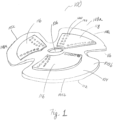
- Fig. 1 shows a device 100 for measuring temperatures in one or more regions of biological tissue, such as the human breast.
- the devices includes a platform 104 having a first surface 108 and a second surface 112.
- the platform may be made of any flexible or semi-rigid material that conforms to the breast tissue and is suitable for application and adherence of medical devices to skin. Medical grade foam tapes, which are substantially water-resistant and inert to skin, are particularly suitable in this regard.
- platform 104 is an open or closed cell foam, which may be a polyethylene foam.
- the first surface 108 of platform 104 may be coated with a medical grade adhesive such as an acrylic-based adhesive.
- Foam padding may be obtained commercially, e.g., 3M TM 1772 Medical Foam Tape, and may include a liner, e.g., a silicone treated, polyethylene coated, bleached Kraft paper.
- the liner may be conveniently used as a removable/releasable cover layer for the device (shown in Fig. 2 ).
- the device 100 contains a temperature sensing module 116 having a top surface 118 which contains a plurality of spaced-apart recesses 120 disposed thereon.
- a thermographic composition 216 may be disposed in each recess.
- the device 100 may be disk-shaped and configured such as in the form of cut-outs or lobes 105a, 105b and 105c, to contain multiple temperature sensing modules e.g., 2, 3 or 4, each of which may have a temperature sensing module 116 disposed thereon.
- This arrangement facilitates application of the device to the breasts without any wrinkling or folding of the device, and for simultaneous temperature measurements in a plurality of regions of the breast.
- the relative dimensions of the platform and the module(s) may vary so as to allow for a periphery 108A, 108B and 108C of the first surface of the platform that is not covered by the module(s) to facilitate adhering the device to the tissue.
- Device 100 may further include a nipple hole 106, that defines the center of the device, and which also facilitates application of the device to a breast.
- the device 100 may be made in various convenient shapes and in sizes, typically ranging from about 5 inches to about 9 inches (e.g ., 5, 6, 7, 8 or 9 inches) in overall diameter, in order to accommodate a wide variety of breast sizes, and depending upon the number of regions of breast tissue to be measured.
- Overall thickness of the device typically ranges from about 3 mm to about 4 mm, and in some embodiments from about 3.25 mm to about 3.75 mm, e.g ., about 3.5 mm.
- the device itself, and advantageously all the individual structural elements therein, are flexible and easily conform to the contour of a wide variety of human breasts, male and female alike, to maximize contact between the device and the breast tissue.
- the device may include one or two appropriately shaped lobes with corresponding temperature sensing modules (that would measure temperatures of mirror hemispheric regions of left and right breast tissue) or more than three, e.g ., 4, appropriately shaped lobes with corresponding temperature sensing modules (that would measure temperature of mirror quadrant regions of breast tissue).
- the lobes may be substantially equal in size.
- the temperature sensing module 116 includes a heat-conductive substrate 208 having a top surface and with the plurality of linear arrays of spaced apart recesses 120 defined in the top surface.
- the conductive nature of the substrate 208 provides substantially uniform distribution of heat that emanates from the breast tissue to each array and the recesses contained therein.
- the substrate 208 may be a layer of a heat-conductive metal foil, such as an aluminum foil (wherein the metal may be in the form of an alloy). Aside from aluminum, flexible, heat-conductive sheets of other materials such as, for example, copper, silver, gold, stainless steel and any other heat-conductive pliable materials, may also be useful.
- the heat conducting substrate may have a thickness that accommodates the depth of the recesses 120. The thickness of the heat conducting substrate typically varies from about 0.0015 to about 0.0025 inches.
- the temperature sensing module 116 also contains a protective layer 212 that is disposed on the top surface of the heat conducting substrate 208 (and which may constitute the top surface of the temperature sensing module 116).
- the protective layer 212 may be composed of a thermoplastic polymer or copolymer, examples of which include polyesters such as polyether terephthalate (commercially available under the tradename Mylar ® ), ethylene copolymers (commercially available under the tradename Surlyn ® ) and polyamides such as nylon.
- the protective layer 212 serves to prevent or minimize contact between the heat conducting substrate 208, particularly metallic foils, and the thermographic compositions 216, which tend to be corrosive.
- the protective layer 212 may be disposed on and secured to the heat conducting substrate 208 via adhesive, e.g ., a polyurethane adhesive.
- the protective layer 212 has a thickness that typically varies from about 0.0005 to about 0.0015 inches.
- the recesses 120 have a round or circular shape and a depth such that they will accommodate volumes (of thermographic compositions) that typically ranges from about 250 nl to about 400 nl.
- the depth of the recesses 120 typically varies from about 0.001 inches to about 0.002 inches and in some embodiments about 0.0015 inches.
- the number of recesses in the linear array 120 may vary, e.g., from about 2 to about 20, and in some embodiments each linear array has at least 3, 4, 5, 6, 7 or 8 recesses.
- the number of recesses in each linear array may differ.
- alternating linear arrays may have between 3-8 recesses and 12-15 recesses. In some other embodiments, the number of recesses in each linear array may alternate between 7 and 15 recesses, and in yet other embodiments, between 8 and 14 recesses.
- the temperature sensing module 116 may be prepared by methods known in the art, such as by first adhering the protective layer 212 to the heat conducting substrate 208 and then subjecting the product to a dimpling process.
- the module 116 may be treated beforehand in order to enhance the adhesion of the thermographic compositions 216 in the recesses. A corona treatment may suffice in these regards.
- Thermographic compositions, in liquid form, are dispensed in the recesses in each of the columns in the array, typically in a volume of about 275 nanoliters (nl) to about 375 nl. Once the compositions are dispensed in the recesses, the temperature sensing module 116 containing the thermographic compositions 216 may be passed through a chilling chamber to quickly freeze and solidify the compositions.
- the device further includes a transparent sealing layer 220.
- This layer 220 seals each recess 120 and the thermographic compositions 216 disposed therein.
- the sealing layer 220 is advantageously impermeable to the thermographic compositions 216.
- the transparency of the sealing layer 220 permits ease of reading the device after removal of the device from breast tissue.
- Polyisobutylene (PIB)-based materials are suitable.
- PIB-type adhesives are commercially available from BASF under the tradename Oppanol ® B (known as a series of medium and high molecular weight polyisobutenes having a weight-average molecular weight (Mw) between 40 ,000 and 4,000,000), and Chevron Chemical Co.
- sealing layer 220 Other materials that may be used as the sealing layer 220 include polypropylene, polyethylene terephthalates, nitrocellulose and polyvinyl chloride.
- the sealing layer 220 may be applied and sealed to the top surface of the temperature sensing module 116 in the form of a laminate and via procedures known in the art such as heat or vacuum sealing.
- the opposing or outer surface transparent sealing layer 116 may have medical grade adhesive disposed thereon.
- the transparent protective layer 220 is applied to the heat conducting module 116, the recesses having been filled with the thermographic compositions 216 in liquid form, thus making a composite.
- the resulting composites may be die cut in order to produce a plurality of substantially equally shaped segments, e.g., triangular segments, followed by applying the segments to the corresponding number of lobe areas 105 on the first surface 108 of the platform 104.
- the device 100 may further include a removable cover layer 224, which may be made from silicon-treated paper such as siliconized Kraft paper.
- This layer 224 which may cover the entirety of the device 100, protects the device 100 after manufacture and prior to use.
- the platform 104 material is commercially available in combination with a so-called release liner, the liner may conveniently serve as the removable cover layer.
- the removable cover layer 224 maybe adhered to the device 100, e.g., by adhesive disposed on the periphery 108A of the first surface 108 of the platform 104 that is not covered by the temperature sensing module(s).
- the resulting device 100 may then be die cut (consistent with the number and shape of the temperature sensing module(s)) into the final shape of the device 100.
- the removable cover layer 224 is easily removable prior to application of the device 100 to the breast tissue.
- breasts are an appendage to the body, they have a lower temperature than the normal body temperature of 98.6°F.
- the actual temperature depends on the size and shape of an individual's breasts. In normal, non-diseased situations, the temperature is substantially the same for both breasts. When early stage breast cancer or certain forms of breast disease is present, however, metabolic activity increases, producing increased heat in the affected breast. As is known in the art, the likelihood of having a cancerous condition in the same region in both breasts is small.
- the inventive device measures the temperature difference in at least one mirror region of each breast. By comparing temperature readings from one breast to the other, the disclosed device can quantify unilateral variations in temperature as between mirror regions of the breasts. A temperature difference of 2°F or more between mirror-image regions may indicate that a pathologic condition exists in the breast with the elevated temperature.
- thermographic compositions 216 are solid solutions at room temperature, and at higher temperatures, including temperatures in a diagnostically relevant temperature range, undergo a change in state from solid to liquid.
- the thermographic compositions 216 exhibit a first color in the solid state, which is visible to the naked eye, and exhibit a second color when in the liquid state, which color is distinct from the first color and is also visible to the naked eye.
- the thermographic compositions 216 include a binary solvent system, and at least one colorant.
- the binary solvent system includes a mixture of ortho-bromonitrobenzene (OBNB), which has a melting point of 106.88°F, and orthochloronitrobenzene (OCNB), which has a melting point of 90.98°F.
- OBNB ortho-bromonitrobenzene
- OCNB orthochloronitrobenzene
- the relative amounts of each solvent in the solid state (which may be measured by weight) may be varied in a given thermographic composition 216 such that the composition melts, with an accompanying color change, at a precise temperature within the range.
- the thermographic compositions 216 also possess the property of stable undercooling and will remain liquid for at least several minutes up to several hours when subjected to a surrounding temperature that is somewhat below the melting point of the composition. This property allows for ease of reading and interpreting the results without haste due to the supercooling effect of the binary system.
- thermographic compositions 216 may be formulated to have precise melting points over the diagnostically relevant temperature range. Broadly, this range may include temperatures from about 88°F to about 107°F, e.g., from about 88°F to about 106.7°F (the upper end taking into account high fever), in order to detect breast disease such as cancer.
- the device is configured to detect breast temperatures in a range of about 90°F to about 99°F, and in some embodiments from about 90°F to about 98.5°F, and in some other embodiments from about 90.5°F to about 99°F.
- thermographic compositions contained in any one linear array 120 contain the same relative amounts of OBNB and OCNB, and thus have the same melting point.
- the melting point temperatures of the thermographic compositions 216 are typically accurate to within ⁇ 0.2°F. Also, no two linear arrays contain thermographic compositions 216 having the same melting point.
- compositions contained in each successive linear array are thus formulated by varying the relative amounts of OBNB and OCNB (which due to their respective melting points are inversely related, and which also may be measured in terms of weight in the solid state), such that the compositions in each successive array have incrementally increasing melting points, typically in increments of about 0.2°F to about 1.0°F, and in some embodiments from about 0.2°F to about 0.5°F, and in some embodiments about 0.25°F, and in yet other embodiments about 0.5°F.
- the number of linear arrays disposed in the temperature sensing module 116 will be determined accordingly.
- the device may contain 10 linear arrays, and in the case of 0.5°F increments, the device may contain 19 linear arrays.
- the relative amounts of OBNB may thus vary from about 6% (at the lower end of the temperature range) to about 75% (wt/wt) (at the higher end of the temperature range) and in some embodiments from about 12.5% to about 72%.
- the relative amounts of OCNB may vary from about 95% to about 25% (wt/wt) and in some embodiments from about 88% to about 28%.
- the thermographic compositions 216 also contain at least one colorant.
- the colorant is compatible with (e.g ., soluble or dispersible in) the liquid resulting from the change of state from solid to liquid. In some embodiments, it is soluble in the solvent system when the composition is in the liquid state, and which causes a change in color of the composition, which is visible to the naked eye, when the composition changes from solid to liquid and from liquid to solid.
- the presence of the colorant allows the compositions 216 to reflect or absorb light in the visible area of the spectrum on or below the melting point of the solvent system or, in the alternative, on or above the melting point of the solvent system, or both in different colors, so that a change in color is visible to the naked eye.
- the colorant may be a dye such as an organic dye. Oil-soluble dyes are suitable.
- the compositions contain a leuco dye, which as known in the art, exists in two forms, one of which is substantially colorless.
- leuco dyes include dyes that contains a lactone group such as crystal violet lactone. Some lactone-containing dyes, such as crystal violet lactone, are leuco dyes.
- anthraquinone dyes that may be useful with practice of the disclosed device include anthraquinone dyes substituted once or severally with one or more of the following functional groups: amino, alkylamino, arylamino, acylamino, aroylamino, aroylamino wherein the aryl ring is further substituted, alkylsulfonylamino, alkylsulfonylamino wherein the alkyl chain may be branched and contains from two to twenty carbons atoms, arylsulfonylamino, arylsulfonylamino wherein the aryl ring is further substituted, hydroxy, alkoxy, aryloxy, substituted aryloxy, alkylthio, arylthio, substituted arylthio, chloro, bromo, etc.
- quinolone dyes e.g ., pinacyanol chloride, pinacyanol bromide, pinacyanol iodide, quinaldine red, cryptocyanine, 1,1'-Diethyl-2,2'-cyanine iodide, 2-(p-Dimethylaminostyryl)-1
- sulphonephthalein dyes e.g ., cresol red, chlorophenol red, chlorophenol blue, bromophenol blue, bromocresol purple and chlorocresol green.
- organic dyes that may be useful with practice of the disclosed device, such as Sudan dyes, are generally known in the art, see e.g. US Patent 4,232,552 .
- the thermographic compositions 216 contain a plurality of (e.g ., two) dyes, both of which may be organic dyes.
- the respective dyes may or may not exhibit visible color in both the solid and the liquid states, provided, however, that the compositions exhibit a first color in the solid state and a second, distinct color in the liquid state, wherein the colors are visible to the naked eye.
- a composition containing the leuco dye crystal violet lactone exhibits a very bright blue color in a solid state and a faint yellow color in the liquid state.
- the presence of a second organic dye that dominates the overall color of the composition when in the liquid state may further enhance reading and interpretation of the results.
- the composition may include a dye that exhibits a strong red color when in the liquid state, such that upon melting the compositions change from blue to red.
- the thermographic compositions 216 may contain additional components.
- some dyes are pH-sensitive and are used in combination with an activator or developer.
- Some dyes containing lactone groups, e.g ., crystal violet lactone, may be used with an activator.
- Representative examples of activators include organic acids having a pK a of about 4 to about 12, e.g ., phenol, bisphenol A, arachidic acid, pyrocathechol and 3-nitrophenol.
- Other examples of activators include UV absorbers, e.g ., 2,2',4'4'-tetrahydroxybenzophenone (commercially available from BASF under the tradename Uvinul ® ).
- the total amount of the activator(s) generally varies from about 0.25% to about 0.70%, based on the total weight of the thermographic composition.
- the colorants, and other non-solvent components of the compositions may be referred to as an indicator system.
- the colorant may include a pigment.
- the amounts of the colorant(s) and the indicator system contained in the thermographic compositions 216 may be determined in accordance with standard techniques, in order to obtain visible color change in the volumes of solvent accommodated by the recesses.
- the amount of colorant typically varies from about 0.10% wt to about 0.40% wt, and the amounts of the indicator system typically vary from about 0.1% to about 1.0% by weight, based on the total weight of the composition.
- the device 100 contains 3 temperature sensing modules 116 A, B and C, disposed in the respective lobes 105 on the first surface 108 of the platform 104.
- Each temperature sensing module 116 contains 18 linear arrays 304, of spaced apart recesses 120.
- the arrays contain alternating numbers of 14 and 8 recesses.
- thermographic compositions 216 contained in the recesses 120 in each of the arrays may be formulated, in terms of relative amounts (expressed in terms of % wt/wt) of OBNB and OCNB present therein, as set forth in Table 1.
- the indicator system may include the following dyes and activators, in amounts in the ranges set forth in Tables 2 and 3 below.
- Table 2 COPIKEM I (Crystal Violet Lactone) (0.10 and 0.3% wt) 2,2',4'4'-tetrahydroxybenzophenone (Uvinul) (0.10 and 0.3% wt) 1-methylaminoanthraquinone (Spectra III) (0.04 and 0.05% wt) 4,4'-isopropylidenediphenol (Bisphenol A) (0.10 and 0.3% wt)
- Table 3 COPIKEM I (Crystal Violet Lactone) (0.10 and 0.3% wt) 2,2',4'4'-tetrahydroxybenzophenone (Uvinul) (0.10 and 0.3% wt) 1-[[4-(phenylazo)phenyl]azo-2-naphthalenol (D&C Red #17) (0.03 and 0.05% wt) 4,4'-isopropylid
- thermographic compositions each designed to melt at 0.5 degree increments in a range from 90 degrees to 99 degrees as shown in Table 1, may be prepared by mixing together relative amounts of an ortho-chloro composition and an ortho-bromo composition, as shown in Tables 4 and 5, respectively.
- device 100 further includes a data structure 330 which may attached to the first surface 108 of the platform 104.
- data structure 330 may be implemented with a QR code is a machine-readable code that includes an array of black and white squares, typically used for storing URLs or other information for reading by the camera on a smartphone.
- the QR code may be used as a serial number for the device, for example, establishing authenticity in terms of commercial source, and tracking production details such as the lot or batch number, and which may be used in communication with an electronic device to read the results.
- Other data structure formats such as two and three-dimensional barcodes may be similarly utilized for the structure 330 with the devices disclosed herein
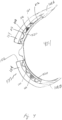
- FIG. 4 A cross-sectional view of a device 100 once applied to the breast 404 (minus the second backing layer which is removed beforehand), is shown in Fig. 4 .
- the disclosed device 100 is applied to each breast 404.
- a pair of devices 100 may be packaged together in the form of a kit, sealed so as to be substantially impermeable to air, along with printed instructions for use, e.g ., proper alignment of each device on the breasts so that the mirror regions of each breast are matched with corresponding lobe areas of the device, and for reading and interpreting the results shown on the used device after it is removed from the breast.
- the kit may be stored at temperatures suitably below the diagnostically relevant temperature range, e.g ., below 80°F.
- the device 100 may not require the assistance of a practitioner, such as a physician or nurse.
- the patient may apply the device herself.
- the patient may be seated in an upright position.
- the removable (releasable) cover layer (not shown) is removed.
- the procedure is repeated for the other breast.
- the devices are applied in the same alignment, in which the designated lobes A, B and C, are placed on the corresponding mirror regions of the breasts.
- thermographic composition in one or more of the columns melts and becomes liquid, the color will change.
- the color turns from blue to red, enhancing ease of reading and interpreting the results.
- the application of the device to both breasts is advantageously performed in less than about two minutes so as to minimize conversion of the thermographic compositions to the liquid state prior to contact with the breast tissue, and thus ensure accurate results.
- Fig. 4 shows the device 100 fitted onto the breast 404, centered via the nipple hole 106.
- Transparent plastic layer 220 is contiguous to the breast tissue.
- the device 100 may be adhesively and releasably secured to the breast tissue via the overlapping portions or peripheries 108A and 108B of the platform 104 via the adhesive disposed on the first surface 108 thereof (periphery 108C not shown).
- the devices may be in place for about 15 minutes. Thereafter, the devices are removed for purposes of reading and interpreting the results.
- Figs. 5A and 5B show devices 500 and 550 removed from the left and right breasts, respectively.
- the numbers 1-18 printed on each temperature sensing module 116 signify the number of linear arrays where each array represents a specific temperature within the range of 90-98.5°F, from lowest to highest, and in increments of 0.5°F.
- the letters A, B and C signify the lobes that will be positioned on the same region of each breast for purposes of correctly aligning each device 500 and 550, e.g ., so that lobe A will be positioned on the top of each breast, lobe B is positioned on the inner breast, and lobe C is positioned on the outer breast).
- the color change is shown by light or dark recesses or dots, where dark dots signify that the thermographic compositions therein melted and thus changed color from blue to red.
- a test recording form may be placed next to the left and right devices.
- Lines 504A, 504B, 504C and 554A, 554B and 554C may be drawn on the Test Recording Form (or on the used devices themselves) from the top (where the numbers 1-18 are printed) to the bottom (where the letters A, B and C are printed on the highest numbered array showing a change of color (i.e ., from light (blue) to dark (red)) in at least three recesses. This is done for each of the three regions, in both of the left and right breast pads.
- the array number that the line is drawn through for each of the three regions for each breast on the bottom of the form is recorded.
- the difference for each mirror region is calculated.
- the difference in the array numbers between the A region in the left breast pad and the corresponding A region in the right breast pad determines the temperature differential.
- the results of the A, B and C regions are read and interpreted individually.
- the temperature of both breasts is substantially the same.
- the tissue in each of the mirror regions of both breasts will be about equal, e.g ., within 2.0°F within each other.
- the thermographic compositions contained in at least three of the recesses in each of linear arrays enumerated 1-7 contained in the same lobe on both breasts will turn from light to dark ( e.g ., blue to red).
- the tissue of one breast has increased metabolic activity, the temperature will be higher and a color change will appear in at least one higher numbered linear array.
- the highest numbered column with at least three dark recesses is row 5, which means that the temperature of this "A" region of the left breast is 92°F.
- the highest numbered column with at least three dark recesses is row 9, which means that this mirror "A" region of the right breast is 94°F.
- a difference of 4 or more lines or columns, which represents a temperature differential of 2°F or more, may be considered diagnostically significant. This result will constitute an alert and the user may consult with a doctor for further tests.
- Fig. 6 is a top view of an embodiment of a device 600 substantially similar in construction and function as device 100 described herein with reference to Figures 1 - 5B , except that device 600 further comprises an additional lobe 105d having a temperature sensing module 116d disposed thereon, as illustrated.
- the device 600 when placed over the breast, enables the lobe 105d to be positioned approximately underneath the armpit for detection of heat signatures by temperature sensing module 116d in the area of any lymph nodes proximate the armpit.
- the temperature sensing module 116d may have a similar or different construction and function to temperature sensing module 116a-c described herein.
- the arrangement and pattern of recesses 120 of temperature sensing module 116d on lobe 105d may be different than that of lobes 105a-c and may be designed for optimal coverage of the desired area.
- the space intermediate lobe 105d and the closest adjacent lobe 105a may be approximately as illustrated or may be increased or decreased.
- the device 600 may also include a data structure 330, which may be implemented with a QR code, similar to devices 500 and 550.
- values are disclosed in groups or in ranges. It is specifically intended that the description include each and every individual sub-combination of the members of such groups and ranges and any combination of the various endpoints of such groups or ranges.
- an integer in the range of 0 to 40 is specifically intended to individually disclose 0, 1, 2, 3, 4, 5, 6, 7, 8, 9, 10, 11, 12, 13, 14, 15, 16, 17, 18, 19, 20, 21, 22, 23, 24, 25, 26, 27, 28, 29, 30, 31, 32, 33, 34, 35, 36, 37, 38, 39, and 40
- an integer in the range of 1 to 20 is specifically intended to individually disclose 1, 2, 3, 4, 5, 6, 7, 8, 9, 10, 11, 12, 13, 14, 15, 16, 17, 18, 19, and 20
Landscapes
- Health & Medical Sciences (AREA)
- Life Sciences & Earth Sciences (AREA)
- Physics & Mathematics (AREA)
- Surgery (AREA)
- General Health & Medical Sciences (AREA)
- Engineering & Computer Science (AREA)
- Biomedical Technology (AREA)
- Heart & Thoracic Surgery (AREA)
- Medical Informatics (AREA)
- Molecular Biology (AREA)
- Biophysics (AREA)
- Animal Behavior & Ethology (AREA)
- Pathology (AREA)
- Public Health (AREA)
- Veterinary Medicine (AREA)
- General Physics & Mathematics (AREA)
- Gynecology & Obstetrics (AREA)
- Reproductive Health (AREA)
- Radiation Pyrometers (AREA)
- Measuring And Recording Apparatus For Diagnosis (AREA)
Claims (17)
- Vorrichtung zur Messung von Temperaturen in einem oder mehreren Bereichen an einer menschlichen Brust, wobei die Vorrichtung Folgendes umfasst:eine Plattform (104), die eine erste Fläche (108) und eine zweite Fläche (112) aufweist;ein Temperaturerfassungsmodul (116), das auf der ersten Fläche (108) der Plattform (104) angeordnet ist, wobei das Modul Folgendes umfasst:ein wärmeleitendes Substrat (208), das eine obere Fläche und eine Vielzahl von linearen Anordnungen aufweist, umfassend eine Vielzahl von in der oberen Fläche definierten beabstandeten Aussparungen (120);eine Schutzschicht (212) aus Material, die auf der oberen Fläche des wärmeleitenden Substrats angeordnet ist;eine thermografische Zusammensetzung, die in jeder Aussparung (120) angeordnet ist; undeine transparente Dichtschicht (22), die zum Abdichten jeder Aussparung (120) über dem wärmeleitenden Substrat (208) angeordnet ist,wobei die thermografische Zusammensetzung Folgendes umfasst:ein binäres Lösungsmittelsystem, umfassend eine relative Menge an ortho-Chlornitrobenzol (OCNB) und ortho-Bromnitrobenzol (OBNB); undein Indikatorsystem, umfassend ein Farbmittel, wobei das Farbmittel einen ersten Farbstoff umfasst, der Kristallviolettlacton ist; undeinen zweiten Farbstoff, der (1-Methylamino)anthrachinon oder 1-[[4-(Phenylazo)phenyl]azo]-2-naphthalinol ist; undwobei das Indikatorsystem ferner einen Aktivator umfasst, umfassend Bisphenol A und 2,2',4',4'-Tetrahydroxybenzophenon, wobei das Indikatorsystem in einer Menge von 0,1 bis 1,0 Gew.-%, bezogen auf das Gesamtgewicht der thermografischen Zusammensetzung, vorliegt;wobei die relative Menge von OCNB und OBNB einen Schmelzpunkt der thermografischen Zusammensetzung bestimmt,wobei die thermografische Zusammensetzung, wenn sie in einem festen Zustand ist, eine erste Farbe zeigt und wenn sie in einem flüssigen Zustand ist, eine zweite von der ersten Farbe abweichende Farbe zeigt, wobei jede der ersten und zweiten Farbe mit bloßem Auge sichtbar ist,wobei die thermografischen Zusammensetzungen in den Aussparungen (120) in einer beliebigen linearen Anordnung identisch sind und einen gleichen Schmelzpunkt innerhalb eines diagnostisch relevanten Temperaturbereichs aufweisen,wobei keine zwei linearen Anordnungen thermographische Zusammensetzungen mit dem gleichen Schmelzpunkt enthalten und wobei die unterschiedlichen Schmelzpunkte der thermografischen Zusammensetzung in der Vielzahl von linearen Anordnungen den diagnostisch relevanten Temperaturbereich definieren, wobei die Vorrichtung konform mit einer Form einer menschlichen Brust ist.
- Vorrichtung nach Anspruch 1, wobei der Unterschied zwischen jeweiligen Schmelzpunkten der thermografischen Zusammensetzung benachbarter linearer Anordnungen im Bereich von 0,2 °F bis 1,0 °F (0,11 °C bis 0,56 °C) oder vorzugsweise im Bereich von 0,2 °F bis 0,5 °F (0,11 °C bis 0,28 °C) liegt.
- Vorrichtung nach Anspruch 1, wobei das wärmeleitende Material eine Metallfolie umfasst.
- Vorrichtung nach Anspruch 1, wobei die transparente Dichtschicht ein thermoplastisches Polymer umfasst.
- Vorrichtung nach Anspruch 1, wobei der diagnostisch relevante Temperaturbereich etwa 88 °F bis etwa 106,7 °F (etwa 31,1 °C bis etwa 41,5 °C) oder vorzugsweise 90 °F bis etwa 99 °F (32,2 °C bis etwa 37,2 °C) oder besonders bevorzugt 90 °F bis etwa 98,5 °F (32,2 °C bis etwa 36,9 °C) oder ganz besonders bevorzugt 90,5 °F bis etwa 99 °F (32,5 °C bis etwa 37,2 °C) beträgt.
- Vorrichtung nach Anspruch 1, wobei die Vielzahl von linearen Anordnungen von Aussparungen (120) radial angeordnet ist.
- Vorrichtung nach Anspruch 1, wobei die linearen Anordnungen in einer Reihenfolge angeordnet sind, die sequenziell ansteigenden Schmelzpunkten der thermografischen Zusammensetzung innerhalb des diagnostisch relevanten Temperaturbereichs entspricht.
- Vorrichtung nach Anspruch 1, wobei jede lineare Anordnung mindestens 3 bis 8 Aussparungen aufweist.
- Vorrichtung nach Anspruch 1, wobei:
die Plattform (104) ein Schaumstoffmaterial umfasst. - Vorrichtung nach Anspruch 9, ferner umfassend:
Klebstoff in medizinischer Qualität, der auf der ersten Fläche (108) der Plattform (104) angeordnet ist, wobei das Temperaturerfassungsmodul (116) durch den Klebstoff auf der ersten Fläche (108) der Plattform (104) gehalten wird. - Vorrichtung nach Anspruch 1, wobei eine Öffnung in einer Mitte der Plattform (104) definiert ist und wobei die Vielzahl von linearen Anordnungen von beabstandeten Aussparungen (120) radial in Bezug auf die Mitte der Plattform (104) angeordnet ist.
- Vorrichtung nach Anspruch 1, wobei abwechselnde lineare Anordnungen von Aussparungen (120) eine unterschiedliche Anzahl von Aussparungen aufweisen.
- Vorrichtung nach Anspruch 10, ferner umfassend eine lösbare Deckschicht (224), die eine Form aufweist, die der Plattform (104) entspricht, die über der Vorrichtung bereitgestellt und lösbar an der ersten Fläche (108) der Plattform (104) durch den Klebstoff am Umfang befestigt ist.
- Vorrichtung nach Anspruch 1, ferner umfassend eine Datenstruktur (330), die auf der ersten Fläche der Plattform (104) angeordnet ist.
- Vorrichtung nach Anspruch 1, wobei die Plattform (104) zum Definieren einer Vielzahl von Lappenbereichen, vorzugsweise 3 Lappenbereichen, geformt ist, und wobei jeder der Vielzahl von Lappenbereichen konform mit einer Form einer menschlichen Brust ist.
- Vorrichtung nach Anspruch 1, wobei das Farbmittel in einer Menge von 0,10 bis 0,40 Gew.-%, bezogen auf das Gesamtgewicht der thermografischen Zusammensetzung, vorliegt.
- Vorrichtung nach Anspruch 1, wobei das Kristallviolettlacton in einer Menge von 0,10 bis 0,3 Gew.-%, bezogen auf das Gesamtgewicht der thermografischen Zusammensetzung, der zweite Farbstoff 1-[[4-(Phenylazo)phenyl]azo]-2-naphthalenol ist, das in einer Menge von 0,03 bis 0,05 Gew.-%, bezogen auf das Gesamtgewicht der thermografischen Zusammensetzung, vorliegt, jedes von dem Bisphenol A und 2,2',4',4'-Tetrahydroxybenzophenon in einer Menge von 0,10 bis 0,3 Gew.-%, bezogen auf das Gesamtgewicht der thermografischen Zusammensetzung, vorliegt, wobei der Aktivator auch Arachinsäure in einer Menge von 0,01 bis 0,03 Gew.-%, bezogen auf das Gesamtgewicht der thermografischen Zusammensetzung, umfasst.
Applications Claiming Priority (2)
| Application Number | Priority Date | Filing Date | Title |
|---|---|---|---|
| US201762596223P | 2017-12-08 | 2017-12-08 | |
| PCT/US2018/064498 WO2019113460A2 (en) | 2017-12-08 | 2018-12-07 | Thermographic device for measurement of differential temperatures in tissue |
Publications (3)
| Publication Number | Publication Date |
|---|---|
| EP3758592A2 EP3758592A2 (de) | 2021-01-06 |
| EP3758592A4 EP3758592A4 (de) | 2022-04-27 |
| EP3758592B1 true EP3758592B1 (de) | 2024-11-06 |
Family
ID=66751811
Family Applications (1)
| Application Number | Title | Priority Date | Filing Date |
|---|---|---|---|
| EP18886738.6A Active EP3758592B1 (de) | 2017-12-08 | 2018-12-07 | Thermografische vorrichtung zur messung von differenztemperaturen in gewebe |
Country Status (4)
| Country | Link |
|---|---|
| US (2) | US11445917B2 (de) |
| EP (1) | EP3758592B1 (de) |
| MX (1) | MX2020005985A (de) |
| WO (1) | WO2019113460A2 (de) |
Families Citing this family (5)
| Publication number | Priority date | Publication date | Assignee | Title |
|---|---|---|---|---|
| EP3758592B1 (de) | 2017-12-08 | 2024-11-06 | Welwaze Medical Inc. | Thermografische vorrichtung zur messung von differenztemperaturen in gewebe |
| GB2619725B (en) * | 2022-06-14 | 2025-04-23 | Davion Healthcare Plc | System, sensor device, and method for determining differential temperature in breast |
| IL305760B2 (en) * | 2023-09-07 | 2025-04-01 | Feminai LTD | Unit, kit and system for detecting tissue abnormalities |
| IL301229B2 (en) * | 2023-03-08 | 2025-06-01 | Feminai LTD | Unit, kit and system for identifying abnormalities in a tissue of a subject |
| GB2636586A (en) * | 2023-12-15 | 2025-06-25 | Davion Healthcare Plc | Sensor device, system and method for determining temperatures of different regions of a breast |
Family Cites Families (25)
| Publication number | Priority date | Publication date | Assignee | Title |
|---|---|---|---|---|
| US2490933A (en) * | 1943-07-19 | 1949-12-13 | Earl L Tornquist | Temperature indicator |
| US3830224A (en) | 1972-12-19 | 1974-08-20 | Vanzetti Infrared Computer Sys | Means for detecting changes in the temperature of the skin |
| US3847139A (en) | 1973-04-13 | 1974-11-12 | E Flam | Device for aid in detecting breast cancer |
| DE2536773C3 (de) * | 1975-08-19 | 1978-11-30 | Troponwerke Gmbh & Co Kg, 5000 Koeln | Thermographische Platte zur Messung von Temperaturverteilungen |
| US4232552A (en) | 1978-09-28 | 1980-11-11 | Akzona Incorporated | Temperature indicating compositions of matter |
| US4186731A (en) * | 1978-05-15 | 1980-02-05 | Clark William T Iii | Topical Thermograph |
| US4190058A (en) | 1978-05-22 | 1980-02-26 | Arden Industries, Inc. | Device for use in early detection of breast cancer |
| US4651749A (en) * | 1978-05-22 | 1987-03-24 | B.C.S.I. Laboratories, Inc. | Cancer detection patch for early detection of breast cancer |
| US4624264A (en) | 1978-05-22 | 1986-11-25 | B.C.S.I. Laboratories, Inc. | Method of early detection of breast cancer |
| US4362645A (en) * | 1978-09-28 | 1982-12-07 | Akzona, Inc. | Temperature indicating compositions of matter |
| US4397570A (en) | 1981-06-02 | 1983-08-09 | Pymah Corporation | Pressure sensitive adhesive containing a nucleating agent for use in a disposable thermometer |
| US4437471A (en) * | 1982-01-13 | 1984-03-20 | Jeffrey Nelson | Implement for measuring skin temperatures |
| US4524778A (en) * | 1983-07-01 | 1985-06-25 | American Thermometer Co., Inc. | Skin temperature indicating and recording device |
| US4788984A (en) * | 1987-01-30 | 1988-12-06 | Procare Industries Ltd. | Method and kit for use in conceiving a child of a desired gender |
| US5094545A (en) | 1990-09-28 | 1992-03-10 | Pyma Corporation | Urine temperature measuring device |
| DE4216341A1 (de) * | 1992-05-16 | 1993-11-18 | Roehm Gmbh | Lichtstreuende Polymethacrylat-Formkörper mit hohen Temperatur- und Wetterechtheitswerten |
| US5816707A (en) | 1994-05-06 | 1998-10-06 | Minnesota Mining And Manufacturing Company | Reversible chemical thermometer |
| US6135968A (en) | 1997-09-10 | 2000-10-24 | Scantek Medical, Inc. | Differential temperature measuring device and method |
| US6086247A (en) * | 1998-02-05 | 2000-07-11 | Von Hollen; Dirk | Differential temperature sensor device for use in the detection of breast cancer and breast disease |
| US6419636B1 (en) | 1998-10-02 | 2002-07-16 | David Ernest Young | System for thermometry-based breast assessment including cancer risk |
| US6077228A (en) * | 1998-11-04 | 2000-06-20 | Schonberger; Milton | Breast temperature scanner |
| PL220699B1 (pl) | 2010-01-29 | 2015-12-31 | Braster Spółka Z Ograniczoną Odpowiedzialnością | Mieszanina związków ciekłokrystalicznych, układ trzech mieszanin ciekłokrystalicznych oraz ich zastosowanie |
| US8990479B2 (en) | 2012-07-30 | 2015-03-24 | Lenovo Enterprise Solutions (Singapore) Pte. Ltd. | Using persistent memory regions within memory devices to collect serial presence detect and performance data |
| US20170007170A1 (en) * | 2015-07-10 | 2017-01-12 | Rememdia LC | Allergy Skin Test Devices |
| EP3758592B1 (de) | 2017-12-08 | 2024-11-06 | Welwaze Medical Inc. | Thermografische vorrichtung zur messung von differenztemperaturen in gewebe |
-
2018
- 2018-12-07 EP EP18886738.6A patent/EP3758592B1/de active Active
- 2018-12-07 MX MX2020005985A patent/MX2020005985A/es unknown
- 2018-12-07 WO PCT/US2018/064498 patent/WO2019113460A2/en not_active Ceased
- 2018-12-10 US US16/214,928 patent/US11445917B2/en active Active
-
2022
- 2022-09-19 US US17/947,512 patent/US11998302B2/en active Active
Also Published As
| Publication number | Publication date |
|---|---|
| US20230200662A1 (en) | 2023-06-29 |
| WO2019113460A3 (en) | 2020-03-26 |
| EP3758592A2 (de) | 2021-01-06 |
| MX2020005985A (es) | 2020-10-28 |
| WO2019113460A2 (en) | 2019-06-13 |
| US20190209019A1 (en) | 2019-07-11 |
| EP3758592A4 (de) | 2022-04-27 |
| CA3085004A1 (en) | 2019-06-13 |
| US11445917B2 (en) | 2022-09-20 |
| US11998302B2 (en) | 2024-06-04 |
Similar Documents
| Publication | Publication Date | Title |
|---|---|---|
| US11998302B2 (en) | Thermographic device for measurement of differential temperatures in tissue | |
| US4064872A (en) | Temperature measuring device of a liquid crystal laminate | |
| US9526460B2 (en) | Tissue-characterization probe with effective sensor-to-tissue contact | |
| Bottini et al. | Magnetic resonance imaging compared to echocardiography to assess left ventricular mass in the hypertensive patient | |
| USRE32000E (en) | Device for use in early detection of breast cancer | |
| US20090259139A1 (en) | Thermomastographic apparatus for differentiation diagnostics for detecting breast pathology in women and use of the thermomastographic apparatus for differentiation diagnostics | |
| US4428382A (en) | Method for identifying the presence of abnormal tissue | |
| WO2008132714A2 (en) | Ergonomic probes | |
| US4651749A (en) | Cancer detection patch for early detection of breast cancer | |
| US4190058A (en) | Device for use in early detection of breast cancer | |
| EP3250116B1 (de) | Thermooptische kontaktstruktur und deren anwendung bei der erkennung von allergischen reaktionen | |
| US4624264A (en) | Method of early detection of breast cancer | |
| CA3085004C (en) | Thermographic device for measurement of differential temperatures in tissue | |
| HK40044139B (en) | Thermographic device for measurement of differential temperatures in tissue | |
| HK40044139A (en) | Thermographic device for measurement of differential temperatures in tissue | |
| US20090198154A1 (en) | Mole tracking system | |
| CN215839561U (zh) | 一种治疗检查提示腕带 | |
| Simons et al. | The role of clinical data in interpretation of perfusion images | |
| RU2532372C1 (ru) | Способ дифференциальной диагностики доброкачественных и злокачественных опухолей молочной железы | |
| Goldberg et al. | Contact plate thermography: a new technique for diagnosis of breast masses | |
| Mahoney et al. | Early diagnosis of breast cancer: experience in a consultant breast clinic | |
| Antonini et al. | Thermography surveillance after breast conserving surgery—Three cases | |
| WO2024192515A1 (en) | Tissue phantoms | |
| Joy et al. | Breast cancer technology overview | |
| Marshall | Ultraviolet photography in detecting ‘latent’halos of pigmented lesions |
Legal Events
| Date | Code | Title | Description |
|---|---|---|---|
| STAA | Information on the status of an ep patent application or granted ep patent |
Free format text: STATUS: THE INTERNATIONAL PUBLICATION HAS BEEN MADE |
|
| PUAI | Public reference made under article 153(3) epc to a published international application that has entered the european phase |
Free format text: ORIGINAL CODE: 0009012 |
|
| STAA | Information on the status of an ep patent application or granted ep patent |
Free format text: STATUS: REQUEST FOR EXAMINATION WAS MADE |
|
| 17P | Request for examination filed |
Effective date: 20200706 |
|
| AK | Designated contracting states |
Kind code of ref document: A2 Designated state(s): AL AT BE BG CH CY CZ DE DK EE ES FI FR GB GR HR HU IE IS IT LI LT LU LV MC MK MT NL NO PL PT RO RS SE SI SK SM TR |
|
| AX | Request for extension of the european patent |
Extension state: BA ME |
|
| DAV | Request for validation of the european patent (deleted) | ||
| DAX | Request for extension of the european patent (deleted) | ||
| REG | Reference to a national code |
Ref country code: HK Ref legal event code: DE Ref document number: 40044139 Country of ref document: HK |
|
| A4 | Supplementary search report drawn up and despatched |
Effective date: 20220324 |
|
| RIC1 | Information provided on ipc code assigned before grant |
Ipc: G01K 11/16 20210101ALI20220319BHEP Ipc: C09K 3/00 20060101ALI20220319BHEP Ipc: A61B 5/01 20060101AFI20220319BHEP |
|
| GRAP | Despatch of communication of intention to grant a patent |
Free format text: ORIGINAL CODE: EPIDOSNIGR1 |
|
| STAA | Information on the status of an ep patent application or granted ep patent |
Free format text: STATUS: GRANT OF PATENT IS INTENDED |
|
| RIC1 | Information provided on ipc code assigned before grant |
Ipc: G01K 11/16 20060101ALI20240404BHEP Ipc: C09K 3/00 20060101ALI20240404BHEP Ipc: A61B 5/01 20060101AFI20240404BHEP |
|
| INTG | Intention to grant announced |
Effective date: 20240419 |
|
| GRAS | Grant fee paid |
Free format text: ORIGINAL CODE: EPIDOSNIGR3 |
|
| GRAA | (expected) grant |
Free format text: ORIGINAL CODE: 0009210 |
|
| STAA | Information on the status of an ep patent application or granted ep patent |
Free format text: STATUS: THE PATENT HAS BEEN GRANTED |
|
| AK | Designated contracting states |
Kind code of ref document: B1 Designated state(s): AL AT BE BG CH CY CZ DE DK EE ES FI FR GB GR HR HU IE IS IT LI LT LU LV MC MK MT NL NO PL PT RO RS SE SI SK SM TR |
|
| REG | Reference to a national code |
Ref country code: GB Ref legal event code: FG4D |
|
| REG | Reference to a national code |
Ref country code: CH Ref legal event code: EP |
|
| REG | Reference to a national code |
Ref country code: DE Ref legal event code: R096 Ref document number: 602018076407 Country of ref document: DE |
|
| REG | Reference to a national code |
Ref country code: IE Ref legal event code: FG4D |
|
| REG | Reference to a national code |
Ref country code: GB Ref legal event code: 732E Free format text: REGISTERED BETWEEN 20250206 AND 20250212 |
|
| REG | Reference to a national code |
Ref country code: LT Ref legal event code: MG9D |
|
| REG | Reference to a national code |
Ref country code: NL Ref legal event code: MP Effective date: 20241106 |
|
| REG | Reference to a national code |
Ref country code: DE Ref legal event code: R081 Ref document number: 602018076407 Country of ref document: DE Owner name: WELWAZE MEDICAL INC., MIAMI, US Free format text: FORMER OWNERS: MOUSA, SAMIR, BOONTON, NJ, US; WELWAZE MEDICAL INC., MIAMI, FL, US |
|
| PG25 | Lapsed in a contracting state [announced via postgrant information from national office to epo] |
Ref country code: HR Free format text: LAPSE BECAUSE OF FAILURE TO SUBMIT A TRANSLATION OF THE DESCRIPTION OR TO PAY THE FEE WITHIN THE PRESCRIBED TIME-LIMIT Effective date: 20241106 Ref country code: PT Free format text: LAPSE BECAUSE OF FAILURE TO SUBMIT A TRANSLATION OF THE DESCRIPTION OR TO PAY THE FEE WITHIN THE PRESCRIBED TIME-LIMIT Effective date: 20250306 Ref country code: IS Free format text: LAPSE BECAUSE OF FAILURE TO SUBMIT A TRANSLATION OF THE DESCRIPTION OR TO PAY THE FEE WITHIN THE PRESCRIBED TIME-LIMIT Effective date: 20250306 |
|
| PG25 | Lapsed in a contracting state [announced via postgrant information from national office to epo] |
Ref country code: NL Free format text: LAPSE BECAUSE OF FAILURE TO SUBMIT A TRANSLATION OF THE DESCRIPTION OR TO PAY THE FEE WITHIN THE PRESCRIBED TIME-LIMIT Effective date: 20241106 Ref country code: FI Free format text: LAPSE BECAUSE OF FAILURE TO SUBMIT A TRANSLATION OF THE DESCRIPTION OR TO PAY THE FEE WITHIN THE PRESCRIBED TIME-LIMIT Effective date: 20241106 |
|
| REG | Reference to a national code |
Ref country code: AT Ref legal event code: MK05 Ref document number: 1738442 Country of ref document: AT Kind code of ref document: T Effective date: 20241106 |
|
| PG25 | Lapsed in a contracting state [announced via postgrant information from national office to epo] |
Ref country code: BG Free format text: LAPSE BECAUSE OF FAILURE TO SUBMIT A TRANSLATION OF THE DESCRIPTION OR TO PAY THE FEE WITHIN THE PRESCRIBED TIME-LIMIT Effective date: 20241106 |
|
| PG25 | Lapsed in a contracting state [announced via postgrant information from national office to epo] |
Ref country code: ES Free format text: LAPSE BECAUSE OF FAILURE TO SUBMIT A TRANSLATION OF THE DESCRIPTION OR TO PAY THE FEE WITHIN THE PRESCRIBED TIME-LIMIT Effective date: 20241106 |
|
| PG25 | Lapsed in a contracting state [announced via postgrant information from national office to epo] |
Ref country code: NO Free format text: LAPSE BECAUSE OF FAILURE TO SUBMIT A TRANSLATION OF THE DESCRIPTION OR TO PAY THE FEE WITHIN THE PRESCRIBED TIME-LIMIT Effective date: 20250206 |
|
| PG25 | Lapsed in a contracting state [announced via postgrant information from national office to epo] |
Ref country code: GR Free format text: LAPSE BECAUSE OF FAILURE TO SUBMIT A TRANSLATION OF THE DESCRIPTION OR TO PAY THE FEE WITHIN THE PRESCRIBED TIME-LIMIT Effective date: 20250207 Ref country code: LV Free format text: LAPSE BECAUSE OF FAILURE TO SUBMIT A TRANSLATION OF THE DESCRIPTION OR TO PAY THE FEE WITHIN THE PRESCRIBED TIME-LIMIT Effective date: 20241106 Ref country code: AT Free format text: LAPSE BECAUSE OF FAILURE TO SUBMIT A TRANSLATION OF THE DESCRIPTION OR TO PAY THE FEE WITHIN THE PRESCRIBED TIME-LIMIT Effective date: 20241106 |
|
| PG25 | Lapsed in a contracting state [announced via postgrant information from national office to epo] |
Ref country code: PL Free format text: LAPSE BECAUSE OF FAILURE TO SUBMIT A TRANSLATION OF THE DESCRIPTION OR TO PAY THE FEE WITHIN THE PRESCRIBED TIME-LIMIT Effective date: 20241106 |
|
| PG25 | Lapsed in a contracting state [announced via postgrant information from national office to epo] |
Ref country code: RS Free format text: LAPSE BECAUSE OF FAILURE TO SUBMIT A TRANSLATION OF THE DESCRIPTION OR TO PAY THE FEE WITHIN THE PRESCRIBED TIME-LIMIT Effective date: 20250206 |
|
| PG25 | Lapsed in a contracting state [announced via postgrant information from national office to epo] |
Ref country code: SM Free format text: LAPSE BECAUSE OF FAILURE TO SUBMIT A TRANSLATION OF THE DESCRIPTION OR TO PAY THE FEE WITHIN THE PRESCRIBED TIME-LIMIT Effective date: 20241106 |
|
| PG25 | Lapsed in a contracting state [announced via postgrant information from national office to epo] |
Ref country code: DK Free format text: LAPSE BECAUSE OF FAILURE TO SUBMIT A TRANSLATION OF THE DESCRIPTION OR TO PAY THE FEE WITHIN THE PRESCRIBED TIME-LIMIT Effective date: 20241106 |
|
| PG25 | Lapsed in a contracting state [announced via postgrant information from national office to epo] |
Ref country code: EE Free format text: LAPSE BECAUSE OF FAILURE TO SUBMIT A TRANSLATION OF THE DESCRIPTION OR TO PAY THE FEE WITHIN THE PRESCRIBED TIME-LIMIT Effective date: 20241106 |
|
| PG25 | Lapsed in a contracting state [announced via postgrant information from national office to epo] |
Ref country code: RO Free format text: LAPSE BECAUSE OF FAILURE TO SUBMIT A TRANSLATION OF THE DESCRIPTION OR TO PAY THE FEE WITHIN THE PRESCRIBED TIME-LIMIT Effective date: 20241106 |
|
| PG25 | Lapsed in a contracting state [announced via postgrant information from national office to epo] |
Ref country code: SK Free format text: LAPSE BECAUSE OF FAILURE TO SUBMIT A TRANSLATION OF THE DESCRIPTION OR TO PAY THE FEE WITHIN THE PRESCRIBED TIME-LIMIT Effective date: 20241106 |
|
| PG25 | Lapsed in a contracting state [announced via postgrant information from national office to epo] |
Ref country code: CZ Free format text: LAPSE BECAUSE OF FAILURE TO SUBMIT A TRANSLATION OF THE DESCRIPTION OR TO PAY THE FEE WITHIN THE PRESCRIBED TIME-LIMIT Effective date: 20241106 |
|
| PG25 | Lapsed in a contracting state [announced via postgrant information from national office to epo] |
Ref country code: IT Free format text: LAPSE BECAUSE OF FAILURE TO SUBMIT A TRANSLATION OF THE DESCRIPTION OR TO PAY THE FEE WITHIN THE PRESCRIBED TIME-LIMIT Effective date: 20241106 |
|
| REG | Reference to a national code |
Ref country code: CH Ref legal event code: PL |
|
| REG | Reference to a national code |
Ref country code: DE Ref legal event code: R097 Ref document number: 602018076407 Country of ref document: DE |
|
| PG25 | Lapsed in a contracting state [announced via postgrant information from national office to epo] |
Ref country code: LU Free format text: LAPSE BECAUSE OF NON-PAYMENT OF DUE FEES Effective date: 20241207 |
|
| PG25 | Lapsed in a contracting state [announced via postgrant information from national office to epo] |
Ref country code: SE Free format text: LAPSE BECAUSE OF FAILURE TO SUBMIT A TRANSLATION OF THE DESCRIPTION OR TO PAY THE FEE WITHIN THE PRESCRIBED TIME-LIMIT Effective date: 20241106 |
|
| PLBE | No opposition filed within time limit |
Free format text: ORIGINAL CODE: 0009261 |
|
| STAA | Information on the status of an ep patent application or granted ep patent |
Free format text: STATUS: NO OPPOSITION FILED WITHIN TIME LIMIT |
|
| PG25 | Lapsed in a contracting state [announced via postgrant information from national office to epo] |
Ref country code: MC Free format text: LAPSE BECAUSE OF FAILURE TO SUBMIT A TRANSLATION OF THE DESCRIPTION OR TO PAY THE FEE WITHIN THE PRESCRIBED TIME-LIMIT Effective date: 20241106 |
|
| REG | Reference to a national code |
Ref country code: BE Ref legal event code: MM Effective date: 20241231 |
|
| 26N | No opposition filed |
Effective date: 20250807 |
|
| PG25 | Lapsed in a contracting state [announced via postgrant information from national office to epo] |
Ref country code: BE Free format text: LAPSE BECAUSE OF NON-PAYMENT OF DUE FEES Effective date: 20241231 |
|
| PG25 | Lapsed in a contracting state [announced via postgrant information from national office to epo] |
Ref country code: CH Free format text: LAPSE BECAUSE OF NON-PAYMENT OF DUE FEES Effective date: 20241231 |
|
| PG25 | Lapsed in a contracting state [announced via postgrant information from national office to epo] |
Ref country code: IE Free format text: LAPSE BECAUSE OF NON-PAYMENT OF DUE FEES Effective date: 20241207 |
|
| PGFP | Annual fee paid to national office [announced via postgrant information from national office to epo] |
Ref country code: GB Payment date: 20251229 Year of fee payment: 8 |
|
| PGFP | Annual fee paid to national office [announced via postgrant information from national office to epo] |
Ref country code: FR Payment date: 20251229 Year of fee payment: 8 |
|
| PG25 | Lapsed in a contracting state [announced via postgrant information from national office to epo] |
Ref country code: CY Free format text: LAPSE BECAUSE OF FAILURE TO SUBMIT A TRANSLATION OF THE DESCRIPTION OR TO PAY THE FEE WITHIN THE PRESCRIBED TIME-LIMIT; INVALID AB INITIO Effective date: 20181207 |
|
| PGFP | Annual fee paid to national office [announced via postgrant information from national office to epo] |
Ref country code: DE Payment date: 20251230 Year of fee payment: 8 |