EP3757937B1 - Bilderkennungsverfahren, speichermedium und computervorrichtung - Google Patents
Bilderkennungsverfahren, speichermedium und computervorrichtung Download PDFInfo
- Publication number
- EP3757937B1 EP3757937B1 EP19803023.1A EP19803023A EP3757937B1 EP 3757937 B1 EP3757937 B1 EP 3757937B1 EP 19803023 A EP19803023 A EP 19803023A EP 3757937 B1 EP3757937 B1 EP 3757937B1
- Authority
- EP
- European Patent Office
- Prior art keywords
- image
- feature
- machine learning
- learning model
- recognized
- Prior art date
- Legal status (The legal status is an assumption and is not a legal conclusion. Google has not performed a legal analysis and makes no representation as to the accuracy of the status listed.)
- Active
Links
Images



Classifications
-
- G—PHYSICS
- G06—COMPUTING OR CALCULATING; COUNTING
- G06N—COMPUTING ARRANGEMENTS BASED ON SPECIFIC COMPUTATIONAL MODELS
- G06N3/00—Computing arrangements based on biological models
- G06N3/02—Neural networks
- G06N3/08—Learning methods
-
- G—PHYSICS
- G06—COMPUTING OR CALCULATING; COUNTING
- G06F—ELECTRIC DIGITAL DATA PROCESSING
- G06F18/00—Pattern recognition
- G06F18/20—Analysing
- G06F18/21—Design or setup of recognition systems or techniques; Extraction of features in feature space; Blind source separation
- G06F18/214—Generating training patterns; Bootstrap methods, e.g. bagging or boosting
-
- G—PHYSICS
- G06—COMPUTING OR CALCULATING; COUNTING
- G06F—ELECTRIC DIGITAL DATA PROCESSING
- G06F18/00—Pattern recognition
- G06F18/20—Analysing
- G06F18/24—Classification techniques
-
- G—PHYSICS
- G06—COMPUTING OR CALCULATING; COUNTING
- G06F—ELECTRIC DIGITAL DATA PROCESSING
- G06F18/00—Pattern recognition
- G06F18/20—Analysing
- G06F18/24—Classification techniques
- G06F18/243—Classification techniques relating to the number of classes
- G06F18/2431—Multiple classes
-
- G—PHYSICS
- G06—COMPUTING OR CALCULATING; COUNTING
- G06F—ELECTRIC DIGITAL DATA PROCESSING
- G06F18/00—Pattern recognition
- G06F18/20—Analysing
- G06F18/25—Fusion techniques
- G06F18/253—Fusion techniques of extracted features
-
- G—PHYSICS
- G06—COMPUTING OR CALCULATING; COUNTING
- G06F—ELECTRIC DIGITAL DATA PROCESSING
- G06F18/00—Pattern recognition
- G06F18/20—Analysing
- G06F18/25—Fusion techniques
- G06F18/254—Fusion techniques of classification results, e.g. of results related to same input data
-
- G—PHYSICS
- G06—COMPUTING OR CALCULATING; COUNTING
- G06N—COMPUTING ARRANGEMENTS BASED ON SPECIFIC COMPUTATIONAL MODELS
- G06N3/00—Computing arrangements based on biological models
- G06N3/02—Neural networks
- G06N3/04—Architecture, e.g. interconnection topology
-
- G—PHYSICS
- G06—COMPUTING OR CALCULATING; COUNTING
- G06N—COMPUTING ARRANGEMENTS BASED ON SPECIFIC COMPUTATIONAL MODELS
- G06N3/00—Computing arrangements based on biological models
- G06N3/02—Neural networks
- G06N3/04—Architecture, e.g. interconnection topology
- G06N3/045—Combinations of networks
-
- G—PHYSICS
- G06—COMPUTING OR CALCULATING; COUNTING
- G06N—COMPUTING ARRANGEMENTS BASED ON SPECIFIC COMPUTATIONAL MODELS
- G06N3/00—Computing arrangements based on biological models
- G06N3/02—Neural networks
- G06N3/04—Architecture, e.g. interconnection topology
- G06N3/0464—Convolutional networks [CNN, ConvNet]
-
- G—PHYSICS
- G06—COMPUTING OR CALCULATING; COUNTING
- G06N—COMPUTING ARRANGEMENTS BASED ON SPECIFIC COMPUTATIONAL MODELS
- G06N3/00—Computing arrangements based on biological models
- G06N3/02—Neural networks
- G06N3/08—Learning methods
- G06N3/09—Supervised learning
-
- G—PHYSICS
- G06—COMPUTING OR CALCULATING; COUNTING
- G06N—COMPUTING ARRANGEMENTS BASED ON SPECIFIC COMPUTATIONAL MODELS
- G06N3/00—Computing arrangements based on biological models
- G06N3/02—Neural networks
- G06N3/08—Learning methods
- G06N3/096—Transfer learning
-
- G—PHYSICS
- G06—COMPUTING OR CALCULATING; COUNTING
- G06T—IMAGE DATA PROCESSING OR GENERATION, IN GENERAL
- G06T3/00—Geometric image transformations in the plane of the image
- G06T3/40—Scaling of whole images or parts thereof, e.g. expanding or contracting
-
- G—PHYSICS
- G06—COMPUTING OR CALCULATING; COUNTING
- G06T—IMAGE DATA PROCESSING OR GENERATION, IN GENERAL
- G06T5/00—Image enhancement or restoration
- G06T5/90—Dynamic range modification of images or parts thereof
-
- G—PHYSICS
- G06—COMPUTING OR CALCULATING; COUNTING
- G06T—IMAGE DATA PROCESSING OR GENERATION, IN GENERAL
- G06T7/00—Image analysis
- G06T7/0002—Inspection of images, e.g. flaw detection
- G06T7/0012—Biomedical image inspection
- G06T7/0014—Biomedical image inspection using an image reference approach
-
- G—PHYSICS
- G06—COMPUTING OR CALCULATING; COUNTING
- G06V—IMAGE OR VIDEO RECOGNITION OR UNDERSTANDING
- G06V10/00—Arrangements for image or video recognition or understanding
- G06V10/70—Arrangements for image or video recognition or understanding using pattern recognition or machine learning
- G06V10/764—Arrangements for image or video recognition or understanding using pattern recognition or machine learning using classification, e.g. of video objects
-
- G—PHYSICS
- G06—COMPUTING OR CALCULATING; COUNTING
- G06V—IMAGE OR VIDEO RECOGNITION OR UNDERSTANDING
- G06V10/00—Arrangements for image or video recognition or understanding
- G06V10/70—Arrangements for image or video recognition or understanding using pattern recognition or machine learning
- G06V10/77—Processing image or video features in feature spaces; using data integration or data reduction, e.g. principal component analysis [PCA] or independent component analysis [ICA] or self-organising maps [SOM]; Blind source separation
- G06V10/80—Fusion, i.e. combining data from various sources at the sensor level, preprocessing level, feature extraction level or classification level
- G06V10/809—Fusion, i.e. combining data from various sources at the sensor level, preprocessing level, feature extraction level or classification level of classification results, e.g. where the classifiers operate on the same input data
-
- G—PHYSICS
- G06—COMPUTING OR CALCULATING; COUNTING
- G06V—IMAGE OR VIDEO RECOGNITION OR UNDERSTANDING
- G06V10/00—Arrangements for image or video recognition or understanding
- G06V10/70—Arrangements for image or video recognition or understanding using pattern recognition or machine learning
- G06V10/82—Arrangements for image or video recognition or understanding using pattern recognition or machine learning using neural networks
-
- G—PHYSICS
- G06—COMPUTING OR CALCULATING; COUNTING
- G06V—IMAGE OR VIDEO RECOGNITION OR UNDERSTANDING
- G06V40/00—Recognition of biometric, human-related or animal-related patterns in image or video data
- G06V40/10—Human or animal bodies, e.g. vehicle occupants or pedestrians; Body parts, e.g. hands
- G06V40/18—Eye characteristics, e.g. of the iris
-
- G—PHYSICS
- G06—COMPUTING OR CALCULATING; COUNTING
- G06T—IMAGE DATA PROCESSING OR GENERATION, IN GENERAL
- G06T2207/00—Indexing scheme for image analysis or image enhancement
- G06T2207/20—Special algorithmic details
- G06T2207/20081—Training; Learning
-
- G—PHYSICS
- G06—COMPUTING OR CALCULATING; COUNTING
- G06T—IMAGE DATA PROCESSING OR GENERATION, IN GENERAL
- G06T2207/00—Indexing scheme for image analysis or image enhancement
- G06T2207/20—Special algorithmic details
- G06T2207/20084—Artificial neural networks [ANN]
-
- G—PHYSICS
- G06—COMPUTING OR CALCULATING; COUNTING
- G06T—IMAGE DATA PROCESSING OR GENERATION, IN GENERAL
- G06T2207/00—Indexing scheme for image analysis or image enhancement
- G06T2207/20—Special algorithmic details
- G06T2207/20112—Image segmentation details
- G06T2207/20132—Image cropping
-
- G—PHYSICS
- G06—COMPUTING OR CALCULATING; COUNTING
- G06T—IMAGE DATA PROCESSING OR GENERATION, IN GENERAL
- G06T2207/00—Indexing scheme for image analysis or image enhancement
- G06T2207/30—Subject of image; Context of image processing
- G06T2207/30004—Biomedical image processing
-
- G—PHYSICS
- G06—COMPUTING OR CALCULATING; COUNTING
- G06T—IMAGE DATA PROCESSING OR GENERATION, IN GENERAL
- G06T2207/00—Indexing scheme for image analysis or image enhancement
- G06T2207/30—Subject of image; Context of image processing
- G06T2207/30004—Biomedical image processing
- G06T2207/30041—Eye; Retina; Ophthalmic
-
- G—PHYSICS
- G06—COMPUTING OR CALCULATING; COUNTING
- G06V—IMAGE OR VIDEO RECOGNITION OR UNDERSTANDING
- G06V2201/00—Indexing scheme relating to image or video recognition or understanding
- G06V2201/03—Recognition of patterns in medical or anatomical images
Definitions
- This application relates to the field of computer technologies, and in particular, to an image recognition a storage medium, and a computer device.
- an image may be classified by recognizing information carried in the image, that is, a classification category to which the image belongs is determined among several classification categories.
- a classification category to which the fundus image belongs is determined among the five classification categories: normal, mild NPDR, moderate NPDR, severe NPDR, and PDR.
- an image is mainly determined manually, to determine the classification category to which the image belongs. For example, a doctor observes a fundus image through eyes, and determines, according to the experience, which of normal, mild NPDR, moderate NPDR, severe NPDR, and PDR the fundus image belongs to.
- EP 3 287 943 A1 belongs to background art which can be regarded as useful for understanding the invention. It discloses a neural network model-based liveness test model.
- first and second used in this application are used for distinguishing similar objects from names. However, these objects are not limited by these terms. It is to be understood that these terms may be exchanged in a proper case without departing from the scope of this application. For example, a “first fully connected layer” may be described as a “second fully connected layer”, and similarly, a “second fully connected layer” may be described as a "first fully connected layer”.
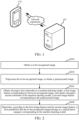
- An image recognition method provided in the embodiments of this application may be applied to an application environment shown in FIG. 1 .
- the application environment involves a terminal 110 and a server 120.
- the terminal 110 and the server 120 are connected through a network.
- the terminal 110 may obtain a to-be-recognized image, and transmit the to-be-recognized image to the server 120.
- the server 120 preprocesses the to-be-recognized image, inputs the to-be-recognized image and the preprocessed to-be-recognized image into a machine learning model, and then outputs, through the machine learning model, a probability that the to-be-recognized image belongs to a classification category corresponding to the machine learning model.
- the terminal 110 may also directly preprocesses the to-be-recognized image, inputs the to-be-recognized image and the preprocessed to-be-recognized image to a machine learning model, and then outputs, through the machine learning model, a probability that the to-be-recognized image belongs to a classification category corresponding to the machine learning model.
- the machine learning model may be obtained through training by the server 120, or may be obtained through training by the terminal 110.
- the terminal 110 may be a desktop terminal or a mobile terminal, and the mobile terminal may include at least one of a mobile phone, a tablet computer, a notebook computer, a personal digital assistant, a wearable device, and a medical imaging device.
- the server 120 may be implemented by using an independent physical server or a server cluster formed by a plurality of physical servers.
- an image recognition method is provided.
- An example in which the method is applied to a computer device (such as the terminal 110 or the server 120 shown in FIG. 1 ) is used for description.
- the method may include the following steps S202 to S208.
- the computer device obtains a to-be-recognized image.
- the to-be-recognized image is an image on which image recognition is to be performed.
- the image recognition is classifying an image into one or more of several candidate classification categories, that is, determining a classification category to which the image belongs.
- a candidate classification category may be preset according to an actual application requirement.
- the to-be-recognized image is an unprocessed raw image. It may be understood that, the to-be-recognized image may involve various types of images, for example, a character image, an animal image, and a landscape image.
- the computer device may obtain an image transmitted by another computer device, and use the image as the to-be-recognized image.
- the server 120 in FIG. 1 obtains an image transmitted by the terminal 110, and uses the image as the to-be-recognized image.
- the computer device may alternatively obtain an image generated locally, and use the image as the to-be-recognized image.
- the computer device may alternatively crawl an image from the Internet, and use the image as the to-be-recognized image.
- the to-be-recognized image includes a medical image.
- the medical image refers to an internal tissue image that is obtained from an organism or a part of an organism and that is obtained to perform medical treatment or medical research, for example, an internal tissue image obtained in a non-invasive manner.
- the medical image is a fundus image.
- a fundus is a part on which blood vessels can be directly observed on a living organism, and the fundus image may be obtained through a fundus photographing apparatus (such as a fundus camera).
- the fundus image may be used for reflecting illness states of diseases such as diabetic retinopathy, hypertension, glaucoma, and arteriosclerosis.
- the medical image may also include a pulmonary lesion region image, for example, a computed tomography (CT) image obtained by performing CT on a pulmonary lesion region, or a magnetic resonance (MR) image obtained through MR imaging.
- CT computed tomography
- MR magnetic resonance
- the pulmonary lesion region image may be used for reflecting illness states of diseases such as the lung cancer.
- the to-be-recognized image may be an image file having a visual form, for example, an image file in a JPEG format.
- the to-be-recognized image may alternatively be image data not having a visual form, for example, a set of pixel values of pixels represented by values.
- the computer device preprocesses the to-be-recognized image, to obtain a preprocessed image.
- the preprocessed image is a preprocessed to-be-recognized image, that is, an image obtained after the to-be-recognized image is preprocessed.
- the image is preprocessed to highlight a target detail object in the image. Based on this, compared with a raw to-be-recognized image, the preprocessed to-be-recognized image can display the target detail object in the image more prominently, that is, can highlight details in the to-be-recognized image.
- the target detail object may be determined based on an actual application requirement, and correspondingly, when the to-be-recognized image is preprocessed, a specific preprocessing manner may be determined according to the target detail object that needs to be highlighted in the to-be-recognized image.
- a blood vessel part and a microaneurysm part in the fundus image may be used as target detail objects, that is, the fundus image is preprocessed, to highlight the blood vessels and the microaneurysms in the fundus image.
- the computer device obtains, through a first submodel in a machine learning model, a first image feature corresponding to the to-be-recognized image, and obtains, through a second submodel in the machine learning model, a second image feature corresponding to the preprocessed image.
- a full name of machine learning is referred to as ML for short.
- the machine learning model may learn through a sample, and therefore has a specific capability.
- the machine learning model in this embodiment is a pre-trained model having an image classification capability.
- machine learning may include deep learning (DL for short).
- DL deep learning
- a deep learning manner may be used, thereby omitting a step of manually defining an input feature of a model.
- the limitation that the conventional machine learning needs manual participation is broken, and information in input images (the to-be-recognized image and the preprocessed image) of the model is fully mined, so that the accuracy and the stability of the image classification are improved.
- a quantity of samples may also be increased, to further improve the accuracy of an output result of the model.
- the machine learning model may use a neural network model, for example, a convolutional neural network (CNN) model.
- CNN convolutional neural network
- the machine learning model may be a deep learning model.
- the computer device may preset a model structure of the machine learning model, to obtain an initial machine learning model, and then obtain a model parameter of the machine learning model through training by using image samples belonging to classification categories. Accordingly, when image recognition needs to be performed on the to-be-recognized image, the computer device may obtain the pre-trained model parameter, and then import the model parameter to the initial machine learning model, to obtain the machine learning model.
- the machine learning model includes a first submodel and a second submodel.
- the first submodel may be used for obtaining the first image feature corresponding to the to-be-recognized image
- the second submodel may be used for obtaining the second image feature corresponding to the preprocessed image. Therefore, it may be seen that, in the machine learning model, the two submodels independent of each other may obtain the first image feature and the second image feature respectively.
- the machine learning model may include more than two submodels.
- the machine learning model may further include a third submodel and a fourth submodel.
- Different submodels may be used for obtaining image features corresponding to to-be-recognized images of different versions.
- the to-be-recognized images of different versions may include: a to-be-recognized image of a raw version (an unprocessed to-be-recognized image) and a to-be-recognized image of a preprocessed version (a preprocessed to-be-recognized image).
- different preprocessing manners may correspond to to-be-recognized images of different preprocessing versions.
- the image feature may be used for reflecting a characteristic of the image.
- Image classification may be performed on the image according to the characteristic of the image, that is, the image feature of image may be extracted, and image classification is performed on the image according to the image feature.
- the image feature is the basis for performing image classification.
- the first image feature is an image feature corresponding to the to-be-recognized image
- the second image feature is an image feature corresponding to the preprocessed image.
- both the first image feature and the second image feature may be high-dimensional features obtained through the machine learning model.
- both the first image feature and the second image feature may be one-dimensional vectors, for example, an array including 1024 floating-point numbers.
- both the to-be-recognized image and a preprocessed image that is obtained after the to-be-recognized image is preprocessed may be inputted into the machine learning model.
- the first submodel in the machine learning model performs feature extraction on the to-be-recognized image, to obtain the first image feature corresponding to the to-be-recognized image
- the second submodel in the machine learning model performs feature extraction on the preprocessed image, to obtain the second image feature corresponding to the preprocessed image.
- subsequent processing is performed according to the first image feature and the second image feature.
- the machine learning model may include two input channels. Accordingly, the to-be-recognized image may be inputted into the first submodel of the machine learning model through one input channel in the machine learning model, and the preprocessed image may be inputted into the second submodel of the machine learning model through the other input channel.
- the computer device determines, according to the first image feature and the second image feature, a first probability that the to-be-recognized image belongs to a classification category corresponding to the machine learning model.
- the image may be used for reflecting an attribute of a related object.
- a character image may reflect the gender of the character in the image (briefly referred to as example E-1 below), and in another example, a fundus image may reflect the property and the severity of diabetic retinopathy (briefly referred to as example E-2 below).
- the classification categories are several classification categories related to the attribute of the object reflected by the image. For the example E-1, two classification categories: male and female, may be set, and for the example E-2, five classification categories: normal, mild NPDR, moderate NPDR, severe NPDR, and PDR, may be set.
- the first image feature and the second image feature jointly reflect the classification category, to which the corresponding to-be-recognized image belongs, corresponding to the machine learning model.
- the classification of the to-be-recognized image may be two-class classification, or may be multi-class classification.
- the two-class classification of the to-be-recognized image is that for the to-be-recognized image, a total quantity of candidate classification categories is equal to 2, such as the foregoing example E-1.
- the multi-class classification of the to-be-recognized image is that for the to-be-recognized image, a total quantity of candidate classification categories is greater than 2, for example, the foregoing example E-2 is five-classification of the to-be-recognized image.
- first probabilities that the to-be-recognized image belongs to the classification categories respectively are determined according to the first image feature and the second image feature. For example, if the classification categories are respectively category A, category B, and category C, a first probability that the to-be-recognized image belongs to category A, a first probability that the to-be-recognized image belongs to category B, and a first probability that the to-be-recognized image belongs to category C are determined according to the first image feature and the second image feature.
- the first probability may be used for reflecting the possibility that the to-be-recognized image belongs to the corresponding classification category.
- the first probability that the to-be-recognized image belongs to category A is used for reflecting the possibility that the to-be-recognized image belongs to category A.
- the classification category to which the to-be-recognized image belongs may be further determined according to the first probabilities that the to-be-recognized image belongs to the classification categories respectively.
- the attribute of the object that can be reflected by the to-be-recognized image may be further predicted according to the first probabilities that the to-be-recognized image belongs to the classification categories respectively.
- the to-be-recognized image being a fundus image as an example, according to first probabilities that the to-be-recognized fundus image belongs to normal, mild NPDR, moderate NPDR, severe NPDR, and PDR respectively, the illness state of diabetic retinopathy of the owner of the fundus image may be predicted.
- the to-be-recognized image is preprocessed, a first image feature corresponding to the to-be-recognized image and a second image feature corresponding to the preprocessed to-be-recognized image are then obtained through a first submodel and a second submodel in a machine learning model respectively, and a probability that the to-be-recognized image belongs to a classification category corresponding to the machine learning model is further determined according to the first image feature and the second image feature jointly.
- the to-be-recognized image is classified automatically through the machine learning model, which is more accurate than manual determining; on the other hand, the preprocessed to-be-recognized image can highlight details in the image, both basic information in a raw to-be-recognized image and detail information highlighted by the preprocessed to-be-recognized image are used with reference to the first image feature and the second image feature. It may be seen that, the information is fully used based on the to-be-recognized image (that is, the information in the to-be-recognized image is fully mined), thereby further improving the recognition accuracy.
- the step of determining, according to the first image feature and the second image feature, a first probability that the to-be-recognized image belongs to a classification category corresponding to the machine learning model may include the following steps: inputting the first image feature and the second image feature into an output layer of the machine learning model; and determining, through the output layer of the machine learning model and according to the first image feature and the second image feature, the first probability that the to-be-recognized image belongs to the classification category corresponding to the machine learning model.
- the machine learning model in addition to the first submodel and the second submodel, further includes an output layer.
- the output layer of the machine learning model is used for determining, according to the first image feature and the second image feature, the first probability that the to-be-recognized image belongs to the classification category corresponding to the machine learning model, and outputting the first probability.
- the output layer may be a normalized index (softmax) layer.
- the softmax layer has a capability of obtaining a final classification result of image classification.
- the softmax layer may use the first image feature and the second image feature as inputs, and perform matrix multiplication processing, vector addition processing, and normalized processing sequentially according to the first image feature and the second image feature, to obtain a final classification result of the to-be-recognized image, that is, the first probability that the to-be-recognized image belongs to the classification category corresponding to the machine learning model.
- the task of determining, according to the first image feature and the second image feature, the first probability that the to-be-recognized image belongs to the classification category corresponding to the machine learning model continues to be completed through the machine learning model. That is, a user may directly input both the to-be-recognized image and the preprocessed image into the machine learning model, and then the machine learning model may automatically complete the tasks, to further output the first probability that the to-be-recognized image belongs to the classification category corresponding to the machine learning model.
- input features of the machine learning model do not need to be manually defined, thereby implementing end-to-end learning, and simplifying the workflow.
- the first submodel includes a first feature detection submodel
- the second submodel includes a second feature detection submodel
- the machine learning model further includes: a first fully connected layer connected to the first feature detection submodel and a second fully connected layer connected to the second feature detection submodel, both the first fully connected layer and the second fully connected layer being connected to the output layer.
- the step of obtaining a first image feature corresponding to the to-be-recognized image may be implemented through the first feature detection submodel and the first fully connected layer
- the step of obtaining a second image feature corresponding to the preprocessed image may be implemented through the second feature detection submodel and the second fully connected layer.
- the feature detection submodels are used for performing image feature extraction on an input image thereof, to obtain an intermediate image feature corresponding to the input image.
- the intermediate image feature obtained by the feature detection submodel may be determined according to a model parameter of the feature detection submodel.
- the first feature detection submodel is used for performing image feature extraction on the to-be-recognized image, to obtain an intermediate image feature corresponding to the to-be-recognized image.
- the second feature detection submodel is used for performing image feature extraction on the preprocessed image, to obtain an intermediate image feature corresponding to the preprocessed image.
- the first feature detection submodel and the second feature detection submodel may maintain consistent model structures, and may only have different model parameters.
- the model structures of the two may both be obtained through adjustment based on any suitable CNN model.
- the model structures of them may both be the structure remained after the output layer at the end of an inceptionV3 model is removed.
- other CNN models may also be adjusted, to obtain the model structures of the first feature detection submodel and the second feature detection submodel.
- the other CNN models include a RestNet model (or ResNet model), a visual geometry group (VGG) model, a DenseNet model, and the like.
- the first feature detection submodel and the second feature detection submodel may also have different model structures.
- the fully connected layer may be used for performing matrix multiplication processing on an input feature and a model parameter that corresponds to the fully connected layer, to obtain a corresponding target image feature.
- the first fully connected layer is connected to the first feature detection submodel. It may be understood that, an output of the first feature detection submodel is an input of the first fully connected layer.
- the first fully connected layer may be used for performing matrix multiplication processing on an intermediate image feature outputted by the first feature detection submodel and a model parameter corresponding to the first fully connected layer, to obtain the first image feature corresponding to the to-be-recognized image.
- the second fully connected layer is connected to the second feature detection submodel. An output of the second feature detection submodel is an input of the second fully connected layer.
- the second fully connected layer may be used for performing matrix multiplication processing on an intermediate image feature outputted by the second feature detection submodel and a model parameter corresponding to the second fully connected layer, to obtain the second image feature corresponding to the preprocessed image.
- both the first fully connected layer and the second fully connected layer are further connected to the output layer. It may be understood that, both the output of the first fully connected layer and the output of the second fully connected layer are inputs of the output layer.
- the output layer may be used for determining, according to the first image feature output by the first fully connected layer, and the second image feature outputted by the second fully connected layer jointly, the first probability that the to-be-recognized image belongs to the classification category corresponding to the machine learning model, and outputting the determined probability.
- the computer device after obtaining the to-be-recognized image and the preprocessed image, inputs the to-be-recognized image into the first feature detection submodel of the machine learning model, and inputs the preprocessed image into the second feature detection submodel of the machine learning model.
- the first feature detection submodel performs image feature extraction on the to-be-recognized image, and outputs the extracted intermediate image feature to the first fully connected layer, and then, the first fully connected layer obtains, according to the intermediate image feature, the first image feature corresponding to the to-be-recognized image, and outputs the first image feature to the output layer.
- the second feature detection submodel performs image feature extraction on the preprocessed image, and outputs the extracted intermediate image feature to the second fully connected layer, and then, the second fully connected layer obtains, according to the intermediate image feature, the second image feature corresponding to the preprocessed image, and outputs the second image feature to the output layer. Then, the output layer determines, according to the received first image feature and second image feature, the first probability that the to-be-recognized image belongs to the classification category corresponding to the machine learning model, and outputs the first probability.
- the machine learning model may include two input channels.
- the to-be-recognized image may be inputted into the first feature detection submodel of the machine learning model through one input channel
- the preprocessed image may be inputted into the second feature detection submodel of the machine learning model through the other input channel.
- the step of determining, according to the first image feature and the second image feature, a first probability that the to-be-recognized image belongs to a classification category corresponding to the machine learning model may include the following steps: obtaining, through the machine learning model and according to the first image feature, a second probability that the to-be-recognized image belongs to the classification category corresponding to the machine learning model; obtaining, through the machine learning model and according to the second image feature, a third probability that the preprocessed image belongs to the classification category corresponding to the machine learning model; and performing an operation according to the second probability and the third probability, and determining the first probability that the to-be-recognized image belongs to the classification category corresponding to the machine learning model.
- the second probability may be used for preliminarily reflecting the possibility that the to-be-recognized image belongs to the corresponding classification category.
- the third probability may be used for reflecting the possibility that the preprocessed image belongs to the corresponding classification category.
- the second probability that the to-be-recognized image belongs to the classification category corresponding to the machine learning model, and the third probability that the preprocessed image belongs to the classification category corresponding to the machine learning model may continue to be obtained through the machine learning model.
- the machine learning model completes the work tasks thereof.
- other functional modules, of a non-machine learning model, running on the computer device may perform an operation according to the second probability and the third probability, to obtain the first probability that the to-be-recognized image belongs to the classification category corresponding to the machine learning model.
- the task of performing an operation according to the second probability and the third probability may be completed manually or by other computer devices. It may be understood that, the first probability is used for finally reflecting the possibility that the to-be-recognized image belongs to the corresponding classification category.
- second probabilities that the to-be-recognized image belongs to classification categories respectively are obtained according to the first image feature. For example, if the classification categories are respectively category A, category B, and category C, a second probability that the to-be-recognized image belongs to category A, a second probability that the to-be-recognized image belongs to category B, and a second probability that the to-be-recognized image belongs to category C are determined according to the first image feature. Similarly, third probabilities that the to-be-recognized image belongs to classification categories respectively are obtained according to the second image feature.
- a third probability that the preprocessed image belongs to category A, a third probability that the preprocessed image belongs to category B, and a third probability that the preprocessed image belongs to category C are determined according to the second image feature.
- the operation may include an average operation.
- the average operation may be specifically a weighted average operation. For example, a weighted average operation is performed according to the second probability that the to-be-recognized image belongs to a category A, a weight value corresponding to the second probability, the third probability that the preprocessed image belongs to the category A, and a weight value corresponding to the third probability, to obtain the first probability that the to-be-recognized image belongs to the category A.
- the first submodel includes a first classification submodel
- the second submodel includes a second classification submodel.
- the foregoing step of obtaining, a first image feature corresponding to the to-be-recognized image, and obtaining, according to the first image feature, a second probability that the to-be-recognized image belongs to the classification category corresponding to the machine learning model may be implemented through the first classification submodel; and the foregoing step of obtaining, a second image feature corresponding to the preprocessed image, and obtaining, according to the second image feature, a third probability that the preprocessed image belongs to the classification category corresponding to the machine learning model may be implemented through the second classification submodel.
- the first classification submodel may be used for performing image feature extraction on the to-be-recognized image, to obtain the first image feature corresponding to the to-be-recognized image, and determining, according to the first image feature, the second probability that the to-be-recognized image belongs to the classification category corresponding to the machine learning model.
- the second classification submodel may be used for performing image feature extraction on the preprocessed image, to obtain the second image feature corresponding to the preprocessed image, and determining, according to the second image feature, the third probability that the preprocessed image belongs to the classification category corresponding to the machine learning model.
- the first classification submodel and the second classification submodel may maintain consistent model structures, and may only have different model parameters.
- the model structures of the two may both use any suitable CNN model, and the CNN model is, for example, an inceptionV3 model, a RestNet model (or ResNet model), a VGG model, or a DenseNet model.
- the first classification submodel and the second classification submodel may also have different model structures.
- the computer device after obtaining the to-be-recognized image and the preprocessed image, the computer device inputs the to-be-recognized image into the first classification submodel of the machine learning model, and inputs the preprocessed image into the second classification submodel of the machine learning model.
- the first classification submodel performs image feature extraction on the to-be-recognized image, to obtain the first image feature corresponding to the to-be-recognized image, then determines, according to the first image feature, the second probability that the to-be-recognized image belongs to the classification category corresponding to the machine learning model, and outputs the second probability; on the other hand, the second classification submodel performs image feature extraction on the preprocessed image, to obtain the second image feature corresponding to the preprocessed image, then determines, according to the second image feature, the third probability that the preprocessed image belongs to the classification category corresponding to the machine learning model, and outputs the third probability.
- the machine learning model may include two input channels.
- the to-be-recognized image may be inputted into the first classification submodel of the machine learning model through one input channel
- the preprocessed image may be inputted into the second classification submodel of the machine learning model through the other input channel.
- the foregoing manner for preprocessing the to-be-recognized image includes at least one or a combination of at least two of the following steps:
- the computer device may perform preprocessing through any one or a combination of at least two of the foregoing steps, to highlight the details in the to-be-recognized image.
- the foregoing manner for preprocessing the to-be-recognized image may include the following steps: adjusting, by the computer device, a target object in the to-be-recognized image to a reference object size, to obtain a first adjusted image; cropping, by the computer device, an invalid region in the first adjusted image, to obtain a second adjusted image, the second adjusted image not including the invalid region; and adjusting, by the computer device, the second adjusted image to a reference image size, to obtain a third adjusted image, the preprocessed image being obtained according to the third adjusted image.
- the computer device may adjust a target object to a reference object size, to obtain a first adjusted image. Specifically, it may be implemented by scaling the target object included in the to-be-recognized image.
- the target object is image content included in the to-be-recognized image, and is the object that needs to be highlighted. It may be understood that, the target object may be set according to an actual application requirement. For example, for a character image, a mouth of the character in the image may be preset as the target object, and a fixed width value is used as the reference object size.
- the mouth part of the character Mona Lisa in the image may be scaled, to adjust the size of the mouth part to the fixed width value.
- eyeballs in the image may be preset as the target object, and a fixed radius value is used as the reference object size.
- the eyeballs in the fundus image may be scaled, to adjust the radius of the eyeballs in the fundus image to the fixed radius value.
- the reference object size may be the size of a preset object, or may be sizes of other objects than the target object in the to-be-recognized image.
- one eyeball may be set as the target object, and the other eyeball may be set as the reference object, so that one eyeball in the fundus image may be adjusted to be the size of the other eyeball.
- the computer device crops an invalid region in the first adjusted image (that is, the image obtained after the target object of the to-be-recognized image is adjusted to the reference object size), to obtain a second adjusted image, the second adjusted image not including the invalid region. That is, the computer device crops the invalid region in the first adjusted image, and the image that does not include the invalid region and that is remained after the cropping is the second adjusted image.
- the invalid region is an image region in which the task of determining the first probability that the to-be-recognized image belongs to the classification category corresponding to the machine learning model does not have any positive effect.
- the invalid region may include a region not having valid content information, for example, a blank region.
- the second adjusted image (that is, the image obtained after the invalid region in the first adjusted image is cropped) is adjusted to the reference image size, to obtain a third adjusted image.
- the third adjusted image is a preprocessed image.
- the computer device may set an image size of a training image inputted into the machine learning model. Accordingly, training the machine learning model according to the training images (input of a fixed size) of the uniform image size can greatly reduce the complexity of the machine learning model.
- the computer device may query for the reference image size associated with the machine learning model, and then, in the process of preprocessing the to-be-recognized image, may compare a current image size of the second adjusted image with the reference image size.
- the computer device may adjust the current image size to the reference image size.
- the reference image size may be a resolution of 512*512.
- the setting for the image size of the training image used herein for uniformly training the machine learning model is not a limitation on the image size of the training image.
- the image sizes of the training images for training the machine learning model may not be the uniform image size.
- the foregoing manner for preprocessing the to-be-recognized image may further include the following step: adjusting an image attribute of a target adjusted image, the target adjusted image including any one of the first adjusted image, the second adjusted image, and the third adjusted image, and the image attribute including at least one of a contrast and a grayscale.
- the contrast of the image may be further adjusted.
- the grayscale of the image may be further adjusted.
- both the contrast of the image and the grayscale of the image may be further adjusted.
- the image attribute is also not limited to the contrast and the grayscale.
- the image attribute may further include brightness, and in this case, the image attribute includes at least one of the contrast, the grayscale, and the brightness.
- Adjusting the contrast of the image may be specifically performing the following processing on pixel values (R, G, B) of pixels in the image: subtracting the average value in the pixel range of the pixel, and multiplying each pixel value by a value, to increase the distinction among the pixels.
- the value may be set according to an actual application requirement, for example, may be set to 4.
- the grayscale of the image may be increased by 50%.
- the feature of the target adjusted image may be highlighted. Using the fundus image as an example, after the contrast and the grayscale of the fundus image are adjusted as above, a blood vessel part, a texture feature, and the like in the fundus image can be more highlighted.
- the step of adjusting the image attribute may be arranged before the step of adjusting the target object to the reference object size. That is, the image attribute of the to-be-recognized image is first adjusted, then the target object in the adjusted to-be-recognized image is adjusted to the reference object size, to obtain the first adjusted image, and further subsequent processing is performed according to the first adjusted image.
- the step of adjusting the image attribute may follow any one of the three steps of adjusting the target object to the reference object size, cropping the invalid region in the image, and adjusting the image to the reference image size, for example, follow the step of cropping the invalid region in the image. That is, the image attribute of the second adjusted image is adjusted, and the second adjusted image with the adjusted image attribute is adjusted to the reference image size, to obtain the third adjusted image.
- a quantity of the preprocessed images is greater than 1, and the preprocessed images are obtained according to different preprocessing manners.
- more than two different preprocessing manners may be used for preprocessing the to-be-recognized image respectively.
- a corresponding preprocessed image may be obtained, and accordingly, after various different preprocessing manners are used for preprocessing the to-be-recognized image respectively, a total quantity of obtained preprocessed images respectively corresponding to (one-to-one correspondence) the various preprocessing manners is more than two correspondingly.
- the three different preprocessing manners of a preprocessing manner W1, a preprocessing manner W2, and a preprocessing manner W3 may be used for preprocessing a to-be-recognized image PO respectively, to obtain a preprocessed image Pd1 uniquely corresponding to the preprocessing manner W1, a preprocessed image Pd2 uniquely corresponding to the preprocessing manner W2, and a preprocessed image Pd3 uniquely corresponding to the preprocessing manner W3 (which is briefly referred to as an example E-3).
- the computer device may input the to-be-recognized image and the preprocessed images into the machine learning model, and obtain, through the machine learning model, a first image feature corresponding to the to-be-recognized image, and second image features corresponding to the preprocessed images respectively. Then, the computer device determines, according to the first image feature corresponding to the to-be-recognized image, and the second image features corresponding to the preprocessed images respectively jointly, the first probability that the to-be-recognized image belongs to the classification category corresponding to the machine learning model.
- information included in the to-be-recognized image can be further mined, to further improve the accuracy of the output result of the model.
- both a quantity of the second feature detection submodels and a quantity of the second fully connected layers match a quantity of the preprocessed images. Specifically, when the quantity of the preprocessed images is equal to 1, both the quantity of the second feature detection submodels and the quantity of the second fully connected layers are equal to 1; and when the quantity of the preprocessed images is greater than 1, both the quantity of the second feature detection submodels and the quantity of the second fully connected layers are greater than 1, and may be consistent with the quantity of the preprocessed images.
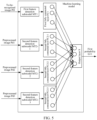
- the machine learning model includes a first feature detection submodel MT1 used for obtaining a first image feature F1 corresponding to the to-be-recognized image PO, a second feature detection submodel MT2-1 used for obtaining a second image feature F21-1 corresponding to the preprocessed image Pd1, a second feature detection submodel MT2-2 used for obtaining a second image feature F21-2 corresponding to the preprocessed image Pd2, a second feature detection submodel MT2-3 used for obtaining a second image feature F21-3 corresponding to the preprocessed image Pd3, a first fully connected layer FC1, a second fully connected layer FC2-1, a second fully connected layer FC2-2, a second fully connected layer FC2-3, and an output layer S.
- the first feature detection submodel MT1 is connected to the first fully connected layer FC1
- the second feature detection submodel MT2-1 is connected to the second fully connected layer FC2-1
- the second feature detection submodel MT2-2 is connected to the second fully connected layer FC2-2
- the second feature detection submodel MT2-3 is connected to the second fully connected layer FC2-3.
- the first fully connected layer FC1, the second fully connected layer FC2-1, the second fully connected layer FC2-2, and the second fully connected layer FC2-3 are all connected to the output layer S.
- the output layer S determines, according to an output result of the first fully connected layer FC1, an output result of the second fully connected layer FC2-1, an output result of the second fully connected layer FC2-2, the output result of the second fully connected layer FC2-3 jointly, a first probability G11 that the to-be-recognized image PO belongs to the classification category corresponding to the machine learning model.
- a quantity of the second classification submodels matches a quantity of the preprocessed images. Specifically, when the quantity of the preprocessed images is greater than 1, the quantity of the second classification submodels is greater than 1, and is consistent with the quantity of the preprocessed images.
- the computer device may perform an operation according to second probabilities outputted by the first classification submodel, and third probabilities outputted by the second classification submodels, to obtain first probabilities that the to-be-recognized image belongs to the classification categories corresponding to the machine learning model.
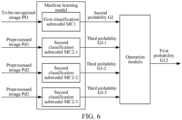
- the machine learning model includes a first classification submodel MC1, a second classification submodel MC2-1, a second classification submodel MC2-2, and a second classification submodel MC2-3.
- the first classification submodel MC1 is used for performing image feature extraction on the to-be-recognized image PO, to obtain the first image feature F1 corresponding to the to-be-recognized image PO, and determining, according to the first image feature F1, a second probability G2 that the to-be-recognized image PO belongs to the classification category corresponding to the machine learning model;
- the second classification submodel MC2-1 is used for performing image feature extraction on the preprocessed image Pd1, to obtain the second image feature F21-1 corresponding to the preprocessed image Pd1, and determining, according to the second image feature F21-1, a third probability G3-1 that the preprocessed image Pd1 belongs to the classification category corresponding to the machine learning model;
- the second classification submodel MC1 is used for performing image feature extraction on
- the computer device may perform an operation on the second probability G2 outputted by the first classification submodel MC1, the third probability G3-1 outputted by the second classification submodel MC2-1, the third probability G3-2 outputted by the second classification submodel MC2-2, and the third probability G3-3 outputted by the second classification submodel MC2-3, and determine the first probability G12 that the to-be-recognized image PO belongs to the classification category corresponding to the machine learning model.
- the machine learning model may include more than three input channels. Accordingly, the to-be-recognized image may be inputted into the machine learning model through one input channel in the machine learning model, and the preprocessed images corresponding to the preprocessing manners may be inputted into the machine learning model respectively through other input channels than the input channel in the machine learning model.
- the to-be-recognized image may be inputted into the first feature detection submodel of the machine learning model through one input channel in the machine learning model, and the preprocessed images in a one-to-one correspondence to the preprocessing manners may be inputted into respective corresponding second feature detection submodels through other input channels than the input channel.
- the to-be-recognized image may be inputted into the first classification submodel of the machine learning model through one input channel in the machine learning model, and the preprocessed images in a one-to-one correspondence to the preprocessing manners may be inputted into respective corresponding second classification submodels through other input channels than the input channel.
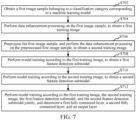
- the manner for determining the machine learning model may include the following steps S702 to S712. S702. Obtain a first image sample belonging to a classification category corresponding to a machine learning model. S704. Perform data enhancement processing on the first image sample, to obtain a first training image. S706. Preprocess the first image sample, and perform the data enhancement processing on the preprocessed first image sample, to obtain a second training image. S708. Perform model training according to the first training image, to obtain a first feature detection submodel. S710. Perform model training according to the second training image, to obtain a second feature detection submodel. S712. Perform model training according to the first training image, the second training image, the first feature detection submodel, and the second feature detection submodel jointly, to determine a first fully connected layer, a second fully connected layer, and an output layer.
- the first image sample is an unprocessed image sample.
- the first image sample is an image of which a real classification result is known.
- the computer device may obtain classification labels of first image samples.
- the classification label is used for representing a known real classification result corresponding to the image sample, that is, for any first image sample, the classification label may be used for determining a classification category to which the first image sample really belongs.
- the real classification result represented by the classification label may be determined through manual analysis, for example, determined through analysis of experts in the field of the related art.
- the first training image is a first image sample obtained after data enhancement processing is performed, that is, an image obtained after data enhancement processing is performed on the first image sample. It may be understood that, the classification label of the first training image is consistent with the classification label of the corresponding first image sample.
- the second training image is a first image sample obtained after preprocessing is performed first and then data enhancement processing is performed, that is, an image obtained after the first image sample is preprocessed first and then data enhancement processing is performed on the preprocessed first image sample. It may be understood that, the classification label of the second training image is consistent with the classification label of the corresponding first image sample.
- Data enhancement processing is performed on both the first image sample and the preprocessed first image sample.
- One objective is to expand the amount of training data, and the other objective is to improve a generalization capability of the machine learning model obtained through training.
- the computer device may perform model training according to the first training image, to obtain a first feature detection submodel, and perform model training according to the second training image, to obtain a second feature detection submodel. Then, the computer device performs model integration processing, so that the end of the first feature detection submodel is connected to one fully connected layer, the end of the second feature detection submodel is connected to the other fully connected layer, and the two fully connected layers are connected to one output layer, and initializes the two fully connected layer and one output layer.
- model training is performed according to the first training image, the second training image, the first feature detection submodel, and the second feature detection submodel, to determine the model parameters of the two fully connected layers and the model parameter of the output layer jointly. It may be understood that, when the model parameters of the two fully connected layers and the model parameter of the output layer are determined, the first fully connected layer, the second fully connected layer, and the output layer are determined, so that the entire machine learning model is determined.
- the computer device may perform supervised model training by using the first training image and the second training image. Moreover, in the training process, according to the difference between the classification label and the classification result that is automatically determined by the machine learning model, the model parameter of the machine learning model is adjusted and training continues, and the training ends until a training stop condition is met.
- the model parameter obtained when the training ends may be the model parameter of the machine learning model.
- the classification result that is automatically determined by the machine learning model and the classification label of the corresponding sample may be compared through the softmax layer of the machine learning model, and a loss function is further calculated. Then, gradient back propagation is performed according to the loss function, to adjust the model parameter of the machine learning model.
- the loss function may be any suitable loss function, for example, a cross entropy loss function.
- the training stop condition is a condition in which model training ends.
- the training stop condition may be reaching a preset iteration quantity, or that a classification performance indicator of a machine learning model with the adjusted model parameter reaches a preset indicator.
- the process of performing model training according to the first training image to obtain the first feature detection submodel may adopt deep learning.
- deep learning the training may specifically be implemented by using any suitable deep learning manner.
- a transfer learning manner may be used, that is, during transfer training, the underlying network is used as a feature extractor.
- a fine tune manner may be used, that is, during transfer training, all or most layers are trained.
- the computer device may train and store a machine learning model, and may directly obtain and use the machine learning model in need of using the machine learning model.
- the computer device may only store the model parameter of the machine learning model, and when needing to use the machine learning model, obtain and use the machine learning model after obtaining the model parameter and importing the model parameter into an initial machine learning model.
- supervised training is performed to obtain the machine learning model, which improves the classification accuracy of the machine learning model compared with an unsupervised training mode.
- the input feature of the machine learning model is prevented from being manually defined, and the training efficiency and accuracy of the machine learning model are improved.
- the manner for determining the machine learning model may include the following steps S802 to S808.
- S802. Obtain a second image sample belonging to a classification category corresponding to a machine learning model.
- S804. Perform data enhancement processing on the second image sample, to obtain a third training image.
- S806. Preprocess the second image sample, and perform the data enhancement processing on the preprocessed second image sample, to obtain a fourth training image.
- S808. Perform model training according to the third training image, to obtain a first classification submodel, and perform model training according to the fourth training image, to obtain a second classification submodel.
- model structures of machine learning models that need to be trained are different.
- the machine learning model obtained through training includes the first classification submodel and the second classification submodel. Based on this, in the model training process, after model training is performed according to the third training image, to obtain the first classification submodel, and model training is performed according to the fourth training image, to obtain the second classification submodel, the entire machine learning model is determined.
- the limitation on the second image sample in this embodiment may be the same as the specific limitation on the foregoing first image sample, and the terms "first" and “second” are only distinctions on naming in different embodiments.
- the third training image is similar to the situation of the foregoing first training image
- the fourth training image is also similar to the situation of the foregoing second training image.
- the manner for performing data enhancement processing on the image may include the following steps: obtaining a first transformation parameter corresponding to a geometric transformation manner; and performing geometric transformation processing on the image according to the first transformation parameter and the geometric transformation manner corresponding to the first transformation parameter.
- the geometric transformation manner is an image transformation manner in which the pixel values of the image do not change.
- the geometric transformation manner may include at least one of image flipping, image cropping, image scaling, and image rotation.
- the first transformation parameter is an operation parameter involved in the geometric transformation processing, for example, an image rotation angle value, or an image scaling ratio value.
- the first transformation parameter may be random, or certainly may be preset.
- the step of performing geometric transformation processing on the image may include at least one of the following: flipping the image in a direction according to a flipping probability; cropping borders of the image according to a random cropping parameter; adjusting an image size of the image according to a random image size adjustment value; and rotating the image according to a random rotation angle value.
- the image is flipped in a direction according to the flipping probability.
- the image is left-right flipped or up-down flipped according to a probability of 50%.
- borders of the image are cropped, for example, border cropping is performed on the height and the width of the image by 0% to 20%.
- the image size adjustment value the image size of the image is adjusted, for example, the image size of the image is scaled to 90% to 110% of the raw image and according to the random rotation angle value, the image is rotated, for example, the image is randomly rotated by -180° to 180°.
- the manner for performing data enhancement processing on the image may include the following steps: obtaining a second transformation parameter corresponding to an image attribute adjustment manner; and performing image attribute adjustment processing on the image according to the second transformation parameter and the image attribute adjustment manner corresponding to the second transformation parameter.
- the image attribute adjustment manner is an image transformation manner of changing the pixel values of the image.
- the image attribute adjustment manner may include at least one of adjusting the image brightness, adjusting the image contrast, and the like.
- the second transformation parameter is an operation parameter involved in the image attribute adjustment processing, for example, an image brightness value or an image contrast value.
- the second transformation parameter may be random, or certainly may be preset.
- the step of performing image attribute adjustment processing on the image may include at least one of the following: adjusting brightness of pixels in the image according to a random brightness adjustment value; and adjusting contrasts of the pixels in the image according to a contrast adjustment value.
- the brightness of the pixels in the image is adjusted. For example, a brightness value of the pixels in the image is randomly increased by -20 to 20.
- the contrast adjustment value the contrast of the pixels in the image is adjusted, for example, the pixels in the image are multiplied by a random value between 0.8 and 1.2.
- an image recognition method is provided.
- the image recognition method does not form part of the invention.
- the method may specifically include the following step S902 to step S920.
- S920 Determine, through the output layer of the machine learning model and according to the first image feature from the first fully connected layer and the second image feature from the second fully connected layer jointly, first probabilities that the to-be-recognized fundus image belongs to the five classification categories: normal, mild NPDR, moderate NPDR, severe NPDR, and PDR respectively.
- the to-be-recognized fundus image is preprocessed, a first image feature corresponding to the to-be-recognized fundus image and a second image feature corresponding to the preprocessed to-be-recognized fundus image are then obtained through a machine learning model respectively, and a probability that the to-be-recognized fundus image belongs to a classification category corresponding to the machine learning model is further determined according to the first image feature and the second image feature jointly.
- the to-be-recognized fundus image is classified automatically through the machine learning model, which is more accurate than manual determining; on the other hand, the preprocessed to-be-recognized fundus image can highlight details in the image, both basic information in a to-be-recognized raw fundus image and detail information highlighted by the preprocessed to-be-recognized fundus image are used with reference to the first image feature and the second image feature. It may be seen that, the information in the to-be-recognized fundus image is fully mined, thereby further improving the recognition accuracy.
- steps in the flowcharts of the foregoing embodiments are displayed in order according to arrows, the steps are not necessarily performed in the order indicated by the arrows.
- sequence for performing the steps is not strictly limited, and the steps may be performed in other sequences.
- at least some steps may include a plurality of sub-steps or a plurality of stages, the sub-steps or stages are not necessarily performed at a same moment and may be performed at different moments, the sub-steps or stages are not necessarily sequentially performed, and the sub-steps or stages and at least some of other steps or sub-steps or stages of other steps may be performed in turn or alternately.
- an image recognition apparatus 1000 is provided.
- the apparatus may include the following modules 1002 to 1008.
- a to-be-recognized image obtaining module 1002 is configured to obtain a to-be-recognized image;
- a preprocessed image obtaining module 1004 is configured to preprocess the to-be-recognized image, to obtain a preprocessed image;
- an image feature obtaining module 1006 is configured to obtain, through a first submodel in a machine learning model, a first image feature corresponding to the to-be-recognized image, and obtain, through a second submodel in the machine learning model, a second image feature corresponding to the preprocessed image;
- a prediction probability determining module 1008 is configured to determine, according to the first image feature and the second image feature, a first probability that the to-be-recognized image belongs to a classification category corresponding to the machine learning model.
- the foregoing image recognition apparatus 1000 preprocesses the to-be-recognized image, then obtains, through a first submodel and a second submodel in a machine learning model respectively, a first image feature corresponding to the to-be-recognized image, and a second image feature corresponding to the preprocessed to-be-recognized image, and further determines, according to the first image feature and the second image feature jointly, a probability that the to-be-recognized image belongs to a classification category corresponding to the machine learning model.
- the to-be-recognized image is classified automatically through the machine learning model, which is more accurate than manual determining; on the other hand, the preprocessed to-be-recognized image can highlight details in the image, both basic information in a raw to-be-recognized image and detail information highlighted by the preprocessed to-be-recognized image are used with reference to the first image feature and the second image feature. It may be seen that, the information in the to-be-recognized image is fully mined, thereby further improving the recognition accuracy.
- the prediction probability determining module 1008 may include the following units: an image feature output unit, configured to input the first image feature and the second image feature to an output layer of the machine learning model; and a first prediction probability determining unit, configured to determine, through the output layer of the machine learning model and according to the first image feature and the second image feature, the first probability that the to-be-recognized image belongs to the classification category corresponding to the machine learning model.
- the first submodel includes a first feature detection submodel
- the second submodel includes a second feature detection submodel
- the machine learning model further includes: a first fully connected layer connected to the first feature detection submodel and a second fully connected layer connected to the second feature detection submodel, both the first fully connected layer and the second fully connected layer being connected to the output layer.
- the image feature obtaining module 1006 may be configured to obtain, through the first feature detection submodel and the first fully connected layer, a first image feature corresponding to the to-be-recognized image, and obtain, through the second feature detection submodel and the second fully connected layer, a second image feature corresponding to the preprocessed image.
- the prediction probability determining module 1008 may include the following units: a second prediction probability determining unit, configured to obtain, through the machine learning model and according to the first image feature, a second probability that the to-be-recognized image belongs to the classification category corresponding to the machine learning model; a third prediction probability determining unit, configured to obtain, through the machine learning model and according to the second image feature, a third probability that the preprocessed image belongs to the classification category corresponding to the machine learning model; and a fourth prediction probability determining unit, configured to perform an operation according to the second probability and the third probability, and determine the first probability that the to-be-recognized image belongs to the classification category corresponding to the machine learning model.
- the first submodel includes a first classification submodel
- the second submodel includes a second classification submodel.
- the second prediction probability determining unit may be configured to obtain, through the first classification submodel, a first image feature corresponding to the to-be-recognized image, and obtain, according to the first image feature, a second probability that the to-be-recognized image belongs to the classification category corresponding to the machine learning model; and the third prediction probability determining unit may be configured to obtain, through the second classification submodel, a second image feature corresponding to the preprocessed image, and obtain, according to the second image feature, a third probability that the preprocessed image belongs to the classification category corresponding to the machine learning model.
- the preprocessed image obtaining module 1004 may include the following units: a first adjusted image obtaining unit, configured to adjust a target object in the to-be-recognized image to a reference object size, to obtain a first adjusted image; a second adjusted image obtaining unit, configured to crop an invalid region in the first adjusted image, to obtain a second adjusted image, the second adjusted image not including the invalid region; and a third adjusted image obtaining unit, configured to adjust the second adjusted image to a reference image size, to obtain a third adjusted image, the preprocessed image being obtained according to the third adjusted image.
- the preprocessed image obtaining module 1004 may further include an image attribute adjustment unit, configured to adjust an image attribute of a target adjusted image, the target adjusted image including any one of the first adjusted image, the second adjusted image, and the third adjusted image, and the image attribute including at least one of a contrast and a grayscale.
- an image attribute adjustment unit configured to adjust an image attribute of a target adjusted image, the target adjusted image including any one of the first adjusted image, the second adjusted image, and the third adjusted image, and the image attribute including at least one of a contrast and a grayscale.
- a quantity of the preprocessed images is greater than 1, and the preprocessed images are obtained according to different preprocessing manners.
- the image recognition apparatus 1000 may further include a first model training module, and the first model training model may include the following units: a first sample obtaining unit, configured to obtain a first image sample belonging to a classification category corresponding to a machine learning model; a first training image obtaining unit, configured to perform data enhancement processing on the first image sample, to obtain a first training image; a second training image obtaining unit, configured to preprocess the first image sample, and perform data enhancement processing on the preprocessed first image sample, to obtain a second training image; a first submodel training unit, configured to perform model training according to the first training image, to obtain a first feature detection submodel; a second submodel training unit, configured to perform model training according to the second training image, to obtain a second feature detection submodel; and a first model determining unit, configured to perform model training according to the first training image, the second training image, the first feature detection submodel, and the second feature detection submodel jointly, and determine a first fully connected layer, a second fully connected layer, and an output layer
- the image recognition apparatus 1000 may further include a second model training module, and the second model training model may include the following units: a second sample obtaining unit, configured to obtain a second image sample belonging to a classification category corresponding to a machine learning model; a third training image obtaining unit, configured to perform data enhancement processing on the second image sample, to obtain a third training image; a fourth training image obtaining unit, configured to preprocess the second image sample, and perform data enhancement processing on the preprocessed first image sample, to obtain a fourth training image; and a second model determining unit, configured to perform model training according to the third training image, to obtain a first classification submodel, and perform model training according to the fourth training image, obtain a second classification submodel.
- the second model training model may include the following units: a second sample obtaining unit, configured to obtain a second image sample belonging to a classification category corresponding to a machine learning model; a third training image obtaining unit, configured to perform data enhancement processing on the second image sample, to obtain a third training image; a fourth training
- the manner for performing data enhancement processing on the image by the first training image obtaining unit or the third training image obtaining unit may include at least one of the following: flipping the image in a direction according to a flipping probability; cropping borders of the image according to a random cropping parameter; adjusting brightness of pixels in the image according to a random brightness adjustment value; adjusting contrasts of the pixels in the image according to a random contrast adjustment value; adjusting an image size of the image according to a random image size adjustment value; and rotating the image according to a random rotation angle value.
- the to-be-recognized image includes a medical image; and the machine learning model includes a CNN model.
- the modules in the foregoing image recognition apparatus 1000 may be implemented in whole or in part by software, hardware, or a combination thereof.
- the foregoing modules may be built in or independent of a processor of a computer device in a hardware form, or may be stored in a memory of the computer device in a software form, so that the processor invokes and performs an operation corresponding to each of the foregoing modules.
- a computer device including a memory and a processor, the memory storing a computer program, the computer program, when executed by the processor, causing the processor to perform the steps of the image recognition method in any embodiment of this application.
- the computer device may be the server 120 shown in FIG. 1 .
- An internal structure diagram of the computer device may be shown in FIG. 11 .
- the computer device includes a processor, a memory, and a network interface connected through a system bus.
- the processor is configured to provide computation and control abilities.
- the memory includes a non-volatile storage medium and an internal memory.
- the non-volatile storage medium stores an operating system, a computer program, and a database, and the internal memory provides an environment for running the operating system and the computer program in the non-volatile storage medium.
- the network interface is configured to connect to and communicate with an external terminal by using a network.
- the computer program when executed by the processor, causes the processor to implement the image recognition method provided in any embodiment of this application.
- FIG. 11 is only a block diagram of a partial structure related to the solution in this application, and does not limit the computer device to which the solution of this application is applied.
- the computer device may include more components or fewer components than those shown in the figure, or some components may be combined, or a different component deployment may be used.
- the image recognition apparatus 1000 provided in this application may be implemented in a form of a computer program, and the computer program may be run on the computer device shown in FIG. 11 .
- the memory of the computer device may store program modules forming the image recognition apparatus 1000, for example, the to-be-recognized image obtaining module 1002, the preprocessed image obtaining module 1004, the image feature obtaining module 1006, and the prediction probability determining module 1008 shown in FIG. 10 .
- the computer program formed by the program modules causes the processor to perform the steps in the image recognition method in the embodiments of this application described in this specification.
- the computer device shown in FIG. 11 may perform step S202 through the to-be-recognized image obtaining module 1002 in the image recognition apparatus 1000 shown in FIG. 10 , perform step S204 through the preprocessed image obtaining module 1004, perform step S206 through the image feature obtaining module 1006, perform step S208 through the prediction probability determining module 1008, and the like.
- the non-volatile memory may include a read-only memory (ROM), a programmable ROM (PROM), an electrically programmable ROM (EPROM), an electrically erasable programmable ROM (EEPROM), or a flash.
- the volatile memory may include a random access memory (RAM) or an external high-speed cache.
- the RAM is available in various forms, such as a static RAM (SRAM), a dynamic RAM (DRAM), a synchronous DRAM (SDRAM), a double data rate SDRAM (DDRSDRAM), an enhanced SDRAM (ESDRAM), a synchronous link (Synchlink) DRAM (SLDRAM), a Rambus direct RAM (RDRAM), a direct Rambus dynamic RAM (DRDRAM), and a Rambus dynamic RAM (DRAM).
- SRAM static RAM
- DRAM dynamic RAM
- SDRAM synchronous DRAM
- DDRSDRAM double data rate SDRAM
- ESDRAM enhanced SDRAM
- SLDRAM synchronous link
- Rambus direct RAM RDRAM
- DRAM direct Rambus dynamic RAM
- DRAM Rambus dynamic RAM
- a computer-readable storage medium storing a computer program, and the computer program, when executed by a processor, causes the processor to perform the steps in the image recognition method provided in any embodiment of this application.
Landscapes
- Engineering & Computer Science (AREA)
- Theoretical Computer Science (AREA)
- Physics & Mathematics (AREA)
- General Physics & Mathematics (AREA)
- Evolutionary Computation (AREA)
- Artificial Intelligence (AREA)
- Data Mining & Analysis (AREA)
- General Health & Medical Sciences (AREA)
- Health & Medical Sciences (AREA)
- Computer Vision & Pattern Recognition (AREA)
- Software Systems (AREA)
- Computing Systems (AREA)
- General Engineering & Computer Science (AREA)
- Life Sciences & Earth Sciences (AREA)
- Molecular Biology (AREA)
- Computational Linguistics (AREA)
- Mathematical Physics (AREA)
- Biophysics (AREA)
- Biomedical Technology (AREA)
- Multimedia (AREA)
- Medical Informatics (AREA)
- Databases & Information Systems (AREA)
- Bioinformatics & Cheminformatics (AREA)
- Bioinformatics & Computational Biology (AREA)
- Evolutionary Biology (AREA)
- Ophthalmology & Optometry (AREA)
- Human Computer Interaction (AREA)
- Nuclear Medicine, Radiotherapy & Molecular Imaging (AREA)
- Radiology & Medical Imaging (AREA)
- Quality & Reliability (AREA)
- Image Analysis (AREA)
- Eye Examination Apparatus (AREA)
Claims (2)
- Eine Vorrichtung mit einem Computer, umfassend einen Speicher und einen Prozessor, wobei der Speicher ein Computerprogramm speichert, und das Computerprogramm, wenn es vom Prozessor ausgeführt wird, den Prozessor dazu veranlasst, eine Bilderkennung wie folgt auszuführen:Erhalten (S902) einer ersten Bildprobe, die zu einer Klassifikationskategorie gehört, die einem maschinellen Lernmodell entspricht; Durchführen einer Datenanreicherungsverarbeitung an der ersten Bildprobe, um ein erstes Trainingsbild zu erhalten; Vorverarbeiten der ersten Bildprobe und Durchführen einer Datenanreicherungsverarbeitung an der vorverarbeiteten ersten Bildprobe, um ein zweites Trainingsbild zu erhalten; Durchführen eines Modelltrainings basierend auf dem ersten Trainingsbild, um ein erstes Merkmalserkennungs-Teilmodell zu erhalten; Durchführen eines Modelltrainings basierend auf dem zweiten Trainingsbild, um ein zweites Merkmalserkennungs-Teilmodell zu erhalten; und Durchführen eines gemeinsamen Modelltrainings basierend auf dem ersten Trainingsbild, dem zweiten Trainingsbild, dem ersten Merkmalserkennungs-Teilmodell und dem zweiten Merkmalserkennungs-Teilmodell und Bestimmen einer ersten voll verbundenen Schicht, einer zweiten voll verbundenen Schicht und einer Ausgabeschicht, um ein maschinelles Lernmodell zu bestimmen;Erhalten (S904) eines zu erkennenden Fundusbildes;Vorverarbeiten (S906) des zu erkennenden Fundusbildes, um ein vorverarbeitetes Fundusbild zu erhalten;Eingeben (S908) des zu erkennenden Fundusbildes in das erste Merkmalserkennungs-Teilmodell des maschinellen Lernmodells;Erhalten (S910) eines Zwischenbildmerkmals, das dem zu erkennenden Fundusbild entspricht, durch das erste Merkmalserkennungs-Teilmodell, und Ausgeben des Zwischenbildmerkmals an die erste voll verbundene Schicht des maschinellen Lernmodells;Erhalten (S912) eines ersten Bildmerkmals, das dem zu erkennenden Fundusbild entspricht, durch die erste voll verbundene Schicht und basierend auf dem Zwischenbildmerkmal aus dem ersten Merkmalserkennungs-Teilmodell, und Ausgeben des ersten Bildmerkmals an die Ausgabeschicht des maschinellen Lernmodells;Eingeben (S914) des vorverarbeiteten Fundusbildes in das zweite Merkmalserkennungs-Teilmodell des maschinellen Lernmodells;Erhalten (S916) eines Zwischenbildmerkmals, das dem vorverarbeiteten Fundusbild entspricht, durch das zweite Merkmalserkennungs-Teilmodell, und Ausgeben des Zwischenbildmerkmals an die zweite voll verbundene Schicht des maschinellen Lernmodells;Erhalten (S918) eines zweiten Bildmerkmals, das dem vorverarbeiteten Fundusbild entspricht, durch die zweite voll verbundene Schicht und basierend auf dem Zwischenbildmerkmal aus dem zweiten Merkmalserkennungs-Teilmodell, und Ausgeben des zweiten Bildmerkmals an die Ausgabeschicht des maschinellen Lernmodells; undBestimmen (S920) erster Wahrscheinlichkeiten, dass das zu erkennende Fundusbild jeweils zu den fünf Klassifikationskategorien gehört: normal, leichtes NPDR, moderates NPDR, schweres NPDR und PDR, durch die Ausgabeschicht des maschinellen Lernmodells und basierend auf dem ersten Bildmerkmal aus der ersten voll verbundenen Schicht und dem zweiten Bildmerkmal aus der zweiten voll verbundenen Schicht gemeinsam.
- Ein computerlesbares Speichermedium, das ein Computerprogramm speichert, wobei das Computerprogramm, wenn es von einem Prozessor ausgeführt wird, den Prozessor dazu veranlasst, eine Bilderkennung wie folgt auszuführen:Erhalten (S902) einer ersten Bildprobe, die zu einer Klassifikationskategorie gehört, die einem maschinellen Lernmodell entspricht; Durchführen einer Datenanreicherungsverarbeitung an der ersten Bildprobe, um ein erstes Trainingsbild zu erhalten; Vorverarbeiten der ersten Bildprobe und Durchführen einer Datenanreicherungsverarbeitung an der vorverarbeiteten ersten Bildprobe, um ein zweites Trainingsbild zu erhalten; Durchführen eines Modelltrainings basierend auf dem ersten Trainingsbild, um ein erstes Merkmalserkennungs-Teilmodell zu erhalten; Durchführen eines Modelltrainings basierend auf dem zweiten Trainingsbild, um ein zweites Merkmalserkennungs-Teilmodell zu erhalten; und Durchführen eines gemeinsamen Modelltrainings basierend auf dem ersten Trainingsbild, dem zweiten Trainingsbild, dem ersten Merkmalserkennungs-Teilmodell und dem zweiten Merkmalserkennungs-Teilmodell und Bestimmen einer ersten voll verbundenen Schicht, einer zweiten voll verbundenen Schicht und einer Ausgabeschicht, um ein maschinelles Lernmodell zu bestimmen;Erhalten (S904) eines zu erkennenden Fundusbildes;Vorverarbeiten (S906) des zu erkennenden Fundusbildes, um ein vorverarbeitetes Fundusbild zu erhalten;Eingeben (S908) des zu erkennenden Fundusbildes in das erste Merkmalserkennungs-Teilmodell des maschinellen Lernmodells;Erhalten (S910) eines Zwischenbildmerkmals, das dem zu erkennenden Fundusbild entspricht, durch das erste Merkmalserkennungs-Teilmodell, und Ausgeben des Zwischenbildmerkmals an die erste voll verbundene Schicht des maschinellen Lernmodells;Erhalten (S912) eines ersten Bildmerkmals, das dem zu erkennenden Fundusbild entspricht, durch die erste voll verbundene Schicht und basierend auf dem Zwischenbildmerkmal aus dem ersten Merkmalserkennungs-Teilmodell, und Ausgeben des ersten Bildmerkmals an die Ausgabeschicht des maschinellen Lernmodells;Eingeben (S914) des vorverarbeiteten Fundusbildes in das zweite Merkmalserkennungs-Teilmodell des maschinellen Lernmodells;Erhalten (S916) eines Zwischenbildmerkmals, das dem vorverarbeiteten Fundusbild entspricht, durch das zweite Merkmalserkennungs-Teilmodell, und Ausgeben des Zwischenbildmerkmals an die zweite voll verbundene Schicht des maschinellen Lernmodells;Erhalten (S918) eines zweiten Bildmerkmals, das dem vorverarbeiteten Fundusbild entspricht, durch die zweite voll verbundene Schicht und basierend auf dem Zwischenbildmerkmal aus dem zweiten Merkmalserkennungs-Teilmodell, und Ausgeben des zweiten Bildmerkmals an die Ausgabeschicht des maschinellen Lernmodells; undBestimmen (S920) erster Wahrscheinlichkeiten, dass das zu erkennende Fundusbild jeweils zu den fünf Klassifikationskategorien gehört: normal, leichtes NPDR, moderates NPDR, schweres NPDR und PDR, durch die Ausgabeschicht des maschinellen Lernmodells und basierend auf dem ersten Bildmerkmal aus der ersten voll verbundenen Schicht und dem zweiten Bildmerkmal aus der zweiten voll verbundenen Schicht gemeinsam.
Applications Claiming Priority (2)
| Application Number | Priority Date | Filing Date | Title |
|---|---|---|---|
| CN201810467783.2A CN108665457B (zh) | 2018-05-16 | 2018-05-16 | 图像识别方法、装置、存储介质及计算机设备 |
| PCT/CN2019/083151 WO2019218835A1 (zh) | 2018-05-16 | 2019-04-18 | 图像识别方法、存储介质及计算机设备 |
Publications (3)
| Publication Number | Publication Date |
|---|---|
| EP3757937A1 EP3757937A1 (de) | 2020-12-30 |
| EP3757937A4 EP3757937A4 (de) | 2021-09-22 |
| EP3757937B1 true EP3757937B1 (de) | 2025-02-19 |
Family
ID=63779724
Family Applications (1)
| Application Number | Title | Priority Date | Filing Date |
|---|---|---|---|
| EP19803023.1A Active EP3757937B1 (de) | 2018-05-16 | 2019-04-18 | Bilderkennungsverfahren, speichermedium und computervorrichtung |
Country Status (5)
| Country | Link |
|---|---|
| US (1) | US11270169B2 (de) |
| EP (1) | EP3757937B1 (de) |
| JP (1) | JP7085007B2 (de) |
| CN (2) | CN108665457B (de) |
| WO (1) | WO2019218835A1 (de) |
Families Citing this family (62)
| Publication number | Priority date | Publication date | Assignee | Title |
|---|---|---|---|---|
| CN108665457B (zh) | 2018-05-16 | 2023-12-19 | 腾讯医疗健康(深圳)有限公司 | 图像识别方法、装置、存储介质及计算机设备 |
| US12455778B2 (en) * | 2018-07-06 | 2025-10-28 | Capital One Services, Llc | Systems and methods for data stream simulation |
| JP6984020B2 (ja) * | 2018-07-31 | 2021-12-17 | オリンパス株式会社 | 画像解析装置および画像解析方法 |
| WO2020062262A1 (en) | 2018-09-30 | 2020-04-02 | Shanghai United Imaging Healthcare Co., Ltd. | Systems and methods for generating a neural network model for image processing |
| CN109427060A (zh) | 2018-10-30 | 2019-03-05 | 腾讯科技(深圳)有限公司 | 一种影像识别的方法、装置、终端设备和医疗系统 |
| CN109464120A (zh) * | 2018-10-31 | 2019-03-15 | 深圳市第二人民医院 | 一种糖尿病视网膜病变筛查方法、装置及存储介质 |
| CN109724984B (zh) * | 2018-12-07 | 2021-11-02 | 上海交通大学 | 一种基于深度学习算法的缺陷检测识别装置和方法 |
| CN111368601B (zh) * | 2018-12-26 | 2021-11-16 | 北京市商汤科技开发有限公司 | 活体检测方法和装置、电子设备和计算机可读存储介质 |
| CN109886415A (zh) * | 2019-01-07 | 2019-06-14 | 鲁班嫡系机器人(深圳)有限公司 | 数据处理方法、装置、计算机设备和存储介质 |
| CN109859836B (zh) * | 2019-01-15 | 2022-03-22 | 上海鹰瞳医疗科技有限公司 | 医疗图像识别方法和设备 |
| CN111611828A (zh) * | 2019-02-26 | 2020-09-01 | 北京嘀嘀无限科技发展有限公司 | 一种非正常图像识别方法、装置、电子设备及存储介质 |
| CN113646805A (zh) | 2019-03-29 | 2021-11-12 | 人工智能技术公司 | 眼科和全身性疾病的基于图像的检测 |
| CN110009052B (zh) * | 2019-04-11 | 2022-11-18 | 腾讯科技(深圳)有限公司 | 一种图像识别的方法、图像识别模型训练的方法及装置 |
| CN110188613A (zh) * | 2019-04-28 | 2019-08-30 | 上海鹰瞳医疗科技有限公司 | 图像分类方法及设备 |
| CN110599503B (zh) * | 2019-06-18 | 2021-05-28 | 腾讯科技(深圳)有限公司 | 检测模型训练方法、装置、计算机设备和存储介质 |
| CN110414572B (zh) * | 2019-07-08 | 2021-09-07 | 北京三快在线科技有限公司 | 一种图像识别的方法及装置 |
| CN110717395A (zh) * | 2019-09-06 | 2020-01-21 | 平安城市建设科技(深圳)有限公司 | 图片物体处理方法、装置及存储介质 |
| JP7410619B2 (ja) * | 2019-10-31 | 2024-01-10 | キヤノン株式会社 | 画像処理装置、画像処理方法およびプログラム |
| CN110927167A (zh) * | 2019-10-31 | 2020-03-27 | 北京海益同展信息科技有限公司 | 一种禽蛋检测方法、装置、电子设备及存储介质 |
| CN110866908B (zh) * | 2019-11-12 | 2021-03-26 | 腾讯科技(深圳)有限公司 | 图像处理方法、装置、服务器及存储介质 |
| CN110929807B (zh) * | 2019-12-06 | 2021-04-06 | 腾讯科技(深圳)有限公司 | 图像分类模型的训练方法、图像分类方法及装置 |
| CN110974415B (zh) * | 2019-12-19 | 2020-10-30 | 向欣 | 一种动脉瘤容积的三维造影动脉瘤形态数据库建立方法 |
| CN111209947A (zh) * | 2019-12-31 | 2020-05-29 | 歌尔股份有限公司 | 图像识别方法、设备、存储介质及装置 |
| US11531571B2 (en) * | 2020-01-29 | 2022-12-20 | Walmart Apollo, Llc | Systems and methods for processing of catalog items with a plurality of models |
| CN111325117B (zh) * | 2020-02-05 | 2024-01-26 | 北京字节跳动网络技术有限公司 | 目标对象识别模型的训练方法、装置和电子设备 |
| FR3108176B1 (fr) * | 2020-03-10 | 2022-09-02 | Data Pixel | Dispositif de détection de défauts de surface sur au moins une face terminale d’au moins une fibre optique. |
| JP6885517B1 (ja) * | 2020-03-17 | 2021-06-16 | 株式会社村田製作所 | 診断支援装置及びモデル生成装置 |
| CN111340137A (zh) * | 2020-03-26 | 2020-06-26 | 上海眼控科技股份有限公司 | 图像识别方法、装置及存储介质 |
| CN111292839B (zh) * | 2020-05-13 | 2020-10-13 | 腾讯科技(深圳)有限公司 | 图像处理方法、装置、计算机设备和存储介质 |
| JP7486349B2 (ja) * | 2020-05-28 | 2024-05-17 | キヤノン株式会社 | ニューラルネットワーク、ニューラルネットワークの学習方法、プログラム、画像処理装置 |
| CN111753729B (zh) * | 2020-06-24 | 2022-06-24 | 西安深信科创信息技术有限公司 | 一种假脸检测方法、装置、电子设备及存储介质 |
| CN111783700B (zh) * | 2020-07-06 | 2023-11-24 | 中国交通通信信息中心 | 一种路面异物自动识别预警方法和系统 |
| CN111951933B (zh) * | 2020-08-07 | 2023-01-17 | 平安科技(深圳)有限公司 | 眼底彩照图像分级方法、装置、计算机设备及存储介质 |
| WO2022072513A1 (en) | 2020-09-30 | 2022-04-07 | Ai-Ris LLC | Retinal imaging system |
| CN112529040A (zh) * | 2020-11-16 | 2021-03-19 | 深圳壹账通智能科技有限公司 | 模型生成的方法、装置、电子设备及介质 |
| CN112308034A (zh) * | 2020-11-25 | 2021-02-02 | 中国科学院深圳先进技术研究院 | 一种性别分类的方法、设备、终端及计算机存储介质 |
| CN114549848B (zh) * | 2020-11-25 | 2025-09-05 | 顺丰科技有限公司 | 图像识别方法、装置、计算机设备和存储介质 |
| CN114639099B (zh) * | 2020-12-15 | 2024-10-18 | 深圳市瑞图生物技术有限公司 | 显微图像中目标物的识别定位方法、装置、设备和介质 |
| JP7644924B2 (ja) | 2020-12-28 | 2025-03-13 | 株式会社トプコン | 眼科情報処理装置、眼科装置、眼科情報処理方法、及びプログラム |
| CN112836661A (zh) * | 2021-02-07 | 2021-05-25 | Oppo广东移动通信有限公司 | 人脸识别方法、装置、电子设备及存储介质 |
| CN112926462B (zh) * | 2021-03-01 | 2023-02-07 | 创新奇智(西安)科技有限公司 | 训练方法、装置、动作识别方法、装置及电子设备 |
| CN113516003A (zh) * | 2021-03-10 | 2021-10-19 | 武汉特斯联智能工程有限公司 | 一种应用于智慧安防的基于识别模型的识别方法及装置 |
| CN113033659A (zh) * | 2021-03-24 | 2021-06-25 | 北京百度网讯科技有限公司 | 图像识别模型的训练与图像识别的方法、装置 |
| CN113076993B (zh) * | 2021-03-31 | 2023-04-18 | 零氪智慧医疗科技(天津)有限公司 | 用于胸部x光片识别的信息处理方法、模型训练方法 |
| CN113140012B (zh) * | 2021-05-14 | 2024-05-31 | 北京字节跳动网络技术有限公司 | 图像处理方法、装置、介质及电子设备 |
| CN113420797B (zh) * | 2021-06-08 | 2023-05-30 | 杭州知衣科技有限公司 | 一种可在线学习的图像属性识别方法及系统 |
| CN113409290B (zh) * | 2021-06-29 | 2023-12-15 | 北京兆维电子(集团)有限责任公司 | 一种液晶屏外观缺陷检测方法、装置及存储介质 |
| CN113536553B (zh) * | 2021-06-30 | 2024-05-17 | 广东利元亨智能装备股份有限公司 | 一种模型简化处理方法、装置、设备及计算机存储介质 |
| CN113486947B (zh) * | 2021-07-01 | 2024-09-06 | 有米科技股份有限公司 | 基于尺寸数据的服装商品性别分类方法及装置 |
| CN113537037A (zh) * | 2021-07-12 | 2021-10-22 | 北京洞微科技发展有限公司 | 路面病害识别方法、系统、电子设备及存储介质 |
| CN113688893A (zh) * | 2021-08-19 | 2021-11-23 | 西交利物浦大学 | 一种图片分类的方法、装置、电子设备及存储介质 |
| CN113469295B (zh) * | 2021-09-02 | 2021-12-03 | 北京字节跳动网络技术有限公司 | 生成模型的训练方法、息肉识别方法、装置、介质及设备 |
| CN114550240A (zh) * | 2022-01-28 | 2022-05-27 | 北京百度网讯科技有限公司 | 图像识别的方法、装置、电子设备及存储介质 |
| TWI820624B (zh) * | 2022-03-04 | 2023-11-01 | 國立中正大學 | 基於語義分割於影像辨識之方法 |
| WO2023184359A1 (en) * | 2022-03-31 | 2023-10-05 | Qualcomm Incorporated | System and method for image processing using mixed inference precision |
| US12164613B2 (en) | 2022-05-10 | 2024-12-10 | Bank Of America Corporation | Creating feature based image recognition subclasses for identity verification |
| US20240112329A1 (en) * | 2022-10-04 | 2024-04-04 | HeHealth PTE Ltd. | Distinguishing a Disease State from a Non-Disease State in an Image |
| CN115424084B (zh) * | 2022-11-07 | 2023-03-24 | 浙江省人民医院 | 基于类别加权网络的眼底照片分类方法与装置 |
| WO2024192673A1 (zh) * | 2023-03-21 | 2024-09-26 | 深圳先进技术研究院 | 帕金森病辅助分析系统及方法 |
| CN121241372A (zh) | 2023-04-17 | 2025-12-30 | 达能日尔维公司 | 用于处理图像的方法和系统 |
| CN116596863A (zh) * | 2023-05-05 | 2023-08-15 | 浙江工业大学 | 一种加工表面纹理特征自适应提取方法 |
| EP4734820A1 (de) * | 2023-08-11 | 2026-05-06 | Medios Technologies Pte Ltd | System und verfahren zum nachweis diabetischer retinopathie |
Family Cites Families (22)
| Publication number | Priority date | Publication date | Assignee | Title |
|---|---|---|---|---|
| JPH06231258A (ja) * | 1993-01-29 | 1994-08-19 | Video Res:Kk | ニューラルネットワークを用いた画像認識装置 |
| JP2008009728A (ja) * | 2006-06-29 | 2008-01-17 | Ritsumeikan | 表情認識方法及び表情認識装置 |
| US10424678B2 (en) | 2011-01-10 | 2019-09-24 | Toyota Motor Engineering & Manufacturing North America, Inc. | Solar cell with double groove diffraction grating |
| AU2014218444B2 (en) * | 2014-08-29 | 2017-06-15 | Canon Kabushiki Kaisha | Dynamic feature selection for joint probabilistic recognition |
| JP6528608B2 (ja) * | 2015-08-28 | 2019-06-12 | カシオ計算機株式会社 | 診断装置、及び診断装置における学習処理方法、並びにプログラム |
| CN106097335B (zh) * | 2016-06-08 | 2019-01-25 | 安翰光电技术(武汉)有限公司 | 消化道病灶图像识别系统及识别方法 |
| CN107545271B (zh) * | 2016-06-29 | 2021-04-09 | 阿里巴巴集团控股有限公司 | 图像识别方法、装置和系统 |
| KR102483642B1 (ko) * | 2016-08-23 | 2023-01-02 | 삼성전자주식회사 | 라이브니스 검사 방법 및 장치 |
| CN106530295A (zh) * | 2016-11-07 | 2017-03-22 | 首都医科大学 | 一种视网膜病变的眼底图像分类方法和装置 |
| CN106650806B (zh) * | 2016-12-16 | 2019-07-26 | 北京大学深圳研究生院 | 一种用于行人检测的协同式深度网络模型方法 |
| CN108460649A (zh) * | 2017-02-22 | 2018-08-28 | 阿里巴巴集团控股有限公司 | 一种图像识别方法及装置 |
| CN108771530B (zh) * | 2017-05-04 | 2021-03-30 | 深圳硅基智能科技有限公司 | 基于深度神经网络的眼底病变筛查系统 |
| CN107423571B (zh) * | 2017-05-04 | 2018-07-06 | 深圳硅基仿生科技有限公司 | 基于眼底图像的糖尿病视网膜病变识别系统 |
| CN107220598B (zh) * | 2017-05-12 | 2020-11-10 | 中国科学院自动化研究所 | 基于深度学习特征和Fisher Vector编码模型的虹膜图像分类方法 |
| CN107180426B (zh) * | 2017-06-06 | 2020-12-08 | 西北工业大学 | 基于可迁移的多模型集成的计算机辅助肺结节分类装置 |
| CN107341506A (zh) * | 2017-06-12 | 2017-11-10 | 华南理工大学 | 一种基于多方面深度学习表达的图像情感分类方法 |
| CN107680684B (zh) * | 2017-10-12 | 2021-05-07 | 百度在线网络技术(北京)有限公司 | 用于获取信息的方法及装置 |
| CN107909095A (zh) * | 2017-11-07 | 2018-04-13 | 江苏大学 | 一种基于深度学习的图像识别方法 |
| CN107818313B (zh) * | 2017-11-20 | 2019-05-14 | 腾讯科技(深圳)有限公司 | 活体识别方法、装置和存储介质 |
| CN108009592A (zh) * | 2017-12-15 | 2018-05-08 | 云南大学 | 一种糖尿病性视网膜图像自动分类方法 |
| CN108665457B (zh) * | 2018-05-16 | 2023-12-19 | 腾讯医疗健康(深圳)有限公司 | 图像识别方法、装置、存储介质及计算机设备 |
| CN108781831A (zh) | 2018-07-11 | 2018-11-13 | 巫溪县渝川农业开发有限公司 | 苗木嫁接捆绑机 |
-
2018
- 2018-05-16 CN CN201810467783.2A patent/CN108665457B/zh active Active
- 2018-05-16 CN CN201910611035.1A patent/CN110335269A/zh active Pending
-
2019
- 2019-04-18 EP EP19803023.1A patent/EP3757937B1/de active Active
- 2019-04-18 JP JP2020543014A patent/JP7085007B2/ja active Active
- 2019-04-18 WO PCT/CN2019/083151 patent/WO2019218835A1/zh not_active Ceased
-
2020
- 2020-07-29 US US16/942,383 patent/US11270169B2/en active Active
Non-Patent Citations (1)
| Title |
|---|
| GARCÍA GABRIEL ET AL: "Detection of Diabetic Retinopathy Based on a Convolutional Neural Network Using Retinal Fundus Images", 25 October 2017, SAT 2015 18TH INTERNATIONAL CONFERENCE, AUSTIN, TX, USA, SEPTEMBER 24-27, 2015; [LECTURE NOTES IN COMPUTER SCIENCE; LECT.NOTES COMPUTER], SPRINGER, BERLIN, HEIDELBERG, PAGE(S) 635 - 642, ISBN: 978-3-540-74549-5, XP047451768 * |
Also Published As
| Publication number | Publication date |
|---|---|
| EP3757937A4 (de) | 2021-09-22 |
| CN110335269A (zh) | 2019-10-15 |
| WO2019218835A1 (zh) | 2019-11-21 |
| US11270169B2 (en) | 2022-03-08 |
| JP7085007B2 (ja) | 2022-06-15 |
| CN108665457A (zh) | 2018-10-16 |
| EP3757937A1 (de) | 2020-12-30 |
| JP2021513167A (ja) | 2021-05-20 |
| US20200356805A1 (en) | 2020-11-12 |
| CN108665457B (zh) | 2023-12-19 |
Similar Documents
| Publication | Publication Date | Title |
|---|---|---|
| US11270169B2 (en) | Image recognition method, storage medium and computer device | |
| US11604949B2 (en) | Image processing method and apparatus, computer-readable storage medium, and computer device | |
| CN112837357B (zh) | 医学影像配准方法、装置、计算机设备及存储介质 | |
| CN115115567B (zh) | 一种图像处理方法、装置、计算机设备及介质 | |
| CN113012155A (zh) | 髋关节图像中骨骼分割方法、电子设备及存储介质 | |
| CN111340087A (zh) | 图像识别方法、装置、计算机可读存储介质和计算机设备 | |
| CN107798673A (zh) | 诊断支援装置、诊断支援装置的图像处理方法、以及存储程序的存储介质 | |
| CN113240655A (zh) | 一种自动检测眼底图像类型的方法、存储介质及装置 | |
| CN113850753A (zh) | 医学图像信息计算方法、装置、边缘计算设备和存储介质 | |
| CN117912092B (zh) | 基于双目特征融合的眼底图像识别方法、装置及存储介质 | |
| CN112489043A (zh) | 心脏疾病检测装置、模型训练方法及存储介质 | |
| CN117058676A (zh) | 一种基于眼底检查影像的血管分割方法、装置和系统 | |
| Thiagarajan et al. | Diabetic retinopathy detection using deep learning techniques | |
| CN117253035B (zh) | 一种基于极坐标下注意力的单目标医学图像分割方法 | |
| US20250174001A1 (en) | Image retrieval method, model training method, apparatus, and storage medium | |
| CN121305207A (zh) | 青光眼多模态辅助诊断装置及电子设备 | |
| Ma et al. | MDF-Net: An attention-guided multi-scale dual-fusion network for retinal vessel segmentation | |
| CN120072271A (zh) | 一种基于深度学习的眼底图像多疾病联合诊断系统 | |
| Mundada et al. | MDLGO: Integrated Multimodal Deep Learning Framework for Enhanced Precision in Glaucoma Diagnosis Using OCT A-scans | |
| CN115393374B (zh) | 基于散度损失的腰椎mri图像语义分割方法及系统 | |
| CN112750110A (zh) | 基于神经网络对肺部病灶区进行评估的评估系统和相关产品 | |
| Jiang et al. | MCU-RE: Integrating visual state space and local dependencies for retinal edema segmentation | |
| WO2024062839A1 (ja) | 識別装置、識別方法、プログラム | |
| Brown et al. | Deep learning for computer-aided diagnosis in ophthalmology: a review | |
| Zhao et al. | Self-supervised disc and cup segmentation via non-local deformable convolution and adaptive transformer |
Legal Events
| Date | Code | Title | Description |
|---|---|---|---|
| STAA | Information on the status of an ep patent application or granted ep patent |
Free format text: STATUS: THE INTERNATIONAL PUBLICATION HAS BEEN MADE |
|
| PUAI | Public reference made under article 153(3) epc to a published international application that has entered the european phase |
Free format text: ORIGINAL CODE: 0009012 |
|
| STAA | Information on the status of an ep patent application or granted ep patent |
Free format text: STATUS: REQUEST FOR EXAMINATION WAS MADE |
|
| 17P | Request for examination filed |
Effective date: 20200924 |
|
| AK | Designated contracting states |
Kind code of ref document: A1 Designated state(s): AL AT BE BG CH CY CZ DE DK EE ES FI FR GB GR HR HU IE IS IT LI LT LU LV MC MK MT NL NO PL PT RO RS SE SI SK SM TR |
|
| AX | Request for extension of the european patent |
Extension state: BA ME |
|
| RIC1 | Information provided on ipc code assigned before grant |
Ipc: G06N 3/08 20060101ALI20210512BHEP Ipc: G06N 3/04 20060101ALI20210512BHEP Ipc: G06K 9/62 20060101ALI20210512BHEP Ipc: G06T 7/00 20170101AFI20210512BHEP |
|
| DAV | Request for validation of the european patent (deleted) | ||
| DAX | Request for extension of the european patent (deleted) | ||
| A4 | Supplementary search report drawn up and despatched |
Effective date: 20210819 |
|
| RIC1 | Information provided on ipc code assigned before grant |
Ipc: G06N 3/08 20060101ALI20210813BHEP Ipc: G06N 3/04 20060101ALI20210813BHEP Ipc: G06K 9/62 20060101ALI20210813BHEP Ipc: G06T 7/00 20170101AFI20210813BHEP |
|
| RAP3 | Party data changed (applicant data changed or rights of an application transferred) |
Owner name: TENCENT TECHNOLOGY (SHENZHEN) COMPANY LIMITED |
|
| STAA | Information on the status of an ep patent application or granted ep patent |
Free format text: STATUS: EXAMINATION IS IN PROGRESS |
|
| 17Q | First examination report despatched |
Effective date: 20220831 |
|
| REG | Reference to a national code |
Ref country code: DE Free format text: PREVIOUS MAIN CLASS: G06T0007000000 Ipc: G06V0010764000 Ref country code: DE Ref legal event code: R079 Ref document number: 602019066221 Country of ref document: DE Free format text: PREVIOUS MAIN CLASS: G06T0007000000 Ipc: G06V0010764000 |
|
| REG | Reference to a national code |
Ref country code: DE Ref legal event code: R079 Free format text: PREVIOUS MAIN CLASS: G06V0010764000 Ipc: G06V0040180000 Ref country code: DE Ref legal event code: R079 Ref document number: 602019066221 Country of ref document: DE Free format text: PREVIOUS MAIN CLASS: G06V0010764000 Ipc: G06V0040180000 |
|
| GRAP | Despatch of communication of intention to grant a patent |
Free format text: ORIGINAL CODE: EPIDOSNIGR1 |
|
| STAA | Information on the status of an ep patent application or granted ep patent |
Free format text: STATUS: GRANT OF PATENT IS INTENDED |
|
| RIC1 | Information provided on ipc code assigned before grant |
Ipc: G06N 3/08 20060101ALI20241003BHEP Ipc: G06N 3/045 20230101ALI20241003BHEP Ipc: G06F 18/25 20230101ALI20241003BHEP Ipc: G06F 18/2431 20230101ALI20241003BHEP Ipc: G06V 10/82 20220101ALI20241003BHEP Ipc: G06V 10/80 20220101ALI20241003BHEP Ipc: G06V 10/764 20220101AFI20241003BHEP |
|
| RIC1 | Information provided on ipc code assigned before grant |
Ipc: G06N 3/045 20230101ALI20241014BHEP Ipc: G06F 18/25 20230101ALI20241014BHEP Ipc: G06F 18/2431 20230101ALI20241014BHEP Ipc: G06V 10/82 20220101ALI20241014BHEP Ipc: G06V 10/80 20220101ALI20241014BHEP Ipc: G06V 10/764 20220101ALI20241014BHEP Ipc: G06N 3/08 20060101ALI20241014BHEP Ipc: G06V 40/18 20220101AFI20241014BHEP |
|
| INTG | Intention to grant announced |
Effective date: 20241028 |
|
| GRAS | Grant fee paid |
Free format text: ORIGINAL CODE: EPIDOSNIGR3 |
|
| GRAA | (expected) grant |
Free format text: ORIGINAL CODE: 0009210 |
|
| STAA | Information on the status of an ep patent application or granted ep patent |
Free format text: STATUS: THE PATENT HAS BEEN GRANTED |
|
| AK | Designated contracting states |
Kind code of ref document: B1 Designated state(s): AL AT BE BG CH CY CZ DE DK EE ES FI FR GB GR HR HU IE IS IT LI LT LU LV MC MK MT NL NO PL PT RO RS SE SI SK SM TR |
|
| REG | Reference to a national code |
Ref country code: GB Ref legal event code: FG4D |
|
| REG | Reference to a national code |
Ref country code: CH Ref legal event code: EP |
|
| REG | Reference to a national code |
Ref country code: IE Ref legal event code: FG4D |
|
| REG | Reference to a national code |
Ref country code: DE Ref legal event code: R096 Ref document number: 602019066221 Country of ref document: DE |
|
| REG | Reference to a national code |
Ref country code: NL Ref legal event code: MP Effective date: 20250219 |
|
| PG25 | Lapsed in a contracting state [announced via postgrant information from national office to epo] |
Ref country code: RS Free format text: LAPSE BECAUSE OF FAILURE TO SUBMIT A TRANSLATION OF THE DESCRIPTION OR TO PAY THE FEE WITHIN THE PRESCRIBED TIME-LIMIT Effective date: 20250519 |
|
| PG25 | Lapsed in a contracting state [announced via postgrant information from national office to epo] |
Ref country code: FI Free format text: LAPSE BECAUSE OF FAILURE TO SUBMIT A TRANSLATION OF THE DESCRIPTION OR TO PAY THE FEE WITHIN THE PRESCRIBED TIME-LIMIT Effective date: 20250219 |
|
| PG25 | Lapsed in a contracting state [announced via postgrant information from national office to epo] |
Ref country code: PL Free format text: LAPSE BECAUSE OF FAILURE TO SUBMIT A TRANSLATION OF THE DESCRIPTION OR TO PAY THE FEE WITHIN THE PRESCRIBED TIME-LIMIT Effective date: 20250219 |
|
| PGFP | Annual fee paid to national office [announced via postgrant information from national office to epo] |
Ref country code: DE Payment date: 20250417 Year of fee payment: 7 |
|
| PG25 | Lapsed in a contracting state [announced via postgrant information from national office to epo] |
Ref country code: ES Free format text: LAPSE BECAUSE OF FAILURE TO SUBMIT A TRANSLATION OF THE DESCRIPTION OR TO PAY THE FEE WITHIN THE PRESCRIBED TIME-LIMIT Effective date: 20250219 |
|
| REG | Reference to a national code |
Ref country code: LT Ref legal event code: MG9D |
|
| PG25 | Lapsed in a contracting state [announced via postgrant information from national office to epo] |
Ref country code: NO Free format text: LAPSE BECAUSE OF FAILURE TO SUBMIT A TRANSLATION OF THE DESCRIPTION OR TO PAY THE FEE WITHIN THE PRESCRIBED TIME-LIMIT Effective date: 20250519 Ref country code: IS Free format text: LAPSE BECAUSE OF FAILURE TO SUBMIT A TRANSLATION OF THE DESCRIPTION OR TO PAY THE FEE WITHIN THE PRESCRIBED TIME-LIMIT Effective date: 20250619 |
|
| PG25 | Lapsed in a contracting state [announced via postgrant information from national office to epo] |
Ref country code: NL Free format text: LAPSE BECAUSE OF FAILURE TO SUBMIT A TRANSLATION OF THE DESCRIPTION OR TO PAY THE FEE WITHIN THE PRESCRIBED TIME-LIMIT Effective date: 20250219 |
|
| PG25 | Lapsed in a contracting state [announced via postgrant information from national office to epo] |
Ref country code: HR Free format text: LAPSE BECAUSE OF FAILURE TO SUBMIT A TRANSLATION OF THE DESCRIPTION OR TO PAY THE FEE WITHIN THE PRESCRIBED TIME-LIMIT Effective date: 20250219 |
|
| PG25 | Lapsed in a contracting state [announced via postgrant information from national office to epo] |
Ref country code: LV Free format text: LAPSE BECAUSE OF FAILURE TO SUBMIT A TRANSLATION OF THE DESCRIPTION OR TO PAY THE FEE WITHIN THE PRESCRIBED TIME-LIMIT Effective date: 20250219 Ref country code: PT Free format text: LAPSE BECAUSE OF FAILURE TO SUBMIT A TRANSLATION OF THE DESCRIPTION OR TO PAY THE FEE WITHIN THE PRESCRIBED TIME-LIMIT Effective date: 20250620 |
|
| PGFP | Annual fee paid to national office [announced via postgrant information from national office to epo] |
Ref country code: FR Payment date: 20250415 Year of fee payment: 7 |
|
| PG25 | Lapsed in a contracting state [announced via postgrant information from national office to epo] |
Ref country code: GR Free format text: LAPSE BECAUSE OF FAILURE TO SUBMIT A TRANSLATION OF THE DESCRIPTION OR TO PAY THE FEE WITHIN THE PRESCRIBED TIME-LIMIT Effective date: 20250520 Ref country code: BG Free format text: LAPSE BECAUSE OF FAILURE TO SUBMIT A TRANSLATION OF THE DESCRIPTION OR TO PAY THE FEE WITHIN THE PRESCRIBED TIME-LIMIT Effective date: 20250219 |
|
| REG | Reference to a national code |
Ref country code: AT Ref legal event code: MK05 Ref document number: 1769076 Country of ref document: AT Kind code of ref document: T Effective date: 20250219 |
|
| PG25 | Lapsed in a contracting state [announced via postgrant information from national office to epo] |
Ref country code: SE Free format text: LAPSE BECAUSE OF FAILURE TO SUBMIT A TRANSLATION OF THE DESCRIPTION OR TO PAY THE FEE WITHIN THE PRESCRIBED TIME-LIMIT Effective date: 20250219 |
|
| PG25 | Lapsed in a contracting state [announced via postgrant information from national office to epo] |
Ref country code: SM Free format text: LAPSE BECAUSE OF FAILURE TO SUBMIT A TRANSLATION OF THE DESCRIPTION OR TO PAY THE FEE WITHIN THE PRESCRIBED TIME-LIMIT Effective date: 20250219 |
|
| PG25 | Lapsed in a contracting state [announced via postgrant information from national office to epo] |
Ref country code: DK Free format text: LAPSE BECAUSE OF FAILURE TO SUBMIT A TRANSLATION OF THE DESCRIPTION OR TO PAY THE FEE WITHIN THE PRESCRIBED TIME-LIMIT Effective date: 20250219 |
|
| PG25 | Lapsed in a contracting state [announced via postgrant information from national office to epo] |
Ref country code: IT Free format text: LAPSE BECAUSE OF FAILURE TO SUBMIT A TRANSLATION OF THE DESCRIPTION OR TO PAY THE FEE WITHIN THE PRESCRIBED TIME-LIMIT Effective date: 20250219 |
|
| PG25 | Lapsed in a contracting state [announced via postgrant information from national office to epo] |
Ref country code: AT Free format text: LAPSE BECAUSE OF FAILURE TO SUBMIT A TRANSLATION OF THE DESCRIPTION OR TO PAY THE FEE WITHIN THE PRESCRIBED TIME-LIMIT Effective date: 20250219 |
|
| PG25 | Lapsed in a contracting state [announced via postgrant information from national office to epo] |
Ref country code: EE Free format text: LAPSE BECAUSE OF FAILURE TO SUBMIT A TRANSLATION OF THE DESCRIPTION OR TO PAY THE FEE WITHIN THE PRESCRIBED TIME-LIMIT Effective date: 20250219 Ref country code: CZ Free format text: LAPSE BECAUSE OF FAILURE TO SUBMIT A TRANSLATION OF THE DESCRIPTION OR TO PAY THE FEE WITHIN THE PRESCRIBED TIME-LIMIT Effective date: 20250219 |
|
| PG25 | Lapsed in a contracting state [announced via postgrant information from national office to epo] |
Ref country code: RO Free format text: LAPSE BECAUSE OF FAILURE TO SUBMIT A TRANSLATION OF THE DESCRIPTION OR TO PAY THE FEE WITHIN THE PRESCRIBED TIME-LIMIT Effective date: 20250219 |
|
| PG25 | Lapsed in a contracting state [announced via postgrant information from national office to epo] |
Ref country code: SK Free format text: LAPSE BECAUSE OF FAILURE TO SUBMIT A TRANSLATION OF THE DESCRIPTION OR TO PAY THE FEE WITHIN THE PRESCRIBED TIME-LIMIT Effective date: 20250219 |
|
| REG | Reference to a national code |
Ref country code: DE Ref legal event code: R097 Ref document number: 602019066221 Country of ref document: DE |
|
| REG | Reference to a national code |
Ref country code: CH Ref legal event code: H13 Free format text: ST27 STATUS EVENT CODE: U-0-0-H10-H13 (AS PROVIDED BY THE NATIONAL OFFICE) Effective date: 20251125 |
|
| PG25 | Lapsed in a contracting state [announced via postgrant information from national office to epo] |
Ref country code: LU Free format text: LAPSE BECAUSE OF NON-PAYMENT OF DUE FEES Effective date: 20250418 |
|
| PG25 | Lapsed in a contracting state [announced via postgrant information from national office to epo] |
Ref country code: MC Free format text: LAPSE BECAUSE OF FAILURE TO SUBMIT A TRANSLATION OF THE DESCRIPTION OR TO PAY THE FEE WITHIN THE PRESCRIBED TIME-LIMIT Effective date: 20250219 |
|
| PLBE | No opposition filed within time limit |
Free format text: ORIGINAL CODE: 0009261 |
|
| STAA | Information on the status of an ep patent application or granted ep patent |
Free format text: STATUS: NO OPPOSITION FILED WITHIN TIME LIMIT |
|
| REG | Reference to a national code |
Ref country code: BE Ref legal event code: MM Effective date: 20250430 |
|
| PG25 | Lapsed in a contracting state [announced via postgrant information from national office to epo] |
Ref country code: BE Free format text: LAPSE BECAUSE OF NON-PAYMENT OF DUE FEES Effective date: 20250430 |
|
| PG25 | Lapsed in a contracting state [announced via postgrant information from national office to epo] |
Ref country code: CH Free format text: LAPSE BECAUSE OF NON-PAYMENT OF DUE FEES Effective date: 20250430 |
|
| 26N | No opposition filed |
Effective date: 20251120 |
|
| PGFP | Annual fee paid to national office [announced via postgrant information from national office to epo] |
Ref country code: GB Payment date: 20260324 Year of fee payment: 8 |
|
| PG25 | Lapsed in a contracting state [announced via postgrant information from national office to epo] |
Ref country code: IE Free format text: LAPSE BECAUSE OF NON-PAYMENT OF DUE FEES Effective date: 20250418 |