EP3756261B1 - A method for evaluating a state of charge of a rechargeable battery - Google Patents
A method for evaluating a state of charge of a rechargeable battery Download PDFInfo
- Publication number
- EP3756261B1 EP3756261B1 EP18708372.0A EP18708372A EP3756261B1 EP 3756261 B1 EP3756261 B1 EP 3756261B1 EP 18708372 A EP18708372 A EP 18708372A EP 3756261 B1 EP3756261 B1 EP 3756261B1
- Authority
- EP
- European Patent Office
- Prior art keywords
- voltage
- output
- rechargeable battery
- converter
- power source
- Prior art date
- Legal status (The legal status is an assumption and is not a legal conclusion. Google has not performed a legal analysis and makes no representation as to the accuracy of the status listed.)
- Active
Links
Images

Classifications
-
- B—PERFORMING OPERATIONS; TRANSPORTING
- B60—VEHICLES IN GENERAL
- B60L—PROPULSION OF ELECTRICALLY-PROPELLED VEHICLES; SUPPLYING ELECTRIC POWER FOR AUXILIARY EQUIPMENT OF ELECTRICALLY-PROPELLED VEHICLES; ELECTRODYNAMIC BRAKE SYSTEMS FOR VEHICLES IN GENERAL; MAGNETIC SUSPENSION OR LEVITATION FOR VEHICLES; MONITORING OPERATING VARIABLES OF ELECTRICALLY-PROPELLED VEHICLES; ELECTRIC SAFETY DEVICES FOR ELECTRICALLY-PROPELLED VEHICLES
- B60L58/00—Methods or circuit arrangements for monitoring or controlling batteries or fuel cells, specially adapted for electric vehicles
- B60L58/10—Methods or circuit arrangements for monitoring or controlling batteries or fuel cells, specially adapted for electric vehicles for monitoring or controlling batteries
- B60L58/12—Methods or circuit arrangements for monitoring or controlling batteries or fuel cells, specially adapted for electric vehicles for monitoring or controlling batteries responding to state of charge [SoC]
-
- G—PHYSICS
- G01—MEASURING; TESTING
- G01R—MEASURING ELECTRIC VARIABLES; MEASURING MAGNETIC VARIABLES
- G01R31/00—Arrangements for testing electric properties; Arrangements for locating electric faults; Arrangements for electrical testing characterised by what is being tested not provided for elsewhere
- G01R31/36—Arrangements for testing, measuring or monitoring the electrical condition of accumulators or electric batteries, e.g. capacity or state of charge [SoC]
- G01R31/382—Arrangements for monitoring battery or accumulator variables, e.g. SoC
- G01R31/3842—Arrangements for monitoring battery or accumulator variables, e.g. SoC combining voltage and current measurements
-
- H—ELECTRICITY
- H02—GENERATION; CONVERSION OR DISTRIBUTION OF ELECTRIC POWER
- H02J—ELECTRIC POWER NETWORKS; CIRCUIT ARRANGEMENTS OR SYSTEMS FOR SUPPLYING OR DISTRIBUTING ELECTRIC POWER; SYSTEMS FOR STORING ELECTRIC ENERGY
- H02J7/00—Circuit arrangements for charging or discharging batteries or for supplying loads from batteries
- H02J7/50—Circuit arrangements for charging or discharging batteries or for supplying loads from batteries acting upon multiple batteries simultaneously or sequentially
-
- H—ELECTRICITY
- H02—GENERATION; CONVERSION OR DISTRIBUTION OF ELECTRIC POWER
- H02J—ELECTRIC POWER NETWORKS; CIRCUIT ARRANGEMENTS OR SYSTEMS FOR SUPPLYING OR DISTRIBUTING ELECTRIC POWER; SYSTEMS FOR STORING ELECTRIC ENERGY
- H02J7/00—Circuit arrangements for charging or discharging batteries or for supplying loads from batteries
- H02J7/80—Circuit arrangements for charging or discharging batteries or for supplying loads from batteries including monitoring or indicating arrangements
- H02J7/82—Control of state of charge [SOC]
-
- B—PERFORMING OPERATIONS; TRANSPORTING
- B60—VEHICLES IN GENERAL
- B60L—PROPULSION OF ELECTRICALLY-PROPELLED VEHICLES; SUPPLYING ELECTRIC POWER FOR AUXILIARY EQUIPMENT OF ELECTRICALLY-PROPELLED VEHICLES; ELECTRODYNAMIC BRAKE SYSTEMS FOR VEHICLES IN GENERAL; MAGNETIC SUSPENSION OR LEVITATION FOR VEHICLES; MONITORING OPERATING VARIABLES OF ELECTRICALLY-PROPELLED VEHICLES; ELECTRIC SAFETY DEVICES FOR ELECTRICALLY-PROPELLED VEHICLES
- B60L2200/00—Type of vehicles
- B60L2200/40—Working vehicles
-
- B—PERFORMING OPERATIONS; TRANSPORTING
- B60—VEHICLES IN GENERAL
- B60L—PROPULSION OF ELECTRICALLY-PROPELLED VEHICLES; SUPPLYING ELECTRIC POWER FOR AUXILIARY EQUIPMENT OF ELECTRICALLY-PROPELLED VEHICLES; ELECTRODYNAMIC BRAKE SYSTEMS FOR VEHICLES IN GENERAL; MAGNETIC SUSPENSION OR LEVITATION FOR VEHICLES; MONITORING OPERATING VARIABLES OF ELECTRICALLY-PROPELLED VEHICLES; ELECTRIC SAFETY DEVICES FOR ELECTRICALLY-PROPELLED VEHICLES
- B60L2210/00—Converter types
- B60L2210/10—DC to DC converters
-
- H—ELECTRICITY
- H02—GENERATION; CONVERSION OR DISTRIBUTION OF ELECTRIC POWER
- H02J—ELECTRIC POWER NETWORKS; CIRCUIT ARRANGEMENTS OR SYSTEMS FOR SUPPLYING OR DISTRIBUTING ELECTRIC POWER; SYSTEMS FOR STORING ELECTRIC ENERGY
- H02J2207/00—Details of circuit arrangements for charging or discharging batteries or supplying loads from batteries
- H02J2207/20—Charging or discharging characterised by the power electronics converter
-
- Y—GENERAL TAGGING OF NEW TECHNOLOGICAL DEVELOPMENTS; GENERAL TAGGING OF CROSS-SECTIONAL TECHNOLOGIES SPANNING OVER SEVERAL SECTIONS OF THE IPC; TECHNICAL SUBJECTS COVERED BY FORMER USPC CROSS-REFERENCE ART COLLECTIONS [XRACs] AND DIGESTS
- Y02—TECHNOLOGIES OR APPLICATIONS FOR MITIGATION OR ADAPTATION AGAINST CLIMATE CHANGE
- Y02T—CLIMATE CHANGE MITIGATION TECHNOLOGIES RELATED TO TRANSPORTATION
- Y02T10/00—Road transport of goods or passengers
- Y02T10/60—Other road transportation technologies with climate change mitigation effect
- Y02T10/70—Energy storage systems for electromobility, e.g. batteries
Definitions
- the invention relates to the field of batteries; it relates more specifically to a method to diagnose the state of charge of a low-voltage rechargeable battery embedded in a high-voltage network supplied by a high-voltage power source.
- the electric machine When the machine is a hybrid or an electric machine comprising electrical actuators, the electric machine is commonly powered by a primary power source to power, for instance, via a primary electrical network, electric actuators, and a secondary power source to power, via a secondary electrical network, low loads such as radio, lights inside the cabin, heaters, air conditioning system, control units of the electric machine....
- a primary power source to power
- a secondary electrical network low loads such as radio, lights inside the cabin, heaters, air conditioning system, control units of the electric machine.
- connection of the primary power source with the primary electrical network is usually performed via an electric contactor that is controlled by an ECU powered by the secondary electrical network.
- the primary power source is usually able to deliver a voltage that is higher than the secondary power source and is commonly called a high-voltage power source.
- the secondary power source is commonly called a low-voltage power source.
- an electrical system comprising at least a high-voltage electrical network supplied by a high-voltage power source, and a low-voltage electrical network, the low-voltage electrical network being supplied by the high-voltage power source through a DC/DC (direct current to direct current) converter and/or by a low voltage source such as a rechargeable battery.
- the rechargeable battery can be used to restart the electrical system after the high power source has been shutdown.
- the rechargeable battery can be used as backup for the high power network. As illustrated by the previous example, in certain situations it is vital to know what the state of charge of the rechargeable battery is, before stopping the system.
- US 2017/297440 A1 and US 2016/304041 A1 disclose prior art methods that can be used to evaluate the state of charge of a rechargeable battery.
- An object of the invention is to provide a solution to this problem.
- the present invention provides a method for evaluating a state of a charge of a rechargeable battery according to claim 1.
- one benefit of this diagnosis method is that the existing control unit of the system and existing sensors embedded in the DC/DC converter will be enough to implement the method.
- another benefit of this diagnosis method is that it can be performed on the live system without service interruption.
- the state of the rechargeable battery is considered operational if the output DC current has been lower than the predetermined threshold current value during a time, that is longer than the second predetermined period of time; indeed, this implies that during this time during which the output DC voltage was maintained down to the target DC voltage, the rechargeable battery has supplied enough current to supply the set of electrical loads, and compensate for reduction of DC current under the predetermined threshold current value.
- the target DC voltage is chosen such that it is comprised between 70% and 95 % of the nominal tension of the rechargeable battery, preferably between 75% and 85 % of the nominal tension of the rechargeable battery.
- the target value is determined to be the lowest voltage possible within the operating range of all the systems connected to the low voltage network. The aim is to select the lowest voltage possible without disrupting the low voltage network.
- the first predetermined period of time lasts preferably more than 50 ms (milliseconds).
- the first predetermined period of time is more preferably comprised between 90 ms and 150 ms.
- a minimum duration of 50 ms is necessary to take into account the time between the emission of the control signal to control the DC/DC converter to reduce the output DC voltage from an actual voltage down to a target DC voltage and the voltage adjustment at the DC/DC converter output and to take into account the capacitive effect on the network which might sustain the voltage temporarily.
- a first predetermined period of time that preferably lasts a maximum of 150 ms is sufficient to obtain a reliable result about the state of the rechargeable battery. The first predetermined period of time can be above 150 ms but it doesn't increase significantly the reliability of the result whereas a duration above 150 ms might cause some disruptions in the electrical system, especially if an extra power is requested by several loads.
- step a) the output DC voltage is reduced from a current voltage down to a target DC voltage at a predetermined decreasing rate.
- the predetermined decreasing rate is comprised between 0,5 V/s and 5V/s.
- the predetermined decreasing rate is comprised between 1 V/s and 3 V/s.
- the second predetermined period of time preferably lasts at least 10 ms.
- the second predetermined period of time is, more preferably, comprised between 40 ms and 100 ms.
- a second predetermined period of time that lasts at least 10 ms is preferred in order to obtain reliable results for the state of the rechargeable battery.
- a second predetermined period of time that preferably lasts a maximum of 100 ms is sufficient to obtain a reliable result about the state of the rechargeable battery.
- the second predetermined period of time can be above 100 ms, but it doesn't increase significantly the reliability of the results obtained by the present method.
- the DC/DC converter delivers a nominal output DC voltage
- the method further comprises the following steps to be realised before step a. of reducing the output DC voltage:
- the output DC voltage is lower than a predetermined threshold voltage value, initial conditions to start the diagnostic are considered insufficient to execute the diagnostic method and the state of the rechargeable battery is considered to be failed.
- the output DC voltage is lower than a predetermined threshold voltage value, according to the method, we are not able to reduce the output DC voltage from a current voltage down to a target DC voltage.
- the method can be applied only if the network voltage output is above said predetermined threshold voltage value.
- the predetermined threshold voltage value is equal to the nominal output DC voltage minus a value comprised between 5 % and 30% of the nominal voltage.
- the system further comprises an electric actuator for moving an equipment, and the at least one control unit further controls the actuator, the method is triggered and started with step a. of claim 1 or with step 1. of claim 9 following an operator request to stop the system, the method further comprises the following steps to be executed after the step f. of determining that the rechargeable battery is failed:
- step f. if the outcome of step f. is that the state of the rechargeable battery is considered failed, the operator is informed that the equipment must be put down to the ground before stopping the system and the primary power source is then shut down by the electrical system only after having received the confirmation that the equipment is on the ground.
- Said confirmation can be received by the user via a HMI interface arranged in the cabin of the vehicle or by at least one sensor detecting the ground position of the equipment.
- the invention also concerns a computer program to be executed on at least one control unit for evaluating a state of a charge of a rechargeable battery on a system, the computer program comprising program code means suitable for executing a method according to the invention.
- the invention also concerns a computer-readable means comprising a recorded computer program, said computer-readable means comprising program code means suitable for performing the method according to the invention, when said recorded computer program is executed by at least one control unit.
- the invention also concerns a vehicle comprising an electrical system, said electrical system comprising at least one primary power source and a rechargeable battery as secondary power source, DC/DC converter and an electrical network comprising a primary electrical network that connects the primary power source to the DC/DC converter and a secondary electrical network that connects the rechargeable battery to the DC/DC converter; the DC/DC converter converting an input DC voltage supplied by the at least one primary power source into an output DC voltage supplied to the secondary electrical network, the at least one primary power source and the rechargeable battery being connected in parallel to at least one electrical load and being configured to supply, via the electrical network, DC voltage and DC current to said at least one electrical load, said system further comprising sensors to measure an output DC current and the output DC voltage, and further comprising at least one control unit controlling the sensors and the power sources, and executing a computer program comprising program code means suitable for executing a method according to the invention.
- the vehicle is an excavator construction machine
- the system further comprises at least one electric actuator for moving bucket of the vehicle
- the at least one control unit executes preferably a computer program comprising program code means suitable for executing a method according to the invention.
- the at least one control unit also controls the electric actuator.
- the electric actuator is controlled by a different control unit.
- Figure 1 represents a schematic view of an example embodiment of an electrical system according to the invention that can be arranged in a hybrid or full electric vehicle such as a hybrid or electric construction machine.
- An electrical system according to the invention may comprise different kinds of electrical power sources, such as for instance a permanent high voltage battery 1, a secondary high voltage battery 2, a thermal range extender 3, a fuel cell unit 4, a low voltage rechargeable battery 5, and an integrated charger 6.
- the permanent high voltage battery 1 and the secondary high voltage battery 2 can be, for instance, 600V batteries.
- the low voltage rechargeable battery 5 can be, for instance, a 24V battery.
- the high voltage batteries 1, 2 are connected to a first network that is a high-voltage network 10 supplying 600 V to different electric actuators, such as, for example, a linear actuator 7, and a rotational actuator 8.
- the second network is a low-voltage network 11 supplying 24V to other accessories 9 such as radio, lights inside the cabin, heaters, air conditioning system , control units of the vehicle.
- a DC/DC converter 12 is converting 600VDC high-voltage DC input into 24VDC low-voltage DC output that supplies the low-voltage network.
- the low-voltage network can also be supplied in 24VDC by the 24V battery.
- high-voltage values can as well be 48 VDC, 158VDC, or 334 VDC, or 400 VDC or any other value instead of 600VDC; low-voltage value can as well be 12VDC, or some other values instead of 24VDC.
- the electrical system may also comprise a power source provided by the national electricity distribution network, supplying 230VAC that is then converted to 600VDC via a dedicated 230VAC/600VDC converter.
- the 600VDC/24VDC converter is provided with embedded sensors monitoring the converter's input voltage and current, and/or the converter's output voltage and current. These sensors can communicate the measured values to a control unit of the system, controlling the sensors, the actuators, the power sources and the converter, namely their activation and/or their DC voltages.
- An electrical system comprising at least one of the above mentioned 600VDC sources, supplying a high-voltage network, and a rechargeable 24VDC battery, supplying a low-voltage network, with a 600VDC/24VDC converter also supplying the low-voltage network, may be installed, with a control unit, on a machinery platform or a vehicle, for example a construction machine such as an excavator manipulating an equipment, such as a bucket, attached to it, and driven by the system through at least one electric actuator.
- a control unit on a machinery platform or a vehicle, for example a construction machine such as an excavator manipulating an equipment, such as a bucket, attached to it, and driven by the system through at least one electric actuator.
- the 24VDC rechargeable battery is used when the 600VDC sources are inactive, to supply some accessories, such as a radio or a light inside an operator's cabin; it is also used to activate the 600VDC network. Once the 600VDC network is activated, it becomes the main power supplier for the actuators and for the accessories via the DC/DC converter, but also to charge, as much as necessary, the 24VDC rechargeable battery. The 24VDC rechargeable battery is then only used as back-up and/or for buffer-storing in the case of peak loads.
- the 24VDC rechargeable is not charged enough to be capable of re-activating the high-level voltage network.
- Complying with safety regulations may for example mean putting to the ground the equipment attached to the construction machine, such as an excavator machine equipped with a bucket. Indeed, if this is not done before shutting down the high-voltage network, whereas the 24VDC rechargeable battery is not able to re-activate this high-voltage network, then the excavator machine will be parked in a non-compliant configuration, and it will become very difficult to make it compliant with safety regulations.
- the high-voltage network is considered as being shutdown when it is disconnected from its high power source such as the high voltage batteries 1, 2.
- Away of shutting down the high-voltage network consists in disconnecting it from the high power source via, for instance, an electric contactor that is controlled by an ECU of the low voltage network.
- the method according to the invention consists in automatically controlling the state of charge of the rechargeable battery before stopping the system, and without any service interruption.
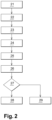
- the method comprises the following steps, as represented by the block diagram of figure 2 :
- the DC/DC converter is controlled to reduce the output DC voltage from a current voltage down to a target DC voltage.
- the target value is determined to be the lowest voltage possible within the operating range of all the systems connected to the low voltage network.
- the aim is to select the lowest voltage possible without disrupting the low voltage network.
- the target value will be preferably chosen to be comprised between 70% and 95 % of the nominal tension of the rechargeable battery, preferably between 75% and 85 % of the nominal tension of the rechargeable battery.
- the rechargeable battery is a 24VDC battery
- the target value can be comprised between 16.8V and 22.8V, preferably between 18 and 20.4V , for instance, the target value can be about 18.6V.
- the output DC voltage is reduced from the current voltage down to the target DC voltage at a predetermined decreasing rate that is comprised between 0,5 V/s and 5V/s, preferably between 1 V/s and 3 V/s, and more preferably around 2V/s.
- the low-voltage network requires a minimum operational voltage and a minimum operational current to remain operational; the target DC voltage is set to be equal to this minimum operational voltage, and the predetermined threshold current value is set to be lower than this minimum operational current.
- the state of the rechargeable battery is considered operational, step 28, if the output DC current has been lower than the predetermined threshold current value during a time that is longer than the second predetermined period of time. Indeed, this implies that during the time when the output DC current value is remained lower than the predetermined threshold current value and when the output DC voltage was maintained down to the target DC voltage, the rechargeable battery has supplied enough current to supply the set of electrical loads, and compensate for reduction of DC current under the predetermined threshold current value so as to maintain the system operational.
- step 29 if the output DC current has been lower than the predetermined threshold current value during a time that is shorter than the second predetermined period of time.
- a minimum duration of 50 ms is determined to take into account the capacitive effect
- the first predetermined period of time lasts more than 50 ms, preferably the first predetermined period of time is comprised between 90 ms and 150 ms, more preferably around 100 ms.
- the second predetermined period of time introduced in fifth step 27 is determined by the need to filter out current peaks, in case there has been a peak current draw following a load starting up.
- the second predetermined period of time lasts more than 10 ms in order to obtain reliable results for the state of the rechargeable battery and is preferably comprised between 40 ms and 100 ms and is more preferably about 50 ms.
- the execution of the first step 23 of the method is preferably triggered by a request from the operator requiring the system to stop.
- the operator's request can be indicated via, for instance, a dedicated key being rotated or via a dedicated button being pressed.
- first step 23 of the invention can be periodically and automatically triggered while the electrical system is still activated and without receiving any specific request from the operator.
- the control unit controls the different loads of the vehicle to maintain them in their current states to avoid power variation in the electric networks.
- a further step 22, that is preferably executed before first step 23, consists in checking that some initial conditions before executing steps 23 to 27 of the present methods are met.
- the further step 22 comprises the sub-steps of:
- the method is aborted without carrying out the next steps of the method. Indeed, if the output DC voltage is lower than a predetermined threshold voltage value, according to the method we are not able to reduce the output DC voltage from a current voltage down to a target DC voltage. The method can be applied only if the network voltage output is above said predetermined threshold voltage value.
- step 21 If according to previous step 21, the method is triggered by a request from the operator requiring the system to stop, the further step 22 takes place after previous step 21.
- the output DC voltage is reset to the nominal output DC voltage supplied by the converter 12.
Landscapes
- Engineering & Computer Science (AREA)
- Power Engineering (AREA)
- Life Sciences & Earth Sciences (AREA)
- Sustainable Development (AREA)
- Sustainable Energy (AREA)
- Transportation (AREA)
- Mechanical Engineering (AREA)
- Physics & Mathematics (AREA)
- General Physics & Mathematics (AREA)
- Charge And Discharge Circuits For Batteries Or The Like (AREA)
Description
- The invention relates to the field of batteries; it relates more specifically to a method to diagnose the state of charge of a low-voltage rechargeable battery embedded in a high-voltage network supplied by a high-voltage power source.
- When multiple electrical power sources are used in parallel as a power source system, some of the power sources outputs are controllable to some extent while other power sources do not have embedded diagnostics, or are not able to communicate their status. In some situations, it becomes crucial to be able to identify the state of the power sources. For example, on construction machinery, the EN 474-1 regulation obliges to be able to lower to the ground the equipment when the machine is stopped. When a machine is composed of a hydraulic system, this operation could be done even after having stopped the engine, thanks to the residual pressure system that is planned for that situation. When the machine is a hybrid or an electric machine comprising electrical actuators, the electric machine is commonly powered by a primary power source to power, for instance, via a primary electrical network, electric actuators, and a secondary power source to power, via a secondary electrical network, low loads such as radio, lights inside the cabin, heaters, air conditioning system, control units of the electric machine.... If failure of the secondary power source occurs, it becomes impossible to comply with the regulation once the primary power source has been shutdown. Indeed, when the primary power source has been shutdown, that is to say disconnected from the primary electrical network, and in case of a failure of the secondary power source , it will be impossible to start the primary power source. In other words, in case of a failure of the secondary power source it will become impossible to connect the primary power source to the primary electrical network. This is due to the fact that the connection of the primary power source with the primary electrical network is usually performed via an electric contactor that is controlled by an ECU powered by the secondary electrical network. As a consequence, it would be impossible to lower again the equipment to the ground as requested by the above regulation.
- The primary power source is usually able to deliver a voltage that is higher than the secondary power source and is commonly called a high-voltage power source. The secondary power source is commonly called a low-voltage power source.
- More specifically, we are considering an electrical system comprising at least a high-voltage electrical network supplied by a high-voltage power source, and a low-voltage electrical network, the low-voltage electrical network being supplied by the high-voltage power source through a DC/DC (direct current to direct current) converter and/or by a low voltage source such as a rechargeable battery. The rechargeable battery can be used to restart the electrical system after the high power source has been shutdown. Besides, the rechargeable battery can be used as backup for the high power network. As illustrated by the previous example, in certain situations it is vital to know what the state of charge of the rechargeable battery is, before stopping the system.
- For diagnosing the state of charge of the rechargeable battery, it is known to feed it with electrical current or voltage pulses and to evaluate the temporal profile of the voltage or current output from the battery. This strategy requires specific electrical circuits and sensors to be added to already complex systems.
- It is also known to use a battery charge controller, but this solution is expensive, and would imply a service interruption to perform the diagnosis.
-
US 2017/297440 A1 andUS 2016/304041 A1 disclose prior art methods that can be used to evaluate the state of charge of a rechargeable battery. - There is a need for simpler solutions which enable diagnosis of a battery which has no embedded diagnostic means, and/or which do not communicate such diagnostic; moreover, it must be possible to perform the diagnosis on the live system without service interruption.
- An object of the invention is to provide a solution to this problem.
- The present invention provides a method for evaluating a state of a charge of a rechargeable battery according to
claim 1. - According to an aspect of the invention, one benefit of this diagnosis method is that the existing control unit of the system and existing sensors embedded in the DC/DC converter will be enough to implement the method.
- According to an aspect of the invention, another benefit of this diagnosis method is that it can be performed on the live system without service interruption.
- According to an aspect of the invention, the state of the rechargeable battery is considered operational if the output DC current has been lower than the predetermined threshold current value during a time, that is longer than the second predetermined period of time; indeed, this implies that during this time during which the output DC voltage was maintained down to the target DC voltage, the rechargeable battery has supplied enough current to supply the set of electrical loads, and compensate for reduction of DC current under the predetermined threshold current value.
- According to an aspect of the invention, the target DC voltage is chosen such that it is comprised between 70% and 95 % of the nominal tension of the rechargeable battery, preferably between 75% and 85 % of the nominal tension of the rechargeable battery. The target value is determined to be the lowest voltage possible within the operating range of all the systems connected to the low voltage network. The aim is to select the lowest voltage possible without disrupting the low voltage network.
- According to an aspect of the invention, the first predetermined period of time lasts preferably more than 50 ms (milliseconds).
- According to an aspect of the invention, the first predetermined period of time is more preferably comprised between 90 ms and 150 ms.
- A minimum duration of 50 ms is necessary to take into account the time between the emission of the control signal to control the DC/DC converter to reduce the output DC voltage from an actual voltage down to a target DC voltage and the voltage adjustment at the DC/DC converter output and to take into account the capacitive effect on the network which might sustain the voltage temporarily. A first predetermined period of time that preferably lasts a maximum of 150 ms is sufficient to obtain a reliable result about the state of the rechargeable battery. The first predetermined period of time can be above 150 ms but it doesn't increase significantly the reliability of the result whereas a duration above 150 ms might cause some disruptions in the electrical system, especially if an extra power is requested by several loads.
- According to an aspect of the invention, during step a) the output DC voltage is reduced from a current voltage down to a target DC voltage at a predetermined decreasing rate.
- According to an aspect of the invention, the predetermined decreasing rate is comprised between 0,5 V/s and 5V/s.
- According to an aspect of the invention, the predetermined decreasing rate is comprised between 1 V/s and 3 V/s.
- According to an aspect of the invention, the second predetermined period of time preferably lasts at least 10 ms.
- According to an aspect of the invention, the second predetermined period of time is, more preferably, comprised between 40 ms and 100 ms.
- A second predetermined period of time that lasts at least 10 ms is preferred in order to obtain reliable results for the state of the rechargeable battery.
- A second predetermined period of time that preferably lasts a maximum of 100 ms is sufficient to obtain a reliable result about the state of the rechargeable battery. The second predetermined period of time can be above 100 ms, but it doesn't increase significantly the reliability of the results obtained by the present method.
- According to an aspect of the invention, the DC/DC converter delivers a nominal output DC voltage, and the method further comprises the following steps to be realised before step a. of reducing the output DC voltage:
- 1. Measuring an output DC voltage of the DC/DC converter;
- 2. Comparing said output DC voltage of the DC/DC converter to a predetermined threshold voltage value;
- 3. If output DC voltage is higher than said predetermined threshold voltage value, continuing the method and carrying out steps a. to f. and if output DC voltage is lower than said predetermined threshold voltage value aborting the method without carrying out steps a. to f.
- According to an aspect of the invention, if the output DC voltage is lower than a predetermined threshold voltage value, initial conditions to start the diagnostic are considered insufficient to execute the diagnostic method and the state of the rechargeable battery is considered to be failed. Indeed, if the output DC voltage is lower than a predetermined threshold voltage value, according to the method, we are not able to reduce the output DC voltage from a current voltage down to a target DC voltage. The method can be applied only if the network voltage output is above said predetermined threshold voltage value.
- According to an aspect of the invention, the predetermined threshold voltage value is equal to the nominal output DC voltage minus a value comprised between 5 % and 30% of the nominal voltage.
- According to an aspect of the invention, the system further comprises an electric actuator for moving an equipment, and the at least one control unit further controls the actuator, the method is triggered and started with step a. of
claim 1 or withstep 1. ofclaim 9 following an operator request to stop the system, the method further comprises the following steps to be executed after the step f. of determining that the rechargeable battery is failed: - g. requesting the operator to put the equipment on the ground before shutting down the primary power source;
- h. receiving the confirmation that the equipment is on the ground;
- i. shutting down the primary power source after having received the confirmation that the equipment is on the ground.
- According to an aspect of the invention, if the outcome of step f. is that the state of the rechargeable battery is considered failed, the operator is informed that the equipment must be put down to the ground before stopping the system and the primary power source is then shut down by the electrical system only after having received the confirmation that the equipment is on the ground. Said confirmation can be received by the user via a HMI interface arranged in the cabin of the vehicle or by at least one sensor detecting the ground position of the equipment.
- The invention also concerns a computer program to be executed on at least one control unit for evaluating a state of a charge of a rechargeable battery on a system, the computer program comprising program code means suitable for executing a method according to the invention.
- The invention also concerns a computer-readable means comprising a recorded computer program, said computer-readable means comprising program code means suitable for performing the method according to the invention, when said recorded computer program is executed by at least one control unit.
- The invention also concerns a vehicle comprising an electrical system, said electrical system comprising at least one primary power source and a rechargeable battery as secondary power source, DC/DC converter and an electrical network comprising a primary electrical network that connects the primary power source to the DC/DC converter and a secondary electrical network that connects the rechargeable battery to the DC/DC converter; the DC/DC converter converting an input DC voltage supplied by the at least one primary power source into an output DC voltage supplied to the secondary electrical network, the at least one primary power source and the rechargeable battery being connected in parallel to at least one electrical load and being configured to supply, via the electrical network, DC voltage and DC current to said at least one electrical load, said system further comprising sensors to measure an output DC current and the output DC voltage, and further comprising at least one control unit controlling the sensors and the power sources, and executing a computer program comprising program code means suitable for executing a method according to the invention.
- According to an aspect of the invention, the vehicle is an excavator construction machine, the system further comprises at least one electric actuator for moving bucket of the vehicle, the at least one control unit executes preferably a computer program comprising program code means suitable for executing a method according to the invention. Preferably, the at least one control unit also controls the electric actuator. In a variant, the electric actuator is controlled by a different control unit.
- Further advantages and advantageous features of the invention are disclosed in the following description and in the dependent claims.
- Below follows a more detailed description of embodiments of the invention cited as examples, in reference to the figures.
-
Figure 1 is a schematic view of a system comprising different electrical power sources supplying two networks of actuators and accessories, and a DC/DC converter. -
Figure 2 is a block diagram representation of the method according to the invention -
Figure 1 represents a schematic view of an example embodiment of an electrical system according to the invention that can be arranged in a hybrid or full electric vehicle such as a hybrid or electric construction machine. - An electrical system according to the invention may comprise different kinds of electrical power sources, such as for instance a permanent
high voltage battery 1, a secondaryhigh voltage battery 2, athermal range extender 3, afuel cell unit 4, a low voltagerechargeable battery 5, and anintegrated charger 6. The permanenthigh voltage battery 1 and the secondaryhigh voltage battery 2 can be, for instance, 600V batteries. The low voltagerechargeable battery 5 can be, for instance, a 24V battery. - All these different sources supply electrical power to two different networks. The
high voltage batteries voltage network 10 supplying 600 V to different electric actuators, such as, for example, alinear actuator 7, and arotational actuator 8. The second network is a low-voltage network 11 supplying 24V toother accessories 9 such as radio, lights inside the cabin, heaters, air conditioning system , control units of the vehicle. - A DC/
DC converter 12 is converting 600VDC high-voltage DC input into 24VDC low-voltage DC output that supplies the low-voltage network. The low-voltage network can also be supplied in 24VDC by the 24V battery. - In other embodiments of the electrical system according to the invention, high-voltage values can as well be 48 VDC, 158VDC, or 334 VDC, or 400 VDC or any other value instead of 600VDC; low-voltage value can as well be 12VDC, or some other values instead of 24VDC.
- The electrical system may also comprise a power source provided by the national electricity distribution network, supplying 230VAC that is then converted to 600VDC via a dedicated 230VAC/600VDC converter.
- The 600VDC/24VDC converter is provided with embedded sensors monitoring the converter's input voltage and current, and/or the converter's output voltage and current. These sensors can communicate the measured values to a control unit of the system, controlling the sensors, the actuators, the power sources and the converter, namely their activation and/or their DC voltages.
- An electrical system comprising at least one of the above mentioned 600VDC sources, supplying a high-voltage network, and a rechargeable 24VDC battery, supplying a low-voltage network, with a 600VDC/24VDC converter also supplying the low-voltage network, may be installed, with a control unit, on a machinery platform or a vehicle, for example a construction machine such as an excavator manipulating an equipment, such as a bucket, attached to it, and driven by the system through at least one electric actuator.
- The 24VDC rechargeable battery is used when the 600VDC sources are inactive, to supply some accessories, such as a radio or a light inside an operator's cabin; it is also used to activate the 600VDC network. Once the 600VDC network is activated, it becomes the main power supplier for the actuators and for the accessories via the DC/DC converter, but also to charge, as much as necessary, the 24VDC rechargeable battery. The 24VDC rechargeable battery is then only used as back-up and/or for buffer-storing in the case of peak loads.
- It may happen that the state of health of the 24VDC rechargeable battery is such that it does not get charged anymore.
- In one example embodiment of the invention, it is mandatory to avoid shutdown of the high-voltage network before having complied with safety regulations, in case the 24VDC rechargeable is not charged enough to be capable of re-activating the high-level voltage network. Complying with safety regulations may for example mean putting to the ground the equipment attached to the construction machine, such as an excavator machine equipped with a bucket. Indeed, if this is not done before shutting down the high-voltage network, whereas the 24VDC rechargeable battery is not able to re-activate this high-voltage network, then the excavator machine will be parked in a non-compliant configuration, and it will become very difficult to make it compliant with safety regulations. The high-voltage network is considered as being shutdown when it is disconnected from its high power source such as the
high voltage batteries - Therefore, to avoid getting into this situation, the method according to the invention consists in automatically controlling the state of charge of the rechargeable battery before stopping the system, and without any service interruption.
- In a first embodiment, the method comprises the following steps, as represented by the block diagram of
figure 2 : - a
first step 23 consists in controlling the DC/DC converter to reduce the output DC voltage from a current voltage down to a target DC voltage; - a
second step 24 consists in maintaining the control of the output voltage of the DC/DC converter at the target DC voltage during a first predetermined period of time; - a
third step 25 consists is measuring the output DC current, supplied by theconverter 12, during the first predetermined period of time. - In this example embodiment of the invention, during
first step 23, the DC/DC converter is controlled to reduce the output DC voltage from a current voltage down to a target DC voltage. The target value is determined to be the lowest voltage possible within the operating range of all the systems connected to the low voltage network. The aim is to select the lowest voltage possible without disrupting the low voltage network. To this end and according to the invention, the target value will be preferably chosen to be comprised between 70% and 95 % of the nominal tension of the rechargeable battery, preferably between 75% and 85 % of the nominal tension of the rechargeable battery. As an example, the rechargeable battery is a 24VDC battery, in this case the target value can be comprised between 16.8V and 22.8V, preferably between 18 and 20.4V , for instance, the target value can be about 18.6V. Preferably, the output DC voltage is reduced from the current voltage down to the target DC voltage at a predetermined decreasing rate that is comprised between 0,5 V/s and 5V/s, preferably between 1 V/s and 3 V/s, and more preferably around 2V/s. - In a fourth step 26 the control unit will determine, within the first predetermined period of time, a time during which the output DC current value is remained lower than a predetermined threshold current value; the control unit will then evaluate the state of charge of the rechargeable battery depending on how long the DC current value is remained lower than the predetermined threshold current value;
- To this aim, in a
fifth step 27, the control unit will compare with a second predetermined period of time, the time during which the output DC current value is remained lower than the predetermined threshold current value. - It is assumed that the low-voltage network requires a minimum operational voltage and a minimum operational current to remain operational; the target DC voltage is set to be equal to this minimum operational voltage, and the predetermined threshold current value is set to be lower than this minimum operational current.
- The state of the rechargeable battery is considered operational, step 28, if the output DC current has been lower than the predetermined threshold current value during a time that is longer than the second predetermined period of time. Indeed, this implies that during the time when the output DC current value is remained lower than the predetermined threshold current value and when the output DC voltage was maintained down to the target DC voltage, the rechargeable battery has supplied enough current to supply the set of electrical loads, and compensate for reduction of DC current under the predetermined threshold current value so as to maintain the system operational.
- On the contrary, the state of the rechargeable battery is considered as failed,
step 29, if the output DC current has been lower than the predetermined threshold current value during a time that is shorter than the second predetermined period of time. - On the low-voltage network, it is expected that there is always consumers on the network. This is in general the case. This means that current is drawn from the network. When the DC/DC converter is controlled to ramp down to the target DC voltage in
first step 23, it is requested insecond step 24 to maintain this target DC voltage during a first predetermined period of time, to cater for the following: - 1. the time between the DC/DC converter request to ramp down and the DC/DC converter output,
- 2. the capacitive effect on the network which might sustain the voltage temporarily until eventually the battery is drawn.
- A minimum duration of 50 ms is determined to take into account the capacitive effect;
- Conversely, above 150 ms might cause some disruptions in the electrical system without significantly increasing the reliability of the results given by the present method. Therefore, in this example embodiment of the invention, the first predetermined period of time lasts more than 50 ms, preferably the first predetermined period of time is comprised between 90 ms and 150 ms, more preferably around 100 ms.
- The second predetermined period of time introduced in
fifth step 27 is determined by the need to filter out current peaks, in case there has been a peak current draw following a load starting up. - Therefore, in this example embodiment of the invention, the second predetermined period of time lasts more than 10 ms in order to obtain reliable results for the state of the rechargeable battery and is preferably comprised between 40 ms and 100 ms and is more preferably about 50 ms.
- In a second embodiment of the invention, before the execution of the
first step 23, and according to an additional andprevious step 21, the execution of thefirst step 23 of the method is preferably triggered by a request from the operator requiring the system to stop. The operator's request can be indicated via, for instance, a dedicated key being rotated or via a dedicated button being pressed. - In an alternative of the invention,
first step 23 of the invention can be periodically and automatically triggered while the electrical system is still activated and without receiving any specific request from the operator. In this case and whenstep 23 is initiated or about to be initiated, the control unit controls the different loads of the vehicle to maintain them in their current states to avoid power variation in the electric networks. - In a further improvement of the invention, a
further step 22, that is preferably executed beforefirst step 23, consists in checking that some initial conditions before executingsteps 23 to 27 of the present methods are met. - To this end, the
further step 22 comprises the sub-steps of: - 1. measuring the output DC voltage of the DC/DC converter,
- 2. comparing the output DC voltage to a predetermined threshold voltage value,
- 3. based on the result of the comparison between the output DC voltage, determining if initial conditions are met to execute the next steps of the method.
- If the output DC voltage is lower than said predetermined threshold voltage value, it is determined that initial conditions are insufficient to execute the next steps of the method. In this case, the method is aborted without carrying out the next steps of the method. Indeed, if the output DC voltage is lower than a predetermined threshold voltage value, according to the method we are not able to reduce the output DC voltage from a current voltage down to a target DC voltage. The method can be applied only if the network voltage output is above said predetermined threshold voltage value.
- On the contrary, if the output DC voltage is higher than the predetermined threshold voltage value, it is determined that conditions are met to execute the next steps of the method. The
next step 23 of the method is then executed. - The predetermined threshold voltage value is preferably determined at a value that is lower than the nominal or reference output DC voltage. The predetermined threshold voltage value can be determined between 5% and 30% below the nominal or reference output DC voltage. The threshold voltage value may be, for instance, about 18,6 V when the nominal or reference output DC voltage is 24V.
- If according to
previous step 21, the method is triggered by a request from the operator requiring the system to stop, thefurther step 22 takes place afterprevious step 21. - As indicated in
figure 2 , in a further improvement of the invention, depending on the outcome offifth step 27, the method according to this improvement of the invention executes one of the two following steps: - ∘ Sixth step 28, if the state of the rechargeable battery is evaluated operational, the machine can be stopped with no other action;
-
∘ Seventh step 29, if the state of the rechargeable battery is evaluated failed, the method comprises the following sub-steps :- requesting from the operator to put the equipment on the ground before automatically shutting down the
primary power source - receiving, via, for instance, a HMI interface in the cabin of the vehicle, a confirmation from the operator that the equipment of the machine has been put on the ground;
- when it is confirmed that the equipment is on the ground, shutting down the
primary power source
- requesting from the operator to put the equipment on the ground before automatically shutting down the
- After the evaluation of the state of charge of the rechargeable battery, the output DC voltage is reset to the nominal output DC voltage supplied by the
converter 12.
Claims (15)
- A method for evaluating a state of charge of a rechargeable battery of an electrical system, said electrical system comprising at least one primary power source (1, 2) and a rechargeable battery (5) as a secondary power source, a DC/DC converter (12) and an electrical network comprising a primary electrical network (10) that connects the primary power source (1,2) to the DC/DC converter (12) and a secondary electrical network (11) that connects the rechargeable battery (5) to at least the DC/DC converter (12) ; the DC/DC converter converting an input DC voltage supplied by the at least one primary power source (1, 2 ) into an output DC voltage supplied to the secondary electrical network (11), the at least one primary power source (1, 2) and the rechargeable battery (5) being connected in parallel to at least one electrical load (7, 8, 9) and being configured to supply, via the electrical network (10, 11), DC voltage and DC current to said at least one electrical load (7, 8, 9), said electrical system further comprising sensors to measure an output DC current and the output DC voltage supplied by the DC/DC converter, and further comprising at least one control unit connected to the sensors and able to control at least the DC/DC converter, characterized in that said method comprising the following steps :a. controlling (23) the DC/DC converter to reduce the output DC voltage from an actual voltage down to a target DC voltage;b. maintaining (24) the target DC voltage during a first predetermined period of time;c. measuring (25) the output DC current during the first predetermined period of time;d. determining (26), within the first predetermined period of time, a time during which the output DC current is remained lower than a predetermined threshold current value;e. comparing (27) the time during which the output DC current value is remained lower than the predetermined threshold current value with a second predetermined period of time;in that the state of the rechargeable battery (5) is considered operational if the output DC current has been lower than the predetermined threshold current value during a time period that is longer than the second predetermined period of time;in that, when operational, the rechargeable battery (5) can be used to restart the primary electrical network (10) after the primary power source (1, 2) has been shutdown; andin that the rechargeable battery (5) is determined (29) as not operational if the time period during which, the output DC current value is remained lower than the predetermined threshold current value, is shorter than the second predetermined period of time.
- A method according to claim 1, wherein the target DC voltage is chosen to be comprised between 70% and 95 % of the nominal tension of the rechargeable battery, preferably between 75% and 85 % of the nominal tension of the rechargeable battery (5).
- A method according to claim 1 or 2, wherein the first predetermined period of time lasts more than 50 ms and is preferably comprised between 90 ms and 150 ms.
- A method according to any of the preceding claims, wherein during step a) the output DC voltage is reduced from a current voltage down to a target DC voltage at a predetermined decreasing rate.
- A method according to claim 4, wherein the predetermined decreasing rate is comprised between 0,5 V/s and 5V/s.
- A method according to claim 5, wherein the predetermined decreasing rate is comprised between 1 V/s and 3 V/s.
- A method according to any of the preceding claims, wherein the second predetermined period of time lasts at least 10 ms.
- A method according to claim 7, wherein the second predetermined period of time is comprised between 40 ms and 100 ms.
- A method according to any of preceding claims, wherein the DC/DC converter delivers a nominal output DC voltage, the method further comprising the following steps (22) to be realised before step a. of reducing the output DC voltage:1. Measuring an output DC voltage of the DC/DC converter (12);2. Comparing said output DC voltage of the DC/DC converter (12) to a predetermined threshold voltage value;3. If output DC voltage is higher than said predetermined threshold voltage value, continuing the method and carrying out steps a. to f. and if output DC voltage is lower than said predetermined threshold voltage value, aborting the method without carrying out steps a. to f.
- A method according to any of the preceding claims, the system further comprising an electric actuator for moving an equipment, the method is triggered and started with step a. of claim 1 or with step 1. of claim 9 following an operator request (21) to stop the system, the method further comprising the following steps to be executed after the step f. of determining that the rechargeable battery is failed:g. requesting from the operator to put the equipment on the ground before shutting down the primary power source (1, 2);h. receiving the confirmation that the equipment is on the ground;i. shutting down the primary power source (1, 2) after having received the confirmation that the equipment is on the ground.
- A computer program to be executed on at least one control unit for evaluating a state of charge of a rechargeable battery on a system, the computer program comprising program code means suitable for executing a method according to any of the preceding claims 1 to 10.
- A computer program to be executed on at least one control unit for evaluating a state of charge of a rechargeable battery (5) on a system, the computer program comprising program code means suitable for executing a method according to claim 10.
- Computer-readable means comprising a recorded computer program according to claim 11 or 12, said computer-readable means comprising program code means suitable for performing the method according to preceding claims, when said recorded computer program is executed by at least one control unit.
- A vehicle comprising an electrical system, said electrical system comprising at least one primary power source (1,2) and a rechargeable battery (5) as secondary power source, a DC/DC converter (12) and an electrical network comprising a primary electrical network (10) that connects the primary power source (1, 2) to the DC/DC converter (12) and a secondary electrical network (11) that connects the rechargeable battery (5) to the DC/DC converter (12); the DC/DC converter (12) converting an input DC voltage supplied by the at least one primary power source (1, 2) into an output DC voltage supplied to the secondary electrical network (11), the at least one primary power source (1, 2) and the rechargeable battery (5) being connected in parallel to at least one electrical load (7, 8, 9) and being configured to supply, via the electrical network (10, 11), DC voltage and DC current to said at least one electrical load (7, 8, 9), said system further comprising sensors to measure an output DC current and the output DC voltage, and further comprising at least one control unit controlling the sensors and the power sources, and executing a computer program according to claim 11.
- A vehicle according to claim 14, wherein the vehicle is an excavator construction machine, the system further comprises at least one electric actuator (7, 8) for moving a bucket of the vehicle, the at least one control unit, executes a computer program according to claim 12.
Applications Claiming Priority (1)
| Application Number | Priority Date | Filing Date | Title |
|---|---|---|---|
| PCT/EP2018/054507 WO2019161909A1 (en) | 2018-02-23 | 2018-02-23 | A method for evaluating a state of charge of a rechargeable battery |
Publications (3)
| Publication Number | Publication Date |
|---|---|
| EP3756261A1 EP3756261A1 (en) | 2020-12-30 |
| EP3756261C0 EP3756261C0 (en) | 2024-08-14 |
| EP3756261B1 true EP3756261B1 (en) | 2024-08-14 |
Family
ID=61557256
Family Applications (1)
| Application Number | Title | Priority Date | Filing Date |
|---|---|---|---|
| EP18708372.0A Active EP3756261B1 (en) | 2018-02-23 | 2018-02-23 | A method for evaluating a state of charge of a rechargeable battery |
Country Status (4)
| Country | Link |
|---|---|
| US (1) | US11289929B2 (en) |
| EP (1) | EP3756261B1 (en) |
| CN (1) | CN111480278B (en) |
| WO (1) | WO2019161909A1 (en) |
Families Citing this family (5)
| Publication number | Priority date | Publication date | Assignee | Title |
|---|---|---|---|---|
| DE102019133048A1 (en) * | 2019-12-04 | 2021-06-10 | Liebherr-Werk Nenzing Gmbh | Device for the emergency supply of a high-voltage electrical system |
| CN111798657B (en) * | 2020-06-22 | 2022-05-17 | 广州赛特智能科技有限公司 | Automatic rescue system and method for unmanned sweeper |
| US11628740B2 (en) | 2020-10-29 | 2023-04-18 | Argo AI, LLC | Devices, systems, and methods for mitigating vehicle power loss in battery mode |
| US20250364824A1 (en) * | 2022-06-01 | 2025-11-27 | Milwaukee Electric Tool Corporation | Hybrid supercapacitors in power tool devices |
| US11970078B2 (en) * | 2022-09-02 | 2024-04-30 | GM Global Technology Operations LLC | Vehicle accessory load control and power stability |
Family Cites Families (10)
| Publication number | Priority date | Publication date | Assignee | Title |
|---|---|---|---|---|
| JP3478193B2 (en) * | 1999-05-24 | 2003-12-15 | トヨタ自動車株式会社 | Power monitoring device |
| CN101926083B (en) * | 2008-01-28 | 2012-11-21 | 株式会社村田制作所 | Dc-dc converter |
| JP2011017546A (en) * | 2009-07-07 | 2011-01-27 | Nissan Motor Co Ltd | Device and method for diagnosing deterioration of lead battery for vehicle |
| CN102906582B (en) * | 2010-05-21 | 2015-02-25 | 丰田自动车株式会社 | Secondary battery diagnostic device, diagnostic method, and vehicle |
| WO2015078481A1 (en) * | 2013-11-28 | 2015-06-04 | Volvo Truck Corporation | Traction voltage system in a vehicle and method for controlling such a system |
| US20160099593A1 (en) * | 2014-10-03 | 2016-04-07 | Infineon Technologies Austria Ag | Battery charge state evaluation coincident with constant current charging |
| US9925888B2 (en) * | 2016-03-02 | 2018-03-27 | Ford Global Technologies, Llc | Battery cell state of charge initialization in a presence of voltage measurement uncertainty |
| CN107202958B (en) * | 2016-03-17 | 2020-09-22 | 伊姆西Ip控股有限责任公司 | Method and apparatus for testing condition of battery |
| CN205554092U (en) * | 2016-04-14 | 2016-09-07 | 罗伯特·博世有限公司 | DCDC converter, battery energy management system and hybrid vehicle |
| JP6562015B2 (en) * | 2017-02-21 | 2019-08-21 | トヨタ自動車株式会社 | Power system |
-
2018
- 2018-02-23 WO PCT/EP2018/054507 patent/WO2019161909A1/en not_active Ceased
- 2018-02-23 US US16/971,955 patent/US11289929B2/en active Active
- 2018-02-23 CN CN201880080790.5A patent/CN111480278B/en not_active Expired - Fee Related
- 2018-02-23 EP EP18708372.0A patent/EP3756261B1/en active Active
Also Published As
| Publication number | Publication date |
|---|---|
| EP3756261C0 (en) | 2024-08-14 |
| CN111480278A (en) | 2020-07-31 |
| US11289929B2 (en) | 2022-03-29 |
| US20200395776A1 (en) | 2020-12-17 |
| CN111480278B (en) | 2024-04-26 |
| EP3756261A1 (en) | 2020-12-30 |
| WO2019161909A1 (en) | 2019-08-29 |
Similar Documents
| Publication | Publication Date | Title |
|---|---|---|
| US11289929B2 (en) | Method for evaluating a state of charge of a rechargeable battery | |
| CN111656206B (en) | Method for monitoring the energy supply of a motor vehicle with automated driving functions | |
| US11383736B2 (en) | Vehicle battery controller | |
| US9862275B2 (en) | Fail safe apparatus and method for eco-friendly vehicle | |
| JP6670998B2 (en) | Power converter | |
| US9889763B2 (en) | External power supply of fuel cell mounted vehicle and control method therefor | |
| US6211681B1 (en) | Apparatus for diagnosing electric power source while power is supplied to load device from the power source | |
| US10862148B2 (en) | Vehicle power source system | |
| JP5334620B2 (en) | Charging apparatus and charging method | |
| CN109937164A (en) | For monitoring the method and apparatus for carrying out the process with the motor vehicle of automation driving functions | |
| US20160103188A1 (en) | Method for monitoring the state of a battery in a motor vehicle | |
| JP2014105857A (en) | Method and system for diagnosing failure of oil pressure sensor | |
| CN116056943B (en) | Method for diagnosing battery relay disconnection of hybrid powertrain | |
| US11833925B2 (en) | Battery diagnostic device, method, program, and vehicle | |
| US20210229610A1 (en) | In-vehicle backup circuit and in-vehicle backup device | |
| CN113644300B (en) | Fuel cell system and control method thereof, and non-transitory storage medium | |
| US20210053454A1 (en) | Method and circuit arrangement for unlocking a charging plug in an emergency designed for a charging station for charging an electric energy storage of an electric vehicle | |
| EP3761493A1 (en) | Dc-dc converter control apparatus and dc-dc converter control method | |
| KR20200071873A (en) | Charging control method for battery of vehicle | |
| JP2006288163A (en) | Abnormality monitoring device in load drive circuit | |
| US9811069B2 (en) | Servomotor control apparatus | |
| US20230100819A1 (en) | Interlock system, method, storage medium, and vehicle | |
| WO2017115628A1 (en) | Power management device and failure detection method | |
| US12330514B2 (en) | In-vehicle system and vehicle brake diagnostic device with a single relay connection | |
| US20250208211A1 (en) | Abnormality detection device |
Legal Events
| Date | Code | Title | Description |
|---|---|---|---|
| STAA | Information on the status of an ep patent application or granted ep patent |
Free format text: STATUS: UNKNOWN |
|
| STAA | Information on the status of an ep patent application or granted ep patent |
Free format text: STATUS: THE INTERNATIONAL PUBLICATION HAS BEEN MADE |
|
| PUAI | Public reference made under article 153(3) epc to a published international application that has entered the european phase |
Free format text: ORIGINAL CODE: 0009012 |
|
| STAA | Information on the status of an ep patent application or granted ep patent |
Free format text: STATUS: REQUEST FOR EXAMINATION WAS MADE |
|
| 17P | Request for examination filed |
Effective date: 20200828 |
|
| AK | Designated contracting states |
Kind code of ref document: A1 Designated state(s): AL AT BE BG CH CY CZ DE DK EE ES FI FR GB GR HR HU IE IS IT LI LT LU LV MC MK MT NL NO PL PT RO RS SE SI SK SM TR |
|
| AX | Request for extension of the european patent |
Extension state: BA ME |
|
| DAV | Request for validation of the european patent (deleted) | ||
| DAX | Request for extension of the european patent (deleted) | ||
| GRAP | Despatch of communication of intention to grant a patent |
Free format text: ORIGINAL CODE: EPIDOSNIGR1 |
|
| STAA | Information on the status of an ep patent application or granted ep patent |
Free format text: STATUS: GRANT OF PATENT IS INTENDED |
|
| INTG | Intention to grant announced |
Effective date: 20240418 |
|
| GRAS | Grant fee paid |
Free format text: ORIGINAL CODE: EPIDOSNIGR3 |
|
| GRAA | (expected) grant |
Free format text: ORIGINAL CODE: 0009210 |
|
| STAA | Information on the status of an ep patent application or granted ep patent |
Free format text: STATUS: THE PATENT HAS BEEN GRANTED |
|
| AK | Designated contracting states |
Kind code of ref document: B1 Designated state(s): AL AT BE BG CH CY CZ DE DK EE ES FI FR GB GR HR HU IE IS IT LI LT LU LV MC MK MT NL NO PL PT RO RS SE SI SK SM TR |
|
| REG | Reference to a national code |
Ref country code: GB Ref legal event code: FG4D |
|
| REG | Reference to a national code |
Ref country code: CH Ref legal event code: EP |
|
| REG | Reference to a national code |
Ref country code: DE Ref legal event code: R096 Ref document number: 602018073039 Country of ref document: DE |
|
| REG | Reference to a national code |
Ref country code: IE Ref legal event code: FG4D |
|
| U01 | Request for unitary effect filed |
Effective date: 20240902 |
|
| U07 | Unitary effect registered |
Designated state(s): AT BE BG DE DK EE FI FR IT LT LU LV MT NL PT RO SE SI Effective date: 20240912 |
|
| PG25 | Lapsed in a contracting state [announced via postgrant information from national office to epo] |
Ref country code: NO Free format text: LAPSE BECAUSE OF FAILURE TO SUBMIT A TRANSLATION OF THE DESCRIPTION OR TO PAY THE FEE WITHIN THE PRESCRIBED TIME-LIMIT Effective date: 20241114 |
|
| PG25 | Lapsed in a contracting state [announced via postgrant information from national office to epo] |
Ref country code: PL Free format text: LAPSE BECAUSE OF FAILURE TO SUBMIT A TRANSLATION OF THE DESCRIPTION OR TO PAY THE FEE WITHIN THE PRESCRIBED TIME-LIMIT Effective date: 20240814 Ref country code: GR Free format text: LAPSE BECAUSE OF FAILURE TO SUBMIT A TRANSLATION OF THE DESCRIPTION OR TO PAY THE FEE WITHIN THE PRESCRIBED TIME-LIMIT Effective date: 20241115 |
|
| PG25 | Lapsed in a contracting state [announced via postgrant information from national office to epo] |
Ref country code: IS Free format text: LAPSE BECAUSE OF FAILURE TO SUBMIT A TRANSLATION OF THE DESCRIPTION OR TO PAY THE FEE WITHIN THE PRESCRIBED TIME-LIMIT Effective date: 20241214 |
|
| PG25 | Lapsed in a contracting state [announced via postgrant information from national office to epo] |
Ref country code: HR Free format text: LAPSE BECAUSE OF FAILURE TO SUBMIT A TRANSLATION OF THE DESCRIPTION OR TO PAY THE FEE WITHIN THE PRESCRIBED TIME-LIMIT Effective date: 20240814 |
|
| PG25 | Lapsed in a contracting state [announced via postgrant information from national office to epo] |
Ref country code: RS Free format text: LAPSE BECAUSE OF FAILURE TO SUBMIT A TRANSLATION OF THE DESCRIPTION OR TO PAY THE FEE WITHIN THE PRESCRIBED TIME-LIMIT Effective date: 20241114 Ref country code: ES Free format text: LAPSE BECAUSE OF FAILURE TO SUBMIT A TRANSLATION OF THE DESCRIPTION OR TO PAY THE FEE WITHIN THE PRESCRIBED TIME-LIMIT Effective date: 20240814 |
|
| PG25 | Lapsed in a contracting state [announced via postgrant information from national office to epo] |
Ref country code: RS Free format text: LAPSE BECAUSE OF FAILURE TO SUBMIT A TRANSLATION OF THE DESCRIPTION OR TO PAY THE FEE WITHIN THE PRESCRIBED TIME-LIMIT Effective date: 20241114 Ref country code: PL Free format text: LAPSE BECAUSE OF FAILURE TO SUBMIT A TRANSLATION OF THE DESCRIPTION OR TO PAY THE FEE WITHIN THE PRESCRIBED TIME-LIMIT Effective date: 20240814 Ref country code: NO Free format text: LAPSE BECAUSE OF FAILURE TO SUBMIT A TRANSLATION OF THE DESCRIPTION OR TO PAY THE FEE WITHIN THE PRESCRIBED TIME-LIMIT Effective date: 20241114 Ref country code: IS Free format text: LAPSE BECAUSE OF FAILURE TO SUBMIT A TRANSLATION OF THE DESCRIPTION OR TO PAY THE FEE WITHIN THE PRESCRIBED TIME-LIMIT Effective date: 20241214 Ref country code: HR Free format text: LAPSE BECAUSE OF FAILURE TO SUBMIT A TRANSLATION OF THE DESCRIPTION OR TO PAY THE FEE WITHIN THE PRESCRIBED TIME-LIMIT Effective date: 20240814 Ref country code: GR Free format text: LAPSE BECAUSE OF FAILURE TO SUBMIT A TRANSLATION OF THE DESCRIPTION OR TO PAY THE FEE WITHIN THE PRESCRIBED TIME-LIMIT Effective date: 20241115 Ref country code: ES Free format text: LAPSE BECAUSE OF FAILURE TO SUBMIT A TRANSLATION OF THE DESCRIPTION OR TO PAY THE FEE WITHIN THE PRESCRIBED TIME-LIMIT Effective date: 20240814 |
|
| U20 | Renewal fee for the european patent with unitary effect paid |
Year of fee payment: 8 Effective date: 20250224 |
|
| PG25 | Lapsed in a contracting state [announced via postgrant information from national office to epo] |
Ref country code: SM Free format text: LAPSE BECAUSE OF FAILURE TO SUBMIT A TRANSLATION OF THE DESCRIPTION OR TO PAY THE FEE WITHIN THE PRESCRIBED TIME-LIMIT Effective date: 20240814 |
|
| PG25 | Lapsed in a contracting state [announced via postgrant information from national office to epo] |
Ref country code: CZ Free format text: LAPSE BECAUSE OF FAILURE TO SUBMIT A TRANSLATION OF THE DESCRIPTION OR TO PAY THE FEE WITHIN THE PRESCRIBED TIME-LIMIT Effective date: 20240814 |
|
| PG25 | Lapsed in a contracting state [announced via postgrant information from national office to epo] |
Ref country code: SK Free format text: LAPSE BECAUSE OF FAILURE TO SUBMIT A TRANSLATION OF THE DESCRIPTION OR TO PAY THE FEE WITHIN THE PRESCRIBED TIME-LIMIT Effective date: 20240814 |
|
| PLBE | No opposition filed within time limit |
Free format text: ORIGINAL CODE: 0009261 |
|
| STAA | Information on the status of an ep patent application or granted ep patent |
Free format text: STATUS: NO OPPOSITION FILED WITHIN TIME LIMIT |
|
| 26N | No opposition filed |
Effective date: 20250515 |
|
| PG25 | Lapsed in a contracting state [announced via postgrant information from national office to epo] |
Ref country code: MC Free format text: LAPSE BECAUSE OF FAILURE TO SUBMIT A TRANSLATION OF THE DESCRIPTION OR TO PAY THE FEE WITHIN THE PRESCRIBED TIME-LIMIT Effective date: 20240814 |
|
| REG | Reference to a national code |
Ref country code: CH Ref legal event code: PL |
|
| PG25 | Lapsed in a contracting state [announced via postgrant information from national office to epo] |
Ref country code: CH Free format text: LAPSE BECAUSE OF NON-PAYMENT OF DUE FEES Effective date: 20250228 |
|
| GBPC | Gb: european patent ceased through non-payment of renewal fee |
Effective date: 20250223 |
|
| PG25 | Lapsed in a contracting state [announced via postgrant information from national office to epo] |
Ref country code: GB Free format text: LAPSE BECAUSE OF NON-PAYMENT OF DUE FEES Effective date: 20250223 |
|
| PG25 | Lapsed in a contracting state [announced via postgrant information from national office to epo] |
Ref country code: IE Free format text: LAPSE BECAUSE OF NON-PAYMENT OF DUE FEES Effective date: 20250223 |
|
| U20 | Renewal fee for the european patent with unitary effect paid |
Year of fee payment: 9 Effective date: 20260224 |