EP3756091B1 - Verbindungsverfahren für roboter - Google Patents
Verbindungsverfahren für roboter Download PDFInfo
- Publication number
- EP3756091B1 EP3756091B1 EP19710051.4A EP19710051A EP3756091B1 EP 3756091 B1 EP3756091 B1 EP 3756091B1 EP 19710051 A EP19710051 A EP 19710051A EP 3756091 B1 EP3756091 B1 EP 3756091B1
- Authority
- EP
- European Patent Office
- Prior art keywords
- program
- robot
- robots
- message
- type
- Prior art date
- Legal status (The legal status is an assumption and is not a legal conclusion. Google has not performed a legal analysis and makes no representation as to the accuracy of the status listed.)
- Active
Links
Images




Classifications
-
- H—ELECTRICITY
- H04—ELECTRIC COMMUNICATION TECHNIQUE
- H04L—TRANSMISSION OF DIGITAL INFORMATION, e.g. TELEGRAPHIC COMMUNICATION
- H04L12/00—Data switching networks
- H04L12/28—Data switching networks characterised by path configuration, e.g. LAN [Local Area Networks] or WAN [Wide Area Networks]
- H04L12/2803—Home automation networks
-
- B—PERFORMING OPERATIONS; TRANSPORTING
- B25—HAND TOOLS; PORTABLE POWER-DRIVEN TOOLS; MANIPULATORS
- B25J—MANIPULATORS; CHAMBERS PROVIDED WITH MANIPULATION DEVICES
- B25J13/00—Controls for manipulators
- B25J13/006—Controls for manipulators by means of a wireless system for controlling one or several manipulators
-
- B—PERFORMING OPERATIONS; TRANSPORTING
- B25—HAND TOOLS; PORTABLE POWER-DRIVEN TOOLS; MANIPULATORS
- B25J—MANIPULATORS; CHAMBERS PROVIDED WITH MANIPULATION DEVICES
- B25J9/00—Program-controlled manipulators
- B25J9/10—Program-controlled manipulators characterised by positioning means for manipulator elements
-
- B—PERFORMING OPERATIONS; TRANSPORTING
- B25—HAND TOOLS; PORTABLE POWER-DRIVEN TOOLS; MANIPULATORS
- B25J—MANIPULATORS; CHAMBERS PROVIDED WITH MANIPULATION DEVICES
- B25J9/00—Program-controlled manipulators
- B25J9/16—Program controls
- B25J9/1602—Program controls characterised by the control system, structure, architecture
- B25J9/161—Hardware, e.g. neural networks, fuzzy logic, interfaces, processor
-
- B—PERFORMING OPERATIONS; TRANSPORTING
- B25—HAND TOOLS; PORTABLE POWER-DRIVEN TOOLS; MANIPULATORS
- B25J—MANIPULATORS; CHAMBERS PROVIDED WITH MANIPULATION DEVICES
- B25J9/00—Program-controlled manipulators
- B25J9/16—Program controls
- B25J9/1656—Program controls characterised by programming, planning systems for manipulators
- B25J9/1658—Program controls characterised by programming, planning systems for manipulators characterised by programming language
-
- B—PERFORMING OPERATIONS; TRANSPORTING
- B25—HAND TOOLS; PORTABLE POWER-DRIVEN TOOLS; MANIPULATORS
- B25J—MANIPULATORS; CHAMBERS PROVIDED WITH MANIPULATION DEVICES
- B25J9/00—Program-controlled manipulators
- B25J9/16—Program controls
- B25J9/1656—Program controls characterised by programming, planning systems for manipulators
- B25J9/1661—Program controls characterised by programming, planning systems for manipulators characterised by task planning, object-oriented languages
-
- B—PERFORMING OPERATIONS; TRANSPORTING
- B25—HAND TOOLS; PORTABLE POWER-DRIVEN TOOLS; MANIPULATORS
- B25J—MANIPULATORS; CHAMBERS PROVIDED WITH MANIPULATION DEVICES
- B25J9/00—Program-controlled manipulators
- B25J9/16—Program controls
- B25J9/1656—Program controls characterised by programming, planning systems for manipulators
- B25J9/1669—Program controls characterised by programming, planning systems for manipulators characterised by special application, e.g. multi-arm co-operation, assembly, grasping
-
- G—PHYSICS
- G06—COMPUTING OR CALCULATING; COUNTING
- G06F—ELECTRIC DIGITAL DATA PROCESSING
- G06F9/00—Arrangements for program control, e.g. control units
- G06F9/06—Arrangements for program control, e.g. control units using stored programs, i.e. using an internal store of processing equipment to receive or retain programs
- G06F9/46—Multiprogramming arrangements
- G06F9/54—Interprogram communication
- G06F9/546—Message passing systems or structures, e.g. queues
-
- H—ELECTRICITY
- H04—ELECTRIC COMMUNICATION TECHNIQUE
- H04L—TRANSMISSION OF DIGITAL INFORMATION, e.g. TELEGRAPHIC COMMUNICATION
- H04L63/00—Network architectures or network communication protocols for network security
- H04L63/04—Network architectures or network communication protocols for network security for providing a confidential data exchange among entities communicating through data packet networks
- H04L63/0428—Network architectures or network communication protocols for network security for providing a confidential data exchange among entities communicating through data packet networks wherein the data content is protected, e.g. by encrypting or encapsulating the payload
-
- H—ELECTRICITY
- H04—ELECTRIC COMMUNICATION TECHNIQUE
- H04L—TRANSMISSION OF DIGITAL INFORMATION, e.g. TELEGRAPHIC COMMUNICATION
- H04L67/00—Network arrangements or protocols for supporting network services or applications
- H04L67/01—Protocols
- H04L67/12—Protocols specially adapted for proprietary or special-purpose networking environments, e.g. medical networks, sensor networks, networks in vehicles or remote metering networks
- H04L67/125—Protocols specially adapted for proprietary or special-purpose networking environments, e.g. medical networks, sensor networks, networks in vehicles or remote metering networks involving control of end-device applications over a network
-
- H—ELECTRICITY
- H04—ELECTRIC COMMUNICATION TECHNIQUE
- H04L—TRANSMISSION OF DIGITAL INFORMATION, e.g. TELEGRAPHIC COMMUNICATION
- H04L69/00—Network arrangements, protocols or services independent of the application payload and not provided for in the other groups of this subclass
- H04L69/26—Special purpose or proprietary protocols or architectures
-
- B—PERFORMING OPERATIONS; TRANSPORTING
- B25—HAND TOOLS; PORTABLE POWER-DRIVEN TOOLS; MANIPULATORS
- B25J—MANIPULATORS; CHAMBERS PROVIDED WITH MANIPULATION DEVICES
- B25J13/00—Controls for manipulators
- B25J13/08—Controls for manipulators by means of sensing devices, e.g. viewing or touching devices
- B25J13/087—Controls for manipulators by means of sensing devices, e.g. viewing or touching devices for sensing other physical parameters, e.g. electrical or chemical properties
-
- B—PERFORMING OPERATIONS; TRANSPORTING
- B25—HAND TOOLS; PORTABLE POWER-DRIVEN TOOLS; MANIPULATORS
- B25J—MANIPULATORS; CHAMBERS PROVIDED WITH MANIPULATION DEVICES
- B25J9/00—Program-controlled manipulators
- B25J9/16—Program controls
- B25J9/1615—Program controls characterised by special kind of manipulator, e.g. planar, scara, gantry, cantilever, space, closed chain, passive/active joints and tendon driven manipulators
- B25J9/162—Mobile manipulator, movable base with manipulator arm mounted on it
-
- B—PERFORMING OPERATIONS; TRANSPORTING
- B25—HAND TOOLS; PORTABLE POWER-DRIVEN TOOLS; MANIPULATORS
- B25J—MANIPULATORS; CHAMBERS PROVIDED WITH MANIPULATION DEVICES
- B25J9/00—Program-controlled manipulators
- B25J9/16—Program controls
- B25J9/1679—Program controls characterised by the tasks executed
- B25J9/1682—Dual arm manipulator; Coordination of several manipulators
Definitions
- the present invention relates to the field of communication between connected objects (mobile robots, sensors, etc.), and the interoperability of these connected objects.
- the problem to be solved is therefore to design an interface software capable of federating heterogeneous mobile objects, in particular by making it possible to interconnect these objects which may belong to one or more fleets of objects for the performance of specified tasks, possibly remotely, among themselves and/or by one or more operators.
- the object of the invention is therefore to propose a solution to all or part of this problem.
- the present invention relates to a method for interconnecting a first robot with at least one second robot, and a method for managing cooperation between a plurality of robots, as well as at least one computer program comprising instructions configured to perform said methods.
- the translation step comprises access within the second program to a configuration file (belonging to P2) such as a correspondence table or a database saved in the at least one memory module, said configuration file providing the second program the portion of the program capable of being implemented by the third program.
- a configuration file such as a correspondence table or a database saved in the at least one memory module
- a first transport protocol is used for the transmission of a sixth message between the second program of the first robot and the second program of the second robot.
- the first, second, third, fourth, fifth and sixth messages exchanged are in JSON format.
- the first protocol is of the UDP type.
- the second protocol is of the TCP type.
- the at least one telecommunications device comprises a wireless communication means.
- the wireless communication means comprises at least one module among: WIFI type module, RFID type module, Bluetooth type module, GSM type module.
- the second program of the first robot encrypts the second message before transmitting it if the recipient is the at least one second robot, and the second program of the first robot decrypts the third message before translating it or to transmit it, if the sender is the at least one second robot.
- the second program is capable of intelligently encrypting and/or decrypting the messages according to their origin and their destination.
- the at least one second robot comprises a remote operator connected to an internet server.
- the third program comprises the operating system of the robot on which it is installed and a driver program for at least one actuator and/or at least one sensor.
- the invention also relates to a computer program comprising a set of instructions configured to execute at least one method according to the invention.
- the invention relates to a computer program comprising a set of instructions configured to execute the method for interconnecting robots, and a computer program comprising a set of instructions configured to execute the cooperation management method inter robots.
- the invention relates to a method which is implemented by a second program P2, on an autonomous robot 1 such as that schematically represented on the figure 1 ;
- P2 comprises one or more sub-programs or software modules, and constitutes a software layer which provides the interface between a first program P1 and two other programs, a third program P3 and a fourth program P4; these programs P1, P3 and P4 each also comprise one or more sub-programs or software modules, and each constitute a software layer.
- the second program P2, or second set of sub-programs or software modules, implements the method according to the invention.
- the first and second programs P1, P2 are generic and can be deployed on any robot, independently of the operating system.
- the fourth program P4, or fourth set of sub-programs or adaptation software module is the only software module of the invention that needs to be adapted to the robot on which the invention is installed.
- An adaptation library external to the robot and to the programs P1, P2, P3, P4, makes it possible in particular to generate the skeleton of said fourth program in the robot's own language.
- the adaptation library is for example available in the Coud or available via a system which can be linked to the robot on demand such as a local computer or a tablet.
- the adaptation library also helps the operator to define and configure the interaction scenario(s) between the robots.
- the software layer P1 is configured to transport the messages, duly formatted beforehand, from one robot (or object) to another robot (or object) and/or to the remote server 3, via the telecommunications available for exchanges between robots and/or remote objects.
- the software layers P1 and the telecommunications equipment implemented by these software layers ensure, among other things, the function of a communication bus BC, hardware and software, making it possible to link the various robots to one another and to the Cloud.
- each communication bus BC has its own router R, making it possible, among other things, to connect the robot directly to the Cloud.
- the higher software layers hosted by the server for example the HMI, or in the cloud, are called application layers.
- the intermediate software layer P2 is generic.
- This intermediate software layer P2 provides the interface between the proprietary formats and instructions implemented on each robot by the software layer P3 for controlling the actuators and actors of the robot in question, and a generic format common to all robots and objects. connected; this interface function notably comprises a mechanism for translating the information or commands received according to the generic format into information or instructions that can be executed according to one of the software layers P4 or P3 of the recipient robot.
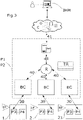
- the picture 3 illustrates an embodiment of the invention, in which the robots (in the material sense) are provided only with the programs P3 and P4 which are specific to them, while the common generic programs P1 and P2 are deported to the cloud.
- the robots communicate with each other via a hardware and software communication bus BC, and at least one router R with which a routing table TR is associated, and possibly with the cloud C and/or at least one user human via an HMI man-machine interface.
- said routing table comprises a list of doublets in the form (robot name, IP address: Port) which allows the router advantageously integrated into the second program P2 to correctly redirect the messages.
- robot name IP address: Port
- said routing table comprises a list of doublets in the form (robot name, IP address: Port) which allows the router advantageously integrated into the second program P2 to correctly redirect the messages.
- IP address Port
- This generic structure allows transparent transmission of messages to higher levels (P1 and P2).
- the second program P2 running on the recipient robot translates the command or the request into a command that can be directly executed on this recipient robot.
- the configuration file is generated (for example by an external program) from the adaptation library, preferably prior to its injection into the second program P2.
- recourse in direct mode to the configuration file occurs only when the messages are commands and/or requests intended for robots authorizing the execution of commands by an external system.
- the communication between the second program P2 and the modules of the lower software layers P3, P4 of the robot considered takes place via a TCP type connection, represented in picture 3 by the solid arrows 30.
- Communication between different second programs P2 belonging to a plurality of robots 1, 2, 21 is carried out according to a UDP type protocol shown in picture 3 by the dotted arrows 40.
- the communication to the server and/or the cloud C is carried out according to a protocol of the UDP type shown in picture 3 by the arrows 41.
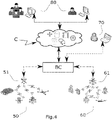
- FIG 4 The overall operation of the invention is resumed at figure 4 , in order to illustrate another variant of communication in which separate fleets of robots 50, 60 communicate with each other via the method according to the invention.
- These fleets can further comprise master robots 51, 61, capable of transmitting the messages received from upstream via the communication bus BC from, for example, the other fleet, a direct user 70, the cloud C, or at least one relocated user 80 passing through the cloud C.
- the first exchanges are carried out according to the UDP protocol, and even more preferentially according to the mode broadcast.
- the interconnection method according to the invention makes it possible, thanks to a set of software layers and modules which are very largely generic, on the one hand to interconnect the heterogeneous robots of the same fleet, but also to interconnect several fleets with each other.
- Orders are formulated from the existing application layer(s) (remote HMI, local HMI on the robotic site or on the robot itself, Cloud, etc.).
- the set of files formalizing a mission comprises at least: a list of identifiers of elementary tasks to be executed (LTP), a file of parameters relating to the constraints on the sequencing of said tasks, a list of identifiers of the peripherals (actuators, sensors, etc.) needed to carry out the tasks, a peripheral prioritization file.
- LTP list of identifiers of elementary tasks to be executed
- peripherals actuators, sensors, etc.
- the transmission from and to the layer P1 takes place via a service for detecting peripherals belonging to the communication bus BC.
- the list of tasks achievable (LTR) by the robot is in the form of a file or in the form of a database containing, among other things, the identifier of the robot and the list of identifiers of the tasks that it can carry out among the list of elementary task identifiers (LTP).
- LTR tasks achievable
- all the files exchanged are in JSON format.
- the execution of the mission can be triggered automatically via programs in the Cloud, or via users from dedicated HMI, remote or local interfaces.
- the peripheral data is recovered by a “data synchronization” service belonging to the communication bus BC of the layer P1.
- the supervision of the inter-robot collaboration is carried out at the level of the “collaboration” service of the layer P1 of each robot.
- the various communication channels are secure.
- Each robot uses its own robotic operating system.
- the robot R1 equipped with a humidity sensor, a temperature sensor and an RFID tag, leaves its starting zone Z1-ZD following the reception of a message from the part of the robot R2 (also provided with an RFID tag) inviting it to join it in the zone Z2 which corresponds for example to a loading zone ZCH.
- the R1 robot must perform autonomous navigation using, for example, data from its own odometry and a laser rangefinder. Once arrived at zone Z2, the robot R1 must communicate with an RFID chip which will indicate its stopping zone for handling parts.
- the R1 robot then heads towards the Z3-ZTR processing area. Arrived at the level of said zone Z3, it notifies the robot R3 of information on the temperature of the part.
- the robot R4 joins the zone Z3 and recovers the part to deposit it according to its temperature either in the zone Z4A or Z4B. During this time, the robot R1 returns to the zone Z1 waiting for the next cycle.
- the methods according to the invention allow fluid communication between heterogeneous robots and sensors, by proposing a mostly generic software architecture (layers P1, P2), easy to install and use (the initial robotic operating system of the robot remaining in place) and an efficient principle of conversion and transmission of messages making the communication transparent between the higher software layers.
Landscapes
- Engineering & Computer Science (AREA)
- Mechanical Engineering (AREA)
- Robotics (AREA)
- Software Systems (AREA)
- Computer Networks & Wireless Communication (AREA)
- Automation & Control Theory (AREA)
- Signal Processing (AREA)
- Physics & Mathematics (AREA)
- Computing Systems (AREA)
- Theoretical Computer Science (AREA)
- Computer Security & Cryptography (AREA)
- General Engineering & Computer Science (AREA)
- Evolutionary Computation (AREA)
- Artificial Intelligence (AREA)
- Fuzzy Systems (AREA)
- Mathematical Physics (AREA)
- General Physics & Mathematics (AREA)
- Medical Informatics (AREA)
- General Health & Medical Sciences (AREA)
- Health & Medical Sciences (AREA)
- Computer Hardware Design (AREA)
- Manipulator (AREA)
Claims (15)
- Verfahren für die Verbindung eines ersten Roboters (1) mit wenigstens einem zweiten Roboter (2, 21), wobei jeder Roboter (1, 2, 21) wenigstens umfasst:- eine Schalt- und Steuereinheit, wobei die Schalt- und Steuereinheit wenigstens einen Prozessor (4) und wenigstens ein Speichermodul (M) umfasst;- wenigstens eine Peripherieeinrichtung vom Typ Aktor oder Sensor;- wenigstens eine Kommunikationseinrichtung;- ein erstes Programm (P1), das konfiguriert ist, die wenigstens eine Kommunikationseinrichtung zu steuern, und das eine Vielzahl von ersten Softwaremodulen umfasst, die auf dem wenigstens einen Prozessor ausgeführt werden;- ein zweites Programm (P2), das eine Vielzahl von zweiten Softwaremodulen umfasst, die auf dem wenigstens einen Prozessor ausgeführt werden, wobei die Konfiguration des zweiten Programms (P2) bestimmt wird durch eine Einstellungsdatei, die ein Feld typ_service umfasst, das einen Sendemodus aus den Modi Interpretieren oder Direkt angibt, wobei der Sendemodus die Nachrichten kennzeichnet, die von dem zweiten Programm (P2) übermittelt werden;- ein drittes Programm (P3), das konfiguriert ist, den wenigstens einen Aktor und/oder den wenigstens einen Sensor zu steuern, und das eine Vielzahl von dritten Softwaremodulen umfasst, die auf dem wenigstens einen Prozessor ausgeführt werden;wobei das Verfahren die folgenden Schritte umfasst, umgesetzt durch das zweite Programm (P2) innerhalb jedes der Roboter (1, 2, 21), nach Empfang einer ersten Nachricht, die von dem dritten Programm (P3) stammt, durch das zweite Programm (P2):- Konvertieren der ersten Nachricht in eine zweite Nachricht, wobei die zweite Nachricht gemäß einer vordefinierten Objektstruktur formatiert ist, umfassend ein Feld typ_msg, das einen Typ der Nachricht aus folgenden Typen angibt: Befehl, Anfrage oder Information;- Übermitteln der zweiten Nachricht an wenigstens ein Programm aus: dem ersten Programm (P1), das zu dem gleichen Roboter gehört, dem zweiten Programm (P2) eines anderen Roboters;wobei das Verfahren zur Verbindung weiter folgende Schritte umfasst, umgesetzt durch das zweite Programm (P2) innerhalb jedes der Roboter (1, 2, 21), nach Empfang einer dritten Nachricht durch das zweite Programm (P2), die gemäß der vordefinierten Objektstruktur formatiert ist und von wenigstens einem Programm stammt aus: dem ersten Programm (P1), das zu dem gleichen Roboter gehört, dem zweiten Programm (P2) eines anderen Roboters, wenn das Feld typ_msg der dritten Nachricht den Typ Befehl oder den Typ Anfrage angibt:- Übersetzen der dritten Nachricht in einen Programmabschnitt, der geeignet ist, von dem dritten Programm (P3) umgesetzt zu werden, wenn das Feld typ_service der Einstellungsdatei, das der dritten Nachricht zugeordnet ist, den Sendemodus Direkt angibt; und/oder- Übermitteln, gemäß einem zweiten Transportprotokoll, wenigstens eines Teils der dritten Nachricht oder des Programmabschnitts an das dritte Programm (P3).
- Verfahren nach Anspruch 1, wobei der Schritt des Übersetzens den Zugriff innerhalb des zweiten Programms auf eine Konfigurationsdatei umfasst, die in dem wenigstens einen Speichermodul (M) gespeichert ist, wobei die Konfigurationsdatei dem zweiten Programm den Programmabschnitt bereitstellt, der geeignet ist, von dem dritten Programm (P3) umgesetzt zu werden.
- Verfahren nach einem der Ansprüche 1 oder 2, wobei der Schritt des Übermittelns wenigstens eines Teils der dritten Nachricht oder des Programmabschnitts wenigstens umfasst:• ein erstes Übermitteln, gemäß einem zweiten Transportprotokoll, einer vierten Nachricht des zweiten Programms (P2) an ein viertes Programm (P4),• ein zweites Übermitteln einer fünften Nachricht des vierten Programms (P4) an das dritte Programm (P3).
- Verfahren nach einem der vorstehenden Ansprüche, wobei ein erstes Transportprotokoll zum Übermitteln einer sechsten Nachricht zwischen dem zweiten Programm P2 des ersten Roboters (1, 2, 21) und dem zweiten Programm P2 des zweiten Roboters (1, 2, 21) verwendet wird.
- Verfahren nach einem der vorstehenden Ansprüche, wobei die ausgetauschte erste, zweite, dritte, vierte, fünfte und sechste Nachricht im Format JSON sind.
- Verfahren nach einem der Ansprüche 3 bis 5, wobei das erste Protokoll vom Typ UDP ist.
- Verfahren nach einem der Ansprüche 1 bis 6, wobei das zweite Protokoll vom Typ TCP ist.
- Verfahren nach einem der vorstehenden Ansprüche, wobei die wenigstens eine Telekommunikationseinrichtung ein drahtloses Kommunikationsmittel umfasst.
- Verfahren nach einem der vorstehenden Ansprüche, wobei das drahtlose Kommunikationsmittel wenigstens ein Modul umfasst aus: einem Modul vom Typ WIFI, einem Modul vom Typ RFID, einem Modul vom Typ Bluetooth, einem Modul vom Typ GSM.
- Verfahren nach einem der vorstehenden Ansprüche, wobei das zweite Programm (P2) die zweite Nachricht verschlüsselt, bevor sie übermittelt wird, wenn der Empfänger der wenigstens eine zweite Roboter (2) ist, und wobei das zweite Programm (P2) die dritte Nachricht entschlüsselt, bevor sie übersetzt oder übermittelt wird, wenn der Sender der wenigstens eine zweite Roboter (2) ist.
- Verfahren nach einem der vorstehenden Ansprüche, wobei der wenigstens eine zweite Roboter einen entfernten Bediener umfasst, der mit einem Internetserver verbunden ist.
- Verfahren nach einem der vorstehenden Ansprüche, wobei das dritte Programm (P3) das Betriebssystem des Roboters und ein Steuerprogramm für wenigstens einen Aktor (A1, A2) und/oder wenigstens einen Sensor (C) umfasst.
- Verfahren zur Verwaltung der Kooperation zwischen einer Vielzahl von Robotern (1, 2, 21), wobei jeder Roboter aus der Vielzahl von Robotern (1, 2, 21) wenigstens umfasst:- eine Schalt- und Steuereinheit, wobei die Schalt- und Steuereinheit wenigstens einen Prozessor (4) und wenigstens ein Speichermodul (M) umfasst;- wenigstens eine Peripherieeinrichtung vom Typ Aktor (A1, A2) oder Sensor (C);- wenigstens eine Kommunikationseinrichtung, die mit wenigstens einem Kommunikationsnetz verbunden ist;- ein erstes Programm (P1), das konfiguriert ist, die wenigstens eine Kommunikationseinrichtung zu steuern, und das eine Vielzahl von ersten Softwaremodulen umfasst, die auf dem wenigstens einen Prozessor ausgeführt werden;- ein zweites Programm (P2), das eine Vielzahl von zweiten Softwaremodulen umfasst, die auf dem wenigstens einen Prozessor ausgeführt werden;- ein drittes Programm (P3), das konfiguriert ist, den wenigstens einen Aktor und/oder den wenigstens einen Sensor zu steuern, und das eine Vielzahl von dritten Softwaremodulen umfasst, die auf dem wenigstens einen Prozessor ausgeführt werden;wobei das Verfahren folgende Schritte umfasst:- Aussenden, über eine Anwendungsebene, die von einem Server (3) gehostet wird oder über Internet zugänglich ist, einer Missionsdatei, wobei die Missionsdatei eine Liste geplanter elementarer Aufgaben und ihre Sequenzierung umfasst, und einer Datei zur Identifikation und Priorisierung der Peripherieeinrichtungen,- Empfangen der Missionsdatei und der Datei zur Identifikation und Priorisierung durch einen Einrichtungsdienst des ersten Programms (P1) jedes Roboters aus der Vielzahl von Robotern,- Übermitteln, durch das erste Programm (P1) jedes Roboters aus der Vielzahl von Robotern, einer ersten Nachricht vom Typ Anfrage an sein zweites Programm (P2), um einen Identifikator jedes verfügbaren Peripheriegeräts (A1, A2, C) des wenigstens einen Peripheriegeräts jedes Roboters aus der Vielzahl von Robotern (1, 2, 21) zu erfahren,- Umsetzen, durch das zweite Programm (P2) jedes Roboters aus der Vielzahl von Robotern (1, 2, 21), des Verfahrens für die Verbindung von Robotern nach einem der vorstehenden Ansprüche, um die Identifikatoren der auf jedem Roboter aus der Vielzahl von Robotern (1, 2, 21) verfügbaren Peripheriegeräte (A1, A2, C) am dritten Programm (P3) abzufragen und dem ersten Programm (P1) zu übermitteln;- Verarbeiten, durch den Einrichtungsdienst des ersten Programms (P1) jedes Roboters aus der Vielzahl von Robotern (1, 2, 21), der Identifikatoren der verfügbaren Peripheriegeräte (A1, A2, C), um eine Liste der von jedem Roboter (1, 2, 21) aus der Vielzahl von Robotern (1, 2, 21) ausführbaren Aufgaben zu generieren,- Übermitteln, an jeden Roboter (1, 2, 21) aus der Vielzahl von Robotern (1, 2, 21) und/oder an einen zentralisierten Dienst des Servers, über jeden Dienst zur Verhandlung/Auswahl des ersten Programms P1, der Liste der von jedem Roboter aus der Vielzahl von Robotern (1, 2, 21) ausführbaren Aufgaben,- Erzeugen, durch einen zentralisierten Dienst des Servers und/oder nach einem Kommunikationsprozess zwischen jedem Dienst zur Verhandlung/Auswahl der Roboter (1, 2, 21), auf der Grundlage der Datei zur Identifikation und Priorisierung der Peripheriegeräte und der Liste der ausführbaren Aufgaben, einer Liste der Roboter, die an der Mission teilnehmen,- Ausführen der Mission,- Synchronisieren der Roboter,- Überwachen der Ausführung der Mission.
- Computerprogramm, umfassend eine Einheit von Anweisungen, die konfiguriert sind, das Verfahren für die Verbindung von Robotern nach einem der Ansprüche 1 bis 12 auszuführen.
- Computerprogramm, umfassend eine Einheit von Anweisungen, die konfiguriert sind, das Verfahren zur Verwaltung der Kooperation nach Anspruch 13 auszuführen.
Applications Claiming Priority (2)
| Application Number | Priority Date | Filing Date | Title |
|---|---|---|---|
| FR1851429A FR3078178B1 (fr) | 2018-02-20 | 2018-02-20 | Procede d’interconnexion entre robots |
| PCT/FR2019/050328 WO2019162595A1 (fr) | 2018-02-20 | 2019-02-14 | Procédé d'interconnexion entre robots |
Publications (2)
| Publication Number | Publication Date |
|---|---|
| EP3756091A1 EP3756091A1 (de) | 2020-12-30 |
| EP3756091B1 true EP3756091B1 (de) | 2022-04-13 |
Family
ID=62683312
Family Applications (1)
| Application Number | Title | Priority Date | Filing Date |
|---|---|---|---|
| EP19710051.4A Active EP3756091B1 (de) | 2018-02-20 | 2019-02-14 | Verbindungsverfahren für roboter |
Country Status (11)
| Country | Link |
|---|---|
| US (1) | US11890761B2 (de) |
| EP (1) | EP3756091B1 (de) |
| JP (1) | JP7266048B2 (de) |
| KR (1) | KR20200135358A (de) |
| CN (1) | CN111742298B (de) |
| BR (1) | BR112020016874A2 (de) |
| CA (1) | CA3089452A1 (de) |
| ES (1) | ES2923288T3 (de) |
| FR (1) | FR3078178B1 (de) |
| SG (1) | SG11202007674SA (de) |
| WO (1) | WO2019162595A1 (de) |
Families Citing this family (7)
| Publication number | Priority date | Publication date | Assignee | Title |
|---|---|---|---|---|
| EP3931656B1 (de) | 2019-02-26 | 2023-02-22 | Airbus Operations GmbH | Unbemanntes bodenbasiertes transportfahrzeug und verfahren zum transportieren von gegenständen |
| DE102020209746A1 (de) | 2020-07-31 | 2022-02-03 | Airbus Operations Gmbh | Unbemanntes bodengebundenes fahrzeug zur aufrechterhaltungvon hygiene und verfahren zur verbesserung von hygienebedingungen |
| CN116237925A (zh) * | 2021-12-08 | 2023-06-09 | 无锡小天鹅电器有限公司 | 衣物处理系统及控制方法、装置和存储介质 |
| KR102706998B1 (ko) * | 2021-12-29 | 2024-09-13 | 주식회사 클로봇 | 이기종 로봇 에이전트들을 제어하는 gRPC 기반 로봇 관제 시스템 및 이의 방법 |
| KR102775878B1 (ko) * | 2022-08-30 | 2025-03-05 | 한국로봇융합연구원 | 고소도장 로봇 통합제어 시스템 |
| US20240189998A1 (en) * | 2022-12-08 | 2024-06-13 | Yokogawa Electric Corporation | Building a robot mission based on mission inventory |
| GB2631087A (en) * | 2023-06-14 | 2024-12-25 | Bettering Our Worlds Bow Ltd | Methods & systems for remote robot control |
Family Cites Families (18)
| Publication number | Priority date | Publication date | Assignee | Title |
|---|---|---|---|---|
| US6374155B1 (en) * | 1999-11-24 | 2002-04-16 | Personal Robotics, Inc. | Autonomous multi-platform robot system |
| JP2002189608A (ja) | 2000-08-28 | 2002-07-05 | Sony Corp | 通信装置及び通信方法、情報処理システム、プログラム作成方法、ネットワークシステム、並びにロボット装置 |
| US6687571B1 (en) * | 2001-04-24 | 2004-02-03 | Sandia Corporation | Cooperating mobile robots |
| JP3925140B2 (ja) * | 2001-10-09 | 2007-06-06 | ソニー株式会社 | 情報提供方法及び情報提供装置、並びにコンピュータ・プログラム |
| JP2003285285A (ja) | 2002-03-27 | 2003-10-07 | Nec Corp | ソフトウェアエージェントを有するロボット装置及びその制御方法とプログラム |
| US7844364B2 (en) * | 2002-04-16 | 2010-11-30 | Irobot Corporation | Systems and methods for dispersing and clustering a plurality of robotic devices |
| JP4792823B2 (ja) | 2005-06-09 | 2011-10-12 | ソニー株式会社 | ネットワーク・システム、移動体装置及びその制御方法、並びにコンピュータ・プログラム |
| KR100701823B1 (ko) * | 2006-05-24 | 2007-03-30 | (주)시뮬레이션연구소 | 메신저를 활용한 토이(Toy) 로봇간 통신시스템 및 이와연동되는 토이 로봇 |
| US20090254671A1 (en) | 2008-03-31 | 2009-10-08 | France Telecom | Remote control of a device by a terminal |
| KR20120072021A (ko) | 2010-12-23 | 2012-07-03 | 한국전자통신연구원 | 로봇 플러그인 중계 시스템 및 방법 |
| JP5698614B2 (ja) | 2011-06-22 | 2015-04-08 | インターナショナル・ビジネス・マシーンズ・コーポレーションInternational Business Machines Corporation | コンテキスト情報処理システム及び方法 |
| KR101871430B1 (ko) * | 2011-11-14 | 2018-06-26 | 한국전자통신연구원 | 소형 로봇의 다중 운용 방법 및 그 운용 시스템 |
| CN103679837B (zh) * | 2012-09-07 | 2018-05-18 | 发纳科机器人美国公司 | 监控/分析机器人相关信息并显示在智能装置上的系统 |
| US9233468B2 (en) * | 2013-11-12 | 2016-01-12 | Irobot Corporation | Commanding a mobile robot using glyphs |
| WO2015117662A1 (en) * | 2014-02-07 | 2015-08-13 | Abb Technology Ltd | Web browser access to robot cell devices |
| CN105429858B (zh) * | 2015-12-11 | 2018-08-03 | 中国人民解放军国防科学技术大学 | 一种多机器人间实时消息传递方法 |
| JP6096874B1 (ja) | 2015-12-21 | 2017-03-15 | ファナック株式会社 | セルコントロールシステムにおける製造セルの状態変化管理システム |
| US10375019B2 (en) * | 2017-10-06 | 2019-08-06 | Stealthpath, Inc. | Methods for internet communication security |
-
2018
- 2018-02-20 FR FR1851429A patent/FR3078178B1/fr not_active Expired - Fee Related
-
2019
- 2019-02-14 SG SG11202007674SA patent/SG11202007674SA/en unknown
- 2019-02-14 KR KR1020207027076A patent/KR20200135358A/ko not_active Ceased
- 2019-02-14 WO PCT/FR2019/050328 patent/WO2019162595A1/fr not_active Ceased
- 2019-02-14 JP JP2020566329A patent/JP7266048B2/ja active Active
- 2019-02-14 CA CA3089452A patent/CA3089452A1/fr active Pending
- 2019-02-14 US US16/970,856 patent/US11890761B2/en active Active
- 2019-02-14 ES ES19710051T patent/ES2923288T3/es active Active
- 2019-02-14 EP EP19710051.4A patent/EP3756091B1/de active Active
- 2019-02-14 BR BR112020016874-2A patent/BR112020016874A2/pt not_active IP Right Cessation
- 2019-02-14 CN CN201980014382.4A patent/CN111742298B/zh active Active
Also Published As
| Publication number | Publication date |
|---|---|
| JP2021514515A (ja) | 2021-06-10 |
| ES2923288T3 (es) | 2022-09-26 |
| BR112020016874A2 (pt) | 2020-12-15 |
| CN111742298B (zh) | 2024-03-22 |
| US20200376669A1 (en) | 2020-12-03 |
| FR3078178B1 (fr) | 2020-02-28 |
| CN111742298A (zh) | 2020-10-02 |
| EP3756091A1 (de) | 2020-12-30 |
| WO2019162595A1 (fr) | 2019-08-29 |
| FR3078178A1 (fr) | 2019-08-23 |
| US11890761B2 (en) | 2024-02-06 |
| JP7266048B2 (ja) | 2023-04-27 |
| SG11202007674SA (en) | 2020-09-29 |
| CA3089452A1 (fr) | 2019-08-29 |
| KR20200135358A (ko) | 2020-12-02 |
Similar Documents
| Publication | Publication Date | Title |
|---|---|---|
| WO2019162595A1 (fr) | Procédé d'interconnexion entre robots | |
| US8281385B2 (en) | Internet friendly proxy server extending legacy software connectivity | |
| JP5242134B2 (ja) | プライベートネットワークシステム及び方法 | |
| US10257163B2 (en) | Secured process control communications | |
| TWI641255B (zh) | 多模式遠端協作技術 | |
| AU2015100676B4 (en) | Connecting module for connecting at least one sensor, actuator, or effector to a service-oriented-architecture network | |
| CN106170963B (zh) | 在控制和自动化系统的部件间建立安全通信的装置和方法 | |
| US12035209B2 (en) | Method for wireless event-driven everything-to-everything (X2X) payload delivery | |
| US20240121218A1 (en) | Secure remote access to historical data | |
| CN104618341B (zh) | 用于安全的远程访问的系统和方法 | |
| EP3433991A1 (de) | Verfahren zur verwaltung und wartung eines flugzeug mit einem bereich mit hohem sicherheitsgrad | |
| CN104618320A (zh) | 用于安全文件传输的系统和方法 | |
| KR102212859B1 (ko) | 비동기 이중화 환경에서 프록시 기반 보안 시스템의 트래픽 처리 방법 | |
| US20230336442A1 (en) | Method and data-transfer-system for transferring data between a data source and a data sink | |
| WO2016028551A1 (en) | Flexible server architecture with ability to dynamically change gateway communication channels | |
| AAU et al. | Deliverable D2. 3 High level architecture (first version) | |
| FR3026517A1 (fr) | Dispositif et procede de transfert bidirectionnel de donnees entre un terminal de communication et un module compatible isobus | |
| Bröring et al. | Deliverable D2. 6 High level architecture (final version) | |
| Lundell et al. | Design of a Telematics System for Saab Giraffe AMB | |
| AU2015203234A1 (en) | Connecting module for connecting at least one sensor, actuator, or effector to a service-oriented-architecture network |
Legal Events
| Date | Code | Title | Description |
|---|---|---|---|
| STAA | Information on the status of an ep patent application or granted ep patent |
Free format text: STATUS: UNKNOWN |
|
| STAA | Information on the status of an ep patent application or granted ep patent |
Free format text: STATUS: THE INTERNATIONAL PUBLICATION HAS BEEN MADE |
|
| PUAI | Public reference made under article 153(3) epc to a published international application that has entered the european phase |
Free format text: ORIGINAL CODE: 0009012 |
|
| STAA | Information on the status of an ep patent application or granted ep patent |
Free format text: STATUS: REQUEST FOR EXAMINATION WAS MADE |
|
| 17P | Request for examination filed |
Effective date: 20200910 |
|
| AK | Designated contracting states |
Kind code of ref document: A1 Designated state(s): AL AT BE BG CH CY CZ DE DK EE ES FI FR GB GR HR HU IE IS IT LI LT LU LV MC MK MT NL NO PL PT RO RS SE SI SK SM TR |
|
| AX | Request for extension of the european patent |
Extension state: BA ME |
|
| DAV | Request for validation of the european patent (deleted) | ||
| DAX | Request for extension of the european patent (deleted) | ||
| GRAP | Despatch of communication of intention to grant a patent |
Free format text: ORIGINAL CODE: EPIDOSNIGR1 |
|
| STAA | Information on the status of an ep patent application or granted ep patent |
Free format text: STATUS: GRANT OF PATENT IS INTENDED |
|
| RIC1 | Information provided on ipc code assigned before grant |
Ipc: G06F 9/54 20060101ALI20211116BHEP Ipc: B25J 9/16 20060101ALI20211116BHEP Ipc: H04L 12/28 20060101ALI20211116BHEP Ipc: G05B 15/00 20060101ALI20211116BHEP Ipc: H04L 29/08 20060101ALI20211116BHEP Ipc: G06F 9/46 20060101AFI20211116BHEP |
|
| INTG | Intention to grant announced |
Effective date: 20211203 |
|
| GRAS | Grant fee paid |
Free format text: ORIGINAL CODE: EPIDOSNIGR3 |
|
| GRAA | (expected) grant |
Free format text: ORIGINAL CODE: 0009210 |
|
| STAA | Information on the status of an ep patent application or granted ep patent |
Free format text: STATUS: THE PATENT HAS BEEN GRANTED |
|
| AK | Designated contracting states |
Kind code of ref document: B1 Designated state(s): AL AT BE BG CH CY CZ DE DK EE ES FI FR GB GR HR HU IE IS IT LI LT LU LV MC MK MT NL NO PL PT RO RS SE SI SK SM TR |
|
| REG | Reference to a national code |
Ref country code: GB Ref legal event code: FG4D Free format text: NOT ENGLISH |
|
| REG | Reference to a national code |
Ref country code: CH Ref legal event code: EP |
|
| REG | Reference to a national code |
Ref country code: DE Ref legal event code: R096 Ref document number: 602019013688 Country of ref document: DE |
|
| REG | Reference to a national code |
Ref country code: IE Ref legal event code: FG4D Free format text: LANGUAGE OF EP DOCUMENT: FRENCH |
|
| REG | Reference to a national code |
Ref country code: AT Ref legal event code: REF Ref document number: 1483931 Country of ref document: AT Kind code of ref document: T Effective date: 20220515 |
|
| REG | Reference to a national code |
Ref country code: LT Ref legal event code: MG9D |
|
| REG | Reference to a national code |
Ref country code: NL Ref legal event code: MP Effective date: 20220413 |
|
| REG | Reference to a national code |
Ref country code: AT Ref legal event code: MK05 Ref document number: 1483931 Country of ref document: AT Kind code of ref document: T Effective date: 20220413 |
|
| REG | Reference to a national code |
Ref country code: ES Ref legal event code: FG2A Ref document number: 2923288 Country of ref document: ES Kind code of ref document: T3 Effective date: 20220926 |
|
| PG25 | Lapsed in a contracting state [announced via postgrant information from national office to epo] |
Ref country code: NL Free format text: LAPSE BECAUSE OF FAILURE TO SUBMIT A TRANSLATION OF THE DESCRIPTION OR TO PAY THE FEE WITHIN THE PRESCRIBED TIME-LIMIT Effective date: 20220413 |
|
| PG25 | Lapsed in a contracting state [announced via postgrant information from national office to epo] |
Ref country code: SE Free format text: LAPSE BECAUSE OF FAILURE TO SUBMIT A TRANSLATION OF THE DESCRIPTION OR TO PAY THE FEE WITHIN THE PRESCRIBED TIME-LIMIT Effective date: 20220413 Ref country code: PT Free format text: LAPSE BECAUSE OF FAILURE TO SUBMIT A TRANSLATION OF THE DESCRIPTION OR TO PAY THE FEE WITHIN THE PRESCRIBED TIME-LIMIT Effective date: 20220816 Ref country code: NO Free format text: LAPSE BECAUSE OF FAILURE TO SUBMIT A TRANSLATION OF THE DESCRIPTION OR TO PAY THE FEE WITHIN THE PRESCRIBED TIME-LIMIT Effective date: 20220713 Ref country code: LT Free format text: LAPSE BECAUSE OF FAILURE TO SUBMIT A TRANSLATION OF THE DESCRIPTION OR TO PAY THE FEE WITHIN THE PRESCRIBED TIME-LIMIT Effective date: 20220413 Ref country code: HR Free format text: LAPSE BECAUSE OF FAILURE TO SUBMIT A TRANSLATION OF THE DESCRIPTION OR TO PAY THE FEE WITHIN THE PRESCRIBED TIME-LIMIT Effective date: 20220413 Ref country code: GR Free format text: LAPSE BECAUSE OF FAILURE TO SUBMIT A TRANSLATION OF THE DESCRIPTION OR TO PAY THE FEE WITHIN THE PRESCRIBED TIME-LIMIT Effective date: 20220714 Ref country code: FI Free format text: LAPSE BECAUSE OF FAILURE TO SUBMIT A TRANSLATION OF THE DESCRIPTION OR TO PAY THE FEE WITHIN THE PRESCRIBED TIME-LIMIT Effective date: 20220413 Ref country code: BG Free format text: LAPSE BECAUSE OF FAILURE TO SUBMIT A TRANSLATION OF THE DESCRIPTION OR TO PAY THE FEE WITHIN THE PRESCRIBED TIME-LIMIT Effective date: 20220713 Ref country code: AT Free format text: LAPSE BECAUSE OF FAILURE TO SUBMIT A TRANSLATION OF THE DESCRIPTION OR TO PAY THE FEE WITHIN THE PRESCRIBED TIME-LIMIT Effective date: 20220413 |
|
| PG25 | Lapsed in a contracting state [announced via postgrant information from national office to epo] |
Ref country code: RS Free format text: LAPSE BECAUSE OF FAILURE TO SUBMIT A TRANSLATION OF THE DESCRIPTION OR TO PAY THE FEE WITHIN THE PRESCRIBED TIME-LIMIT Effective date: 20220413 Ref country code: PL Free format text: LAPSE BECAUSE OF FAILURE TO SUBMIT A TRANSLATION OF THE DESCRIPTION OR TO PAY THE FEE WITHIN THE PRESCRIBED TIME-LIMIT Effective date: 20220413 Ref country code: LV Free format text: LAPSE BECAUSE OF FAILURE TO SUBMIT A TRANSLATION OF THE DESCRIPTION OR TO PAY THE FEE WITHIN THE PRESCRIBED TIME-LIMIT Effective date: 20220413 Ref country code: IS Free format text: LAPSE BECAUSE OF FAILURE TO SUBMIT A TRANSLATION OF THE DESCRIPTION OR TO PAY THE FEE WITHIN THE PRESCRIBED TIME-LIMIT Effective date: 20220813 |
|
| REG | Reference to a national code |
Ref country code: DE Ref legal event code: R097 Ref document number: 602019013688 Country of ref document: DE |
|
| PG25 | Lapsed in a contracting state [announced via postgrant information from national office to epo] |
Ref country code: SM Free format text: LAPSE BECAUSE OF FAILURE TO SUBMIT A TRANSLATION OF THE DESCRIPTION OR TO PAY THE FEE WITHIN THE PRESCRIBED TIME-LIMIT Effective date: 20220413 Ref country code: SK Free format text: LAPSE BECAUSE OF FAILURE TO SUBMIT A TRANSLATION OF THE DESCRIPTION OR TO PAY THE FEE WITHIN THE PRESCRIBED TIME-LIMIT Effective date: 20220413 Ref country code: RO Free format text: LAPSE BECAUSE OF FAILURE TO SUBMIT A TRANSLATION OF THE DESCRIPTION OR TO PAY THE FEE WITHIN THE PRESCRIBED TIME-LIMIT Effective date: 20220413 Ref country code: EE Free format text: LAPSE BECAUSE OF FAILURE TO SUBMIT A TRANSLATION OF THE DESCRIPTION OR TO PAY THE FEE WITHIN THE PRESCRIBED TIME-LIMIT Effective date: 20220413 Ref country code: DK Free format text: LAPSE BECAUSE OF FAILURE TO SUBMIT A TRANSLATION OF THE DESCRIPTION OR TO PAY THE FEE WITHIN THE PRESCRIBED TIME-LIMIT Effective date: 20220413 Ref country code: CZ Free format text: LAPSE BECAUSE OF FAILURE TO SUBMIT A TRANSLATION OF THE DESCRIPTION OR TO PAY THE FEE WITHIN THE PRESCRIBED TIME-LIMIT Effective date: 20220413 |
|
| PLBE | No opposition filed within time limit |
Free format text: ORIGINAL CODE: 0009261 |
|
| STAA | Information on the status of an ep patent application or granted ep patent |
Free format text: STATUS: NO OPPOSITION FILED WITHIN TIME LIMIT |
|
| 26N | No opposition filed |
Effective date: 20230116 |
|
| PG25 | Lapsed in a contracting state [announced via postgrant information from national office to epo] |
Ref country code: AL Free format text: LAPSE BECAUSE OF FAILURE TO SUBMIT A TRANSLATION OF THE DESCRIPTION OR TO PAY THE FEE WITHIN THE PRESCRIBED TIME-LIMIT Effective date: 20220413 |
|
| PG25 | Lapsed in a contracting state [announced via postgrant information from national office to epo] |
Ref country code: SI Free format text: LAPSE BECAUSE OF FAILURE TO SUBMIT A TRANSLATION OF THE DESCRIPTION OR TO PAY THE FEE WITHIN THE PRESCRIBED TIME-LIMIT Effective date: 20220413 |
|
| PG25 | Lapsed in a contracting state [announced via postgrant information from national office to epo] |
Ref country code: MC Free format text: LAPSE BECAUSE OF FAILURE TO SUBMIT A TRANSLATION OF THE DESCRIPTION OR TO PAY THE FEE WITHIN THE PRESCRIBED TIME-LIMIT Effective date: 20220413 |
|
| REG | Reference to a national code |
Ref country code: CH Ref legal event code: PL |
|
| PG25 | Lapsed in a contracting state [announced via postgrant information from national office to epo] |
Ref country code: LU Free format text: LAPSE BECAUSE OF NON-PAYMENT OF DUE FEES Effective date: 20230214 Ref country code: LI Free format text: LAPSE BECAUSE OF NON-PAYMENT OF DUE FEES Effective date: 20230228 Ref country code: CH Free format text: LAPSE BECAUSE OF NON-PAYMENT OF DUE FEES Effective date: 20230228 |
|
| REG | Reference to a national code |
Ref country code: IE Ref legal event code: MM4A |
|
| PG25 | Lapsed in a contracting state [announced via postgrant information from national office to epo] |
Ref country code: IE Free format text: LAPSE BECAUSE OF NON-PAYMENT OF DUE FEES Effective date: 20230214 |
|
| PG25 | Lapsed in a contracting state [announced via postgrant information from national office to epo] |
Ref country code: BG Free format text: LAPSE BECAUSE OF FAILURE TO SUBMIT A TRANSLATION OF THE DESCRIPTION OR TO PAY THE FEE WITHIN THE PRESCRIBED TIME-LIMIT Effective date: 20220413 |
|
| PG25 | Lapsed in a contracting state [announced via postgrant information from national office to epo] |
Ref country code: BG Free format text: LAPSE BECAUSE OF FAILURE TO SUBMIT A TRANSLATION OF THE DESCRIPTION OR TO PAY THE FEE WITHIN THE PRESCRIBED TIME-LIMIT Effective date: 20220413 |
|
| PG25 | Lapsed in a contracting state [announced via postgrant information from national office to epo] |
Ref country code: CY Free format text: LAPSE BECAUSE OF FAILURE TO SUBMIT A TRANSLATION OF THE DESCRIPTION OR TO PAY THE FEE WITHIN THE PRESCRIBED TIME-LIMIT; INVALID AB INITIO Effective date: 20190214 |
|
| PG25 | Lapsed in a contracting state [announced via postgrant information from national office to epo] |
Ref country code: HU Free format text: LAPSE BECAUSE OF FAILURE TO SUBMIT A TRANSLATION OF THE DESCRIPTION OR TO PAY THE FEE WITHIN THE PRESCRIBED TIME-LIMIT; INVALID AB INITIO Effective date: 20190214 |
|
| PG25 | Lapsed in a contracting state [announced via postgrant information from national office to epo] |
Ref country code: TR Free format text: LAPSE BECAUSE OF FAILURE TO SUBMIT A TRANSLATION OF THE DESCRIPTION OR TO PAY THE FEE WITHIN THE PRESCRIBED TIME-LIMIT Effective date: 20220413 |
|
| PGFP | Annual fee paid to national office [announced via postgrant information from national office to epo] |
Ref country code: GB Payment date: 20260219 Year of fee payment: 8 |
|
| PGFP | Annual fee paid to national office [announced via postgrant information from national office to epo] |
Ref country code: ES Payment date: 20260319 Year of fee payment: 8 |
|
| PGFP | Annual fee paid to national office [announced via postgrant information from national office to epo] |
Ref country code: DE Payment date: 20260217 Year of fee payment: 8 |
|
| PGFP | Annual fee paid to national office [announced via postgrant information from national office to epo] |
Ref country code: IT Payment date: 20260227 Year of fee payment: 8 Ref country code: BE Payment date: 20260218 Year of fee payment: 8 |
|
| PGFP | Annual fee paid to national office [announced via postgrant information from national office to epo] |
Ref country code: FR Payment date: 20260223 Year of fee payment: 8 |