EP3755769B1 - Funktionsflüssigkeiten mit niedrigviskosem polyalpha-olefin-grundstoff - Google Patents
Funktionsflüssigkeiten mit niedrigviskosem polyalpha-olefin-grundstoff Download PDFInfo
- Publication number
- EP3755769B1 EP3755769B1 EP19703821.9A EP19703821A EP3755769B1 EP 3755769 B1 EP3755769 B1 EP 3755769B1 EP 19703821 A EP19703821 A EP 19703821A EP 3755769 B1 EP3755769 B1 EP 3755769B1
- Authority
- EP
- European Patent Office
- Prior art keywords
- base stock
- pao
- olefin
- dimer
- viscosity
- Prior art date
- Legal status (The legal status is an assumption and is not a legal conclusion. Google has not performed a legal analysis and makes no representation as to the accuracy of the status listed.)
- Active
Links
Images

Classifications
-
- C—CHEMISTRY; METALLURGY
- C10—PETROLEUM, GAS OR COKE INDUSTRIES; TECHNICAL GASES CONTAINING CARBON MONOXIDE; FUELS; LUBRICANTS; PEAT
- C10M—LUBRICATING COMPOSITIONS; USE OF CHEMICAL SUBSTANCES EITHER ALONE OR AS LUBRICATING INGREDIENTS IN A LUBRICATING COMPOSITION
- C10M107/00—Lubricating compositions characterised by the base-material being a macromolecular compound
- C10M107/02—Hydrocarbon polymers; Hydrocarbon polymers modified by oxidation
- C10M107/10—Hydrocarbon polymers; Hydrocarbon polymers modified by oxidation containing aliphatic monomer having more than 4 carbon atoms
Definitions
- This disclosure relates to functional fluids such as automotive engine transmission fluids, clutch fluids, gearbox fluids, electric motor cooling fluids, and battery pack cooling fluids.
- functional fluids comprising a low-viscosity, low-volatility polyalpha-olefin base stock.
- Engine transmission fluids lubricates components in the transmission and helps cooling down the transmission in operation. Macro trends in transmission fluids are tending toward lower viscosities to achieve better fuel economy. As base stock viscosity is lowered, however, volatility for the base stock tends to increase, which can cause undesirable outcomes in lubricant performance such as fluid loss, increased wear, and the like. Likewise, gearbox fluids, clutch fluids, and other mechanical system lubricating fluids can benefit from lower operating viscosities as well to achieve a higher energy efficiency.
- hybrid and electric vehicles require transmission fluids that have very low viscosity base stocks in order to improve fuel economy and drive superior thermal transfer properties. These transmission fluids are exposed to high temperatures due to close contact with the electric motor, and thus the base stocks require low volatility, good oxidative stability, and good thermal stability properties. Electric motors and battery packs of hybrid vehicles and electric vehicles may need to be cooled during operation by functional fluids due to the heat generated by large discharge currents. Low viscosity, low volatility, good oxidation stability and good thermal stability are highly desirable for such functional fluids as well.
- PAO polyalpha-olefin
- WO 2013/055480 A1 discloses a series of low-viscosity PAO base stocks made by (i) oligomerization of linear alpha-olefin ("LAO") monomer(s) in the presence of a catalyst system comprising a metallocene compound or (ii) a hybrid process including a first step of producing a second oligomer from oligomerization of LAO monomer(s) in the presence of a catalyst system comprising a metallocene compound, followed by oligomerization of the dimer with an LAO monomer in the presence of a Lewis acid catalyst.
- LAO linear alpha-olefin
- a hybrid process including a first step of producing a second oligomer from oligomerization of LAO monomer(s) in the presence of a catalyst system comprising a metallocene compound, followed by oligomerization of the dimer with an LAO monomer in the presence of a Lewis acid catalyst.
- This patent reference also discloses engine oils compris
- US2013/0090273A1 discloses ultra-low viscosity passenger car engine oil compositions with a kinematic viscosity at 100° C of from 4 to 6 cSt, and comprising in admixture 60 wt % to 90 wt % of a first base oil component, based on the total weight of the composition, the first base oil component consisting of a polyalphaolefin base stock or combination of polyalphaolefin stocks, each having a kinematic viscosity at 100° C of from 3.2 cSt to 3.8 cSt; and 0.1 wt % to 20 wt % of a second base oil component, based on the total weight of the composition, the second base oil component consisting of a Group II, Group III or Group V base stock, or any combination thereof; wherein the composition comprises from 0 wt % to less
- US2017/0183594A1 discloses a low-viscosity oil including more than 50 wt % of 9-methyl-11-octyl-heneicosane as well as a lubricating composition including the base oil and optionally another base oil or an additive.
- the preset invention is defined by the claims, which relate to the use of a saturated polyalpha-olefin ("PAO") base stock as a base stock for the preparation of a functional fluid for engine transmissions for internal combustion engines, including automatic and manual transmissions, gas/electric hybrid engine transmissions, diesel/electric hybrid engine transmissions, electric motors, and battery packs, for purposes of lubricating and/or cooling the transmissions, electrical motors and/or the battery packs.
- PAO saturated polyalpha-olefin
- the PAO base stock has a kinematic viscosity at 100°C determined pursuant to ASTM D445 (“KV100") in the range from 3.0 x10⁻⁶ to 4.5 x10⁻⁶ m2/s (3.0 to 4.5 m m2/s (cSt)); and a Noack volatility determined pursuant to ASTM D5800 ("NV") not higher than 15%.
- the concentration of said PAO base stock in the functional fluid is in the range from 50 wt% to 98 wt%, based on the weight of the functional fluid.
- low-viscosity PAO base stocks made by (i) oligomerization of linear alpha-olefin ("LAO") monomer(s) in the presence of a catalyst system comprising a metallocene compound or (ii) a hybrid process including a first step of producing a second oligomer such as a dimer from oligomerization of LAO monomer(s) in the presence of a catalyst system comprising a metallocene compound, followed by oligomerization of the second oligomer with an LAO monomer in the presence of a Lewis acid catalyst, have excellent properties for functional fluids such as transmission fluids, especially high-quality transmission fluids with good balance of low viscosity and low volatility, particularly suitable for demanding transmissions found in modern hybrid vehicles.
- functional fluids such as transmission fluids, especially high-quality transmission fluids with good balance of low viscosity and low volatility, particularly suitable for demanding transmissions found in modern hybrid vehicles.
- alkyl or "alkyl group” interchangeably refers to a saturated hydrocarbyl group consisting of carbon and hydrogen atoms.
- An alkyl group can be linear, branched linear, cyclic, or substituted cyclic where the substitute is an alkyl.
- hydrocarbyl group or “hydrocarbyl” interchangeably refers to a group consisting of hydrogen and carbon atoms only.
- a hydrocarbyl group can be saturated or unsaturated, linear or branched linear, cyclic or acyclic, aromatic or non-aromatic.
- Cn group, compound or oligomer refers to a group, a compound or an oligomer comprising carbon atoms at total number thereof of n.
- a “Cm-Cn” group, compound or oligomer refers to a group, compound or oligomer comprising carbon atoms at a total number thereof in the range from m to n.
- a C28-C32 oligomer refers to an oligomer comprising carbon atoms at a total number thereof in the range from 28 to 32.
- carbon backbone refers to the longest straight carbon chain in the molecule of the compound, group or oligomer in question.
- Branch refers to any non-hydrogen group connected to the carbon backbone.
- olefin refers to an unsaturated hydrocarbon compound having a hydrocarbon chain containing at least one carbon-to-carbon double bond in the structure thereof, wherein the carbon-to-carbon double bond does not constitute a part of an aromatic ring.
- the olefin may be linear, branched linear, or cyclic.
- Olefin is intended to embrace all structural isomeric forms of olefins, unless it is specified to mean a single isomer or the context clearly indicates otherwise.
- a "linear alpha-olefin” is an alpha-olefin defined in this paragraph wherein R 1 is hydrogen, and R 2 is hydrogen or a linear alkyl group.
- vinyl means an olefin having the following formula: wherein R is a hydrocarbyl group, preferably a saturated hydrocarbyl group such as an alkyl group.
- vinylene means an olefin having the following formula: wherein R 1 and R 2 are each independently a hydrocarbyl group, preferably a saturated hydrocarbyl group such as alkyl group.
- tri-substituted vinylene means an olefin having the following formula: wherein R 1 , R 2 , and R 3 are each independently a hydrocarbyl group, preferably a saturated hydrocarbyl group such as alkyl group.
- tetra-substituted vinylene means an olefin having the following formula: wherein R 1 , R 2 , R 3 and R 4 are each independently a hydrocarbyl group, preferably a saturated hydrocarbyl group such as alkyl group.
- PAO(s) includes any oligomer(s) and polymer(s) of one or more alpha-olefin monomer(s).
- PAOs are oligomeric or polymeric molecules produced from the polymerization reactions of alpha-olefin monomer molecules in the presence of a catalyst system, optionally further hydrogenated to remove residual carbon-carbon double bonds therein.
- the PAO can be a dimer, a trimer, a tetramer, or any other oligomer or polymer comprising two or more structure units derived from one or more alpha-olefin monomer(s).
- the PAO molecule can be highly regio-regular, such that the bulk material exhibits an isotacticity, or a syndiotacticity when measured by 13 C NMR.
- the PAO molecule can be highly regio-irregular, such that the bulk material is substantially atactic when measured by 13 C NMR.
- a PAO material made by using a metallocene-based catalyst system is typically called a metallocene-PAO ("mPAO")
- mPAO metallocene-PAO
- cPAO conventional PAO
- pendant group with respect to a PAO molecule refers to any group other than hydrogen attached to the carbon backbone other than those attached to the carbon atoms at the very ends of the carbon backbone.
- length of a pendant group is defined as the total number of carbon atoms in the longest carbon chain in the pendant group, counting from the first carbon atom attached to the carbon backbone.
- the pendant group may contain a cyclic group or a portion thereof in the longest carbon chain, in which case half of the carbon atoms in the cyclic group are counted toward the length of the pendant group.
- a linear C8 pendant group has a length of 8; the pendant groups PG-1 (cyclohexylmethylene) and PG-2 (phenylmethylene) each has a length of 4; and the pendant groups PG-3 (o-heptyl-phenylmethylene) and PG-4 ( p- heptylphenylmethylene) each has a length of 11.
- the arithmetic average of the lengths of all such pendant groups are calculated as the average length of the all pendant groups in the PAO molecule.
- substantially all with respect to PAO molecules means at least 90 mol% (such as at least 95 mol%, at least 98 mol%, at least 99 mol%, or even 100 mol%).
- the term “consist essentially of” means comprising at a concentration of at least 90 mol% (such as at least 95 mol%, at least 98 mol%, at least 99 mol%, or even 100 mol%).
- the term "substantially free of” with respect to a particular component means the concentration of that component in the relevant composition is no greater than 10 mol% (such as no greater than 5 mol%, no greater than 3 mol%, or no greater than 1 mol%), based on the total quantity of the relevant composition.
- a “lubricant” refers to a substance that can be introduced between two or more moving surfaces and lower the level of friction between two adjacent surfaces moving relative to each other.
- a lubricant “base stock” is a material, typically a fluid at the operating temperature of the lubricant, used to formulate a lubricant by admixing it with other components.
- base stocks suitable in lubricants include API Group I, Group II, Group III, Group IV, and Group V base stocks.
- Fluids derived from Fischer-Tropsch process or Gas-to-Liquid (“GTL”) processes are examples of synthetic base stocks useful for making modern lubricants.
- GTL base stocks and processes for making them can be found in, e.g., WO 2005/121280 A1 and U.S. Patent Nos. 7,344,631 ; 6,846,778 ; 7,241,375 ; 7,053,254 .
- kinematic viscosity values in this disclosure are as determined according to ASTM D445. Kinematic viscosity at 100°C is reported herein as KV100, and kinematic viscosity at 40°C is reported herein as KV40. Unit of all KV100 and KV40 values herein is cSt, unless otherwise specified.
- NV Noack volatility
- CCSV cold-crank-simulator viscosity
- HTHSV high-temperature high-shear viscosity
- Brookfield viscosity Brookfield
- MRV MRV apparent viscosity
- thermal conductivity values in this disclosure are as determined pursuant to ASTM E1269. Unit of thermal conductivity values is W ⁇ (m ⁇ K) -1 , unless otherwise specified.
- Molecular weight of oligomer or polymer materials (including hydrogenated and unsaturated PAO materials) and distribution thereof in this disclosure are measured by using gel permeation chromatography (GPC) equipped with a multiple-channel band filter based infrared detector ensemble IR5 (GPC-IR) with band region covering from 2700 - 3000 cm -1 (all saturated C-H stretching vibration).
- GPC gel permeation chromatography
- IR5 infrared detector ensemble IR5
- Reagent grade 1,2,4-trichlorobenzene (TCB) (from Sigma-Aldrich) comprising 300 ppm antioxidant BHT is used as the mobile phase at a nominal flow rate of 1.0 mL/min and a nominal injection volume 200 ⁇ L.
- the whole system including transfer lines, columns, and detectors is contained in an oven maintained at 145°C.
- a given amount of sample is weighed and sealed in a standard vial with 10 ⁇ L flow marker (heptane) added thereto.
- the oligomer or polymer is automatically dissolved in the instrument with 8 mL added TCB solvent at 160°C with continuous shaking.
- the sample solution concentration is from 0.2 to 2.0 mg/ml, with lower concentrations used for higher molecular weight samples.
- the mass recovery is calculated from the ratio of the integrated area of the concentration chromatography over elution volume and the injection mass which is equal to the pre-determined concentration multiplied by injection loop volume.
- Mn Number-average molecular weight
- Mw weight-average molecular weight
- NMR spectroscopy provides key structural information about the synthesized polymers.
- Proton NMR (1H-NMR) analysis of the unsaturated PAO material gives a quantitative breakdown of the olefinic structure types (viz. vinyl, 1,2-di-substituted vinylene, tri-substituted vinylene, and vinylidene).
- compositions of mixtures of olefins comprising terminal olefins (vinyls and vinylidenes) and internal olefins (1,2-di-substituted vinylenes and tri-substituted vinylenes) are determined by using 1 H-NMR.
- a NMR instrument of at least 500 MHz is run under the following conditions: a 30° flip angle RF pulse, 120 scans, with a delay of 5 seconds between pulses; sample dissolved in CDCl 3 (deuterated chloroform); and signal collection temperature at 25°C.
- the following approach is taken in determining the concentrations of the various olefins among all of the olefins from an NMR spectrum. First, peaks corresponding to different types of hydrogen atoms in vinyls (T1), vinylidenes (T2), 1,2-di-substituted vinylenes (T3), and tri-substituted vinylenes (T4) are identified.
- a process is described as comprising at least one "step.” It should be understood that each step is an action or operation that may be carried out once or multiple times in the process, in a continuous or discontinuous fashion. Unless specified to the contrary or the context clearly indicates otherwise, the steps in a process may be conducted sequentially in the order as they are listed, with or without overlapping between one or more other step(s), or in any other order, as the case may be. In addition, one or more or even all steps may be conducted simultaneously with regard to the same or different batch of material.
- a second step may be carried out simultaneously with respect to an intermediate material resulting from treating the raw materials fed into the process at an earlier time in the first step.
- the steps are conducted in the order described.
- the indefinite article “a” or “an” shall mean “at least one” unless specified to the contrary or the context clearly indicates otherwise.
- embodiments using “a given device” include embodiments where one, two or more such given devices is used, unless specified to the contrary or the context clearly indicates that only one such given device is used.
- the functional fluids of this disclosure comprises a PAO first base stock as the primary base stock or a co-base stock.
- the PAO first base stock is desirably a low-viscosity, low-volatility base stock particularly suitable for use in functional fluids for engine transmissions for internal combustion engines, including automatic and manual transmissions, gas/electric hybrid engine transmissions, diesel/electric hybrid engine transmissions, electric motors, and even battery packs, for purposes of lubricating and/or cooling the transmissions, electrical motors and/or the battery packs, such as those installed in modern gas or diesel powered, gas/electric powered, diesel/electric powered, and electrically powered automobiles.
- the PAO first base stock desirably has a KV100 in the range from v1 to v2 cSt, where v1 and v2 can be, independently, 3.0, 3.1, 3.2, 3.3, 3.4, 3.5, 3.6, 3.7, 3.8, 3.9, 4.0, 4.1, 4.2, 4.3, 4.4, and 4.5.
- the low viscosity of the PAO first base stock reduces traction loss during the high speed movement of the components in the transmission, resulting in high energy efficiency and low transmission operating temperature.
- the low viscosity of the PAO first base stock enables high-velocity circulation of the functional fluid when pumped in a circuit, achieving the ability of high cooling efficiency if used as a cooling medium for an electric motor and/or a battery backpack.
- the PAO first base stock desirably has a low NV value of no greater than 15.0 wt%, preferably no greater than 14.0 wt%, more preferably no greater than 13.0 wt%, still more preferably no greater than 12.5 wt%, determined pursuant to ASTM D5800.
- the PAO base stock in the functional fluids of this disclosure tends to have lower NV values.
- the low NV values of the PAO first base stock contributes to consistent viscosity and performance of the functional fluids of this disclosure over a long service period without the need of servicing and fluid replacement.
- the PAO first base stock may desirably have a thermal conductivity at 40°C in the range from 0.11 to 0.16 W ⁇ (m ⁇ K) -1 .
- the PAO first base stock desirably are saturated alkanes substantially free of olefinic double bonds in the molecules thereof.
- the PAO first base stock may desirably have a cold-cranking simulator viscosity at -35°C determined pursuant to ASTM ("CCSV") no higher than 1,000 centipoise.
- the PAO first base stock may have a CCSV at -35°C in the range from a1 to a2 centipoise, where a1 and a2 can be, independently, 500, 550, 600, 650, 700, 750, 800, 850, 900, or 1000, as long as a1 ⁇ a2.
- the exceedingly low CCSV of the PAO first base stock renders particularly useful in an engine transmission fluid operating from time to time at low temperature in cold climate. Compared to conventional PAO base stocks available commercially, the PAO first base stock can be particularly advantageous in this regard.
- the PAO first base stock may desirably have a high-temperature, high-shear viscosity determined pursuant to ASTM D4683 ("HTHSV") at 150°C of no greater than 1.4 centipoise.
- HTHSV high-temperature, high-shear viscosity determined pursuant to ASTM D4683
- the PAO first base stock may have a HTHSV at 150°C in the range from 1.0 to 1.4 centipoise, preferably from 1.0 to 1.3 poise, more preferably from 1.0 to 1.2 poise.
- a lower HTHSV can provide improved fuel economy to the lubricating application since the lower viscosity can result in reduced friction.
- the PAO first base stock desirably has a high oxidation stability indicated by rotating pressure vessel oxidation test (RPVOT) break time, determined pursuant to ASTM D-2272, of at least about 60 minutes, preferably at least 70 minutes, more preferably at least 80 minutes.
- RVOT rotating pressure vessel oxidation test
- the PAO first base stock desirably may comprise C28-C32 polyalpha-olefin oligomers at a total concentration thereof of no less than 90 wt%, preferably no less than 92 wt%, more preferably no less than 94 wt%, still more preferably no less than 95 wt%, still more preferably no less than 96 wt%, still more preferably no less than 97 wt%, still more preferably no less than 98 wt%, based on the total weight of the first base stock.
- a narrow molecular weight distribution is achieved by such high percentage of oligomers having close molecular weights.
- the PAO first base stock desirably may comprise C30 polyalpha-olefin oligomers at a total concentration thereof of no less than 90 wt%, preferably no less than 92 wt%, more preferably no less than 94 wt%, still more preferably no less than 95 wt%, still more preferably no less than 96 wt%, still more preferably no less than 97 wt%, still more preferably no less than 98 wt%, based on the total weight of the first base stock.
- the C30 polyalpha-olefin oligomers may be conveniently represented by formula C 30 H 62 , which may be a mixture of multiple (e.g., two, three, four, or more) alkane isomers.
- such PAO first base stock may comprise one predominant compound having formula C 30 H 62 at a total concentration of at least 50 wt%, 60 wt%, 70 wt%, 80 wt%, or even 90 wt%, based on the total moles of the C 30 H 62 isomers.
- the PAO first base stock may comprise polyalpha-olefin oligomers having the following formula at a total concentration thereof, based on the total weight of the first base stock, of no less than 50 wt%, preferably no less than 60 wt%, more preferably no less than 70 wt%, still more preferably no less than 80 wt%, still more preferably no less than 90 wt%, still more preferably no less than 95 wt%: wherein each R is independently an n-butyl, n-hexyl, n-octyl, n-decyl, or n-dodecyl.
- PAO oligomers are C28 to C32 oligomers.
- the different R groups contain carbon numbers differing by no more than 2. In one preferred example, all R groups are n-octyl.
- the PAO first base stock desirably has high oxidation resistance, especially at high operation temperatures inside an engine transmission, particularly a hybrid engine transmission. Please provide description of oxidation resistance of this material; explain what causes the high oxidation resistance of this base stock material.
- At least a portion of the PAO first base stock can be desirably made from a process selected from:
- the entirety of the PAO first base stock can be made by either process (i) or process (ii) above.
- PAO oligomers made by process (i) and those by process (ii) above may be combined together at any proportion to make the PAO first base stock of this disclosure.
- WO 2013/055480 A1 discloses processes (i) and (ii) above.
- the C6 to C14 alpha-olefin are preferably linear alpha-olefins, e.g., 1-hexene, 1-octene, 1-decene, 1-dodecene, and 1-tetradecene.
- Preferred alpha-olefins for processes (i) and (ii) are 1-octene, 1-decene, and 1-dodecene.
- Most preferred alpha-olefin is 1-decene, especially in cases where a single alpha-olefin is used in making the PAO first base stock.
- two different alpha-olefins are used at substantial concentrations (e.g., higher than 5 mol%, based on the total moles of the alpha-olefins), it is preferred that they contain carbon numbers differing by no more than 4, still more preferably by no more than 2. If three different alpha-olefins are used at substantial concentrations, it is preferred that they contain carbon numbers differing by no more than 6, still more preferably by no more than 4. Close molecular weights of the multiple alpha-olefin monomers used in the processes contribute to highly uniform molecular weights among the molecules included in the first PAO base stock.
- a single alpha-olefin monomer is used for making the PAO first base stock.
- a single alpha-olefin is used for making the second oligomer.
- the second oligomer is a dimer of the alpha-olefin(s).
- the first unhydrogenated precursor consists essentially of trimer(s).
- the first unhydrogenated precursor preferably consists essentially of C 30 H 60 .
- the second oligomer consists essentially of dimer(s).
- the second oligomer preferably consist essentially of C 20 H 40 .
- the second unhydrogenated precursor preferably consists of trimer(s).
- the second unhydrogenated precursor preferably consists essentially of C 30 H 60 .
- the second oligomer comprises at least 20 (or 25, 30, 35, 40, 45, 50, 55, 60) wt% of tri-substituted olefins.
- the second unhydrogenated precursor preferably comprises, in total, at least 50 (or 55, 60, 65, 70, 75, or even 80) wt% of tri-substituted and tetra-substituted olefins combined, based on the total moles of the olefins in the second unhydrogenated precursor.
- the functional fluid of this disclosure comprises the PAO first base stock described above as a major component.
- concentration of the PAO first base stock in the functional fluid of this disclosure can range from, e.g., x1 to x2 wt%, where xland x2 can be, independently, 3, 4, 5, 6, 7, 8, 9, 10, 15, 20, 25, 30, 35, 40, 45, 50, 55, 60, 65, 70, 75, 80, 85, 90, 95, 96, 97, 98, 99 as long as x1 ⁇ x2, based on the total weight of the functional fluid.
- the PAO base stock can be present in the functional fluid as a primary stock or a co-base stock.
- the functional fluid is an automotive transmission fluid, a clutch fluid, or a battery pack cooling fluid
- the PAO first base stock may be present advantageously as a primary base stock at a concentration of e.g., at least 50 wt%, based on the total weight of the functional fluid.
- the functional fluid is an industrial gearbox fluid, which can comprise a high-viscosity PAO base stock as a primary base stock
- the low-viscosity PAO first base stock may be present in the functional fluid as a co-base stock included at a relatively low treat rate, e.g., in the range from 3 wt% to 20 wt%, based on the total weight of the functional fluid.
- the functional fluid of this disclosure desirably has a KV100 in the range from v3 to v4 cSt, where v3 and v4 can be, independently, 3.5, 3.6, 3.7, 3.8, 3.9, 4.0, 4.1, or 4.2, as long as v3 ⁇ v4.
- v3 3.5
- v4 4.0
- the functional fluid of this disclosure desirably has a low Noack Volatility ("NV") value in the range from 10 to 15 wt%, preferably from 10 to 13 wt%, more preferably from 10 to 12 wt%, still more preferably from 10 to 11 wt%.
- NV Noack Volatility
- Lower NV value translates to less loss of the fluid throughout the service life and hence a more consistent performance of the fluid throughout a fixed drain interval, and/or a longer service life at a given fluid loss target.
- the low NV value of the functional fluids of this disclosure is imparted at least in part by the low NV value of the first PAO base stock.
- the functional fluid of this disclosure can desirably have a high thermal transfer efficacy.
- the functional fluid of this disclosure can benefit from the high oxidation stability of the first PAO base stock and enjoy a long service life.
- the functional fluid of this disclosure can be any engine transmission fluid.
- Engine transmission fluids are typically placed into the housing of a transmission unit including multiple moving parts such as cogs.
- the transmission fluid present between the hard surfaces (e.g., metal surfaces) moving against each other desirably forms a thin film which protects the surfaces from direct contact and abrasion. Lower viscosity of the transmission fluid reduces traction loss and hence is desirable.
- the functional fluid of this disclosure can be particularly advantageously a gas-electric or diesel-electric hybrid engine transmission fluid.
- the transmission fluid typically contact both the transmission and an electric motor that can run at high temperature when high electric current passes through.
- the high oxidation stability of the first PAO base stock lends thermal stability to the functional fluid containing it as a primary component.
- the functional fluids of this disclosure can be a cooling fluid for an electrical motor or a battery pack.
- the electric motor and the battery pack of an electrically-powered vehicle or a hybrid vehicle can reach a high temperature if not properly cooled.
- the low-viscosity, high oxidation stability functional fluid of this disclosure can provide excellent cooling efficacy for the electric motor and/or battery packs.
- a wide range of lubricating oil base stocks known in the art can be used in conjunction with the PAO first base stock in the functional fluids of this disclosure, typically as co-base stock.
- Such other base stocks can be either derived from natural resources or synthetic, including un-refined, refined, or re-refined oils.
- Un-refined oil base stocks include shale oil obtained directly from retorting operations, petroleum oil obtained directly from primary distillation, and ester oil obtained directly from a natural source (such as plant matters and animal tissues) or directly from a chemical esterification process.
- Refined oil base stocks are those un-refined base stocks further subjected to one or more purification steps such as solvent extraction, secondary distillation, acid extraction, base extraction, filtration, and percolation to improve the at least one lubricating oil property.
- Re-refined oil base stocks are obtained by processes analogous to refined oils but using an oil that has been previously used as a feed stock.
- API Groups I, II, III, IV and V are broad categories of base stocks developed and defined by the American Petroleum Institute (API Publication 1509; www.API.org) to create guidelines for lubricant base stocks.
- Group I base stocks generally have a viscosity index of from about 80 to 120 and contain greater than about 0.03% sulfur and less than about 90% saturates.
- Group II base stocks generally have a viscosity index of from about 80 to 120, and contain less than or equal to about 0.03% sulfur and greater than or equal to about 90% saturates.
- Group III base stocks generally have a viscosity index greater than about 120 and contains less than or equal to about 0.03% sulfur and greater than about 90% saturates.
- Group IV includes polyalpha-olefins (PAO).
- Group V base stocks include base stocks not included in Groups I-IV.
- the table below summarizes properties of each of these five groups.
- Base Stock Properties Saturates Sulfur Viscosity Index Group I Higher than 90 and/or Higher than 0.03% and At least 80 and at most 120 Group II Higher than 90 and At most 0.03% and At least 80 and at most 120 Group III At least 90 and At most 0.03% and At least 120 Group IV PAO products Group V All other products not included in Groups I, II, III, and IV
- Natural oils include animal oils (e.g. lard), vegetable oils (e.g., castor oil), and mineral oils. Animal and vegetable oils possessing favorable thermal oxidative stability can be used. Of the natural oils, mineral oils are preferred. Mineral oils vary widely as to their crude source, e.g., as to whether they are paraffinic, naphthenic, or mixed paraffinic-naphthenic. Oils derived from coal or shale are also useful in this disclosure. Natural oils vary also as to the method used for their production and purification, e.g., their distillation range and whether they are straight run or cracked, hydrorefined, or solvent extracted.
- Group II and/or Group III base stocks are generally hydroprocessed or hydrocracked base stocks derived from crude oil refining processes.
- Synthetic base stocks include polymerized and interpolymerized olefins (e.g., polybutylenes, polypropylenes, propylene isobutylene copolymers, ethylene-olefin copolymers, and ethylene-alpha-olefin copolymers).
- polymerized and interpolymerized olefins e.g., polybutylenes, polypropylenes, propylene isobutylene copolymers, ethylene-olefin copolymers, and ethylene-alpha-olefin copolymers.
- PAO base stocks are placed into Group IV.
- Advantageous Group IV base stocks are those made from one or more of C6, C8, C10, C12, and C14 linear alpha-olefins (“LAO"s). These base stocks can be commercially available at a wide range of viscosity, such as a KV100 in the range from 1.0 to 1,000 cSt.
- the additional PAO base stocks can be made by polymerization of the LAO(s) in the presence of Lewis-acid type catalyst, or in the presence of a metallocene compound-based catalyst system.
- High quality Group IV PAO commercial base stocks including the SpectraSyn TM and SpectraSyn Elite TM series available from ExxonMobil Chemical Company having an address at 4500 Bayway Drive, Baytown, Texas 77450, United States.
- Esters in a minor amount may be useful in the functional fluids of this disclosure. Additive solvency and seal compatibility characteristics may be imparted by the use of esters such as the esters of dibasic acids with monoalkanols and the polyol esters of monocarboxylic acids.
- Esters of the former type include, e.g., the esters of dicarboxylic acids such as phthalic acid, succinic acid, sebacic acid, fumaric acid, adipic acid, linoleic acid dimer, malonic acid, alkyl malonic acid, alkenyl malonic acid, etc., with a variety of alcohols such as butyl alcohol, hexyl alcohol, dodecyl alcohol, 2-ethylhexyl alcohol, etc.
- dicarboxylic acids such as phthalic acid, succinic acid, sebacic acid, fumaric acid, adipic acid, linoleic acid dimer, malonic acid, alkyl malonic acid, alkenyl malonic acid, etc.
- alcohols such as butyl alcohol, hexyl alcohol, dodecyl alcohol, 2-ethylhexyl alcohol, etc.
- esters include dibutyl adipate, di(2-ethylhexyl) sebacate, di-n-hexyl fumarate, dioctyl sebacate, diisooctyl azelate, diisodecyl azelate, dioctyl phthalate, didecyl phthalate, dieicosyl sebacate, etc.
- Useful ester-type Group V base stock include the Estere xTM series commercially available from ExxonMobil Chemical Company.
- One or more of the following maybe used as a base stock in the functional fluids of this disclosure as well: (1) one or more Gas-to-Liquids (GTL) materials; and (2) hydrodewaxed, hydroisomerized, solvent dewaxed, or catalytically dewaxed base stocks derived from synthetic wax, natural wax, waxy feeds, slack waxes, gas oils, waxy fuels, hydrocracker bottoms, waxy raffinate, hydrocrackate, thermal crackates, foots oil, and waxy materials derived from coal liquefaction or shale oil.
- Such waxy feeds can be derived from mineral oils or non-mineral oil processing or can be synthetic (e.g., Fischer-Tropsch feed stocks).
- Such base stocks preferably comprise linear or branched hydrocarbyl compounds of C20 or higher, more preferably C30 or higher.
- the functional fluids of this disclosure can comprise one or more Group I, II, III, IV, or V base stocks in addition to the CCSV-boosting base stock.
- Group I base stocks if any, are present at a relatively low concentration if a high quality functional fluid is desired.
- Group I base stocks may be introduced as a diluent of an additive package at a small quantity.
- Groups II and III base stocks can be included in the functional fluids of this disclosure, but preferably only those with high quality, e.g., those having a VI from 100 to 120.
- Group IV and V base stocks, preferably those of high quality can be desirably included into the functional fluids of this disclosure, as a co-base stock at treat rate lower than the PAO first base stock.
- the functional fluids of this disclosure may additionally contain one or more of the commonly used lubricating oil performance additives including but not limited to dispersants, detergents, viscosity modifiers, antiwear additives, corrosion inhibitors, rust inhibitors, metal deactivators, extreme pressure additives, anti-seizure agents, wax modifiers, viscosity modifiers, fluid-loss additives, seal compatibility agents, lubricity agents, anti-staining agents, chromophoric agents, defoamants, demulsifiers, densifiers, wetting agents, gelling agents, tackiness agents, colorants, and others.
- the commonly used lubricating oil performance additives including but not limited to dispersants, detergents, viscosity modifiers, antiwear additives, corrosion inhibitors, rust inhibitors, metal deactivators, extreme pressure additives, anti-seizure agents, wax modifiers, viscosity modifiers, fluid-loss additives, seal compatibility agents, lubricity agents, anti-
- additive(s) When functional fluids contain one or more of the additives discussed above, the additive(s) are blended into the oil composition in an amount sufficient for it to perform its intended function.
- the weight amounts in the table below, as well as other amounts mentioned herein, are directed to the amount of active ingredient (that is the non-diluent portion of the ingredient).
- the weight percent (wt%) indicated below is based on the total weight of the lubricating oil formulation.
- CCSV-boosting base stock examples include, but are not limited to, analytical gas chromatography, nuclear magnetic resonance, thermogravimetric analysis (TGA), inductively coupled plasma mass spectrometry, differential scanning calorimetry (DSC), and volatility and viscosity measurements.
- TGA thermogravimetric analysis
- DSC differential scanning calorimetry
- NMR Nuclear magnetic resonance spectroscopy
- Proton NMR also frequently referred to as HNMR
- HNMR Hydrophilicity-sensitive spectroscopic analysis
- C-NMR Carbon-13 NMR
- C-NMR was used to identify and quantify olefinic structures in the fluids.
- Classification of unsaturated carbon types that is based upon the number of attached hydrogen atoms was determined by comparing spectra collected using the APT ( Patt, S. L. ; Shoolery, N., J. Mag. Reson., 46:535 (1982 )) and DEPT ( Doddrell, D. M.; Pegg, D. T.; Bendall, M. R., J. Mag. Reson., 48:323 (1982 )) pulse sequences.
- APT data detects all carbons in the sample and DEPT data contains signals from only carbons that have attached hydrogens.
- Carbons having odd number of hydrogen atoms directly attached are represented with signals with having an opposite polarity from those having two (DEPT data) or in the case of the APT spectra zero or two attached hydrogens. Therefore, the presence of a carbon signal in an APT spectra that is absent in the DEPT data and which has the same signal polarity as a carbon with two attached hydrogen atoms is indicative of a carbon without any attached hydrogens. Carbon signals exhibiting this polarity relationship that are in the chemical shift range between 105 and 155 ppm in the spectrum are classified as carbons in olefinic structures.
- vinyl olefins are defined as containing one unsaturated carbon that is bonded to two hydrogens bonded to a carbon that contains one hydrogen
- vinylidene olefins are identified as having a carbon with two hydrogens bonded to a carbon without any attached hydrogens
- tri-substituted olefins are identified by having both carbons in the unsaturated structure contain one hydrogen atom.
- Tetra-substituted olefin carbons are unsaturated structures in which neither of the carbons in the unsaturated structure have any directly bonded hydrogens.
- a quantitative C-NMR spectrum was collected using the following conditions: 50 to 75 wt% solutions of the sample in deuterated chloroform containing 0.1 M of the relaxation agent Cr(acac) 3 (tris (acetylacetonato) - chromium (III)) was placed into a NMR spectrometer. Data was collected using a 30 degree pulse with inverse gated 1 H decoupling to suppress any nuclear Overhauser effect and an observe sweep width of 200 ppm.
- Quantitation of the olefinic content in the sample is calculated by ratioing the normalized average intensity of the carbons in an olefinic bond multiplied by 1000 to the total carbon intensity attributable to the fluid sample. Percentages of each olefinic structure can be calculated by summing all of the olefinic structures identified and dividing that total into the individual structure amounts.
- GC Gas chromatography
- a 97% pure 1-decene was fed to a stainless steel Parr reactor where it was sparged with nitrogen for 1 hour to obtain a purified feed.
- the purified stream of 1-decene was then fed at a rate of 2080 grams per hour to a stainless steel Parr reactor for oligomerization.
- the oligomerization temperature was 120°C.
- the catalyst was dimethylsilyl-bis(tetrahydroindenyl) zirconium dimethyl (hereinafter referred to as "Catalyst 1").
- a catalyst solution including purified toluene, tri n-octyl aluminum (TNOA), and N,N- dimethylanilinium tetrakis (penta-flourophenyl) borate (hereinafter referred to as "Activator 1") was prepared per the following recipe based on 1 gram of Catalyst 1: Catalyst 1: 1 gram Purified Toluene: 376 grams 25% TNOA in Toluene: 24 grams Activator 1: 1.9 grams.
- the 1-decene and catalyst solution were fed into the reactor at a ratio of 31,200 grams of 1-decene per gram of catalyst solution. Additional TNOA was also used as a scavenger to remove any polar impurities and added to the reactor at a rate of 0.8 grams of 0.25% TNOA in toluene per 100 grams of purified LAO. The residence time in the reactor was 2.7 hours. The reactor was run at liquid full conditions, with no addition of any gas.
- Example 2 The reactor effluent from Example 1 was distilled to remove the unreacted 1-decene and to separate the olefin fractions.
- the different olefin fractions were each hydrogenated in a stainless steel Parr reactor at 232°C and 2413 kPa (350 psi) of hydrogen for 2 hours using 0.5 wt% Nickel Oxide catalyst. Properties of each hydrogenated distillation cut are shown in TABLE 2. This example demonstrates that, with the exception of the intermediate PAO dimer, the intermediate PAO cuts have excellent properties.
- the intermediate PAO dimer and 1-decene monomer were fed at a dimer to monomer mass ratio of 2:1.
- the reactor temperature was 32°C with a 34.47 kPa (5 psi) partial pressure of BF 3 and catalyst concentration was 30 mmol of catalyst per 100 grams of feed. The catalyst and feeds were stopped after one hour and the reactor contents were allowed to react for one hour.
- TABLEs 3 and 4 demonstrate that the intermediate PAO dimer from Example 1 is highly reactive in a Lewis acid catalyzed oligomerization and that it produces a co-dimer with excellent properties. Because the 1-decene dimer has the same carbon number as the intermediate mPAO dimer, it is difficult to determine exactly how much intermediate mPAO dimer was converted.
- TABLE 3 specifies the least amount of intermediate PAO dimer converted (the assumption being that all dimer in the reactor effluent was unreacted intermediate PAO) and also the estimated amount converted, calculated by assuming that only the linear portion of the dimer GC peak is unreacted intermediate PAO dimer and the other portion is formed by the dimerization of 1-decene.
- a codimer (C30) fraction was obtained by distilling the oligomerization mixture. NMR spectra of the codimer showed the following composition: 4% vinylidene, 77% tri-substituted olefins, and 19% tetra-substituted olefin.
- Example 3 The procedure of Example 3 was followed, except that the unhydrogenated intermediate PAO dimer portion was reacted with 1-octene instead of 1-decene. Results are shown in TABLEs 3 and 4 below. Because the 1-octene dimer has a different carbon number than the intermediate PAO dimer, conversion of the intermediate PAO dimer is measured and need not be estimated.
- Example 3 The procedure of Example 3 was followed, except that the unhydrogenated intermediate PAO dimer portion was reacted with 1-dodecene instead of 1-decene. Results are shown in TABLEs 3 and 4 below.
- TABLE 3 Example LAO Feed Conversion of Intermediate mPAO Dimer Conversion of LAO Conversion Intermediate mPAO Dimer / Conversion LAO 3 1-decene >80% (95% estimated) 97% >.82(.98 estimated) 4 1-octene 89% 91% .98 5 1-dodecene 91% 79% 1.15
- a trimer was oligomerized from 1-decene in a stainless steel Parr reactor using a BF 3 catalyst promoted with a BF 3 complex of butanol and butyl acetate.
- the reactor temperature was 32°C with a 34.47 kPa (5 psi) partial pressure of BF 3 and catalyst concentration was 30 mmol of catalyst per 100 grams of feed.
- the catalyst and feeds were stopped after one hour and the reactor contents were allowed to react for one hour. These are the same conditions that were used in the reactions of Examples 3 to 5, except that 1-decene was fed to the reactor without any intermediate PAO dimer.
- a sample of the reaction effluent was then collected and analyzed by GC. TABLE 4 shows properties and yield of the resulting PAO trimer.
- This example is useful to show a comparison between an acid based oligomerization process with a pure LAO feed (Example 6) versus the same process with a mixed feed of the inventive intermediate mPAO dimer from Example 1 and LAO (Examples 3-5).
- the addition of the intermediate mPAO dimer contributes to a higher trimer yield and this trimer has improved VI and Noack Volatility.
- the intermediate mPAO dimer portion from a reaction using the procedure and catalysts system of Example 1 was oligomerized with 1-octene and 1-dodecene using an AlCl 3 catalyst in a five liter glass reactor.
- the intermediate mPAO dimer portion comprised 5% by mass of the combined LAO and dimer feed stream.
- the reactor temperature was 36°C, pressure was atmospheric, and catalyst concentration was 2.92% of the entire feed.
- the catalyst and feeds were stopped after three hours and the reactor contents were allowed to react for one hour. A sample was then collected and analyzed.
- TABLE 5 shows the amount of dimer in the reactor effluent as measured by GC (i.e., new dimer formed, and residual intermediate dimer) and the effluent's molecular weight distribution as determined by GPC.
- a 97% pure 1-decene was fed to a stainless steel Parr reactor where it was sparged with nitrogen for 1 hour to obtain a purified feed.
- the purified stream of 1-decene was then fed at a rate of 2080 grams per hour to a stainless steel Parr reactor for oligomerization.
- the oligomerization temperature was 120°C.
- the catalyst was Catalyst 1 prepared in a catalyst solution including purified toluene, tri n-octyl aluminum (TNOA), and Activator 1.
- Catalyst 1 1 gram Purified Toluene: 376 grams 25% TNOA in Toluene: 24 grams Activator 1: 1.9 grams.
- the 1-decene and catalyst solution were fed into the reactor at a ratio of 31,200 grams of 1-decene per gram of catalyst solution. Additional TNOA was also used as a scavenger to remove any polar impurities and added to the LAO at a rate of 0.8 grams of 0.25% TNOA in toluene per 100 grams of purified 1-decene.
- the residence time in the reactor was 2.8 hours. The reactor was run at liquid full conditions, with no addition of any gas. When the system reached steady-state, a sample was taken from the reactor effluent and the composition of the crude polymer was determined by GC. The percent conversion of 1-decene, shown in TABLE 6, was computed from the GC results. Kinematic viscosity of the intermediate PAO product (after monomer removal) was measured at 100°C.
- Example 9 The procedure of Example 9 was followed with the exception that the reactor temperature was 110°C.
- Example 9 The procedure of Example 9 was followed with the exception that the reactor temperature was 130°C.
- Example 9 The procedure of Example 9 was followed with the exception that the residence time in the reactor was 2 hours and the catalyst amount was increased to 23,000 grams of LAO per gram of catalyst to attain a similar conversion as the above Examples.
- Example 9 The procedure of Example 9 was followed with the exception that the residence time in the reactor was 4 hours and the catalyst amount was decreased to 46,000 grams of LAO per gram of catalyst to attain a similar conversion as the above Examples.
- Example 9 The procedure of Example 9 was followed with the exception that the reactor was run in semi-batch mode (the feed streams were continuously added until the desired amount was achieved and then the reaction was allowed to continue without addition new feedstream) and the catalyst used was bis(l-butyl-3 -methyl cyclopentadienyl) zirconium dichloride (hereinafter referred to as "Catalyst 2") that had been alkylated with an octyl group by TNOA.
- Catalyst 2 bis(l-butyl-3 -methyl cyclopentadienyl) zirconium dichloride
- conversion of LAO was only 44%.
- the kinematic viscosity at 100°C is not reported due to low conversion.
- a dimer was formed using a process similar to what is described in U.S. Patent No. 4,973,788 .
- the LAO feedstock was 1-decene and TNOA was used as a catalyst.
- the contents were reacted for 86 hours at 120°C and 172.37 kPa (25 psi) in a stainless steel Parr reactor.
- the dimer product portion was separated from the reactor effluent via distillation and its composition was analyzed via proton-NMR and is provided in TABLE 7.
- TABLE 7 Vinylidene 96% Di-substituted olefins 4% Tri-substituted olefins 0%
- This C20 dimer portion was then contacted with a 1-octene feedstock and a butanol / butyl acetate promoter system in a second stainless steel Parr reactor.
- the molar feed ratio of dimer to LAO was 1:1
- the molar feed ratio of butanol to butyl acetate was 1:1
- the promoter was fed at a rate of 30 mmol/100 grams of LAO.
- the reaction temperature was 32°C with a 34.47 kPa (5 psi) partial pressure of BF3 providing the acid catalyst
- the feed time was one hour
- the contents were allowed to react for another hour.
- a sample was then taken from the product stream and analyzed via GC.
- the composition is provided below in TABLE 8. Applicants believe the dimer composition and other feedstocks used in this Example 15 are similar to the dimer composition and feedstocks used in multiple examples in U.S. Patent No. 6,548,724 .
- the yield of the C28 fraction was increased from 59.0%> to 72.5% by utilizing an intermediate dimer comprising primarily tri-substituted olefins instead of an intermediate dimer comprising primarily vinylidene olefins.
- an intermediate PAO dimer comprising primarily tri-substituted olefins is highly preferred over a dimer comprising primarily vinylidene due to the significant increases in yield of the C28 co-dimer product that is commercially valuable for low viscosity applications.
- Example 17 was prepared in a manner identical to Example 15, except that the LAO feedstock in the second reactor for the acid based oligomerization was 1-decene instead of 1-octene. Applicants believe the dimer composition and other feedstocks used in Example 17 are also similar to the dimer composition and feedstocks used in multiple examples in U.S. Patent No. 6,548,724 . A sample was taken from the product stream of the second reactor and analyzed via GC, and the composition is provided below in TABLE 9.
- Example 18 was performed identical to Example 16, except that the LAO feedstock in the second reactor was 1-decene instead of 1-octene. A sample was taken from the product stream of the second reactor and analyzed. The overall composition of the reactor PAO product is provided below in TABLE 9. The C30 fraction, prior to hydrogenation, has approximately 21% tetra-substituted olefins, as determined by carbon- NMR; the remaining structure is a mixture of vinylidene and tri-substituted olefins. TABLE 9 Second Reactor Effluent Example 17 Example 18 Unreacted Monomer 0.7% 0.7% Lighter Fractions 7.3% 9.0% C 30 Fraction 71.4% 76.1% Heavier Fractions 20.6% 14.2%
- Examples 17 and 18 show that, again, using a dimer intermediate comprising primarily tri-substituted olefins increases the yield of the desired C30 product. Since the carbon number of the co-dimer and the C10 trimer is the same in these experiments, it is infeasible to separately quantify the amount of co-dimer and C10 trimer. Instead, the C30 material was separated via distillation and the product properties were measured for both Examples 17 and 18.
- a C10 trimer was obtained from a BF3 oligomerization wherein the above procedures for the second reactor of Examples 17 and 18 were used to obtain the trimer; i.e. there was no first reaction with either TNOA or Catalyst 1 and thus, no dimer feed element in the acid catalyst oligomerization. Properties of this C10 trimer were measured and are summarized in TABLE 10 and compared to the C30 trimers of Examples 17 and 18.
- the C30 material obtained using vinylidene dimers has properties more similar to those of a C 10 trimer in a BF3 process than the C30 material obtained using tri-substituted vinylene dimers, indicating that a greater portion of the C30 yield is a C10 trimer and not a co-dimer of the vinylidene dimer and 1-decene.
- Example 19 was prepared using the catalyst system and process steps of Example 1 except that the starting LAO feed was 97% pure 1-octene and the oligomerization temperature was 130°C. When the system reached steady-state, a sample was taken from the reactor effluent and fractionated to obtain C16 olefin portion (1-octene dimer) that was approximately 98% pure. This intermediate PAO dimer was analyzed by proton NMR and had greater than 50% tri-substituted olefin content.
- This intermediate mPAO dimer portion was then oligomerized with 1- dodecene, using a BF3 catalyst, and a butanol / butyl acetate promoter system in a second reactor.
- the intermediate mPAO dimer was fed at a 1 : 1 mole ratio to the 1-dodecene and catalyst concentration was 30 mmol of catalyst per 100 grams of feed.
- the reactor temperature was 32°C.
- the catalyst and feeds were stopped after one hour and the reactor contents were allowed to react for one additional hour.
- a sample was then collected, analyzed by GC (see TABLE 12), and fractionated to obtain a cut of C28 that was about 97% pure.
- the C28 olefin portion was hydrogenated and analyzed for its properties; results are shown in TABLE 11.
- Example 22 was prepared using the catalyst system and process steps of Example 1 except that the LAO feed was 97% pure 1-dodecene and the oligomerization temperature was 130°C. When the system reached steady-state, a sample was taken from the reactor effluent and fractionated to obtain a C24 olefin (1-dodecene dimer) portion that was about 98% pure. This intermediate mPAO dimer was analyzed by proton-NMR and had greater than 50% tri-substituted olefin content.
- the C24 intermediate mPAO dimer portion was then oligomerized with 1- hexene, using a BF3 catalyst, and a butanol / butyl acetate promoter system in a second reactor.
- the C24 intermediate PAO dimer was fed at a 1 : 1 mole ratio to the 1-hexene and catalyst concentration was 30 mmol of catalyst per 100 grams of feed.
- the reactor temperature was 32°C.
- the catalyst and feeds were stopped after one hour and the reactor contents were allowed to react for one additional hour.
- a sample was then collected, analyzed by GC (see TABLE 12), and fractionated to obtain cut of C30 olefin that was about 97%) pure.
- the C30 olefin portion was hydrogenated and analyzed for its properties, and results are shown in TABLE 11.
- Example 24 was prepared using the same process and catalyst system as Example 1 except that the first oligomerization temperature was 130°C. When the system reached steady-state, a sample was taken from the reactor effluent and fractionated to obtain a C20 intermediate mPAO dimer portion that was about 98% pure. The distilled dimer was analyzed by proton-NMR and had greater than 50% tri-substituted olefin content.
- the C20 intermediate mPAO dimer portion was then oligomerized with 1- decene, a BF3 catalyst, and a butanol / butyl acetate promoter system in a second reactor.
- the intermediate mPAO dimer was fed at a 1 : 1 mole ratio to 1-decene and catalyst concentration was 30 mmol of catalyst per 100 grams of feed.
- the reactor temperature was 32°C.
- the catalyst and feeds were stopped after one hour and the reactor contents were allowed to react for one additional hour.
- a sample was then collected, analyzed by GC (see TABLE 12), and then fractionated to obtain cut of C30 olefin that was about 97% pure.
- the C30 olefin portion was hydrogenated and analyzed; results are shown in TABLE 11.
- Example 24 is similar to Example 3, with the sole difference being the first reaction temperature.
- a comparison of the data in TABLE 4 and TABLE 11 shows that for the higher first reaction temperature of Example 24, the kinematic viscosity and VI are comparable, and the pour point is decreased with a minor increase in Noack volatility.
- Example 11 Similar to Example 24 except that the intermediate mPAO dimer portion produced was oligomerized with 1-octene, instead of 1-decene, in the subsequent reaction step to produce a C28 olefin. Results are shown in TABLE 11. This data is comparable to Example 4, with substantially similar product results, even with an increased temperature in the first reactor for Example 25.
- Example 11 Similar to Example 24 except that the intermediate PAO dimer portion produced was oligomerized with 1-dodecene, instead of 1-decene, in the subsequent step to produce a C32 olefin. Results are shown in TABLE 11. This data is comparable to Example 5, with substantially similar product results, even with an increased temperature in the first reactor for Example 26.
- PAO-3.4 is a low-viscosity PAO base stock having a KV100 of 3.4 cSt prepared by a process described in Example 9 above
- PAO-3.5 is a low-viscosity PAO base stock having a KV100 of 3.5 cSt prepared by a process described in Example 18 above
- PAO-4 is a commercial PAO base stock having a KV100 of 4.0 cSt available from ExxonMobil Chemical Company having an address at 4500 Bayway Drive, Baytown, TX 77450, made by oligomerization of linear alpha-olefins in the presence of a Lewis acid catalyst
- GTL-4 is a commercial GTL base stock having a KV100 of about 4.0 cS
- the Group III base stock is Yubase 4, a commercial base stock available from SK Lubricants Co., Ltd. having an address at 26, Jongro, Jongro-Gu, Seoul 03188, Korea.
- the Group III+ base stock is Yubase 4 Plus, a commercial stock also available from SK Lubricants Co., Ltd.
- the PAO-3.4 and PAO-3.5 base stocks have CCSV at -30°C and -35°C, and HTHSV values significantly lower than PAO-4 and GTL-4.
- the PAO-3.4 and PAO-3.5 base stocks have much higher RPVOT values than PAO-4 and GTL-4.
- the PAO-3.5 and PAO-3.4 base stocks have comparable NV values to PAO-4. All these exceptional properties of the PAO-3.4 and PAO-3.5 base stocks render them superior base stocks for transmission fluids, especially transmission fluids for hybrid engines where the transmission fluids is exposed to high temperature electric motor.
- the PAO-3.4, PAO-3.5, and PAO-4 base stocks all have far lower pour point than GTL-4.
- the PAO-3.4 base stock made from a metallocene-catalyzed process and the PAO-3.5 base stock made from a hybrid process including a step of metallocene-catalyzed oligomerization to produce a dimer, followed by a Lewis-acid-catalyzed oligomerization between the dimer and a LAO monomer, are much better base stocks for high-quality transmission fluids and other functional fluids.
- Fluids 1 and 2 formulated from the PAO-3.4 and PAO-3.5 base stocks, respectively, exhibited much superior low-temperature properties, i.e., much lower Brookfield viscosities, CCSV at -25, -30, and -35°C, and much lower MRV apparent viscosity values at -30 and -35°C, compared to Fluids 3 and 4, which are formulated from commercial PAO-4 and GTL-4 base stocks, respectively.
- Fluids 1 and 2 exhibited much lower HTHSV at 150°C than Fluids 3 and 4, indicating superiority at high temperature and high shear situations in transmissions with lower viscosities.
- Fluids 1 and 2 demonstrated excellent oxidative stability superior to Fluids 3 and 4 in many respects. Specifically, Fluids 1 and 2 showed much longer PDSC time than Fluids 3 and 4. Fluids 1 and 2 showed much lower ⁇ KV at 40°C and 100°C after 384 hours compared to both Fluids 3 and 4. Fluids 1 and 2 showed much lower ⁇ KV at 40°C and 100°C after 192 hours compared to Fluid 3. Fluids 1 and 2 showed much lower oxidation by FT-IR after 384 hours compared to both Fluids 3 and 4.
- a series of clutch fluids (Fluids 5, 6, and 7) were formulated from the above PAO-3.4 base stock, and/or commercial Groups II, II+, III, and III+ base stocks, and tested. Fluid 5 is identical to Fluid 1.
- the compositions and test data are presented in TABLE 16 below.
- Fluid 5 made from the PAO-3.4 base stock demonstrated much lower pour point and Brookfield viscosity at -40°C, as well as Noack volatility at 200°C and 250°C compared to Fluids 6 and 7 made from Groups II, II+, III, and III+ base stocks, which are highly desired for clutch fluids.
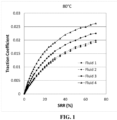
- Fluids 5, 6, and 7 were then tested for Dexron Clutch Friction Durability. Testing results are presented in FIG. 2 . From FIG. 2 , it can be clearly seen that Fluid 5 demonstrated much superior clutch durability performance compared to Fluids 6 and 7, showing superiosity of the PAO-3.4 base stock to Groups II, II+, III, and III+ base stocks in formulating clutch fluids.
- the high performance of Fluid 5, enabled by the PAO-3.4 base stock, can help with delivering more smooth torque transfer, driver comfort and higher durability of the clutch system compared to Fluids 6 and 7 formulated from Groups II, II+, III, and III+ base stocks.
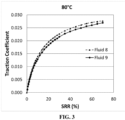
- Fluids 8 and 9 Two industrial gear oil fluids (Fluids 8 and 9) were formulated from a high-viscosity PAO base stock, i.e., SpectraSyn Elite TM 150 ("mPAO-150"), a PAO base stock having a KV100 of about 150 cSt available from ExxonMobil Chemical Company, an ester base stock, i.e., Esterex A51, also available from ExxonMobil Chemical Company, and the PAO-3.4 base stock described above or a conventional PAO base stock having a KV100 of about 6 cSt.
- the compositions of Fluids 8 and 9 are provided in TABLE 17 below.
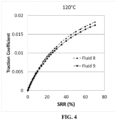
- Fluid 9 comprising the PAO-3.4 demonstrated lower traction at both temperatures compared to Fluid 8.
- Fluid 9 would exhibit higher energy efficiency compared to Fluid 8 as industrial gear oils.
- the PAO-3.4 base stock can help improve traction and therefore energy efficiency and fuel economy compared to conventional low-viscosity PAO base stock when formulated into industrial gear oil fluids at low treat rates with high viscosity base stocks.
Landscapes
- Chemical & Material Sciences (AREA)
- Chemical Kinetics & Catalysis (AREA)
- General Chemical & Material Sciences (AREA)
- Oil, Petroleum & Natural Gas (AREA)
- Organic Chemistry (AREA)
- Lubricants (AREA)
- Organic Low-Molecular-Weight Compounds And Preparation Thereof (AREA)
- Compositions Of Macromolecular Compounds (AREA)
- Transition And Organic Metals Composition Catalysts For Addition Polymerization (AREA)
Claims (10)
- Verwendung eines gesättigten Poly-alpha-olefin- ("PAO")-Basismaterials miteiner kinematischen Viskosität bei 100°C, bestimmt gemäß ASTM D445 ("KV100"), im Bereich von 3,0 ×10⁻⁶ bis 4,5 ×10⁻⁶ m2/s (3,0 bis 4,5 mm2/s (cSt)) undeiner Noack-Flüchtigkeit, bestimmt gemäß ASTM D5800 ("NV"), nicht höher als 15 %,als Basismaterial zur Herstellung von Funktionsflüssigkeit für Motorgetriebe für Verbrennungsmotoren, einschließlich Automatik- und Schaltgetrieben, Gas/Elektro-Hybridmotorgetrieben, Diesel/Elektro-Hybridmotorgetrieben, Elektromotoren und Batteriepacks zum Zweck des Schmierens und/oder Kühlens der Getriebe, Elektromotoren und/oder der Batteriepacks,wobei die Konzentration des PAO-Basismaterials in der Funktionsflüssigkeit im Bereich von 50 Gew.% bis 98 Gew.% liegt, bezogen auf das Gewicht der Funktionsflüssigkeit,
- Verwendung nach Anspruch 1, bei der das PAO-Basismaterial C28-bis C32-Poly-alpha-olefinoligomere in einer Konzentration von nicht weniger als 95 Gew.% umfasst, bezogen auf das Gesamtgewicht des PAO-Basismaterials, wobei das erste Basismaterial vorzugsweise C30-Poly-alpha-olefinoligomere in einer Konzentration von nicht weniger als 95 Gew.% enthält, bezogen auf das Gesamtgewicht des PAO-Basismaterials.
- Verwendung nach Anspruch 1 oder Anspruch 2, bei der das PAO-Basismaterial eine kinematische Viskosität bei 100°C, bestimmt gemäß ASTM D445 ("KV100"), im Bereich von ≤ 4,0 ×10⁻⁶ m2/s (≤ 4,0 mm2/s (cSt)), vorzugsweise ≤ 3,6 ×10⁻⁶ m2/s (≤ 3,6 mm2/s (cSt)), bevorzugter ≤ 3,5 ×10⁻⁶ m2/s (≤ 3,5 mm2/s (cSt)) und/oder eine Noack-Flüchtigkeit, bestimmt gemäß ASTM D5800 ("NV"), von ≤ 12,5 % aufweist.
- Verwendung nach einem der vorhergehenden Ansprüche, bei der das PAO-Basismaterial Poly-alpha-olefinoligomere mit der folgenden Formel in einer Gesamtkonzentration derselben, bezogen auf das Gesamtgewicht des PAO-Basismaterials, von nicht weniger als 80 Gew.% aufweist:

- Verwendung nach Anspruch 1, bei der das PAO-Basismaterial eine Viskosität im Kaltstartsimulator bei -35°C, bestimmt gemäß ASTM D5293 ("CCSV"), von nicht höher als 1 Pa-s (1000 Centipoise),eine Viskosität bei hoher Temperatur und hoher Scherung, bestimmt gemäß ASTM D4683 ("HTHSV"), bei 150°C von nicht mehr als 1,4 ×10⁻³ Pa·s (1,4 Centipoise),eine Wärmeleitfähigkeit, bestimmt gemäß ASTM E1269, bei 40°C im Bereich von 0,11 bis 0,16 Watt·meter-1·K-1,eine KV100 im Bereich von 3,5 ×10⁻⁶ m2/s bis 4,2 ×10⁻⁶ m2/s (3,5 bis 4,2 mm2/s (cSt)) undeine Noack-Flüchtigkeit im Bereich von 10 bis 13 Gew.% aufweist.
- Verwendung nach einem der vorhergehenden Ansprüche, bei der mindestens ein Anteil des PAO-Basismaterials mittels eines Prozesses produziert ist, der ausgewählt ist aus:(i) einem ersten Prozess, bei dem ein oder mehrere C6- bis C14-alpha-Olefine in Gegenwart von Katalysatorsystem, das Metallocenverbindung umfasst, oligomerisiert werden, um erste Oligomermischung zu erhalten, erster nicht-hydrierter Vorläufer für das erste Basismaterial aus der Oligomermischung abgetrennt wird, nachfolgend der erste nicht-hydrierte Vorläufer hydriert wird, und(ii) einem zweiten Prozess, bei dem zweites Oligomer aus einem oder mehreren C6- bis C14-alpha-Olefinen in Gegenwart von Katalysatorsystem produziert wird, das Metallocenverbindung umfasst, das zweite Oligomer mit einem oder mehreren C6- bis C14-alpha-Olefinen in Gegenwart von Lewis-Säurekatalysator umgesetzt wird, um dritte Oligomermischung zu erhalten, zweiter nicht-hydrierter Vorläufer des ersten Basismaterials aus der dritten Oligomermischung abgetrennt wird, nachfolgend der zweite nicht-hydrierte Vorläufer hydriert wird.
- Verwendung nach Anspruch 6, bei der in Prozess (ii) das zweite Oligomer im Wesentlichen aus Dimer des einen oder der mehreren alpha-Olefine besteht.
- Verwendung nach Anspruch 6 oder Anspruch 7, bei der das PAO-Basismaterial aus Prozess (ii) produziert wird, in dem das Dimer mindestens 20 Gew.% trisubstituiertes Olefin/trisubstituierte Olefine, vorzugsweise > 40 Gew.% trisubstituiertes Olefin/trisubstituierte Olefine und am meisten bevorzugt > 50 Gew.% trisubstituiertes Olefin/trisubstituierte Olefine umfasst, bezogen auf das Gesamtgewicht des Dimers.
- Verwendung nach einem der Ansprüche 6 bis 8, bei der das PAO-Basismaterial aus Monomer produziert wird, das im Wesentlichen aus 1-Decen besteht.
- Verwendung nach Anspruch 6, bei der das PAO-Basismaterial aus Prozess (ii) produziert wird, bei der der zweite nicht-hydrierte Vorläufer mindestens 50 Gew.% von entweder tetrasubstituiertem Olefin/tetrasubstituierten Olefinen oder trisubstituierten Olefinen und insbesondere mindestens 80 Gew.% von entweder tetrasubstituiertem Olefin/tetrasubstituierten Olefinen oder trisubstituierten Olefinen umfasst, bezogen auf das Gesamtgewicht des abgetrennten Vorläufers.
Applications Claiming Priority (3)
| Application Number | Priority Date | Filing Date | Title |
|---|---|---|---|
| US201862632044P | 2018-02-19 | 2018-02-19 | |
| EP18167068 | 2018-04-12 | ||
| PCT/US2019/013444 WO2019160630A1 (en) | 2018-02-19 | 2019-01-14 | Functional fluids comprising low-viscosity polyalpha-olefin base stock |
Publications (2)
| Publication Number | Publication Date |
|---|---|
| EP3755769A1 EP3755769A1 (de) | 2020-12-30 |
| EP3755769B1 true EP3755769B1 (de) | 2024-07-31 |
Family
ID=67619458
Family Applications (1)
| Application Number | Title | Priority Date | Filing Date |
|---|---|---|---|
| EP19703821.9A Active EP3755769B1 (de) | 2018-02-19 | 2019-01-14 | Funktionsflüssigkeiten mit niedrigviskosem polyalpha-olefin-grundstoff |
Country Status (4)
| Country | Link |
|---|---|
| EP (1) | EP3755769B1 (de) |
| CN (1) | CN111868217B (de) |
| CA (1) | CA3091510C (de) |
| WO (1) | WO2019160630A1 (de) |
Families Citing this family (4)
| Publication number | Priority date | Publication date | Assignee | Title |
|---|---|---|---|---|
| CN116396730B (zh) * | 2023-04-06 | 2025-09-23 | 亚培烯科技(上海)有限公司 | 一种用于浸没冷却热管理的单相冷却液、制备方法以及应用 |
| FR3154413A1 (fr) * | 2023-10-18 | 2025-04-25 | Totalenergies Onetech | Compositions lubrifiantes d’indice de viscosité élevé |
| US20250368913A1 (en) * | 2024-05-30 | 2025-12-04 | ExxonMobil Technology and Engineering Company | Multi-functional fluids for improving performance of electric drive units |
| US20250388798A1 (en) * | 2024-06-24 | 2025-12-25 | ExxonMobil Technology and Engineering Company | Polyalpha-olefins for improving thermal management of electric motors and other electric heat sources |
Citations (9)
| Publication number | Priority date | Publication date | Assignee | Title |
|---|---|---|---|---|
| US20010041818A1 (en) | 1999-09-23 | 2001-11-15 | Vahid Bagheri | Oligomer oils and their manufacture |
| WO2006101583A1 (en) | 2005-03-17 | 2006-09-28 | Exxonmobil Chemical Patents Inc. | Blend comprising group iii and group iv basestocks |
| US20080194442A1 (en) | 2007-02-13 | 2008-08-14 | Watts Raymond F | Methods for lubricating a transmission |
| WO2009073135A1 (en) | 2007-11-29 | 2009-06-11 | Ineos Usa Llc | Low viscosity oligomer oil product, process, and composition |
| US20130090278A1 (en) | 2011-10-10 | 2013-04-11 | Exxonmobil Chemical Patents Inc. | High efficiency engine oil compositions |
| WO2014134506A1 (en) | 2013-03-01 | 2014-09-04 | VORA Inc. | Lubricating compositions and methods of use thereof |
| JP2014169460A (ja) | 2014-06-25 | 2014-09-18 | Jx Nippon Oil & Energy Corp | 自動車用変速機油組成物 |
| WO2016109325A1 (en) | 2014-12-30 | 2016-07-07 | Exxonmobil Research And Engineering Company | Lubricating oil compositions containing encapsulated microscale particles |
| US20170005303A1 (en) | 2015-06-30 | 2017-01-05 | Faraday&Future Inc. | Vehicle Energy-Storage System |
Family Cites Families (16)
| Publication number | Priority date | Publication date | Assignee | Title |
|---|---|---|---|---|
| US4973788A (en) | 1989-05-05 | 1990-11-27 | Ethyl Corporation | Vinylidene dimer process |
| US6150574A (en) * | 1999-05-06 | 2000-11-21 | Mobil Oil Corporation | Trialkymethane mixtures as synthetic lubricants |
| US20030191032A1 (en) | 2002-01-31 | 2003-10-09 | Deckman Douglas E. | Mixed TBN detergents and lubricating oil compositions containing such detergents |
| US7344631B2 (en) | 2002-10-08 | 2008-03-18 | Exxonmobil Research And Engineering Company | Oxygenate treatment of dewaxing catalyst for greater yield of dewaxed product |
| US6846778B2 (en) | 2002-10-08 | 2005-01-25 | Exxonmobil Research And Engineering Company | Synthetic isoparaffinic premium heavy lubricant base stock |
| US7053254B2 (en) | 2003-11-07 | 2006-05-30 | Chevron U.S.A, Inc. | Process for improving the lubricating properties of base oils using a Fischer-Tropsch derived bottoms |
| WO2005121280A1 (en) | 2004-06-08 | 2005-12-22 | Shell Internationale Research Maatschappij B.V. | Process to make a base oil |
| US7754663B2 (en) * | 2004-12-21 | 2010-07-13 | Exxonmobil Research And Engineering Company | Premium wear-resistant lubricant containing non-ionic ashless anti-wear additives |
| JP2009510214A (ja) * | 2005-09-30 | 2009-03-12 | エクソンモービル・ケミカル・パテンツ・インク | グループiiのベースストックおよびグループivのベースストックを含むブレンド |
| US8048833B2 (en) | 2007-08-17 | 2011-11-01 | Exxonmobil Research And Engineering Company | Catalytic antioxidants |
| US9422497B2 (en) | 2012-09-21 | 2016-08-23 | Exxonmobil Research And Engineering Company | Synthetic lubricant basestocks and methods of preparation thereof |
| US9458403B2 (en) | 2012-09-27 | 2016-10-04 | Exxonmobil Research And Engineering Company | High viscosity, functionalized metallocene polyalphaolefin base stocks and processes for preparing same |
| US20140113847A1 (en) | 2012-10-24 | 2014-04-24 | Exxonmobil Research And Engineering Company | High viscosity index lubricating oil base stock and viscosity modifier combinations, and lubricating oils derived therefrom |
| FR3021664B1 (fr) * | 2014-05-30 | 2020-12-04 | Total Marketing Services | Polyolefines lubrifiantes de basse viscosite |
| FR3021665B1 (fr) * | 2014-05-30 | 2018-02-16 | Total Marketing Services | Procede de preparation de polyolefines lubrifiantes de basse viscosite |
| US10738258B2 (en) * | 2017-03-24 | 2020-08-11 | Exxonmobil Research And Engineering Company | Method for improving engine fuel efficiency and energy efficiency |
-
2019
- 2019-01-14 WO PCT/US2019/013444 patent/WO2019160630A1/en not_active Ceased
- 2019-01-14 CN CN201980020390.XA patent/CN111868217B/zh active Active
- 2019-01-14 CA CA3091510A patent/CA3091510C/en active Active
- 2019-01-14 EP EP19703821.9A patent/EP3755769B1/de active Active
Patent Citations (10)
| Publication number | Priority date | Publication date | Assignee | Title |
|---|---|---|---|---|
| US20010041818A1 (en) | 1999-09-23 | 2001-11-15 | Vahid Bagheri | Oligomer oils and their manufacture |
| WO2006101583A1 (en) | 2005-03-17 | 2006-09-28 | Exxonmobil Chemical Patents Inc. | Blend comprising group iii and group iv basestocks |
| US20080194442A1 (en) | 2007-02-13 | 2008-08-14 | Watts Raymond F | Methods for lubricating a transmission |
| WO2009073135A1 (en) | 2007-11-29 | 2009-06-11 | Ineos Usa Llc | Low viscosity oligomer oil product, process, and composition |
| US20130090278A1 (en) | 2011-10-10 | 2013-04-11 | Exxonmobil Chemical Patents Inc. | High efficiency engine oil compositions |
| US9399746B2 (en) | 2011-10-10 | 2016-07-26 | Exxonmobil Chemical Patents Inc. | Poly alpha olefin compositions |
| WO2014134506A1 (en) | 2013-03-01 | 2014-09-04 | VORA Inc. | Lubricating compositions and methods of use thereof |
| JP2014169460A (ja) | 2014-06-25 | 2014-09-18 | Jx Nippon Oil & Energy Corp | 自動車用変速機油組成物 |
| WO2016109325A1 (en) | 2014-12-30 | 2016-07-07 | Exxonmobil Research And Engineering Company | Lubricating oil compositions containing encapsulated microscale particles |
| US20170005303A1 (en) | 2015-06-30 | 2017-01-05 | Faraday&Future Inc. | Vehicle Energy-Storage System |
Non-Patent Citations (5)
Also Published As
| Publication number | Publication date |
|---|---|
| CN111868217A (zh) | 2020-10-30 |
| CN111868217B (zh) | 2022-09-13 |
| CA3091510A1 (en) | 2019-08-22 |
| CA3091510C (en) | 2025-05-13 |
| WO2019160630A1 (en) | 2019-08-22 |
| EP3755769A1 (de) | 2020-12-30 |
Similar Documents
| Publication | Publication Date | Title |
|---|---|---|
| US11180709B2 (en) | Functional fluids comprising low-viscosity, low-volatility polyalpha-olefin base stock | |
| EP3788122B1 (de) | Kohlenwasserstoffgemisch mit einzigartiger verzweigungsstruktur | |
| EP2766460B1 (de) | Niedrigviskose motorölzusammensetzungen | |
| EP2222823B1 (de) | Verfahren zur herstellung eines niederviskosen oligomeren öls | |
| EP3755769B1 (de) | Funktionsflüssigkeiten mit niedrigviskosem polyalpha-olefin-grundstoff | |
| JP2025131613A (ja) | 再生可能な潤滑油組成物でエンジン性能を改善するための方法 | |
| EP3676240A1 (de) | Esterverbindungen, schmierölzusammensetzungen damit und verfahren zur herstellung davon | |
| US11597890B2 (en) | Base stocks and oil compositions containing the same | |
| US20230092322A1 (en) | Renewable Based E-Drive Fluids | |
| US10611980B2 (en) | Lubricant containing high-viscosity metallocene polyalpha-olefins | |
| US10876062B2 (en) | Cold cranking simulator viscosity boosting base stocks and lubricating oil formulations containing the same | |
| CN110573600A (zh) | 冷起动模拟机粘度提升基料和含有它们的润滑油制剂 | |
| CN110621768B (zh) | 冷起动模拟机粘度提升基料和含有它们的润滑油制剂 | |
| CN118055998A (zh) | 可再生基电子驱动流体 |
Legal Events
| Date | Code | Title | Description |
|---|---|---|---|
| STAA | Information on the status of an ep patent application or granted ep patent |
Free format text: STATUS: UNKNOWN |
|
| STAA | Information on the status of an ep patent application or granted ep patent |
Free format text: STATUS: THE INTERNATIONAL PUBLICATION HAS BEEN MADE |
|
| PUAI | Public reference made under article 153(3) epc to a published international application that has entered the european phase |
Free format text: ORIGINAL CODE: 0009012 |
|
| STAA | Information on the status of an ep patent application or granted ep patent |
Free format text: STATUS: REQUEST FOR EXAMINATION WAS MADE |
|
| 17P | Request for examination filed |
Effective date: 20200821 |
|
| AK | Designated contracting states |
Kind code of ref document: A1 Designated state(s): AL AT BE BG CH CY CZ DE DK EE ES FI FR GB GR HR HU IE IS IT LI LT LU LV MC MK MT NL NO PL PT RO RS SE SI SK SM TR |
|
| AX | Request for extension of the european patent |
Extension state: BA ME |
|
| DAV | Request for validation of the european patent (deleted) | ||
| DAX | Request for extension of the european patent (deleted) | ||
| STAA | Information on the status of an ep patent application or granted ep patent |
Free format text: STATUS: EXAMINATION IS IN PROGRESS |
|
| 17Q | First examination report despatched |
Effective date: 20231024 |
|
| GRAP | Despatch of communication of intention to grant a patent |
Free format text: ORIGINAL CODE: EPIDOSNIGR1 |
|
| STAA | Information on the status of an ep patent application or granted ep patent |
Free format text: STATUS: GRANT OF PATENT IS INTENDED |
|
| INTG | Intention to grant announced |
Effective date: 20240318 |
|
| RAP3 | Party data changed (applicant data changed or rights of an application transferred) |
Owner name: EXXONMOBIL CHEMICAL PATENTS INC. |
|
| GRAS | Grant fee paid |
Free format text: ORIGINAL CODE: EPIDOSNIGR3 |
|
| GRAA | (expected) grant |
Free format text: ORIGINAL CODE: 0009210 |
|
| STAA | Information on the status of an ep patent application or granted ep patent |
Free format text: STATUS: THE PATENT HAS BEEN GRANTED |
|
| P01 | Opt-out of the competence of the unified patent court (upc) registered |
Effective date: 20240528 |
|
| AK | Designated contracting states |
Kind code of ref document: B1 Designated state(s): AL AT BE BG CH CY CZ DE DK EE ES FI FR GB GR HR HU IE IS IT LI LT LU LV MC MK MT NL NO PL PT RO RS SE SI SK SM TR |
|
| REG | Reference to a national code |
Ref country code: CH Ref legal event code: EP Ref country code: GB Ref legal event code: FG4D |
|
| REG | Reference to a national code |
Ref country code: DE Ref legal event code: R096 Ref document number: 602019056060 Country of ref document: DE |
|
| REG | Reference to a national code |
Ref country code: IE Ref legal event code: FG4D |
|
| REG | Reference to a national code |
Ref country code: LT Ref legal event code: MG9D |
|
| REG | Reference to a national code |
Ref country code: NL Ref legal event code: MP Effective date: 20240731 |
|
| PG25 | Lapsed in a contracting state [announced via postgrant information from national office to epo] |
Ref country code: PT Free format text: LAPSE BECAUSE OF FAILURE TO SUBMIT A TRANSLATION OF THE DESCRIPTION OR TO PAY THE FEE WITHIN THE PRESCRIBED TIME-LIMIT Effective date: 20241202 |
|
| REG | Reference to a national code |
Ref country code: AT Ref legal event code: MK05 Ref document number: 1708471 Country of ref document: AT Kind code of ref document: T Effective date: 20240731 |
|
| PG25 | Lapsed in a contracting state [announced via postgrant information from national office to epo] |
Ref country code: PT Free format text: LAPSE BECAUSE OF FAILURE TO SUBMIT A TRANSLATION OF THE DESCRIPTION OR TO PAY THE FEE WITHIN THE PRESCRIBED TIME-LIMIT Effective date: 20241202 |
|
| PG25 | Lapsed in a contracting state [announced via postgrant information from national office to epo] |
Ref country code: NO Free format text: LAPSE BECAUSE OF FAILURE TO SUBMIT A TRANSLATION OF THE DESCRIPTION OR TO PAY THE FEE WITHIN THE PRESCRIBED TIME-LIMIT Effective date: 20241031 |
|
| PG25 | Lapsed in a contracting state [announced via postgrant information from national office to epo] |
Ref country code: NL Free format text: LAPSE BECAUSE OF FAILURE TO SUBMIT A TRANSLATION OF THE DESCRIPTION OR TO PAY THE FEE WITHIN THE PRESCRIBED TIME-LIMIT Effective date: 20240731 Ref country code: FI Free format text: LAPSE BECAUSE OF FAILURE TO SUBMIT A TRANSLATION OF THE DESCRIPTION OR TO PAY THE FEE WITHIN THE PRESCRIBED TIME-LIMIT Effective date: 20240731 Ref country code: PL Free format text: LAPSE BECAUSE OF FAILURE TO SUBMIT A TRANSLATION OF THE DESCRIPTION OR TO PAY THE FEE WITHIN THE PRESCRIBED TIME-LIMIT Effective date: 20240731 Ref country code: GR Free format text: LAPSE BECAUSE OF FAILURE TO SUBMIT A TRANSLATION OF THE DESCRIPTION OR TO PAY THE FEE WITHIN THE PRESCRIBED TIME-LIMIT Effective date: 20241101 |
|
| PG25 | Lapsed in a contracting state [announced via postgrant information from national office to epo] |
Ref country code: BG Free format text: LAPSE BECAUSE OF FAILURE TO SUBMIT A TRANSLATION OF THE DESCRIPTION OR TO PAY THE FEE WITHIN THE PRESCRIBED TIME-LIMIT Effective date: 20240731 |
|
| PG25 | Lapsed in a contracting state [announced via postgrant information from national office to epo] |
Ref country code: LV Free format text: LAPSE BECAUSE OF FAILURE TO SUBMIT A TRANSLATION OF THE DESCRIPTION OR TO PAY THE FEE WITHIN THE PRESCRIBED TIME-LIMIT Effective date: 20240731 |
|
| PG25 | Lapsed in a contracting state [announced via postgrant information from national office to epo] |
Ref country code: IS Free format text: LAPSE BECAUSE OF FAILURE TO SUBMIT A TRANSLATION OF THE DESCRIPTION OR TO PAY THE FEE WITHIN THE PRESCRIBED TIME-LIMIT Effective date: 20241130 Ref country code: AT Free format text: LAPSE BECAUSE OF FAILURE TO SUBMIT A TRANSLATION OF THE DESCRIPTION OR TO PAY THE FEE WITHIN THE PRESCRIBED TIME-LIMIT Effective date: 20240731 |
|
| PG25 | Lapsed in a contracting state [announced via postgrant information from national office to epo] |
Ref country code: HR Free format text: LAPSE BECAUSE OF FAILURE TO SUBMIT A TRANSLATION OF THE DESCRIPTION OR TO PAY THE FEE WITHIN THE PRESCRIBED TIME-LIMIT Effective date: 20240731 |
|
| PG25 | Lapsed in a contracting state [announced via postgrant information from national office to epo] |
Ref country code: ES Free format text: LAPSE BECAUSE OF FAILURE TO SUBMIT A TRANSLATION OF THE DESCRIPTION OR TO PAY THE FEE WITHIN THE PRESCRIBED TIME-LIMIT Effective date: 20240731 Ref country code: RS Free format text: LAPSE BECAUSE OF FAILURE TO SUBMIT A TRANSLATION OF THE DESCRIPTION OR TO PAY THE FEE WITHIN THE PRESCRIBED TIME-LIMIT Effective date: 20241031 |
|
| PG25 | Lapsed in a contracting state [announced via postgrant information from national office to epo] |
Ref country code: RS Free format text: LAPSE BECAUSE OF FAILURE TO SUBMIT A TRANSLATION OF THE DESCRIPTION OR TO PAY THE FEE WITHIN THE PRESCRIBED TIME-LIMIT Effective date: 20241031 Ref country code: PL Free format text: LAPSE BECAUSE OF FAILURE TO SUBMIT A TRANSLATION OF THE DESCRIPTION OR TO PAY THE FEE WITHIN THE PRESCRIBED TIME-LIMIT Effective date: 20240731 Ref country code: NO Free format text: LAPSE BECAUSE OF FAILURE TO SUBMIT A TRANSLATION OF THE DESCRIPTION OR TO PAY THE FEE WITHIN THE PRESCRIBED TIME-LIMIT Effective date: 20241031 Ref country code: NL Free format text: LAPSE BECAUSE OF FAILURE TO SUBMIT A TRANSLATION OF THE DESCRIPTION OR TO PAY THE FEE WITHIN THE PRESCRIBED TIME-LIMIT Effective date: 20240731 Ref country code: LV Free format text: LAPSE BECAUSE OF FAILURE TO SUBMIT A TRANSLATION OF THE DESCRIPTION OR TO PAY THE FEE WITHIN THE PRESCRIBED TIME-LIMIT Effective date: 20240731 Ref country code: IS Free format text: LAPSE BECAUSE OF FAILURE TO SUBMIT A TRANSLATION OF THE DESCRIPTION OR TO PAY THE FEE WITHIN THE PRESCRIBED TIME-LIMIT Effective date: 20241130 Ref country code: HR Free format text: LAPSE BECAUSE OF FAILURE TO SUBMIT A TRANSLATION OF THE DESCRIPTION OR TO PAY THE FEE WITHIN THE PRESCRIBED TIME-LIMIT Effective date: 20240731 Ref country code: GR Free format text: LAPSE BECAUSE OF FAILURE TO SUBMIT A TRANSLATION OF THE DESCRIPTION OR TO PAY THE FEE WITHIN THE PRESCRIBED TIME-LIMIT Effective date: 20241101 Ref country code: FI Free format text: LAPSE BECAUSE OF FAILURE TO SUBMIT A TRANSLATION OF THE DESCRIPTION OR TO PAY THE FEE WITHIN THE PRESCRIBED TIME-LIMIT Effective date: 20240731 Ref country code: ES Free format text: LAPSE BECAUSE OF FAILURE TO SUBMIT A TRANSLATION OF THE DESCRIPTION OR TO PAY THE FEE WITHIN THE PRESCRIBED TIME-LIMIT Effective date: 20240731 Ref country code: BG Free format text: LAPSE BECAUSE OF FAILURE TO SUBMIT A TRANSLATION OF THE DESCRIPTION OR TO PAY THE FEE WITHIN THE PRESCRIBED TIME-LIMIT Effective date: 20240731 Ref country code: AT Free format text: LAPSE BECAUSE OF FAILURE TO SUBMIT A TRANSLATION OF THE DESCRIPTION OR TO PAY THE FEE WITHIN THE PRESCRIBED TIME-LIMIT Effective date: 20240731 |
|
| PGFP | Annual fee paid to national office [announced via postgrant information from national office to epo] |
Ref country code: DE Payment date: 20250129 Year of fee payment: 7 |
|
| PG25 | Lapsed in a contracting state [announced via postgrant information from national office to epo] |
Ref country code: RO Free format text: LAPSE BECAUSE OF FAILURE TO SUBMIT A TRANSLATION OF THE DESCRIPTION OR TO PAY THE FEE WITHIN THE PRESCRIBED TIME-LIMIT Effective date: 20240731 Ref country code: SM Free format text: LAPSE BECAUSE OF FAILURE TO SUBMIT A TRANSLATION OF THE DESCRIPTION OR TO PAY THE FEE WITHIN THE PRESCRIBED TIME-LIMIT Effective date: 20240731 Ref country code: DK Free format text: LAPSE BECAUSE OF FAILURE TO SUBMIT A TRANSLATION OF THE DESCRIPTION OR TO PAY THE FEE WITHIN THE PRESCRIBED TIME-LIMIT Effective date: 20240731 |
|
| PG25 | Lapsed in a contracting state [announced via postgrant information from national office to epo] |
Ref country code: EE Free format text: LAPSE BECAUSE OF FAILURE TO SUBMIT A TRANSLATION OF THE DESCRIPTION OR TO PAY THE FEE WITHIN THE PRESCRIBED TIME-LIMIT Effective date: 20240731 |
|
| PGFP | Annual fee paid to national office [announced via postgrant information from national office to epo] |
Ref country code: BE Payment date: 20250127 Year of fee payment: 7 |
|
| REG | Reference to a national code |
Ref country code: DE Ref legal event code: R026 Ref document number: 602019056060 Country of ref document: DE |
|
| PG25 | Lapsed in a contracting state [announced via postgrant information from national office to epo] |
Ref country code: CZ Free format text: LAPSE BECAUSE OF FAILURE TO SUBMIT A TRANSLATION OF THE DESCRIPTION OR TO PAY THE FEE WITHIN THE PRESCRIBED TIME-LIMIT Effective date: 20240731 |
|
| PGFP | Annual fee paid to national office [announced via postgrant information from national office to epo] |
Ref country code: FR Payment date: 20250127 Year of fee payment: 7 |
|
| PG25 | Lapsed in a contracting state [announced via postgrant information from national office to epo] |
Ref country code: IT Free format text: LAPSE BECAUSE OF FAILURE TO SUBMIT A TRANSLATION OF THE DESCRIPTION OR TO PAY THE FEE WITHIN THE PRESCRIBED TIME-LIMIT Effective date: 20240731 Ref country code: SK Free format text: LAPSE BECAUSE OF FAILURE TO SUBMIT A TRANSLATION OF THE DESCRIPTION OR TO PAY THE FEE WITHIN THE PRESCRIBED TIME-LIMIT Effective date: 20240731 |
|
| PGFP | Annual fee paid to national office [announced via postgrant information from national office to epo] |
Ref country code: GB Payment date: 20250121 Year of fee payment: 7 |
|
| PLBI | Opposition filed |
Free format text: ORIGINAL CODE: 0009260 |
|
| PLAX | Notice of opposition and request to file observation + time limit sent |
Free format text: ORIGINAL CODE: EPIDOSNOBS2 |
|
| 26 | Opposition filed |
Opponent name: CHEVRON PHILLIPS CHEMICAL COMPANY LP Effective date: 20250424 |
|
| REG | Reference to a national code |
Ref country code: CH Ref legal event code: PL |
|
| PG25 | Lapsed in a contracting state [announced via postgrant information from national office to epo] |
Ref country code: SE Free format text: LAPSE BECAUSE OF FAILURE TO SUBMIT A TRANSLATION OF THE DESCRIPTION OR TO PAY THE FEE WITHIN THE PRESCRIBED TIME-LIMIT Effective date: 20240731 |
|
| PLAF | Information modified related to communication of a notice of opposition and request to file observations + time limit |
Free format text: ORIGINAL CODE: EPIDOSCOBS2 |
|
| PG25 | Lapsed in a contracting state [announced via postgrant information from national office to epo] |
Ref country code: MC Free format text: LAPSE BECAUSE OF FAILURE TO SUBMIT A TRANSLATION OF THE DESCRIPTION OR TO PAY THE FEE WITHIN THE PRESCRIBED TIME-LIMIT Effective date: 20240731 Ref country code: LU Free format text: LAPSE BECAUSE OF NON-PAYMENT OF DUE FEES Effective date: 20250114 |
|
| PLBB | Reply of patent proprietor to notice(s) of opposition received |
Free format text: ORIGINAL CODE: EPIDOSNOBS3 |
|
| PG25 | Lapsed in a contracting state [announced via postgrant information from national office to epo] |
Ref country code: CH Free format text: LAPSE BECAUSE OF NON-PAYMENT OF DUE FEES Effective date: 20250131 |
|
| PG25 | Lapsed in a contracting state [announced via postgrant information from national office to epo] |
Ref country code: IE Free format text: LAPSE BECAUSE OF NON-PAYMENT OF DUE FEES Effective date: 20250114 |