EP3755145B1 - Käfig zur aufnahme von hymenoptera - Google Patents
Käfig zur aufnahme von hymenoptera Download PDFInfo
- Publication number
- EP3755145B1 EP3755145B1 EP19710162.9A EP19710162A EP3755145B1 EP 3755145 B1 EP3755145 B1 EP 3755145B1 EP 19710162 A EP19710162 A EP 19710162A EP 3755145 B1 EP3755145 B1 EP 3755145B1
- Authority
- EP
- European Patent Office
- Prior art keywords
- cage
- capture
- capture cage
- funnel
- passage
- Prior art date
- Legal status (The legal status is an assumption and is not a legal conclusion. Google has not performed a legal analysis and makes no representation as to the accuracy of the status listed.)
- Active
Links
Images


Classifications
-
- A—HUMAN NECESSITIES
- A01—AGRICULTURE; FORESTRY; ANIMAL HUSBANDRY; HUNTING; TRAPPING; FISHING
- A01M—CATCHING, TRAPPING OR SCARING OF ANIMALS; APPARATUS FOR THE DESTRUCTION OF NOXIOUS ANIMALS OR NOXIOUS PLANTS
- A01M1/00—Stationary means for catching or killing insects
- A01M1/10—Catching insects by using Traps
- A01M1/106—Catching insects by using Traps for flying insects
-
- A—HUMAN NECESSITIES
- A01—AGRICULTURE; FORESTRY; ANIMAL HUSBANDRY; HUNTING; TRAPPING; FISHING
- A01M—CATCHING, TRAPPING OR SCARING OF ANIMALS; APPARATUS FOR THE DESTRUCTION OF NOXIOUS ANIMALS OR NOXIOUS PLANTS
- A01M1/00—Stationary means for catching or killing insects
- A01M1/02—Stationary means for catching or killing insects with devices or substances, e.g. food, pheronones attracting the insects
-
- A—HUMAN NECESSITIES
- A01—AGRICULTURE; FORESTRY; ANIMAL HUSBANDRY; HUNTING; TRAPPING; FISHING
- A01M—CATCHING, TRAPPING OR SCARING OF ANIMALS; APPARATUS FOR THE DESTRUCTION OF NOXIOUS ANIMALS OR NOXIOUS PLANTS
- A01M23/00—Traps for animals
- A01M23/02—Collecting-traps
- A01M23/08—Collecting-traps with approaches permitting entry only
Definitions
- the present invention relates to a self-contained capture cage for unwanted insects, this model concerns the species Vespa velutina, a hymenoptera more commonly called Asian hornet or yellow-legged hornets.
- the Asian hornet, accidentally imported with Chinese goods in 2004, has proven to be a highly invasive pest due to its exponential reproduction rate and its need for meat protein.
- a generalist predator it impacts many species of useful insects including many pollinators which are the prey of this predator, it is in fact destructive of biodiversity and threatens the food chain by its omnipresence in territories with large fluctuations in density.
- This hornet is capable of destroying entire hives of honey bees in a single season, seriously affecting beekeeping activity and accelerating the disappearance of beekeepers by ruining their farms.
- Asian hornets are social insects and therefore live in colonies. These are sheltered in cellulose nests and made up of individuals divided into castes, each playing a defined role in the colony. The queen founds the colony and then lays eggs. The workers, unfertilized female workers, remove the larvae, feed the colony with food and build the nest. The young queens ensure the dissemination of the species over a radius of nearly 70km/year (source: Institut de mecanic sur la Biologie de l'insecte de Tours). The social bond is ensured by a pheromone produced by the foundress which is specific to each colony (nest).
- the young queen, who has become a "foundress" is at the centre of the colony's social network due to her production of pheromones which enable its perfect cohesion.
- the foundress plays a major role in reproduction and her death ultimately leads to the decline of the colony.
- venom-injecting system that is to say a sting capable of injecting venom, which is painful and sometimes dangerous for humans if the envenomation is severe.
- Vespa velutina is distinguished from its European cousin Vespa crabro by several traits, morphological nuances and its exclusively diurnal activity.
- Vespa velutina The nest of Vespa velutina is generally built in the open air, very often at the top of large trees, unlike its European cousin which always establishes its nest in pre-existing cavities, well sheltered from the elements.
- Vespa velutina lives better in an anthropic environment than in the countryside. Its nest is also much larger and more populous: it can contain up to 2000 individuals compared to 800 for Vespa crabro.
- Vespa velutina is particularly efficient in hunting because it is very fast and able to hover. This allows it to capture its prey very efficiently. It carries them off to cut them up and keeps only the thorax with which it will make a ball that it brings back to the nest to feed the larvae.
- the Asian hornet is therefore a scourge for beekeeping activity.
- Trapping involves using devices that contain bait that is attractive to hornets and keeps them captive.
- US2018/0042212 discloses an insect trap using a bottle and funnel system that on the one hand lacks selectivity and on the other hand does not allow the olfactory effluvia of a possible bait to be sufficiently diffused.
- a similar principle is found in US 1,386408 which suffers from the same defects (admittedly attenuated).
- US869556 And WO 2012/001442 disclose cages that do not allow species selectivity.
- WO2016/004472A1 discloses an "ovitrap" configured in particular to trap mosquitoes and to enable the collection of information relating to the mosquitoes thus trapped. Not all of these traps are capable of satisfactorily capturing Vespa velutina.
- Another curative control technique consists of destroying nests using significant equipment (telescopic pole, spraying equipment), and good protection, handling biocides and possible attack by hornets. Electrocuting hornets with an "electric harp" allows the destruction of hornets near hives. All these methods are curative and do not effectively regulate the species.
- the present invention aims to remedy all these drawbacks.
- the present invention relates to a selective capture cage (20) for hymenoptera according to claim 1.
- the funnel of the invention is of a generally truncated cone shape, for example of circular, oval or polygonal section such as a triangle, a square, a rectangle, a diamond, a pentagon, a hexagon, a heptagon or even an octagon.
- the passage orifice (212) comprises at least one passage limiting section with a dimension greater than 7.0 mm and for example less than 7.23 mm.
- the passage orifice (212) comprises at least one passage limiting section with a dimension between 7.17 mm and 7.30 mm, even more preferably between 7.18 mm and 7.25 mm, for example between 7.19 mm and 7.23 mm, such as between 7.20 mm and 7.22 mm.
- the funnel section has the shape of a truncated pyramid (213).
- the capture cage according to the present invention is characterized in that the limiting passage section of the pores is of a size less than or equal to 12 mm, less than or equal to 11 mm, less than or equal to 7 mm, or less than or equal to 5 mm.
- the capture cage according to the present invention is characterized in that the pores of the porous plate (21) comprise a polygonal shape and/or a rounded shape.
- the polygonal shape can be a diamond, for example with a long diagonal of between 14 and 18 mm and a short diagonal of between 5 and 9 mm.
- the rounded shape consists of a rectangle of which at at least one corner is rounded, or even characterized in that at least one side of the rectangle is completely rounded.
- the present invention relates to a cage for capturing hymenoptera comprising a box having a bottom and four walls, two of which each have an opening for the circulation of effluvia, remarkable in that each opening for the circulation of effluvia comprises a porous plate (such as a mesh plate).
- Said porous plate (such as a mesh plate) can cover the opening for the circulation of effluvia, and can be made of at least one mesh part having meshes whose height in the vertical is less than 0.7 cm.
- Said porous plate (such as a mesh plate) can comprise a funnel in the shape of a truncated pyramid having a large base and a small base directed towards the inside of the capture cage, said truncated pyramid having a passage orifice corresponding to the small base of the truncated pyramid.
- the passage hole will allow all the Asian hornets to enter while preventing them from leaving because the funnel (e.g. the pyramid trunk) directed inwards prevents the hornet(s) from finding the exit.
- the cage allows for effective preventive control.
- the capture cage according to the present invention is characterized in that the hymenoptera is the species Vespa velutina, and preferably the capture cage is configured not to retain honey bees.
- the mesh has meshes whose long diagonal is between 14 and 18 mm, the short diagonal is between between 5 and 9 mm, the strap is between 0.8 and 1.2 mm and the thickness is between 0.6 and 1 mm.
- the passage orifice (212) has the shape of a rectangle whose length is between 10 and 30 mm, such as 20 mm, and whose width is 7.21 mm.
- the capture cage according to the present invention can be characterized in that the cage is configured such that the length is horizontal to the ground and the width is perpendicular to the ground.
- the capture cage (20) according to the present invention is characterized by the distance between the large base and the small base of the funnel being between 10 and 15 cm.
- the height between the large base and the small base of the pyramid trunc may be between 10 and 15 cm.
- the box has a removable cover (having the property of isolating the interior from the exterior at its level).
- the two walls each have an opening facing each other.
- the bottom comprises at least one porous portion (such as a mesh portion) under which a bait is intended to be positioned.
- the porous plate (such as a mesh plate) comprises a rectangular-shaped planar portion having a length of between 11 and 20 cm and a width of between 7 and 15 cm.
- the subject matter of the present invention relates to a funnel for a capture cage (20) as described by claim 11.
- the funnel according to the present invention can be characterized in that the passage orifice (212) has the shape of a rectangle whose length is between 10 and 30 mm, such as 20 mm, and the width is 7.21 mm.
- the funnel according to the present invention can be characterized in that it comprises a porous portion whose limiting passage section of the pores is smaller in size than the limiting passage section of the passage orifice (212).
- one of the objects according to the present invention relates to a funnel as described herein, characterized in that said funnel has the shape of a truncated pyramid (213).
- an object of the present invention relates to a kit for making a funnel as described by claim 12.
- Another subject of the present invention relates to the use of a capture cage (20) according to the present invention for capturing at least one hornet, preferably a hornet of the species Vespa velutina (capture of queens: preventive use, and/or capture of workers: curative use).
- This use can be characterized in that at least one bait is inserted into the capture cage (20), said at least one bait being optionally positioned and protected under a porous part, such as a mesh part.
- the use can be characterized in that said at least one bait is selected from the list consisting of honeyed waxes, syrup of red fruits, brown beer, cider or sweet white wine saturated in sugars to which jam and/or honey may be added, or of meat material, for example from fish, crustaceans or shellfish, or one of the mixtures of these.
- the present invention may further relate to the use as described herein, characterized in that islands consisting of small sponges are inserted as diffusers of olfactory effluvia in the capture cage (20).
- FIG. 1 represents a perspective view of the interior of the capture cage 20.
- FIG. 2 represents a perspective view of one side only of the capture cage 20.
- FIG. 1 there is shown a box having a bottom 201 and four walls, two of which have an opening 22 for the circulation of effluvia.
- Each opening 22 for circulation of the effluvia is covered by a porous plate (such as a mesh plate) 21 completely covering the opening 22 for circulation of the effluvia.
- the porous plate (such as a mesh plate) 21 is made of a mesh having meshes whose long diagonal is 16 mm, the short diagonal is 8 mm, the strap is 1 mm and the thickness is 0.8 mm.
- the porous plate (such as a mesh plate) 21 comprises a funnel in the shape of a truncated pyramid 213 having a large base and a small base directed towards the inside of the capture cage 20, said truncated pyramid 213 having a passage orifice 212 corresponding to the small base of the truncated pyramid 213.
- the funnel may be made of any material that is sufficiently rigid for its implementation, for example metal, organic polymer such as plastic (e.g. PVC) or a biological material such as wood or reconstituted cellulose. Shown here is a funnel in the shape of a truncated pyramid 213 made of expanded metal. In one example, the funnel is thus made of metal, such as aluminum. According to other examples, it is made of other materials that make it possible to maintain the shape of the funnel (such as a truncated pyramid 213).
- the dimension of the expanded metal may be 16 x 8 x 1 ⁇ 0.8 mm and it is fixed on a porous plate (such as a mesh plate) 21 of the same nature.
- the rigid material profile (such as metal) deployed in the chosen format allows bees and other insects of equivalent or smaller size to pass through the pores/meshes (in both directions) in the best conditions of ease and speed.
- the porous plate (such as a mesh plate) 21 is positioned normal to the longitudinal axis of the funnel and allows the circulation of the effluvia and a rapid exit of the bees without obstruction.
- the porous plate (such as a mesh plate) 21 comprises a flat part 211 of rectangular shape whose length is between 11 and 20 cm, for example 15 cm and the width is between 7 and 15 cm, for example 10 cm.
- the porous plate (such as a mesh plate) 21 is arranged as follows: the base of the diamond of the meshes is directed towards the outside for greater ease of exit than of entry.
- the funnel is fixed to the porous plate (such as a mesh plate) 21 after a 10 x 20 cm cutout in a mesh plate.
- the fixing is carried out by stapling, tacking, screwing (e.g. on wood, photo), by gluing (glue resin for plastic) or by nylon collar on the capture cage 20 and by an overlap of approximately 1 cm.
- the passage orifice 212 of the funnel (such as a truncated pyramid) 213 porous/mesh, directed towards the inside, allows the easy passage of the Asian hornet queens and, for this purpose, has a calibrated orifice of 7.21 mm high for the effective passage of the thorax of an Asian hornet queen while prohibiting that of a European hornet queen which is approximately 1.5 mm larger in size. This is why it is possible to have an orifice in a range of values around 7.21 mm in order to vary the selectivity of the cage.
- the depth of the funnel (like a truncated pyramid) of the module and its fully ventilated structure is long enough to prevent the Asian hornet from finding the exit (trap principle).
- the experiments carried out have shown that no Asian hornet that entered has ever come out.
- the height (or depth of the funnel) between the large base and the small base of the funnel (such as a truncated pyramid) 213 is 13 cm (between 10 and 15 cm).
- the capture cage 20 preferably comprises two funnels, facing each other to optimize the circulation of effluvia.
- the two funnels are not facing each other but for reasons of space, the longitudinal axis of the two funnels is offset from each other.
- the wide opening of the funnel thus ensures the reception and capture of all the Asian hornet queens from the environment of the capture cage 20 over very large distances to the point of no longer risking predation by hunting workers throughout the season to protect an apiary.
- Capture cage 20 contains bait.
- the bait is positioned under the bottom 201 of the capture cage 20.
- the bottom 201 of the capture cage 20 comprises a mesh portion under which a bait is positioned.
- the assembly consisting of the capture cage 20 and the bait allows the capture of the Asian hornet.
- the bait is positioned inside the cage still with a grid to allow the olfactory odors to be released.
- a mixture of red fruit syrup, brown beer, cider saturated in sugars can be used to which jam or honey can be added (for example from leftover jam or pots of honey forgotten at the bottom of a cupboard).
- Islands made of small sponges are as many diffusers of complementary olfactory effluvia. It may be recalled that it is only exclusively the odorous effluvia that exhale from the baits and that will attract the Asian hornets.
- the larger the surface area of the bait the more effective and wide the range of action of the capture cage 20 is.
- the very strong attractiveness that allows collection over a very wide radius is linked to a particularly effective bait that can be of several types, placed over a very large surface inaccessible to all insects. This allows for a rapid death of the hornets, respect for the health aspect for the bees (avoiding the transmission of diseases by American foulbrood spores) allowing them to emerge very quickly as well as all other small insects.
- the imperative period is spring to prevent the construction of Asian hornet nests. It allows the capture of queens from the end of March. Given the capture of all the queens, do not take into account the intra-specific competition (queens fighting among themselves) that they have from this period for the usurpation of the nests. From the end of June, the capture of queens is rarer, or even stops.
- the capture cage 20 allows the use of a frame of crystallized honey made up of two superimposed supers (if you have super honey frames).
- the first super will contain the frames of honey, it is placed on a bottom 201 of a ventilated hive closed by a nested entrance door on the closing side to prevent any insect passage.
- This super is isolated from the top one by the fine mesh described above to protect the bait (best) from the size of the super or a propolis grid kept away from the frame heads by wedging.
- the top (empty) super becomes the capture cage 20 of the Asian hornet and is protected by a cover removable.
- the removable cover has the function of closing the box and functions as a roof whose dimensions are greater than the section of the box (i.e. insulation). If hive body frames are available, the lower super is replaced by a hive body.
- the captured Asian hornets present in the capture cage 20 are generally grouped on a social hymenoptera wall.
- the Asian hornets to be destroyed can be collected in the jar with a small tool (brush .... or with a cordless vacuum cleaner). Freezing or crushing them is one of the solutions for their elimination.
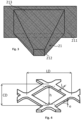
- FIG 3 represents a porous plate (such as a mesh plate) 21 having a truncated pyramid-shaped funnel 213 having a large base and a small base.
- the truncated pyramid 213 is directed towards the inside of the capture cage 20.
- the truncated pyramid 213 has a passage orifice 212 corresponding to the small base of the truncated pyramid 213.
- the grid is made of expanded metal.
- the metal is, for example, aluminum.
- Expanded metal is manufactured from sheet metal by cutting and cold drawing. It has very strong meshes drawn in a single operation.
- This figure shows the characteristics of the plate mesh: LD for long diagonal, CD for short diagonal, L for strap and e for thickness.
- the porous plate (such as a mesh plate) is made of a mesh having meshes whose long diagonal is 16 mm, the short diagonal is 8 mm, the strap is 1 mm and the thickness is 0.8 mm.
- the short diagonal is measured between two mesh axes as shown in the figure.
- the empty space, noted h, corresponding to the height of the mesh is less than 0.7 cm.
- FIG. 5 represents the elements of a kit for a truncated pyramid-shaped funnel according to the present invention, particularly well suited to the capture of Vespa velutina.
- the size of the thorax of the queens of the Asian hornet Vespa velutina is very slightly smaller than the size of the thorax of the queens of the European hornet Vespa crabro. It is thus possible to be selective in this regard.
- this kit can comprise a base with a rectangular passage orifice (212) with a width of 7.21 mm (i.e. a passage limiting section of 7.21 mm) and a length of 20 mm.
- Truncated triangular parts linked to each other by attachment means (I) make it possible to define a funnel.
- the attachment means can be of the male or female type as shown, making it possible to attach (e.g. by clips) to each other.
- the triangular part can comprise male and/or female attachment means.
- the funnel can be inserted into a box to form a cage according to the present invention by attachment means (K).
- the box may comprise an attachment means complementary to the attachment (K), for example with a similar operation to the attachment (I).
- the base is here of generally rectangular shape, but can also be of another shape (triangular, pentagonal, hexagonal, etc.) depending on the number of truncated triangular pieces surrounding it.
- the base is of generally rectangular shape, and requires 4 truncated triangular pieces to form the funnel (pyramidal trunc).
- the pores of The porous plates are here rectangles with rounded corners (here one whole side is rounded), whose length is 11 mm and width 5 mm. Indeed, it has been observed that the exit of small insects is facilitated by such patterns (undercuts on the inner side on the porous plate and the cone with rounded edges of the openings).
- a calibration to the hundredth of a millimeter (mm) was carried out for the passage orifice with tests carried out on 9 Vespa velutina queens to verify uniformity of the height of their thorax.
- two cages according to the present invention (one of which was photographed at figure 6 ) set up allowed the capture of Vespa velutina hornets as a curative measure (i.e. not the queens).
- the passage holes were identical: rectangular with a length of 20 mm and a width of 7.21 mm.
- the cages were configured so that the axis of the length (20 mm) of the holes was horizontal, and the axis of the width (7.21 mm) was vertical.
- the two traps were placed in the same honeybee apiary: one of them placed directly on a hive and the other at a distance.
- the type of bait used in the traps was honey-based (in the form of honey wax caps from honey extractions for the boxes - possibility of using honey frames for the hives). 1062 Asian hornets (i.e. the equivalent of half a hive of these hornets) were thus captured with a noted selectivity of 99.7%.
Landscapes
- Life Sciences & Earth Sciences (AREA)
- Pest Control & Pesticides (AREA)
- Engineering & Computer Science (AREA)
- Insects & Arthropods (AREA)
- Wood Science & Technology (AREA)
- Zoology (AREA)
- Environmental Sciences (AREA)
- Catching Or Destruction (AREA)
Claims (15)
- Selektiver Käfig (20) zum Fangen von Hautflüglern, umfassend einen Kasten mit einem Boden (201) und mindestens drei Wänden, von denen mindestens zwei Wände jeweils eine Öffnung für die Zirkulation (22) von Duftstoffen aufweisen, wobei jede Öffnung für die Zirkulation (22) von Duftstoffen eine poröse Platte (21) umfasst, die die Öffnung für die Zirkulation (22) von Duftstoffen abdeckt, die poröse Platte (21) einen trichterförmigen Querschnitt mit einer großen Basis und einer kleinen Basis aufweist, die kleine Basis mindestens eine Öffnung für einen selektiven Durchgang (212) umfasst und die kleine Basis zum Inneren des Fangkäfigs (20) hin angeordnet ist, der begrenzende Durchgangsquerschnitt der Poren der porösen Platte (21) größenmäßig kleiner als die Durchgangsöffnung (212) ist,
dadurch gekennzeichnet, dass:- die Durchgangsöffnung (212) mindestens einen begrenzenden Durchgangsquerschnitt zwischen 7,15 und 7,30 mm, vorzugsweise 7,21 mm, umfasst. - Fangkäfig (20) nach Anspruch 1, dadurch gekennzeichnet, dass der trichterförmige Querschnitt die Form eines Pyramidenstumpfes (213) hat und/oder der Käfig vier Wände umfasst.
- Fangkäfig nach Anspruch 1 oder 2, dadurch gekennzeichnet, dass der Hautflügler die Art Vespa velutina ist.
- Fangkäfig nach einem der vorhergehenden Ansprüche, dadurch gekennzeichnet, dass:- der begrenzende Durchgangsquerschnitt der Poren kleiner oder gleich 7 mm oder kleiner oder gleich 5 mm ist,- die Poren der porösen Platte (21) eine polygonale Form und/oder eine abgerundete Form umfassen.
- Fangkäfig nach Anspruch 4, dadurch gekennzeichnet, dass:- die polygonale Form eine Raute ist, beispielsweise mit einer langen Diagonale zwischen 14 und 18 mm und einer kurzen Diagonale zwischen 5 und 9 mm, und/oder- die abgerundete Form aus einem Rechteck besteht, von dem mindestens eine Ecke abgerundet, vorzugsweise mindestens eine Seite des Rechtecks vollständig abgerundet ist.
- Fangkäfig nach einem der vorhergehenden Ansprüche, dadurch gekennzeichnet, dass die Durchgangsöffnung (212) die Form eines Rechtecks hat, dessen Länge zwischen 10 und 30 mm, beispielsweise 20 mm, und dessen Breite 7,21 mm beträgt.
- Fangkäfig nach Anspruch 6, dadurch gekennzeichnet, dass der Käfig derart ausgelegt ist, dass die Länge horizontal zum Boden und die Breite senkrecht zum Boden verläuft, wenn der Boden (201) des Kastens horizontal zum Boden verläuft.
- Fangkäfig nach einem der vorhergehenden Ansprüche, dadurch gekennzeichnet, dass die poröse Platte (21) eine Gitterplatte ist, wobei das Gitter der Gitterplatte Maschen mit einem Riemchen zwischen 0,8 und 1,2 mm und einer Dicke zwischen 0,6 und 1 mm hat.
- Fangkäfig (20) nach einem der vorhergehenden Ansprüche, wobei die beiden Wände jeweils eine gegenüberliegende Öffnung aufweisen.
- Fangkäfig (20) nach einem der vorhergehenden Ansprüche, der derart ausgelegt ist, dass der Boden (201) mindestens einen porösen Teil, wie beispielsweise eine Gitterplatte, aufweist, unter dem vorgesehen ist, einen Köder zu positionieren.
- Trichter für Fangkäfig (20) nach einem der vorhergehenden Ansprüche, wobei der Trichter an seiner dünnsten Seite in einer Basis mit mindestens einer Öffnung für einen selektiven Durchgang (212) endet, dadurch gekennzeichnet, dass die Durchgangsöffnung (212) mindestens einen begrenzenden Durchgangsquerschnitt zwischen 7,15 und 7,30 mm, vorzugsweise 7,21 mm, umfasst.
- Set zur Herstellung eines Trichters nach Anspruch 11, wobei der Trichter an seiner dünnsten Seite in einer Basis mit mindestens einer Öffnung für einen selektiven Durchgang (212) endet, wobei der Trichter die Form eines Pyramidenstumpfs (213) hat und das Set umfasst:- mindestens drei dreieckige Teile, vorzugsweise vier dreieckige Teile, wobei die dreieckigen Teile an einem ihrer Enden abgestumpft sind,- mindestens ein Mittel zum Befestigen der Basis mit den mindestens drei dreieckigen Teilen im Bereich ihres abgestumpften Endes,dadurch gekennzeichnet, dass das Set umfasst:- eine Basis mit einer Durchgangsöffnung (212) nach Anspruch 11 oder die Durchgangsöffnung hat die Form eines Rechtecks, dessen Länge zwischen 10 und 30 mm, beispielsweise 20 mm, und dessen Breite 7,21 mm beträgt.
- Verwendung eines Fangkäfigs (20) nach einem der Ansprüche 1 bis 10 zum Fangen mindestens einer Hornisse, vorzugsweise einer Hornisse der Art Vespa velutina.
- Verwendung nach Anspruch 13, dadurch gekennzeichnet, dass mindestens ein Köder in den Fangkäfig (20) eingeführt wird, wobei der mindestens eine Köder optional unter einem porösen Teil, wie einem Gitterteil, positioniert und geschützt ist und optional Inseln aus kleinen Schwämmen als Duftstoffverteiler in den Fangkäfig (20) eingeführt sind.
- Verwendung nach Anspruch 14, dadurch gekennzeichnet, dass der mindestens eine Köder aus der Liste ausgewählt wird, die aus Honigwachs, Sirup aus roten Früchten, dunklem Bier, Apfelwein oder süßem Weißwein, gesättigt mit Zucker, dem Konfitüre und/oder Honig zugesetzt werden können, oder fleischigem Material, beispielsweise aus Fisch, Schalentieren oder Muscheln, oder einer Mischung davon besteht.
Applications Claiming Priority (2)
| Application Number | Priority Date | Filing Date | Title |
|---|---|---|---|
| FR1851532A FR3077956B1 (fr) | 2018-02-22 | 2018-02-22 | Cage de capture d’hymenopteres |
| PCT/IB2019/051453 WO2019162893A1 (fr) | 2018-02-22 | 2019-02-22 | Cage de capture d'hymenopteres |
Publications (2)
| Publication Number | Publication Date |
|---|---|
| EP3755145A1 EP3755145A1 (de) | 2020-12-30 |
| EP3755145B1 true EP3755145B1 (de) | 2025-01-15 |
Family
ID=62017527
Family Applications (1)
| Application Number | Title | Priority Date | Filing Date |
|---|---|---|---|
| EP19710162.9A Active EP3755145B1 (de) | 2018-02-22 | 2019-02-22 | Käfig zur aufnahme von hymenoptera |
Country Status (4)
| Country | Link |
|---|---|
| US (1) | US20200396977A1 (de) |
| EP (1) | EP3755145B1 (de) |
| FR (1) | FR3077956B1 (de) |
| WO (1) | WO2019162893A1 (de) |
Families Citing this family (6)
| Publication number | Priority date | Publication date | Assignee | Title |
|---|---|---|---|---|
| US11297821B2 (en) * | 2017-12-19 | 2022-04-12 | Mark Edevold | Varmint control device |
| US11503821B2 (en) * | 2018-04-11 | 2022-11-22 | Alex John Broskey | Animal trapping device |
| AU2020251782B2 (en) | 2019-03-29 | 2026-02-05 | Google Llc | Insect trapping systems |
| FR3103353B1 (fr) | 2019-11-22 | 2021-10-22 | Larguier Frederic | Piège à insecte automatique pour capturer vivants et de manière sélective des insectes |
| FR3135873B1 (fr) | 2022-05-31 | 2024-07-12 | Manuel Augusto | Dispositif aspirant de longueur variable pour la destruction de frelons asiatiques et procédé associé |
| FR3136931A1 (fr) | 2022-06-22 | 2023-12-29 | Jabeprode | Cage de capture d’hymenopteres avec brise-vue anti-retour |
Family Cites Families (16)
| Publication number | Priority date | Publication date | Assignee | Title |
|---|---|---|---|---|
| US455096A (en) * | 1891-06-30 | Roach-trap | ||
| US222134A (en) * | 1879-12-02 | Improvement in roach-traps | ||
| US869556A (en) * | 1907-05-18 | 1907-10-29 | James E De Haas | Insect-trap. |
| US1297728A (en) * | 1918-08-14 | 1919-03-18 | William E Petty | Fly-trap. |
| US1386408A (en) * | 1920-01-05 | 1921-08-02 | Karbouski Martin | Insect-trap |
| US1681625A (en) * | 1926-05-18 | 1928-08-21 | William O Roberts | Insect trap |
| US4551941A (en) * | 1984-02-16 | 1985-11-12 | Schneidmiller Rodney G | Insect trap selective for wasps |
| US5548922A (en) * | 1995-01-11 | 1996-08-27 | S. C. Johnson & Son, Inc. | Insect bait station |
| WO1998025454A1 (en) * | 1996-12-13 | 1998-06-18 | The Clorox Company | Liquid bait station with internal wicking action |
| US6272791B1 (en) * | 1998-05-08 | 2001-08-14 | Donald A. Pleasants | Device for delivering a poison to a pest |
| US5974726A (en) * | 1998-06-05 | 1999-11-02 | Creeger; Samuel M. | Method of controlling pests and associated apparatus |
| US6860062B2 (en) * | 2001-10-17 | 2005-03-01 | Rockwell Laboratories, Ltd. | Insect baiting and trapping station |
| WO2010037396A1 (en) * | 2008-10-01 | 2010-04-08 | Wasp Pipe Company Aps | Insect trap |
| WO2012001442A1 (en) * | 2010-06-28 | 2012-01-05 | Hexapoda, S.L. | Trap for capturing flying insects |
| WO2016004472A1 (en) * | 2014-07-07 | 2016-01-14 | Huisman, Richard | An ovitrap |
| US10645915B2 (en) * | 2016-08-11 | 2020-05-12 | Kory McGavin | Insect trap |
-
2018
- 2018-02-22 FR FR1851532A patent/FR3077956B1/fr not_active Expired - Fee Related
-
2019
- 2019-02-22 US US16/971,983 patent/US20200396977A1/en not_active Abandoned
- 2019-02-22 EP EP19710162.9A patent/EP3755145B1/de active Active
- 2019-02-22 WO PCT/IB2019/051453 patent/WO2019162893A1/fr not_active Ceased
Also Published As
| Publication number | Publication date |
|---|---|
| EP3755145A1 (de) | 2020-12-30 |
| FR3077956A1 (fr) | 2019-08-23 |
| WO2019162893A1 (fr) | 2019-08-29 |
| US20200396977A1 (en) | 2020-12-24 |
| FR3077956B1 (fr) | 2021-07-23 |
Similar Documents
| Publication | Publication Date | Title |
|---|---|---|
| EP3755145B1 (de) | Käfig zur aufnahme von hymenoptera | |
| Hood | The small hive beetle, Aethina tumida: a review | |
| Visscher | The honey bee way of death: necrophoric behaviour in Apis mellifera colonies | |
| US7309274B2 (en) | In-hive trap and attractant composition for the control of the small hive beetle, Aethina tumida | |
| KR102040486B1 (ko) | 시각, 후각과 온도습성을 이용한 말벌유인 포획기 | |
| KR101822029B1 (ko) | 꿀벌통을 이용한 말벌 포획기 | |
| US20160330938A1 (en) | Hygienic honey bee bottom board | |
| KR200446750Y1 (ko) | 포획망 내부로 유인제가 구비되는 말벌포획장치 | |
| Bernier et al. | Control of Aethina tumida (Coleoptera: Nitidulidae) using in-hive traps | |
| Islam et al. | Seasonal variations in hornet’s spp. and efficiency of different traps as a tool for control | |
| KR20180069456A (ko) | 해충 차단 기능을 갖는 벌통 | |
| EP3236747B1 (de) | Falle für kriechende insekten | |
| WO2023247894A1 (fr) | Cage de capture d'hymenopteres avec brise-vue anti-retour | |
| KR200498610Y1 (ko) | 말벌 포획 퇴치기 | |
| Da Silva et al. | Rearing carpenter bees (Xylocopa spp.) for crop pollination | |
| AU2009238296A1 (en) | Pest trap for beehive | |
| EP3225110A1 (de) | Verfahren zum manipulieren schädlicher soziallebender insekten zur zerstörung ihrer nester | |
| KR102704689B1 (ko) | 말벌 퇴치장치 | |
| Price et al. | A guide to the small hive beetle: an emerging pest in Washington State | |
| Tiwari et al. | Moths trapping of Brinjal shoot and fruit borer, Leucinodes orbonalis Guenee | |
| FR3164604A1 (fr) | Dispositif de capture sélective de frelons (vespa velutina) à entrées mécaniques unidirectionnelles. | |
| Perez-Sato et al. | Direct introduction of mated and virgin queens using smoke: a method that gives almost 100% acceptance when hives have been queenless for 2 days or more | |
| KR20250001631U (ko) | 말벌 포획기 | |
| KR200435146Y1 (ko) | 말벌포살기 | |
| CN112335579B (zh) | 侵入防止装置 |
Legal Events
| Date | Code | Title | Description |
|---|---|---|---|
| STAA | Information on the status of an ep patent application or granted ep patent |
Free format text: STATUS: UNKNOWN |
|
| STAA | Information on the status of an ep patent application or granted ep patent |
Free format text: STATUS: THE INTERNATIONAL PUBLICATION HAS BEEN MADE |
|
| PUAI | Public reference made under article 153(3) epc to a published international application that has entered the european phase |
Free format text: ORIGINAL CODE: 0009012 |
|
| STAA | Information on the status of an ep patent application or granted ep patent |
Free format text: STATUS: REQUEST FOR EXAMINATION WAS MADE |
|
| 17P | Request for examination filed |
Effective date: 20200908 |
|
| AK | Designated contracting states |
Kind code of ref document: A1 Designated state(s): AL AT BE BG CH CY CZ DE DK EE ES FI FR GB GR HR HU IE IS IT LI LT LU LV MC MK MT NL NO PL PT RO RS SE SI SK SM TR |
|
| AX | Request for extension of the european patent |
Extension state: BA ME |
|
| DAV | Request for validation of the european patent (deleted) | ||
| DAX | Request for extension of the european patent (deleted) | ||
| STAA | Information on the status of an ep patent application or granted ep patent |
Free format text: STATUS: EXAMINATION IS IN PROGRESS |
|
| 17Q | First examination report despatched |
Effective date: 20230105 |
|
| GRAP | Despatch of communication of intention to grant a patent |
Free format text: ORIGINAL CODE: EPIDOSNIGR1 |
|
| STAA | Information on the status of an ep patent application or granted ep patent |
Free format text: STATUS: GRANT OF PATENT IS INTENDED |
|
| INTG | Intention to grant announced |
Effective date: 20240724 |
|
| GRAS | Grant fee paid |
Free format text: ORIGINAL CODE: EPIDOSNIGR3 |
|
| GRAA | (expected) grant |
Free format text: ORIGINAL CODE: 0009210 |
|
| STAA | Information on the status of an ep patent application or granted ep patent |
Free format text: STATUS: THE PATENT HAS BEEN GRANTED |
|
| AK | Designated contracting states |
Kind code of ref document: B1 Designated state(s): AL AT BE BG CH CY CZ DE DK EE ES FI FR GB GR HR HU IE IS IT LI LT LU LV MC MK MT NL NO PL PT RO RS SE SI SK SM TR |
|
| REG | Reference to a national code |
Ref country code: CH Ref legal event code: EP Ref country code: GB Ref legal event code: FG4D Free format text: NOT ENGLISH |
|
| REG | Reference to a national code |
Ref country code: DE Ref legal event code: R096 Ref document number: 602019064835 Country of ref document: DE |
|
| REG | Reference to a national code |
Ref country code: IE Ref legal event code: FG4D Free format text: LANGUAGE OF EP DOCUMENT: FRENCH |
|
| REG | Reference to a national code |
Ref country code: NL Ref legal event code: MP Effective date: 20250115 |
|
| PG25 | Lapsed in a contracting state [announced via postgrant information from national office to epo] |
Ref country code: NL Free format text: LAPSE BECAUSE OF FAILURE TO SUBMIT A TRANSLATION OF THE DESCRIPTION OR TO PAY THE FEE WITHIN THE PRESCRIBED TIME-LIMIT Effective date: 20250115 |
|
| PG25 | Lapsed in a contracting state [announced via postgrant information from national office to epo] |
Ref country code: RS Free format text: LAPSE BECAUSE OF FAILURE TO SUBMIT A TRANSLATION OF THE DESCRIPTION OR TO PAY THE FEE WITHIN THE PRESCRIBED TIME-LIMIT Effective date: 20250415 |
|
| PG25 | Lapsed in a contracting state [announced via postgrant information from national office to epo] |
Ref country code: FI Free format text: LAPSE BECAUSE OF FAILURE TO SUBMIT A TRANSLATION OF THE DESCRIPTION OR TO PAY THE FEE WITHIN THE PRESCRIBED TIME-LIMIT Effective date: 20250115 |
|
| PG25 | Lapsed in a contracting state [announced via postgrant information from national office to epo] |
Ref country code: PL Free format text: LAPSE BECAUSE OF FAILURE TO SUBMIT A TRANSLATION OF THE DESCRIPTION OR TO PAY THE FEE WITHIN THE PRESCRIBED TIME-LIMIT Effective date: 20250115 |
|
| PG25 | Lapsed in a contracting state [announced via postgrant information from national office to epo] |
Ref country code: ES Free format text: LAPSE BECAUSE OF FAILURE TO SUBMIT A TRANSLATION OF THE DESCRIPTION OR TO PAY THE FEE WITHIN THE PRESCRIBED TIME-LIMIT Effective date: 20250115 |
|
| REG | Reference to a national code |
Ref country code: LT Ref legal event code: MG9D |
|
| PG25 | Lapsed in a contracting state [announced via postgrant information from national office to epo] |
Ref country code: IS Free format text: LAPSE BECAUSE OF FAILURE TO SUBMIT A TRANSLATION OF THE DESCRIPTION OR TO PAY THE FEE WITHIN THE PRESCRIBED TIME-LIMIT Effective date: 20250515 Ref country code: NO Free format text: LAPSE BECAUSE OF FAILURE TO SUBMIT A TRANSLATION OF THE DESCRIPTION OR TO PAY THE FEE WITHIN THE PRESCRIBED TIME-LIMIT Effective date: 20250415 |
|
| REG | Reference to a national code |
Ref country code: AT Ref legal event code: MK05 Ref document number: 1759197 Country of ref document: AT Kind code of ref document: T Effective date: 20250115 |
|
| PG25 | Lapsed in a contracting state [announced via postgrant information from national office to epo] |
Ref country code: HR Free format text: LAPSE BECAUSE OF FAILURE TO SUBMIT A TRANSLATION OF THE DESCRIPTION OR TO PAY THE FEE WITHIN THE PRESCRIBED TIME-LIMIT Effective date: 20250115 |
|
| PG25 | Lapsed in a contracting state [announced via postgrant information from national office to epo] |
Ref country code: LV Free format text: LAPSE BECAUSE OF FAILURE TO SUBMIT A TRANSLATION OF THE DESCRIPTION OR TO PAY THE FEE WITHIN THE PRESCRIBED TIME-LIMIT Effective date: 20250115 Ref country code: PT Free format text: LAPSE BECAUSE OF FAILURE TO SUBMIT A TRANSLATION OF THE DESCRIPTION OR TO PAY THE FEE WITHIN THE PRESCRIBED TIME-LIMIT Effective date: 20250515 |
|
| PG25 | Lapsed in a contracting state [announced via postgrant information from national office to epo] |
Ref country code: BG Free format text: LAPSE BECAUSE OF FAILURE TO SUBMIT A TRANSLATION OF THE DESCRIPTION OR TO PAY THE FEE WITHIN THE PRESCRIBED TIME-LIMIT Effective date: 20250115 Ref country code: GR Free format text: LAPSE BECAUSE OF FAILURE TO SUBMIT A TRANSLATION OF THE DESCRIPTION OR TO PAY THE FEE WITHIN THE PRESCRIBED TIME-LIMIT Effective date: 20250416 |
|
| PG25 | Lapsed in a contracting state [announced via postgrant information from national office to epo] |
Ref country code: AT Free format text: LAPSE BECAUSE OF FAILURE TO SUBMIT A TRANSLATION OF THE DESCRIPTION OR TO PAY THE FEE WITHIN THE PRESCRIBED TIME-LIMIT Effective date: 20250115 |
|
| REG | Reference to a national code |
Ref country code: DE Ref legal event code: R119 Ref document number: 602019064835 Country of ref document: DE |
|
| PG25 | Lapsed in a contracting state [announced via postgrant information from national office to epo] |
Ref country code: SE Free format text: LAPSE BECAUSE OF FAILURE TO SUBMIT A TRANSLATION OF THE DESCRIPTION OR TO PAY THE FEE WITHIN THE PRESCRIBED TIME-LIMIT Effective date: 20250115 |
|
| REG | Reference to a national code |
Ref country code: CH Ref legal event code: PL |
|
| PG25 | Lapsed in a contracting state [announced via postgrant information from national office to epo] |
Ref country code: SM Free format text: LAPSE BECAUSE OF FAILURE TO SUBMIT A TRANSLATION OF THE DESCRIPTION OR TO PAY THE FEE WITHIN THE PRESCRIBED TIME-LIMIT Effective date: 20250115 |
|
| PG25 | Lapsed in a contracting state [announced via postgrant information from national office to epo] |
Ref country code: DK Free format text: LAPSE BECAUSE OF FAILURE TO SUBMIT A TRANSLATION OF THE DESCRIPTION OR TO PAY THE FEE WITHIN THE PRESCRIBED TIME-LIMIT Effective date: 20250115 |
|
| PG25 | Lapsed in a contracting state [announced via postgrant information from national office to epo] |
Ref country code: MC Free format text: LAPSE BECAUSE OF FAILURE TO SUBMIT A TRANSLATION OF THE DESCRIPTION OR TO PAY THE FEE WITHIN THE PRESCRIBED TIME-LIMIT Effective date: 20250115 |
|
| PG25 | Lapsed in a contracting state [announced via postgrant information from national office to epo] |
Ref country code: IT Free format text: LAPSE BECAUSE OF FAILURE TO SUBMIT A TRANSLATION OF THE DESCRIPTION OR TO PAY THE FEE WITHIN THE PRESCRIBED TIME-LIMIT Effective date: 20250115 Ref country code: LU Free format text: LAPSE BECAUSE OF NON-PAYMENT OF DUE FEES Effective date: 20250222 |
|
| PG25 | Lapsed in a contracting state [announced via postgrant information from national office to epo] |
Ref country code: CH Free format text: LAPSE BECAUSE OF NON-PAYMENT OF DUE FEES Effective date: 20250228 |
|
| PG25 | Lapsed in a contracting state [announced via postgrant information from national office to epo] |
Ref country code: CZ Free format text: LAPSE BECAUSE OF FAILURE TO SUBMIT A TRANSLATION OF THE DESCRIPTION OR TO PAY THE FEE WITHIN THE PRESCRIBED TIME-LIMIT Effective date: 20250115 Ref country code: EE Free format text: LAPSE BECAUSE OF FAILURE TO SUBMIT A TRANSLATION OF THE DESCRIPTION OR TO PAY THE FEE WITHIN THE PRESCRIBED TIME-LIMIT Effective date: 20250115 |
|
| PG25 | Lapsed in a contracting state [announced via postgrant information from national office to epo] |
Ref country code: RO Free format text: LAPSE BECAUSE OF FAILURE TO SUBMIT A TRANSLATION OF THE DESCRIPTION OR TO PAY THE FEE WITHIN THE PRESCRIBED TIME-LIMIT Effective date: 20250115 |
|
| PG25 | Lapsed in a contracting state [announced via postgrant information from national office to epo] |
Ref country code: SK Free format text: LAPSE BECAUSE OF FAILURE TO SUBMIT A TRANSLATION OF THE DESCRIPTION OR TO PAY THE FEE WITHIN THE PRESCRIBED TIME-LIMIT Effective date: 20250115 |
|
| PLBE | No opposition filed within time limit |
Free format text: ORIGINAL CODE: 0009261 |
|
| STAA | Information on the status of an ep patent application or granted ep patent |
Free format text: STATUS: NO OPPOSITION FILED WITHIN TIME LIMIT |
|
| REG | Reference to a national code |
Ref country code: BE Ref legal event code: MM Effective date: 20250228 |
|
| 26N | No opposition filed |
Effective date: 20251016 |
|
| GBPC | Gb: european patent ceased through non-payment of renewal fee |
Effective date: 20250415 |
|
| PG25 | Lapsed in a contracting state [announced via postgrant information from national office to epo] |
Ref country code: DE Free format text: LAPSE BECAUSE OF NON-PAYMENT OF DUE FEES Effective date: 20250902 |
|
| PG25 | Lapsed in a contracting state [announced via postgrant information from national office to epo] |
Ref country code: GB Free format text: LAPSE BECAUSE OF NON-PAYMENT OF DUE FEES Effective date: 20250415 |
|
| PG25 | Lapsed in a contracting state [announced via postgrant information from national office to epo] |
Ref country code: FR Free format text: LAPSE BECAUSE OF NON-PAYMENT OF DUE FEES Effective date: 20250315 |
|
| PG25 | Lapsed in a contracting state [announced via postgrant information from national office to epo] |
Ref country code: BE Free format text: LAPSE BECAUSE OF NON-PAYMENT OF DUE FEES Effective date: 20250228 |
|
| PG25 | Lapsed in a contracting state [announced via postgrant information from national office to epo] |
Ref country code: IE Free format text: LAPSE BECAUSE OF NON-PAYMENT OF DUE FEES Effective date: 20250222 |