EP3754000A1 - Lubricating oil composition - Google Patents
Lubricating oil composition Download PDFInfo
- Publication number
- EP3754000A1 EP3754000A1 EP19754985.0A EP19754985A EP3754000A1 EP 3754000 A1 EP3754000 A1 EP 3754000A1 EP 19754985 A EP19754985 A EP 19754985A EP 3754000 A1 EP3754000 A1 EP 3754000A1
- Authority
- EP
- European Patent Office
- Prior art keywords
- group
- lubricating oil
- oil composition
- mass
- carbon atoms
- Prior art date
- Legal status (The legal status is an assumption and is not a legal conclusion. Google has not performed a legal analysis and makes no representation as to the accuracy of the status listed.)
- Granted
Links
- NYULXBDKNRGDQM-UHFFFAOYSA-N CCC(CC)(N)OC Chemical compound CCC(CC)(N)OC NYULXBDKNRGDQM-UHFFFAOYSA-N 0.000 description 1
Classifications
-
- C—CHEMISTRY; METALLURGY
- C10—PETROLEUM, GAS OR COKE INDUSTRIES; TECHNICAL GASES CONTAINING CARBON MONOXIDE; FUELS; LUBRICANTS; PEAT
- C10M—LUBRICATING COMPOSITIONS; USE OF CHEMICAL SUBSTANCES EITHER ALONE OR AS LUBRICATING INGREDIENTS IN A LUBRICATING COMPOSITION
- C10M169/00—Lubricating compositions characterised by containing as components a mixture of at least two types of ingredient selected from base-materials, thickeners or additives, covered by the preceding groups, each of these compounds being essential
- C10M169/04—Mixtures of base-materials and additives
-
- C—CHEMISTRY; METALLURGY
- C10—PETROLEUM, GAS OR COKE INDUSTRIES; TECHNICAL GASES CONTAINING CARBON MONOXIDE; FUELS; LUBRICANTS; PEAT
- C10M—LUBRICATING COMPOSITIONS; USE OF CHEMICAL SUBSTANCES EITHER ALONE OR AS LUBRICATING INGREDIENTS IN A LUBRICATING COMPOSITION
- C10M101/00—Lubricating compositions characterised by the base-material being a mineral or fatty oil
-
- C—CHEMISTRY; METALLURGY
- C10—PETROLEUM, GAS OR COKE INDUSTRIES; TECHNICAL GASES CONTAINING CARBON MONOXIDE; FUELS; LUBRICANTS; PEAT
- C10M—LUBRICATING COMPOSITIONS; USE OF CHEMICAL SUBSTANCES EITHER ALONE OR AS LUBRICATING INGREDIENTS IN A LUBRICATING COMPOSITION
- C10M101/00—Lubricating compositions characterised by the base-material being a mineral or fatty oil
- C10M101/02—Petroleum fractions
-
- C—CHEMISTRY; METALLURGY
- C10—PETROLEUM, GAS OR COKE INDUSTRIES; TECHNICAL GASES CONTAINING CARBON MONOXIDE; FUELS; LUBRICANTS; PEAT
- C10M—LUBRICATING COMPOSITIONS; USE OF CHEMICAL SUBSTANCES EITHER ALONE OR AS LUBRICATING INGREDIENTS IN A LUBRICATING COMPOSITION
- C10M105/00—Lubricating compositions characterised by the base-material being a non-macromolecular organic compound
- C10M105/08—Lubricating compositions characterised by the base-material being a non-macromolecular organic compound containing oxygen
- C10M105/32—Esters
- C10M105/38—Esters of polyhydroxy compounds
-
- C—CHEMISTRY; METALLURGY
- C10—PETROLEUM, GAS OR COKE INDUSTRIES; TECHNICAL GASES CONTAINING CARBON MONOXIDE; FUELS; LUBRICANTS; PEAT
- C10M—LUBRICATING COMPOSITIONS; USE OF CHEMICAL SUBSTANCES EITHER ALONE OR AS LUBRICATING INGREDIENTS IN A LUBRICATING COMPOSITION
- C10M107/00—Lubricating compositions characterised by the base-material being a macromolecular compound
- C10M107/20—Lubricating compositions characterised by the base-material being a macromolecular compound containing oxygen
- C10M107/30—Macromolecular compounds obtained otherwise than by reactions only involving carbon-to-carbon unsaturated bonds
- C10M107/32—Condensation polymers of aldehydes or ketones; Polyesters; Polyethers
- C10M107/34—Polyoxyalkylenes
-
- C—CHEMISTRY; METALLURGY
- C10—PETROLEUM, GAS OR COKE INDUSTRIES; TECHNICAL GASES CONTAINING CARBON MONOXIDE; FUELS; LUBRICANTS; PEAT
- C10M—LUBRICATING COMPOSITIONS; USE OF CHEMICAL SUBSTANCES EITHER ALONE OR AS LUBRICATING INGREDIENTS IN A LUBRICATING COMPOSITION
- C10M111/00—Lubrication compositions characterised by the base-material being a mixture of two or more compounds covered by more than one of the main groups C10M101/00 - C10M109/00, each of these compounds being essential
- C10M111/04—Lubrication compositions characterised by the base-material being a mixture of two or more compounds covered by more than one of the main groups C10M101/00 - C10M109/00, each of these compounds being essential at least one of them being a macromolecular organic compound
-
- C—CHEMISTRY; METALLURGY
- C10—PETROLEUM, GAS OR COKE INDUSTRIES; TECHNICAL GASES CONTAINING CARBON MONOXIDE; FUELS; LUBRICANTS; PEAT
- C10M—LUBRICATING COMPOSITIONS; USE OF CHEMICAL SUBSTANCES EITHER ALONE OR AS LUBRICATING INGREDIENTS IN A LUBRICATING COMPOSITION
- C10M133/00—Lubricating compositions characterised by the additive being an organic non-macromolecular compound containing nitrogen
- C10M133/02—Lubricating compositions characterised by the additive being an organic non-macromolecular compound containing nitrogen having a carbon chain of less than 30 atoms
- C10M133/04—Amines, e.g. polyalkylene polyamines; Quaternary amines
- C10M133/12—Amines, e.g. polyalkylene polyamines; Quaternary amines having amino groups bound to a carbon atom of a six-membered aromatic ring
-
- C—CHEMISTRY; METALLURGY
- C10—PETROLEUM, GAS OR COKE INDUSTRIES; TECHNICAL GASES CONTAINING CARBON MONOXIDE; FUELS; LUBRICANTS; PEAT
- C10M—LUBRICATING COMPOSITIONS; USE OF CHEMICAL SUBSTANCES EITHER ALONE OR AS LUBRICATING INGREDIENTS IN A LUBRICATING COMPOSITION
- C10M137/00—Lubricating compositions characterised by the additive being an organic non-macromolecular compound containing phosphorus
- C10M137/02—Lubricating compositions characterised by the additive being an organic non-macromolecular compound containing phosphorus having no phosphorus-to-carbon bond
- C10M137/04—Phosphate esters
-
- C—CHEMISTRY; METALLURGY
- C10—PETROLEUM, GAS OR COKE INDUSTRIES; TECHNICAL GASES CONTAINING CARBON MONOXIDE; FUELS; LUBRICANTS; PEAT
- C10M—LUBRICATING COMPOSITIONS; USE OF CHEMICAL SUBSTANCES EITHER ALONE OR AS LUBRICATING INGREDIENTS IN A LUBRICATING COMPOSITION
- C10M137/00—Lubricating compositions characterised by the additive being an organic non-macromolecular compound containing phosphorus
- C10M137/02—Lubricating compositions characterised by the additive being an organic non-macromolecular compound containing phosphorus having no phosphorus-to-carbon bond
- C10M137/04—Phosphate esters
- C10M137/08—Ammonium or amine salts
-
- C—CHEMISTRY; METALLURGY
- C10—PETROLEUM, GAS OR COKE INDUSTRIES; TECHNICAL GASES CONTAINING CARBON MONOXIDE; FUELS; LUBRICANTS; PEAT
- C10M—LUBRICATING COMPOSITIONS; USE OF CHEMICAL SUBSTANCES EITHER ALONE OR AS LUBRICATING INGREDIENTS IN A LUBRICATING COMPOSITION
- C10M137/00—Lubricating compositions characterised by the additive being an organic non-macromolecular compound containing phosphorus
- C10M137/02—Lubricating compositions characterised by the additive being an organic non-macromolecular compound containing phosphorus having no phosphorus-to-carbon bond
- C10M137/04—Phosphate esters
- C10M137/10—Thio derivatives
- C10M137/105—Thio derivatives not containing metal
-
- C—CHEMISTRY; METALLURGY
- C10—PETROLEUM, GAS OR COKE INDUSTRIES; TECHNICAL GASES CONTAINING CARBON MONOXIDE; FUELS; LUBRICANTS; PEAT
- C10M—LUBRICATING COMPOSITIONS; USE OF CHEMICAL SUBSTANCES EITHER ALONE OR AS LUBRICATING INGREDIENTS IN A LUBRICATING COMPOSITION
- C10M141/00—Lubricating compositions characterised by the additive being a mixture of two or more compounds covered by more than one of the main groups C10M125/00 - C10M139/00, each of these compounds being essential
- C10M141/10—Lubricating compositions characterised by the additive being a mixture of two or more compounds covered by more than one of the main groups C10M125/00 - C10M139/00, each of these compounds being essential at least one of them being an organic phosphorus-containing compound
-
- C—CHEMISTRY; METALLURGY
- C10—PETROLEUM, GAS OR COKE INDUSTRIES; TECHNICAL GASES CONTAINING CARBON MONOXIDE; FUELS; LUBRICANTS; PEAT
- C10M—LUBRICATING COMPOSITIONS; USE OF CHEMICAL SUBSTANCES EITHER ALONE OR AS LUBRICATING INGREDIENTS IN A LUBRICATING COMPOSITION
- C10M2203/00—Organic non-macromolecular hydrocarbon compounds and hydrocarbon fractions as ingredients in lubricant compositions
- C10M2203/003—Organic non-macromolecular hydrocarbon compounds and hydrocarbon fractions as ingredients in lubricant compositions used as base material
-
- C—CHEMISTRY; METALLURGY
- C10—PETROLEUM, GAS OR COKE INDUSTRIES; TECHNICAL GASES CONTAINING CARBON MONOXIDE; FUELS; LUBRICANTS; PEAT
- C10M—LUBRICATING COMPOSITIONS; USE OF CHEMICAL SUBSTANCES EITHER ALONE OR AS LUBRICATING INGREDIENTS IN A LUBRICATING COMPOSITION
- C10M2203/00—Organic non-macromolecular hydrocarbon compounds and hydrocarbon fractions as ingredients in lubricant compositions
- C10M2203/10—Petroleum or coal fractions, e.g. tars, solvents, bitumen
- C10M2203/1006—Petroleum or coal fractions, e.g. tars, solvents, bitumen used as base material
-
- C—CHEMISTRY; METALLURGY
- C10—PETROLEUM, GAS OR COKE INDUSTRIES; TECHNICAL GASES CONTAINING CARBON MONOXIDE; FUELS; LUBRICANTS; PEAT
- C10M—LUBRICATING COMPOSITIONS; USE OF CHEMICAL SUBSTANCES EITHER ALONE OR AS LUBRICATING INGREDIENTS IN A LUBRICATING COMPOSITION
- C10M2203/00—Organic non-macromolecular hydrocarbon compounds and hydrocarbon fractions as ingredients in lubricant compositions
- C10M2203/10—Petroleum or coal fractions, e.g. tars, solvents, bitumen
- C10M2203/102—Aliphatic fractions
- C10M2203/1025—Aliphatic fractions used as base material
-
- C—CHEMISTRY; METALLURGY
- C10—PETROLEUM, GAS OR COKE INDUSTRIES; TECHNICAL GASES CONTAINING CARBON MONOXIDE; FUELS; LUBRICANTS; PEAT
- C10M—LUBRICATING COMPOSITIONS; USE OF CHEMICAL SUBSTANCES EITHER ALONE OR AS LUBRICATING INGREDIENTS IN A LUBRICATING COMPOSITION
- C10M2207/00—Organic non-macromolecular hydrocarbon compounds containing hydrogen, carbon and oxygen as ingredients in lubricant compositions
- C10M2207/28—Esters
- C10M2207/283—Esters of polyhydroxy compounds
-
- C—CHEMISTRY; METALLURGY
- C10—PETROLEUM, GAS OR COKE INDUSTRIES; TECHNICAL GASES CONTAINING CARBON MONOXIDE; FUELS; LUBRICANTS; PEAT
- C10M—LUBRICATING COMPOSITIONS; USE OF CHEMICAL SUBSTANCES EITHER ALONE OR AS LUBRICATING INGREDIENTS IN A LUBRICATING COMPOSITION
- C10M2207/00—Organic non-macromolecular hydrocarbon compounds containing hydrogen, carbon and oxygen as ingredients in lubricant compositions
- C10M2207/28—Esters
- C10M2207/283—Esters of polyhydroxy compounds
- C10M2207/2835—Esters of polyhydroxy compounds used as base material
-
- C—CHEMISTRY; METALLURGY
- C10—PETROLEUM, GAS OR COKE INDUSTRIES; TECHNICAL GASES CONTAINING CARBON MONOXIDE; FUELS; LUBRICANTS; PEAT
- C10M—LUBRICATING COMPOSITIONS; USE OF CHEMICAL SUBSTANCES EITHER ALONE OR AS LUBRICATING INGREDIENTS IN A LUBRICATING COMPOSITION
- C10M2207/00—Organic non-macromolecular hydrocarbon compounds containing hydrogen, carbon and oxygen as ingredients in lubricant compositions
- C10M2207/28—Esters
- C10M2207/287—Partial esters
- C10M2207/288—Partial esters containing free carboxyl groups
-
- C—CHEMISTRY; METALLURGY
- C10—PETROLEUM, GAS OR COKE INDUSTRIES; TECHNICAL GASES CONTAINING CARBON MONOXIDE; FUELS; LUBRICANTS; PEAT
- C10M—LUBRICATING COMPOSITIONS; USE OF CHEMICAL SUBSTANCES EITHER ALONE OR AS LUBRICATING INGREDIENTS IN A LUBRICATING COMPOSITION
- C10M2209/00—Organic macromolecular compounds containing oxygen as ingredients in lubricant compositions
- C10M2209/10—Macromolecular compoundss obtained otherwise than by reactions only involving carbon-to-carbon unsaturated bonds
- C10M2209/103—Polyethers, i.e. containing di- or higher polyoxyalkylene groups
- C10M2209/105—Polyethers, i.e. containing di- or higher polyoxyalkylene groups of alkylene oxides containing three carbon atoms only
-
- C—CHEMISTRY; METALLURGY
- C10—PETROLEUM, GAS OR COKE INDUSTRIES; TECHNICAL GASES CONTAINING CARBON MONOXIDE; FUELS; LUBRICANTS; PEAT
- C10M—LUBRICATING COMPOSITIONS; USE OF CHEMICAL SUBSTANCES EITHER ALONE OR AS LUBRICATING INGREDIENTS IN A LUBRICATING COMPOSITION
- C10M2209/00—Organic macromolecular compounds containing oxygen as ingredients in lubricant compositions
- C10M2209/10—Macromolecular compoundss obtained otherwise than by reactions only involving carbon-to-carbon unsaturated bonds
- C10M2209/103—Polyethers, i.e. containing di- or higher polyoxyalkylene groups
- C10M2209/106—Polyethers, i.e. containing di- or higher polyoxyalkylene groups of alkylene oxides containing four carbon atoms only
- C10M2209/1065—Polyethers, i.e. containing di- or higher polyoxyalkylene groups of alkylene oxides containing four carbon atoms only used as base material
-
- C—CHEMISTRY; METALLURGY
- C10—PETROLEUM, GAS OR COKE INDUSTRIES; TECHNICAL GASES CONTAINING CARBON MONOXIDE; FUELS; LUBRICANTS; PEAT
- C10M—LUBRICATING COMPOSITIONS; USE OF CHEMICAL SUBSTANCES EITHER ALONE OR AS LUBRICATING INGREDIENTS IN A LUBRICATING COMPOSITION
- C10M2215/00—Organic non-macromolecular compounds containing nitrogen as ingredients in lubricant Compositions
- C10M2215/02—Amines, e.g. polyalkylene polyamines; Quaternary amines
- C10M2215/06—Amines, e.g. polyalkylene polyamines; Quaternary amines having amino groups bound to carbon atoms of six-membered aromatic rings
- C10M2215/064—Di- and triaryl amines
-
- C—CHEMISTRY; METALLURGY
- C10—PETROLEUM, GAS OR COKE INDUSTRIES; TECHNICAL GASES CONTAINING CARBON MONOXIDE; FUELS; LUBRICANTS; PEAT
- C10M—LUBRICATING COMPOSITIONS; USE OF CHEMICAL SUBSTANCES EITHER ALONE OR AS LUBRICATING INGREDIENTS IN A LUBRICATING COMPOSITION
- C10M2215/00—Organic non-macromolecular compounds containing nitrogen as ingredients in lubricant Compositions
- C10M2215/02—Amines, e.g. polyalkylene polyamines; Quaternary amines
- C10M2215/06—Amines, e.g. polyalkylene polyamines; Quaternary amines having amino groups bound to carbon atoms of six-membered aromatic rings
- C10M2215/064—Di- and triaryl amines
- C10M2215/065—Phenyl-Naphthyl amines
-
- C—CHEMISTRY; METALLURGY
- C10—PETROLEUM, GAS OR COKE INDUSTRIES; TECHNICAL GASES CONTAINING CARBON MONOXIDE; FUELS; LUBRICANTS; PEAT
- C10M—LUBRICATING COMPOSITIONS; USE OF CHEMICAL SUBSTANCES EITHER ALONE OR AS LUBRICATING INGREDIENTS IN A LUBRICATING COMPOSITION
- C10M2215/00—Organic non-macromolecular compounds containing nitrogen as ingredients in lubricant Compositions
- C10M2215/24—Organic non-macromolecular compounds containing nitrogen as ingredients in lubricant Compositions having hydrocarbon substituents containing thirty or more carbon atoms, e.g. nitrogen derivatives of substituted succinic acid
- C10M2215/26—Amines
-
- C—CHEMISTRY; METALLURGY
- C10—PETROLEUM, GAS OR COKE INDUSTRIES; TECHNICAL GASES CONTAINING CARBON MONOXIDE; FUELS; LUBRICANTS; PEAT
- C10M—LUBRICATING COMPOSITIONS; USE OF CHEMICAL SUBSTANCES EITHER ALONE OR AS LUBRICATING INGREDIENTS IN A LUBRICATING COMPOSITION
- C10M2223/00—Organic non-macromolecular compounds containing phosphorus as ingredients in lubricant compositions
- C10M2223/02—Organic non-macromolecular compounds containing phosphorus as ingredients in lubricant compositions having no phosphorus-to-carbon bonds
- C10M2223/04—Phosphate esters
-
- C—CHEMISTRY; METALLURGY
- C10—PETROLEUM, GAS OR COKE INDUSTRIES; TECHNICAL GASES CONTAINING CARBON MONOXIDE; FUELS; LUBRICANTS; PEAT
- C10M—LUBRICATING COMPOSITIONS; USE OF CHEMICAL SUBSTANCES EITHER ALONE OR AS LUBRICATING INGREDIENTS IN A LUBRICATING COMPOSITION
- C10M2223/00—Organic non-macromolecular compounds containing phosphorus as ingredients in lubricant compositions
- C10M2223/02—Organic non-macromolecular compounds containing phosphorus as ingredients in lubricant compositions having no phosphorus-to-carbon bonds
- C10M2223/04—Phosphate esters
- C10M2223/041—Triaryl phosphates
-
- C—CHEMISTRY; METALLURGY
- C10—PETROLEUM, GAS OR COKE INDUSTRIES; TECHNICAL GASES CONTAINING CARBON MONOXIDE; FUELS; LUBRICANTS; PEAT
- C10M—LUBRICATING COMPOSITIONS; USE OF CHEMICAL SUBSTANCES EITHER ALONE OR AS LUBRICATING INGREDIENTS IN A LUBRICATING COMPOSITION
- C10M2223/00—Organic non-macromolecular compounds containing phosphorus as ingredients in lubricant compositions
- C10M2223/02—Organic non-macromolecular compounds containing phosphorus as ingredients in lubricant compositions having no phosphorus-to-carbon bonds
- C10M2223/04—Phosphate esters
- C10M2223/043—Ammonium or amine salts thereof
-
- C—CHEMISTRY; METALLURGY
- C10—PETROLEUM, GAS OR COKE INDUSTRIES; TECHNICAL GASES CONTAINING CARBON MONOXIDE; FUELS; LUBRICANTS; PEAT
- C10M—LUBRICATING COMPOSITIONS; USE OF CHEMICAL SUBSTANCES EITHER ALONE OR AS LUBRICATING INGREDIENTS IN A LUBRICATING COMPOSITION
- C10M2223/00—Organic non-macromolecular compounds containing phosphorus as ingredients in lubricant compositions
- C10M2223/02—Organic non-macromolecular compounds containing phosphorus as ingredients in lubricant compositions having no phosphorus-to-carbon bonds
- C10M2223/04—Phosphate esters
- C10M2223/047—Thioderivatives not containing metallic elements
-
- C—CHEMISTRY; METALLURGY
- C10—PETROLEUM, GAS OR COKE INDUSTRIES; TECHNICAL GASES CONTAINING CARBON MONOXIDE; FUELS; LUBRICANTS; PEAT
- C10M—LUBRICATING COMPOSITIONS; USE OF CHEMICAL SUBSTANCES EITHER ALONE OR AS LUBRICATING INGREDIENTS IN A LUBRICATING COMPOSITION
- C10M2229/00—Organic macromolecular compounds containing atoms of elements not provided for in groups C10M2205/00, C10M2209/00, C10M2213/00, C10M2217/00, C10M2221/00 or C10M2225/00 as ingredients in lubricant compositions
- C10M2229/02—Unspecified siloxanes; Silicones
-
- C—CHEMISTRY; METALLURGY
- C10—PETROLEUM, GAS OR COKE INDUSTRIES; TECHNICAL GASES CONTAINING CARBON MONOXIDE; FUELS; LUBRICANTS; PEAT
- C10N—INDEXING SCHEME ASSOCIATED WITH SUBCLASS C10M RELATING TO LUBRICATING COMPOSITIONS
- C10N2020/00—Specified physical or chemical properties or characteristics, i.e. function, of component of lubricating compositions
- C10N2020/01—Physico-chemical properties
- C10N2020/02—Viscosity; Viscosity index
-
- C—CHEMISTRY; METALLURGY
- C10—PETROLEUM, GAS OR COKE INDUSTRIES; TECHNICAL GASES CONTAINING CARBON MONOXIDE; FUELS; LUBRICANTS; PEAT
- C10N—INDEXING SCHEME ASSOCIATED WITH SUBCLASS C10M RELATING TO LUBRICATING COMPOSITIONS
- C10N2030/00—Specified physical or chemical properties which is improved by the additive characterising the lubricating composition, e.g. multifunctional additives
- C10N2030/02—Pour-point; Viscosity index
-
- C—CHEMISTRY; METALLURGY
- C10—PETROLEUM, GAS OR COKE INDUSTRIES; TECHNICAL GASES CONTAINING CARBON MONOXIDE; FUELS; LUBRICANTS; PEAT
- C10N—INDEXING SCHEME ASSOCIATED WITH SUBCLASS C10M RELATING TO LUBRICATING COMPOSITIONS
- C10N2030/00—Specified physical or chemical properties which is improved by the additive characterising the lubricating composition, e.g. multifunctional additives
- C10N2030/04—Detergent property or dispersant property
-
- C—CHEMISTRY; METALLURGY
- C10—PETROLEUM, GAS OR COKE INDUSTRIES; TECHNICAL GASES CONTAINING CARBON MONOXIDE; FUELS; LUBRICANTS; PEAT
- C10N—INDEXING SCHEME ASSOCIATED WITH SUBCLASS C10M RELATING TO LUBRICATING COMPOSITIONS
- C10N2030/00—Specified physical or chemical properties which is improved by the additive characterising the lubricating composition, e.g. multifunctional additives
- C10N2030/06—Oiliness; Film-strength; Anti-wear; Resistance to extreme pressure
-
- C—CHEMISTRY; METALLURGY
- C10—PETROLEUM, GAS OR COKE INDUSTRIES; TECHNICAL GASES CONTAINING CARBON MONOXIDE; FUELS; LUBRICANTS; PEAT
- C10N—INDEXING SCHEME ASSOCIATED WITH SUBCLASS C10M RELATING TO LUBRICATING COMPOSITIONS
- C10N2030/00—Specified physical or chemical properties which is improved by the additive characterising the lubricating composition, e.g. multifunctional additives
- C10N2030/10—Inhibition of oxidation, e.g. anti-oxidants
-
- C—CHEMISTRY; METALLURGY
- C10—PETROLEUM, GAS OR COKE INDUSTRIES; TECHNICAL GASES CONTAINING CARBON MONOXIDE; FUELS; LUBRICANTS; PEAT
- C10N—INDEXING SCHEME ASSOCIATED WITH SUBCLASS C10M RELATING TO LUBRICATING COMPOSITIONS
- C10N2030/00—Specified physical or chemical properties which is improved by the additive characterising the lubricating composition, e.g. multifunctional additives
- C10N2030/24—Emulsion properties
-
- C—CHEMISTRY; METALLURGY
- C10—PETROLEUM, GAS OR COKE INDUSTRIES; TECHNICAL GASES CONTAINING CARBON MONOXIDE; FUELS; LUBRICANTS; PEAT
- C10N—INDEXING SCHEME ASSOCIATED WITH SUBCLASS C10M RELATING TO LUBRICATING COMPOSITIONS
- C10N2030/00—Specified physical or chemical properties which is improved by the additive characterising the lubricating composition, e.g. multifunctional additives
- C10N2030/40—Low content or no content compositions
-
- C—CHEMISTRY; METALLURGY
- C10—PETROLEUM, GAS OR COKE INDUSTRIES; TECHNICAL GASES CONTAINING CARBON MONOXIDE; FUELS; LUBRICANTS; PEAT
- C10N—INDEXING SCHEME ASSOCIATED WITH SUBCLASS C10M RELATING TO LUBRICATING COMPOSITIONS
- C10N2040/00—Specified use or application for which the lubricating composition is intended
- C10N2040/08—Hydraulic fluids, e.g. brake-fluids
-
- C—CHEMISTRY; METALLURGY
- C10—PETROLEUM, GAS OR COKE INDUSTRIES; TECHNICAL GASES CONTAINING CARBON MONOXIDE; FUELS; LUBRICANTS; PEAT
- C10N—INDEXING SCHEME ASSOCIATED WITH SUBCLASS C10M RELATING TO LUBRICATING COMPOSITIONS
- C10N2040/00—Specified use or application for which the lubricating composition is intended
- C10N2040/30—Refrigerators lubricants or compressors lubricants
Definitions
- the present invention relates to a lubricating oil composition used in turbomachinery, compressors, hydraulic equipments, or machine tools, and a method of using the lubricating oil composition.
- a lubricating oil composition for use in instruments including various turbomachinery such as steam turbines and gas turbines, compressors such as rotary gas compressors and reciprocating compressors, hydraulic equipments, and hydraulic units of machine tools is used while circulating in a high-temperature environment system for a long period of time.
- the lubricating oil composition When used for a long time under high temperature environments, it is susceptible to sludge precipitation according to oxidative deterioration.
- the precipitated sludge adheres to, for example, a bearing of a rotor to generate heat, thereby providing a risk of bearing damage, or may clog a filter arranged in a circulation line, or may deposit on a control valve, thereby often causing control system operation failures, etc.
- PTL 1 discloses a lubricating oil composition for air compressors, the composition including a synthetic base oil which is a mixed oil of a polyglycol-based synthetic oil and an ester-based synthetic oil, and one or more amine-based antioxidants selected from a specific compound group such as asymmetric diphenylamine-based compounds.
- the lubricating oil composition for air compressors shows a result of preventing sludge precipitation while appropriately preventing oxidation.
- the lubricating oil composition used in such instruments is required to be hardly emulsified and to be easily separated from water even when emulsified, that is, to be excellent in water separability.
- An object of the present invention is to provide a lubricating oil composition excellent in oxidation stability and having a strong effect of preventing sludge precipitation even when used for a long period of time under high temperature environments, and having excellent water separability, wherein the lubricating oil composition is used in turbomachinery, compressors, hydraulic equipments, or machine tools.
- a lubricating oil composition containing a mixed base oil that contains a combination of a predetermined mineral oil and a synthetic oil containing a polyalkylene glycol (hereinafter also referred to as "PAG”) and a polyol ester (hereinafter also referred to as "POE”) can solve the above-mentioned problems and have completed the present invention.
- PAG polyalkylene glycol
- POE polyol ester
- the present invention provides the following [1] and [2].
- the lubricating oil composition of the present invention is excellent in oxidation stability, has a strong effect of preventing sludge precipitation and has excellent water separability, even when used for a long period of time under high temperature environments. Consequently, the lubricating oil composition is suitable for use in turbomachinery, compressors, hydraulic equipments, or machine tools.
- kinematic viscosity and viscosity index mean values measured and calculated in accordance with JIS K2283:2000.
- the content of a phosphorus atom or a metal atom means a value measured in accordance with JPI-5S-38-92.
- the content of a nitrogen atom means a value measured in accordance with JIS K2609.
- the lubricating oil composition of the present invention is used in turbomachinery, compressors, hydraulic equipments, or machine tools, and contains a mineral oil (A) and a synthetic oil (B) that contains a polyalkylene glycol (PAG) (B1) and a polyol ester (POE) (B2).
- A mineral oil
- B synthetic oil
- PAG polyalkylene glycol
- POE polyol ester
- the lubricating oil composition of the present invention uses, as a base oil, a mixed base oil containing a synthetic oil that contains PAG and POE, along with a mineral oil (A), and therefore can be excellent in oxidation stability, can have a strong effect of preventing sludge precipitation and can have excellent water separability, even when used for a long period of time under high temperature environments.
- Mineral oil is excellent in water separability but is poor in oxidation stability in high-temperature environments and readily forms deterioration materials, and the deterioration materials precipitate as sludge to cause system troubles.
- PAG has a property that dissolves deterioration materials to form in high-temperature environments and therefore prevents precipitation of the deterioration materials as sludge, but has a problem in water separability.
- PAG since the polarity thereof is too high, PAG is poor in compatibility with an apolar base oil such as mineral oil, and therefore in a mixed base oil of a mineral oil and PAG, the two oils could hardly exhibit a property of compensating for their drawbacks.
- POE is poorer than PAG in point of solubility of deterioration materials that form in high-temperature environments, but has a property of being excellent in compatibility with other base oils, and is therefore well compatible with both PAG and mineral oil.
- POE is also problematic in point of water separability.
- the base oil in the case where a base oil containing a mineral oil and POE but not containing PAG is used, the base oil is poorer than PAG alone in point of the ability to dissolve deterioration materials to form in high-temperature environments.
- the lubricating oil composition of the present invention is excellent in oxidation stability, has a strong effect of preventing sludge precipitation and has excellent water separability, even in use for a long period of time in high-temperature environments.
- a lubricating oil composition of one embodiment of the present invention preferably further contains an antioxidant (C) containing an amine-based antioxidant (C1).
- a lubricating oil composition of one embodiment of the present invention preferably further contains one or more phosphorus compounds (D) selected from a neutral phosphate (D1), an acid phosphate (D2) and an acid phosphate amine salt (D3).
- D1 neutral phosphate
- D2 acid phosphate
- D3 acid phosphate amine salt
- a lubricating oil composition of one embodiment of the present invention may contain any other lubricating oil additives than the components (C) and (D) within a range not detracting from the advantageous effects of the present invention.
- the total content of the components (A) and (B) is, based on the total amount (100% by mass) of the lubricating oil composition, generally 65% by mass or more, preferably 70% by mass or more, more preferably 80% by mass or more, even more preferably 90% by mass or more, further more preferably 95% by mass or more, and is generally 100% by mass or less, preferably 99.9% by mass or less.
- the total content of the components (A), (B), (C) and (D) is, based on the total amount (100% by mass) of the lubricating oil composition, preferably 70 to 100% by mass, more preferably 80 to 100% by mass, even more preferably 90 to 100% by mass, further more preferably 97 to 100% by mass.
- Examples of the mineral oil (A) for use in the present invention include topped crudes obtained through atmospheric distillation of crude oils such as paraffin-based crude oils, intermediate-based crude oils and naphthene-based crude oils; distillates obtained through reduced-pressure distillation of such topped crudes; mineral oils obtained by purifying the distillates through one or more purification treatments of solvent deasphalting, solvent extraction, hydrocracking, solvent dewaxing, catalytic dewaxing, or hydrorefining; and mineral oil waxes obtained by isomerizing a wax produced from a natural gas through Fischer-Tropsch synthesis (GTL wax (Gas To Liquids WAX)).
- crude oils such as paraffin-based crude oils, intermediate-based crude oils and naphthene-based crude oils
- distillates obtained through reduced-pressure distillation of such topped crudes
- mineral oils obtained by purifying the distillates through one or more purification treatments of solvent deasphalting, solvent extraction, hydrocracking, solvent dewaxing, cat
- One alone or two or more kinds of these mineral oils may be used either singly or as combined.
- the mineral oil (A) for use in one embodiment of the present invention is preferably a mineral oil grouped in Group 2 or 3 in the base oil category of API (American Petroleum Institute).
- the kinematic viscosity at 40°C of the mineral oil (A) for use in one embodiment of the present invention is preferably 8 to 350 mm 2 /s, more preferably 10 to 150 mm 2 /s, even more preferably 12 to 100 mm 2 /s, further more preferably 15 to 68 mm 2 /s.
- the viscosity index of the mineral oil (A) for use in one embodiment of the present invention is preferably 80 or more, more preferably 90 or more, even more preferably 100 or more.
- the content of the component (A) is, based on the total amount (100% by mass) of the lubricating oil composition, 5 to 95% by mass, preferably 10 to 95% by mass, more preferably 20 to 93% by mass, even more preferably 40 to 92% by mass, further more preferably 60 to 90% by mass.
- the lubricating oil composition When the content of the component (A) is less than 5% by mass, the lubricating oil composition is poor in water separability and especially when various additives are added thereto, reduction in water separability of the composition may be greater.
- the content ratio of the component (A) to the total content of the component (B1) and the component (B2) [(A)/(B1)+(B2)] is, by mass, from the viewpoint of providing a lubricating oil composition excellent in water separability, preferably 0.05 or more, more preferably 0.10 or more, even more preferably 0.30 or more, further more preferably 0.70 or more, further more preferably 1.50 or more, especially more preferably 3.50 or more, and is, from the viewpoint of providing a lubricating oil composition excellent in oxidation stability and having a strong effect of preventing sludge precipitation even in use for a long period of time in high-temperature environments, preferably 19.0 or less, more preferably 15.0 or less, even more preferably 12.0 or less.
- the synthetic oil (B) contained in the lubricating oil composition of the present invention contains a polyalkylene glycol (B1) and a polyol ester (B2).
- the synthetic oil (B) for use in one embodiment of the present invention may further contain any other synthetic oil than the components (B1) and (B2) within a range not detracting from the advantageous effects of the present invention.
- the total content of the components (B1) and (B2) in the synthetic oil (B) is, based on the total amount (100% by mass) of the synthetic oil (B) contained in the lubricating oil composition, preferably 70 to 100% by mass, more preferably 80 to 100% by mass, even more preferably 90 to 100% by mass, further more preferably 95 to 100% by mass.
- the content ratio of the component (B1) to the component (B2) [(B1)/(B2)] is, by mass, from the viewpoint of providing a lubricating oil composition excellent in oxidation stability and having a strong effect of preventing sludge precipitation even in use for a long period of time in high-temperature environments, preferably 10/90 to 80/20, more preferably 15/85 to 70/30, even more preferably 20/80 to 60/40, further more preferably 25/75 to 55/45.
- the content of the component (B) is, based on the total amount (100% by mass) of the lubricating oil composition, from the viewpoint of providing a a lubricating oil composition excellent in oxidation stability and having a strong effect of preventing sludge precipitation even in use for a long period of time in high-temperature environments, preferably 5% by mass or more, more preferably 6% by mass or more, even more preferably 7% by mass or more, further more preferably 8% by mass or more, and is, from the viewpoint of providing a lubricating oil composition excellent in water separability, preferably 95% by mass or less, more preferably 90% by mass or less, even more preferably 80% by mass or less, further more preferably 60% by mass or less, further more preferably 40% by mass or less, especially more preferably 20% by mass or less.
- Examples of the polyalkylene glycol (B1) include polymers obtained by polymerization or copolymerization of alkylene oxide.
- polyalkylene glycol (B1) may be used alone or in combination of two or more kinds thereof.
- a number average molecular weight (Mn) of the polyalkylene glycol (B1) used in one embodiment of the present invention is preferably 200 to 10,000, more preferably 240 to 5,000, still more preferably 280 to 3,000, and even still more preferably 320 to 1,500 from the viewpoint of improving the viscosity index of the lubricating oil composition.
- Mn number average molecular weight
- the polyalkylene glycol (B1) used in one embodiment of the present invention is preferably a polyalkylene glycol in which at least one end is sealed with a substituent, from the viewpoint of providing a lubricating oil composition which is further improved in the effect of preventing sludge precipitation.
- Examples of the substituent capable of sealing the end of the polyalkylene glycol include a monovalent hydrocarbon group having 1 to 10 carbon atoms, an acyl group having 2 to 10 carbon atoms, or a heterocyclic group having 3 to 10 ring atoms, and preferably, a monovalent hydrocarbon group having 1 to 10 carbon atoms.
- examples of specific groups regarding the monovalent hydrocarbon group, acyl group, and heterocyclic group that can be selected as the substituent, and the range of the preferable number of the carbon atoms or ring atoms is the same as defined in R B1 and R B3 in the following formula (b-1).
- the polyalkylene glycol (B1) is preferably a compound represented by the following general formula (b-1), from the viewpoint of providing a lubricating oil composition which is further improved in the effect of preventing sludge precipitation.
- R B1 is a hydrogen atom, a monovalent hydrocarbon group having 1 to 10 carbon atoms, an acyl group having 2 to 10 carbon atoms, a divalent to hexavalent hydrocarbon group having 1 to 10 carbon atoms, or a heterocyclic group having 3 to 10 ring atoms.
- R B2 is an alkylene group having 2 to 4 carbon atoms.
- R B3 is a hydrogen atom, a monovalent hydrocarbon group having 1 to 10 carbon atoms, an acyl group having 2 to 10 carbon atoms, or a heterocyclic group having 3 to 10 ring atoms.
- b is an integer of 1 to 6, preferably an integer of 1 to 4, more preferably 1 to 3, and still more preferably 1.
- b is determined according to the number of the binding site with R B1 in the general formula (b-1).
- R B1 is a monovalent hydrocarbon group such as an alkyl group or a cycloalkyl group, or an acyl group
- b is 1.
- R B1 is a hydrocarbon group or a heterocyclic group
- the valence of the group is 1, 2, 3, 4, 5, and 6, b is 1, 2, 3, 4, 5 and 6, respectively.
- a is a number of 1 or more, and is a value appropriately determined according to the value of the number average molecular weight of the compound represented by the general formula (b-1).
- a is an average value (a weighted average value), and the average value may be 1 or more.
- R B2 and R B3 may be the same as or different from each other.
- At least one of R B1 and R B3 in the general formula (b-1) is preferably a monovalent hydrocarbon group having 1 to 10 carbon atoms, an acyl group having 2 to 10 carbon atoms, a divalent to hexavalent hydrocarbon group having 1 to 10 carbon atoms, or a heterocyclic group having 3 to 10 ring atoms, and more preferably a monovalent hydrocarbon group having 1 to 10 carbon atoms.
- Examples of the monovalent hydrocarbon group having 1 to 10 carbon atoms which can be selected as R B1 and R B3 include alkyl groups such as a methyl group, an ethyl group, a propyl group (a n-propyl group, an isopropyl group), a butyl group (a n-butyl group, an isobutyl group, an s-butyl group, a t-butyl group), a pentyl group, a hexyl group, a heptyl group, an octyl group, a nonyl group, and a decyl group; cycloalkyl groups such as a cyclopentyl group, a cyclohexyl group, a methylcyclohexyl group, an ethylcyclohexyl group, a propylcyclohexyl group, and a dimethyl cyclohexyl group; aryl groups
- alkyl group may be either linear or branched.
- the number of carbon atoms of the monovalent hydrocarbon group is preferably 1 to 10, more preferably 1 to 6, and still more preferably 1 to 4.
- the hydrocarbon group moiety in the acyl group having 2 to 10 carbon atoms which can be selected as R B1 and R B3 may be linear, branched, or cyclic.
- the hydrocarbon group moiety includes those having 1 to 9 carbon atoms among the monovalent hydrocarbon groups which can be selected as R B1 and R B3 .
- the number of carbon atoms of the acyl group is preferably 2 to 10, and more preferably 2 to 6.
- the divalent to hexavalent hydrocarbon group which can be selected as R B1 includes residues obtained by removing 1 to 5 hydrogen atoms from the monovalent hydrocarbon group which can be selected as R B1 and residues obtained by removing a hydroxy group from polyhydric alcohols, such as trimethylolpropane, glycerin, pentaerythritol, sorbitol, 1,2,3-trihydroxycyclohexane, and 1,3,5-trihydroxycyclohexane.
- polyhydric alcohols such as trimethylolpropane, glycerin, pentaerythritol, sorbitol, 1,2,3-trihydroxycyclohexane, and 1,3,5-trihydroxycyclohexane.
- the number of carbon atoms of the divalent to hexavalent hydrocarbon group is preferably 1 to 10, more preferably 1 to 6, and still more preferably 1 to 4.
- the heterocyclic group having 3 to 10 ring atoms which can be selected as R B1 and R B3 is preferably an oxygen atom-containing heterocyclic group or a sulfur atom-containing heterocyclic group. Further, the heterocyclic group may be a saturated ring or an unsaturated ring.
- oxygen atom-containing heterocyclic group examples include residues obtained by removing 1 to 6 hydrogen atoms from an oxygen atom-containing saturated heterocyclic ring, such as 1,3-propylene oxide, tetrahydrofuran, tetrahydropyran, and hexamethylene oxide, and an oxygen atom-containing unsaturated heterocyclic ring, such as acetylene oxide, furan, pyran, oxycycloheptatriene, isobenzofuran, and isochromene.
- an oxygen atom-containing saturated heterocyclic ring such as 1,3-propylene oxide, tetrahydrofuran, tetrahydropyran, and hexamethylene oxide
- an oxygen atom-containing unsaturated heterocyclic ring such as acetylene oxide, furan, pyran, oxycycloheptatriene, isobenzofuran, and isochromene.
- sulfur atom-containing heterocyclic group examples include residues obtained by removing 1 to 6 hydrogen atoms from a sulfur atom-containing saturated heterocyclic ring, such as ethylene sulfide, trimethylene sulfide, tetrahydrothiophene, tetrahydrothiopyran, and hexamethylene sulfide, and a sulfur atom-containing unsaturated heterocyclic ring, such as acetylene sulfide, thiophene, thiapyran, and thiotripyridene.
- a sulfur atom-containing saturated heterocyclic ring such as ethylene sulfide, trimethylene sulfide, tetrahydrothiophene, tetrahydrothiopyran, and hexamethylene sulfide
- a sulfur atom-containing unsaturated heterocyclic ring such as acetylene sulfide, thiophene, thiapyran, and thi
- the number of ring atoms of the heterocyclic group is preferably 3 to 10, more preferably 3 to 6, and still more preferably 5 or 6.
- alkylene group having 2 to 4 carbon atoms that can be selected as R B2 include an alkylene group having 2 carbon atoms, such as an ethylene group (-CH 2 CH 2 -); an alkylene group having 3 carbon atoms, such as a trimethylene group (-CH 2 CH 2 CH 2 -), a 1-methylethylene group (a propylene group) (-CH(CH 3 )CH 2 -); and an alkylene group having 4 carbon atoms, such as a tetramethylene group (-CH 2 CH 2 CH 2 CH 2 -), a 1-methyltrimethylene group (-CH(CH 3 )CH 2 CH 2 -), a 2-methyltrimethylene group (-CH 2 CH(CH 3 )CH 2 -), a butylene group (-C(CH 3 ) 2 CH 2 -), a 1-ethylethylene group (-CH(CH 2 CH 3 )CH 2 -, and a 1,2-dimethylethylene group (-CH(CH 3 )-CH(
- R B2' s when there are a plurality of R B2' s, R B2' s may be the same as each other or may be a combination of two or more kinds of alkylene groups.
- R B2 is preferably an ethylene group (-CH 2 CH 2 -) or a 1-methylethylene group (propylene group) (-CH(CH 3 )CH 2 -).
- the content of the oxypropylene unit (-OCH(CH 3 )CH 2 -) is preferably 50% by mol to 100% by mol, more preferably 65% by mol to 100% by mol, and still more preferably 80% by mol to 100% by mol, based on the total amount (100% by mol) of the oxyalkylene unit (OR B2 ) in the structure of the compound.
- the kinematic viscosity at 40°C of the component (B1) used in one embodiment of the present invention is preferably 8 mm 2 /s to 350 mm 2 /s, more preferably 10 mm 2 /s to 150 mm 2 /s, still more preferably 12 mm 2 /s to 100 mm 2 /s, and even still more preferably 15 mm 2 /s to 68 mm 2 /s.
- the viscosity index of the component (B1) used in one embodiment of the present invention is preferably 90 or more, more preferably 100 or more, still more preferably 120 or more, and even still more preferably 140 or more.
- the content of the component (B1) is, based on the total amount (100% by mass) of the lubricating oil composition, preferably 1.0 to 70% by mass, more preferably 1.2 to 50% by mass, even more preferably 1.4 to 30% by mass, further more preferably 1.5 to 20% by mass, further more preferably 1.7 to 12% by mass, and especially more preferably 1.9 to 6% by mass.
- polyol ester (B2) examples include a hindered ester of a hindered polyol, which has one or more quaternary carbon atoms in the molecule wherein at least one of the quaternary carbon atoms has 1 to 4 methylol groups bonded thereto, with an aliphatic monocarboxylic acid.
- the polyol ester (B2) may be used alone or in combination of two or more kinds thereof.
- polyol ester (B2) is generally a complete ester in which all the hydroxy groups of the polyol are esterified, but may include a partial ester in which some of the hydroxy groups remain unesterified, as long as the effects of the present invention are not impaired.
- the hindered polyol is preferably a compound represented by the following general formula (b-2).
- R B11 and R B12 are each independently a monovalent hydrocarbon group having 1 to 6 carbon atoms or a methylol group (-CH 2 OH).
- n an integer of 0 to 4, preferably 0 to 2, more preferably 0 or 1, and still more preferably 0.
- n 0, it is a single bond and provides a compound represented by the following general formula (b-2').
- R B11 and R B12 each independently represent a monovalent hydrocarbon group having 1 to 6 carbon atoms or a methylol group (-CH 2 OH).
- Examples of the monovalent hydrocarbon group having 1 to 6 carbon atoms which can be selected as R B11 and R B12 include alkyl groups having 1 to 6 carbon atoms (a methyl group, an ethyl group, a propyl group, a butyl group, a pentyl group, a hexyl group), a cyclopentyl group, a cyclohexyl group, and a phenyl group.
- alkyl group may be either linear or branched.
- the monovalent hydrocarbon group having 1 to 6 carbon atoms which can be selected as R B11 and R B12 is preferably an alkyl group having 1 to 6 carbon atoms, and more preferably an alkyl group having 1 to 3 carbon atoms.
- Examples of the compound represented by the following general formula (b-2) include a hindered polyol such as a dialkylpropanediol (wherein the alkyl group has 1 to 6 carbon atoms), a trimethylolalkane (wherein the alkane has 2 to 7 carbon atoms), and a pentaerythritol, and a dehydrated condensate thereof, and more specifically, neopentyl glycol, 2-ethyl-2-methyl-1,3-propanediol, 2,2-diethyl 1,3-propanediol, trimethylolethane, trimethylolpropane, trimethylolbutane, trimethylolpentane, trimethylolhexane, trimethylolheptane, pentaerythritol, 2,2,6,6-tetramethyl-4-oxa-1,7-heptanediol, 2,2,6,6,10,10-hexamethyl-4
- trimethylolpropane, neopentyl glycol, pentaerythritol, and bimolecular or trimolecular dehydrated condensates thereof are preferred, and trimethylolpropane, neopentyl glycol, and pentaerythritol are more preferred, and trimethylolpropane is still more preferred.
- the aliphatic monocarboxylic acid includes a saturated aliphatic monocarboxylic acid having 5 to 22 carbon atoms.
- the acyl group of the saturated aliphatic monocarboxylic acid may be either linear or branched.
- saturated aliphatic monocarboxylic acid examples include a linear saturated monocarboxylic acid such as valeric acid, caproic acid, enanthic acid, caprylic acid, pelargonic acid, capric acid, undecanoic acid, lauric acid, tridecanoic acid, myristic acid, pentadecanoic acid, palmitic acid, heptadecanoic acid, stearic acid, nonadecanoic acid, arachic acid, and behenic acid; and a branched saturated monocarboxylic acid such as isomyristic acid, isopalmitic acid, isostearic acid, 2,2-dimethylpropanoic acid, 2,2-dimethylbutanoic acid, 2,2-dimethylpentanoic acid, 2,2-dimethyloctanoic acid, 2-ethyl-2,3,3-trimethylbutanoic acid, 2,2,3,4-tetramethylpentanoic acid, 2,5,5-trimethyl
- these aliphatic monocarboxylic acids may be used alone or in combination of two or more kinds thereof.
- the number of carbon atoms of the saturated aliphatic monocarboxylic acid is preferably 5 to 18, more preferably 6 to 14, and still more preferably 8 to 10.
- the kinematic viscosity at 40°C of the polyol ester (B2) used in one embodiment of the present invention is preferably 8 mm 2 /s to 350 mm 2 /s, more preferably 10 mm 2 /s to 150 mm 2 /s, still more preferably 11 mm 2 /s to 100 mm 2 /s, and even still more preferably 12 mm 2 /s to 68 mm 2 /s.
- the viscosity index of the polyol ester (B2) used in one embodiment of the present invention is preferably 90 or more, more preferably 100 or more, still more preferably 110 or more, and even still more preferably 120 or more.
- the number average molecular weight (Mn) of the polyol ester (B2) used in one embodiment of the present invention is preferably 100 to 8,000, more preferably 200 to 4,000, still more preferably 300 to 2,000, and even still more preferably 400 to 1,000.
- the content of the component (B2) is, based on the total amount (100% by mass) of the lubricating oil composition, preferably 2.0 to 90% by mass, more preferably 2.5 to 70% by mass, even more preferably 3.0 to 55% by mass, further more preferably 3.5 to 40% by mass, further more preferably 4.0 to 30% by mass, and especially more preferably 4.5 to 15% by mass.
- the synthetic oil (B) for use in one embodiment of the present invention may further contain any other synthetic oil than the components (B1) and (B2) within a range not detracting from the advantageous effects of the present invention.
- Examples of the other synthetic oil include poly- ⁇ -olefins such as ⁇ -olefin homopolymers or ⁇ -olefin copolymers (for example, ⁇ -olefin copolymers having 8 to 14 carbon atoms such as ethylene- ⁇ -olefin copolymers); isoparaffin; various esters other than the component (B2), such as dibasic acid esters (for example, ditridecyl glutarate), aromatic acid esters (for example, 2-ethylhexyl trimellitate, 2-ethylhexyl pyromellitate), and phosphate esters; various ethers other than the component (B1), such as polyphenyl ethers; alkylbenzenes; and alkylnaphthalenes.
- poly- ⁇ -olefins such as ⁇ -olefin homopolymers or ⁇ -olefin copolymers (for example, ⁇ -olefin copolymers having
- One alone or two or more kinds of these synthetic oils may be used either singly or as combined.
- the lubricating oil composition of one embodiment of the present invention preferably contains an antioxidant (C) containing an amine-based antioxidant (C1), from the viewpoint of providing a lubricating oil composition which is excellent in oxidation stability, suppresses generation of deterioration products, and is further improved in the effect of preventing sludge precipitation.
- an antioxidant (C) containing an amine-based antioxidant (C1) from the viewpoint of providing a lubricating oil composition which is excellent in oxidation stability, suppresses generation of deterioration products, and is further improved in the effect of preventing sludge precipitation.
- the antioxidant (C) used in one embodiment of the present invention may further contain any other antioxidant than the amine-based antioxidant (C1) together with the amine-based antioxidant (C1).
- the content of the component (C1) in the component (C) is, based on the total amount (100% by mass) of the component (C), preferably 30 to 100% by mass, more preferably 50 to 100% by mass, even more preferably 60 to 100% by mass, and further more preferably 70 to 100% by mass, from the viewpoint of providing a lubricating oil composition which suppresses generation of deterioration products, is further improved in the effect of preventing sludge precipitation, and has excellent oxidation stability.
- the content of the component (C) is preferably 0.01 to 10% by mass, more preferably 0.05 to 7% by mass, and still more preferably 0.1 to 5% by mass, based on the total amount (100% by mass) of the lubricating oil composition, from the viewpoint of providing a lubricating oil composition which suppresses generation of deterioration products, is further improved in the effect of preventing sludge precipitation, and has excellent oxidation stability.
- the amine-based antioxidant (C1) may be an amine-based compound having antioxidant performance, and includes naphthylamine (C11) and diphenylamine (C12).
- the amine-based antioxidant (C1) may be used alone or in combination of two or more kinds thereof.
- both naphthylamine (C11) and diphenylamine (C12) are preferably included.
- the content ratio [(C11)/(C12)] of the naphthylamine (C11) and the diphenylamine (C12) is preferably 10/90 to 90/10, more preferably 15/85 to 85/15, still more preferably 20/80 to 80/20, and even still more preferably 25/75 to 75/25 by a mass ratio.
- Examples of the naphthylamine (C11) include phenyl- ⁇ -naphthylamine, phenyl- ⁇ -naphthylamine, alkylphenyl- ⁇ -naphthylamine, and alkylphenyl- ⁇ -naphthylamine, and preferably, alkylphenyl- ⁇ -naphthylamine and alkylphenyl- ⁇ -naphthylamine.
- the number of carbon atoms of the alkyl group in the alkylphenyl- ⁇ -naphthylamine and the alkylphenyl- ⁇ -naphthylamine is preferably 1 to 30, but is, from the viewpoint of improving solubility with the mineral oil (A) and the synthetic oil (B), and more improving the effect of preventing sludge precipitation, more preferably 1 to 20, even more preferably 4 to 16, and still more preferably 6 to 14.
- the diphenylamine (C12) is preferably a compound represented by the following general formula (c-1) and more preferably a compound represented by the following general formula (c-2).
- R x and R y are each independently an alkyl group having 1 to 30 carbon atoms, or an alkyl group having 1 to 30 carbon atoms substituted with an aryl group having 6 to 18 ring atoms.
- the alkyl group may be either a linear alkyl group or a branched alkyl group.
- z1 and z2 are each independently an integer of 0 to 5, preferably 0 or 1, and more preferably 1. Further, when there are a plurality of R x and R y , R x and R y may be the same as or different from each other.
- the number of carbon atoms of the alkyl group which can be selected as R x and R y is 1 to 30, preferably 1 to 20, and more preferably 1 to 10.
- Examples of the alkyl group in the alkylphenyl-naphthylamine and the alkyl group in the diphenylamine include a methyl group, an ethyl group, a propyl group, a butyl group, a pentyl group, a hexyl group, a heptyl group, an octyl group, a nonyl group, a decyl group, an undecyl group, a dodecyl group, a hexadecyl group, an octadecyl group, a nonadecyl group, an eicosyl group, and a tetracosyl group.
- the content of the amine-based antioxidant (C1) in terms of nitrogen atom is preferably 50 to 3000 ppm by mass, more preferably 100 to 2000 ppm by mass, still more preferably 120 to 1500 ppm by mass, even still more preferably 150 to 1000 ppm by mass, based on the total amount (100% by mass) of the lubricating oil composition, from the viewpoint of providing a lubricating oil composition which suppresses generation of deterioration products, is further improved in the effect of preventing sludge precipitation, and has excellent oxidation stability.
- the antioxidant (C) may also contain an antioxidant other than the above amine-based antioxidant (C1). As such an antioxidant, a phenol-based antioxidant is preferred.
- phenol-based antioxidant examples include monocyclic phenol compounds such as 2,6-di-t-butyl-4-methylphenol, 2,6-di-t-butyl-4-ethylphenol, 2,4,6-tri-t-butylphenol, 2,6-di-t-butyl-4-hydroxymethylphenol, 2,6-di-t-butylphenol, 2,4-dimethyl-6-t-butylphenol, 2,6-di-t-butyl-4-(N,N-dimethylaminomethyl)phenol, 2,6-di-t-amyl-4-methylphenol, and n-octadecyl-3-(3,5-di-t-butyl-4-hydroxyphenyl)propionate; and polycyclic phenol compounds such as 4,4'-methylenebis(2,6-di-t-butylphenol), 4,4'-isopropylidenebis(2,6-di-t-butylphenol), 2,2'-methylenebis(
- the content of the phenol-based antioxidant relative to 100 parts by mass of the amine-based antioxidant (C1) is preferably 0 part by mass to 100 parts by mass, more preferably 0 part by mass to 60 parts by mass, and still more preferably 0 part by mass to 40 parts by mass.
- the lubricating oil composition of one embodiment of the present invention preferably further contains one or more phosphorus compounds (D) selected from a neutral phosphate (D1), an acid phosphate (D2), an acid phosphate amine salt (D3) and a sulfur-phosphorus compound (D4), from the viewpoint of improving wear resistance.
- D1 neutral phosphate
- D2 acid phosphate
- D3 acid phosphate amine salt
- D4 sulfur-phosphorus compound
- the component (D) preferably contains one or more selected from the component (D1) and the component (D3). Also from the viewpoint of satisfying both oxidation stability and wear resistance even in a relatively small amount, the component (D) preferably contains one or more selected from the component (D3) and the component (D4).
- the content of the component (D) in terms of phosphorus atom is, based on the total amount (100% by mass) of the lubricating oil composition, preferably 10 to 1600 ppm by mass, more preferably 20 to 1200 ppm by mass, even more preferably 50 to 1000 ppm by mass, further more preferably 100 to 800 ppm by mass, especially more preferably 150 to 600 ppm by mass.
- the content thereof in terms of phosphorus atom may be, based on the total amount (100% by mass) of the lubricating oil composition, preferably 10 to 50 ppm by mass, more preferably 10 to 30 ppm by mass.
- the content of the component (D) is, based on the total amount (100% by mass) of the lubricating oil composition, preferably 0.01 to 2.0% by mass, more preferably 0.02 to 1.5% by mass, even more preferably 0.05 to 1.0% by mass, further more preferably 0.10 to 0.70% by mass.
- the content of the component (D) may be, based on the total amount (100% by mass) of the lubricating oil composition, preferably 0.01 to 1.0 ppm by mass, more preferably 0.01 to 0.2 ppm by mass, even more preferably 0.01 to 0.05 ppm by mass.
- the neutral phosphate (D1) is preferably a compound (D11) represented by the following general formula (d1-1).
- R D1 to R D3 are each independently an alkyl group having 1 to 18 (preferably 3 to 18) carbon atoms, or an aryl group having 6 to 18 ring carbon atoms and substituted with an alkyl group having 1 to 18 (preferably 3 to 12) carbon atoms.
- Examples of the alkyl group having 1 to 18 carbon atoms which can be selected as R D1 to R D3 include a methyl group, an ethyl group, a propyl group (a n-propyl group, an isopropyl group), a butyl group (a n-butyl group, an s-butyl, a t-butyl group, an isobutyl group), a pentyl group, a hexyl group, a 2-ethyl hexyl group, a heptyl group, an octyl group, a nonyl group, a decyl group, an undecyl group, a dodecyl group, a tridecyl group, a tetradecyl group, a pentadecyl group, a hexadecyl group, a heptadecyl group, and an octadecyl
- alkyl group may be either a linear alkyl group or a branched alkyl group.
- Examples of the aryl group having 6 to 18 ring carbon atoms include a phenyl group, a naphthyl group, an anthryl group, a phenanthryl group, a biphenyl group, a terphenyl group, and a phenylnaphthyl group, and preferably, a phenyl group.
- the "aryl group substituted with an alkyl group having 1 to 18 carbon atoms" which can be selected as R D1 to R D3 includes a group in which at least one of hydrogen atoms bonded to the ring carbon atoms of the aryl group is substituted with the alkyl group having 1 to 18 carbon atoms.
- the compound (D11) is more preferably a compound (D12) represented by the following general formula (d1-2).
- R D11 to R D13 are each independently an alkyl group having 1 to 18 carbon atoms.
- the alkyl group may be the same as the alkyl group which can be selected as R D11 to R D13 .
- the number of carbon atoms of the alkyl group which can be selected as R 11 to R 13 is 1 to 18 but is, from the viewpoint of providing a lubricating oil composition having improved rust-preventing performance, preferably 3 to 12, more preferably 3 to 8, even more preferably 3 to 6, further more preferably 3.
- p1 to p3 are each independently an integer of 1 to 5, preferably an integer of 1 to 2, and more preferably 1.
- the acid phosphate (D2) is preferably one or more selected from a compound represented by the following general formula (d2-1) and a compound represented by the following general formula (d2-2).
- R a and R b are each independently an alkyl group having 1 to 12 carbon atoms.
- the alkyl group may be the same as the alkyl group having 1 to 12 carbon atoms among the alkyl group which can be selected as R D1 to R D3 as mentioned above.
- the number of carbon atoms of the alkyl group which can be selected as R a and R b is preferably 3 to 10, more preferably 6 to 10, and still more preferably 8 to 10.
- R a and R b in the general formula (d2-1) may be the same as or different from each other.
- the acid phosphate amine salt (D3) is preferably one or more selected from an amine salt of a compound represented by the above-mentioned general formula (d2-1) and an amine salt of a compound represented by the above-mentioned general formula (d2-2).
- the amine to form the amine salt is preferably a compound represented by the following general formula (d3).
- One alone or two or more kinds of the amines may be used either singly or as combined.
- q represents an integer of 1 to 3.
- R C is each independently an alkyl group having 6 to 18 carbon atoms, an alkenyl group having 6 to 18 carbon atoms, an aryl group having 6 to 18 ring carbon atoms, an arylalkyl group having 7 to 18 carbon atoms, or a hydroxyalkyl group having 6 to 18 carbon atoms, and preferably, an alkyl group having 6 to 18 carbon atoms.
- R C s When there are a plurality of R C s, R C s may be the same as or different from each other.
- alkyl group which can be selected as R C examples include a hexyl group, a heptyl group, an octyl group, a 2-ethylhexyl group, a nonyl group, a decyl group, an undecyl group, a dodecyl group, a tridecyl group, a tetradecyl group, a hexadecyl group, and an octadecyl group.
- the alkyl group may be either a linear alkyl group or a branched alkyl group.
- the number of carbon atoms of the alkyl group which can be selected as R C is 6 to 18, preferably 7 to 16, more preferably 8 to 15, and still more preferably 10 to 13.
- alkenyl group which can be selected as R C include a hexenyl group, a heptenyl group, an octenyl group, a nonenyl group, a decenyl group, an undecenyl group, a dodecenyl group, a tridecenyl group, a tetradecenyl group, a hexadecenyl group, and an octadecenyl group.
- the alkenyl group may be either a linear alkenyl group or a branched alkenyl group.
- the number of carbon atoms of the alkenyl group which can be selected as R C is 6 to 18, preferably 7 to 16, more preferably 8 to 15, and still more preferably 10 to 13.
- Examples of the aryl group which can be selected as R C include a phenyl group, a naphthyl group, an anthryl group, a phenanthryl group, a biphenyl group, a terphenyl group, and a phenylnaphthyl group.
- the number of carbon atoms of the aryl group which can be selected as R C is 6 to 18, preferably 6 to 16, and more preferably 6 to 14.
- the arylalkyl group which can be selected as R C includes a group in which a hydrogen atom of the alkyl group is substituted with the aryl group, and specifically, a phenylmethyl group, and a phenylethyl group.
- the number of carbon atoms of the arylalkyl group which can be selected as R C is 7 to 18, preferably 7 to 16, and more preferably 8 to 14.
- the hydroxyalkyl group which can be selected as R C includes a group in which a hydrogen atom of the alkyl group is substituted with a hydroxy group, and specifically, a hydroxyhexyl group, a hydroxyoctyl group, a hydroxydodecyl group, and a hydroxytridecyl group.
- the number of carbon atoms of the hydroxyalkyl group which can be selected as R C is 6 to 18, preferably 7 to 16, more preferably 8 to 15, and still more preferably 10 to 13.
- the sulfur-phosphorus compound (D4) includes monothiophosphates, dithiophosphates, trithiophosphates, monothiophosphate amine salts, dithiophosphate amine salts, monothiophosphites, dithiophosphites, and trithiophosphites, and among these, dithiophosphates are preferred.
- dithiophosphates having a carboxy group or an ester residue at the terminal are preferred among dithiophosphates.
- the sulfur-phosphorus compound (D4) can have high polarity, and therefore also in this embodiment using the above-mentioned specific ester-based synthetic base oil (A) as a base oil, the sulfur-phosphorus compound of the type can readily exhibit a function as an extreme pressure agent.
- dithiophosphate having a carboxy group or an ester residue at the terminal include compounds represented by the following general formula (d4).
- R d represents a linear or branched alkylene group having 1 to 8 carbon atoms
- R e and R f each independently represent a hydrocarbon group having 1 to 20 carbon atoms
- R g represents a hydrogen atom or a hydrocarbon group having 1 to 10 carbon atoms.
- R d is from the viewpoint of bettering solubility in base oil, preferably a linear or branched alkylene group having 1 to 8 carbon atoms, more preferably a linear or branched alkylene group having 2 to 4 carbon atoms, even more preferably an alkylene group having 2 carbon atoms or a branched alkylene group having 3 to 4 carbon atoms.
- -CH 2 CH 2 -, -CH 2 CH(CH 3 )-, -CH 2 CH(CH 2 CH 3 )-, -CH 2 CH(CH 3 )CH 2 -, and -CH 2 CH(CH 2 CH 2 CH 3 )- are preferred; -CH 2 CH 2 -, -CH 2 CH(CH 3 )-, and -CH 2 CH(CH 3 )CH 2 - are more preferred; and -CH 2 CH 2 -, and -CH 2 CH(CH 3 )- are even more preferred.
- R e and R f each are, from the viewpoint of bettering extreme pressure performance and bettering solubility in base oil, preferably a linear or branched alkyl group having 1 to 8 carbon atoms, more preferably a linear or branched alkyl group having 3 to 6 carbon atoms. Specifically, they are preferably selected from groups of propyl, isopropyl, butyl, isobutyl, t-butyl, pentyl, isopentyl, hexyl, 2-ethylbutyl, 1-methylpentyl, 1,3-dimethylbutyl and 2-ethylhexyl, and among these, isopropyl, isobutyl and t-butyl are more preferred.
- R g is, from the viewpoint of bettering extreme pressure performance and solubility in base oil, preferably a hydrogen atom, or a linear or branched alkyl group having 1 to 4 carbon atoms. Specifically, a hydrogen atom and groups of methyl, ethyl, propyl, isopropyl, butyl, isobutyl and t-butyl group are preferred, and among these, a hydrogen atom, a methyl group and an ethyl group are more preferred.
- the lubricating oil composition of one embodiment of the present invention may contain any other additive for lubricating oil than the above-mentioned components (B) to (D) within a range not detracting from the advantageous effects of the present invention.
- additives for lubricating oil include a rust inhibitor, a detergent dispersant, a viscosity index improver, an anti-foaming agent, a friction modifier, and a metal deactivator.
- One alone or two or more kinds of these additives for lubricating oil may be used either singly or as combined.
- each additive for lubricating oil may be appropriately controlled depending on the kind of the additive within a range not detracting from the advantageous effects of the present invention, but is, based on the total amount (100% by mass) of the lubricating oil composition, generally 0.001 to 10% by mass, preferably 0.005 to 5% by mass, more preferably 0.01 to 2% by mass.
- a lubricating oil composition prepared by blending an alkenylsuccinate in a base oil of PAG or POE suffers from worsening of water separability.
- the lubricating oil composition of the present invention contains a base oil (A) that is well compatible with an alkenylsuccinate and therefore can effectively exhibit rust-preventing performance that the alkenylsuccinate has.
- the lubricating oil composition can still have good water separability.
- the content of the alkenylsuccinate is, based on the total amount (100% by mass) of the lubricating oil composition, preferably 0.001 to 5.0% by mass, more preferably 0.005 to 2.0% by mass, even more preferably 0.01 to 1.0% by mass, further more preferably 0.02 to 0.50% by mass.
- the lubricating oil composition of one embodiment of the present invention does not substantially contain a metal atom-containing compound from the viewpoint of preventing sludge precipitation to occur in use for a long period of time in high-temperature environments.
- the metal atom in the "metal atom-containing compound” includes an alkali metal atom, an alkaline earth metal atom and a transition metal atom.
- does not substantially contain a metal atom-containing compound is a definition to deny an embodiment of incorporating a metal atom-containing compound with a predetermined object but is not a definition to deny even a case of containing a metal atom-containing compound as an impurity.
- the content of a metal atom-containing compound contained as an impurity is preferably as small as possible.
- the content of a metal atom is, from the viewpoint of preventing sludge precipitation to occur in use for a long period of time in high-temperature environments, based on the total amount (100% by mass) of the lubricating oil composition, preferably less than 100 ppm by mass, more preferably less than 50 ppm by mass, even more preferably less than 10 ppm by mass, further more preferably less than 5 ppm by mass.
- the content of a metal atom means a value measured according to JPI-5S-38-92.
- the kinematic viscosity at 40°C of the lubricating oil composition of one embodiment of the present invention is preferably 5 to 300 mm 2 /s, more preferably 10 to 200 mm 2 /s, even more preferably 15 to 100 mm 2 /s.
- the viscosity index of the lubricating oil composition of one embodiment of the present invention is preferably 90 or more, more preferably 100 or more, even more preferably 105 or more, further more preferably 110 or more.
- the amount of sludge precipitated in 960 hours after the start of the test in an environment of 120°C is preferably 1.0 mg/100 ml or less, more preferably 0.7 mg/100 ml or less, even more preferably 0.5 mg/100 ml or less.
- the amount of the precipitated sludge is a value measured in accordance with ASTM D7873 using a membrane filter having an average pore diameter of 1.0 ⁇ m.
- the RPVOT residual ratio in 960 hours after the start of the test is preferably 65% or more, more preferably 70% or more, even more preferably 72% or more.
- RPVOT residual ratio is a value calculated according to the following expression.
- RPVOT residual ratio % RPVOT time of sample after test / RPVOT time of sample before test ⁇ 100
- the demulsibility degree that indicates a time to be taken for an emulsion layer to reach 3 mL is preferably 15 minutes or less, more preferably 10 minutes or less, even more preferably 5 minutes or less.
- the traction coefficient of the lubricating oil composition of one embodiment of the present invention is preferably 0.020 or less, more preferably 0.018 or less.
- the lubricating oil composition of the present invention is used in turbomachinery, compressors (excepting refrigerators), hydraulic equipments, or machine tools.
- the lubricating oil composition of one embodiment of the present invention is favorably used as a lubricating oil (pump oil, turbine oil) for turbomachinery for use for lubrication of turbomachinery such as pumps, vacuum pumps, blowers, turbocompressors, steam turbines, atomic force turbines, gas turbines, and turbines for hydraulic power generation; a bearing oil, a gear oil or a control system operating oil for lubrication for compressors such as rotary compressor and reciprocating compressors; a hydraulic actuation oil for use for hydraulic machines; and a lubricating oil for machine tools for use for hydraulic units of machine tools.
- a lubricating oil pump oil, turbine oil
- turbomachinery for use for lubrication of turbomachinery
- turbomachinery such as pumps, vacuum pumps, blowers, turbocompressors, steam turbines, atomic force turbines, gas turbines, and turbines for hydraulic power generation
- the present application also provides a use method of the following [1],
- Mn was measured in terms of standard polystyrene according to gel permeation chromatography (GPC) under the following measurement conditions.
- the mineral oil, synthetic oil, amine-based antioxidant, phosphorus compound and other additives shown below were blended at the blending ratio shown in Table 1 and, and fully mixed to prepare lubricating oil compositions (I) to (VII) and (i) to (v), respectively.
- PEO Trimethylolpropane triester (complete ester of trimethylolpropane and carboxylic acid having 8 to 10 carbon atoms).
- Nitrogen atom content 4.2% by mass.
- Acid phosphate amine Amine salt of a mixture of a compound represented by the general formula (d2-1) and a compound represented by the general formula (d2-2), and a compound represented by the general formula (d3).
- R a and R b each are an alkyl group having 8 or 10 carbon atoms
- R c is an alkyl group having 12 carbon atoms
- q is 1 or 2.
- Phosphorus atom content 4.8% by mass.
- Anti-foaming agent Silicone-based anti-foaming agent, acryl-based anti-foaming agent.
- the amount of sludge precipitated and the RPVOT residual ratio in 960 hours after initiation of the test under environment of 120°C was measured in accordance with the oxidation stability test (Dry-TOST) of ASTM D7873.
- the amount of the precipitated sludge was measured in accordance with ASTM D7873 using a membrane filter having an average pore diameter of 1.0 pm (provided by Millipore Corporation).
- RPVOT residual ratio RPVOT time of sample after test / RPVOT time of sample before test ⁇ 100
- a water separability test was conducted at a temperature of 54°C in accordance with JIS K2520 to measure the time (demulsibility unit: min) taken for an emulsion layer to reach 3 mL.
- the lubricating oil compositions prepared in Examples 1 to 7 were excellent in oxidation stability and had a strong effect of preventing sludge precipitation, and and had excellent water separability. In addition, these have a low traction coefficient and showed an effect of improving wear resistance.
- the lubricating oil composition prepared in Comparative Example 1 was poor in oxidation stability, and as compared with those in Examples, this caused much sludge precipitation and had a low RPVOT residual ratio. In addition, this is insufficient in point of wear resistance.
- the lubricating oil compositions prepared in Comparative Examples 2, 3, 4 and 5 had good oxidation stability and wear resistance, but were poor in water separability, and among these, the composition of Comparative Example 4 was especially poor in oxidation stability, and caused relatively much sludge precipitation.
Landscapes
- Chemical & Material Sciences (AREA)
- Oil, Petroleum & Natural Gas (AREA)
- Chemical Kinetics & Catalysis (AREA)
- General Chemical & Material Sciences (AREA)
- Organic Chemistry (AREA)
- Health & Medical Sciences (AREA)
- Emergency Medicine (AREA)
- Engineering & Computer Science (AREA)
- Lubricants (AREA)
Abstract
Description
- The present invention relates to a lubricating oil composition used in turbomachinery, compressors, hydraulic equipments, or machine tools, and a method of using the lubricating oil composition.
- A lubricating oil composition for use in instruments including various turbomachinery such as steam turbines and gas turbines, compressors such as rotary gas compressors and reciprocating compressors, hydraulic equipments, and hydraulic units of machine tools is used while circulating in a high-temperature environment system for a long period of time.
- When the lubricating oil composition is used for a long time under high temperature environments, it is susceptible to sludge precipitation according to oxidative deterioration. The precipitated sludge adheres to, for example, a bearing of a rotor to generate heat, thereby providing a risk of bearing damage, or may clog a filter arranged in a circulation line, or may deposit on a control valve, thereby often causing control system operation failures, etc.
- Therefore, improvement in the effect of preventing sludge precipitation is required for the lubricating oil composition which is used while circulating in a high-temperature environment system for a long period of time.
- For example, PTL 1 discloses a lubricating oil composition for air compressors, the composition including a synthetic base oil which is a mixed oil of a polyglycol-based synthetic oil and an ester-based synthetic oil, and one or more amine-based antioxidants selected from a specific compound group such as asymmetric diphenylamine-based compounds.
- According to PTL 1, the lubricating oil composition for air compressors shows a result of preventing sludge precipitation while appropriately preventing oxidation.
- PTL 1:
WO2013/146805 - However, a lubricating oil composition used in instruments such as turbines which may be contaminated with water or steam is emulsified by contamination with water or steam, which is a factor causing troubles in instruments.
- For this reason, the lubricating oil composition used in such instruments is required to be hardly emulsified and to be easily separated from water even when emulsified, that is, to be excellent in water separability.
- In PTL 1, studies have not been conducted on water separability of the lubricating oil composition.
- An object of the present invention is to provide a lubricating oil composition excellent in oxidation stability and having a strong effect of preventing sludge precipitation even when used for a long period of time under high temperature environments, and having excellent water separability, wherein the lubricating oil composition is used in turbomachinery, compressors, hydraulic equipments, or machine tools.
- The present inventors have found that a lubricating oil composition containing a mixed base oil that contains a combination of a predetermined mineral oil and a synthetic oil containing a polyalkylene glycol (hereinafter also referred to as "PAG") and a polyol ester (hereinafter also referred to as "POE") can solve the above-mentioned problems and have completed the present invention.
- That is, the present invention provides the following [1] and [2].
- [1] A lubricating oil composition containing a mineral oil (A) and a synthetic oil (B) that contains a polyalkylene glycol (B1) and a polyol ester (B2);
- in which the content of the mineral oil (A) is from 5 to 95% by mass based on the total amount of the lubricating oil composition, and
- which is used in turbomachinery, compressors, hydraulic equipments, or machine tools.
- [2] A method of using a lubricating oil composition, using the lubricating oil composition of the above [1] in turbomachinery, compressors, hydraulic equipments, or machine tools.
- The lubricating oil composition of the present invention is excellent in oxidation stability, has a strong effect of preventing sludge precipitation and has excellent water separability, even when used for a long period of time under high temperature environments. Consequently, the lubricating oil composition is suitable for use in turbomachinery, compressors, hydraulic equipments, or machine tools.
- In the following description, kinematic viscosity and viscosity index mean values measured and calculated in accordance with JIS K2283:2000.
- The content of a phosphorus atom or a metal atom means a value measured in accordance with JPI-5S-38-92.
- The content of a nitrogen atom means a value measured in accordance with JIS K2609.
- The lubricating oil composition of the present invention is used in turbomachinery, compressors, hydraulic equipments, or machine tools, and contains a mineral oil (A) and a synthetic oil (B) that contains a polyalkylene glycol (PAG) (B1) and a polyol ester (POE) (B2).
- The lubricating oil composition of the present invention uses, as a base oil, a mixed base oil containing a synthetic oil that contains PAG and POE, along with a mineral oil (A), and therefore can be excellent in oxidation stability, can have a strong effect of preventing sludge precipitation and can have excellent water separability, even when used for a long period of time under high temperature environments.
- Mineral oil is excellent in water separability but is poor in oxidation stability in high-temperature environments and readily forms deterioration materials, and the deterioration materials precipitate as sludge to cause system troubles.
- PAG has a property that dissolves deterioration materials to form in high-temperature environments and therefore prevents precipitation of the deterioration materials as sludge, but has a problem in water separability. In addition, since the polarity thereof is too high, PAG is poor in compatibility with an apolar base oil such as mineral oil, and therefore in a mixed base oil of a mineral oil and PAG, the two oils could hardly exhibit a property of compensating for their drawbacks.
- On the other hand, POE is poorer than PAG in point of solubility of deterioration materials that form in high-temperature environments, but has a property of being excellent in compatibility with other base oils, and is therefore well compatible with both PAG and mineral oil. However, POE is also problematic in point of water separability.
- Consequently, in the present invention, three kinds of base oils, mineral oil, PAG and POE are combined to provide a lubricating oil composition capable of expressing both the characteristic of "mineral oil" excellent in water separability and the characteristic of "PAG" capable of dissolving deterioration materials to form in high-temperature environments, in a well-balanced manner.
- In the case where a base oil containing PAG and POE but not containing a mineral oil is used, it still has a problem in point of water separability, and when any other additive is added thereto, the water separability of the resultant base oil tends to further decrease.
- On the other hand, in the case where a base oil containing a mineral oil and POE but not containing PAG is used, the base oil is poorer than PAG alone in point of the ability to dissolve deterioration materials to form in high-temperature environments.
- Further, in the case where a base oil containing a mineral oil and PAG but not containing POE is used, the compatibility between the mineral oil and PAG is poor, and therefore the characteristic that the mineral oil has and the characteristic that PAG has could be hardly expressed.
- In other words, in the present invention, three kinds of base oils, mineral oil, PAG and POE are combined, and therefore, while taking advantages of their own characteristics, it is possible to compensate for the disadvantageous of the individual base oil components by the other constituent base oils.
- As a result, the lubricating oil composition of the present invention is excellent in oxidation stability, has a strong effect of preventing sludge precipitation and has excellent water separability, even in use for a long period of time in high-temperature environments.
- From the viewpoint of providing such a lubricating oil composition that is excellent in oxidation stability and has a strong effect of preventing sludge precipitation even in use for a long period of time in high-temperature environments, a lubricating oil composition of one embodiment of the present invention preferably further contains an antioxidant (C) containing an amine-based antioxidant (C1).
- Also from the viewpoint of improving wear resistance, a lubricating oil composition of one embodiment of the present invention preferably further contains one or more phosphorus compounds (D) selected from a neutral phosphate (D1), an acid phosphate (D2) and an acid phosphate amine salt (D3).
- With that, a lubricating oil composition of one embodiment of the present invention may contain any other lubricating oil additives than the components (C) and (D) within a range not detracting from the advantageous effects of the present invention.
- In the lubricating oil composition of one embodiment of the present invention, the total content of the components (A) and (B) is, based on the total amount (100% by mass) of the lubricating oil composition, generally 65% by mass or more, preferably 70% by mass or more, more preferably 80% by mass or more, even more preferably 90% by mass or more, further more preferably 95% by mass or more, and is generally 100% by mass or less, preferably 99.9% by mass or less.
- In the lubricating oil composition of one embodiment of the present invention, the total content of the components (A), (B), (C) and (D) is, based on the total amount (100% by mass) of the lubricating oil composition, preferably 70 to 100% by mass, more preferably 80 to 100% by mass, even more preferably 90 to 100% by mass, further more preferably 97 to 100% by mass.
- The components contained in the lubricating oil composition of one embodiment of the present invention are described below.
- Examples of the mineral oil (A) for use in the present invention include topped crudes obtained through atmospheric distillation of crude oils such as paraffin-based crude oils, intermediate-based crude oils and naphthene-based crude oils; distillates obtained through reduced-pressure distillation of such topped crudes; mineral oils obtained by purifying the distillates through one or more purification treatments of solvent deasphalting, solvent extraction, hydrocracking, solvent dewaxing, catalytic dewaxing, or hydrorefining; and mineral oil waxes obtained by isomerizing a wax produced from a natural gas through Fischer-Tropsch synthesis (GTL wax (Gas To Liquids WAX)).
- One alone or two or more kinds of these mineral oils may be used either singly or as combined.
- The mineral oil (A) for use in one embodiment of the present invention is preferably a mineral oil grouped in Group 2 or 3 in the base oil category of API (American Petroleum Institute).
- The kinematic viscosity at 40°C of the mineral oil (A) for use in one embodiment of the present invention is preferably 8 to 350 mm2/s, more preferably 10 to 150 mm2/s, even more preferably 12 to 100 mm2/s, further more preferably 15 to 68 mm2/s.
- The viscosity index of the mineral oil (A) for use in one embodiment of the present invention is preferably 80 or more, more preferably 90 or more, even more preferably 100 or more.
- In the lubricating oil composition of the present invention, the content of the component (A) is, based on the total amount (100% by mass) of the lubricating oil composition, 5 to 95% by mass, preferably 10 to 95% by mass, more preferably 20 to 93% by mass, even more preferably 40 to 92% by mass, further more preferably 60 to 90% by mass.
- When the content of the component (A) is less than 5% by mass, the lubricating oil composition is poor in water separability and especially when various additives are added thereto, reduction in water separability of the composition may be greater.
- On the other hand, when the content of the component (A) is more than 95% by mass, the content of the components (B1) and (B2) could not be secured sufficiently and, if so, sludge precipitation readily occurs in high-temperature environments and the lubricating oil composition is poor in oxidation stability.
- In the lubricating oil of one embodiment of the present invention, the content ratio of the component (A) to the total content of the component (B1) and the component (B2) [(A)/(B1)+(B2)] is, by mass, from the viewpoint of providing a lubricating oil composition excellent in water separability, preferably 0.05 or more, more preferably 0.10 or more, even more preferably 0.30 or more, further more preferably 0.70 or more, further more preferably 1.50 or more, especially more preferably 3.50 or more, and is, from the viewpoint of providing a lubricating oil composition excellent in oxidation stability and having a strong effect of preventing sludge precipitation even in use for a long period of time in high-temperature environments, preferably 19.0 or less, more preferably 15.0 or less, even more preferably 12.0 or less.
- The synthetic oil (B) contained in the lubricating oil composition of the present invention contains a polyalkylene glycol (B1) and a polyol ester (B2).
- The synthetic oil (B) for use in one embodiment of the present invention may further contain any other synthetic oil than the components (B1) and (B2) within a range not detracting from the advantageous effects of the present invention.
- However, in the lubricating oil composition of one embodiment of the present invention, the total content of the components (B1) and (B2) in the synthetic oil (B) is, based on the total amount (100% by mass) of the synthetic oil (B) contained in the lubricating oil composition, preferably 70 to 100% by mass, more preferably 80 to 100% by mass, even more preferably 90 to 100% by mass, further more preferably 95 to 100% by mass.
- In the lubricating oil composition of one embodiment of the present invention, the content ratio of the component (B1) to the component (B2) [(B1)/(B2)] is, by mass, from the viewpoint of providing a lubricating oil composition excellent in oxidation stability and having a strong effect of preventing sludge precipitation even in use for a long period of time in high-temperature environments, preferably 10/90 to 80/20, more preferably 15/85 to 70/30, even more preferably 20/80 to 60/40, further more preferably 25/75 to 55/45.
- In the lubricating oil composition of one embodiment of the present invention, the content of the component (B) is, based on the total amount (100% by mass) of the lubricating oil composition, from the viewpoint of providing a a lubricating oil composition excellent in oxidation stability and having a strong effect of preventing sludge precipitation even in use for a long period of time in high-temperature environments, preferably 5% by mass or more, more preferably 6% by mass or more, even more preferably 7% by mass or more, further more preferably 8% by mass or more, and is, from the viewpoint of providing a lubricating oil composition excellent in water separability, preferably 95% by mass or less, more preferably 90% by mass or less, even more preferably 80% by mass or less, further more preferably 60% by mass or less, further more preferably 40% by mass or less, especially more preferably 20% by mass or less.
- Examples of the polyalkylene glycol (B1) include polymers obtained by polymerization or copolymerization of alkylene oxide.
- Further, the polyalkylene glycol (B1) may be used alone or in combination of two or more kinds thereof.
- A number average molecular weight (Mn) of the polyalkylene glycol (B1) used in one embodiment of the present invention is preferably 200 to 10,000, more preferably 240 to 5,000, still more preferably 280 to 3,000, and even still more preferably 320 to 1,500 from the viewpoint of improving the viscosity index of the lubricating oil composition.
- In this description, the number average molecular weight (Mn) is a value as expressed in terms of standard polystyrene, measured by gel permeation chromatography (GPC), and measurement conditions include conditions described in Examples.
- Further, the polyalkylene glycol (B1) used in one embodiment of the present invention is preferably a polyalkylene glycol in which at least one end is sealed with a substituent, from the viewpoint of providing a lubricating oil composition which is further improved in the effect of preventing sludge precipitation.
- Examples of the substituent capable of sealing the end of the polyalkylene glycol include a monovalent hydrocarbon group having 1 to 10 carbon atoms, an acyl group having 2 to 10 carbon atoms, or a heterocyclic group having 3 to 10 ring atoms, and preferably, a monovalent hydrocarbon group having 1 to 10 carbon atoms.
- Further, examples of specific groups regarding the monovalent hydrocarbon group, acyl group, and heterocyclic group that can be selected as the substituent, and the range of the preferable number of the carbon atoms or ring atoms is the same as defined in RB1 and RB3 in the following formula (b-1).
- In one embodiment of the present invention, the polyalkylene glycol (B1) is preferably a compound represented by the following general formula (b-1), from the viewpoint of providing a lubricating oil composition which is further improved in the effect of preventing sludge precipitation.
RB1-[(ORB2)a-ORB3]b (b-1)
- In the general formula (b-1), RB1 is a hydrogen atom, a monovalent hydrocarbon group having 1 to 10 carbon atoms, an acyl group having 2 to 10 carbon atoms, a divalent to hexavalent hydrocarbon group having 1 to 10 carbon atoms, or a heterocyclic group having 3 to 10 ring atoms.
- RB2 is an alkylene group having 2 to 4 carbon atoms.
- RB3 is a hydrogen atom, a monovalent hydrocarbon group having 1 to 10 carbon atoms, an acyl group having 2 to 10 carbon atoms, or a heterocyclic group having 3 to 10 ring atoms.
- b is an integer of 1 to 6, preferably an integer of 1 to 4, more preferably 1 to 3, and still more preferably 1.
- Further, b is determined according to the number of the binding site with RB1 in the general formula (b-1).
- For example, when RB1 is a monovalent hydrocarbon group such as an alkyl group or a cycloalkyl group, or an acyl group, b is 1. In other words, when RB1 is a hydrocarbon group or a heterocyclic group, and the valence of the group is 1, 2, 3, 4, 5, and 6, b is 1, 2, 3, 4, 5 and 6, respectively.
- a is a number of 1 or more, and is a value appropriately determined according to the value of the number average molecular weight of the compound represented by the general formula (b-1).
- Further, when two or more different kinds of the compound represented by general formula (b-1) are used, a is an average value (a weighted average value), and the average value may be 1 or more.
- Further, when there are a plurality of RB2 and RB3, RB2 and RB3 may be the same as or different from each other.
- In one embodiment of the present invention, at least one of RB1 and RB3 in the general formula (b-1) is preferably a monovalent hydrocarbon group having 1 to 10 carbon atoms, an acyl group having 2 to 10 carbon atoms, a divalent to hexavalent hydrocarbon group having 1 to 10 carbon atoms, or a heterocyclic group having 3 to 10 ring atoms, and more preferably a monovalent hydrocarbon group having 1 to 10 carbon atoms.
- Examples of the monovalent hydrocarbon group having 1 to 10 carbon atoms which can be selected as RB1 and RB3 include alkyl groups such as a methyl group, an ethyl group, a propyl group (a n-propyl group, an isopropyl group), a butyl group (a n-butyl group, an isobutyl group, an s-butyl group, a t-butyl group), a pentyl group, a hexyl group, a heptyl group, an octyl group, a nonyl group, and a decyl group; cycloalkyl groups such as a cyclopentyl group, a cyclohexyl group, a methylcyclohexyl group, an ethylcyclohexyl group, a propylcyclohexyl group, and a dimethyl cyclohexyl group; aryl groups such as a phenyl group, a methylphenyl group, an ethylphenyl group, a dimethyl phenyl group, a propyl phenyl group, a trimethylphenyl group, a butylphenyl group, and a naphthyl group; arylalkyl groups such as a benzyl group, a phenylethyl, a methylbenzyl group, a phenylpropyl group, and a phenylbutyl group.
- Further, the alkyl group may be either linear or branched.
- The number of carbon atoms of the monovalent hydrocarbon group is preferably 1 to 10, more preferably 1 to 6, and still more preferably 1 to 4.
- The hydrocarbon group moiety in the acyl group having 2 to 10 carbon atoms which can be selected as RB1 and RB3 may be linear, branched, or cyclic. The hydrocarbon group moiety includes those having 1 to 9 carbon atoms among the monovalent hydrocarbon groups which can be selected as RB1 and RB3.
- Further, the number of carbon atoms of the acyl group is preferably 2 to 10, and more preferably 2 to 6.
- The divalent to hexavalent hydrocarbon group which can be selected as RB1 includes residues obtained by removing 1 to 5 hydrogen atoms from the monovalent hydrocarbon group which can be selected as RB1 and residues obtained by removing a hydroxy group from polyhydric alcohols, such as trimethylolpropane, glycerin, pentaerythritol, sorbitol, 1,2,3-trihydroxycyclohexane, and 1,3,5-trihydroxycyclohexane.
- Further, the number of carbon atoms of the divalent to hexavalent hydrocarbon group is preferably 1 to 10, more preferably 1 to 6, and still more preferably 1 to 4.
- The heterocyclic group having 3 to 10 ring atoms which can be selected as RB1 and RB3 is preferably an oxygen atom-containing heterocyclic group or a sulfur atom-containing heterocyclic group. Further, the heterocyclic group may be a saturated ring or an unsaturated ring.
- Examples of the oxygen atom-containing heterocyclic group include residues obtained by removing 1 to 6 hydrogen atoms from an oxygen atom-containing saturated heterocyclic ring, such as 1,3-propylene oxide, tetrahydrofuran, tetrahydropyran, and hexamethylene oxide, and an oxygen atom-containing unsaturated heterocyclic ring, such as acetylene oxide, furan, pyran, oxycycloheptatriene, isobenzofuran, and isochromene.
- Examples of the sulfur atom-containing heterocyclic group include residues obtained by removing 1 to 6 hydrogen atoms from a sulfur atom-containing saturated heterocyclic ring, such as ethylene sulfide, trimethylene sulfide, tetrahydrothiophene, tetrahydrothiopyran, and hexamethylene sulfide, and a sulfur atom-containing unsaturated heterocyclic ring, such as acetylene sulfide, thiophene, thiapyran, and thiotripyridene.
- The number of ring atoms of the heterocyclic group is preferably 3 to 10, more preferably 3 to 6, and still more preferably 5 or 6.
- Examples of the alkylene group having 2 to 4 carbon atoms that can be selected as RB2 include an alkylene group having 2 carbon atoms, such as an ethylene group (-CH2CH2-); an alkylene group having 3 carbon atoms, such as a trimethylene group (-CH2CH2CH2-), a 1-methylethylene group (a propylene group) (-CH(CH3)CH2-); and an alkylene group having 4 carbon atoms, such as a tetramethylene group (-CH2CH2CH2CH2-), a 1-methyltrimethylene group (-CH(CH3)CH2CH2-), a 2-methyltrimethylene group (-CH2CH(CH3)CH2-), a butylene group (-C(CH3)2CH2-), a 1-ethylethylene group (-CH(CH2CH3)CH2-, and a 1,2-dimethylethylene group (-CH(CH3)-CH(CH3)-).
- Further, when there are a plurality of RB2's, RB2's may be the same as each other or may be a combination of two or more kinds of alkylene groups.
- Among them, RB2 is preferably an ethylene group (-CH2CH2-) or a 1-methylethylene group (propylene group) (-CH(CH3)CH2-).
- In the compound represented by the general formula (b-1), the content of the oxypropylene unit (-OCH(CH3)CH2-) is preferably 50% by mol to 100% by mol, more preferably 65% by mol to 100% by mol, and still more preferably 80% by mol to 100% by mol, based on the total amount (100% by mol) of the oxyalkylene unit (ORB2) in the structure of the compound.
- The kinematic viscosity at 40°C of the component (B1) used in one embodiment of the present invention is preferably 8 mm2/s to 350 mm2/s, more preferably 10 mm2/s to 150 mm2/s, still more preferably 12 mm2/s to 100 mm2/s, and even still more preferably 15 mm2/s to 68 mm2/s.
- Further, the viscosity index of the component (B1) used in one embodiment of the present invention is preferably 90 or more, more preferably 100 or more, still more preferably 120 or more, and even still more preferably 140 or more.
- In the lubricating oil composition of one embodiment of the present invention, the content of the component (B1) is, based on the total amount (100% by mass) of the lubricating oil composition, preferably 1.0 to 70% by mass, more preferably 1.2 to 50% by mass, even more preferably 1.4 to 30% by mass, further more preferably 1.5 to 20% by mass, further more preferably 1.7 to 12% by mass, and especially more preferably 1.9 to 6% by mass.
- Examples of the polyol ester (B2) include a hindered ester of a hindered polyol, which has one or more quaternary carbon atoms in the molecule wherein at least one of the quaternary carbon atoms has 1 to 4 methylol groups bonded thereto, with an aliphatic monocarboxylic acid.
- The polyol ester (B2) may be used alone or in combination of two or more kinds thereof.
- Further, the polyol ester (B2) is generally a complete ester in which all the hydroxy groups of the polyol are esterified, but may include a partial ester in which some of the hydroxy groups remain unesterified, as long as the effects of the present invention are not impaired.
- The hindered polyol is preferably a compound represented by the following general formula (b-2).

- In the general formula (b-2), RB11 and RB12 are each independently a monovalent hydrocarbon group having 1 to 6 carbon atoms or a methylol group (-CH2OH).
- n represents an integer of 0 to 4, preferably 0 to 2, more preferably 0 or 1, and still more preferably 0. When n = 0, it is a single bond and provides a compound represented by the following general formula (b-2').

- Examples of the monovalent hydrocarbon group having 1 to 6 carbon atoms which can be selected as RB11 and RB12 include alkyl groups having 1 to 6 carbon atoms (a methyl group, an ethyl group, a propyl group, a butyl group, a pentyl group, a hexyl group), a cyclopentyl group, a cyclohexyl group, and a phenyl group.
- Further, the alkyl group may be either linear or branched.
- Among them, the monovalent hydrocarbon group having 1 to 6 carbon atoms which can be selected as RB11 and RB12 is preferably an alkyl group having 1 to 6 carbon atoms, and more preferably an alkyl group having 1 to 3 carbon atoms.
- Examples of the compound represented by the following general formula (b-2) include a hindered polyol such as a dialkylpropanediol (wherein the alkyl group has 1 to 6 carbon atoms), a trimethylolalkane (wherein the alkane has 2 to 7 carbon atoms), and a pentaerythritol, and a dehydrated condensate thereof, and more specifically, neopentyl glycol, 2-ethyl-2-methyl-1,3-propanediol, 2,2-diethyl 1,3-propanediol, trimethylolethane, trimethylolpropane, trimethylolbutane, trimethylolpentane, trimethylolhexane, trimethylolheptane, pentaerythritol, 2,2,6,6-tetramethyl-4-oxa-1,7-heptanediol, 2,2,6,6,10,10-hexamethyl-4,8-dioxa-1,11-undecadiol, 2,2,6,6,10,10,14,14-octamethyl-4,8,12-trioxa-1,15-pentadecadiol, 2,6-di(hydroxymethyl)-2,6-dimethyl-4-oxa-1,7-heptanediol, 2,6,10-tri(hydroxymethyl)-2,6,10-trimethyl-4,8-dioxa-1,11-undecadiol, 2,6,10,14-tetra(hydroxymethyl)-2,6,10,14-tetramethyl-4,8,12-trioxa-1,15-pentadecadiol, di(pentaerythritol), tri(pentaerythritol), tetra(pentaerythritol), and penta(pentaerythritol).
- Among them, trimethylolpropane, neopentyl glycol, pentaerythritol, and bimolecular or trimolecular dehydrated condensates thereof are preferred, and trimethylolpropane, neopentyl glycol, and pentaerythritol are more preferred, and trimethylolpropane is still more preferred.
- The aliphatic monocarboxylic acid includes a saturated aliphatic monocarboxylic acid having 5 to 22 carbon atoms.
- The acyl group of the saturated aliphatic monocarboxylic acid may be either linear or branched.
- Examples of the saturated aliphatic monocarboxylic acid include a linear saturated monocarboxylic acid such as valeric acid, caproic acid, enanthic acid, caprylic acid, pelargonic acid, capric acid, undecanoic acid, lauric acid, tridecanoic acid, myristic acid, pentadecanoic acid, palmitic acid, heptadecanoic acid, stearic acid, nonadecanoic acid, arachic acid, and behenic acid; and a branched saturated monocarboxylic acid such as isomyristic acid, isopalmitic acid, isostearic acid, 2,2-dimethylpropanoic acid, 2,2-dimethylbutanoic acid, 2,2-dimethylpentanoic acid, 2,2-dimethyloctanoic acid, 2-ethyl-2,3,3-trimethylbutanoic acid, 2,2,3,4-tetramethylpentanoic acid, 2,5,5-trimethyl-2-t-butylhexanoic acid, 2,3,3-trimethyl-2-ethylbutanoic acid, 2,3-dimethyl-2-isopropylbutanoic acid, 2-ethylhexanoic acid, and 3,5,5-trimethylhexanoic acid.
- In esterification, these aliphatic monocarboxylic acids may be used alone or in combination of two or more kinds thereof.
- The number of carbon atoms of the saturated aliphatic monocarboxylic acid is preferably 5 to 18, more preferably 6 to 14, and still more preferably 8 to 10.
- The kinematic viscosity at 40°C of the polyol ester (B2) used in one embodiment of the present invention is preferably 8 mm2/s to 350 mm2/s, more preferably 10 mm2/s to 150 mm2/s, still more preferably 11 mm2/s to 100 mm2/s, and even still more preferably 12 mm2/s to 68 mm2/s.
- Further, the viscosity index of the polyol ester (B2) used in one embodiment of the present invention is preferably 90 or more, more preferably 100 or more, still more preferably 110 or more, and even still more preferably 120 or more.
- The number average molecular weight (Mn) of the polyol ester (B2) used in one embodiment of the present invention is preferably 100 to 8,000, more preferably 200 to 4,000, still more preferably 300 to 2,000, and even still more preferably 400 to 1,000.
- In the lubricating oil composition of one embodiment of the present invention, the content of the component (B2) is, based on the total amount (100% by mass) of the lubricating oil composition, preferably 2.0 to 90% by mass, more preferably 2.5 to 70% by mass, even more preferably 3.0 to 55% by mass, further more preferably 3.5 to 40% by mass, further more preferably 4.0 to 30% by mass, and especially more preferably 4.5 to 15% by mass.
- The synthetic oil (B) for use in one embodiment of the present invention may further contain any other synthetic oil than the components (B1) and (B2) within a range not detracting from the advantageous effects of the present invention.
- Examples of the other synthetic oil include poly-α-olefins such as α-olefin homopolymers or α-olefin copolymers (for example, α-olefin copolymers having 8 to 14 carbon atoms such as ethylene-α-olefin copolymers); isoparaffin; various esters other than the component (B2), such as dibasic acid esters (for example, ditridecyl glutarate), aromatic acid esters (for example, 2-ethylhexyl trimellitate, 2-ethylhexyl pyromellitate), and phosphate esters; various ethers other than the component (B1), such as polyphenyl ethers; alkylbenzenes; and alkylnaphthalenes.
- One alone or two or more kinds of these synthetic oils may be used either singly or as combined.
- The lubricating oil composition of one embodiment of the present invention preferably contains an antioxidant (C) containing an amine-based antioxidant (C1), from the viewpoint of providing a lubricating oil composition which is excellent in oxidation stability, suppresses generation of deterioration products, and is further improved in the effect of preventing sludge precipitation.
- The antioxidant (C) used in one embodiment of the present invention may further contain any other antioxidant than the amine-based antioxidant (C1) together with the amine-based antioxidant (C1).
- In the lubricating oil composition of one embodiment of the present invention, the content of the component (C1) in the component (C) is, based on the total amount (100% by mass) of the component (C), preferably 30 to 100% by mass, more preferably 50 to 100% by mass, even more preferably 60 to 100% by mass, and further more preferably 70 to 100% by mass, from the viewpoint of providing a lubricating oil composition which suppresses generation of deterioration products, is further improved in the effect of preventing sludge precipitation, and has excellent oxidation stability.
- In the lubricating oil composition of one embodiment of the present invention, the content of the component (C) is preferably 0.01 to 10% by mass, more preferably 0.05 to 7% by mass, and still more preferably 0.1 to 5% by mass, based on the total amount (100% by mass) of the lubricating oil composition, from the viewpoint of providing a lubricating oil composition which suppresses generation of deterioration products, is further improved in the effect of preventing sludge precipitation, and has excellent oxidation stability.
- The amine-based antioxidant (C1) may be an amine-based compound having antioxidant performance, and includes naphthylamine (C11) and diphenylamine (C12).
- The amine-based antioxidant (C1) may be used alone or in combination of two or more kinds thereof.
- Further, in one embodiment of the present invention, both naphthylamine (C11) and diphenylamine (C12) are preferably included.
- In the lubricating oil composition of one embodiment of the present invention, the content ratio [(C11)/(C12)] of the naphthylamine (C11) and the diphenylamine (C12) is preferably 10/90 to 90/10, more preferably 15/85 to 85/15, still more preferably 20/80 to 80/20, and even still more preferably 25/75 to 75/25 by a mass ratio.
- Examples of the naphthylamine (C11) include phenyl-α-naphthylamine, phenyl-β-naphthylamine, alkylphenyl-α-naphthylamine, and alkylphenyl-β-naphthylamine, and preferably, alkylphenyl-α-naphthylamine and alkylphenyl-β-naphthylamine.
- The number of carbon atoms of the alkyl group in the alkylphenyl-α-naphthylamine and the alkylphenyl-β-naphthylamine is preferably 1 to 30, but is, from the viewpoint of improving solubility with the mineral oil (A) and the synthetic oil (B), and more improving the effect of preventing sludge precipitation, more preferably 1 to 20, even more preferably 4 to 16, and still more preferably 6 to 14.
- The diphenylamine (C12) is preferably a compound represented by the following general formula (c-1) and more preferably a compound represented by the following general formula (c-2).

- In the general formulae (c-1) and (c-2), Rx and Ry are each independently an alkyl group having 1 to 30 carbon atoms, or an alkyl group having 1 to 30 carbon atoms substituted with an aryl group having 6 to 18 ring atoms.
- The alkyl group may be either a linear alkyl group or a branched alkyl group.
- In general formula (c-1), z1 and z2 are each independently an integer of 0 to 5, preferably 0 or 1, and more preferably 1. Further, when there are a plurality of Rx and Ry, Rx and Ry may be the same as or different from each other.
- Further, the number of carbon atoms of the alkyl group which can be selected as Rx and Ry is 1 to 30, preferably 1 to 20, and more preferably 1 to 10.
- Examples of the aryl group that can be substituted for the alkyl group include a phenyl group, a naphthyl group, and a biphenyl group, and preferably, a phenyl group.
- Examples of the alkyl group in the alkylphenyl-naphthylamine and the alkyl group in the diphenylamine include a methyl group, an ethyl group, a propyl group, a butyl group, a pentyl group, a hexyl group, a heptyl group, an octyl group, a nonyl group, a decyl group, an undecyl group, a dodecyl group, a hexadecyl group, an octadecyl group, a nonadecyl group, an eicosyl group, and a tetracosyl group.
- In the lubricating oil composition of one embodiment of the present invention, the content of the amine-based antioxidant (C1) in terms of nitrogen atom is preferably 50 to 3000 ppm by mass, more preferably 100 to 2000 ppm by mass, still more preferably 120 to 1500 ppm by mass, even still more preferably 150 to 1000 ppm by mass, based on the total amount (100% by mass) of the lubricating oil composition, from the viewpoint of providing a lubricating oil composition which suppresses generation of deterioration products, is further improved in the effect of preventing sludge precipitation, and has excellent oxidation stability.
- The antioxidant (C) may also contain an antioxidant other than the above amine-based antioxidant (C1). As such an antioxidant, a phenol-based antioxidant is preferred.
- Examples of the phenol-based antioxidant include monocyclic phenol compounds such as 2,6-di-t-butyl-4-methylphenol, 2,6-di-t-butyl-4-ethylphenol, 2,4,6-tri-t-butylphenol, 2,6-di-t-butyl-4-hydroxymethylphenol, 2,6-di-t-butylphenol, 2,4-dimethyl-6-t-butylphenol, 2,6-di-t-butyl-4-(N,N-dimethylaminomethyl)phenol, 2,6-di-t-amyl-4-methylphenol, and n-octadecyl-3-(3,5-di-t-butyl-4-hydroxyphenyl)propionate; and polycyclic phenol compounds such as 4,4'-methylenebis(2,6-di-t-butylphenol), 4,4'-isopropylidenebis(2,6-di-t-butylphenol), 2,2'-methylenebis(4-methyl-6-t-butylphenol), 4,4'-bis(2,6-di-t-butylphenol), 4,4'-bis(2-methyl-6-t-butylphenol), 2,2'-methylenebis(4-ethyl-6-t-butylphenol), and 4,4'-butylidenebis(3-methyl-6-t-butylphenol).
- In the lubricating oil composition of one embodiment of the present invention, the content of the phenol-based antioxidant relative to 100 parts by mass of the amine-based antioxidant (C1) is preferably 0 part by mass to 100 parts by mass, more preferably 0 part by mass to 60 parts by mass, and still more preferably 0 part by mass to 40 parts by mass.
- The lubricating oil composition of one embodiment of the present invention preferably further contains one or more phosphorus compounds (D) selected from a neutral phosphate (D1), an acid phosphate (D2), an acid phosphate amine salt (D3) and a sulfur-phosphorus compound (D4), from the viewpoint of improving wear resistance.
- From the viewpoint of further improving rust-preventing performance, the component (D) preferably contains one or more selected from the component (D1) and the component (D3). Also from the viewpoint of satisfying both oxidation stability and wear resistance even in a relatively small amount, the component (D) preferably contains one or more selected from the component (D3) and the component (D4).
- In the lubricating oil composition of one embodiment of the present invention, the content of the component (D) in terms of phosphorus atom is, based on the total amount (100% by mass) of the lubricating oil composition, preferably 10 to 1600 ppm by mass, more preferably 20 to 1200 ppm by mass, even more preferably 50 to 1000 ppm by mass, further more preferably 100 to 800 ppm by mass, especially more preferably 150 to 600 ppm by mass. In the case where one or more selected from the component (D3) and the component (D4) are used, the content thereof in terms of phosphorus atom may be, based on the total amount (100% by mass) of the lubricating oil composition, preferably 10 to 50 ppm by mass, more preferably 10 to 30 ppm by mass.
- In the lubricating oil composition of one embodiment of the present invention, the content of the component (D) is, based on the total amount (100% by mass) of the lubricating oil composition, preferably 0.01 to 2.0% by mass, more preferably 0.02 to 1.5% by mass, even more preferably 0.05 to 1.0% by mass, further more preferably 0.10 to 0.70% by mass. When one or more selected from the component (D3) and the component (D4) are used, the content of the component (D) may be, based on the total amount (100% by mass) of the lubricating oil composition, preferably 0.01 to 1.0 ppm by mass, more preferably 0.01 to 0.2 ppm by mass, even more preferably 0.01 to 0.05 ppm by mass.
- The neutral phosphate (D1) is preferably a compound (D11) represented by the following general formula (d1-1).

- In the general formula (d1-1), RD1 to RD3 are each independently an alkyl group having 1 to 18 (preferably 3 to 18) carbon atoms, or an aryl group having 6 to 18 ring carbon atoms and substituted with an alkyl group having 1 to 18 (preferably 3 to 12) carbon atoms.
- Examples of the alkyl group having 1 to 18 carbon atoms which can be selected as RD1 to RD3 include a methyl group, an ethyl group, a propyl group (a n-propyl group, an isopropyl group), a butyl group (a n-butyl group, an s-butyl, a t-butyl group, an isobutyl group), a pentyl group, a hexyl group, a 2-ethyl hexyl group, a heptyl group, an octyl group, a nonyl group, a decyl group, an undecyl group, a dodecyl group, a tridecyl group, a tetradecyl group, a pentadecyl group, a hexadecyl group, a heptadecyl group, and an octadecyl group.
- These alkyl group may be either a linear alkyl group or a branched alkyl group.
- Examples of the aryl group having 6 to 18 ring carbon atoms include a phenyl group, a naphthyl group, an anthryl group, a phenanthryl group, a biphenyl group, a terphenyl group, and a phenylnaphthyl group, and preferably, a phenyl group.
- The "aryl group substituted with an alkyl group having 1 to 18 carbon atoms" which can be selected as RD1 to RD3 includes a group in which at least one of hydrogen atoms bonded to the ring carbon atoms of the aryl group is substituted with the alkyl group having 1 to 18 carbon atoms.
- The compound (D11) is more preferably a compound (D12) represented by the following general formula (d1-2).

- In the general formula (d1-2), RD11 to RD13 are each independently an alkyl group having 1 to 18 carbon atoms. The alkyl group may be the same as the alkyl group which can be selected as RD11 to RD13.
- The number of carbon atoms of the alkyl group which can be selected as R11 to R13 is 1 to 18 but is, from the viewpoint of providing a lubricating oil composition having improved rust-preventing performance, preferably 3 to 12, more preferably 3 to 8, even more preferably 3 to 6, further more preferably 3.
- p1 to p3 are each independently an integer of 1 to 5, preferably an integer of 1 to 2, and more preferably 1.
- The acid phosphate (D2) is preferably one or more selected from a compound represented by the following general formula (d2-1) and a compound represented by the following general formula (d2-2).

- In the general formulae (d2-1) and (d2-2), Ra and Rb are each independently an alkyl group having 1 to 12 carbon atoms. The alkyl group may be the same as the alkyl group having 1 to 12 carbon atoms among the alkyl group which can be selected as RD1 to RD3 as mentioned above.
- The number of carbon atoms of the alkyl group which can be selected as Ra and Rb is preferably 3 to 10, more preferably 6 to 10, and still more preferably 8 to 10.
- Ra and Rb in the general formula (d2-1) may be the same as or different from each other.
- The acid phosphate amine salt (D3) is preferably one or more selected from an amine salt of a compound represented by the above-mentioned general formula (d2-1) and an amine salt of a compound represented by the above-mentioned general formula (d2-2).
- The amine to form the amine salt is preferably a compound represented by the following general formula (d3). One alone or two or more kinds of the amines may be used either singly or as combined.
(Rc)q-N-(H)3-q (d3)
- In the general formula (d3), q represents an integer of 1 to 3.
- RC is each independently an alkyl group having 6 to 18 carbon atoms, an alkenyl group having 6 to 18 carbon atoms, an aryl group having 6 to 18 ring carbon atoms, an arylalkyl group having 7 to 18 carbon atoms, or a hydroxyalkyl group having 6 to 18 carbon atoms, and preferably, an alkyl group having 6 to 18 carbon atoms.
- When there are a plurality of RCs, RCs may be the same as or different from each other.
- Examples of the alkyl group which can be selected as RC include a hexyl group, a heptyl group, an octyl group, a 2-ethylhexyl group, a nonyl group, a decyl group, an undecyl group, a dodecyl group, a tridecyl group, a tetradecyl group, a hexadecyl group, and an octadecyl group.
- The alkyl group may be either a linear alkyl group or a branched alkyl group.
- The number of carbon atoms of the alkyl group which can be selected as RC is 6 to 18, preferably 7 to 16, more preferably 8 to 15, and still more preferably 10 to 13.
- Examples of the alkenyl group which can be selected as RC include a hexenyl group, a heptenyl group, an octenyl group, a nonenyl group, a decenyl group, an undecenyl group, a dodecenyl group, a tridecenyl group, a tetradecenyl group, a hexadecenyl group, and an octadecenyl group.
- The alkenyl group may be either a linear alkenyl group or a branched alkenyl group.
- The number of carbon atoms of the alkenyl group which can be selected as RC is 6 to 18, preferably 7 to 16, more preferably 8 to 15, and still more preferably 10 to 13.
- Examples of the aryl group which can be selected as RC include a phenyl group, a naphthyl group, an anthryl group, a phenanthryl group, a biphenyl group, a terphenyl group, and a phenylnaphthyl group.
- The number of carbon atoms of the aryl group which can be selected as RC is 6 to 18, preferably 6 to 16, and more preferably 6 to 14.
- The arylalkyl group which can be selected as RC includes a group in which a hydrogen atom of the alkyl group is substituted with the aryl group, and specifically, a phenylmethyl group, and a phenylethyl group.
- The number of carbon atoms of the arylalkyl group which can be selected as RC is 7 to 18, preferably 7 to 16, and more preferably 8 to 14.
- The hydroxyalkyl group which can be selected as RC includes a group in which a hydrogen atom of the alkyl group is substituted with a hydroxy group, and specifically, a hydroxyhexyl group, a hydroxyoctyl group, a hydroxydodecyl group, and a hydroxytridecyl group.
- The number of carbon atoms of the hydroxyalkyl group which can be selected as RC is 6 to 18, preferably 7 to 16, more preferably 8 to 15, and still more preferably 10 to 13.
- The sulfur-phosphorus compound (D4) includes monothiophosphates, dithiophosphates, trithiophosphates, monothiophosphate amine salts, dithiophosphate amine salts, monothiophosphites, dithiophosphites, and trithiophosphites, and among these, dithiophosphates are preferred.
- From the viewpoint of bettering wear resistance, dithiophosphates having a carboxy group or an ester residue at the terminal are preferred among dithiophosphates. Having a carboxy group or an ester group at the terminal, the sulfur-phosphorus compound (D4) can have high polarity, and therefore also in this embodiment using the above-mentioned specific ester-based synthetic base oil (A) as a base oil, the sulfur-phosphorus compound of the type can readily exhibit a function as an extreme pressure agent.
- Specific examples of the dithiophosphate having a carboxy group or an ester residue at the terminal include compounds represented by the following general formula (d4).

- In the formula (d4), Rd represents a linear or branched alkylene group having 1 to 8 carbon atoms, Re and Rf each independently represent a hydrocarbon group having 1 to 20 carbon atoms. Rg represents a hydrogen atom or a hydrocarbon group having 1 to 10 carbon atoms.
- In the formula (d4), Rd is from the viewpoint of bettering solubility in base oil, preferably a linear or branched alkylene group having 1 to 8 carbon atoms, more preferably a linear or branched alkylene group having 2 to 4 carbon atoms, even more preferably an alkylene group having 2 carbon atoms or a branched alkylene group having 3 to 4 carbon atoms. Specifically, -CH2CH2-, -CH2CH(CH3)-, -CH2CH(CH2CH3)-, -CH2CH(CH3)CH2-, and -CH2CH(CH2CH2CH3)- are preferred; -CH2CH2-, -CH2CH(CH3)-, and -CH2CH(CH3)CH2- are more preferred; and -CH2CH2-, and -CH2CH(CH3)- are even more preferred.
- Re and Rf each are, from the viewpoint of bettering extreme pressure performance and bettering solubility in base oil, preferably a linear or branched alkyl group having 1 to 8 carbon atoms, more preferably a linear or branched alkyl group having 3 to 6 carbon atoms. Specifically, they are preferably selected from groups of propyl, isopropyl, butyl, isobutyl, t-butyl, pentyl, isopentyl, hexyl, 2-ethylbutyl, 1-methylpentyl, 1,3-dimethylbutyl and 2-ethylhexyl, and among these, isopropyl, isobutyl and t-butyl are more preferred.
- Rg is, from the viewpoint of bettering extreme pressure performance and solubility in base oil, preferably a hydrogen atom, or a linear or branched alkyl group having 1 to 4 carbon atoms. Specifically, a hydrogen atom and groups of methyl, ethyl, propyl, isopropyl, butyl, isobutyl and t-butyl group are preferred, and among these, a hydrogen atom, a methyl group and an ethyl group are more preferred.
- The lubricating oil composition of one embodiment of the present invention may contain any other additive for lubricating oil than the above-mentioned components (B) to (D) within a range not detracting from the advantageous effects of the present invention.
- Examples of such additives for lubricating oil include a rust inhibitor, a detergent dispersant, a viscosity index improver, an anti-foaming agent, a friction modifier, and a metal deactivator.
- One alone or two or more kinds of these additives for lubricating oil may be used either singly or as combined.
- In the case where such additives for lubricating oil are added, the content of each additive for lubricating oil may be appropriately controlled depending on the kind of the additive within a range not detracting from the advantageous effects of the present invention, but is, based on the total amount (100% by mass) of the lubricating oil composition, generally 0.001 to 10% by mass, preferably 0.005 to 5% by mass, more preferably 0.01 to 2% by mass.
- A lubricating oil composition prepared by blending an alkenylsuccinate in a base oil of PAG or POE suffers from worsening of water separability.
- However, the lubricating oil composition of the present invention contains a base oil (A) that is well compatible with an alkenylsuccinate and therefore can effectively exhibit rust-preventing performance that the alkenylsuccinate has. In addition, even though an alkenylsuccinate is blended therein, the lubricating oil composition can still have good water separability.
- In the lubricating oil composition of one embodiment of the present invention, the content of the alkenylsuccinate is, based on the total amount (100% by mass) of the lubricating oil composition, preferably 0.001 to 5.0% by mass, more preferably 0.005 to 2.0% by mass, even more preferably 0.01 to 1.0% by mass, further more preferably 0.02 to 0.50% by mass.
- Preferably, the lubricating oil composition of one embodiment of the present invention does not substantially contain a metal atom-containing compound from the viewpoint of preventing sludge precipitation to occur in use for a long period of time in high-temperature environments.
- Here, the metal atom in the "metal atom-containing compound" includes an alkali metal atom, an alkaline earth metal atom and a transition metal atom.
- In this description, "does not substantially contain a metal atom-containing compound" is a definition to deny an embodiment of incorporating a metal atom-containing compound with a predetermined object but is not a definition to deny even a case of containing a metal atom-containing compound as an impurity.
- However, the content of a metal atom-containing compound contained as an impurity is preferably as small as possible.
- In the lubricating oil composition of one embodiment of the present invention, the content of a metal atom is, from the viewpoint of preventing sludge precipitation to occur in use for a long period of time in high-temperature environments, based on the total amount (100% by mass) of the lubricating oil composition, preferably less than 100 ppm by mass, more preferably less than 50 ppm by mass, even more preferably less than 10 ppm by mass, further more preferably less than 5 ppm by mass.
- In this description, the content of a metal atom means a value measured according to JPI-5S-38-92.
- The kinematic viscosity at 40°C of the lubricating oil composition of one embodiment of the present invention is preferably 5 to 300 mm2/s, more preferably 10 to 200 mm2/s, even more preferably 15 to 100 mm2/s.
- The viscosity index of the lubricating oil composition of one embodiment of the present invention is preferably 90 or more, more preferably 100 or more, even more preferably 105 or more, further more preferably 110 or more.
- When the lubricating oil composition of one embodiment of the present invention is tested according to the oxidation stability test (Dry-TOST method) of ASTM D7873, the amount of sludge precipitated in 960 hours after the start of the test in an environment of 120°C is preferably 1.0 mg/100 ml or less, more preferably 0.7 mg/100 ml or less, even more preferably 0.5 mg/100 ml or less.
- The amount of the precipitated sludge is a value measured in accordance with ASTM D7873 using a membrane filter having an average pore diameter of 1.0 µm.
- When the lubricating oil composition of one embodiment of the present invention is tested under environment of 120°C according to the oxidation stability test (Dry-TOST method) of ASTM D7873, the RPVOT residual ratio in 960 hours after the start of the test is preferably 65% or more, more preferably 70% or more, even more preferably 72% or more.
- RPVOT residual ratio is a value calculated according to the following expression.

- When the lubricating oil composition of one embodiment of the present invention is tested in a water separability test at a temperature of 54°C according to JIS K2520, the demulsibility degree that indicates a time to be taken for an emulsion layer to reach 3 mL is preferably 15 minutes or less, more preferably 10 minutes or less, even more preferably 5 minutes or less.
- The traction coefficient of the lubricating oil composition of one embodiment of the present invention, as measured under the measurement conditions shown in the section of Examples given hereinunder, is preferably 0.020 or less, more preferably 0.018 or less.
- The lubricating oil composition of the present invention is used in turbomachinery, compressors (excepting refrigerators), hydraulic equipments, or machine tools.
- Specifically, the lubricating oil composition of one embodiment of the present invention is favorably used as a lubricating oil (pump oil, turbine oil) for turbomachinery for use for lubrication of turbomachinery such as pumps, vacuum pumps, blowers, turbocompressors, steam turbines, atomic force turbines, gas turbines, and turbines for hydraulic power generation; a bearing oil, a gear oil or a control system operating oil for lubrication for compressors such as rotary compressor and reciprocating compressors; a hydraulic actuation oil for use for hydraulic machines; and a lubricating oil for machine tools for use for hydraulic units of machine tools.
- Namely, the present application also provides a use method of the following [1],
- [1] A method of using a lubricating oil composition, using a lubricating oil composition containing a mineral oil (A) and a synthetic oil (B) that contains a polyalkylene glycol (B1) and a polyol ester (B2), in which the content of the mineral oil (A) is 5 to 95% by mass, in turbomachinery, compressors, hydraulic equipments, or machine tools.
- Specific constitutions of the lubricating oil composition of the present invention, as well as specific exemplifications of turbomachinery, compressors, hydraulic equipments, and machine tools are as described above.
- The present invention is described more specifically with reference to Examples, but the present invention is not limited to these Examples.
- Measured and calculated in accordance with JIS K2283:2000.
- Mn was measured in terms of standard polystyrene according to gel permeation chromatography (GPC) under the following measurement conditions.
- Gel permeation chromatography apparatus: "1260 type HPLC" manufactured by Agilent Co.
Standard sample: polystyrene
Column: One in which two of "Shodex LF404" were successively connected to each other
Column temperature: 35°C
Developing solvent: Chloroform
Flow rate: 0.3 mL/min - Measured in accordance with JPI-5S-38-92.
- Measured in accordance with JIS K2609.
- The mineral oil, synthetic oil, amine-based antioxidant, phosphorus compound and other additives shown below were blended at the blending ratio shown in Table 1 and, and fully mixed to prepare lubricating oil compositions (I) to (VII) and (i) to (v), respectively.
- The details of the respective components used in the preparation of the lubricating oil compositions are as mentioned below.
- "150N Mineral Oil": mineral oil grouped in Group 2 of the API base oil category. Kinematic viscosity at 40°C = 30.6 mm2/s, viscosity index = 104.
- "PAG": Polypropylene glycol of which one end is sealed with butyl ether which is represented by H-(OCH(CH3)CH2)a-OC4H9 (in the general formula (b-1), RB1 is a hydrogen atom, RB2 is a propylene group, RB3 is a n-butyl group, and b is 1). Kinematic viscosity at 40°C = 37.2 mm2/s, viscosity index = 173, Mn = 800.
- "POE": Trimethylolpropane triester (complete ester of trimethylolpropane and carboxylic acid having 8 to 10 carbon atoms). Kinematic viscosity at 40°C = 19.6 mm2/s, viscosity index = 138.
- "Naphthylamine": P-octylphenyl-α-naphthylamine. Nitrogen atom content = 4.2% by mass.
- "Diphenylamine": Bis(p-octylphenyl)amine, a compound represented by the general formula (c-2) where Rx and Ry are octyl group. Nitrogen atom content = 3.6% by mass.
- "Neutral phosphate ester": Tris(p-isopropylphenyl)phosphate, in the general formula (d1-2), p1 to p3 are 1, and RD11 to RD13 are isopropyl groups, wherein the isopropyl group is bonded to the para-position. Phosphorus atom content = 6.8% by mass.
- "Acid phosphate amine": Amine salt of a mixture of a compound represented by the general formula (d2-1) and a compound represented by the general formula (d2-2), and a compound represented by the general formula (d3). (In the general formula (d2-1) and the general formula (d2-2), Ra and Rb each are an alkyl group having 8 or 10 carbon atoms, in the general formula (d3), Rc is an alkyl group having 12 carbon atoms, q is 1 or 2.) Phosphorus atom content = 4.8% by mass.
- Thiophosphate 1: 3-Diisobutoxyphosphinothioylsulfanyl-2-methylpropanoic acid. Phosphorus atom content = 9.3% by mass.
- Thiophosphate 2: Ethyl-3-[{bis(1-methylethoxy)phosphinothioyl}thio]propionate. Phosphorus atom content = 9.9% by mass.
- "Rust inhibitor": Alkenylsuccinate half ester.
- "Anti-foaming agent": Silicone-based anti-foaming agent, acryl-based anti-foaming agent.
- With respect to each of the prepared lubricating oil compositions, various physical property values shown in Tables 1 and 2 were measured according to the above methods, and various properties of the lubricating oil compositions were evaluated by conducting the following tests. The results are shown in Tables 1 and 2.
- The amount of sludge precipitated and the RPVOT residual ratio in 960 hours after initiation of the test under environment of 120°C was measured in accordance with the oxidation stability test (Dry-TOST) of ASTM D7873.
- The amount of the precipitated sludge was measured in accordance with ASTM D7873 using a membrane filter having an average pore diameter of 1.0 pm (provided by Millipore Corporation).
- The RPVOT residual ratio was calculated according to the following expression.

- A water separability test was conducted at a temperature of 54°C in accordance with JIS K2520 to measure the time (demulsibility unit: min) taken for an emulsion layer to reach 3 mL.
- Using an EHD oil film measuring device (available from PCS Instruments Ltd.), a traction coefficient was measured under the following measurement conditions.
Disc: diameter 46 mm, SAE AISI52100 steel
Ball: diameter 19 mm, SAE AISI52100 steel
Load: 20 N
Rolling speed: 2.0 m/s
Oil temperature: 60°C
Slip ratio: 10% - Using an FZG gear tester and according to ISO 14635-1, a load was stepwise increased as prescribed, and a stage under a load to have generated scouring was evaluated. A higher stage of load indicates more excellent scouring resistance.
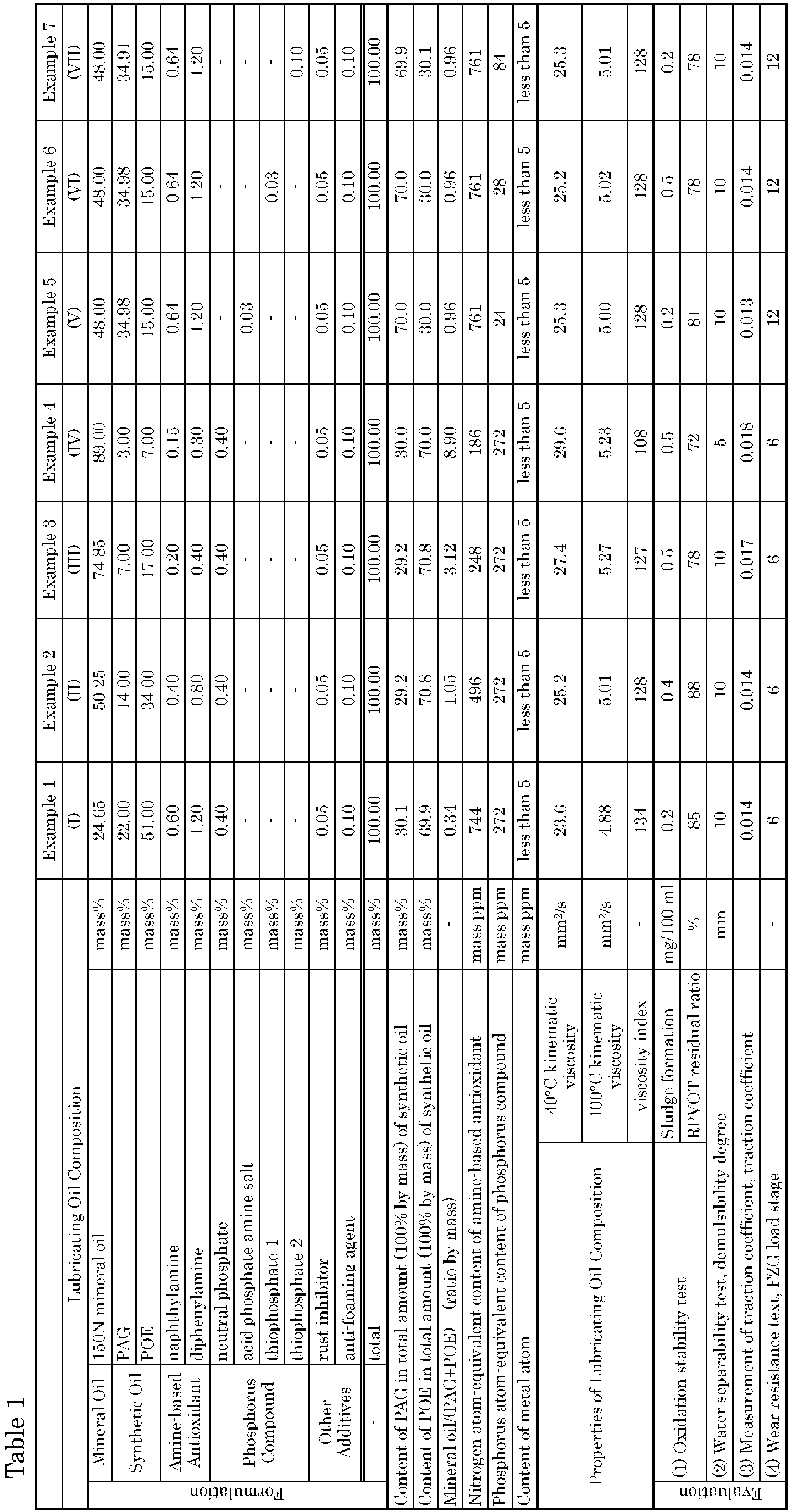

- The lubricating oil compositions prepared in Examples 1 to 7 were excellent in oxidation stability and had a strong effect of preventing sludge precipitation, and and had excellent water separability. In addition, these have a low traction coefficient and showed an effect of improving wear resistance.
- On the other hand, the lubricating oil composition prepared in Comparative Example 1 was poor in oxidation stability, and as compared with those in Examples, this caused much sludge precipitation and had a low RPVOT residual ratio. In addition, this is insufficient in point of wear resistance.
- The lubricating oil compositions prepared in Comparative Examples 2, 3, 4 and 5 had good oxidation stability and wear resistance, but were poor in water separability, and among these, the composition of Comparative Example 4 was especially poor in oxidation stability, and caused relatively much sludge precipitation.
Claims (10)
- A lubricating oil composition comprising a mineral oil (A) and a synthetic oil (B) that comprises a polyalkylene glycol (B1) and a polyol ester (B2);
in which the content of the mineral oil (A) is from 5 to 95% by mass based on the total amount of the lubricating oil composition, and
which is used in turbomachinery, compressors, hydraulic equipments, or machine tools. - The lubricating oil composition according to claim 1, wherein the content ratio of the component (B1) to the component (B2) [(B1)/(B2)] is, by mass, from 10/90 to 80/20.
- The lubricating oil composition according to claim 1 or 2, wherein the content ratio of the component (A) to the total content of the component (B1) and the component (B2) [(A)/((B1)+(B2))] is, by mass, from 0.05 to 19.0.
- The lubricating oil composition according to any one of claims 1 to 3, further comprising an antioxidant (C) that comprises an amine-type antioxidant (C1).
- The lubricating oil composition according to claim 4, wherein the nitrogen atom-equivalent content of the component (C1) is, based on the total amount of the lubricating oil composition, from 50 to 3,000 ppm by mass.
- The lubricating oil composition according to any one of claims 1 to 5, further comprising one or more phosphorus compounds (D) selected from a neutral phosphate (D1), an acid phosphate (D2), an acid phosphate amine salt (D3) and a sulfur-phosphorus compound (D4).
- The lubricating oil composition according to claim 6, wherein the phosphorus atom-equivalent content of the component (D) is, based on the total amount of the lubricating oil composition, from 10 to 1,600 ppm by mass.
- The lubricating oil composition according to any one of claims 1 to 7, wherein the metal atom content is, based on the total amount of the lubricating oil composition, less than 100 ppm by mass.
- The lubricating oil composition according to any one of claims 1 to 8, wherein, when the lubricating oil composition is tested in a water separability test at a temperature of 54°C according to JIS K2520, the demulsibility degree that indicates a time to be taken for an emulsion layer to reach 3 mL is 15 minutes or less.
- A method of using a lubricating oil composition, using the lubricating oil composition of any one of claims 1 to 9 in turbomachinery, compressors, hydraulic equipments, or machine tools.
Applications Claiming Priority (2)
| Application Number | Priority Date | Filing Date | Title |
|---|---|---|---|
| JP2018026369 | 2018-02-16 | ||
| PCT/JP2019/005711 WO2019160123A1 (en) | 2018-02-16 | 2019-02-15 | Lubricating oil composition |
Publications (3)
| Publication Number | Publication Date |
|---|---|
| EP3754000A1 true EP3754000A1 (en) | 2020-12-23 |
| EP3754000A4 EP3754000A4 (en) | 2021-09-29 |
| EP3754000B1 EP3754000B1 (en) | 2025-01-01 |
Family
ID=67618512
Family Applications (1)
| Application Number | Title | Priority Date | Filing Date |
|---|---|---|---|
| EP19754985.0A Active EP3754000B1 (en) | 2018-02-16 | 2019-02-15 | Lubricating oil composition |
Country Status (5)
| Country | Link |
|---|---|
| US (1) | US20210130730A1 (en) |
| EP (1) | EP3754000B1 (en) |
| JP (1) | JP7198229B2 (en) |
| CN (1) | CN110914387B (en) |
| WO (1) | WO2019160123A1 (en) |
Cited By (1)
| Publication number | Priority date | Publication date | Assignee | Title |
|---|---|---|---|---|
| EP4269545A4 (en) * | 2020-12-25 | 2024-11-20 | Idemitsu Kosan Co.,Ltd. | LUBRICATING OIL COMPOSITION, METHOD FOR USING LUBRICATING OIL COMPOSITION, AND METHOD FOR PRODUCING LUBRICATING OIL COMPOSITION |
Family Cites Families (20)
| Publication number | Priority date | Publication date | Assignee | Title |
|---|---|---|---|---|
| JPS5219844B2 (en) * | 1974-04-10 | 1977-05-31 | ||
| JPH05105885A (en) * | 1990-06-07 | 1993-04-27 | Tonen Corp | Gasoline additive composition |
| EP0524783A1 (en) * | 1991-07-23 | 1993-01-27 | Oceanfloor Limited | Use of lubricating oil compositions |
| US6127324A (en) * | 1999-02-19 | 2000-10-03 | The Lubrizol Corporation | Lubricating composition containing a blend of a polyalkylene glycol and an alkyl aromatic and process of lubricating |
| JP4993984B2 (en) * | 2006-09-25 | 2012-08-08 | Jx日鉱日石エネルギー株式会社 | Oil composition for warm pressing and method for warm pressing |
| JP4955366B2 (en) * | 2006-10-30 | 2012-06-20 | 株式会社Adeka | Phosphorus molybdenum compound, process for producing the same, lubricating oil additive and lubricating oil composition containing the compound |
| US20090253597A1 (en) * | 2008-03-31 | 2009-10-08 | Exxonmobil Research And Engineering Company | Lubricant composition with improved varnish deposit resistance |
| DK2274408T3 (en) * | 2008-04-28 | 2013-02-04 | Dow Global Technologies Llc | Polyalkylene glycol-based lubricant compositions for wind turbines |
| US8586520B2 (en) * | 2011-06-30 | 2013-11-19 | Exxonmobil Research And Engineering Company | Method of improving pour point of lubricating compositions containing polyalkylene glycol mono ethers |
| JP5731306B2 (en) * | 2011-07-21 | 2015-06-10 | 昭和シェル石油株式会社 | Two-phase lubricating oil composition |
| US9133380B2 (en) * | 2012-02-15 | 2015-09-15 | Chemtura Corporation | Polyester lubricant for working fluids comprising difluoromethane |
| CN104220569B (en) | 2012-03-29 | 2017-09-01 | 出光兴产株式会社 | Lubricating oil composition for air compressor |
| WO2014156338A1 (en) * | 2013-03-29 | 2014-10-02 | 出光興産株式会社 | Lubricant oil composition |
| JP6134212B2 (en) * | 2013-06-24 | 2017-05-24 | Jxtgエネルギー株式会社 | Hydraulic fluid composition |
| WO2015022958A1 (en) * | 2013-08-14 | 2015-02-19 | セントラル硝子株式会社 | Heat transmission method and high-temperature heat pump device |
| JP6284802B2 (en) * | 2014-03-28 | 2018-02-28 | Jxtgエネルギー株式会社 | Trunk piston type diesel engine lubricating oil composition |
| CN105087110B (en) * | 2014-05-09 | 2018-04-27 | 吉坤日矿日石能源株式会社 | Lubricant oil composite |
| KR101857425B1 (en) * | 2014-10-03 | 2018-05-15 | 제이엑스티지 에네루기 가부시키가이샤 | Lubricant base oil and refrigerator oil |
| WO2016160873A1 (en) * | 2015-03-30 | 2016-10-06 | Carrier Corporation | Low-oil refrigerants and vapor compression systems |
| JP2018009106A (en) * | 2016-07-14 | 2018-01-18 | コスモ石油ルブリカンツ株式会社 | Non-zinc hydraulic oil composition |
-
2019
- 2019-02-15 EP EP19754985.0A patent/EP3754000B1/en active Active
- 2019-02-15 US US16/632,695 patent/US20210130730A1/en not_active Abandoned
- 2019-02-15 CN CN201980003780.6A patent/CN110914387B/en active Active
- 2019-02-15 JP JP2019572303A patent/JP7198229B2/en active Active
- 2019-02-15 WO PCT/JP2019/005711 patent/WO2019160123A1/en not_active Ceased
Cited By (2)
| Publication number | Priority date | Publication date | Assignee | Title |
|---|---|---|---|---|
| EP4269545A4 (en) * | 2020-12-25 | 2024-11-20 | Idemitsu Kosan Co.,Ltd. | LUBRICATING OIL COMPOSITION, METHOD FOR USING LUBRICATING OIL COMPOSITION, AND METHOD FOR PRODUCING LUBRICATING OIL COMPOSITION |
| US12180433B2 (en) | 2020-12-25 | 2024-12-31 | Idemitsu Kosan Co., Ltd. | Lubricating oil composition, method for using lubricating oil composition, and method for producing lubricating oil composition |
Also Published As
| Publication number | Publication date |
|---|---|
| EP3754000B1 (en) | 2025-01-01 |
| US20210130730A1 (en) | 2021-05-06 |
| WO2019160123A1 (en) | 2019-08-22 |
| JPWO2019160123A1 (en) | 2021-02-04 |
| JP7198229B2 (en) | 2022-12-28 |
| CN110914387B (en) | 2023-06-02 |
| CN110914387A (en) | 2020-03-24 |
| EP3754000A4 (en) | 2021-09-29 |
Similar Documents
| Publication | Publication Date | Title |
|---|---|---|
| US11352583B2 (en) | Lubricant composition | |
| JP6195429B2 (en) | Working fluid composition for refrigerator and refrigerator oil | |
| EP2691498A1 (en) | Lubricant compositions comprising polylkylene glycol diether with low noack volatility | |
| US11193080B2 (en) | Lubricating oil composition | |
| US11518922B2 (en) | Refrigerator oil and composition for refrigerators | |
| KR102603887B1 (en) | Lubricating oil composition | |
| EP3872153A1 (en) | Lubricating oil composition, mechanical device equipped with lubricating oil composition, and method for producing lubricating oil composition | |
| WO2014156338A1 (en) | Lubricant oil composition | |
| EP3868852B1 (en) | Lubricating oil composition for air compressors, air compressor lubricating method, and air compressor | |
| JP6059320B2 (en) | Working fluid composition for refrigerator and refrigerator oil | |
| EP3754000B1 (en) | Lubricating oil composition | |
| WO2019189494A1 (en) | Lubricating oil composition | |
| KR20150028296A (en) | Lubricating oil composition | |
| CN105255567A (en) | Refrigerating machine oil composition and application thereof | |
| JP7460445B2 (en) | Lubricating Oil Composition | |
| WO2022138523A1 (en) | Lubricant composition | |
| EP4682231A1 (en) | Composition for freezer | |
| EP3778833A1 (en) | Lubricant composition |
Legal Events
| Date | Code | Title | Description |
|---|---|---|---|
| STAA | Information on the status of an ep patent application or granted ep patent |
Free format text: STATUS: THE INTERNATIONAL PUBLICATION HAS BEEN MADE |
|
| PUAI | Public reference made under article 153(3) epc to a published international application that has entered the european phase |
Free format text: ORIGINAL CODE: 0009012 |
|
| STAA | Information on the status of an ep patent application or granted ep patent |
Free format text: STATUS: REQUEST FOR EXAMINATION WAS MADE |
|
| 17P | Request for examination filed |
Effective date: 20200120 |
|
| AK | Designated contracting states |
Kind code of ref document: A1 Designated state(s): AL AT BE BG CH CY CZ DE DK EE ES FI FR GB GR HR HU IE IS IT LI LT LU LV MC MK MT NL NO PL PT RO RS SE SI SK SM TR |
|
| AX | Request for extension of the european patent |
Extension state: BA ME |
|
| DAV | Request for validation of the european patent (deleted) | ||
| DAX | Request for extension of the european patent (deleted) | ||
| A4 | Supplementary search report drawn up and despatched |
Effective date: 20210830 |
|
| RIC1 | Information provided on ipc code assigned before grant |
Ipc: C10N 30/06 20060101ALI20210824BHEP Ipc: C10N 20/02 20060101ALI20210824BHEP Ipc: C10N 30/02 20060101ALI20210824BHEP Ipc: C10M 169/04 20060101ALI20210824BHEP Ipc: C10N 40/30 20060101ALI20210824BHEP Ipc: C10N 40/12 20060101ALI20210824BHEP Ipc: C10N 40/08 20060101ALI20210824BHEP Ipc: C10N 40/06 20060101ALI20210824BHEP Ipc: C10N 30/10 20060101ALI20210824BHEP Ipc: C10N 30/04 20060101ALI20210824BHEP Ipc: C10N 30/00 20060101ALI20210824BHEP Ipc: C10M 137/04 20060101ALI20210824BHEP Ipc: C10M 107/34 20060101ALI20210824BHEP Ipc: C10M 105/38 20060101ALI20210824BHEP Ipc: C10M 101/02 20060101ALI20210824BHEP Ipc: C10M 111/04 20060101AFI20210824BHEP |
|
| STAA | Information on the status of an ep patent application or granted ep patent |
Free format text: STATUS: EXAMINATION IS IN PROGRESS |
|
| 17Q | First examination report despatched |
Effective date: 20230721 |
|
| GRAP | Despatch of communication of intention to grant a patent |
Free format text: ORIGINAL CODE: EPIDOSNIGR1 |
|
| STAA | Information on the status of an ep patent application or granted ep patent |
Free format text: STATUS: GRANT OF PATENT IS INTENDED |
|
| INTG | Intention to grant announced |
Effective date: 20240725 |
|
| GRAS | Grant fee paid |
Free format text: ORIGINAL CODE: EPIDOSNIGR3 |
|
| GRAA | (expected) grant |
Free format text: ORIGINAL CODE: 0009210 |
|
| STAA | Information on the status of an ep patent application or granted ep patent |
Free format text: STATUS: THE PATENT HAS BEEN GRANTED |
|
| AK | Designated contracting states |
Kind code of ref document: B1 Designated state(s): AL AT BE BG CH CY CZ DE DK EE ES FI FR GB GR HR HU IE IS IT LI LT LU LV MC MK MT NL NO PL PT RO RS SE SI SK SM TR |
|
| REG | Reference to a national code |
Ref country code: GB Ref legal event code: FG4D |
|
| REG | Reference to a national code |
Ref country code: DE Ref legal event code: R096 Ref document number: 602019064271 Country of ref document: DE |
|
| REG | Reference to a national code |
Ref country code: CH Ref legal event code: EP |
|
| REG | Reference to a national code |
Ref country code: IE Ref legal event code: FG4D |
|
| REG | Reference to a national code |
Ref country code: LT Ref legal event code: MG9D |
|
| REG | Reference to a national code |
Ref country code: NL Ref legal event code: MP Effective date: 20250101 |
|
| REG | Reference to a national code |
Ref country code: AT Ref legal event code: MK05 Ref document number: 1756240 Country of ref document: AT Kind code of ref document: T Effective date: 20250101 |
|
| PG25 | Lapsed in a contracting state [announced via postgrant information from national office to epo] |
Ref country code: NL Free format text: LAPSE BECAUSE OF FAILURE TO SUBMIT A TRANSLATION OF THE DESCRIPTION OR TO PAY THE FEE WITHIN THE PRESCRIBED TIME-LIMIT Effective date: 20250101 |
|
| PG25 | Lapsed in a contracting state [announced via postgrant information from national office to epo] |
Ref country code: FI Free format text: LAPSE BECAUSE OF FAILURE TO SUBMIT A TRANSLATION OF THE DESCRIPTION OR TO PAY THE FEE WITHIN THE PRESCRIBED TIME-LIMIT Effective date: 20250101 |
|
| PG25 | Lapsed in a contracting state [announced via postgrant information from national office to epo] |
Ref country code: PL Free format text: LAPSE BECAUSE OF FAILURE TO SUBMIT A TRANSLATION OF THE DESCRIPTION OR TO PAY THE FEE WITHIN THE PRESCRIBED TIME-LIMIT Effective date: 20250101 |
|
| PG25 | Lapsed in a contracting state [announced via postgrant information from national office to epo] |
Ref country code: ES Free format text: LAPSE BECAUSE OF FAILURE TO SUBMIT A TRANSLATION OF THE DESCRIPTION OR TO PAY THE FEE WITHIN THE PRESCRIBED TIME-LIMIT Effective date: 20250101 |
|
| PG25 | Lapsed in a contracting state [announced via postgrant information from national office to epo] |
Ref country code: IS Free format text: LAPSE BECAUSE OF FAILURE TO SUBMIT A TRANSLATION OF THE DESCRIPTION OR TO PAY THE FEE WITHIN THE PRESCRIBED TIME-LIMIT Effective date: 20250501 Ref country code: NO Free format text: LAPSE BECAUSE OF FAILURE TO SUBMIT A TRANSLATION OF THE DESCRIPTION OR TO PAY THE FEE WITHIN THE PRESCRIBED TIME-LIMIT Effective date: 20250401 |
|
| PG25 | Lapsed in a contracting state [announced via postgrant information from national office to epo] |
Ref country code: HR Free format text: LAPSE BECAUSE OF FAILURE TO SUBMIT A TRANSLATION OF THE DESCRIPTION OR TO PAY THE FEE WITHIN THE PRESCRIBED TIME-LIMIT Effective date: 20250101 |
|
| PG25 | Lapsed in a contracting state [announced via postgrant information from national office to epo] |
Ref country code: LV Free format text: LAPSE BECAUSE OF FAILURE TO SUBMIT A TRANSLATION OF THE DESCRIPTION OR TO PAY THE FEE WITHIN THE PRESCRIBED TIME-LIMIT Effective date: 20250101 Ref country code: PT Free format text: LAPSE BECAUSE OF FAILURE TO SUBMIT A TRANSLATION OF THE DESCRIPTION OR TO PAY THE FEE WITHIN THE PRESCRIBED TIME-LIMIT Effective date: 20250502 |
|
| PG25 | Lapsed in a contracting state [announced via postgrant information from national office to epo] |
Ref country code: GR Free format text: LAPSE BECAUSE OF FAILURE TO SUBMIT A TRANSLATION OF THE DESCRIPTION OR TO PAY THE FEE WITHIN THE PRESCRIBED TIME-LIMIT Effective date: 20250402 Ref country code: BG Free format text: LAPSE BECAUSE OF FAILURE TO SUBMIT A TRANSLATION OF THE DESCRIPTION OR TO PAY THE FEE WITHIN THE PRESCRIBED TIME-LIMIT Effective date: 20250101 |
|
| PG25 | Lapsed in a contracting state [announced via postgrant information from national office to epo] |
Ref country code: AT Free format text: LAPSE BECAUSE OF FAILURE TO SUBMIT A TRANSLATION OF THE DESCRIPTION OR TO PAY THE FEE WITHIN THE PRESCRIBED TIME-LIMIT Effective date: 20250101 |
|
| PG25 | Lapsed in a contracting state [announced via postgrant information from national office to epo] |
Ref country code: CZ Free format text: LAPSE BECAUSE OF FAILURE TO SUBMIT A TRANSLATION OF THE DESCRIPTION OR TO PAY THE FEE WITHIN THE PRESCRIBED TIME-LIMIT Effective date: 20250101 |
|
| PG25 | Lapsed in a contracting state [announced via postgrant information from national office to epo] |
Ref country code: SE Free format text: LAPSE BECAUSE OF FAILURE TO SUBMIT A TRANSLATION OF THE DESCRIPTION OR TO PAY THE FEE WITHIN THE PRESCRIBED TIME-LIMIT Effective date: 20250101 |
|
| REG | Reference to a national code |
Ref country code: CH Ref legal event code: PL |
|
| REG | Reference to a national code |
Ref country code: DE Ref legal event code: R097 Ref document number: 602019064271 Country of ref document: DE |
|
| PG25 | Lapsed in a contracting state [announced via postgrant information from national office to epo] |
Ref country code: SM Free format text: LAPSE BECAUSE OF FAILURE TO SUBMIT A TRANSLATION OF THE DESCRIPTION OR TO PAY THE FEE WITHIN THE PRESCRIBED TIME-LIMIT Effective date: 20250101 |
|
| PG25 | Lapsed in a contracting state [announced via postgrant information from national office to epo] |
Ref country code: DK Free format text: LAPSE BECAUSE OF FAILURE TO SUBMIT A TRANSLATION OF THE DESCRIPTION OR TO PAY THE FEE WITHIN THE PRESCRIBED TIME-LIMIT Effective date: 20250101 |
|
| PG25 | Lapsed in a contracting state [announced via postgrant information from national office to epo] |
Ref country code: MC Free format text: LAPSE BECAUSE OF FAILURE TO SUBMIT A TRANSLATION OF THE DESCRIPTION OR TO PAY THE FEE WITHIN THE PRESCRIBED TIME-LIMIT Effective date: 20250101 |
|
| PG25 | Lapsed in a contracting state [announced via postgrant information from national office to epo] |
Ref country code: LU Free format text: LAPSE BECAUSE OF NON-PAYMENT OF DUE FEES Effective date: 20250215 Ref country code: IT Free format text: LAPSE BECAUSE OF FAILURE TO SUBMIT A TRANSLATION OF THE DESCRIPTION OR TO PAY THE FEE WITHIN THE PRESCRIBED TIME-LIMIT Effective date: 20250101 |
|
| PG25 | Lapsed in a contracting state [announced via postgrant information from national office to epo] |
Ref country code: CH Free format text: LAPSE BECAUSE OF NON-PAYMENT OF DUE FEES Effective date: 20250228 |
|
| PG25 | Lapsed in a contracting state [announced via postgrant information from national office to epo] |
Ref country code: EE Free format text: LAPSE BECAUSE OF FAILURE TO SUBMIT A TRANSLATION OF THE DESCRIPTION OR TO PAY THE FEE WITHIN THE PRESCRIBED TIME-LIMIT Effective date: 20250101 |
|
| PG25 | Lapsed in a contracting state [announced via postgrant information from national office to epo] |
Ref country code: RO Free format text: LAPSE BECAUSE OF FAILURE TO SUBMIT A TRANSLATION OF THE DESCRIPTION OR TO PAY THE FEE WITHIN THE PRESCRIBED TIME-LIMIT Effective date: 20250101 |
|
| PG25 | Lapsed in a contracting state [announced via postgrant information from national office to epo] |
Ref country code: SK Free format text: LAPSE BECAUSE OF FAILURE TO SUBMIT A TRANSLATION OF THE DESCRIPTION OR TO PAY THE FEE WITHIN THE PRESCRIBED TIME-LIMIT Effective date: 20250101 |
|
| PLBE | No opposition filed within time limit |
Free format text: ORIGINAL CODE: 0009261 |
|
| STAA | Information on the status of an ep patent application or granted ep patent |
Free format text: STATUS: NO OPPOSITION FILED WITHIN TIME LIMIT |
|
| REG | Reference to a national code |
Ref country code: BE Ref legal event code: MM Effective date: 20250228 |
|
| 26N | No opposition filed |
Effective date: 20251002 |
|
| GBPC | Gb: european patent ceased through non-payment of renewal fee |
Effective date: 20250401 |
|
| PG25 | Lapsed in a contracting state [announced via postgrant information from national office to epo] |
Ref country code: GB Free format text: LAPSE BECAUSE OF NON-PAYMENT OF DUE FEES Effective date: 20250401 |
|
| PGFP | Annual fee paid to national office [announced via postgrant information from national office to epo] |
Ref country code: FR Payment date: 20251231 Year of fee payment: 8 |
|
| PG25 | Lapsed in a contracting state [announced via postgrant information from national office to epo] |
Ref country code: BE Free format text: LAPSE BECAUSE OF NON-PAYMENT OF DUE FEES Effective date: 20250228 |
|
| PG25 | Lapsed in a contracting state [announced via postgrant information from national office to epo] |
Ref country code: IE Free format text: LAPSE BECAUSE OF NON-PAYMENT OF DUE FEES Effective date: 20250215 |
|
| PGFP | Annual fee paid to national office [announced via postgrant information from national office to epo] |
Ref country code: DE Payment date: 20251230 Year of fee payment: 8 |