EP3753971B1 - Polymere für die behandlung von oberflächen - Google Patents
Polymere für die behandlung von oberflächen Download PDFInfo
- Publication number
- EP3753971B1 EP3753971B1 EP20177979.0A EP20177979A EP3753971B1 EP 3753971 B1 EP3753971 B1 EP 3753971B1 EP 20177979 A EP20177979 A EP 20177979A EP 3753971 B1 EP3753971 B1 EP 3753971B1
- Authority
- EP
- European Patent Office
- Prior art keywords
- group
- formula
- diyl
- repeating unit
- alkanediyl
- Prior art date
- Legal status (The legal status is an assumption and is not a legal conclusion. Google has not performed a legal analysis and makes no representation as to the accuracy of the status listed.)
- Active
Links
Images
Classifications
-
- C—CHEMISTRY; METALLURGY
- C08—ORGANIC MACROMOLECULAR COMPOUNDS; THEIR PREPARATION OR CHEMICAL WORKING-UP; COMPOSITIONS BASED THEREON
- C08G—MACROMOLECULAR COMPOUNDS OBTAINED OTHERWISE THAN BY REACTIONS ONLY INVOLVING UNSATURATED CARBON-TO-CARBON BONDS
- C08G69/00—Macromolecular compounds obtained by reactions forming a carboxylic amide link in the main chain of the macromolecule
- C08G69/02—Polyamides derived from amino-carboxylic acids or from polyamines and polycarboxylic acids
- C08G69/26—Polyamides derived from amino-carboxylic acids or from polyamines and polycarboxylic acids derived from polyamines and polycarboxylic acids
- C08G69/28—Preparatory processes
- C08G69/30—Solid state polycondensation
-
- C—CHEMISTRY; METALLURGY
- C11—ANIMAL OR VEGETABLE OILS, FATS, FATTY SUBSTANCES OR WAXES; FATTY ACIDS THEREFROM; DETERGENTS; CANDLES
- C11D—DETERGENT COMPOSITIONS; USE OF SINGLE SUBSTANCES AS DETERGENTS; SOAP OR SOAP-MAKING; RESIN SOAPS; RECOVERY OF GLYCEROL
- C11D3/00—Other compounding ingredients of detergent compositions covered in group C11D1/00
- C11D3/0005—Other compounding ingredients characterised by their effect
- C11D3/0036—Soil deposition preventing compositions; Antiredeposition agents
-
- C—CHEMISTRY; METALLURGY
- C08—ORGANIC MACROMOLECULAR COMPOUNDS; THEIR PREPARATION OR CHEMICAL WORKING-UP; COMPOSITIONS BASED THEREON
- C08G—MACROMOLECULAR COMPOUNDS OBTAINED OTHERWISE THAN BY REACTIONS ONLY INVOLVING UNSATURATED CARBON-TO-CARBON BONDS
- C08G69/00—Macromolecular compounds obtained by reactions forming a carboxylic amide link in the main chain of the macromolecule
- C08G69/48—Polymers modified by chemical after-treatment
-
- C—CHEMISTRY; METALLURGY
- C11—ANIMAL OR VEGETABLE OILS, FATS, FATTY SUBSTANCES OR WAXES; FATTY ACIDS THEREFROM; DETERGENTS; CANDLES
- C11D—DETERGENT COMPOSITIONS; USE OF SINGLE SUBSTANCES AS DETERGENTS; SOAP OR SOAP-MAKING; RESIN SOAPS; RECOVERY OF GLYCEROL
- C11D3/00—Other compounding ingredients of detergent compositions covered in group C11D1/00
- C11D3/16—Organic compounds
- C11D3/37—Polymers
- C11D3/3703—Macromolecular compounds obtained otherwise than by reactions only involving carbon-to-carbon unsaturated bonds
- C11D3/3719—Polyamides or polyimides
Definitions
- the invention relates to polymers which comprise in their molecular structure at least one repeating unit with catechol functionalization and at least one different repeating unit with NH 2 or ammonium functionalization, wherein the molar ratio of said units is in the range from 0.5 to 1 to 4 to 1, preferably 1 to 1 to 2 to 1.
- a surface treatment agent such as a washing or cleaning agent
- one object of the present invention was to reduce the re-soiling of the surface during the washing process but also after the washing process with normal use of the textile or household item.
- the conventional polymers must be incorporated into the washing or cleaning agents in significant quantities in order to achieve a noticeable effect. More efficient polymers are desirable, which show good effects even when used in reduced quantities.
- Another object of the present invention was to provide polymers which more efficiently reduce or prevent the disadvantages occurring during surface cleaning.
- the polymers according to the invention defined below solve the above-mentioned problem and are also able to adsorb to an improved extent from the aqueous cleaning or washing liquor onto a substrate surface, in particular onto textile surfaces or household surfaces. As a result, these polymers are particularly efficient and the amount of polymers used can be kept low.
- a and A 1 do not both represent a direct bond.
- a 4 and A 3 do not both represent a direct bond. This means that at least one of A and A 1 or one of A 4 and A 3 represents a spacer group.
- a chemical compound marked with * in a structural formula of a repeating unit Bond represents a valence, which is part of the polymer backbone as a covalent bond.
- the repeating units of formula (II) are different from the repeating units of formula (I).
- the repeating units of formula (II) therefore do not contain a 1,2-dihydroxyphenyl group, which can be additionally substituted on the phenyl ring.
- the polymer backbone is a continuous series of covalently bonded atoms that form the actual molecular chain as the "backbone" of a polymer.
- the parts of the molecule that do not form this actual chain but are merely bonded to it are not part of the polymer backbone.
- the residues G 1 and G 2 each indicate a structural unit contributing to the polymer backbone. This means that the residues G 1 and G 2 each represent the structural fragment responsible for the corresponding repeating unit, which makes the complete contribution of the repeating unit to the atoms constituting the polymer backbone and can also carry further residues.
- G 1 of formula (I) naturally contains, in addition to the contribution of the atoms constituting the polymer backbone, further side chains or atoms bonded thereto. Embodiments of G 1 are defined below.
- G 2 of formula (II) naturally contains, in addition to the contribution of the atoms constituting the polymer backbone, further side chains or atoms bonded to it.
- Embodiments of G 2 are defined below.
- a spacer group is a structural fragment of a side chain of a polymer that bridges the end group of the side chain (also: side chain terminus) with the polymer backbone.
- suitable polymers are those characterized in that A according to formula (I) stands for a carbonyl group, for a carbonyloxy group, for a carbonylimino group, for an imino group, for a C 1 -C 4 -alkyleneoxy group, for a C 1 -C 4 -alkyleneimino group.
- a according to formula (I) stands for a carbonyl group.
- Preferred repeat units of formula (II) are those in which A 4 according to formula (II) is a carbonyl group, a carbonyloxy group, a carbonylimino group, an imino group, a C 1 -C 4 -alkyleneoxy group, a C 1 -C 4 -alkylenimino group, a C 1 -C 4 -alkyleniminocarbonyl group, C 2 -C 6 - ⁇ , ⁇ -(dioxo)alkane- ⁇ , ⁇ -diyl group.
- a 4 according to formula (II) is a carbonyl group.
- a linking group is a structural fragment that links a spacer group in a side chain of the repeating unit of a polymer to the side chain terminus (e.g. 1,2-dihydroxyphenyl residue of formula (I) or X of formula (II)).
- a 1 according to formula (I) is a direct bond, a C 1 -C 4 -alkanediyl group, a C 1 -C 4 -alkyleneoxycarbonyl group.
- a 1 according to formula (I) is particularly preferably a C 1 -C 4 -alkanediyl group, especially when A is a carbonyl group.
- These polymers particularly preferably contain the preferred spacer group A according to formula (I).
- a 3 according to formula (II) is a direct bond, a C 1 -C 6 -alkanediyl group, a C 2 -C 6 - ⁇ , ⁇ -(dioxo)alkane- ⁇ , ⁇ -diyl group.
- a 3 according to formula (II) is particularly preferably a C 1 -C 6 -alkanediyl group, especially when A 4 is a carbonyl group.
- These polymers particularly preferably contain the preferred spacer group A 4 according to formula (II).
- Asymmetrical bivalent groups in particular those of the radicals A, A 1 , A 3 , A 4 and A 5 , can be inserted into the inventive structures of the repeat units of the formulas (I) and (II) of the inventive polymer (and their preferred embodiments) in accordance with both possibilities obtainable by rotation (eg ethyleneoxy as -OCH 2 CH 2 - or as -CHzCHzO-). It is preferred if the covalent linkage of two atoms other than carbon, eg the formation of a peroxy group (-OO-), is avoided.
- a carbonylimino group is known to be a bivalent group
- An imino group is known to be a divalent group -NH-
- a carbonyloxy group is known to be a divalent group
- Preferred C 1 -C 4 alkyleneoxy groups are selected from methyleneoxy (-OCH 2 - or -CH 2 O-), ethyleneoxy (-OCH 2 CH 2 - or -CH 2 CH 2 O-), propyleneoxy (-OCH 2 CH 2 CH 2 - or -OCH 2 CHMe- or -CH 2 CH 2 CH 2 O- or -CMeHCH 2 O-), butyleneoxy (-OCH 2 CH 2 CH 2 CH 2 - or -OCH 2 CH 2 CHMe- or -OCH 2 CHEt- or -CH 2 CH 2 CH 2 CH 2 O- or -CHMeCHzCHzO- or -CHEt-CHzO-).
- Preferred C 1 -C 4 alkyleneimino groups are selected from methyleneimino (-NHCH 2 - or -CH 2 NH-), ethyleneimino (-NHCH 2 CH 2 - or -CH 2 CH 2 NH-), propyleneimino (-NHCH 2 CH 2 CH 2 - or -NHCH 2 CHMe- or -CH 2 CH 2 CH 2 NH- or -CHMeCH 2 NH-), butyleneimino (-NHCH 2 CH 2 CH 2 CH 2 - or -NHCH 2 CH 2 CHMe- or -NHCH 2 CHEt- or -CH 2 CH 2 CH 2 CH 2 NH- or -CHMeCH 2 CH 2 NH- or -CHEtCH 2 CH 2 NH-).
- Preferred C 1 -C 4 alkyleneiminocarbonyl groups are selected from methyleneiminocarbonyl (-NHCH 2 - or -CH 2 NH-), ethyleneiminocarbonyl (-CONHCH 2 CH 2 - or -CH 2 CH 2 NHCO-), propyleneiminocarbonyl (-CONHCH 2 CH 2 CH 2 - or -CONHCH 2 CHMe- or -CH 2 CH 2 CH 2 NHCO- or-CHMeCH 2 NHCO-), butyleneimino (-CONHCH 2 CH 2 CH 2 CH 2 - or -CONHCH 2 CH 2 CHMe- or-CONHCH 2 CHEt- or -CH 2 CH 2 CH 2 CH 2 NHCO- or -CHMeCH 2 CH 2 NHCO- or-CHEtCH 2 CH 2 NHCO-).
- Preferred C 1 -C 4 alkyl groups are selected from methyl, ethyl, n-propyl, isopropyl, n-butyl, sec-butyl, iso-butyl, tert-butyl.
- Preferred C 2 -C 4 hydroxyalkyl groups are selected from 2-hydroxyethyl, 3-hydroxypropyl, 2-hydroxypropyl, 4-hydroxybutyl, 3-hydroxybutyl, 2-hydroxybutyl.
- Preferred C 1 -C 4 alkoxy groups are selected from methoxy, ethoxy, n-propoxy, iso-propoxy, n-butoxy, sec-butoxy, iso-butoxy, tert-butoxy.
- Preferred halogen atoms are selected from chlorine, bromine, fluorine.
- Preferred C 1 -C 10 alkylcarbonyloxy groups are selected from CH 3 -CO-O-, CH 3 CH 2 CO-O-, CH 3 CH 2 CH 2 CO-O-.
- Preferred C 1 -C 10 alkoxycarbonyl groups are selected from methoxycarbonyl, ethoxycarbonyl, n-propoxycarbonyl, iso-propoxycarbonyl, n-butoxycarbonyl, sec-butoxycarbonyl, iso-butoxycarbonyl, tert-butoxycarbonyl, hexyloxycarbonyl, 2-ethylhexyloxycarbonyl, octyloxycarbonyl.
- Preferred C 6 -C 10 aryloxycarbonyl groups are selected from phenoxycarbonyl, 2-methylphenoxycarbonyl, 3-methylphenoxycarbonyl, 4-methylphenoxycarbonyl.
- Preferred C 6 -C 10 arylcarbonyloxy groups are selected from phenylcarbonyloxy (also: benzoyloxy), 2-methylphenylcarbonyloxy, 3-methylphenylcarbonyloxy, 4-methylphenylcarbonyloxy.
- a preferred C 2 -C 10 alkenyloxycarbonyl group is allyloxycarbonyl or vinyloxycarbonyl.
- Preferred C 1 -C 4 alkanediyl groups are selected from methylene, ethane-1,2-diyl, propane-1,2-diyl, propane-1,3-diyl, butane-1,4-diyl, butane-1,2-diyl, butane-1,3-diyl.
- C 1 -C 4 alkyleneoxycarbonyl groups are bivalent groups which have one free valence on the alkylene structural unit and one free valence on the carbonyl group.
- C 1 -C 4 alkyleneoxycarbonyl groups are selected from methyleneoxycarbonyl (-CHz-O-CO- or -CO-O-CH 2 -), ethyleneoxycarbonyl (-CH 2 -CH 2 -O-CO- or -O-CO-CH 2 -CH 2 -), propyleneoxycarbonyl (-CH 2 -CH 2 -CH 2 -O-CO- or -CO-O-CH 2 -CH 2 -CH 2 -), butyleneoxycarbonyl (-CHz-CHz-CHz-CHz-O-CO- or -CO-O-CH 2 -CH 2 -CH 2 -CH 2 -).
- Preferred C 2 -C 6 - ⁇ , ⁇ -(dioxo)alkane- ⁇ , ⁇ -diyl groups are selected from 1,3-dioxopropane-1,3-diyl, 1,4-dioxobutane-1,4-diyl, 1,5-dioxopentane-1,5-diyl, 1,6-dioxohexane-1,6-diyl.
- the polymers according to the invention can be constructed by polyreaction from correspondingly catechol-functionalized monomers or correspondingly XA 3 -A 4 -functionalized monomers, or are obtainable by polymer-analogous reaction with a polymer and a catechol-containing or group X-containing reagent as starting material. It is preferred according to the invention if G 1 according to formula (I) and G 2 according to formula (II) contribute to a polymer backbone which is selected from a polymer backbone obtainable by polyaddition, polycondensation or by radical polymerization.
- Particularly successful and therefore preferred polymers are those polymers in which the amount of units of formula (I) and formula (II) is at least 50 mol% based on all repeat units contained in the polymer.
- Polymers according to the invention which are characterized in that they have an average molecular weight (Mw) of 500 to 500,000 g/mol, preferably of 2,000 to 200,000 g/mol, are preferred.
- Mw average molecular weight
- the average molecular weights given for polymeric ingredients in this application are - unless explicitly stated otherwise - always weight-average molecular weights M w which can generally be determined by means of gel permeation chromatography using an RI detector, the measurement being expediently carried out against an external standard.
- Preferred repeating units of the formula (I) with said 1,2-dihydroxyphenyl side chain terminus are those in which R 2 and R 3 in formula (I) represent a hydrogen atom.
- the polymer backbone of the polymer according to the invention is derived from polyamide.
- Polyamide-based polymers according to the invention can preferably be prepared using common protective group chemistry (for amino groups, e.g.: triphenylmethyl (trityl), (((9H-fluoren-9-yl)methoxy)carbonyl (Fmoc); for phenolic OH, e.g.: methoxy, ketal).
- Corresponding repeating units of formula (Ia) are derived from formula (I), in which A according to formula (I) represents a carbonyl group which binds to the spacer group A 1 and to G 1 .
- R 2 and R 3 in formula (Ia) are a hydrogen atom
- a 1 and Z are an ethane-1,2-diyl group.
- This special repeating unit is abbreviated below as *-(Cat)-*
- step (v) If the polymer is to be synthesized on a solid phase, it is preferable to couple the reaction product from (iv) with the solid phase and then carry out step (v).
- the hydroxyl groups on the catechol skeleton of the repeating unit of formula (I) or (I-a) are provided with protective groups (e.g. methyl), these protective groups are preferably removed again after the polyreaction has taken place, forming the polymers with the catechol structural fragment of formula (I) or formula (I-a).
- the compound to be deprotected (preferably the polymer to be deprotected) is preferably shaken in a solution of trifluoromethanesulfonic acid (18 molar equivalents per catechol), thioanisole (8 molar equivalents per catechol) and trifluoroacetic acid (95 vol.% of the total solution) for 18 h based on the reaction conditions of Kiso.
- the reaction solution is then mixed with diethyl ether, the reaction product is precipitated and the isolated precipitate is dried under vacuum.
- Corresponding repeating units of formula (II-a) are derived from formula (II), in which the spacer group A 4 according to formula (II) represents a carbonyl group which binds to the linking group A 3 and to G 2 .
- step (v) If the polymer is to be synthesized on a solid phase, it is preferred to couple the reaction product from (iv) with the solid phase and then carry out step (v).
- the repeating unit of formula (II-b) is derived from the repeating unit of formula (II), in which the linking group A 3 is a direct bond and the spacer group A 4 is a C 2 -C 6 - ⁇ , ⁇ -(dioxo)alkane- ⁇ , ⁇ -diyl group and X is a group NH 2 .
- the polymer can contain, as a repeating unit of the formula (II), the repeating unit of the formula (II-b) alone or together with the repeating unit of the formula (II-a).
- Particularly preferred polymers according to the invention therefore contain at least one repeating unit of the formula (I-a) and at least one repeating unit of the formula (II-a) and/or the formula (II-b).
- the polymer is to be built up on a solid phase, it is preferred to couple the reaction product from (U8) to the solid phase. It is also conceivable to couple the reaction product (U2) to the solid phase and to obtain a polymer chain containing at least one protected primary amino group (preferably at least one triphenylmethyl-protected primary amino group) in the polymer, in which the protected primary amino group is deprotected in one step before or after splitting off from the solid phase and the resulting group is reacted with a compound of the formula (E3) (vide supra) or (E6) (vide supra) .
- Corresponding repeating units of formula (II-c) are derived from formula (II), in which the spacer group A 4 according to formula (II) represents a C 2 -alkylaminocarbonyl group which binds to the linking group A 3 and to G 2 .
- Z 1 is an ethane-1,2-diyl group
- a 3 is a propane-1,3-diyl group
- X is an N,N-dimethylamino group.
- This specific preferred structural unit is abbreviated below as *-(IIc-amine)-*.
- reaction product (U11) from (iv) with the solid phase during polymer synthesis and then to carry out step (v) for deprotection on the solid phase.
- the repeating unit of formula (II-d) is derived from the repeating unit of formula (II) in which the linking group A 3 is a C 2 -C 6 - ⁇ , ⁇ -(dioxo)alkane- ⁇ , ⁇ -diyl group and the spacer group A 4 is a C 2 -alkylimine group and X is an NH 2 group.
- Z 3 represents an ethane-1,2-diyl group and A 6 represents an ethane-1,2-diyl group.
- This specific preferred structural unit is abbreviated below as *-(lld-amide)-*.
- the polymer may contain, as a repeating unit of formula (II), the repeating unit of formula (II-d) alone or together with at least one repeating unit selected from formula (II-a), formula (II-b), formula (II-c) or mixtures thereof.
- the polymer is to be built up on a solid phase, it is preferred to couple the reaction product from (U14) to the solid phase. It is also conceivable to couple the reaction product (U13) to the solid phase and to obtain a polymer chain containing at least one protected primary amino group (preferably at least one triphenylmethyl-protected primary amino group) in the polymer, in which the protected primary amino group is deprotected in one step before or after splitting off from the solid phase and the resulting group is reacted with a compound of the formula (E9) (vide supra) or (E11) (vide supra) .
- Particularly preferred polymers according to the invention contain at least one repeating unit of the formula (I-a) combined with at least one repeating unit of the formula (II-a) and/or the formula (II-b) and/or the formula (II-c) and/or the formula (II-d). It is particularly preferred if the polymers according to the invention contain at least one repeating unit of the formula (I-a) combined with at least one repeating unit of the formula (II-c) and/or the formula (II-d).
- preferred polymers according to the invention are characterized in that they contain at least one structural unit of the formula (III) as a (preferably only) further repeating unit, where n is a number from 1 to 10 and Z 2 is a C 2 to C 8 alkanediyl group (preferably ethane-1,2-diyl). It is again preferred if the polymer contains the repeat units according to formula (III) in an amount of less than 50 mol%.
- Z 2 represents an ethane-1,2-diyl group and n represents 1. This particular preferred repeating unit is abbreviated below as *-(EDS)-*.
- the monomers corresponding to formula (III) for the synthesis of the preferred polymers according to the invention were prepared by the method described in Ebbesen, M.F., et al. "Biodegradable poly(amidoamine)s with uniform degradation fragments via sequence-controlled macromonomers", Polymer Chemistry 7.46 (2016), pages 7086-7093 and that in " Sequence-defined glycopolymer segments presenting mannose: synthesis and lectin binding affinity.” Biomacromolecules 13.6 (2012): 1845-1852 The synthesis process described in the "Supporting Information" is used. The aforementioned publications are expressly and fully referred to.
- the polyamide-derived polymers can be prepared from the monomers by polyreaction, here polycondensation, in a manner known to the person skilled in the art.
- polyreaction here polycondensation
- the polyamide-derived polymers are synthesized on the solid phase.
- a solid phase with free amino groups is provided, which is sequentially reacted with monomers or prepolymers with protected amino groups, preferably with Fmoc-protected amino groups, to form a polymer, and the protective group of the coupled monomer is removed before the next reaction with a monomer to obtain an amino group.
- a corresponding protocol for a preferred solid phase synthesis is described in Gerke, Christoph, et al. "Sequence-controlled glycopolymers via step-growth polymerization of precision glycomacromolecules for lectin receptor clustering.” Biomacromolecules 18.3 (2017), pages 787-796 described. In this context, reference is expressly made to this publication in its entirety.
- Suitable monomers for solid-phase synthesis and in particular for solid-phase synthesis according to the above protocol are preferably reaction products of the above formula (U2), the above formula (U5), the above formula (U8), the above formula (U11), the above formula (U13), the above formula (U14) or monomer for the synthesis of the repeating unit of the above formula (III) used as monomers.
- the polymer backbone of the polymer according to the invention is derived from acrylates, methacrylates, acrylamides, methacrylamides, or copolymers thereof.
- Corresponding polymers can be formed by radical polyreaction.
- the monomers corresponding to formula (Ic) for the synthesis of the polymers according to the invention are known from the literature and can be prepared, for example, according to the synthesis procedure according to the publication WO 2005/070866 A2 (here, among others: 2-(3,4-dihydroxyphenyl)ethyl acrylate, 2-(3,4-dihydroxyphenyl)ethyl methacrylate, 2-(3,4-dihydroxy-6-methyl-phenyl)ethyl methacrylamide) or patent specification US 6,605,270 A or after Na Lin et al., Nucleic Acids Research, Volume 35, Issue 4, 2007, pages 1222-1229 (here: N-[2-(3,4-dihydroxy-phenyl)-ethyl]-acrylamide). Express and full reference is made to these publications.
- a second subject matter of the invention is an agent for treating surfaces, in particular hard surfaces or textiles, characterized in that it contains at least one polymer according to the invention of the first subject matter of the invention and at least one surfactant.
- the agent according to the invention can be in solid form, in particular as a gel body or as a granular mixture (such as granules or powder or shaped bodies, e.g. tablets), or it can be liquid. In a preferred embodiment, the agent according to the invention is liquid.
- a substance e.g. a composition
- a substance is solid if it is in the solid state at 20°C and 1013 mbar.
- a substance e.g. a composition
- a substance is liquid according to the definition of the invention if it is in the liquid state at 20°C and 1013 mbar.
- a chemical compound is an organic compound if the molecule of the chemical compound contains at least one covalent bond between carbon and hydrogen. This definition applies, among others, to "organic bleach activators" as a chemical compound mutatis mutandis.
- a chemical compound is an inorganic compound if the molecule of the chemical compound does not contain a covalent bond between carbon and hydrogen.
- the agent according to the invention contains at least one surfactant as a mandatory component.
- preferred surfactants are anionic surfactants, nonionic surfactants, zwitterionic surfactants, amphoteric surfactants or cationic surfactants.
- the agent according to the invention preferably contains a total amount of 0.1 to 70% by weight of surfactant based on its total weight.
- agents according to the invention contain a total amount of 0.1 to 5.0% by weight of at least one surfactant, based on their total weight. Such agents are suitable for use according to the invention, in particular in a dishwasher. It is again particularly preferred if the agent contains at least one non-ionic surfactant.
- agents according to the invention contain, based on their total weight, a total amount of 5 to 70% by weight, more preferably 20 to 65% by weight, very particularly preferably 25 to 60% by weight, of at least one surfactant.
- Such agents are suitable for use according to the invention, but in particular for use in a washing machine for laundry. It is again particularly preferred if the agent contains at least one anionic surfactant and optionally additionally at least one nonionic surfactant.
- a preferred agent according to the invention is characterized in that it contains at least one anionic surfactant.
- Surfactant compositions according to the invention with anionic surfactant can be used in the said fields of application, but are preferably suitable for washing textiles, particularly preferably for use in a washing machine for textile washing.
- anionic surfactant is contained in a total amount of 8 to 70 wt.%, in particular 25 to 60 wt.%, more preferably 30 to 40 wt.%, based on the total weight of the composition.
- Sulfonates and/or sulfates can preferably be used as anionic surfactants.
- suitable surfactants of the sulfonate type are C 9-13 alkylbenzenesulfonates, olefinsulfonates, ie mixtures of alkene and hydroxyalkanesulfonates and disulfonates, such as those obtained, for example, from C 12-18 monoolefins with a terminal or internal double bond by sulfonation with gaseous sulfur trioxide and subsequent alkaline or acidic hydrolysis of the sulfonation products.
- estersulfonates for example the ⁇ -sulfonated methyl esters of hydrogenated coconut, palm kernel or tallow fatty acids.
- Particularly preferred agents according to the invention contain as anionic surfactant at least one compound of the formula (T1), in the R' and R" are independently H or alkyl and together contain 9 to 19, preferably 9 to 15 and in particular 9 to 13 C atoms, and Y + is a monovalent cation or the n-th part of an n-valent cation (in particular Na + ).
- Preferred alk(en)yl sulfates are the alkali metal and especially the sodium salts of the sulfuric acid half esters of the C 12 -C 18 fatty alcohols, for example from coconut fatty alcohol, tallow fatty alcohol, lauryl, myristyl, cetyl or stearyl alcohol or the C 10 -C 20 oxo alcohols and those half esters of secondary alcohols of these chain lengths.
- the C 12 -C 16 alkyl sulfates and C 12 -C 15 alkyl sulfates as well as C 14 -C 15 alkyl sulfates are preferred.
- 2,3-Alkyl sulfates are also suitable anionic surfactants.
- Fatty alcohol ether sulfates such as the sulfuric acid monoesters of straight-chain or branched C 7-21 alcohols ethoxylated with 1 to 6 moles of ethylene oxide, such as 2-methyl-branched C 9-11 alcohols with an average of 3.5 moles of ethylene oxide (EO) or C 12-18 fatty alcohols with 1 to 4 EO, are also suitable.
- Suitable anionic surfactants are soaps. Suitable are saturated and unsaturated fatty acid soaps, such as the salts of lauric acid, myristic acid, palmitic acid, stearic acid, (hydrogenated) erucic acid and behenic acid, as well as soap mixtures derived from natural fatty acids, for example coconut, palm kernel, olive oil or tallow fatty acids.
- the anionic surfactants and the soaps can be in the form of their sodium, potassium, magnesium or ammonium salts.
- the anionic surfactants are preferably in the form of their ammonium salts.
- Preferred counterions for the anionic surfactants are the protonated forms of choline, triethylamine, monoethanolamine, triethanolamine or methylethylamine.
- the agent according to the invention contains an alkylbenzenesulfonic acid neutralized with monoethanolamine, in particular C 9-13 alkylbenzenesulfonic acid, and/or a fatty acid neutralized with monoethanolamine.
- a preferred agent according to the invention contains at least one anionic surfactant selected from the group consisting of C 8-18 alkylbenzenesulfonates, olefinsulfonates, C 12-18 alkanesulfonates, estersulfonates, alkyl sulfates, alkenyl sulfates, fatty alcohol ether sulfates and mixtures thereof.
- the agent according to the invention contains at least one non-ionic surfactant.
- the at least one nonionic surfactant can be any known nonionic surfactant suitable for the purpose of the invention.
- the inventive agents described herein contain as nonionic surfactant at least one fatty alcohol alkoxylate having the following formula (T2), R'-O-(XO) m -H (T2) where R' is a linear or branched C 8 -C 18 alkyl radical, an aryl radical or alkylaryl radical, XO is independently an ethylene oxide (EO) or propylene oxide (PO) group and m is an integer from 1 to 50.
- R' is a linear or branched, substituted or unsubstituted alkyl radical.
- R I is a linear or branched alkyl radical having 5 to 30 carbon atoms, preferably having 7 to 25 carbon atoms and in particular having 10 to 19 carbon atoms.
- Preferred radicals R' are selected from decyl, undecyl, dodecyl, tridecyl, tetradecyl, pentadecyl, hexadecyl, heptadecyl, octadecyl, nonadecyl radicals and mixtures thereof, with the representatives with an even number of carbon atoms being preferred.
- radicals R' are derived from fatty alcohols having 12 to 19 carbon atoms, for example from coconut fatty alcohol, tallow fatty alcohol, lauryl, myristyl, cetyl or stearyl alcohol or from oxo alcohols having 10 to 19 carbon atoms.
- XO of formula (T2) is an ethylene oxide (EO) or propylene oxide (PO) moiety, preferably an ethylene oxide moiety.
- the index m of the formula (T2) is an integer from 1 to 50, preferably 2 to 20 and more preferably 2 to 10. In particular, m is 3, 4, 5, 6 or 7.
- the surfactant composition according to the invention can contain mixtures of nonionic surfactants having different degrees of ethoxylation.
- Such fatty alcohol ethoxylates are available under the sales names Dehydol ® LT7 (BASF), Lutensol ® AO7 (BASF), Lutensol ® M7 (BASF) and Neodol ® 45-7 (Shell Chemicals).
- the agents according to the invention particularly preferably contain non-ionic surfactants from the group of alkoxylated alcohols.
- the non-ionic surfactants used are preferably alkoxylated, advantageously ethoxylated, in particular primary alcohols with preferably 8 to 18 C atoms and an average of 1 to 12 moles of ethylene oxide (EO) per mole of alcohol, in which the alcohol radical can be linear or preferably methyl-branched in the 2-position or can contain linear and methyl-branched radicals in the mixture, as are usually present in oxo alcohol radicals.
- EO ethylene oxide
- alcohol ethoxylates with linear radicals from alcohols of native origin with 12 to 18 C atoms for example from coconut, palm, tallow or oleyl alcohol, and an average of 2 to 8 moles of EO per mole of alcohol is preferred.
- Preferred ethoxylated alcohols include, for example, C 12-14 alcohols with 3 EO or 4 EO, C 8-11 alcohol with 7 EO, C 13-15 alcohols with 3 EO, 5 EO, 7 EO or 8 EO, C 12-18 alcohols with 3 EO, 5 EO or 7 EO and mixtures of these, such as mixtures of C 12-14 alcohol with 3 EO and C 12-18 alcohol with 5 EO.
- Preferred alcohol ethoxylates have a narrow homolog distribution (narrow range ethoxylates, NRE).
- fatty alcohols with more than 12 EO can also be used, particularly as cleaning agents for machine dishwashing. Examples of these are tallow fatty alcohol with 14 EO, 25 EO, 30 EO or 40 EO.
- Ethoxylated nonionic surfactants obtained from C 6-20 monohydroxyalkanols or C 6-20 alkylphenols or C 16-20 fatty alcohols and more than 12 moles, preferably more than 15 moles and in particular more than 20 moles of ethylene oxide per mole of alcohol are particularly preferred.
- a particularly preferred nonionic surfactant is obtained from a straight-chain fatty alcohol with 16 to 20 carbon atoms (C 16-20 alcohol), preferably a C 18 alcohol and at least 12 moles, preferably at least 15 moles and in particular at least 20 moles of ethylene oxide. Of these, the so-called “narrow range ethoxylates" are particularly preferred.
- Surfactants that are preferably used come from the groups of alkoxylated non-ionic surfactants, in particular ethoxylated primary alcohols and mixtures of these surfactants with structurally more complex surfactants such as polyoxypropylene/polyoxyethylene/polyoxypropylene ((PO/EO/PO) surfactants).
- Such non-ionic (PO/EO/PO) surfactants are also characterized by good foam control.
- nonionic surfactants in particular for cleaning agents for machine dishwashing, have proven to be low-foaming nonionic surfactants which have alternating ethylene oxide and alkylene oxide units within the scope of the present invention.
- surfactants with EO-AO-EO-AO blocks are preferred, with one to ten EO or AO groups being bonded to one another before a block from the other groups follows.
- nonionic surfactants of the general formula (T4) preferred in which R 1 represents a straight-chain or branched, saturated or mono- or polyunsaturated C 6-24 alkyl or alkenyl radical; each group R 2 or R 3 is independently selected from -CH 3 , -CH 2 CH 3 , -CH 2 CH 2 -CH 3 , -CH(CH 3 ) 2 and the indices w, x, y, z independently represent integers from 1 to 6.
- Preferred nonionic surfactants of the above formula can be prepared by known methods from the corresponding alcohols R 1 -OH and ethylene or alkylene oxide.
- the radical R 1 in the above formula can vary depending on the origin of the alcohol. If native Sources used, the radical R 1 has an even number of carbon atoms and is generally unbranched, with linear radicals from alcohols of native origin with 12 to 18 C atoms, for example from coconut, palm, tallow or oleyl alcohol, being preferred.
- Alcohols accessible from synthetic sources are, for example, Guerbet alcohols or radicals methyl-branched in the 2-position or linear and methyl-branched radicals in a mixture, as are usually present in oxo alcohol radicals.
- nonionic surfactants are preferred in which R 1 in the above formula is an alkyl radical with 6 to 24, preferably 8 to 20, particularly preferably 9 to 15 and in particular 9 to 11 carbon atoms.
- butylene oxide is particularly suitable as an alkylene oxide unit which is present in the preferred nonionic surfactants in alternation with the ethylene oxide unit.
- R 2 and R 3 are independently selected from -CH 2 CH 2 -CH 3 and -CH(CH 3 ) 2 are also suitable.
- non-ionic surfactants that are preferably used, in particular for cleaning agents for machine dishwashing, are non-ionic surfactants of the general formula (T5) R 1 O(AlkO) x M(OAlk) y OR 2 (T5) where R 1 and R 2 independently of one another represent a branched or unbranched, saturated or unsaturated, optionally hydroxylated alkyl radical having 4 to 22 carbon atoms; Alk represents a branched or unbranched alkyl radical having 2 to 4 carbon atoms; x and y independently of one another represent values between 1 and 70; and M represents an alkyl radical from the group CH 2 , CHR 3 , CR 3 R 4 , CH 2 CHR 3 and CHR 3 CHR 4 , where R 3 and R 4 independently of one another represent a branched or unbranched, saturated or unsaturated alkyl radical having 1 to 18 carbon atoms.
- R 1 and R 2 independently of one another represent a branched or unbranched, saturated or
- Nonionic surfactants of the general formula (T6) are preferred.
- compounds of the general formula (T7) are preferred R 1 -CH(OH)CH 2 -O(CH 2 CH 2 O) x CH 2 CHR(OCH 2 CH 2 ) y O-CH 2 CH(OH)-R 2 (T7) in which R is a linear, saturated alkyl radical having 8 to 16 carbon atoms, preferably 10 to 14 carbon atoms, and R 1 and R 2 independently of one another are an alkyl radical or alkenyl radical having 6 to 22 carbon atoms, and n and m independently of one another have values of 20 to 30.
- Corresponding compounds can be obtained, for example, by reacting alkyldiols HO-CHR-CH 2 -OH with ethylene oxide, followed by reaction with an alkyl epoxide to close the free OH functions with formation of a dihydroxy ether.
- non-ionic surfactants of the general formula (T8) R 1 -CH(OH)CH 2 O-(AO) w -(A'O) x -(A"0) y -(A′′′O) z -R 2 (T8) hereinafter also referred to as "hydroxy mixed ethers"
- the cleaning performance of preparations according to the invention can surprisingly be significantly improved, in comparison to systems which contain alternative non-ionic surfactants, for example from the group of polyalkoxylated fatty alcohols.
- non-ionic surfactants with one or more free hydroxyl groups on one or both terminal alkyl radicals, the stability of the enzymes optionally additionally contained in the agents according to the invention can be significantly improved.
- Preferred, in particular for cleaning agents for machine dishwashing are those end-capped poly(oxyalkylated) nonionic surfactants which, according to the following formula (T10) in addition to a radical R 1 which represents linear or branched, saturated or unsaturated, aliphatic or aromatic hydrocarbon radicals having 2 to 30 carbon atoms, preferably having 4 to 22 carbon atoms, furthermore a linear or branched, saturated or unsaturated, aliphatic or aromatic hydrocarbon radical R 2 having 1 to 30 carbon atoms, where n stands for values between 1 and 90, preferably for values between 10 and 80 and in particular for values between 20 and 60.
- Particularly preferred surfactants of the above formula are those in which R 1 stands for C 7 to C 13 , n stands for an integer from 16 to 28 and R 2 stands for C 8 to C 12 .
- surfactants of the formula R 1 O[CH 2 CH(CH 3 )O] x [CH 2 CH 2 O] y CH 2 CH(OH)R 2 , in which R 1 is a linear or branched aliphatic hydrocarbon radical having 4 to 18 carbon atoms or mixtures thereof, R 2 is a linear or branched hydrocarbon radical having 2 to 26 carbon atoms or mixtures thereof and x is between 0.5 and 1.5 and y is at least 15.
- the group of these nonionic surfactants includes, for example, the C 2-26 fatty alcohol (PO) 1 -(EO) 15-40 -2-hydroxyalkyl ethers, in particular also the C 8-10 fatty alcohol (PO) 1 -(EO) 22 -2-hydroxydecyl ethers.
- nonionic surfactants which can preferably be used, in particular for cleaning agents for machine dishwashing, are the end-capped poly(oxyalkylated) nonionic surfactants of the formula R 1 O[CH 2 CH(R 3 )O] x [CH 2 ] k CH(OH)[CH 2 ] j OR 2 , in which R 1 and R 2 are linear or branched, saturated or unsaturated, aliphatic or aromatic hydrocarbon radicals having 1 to 30 carbon atoms, R 3 is H or a methyl, ethyl, n-propyl, isopropyl, n-butyl, 2-butyl or 2-methyl-2-butyl radical, x are values between 1 and 30, k and j are values between 1 and 12, preferably between 1 and 5.
- R 1 O[CH 2 CH(R 3 )O] x [CH 2 ] k CH(OH)[CH 2 ] j OR 2 can be different.
- R 1 and R 2 are preferably linear or branched, saturated or unsaturated, aliphatic or aromatic hydrocarbon radicals having 6 to 22 carbon atoms, with radicals having 8 to 18 C atoms being particularly preferred.
- R 3 H, -CH 3 or -CH 2 CH 3 are particularly preferred.
- Particularly preferred values for x are in the range from 1 to 20, in particular from 6 to 15.
- each R 3 in the above formula can be different if x > 2.
- the value 3 for x has been chosen here as an example and can certainly be larger, whereby the range of variation increases with increasing x values and includes, for example, a large number of (EO) groups combined with a small number of (PO) groups, or vice versa.
- the group of these non-ionic surfactants includes, for example, the C 4-22 fatty alcohol (EO) 10-80 -2-hydroxyalkyl ethers, in particular the C 8-12 fatty alcohol (EO) 22 -2-hydroxydecyl ethers and the C 4-22 fatty alcohol (EO) 40-80 -2-hydroxyalkyl ethers.
- the agent according to the invention can contain amine oxide as a non-ionic surfactant.
- amine oxides established in the prior art for these purposes, i.e. compounds having the formula R 1 R 2 R 3 NO, in which each R 1 , R 2 and R 3 is independently an optionally substituted hydrocarbon chain with 1 to 30 carbon atoms, can be used as amine oxide.
- Particularly preferably used amine oxides are those in which R 1 is alkyl with 12 to 18 carbon atoms and R 2 and R 3 are each independently alkyl with 1 to 4 carbon atoms, in particular alkyldimethylamine oxides with 12 to 18 carbon atoms.
- Suitable amine oxides are N-cocoalkyl-N,N-dimethylamine oxide, N-tallowalkyl-N,N-dihydroxyethylamine oxide, myristyl/cetyldimethylamine oxide or lauryldimethylamine oxide.
- Suitable nonionic surfactants are, for example, alkyl glycosides of the general formula RO(G) x in which R corresponds to a primary straight-chain or methyl-branched, in particular 2-methyl-branched aliphatic radical with 8 to 22, preferably 12 to 18 C atoms and G is the symbol which stands for a glycose unit with 5 or 6 C atoms, preferably glucose,
- the degree of oligomerization x which indicates the distribution of monoglycosides and oligoglycosides, is any number between 1 and 10; preferably x is between 1.2 and 1.4.
- nonionic surfactants which are used either as the sole nonionic surfactant or in combination with other nonionic surfactants, are alkoxylated, preferably ethoxylated or ethoxylated and propoxylated fatty acid alkyl esters, preferably with 1 to 4 carbon atoms in the alkyl chain.
- Suitable surfactants are the polyhydroxy fatty acid amides known as PHFA.
- compositions of the invention described herein may also contain several of the nonionic surfactants described above.
- the agent according to the invention preferably additionally contains water. It is again preferred if the agents according to the invention contain water, based on the total weight of the composition, preferably in a total amount of between 0 and 70% by weight, in particular between 0 and 60% by weight. more preferably between 0 and 40% by weight, particularly preferably between 0 and 25% by weight.
- the proportion of water in the agent according to the invention is very particularly preferably 20% by weight or less, more preferably 15% by weight or less, more preferably 12% by weight or less, in particular between 20 and 4% by weight.
- the information in % by weight refers to the total weight of the agent.
- the agents according to the invention contain less than 35% by weight, in particular less than 30% by weight, preferably less than 25% by weight, particularly preferably less than 20% by weight of water, it is preferred to provide the agents in the form of a portion, wherein the portion comprises at least one chamber with a wall made of water-soluble material in which the agent according to the invention is present.
- a portion is an independent dosing unit with at least one chamber.
- the total compositions of all chambers add up to the product to be dosed in the portion.
- a chamber is a space delimited by walls (e.g. a film) that can also exist without the product to be dosed (possibly by changing its shape).
- walls e.g. a film
- a layer of a surface coating therefore explicitly does not fall under the definition of a wall.
- the water-soluble material forms walls of the chamber and thereby envelops the agent according to the invention.
- the wall is made of a water-soluble material.
- the water solubility of the material can be determined using a square film of the said material (film: 22 ⁇ 22 mm with a thickness of 76 ⁇ m) fixed in a square frame (edge length on the inside: 20 mm) according to the following measurement protocol.
- Said framed film is immersed in 800 mL of distilled water at 20 °C in a 1 liter beaker with a circular bottom (Schott, Mainz, beaker 1000 mL, low form) so that the surface of the clamped film is arranged at a right angle to the bottom of the beaker, the upper edge of the frame is 1 cm below the water surface and the lower edge of the frame is aligned parallel to the bottom of the beaker such that the lower edge of the frame runs along the radius of the bottom of the beaker and the center of the lower edge of the frame is arranged above the center of the radius of the bottom of the beaker.
- the material should dissolve within 600 seconds when stirred (magnetic stirrer speed 300 rpm, stirring rod: 6.8 cm long, diameter 10 mm) so that no individual solid film particles are visible to the naked eye.
- the walls are preferably made of a water-soluble film. According to the invention, this film can preferably have a thickness of at most 150 ⁇ m (particularly preferably at most 120 ⁇ m). Preferred walls are therefore made of a water-soluble film and have a thickness of at most 150 ⁇ m (particularly preferably at most 120 ⁇ m, very particularly preferably at most 90 ⁇ m).
- Such water-soluble portions can be produced either by vertical form-fill-seal (VFFS) or thermoforming processes.
- VFFS vertical form-fill-seal
- Particularly preferred are walls of at least one chamber by sealing at least one film of water-soluble material, in particular by sealing using a form-fill-seal process.
- the thermoforming process generally includes forming a first layer of a water-soluble film material to form at least one recess for receiving at least one composition therein, filling the composition into each recess, covering the composition-filled recesses with a second layer of a water-soluble film material, and sealing the first and second layers together at least around the recesses.
- the water-soluble material preferably contains at least one water-soluble polymer.
- the water-soluble material preferably contains a water-soluble film material selected from polymers or polymer mixtures.
- the casing can be formed from one or two or more layers of the water-soluble film material.
- the water-soluble film material of the first layer and the further layers, if present, can be the same or different.
- the water-soluble material contains polyvinyl alcohol or a polyvinyl alcohol copolymer.
- Suitable water-soluble films as water-soluble material are preferably based on a polyvinyl alcohol or a polyvinyl alcohol copolymer whose molecular weight is in the range from 10,000 to 1,000,000 gmol -1 , preferably from 20,000 to 500,000 gmol -1 , particularly preferably from 30,000 to 100,000 gmol -1 and in particular from 40,000 to 80,000 gmol -1 .
- Polyvinyl alcohol is usually produced by hydrolysis of polyvinyl acetate, since the direct synthesis route is not possible. The same applies to polyvinyl alcohol copolymers, which are produced from polyvinyl acetate copolymers. It is preferred if at least one layer of the water-soluble material comprises a polyvinyl alcohol whose degree of hydrolysis is 70 to 100 mol%, preferably 80 to 90 mol%, particularly preferably 81 to 89 mol% and in particular 82 to 88 mol%.
- the film material suitable as a water-soluble material can additionally have polymers selected from the group comprising acrylic acid-containing polymers, polyacrylamides, oxazoline polymers, polystyrene sulfonates, polyurethanes, polyesters, polyethers, polylactic acid, and/or mixtures of the above polymers added.
- preferred polyvinyl alcohol copolymers comprise dicarboxylic acids as further monomers.
- Suitable dicarboxylic acids are itaconic acid, malonic acid, succinic acid and mixtures thereof, with itaconic acid being preferred.
- polyvinyl alcohol copolymers comprise, in addition to vinyl alcohol, an ethylenically unsaturated carboxylic acid, its salt or its ester.
- such copolymers contain Polyvinyl alcohol copolymers in addition to vinyl alcohol acrylic acid, methacrylic acid, acrylic acid esters, methacrylic acid esters or mixtures thereof.
- Film material used as water-soluble material of the walls has a preferred thickness in a range from 65 to 180 ⁇ m, in particular from 70 to 150 ⁇ m, more preferably 75 to 120 ⁇ m.
- a bittering agent is preferably incorporated into the water-soluble material of the portion walls.
- Corresponding embodiments of the water-soluble material with bittering agent are described in the publications EP-B1-2 885 220 and EP-B1-2 885 221 described.
- a preferred bittering agent is denatonium benzoate.
- Suitable water-soluble films for use as the water-soluble material of the wall of the water-soluble portion according to the invention are films sold under the name Monosol M8630 by MonoSol LLC.
- Other suitable films include films with the name Solublon ® PT, Solublon ® KA, Solublon ® KC or Solublon ® KL from Aicello Chemical Europe GmbH or the films VF-HP from Kuraray, or HiTorrent SH2312 from Nippon Gohsei.
- the agents according to the invention additionally contain at least one organic solvent (in particular in addition to water).
- the agent according to the invention preferably additionally contains at least one organic solvent with at least one hydroxyl group, without amino group and with a molecular weight of at most 500 g/mol.
- This said organic solvent is in turn preferably selected from (C 2 -C 8 )-alkanols having at least one hydroxyl group (particularly preferably selected from the group consisting of ethanol, ethylene glycol, 1,2-propanediol, glycerin, 1,3-propanediol, n-propanol, isopropanol, 1,1,1-trimethylolpropane, 2-methyl-1,3-propanediol, 2-hydroxymethyl-1,3-propanediol, or mixtures thereof), triethylene glycol, butyl diglycol, polyethylene glycols having a weight-average molar mass M w of at most 500 g/mol, glycerin carbonate, propylene carbonate, 1-methoxy-2-propanol, 3-methoxy-3-methyl-1-butanol, butyl lactate, 2-isobutyl-2-methyl-4-hydroxymethyl-1,3-dioxolane, 2,2-Dimethyl
- organic solvent is contained in a total amount of 5 to 40 wt.%, in particular 10 to 35 wt.%.
- the agents according to the invention can additionally contain at least one enzyme.
- all enzymes established in the state of the art for cleaning substrate surfaces, in particular for textile treatment and cleaning hard surfaces can be used.
- Preferred hydrolytic enzymes include in particular proteases, amylases, in particular ⁇ -amylases, cellulases, lipases, hemicellulases, in particular pectinases, mannanases, ⁇ -glucanases, and mixtures thereof.
- Particularly preferred are proteases, amylases and/or lipases and mixtures thereof and very particularly preferred are proteases.
- These enzymes are in principle of natural origin; based on the natural molecules, improved variants are available for use in washing or cleaning agents, which are therefore preferably used.
- subtilisin type those of the subtilisin type are preferred.
- these are the subtilisins BPN' and Carlsberg, the protease PB92, the subtilisins 147 and 309, the alkaline protease from Bacillus lentus, subtilisin DY and the enzymes thermitase, proteinase K and the proteases TW3 and TW7, which are classified as subtilases but no longer as subtilisins in the narrower sense.
- Subtilisin Carlsberg is available in a further developed form under the trade name Alcalase ® from Novozymes A/S, Bagsvaerd, Denmark.
- subtilisins 147 and 309 are sold under the trade names Esperase ® and Savinase ® by Novozymes.
- the protease variants known as BLAP ® are derived from the protease from Bacillus lentus DSM 5483.
- proteases are, for example, the enzymes available under the trade names Durazym ® , Relase ® , Everlase ® , Nafizym ® , Natalase ® , Kannase ® and Ovozyme ® from Novozymes, the enzymes available under the trade names Purafect ® , Purafect ® OxP, Purafect ® Prime, Excellase ® and Properase ® from Genencor, the enzyme available under the trade name Protosol ® from Advanced Biochemicals Ltd., Thane, India, the enzyme available under the trade name Wuxi ® from Wuxi Snyder Bioproducts Ltd., China, the enzyme available under the trade names Proleather ® and Protease P ® from Amano Pharmaceuticals Ltd., Nagoya, Japan, and the enzyme available under the name Proteinase K-16 from Kao Corp., Tokyo, Japan.
- the proteases from Bacillus gibsonii and Bacillus pumilus are also particularly preferred.
- amylases examples include the ⁇ -amylases from Bacillus licheniformis, from B. amyloliquefaciens or from B. stearothermophilus and their further developments that have been improved for use in washing or cleaning agents.
- the enzyme from B. licheniformis is available from Novozymes under the name Termamyl ® and from Genencor under the name Purastar ® ST. Further developments of this ⁇ -amylase are available from Novozymes under the trade names Duramyl ® and Termamyl ® ultra, from Genencor under the name Purastar ® OxAm and from Daiwa Seiko Inc., Tokyo, Japan, as Keistase ® .
- the ⁇ -amylase from B. amyloliquefaciens is sold by Novozymes under the name BAN ® , and variants derived from the ⁇ -amylase from B. stearothermophilus under the names BSG ® and Novamyl ® , also from Novozymes.
- Other products that are particularly suitable for this purpose are the ⁇ -amylase from Bacillus sp. A 7-7 (DSM 12368) and the cyclodextrin glucanotransferase (CGTase) from B. agaradherens (DSM 9948). Fusion products of all of the molecules mentioned can also be used.
- lipases or cutinases which can be used according to the invention, which are included in particular because of their triglyceride-splitting activities, but also in order to produce peracids from suitable precursors in situ, are the lipases originally obtainable from Humicola lanuginosa (Thermomyces lanuginosus) or further developed lipases, in particular those with the amino acid exchange D96L. They are sold, for example, by the company Novozymes under the trade names Lipolase ® , Lipolase ® Ultra, LipoPrime ® , Lipozyme ® and Lipex ® . Furthermore, the cutinases which were originally isolated from Fusarium solani pisi and Humicola insolens can be used.
- Lipases which can also be used are available from the company Amano under the names Lipase CE ® , Lipase P ® , Lipase B ® , or Lipase CES ® , Lipase AKG ® , Bacillus sp. Lipase ® , Lipase AP ® , Lipase M-AP ® and Lipase AML ® are available.
- lipases and cutinases from Genencor can be used, the starting enzymes of which were originally isolated from Pseudomonas mendocina and Fusarium solanii.
- Lipase ® and Lipomax ® originally sold by Gist-Brocades and the enzymes sold by Meito Sangyo KK, Japan, under the names Lipase MY-30 ® , Lipase OF ® and Lipase PL ® , as well as the product Lumafast ® from Genencor.
- cellulases can be present as pure enzymes, as enzyme preparations or in the form of mixtures in which the individual components advantageously complement each other with regard to their various performance aspects, particularly in agents for textile washing.
- performance aspects include in particular the contribution of the cellulase to the primary washing performance of the agent (cleaning performance), to the secondary washing performance of the agent (anti-redeposition effect or graying inhibition), to the finishing (fabric effect) or to the exertion of a "stone washed" effect.
- a useful fungal, endoglucanase (EG)-rich cellulase preparation, or its further developments, is offered by Novozymes under the trade name Celluzyme ® .
- Endolase ® and Carezyme ® are based on the 50 kD-EG and the 43 kD-EG from H. insolens DSM 1800 respectively.
- Other commercial products from this company that can be used are Cellusoft ® , Renozyme ® and Celluclean ® .
- Also usable are, for example, the 20 kD-EG from Melanocarpus, which is available from AB Enzymes, Finland, under the trade names Ecostone ® and Biotouch ® .
- Other commercial products from AB Enzymes are Econase ® and Ecopulp ® .
- Other suitable cellulases are from Bacillus sp.
- CBS 670.93 and CBS 669.93 whereby the one from Bacillus sp. CBS 670.93 is available from Genencor under the trade name Puradax ® .
- Other commercial products from Genencor are "Genencor detergent cellulase L" and IndiAge ® Neutra. Variants of these enzymes obtained through point mutations can also are used according to the invention.
- Particularly preferred cellulases are Thielavia terrestris cellulase variants, cellulases from Melanocarpus, in particular Melanocarpus albomyces, cellulases of the EGIII type from Trichoderma reesei or variants obtainable therefrom.
- hemicellulases include, for example, mannanases, xanthan lyases, xanthanases, xyloglucanases, xylanases, pullulanases, pectin-splitting enzymes and ⁇ -glucanases.
- the ⁇ -glucanase obtained from Bacillus subtilis is available under the name Cereflo ® from the company Novozymes.
- Hemicellulases that are particularly preferred according to the invention are mannanases, which are sold, for example, under the trade names Mannaway ® by the company Novozymes or Purabrite ® by the company Genencor.
- the pectin-splitting enzymes also include enzymes with the names pectinase, pectate lyase, pectin esterase, pectin demethoxylase, pectin methoxylase, pectin methyl esterase, pectase, pectin methyl esterase, pectin esterase, pectin pectyl hydrolase, pectin depolymerase, endopolygalacturonase, pectolase, pectin hydrolase, pectin polygalacturonase, endo-polygalacturonase, poly- ⁇ -1,4-galacturonide glycanohydrolase, endogalacturon
- Suitable enzymes in this regard are available under the names Gamanase ® , Pektinex AR ® , X-Pect ® or Pectaway ® from the company Novozymes, under the names Rohapect UF ® , Rohapect TPL ® , Rohapect PTE100 ® , Rohapect MPE ® , Rohapect MA plus HC, Rohapect DA12L ® , Rohapect 10L ® , Rohapect B1L ® from the company AB Enzymes and under the name Pyrolase ® from the company Diversa Corp., San Diego, CA, USA.
- the agent according to the invention preferably contains enzymes in total amounts of 1 x 10 -8 to 5 percent by weight based on active protein.
- the enzymes are preferably contained in this portion in a total amount of 0.001 to 2% by weight, more preferably 0.01 to 1.5% by weight, even more preferably 0.05 to 1.25% by weight and particularly preferably 0.01 to 0.5% by weight.
- Additional ingredients may also include builders, complexing agents, optical brighteners (preferably in portions for textile washing), pH adjusters, perfume, dye, Dye transfer inhibitors or mixtures thereof may be contained in the agents according to the invention.
- builder substances such as silicates, aluminum silicates (especially zeolites), salts of organic di- and polycarboxylic acids as well as mixtures of these substances, preferably water-soluble builder substances, can be advantageous.
- the use of phosphates is largely or completely avoided.
- the surfactant composition according to the invention preferably contains less than 5% by weight, particularly preferably less than 3% by weight, in particular less than 1% by weight of phosphate(s).
- the surfactant composition according to the invention is particularly preferably completely phosphate-free, i.e. the compositions contain less than 0.1% by weight of phosphate(s).
- the builders include in particular carbonates, citrates, phosphonates, organic builders and silicates.
- the weight proportion of the total builders in relation to the total weight of the composition according to the invention is preferably 15 to 80% by weight and in particular 20 to 70% by weight.
- Organic builders suitable according to the invention are, for example, the polycarboxylic acids (polycarboxylates) which can be used in the form of their sodium salts, whereby polycarboxylic acids are understood to be carboxylic acids which carry more than one, in particular two to eight acid functions, preferably two to six, in particular two, three, four or five acid functions in the entire molecule.
- Preferred polycarboxylic acids are therefore dicarboxylic acids, tricarboxylic acids, tetracarboxylic acids and pentacarboxylic acids, in particular di-, tri- and tetracarboxylic acids.
- the polycarboxylic acids can also carry other functional groups, such as hydroxyl or amino groups.
- citric acid adipic acid
- succinic acid glutaric acid, malic acid, tartaric acid, maleic acid, fumaric acid, sugar acids (preferably aldaric acids, for example galactaric acid and glucaric acid), aminocarboxylic acids, in particular aminodicarboxylic acids, aminotricarboxylic acids, aminotetracarboxylic acids such as nitrilotriacetic acid (NTA), glutamine-N,N-diacetic acid (also known as N,N-bis(carboxymethyl)-L-glutamic acid or GLDA), methylglycinediacetic acid (MGDA) and their derivatives and mixtures thereof.
- Preferred salts are the salts of polycarboxylic acids such as citric acid, adipic acid, succinic acid, glutaric acid, tartaric acid, GLDA, MGDA and mixtures thereof.
- polymeric polycarboxylates organic polymers with a large number of (especially more than ten) carboxylate functions in the macromolecule
- polyaspartates organic polymers with a large number of (especially more than ten) carboxylate functions in the macromolecule
- polyacetals polyacetals and dextrins.
- the free acids typically also have the property of an acidifying component.
- these include citric acid, succinic acid, glutaric acid, adipic acid, gluconic acid and any mixtures of these.
- compositions according to the invention in particular dishwashing detergents, preferably automatic dishwashing detergents, contain one or more salts of citric acid, i.e. citrates, as one of their essential builders. These are preferably contained in a proportion of 2 to 40% by weight, in particular 5 to 30% by weight, especially 7 to 28% by weight, particularly preferably 10 to 25% by weight, very particularly preferably 15 to 20% by weight, in each case based on the total weight of the composition.
- dishwashing detergents preferably automatic dishwashing detergents
- dishwashing detergents are characterized in that they contain at least two builders from the group of silicates, phosphonates, carbonates, aminocarboxylic acids and citrates, the weight proportion of these builders, based on the total weight of the surfactant composition according to the invention, preferably being 5 to 70 wt. %, preferably 15 to 60 wt. %, and in particular 20 to 50 wt. %.
- the combination of two or more builders from the above-mentioned group has proven to be advantageous for the cleaning and rinsing performance of washing or cleaning agents according to the invention, in particular dishwashing detergents, preferably automatic dishwashing detergents.
- one or more other builders may also be included.
- Preferred surfactant compositions according to the invention are characterized by a builder combination of citrate and carbonate and/or hydrogen carbonate.
- a mixture of carbonate and citrate is used, the amount of carbonate preferably being from 5 to 40% by weight, in particular 10 to 35% by weight, very particularly preferably 15 to 30% by weight, and the amount of citrate preferably being from 5 to 35% by weight, in particular 10 to 25% by weight, very particularly preferably 15 to 20% by weight, in each case based on the total amount of the cleaning agent, the total amount of these two builders preferably being 20 to 65% by weight, in particular 25 to 60% by weight, preferably 30 to 50% by weight.
- one or more further builders can also be included.
- the surfactant compositions according to the invention can contain in particular phosphonates as a further builder.
- a hydroxyalkane and/or aminoalkanephosphonate is preferably used as the phosphonate compound.
- HEDP 1-hydroxyethane-1,1-diphosphonate
- Ethylenediaminetetramethylenephosphonate (EDTMP), diethylenetriaminepentamethylenephosphonate (DTPMP) and their higher homologues are preferably suitable as aminoalkanephosphonates.
- Phosphonates are Surfactant compositions preferably contain surfactants in amounts of 0.1 to 10 wt.%, in particular in amounts of 0.5 to 8 wt.%, very particularly preferably 2.5 to 7.5 wt.%, in each case based on the total weight of the composition.
- citrate, (hydrogen) carbonate and phosphonate are particularly preferred. These can be used in the amounts mentioned above. In particular, amounts of 10 to 25% by weight of citrate, 10 to 30% by weight of carbonate (or hydrogen carbonate) and 2.5 to 7.5% by weight of phosphonate are used in this combination, based on the total weight of the agent.
- washing or cleaning agents preferably dishwashing agents, more preferably automatic dishwashing agents
- they contain at least one further phosphorus-free builder in addition to citrate and (hydrogen) carbonate and optionally phosphonate.
- this is selected from the aminocarboxylic acids, with the further phosphorus-free builder preferably being selected from methylglycinediacetic acid (MGDA), glutamic acid diacetate (GLDA), aspartic acid diacetate (ASDA), hydroxyethyliminodiacetate (HEIDA), iminodisuccinate (IDS) and ethylenediamine disuccinate (EDDS), particularly preferably from MGDA or GLDA.
- a particularly preferred combination is, for example, citrate, (hydrogen) carbonate and MGDA and optionally phosphonate.
- the weight percent of the additional phosphorus-free builder is preferably 0 to 40 weight percent, in particular 5 to 30 weight percent, above all 7 to 25 weight percent.
- the use of MGDA or GLDA, in particular MGDA, as granules is particularly preferred. MGDA granules that contain as little water as possible and/or have a lower hygroscopicity (water absorption at 25°C, normal pressure) compared to the non-granulated powder are advantageous.
- the combination of at least three, in particular at least four builders from the above-mentioned group has proven to be advantageous for the cleaning and rinsing performance of agents according to the invention, in particular dishwashing agents, preferably automatic dishwashing agents. Other builders can also be included.
- Polymeric polycarboxylates are also suitable as organic builders. These are, for example, the alkali metal salts of polyacrylic acid or polymethacrylic acid, for example those with a relative molecular mass of 500 to 70,000 g/mol. Suitable polymers are, in particular, polyacrylates, which preferably have a molecular mass of 1,000 to 20,000 g/mol. Due to their superior solubility, the short-chain polyacrylates from this group, which have molecular masses of 1,100 to 10,000 g/mol, and particularly preferably of 1,200 to 5,000 g/mol, may be preferred.
- the content of (homo)polymeric polycarboxylates in the agents according to the invention, in particular dishwashing agents, preferably automatic dishwashing agents, is preferably 0.5 to 20 wt.%, preferably 2 to 15 wt.% and in particular 4 to 10 wt.%.
- the agents according to the invention can further contain as a builder crystalline layered silicates of the general formula NaMSi x O 2x+1 ⁇ y HzO, in which M is sodium or hydrogen, x is a number from 1.9 to 22, preferably from 1.9 to 4, with particularly preferred values for x being 2, 3 or 4, and y is a number from 0 to 33, preferably from 0 to 20.
- Amorphous sodium silicates with a NazO : SiOz modulus of 1:2 to 1:3.3, preferably from 1:2 to 1:2.8 and in particular from 1:2 to 1:2.6, which are preferably delayed in dissolution and have secondary washing properties, can also be used.
- washing or cleaning agents preferably dishwashing agents, more preferably automatic dishwashing agents
- the content of silicates is limited to amounts below 10% by weight, preferably below 5% by weight and in particular below 2% by weight.
- An optical brightener is preferably selected from the substance classes of distyrylbiphenyls, stilbenes, 4,4'-diamino-2,2'-stilbenedisulfonic acids, coumarins, dihydroquinolinones, 1,3-diarylpyrazolines, naphthalimides, benzoxazole systems, benzisoxazole systems, benzimidazole systems, pyrene derivatives substituted by heterocycles and mixtures thereof.
- optical brighteners include disodium 4,4'-bis-(2-morpholino-4-anilino-s-triazin-6-ylamino)stilbene disulfonate (for example available as Tinopal ® DMS from BASF SE), disodium 2,2'-bis-(phenylstyryl)disulfonate (for example available as Tinopal ® CBS from BASF SE), 4,4'-bis[(4-anilino-6-[bis(2-hydroxyethyl)amino]-1,3,5-triazin-2-yl)amino]stilbene-2,2'-disulfonic acid (for example available as Tinopal ® UNPA from BASF SE), Hexosodium 2,2'-[vinylenebis[(3-sulphonato-4,1-phenylene)imino[6-(diethylamino)-1,3,5-triazine-4,2-diyl]imino]]bis-(benzene
- the dye transfer inhibitor is a polymer or copolymer of cyclic amines such as vinylpyrrolidone and/or vinylimidazole.
- Polymers suitable as dye transfer inhibitors include polyvinylpyrrolidone (PVP), polyvinylimidazole (PVI), copolymers of vinylpyrrolidone and vinylimidazole (PVP/PVI), polyvinylpyridine-N-oxide, poly-N-carboxymethyl-4-vinylpyridium chloride, polyethylene glycol-modified copolymers of vinylpyrrolidone and vinylimidazole and mixtures thereof.
- Polyvinylpyrrolidone (PVP), polyvinylimidazole (PVI) or copolymers of vinylpyrrolidone and vinylimidazole (PVP/PVI) are particularly preferably used as dye transfer inhibitors.
- the polyvinylpyrrolidones (PVP) used preferably have an average molecular weight of 2,500 to 400,000 and are commercially available from ISP Chemicals as PVP K 15, PVP K 30, PVP K 60 or PVP K 90 or from BASF as Sokalan ® HP 50 or Sokalan ® HP 53.
- the copolymers of vinylpyrrolidone and vinylimidazole (PVP/PVI) used preferably have a molecular weight in the range of 5,000 to 100,000.
- a PVP/PVI copolymer is commercially available. for example from BASF under the name Sokalan ® HP 56.
- Another extremely preferred color transfer inhibitor is polyethylene glycol-modified copolymers of vinylpyrrolidone and vinylimidazole, which are available from BASF under the name Sokalan ® HP 66, for example.
- the agents according to the invention in particular dishwashing detergents, contain as a further component at least one zinc salt as a glass corrosion inhibitor.
- the zinc salt can be an inorganic or organic zinc salt.
- the zinc salt preferably used according to the invention preferably has a solubility in water of above 100 mg/l, preferably above 500 mg/l, particularly preferably above 1 g/l and in particular above 5 g/l (all solubilities at 20°C water temperature).
- the inorganic zinc salt is preferably selected from the group consisting of zinc bromide, zinc chloride, zinc iodide, zinc nitrate and zinc sulfate.
- the organic zinc salt is preferably selected from the group consisting of zinc salts of monomeric or polymeric organic acids, in particular from the group zinc acetate, zinc acetylacetonate, zinc benzoate, zinc formate, zinc lactate, zinc gluconate, zinc ricinoleate, zinc abietate, zinc valerate and zinc p-toluenesulfonate.
- zinc acetate is used as the zinc salt.
- the zinc salt is preferably present in agents according to the invention in an amount of 0.01% to 5% by weight, particularly preferably in an amount of 0.05% to 3% by weight, in particular in an amount of 0.1% to 2% by weight, based on the total weight of the agent.
- polyethyleneimines such as those available under the name Lupasol® (BASF)
- BASF can be used as glass corrosion inhibitors, preferably in an amount of 0 to 5% by weight, in particular 0.01 to 2% by weight.
- a third subject matter of the invention is a method for treating substrate surfaces, in particular hard surfaces or textile surfaces, wherein at least one polymer according to the invention of the first subject matter of the invention is applied to the surface.
- a surfactant-containing liquor is a liquid preparation for treating a substrate that is obtainable by using a surfactant-containing agent and diluting it with at least one solvent (preferably water). Fabrics or textiles (such as clothing) can be used as the substrate.
- the agents according to the invention are preferably used to provide a surfactant-containing liquor in the context of mechanical cleaning processes, such as those carried out, for example, by a washing machine for textiles or a dishwasher.
- a fourth subject matter of the invention is the use of at least one polymer according to the invention of the first subject matter of the invention for reducing dirt deposits on surfaces, in particular on hard surfaces or textile surfaces.
- N 1 -(2-Aminoethyl)-N 2 -tritylethane-1,2-diamine (1) (30 g, 87 mmol) was dissolved in 300 mL of THF and 30 mL of triethylamine.
- a solution of Fmoc-OSu (29.3 g, 87 mmol) in 300 mL of THF was then added dropwise at -78°C over a period of 2 hours.
- Succinic anhydride (11.3 g, 113 mmol) was then added and the reaction was stirred at room temperature for 16 hours.
- the reaction solution was washed with an aqueous citric acid solution and the organic phase was dried over magnesium sulfate.
- the solvent was removed under reduced pressure on a rotary evaporator.
- the crude product was recrystallized in DCM and the product 2 was obtained as a white powder with a yield of 35 g (52 mmol, 60%).
- 3-(3,4-Dimethoxyphenyl)propionic acid (10 g, 48 mmol) was dissolved in 100 mL of DCM and 2 mL of DMF. The solution was cooled to 0°C and then oxalyl chloride (6 mL, 70 mmol) was added. The reaction was stirred for 16 hours at room temperature. The solvent was then removed under reduced pressure on a rotary evaporator and the product 3 was obtained as a red oil with a yield of 12 g (crude product).
- N 1 -(2-Aminoethyl)-N 2 -tritylethane-1,2-diamine (1) (14.8 g, 43 mmol) was dissolved in 150 mL of THF and 15 mL of triethylamine. Then, a solution of Fmoc-OSu (14.6 g, 43 mmol) in 150 mL of THF was added dropwise at -78°C over a period of 2 hours. Then, 3-(3,4-dimethoxyphenyl)propionic acid chloride (3) (12 g, crude product) was added and the reaction was stirred for 16 hours at room temperature. The reaction solution was washed with a saturated NaHCO 3 solution and the organic phase was dried over magnesium sulfate. The solvent was removed under reduced pressure on a rotary evaporator to obtain the product 4 as a brown oil in a yield of 40 g (crude product).
- the solvent was removed under reduced pressure on a rotary evaporator and the crude product was recrystallized from acetone and toluene in a ratio of 1:1.
- the product 6 was obtained as a white powder with a yield of 12 g (19.5 mmol, 45%).
- the trityl building block was removed from the solid phase after Palladino, Pasquale, and Dmitry A. Stetsenko. "New TFA-free cleavage and final deprotection in Fmoc solid-phase peptide synthesis: dilute Hel in fluoro alcohol.” Organic letters 14.24 (2012): 6346-6349 selectively deprotected. After deprotection, the free amine was reacted with the following acids to obtain a corresponding tertiary amine or primary amide.
- contact angle determinations known to the person skilled in the art can be carried out (cf. RS Hebbar, AM Isloor, AF Ismail in: “Membrane Charaterization” (Elsevier Verlag), ISBN 978-0-444-63776-5, Published: 2017, Pages 219-255 ).
- Poly(ethylene glycol) based, deformable hydrogel particles were prepared by dispersion polymerization.
- the PEG-diacrylamide was previously prepared according to a synthesis already published by Hartmann et al. ( Biomed. Mater. Res., Part B, 2011, 98B, 8-17 ).
- Irgacure 2959 was used as UV photoinitiator and was added to the dispersion at a concentration of 0.01 wt-% (1 mg), shaken and then photopolymerized under UV irradiation (Hereaus HiLite) for 180 s.
- the water was exchanged for 2-(N-morpholino)ethanesulfonic acid buffer (MES, pH 4.5, 0.1 M) by multiple centrifugation/washing.
- MES 2-(N-morpholino)ethanesulfonic acid buffer
- the hydrogel particles (0.02 g) were then dispersed in 2 mL of MES buffer.
- the polymer to be fixed (33 mg) was dissolved in 5 mL of the MES buffer and added to the hydrogel particle dispersion.
- N- (3-dimethylaminopropyl) -N'- ethylcarbodiimide (EDC) hydrochloride was used as a coupling reagent to activate the crotonic acid.
- EDC was first dissolved in ultrapure water at a concentration of 10 wt% (100 mg) and then added to the dispersion. The reaction was carried out at room temperature for 2 h with shaking. The reaction solution was then removed by centrifugation and the functionalization step was repeated a second time. The particles were then washed three times with water and stored in water at 4 °C.
- the degree of functionalization of the hydrogel particles functionalized with (inventive polymer) was determined by coloring with the dye toluidine blue O. This cationic dye binds to carboxyl groups and thus shows the degree of polymer functionalization by comparing the coloring of crotonic acid hydrogel particles and hydrogel particles functionalized with (inventive) polymer.
- 0.2 mL of the respective particles were placed in 1.5 mL Eppendorf Tubes ® (Eppendorf, Germany) and centrifuged. The supernatant was removed and 0.2 mL of a 0.3125 M TBO solution at pH 10.5 (NaOH) was added to the particles.
- the Eppendorf Tubes ® were wrapped in aluminum foil and shaken for 18 h.
- the hydrogel particles were then centrifuged, the supernatant removed and washed with 1 mL in water at pH 10.5 (NaOH).
- optical microscopy (Olympus IX73, Olympus Europa SE & Co. KG) was carried out with a CMOS camera (DMK 23UX174, Imaging Source Europe GmbH).
- the differences in the gray values of the hydrogel particles functionalized with crotonic acid and with (inventive) polymer give the relative degrees of functionalization.
- the absolute degree of functionalization of the crotonic acid hydrogel particles (Example 1B) was previously determined colorimetrically. determined by UV titration with TBO.
- the described procedure for crotonic acid functionalization typically results in a degree of functionalization of 90 ⁇ mol/g.
- Hydrogel particles were functionalized with the following polymers according to the above procedure: hydrogel particles polymer polymer used for functionalization H1 comparison polymer VP1 H2 according to the invention EP1 H3 according to the invention EP2
- R the effective radius, is calculated from the radii of the hydrogel particle and the colloidal AFM probe.
- the hydrogel particles show average elastic moduli of 100 ⁇ 18 kPa.
- ⁇ -Slide 8 Well Glass Bottom (ibidi GmbH, Planegg/Martinsried Germany) was used as the glass surface for the adhesion measurements.
- a ⁇ -Slide 8 Well Glass Bottom was cleaned in a UV Ozone Cleaner UVC.1014 (NanoBioAnalytics, Germany) for 30 minutes.
- a glass surface was immersed in a solution of ethanol (200 mL), water (10.5 mL), acetic acid (0.2 mL) and (3-glycidyloxypropyl)trimethoxysilane (2.1 mL) and reacted for 2 h at room temperature. The surface was then washed with ethanol and annealed at 80 °C for 12 h in a drying cabinet. For further functionalization, 0.3 mL of a D-cellobiose or carboxymethylcellulose solution (1 wt%) in phosphate buffer (10 mM, pH 8.0-8.5) was added to the chambers of the ⁇ -slides. After 2 h of reaction at room temperature, the solution was removed and the surfaces were washed three times with water.
- a is the contact radius
- W adh is the adhesion energy
- R is the hydrogel particle radius
- RICM was performed with an Olympus IX73 inverted microscope (Olympus IX73, Olympus Europa SE & Co. KG) at a wavelength of 533 nm (LED illumination, COP1-A Thorlabs GmbH).
- An Olympus UplanFL N 60x/0.90 objective (Olympus Europa SE & Co. KG) and an Imagingsource DMK 23UX174 (Imaging Source Europe GmbH) camera were used to record the RICM interference patterns.
- the radii of the contact surface and the particles were measured ( Figure 1 ).
- images of the interference patterns were first taken with Micromanager (v1.4.16, Open Imaging Inc.) and the interference profiles were automatically generated using a self-written image recognition program.
- the calculation of the contact radii and adhesion energies was then carried out using a script-based analysis using the IgorPro program (WaveMetrics, USA). For one data point, at least 10 contact areas and particle radii were measured, plotted against each other and fitted with the JKR model ( Figure 3 C)
- the polymer-functionalized hydrogel particles show approximately equal adhesion energies on the glass and cellobiose surfaces.
- the adhesion energy in RICM of the polymers investigated was also determined according to the above protocol from a washing solution (Persil Color ® (Henkel AG & Co. KGaA) diluted to 4.1 g/L) on the cellobiose model surface.
- the determined adhesion energy is then expressed in RICM versus the ratio of catechol to amine of the respective hydrogel particles (H1) to (H3) relationships of the functionalities adhesion energy [ ⁇ mol/m 2 ) catechol/amine hydrogel particles 1/0 (H1) 0 1/1 (H2) 310 2/1 (H3) 370
Landscapes
- Chemical & Material Sciences (AREA)
- Chemical Kinetics & Catalysis (AREA)
- Organic Chemistry (AREA)
- Life Sciences & Earth Sciences (AREA)
- Engineering & Computer Science (AREA)
- Oil, Petroleum & Natural Gas (AREA)
- Wood Science & Technology (AREA)
- Health & Medical Sciences (AREA)
- Medicinal Chemistry (AREA)
- Polymers & Plastics (AREA)
- General Chemical & Material Sciences (AREA)
- Addition Polymer Or Copolymer, Post-Treatments, Or Chemical Modifications (AREA)
Description
- Die Erfindung betrifft Polymere, die in ihrer Molekülstruktur mindestens eine Wiederholungseinheit mit Catecholfunktionalisierung und mindestens eine davon verschiedene Wiederholungseinheit mit NH2- oder Ammoniumfunktionalisierung umfassen, wobei das Molverhältnis besagter Einheiten im Bereich von 0.5 zu 1 bis 4 zu 1, bevorzugt 1 zu 1 bis 2 zu 1, liegt. Diese Polymere eignen sich zur Einarbeitung in ein Oberflächenbehandlungsmittel, wie z.B. ein Wasch- oder Reinigungsmittel und führen zur Adhäsion an Oberflächen, insbesondere an Oberflächen von Textilien oder Oberflächen von Metall-, Glas-, Keramik- oder Kunststoffgegenständen.
- Zur Gewährleitung von Sauberkeit und Hygiene müssen Oberflächen, insbesondere textile Oberflächen (wie Gewebe, Kleidung) oder Haushaltsoberflächen (wie Metall-, Glas-, Keramik- oder Kunststoffoberflächen) gereinigt werden. Der Reinigungsprozess muss effektiv sein und die gereinigte Oberfläche des Textils oder des Haushaltsgegenstandes nach der Reinigung ein makelloses Erscheinungsbild aufweisen.
- Um die Reinigungsleistung eines Reinigungsprozesses zu erhöhen, sollte die während des Reinigungsvorganges mögliche Wiederanlagerung von Schmutz aus der Reinigungs- oder Waschflüssigkeit an die Oberfläche des zu reinigenden Substrates vermieden werden. Für ein makelloses Erscheinungsbild einer sauberen Oberfläche sollte auch die oft an harten Oberflächen nach der Trocknung beobachtete Fleck- oder Schlierenbildung verhindert oder reduziert werden. Daher war es eine Aufgabe der vorliegenden Erfindung, die Wiederanschmutzung der Oberfläche während des Waschvorgangs aber auch nach dem Waschvorgang bei üblichem Gebrauch des Textils oder des Haushaltsgegenstandes zu verringern.
- Es war bereits vorher bekannt, dass beispielsweise die an Oberflächen auftretende Wiederanlagerung von Schmutz, sowie die Fleck- oder Schlierenbildung an harten Oberflächen durch den Einsatz spezieller Polymere reduziert werden kann. Der Artikel Dopa/Catechol-Tethered Polymers: Bioadhesives and Biomimetic Adhesive Materials in der Fachzeitschrift Polymer Reviews, vol. 54, issue 3, 5. Mai 2014 (2014-05-05), Seiten 436-513 bezieht sich beispielsweise auf Bioklebstoffe und biomimetische Haftstoffe enthaltend Dopa/Catechol-Einheiten sowie auf die Behandlung von Oberflächen.
- Die herkömmlichen Polymere müssen für diesen Zweck in einer signifikanten Menge in die Wasch- oder Reinigungsmittel eingearbeitet werden, damit ein spürbarer Effekt auftritt. Effizientere Polymere sind wünschenswert, die bereits bei reduzierter Einsatzmenge gute Effekte zeigen.
- Eine Aufgabe der vorliegenden Erfindung war es ebenso, Polymere bereitzustellen, welche die bei der Oberflächenreinigung auftretenden Nachteile effizienter verringern oder verhindern.
- Es wurde nun gefunden, dass die nachfolgend definierten, erfindungsgemäßen Polymere die zuvor genannte Aufgabe lösen und zusätzlich in der Lage sind, in verbessertem Maße aus der wässrigen Reinigungs- bzw. Waschflotte an eine Substratoberfläche, insbesondere an textile Oberflächen oder Haushaltsoberflächen, zu adsorbieren. Dadurch wirken diese Polymere besonders effizient und die Einsatzmenge der Polymere kann niedrig gehalten werden.
- Ein erster Gegenstand der Erfindung ist daher ein Polymer, enthaltend mindestens eine Wiederholungseinheit der Formel (I) und mindestens eine Wiederholungseinheit der Formel (II) und gegebenenfalls weitere Wiederholungseinheiten,

- worin G1 und G2 unabhängig voneinander eine zum Polymerruckgrat beitragende Struktureinheit bedeuten,
- G1 die Formel *-(C=O)-Z-(C=O)-NR'-CH2CH2-(N-Rest)-CH2CH2-NR'-* aufweist, wobei jedes
- R' unabhängig für H oder C1-C4-Alkyl, Z für eine C2-C8-Alkandiylgruppe, bevorzugt für Ethan-1,2-diyl, steht und "Rest" für den über A/A1 gebundenen Dihydroxyphenylrest gemäß Formel (I) steht, G2 die Formel *-(C=O)-Z1-(C=O)-NR'-CH2CH2-(N-Rest)-CH2CH2-NR'-* aufweist, wobei jedes
- R' unabhängig für H oder C1-C4-Alkyl, Z für eine C2-C8-Alkandiylgruppe, bevorzugt für Ethan-1,2-diyl, steht und "Rest" für-A4-A3-X steht,
- A und A4 unabhängig voneinander eine Spacergruppe einer Seitenkette des Polymers oder eine direkte Bindung bedeuten,
- A1 eine Anknüpfungsgruppe des Catecholrestes aus Formel (I) an die Spacergruppe A oder eine direkte Bindung bedeutet
- A3 eine Anknüpfungsgruppe der Gruppe X an die Spacergruppe A4 oder eine direkte Bindung bedeutet,
- R2 und R3 unabhängig voneinander stehen für ein Wasserstoffatom, eine C1-C4-Alkylgruppe, eine C2-C4-Hydroxyalkylgruppe, eine C1-C4-Alkoxygruppe, ein Halogenatom, eine Sulfonsäuregruppe, eine C1-C10-Alkylcarbonyloxy-Gruppe, eine C1-C10-Alkoxycarbonylgruppe, eine C6-C10-Aryloxycarbonyl-Gruppe, eine C6-C10-Arylcarbonyloxy-Gruppe, C2-C10-Alkenylcarbonyloxy-Gruppe, eine C2-C10-Alkenyloxycarbonylgruppe, eine Hydroxylgruppe, eine Aminogruppe, eine Ammoniumgruppe, X für eine Aminogruppe -N(R5)(R6) oder eine Ammonio-Gruppe -N+(R5)(R6)(R7) 1/n Ann- steht, worin R5, R6 und R7 jeweils unabhängig voneinander für ein Wasserstoffatom, eine C1-C4-Alkylgruppe oder eine C2-C4-Hydroxyalkylgruppe stehen und 1/n Ann- ein Äquivalent eines n-wertigen Anions, bevorzugt mit n = 1 bedeuten,
- mit der Maßgabe, dass die Wiederholungseinheiten der Formel (II) von den Wiederholungseinheiten der Formel (I) verschieden sind und das Molverhältnis der Einheiten der Formel (I) zu den Einheiten der Formel (II) im Bereich von 0.5 zu 1 bis 4 zu 1, bevorzugt 1 zu 1 bis 2 zu 1, beträgt.
- Es kann in verschiedenen Ausführungsformen bevorzugt sein, dass A und A1 nicht beide eine direkte Bindung bedeuten. Ebenso kann es in verschiedenen Ausführungsformen bevorzugt sein, dass A4 und A3 nicht beide eine direkte Bindung bedeuten. Dies bedeutet, dass jeweils mindestens einer von A und A1 bzw. einer von A4 und A3 einer Spacergruppe darstellen.
- Eine in einer Strukturformel einer Wiederholungseinheit mit einem * gekennzeichnete chemische Bindung repräsentiert eine Valenz, die als kovalente Bindung ein Teil des Polymerrückgrats ist.
- Die Wiederholungseinheiten der Formel (II) sind von den Wiederholungseinheiten der Formel (I) verschieden. Insbesondere enthalten die Wiederholungseinheiten der Formel (II) daher keine 1,2-Dihydroxyphenylgruppe, die am Phenylring zusätzlich substituiert sein kann.
- Das Polymerrückgrat ist eine kontinuierliche Reihe kovalent gebundener Atome, die die eigentliche Molekülkette als "Rückgrat" eines Polymers bilden. Nicht zum Polymerrückgrat gehören die Molekülteile, die nicht diese eigentliche Kette bilden, sondern lediglich an diese gebunden sind.
- In den Formeln (I) und (II) kennzeichnen die Reste G1 und G2 jeweils eine zum Polymerrückgrat beitragende Struktureinheit. Das bedeutet, dass die Reste G1 und G2 jeweils das für die entsprechende Wiederholungseinheit verantwortliche Strukturfragment repräsentieren, welches den kompletten Beitrag der Wiederholungseinheit zu den das Polymerrückgrat konstituierenden Atomen leistet und darüber hinaus weitere Reste tragen kann.
- G1 der Formel (I) enthält obiger Definition folgend selbstverständlich neben dem Beitrag der das Polymerrückgrat konstituierenden Atome weitere, daran gebundene Seitenketten oder Atome. Ausführungsformen von G1 werden unten definiert.
- G2 der Formel (II) enthält obiger Definition folgend selbstverständlich neben dem Beitrag der das Polymerrückgrat konstituierenden Atome weitere, daran gebundene Seitenketten oder Atome. Ausführungsformen von G2 werden unten definiert.
- Eine Spacergruppe ist ein Strukturfragment einer Seitenkette eines Polymers, das die Endgruppe der Seitenkette (auch: Seitenketten-Terminus) mit dem Polymerrückgrat verbrückt.
- Bevorzugt geeignet sind Polymere, die sich dadurch kennzeichnen, dass A gemäß Formel (I) für eine Carbonylgruppe, für eine Carbonyloxygruppe, für eine Carbonyliminogruppe, für eine Iminogruppe, für eine C1-C4-Alkylenoxygruppe, für eine C1-C4-Alkyleniminogruppe steht. In verschiedenen Ausführungsformen steht A gemäß Formel (I) für eine Carbonylgruppe.
- Als Wiederholungseinheit der Formel (II) erwiesen sich solche als bevorzugt, in denen A4 gemäß Formel (II) für eine Carbonylgruppe, für eine Carbonyloxygruppe, für eine Carbonyliminogruppe, für eine Iminogruppe, für eine C1-C4-Alkylenoxygruppe, für eine C1-C4-Alkyleniminogruppe, für eine C1-C4-Alkyleniminocarbonylgruppe, C2-C6-α,ω-(Dioxo)alkan- α,ω-diylgruppe steht. In verschiedenen Ausführungsformen steht A4 gemäß Formel (II) für eine Carbonylgruppe.
- Eine Anknüpfungsgruppe ist ein Strukturfragment, das in einer Seitenkette der Wiederholungseinheit eines Polymers eine Spacergruppe mit dem Seitenketten-Terminus (z.B. 1,2-Dihydroxyphenylrest der Formel (I) oder X der Formel (II)) verknüpft.
- Bevorzugte erfindungsgemäße Polymere sind dadurch gekennzeichnet, dass A1 gemäß Formel (I) für eine direkte Bindung, für eine C1-C4-Alkandiylgruppe, eine C1-C4-Alkylenoxycarbonylgruppe steht. Besonders bevorzugt ist A1 gemäß Formel (I) eine C1-C4-Alkandiylgruppe, insbesondere wenn A eine Carbonylgruppe ist. Besonders bevorzugt enthalten diese Polymere die bevorzugte Spacerguppe A gemäß Formel (I).
- Bevorzugte erfindungsgemäße Polymere sind dadurch gekennzeichnet, dass A3 gemäß Formel (II) für eine direkte Bindung, eine C1-C6-Alkandiylgruppe, eine C2-C6-α,ω-(Dioxo)alkan- α,ω-diylgruppe steht. Besonders bevorzugt ist A3 gemäß Formel (II) eine C1-C6-Alkandiylgruppe, insbesondere wenn A4 eine Carbonylgruppe ist. Besonders bevorzugt enthalten diese Polymere die bevorzugte Spacerguppe A4 gemäß Formel (II).
- Unsymmetrische bivalente Gruppen, insbesondere solche der Reste A, A1, A3, A4 und A5, lassen sich in die erfindungsgemäßen Strukturen der Wiederholungseinheiten der Formeln (I) und (II) des erfindungsgemäßen Polymeres (sowie deren bevorzugten Ausführungsformen) entsprechend beider durch Rotation erhältlichen Möglichkeiten einfügen (z.B. Ethylenoxy als -OCH2CH2- oder als -CHzCHzO-). Dabei ist es bevorzugt, wenn die kovalente Verknüpfung zweier Atome, die von Kohlenstoff verschieden sind, z.B. die Bildung einer Peroxygruppe (-O-O-), vermieden wird.
- Eine Carbonyliminogruppe ist bekanntermaßen eine bivalente Gruppe

- Eine Iminogruppe ist bekanntermaßen eine bivalente Gruppe -NH-
- Eine Carbonyloxygruppe ist bekanntermaßen eine bivalente Gruppe

- Bevorzugte C1-C4-Alkylenoxygruppen werden ausgewählt aus Methylenoxy (-OCH2- oder -CH2O-), Ethylenoxy (-OCH2CH2- oder-CH2CH2O-), Propylenoxy (-OCH2CH2CH2- oder -OCH2CHMe- oder -CH2CH2CH2O- oder -CMeHCH2O-), Butylenoxy (-OCH2CH2CH2CH2- oder -OCH2CH2CHMe- oder -OCH2CHEt- oder -CH2CH2CH2CH2O- oder -CHMeCHzCHzO- oder -CHEt-CHzO-).
- Bevorzugte C1-C4-Alkyleniminogruppen werden ausgewählt aus Methylenimino (-NHCH2- oder -CH2NH-), Ethylenimino (-NHCH2CH2- oder -CH2CH2NH-), Propylenimino (-NHCH2CH2CH2- oder -NHCH2CHMe- oder -CH2CH2CH2NH- oder -CHMeCH2NH-), Butylenimino (-NHCH2CH2CH2CH2- oder -NHCH2CH2CHMe- oder -NHCH2CHEt- oder -CH2CH2CH2CH2NH- oder -CHMeCH2CH2NH- oder -CHEtCH2CH2NH-).
- Bevorzugte C1-C4-Alkyleniminocarbonylgruppen werden ausgewählt aus Methyleniminocarbonyl (-NHCH2- oder -CH2NH-), Ethyleniminocarbonyl (-CONHCH2CH2- oder -CH2CH2NHCO-), Propyleniminocarbonyl (-CONHCH2CH2CH2- oder -CONHCH2CHMe- oder -CH2CH2CH2NHCO- oder-CHMeCH2NHCO-), Butylenimino (-CONHCH2CH2CH2CH2- oder -CONHCH2CH2CHMe- oder-CONHCH2CHEt- oder -CH2CH2CH2CH2NHCO- oder -CHMeCH2CH2NHCO- oder-CHEtCH2CH2NHCO-).
- Bevorzugte C1-C4-Alkylgruppen werden ausgewählt aus Methyl, Ethyl, n-Propyl, Isopropyl, n-Butyl, sec-Butyl, iso-Butyl, tert-butyl.
- Bevorzugte C2-C4-Hydroxyalkylgruppen werden ausgewählt aus 2-Hydroxyethyl, 3-Hydroxypropyl, 2-Hydroxypropyl, 4-Hydroxybutyl, 3-Hydroxybutyl, 2-Hydroxybutyl.
- Bevorzugte C1-C4-Alkoxygruppen werden ausgewählt aus Methoxy, Ethoxy, n-Propoxy, iso-Propoxy, n-Butoxy, sec-Butoxy, iso-Butoxy, tert-Butoxy.
- Bevorzugte Halogenatome werden ausgewählt aus Chlor, Brom, Fluor.
- Bevorzugte C1-C10-Alkylcarbonyloxy-Gruppen werden ausgewählt aus CH3-CO-O-, CH3CH2CO-O-, CH3CH2CH2CO-O-.
- Bevorzugte C1-C10-Alkoxycarbonylgruppen werden ausgewählt aus Methoxycarbonyl, Ethoxycarbonyl, n-Propoxycarbonyl, iso-Propoxycarbonyl, n-Butoxycarbonyl, sec-Butoxycarbonyl, iso-Butoxycarbonyl, tert-Butoxycarbonyl, Hexyloxycarbonyl, 2-Ethylhexyloxycarbonyl, Octyloxycarbonyl.
- Bevorzugte C6-C10-Aryloxycarbonyl-Gruppen werden ausgewählt aus Phenoxycarbonyl, 2-Methylphenoxycarbonyl, 3-Methylphenoxycarbonyl, 4-Methylphenoxycarbonyl.
- Bevorzugte C6-C10-Arylcarbonyloxy-Gruppen werden ausgewählt aus Phenylcarbonyloxy (auch: Benzoyloxy), 2-Methylphenylcarbonyloxy, 3-Methylphenylcarbonyloxy, 4-Methylphenylcarbonyloxy.
- Bevorzugte C2-C10-Alkenylcarbonyloxy-Gruppen werden ausgewählt aus CH2=CH-CH2-CO-O-, CH2=CH-CO-O-, CH2=CMe-CO-O-
- Eine bevorzugte C2-C10-Alkenyloxycarbonylgruppe ist Allyloxycarbonyl oder Vinyloxycarbonyl.
- Bevorzugte C1-C4-Alkandiylgruppen werden ausgewählt aus Methylen, Ethan-1,2-diyl, Propan-1,2-diyl, Propan-1,3-diyl, Butan-1,4-diyl, Butan-1,2-diyl, Butan-1,3-diyl.
- C1-C4-Alkylenoxycarbonylgruppen sind bivalente Gruppen, die eine freie Valenz an der Alkylenstruktureinheit und eine freie Valenz an der Carbonylgruppe aufweisen. Bevorzugt C1-C4-Alkylenoxycarbonylgruppen werden ausgewählt aus Methylenoxycarbonyl (-CHz-O-CO- oder -CO-O-CH2-), Ethylenoxycarbonyl (-CH2-CH2-O-CO- oder -O-CO-CH2-CH2-), Propylenoxycarbonyl (-CH2-CH2-CH2-O-CO- oder -CO-O-CH2-CH2-CH2-), Butylenoxycarbonyl (-CHz-CHz-CHz-CHz-O-CO- oder -CO-O-CH2-CH2-CH2-CH2-).
- Eine C2-C6-α,ω-(Dioxo)alkan- α,ω-diylgruppe ist eine C2-C6-Alkandiylgruppe, die jeweils am Terminus
eine Oxo-Gruppe trägt (i.e.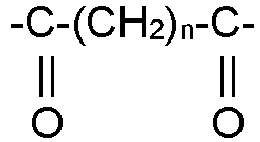
- Bevorzugte C2-C6-α,ω-(Dioxo)alkan-α,ω-diylgruppen werden ausgewählt aus 1,3-Dioxopropan-1,3-diyl, 1,4-Dioxobutan-1,4-diyl, 1,5-Dioxopentan-1,5-diyl, 1,6-Dioxohexan-1,6-diyl.
- Die erfindungsgemäßen Polymere lassen sich durch Polyreaktion aus entsprechend Catecholfunktionalisierten Monomeren bzw. entsprechend X-A3-A4-funktionalisierten Monomeren aufbauen, oder sind durch polymeranaloge Reaktion mit einem Polymer und einem Catechol-haltigem bzw. einem Gruppe X-haltigen Reagenz als Edukt erhältlich. Es ist erfindungsgemäß bevorzugt, wenn G1 gemäß Formel (I) und G2 gemäß Formel (II) zu einem Polymerrückgrat beitragen, das ausgewählt wird aus einem Polymerrückgrat, erhältlich durch Polyaddition, Polykondensation oder durch radikalische Polymerisation.
- Als besonders erfolgreiche und daher bevorzugte Polymere stellten sich solche Polymere heraus, bei denen die Menge der Einheiten der Formel (I) und der Formel (II) mindestens 50 Mol-% in Bezug auf alle im Polymer enthaltenen Wiederholungseinheiten beträgt.
- Erfindungsgemäße Polymere, die dadurch gekennzeichnet sind, dass sie ein mittleres Molgewicht (Mw) von 500 bis 500000 g/mol, bevorzugt von 2000 bis 200000 g/mol, aufweisen, sind bevorzugt. Bei den im Rahmen dieser Anmeldung für polymere Inhaltsstoffe angegebenen mittleren Molmassen handelt es sich - sofern nicht explizit anders gekennzeichnet - stets um gewichtsmittlere Molmassen Mw, die grundsätzlich mittels Gelpermeationschromatographie mit Hilfe eines RI-Detektors bestimmbar sind, wobei die Messung zweckmäßig gegen einen externen Standard erfolgt.
- Werden im Rahmen der Anmeldung Zahlenbereiche von einer Zahl zu einer anderen Zahl definiert, so sind von dem Bereich die Grenzwerte mitumfasst.
- Werden im Rahmen der Anmeldung Zahlenbereiche zwischen einer Zahl und einer anderen Zahl definiert, so sind von dem Bereich die Grenzwerte nicht mitumfasst.
- Als Wiederholungseinheiten der Formel (I) mit besagtem 1,2-Dihydroxyphenyl-Seitenketten-Terminus eignen sich bevorzugt solche, in denen R2 und R3 in Formel (I) für ein Wasserstoffatom stehen.
- Das Polymerrückgrat des erfindungsgemäßen Polymers leitet sich ab von Polyamid. Erfindungsgemäße Polymere auf Polyamidbasis lassen sich bevorzugt unter Anwendung gängiger Schutzgruppen-Chemie (für Aminogruppen z.B.: Triphenylmethyl (Trityl), (((9H-Fluoren-9-yl)methoxy)carbonyl (Fmoc); für phenolische OH z.B.: Methoxy, Ketal) darstellen.
- Die Einführung und Entfernung der vorgenannten Schutzgruppen ist dem Fachmann bekannt, insbesondere für Trityl an Aminogruppen aus Hans-Dieter Jakubke, Hans Jeschkeit: Aminosäuren, Peptide, Proteine, Verlag Chemie, Weinheim, S. 130-131, 1982 (ISBN 3-527-25892-2), für Fmoc an Aminogruppen aus E. Atherton, C. Bury, R. C. Sheppard, and B. J. Williams, Tetrahedron Lett., 3041, (1979), für Methoxy an phenolischen Hydroxygruppen aus Kiso, Yoshiaki et al., "Deprotection of O-methyltyrosine by a 'push-pull'mechanism using the thioanisole-trifluoromethanesulphonic acid system. Application to the convenient synthesis of a potent N-methylenkephalin derivative" im Journal of the Chemical Society, Chemical Communications 21 (1979), 971-972, für Ketal and phenolischen Hydroxygruppen aus K. Ogura and G.-i. Tsuchihashi, Tetrahedron Lett., 3151 (1971). Auf die vorgenannten Druckschriften wird ausdrücklich und vollinhaltlich Bezug genommen.
- Es hat sich als erfindungsgemäß bevorzugt erwiesen, wenn das erfindungsgemäße Polymer als Wiederholungseinheit der Formel (I) mindestens eine Wiederholungseinheit der Formel (I-a) enthält,

- A1 für eine C1-C4-Alkandiylgruppe (bevorzugt für Ethan-1,2-diyl) steht,
- Z für eine C2-C8-Alkandiylgruppe (bevorzugt für Ethan-1,2-diyl) steht,
- R2 und R3 unabhängig voneinander stehen für ein Wasserstoffatom, eine C1-C4-Alkylgruppe, eine C2-C4-Hydroxyalkylgruppe, eine C1-C4-Alkoxygruppe, ein Halogenatom, eine Sulfonsäuregruppe (bevorzugt jeweils für ein Wasserstoffatom) stehen.
- Entsprechende Wiederholungseinheiten der Formel (I-a) leiten sich von Formel (I) ab, in dem A gemäß Formel (I) eine Carbonylgruppe bedeutet, die an die Spacergruppe A1 und an G1 bindet.
- In einer besonders bevorzugten Wiederholungseinheit der Formel (I-a) stehen in Formel (I-a) R2 und R3 für ein Wasserstoffatom, A1 und Z für eine Ethan-1,2-diylgruppe. Diese spezielle Wiederholungseinheit wird nachfolgend mit *-(Cat)-* abgekürzt
- Die zur Formel (I-a) korrespondierenden Monomere zur Synthese der erfindungsgemäßen Polymere lassen sich durch folgendes Syntheseverfahren herstellen:
- (i) Schutz beider primären Aminogruppen eines Diethylentriamins mit Schutzgruppen S1 und S2 die gleich oder verschieden sein können, bevorzugt verschieden, insbesondere für Triphenylmethyl oder (((9H-Fluoren-9-yl)methoxy)carbonyl;
- (ii) Funktionalisierung der sekundären Aminogruppe des geschützten Diethylentriamins aus (i) mit einer Verbindung der Formel (E1)

- A1, R2 und R3 wie in Formel (I-a) definiert sind,
- Y steht für ein Chloratom, ein Bromatom, ein lodatom, eine Hydroxylgruppe,
- SG und SG' stehen für eine Schutzgruppe, bevorzugt für Methyl,
unter Erhalt des Umsetzungsproduktes der Formel (U1)
- worin
- A1, R2 und R3 wie in Formel (I-a) definiert sind,
- SG und SG' wie in Formel (E1) definiert sind,
- S1 und S2 unabhängig voneinander stehen jeweils für eine Schutzgruppe, die gleich oder verschieden sein können, bevorzugt verschieden, insbesondere für Triphenylmethyl oder (((9H-Fluoren-9-yl)methoxy)carbonyl;
- (iii) Entfernung einer Schutzgruppe S1 oder S2 aus dem funktionalisierten Diethylentriamin der Formel (U1),
- (iv) Umsetzung des entschützten Diethylentriamins aus (iii) mit einer Verbindung der Formel (E2) oder dessen Anhydrid,

- worin Z wie in Formel (I-a) definiert ist,
- unter Erhalt des Umsetzungsproduktes der Formel (U2)

- worin
- A1, R2, R3 und Z wie in Formel (I-a) definiert ist,
- SG und SG' wie in Formel (E1) definiert ist,
- SG" wie S1 oder S2 gemäß Formel (U1) definiert ist,
- (v) Entfernung der Schutzgruppe SG" aus dem Umsetzungsprodukt (U2) unter Erhalt der Verbindung (U3)
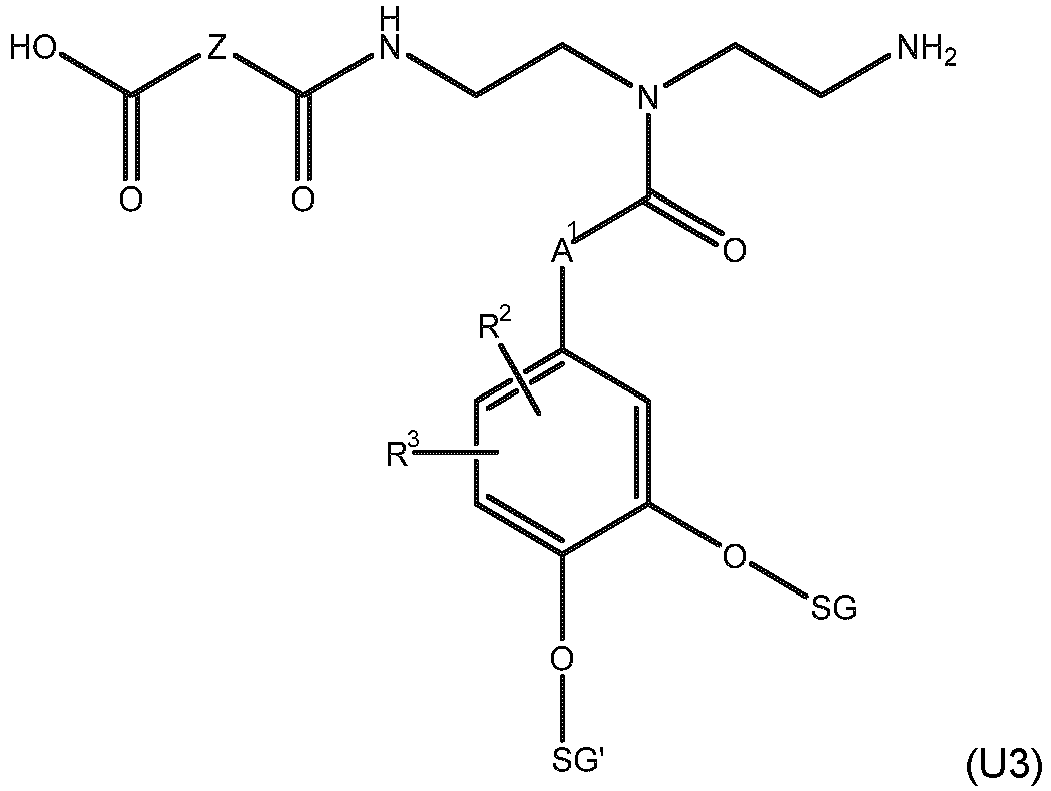
- A1, R2, R3 und Z wie in Formel (I-a) definiert ist,
- SG und SG' wie in Formel (E1) definiert ist.
- Sollte der Aufbau des Polymers an einer festen Phase stattfinden, ist es bevorzugt, Umsetzungsprodukt aus (iv) mit der festen Phase zu koppeln und dann Schritt (v) durchzuführen.
- Ein Synthesebeispiel der vorgenannten Syntheseroute wird in
Fig.1 illustriert und in der Beispielsektion detailliert beschrieben.
- Falls während der Monomersynthese die Hydroxylgruppen am Catechol-Gerüst der Wiederholungseinheit der Formel (I) bzw. (I-a) mit Schutzgruppen versehen sind (z.B. Methyl), so werden diese Schutzgruppen bevorzugt nach erfolgter Polyreaktion wieder entfernt, unter Bildung der Polymere mit dem Catechol-Strukturfragment der Formel (I) bzw. der Formel (I-a).
- Eine erfolgreiche Entfernung von Methyl-Schutzgruppen von direkt an Aromaten bindenden Hydroxylgruppen lässt sich gemäß Kiso, Yoshiaki et al., "Deprotection of O-methyltyrosine by a 'push-pull'mechanism using the thioanisole-trifluoromethanesulphonic acid system. Application to the convenient synthesis of a potent N-methylenkephalin derivative" im Journal of the Chemical Society, Chemical Communications 21 (1979), 971-972 durch Umsetzung (bevorzugt des zu entschützenden Polymers) mit Trifluormethansulfonsäure in Trifluoressigsäure (TFA) in Gegenwart von Thioanisol erreichen. Auf die vorgenannte Druckschrift wird ausdrücklich und vollinhaltlich Bezug genommen. Die zu entschützende Verbindung (bevorzugt das zu entschützende Polymer) wird bevorzugt in Anlehnung an die Reaktionsbedingungen von Kiso in einer Lösung aus Trifluormethansulfonsäure (18 Moläquivalente pro Catechol), Thioanisol (8 Moläquivalente pro Catechol) und Trifluoressigsäure (95 Vol.-% der gesamten Lösung) für 18 h geschüttelt. Anschließend wird die Reaktionslösung mit Diethylether versetzt, das Reaktionsprodukt gefällt und der isolierte Niederschlag unter Vakuum getrocknet.
- Es ist erfindungsgemäß bevorzugt, wenn die erfindungsgemäßen Polymere als Wiederholungseinheit der Formel (II) mindestens eine Wiederholungseinheit der Formel (II-a) enthalten,

- A3 eine C1-C6-Alkandiyl-Gruppe bedeutet,
- Z1 für eine C2-C8-Alkandiylgruppe (bevorzugt für Ethan-1 ,2-diyl) steht,
- X für eine Aminogruppe -N(R5)(R6) oder eine Ammonio-Gruppe -N+(R5)(R6)(R7) 1/n Ann- steht,
- worin R5, R6 und R7 jeweils unabhängig voneinander für ein Wasserstoffatom, eine C1-C4-Alkylgruppe oder eine C2-C4-Hydroxyalkylgruppe stehen und 1/n Ann- ein Äquivalent eines n-wertigen Anions, bevorzugt mit n = 1 bedeuten.
- Entsprechende Wiederholungseinheiten der Formel (II-a) leiten sich von Formel (II) ab, in dem die Spacergruppe A4 gemäß Formel (II) eine Carbonylgruppe bedeutet, die an die Anknüpfungsgruppe A3 und an G2 bindet.
- Die zur Formel (II-a) korrespondierenden Monomere zur Synthese der erfindungsgemäßen Polymere lassen sich durch folgendes Syntheseverfahren herstellen:
- (i) Schutz beider primären Aminogruppen eines Diethylentriamins mit Schutzgruppen S1 und S2 die gleich oder verschieden sein können, bevorzugt verschieden, insbesondere Triphenylmethyl oder (((9H-Fluoren-9-yl)methoxy)carbonyl;
- (ii) Funktionalisierung der sekundären Aminogruppe des geschützten Diethylentriamins aus (i) mit einer Verbindung der Formel (E3)

- X und A3 wie in Formel (II-a) definiert sind,
unter Erhalt des Umsetzungsproduktes der Formel (U4)
- worin
- X und A3 wie in Formel (II-a) definiert sind,
- S1 und S2 unabhängig voneinander stehen jeweils für eine Schutzgruppe, die gleich oder verschieden sein können, bevorzugt verschieden, insbesondere für Triphenylmethyl oder (((9H-Fluoren-9-yl)methoxy)carbonyl;
- X und A3 wie in Formel (II-a) definiert sind,
- (iii) Entfernung einer Schutzgruppe S1 oder S2 aus dem funktionalisierten Diethylentriamin der Formel (U4),
- (iv) Umsetzung des entschützten Diethylentriamins aus (iii) mit einer Verbindung der Formel (E5) oder dessen Anhydrid,

- worin Z1 wie in Formel (II-a) definiert ist,
- unter Erhalt des Umsetzungsproduktes der Formel (U5)

- worin
- X, Z1 und A3 wie in Formel (II-a) definiert ist,
- SG‴ wie S1 oder S2 gemäß Formel (U4) definiert ist,
- (v) Entfernung der Schutzgruppe SG‴ aus dem Umsetzungsprodukt (U5) unter Erhalt der Verbindung (U6)

X, A3 und Z1 wie in Formel (II-a) definiert ist. - Sollte der Aufbau des Polymers an einer festen Phase stattfinden, ist es bevorzugt, Umsetzungsprodukt aus (iv) mit der festen Phase zu koppeln und dann Schritt (v) durchzuführen.
- Ein Synthesebeispiel der vorgenannten Syntheseroute wird in der Beispielsektion detailliert beschrieben.
- Weiter hat es sich erfindungsgemäß als bevorzugt erwiesen, wenn das erfindungsgemäße Polymer als Wiederholungseinheit der Formel (II) mindestens eine Wiederholungseinheit der Formel (II-b) enthält,
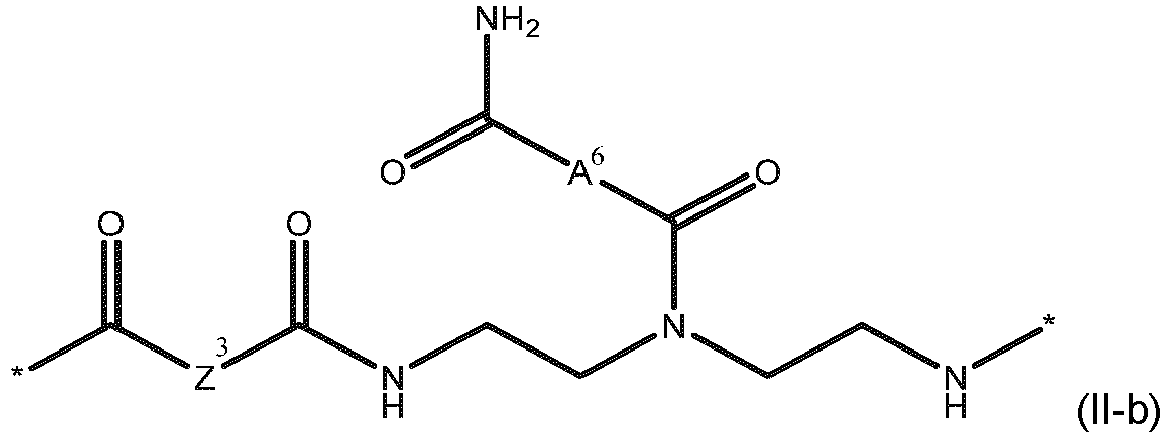
- worin A6 für eine (C2 bis C6)-Alkandiylgruppe steht, insbesondere für Ethan-1,2-diyl, Propan-1,3-diyl, Butan-1,4-diyl, Propan-1,2-diyl, Butan-1,2-diyl, Butan-1,3-diyl, Pentan-1,5-diyl oder Hexan-1,6-diyl,
- Z3 für eine C2-C8-Alkandiylgruppe (bevorzugt für Ethan-1,2-diyl) steht.
- Die Wiederholungseinheit der Formel (II-b) leitet sich von der Wiederholungseinheit der Formel (II) ab, in dem die Anknüpfungsgruppe A3 eine direkte Bindung und die Spacergruppe A4 eine C2-C6-α,ω-(Dioxo)alkan- α,ω-diylgruppe und X eine Gruppe NH2 ist.
- Das Polymer kann als Wiederholungseinheit der Formel (II) die Wiederholungseinheit der Formel (II-b) allein, oder gemeinsam mit der Wiederholungseinheit der Formel (II-a) enthalten. Besonders bevorzugte erfindungsgemäße Polymere enthalten daher mindestens eine Wiederholungseinheit der Formel (I-a) und mindestens eine Wiederholungseinheit der Formel (II-a) und/oder der Formel (II-b).
- Die zur Formel (II-b) korrespondierenden Monomere zur Synthese der erfindungsgemäßen Polymere lassen sich durch folgendes Syntheseverfahren herstellen:
- (i) Schutz beider primären Aminogruppen eines Diethylentriamins mit Schutzgruppen S1 und S2 die gleich oder verschieden sein können, bevorzugt verschieden, insbesondere Triphenylmethyl oder (((9H-Fluoren-9-yl)methoxy)carbonyl;
- (ii) Funktionalisierung der sekundären Aminogruppe des geschützten Diethylentriamins aus (i) Verbindung der Formel (E6) oder dessen Anhydrid,
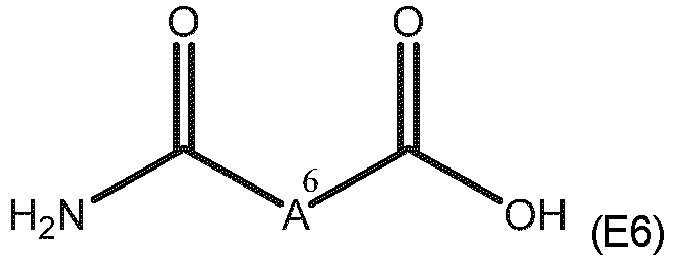

- A6 wie in Formel (II-b) definiert ist,
- S1 und S2 unabhängig voneinander stehen jeweils für eine Schutzgruppe, die gleich oder verschieden sein können, bevorzugt verschieden, insbesondere für Triphenylmethyl oder (((9H-Fluoren-9-yl)methoxy)carbonyl;
- (iii) Entfernung einer Schutzgruppe S1 oder S2 aus dem funktionalisierten Diethylentriamin der Formel (U7),
- (iv) Umsetzung des entschützten Diethylentriamins aus (iii) mit einer Verbindung der Formel (E7), der Formel (E8) oder jeweils deren Säurehalogenid,

- worin Z4 für eine C2-C8-Alkandiylgruppe (bevorzugt für Ethan-1 ,2-diyl) steht,
- unter Erhalt des Umsetzungsproduktes der Formel (U8)

- worin
- Z3 wie in Formel (U7) definiert ist,
- Z4 wie in Formel (E7) definiert ist,
- SG‴ wie S1 oder S2 gemäß Formel (U7) definiert ist, bevorzugt (((9H-Fluoren-9-yl)methoxy)carbonyl bedeutet,
- (v) Entfernung der Schutzgruppe SG‴ aus dem Umsetzungsprodukt (U8) unter Erhalt der Verbindung (U9)
- Sollte der Aufbau des Polymers an einer festen Phase stattfinden, ist es bevorzugt, Umsetzungsprodukt aus (U8) mit der festen Phase zu koppeln. Es ist auch denkbar, Umsetzungsprodukt (U2) mit der festen Phase zu koppeln und eine Polymerkette enthaltend mindestens eine geschützte primäre Aminogruppe (bevorzugt mindestens eine mit Triphenylmethylgeschützte primäre Aminogruppe) im Polymer zu erhalten, bei der vor oder nach Abspaltung von der festen Phase die geschützte primäre Aminogruppe in einem Schritt entschützt wird und die resultierende Gruppe mit einer Verbindung der Formel (E3) (vide supra) oder (E6) (vide supra) umgesetzt wird.
- Ein Synthesebeispiel der vorgenannten Syntheseroute wird in der Beispielsektion detailliert beschrieben.
- Es ist erfindungsgemäß bevorzugt, wenn die erfindungsgemäßen Polymere als Wiederholungseinheit der Formel (II) mindestens eine Wiederholungseinheit der Formel (II-c) enthalten,

- A3 eine C1-C6-Alkandiyl-Gruppe bedeutet,
- Z1 für eine C2-C8-Alkandiylgruppe (bevorzugt für Ethan-1 ,2-diyl) steht,
- X für eine Aminogruppe -N(R5)(R6) oder eine Ammonio-Gruppe -N+(R5)(R6)(R7) 1/n Ann- steht,
- worin R5, R6 und R7 jeweils unabhängig voneinander für ein Wasserstoffatom, eine C1-C4-Alkylgruppe oder eine C2-C4-Hydroxyalkylgruppe stehen und 1/n Ann- ein Äquivalent eines n-wertigen Anions, bevorzugt mit n = 1 bedeuten.
- Entsprechende Wiederholungseinheiten der Formel (II-c) leiten sich von Formel (II) ab, in dem die Spacergruppe A4 gemäß Formel (II) eine C2-Alkylaminocarbonyl-Gruppe bedeutet, die an die Anknüpfungsgruppe A3 und an G2 bindet.
- In einer bevorzugten Wiederholungseinheit der Formel (II-c) steht Z1 für eine Ethan-1 ,2-diylgruppe, A3 für eine Propan-1,3-diylgruppe und X für eine N,N-Dimethylaminogruppe. Diese spezielle bevorzugte Struktureinheit wird nachfolgend mit *-(llc-Amin)-* abgekürzt.
- Die zur Formel (II-c) korrespondierenden Monomere zur Synthese der erfindungsgemäßen Polymere lassen sich durch folgendes Syntheseverfahren herstellen:
- (i) Schutz beider primären Aminogruppen eines Diethylentriamins mit Schutzgruppen S1 und S2 die gleich oder verschieden sein können, bevorzugt verschieden, insbesondere Triphenylmethyl oder (((9H-Fluoren-9-yl)methoxy)carbonyl;
- (ii) Funktionalisierung der sekundären Aminogruppe des geschützten Diethylentriamins aus (i) mit einer Verbindung der Formel (E8)

Z1 wie in Formel (II-c) definiert sind,
unter Erhalt des Umsetzungsproduktes der Formel (U10)
- Z1 wie in Formel (II-c) definiert sind,
- S1 und S2 unabhängig voneinander stehen jeweils für eine Schutzgruppe, die gleich oder verschieden sein können, bevorzugt verschieden, insbesondere für Triphenylmethyl oder (((9H-Fluoren-9-yl)methoxy)carbonyl;
- (iii) Entfernung einer Schutzgruppe S1 oder S2 aus dem funktionalisierten Diethylentriamin der Formel (U10),
- (iv) Umsetzung des entschützten Diethylentriamins aus (iii) mit einer Verbindung der Formel (E9) oder dessen Anhydrid,

- X und A3 wie in Formel (II-c) definiert ist,
- unter Erhalt des Umsetzungsproduktes der Formel (U11)

- worin
- X, Z1 und A3 wie in Formel (II-c) definiert ist,
- SG‴ wie S1 oder S2 gemäß Formel (U10) definiert ist,
- (v) Entfernung der Schutzgruppe SG‴ aus dem Umsetzungsprodukt (U11) unter Erhalt der Verbindung (U12)

X, A3 und Z1 wie in Formel (II-c) definiert ist. - Sollte der Aufbau des Polymers an einer festen Phase stattfinden, ist es bevorzugt, bei der Polymersynthese Umsetzungsprodukt (U11) aus (iv) mit der festen Phase zu koppeln und dann den Schritt (v) zur Entschützung an der festen Phase durchzuführen.
- Weiter hat es sich erfindungsgemäß als bevorzugt erwiesen, wenn das erfindungsgemäße Polymer als Wiederholungseinheit der Formel (II) mindestens eine Wiederholungseinheit der Formel (II-d) enthält,

- worin A6 für eine (C2 bis C6)-Alkandiylgruppe steht, insbesondere für Ethan-1,2-diyl, Propan-1,3-diyl, Butan-1,4-diyl, Propan-1,2-diyl, Butan-1,2-diyl, Butan-1,3-diyl, Pentan-1,5-diyl oder Hexan-1,6-diyl,
- Z3 für eine C2-C8-Alkandiylgruppe (bevorzugt für Ethan-1,2-diyl) steht.
- Die Wiederholungseinheit der Formel (II-d) leitet sich von der Wiederholungseinheit der Formel (II) ab, in dem die Anknüpfungsgruppe A3 eine C2-C6-α,ω-(Dioxo)alkan- α,ω-diylgruppe und die Spacergruppe A4 eine C2-Alkylimin-Gruppe und X eine Gruppe NH2 ist.
- In einer bevorzugten Wiederholungseinheit der Formel (II-d) steht Z3 für eine Ethan-1,2-diylgruppe und A6 für eine Ethan-1,2-diylgruppe. Diese spezielle bevorzugte Struktureinheit wird nachfolgend mit *-(lld-Amid)-* abgekürzt.
- Das Polymer kann als Wiederholungseinheit der Formel (II) die Wiederholungseinheit der Formel (II-d) allein, oder gemeinsam mit mindestens einer Wiederholungseinheit ausgewählt aus Formel (II-a), Formel (II-b), Formel (II-c) oder Mischungen daraus, enthalten.
- Die zur Formel (II-d) korrespondierenden Monomere zur Synthese der erfindungsgemäßen Polymere lassen sich durch folgendes Syntheseverfahren herstellen:
- (i) Schutz beider primären Aminogruppen eines Diethylentriamins mit Schutzgruppen S1 und S2 die gleich oder verschieden sein können, bevorzugt verschieden, insbesondere Triphenylmethyl oder (((9H-Fluoren-9-yl)methoxy)carbonyl;
- (ii) Funktionalisierung der sekundären Aminogruppe des geschützten Diethylentriamins aus (i) Verbindung der Formel (E10) oder dessen Anhydrid,


- Z3 wie in Formel (II-d) definiert ist,
- S1 und S2 unabhängig voneinander stehen jeweils für eine Schutzgruppe, die gleich oder verschieden sein können, bevorzugt verschieden, insbesondere für Triphenylmethyl oder (((9H-Fluoren-9-yl)methoxy)carbonyl;
- (iii) Entfernung einer Schutzgruppe S1 oder S2 aus dem funktionalisierten Diethylentriamin der Formel (U13),
- (iv) Umsetzung des entschützten Diethylentriamins aus (iii) mit einer Verbindung der Formel (E11), der Formel (E8) oder jeweils deren Säurehalogenid oder Anhydrid

- worin A6 für eine C2-C8-Alkandiylgruppe (bevorzugt für Ethan-1,2-diyl) steht,
- unter Erhalt des Umsetzungsproduktes der Formel (U14)

- worin
- Z3 wie in Formel (II-d) definiert ist,
- A6 wie in Formel (E11) definiert ist,
- SG‴ wie S1 oder S2 gemäß Formel (U13) definiert ist, bevorzugt (((9H-Fluoren-9-yl)methoxy)carbonyl bedeutet,
- (v) Entfernung der Schutzgruppe SG‴ aus dem Umsetzungsprodukt (U14) unter Erhalt der Verbindung (U15)
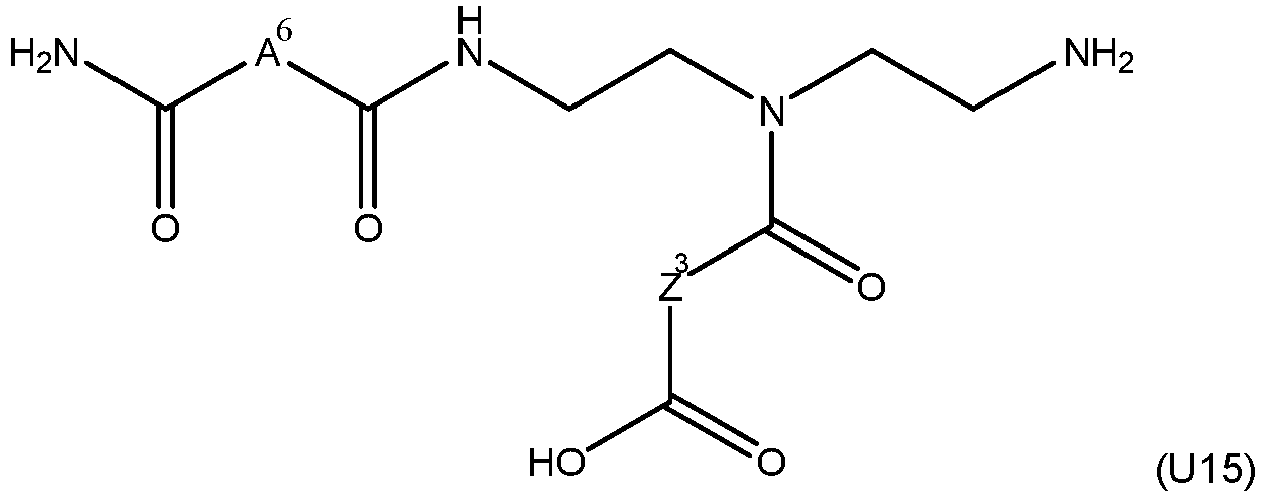
Z3 und A6 wie in Formel (U14) definiert sind. - Sollte der Aufbau des Polymers an einer festen Phase stattfinden, ist es bevorzugt, Umsetzungsprodukt aus (U14) mit der festen Phase zu koppeln. Es ist auch denkbar, Umsetzungsprodukt (U13) mit der festen Phase zu koppeln und eine Polymerkette enthaltend mindestens eine geschützte primäre Aminogruppe (bevorzugt mindestens eine mit Triphenylmethylgeschützte primäre Aminogruppe) im Polymer zu erhalten, bei der vor oder nach Abspaltung von der festen Phase die geschützte primäre Aminogruppe in einem Schritt entschützt wird und die resultierende Gruppe mit einer Verbindung der Formel (E9) (vide supra) oder (E11) (vide supra) umgesetzt wird.
- Ein Synthesebeispiel der vorgenannten Syntheseroute wird in der Beispielsektion detailliert beschrieben.
- Besonders bevorzugte erfindungsgemäße Polymere enthalten mindestens eine Wiederholungseinheit der Formel (I-a) kombiniert mit mindestens einer Wiederholungseinheit der Formel (II-a) und/oder der Formel (II-b) und/oder der Formel (II-c) und/oder der Formel (II-d). Dabei ist es besonders bevorzugt, wenn die erfindungsgemäßen Polymere mindestens eine Wiederholungseinheit der Formel (I-a) kombiniert mit mindestens einer Wiederholungseinheit der Formel (II-c) und/oder der Formel (II-d) enthalten.
- Es hat sich mit Blick auf die Lösung der Aufgabe aber auch für eine verbesserte Einarbeitbarkeit des Polymers in wässrige Oberflächenbehandlungsmittel gezeigt, dass bevorzugte erfindungsgemäße Polymere dadurch gekennzeichnet sind, dass sie als (bevorzugt einzige) weitere Wiederholungseinheit mindestens eine Struktureinheit der Formel (III) enthalten,

- In einer bevorzugten Wiederholungseinheit der Formel (III) stehen Z2 für eine Ethan-1,2-diylgruppe und n steht für 1. Diese spezielle bevorzugte Wiederholungseinheit wird im Folgenden mit *-(EDS)-* abgekürzt.
- Die zur Formel (III) korrespondierenden Monomere zur Synthese der bevorzugten erfindungsgemäßen Polymere wurden durch das in Ebbesen, M. F., et al. "Biodegradable poly(amidoamine)s with uniform degradation fragments via sequence-controlled macromonomers", Polymer Chemistry 7.46 (2016), Seiten 7086-7093 und das in "Sequence-defined glycopolymer segments presenting mannose: synthesis and lectin binding affinity." Biomacromolecules 13.6 (2012): 1845-1852 in den "Supporting Information" beschriebene Syntheseverfahren hergestellt. Auf vorgenannte Druckschriften wird ausdrücklich und vollinhaltlich Bezug genommen.
- Ganz besonders bevorzugte erfindungsgemäße Polymere enthalten
- (a) mindestens eine Wiederholungseinheit der Formel (I-a) und
- (b) mindestens eine Wiederholungseinheit der Formel (II-a) und/oder der Formel (II-b) und/oder der Formel (II-c) und/oder der Formel (II-d) und
- (c) mindestens eine Wiederholungseinheit der Formel (III).
- Die von Polyamid-abgeleiteten Polymere lassen sich aus den Monomeren durch Polyreaktion, hier Polykondensation, in der dem Fachmann bekannten Weise darstellen. Zur Darstellung von Polymeren mit definierter Makrostruktur wie z.B. Blockcopolymeren oder sonstiger definierter Abfolge der erfindungsgemäßen Struktureinheiten, sowie zur gezielten Einstellung des erfindungsgemäßen Molverhältnisses der Wiederholungseinheiten werden die von Polyamid-abgeleiteten Polymere an der Festphase synthetisiert. Zu diesem Zweck wird in einer bevorzugten Synthesevariante eine feste Phase mit freien Aminogruppen bereitgestellt, die sequenziell zum Aufbau eines Polymers mit Monomeren oder Prepolymeren mit geschützten Aminogruppen, bevorzugt mit Fmoc-geschützen Aminogruppen, umgesetzt und die Schutzgruppe des gekoppelten Monomers vor der nächsten Umsetzung mit einem Monomer wieder unter Erhalt einer Aminogruppe entfernt wird. Ein entsprechendes Protokoll für eine bevorzugte Festphasen-Synthese wird in Gerke, Christoph, et al. "Sequence-controlled glycopolymers via step-growth polymerization of precision glycomacromolecules for lectin receptor clustering." Biomacromolecules 18.3 (2017), Seiten 787-796 beschrieben. Auf diese Druckschrift wird in diesem Zusammenhang ausdrücklich und vollinhaltlich Bezug genommen. Als einsetzbare Monomere eignen sich für die Festphasen-Synthese und insbesondere für eine Festphasen-Synthese gemäß vorgenanntem Protokoll bevorzugt als Monomer genutztes Umsetzungsprodukt der obigen Formel (U2), der obigen Formel (U5), der obigen Formel (U8), der obigen Formel (U11), der obigen Formel (U13), der obigen Formel (U14) oder Monomer zur Synthese der Wiederholungseinheit der obigen Formel (III).
- Das Polymerrückgrat des erfindungsgemäßen Polymers leitet sich in einer ganz besonders bevorzugten Ausführungsform der erfindungsgemäßen Polymere ab von Acrylaten, Methacrylaten, Acrylamiden, Methacrylamiden, oder Copolymeren daraus. Entsprechende Polymere können durch radikalische Polyreaktion gebildet werden.
- Bevorzugte erfindungsgemäße Polymere sind dadurch gekennzeichnet, dass sie als Wiederholungseinheit der Formel (I) mindestens eine Wiederholungseinheit der Formel (Ic) enthalten,

- R1 für ein Wasserstoffatom oder eine Methylgruppe steht,
- A2 für ein Sauerstoffatom oder eine Gruppe -NH-, bevorzugt für eine Gruppe -NH-, steht
- R2, R3, und A1 wie in Formel (I) definiert ist.
- Die zur Formel (I-c) korrespondierenden Monomere zur Synthese der erfindungsgemäßen Polymere sind literaturbekannt und lassen sich beispielsweise nach der Synthesevorschrift gemäß Druckschrift
WO 2005/070866 A2 (hier u.a.: 2-(3,4-Dihydroxyphenyl)ethylacrylat, 2-(3,4-Dihydroxyphenyl)ethylmethacrylat, 2-(3,4-Dihydroxy-6-methyl-phenyl)ethylmethacrylamid) oderPatentschrift US 6,605,270 A oder nach Na Lin et al., Nucleic Acids Research, Volume 35, Issue 4, 2007, Seiten 1222-1229 (hier: N-[2-(3,4-Dihydroxy-phenyl)-ethyl]-acrylamid) herstellen. Auf diese Druckschriften wird ausdrücklich und vollinhaltlich Bezug genommen. - Erfindungsgemäß bevorzugte Polymere (insbesondere solche, die mindestens eine Wiederholungseinheit der Formel (I-c) enthalten) enthalten als Wiederholungseinheit der Formel (II) mindestens eine Wiederholungseinheit der Formel (II-e),

- R4 für ein Wasserstoffatom oder eine Methylgruppe steht,
- A5 für ein Sauerstoffatom oder eine Gruppe -NH- steht,
- A3 für eine C2-C6-Alkandiylgruppe steht,
- X für eine Aminogruppe -N(R5)(R6) oder eine Ammonio-Gruppe -N+(R5)(R6)(R7) 1/n Ann- steht,
- worin R5, R6 und R7 jeweils unabhängig voneinander für ein Wasserstoffatom, eine C1-C4-Alkylgruppe oder eine C2-C4-Hydroxyalkylgruppe stehen und 1/n Ann- ein Äquivalent eines n-wertigen Anions,
- bevorzugt mit n = 1 bedeuten.
- Besonders bevorzugt sind solche Wiederholungseinheiten der Formel (II-e), bei denen die Reste R5, R6 und R7 jeweils für eine Methylgruppe stehen.
- Ganz besonders bevorzugte, erfindungsgemäße Polymere (insbesondere solche, die mindestens eine Wiederholungseinheit der Formel (I-c) enthalten) enthalten als Wiederholungseinheit der Formel (II) mindestens eine Wiederholungseinheit der Formel (II-f) oder deren Trimethylammonium-Salz oder mindestens eine Wiederholungseinheit der Formel (II-g) oder Mischungen daraus,

- R4 für ein Wasserstoffatom oder eine Methylgruppe steht,
- A5 für ein Sauerstoffatom oder eine Gruppe -NH- steht,
- m für 2 oder 3 steht;

- worin
- R4 für ein Wasserstoffatom oder eine Methylgruppe steht.
- Es hat sich als bevorzugt erwiesen, wenn erfindungsgemäße Polymere (insbesondere solche, die mindestens eine Wiederholungseinheit der Formel (I-e) und mindestens eine Wiederholungseinheit der Formel (II), ausgewählt aus Formel (II-f), (II-g) oder Mischungen daraus, enthalten) dadurch gekennzeichnet sind, dass sie als (bevorzugt einzige) weitere Wiederholungseinheit mindestens eine Struktureinheit der Formel (IV) enthalten,
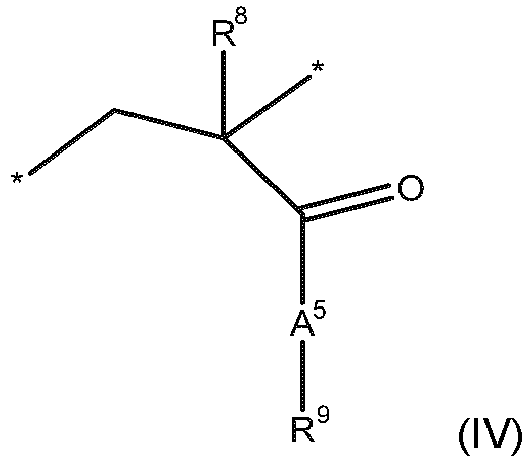
- R8 für ein Wasserstoffatom oder eine Methylgruppe steht,
- A5 für ein Sauerstoffatom oder eine Gruppe -NH- steht,
- R9 für eine Hydroxyterminierte Polyalkylenoxid-Gruppe, für eine C1-C4-Alkyl-terminierte Polyalkylenoxid-Gruppe, für eine C2-C6-Hydroxyalkylgruppe, für eine C3-C6-Polyhydroxyalkylgruppe, für eine C1-C6-Alkylgruppe, für eine C1-C4-Alkoxy-C2-C4-alkyl-Gruppe, für eine 2-Hydroxyethyl-Gruppe, für eine 2-Hydroxypropyl-Gruppe, für eine 2-Methyl-1-Propansulfansäure-Gruppe und deren Natriumsalz, für eine N-[Tris(hydroxymethyl)methyl]-Gruppe, für eine 2-Carboxyethyl-Gruppe und/oder für eine 3-Sulfopropyl-Gruppe.
- Ein zweiter Gegenstand der Erfindung ist ein Mittel zur Behandlung von Oberflächen, insbesondere von harten Oberflächen oder von Textilien, dadurch gekennzeichnet, dass es mindestens ein erfindungsgemäßes Polymer des ersten Erfindungsgegenstandes und mindestens ein Tensid enthält.
- Das erfindungsgemäße Mittel kann festförmig, insbesondere als Gelkörper oder als körniges Gemenge (wie z.B. Granulat oder Pulver oder Formkörper, z.B. Tablette) vorliegen oder flüssig sein. Im Rahmen eine bevorzugten Ausführungsform ist das erfindungsgemäße Mittel flüssig.
- Ein Stoff (z.B. eine Zusammensetzung) ist gemäß Definition der Erfindung festförmig (auch: fest), wenn er bei 20°C und 1013 mbar im festen Aggregatzustand vorliegt.
- Ein Stoff (z.B. eine Zusammensetzung) ist gemäß Definition der Erfindung flüssig, wenn er bei 20°C und 1013 mbar im flüssigen Aggregatzustand vorliegt.
- Eine chemische Verbindung ist eine organische Verbindung, wenn das Molekül der chemischen Verbindung mindestens eine kovalente Bindung zwischen Kohlenstoff und Wasserstoff enthält. Diese Definition gilt unter anderem für "organische Bleichaktivatoren" als chemische Verbindung mutatis mutandis.
- Eine chemische Verbindung ist im Umkehrschluss zur Definition der organischen Verbindung eine anorganische Verbindung, wenn das Molekül der chemischen Verbindung keine kovalente Bindung zwischen Kohlenstoff und Wasserstoff enthält.
- Das erfindungsgemäße Mittel enthält neben dem Polymer als zwingenden Bestandteil mindestens ein Tensid. Als Tenside kommen erfindungsgemäß bevorzugt anionische Tenside, nichtionische Tenside, zwitterionische Tenside, amphotere Tenside oder kationische Tenside in Frage.
- Das erfindungsgemäße Mittel enthält bezogen auf dessen Gesamtgewicht bevorzugt eine Gesamtmenge von 0,1 bis 70 Gew.-% Tensid.
- Besonders bevorzugte erfindungsgemäße Mittel enthalten bezogen auf deren Gesamtgewicht eine Gesamtmenge von 0,1 bis 5,0 Gew.-% mindestens eines Tensids. Solche Mittel eignen sich zur erfindungsgemäßen Anwendung, insbesondere in einer Geschirrspülmaschine. Dabei ist es wiederum besonders bevorzugt, wenn das Mittel mindestens ein nichtionisches Tensid enthält.
- Besonders bevorzugte erfindungsgemäße Mittel enthalten bezogen auf deren Gesamtgewicht eine Gesamtmenge von 5 bis 70 Gew.-%, mehr bevorzugt von 20 bis 65 Gew.-%, ganz besonders bevorzugt von 25 bis 60 Gew.-%, mindestens eines Tensids. Solche Mittel eignen sich zur erfindungsgemäßen Anwendung, insbesondere jedoch zur Anwendung in einer Waschmaschine für die Textilwäsche. Dabei ist es wiederum besonders bevorzugt, wenn das Mittel mindestens ein anionisches Tensid und gegebenenfalls zusätzlich mindestens ein nichtionisches Tensid enthält.
- Ein erfindungsgemäß bevorzugtes Mittel ist dadurch gekennzeichnet, dass es mindestens ein anionisches Tensid enthält. Erfindungsgemäße Tensidzusammensetzungen mit anionischem Tensid können auf den besagten Anwendungsgebieten eingesetzt werden, eignen sich jedoch bevorzugt für die Wäsche von Textilien, besonders bevorzugt für eine Anwendung in einer Waschmaschine für die Textilwäsche.
- Wenn das erfindungsgemäße Mittel anionisches Tensid enthält, ist es wiederum bevorzugt, dass bezogen auf das Gesamtgewicht der Zusammensetzung anionisches Tensid in einer Gesamtmenge von 8 bis 70 Gew.-%, insbesondere 25 bis 60 Gew.-%, weiter bevorzugt von 30 bis 40 Gew.-%, enthalten ist.
- Als anionisches Tensid können vorzugsweise Sulfonate und/oder Sulfate eingesetzt werden.
- Als Tenside vom Sulfonat-Typ kommen dabei vorzugsweise C9-13-Alkylbenzolsulfonate, Olefinsulfonate, d.h. Gemische aus Alken- und Hydroxyalkansulfonaten sowie Disulfonaten, wie man sie beispielsweise aus C12-18-Monoolefinen mit end- oder innenständiger Doppelbindung durch Sulfonieren mit gasförmigem Schwefeltrioxid und anschließende alkalische oder saure Hydrolyse der Sulfonierungsprodukte erhält, in Betracht. Geeignet sind auch C12-18-Alkansulfonate und die Ester von α-Sulfofettsäuren (Estersulfonate), zum Beispiel die α-sulfonierten Methylester der hydrierten Kokos-, Palmkern- oder Talgfettsäuren.
- Besonders bevorzugte erfindungsgemäße Mittel enthalten als anionisches Tensid mindestens eine Verbindung der Formel (T1),

R' und R" unabhängig H oder Alkyl sind und zusammen 9 bis 19, vorzugsweise 9 bis 15 und insbesondere 9 bis 13 C-Atome enthalten, und Y+ ein einwertiges Kation oder den n-ten Teil eines n-wertigen Kations (insbesondere Na+) bedeuten. - Als Alk(en)ylsulfate werden die Alkali- und insbesondere die Natriumsalze der Schwefelsäurehalbester der C12-C18-Fettalkohole, beispielsweise aus Kokosfettalkohol, Talgfettalkohol, Lauryl-, Myristyl-, Cetyl- oder Stearylalkohol oder der C10-C20-Oxoalkohole und diejenigen Halbester sekundärer Alkohole dieser Kettenlängen bevorzugt. Aus waschtechnischem Interesse sind die C12-C16-Alkylsulfate und C12-C15-Alkylsulfate sowie C14-C15-Alkylsulfate bevorzugt. Auch 2,3-Alkylsulfate sind geeignete anionische Tenside.
- Auch Fettalkoholethersulfate, wie die Schwefelsäuremonoester der mit 1 bis 6 Mol Ethylenoxid ethoxylierten geradkettigen oder verzweigten C7-21-Alkohole, wie 2-Methyl-verzweigte C9-11-Alkohole mit im Durchschnitt 3,5 Mol Ethylenoxid (EO) oder C12-18-Fettalkohole mit 1 bis 4 EO, sind geeignet.
- Weitere geeignete anionische Tenside sind Seifen. Geeignet sind gesättigte und ungesättigte Fettsäureseifen, wie die Salze der Laurinsäure, Myristinsäure, Palmitinsäure, Stearinsäure, (hydrierten) Erucasäure und Behensäure sowie insbesondere aus natürlichen Fettsäuren, zum Beispiel Kokos-, Palmkern-, Olivenöl- oder Talgfettsäuren, abgeleitete Seifengemische.
- Die anionischen Tenside sowie die Seifen können in Form ihrer Natrium-, Kalium- oder Magnesium- oder Ammoniumsalze vorliegen. Vorzugsweise liegen die anionischen Tenside in Form ihrer Ammoniumsalze vor. Bevorzugte Gegenionen für die anionischen Tenside sind die protonierten Formen von Cholin, Triethylamin, Monoethanolamin, Triethanolamin oder Methylethylamin.
- In einer ganz besonders bevorzugten Ausführungsform enthält das erfindungsgemäße Mittel eine mit Monoethanolamin neutralisierte Alkylbenzolsulfonsäure, insbesondere C9-13-Alkylbenzolsulfonsäure, und/oder eine mit Monoethanolamin neutralisierte Fettsäure.
- Ein bevorzugtes erfindungsgemäße Mittel enthält mindestens ein anionisches Tensid, ausgewählt aus der Gruppe bestehend aus C8-18-Alkylbenzolsulfonaten, Olefinsulfonaten, C12-18-Alkansulfonaten, Estersulfonaten, Alkylsulfaten, Alkenylsulfaten, Fettalkoholethersulfaten und Mischungen daraus.
- Im Rahmen einer bevorzugten Ausführungsform enthält das erfindungsgemäße Mittel mindestens ein nichtionisches Tensid.
- Das mindestens eine nichtionische Tensid kann jedes bekannte und für den erfindungsgemäßen Zweck geeignete nichtionische Tensid sein.
- In einer bevorzugten Ausführungsform der Erfindung enthalten die hierin beschriebenen erfindungsgemäßen Mittel als nichtionisches Tensid mindestens ein Fettalkoholalkoxylat mit der nachstehenden Formel (T2),
R'-O-(XO)m-H (T2)
wobei R' für einen linearen oder verzweigten C8-C18-Alkylrest, einen Arylrest oder Alkylarylrest steht, XO unabhängig voneinander eine Ethylenoxid- (EO) oder Propylenoxid- (PO) Gruppierung ist und m eine ganze Zahl von 1 bis 50 ist. In der vorstehenden Formel steht R' für einen linearen oder verzweigten, substituierten oder unsubstituierten Alkylrest. In einer bevorzugten Ausführungsform der vorliegenden Erfindung ist RI ein linearer oder verzweigter Alkylrest mit 5 bis 30 Kohlenstoffatomen, vorzugsweise mit 7 bis 25 Kohlenstoffatomen und insbesondere mit 10 bis 19 Kohlenstoffatomen. Bevorzugte Reste R' sind ausgewählt aus Decyl-, Undecyl-, Dodecyl-, Tridecyl-, Tetradecyl, Pentadecyl-, Hexadecyl-, Heptadecyl-, Octadecyl-, Nonadecylresten und deren Mischungen, wobei die Vertreter mit gerader Anzahl an Kohlenstoffatomen bevorzugt sind. Besonders bevorzugte Reste R' sind abgeleitet von Fettalkoholen mit 12 bis 19 Kohlenstoffatomen, beispielsweise von Kokosfettalkohol, Talgfettalkohol, Lauryl-, Myristyl-, Cetyl- oder Stearylalkohol oder von Oxoalkoholen mit 10 bis 19 Kohlenstoffatomen. - XO der Formel (T2) ist eine Ethylenoxid- (EO) oder Propylenoxid- (PO) Gruppierung, vorzugsweise eine Ethylenoxidgruppierung.
- Der Index m der Formel (T2) ist eine ganze Zahl von 1 bis 50, vorzugsweise 2 bis 20 und bevorzugt 2 bis 10. Insbesondere ist m 3, 4, 5, 6 oder 7. Die erfindungsgemäße Tensidzusammensetzung kann Mischungen von nichtionischen Tensiden enthalten, die verschiedene Ethoxylierungsgrade aufweisen.
- Zusammenfassend sind besonders bevorzugte Fettalkoholalkoxylate solche der Formel (T3)

- Solche Fettalkoholethoxylate sind unter den Verkaufsbezeichnungen Dehydol® LT7 (BASF), Lutensol® AO7 (BASF), Lutensol® M7 (BASF) und Neodol® 45-7 (Shell Chemicals) erhältlich.
- Mit besonderem Vorzug enthalten die erfindungsgemäßen Mittel nichtionische Tenside aus der Gruppe der alkoxylierten Alkohole. Als nichtionische Tenside werden vorzugsweise alkoxylierte, vorteilhafterweise ethoxylierte, insbesondere primäre Alkohole mit vorzugsweise 8 bis 18 C-Atomen und durchschnittlich 1 bis 12 Mol Ethylenoxid (EO) pro Mol Alkohol eingesetzt, in denen der Alkoholrest linear oder bevorzugt in 2-Stellung methylverzweigt sein kann beziehungsweise lineare und methylverzweigte Reste im Gemisch enthalten kann, so wie sie üblicherweise in Oxoalkoholresten vorliegen. Insbesondere sind jedoch Alkoholethoxylate mit linearen Resten aus Alkoholen nativen Ursprungs mit 12 bis 18 C-Atomen, zum Beispielaus Kokos-, Palm-, Talgfett- oder Oleylalkohol, und durchschnittlich 2 bis 8 Mol EO pro Mol Alkohol bevorzugt. Zu den bevorzugten ethoxylierten Alkoholen gehören beispielsweise C12-14-Alkohole mit 3 EO oder 4 EO, C8-11-Alkohol mit 7 EO, C13-15-Alkohole mit 3 EO, 5 EO, 7 EO oder 8 EO, C12-18-Alkohole mit 3 EO, 5 EO oder 7 EO und Mischungen aus diesen, wie Mischungen aus C12-14-Alkohol mit 3 EO und C12-18-Alkohol mit 5 EO.
- Bevorzugte Alkoholethoxylate weisen eine eingeengte Homologenverteilung auf (narrow range ethoxylates, NRE). Zusätzlich zu diesen nichtionischen Tensiden können, insbesondere als Reinigungsmittel für das maschinelle Geschirrspülen, auch Fettalkohole mit mehr als 12 EO eingesetzt werden. Beispiele hierfür sind Talgfettalkohol mit 14 EO, 25 EO, 30 EO oder 40 EO.
- Mit besonderem Vorzug werden ethoxylierte nichtionische Tenside, die aus C6-20-Monohydroxyalkanolen oder C6-20-Alkylphenolen oder C16-20-Fettalkoholen und mehr als 12 Mol, vorzugsweise mehr als 15 Mol und insbesondere mehr als 20 Mol Ethylenoxid pro Mol Alkohol gewonnen wurden, eingesetzt. Ein besonders bevorzugtes nichtionisches Tensid wird aus einem geradkettigen Fettalkohol mit 16 bis 20 Kohlenstoffatomen (C16-20-Alkohol), vorzugsweise einem C18-Alkohol und mindestens 12 Mol, vorzugsweise mindestens 15 Mol und insbesondere mindestens 20 Mol Ethylenoxid gewonnen. Hierunter sind die sogenannten "narrow range ethoxylates" besonders bevorzugt.
- Bevorzugt einzusetzende Tenside stammen aus den Gruppen der alkoxylierten nichtionischen Tenside, insbesondere der ethoxylierten primären Alkohole und Mischungen dieser Tenside mit strukturell komplizierter aufgebauten Tensiden wie Polyoxypropylen/Polyoxyethylen/Polyoxypropylen ((PO/EO/PO)-Tenside). Solche nichtionischen (PO/EO/PO)-Tenside zeichnen sich darüber hinaus durch gute Schaumkontrolle aus.
- Als besonders bevorzugte nichtionische Tenside, insbesondere für Reinigungsmittel für das maschinelle Geschirrspülen, haben sich im Rahmen der vorliegenden Erfindung für die schwachschäumende Niotenside erwiesen, welche alternierende Ethylenoxid- und Alkylenoxideinheiten aufweisen. Unter diesen sind wiederum Tenside mit EO-AO-EO-AO-Blöcken bevorzugt, wobei jeweils eine bis zehn EO- beziehungsweise AO-Gruppen aneinander gebunden sind, bevor ein Block aus den jeweils anderen Gruppen folgt. Hier sind nichtionisches Tenside der allgemeinen Formel (T4)

- Bevorzugte nichtionische Tenside der vorstehenden Formel lassen sich durch bekannte Methoden aus den entsprechenden Alkoholen R1-OH und Ethylen- beziehungsweise Alkylenoxid herstellen. Der Rest R1 in der vorstehenden Formel kann je nach Herkunft des Alkohols variieren. Werden native Quellen genutzt, weist der Rest R1 eine gerade Anzahl von Kohlenstoffatomen auf und ist in der Regel unverzweigt, wobei die linearen Reste aus Alkoholen nativen Ursprungs mit 12 bis 18 C-Atomen, zum Beispielaus Kokos-, Palm-, Talgfett- oder Oleylalkohol, bevorzugt sind. Aus synthetischen Quellen zugängliche Alkohole sind beispielsweise die Guerbetalkohole oder in 2-Stellung methylverzweigte beziehungsweise lineare und methylverzweigte Reste im Gemisch, so wie sie üblicherweise in Oxoalkoholresten vorliegen. Unabhängig von der Art des zur Herstellung der in erfindungsgemäßen Mittel enthaltenen nichtionischen Tenside eingesetzten Alkohols sind nichtionische Tenside bevorzugt, bei denen R1 in der vorstehenden Formel für einen Alkylrest mit 6 bis 24, vorzugsweise 8 bis 20, besonders bevorzugt 9 bis 15 und insbesondere 9 bis 11 Kohlenstoffatomen steht.
- Als Alkylenoxideinheit, die alternierend zur Ethylenoxideinheit in den bevorzugten nichtionischen Tensiden enthalten ist, kommt neben Propylenoxid insbesondere Butylenoxid in Betracht. Aber auch weitere Alkylenoxide, bei denen R2 beziehungsweise R3 unabhängig voneinander ausgewählt sind aus -CH2CH2-CH3 beziehungsweise -CH(CH3)2 sind geeignet. Bevorzugt werden nichtionische Tenside der vorstehenden Formel eingesetzt, bei denen R2 beziehungsweise R3 für einen Rest -CH3, w und x unabhängig voneinander für Werte von 3 oder 4 und y und z unabhängig voneinander für Werte von 1 oder 2 stehen.
- Weitere bevorzugt eingesetzte nichtionische Tenside, insbesondere für Reinigungsmittel für das maschinelle Geschirrspülen, sind nichtionische Tenside der allgemeinen Formel (T5)
R1O(AlkO)xM(OAlk)yOR2 (T5)
wobei R1 und R2 unabhängig voneinander für einen verzweigten oder unverzweigten, gesättigten oder ungesättigten, gegebenenfalls hydroxylierten Alkylrest mit 4 bis 22 Kohlenstoffatomen stehen; Alk für einen verzweigten oder unverzweigten Alkylrest mit 2 bis 4 Kohlenstoffatomen steht; x und y unabhängig voneinander für Werte zwischen 1 und 70 stehen; und M für einen Alkylrest aus der Gruppe CH2, CHR3, CR3R4, CH2CHR3 und CHR3CHR4 steht, wobei R3 und R4 unabhängig voneinander für einen verzweigten oder unverzweigten, gesättigten oder ungesättigten Alkylrest mit 1 bis 18 Kohlenstoffatomen stehen. - Bevorzugt sind hierbei nichtionische Tenside der allgemeinen Formel (T6)
R1-CH(OH)CH2-O(CH2CH2O)xCH2CHR(OCH2CH2)y-CH2CH(OH)-R2 (T6),
wobei R, R1 und R2 unabhängig voneinander für einen Alkylrest oder Alkenylrest mit 6 bis 22 Kohlenstoffatomen; x und y unabhängig voneinander für Werte zwischen 1 und 40 stehen. - Bevorzugt sind hierbei insbesondere Verbindungen der allgemeinen Formel (T7)
R1-CH(OH)CH2-O(CH2CH2O)xCH2CHR(OCH2CH2)yO-CH2CH(OH)-R2 (T7)
in denen R für einen linearen, gesättigten Alkylrest mit 8 bis 16 Kohlenstoffatomen, vorzugsweise 10 bis 14 Kohlenstoffatomen steht und R1 und R2 unabhängig voneinander für einen Alkylrest oder Alkenylrest mit 6 bis 22 Kohlenstoffatomen stehen, und n und m unabhängig voneinander Werte von 20 bis 30 aufweisen. Entsprechende Verbindungen können beispielsweise durch Umsetzung von Alkyldiolen HO-CHR-CH2-OH mit Ethylenoxid erhalten werden, wobei im Anschluss eine Umsetzung mit einem Alkylepoxid zum Verschluss der freien OH-Funktionen unter Ausbildung eines Dihydroxyethers erfolgt. - Bevorzugte nichtionische Tenside sind hierbei, insbesondere für Reinigungsmittel für das maschinelle Geschirrspülen, solche der allgemeinen Formel (T8)
R1-CH(OH)CH2O- (AO)w-(AO)x-(A"O)y-(A‴O)z-R2 (T8)
in der - R1 für einen geradkettigen oder verzweigten, gesättigten oder ein- bzw. mehrfach ungesättigten C6-24-Alkyl- oder -Alkenylrest steht;
- R2 für Wasserstoff oder einen linearen oder verzweigten Kohlenwasserstoffrest mit 2 bis 26 Kohlenstoffatomen steht;
- A, A', A" und A‴ unabhängig voneinander für einen Rest aus der Gruppe -CH2CH2, -CH2CH2-CH2, -CH2-CH(CH3), -CH2-CH2-CH2-CH2, -CH2-CH(CH3)-CH2-, -CH2-CH(CH2-CH3) stehen,
- w, x, y und z für Werte zwischen 0,5 und 120 stehen, wobei x, y und/oder z auch 0 sein können.
- Durch den Zusatz der vorgenannten nichtionischen Tenside der allgemeinen Formel (T8)
R1-CH(OH)CH2O-(AO)w-(A'O)x-(A"0)y-(A‴O)z-R2 (T8)
nachfolgend auch als "Hydroxymischether" bezeichnet, kann überraschenderweise die Reinigungsleistung erfindungsgemäßer Zubereitungen deutlich verbessert werden und zwar im Vergleich zu Systemen, die alternative nichtionischen Tenside, beispielsweise aus der Gruppe der polyalkoxylierten Fettalkohole enthalten. - Durch den Einsatz dieser nichtionischen Tenside mit einer oder mehreren freien Hydroxylgruppen an einem oder beiden endständigen Alkylresten kann die Stabilität der gegebenenfalls zusätzlich in den erfindungsgemäßen Mitteln enthaltenen Enzyme deutlich verbessert werden.
- Bevorzugt sind, insbesondere für Reinigungsmittel für das maschinelle Geschirrspülen, solche endgruppenverschlossenen poly(oxyalkylierten) nichtionischen Tenside, die, gemäß der folgenden Formel (T10)

- Besonders bevorzugt sind, insbesondere für Reinigungsmittel für das maschinelle Geschirrspülen, Tenside der Formel R1O[CH2CH(CH3)O]x[CH2CH2O]yCH2CH(OH)R2,
in der R1 für einen linearen oder verzweigten aliphatischen Kohlenwasserstoffrest mit 4 bis 18 Kohlenstoffatomen oder Mischungen hieraus steht, R2einen linearen oder verzweigten Kohlenwasserstoffrest mit 2 bis 26 Kohlenstoffatomen oder Mischungen hieraus bezeichnet und x für Werte zwischen 0,5 und 1,5 sowie y für einen Wert von mindestens 15 steht. Zur Gruppe dieser nichtionischen Tenside zählen beispielsweise die C2-26 Fettalkohol-(PO)1-(EO)15-40-2-hydroxyalkylether, insbesondere auch die C8-10 Fettalkohol-(PO)1-(EO)22-2-hydroxydecylether. - Besonders bevorzugt sind weiterhin, insbesondere für Reinigungsmittel für das maschinelle Geschirrspülen, solche endgruppenverschlossenen poly(oxyalkylierten) Niotenside der Formel
R1O[CH2CH2O]x[CH2CH(R3)O]yCH2CH(OH)R2,
in der R1 und R2 unabhängig voneinander für einen linearen oder verzweigten, gesättigten oder ein- bzw. mehrfach ungesättigten Kohlenwasserstoffrest mit 2 bis 26 Kohlenstoffatomen steht, R3 unabhängig voneinander ausgewählt ist aus -CH3, -CH2CH3, -CH2CH2-CH 3, -CH(CH3)2, vorzugsweise jedoch für -CH3steht, und x und y unabhängig voneinander für Werte zwischen 1 und 32 stehen, wobei Niotenside mit R3= -CH3und Werten für x von 15 bis 32 und y von 0,5 und 1,5 ganz besonders bevorzugt sind. - Weitere bevorzugt einsetzbare nichtionischen Tenside, insbesondere für Reinigungsmittel für das maschinelle Geschirrspülen, sind die endgruppenverschlossenen poly(oxyalkylierten) nichtionischen Tenside der Formel R1O[CH2CH(R3)O]x[CH2]kCH(OH)[CH2]jOR2,
in der R1 und R2 für lineare oder verzweigte, gesättigte oder ungesättigte, aliphatische oder aromatische Kohlenwasserstoffreste mit 1 bis 30 Kohlenstoffatomen stehen, R3 für H oder einen Methyl-, Ethyl-, n-Propyl-, iso-Propyl-, n-Butyl-, 2-Butyl- oder 2-Methyl-2-Butylrest steht, x für Werte zwischen 1 und 30, k und j für Werte zwischen 1 und 12, vorzugsweise zwischen 1 und 5 stehen. - Wenn der Wert x > 2 ist, kann jedes R3 in der oben stehenden Formel
- R1O[CH2CH(R3)O]x[CH2]kCH(OH)[CH2]jOR2 unterschiedlich sein. R1 und R2 sind vorzugsweise lineare oder verzweigte, gesättigte oder ungesättigte, aliphatische oder aromatische Kohlenwasserstoffreste mit 6 bis 22 Kohlenstoffatomen, wobei Reste mit 8 bis 18 C-Atomen besonders bevorzugt sind. Für den Rest R3 sind H, -CH3 oder -CH2CH3 besonders bevorzugt. Besonders bevorzugte Werte für x liegen im Bereich von 1 bis 20, insbesondere von 6 bis 15.
- Wie vorstehend beschrieben, kann jedes R3 in der oben stehenden Formel unterschiedlich sein, falls x > 2 ist. Hierdurch kann die Alkylenoxideinheit in der eckigen Klammer variiert werden. Steht x beispielsweise für 3, kann der Rest R3 ausgewählt werden, um Ethylenoxid- (R3= H) oder Propylenoxid- (R3= CH3) Einheiten zu bilden, die in jedweder Reihenfolge aneinandergefügt sein können, beispielsweise (EO)(PO)(EO), (EO)(EO)(PO), (EO)(EO)(EO), (PO)(EO)(PO), (PO)(PO)(EO) und (PO)(PO)(PO). Der Wert 3 für x ist hierbei beispielhaft gewählt worden und kann durchaus größer sein, wobei die Variationsbreite mit steigenden x-Werten zunimmt und beispielsweise eine große Anzahl (EO)-Gruppen, kombiniert mit einer geringen Anzahl (PO)- Gruppen einschließt, oder umgekehrt.
- Besonders bevorzugte endgruppenverschlossene poly(oxyalkylierte) Alkohole der oben stehenden Formel weisen Werte von k = 1 und j = 1 auf, so dass sich die vorstehende Formel zu R1O[CH2CH(R3)O]xCH2CH(OH)CH2OR2 vereinfacht. In der letztgenannten Formel sind R1, R2 und R3 wie oben definiert und x steht für Zahlen von 1 bis 30, vorzugsweise von 1 bis 20 und insbesondere von 6 bis 18. Besonders bevorzugt sind Tenside, bei denen die Reste R1 und R2 9 bis 14 C-Atome aufweisen, R3 für H steht und x Werte von 6 bis 15 annimmt. Als besonders wirkungsvoll haben sich schließlich die nichtionischen Tenside der allgemeine Formel R1-CH(OH)CH2O-(AO)w-R2 erwiesen, in der
- R1 für einen geradkettigen oder verzweigten, gesättigten oder ein- bzw. mehrfach ungesättigten C6-24-Alkyl- oder -Alkenylrest steht;
- R2 für einen linearen oder verzweigten Kohlenwasserstoffrest mit 2 bis 26 Kohlenstoffatomen steht;
- A für einen Rest aus der Gruppe CH2CH2, CH2CH2CH2, CH2CH(CH3), vorzugsweise für CH2CH2 steht, und
- w für Werte zwischen 1 und 120, vorzugsweise 10 bis 80, insbesondere 20 bis 40 steht.
- Zur Gruppe dieser nichtionischen Tenside zählen beispielsweise die C4-22 Fettalkohol-(EO)10-80-2-hydroxyalkylether, insbesondere auch die C8-12 Fettalkohol-(EO)22-2-hydroxydecylether und die C4-22 Fettalkohol-(EO)40-80-2-hydroxyalkylether.
- Ferner kann das erfindungsgemäße Mittel als nichtionisches Tensid Aminoxid enthalten. Als Aminoxid sind prinzipiell alle im Stand der Technik für diese Zwecke etablierten Aminoxide also Verbindungen, die die Formel R1R2R3NO aufweisen, worin jedes R1, R2 und R3 unabhängig von den anderen eine gegebenenfalls substituierte Kohlenwasserstoffkette mit 1 bis 30 Kohlenstoffatomen ist, einsetzbar. Besonders bevorzugt eingesetzte Aminoxide sind solche in denen R1 Alkyl mit 12 bis 18 Kohlenstoffatomen und R2 und R3 jeweils unabhängig Alkyl mit 1 bis 4 Kohlenstoffatomen sind, insbesondere Alkyldimethylaminoxide mit 12 bis 18 Kohlenstoffatomen. Beispielhafte Vertreter geeigneter Aminoxide sind N-Kokosalkyl-N,N-dimethylaminoxid, N-Talgalkyl-N,N-dihydroxyethylaminoxid, Myristyl-/Cetyldimethylaminoxid oder Lauryldimethylaminoxid.
- Als nichtionische Tenside eignen sich beispielsweise Alkylglykoside der allgemeinen Formel RO(G)x in der R einem primären geradkettigen oder methylverzweigten, insbesondere in 2-Stellung methylverzweigten aliphatischen Rest mit 8 bis 22, vorzugsweise 12 bis 18 C-Atomen entspricht und G das Symbol ist, das für eine Glykoseeinheit mit 5 oder 6 C-Atomen, vorzugsweise für Glucose, steht. Der Oligomerisierungsgrad x, der die Verteilung von Monoglykosiden und Oligoglykosiden angibt, ist eine beliebige Zahl zwischen 1 und 10; vorzugsweise liegt x bei 1,2 bis 1,4.
- Eine weitere Klasse bevorzugt eingesetzter nichtionischer Tenside, die entweder als alleiniges nichtionisches Tensid oder in Kombination mit anderen nichtionischen Tensiden eingesetzt werden, sind alkoxylierte, vorzugsweise ethoxylierte oder ethoxylierte und propoxylierte Fettsäurealkylester, vorzugsweise mit 1 bis 4 Kohlenstoffatomen in der Alkylkette.
- Weitere geeignete Tenside sind die als PHFA bekannten Polyhydroxyfettsäureamide.
- Weitere einsetzbare, nichtionische Tenside können beispielsweise sein
- Polyolfettsäureester,
- alkoxylierte Triglyceride,
- alkoxylierte Fettsäurealkylester der Formel R3CO-(OCH2CHR4)wOR5,
in der R3CO für einen linearen oder verzweigten, gesättigten und/oder ungesättigten Acylrest mit 6 bis 22 Kohlenstoffatomen, R4 für Wasserstoff oder Methyl und R5 für lineare oder verzweigte Alkylreste mit 1 bis 4 Kohlenstoffatomen steht und w 1 bis 20 ist, - Hydroxymischether,
- Sorbitanfettsäureester und Anlagerungeprodukte von Ethylenoxid an Sorbitanfettsäureester wie beispielsweise die Polysorbate,
- Zuckerfettsäureester und Anlagerungsprodukte von Ethylenoxid an Zuckerfettsäureester,
- Anlagerungsprodukte von Ethylenoxid an Fettsäurealkanolamide und Fettamine,
- Fettsäure-N-alkylglucamide.
- Die hierin beschriebenen erfindungsgemäßen Tensidzusammensetzungen können auch mehrere der vorstehend beschriebenen nichtionischen Tenside enthalten.
- Erfindungsgemäß besonders bevorzugte Mittel, insbesondere flüssige Mittel, enthalten jeweils bezogen auf das Gesamtgewicht des Mittels jeweils eine Gesamtmenge von
- 30 bis 40 Gew.-% mindestens eines anionischen Tensids und
- 18 bis 28 Gew.-% mindestens eines nichtionischen Tensids.
- Erfindungsgemäß ganz besonders bevorzugte Mittel, insbesondere flüssige Mittel, enthalten zumindest eine Tensidkombination, wie sie nachfolgend für die Zusammensetzungen (A) bis (D) beschrieben ist:
- (A) Mittel zur Behandlung von Oberflächen, insbesondere von Textilien, dadurch gekennzeichnet, dass es mindestens ein erfindungsgemäßes Polymer des ersten Erfindungsgegenstandes und als Tensid jeweils bezogen auf das Gesamtgewicht der Zusammensetzung mindestens jeweils eine Gesamtmenge von
- 25 bis 60 Gew.-% mindestens eines anionischen Tensids, wobei als anionisches Tensid mindestens ein C9-13-Alkylbenzolsulfonat enthalten ist, und
- 2 bis 35 Gew.-% mindestens eines nichtionischen Tensids, wobei als nichtionisches Tensid mindestens ein alkoxylierter Alkohol mit 8 bis 18 Kohlenstoffatomen und durchschnittlich 4 bis 12 Mol Ethylenoxid (EO) pro Mol Alkohol enthalten ist.
- (B) Mittel zur Behandlung von Oberflächen, insbesondere von Textilien, dadurch gekennzeichnet, dass es mindestens ein erfindungsgemäßes Polymer des ersten Erfindungsgegenstandes und als Tensid jeweils bezogen auf das Gesamtgewicht der Zusammensetzung mindestens jeweils eine Gesamtmenge von
- 25 bis 60 Gew.-% mindestens eines anionischen Tensids, wobei als anionisches Tensid mindestens 25 bis 60 Gew.-% mindestens eines C9-13-Alkylbenzolsulfonats enthalten ist, und
- 2 bis 35 Gew.-% mindestens eines nichtionischen Tensids, wobei als nichtionisches Tensid mindestens 2 bis 35 Gew.-% mindestens eines alkoxylierten Alkohols mit 8 bis 18 Kohlenstoffatomen und durchschnittlich 4 bis 12 Mol Ethylenoxid (EO) pro Mol Alkohol enthalten ist.
- (C) Mittel zur Behandlung von Oberflächen, insbesondere von Textilien, dadurch gekennzeichnet, dass es mindestens ein erfindungsgemäßes Polymer des ersten Erfindungsgegenstandes und als Tensid jeweils bezogen auf das Gesamtgewicht der Zusammensetzung mindestens jeweils eine Gesamtmenge von
- 30 bis 40 Gew.-% mindestens eines anionischen Tensids, wobei als anionisches Tensid mindestens ein C9-13-Alkylbenzolsulfonat enthalten ist, und
- 18 bis 28 Gew.-% mindestens eines nichtionischen Tensids, wobei als nichtionisches Tensid mindestens ein alkoxylierter Alkohol mit 8 bis 18 Kohlenstoffatomen und durchschnittlich 4 bis 12 Mol Ethylenoxid (EO) pro Mol Alkohol enthalten ist.
- (D) Mittel zur Behandlung von Oberflächen, insbesondere von Textilien, dadurch gekennzeichnet, dass es mindestens ein erfindungsgemäßes Polymer des ersten Erfindungsgegenstandes und als Tensid jeweils bezogen auf das Gesamtgewicht der Zusammensetzung mindestens jeweils eine Gesamtmenge von
- 30 bis 40 Gew.-% mindestens eines anionischen Tensids, wobei als anionisches Tensid mindestens 30 bis 40 Gew.-% mindestens eines C9-13-Alkylbenzolsulfonats enthalten ist, und
- 18 bis 28 Gew.-% mindestens eines nichtionischen Tensids, wobei als nichtionisches Tensid mindestens 18 bis 28 Gew.-% mindestens eines alkoxylierten Alkohols mit 8 bis 18 Kohlenstoffatomen und durchschnittlich 4 bis 12 Mol Ethylenoxid (EO) pro Mol Alkohol enthalten ist.
- Das erfindungsgemäße Mittel enthält bevorzugt zusätzlich Wasser. Es ist wiederum bevorzugt, wenn in den erfindungsgemäßen Mitteln Wasser bezogen auf das Gesamtgewicht der Zusammensetzung bevorzugt in einer Gesamtmenge zwischen 0 und 70 Gew.-%, insbesondere zwischen 0 und 60 Gew.-%, bevorzugter zwischen 0 bis 40 Gew.-%, besonders bevorzugt zwischen 0 bis 25 Gew.-% enthalten ist. Der Anteil an Wasser in dem erfindungsgemäßen Mittel beträgt ganz besonders bevorzugt 20 Gew.-% oder weniger, wiederum bevorzugter 15 Gew.-% oder weniger, wiederum bevorzugter 12 Gew.-%, oder weniger, insbesondere zwischen 20 und 4 Gew.-%. Die Angaben in Gew.-% beziehen sich auf das Gesamtgewicht des Mittels.
- Wenn die erfindungsgemäßen Mittel weniger als 35 Gew.-%, insbesondere weniger als 30 Gew.-%, bevorzugt weniger als 25 Gew.-%, besonders bevorzugt weniger als 20 Gew.-% Wasser enthalten ist es bevorzugt, die Mittel in Form einer Portion bereitzustellen, wobei die Portion mindestens eine Kammer mit Wandung aus wasserlöslichem Material umfasst, in der das erfindungsgemäße Mittel vorliegt.
- Eine Portion ist eine eigenständige Dosiereinheit mit mindestens einer Kammer. Über alle Kammern aufsummiert ergeben die in Summe darin konfektionierten Zusammensetzungen das zu dosierende Gut der Portion. Eine Kammer ist ein durch Wandungen (z.B. durch eine Folie) abgegrenzter Raum, welcher auch ohne das zu dosierende Gut (ggf. unter Veränderung seiner Form) existieren kann. Eine Schicht einer Oberflächenbeschichtung fällt somit explizit nicht unter die Definition einer Wandung.
- Das wasserlösliche Material bildet Wandungen der Kammer und umhüllt dadurch das erfindungsgemäße Mittel.
- Die Wandung ist erfindungsgemäß aus einem wasserlöslichen Material. Die Wasserlöslichkeit des Materials kann mit Hilfe eines in einem quadratischen Rahmen (Kantenlänge auf der Innenseite: 20 mm) fixierten quadratischen Films des besagten Materials (Film: 22 × 22 mm mit einer Dicke von 76 µm) nach folgendem Messprotokoll bestimmt werden. Besagter gerahmter Film wird in 800 mL auf 20 °C temperiertes, destilliertes Wasser in einem 1 Liter Becherglas mit kreisförmiger Bodenfläche (Fa. Schott, Mainz, Becherglas 1000 mL, niedrige Form) eingetaucht, so dass die Fläche des eingespannten Films im rechten Winkel zur Bodenfläche des Becherglases angeordnet ist, die Oberkante des Rahmens 1 cm unter der Wasseroberfläche ist und die Unterkante des Rahmens parallel zur Bodenfläche des Becherglases derart ausgerichtet ist, dass die Unterkante des Rahmens entlang des Radius der Bodenfläche des Becherglases verläuft und die Mitte der Unterkante des Rahmens über der Mitte des Radius des Becherglasbodens angeordnet ist. Das Material sollte sich unter Rühren (Rührgeschwindigkeit Magnetrührer 300 rpm, Rührstab: 6,8 cm lang, Durchmesser 10 mm) innerhalb von 600 Sekunden derart auflösen, dass mit dem bloßen Auge keine einzelnen festförmigen Folienpartikel mehr sichtbar sind. Die Wandungen sind bevorzugt aus einer wasserlöslichen Folie. Diese Folie kann erfindungsgemäß bevorzugt eine Dicke von höchstens 150 µm (besonders bevorzugt von höchstens 120 µm) besitzen. Bevorzugten Wandungen sind demnach aus einer wasserlöslichen Folie gefertigt und weisen eine Dicke von höchstens 150 µm (besonders bevorzugt von höchstens 120 µm, ganz besonders bevorzugt von höchstens 90 µm) auf.
- Solche wasserlöslichen Portionen können entweder durch Verfahren des vertikalen Formfüllversiegelns (VFFS) oder Warmformverfahren hergestellt werden. Besonders bevorzugt werden Wandungen mindestens einer Kammer durch Versiegeln mindestens eines Films aus wasserlöslichem Material, insbesondere durch Versiegeln im Rahmen eines Form-Fill-Seal-Verfahrens, erstellt.
- Das Warmformverfahren schließt im Allgemeinen das Formen einer ersten Lage aus einem wasserlöslichen Folienmaterial zum Bilden von mindestens einer Ausbuchtung zum Aufnehmen jeweils mindestens einer Zusammensetzung darin, Einfüllen der Zusammensetzung in die jeweilige Ausbuchtung, Bedecken der mit der Zusammensetzung gefüllten Ausbuchtungen mit einer zweiten Lage aus einem wasserlöslichen Folienmaterial und Versiegeln der ersten und zweiten Lagen miteinander zumindest um die Ausbuchtungen herum ein.
- Das wasserlösliche Material enthält bevorzugt mindestens ein wasserlösliches Polymer. Außerdem enthält das wasserlösliche Material vorzugsweise ein wasserlösliches Folienmaterial ausgewählt aus Polymeren oder Polymergemischen. Die Umhüllung kann aus einer oder aus zwei oder mehr Lagen aus dem wasserlöslichen Folienmaterial gebildet werden. Das wasserlösliche Folienmaterial der ersten Lage und der weiteren Lagen, falls vorhanden, kann gleich oder unterschiedlich sein.
- Es ist bevorzugt, dass das wasserlösliche Material Polyvinylalkohol oder ein Polyvinylalkoholcopolymer enthält.
- Geeignete wasserlösliche Folien als wasserlösliches Material basieren bevorzugt auf einem Polyvinylalkohol oder einem Polyvinylalkoholcopolymer, dessen Molekulargewicht jeweils im Bereich von 10.000 bis 1.000.000 gmol-1, vorzugsweise von 20.000 bis 500.000 gmol-1, besonders bevorzugt von 30.000 bis 100.000 gmol-1 und insbesondere von 40.000 bis 80.000 gmol-1 liegt.
- Die Herstellung von Polyvinylalkohol geschieht üblicherweise durch Hydrolyse von Polyvinylacetat, da der direkte Syntheseweg nicht möglich ist. Ähnliches gilt für Polyvinylalkoholcopolymere, die aus entsprechend aus Polyvinylacetatcopolymeren hergestellt werden. Bevorzugt ist, wenn wenigstens eine Lage des wasserlöslichen Materials einen Polyvinylalkohol umfasst, dessen Hydrolysegrad 70 bis 100 Mol-%, vorzugsweise 80 bis 90 Mol-%, besonders bevorzugt 81 bis 89 Mol-% und insbesondere 82 bis 88 Mol-% ausmacht.
- Dem als wasserlösliches Material geeigneten Folienmaterial kann zusätzlich Polymere, ausgewählt aus der Gruppe umfassend Acrylsäure-haltige Polymere, Polyacrylamide, Oxazolin-Polymere, Polystyrolsulfonate, Polyurethane, Polyester, Polyether Polymilchsäure, und/oder Mischungen der vorstehenden Polymere, zugesetzt sein.
- Bevorzugte Polyvinylalkoholcopolymere umfassen neben Vinylalkohol Dicarbonsäuren als weitere Monomere. Geeignete Dicarbonsäure sind Itaconsäure, Malonsäure, Bernsteinsäure und Mischungen daraus, wobei Itaconsäure bevorzugt ist.
- Ebenso bevorzugte Polyvinylalkoholcopolymere umfassen neben Vinylalkohol eine ethylenisch ungesättige Carbonsäure, deren Salz oder deren Ester. Besonders bevorzugt enthalten solche Polyvinylalkoholcopolymere neben Vinylalkohol Acrylsäure, Methacrylsäure, Acrylsäureester, Methacrylsäureester oder Mischungen daraus.
- Als wasserlösliches Material der Wandungen eingesetztes Folienmaterial weist eine bevorzugte Dicke in einem Bereich von 65 bis 180 µm, insbesondere von 70 bis 150 µm, weiter bevorzugt 75 bis 120 µm, auf.
- In das besagte wasserlösliche Material der Wandungen der Portion wird zur Erhöhung der Produktsicherheit bevorzugt ein Bittermittel eingearbeitet. Entsprechende Ausführungsformen des wasserlöslichen Materials mit Bittermittel sind in den Druckschriften
EP-B1-2 885 220 undEP-B1-2 885 221 beschrieben. Ein bevorzugtes Bittermittel ist Denatonium Benzoat. - Geeignete wasserlösliche Folien zum Einsatz als wasserlösliches Material der Wandung der wasserlöslichen Portion gemäß der Erfindung sind Folien, die unter der Bezeichnung Monosol M8630 von MonoSol LLC vertrieben werden. Andere geeignete Folien umfassen Folien mit der Bezeichnung Solublon® PT, Solublon® KA, Solublon® KC oder Solublon® KL von der Aicello Chemical Europe GmbH oder die Folien VF-HP von Kuraray, oder HiSelon SH2312 der Firma Nippon Gohsei.
- Es ganz besonders bevorzugt, wenn die erfindungsgemäßen Mittel (insbesondere neben Wasser) zusätzlich mindestens ein organisches Lösemittel enthalten.
- Die Löslichkeit des besagten Mittels, sowie dessen Stabilität wird verbessert, wenn vorzugsweise das erfindungsgemäße Mittel zusätzlich mindestens ein organisches Lösemittel mit mindestens einer Hydroxylgruppe, ohne Aminogruppe und mit einem Molekulargewicht von höchstens 500 g/mol enthält.
- Dieses besagte organische Lösemittel wird wiederum bevorzugt ausgewählt aus (C2-C8)-Alkanolen mit mindestens einer Hydroxylgruppe (besonders bevorzugt ausgewählt aus der Gruppe, Ethanol, Ethylenglycol,1,2-Propandiol, Glycerin, 1,3-Propandiol, n-Propanol, Isopropanol, 1,1,1-Trimethylolpropan, 2-Methyl-1,3-propandiol, 2-Hydroxymethyl-1,3-propandiol, oder Mischungen daraus), Triethylenglycol, Butyldiglycol, Polyethylenglycolen mit einer gewichtsmittleren Molmasse Mw von höchstens 500 g/mol, Glycerincarbonat, Propylencarbonat, 1-Methoxy-2-propanol, 3-Methoxy-3-methyl-1-butanol, Butyllactat, 2-Isobutyl-2-methyl-4-hydroxymethyl-1,3-dioxolan, 2,2-Dimethyl-4-hydroxymethyl-1,3-dioxolan, Dipropylenglycol, oder Mischungen daraus.
- Dabei ist es wiederum besonders bevorzugt, wenn besagtes organisches Lösemittel in einer Gesamtmenge von 5 bis 40 Gew.-%, insbesondere von 10 bis 35 Gew.-%, enthalten ist.
- Die erfindungsgemäßen Mittel können zusätzlich mindestens ein Enzym enthalten. Prinzipiell sind diesbezüglich alle im Stand der Technik für die Reinigung von Substratoberflächen, insbesondere für die Textilbehandlung und die Reinigung harter Oberflächen, etablierten Enzyme einsetzbar. Vorzugsweise handelt es sich um eines oder mehrere Enzyme, die in einer tensidhaltigen Flotte eine katalytische Aktivität entfalten können, insbesondere eine Protease, Amylase, Lipase, Cellulase, Hemicellulase, Mannanase, Pektin-spaltendes Enzym, Tannase, Xylanase, Xanthanase, β-Glucosidase, Carrageenase, Perhydrolase, Oxidase, Oxidoreduktase sowie deren Gemische. Bevorzugt geeignete hydrolytische Enzyme umfassen insbesondere Proteasen, Amylasen, insbesondere α-Amylasen, Cellulasen, Lipasen, Hemicellulasen, insbesondere Pectinasen, Mannanasen, β-Glucanasen, sowie deren Gemische. Besonders bevorzugt sind Proteasen, Amylasen und/oder Lipasen sowie deren Gemische und ganz besonders bevorzugt sind Proteasen. Diese Enzyme sind im Prinzip natürlichen Ursprungs; ausgehend von den natürlichen Molekülen stehen für den Einsatz in Wasch- oder Reinigungsmitteln verbesserte Varianten zur Verfügung, die entsprechend bevorzugt eingesetzt werden.
- Unter den Proteasen sind solche vom Subtilisin-Typ bevorzugt. Beispiele hierfür sind die Subtilisine BPN' und Carlsberg, die Protease PB92, die Subtilisine 147 und 309, die alkalische Protease aus Bacillus lentus, Subtilisin DY und die den Subtilasen, nicht mehr jedoch den Subtilisinen im engeren Sinne zuzuordnenden Enzyme Thermitase, Proteinase K und die Proteasen TW3 und TW7. Subtilisin Carlsberg ist in weiterentwickelter Form unter dem Handelsnamen Alcalase® von der Firma Novozymes A/S, Bagsvaerd, Dänemark, erhältlich. Die Subtilisine 147 und 309 werden unter den Handelsnamen Esperase®, beziehungsweise Savinase® von der Firma Novozymes vertrieben. Von der Protease aus Bacillus lentus DSM 5483 leiten sich die unter der Bezeichnung BLAP® geführten Protease-Varianten ab. Weitere brauchbare Proteasen sind beispielsweise die unter den Handelsnamen Durazym®, Relase®, Everlase®, Nafizym®, Natalase®, Kannase® und Ovozyme® von der Firma Novozymes, die unter den Handelsnamen, Purafect®, Purafect® OxP, Purafect® Prime, Excellase® und Properase® von der Firma Genencor, das unter dem Handelsnamen Protosol® von der Firma Advanced Biochemicals Ltd., Thane, Indien, das unter dem Handelsnamen Wuxi® von der Firma Wuxi Snyder Bioproducts Ltd., China, die unter den Handelsnamen Proleather® und Protease P® von der Firma Amano Pharmaceuticals Ltd., Nagoya, Japan, und das unter der Bezeichnung Proteinase K-16 von der Firma Kao Corp., Tokyo, Japan, erhältlichen Enzyme. Besonders bevorzugt eingesetzt werden auch die Proteasen aus Bacillus gibsonii und Bacillus pumilus.
- Beispiele für erfindungsgemäß verwendbare Amylasen sind die α-Amylasen aus Bacillus licheniformis, aus B. amyloliquefaciens oder aus B. stearothermophilus sowie deren für den Einsatz in Wasch- oder Reinigungsmitteln verbesserte Weiterentwicklungen. Das Enzym aus B. licheniformis ist von der Firma Novozymes unter dem Namen Termamyl® und von der Firma Genencor unter dem Namen Purastar®ST erhältlich. Weiterentwicklungsprodukte dieser α- Amylase sind von der Firma Novozymes unter den Handelsnamen Duramyl® und Termamyl®ultra, von der Firma Genencor unter dem Namen Purastar®OxAm und von der Firma Daiwa Seiko Inc., Tokyo, Japan, als Keistase® erhältlich. Die α-Amylase von B. amyloliquefaciens wird von der Firma Novozymes unter dem Namen BAN® vertrieben, und abgeleitete Varianten von der α- Amylase aus B. stearothermophilus unter den Namen BSG® und Novamyl®, ebenfalls von der Firma Novozymes. Des Weiteren sind für diesen Zweck die α-Amylase aus Bacillus sp. A 7-7 (DSM 12368) und die Cyclodextrin-Glucanotransferase (CGTase) aus B. agaradherens (DSM 9948) hervorzuheben. Ebenso sind Fusionsprodukte aller genannten Moleküle einsetzbar. Darüber hinaus sind die unter den Handelsnamen Fungamyl® von dem Unternehmen Novozymes erhältlichen Weiterentwicklungen der α-Amylase aus Aspergillus niger und A. oryzae geeignet. Weitere vorteilhaft einsetzbare Handelsprodukte sind beispielsweise die Amylase-LT®, sowie Stainzyme® oder Stainzyme ultra® oder Stainzyme plus® oder Amplify Prime®, letztere ebenfalls von dem Unternehmen Novozymes. Auch durch Punktmutationen erhältliche Varianten dieser Enzyme können erfindungsgemäß eingesetzt werden.
- Beispiele für erfindungsgemäß verwendbare Lipasen oder Cutinasen, die insbesondere wegen ihrer Triglycerid-spaltenden Aktivitäten enthalten sind, aber auch, um aus geeigneten Vorstufen in situ Persäuren zu erzeugen, sind die ursprünglich aus Humicola lanuginosa (Thermomyces lanuginosus) erhältlichen, beziehungsweise weiterentwickelten Lipasen, insbesondere solche mit dem Aminosäureaustausch D96L. Sie werden beispielsweise von der Firma Novozymes unter den Handelsnamen Lipolase®, Lipolase®Ultra, LipoPrime®, Lipozyme® und Lipex® vertrieben. Desweiteren sind beispielsweise die Cutinasen einsetzbar, die ursprünglich aus Fusarium solani pisi und Humicola insolens isoliert worden sind. Ebenso brauchbare Lipasen sind von der Firma Amano unter den Bezeichnungen Lipase CE®, Lipase P®, Lipase B®, beziehungsweise Lipase CES®, Lipase AKG®, Bacillus sp. Lipase®, Lipase AP®, Lipase M-AP® und Lipase AML® erhältlich. Von der Firma Genencor sind beispielsweise die Lipasen beziehungsweise Cutinasen einsetzbar, deren Ausgangsenzyme ursprünglich aus Pseudomonas mendocina und Fusarium solanii isoliert worden sind. Als weitere wichtige Handelsprodukte sind die ursprünglich von der Firma Gist-Brocades vertriebenen Präparationen M1 Lipase® und Lipomax® und die von der Firma Meito Sangyo KK, Japan, unter den Namen Lipase MY-30®, Lipase OF® und Lipase PL® vertriebenen Enzyme zu erwähnen, ferner das Produkt Lumafast® von der Firma Genencor.
- Cellulasen können je nach Zweck als reine Enzyme, als Enzympräparationen oder in Form von Mischungen, in denen sich die einzelnen Komponenten vorteilhafterweise hinsichtlich ihrer verschiedenen Leistungsaspekte ergänzen, insbesondere in Mitteln für die Textilwäsche, vorhanden sein. Zu diesen Leistungsaspekten zählen insbesondere die Beiträge der Cellulase zur Primärwaschleistung des Mittels (Reinigungsleistung), zur Sekundärwaschleistung des Mittels (Antiredepositionswirkung oder Vergrauungsinhibition), zur Avivage (Gewebewirkung) oder zur Ausübung eines "stone washed"-Effekts. Eine brauchbare pilzliche, Endoglucanase(EG)-reiche Cellulase-Präparation, beziehungsweise deren Weiterentwicklungen wird von der Firma Novozymes unter dem Handelsnamen Celluzyme® angeboten. Die ebenfalls von der Firma Novozymes erhältlichen Produkte Endolase® und Carezyme® basieren auf der 50 kD-EG, beziehungsweise der 43 kD-EG aus H. insolens DSM 1800. Weitere einsetzbare Handelsprodukte dieser Firma sind Cellusoft®, Renozyme® und Celluclean®. Weiterhin einsetzbar sind beispielsweise die 20 kD-EG aus Melanocarpus, die von der Firma AB Enzymes, Finnland, unter den Handelsnamen Ecostone® und Biotouch® erhältlich sind. Weitere Handelsprodukte der Firma AB Enzymes sind Econase® und Ecopulp®. Weitere geeignete Cellulasen sind aus Bacillus sp. CBS 670.93 und CBS 669.93, wobei die aus Bacillus sp. CBS 670.93 von der Firma Genencor unter dem Handelsnamen Puradax® erhältlich ist. Weitere Handelsprodukte der Firma Genencor sind "Genencor detergent cellulase L" und IndiAge®Neutra. Auch durch Punktmutationen erhältliche Varianten dieser Enzyme können erfindungsgemäß eingesetzt werden. Besonders bevorzugte Cellulasen sind Thielavia terrestris Cellulasevarianten, Cellulasen aus Melanocarpus, insbesondere Melanocarpus albomyces, Cellulasen vom EGIII-Typ aus Trichoderma reesei oder hieraus erhältliche Varianten.
- Ferner können insbesondere zur Entfernung bestimmter auf dem Substrat befindlicher Problemanschmutzungen weitere Enzyme eingesetzt sein, die unter dem Begriff Hemicellulasen zusammengefasst werden. Hierzu gehören beispielsweise Mannanasen, Xanthanlyasen, Xanthanasen, Xyloglucanasen, Xylanasen, Pullulanasen, Pektin-spaltende Enzyme und β-Glucanasen. Die aus Bacillus subtilis gewonnene β-Glucanase ist unter dem Namen Cereflo® von der Firma Novozymes erhältlich. Erfindungsgemäß besonders bevorzugte Hemicellulasen sind Mannanasen, welche beispielsweise unter den Handelsnamen Mannaway® von dem Unternehmen Novozymes oder Purabrite® von dem Unternehmen Genencor vertrieben werden. Zu den Pektinspaltenden Enzymen werden im Rahmen der vorliegenden Erfindung ebenfalls Enzyme gezählt mit den Bezeichnungen Pektinase, Pektatlyase, Pektinesterase, Pektindemethoxylase, Pektinmethoxylase, Pektinmethylesterase, Pektase, Pektinmethylesterase, Pektinoesterase, Pektinpektylhydrolase, Pektindepolymerase, Endopolygalacturonase, Pektolase, Pektinhydrolase, Pektin-Polygalacturonase, Endo-Polygalacturonase, Poly-α-1,4-Galacturonid Glycanohydrolase, Endogalacturonase, Endo-D-galacturonase, Galacturan 1,4-α-Galacturonidase, Exopolygalacturonase, Poly(galacturonat) Hydrolase, Exo-D-Galacturonase, Exo-D-Galacturonanase, Exopoly-D-Galacturonase, Exo-poly-α-Galacturonosidase, Exopolygalacturonosidase oder Exopolygalacturanosidase. Beispiele für diesbezüglich geeignete Enzyme sind beispielsweise unter den Namen Gamanase®, Pektinex AR®, X-Pect® oder Pectaway® von dem Unternehmen Novozymes, unter dem Namen Rohapect UF®, Rohapect TPL®, Rohapect PTE100®, Rohapect MPE®, Rohapect MA plus HC, Rohapect DA12L®, Rohapect 10L®, Rohapect B1L® von dem Unternehmen AB Enzymes und unter dem Namen Pyrolase® von dem Unternehmen Diversa Corp., San Diego, CA, USA erhältlich.
- Unter all diesen Enzymen sind solche besonders bevorzugt, die an sich gegenüber einer Oxidation vergleichsweise stabil oder beispielsweise über Punktmutagenese stabilisiert worden sind. Hierunter sind insbesondere die bereits erwähnten Handelsprodukte Everlase® und Purafect®OxP als Beispiele für solche Proteasen und Duramyl® als Beispiel für eine solche α-Amylase anzuführen.
- Das erfindungsgemäße Mittel enthält Enzyme vorzugsweise in Gesamtmengen von 1 × 10⁻⁸ bis 5 Gewichts-Prozent bezogen auf aktives Protein. Bevorzugt sind die Enzyme in einer Gesamtmenge von 0,001 bis 2 Gew.-%, weiter bevorzugt von 0,01 bis 1,5 Gew.-%, noch weiter bevorzugt von 0,05 bis 1,25 Gew.-% und besonders bevorzugt von 0,01 bis 0,5 Gew.-% in dieser Portion enthalten.
- Weiterhin können als zusätzliche Inhaltsstoffe Gerüststoffe, Komplexierungsmittel, optische Aufheller (bevorzugt in Portionen für die Textilwäsche), pH-Stellmittel, Parfum, Farbstoff, Farbübertragungssinhibitor (auch dye transfer inhibitor) oder deren Gemische in den erfindungsgemäßen Mitteln enthalten sein.
- Der Einsatz von Buildersubstanzen (Gerüststoffen) wie Silikaten, Aluminiumsilikaten (insbesondere Zeolithen), Salze organischer Di- und Polycarbonsäuren sowie Mischungen dieser Stoffe, vorzugsweise wasserlöslicher Buildersubstanzen, kann von Vorteil sein.
- In einer erfindungsgemäß bevorzugten Ausführungsform, wird auf den Einsatz von Phosphaten (auch Polyphosphaten) weitgehend oder vollständig verzichtet. Die erfindungsgemäße Tensidzusammensetzung enthält in dieser Ausführungsform vorzugsweise weniger als 5 Gew.-%, besonders bevorzugt weniger als 3 Gew.-%, insbesondere weniger als 1 Gew.-% Phosphat(e). Besonders bevorzugt ist die erfindungsgemäße Tensidzusammensetzung in dieser Ausführungsform völlig phosphatfrei, d.h. die Zusammensetzungen enthalten weniger als 0,1 Gew.-% Phosphat(e).
- Zu den Gerüststoffen zählen insbesondere Carbonate, Citrate, Phosphonate, organische Gerüststoffe und Silikate. Der Gewichtsanteil der gesamten Gerüststoffe am Gesamtgewicht erfindungsgemäßer Zusammensetzung beträgt vorzugsweise 15 bis 80 Gew.-% und insbesondere 20 bis 70 Gew.-%.
- Erfindungsgemäß geeignete organische Gerüststoffe sind beispielsweise die in Form ihrer Natriumsalze einsetzbaren Polycarbonsäuren (Polycarboxylate), wobei unter Polycarbonsäuren solche Carbonsäuren verstanden werden, die mehr als eine, insbesondere zwei bis acht Säurefunktionen, bevorzugt zwei bis sechs, insbesondere zwei, drei, vier oder fünf Säurefunktionen im gesamten Molekül tragen. Bevorzugt sind als Polycarbonsäuren somit Dicarbonsäuren, Tricarbonsäuren Tetracarbonsäuren und Pentacarbonsäuren, insbesondere Di-, Tri- und Tetracarbonsäuren. Dabei können die Polycarbonsäuren noch weitere funktionelle Gruppen, wie beispielsweise Hydroxyl- oder Aminogruppen, tragen. Beispielsweise sind dies Citronensäure, Adipinsäure, Bernsteinsäure, Glutarsäure, Äpfelsäure, Weinsäure, Maleinsäure, Fumarsäure, Zuckersäuren (bevorzugt Aldarsäuren, beispielsweise Galactarsäure und Glucarsäure), Aminocarbonsäuren, insbesondere Aminodicarbonsäuren, Aminotricarbonsäuren, Aminotetracarbonsäuren wie beispielsweise Nitrilotriessigsäure (NTA), Glutamin-N,N-diessigsäure (auch als N,N-Bis(carboxymethyl)-L-glutaminsäure oder GLDA bezeichnet), Methylglycindiessigsäure (MGDA) und deren Derivate sowie Mischungen aus diesen. Bevorzugte Salze sind die Salze der Polycarbonsäuren wie Citronensäure, Adipinsäure, Bernsteinsäure, Glutarsäure, Weinsäure, GLDA, MGDA und Mischungen aus diesen.
- Weiterhin geeignet als organische Gerüststoffe sind polymere Polycarboxylate (organische Polymere mit einer Vielzahl, an (insbesondere größer zehn) Carboxylatfunktionen im Makromolekül), Polyaspartate, Polyacetale und Dextrine.
- Die freien Säuren besitzen neben ihrer Builderwirkung typischerweise auch die Eigenschaft einer Säuerungskomponente. Insbesondere sind hierbei Citronensäure, Bernsteinsäure, Glutarsäure, Adipinsäure, Gluconsäure und beliebige Mischungen aus diesen zu nennen.
- Besonders bevorzugte erfindungsgemäße Tensidzusammensetzungen, insbesondere Geschirrspülmittel, bevorzugt maschinelle Geschirrspülmittel, enthalten als einen ihrer wesentlichen Gerüststoffe ein oder mehrere Salze der Citronensäure, also Citrate. Diese sind vorzugsweise in einem Anteil von 2 bis 40 Gew.-%, insbesondere von 5 bis 30 Gew.-%, besonders von 7 bis 28 Gew.-%, besonders bevorzugt 10 bis 25 Gew.-%, ganz besonders bevorzugt 15 bis 20 Gew.-% enthalten, jeweils bezogen auf das Gesamtgewicht der Zusammensetzung.
- Besonders bevorzugt ist ebenfalls der Einsatz von Carbonat(en) und/oder Hydrogencarbonat(en), vorzugsweise Alkalicarbonat(en), besonders bevorzugt Natriumcarbonat (Soda), in Mengen von 2 bis 50 Gew.-%, vorzugsweise von 4 bis 40 Gew.-% und insbesondere von 10 bis 30 Gew.-%, ganz besonders bevorzugt 10 bis 24 Gew.-%, jeweils bezogen auf das Gewicht der Zusammensetzung.
- Besonders bevorzugte erfindungsgemäße Tensidzusammensetzungen, insbesondere Geschirrspülmittel, bevorzugt maschinelle Geschirrspülmittel, sind dadurch gekennzeichnet, dass sie mindestens zwei Gerüststoffe aus der Gruppe der Silikate, Phosphonate, Carbonate, Aminocarbonsäuren und Citrate enthalten, wobei der Gewichtsanteil dieser Gerüststoffe, bezogen auf das Gesamtgewicht der erfindungsgemäßen Tensidzusammensetzung, bevorzugt 5 bis 70 Gew.-%, vorzugsweise 15 bis 60 Gew.- % und insbesondere 20 bis 50 Gew.-% beträgt. Die Kombination von zwei oder mehr Gerüststoffen aus der oben genannten Gruppe hat sich für die Reinigungs- und Klarspülleistung erfindungsgemäßer Wasch- oder Reinigungsmittel, insbesondere Geschirrspülmittel, bevorzugt maschinelle Geschirrspülmittel, als vorteilhaft erwiesen. Über die hier erwähnten Gerüststoffe hinaus können noch ein oder mehrere andere Gerüststoffe zusätzlich enthalten sein.
- Bevorzugte erfindungsgemäße Tensidzusammensetzungen, insbesondere Geschirrspülmittel, bevorzugt maschinelle Geschirrspülmittel, sind durch eine Gerüststoffkombination aus Citrat und Carbonat und/oder Hydrogencarbonat gekennzeichnet. In einer erfindungsgemäß ganz besonders bevorzugten Ausführungsform wird eine Mischung aus Carbonat und Citrat eingesetzt, wobei die Menge an Carbonat vorzugsweise von 5 bis 40 Gew.-%, insbesondere 10 bis 35 Gew.-%, ganz besonders bevorzugt 15 bis 30 Gew.-% und die Menge an Citrat vorzugsweise von 5 bis 35 Gew.-%, insbesondere 10 bis 25 Gew.-%, ganz besonders bevorzugt 15 bis 20 Gew.-%, jeweils bezogen auf die Gesamtmenge des Reinigungsmittels, beträgt, wobei die Gesamtmenge dieser beiden Gerüststoffe vorzugsweise 20 bis 65 Gew.-%, insbesondere 25 bis 60 Gew.-%, bevorzugt 30 bis 50 Gew.-%, beträgt. Darüber hinaus können noch ein oder mehrere weitere Gerüststoffe zusätzlich enthalten sein.
- Die erfindungsgemäßen Tensidzusammensetzungen, insbesondere Geschirrspülmittel, bevorzugt maschinelle Geschirrspülmittel, können als weiteren Gerüststoff insbesondere Phosphonate enthalten. Als Phosphonat-Verbindung wird vorzugsweise ein Hydroxyalkan- und/oder Aminoalkanphosphonat eingesetzt. Unter den Hydroxyalkanphosphonaten ist das 1- Hydroxyethan-1,1-diphosphonat (HEDP) von besonderer Bedeutung. Als Aminoalkanphosphonate kommen vorzugsweise Ethylendiamintetramethylenphosphonat (EDTMP), Diethylentriamin- pentamethylenphosphonat (DTPMP) sowie deren höhere Homologe in Frage. Phosphonate sind in erfindungsgemäßen Tenidzusammensetzungen vorzugsweise in Mengen von 0,1 bis 10 Gew.-%, insbesondere in Mengen von 0,5 bis 8 Gew.-%, ganz besonders bevorzugt von 2,5 bis 7,5 Gew.-%, jeweils bezogen auf das Gesamtgewicht der Zusammensetzung, enthalten.
- Besonders bevorzugt ist der kombinierte Einsatz von Citrat, (Hydrogen-)Carbonat und Phosphonat. Diese können in den oben genannten Mengen eingesetzt werden. Insbesondere werden bei dieser Kombination Mengen von, jeweils bezogen auf das Gesamtgewicht des Mittels, 10 bis 25 Gew.-% Citrat, 10 bis 30 Gew.-% Carbonat (oder Hydrogencarbonat), sowie 2,5 bis 7,5 Gew.-% Phosphonat eingesetzt.
- Weitere besonders bevorzugte, erfindungsgemäße Mittel, insbesondere Wasch- oder Reinigungsmittel, bevorzugt Geschirrspülmittel, weiter bevorzugt maschinelle Geschirrspülmittel, sind dadurch gekennzeichnet, dass sie neben Citrat und (Hydrogen-) Carbonat sowie ggf. Phosphonat mindestens einen weiteren phosphorfreien Gerüststoff enthalten. Insbesondere ist dieser ausgewählt aus den Aminocarbonsäuren, wobei der weitere phosphorfreie Gerüststoff vorzugsweise ausgewählt ist aus Methylglycindiessigsäure (MGDA), Glutaminsäurediacetat (GLDA), Asparaginsäurediacetat (ASDA), Hydroxyethyliminodiacetat (HEIDA), Iminodisuccinat (IDS) und Ethylendiamindisuccinat (EDDS), besonders bevorzugt aus MGDA oder GLDA. Eine besonders bevorzugte Kombination ist beispielsweise Citrat, (Hydrogen-)Carbonat und MGDA sowie ggf. Phosphonat.
- Der Gew.-%-Anteil des weiteren phosphorfreien Gerüststoffs, insbesondere des MGDA und/oder GLDA, beträgt vorzugsweise 0 bis 40 Gew.-%, insbesondere 5 bis 30 Gew.-%, vor allem 7 bis 25 Gew.-%. Besonders bevorzugt ist der Einsatz von MGDA bzw. GLDA, insbesondere MGDA, als Granulat. Von Vorteil sind dabei solche MGDA-Granulate, die möglichst wenig Wasser enthalten und/oder eine im Vergleich zum nicht granulierten Pulver geringere Hygroskopizität (Wasseraufnahme bei 25 °C, Normaldruck) aufweisen. Die Kombination von mindestens drei, insbesondere mindestens vier Gerüststoffen aus der oben genannten Gruppe hat sich für die Reinigungs- und Klarspülleistung erfindungsgemäßer Mittel, insbesondere Geschirrspülmittel, bevorzugt maschinelle Geschirrspülmittel, als vorteilhaft erwiesen. Daneben können noch weitere Gerüststoffe enthalten sein.
- Als organische Gerüststoffe sind weiterhin polymere Polycarboxylate geeignet, dies sind beispielsweise die Alkalimetallsalze der Polyacrylsäure oder der Polymethacrylsäure, beispielsweise solche mit einer relativen Molekülmasse von 500 bis 70000 g/mol. Geeignete Polymere sind insbesondere Polyacrylate, die bevorzugt eine Molekülmasse von 1000 bis 20000 g/mol aufweisen. Aufgrund ihrer überlegenen Löslichkeit können aus dieser Gruppe wiederum die kurzkettigen Polyacrylate, die Molmassen von 1100 bis 10000 g/mol, und besonders bevorzugt von 1200 bis 5000 g/mol, aufweisen, bevorzugt sein.
- Der Gehalt der erfindungsgemäßen Mittel, insbesondere Geschirrspülmittel, bevorzugt maschinelle Geschirrspülmittel, an (homo)polymeren Polycarboxylaten beträgt vorzugsweise 0,5 bis 20 Gew.-%, bevorzugt 2 bis 15 Gew.-% und insbesondere 4 bis 10 Gew.-%.
- Die erfindungsgemäßen Mittel, bevorzugt als Wasch- oder Reinigungsmittel, insbesondere Geschirrspülmittel, bevorzugt maschinelle Geschirrspülmittel, können als Gerüststoff weiterhin kristalline schichtförmige Silikate der allgemeinen Formel NaMSixO2x+1 · y HzO, worin M Natrium oder Wasserstoff darstellt, x eine Zahl von 1,9 bis 22, vorzugsweise von 1,9 bis 4, wobei besonders bevorzugte Werte für x 2, 3 oder 4 sind, und y für eine Zahl von 0 bis 33, vorzugsweise von 0 bis 20 steht. Einsetzbar sind auch amorphe Natriumsilikate mit einem Modul NazO : SiOz von 1:2 bis 1:3,3, vorzugsweise von 1:2 bis 1:2,8 und insbesondere von 1:2 bis 1:2,6, welche vorzugsweise löseverzögert sind und Sekundärwascheigenschaften aufweisen.
- In bestimmten erfindungsgemäßen Mitteln, insbesondere Wasch-oder Reinigungsmitteln, bevorzugt Geschirrspülmitteln, weiter bevorzugt maschinellen Geschirrspülmitteln, wird der Gehalt an Silikaten, bezogen auf das Gesamtgewicht der Zusammensetzung, auf Mengen unterhalb 10 Gew.-%, vorzugsweise unterhalb 5 Gew.-% und insbesondere unterhalb 2 Gew.-% begrenzt.
- Ein optischer Aufheller wird vorzugsweise aus den Substanzklassen der Distyrylbiphenyle, der Stilbene, der 4,4'-Diamino-2,2'-stilbendisulfonsäuren, der Cumarine, der Dihydrochinolinone, der 1,3-Diarylpyrazoline, der Naphthalsäureimide, der Benzoxazol-Systeme, der Benzisoxazol-Systeme, der Benzimidazol-Systeme, der durch Heterocyclen substituierten Pyrenderivate und Mischungen daraus ausgewählt.
- Besonders bevorzugte optische Aufheller umfassen Dinatrium-4,4'-bis-(2-morpholino-4-anilino-s-triazin-6-ylamino)stilbendisulfonat (beispielsweise erhältlich als Tinopal® DMS von BASF SE), Dinatrium-2,2'-bis-(phenyl-styryl)disulfonat (beispielsweise erhältlich als Tinopal® CBS von BASF SE), 4,4'-Bis[(4-anilino-6-[bis(2-hydroxyethyl)amino]-1,3,5-triazin-2-yl)amino]stilben-2,2'-disulfonsäure (beispielsweise erhältlich als Tinopal® UNPA von BASF SE), Hexanatrium-2,2'-[vinylenbis[(3-sulphonato-4,1-phenylen)imino[6-(diethylamino)-1,3,5-triazin-4,2-diyl]imino]]bis-(benzol-1,4-disulfonat) (beispielsweise erhältlich als Tinopal® SFP von BASF SE), 2,2'-(2,5-Thiophendiyl)bis[5-1,1-dimethylethyl)-benzoxazol (beispielsweise erhältlich als Tinopal® SFP von BASF SE) und/oder 2,5-Bis(benzoxazol-2-yl)thiophen.
- Es ist bevorzugt, dass der Farbübertragungsinhibitor ein Polymer oder Copolymer von cyclischen Aminen wie beispielsweise Vinylpyrrolidon und/oder Vinylimidazol ist. Als Farbübertragungsinhibitor geeignete Polymere umfassen Polyvinylpyrrolidon (PVP), Polyvinylimidazol (PVI), Copolymere von Vinylpyrrolidon und Vinylimidazol (PVP/PVI), Polyvinylpyridin-N-oxid, Poly-N-carboxymethyl-4-vinylpyridiumchlorid, Polyethylenglycol-modifizierte Copolymere von Vinylpyrrolidon und Vinylimidazol sowie Mischungen daraus. Besonders bevorzugt werden Polyvinylpyrrolidon (PVP), Polyvinylimidazol (PVI) oder Copolymere von Vinylpyrrolidon und Vinylimidazol (PVP/PVI) als Farbübertragungsinhibitor eingesetzt. Die eingesetzten Polyvinylpyrrolidone (PVP) besitzen bevorzugt ein mittleres Molekular gewicht von 2.500 bis 400.000 und sind kommerziell von ISP Chemicals als PVP K 15, PVP K 30, PVP K 60 oder PVP K 90 oder von der BASF als Sokalan® HP 50 oder Sokalan® HP 53 erhältlich. Die eingesetzten Copolymere von Vinylpyrrolidon und Vinylimidazol (PVP/PVI) weisen vorzugsweise ein Molekulargewicht im Bereich von 5.000 bis 100.000 auf. Kommerziell erhältlich ist ein PVP/PVI-Copolymer beispielsweise von der BASF unter der Bezeichnung Sokalan® HP 56. Ein weiterer äußerst bevorzugt einsetzbarer Farbübertragungsinhibitor sind Polyethylenglycol-modifizierte Copolymere von Vinylpyrrolidon und Vinylimidazol, welche beispielsweise unter der Bezeichnung Sokalan® HP 66 von der BASF erhältlich sind.
- Die erfindungsgemäßen Mitteln, insbesondere Geschirrspülmittel enthalten in einer bevorzugten Ausführungsform als weiteren Bestandteil mindestens ein Zinksalz als Glaskorrosionsinhibitor. Bei dem Zinksalz kann es sich hierbei um ein anorganisches oder organisches Zinksalz handeln. Das erfindungsgemäß bevorzugt einzusetzende Zinksalz hat vorzugsweise in Wasser eine Löslichkeit oberhalb 100 mg/l, vorzugsweise oberhalb 500 mg/l, besonders bevorzugt oberhalb 1 g/l und insbesondere oberhalb 5 g/l (alle Löslichkeiten bei 20°C Wassertemperatur). Das anorganische Zinksalz ist vorzugsweise ausgewählt aus der Gruppe bestehend aus Zinkbromid, Zinkchlorid, Zinkiodid, Zinknitrat und Zinksulfat. Das organische Zinksalz ist vorzugsweise ausgewählt aus der Gruppe bestehend aus Zinksalzen monomerer oder polymerer organischer Säuren, insbesondere aus der Gruppe Zinkacetat, Zinkacetylacetonat, Zinkbenzoat, Zinkformiat, Zinklactat, Zinkgluconat, Zinkricinoleat, Zinkabietat, Zinkvalerat und Zink-p-toluolsulfonat. In einer erfindungsgemäß besonders bevorzugten Ausführungsform wird als Zinksalz Zinkacetat eingesetzt. Das Zinksalz ist in erfindungsgemäßen Mitteln vorzugsweise in einer Menge von 0,01 Gew.-% bis 5 Gew.-%, besonders bevorzugt in einer Menge von 0,05 Gew.-% bis 3 Gew.-%, insbesondere in einer Menge von 0,1 Gew.-% bis 2 Gew.-%, enthalten, bezogen auf das Gesamtgewicht des Mittels. Zusätzlich oder alternativ zu den o.g. Salzen (insbesondere den Zinksalzen) können Polyethylenimine, wie sie beispielsweise unter dem Namen Lupasol® (BASF) erhältlich sind, vorzugsweise in einer Menge von 0 bis 5 Gew.-%, insbesondere 0,01 bis 2 Gew.-%, als Glaskorrosionsinhibitoren eingesetzt werden.
- Ein dritter Gegenstand der Erfindung ist ein Verfahren zur Behandlung von Substratoberflächen, insbesondere von harten Oberflächen oder textilen Oberflächen, worin mindestens ein erfindungsgemäßes Polymer des ersten Erfindungsgegenstandes auf die Oberfläche aufgebracht wird.
- Als bevorzugte Substratoberflächen sind insbesondere Oberflächen von Textilien (textile Oberflächen wie z.B. Kleidung, Gardinen, Polsterüberzüge, Bettwäsche, Handtücher), Glas, Stein (wie z.B. Granit, Marmor), Keramik (wie z.B. Geschirr oder Fliesen), Emaille, Metall (wie z.B. Stahl, Edelstahl) oder Kunststoff zu nennen. Bei dem dem Fachmann bekannten Begriff der harten Oberfläche handelt es sich um nicht oder nur in geringem Maße kompressible Oberflächen, insbesondere um Oberflächen aus Glas, Stein, Keramik, Metall, Emaille oder Hartkunststoff. Bei den harten Oberflächen kann es sich insbesondere um typische, im Haushalt vorkommende Oberflächen (Haushaltsoberflächen) handeln, wie beispielsweise die Oberfläche von Fliesen, Fußböden, Armaturen, Waschbecken, Duschwannen, Badewannen, Toiletten, Duschkabinen, Möbeln wie Tischen, Stühlen, Schränken, Arbeitsflächen oder sonstigen Möbeln, Spiegeln, Fenstern, Geschirr, Besteck, Gläsern, Porzellangegenständen oder die Oberflächen von Haushaltsgeräten wie Waschmaschinen, Geschirrspülmaschinen, Herde oder Dunstabzugshauben. Vorzugsweise wird in dem erfindungsgemäßen Verfahren das erfindungsgemäße Polymer des ersten Erfindungsgegenstandes unter Anwendung eines Mittels des zweiten Erfindungsgegenstandes aufgebracht. Dabei umfasst das erfindungsgemäße Verfahren zur Substratbehandlung besonders bevorzugt die Verfahrensschritte
- (a) Bereitstellen einer tensidhaltigen Flotte durch Mischen von 0,5 L bis 40,0 L Wasser mit einem Mittel des zweiten Erfindungsgegenstandes, und
- (b) In Kontakt bringen eines Substrats, insbesondere eines Textils oder Geschirr, mit der gemäß (a) hergestellten tensidhaltigen Flotte.
- Eine tensidhaltige Flotte ist im Sinne der Erfindung eine durch Einsatz eines tensidhaltigen Mittels unter Verdünnung mit mindestens einem Lösemittel (bevorzugt Wasser) erhältliche, flüssige Zubereitung für die Behandlung eines Substrats. Als Substrat kommen Gewebe oder Textilien (wie z.B. Kleidung) in Frage.
- Bevorzugt werden die erfindungsgemäßen Mittel zur Bereitstellung einer tensidhaltigen Flotte im Rahmen maschineller Reinigungsverfahren verwendet, wie sie z.B. von einer Waschmaschine für Textilien oder einer Geschirrspülmaschine ausgeführt werden.
- Ein vierter Gegenstand der Erfindung ist die Verwendung mindestens eines erfindungsgemäßen Polymers des ersten Erfindungsgegenstandes zur Reduktion von Schmutzablagerung auf Oberflächen, insbesondere auf harten Oberflächen oder textilen Oberflächen.
- Im Rahmen der Experimente wurden folgende Chemikalien eingesetzt:
- DCM
- Dichlormethan
- THF
- Tetrahydrofuran
- Fmoc-OSu
- N-(9-Fluorenylmethoxycarbonyloxy)succinimid
- DMF
- Dimethylformamid
- PEG
- Polyethylenglykol
- EDC
- N-(3-Dimethylaminopropyl)-N'-ethylcarbodiimid
- TBO
- Toluidinblau O
-

- Zu einer Lösung aus Diethylentriamin (135 ml, 1.25 mol) in 1000 ml DCM wurde eine Lösung aus Tritylchlorid (70 g, 0.25 mol) in 250 ml DCM über einen Zeitraum von 2 Stunden bei 0°C zugetropft. Danach wurde die Reaktion 16 Stunden bei Raumtemperatur gerührt und anschließend die Reaktionslösung mit einer gesättigten NaHCOs-Lösung gewaschen. Die organische Phase wurde über Magnesiumsulfat getrocknet und das Lösungsmittel anschließend am Rotationsverdampfer unter vermindertem Druck entfernt. Das Produkt 1 wurde als braunes Öl mit einer Ausbeute von 87 g (0.25 mol, 100 %) gewonnen.
-

- N1-(2-Aminoethyl)-N2-tritylethan-1,2-diamin (1) (30 g, 87 mmol) wurde in 300 ml THF und 30 ml Triethylamin gelöst. Anschließend wurde bei -78°C eine Lösung aus Fmoc-OSu (29.3 g, 87 mmol) in 300 ml THF über einen Zeitraum von 2 Stunden zugetropft. Danach wurde Bernsteinsäureanhydrid (11.3 g, 113 mmol) hinzugegeben und die Reaktion 16 Stunden bei Raumtemperatur gerührt. Die Reaktionslösung wurde mit einer wässrigen Zitronensäure-Lösung gewaschen und die organische Phase über Magnesiumsulfat getrocknet. Das Lösungsmittel wurde unter vermindertem Druck am Rotationsverdampfer entfernt. Das Rohprodukt wurde in DCM umkristallisiert und das Produkt 2 als weißes Pulver mit einer Ausbeute von 35 g (52 mmol, 60 %) gewonnen.
- Diese Synthese wird in Punkt 1.1 dieser Beispielsektion beschrieben (vide supra).
-

-

- N1-(2-Aminoethyl)-N2-tritylethan-1,2-diamin (1) (14.8 g, 43 mmol) wurde in 150 ml THF und 15 ml Triethylamin gelöst. Anschließend wurde bei -78°C eine Lösung aus Fmoc-OSu (14.6 g, 43 mmol) in 150 ml THF über einen Zeitraum von 2 Stunden zugetropft. Danach wurde 3-(3,4-Dimethoxyphenyl)propionsäurechlorid (3) (12 g, Rohprodukt) hinzugegeben und die Reaktion 16 Stunden bei Raumtemperatur gerührt. Die Reaktionslösung wurde mit einer gesättigten NaHCOs-Lösung gewaschen und die organische Phase über Magnesiumsulfat getrocknet. Das Lösungsmittel wurde unter vermindertem Druck am Rotationsverdampfer entfernt um das Produkt 4 als braunes Öl mit einer Ausbeute von 40 g (Rohprodukt) zu erhalten.
-
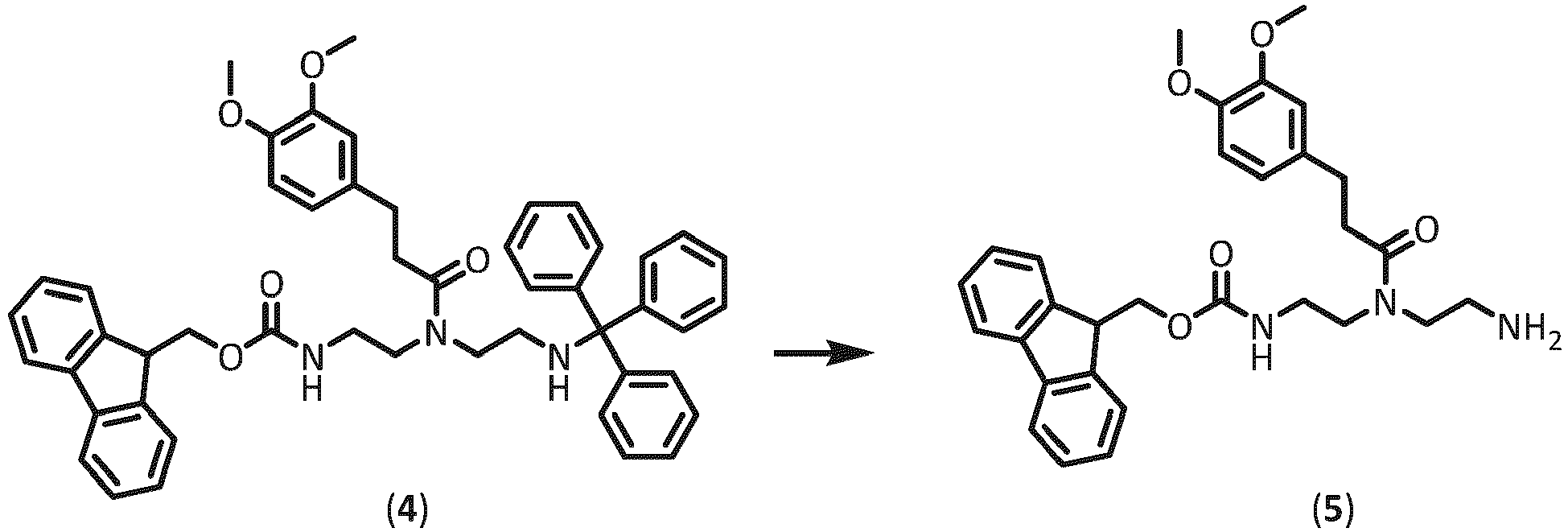
- (9H-Fluoren-9-yl)methyl(2-(3-(3,4-dimethoxyphenyl)-N-(2-(tritylamino)ethyl)propan-amido)ethyl)carbamat (4) (40 g, Rohprodukt) wurde in 600 ml DCM gelöst. Danach wurden 70 ml Trifluoressigsäure und 7 ml Triethylsilan zugegeben. Die Reaktion wurde 2 Stunden bei Raumtemperatur gerührt. Anschließend wurde die Reaktionslösung in Diethylether gefällt. Nach abdekantieren des Diethylethers wurde das Produkt 5 mit einer Ausbeute von 35 g (Rohprodukt) als braunes Öl gewonnen.
-

- (9H-Fluoren-9-yl)methyl(2-(N-(2-aminoethyl)-3-(3,4-dimethoxyphenyl)propanamido)ethyl)carbamat (5) (35 g, Rohprodukt) wurde in 500 ml DCM und 20 ml Triethylamin gelöst. Anschließend wurde Bernsteinsäureanhydrid (5.5 g, 55 mmol) hinzugegeben und die Reaktion 16 Stunden bei Raumtemperatur gerührt. Danach wurde die Reaktionslösung mit einer wässrigen Zitronensäure-Lösung gewaschen und die organische Phase über Magnesiumsulfat getrocknet. Das Lösungsmittel wurde unter vermindertem Druck am Rotationsverdampfer entfernt und das Rohprodukt in Aceton und Toluol in einem Verhältnis von 1:1 umkristallisiert. Das Produkt 6 wurde als weißes Pulver mit einer Ausbeute von 12 g (19.5 mmol, 45 %) erhalten.
- Unter Einsatz der unter Punkt 1 und 2 dieser Beispielsektion synthetisierten Bausteine, wurden nach dem Protokoll aus Ponader, Daniela, et al. "Sequence-defined glycopolymer segments presenting mannose: synthesis and lectin binding affinity." Biomacromolecules 13.6 (2012): 1845-1852 (vgl. insbesondere S.1848, 2. Spalte vorletzter Absatz und Scheme 1) an der Festphase (kommerziell erhältliches Tentagel S Ram Resin) zu Polymeren aufgebaut.
- Falls die an die Festphase gebundene Polymere eine Trityl-Schutzgruppe enthielten, wurde der Trityl-Baustein vor der Abspaltung von der Festphase an der Festphase nach Palladino, Pasquale, and Dmitry A. Stetsenko. "New TFA-free cleavage and final deprotection in Fmoc solid-phase peptide synthesis: dilute Hel in fluoro alcohol." Organic letters 14.24 (2012): 6346-6349 selektiv entschützt. Nach dem Entschützen wurde das freie Amin mit folgenden Säuren umgesetzt um ein entsprechendes tertiäres Amin bzw. primäres Amid zu erhalten.

- Dabei wurde analog zu Punkt 2.5 (vide supra) vorgegangen. Als letzten Schritt wurden die Methoxy-Schutzgruppen unter Freisetzung der Catechol-Hydroxygruppen nach bekannter Vorschrift (vide supra) entschützt.
- Folgende Polymere wurden nach oben beschriebener Methode aus den Monomeren 4-((2-((((9H-Fluoren-9-yl)methoxy)carbonyl)amino)ethyl)(2-(tritylamino)ethyl)-amino)-4-oxobutansäure (2), 7-(3-(3,4-dimethoxyphenyl)propanoyl)-1-(9H-fluoren-9-yl)-3,11-dioxo-2-oxa-4,7,10-triazatetradecan-14-oic acid (6) und 1-(9H-Fluoren-9-yl)-3,14-dioxo-2,7,10-trioxa-4,13-diazaheptadecan-17-oic acid (Darstellung siehe: Biomacromolecules 13.6 (2012): 1845-1852 in den Supporting Information) synthetisiert:
Polymer Sequenz VP1 H2N-CO-(Cat)-(EDS)-(EDS)-(EDS)-(EDS)-(EDS)-NH2 EP1 H2N-CO-(IIc-Amin)-(EDS)-(Cat)-(EDS)-(EDS)-(EDS)-NH2 EP2 H2N-CO-(Cat)-(EDS)-(IIc-Amin)-(EDS)-(Cat)-(EDS)-NH2 EP3 H2N-CO-(IId-Amid)-(EDS)-(Cat)-(EDS)-(EDS)-(EDS)-NH2 EP4 H2N-CO-(Cat)-(EDS)-(IId-Amid)-(EDS)-(Cat)-(EDS)-NH2 EP5 H2N-CO-(Cat)-(EDS)-(Cat)-(EDS)-(EDS)-(EDS)-NH2 - Um die Güte der Adhäsion der erfindungsgemäßen Polymere zu prüfen, können die für diesen Zweck dem Fachmann bekannten Kontaktwinkelbestimmungen durchgeführt werden (vgl. R.S. Hebbar, A.M. Isloor, A.F. Ismail in: "Membrane Charaterization" (Elsevier Verlag), ISBN 978-0-444-63776-5, Erschienen: 2017, Pages 219-255).
- Es ist aber auch möglich durch die die Nutzung von mit den erfindungsgemäßen Polymeren versehenen Adhäsionssonden die Adhäsionsenergie über die Reflektions-Inteferenz-Kontrast-Mikroskopie (RICM) zu messen und die Adhäsionsenergien daraus mit dem Modell von Johnson, Kendall und Roberts (JKR) zu bestimmen. Diese ebenso dem Fachmann bekannte Methode wurde wie nachfolgend beschrieben an den erfindungsgemäßen Polymeren durchgeführt.
- Poly(ethylenglykol) basierte, deformierbare Hydrogelpartikel wurden durch Dispersionspolymerisation hergestellt. Dazu wurde PEG-diacrylamid (Mn = 8000 g/mol) (50 mg) zunächst in 5 ml Wasser vollständig gelöst und dann 5 ml einer 2 M Natriumsulfatlösung hinzugegeben, um eine Dispersion der Konzentration 0.5 wt-% PEG zu erhalten. Das PEG-diacrylamid wurde zuvor nach einer bereits von Hartmann et al. publizierten Synthese dargestellt (Biomed. Mater. Res., Part B, 2011, 98B, 8-17). Als UV Photoinitiator wurde Irgacure 2959 verwendet und in einer Konzentration von 0.01 wt-% (1 mg) in die Dispersion gegeben, geschüttelt und im Anschluss unter UV-Bestrahlung (Hereaus HiLite) für 180 s photopolymerisiert.
- Wasser als kontinuierliche Phase der Poly(ethylenglykol)-diacrylamid Dispersion wurde durch Ethanol ersetzt und Benzophenon (3 wt%, 250 mg) sowie Crotonsäure (19 wt%, 1.5 g) dazugegeben. Danach wurde die Dispersion 60 s mit Stickstoff gespült und anschließend für 90 s mit UV Licht bestrahlt. Dieser Vorgang wurde 10 mal wiederholt. Die Hydrogelpartikel wurden je dreimal mit Ethanol, Ethanol-Wasser im Volumenverhältnis 1:1 und mit Wasser gewaschen und in Wasser bei 4 °C gelagert (
Abbildung 2 ). - Zur Funktionalisierung der Crotonsäure-funktionalisierten Hydrogelpartikel wurde das Wasser gegen 2-(N-Morpholino)ethansulfonsäurepuffer (MES, pH 4.5, 0.1 M) durch mehrfaches Zentrifugieren/Waschen getauscht. Danach wurden die Hydrogelpartikel (0.02 g) in 2 mL MES-Puffer dispergiert. Das zu fixierende Polymer (33 mg) wurde in 5 mL des MES-Puffers gelöst und zur Hydrogelpartikeldispersion gegeben. Als Kupplungsreagenz zur Aktivierung der Crotonsäure wurde N-(3-Dimethylaminopropyl)-N'-ethylcarbodiimid (EDC) Hydrochlorid verwendet. EDC wurde zunächst in der Konzentration 10 wt-% (100 mg) in Reinstwasser gelöst und dann in die Dispersion gegeben. Die Reaktion wurde bei Raumtemperatur für 2 h unter Schütteln durchgeführt. Im Anschluss wurde die Reaktionslösung durch Zentrifugation entfernt und der Funktionalisierungsschritt ein zweites Mal wiederholt. Im Anschluss wurden die Partikel dreimal mit Wasser gewaschen und in Wasser bei 4 °C gelagert.
- Der Funktionalisierungsgrad der mit (erfindungsgemäßem Polymer)-funktionalisierten Hydrogelpartikel wurde mittels Einfärbung mit dem Farbstoff Toluidinblau O bestimmt. Dieser kationische Farbstoff bindet an Carboxylgruppen und zeigt so über einen Vergleich der Einfärbung von Crotonsäurehydrogelpartikeln und mit (erfindungsgemäßem) Polymer-funktionalisierten Hydrogelpartikel den Polymer-Funktionalisierungsgrad. Hierzu wurden 0.2 mL der jeweiligen Partikel in 1.5 mL Eppendorf Tubes® (Eppendorf, Deutschland) gegeben und zentrifugiert. Der Überstand wurde entfernt und 0.2 mL einer 0.3125 M TBO-Lösung bei pH 10.5 (NaOH) zu den Partikeln gegeben. Die Eppendorf Tubes® wurden in Aluminiumfolie gewickelt und für 18 h geschüttelt. Im Anschluss wurden die Hydrogelpartikel zentrifugiert, der Überstand entfernt und mit 1 mL in Wasser bei pH 10.5 (NaOH) gewaschen. Zur Quantifizierung der Färbung wurde optische Mikroskopie (Olympus IX73, Olympus Europa SE & Co. KG) mit einer CMOS Kamera (DMK 23UX174, Imaging Source Europe GmbH) durchgeführt. Die Differenzen der Grauwerte der Crotonsäure- und mit (erfindungsgemäßem) Polymer-funktionalisierten Hydrogelpartikel ergeben die relativen Funktionalisierungsgrade. Der absolute Funktionalisierungsgrad der Crotonsäure-Hydrogelpartikel (Beispiel 1B) wurde zuvor kolorimetrisch mittels UV Titration mit TBO bestimmt. Mit der beschriebenen Prozedur zur Crotonsäurefunktionalisierung ergibt sich typischerweise ein Funktionalisierungsgrad 90 µmol/g.
- Es wurden nach obiger Vorschrift Hydrogelpartikel mit folgenden Polymeren funktionalisiert:
Hydrogelpartikel Polymer zur Funktionalisierung genutztes Polymer H1 Vergleichspolymer VP1 H2 erfindungsgemäß EP1 H3 erfindungsgemäß EP2 - Es wurden Kraft-Deformationskurven mit Hilfe von Colloidal-Probe AFM der mit erfindungsgemäßem Polymer funktionalisierten Hydrogelpartikel gemessen und mit dem Hertzmodell analysiert:

- Als Glasoberfläche für die Adhäsionmessungen wurden µ-Slide 8 Well Glass Bottom (ibidi GmbH, Planegg/Martinsried Deutschland) verwendet. Zur Vorbereitung wurde ein µ-Slide 8 Well Glass Bottom in einem UV Ozone Cleaner UVC.1014 (NanoBioAnalytics, Deutschland) für 30 Minuten gereinigt.
- Zur Präparation von zelluloseimitierenden Oberflächen wurde eine Glasoberfläche in eine Lösung aus Ethanol (200 mL), Wasser (10.5 mL), Essigsäure (0.2 mL) und (3-Glycidyloxypropyl)trimethoxysilan (2.1 mL) gegeben und für 2 h bei Raumtemperatur reagiert. Im Anschluss wurde die Oberfläche mit Ethanol gewaschen und bei 80 °C für 12 h in einem Trockenschrank getempert. Zur weiteren Funktionalisierung wurden 0.3 mL einer D-Cellobiose- oder Carboxymethylcelluloselösung (1 wt%) in Phosphatpuffer (10 mM, pH 8.0-8.5) in die Kammern der µ-Slides gegeben. Nach 2 h Reaktion bei Raumtemperatur wurde die Lösung entfernt und die Oberflächen dreimal mit Wasser gewaschen.
- Beispielhaft ist hier die Analyse der Adhäsion eines Polymers mit zwei Catecholeinheiten auf Glas (
Abbildung 3 A) und auf D-Cellobiose (Abbildung 3 B) gezeigt. Als Messmedien wurde Phosphatpuffer (pH 8.0, 10 mM) für Glasoberflächen und verdünnte NaOH (pH 8.5) für Cellobioseoberflächen verwendet. Zur Bestimmung der Adhäsionsenergien wurde das entsprechende Polymer wie unter Punkt 4 beschrieben (vide supra) an Hydrogelpartikel gebunden und die Adhäsionsflächen der Hydrogele auf der jeweiligen Oberfläche mit Hilfe der Reflektions-Inteferenz-Kontrast-Mikroskopie (RICM) analysiert. Anschließend wurden die Adhäsionsenergien mit dem Modell von Johnson, Kendall und Roberts (JKR) ausgewertet:
- Hierbei ist a der Kontaktradius, Wadh die Adhäsionsenergie, R der Hydrogelpartikelradius und Eeff das effektive Elastizitätsmodul Eeff =[4E/3(1-v2 )].
- RICM wurde mit einem inversen Mikroskop Olympus IX73 (Olympus IX73, Olympus Europa SE & Co. KG) bei einer Wellenlänge von 533 nm (LED Beleuchtung, COP1-A Thorlabs GmbH) durchgeführt. Zur Erzeugung der Interferenzmuster wurde ein Filterwürfel mit einem semitransparenten Spiegel, einer Viertelwellenplatte und Polarisatoren (optische Bauteile Thorlabs GmbH) verwendet. Zur Aufnahme der RICM Interferenzmuster wurde ein Olympus UplanFL N 60x/0.90 Objektiv (Olympus Europa SE & Co. KG) und eine Imagingsource DMK 23UX174 (Imaging Source Europe GmbH) Kamera verwendet. Zur Durchführung der Berechnungen nach dem JKR-Modell wurden die Radien der Kontaktfläche und der Partikel gemessen (
Abbildung 1 ). Dazu wurden Bilder der Interferenzmuster zunächst mit Mikromanager (v1.4.16, Open Imaging Inc.) aufgenommen und die Interferenzprofile mit einem selbstgeschriebenen Bilderkennungsprogramm automatisch generiert. Die Berechnung der Kontaktradien und Adhäsionsenergien wurde dann durch eine skriptbasierte Analyse mit dem Programm IgorPro (WaveMetrics, USA) durchgeführt. Für einen Datenpunkt wurden mindestens 10 Kontaktflächen und Partikelradien gemessen, gegeneinander aufgetragen und mit dem JKR-Modell gefittet (Abbildung 3 C) . Die Polymer-funktionalisierten Hydrogelpartikel zeigen in etwa gleich große Adhäsionsenergien auf der Glas-, bzw. Cellobioseoberfläche. - Es wurde ebenso die Adhäsionsenergie in RICM der untersuchten Polymere gemäß obigem Protokoll aus einer Waschlauge (Persil Color® (Firma Henkel AG & Co. KGaA) verdünnt auf 4,1 g/L) auf die Cellobiosemodeloberfläche bestimmt. Nachfolgend wird dabei die bestimmte Adhäsionsenergie in RICM gegen das Verhältnis von Catechol zu Amin des jeweiligen Hydrogelpartikels (H1) bis (H3) angegeben
Verhältnisse der Funktionalitäten Adhäsionsenergie [µmol/m2) Catechol/Amin Hydrogelpartikel 1/0 (H1) 0 1/1 (H2) 310 2/1 (H3) 370

Z3 und Z4 wie in Formel (U8) definiert sind.
Claims (10)
- Polymer, enthaltend mindestens eine Wiederholungseinheit der Formel (I) und mindestens eine Wiederholungseinheit der Formel (II) und gegebenenfalls weitere Wiederholungseinheiten,
 worin G1 und G2 unabhängig voneinander eine zum Polymerrückgrat beitragende Struktureinheit bedeuten,G1 die Formel *-(C=O)-Z-(C=O)-NR'-CH2CH2-(N-Rest)-CH2CH2-NR'-* aufweist, wobei jedes R' unabhängig für H oder C1-C4-Alkyl, Z für eine C2-C8-Alkandiylgruppe, bevorzugt für Ethan-1,2-diyl, steht und "Rest" für den über A/A1 gebundenen Dihydroxyphenylrest gemäß Formel (I) steht,G2 die Formel *-(C=O)-Z1-(C=O)-NR'-CH2CH2-(N-Rest)-CH2CH2-NR'-* aufweist, wobei jedes R' unabhängig für H oder C1-C4-Alkyl, Z für eine C2-C8-Alkandiylgruppe, bevorzugt für Ethan-1,2-diyl, steht und "Rest" für -A4-A3-X steht,A und A4 unabhängig voneinander eine Spacergruppe einer Seitenkette des Polymers oder eine direkte Bindung bedeuten,A1 eine Anknüpfungsgruppe des Catecholrestes aus Formel (I) an die Spacergruppe A oder eine direkte Bindung bedeutet,A3 eine Anknüpfungsgruppe der Gruppe X an die Spacergruppe A4 oder eine direkte Bindung bedeutet,R2 und R3 unabhängig voneinander stehen für ein Wasserstoffatom, eine C1-C4-Alkylgruppe, eine C2-C4-Hydroxyalkylgruppe, eine C1-C4-Alkoxygruppe, ein Halogenatom, eine Sulfonsäuregruppe, eine C1-C10-Alkylcarbonyloxy-Gruppe, eine C1-C10-Alkoxycarbonylgruppe, eine C6-C10-Aryloxycarbonyl-Gruppe, eine C6-C10-Arylcarbonyloxy-Gruppe, C2-C10-Alkenylcarbonyloxy-Gruppe, eine C2-C10-Alkenyloxycarbonylgruppe, eine Hydroxylgruppe, eine Aminogruppe, eine Ammoniumgruppe,X für eine Aminogruppe -N(R5)(R6) oder eine Ammonio-Gruppe -N+(R5)(R6)(R7) 1/n Ann- steht,worin R5, R6 und R7 jeweils unabhängig voneinander für ein Wasserstoffatom, eine C1-C4-Alkylgruppe oder eine C2-C4-Hydroxyalkylgruppe stehen und 1/n Ann- ein Äquivalent eines n-wertigen Anions, bevorzugt mit n = 1 bedeuten,mit der Maßgabe, dass die Wiederholungseinheiten der Formel (II) von den Wiederholungseinheiten der Formel (I) verschieden sind und das Molverhältnis der Einheiten der Formel (I) zu den Einheiten der Formel (II) im Bereich von 0.5 zu 1 bis 4 zu 1, bevorzugt 1 zu 1 bis 2 zu 1, beträgt.
 - Polymer gemäß Anspruch 1, dadurch gekennzeichnet, dass mindestens eines von A und A1 und/oder mindestens eines von A3 und A4 für eine Spacergruppe steht.
- Polymer gemäß Anspruch 1 oder 2, dadurch gekennzeichnet, dass(1) A gemäß Formel (I) für eine Carbonylgruppe, für eine Carbonyloxygruppe, für eine Carbonyliminogruppe, für eine Iminogruppe, für eine C1-C4-Alkylenoxygruppe, für eine C1-C4-Alkyleniminogruppe, vorzugsweise eine Carbonylgruppe, steht; und/oder(2) A4 gemäß Formel (II) für eine Carbonylgruppe, für eine Carbonyloxygruppe, für eine Carbonyliminogruppe, für eine Iminogruppe, für eine C1-C4-Alkylenoxygruppe, für eine C2-C6-α,ω-(Dioxo)alkan- α,ω-diytgruppe, für eine C1-C4-Alkyleniminogruppe, für eine C1-C4-Alkyleniminocarbonylgruppe, vorzugsweise für eine Carbonylgruppe, steht.
- Polymer gemäß einem der vorangehenden Ansprüche, dadurch gekennzeichnet, dass(1) A1 gemäß Formel (I) für eine direkte Bindung, für eine C1-C4-Alkandiylgruppe, eine C1-C4-Alkylenoxycarbonylgruppe, vorzugsweise für eine C1-C4-Alkandiylgruppe, steht; und/oder(2) A3 gemäß Formel (II) für eine direkte Bindung, eine C1-C6-Alkandiylgruppe, eine C2-C6-α,ω-(Dioxo)alkan- α,ω-diylgruppe, vorzugsweise für eine C1-C6-Alkandiylgruppe, steht.
- Polymer gemäß einem der vorangehenden Ansprüche, dadurch gekennzeichnet, dass es als Wiederholungseinheit der Formel (I) mindestens eine Wiederholungseinheit der Formel (I-a) enthält,
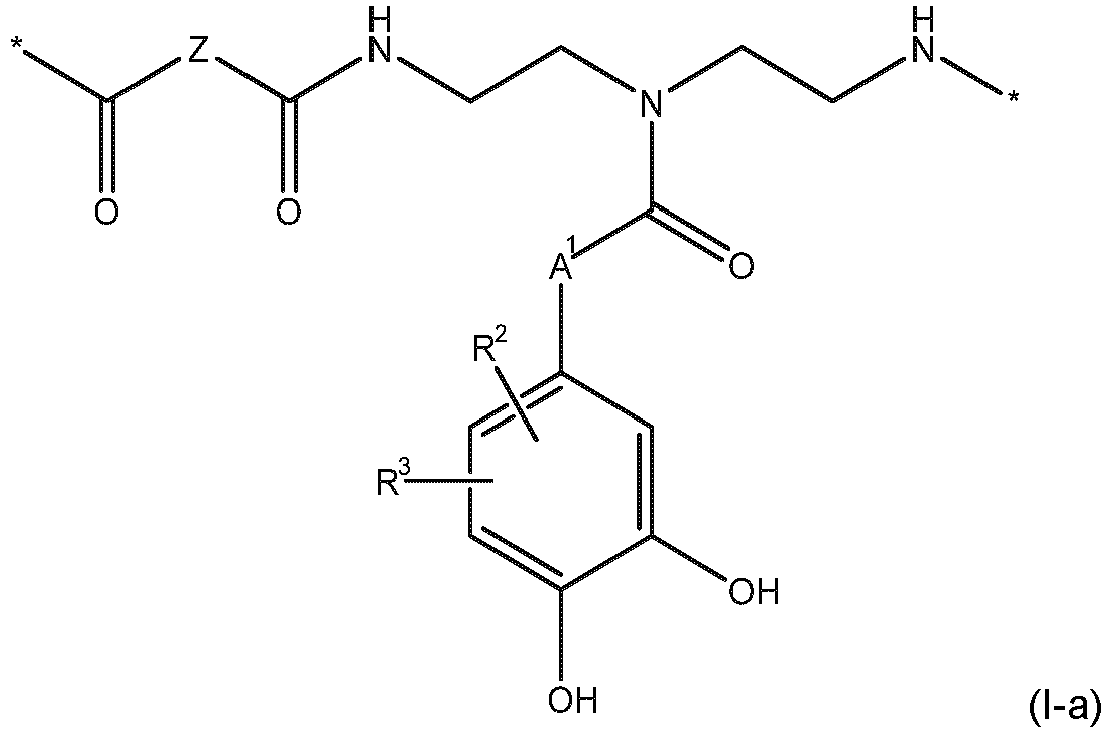 A1 für eine C1-C4-Alkandiylgruppe (bevorzugt für Ethan-1,2-diyl) steht,Z für eine C2-C8-Alkandiylgruppe (bevorzugt für Ethan-1,2-diyl) steht,R2 und R3 unabhängig voneinander stehen für ein Wasserstoffatom, eine C1-C4-Alkylgruppe, eine C2-C4-Hydroxyalkylgruppe, eine C1-C4-Alkoxygruppe, ein Halogenatom, eine Sulfonsäuregruppe (bevorzugt jeweils für ein Wasserstoffatom) stehen.
 - Polymer gemäß einem der vorangehenden Ansprüche, dadurch gekennzeichnet, dass es als Wiederholungseinheit der Formel (II)(1) mindestens eine Wiederholungseinheit der Formel (II-a) enthält,
 A3 eine C1-C6-Alkandiyl-Gruppe bedeutet,Z1 für eine C2-C8-Alkandiylgruppe (bevorzugt für Ethan-1 ,2-diyl) steht,X für eine Aminogruppe -N(R5)(R6) oder eine Ammonio-Gruppe -N+(R5)(R6)(R7) 1/n Ann- steht,worin R5, R6 und R7 jeweils unabhängig voneinander für ein Wasserstoffatom, eine C1-C4-Alkylgruppe oder eine C2-C4-Hydroxyalkylgruppe stehen und 1/n Ann- ein Äquivalent eines n-wertigen Anions, bevorzugt mit n = 1 bedeuten; und/oder(2) mindestens eine Wiederholungseinheit der Formel (II-b) enthält,
 (3) mindestens eine Wiederholungseinheit der Formel (II-c) enthält,
 A3 eine C1-C6-Alkandiyl-Gruppe bedeutet,Z1 für eine C2-C8-Alkandiylgruppe (bevorzugt für Ethan-1 ,2-diyl) steht,X für eine Aminogruppe -N(R5)(R6) oder eine Ammonio-Gruppe -N+(R5)(R6)(R7) 1/n Ann- steht,worin R5, R6 und R7 jeweils unabhängig voneinander für ein Wasserstoffatom, eine C1-C4-Alkylgruppe oder eine C2-C4-Hydroxyalkylgruppe stehen und 1/n Ann- ein Äquivalent eines n-wertigen Anions, bevorzugt mit n = 1 bedeuten; und/oder(4) mindestens eine Wiederholungseinheit der Formel (II-d) enthält,
 worin A6 für eine (C2 bis C6)-Alkandiylgruppe steht, insbesondere für Ethan-1,2-diyl, Propan-1,3-diyl, Butan-1,4-diyl, Propan-1,2-diyl, Butan-1,2-diyl, Butan-1,3-diyl, Pentan-1,5-diyl oder Hexan-1,6-diyl,Z3 für eine C2-C8-Alkandiylgruppe (bevorzugt für Ethan-1 ,2-diyl) steht.
 - Polymer nach einem der Ansprüche 1 bis 6, dadurch gekennzeichnet, dass es als, bevorzugt einzige, weitere Wiederholungseinheit mindestens eine Struktureinheit der Formel (III) enthält,

- Mittel zur Behandlung von Oberflächen, insbesondere von harten Oberflächen oder Textilien, dadurch gekennzeichnet, dass es mindestens ein Polymer nach einem der Ansprüche 1 bis 7 und mindestens ein Tensid enthält.
- Verfahren zur Behandlung von Substratoberflächen, insbesondere von harten Oberflächen oder textilen Oberflächen, worin mindestens Polymer gemäß einem der Ansprüche 1 bis 7 oder mindestens ein Mittel gemäß Anspruch 8 auf die Oberfläche aufgebracht wird.
- Verwendung mindestens eines Polymers nach einem der Ansprüche 1 bis 7 oder eines Mittels nach Anspruch 8 zur Reduktion von Schmutzablagerung auf Oberflächen, insbesondere auf harten Oberflächen oder textilen Oberflächen.
Applications Claiming Priority (1)
| Application Number | Priority Date | Filing Date | Title |
|---|---|---|---|
| DE102019208832.5A DE102019208832A1 (de) | 2019-06-18 | 2019-06-18 | Polymere für die Behandlung von Oberflächen |
Publications (2)
| Publication Number | Publication Date |
|---|---|
| EP3753971A1 EP3753971A1 (de) | 2020-12-23 |
| EP3753971B1 true EP3753971B1 (de) | 2024-11-27 |
Family
ID=70977398
Family Applications (1)
| Application Number | Title | Priority Date | Filing Date |
|---|---|---|---|
| EP20177979.0A Active EP3753971B1 (de) | 2019-06-18 | 2020-06-03 | Polymere für die behandlung von oberflächen |
Country Status (4)
| Country | Link |
|---|---|
| US (1) | US11873468B2 (de) |
| EP (1) | EP3753971B1 (de) |
| DE (1) | DE102019208832A1 (de) |
| ES (1) | ES3011033T3 (de) |
Families Citing this family (1)
| Publication number | Priority date | Publication date | Assignee | Title |
|---|---|---|---|---|
| WO2023245127A2 (en) * | 2022-06-17 | 2023-12-21 | The Regents Of The University Of California | A multifunctional bioadhesive designed with chemical functionality induced sutured biological building blocks |
Family Cites Families (11)
| Publication number | Priority date | Publication date | Assignee | Title |
|---|---|---|---|---|
| US5487888A (en) | 1993-05-20 | 1996-01-30 | Geltex, Inc. | Iron-binding polymers for oral administration |
| US7618937B2 (en) * | 2001-07-20 | 2009-11-17 | Northwestern University | Peptidomimetic polymers for antifouling surfaces |
| DE102004004214A1 (de) | 2004-01-27 | 2005-08-25 | Basf Ag | Polymerdispersionen oder -lösungen mit 3,4 Dihydroxyphenylgruppen |
| US9642933B2 (en) * | 2012-01-30 | 2017-05-09 | Board Of Regents, The University Of Texas System | Compositions comprising bioadhesives and methods of making the same |
| WO2013151537A1 (en) * | 2012-04-03 | 2013-10-10 | Empire Technology Development Llc | Biocompatible adhesive polymers |
| DE102012214607A1 (de) | 2012-08-16 | 2014-02-20 | Henkel Ag & Co. Kgaa | Wasserlösliche Verpackung mit Bittermittel I |
| DE102012214608A1 (de) | 2012-08-16 | 2014-02-20 | Henkel Ag & Co. Kgaa | Wasserlösliche Verpackung mit Bittermittel II |
| US10882931B2 (en) * | 2014-09-11 | 2021-01-05 | Susos Ag | Functional polymer |
| US9682100B2 (en) * | 2015-01-26 | 2017-06-20 | International Business Machines Corporation | Cationic polyamines for treatment of viruses |
| EP3263623A1 (de) * | 2016-06-30 | 2018-01-03 | Freie Universität Berlin | Überzugsmittel und beschichtungsanordnung |
| DE102016223586A1 (de) * | 2016-11-28 | 2018-05-30 | Clariant International Ltd | Copolymere und deren verwendung in reinigungsmittel-zusammensetzungen |
-
2019
- 2019-06-18 DE DE102019208832.5A patent/DE102019208832A1/de not_active Withdrawn
-
2020
- 2020-06-03 ES ES20177979T patent/ES3011033T3/es active Active
- 2020-06-03 EP EP20177979.0A patent/EP3753971B1/de active Active
- 2020-06-18 US US16/905,523 patent/US11873468B2/en active Active
Also Published As
| Publication number | Publication date |
|---|---|
| EP3753971A1 (de) | 2020-12-23 |
| US20200399564A1 (en) | 2020-12-24 |
| ES3011033T3 (en) | 2025-04-07 |
| DE102019208832A1 (de) | 2020-12-24 |
| US11873468B2 (en) | 2024-01-16 |
Similar Documents
| Publication | Publication Date | Title |
|---|---|---|
| EP3864121B1 (de) | Waschmittelzusammensetzung mit catechol-metallkomplexverbindung | |
| EP3638758A1 (de) | Portion zur bereitstellung tensidhaltiger flotten | |
| EP3638759A1 (de) | Viskoelastische, festförmige tensidzusammensetzung | |
| EP3864125B1 (de) | Mehrkomponenten-waschmittel mit catechol-metallkomplex | |
| US20240294848A1 (en) | Bio-based cleaner additive | |
| EP3130656B1 (de) | Wasserarme mittel für die textilbehandlung, enthaltend mindestens eine spezielle kationische verbindung und mindestens ein zusätzliches tensid | |
| EP3638755A1 (de) | Viskoelastische, festförmige tensidzusammensetzung mit hohem tensidgehalt | |
| EP3753971B1 (de) | Polymere für die behandlung von oberflächen | |
| EP3749738B1 (de) | Viskoelastische, festförmige tensidzusammensetzung | |
| EP3194549A1 (de) | Mittel für die textilbehandlung, enthaltend mindestens einen anionischen, aromatischen polyester und mindestens einen nichtionischen, aromatischen polyester | |
| EP3864120B1 (de) | Flüssigwaschmittel mit catechol-verbindung | |
| DE102017223456A1 (de) | Viskoelastische, festförmige Tensidzusammensetzung mit hohem Tensidgehalt | |
| DE102018219415A1 (de) | Textilvorbehandlungsmittel enthaltend einen Formkörper mit niedermolekularem Gelbildner | |
| DE102023212736A1 (de) | Viskoses flüssiges Wasch- oder Reinigungsmittel | |
| DE102023212735A1 (de) | Wasch- oder Reinigungsmittelformkörper | |
| DE102023212739A1 (de) | Wasch- oder Reinigungsmittelformkörper | |
| EP3894172A1 (de) | Vorrichtung und verfahren zur herstellung einer wasserlöslichen hülle sowie diese wasserlösliche hülle enthaltene wasch- oder reinigungsmittelportionen | |
| DE102018219413A1 (de) | Textilvorbehandlungsmittel enthaltend einen Formkörper mit Glucosamin-Derivat als niedermolekularem Gelbildner | |
| DE102018214800A1 (de) | Viskoelastische, festförmige Tensidzusammensetzung enthaltend ein N,N‘-Diarylamidocystin-Derivat | |
| DE102023201696A1 (de) | Wasch- und reinigungsmittel mit dispersin | |
| DE102023201695A1 (de) | Wasch- und reinigungsmittel mit dispersin | |
| DE102016209326A1 (de) | Kombination von Textilbehandlungsmittel und Farbfangtuch | |
| DE102023211746A1 (de) | Wasch- und reinigungsmittel enthaltend antimikrobielles peptid | |
| DE102016212054A1 (de) | Reinigungsmittel mit verringerter Glaskorrosion | |
| DE102016209323A1 (de) | Kombination von Textilbehandlungsmittel und Farbfangtuch |
Legal Events
| Date | Code | Title | Description |
|---|---|---|---|
| PUAI | Public reference made under article 153(3) epc to a published international application that has entered the european phase |
Free format text: ORIGINAL CODE: 0009012 |
|
| STAA | Information on the status of an ep patent application or granted ep patent |
Free format text: STATUS: REQUEST FOR EXAMINATION WAS MADE |
|
| 17P | Request for examination filed |
Effective date: 20200603 |
|
| AK | Designated contracting states |
Kind code of ref document: A1 Designated state(s): AL AT BE BG CH CY CZ DE DK EE ES FI FR GB GR HR HU IE IS IT LI LT LU LV MC MK MT NL NO PL PT RO RS SE SI SK SM TR |
|
| AX | Request for extension of the european patent |
Extension state: BA ME |
|
| P01 | Opt-out of the competence of the unified patent court (upc) registered |
Effective date: 20230531 |
|
| GRAP | Despatch of communication of intention to grant a patent |
Free format text: ORIGINAL CODE: EPIDOSNIGR1 |
|
| STAA | Information on the status of an ep patent application or granted ep patent |
Free format text: STATUS: GRANT OF PATENT IS INTENDED |
|
| INTG | Intention to grant announced |
Effective date: 20231218 |
|
| GRAS | Grant fee paid |
Free format text: ORIGINAL CODE: EPIDOSNIGR3 |
|
| GRAA | (expected) grant |
Free format text: ORIGINAL CODE: 0009210 |
|
| STAA | Information on the status of an ep patent application or granted ep patent |
Free format text: STATUS: THE PATENT HAS BEEN GRANTED |
|
| AK | Designated contracting states |
Kind code of ref document: B1 Designated state(s): AL AT BE BG CH CY CZ DE DK EE ES FI FR GB GR HR HU IE IS IT LI LT LU LV MC MK MT NL NO PL PT RO RS SE SI SK SM TR |
|
| REG | Reference to a national code |
Ref country code: GB Ref legal event code: FG4D Free format text: NOT ENGLISH |
|
| REG | Reference to a national code |
Ref country code: CH Ref legal event code: EP |
|
| REG | Reference to a national code |
Ref country code: DE Ref legal event code: R096 Ref document number: 502020009812 Country of ref document: DE |
|
| REG | Reference to a national code |
Ref country code: IE Ref legal event code: FG4D Free format text: LANGUAGE OF EP DOCUMENT: GERMAN |
|
| REG | Reference to a national code |
Ref country code: LT Ref legal event code: MG9D |
|
| REG | Reference to a national code |
Ref country code: NL Ref legal event code: MP Effective date: 20241127 |
|
| REG | Reference to a national code |
Ref country code: ES Ref legal event code: FG2A Ref document number: 3011033 Country of ref document: ES Kind code of ref document: T3 Effective date: 20250407 |
|
| PG25 | Lapsed in a contracting state [announced via postgrant information from national office to epo] |
Ref country code: IS Free format text: LAPSE BECAUSE OF FAILURE TO SUBMIT A TRANSLATION OF THE DESCRIPTION OR TO PAY THE FEE WITHIN THE PRESCRIBED TIME-LIMIT Effective date: 20250327 Ref country code: PT Free format text: LAPSE BECAUSE OF FAILURE TO SUBMIT A TRANSLATION OF THE DESCRIPTION OR TO PAY THE FEE WITHIN THE PRESCRIBED TIME-LIMIT Effective date: 20250327 Ref country code: HR Free format text: LAPSE BECAUSE OF FAILURE TO SUBMIT A TRANSLATION OF THE DESCRIPTION OR TO PAY THE FEE WITHIN THE PRESCRIBED TIME-LIMIT Effective date: 20241127 |
|
| PG25 | Lapsed in a contracting state [announced via postgrant information from national office to epo] |
Ref country code: NL Free format text: LAPSE BECAUSE OF FAILURE TO SUBMIT A TRANSLATION OF THE DESCRIPTION OR TO PAY THE FEE WITHIN THE PRESCRIBED TIME-LIMIT Effective date: 20241127 Ref country code: FI Free format text: LAPSE BECAUSE OF FAILURE TO SUBMIT A TRANSLATION OF THE DESCRIPTION OR TO PAY THE FEE WITHIN THE PRESCRIBED TIME-LIMIT Effective date: 20241127 |
|
| PG25 | Lapsed in a contracting state [announced via postgrant information from national office to epo] |
Ref country code: BG Free format text: LAPSE BECAUSE OF FAILURE TO SUBMIT A TRANSLATION OF THE DESCRIPTION OR TO PAY THE FEE WITHIN THE PRESCRIBED TIME-LIMIT Effective date: 20241127 |
|
| PG25 | Lapsed in a contracting state [announced via postgrant information from national office to epo] |
Ref country code: NO Free format text: LAPSE BECAUSE OF FAILURE TO SUBMIT A TRANSLATION OF THE DESCRIPTION OR TO PAY THE FEE WITHIN THE PRESCRIBED TIME-LIMIT Effective date: 20250227 |
|
| PG25 | Lapsed in a contracting state [announced via postgrant information from national office to epo] |
Ref country code: LV Free format text: LAPSE BECAUSE OF FAILURE TO SUBMIT A TRANSLATION OF THE DESCRIPTION OR TO PAY THE FEE WITHIN THE PRESCRIBED TIME-LIMIT Effective date: 20241127 Ref country code: GR Free format text: LAPSE BECAUSE OF FAILURE TO SUBMIT A TRANSLATION OF THE DESCRIPTION OR TO PAY THE FEE WITHIN THE PRESCRIBED TIME-LIMIT Effective date: 20250228 |
|
| PG25 | Lapsed in a contracting state [announced via postgrant information from national office to epo] |
Ref country code: PL Free format text: LAPSE BECAUSE OF FAILURE TO SUBMIT A TRANSLATION OF THE DESCRIPTION OR TO PAY THE FEE WITHIN THE PRESCRIBED TIME-LIMIT Effective date: 20241127 |
|
| PG25 | Lapsed in a contracting state [announced via postgrant information from national office to epo] |
Ref country code: RS Free format text: LAPSE BECAUSE OF FAILURE TO SUBMIT A TRANSLATION OF THE DESCRIPTION OR TO PAY THE FEE WITHIN THE PRESCRIBED TIME-LIMIT Effective date: 20250227 |
|
| PG25 | Lapsed in a contracting state [announced via postgrant information from national office to epo] |
Ref country code: SM Free format text: LAPSE BECAUSE OF FAILURE TO SUBMIT A TRANSLATION OF THE DESCRIPTION OR TO PAY THE FEE WITHIN THE PRESCRIBED TIME-LIMIT Effective date: 20241127 |
|
| PGFP | Annual fee paid to national office [announced via postgrant information from national office to epo] |
Ref country code: DE Payment date: 20250618 Year of fee payment: 6 |
|
| PG25 | Lapsed in a contracting state [announced via postgrant information from national office to epo] |
Ref country code: DK Free format text: LAPSE BECAUSE OF FAILURE TO SUBMIT A TRANSLATION OF THE DESCRIPTION OR TO PAY THE FEE WITHIN THE PRESCRIBED TIME-LIMIT Effective date: 20241127 |
|
| PGFP | Annual fee paid to national office [announced via postgrant information from national office to epo] |
Ref country code: GB Payment date: 20250618 Year of fee payment: 6 |
|
| PG25 | Lapsed in a contracting state [announced via postgrant information from national office to epo] |
Ref country code: EE Free format text: LAPSE BECAUSE OF FAILURE TO SUBMIT A TRANSLATION OF THE DESCRIPTION OR TO PAY THE FEE WITHIN THE PRESCRIBED TIME-LIMIT Effective date: 20241127 |
|
| PGFP | Annual fee paid to national office [announced via postgrant information from national office to epo] |
Ref country code: FR Payment date: 20250626 Year of fee payment: 6 |
|
| PG25 | Lapsed in a contracting state [announced via postgrant information from national office to epo] |
Ref country code: RO Free format text: LAPSE BECAUSE OF FAILURE TO SUBMIT A TRANSLATION OF THE DESCRIPTION OR TO PAY THE FEE WITHIN THE PRESCRIBED TIME-LIMIT Effective date: 20241127 |
|
| PG25 | Lapsed in a contracting state [announced via postgrant information from national office to epo] |
Ref country code: SK Free format text: LAPSE BECAUSE OF FAILURE TO SUBMIT A TRANSLATION OF THE DESCRIPTION OR TO PAY THE FEE WITHIN THE PRESCRIBED TIME-LIMIT Effective date: 20241127 |
|
| PG25 | Lapsed in a contracting state [announced via postgrant information from national office to epo] |
Ref country code: CZ Free format text: LAPSE BECAUSE OF FAILURE TO SUBMIT A TRANSLATION OF THE DESCRIPTION OR TO PAY THE FEE WITHIN THE PRESCRIBED TIME-LIMIT Effective date: 20241127 |
|
| REG | Reference to a national code |
Ref country code: DE Ref legal event code: R097 Ref document number: 502020009812 Country of ref document: DE |
|
| PG25 | Lapsed in a contracting state [announced via postgrant information from national office to epo] |
Ref country code: SE Free format text: LAPSE BECAUSE OF FAILURE TO SUBMIT A TRANSLATION OF THE DESCRIPTION OR TO PAY THE FEE WITHIN THE PRESCRIBED TIME-LIMIT Effective date: 20241127 |
|
| PLBE | No opposition filed within time limit |
Free format text: ORIGINAL CODE: 0009261 |
|
| STAA | Information on the status of an ep patent application or granted ep patent |
Free format text: STATUS: NO OPPOSITION FILED WITHIN TIME LIMIT |
|
| REG | Reference to a national code |
Ref country code: CH Ref legal event code: L10 Free format text: ST27 STATUS EVENT CODE: U-0-0-L10-L00 (AS PROVIDED BY THE NATIONAL OFFICE) Effective date: 20251008 |
|
| PGFP | Annual fee paid to national office [announced via postgrant information from national office to epo] |
Ref country code: ES Payment date: 20250731 Year of fee payment: 6 |
|
| PGFP | Annual fee paid to national office [announced via postgrant information from national office to epo] |
Ref country code: IT Payment date: 20250624 Year of fee payment: 6 |
|
| 26N | No opposition filed |
Effective date: 20250828 |
|
| REG | Reference to a national code |
Ref country code: CH Ref legal event code: H13 Free format text: ST27 STATUS EVENT CODE: U-0-0-H10-H13 (AS PROVIDED BY THE NATIONAL OFFICE) Effective date: 20260127 |
|
| PG25 | Lapsed in a contracting state [announced via postgrant information from national office to epo] |
Ref country code: MC Free format text: LAPSE BECAUSE OF FAILURE TO SUBMIT A TRANSLATION OF THE DESCRIPTION OR TO PAY THE FEE WITHIN THE PRESCRIBED TIME-LIMIT Effective date: 20241127 |
|
| PG25 | Lapsed in a contracting state [announced via postgrant information from national office to epo] |
Ref country code: LU Free format text: LAPSE BECAUSE OF NON-PAYMENT OF DUE FEES Effective date: 20250603 |
|
| REG | Reference to a national code |
Ref country code: BE Ref legal event code: MM Effective date: 20250630 |
|
| REG | Reference to a national code |
Ref country code: DE Ref legal event code: R084 Ref document number: 502020009812 Country of ref document: DE |
|
| PG25 | Lapsed in a contracting state [announced via postgrant information from national office to epo] |
Ref country code: IE Free format text: LAPSE BECAUSE OF NON-PAYMENT OF DUE FEES Effective date: 20250603 |
|
| PG25 | Lapsed in a contracting state [announced via postgrant information from national office to epo] |
Ref country code: BE Free format text: LAPSE BECAUSE OF NON-PAYMENT OF DUE FEES Effective date: 20250630 |
|
| PG25 | Lapsed in a contracting state [announced via postgrant information from national office to epo] |
Ref country code: CH Free format text: LAPSE BECAUSE OF NON-PAYMENT OF DUE FEES Effective date: 20250630 |