EP3752728B1 - Turbomachine pour aéronef et aéronef associé - Google Patents
Turbomachine pour aéronef et aéronef associé Download PDFInfo
- Publication number
- EP3752728B1 EP3752728B1 EP19710752.7A EP19710752A EP3752728B1 EP 3752728 B1 EP3752728 B1 EP 3752728B1 EP 19710752 A EP19710752 A EP 19710752A EP 3752728 B1 EP3752728 B1 EP 3752728B1
- Authority
- EP
- European Patent Office
- Prior art keywords
- turbomachine
- teeth
- leading edge
- aircraft
- depressions
- Prior art date
- Legal status (The legal status is an assumption and is not a legal conclusion. Google has not performed a legal analysis and makes no representation as to the accuracy of the status listed.)
- Active
Links
Images


Classifications
-
- F—MECHANICAL ENGINEERING; LIGHTING; HEATING; WEAPONS; BLASTING
- F02—COMBUSTION ENGINES; HOT-GAS OR COMBUSTION-PRODUCT ENGINE PLANTS
- F02K—JET-PROPULSION PLANTS
- F02K1/00—Plants characterised by the form or arrangement of the jet pipe or nozzle; Jet pipes or nozzles peculiar thereto
- F02K1/38—Introducing air inside the jet
-
- F—MECHANICAL ENGINEERING; LIGHTING; HEATING; WEAPONS; BLASTING
- F02—COMBUSTION ENGINES; HOT-GAS OR COMBUSTION-PRODUCT ENGINE PLANTS
- F02K—JET-PROPULSION PLANTS
- F02K1/00—Plants characterised by the form or arrangement of the jet pipe or nozzle; Jet pipes or nozzles peculiar thereto
- F02K1/38—Introducing air inside the jet
- F02K1/386—Introducing air inside the jet mixing devices in the jet pipe, e.g. for mixing primary and secondary flow
-
- B—PERFORMING OPERATIONS; TRANSPORTING
- B64—AIRCRAFT; AVIATION; COSMONAUTICS
- B64C—AEROPLANES; HELICOPTERS
- B64C3/00—Wings
- B64C3/10—Shape of wings
- B64C3/16—Frontal aspect
-
- B—PERFORMING OPERATIONS; TRANSPORTING
- B64—AIRCRAFT; AVIATION; COSMONAUTICS
- B64D—EQUIPMENT FOR FITTING IN OR TO AIRCRAFT; FLIGHT SUITS; PARACHUTES; ARRANGEMENT OR MOUNTING OF POWER PLANTS OR PROPULSION TRANSMISSIONS IN AIRCRAFT
- B64D27/00—Arrangement or mounting of power plants in aircraft; Aircraft characterised by the type or position of power plants
- B64D27/02—Aircraft characterised by the type or position of power plants
- B64D27/10—Aircraft characterised by the type or position of power plants of gas-turbine type
-
- F—MECHANICAL ENGINEERING; LIGHTING; HEATING; WEAPONS; BLASTING
- F02—COMBUSTION ENGINES; HOT-GAS OR COMBUSTION-PRODUCT ENGINE PLANTS
- F02C—GAS-TURBINE PLANTS; AIR INTAKES FOR JET-PROPULSION PLANTS; CONTROLLING FUEL SUPPLY IN AIR-BREATHING JET-PROPULSION PLANTS
- F02C7/00—Features, components parts, details or accessories, not provided for in, or of interest apart form groups F02C1/00 - F02C6/00; Air intakes for jet-propulsion plants
- F02C7/04—Air intakes for gas-turbine plants or jet-propulsion plants
- F02C7/042—Air intakes for gas-turbine plants or jet-propulsion plants having variable geometry
-
- F—MECHANICAL ENGINEERING; LIGHTING; HEATING; WEAPONS; BLASTING
- F02—COMBUSTION ENGINES; HOT-GAS OR COMBUSTION-PRODUCT ENGINE PLANTS
- F02C—GAS-TURBINE PLANTS; AIR INTAKES FOR JET-PROPULSION PLANTS; CONTROLLING FUEL SUPPLY IN AIR-BREATHING JET-PROPULSION PLANTS
- F02C7/00—Features, components parts, details or accessories, not provided for in, or of interest apart form groups F02C1/00 - F02C6/00; Air intakes for jet-propulsion plants
- F02C7/04—Air intakes for gas-turbine plants or jet-propulsion plants
- F02C7/045—Air intakes for gas-turbine plants or jet-propulsion plants having provisions for noise suppression
-
- F—MECHANICAL ENGINEERING; LIGHTING; HEATING; WEAPONS; BLASTING
- F02—COMBUSTION ENGINES; HOT-GAS OR COMBUSTION-PRODUCT ENGINE PLANTS
- F02K—JET-PROPULSION PLANTS
- F02K1/00—Plants characterised by the form or arrangement of the jet pipe or nozzle; Jet pipes or nozzles peculiar thereto
- F02K1/46—Nozzles having means for adding air to the jet or for augmenting the mixing region between the jet and the ambient air, e.g. for silencing
- F02K1/48—Corrugated nozzles
-
- F—MECHANICAL ENGINEERING; LIGHTING; HEATING; WEAPONS; BLASTING
- F05—INDEXING SCHEMES RELATING TO ENGINES OR PUMPS IN VARIOUS SUBCLASSES OF CLASSES F01-F04
- F05D—INDEXING SCHEME FOR ASPECTS RELATING TO NON-POSITIVE-DISPLACEMENT MACHINES OR ENGINES, GAS-TURBINES OR JET-PROPULSION PLANTS
- F05D2220/00—Application
- F05D2220/30—Application in turbines
- F05D2220/32—Application in turbines in gas turbines
- F05D2220/323—Application in turbines in gas turbines for aircraft propulsion, e.g. jet engines
-
- F—MECHANICAL ENGINEERING; LIGHTING; HEATING; WEAPONS; BLASTING
- F05—INDEXING SCHEMES RELATING TO ENGINES OR PUMPS IN VARIOUS SUBCLASSES OF CLASSES F01-F04
- F05D—INDEXING SCHEME FOR ASPECTS RELATING TO NON-POSITIVE-DISPLACEMENT MACHINES OR ENGINES, GAS-TURBINES OR JET-PROPULSION PLANTS
- F05D2250/00—Geometry
- F05D2250/10—Two-dimensional
- F05D2250/18—Two-dimensional patterned
- F05D2250/183—Two-dimensional patterned zigzag
-
- F—MECHANICAL ENGINEERING; LIGHTING; HEATING; WEAPONS; BLASTING
- F05—INDEXING SCHEMES RELATING TO ENGINES OR PUMPS IN VARIOUS SUBCLASSES OF CLASSES F01-F04
- F05D—INDEXING SCHEME FOR ASPECTS RELATING TO NON-POSITIVE-DISPLACEMENT MACHINES OR ENGINES, GAS-TURBINES OR JET-PROPULSION PLANTS
- F05D2250/00—Geometry
- F05D2250/10—Two-dimensional
- F05D2250/18—Two-dimensional patterned
- F05D2250/184—Two-dimensional patterned sinusoidal
-
- F—MECHANICAL ENGINEERING; LIGHTING; HEATING; WEAPONS; BLASTING
- F05—INDEXING SCHEMES RELATING TO ENGINES OR PUMPS IN VARIOUS SUBCLASSES OF CLASSES F01-F04
- F05D—INDEXING SCHEME FOR ASPECTS RELATING TO NON-POSITIVE-DISPLACEMENT MACHINES OR ENGINES, GAS-TURBINES OR JET-PROPULSION PLANTS
- F05D2250/00—Geometry
- F05D2250/60—Structure; Surface texture
- F05D2250/61—Structure; Surface texture corrugated
-
- F—MECHANICAL ENGINEERING; LIGHTING; HEATING; WEAPONS; BLASTING
- F05—INDEXING SCHEMES RELATING TO ENGINES OR PUMPS IN VARIOUS SUBCLASSES OF CLASSES F01-F04
- F05D—INDEXING SCHEME FOR ASPECTS RELATING TO NON-POSITIVE-DISPLACEMENT MACHINES OR ENGINES, GAS-TURBINES OR JET-PROPULSION PLANTS
- F05D2260/00—Function
- F05D2260/96—Preventing, counteracting or reducing vibration or noise
-
- F—MECHANICAL ENGINEERING; LIGHTING; HEATING; WEAPONS; BLASTING
- F15—FLUID-PRESSURE ACTUATORS; HYDRAULICS OR PNEUMATICS IN GENERAL
- F15D—FLUID DYNAMICS, i.e. METHODS OR MEANS FOR INFLUENCING THE FLOW OF GASES OR LIQUIDS
- F15D1/00—Influencing flow of fluids
- F15D1/002—Influencing flow of fluids by influencing the boundary layer
- F15D1/0025—Influencing flow of fluids by influencing the boundary layer using passive means, i.e. without external energy supply
- F15D1/003—Influencing flow of fluids by influencing the boundary layer using passive means, i.e. without external energy supply comprising surface features, e.g. indentations or protrusions
- F15D1/0035—Influencing flow of fluids by influencing the boundary layer using passive means, i.e. without external energy supply comprising surface features, e.g. indentations or protrusions in the form of riblets
-
- F—MECHANICAL ENGINEERING; LIGHTING; HEATING; WEAPONS; BLASTING
- F15—FLUID-PRESSURE ACTUATORS; HYDRAULICS OR PNEUMATICS IN GENERAL
- F15D—FLUID DYNAMICS, i.e. METHODS OR MEANS FOR INFLUENCING THE FLOW OF GASES OR LIQUIDS
- F15D1/00—Influencing flow of fluids
- F15D1/002—Influencing flow of fluids by influencing the boundary layer
- F15D1/0025—Influencing flow of fluids by influencing the boundary layer using passive means, i.e. without external energy supply
- F15D1/003—Influencing flow of fluids by influencing the boundary layer using passive means, i.e. without external energy supply comprising surface features, e.g. indentations or protrusions
- F15D1/0035—Influencing flow of fluids by influencing the boundary layer using passive means, i.e. without external energy supply comprising surface features, e.g. indentations or protrusions in the form of riblets
- F15D1/004—Influencing flow of fluids by influencing the boundary layer using passive means, i.e. without external energy supply comprising surface features, e.g. indentations or protrusions in the form of riblets oriented essentially parallel to the direction of flow
Definitions
- the present invention relates to the field of aero-acoustic management of profiled air flow structures, such as fixed blades in a turbomachine for aircraft or in a test bed for such turbomachines, or a nozzle turbomachine primary air inlet (double-flow turbojet in this case). More specifically, the present invention relates to a turbine engine for an aircraft and to an aircraft.
- profiled airflow structures having a profiled leading and/or trailing edge having, along an edge line d 'attack and / or flight, a profile serrations therefore provided with a succession of teeth and hollow.
- this tightness profile extends along the leading and/or trailing edge, in other words in the direction of the elongation of the structure at the leading and/or trailing edge.
- a rotating structure such as downstream of a turbomachine fan towards a primary air stream nozzle
- a disturbing structure such as for example a wing by an aircraft fuselage, or a stabilizer by a fin
- a goal here is to optimize the realization of the serrations in order to reduce the acoustic noise levels by minimizing the impact on the aerodynamic properties.
- CN101 716 995A discloses a turbomachine according to the preamble of claim 1.
- the teeth of the profile in serrations will be, individually, favorably non-symmetrical with respect to a perpendicular to the line of the leading edge passing through the top of the tooth considered.
- an advantage of having provided that, as mentioned above, at least some of the hollows are angularly interposed between two circumferentially successive first blades (IGV) will be to avoid having zones of turbulence and/or overspeed too great in the casing area of the leading edge of the first blades (IGV).
- Solution b) is technically more relevant, since it makes it possible to optimize the inclination of the teeth as a function of the operating phases of the engine and/or of the aircraft.
- Solution a is mechanically simpler and its compromise can satisfy.
- Yet another approach which can be applied to another part of an aircraft or a turbomachine, could be to provide a profiled structure in which the undulating shape would remain periodic, but would present, in some at least periods (groups of successive teeth) , teeth different from each other and/or hollows different from each other.
- the teeth of the profile at the leading and/or trailing edge could be more finely adapted to the complexity and variability of the air flows received.
- the teeth and recesses of the serration profile individually have a wavy shape, with rounded or more pointed tops.
- Rounded corners make it possible to reduce concentrations of mechanical stresses that are too strong locally, which increases the service life of the part.
- teeth and recesses individually having a shape with locally rectilinear side walls makes it possible to introduce a certain decorrelation between the sources of noise along the leading and/or trailing edge.
- profiled structures other than a primary air inlet slat, an IGV or an OGV could benefit from the considerations defined here.
- the profiled structure could then be one among a structure (that is to say an element) of an aircraft, and in particular, an aircraft wing, a slat or an aircraft wing flap, a pylon support of an aircraft engine, a fin, an aircraft stabilizer, a helicopter blade, a propeller, a turbojet blade.
- a structure that is to say an element of an aircraft, and in particular, an aircraft wing, a slat or an aircraft wing flap, a pylon support of an aircraft engine, a fin, an aircraft stabilizer, a helicopter blade, a propeller, a turbojet blade.
- an aircraft turbojet engine 100 is shown very schematically and is defined as follows:
- the nacelle 12 serves as an outer casing for the various organs, among which, at the front (on the left on the figure 1 ) a fan 14 upstream (AM) whose blades rotate around the axis X.
- AM fan 14 upstream
- the air flow Downstream (AV) of the fan 14, the air flow (locally shown schematically 38 figure 4 ) is separated by the splitter 16 from an annular wall 160 into a primary airflow and a secondary airflow.
- the primary air flow travels through an internal annular air passage or primary stream 18 by entering the low pressure compressor 22 at the level of the inlet guide vanes 24 IGV, also called first vanes.
- the secondary air flow is deflected by the splitter nozzle 16 into an external annular air passage 20 (secondary stream) in the direction of the outlet guide vanes 26 OGV, also called second vanes, then towards the engine outlet.
- the upstream part 161 of the splitter 16 comprising the leading edge 164a located furthest upstream and at which the outer wall 162 of the splitter 16 joins the inner wall 163 of the splitter 16, the upper wall 162 forming the inner shroud of the secondary vein 20.
- axial is that which extends along or parallel to the longitudinal axis (X) of rotation of the part concerned of the turbomachine, which axis will a priori be the axis general rotation of this turbomachine and the longitudinal axis of the aircraft, like that of the plane shown schematically figure 12 .
- the internal wall 163 is the radially internal wall of the separator spout 16.
- the upstream and downstream references are to be considered in conjunction with the gas flow in the (part of) turbomachine considered: these gases enter upstream and exit downstream, flowing generally parallel to the X axis.
- the splitter spout 16 is hollow, the outer face of the wall 162 serving as an internal limit to the outer annular air passage 20 receiving the secondary flow while the inner face of the wall 163 serves as an outer limit to the internal annular air passage 18 receiving the primary stream.
- the inner wall 163 of the splitter nozzle 16 forms the outer shroud of the low pressure compressor 22.
- this leading edge 164a can therefore be made for this leading edge 164a to have a profile 28 with serrations having a succession of teeth 30 and hollow 32, as illustrated in the examples of figures 5-6 , for example.
- the figure 12 thus schematizes an aircraft 100 on which structures with such profiles 28 with serrations are present, on the leading edge, on the wings 38, on a pylon 41 supporting an engine 42 of the aircraft, on a fin 44, a stabilizer 46, a propeller or blade 48 of a turbojet, typically an open-rotor.
- the picture 3 locally schematizes a profile 28 in serrations present on what can be, marked 50, a helicopter blade, a fan, rotor or stator blade, a leading edge slat or an aircraft wing flap aircraft.
- direction L is the direction along which the leading edge line extends, which can be confused with the leading edge 164a if considered over its entire length.
- This direction L can be rectilinear (case for example of a wing, a drift, a stabilizer), or curved, even closed on itself (possible case for example of a propeller, a blade of blower, rotor or stator, or separator nozzle 16).
- the teeth 30 of the profile in serrations are individually inclined towards the second place: angle ⁇ figure 12 , excluding the influence of a fan, and angle ⁇ figures 6-7 .
- FIGs 6, 7 we see schematically a proposal formulated above according to which the IGVs 24 would be inclined in the XY plane with respect to the X axis; angle ⁇ .
- the teeth 30 are, circumferentially around this axis X, each inclined by the same angle ⁇ (but this angle could vary), in the same direction as that, common, of the IGVs 24.
- both the (leading edges of) IGVs 24 and the (leading edges of) teeth 30 are in fact generally facing the air flow 38 whose overall oblique orientation (here with respect to the axis X ) U is the result of its components Ux along X and Uy along Y, given the agreed direction of rotation of the fan 14 here.
- the teeth 30 are individually asymmetrical axially with respect to a parallel to said general axis X, this parallel passing here again through the top 31 of the tooth in question.
- said first blades/IGV 24 may individually have a line 240 of average camber along their chord, to take into account the influence of the rotation of the fan 14.
- the angle of inclination of the flow produced by the fan 14 depends on the engine speed, therefore on the speed of rotation of the fan.
- the teeth 30 in the direction of the average camber of the IGVs or of the camber at the level of the leading edge 25 of these blades.
- the angle values retained may be averaged along the wingspan or elongation of the IGVs or take the values of the camber of the IGVs at the blade tip, or even be set at the operating speed of the most interesting turbomachine from the point from an aero-acoustic point of view.
- the upper surface 241 is directed towards the positive direction Y, the lower surface of the opposite side.
- the teeth 30 are, circumferentially around said general axis X, generally oriented in the direction of a tangent 43 to said line 240 of mean camber of the IGV blades 24, at the level of their leading edges 25.
- the tangent forms a non-zero angle ( ⁇ ) with respect to the direction of the general axis (X) of the turbomachine.
- the teeth 30 may in particular be located upstream relative to the leading edges of the IGV blades 24, as can be seen figure 7 .
- the bottoms 320 of the recesses 32 of the profile 28 with serrations belong at least for some to a first surface, transverse to said X axis, marked Y1 figure 6 and Y2 figure 7 , positioned at level ( figure 6 ) or further downstream (AV; figure 9 ) than a second surface also transverse to the X axis, referenced Y'1 figure 6 and Y'2 figure 7 , to which belong at least some of the leading edges 25 of the IGV blades 24.
- this is a priori independent of the shape of the (tops of) teeth 30 and (bottoms 320 of) hollows 32.
- the teeth 30 and hollow 32 of the profile 28 with serrations will individually have a wavy shape, with rounded tops ( figures 6, 9 Where 11 for example) or pointed ( figure 7 ), this to promote effective noise reduction by minimizing the mechanical stresses supported by this geometry.
- these teeth 30 and hollow 32 may appear individually and locally as rectilinear ( figure 7 ), this to favor the decorrelation of noise sources along the leading edge and to facilitate the manufacture of this geometry.
- the dotted lines on the figure 10 schematize the fact that the inclinations of the teeth 30 of the tightness profile could vary according to the engine speed of the turbine engine and/or the operating phases of the aircraft (typically flight phases). In the example, it is OGV 26.
- schematized figure 11 can we have a geometry 28, for example a beak with a corrugated leading edge, with an inclination variable teeth 30, depending on the engine speed.
- This figure shows a simplified representation of the streamlines of the air flow 38 and of the IGV blades 24, with orientations here "in angular opposition" between that of the IGVs and that of the teeth 30: teeth 30 oriented obliquely towards the side 23, IGV 24 oriented obliquely towards side 21, in this example.
- the teeth 30 being arranged periodically along the direction of elongation L, they may all be identical, such as figure 6 or 7 . While retaining a profiled structure with a periodic corrugated shape, it is however possible to provide, as figure 9 , (groups of) (successive) teeth 30 which, within at least some of the periods, are different from one another (even teeth 301 and 302 for example); the same applies to the hollows between them (even hollows 321 and 322 for example).
- the elementary geometry will have several undulations, two in the example.
- the teeth of the profile could be more finely adapted to the complexity and variability of the air flows received.
- At least some of the hollows 32 of the profile 28 with serrations can be offset angularly (circumferentially) with respect to the angular position of the IGV blades 24, so that, in the direction L, these hollows 32 are interposed between two first circumferentially successive IGV blades 24, as illustrated figures 8-9 .
- the IGVs 24 are even placed axially (X) in the continuity of the teeth 30; more precisely, each chord 242 of IGV 24 has been placed, in the general direction U of the air flow 38 which impacts it, substantially in alignment with the top of the tooth 30 which precedes this IGV, towards the upstream (AM).
- trailing edges could be concerned, as an alternative or complement, such as (lines of) trailing edges 164b in profile 28 in wing hugs, as shown figure 12 .
- the source of noise can typically be related to the interaction between the turbulence in the boundary layer of the airfoil and this trailing edge.
Landscapes
- Engineering & Computer Science (AREA)
- Chemical & Material Sciences (AREA)
- Combustion & Propulsion (AREA)
- Mechanical Engineering (AREA)
- General Engineering & Computer Science (AREA)
- Physics & Mathematics (AREA)
- Fluid Mechanics (AREA)
- Aviation & Aerospace Engineering (AREA)
- Geometry (AREA)
- Structures Of Non-Positive Displacement Pumps (AREA)
- Clamps And Clips (AREA)
- Connection Of Plates (AREA)
Description
- La présente invention concerne le domaine de la gestion aéro-acoustique de structures profilées d'écoulement d'air, telles par exemple que des aubes fixes dans une turbomachine pour aéronef ou dans un banc d'essai de telles turbomachines, ou un bec d'entrée d'air primaire de turbomachine (turboréacteur double flux en l'espèce). Plus spécifiquement, la présente invention concerne une turbomachine pour aéronef et un aéronef.
- Un exemple sera donné pour une turbomachine double flux pourvue d'une soufflante (dite amont, située donc en partie amont de la turbomachine) et d'un redresseur disposé en veine secondaire et sur laquelle le type précitée d'aube fixe se retrouve par exemple sur des aubes directrices de sortie OGV (outlet guide vane), ou redresseurs, disposés en aval d'un corps tournant pour redresser le flux d'air.
- Sur certains turboréacteurs, il est envisagé d'augmenter le diamètre de la soufflante et de réduire la longueur de la nacelle de suspension à l'aéronef, diminuant ainsi la distance entre la soufflante et les aubes directrices d'entrée IGV (Inlet Guide Vanes), les OGV et le bec d'entrée d'air primaire. Dans ce type de moteur, l'interaction du sillage de la soufflante avec les IGV, les OGV et le bec est une des sources de bruit à large bande dominante.
- Au-delà de ce constat dans une turbomachine, d'autres zones de turbomachines, mais aussi de structures profilées d'écoulement d'air (ailes, aubes d'open-rotor - rotor ouvert -... etc.) sont confrontées à des problématiques de gestion aéro-acoustique.
- Aussi a-t-il déjà été proposé, au moins dans le domaine des aéronefs, d'utiliser des structures profilées d'écoulement d'air présentant un bord d'attaque et/ou de fuite profilé ayant, suivant une ligne de bord d'attaque et/ou de fuite, un profil en serrations pourvu donc d'une succession de dents et de creux.
- Ainsi, ce profil en serrations s'étend le long du bord d'attaque et/ou de fuite, autrement dit dans la direction de l'allongement de la structure au bord d'attaque et/ou de fuite.
- Bien que les profils « serrations » soient capables de réduire le bruit à large bande émis, ils ont un impact sur l'écoulement autour des profils. Les propriétés aérodynamiques (pertes aérodynamiques, portance, décrochage de la couche limite...etc) peuvent donc être affectées de manière significative.
- Par ailleurs, le flux d'air généré, axialement (axe X ci-après, aussi dénommé axe général) en aval d'une structure tournante, comme en aval d'une soufflante de turbomachine vers un bec de veine d'air primaire, ou qui peut être influencé par une structure perturbante, comme par exemple une aile par un fuselage d'aéronef, ou un stabilisateur par une dérive, est tourbillonnant et fortement influencé par un sens de rotation de l'air ou par celui de la soufflante.
- Un but est ici d'optimiser la réalisation des serrations afin de réduire les niveaux de bruit acoustiques en minimisant l'impact sur les propriétés aérodynamiques.
-
CN101 716 995 A divulgue une turbomachine selon le préambule de la revendication 1. - Aussi est-il proposé une turbomachine pour aéronef :
- la turbomachine présentant un axe général (X) autour duquel tournent des parties rotatives de la turbomachine, dont des aubes d'une soufflante amont,
- la turbomachine comprenant, qui chacune présente un bord d'attaque :
- -- une paroi annulaire de séparation d'un flux d'air, en aval de la soufflante amont, la paroi annulaire de séparation séparant le flux d'air en un flux primaire et un flux secondaire,
- -- des premières aubes (dites IGV) fixes de guidage du flux primaire (Fp) dans la turbomachine, et
- -- des secondes aubes (dites OGV) fixes de guidage du flux secondaire dans la turbomachine, les premières aubes fixes de guidage du flux primaire et les secondes aubes fixes de guidage du flux secondaire étant liées à la paroi annulaire de séparation, et
- la turbomachine étant pourvue d'au moins une structure profilée,
- -- ayant un profil de bord d'attaque en serrations présentant une succession de dents et de creux, et
- -- telle que, le long du bord d'attaque, depuis un premier endroit vers un second endroit, les dents du profil en serrations sont individuellement inclinées vers le second endroit, la turbomachine étant caractérisée en ce que l'une au moins des caractéristiques a),b),c) suivantes est vérifiée ;
- a) les dents sont, circonférentiellement autour dudit axe général (X) et en aval de la soufflante amont, individuellement inclinées (angle β ci-après) vers une orientation (U ci-après) globalement oblique du flux d'air par rapport audit axe général (X), pour lui faire globalement face,
- b) sur la paroi annulaire de séparation du flux d'air où elles sont présentes, lesdites dents sont orientées dans la direction de la ligne de cambrure des premières aubes (IGV) fixes, au niveau du bord d'attaque,
- c) autour dudit axe général (X), certains au moins desdits creux du profil à serrations sont décalés angulairement par rapport à la position angulaire des premières aubes fixes de guidage du flux primaire dans la turbomachine, de telle sorte que lesdits certains au moins des creux soient angulairement interposés entre deux premières aubes circonférentiellement successives.
- De fait, compte tenu des géométries des structures profilées actuellement jugées performantes et adaptées, les dents du profil en serrations seront, individuellement, favorablement non symétriques par rapport à une perpendiculaire à la ligne de bord d'attaque passant par le sommet de la dent considérée.
- Avec de telles dents inclinées, on devrait pouvoir mieux tenir compte des phénomènes précités, afin que les surfaces des serrations puissent être aussi pleinement actives que possible dans l'effet acoustique attendu.
- Un avantage est aussi que l'on va alors tenir compte du fait que le flux d'air généré axialement en aval la soufflante est tourbillonnant et est fortement influencé par le sens de rotation et la vitesse de rotation de cette soufflante.
- Normalement, au moins avec un profil à géométrie élémentaire périodique non excessivement torturé (voir ci-avant), il doit s'avérer qu'à un bord d'attaque, l'écoulement ou flux d'air généré contourne le profil considéré au niveau des (sommets des) dents pour s'accélérer près des creux.
- Dans ce cas, un avantage à avoir prévu que, comme précité, certains au moins des creux soient angulairement interposés entre deux premières aubes (IGV) circonférentiellement successives sera(serait) d'éviter d'avoir des zones de turbulences et/ou de survitesses trop importants au niveau de la zone carter du bord d'attaque des premières aubes (IGV).
- Par ailleurs, un avantage à disposer de dents orientées dans la direction de la ligne de cambrure des IGV, au niveau du bord d'attaque sera(serait) la simplicité mécanique de cette solution.
- Cependant, la direction de l'écoulement tournant change avec la vitesse de rotation de la soufflante (c'est-à-dire avec le régime moteur).
- Deux approches intéressantes sont donc proposées :
- a) les inclinaisons des dents sont fixées au régime de fonctionnement le plus intéressant du point de vue aéro-acoustique ; ces inclinaisons, qui peuvent être communes pour toutes le dents d'une même structure, sont alors fixes ; ou
- b) sur une turbomachine pourvue d'au moins une structure profilée comme précitée, ou d'un aéronef ainsi équipé, les inclinaisons des dents du profil en serrations varient en fonction d'un régime moteur de la turbomachine.
- La solution b) est techniquement plus pertinente, car elle permet d'optimiser l'inclinaison des dents en fonction des phases de fonctionnement du moteur et/ou de l'aéronef.
- La solution a) est plus simple mécaniquement et son compromis peut satisfaire.
- Encore une autre approche, qui peut être appliquée à une autre partie d'aéronef ou de turbomachine, pourrait être de prévoir une structure profilée dans laquelle la forme ondulée resterait périodique, mais présenterait, dans certaines au moins des périodes (groupes de dents successives), des dents différentes entre elles et/ou des creux différents entre eux.
- Ainsi, sans qu'elles soient mobiles, les dents du profil au niveau du bord d'attaque et/ou fuite pourraient plus finement être adaptées à la complexité et à la variabilité des flux d'air reçus.
- En termes de formes, il est proposé que les dents et creux du profil en serrations présentent individuellement une forme ondulée, avec des sommets arrondis ou plus pointus.
- Des sommets arrondis permettent de réduire des concentrations de contraintes mécaniques trop fortes localement, ce qui augmente la durée de vie de la pièce en service.
- Des sommets pointus permettent une réduction de bruit potentiellement augmentée.
- Par ailleurs, prévoir des dents et creux présentant individuellement une forme à parois latérales localement rectilignes permet d'introduire une certaine décorrélation entre les sources de bruit le long du bord d'attaque et/ou de fuite.
- On aura compris que des structures profilées autres qu'un bec d'entrée d'air primaire, un IGV ou un OGV pourraient bénéficier des considérations ici définies.
- La structure profilée pourrait alors être l'une parmi une structure (c'est-à-dire un élément) d'aéronef, et notamment, une aile d'aéronef, un bec ou un volet d'aile d'aéronef, un pylône de support d'un moteur d'aéronef, une dérive, un stabilisateur d'aéronef, une pale d'hélicoptère, une hélice, une aube de turboréacteur.
- En effet, dans les cas ci-avant, la présence d'un profil en serrations comme proposé permet de traiter un problème délicat liant des problématiques de gestion aéro-acoustique tant statiques (présence de structures d'entrée d'air, d'aubes...) que dynamiques (rotation d'aubes, prise en compte de certaines configurations de vols...) et ce d'autant plus avec des turbomachines à soufflante amont sur lesquelles les problèmes d'interférences acoustiques/aérodynamiques sont très complexes, et le bruit généré important.
- L'invention sera si nécessaire encore mieux comprise et d'autres détails, caractéristiques et avantages pourront apparaître à la lecture de la description qui suit, faite à titre d'exemple non limitatif en référence aux dessins annexés.
-
- la
figure 1 est un schéma en coupe longitudinale (axe X) d'une turbomachine conventionnelle d'aéronef ; - la
figure 2 schématise la zone amont (bec) de la paroi de séparation entre les flux primaire et secondaire, avec une solution conforme à l'invention ; - la
figure 3 peut être soit le détail III de lafigure 2 , soit un schéma local de profil en serrations présent sur ce qui peut être une pale d'hélicoptère, une aube de la soufflante, du rotor ou du redresseur, un bec de bord d'attaque ou un volet d'aile d'aéronef ; - la
figure 4 est le détail IV de lafigure 1 ; - les
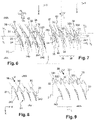
figures 5-9 schématisent diverses formes de profils à serrations à dents fixes conformes à l'invention ; - les
figures 10-11 schématisent une hypothèse de profils à serrations à dents à orientation variable, et - la
figure 12 schématise un aéronef porteur de structures conformes à l'invention. - Si l'on se reporte à la
figure 1 , un turboréacteur 10 d'aéronef 100 est représenté de façon très schématique et est défini comme suit :
La nacelle 12 sert d'enveloppe extérieure aux différents organes, parmi lesquels, à l'avant (à gauche sur lafigure 1 ) une soufflante 14 amont (AM) dont des aubes tournent autour de l'axe X. - En aval (AV) de la soufflante 14, le flux d'air (localement schématisé 38
figure 4 ) est séparé par le bec séparateur 16 d'une paroi annulaire 160 en un flux d'air primaire et un flux d'air secondaire. Le flux d'air primaire parcourt un passage d'air annulaire interne ou veine primaire 18 en pénétrant dans le compresseur basse pression 22 au niveau des aubes directrices d'entrée 24 IGV, dites aussi premières aubes. Le flux d'air secondaire est dévié par le bec séparateur 16 dans un passage d'air annulaire externe 20 (veine secondaire) en direction des aubes directrices de sortie 26 OGV, dites aussi secondes aubes, puis vers la sortie du moteur. - Sur la
figure 2 , on visualise de façon plus précise la partie amont 161 du bec séparateur 16 comprenant le bord d'attaque 164a situé le plus en amont et au niveau duquel la paroi externe 162 du bec séparateur 16 rejoint la paroi interne 163 du bec séparateur 16, la paroi supérieure 162 formant la virole intérieure de la veine secondaire 20. - A toutes fins, il est précisé que, dans le présent texte, est axial ce qui s'étend suivant ou parallèlement à l'axe longitudinal (X) de rotation de la partie concernée de la turbomachine, lequel axe sera a priori l'axe général de rotation de cette turbomachine et l'axe longitudinal de l'aéronef, comme celui de l'avion schématisé
figure 12 . Est radial (axe Z) et est circonférentiel ce qui s'étend radialement à l'axe X et autour de lui, respectivement. Est interne ou intérieur et externe ou extérieur ce qui l'est radialement, vis-à-vis de l'axe X. Ainsi, la paroi interne 163 est la paroi radialement interne du bec séparateur 16. Par ailleurs, les références amont et aval sont à considérer en liaison avec l'écoulement des gaz dans la (partie de) turbomachine considérée : ces gaz entrent à l'amont et sortent à l'aval, en circulant globalement parallèlement à l'axe X. - En outre, les dessins joints, et les descriptions qui s'y rapportent, ont été définis en référence au repère orthogonal conventionnel X-Y-Z, avec donc l'axe X comme ci-dessus défini.
- Le bec séparateur 16 est creux, la face extérieure de la paroi 162 servant de limite interne au passage d'air annulaire externe 20 recevant le flux secondaire tandis que la face intérieure de la paroi 163 sert de limite externe au passage d'air annulaire interne 18 recevant le flux primaire.
- La paroi intérieure 163 du bec séparateur 16 forme la virole extérieure du compresseur basse pression 22.
- Même si le décalage axial (X) vers l'aval des aubes IGV 24 par rapport au bord d'attaque 164a du bec séparateur 16 est moindre par comparaison avec celui des aubes OGV 26 par rapport à ce même bord d'attaque 164a, la portion de la partie amont 161 directement adjacente au bord d'attaque 164a du bec séparateur 16 est dégagée.
- Comme expliqué ci-avant, pour l'effet induit de gestion aéro-acoustique par limitation du bruit généré par cette zone, on peut donc prévoir que ce bord d'attaque 164a ait un profil 28 à serrations présentant une succession de dents 30 et de creux 32, comme illustré dans les exemples des
figures 5-6 , par exemple. - Mais des structures autres que sur une turbomachine, telle le turboréacteur 10, peuvent être concernées par la solution de l'invention et présenter un bord d'attaque et/ou de fuite à profil 28 à serrations présentant une succession de dents 30 et de creux 32 bénéficiant de tout ou partie des caractéristiques de l'invention revendiquée, lesquelles caractéristiques leurs seraient alors appliquées au lieu de l'être à une turbomachine, comme revendiqué.
- La
figure 12 schématise ainsi un aéronef 100 sur lequel des structures à tels profils 28 à serrations sont présentes, en bord d'attaque, sur les ailes 38, sur un pylône 41 de support d'un moteur 42 de l'aéronef, sur une dérive 44, un stabilisateur 46, une hélice ou aube 48 de turboréacteur, typiquement d'open-rotor. - Par ailleurs, la
figure 3 schématise localement un profil 28 en serrations présent sur ce qui peut être, repéré 50, une pale d'hélicoptère, une aube de la soufflante, du rotor ou du redresseur, un bec de bord d'attaque ou un volet d'aile d'aéronef. - Tous ces profils aérodynamiques ont pour point commun de générer une couche limite sur la surface en aval, et donc un écoulement turbulent.
- Quelle que soit l'application, concernant un profil 28 quelconque à serrations, on va ici considérer qu'il présente des ondulations qui définissent :
- suivant une direction (L) d'allongement du bord d'attaque ou bord de fuite, une géométrie élémentaire qui se répète, deux ondulations identiques (ou quasi-identiques, quand deux dents consécutives présentent de petites variations de géométries, à +/- 30%) de deux géométries élémentaires successives, telles que 34, 36
figures 5 ,7 , suivant ladite direction L présentant entre elles, suivant cette direction, une même distance, À, et - une amplitude maximale, h, perpendiculairement à cette direction L.
- Il est en outre précisé que la direction L est la direction le long de laquelle s'étend la ligne de bord d'attaque que l'on peut confondre avec le bord d'attaque 164a si on le considère sur toute sa longueur. Cette direction L peut être rectiligne (cas par exemple d'une aile, d'une dérive, d'un stabilisateur), ou courbe, voire fermée sur elle-même (cas possible par exemple d'une hélice, d'une aube de soufflante, de rotor ou de redresseur, ou du bec séparateur 16).
- Conformément à l'invention, pour atténuer les fluctuations de pression localement intense, on va donc prévoir sur la structure profilée concernée que, le long du bord d'attaque 164a et/ou de fuite 164b (voir
figure 12 ) et donc de la direction L d'allongement, depuis un premier endroit 21 vers un second endroit 23, les dents 30 du profil en serrations soient individuellement inclinées vers le second endroit : angle αfigure 12 , hors influence d'une soufflante, et angle βfigures 6-7 . -
Figures 6, 7 , on voit schématisée une proposition ci-avant formulée selon laquelle les IGV 24 seraient inclinés dans le plan X-Y par rapport à l'axe X ; angle β. Les dents 30 sont, circonférentiellement autour de cet axe X, inclinées chacune du même angle β (mais cet angle pourrait varier), dans la même direction que celle, commune, des IGV 24. On a en effet, ici, tenu compte de l'influence de la rotation de la soufflante 14, laquelle est supposée tourner dans le sens positif de l'axe Y (voirfigure 1 et pointe de flèche suivant la direction Lfigure 2 ). - Un angle α ou β compris entre 30 et 60° par rapport à l'axe X, de préférence entre 35 et 45°, serait approprié, eu égard aux premiers résultats de tests menés. Ceci n'est pas limitatif.
- Ainsi, tant les (bords d'attaque des) IGV 24 que les (bords d'attaque des) dents 30 font de fait globalement face au flux d'air 38 dont l'orientation globale oblique (ici par rapport à l'axe X) U est le résultat de ses composantes Ux suivant X et Uy suivant Y, compte tenu du sens ici convenu de rotation de la soufflante 14.
- Les dents 30 sont individuellement non symétriques axialement par rapport à une parallèle audit axe général X, cette parallèle passant là encore par le sommet 31 de la dent considérée.
- Le but de ces orientations peut être considéré comme double.
- Premièrement, il s'agit d'éviter l'interaction entre l'écoulement accéléré et turbulent produit dans les creux 32 et le bord d'attaque 25 des IGV. Ceci peut en effet contribuer de manière significative au bruit à large bande du compresseur basse pression 22. Deuxièmement, la solution technique pourra servir à optimiser l'entrée d'air de compresseur basse pression 22 et de réduire les pertes aérodynamiques éventuelles.
- Comme montré aussi
figures 6-7 , lesdites premières aubes/IGV 24 pourront présenter individuellement une ligne 240 de cambrure moyenne le long de leur corde, pour tenir compte de l'influence de la rotation de la soufflante 14. - L'angle d'inclinaison de l'écoulement produit par la soufflante 14 dépend du régime moteur, donc de la vitesse de rotation de la soufflante.
- Aussi, envisage-t-on d'orienter les dents 30 dans la direction de la cambrure moyenne des IGV ou de la cambrure au niveau du bord d'attaque 25 de ces aubes. Les valeurs d'angles retenues pourront être moyennées le long de l'envergure ou allongement des IGV ou prendre les valeurs de la cambrure des IGV en tête d'aube, ou encore être fixées au régime de fonctionnement de la turbomachine le plus intéressant du point de vue aéro-acoustique.
- Comme illustré et dans cet exemple, l'extrados 241 est dirigé vers la direction positive Y, l'intrados du côté opposé.
- Pour encore limiter l'impact acoustique sur les IGV 24 du flux d'air tourbillonnant que la soufflante 14 génère donc en aval, il est aussi proposé, comme montré
figures 6-7 notamment, que les dents 30 soient, circonférentiellement autour dudit axe général X, orientées globalement dans la direction d'une tangente 43 à ladite ligne 240 de cambrure moyenne des aubes IGV 24, au niveau de leurs bords d'attaque 25. La tangente forme un angle (β) non nul par rapport à la direction de l'axe général (X) de la turbomachine. - Un avantage est alors d'aligner les dents 30 dans la direction de la cambrure des IGV et de nouveau de pouvoir adapter la géométrie de l'entrée d'air du compresseur 22 à son environnement. La direction de l'écoulement d'air à l'aval de la soufflante 12 dépendant de sa vitesse de rotation, aligner les dents dans la direction des IGV (qui sont une partie fixe) pourrait donc être un bon compromis entre vitesses variables et géométries à figer.
- Le long de l'axe général X, les dents 30 pourront en particulier être situées en amont par rapport aux bords d'attaque des aubes IGV 24, comme on le constate
figure 7 . - Toutefois, pour une limitation dimensionnelle pouvant exister entre le bord d'attaque du bec et les aubes IGV (typiquement de l'ordre de 1-5 cm), ainsi que pour avoir la possibilité d'augmenter la taille/l'amplitude des dents 30, il est proposé que, toujours dans cette direction de l'axe X, les fonds 320 des creux 32 du profil 28 à serrations appartiennent au moins pour certains à une première surface, transversale audit axe X, repérée Y1
figure 6 et Y2figure 7 , positionnée au niveau (figure 6 ) ou plus en aval (AV ;figure 9 ) qu'une seconde surface également transversale à l'axe X, repérée Y'1figure 6 et Y'2figure 7 , à laquelle appartiennent au moins certains des bords d'attaque 25 des aubes IGV 24. Malgré les illustrations, ceci est a priori indépendant de la forme des (sommets des) dents 30 et des (fonds 320 des) creux 32. - A ce sujet, les dents 30 et creux 32 du profil 28 à serrations présenteront individuellement une forme ondulée, avec des sommets arrondis (
figures 6, 9 ou11 par exemple) ou pointus (figure 7 ), ceci pour favoriser une réduction de bruit efficace en minimisant les contraintes mécaniques supportées par cette géométrie. - Quant aux formes des parois latérales (dont l'une est repérée 300
figure 7 ) de ces dents 30 et creux 32, elles pourront se présenter individuellement et localement comme rectilignes (figure 7 ), ceci pour favoriser la décorrélation des sources de bruit le long du bord d'attaque et pour faciliter la fabrication de cette géométrie. - Les pointillés sur la
figure 10 schématisent le fait que les inclinaisons des dents 30 du profil en serrations pourraient varier en fonction du régime moteur de la turbomachine et/ou des phases de fonctionnement de l'aéronef (typiquement phases de vol). Dans l'exemple, il s'agit d'OGV 26. - Un mécanisme commun par pivotement des dents 30, piloté par une logique de commande couplée avec par exemple un asservissement tenant compte du régime moteur, pourrait alors permettre de faire varier leurs inclinaisons, le long la direction d'allongement L, autour d'axes parallèles entre eux mais perpendiculaires à cette direction d'allongement L (voir un de ces axes repéré 30a
figures 10 et 11 ). - Ainsi, comme schématisé
figure 11 , pourra-t-on avoir une géométrie 28, par exemple d'un bec à bord d'attaque ondulé, avec une inclinaison variable des dents 30, en fonction du régime moteur. Sur cette figure sont schématisées une représentation simplifiée des lignes de courant du flux d'air 38 et des aubes IGV 24, avec des orientations ici « en opposition angulaires » entre celle des IGV et celle des dents 30 : dents 30 orientées en oblique vers le côté 23, IGV 24 orientées en oblique vers le côté 21, dans cet exemple. - Par ailleurs, les dents 30 étant disposées de façon périodique le long de la direction d'allongement L, elles peuvent être toutes identiques, comme
figure 6 ou 7 . Tout en conservant une structure profilée à forme ondulée périodique, on peut toutefois prévoir, commefigure 9 , des (groupes de) dents (successives) 30 qui, au sein de certaines au moins des périodes, soient différentes entre elles (voire dents 301 et 302 par exemple) ; de même pour les creux entre eux (voire creux 321 et 322 par exemple). - Ainsi, la géométrie élémentaire sera à plusieurs ondulations, deux dans l'exemple.
- De la sorte, sans qu'elles soient mobiles, les dents du profil pourraient plus finement être adaptées à la complexité et à la variabilité des flux d'air reçus.
- Encore sur un bec 16, pour bénéficier d'une aérodynamique favorable notamment à l'entrée d'air du compresseur basse pression 22, il est par ailleurs prévu qu'autour de l'axe X, certains au moins des creux 32 du profil 28 à serrations puissent être décalés angulairement (circonférentiellement) par rapport à la position angulaire des aubes IGV 24, de telle sorte que, dans la direction L, ces creux 32 soient interposés entre deux premières aubes IGV 24 circonférentiellement successives, comme illustré
figures 8-9 . - Sur ces figures, les IGV 24 sont même placés axialement (X) dans la continuité des dents 30 ; plus précisément chaque corde 242 d'IGV 24 a été placée, suivant la direction générale U de l'écoulement d'air 38 qui l'impacte, sensiblement dans l'alignement du sommet de la dent 30 qui précède cet IGV, vers l'amont (AM).
- Si les explications et commentaires ci-avant ont été faits, en relation avec les figures présentées, essentiellement en référence à des situations en bord d'attaque, des bords de fuite pourraient être concernés, en alternative ou complément, tel des (lignes de) bords de fuite 164b à profil 28 en serrations d'aile, comme montré
figure 12 . - Au bord de fuite, la source de bruit peut typiquement être liée à l'interaction entre la turbulence dans la couche limite du profil et ce bord de fuite.
- On aura compris que, de façon générale, les solutions proposées ci-avant ont eu pour objectif(s) d'optimiser l'orientation des dents d'un dit profil aérodynamiques 28 en serrations pour réduire le bruit à large bande produit par ces profils (aubes, OGV, IGVs, bec, ...etc) en minimisant l'impact sur les propriétés aérodynamiques des structures qui les portent et/ou environnantes, en particulier celles situées en aval.
Claims (6)
- Turbomachine (10) pour aéronef,- la turbomachine présentant un axe général (X) autour duquel tournent des parties rotatives de la turbomachine, dont des aubes d'une soufflante amont (14),- la turbomachine comprenant, qui chacune présente un bord d'attaque (164a) :-- une paroi (160) annulaire de séparation d'un flux d'air, en aval de la soufflante amont (14), la paroi (160) annulaire de séparation séparant le flux d'air en un flux primaire et un flux secondaire,-- des premières aubes (24,IGV) fixes de guidage du flux primaire (Fp) dans la turbomachine, et-- des secondes aubes (26,OGV) fixes de guidage du flux secondaire dans la turbomachine, les premières aubes (24,IGV) fixes de guidage du flux primaire (Fp) et les secondes aubes (26,OGV) fixes de guidage du flux secondaire (Fs) étant liées à la paroi (160) annulaire de séparation, et- la turbomachine étant pourvue d'au moins une structure profilée,-- ayant un profil (28) de bord d'attaque (164a) en serrations présentant une succession de dents (30) et de creux (32), et-- telle que, le long du bord d'attaque (164a), depuis un premier endroit (21) vers un second endroit (23), les dents (30) du profil en serrations sont individuellement inclinées vers le second endroit, la turbomachine étant caractérisée en ce que ;a) les dents (30) sont, circonférentiellement autour dudit axe général (X) et en aval de la soufflante amont, individuellement inclinées (β) vers une orientation (U,42) globalement oblique du flux d'air (38) par rapport audit axe général (X), pour lui faire globalement face, oub) sur la paroi (160) annulaire de séparation du flux d'air où elles sont présentes, les dents sont orientées dans la direction de la ligne (240) de cambrure des premières aubes (24,IGV) fixes, au niveau du bord d'attaque, ouc) autour dudit axe général (X), certains au moins desdits creux (32) du profil (28) à serrations sont décalés angulairement par rapport à la position angulaire des premières aubes (24, IGV) fixes de guidage du flux primaire (Fp) dans la turbomachine, de telle sorte que lesdits certains au moins des creux (32) soient angulairement interposés entre deux premières aubes (24, IGV) circonférentiellement successives.
- Turbomachine selon la revendication 1, dans laquelle les dents (30) et creux (32) du profil en serrations présentent individuellement une forme ondulée, avec des sommets (31) arrondis ou plus pointus.
- Turbomachine selon l'une quelconque des revendications précédentes, dans laquelle les dents (30) et creux (32) du profil en serrations présentent individuellement une forme à parois latérales (300) localement rectilignes.
- Turbomachine selon la revendication 2 ou les revendications 2 et 3, dans laquelle la forme ondulée est périodique et présente, dans certaines au moins des périodes, des dents (30) différentes entre elles et/ou des creux (32) différents entre eux.
- Turbomachine selon l'une quelconque des revendications précédentes, dans laquelle les inclinaisons individuelles (β) des dents (30) du profil en serrations varient en fonction d'un régime moteur de la turbomachine.
- Aéronef (100) comprenant une turbomachine (1) pour se déplacer, selon l'une quelconque des revendications 1 à 5.
Applications Claiming Priority (2)
| Application Number | Priority Date | Filing Date | Title |
|---|---|---|---|
| FR1851359A FR3078098B1 (fr) | 2018-02-16 | 2018-02-16 | Structure a profil en serrations inclinees |
| PCT/FR2019/050349 WO2019158875A1 (fr) | 2018-02-16 | 2019-02-15 | Turbomachine à bec de séparation de flux à profil en serrations inclinées |
Publications (2)
| Publication Number | Publication Date |
|---|---|
| EP3752728A1 EP3752728A1 (fr) | 2020-12-23 |
| EP3752728B1 true EP3752728B1 (fr) | 2022-07-20 |
Family
ID=61873595
Family Applications (1)
| Application Number | Title | Priority Date | Filing Date |
|---|---|---|---|
| EP19710752.7A Active EP3752728B1 (fr) | 2018-02-16 | 2019-02-15 | Turbomachine pour aéronef et aéronef associé |
Country Status (5)
| Country | Link |
|---|---|
| US (2) | US11629664B2 (fr) |
| EP (1) | EP3752728B1 (fr) |
| CN (2) | CN111771048B (fr) |
| FR (1) | FR3078098B1 (fr) |
| WO (1) | WO2019158875A1 (fr) |
Families Citing this family (21)
| Publication number | Priority date | Publication date | Assignee | Title |
|---|---|---|---|---|
| FR3078098B1 (fr) * | 2018-02-16 | 2020-06-19 | Safran Aircraft Engines | Structure a profil en serrations inclinees |
| JP7346347B2 (ja) * | 2020-03-25 | 2023-09-19 | 三菱重工業株式会社 | 翼及び航空機 |
| CN113833568B (zh) * | 2020-06-24 | 2022-09-06 | 中国航发商用航空发动机有限责任公司 | 分流环、航空发动机以及分流环制造方法 |
| CN114506443B (zh) * | 2022-02-23 | 2023-06-23 | 北京航空航天大学 | 具备导引结构的叶片、转子以及叶片设计方法 |
| CN114459769B (zh) * | 2022-04-14 | 2022-07-12 | 中国空气动力研究与发展中心低速空气动力研究所 | 一种小型涡喷发动机地面推力矢量标定装置 |
| US12577926B2 (en) | 2022-08-02 | 2026-03-17 | General Electric Company | Gas turbine engine |
| GB202216057D0 (en) * | 2022-10-31 | 2022-12-14 | Rolls Royce Plc | Flow splitter |
| US12012898B2 (en) | 2022-11-03 | 2024-06-18 | General Electric Company | Gas turbine engine with acoustic spacing of the fan blades and outlet guide vanes |
| FR3151628A1 (fr) | 2023-07-26 | 2025-01-31 | Safran Aircraft Engines | Soufflante pour propulsion aéronautique |
| FR3151570A1 (fr) | 2023-07-26 | 2025-01-31 | Safran Aircraft Engines | Soufflante non-carénée pour propulsion aéronautique |
| FR3155209B1 (fr) | 2023-11-14 | 2025-11-07 | Safran Aircraft Engines | Soufflante pour propulsion aéronautique |
| FR3155208A1 (fr) | 2023-11-14 | 2025-05-16 | Safran Aircraft Engines | Soufflante pour propulsion aéronautique |
| FR3162789A1 (fr) | 2024-05-29 | 2025-12-05 | Safran Aircraft Engines | Pale de soufflante pour propulsion aéronautique |
| US12428962B1 (en) | 2024-06-14 | 2025-09-30 | General Electric Company | Gas turbine engine with acoustic spacing of the fan blades and outlet guide vanes |
| US12421854B1 (en) * | 2024-06-14 | 2025-09-23 | General Electric Company | Gas turbine engine with acoustic spacing of the fan blades and outlet guide vanes |
| US12429067B1 (en) | 2024-06-14 | 2025-09-30 | General Electric Company | Gas turbine engine with acoustic spacing of the fan blades and outlet guide vanes |
| US12510104B2 (en) | 2024-06-14 | 2025-12-30 | General Electric Company | Gas turbine engine with acoustic spacing of the fan blades and outlet guide vanes |
| US12560125B2 (en) | 2024-06-14 | 2026-02-24 | General Electric Company | Gas turbine engine with acoustic spacing of the fan blades and outlet guide vanes |
| US12292017B1 (en) * | 2024-06-14 | 2025-05-06 | General Electric Company | Gas turbine engine with acoustic spacing of the fan blades and outlet guide vanes |
| US12497923B1 (en) | 2024-06-14 | 2025-12-16 | General Electric Company | Gas turbine engine with acoustic spacing of the fan blades and outlet guide vanes |
| CN119858651B (zh) * | 2025-03-04 | 2026-03-24 | 中山大学 | 一种基于仿生结构的涵道风扇 |
Citations (1)
| Publication number | Priority date | Publication date | Assignee | Title |
|---|---|---|---|---|
| EP1602575A2 (fr) * | 2004-06-01 | 2005-12-07 | Deutsches Zentrum für Luft- und Raumfahrt e.V. | Élément portant ou de guidage |
Family Cites Families (8)
| Publication number | Priority date | Publication date | Assignee | Title |
|---|---|---|---|---|
| US1862827A (en) * | 1930-01-22 | 1932-06-14 | Parsons | Steam turbine |
| US3403893A (en) * | 1967-12-05 | 1968-10-01 | Gen Electric | Axial flow compressor blades |
| FR2857416B1 (fr) * | 2003-07-09 | 2007-05-25 | Snecma Moteurs | Dispositif de reduction du bruit de jet d'une turbomachine |
| US7520124B2 (en) * | 2006-09-12 | 2009-04-21 | United Technologies Corporation | Asymmetric serrated nozzle for exhaust noise reduction |
| CN101716995A (zh) * | 2009-10-12 | 2010-06-02 | 章成谊 | 波形翼与物体的波形表面 |
| GB201512688D0 (en) * | 2015-07-20 | 2015-08-26 | Rolls Royce Plc | Aerofoil |
| GB2545711B (en) * | 2015-12-23 | 2018-06-06 | Rolls Royce Plc | Gas turbine engine vane splitter |
| FR3078098B1 (fr) * | 2018-02-16 | 2020-06-19 | Safran Aircraft Engines | Structure a profil en serrations inclinees |
-
2018
- 2018-02-16 FR FR1851359A patent/FR3078098B1/fr not_active Expired - Fee Related
-
2019
- 2019-02-15 CN CN201980013743.3A patent/CN111771048B/zh active Active
- 2019-02-15 CN CN202310193981.5A patent/CN116291944A/zh active Pending
- 2019-02-15 US US16/969,630 patent/US11629664B2/en active Active
- 2019-02-15 EP EP19710752.7A patent/EP3752728B1/fr active Active
- 2019-02-15 WO PCT/FR2019/050349 patent/WO2019158875A1/fr not_active Ceased
-
2023
- 2023-03-14 US US18/183,232 patent/US11913405B2/en active Active
Patent Citations (1)
| Publication number | Priority date | Publication date | Assignee | Title |
|---|---|---|---|---|
| EP1602575A2 (fr) * | 2004-06-01 | 2005-12-07 | Deutsches Zentrum für Luft- und Raumfahrt e.V. | Élément portant ou de guidage |
Also Published As
| Publication number | Publication date |
|---|---|
| US11913405B2 (en) | 2024-02-27 |
| EP3752728A1 (fr) | 2020-12-23 |
| WO2019158875A1 (fr) | 2019-08-22 |
| CN111771048A (zh) | 2020-10-13 |
| FR3078098B1 (fr) | 2020-06-19 |
| CN111771048B (zh) | 2023-04-18 |
| CN116291944A (zh) | 2023-06-23 |
| FR3078098A1 (fr) | 2019-08-23 |
| US11629664B2 (en) | 2023-04-18 |
| US20200400069A1 (en) | 2020-12-24 |
| US20230213000A1 (en) | 2023-07-06 |
Similar Documents
| Publication | Publication Date | Title |
|---|---|---|
| EP3752728B1 (fr) | Turbomachine pour aéronef et aéronef associé | |
| EP3752729B1 (fr) | Structure profilée d'écoulement d'air et turbomachine pour aéronef | |
| EP3867498B1 (fr) | Structure profilee pour aeronef ou turbomachine | |
| EP2839168B1 (fr) | Carter pour roue a aubes de turbomachine ameliore et turbomachine equipee dudit carter | |
| EP3256697B1 (fr) | Ensemble de redressement d'air de turbomachine à performances aerodynamiques améliorées | |
| CA2975570C (fr) | Ensemble de redressement a performances aerodynamiques optimisees | |
| FR3087483A1 (fr) | Structure profilee pour aeronef ou turbomachine pour aeronef | |
| CA2837829A1 (fr) | Pale, en particulier a calage variable, helice comprenant de telles pales, et turbomachine correspondante | |
| FR2999151A1 (fr) | Pale d'helice pour turbomachine | |
| EP4077880B1 (fr) | Module pour turbomachine | |
| WO2017017392A1 (fr) | Ensemble de redressement de flux d'air a performances aerodynamiques ameliorees | |
| WO2023021258A1 (fr) | Pièce statorique d'une turbomachine comprenant une pale et une ailette définissant entre elles une surface décroissante d'amont en aval selon le sens d'écoulement des gaz | |
| EP4278075A1 (fr) | Ensemble propulsif pour aeronef comprenant une aube de redresseur intégrée à une partie amont d'un mat d'accrochage de hauteur réduite | |
| EP3829975B1 (fr) | Turbomachine à hélices coaxiales | |
| EP4508311B1 (fr) | Pièce statorique à ailette dans une turbomachine | |
| EP4301969B1 (fr) | Entrée d'air de nacelle d'ensemble propulsif d'aéronef pour favoriser une phase de poussée et une phase d'inversion de poussée et son procédé d'utilisation | |
| FR3143070A1 (fr) | Propulseur aeronautique comprenant une aube presentant des reliefs | |
| WO2017187093A1 (fr) | Ensemble de redressement de flux d'air et turbomachine comprenant un tel ensemble | |
| EP4025789A1 (fr) | Moyeu polysphérique de turbomachine pour pales à calage variable | |
| WO2025093843A1 (fr) | Aube de redresseur avec une fente | |
| EP4571076A1 (fr) | Module de turbomachine comprenant des aubes rotoriques et des ailettes, et turbomachine correspondante | |
| WO2025125742A1 (fr) | Module de turbomachine comprenant des aubes rotoriques a calage variable et des ailettes montees sur un rotor, et turbomachine correspondante | |
| FR3163691A1 (fr) | Composant de turbomachine | |
| BE1028097A1 (fr) | Aube de compresseur de turbomachine, compresseur et turbomachine munis de celle-ci | |
| FR3131732A1 (fr) | Ensemble propulsif a helice pour aeronef, comprenant une aube de stator integree a une partie d’extremite amont d’un mat d’accrochage de hauteur reduite |
Legal Events
| Date | Code | Title | Description |
|---|---|---|---|
| STAA | Information on the status of an ep patent application or granted ep patent |
Free format text: STATUS: UNKNOWN |
|
| STAA | Information on the status of an ep patent application or granted ep patent |
Free format text: STATUS: THE INTERNATIONAL PUBLICATION HAS BEEN MADE |
|
| PUAI | Public reference made under article 153(3) epc to a published international application that has entered the european phase |
Free format text: ORIGINAL CODE: 0009012 |
|
| STAA | Information on the status of an ep patent application or granted ep patent |
Free format text: STATUS: REQUEST FOR EXAMINATION WAS MADE |
|
| 17P | Request for examination filed |
Effective date: 20200722 |
|
| AK | Designated contracting states |
Kind code of ref document: A1 Designated state(s): AL AT BE BG CH CY CZ DE DK EE ES FI FR GB GR HR HU IE IS IT LI LT LU LV MC MK MT NL NO PL PT RO RS SE SI SK SM TR |
|
| AX | Request for extension of the european patent |
Extension state: BA ME |
|
| DAV | Request for validation of the european patent (deleted) | ||
| DAX | Request for extension of the european patent (deleted) | ||
| GRAP | Despatch of communication of intention to grant a patent |
Free format text: ORIGINAL CODE: EPIDOSNIGR1 |
|
| STAA | Information on the status of an ep patent application or granted ep patent |
Free format text: STATUS: GRANT OF PATENT IS INTENDED |
|
| INTG | Intention to grant announced |
Effective date: 20210901 |
|
| GRAJ | Information related to disapproval of communication of intention to grant by the applicant or resumption of examination proceedings by the epo deleted |
Free format text: ORIGINAL CODE: EPIDOSDIGR1 |
|
| STAA | Information on the status of an ep patent application or granted ep patent |
Free format text: STATUS: REQUEST FOR EXAMINATION WAS MADE |
|
| INTC | Intention to grant announced (deleted) | ||
| GRAS | Grant fee paid |
Free format text: ORIGINAL CODE: EPIDOSNIGR3 |
|
| STAA | Information on the status of an ep patent application or granted ep patent |
Free format text: STATUS: GRANT OF PATENT IS INTENDED |
|
| GRAP | Despatch of communication of intention to grant a patent |
Free format text: ORIGINAL CODE: EPIDOSNIGR1 |
|
| INTG | Intention to grant announced |
Effective date: 20220208 |
|
| GRAJ | Information related to disapproval of communication of intention to grant by the applicant or resumption of examination proceedings by the epo deleted |
Free format text: ORIGINAL CODE: EPIDOSDIGR1 |
|
| GRAL | Information related to payment of fee for publishing/printing deleted |
Free format text: ORIGINAL CODE: EPIDOSDIGR3 |
|
| STAA | Information on the status of an ep patent application or granted ep patent |
Free format text: STATUS: REQUEST FOR EXAMINATION WAS MADE |
|
| GRAP | Despatch of communication of intention to grant a patent |
Free format text: ORIGINAL CODE: EPIDOSNIGR1 |
|
| STAA | Information on the status of an ep patent application or granted ep patent |
Free format text: STATUS: GRANT OF PATENT IS INTENDED |
|
| INTC | Intention to grant announced (deleted) | ||
| GRAS | Grant fee paid |
Free format text: ORIGINAL CODE: EPIDOSNIGR3 |
|
| GRAA | (expected) grant |
Free format text: ORIGINAL CODE: 0009210 |
|
| STAA | Information on the status of an ep patent application or granted ep patent |
Free format text: STATUS: THE PATENT HAS BEEN GRANTED |
|
| INTG | Intention to grant announced |
Effective date: 20220603 |
|
| AK | Designated contracting states |
Kind code of ref document: B1 Designated state(s): AL AT BE BG CH CY CZ DE DK EE ES FI FR GB GR HR HU IE IS IT LI LT LU LV MC MK MT NL NO PL PT RO RS SE SI SK SM TR |
|
| REG | Reference to a national code |
Ref country code: CH Ref legal event code: EP |
|
| REG | Reference to a national code |
Ref country code: DE Ref legal event code: R096 Ref document number: 602019017208 Country of ref document: DE |
|
| REG | Reference to a national code |
Ref country code: AT Ref legal event code: REF Ref document number: 1505654 Country of ref document: AT Kind code of ref document: T Effective date: 20220815 |
|
| REG | Reference to a national code |
Ref country code: IE Ref legal event code: FG4D Free format text: LANGUAGE OF EP DOCUMENT: FRENCH |
|
| REG | Reference to a national code |
Ref country code: LT Ref legal event code: MG9D |
|
| REG | Reference to a national code |
Ref country code: NL Ref legal event code: MP Effective date: 20220720 |
|
| PG25 | Lapsed in a contracting state [announced via postgrant information from national office to epo] |
Ref country code: SE Free format text: LAPSE BECAUSE OF FAILURE TO SUBMIT A TRANSLATION OF THE DESCRIPTION OR TO PAY THE FEE WITHIN THE PRESCRIBED TIME-LIMIT Effective date: 20220720 Ref country code: RS Free format text: LAPSE BECAUSE OF FAILURE TO SUBMIT A TRANSLATION OF THE DESCRIPTION OR TO PAY THE FEE WITHIN THE PRESCRIBED TIME-LIMIT Effective date: 20220720 Ref country code: PT Free format text: LAPSE BECAUSE OF FAILURE TO SUBMIT A TRANSLATION OF THE DESCRIPTION OR TO PAY THE FEE WITHIN THE PRESCRIBED TIME-LIMIT Effective date: 20221121 Ref country code: NO Free format text: LAPSE BECAUSE OF FAILURE TO SUBMIT A TRANSLATION OF THE DESCRIPTION OR TO PAY THE FEE WITHIN THE PRESCRIBED TIME-LIMIT Effective date: 20221020 Ref country code: NL Free format text: LAPSE BECAUSE OF FAILURE TO SUBMIT A TRANSLATION OF THE DESCRIPTION OR TO PAY THE FEE WITHIN THE PRESCRIBED TIME-LIMIT Effective date: 20220720 Ref country code: LV Free format text: LAPSE BECAUSE OF FAILURE TO SUBMIT A TRANSLATION OF THE DESCRIPTION OR TO PAY THE FEE WITHIN THE PRESCRIBED TIME-LIMIT Effective date: 20220720 Ref country code: LT Free format text: LAPSE BECAUSE OF FAILURE TO SUBMIT A TRANSLATION OF THE DESCRIPTION OR TO PAY THE FEE WITHIN THE PRESCRIBED TIME-LIMIT Effective date: 20220720 Ref country code: FI Free format text: LAPSE BECAUSE OF FAILURE TO SUBMIT A TRANSLATION OF THE DESCRIPTION OR TO PAY THE FEE WITHIN THE PRESCRIBED TIME-LIMIT Effective date: 20220720 Ref country code: ES Free format text: LAPSE BECAUSE OF FAILURE TO SUBMIT A TRANSLATION OF THE DESCRIPTION OR TO PAY THE FEE WITHIN THE PRESCRIBED TIME-LIMIT Effective date: 20220720 |
|
| REG | Reference to a national code |
Ref country code: AT Ref legal event code: MK05 Ref document number: 1505654 Country of ref document: AT Kind code of ref document: T Effective date: 20220720 |
|
| PG25 | Lapsed in a contracting state [announced via postgrant information from national office to epo] |
Ref country code: PL Free format text: LAPSE BECAUSE OF FAILURE TO SUBMIT A TRANSLATION OF THE DESCRIPTION OR TO PAY THE FEE WITHIN THE PRESCRIBED TIME-LIMIT Effective date: 20220720 Ref country code: IS Free format text: LAPSE BECAUSE OF FAILURE TO SUBMIT A TRANSLATION OF THE DESCRIPTION OR TO PAY THE FEE WITHIN THE PRESCRIBED TIME-LIMIT Effective date: 20221120 Ref country code: HR Free format text: LAPSE BECAUSE OF FAILURE TO SUBMIT A TRANSLATION OF THE DESCRIPTION OR TO PAY THE FEE WITHIN THE PRESCRIBED TIME-LIMIT Effective date: 20220720 Ref country code: GR Free format text: LAPSE BECAUSE OF FAILURE TO SUBMIT A TRANSLATION OF THE DESCRIPTION OR TO PAY THE FEE WITHIN THE PRESCRIBED TIME-LIMIT Effective date: 20221021 |
|
| REG | Reference to a national code |
Ref country code: DE Ref legal event code: R097 Ref document number: 602019017208 Country of ref document: DE |
|
| PG25 | Lapsed in a contracting state [announced via postgrant information from national office to epo] |
Ref country code: SM Free format text: LAPSE BECAUSE OF FAILURE TO SUBMIT A TRANSLATION OF THE DESCRIPTION OR TO PAY THE FEE WITHIN THE PRESCRIBED TIME-LIMIT Effective date: 20220720 Ref country code: RO Free format text: LAPSE BECAUSE OF FAILURE TO SUBMIT A TRANSLATION OF THE DESCRIPTION OR TO PAY THE FEE WITHIN THE PRESCRIBED TIME-LIMIT Effective date: 20220720 Ref country code: DK Free format text: LAPSE BECAUSE OF FAILURE TO SUBMIT A TRANSLATION OF THE DESCRIPTION OR TO PAY THE FEE WITHIN THE PRESCRIBED TIME-LIMIT Effective date: 20220720 Ref country code: CZ Free format text: LAPSE BECAUSE OF FAILURE TO SUBMIT A TRANSLATION OF THE DESCRIPTION OR TO PAY THE FEE WITHIN THE PRESCRIBED TIME-LIMIT Effective date: 20220720 Ref country code: AT Free format text: LAPSE BECAUSE OF FAILURE TO SUBMIT A TRANSLATION OF THE DESCRIPTION OR TO PAY THE FEE WITHIN THE PRESCRIBED TIME-LIMIT Effective date: 20220720 |
|
| PLBE | No opposition filed within time limit |
Free format text: ORIGINAL CODE: 0009261 |
|
| STAA | Information on the status of an ep patent application or granted ep patent |
Free format text: STATUS: NO OPPOSITION FILED WITHIN TIME LIMIT |
|
| PG25 | Lapsed in a contracting state [announced via postgrant information from national office to epo] |
Ref country code: SK Free format text: LAPSE BECAUSE OF FAILURE TO SUBMIT A TRANSLATION OF THE DESCRIPTION OR TO PAY THE FEE WITHIN THE PRESCRIBED TIME-LIMIT Effective date: 20220720 Ref country code: EE Free format text: LAPSE BECAUSE OF FAILURE TO SUBMIT A TRANSLATION OF THE DESCRIPTION OR TO PAY THE FEE WITHIN THE PRESCRIBED TIME-LIMIT Effective date: 20220720 |
|
| 26N | No opposition filed |
Effective date: 20230421 |
|
| PG25 | Lapsed in a contracting state [announced via postgrant information from national office to epo] |
Ref country code: AL Free format text: LAPSE BECAUSE OF FAILURE TO SUBMIT A TRANSLATION OF THE DESCRIPTION OR TO PAY THE FEE WITHIN THE PRESCRIBED TIME-LIMIT Effective date: 20220720 |
|
| PG25 | Lapsed in a contracting state [announced via postgrant information from national office to epo] |
Ref country code: SI Free format text: LAPSE BECAUSE OF FAILURE TO SUBMIT A TRANSLATION OF THE DESCRIPTION OR TO PAY THE FEE WITHIN THE PRESCRIBED TIME-LIMIT Effective date: 20220720 |
|
| PG25 | Lapsed in a contracting state [announced via postgrant information from national office to epo] |
Ref country code: MC Free format text: LAPSE BECAUSE OF FAILURE TO SUBMIT A TRANSLATION OF THE DESCRIPTION OR TO PAY THE FEE WITHIN THE PRESCRIBED TIME-LIMIT Effective date: 20220720 |
|
| REG | Reference to a national code |
Ref country code: CH Ref legal event code: PL |
|
| REG | Reference to a national code |
Ref country code: BE Ref legal event code: MM Effective date: 20230228 |
|
| PG25 | Lapsed in a contracting state [announced via postgrant information from national office to epo] |
Ref country code: LU Free format text: LAPSE BECAUSE OF NON-PAYMENT OF DUE FEES Effective date: 20230215 Ref country code: LI Free format text: LAPSE BECAUSE OF NON-PAYMENT OF DUE FEES Effective date: 20230228 Ref country code: CH Free format text: LAPSE BECAUSE OF NON-PAYMENT OF DUE FEES Effective date: 20230228 |
|
| REG | Reference to a national code |
Ref country code: IE Ref legal event code: MM4A |
|
| PG25 | Lapsed in a contracting state [announced via postgrant information from national office to epo] |
Ref country code: IE Free format text: LAPSE BECAUSE OF NON-PAYMENT OF DUE FEES Effective date: 20230215 |
|
| PG25 | Lapsed in a contracting state [announced via postgrant information from national office to epo] |
Ref country code: BE Free format text: LAPSE BECAUSE OF NON-PAYMENT OF DUE FEES Effective date: 20230228 |
|
| PG25 | Lapsed in a contracting state [announced via postgrant information from national office to epo] |
Ref country code: IT Free format text: LAPSE BECAUSE OF FAILURE TO SUBMIT A TRANSLATION OF THE DESCRIPTION OR TO PAY THE FEE WITHIN THE PRESCRIBED TIME-LIMIT Effective date: 20220720 |
|
| PG25 | Lapsed in a contracting state [announced via postgrant information from national office to epo] |
Ref country code: BG Free format text: LAPSE BECAUSE OF FAILURE TO SUBMIT A TRANSLATION OF THE DESCRIPTION OR TO PAY THE FEE WITHIN THE PRESCRIBED TIME-LIMIT Effective date: 20220720 |
|
| PG25 | Lapsed in a contracting state [announced via postgrant information from national office to epo] |
Ref country code: BG Free format text: LAPSE BECAUSE OF FAILURE TO SUBMIT A TRANSLATION OF THE DESCRIPTION OR TO PAY THE FEE WITHIN THE PRESCRIBED TIME-LIMIT Effective date: 20220720 |
|
| PG25 | Lapsed in a contracting state [announced via postgrant information from national office to epo] |
Ref country code: CY Free format text: LAPSE BECAUSE OF FAILURE TO SUBMIT A TRANSLATION OF THE DESCRIPTION OR TO PAY THE FEE WITHIN THE PRESCRIBED TIME-LIMIT; INVALID AB INITIO Effective date: 20190215 |
|
| PG25 | Lapsed in a contracting state [announced via postgrant information from national office to epo] |
Ref country code: HU Free format text: LAPSE BECAUSE OF FAILURE TO SUBMIT A TRANSLATION OF THE DESCRIPTION OR TO PAY THE FEE WITHIN THE PRESCRIBED TIME-LIMIT; INVALID AB INITIO Effective date: 20190215 |
|
| PG25 | Lapsed in a contracting state [announced via postgrant information from national office to epo] |
Ref country code: TR Free format text: LAPSE BECAUSE OF FAILURE TO SUBMIT A TRANSLATION OF THE DESCRIPTION OR TO PAY THE FEE WITHIN THE PRESCRIBED TIME-LIMIT Effective date: 20220720 |
|
| PGFP | Annual fee paid to national office [announced via postgrant information from national office to epo] |
Ref country code: GB Payment date: 20260219 Year of fee payment: 8 |
|
| PGFP | Annual fee paid to national office [announced via postgrant information from national office to epo] |
Ref country code: DE Payment date: 20260217 Year of fee payment: 8 |
|
| PGFP | Annual fee paid to national office [announced via postgrant information from national office to epo] |
Ref country code: FR Payment date: 20260219 Year of fee payment: 8 |