EP3751362B1 - A method for modeling a compressor speed - Google Patents
A method for modeling a compressor speed Download PDFInfo
- Publication number
- EP3751362B1 EP3751362B1 EP20182237.6A EP20182237A EP3751362B1 EP 3751362 B1 EP3751362 B1 EP 3751362B1 EP 20182237 A EP20182237 A EP 20182237A EP 3751362 B1 EP3751362 B1 EP 3751362B1
- Authority
- EP
- European Patent Office
- Prior art keywords
- compressor
- determining
- boost
- gas
- mass flow
- Prior art date
- Legal status (The legal status is an assumption and is not a legal conclusion. Google has not performed a legal analysis and makes no representation as to the accuracy of the status listed.)
- Active
Links
Images



Classifications
-
- F—MECHANICAL ENGINEERING; LIGHTING; HEATING; WEAPONS; BLASTING
- F01—MACHINES OR ENGINES IN GENERAL; ENGINE PLANTS IN GENERAL; STEAM ENGINES
- F01D—NON-POSITIVE DISPLACEMENT MACHINES OR ENGINES, e.g. STEAM TURBINES
- F01D17/00—Regulating or controlling by varying flow
- F01D17/02—Arrangement of sensing elements
- F01D17/06—Arrangement of sensing elements responsive to speed
-
- G—PHYSICS
- G05—CONTROLLING; REGULATING
- G05B—CONTROL OR REGULATING SYSTEMS IN GENERAL; FUNCTIONAL ELEMENTS OF SUCH SYSTEMS; MONITORING OR TESTING ARRANGEMENTS FOR SUCH SYSTEMS OR ELEMENTS
- G05B17/00—Systems involving the use of models or simulators of said systems
- G05B17/02—Systems involving the use of models or simulators of said systems electric
-
- F—MECHANICAL ENGINEERING; LIGHTING; HEATING; WEAPONS; BLASTING
- F02—COMBUSTION ENGINES; HOT-GAS OR COMBUSTION-PRODUCT ENGINE PLANTS
- F02B—INTERNAL-COMBUSTION PISTON ENGINES; COMBUSTION ENGINES IN GENERAL
- F02B37/00—Engines characterised by provision of pumps driven at least for part of the time by exhaust
- F02B37/12—Control of the pumps
- F02B37/18—Control of the pumps by bypassing exhaust from the inlet to the outlet of turbine or to the atmosphere
-
- F—MECHANICAL ENGINEERING; LIGHTING; HEATING; WEAPONS; BLASTING
- F02—COMBUSTION ENGINES; HOT-GAS OR COMBUSTION-PRODUCT ENGINE PLANTS
- F02B—INTERNAL-COMBUSTION PISTON ENGINES; COMBUSTION ENGINES IN GENERAL
- F02B39/00—Component parts, details, or accessories relating to, driven charging or scavenging pumps, not provided for in groups F02B33/00 - F02B37/00
- F02B39/16—Other safety measures for, or other control of, pumps
-
- F—MECHANICAL ENGINEERING; LIGHTING; HEATING; WEAPONS; BLASTING
- F02—COMBUSTION ENGINES; HOT-GAS OR COMBUSTION-PRODUCT ENGINE PLANTS
- F02B—INTERNAL-COMBUSTION PISTON ENGINES; COMBUSTION ENGINES IN GENERAL
- F02B39/00—Component parts, details, or accessories relating to, driven charging or scavenging pumps, not provided for in groups F02B33/00 - F02B37/00
- F02B39/16—Other safety measures for, or other control of, pumps
- F02B2039/162—Control of pump parameters to improve safety thereof
- F02B2039/168—Control of pump parameters to improve safety thereof the rotational speed of pump or exhaust drive being limited
-
- F—MECHANICAL ENGINEERING; LIGHTING; HEATING; WEAPONS; BLASTING
- F05—INDEXING SCHEMES RELATING TO ENGINES OR PUMPS IN VARIOUS SUBCLASSES OF CLASSES F01-F04
- F05D—INDEXING SCHEME FOR ASPECTS RELATING TO NON-POSITIVE-DISPLACEMENT MACHINES OR ENGINES, GAS-TURBINES OR JET-PROPULSION PLANTS
- F05D2220/00—Application
- F05D2220/40—Application in turbochargers
-
- F—MECHANICAL ENGINEERING; LIGHTING; HEATING; WEAPONS; BLASTING
- F05—INDEXING SCHEMES RELATING TO ENGINES OR PUMPS IN VARIOUS SUBCLASSES OF CLASSES F01-F04
- F05D—INDEXING SCHEME FOR ASPECTS RELATING TO NON-POSITIVE-DISPLACEMENT MACHINES OR ENGINES, GAS-TURBINES OR JET-PROPULSION PLANTS
- F05D2270/00—Control
- F05D2270/70—Type of control algorithm
- F05D2270/708—Type of control algorithm with comparison tables
-
- Y—GENERAL TAGGING OF NEW TECHNOLOGICAL DEVELOPMENTS; GENERAL TAGGING OF CROSS-SECTIONAL TECHNOLOGIES SPANNING OVER SEVERAL SECTIONS OF THE IPC; TECHNICAL SUBJECTS COVERED BY FORMER USPC CROSS-REFERENCE ART COLLECTIONS [XRACs] AND DIGESTS
- Y02—TECHNOLOGIES OR APPLICATIONS FOR MITIGATION OR ADAPTATION AGAINST CLIMATE CHANGE
- Y02T—CLIMATE CHANGE MITIGATION TECHNOLOGIES RELATED TO TRANSPORTATION
- Y02T10/00—Road transport of goods or passengers
- Y02T10/10—Internal combustion engine [ICE] based vehicles
- Y02T10/12—Improving ICE efficiencies
Definitions
- the invention relates to a method for modeling the speed of a compressor, in particular for a turbocharger.
- the invention can be applied in heavy-duty vehicles, such as trucks, buses and construction equipment. Although the invention will be described with respect to a truck, the invention is not restricted to this particular vehicle, but may also be used in other applications utilizing turbocharger units such as aero or marine systems.
- a turbocharger is a vehicle component used together with an associated internal combustion engine, typically a diesel engine.
- the turbocharger is configured to recover a part of the energy of the exhaust gas and to use that energy to compress intake air flowing into the combustion chamber of the internal combustion engine.
- Turbochargers are commonly provided for increasing the efficiency and power of the internal combustion engine.
- a turbocharger has three main components; a turbine for converting energy of the exhaust gas flow to a rotational movement of the turbine, a compressor rotationally connected to the turbine for compressing intake air, and a housing enclosing the turbine and the compressor as well as a rotating shaft, bearings, etc.
- An object of the invention is to provide a method for modeling the compressor speed overcoming the above mentioned drawbacks of prior art methods.
- the object is achieved by a method according to claim 1.
- a method for modelling the compressor speed of a turbocharger comprising i) determining the temperature difference across the compressor, ii) determining the mass flow through the compressor, and iii) calculating a compressor speed value as a function of the temperature difference across the compressor and the mass flow.
- the step of calculating the compressor speed value is performed using N turbo ⁇ dm gas dt R ⁇ T boost ⁇ T in , where N turbo is the compressor speed, dm gas dt is the mass flow, R ⁇ is a corrected ideal gas constant, and T boost - T in is the temperature difference across the compressor.
- N turbo is the compressor speed
- dm gas dt is the mass flow
- R ⁇ is a corrected ideal gas constant
- T boost - T in is the temperature difference across the compressor.
- the method further comprises the step of determining if a recovered exhaust gas flow is introduced downstream the compressor. Further the step of determining the mass flow is performed by determining the mass flow of the gas exiting the compressor and correcting the determined mass flow by a factor corresponding to recovered exhaust gas flow. By introducing the effects caused by recovered exhaust gas flow, the accuracy of the modeling method is improved.
- the step of determining the temperature difference across the compressor is performed by estimating the temperature downstream the compressor, and by subtracting the estimated temperature from a measured ambient temperature. Since it is difficult to arrange a physical temperature sensor close to the compressor, an estimated temperature just downstream the compressor will provide a more accurate value for the resulting temperature difference.
- the step of estimating the temperature downstream the compressor is performed by measuring the temperature in an air inlet manifold, and correcting this temperature by a factor corresponding to the temperature loss across an associated cooler. Hence, accuracy of the speed modeling method is further improved.
- the method further comprises the step of determining the pressure ratio across the compressor. Further, the step of calculating the compressor speed value is performed by calculating the compressor speed value as a function of the pressure ratio.
- the step of determining the pressure ratio across the compressor is performed by determining if the ambient pressure is below a preset ambient pressure corresponding to high altitude conditions, and if so, setting the ambient pressure as the preset ambient pressure, and dividing the boost pressure with the ambient pressure.
- high altitude conditions are also considered. This is highly beneficial for increasing the accuracy of the speed modeling. As there is otherwise a risk of overestimating the compressor speed, this will avoid unnecessary torque derate at higher altitudes as well as wrong calculations for low cycle fatigue.
- the step of calculating the compressor speed value is performed by estimating a compressor speed value using the pressure ratio as input, and calculating a corrected compressor speed value from the estimated compressor speed value and the actual ambient pressure. This has proven to provide an accurate model performance.
- a method for modeling the compressor speed of a turbocharger comprises i) determining the ambient pressure, ii) determining if the ambient pressure is below a preset ambient pressure corresponding to high altitude conditions, and if so, setting the ambient pressure as the preset ambient pressure, iii) determining a pressure ratio from the boost pressure and the ambient pressure, iv) estimating a compressor speed value using the pressure ratio as input, and v) calculating a corrected compressor speed value from the estimated compressor speed value and the actual ambient pressure. Similar to what has been discussed above, this is highly beneficial for increasing the accuracy of the speed modeling. As there is otherwise a risk of overestimating the compressor speed, this will avoid unnecessary torque derate at higher altitudes as well as wrong calculations for low cycle fatigue.
- the method comprises the further steps of determining the temperature difference across the compressor, determining the mass flow through the compressor, and calculating a compressor speed value as a function of the pressure ratio, the temperature difference across the compressor, and the mass flow.
- the method comprises the further step of determining if a recovered exhaust gas flow is introduced downstream the compressor, and wherein the step of determining the mass flow is performed by determining the mass flow of the gas exiting the compressor and correcting the determined mass flow by a factor corresponding to recovered exhaust gas flow.
- the step of determining the temperature difference across the compressor is performed by estimating the temperature downstream the compressor, and by subtracting the estimated temperature from a measured ambient temperature.
- the step of estimating the temperature downstream the compressor is performed by measuring the temperature in an air inlet manifold, and correcting this temperature by a factor corresponding to the temperature loss across an associated cooler.
- a computer program comprising program code means for performing the steps of any of the aspects above when said program is run on a computer, whereby the steps of determining of the temperature difference across the compressor and determining the mass flow through the compressor are based on sensor signals.
- a computer readable medium is also provided, carrying a computer program comprising program code means for performing the steps of any of the above mentioned aspects when said program product is run on a computer, whereby the steps of determining of the temperature difference across the compressor and determining the mass flow through the compressor are based on sensor signals.
- a controller for modeling the compressor speed of a turbocharger is also provided.
- the controller is configured to perform the steps of the method according to the first and second aspects described above.
- a controller for modeling the compressor speed of a turbocharger comprises a processor and a memory, said memory containing instructions executable by the processor.
- the controller is operative to determining the temperature difference across the compressor, determining the mass flow through the compressor, and calculating a compressor speed value as a function of the temperature difference across the compressor and the mass flow.
- controller is further operative to perform the method according to the first or second aspects described above.
- a controller for modeling the compressor speed of a turbocharger comprises a processor and a memory, said memory containing instructions executable by the processor.
- the controller is operative to determining the ambient pressure, determining if the ambient pressure is below a preset ambient pressure corresponding to high altitude conditions, and if so, setting the ambient pressure as the preset ambient pressure, determining a pressure ratio from the boost pressure and the ambient pressure, estimating a compressor speed value using the pressure ratio as input, and calculating a corrected compressor speed value from the estimated compressor speed value and the actual ambient pressure.
- controller is further operative to perform the method according to the second aspect described above.
- a controller for modeling the compressor speed of a turbocharger comprises a first module configured to determining the temperature difference across the compressor, a second module configured to determining the mass flow through the compressor, and a third module configured to calculating a compressor speed value as a function of the temperature difference across the compressor and the mass flow.
- controller further comprises additional modules configured to perform the method according to the first aspect described above.
- a controller for modeling the compressor speed of a turbocharger comprises a first module configured to determining the ambient pressure, a second module configured to determining if the ambient pressure is below a preset ambient pressure corresponding to high altitude conditions, and if so, setting the ambient pressure as the preset ambient pressure, a third module configured to determining a pressure ratio from the boost pressure and the ambient pressure, a fourth module configured to estimating a compressor speed value using the pressure ratio as input, and a fifth module configured to calculating a corrected compressor speed value from the estimated compressor speed value and the actual ambient pressure.
- controller further comprises additional modules configured to perform the method according to the second aspect described above.
- a vehicle comprising a controller according to the aspects described above.
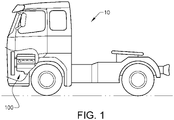
- a vehicle 10 is shown.
- the vehicle 10 which is illustrated as a truck, has an internal combustion engine 100 for driving the vehicle 10.
- the internal combustion engine 100 of the vehicle 10 is provided with a turbocharger 130 and a controller 200.
- the vehicle 10 may have additional propulsion units, such as electric drives etc. as long as it has at least one engine providing a flow of exhaust gases interacting with the turbocharger unit 130.
- the vehicle 10 is not exclusively a truck but may also represent various vehicles such as buses, constructional equipment, etc.
- the internal combustion engine 100 includes a cylinder block 102 being provided with a plurality of cylinders 104 operated to combust fuel, such as diesel or gasoline, whereby the motion of pistons reciprocating in the cylinders 104 is transmitted to a rotation movement of a crank shaft 156.
- the crank shaft 110 is further coupled to a transmission (not shown) for providing a torque to driving elements (not shown).
- driving elements are wheels; however the internal combustion engine 100 may also be used for other equipment such as construction equipment, marine applications, etc.
- the internal combustion engine 100 further comprises an exhaust gas system 120, which system 120 serves the purpose of recovering at least some of the energy in the exhaust gas flow to improve the performance of the internal combustion engine 100.
- the exhaust gas exits the cylinders 104 and enters an exhaust manifold 106 which is further connected to an exhaust inlet 132 of a turbocharger unit 130.
- the exhaust gas flow causes a turbine 134 arranged inside a turbine housing to rotate, which rotation is translated via a shaft 135 to a corresponding rotation of a compressor 136 arranged inside a compressor housing and being used to compress incoming air before it is introduced in the cylinders 104.
- Air is introduced to interact with the compressor 136 via an air inlet 140. Downstream the compressor 136, i.e. after the incoming air is compressed, it is guided by an air conduit 142 to an air inlet manifold 144 being connected with the cylinders 104. A cooler 146, such as a charged air cooler, may be provided in the air conduit 142.
- a bypass line 108 may at one end be connected to the exhaust gas flow path at a position between the exhaust gas manifold 106 and the exhaust gas inlet 132 of the turbocharger 130.
- a second end of the bypass line 108 is connected to the air conduit 142 somewhere downstream the compressor 136.
- a controller 200 is also provided for modeling the speed of the compressor 136.
- the controller 200 comprises a processor 202 and a memory 204, wherein the memory 204 contains instructions executable by the processor 202.
- the memory 204 may be implemented by any known memory technology, including but not limited to E(E)PROM, S(D)RAM and flash memory, and it may also include secondary storage such as a magnetic or optical disc. Physically, the memory 204 may consist of one unit or a plurality of units which together constitute the memory 204 on a logical level. In some embodiments, it may be implemented at least partly by a storage area in another component of the controller 200.
- the processor 202 is overall responsible for the operation of the controller 200.
- the processor 202 may e.g. be implemented by means of a PLC, CPU, and/or DSP capable of performing the intended functionality.
- the controller 200 is operative to receive a plurality of data inputs, and to model the compressor speed as a function of at least some of the data inputs.
- a number of sensors 150a-e are provided and configured to measure various parameters of the air flowing into, and out from, the compressor 136.
- the sensors 150a-e are connected to the controller 200.
- a temperature sensor 150a is arranged in the air inlet manifold 144 for providing data corresponding to the boost temperature T boost .
- a pressure sensor 150b may be arranged in the air inlet manifold 144 for providing data corresponding to the boost pressure p boost .
- a further sensor 150c may be arranged in the air conduit 142 immediately downstream the compressor 136 for providing data corresponding to the mass air flow dm gas dt .
- Additional sensors 150d-e may be provided in the air conduit 142 upstream the compressor 136 for providing data corresponding to the ambient temperature T in and the ambient pressure p amb .
- the sensors 150a, 150d, and 150c are used for allowing the controller to determine the speed of the compressor 136.
- the controller 200 includes a number of modules 210, 212, 214, 216.
- the modules 210, 212, 214, 216 may be implemented by hardware and/or software.
- a first module 210 is configured to determine the temperature difference across the compressor 136 from the boost temperature and the inlet, or ambient temperature.
- the controller 200 receives measured sensor data from the sensors 150a, 150d.
- the second module 212 is configured to determine the mass flow.
- the controller 200 receives measured sensor data from the sensor 150c.
- the third module 214 is configured to calculate the compressor speed N turbo from the determined temperature difference and the determined mass flow.
- a fourth module 216 is also provided and configured to communicate the modelled compressor speed to an associated unit for monitoring the current status of the turbocharger components, especially in terms of service and maintenance.
- the associated unit may either be arranged on-board the vehicle, or remote from the vehicle.
- the third module 214 is preferably calculating the compressor speed value using a relationship in the form of N turbo ⁇ dm gas dt R ⁇ T boost ⁇ T in , where N turbo is the compressor speed, dm gas dt is the mass flow, R ⁇ is a corrected ideal gas constant, and T boost - T in is the temperature difference across the compressor.
- N turbo is the compressor speed
- dm gas dt is the mass flow
- R ⁇ is a corrected ideal gas constant
- T boost - T in is the temperature difference across the compressor.
- the parameters, a and b, may be given by a fuel model structure.
- a common model of diesel which may be used is iso-octane, C 8 H 18 .
- volumetric efficiency f N engine p exhaust p boost .
- dm gas dt will not only be gas exiting the compressor, but also exhaust gas recovery (EGR).
- EGR exhaust gas recovery
- the controller 200 may thus include a further module configured to determine if a recovered exhaust gas flow is introduced downstream the compressor.
- the module 212 for determining the mass flow may thus be configured to determine the mass flow of the gas exiting the compressor and correcting the determined mass flow by a factor corresponding to recovered exhaust gas flow.
- the module 210 may in some embodiments be configured to determine the temperature difference across the compressor by estimating the temperature downstream the compressor, and by subtracting the estimated temperature from a measured ambient temperature.
- T boost - T in The temperature difference, T boost - T in , can be used by itself. As described above, an even better approach may be to model the temperature just after the compressor. In order to do this the impact of EGR (with a given temperature T EGR and a given mass flow dm EGR / dt should be taken into account.
- T CAC 1 dm air dt k calibration dm EGR dt + dm air dt T boost ⁇ T EGR m EGR dt , where T EGR and m EGR dt is either measured or estimated in the EMS.
- T CAC is already known from the calculation after the charger air cooler, it is possible to determine a unique value T compressor for a given dm air dt .
- a controller 200 for modeling the compressor speed.
- the controller 200 is shown in Fig. 4 , and comprises a number of modules 220-230.
- a first module 220 is configured to store a reference value for the ambient pressure, corresponding to a high altitude condition. Such preset ambient pressure may e.g. be 97 kPa.
- a second module 222 is configured to determine if a measured ambient pressure, preferably being received by the sensor 150e of Fig. 2 , is below the preset ambient pressure provided by module 220 and corresponding to high altitude conditions. If so, the third module 224 is configured to set the ambient pressure as the preset ambient pressure, and dividing the boost pressure with the ambient pressure to form a pressure ratio across the compressor 136.
- the fourth module 226 is configured to calculate the compressor speed value by estimating a compressor speed value using the pressure ratio as input, and a fifth module 228 is configured to calculate a corrected compressor speed value from the estimated compressor speed value and the actual ambient pressure.
- a sixth module 230 may be provided for communicating the modeled compressor speed communicate the modeled compressor speed to an associated unit for monitoring the current status of the turbocharger components, especially in terms of service and maintenance.
- the associated unit may either be arranged on-board the vehicle, or remote from the vehicle.
- N Turbo ⁇ p amb , measured ⁇ N Turbo .
- This aspect may preferably be combined with the first mentioned aspect describing the use of the temperature difference with respect to Fig. 3 . By such combination, an improved model for the compressor speed is achieved. However, the aspect may also be combined with other compressor speed models using the ambient pressure as input.
- test cycles may be provided, which test cycle is used to calibrate against. Therefore, it is advantageous not to have a repetitive cycle that can shift the calibration unfavorably towards one end due to reoccurring conditions during the cycle.
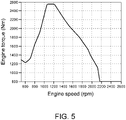
- a way to calibrate the model is therefore to generate random test-cycles with altering engine speeds and torques according to the diagram shown in Fig. 5 .
- the test cycles should be representative for normal driving cycles.
- the speed/torque combination should preferably fulfill the maximum torque dependency on engine speed.
- the value provided by the estimator can then be used for on-board diagnosis in order to monitor the rotating parts of the turbocharger and to create an information bank containing the current 'wear' status of the said parts.
- FIG. 5 A suggested approach to calibrate the polynomial for the compressor speed model is given by the diagram in Fig. 5 .
- An engine speed-torque mesh may be created where a random walk is applied between given points in order to give unbiased and extensive data for model calibration.
- a method 300 for modeling the speed of a compressor of a turbocharger is schematically shown.
- the method comprises a first step 302 of determining the temperature difference across the compressor, and a second step 304 of determining the mass flow through the compressor.
- a step 306 is thereafter performed in which a compressor speed value is calculated as a function of the temperature difference across the compressor and the mass flow.
- a final step 308 may be performed in which the modeled speed value is communicated to a unit, in line what has been previously described for the controller 200.
- the method may perform additional steps as has been described above.
- FIG. 7 another method 400 for modeling the speed of a compressor of a turbocharger is schematically shown.
- the method 400 comprises a first step 402 of determining the ambient pressure, and a second step 404 of determining if the ambient pressure is below a preset ambient pressure corresponding to high altitude conditions. If so, the method 400 sets the ambient pressure as the preset ambient pressure.
- a third step 406 is performed for determining a pressure ratio from the boost pressure and the ambient pressure.
- a compressor speed value is estimated using the pressure ratio as input, and
- a corrected compressor speed value is calculated from the estimated compressor speed value and the actual ambient pressure. Additional steps may be performed, e.g. in which the modeled speed value is communicated to a unit, in line what has been previously described for the controller 200. The method may perform additional steps as has been described above.
- the methods 300, 400 of Figs. 6 and 7 may preferably be combined in order to provide an improved compressor speed model, especially in terms of simplicity and accuracy.
Landscapes
- Engineering & Computer Science (AREA)
- Mechanical Engineering (AREA)
- General Engineering & Computer Science (AREA)
- Chemical & Material Sciences (AREA)
- Combustion & Propulsion (AREA)
- Physics & Mathematics (AREA)
- General Physics & Mathematics (AREA)
- Automation & Control Theory (AREA)
- Supercharger (AREA)
- Combined Controls Of Internal Combustion Engines (AREA)
Description
- The invention relates to a method for modeling the speed of a compressor, in particular for a turbocharger.
- The invention can be applied in heavy-duty vehicles, such as trucks, buses and construction equipment. Although the invention will be described with respect to a truck, the invention is not restricted to this particular vehicle, but may also be used in other applications utilizing turbocharger units such as aero or marine systems.
- A turbocharger is a vehicle component used together with an associated internal combustion engine, typically a diesel engine. The turbocharger is configured to recover a part of the energy of the exhaust gas and to use that energy to compress intake air flowing into the combustion chamber of the internal combustion engine. Turbochargers are commonly provided for increasing the efficiency and power of the internal combustion engine.
- A turbocharger has three main components; a turbine for converting energy of the exhaust gas flow to a rotational movement of the turbine, a compressor rotationally connected to the turbine for compressing intake air, and a housing enclosing the turbine and the compressor as well as a rotating shaft, bearings, etc.
- In order to monitor the wear of the rotating parts of the turbocharger it is desirable to determine the speed of the turbine or the compressor. In particular, wear of the compressor is typically categorized by low cycle fatigue and high cycle fatigue. Low cycle fatigue corresponds to relatively small fluctuations in compressor speed, while high cycle fatigue corresponds to relatively rapid (and large) changes in compressor speed. Fatigue will eventually lead to substantial changes in the material structure of the compressor, which may lead to a sudden breakage of the compressor. Such breakage will in most cases lead to a malfunction of the entire turbocharger, requiring standstill of the vehicle and costly service and/or replacement of the turbocharger.
- Different solutions for monitoring the compressor speed have been proposed. In particular, it has been suggested to arrange a physical speed sensor at the compressor. However, more recent solutions have been suggested in which the physical sensor is replaced by a compressor speed model for estimating the compressor speed.
- One solution for modeling the speed of a double-stage turbocharger is described in
US2009/0314082 . Here, the speed of each turbine is modeled separately and the temperature as well as the pressure between the turbines is used as input for the speed estimation, as well as an ambient pressure value. WhileUS2009/0314082 requires a number of physical sensors for providing the necessary input data, it would be advantageous to provide a speed modeling method reducing this number of required sensors. - An object of the invention is to provide a method for modeling the compressor speed overcoming the above mentioned drawbacks of prior art methods.
- The object is achieved by a method according to claim 1.
- By determining the temperature difference across the compressor, and use this temperature difference as input for the compressor speed model, it is no longer necessary to have an ambient pressure sensor providing input data for the model.
- A method for modelling the compressor speed of a turbocharger is therefore provided, comprising i) determining the temperature difference across the compressor, ii) determining the mass flow through the compressor, and iii) calculating a compressor speed value as a function of the temperature difference across the compressor and the mass flow.
- In the present invention, the step of calculating the compressor speed value is performed using


- across the compressor, thus leading to significant reduction in hardware complexity of the associated turbocharger.
- In an embodiment,


- In an embodiment the step of calculating the compressor speed value is performed by a polynomial representation of


- In an embodiment, the method further comprises the step of determining if a recovered exhaust gas flow is introduced downstream the compressor. Further the step of determining the mass flow is performed by determining the mass flow of the gas exiting the compressor and correcting the determined mass flow by a factor corresponding to recovered exhaust gas flow. By introducing the effects caused by recovered exhaust gas flow, the accuracy of the modeling method is improved.
- In an embodiment the step of determining the temperature difference across the compressor is performed by estimating the temperature downstream the compressor, and by subtracting the estimated temperature from a measured ambient temperature. Since it is difficult to arrange a physical temperature sensor close to the compressor, an estimated temperature just downstream the compressor will provide a more accurate value for the resulting temperature difference.
- In an embodiment the step of estimating the temperature downstream the compressor is performed by measuring the temperature in an air inlet manifold, and correcting this temperature by a factor corresponding to the temperature loss across an associated cooler. Hence, accuracy of the speed modeling method is further improved.
- In an embodiment the method further comprises the step of determining the pressure ratio across the compressor. Further, the step of calculating the compressor speed value is performed by calculating the compressor speed value as a function of the pressure ratio.
- By including the pressure ratio across the compressor as input for the compressor speed modeling method, accuracy may be further improved.
- In an embodiment the step of determining the pressure ratio across the compressor is performed by determining if the ambient pressure is below a preset ambient pressure corresponding to high altitude conditions, and if so, setting the ambient pressure as the preset ambient pressure, and dividing the boost pressure with the ambient pressure. In this embodiment, high altitude conditions are also considered. This is highly beneficial for increasing the accuracy of the speed modeling. As there is otherwise a risk of overestimating the compressor speed, this will avoid unnecessary torque derate at higher altitudes as well as wrong calculations for low cycle fatigue.
- In an embodiment the step of calculating the compressor speed value is performed by estimating a compressor speed value using the pressure ratio as input, and calculating a corrected compressor speed value from the estimated compressor speed value and the actual ambient pressure. This has proven to provide an accurate model performance.
- According to a second aspect, a method for modeling the compressor speed of a turbocharger is also provided. The method comprises i) determining the ambient pressure, ii) determining if the ambient pressure is below a preset ambient pressure corresponding to high altitude conditions, and if so, setting the ambient pressure as the preset ambient pressure, iii) determining a pressure ratio from the boost pressure and the ambient pressure, iv) estimating a compressor speed value using the pressure ratio as input, and v) calculating a corrected compressor speed value from the estimated compressor speed value and the actual ambient pressure. Similar to what has been discussed above, this is highly beneficial for increasing the accuracy of the speed modeling. As there is otherwise a risk of overestimating the compressor speed, this will avoid unnecessary torque derate at higher altitudes as well as wrong calculations for low cycle fatigue.
- In an embodiment the method comprises the further steps of determining the temperature difference across the compressor, determining the mass flow through the compressor, and calculating a compressor speed value as a function of the pressure ratio, the temperature difference across the compressor, and the mass flow.
- In an embodiment, the step of calculating the compressor speed value is performed by a polynomial representation of


- In an embodiment, the method comprises the further step of determining if a recovered exhaust gas flow is introduced downstream the compressor, and wherein the step of determining the mass flow is performed by determining the mass flow of the gas exiting the compressor and correcting the determined mass flow by a factor corresponding to recovered exhaust gas flow.
- In an embodiment the step of determining the temperature difference across the compressor is performed by estimating the temperature downstream the compressor, and by subtracting the estimated temperature from a measured ambient temperature.
- In an embodiment the step of estimating the temperature downstream the compressor is performed by measuring the temperature in an air inlet manifold, and correcting this temperature by a factor corresponding to the temperature loss across an associated cooler.
- A computer program is also provided, comprising program code means for performing the steps of any of the aspects above when said program is run on a computer, whereby the steps of determining of the temperature difference across the compressor and determining the mass flow through the compressor are based on sensor signals.
- A computer readable medium is also provided, carrying a computer program comprising program code means for performing the steps of any of the above mentioned aspects when said program product is run on a computer, whereby the steps of determining of the temperature difference across the compressor and determining the mass flow through the compressor are based on sensor signals.
- A controller for modeling the compressor speed of a turbocharger is also provided. The controller is configured to perform the steps of the method according to the first and second aspects described above.
- A controller for modeling the compressor speed of a turbocharger is also provided. The controller comprises a processor and a memory, said memory containing instructions executable by the processor. The controller is operative to determining the temperature difference across the compressor, determining the mass flow through the compressor, and calculating a compressor speed value as a function of the temperature difference across the compressor and the mass flow.
- In an embodiment the controller is further operative to perform the method according to the first or second aspects described above.
- A controller for modeling the compressor speed of a turbocharger is also provided. The controller comprises a processor and a memory, said memory containing instructions executable by the processor. The controller is operative to determining the ambient pressure, determining if the ambient pressure is below a preset ambient pressure corresponding to high altitude conditions, and if so, setting the ambient pressure as the preset ambient pressure, determining a pressure ratio from the boost pressure and the ambient pressure, estimating a compressor speed value using the pressure ratio as input, and calculating a corrected compressor speed value from the estimated compressor speed value and the actual ambient pressure.
- In an embodiment the controller is further operative to perform the method according to the second aspect described above.
- A controller for modeling the compressor speed of a turbocharger is also provided. The controller comprises a first module configured to determining the temperature difference across the compressor, a second module configured to determining the mass flow through the compressor, and a third module configured to calculating a compressor speed value as a function of the temperature difference across the compressor and the mass flow.
- In an embodiment the controller further comprises additional modules configured to perform the method according to the first aspect described above.
- A controller for modeling the compressor speed of a turbocharger is also provided. The controller comprises a first module configured to determining the ambient pressure, a second module configured to determining if the ambient pressure is below a preset ambient pressure corresponding to high altitude conditions, and if so, setting the ambient pressure as the preset ambient pressure, a third module configured to determining a pressure ratio from the boost pressure and the ambient pressure, a fourth module configured to estimating a compressor speed value using the pressure ratio as input, and a fifth module configured to calculating a corrected compressor speed value from the estimated compressor speed value and the actual ambient pressure.
- In an embodiment the controller further comprises additional modules configured to perform the method according to the second aspect described above.
- A vehicle is also provided, comprising a controller according to the aspects described above.
- With reference to the appended drawings, below follows a more detailed description of embodiments of the invention cited as examples.
- In the drawings:
-
Fig. 1 is a side view of a vehicle according to an embodiment, -
Fig. 2 is a schematic view of an internal combustion engine according to an embodiment, -
Fig. 3 is a schematic view of a controller according to an embodiment, -
Fig. 4 is a schematic view of a controller according to an embodiment, -
Fig. 5 is a diagram showing the engine speed as a function of engine torque for a vehicle according to an embodiment, and -
Figs. 6 and 7 are schematic views of methods according to different embodiments. - Starting with
Fig. 1 avehicle 10 is shown. Thevehicle 10, which is illustrated as a truck, has aninternal combustion engine 100 for driving thevehicle 10. As will be further explained below theinternal combustion engine 100 of thevehicle 10 is provided with aturbocharger 130 and acontroller 200. Thevehicle 10 may have additional propulsion units, such as electric drives etc. as long as it has at least one engine providing a flow of exhaust gases interacting with theturbocharger unit 130. Hence thevehicle 10 is not exclusively a truck but may also represent various vehicles such as buses, constructional equipment, etc. - In
Fig. 2 an example of aninternal combustion engine 100 is shown. Theinternal combustion engine 100 includes acylinder block 102 being provided with a plurality ofcylinders 104 operated to combust fuel, such as diesel or gasoline, whereby the motion of pistons reciprocating in thecylinders 104 is transmitted to a rotation movement of a crank shaft 156. Thecrank shaft 110 is further coupled to a transmission (not shown) for providing a torque to driving elements (not shown). In case of a heavy vehicle, such as a truck, the driving elements are wheels; however theinternal combustion engine 100 may also be used for other equipment such as construction equipment, marine applications, etc. - The
internal combustion engine 100 further comprises anexhaust gas system 120, whichsystem 120 serves the purpose of recovering at least some of the energy in the exhaust gas flow to improve the performance of theinternal combustion engine 100. In the shown example the exhaust gas exits thecylinders 104 and enters anexhaust manifold 106 which is further connected to anexhaust inlet 132 of aturbocharger unit 130. The exhaust gas flow causes aturbine 134 arranged inside a turbine housing to rotate, which rotation is translated via ashaft 135 to a corresponding rotation of acompressor 136 arranged inside a compressor housing and being used to compress incoming air before it is introduced in thecylinders 104. - Air is introduced to interact with the
compressor 136 via an air inlet 140. Downstream thecompressor 136, i.e. after the incoming air is compressed, it is guided by anair conduit 142 to anair inlet manifold 144 being connected with thecylinders 104. A cooler 146, such as a charged air cooler, may be provided in theair conduit 142. - Some of the exhaust gas flow may be re-circulated to the
cylinders 104 via theair conduit 142 in order to provide exhaust gas recovery. For this abypass line 108 may at one end be connected to the exhaust gas flow path at a position between theexhaust gas manifold 106 and theexhaust gas inlet 132 of theturbocharger 130. A second end of thebypass line 108 is connected to theair conduit 142 somewhere downstream thecompressor 136. - A
controller 200 is also provided for modeling the speed of thecompressor 136. Thecontroller 200 comprises aprocessor 202 and amemory 204, wherein thememory 204 contains instructions executable by theprocessor 202. - The
memory 204 may be implemented by any known memory technology, including but not limited to E(E)PROM, S(D)RAM and flash memory, and it may also include secondary storage such as a magnetic or optical disc. Physically, thememory 204 may consist of one unit or a plurality of units which together constitute thememory 204 on a logical level. In some embodiments, it may be implemented at least partly by a storage area in another component of thecontroller 200. Theprocessor 202 is overall responsible for the operation of thecontroller 200. Theprocessor 202 may e.g. be implemented by means of a PLC, CPU, and/or DSP capable of performing the intended functionality. - The
controller 200 is operative to receive a plurality of data inputs, and to model the compressor speed as a function of at least some of the data inputs. For this, a number ofsensors 150a-e are provided and configured to measure various parameters of the air flowing into, and out from, thecompressor 136. Thesensors 150a-e are connected to thecontroller 200. In one embodiment, atemperature sensor 150a is arranged in theair inlet manifold 144 for providing data corresponding to the boost temperature Tboost . Apressure sensor 150b may be arranged in theair inlet manifold 144 for providing data corresponding to the boost pressure pboost . Afurther sensor 150c may be arranged in theair conduit 142 immediately downstream thecompressor 136 for providing data corresponding to the mass air flow
Additional sensors 150d-e may be provided in theair conduit 142 upstream thecompressor 136 for providing data corresponding to the ambient temperature Tin and the ambient pressure pamb . - According to one specific aspect, the
sensors compressor 136. According to this particular aspect, as is shown inFig. 3 , thecontroller 200 includes a number ofmodules modules first module 210 is configured to determine the temperature difference across thecompressor 136 from the boost temperature and the inlet, or ambient temperature. - Hence, the
controller 200 receives measured sensor data from thesensors second module 212 is configured to determine the mass flow. Hence, thecontroller 200 receives measured sensor data from thesensor 150c. Thethird module 214 is configured to calculate the compressor speed Nturbo from the determined temperature difference and the determined mass flow. Afourth module 216 is also provided and configured to communicate the modelled compressor speed to an associated unit for monitoring the current status of the turbocharger components, especially in terms of service and maintenance. The associated unit may either be arranged on-board the vehicle, or remote from the vehicle. - The
third module 214 is preferably calculating the compressor speed value using a relationship in the form of


- Calculating the compressor speed value may be performed by forming a polynomial representation of


- In general, the following relationship between turbo power and gas property before and after the compressor is assumed to be valid:

- As is evident, the mass flow relationship is much simpler than an equivalent volume velocity relationship. Hence, only the mass flow relationship is used in the modeling procedure as presented herein. The power supply needed to maintain a certain level of mass flow at a given temperature increase will also be proportional to the turbo speed, Nturbo according to Ẇsupplied ∝ Nturbo . Thus,


- The gas specific ideal gas law constant is calculated as R̃gas = R/Mgas, while the molar mass of the gas is dependent on λ and exhaust gas recovery fraction, β:


- The parameters, a and b, may be given by a fuel model structure. A common model of diesel which may be used is iso-octane, C 8 H 18.
- The ideal mass flow may thus be calculated, for a four- stroke diesel engine of size Vengine and engine speed Nengine, as:

- In a real application, the ideal mass flow above may not be a realistic quantity. For providing a better estimation, the volumetric efficiency could also be considered. A simple model of the volumetric efficiency is


- The engine speed dependency, g(Nengine ), may be semi-empirically derived (linearized). Following the conclusion derived by from the equations above, a simple assumption would be:

- The coefficients are preferably derived by application of a least squares criterion


α are then given asα = (ATA) -1 ATzturbospeed. - A good fit may be achieved for the function having the form
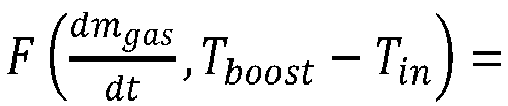

- As is realized


- The
controller 200 may thus include a further module configured to determine if a recovered exhaust gas flow is introduced downstream the compressor. Themodule 212 for determining the mass flow may thus be configured to determine the mass flow of the gas exiting the compressor and correcting the determined mass flow by a factor corresponding to recovered exhaust gas flow. - The
module 210 may in some embodiments be configured to determine the temperature difference across the compressor by estimating the temperature downstream the compressor, and by subtracting the estimated temperature from a measured ambient temperature. - For the controller shown in
Fig. 3 , additional modules may be provided for including the impact of the pressure ratio across the compressor. Hence,

- The temperature difference, Tboost - Tin , can be used by itself. As described above, an even better approach may be to model the temperature just after the compressor. In order to do this the impact of EGR (with a given temperature TEGR and a given mass flow dmEGR /dt should be taken into account.
- The signal Tboost can then be used to model the temperature after the charged
air cooler 146 as

charger air cooler 146 could be accounted for. This may be done by using a map/function/model, f, that describes the temperature drop in the charger air cooler as
- In such case there may be yet another expression for TCAC , namely TCAC = Tcompressor -

- As the TCAC is already known from the calculation after the charger air cooler, it is possible to determine a unique value Tcompressor for a given

- According to another aspect a
controller 200 is provided for modeling the compressor speed. Thecontroller 200 is shown inFig. 4 , and comprises a number of modules 220-230. Afirst module 220 is configured to store a reference value for the ambient pressure, corresponding to a high altitude condition. Such preset ambient pressure may e.g. be 97 kPa. Asecond module 222 is configured to determine if a measured ambient pressure, preferably being received by thesensor 150e ofFig. 2 , is below the preset ambient pressure provided bymodule 220 and corresponding to high altitude conditions. If so, thethird module 224 is configured to set the ambient pressure as the preset ambient pressure, and dividing the boost pressure with the ambient pressure to form a pressure ratio across thecompressor 136. Hence, the pressure ratio is set according to pratio =
fourth module 226 is configured to calculate the compressor speed value by estimating a compressor speed value using the pressure ratio as input, and afifth module 228 is configured to calculate a corrected compressor speed value from the estimated compressor speed value and the actual ambient pressure. Asixth module 230 may be provided for communicating the modeled compressor speed communicate the modeled compressor speed to an associated unit for monitoring the current status of the turbocharger components, especially in terms of service and maintenance. The associated unit may either be arranged on-board the vehicle, or remote from the vehicle. - The real measured ambient pressure pamb may consequently be used in the last step, when an estimated turbo speed NTurbo has been modelled, according to

- This aspect may preferably be combined with the first mentioned aspect describing the use of the temperature difference with respect to
Fig. 3 . By such combination, an improved model for the compressor speed is achieved. However, the aspect may also be combined with other compressor speed models using the ambient pressure as input. - Now turning to
Fig. 5 , calibration of the model will be described. The calibration procedure may be performed straightforward as is suggested by the equations above. A proper test cycle may preferably be provided, which test cycle is used to calibrate against. Therefore, it is advantageous not to have a repetitive cycle that can shift the calibration unfavorably towards one end due to reoccurring conditions during the cycle. A way to calibrate the model is therefore to generate random test-cycles with altering engine speeds and torques according to the diagram shown inFig. 5 . Even more preferably, the test cycles should be representative for normal driving cycles. The speed/torque combination should preferably fulfill the maximum torque dependency on engine speed. The value provided by the estimator can then be used for on-board diagnosis in order to monitor the rotating parts of the turbocharger and to create an information bank containing the current 'wear' status of the said parts. - A suggested approach to calibrate the polynomial for the compressor speed model is given by the diagram in
Fig. 5 . An engine speed-torque mesh may be created where a random walk is applied between given points in order to give unbiased and extensive data for model calibration. - In
Figs. 6 amethod 300 for modeling the speed of a compressor of a turbocharger is schematically shown. The method comprises afirst step 302 of determining the temperature difference across the compressor, and asecond step 304 of determining the mass flow through the compressor. Astep 306 is thereafter performed in which a compressor speed value is calculated as a function of the temperature difference across the compressor and the mass flow. Afinal step 308 may be performed in which the modeled speed value is communicated to a unit, in line what has been previously described for thecontroller 200. The method may perform additional steps as has been described above. - In
Fig. 7 anothermethod 400 for modeling the speed of a compressor of a turbocharger is schematically shown. Themethod 400 comprises afirst step 402 of determining the ambient pressure, and asecond step 404 of determining if the ambient pressure is below a preset ambient pressure corresponding to high altitude conditions. If so, themethod 400 sets the ambient pressure as the preset ambient pressure. Athird step 406 is performed for determining a pressure ratio from the boost pressure and the ambient pressure. Instep 408, a compressor speed value is estimated using the pressure ratio as input, and In step 410 a corrected compressor speed value is calculated from the estimated compressor speed value and the actual ambient pressure. Additional steps may be performed, e.g. in which the modeled speed value is communicated to a unit, in line what has been previously described for thecontroller 200. The method may perform additional steps as has been described above. - The
methods Figs. 6 and 7 may preferably be combined in order to provide an improved compressor speed model, especially in terms of simplicity and accuracy. - It is to be understood that the present invention is not limited to the embodiments described above and illustrated in the drawings; rather, the skilled person will recognize that many changes and modifications may be made within the scope of the appended claims.
Claims (13)
- A method for calculating the compressor speed of a turbocharger, characterized by the steps of:determining the temperature difference across the compressor,determining the mass flow through the compressor, andcalculating a compressor speed value as a function of the temperature difference across the compressor and the mass flow, wherein the step of calculating the compressor speed value is performed using


- The method according to claim 1, wherein


- The method according to claim 2, wherein the step of calculating the compressor speed value is performed by a polynomial representation of


- The method according to any one of the preceding claims, characterized by the further step of:determining if a recovered exhaust gas flow is introduced downstream the compressor, andwherein the step of determining the mass flow is performed by determining the mass flow of the gas exiting the compressor and correcting the determined mass flow by a factor corresponding to recovered exhaust gas flow.
- The method according to any one of the preceding claims, wherein the step of determining the temperature difference across the compressor is performed by estimating the temperature downstream the compressor, and by subtracting the estimated temperature from a measured ambient temperature.
- The method according to claim 5, wherein the step of estimating the temperature downstream the compressor is performed by measuring the temperature in an air inlet manifold, and correcting this temperature by a factor corresponding to the temperature loss across an associated cooler.
- The method according to any one of the preceding claims, characterized by the further step of:determining the pressure ratio across the compressor, and wherein the step of calculating the compressor speed value is performed by calculating the compressor speed value as a function of the pressure ratio.
- The method according to claim 7, wherein the step of determining the pressure ratio across the compressor is performed by:determining if the ambient pressure is below a preset ambient pressure corresponding to high altitude conditions, and if so, setting the ambient pressure as the preset ambient pressure, anddividing the boost pressure with the ambient pressure.
- The method according to claim 8, wherein the step of calculating the compressor speed value is performed by estimating a compressor speed value using the pressure ratio as input, and calculating a corrected compressor speed value from the estimated compressor speed value and the actual ambient pressure.
- A computer program comprising program code means for performing the steps of any of claims 1 to 9 when said program is run on a computer, whereby the steps of determining of the temperature difference across the compressor and determining the mass flow through the compressor are based on sensor signals.
- A computer readable medium carrying a computer program comprising program code means for performing the steps of any of claims 1 to 9 when said program product is run on a computer, whereby the steps of determining of the temperature difference across the compressor and determining the mass flow through the compressor are based on sensor signals.
- A controller (200) for modeling the compressor speed of a turbocharger (130), the controller being configured to perform the steps of the method according to any of claims 1 to 9.
- A vehicle comprising a controller (200) according to claim 12.
Priority Applications (1)
| Application Number | Priority Date | Filing Date | Title |
|---|---|---|---|
| EP20182237.6A EP3751362B1 (en) | 2015-05-06 | 2015-05-06 | A method for modeling a compressor speed |
Applications Claiming Priority (3)
| Application Number | Priority Date | Filing Date | Title |
|---|---|---|---|
| EP20182237.6A EP3751362B1 (en) | 2015-05-06 | 2015-05-06 | A method for modeling a compressor speed |
| PCT/EP2015/059909 WO2016177413A1 (en) | 2015-05-06 | 2015-05-06 | A method for modeling a compressor speed |
| EP15722149.0A EP3292443B1 (en) | 2015-05-06 | 2015-05-06 | A method for modeling a compressor speed |
Related Parent Applications (2)
| Application Number | Title | Priority Date | Filing Date |
|---|---|---|---|
| EP15722149.0A Division EP3292443B1 (en) | 2015-05-06 | 2015-05-06 | A method for modeling a compressor speed |
| EP15722149.0A Division-Into EP3292443B1 (en) | 2015-05-06 | 2015-05-06 | A method for modeling a compressor speed |
Publications (2)
| Publication Number | Publication Date |
|---|---|
| EP3751362A1 EP3751362A1 (en) | 2020-12-16 |
| EP3751362B1 true EP3751362B1 (en) | 2022-09-07 |
Family
ID=53175477
Family Applications (2)
| Application Number | Title | Priority Date | Filing Date |
|---|---|---|---|
| EP20182237.6A Active EP3751362B1 (en) | 2015-05-06 | 2015-05-06 | A method for modeling a compressor speed |
| EP15722149.0A Active EP3292443B1 (en) | 2015-05-06 | 2015-05-06 | A method for modeling a compressor speed |
Family Applications After (1)
| Application Number | Title | Priority Date | Filing Date |
|---|---|---|---|
| EP15722149.0A Active EP3292443B1 (en) | 2015-05-06 | 2015-05-06 | A method for modeling a compressor speed |
Country Status (5)
| Country | Link |
|---|---|
| US (2) | US10428677B2 (en) |
| EP (2) | EP3751362B1 (en) |
| JP (1) | JP6640875B2 (en) |
| CN (2) | CN107567603B (en) |
| WO (1) | WO2016177413A1 (en) |
Families Citing this family (1)
| Publication number | Priority date | Publication date | Assignee | Title |
|---|---|---|---|---|
| US12196470B2 (en) | 2022-05-27 | 2025-01-14 | Copeland Lp | Systems and methods for determining startup pressure ratio for dynamic compressors |
Family Cites Families (24)
| Publication number | Priority date | Publication date | Assignee | Title |
|---|---|---|---|---|
| US2493784A (en) | 1945-06-20 | 1950-01-10 | Houdry Process Corp | Catalyst regeneration apparatus |
| JP4151195B2 (en) * | 2000-04-20 | 2008-09-17 | トヨタ自動車株式会社 | Control device for continuously variable transmission for vehicle |
| DE10122293A1 (en) | 2001-05-08 | 2002-11-21 | Audi Ag | Method for regulating a boost pressure limitation of a turbocharger in an internal combustion engine as a function of the density of the ambient air |
| DE102004019315B8 (en) * | 2004-04-21 | 2017-04-27 | Volkswagen Ag | Method for determining state variables of a gas mixture in an air gap assigned to an internal combustion engine and correspondingly configured engine control |
| US7127892B2 (en) * | 2004-08-13 | 2006-10-31 | Cummins, Inc. | Techniques for determining turbocharger speed |
| DE102005016392B3 (en) * | 2005-04-09 | 2006-09-07 | Daimlerchrysler Ag | Regulating process for exhaust gas supercharger involves taking reliable maximum revs figure as actual operating point of compressor or engine |
| US7296562B2 (en) * | 2006-03-30 | 2007-11-20 | Caterpiller Inc. | Control system and method for estimating turbocharger performance |
| US7937996B2 (en) * | 2007-08-24 | 2011-05-10 | GM Global Technology Operations LLC | Turbo speed sensor diagnostic for turbocharged engines |
| US7861580B2 (en) | 2008-06-23 | 2011-01-04 | Cummins Ip, Inc. | Virtual turbine speed sensor |
| GB2482323A (en) * | 2010-07-30 | 2012-02-01 | Ford Global Tech Llc | A method and system for controlling an engine based on determination of rotational speed of a compressor |
| GB2483729A (en) * | 2010-09-20 | 2012-03-21 | Gm Global Tech Operations Inc | System for diagnosing error conditions of a gas flow control system for turbocharged engines |
| EP2489850B1 (en) * | 2011-02-21 | 2013-08-21 | Ford Global Technologies, LLC | Method for operating a turbocharger arrangement and control unit for a turbocharger arrangement |
| JP5719257B2 (en) * | 2011-09-02 | 2015-05-13 | ダイムラー・アクチェンゲゼルシャフトDaimler AG | Supercharger control device |
| US8892332B2 (en) * | 2011-09-25 | 2014-11-18 | Cummins, Inc. | System and method for estimating turbocharger operating speed |
| US8887693B2 (en) * | 2011-09-25 | 2014-11-18 | Cummins, Inc. | System and method for estimating turbocharger compressor inlet air flow rate |
| US8567192B2 (en) | 2011-09-25 | 2013-10-29 | Cummins, Inc. | System for controlling an air handling system including a dual-stage variable geometry turbocharger |
| DE102011088763A1 (en) * | 2011-12-15 | 2013-06-20 | Robert Bosch Gmbh | A method and apparatus for determining a modeling value for a physical quantity in an engine system having an internal combustion engine |
| US8459038B1 (en) * | 2012-02-09 | 2013-06-11 | Williams International Co., L.L.C. | Two-spool turboshaft engine control system and method |
| US8562484B1 (en) * | 2012-05-07 | 2013-10-22 | Ford Global Technologies, Llc | Method and apparatus for starting a turbocharged engine in a hybrid vehicle |
| WO2013175588A1 (en) * | 2012-05-23 | 2013-11-28 | トヨタ自動車株式会社 | Device for estimating air intake volume for supercharged engine |
| JP6032966B2 (en) | 2012-06-27 | 2016-11-30 | 日野自動車株式会社 | Turbo speed detector |
| US9610938B2 (en) * | 2013-06-24 | 2017-04-04 | Toyota Jidosha Kabushiki Kaisha | Control apparatus for hybrid vehicle |
| GB2519515A (en) * | 2013-10-14 | 2015-04-29 | Gm Global Tech Operations Inc | Method of estimating the boost capability of a turbocharged internal combustion engine |
| CN104481704B (en) * | 2014-12-10 | 2016-02-10 | 中国科学院工程热物理研究所 | One realizes fuel real-time control method and device in Study On Start-up Process For Gas Turbines |
-
2015
- 2015-05-06 CN CN201580079553.3A patent/CN107567603B/en active Active
- 2015-05-06 JP JP2017557454A patent/JP6640875B2/en not_active Expired - Fee Related
- 2015-05-06 CN CN202011389305.8A patent/CN112612217B/en active Active
- 2015-05-06 US US15/561,035 patent/US10428677B2/en active Active
- 2015-05-06 EP EP20182237.6A patent/EP3751362B1/en active Active
- 2015-05-06 EP EP15722149.0A patent/EP3292443B1/en active Active
- 2015-05-06 WO PCT/EP2015/059909 patent/WO2016177413A1/en not_active Ceased
-
2019
- 2019-08-20 US US16/545,128 patent/US10801356B2/en active Active
Also Published As
| Publication number | Publication date |
|---|---|
| CN112612217B (en) | 2024-07-02 |
| WO2016177413A1 (en) | 2016-11-10 |
| US10428677B2 (en) | 2019-10-01 |
| US10801356B2 (en) | 2020-10-13 |
| US20180073385A1 (en) | 2018-03-15 |
| CN112612217A (en) | 2021-04-06 |
| JP6640875B2 (en) | 2020-02-05 |
| EP3751362A1 (en) | 2020-12-16 |
| US20190368371A1 (en) | 2019-12-05 |
| CN107567603A (en) | 2018-01-09 |
| CN107567603B (en) | 2020-12-18 |
| EP3292443A1 (en) | 2018-03-14 |
| EP3292443B1 (en) | 2020-09-23 |
| JP2018515711A (en) | 2018-06-14 |
Similar Documents
| Publication | Publication Date | Title |
|---|---|---|
| US6092016A (en) | Apparatus and method for diagnosing an engine using an exhaust temperature model | |
| US20120191427A1 (en) | System for diagnosing error conditions of a gas flow control system for turbocharged engines | |
| EP3011401B1 (en) | A method for a vehicle | |
| US9890717B2 (en) | System and method for estimating turbocharger operating speed | |
| CN110261127B (en) | On-line detection method of carbon deposit stuck in engine variable-section turbocharger | |
| JP2005155384A (en) | Diagnostic apparatus for internal combustion engine equipped with turbocharger | |
| EP2541015A1 (en) | Internal combustion engine control device | |
| Buchman et al. | A method for turbocharging single-cylinder, four-stroke engines | |
| US10801356B2 (en) | Method for modeling a compressor speed | |
| EP3584447A1 (en) | State quantity estimating device | |
| US7802427B2 (en) | System and method for monitoring boost leak | |
| JP6824376B2 (en) | How to model compressor speed | |
| KR102916377B1 (en) | Engine status estimation apparatus, engine status estimation method and engine status estimation program | |
| Zhang et al. | Method of Turbocharger Emulation on Engine Test and Application to Turbocompound System Optimisation | |
| JP2005120929A (en) | Control device for diesel engine | |
| Hagen et al. | The connected car and its new possibilities for diagnosis of the internal combustion engine | |
| CN120291951A (en) | Method, device and medium for manufacturing and calibrating SCR low conversion efficiency fault parts | |
| Pojawa | Energetic state parameters measurements of LM 2500 naval gas turbine for modeling and simulation purposes | |
| Marais et al. | Fuel consumption for conventional and electrically driven ac compressors | |
| Sidorow et al. | Physical and experimental modeling of turbochargers with thermodynamic approach for calculation of virtual sensors | |
| Coelho et al. | EXPERIMENTAL SETUP FOR TURBOCHARGER CONTROL |
Legal Events
| Date | Code | Title | Description |
|---|---|---|---|
| PUAI | Public reference made under article 153(3) epc to a published international application that has entered the european phase |
Free format text: ORIGINAL CODE: 0009012 |
|
| STAA | Information on the status of an ep patent application or granted ep patent |
Free format text: STATUS: THE APPLICATION HAS BEEN PUBLISHED |
|
| AC | Divisional application: reference to earlier application |
Ref document number: 3292443 Country of ref document: EP Kind code of ref document: P |
|
| AK | Designated contracting states |
Kind code of ref document: A1 Designated state(s): AL AT BE BG CH CY CZ DE DK EE ES FI FR GB GR HR HU IE IS IT LI LT LU LV MC MK MT NL NO PL PT RO RS SE SI SK SM TR |
|
| STAA | Information on the status of an ep patent application or granted ep patent |
Free format text: STATUS: REQUEST FOR EXAMINATION WAS MADE |
|
| 17P | Request for examination filed |
Effective date: 20210615 |
|
| RBV | Designated contracting states (corrected) |
Designated state(s): AL AT BE BG CH CY CZ DE DK EE ES FI FR GB GR HR HU IE IS IT LI LT LU LV MC MK MT NL NO PL PT RO RS SE SI SK SM TR |
|
| GRAP | Despatch of communication of intention to grant a patent |
Free format text: ORIGINAL CODE: EPIDOSNIGR1 |
|
| STAA | Information on the status of an ep patent application or granted ep patent |
Free format text: STATUS: GRANT OF PATENT IS INTENDED |
|
| INTG | Intention to grant announced |
Effective date: 20211210 |
|
| GRAJ | Information related to disapproval of communication of intention to grant by the applicant or resumption of examination proceedings by the epo deleted |
Free format text: ORIGINAL CODE: EPIDOSDIGR1 |
|
| STAA | Information on the status of an ep patent application or granted ep patent |
Free format text: STATUS: REQUEST FOR EXAMINATION WAS MADE |
|
| GRAP | Despatch of communication of intention to grant a patent |
Free format text: ORIGINAL CODE: EPIDOSNIGR1 |
|
| STAA | Information on the status of an ep patent application or granted ep patent |
Free format text: STATUS: GRANT OF PATENT IS INTENDED |
|
| INTC | Intention to grant announced (deleted) | ||
| INTG | Intention to grant announced |
Effective date: 20220429 |
|
| GRAS | Grant fee paid |
Free format text: ORIGINAL CODE: EPIDOSNIGR3 |
|
| GRAA | (expected) grant |
Free format text: ORIGINAL CODE: 0009210 |
|
| STAA | Information on the status of an ep patent application or granted ep patent |
Free format text: STATUS: THE PATENT HAS BEEN GRANTED |
|
| AC | Divisional application: reference to earlier application |
Ref document number: 3292443 Country of ref document: EP Kind code of ref document: P |
|
| AK | Designated contracting states |
Kind code of ref document: B1 Designated state(s): AL AT BE BG CH CY CZ DE DK EE ES FI FR GB GR HR HU IE IS IT LI LT LU LV MC MK MT NL NO PL PT RO RS SE SI SK SM TR |
|
| REG | Reference to a national code |
Ref country code: GB Ref legal event code: FG4D |
|
| REG | Reference to a national code |
Ref country code: CH Ref legal event code: EP Ref country code: AT Ref legal event code: REF Ref document number: 1517568 Country of ref document: AT Kind code of ref document: T Effective date: 20220915 |
|
| REG | Reference to a national code |
Ref country code: IE Ref legal event code: FG4D |
|
| REG | Reference to a national code |
Ref country code: DE Ref legal event code: R096 Ref document number: 602015080772 Country of ref document: DE |
|
| REG | Reference to a national code |
Ref country code: LT Ref legal event code: MG9D |
|
| REG | Reference to a national code |
Ref country code: NL Ref legal event code: MP Effective date: 20220907 |
|
| PG25 | Lapsed in a contracting state [announced via postgrant information from national office to epo] |
Ref country code: SE Free format text: LAPSE BECAUSE OF FAILURE TO SUBMIT A TRANSLATION OF THE DESCRIPTION OR TO PAY THE FEE WITHIN THE PRESCRIBED TIME-LIMIT Effective date: 20220907 Ref country code: RS Free format text: LAPSE BECAUSE OF FAILURE TO SUBMIT A TRANSLATION OF THE DESCRIPTION OR TO PAY THE FEE WITHIN THE PRESCRIBED TIME-LIMIT Effective date: 20220907 Ref country code: NO Free format text: LAPSE BECAUSE OF FAILURE TO SUBMIT A TRANSLATION OF THE DESCRIPTION OR TO PAY THE FEE WITHIN THE PRESCRIBED TIME-LIMIT Effective date: 20221207 Ref country code: LV Free format text: LAPSE BECAUSE OF FAILURE TO SUBMIT A TRANSLATION OF THE DESCRIPTION OR TO PAY THE FEE WITHIN THE PRESCRIBED TIME-LIMIT Effective date: 20220907 Ref country code: LT Free format text: LAPSE BECAUSE OF FAILURE TO SUBMIT A TRANSLATION OF THE DESCRIPTION OR TO PAY THE FEE WITHIN THE PRESCRIBED TIME-LIMIT Effective date: 20220907 Ref country code: FI Free format text: LAPSE BECAUSE OF FAILURE TO SUBMIT A TRANSLATION OF THE DESCRIPTION OR TO PAY THE FEE WITHIN THE PRESCRIBED TIME-LIMIT Effective date: 20220907 |
|
| REG | Reference to a national code |
Ref country code: AT Ref legal event code: MK05 Ref document number: 1517568 Country of ref document: AT Kind code of ref document: T Effective date: 20220907 |
|
| PG25 | Lapsed in a contracting state [announced via postgrant information from national office to epo] |
Ref country code: HR Free format text: LAPSE BECAUSE OF FAILURE TO SUBMIT A TRANSLATION OF THE DESCRIPTION OR TO PAY THE FEE WITHIN THE PRESCRIBED TIME-LIMIT Effective date: 20220907 Ref country code: GR Free format text: LAPSE BECAUSE OF FAILURE TO SUBMIT A TRANSLATION OF THE DESCRIPTION OR TO PAY THE FEE WITHIN THE PRESCRIBED TIME-LIMIT Effective date: 20221208 |
|
| PG25 | Lapsed in a contracting state [announced via postgrant information from national office to epo] |
Ref country code: SM Free format text: LAPSE BECAUSE OF FAILURE TO SUBMIT A TRANSLATION OF THE DESCRIPTION OR TO PAY THE FEE WITHIN THE PRESCRIBED TIME-LIMIT Effective date: 20220907 Ref country code: RO Free format text: LAPSE BECAUSE OF FAILURE TO SUBMIT A TRANSLATION OF THE DESCRIPTION OR TO PAY THE FEE WITHIN THE PRESCRIBED TIME-LIMIT Effective date: 20220907 Ref country code: PT Free format text: LAPSE BECAUSE OF FAILURE TO SUBMIT A TRANSLATION OF THE DESCRIPTION OR TO PAY THE FEE WITHIN THE PRESCRIBED TIME-LIMIT Effective date: 20230109 Ref country code: ES Free format text: LAPSE BECAUSE OF FAILURE TO SUBMIT A TRANSLATION OF THE DESCRIPTION OR TO PAY THE FEE WITHIN THE PRESCRIBED TIME-LIMIT Effective date: 20220907 Ref country code: CZ Free format text: LAPSE BECAUSE OF FAILURE TO SUBMIT A TRANSLATION OF THE DESCRIPTION OR TO PAY THE FEE WITHIN THE PRESCRIBED TIME-LIMIT Effective date: 20220907 Ref country code: AT Free format text: LAPSE BECAUSE OF FAILURE TO SUBMIT A TRANSLATION OF THE DESCRIPTION OR TO PAY THE FEE WITHIN THE PRESCRIBED TIME-LIMIT Effective date: 20220907 |
|
| PG25 | Lapsed in a contracting state [announced via postgrant information from national office to epo] |
Ref country code: SK Free format text: LAPSE BECAUSE OF FAILURE TO SUBMIT A TRANSLATION OF THE DESCRIPTION OR TO PAY THE FEE WITHIN THE PRESCRIBED TIME-LIMIT Effective date: 20220907 Ref country code: PL Free format text: LAPSE BECAUSE OF FAILURE TO SUBMIT A TRANSLATION OF THE DESCRIPTION OR TO PAY THE FEE WITHIN THE PRESCRIBED TIME-LIMIT Effective date: 20220907 Ref country code: IS Free format text: LAPSE BECAUSE OF FAILURE TO SUBMIT A TRANSLATION OF THE DESCRIPTION OR TO PAY THE FEE WITHIN THE PRESCRIBED TIME-LIMIT Effective date: 20230107 Ref country code: EE Free format text: LAPSE BECAUSE OF FAILURE TO SUBMIT A TRANSLATION OF THE DESCRIPTION OR TO PAY THE FEE WITHIN THE PRESCRIBED TIME-LIMIT Effective date: 20220907 |
|
| REG | Reference to a national code |
Ref country code: DE Ref legal event code: R097 Ref document number: 602015080772 Country of ref document: DE |
|
| PG25 | Lapsed in a contracting state [announced via postgrant information from national office to epo] |
Ref country code: NL Free format text: LAPSE BECAUSE OF FAILURE TO SUBMIT A TRANSLATION OF THE DESCRIPTION OR TO PAY THE FEE WITHIN THE PRESCRIBED TIME-LIMIT Effective date: 20220907 Ref country code: AL Free format text: LAPSE BECAUSE OF FAILURE TO SUBMIT A TRANSLATION OF THE DESCRIPTION OR TO PAY THE FEE WITHIN THE PRESCRIBED TIME-LIMIT Effective date: 20220907 |
|
| PLBE | No opposition filed within time limit |
Free format text: ORIGINAL CODE: 0009261 |
|
| STAA | Information on the status of an ep patent application or granted ep patent |
Free format text: STATUS: NO OPPOSITION FILED WITHIN TIME LIMIT |
|
| PG25 | Lapsed in a contracting state [announced via postgrant information from national office to epo] |
Ref country code: DK Free format text: LAPSE BECAUSE OF FAILURE TO SUBMIT A TRANSLATION OF THE DESCRIPTION OR TO PAY THE FEE WITHIN THE PRESCRIBED TIME-LIMIT Effective date: 20220907 |
|
| 26N | No opposition filed |
Effective date: 20230608 |
|
| PG25 | Lapsed in a contracting state [announced via postgrant information from national office to epo] |
Ref country code: SI Free format text: LAPSE BECAUSE OF FAILURE TO SUBMIT A TRANSLATION OF THE DESCRIPTION OR TO PAY THE FEE WITHIN THE PRESCRIBED TIME-LIMIT Effective date: 20220907 |
|
| REG | Reference to a national code |
Ref country code: CH Ref legal event code: PL |
|
| PG25 | Lapsed in a contracting state [announced via postgrant information from national office to epo] |
Ref country code: MC Free format text: LAPSE BECAUSE OF FAILURE TO SUBMIT A TRANSLATION OF THE DESCRIPTION OR TO PAY THE FEE WITHIN THE PRESCRIBED TIME-LIMIT Effective date: 20220907 |
|
| GBPC | Gb: european patent ceased through non-payment of renewal fee |
Effective date: 20230506 |
|
| REG | Reference to a national code |
Ref country code: BE Ref legal event code: MM Effective date: 20230531 |
|
| PG25 | Lapsed in a contracting state [announced via postgrant information from national office to epo] |
Ref country code: MC Free format text: LAPSE BECAUSE OF FAILURE TO SUBMIT A TRANSLATION OF THE DESCRIPTION OR TO PAY THE FEE WITHIN THE PRESCRIBED TIME-LIMIT Effective date: 20220907 Ref country code: LU Free format text: LAPSE BECAUSE OF NON-PAYMENT OF DUE FEES Effective date: 20230506 Ref country code: LI Free format text: LAPSE BECAUSE OF NON-PAYMENT OF DUE FEES Effective date: 20230531 Ref country code: CH Free format text: LAPSE BECAUSE OF NON-PAYMENT OF DUE FEES Effective date: 20230531 |
|
| REG | Reference to a national code |
Ref country code: IE Ref legal event code: MM4A |
|
| PG25 | Lapsed in a contracting state [announced via postgrant information from national office to epo] |
Ref country code: IE Free format text: LAPSE BECAUSE OF NON-PAYMENT OF DUE FEES Effective date: 20230506 |
|
| PG25 | Lapsed in a contracting state [announced via postgrant information from national office to epo] |
Ref country code: IE Free format text: LAPSE BECAUSE OF NON-PAYMENT OF DUE FEES Effective date: 20230506 Ref country code: GB Free format text: LAPSE BECAUSE OF NON-PAYMENT OF DUE FEES Effective date: 20230506 |
|
| PG25 | Lapsed in a contracting state [announced via postgrant information from national office to epo] |
Ref country code: IT Free format text: LAPSE BECAUSE OF FAILURE TO SUBMIT A TRANSLATION OF THE DESCRIPTION OR TO PAY THE FEE WITHIN THE PRESCRIBED TIME-LIMIT Effective date: 20220907 Ref country code: BE Free format text: LAPSE BECAUSE OF NON-PAYMENT OF DUE FEES Effective date: 20230531 |
|
| PGFP | Annual fee paid to national office [announced via postgrant information from national office to epo] |
Ref country code: FR Payment date: 20240527 Year of fee payment: 10 |
|
| PG25 | Lapsed in a contracting state [announced via postgrant information from national office to epo] |
Ref country code: BG Free format text: LAPSE BECAUSE OF FAILURE TO SUBMIT A TRANSLATION OF THE DESCRIPTION OR TO PAY THE FEE WITHIN THE PRESCRIBED TIME-LIMIT Effective date: 20220907 |
|
| PG25 | Lapsed in a contracting state [announced via postgrant information from national office to epo] |
Ref country code: BG Free format text: LAPSE BECAUSE OF FAILURE TO SUBMIT A TRANSLATION OF THE DESCRIPTION OR TO PAY THE FEE WITHIN THE PRESCRIBED TIME-LIMIT Effective date: 20220907 |
|
| PGFP | Annual fee paid to national office [announced via postgrant information from national office to epo] |
Ref country code: DE Payment date: 20250528 Year of fee payment: 11 |
|
| PG25 | Lapsed in a contracting state [announced via postgrant information from national office to epo] |
Ref country code: CY Free format text: LAPSE BECAUSE OF FAILURE TO SUBMIT A TRANSLATION OF THE DESCRIPTION OR TO PAY THE FEE WITHIN THE PRESCRIBED TIME-LIMIT; INVALID AB INITIO Effective date: 20150506 |
|
| PG25 | Lapsed in a contracting state [announced via postgrant information from national office to epo] |
Ref country code: HU Free format text: LAPSE BECAUSE OF FAILURE TO SUBMIT A TRANSLATION OF THE DESCRIPTION OR TO PAY THE FEE WITHIN THE PRESCRIBED TIME-LIMIT; INVALID AB INITIO Effective date: 20150506 |
|
| PG25 | Lapsed in a contracting state [announced via postgrant information from national office to epo] |
Ref country code: TR Free format text: LAPSE BECAUSE OF FAILURE TO SUBMIT A TRANSLATION OF THE DESCRIPTION OR TO PAY THE FEE WITHIN THE PRESCRIBED TIME-LIMIT Effective date: 20220907 |
|
| PG25 | Lapsed in a contracting state [announced via postgrant information from national office to epo] |
Ref country code: FR Free format text: LAPSE BECAUSE OF NON-PAYMENT OF DUE FEES Effective date: 20250531 |