EP3750397B1 - Agricultural tractor with integrated suspension system for baler application - Google Patents
Agricultural tractor with integrated suspension system for baler application Download PDFInfo
- Publication number
- EP3750397B1 EP3750397B1 EP20179743.8A EP20179743A EP3750397B1 EP 3750397 B1 EP3750397 B1 EP 3750397B1 EP 20179743 A EP20179743 A EP 20179743A EP 3750397 B1 EP3750397 B1 EP 3750397B1
- Authority
- EP
- European Patent Office
- Prior art keywords
- tractor
- baler
- suspension system
- accelerations
- forces
- Prior art date
- Legal status (The legal status is an assumption and is not a legal conclusion. Google has not performed a legal analysis and makes no representation as to the accuracy of the status listed.)
- Active
Links
Images

Classifications
-
- A—HUMAN NECESSITIES
- A01—AGRICULTURE; FORESTRY; ANIMAL HUSBANDRY; HUNTING; TRAPPING; FISHING
- A01F—PROCESSING OF HARVESTED PRODUCE; HAY OR STRAW PRESSES; DEVICES FOR STORING AGRICULTURAL OR HORTICULTURAL PRODUCE
- A01F15/00—Baling presses for straw, hay or the like
- A01F15/08—Details
-
- B—PERFORMING OPERATIONS; TRANSPORTING
- B60—VEHICLES IN GENERAL
- B60G—VEHICLE SUSPENSION ARRANGEMENTS
- B60G17/00—Resilient suspensions having means for adjusting the spring or vibration-damper characteristics, for regulating the distance between a supporting surface and a sprung part of vehicle or for locking suspension during use to meet varying vehicular or surface conditions, e.g. due to speed or load
- B60G17/015—Resilient suspensions having means for adjusting the spring or vibration-damper characteristics, for regulating the distance between a supporting surface and a sprung part of vehicle or for locking suspension during use to meet varying vehicular or surface conditions, e.g. due to speed or load the regulating means comprising electric or electronic elements
- B60G17/0152—Resilient suspensions having means for adjusting the spring or vibration-damper characteristics, for regulating the distance between a supporting surface and a sprung part of vehicle or for locking suspension during use to meet varying vehicular or surface conditions, e.g. due to speed or load the regulating means comprising electric or electronic elements characterised by the action on a particular type of suspension unit
-
- B—PERFORMING OPERATIONS; TRANSPORTING
- B60—VEHICLES IN GENERAL
- B60G—VEHICLE SUSPENSION ARRANGEMENTS
- B60G17/00—Resilient suspensions having means for adjusting the spring or vibration-damper characteristics, for regulating the distance between a supporting surface and a sprung part of vehicle or for locking suspension during use to meet varying vehicular or surface conditions, e.g. due to speed or load
- B60G17/02—Spring characteristics, e.g. mechanical springs and mechanical adjusting means
-
- B—PERFORMING OPERATIONS; TRANSPORTING
- B60—VEHICLES IN GENERAL
- B60G—VEHICLE SUSPENSION ARRANGEMENTS
- B60G2300/00—Indexing codes relating to the type of vehicle
- B60G2300/04—Trailers
-
- B—PERFORMING OPERATIONS; TRANSPORTING
- B60—VEHICLES IN GENERAL
- B60G—VEHICLE SUSPENSION ARRANGEMENTS
- B60G2300/00—Indexing codes relating to the type of vehicle
- B60G2300/08—Agricultural vehicles
- B60G2300/082—Tractors
-
- B—PERFORMING OPERATIONS; TRANSPORTING
- B60—VEHICLES IN GENERAL
- B60G—VEHICLE SUSPENSION ARRANGEMENTS
- B60G2400/00—Indexing codes relating to detected, measured or calculated conditions or factors
- B60G2400/05—Attitude
- B60G2400/051—Angle
- B60G2400/0512—Pitch angle
-
- B—PERFORMING OPERATIONS; TRANSPORTING
- B60—VEHICLES IN GENERAL
- B60G—VEHICLE SUSPENSION ARRANGEMENTS
- B60G2400/00—Indexing codes relating to detected, measured or calculated conditions or factors
- B60G2400/10—Acceleration; Deceleration
- B60G2400/102—Acceleration; Deceleration vertical
Definitions
- the present invention concerns an agricultural tractor with integrated suspension system for baler application.
- a baler most often called a hay baler, is a piece of farm machinery used to compress by means of a movable plunger a cut and raked crop (such as hay, cotton, flax straw, salt marsh hay, or silage) into compact bales that are easy to handle, transport, and store. Often, bales are configured to dry and preserve some intrinsic (e.g. the nutritional) value of the plants bundled.
- balers are commonly used, each producing a different type of bale - rectangular or cylindrical, of various sizes, bound with twine, strapping, netting, or wire.
- the baler is normally towed by an agricultural vehicle (normally a tractor) and is powered by the PTO of the tractor.
- the engine speed of the tractor is not constant and drops periodically due to the incremented torque requested by the plunger through the PTO while pressing the cut and raked crop.
- the drops in the engine speed and the bale drops produce forces that are transmitted to the tractor and that, in some operating conditions, causes comfort problems to the operator driving the tractor as the transmitted force induces a pitch movement and/or an acceleration to the operator's cab.
- US20180084723 discloses a control unit able to detect torque required by the baler and to regulate accordingly the propulsion drivetrain.
- Scope of the present invention is to provide an agricultural tractor that is provided with an integrated suspension system that may prevent the above discomfort condition due to the operating cycle of the towed baler.
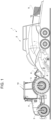
- numeral 1 indicates, as a whole, an agricultural tractor (of known kind) with an integrated suspension system 3 (of known kind, indicated schematically by means of dampers) designed to regulate the stiffness of the suspensions based on a control signal of an electronic control unit 4 (shown schematically).
- a variable stiffness architecture is used in the suspension system to counteract the body roll moment, thereby enhancing the roll stability of the tractor 1.
- the tractor 1 tows an implement 5 that is a baler powered by the torque provided by a PTO 6 of the tractor 1.
- the baler 5 (of known kind) is provided with an internal plunger 7 (shown schematically) that is used to compress a cut and raked crop 8 (such as hay, cotton, flax straw, salt marsh hay, or silage) into compact bales 9 that are easy to handle, transport, and store.
- a cut and raked crop 8 such as hay, cotton, flax straw, salt marsh hay, or silage
- rectangular bales 9 are provided.
- the electronic control 4 is designed to detect the operating cycle of the plunger 7 of the baler 5 and implement a comfort control mode by regulating the stiffness of the suspension system 3 in order to reduce a pitch movement of the tractor 1 and/or an acceleration to the operator's cab 10 induced by the forces and/or torques and/or accelerations transmitted from the baler 5 to the tractor 1.
- One preferred operating mode of the electronic unit 4 is shown in the flow chart of figure 2 .
- the electronic control unit checks if a comfort mode has been requested by the operator; in the affirmative condition, block 100 is followed by block 110 that checks if the baler 5 has been connected with the tractor 1. If no connection is detected, block 110 is followed by a block 120 that keeps a normal setting for the integrated suspension system 3. If a connection is detected (connection is detected by checking the status or messages coming from the ISOBUS for instance), block 110 is followed by a block 130 that enables the requested comfort mode. Accordingly, the electronic control unit 4 is designed to provide a prediction of the forces/torques/accelerations transmitted by the baler 5 towards the tractor 1.
- the stiffness of the suspension system 3 is regulated based on the prediction in order to anticipate and thus reducing a pitch movement of the tractor and/or an acceleration to the operator's cab 10 induced by the forces/torques/accelerations.
- block 140 provides a self calibration procedure wherein the forces and/or accelerations and/or torques transmitted from the baler 5 to the tractor 1 are measured (for example they are measured by using sensors for determining the excursion of the suspension system or sensors for measuring the torque in the PTO or sensors for measuring the force transmitted to the rear hitches) in a calibration interval to determine the frequency and parameters of the operating cycle of the plunger 7.
- Parameters of the operating cycle of the baler comprise: information describing plunger movement, or the engine speed drop or the bale drops.
- the above parameters have an almost constant and periodical behavior and it is possible to interpolate and thus predict the waveforms of the forces/torques/accelerations transmitted to the tractor 1 from the baler 5.
- the calibration step may determine that the force/torques/accelerations transmitted to the tractor 1 by the baler 5 have a periodic pulsating shape with peaks spaced by period ⁇ (and frequency 1/ ⁇ ) and average peak value P m .
- the parameters are stored in a memory and used to implement the comfort mode.
- the electronic control unit 4 operating under the comfort mode is designed to maintain the acceleration ⁇ of the tractor and/or the pitch ⁇ introduced to the tractor's cab 10 under the set limit values ⁇ lim and ⁇ lim having value as lower as possible, for instance values defined by the user as default or predetermined values.
- the above operation is obtained by a closed control loop system (we refer to block 160) that measures the acceleration ⁇ and/or the pitch ⁇ and regulate the stiffness of the suspension to maintain these two values under the set limit values ⁇ lim and ⁇ lim .
- the measurement of the acceleration ⁇ and/or the pitch ⁇ of the tractor induced by the baler can be obtained by means of sensors measuring the excursions of the suspension system for example.
- the block 150 is configured to provide feedback to the self-calibration module to improve or fine tuning the calculation of the period ⁇ and the average peak value Pm. In this way, it is possible to predict what are the force/torques/accelerations induced in the tractor 1 by the baler 5 and then anticipate the reaction by regulating the stiffness of the suspension.
- the electronic control unit 4 may be designed to receive a measure of the forces/torques/accelerations transmitted by the baler 5 (towed by the tractor 1) to the tractor 1; under said comfort control mode the stiffness of the suspension system is regulated in real time and in closed control loop based on said measure in order to reduce a pitch movement of the tractor 1 and/or an acceleration to the operator's cab 10 induced by the forces/torques/accelerations.
- the electronic control unit 4 operating under the control mode may designed to regulate the stiffness of the suspension system by considering additional information, for instance type of crop, environmental conditions, dimension or weight of the bale, weight of the towed baler or other parameter set by the user.
- the stiffness of the suspension system may be regulated by controlling hydraulically the fluid in the hydraulic suspensions, or any other known method used for regulating the stiffness or the dampening excursion of a generic suspension system, as not limiting example the one disclosed in EP1905290 .
Landscapes
- Engineering & Computer Science (AREA)
- Mechanical Engineering (AREA)
- Life Sciences & Earth Sciences (AREA)
- Environmental Sciences (AREA)
- Vehicle Body Suspensions (AREA)
- Lifting Devices For Agricultural Implements (AREA)
- Agricultural Machines (AREA)
Description
- The present invention concerns an agricultural tractor with integrated suspension system for baler application.
- A baler, most often called a hay baler, is a piece of farm machinery used to compress by means of a movable plunger a cut and raked crop (such as hay, cotton, flax straw, salt marsh hay, or silage) into compact bales that are easy to handle, transport, and store. Often, bales are configured to dry and preserve some intrinsic (e.g. the nutritional) value of the plants bundled. Several different types of balers are commonly used, each producing a different type of bale - rectangular or cylindrical, of various sizes, bound with twine, strapping, netting, or wire.
- The baler is normally towed by an agricultural vehicle (normally a tractor) and is powered by the PTO of the tractor.
- The engine speed of the tractor is not constant and drops periodically due to the incremented torque requested by the plunger through the PTO while pressing the cut and raked crop. The drops in the engine speed and the bale drops produce forces that are transmitted to the tractor and that, in some operating conditions, causes comfort problems to the operator driving the tractor as the transmitted force induces a pitch movement and/or an acceleration to the operator's cab.
US20180084723 discloses a control unit able to detect torque required by the baler and to regulate accordingly the propulsion drivetrain. - Scope of the present invention is to provide an agricultural tractor that is provided with an integrated suspension system that may prevent the above discomfort condition due to the operating cycle of the towed baler.
- The aforementioned aim is reached by the present invention as claimed in the appended set of claims.
- For a better understanding of the present invention, a preferred embodiment is described in the following, by way of a non-limiting example, with reference to the attached drawings wherein:
-
Figure 1 shows schematically an agricultural tractor towing a baler; and -
Figure 2 is a flow chart that explains the control logic of the suspension system of the tractor. - In
figure 1 , numeral 1 indicates, as a whole, an agricultural tractor (of known kind) with an integrated suspension system 3 (of known kind, indicated schematically by means of dampers) designed to regulate the stiffness of the suspensions based on a control signal of an electronic control unit 4 (shown schematically). As it is known, a variable stiffness architecture is used in the suspension system to counteract the body roll moment, thereby enhancing the roll stability of the tractor 1. - The tractor 1 tows an
implement 5 that is a baler powered by the torque provided by aPTO 6 of the tractor 1.
The baler 5 (of known kind) is provided with an internal plunger 7 (shown schematically) that is used to compress a cut and raked crop 8 (such as hay, cotton, flax straw, salt marsh hay, or silage) intocompact bales 9 that are easy to handle, transport, and store. In the example,rectangular bales 9 are provided. - According to the present invention, the electronic control 4 is designed to detect the operating cycle of the
plunger 7 of thebaler 5 and implement a comfort control mode by regulating the stiffness of thesuspension system 3 in order to reduce a pitch movement of the tractor 1 and/or an acceleration to the operator'scab 10 induced by the forces and/or torques and/or accelerations transmitted from thebaler 5 to the tractor 1. - One preferred operating mode of the electronic unit 4 is shown in the flow chart of
figure 2 . - According to
block 100 the electronic control unit checks if a comfort mode has been requested by the operator; in the affirmative condition,block 100 is followed byblock 110 that checks if thebaler 5 has been connected with the tractor 1. If no connection is detected,block 110 is followed by ablock 120 that keeps a normal setting for the integratedsuspension system 3. If a connection is detected (connection is detected by checking the status or messages coming from the ISOBUS for instance),block 110 is followed by ablock 130 that enables the requested comfort mode. Accordingly, the electronic control unit 4 is designed to provide a prediction of the forces/torques/accelerations transmitted by thebaler 5 towards the tractor 1. Under the above comfort control mode, the stiffness of thesuspension system 3 is regulated based on the prediction in order to anticipate and thus reducing a pitch movement of the tractor and/or an acceleration to the operator'scab 10 induced by the forces/torques/accelerations. - More specifically, in the embodiment described in
figure 2 ,block 140 provides a self calibration procedure wherein the forces and/or accelerations and/or torques transmitted from thebaler 5 to the tractor 1 are measured (for example they are measured by using sensors for determining the excursion of the suspension system or sensors for measuring the torque in the PTO or sensors for measuring the force transmitted to the rear hitches) in a calibration interval to determine the frequency and parameters of the operating cycle of theplunger 7. Parameters of the operating cycle of the baler comprise: information describing plunger movement, or the engine speed drop or the bale drops.
During the baler operation, the above parameters have an almost constant and periodical behavior and it is possible to interpolate and thus predict the waveforms of the forces/torques/accelerations transmitted to the tractor 1 from thebaler 5. - For instance, the calibration step may determine that the force/torques/accelerations transmitted to the tractor 1 by the
baler 5 have a periodic pulsating shape with peaks spaced by period τ (and frequency 1/τ) and average peak value Pm. The parameters are stored in a memory and used to implement the comfort mode. - According to
block 150, the electronic control unit 4 operating under the comfort mode is designed to maintain the acceleration α of the tractor and/or the pitch β introduced to the tractor'scab 10 under the set limit values αlim and βlim having value as lower as possible, for instance values defined by the user as default or predetermined values. The above operation is obtained by a closed control loop system (we refer to block 160) that measures the acceleration α and/or the pitch β and regulate the stiffness of the suspension to maintain these two values under the set limit values αlim and βlim. Preferably, the measurement of the acceleration α and/or the pitch β of the tractor induced by the baler can be obtained by means of sensors measuring the excursions of the suspension system for example. Moreover, theblock 150 is configured to provide feedback to the self-calibration module to improve or fine tuning the calculation of the period τ and the average peak value Pm. In this way, it is possible to predict what are the force/torques/accelerations induced in the tractor 1 by thebaler 5 and then anticipate the reaction by regulating the stiffness of the suspension. - Alternatively to the use of above prediction of
figure 2 , the electronic control unit 4 may be designed to receive a measure of the forces/torques/accelerations transmitted by the baler 5 (towed by the tractor 1) to the tractor 1; under said comfort control mode the stiffness of the suspension system is regulated in real time and in closed control loop based on said measure in order to reduce a pitch movement of the tractor 1 and/or an acceleration to the operator'scab 10 induced by the forces/torques/accelerations. - Finally, the electronic control unit 4 operating under the control mode may designed to regulate the stiffness of the suspension system by considering additional information, for instance type of crop, environmental conditions, dimension or weight of the bale, weight of the towed baler or other parameter set by the user. The stiffness of the suspension system may be regulated by controlling hydraulically the fluid in the hydraulic suspensions, or any other known method used for regulating the stiffness or the dampening excursion of a generic suspension system, as not limiting example the one disclosed in
EP1905290 .
Claims (8)
- Agricultural tractor (1) with integrated suspension system (3), wherein the tractor (1) is provided with an integrated suspension system (3) designed to regulate the stiffness of the suspensions based on a control signal, characterized by comprising electronic control means (4) configured to detect the operating cycle of a towed baler (3) and to implement a comfort control mode (130) by regulating the stiffness of the suspension system in order to reduce a pitch movement of the tractor and/or an acceleration to the operator's cab (10) induced by the forces and/or accelerations and/or torques transmitted from the baler (5) to the tractor (1) .
- Agricultural tractor (1) as defined in claim 1, wherein said electronic control means (4) is configured to provide a prediction of the forces and/or accelerations and/or torques transmitted by the baler (5) to the tractor (1); under said comfort control mode (130) the stiffness of the suspension system (3) is regulated based on said prediction in order to reduce the pitch movement of the tractor and/or the acceleration to the operator's cab (10) induced by said forces and/or accelerations and/or torques.
- Agricultural tractor as defined in claim 2, wherein said electronic control means (4) is configured to implement a self calibration procedure (140) wherein the forces and/or accelerations and/or torques transmitted from the baler to the tractor are measured in a calibration interval to determine the frequency and at least one parameter of the operating cycle of the baler.
- Agricultural tractor as defined in claim 3, wherein said at least one parameter is information describing one of plunger movement, or engine speed drop or bale drops.
- Agricultural tractor (1) as defined in claim 1, wherein said electronic control means (4) is configured to receive a measure of the forces and/or accelerations and/or torques transmitted by the baler (5) to the tractor; under said comfort control mode the stiffness of the suspension system (3) is regulated in a closed control loop based on the measure in order to reduce a pitch movement of the tractor and/or an acceleration to the operator's cab induced by said forces and/or accelerations and/or torques.
- Agricultural tractor as defined in claim 1, wherein said electronic control means (4) is configured to detect the physical connection between the tractor (1) and the baler (5) and, once the connection is established (110), to enable said comfort control mode (130) of operation of the suspension system (3).
- Agricultural tractor as defined in any of the preceding claim, wherein said electronic control means operating under said control mode is configured to maintain (150) the acceleration of the tractor and/or the pitch introduced to the tractor's cab under predetermined values.
- Agricultural tractor as defined in any of the preceding claim, wherein said electronic control means (4) operating under said control mode is configured to regulate the stiffness of said suspension system (3) by considering additional information, for instance type of crop, environmental conditions, dimension or weight of the bale or other parameter set by the user.
Applications Claiming Priority (1)
| Application Number | Priority Date | Filing Date | Title |
|---|---|---|---|
| IT102019000008913A IT201900008913A1 (en) | 2019-06-13 | 2019-06-13 | AGRICULTURAL TRACTOR WITH INTEGRATED SUSPENSION SYSTEM FOR USE WITH PACKER |
Publications (2)
| Publication Number | Publication Date |
|---|---|
| EP3750397A1 EP3750397A1 (en) | 2020-12-16 |
| EP3750397B1 true EP3750397B1 (en) | 2023-08-09 |
Family
ID=67998690
Family Applications (1)
| Application Number | Title | Priority Date | Filing Date |
|---|---|---|---|
| EP20179743.8A Active EP3750397B1 (en) | 2019-06-13 | 2020-06-12 | Agricultural tractor with integrated suspension system for baler application |
Country Status (2)
| Country | Link |
|---|---|
| EP (1) | EP3750397B1 (en) |
| IT (1) | IT201900008913A1 (en) |
Family Cites Families (5)
| Publication number | Priority date | Publication date | Assignee | Title |
|---|---|---|---|---|
| DE4119414A1 (en) * | 1991-06-13 | 1992-12-17 | Bosch Gmbh Robert | AGRICULTURAL USE OF TRACTOR WITH A LINKED LIFT |
| US7513521B2 (en) | 2006-09-26 | 2009-04-07 | Cnh America Llc | Suspended drawbar control with selectable operating modes |
| JP5628721B2 (en) * | 2011-03-22 | 2014-11-19 | 株式会社クボタ | Tractor |
| DE102016218595A1 (en) * | 2016-09-27 | 2018-03-29 | Deere & Company | Drive system of a work vehicle |
| DE102016222081A1 (en) * | 2016-11-10 | 2018-05-17 | Deere & Company | Rectangular baler with a counterweight compensating the stuffer movement |
-
2019
- 2019-06-13 IT IT102019000008913A patent/IT201900008913A1/en unknown
-
2020
- 2020-06-12 EP EP20179743.8A patent/EP3750397B1/en active Active
Also Published As
| Publication number | Publication date |
|---|---|
| IT201900008913A1 (en) | 2020-12-13 |
| EP3750397A1 (en) | 2020-12-16 |
Similar Documents
| Publication | Publication Date | Title |
|---|---|---|
| US10827675B2 (en) | Drive system of a utility vehicle | |
| EP2825019B1 (en) | A method and system for determining the load on an element of the drive system of a plunger in a baler | |
| US7703391B2 (en) | Round baler with scale and moisture meter | |
| US9844187B2 (en) | Density control system | |
| US12063895B2 (en) | Crop baler with stuffer countermass | |
| EP3262921B1 (en) | Baler | |
| WO2013045105A1 (en) | Baler and method of baling | |
| US9823147B2 (en) | Method and system for determining the plunger load of a baler | |
| EP2816889B1 (en) | Multi-mode control system for rectangular baler and related method | |
| EP2614703B1 (en) | Crop parameter dependent bale chamber configuration adaptation | |
| EP3721702B1 (en) | Agricultural baler with bale formation control based on power requirements and usage | |
| US6457405B1 (en) | Sensor arrangement for an agricultural baler | |
| EP3837963B1 (en) | Methods and systems for measuring throughput in agricultural equipment | |
| US11968929B2 (en) | Agricultural system | |
| EP3750397A1 (en) | Agricultural tractor with integrated suspension system for baler application | |
| US12029169B2 (en) | Baling machine including a pre-baling chamber rotative packer/stuffer | |
| US11085852B2 (en) | Agricultural system | |
| Coen et al. | WO/2014/180965-A method and system for determining the plunger load of a baler |
Legal Events
| Date | Code | Title | Description |
|---|---|---|---|
| PUAI | Public reference made under article 153(3) epc to a published international application that has entered the european phase |
Free format text: ORIGINAL CODE: 0009012 |
|
| STAA | Information on the status of an ep patent application or granted ep patent |
Free format text: STATUS: THE APPLICATION HAS BEEN PUBLISHED |
|
| AK | Designated contracting states |
Kind code of ref document: A1 Designated state(s): AL AT BE BG CH CY CZ DE DK EE ES FI FR GB GR HR HU IE IS IT LI LT LU LV MC MK MT NL NO PL PT RO RS SE SI SK SM TR |
|
| AX | Request for extension of the european patent |
Extension state: BA ME |
|
| STAA | Information on the status of an ep patent application or granted ep patent |
Free format text: STATUS: REQUEST FOR EXAMINATION WAS MADE |
|
| 17P | Request for examination filed |
Effective date: 20210616 |
|
| RBV | Designated contracting states (corrected) |
Designated state(s): AL AT BE BG CH CY CZ DE DK EE ES FI FR GB GR HR HU IE IS IT LI LT LU LV MC MK MT NL NO PL PT RO RS SE SI SK SM TR |
|
| GRAP | Despatch of communication of intention to grant a patent |
Free format text: ORIGINAL CODE: EPIDOSNIGR1 |
|
| STAA | Information on the status of an ep patent application or granted ep patent |
Free format text: STATUS: GRANT OF PATENT IS INTENDED |
|
| RIC1 | Information provided on ipc code assigned before grant |
Ipc: B60G 23/00 20060101ALN20221221BHEP Ipc: B60G 17/02 20060101ALI20221221BHEP Ipc: B60G 17/015 20060101ALI20221221BHEP Ipc: A01F 15/08 20060101AFI20221221BHEP |
|
| INTG | Intention to grant announced |
Effective date: 20230112 |
|
| GRAS | Grant fee paid |
Free format text: ORIGINAL CODE: EPIDOSNIGR3 |
|
| RAP3 | Party data changed (applicant data changed or rights of an application transferred) |
Owner name: CNH INDUSTRIAL ITALIA S.P.A. |
|
| GRAA | (expected) grant |
Free format text: ORIGINAL CODE: 0009210 |
|
| STAA | Information on the status of an ep patent application or granted ep patent |
Free format text: STATUS: THE PATENT HAS BEEN GRANTED |
|
| AK | Designated contracting states |
Kind code of ref document: B1 Designated state(s): AL AT BE BG CH CY CZ DE DK EE ES FI FR GB GR HR HU IE IS IT LI LT LU LV MC MK MT NL NO PL PT RO RS SE SI SK SM TR |
|
| REG | Reference to a national code |
Ref country code: GB Ref legal event code: FG4D |
|
| REG | Reference to a national code |
Ref country code: CH Ref legal event code: EP |
|
| REG | Reference to a national code |
Ref country code: IE Ref legal event code: FG4D |
|
| REG | Reference to a national code |
Ref country code: DE Ref legal event code: R096 Ref document number: 602020015268 Country of ref document: DE |
|
| REG | Reference to a national code |
Ref country code: LT Ref legal event code: MG9D |
|
| REG | Reference to a national code |
Ref country code: NL Ref legal event code: MP Effective date: 20230809 |
|
| REG | Reference to a national code |
Ref country code: AT Ref legal event code: MK05 Ref document number: 1596381 Country of ref document: AT Kind code of ref document: T Effective date: 20230809 |
|
| PG25 | Lapsed in a contracting state [announced via postgrant information from national office to epo] |
Ref country code: GR Free format text: LAPSE BECAUSE OF FAILURE TO SUBMIT A TRANSLATION OF THE DESCRIPTION OR TO PAY THE FEE WITHIN THE PRESCRIBED TIME-LIMIT Effective date: 20231110 |
|
| PG25 | Lapsed in a contracting state [announced via postgrant information from national office to epo] |
Ref country code: IS Free format text: LAPSE BECAUSE OF FAILURE TO SUBMIT A TRANSLATION OF THE DESCRIPTION OR TO PAY THE FEE WITHIN THE PRESCRIBED TIME-LIMIT Effective date: 20231209 |
|
| PG25 | Lapsed in a contracting state [announced via postgrant information from national office to epo] |
Ref country code: SE Free format text: LAPSE BECAUSE OF FAILURE TO SUBMIT A TRANSLATION OF THE DESCRIPTION OR TO PAY THE FEE WITHIN THE PRESCRIBED TIME-LIMIT Effective date: 20230809 Ref country code: RS Free format text: LAPSE BECAUSE OF FAILURE TO SUBMIT A TRANSLATION OF THE DESCRIPTION OR TO PAY THE FEE WITHIN THE PRESCRIBED TIME-LIMIT Effective date: 20230809 Ref country code: PT Free format text: LAPSE BECAUSE OF FAILURE TO SUBMIT A TRANSLATION OF THE DESCRIPTION OR TO PAY THE FEE WITHIN THE PRESCRIBED TIME-LIMIT Effective date: 20231211 Ref country code: NO Free format text: LAPSE BECAUSE OF FAILURE TO SUBMIT A TRANSLATION OF THE DESCRIPTION OR TO PAY THE FEE WITHIN THE PRESCRIBED TIME-LIMIT Effective date: 20231109 Ref country code: NL Free format text: LAPSE BECAUSE OF FAILURE TO SUBMIT A TRANSLATION OF THE DESCRIPTION OR TO PAY THE FEE WITHIN THE PRESCRIBED TIME-LIMIT Effective date: 20230809 Ref country code: LV Free format text: LAPSE BECAUSE OF FAILURE TO SUBMIT A TRANSLATION OF THE DESCRIPTION OR TO PAY THE FEE WITHIN THE PRESCRIBED TIME-LIMIT Effective date: 20230809 Ref country code: LT Free format text: LAPSE BECAUSE OF FAILURE TO SUBMIT A TRANSLATION OF THE DESCRIPTION OR TO PAY THE FEE WITHIN THE PRESCRIBED TIME-LIMIT Effective date: 20230809 Ref country code: IS Free format text: LAPSE BECAUSE OF FAILURE TO SUBMIT A TRANSLATION OF THE DESCRIPTION OR TO PAY THE FEE WITHIN THE PRESCRIBED TIME-LIMIT Effective date: 20231209 Ref country code: HR Free format text: LAPSE BECAUSE OF FAILURE TO SUBMIT A TRANSLATION OF THE DESCRIPTION OR TO PAY THE FEE WITHIN THE PRESCRIBED TIME-LIMIT Effective date: 20230809 Ref country code: GR Free format text: LAPSE BECAUSE OF FAILURE TO SUBMIT A TRANSLATION OF THE DESCRIPTION OR TO PAY THE FEE WITHIN THE PRESCRIBED TIME-LIMIT Effective date: 20231110 Ref country code: FI Free format text: LAPSE BECAUSE OF FAILURE TO SUBMIT A TRANSLATION OF THE DESCRIPTION OR TO PAY THE FEE WITHIN THE PRESCRIBED TIME-LIMIT Effective date: 20230809 Ref country code: AT Free format text: LAPSE BECAUSE OF FAILURE TO SUBMIT A TRANSLATION OF THE DESCRIPTION OR TO PAY THE FEE WITHIN THE PRESCRIBED TIME-LIMIT Effective date: 20230809 |
|
| PG25 | Lapsed in a contracting state [announced via postgrant information from national office to epo] |
Ref country code: PL Free format text: LAPSE BECAUSE OF FAILURE TO SUBMIT A TRANSLATION OF THE DESCRIPTION OR TO PAY THE FEE WITHIN THE PRESCRIBED TIME-LIMIT Effective date: 20230809 |
|
| PG25 | Lapsed in a contracting state [announced via postgrant information from national office to epo] |
Ref country code: ES Free format text: LAPSE BECAUSE OF FAILURE TO SUBMIT A TRANSLATION OF THE DESCRIPTION OR TO PAY THE FEE WITHIN THE PRESCRIBED TIME-LIMIT Effective date: 20230809 |
|
| PG25 | Lapsed in a contracting state [announced via postgrant information from national office to epo] |
Ref country code: SM Free format text: LAPSE BECAUSE OF FAILURE TO SUBMIT A TRANSLATION OF THE DESCRIPTION OR TO PAY THE FEE WITHIN THE PRESCRIBED TIME-LIMIT Effective date: 20230809 Ref country code: RO Free format text: LAPSE BECAUSE OF FAILURE TO SUBMIT A TRANSLATION OF THE DESCRIPTION OR TO PAY THE FEE WITHIN THE PRESCRIBED TIME-LIMIT Effective date: 20230809 Ref country code: ES Free format text: LAPSE BECAUSE OF FAILURE TO SUBMIT A TRANSLATION OF THE DESCRIPTION OR TO PAY THE FEE WITHIN THE PRESCRIBED TIME-LIMIT Effective date: 20230809 Ref country code: EE Free format text: LAPSE BECAUSE OF FAILURE TO SUBMIT A TRANSLATION OF THE DESCRIPTION OR TO PAY THE FEE WITHIN THE PRESCRIBED TIME-LIMIT Effective date: 20230809 Ref country code: DK Free format text: LAPSE BECAUSE OF FAILURE TO SUBMIT A TRANSLATION OF THE DESCRIPTION OR TO PAY THE FEE WITHIN THE PRESCRIBED TIME-LIMIT Effective date: 20230809 Ref country code: CZ Free format text: LAPSE BECAUSE OF FAILURE TO SUBMIT A TRANSLATION OF THE DESCRIPTION OR TO PAY THE FEE WITHIN THE PRESCRIBED TIME-LIMIT Effective date: 20230809 Ref country code: SK Free format text: LAPSE BECAUSE OF FAILURE TO SUBMIT A TRANSLATION OF THE DESCRIPTION OR TO PAY THE FEE WITHIN THE PRESCRIBED TIME-LIMIT Effective date: 20230809 |
|
| REG | Reference to a national code |
Ref country code: DE Ref legal event code: R097 Ref document number: 602020015268 Country of ref document: DE |
|
| PLBE | No opposition filed within time limit |
Free format text: ORIGINAL CODE: 0009261 |
|
| STAA | Information on the status of an ep patent application or granted ep patent |
Free format text: STATUS: NO OPPOSITION FILED WITHIN TIME LIMIT |
|
| 26N | No opposition filed |
Effective date: 20240513 |
|
| PG25 | Lapsed in a contracting state [announced via postgrant information from national office to epo] |
Ref country code: SI Free format text: LAPSE BECAUSE OF FAILURE TO SUBMIT A TRANSLATION OF THE DESCRIPTION OR TO PAY THE FEE WITHIN THE PRESCRIBED TIME-LIMIT Effective date: 20230809 |
|
| PG25 | Lapsed in a contracting state [announced via postgrant information from national office to epo] |
Ref country code: BG Free format text: LAPSE BECAUSE OF FAILURE TO SUBMIT A TRANSLATION OF THE DESCRIPTION OR TO PAY THE FEE WITHIN THE PRESCRIBED TIME-LIMIT Effective date: 20230809 |
|
| PG25 | Lapsed in a contracting state [announced via postgrant information from national office to epo] |
Ref country code: BG Free format text: LAPSE BECAUSE OF FAILURE TO SUBMIT A TRANSLATION OF THE DESCRIPTION OR TO PAY THE FEE WITHIN THE PRESCRIBED TIME-LIMIT Effective date: 20230809 |
|
| PG25 | Lapsed in a contracting state [announced via postgrant information from national office to epo] |
Ref country code: MC Free format text: LAPSE BECAUSE OF FAILURE TO SUBMIT A TRANSLATION OF THE DESCRIPTION OR TO PAY THE FEE WITHIN THE PRESCRIBED TIME-LIMIT Effective date: 20230809 |
|
| REG | Reference to a national code |
Ref country code: CH Ref legal event code: PL |
|
| PG25 | Lapsed in a contracting state [announced via postgrant information from national office to epo] |
Ref country code: LU Free format text: LAPSE BECAUSE OF NON-PAYMENT OF DUE FEES Effective date: 20240612 |
|
| PG25 | Lapsed in a contracting state [announced via postgrant information from national office to epo] |
Ref country code: IE Free format text: LAPSE BECAUSE OF NON-PAYMENT OF DUE FEES Effective date: 20240612 |
|
| PG25 | Lapsed in a contracting state [announced via postgrant information from national office to epo] |
Ref country code: BE Free format text: LAPSE BECAUSE OF NON-PAYMENT OF DUE FEES Effective date: 20240630 Ref country code: CH Free format text: LAPSE BECAUSE OF NON-PAYMENT OF DUE FEES Effective date: 20240630 |
|
| REG | Reference to a national code |
Ref country code: BE Ref legal event code: MM Effective date: 20240630 |
|
| PG25 | Lapsed in a contracting state [announced via postgrant information from national office to epo] |
Ref country code: CY Free format text: LAPSE BECAUSE OF FAILURE TO SUBMIT A TRANSLATION OF THE DESCRIPTION OR TO PAY THE FEE WITHIN THE PRESCRIBED TIME-LIMIT; INVALID AB INITIO Effective date: 20200612 |
|
| PG25 | Lapsed in a contracting state [announced via postgrant information from national office to epo] |
Ref country code: HU Free format text: LAPSE BECAUSE OF FAILURE TO SUBMIT A TRANSLATION OF THE DESCRIPTION OR TO PAY THE FEE WITHIN THE PRESCRIBED TIME-LIMIT; INVALID AB INITIO Effective date: 20200612 |
|
| PG25 | Lapsed in a contracting state [announced via postgrant information from national office to epo] |
Ref country code: TR Free format text: LAPSE BECAUSE OF FAILURE TO SUBMIT A TRANSLATION OF THE DESCRIPTION OR TO PAY THE FEE WITHIN THE PRESCRIBED TIME-LIMIT Effective date: 20230809 |
|
| PGFP | Annual fee paid to national office [announced via postgrant information from national office to epo] |
Ref country code: GB Payment date: 20260622 Year of fee payment: 7 |
|
| PGFP | Annual fee paid to national office [announced via postgrant information from national office to epo] |
Ref country code: IT Payment date: 20260623 Year of fee payment: 7 |
|
| PGFP | Annual fee paid to national office [announced via postgrant information from national office to epo] |
Ref country code: DE Payment date: 20260623 Year of fee payment: 7 |
|
| PGFP | Annual fee paid to national office [announced via postgrant information from national office to epo] |
Ref country code: FR Payment date: 20260622 Year of fee payment: 7 |