EP3749449B1 - Method for preparing a silver impregnation solution - Google Patents
Method for preparing a silver impregnation solution Download PDFInfo
- Publication number
- EP3749449B1 EP3749449B1 EP19702305.4A EP19702305A EP3749449B1 EP 3749449 B1 EP3749449 B1 EP 3749449B1 EP 19702305 A EP19702305 A EP 19702305A EP 3749449 B1 EP3749449 B1 EP 3749449B1
- Authority
- EP
- European Patent Office
- Prior art keywords
- silver
- oxalic acid
- solution
- reactor
- organic amine
- Prior art date
- Legal status (The legal status is an assumption and is not a legal conclusion. Google has not performed a legal analysis and makes no representation as to the accuracy of the status listed.)
- Active
Links
Images



Classifications
-
- B—PERFORMING OPERATIONS; TRANSPORTING
- B01—PHYSICAL OR CHEMICAL PROCESSES OR APPARATUS IN GENERAL
- B01J—CHEMICAL OR PHYSICAL PROCESSES, e.g. CATALYSIS OR COLLOID CHEMISTRY; THEIR RELEVANT APPARATUS
- B01J21/00—Catalysts comprising the elements, oxides, or hydroxides of magnesium, boron, aluminium, carbon, silicon, titanium, zirconium, or hafnium
- B01J21/02—Boron or aluminium; Oxides or hydroxides thereof
- B01J21/04—Alumina
-
- B—PERFORMING OPERATIONS; TRANSPORTING
- B01—PHYSICAL OR CHEMICAL PROCESSES OR APPARATUS IN GENERAL
- B01J—CHEMICAL OR PHYSICAL PROCESSES, e.g. CATALYSIS OR COLLOID CHEMISTRY; THEIR RELEVANT APPARATUS
- B01J23/00—Catalysts comprising metals or metal oxides or hydroxides, not provided for in group B01J21/00
- B01J23/38—Catalysts comprising metals or metal oxides or hydroxides, not provided for in group B01J21/00 of noble metals
- B01J23/48—Silver or gold
- B01J23/50—Silver
-
- B—PERFORMING OPERATIONS; TRANSPORTING
- B01—PHYSICAL OR CHEMICAL PROCESSES OR APPARATUS IN GENERAL
- B01J—CHEMICAL OR PHYSICAL PROCESSES, e.g. CATALYSIS OR COLLOID CHEMISTRY; THEIR RELEVANT APPARATUS
- B01J23/00—Catalysts comprising metals or metal oxides or hydroxides, not provided for in group B01J21/00
- B01J23/38—Catalysts comprising metals or metal oxides or hydroxides, not provided for in group B01J21/00 of noble metals
- B01J23/54—Catalysts comprising metals or metal oxides or hydroxides, not provided for in group B01J21/00 of noble metals combined with metals, oxides or hydroxides provided for in groups B01J23/02 - B01J23/36
- B01J23/66—Silver or gold
- B01J23/68—Silver or gold with arsenic, antimony, bismuth, vanadium, niobium, tantalum, polonium, chromium, molybdenum, tungsten, manganese, technetium or rhenium
- B01J23/688—Silver or gold with arsenic, antimony, bismuth, vanadium, niobium, tantalum, polonium, chromium, molybdenum, tungsten, manganese, technetium or rhenium with manganese, technetium or rhenium
-
- B—PERFORMING OPERATIONS; TRANSPORTING
- B01—PHYSICAL OR CHEMICAL PROCESSES OR APPARATUS IN GENERAL
- B01J—CHEMICAL OR PHYSICAL PROCESSES, e.g. CATALYSIS OR COLLOID CHEMISTRY; THEIR RELEVANT APPARATUS
- B01J35/00—Catalysts, in general, characterised by their form or physical properties
- B01J35/60—Catalysts, in general, characterised by their form or physical properties characterised by their surface properties or porosity
- B01J35/61—Surface area
- B01J35/612—Surface area less than 10 m2/g
-
- B—PERFORMING OPERATIONS; TRANSPORTING
- B01—PHYSICAL OR CHEMICAL PROCESSES OR APPARATUS IN GENERAL
- B01J—CHEMICAL OR PHYSICAL PROCESSES, e.g. CATALYSIS OR COLLOID CHEMISTRY; THEIR RELEVANT APPARATUS
- B01J37/00—Processes, in general, for preparing catalysts; Processes, in general, for activation of catalysts
- B01J37/02—Impregnation, coating or precipitation
- B01J37/0201—Impregnation
- B01J37/0203—Impregnation the impregnation liquid containing organic compounds
-
- B—PERFORMING OPERATIONS; TRANSPORTING
- B01—PHYSICAL OR CHEMICAL PROCESSES OR APPARATUS IN GENERAL
- B01J—CHEMICAL OR PHYSICAL PROCESSES, e.g. CATALYSIS OR COLLOID CHEMISTRY; THEIR RELEVANT APPARATUS
- B01J37/00—Processes, in general, for preparing catalysts; Processes, in general, for activation of catalysts
- B01J37/02—Impregnation, coating or precipitation
- B01J37/0201—Impregnation
- B01J37/0205—Impregnation in several steps
-
- B—PERFORMING OPERATIONS; TRANSPORTING
- B01—PHYSICAL OR CHEMICAL PROCESSES OR APPARATUS IN GENERAL
- B01J—CHEMICAL OR PHYSICAL PROCESSES, e.g. CATALYSIS OR COLLOID CHEMISTRY; THEIR RELEVANT APPARATUS
- B01J37/00—Processes, in general, for preparing catalysts; Processes, in general, for activation of catalysts
- B01J37/02—Impregnation, coating or precipitation
- B01J37/0201—Impregnation
- B01J37/0213—Preparation of the impregnating solution
-
- B—PERFORMING OPERATIONS; TRANSPORTING
- B01—PHYSICAL OR CHEMICAL PROCESSES OR APPARATUS IN GENERAL
- B01J—CHEMICAL OR PHYSICAL PROCESSES, e.g. CATALYSIS OR COLLOID CHEMISTRY; THEIR RELEVANT APPARATUS
- B01J37/00—Processes, in general, for preparing catalysts; Processes, in general, for activation of catalysts
- B01J37/08—Heat treatment
-
- C—CHEMISTRY; METALLURGY
- C07—ORGANIC CHEMISTRY
- C07D—HETEROCYCLIC COMPOUNDS
- C07D301/00—Preparation of oxiranes
- C07D301/02—Synthesis of the oxirane ring
-
- B—PERFORMING OPERATIONS; TRANSPORTING
- B01—PHYSICAL OR CHEMICAL PROCESSES OR APPARATUS IN GENERAL
- B01J—CHEMICAL OR PHYSICAL PROCESSES, e.g. CATALYSIS OR COLLOID CHEMISTRY; THEIR RELEVANT APPARATUS
- B01J2235/00—Indexing scheme associated with group B01J35/00, related to the analysis techniques used to determine the catalysts form or properties
-
- B—PERFORMING OPERATIONS; TRANSPORTING
- B01—PHYSICAL OR CHEMICAL PROCESSES OR APPARATUS IN GENERAL
- B01J—CHEMICAL OR PHYSICAL PROCESSES, e.g. CATALYSIS OR COLLOID CHEMISTRY; THEIR RELEVANT APPARATUS
- B01J35/00—Catalysts, in general, characterised by their form or physical properties
- B01J35/50—Catalysts, in general, characterised by their form or physical properties characterised by their shape or configuration
- B01J35/55—Cylinders or rings
Definitions
- the present invention relates to a method for preparing a silver impregnation solution and to a method for producing a catalyst effective in the oxidative conversion of ethylene to ethylene oxide.
- Silver impregnation solutions of the art typically contain silver oxalate, or a combination of silver oxide and oxalic acid, together in ethylenediamine.
- oxalate in oxalic acid provides oxalate anion to counter the charge balance of silver cation in the ethylenediamine/water solution to form a soluble [Ag 2 C 2 O 4 ]-ethylenediamine complex.
- One approach for preparing suitable silver impregnation solutions involves the preparation of insoluble silver oxalate intermediate starting from aqueous silver nitrate solutions.
- the silver oxalate intermediate is then dissolved in an aqueous solution of an organic amine which converts the silver oxalate into water soluble complexes.
- Ethylenediamine is a suitable organic amine ligand.
- Another approach for preparing suitable silver impregnation solutions involves preparing an aqueous oxalic acid-organic amine solution by reacting oxalic acid with an organic amine in the presence of water and conducting a silver complex formation reaction by adding particulate silver oxide to the aqueous oxalic acid-organic amine solution.
- This approach minimizes separation efforts.
- no suggestion has been made concerning a safe and efficient implementation of this approach into a technical process for the large-scale production of catalysts.
- WO 2015/095508 A1 describes the preparation of a silver solution in a laboratory scale. Water was gradually mixed with ethylenediamine in a container placed in an ice bath to control the solution temperature between 20 and 30°C with vigorous agitation. Ammonium oxalate was subsequently added to the solution while the temperature was maintained at 20 to 30°C. After ammonium oxalate was completely dissolved, silver oxide was added to the solution at a temperature between 20 and 30°C. Comparative example 5 of WO 2015/095508 A1 provides a recipe for the preparation of a silver complex solution using oxalic acid as an exclusive source of oxalate ions. The amounts of oxalic acid dihydrate and silver oxide of 261.0 g and 490.0 g, respectively, correspond to an oxalic acid/silver molar ratio of 0.49.
- US 2009/0177000 A1 describes that, for example, silver oxide can be dissolved in a solution of oxalic acid and ethylenediamine up to silver content of approximately 30 percent by weight.
- WO 2014/105770 A1 describes the preparation of an impregnation stock solution.
- 277.5 g of deionized water was placed in cooling bath to maintain temperature during the whole preparation under 50°C.
- 221.9 g of ethylenediamine was added in small portions to avoid overheating.
- 174.1 g of oxalic acid dihydrate was then added to the water-ethylenediamine solution in small portions.
- 326.5 g of high purity silver oxide was added to solution in small portions. After all silver oxide was dissolved and the solution was cooled to about 35°C it was removed from cooling bath.
- the oxalic acid/silver molar ratio was 0.49.
- the process avoids the possibility of oxalic acid and silver oxide powder coming into direct contact.
- a neutralization reactor R1 is charged with an aqueous organic amine.
- Any reactor known to those skilled in the art can be used.
- Such reactors comprise refrigerating means for cooling the reaction medium in the reactor and agitating means for agitating or stirring the reaction medium in the reactor.
- Stirred tank reactors can, for example, be used as reactors.
- a tank-type forced circulation reactor with a heat exchanger arranged in the external liquid circuit can be used.
- an aqueous stock solution of the amine can be used which can be adjusted to the desired amine concentration by adding additional amine or water.
- the organic amine is dissolved in water in order to form an aqueous solution of the organic amine.
- the organic amine concentration is in the range from 40 to 70 wt.%, in particular 50 to 62 wt.%.
- Any organic amine can be used in the method of the invention which is capable of dissolving silver cations (Ag + ) in the form of a water soluble complex.
- the organic amine comprises, for example, a vicinal alkylene diamine, preferably ethylenediamine. Vicinal alkylene diamine, and in particular ethylenediamine, are capable of dissolving large amounts of silver oxalate in aqueous solutions. It is assumed that the free electron pairs of both nitrogen atoms of vicinal alkylene diamines coordinate to a silver cation thereby forming five-membered chelate rings.
- Additional amines such as monethanolamine, can be used if desired.
- oxalic acid powder is added through a first feeding conduit to the neutralization reactor R1, preferably on a metered basis.
- Oxalic acid can be added in any form. It is preferably added in the form of oxalic acid dihydrate.
- Known devices for dispensing powder materials preferably on a metered basis, can be used such as loss-in-weight feeder systems or volumetric feeders.
- the oxalic acid dihydrate powder preferably has a controlled particle size distribution in order to operate the reaction of oxalic acid dihydrate with an aqueous organic amine solution in a controllable way. It is generally preferred that the oxalic acid dihydrate powder has a primary particle size distribution such that at least 75% by volume of the particles have a particle size of 250 ⁇ m or lower. Preferably, at least 75% by volume of the particles have a particle size of 50 ⁇ m or lower.
- Primary particle size distribution as used herein is measured using a dispersion pressure of equal or greater than 3.5 bar. Dispersion at a dispersion pressure of 3.5 bar resulted in a monomodal distribution which is used as the primary particle size distribution.
- the oxalic acid dihydrate powder may, for example, have an agglomerated particle size distribution such that at least 75% of the total volume of oxalic acid dihydrate is in the form of aggregates having an apparent particle size of at least 50 ⁇ m. "Agglomerated particle size distribution" as used herein is measured using a dispersion pressure of 0.1 bar.
- a dust of oxalic acid dihydrate can be formed during handling. Such dust formation is undesired as the dust particles can create health hazards or deposit on surfaces of the reaction equipment.
- the presence of metal species or of inorganic anions in the impregnation solution can adversely influence the catalytic properties of a catalyst produced therefrom.
- individual catalytic properties may be enhanced by a specific promoting species if purposively added to the impregnation solution other catalytic properties may be diminished. For that reason it is preferred to minimize the introduction of metal species or of inorganic anions via the oxalic acid dihydrate powder.
- the oxalic acid dihydrate has a purity of at least 99.5% by weight.
- the oxalic acid dihydrate contains, for example, 10 ppmw or less of copper.
- the oxalic acid dihydrate contains, for example, 10 ppmw or less of iron.
- the oxalic acid dihydrate contains, for example, 2 ppmw or less of lead.
- the oxalic acid dihydrate contains, for example, 10 ppmw or less of sodium.
- the oxalic acid dihydrate can contain varying amounts of sulfate ions. Sulphur is often added to the solution in minor controlled amounts, with the aim of improving catalyst selectivity. Excessive amounts of Sulphur, on the other hand, can cause catalyst poisoning.
- a preferred oxalic acid dihydrate contains 1500 ppmw or less, such as 500 ppmw or less, more preferable 100 ppmw or less, most preferably 20 ppmw or less of sulfate anions.
- the reaction medium is generally agitated in step (b). Any agitation technique can be used which ensures sufficient mixing of the oxalic acid with the surrounding liquid. Agitation preferably involves stirring. As the reaction amines with oxalic acid is exothermic, it is important to cool the reaction in order to ensure that the oxalic acid-organic amine solution is prepared in a controlled way.
- the aqueous organic amine is adjusted to a temperature T 1 , wherein T 1 ⁇ 100°C - ⁇ T AD-1 and ⁇ T AD-1 is the maximum adiabatic temperature rise during step (b).
- the maximum adiabatic temperature rise ⁇ T AD-1 is the increase of the temperature of the reaction medium which would occur if the total amount of oxalic acid were added at once under adiabatic conditions.
- the volatility of the organic amine is high at temperatures above 100°C. Excess vaporization of the organic amine can cause an uncontrolled pressure increase or the formation of explosive amine vapor/air mixtures. At a temperature of 100°C or below, the reaction mixture can be safely handled over a period of at least 24 hours. If the method is carried out within the limitations of the above condition, the temperature of the reaction medium can never exceed 100°C even if heat removal from the reaction medium is insufficient and/or heat removal equipment fails. This ensures a safe and efficient production of the aqueous oxalic acid-organic amine solution.
- Q AD-1 and cp 1 are determined experimentally, as illustrated in the appended examples.
- the reactants are present in non-stoichiometric amounts, and Q AD-1 is determined by the reaction limiting reactant, typically the oxalic acid.
- the starting temperature T 1 is in the range from 10°C to 40°C, particularly 10 to 20°C.
- step (c) the aqueous oxalic acid-organic amine solution is at least partially withdrawn from the neutralization reactor and directed to a complexation reactor R2 that is spatially separated from the vessel R1.
- a complexation reactor R2 that is spatially separated from the vessel R1.
- Any reactor known to those skilled in the art can be used as vessel R2.
- Such reactors comprise refrigerating means for cooling the reaction medium in the reactor and agitating means for agitating or stirring the reaction medium in the reactor.
- a stirred tank reactor can, for example, be used as reactor R2.
- Withdrawal of the aqueous oxalic acid-organic amine solution can occur by gravity, but is preferably effected by a liquid pump.
- step (b) allows for efficient use of the capacity of each reactor.
- Each of the complexation reactors R2 i is equipped with a second feeding conduit for metering particulate silver oxide to the complexation reactor R2 i .
- Step (b) is inherently faster than step (d).
- the aqueous oxalic acid-organic amine solution is kept in the neutralization reactor R1 until the silver complex formation is substantially completed and the entire silver impregnation solution is withdrawn from the complexation reactor R2. If two complexation reactors R2 1 and R2 2 are available, while the reaction according to step (d) is ongoing in the first complexation reactor R2 1 , aqueous oxalic acid-organic amine solution is withdrawn from the neutralization reactor into the second complexation reactor R2 2 .
- delays in the operation of the neutralization reactor R1 caused by keeping the aqueous oxalic acid-organic amine solution in the neutralization reactor are shortened.
- the neutralization reactor R1 is available for refilling more frequently.
- step (d) proceeds to substantial completion relatively quickly and the complexation reactor R2 can be refilled frequently and, hence, can be operated with a high space-time yield. It has been found that a similar improvement of space-time-yield is achieved for the neutralization reactor R1 and the delays in use of the neutralization reactor R1 caused by keeping the aqueous oxalic acid-organic amine solution in the first reactor are shortened.
- steps (b) and (d) can increase the safety even further because the reactors can be adapted independently to the specific requirements of the chemical reactions which occur in step (b) and in step (d). This results in optimized control of the chemical reactions of step (b) in the neutralization reactor R1 and of the chemical reactions of step (d) in the complexation reactor R2.
- step (d) particulate silver oxide is added through a second feeding conduit to the complexation reactor R2, preferably on a metered basis, to obtain a silver impregnation solution.
- the particular silver oxide can be added to the aqueous oxalic acid-organic amine solution in portions or continuously.
- Known devices for dispensing powder materials preferably on a metered basis, can be used such as loss-in-weight feeder systems or volumetric feeders.
- a silver complex formation reaction is conducted by adding particulate silver oxide to the aqueous oxalic acid-organic amine solution. This reaction involves the dissolution of silver oxide particles and complexation of silver cations.
- the reaction medium is generally agitated in step (d). Any agitation technique can be used which ensures sufficient mixing of particulate silver oxide with the surrounding liquid. Agitation preferably involves stirring.
- the aqueous oxalic acid-organic amine solution is adjusted to a temperature T 2 , wherein T 2 ⁇ 80°C - ⁇ T AD-2 and ⁇ T AD-2 is the maximum adiabatic temperature rise during step (d).
- step (d) The inventors have found that an irreversible decomposition of the silver complexes formed in step (d) occurs at elevated temperatures and this irreversible decomposition is accelerated at temperatures above 80°C. Additionally, occupational or environmental hazards are more likely to occur at temperatures above 80°C.
- the maximum adiabatic temperature rise ⁇ T AD-2 is the increase of the temperature of the reaction medium which would occur if the total amount of silver oxide were added at once and converted in the silver complex formation reaction under adiabatic conditions.
- Q AD-2 and cp 2 are determined experimentally, as illustrated in the examples.
- the reactants are present in non-stoichiometric amounts, and Q AD-2 is determined by the reaction limiting reactant, typically the silver oxide.
- step (d) is carried out within the limitations of the above condition, undesired irreversible decomposition of silver complexes is suppressed because the temperature of the reaction medium can never exceed 80°C even if heat removal from the reaction medium is insufficient and/or heat removal equipment fails. This ensures a safe and efficient production of the silver impregnation solution.
- the starting temperature T 2 is in the range from 10 °C to 40°C, particularly 15 to 20°C.
- the silver complex formation rates are high.
- the time period of step (d) does not exceed 3 minutes per kg of added silver oxide, calculated as Ag metal.
- the time period does not exceed 2 minutes per kg of added silver oxide, in particular not exceed 90 seconds per kg of added silver oxide, calculated as Ag metal.
- the method involves the addition of at least 100 kg of particulate silver oxide, preferably at least 200 kg of particulate silver oxide, in particular at least 300 kg, calculated as Ag metal.
- the silver oxide particles or powder can, for example, be essentially dry, or be a damp (moist) powder.
- the moist powder can contain substantial amounts of water. High moisture contents are tolerated by the method of the invention.
- the silver oxide may, for example, have a water content of up to 20% by weight, preferably, up to 15% by weight.
- the "water content” as used herein includes water which is physically adsorbed to the silver oxide and water which is chemically bound, for example, in the form of hydroxide. A skilled person can measure the water content of particulate silver oxide according to methods well-known in the art and calculate very easily how much water is added into the reaction medium as a part of moist silver oxide.
- the silver oxide preferably has a controlled particle size distribution in order to facilitate the dissolution of the silver oxide and complexation of the silver cations. It is generally preferred that the silver oxide has a primary particle size distribution such that at least 75% by volume of the particles have a particle size of 250 ⁇ m or lower. Preferably, at least 75% by volume of the particles have a particle size of 50 ⁇ m or lower. Most preferably, at least 75% by volume of the particles have a particle size of 10 ⁇ m or lower.
- Primary particle size distribution as used herein is measured using a dispersion pressure of 3.5 bar. Dispersion at a dispersion pressure of 3.5 bar resulted in a monomodal distribution which is used as the primary particle size distribution.
- the particulate silver oxide powder may, for example, have an agglomerated particle size distribution such that at least 30% by volume, preferably at least 75% by volume of silver oxide is in the form of aggregates having an apparent particle size of at least 50 ⁇ m, e.g. at least 100 ⁇ m.
- Agglomerated particle size distribution as used herein is measured using a dispersion pressure of 0.1 bar.
- the silver oxide has a controlled BET specific surface area range.
- the specific surface area is the total surface area of the silver oxide particles expressed in square meters per mass of silver oxide particles expressed in gram.
- the particulate silver oxide can, for example, have a specific surface area in the range of 0.1 m 2 /g to 10 m 2 /g, e.g., at least 0.2 m 2 /g to 5 m 2 /g, preferably, at least 0.3 m 2 /g to 1.0 m 2 /g.
- the presence of metal species other than silver and/or of inorganic anions in the impregnation solution can adversely influence the catalytic properties of a catalyst produced therefrom.
- individual catalytic properties may be enhanced by a specific promoting species if purposively added to the impregnation solution other catalytic properties may be diminished. For that reason it is preferred to minimize the introduction of metal species other than silver and/or of inorganic anions via the silver oxide.
- the silver oxide has a purity of at least 99.5% by weight, in particular at least 99.9% by weight.
- a preferred silver oxide contains 500 ppmw or less of the sum of chloride and sulfate anions.
- the silver oxide contains, for example, 15 ppmw or less of chloride anions.
- the silver oxide contains, for example, 20 ppmw or less of sulfate anions.
- the silver oxide contains, for example, 100 ppmw or less of nitrates.
- a preferred silver oxide contains 500 ppmw or less of trace metals selected from copper, iron, lead, nickel, and sodium.
- the silver oxide contains, for example, 10 ppmw or less of copper.
- the silver oxide contains, for example, 10 ppmw or less of iron.
- the silver oxide contains, for example, 10 ppmw or less of lead.
- the silver oxide contains, for example, 10 ppmw or less of nickel.
- the silver oxide contains, for example, 10 ppmw or less of sodium.
- a particularly preferred silver oxide contains 15 ppmw or less of chlorides, 100 ppmw or less of nitrates, 20 ppmw or less of sulfates, 5 ppmw or less of copper, 5 ppmw or less of iron, 5 ppmw or less of lead, 5 ppmw or less of nickel and 5 ppmw or less of sodium.
- the relative amounts of water, organic amine, oxalic acid and silver oxide are not especially limited. Increasing the content of organic amine in excess over the stoichiometric amount does in general increase the solubility of silver cations in aqueous solutions containing oxalic acid.
- An oxalate anion can counterbalance the charge of two silver cations and the amount of silver oxide and oxalic acid used in the method of the invention are preferably such that the oxalic acid/silver molar ratio is preferably in the range from 0.4 to 0.65, more preferably 0.5 to 0.6, in particular 0.505 to 0.6. It has been found that the amount of undissolved solids is minimized when the oxalic acid is used in a slight stoichiometric excess over the silver ions. Using an excess of oxalic acid allows for a reduction of the residence time required for step (d).
- the molar ratio of amine nitrogen atoms of the organic amine to silver cations is at least 2.66, e.g., at least 2.76, preferably at least 2.86, most preferably at least 3.00.
- the organic amine is a diamine, such as ethylenediamine
- the molar ratio of diamine to silver cations is thus at least 1.33, e.g., at least 1.38, preferably at least 1.43, most preferably at least 1.50. It is assumed that a molar access of volatile organic amine is advantageous, because an increased concentration of organic amine accelerates the dissolution of silver oxide in step (c).
- the amount of organic amine comprised by the silver complex formation reaction medium may, for example, be at least 23%, in particular at least 24% by weight, preferably at least 25% by weight, most preferably at least 26% by weight after addition of all the silver oxide. This amount is based on all organic amine in the reaction medium, e.g., coordinated and uncoordinated.
- the method of the invention is not limited to silver impregnation solutions having a particular content of dissolved, e.g., complexed silver cations, it is generally preferred to prepare silver impregnation solutions having a high dissolved silver content.
- the finished silver impregnation solution contains 24 to 35% by weight, e.g. 25 to 34% by weight, in particular 26 to 33% by weight, preferably 27 to 32% by weight, more preferably 28 to 31% by weight and most preferably 29 to 30% by weight of dissolved, e.g., complexed, silver cations.
- the content of dissolved silver cations is calculated based on all silver cations which are homogeneously dissolved in the reaction medium at the end of the silver complex formation reaction.
- the homogeneously dissolved silver cations comprise silver cations complexed by organic amine and silver cations dissolved in any other form.
- agitation preferably by stirring
- the post-reaction can be carried out under gentle heating, e.g. at a temperature in the range of 20 to 45°C, preferably 25 to 40°C.
- the post-reaction is preferably conducted in a post reactor R3 where the post reactor R3 is the only vessel equipped with heating means.
- the reaction medium obtained at the end of step (d) is transferred to a post reactor R3 and stirred for a post-reaction period, optionally under heating to a temperature of up to 45°C, for example 20 to 40°C.
- step (d) it is not necessary to completely empty the complexation reactor R2. Only a part of the suspension obtained at the end of step (d) can be withdrawn and directed to the post reactor R3 or filtration unit. The remainder of the solution in the complexation reactor R2 can be supplemented with fresh aqueous oxalic acid-organic amine solution and particulate silver oxide can be added in accordance with step (d).
- the solution or suspension obtained at the end of step (d) can be used as a silver impregnation solution.
- the reaction medium can be subjected to filtration operation in a filtration unit (step (e)), preferably a clarification filtration operation.
- the silver impregnation solution can, for example, be obtained by passing the reaction medium through a filtration unit in order to remove a minor amount of undissolved solid which is present in reaction medium. Any known filtration technique can be used.
- a depth filtration means is preferably used in the filtration operation.
- Depth filters are a variety of filters that use a porous filtration medium to retain particles throughout the medium.
- the depth filtration means can include one or more filters, such as membrane filters, plate filters, cartridge filters, bag filters, pressure leaf filters, rotary drum filters or vacuum filters.
- Different size particles can be trapped at different locations throughout the thickness of the filtration media. Larger particles are trapped on an outer layer with the subsequent layers trapping smaller and smaller particles until reaching the final desired micron rating. This prevents particle build-up from becoming so fine that plugging occurs and increases the particles-holding capacity of the filter, which gives the filter a longer life.
- Stacked disc modules are generally preferred due to their convenience of handling. As one example, SUPRAdisc ® II Depth Filter Modules available from Pall Corporation, Port Washington, USA, such as Supradisc II KS 100, can effectively be used to remove undissolved solid from the silver impregnation solution.
- one filtration unit or more than one filtration units for example two filtration units.
- Filtration of the the silver impregnation solution can be switched to and continued in a second filtration unit in case the first filtration unit is down for maintenance due to clogging or the like.
- the method of the invention may comprise adding one or more promoting species to the impregnation solution.
- a promoting species denotes a component that provides an improvement in one or more of the catalytic properties of the catalyst prepared form the impregnation solution when compared to a catalyst not containing said component.
- the promoting species can be any of those species, known in the art, that function to improve the catalytic properties of the silver catalyst. Examples of catalytic properties include, inter alia, operability (resistance to runaway), selectivity, activity, conversion, stability and yield.
- the promoting species may be added to the impregnating solution in any soluble form.
- Sources for promoting species can be added into the reaction medium at any time from the beginning of step (a) to the end of step (e) or to any of the organic amine, the oxalic acid and/or the water before these are reacted in step (a) or after completion of step (e).
- the impregnation solution may include a promoting amount of an alkali metal or a mixture of two or more alkali metals.
- Suitable alkali metal promoters include, for example, lithium, sodium, potassium, rubidium, cesium or combinations thereof. Potassium is often preferred.
- the amount of alkali metal, e.g. potassium will typically range from 50 ppm to 5000 ppm, more typically from 75 ppm to 3000 ppm, most typically from 100 ppm to 1000 ppm expressed in terms of the alkali metal relative to the weight of silver.
- the impregnation solution may also include a Group IIA alkaline earth metal or a mixture of two or more Group IIA alkaline earth metals.
- Suitable alkaline earth metal promoters include, for example, beryllium, magnesium, calcium, strontium, and barium or combinations thereof.
- the amounts of alkaline earth metal promoters can be used in amounts similar to those used for the alkali or transition metal promoters.
- the impregnation solution may also include a promoting amount of a main group element or a mixture of two or more main group elements.
- Suitable main group elements include any of the elements in Groups IIIA (boron group) to VIIA (halogen group) of the Periodic Table of the Elements.
- the carrier or catalyst can include a promoting amount of sulfur, phosphorus, boron, halogen (e.g., fluorine), gallium, or a combination thereof.
- the impregnation solution may also include a promoting amount of a transition metal or a mixture of two or more transition metals.
- Suitable transition metals can include, for example, the elements from Groups IIIB (scandium group), IVB (titanium group), VB (vanadium group), VIB (chromium group), VIIB (manganese group), VIIIB (iron, cobalt, nickel groups), IB (copper group), and IIB (zinc group) of the Periodic Table of the Elements, as well as combinations thereof.
- the transition metal is an early transition metal, i.e., from Groups IIIB, IVB, VB or VIB, such as, for example, hafnium, yttrium, molybdenum, tungsten, rhenium, chromium, titanium, zirconium, vanadium, tantalum, niobium, or a combination thereof.
- the transition metal promoter(s) is (are) present in a total amount from 150 ppm to 15000 ppm, typically 225 ppm to 9000 ppm, most typically from 300 ppm to 3000 ppm, expressed in terms of metal(s) relative to the weight of silver.
- rhenium (Re) is a particularly efficacious promoter for ethylene epoxidation high selectivity catalysts.
- the rhenium component in the carrier or catalyst can be in any suitable form, but is more typically one or more rhenium- containing compounds (e.g., a rhenium oxide) or complexes.
- the impregnation solution may also include a promoting amount of a rare earth metal or a mixture of two or more rare earth metals.
- the rare earth metals include any of the elements having an atomic number of 57-103. Some examples of these elements include lanthanum (La), cerium (Ce), and samarium (Sm).
- the amount of rare earth metal promoters can be used in amounts similar to those used for the transition metal promoters.
- a preferred promoting species is potassium which is preferably added in the form of a potassium salt, e.g., potassium hydroxide which can for example be fed into step (a) by adding it to an aqueous solution of organic amine, e.g. ethylenediamine, which is fed into step (a).
- a part of the potassium source is added in step (a) and another part is added to the silver impregnation solution after completion of step (d) or (e).
- promotors such as rhenium, tungsten, lithium, cesium and sulfur, are used, sources of these promotors are preferably added to the silver impregnation solution after completion of step (d) or (e).
- the method of the invention does not comprise adding a promoting species.
- the method of the invention may also comprise adding silver concentration enhancers such as ammonium salts having thermally decomposable anionic components as described in WO 2015/095508 A1 .
- the present invention further relates to a method for producing a catalyst effective in the oxidative conversion of ethylene to ethylene oxide, the method comprising
- refractory support Any refractory support known in the art can be used. Suitable examples of refractory supports are described in EP 0902726 , EP 1478458 , EP 1675678 , EP 3254576 , WO 2004/101144 , WO 2007/021472 , WO 2008/054654 , WO 2009/029414 , WO 2010/008920 , WO 2011/153390A1 , WO 2012/143557A1 , WO 2012/143559A1 , WO 2013/077839A1 or US 2018/0021755 .
- calcination processes Any calcination processes known in the art can be used. Suitable examples of calcination processes are described in US 5,504,052 , US 5,646,087 , US 7,553,795 , US 8,378,129 , US 8,546,297 , US 2014/0187417 , EP 1893331 or WO 2012/140614 .
- Impregnation step (ii) may comprise multiple alternating impregnation and drying steps.
- the impregnation solution in a first impregnation step comprises for example silver and promotor, e.g. potassium.
- Additional promotors, such as tungsten, rhenium, lithium, sulfur, and/or cesium can, for example, be comprised by a silver impregnation solution used in a second or later impregnation step.
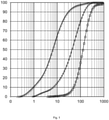
- the abscissa shows the particle size in ⁇ m on a logarithmic scale
- the ordinate shows the particular corresponding cumulative proportion of the particles in % by volume
- the ordinate value of one point on the distribution curve shows the X% of the total particle volume which consists of particles having the particle size assigned to this point on the abscissa or having a smaller particle dimension; in other words, (100-X)% of the total particle volume consist of particles having a greater particle size.
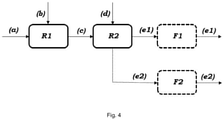
- a neutralization reactor R1 is charged with an aqueous organic amine through line (a); then oxalic acid powder is metered through a first feeding conduit (b) to the neutralization reactor R1 to obtain an aqueous oxalic acid-organic amine solution; the aqueous oxalic acid-organic amine solution is withdrawn from the neutralization reactor R1 into a complexation reactor R2 through line (c); particulate silver oxide is metered through a second feeding conduit (d) to the complexation reactor R2 to obtain a silver impregnation solution; and the silver impregnation solution is withdrawn through line (e) and subjected to filtration in filtration unit F.
- filtration units F1 and F2 are provided. Filtration of the the silver impregnation solution can be continued in filtration unit F2 in case filtration unit F1 is down for maintenance.
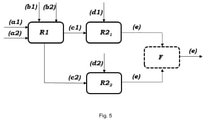
- a first complexation reactor R2 1 and a second complexation reactor R2 2 are provided, which are operated alternately.
- Aqueous oxalic acid-organic amine solution is withdrawn from the neutralization reactor R1 into the first complexation reactor R2 1 and particulate silver oxide is metered through feeding conduit (di) to the first complexation reactor R2 1 .
- freshly prepared aqueous oxalic acid-organic amine solution is withdrawn from the neutralization reactor R1 into the second complexation reactor R2 2 and particulate silver oxide is metered through feeding conduit (d 2 ) to the second complexation reactor R2 2 .
- Silver impregnation solution is withdrawn through line (e) from complexation reactors R2 1 and R2 2 and subjected to filtration in filtration unit F.
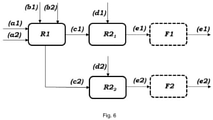
- Fig. 6 shows an embodiment of the invention similar to Fig. 5 , however, two filtration units F1 and F2 are provided which are separately allocated to each of the complexation vessels R2 1 and R2 2 .
- Figure 7 shows a flow chart of an embodiment of the process of the invention including a post reactor R3 for driving the silver complex formation reaction to completion.
- the particle size distributions referred to herein are determined by laser diffraction. This involves passing the powder through a sieve in order to remove agglomerates of a size of more than 2 mm then conducting the sieved powder into a Scirocco 2000 dry powder feeder, dry-dispersing it therein with compressed air and blowing it into the test cell in a free jet. In this cell, a Malvern Mastersizer 2000 laser diffraction spectrometer is used to determine the volume-based particle size distribution to ISO 13320. The intensity of the dispersion of the dry powder during the analysis is determined by the dispersion pressure employed of the compressed air employed as the propellant gas. Dispersion pressures of 0.1 bar, 1 bar, and 3.5 bar (absolute pressure) have been used.
- oxalic acid dihydrate and Ag 2 O powder can form thermally unstable silver oxalate that upon thermal decomposition releases a high amount of energy.
- Reaction enthalpies and heat capacities were measured in a microcalorimeter (RC1e manufactured by Mettler Toledo) as follows. 350.1 g (3.087 mol) 53 wt% ethylenediamine / H 2 O solution was charged into the reactor and tempered to 38°C. Then, 120.5 g (0.956 mol) oxalic acid dihydrate was added via a funnel in 5 identical portions of 24.1 g each within 20 sec and stirred for 6min at 38°C. The heat flow during the additions was recorded and Q AD-1 was calculated. Then, cp 1 was determined.
- the silver oxide used is commercially available from Ames Goldsmith. Its chemical composition is described below: Silver Content as Ag 2 O ⁇ 99.90% moisture content ⁇ 0.20% chlorides ⁇ 15 ppm nitrates ⁇ 100 ppm carbonates ⁇ 0.25% sulfates ⁇ 20 ppm copper ⁇ 20 ppm iron ⁇ 20 ppm lead ⁇ 20 ppm nickel ⁇ 20 ppm sodium ⁇ 50 ppm other trace metals ⁇ 20 ppm
- the silver impregnation solution was obtained by passing the reaction mixture through a filtration unit SUPRAdisc ® II KS 100 Depth Filter Modules available from Pall Corporation, Port Washington, USA to remove a minor amount of undissolved solid.
- the resulting silver impregnation solution had a density of 1.530 g/ml and a silver content of 29.5 wt%.
- reaction mixture was passed through a filtration unit SUPRAdisc ® II KS 100 Depth Filter Modules available from Pall Corporation, Port Washington, USA to remove to the undissolved solid.
- SUPRAdisc ® II KS 100 Depth Filter Modules available from Pall Corporation, Port Washington, USA to remove to the undissolved solid.
- the filtration modules were plugged and it was difficult to obtain a silver complex solution.
- the promoter solution I was prepared by dissolving LiNO 3 and (NH 4 ) 2 SO 4 in water to form a solution with Li-content of 2.85 wt% and S-content of 0.21 wt%.
- the promoter solution II was prepared by dissolving CsOH and H 2 WO 4 in water to form a solution with Cs-content of 5.3 wt% and W-content of 3.0 wt%.
- the promoter solution III was prepared by dissolving NH 4 ReO 4 in water to form a solution with Re-content of 3.7 wt%.
Landscapes
- Chemical & Material Sciences (AREA)
- Organic Chemistry (AREA)
- Engineering & Computer Science (AREA)
- Materials Engineering (AREA)
- Chemical Kinetics & Catalysis (AREA)
- Physics & Mathematics (AREA)
- Thermal Sciences (AREA)
- Catalysts (AREA)
- Organic Low-Molecular-Weight Compounds And Preparation Thereof (AREA)
Description
- The present invention relates to a method for preparing a silver impregnation solution and to a method for producing a catalyst effective in the oxidative conversion of ethylene to ethylene oxide.
- It is known to prepare supported silver catalysts which are effective in the oxidative conversion of ethylene to ethylene oxide by treating a suitable support, in particular an alumina support, with a silver impregnation solution which optionally contains promotors. The impregnated support is then subjected to a calcination process.
- Silver impregnation solutions of the art typically contain silver oxalate, or a combination of silver oxide and oxalic acid, together in ethylenediamine. In the oxalic acid formulation, oxalate in oxalic acid provides oxalate anion to counter the charge balance of silver cation in the ethylenediamine/water solution to form a soluble [Ag2C2O4]-ethylenediamine complex.
- One approach for preparing suitable silver impregnation solutions involves the preparation of insoluble silver oxalate intermediate starting from aqueous silver nitrate solutions. The silver oxalate intermediate is then dissolved in an aqueous solution of an organic amine which converts the silver oxalate into water soluble complexes. Ethylenediamine is a suitable organic amine ligand. Much effort has gone into the development of processes based on this or similar approaches, see, for example,
EP 0 716 884 A2EP 1 115 486 A1EP 1 613 428 A1 ,US 4,731,350 ,WO 2004/094055 A2 , andWO 2009/029419 A1 . Nevertheless, large scale industrial application of this approach is not very efficient because it requires elaborate solid/liquid phase separation steps. - Another approach for preparing suitable silver impregnation solutions involves preparing an aqueous oxalic acid-organic amine solution by reacting oxalic acid with an organic amine in the presence of water and conducting a silver complex formation reaction by adding particulate silver oxide to the aqueous oxalic acid-organic amine solution. This approach minimizes separation efforts. However, no suggestion has been made concerning a safe and efficient implementation of this approach into a technical process for the large-scale production of catalysts.
-
WO 2015/095508 A1 , for example, describes the preparation of a silver solution in a laboratory scale. Water was gradually mixed with ethylenediamine in a container placed in an ice bath to control the solution temperature between 20 and 30°C with vigorous agitation. Ammonium oxalate was subsequently added to the solution while the temperature was maintained at 20 to 30°C. After ammonium oxalate was completely dissolved, silver oxide was added to the solution at a temperature between 20 and 30°C. Comparative example 5 ofWO 2015/095508 A1 provides a recipe for the preparation of a silver complex solution using oxalic acid as an exclusive source of oxalate ions. The amounts of oxalic acid dihydrate and silver oxide of 261.0 g and 490.0 g, respectively, correspond to an oxalic acid/silver molar ratio of 0.49. -
US 4,356,312 mentions that reagent grade silver oxide was mixed with an aqueous solution of reagent grade oxalic acid dissolved in ethylenediamine (EN) to form an about 2 molar solution of Ag2(EN)2C2O4. Ten percent by volume of ethanolamine (about 0.4 moles of ethanolamine per mole of silver) was then added to complete the solubilizing/reducing agent combination. This solution contained about 22% by weight silver. -
US 2009/0177000 A1 describes that, for example, silver oxide can be dissolved in a solution of oxalic acid and ethylenediamine up to silver content of approximately 30 percent by weight. -
US 5,187,140 ,US 4,908,343 andUS 5,504,053 describe in a very general way that a desired amount of ethylenediamine is mixed with distilled water. Then oxalic acid dihydrate is added slowly to the solution at ambient temperature while continuously stirring. Silver oxide powder is then added to the diamine-oxalic acid salt-water solution while maintaining the solution temperature below about 40°C. Finally, monoethanolamine, aqueous alkali metal salt solution(s) and distilled water are added to complete the solution. Nothing is said about any problem that might occur when this preparation of impregnation solution is applied at large industrial scale. -
WO 2014/105770 A1 describes the preparation of an impregnation stock solution. 277.5 g of deionized water was placed in cooling bath to maintain temperature during the whole preparation under 50°C. At continuous stirring, 221.9 g of ethylenediamine was added in small portions to avoid overheating. 174.1 g of oxalic acid dihydrate was then added to the water-ethylenediamine solution in small portions. After all oxalic acid was dissolved, 326.5 g of high purity silver oxide was added to solution in small portions. After all silver oxide was dissolved and the solution was cooled to about 35°C it was removed from cooling bath. The oxalic acid/silver molar ratio was 0.49. - The above described processes involve the handling of powders of oxalic acid and silver oxide. Both powders tend to be hygroscopic and can adhere to the inner walls of the feeding equipment and/or the reactor inner walls above the liquid level in the reactor. The latter phenomenon is aggravated by intense stirring, when particulate oxalic acid and/or silver oxide are flung around in the reactor and small quantities thereof come into contact with and adhere to the reactor inner walls. If dry or moist remains of oxalic acid adhering to inner walls of the feeding equipment and/or the reactor inner walls come into contact with silver oxide both chemicals can react to yield silver oxalate. Silver oxalate, however, is explosive upon heating, shock or friction. Thus, the preparation of a silver impregnation solution by subsequently adding oxalic acid and silver oxide to an aqueous amine solution, using the same powder feeding equipment or the same reactor runs the risk of severe security hazards.
- It is an object of the present invention to provide a method for preparing a silver impregnation solution in an efficient and occupationally and environmentally safe way.
- This problem is solved by a method for preparing a silver impregnation solution comprising:
- (a) charging a neutralization reactor R1 with an aqueous organic amine;
- (b) adding oxalic acid powder through a first feeding conduit to the neutralization reactor R1 to obtain an aqueous oxalic acid-organic amine solution;
- (c) directing the aqueous oxalic acid-organic amine solution from the neutralization reactor R1 to a complexation reactor R2;
- (d) adding particulate silver oxide through a second feeding conduit to the complexation reactor R2 to obtain a silver impregnation solution; and, optionally,
- (e) subjecting the silver impregnation solution to filtration.
- The process avoids the possibility of oxalic acid and silver oxide powder coming into direct contact.
- In step (a), a neutralization reactor R1 is charged with an aqueous organic amine. Any reactor known to those skilled in the art can be used. Such reactors comprise refrigerating means for cooling the reaction medium in the reactor and agitating means for agitating or stirring the reaction medium in the reactor. Stirred tank reactors can, for example, be used as reactors. Alternatively, a tank-type forced circulation reactor with a heat exchanger arranged in the external liquid circuit can be used.
- Generally, an aqueous stock solution of the amine can be used which can be adjusted to the desired amine concentration by adding additional amine or water. Alternatively, the organic amine is dissolved in water in order to form an aqueous solution of the organic amine. Preferably, the organic amine concentration is in the range from 40 to 70 wt.%, in particular 50 to 62 wt.%.
- Any organic amine can be used in the method of the invention which is capable of dissolving silver cations (Ag+) in the form of a water soluble complex. The organic amine comprises, for example, a vicinal alkylene diamine, preferably ethylenediamine. Vicinal alkylene diamine, and in particular ethylenediamine, are capable of dissolving large amounts of silver oxalate in aqueous solutions. It is assumed that the free electron pairs of both nitrogen atoms of vicinal alkylene diamines coordinate to a silver cation thereby forming five-membered chelate rings.
- Additional amines, such as monethanolamine, can be used if desired.
- In step (b), oxalic acid powder is added through a first feeding conduit to the neutralization reactor R1, preferably on a metered basis. Oxalic acid can be added in any form. It is preferably added in the form of oxalic acid dihydrate. Known devices for dispensing powder materials, preferably on a metered basis, can be used such as loss-in-weight feeder systems or volumetric feeders.
- Although the method of the invention can be carried out with oxalic acid dihydrate particles having a broad range of different sizes, ranging, for example, from the nanometer to the upper micrometer range, the oxalic acid dihydrate powder preferably has a controlled particle size distribution in order to operate the reaction of oxalic acid dihydrate with an aqueous organic amine solution in a controllable way. It is generally preferred that the oxalic acid dihydrate powder has a primary particle size distribution such that at least 75% by volume of the particles have a particle size of 250 µm or lower. Preferably, at least 75% by volume of the particles have a particle size of 50 µm or lower. "Primary particle size distribution" as used herein is measured using a dispersion pressure of equal or greater than 3.5 bar. Dispersion at a dispersion pressure of 3.5 bar resulted in a monomodal distribution which is used as the primary particle size distribution.
- The oxalic acid dihydrate powder may, for example, have an agglomerated particle size distribution such that at least 75% of the total volume of oxalic acid dihydrate is in the form of aggregates having an apparent particle size of at least 50 µm. "Agglomerated particle size distribution" as used herein is measured using a dispersion pressure of 0.1 bar. When the oxalic acid dihydrate powder comprises a majority of small unagglomerated primary oxalic acid dihydrate powder particles, a dust of oxalic acid dihydrate can be formed during handling. Such dust formation is undesired as the dust particles can create health hazards or deposit on surfaces of the reaction equipment. It has been found that primary oxalic acid dihydrate powder particles having sizes of from the upper nanometer to lower micrometer range form aggregates having an apparent particle size in the upper micrometer to lower millimeter range and which are stable when exposed to a dispersion pressure of 0.1 bar in laser diffraction particle size analysis. Under feeding conditions the aggregates are stable and undesired dust formation can be suppressed.
- The presence of metal species or of inorganic anions in the impregnation solution can adversely influence the catalytic properties of a catalyst produced therefrom. Although individual catalytic properties may be enhanced by a specific promoting species if purposively added to the impregnation solution other catalytic properties may be diminished. For that reason it is preferred to minimize the introduction of metal species or of inorganic anions via the oxalic acid dihydrate powder. Preferably, the oxalic acid dihydrate has a purity of at least 99.5% by weight.
- The oxalic acid dihydrate contains, for example, 10 ppmw or less of copper.
- The oxalic acid dihydrate contains, for example, 10 ppmw or less of iron.
- The oxalic acid dihydrate contains, for example, 2 ppmw or less of lead.
- The oxalic acid dihydrate contains, for example, 10 ppmw or less of sodium.
- The oxalic acid dihydrate can contain varying amounts of sulfate ions. Sulphur is often added to the solution in minor controlled amounts, with the aim of improving catalyst selectivity. Excessive amounts of Sulphur, on the other hand, can cause catalyst poisoning. A preferred oxalic acid dihydrate contains 1500 ppmw or less, such as 500 ppmw or less, more preferable 100 ppmw or less, most preferably 20 ppmw or less of sulfate anions.
- The reaction medium is generally agitated in step (b). Any agitation technique can be used which ensures sufficient mixing of the oxalic acid with the surrounding liquid. Agitation preferably involves stirring. As the reaction amines with oxalic acid is exothermic, it is important to cool the reaction in order to ensure that the oxalic acid-organic amine solution is prepared in a controlled way.
- In an embodiment, prior to step (b), the aqueous organic amine is adjusted to a temperature T1, wherein T1 ≤ 100°C - ΔTAD-1 and ΔTAD-1 is the maximum adiabatic temperature rise during step (b). The maximum adiabatic temperature rise ΔTAD-1 is the increase of the temperature of the reaction medium which would occur if the total amount of oxalic acid were added at once under adiabatic conditions.
- The volatility of the organic amine is high at temperatures above 100°C. Excess vaporization of the organic amine can cause an uncontrolled pressure increase or the formation of explosive amine vapor/air mixtures. At a temperature of 100°C or below, the reaction mixture can be safely handled over a period of at least 24 hours. If the method is carried out within the limitations of the above condition, the temperature of the reaction medium can never exceed 100°C even if heat removal from the reaction medium is insufficient and/or heat removal equipment fails. This ensures a safe and efficient production of the aqueous oxalic acid-organic amine solution.
- ΔTAD-1 can be calculated according to

- Preferably, the starting temperature T1 is in the range from 10°C to 40°C, particularly 10 to 20°C.
- In step (c), the aqueous oxalic acid-organic amine solution is at least partially withdrawn from the neutralization reactor and directed to a complexation reactor R2 that is spatially separated from the vessel R1. This prevents any possibility of a direct reaction of oxalic acid powder with silver oxide powder. Any reactor known to those skilled in the art can be used as vessel R2. Such reactors comprise refrigerating means for cooling the reaction medium in the reactor and agitating means for agitating or stirring the reaction medium in the reactor. A stirred tank reactor can, for example, be used as reactor R2. Withdrawal of the aqueous oxalic acid-organic amine solution can occur by gravity, but is preferably effected by a liquid pump.
- In the practice of the invention, it is not necessary to completely empty the neutralization reactor R1. Only a part of the aqueous oxalic acid-organic amine solution can be withdrawn and directed to the complexation reactor R2. The remainder of the solution in the neutralization reactor R1 can be supplemented with fresh amine and oxalic acid can be added in accordance with step (b).
- In addition, spatial separation of step (b) from step (d) allows for efficient use of the capacity of each reactor. According to the invention, it is envisaged to provide one complexation reactor R2 or more than one complexation reactors R21, ... R2i, for example a first complexation reactor R21 and a second complexation reactor R22, per one neutralization reactor R1. If more than one complexation reactors R2 are employed, these vessels are charged with the aqueous oxalic acid-organic amine solution at the same time or alternately, preferably alternately. Each of the complexation reactors R2i is equipped with a second feeding conduit for metering particulate silver oxide to the complexation reactor R2i. Step (b) is inherently faster than step (d). The aqueous oxalic acid-organic amine solution is kept in the neutralization reactor R1 until the silver complex formation is substantially completed and the entire silver impregnation solution is withdrawn from the complexation reactor R2. If two complexation reactors R21 and R22 are available, while the reaction according to step (d) is ongoing in the first complexation reactor R21, aqueous oxalic acid-organic amine solution is withdrawn from the neutralization reactor into the second complexation reactor R22. Thus, delays in the operation of the neutralization reactor R1 caused by keeping the aqueous oxalic acid-organic amine solution in the neutralization reactor are shortened. The neutralization reactor R1 is available for refilling more frequently.
- The reaction in step (d) proceeds to substantial completion relatively quickly and the complexation reactor R2 can be refilled frequently and, hence, can be operated with a high space-time yield. It has been found that a similar improvement of space-time-yield is achieved for the neutralization reactor R1 and the delays in use of the neutralization reactor R1 caused by keeping the aqueous oxalic acid-organic amine solution in the first reactor are shortened.
- Further, spatial separation of steps (b) and (d) can increase the safety even further because the reactors can be adapted independently to the specific requirements of the chemical reactions which occur in step (b) and in step (d). This results in optimized control of the chemical reactions of step (b) in the neutralization reactor R1 and of the chemical reactions of step (d) in the complexation reactor R2.
- In step (d), particulate silver oxide is added through a second feeding conduit to the complexation reactor R2, preferably on a metered basis, to obtain a silver impregnation solution. The particular silver oxide can be added to the aqueous oxalic acid-organic amine solution in portions or continuously. Known devices for dispensing powder materials, preferably on a metered basis, can be used such as loss-in-weight feeder systems or volumetric feeders. A silver complex formation reaction is conducted by adding particulate silver oxide to the aqueous oxalic acid-organic amine solution. This reaction involves the dissolution of silver oxide particles and complexation of silver cations.
- The reaction medium is generally agitated in step (d). Any agitation technique can be used which ensures sufficient mixing of particulate silver oxide with the surrounding liquid. Agitation preferably involves stirring.
- As the reaction of an aqueous oxalic acid-amine solution with silver oxide is exothermic, it is important to cool the reaction mixture during and immediately after the addition of the silver oxide in order to ensure that the aqueous silver complex suspension or solution is prepared in a controlled way. On the other hand, once the entire amount of silver oxide has been added to the complexation reactor R2 and the reaction temperature profile has passed the peak temperature, cooling is no longer required and can be discontinued. Preferably, cooling is switched to heating to control the reaction temperature to facilitate completion of the silver complexation reaction.
- In an embodiment, prior to step (d), the aqueous oxalic acid-organic amine solution is adjusted to a temperature T2, wherein T2 ≤ 80°C - ΔTAD-2 and ΔTAD-2 is the maximum adiabatic temperature rise during step (d).
- The inventors have found that an irreversible decomposition of the silver complexes formed in step (d) occurs at elevated temperatures and this irreversible decomposition is accelerated at temperatures above 80°C. Additionally, occupational or environmental hazards are more likely to occur at temperatures above 80°C.
- The maximum adiabatic temperature rise ΔTAD-2 is the increase of the temperature of the reaction medium which would occur if the total amount of silver oxide were added at once and converted in the silver complex formation reaction under adiabatic conditions.
- ΔTAD-2 can be calculated according to

- If step (d) is carried out within the limitations of the above condition, undesired irreversible decomposition of silver complexes is suppressed because the temperature of the reaction medium can never exceed 80°C even if heat removal from the reaction medium is insufficient and/or heat removal equipment fails. This ensures a safe and efficient production of the silver impregnation solution.
- In a process, wherein oxalic acid powder and particulate silver oxide are subsequently metered into only one reactor, a maximum adiabatic temperature rise in the magnitude of ΔTAD-1 + ΔTAD-2 could occur, in case the metering equipment and/or heat removal equipment fails. Such temperature rise is difficult to manage and can give rise to severe occupational or environmental hazards.
- Preferably, the starting temperature T2 is in the range from 10 °C to 40°C, particularly 15 to 20°C.
- According to the invention, the silver complex formation rates are high. Preferably, the time period of step (d) does not exceed 3 minutes per kg of added silver oxide, calculated as Ag metal. In particular, the time period does not exceed 2 minutes per kg of added silver oxide, in particular not exceed 90 seconds per kg of added silver oxide, calculated as Ag metal.
- In preferred methods of the invention, the method involves the addition of at least 100 kg of particulate silver oxide, preferably at least 200 kg of particulate silver oxide, in particular at least 300 kg, calculated as Ag metal.
- The silver oxide particles or powder can, for example, be essentially dry, or be a damp (moist) powder. The moist powder can contain substantial amounts of water. High moisture contents are tolerated by the method of the invention. The silver oxide may, for example, have a water content of up to 20% by weight, preferably, up to 15% by weight. The "water content" as used herein includes water which is physically adsorbed to the silver oxide and water which is chemically bound, for example, in the form of hydroxide. A skilled person can measure the water content of particulate silver oxide according to methods well-known in the art and calculate very easily how much water is added into the reaction medium as a part of moist silver oxide.
- Although the method of the invention can be carried out with silver oxide particles having a broad range of different sizes, ranging, for example, from the nanometer to the upper micrometer range, the silver oxide preferably has a controlled particle size distribution in order to facilitate the dissolution of the silver oxide and complexation of the silver cations. It is generally preferred that the silver oxide has a primary particle size distribution such that at least 75% by volume of the particles have a particle size of 250 µm or lower. Preferably, at least 75% by volume of the particles have a particle size of 50 µm or lower. Most preferably, at least 75% by volume of the particles have a particle size of 10 µm or lower. "Primary particle size distribution" as used herein is measured using a dispersion pressure of 3.5 bar. Dispersion at a dispersion pressure of 3.5 bar resulted in a monomodal distribution which is used as the primary particle size distribution.
- The particulate silver oxide powder may, for example, have an agglomerated particle size distribution such that at least 30% by volume, preferably at least 75% by volume of silver oxide is in the form of aggregates having an apparent particle size of at least 50 µm, e.g. at least 100 µm. "Agglomerated particle size distribution" as used herein is measured using a dispersion pressure of 0.1 bar. When the particulate silver oxide comprises a majority of small unagglomerated primary silver oxide particles, a dust of silver oxide particles can be formed during handling. Such dust formation is undesired as the dust particles can create health hazards or deposit on surfaces of the reaction equipment. It has been found that primary silver oxide particles having sizes of from the upper nanometer to lower micrometer range form aggregates having an apparent particle size in the upper micrometer to lower millimeter range and which are stable when exposed to a dispersion pressure of 0.1 bar in laser diffraction particle size analysis. Under feeding conditions the aggregates are stable and undesired dust formation can be suppressed.
- Preferably, the silver oxide has a controlled BET specific surface area range. The specific surface area is the total surface area of the silver oxide particles expressed in square meters per mass of silver oxide particles expressed in gram. The particulate silver oxide can, for example, have a specific surface area in the range of 0.1 m2/g to 10 m2/g, e.g., at least 0.2 m2/g to 5 m2/g, preferably, at least 0.3 m2/g to 1.0 m2/g.
- It is assumed that the surface area of silver oxide which is in contact with the liquid reaction medium influences the silver complex formation kinetics. An increased silver oxide surface area results in an accelerated silver complex formation reaction. On the other hand, too high surface area results in dust formation and can create health hazards.
- The presence of metal species other than silver and/or of inorganic anions in the impregnation solution can adversely influence the catalytic properties of a catalyst produced therefrom. Although individual catalytic properties may be enhanced by a specific promoting species if purposively added to the impregnation solution other catalytic properties may be diminished. For that reason it is preferred to minimize the introduction of metal species other than silver and/or of inorganic anions via the silver oxide. Preferably, the silver oxide has a purity of at least 99.5% by weight, in particular at least 99.9% by weight.
- A preferred silver oxide contains 500 ppmw or less of the sum of chloride and sulfate anions.
- The silver oxide contains, for example, 15 ppmw or less of chloride anions.
- The silver oxide contains, for example, 20 ppmw or less of sulfate anions.
- The silver oxide contains, for example, 100 ppmw or less of nitrates.
- A preferred silver oxide contains 500 ppmw or less of trace metals selected from copper, iron, lead, nickel, and sodium.
- The silver oxide contains, for example, 10 ppmw or less of copper.
- The silver oxide contains, for example, 10 ppmw or less of iron.
- The silver oxide contains, for example, 10 ppmw or less of lead.
- The silver oxide contains, for example, 10 ppmw or less of nickel.
- The silver oxide contains, for example, 10 ppmw or less of sodium.
- A particularly preferred silver oxide contains 15 ppmw or less of chlorides, 100 ppmw or less of nitrates, 20 ppmw or less of sulfates, 5 ppmw or less of copper, 5 ppmw or less of iron, 5 ppmw or less of lead, 5 ppmw or less of nickel and 5 ppmw or less of sodium.
- The relative amounts of water, organic amine, oxalic acid and silver oxide are not especially limited. Increasing the content of organic amine in excess over the stoichiometric amount does in general increase the solubility of silver cations in aqueous solutions containing oxalic acid.
- An oxalate anion can counterbalance the charge of two silver cations and the amount of silver oxide and oxalic acid used in the method of the invention are preferably such that the oxalic acid/silver molar ratio is preferably in the range from 0.4 to 0.65, more preferably 0.5 to 0.6, in particular 0.505 to 0.6. It has been found that the amount of undissolved solids is minimized when the oxalic acid is used in a slight stoichiometric excess over the silver ions. Using an excess of oxalic acid allows for a reduction of the residence time required for step (d). Thus, production of a silver impregnation solution having a given amount of undissolved Ag2O proceeds faster with an oxalic acid/silver molar ratio above 0.5, as compared to an oxalic acid/silver molar ratio of 0.5 or below.
- In a preferred method of the invention, the molar ratio of amine nitrogen atoms of the organic amine to silver cations is at least 2.66, e.g., at least 2.76, preferably at least 2.86, most preferably at least 3.00. When the organic amine is a diamine, such as ethylenediamine, the molar ratio of diamine to silver cations is thus at least 1.33, e.g., at least 1.38, preferably at least 1.43, most preferably at least 1.50. It is assumed that a molar access of volatile organic amine is advantageous, because an increased concentration of organic amine accelerates the dissolution of silver oxide in step (c).
- In the method of the invention, the amount of organic amine comprised by the silver complex formation reaction medium may, for example, be at least 23%, in particular at least 24% by weight, preferably at least 25% by weight, most preferably at least 26% by weight after addition of all the silver oxide. This amount is based on all organic amine in the reaction medium, e.g., coordinated and uncoordinated.
- Although the method of the invention is not limited to silver impregnation solutions having a particular content of dissolved, e.g., complexed silver cations, it is generally preferred to prepare silver impregnation solutions having a high dissolved silver content. In a preferred method of the invention, the finished silver impregnation solution contains 24 to 35% by weight, e.g. 25 to 34% by weight, in particular 26 to 33% by weight, preferably 27 to 32% by weight, more preferably 28 to 31% by weight and most preferably 29 to 30% by weight of dissolved, e.g., complexed, silver cations. The content of dissolved silver cations is calculated based on all silver cations which are homogeneously dissolved in the reaction medium at the end of the silver complex formation reaction. The homogeneously dissolved silver cations comprise silver cations complexed by organic amine and silver cations dissolved in any other form.
- After complete addition of silver oxide, agitation, preferably by stirring, is typically continued during a post-reaction period to drive the silver complex formation reaction to completion. Cooling is discontinued during the post-reaction. The post-reaction can be carried out under gentle heating, e.g. at a temperature in the range of 20 to 45°C, preferably 25 to 40°C. In order to minimize the risk of operation errors and to avoid a situation where the content of the complexation reactor R2 is heated while the addition of particulate sliver oxide is still ongoing, the post-reaction is preferably conducted in a post reactor R3 where the post reactor R3 is the only vessel equipped with heating means. Thus, in one embodiment the reaction medium obtained at the end of step (d) is transferred to a post reactor R3 and stirred for a post-reaction period, optionally under heating to a temperature of up to 45°C, for example 20 to 40°C.
- In the practice of the invention, it is not necessary to completely empty the complexation reactor R2. Only a part of the suspension obtained at the end of step (d) can be withdrawn and directed to the post reactor R3 or filtration unit. The remainder of the solution in the complexation reactor R2 can be supplemented with fresh aqueous oxalic acid-organic amine solution and particulate silver oxide can be added in accordance with step (d).
- The solution or suspension obtained at the end of step (d) can be used as a silver impregnation solution. If an insoluble solid is present in the reaction medium obtained at the end of step (d), the reaction medium can be subjected to filtration operation in a filtration unit (step (e)), preferably a clarification filtration operation. The silver impregnation solution can, for example, be obtained by passing the reaction medium through a filtration unit in order to remove a minor amount of undissolved solid which is present in reaction medium. Any known filtration technique can be used.
- A depth filtration means is preferably used in the filtration operation. Depth filters are a variety of filters that use a porous filtration medium to retain particles throughout the medium. The depth filtration means can include one or more filters, such as membrane filters, plate filters, cartridge filters, bag filters, pressure leaf filters, rotary drum filters or vacuum filters. Different size particles can be trapped at different locations throughout the thickness of the filtration media. Larger particles are trapped on an outer layer with the subsequent layers trapping smaller and smaller particles until reaching the final desired micron rating. This prevents particle build-up from becoming so fine that plugging occurs and increases the particles-holding capacity of the filter, which gives the filter a longer life. Stacked disc modules are generally preferred due to their convenience of handling. As one example, SUPRAdisc® II Depth Filter Modules available from Pall Corporation, Port Washington, USA, such as
Supradisc II KS 100, can effectively be used to remove undissolved solid from the silver impregnation solution. - According to the invention, it is envisaged to provide one filtration unit or more than one filtration units, for example two filtration units. Filtration of the the silver impregnation solution can be switched to and continued in a second filtration unit in case the first filtration unit is down for maintenance due to clogging or the like.
- The method of the invention may comprise adding one or more promoting species to the impregnation solution. A promoting species denotes a component that provides an improvement in one or more of the catalytic properties of the catalyst prepared form the impregnation solution when compared to a catalyst not containing said component. The promoting species can be any of those species, known in the art, that function to improve the catalytic properties of the silver catalyst. Examples of catalytic properties include, inter alia, operability (resistance to runaway), selectivity, activity, conversion, stability and yield.
- The promoting species may be added to the impregnating solution in any soluble form. Sources for promoting species can be added into the reaction medium at any time from the beginning of step (a) to the end of step (e) or to any of the organic amine, the oxalic acid and/or the water before these are reacted in step (a) or after completion of step (e).
- In some embodiments, the impregnation solution may include a promoting amount of an alkali metal or a mixture of two or more alkali metals. Suitable alkali metal promoters include, for example, lithium, sodium, potassium, rubidium, cesium or combinations thereof. Potassium is often preferred. The amount of alkali metal, e.g. potassium, will typically range from 50 ppm to 5000 ppm, more typically from 75 ppm to 3000 ppm, most typically from 100 ppm to 1000 ppm expressed in terms of the alkali metal relative to the weight of silver.
- The impregnation solution may also include a Group IIA alkaline earth metal or a mixture of two or more Group IIA alkaline earth metals. Suitable alkaline earth metal promoters include, for example, beryllium, magnesium, calcium, strontium, and barium or combinations thereof. The amounts of alkaline earth metal promoters can be used in amounts similar to those used for the alkali or transition metal promoters.
- The impregnation solution may also include a promoting amount of a main group element or a mixture of two or more main group elements. Suitable main group elements include any of the elements in Groups IIIA (boron group) to VIIA (halogen group) of the Periodic Table of the Elements. For example, the carrier or catalyst can include a promoting amount of sulfur, phosphorus, boron, halogen (e.g., fluorine), gallium, or a combination thereof.
- The impregnation solution may also include a promoting amount of a transition metal or a mixture of two or more transition metals. Suitable transition metals can include, for example, the elements from Groups IIIB (scandium group), IVB (titanium group), VB (vanadium group), VIB (chromium group), VIIB (manganese group), VIIIB (iron, cobalt, nickel groups), IB (copper group), and IIB (zinc group) of the Periodic Table of the Elements, as well as combinations thereof. More typically, the transition metal is an early transition metal, i.e., from Groups IIIB, IVB, VB or VIB, such as, for example, hafnium, yttrium, molybdenum, tungsten, rhenium, chromium, titanium, zirconium, vanadium, tantalum, niobium, or a combination thereof. In one embodiment, the transition metal promoter(s) is (are) present in a total amount from 150 ppm to 15000 ppm, typically 225 ppm to 9000 ppm, most typically from 300 ppm to 3000 ppm, expressed in terms of metal(s) relative to the weight of silver.
- Of the transition metal promoters listed, rhenium (Re) is a particularly efficacious promoter for ethylene epoxidation high selectivity catalysts. The rhenium component in the carrier or catalyst can be in any suitable form, but is more typically one or more rhenium- containing compounds (e.g., a rhenium oxide) or complexes.
- The impregnation solution may also include a promoting amount of a rare earth metal or a mixture of two or more rare earth metals. The rare earth metals include any of the elements having an atomic number of 57-103. Some examples of these elements include lanthanum (La), cerium (Ce), and samarium (Sm). The amount of rare earth metal promoters can be used in amounts similar to those used for the transition metal promoters.
- A preferred promoting species is potassium which is preferably added in the form of a potassium salt, e.g., potassium hydroxide which can for example be fed into step (a) by adding it to an aqueous solution of organic amine, e.g. ethylenediamine, which is fed into step (a). Alternatively, a part of the potassium source is added in step (a) and another part is added to the silver impregnation solution after completion of step (d) or (e). If other promotors such as rhenium, tungsten, lithium, cesium and sulfur, are used, sources of these promotors are preferably added to the silver impregnation solution after completion of step (d) or (e).
- Alternatively, the method of the invention does not comprise adding a promoting species.
- The method of the invention may also comprise adding silver concentration enhancers such as ammonium salts having thermally decomposable anionic components as described in
WO 2015/095508 A1 . - The present invention further relates to a method for producing a catalyst effective in the oxidative conversion of ethylene to ethylene oxide, the method comprising
- (i) preparing a silver impregnation solution according to a method of the invention;
- (ii) impregnating a refractory support with the silver impregnation solution; and
- (iii) subjecting the impregnated refractory support to a calcination process.
- Any refractory support known in the art can be used. Suitable examples of refractory supports are described in
EP 0902726 ,EP 1478458 ,EP 1675678 ,EP 3254576 ,WO 2004/101144 ,WO 2007/021472 ,WO 2008/054654 ,WO 2009/029414 ,WO 2010/008920 ,WO 2011/153390A1 ,WO 2012/143557A1 ,WO 2012/143559A1 ,WO 2013/077839A1 orUS 2018/0021755 . - Any impregnation processes known in the art can be used. A suitable example of an impregnation process is described in
WO 2013/066557 . - Any calcination processes known in the art can be used. Suitable examples of calcination processes are described in
US 5,504,052 ,US 5,646,087 ,US 7,553,795 ,US 8,378,129 ,US 8,546,297 ,US 2014/0187417 ,EP 1893331 orWO 2012/140614 . - Impregnation step (ii) may comprise multiple alternating impregnation and drying steps. The impregnation solution in a first impregnation step comprises for example silver and promotor, e.g. potassium. Additional promotors, such as tungsten, rhenium, lithium, sulfur, and/or cesium can, for example, be comprised by a silver impregnation solution used in a second or later impregnation step.
- The invention will be described in more detail by the accompanying drawings and the subsequent examples.
-
Figure 1 shows a favorable particle size distribution of oxalic acid dihydrate powder using different dispersion pressures (squares = 0.1 bar; crosses = 1 bar; triangles = 3.5 bar). -
Figure 2 shows a favorable particle size distribution of silver oxide powder using different dispersion pressures (squares = 0.1 bar; crosses = 1 bar; triangles = 3.5 bar). -
Figure 3 shows a flow chart of an embodiment of the process of the invention. -
Figure 4 shows a flow chart of an embodiment of the process of the invention including two filtration units F1 and F2. -
Figure 5 shows a flow chart of an embodiment of the process of the invention including a first complexation reactor R21 and a second complexation reactor R22 which are operated alternately, and a common filtration unit. -
Figure 6 shows a flow chart of an embodiment of the process of the invention including a first complexation reactor R21 and a second complexation reactor R22 which are operated alternately, and two filtration units F1 and F2. -
Figure 7 shows a flow chart of an embodiment of the process of the invention including a third vessel R3. - In
Figs. 1 and2 , the abscissa shows the particle size in µm on a logarithmic scale, and the ordinate shows the particular corresponding cumulative proportion of the particles in % by volume (the ordinate value of one point on the distribution curve shows the X% of the total particle volume which consists of particles having the particle size assigned to this point on the abscissa or having a smaller particle dimension; in other words, (100-X)% of the total particle volume consist of particles having a greater particle size. - According to
Fig. 3 , a neutralization reactor R1 is charged with an aqueous organic amine through line (a); then oxalic acid powder is metered through a first feeding conduit (b) to the neutralization reactor R1 to obtain an aqueous oxalic acid-organic amine solution; the aqueous oxalic acid-organic amine solution is withdrawn from the neutralization reactor R1 into a complexation reactor R2 through line (c); particulate silver oxide is metered through a second feeding conduit (d) to the complexation reactor R2 to obtain a silver impregnation solution; and the silver impregnation solution is withdrawn through line (e) and subjected to filtration in filtration unit F. - According to
Fig. 4 , two filtration units F1 and F2 are provided. Filtration of the the silver impregnation solution can be continued in filtration unit F2 in case filtration unit F1 is down for maintenance. - According to
Fig. 5 , a first complexation reactor R21 and a second complexation reactor R22 are provided, which are operated alternately. Aqueous oxalic acid-organic amine solution is withdrawn from the neutralization reactor R1 into the first complexation reactor R21 and particulate silver oxide is metered through feeding conduit (di) to the first complexation reactor R21. While metering of particulate silver oxide into the first complexation reactor R21 is ongoing, freshly prepared aqueous oxalic acid-organic amine solution is withdrawn from the neutralization reactor R1 into the second complexation reactor R22 and particulate silver oxide is metered through feeding conduit (d2) to the second complexation reactor R22. Silver impregnation solution is withdrawn through line (e) from complexation reactors R21 and R22 and subjected to filtration in filtration unit F. -
Fig. 6 shows an embodiment of the invention similar toFig. 5 , however, two filtration units F1 and F2 are provided which are separately allocated to each of the complexation vessels R21 and R22. -
Figure 7 shows a flow chart of an embodiment of the process of the invention including a post reactor R3 for driving the silver complex formation reaction to completion. - The particle size distributions referred to herein are determined by laser diffraction. This involves passing the powder through a sieve in order to remove agglomerates of a size of more than 2 mm then conducting the sieved powder into a Scirocco 2000 dry powder feeder, dry-dispersing it therein with compressed air and blowing it into the test cell in a free jet. In this cell, a Malvern Mastersizer 2000 laser diffraction spectrometer is used to determine the volume-based particle size distribution to ISO 13320. The intensity of the dispersion of the dry powder during the analysis is determined by the dispersion pressure employed of the compressed air employed as the propellant gas. Dispersion pressures of 0.1 bar, 1 bar, and 3.5 bar (absolute pressure) have been used.
- To assess the reactivity of Ag2O powder with oxalic acid dihydrate, the following experiments were devised:
- Sample 1: 1.25 g oxalic acid dihydrate and 1.25 g Ag2O powder were mixed and allowed to react at room temperature for four hours.
- Sample 2: 1.25 g oxalic acid dihydrate, 1.25 g Ag2O powder and 0.5 g deionized water were mixed and allowed to react at room temperature for four hours. The deionized water was preheated to 40°C prior to mixing.
- Both samples showed a visible reaction and were subjected to DSC analysis. The results are shown below:
Onset temperature [°C] Heat release [J/g] Sample 1125 300 Sample 2 85 340 - Thus, oxalic acid dihydrate and Ag2O powder can form thermally unstable silver oxalate that upon thermal decomposition releases a high amount of energy.
- Reaction enthalpies and heat capacities were measured in a microcalorimeter (RC1e manufactured by Mettler Toledo) as follows. 350.1 g (3.087 mol) 53 wt% ethylenediamine / H2O solution was charged into the reactor and tempered to 38°C. Then, 120.5 g (0.956 mol) oxalic acid dihydrate was added via a funnel in 5 identical portions of 24.1 g each within 20 sec and stirred for 6min at 38°C. The heat flow during the additions was recorded and QAD-1 was calculated. Then, cp1 was determined.
- Subsequently, 223.5 g (0.965 mol) silver(I)-oxid was added via a funnel in 5 identical portions of 44.7 g within 30 sec and stirred for 6min at 38°C. The heat flow during the additions was recorded and QAD-2 was calculated. Finally, cp2 was determined.
- The results are as follows:


- 783 kg of an aqueous ethylenediamine solution with an ethylenediamine content of 59 wt% was pumped in a stirring
reactor 1. Subsequently the 59 wt% ethylenediamine solution was diluted under stirring with 94 kg of de-ionized water. Next, 26.6 kg of 0.95 wt% KOH solution were added to form an aqueous KOH / ethylenediamine solution. The solution was cooled to a temperature of below 20°C. Then 300 kg of oxalic acid dihydrate (purity ≥ 99.6 %, particle size distribution is shown inFig. 1 ) were added into the stirringreactor 1 stepwise during about 180 minutes under stirring and cooling to control the reaction temperature in the range of 20 - 25°C. Once the addition of oxalic acid dihydrate was completed and the temperature profile from the addition of the last portion of oxalic acid dihydrate passed a maximum, cooling was terminated and the reaction mixture was stirred further for the next 60 minutes to form an aqueous oxalic acid-ethylenediamine solution. - Next, 1113 kg of the resulting aqueous oxalic acid-ethylenediamine solution was transferred from the stirring
reactor 1 to a stirring reactor 2. The reaction medium was cooled to a temperature below 20°C. Then, 500 kg silver oxide powder (Ag2O-content ≥ 99.90 wt%, moisture content ≤ 0.2 wt%, particle size distribution is shown inFig. 2 , BET surface area = 0.66 m2/g), was added during 225 minutes under stirring and cooling to control the reaction temperature in the range of 20 - 25°C. Once the addition of silver oxide was completed, and the temperature profile from the addition of the last portion of silver oxide passed a maximum, cooling was terminated and the reaction mixture was heated under stirring in a temperature range of about 25 - 30°C for the next 3 hours to form an aqueous Ag complex suspension. - The silver oxide used is commercially available from Ames Goldsmith. Its chemical composition is described below:
Silver Content as Ag2O ≥ 99.90% moisture content ≤ 0.20% chlorides ≤ 15 ppm nitrates ≤ 100 ppm carbonates ≤ 0.25% sulfates ≤ 20 ppm copper ≤ 20 ppm iron ≤ 20 ppm lead ≤ 20 ppm nickel ≤ 20 ppm sodium ≤ 50 ppm other trace metals ≤ 20 ppm - Subsequently, the silver impregnation solution was obtained by passing the reaction mixture through a filtration unit SUPRAdisc® II KS 100 Depth Filter Modules available from Pall Corporation, Port Washington, USA to remove a minor amount of undissolved solid. The resulting silver impregnation solution had a density of 1.530 g/ml and a silver content of 29.5 wt%.
- 844 kg of an aqueous ethylenediamine solution with an ethylenediamine content of 59.4 wt% was pumped in a stirring
reactor 1. Subsequently the 59.4 wt% ethylenediamine solution was diluted under stirring with 113 kg of de-ionized water. Next, 28.8 kg of 0.95 wt% KOH solution were added to form an aqueous KOH / ethylenediamine solution. The solution was cooled to a temperature of below 20°C. Then 325 kg of oxalic acid dihydrate (purity ≥ 99.6 %, particle size distribution is shown inFig. 1 ) were added into the stirringreactor 1 stepwise during about 195 minutes under stirring and cooling to control the reaction temperature in the range of 20 - 25°C. Once the addition of oxalic acid dihydrate was completed, and the temperature profile from the addition of the last portion of oxalic acid dihydrate passed a maximum, cooling was terminated and the reaction mixture was stirred further for the next 60 minutes to form an aqueous oxalic acid-ethylenediamine solution. - Next, 1145 kg of the resulting aqueous oxalic acid-ethylenediamine solution was transferred from the stirring
reactor 1 to a stirring reactor 2. The reaction medium was cooled to a temperature below 20°C. Then, 530 kg silver oxide powder (Ag2O-content ≥ 99.90 wt%, moisture content ≤ 0.2 wt%, particle size distribution is shown inFig. 2 ; purity as in Production example 1, BET surface area = 0.66 m2/g), was added during 240 minutes under stirring and cooling to control the reaction temperature in the range of 20 - 25°C. Once the addition of silver oxide was completed, and the temperature profile from the addition of the last portion of silver oxide passed a maximum, cooling was terminated and the reaction mixture was heated under stirring in a temperature range of about 25 - 30°C for the next 6 hours to form an aqueous Ag complex suspension. The applied oxalate to silver molar ratio was 0.49. Despite of the increased heating time, the suspension contained a much higher amount of undissolved solid. - Subsequently, the reaction mixture was passed through a filtration unit SUPRAdisc® II KS 100 Depth Filter Modules available from Pall Corporation, Port Washington, USA to remove to the undissolved solid. However the filtration modules were plugged and it was difficult to obtain a silver complex solution.
- 585 kg of a commercially available alpha-alumina support were placed in a vacuum tumble mixer having a volume of 1.8 m3. The support had a cylindrical geometry with the cylinders having an outer diameter of 9 mm, a length of 9 mm and a wall thickness of 3 mm. The support had a water uptake of 0.55 ml/g and a BET surface area of 2 m2/g. The support was impregnated with 468 kg of Ag complex solution prepared according to Production Example 1 under a reduced pressure of 50 mbar and at a rate of rotation of 0.5 revolutions/min. Impregnation was carried out at room temperature over a period of 4 hours. The vacuum was then broken and the impregnated support was transferred to a belt calciner. The impregnated material was further heated on a belt calciner at a temperature of 290°C in nitrogen flow according to calcination parameters described in
WO 2012/140614 to form an Ag-containing intermediate product. - 328 kg of Ag complex solution prepared according to Production Example 1 were mixed with 13.23 kg of promoter solution I containing Li and S, 14.37 kg of promoter solution II containing Cs and W, and 24.93 kg of promoter solution III containing Re to form Ag impregnation solution.
- The promoter solution I was prepared by dissolving LiNO3 and (NH4)2SO4 in water to form a solution with Li-content of 2.85 wt% and S-content of 0.21 wt%. The promoter solution II was prepared by dissolving CsOH and H2WO4 in water to form a solution with Cs-content of 5.3 wt% and W-content of 3.0 wt%. The promoter solution III was prepared by dissolving NH4ReO4 in water to form a solution with Re-content of 3.7 wt%.
- 634 kg of Ag-containing intermediate prepared according to
Step 1 were impregnated with 357 kg of the Ag impregnation solution under a reduced pressure of 50 mbar and at a rate of rotation of 0.5 revolutions/min. Impregnation was carried out at room temperature over a period of 3 hours. The vacuum was then broken and the impregnated support was transferred to a belt calciner. The impregnated material was further heated on a belt calciner at a temperature of 290°C in nitrogen flow according to calcination parameters described inWO 2012/140614 to form a final ethylene oxide catalyst.
Claims (18)
- A method for preparing a silver impregnation solution comprising:(a) charging a neutralization reactor R1 with an aqueous organic amine;(b) adding oxalic acid powder through a first feeding conduit to the neutralization reactor R1 to obtain an aqueous oxalic acid-organic amine solution;(c) directing the aqueous oxalic acid-organic amine solution from the neutralization reactor to a complexation reactor R2;(d) adding particulate silver oxide through a second feeding conduit to the complexation reactor R2 to obtain a silver impregnation solution; and, optionally,(e) subjecting the silver impregnation solution to filtration.
- The method of claim 1, wherein the oxalic acid to silver molar ratio is in the range of 0.505 to 0.6.
- The method of claim 1 or 2, wherein, prior to step (b), the aqueous organic amine is adjusted to a temperature T1, wherein

- The method of any one of the preceding claims, wherein prior to step (d), the aqueous oxalic acid-organic amine solution is adjusted to a temperature T2, wherein

- The method of any one of the preceding claims, wherein the oxalic acid is oxalic acid dihydrate containing 1500 ppmw or less, of sulfate anions.
- The method of any one of the preceding claims, wherein the oxalic acid is oxalic acid dihydrate powder having a primary particle size distribution such that at least 75% by volume of the particles have a particle size of 250 µm or lower.
- The method of any one of the preceding claims, wherein the time period of step (d) does not exceed 3 minutes per kg of added silver oxide, calculated as Ag metal.
- The method of any one of the preceding claims, wherein the silver oxide has a water content of up to 20% by weight.
- The method of any one of the preceding claims, wherein the silver oxide has a primary particle size distribution such that at least 75% by volume of the particles have a particle size of 250 µm or lower
- The method of any one of the preceding claims, wherein the silver oxide has a primary particle size distribution such that at least 75% by volume of the particles have a particle size of 50 µm or lower, and an agglomerated particle size distribution such that at least 30% by volume is in the form of aggregates having an apparent particle size of at least 50 µm.
- The method of any one of the preceding claims, wherein the silver oxide has a specific surface area of 0.1 m2/g to 10 m2/g.
- The method of any one of the preceding claims, wherein the silver oxide contains at most 500 ppmw of trace metals selected from copper, iron, lead, nickel, and sodium.
- The method of any one of the preceding claims, wherein the silver oxide contains at most 500 ppmw of the sum of chloride and sulfate anions.
- The method of any one of the preceding claims, wherein the final silver impregnation solution contains 24 to 35% by weight of dissolved silver cations.
- The method of any one of the preceding claims, wherein the organic amine comprises a vicinal alkylene diamine, preferably ethylenediamine.
- The method of any one of the preceding claims, wherein the molar ratio of amine nitrogen atoms of the organic amine to silver cations is at least 2.66.
- The method of any one of the preceding claims, wherein aqueous oxalic acid-organic amine solution is withdrawn from the neutralization reactor and directed alternately into a first complexation reactor R21; and into a second complexation reactor R22.
- A method for producing a catalyst effective in the oxidative conversion of ethylene to ethylene oxide, the method comprising(i) preparing a silver impregnation solution according to a method defined in any of claims 1 to 17;(ii) impregnating a refractory support with the silver impregnation solution; and(iii) subjecting the impregnated refractory support to a calcination process.
Applications Claiming Priority (2)
| Application Number | Priority Date | Filing Date | Title |
|---|---|---|---|
| EP18155566 | 2018-02-07 | ||
| PCT/EP2019/052918 WO2019154863A1 (en) | 2018-02-07 | 2019-02-06 | Method for preparing a silver impregnation solution |
Publications (2)
| Publication Number | Publication Date |
|---|---|
| EP3749449A1 EP3749449A1 (en) | 2020-12-16 |
| EP3749449B1 true EP3749449B1 (en) | 2022-02-02 |
Family
ID=61187194
Family Applications (1)
| Application Number | Title | Priority Date | Filing Date |
|---|---|---|---|
| EP19702305.4A Active EP3749449B1 (en) | 2018-02-07 | 2019-02-06 | Method for preparing a silver impregnation solution |
Country Status (4)
| Country | Link |
|---|---|
| EP (1) | EP3749449B1 (en) |
| CN (1) | CN111655368A (en) |
| DK (1) | DK3749449T3 (en) |
| WO (1) | WO2019154863A1 (en) |
Families Citing this family (10)
| Publication number | Priority date | Publication date | Assignee | Title |
|---|---|---|---|---|
| WO2021038027A1 (en) | 2019-08-28 | 2021-03-04 | Basf Se | Process for preparing an epoxidation catalyst |
| WO2021191414A1 (en) | 2020-03-27 | 2021-09-30 | Basf Se | Process for producing a silver-based epoxidation catalyst |
| EP3885038A1 (en) | 2020-03-27 | 2021-09-29 | Basf Se | Process for producing an epoxidation catalyst |
| US20230256415A1 (en) | 2020-06-26 | 2023-08-17 | Basf Se | Production of porous alpha-alumina supports from boehmitic derived aluminas |
| WO2021260138A1 (en) | 2020-06-26 | 2021-12-30 | Basf Se | Shaped catalyst body for the production of ethylene oxide |
| US20230256414A1 (en) | 2020-06-26 | 2023-08-17 | Basf Se | Process for producing a porous alpha-alumina catalyst support |
| EP4284552A1 (en) | 2021-01-26 | 2023-12-06 | Basf Se | Epoxidation catalyst |
| EP4359123A1 (en) | 2021-06-25 | 2024-05-01 | Basf Se | High purity tableted alpha-alumina catalyst support |
| CN120051334A (en) | 2022-10-12 | 2025-05-27 | 巴斯夫欧洲公司 | Epoxidation catalyst |
| WO2026027443A1 (en) | 2024-07-29 | 2026-02-05 | Basf Se | Blended catalyst mix for epoxidation |
Family Cites Families (35)
| Publication number | Priority date | Publication date | Assignee | Title |
|---|---|---|---|---|
| US4356312A (en) | 1972-01-07 | 1982-10-26 | Shell Oil Company | Ethylene oxide process |
| GB8610441D0 (en) | 1986-04-29 | 1986-06-04 | Shell Int Research | Preparation of silver-containing catalyst |
| US4908343A (en) | 1987-02-20 | 1990-03-13 | Union Carbide Chemicals And Plastics Company Inc. | Catalyst composition for oxidation of ethylene to ethylene oxide |
| CA1337722C (en) | 1989-04-18 | 1995-12-12 | Madan Mohan Bhasin | Alkylene oxide catalysts having enhanced activity and/or stability |
| US5187140A (en) | 1989-10-18 | 1993-02-16 | Union Carbide Chemicals & Plastics Technology Corporation | Alkylene oxide catalysts containing high silver content |
| US5504052A (en) | 1994-12-02 | 1996-04-02 | Scientific Design Company, Inc. | Silver catalyst preparation |
| JP4172827B2 (en) | 1994-12-15 | 2008-10-29 | シエル・インターナシヨネイル・リサーチ・マーチヤツピイ・ベー・ウイ | Method for producing ethylene oxide catalyst |
| US5733840A (en) | 1996-06-06 | 1998-03-31 | Norton Chemical Process Products Corporation | Catalyst carrier |
| ES2301248T3 (en) | 1998-09-14 | 2008-06-16 | Shell Internationale Research Maatschappij B.V. | PROCEDURE TO PREPARE CATALYSTS WITH IMPROVED CATALYTIC PROPERTIES. |
| US6831037B2 (en) | 2002-02-25 | 2004-12-14 | Saint-Gobain Norpro Corporation | Catalyst carriers |
| CN1175932C (en) * | 2002-07-10 | 2004-11-17 | 中国石油化工股份有限公司 | Method for preparing vinyl epoxide argentum catalyst |
| CA2520776C (en) | 2003-04-01 | 2012-05-08 | Shell Internationale Research Maatschappij B.V. | An olefin epoxidation process and a catalyst for use in the process |
| US6846774B2 (en) | 2003-04-23 | 2005-01-25 | Scientific Design Co., Inc. | Ethylene oxide catalyst |
| RU2342993C2 (en) | 2003-05-07 | 2009-01-10 | Шелл Интернэшнл Рисерч Маатсхаппий Б.В. | Silver-containing catalysts, obtaining such catalysts and their application |
| CN1867400B (en) | 2003-10-16 | 2010-04-14 | 陶氏技术投资有限责任公司 | Catalysts with improved stability, efficiency and/or activity for alkylene oxide production |
| US7759284B2 (en) | 2005-05-09 | 2010-07-20 | Scientific Design Company, Inc. | Calcination in an inert gas in the presence of a small concentration of an oxidizing component |
| US8791280B2 (en) | 2005-08-10 | 2014-07-29 | Sd Lizenzverwertungsgesellschaft Mbh & Co. Kg | Process for preparation of catalyst carrier and its use in catalyst preparation |
| US7553795B2 (en) | 2006-03-21 | 2009-06-30 | Sd Lizenzverwertungsgesellschaft Mbh & Co. Kg | Activation of high selectivity ethylene oxide catalyst |
| EP2012916B1 (en) * | 2006-04-18 | 2020-10-07 | Dow Global Technologies LLC | A process for producing an alkylene oxide catalyst |
| US8097557B2 (en) | 2006-08-08 | 2012-01-17 | Sd Lizenverwertungsgesellschaft Mbh & Co. Kg | Two-stage calcination for catalyst production |
| US20080100792A1 (en) | 2006-10-27 | 2008-05-01 | Blum Ronald D | Universal endpiece for spectacle temples |
| US7507845B1 (en) | 2007-08-27 | 2009-03-24 | Sd Lizenzverwertungsgesellschaft Mbh & Co Kg | Process for production of an olefin oxide |
| US7714152B2 (en) | 2007-08-30 | 2010-05-11 | Sd Lizenzverwertungsgesellschaft Mbh & Co. Kg | Carrier for olefin oxide catalyst |
| US8349765B2 (en) | 2008-07-18 | 2013-01-08 | Scientific Design Company, Inc. | Mullite-containing carrier for ethylene oxide catalysts |
| TW201213013A (en) | 2010-05-17 | 2012-04-01 | Scient Design Co | Method for preparing an epoxidation catalyst |
| US8586769B2 (en) | 2010-06-04 | 2013-11-19 | Scientific Design Company, Inc. | Carrier for ethylene oxide catalysts |
| WO2012140614A1 (en) | 2011-04-14 | 2012-10-18 | Basf Se | Process for producing catalyst for oxidation of ethylene to ethylene oxide |
| US9227174B2 (en) | 2011-04-21 | 2016-01-05 | Ceramtec Gmbh | Porous aluminum oxide |
| JP6054980B2 (en) | 2011-10-31 | 2016-12-27 | ダウ テクノロジー インベストメンツ リミティド ライアビリティー カンパニー | Method for producing epoxidation catalyst, and epoxidation method using the catalyst |
| JP6454891B2 (en) | 2011-11-21 | 2019-01-23 | 株式会社ノリタケカンパニーリミテド | Support for ethylene epoxidation catalyst, ethylene epoxidation catalyst, and method for vapor phase conversion of ethylene to ethylene oxide |
| EP2938435A4 (en) | 2012-12-31 | 2016-10-05 | Scient Design Co | CALCINATION PROCESS FOR THE PRODUCTION OF AN ENHANCED ETHYLENE OXIDE CATALYST |
| EP2920159B1 (en) | 2012-12-31 | 2020-02-12 | Scientific Design Company Inc. | Start-up process for high selectivity ethylene oxide catalysts |
| US10300462B2 (en) * | 2013-12-19 | 2019-05-28 | Scientific Design Company, Inc. | High concentration silver solutions for ethylene oxide catalyst preparation |
| KR102660664B1 (en) | 2015-06-02 | 2024-04-25 | 사이언티픽 디자인 컴파니 인코포레이티드 | Method for manufacturing porous material with improved properties |
| ITUA20164126A1 (en) | 2016-06-06 | 2017-12-06 | Freddy Spa | SOLE FOR A FOOTWEAR WITH A PART TO SUPPORT THE HEEL |
-
2019
- 2019-02-06 EP EP19702305.4A patent/EP3749449B1/en active Active
- 2019-02-06 DK DK19702305.4T patent/DK3749449T3/en active
- 2019-02-06 CN CN201980010441.0A patent/CN111655368A/en active Pending
- 2019-02-06 WO PCT/EP2019/052918 patent/WO2019154863A1/en not_active Ceased
Also Published As
| Publication number | Publication date |
|---|---|
| US20210039074A1 (en) | 2021-02-11 |
| DK3749449T3 (en) | 2022-04-19 |
| EP3749449A1 (en) | 2020-12-16 |
| CN111655368A (en) | 2020-09-11 |
| WO2019154863A1 (en) | 2019-08-15 |
Similar Documents
| Publication | Publication Date | Title |
|---|---|---|
| EP3749449A1 (en) | Method for preparing a silver impregnation solution | |
| US5801259A (en) | Ethylene oxide catalyst and process | |
| US5929259A (en) | Preparation of ethylene oxide and catalyst | |
| US5380697A (en) | Ethylene oxide catalyst and process | |
| EP0808215B1 (en) | Alkylene oxide catalyst and process | |
| EP3275548B1 (en) | Method for producing catalyst | |
| KR101346885B1 (en) | Method for producing silica-supported catalyst, and method for producing unsaturated carboxylic acid or unsaturated nitrile | |
| US8785675B2 (en) | Mixed catalyst | |
| JPH09501606A (en) | Ethylene oxide catalyst | |
| JP3825797B2 (en) | Epoxidation catalyst | |
| US12629664B2 (en) | Method for preparing a silver impregnation solution | |
| JP2603713B2 (en) | Method for producing aluminum hydroxide and method for forming sintered product | |
| CN103831105A (en) | Olefin epoxidation catalyst and application thereof | |
| EP0040950A2 (en) | Process for regenerating antimony containing oxide catalyst | |
| CN103357439A (en) | Carrier of silver catalyst for olefin epoxidation, preparation method and application | |
| TW202421267A (en) | Epoxidation catalyst | |
| JP4880969B2 (en) | Solid catalyst for synthesizing methacrylic acid, method for producing the same, and method for producing methacrylic acid | |
| CN103357442B (en) | The carrier of alkene epoxidation silver catalyst, its preparation method and application thereof | |
| JP6775172B2 (en) | Method for manufacturing precipitation catalyst | |
| CN104549545A (en) | Alpha-aluminum oxide supporter for silver catalyst for olefin epoxidation and preparation method for alpha-aluminum oxide supporter | |
| JPH06343864A (en) | Catalyst for producing ethylene oxide and method for producing the same | |
| RU2482060C1 (en) | Diamond synthesis method | |
| JPH0613094B2 (en) | Method for producing fluidized catalyst for synthesizing methanol | |
| SA91120272B1 (en) | Catalysts for the production of alkylene oxide with enhanced efficacy and/or stability |
Legal Events
| Date | Code | Title | Description |
|---|---|---|---|
| STAA | Information on the status of an ep patent application or granted ep patent |
Free format text: STATUS: UNKNOWN |
|
| STAA | Information on the status of an ep patent application or granted ep patent |
Free format text: STATUS: THE INTERNATIONAL PUBLICATION HAS BEEN MADE |
|
| PUAI | Public reference made under article 153(3) epc to a published international application that has entered the european phase |
Free format text: ORIGINAL CODE: 0009012 |
|
| STAA | Information on the status of an ep patent application or granted ep patent |
Free format text: STATUS: REQUEST FOR EXAMINATION WAS MADE |
|
| 17P | Request for examination filed |
Effective date: 20200907 |
|
| AK | Designated contracting states |
Kind code of ref document: A1 Designated state(s): AL AT BE BG CH CY CZ DE DK EE ES FI FR GB GR HR HU IE IS IT LI LT LU LV MC MK MT NL NO PL PT RO RS SE SI SK SM TR |
|
| AX | Request for extension of the european patent |
Extension state: BA ME |
|
| DAV | Request for validation of the european patent (deleted) | ||
| DAX | Request for extension of the european patent (deleted) | ||
| GRAP | Despatch of communication of intention to grant a patent |
Free format text: ORIGINAL CODE: EPIDOSNIGR1 |
|
| STAA | Information on the status of an ep patent application or granted ep patent |
Free format text: STATUS: GRANT OF PATENT IS INTENDED |
|
| INTG | Intention to grant announced |
Effective date: 20210820 |
|
| RIN1 | Information on inventor provided before grant (corrected) |
Inventor name: ZUEHLKE, JUERGEN Inventor name: BARTOSCH, CHRISTIAN Inventor name: WALSDORFF, CHRISTIAN Inventor name: BOSCH, MARCO Inventor name: WEINLAND, TOBIAS Inventor name: BORCHERT, HOLGER Inventor name: RIECK, DANIELA Inventor name: LEHR, ANDREAS Inventor name: KARPOV, ANDREY |
|
| GRAS | Grant fee paid |
Free format text: ORIGINAL CODE: EPIDOSNIGR3 |
|
| GRAA | (expected) grant |
Free format text: ORIGINAL CODE: 0009210 |
|
| STAA | Information on the status of an ep patent application or granted ep patent |
Free format text: STATUS: THE PATENT HAS BEEN GRANTED |
|
| AK | Designated contracting states |
Kind code of ref document: B1 Designated state(s): AL AT BE BG CH CY CZ DE DK EE ES FI FR GB GR HR HU IE IS IT LI LT LU LV MC MK MT NL NO PL PT RO RS SE SI SK SM TR |
|
| REG | Reference to a national code |
Ref country code: GB Ref legal event code: FG4D |
|
| REG | Reference to a national code |
Ref country code: CH Ref legal event code: EP Ref country code: AT Ref legal event code: REF Ref document number: 1466443 Country of ref document: AT Kind code of ref document: T Effective date: 20220215 |
|
| REG | Reference to a national code |
Ref country code: DE Ref legal event code: R096 Ref document number: 602019011354 Country of ref document: DE |
|
| REG | Reference to a national code |
Ref country code: IE Ref legal event code: FG4D |
|
| REG | Reference to a national code |
Ref country code: DK Ref legal event code: T3 Effective date: 20220412 |
|
| REG | Reference to a national code |
Ref country code: LT Ref legal event code: MG9D |
|
| REG | Reference to a national code |
Ref country code: NL Ref legal event code: MP Effective date: 20220202 |
|
| REG | Reference to a national code |
Ref country code: AT Ref legal event code: MK05 Ref document number: 1466443 Country of ref document: AT Kind code of ref document: T Effective date: 20220202 |
|
| PG25 | Lapsed in a contracting state [announced via postgrant information from national office to epo] |
Ref country code: SE Free format text: LAPSE BECAUSE OF FAILURE TO SUBMIT A TRANSLATION OF THE DESCRIPTION OR TO PAY THE FEE WITHIN THE PRESCRIBED TIME-LIMIT Effective date: 20220202 Ref country code: RS Free format text: LAPSE BECAUSE OF FAILURE TO SUBMIT A TRANSLATION OF THE DESCRIPTION OR TO PAY THE FEE WITHIN THE PRESCRIBED TIME-LIMIT Effective date: 20220202 Ref country code: PT Free format text: LAPSE BECAUSE OF FAILURE TO SUBMIT A TRANSLATION OF THE DESCRIPTION OR TO PAY THE FEE WITHIN THE PRESCRIBED TIME-LIMIT Effective date: 20220602 Ref country code: NO Free format text: LAPSE BECAUSE OF FAILURE TO SUBMIT A TRANSLATION OF THE DESCRIPTION OR TO PAY THE FEE WITHIN THE PRESCRIBED TIME-LIMIT Effective date: 20220502 Ref country code: NL Free format text: LAPSE BECAUSE OF FAILURE TO SUBMIT A TRANSLATION OF THE DESCRIPTION OR TO PAY THE FEE WITHIN THE PRESCRIBED TIME-LIMIT Effective date: 20220202 Ref country code: LT Free format text: LAPSE BECAUSE OF FAILURE TO SUBMIT A TRANSLATION OF THE DESCRIPTION OR TO PAY THE FEE WITHIN THE PRESCRIBED TIME-LIMIT Effective date: 20220202 Ref country code: HR Free format text: LAPSE BECAUSE OF FAILURE TO SUBMIT A TRANSLATION OF THE DESCRIPTION OR TO PAY THE FEE WITHIN THE PRESCRIBED TIME-LIMIT Effective date: 20220202 Ref country code: ES Free format text: LAPSE BECAUSE OF FAILURE TO SUBMIT A TRANSLATION OF THE DESCRIPTION OR TO PAY THE FEE WITHIN THE PRESCRIBED TIME-LIMIT Effective date: 20220202 Ref country code: BG Free format text: LAPSE BECAUSE OF FAILURE TO SUBMIT A TRANSLATION OF THE DESCRIPTION OR TO PAY THE FEE WITHIN THE PRESCRIBED TIME-LIMIT Effective date: 20220502 |
|
| PG25 | Lapsed in a contracting state [announced via postgrant information from national office to epo] |
Ref country code: PL Free format text: LAPSE BECAUSE OF FAILURE TO SUBMIT A TRANSLATION OF THE DESCRIPTION OR TO PAY THE FEE WITHIN THE PRESCRIBED TIME-LIMIT Effective date: 20220202 Ref country code: LV Free format text: LAPSE BECAUSE OF FAILURE TO SUBMIT A TRANSLATION OF THE DESCRIPTION OR TO PAY THE FEE WITHIN THE PRESCRIBED TIME-LIMIT Effective date: 20220202 Ref country code: GR Free format text: LAPSE BECAUSE OF FAILURE TO SUBMIT A TRANSLATION OF THE DESCRIPTION OR TO PAY THE FEE WITHIN THE PRESCRIBED TIME-LIMIT Effective date: 20220503 Ref country code: FI Free format text: LAPSE BECAUSE OF FAILURE TO SUBMIT A TRANSLATION OF THE DESCRIPTION OR TO PAY THE FEE WITHIN THE PRESCRIBED TIME-LIMIT Effective date: 20220202 Ref country code: AT Free format text: LAPSE BECAUSE OF FAILURE TO SUBMIT A TRANSLATION OF THE DESCRIPTION OR TO PAY THE FEE WITHIN THE PRESCRIBED TIME-LIMIT Effective date: 20220202 |
|
| PG25 | Lapsed in a contracting state [announced via postgrant information from national office to epo] |
Ref country code: IS Free format text: LAPSE BECAUSE OF FAILURE TO SUBMIT A TRANSLATION OF THE DESCRIPTION OR TO PAY THE FEE WITHIN THE PRESCRIBED TIME-LIMIT Effective date: 20220602 |
|
| REG | Reference to a national code |
Ref country code: CH Ref legal event code: PL |
|
| PG25 | Lapsed in a contracting state [announced via postgrant information from national office to epo] |
Ref country code: SM Free format text: LAPSE BECAUSE OF FAILURE TO SUBMIT A TRANSLATION OF THE DESCRIPTION OR TO PAY THE FEE WITHIN THE PRESCRIBED TIME-LIMIT Effective date: 20220202 Ref country code: SK Free format text: LAPSE BECAUSE OF FAILURE TO SUBMIT A TRANSLATION OF THE DESCRIPTION OR TO PAY THE FEE WITHIN THE PRESCRIBED TIME-LIMIT Effective date: 20220202 Ref country code: RO Free format text: LAPSE BECAUSE OF FAILURE TO SUBMIT A TRANSLATION OF THE DESCRIPTION OR TO PAY THE FEE WITHIN THE PRESCRIBED TIME-LIMIT Effective date: 20220202 Ref country code: LU Free format text: LAPSE BECAUSE OF NON-PAYMENT OF DUE FEES Effective date: 20220206 Ref country code: EE Free format text: LAPSE BECAUSE OF FAILURE TO SUBMIT A TRANSLATION OF THE DESCRIPTION OR TO PAY THE FEE WITHIN THE PRESCRIBED TIME-LIMIT Effective date: 20220202 Ref country code: CZ Free format text: LAPSE BECAUSE OF FAILURE TO SUBMIT A TRANSLATION OF THE DESCRIPTION OR TO PAY THE FEE WITHIN THE PRESCRIBED TIME-LIMIT Effective date: 20220202 |
|
| REG | Reference to a national code |
Ref country code: DE Ref legal event code: R097 Ref document number: 602019011354 Country of ref document: DE |
|
| PG25 | Lapsed in a contracting state [announced via postgrant information from national office to epo] |
Ref country code: MC Free format text: LAPSE BECAUSE OF FAILURE TO SUBMIT A TRANSLATION OF THE DESCRIPTION OR TO PAY THE FEE WITHIN THE PRESCRIBED TIME-LIMIT Effective date: 20220202 Ref country code: AL Free format text: LAPSE BECAUSE OF FAILURE TO SUBMIT A TRANSLATION OF THE DESCRIPTION OR TO PAY THE FEE WITHIN THE PRESCRIBED TIME-LIMIT Effective date: 20220202 |
|
| PLBE | No opposition filed within time limit |
Free format text: ORIGINAL CODE: 0009261 |
|
| STAA | Information on the status of an ep patent application or granted ep patent |
Free format text: STATUS: NO OPPOSITION FILED WITHIN TIME LIMIT |
|
| 26N | No opposition filed |
Effective date: 20221103 |
|
| PG25 | Lapsed in a contracting state [announced via postgrant information from national office to epo] |
Ref country code: LI Free format text: LAPSE BECAUSE OF NON-PAYMENT OF DUE FEES Effective date: 20220228 Ref country code: IE Free format text: LAPSE BECAUSE OF NON-PAYMENT OF DUE FEES Effective date: 20220206 Ref country code: FR Free format text: LAPSE BECAUSE OF NON-PAYMENT OF DUE FEES Effective date: 20220402 Ref country code: CH Free format text: LAPSE BECAUSE OF NON-PAYMENT OF DUE FEES Effective date: 20220228 |
|
| PG25 | Lapsed in a contracting state [announced via postgrant information from national office to epo] |
Ref country code: SI Free format text: LAPSE BECAUSE OF FAILURE TO SUBMIT A TRANSLATION OF THE DESCRIPTION OR TO PAY THE FEE WITHIN THE PRESCRIBED TIME-LIMIT Effective date: 20220202 |
|
| PG25 | Lapsed in a contracting state [announced via postgrant information from national office to epo] |
Ref country code: IT Free format text: LAPSE BECAUSE OF FAILURE TO SUBMIT A TRANSLATION OF THE DESCRIPTION OR TO PAY THE FEE WITHIN THE PRESCRIBED TIME-LIMIT Effective date: 20220202 |
|
| PG25 | Lapsed in a contracting state [announced via postgrant information from national office to epo] |
Ref country code: MK Free format text: LAPSE BECAUSE OF FAILURE TO SUBMIT A TRANSLATION OF THE DESCRIPTION OR TO PAY THE FEE WITHIN THE PRESCRIBED TIME-LIMIT Effective date: 20220202 Ref country code: CY Free format text: LAPSE BECAUSE OF FAILURE TO SUBMIT A TRANSLATION OF THE DESCRIPTION OR TO PAY THE FEE WITHIN THE PRESCRIBED TIME-LIMIT Effective date: 20220202 |
|
| PG25 | Lapsed in a contracting state [announced via postgrant information from national office to epo] |
Ref country code: HU Free format text: LAPSE BECAUSE OF FAILURE TO SUBMIT A TRANSLATION OF THE DESCRIPTION OR TO PAY THE FEE WITHIN THE PRESCRIBED TIME-LIMIT; INVALID AB INITIO Effective date: 20190206 |
|
| PG25 | Lapsed in a contracting state [announced via postgrant information from national office to epo] |
Ref country code: MT Free format text: LAPSE BECAUSE OF FAILURE TO SUBMIT A TRANSLATION OF THE DESCRIPTION OR TO PAY THE FEE WITHIN THE PRESCRIBED TIME-LIMIT Effective date: 20220202 |
|
| PG25 | Lapsed in a contracting state [announced via postgrant information from national office to epo] |
Ref country code: TR Free format text: LAPSE BECAUSE OF FAILURE TO SUBMIT A TRANSLATION OF THE DESCRIPTION OR TO PAY THE FEE WITHIN THE PRESCRIBED TIME-LIMIT Effective date: 20220202 |
|
| PGFP | Annual fee paid to national office [announced via postgrant information from national office to epo] |
Ref country code: GB Payment date: 20260223 Year of fee payment: 8 |
|
| PGFP | Annual fee paid to national office [announced via postgrant information from national office to epo] |
Ref country code: DK Payment date: 20260223 Year of fee payment: 8 Ref country code: DE Payment date: 20260220 Year of fee payment: 8 |
|
| PGFP | Annual fee paid to national office [announced via postgrant information from national office to epo] |
Ref country code: BE Payment date: 20260220 Year of fee payment: 8 |