EP3747858A1 - Method for producing dimethylolbutanal and distillation apparatus - Google Patents
Method for producing dimethylolbutanal and distillation apparatus Download PDFInfo
- Publication number
- EP3747858A1 EP3747858A1 EP19747776.3A EP19747776A EP3747858A1 EP 3747858 A1 EP3747858 A1 EP 3747858A1 EP 19747776 A EP19747776 A EP 19747776A EP 3747858 A1 EP3747858 A1 EP 3747858A1
- Authority
- EP
- European Patent Office
- Prior art keywords
- distillation tower
- tower
- distillation
- raw material
- boiling point
- Prior art date
- Legal status (The legal status is an assumption and is not a legal conclusion. Google has not performed a legal analysis and makes no representation as to the accuracy of the status listed.)
- Granted
Links
Images


Classifications
-
- C—CHEMISTRY; METALLURGY
- C07—ORGANIC CHEMISTRY
- C07C—ACYCLIC OR CARBOCYCLIC COMPOUNDS
- C07C45/00—Preparation of compounds having >C = O groups bound only to carbon or hydrogen atoms; Preparation of chelates of such compounds
- C07C45/78—Separation; Purification; Stabilisation; Use of additives
- C07C45/81—Separation; Purification; Stabilisation; Use of additives by change in the physical state, e.g. crystallisation
- C07C45/82—Separation; Purification; Stabilisation; Use of additives by change in the physical state, e.g. crystallisation by distillation
- C07C45/83—Separation; Purification; Stabilisation; Use of additives by change in the physical state, e.g. crystallisation by distillation by extractive distillation
-
- B—PERFORMING OPERATIONS; TRANSPORTING
- B01—PHYSICAL OR CHEMICAL PROCESSES OR APPARATUS IN GENERAL
- B01D—SEPARATION
- B01D3/00—Distillation or related exchange processes in which liquids are contacted with gaseous media, e.g. stripping
- B01D3/009—Distillation or related exchange processes in which liquids are contacted with gaseous media, e.g. stripping in combination with chemical reactions
-
- C—CHEMISTRY; METALLURGY
- C07—ORGANIC CHEMISTRY
- C07C—ACYCLIC OR CARBOCYCLIC COMPOUNDS
- C07C45/00—Preparation of compounds having >C = O groups bound only to carbon or hydrogen atoms; Preparation of chelates of such compounds
- C07C45/78—Separation; Purification; Stabilisation; Use of additives
- C07C45/81—Separation; Purification; Stabilisation; Use of additives by change in the physical state, e.g. crystallisation
- C07C45/82—Separation; Purification; Stabilisation; Use of additives by change in the physical state, e.g. crystallisation by distillation
-
- B—PERFORMING OPERATIONS; TRANSPORTING
- B01—PHYSICAL OR CHEMICAL PROCESSES OR APPARATUS IN GENERAL
- B01D—SEPARATION
- B01D3/00—Distillation or related exchange processes in which liquids are contacted with gaseous media, e.g. stripping
- B01D3/14—Fractional distillation or use of a fractionation or rectification column
- B01D3/143—Fractional distillation or use of a fractionation or rectification column by two or more of a fractionation, separation or rectification step
-
- B—PERFORMING OPERATIONS; TRANSPORTING
- B01—PHYSICAL OR CHEMICAL PROCESSES OR APPARATUS IN GENERAL
- B01D—SEPARATION
- B01D3/00—Distillation or related exchange processes in which liquids are contacted with gaseous media, e.g. stripping
- B01D3/14—Fractional distillation or use of a fractionation or rectification column
- B01D3/32—Other features of fractionating columns ; Constructional details of fractionating columns not provided for in groups B01D3/16 - B01D3/30
-
- C—CHEMISTRY; METALLURGY
- C07—ORGANIC CHEMISTRY
- C07C—ACYCLIC OR CARBOCYCLIC COMPOUNDS
- C07C45/00—Preparation of compounds having >C = O groups bound only to carbon or hydrogen atoms; Preparation of chelates of such compounds
- C07C45/61—Preparation of compounds having >C = O groups bound only to carbon or hydrogen atoms; Preparation of chelates of such compounds by reactions not involving the formation of >C = O groups
- C07C45/67—Preparation of compounds having >C = O groups bound only to carbon or hydrogen atoms; Preparation of chelates of such compounds by reactions not involving the formation of >C = O groups by isomerisation; by change of size of the carbon skeleton
- C07C45/68—Preparation of compounds having >C = O groups bound only to carbon or hydrogen atoms; Preparation of chelates of such compounds by reactions not involving the formation of >C = O groups by isomerisation; by change of size of the carbon skeleton by increase in the number of carbon atoms
- C07C45/72—Preparation of compounds having >C = O groups bound only to carbon or hydrogen atoms; Preparation of chelates of such compounds by reactions not involving the formation of >C = O groups by isomerisation; by change of size of the carbon skeleton by increase in the number of carbon atoms by reaction of compounds containing >C = O groups with the same or other compounds containing >C = O groups
- C07C45/75—Reactions with formaldehyde
-
- C—CHEMISTRY; METALLURGY
- C07—ORGANIC CHEMISTRY
- C07C—ACYCLIC OR CARBOCYCLIC COMPOUNDS
- C07C45/00—Preparation of compounds having >C = O groups bound only to carbon or hydrogen atoms; Preparation of chelates of such compounds
- C07C45/78—Separation; Purification; Stabilisation; Use of additives
- C07C45/80—Separation; Purification; Stabilisation; Use of additives by liquid-liquid treatment
-
- C—CHEMISTRY; METALLURGY
- C07—ORGANIC CHEMISTRY
- C07C—ACYCLIC OR CARBOCYCLIC COMPOUNDS
- C07C47/00—Compounds having —CHO groups
- C07C47/02—Saturated compounds having —CHO groups bound to acyclic carbon atoms or to hydrogen
- C07C47/19—Saturated compounds having —CHO groups bound to acyclic carbon atoms or to hydrogen containing hydroxy groups
-
- Y—GENERAL TAGGING OF NEW TECHNOLOGICAL DEVELOPMENTS; GENERAL TAGGING OF CROSS-SECTIONAL TECHNOLOGIES SPANNING OVER SEVERAL SECTIONS OF THE IPC; TECHNICAL SUBJECTS COVERED BY FORMER USPC CROSS-REFERENCE ART COLLECTIONS [XRACs] AND DIGESTS
- Y02—TECHNOLOGIES OR APPLICATIONS FOR MITIGATION OR ADAPTATION AGAINST CLIMATE CHANGE
- Y02P—CLIMATE CHANGE MITIGATION TECHNOLOGIES IN THE PRODUCTION OR PROCESSING OF GOODS
- Y02P20/00—Technologies relating to chemical industry
- Y02P20/10—Process efficiency
Definitions
- the present specification relates to a method for producing dimethylolbutanal and a distillation device.
- Trimethylolpropane is a white crystalline substance at room temperature, and is widely used as a raw material in various fields such as alkyd resin, saturated polyester, synthetic lubricant, polyurethane resin, and plasticizer fields.
- Trimethylolpropane as an industrially important raw material may be produced by various methods, and one of the methods is a method for producing trimethylolpropane through an aldol condensation reaction and a hydrogenation reaction.
- dimethylolbutanal as an aldol reaction product, the unreacted raw material, and impurities having boiling points higher or lower than that of dimethylolbutanal coexist. Accordingly, it is important to efficiently separate a dimethylolbutanal component from the aldol reaction product and feed the dimethylolbutanal component to a hydrogenation reaction.
- the present specification relates to a method for producing dimethylolbutanal and a distillation device.
- An exemplary embodiment of the present specification provides a method for producing dimethylolbutanal, the method comprising:
- distillation device comprising:
- dimethylolbutanal used as a raw material for producing trimethylolpropane It is possible to obtain dimethylolbutanal used as a raw material for producing trimethylolpropane through a method for producing dimethylolbutanal according to an exemplary embodiment of the present specification with a high recovery rate.
- a distillation device may efficiently separate dimethylolbutanal in a short period of time by using a side cut of a distillation tower.
- the 'DMB recovery rate' is defined as a percentage of a value obtained by dividing an amount of dimethylolbutanal (DMB) comprised in a flow rate flowing out while being separated from the lower portion of a distillation tower (distillation column) by an amount of DMB comprised in a raw material fed to the distillation tower.
- DMB dimethylolbutanal
- the 'side cut' means a middle part located at the side portion of the distillation tower. That is, in the process of separating the raw material by distillation, the 'side cut' may mean a part in which a component separated from the middle portion of the distillation tower is discharged.
- the side cut may mean a component except for components separated into the top portion of the tower and the bottom portion of the tower. In this case, a component separated into the side cut is referred to as a side draw stream.
- a 'distillation tower' may be used interchangeably with a 'distillation column'. That is, the distillation tower and the distillation column are used as the same meaning.
- An exemplary embodiment of the present specification provides a method for producing dimethylolbutanal, the method comprising: (A) distilling a raw material comprising dimethylolbutanal (DMB) in a distillation tower; (B) separating the distilled raw material in the distillation tower into a low boiling point component, dimethylolbutanal, and a high boiling point component; and (C) refluxing a portion or all of the high boiling point component to the distillation tower by heating the portion or all of the high boiling point component, in which the dimethylolbutanal is separated from a side cut of the distillation tower.
- DMB dimethylolbutanal
- DMB dimethylolbutanal
- TMP trimethylolpropane
- a distillation column and a wiped film evaporator are used.
- the distillation column has a high separation efficiency, but the loss of effective components caused by the high-temperature operation of the reboiler and the long residence time during the separation process occurs, and the distillation column needs to be operated at high vacuum to prevent the thermal decomposition of DMB
- the wiped film evaporator has a small amount of DMB thermally decomposed due to characteristics of the device in which the aldol reaction product is separated within a short time, but has a disadvantage in that the separation efficiency is reduced.
- the WFE needs to be repeatedly operated, or to be operated by increasing the number of devices.
- the present inventors have invented a device and a process for efficiently separating effective components (DMB, and the like) in a short period of time by using a side cut function at the side portion of the distillation column having a high separation efficiency.
- DMB effective components
- the side reaction and the thermal decomposition of DMB could be reduced by minimizing the exposure of the aldol reaction product to high temperature in the reboiler, the amount of energy used could be reduced by decreasing the amount of DMB residing in the reboiler, and the content of the high boiling point component in the raw material finally fed to the hydrogenation process could be reduced, so that the hydrogenation reactivity could be improved, and the catalyst could be protected.
- the step (A) may further comprise: obtaining an aldol reaction product by allowing an alkanal, formaldehyde (FA), and an alkylamine catalyst to react; and obtaining a raw material comprising the dimethylolbutanal by extracting the aldol reaction product together with an alcohol solvent.
- obtaining an aldol reaction product by allowing an alkanal, formaldehyde (FA), and an alkylamine catalyst to react
- obtaining a raw material comprising the dimethylolbutanal by extracting the aldol reaction product together with an alcohol solvent.
- the raw material in the step (A) may be a raw material obtained by a step of extracting a product obtained by allowing an alkanal, formaldehyde (FA), and an alkylamine catalyst to react using an alcohol solvent.
- the alkanal : formaldehyde 1 : 2
- the formaldehyde fed in excess that is, the formaldehyde fed in an amount of 2 mol or more remains after the reaction, so that the condition may be adverse in terms of process configuration and economic feasibility because formaldehyde needs to be reused through the separation/recovery process after the reaction.
- a suitable amount of formaldehyde fed may be selected in consideration of the increase width of a possible reaction yield and the proportion of formaldehyde fed in excess.
- a mol ratio of the alkanal, the formaldehyde, and the alkylamine catalyst may be 2.5 mol to 5 mol of formaldehyde and 0.1 mol to 0.3 mol of the alkylamine catalyst based on 1 mol of the alkanal. That is, the mol ratio of the alkanal : formaldehyde : an alkylamine catalyst may be 1 : 2.5 to 5 : 0.1 to 0.3.
- a mol ratio of the alkanal, the formaldehyde, and the alkylamine catalyst may be 3.5 mol to 4.5 mol of formaldehyde and 0.15 mol to 0.25 mol of the alkylamine catalyst based on 1 mol of the alkanal.
- the reaction yield When the content of formaldehyde is less than 2.5 mol based on 1 mol of the alkanal, the reaction yield may be rapidly decreased, and when the content is more than 5 mol, the amount of formaldehyde to be recovered after the reaction may be rapidly increased as compared to the increase width of the reaction yield, so that the economic feasibility may deteriorate. Further, when the content of the alkylamine catalyst is less than 0.1 mol based on 1 mol of the alkanal, the reaction rate is slowed down, so that the reaction time may be increased, and when the content is more than 0.3 mol, the economic feasibility may deteriorate because the catalyst is used in a large amount.
- the aldol reaction of the alkanal, the formaldehyde (FA), and the alkylamine catalyst may be performed under the condition of 25°C to 50°C at normal pressure.
- the temperature may be 30°C to 40°C.
- the aldol reaction time may be 90 minutes to 200 minutes, preferably 120 minutes to 200 minutes.
- the reaction yield may be increased.
- the alkanal may be an alkanal having 3 to 10 carbon atoms, and specifically, may be propanal, butanal, pentanal, hexanal, and the like, but is not limited thereto. More specifically, n-butanal (n-BAL) is preferred.
- the alkylamine in the alkylamine catalyst is an alkylamine having 3 to 20 carbon atoms, and specifically, trimethylamine, triethylamine (TEA), tripropylamine, diisopropylethylamine, or the like may be used, and preferably, triethylamine may be used.
- the alcohol solvent used as an extraction solvent in the extracting of the product may be an alcohol solvent having 2 to 10 carbon atoms.
- the alcohol solvent may be an alcohol solvent having 6 to 8 carbon atoms, and may be preferably an alcohol solvent having 8 carbon atoms.
- the alcohol solvent may be 2-ethyl hexanol (2-EH).
- the extraction solvent may be fed in an amount of 1.5 times to 3 times as compared to the initial raw material weight of the aldol reaction.
- the extraction temperature in the extracting of the product is preferably 25°C to 90°C, and specifically, the extraction temperature is preferably 30°C to 70°C. According to an exemplary embodiment of the present specification, when the extraction temperature is satisfied, the extraction yield may be increased.
- the distillation tower may be a single distillation tower or a multi-stage distillation tower, and is not limited thereto, but may be preferably a multi-stage distillation tower.
- the distillation tower may be a multi-stage distillation tower of 20 stages to 40 stages.
- the distillation tower may be preferably a multi-stage distillation tower of 20 stages to 30 stages, and more preferably a tray type multi-stage distillation tower of 25 stages.
- the DMB recovery rate may be reduced, and when the number of stages of the distillation tower is more than 40, the DMB recovery rate is increased, but as the number of stages of the distillation tower is increased, device investment costs and operation costs may be increased.
- the low boiling point component in the step (B) may be separated into the top portion of the tower in the distillation tower.
- the low boiling point component may mean a material having a lower boiling point than that of DMB Examples thereof comprise formaldehyde (FA), water (H 2 O), methanol (MeOH), triethylamine (TEA), ethylacrolein (EA), and the like.
- the fact that the low boiling point component is separated into the top portion of the tower in the distillation tower may mean that the low boiling point component is comprised in the highest content in the component separated into the top portion of the tower as compared to the content of the low boiling point component comprised in the component separated into the bottom portion of the tower and the side cut in the distillation tower.
- the fact that the low boiling point component is separated into the top portion of the tower in the distillation tower may mean that the low boiling point component is not comprised in the component separated into the bottom portion of the tower and the side cut in the distillation tower.
- the high boiling point component in the step (B) may be separated into the bottom portion of the tower in the distillation tower.
- the high boiling point component may mean a material having a higher boiling point than that of DMB Examples thereof comprise trimethylolpropane (TMP), and the like.
- TMP trimethylolpropane
- the fact that the high boiling point component is separated into the bottom portion of the tower in the distillation tower may mean that the high boiling point component is comprised in the highest content in the component separated into the bottom portion of the tower as compared to the content of the high boiling point component comprised in the component separated into the top portion of the tower and the side cut in the distillation tower.
- the fact that the high boiling point component is separated into the bottom portion of the tower in the distillation tower may mean that the high boiling point component is not comprised in the component separated into the top portion of the tower and the side cut in the distillation tower.
- the top portion of the tower in the distillation tower may mean a portion located at the highest point in the upper portion of the distillation tower.
- the top portion of the tower in the distillation tower may mean a stage located at the uppermost portion of a tray type multi-stage distillation tower.
- the bottom portion of the tower in the distillation tower may mean a portion located at the lowest point in the lower portion of the distillation tower.
- the bottom portion of the tower in the distillation tower may mean a stage located at the lowermost portion of a tray type multi-stage distillation tower.
- the dimethylolbutanal may be separated at a recovery rate of 94% or more, more preferably 98% or more.
- the dimethylolbutanal may be separated from the side cut located at the side portion of the distillation tower.
- the fact that the dimethylolbutanal is separated into the side cut of the tower in the distillation tower may mean that the dimethylolbutanal is comprised in the highest content in the component separated into the side cut as compared to the content of the dimethylolbutanal comprised in the component separated into the top portion of the tower and the bottom portion of the tower in the distillation tower.
- the fact that the dimethylolbutanal is separated into the side cut of the tower in the distillation tower may mean that the dimethylolbutanal is not comprised in the component separated into the top portion of the tower and the bottom portion of the tower in the distillation tower.
- the DMB produced by the aldol reaction is an intermediate material in an unstable state in which aldehyde is comprised due to the structure thereof, the DMB is characterized in that the DMB may be easily thermally decomposed or may cause a side reaction according to the synthesis conditions or separation conditions.
- TMP is a final product comprising a stable alcohol structure in which the hydrogenation reaction is also completed
- TMP is characterized in that in the separation process, a thermal decomposition or a side reaction does not easily occur, and accordingly, TMP can be separated by using a general distillation column.
- TMP when a stable product such as TMP is separated, TMP is stable even though TMP resides in the column for a long period of time, so that two column functions may be integrated in one column instead of using two columns by applying a divided wall column (DWC), and the like, and accordingly, it is possible to expect effects of reducing energy and reducing investment costs.
- DWC divided wall column
- the residence time in the column is increased when the DWC is used, so that the use of DWC is not preferred because it is more highly likely that DMB is thermally decomposed. That is, when an unstable material is separated, it is very important to separate a target material in a short time by minimizing the residence time in the column while minimizing the exposure of the unstable material to high temperature.
- a method of separating DMB in the reaction product and a method of separating TMP in the reaction product are fundamentally different in terms of separation methods, conditions, devices, and the like.
- the pressure at the top portion of the tower in the distillation tower may be 150 mbar to 650 mbar, and 200 mbar to 600 mbar.
- the pressure may be selected in connection with a suitable range of the operation temperature of the column.
- the pressure at the top portion of the tower in the distillation tower is less than 150 mbar, components having low boiling points separated from the top of the tower at high vacuum are condensed and recovered, which may be adverse in the operation because the cooling temperature of the top column of the tower is lowered, and when the pressure is more than 650 mbar, an effective component may be decomposed because the column temperature needs to be 200°C or more in order to separate the effective component.
- the heating temperature in the step (C) may be 150°C to 200°C.
- the heating temperature may mean a set temperature of a reboiler.
- the heating temperature in the step (C) may be 160°C to 195°C.
- the minimum heating temperature for separating an effective component (DMB) is required, and when the heating temperature in the step (C) is less than 150°C, it may be difficult to separate low boiling point components into the upper portion of the column at a suitable flow rate, and when the heating temperature in the step (C) is more than 200°C, the effective component (DMB) may be decomposed at high temperature, which is not preferred.
- an exemplary embodiment of the present specification provides a distillation device comprising: a distillation tower provided so as to distill a raw material comprising dimethylolbutanal; a raw material inlet provided such that the raw material is fed to the distillation tower; a second outlet provided such that a low boiling point component in which the raw material is distilled and separated is discharged from the distillation tower; a side cut provided such that dimethylolbutanal in which the raw material is distilled and separated is discharged from the distillation tower; a first outlet provided such that a high boiling point component in which the raw material is distilled and separated is discharged from the distillation tower; and a reboiler provided so as to reflux a portion or all of the high boiling point component discharged through the first outlet to the distillation tower.
- a side reaction and the thermal decomposition of DMB may be decreased by minimizing the exposure of an aldol reaction product to high temperature in a reboiler, and the amount of energy used may be reduced and DMB may be separated at a high recovery rate by decreasing the amount of DMB residing in the reboiler. This may ultimately reduce the content of the high boiling point component in a raw material fed to the hydrogenation process, so that there are effects capable of improving the hydrogenation reactivity and protecting a catalyst.
- the distillation tower may be a single distillation tower or a multi-stage distillation tower, and is not limited thereto, but may be preferably a multi-stage distillation tower of 20 stages to 40 stages.
- the DMB recovery rate may be reduced, and when the number of stages of the distillation tower is more than 40, the DMB recovery rate is increased, but as the number of stages of the distillation tower is increased, device investment costs and operation costs may be increased.
- the raw material inlet may be located at the side portion of the distillation tower.
- the distillation tower according to an exemplary embodiment of the present specification is a multi-stage distillation tower of 20 stages to 40 stages
- the raw material inlet may be located between the 5th stage and the 35th stage of the distillation tower.
- the raw material inlet may be located between the 5th stage and the 20th stage of the distillation tower. More preferably, the raw material inlet may be located between the 10th stage and the 15th stage of the distillation tower.
- the first outlet may be located at the bottom portion of the tower in the distillation tower.
- the bottom portion of the tower in the distillation tower may mean a portion located at the lowest point in the lower portion of the distillation tower.
- the bottom portion of the tower in the distillation tower may mean a stage located at the lowermost portion of a tray type multi-stage distillation tower.
- the component separated into the first outlet may comprise a high boiling point component in a raw material. The description on the high boiling point component is the same as that described above.
- the second outlet may be located at the top portion of the tower in the distillation tower.
- the top portion of the tower in the distillation tower may mean a portion located at the highest point in the upper portion of the distillation tower.
- the top portion of the tower in the distillation tower may mean a stage located at the uppermost portion of a tray type multi-stage distillation tower.
- the component separated into the second outlet may comprise a low boiling point component in a raw material. The description on the low boiling point component is the same as that described above.
- the side cut may be located at the side portion of the distillation tower.
- the side cut may be located between the raw material inlet and the first outlet.
- the side cut may be located between the 2nd stage to the 10th stage of the distillation tower.
- the side cut may be located between the 2nd stage and the 5th stage of the distillation tower.
- the gap between the side cut and the raw material inlet may be the 3rd stage to the 30th stage.
- the gap between the side cut and the raw material inlet may be the 5th stage to the 10th stage.
- the raw material inlet may be located at a higher stage than the side cut.
- the reboiler is connected to a portion of a bottom line connected to the bottom portion of the tower in the distillation tower, and thus may serve to reflux a component comprising a high boiling point material separated into the bottom portion of the tower again to the lower portion of the distillation tower.
- the bottom line may mean a pipe which is connected to the bottom portion of the tower in the distillation tower and through which a component comprising a high boiling point material is separated and discharged.
- the temperature of the reboiler may be adjusted to 150°C to 200°C.
- the temperature of the reboiler may be adjusted to 160°C to 195°C.
- the reboiler may further comprise a temperature adjusting means provided so as to adjust the temperature of the reboiler to 150°C to 200°C.
- the temperature adjusting means may be a temperature adjusting means provided to adjust the temperature to 160°C to 195°C.
- the temperature adjusting means may mean a temperature display window, a heating means, a temperature controlling means, and the like, and is not limited as long as the temperature adjusting means is typically used in the reboiler in the related art.
- FIG. 1 is an exemplary process view of the distillation device and pipe configuration for performing the method for producing dimethylolbutanal according to an exemplary embodiment of the present specification.
- a raw material comprising dimethylolbutanal is fed to a distillation tower 100 through a raw material inlet 11.
- the raw material comprising dimethylolbutanal (DMB) means a raw material obtained through extracting an aldol reaction product obtained by subjecting an alkanal, formaldehyde, and an alkylamine catalyst as a raw material to an aldol condensation reaction using an alcohol solvent.
- the alkanal may be an alkanal having 3 to 10 carbon atoms, and specifically, may be propanal, butanal, pentanal, hexanal, and the like, but is not limited thereto. More specifically, n-butanal (n-BAL) is preferred.
- the alkylamine catalyst is an alkylamine having 3 to 20 carbon atoms, and specifically, trimethylamine, triethylamine (TEA), tripropylamine, diisopropylethylamine, or the like may be used, and preferably, triethylamine may be used.
- the alcohol solvent used as an extraction solvent in the extracting of the product may be an alcohol solvent having 2 to 10 carbon atoms.
- the alcohol solvent may be an alcohol solvent having 6 to 8 carbon atoms, and may be preferably an alcohol solvent having 8 carbon atoms.
- the alcohol solvent is 2-ethyl hexanol (2-EH). In this case, 2-ethyl hexanol may be fed by 1.5 times to 3 times as compared to the initial raw material weight of the aldol condensation reaction, and the extraction temperature may be 25°C to 90°C.
- the distillation tower 100 may be a single distillation tower or a multi-stage distillation tower, and is not limited thereto, but may be preferably a multi-stage distillation tower. In this case, the distillation tower 100 may be a multi-stage distillation tower of 20 stages to 40 stages. Furthermore, the pressure at the top portion of the tower in the distillation tower 100 may be 150 mbar to 650 mbar.
- the raw material inlet 11 may be located at the side portion of the distillation tower 100.
- the distillation tower 100 is a multi-stage distillation tower of 20 stages to 40 stages, the raw material inlet 11 may be located between the 5th stage and the 35th stage of the distillation tower 100.
- the first outlet 14 may be located at the bottom portion of the tower in the distillation tower 100.
- the bottom portion of the tower in the distillation tower 100 may mean a portion located at the lowest point in the lower portion of the distillation tower 100.
- the bottom portion of the tower in the distillation tower 100 may mean a stage located at the lowermost portion of a tray type multi-stage distillation tower.
- the component separated into the first outlet 14 may comprise a high boiling point component in a raw material.
- the high boiling point component may mean a material having a higher boiling point than that of DMB Examples thereof comprise trimethylolpropane (TMP), and the like.
- the fact that the high boiling point component is separated into the first outlet 14 of the distillation tower 100 may mean that the high boiling point component is comprised as the highest content in the component separated into the first outlet 14 as compared to the content of the high boiling point component comprised in the component separated into the second outlet 12 and the side cut 13 of the distillation tower 100.
- the second outlet 12 may be located at the top portion of the tower in the distillation tower 100.
- the top portion of the tower in the distillation tower 100 may mean a portion located at the highest point in the upper portion of the distillation tower 100.
- the top portion of the tower in the distillation tower 100 may mean a stage located at the uppermost portion of a tray type multi-stage distillation tower.
- the component separated into the second outlet 12 may comprise a low boiling point component in a raw material.
- the low boiling point component may mean a material having a lower boiling point than that of DMB Examples thereof comprise formaldehyde (FA), water (H 2 O), methanol (MeOH), triethylamine (TEA), ethylacrolein (EA), and the like.
- the fact that the low boiling point component is separated into the second outlet 12 of the distillation tower 100 may mean that the low boiling point component is comprised as the highest content in the component separated into the second outlet 12 as compared to the content of the low boiling point component comprised in the component separated into the first outlet 14 and the side cut 13 of the distillation tower 100.
- the side cut 13 may be located at the side portion of the distillation tower 100.
- the side cut 13 may be connected to a portion in which side cut equipment 200 in the distillation tower 100 is located.
- the side cut equipment 200 means a device capable of capturing a liquid flowing down from the raw material inlet 11 of the distillation tower 100. A portion of the captured liquid is separated into the side cut 13, and the other flows down to the lower portion of the distillation tower 100 and is separated into the first outlet 14.
- the side cut 13 may be located between the raw material inlet 11 and the first outlet 14.
- the side cut equipment 200 may located between the 2nd stage and the 10th stage of the distillation tower 100.
- the gap between the side cut 13 and the raw material inlet 11 may be the third stage to the 30th stage. In this case, the raw material inlet 11 may be located at a higher stage than the side cut 13.
- the fact that the dimethylolbutanal is separated into the side cut 13 of the distillation tower 100 may mean that the dimethylolbutanal is comprised as the highest content in the component separated into the side cut 13 as compared to the content of the dimethylolbutanal comprised in the component separated into the second outlet 12 and the first outlet 14 of the distillation tower 100.
- the reboiler 300 is connected to a portion of the first outlet 14 connected to the bottom portion of the tower in the distillation tower 100, and thus may serve to reflux a component comprising a high boiling point material separated into the first outlet 14 again to the lower portion of the distillation tower 100 through a reflux pipe 15.
- the temperature of the reboiler 300 may be adjusted to 150°C to 200°C.
- DMB may be efficiently separated from the aldol reaction product by using side cut equipment in a distillation column having a high separation efficiency.
- n-butanal (n-BAL), formaldehyde (FA), and triethylamine (TEA) were prepared at a mol ratio of 1 : 4 : 0.2, and allowed to react under a condition of 35°C at normal pressure for 3 hours. Subsequently, 2-ethyl hexanol (2-EH) was fed 2 times as compared to the initial raw material weight, and an organic layer obtained by extracting the product under a condition of 70°C at normal pressure was prepared as a distillation raw material.
- n-butanal (n-BAL), formaldehyde (FA), and triethylamine (TEA) were prepared at a mol ratio of 1 : 2 : 0.2, and allowed to react under a condition of 35°C at normal pressure for 3 hours. Subsequently, 2-ethyl hexanol (2-EH) was fed 2 times as compared to the initial raw material weight, and an organic layer obtained by extracting the product under a condition of 70°C at normal pressure was prepared as a distillation raw material.
- a raw material feed stage and a side cut stage were installed at the 13th stage and the 3rd stage, respectively.
- the pressure at the upper portion of the distillation column was set at 200 mbar, and the temperature of the reboiler was adjusted to 160°C.
- Example 1 A continuous operation was performed in the same manner as in Example 1, except that the pressure at the upper portion of the distillation column was set at 600 mbar, and the reboiler was operated by adjusting the temperature of the reboiler to 195°C in Example 1.
- Example 2 A continuous operation was performed in the same manner as in Example 1, except that the pressure at the upper portion of the distillation column was set at 200 mbar, the reboiler was operated by adjusting the temperature of the reboiler to 200°C, and the raw material obtained in Preparation Example 2 was supplied constantly at a rate of 11.5 g/min in Example 1.
- a continuous operation was performed in the same manner as in Comparative Example 1, except that the pressure at the upper portion of the distillation column was set at 200 mbar, and the reboiler was operated by adjusting the temperature of the reboiler to 150°C in Comparative Example 1.
- a DMB separation experiment was performed by using a wiped film evaporator (WFE) device.
- the experiment was performed under the conditions of a pressure of 200 mbar and a temperature of 150°C, and the raw materials obtained in the Preparation Examples were supplied constantly at 10 g/min to the device.
- WFE wiped film evaporator
- a rotor provided inside the evaporator was operated at a rate of 150 rpm, the low boiling point component was removed into the upper portion of the WFE, and the DMB component was continuously separated into the lower portion of the WFE.
- the hydrogenation reactivity may be improved and the catalyst may be protected by decreasing the content of the high boiling point component in the raw material fed to the hydrogenation process.
Landscapes
- Chemical & Material Sciences (AREA)
- Organic Chemistry (AREA)
- Chemical Kinetics & Catalysis (AREA)
- Crystallography & Structural Chemistry (AREA)
- Organic Low-Molecular-Weight Compounds And Preparation Thereof (AREA)
- Low-Molecular Organic Synthesis Reactions Using Catalysts (AREA)
- Vaporization, Distillation, Condensation, Sublimation, And Cold Traps (AREA)
Abstract
Description
- This application claims priority to and the benefit of Korean Patent Application No.
10-2018-0013043 - The present specification relates to a method for producing dimethylolbutanal and a distillation device.
- Trimethylolpropane (TMP) is a white crystalline substance at room temperature, and is widely used as a raw material in various fields such as alkyd resin, saturated polyester, synthetic lubricant, polyurethane resin, and plasticizer fields.
- Trimethylolpropane as an industrially important raw material may be produced by various methods, and one of the methods is a method for producing trimethylolpropane through an aldol condensation reaction and a hydrogenation reaction.
- Once the aldol condensation reaction is completed, dimethylolbutanal as an aldol reaction product, the unreacted raw material, and impurities having boiling points higher or lower than that of dimethylolbutanal coexist. Accordingly, it is important to efficiently separate a dimethylolbutanal component from the aldol reaction product and feed the dimethylolbutanal component to a hydrogenation reaction.
- Therefore, studies for separating dimethylolbutanal from the aldol reaction product by an economical method have been continuously conducted.
- The present specification relates to a method for producing dimethylolbutanal and a distillation device.
- An exemplary embodiment of the present specification provides a method for producing dimethylolbutanal, the method comprising:
- (A) distilling a raw material comprising dimethylolbutanal (DMB) in a distillation tower;
- (B) separating the distilled raw material in the distillation tower into a low boiling point component, dimethylolbutanal, and a high boiling point component; and
- (C) refluxing a portion or all of the high boiling point component to the distillation tower by heating the portion or all of the high boiling point component,
- Further, an exemplary embodiment of the present specification provides a distillation device comprising:
- a distillation tower provided so as to distill a raw material comprising dimethylolbutanal;
- a raw material inlet provided such that the raw material is fed to the distillation tower;
- a second outlet provided such that a low boiling point component in which the raw material is distilled and separated is discharged from the distillation tower;
- a side cut provided such that dimethylolbutanal in which the raw material is distilled and separated is discharged from the distillation tower; a first outlet provided such that a high boiling point component in which the raw material is distilled and separated is discharged from the distillation tower; and
- a reboiler provided so as to reflux a portion or all of the high boiling point component discharged through the first outlet to the distillation tower.
- It is possible to obtain dimethylolbutanal used as a raw material for producing trimethylolpropane through a method for producing dimethylolbutanal according to an exemplary embodiment of the present specification with a high recovery rate.
- Further, a distillation device according to an exemplary embodiment of the present specification may efficiently separate dimethylolbutanal in a short period of time by using a side cut of a distillation tower.
-
-
FIG. 1 is a schematic view of a distillation device for performing a method for producing dimethylobutanal according to an exemplary embodiment of the present specification. -
FIG. 2 is a schematic view of a distillation device according to the related art. -
- 11:
- Raw material inlet
- 12:
- Second outlet
- 13:
- Side cut
- 14:
- First outlet
- 15:
- Reflux pipe
- 100:
- Distillation tower
- 200:
- Side cut equipment
- 300:
- Reboiler
- Hereinafter, the present specification will be described in more detail.
- In the present specification, the 'DMB recovery rate' is defined as a percentage of a value obtained by dividing an amount of dimethylolbutanal (DMB) comprised in a flow rate flowing out while being separated from the lower portion of a distillation tower (distillation column) by an amount of DMB comprised in a raw material fed to the distillation tower.
- In the present specification, the 'side cut' means a middle part located at the side portion of the distillation tower. That is, in the process of separating the raw material by distillation, the 'side cut' may mean a part in which a component separated from the middle portion of the distillation tower is discharged. The side cut may mean a component except for components separated into the top portion of the tower and the bottom portion of the tower. In this case, a component separated into the side cut is referred to as a side draw stream.
- In the present specification, a 'distillation tower' may be used interchangeably with a 'distillation column'. That is, the distillation tower and the distillation column are used as the same meaning.
- An exemplary embodiment of the present specification provides a method for producing dimethylolbutanal, the method comprising: (A) distilling a raw material comprising dimethylolbutanal (DMB) in a distillation tower; (B) separating the distilled raw material in the distillation tower into a low boiling point component, dimethylolbutanal, and a high boiling point component; and (C) refluxing a portion or all of the high boiling point component to the distillation tower by heating the portion or all of the high boiling point component, in which the dimethylolbutanal is separated from a side cut of the distillation tower.
- As dimethylolbutanal (DMB) and some byproducts are formed after the aldol reaction, salts are produced, and the reactivity and stability during the subsequent hydrogen reaction deteriorate when the salts are not removed. When trimethylolpropane (TMP) is produced by the hydrogenation reaction, it is necessary to effectively separate dimethylolbutanal (DMB) as a precursor material of trimethylolpropane after the first step aldol reaction.
- As a related art for separating an aldol reaction product, a distillation column and a wiped film evaporator (WFE) are used. However, the distillation column has a high separation efficiency, but the loss of effective components caused by the high-temperature operation of the reboiler and the long residence time during the separation process occurs, and the distillation column needs to be operated at high vacuum to prevent the thermal decomposition of DMB The wiped film evaporator has a small amount of DMB thermally decomposed due to characteristics of the device in which the aldol reaction product is separated within a short time, but has a disadvantage in that the separation efficiency is reduced. Thus, to increase the separation efficiency, there is a disadvantage in that the WFE needs to be repeatedly operated, or to be operated by increasing the number of devices.
- Accordingly, the present inventors have invented a device and a process for efficiently separating effective components (DMB, and the like) in a short period of time by using a side cut function at the side portion of the distillation column having a high separation efficiency. Through this, the side reaction and the thermal decomposition of DMB could be reduced by minimizing the exposure of the aldol reaction product to high temperature in the reboiler, the amount of energy used could be reduced by decreasing the amount of DMB residing in the reboiler, and the content of the high boiling point component in the raw material finally fed to the hydrogenation process could be reduced, so that the hydrogenation reactivity could be improved, and the catalyst could be protected.
- According to an exemplary embodiment of the present specification, the step (A) may further comprise: obtaining an aldol reaction product by allowing an alkanal, formaldehyde (FA), and an alkylamine catalyst to react; and obtaining a raw material comprising the dimethylolbutanal by extracting the aldol reaction product together with an alcohol solvent.
- In other words, the raw material in the step (A) may be a raw material obtained by a step of extracting a product obtained by allowing an alkanal, formaldehyde (FA), and an alkylamine catalyst to react using an alcohol solvent.
- As for a condition under which the aldol reaction raw material is fed, based on 1 mol of an alkanal, the more the amount of formaldehyde as one of the reaction raw materials fed is, the better the reaction yield is. However, considering that with respect to the theoretical equivalent ratio required for the reaction, the alkanal : formaldehyde = 1 : 2, the formaldehyde fed in excess, that is, the formaldehyde fed in an amount of 2 mol or more remains after the reaction, so that the condition may be adverse in terms of process configuration and economic feasibility because formaldehyde needs to be reused through the separation/recovery process after the reaction. Accordingly, a suitable amount of formaldehyde fed may be selected in consideration of the increase width of a possible reaction yield and the proportion of formaldehyde fed in excess.
- According to an exemplary embodiment of the present specification, a mol ratio of the alkanal, the formaldehyde, and the alkylamine catalyst may be 2.5 mol to 5 mol of formaldehyde and 0.1 mol to 0.3 mol of the alkylamine catalyst based on 1 mol of the alkanal. That is, the mol ratio of the alkanal : formaldehyde : an alkylamine catalyst may be 1 : 2.5 to 5 : 0.1 to 0.3. Further, a mol ratio of the alkanal, the formaldehyde, and the alkylamine catalyst may be 3.5 mol to 4.5 mol of formaldehyde and 0.15 mol to 0.25 mol of the alkylamine catalyst based on 1 mol of the alkanal.
- When the content of formaldehyde is less than 2.5 mol based on 1 mol of the alkanal, the reaction yield may be rapidly decreased, and when the content is more than 5 mol, the amount of formaldehyde to be recovered after the reaction may be rapidly increased as compared to the increase width of the reaction yield, so that the economic feasibility may deteriorate. Further, when the content of the alkylamine catalyst is less than 0.1 mol based on 1 mol of the alkanal, the reaction rate is slowed down, so that the reaction time may be increased, and when the content is more than 0.3 mol, the economic feasibility may deteriorate because the catalyst is used in a large amount.
- According to an exemplary embodiment of the present specification, the aldol reaction of the alkanal, the formaldehyde (FA), and the alkylamine catalyst may be performed under the condition of 25°C to 50°C at normal pressure. Preferably, the temperature may be 30°C to 40°C. Further, according to an exemplary embodiment of the present specification, the aldol reaction time may be 90 minutes to 200 minutes, preferably 120 minutes to 200 minutes. According to an exemplary embodiment of the present specification, when the temperature and time conditions of the aldol reaction are satisfied, the reaction yield may be increased.
- According to an exemplary embodiment of the present specification, the alkanal may be an alkanal having 3 to 10 carbon atoms, and specifically, may be propanal, butanal, pentanal, hexanal, and the like, but is not limited thereto. More specifically, n-butanal (n-BAL) is preferred.
- In addition, according to an exemplary embodiment of the present specification, the alkylamine in the alkylamine catalyst is an alkylamine having 3 to 20 carbon atoms, and specifically, trimethylamine, triethylamine (TEA), tripropylamine, diisopropylethylamine, or the like may be used, and preferably, triethylamine may be used.
- According to an exemplary embodiment of the present specification, the alcohol solvent used as an extraction solvent in the extracting of the product may be an alcohol solvent having 2 to 10 carbon atoms. Specifically, the alcohol solvent may be an alcohol solvent having 6 to 8 carbon atoms, and may be preferably an alcohol solvent having 8 carbon atoms.
- According to an exemplary embodiment of the present specification, the alcohol solvent may be 2-ethyl hexanol (2-EH).
- According to an exemplary embodiment of the present specification, the extraction solvent may be fed in an amount of 1.5 times to 3 times as compared to the initial raw material weight of the aldol reaction.
- According to an exemplary embodiment of the present specification, the extraction temperature in the extracting of the product is preferably 25°C to 90°C, and specifically, the extraction temperature is preferably 30°C to 70°C. According to an exemplary embodiment of the present specification, when the extraction temperature is satisfied, the extraction yield may be increased.
- According to an exemplary embodiment of the present specification, the distillation tower may be a single distillation tower or a multi-stage distillation tower, and is not limited thereto, but may be preferably a multi-stage distillation tower.
- According to an exemplary embodiment of the present specification, the distillation tower may be a multi-stage distillation tower of 20 stages to 40 stages. The distillation tower may be preferably a multi-stage distillation tower of 20 stages to 30 stages, and more preferably a tray type multi-stage distillation tower of 25 stages. When the number of stages of the distillation tower is less than 20, the DMB recovery rate may be reduced, and when the number of stages of the distillation tower is more than 40, the DMB recovery rate is increased, but as the number of stages of the distillation tower is increased, device investment costs and operation costs may be increased.
- According to an exemplary embodiment of the present specification, the low boiling point component in the step (B) may be separated into the top portion of the tower in the distillation tower. The low boiling point component may mean a material having a lower boiling point than that of DMB Examples thereof comprise formaldehyde (FA), water (H2O), methanol (MeOH), triethylamine (TEA), ethylacrolein (EA), and the like. The fact that the low boiling point component is separated into the top portion of the tower in the distillation tower may mean that the low boiling point component is comprised in the highest content in the component separated into the top portion of the tower as compared to the content of the low boiling point component comprised in the component separated into the bottom portion of the tower and the side cut in the distillation tower. Alternatively, the fact that the low boiling point component is separated into the top portion of the tower in the distillation tower may mean that the low boiling point component is not comprised in the component separated into the bottom portion of the tower and the side cut in the distillation tower.
- According to an exemplary embodiment of the present specification, the high boiling point component in the step (B) may be separated into the bottom portion of the tower in the distillation tower. The high boiling point component may mean a material having a higher boiling point than that of DMB Examples thereof comprise trimethylolpropane (TMP), and the like. The fact that the high boiling point component is separated into the bottom portion of the tower in the distillation tower may mean that the high boiling point component is comprised in the highest content in the component separated into the bottom portion of the tower as compared to the content of the high boiling point component comprised in the component separated into the top portion of the tower and the side cut in the distillation tower. Alternatively, the fact that the high boiling point component is separated into the bottom portion of the tower in the distillation tower may mean that the high boiling point component is not comprised in the component separated into the top portion of the tower and the side cut in the distillation tower.
- According to an exemplary embodiment of the present specification, the top portion of the tower in the distillation tower may mean a portion located at the highest point in the upper portion of the distillation tower. The top portion of the tower in the distillation tower may mean a stage located at the uppermost portion of a tray type multi-stage distillation tower. The bottom portion of the tower in the distillation tower may mean a portion located at the lowest point in the lower portion of the distillation tower. The bottom portion of the tower in the distillation tower may mean a stage located at the lowermost portion of a tray type multi-stage distillation tower.
- According to an exemplary embodiment of the present specification, the dimethylolbutanal may be separated at a recovery rate of 94% or more, more preferably 98% or more. In this case, the dimethylolbutanal may be separated from the side cut located at the side portion of the distillation tower. The fact that the dimethylolbutanal is separated into the side cut of the tower in the distillation tower may mean that the dimethylolbutanal is comprised in the highest content in the component separated into the side cut as compared to the content of the dimethylolbutanal comprised in the component separated into the top portion of the tower and the bottom portion of the tower in the distillation tower. Alternatively, the fact that the dimethylolbutanal is separated into the side cut of the tower in the distillation tower may mean that the dimethylolbutanal is not comprised in the component separated into the top portion of the tower and the bottom portion of the tower in the distillation tower.
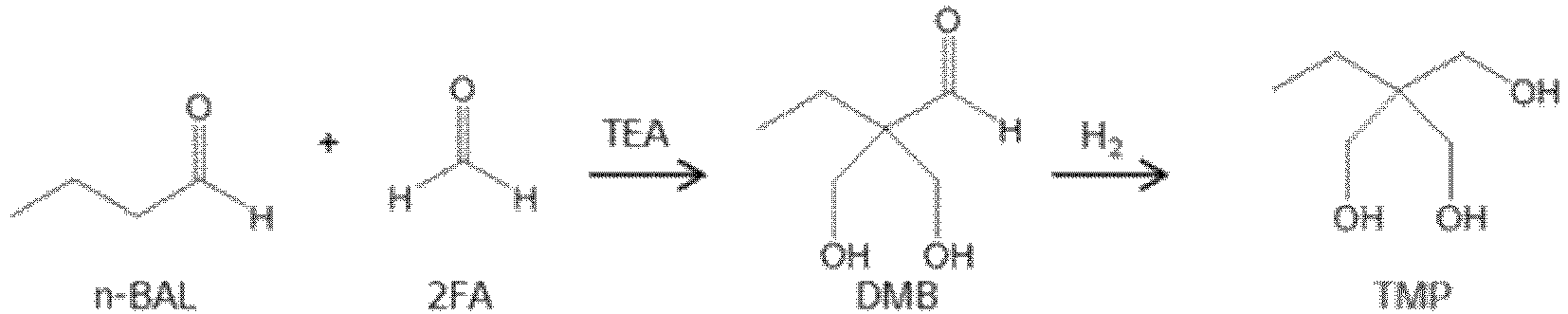
- In order to produce a TMP product through a hydrogenation processing method, a two-step process of an aldol reaction and a hydrogenation reaction is performed as in the reaction formula. Since the DMB produced by the aldol reaction is an intermediate material in an unstable state in which aldehyde is comprised due to the structure thereof, the DMB is characterized in that the DMB may be easily thermally decomposed or may cause a side reaction according to the synthesis conditions or separation conditions.
- In contrast, since TMP is a final product comprising a stable alcohol structure in which the hydrogenation reaction is also completed, TMP is characterized in that in the separation process, a thermal decomposition or a side reaction does not easily occur, and accordingly, TMP can be separated by using a general distillation column.
- Accordingly, it is very important to separate a target material when an unstable intermediate such as DMB is separated and to minimize the thermal decomposition or the side reaction in the separation process, but when a stable product such as TMP is separated, it is a very important factor to use a small amount of energy while efficiently separating the target material.
- Due to this background, it can be seen that a method of separating DMB in the reaction product and a method of separating TMP in the reaction product are fundamentally different in terms of separation methods, conditions, devices, and the like.
- Further, when a stable product such as TMP is separated, TMP is stable even though TMP resides in the column for a long period of time, so that two column functions may be integrated in one column instead of using two columns by applying a divided wall column (DWC), and the like, and accordingly, it is possible to expect effects of reducing energy and reducing investment costs. However, when an unstable product such as DMB is separated, the residence time in the column is increased when the DWC is used, so that the use of DWC is not preferred because it is more highly likely that DMB is thermally decomposed. That is, when an unstable material is separated, it is very important to separate a target material in a short time by minimizing the residence time in the column while minimizing the exposure of the unstable material to high temperature.
- Accordingly, a method of separating DMB in the reaction product and a method of separating TMP in the reaction product are fundamentally different in terms of separation methods, conditions, devices, and the like.
- According to an exemplary embodiment of the present specification, the pressure at the top portion of the tower in the distillation tower may be 150 mbar to 650 mbar, and 200 mbar to 600 mbar. The pressure may be selected in connection with a suitable range of the operation temperature of the column. When the pressure at the top portion of the tower in the distillation tower is less than 150 mbar, components having low boiling points separated from the top of the tower at high vacuum are condensed and recovered, which may be adverse in the operation because the cooling temperature of the top column of the tower is lowered, and when the pressure is more than 650 mbar, an effective component may be decomposed because the column temperature needs to be 200°C or more in order to separate the effective component.
- According to an exemplary embodiment of the present specification, the heating temperature in the step (C) may be 150°C to 200°C. In this case, the heating temperature may mean a set temperature of a reboiler. In addition, the heating temperature in the step (C) may be 160°C to 195°C. The minimum heating temperature for separating an effective component (DMB) is required, and when the heating temperature in the step (C) is less than 150°C, it may be difficult to separate low boiling point components into the upper portion of the column at a suitable flow rate, and when the heating temperature in the step (C) is more than 200°C, the effective component (DMB) may be decomposed at high temperature, which is not preferred.
- Furthermore, an exemplary embodiment of the present specification provides a distillation device comprising: a distillation tower provided so as to distill a raw material comprising dimethylolbutanal; a raw material inlet provided such that the raw material is fed to the distillation tower; a second outlet provided such that a low boiling point component in which the raw material is distilled and separated is discharged from the distillation tower; a side cut provided such that dimethylolbutanal in which the raw material is distilled and separated is discharged from the distillation tower; a first outlet provided such that a high boiling point component in which the raw material is distilled and separated is discharged from the distillation tower; and a reboiler provided so as to reflux a portion or all of the high boiling point component discharged through the first outlet to the distillation tower.
- In the method of separating DMB by using a distillation column, when a side cut is used, a side reaction and the thermal decomposition of DMB may be decreased by minimizing the exposure of an aldol reaction product to high temperature in a reboiler, and the amount of energy used may be reduced and DMB may be separated at a high recovery rate by decreasing the amount of DMB residing in the reboiler. This may ultimately reduce the content of the high boiling point component in a raw material fed to the hydrogenation process, so that there are effects capable of improving the hydrogenation reactivity and protecting a catalyst.
- According to an exemplary embodiment of the present specification, the distillation tower may be a single distillation tower or a multi-stage distillation tower, and is not limited thereto, but may be preferably a multi-stage distillation tower of 20 stages to 40 stages. When the number of stages of the distillation tower is less than 20, the DMB recovery rate may be reduced, and when the number of stages of the distillation tower is more than 40, the DMB recovery rate is increased, but as the number of stages of the distillation tower is increased, device investment costs and operation costs may be increased.
- According to an exemplary embodiment of the present specification, the raw material inlet may be located at the side portion of the distillation tower. When the distillation tower according to an exemplary embodiment of the present specification is a multi-stage distillation tower of 20 stages to 40 stages, the raw material inlet may be located between the 5th stage and the 35th stage of the distillation tower. Preferably, the raw material inlet may be located between the 5th stage and the 20th stage of the distillation tower. More preferably, the raw material inlet may be located between the 10th stage and the 15th stage of the distillation tower.
- According to an exemplary embodiment of the present specification, the first outlet may be located at the bottom portion of the tower in the distillation tower. The bottom portion of the tower in the distillation tower may mean a portion located at the lowest point in the lower portion of the distillation tower. The bottom portion of the tower in the distillation tower may mean a stage located at the lowermost portion of a tray type multi-stage distillation tower. The component separated into the first outlet may comprise a high boiling point component in a raw material. The description on the high boiling point component is the same as that described above.
- According to an exemplary embodiment of the present specification, the second outlet may be located at the top portion of the tower in the distillation tower. The top portion of the tower in the distillation tower may mean a portion located at the highest point in the upper portion of the distillation tower. The top portion of the tower in the distillation tower may mean a stage located at the uppermost portion of a tray type multi-stage distillation tower. The component separated into the second outlet may comprise a low boiling point component in a raw material. The description on the low boiling point component is the same as that described above.
- According to an exemplary embodiment of the present specification, the side cut may be located at the side portion of the distillation tower. The side cut may be located between the raw material inlet and the first outlet. Specifically, the side cut may be located between the 2nd stage to the 10th stage of the distillation tower. Preferably, the side cut may be located between the 2nd stage and the 5th stage of the distillation tower.
- According to an exemplary embodiment of the present specification, the gap between the side cut and the raw material inlet may be the 3rd stage to the 30th stage. Preferably, the gap between the side cut and the raw material inlet may be the 5th stage to the 10th stage. In this case, the raw material inlet may be located at a higher stage than the side cut.
- According to an exemplary embodiment of the present specification, the reboiler is connected to a portion of a bottom line connected to the bottom portion of the tower in the distillation tower, and thus may serve to reflux a component comprising a high boiling point material separated into the bottom portion of the tower again to the lower portion of the distillation tower. The bottom line may mean a pipe which is connected to the bottom portion of the tower in the distillation tower and through which a component comprising a high boiling point material is separated and discharged.
- According to an exemplary embodiment of the present specification, the temperature of the reboiler may be adjusted to 150°C to 200°C. Preferably, the temperature of the reboiler may be adjusted to 160°C to 195°C.
- According to an exemplary embodiment of the present specification, the reboiler may further comprise a temperature adjusting means provided so as to adjust the temperature of the reboiler to 150°C to 200°C. Preferably, the temperature adjusting means may be a temperature adjusting means provided to adjust the temperature to 160°C to 195°C.
- The temperature adjusting means may mean a temperature display window, a heating means, a temperature controlling means, and the like, and is not limited as long as the temperature adjusting means is typically used in the reboiler in the related art.
-
FIG. 1 is an exemplary process view of the distillation device and pipe configuration for performing the method for producing dimethylolbutanal according to an exemplary embodiment of the present specification. - According to
FIG. 1 , a raw material comprising dimethylolbutanal (DMB) is fed to adistillation tower 100 through araw material inlet 11. The raw material comprising dimethylolbutanal (DMB) means a raw material obtained through extracting an aldol reaction product obtained by subjecting an alkanal, formaldehyde, and an alkylamine catalyst as a raw material to an aldol condensation reaction using an alcohol solvent. In this case, the alkanal may be an alkanal having 3 to 10 carbon atoms, and specifically, may be propanal, butanal, pentanal, hexanal, and the like, but is not limited thereto. More specifically, n-butanal (n-BAL) is preferred. In addition, the alkylamine catalyst is an alkylamine having 3 to 20 carbon atoms, and specifically, trimethylamine, triethylamine (TEA), tripropylamine, diisopropylethylamine, or the like may be used, and preferably, triethylamine may be used. The alcohol solvent used as an extraction solvent in the extracting of the product may be an alcohol solvent having 2 to 10 carbon atoms. Specifically, the alcohol solvent may be an alcohol solvent having 6 to 8 carbon atoms, and may be preferably an alcohol solvent having 8 carbon atoms. Specifically, it is preferred that the alcohol solvent is 2-ethyl hexanol (2-EH). In this case, 2-ethyl hexanol may be fed by 1.5 times to 3 times as compared to the initial raw material weight of the aldol condensation reaction, and the extraction temperature may be 25°C to 90°C. - The
distillation tower 100 may be a single distillation tower or a multi-stage distillation tower, and is not limited thereto, but may be preferably a multi-stage distillation tower. In this case, thedistillation tower 100 may be a multi-stage distillation tower of 20 stages to 40 stages. Furthermore, the pressure at the top portion of the tower in thedistillation tower 100 may be 150 mbar to 650 mbar. - According to
FIG. 1 , theraw material inlet 11 may be located at the side portion of thedistillation tower 100. When thedistillation tower 100 is a multi-stage distillation tower of 20 stages to 40 stages, theraw material inlet 11 may be located between the 5th stage and the 35th stage of thedistillation tower 100. - The
first outlet 14 may be located at the bottom portion of the tower in thedistillation tower 100. The bottom portion of the tower in thedistillation tower 100 may mean a portion located at the lowest point in the lower portion of thedistillation tower 100. The bottom portion of the tower in thedistillation tower 100 may mean a stage located at the lowermost portion of a tray type multi-stage distillation tower. The component separated into thefirst outlet 14 may comprise a high boiling point component in a raw material. The high boiling point component may mean a material having a higher boiling point than that of DMB Examples thereof comprise trimethylolpropane (TMP), and the like. The fact that the high boiling point component is separated into thefirst outlet 14 of thedistillation tower 100 may mean that the high boiling point component is comprised as the highest content in the component separated into thefirst outlet 14 as compared to the content of the high boiling point component comprised in the component separated into the second outlet 12 and the side cut 13 of thedistillation tower 100. - The second outlet 12 may be located at the top portion of the tower in the
distillation tower 100. The top portion of the tower in thedistillation tower 100 may mean a portion located at the highest point in the upper portion of thedistillation tower 100. The top portion of the tower in thedistillation tower 100 may mean a stage located at the uppermost portion of a tray type multi-stage distillation tower. The component separated into the second outlet 12 may comprise a low boiling point component in a raw material. The low boiling point component may mean a material having a lower boiling point than that of DMB Examples thereof comprise formaldehyde (FA), water (H2O), methanol (MeOH), triethylamine (TEA), ethylacrolein (EA), and the like. The fact that the low boiling point component is separated into the second outlet 12 of thedistillation tower 100 may mean that the low boiling point component is comprised as the highest content in the component separated into the second outlet 12 as compared to the content of the low boiling point component comprised in the component separated into thefirst outlet 14 and the side cut 13 of thedistillation tower 100. - The side cut 13 may be located at the side portion of the
distillation tower 100. The side cut 13 may be connected to a portion in which side cutequipment 200 in thedistillation tower 100 is located. The side cutequipment 200 means a device capable of capturing a liquid flowing down from theraw material inlet 11 of thedistillation tower 100. A portion of the captured liquid is separated into the side cut 13, and the other flows down to the lower portion of thedistillation tower 100 and is separated into thefirst outlet 14. - The side cut 13 may be located between the
raw material inlet 11 and thefirst outlet 14. Specifically, the side cutequipment 200 may located between the 2nd stage and the 10th stage of thedistillation tower 100. The gap between the side cut 13 and theraw material inlet 11 may be the third stage to the 30th stage. In this case, theraw material inlet 11 may be located at a higher stage than the side cut 13. - The fact that the dimethylolbutanal is separated into the side cut 13 of the
distillation tower 100 may mean that the dimethylolbutanal is comprised as the highest content in the component separated into the side cut 13 as compared to the content of the dimethylolbutanal comprised in the component separated into the second outlet 12 and thefirst outlet 14 of thedistillation tower 100. - The
reboiler 300 is connected to a portion of thefirst outlet 14 connected to the bottom portion of the tower in thedistillation tower 100, and thus may serve to reflux a component comprising a high boiling point material separated into thefirst outlet 14 again to the lower portion of thedistillation tower 100 through areflux pipe 15. The temperature of thereboiler 300 may be adjusted to 150°C to 200°C. - As described above, according to an exemplary embodiment of the present specification, DMB may be efficiently separated from the aldol reaction product by using side cut equipment in a distillation column having a high separation efficiency.
- Hereinafter, the present specification will be described in detail with reference to Examples for specifically describing the present specification. However, the Examples according to the present specification may be modified in various forms, and it is not interpreted that the scope of the present specification is limited to the Examples described below in detail. The Examples of the present specification are provided to more completely explain the present specification to a person with ordinary skill in the art.
- n-butanal (n-BAL), formaldehyde (FA), and triethylamine (TEA) were prepared at a mol ratio of 1 : 4 : 0.2, and allowed to react under a condition of 35°C at normal pressure for 3 hours. Subsequently, 2-ethyl hexanol (2-EH) was fed 2 times as compared to the initial raw material weight, and an organic layer obtained by extracting the product under a condition of 70°C at normal pressure was prepared as a distillation raw material.
- A representative composition of the obtained distillation raw material is shown in the following Table 1.
- n-butanal (n-BAL), formaldehyde (FA), and triethylamine (TEA) were prepared at a mol ratio of 1 : 2 : 0.2, and allowed to react under a condition of 35°C at normal pressure for 3 hours. Subsequently, 2-ethyl hexanol (2-EH) was fed 2 times as compared to the initial raw material weight, and an organic layer obtained by extracting the product under a condition of 70°C at normal pressure was prepared as a distillation raw material.
- A representative composition of the obtained distillation raw material is shown in the following Table 1.
[Table 1] Classification (wt%) H2O Low boiling point component 2-EH DMB High boiling point component Preparation Example 1 4.6 6.9 78.3 7.8 2.4 Preparation Example 2 4.3 10.0 78.2 4.5 3.0 - By using a 25-stage tray type distillation column having a diameter of 50 mm, a raw material feed stage and a side cut stage were installed at the 13th stage and the 3rd stage, respectively. The pressure at the upper portion of the distillation column was set at 200 mbar, and the temperature of the reboiler was adjusted to 160°C.
- While the raw material obtained in Preparation Example 1 was supplied constantly at a rate of 10 g/min, a continuous operation was performed for 3 hours until the column condition was stabilized.
- Under a condition in which the column condition was stabilized, the flow rate and the composition of an organic material at the side cut stage, and the DMB recovery rate are summarized in the following Table 2.
- A continuous operation was performed in the same manner as in Example 1, except that the pressure at the upper portion of the distillation column was set at 600 mbar, and the reboiler was operated by adjusting the temperature of the reboiler to 195°C in Example 1.
- Under a condition in which the column condition was stabilized, the flow rate and the composition of an organic material at the side cut stage, and the DMB recovery rate are summarized in the following Table 2.
- A continuous operation was performed in the same manner as in Example 1, except that the pressure at the upper portion of the distillation column was set at 200 mbar, the reboiler was operated by adjusting the temperature of the reboiler to 200°C, and the raw material obtained in Preparation Example 2 was supplied constantly at a rate of 11.5 g/min in Example 1.
- Under a condition in which the column condition was stabilized, the flow rate and the composition of an organic material at the side cut stage, and the DMB recovery rate are summarized in the following Table 2.
- An experiment was performed in a state where the side cut equipment was removed from the distillation column device used in Example 1. The pressure at the upper portion of the distillation column was set at 800 mbar, and while the reboiler was operated by adjusting the temperature of the reboiler to 190°C, a continuous operation was performed for 3 hours until the column condition was stabilized.
- Under a condition in which the column condition was stabilized, the flow rate and the composition of an organic material discharged from the reboiler, and the DMB recovery rate are summarized in the following Table 2.
- A continuous operation was performed in the same manner as in Comparative Example 1, except that the pressure at the upper portion of the distillation column was set at 200 mbar, and the reboiler was operated by adjusting the temperature of the reboiler to 150°C in Comparative Example 1.
- Under a condition in which the column condition was stabilized, the flow rate and the composition of an organic material discharged from the reboiler, and the DMB recovery rate are summarized in the following Table 2.
- A DMB separation experiment was performed by using a wiped film evaporator (WFE) device. The experiment was performed under the conditions of a pressure of 200 mbar and a temperature of 150°C, and the raw materials obtained in the Preparation Examples were supplied constantly at 10 g/min to the device.
- In this case, a rotor provided inside the evaporator was operated at a rate of 150 rpm, the low boiling point component was removed into the upper portion of the WFE, and the DMB component was continuously separated into the lower portion of the WFE.
- The flow rate and the composition of an organic material separated into the lower portion of the device, and the DMB recovery rate are summarized in the following Table 2.
[Table 2] Classification Operation condition Flow rate (g/min) H2O (wt%) Low boiling point component (wt%) 2-EH (wt%) DMB (wt%) High boiling point component (wt%) DMB recovery rate (%) Separation method and position Pressure/Temperature Example 1 column side cut 200 mbar/ 160°C 8.1 2.0 0.5 87.0 9.5 1.0 98.7 Example 2 column side cut 600 mbar/ 195°C 8.2 1.4 0.4 88.0 9.4 0.8 98.8 Example 3 column side cut 200 mbar/ 200°C 9.4 1.4 2.9 88.0 5.2 2.5 94.5 Comparative Example 1 column bottom 800 mbar/ 190°C 8.5 1.7 1.2 82.0 8.0 7.1 87.2 Comparative column 200 mbar/ 8.2 1.2 1.0 83.2 8.7 5.9 91.5 Example 2 bottom 150°C Comparative Example 3 WFE bottom 200 mbar/ 150°C 7.5 2.0 6.0 81.5 8.0 2.5 76.9 - According to Table 2, it could be confirmed that according to an exemplary embodiment of the present specification, in the case of Examples 1 and 2 in which DMB was separated from a distillation column which was equipped with a side cut, a higher DMB recovery rate (98.7% or more) could be obtained as compared to Comparative Examples 1 and 2 in which the distillation column in the related art, which was not equipped with a side cut, was used, and Comparative Example 3 in which a wiped film evaporator was used.
- As a result, when the distillation device according to an exemplary embodiment of the present specification was used, a side reaction and the thermal decomposition of DMB was decreased by minimizing the exposure of an aldol reaction product to high temperature in a reboiler, and the amount of energy used was reduced by decreasing the amount of DMB residing in the reboiler, so that the DMB component could be efficiently separated in a short period of time.
- As a result, the hydrogenation reactivity may be improved and the catalyst may be protected by decreasing the content of the high boiling point component in the raw material fed to the hydrogenation process.
- Furthermore, when Examples 1, 2, and 3 are compared, it can be seen that when a mol ratio of the alkanal : formaldehyde : the alkylamine catalyst satisfies 1 : 2.5 to 5 : 0.1 to 0.3, a higher DMB recovery rate may be obtained.
- Although the preferred exemplary embodiments of the present invention have been described above, the present invention is not limited thereto, and various modifications can be made and carried out within the scope of the claims and the detailed description of the invention, and also fall within the scope of the invention.
Claims (17)
- A method for producing dimethylolbutanal, the method comprising:(A) distilling a raw material comprising dimethylolbutanal (DMB) in a distillation tower;(B) separating the distilled raw material in the distillation tower into a low boiling point component, dimethylolbutanal, and a high boiling point component; and(C) refluxing a portion or all of the high boiling point component to the distillation tower by heating the portion or all of the high boiling point component,wherein the dimethylolbutanal is separated from a side cut of the distillation tower.
- The method of claim 1, wherein the step (A) further comprises:obtaining an aldol reaction product by allowing an alkanal, formaldehyde (FA), and an alkylamine catalyst to react; andobtaining a raw material comprising the dimethylolbutanal by extracting the aldol reaction product together with an alcohol solvent.
- The method of claim 2, wherein a mol ratio of the alkanal, the formaldehyde, and the alkylamine catalyst is 2.5 mol to 5 mol of formaldehyde and 0.1 mol to 0.3 mol of the alkylamine catalyst based on 1 mol of the alkanal.
- The method of claim 1, wherein the distillation tower is a multi-stage distillation tower of 20 stages to 40 stages.
- The method of claim 1, wherein the low boiling point component in the step (B) is separated into a top portion of the tower in the distillation tower.
- The method of claim 1, wherein the high boiling point component in step (B) is separated into a bottom portion of the tower in the distillation tower.
- The method of claim 1, wherein the dimethylolbutanal is separated at a recovery rate of 94% or more.
- The method of claim 1, wherein the heating temperature in step (C) is 150°C to 200°C.
- The method of claim 1, wherein a pressure at the top portion of the tower in the distillation tower is 150 mbar to 650 mbar.
- A distillation device comprising:a distillation tower provided so as to distill a raw material comprising dimethylolbutanal;a raw material inlet provided such that the raw material is fed to the distillation tower;a second outlet provided such that a low boiling point component in which the raw material is distilled and separated is discharged from the distillation tower;a side cut provided such that dimethylolbutanal in which the raw material is distilled and separated is discharged from the distillation tower;a first outlet provided such that a high boiling point component in which the raw material is distilled and separated is discharged from the distillation tower; anda reboiler provided so as to reflux a portion or all of the high boiling point component discharged through the first outlet to the distillation tower.
- The distillation device of claim 10, wherein the distillation tower is a multi-stage distillation tower of 20 stages to 40 stages.
- The distillation device of claim 10, wherein the raw material inlet is located between the 5th stage and the 35th stage of the distillation tower.
- The distillation device of claim 10, wherein the first outlet is located at a bottom portion of the tower in the distillation tower.
- The distillation device of claim 10, wherein the side cut is located between the raw material inlet and the first outlet.
- The distillation device of claim 10, wherein the side cut is located between the 2nd stage and the 10th stage of the distillation tower.
- The distillation device of claim 10, wherein the second outlet is located at a top portion of the tower in the distillation tower.
- The distillation device of claim 10, further comprising a temperature adjusting means provided so as to adjust a temperature of the reboiler to 150°C to 200°C.
Applications Claiming Priority (2)
| Application Number | Priority Date | Filing Date | Title |
|---|---|---|---|
| KR20180013043 | 2018-02-01 | ||
| PCT/KR2019/001012 WO2019151710A1 (en) | 2018-02-01 | 2019-01-24 | Method for producing dimethylolbutanal and distillation apparatus |
Publications (3)
| Publication Number | Publication Date |
|---|---|
| EP3747858A1 true EP3747858A1 (en) | 2020-12-09 |
| EP3747858A4 EP3747858A4 (en) | 2021-03-17 |
| EP3747858B1 EP3747858B1 (en) | 2025-08-27 |
Family
ID=67478863
Family Applications (1)
| Application Number | Title | Priority Date | Filing Date |
|---|---|---|---|
| EP19747776.3A Active EP3747858B1 (en) | 2018-02-01 | 2019-01-24 | Method for producing dimethylolbutanal and distillation apparatus |
Country Status (6)
| Country | Link |
|---|---|
| US (1) | US10913700B2 (en) |
| EP (1) | EP3747858B1 (en) |
| JP (1) | JP7022215B2 (en) |
| KR (1) | KR102391592B1 (en) |
| CN (1) | CN111465590B (en) |
| WO (1) | WO2019151710A1 (en) |
Families Citing this family (1)
| Publication number | Priority date | Publication date | Assignee | Title |
|---|---|---|---|---|
| KR102245931B1 (en) * | 2018-10-22 | 2021-04-28 | 주식회사 엘지화학 | Preparing method of dimethylolbutanal and preperation method of trimethylolpropane using the same |
Family Cites Families (15)
| Publication number | Priority date | Publication date | Assignee | Title |
|---|---|---|---|---|
| JPH11130719A (en) * | 1997-10-23 | 1999-05-18 | Mitsubishi Chemical Corp | Purification method of dimethylol alkanal |
| JP4284477B2 (en) | 1998-12-25 | 2009-06-24 | 三菱瓦斯化学株式会社 | Method for producing high-purity trimethylolpropane |
| DE19963437A1 (en) * | 1999-12-28 | 2001-07-05 | Basf Ag | Process for the decomposition of high-boiling by-products formed in the synthesis of polyhydric alcohols |
| DE19963435A1 (en) | 1999-12-28 | 2001-07-05 | Basf Ag | Process for the purification of trimethylolpropane produced by hydrogenation by continuous distillation |
| JP2002045604A (en) * | 2000-08-02 | 2002-02-12 | Kyowa Yuka Co Ltd | Distillation apparatus and distillation method using the same |
| JP2002066204A (en) * | 2000-08-31 | 2002-03-05 | Sumitomo Heavy Ind Ltd | Distillation device |
| US6582564B2 (en) * | 2000-08-22 | 2003-06-24 | Sumitomo Heavy Industries, Ltd. | Distillation apparatus and distillation method |
| DE10160180A1 (en) | 2001-12-07 | 2003-06-18 | Basf Ag | Process for the isolation of trimethylolpropane from a reaction mixture |
| DE10164264A1 (en) | 2001-12-27 | 2003-07-17 | Bayer Ag | Process for the preparation of trimethylolpropane |
| JPWO2005007605A1 (en) | 2003-07-23 | 2006-08-31 | 協和発酵ケミカル株式会社 | Process for producing α, α-bis (hydroxymethyl) alkanal |
| KR100837523B1 (en) | 2006-03-07 | 2008-06-12 | 주식회사 엘지화학 | Method for preparing trimethylolpropane |
| MY153850A (en) * | 2008-12-09 | 2015-03-31 | Basf Se | Method for purifying crude polymethylols |
| JP6487543B2 (en) * | 2014-10-31 | 2019-03-20 | エルジー・ケム・リミテッド | Distillation equipment |
| KR101804006B1 (en) * | 2014-10-31 | 2017-12-01 | 주식회사 엘지화학 | Distillation device |
| KR20180013043A (en) | 2016-07-28 | 2018-02-07 | (주)코콤에코텍 | Filter material for water treatment |
-
2019
- 2019-01-24 US US16/769,187 patent/US10913700B2/en active Active
- 2019-01-24 WO PCT/KR2019/001012 patent/WO2019151710A1/en not_active Ceased
- 2019-01-24 KR KR1020190009214A patent/KR102391592B1/en active Active
- 2019-01-24 EP EP19747776.3A patent/EP3747858B1/en active Active
- 2019-01-24 CN CN201980006341.0A patent/CN111465590B/en active Active
- 2019-01-24 JP JP2020530460A patent/JP7022215B2/en active Active
Also Published As
| Publication number | Publication date |
|---|---|
| JP2021505564A (en) | 2021-02-18 |
| KR102391592B1 (en) | 2022-04-28 |
| US10913700B2 (en) | 2021-02-09 |
| CN111465590B (en) | 2023-04-11 |
| US20200369588A1 (en) | 2020-11-26 |
| KR20190093505A (en) | 2019-08-09 |
| EP3747858B1 (en) | 2025-08-27 |
| WO2019151710A1 (en) | 2019-08-08 |
| EP3747858A4 (en) | 2021-03-17 |
| JP7022215B2 (en) | 2022-02-17 |
| CN111465590A (en) | 2020-07-28 |
Similar Documents
| Publication | Publication Date | Title |
|---|---|---|
| US8933277B2 (en) | Process for preparing polymethylols | |
| EP2376413B2 (en) | Method for distilling an aqueous mixture of neopentylglycol | |
| KR20110098941A (en) | Purification Method of Crude Polymethylol | |
| CN101102986B (en) | Method for preparing trimethylolpropane | |
| JP5817730B2 (en) | Method for producing ditrimethylolpropane | |
| KR20180047255A (en) | Trimethylolpropane manufacturing device and method using thereof | |
| EP3747858B1 (en) | Method for producing dimethylolbutanal and distillation apparatus | |
| JP2005511674A (en) | Method for isolating trimethylolpropane from a reaction mixture | |
| KR100852283B1 (en) | Method for Purifying Neopentyl Glycol | |
| CN1325453C (en) | Method for preparing polylol | |
| KR101650610B1 (en) | Method For Preparing Polycarbonate | |
| CN108463451A (en) | The manufacturing method of hydroxy pivalin aldehyde | |
| CN104024200B (en) | The method being recovered by distillation double-trimethylolpropane | |
| EP2684860B1 (en) | Method for concentrating aqueous 3-hydroxy-2,2-dimethylpropanal solution | |
| CN112119054A (en) | Optimizing 2-EH Product Recovery System Using Process Intensification | |
| JP4356342B2 (en) | Purification method of ethylene glycol | |
| CN112920015A (en) | Process for refining alcohols derived from the hydrogenation of aldehydes | |
| JP2006256992A (en) | Propylene oxide purification method |
Legal Events
| Date | Code | Title | Description |
|---|---|---|---|
| STAA | Information on the status of an ep patent application or granted ep patent |
Free format text: STATUS: THE INTERNATIONAL PUBLICATION HAS BEEN MADE |
|
| PUAI | Public reference made under article 153(3) epc to a published international application that has entered the european phase |
Free format text: ORIGINAL CODE: 0009012 |
|
| STAA | Information on the status of an ep patent application or granted ep patent |
Free format text: STATUS: REQUEST FOR EXAMINATION WAS MADE |
|
| 17P | Request for examination filed |
Effective date: 20200602 |
|
| AK | Designated contracting states |
Kind code of ref document: A1 Designated state(s): AL AT BE BG CH CY CZ DE DK EE ES FI FR GB GR HR HU IE IS IT LI LT LU LV MC MK MT NL NO PL PT RO RS SE SI SK SM TR |
|
| AX | Request for extension of the european patent |
Extension state: BA ME |
|
| A4 | Supplementary search report drawn up and despatched |
Effective date: 20210216 |
|
| RIC1 | Information provided on ipc code assigned before grant |
Ipc: C07C 45/75 20060101ALI20210210BHEP Ipc: C07C 47/19 20060101ALI20210210BHEP Ipc: B01D 3/32 20060101ALI20210210BHEP Ipc: C07C 45/80 20060101ALI20210210BHEP Ipc: B01D 3/14 20060101ALI20210210BHEP Ipc: B01D 3/00 20060101ALI20210210BHEP Ipc: C07C 45/82 20060101AFI20210210BHEP |
|
| DAV | Request for validation of the european patent (deleted) | ||
| DAX | Request for extension of the european patent (deleted) | ||
| STAA | Information on the status of an ep patent application or granted ep patent |
Free format text: STATUS: EXAMINATION IS IN PROGRESS |
|
| 17Q | First examination report despatched |
Effective date: 20220411 |
|
| GRAP | Despatch of communication of intention to grant a patent |
Free format text: ORIGINAL CODE: EPIDOSNIGR1 |
|
| STAA | Information on the status of an ep patent application or granted ep patent |
Free format text: STATUS: GRANT OF PATENT IS INTENDED |
|
| INTG | Intention to grant announced |
Effective date: 20250617 |
|
| GRAS | Grant fee paid |
Free format text: ORIGINAL CODE: EPIDOSNIGR3 |
|
| GRAA | (expected) grant |
Free format text: ORIGINAL CODE: 0009210 |
|
| STAA | Information on the status of an ep patent application or granted ep patent |
Free format text: STATUS: THE PATENT HAS BEEN GRANTED |
|
| AK | Designated contracting states |
Kind code of ref document: B1 Designated state(s): AL AT BE BG CH CY CZ DE DK EE ES FI FR GB GR HR HU IE IS IT LI LT LU LV MC MK MT NL NO PL PT RO RS SE SI SK SM TR |
|
| REG | Reference to a national code |
Ref country code: GB Ref legal event code: FG4D |
|
| REG | Reference to a national code |
Ref country code: CH Ref legal event code: EP |
|
| REG | Reference to a national code |
Ref country code: DE Ref legal event code: R096 Ref document number: 602019074757 Country of ref document: DE |
|
| REG | Reference to a national code |
Ref country code: IE Ref legal event code: FG4D |
|
| REG | Reference to a national code |
Ref country code: NL Ref legal event code: MP Effective date: 20250827 |
|
| PG25 | Lapsed in a contracting state [announced via postgrant information from national office to epo] |
Ref country code: IS Free format text: LAPSE BECAUSE OF FAILURE TO SUBMIT A TRANSLATION OF THE DESCRIPTION OR TO PAY THE FEE WITHIN THE PRESCRIBED TIME-LIMIT Effective date: 20251227 |
|
| PGFP | Annual fee paid to national office [announced via postgrant information from national office to epo] |
Ref country code: GB Payment date: 20251222 Year of fee payment: 8 |
|
| PG25 | Lapsed in a contracting state [announced via postgrant information from national office to epo] |
Ref country code: NO Free format text: LAPSE BECAUSE OF FAILURE TO SUBMIT A TRANSLATION OF THE DESCRIPTION OR TO PAY THE FEE WITHIN THE PRESCRIBED TIME-LIMIT Effective date: 20251127 |
|
| REG | Reference to a national code |
Ref country code: LT Ref legal event code: MG9D |
|
| PG25 | Lapsed in a contracting state [announced via postgrant information from national office to epo] |
Ref country code: PT Free format text: LAPSE BECAUSE OF FAILURE TO SUBMIT A TRANSLATION OF THE DESCRIPTION OR TO PAY THE FEE WITHIN THE PRESCRIBED TIME-LIMIT Effective date: 20251229 |
|
| PG25 | Lapsed in a contracting state [announced via postgrant information from national office to epo] |
Ref country code: FI Free format text: LAPSE BECAUSE OF FAILURE TO SUBMIT A TRANSLATION OF THE DESCRIPTION OR TO PAY THE FEE WITHIN THE PRESCRIBED TIME-LIMIT Effective date: 20250827 |
|
| PG25 | Lapsed in a contracting state [announced via postgrant information from national office to epo] |
Ref country code: NL Free format text: LAPSE BECAUSE OF FAILURE TO SUBMIT A TRANSLATION OF THE DESCRIPTION OR TO PAY THE FEE WITHIN THE PRESCRIBED TIME-LIMIT Effective date: 20250827 Ref country code: HR Free format text: LAPSE BECAUSE OF FAILURE TO SUBMIT A TRANSLATION OF THE DESCRIPTION OR TO PAY THE FEE WITHIN THE PRESCRIBED TIME-LIMIT Effective date: 20250827 |
|
| PGFP | Annual fee paid to national office [announced via postgrant information from national office to epo] |
Ref country code: FR Payment date: 20251223 Year of fee payment: 8 |
|
| PG25 | Lapsed in a contracting state [announced via postgrant information from national office to epo] |
Ref country code: GR Free format text: LAPSE BECAUSE OF FAILURE TO SUBMIT A TRANSLATION OF THE DESCRIPTION OR TO PAY THE FEE WITHIN THE PRESCRIBED TIME-LIMIT Effective date: 20251128 |
|
| PG25 | Lapsed in a contracting state [announced via postgrant information from national office to epo] |
Ref country code: SE Free format text: LAPSE BECAUSE OF FAILURE TO SUBMIT A TRANSLATION OF THE DESCRIPTION OR TO PAY THE FEE WITHIN THE PRESCRIBED TIME-LIMIT Effective date: 20250827 |
|
| PG25 | Lapsed in a contracting state [announced via postgrant information from national office to epo] |
Ref country code: LV Free format text: LAPSE BECAUSE OF FAILURE TO SUBMIT A TRANSLATION OF THE DESCRIPTION OR TO PAY THE FEE WITHIN THE PRESCRIBED TIME-LIMIT Effective date: 20250827 |
|
| PG25 | Lapsed in a contracting state [announced via postgrant information from national office to epo] |
Ref country code: BG Free format text: LAPSE BECAUSE OF FAILURE TO SUBMIT A TRANSLATION OF THE DESCRIPTION OR TO PAY THE FEE WITHIN THE PRESCRIBED TIME-LIMIT Effective date: 20250827 Ref country code: PL Free format text: LAPSE BECAUSE OF FAILURE TO SUBMIT A TRANSLATION OF THE DESCRIPTION OR TO PAY THE FEE WITHIN THE PRESCRIBED TIME-LIMIT Effective date: 20250827 |
|
| PG25 | Lapsed in a contracting state [announced via postgrant information from national office to epo] |
Ref country code: RS Free format text: LAPSE BECAUSE OF FAILURE TO SUBMIT A TRANSLATION OF THE DESCRIPTION OR TO PAY THE FEE WITHIN THE PRESCRIBED TIME-LIMIT Effective date: 20251127 |
|
| PG25 | Lapsed in a contracting state [announced via postgrant information from national office to epo] |
Ref country code: ES Free format text: LAPSE BECAUSE OF FAILURE TO SUBMIT A TRANSLATION OF THE DESCRIPTION OR TO PAY THE FEE WITHIN THE PRESCRIBED TIME-LIMIT Effective date: 20250827 |
|
| REG | Reference to a national code |
Ref country code: AT Ref legal event code: MK05 Ref document number: 1829866 Country of ref document: AT Kind code of ref document: T Effective date: 20250827 |
|
| PG25 | Lapsed in a contracting state [announced via postgrant information from national office to epo] |
Ref country code: SM Free format text: LAPSE BECAUSE OF FAILURE TO SUBMIT A TRANSLATION OF THE DESCRIPTION OR TO PAY THE FEE WITHIN THE PRESCRIBED TIME-LIMIT Effective date: 20250827 |
|
| PG25 | Lapsed in a contracting state [announced via postgrant information from national office to epo] |
Ref country code: DK Free format text: LAPSE BECAUSE OF FAILURE TO SUBMIT A TRANSLATION OF THE DESCRIPTION OR TO PAY THE FEE WITHIN THE PRESCRIBED TIME-LIMIT Effective date: 20250827 |
|
| PGFP | Annual fee paid to national office [announced via postgrant information from national office to epo] |
Ref country code: DE Payment date: 20251222 Year of fee payment: 8 |
|
| PG25 | Lapsed in a contracting state [announced via postgrant information from national office to epo] |
Ref country code: AT Free format text: LAPSE BECAUSE OF FAILURE TO SUBMIT A TRANSLATION OF THE DESCRIPTION OR TO PAY THE FEE WITHIN THE PRESCRIBED TIME-LIMIT Effective date: 20250827 |
|
| PG25 | Lapsed in a contracting state [announced via postgrant information from national office to epo] |
Ref country code: IT Free format text: LAPSE BECAUSE OF FAILURE TO SUBMIT A TRANSLATION OF THE DESCRIPTION OR TO PAY THE FEE WITHIN THE PRESCRIBED TIME-LIMIT Effective date: 20250827 |
|
| PG25 | Lapsed in a contracting state [announced via postgrant information from national office to epo] |
Ref country code: CZ Free format text: LAPSE BECAUSE OF FAILURE TO SUBMIT A TRANSLATION OF THE DESCRIPTION OR TO PAY THE FEE WITHIN THE PRESCRIBED TIME-LIMIT Effective date: 20250827 |
|
| PG25 | Lapsed in a contracting state [announced via postgrant information from national office to epo] |
Ref country code: EE Free format text: LAPSE BECAUSE OF FAILURE TO SUBMIT A TRANSLATION OF THE DESCRIPTION OR TO PAY THE FEE WITHIN THE PRESCRIBED TIME-LIMIT Effective date: 20250827 Ref country code: SK Free format text: LAPSE BECAUSE OF FAILURE TO SUBMIT A TRANSLATION OF THE DESCRIPTION OR TO PAY THE FEE WITHIN THE PRESCRIBED TIME-LIMIT Effective date: 20250827 |