EP3747856A1 - Compound having fluorene skeleton, and method for manufacturing same - Google Patents
Compound having fluorene skeleton, and method for manufacturing same Download PDFInfo
- Publication number
- EP3747856A1 EP3747856A1 EP19748185.6A EP19748185A EP3747856A1 EP 3747856 A1 EP3747856 A1 EP 3747856A1 EP 19748185 A EP19748185 A EP 19748185A EP 3747856 A1 EP3747856 A1 EP 3747856A1
- Authority
- EP
- European Patent Office
- Prior art keywords
- formula
- compound
- acid
- represented
- bis
- Prior art date
- Legal status (The legal status is an assumption and is not a legal conclusion. Google has not performed a legal analysis and makes no representation as to the accuracy of the status listed.)
- Pending
Links
- 150000001875 compounds Chemical class 0.000 title claims abstract description 156
- 125000003983 fluorenyl group Chemical group C1(=CC=CC=2C3=CC=CC=C3CC12)* 0.000 title claims abstract description 77
- 238000004519 manufacturing process Methods 0.000 title claims abstract description 76
- 238000000034 method Methods 0.000 title abstract description 28
- KDLHZDBZIXYQEI-UHFFFAOYSA-N Palladium Chemical compound [Pd] KDLHZDBZIXYQEI-UHFFFAOYSA-N 0.000 claims abstract description 77
- LFQSCWFLJHTTHZ-UHFFFAOYSA-N Ethanol Chemical compound CCO LFQSCWFLJHTTHZ-UHFFFAOYSA-N 0.000 claims abstract description 52
- 239000000203 mixture Substances 0.000 claims abstract description 40
- 125000003118 aryl group Chemical group 0.000 claims abstract description 29
- 125000005843 halogen group Chemical group 0.000 claims abstract description 23
- 229910052763 palladium Inorganic materials 0.000 claims abstract description 22
- 125000004435 hydrogen atom Chemical group [H]* 0.000 claims abstract description 18
- 125000001424 substituent group Chemical group 0.000 claims abstract description 17
- 125000002947 alkylene group Chemical group 0.000 claims abstract description 13
- 125000001183 hydrocarbyl group Chemical group 0.000 claims abstract 5
- YXFVVABEGXRONW-UHFFFAOYSA-N Toluene Chemical compound CC1=CC=CC=C1 YXFVVABEGXRONW-UHFFFAOYSA-N 0.000 claims description 99
- -1 alcohol compound Chemical class 0.000 claims description 64
- 239000003054 catalyst Substances 0.000 claims description 34
- 239000007858 starting material Substances 0.000 claims description 26
- 239000011964 heteropoly acid Substances 0.000 claims description 24
- 239000003377 acid catalyst Substances 0.000 claims description 21
- 239000007810 chemical reaction solvent Substances 0.000 claims description 20
- 125000004432 carbon atom Chemical group C* 0.000 claims description 19
- NFHFRUOZVGFOOS-UHFFFAOYSA-N palladium;triphenylphosphane Chemical compound [Pd].C1=CC=CC=C1P(C=1C=CC=CC=1)C1=CC=CC=C1.C1=CC=CC=C1P(C=1C=CC=CC=1)C1=CC=CC=C1.C1=CC=CC=C1P(C=1C=CC=CC=1)C1=CC=CC=C1.C1=CC=CC=C1P(C=1C=CC=CC=1)C1=CC=CC=C1 NFHFRUOZVGFOOS-UHFFFAOYSA-N 0.000 claims description 19
- 125000001997 phenyl group Chemical group [H]C1=C([H])C([H])=C(*)C([H])=C1[H] 0.000 claims description 18
- YLQWCDOCJODRMT-UHFFFAOYSA-N fluoren-9-one Chemical compound C1=CC=C2C(=O)C3=CC=CC=C3C2=C1 YLQWCDOCJODRMT-UHFFFAOYSA-N 0.000 claims description 17
- ZADPBFCGQRWHPN-UHFFFAOYSA-N boronic acid Chemical compound OBO ZADPBFCGQRWHPN-UHFFFAOYSA-N 0.000 claims description 16
- CDBYLPFSWZWCQE-UHFFFAOYSA-L Sodium Carbonate Chemical compound [Na+].[Na+].[O-]C([O-])=O CDBYLPFSWZWCQE-UHFFFAOYSA-L 0.000 claims description 14
- HXITXNWTGFUOAU-UHFFFAOYSA-N phenylboronic acid Chemical compound OB(O)C1=CC=CC=C1 HXITXNWTGFUOAU-UHFFFAOYSA-N 0.000 claims description 12
- 150000008064 anhydrides Chemical class 0.000 claims description 11
- BWHMMNNQKKPAPP-UHFFFAOYSA-L potassium carbonate Chemical compound [K+].[K+].[O-]C([O-])=O BWHMMNNQKKPAPP-UHFFFAOYSA-L 0.000 claims description 11
- 125000001624 naphthyl group Chemical group 0.000 claims description 10
- 239000007795 chemical reaction product Substances 0.000 claims description 9
- 229920005992 thermoplastic resin Polymers 0.000 claims description 9
- FYEFHYMUEWRCRF-UHFFFAOYSA-N 2,7-dibromofluoren-1-one Chemical compound BrC1=CC=C2C3=CC=C(Br)C(=O)C3=CC2=C1 FYEFHYMUEWRCRF-UHFFFAOYSA-N 0.000 claims description 8
- QCDWFXQBSFUVSP-UHFFFAOYSA-N 2-phenoxyethanol Chemical compound OCCOC1=CC=CC=C1 QCDWFXQBSFUVSP-UHFFFAOYSA-N 0.000 claims description 8
- 125000000217 alkyl group Chemical group 0.000 claims description 8
- 229960005323 phenoxyethanol Drugs 0.000 claims description 8
- 125000003545 alkoxy group Chemical group 0.000 claims description 7
- 229910000029 sodium carbonate Inorganic materials 0.000 claims description 7
- NBIIXXVUZAFLBC-UHFFFAOYSA-N Phosphoric acid Chemical compound OP(O)(O)=O NBIIXXVUZAFLBC-UHFFFAOYSA-N 0.000 claims description 6
- 229910052739 hydrogen Inorganic materials 0.000 claims description 6
- 239000001257 hydrogen Substances 0.000 claims description 6
- 239000012046 mixed solvent Substances 0.000 claims description 6
- KPTRDYONBVUWPD-UHFFFAOYSA-N naphthalen-2-ylboronic acid Chemical compound C1=CC=CC2=CC(B(O)O)=CC=C21 KPTRDYONBVUWPD-UHFFFAOYSA-N 0.000 claims description 6
- ZOKXTWBITQBERF-UHFFFAOYSA-N Molybdenum Chemical compound [Mo] ZOKXTWBITQBERF-UHFFFAOYSA-N 0.000 claims description 5
- 229910052750 molybdenum Inorganic materials 0.000 claims description 5
- 239000011733 molybdenum Substances 0.000 claims description 5
- YJVFFLUZDVXJQI-UHFFFAOYSA-L palladium(ii) acetate Chemical compound [Pd+2].CC([O-])=O.CC([O-])=O YJVFFLUZDVXJQI-UHFFFAOYSA-L 0.000 claims description 5
- 229910000027 potassium carbonate Inorganic materials 0.000 claims description 5
- WFKWXMTUELFFGS-UHFFFAOYSA-N tungsten Chemical compound [W] WFKWXMTUELFFGS-UHFFFAOYSA-N 0.000 claims description 5
- 229910052721 tungsten Inorganic materials 0.000 claims description 5
- 239000010937 tungsten Substances 0.000 claims description 5
- 229910052720 vanadium Inorganic materials 0.000 claims description 5
- GPPXJZIENCGNKB-UHFFFAOYSA-N vanadium Chemical compound [V]#[V] GPPXJZIENCGNKB-UHFFFAOYSA-N 0.000 claims description 5
- 125000003342 alkenyl group Chemical group 0.000 claims description 4
- HUMMCEUVDBVXTQ-UHFFFAOYSA-N naphthalen-1-ylboronic acid Chemical compound C1=CC=C2C(B(O)O)=CC=CC2=C1 HUMMCEUVDBVXTQ-UHFFFAOYSA-N 0.000 claims description 4
- VOXXGUAZBWSUSS-UHFFFAOYSA-N 2,4,6-triphenyl-1,3,5,2,4,6-trioxatriborinane Chemical compound O1B(C=2C=CC=CC=2)OB(C=2C=CC=CC=2)OB1C1=CC=CC=C1 VOXXGUAZBWSUSS-UHFFFAOYSA-N 0.000 claims description 3
- XXMUCWWTRNHTGM-UHFFFAOYSA-N 2,7-diphenylfluoren-1-one Chemical compound O=C1C2=CC3=CC(C=4C=CC=CC=4)=CC=C3C2=CC=C1C1=CC=CC=C1 XXMUCWWTRNHTGM-UHFFFAOYSA-N 0.000 claims description 3
- 229910000147 aluminium phosphate Inorganic materials 0.000 claims description 3
- RMAQACBXLXPBSY-UHFFFAOYSA-N silicic acid Chemical compound O[Si](O)(O)O RMAQACBXLXPBSY-UHFFFAOYSA-N 0.000 claims description 2
- 235000012239 silicon dioxide Nutrition 0.000 claims description 2
- 229910052751 metal Inorganic materials 0.000 abstract description 27
- 239000002184 metal Substances 0.000 abstract description 27
- 229920005989 resin Polymers 0.000 abstract description 22
- 239000011347 resin Substances 0.000 abstract description 22
- 230000003287 optical effect Effects 0.000 abstract description 16
- 239000002994 raw material Substances 0.000 abstract 3
- 238000006243 chemical reaction Methods 0.000 description 73
- 239000002904 solvent Substances 0.000 description 44
- NIHNNTQXNPWCJQ-UHFFFAOYSA-N fluorene Chemical group C1=CC=C2CC3=CC=CC=C3C2=C1 NIHNNTQXNPWCJQ-UHFFFAOYSA-N 0.000 description 38
- 238000005259 measurement Methods 0.000 description 35
- 239000013078 crystal Substances 0.000 description 27
- 150000002739 metals Chemical class 0.000 description 20
- OKTJSMMVPCPJKN-UHFFFAOYSA-N Carbon Chemical compound [C] OKTJSMMVPCPJKN-UHFFFAOYSA-N 0.000 description 19
- 239000007787 solid Substances 0.000 description 18
- 229920005668 polycarbonate resin Polymers 0.000 description 17
- 239000004431 polycarbonate resin Substances 0.000 description 17
- 239000011541 reaction mixture Substances 0.000 description 17
- 238000004128 high performance liquid chromatography Methods 0.000 description 16
- 150000002430 hydrocarbons Chemical group 0.000 description 16
- XLYOFNOQVPJJNP-UHFFFAOYSA-N water Substances O XLYOFNOQVPJJNP-UHFFFAOYSA-N 0.000 description 16
- LRHPLDYGYMQRHN-UHFFFAOYSA-N N-Butanol Chemical compound CCCCO LRHPLDYGYMQRHN-UHFFFAOYSA-N 0.000 description 14
- QAOWNCQODCNURD-UHFFFAOYSA-N Sulfuric acid Chemical compound OS(O)(=O)=O QAOWNCQODCNURD-UHFFFAOYSA-N 0.000 description 14
- 239000002585 base Substances 0.000 description 14
- 239000012535 impurity Substances 0.000 description 14
- 239000000047 product Substances 0.000 description 14
- 150000004945 aromatic hydrocarbons Chemical class 0.000 description 12
- 238000002425 crystallisation Methods 0.000 description 12
- 230000008025 crystallization Effects 0.000 description 12
- 239000002253 acid Substances 0.000 description 10
- 239000000178 monomer Substances 0.000 description 10
- 239000008188 pellet Substances 0.000 description 10
- JQJYTWHASCGDRQ-UHFFFAOYSA-N 2-[4-[9-[4-(2-hydroxyethoxy)phenyl]-2,7-diphenylfluoren-9-yl]phenoxy]ethanol Chemical compound OCCOc1ccc(cc1)C1(c2cc(ccc2-c2ccc(cc12)-c1ccccc1)-c1ccccc1)c1ccc(OCCO)cc1 JQJYTWHASCGDRQ-UHFFFAOYSA-N 0.000 description 9
- NQXNYVAALXGLQT-UHFFFAOYSA-N 2-[4-[9-[4-(2-hydroxyethoxy)phenyl]fluoren-9-yl]phenoxy]ethanol Chemical compound C1=CC(OCCO)=CC=C1C1(C=2C=CC(OCCO)=CC=2)C2=CC=CC=C2C2=CC=CC=C21 NQXNYVAALXGLQT-UHFFFAOYSA-N 0.000 description 9
- OKKJLVBELUTLKV-UHFFFAOYSA-N Methanol Chemical compound OC OKKJLVBELUTLKV-UHFFFAOYSA-N 0.000 description 9
- ZMXDDKWLCZADIW-UHFFFAOYSA-N N,N-Dimethylformamide Chemical compound CN(C)C=O ZMXDDKWLCZADIW-UHFFFAOYSA-N 0.000 description 9
- 230000000052 comparative effect Effects 0.000 description 9
- 230000018044 dehydration Effects 0.000 description 9
- 238000006297 dehydration reaction Methods 0.000 description 9
- JVBWCQOTLXWAIF-UHFFFAOYSA-N 2-[4-[9-[4-(2-hydroxyethoxy)phenyl]-2,7-dinaphthalen-1-ylfluoren-9-yl]phenoxy]ethanol Chemical compound OCCOc1ccc(cc1)C1(c2cc(ccc2-c2ccc(cc12)-c1cccc2ccccc12)-c1cccc2ccccc12)c1ccc(OCCO)cc1 JVBWCQOTLXWAIF-UHFFFAOYSA-N 0.000 description 8
- HEDRZPFGACZZDS-UHFFFAOYSA-N Chloroform Chemical compound ClC(Cl)Cl HEDRZPFGACZZDS-UHFFFAOYSA-N 0.000 description 8
- 125000002887 hydroxy group Chemical group [H]O* 0.000 description 8
- KFZMGEQAYNKOFK-UHFFFAOYSA-N Isopropanol Chemical compound CC(C)O KFZMGEQAYNKOFK-UHFFFAOYSA-N 0.000 description 7
- 150000001298 alcohols Chemical class 0.000 description 7
- 230000015572 biosynthetic process Effects 0.000 description 7
- 150000004715 keto acids Chemical class 0.000 description 7
- 238000000746 purification Methods 0.000 description 7
- IJGRMHOSHXDMSA-UHFFFAOYSA-N Atomic nitrogen Chemical compound N#N IJGRMHOSHXDMSA-UHFFFAOYSA-N 0.000 description 6
- YMWUJEATGCHHMB-UHFFFAOYSA-N Dichloromethane Chemical compound ClCCl YMWUJEATGCHHMB-UHFFFAOYSA-N 0.000 description 6
- HEMHJVSKTPXQMS-UHFFFAOYSA-M Sodium hydroxide Chemical compound [OH-].[Na+] HEMHJVSKTPXQMS-UHFFFAOYSA-M 0.000 description 6
- 150000007513 acids Chemical class 0.000 description 6
- 238000001816 cooling Methods 0.000 description 6
- 125000000753 cycloalkyl group Chemical group 0.000 description 6
- 229930195733 hydrocarbon Natural products 0.000 description 6
- 125000002496 methyl group Chemical group [H]C([H])([H])* 0.000 description 6
- RTZKZFJDLAIYFH-UHFFFAOYSA-N Diethyl ether Chemical compound CCOCC RTZKZFJDLAIYFH-UHFFFAOYSA-N 0.000 description 5
- 238000009835 boiling Methods 0.000 description 5
- 229910052799 carbon Inorganic materials 0.000 description 5
- 230000000694 effects Effects 0.000 description 5
- 238000001914 filtration Methods 0.000 description 5
- 239000002244 precipitate Substances 0.000 description 5
- 230000009257 reactivity Effects 0.000 description 5
- 238000001953 recrystallisation Methods 0.000 description 5
- 238000010517 secondary reaction Methods 0.000 description 5
- 125000006273 (C1-C3) alkyl group Chemical group 0.000 description 4
- 125000004178 (C1-C4) alkyl group Chemical group 0.000 description 4
- 125000006704 (C5-C6) cycloalkyl group Chemical group 0.000 description 4
- 238000005160 1H NMR spectroscopy Methods 0.000 description 4
- 239000004215 Carbon black (E152) Substances 0.000 description 4
- AMQJEAYHLZJPGS-UHFFFAOYSA-N N-Pentanol Chemical compound CCCCCO AMQJEAYHLZJPGS-UHFFFAOYSA-N 0.000 description 4
- CTQNGGLPUBDAKN-UHFFFAOYSA-N O-Xylene Chemical compound CC1=CC=CC=C1C CTQNGGLPUBDAKN-UHFFFAOYSA-N 0.000 description 4
- UIIMBOGNXHQVGW-UHFFFAOYSA-M Sodium bicarbonate Chemical compound [Na+].OC([O-])=O UIIMBOGNXHQVGW-UHFFFAOYSA-M 0.000 description 4
- DKGAVHZHDRPRBM-UHFFFAOYSA-N Tert-Butanol Chemical compound CC(C)(C)O DKGAVHZHDRPRBM-UHFFFAOYSA-N 0.000 description 4
- 125000003710 aryl alkyl group Chemical group 0.000 description 4
- MVPPADPHJFYWMZ-UHFFFAOYSA-N chlorobenzene Chemical compound ClC1=CC=CC=C1 MVPPADPHJFYWMZ-UHFFFAOYSA-N 0.000 description 4
- 238000007865 diluting Methods 0.000 description 4
- IEJIGPNLZYLLBP-UHFFFAOYSA-N dimethyl carbonate Chemical compound COC(=O)OC IEJIGPNLZYLLBP-UHFFFAOYSA-N 0.000 description 4
- 238000004821 distillation Methods 0.000 description 4
- 125000001495 ethyl group Chemical group [H]C([H])([H])C([H])([H])* 0.000 description 4
- ZXEKIIBDNHEJCQ-UHFFFAOYSA-N isobutanol Chemical compound CC(C)CO ZXEKIIBDNHEJCQ-UHFFFAOYSA-N 0.000 description 4
- 229910052757 nitrogen Inorganic materials 0.000 description 4
- 239000012264 purified product Substances 0.000 description 4
- 150000003839 salts Chemical class 0.000 description 4
- CGFYHILWFSGVJS-UHFFFAOYSA-N silicic acid;trioxotungsten Chemical compound O[Si](O)(O)O.O=[W]1(=O)O[W](=O)(=O)O[W](=O)(=O)O1.O=[W]1(=O)O[W](=O)(=O)O[W](=O)(=O)O1.O=[W]1(=O)O[W](=O)(=O)O[W](=O)(=O)O1.O=[W]1(=O)O[W](=O)(=O)O[W](=O)(=O)O1 CGFYHILWFSGVJS-UHFFFAOYSA-N 0.000 description 4
- 239000000126 substance Substances 0.000 description 4
- 238000003786 synthesis reaction Methods 0.000 description 4
- 239000008096 xylene Substances 0.000 description 4
- QTPLEVOKSWEYAC-UHFFFAOYSA-N 1,2-diphenyl-9h-fluorene Chemical compound C=1C=CC=CC=1C1=C2CC3=CC=CC=C3C2=CC=C1C1=CC=CC=C1 QTPLEVOKSWEYAC-UHFFFAOYSA-N 0.000 description 3
- HXGPBZKGPPZSGX-UHFFFAOYSA-N 2,7-bis[fluoro(dipyridin-2-yl)methyl]-1,8-naphthyridine Chemical compound C=1C=CC=NC=1C(C=1N=C2N=C(C=CC2=CC=1)C(F)(C=1N=CC=CC=1)C=1N=CC=CC=1)(F)C1=CC=CC=N1 HXGPBZKGPPZSGX-UHFFFAOYSA-N 0.000 description 3
- GEJAZLOKTGLXTF-UHFFFAOYSA-N 4-[9-(4-hydroxyphenyl)-2,7-dinaphthalen-1-ylfluoren-9-yl]phenol Chemical compound Oc1ccc(cc1)C1(c2cc(ccc2-c2ccc(cc12)-c1cccc2ccccc12)-c1cccc2ccccc12)c1ccc(O)cc1 GEJAZLOKTGLXTF-UHFFFAOYSA-N 0.000 description 3
- BBOADZJZUHXHIC-UHFFFAOYSA-N 4-[9-(4-hydroxyphenyl)-2,7-diphenylfluoren-9-yl]phenol Chemical compound Oc1ccc(cc1)C1(c2cc(ccc2-c2ccc(cc12)-c1ccccc1)-c1ccccc1)c1ccc(O)cc1 BBOADZJZUHXHIC-UHFFFAOYSA-N 0.000 description 3
- WEVYAHXRMPXWCK-UHFFFAOYSA-N Acetonitrile Chemical compound CC#N WEVYAHXRMPXWCK-UHFFFAOYSA-N 0.000 description 3
- WKBOTKDWSSQWDR-UHFFFAOYSA-N Bromine atom Chemical compound [Br] WKBOTKDWSSQWDR-UHFFFAOYSA-N 0.000 description 3
- BVKZGUZCCUSVTD-UHFFFAOYSA-L Carbonate Chemical compound [O-]C([O-])=O BVKZGUZCCUSVTD-UHFFFAOYSA-L 0.000 description 3
- XEKOWRVHYACXOJ-UHFFFAOYSA-N Ethyl acetate Chemical compound CCOC(C)=O XEKOWRVHYACXOJ-UHFFFAOYSA-N 0.000 description 3
- KWYUFKZDYYNOTN-UHFFFAOYSA-M Potassium hydroxide Chemical compound [OH-].[K+] KWYUFKZDYYNOTN-UHFFFAOYSA-M 0.000 description 3
- 229910020628 SiW12O40 Inorganic materials 0.000 description 3
- 239000007864 aqueous solution Substances 0.000 description 3
- 125000004429 atom Chemical group 0.000 description 3
- JFDZBHWFFUWGJE-UHFFFAOYSA-N benzonitrile Chemical compound N#CC1=CC=CC=C1 JFDZBHWFFUWGJE-UHFFFAOYSA-N 0.000 description 3
- LLEMOWNGBBNAJR-UHFFFAOYSA-N biphenyl-2-ol Chemical class OC1=CC=CC=C1C1=CC=CC=C1 LLEMOWNGBBNAJR-UHFFFAOYSA-N 0.000 description 3
- GDTBXPJZTBHREO-UHFFFAOYSA-N bromine Substances BrBr GDTBXPJZTBHREO-UHFFFAOYSA-N 0.000 description 3
- 229910052794 bromium Inorganic materials 0.000 description 3
- 239000006227 byproduct Substances 0.000 description 3
- 150000004649 carbonic acid derivatives Chemical class 0.000 description 3
- 238000009833 condensation Methods 0.000 description 3
- 230000005494 condensation Effects 0.000 description 3
- USIUVYZYUHIAEV-UHFFFAOYSA-N diphenyl ether Chemical class C=1C=CC=CC=1OC1=CC=CC=C1 USIUVYZYUHIAEV-UHFFFAOYSA-N 0.000 description 3
- 239000010408 film Substances 0.000 description 3
- 125000005842 heteroatom Chemical group 0.000 description 3
- VLKZOEOYAKHREP-UHFFFAOYSA-N n-Hexane Chemical compound CCCCCC VLKZOEOYAKHREP-UHFFFAOYSA-N 0.000 description 3
- IYDGMDWEHDFVQI-UHFFFAOYSA-N phosphoric acid;trioxotungsten Chemical compound O=[W](=O)=O.O=[W](=O)=O.O=[W](=O)=O.O=[W](=O)=O.O=[W](=O)=O.O=[W](=O)=O.O=[W](=O)=O.O=[W](=O)=O.O=[W](=O)=O.O=[W](=O)=O.O=[W](=O)=O.O=[W](=O)=O.OP(O)(O)=O IYDGMDWEHDFVQI-UHFFFAOYSA-N 0.000 description 3
- 229920000728 polyester Polymers 0.000 description 3
- 238000006116 polymerization reaction Methods 0.000 description 3
- 239000000243 solution Substances 0.000 description 3
- 150000003573 thiols Chemical class 0.000 description 3
- 125000004169 (C1-C6) alkyl group Chemical group 0.000 description 2
- RFFLAFLAYFXFSW-UHFFFAOYSA-N 1,2-dichlorobenzene Chemical compound ClC1=CC=CC=C1Cl RFFLAFLAYFXFSW-UHFFFAOYSA-N 0.000 description 2
- OCJBOOLMMGQPQU-UHFFFAOYSA-N 1,4-dichlorobenzene Chemical compound ClC1=CC=C(Cl)C=C1 OCJBOOLMMGQPQU-UHFFFAOYSA-N 0.000 description 2
- 125000001140 1,4-phenylene group Chemical group [H]C1=C([H])C([*:2])=C([H])C([H])=C1[*:1] 0.000 description 2
- QWBBPBRQALCEIZ-UHFFFAOYSA-N 2,3-dimethylphenol Chemical compound CC1=CC=CC(O)=C1C QWBBPBRQALCEIZ-UHFFFAOYSA-N 0.000 description 2
- NXXYKOUNUYWIHA-UHFFFAOYSA-N 2,6-Dimethylphenol Chemical compound CC1=CC=CC(C)=C1O NXXYKOUNUYWIHA-UHFFFAOYSA-N 0.000 description 2
- HBTONAMIPDVQRI-UHFFFAOYSA-N 2-[4-[9-[4-(2-hydroxyethoxy)-3-phenylphenyl]fluoren-9-yl]-2-phenylphenoxy]ethanol Chemical compound OCCOC1=CC=C(C2(C3=CC=CC=C3C3=CC=CC=C32)C=2C=C(C(OCCO)=CC=2)C=2C=CC=CC=2)C=C1C1=CC=CC=C1 HBTONAMIPDVQRI-UHFFFAOYSA-N 0.000 description 2
- ZBZHIQJOQNWMKP-UHFFFAOYSA-N 2-[4-[9-[4-(2-hydroxyethoxy)phenyl]-1,8-dinaphthalen-1-ylfluoren-9-yl]phenoxy]ethanol Chemical compound OCCOc1ccc(cc1)C1(c2c(cccc2-c2cccc3ccccc23)-c2cccc(c12)-c1cccc2ccccc12)c1ccc(OCCO)cc1 ZBZHIQJOQNWMKP-UHFFFAOYSA-N 0.000 description 2
- BVTFKBSENOACHO-UHFFFAOYSA-N 2-[4-[9-[4-(2-hydroxyethoxy)phenyl]-1,8-diphenylfluoren-9-yl]phenoxy]ethanol Chemical compound OCCOc1ccc(cc1)C1(c2c(cccc2-c2ccccc2)-c2cccc(c12)-c1ccccc1)c1ccc(OCCO)cc1 BVTFKBSENOACHO-UHFFFAOYSA-N 0.000 description 2
- WGHVINBZDNYFSB-UHFFFAOYSA-N 2-[4-[9-[4-(2-hydroxyethoxy)phenyl]-3,6-dinaphthalen-1-ylfluoren-9-yl]phenoxy]ethanol Chemical compound OCCOc1ccc(cc1)C1(c2ccc(cc2-c2cc(ccc12)-c1cccc2ccccc12)-c1cccc2ccccc12)c1ccc(OCCO)cc1 WGHVINBZDNYFSB-UHFFFAOYSA-N 0.000 description 2
- YGOXPJMNEYLRMH-UHFFFAOYSA-N 2-[4-[9-[4-(2-hydroxyethoxy)phenyl]-3,6-diphenylfluoren-9-yl]phenoxy]ethanol Chemical compound OCCOc1ccc(cc1)C1(c2ccc(cc2-c2cc(ccc12)-c1ccccc1)-c1ccccc1)c1ccc(OCCO)cc1 YGOXPJMNEYLRMH-UHFFFAOYSA-N 0.000 description 2
- PTSYQRZXKINUGC-UHFFFAOYSA-N 2-[4-[9-[4-(2-hydroxyethoxy)phenyl]-4,5-dinaphthalen-1-ylfluoren-9-yl]phenoxy]ethanol Chemical compound OCCOc1ccc(cc1)C1(c2cccc(c2-c2c1cccc2-c1cccc2ccccc12)-c1cccc2ccccc12)c1ccc(OCCO)cc1 PTSYQRZXKINUGC-UHFFFAOYSA-N 0.000 description 2
- QJUVWCWKRCPQDI-UHFFFAOYSA-N 2-[4-[9-[4-(2-hydroxyethoxy)phenyl]-4,5-diphenylfluoren-9-yl]phenoxy]ethanol Chemical compound OCCOC1=CC=C(C=C1)C1(C2=CC=CC(=C2C=2C(=CC=CC1=2)C1=CC=CC=C1)C1=CC=CC=C1)C1=CC=C(C=C1)OCCO QJUVWCWKRCPQDI-UHFFFAOYSA-N 0.000 description 2
- FHZQOYSKWUJKDZ-UHFFFAOYSA-N 2-[6-[9-[6-(2-hydroxyethoxy)naphthalen-2-yl]fluoren-9-yl]naphthalen-2-yl]oxyethanol Chemical compound C1=C(OCCO)C=CC2=CC(C3(C4=CC=CC=C4C4=CC=CC=C43)C3=CC4=CC=C(C=C4C=C3)OCCO)=CC=C21 FHZQOYSKWUJKDZ-UHFFFAOYSA-N 0.000 description 2
- 125000000094 2-phenylethyl group Chemical group [H]C1=C([H])C([H])=C(C([H])=C1[H])C([H])([H])C([H])([H])* 0.000 description 2
- TUAMRELNJMMDMT-UHFFFAOYSA-N 3,5-xylenol Chemical compound CC1=CC(C)=CC(O)=C1 TUAMRELNJMMDMT-UHFFFAOYSA-N 0.000 description 2
- KQCFUSPSVXUTNB-UHFFFAOYSA-N 3,6-dibromofluoren-1-one Chemical compound C1=C(Br)C=C2C3=CC(Br)=CC(=O)C3=CC2=C1 KQCFUSPSVXUTNB-UHFFFAOYSA-N 0.000 description 2
- DKIDEFUBRARXTE-UHFFFAOYSA-N 3-mercaptopropanoic acid Chemical compound OC(=O)CCS DKIDEFUBRARXTE-UHFFFAOYSA-N 0.000 description 2
- AGSPUGGIQKBEMC-UHFFFAOYSA-N 4,5-dibromofluoren-1-one Chemical compound BrC=1C=CC(C2=CC3=CC=CC(=C3C=12)Br)=O AGSPUGGIQKBEMC-UHFFFAOYSA-N 0.000 description 2
- GEASTAZSFXCDRL-UHFFFAOYSA-N 4-[9-(4-hydroxyphenyl)-1,8-dinaphthalen-1-ylfluoren-9-yl]phenol Chemical compound Oc1ccc(cc1)C1(c2c(cccc2-c2cccc3ccccc23)-c2cccc(c12)-c1cccc2ccccc12)c1ccc(O)cc1 GEASTAZSFXCDRL-UHFFFAOYSA-N 0.000 description 2
- ZBEAQBWOCZZINI-UHFFFAOYSA-N 4-[9-(4-hydroxyphenyl)-1,8-diphenylfluoren-9-yl]phenol Chemical compound C1=2C=3C(C(C=2C(=CC=C1)C1=CC=CC=C1)(C1=CC=C(O)C=C1)C1=CC=C(O)C=C1)=C(C1=CC=CC=C1)C=CC=3 ZBEAQBWOCZZINI-UHFFFAOYSA-N 0.000 description 2
- HEHCVQMGPDMYAK-UHFFFAOYSA-N 4-[9-(4-hydroxyphenyl)-3,6-dinaphthalen-1-ylfluoren-9-yl]phenol Chemical compound Oc1ccc(cc1)C1(c2ccc(cc2-c2cc(ccc12)-c1cccc2ccccc12)-c1cccc2ccccc12)c1ccc(O)cc1 HEHCVQMGPDMYAK-UHFFFAOYSA-N 0.000 description 2
- KMXJFYHKPRHZJU-UHFFFAOYSA-N 4-[9-(4-hydroxyphenyl)-3,6-diphenylfluoren-9-yl]phenol Chemical compound C1=CC(O)=CC=C1C1(C=2C=CC(O)=CC=2)C2=CC=C(C=3C=CC=CC=3)C=C2C2=CC(C=3C=CC=CC=3)=CC=C21 KMXJFYHKPRHZJU-UHFFFAOYSA-N 0.000 description 2
- OTIKVAVEFOTTHE-UHFFFAOYSA-N 4-[9-(4-hydroxyphenyl)-4,5-dinaphthalen-1-ylfluoren-9-yl]phenol Chemical compound Oc1ccc(cc1)C1(c2cccc(c2-c2c1cccc2-c1cccc2ccccc12)-c1cccc2ccccc12)c1ccc(O)cc1 OTIKVAVEFOTTHE-UHFFFAOYSA-N 0.000 description 2
- QFWIOEXQLMPSNN-UHFFFAOYSA-N 4-[9-(4-hydroxyphenyl)-4,5-diphenylfluoren-9-yl]phenol Chemical compound OC1=CC=C(C=C1)C1(C2=CC=CC(=C2C=2C(=CC=CC1=2)C1=CC=CC=C1)C1=CC=CC=C1)C1=CC=C(C=C1)O QFWIOEXQLMPSNN-UHFFFAOYSA-N 0.000 description 2
- XKRFYHLGVUSROY-UHFFFAOYSA-N Argon Chemical compound [Ar] XKRFYHLGVUSROY-UHFFFAOYSA-N 0.000 description 2
- ZAMOUSCENKQFHK-UHFFFAOYSA-N Chlorine atom Chemical compound [Cl] ZAMOUSCENKQFHK-UHFFFAOYSA-N 0.000 description 2
- OIFBSDVPJOWBCH-UHFFFAOYSA-N Diethyl carbonate Chemical compound CCOC(=O)OCC OIFBSDVPJOWBCH-UHFFFAOYSA-N 0.000 description 2
- PXGOKWXKJXAPGV-UHFFFAOYSA-N Fluorine Chemical compound FF PXGOKWXKJXAPGV-UHFFFAOYSA-N 0.000 description 2
- XEEYBQQBJWHFJM-UHFFFAOYSA-N Iron Chemical compound [Fe] XEEYBQQBJWHFJM-UHFFFAOYSA-N 0.000 description 2
- YNAVUWVOSKDBBP-UHFFFAOYSA-N Morpholine Chemical compound C1COCCN1 YNAVUWVOSKDBBP-UHFFFAOYSA-N 0.000 description 2
- FXHOOIRPVKKKFG-UHFFFAOYSA-N N,N-Dimethylacetamide Chemical compound CN(C)C(C)=O FXHOOIRPVKKKFG-UHFFFAOYSA-N 0.000 description 2
- IMNFDUFMRHMDMM-UHFFFAOYSA-N N-Heptane Chemical compound CCCCCCC IMNFDUFMRHMDMM-UHFFFAOYSA-N 0.000 description 2
- SECXISVLQFMRJM-UHFFFAOYSA-N N-Methylpyrrolidone Chemical compound CN1CCCC1=O SECXISVLQFMRJM-UHFFFAOYSA-N 0.000 description 2
- UFWIBTONFRDIAS-UHFFFAOYSA-N Naphthalene Chemical compound C1=CC=CC2=CC=CC=C21 UFWIBTONFRDIAS-UHFFFAOYSA-N 0.000 description 2
- PXHVJJICTQNCMI-UHFFFAOYSA-N Nickel Chemical compound [Ni] PXHVJJICTQNCMI-UHFFFAOYSA-N 0.000 description 2
- OFBQJSOFQDEBGM-UHFFFAOYSA-N Pentane Chemical compound CCCCC OFBQJSOFQDEBGM-UHFFFAOYSA-N 0.000 description 2
- ISWSIDIOOBJBQZ-UHFFFAOYSA-N Phenol Chemical compound OC1=CC=CC=C1 ISWSIDIOOBJBQZ-UHFFFAOYSA-N 0.000 description 2
- NQRYJNQNLNOLGT-UHFFFAOYSA-N Piperidine Chemical compound C1CCNCC1 NQRYJNQNLNOLGT-UHFFFAOYSA-N 0.000 description 2
- JUJWROOIHBZHMG-UHFFFAOYSA-N Pyridine Chemical compound C1=CC=NC=C1 JUJWROOIHBZHMG-UHFFFAOYSA-N 0.000 description 2
- SMWDFEZZVXVKRB-UHFFFAOYSA-N Quinoline Chemical compound N1=CC=CC2=CC=CC=C21 SMWDFEZZVXVKRB-UHFFFAOYSA-N 0.000 description 2
- NINIDFKCEFEMDL-UHFFFAOYSA-N Sulfur Chemical compound [S] NINIDFKCEFEMDL-UHFFFAOYSA-N 0.000 description 2
- WYURNTSHIVDZCO-UHFFFAOYSA-N Tetrahydrofuran Chemical compound C1CCOC1 WYURNTSHIVDZCO-UHFFFAOYSA-N 0.000 description 2
- HEDRZPFGACZZDS-MICDWDOJSA-N Trichloro(2H)methane Chemical compound [2H]C(Cl)(Cl)Cl HEDRZPFGACZZDS-MICDWDOJSA-N 0.000 description 2
- DTQVDTLACAAQTR-UHFFFAOYSA-N Trifluoroacetic acid Chemical compound OC(=O)C(F)(F)F DTQVDTLACAAQTR-UHFFFAOYSA-N 0.000 description 2
- 230000002411 adverse Effects 0.000 description 2
- 150000001338 aliphatic hydrocarbons Chemical class 0.000 description 2
- 239000003513 alkali Substances 0.000 description 2
- 125000005037 alkyl phenyl group Chemical group 0.000 description 2
- 125000005233 alkylalcohol group Chemical group 0.000 description 2
- PNEYBMLMFCGWSK-UHFFFAOYSA-N aluminium oxide Inorganic materials [O-2].[O-2].[O-2].[Al+3].[Al+3] PNEYBMLMFCGWSK-UHFFFAOYSA-N 0.000 description 2
- 238000004458 analytical method Methods 0.000 description 2
- 150000001450 anions Chemical class 0.000 description 2
- 150000001543 aryl boronic acids Chemical class 0.000 description 2
- 125000001797 benzyl group Chemical group [H]C1=C([H])C([H])=C(C([H])=C1[H])C([H])([H])* 0.000 description 2
- 125000002619 bicyclic group Chemical group 0.000 description 2
- 125000005620 boronic acid group Chemical class 0.000 description 2
- 125000000484 butyl group Chemical group [H]C([*])([H])C([H])([H])C([H])([H])C([H])([H])[H] 0.000 description 2
- FJDQFPXHSGXQBY-UHFFFAOYSA-L caesium carbonate Chemical compound [Cs+].[Cs+].[O-]C([O-])=O FJDQFPXHSGXQBY-UHFFFAOYSA-L 0.000 description 2
- 229910000024 caesium carbonate Inorganic materials 0.000 description 2
- 150000001768 cations Chemical class 0.000 description 2
- 239000000460 chlorine Substances 0.000 description 2
- 229910052801 chlorine Inorganic materials 0.000 description 2
- 239000013065 commercial product Substances 0.000 description 2
- 125000000113 cyclohexyl group Chemical group [H]C1([H])C([H])([H])C([H])([H])C([H])(*)C([H])([H])C1([H])[H] 0.000 description 2
- 125000001511 cyclopentyl group Chemical group [H]C1([H])C([H])([H])C([H])([H])C([H])(*)C1([H])[H] 0.000 description 2
- 238000005695 dehalogenation reaction Methods 0.000 description 2
- 229940117389 dichlorobenzene Drugs 0.000 description 2
- 238000010790 dilution Methods 0.000 description 2
- 239000012895 dilution Substances 0.000 description 2
- ROORDVPLFPIABK-UHFFFAOYSA-N diphenyl carbonate Chemical compound C=1C=CC=CC=1OC(=O)OC1=CC=CC=C1 ROORDVPLFPIABK-UHFFFAOYSA-N 0.000 description 2
- 238000004090 dissolution Methods 0.000 description 2
- 238000000605 extraction Methods 0.000 description 2
- 150000008376 fluorenones Chemical class 0.000 description 2
- 229910052731 fluorine Inorganic materials 0.000 description 2
- 239000011737 fluorine Substances 0.000 description 2
- LHGVFZTZFXWLCP-UHFFFAOYSA-N guaiacol Chemical compound COC1=CC=CC=C1O LHGVFZTZFXWLCP-UHFFFAOYSA-N 0.000 description 2
- 230000001771 impaired effect Effects 0.000 description 2
- 238000002955 isolation Methods 0.000 description 2
- 125000001449 isopropyl group Chemical group [H]C([H])([H])C([H])(*)C([H])([H])[H] 0.000 description 2
- 239000010410 layer Substances 0.000 description 2
- 238000004811 liquid chromatography Methods 0.000 description 2
- RLSSMJSEOOYNOY-UHFFFAOYSA-N m-cresol Chemical compound CC1=CC=CC(O)=C1 RLSSMJSEOOYNOY-UHFFFAOYSA-N 0.000 description 2
- 239000000463 material Substances 0.000 description 2
- 229910052758 niobium Inorganic materials 0.000 description 2
- 239000010955 niobium Substances 0.000 description 2
- GUCVJGMIXFAOAE-UHFFFAOYSA-N niobium atom Chemical compound [Nb] GUCVJGMIXFAOAE-UHFFFAOYSA-N 0.000 description 2
- QJGQUHMNIGDVPM-UHFFFAOYSA-N nitrogen group Chemical group [N] QJGQUHMNIGDVPM-UHFFFAOYSA-N 0.000 description 2
- QWVGKYWNOKOFNN-UHFFFAOYSA-N o-cresol Chemical compound CC1=CC=CC=C1O QWVGKYWNOKOFNN-UHFFFAOYSA-N 0.000 description 2
- 125000003261 o-tolyl group Chemical group [H]C1=C([H])C(*)=C(C([H])=C1[H])C([H])([H])[H] 0.000 description 2
- 239000012788 optical film Substances 0.000 description 2
- 125000005702 oxyalkylene group Chemical group 0.000 description 2
- 150000002941 palladium compounds Chemical class 0.000 description 2
- PIBWKRNGBLPSSY-UHFFFAOYSA-L palladium(II) chloride Chemical compound Cl[Pd]Cl PIBWKRNGBLPSSY-UHFFFAOYSA-L 0.000 description 2
- NRNCYVBFPDDJNE-UHFFFAOYSA-N pemoline Chemical compound O1C(N)=NC(=O)C1C1=CC=CC=C1 NRNCYVBFPDDJNE-UHFFFAOYSA-N 0.000 description 2
- VPRUMANMDWQMNF-UHFFFAOYSA-N phenylethane boronic acid Chemical compound OB(O)CCC1=CC=CC=C1 VPRUMANMDWQMNF-UHFFFAOYSA-N 0.000 description 2
- 230000000704 physical effect Effects 0.000 description 2
- BASFCYQUMIYNBI-UHFFFAOYSA-N platinum Chemical compound [Pt] BASFCYQUMIYNBI-UHFFFAOYSA-N 0.000 description 2
- 229920000515 polycarbonate Polymers 0.000 description 2
- 239000004417 polycarbonate Substances 0.000 description 2
- 229920001225 polyester resin Polymers 0.000 description 2
- 239000004645 polyester resin Substances 0.000 description 2
- 229920000642 polymer Polymers 0.000 description 2
- 229920005862 polyol Polymers 0.000 description 2
- 150000003077 polyols Chemical class 0.000 description 2
- 229920005749 polyurethane resin Polymers 0.000 description 2
- SCVFZCLFOSHCOH-UHFFFAOYSA-M potassium acetate Chemical compound [K+].CC([O-])=O SCVFZCLFOSHCOH-UHFFFAOYSA-M 0.000 description 2
- LWIHDJKSTIGBAC-UHFFFAOYSA-K potassium phosphate Substances [K+].[K+].[K+].[O-]P([O-])([O-])=O LWIHDJKSTIGBAC-UHFFFAOYSA-K 0.000 description 2
- 230000001376 precipitating effect Effects 0.000 description 2
- BDERNNFJNOPAEC-UHFFFAOYSA-N propan-1-ol Chemical compound CCCO BDERNNFJNOPAEC-UHFFFAOYSA-N 0.000 description 2
- 125000001436 propyl group Chemical group [H]C([*])([H])C([H])([H])C([H])([H])[H] 0.000 description 2
- 238000000926 separation method Methods 0.000 description 2
- 229910000030 sodium bicarbonate Inorganic materials 0.000 description 2
- 235000017557 sodium bicarbonate Nutrition 0.000 description 2
- 238000003756 stirring Methods 0.000 description 2
- 238000006467 substitution reaction Methods 0.000 description 2
- 229910052717 sulfur Inorganic materials 0.000 description 2
- 239000011593 sulfur Substances 0.000 description 2
- 229910052715 tantalum Inorganic materials 0.000 description 2
- GUVRBAGPIYLISA-UHFFFAOYSA-N tantalum atom Chemical compound [Ta] GUVRBAGPIYLISA-UHFFFAOYSA-N 0.000 description 2
- 239000013076 target substance Substances 0.000 description 2
- 125000000999 tert-butyl group Chemical group [H]C([H])([H])C(*)(C([H])([H])[H])C([H])([H])[H] 0.000 description 2
- 229920001187 thermosetting polymer Polymers 0.000 description 2
- 125000003944 tolyl group Chemical group 0.000 description 2
- 238000005809 transesterification reaction Methods 0.000 description 2
- 125000005023 xylyl group Chemical group 0.000 description 2
- ASQXKNXJNDLXQV-UHFFFAOYSA-N (10-naphthalen-1-ylanthracen-9-yl)boronic acid Chemical compound C12=CC=CC=C2C(B(O)O)=C(C=CC=C2)C2=C1C1=CC=CC2=CC=CC=C12 ASQXKNXJNDLXQV-UHFFFAOYSA-N 0.000 description 1
- YGVDBZMVEURVOW-UHFFFAOYSA-N (10-naphthalen-2-ylanthracen-9-yl)boronic acid Chemical compound C12=CC=CC=C2C(B(O)O)=C(C=CC=C2)C2=C1C1=CC=C(C=CC=C2)C2=C1 YGVDBZMVEURVOW-UHFFFAOYSA-N 0.000 description 1
- RVPCPPWNSMAZKR-UHFFFAOYSA-N (10-phenylanthracen-9-yl)boronic acid Chemical compound C12=CC=CC=C2C(B(O)O)=C2C=CC=CC2=C1C1=CC=CC=C1 RVPCPPWNSMAZKR-UHFFFAOYSA-N 0.000 description 1
- CYPYTURSJDMMMP-WVCUSYJESA-N (1e,4e)-1,5-diphenylpenta-1,4-dien-3-one;palladium Chemical compound [Pd].[Pd].C=1C=CC=CC=1\C=C\C(=O)\C=C\C1=CC=CC=C1.C=1C=CC=CC=1\C=C\C(=O)\C=C\C1=CC=CC=C1.C=1C=CC=CC=1\C=C\C(=O)\C=C\C1=CC=CC=C1 CYPYTURSJDMMMP-WVCUSYJESA-N 0.000 description 1
- UKSZBOKPHAQOMP-SVLSSHOZSA-N (1e,4e)-1,5-diphenylpenta-1,4-dien-3-one;palladium Chemical compound [Pd].C=1C=CC=CC=1\C=C\C(=O)\C=C\C1=CC=CC=C1.C=1C=CC=CC=1\C=C\C(=O)\C=C\C1=CC=CC=C1 UKSZBOKPHAQOMP-SVLSSHOZSA-N 0.000 description 1
- ZYYANAWVBDFAHY-UHFFFAOYSA-N (2,3-dimethylphenyl)boronic acid Chemical compound CC1=CC=CC(B(O)O)=C1C ZYYANAWVBDFAHY-UHFFFAOYSA-N 0.000 description 1
- TYONHSPZXLFWKI-UHFFFAOYSA-N (2,4-dimethylphenyl)boronic acid Chemical compound CC1=CC=C(B(O)O)C(C)=C1 TYONHSPZXLFWKI-UHFFFAOYSA-N 0.000 description 1
- OOMZKLJLVGQZGV-UHFFFAOYSA-N (2,5-dimethylphenyl)boronic acid Chemical compound CC1=CC=C(C)C(B(O)O)=C1 OOMZKLJLVGQZGV-UHFFFAOYSA-N 0.000 description 1
- DGFCTCGCMKEILT-UHFFFAOYSA-N (2-ethoxyphenyl)boronic acid Chemical compound CCOC1=CC=CC=C1B(O)O DGFCTCGCMKEILT-UHFFFAOYSA-N 0.000 description 1
- NSJVYHOPHZMZPN-UHFFFAOYSA-N (2-methylphenyl)boronic acid Chemical compound CC1=CC=CC=C1B(O)O NSJVYHOPHZMZPN-UHFFFAOYSA-N 0.000 description 1
- HYCYKHYFIWHGEX-UHFFFAOYSA-N (2-phenylphenyl)boronic acid Chemical compound OB(O)C1=CC=CC=C1C1=CC=CC=C1 HYCYKHYFIWHGEX-UHFFFAOYSA-N 0.000 description 1
- KDVZJKOYSOFXRV-UHFFFAOYSA-N (3,4-dimethylphenyl)boronic acid Chemical compound CC1=CC=C(B(O)O)C=C1C KDVZJKOYSOFXRV-UHFFFAOYSA-N 0.000 description 1
- DJGHSJBYKIQHIK-UHFFFAOYSA-N (3,5-dimethylphenyl)boronic acid Chemical compound CC1=CC(C)=CC(B(O)O)=C1 DJGHSJBYKIQHIK-UHFFFAOYSA-N 0.000 description 1
- CHCWUTJYLUBETR-UHFFFAOYSA-N (3-ethoxyphenyl)boronic acid Chemical compound CCOC1=CC=CC(B(O)O)=C1 CHCWUTJYLUBETR-UHFFFAOYSA-N 0.000 description 1
- BJQCPCFFYBKRLM-UHFFFAOYSA-N (3-methylphenyl)boronic acid Chemical compound CC1=CC=CC(B(O)O)=C1 BJQCPCFFYBKRLM-UHFFFAOYSA-N 0.000 description 1
- GOXICVKOZJFRMB-UHFFFAOYSA-N (3-phenylphenyl)boronic acid Chemical compound OB(O)C1=CC=CC(C=2C=CC=CC=2)=C1 GOXICVKOZJFRMB-UHFFFAOYSA-N 0.000 description 1
- UKZVUHVNTYDSOP-UHFFFAOYSA-N (3-propan-2-yloxyphenyl)boronic acid Chemical compound CC(C)OC1=CC=CC(B(O)O)=C1 UKZVUHVNTYDSOP-UHFFFAOYSA-N 0.000 description 1
- SRSWMXFANVKOFH-UHFFFAOYSA-N (3-propoxyphenyl)boronic acid Chemical compound CCCOC1=CC=CC(B(O)O)=C1 SRSWMXFANVKOFH-UHFFFAOYSA-N 0.000 description 1
- WRQNDLDUNQMTCL-UHFFFAOYSA-N (4-ethoxyphenyl)boronic acid Chemical compound CCOC1=CC=C(B(O)O)C=C1 WRQNDLDUNQMTCL-UHFFFAOYSA-N 0.000 description 1
- BIWQNIMLAISTBV-UHFFFAOYSA-N (4-methylphenyl)boronic acid Chemical compound CC1=CC=C(B(O)O)C=C1 BIWQNIMLAISTBV-UHFFFAOYSA-N 0.000 description 1
- BSKLSKWOKGVQHF-UHFFFAOYSA-N (4-phenylnaphthalen-1-yl)boronic acid Chemical compound C12=CC=CC=C2C(B(O)O)=CC=C1C1=CC=CC=C1 BSKLSKWOKGVQHF-UHFFFAOYSA-N 0.000 description 1
- XPEIJWZLPWNNOK-UHFFFAOYSA-N (4-phenylphenyl)boronic acid Chemical compound C1=CC(B(O)O)=CC=C1C1=CC=CC=C1 XPEIJWZLPWNNOK-UHFFFAOYSA-N 0.000 description 1
- CJUHQADBFQRIMC-UHFFFAOYSA-N (4-propan-2-yloxyphenyl)boronic acid Chemical compound CC(C)OC1=CC=C(B(O)O)C=C1 CJUHQADBFQRIMC-UHFFFAOYSA-N 0.000 description 1
- IAEUFBDMVKQCLU-UHFFFAOYSA-N (4-propan-2-ylphenyl)boronic acid Chemical compound CC(C)C1=CC=C(B(O)O)C=C1 IAEUFBDMVKQCLU-UHFFFAOYSA-N 0.000 description 1
- WLCGYIWOKVWFLB-UHFFFAOYSA-N (4-propylphenyl)boronic acid Chemical compound CCCC1=CC=C(B(O)O)C=C1 WLCGYIWOKVWFLB-UHFFFAOYSA-N 0.000 description 1
- JUWYQISLQJRRNT-UHFFFAOYSA-N (5-formylfuran-2-yl)boronic acid Chemical compound OB(O)C1=CC=C(C=O)O1 JUWYQISLQJRRNT-UHFFFAOYSA-N 0.000 description 1
- DEQOVKFWRPOPQP-UHFFFAOYSA-N (5-formylthiophen-2-yl)boronic acid Chemical compound OB(O)C1=CC=C(C=O)S1 DEQOVKFWRPOPQP-UHFFFAOYSA-N 0.000 description 1
- GZFAVYWCPSMLCM-UHFFFAOYSA-N (6-methoxynaphthalen-2-yl)boronic acid Chemical compound C1=C(B(O)O)C=CC2=CC(OC)=CC=C21 GZFAVYWCPSMLCM-UHFFFAOYSA-N 0.000 description 1
- WSLDOOZREJYCGB-UHFFFAOYSA-N 1,2-Dichloroethane Chemical compound ClCCCl WSLDOOZREJYCGB-UHFFFAOYSA-N 0.000 description 1
- RYHBNJHYFVUHQT-UHFFFAOYSA-N 1,4-Dioxane Chemical compound C1COCCO1 RYHBNJHYFVUHQT-UHFFFAOYSA-N 0.000 description 1
- TZGAQHDQUSHGHX-UHFFFAOYSA-N 1,8-dichlorofluoren-9-one Chemical compound C12=CC=CC(Cl)=C2C(=O)C2=C1C=CC=C2Cl TZGAQHDQUSHGHX-UHFFFAOYSA-N 0.000 description 1
- DPNIGJLGMQBNNY-UHFFFAOYSA-N 1-(2,3-dimethylphenoxy)ethanol Chemical compound CC(O)OC1=CC=CC(C)=C1C DPNIGJLGMQBNNY-UHFFFAOYSA-N 0.000 description 1
- GRCCRGZIGHCSEO-UHFFFAOYSA-N 1-(2,5-dimethylphenoxy)ethanol Chemical compound CC(O)OC1=CC(C)=CC=C1C GRCCRGZIGHCSEO-UHFFFAOYSA-N 0.000 description 1
- MPAYJGGBUYKVNE-UHFFFAOYSA-N 1-(2,6-dibutylphenoxy)ethanol Chemical compound CCCCC1=CC=CC(CCCC)=C1OC(C)O MPAYJGGBUYKVNE-UHFFFAOYSA-N 0.000 description 1
- MMLWQANUZJTBLY-UHFFFAOYSA-N 1-(2,6-dimethylphenoxy)ethanol Chemical compound CC(O)OC1=C(C)C=CC=C1C MMLWQANUZJTBLY-UHFFFAOYSA-N 0.000 description 1
- ZIGSNIWTQDNBSG-UHFFFAOYSA-N 1-(2-cyclohexylphenoxy)ethanol Chemical compound CC(O)OC1=CC=CC=C1C1CCCCC1 ZIGSNIWTQDNBSG-UHFFFAOYSA-N 0.000 description 1
- SADPEYKYRHAWLO-UHFFFAOYSA-N 1-(2-methoxyphenoxy)ethanol Chemical compound COC1=CC=CC=C1OC(C)O SADPEYKYRHAWLO-UHFFFAOYSA-N 0.000 description 1
- GJWUEORLYBSRLX-UHFFFAOYSA-N 1-(2-methylphenoxy)ethanol Chemical compound CC(O)OC1=CC=CC=C1C GJWUEORLYBSRLX-UHFFFAOYSA-N 0.000 description 1
- BVFULMNNRVECNI-UHFFFAOYSA-N 1-(2-methylphenoxy)propan-1-ol Chemical compound CCC(O)OC1=CC=CC=C1C BVFULMNNRVECNI-UHFFFAOYSA-N 0.000 description 1
- GSOBKKBOWPKAMP-UHFFFAOYSA-N 1-(2-phenylphenoxy)ethanol Chemical compound CC(O)OC1=CC=CC=C1C1=CC=CC=C1 GSOBKKBOWPKAMP-UHFFFAOYSA-N 0.000 description 1
- OPQCAIWFWZZCRH-UHFFFAOYSA-N 1-(3-butylphenoxy)ethanol Chemical compound CCCCC1=CC=CC(OC(C)O)=C1 OPQCAIWFWZZCRH-UHFFFAOYSA-N 0.000 description 1
- GUFGXAIZAAYYKA-UHFFFAOYSA-N 1-(3-ethylphenoxy)ethanol Chemical compound CCC1=CC=CC(OC(C)O)=C1 GUFGXAIZAAYYKA-UHFFFAOYSA-N 0.000 description 1
- LKJDBVNNYVCLRZ-UHFFFAOYSA-N 1-(3-methylphenoxy)ethanol Chemical compound CC(O)OC1=CC=CC(C)=C1 LKJDBVNNYVCLRZ-UHFFFAOYSA-N 0.000 description 1
- HAVRFPKUVJJVCT-UHFFFAOYSA-N 1-(3-methylphenoxy)propan-1-ol Chemical compound CCC(O)OC1=CC=CC(C)=C1 HAVRFPKUVJJVCT-UHFFFAOYSA-N 0.000 description 1
- QPKFVRWIISEVCW-UHFFFAOYSA-N 1-butane boronic acid Chemical compound CCCCB(O)O QPKFVRWIISEVCW-UHFFFAOYSA-N 0.000 description 1
- VZLMIORNRMGZJC-UHFFFAOYSA-N 1-naphthalen-2-yloxyethanol Chemical compound C1=CC=CC2=CC(OC(O)C)=CC=C21 VZLMIORNRMGZJC-UHFFFAOYSA-N 0.000 description 1
- 125000001637 1-naphthyl group Chemical group [H]C1=C([H])C([H])=C2C(*)=C([H])C([H])=C([H])C2=C1[H] 0.000 description 1
- PCALKHSQMLZQEQ-UHFFFAOYSA-N 1-phenoxybutan-1-ol Chemical compound CCCC(O)OC1=CC=CC=C1 PCALKHSQMLZQEQ-UHFFFAOYSA-N 0.000 description 1
- OAAZUWWNSYWWHG-UHFFFAOYSA-N 1-phenoxypropan-1-ol Chemical compound CCC(O)OC1=CC=CC=C1 OAAZUWWNSYWWHG-UHFFFAOYSA-N 0.000 description 1
- PVPORFNQRIYQRR-UHFFFAOYSA-N 2,3-dibromofluoren-1-one Chemical class C1=CC=C2C3=CC(Br)=C(Br)C(=O)C3=CC2=C1 PVPORFNQRIYQRR-UHFFFAOYSA-N 0.000 description 1
- HEYWYQQFXVEUSH-UHFFFAOYSA-N 2,7-dichlorofluoren-9-one Chemical compound C1=C(Cl)C=C2C(=O)C3=CC(Cl)=CC=C3C2=C1 HEYWYQQFXVEUSH-UHFFFAOYSA-N 0.000 description 1
- ALCCHQWETCASQJ-UHFFFAOYSA-N 2,7-difluorofluoren-1-one Chemical compound FC1=CC=C2C3=CC=C(F)C(=O)C3=CC2=C1 ALCCHQWETCASQJ-UHFFFAOYSA-N 0.000 description 1
- JDLJRWMARKAKIA-UHFFFAOYSA-N 2,7-diiodofluoren-9-one Chemical compound C1=C(I)C=C2C(=O)C3=CC(I)=CC=C3C2=C1 JDLJRWMARKAKIA-UHFFFAOYSA-N 0.000 description 1
- NOZAKUWNUGNDLI-UHFFFAOYSA-N 2-(2-phenylphenoxy)ethanol Chemical compound OCCOC1=CC=CC=C1C1=CC=CC=C1 NOZAKUWNUGNDLI-UHFFFAOYSA-N 0.000 description 1
- HJJVJNOUVPKCAW-UHFFFAOYSA-N 2-[4-[9-[4-(2-hydroxyethoxy)-3-methylphenyl]-1,8-dinaphthalen-1-ylfluoren-9-yl]-2-methylphenoxy]ethanol Chemical compound OCCOC1=C(C=C(C=C1)C1(C2=C(C=CC=C2C=2C=CC=C(C1=2)C1=CC=CC2=CC=CC=C12)C1=CC=CC2=CC=CC=C12)C1=CC(=C(C=C1)OCCO)C)C HJJVJNOUVPKCAW-UHFFFAOYSA-N 0.000 description 1
- PBYXVYADHSOIFW-UHFFFAOYSA-N 2-[4-[9-[4-(2-hydroxyethoxy)-3-methylphenyl]-1,8-diphenylfluoren-9-yl]-2-methylphenoxy]ethanol Chemical compound OCCOC1=C(C=C(C=C1)C1(C2=C(C=CC=C2C=2C=CC=C(C1=2)C1=CC=CC=C1)C1=CC=CC=C1)C1=CC(=C(C=C1)OCCO)C)C PBYXVYADHSOIFW-UHFFFAOYSA-N 0.000 description 1
- NFXOVWGGWKKIFQ-UHFFFAOYSA-N 2-[4-[9-[4-(2-hydroxyethoxy)-3-methylphenyl]-2,7-dinaphthalen-1-ylfluoren-9-yl]-2-methylphenoxy]ethanol Chemical compound OCCOC1=C(C=C(C=C1)C1(C2=CC(=CC=C2C=2C=CC(=CC1=2)C1=CC=CC2=CC=CC=C12)C1=CC=CC2=CC=CC=C12)C1=CC(=C(C=C1)OCCO)C)C NFXOVWGGWKKIFQ-UHFFFAOYSA-N 0.000 description 1
- HFOYDYIKEDXEKH-UHFFFAOYSA-N 2-[4-[9-[4-(2-hydroxyethoxy)-3-methylphenyl]-2,7-diphenylfluoren-9-yl]-2-methylphenoxy]ethanol Chemical compound OCCOC1=C(C=C(C=C1)C1(C2=CC(=CC=C2C=2C=CC(=CC1=2)C1=CC=CC=C1)C1=CC=CC=C1)C1=CC(=C(C=C1)OCCO)C)C HFOYDYIKEDXEKH-UHFFFAOYSA-N 0.000 description 1
- PVRXWXRZRZGJTQ-UHFFFAOYSA-N 2-[4-[9-[4-(2-hydroxyethoxy)-3-methylphenyl]-3,6-dinaphthalen-1-ylfluoren-9-yl]-2-methylphenoxy]ethanol Chemical compound OCCOC1=C(C=C(C=C1)C1(C2=CC=C(C=C2C=2C=C(C=CC1=2)C1=CC=CC2=CC=CC=C12)C1=CC=CC2=CC=CC=C12)C1=CC(=C(C=C1)OCCO)C)C PVRXWXRZRZGJTQ-UHFFFAOYSA-N 0.000 description 1
- YASYCDMVJVYGLB-UHFFFAOYSA-N 2-[4-[9-[4-(2-hydroxyethoxy)-3-methylphenyl]-3,6-diphenylfluoren-9-yl]-2-methylphenoxy]ethanol Chemical compound OCCOC1=C(C=C(C=C1)C1(C2=CC=C(C=C2C=2C=C(C=CC1=2)C1=CC=CC=C1)C1=CC=CC=C1)C1=CC(=C(C=C1)OCCO)C)C YASYCDMVJVYGLB-UHFFFAOYSA-N 0.000 description 1
- HEWDZVZNCRQOIP-UHFFFAOYSA-N 2-[4-[9-[4-(2-hydroxyethoxy)-3-methylphenyl]-4,5-dinaphthalen-1-ylfluoren-9-yl]-2-methylphenoxy]ethanol Chemical compound OCCOC1=C(C=C(C=C1)C1(C2=CC=CC(=C2C=2C(=CC=CC1=2)C1=CC=CC2=CC=CC=C12)C1=CC=CC2=CC=CC=C12)C1=CC(=C(C=C1)OCCO)C)C HEWDZVZNCRQOIP-UHFFFAOYSA-N 0.000 description 1
- YKKMYHJKOOKALP-UHFFFAOYSA-N 2-[4-[9-[4-(2-hydroxyethoxy)-3-methylphenyl]-4,5-diphenylfluoren-9-yl]-2-methylphenoxy]ethanol Chemical compound OCCOC1=C(C=C(C=C1)C1(C2=CC=CC(=C2C=2C(=CC=CC1=2)C1=CC=CC=C1)C1=CC=CC=C1)C1=CC(=C(C=C1)OCCO)C)C YKKMYHJKOOKALP-UHFFFAOYSA-N 0.000 description 1
- IFBHCYIUKARXQJ-UHFFFAOYSA-N 2-[4-[9-[4-(2-hydroxyethoxy)-3-phenylphenyl]-1,8-dinaphthalen-1-ylfluoren-9-yl]-2-phenylphenoxy]ethanol Chemical compound OCCOC1=C(C=C(C=C1)C1(C2=C(C=CC=C2C=2C=CC=C(C1=2)C1=CC=CC2=CC=CC=C12)C1=CC=CC2=CC=CC=C12)C1=CC(=C(C=C1)OCCO)C1=CC=CC=C1)C1=CC=CC=C1 IFBHCYIUKARXQJ-UHFFFAOYSA-N 0.000 description 1
- XWCACIXQUUCHPK-UHFFFAOYSA-N 2-[4-[9-[4-(2-hydroxyethoxy)-3-phenylphenyl]-1,8-diphenylfluoren-9-yl]-2-phenylphenoxy]ethanol Chemical compound OCCOC1=C(C=C(C=C1)C1(C2=C(C=CC=C2C=2C=CC=C(C1=2)C1=CC=CC=C1)C1=CC=CC=C1)C1=CC(=C(C=C1)OCCO)C1=CC=CC=C1)C1=CC=CC=C1 XWCACIXQUUCHPK-UHFFFAOYSA-N 0.000 description 1
- FVXOUPBACQVBHF-UHFFFAOYSA-N 2-[4-[9-[4-(2-hydroxyethoxy)-3-phenylphenyl]-2,7-dinaphthalen-1-ylfluoren-9-yl]-2-phenylphenoxy]ethanol Chemical compound OCCOC1=C(C=C(C=C1)C1(C2=CC(=CC=C2C=2C=CC(=CC1=2)C1=CC=CC2=CC=CC=C12)C1=CC=CC2=CC=CC=C12)C1=CC(=C(C=C1)OCCO)C1=CC=CC=C1)C1=CC=CC=C1 FVXOUPBACQVBHF-UHFFFAOYSA-N 0.000 description 1
- KCKOVEATGJCHGJ-UHFFFAOYSA-N 2-[4-[9-[4-(2-hydroxyethoxy)-3-phenylphenyl]-2,7-diphenylfluoren-9-yl]-2-phenylphenoxy]ethanol Chemical compound OCCOC1=C(C=C(C=C1)C1(C2=CC(=CC=C2C=2C=CC(=CC1=2)C1=CC=CC=C1)C1=CC=CC=C1)C1=CC(=C(C=C1)OCCO)C1=CC=CC=C1)C1=CC=CC=C1 KCKOVEATGJCHGJ-UHFFFAOYSA-N 0.000 description 1
- OASNBPRLJHNCDJ-UHFFFAOYSA-N 2-[4-[9-[4-(2-hydroxyethoxy)-3-phenylphenyl]-3,6-dinaphthalen-1-ylfluoren-9-yl]-2-phenylphenoxy]ethanol Chemical compound OCCOC1=C(C=C(C=C1)C1(C2=CC=C(C=C2C=2C=C(C=CC1=2)C1=CC=CC2=CC=CC=C12)C1=CC=CC2=CC=CC=C12)C1=CC(=C(C=C1)OCCO)C1=CC=CC=C1)C1=CC=CC=C1 OASNBPRLJHNCDJ-UHFFFAOYSA-N 0.000 description 1
- JPSOEYPIBICKFW-UHFFFAOYSA-N 2-[4-[9-[4-(2-hydroxyethoxy)-3-phenylphenyl]-3,6-diphenylfluoren-9-yl]-2-phenylphenoxy]ethanol Chemical compound OCCOC1=C(C=C(C=C1)C1(C2=CC=C(C=C2C=2C=C(C=CC1=2)C1=CC=CC=C1)C1=CC=CC=C1)C1=CC(=C(C=C1)OCCO)C1=CC=CC=C1)C1=CC=CC=C1 JPSOEYPIBICKFW-UHFFFAOYSA-N 0.000 description 1
- BYNUKXIYXOTDPB-UHFFFAOYSA-N 2-[4-[9-[4-(2-hydroxyethoxy)-3-phenylphenyl]-4,5-dinaphthalen-1-ylfluoren-9-yl]-2-phenylphenoxy]ethanol Chemical compound OCCOC1=C(C=C(C=C1)C1(C2=CC=CC(=C2C=2C(=CC=CC1=2)C1=CC=CC2=CC=CC=C12)C1=CC=CC2=CC=CC=C12)C1=CC(=C(C=C1)OCCO)C1=CC=CC=C1)C1=CC=CC=C1 BYNUKXIYXOTDPB-UHFFFAOYSA-N 0.000 description 1
- VFILAXVVDLUTPE-UHFFFAOYSA-N 2-[4-[9-[4-(2-hydroxyethoxy)-3-phenylphenyl]-4,5-diphenylfluoren-9-yl]-2-phenylphenoxy]ethanol Chemical compound OCCOC1=C(C=C(C=C1)C1(C2=CC=CC(=C2C=2C(=CC=CC1=2)C1=CC=CC=C1)C1=CC=CC=C1)C1=CC(=C(C=C1)OCCO)C1=CC=CC=C1)C1=CC=CC=C1 VFILAXVVDLUTPE-UHFFFAOYSA-N 0.000 description 1
- KFTNHWAEPDHEJG-UHFFFAOYSA-N 2-[4-[9-[4-(2-hydroxyethoxy)naphthalen-1-yl]-1,8-dinaphthalen-1-ylfluoren-9-yl]naphthalen-1-yl]oxyethanol Chemical compound OCCOC1=CC=C(C2=CC=CC=C12)C1(C2=C(C=CC=C2C=2C=CC=C(C1=2)C1=CC=CC2=CC=CC=C12)C1=CC=CC2=CC=CC=C12)C1=CC=C(C2=CC=CC=C12)OCCO KFTNHWAEPDHEJG-UHFFFAOYSA-N 0.000 description 1
- GQUCEROZNCAVSL-UHFFFAOYSA-N 2-[4-[9-[4-(2-hydroxyethoxy)naphthalen-1-yl]-1,8-diphenylfluoren-9-yl]naphthalen-1-yl]oxyethanol Chemical compound OCCOC1=CC=C(C2=CC=CC=C12)C1(C2=C(C=CC=C2C=2C=CC=C(C1=2)C1=CC=CC=C1)C1=CC=CC=C1)C1=CC=C(C2=CC=CC=C12)OCCO GQUCEROZNCAVSL-UHFFFAOYSA-N 0.000 description 1
- IIOKBYCLTXIZCC-UHFFFAOYSA-N 2-[4-[9-[4-(2-hydroxyethoxy)naphthalen-1-yl]-2,7-dinaphthalen-1-ylfluoren-9-yl]naphthalen-1-yl]oxyethanol Chemical compound OCCOC1=CC=C(C2=CC=CC=C12)C1(C2=CC(=CC=C2C=2C=CC(=CC1=2)C1=CC=CC2=CC=CC=C12)C1=CC=CC2=CC=CC=C12)C1=CC=C(C2=CC=CC=C12)OCCO IIOKBYCLTXIZCC-UHFFFAOYSA-N 0.000 description 1
- XJVNLMNAHOVBEL-UHFFFAOYSA-N 2-[4-[9-[4-(2-hydroxyethoxy)naphthalen-1-yl]-2,7-diphenylfluoren-9-yl]naphthalen-1-yl]oxyethanol Chemical compound OCCOC1=CC=C(C2=CC=CC=C12)C1(C2=CC(=CC=C2C=2C=CC(=CC1=2)C1=CC=CC=C1)C1=CC=CC=C1)C1=CC=C(C2=CC=CC=C12)OCCO XJVNLMNAHOVBEL-UHFFFAOYSA-N 0.000 description 1
- IFWOFTUXXQLEGS-UHFFFAOYSA-N 2-[4-[9-[4-(2-hydroxyethoxy)naphthalen-1-yl]-3,6-dinaphthalen-1-ylfluoren-9-yl]naphthalen-1-yl]oxyethanol Chemical compound OCCOC1=CC=C(C2=CC=CC=C12)C1(C2=CC=C(C=C2C=2C=C(C=CC1=2)C1=CC=CC2=CC=CC=C12)C1=CC=CC2=CC=CC=C12)C1=CC=C(C2=CC=CC=C12)OCCO IFWOFTUXXQLEGS-UHFFFAOYSA-N 0.000 description 1
- ACTJGLPOEUSETB-UHFFFAOYSA-N 2-[4-[9-[4-(2-hydroxyethoxy)naphthalen-1-yl]-3,6-diphenylfluoren-9-yl]naphthalen-1-yl]oxyethanol Chemical compound OCCOC1=CC=C(C2=CC=CC=C12)C1(C2=CC=C(C=C2C=2C=C(C=CC1=2)C1=CC=CC=C1)C1=CC=CC=C1)C1=CC=C(C2=CC=CC=C12)OCCO ACTJGLPOEUSETB-UHFFFAOYSA-N 0.000 description 1
- WXUZDFAXWXIWAD-UHFFFAOYSA-N 2-[4-[9-[4-(2-hydroxyethoxy)naphthalen-1-yl]-4,5-dinaphthalen-1-ylfluoren-9-yl]naphthalen-1-yl]oxyethanol Chemical compound OCCOC1=CC=C(C2=CC=CC=C12)C1(C2=CC=CC(=C2C=2C(=CC=CC1=2)C1=CC=CC2=CC=CC=C12)C1=CC=CC2=CC=CC=C12)C1=CC=C(C2=CC=CC=C12)OCCO WXUZDFAXWXIWAD-UHFFFAOYSA-N 0.000 description 1
- GBMZADCQJCXNGZ-UHFFFAOYSA-N 2-[4-[9-[4-(2-hydroxyethoxy)naphthalen-1-yl]-4,5-diphenylfluoren-9-yl]naphthalen-1-yl]oxyethanol Chemical compound OCCOC1=CC=C(C2=CC=CC=C12)C1(C2=CC=CC(=C2C=2C(=CC=CC1=2)C1=CC=CC=C1)C1=CC=CC=C1)C1=CC=C(C2=CC=CC=C12)OCCO GBMZADCQJCXNGZ-UHFFFAOYSA-N 0.000 description 1
- DQAJWILRVNXINQ-UHFFFAOYSA-N 2-[6-[9-[6-(2-hydroxyethoxy)naphthalen-2-yl]-1,8-dinaphthalen-1-ylfluoren-9-yl]naphthalen-2-yl]oxyethanol Chemical compound OCCOC=1C=C2C=CC(=CC2=CC=1)C1(C2=C(C=CC=C2C=2C=CC=C(C1=2)C1=CC=CC2=CC=CC=C12)C1=CC=CC2=CC=CC=C12)C1=CC2=CC=C(C=C2C=C1)OCCO DQAJWILRVNXINQ-UHFFFAOYSA-N 0.000 description 1
- ARFGJFQEVXNXCB-UHFFFAOYSA-N 2-[6-[9-[6-(2-hydroxyethoxy)naphthalen-2-yl]-1,8-diphenylfluoren-9-yl]naphthalen-2-yl]oxyethanol Chemical compound OCCOC=1C=C2C=CC(=CC2=CC=1)C1(C2=C(C=CC=C2C=2C=CC=C(C1=2)C1=CC=CC=C1)C1=CC=CC=C1)C1=CC2=CC=C(C=C2C=C1)OCCO ARFGJFQEVXNXCB-UHFFFAOYSA-N 0.000 description 1
- MOFDYWCPMCXOSK-UHFFFAOYSA-N 2-[6-[9-[6-(2-hydroxyethoxy)naphthalen-2-yl]-2,7-dinaphthalen-1-ylfluoren-9-yl]naphthalen-2-yl]oxyethanol Chemical compound OCCOC=1C=C2C=CC(=CC2=CC=1)C1(C2=CC(=CC=C2C=2C=CC(=CC1=2)C1=CC=CC2=CC=CC=C12)C1=CC=CC2=CC=CC=C12)C1=CC2=CC=C(C=C2C=C1)OCCO MOFDYWCPMCXOSK-UHFFFAOYSA-N 0.000 description 1
- GUFIKYXJLDNKON-UHFFFAOYSA-N 2-[6-[9-[6-(2-hydroxyethoxy)naphthalen-2-yl]-2,7-diphenylfluoren-9-yl]naphthalen-2-yl]oxyethanol Chemical compound OCCOC=1C=C2C=CC(=CC2=CC=1)C1(C2=CC(=CC=C2C=2C=CC(=CC1=2)C1=CC=CC=C1)C1=CC=CC=C1)C1=CC2=CC=C(C=C2C=C1)OCCO GUFIKYXJLDNKON-UHFFFAOYSA-N 0.000 description 1
- CVJCGRGIADKDLH-UHFFFAOYSA-N 2-[6-[9-[6-(2-hydroxyethoxy)naphthalen-2-yl]-3,6-dinaphthalen-1-ylfluoren-9-yl]naphthalen-2-yl]oxyethanol Chemical compound OCCOC=1C=C2C=CC(=CC2=CC=1)C1(C2=CC=C(C=C2C=2C=C(C=CC1=2)C1=CC=CC2=CC=CC=C12)C1=CC=CC2=CC=CC=C12)C1=CC2=CC=C(C=C2C=C1)OCCO CVJCGRGIADKDLH-UHFFFAOYSA-N 0.000 description 1
- SLVJQQSEEPMCBX-UHFFFAOYSA-N 2-[6-[9-[6-(2-hydroxyethoxy)naphthalen-2-yl]-3,6-diphenylfluoren-9-yl]naphthalen-2-yl]oxyethanol Chemical compound OCCOC=1C=C2C=CC(=CC2=CC=1)C1(C2=CC=C(C=C2C=2C=C(C=CC1=2)C1=CC=CC=C1)C1=CC=CC=C1)C1=CC2=CC=C(C=C2C=C1)OCCO SLVJQQSEEPMCBX-UHFFFAOYSA-N 0.000 description 1
- KRLWVQSQMVQFEZ-UHFFFAOYSA-N 2-[6-[9-[6-(2-hydroxyethoxy)naphthalen-2-yl]-4,5-dinaphthalen-1-ylfluoren-9-yl]naphthalen-2-yl]oxyethanol Chemical compound OCCOC=1C=C2C=CC(=CC2=CC=1)C1(C2=CC=CC(=C2C=2C(=CC=CC1=2)C1=CC=CC2=CC=CC=C12)C1=CC=CC2=CC=CC=C12)C1=CC2=CC=C(C=C2C=C1)OCCO KRLWVQSQMVQFEZ-UHFFFAOYSA-N 0.000 description 1
- KSKUHWOLNGZLBN-UHFFFAOYSA-N 2-[6-[9-[6-(2-hydroxyethoxy)naphthalen-2-yl]-4,5-diphenylfluoren-9-yl]naphthalen-2-yl]oxyethanol Chemical compound OCCOC=1C=C2C=CC(=CC2=CC=1)C1(C2=CC=CC(=C2C=2C(=CC=CC1=2)C1=CC=CC=C1)C1=CC=CC=C1)C1=CC2=CC=C(C=C2C=C1)OCCO KSKUHWOLNGZLBN-UHFFFAOYSA-N 0.000 description 1
- MOEFFSWKSMRFRQ-UHFFFAOYSA-N 2-ethoxyphenol Chemical compound CCOC1=CC=CC=C1O MOEFFSWKSMRFRQ-UHFFFAOYSA-N 0.000 description 1
- ZAZPDOYUCVFPOI-UHFFFAOYSA-N 2-methylpropylboronic acid Chemical compound CC(C)CB(O)O ZAZPDOYUCVFPOI-UHFFFAOYSA-N 0.000 description 1
- 125000001622 2-naphthyl group Chemical group [H]C1=C([H])C([H])=C2C([H])=C(*)C([H])=C([H])C2=C1[H] 0.000 description 1
- 229940061334 2-phenylphenol Drugs 0.000 description 1
- ZSLUVFAKFWKJRC-IGMARMGPSA-N 232Th Chemical compound [232Th] ZSLUVFAKFWKJRC-IGMARMGPSA-N 0.000 description 1
- SQAIMUJASRQELA-UHFFFAOYSA-N 3,6-dichlorofluoren-9-one Chemical compound C1=C(Cl)C=C2C3=CC(Cl)=CC=C3C(=O)C2=C1 SQAIMUJASRQELA-UHFFFAOYSA-N 0.000 description 1
- PDWOIBZLKXWRLW-UHFFFAOYSA-N 3,6-difluorofluoren-1-one Chemical compound C1=C(F)C=C2C3=CC(F)=CC(=O)C3=CC2=C1 PDWOIBZLKXWRLW-UHFFFAOYSA-N 0.000 description 1
- KTRLUAWZALDCSC-UHFFFAOYSA-N 3,6-diiodofluoren-1-one Chemical compound IC1=CC(C2=CC3=CC=C(C=C3C2=C1)I)=O KTRLUAWZALDCSC-UHFFFAOYSA-N 0.000 description 1
- FNPBECRHSAVLFM-UHFFFAOYSA-N 4,5-dichlorofluoren-1-one Chemical compound ClC=1C=CC(C2=CC3=CC=CC(=C3C=12)Cl)=O FNPBECRHSAVLFM-UHFFFAOYSA-N 0.000 description 1
- QFZKIWAFSBKTLG-UHFFFAOYSA-N 4,5-difluorofluoren-1-one Chemical compound FC=1C=CC(C2=CC3=CC=CC(=C3C=12)F)=O QFZKIWAFSBKTLG-UHFFFAOYSA-N 0.000 description 1
- POWNADIOMPOKHU-UHFFFAOYSA-N 4,5-diiodofluoren-1-one Chemical compound IC=1C=CC(C2=CC3=CC=CC(=C3C=12)I)=O POWNADIOMPOKHU-UHFFFAOYSA-N 0.000 description 1
- QOMCMJHVLMUURU-UHFFFAOYSA-N 4-[9-(4-hydroxy-3-methylphenyl)-1,8-dinaphthalen-1-ylfluoren-9-yl]-2-methylphenol Chemical compound OC1=C(C=C(C=C1)C1(C2=C(C=CC=C2C=2C=CC=C(C1=2)C1=CC=CC2=CC=CC=C12)C1=CC=CC2=CC=CC=C12)C1=CC(=C(C=C1)O)C)C QOMCMJHVLMUURU-UHFFFAOYSA-N 0.000 description 1
- JPDUGPAQILTIAL-UHFFFAOYSA-N 4-[9-(4-hydroxy-3-methylphenyl)-1,8-diphenylfluoren-9-yl]-2-methylphenol Chemical compound OC1=C(C=C(C=C1)C1(C2=C(C=CC=C2C=2C=CC=C(C1=2)C1=CC=CC=C1)C1=CC=CC=C1)C1=CC(=C(C=C1)O)C)C JPDUGPAQILTIAL-UHFFFAOYSA-N 0.000 description 1
- QTXDOLCCCJFYKU-UHFFFAOYSA-N 4-[9-(4-hydroxy-3-methylphenyl)-2,7-dinaphthalen-1-ylfluoren-9-yl]-2-methylphenol Chemical compound OC1=C(C=C(C=C1)C1(C2=CC(=CC=C2C=2C=CC(=CC1=2)C1=CC=CC2=CC=CC=C12)C1=CC=CC2=CC=CC=C12)C1=CC(=C(C=C1)O)C)C QTXDOLCCCJFYKU-UHFFFAOYSA-N 0.000 description 1
- UBZXYCGQAOBHRC-UHFFFAOYSA-N 4-[9-(4-hydroxy-3-methylphenyl)-2,7-diphenylfluoren-9-yl]-2-methylphenol Chemical compound C1=C(O)C(C)=CC(C2(C3=CC(=CC=C3C3=CC=C(C=C32)C=2C=CC=CC=2)C=2C=CC=CC=2)C=2C=C(C)C(O)=CC=2)=C1 UBZXYCGQAOBHRC-UHFFFAOYSA-N 0.000 description 1
- GBJHANAAOMDFIM-UHFFFAOYSA-N 4-[9-(4-hydroxy-3-methylphenyl)-3,6-dinaphthalen-1-ylfluoren-9-yl]-2-methylphenol Chemical compound OC1=C(C=C(C=C1)C1(C2=CC=C(C=C2C=2C=C(C=CC1=2)C1=CC=CC2=CC=CC=C12)C1=CC=CC2=CC=CC=C12)C1=CC(=C(C=C1)O)C)C GBJHANAAOMDFIM-UHFFFAOYSA-N 0.000 description 1
- GUQMTCPMRVIGFB-UHFFFAOYSA-N 4-[9-(4-hydroxy-3-methylphenyl)-3,6-diphenylfluoren-9-yl]-2-methylphenol Chemical compound OC1=C(C=C(C=C1)C1(C2=CC=C(C=C2C=2C=C(C=CC1=2)C1=CC=CC=C1)C1=CC=CC=C1)C1=CC(=C(C=C1)O)C)C GUQMTCPMRVIGFB-UHFFFAOYSA-N 0.000 description 1
- WOBJQBQWMLRBFV-UHFFFAOYSA-N 4-[9-(4-hydroxy-3-methylphenyl)-4,5-dinaphthalen-1-ylfluoren-9-yl]-2-methylphenol Chemical compound OC1=C(C=C(C=C1)C1(C2=CC=CC(=C2C=2C(=CC=CC1=2)C1=CC=CC2=CC=CC=C12)C1=CC=CC2=CC=CC=C12)C1=CC(=C(C=C1)O)C)C WOBJQBQWMLRBFV-UHFFFAOYSA-N 0.000 description 1
- JMIDVIDMSKAXGF-UHFFFAOYSA-N 4-[9-(4-hydroxy-3-methylphenyl)-4,5-diphenylfluoren-9-yl]-2-methylphenol Chemical compound OC1=C(C=C(C=C1)C1(C2=CC=CC(=C2C=2C(=CC=CC1=2)C1=CC=CC=C1)C1=CC=CC=C1)C1=CC(=C(C=C1)O)C)C JMIDVIDMSKAXGF-UHFFFAOYSA-N 0.000 description 1
- FAWJCWLFHZGZPT-UHFFFAOYSA-N 4-[9-(4-hydroxy-3-phenylphenyl)-1,8-dinaphthalen-1-ylfluoren-9-yl]-2-phenylphenol Chemical compound OC1=C(C=C(C=C1)C1(C2=C(C=CC=C2C=2C=CC=C(C1=2)C1=CC=CC2=CC=CC=C12)C1=CC=CC2=CC=CC=C12)C1=CC(=C(C=C1)O)C1=CC=CC=C1)C1=CC=CC=C1 FAWJCWLFHZGZPT-UHFFFAOYSA-N 0.000 description 1
- MFSVSGSTZZVLPT-UHFFFAOYSA-N 4-[9-(4-hydroxy-3-phenylphenyl)-1,8-diphenylfluoren-9-yl]-2-phenylphenol Chemical compound OC1=C(C=C(C=C1)C1(C2=C(C=CC=C2C=2C=CC=C(C1=2)C1=CC=CC=C1)C1=CC=CC=C1)C1=CC(=C(C=C1)O)C1=CC=CC=C1)C1=CC=CC=C1 MFSVSGSTZZVLPT-UHFFFAOYSA-N 0.000 description 1
- BSKWWTDKCFEYHN-UHFFFAOYSA-N 4-[9-(4-hydroxy-3-phenylphenyl)-2,7-dinaphthalen-1-ylfluoren-9-yl]-2-phenylphenol Chemical compound OC1=C(C=C(C=C1)C1(C2=CC(=CC=C2C=2C=CC(=CC1=2)C1=CC=CC2=CC=CC=C12)C1=CC=CC2=CC=CC=C12)C1=CC(=C(C=C1)O)C1=CC=CC=C1)C1=CC=CC=C1 BSKWWTDKCFEYHN-UHFFFAOYSA-N 0.000 description 1
- NBBMLESUGLDAET-UHFFFAOYSA-N 4-[9-(4-hydroxy-3-phenylphenyl)-2,7-diphenylfluoren-9-yl]-2-phenylphenol Chemical compound OC1=C(C=C(C=C1)C1(C2=CC(=CC=C2C=2C=CC(=CC1=2)C1=CC=CC=C1)C1=CC=CC=C1)C1=CC(=C(C=C1)O)C1=CC=CC=C1)C1=CC=CC=C1 NBBMLESUGLDAET-UHFFFAOYSA-N 0.000 description 1
- OHRYTBTZJRIDRR-UHFFFAOYSA-N 4-[9-(4-hydroxy-3-phenylphenyl)-3,6-dinaphthalen-1-ylfluoren-9-yl]-2-phenylphenol Chemical compound OC1=C(C=C(C=C1)C1(C2=CC=C(C=C2C=2C=C(C=CC1=2)C1=CC=CC2=CC=CC=C12)C1=CC=CC2=CC=CC=C12)C1=CC(=C(C=C1)O)C1=CC=CC=C1)C1=CC=CC=C1 OHRYTBTZJRIDRR-UHFFFAOYSA-N 0.000 description 1
- OXLKPHPRVLCBPB-UHFFFAOYSA-N 4-[9-(4-hydroxy-3-phenylphenyl)-3,6-diphenylfluoren-9-yl]-2-phenylphenol Chemical compound OC1=C(C=C(C=C1)C1(C2=CC=C(C=C2C=2C=C(C=CC1=2)C1=CC=CC=C1)C1=CC=CC=C1)C1=CC(=C(C=C1)O)C1=CC=CC=C1)C1=CC=CC=C1 OXLKPHPRVLCBPB-UHFFFAOYSA-N 0.000 description 1
- SDLHTMKZPLMYLG-UHFFFAOYSA-N 4-[9-(4-hydroxy-3-phenylphenyl)-4,5-dinaphthalen-1-ylfluoren-9-yl]-2-phenylphenol Chemical compound OC1=C(C=C(C=C1)C1(C2=CC=CC(=C2C=2C(=CC=CC1=2)C1=CC=CC2=CC=CC=C12)C1=CC=CC2=CC=CC=C12)C1=CC(=C(C=C1)O)C1=CC=CC=C1)C1=CC=CC=C1 SDLHTMKZPLMYLG-UHFFFAOYSA-N 0.000 description 1
- CHWYKLYWSMVZED-UHFFFAOYSA-N 4-[9-(4-hydroxy-3-phenylphenyl)-4,5-diphenylfluoren-9-yl]-2-phenylphenol Chemical compound OC1=C(C=C(C=C1)C1(C2=CC=CC(=C2C=2C(=CC=CC1=2)C1=CC=CC=C1)C1=CC=CC=C1)C1=CC(=C(C=C1)O)C1=CC=CC=C1)C1=CC=CC=C1 CHWYKLYWSMVZED-UHFFFAOYSA-N 0.000 description 1
- YBVFJLRNBNIHPV-UHFFFAOYSA-N 4-[9-(4-hydroxynaphthalen-1-yl)-1,8-dinaphthalen-1-ylfluoren-9-yl]naphthalen-1-ol Chemical compound OC1=CC=C(C2=CC=CC=C12)C1(C2=C(C=CC=C2C=2C=CC=C(C1=2)C1=CC=CC2=CC=CC=C12)C1=CC=CC2=CC=CC=C12)C1=CC=C(C2=CC=CC=C12)O YBVFJLRNBNIHPV-UHFFFAOYSA-N 0.000 description 1
- COUGRFCMOHGCDI-UHFFFAOYSA-N 4-[9-(4-hydroxynaphthalen-1-yl)-1,8-diphenylfluoren-9-yl]naphthalen-1-ol Chemical compound OC1=CC=C(C2=CC=CC=C12)C1(C2=C(C=CC=C2C=2C=CC=C(C1=2)C1=CC=CC=C1)C1=CC=CC=C1)C1=CC=C(C2=CC=CC=C12)O COUGRFCMOHGCDI-UHFFFAOYSA-N 0.000 description 1
- FWJRKHXAOHTGNZ-UHFFFAOYSA-N 4-[9-(4-hydroxynaphthalen-1-yl)-2,7-dinaphthalen-1-ylfluoren-9-yl]naphthalen-1-ol Chemical compound OC1=CC=C(C2=CC=CC=C12)C1(C2=CC(=CC=C2C=2C=CC(=CC1=2)C1=CC=CC2=CC=CC=C12)C1=CC=CC2=CC=CC=C12)C1=CC=C(C2=CC=CC=C12)O FWJRKHXAOHTGNZ-UHFFFAOYSA-N 0.000 description 1
- OPHZVCGYFHEULM-UHFFFAOYSA-N 4-[9-(4-hydroxynaphthalen-1-yl)-2,7-diphenylfluoren-9-yl]naphthalen-1-ol Chemical compound OC1=CC=C(C2=CC=CC=C12)C1(C2=CC(=CC=C2C=2C=CC(=CC1=2)C1=CC=CC=C1)C1=CC=CC=C1)C1=CC=C(C2=CC=CC=C12)O OPHZVCGYFHEULM-UHFFFAOYSA-N 0.000 description 1
- WDMFOYNBNPWLMY-UHFFFAOYSA-N 4-[9-(4-hydroxynaphthalen-1-yl)-3,6-dinaphthalen-1-ylfluoren-9-yl]naphthalen-1-ol Chemical compound OC1=CC=C(C2=CC=CC=C12)C1(C2=CC=C(C=C2C=2C=C(C=CC1=2)C1=CC=CC2=CC=CC=C12)C1=CC=CC2=CC=CC=C12)C1=CC=C(C2=CC=CC=C12)O WDMFOYNBNPWLMY-UHFFFAOYSA-N 0.000 description 1
- IFVPAVKFBBSPGY-UHFFFAOYSA-N 4-[9-(4-hydroxynaphthalen-1-yl)-3,6-diphenylfluoren-9-yl]naphthalen-1-ol Chemical compound OC1=CC=C(C2=CC=CC=C12)C1(C2=CC=C(C=C2C=2C=C(C=CC1=2)C1=CC=CC=C1)C1=CC=CC=C1)C1=CC=C(C2=CC=CC=C12)O IFVPAVKFBBSPGY-UHFFFAOYSA-N 0.000 description 1
- MOYWMYAALCCPEK-UHFFFAOYSA-N 4-[9-(4-hydroxynaphthalen-1-yl)-4,5-dinaphthalen-1-ylfluoren-9-yl]naphthalen-1-ol Chemical compound OC1=CC=C(C2=CC=CC=C12)C1(C2=CC=CC(=C2C=2C(=CC=CC1=2)C1=CC=CC2=CC=CC=C12)C1=CC=CC2=CC=CC=C12)C1=CC=C(C2=CC=CC=C12)O MOYWMYAALCCPEK-UHFFFAOYSA-N 0.000 description 1
- HDMRZFHZBZYYIJ-UHFFFAOYSA-N 4-[9-(4-hydroxynaphthalen-1-yl)-4,5-diphenylfluoren-9-yl]naphthalen-1-ol Chemical compound OC1=CC=C(C2=CC=CC=C12)C1(C2=CC=CC(=C2C=2C(=CC=CC1=2)C1=CC=CC=C1)C1=CC=CC=C1)C1=CC=C(C2=CC=CC=C12)O HDMRZFHZBZYYIJ-UHFFFAOYSA-N 0.000 description 1
- VJOWMORERYNYON-UHFFFAOYSA-N 5-ethenyl-2-methylpyridine Chemical compound CC1=CC=C(C=C)C=N1 VJOWMORERYNYON-UHFFFAOYSA-N 0.000 description 1
- ABPMUHFBPNWRCY-UHFFFAOYSA-N 6-[9-(6-hydroxynaphthalen-2-yl)-1,8-dinaphthalen-1-ylfluoren-9-yl]naphthalen-2-ol Chemical compound OC=1C=C2C=CC(=CC2=CC=1)C1(C2=C(C=CC=C2C=2C=CC=C(C1=2)C1=CC=CC2=CC=CC=C12)C1=CC=CC2=CC=CC=C12)C1=CC2=CC=C(C=C2C=C1)O ABPMUHFBPNWRCY-UHFFFAOYSA-N 0.000 description 1
- FDXBFPRPAPHEHH-UHFFFAOYSA-N 6-[9-(6-hydroxynaphthalen-2-yl)-1,8-diphenylfluoren-9-yl]naphthalen-2-ol Chemical compound OC=1C=C2C=CC(=CC2=CC=1)C1(C2=C(C=CC=C2C=2C=CC=C(C1=2)C1=CC=CC=C1)C1=CC=CC=C1)C1=CC2=CC=C(C=C2C=C1)O FDXBFPRPAPHEHH-UHFFFAOYSA-N 0.000 description 1
- DNDICJCMJHELHF-UHFFFAOYSA-N 6-[9-(6-hydroxynaphthalen-2-yl)-2,7-dinaphthalen-1-ylfluoren-9-yl]naphthalen-2-ol Chemical compound OC=1C=C2C=CC(=CC2=CC=1)C1(C2=CC(=CC=C2C=2C=CC(=CC1=2)C1=CC=CC2=CC=CC=C12)C1=CC=CC2=CC=CC=C12)C1=CC2=CC=C(C=C2C=C1)O DNDICJCMJHELHF-UHFFFAOYSA-N 0.000 description 1
- CJYJJRXCMGJNIQ-UHFFFAOYSA-N 6-[9-(6-hydroxynaphthalen-2-yl)-2,7-diphenylfluoren-9-yl]naphthalen-2-ol Chemical compound OC=1C=C2C=CC(=CC2=CC=1)C1(C2=CC(=CC=C2C=2C=CC(=CC1=2)C1=CC=CC=C1)C1=CC=CC=C1)C1=CC2=CC=C(C=C2C=C1)O CJYJJRXCMGJNIQ-UHFFFAOYSA-N 0.000 description 1
- QQRMWIUQBMXPDL-UHFFFAOYSA-N 6-[9-(6-hydroxynaphthalen-2-yl)-3,6-dinaphthalen-1-ylfluoren-9-yl]naphthalen-2-ol Chemical compound OC=1C=C2C=CC(=CC2=CC=1)C1(C2=CC=C(C=C2C=2C=C(C=CC1=2)C1=CC=CC2=CC=CC=C12)C1=CC=CC2=CC=CC=C12)C1=CC2=CC=C(C=C2C=C1)O QQRMWIUQBMXPDL-UHFFFAOYSA-N 0.000 description 1
- BBTDMPAKBORCJN-UHFFFAOYSA-N 6-[9-(6-hydroxynaphthalen-2-yl)-3,6-diphenylfluoren-9-yl]naphthalen-2-ol Chemical compound OC=1C=C2C=CC(=CC2=CC=1)C1(C2=CC=C(C=C2C=2C=C(C=CC1=2)C1=CC=CC=C1)C1=CC=CC=C1)C1=CC2=CC=C(C=C2C=C1)O BBTDMPAKBORCJN-UHFFFAOYSA-N 0.000 description 1
- BUZFMIJWIJHGIV-UHFFFAOYSA-N 6-[9-(6-hydroxynaphthalen-2-yl)-4,5-dinaphthalen-1-ylfluoren-9-yl]naphthalen-2-ol Chemical compound OC=1C=C2C=CC(=CC2=CC=1)C1(C2=CC=CC(=C2C=2C(=CC=CC1=2)C1=CC=CC2=CC=CC=C12)C1=CC=CC2=CC=CC=C12)C1=CC2=CC=C(C=C2C=C1)O BUZFMIJWIJHGIV-UHFFFAOYSA-N 0.000 description 1
- YJQGWRMZGJQXAS-UHFFFAOYSA-N 6-[9-(6-hydroxynaphthalen-2-yl)-4,5-diphenylfluoren-9-yl]naphthalen-2-ol Chemical compound OC=1C=C2C=CC(=CC2=CC=1)C1(C2=CC=CC(=C2C=2C(=CC=CC1=2)C1=CC=CC=C1)C1=CC=CC=C1)C1=CC2=CC=C(C=C2C=C1)O YJQGWRMZGJQXAS-UHFFFAOYSA-N 0.000 description 1
- NIXOWILDQLNWCW-UHFFFAOYSA-M Acrylate Chemical compound [O-]C(=O)C=C NIXOWILDQLNWCW-UHFFFAOYSA-M 0.000 description 1
- QGZKDVFQNNGYKY-UHFFFAOYSA-O Ammonium Chemical compound [NH4+] QGZKDVFQNNGYKY-UHFFFAOYSA-O 0.000 description 1
- ZOXJGFHDIHLPTG-UHFFFAOYSA-N Boron Chemical compound [B] ZOXJGFHDIHLPTG-UHFFFAOYSA-N 0.000 description 1
- DKPFZGUDAPQIHT-UHFFFAOYSA-N Butyl acetate Natural products CCCCOC(C)=O DKPFZGUDAPQIHT-UHFFFAOYSA-N 0.000 description 1
- 229910052684 Cerium Inorganic materials 0.000 description 1
- VYZAMTAEIAYCRO-UHFFFAOYSA-N Chromium Chemical compound [Cr] VYZAMTAEIAYCRO-UHFFFAOYSA-N 0.000 description 1
- RYGMFSIKBFXOCR-UHFFFAOYSA-N Copper Chemical compound [Cu] RYGMFSIKBFXOCR-UHFFFAOYSA-N 0.000 description 1
- ZAFNJMIOTHYJRJ-UHFFFAOYSA-N Diisopropyl ether Chemical compound CC(C)OC(C)C ZAFNJMIOTHYJRJ-UHFFFAOYSA-N 0.000 description 1
- KMTRUDSVKNLOMY-UHFFFAOYSA-N Ethylene carbonate Chemical compound O=C1OCCO1 KMTRUDSVKNLOMY-UHFFFAOYSA-N 0.000 description 1
- IAYPIBMASNFSPL-UHFFFAOYSA-N Ethylene oxide Chemical compound C1CO1 IAYPIBMASNFSPL-UHFFFAOYSA-N 0.000 description 1
- 239000007818 Grignard reagent Substances 0.000 description 1
- 239000005909 Kieselgur Substances 0.000 description 1
- CERQOIWHTDAKMF-UHFFFAOYSA-N Methacrylic acid Chemical compound CC(=C)C(O)=O CERQOIWHTDAKMF-UHFFFAOYSA-N 0.000 description 1
- BZLVMXJERCGZMT-UHFFFAOYSA-N Methyl tert-butyl ether Chemical compound COC(C)(C)C BZLVMXJERCGZMT-UHFFFAOYSA-N 0.000 description 1
- 238000005481 NMR spectroscopy Methods 0.000 description 1
- 229910019142 PO4 Inorganic materials 0.000 description 1
- OAICVXFJPJFONN-UHFFFAOYSA-N Phosphorus Chemical compound [P] OAICVXFJPJFONN-UHFFFAOYSA-N 0.000 description 1
- BUGBHKTXTAQXES-UHFFFAOYSA-N Selenium Chemical compound [Se] BUGBHKTXTAQXES-UHFFFAOYSA-N 0.000 description 1
- VYPSYNLAJGMNEJ-UHFFFAOYSA-N Silicium dioxide Chemical compound O=[Si]=O VYPSYNLAJGMNEJ-UHFFFAOYSA-N 0.000 description 1
- XUIMIQQOPSSXEZ-UHFFFAOYSA-N Silicon Chemical compound [Si] XUIMIQQOPSSXEZ-UHFFFAOYSA-N 0.000 description 1
- VMHLLURERBWHNL-UHFFFAOYSA-M Sodium acetate Chemical compound [Na+].CC([O-])=O VMHLLURERBWHNL-UHFFFAOYSA-M 0.000 description 1
- 238000006069 Suzuki reaction reaction Methods 0.000 description 1
- 229910052776 Thorium Inorganic materials 0.000 description 1
- ATJFFYVFTNAWJD-UHFFFAOYSA-N Tin Chemical compound [Sn] ATJFFYVFTNAWJD-UHFFFAOYSA-N 0.000 description 1
- RTAQQCXQSZGOHL-UHFFFAOYSA-N Titanium Chemical compound [Ti] RTAQQCXQSZGOHL-UHFFFAOYSA-N 0.000 description 1
- ZMANZCXQSJIPKH-UHFFFAOYSA-N Triethylamine Chemical class CCN(CC)CC ZMANZCXQSJIPKH-UHFFFAOYSA-N 0.000 description 1
- 229910052770 Uranium Inorganic materials 0.000 description 1
- QCWXUUIWCKQGHC-UHFFFAOYSA-N Zirconium Chemical compound [Zr] QCWXUUIWCKQGHC-UHFFFAOYSA-N 0.000 description 1
- LXGQHDUCNDGTDB-PAMNCVQHSA-N [2-[(8s,9r,10s,13s,14s,16s,17r)-9-fluoro-11,17-dihydroxy-10,13,16-trimethyl-3-oxo-6,7,8,11,12,14,15,16-octahydrocyclopenta[a]phenanthren-17-yl]-2-oxoethyl] acetate;[2-[(8s,9r,10s,13s,14s,16s,17r)-9-fluoro-11,17-dihydroxy-10,13,16-trimethyl-3-oxo-6,7,8,11, Chemical compound C1CC2=CC(=O)C=C[C@]2(C)[C@]2(F)[C@@H]1[C@@H]1C[C@H](C)[C@@](C(=O)COC(C)=O)(O)[C@@]1(C)CC2O.C1CC2=CC(=O)C=C[C@]2(C)[C@]2(F)[C@@H]1[C@@H]1C[C@H](C)[C@@](C(=O)COP(O)(O)=O)(O)[C@@]1(C)CC2O LXGQHDUCNDGTDB-PAMNCVQHSA-N 0.000 description 1
- FPWJLQXCGHQXLL-UHFFFAOYSA-N [P].OP(O)(O)=O Chemical compound [P].OP(O)(O)=O FPWJLQXCGHQXLL-UHFFFAOYSA-N 0.000 description 1
- BHTYXHCGQDYPIO-UHFFFAOYSA-N [Si].O[Si](O)(O)O Chemical compound [Si].O[Si](O)(O)O BHTYXHCGQDYPIO-UHFFFAOYSA-N 0.000 description 1
- 150000001242 acetic acid derivatives Chemical class 0.000 description 1
- 125000001931 aliphatic group Chemical group 0.000 description 1
- 229910052783 alkali metal Inorganic materials 0.000 description 1
- 150000001340 alkali metals Chemical class 0.000 description 1
- 229910052784 alkaline earth metal Inorganic materials 0.000 description 1
- 150000001342 alkaline earth metals Chemical class 0.000 description 1
- 229910052782 aluminium Inorganic materials 0.000 description 1
- XAGFODPZIPBFFR-UHFFFAOYSA-N aluminium Chemical compound [Al] XAGFODPZIPBFFR-UHFFFAOYSA-N 0.000 description 1
- 150000001408 amides Chemical class 0.000 description 1
- 150000003863 ammonium salts Chemical class 0.000 description 1
- 125000002490 anilino group Chemical class [H]N(*)C1=C([H])C([H])=C([H])C([H])=C1[H] 0.000 description 1
- PKWBMOXZIMVOJT-UHFFFAOYSA-N anthracen-2-ylboronic acid Chemical compound C1=CC=CC2=CC3=CC(B(O)O)=CC=C3C=C21 PKWBMOXZIMVOJT-UHFFFAOYSA-N 0.000 description 1
- VHHDLIWHHXBLBK-UHFFFAOYSA-N anthracen-9-ylboronic acid Chemical compound C1=CC=C2C(B(O)O)=C(C=CC=C3)C3=CC2=C1 VHHDLIWHHXBLBK-UHFFFAOYSA-N 0.000 description 1
- 125000005577 anthracene group Chemical group 0.000 description 1
- 229910052787 antimony Inorganic materials 0.000 description 1
- WATWJIUSRGPENY-UHFFFAOYSA-N antimony atom Chemical compound [Sb] WATWJIUSRGPENY-UHFFFAOYSA-N 0.000 description 1
- 239000000010 aprotic solvent Substances 0.000 description 1
- 229910052786 argon Inorganic materials 0.000 description 1
- 239000003849 aromatic solvent Substances 0.000 description 1
- 229910052785 arsenic Inorganic materials 0.000 description 1
- RQNWIZPPADIBDY-UHFFFAOYSA-N arsenic atom Chemical compound [As] RQNWIZPPADIBDY-UHFFFAOYSA-N 0.000 description 1
- 238000010533 azeotropic distillation Methods 0.000 description 1
- 230000008901 benefit Effects 0.000 description 1
- HBWDWGMBZIFBQE-UHFFFAOYSA-N benzylboronic acid Chemical compound OB(O)CC1=CC=CC=C1 HBWDWGMBZIFBQE-UHFFFAOYSA-N 0.000 description 1
- 229910052790 beryllium Inorganic materials 0.000 description 1
- ATBAMAFKBVZNFJ-UHFFFAOYSA-N beryllium atom Chemical compound [Be] ATBAMAFKBVZNFJ-UHFFFAOYSA-N 0.000 description 1
- 239000004305 biphenyl Substances 0.000 description 1
- 235000010290 biphenyl Nutrition 0.000 description 1
- 125000006267 biphenyl group Chemical group 0.000 description 1
- UBXYXCRCOKCZIT-UHFFFAOYSA-N biphenyl-3-ol Chemical compound OC1=CC=CC(C=2C=CC=CC=2)=C1 UBXYXCRCOKCZIT-UHFFFAOYSA-N 0.000 description 1
- 239000004327 boric acid Substances 0.000 description 1
- 229910052796 boron Inorganic materials 0.000 description 1
- KVNRLNFWIYMESJ-UHFFFAOYSA-N butyronitrile Chemical compound CCCC#N KVNRLNFWIYMESJ-UHFFFAOYSA-N 0.000 description 1
- ZMIGMASIKSOYAM-UHFFFAOYSA-N cerium Chemical compound [Ce][Ce][Ce][Ce][Ce][Ce][Ce][Ce][Ce][Ce][Ce][Ce][Ce][Ce][Ce][Ce][Ce][Ce][Ce][Ce][Ce][Ce][Ce][Ce][Ce][Ce][Ce][Ce][Ce][Ce][Ce][Ce][Ce][Ce][Ce][Ce][Ce][Ce] ZMIGMASIKSOYAM-UHFFFAOYSA-N 0.000 description 1
- 229910052804 chromium Inorganic materials 0.000 description 1
- 239000011651 chromium Substances 0.000 description 1
- 229910017052 cobalt Inorganic materials 0.000 description 1
- 239000010941 cobalt Substances 0.000 description 1
- GUTLYIVDDKVIGB-UHFFFAOYSA-N cobalt atom Chemical compound [Co] GUTLYIVDDKVIGB-UHFFFAOYSA-N 0.000 description 1
- 238000004440 column chromatography Methods 0.000 description 1
- 239000000470 constituent Substances 0.000 description 1
- 229910052802 copper Inorganic materials 0.000 description 1
- 239000010949 copper Substances 0.000 description 1
- 150000004292 cyclic ethers Chemical class 0.000 description 1
- XDRVAZAFNWDVOE-UHFFFAOYSA-N cyclohexylboronic acid Chemical compound OB(O)C1CCCCC1 XDRVAZAFNWDVOE-UHFFFAOYSA-N 0.000 description 1
- ATBRRGFTYNGFRJ-UHFFFAOYSA-N cyclopenta-2,4-dien-1-ylboronic acid;iron(2+) Chemical compound [Fe+2].OB(O)C1=CC=C[CH-]1.OB(O)C1=CC=C[CH-]1 ATBRRGFTYNGFRJ-UHFFFAOYSA-N 0.000 description 1
- HHGAJIKAUQWFKH-UHFFFAOYSA-N cyclopentane;cyclopentylboronic acid;iron Chemical compound [Fe].[CH]1[CH][CH][CH][CH]1.OB(O)[C]1[CH][CH][CH][CH]1 HHGAJIKAUQWFKH-UHFFFAOYSA-N 0.000 description 1
- UZBHNSVUMGIKLU-UHFFFAOYSA-N cyclopenten-1-ylboronic acid Chemical compound OB(O)C1=CCCC1 UZBHNSVUMGIKLU-UHFFFAOYSA-N 0.000 description 1
- VTTDFSNKIMAQTB-UHFFFAOYSA-N cyclopentylboronic acid Chemical compound OB(O)C1CCCC1 VTTDFSNKIMAQTB-UHFFFAOYSA-N 0.000 description 1
- 239000012024 dehydrating agents Substances 0.000 description 1
- GUJOJGAPFQRJSV-UHFFFAOYSA-N dialuminum;dioxosilane;oxygen(2-);hydrate Chemical compound O.[O-2].[O-2].[O-2].[Al+3].[Al+3].O=[Si]=O.O=[Si]=O.O=[Si]=O.O=[Si]=O GUJOJGAPFQRJSV-UHFFFAOYSA-N 0.000 description 1
- ZXHUJRZYLRVVNP-UHFFFAOYSA-N dibenzofuran-4-ylboronic acid Chemical compound C12=CC=CC=C2OC2=C1C=CC=C2B(O)O ZXHUJRZYLRVVNP-UHFFFAOYSA-N 0.000 description 1
- YNHIGQDRGKUECZ-UHFFFAOYSA-N dichloropalladium;triphenylphosphanium Chemical compound Cl[Pd]Cl.C1=CC=CC=C1[PH+](C=1C=CC=CC=1)C1=CC=CC=C1.C1=CC=CC=C1[PH+](C=1C=CC=CC=1)C1=CC=CC=C1 YNHIGQDRGKUECZ-UHFFFAOYSA-N 0.000 description 1
- 150000002009 diols Chemical class 0.000 description 1
- 238000001035 drying Methods 0.000 description 1
- 239000003480 eluent Substances 0.000 description 1
- 238000005516 engineering process Methods 0.000 description 1
- 239000003822 epoxy resin Substances 0.000 description 1
- 125000001301 ethoxy group Chemical group [H]C([H])([H])C([H])([H])O* 0.000 description 1
- JBTWLSYIZRCDFO-UHFFFAOYSA-N ethyl methyl carbonate Chemical compound CCOC(=O)OC JBTWLSYIZRCDFO-UHFFFAOYSA-N 0.000 description 1
- PAVZHTXVORCEHP-UHFFFAOYSA-N ethylboronic acid Chemical compound CCB(O)O PAVZHTXVORCEHP-UHFFFAOYSA-N 0.000 description 1
- 125000000816 ethylene group Chemical group [H]C([H])([*:1])C([H])([H])[*:2] 0.000 description 1
- PZJSZBJLOWMDRG-UHFFFAOYSA-N furan-2-ylboronic acid Chemical compound OB(O)C1=CC=CO1 PZJSZBJLOWMDRG-UHFFFAOYSA-N 0.000 description 1
- CYEFKCRAAGLNHW-UHFFFAOYSA-N furan-3-ylboronic acid Chemical compound OB(O)C=1C=COC=1 CYEFKCRAAGLNHW-UHFFFAOYSA-N 0.000 description 1
- 230000004927 fusion Effects 0.000 description 1
- 229910052732 germanium Inorganic materials 0.000 description 1
- GNPVGFCGXDBREM-UHFFFAOYSA-N germanium atom Chemical compound [Ge] GNPVGFCGXDBREM-UHFFFAOYSA-N 0.000 description 1
- 239000011521 glass Substances 0.000 description 1
- 230000009477 glass transition Effects 0.000 description 1
- 229960001867 guaiacol Drugs 0.000 description 1
- 150000005171 halobenzenes Chemical class 0.000 description 1
- 238000010438 heat treatment Methods 0.000 description 1
- 125000004836 hexamethylene group Chemical group [H]C([H])([*:2])C([H])([H])C([H])([H])C([H])([H])C([H])([H])C([H])([H])[*:1] 0.000 description 1
- FUZZWVXGSFPDMH-UHFFFAOYSA-N hexanoic acid Chemical compound CCCCCC(O)=O FUZZWVXGSFPDMH-UHFFFAOYSA-N 0.000 description 1
- CXSYDLCMCLCOCA-UHFFFAOYSA-N hexylboronic acid Chemical compound CCCCCCB(O)O CXSYDLCMCLCOCA-UHFFFAOYSA-N 0.000 description 1
- 150000004679 hydroxides Chemical class 0.000 description 1
- 230000006872 improvement Effects 0.000 description 1
- 125000003454 indenyl group Chemical group C1(C=CC2=CC=CC=C12)* 0.000 description 1
- 238000002354 inductively-coupled plasma atomic emission spectroscopy Methods 0.000 description 1
- 239000011261 inert gas Substances 0.000 description 1
- 239000012442 inert solvent Substances 0.000 description 1
- 230000002401 inhibitory effect Effects 0.000 description 1
- PNDPGZBMCMUPRI-UHFFFAOYSA-N iodine Chemical compound II PNDPGZBMCMUPRI-UHFFFAOYSA-N 0.000 description 1
- 229910052741 iridium Inorganic materials 0.000 description 1
- GKOZUEZYRPOHIO-UHFFFAOYSA-N iridium atom Chemical compound [Ir] GKOZUEZYRPOHIO-UHFFFAOYSA-N 0.000 description 1
- 229910052742 iron Inorganic materials 0.000 description 1
- XKEYHBLSCGBBGU-UHFFFAOYSA-N isoquinolin-5-ylboronic acid Chemical compound N1=CC=C2C(B(O)O)=CC=CC2=C1 XKEYHBLSCGBBGU-UHFFFAOYSA-N 0.000 description 1
- 125000005647 linker group Chemical group 0.000 description 1
- WPBNNNQJVZRUHP-UHFFFAOYSA-L manganese(2+);methyl n-[[2-(methoxycarbonylcarbamothioylamino)phenyl]carbamothioyl]carbamate;n-[2-(sulfidocarbothioylamino)ethyl]carbamodithioate Chemical compound [Mn+2].[S-]C(=S)NCCNC([S-])=S.COC(=O)NC(=S)NC1=CC=CC=C1NC(=S)NC(=O)OC WPBNNNQJVZRUHP-UHFFFAOYSA-L 0.000 description 1
- 238000002844 melting Methods 0.000 description 1
- 230000008018 melting Effects 0.000 description 1
- KTMKRRPZPWUYKK-UHFFFAOYSA-N methylboronic acid Chemical compound CB(O)O KTMKRRPZPWUYKK-UHFFFAOYSA-N 0.000 description 1
- 238000002156 mixing Methods 0.000 description 1
- 229910052901 montmorillonite Inorganic materials 0.000 description 1
- 238000006386 neutralization reaction Methods 0.000 description 1
- 230000003472 neutralizing effect Effects 0.000 description 1
- 229910052759 nickel Inorganic materials 0.000 description 1
- YCWSUKQGVSGXJO-NTUHNPAUSA-N nifuroxazide Chemical group C1=CC(O)=CC=C1C(=O)N\N=C\C1=CC=C([N+]([O-])=O)O1 YCWSUKQGVSGXJO-NTUHNPAUSA-N 0.000 description 1
- 150000002825 nitriles Chemical class 0.000 description 1
- GKFRVXOKPXCXAK-UHFFFAOYSA-N octylboronic acid Chemical compound CCCCCCCCB(O)O GKFRVXOKPXCXAK-UHFFFAOYSA-N 0.000 description 1
- 239000013307 optical fiber Substances 0.000 description 1
- 239000012044 organic layer Substances 0.000 description 1
- 235000010292 orthophenyl phenol Nutrition 0.000 description 1
- 229910052762 osmium Inorganic materials 0.000 description 1
- SYQBFIAQOQZEGI-UHFFFAOYSA-N osmium atom Chemical compound [Os] SYQBFIAQOQZEGI-UHFFFAOYSA-N 0.000 description 1
- UQPUONNXJVWHRM-UHFFFAOYSA-N palladium;triphenylphosphane Chemical compound [Pd].C1=CC=CC=C1P(C=1C=CC=CC=1)C1=CC=CC=C1 UQPUONNXJVWHRM-UHFFFAOYSA-N 0.000 description 1
- 239000002245 particle Substances 0.000 description 1
- ABWPXVJNCQKYDR-UHFFFAOYSA-N pentylboronic acid Chemical compound CCCCCB(O)O ABWPXVJNCQKYDR-UHFFFAOYSA-N 0.000 description 1
- JCDAUYWOHOLVMH-UHFFFAOYSA-N phenanthren-9-ylboronic acid Chemical compound C1=CC=C2C(B(O)O)=CC3=CC=CC=C3C2=C1 JCDAUYWOHOLVMH-UHFFFAOYSA-N 0.000 description 1
- YNPNZTXNASCQKK-UHFFFAOYSA-N phenanthrene Chemical group C1=CC=C2C3=CC=CC=C3C=CC2=C1 YNPNZTXNASCQKK-UHFFFAOYSA-N 0.000 description 1
- 239000005011 phenolic resin Substances 0.000 description 1
- 150000002989 phenols Chemical class 0.000 description 1
- 125000000951 phenoxy group Chemical group [H]C1=C([H])C([H])=C(O*)C([H])=C1[H] 0.000 description 1
- ZUOUZKKEUPVFJK-UHFFFAOYSA-N phenylbenzene Natural products C1=CC=CC=C1C1=CC=CC=C1 ZUOUZKKEUPVFJK-UHFFFAOYSA-N 0.000 description 1
- 150000003013 phosphoric acid derivatives Chemical class 0.000 description 1
- DHRLEVQXOMLTIM-UHFFFAOYSA-N phosphoric acid;trioxomolybdenum Chemical compound O=[Mo](=O)=O.O=[Mo](=O)=O.O=[Mo](=O)=O.O=[Mo](=O)=O.O=[Mo](=O)=O.O=[Mo](=O)=O.O=[Mo](=O)=O.O=[Mo](=O)=O.O=[Mo](=O)=O.O=[Mo](=O)=O.O=[Mo](=O)=O.O=[Mo](=O)=O.OP(O)(O)=O DHRLEVQXOMLTIM-UHFFFAOYSA-N 0.000 description 1
- 229910052698 phosphorus Inorganic materials 0.000 description 1
- 239000011574 phosphorus Substances 0.000 description 1
- 229910052697 platinum Inorganic materials 0.000 description 1
- 125000005575 polycyclic aromatic hydrocarbon group Chemical group 0.000 description 1
- 229920000647 polyepoxide Polymers 0.000 description 1
- 235000011056 potassium acetate Nutrition 0.000 description 1
- 235000011009 potassium phosphates Nutrition 0.000 description 1
- QIPHSSYCQCBJAX-UHFFFAOYSA-N propan-2-ylboronic acid Chemical compound CC(C)B(O)O QIPHSSYCQCBJAX-UHFFFAOYSA-N 0.000 description 1
- FVSKHRXBFJPNKK-UHFFFAOYSA-N propionitrile Chemical compound CCC#N FVSKHRXBFJPNKK-UHFFFAOYSA-N 0.000 description 1
- JAQOMSTTXPGKTN-UHFFFAOYSA-N propylboronic acid Chemical compound CCCB(O)O JAQOMSTTXPGKTN-UHFFFAOYSA-N 0.000 description 1
- ABMYEXAYWZJVOV-UHFFFAOYSA-N pyridin-3-ylboronic acid Chemical compound OB(O)C1=CC=CN=C1 ABMYEXAYWZJVOV-UHFFFAOYSA-N 0.000 description 1
- QLULGIRFKAWHOJ-UHFFFAOYSA-N pyridin-4-ylboronic acid Chemical compound OB(O)C1=CC=NC=C1 QLULGIRFKAWHOJ-UHFFFAOYSA-N 0.000 description 1
- UMJSCPRVCHMLSP-UHFFFAOYSA-N pyridine Natural products COC1=CC=CN=C1 UMJSCPRVCHMLSP-UHFFFAOYSA-N 0.000 description 1
- HZFPPBMKGYINDF-UHFFFAOYSA-N pyrimidin-5-ylboronic acid Chemical compound OB(O)C1=CN=CN=C1 HZFPPBMKGYINDF-UHFFFAOYSA-N 0.000 description 1
- DWHCQRBWSBKHMI-UHFFFAOYSA-N quinolin-2-ylboronic acid Chemical compound C1=CC=CC2=NC(B(O)O)=CC=C21 DWHCQRBWSBKHMI-UHFFFAOYSA-N 0.000 description 1
- YGDICLRMNDWZAK-UHFFFAOYSA-N quinolin-3-ylboronic acid Chemical compound C1=CC=CC2=CC(B(O)O)=CN=C21 YGDICLRMNDWZAK-UHFFFAOYSA-N 0.000 description 1
- KATIRQRAVXTBNY-UHFFFAOYSA-N quinolin-4-ylboronic acid Chemical compound C1=CC=C2C(B(O)O)=CC=NC2=C1 KATIRQRAVXTBNY-UHFFFAOYSA-N 0.000 description 1
- NWIJBOCPTGHGIK-UHFFFAOYSA-N quinolin-5-ylboronic acid Chemical compound C1=CC=C2C(B(O)O)=CC=CC2=N1 NWIJBOCPTGHGIK-UHFFFAOYSA-N 0.000 description 1
- JLOLSBLXNMVKGY-UHFFFAOYSA-N quinolin-6-ylboronic acid Chemical compound N1=CC=CC2=CC(B(O)O)=CC=C21 JLOLSBLXNMVKGY-UHFFFAOYSA-N 0.000 description 1
- KXJJSKYICDAICD-UHFFFAOYSA-N quinolin-8-ylboronic acid Chemical compound C1=CN=C2C(B(O)O)=CC=CC2=C1 KXJJSKYICDAICD-UHFFFAOYSA-N 0.000 description 1
- 230000009467 reduction Effects 0.000 description 1
- 238000001226 reprecipitation Methods 0.000 description 1
- 229910052703 rhodium Inorganic materials 0.000 description 1
- 239000010948 rhodium Substances 0.000 description 1
- MHOVAHRLVXNVSD-UHFFFAOYSA-N rhodium atom Chemical compound [Rh] MHOVAHRLVXNVSD-UHFFFAOYSA-N 0.000 description 1
- 229910052711 selenium Inorganic materials 0.000 description 1
- 239000011669 selenium Substances 0.000 description 1
- 229910052710 silicon Inorganic materials 0.000 description 1
- 239000010703 silicon Substances 0.000 description 1
- 239000001632 sodium acetate Substances 0.000 description 1
- 235000017281 sodium acetate Nutrition 0.000 description 1
- 239000012265 solid product Substances 0.000 description 1
- 229910052714 tellurium Inorganic materials 0.000 description 1
- PORWMNRCUJJQNO-UHFFFAOYSA-N tellurium atom Chemical compound [Te] PORWMNRCUJJQNO-UHFFFAOYSA-N 0.000 description 1
- MCZDHTKJGDCTAE-UHFFFAOYSA-M tetrabutylazanium;acetate Chemical compound CC([O-])=O.CCCC[N+](CCCC)(CCCC)CCCC MCZDHTKJGDCTAE-UHFFFAOYSA-M 0.000 description 1
- YLQBMQCUIZJEEH-UHFFFAOYSA-N tetrahydrofuran Natural products C=1C=COC=1 YLQBMQCUIZJEEH-UHFFFAOYSA-N 0.000 description 1
- ARYHTUPFQTUBBG-UHFFFAOYSA-N thiophen-2-ylboronic acid Chemical compound OB(O)C1=CC=CS1 ARYHTUPFQTUBBG-UHFFFAOYSA-N 0.000 description 1
- QNMBSXGYAQZCTN-UHFFFAOYSA-N thiophen-3-ylboronic acid Chemical compound OB(O)C=1C=CSC=1 QNMBSXGYAQZCTN-UHFFFAOYSA-N 0.000 description 1
- 229910052718 tin Inorganic materials 0.000 description 1
- 229910052719 titanium Inorganic materials 0.000 description 1
- 239000010936 titanium Substances 0.000 description 1
- 239000012780 transparent material Substances 0.000 description 1
- RYFMWSXOAZQYPI-UHFFFAOYSA-K trisodium phosphate Chemical compound [Na+].[Na+].[Na+].[O-]P([O-])([O-])=O RYFMWSXOAZQYPI-UHFFFAOYSA-K 0.000 description 1
- 238000004704 ultra performance liquid chromatography Methods 0.000 description 1
- 229910021642 ultra pure water Inorganic materials 0.000 description 1
- 239000012498 ultrapure water Substances 0.000 description 1
- DNYWZCXLKNTFFI-UHFFFAOYSA-N uranium Chemical compound [U][U][U][U][U][U][U][U][U][U][U][U][U][U][U][U][U][U][U][U][U][U][U][U][U][U][U][U][U][U][U][U][U][U][U][U][U][U][U][U][U][U][U][U][U][U][U][U][U][U][U][U][U][U][U][U][U][U][U][U][U][U][U][U][U][U][U][U][U][U][U][U][U][U][U][U][U][U][U][U][U][U][U][U][U][U][U][U][U][U][U][U][U][U][U][U][U][U][U][U][U][U][U][U][U][U][U][U][U][U][U][U][U][U] DNYWZCXLKNTFFI-UHFFFAOYSA-N 0.000 description 1
- 239000002351 wastewater Substances 0.000 description 1
- 239000003643 water by type Substances 0.000 description 1
- 229910052726 zirconium Inorganic materials 0.000 description 1
Classifications
-
- C—CHEMISTRY; METALLURGY
- C08—ORGANIC MACROMOLECULAR COMPOUNDS; THEIR PREPARATION OR CHEMICAL WORKING-UP; COMPOSITIONS BASED THEREON
- C08G—MACROMOLECULAR COMPOUNDS OBTAINED OTHERWISE THAN BY REACTIONS ONLY INVOLVING UNSATURATED CARBON-TO-CARBON BONDS
- C08G64/00—Macromolecular compounds obtained by reactions forming a carbonic ester link in the main chain of the macromolecule
- C08G64/04—Aromatic polycarbonates
- C08G64/06—Aromatic polycarbonates not containing aliphatic unsaturation
-
- C—CHEMISTRY; METALLURGY
- C07—ORGANIC CHEMISTRY
- C07B—GENERAL METHODS OF ORGANIC CHEMISTRY; APPARATUS THEREFOR
- C07B61/00—Other general methods
-
- C—CHEMISTRY; METALLURGY
- C07—ORGANIC CHEMISTRY
- C07C—ACYCLIC OR CARBOCYCLIC COMPOUNDS
- C07C39/00—Compounds having at least one hydroxy or O-metal group bound to a carbon atom of a six-membered aromatic ring
- C07C39/12—Compounds having at least one hydroxy or O-metal group bound to a carbon atom of a six-membered aromatic ring polycyclic with no unsaturation outside the aromatic rings
- C07C39/17—Compounds having at least one hydroxy or O-metal group bound to a carbon atom of a six-membered aromatic ring polycyclic with no unsaturation outside the aromatic rings containing other rings in addition to the six-membered aromatic rings, e.g. cyclohexylphenol
-
- C—CHEMISTRY; METALLURGY
- C07—ORGANIC CHEMISTRY
- C07C—ACYCLIC OR CARBOCYCLIC COMPOUNDS
- C07C41/00—Preparation of ethers; Preparation of compounds having groups, groups or groups
- C07C41/01—Preparation of ethers
- C07C41/18—Preparation of ethers by reactions not forming ether-oxygen bonds
- C07C41/30—Preparation of ethers by reactions not forming ether-oxygen bonds by increasing the number of carbon atoms, e.g. by oligomerisation
-
- C—CHEMISTRY; METALLURGY
- C07—ORGANIC CHEMISTRY
- C07C—ACYCLIC OR CARBOCYCLIC COMPOUNDS
- C07C43/00—Ethers; Compounds having groups, groups or groups
- C07C43/02—Ethers
- C07C43/20—Ethers having an ether-oxygen atom bound to a carbon atom of a six-membered aromatic ring
- C07C43/23—Ethers having an ether-oxygen atom bound to a carbon atom of a six-membered aromatic ring containing hydroxy or O-metal groups
-
- C—CHEMISTRY; METALLURGY
- C08—ORGANIC MACROMOLECULAR COMPOUNDS; THEIR PREPARATION OR CHEMICAL WORKING-UP; COMPOSITIONS BASED THEREON
- C08G—MACROMOLECULAR COMPOUNDS OBTAINED OTHERWISE THAN BY REACTIONS ONLY INVOLVING UNSATURATED CARBON-TO-CARBON BONDS
- C08G64/00—Macromolecular compounds obtained by reactions forming a carbonic ester link in the main chain of the macromolecule
- C08G64/02—Aliphatic polycarbonates
-
- C—CHEMISTRY; METALLURGY
- C08—ORGANIC MACROMOLECULAR COMPOUNDS; THEIR PREPARATION OR CHEMICAL WORKING-UP; COMPOSITIONS BASED THEREON
- C08G—MACROMOLECULAR COMPOUNDS OBTAINED OTHERWISE THAN BY REACTIONS ONLY INVOLVING UNSATURATED CARBON-TO-CARBON BONDS
- C08G64/00—Macromolecular compounds obtained by reactions forming a carbonic ester link in the main chain of the macromolecule
- C08G64/20—General preparatory processes
- C08G64/30—General preparatory processes using carbonates
- C08G64/305—General preparatory processes using carbonates and alcohols
-
- C—CHEMISTRY; METALLURGY
- C08—ORGANIC MACROMOLECULAR COMPOUNDS; THEIR PREPARATION OR CHEMICAL WORKING-UP; COMPOSITIONS BASED THEREON
- C08G—MACROMOLECULAR COMPOUNDS OBTAINED OTHERWISE THAN BY REACTIONS ONLY INVOLVING UNSATURATED CARBON-TO-CARBON BONDS
- C08G64/00—Macromolecular compounds obtained by reactions forming a carbonic ester link in the main chain of the macromolecule
- C08G64/20—General preparatory processes
- C08G64/30—General preparatory processes using carbonates
- C08G64/307—General preparatory processes using carbonates and phenols
-
- C—CHEMISTRY; METALLURGY
- C07—ORGANIC CHEMISTRY
- C07C—ACYCLIC OR CARBOCYCLIC COMPOUNDS
- C07C2603/00—Systems containing at least three condensed rings
- C07C2603/02—Ortho- or ortho- and peri-condensed systems
- C07C2603/04—Ortho- or ortho- and peri-condensed systems containing three rings
- C07C2603/06—Ortho- or ortho- and peri-condensed systems containing three rings containing at least one ring with less than six ring members
- C07C2603/10—Ortho- or ortho- and peri-condensed systems containing three rings containing at least one ring with less than six ring members containing five-membered rings
- C07C2603/12—Ortho- or ortho- and peri-condensed systems containing three rings containing at least one ring with less than six ring members containing five-membered rings only one five-membered ring
- C07C2603/18—Fluorenes; Hydrogenated fluorenes
Definitions
- the present invention relates to compounds with a fluorene backbone, that are suitable as monomers for forming thermoplastic resins that are to form optical members such as optical lenses or optical films, and that are suitable as starting materials for thermoplastic resins with a high refractive index, low birefringence and excellent balance between heat resistance and moldability, as well as to a method for producing the compounds.
- thermoplastic resin materials such as polycarbonates, polyesters and polyester carbonates wherein the starting materials are alcohols with fluorene backbones, among which 9,9-bis(4-(2-hydroxyethoxy)phenyl)fluorene (BPEF) is typical, for use as optical members including optical lenses and optical sheets, because they have excellent optical characteristics, heat resistance and moldability.
- BPEF 9,9-bis(4-(2-hydroxyethoxy)phenyl)fluorene
- PTL 1 discloses a polycarbonate resin wherein the starting material is an alcohol with a BPEF backbone.
- the refractive index of the polycarbonate resin using such an alcohol is given as 1.64, rapid technological innovation in recent years has led to demand for even better properties.
- PTL 2 describes a thermoplastic resin developed using 9,9-bis[4-(2-hydroxyethoxy)-3-phenylphenyl]fluorene (BOPBPEF) as the starting material, but the resin described in this patent document is also in need of improvement in the refractive index.
- BOPBPEF 9,9-bis[4-(2-hydroxyethoxy)-3-phenylphenyl]fluorene
- PTL 3 also describes a high-refractive-index resin using 9,9-bis[6-(2-hydroxyethoxy)-2-naphthyl]fluorene (BNEF) as the starting material, but since the birefringence is also high with the higher refractive index, it is associated with significant problems when applied as a transparent material for an optical lens.
- BNEF 9,9-bis[6-(2-hydroxyethoxy)-2-naphthyl]fluorene
- BPEF 9,9-bis(4-(2-hydroxyethoxy)phenyl)fluorene
- NPL 1 phenoxyethanol
- BNEF 9,9-bis[6-(2-hydroxyethoxy)-2-naphthyl]fluorene
- PTL 4 sulfuric acid and a thiol are used as catalysts for dehydrating condensation of fluorenone and 2-naphthoxyethanol
- BOPBPEF 9,9-bis[4-(2-hydroxyethoxy)-3-phenylphenyl]fluorene
- BNEF BNEF
- sulfuric acid and a thiol are used as catalysts for dehydrating condensation of fluorenone and 2-(2-biphenylyloxy)ethanol (PTL 5)
- PTL 5 2-(2-biphenylyloxy)ethanol
- all of these methods use large amounts of sulfuric acid, it is necessary to carry out complex purification procedures after reaction, such as neutralization and purification, and this generates a large amount of neutralizing waste water.
- inclusion of sulfur components from the catalyst into the product leads to problems such as product coloration, lower stability and lower purity.
- To obtain a high-purity product such as a resin material for optical use it is also necessary to repeat the purification procedure for removal of the sulfur components, and therefore the method cannot be considered to be industrially advantageous.
- step 2 or step (a) The method for producing molecularly designed compounds of the following formula (1) according to the invention consists of the two steps outlined below, but even if the alcohol is synthesized using the following formula (6) or (3) and the following formula (7) by the methods described in the aforementioned patent documents, the reaction of step 2 or step (a) is industrially disadvantageous because the reaction either fails to proceed at all, or the reaction rate is slow even if it does proceed.
- step 1 or step (b) when a large amount of catalyst is used in step 1 or step (b) and activated carbon treatment or very similar metal removal treatment is not carried out, then black particles deriving from the palladium catalyst used in the reaction of step 1 or step (b) mixes with the white compound with a fluorene backbone represented by the following formula (1), thus impairing the color tone of the alcohol compound.
- the present invention which has been devised as a result of research on solving the aforementioned problems of the prior art, provides compounds with a fluorene backbone that have consistent quality and are superior as polymer starting materials, and a method for producing them. Specifically, the invention relates to the following compounds with a fluorene backbone and method for producing them.
- the fluorene compounds of the invention have a low content of specified metals, such as palladium, and a low content of specified compounds, and therefore thermoplastic resins obtained using such fluorene compounds as starting materials have excellent optical characteristics as well as excellent physical properties (heat resistance, color tone and moldability). According to the invention it is also possible to efficiently produce compounds with a fluorene backbone having such excellent properties.
- mixture of compounds means a composition including or consisting of, in addition to these compounds, impurities that are by-products of production of the compounds and impurities deriving from substances used in the production.
- the mixture of the invention is a mixture of compounds with a fluorene backbone represented by the following formula (1), i.e. compounds with a substitution or addition of two aromatic hydrocarbons having at least one hydroxy group, at position 9 of a fluorene.
- the rings Z represent the same or different aromatic hydrocarbon rings
- R 1 and R 2 each independently represent a hydrogen atom, a halogen atom or a hydrocarbon group of 1 to 12 carbon atoms optionally containing an aromatic group
- Ar 1 and Ar 2 represent optionally substituted aromatic groups of 6 to 10 carbon atoms
- L 1 and L 2 represent alkylene groups
- j and k each independently represent an integer of 0 or greater
- m and n each independently represent an integer of 0 to 5.
- the aromatic groups represented by rings Z in formula (1) may be benzene rings or fused polycyclic aromatic hydrocarbons having at least a benzene ring backbone, with preferred examples being fused bi- to tetracyclic hydrocarbon rings such as fused bicyclic hydrocarbons and fused tricyclic hydrocarbons.
- a fused bicyclic hydrocarbon ring is preferably an indene ring or naphthalene ring of 8 to 20 carbon atoms (hereunder also indicated as “C 8-20 "), and more preferably a C 10-16 fused bicyclic hydrocarbon ring.
- a fused tricyclic hydrocarbon ring is preferably an anthracene ring or phenanthrene ring.
- Benzene ring and naphthalene ring are preferred for the rings Z, with benzene ring being more preferred.
- preferred aromatic hydrocarbon rings represented by the rings Z in formula (1) are 1,4-phenylene group, 1,4-naphthalenediyl group and 2,6-naphthalenediyl group, with 1,4-phenylene group being more preferred.
- the two rings Z substituted at position 9 of the fluorene ring may be identical or different, and more preferably they are identical rings.
- the substituents on the rings Z substituting at position 9 of the fluorene backbone are not particularly restricted.
- the groups corresponding to the rings Z substituting at position 9 of the fluorene ring may be 1-naphthyl or 2-naphthyl groups.
- R 1 and R 2 each independently represent a hydrogen atom, a halogen atom or a hydrocarbon group optionally containing an aromatic group of 1 to 12 carbon atoms, with a hydrogen atom, a methyl group or a phenyl group being preferred.
- hydrocarbon groups represented by R 1 and R 2 in formula (1) include alkyl groups, cycloalkyl groups, aryl groups, naphthyl groups and aralkyl groups.
- alkyl groups include C 1-6 alkyl groups, C 1-4 alkyl groups or C 1-3 alkyl groups such as methyl, ethyl, propyl, isopropyl, butyl and t-butyl groups, with C 1-3 alkyl groups being more preferred, and methyl and ethyl groups being even more preferred.
- cycloalkyl groups include C 5-8 cycloalkyl groups and C 5-6 cycloalkyl groups such as cyclopentyl and cyclohexyl groups, with C 5-6 cycloalkyl groups being preferred.
- aryl groups include phenyl and alkylphenyl groups (such as mono- or dimethylphenyl, tolyl, 2-methylphenyl and xylyl groups), with phenyl group being preferred.
- aralkyl groups include C 6-10 aryl-C 1-4 alkyl groups such as benzyl and phenethyl groups.
- Preferred halogen atoms are fluorine, chlorine and bromine.
- substituent numbers j and k for substituents R 1 and R 2 are not particularly restricted and may be selected as appropriate for the number of fused rings of the fused hydrocarbon, but they are preferably each independently integers of 0 or greater, and more preferably 1 or greater. They are also preferably integers of no greater than 6 and more preferably integers of no greater than 4.
- the number of substituents j and k in the rings Z may be the same or different, but in most cases they will be the same.
- L 1 and L 2 each independently represent a divalent linking group, which is preferably an alkylene group of 1 to 12 carbon atoms, and more preferably an ethylene group.
- L 1 and L 2 will usually be identical alkylene groups on the same ring Z.
- L 1 and L 2 may also be the same or different on different rings Z, but normally they will be the same.
- the numbers (numbers of moles of addition) of the oxyalkylene groups (OL 1 ) and (OL 2 ) m and n may each be selected within a range of 0 to 5, with the lower limit being preferably 0 or greater and the upper limit being preferably 4 or lower, more preferably 3 or lower and even more preferably 2 or lower. They are preferably 0 or 1, and most preferably 1.
- the values of m and n may be integers or average values, and they may be the same or different on different rings Z.
- Ar 1 and Ar 2 each independently represent an aromatic group of 6 to 10 carbon atoms, and are preferably phenyl groups or naphthyl groups.
- the groups Ar 1 and Ar 2 may be different from each other or identical, but they will usually be identical.
- the bonding positions of Ar 1 and Ar 2 are preferably position 1 and position 8, position 2 and position 7, position 3 and position 6 or position 4 and position 5, more preferably position 2 and position 7, position 3 and position 6 or position 4 and position 5, and even more preferably position 2 and position 7, of the fluorene backbone.
- Preferred diphenylfluorene types include 9,9-bis(4-(2-hydroxyethoxy)phenyl)-1,8-diphenylfluorene, 9,9-bis(4-(2-hydroxyethoxy)-3-methylphenyl)-1,8-diphenylfluorene, 9,9-bis(4-(2-hydroxyethoxy)-3-phenylphenyl)-1,8-diphenylfluorene, 9,9-bis(4-(2-hydroxyethoxy)-1-naphthyl)-1,8-diphenylfluorene, 9,9-bis(6-(2-hydroxyethoxy)-2-naphthyl)-1,8-diphenylfluorene, 9,9-bis(4-hydroxyphenyl)-1,8-diphenylfluorene, 9,9-bis(4-hydroxy-3-methylphenyl)-1,8-diphenylfluorene, 9,9-bis(4-hydroxy-3-phenylflu
- Preferred dinaphthylfluorene types include 9,9-bis(4-(2-hydroxyethoxy)phenyl)-1,8-dinaphthylfluorene, 9,9-bis(4-(2-hydroxyethoxy)-3-methylphenyl)-1,8-dinaphthylfluorene, 9,9-bis(4-(2-hydroxyethoxy)-3-phenylphenyl)-1,8-dinaphthylfluorene, 9,9-bis(4-(2-hydroxyethoxy)-1-naphthyl)-1,8-dinaphthylfluorene, 9,9-bis(6-(2-hydroxyethoxy)-2-naphthyl)-1,8-dinaphthylfluorene, 9,9-bis(4-hydroxyphenyl)-1,8-dinaphthylfluorene, 9,9-bis(4-hydroxy-3-methylphenyl)-1,8-dina
- a mixture of compounds with a fluorene backbone according to the invention has a palladium element content satisfying the following inequality (2). 0 ⁇ Pd ⁇ 50 ppm
- the lower limit for the palladium element content may be 0.01 ppm or greater, 0.05 ppm or greater or 0.10 ppm or greater.
- Exceeding the upper limit of this range is not preferred because it can potentially have an adverse effect on productivity (or reactivity) for a resin using the starting alcohol represented by formula (1), and the physical properties (heat resistance, moldability and dimensional stability) of the produced resin.
- the method for producing compounds with a fluorene backbone represented by formula (1) or their mixture according to the invention is preferably [I] a production method including at least the following step 1 and step 2, or [II] a production method including at least the following step (a) and step (b).
- Production method [I] is largely divided into two steps, allowing production by a first step 1 in which a fluorenone represented by the following formula (3) is reacted with a boronic acid represented by the following formula (4) or (5), and a second step 2 in which the reaction product (6) produced by the first step is reacted with an alcohol compound represented by the following formula (7).
- the compound with a fluorene backbone or its mixture according to the invention can be produced conveniently and efficiently because reactivity of the boronic acid represented by the following formula (4) or (5) is high and secondary reactions do not occur, while the alcohol represented by the following formula (7) also acts as the reaction solvent and can be easily removed by distillation under reduced pressure.
- the compounds represented by formula (3) are fluorenone compounds corresponding to the fluorene backbone in formula (1), where X 1 is a substituent at position 1, position 2, position 3 or position 4, X 2 is a substituent at position 5, position 6, position 7 or position 8, and X 1 and X 2 are both halogen atoms.
- Preferred ones are 1,8-difluorofluorenone, 2,7-difluorofluorenone, 3,6-difluorofluorenone, 4,5-difluorofluorenone, 1,8-dichlorofluorenone, 2,7-dichlorofluorenone, 3,6-dichlorofluorenone, 4,5-dichlorofluorenone, 1,8-diiodofluorenone, 2,7-diiodofluorenone, 3,6-diiodofluorenone, 4,5-diiodofluorenone, 1,8-dibromofluorenone, 2,7-dibromofluorenone, 3,6-dibromofluorenone and 4,5-dibromofluorenone.
- 1,8-dibromofluorenone 1,8-dibromofluorenone, 2,7-dibromofluorenone, 3,6-dibromofluorenone and 4,5-dibromofluorenone, with 2,7-dibromofluorenone being especially preferred.
- the purity of the fluorenone represented by formula (3) is not particularly restricted, but usually it is preferred to be 95% or higher, and more preferably 99% or higher.
- the fluorenone that is used may be a commercial product or a synthesized product.
- An example of a method for producing dibromofluorenones is described in non-patent literature ( Journal of American Chemical Society, 2017, Vol. 139, 11073-11080 ), and specifically, it is a method of reacting 9-fluorenone and bromine in water.
- Ring Y in a compound represented by formula (4) or (5) corresponds to the groups Ar 1 and Ar 2 in formula (1), and its preferred instances are the same as for Ar 1 and Ar 2 .
- the preferred instances for group R 11 in formulas (4) and (5) are the same as the preferred ones for R 1 and R 2 , and the preferred instances for 1 are the same as the preferred ones for j and k.
- the purity of the boronic acid that is used is not particularly restricted, but usually it is preferred to be 95% or higher, and more preferably 99% or higher.
- the boronic acid that is used may be a commercial product or a synthesized product.
- An example of a method of producing boronic acids is described in patent literature (Japanese Unexamined Patent Publication No. 2002-47292 ), and specifically, it is a method of reacting a phenyl Grignard reagent with a boric acid ester dissolved in a non-ether-based aromatic solvent.
- Boronic acids to be used for the invention include alkylboronic acids, alkenylboronic acids, arylboronic acids and heteroarylboronic acids represented by formulas (4) and (5) and their anhydrides, with alkylboronic acids including butylboronic acid, cyclohexylboronic acid, cyclopentylboronic acid, 2-ethylboronic acid, 4-ethylboronic acid, hexylboronic acid, isobutylboronic acid, isopropylboronic acid, methylboronic acid, n-octylboronic acid, propylboronic acid, pentylboronic acid, 2-phenylethylboronic acid and their anhydrides, alkenylboronic acids including 1-cyclopentenylboronic acid, ferroceneboronic acid and 1,1'-ferrocenediboronic acid and their anhydrides, arylboronic acids including 2-anthraceneboronic acid, 9-anthraceneboronic acid
- Preferred for the invention are phenylboronic acid and 2-naphthaleneboronic acid, and their anhydrides.
- the usage ratio of the compound represented by formula (4) to be used as a starting material is about preferably 2 to 5 mol, more preferably 2.05 to 3.0 mol and even more preferably 2.00 to 2.5 mol, with respect to 1 mol of the compound represented by formula (3) (fluorenone halide compound). If the boronic acid is used at less than 2 mol, the yield of product represented by formula (6) may be lowered. If it is greater than 2.5 mol, the reaction rate and yield will be high, but production cost for the compound with a fluorene backbone may also increase.
- the usage ratio of the compound represented by formula (5) may be about preferably 1 to 5 mol, more preferably 0.8 to 3 mol and even more preferably 0.7 to 1 mol, with respect to 1 mol of the compound represented by formula (3) (fluorenone halide compound). If the boronic acid is used at less than 0.7 mol, the yield of product represented by formula (6) may be lowered. If it is greater than 1 mol, the reaction rate and the yield will be high, but production cost for the compound with a fluorene backbone may also increase.
- the reaction (dehalogenation reaction) between the compounds represented by formula (3) and formula (4) and/or (5) in step 1 may be carried out in a reaction solvent, in the presence of a base and a palladium-based catalyst.
- bases to be used in the reaction of step 1 include inorganic salts, among which are hydroxides such as sodium hydroxide and potassium hydroxide, carbonates such as sodium carbonate (Na 2 CO 3 ), potassium carbonate (K 2 CO 3 ) and cesium carbonate (Cs 2 CO 3 ), acetates such as sodium acetate and potassium acetate and phosphates such as sodium phosphate (Na 3 PO 4 ) and potassium phosphate (K 3 PO 4 ), triethylamines, pyridine, morpholine, quinoline, piperidine, anilines, and organic salts including ammonium salts such as tetra-n-butylammonium acetate. Carbonates are preferably used among these, with potassium carbonate and/or sodium carbonate being more preferred. Such bases may be used alone, or two or more may be used in combination.
- hydroxides such as sodium hydroxide and potassium hydroxide
- carbonates such as sodium carbonate (Na 2 CO 3 ), potassium carbonate (K
- the amount of such bases used in the reaction of step 1 is not particularly restricted, but is preferably added at 1 to 30 equivalents and more preferably 1 to 10 equivalents with respect to 1 mol of the boronic acid.
- the palladium-based catalyst to be used in the reaction of step 1 is preferably a palladium compound used in Suzuki coupling, examples of which include tetrakis(triphenylphosphine)palladium, bis(triphenylphosphine)palladium dichloride, palladium acetate, tris(dibenzylideneacetone)dipalladium, bis(dibenzylideneacetone)palladium, bis[4-(N,N-dimethylamino)phenyl]di- tert -butylphosphinepalladium dichloride, bis(di-tert- butylprenyl)palladium dichloride and bis(di- tert -crotylphosphine)palladium dichloride.
- Preferred among these are tetrakis(triphenylphosphine)palladium and/or palladium acetate.
- Such catalysts may be used alone, or two or
- the amount of catalyst used in the reaction of step 1 is not particularly restricted, but it is preferably 0.5 to 10 millimole and more preferably 0.6 to 5 millimole, in terms of palladium metal atoms, with respect to 1 mol of the fluorenone compound represented by formula (3). If the amount of palladium catalyst used is less than 0.5 millimoles in terms of palladium metal atoms, it may be difficult for the reaction to proceed to completion.
- the amount of palladium catalyst used is greater than 10 millimole in terms of palladium metal atoms, the reaction will proceed to completion but it will be difficult to limit the palladium element content of the compound with a fluorene backbone to within the range of formula (2), not only potentially impairing the color tone of the thermoplastic resin produced using the alcohol starting material, but also increasing production cost for the compound with a fluorene backbone, in some cases.
- reaction solvents to be used in step 1 include aromatic hydrocarbon-based solvents such as toluene or xylene and alcohols such as methanol, ethanol, isopropyl alcohol and n-butanol, either alone or in combinations. Since an aromatic hydrocarbon-based solvent is a high boiling point solvent, the reaction temperature can be set higher, while using an alcohol is suitable for high affinity with water and satisfactory reactivity. Such solvents may be used alone, or two or more may be used in combination. An aprotic solvent such as N,N-dimethylformamide or N,N-dimethylacetamide or a halobenzene such as o-dichlorobenzene may also be used. Such solvents may be used alone, or two or more may be used in combination. According to the invention, a mixed solvent of toluene and ethanol, or toluene alone, may be used.
- aromatic hydrocarbon-based solvents such as toluene or xylene and alcohols
- alcohols such as
- the amount of reaction solvent (for the purpose of the invention, a mixed solvent of toluene and ethanol or toluene alone) that is used is not particularly restricted, but the amount of toluene is preferably 0.1 times by weight, more preferably 0.5 to 100 times by weight and even more preferably 1 to 50 times by weight, with respect to the fluorenone represented by formula (3). If the amount of toluene used is less than 0.1 times by weight, the product can potentially precipitate out and create difficulties for stirring. If the amount of toluene used is greater than 100 times by weight, the effect will not be commensurate with the increased amount of usage, while the volumetric efficiency may also be impaired, increasing production cost for the compound with a fluorene backbone.
- the amount of ethanol used is also not particularly restricted, but it is preferably 0.1 to 50 times by weight and more preferably 1 to 20 times by weight with respect to the fluorenone represented by formula (3). If the amount of ethanol used is less than 0.1 times by weight the reaction rate may be slowed, lowering the yield. If the amount of ethanol used is greater than 50 times by weight, the effect will not be commensurate with the increased amount of usage, as with toluene, while the volumetric efficiency may also be impaired, increasing production cost for the compound with a fluorene backbone.
- the reaction temperature will differ depending on the type of starting materials and solvent used, but it is preferably 50 to 150°C, more preferably 60 to 130°C and even more preferably 70 to 120°C.
- the reaction can be monitored by analysis means such as liquid chromatography.
- reaction mixture Upon completion of the reaction, the reaction mixture will generally contain unreacted fluorenone, unreacted boronic acid, base, catalyst and secondary reaction products, in addition to the product compound represented by formula (6). Therefore, separation and purification may be carried out by separation means using a common method such as filtration, concentration, extraction, crystallization, recrystallization, reprecipitation, activated carbon treatment or highly similar metal removal treatment, or column chromatography, or a combination of these.
- purification may be carried out by removing the boronic acid by a common method (such as a method of adding an aqueous alkali solution to form a water-soluble complex), and removing the palladium compound by activated carbon treatment or highly similar metal removal treatment, and then adding a recrystallization solvent, cooling for recrystallization, and separating by filtration.
- a common method such as a method of adding an aqueous alkali solution to form a water-soluble complex
- the compound represented by formula (7) corresponds to a (poly)hydroxyl group-containing arene ring substituted at position 9 in a diarylfluorene derivative represented by formula (6).
- ring Z corresponds to ring Z in formula (1)
- R 12 corresponds to L 1 and L 2
- p corresponds to m and n
- R 13 corresponds to R 1 and R 2 and s corresponds to j and k
- the benzene rings and naphthalene rings mentioned above are examples.
- the alkylene group represented by R 12 is not particularly restricted, and may be an ethylene, propylene, trimethylene, tetramethylene or hexamethylene group, for example. It is preferably an alkylene group of 1 to 6 carbon atoms, and more preferably an alkylene group of 2 to 3 carbon atoms.
- the substitution position for R 12 is not particularly restricted.
- the number of substituents p is 0, 1 or greater, in which case they may be the same or different. It is preferably 0 to 15 and more preferably 0 to 5.
- the polyalkoxy group may be composed of identical alkoxy groups or composed of a combination of different alkoxy groups (for example, an ethoxy group and a propyleneoxy group), but it will usually be composed of identical alkoxy groups.
- R 13 represents a hydrogen atom, a halogen atom or a hydrocarbon group optionally containing an aromatic group of 1 to 12 carbon atoms, with a hydrogen atom, a methyl group or a phenyl group being preferred.
- hydrocarbon groups represented by R 13 include alkyl, cycloalkyl, aryl, naphthyl and aralkyl groups.
- alkyl groups include C 1-6 alkyl groups, C 1-4 alkyl groups or C 1-3 alkyl groups such as methyl, ethyl, propyl, isopropyl, butyl and t-butyl groups, with C 1-3 alkyl groups being more preferred, and methyl and ethyl groups being even more preferred.
- cycloalkyl groups include C 5-8 cycloalkyl groups and C 5-6 cycloalkyl groups such as cyclopentyl and cyclohexyl groups, with C 5-6 cycloalkyl groups being preferred.
- aryl groups include phenyl and alkylphenyl groups (such as mono- or dimethylphenyl, tolyl, 2-methylphenyl and xylyl groups), with phenyl group being preferred.
- aralkyl groups include C 6-10 aryl-C 1-4 alkyl groups such as benzyl and phenethyl groups. Preferred halogen atoms are fluorine, chlorine and bromine.
- R 13 substituents may be selected as appropriate depending on the number of fused rings of the fused hydrocarbon and is not particularly restricted, and it may be an integer of preferably 0 or greater and more preferably 1 or greater. It is also preferably an integer of no greater than 6 and more preferably an integer of no greater than 4.
- Examples where p is 2 or greater include the polyoxyalkylene phenyl ethers corresponding to these phenoxyalkyl alcohols. Preferred are phenoxy C 2-6 alkyl alcohols or C 1-4 alkylphenoxy C 2-6 alkyl alcohols, with phenoxyethanol being most preferred.
- the amount of compound represented by formula (7) used in the reaction of step 2 is not particularly restricted, but from the viewpoint of inhibiting secondary reactions and for economy, it is preferably 2 to 50 mol, more preferably 2.5 to 20 mol and even more preferably 3 to 10 mol, with respect to 1 mol of the fluorenone. These compounds may also be used as the reaction solvent.
- the compounds represented by formula (7) may be commercial products or synthesized products.
- the method for producing a compound represented by formula (7) may be, for example, a method in which the hydroxyl groups of phenols are reacted using ethylene oxide and ethylene carbonate, in the presence of an alkali catalyst.
- the purity of the compound represented by formula (7) used as a starting material is not particularly restricted, but usually it is preferred to be 95% or higher, and more preferably 99% or higher.
- step 2 will usually be carried out in the presence of an acid catalyst.
- acid catalysts include sulfuric acid, thiolic acid, montmorillonite and heteropolyacids, among which heteropolyacids are preferred because they have low formation of acid catalyst-derived impurities and can facilitate production of the compound with a fluorene backbone according to the invention.
- heteropolyacid used for heteropolyacids that may be suitably used for the invention generally includes those produced by fusion of two or more different inorganic oxo acids, with there being a variety of possible heteropolyacids obtained by combining a central oxo acid with different types of oxo acids fused around it.
- hetero elements A small number of elements that form central oxo acids are referred to as “hetero elements”, and elements forming oxo acids that fuse around it are referred to as "poly elements”.
- the poly elements may be of a single type or of multiple different types.
- hetero element for an oxo acid forming a heteropolyacid
- examples include copper, beryllium, boron, aluminum, carbon, silicon, germanium, tin, titanium, zirconium, cerium, thorium, nitrogen, phosphorus, arsenic, antimony, vanadium, niobium, tantalum, chromium, molybdenum, tungsten, uranium, selenium, tellurium, manganese, iodine, iron, cobalt, nickel, rhodium, osmium, iridium and platinum.
- Phosphorus (phosphoric acid) and silicon (silicic acid) are preferred.
- oxo acids forming a heteropolyacid there are also no particular restrictions on the poly elements of oxo acids forming a heteropolyacid, and examples include vanadium, molybdenum, tungsten, niobium and tantalum. They are preferably one or more selected from among vanadium, molybdenum and tungsten.
- the heteropolyacid anion used to form the heteropolyacid backbone may be one with any of various different compositions. Examples include XM 12 O 40 , XM 12 O 42 , XM 18 O 62 and XM 6 O 24 .
- a preferred composition for the heteropolyacid anion is XM 12 O 40 .
- X is the hetero element and M represents a poly element.
- Specific examples of heteropolyacids with these compositions include phosphomolybdic acid, phosphotungstic acid, silicomolybdic acid, silicotungstic acid and phosphovanadomolybdic acid.
- the heteropolyacid may be a free heteropolyacid, or alternatively a heteropolyacid salt with some or all of the protons replaced with other cations may be used. Therefore, a "heteropolyacid" for the purpose of the invention includes such heteropolyacid salts. Examples of cations that may replace the protons include ammonium, alkali metals and alkaline earth metals.
- the heteropolyacid may be an anhydride or a substance containing water of crystallization, but an anhydride is preferred for more rapid reaction and less formation of by-products. With a substance containing water of crystallization, the same effect can be achieved as with an anhydride if dehydrating treatment is carried out beforehand by reduced pressure drying or azeotropic dehydration with a solvent.
- the heteropolyacid may be used in a form supported on a carrier such as active carbon, alumina, silica-alumina or diatomaceous earth.
- the heteropolyacids may be used alone, or two or more may be used in combination. If necessary, another catalyst other than a heteropolyacid may also be used in a range that does not interfere with the object of the invention.
- the amount of heteropolyacid used is not particularly restricted, but in order to obtain a sufficient reaction rate it is preferably at least 0.0001 times by weight, more preferably 0.001 to 30 times by weight and even more preferably 0.01 to 5 times by weight, with respect to the fluorenone.
- the method of carrying out the reaction of step 2 is not particularly restricted, but it can generally be carried out by charging the compounds represented by formula (6) and formula (7) together with a heteropolyacid into a reactor, and heating and stirring them in air or under an inert gas atmosphere of nitrogen or argon, in the presence or in the absence of an inert solvent such as toluene or xylene.
- an inert solvent such as toluene or xylene.
- the dehydration method is not particularly restricted and may be dehydration by addition of a dehydrating agent, dehydration by pressure reduction, or dehydration by azeotropic distillation with a solvent at ordinary pressure or under reduced pressure.
- the solvent for azeotropic dehydration is not particularly restricted, and it may be an aromatic hydrocarbon solvent such as toluene or xylene, an aromatic halide hydrocarbon solvent such as chlorobenzene or dichlorobenzene, an aliphatic hydrocarbon solvent such as pentane, hexane or heptane, a halogenated aliphatic hydrocarbon solvent such as dichloromethane or 1,2-dichloroethane, an aliphatic or cyclic ether solvent such as diethyl ether, di-iso-propyl ether, methyl-t-butyl ether, diphenyl ether, tetrahydrofuran or dioxane, an ester solvent such as ethyl acetate or butyl acetate, a nitrile solvent such as acetonitrile, propionitrile, butyronitrile or benzonitrile, or an amide solvent such as N,N-dimethylform
- an aromatic hydrocarbon solvent or aromatic halide hydrocarbon solvent more preferably toluene, xylene, chlorobenzene or dichlorobenzene, and even more preferably toluene.
- the amount used is not particularly restricted, but from the viewpoint of economy it is preferably at least 0.1 times by weight, more preferably 0.5 to 100 times by weight and even more preferably 1 to 20 times by weight, with respect to the fluorenone.
- the reaction temperature will differ depending on the type of starting materials and solvent used, but it is preferably 50 to 300°C, more preferably 80 to 250°C and even more preferably 120 to 180°C.
- the reaction can be monitored by analysis means such as liquid chromatography.
- the obtained reaction mixture may be used directly to precipitate the compound represented by formula (1), but usually the compound represented by formula (1) is precipitated at lower than 50°C after post-treatment such as rinsing, concentration, dilution and activated carbon treatment.
- the procedure for precipitating the compound represented by formula (1) from the reaction mixture that has been post-treated as necessary is carried out by raising the temperature of the reaction mixture, combined with a solvent if necessary, to 50°C or higher and no higher than the boiling point of the solvent (preferably 70 to 110°C), and then cooling it to lower than 50°C.
- the reaction mixture When crystals of the compound represented by formula (1) precipitate from the reaction mixture at 50°C or higher, the reaction mixture may be mixed with a diluting solvent in an amount so that crystals do not precipitate out at 50°C or higher, and the temperature of the obtained mixture may then be raised to 50°C or higher and no higher than the boiling point of the solvent (preferably 70 to 110°C), and then cooled to lower than 50°C.
- a diluting solvent in an amount so that crystals do not precipitate out at 50°C or higher
- the temperature of the obtained mixture may then be raised to 50°C or higher and no higher than the boiling point of the solvent (preferably 70 to 110°C), and then cooled to lower than 50°C.
- the diluting solvent may be any of the examples mentioned above as solvents to be used for the reaction, or an alcohol solvent such as methanol, ethanol, propanol, isopropanol, butanol, t-butanol, isobutanol or pentanol or a carbonate solvent such as dimethyl carbonate or diethyl carbonate, but it is preferably butanol or dimethyl carbonate, and most preferably butanol.
- an alcohol solvent such as methanol, ethanol, propanol, isopropanol, butanol, t-butanol, isobutanol or pentanol
- a carbonate solvent such as dimethyl carbonate or diethyl carbonate, but it is preferably butanol or dimethyl carbonate, and most preferably butanol.
- the crystallization procedure may be carried out once or repeated several times.
- the acid catalyst in the reaction of step 2 is phosphotungstic acid
- using an alcohol such as butanol allows a compound represented by formula (1) satisfying formula (2) to be obtained in a convenient and efficient manner with only a single crystallization procedure.
- the precipitated crystals are recovered by filtration, for example.
- the crystals may be rinsed using the solvent used for the reaction, and they may also be dried.
- the purity of the purified compound represented by formula (1) that is obtained in this manner is preferably 95% or greater.
- the purity of a compound with a fluorene backbone obtained by the production method of the invention may be selected within a wide range of 60 to 100%, but it is preferably 70% or greater, more preferably 80% or greater and even more preferably 90% or greater.
- Production method [II] is largely divided into two steps, allowing production by a first step (a) in which a fluorenone represented by the following formula (3) is reacted with an alcohol compound represented by the following formula (7), and a second step (b) in which the reaction product (8) produced by the first step (a) is reacted with a boronic acid represented by the following formula (4) or (5).
- the compound with a fluorene backbone or its mixture according to the invention can be produced conveniently and efficiently because the alcohol represented by the following formula (7) also acts as the reaction solvent and can be easily removed by distillation under reduced pressure, while reactivity of the boronic acid represented by the following formula (4) or (5) is high and secondary reactions do not occur.
- the compound represented by formula (3) may be a compound represented by formula (3) as described above for Production method [I].
- the compound represented by formula (7) corresponds to a (poly)hydroxyl group-containing arene ring substituted at position 9 in a fluorene derivative represented by formula (8).
- the compound represented by formula (7) is the same as the compound represented by formula (7) described for Production method [I], and its details, amount of use and method of obtainment may be as described for the compound represented by formula (7) for Production method [I].
- step (a) will usually be carried out in the presence of an acid catalyst.
- the acid catalyst may be the same one used in step 2 of Production method [I], and the same description applies.
- step (a) The method for carrying out the reaction of step (a) is the same, other than changing the compound of formula (6) used in step 2 of Production method [I] to a compound of formula (3), and the same description applies.
- reaction mixture may be directly used as starting material for the following step (b), without isolation or purification.
- the compound represented by formula (8) may be precipitated from the obtained reaction mixture, and the compound represented by formula (8) may be precipitated at lower than 50°C after post-treatment such as rinsing, concentration, dilution and activated carbon treatment.
- the procedure for precipitating the compound represented by formula (8) from the reaction mixture that has been post-treated as necessary is carried out by raising the temperature of the reaction mixture, combined with a solvent if necessary, to 50°C or higher and no higher than the boiling point of the solvent (preferably 70 to 110°C), and then cooling it to lower than 50°C.
- the reaction mixture When crystals of the compound represented by formula (1) precipitate from the reaction mixture at 50°C or higher, the reaction mixture may be mixed with a diluting solvent in an amount so that crystals do not precipitate out at 50°C or higher, and the temperature of the obtained mixture may then be raised to 50°C or higher and no higher than the boiling point of the solvent (preferably 70 to 110°C), and then cooled to lower than 50°C.
- a diluting solvent in an amount so that crystals do not precipitate out at 50°C or higher
- the temperature of the obtained mixture may then be raised to 50°C or higher and no higher than the boiling point of the solvent (preferably 70 to 110°C), and then cooled to lower than 50°C.
- the diluting solvent may be any of the examples mentioned above as solvents to be used for the reaction, or an alcohol solvent such as methanol, ethanol, propanol, isopropanol, butanol, t-butanol, isobutanol or pentanol or a carbonate solvent such as dimethyl carbonate or diethyl carbonate, but it is preferably ethanol or dimethyl carbonate, and most preferably ethanol.
- an alcohol solvent such as methanol, ethanol, propanol, isopropanol, butanol, t-butanol, isobutanol or pentanol
- a carbonate solvent such as dimethyl carbonate or diethyl carbonate, but it is preferably ethanol or dimethyl carbonate, and most preferably ethanol.
- the crystallization procedure may be carried out once or repeated several times.
- the acid catalyst in the reaction of step 2 is phosphotungstic acid
- using an alcohol such as ethanol allows a compound represented by formula (8) with a low palladium content to be obtained in a convenient and efficient manner with only a single crystallization procedure.
- the precipitated crystals are recovered by filtration, for example.
- the crystals may be rinsed using the solvent used for the reaction, and they may also be dried.
- the purity of the purified compound represented by formula (8) that is obtained in this manner is preferably 95% or greater.
- Ring Y in the compound represented by formula (4) or (5) is the same as ring Y in the compound represented by formula (4) or (5) in Production method [I], and the same description applies.
- step (b) the usage ratio of the compound represented by formula (4) with respect to 1 mol of the fluorene compound represented by formula (8) is the same as the usage ratio of the compound represented by formula (4) with respect to the fluorenone compound represented by formula (3) in step 1 of Production method [I], and the same description applies.
- step (b) the usage ratio of the compound represented by formula (5) with respect to 1 mol of the fluorene compound represented by formula (8) is the same as the usage ratio of the compound represented by formula (5) with respect to the fluorenone compound represented by formula (3) in step 1 of Production method [I], and the same description applies.
- reaction (dehalogenation reaction) between the compounds represented by formula (8) and formula (4) and/or (5) in step (b) may be carried out in a reaction solvent, in the presence of a base and a catalyst.
- the base used in the reaction of step (b) and the amount used is the same as the base used in the reaction of step 1 of Production method [I] and the amount used, and the same description applies.
- the palladium-based catalyst used in the reaction of step (b) is the same as the palladium-based catalyst used in the reaction of step 1 of the Production method [I], and the same description applies.
- step (b) the amount of catalyst used with respect to 1 mol of the fluorene compound represented by formula (8) is the same as the amount of catalyst used with respect to the fluorenone compound represented by formula (3) in step 1 of Production method [I], and the same description applies.
- reaction solvent used in step (b) and the amount used is the same as the reaction solvent used in step 1 of Production method [I] and the amount used, and the same description applies.
- the reaction temperature in step (b) may be the same as the reaction temperature in step 1 of Production method [I], and the same description applies.
- reaction mixture Upon completion of the reaction, the reaction mixture will generally contain unreacted fluorene, unreacted boronic acid, base, catalyst and secondary reaction products, in addition to the product compound represented by formula (1). These may be separated in the same manner as step 1 of Production method [I], and the same description applies.
- the purity of a compound with a fluorene backbone obtained by the production method of the invention may be selected within a wide range of 60 to 100%, but it is preferably 70% or greater, more preferably 80% or greater and even more preferably 90% or greater.
- the compounds with a fluorene backbone in the mixture of the invention preferably have a diphenylfluorene backbone or dinaphthylfluorene backbone in combination with an arene ring, they not only exhibit a high refractive index and high heat resistance, but can also reduce birefringence when used as polymers.
- fluorene compounds having aggregated arene rings substituted at position 9 of a fluorene backbone have been used, but this lowers the birefringence with the high refractive index and heat resistance.
- the compounds with a fluorene backbone in the mixture of the invention have low birefringence while still having a high refractive index, presumably because of the diphenylfluorene backbone.
- the arene ring has one or more hydroxyl groups and multiple hydroxyl groups in the fluorene compound as a whole, the reactivity is high.
- the mixture of the invention can be used as a starting material (monomer) for various types of resins.
- thermoplastic resin for example, a polyester resin, polycarbonate resin, polyester carbonate resin or polyurethane resin
- a polyol component for a thermosetting resin for example, an epoxy resin, phenol resin, thermosetting polyurethane resin or (meth)acrylate ((meth)acrylic acid ester.
- a compound with a fluorene backbone of the invention is to be used as a polyol component, a benzene ring is substituted at position 9 of the fluorene backbone and the fluorene backbone also has a diaryl group, which is presumably why the resulting resin provides the advantage of high levels for both high refractive index and low birefringence.
- the mixture of compounds with a fluorene backbone according to the invention can be used to efficiently prepare a derivative in a common solvent.
- the melting point of the compounds with a fluorene backbone in the mixture of the invention may be selected in a wide range of 100 to 300°C, preferably 120 to 280°C, more preferably 130 to 260°C, even more preferably 140 to 240°C and most preferably 150 to 210°C.
- the resins obtained in the Examples were measured using the following apparatus and method.
- the precipitated white crystals were removed by filtration and dried to obtain 140 g of white crystals of a partially purified product of 9,9-bis(4-(2-hydroxyethoxy)phenyl)-2,7-diphenylfluorene (70% yield, 95.2% purity).
- the partially purified product was again recrystallized with a toluene/butanol mixed solvent, to obtain 125 g of white crystals of a purified product of 9,9-bis(4-(2-hydroxyethoxy)phenyl)-2,7-diphenylfluorene (89% yield, 99.0% purity).
- Measurement of the residual metals by ICP showed Pd at 0.4 ppm.
- the pressure was reduced to 20 kPa over a period of 5 minutes while simultaneously increasing the temperature of the jacket to 260°C at a rate of 60°C/hr, for transesterification reaction.
- the jacket was kept at 260°C while reducing the pressure to 0.13 kPa over a period of 50 minutes, and polymerization reaction was carried out under conditions of 260°C, 0.13 kPa until a prescribed torque was reached.
- the produced resin was extracted while being pelletized, to obtain polycarbonate resin pellets.
- the obtained polycarbonate resin was analyzed by 1 H NMR, confirming that the 9,9-bis(4-(2-hydroxyethoxy)phenyl)-2,7-diphenylfluorene component had been introduced at 50 mol% with respect to the total monomer component.
- the refractive index of the obtained polycarbonate resin was 1.664, the Abbe number was 18, the Tg was 161°C and the pellet b* value was 8.0.
- Polycarbonate resin pellets were obtained in the same manner as Example 1, except that 9,9-bis(4-(2-hydroxyethoxy)phenyl)-2,7-diphenylfluorene synthesized by the method described above was used in step 3.
- the obtained polycarbonate resin was analyzed by 1 H NMR, confirming that the 9,9-bis(4-(2-hydroxyethoxy)phenyl)-2,7-diphenylfluorene component had been introduced at 50 mol% with respect to the total monomer component.
- the refractive index of the obtained polycarbonate resin was 1.664, the Abbe number was 18, the Tg was 161°C and the pellet b* value was 18.0.
- Synthesis of a fluorene compound was carried out in the same manner as Example 1, except that the amount of tetrakis(triphenylphosphine)palladium used in step 1 was changed to 0.558 g (0.48 millimole), but although the reaction proceeded, the diphenyl and monophenyl forms were mixed at 95:5 (weight ratio), and it was not possible to obtain the target fluorene compound.
- step (a) After cooling the reaction mixture observed in step (a) to room temperature, 58 mL of a 4 M potassium carbonate aqueous solution, 36.1 g (0.21 mol) of 2-naphthaleneboronic acid and 1.1 g (0.97 millimole) of tetrakis(triphenylphosphinepalladium) were added, and the mixture was stirred at 80°C for 2 hours for reaction. Progression of the reaction was confirmed by HPLC, and the reaction was completed upon confirming a BPDB residue amount of no greater than 0.1 wt%. The obtained reaction mixture was cooled to room temperature, and after adding ethanol to produce crystallization, the solid was filtered and collected.
- the collected solid was dissolved in chloroform and rinsed 3 times with hot water, after which the chloroform layer was subjected to decoloration treatment with active carbon and treated for palladium removal, and subsequently concentrated to obtain a partially purified product.
- the obtained partially purified solid product was recrystallized with toluene to obtain 58 g of white crystals of the target substance, 9,9-bis(4-(2-hydroxyethoxy)phenyl)-2,7-dinaphthylfluorene (80% yield, 98% purity).
- Measurement of the residual metals by ICP showed Pd at 2.0 ppm.
- step (b) After placing 25.91 parts by mass of the 9,9-bis(4-(2-hydroxyethoxy)phenyl)-2,7-dinaphthylfluorene synthesized in step (b), 16.44 parts by mass of 9,9-bis[4-(2-hydroxyethoxy)phenyl]fluorene, 16.23 parts by mass of diphenyl carbonate and 63.0 ⁇ 10 -5 parts by mass of sodium hydrogencarbonate in a reaction kiln equipped with a stirrer and distillation device, nitrogen exchange was carried out 3 times, and the jacket was heated to 200°C to melt the starting materials.
- the pressure was reduced to 20 kPa over a period of 5 minutes while simultaneously increasing the temperature of the jacket to 260°C at a rate of 60°C/hr, for transesterification reaction.
- the jacket was kept at 260°C while reducing the pressure to 0.13 kPa over a period of 50 minutes, and polymerization reaction was carried out under conditions of 260°C, 0.13 kPa until a prescribed torque was reached.
- the produced resin was extracted while being pelletized, to obtain polycarbonate resin pellets.
- the obtained polycarbonate resin was analyzed by 1 H NMR, confirming that the 9,9-bis(4-(2-hydroxyethoxy)phenyl)-2,7-dinaphthylfluorene component had been introduced at 50 mol% with respect to the total monomer component.
- the refractive index of the obtained polycarbonate resin was 1.692, the Abbe number was 15, and the Tg was 169°C.
- a white solid fluorene compound was obtained in the same manner as Example 9, except that the 2-naphthaleneboronic acid in step (b) was changed to 1-naphthaleneboronic acid (80% yield, 98% purity). Measurement of the residual metals by ICP showed Pd at 2.1 ppm.
- a white solid fluorene compound was obtained in the same manner as Example 9, except that the base in step (b) was changed to sodium carbonate (80% yield, 98% purity). Measurement of the residual metals by ICP showed Pd at 2.0 ppm.
- a white solid fluorene compound was obtained in the same manner as Example 9, except that the catalyst used was the acid catalyst of step (a) that had been dried under reduced pressure beforehand to remove the water of crystallization (81% yield, 98% purity). Measurement of the residual metals by ICP showed Pd at 2.2 ppm.
- a white solid fluorene compound was obtained in the same manner as Example 9, except that the acid catalyst in step (a) was changed to silicotungstic acid n-hydrate (H 4 [SiW 12 O 40 ] ⁇ nH 2 O) (79% yield, 98% purity). Measurement of the residual metals by ICP showed Pd at 2.5 ppm.
- a white solid fluorene compound was obtained in the same manner as Example 9, except that the catalyst used was the acid catalyst of step (a) that had been dried under reduced pressure beforehand to remove the water of crystallization (78% yield, 98% purity). Measurement of the residual metals by ICP showed Pd at 2.2 ppm.
- a brown solid fluorene compound was obtained in the same manner as Example 9, except that activated carbon treatment was not carried out in step (b) (79% yield, 97% purity). Measurement of the residual metals by ICP showed Pd at 50.1 ppm.
- Polycarbonate resin pellets were obtained in the same manner as Example 1, except that 9,9-bis(4-(2-hydroxyethoxy)phenyl)-2,7-dinaphthylfluorene synthesized by the method described above was used in step (c).
- the obtained polycarbonate resin was analyzed by 1 H NMR, confirming that the 9,9-bis(4-(2-hydroxyethoxy)phenyl)-2,7-dinaphthylfluorene component had been introduced at 50 mol% with respect to the total monomer component.
- the refractive index of the obtained polycarbonate resin was 1.692, the Abbe number was 15, and the Tg was 169°C.
- the color tone of the polycarbonate resin pellets obtained in Comparative Example 5 was a more intensely yellow color than the color tone of the polycarbonate resin pellets obtained in Example 9.
- a brown solid fluorene compound was obtained in the same manner as Example 9, except that the amount of tetrakis(triphenylphosphine)palladium used in step (b) was changed to 11.6 g (10 millimole) (80% yield, 98% purity). Measurement of the residual metals by ICP showed Pd at 120 ppm.
- Synthesis of a fluorene compound was carried out in the same manner as Example 9, except that the amount of tetrakis(triphenylphosphine)palladium used in step (b) was changed to 0.56 g (0.48 millimole), but although the reaction proceeded, the dinaphthyl and mononaphthyl forms were mixed at 90:10 (weight ratio) and it was not possible to obtain the target fluorene compound.
- the compounds with a fluorene backbone or their derivatives according to the invention, and resins using the novel compounds with a fluorene backbone as starting materials (monomers) can be used in optical members such as films, lenses, prisms, optical disks, transparent conductive panels, optical cards, sheets, optical fibers, optical films, optical filters and hard coat films, and in particular they are highly useful for lenses.
Landscapes
- Chemical & Material Sciences (AREA)
- Organic Chemistry (AREA)
- Chemical Kinetics & Catalysis (AREA)
- Health & Medical Sciences (AREA)
- Medicinal Chemistry (AREA)
- Polymers & Plastics (AREA)
- Low-Molecular Organic Synthesis Reactions Using Catalysts (AREA)
- Organic Low-Molecular-Weight Compounds And Preparation Thereof (AREA)
- Polyesters Or Polycarbonates (AREA)
Abstract
Description
- The present invention relates to compounds with a fluorene backbone, that are suitable as monomers for forming thermoplastic resins that are to form optical members such as optical lenses or optical films, and that are suitable as starting materials for thermoplastic resins with a high refractive index, low birefringence and excellent balance between heat resistance and moldability, as well as to a method for producing the compounds.
- In recent years there has been increasing interest in thermoplastic resin materials such as polycarbonates, polyesters and polyester carbonates wherein the starting materials are alcohols with fluorene backbones, among which 9,9-bis(4-(2-hydroxyethoxy)phenyl)fluorene (BPEF) is typical, for use as optical members including optical lenses and optical sheets, because they have excellent optical characteristics, heat resistance and moldability.
- PTL 1, for example, discloses a polycarbonate resin wherein the starting material is an alcohol with a BPEF backbone. However, while the refractive index of the polycarbonate resin using such an alcohol is given as 1.64, rapid technological innovation in recent years has led to demand for even better properties. With the aim of achieving a higher refractive index, PTL 2 describes a thermoplastic resin developed using 9,9-bis[4-(2-hydroxyethoxy)-3-phenylphenyl]fluorene (BOPBPEF) as the starting material, but the resin described in this patent document is also in need of improvement in the refractive index. PTL 3 also describes a high-refractive-index resin using 9,9-bis[6-(2-hydroxyethoxy)-2-naphthyl]fluorene (BNEF) as the starting material, but since the birefringence is also high with the higher refractive index, it is associated with significant problems when applied as a transparent material for an optical lens.
- Because there is a trade-off between high refractive index and low birefringence, it has been difficult to achieve both properties with conventional polycarbonates and polyester resins.
- Incidentally, a method for producing 9,9-bis(4-(2-hydroxyethoxy)phenyl)fluorene (BPEF) has been disclosed, in which sulfuric acid and a thiol are used as catalysts for dehydrating condensation of fluorenone and phenoxyethanol (NPL 1). A method for producing 9,9-bis[6-(2-hydroxyethoxy)-2-naphthyl]fluorene (BNEF) has also been disclosed in which, similar to BPEF, sulfuric acid and a thiol are used as catalysts for dehydrating condensation of fluorenone and 2-naphthoxyethanol (PTL 4). For 9,9-bis[4-(2-hydroxyethoxy)-3-phenylphenyl]fluorene (BOPBPEF) as well, similar to BPEF and BNEF, a method has been disclosed in which sulfuric acid and a thiol are used as catalysts for dehydrating condensation of fluorenone and 2-(2-biphenylyloxy)ethanol (PTL 5), but since all of these methods use large amounts of sulfuric acid, it is necessary to carry out complex purification procedures after reaction, such as neutralization and purification, and this generates a large amount of neutralizing waste water. In addition, inclusion of sulfur components from the catalyst into the product leads to problems such as product coloration, lower stability and lower purity. To obtain a high-purity product such as a resin material for optical use it is also necessary to repeat the purification procedure for removal of the sulfur components, and therefore the method cannot be considered to be industrially advantageous.
-
- [PTL 1] International Patent Publication No.
WO2007/142149 - [PTL 2] Japanese Unexamined Patent Publication No.
2015-86265 - [PTL 3] Japanese Unexamined Patent Publication No.
2017-171885 - [PTL 4] Japanese Unexamined Patent Publication No.
2016-79405 - [PTL 5] Japanese Unexamined Patent Publication No.
2009-256342 - [NPL 1] Chemistry Letters, 1998, p.1055-1056
- The method for producing molecularly designed compounds of the following formula (1) according to the invention consists of the two steps outlined below, but even if the alcohol is synthesized using the following formula (6) or (3) and the following formula (7) by the methods described in the aforementioned patent documents, the reaction of step 2 or step (a) is industrially disadvantageous because the reaction either fails to proceed at all, or the reaction rate is slow even if it does proceed. Moreover, when a large amount of catalyst is used in step 1 or step (b) and activated carbon treatment or very similar metal removal treatment is not carried out, then black particles deriving from the palladium catalyst used in the reaction of step 1 or step (b) mixes with the white compound with a fluorene backbone represented by the following formula (1), thus impairing the color tone of the alcohol compound.
- According to the invention, therefore, which has been devised upon much research directed toward solving this problem of the prior art, it is an object to provide novel compounds with a fluorene backbone which have a low content of specific metals such as palladium, and a low content of specific compounds, in the alcohol starting material, and that have excellent color tone and properties (such as optical characteristics, heat resistance and moldability) of the starting material and the resin obtained using the starting material, as well as a method for producing them.
- The present invention, which has been devised as a result of research on solving the aforementioned problems of the prior art, provides compounds with a fluorene backbone that have consistent quality and are superior as polymer starting materials, and a method for producing them. Specifically, the invention relates to the following compounds with a fluorene backbone and method for producing them.
- [1] A mixture of compounds with a fluorene backbone represented by the following formula (1):

wherein the palladium element content satisfies the following inequality (2):
- [2] The mixture according to [1] above, wherein each Z is a phenyl group or naphthyl group.
- [3] The mixture according to [1] or [2] above, wherein formula (1) is one of the following formulas (1a) to (1d).


- [4] The mixture according to [3] above, wherein formula (1) is formula (1b).
- [5] The mixture according to any one of [1] to [4] above, wherein Ar1 and Ar2 in formula (1) are phenyl groups or naphthyl groups.
- [6] A method for producing a compound with a fluorene backbone represented by formula (1), which includes at least the following step 1 and step 2;
- Step 1: A step in which a fluorenone represented by the following formula (3) and a boronic acid represented by the following formula (4) or (5) are reacted in a reaction solvent in the presence of a base and a palladium-based catalyst;
- Step 2: A step in which the reaction product (6) produced in step 1 is reacted with an alcohol compound represented by the following formula (7) in a reaction solvent using an acid catalyst;



- [7] A method for producing a compound with a fluorene backbone represented by formula (1), which includes at least the following step (a) and step (b);
- Step (a): A step in which a fluorenone represented by the following formula (3) and an alcohol compound represented by the following formula (7) are reacted in a reaction solvent in the presence of an acid catalyst;
- Step (b): A step in which the reaction product (8) produced in step (a) is reacted with a boronic acid represented by the following formula (4) or (5) in a reaction solvent in the presence of a base and a palladium-based catalyst;


- [8] The method for producing a compound with a fluorene backbone according to [6] or [7] above, wherein the compound represented by formula (3) is 2,7-dibromofluorenone.
- [9] The method for producing a compound with a fluorene backbone according to [6] or [7] above, wherein the compound represented by formula (4) is phenylboronic acid, 2-naphthaleneboronic acid or 1-naphthaleneboronic acid.
- [10] The method for producing a compound with a fluorene backbone according to [6] or [7] above, wherein the compound represented by formula (5) is phenylboronic anhydride, 2-naphthaleneboronic anhydride or 1-naphthaleneboronic anhydride.
- [11] The method for producing a compound with a fluorene backbone according to [6] or [7] above, wherein the compound represented by formula (6) is 2,7-diphenylfluorenone.
- [12] The method for producing a compound with a fluorene backbone according to [6] or [7] above, wherein the compound represented by formula (7) is 2-phenoxyethanol.
- [13] The method for producing a compound with a fluorene backbone according to [7] above, wherein the compound represented by formula (8) is 9,9-bis(2-hydroxyethoxy)phenyl)-2,7-dibromofluorene.
- [14] The method for producing a compound with a fluorene backbone according to [6] or [7] above, wherein the base used in step 1 or step (b) is potassium carbonate and/or sodium carbonate.
- [15] The method for producing a compound with a fluorene backbone according to [6] or [7] above, wherein the catalyst used in step 1 or step (b) is tetrakis(triphenylphosphine)palladium and/or palladium acetate.
- [16] The method for producing a compound with a fluorene backbone according to [6] or [7] above, wherein the reaction solvent used in step 1 or step (b) is a mixed solvent of toluene and ethanol, or toluene.
- [17] The method for producing a compound with a fluorene backbone according to [6] or [7] above, wherein the acid catalyst used in step 2 or step (a) is a heteropolyacid comprising phosphoric acid or silicic acid, and an oxo acid ion of at least one element selected from among vanadium, molybdenum and tungsten.
- [18] The method for producing a compound with a fluorene backbone according to [17] above, wherein the heteropolyacid is a heteropolyacid or heteropolyacid anhydride that has previously been subjected to dehydrating treatment.
- [19] The method for producing a compound with a fluorene backbone according to [6] or [7] above, wherein the reaction solvent used in step 2 or step (a) is toluene.
- [20] A method of using a compound with a fluorene backbone according to [1] above as a starting material for a thermoplastic resin.
- The fluorene compounds of the invention have a low content of specified metals, such as palladium, and a low content of specified compounds, and therefore thermoplastic resins obtained using such fluorene compounds as starting materials have excellent optical characteristics as well as excellent physical properties (heat resistance, color tone and moldability). According to the invention it is also possible to efficiently produce compounds with a fluorene backbone having such excellent properties.
- The present invention will now be explained in detail, with the understanding that the constituent features described below are merely representative examples of embodiments of the invention and are not meant to limit the content thereof.
- The term "mixture of compounds" as used herein means a composition including or consisting of, in addition to these compounds, impurities that are by-products of production of the compounds and impurities deriving from substances used in the production.
- The mixture of the invention is a mixture of compounds with a fluorene backbone represented by the following formula (1), i.e. compounds with a substitution or addition of two aromatic hydrocarbons having at least one hydroxy group, at position 9 of a fluorene.

- The aromatic groups represented by rings Z in formula (1) may be benzene rings or fused polycyclic aromatic hydrocarbons having at least a benzene ring backbone, with preferred examples being fused bi- to tetracyclic hydrocarbon rings such as fused bicyclic hydrocarbons and fused tricyclic hydrocarbons.
- A fused bicyclic hydrocarbon ring is preferably an indene ring or naphthalene ring of 8 to 20 carbon atoms (hereunder also indicated as "C8-20"), and more preferably a C10-16 fused bicyclic hydrocarbon ring. A fused tricyclic hydrocarbon ring is preferably an anthracene ring or phenanthrene ring.
- Benzene ring and naphthalene ring are preferred for the rings Z, with benzene ring being more preferred.
- Specific examples of preferred aromatic hydrocarbon rings represented by the rings Z in formula (1) are 1,4-phenylene group, 1,4-naphthalenediyl group and 2,6-naphthalenediyl group, with 1,4-phenylene group being more preferred.
- The two rings Z substituted at position 9 of the fluorene ring may be identical or different, and more preferably they are identical rings. The substituents on the rings Z substituting at position 9 of the fluorene backbone are not particularly restricted. When the rings Z are naphthalene, for example, the groups corresponding to the rings Z substituting at position 9 of the fluorene ring may be 1-naphthyl or 2-naphthyl groups.
- In formula (1), R1 and R2 each independently represent a hydrogen atom, a halogen atom or a hydrocarbon group optionally containing an aromatic group of 1 to 12 carbon atoms, with a hydrogen atom, a methyl group or a phenyl group being preferred.
- Examples of hydrocarbon groups represented by R1 and R2 in formula (1) include alkyl groups, cycloalkyl groups, aryl groups, naphthyl groups and aralkyl groups. Specific preferred examples of alkyl groups include C1-6 alkyl groups, C1-4 alkyl groups or C1-3 alkyl groups such as methyl, ethyl, propyl, isopropyl, butyl and t-butyl groups, with C1-3 alkyl groups being more preferred, and methyl and ethyl groups being even more preferred.
- Specific preferred examples of cycloalkyl groups include C5-8 cycloalkyl groups and C5-6 cycloalkyl groups such as cyclopentyl and cyclohexyl groups, with C5-6 cycloalkyl groups being preferred.
- Specific preferred examples of aryl groups include phenyl and alkylphenyl groups (such as mono- or dimethylphenyl, tolyl, 2-methylphenyl and xylyl groups), with phenyl group being preferred.
- Specific preferred examples of aralkyl groups include C6-10 aryl-C1-4 alkyl groups such as benzyl and phenethyl groups.
- Preferred halogen atoms are fluorine, chlorine and bromine.
- In formula (1), the substituent numbers j and k for substituents R1 and R2 are not particularly restricted and may be selected as appropriate for the number of fused rings of the fused hydrocarbon, but they are preferably each independently integers of 0 or greater, and more preferably 1 or greater. They are also preferably integers of no greater than 6 and more preferably integers of no greater than 4. The number of substituents j and k in the rings Z may be the same or different, but in most cases they will be the same.
- In formula (1), L1 and L2 each independently represent a divalent linking group, which is preferably an alkylene group of 1 to 12 carbon atoms, and more preferably an ethylene group. L1 and L2 will usually be identical alkylene groups on the same ring Z. L1 and L2 may also be the same or different on different rings Z, but normally they will be the same.
- The numbers (numbers of moles of addition) of the oxyalkylene groups (OL1) and (OL2) m and n may each be selected within a range of 0 to 5, with the lower limit being preferably 0 or greater and the upper limit being preferably 4 or lower, more preferably 3 or lower and even more preferably 2 or lower. They are preferably 0 or 1, and most preferably 1. The values of m and n may be integers or average values, and they may be the same or different on different rings Z.
- In formula (1), Ar1 and Ar2 each independently represent an aromatic group of 6 to 10 carbon atoms, and are preferably phenyl groups or naphthyl groups. The groups Ar1 and Ar2 may be different from each other or identical, but they will usually be identical. The bonding positions of Ar1 and Ar2 are preferably position 1 and position 8, position 2 and position 7, position 3 and position 6 or position 4 and position 5, more preferably position 2 and position 7, position 3 and position 6 or position 4 and position 5, and even more preferably position 2 and position 7, of the fluorene backbone.
- Representative examples of diol components represented by formula (1) will now be listed, with the understanding that the starting materials to be used in formula (1) of the invention are not limited to these.
- Preferred diphenylfluorene types include 9,9-bis(4-(2-hydroxyethoxy)phenyl)-1,8-diphenylfluorene, 9,9-bis(4-(2-hydroxyethoxy)-3-methylphenyl)-1,8-diphenylfluorene, 9,9-bis(4-(2-hydroxyethoxy)-3-phenylphenyl)-1,8-diphenylfluorene, 9,9-bis(4-(2-hydroxyethoxy)-1-naphthyl)-1,8-diphenylfluorene, 9,9-bis(6-(2-hydroxyethoxy)-2-naphthyl)-1,8-diphenylfluorene, 9,9-bis(4-hydroxyphenyl)-1,8-diphenylfluorene, 9,9-bis(4-hydroxy-3-methylphenyl)-1,8-diphenylfluorene, 9,9-bis(4-hydroxy-3-phenylphenyl)-1,8-diphenylfluorene, 9,9-bis(4-hydroxy-1-naphthyl)-1,8-diphenylfluorene, 9,9-bis(6-hydroxy-2-naphthyl)-1,8-diphenylfluorene, 9,9-bis(4-(2-hydroxyethoxy)phenyl)-2,7-diphenylfluorene, 9,9-bis(4-(2-hydroxyethoxy)-3-methylphenyl)-2,7-diphenylfluorene, 9,9-bis(4-(2-hydroxyethoxy)-3-phenylphenyl)-2,7-diphenylfluorene, 9,9-bis(4-(2-hydroxyethoxy)-1-naphthyl)-2,7-diphenylfluorene, 9,9-bis(6-(2-hydroxyethoxy)-2-naphthyl)-2,7-diphenylfluorene, 9,9-bis(4-hydroxyphenyl)-2,7-diphenylfluorene, 9,9-bis(4-hydroxy-3-methylphenyl)-2,7-diphenylfluorene, 9,9-bis(4-hydroxy-3-phenylphenyl)-2,7-diphenylfluorene, 9,9-bis(4-hydroxy-1-naphthyl)-2,7-diphenylfluorene, 9,9-bis(6-hydroxy-2-naphthyl)-2,7-diphenylfluorene, 9,9-bis(4-(2-hydroxyethoxy)phenyl)-3,6-diphenylfluorene, 9,9-bis(4-(2-hydroxyethoxy)-3-methylphenyl)-3,6-diphenylfluorene, 9,9-bis(4-(2-hydroxyethoxy)-3-phenylphenyl)-3,6-diphenylfluorene, 9,9-bis(4-(2-hydroxyethoxy)-1-naphthyl)-3,6-diphenylfluorene, 9,9-bis(6-(2-hydroxyethoxy)-2-naphthyl)-3,6-diphenylfluorene, 9,9-bis(4-hydroxyphenyl)-3,6-diphenylfluorene, 9,9-bis(4-hydroxy-3-methylphenyl)-3,6-diphenylfluorene, 9,9-bis(4-hydroxy-3-phenylphenyl)-3,6-diphenylfluorene, 9,9-bis(4-hydroxy-1-naphthyl)-3,6-diphenylfluorene, 9,9-bis(6-hydroxy-2-naphthyl)-3,6-diphenylfluorene, 9,9-bis(4-(2-hydroxyethoxy)phenyl)-4,5-diphenylfluorene, 9,9-bis(4-(2-hydroxyethoxy)-3-methylphenyl)-4,5-diphenylfluorene, 9,9-bis(4-(2-hydroxyethoxy)-3-phenylphenyl)-4,5-diphenylfluorene, 9,9-bis(4-(2-hydroxyethoxy)-1-naphthyl)-4,5-diphenylfluorene, 9,9-bis(6-(2-hydroxyethoxy)-2-naphthyl)-4,5-diphenylfluorene, 9,9-bis(4-hydroxyphenyl)-4,5-diphenylfluorene, 9,9-bis(4-hydroxy-3-methylphenyl)-4,5-diphenylfluorene, 9,9-bis(4-hydroxy-3-phenylphenyl)-4,5-diphenylfluorene, 9,9-bis(4-hydroxy-1-naphthyl)-4,5-diphenylfluorene and 9,9-bis(6-hydroxy-2-naphthyl)-4,5-diphenylfluorene.
- More preferred are those represented by the following formulas (1-a) to (1-h), specifically the following formula (1-a): 9,9-bis(4-(2-hydroxyethoxy)phenyl)-1,8-diphenylfluorene, the following formula (1-b): 9,9-bis(4-(2-hydroxyethoxy)phenyl)-2,7-diphenylfluorene, the following formula (1-c): 9,9-bis(4-(2-hydroxyethoxy)phenyl)-3,6-diphenylfluorene, the following formula (1-d): 9,9-bis(4-(2-hydroxyethoxy)phenyl)-4,5-diphenylfluorene, the following formula (1-e): 9,9-bis(4-hydroxyphenyl)-1,8-diphenylfluorene, the following formula (1-f): 9,9-bis(4-hydroxyphenyl)-2,7-diphenylfluorene, the following formula (1-g): 9,9-bis(4-hydroxyphenyl)-3,6-diphenylfluorene and the following formula (1-h): 9,9-bis(4-hydroxyphenyl)-4,5-diphenylfluorene, and especially the following formula (1-b): 9,9-bis(4-(2-hydroxyethoxy)phenyl)-2,7-diphenylfluorene and the following formula (1-f): 9,9-bis(4-hydroxyphenyl)-2,7-diphenylfluorene.


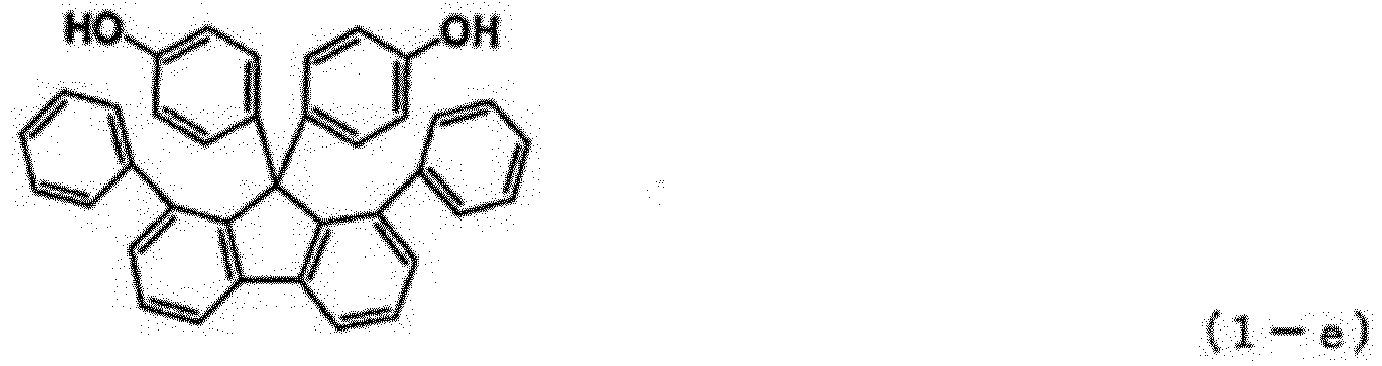


- Preferred dinaphthylfluorene types include 9,9-bis(4-(2-hydroxyethoxy)phenyl)-1,8-dinaphthylfluorene, 9,9-bis(4-(2-hydroxyethoxy)-3-methylphenyl)-1,8-dinaphthylfluorene, 9,9-bis(4-(2-hydroxyethoxy)-3-phenylphenyl)-1,8-dinaphthylfluorene, 9,9-bis(4-(2-hydroxyethoxy)-1-naphthyl)-1,8-dinaphthylfluorene, 9,9-bis(6-(2-hydroxyethoxy)-2-naphthyl)-1,8-dinaphthylfluorene, 9,9-bis(4-hydroxyphenyl)-1,8-dinaphthylfluorene, 9,9-bis(4-hydroxy-3-methylphenyl)-1,8-dinaphthylfluorene, 9,9-bis(4-hydroxy-3-phenylphenyl)-1,8-dinaphthylfluorene, 9,9-bis(4-hydroxy-1-naphthyl)-1,8-dinaphthylfluorene, 9,9-bis(6-hydroxy-2-naphthyl)-1,8-dinaphthylfluorene, 9,9-bis(4-(2-hydroxyethoxy)phenyl)-2,7-dinaphthylfluorene, 9,9-bis(4-(2-hydroxyethoxy)-3-methylphenyl)-2,7-dinaphthylfluorene, 9,9-bis(4-(2-hydroxyethoxy)-3-phenylphenyl)-2,7-dinaphthylfluorene, 9,9-bis(4-(2-hydroxyethoxy)-1-naphthyl)-2,7-dinaphthylfluorene, 9,9-bis(6-(2-hydroxyethoxy)-2-naphthyl)-2,7-dinaphthylfluorene, 9,9-bis(4-hydroxyphenyl)-2,7-dinaphthylfluorene, 9,9-bis(4-hydroxy-3-methylphenyl)-2,7-dinaphthylfluorene, 9,9-bis(4-hydroxy-3-phenylphenyl)-2,7-dinaphthylfluorene, 9,9-bis(4-hydroxy-1-naphthyl)-2,7-dinaphthylfluorene, 9,9-bis(6-hydroxy-2-naphthyl)-2,7-dinaphthylfluorene, 9,9-bis(4-(2-hydroxyethoxy)phenyl)-3,6-dinaphthylfluorene, 9,9-bis(4-(2-hydroxyethoxy)-3-methylphenyl)-3,6-dinaphthylfluorene, 9,9-bis(4-(2-hydroxyethoxy)-3-phenylphenyl)-3,6-dinaphthylfluorene, 9,9-bis(4-(2-hydroxyethoxy)-1-naphthyl)-3,6-dinaphthylfluorene, 9,9-bis(6-(2-hydroxyethoxy)-2-naphthyl)-3,6-dinaphthylfluorene, 9,9-bis(4-hydroxyphenyl)-3,6-dinaphthylfluorene, 9,9-bis(4-hydroxy-3-methylphenyl)-3,6-dinaphthylfluorene, 9,9-bis(4-hydroxy-3-phenylphenyl)-3,6-dinaphthylfluorene, 9,9-bis(4-hydroxy-1-naphthyl)-3,6-dinaphthylfluorene, 9,9-bis(6-hydroxy-2-naphthyl)-3,6-dinaphthylfluorene, 9,9-bis(4-(2-hydroxyethoxy)phenyl)-4,5-dinaphthylfluorene, 9,9-bis(4-(2-hydroxyethoxy)-3-methylphenyl)-4,5-dinaphthylfluorene, 9,9-bis(4-(2-hydroxyethoxy)-3-phenylphenyl)-4,5-dinaphthylfluorene, 9,9-bis(4-(2-hydroxyethoxy)-1-naphthyl)-4,5-dinaphthylfluorene, 9,9-bis(6-(2-hydroxyethoxy)-2-naphthyl)-4,5-dinaphthylfluorene, 9,9-bis(4-hydroxyphenyl)-4,5-dinaphthylfluorene, 9,9-bis(4-hydroxy-3-methylphenyl)-4,5-dinaphthylfluorene, 9,9-bis(4-hydroxy-3-phenylphenyl)-4,5-dinaphthylfluorene, 9,9-bis(4-hydroxy-1-naphthyl)-4,5-dinaphthylfluorene and 9,9-bis(6-hydroxy-2-naphthyl)-4,5-dinaphthylfluorene.
- More preferred are those represented by the following formulas (2-a) to (2-h), specifically (2-a): 9,9-bis(4-(2-hydroxyethoxy)phenyl)-1,8-dinaphthylfluorene, the following formula (2-b): 9,9-bis(4-(2-hydroxyethoxy)phenyl)-2,7-dinaphthylfluorene, the following formula (2-c): 9,9-bis(4-(2-hydroxyethoxy)phenyl)-3,6-dinaphthylfluorene, the following formula (2-d): 9,9-bis(4-(2-hydroxyethoxy)phenyl)-4,5-dinaphthylfluorene, the following formula (2-e): 9,9-bis(4-hydroxyphenyl)-1,8-dinaphthylfluorene, the following formula (2-f): 9,9-bis(4-hydroxyphenyl)-2,7-dinaphthylfluorene, the following formula (2-g): 9,9-bis(4-hydroxyphenyl)-3,6-dinaphthylfluorene and the following formula (2-h): 9,9-bis(4-hydroxyphenyl)-4,5-dinaphthylfluorene, and especially the following formula (2-b): 9,9-bis(4-(2-hydroxyethoxy)phenyl)-2,7-dinaphthylfluorene and the following formula (2-f): 9,9-bis(4-hydroxyphenyl) -2,7-dinaphthylfluorene.


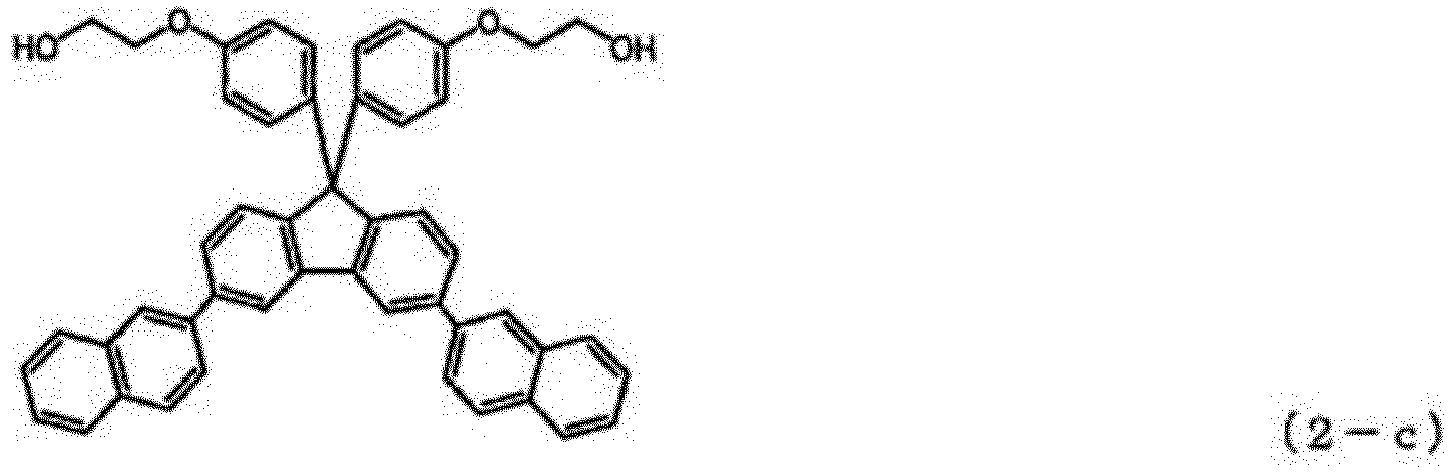


- A mixture of compounds with a fluorene backbone according to the invention has a palladium element content satisfying the following inequality (2).

- It preferably satisfies the following inequality (2-1).

- It preferably satisfies the following inequality (2-2).

- It even more preferably satisfies the following inequality (2-3).

- It even yet more preferably satisfies the following inequality (2-4).

- It especially preferably satisfies the following inequality (2-5).

- It most preferably satisfies the following inequality (2-6).

- Exceeding the upper limit of this range is not preferred because it will adversely affect the color tone of resins using the starting alcohol represented by formula (1) or optical members employing them. The lower limit for the palladium element content may be 0.01 ppm or greater, 0.05 ppm or greater or 0.10 ppm or greater.
- The mixture of compounds with a fluorene backbone according to the invention includes compounds represented by formula (1) wherein m is an integer of 1 to 5 and n = 0, in a range of 0 to 5 wt%, or 0 wt% or greater and less than 5 wt%. For this reason as well, it is in the range of preferably 0 to 3 wt% and more preferably 0 to 1 wt%.
- Exceeding the upper limit of this range is not preferred because it can potentially have an adverse effect on productivity (or reactivity) for a resin using the starting alcohol represented by formula (1), and the physical properties (heat resistance, moldability and dimensional stability) of the produced resin.
- The method for producing compounds with a fluorene backbone represented by formula (1) or their mixture according to the invention is preferably [I] a production method including at least the following step 1 and step 2, or [II] a production method including at least the following step (a) and step (b).
- Production method [I] is largely divided into two steps, allowing production by a first step 1 in which a fluorenone represented by the following formula (3) is reacted with a boronic acid represented by the following formula (4) or (5), and a second step 2 in which the reaction product (6) produced by the first step is reacted with an alcohol compound represented by the following formula (7). With the production method of the invention, the compound with a fluorene backbone or its mixture according to the invention can be produced conveniently and efficiently because reactivity of the boronic acid represented by the following formula (4) or (5) is high and secondary reactions do not occur, while the alcohol represented by the following formula (7) also acts as the reaction solvent and can be easily removed by distillation under reduced pressure.
-


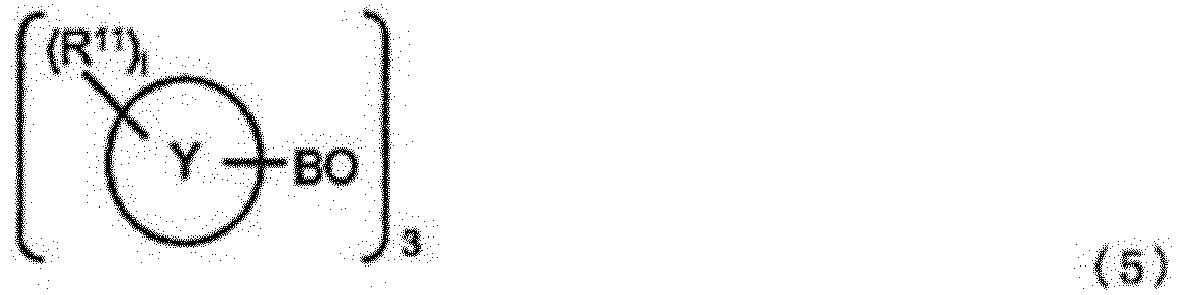
-


- The compounds represented by formula (3) are fluorenone compounds corresponding to the fluorene backbone in formula (1), where X1 is a substituent at position 1, position 2, position 3 or position 4, X2 is a substituent at position 5, position 6, position 7 or position 8, and X1 and X2 are both halogen atoms.
- Representative examples of fluorenone compounds represented by formula (3) will now be listed, with the understanding that the starting materials to be used in formula (1) of the invention are not limited to these.
- Preferred ones are 1,8-difluorofluorenone, 2,7-difluorofluorenone, 3,6-difluorofluorenone, 4,5-difluorofluorenone, 1,8-dichlorofluorenone, 2,7-dichlorofluorenone, 3,6-dichlorofluorenone, 4,5-dichlorofluorenone, 1,8-diiodofluorenone, 2,7-diiodofluorenone, 3,6-diiodofluorenone, 4,5-diiodofluorenone, 1,8-dibromofluorenone, 2,7-dibromofluorenone, 3,6-dibromofluorenone and 4,5-dibromofluorenone. Preferred among these are 1,8-dibromofluorenone, 2,7-dibromofluorenone, 3,6-dibromofluorenone and 4,5-dibromofluorenone, with 2,7-dibromofluorenone being especially preferred.
- They may be used alone or two or more may be combined, with selection as desired depending on the purpose. For the invention, 2,7-dibromofluorenone is preferred.
- The purity of the fluorenone represented by formula (3) is not particularly restricted, but usually it is preferred to be 95% or higher, and more preferably 99% or higher. The fluorenone that is used may be a commercial product or a synthesized product. An example of a method for producing dibromofluorenones is described in non-patent literature (Journal of American Chemical Society, 2017, Vol. 139, 11073-11080), and specifically, it is a method of reacting 9-fluorenone and bromine in water.
- Ring Y in a compound represented by formula (4) or (5) corresponds to the groups Ar1 and Ar2 in formula (1), and its preferred instances are the same as for Ar1 and Ar2. The preferred instances for group R11 in formulas (4) and (5) are the same as the preferred ones for R1 and R2, and the preferred instances for 1 are the same as the preferred ones for j and k.
- The purity of the boronic acid that is used is not particularly restricted, but usually it is preferred to be 95% or higher, and more preferably 99% or higher. The boronic acid that is used may be a commercial product or a synthesized product. An example of a method of producing boronic acids is described in patent literature (Japanese Unexamined Patent Publication No.
2002-47292 - Boronic acids to be used for the invention include alkylboronic acids, alkenylboronic acids, arylboronic acids and heteroarylboronic acids represented by formulas (4) and (5) and their anhydrides, with alkylboronic acids including butylboronic acid, cyclohexylboronic acid, cyclopentylboronic acid, 2-ethylboronic acid, 4-ethylboronic acid, hexylboronic acid, isobutylboronic acid, isopropylboronic acid, methylboronic acid, n-octylboronic acid, propylboronic acid, pentylboronic acid, 2-phenylethylboronic acid and their anhydrides, alkenylboronic acids including 1-cyclopentenylboronic acid, ferroceneboronic acid and 1,1'-ferrocenediboronic acid and their anhydrides, arylboronic acids including 2-anthraceneboronic acid, 9-anthraceneboronic acid, benzylboronic acid, 2-biphenylboronic acid, 3-biphenylboronic acid, 4-biphenylboronic acid, 2,3-dimethylphenylboronic acid, 2,4-dimethylphenylboronic acid, 2,5-dimethylphenylboronic acid, 2,6-dimethylphenylboronic acid, 3,4-dimethylphenylboronic acid, 3,5-dimethylphenylboronic acid, 2-ethoxyphenylboronic acid, 3-ethoxyphenylboronic acid, 4-ethoxyphenylboronic acid, 6-methoxy-2-naphthaleneboronic acid, 2-methylphenylboronic acid, 3-methylphenylboronic acid, 4-methylphenylboronic acid, 1-naphthaleneboronic acid, 2-naphthaleneboronic acid, 9-phenanthreneboronic acid, 10-phenyl-9-anthraceneboronic acid, phenylboronic acid, phenylethaneboronic acid, 4-phenyl(naphthalen-1-yl)boronic acid, 3-propoxyphenylboronic acid, 3-iso-propoxyphenylboronic acid, 4-iso-propoxyphenylboronic acid, 4-propylphenylboronic acid, 4-iso-propylphenylboronic acid, 10-(naphthalen-1-yl)-9-anthraceneboronic acid and 10-(naphthalen-2-yl)-9-anthraceneboronic acid and their anhydrides, and heteroarylboronic acids including benzofuran-2-boronic acid, dibenzofuran-4-boronic acid, 5-formyl-2-furanboronic acid, 5-formylthiophene-2-boronic acid, furan-2-boronic acid, furan-3-boronic acid, pyridine-3-boronic acid, pyridine-4-boronic acid, quinoline-2-boronic acid, quinoline-3-boronic acid, quinoline-4-boronic acid, quinoline-5-boronic acid, quinoline-6-boronic acid, quinoline-8-boronic acid, iso-quinoline-4-boronic acid, 2-thiopheneboronic acid, 3-thiopheneboronic acid and 5-pyrimidineboronic acid and their anhydrides.
- They may be used alone or two or more may be combined, with selection as desired depending on the purpose. Preferred for the invention are phenylboronic acid and 2-naphthaleneboronic acid, and their anhydrides.
- The usage ratio of the compound represented by formula (4) to be used as a starting material is about preferably 2 to 5 mol, more preferably 2.05 to 3.0 mol and even more preferably 2.00 to 2.5 mol, with respect to 1 mol of the compound represented by formula (3) (fluorenone halide compound). If the boronic acid is used at less than 2 mol, the yield of product represented by formula (6) may be lowered. If it is greater than 2.5 mol, the reaction rate and yield will be high, but production cost for the compound with a fluorene backbone may also increase.
- The usage ratio of the compound represented by formula (5) may be about preferably 1 to 5 mol, more preferably 0.8 to 3 mol and even more preferably 0.7 to 1 mol, with respect to 1 mol of the compound represented by formula (3) (fluorenone halide compound). If the boronic acid is used at less than 0.7 mol, the yield of product represented by formula (6) may be lowered. If it is greater than 1 mol, the reaction rate and the yield will be high, but production cost for the compound with a fluorene backbone may also increase.
- The reaction (dehalogenation reaction) between the compounds represented by formula (3) and formula (4) and/or (5) in step 1 may be carried out in a reaction solvent, in the presence of a base and a palladium-based catalyst.
- Examples of bases to be used in the reaction of step 1 include inorganic salts, among which are hydroxides such as sodium hydroxide and potassium hydroxide, carbonates such as sodium carbonate (Na2CO3), potassium carbonate (K2CO3) and cesium carbonate (Cs2CO3), acetates such as sodium acetate and potassium acetate and phosphates such as sodium phosphate (Na3PO4) and potassium phosphate (K3PO4), triethylamines, pyridine, morpholine, quinoline, piperidine, anilines, and organic salts including ammonium salts such as tetra-n-butylammonium acetate. Carbonates are preferably used among these, with potassium carbonate and/or sodium carbonate being more preferred. Such bases may be used alone, or two or more may be used in combination.
- The amount of such bases used in the reaction of step 1 is not particularly restricted, but is preferably added at 1 to 30 equivalents and more preferably 1 to 10 equivalents with respect to 1 mol of the boronic acid.
- The palladium-based catalyst to be used in the reaction of step 1 is preferably a palladium compound used in Suzuki coupling, examples of which include tetrakis(triphenylphosphine)palladium, bis(triphenylphosphine)palladium dichloride, palladium acetate, tris(dibenzylideneacetone)dipalladium, bis(dibenzylideneacetone)palladium, bis[4-(N,N-dimethylamino)phenyl]di-tert-butylphosphinepalladium dichloride, bis(di-tert-butylprenyl)palladium dichloride and bis(di-tert-crotylphosphine)palladium dichloride. Preferred among these are tetrakis(triphenylphosphine)palladium and/or palladium acetate. Such catalysts may be used alone, or two or more may be used in combination.
- The amount of catalyst used in the reaction of step 1 is not particularly restricted, but it is preferably 0.5 to 10 millimole and more preferably 0.6 to 5 millimole, in terms of palladium metal atoms, with respect to 1 mol of the fluorenone compound represented by formula (3). If the amount of palladium catalyst used is less than 0.5 millimoles in terms of palladium metal atoms, it may be difficult for the reaction to proceed to completion. If the amount of palladium catalyst used is greater than 10 millimole in terms of palladium metal atoms, the reaction will proceed to completion but it will be difficult to limit the palladium element content of the compound with a fluorene backbone to within the range of formula (2), not only potentially impairing the color tone of the thermoplastic resin produced using the alcohol starting material, but also increasing production cost for the compound with a fluorene backbone, in some cases.
- Examples of reaction solvents to be used in step 1 include aromatic hydrocarbon-based solvents such as toluene or xylene and alcohols such as methanol, ethanol, isopropyl alcohol and n-butanol, either alone or in combinations. Since an aromatic hydrocarbon-based solvent is a high boiling point solvent, the reaction temperature can be set higher, while using an alcohol is suitable for high affinity with water and satisfactory reactivity. Such solvents may be used alone, or two or more may be used in combination. An aprotic solvent such as N,N-dimethylformamide or N,N-dimethylacetamide or a halobenzene such as o-dichlorobenzene may also be used. Such solvents may be used alone, or two or more may be used in combination. According to the invention, a mixed solvent of toluene and ethanol, or toluene alone, may be used.
- The amount of reaction solvent (for the purpose of the invention, a mixed solvent of toluene and ethanol or toluene alone) that is used is not particularly restricted, but the amount of toluene is preferably 0.1 times by weight, more preferably 0.5 to 100 times by weight and even more preferably 1 to 50 times by weight, with respect to the fluorenone represented by formula (3). If the amount of toluene used is less than 0.1 times by weight, the product can potentially precipitate out and create difficulties for stirring. If the amount of toluene used is greater than 100 times by weight, the effect will not be commensurate with the increased amount of usage, while the volumetric efficiency may also be impaired, increasing production cost for the compound with a fluorene backbone. The amount of ethanol used is also not particularly restricted, but it is preferably 0.1 to 50 times by weight and more preferably 1 to 20 times by weight with respect to the fluorenone represented by formula (3). If the amount of ethanol used is less than 0.1 times by weight the reaction rate may be slowed, lowering the yield. If the amount of ethanol used is greater than 50 times by weight, the effect will not be commensurate with the increased amount of usage, as with toluene, while the volumetric efficiency may also be impaired, increasing production cost for the compound with a fluorene backbone.
- The reaction temperature will differ depending on the type of starting materials and solvent used, but it is preferably 50 to 150°C, more preferably 60 to 130°C and even more preferably 70 to 120°C. The reaction can be monitored by analysis means such as liquid chromatography.
- Upon completion of the reaction, the reaction mixture will generally contain unreacted fluorenone, unreacted boronic acid, base, catalyst and secondary reaction products, in addition to the product compound represented by formula (6). Therefore, separation and purification may be carried out by separation means using a common method such as filtration, concentration, extraction, crystallization, recrystallization, reprecipitation, activated carbon treatment or highly similar metal removal treatment, or column chromatography, or a combination of these. For example, purification may be carried out by removing the boronic acid by a common method (such as a method of adding an aqueous alkali solution to form a water-soluble complex), and removing the palladium compound by activated carbon treatment or highly similar metal removal treatment, and then adding a recrystallization solvent, cooling for recrystallization, and separating by filtration.
- The compound represented by formula (7) ((poly)hydroxyl group-containing arene ring compound) corresponds to a (poly)hydroxyl group-containing arene ring substituted at position 9 in a diarylfluorene derivative represented by formula (6). Specifically, in formula (7), ring Z corresponds to ring Z in formula (1), R12 corresponds to L1 and L2, p corresponds to m and n, R13 corresponds to R1 and R2 and s corresponds to j and k, and the benzene rings and naphthalene rings mentioned above are examples.
- The alkylene group represented by R12 is not particularly restricted, and may be an ethylene, propylene, trimethylene, tetramethylene or hexamethylene group, for example. It is preferably an alkylene group of 1 to 6 carbon atoms, and more preferably an alkylene group of 2 to 3 carbon atoms. The substitution position for R12 is not particularly restricted. The number of substituents p is 0, 1 or greater, in which case they may be the same or different. It is preferably 0 to 15 and more preferably 0 to 5. When p is 2 or greater, the polyalkoxy group may be composed of identical alkoxy groups or composed of a combination of different alkoxy groups (for example, an ethoxy group and a propyleneoxy group), but it will usually be composed of identical alkoxy groups.
- R13 represents a hydrogen atom, a halogen atom or a hydrocarbon group optionally containing an aromatic group of 1 to 12 carbon atoms, with a hydrogen atom, a methyl group or a phenyl group being preferred.
- Examples of hydrocarbon groups represented by R13 include alkyl, cycloalkyl, aryl, naphthyl and aralkyl groups. Specific preferred examples of alkyl groups include C1-6 alkyl groups, C1-4 alkyl groups or C1-3 alkyl groups such as methyl, ethyl, propyl, isopropyl, butyl and t-butyl groups, with C1-3 alkyl groups being more preferred, and methyl and ethyl groups being even more preferred. Specific preferred examples of cycloalkyl groups include C5-8 cycloalkyl groups and C5-6 cycloalkyl groups such as cyclopentyl and cyclohexyl groups, with C5-6 cycloalkyl groups being preferred. Specific preferred examples of aryl groups include phenyl and alkylphenyl groups (such as mono- or dimethylphenyl, tolyl, 2-methylphenyl and xylyl groups), with phenyl group being preferred. Specific preferred examples of aralkyl groups include C6-10 aryl-C1-4 alkyl groups such as benzyl and phenethyl groups. Preferred halogen atoms are fluorine, chlorine and bromine.
- The number s of R13 substituents may be selected as appropriate depending on the number of fused rings of the fused hydrocarbon and is not particularly restricted, and it may be an integer of preferably 0 or greater and more preferably 1 or greater. It is also preferably an integer of no greater than 6 and more preferably an integer of no greater than 4.
- Specific examples of compounds represented by formula (7) where p = 0 include alkylphenols such as phenol, 2-methylphenol and 3-methylphenol, dialkylphenols such as 2,3-xylenol, 2,6-xylenol and 3,5-xylenol, alkoxyphenols such as 2-methoxyphenol and 2-ethoxyphenol or phenylphenols such as 2-phenylphenol and 3-phenylphenol. Examples where p = 1 include phenoxyalkyl alcohols such as phenoxyethanol, phenoxypropanol and phenoxybutanol, alkylphenoxyalkyl alcohols such as (2-methyl-phenoxy)ethanol, (3-methyl-phenoxy)ethanol, (3-ethyl-phenoxy)ethanol, (3-butyl-phenoxy)ethanol, (2-methyl-phenoxy)propanol and (3-methyl-phenoxy)propanol, dialkylphenoxyalkyl alcohols such as (2,3-dimethylphenoxy)ethanol, (2,5-dimethylphenoxy)ethanol, (2,6-dimethylphenoxy)ethanol and (2,6-dibutylphenoxy)ethanol, alkoxyphenoxyalkyl alcohols such as (2-methoxyphenoxy)ethanol, cycloalkylphenoxyalkyl alcohols such as (2-cyclohexylphenoxy)ethanol and arylphenoxyalkyl alcohols such as biphenylyloxyethanol. Examples where p is 2 or greater include the polyoxyalkylene phenyl ethers corresponding to these phenoxyalkyl alcohols. Preferred are phenoxy C2-6 alkyl alcohols or C1-4 alkylphenoxy C2-6 alkyl alcohols, with phenoxyethanol being most preferred.
- The amount of compound represented by formula (7) used in the reaction of step 2 is not particularly restricted, but from the viewpoint of inhibiting secondary reactions and for economy, it is preferably 2 to 50 mol, more preferably 2.5 to 20 mol and even more preferably 3 to 10 mol, with respect to 1 mol of the fluorenone. These compounds may also be used as the reaction solvent.
- The compounds represented by formula (7) may be commercial products or synthesized products. The method for producing a compound represented by formula (7) may be, for example, a method in which the hydroxyl groups of phenols are reacted using ethylene oxide and ethylene carbonate, in the presence of an alkali catalyst.
- The purity of the compound represented by formula (7) used as a starting material is not particularly restricted, but usually it is preferred to be 95% or higher, and more preferably 99% or higher.
- The reaction of step 2 will usually be carried out in the presence of an acid catalyst. Examples of acid catalysts include sulfuric acid, thiolic acid, montmorillonite and heteropolyacids, among which heteropolyacids are preferred because they have low formation of acid catalyst-derived impurities and can facilitate production of the compound with a fluorene backbone according to the invention.
- The term "heteropolyacid" used for heteropolyacids that may be suitably used for the invention generally includes those produced by fusion of two or more different inorganic oxo acids, with there being a variety of possible heteropolyacids obtained by combining a central oxo acid with different types of oxo acids fused around it. A small number of elements that form central oxo acids are referred to as "hetero elements", and elements forming oxo acids that fuse around it are referred to as "poly elements". The poly elements may be of a single type or of multiple different types.
- There are no particular restrictions on the hetero element for an oxo acid forming a heteropolyacid, and examples include copper, beryllium, boron, aluminum, carbon, silicon, germanium, tin, titanium, zirconium, cerium, thorium, nitrogen, phosphorus, arsenic, antimony, vanadium, niobium, tantalum, chromium, molybdenum, tungsten, uranium, selenium, tellurium, manganese, iodine, iron, cobalt, nickel, rhodium, osmium, iridium and platinum. Phosphorus (phosphoric acid) and silicon (silicic acid) are preferred. There are also no particular restrictions on the poly elements of oxo acids forming a heteropolyacid, and examples include vanadium, molybdenum, tungsten, niobium and tantalum. They are preferably one or more selected from among vanadium, molybdenum and tungsten.
- The heteropolyacid anion used to form the heteropolyacid backbone may be one with any of various different compositions. Examples include XM12O40, XM12O42, XM18O62 and XM6O24. A preferred composition for the heteropolyacid anion is XM12O40. In each formula, X is the hetero element and M represents a poly element. Specific examples of heteropolyacids with these compositions include phosphomolybdic acid, phosphotungstic acid, silicomolybdic acid, silicotungstic acid and phosphovanadomolybdic acid.
- The heteropolyacid may be a free heteropolyacid, or alternatively a heteropolyacid salt with some or all of the protons replaced with other cations may be used. Therefore, a "heteropolyacid" for the purpose of the invention includes such heteropolyacid salts. Examples of cations that may replace the protons include ammonium, alkali metals and alkaline earth metals.
- The heteropolyacid may be an anhydride or a substance containing water of crystallization, but an anhydride is preferred for more rapid reaction and less formation of by-products. With a substance containing water of crystallization, the same effect can be achieved as with an anhydride if dehydrating treatment is carried out beforehand by reduced pressure drying or azeotropic dehydration with a solvent. The heteropolyacid may be used in a form supported on a carrier such as active carbon, alumina, silica-alumina or diatomaceous earth. The heteropolyacids may be used alone, or two or more may be used in combination. If necessary, another catalyst other than a heteropolyacid may also be used in a range that does not interfere with the object of the invention.
- The amount of heteropolyacid used is not particularly restricted, but in order to obtain a sufficient reaction rate it is preferably at least 0.0001 times by weight, more preferably 0.001 to 30 times by weight and even more preferably 0.01 to 5 times by weight, with respect to the fluorenone.
- The method of carrying out the reaction of step 2 is not particularly restricted, but it can generally be carried out by charging the compounds represented by formula (6) and formula (7) together with a heteropolyacid into a reactor, and heating and stirring them in air or under an inert gas atmosphere of nitrogen or argon, in the presence or in the absence of an inert solvent such as toluene or xylene. By carrying out the reaction under dehydrating conditions to remove the water, such as catalyst-containing water and reaction product water, in the reaction system, the reaction can proceed more rapidly than without dehydration, formation of by-products can be reduced, and the target product can be obtained at a higher yield. The dehydration method is not particularly restricted and may be dehydration by addition of a dehydrating agent, dehydration by pressure reduction, or dehydration by azeotropic distillation with a solvent at ordinary pressure or under reduced pressure.
- The solvent for azeotropic dehydration is not particularly restricted, and it may be an aromatic hydrocarbon solvent such as toluene or xylene, an aromatic halide hydrocarbon solvent such as chlorobenzene or dichlorobenzene, an aliphatic hydrocarbon solvent such as pentane, hexane or heptane, a halogenated aliphatic hydrocarbon solvent such as dichloromethane or 1,2-dichloroethane, an aliphatic or cyclic ether solvent such as diethyl ether, di-iso-propyl ether, methyl-t-butyl ether, diphenyl ether, tetrahydrofuran or dioxane, an ester solvent such as ethyl acetate or butyl acetate, a nitrile solvent such as acetonitrile, propionitrile, butyronitrile or benzonitrile, or an amide solvent such as N,N-dimethylformamide, N,N-dimethylacetamide or 1-methyl-2-pyrrolidinone. It is preferably an aromatic hydrocarbon solvent or aromatic halide hydrocarbon solvent, more preferably toluene, xylene, chlorobenzene or dichlorobenzene, and even more preferably toluene. The amount used is not particularly restricted, but from the viewpoint of economy it is preferably at least 0.1 times by weight, more preferably 0.5 to 100 times by weight and even more preferably 1 to 20 times by weight, with respect to the fluorenone.
- The reaction temperature will differ depending on the type of starting materials and solvent used, but it is preferably 50 to 300°C, more preferably 80 to 250°C and even more preferably 120 to 180°C. The reaction can be monitored by analysis means such as liquid chromatography.
- After the reaction, the obtained reaction mixture may be used directly to precipitate the compound represented by formula (1), but usually the compound represented by formula (1) is precipitated at lower than 50°C after post-treatment such as rinsing, concentration, dilution and activated carbon treatment. The procedure for precipitating the compound represented by formula (1) from the reaction mixture that has been post-treated as necessary is carried out by raising the temperature of the reaction mixture, combined with a solvent if necessary, to 50°C or higher and no higher than the boiling point of the solvent (preferably 70 to 110°C), and then cooling it to lower than 50°C. When crystals of the compound represented by formula (1) precipitate from the reaction mixture at 50°C or higher, the reaction mixture may be mixed with a diluting solvent in an amount so that crystals do not precipitate out at 50°C or higher, and the temperature of the obtained mixture may then be raised to 50°C or higher and no higher than the boiling point of the solvent (preferably 70 to 110°C), and then cooled to lower than 50°C. The diluting solvent may be any of the examples mentioned above as solvents to be used for the reaction, or an alcohol solvent such as methanol, ethanol, propanol, isopropanol, butanol, t-butanol, isobutanol or pentanol or a carbonate solvent such as dimethyl carbonate or diethyl carbonate, but it is preferably butanol or dimethyl carbonate, and most preferably butanol.
- The crystallization procedure may be carried out once or repeated several times. Especially when the acid catalyst in the reaction of step 2 is phosphotungstic acid, using an alcohol such as butanol allows a compound represented by formula (1) satisfying formula (2) to be obtained in a convenient and efficient manner with only a single crystallization procedure.
- The precipitated crystals are recovered by filtration, for example. The crystals may be rinsed using the solvent used for the reaction, and they may also be dried. The purity of the purified compound represented by formula (1) that is obtained in this manner is preferably 95% or greater.
- The purity of a compound with a fluorene backbone obtained by the production method of the invention may be selected within a wide range of 60 to 100%, but it is preferably 70% or greater, more preferably 80% or greater and even more preferably 90% or greater.
- Production method [II] is largely divided into two steps, allowing production by a first step (a) in which a fluorenone represented by the following formula (3) is reacted with an alcohol compound represented by the following formula (7), and a second step (b) in which the reaction product (8) produced by the first step (a) is reacted with a boronic acid represented by the following formula (4) or (5). With the production method of the invention, the compound with a fluorene backbone or its mixture according to the invention can be produced conveniently and efficiently because the alcohol represented by the following formula (7) also acts as the reaction solvent and can be easily removed by distillation under reduced pressure, while reactivity of the boronic acid represented by the following formula (4) or (5) is high and secondary reactions do not occur.
-


-


- The compound represented by formula (3) may be a compound represented by formula (3) as described above for Production method [I].
- The compound represented by formula (7) ((poly)hydroxyl group-containing arene ring compound) corresponds to a (poly)hydroxyl group-containing arene ring substituted at position 9 in a fluorene derivative represented by formula (8). The compound represented by formula (7) is the same as the compound represented by formula (7) described for Production method [I], and its details, amount of use and method of obtainment may be as described for the compound represented by formula (7) for Production method [I].
- The reaction of step (a) will usually be carried out in the presence of an acid catalyst. The acid catalyst may be the same one used in step 2 of Production method [I], and the same description applies.
- The method for carrying out the reaction of step (a) is the same, other than changing the compound of formula (6) used in step 2 of Production method [I] to a compound of formula (3), and the same description applies.
- After the reaction, the reaction mixture may be directly used as starting material for the following step (b), without isolation or purification.
- After the reaction, the compound represented by formula (8) may be precipitated from the obtained reaction mixture, and the compound represented by formula (8) may be precipitated at lower than 50°C after post-treatment such as rinsing, concentration, dilution and activated carbon treatment. The procedure for precipitating the compound represented by formula (8) from the reaction mixture that has been post-treated as necessary is carried out by raising the temperature of the reaction mixture, combined with a solvent if necessary, to 50°C or higher and no higher than the boiling point of the solvent (preferably 70 to 110°C), and then cooling it to lower than 50°C. When crystals of the compound represented by formula (1) precipitate from the reaction mixture at 50°C or higher, the reaction mixture may be mixed with a diluting solvent in an amount so that crystals do not precipitate out at 50°C or higher, and the temperature of the obtained mixture may then be raised to 50°C or higher and no higher than the boiling point of the solvent (preferably 70 to 110°C), and then cooled to lower than 50°C. The diluting solvent may be any of the examples mentioned above as solvents to be used for the reaction, or an alcohol solvent such as methanol, ethanol, propanol, isopropanol, butanol, t-butanol, isobutanol or pentanol or a carbonate solvent such as dimethyl carbonate or diethyl carbonate, but it is preferably ethanol or dimethyl carbonate, and most preferably ethanol.
- The crystallization procedure may be carried out once or repeated several times. Especially when the acid catalyst in the reaction of step 2 is phosphotungstic acid, using an alcohol such as ethanol allows a compound represented by formula (8) with a low palladium content to be obtained in a convenient and efficient manner with only a single crystallization procedure.
- The precipitated crystals are recovered by filtration, for example. The crystals may be rinsed using the solvent used for the reaction, and they may also be dried. The purity of the purified compound represented by formula (8) that is obtained in this manner is preferably 95% or greater.
- Ring Y in the compound represented by formula (4) or (5) is the same as ring Y in the compound represented by formula (4) or (5) in Production method [I], and the same description applies.
- In the reaction of step (b), the usage ratio of the compound represented by formula (4) with respect to 1 mol of the fluorene compound represented by formula (8) is the same as the usage ratio of the compound represented by formula (4) with respect to the fluorenone compound represented by formula (3) in step 1 of Production method [I], and the same description applies.
- In the reaction of step (b), the usage ratio of the compound represented by formula (5) with respect to 1 mol of the fluorene compound represented by formula (8) is the same as the usage ratio of the compound represented by formula (5) with respect to the fluorenone compound represented by formula (3) in step 1 of Production method [I], and the same description applies.
- The reaction (dehalogenation reaction) between the compounds represented by formula (8) and formula (4) and/or (5) in step (b) may be carried out in a reaction solvent, in the presence of a base and a catalyst.
- The base used in the reaction of step (b) and the amount used is the same as the base used in the reaction of step 1 of Production method [I] and the amount used, and the same description applies.
- The palladium-based catalyst used in the reaction of step (b) is the same as the palladium-based catalyst used in the reaction of step 1 of the Production method [I], and the same description applies.
- In the reaction of step (b), the amount of catalyst used with respect to 1 mol of the fluorene compound represented by formula (8) is the same as the amount of catalyst used with respect to the fluorenone compound represented by formula (3) in step 1 of Production method [I], and the same description applies.
- The reaction solvent used in step (b) and the amount used is the same as the reaction solvent used in step 1 of Production method [I] and the amount used, and the same description applies.
- The reaction temperature in step (b) may be the same as the reaction temperature in step 1 of Production method [I], and the same description applies.
- Upon completion of the reaction, the reaction mixture will generally contain unreacted fluorene, unreacted boronic acid, base, catalyst and secondary reaction products, in addition to the product compound represented by formula (1). These may be separated in the same manner as step 1 of Production method [I], and the same description applies.
- The purity of a compound with a fluorene backbone obtained by the production method of the invention may be selected within a wide range of 60 to 100%, but it is preferably 70% or greater, more preferably 80% or greater and even more preferably 90% or greater.
- Since the compounds with a fluorene backbone in the mixture of the invention preferably have a diphenylfluorene backbone or dinaphthylfluorene backbone in combination with an arene ring, they not only exhibit a high refractive index and high heat resistance, but can also reduce birefringence when used as polymers. In order to increase the refractive index in the past, fluorene compounds having aggregated arene rings substituted at position 9 of a fluorene backbone have been used, but this lowers the birefringence with the high refractive index and heat resistance. The compounds with a fluorene backbone in the mixture of the invention, however, have low birefringence while still having a high refractive index, presumably because of the diphenylfluorene backbone. In addition, since the arene ring has one or more hydroxyl groups and multiple hydroxyl groups in the fluorene compound as a whole, the reactivity is high. The mixture of the invention can be used as a starting material (monomer) for various types of resins. For example, it can be used as a monomer for a thermoplastic resin (for example, a polyester resin, polycarbonate resin, polyester carbonate resin or polyurethane resin), or as a polyol component for a thermosetting resin (for example, an epoxy resin, phenol resin, thermosetting polyurethane resin or (meth)acrylate ((meth)acrylic acid ester). When a compound with a fluorene backbone of the invention is to be used as a polyol component, a benzene ring is substituted at position 9 of the fluorene backbone and the fluorene backbone also has a diaryl group, which is presumably why the resulting resin provides the advantage of high levels for both high refractive index and low birefringence.
- The mixture of compounds with a fluorene backbone according to the invention can be used to efficiently prepare a derivative in a common solvent.
- The melting point of the compounds with a fluorene backbone in the mixture of the invention may be selected in a wide range of 100 to 300°C, preferably 120 to 280°C, more preferably 130 to 260°C, even more preferably 140 to 240°C and most preferably 150 to 210°C.
- The present invention will now be explained in greater detail by Examples, with the understanding that the invention is not limited to the Examples so long as its gist is maintained.
- The measurements for the Examples were carried out in the following manner.
- The compounds obtained in the Examples were measured with the following apparatus and conditions.
- Device: Product of Waters Corp.
- Column: ACQUITY UPLC@BEH C18, 2.1 × 150 mm
- Eluent (volume): Dimethylformamide:ultrapure water (0.1 wt% trifluoroacetic acid) = 70/30 (2) NMR measurement
- The compounds and resins obtained in the Examples were measured with the following apparatus and solvent.
- Apparatus: JNM-AL400 (400 MHz) by JEOL Corp.
- Solvent: CDCl3
- The compounds obtained in the Examples were measured with the following apparatus.
- Device: Agilent Technologies
- Apparatus: Agilent5100 ICP-OES
- The resins obtained in the Examples were measured with the following apparatus and conditions.
- Apparatus: DSC-60A by Shimadzu Corp.
- Conditions: Temperature-elevating rate of 20°C/min
- The resins obtained in the Examples were measured with the following apparatus. Apparatus: CE-7000A Integrating Sphere Spectrophotometer by X-Rite Co.
- The resins obtained in the Examples were measured using the following apparatus and method.
- Apparatus: DR-M2 Abbe refractometer by Atago Co.
- Method: Resin pellets obtained after polymerization was complete were dissolved in methylene chloride, cast onto a glass dish and dried, and the refractive index (wavelength: 589 nm) and Abbe number (calculated from the refractive index at wavelengths of 486 nm, 589 nm and 656 nm using the following formula) were measured for the prepared film at 25°C.

- According to the invention:
- nD: refractive index at wavelength of 589 nm,
- nC: refractive index at wavelength of 656 nm,
- nF: refractive index at wavelength of 486 nm.
- After dissolving 25.25 g (74.7 millimole) of 2,7-dibromofluorenone (hereunder also abbreviated as "DBFN") and 19.13 g (156.9 millimole) of phenylboronic acid in 920 mL of a toluene/ethanol mixed solvent (mixing ratio = 4/1) and then adding 0.837 g (0.7 millimoles) of tetrakis(triphenylphosphine)palladium and 85 mL of a 2 M potassium carbonate aqueous solution, in a 3 L three-necked flask equipped with a stirrer, cooler and thermometer, the mixture was stirred at 80°C for 4 hours for reaction. Progression of the reaction was confirmed by HPLC, and the reaction was completed upon confirming a DBFN residue amount of no greater than 0.1 wt%. The obtained reaction mixture was concentrated under reduced pressure to remove the toluene/ethanol, and then a 1 M sodium hydroxide aqueous solution was added to the residue and extraction was performed with chloroform. After palladium catalyst removal treatment of the chloroform layer using active carbon to remove the palladium catalyst remaining in the system, it was concentrated, and when yellow crystals precipitated out the concentration was stopped and recrystallization was carried out directly. The precipitated yellow crystals were filtered out and dried at 85°C for 24 hours to obtain 20 g of yellow crystals of the target substance, 2,7-diphenylfluorenone (also abbreviated as "DPFN") at a 81% yield.
- After charging 340 g of toluene as a solvent and 2.94 g of 12-tungsto(VI) phosphoric acid n-hydrate (H3[PW12O40]·nH2O) into a 1 L three-necked flask equipped with a stirrer, cooler, water separator and thermometer, azeotropic dehydration was carried out for 30 minutes with toluene circulation. After cooling the contents, 99.72 g (0.3 mol) of the DPFN synthesized in step 1, 165.80 g (1.2 mol) of 2-phenoxyethanol and 50 g of toluene were added, and the mixture was stirred for 12 hours with toluene circulation while the water generated by the reaction was discharged out of the system. Progression of the reaction was appropriately confirmed by HPLC, and the reaction was completed when the DPFN residue was 0.1 wt% or lower. The obtained reaction mixture was adjusted to 70°C and rinsed 3 times with 200 g of water. The organic layer was concentrated under reduced pressure to remove the toluene and excess 2-phenoxyethanol. The obtained mixture was dissolved in 500 g of toluene and decolored with active carbon, and since crystals began to precipitate upon concentration of the treatment solution, concentration was stopped and recrystallization was carried out directly. The precipitated white crystals were removed by filtration and dried to obtain 140 g of white crystals of a partially purified product of 9,9-bis(4-(2-hydroxyethoxy)phenyl)-2,7-diphenylfluorene (70% yield, 95.2% purity).
- The partially purified product was again recrystallized with a toluene/butanol mixed solvent, to obtain 125 g of white crystals of a purified product of 9,9-bis(4-(2-hydroxyethoxy)phenyl)-2,7-diphenylfluorene (89% yield, 99.0% purity). Measurement of the residual metals by ICP showed Pd at 0.4 ppm. HPLC measurement showed that impurities of compounds represented by formula (1) where m = 1 and n = 0 were present at 1% in the obtained white crystals.
- After placing 29.51 parts by mass of the 9,9-bis(4-(2-hydroxyethoxy)phenyl)-2,7-diphenylfluorene synthesized in step 2, 21.93 parts by mass of 9,9-bis[4-(2-hydroxyethoxy)phenyl]fluorene, 21.64 parts by mass of diphenyl carbonate and 42.0 × 10⁻⁵ parts by mass of sodium hydrogencarbonate in a reaction kiln equipped with a stirrer and distillation device, nitrogen exchange was carried out 3 times, and the jacket was heated to 180°C to melt the starting materials. After complete dissolution, the pressure was reduced to 20 kPa over a period of 5 minutes while simultaneously increasing the temperature of the jacket to 260°C at a rate of 60°C/hr, for transesterification reaction. Next, the jacket was kept at 260°C while reducing the pressure to 0.13 kPa over a period of 50 minutes, and polymerization reaction was carried out under conditions of 260°C, 0.13 kPa until a prescribed torque was reached. Upon completion of the reaction, the produced resin was extracted while being pelletized, to obtain polycarbonate resin pellets. The obtained polycarbonate resin was analyzed by 1H NMR, confirming that the 9,9-bis(4-(2-hydroxyethoxy)phenyl)-2,7-diphenylfluorene component had been introduced at 50 mol% with respect to the total monomer component. The refractive index of the obtained polycarbonate resin was 1.664, the Abbe number was 18, the Tg was 161°C and the pellet b* value was 8.0.
- A white solid fluorene compound was obtained in the same manner as Example 1, except that the phenylboronic acid in step 1 was changed to phenylboronic anhydride (89% yield, 99.0% purity). Measurement of the residual metals by ICP showed Pd at 0.4 ppm. HPLC measurement showed that impurities of compounds represented by formula (1) where m = 1 and n = 0 were present at 1% in the obtained white crystals.
- A white solid fluorene compound was obtained in the same manner as Example 1, except that the base in step 1 was changed to sodium carbonate (89% yield, 99.0% purity). Measurement of the residual metals by ICP showed Pd at 0.4 ppm. HPLC measurement showed that impurities of compounds represented by formula (1) where m = 1 and n = 0 were present at 1% in the obtained white crystals.
- A white solid fluorene compound was obtained in the same manner as Example 1, except that the catalyst in step 1 was changed to palladium acetate (89% yield, 99.0% purity). Measurement of the residual metals by ICP showed Pd at 0.4 ppm. HPLC measurement showed that impurities of compounds represented by formula (1) where m = 1 and n = 0 were present at 1% in the obtained white crystals.
- A white solid fluorene compound was obtained in the same manner as Example 1, except that the solvent in step 1 was changed to toluene (89% yield, 99.0% purity). Measurement of the residual metals by ICP showed Pd at 0.4 ppm. HPLC measurement showed that impurities of compounds represented by formula (1) where m = 1 and n = 0 were present at 1% in the obtained white crystals.
- A white solid fluorene compound was obtained in the same manner as Example 1, except that the catalyst used was the acid catalyst of step 2 that had been dried under reduced pressure beforehand to remove the water of crystallization (89% yield, 99.0% purity). Measurement of the residual metals by ICP showed Pd at 0.4 ppm. HPLC measurement showed that impurities of compounds represented by formula (1) where m = 1 and n = 0 were present at 1% in the obtained white crystals.
- A white solid fluorene compound was obtained in the same manner as Example 1, except that the acid catalyst in step 2 was changed to silicotungstic acid n-hydrate (H4[SiW12O40]·nH2O) (89% yield, 99.0% purity). Measurement of the residual metals by ICP showed Pd at 0.4 ppm. HPLC measurement showed that impurities of compounds represented by formula (1) where m = 1 and n = 0 were present at 1% in the obtained white crystals.
- A white solid fluorene compound was obtained in the same manner as Example 6, except for using silicotungstic acid (H4[SiW12O40]) which was the acid catalyst of step 2 that had been dried under reduced pressure beforehand to remove the water of crystallization (89% yield, 99.0% purity). Measurement of the residual metals by ICP showed Pd at 0.4 ppm. HPLC measurement showed that impurities of compounds represented by formula (1) where m = 1 and n = 0 were present at 1% in the obtained white crystals.
- A gray solid fluorene compound was obtained in the same manner as Example 1, except that activated carbon treatment was not carried out in step 1 and step 2 (89% yield, 99.0% purity). Measurement of the residual metals by ICP showed Pd at 70 ppm. HPLC measurement showed that impurities of compounds represented by formula (1) where m = 1 and n = 0 were present at 1% in the obtained gray crystals.
- Polycarbonate resin pellets were obtained in the same manner as Example 1, except that 9,9-bis(4-(2-hydroxyethoxy)phenyl)-2,7-diphenylfluorene synthesized by the method described above was used in step 3. The obtained polycarbonate resin was analyzed by 1H NMR, confirming that the 9,9-bis(4-(2-hydroxyethoxy)phenyl)-2,7-diphenylfluorene component had been introduced at 50 mol% with respect to the total monomer component. The refractive index of the obtained polycarbonate resin was 1.664, the Abbe number was 18, the Tg was 161°C and the pellet b* value was 18.0.
- A gray solid fluorene compound was obtained in the same manner as Example 1, except that the amount of tetrakis(triphenylphosphine)palladium used in step 1 was changed to 11.7 g (10 millimole) (89% yield, 99.0% purity). Measurement of the residual metals by ICP showed Pd at 100 ppm. HPLC measurement showed that impurities of compounds represented by formula (1) where m = 1 and n = 0 were present at 1% in the obtained white crystals.
- Synthesis of a fluorene compound was carried out in the same manner as Example 1, except that the amount of tetrakis(triphenylphosphine)palladium used in step 1 was changed to 0.558 g (0.48 millimole), but although the reaction proceeded, the diphenyl and monophenyl forms were mixed at 95:5 (weight ratio), and it was not possible to obtain the target fluorene compound.
- Synthesis of a fluorene compound was carried out in the same manner as Example 1, except that the acid catalyst in step 2 was changed to sulfuric acid and 3-mercaptopropionic acid, but the reaction failed to proceed and the target fluorene compound could not be obtained.
- After charging 150 g of toluene as a solvent and 2.19 g of 12-phosphotungstic(VI) acid n-hydrate (H3[PW12O40]·nH2O) into a 500 mL flask equipped with a stirrer, cooler and thermometer, azeotropic dehydration was carried out with toluene circulation. After cooling the contents, 33.8 g (0.10 mol) of 2,7-dibromofluorenone (hereunder also abbreviated as DBFN) and 55.3 g (0.40 mol) of 2-phenoxyethanol were added, and the mixture was stirred for 18 hours with toluene circulation while the water generated by the reaction was discharged out of the system. Progression of the reaction was appropriately confirmed by HPLC, and the reaction was completed upon confirming a DBFN residue amount of no greater than 0.1 wt%. The obtained 9,9-bis(2-hydroxyethoxy)phenyl)-2,7-dibromofluorene (hereunder also abbreviated as BPDB) was directly transferred to the reaction of the subsequent step (b) without isolation or purification.
- After cooling the reaction mixture observed in step (a) to room temperature, 58 mL of a 4 M potassium carbonate aqueous solution, 36.1 g (0.21 mol) of 2-naphthaleneboronic acid and 1.1 g (0.97 millimole) of tetrakis(triphenylphosphinepalladium) were added, and the mixture was stirred at 80°C for 2 hours for reaction. Progression of the reaction was confirmed by HPLC, and the reaction was completed upon confirming a BPDB residue amount of no greater than 0.1 wt%. The obtained reaction mixture was cooled to room temperature, and after adding ethanol to produce crystallization, the solid was filtered and collected. The collected solid was dissolved in chloroform and rinsed 3 times with hot water, after which the chloroform layer was subjected to decoloration treatment with active carbon and treated for palladium removal, and subsequently concentrated to obtain a partially purified product. The obtained partially purified solid product was recrystallized with toluene to obtain 58 g of white crystals of the target substance, 9,9-bis(4-(2-hydroxyethoxy)phenyl)-2,7-dinaphthylfluorene (80% yield, 98% purity). Measurement of the residual metals by ICP showed Pd at 2.0 ppm. HPLC measurement showed that impurities of compounds represented by formula (1) where m = 1 and n = 0 were present at 1% in the obtained white crystals.
- After placing 25.91 parts by mass of the 9,9-bis(4-(2-hydroxyethoxy)phenyl)-2,7-dinaphthylfluorene synthesized in step (b), 16.44 parts by mass of 9,9-bis[4-(2-hydroxyethoxy)phenyl]fluorene, 16.23 parts by mass of diphenyl carbonate and 63.0 × 10⁻⁵ parts by mass of sodium hydrogencarbonate in a reaction kiln equipped with a stirrer and distillation device, nitrogen exchange was carried out 3 times, and the jacket was heated to 200°C to melt the starting materials. After complete dissolution, the pressure was reduced to 20 kPa over a period of 5 minutes while simultaneously increasing the temperature of the jacket to 260°C at a rate of 60°C/hr, for transesterification reaction. Next, the jacket was kept at 260°C while reducing the pressure to 0.13 kPa over a period of 50 minutes, and polymerization reaction was carried out under conditions of 260°C, 0.13 kPa until a prescribed torque was reached. Upon completion of the reaction, the produced resin was extracted while being pelletized, to obtain polycarbonate resin pellets. The obtained polycarbonate resin was analyzed by 1H NMR, confirming that the 9,9-bis(4-(2-hydroxyethoxy)phenyl)-2,7-dinaphthylfluorene component had been introduced at 50 mol% with respect to the total monomer component. The refractive index of the obtained polycarbonate resin was 1.692, the Abbe number was 15, and the Tg was 169°C.
- A white solid fluorene compound was obtained in the same manner as Example 9, except that the 2-naphthaleneboronic acid in step (b) was changed to 1-naphthaleneboronic acid (80% yield, 98% purity). Measurement of the residual metals by ICP showed Pd at 2.1 ppm.
- A white solid fluorene compound was obtained in the same manner as Example 9, except that the base in step (b) was changed to sodium carbonate (80% yield, 98% purity). Measurement of the residual metals by ICP showed Pd at 2.0 ppm.
- A white solid fluorene compound was obtained in the same manner as Example 9, except that the catalyst used was the acid catalyst of step (a) that had been dried under reduced pressure beforehand to remove the water of crystallization (81% yield, 98% purity). Measurement of the residual metals by ICP showed Pd at 2.2 ppm.
- A white solid fluorene compound was obtained in the same manner as Example 9, except that the acid catalyst in step (a) was changed to silicotungstic acid n-hydrate (H4[SiW12O40]·nH2O) (79% yield, 98% purity). Measurement of the residual metals by ICP showed Pd at 2.5 ppm.
- A white solid fluorene compound was obtained in the same manner as Example 9, except that the catalyst used was the acid catalyst of step (a) that had been dried under reduced pressure beforehand to remove the water of crystallization (78% yield, 98% purity). Measurement of the residual metals by ICP showed Pd at 2.2 ppm.
- A brown solid fluorene compound was obtained in the same manner as Example 9, except that activated carbon treatment was not carried out in step (b) (79% yield, 97% purity). Measurement of the residual metals by ICP showed Pd at 50.1 ppm.
- Polycarbonate resin pellets were obtained in the same manner as Example 1, except that 9,9-bis(4-(2-hydroxyethoxy)phenyl)-2,7-dinaphthylfluorene synthesized by the method described above was used in step (c). The obtained polycarbonate resin was analyzed by 1H NMR, confirming that the 9,9-bis(4-(2-hydroxyethoxy)phenyl)-2,7-dinaphthylfluorene component had been introduced at 50 mol% with respect to the total monomer component. The refractive index of the obtained polycarbonate resin was 1.692, the Abbe number was 15, and the Tg was 169°C. The color tone of the polycarbonate resin pellets obtained in Comparative Example 5 was a more intensely yellow color than the color tone of the polycarbonate resin pellets obtained in Example 9.
- A brown solid fluorene compound was obtained in the same manner as Example 9, except that the amount of tetrakis(triphenylphosphine)palladium used in step (b) was changed to 11.6 g (10 millimole) (80% yield, 98% purity). Measurement of the residual metals by ICP showed Pd at 120 ppm.
- Synthesis of a fluorene compound was carried out in the same manner as Example 9, except that the amount of tetrakis(triphenylphosphine)palladium used in step (b) was changed to 0.56 g (0.48 millimole), but although the reaction proceeded, the dinaphthyl and mononaphthyl forms were mixed at 90:10 (weight ratio) and it was not possible to obtain the target fluorene compound.
- Synthesis of a fluorene compound was carried out in the same manner as Example 9, except that the acid catalyst in step (a) was changed to sulfuric acid and 3-mercaptopropionic acid, but the reaction failed to proceed and the target fluorene compound could not be obtained.
- With the compounds with a fluorene backbone according to the invention and the method for producing them, it is possible to efficiently produce resin starting materials (monomers) having excellent properties including high refractive index, heat resistance and low birefringence, and the compounds can be suitably used as reaction components for resin starting materials (monomers) and their derivatives.
- The compounds with a fluorene backbone or their derivatives according to the invention, and resins using the novel compounds with a fluorene backbone as starting materials (monomers) can be used in optical members such as films, lenses, prisms, optical disks, transparent conductive panels, optical cards, sheets, optical fibers, optical films, optical filters and hard coat films, and in particular they are highly useful for lenses.
Claims (20)
- A mixture of compounds with a fluorene backbone represented by the following formula (1):

wherein the palladium element content satisfies the following inequality (2):
- The mixture according to claim 1, wherein each Z is a phenyl group or naphthyl group.
- The mixture according to claim 1 or 2, wherein formula (1) is one of the following formulas (1a) to (1d).


- The mixture according to claim 3, wherein formula (1) is formula (1b).
- The mixture according to any one of claims 1 to 4, wherein Ar1 and Ar2 in formula (1) are phenyl groups or naphthyl groups.
- A method for producing a compound with a fluorene backbone represented by formula (1), which includes at least the following step 1 and step 2;Step 1: A step in which a fluorenone represented by the following formula (3) and a boronic acid represented by the following formula (4) or (5) are reacted in a reaction solvent in the presence of a base and a palladium-based catalyst;Step 2: A step in which the reaction product (6) produced in step 1 is reacted with an alcohol compound represented by the following formula (7) in a reaction solvent using an acid catalyst;


- A method for producing a compound with a fluorene backbone represented by formula (1), which includes at least the following step (a) and step (b). presence of an acid catalyst;
Step (b): A step in which the reaction product (8) produced in step (a) is reacted with a boronic acid represented by the following formula (4) or (5) in a reaction solvent in the presence of a base and a palladium-based catalyst;


- The method for producing a compound with a fluorene backbone according to claim 6 or 7, wherein the compound represented by formula (3) is 2,7-dibromofluorenone.
- The method for producing a compound with a fluorene backbone according to claim 6 or 7, wherein the compound represented by formula (4) is phenylboronic acid, 2-naphthaleneboronic acid or 1-naphthaleneboronic acid.
- The method for producing a compound with a fluorene backbone according to claim 6 or 7, wherein the compound represented by formula (5) is phenylboronic anhydride, 2-naphthaleneboronic anhydride or 1-naphthaleneboronic anhydride.
- The method for producing a compound with a fluorene backbone according to claim 6, wherein the compound represented by formula (6) is 2,7-diphenylfluorenone.
- The method for producing a compound with a fluorene backbone according to claim 6 or 7, wherein the compound represented by formula (7) is 2-phenoxyethanol.
- The method for producing a compound with a fluorene backbone according to claim 7, wherein the compound represented by formula (8) is 9,9-bis(2-hydroxyethoxy)phenyl)-2,7-dibromofluorene.
- The method for producing a compound with a fluorene backbone according to claim 6 or 7, wherein the base used in step 1 or step (b) is potassium carbonate and/or sodium carbonate.
- The method for producing a compound with a fluorene backbone according to claim 6 or 7, wherein the catalyst used in step 1 or step (b) is tetrakis(triphenylphosphine)palladium and/or palladium acetate.
- The method for producing a compound with a fluorene backbone according to claim 6 or 7, wherein the reaction solvent used in step 1 or step (b) is a mixed solvent of toluene and ethanol, or toluene.
- The method for producing a compound with a fluorene backbone according to claim 6 or 7, wherein the acid catalyst used in step 2 or step (a) is a heteropolyacid comprising phosphoric acid or silicic acid, and an oxo acid ion of at least one element selected from among vanadium, molybdenum and tungsten.
- The method for producing a compound with a fluorene backbone according to claim 17, wherein the heteropolyacid is a heteropolyacid or heteropolyacid anhydride that has previously been subjected to dehydrating treatment.
- The method for producing a compound with a fluorene backbone according to claim 6 or 7, wherein the reaction solvent used in step 2 or step (a) is toluene.
- starting material for a thermoplastic resin.
Applications Claiming Priority (3)
| Application Number | Priority Date | Filing Date | Title |
|---|---|---|---|
| JP2018014773 | 2018-01-31 | ||
| JP2018092229 | 2018-05-11 | ||
| PCT/JP2019/003024 WO2019151264A1 (en) | 2018-01-31 | 2019-01-29 | Compound having fluorene skeleton, and method for manufacturing same |
Publications (2)
| Publication Number | Publication Date |
|---|---|
| EP3747856A1 true EP3747856A1 (en) | 2020-12-09 |
| EP3747856A4 EP3747856A4 (en) | 2021-03-24 |
Family
ID=67479306
Family Applications (1)
| Application Number | Title | Priority Date | Filing Date |
|---|---|---|---|
| EP19748185.6A Pending EP3747856A4 (en) | 2018-01-31 | 2019-01-29 | CONNECTION WITH FLUORENE SKELETON AND METHOD OF MANUFACTURING IT |
Country Status (7)
| Country | Link |
|---|---|
| US (1) | US11339249B2 (en) |
| EP (1) | EP3747856A4 (en) |
| JP (1) | JP7012751B2 (en) |
| KR (1) | KR102683885B1 (en) |
| CN (1) | CN111465589B (en) |
| TW (1) | TWI865440B (en) |
| WO (1) | WO2019151264A1 (en) |
Cited By (4)
| Publication number | Priority date | Publication date | Assignee | Title |
|---|---|---|---|---|
| EP3932972A4 (en) * | 2019-02-27 | 2022-03-02 | Teijin Limited | THERMOPLASTIC RESIN AND OPTICAL ELEMENT |
| EP3933456A4 (en) * | 2017-08-30 | 2022-06-22 | Teijin Limited | OPTICAL LENS |
| US11566102B2 (en) | 2018-03-12 | 2023-01-31 | Teijin Limited | Polyester resin or polyester carbonate resin, and optical member using said resin |
| US11578168B2 (en) | 2018-03-30 | 2023-02-14 | Teijin Limited | Polycarbonate resin and optical member containing same |
Families Citing this family (16)
| Publication number | Priority date | Publication date | Assignee | Title |
|---|---|---|---|---|
| WO2020085222A1 (en) * | 2018-10-25 | 2020-04-30 | 帝人株式会社 | Crystal of compound having fluorene skeleton and method for producing same |
| JP7231389B2 (en) * | 2018-11-26 | 2023-03-01 | 帝人株式会社 | Method for producing compound having fluorene skeleton and compound having fluorene skeleton with less impurities |
| CN113795476B (en) * | 2019-05-09 | 2024-04-09 | 帝人株式会社 | Compound having fluorene skeleton and method for producing the same |
| WO2022025071A1 (en) * | 2020-07-28 | 2022-02-03 | 三井化学株式会社 | Compound, resin, polycarbonate resin, and optical molded body |
| JP7853211B2 (en) * | 2020-08-18 | 2026-04-28 | 帝人株式会社 | Fluorene derivatives and methods for producing the same |
| CN112142574B (en) * | 2020-10-09 | 2021-12-03 | 浙江中欣氟材股份有限公司 | Synthesis method of 9, 9-bis [4- (2-hydroxyethoxy) phenyl ] fluorene |
| CN116438153A (en) * | 2020-11-04 | 2023-07-14 | 帝人株式会社 | Production method of compound having fluorene skeleton and compound having fluorene skeleton |
| JP7016976B1 (en) * | 2021-03-16 | 2022-02-07 | 大阪ガスケミカル株式会社 | Phase difference film |
| US12163086B2 (en) * | 2021-05-25 | 2024-12-10 | Samsung Electro-Mechanics Co., Ltd. | Dispersant and composition |
| US12497484B2 (en) | 2021-08-12 | 2025-12-16 | Lg Chem, Ltd. | Resin, preparation method therefor, resin composition, and molded product |
| KR102680391B1 (en) * | 2021-10-13 | 2024-07-02 | 성균관대학교산학협력단 | Method for synthesizing fluorene derivative compounds |
| WO2023063653A1 (en) * | 2021-10-13 | 2023-04-20 | 성균관대학교산학협력단 | Method for synthesizing fluorene derivative compound |
| WO2023182652A1 (en) * | 2022-03-23 | 2023-09-28 | 주식회사 엘지화학 | Polycarbonate resin and method for preparing same |
| CN117003621B (en) * | 2022-04-27 | 2025-07-25 | 江苏永星化工股份有限公司 | 2, 7-Di (phenylethynyl) fluorenyl diol derivative crystal and preparation method thereof |
| CN117164440A (en) * | 2022-05-26 | 2023-12-05 | 江苏永星化工股份有限公司 | A kind of fluorenyl diol compound and preparation method thereof |
| CN117229129A (en) * | 2022-06-07 | 2023-12-15 | 江苏永星化工股份有限公司 | A high refractive index fluorene compound and its preparation method |
Family Cites Families (14)
| Publication number | Priority date | Publication date | Assignee | Title |
|---|---|---|---|---|
| JP4350281B2 (en) | 2000-07-27 | 2009-10-21 | 北興化学工業株式会社 | Process for producing phenylboronic acids and triphenylboroxines |
| JP4671231B2 (en) * | 2005-06-16 | 2011-04-13 | 田岡化学工業株式会社 | Method for producing fluorene derivative |
| CN103257376B (en) | 2006-06-05 | 2015-12-09 | 三菱瓦斯化学株式会社 | Optical lens |
| WO2009058396A1 (en) * | 2007-11-02 | 2009-05-07 | Akron Polymer Systems Inc. | Negative birefringent optical films with flat or reversed birefringence wavelength dispersions for liquid crystal displays |
| JP5325627B2 (en) | 2008-03-27 | 2013-10-23 | 大阪瓦斯株式会社 | Method for producing alcohol having fluorene skeleton |
| CN102471467B (en) * | 2009-07-24 | 2013-07-17 | 帝人化成株式会社 | Optical lens, and polyester carbonate copolymer for use in optical lenses |
| CN102408324A (en) * | 2010-09-20 | 2012-04-11 | 如皋市双马化工有限公司 | High-purity oleic acid purification process |
| CN104603111A (en) * | 2012-07-23 | 2015-05-06 | 默克专利有限公司 | Fluorene and electronic devices containing said fluorene |
| JP6336261B2 (en) | 2013-10-29 | 2018-06-06 | 帝人株式会社 | Thermoplastic resin and optical member comprising the same |
| CN104263287B (en) * | 2014-09-19 | 2016-08-24 | 华烁科技股份有限公司 | A kind of rigid/flexible combined printed circuit board high heat-resisting low fluidity adhesive, glued membrane and preparation method thereof |
| JP6487308B2 (en) | 2014-10-20 | 2019-03-20 | 大阪ガスケミカル株式会社 | Polyester poly (meth) acrylate having fluorene skeleton, curable composition and cured product thereof, and production method thereof |
| JP6764353B2 (en) | 2016-03-16 | 2020-09-30 | 大阪ガスケミカル株式会社 | High refractive index resin and molded product |
| KR102245600B1 (en) * | 2016-07-04 | 2021-04-27 | 데이진 가부시키가이샤 | Thermoplastic resin |
| CN110741030B (en) * | 2017-08-30 | 2022-06-17 | 帝人株式会社 | Thermoplastic resin and optical member |
-
2019
- 2019-01-29 KR KR1020207010829A patent/KR102683885B1/en active Active
- 2019-01-29 EP EP19748185.6A patent/EP3747856A4/en active Pending
- 2019-01-29 US US16/965,474 patent/US11339249B2/en active Active
- 2019-01-29 JP JP2019569142A patent/JP7012751B2/en active Active
- 2019-01-29 CN CN201980006251.1A patent/CN111465589B/en active Active
- 2019-01-29 WO PCT/JP2019/003024 patent/WO2019151264A1/en not_active Ceased
- 2019-01-30 TW TW108103502A patent/TWI865440B/en active
Cited By (6)
| Publication number | Priority date | Publication date | Assignee | Title |
|---|---|---|---|---|
| EP3933456A4 (en) * | 2017-08-30 | 2022-06-22 | Teijin Limited | OPTICAL LENS |
| US12240944B2 (en) | 2017-08-30 | 2025-03-04 | Teijin Limited | Optical lens |
| US11566102B2 (en) | 2018-03-12 | 2023-01-31 | Teijin Limited | Polyester resin or polyester carbonate resin, and optical member using said resin |
| US11578168B2 (en) | 2018-03-30 | 2023-02-14 | Teijin Limited | Polycarbonate resin and optical member containing same |
| EP3932972A4 (en) * | 2019-02-27 | 2022-03-02 | Teijin Limited | THERMOPLASTIC RESIN AND OPTICAL ELEMENT |
| US12281198B2 (en) | 2019-02-27 | 2025-04-22 | Teijin Limited | Thermoplastic resin and optical member |
Also Published As
| Publication number | Publication date |
|---|---|
| TWI865440B (en) | 2024-12-11 |
| TW201940459A (en) | 2019-10-16 |
| WO2019151264A1 (en) | 2019-08-08 |
| US20200354517A1 (en) | 2020-11-12 |
| EP3747856A4 (en) | 2021-03-24 |
| US11339249B2 (en) | 2022-05-24 |
| JP7012751B2 (en) | 2022-02-14 |
| CN111465589A (en) | 2020-07-28 |
| CN111465589B (en) | 2024-01-05 |
| KR20200051797A (en) | 2020-05-13 |
| KR102683885B1 (en) | 2024-07-10 |
| JPWO2019151264A1 (en) | 2020-10-08 |
Similar Documents
| Publication | Publication Date | Title |
|---|---|---|
| US11339249B2 (en) | Compound having fluorene skeleton, and method for manufacturing same | |
| JP7491980B2 (en) | Method for producing compound having fluorene skeleton and compound having fluorene skeleton with few impurities | |
| EP2420485B1 (en) | Method for producing fluorene derivative | |
| CN113795476B (en) | Compound having fluorene skeleton and method for producing the same | |
| JP7597853B2 (en) | Compound having a fluorene skeleton and method for producing the same | |
| JP7435114B2 (en) | Method for producing bisphenol and method for producing polycarbonate resin | |
| JP2007023016A (en) | Method for producing fluorene derivative | |
| JP2009046416A (en) | Method for producing alcohol having fluorene skeleton | |
| TWI824040B (en) | Crystallization of a compound having a fluorine skeleton and its production method | |
| CN113474321B (en) | Compound having a binaphthyl skeleton and method for producing the compound having a binaphthyl skeleton | |
| JP7303055B2 (en) | Compound having fluorene skeleton and method for producing the same | |
| TWI878291B (en) | Compound having fluorene skeleton and method for producing the same | |
| JP7597852B2 (en) | Compound having a fluorene skeleton and method for producing the same | |
| JP2007197367A (en) | Method for producing fluorene derivative | |
| JP7502461B2 (en) | Method for producing compound having fluorene skeleton and compound having fluorene skeleton | |
| JP7303076B2 (en) | Method for producing compound having binaphthalene skeleton | |
| JP2022022902A (en) | Compound having fluorene skeleton | |
| JP2022022905A (en) | Compound with fluorene skeleton |
Legal Events
| Date | Code | Title | Description |
|---|---|---|---|
| STAA | Information on the status of an ep patent application or granted ep patent |
Free format text: STATUS: THE INTERNATIONAL PUBLICATION HAS BEEN MADE |
|
| PUAI | Public reference made under article 153(3) epc to a published international application that has entered the european phase |
Free format text: ORIGINAL CODE: 0009012 |
|
| STAA | Information on the status of an ep patent application or granted ep patent |
Free format text: STATUS: REQUEST FOR EXAMINATION WAS MADE |
|
| 17P | Request for examination filed |
Effective date: 20200721 |
|
| AK | Designated contracting states |
Kind code of ref document: A1 Designated state(s): AL AT BE BG CH CY CZ DE DK EE ES FI FR GB GR HR HU IE IS IT LI LT LU LV MC MK MT NL NO PL PT RO RS SE SI SK SM TR |
|
| AX | Request for extension of the european patent |
Extension state: BA ME |
|
| STAA | Information on the status of an ep patent application or granted ep patent |
Free format text: STATUS: EXAMINATION IS IN PROGRESS |
|
| A4 | Supplementary search report drawn up and despatched |
Effective date: 20210219 |
|
| RIC1 | Information provided on ipc code assigned before grant |
Ipc: C07B 61/00 20060101ALI20210215BHEP Ipc: C07C 43/23 20060101AFI20210215BHEP Ipc: C08G 64/02 20060101ALI20210215BHEP Ipc: C07C 41/30 20060101ALI20210215BHEP |
|
| 17Q | First examination report despatched |
Effective date: 20210303 |
|
| DAV | Request for validation of the european patent (deleted) | ||
| DAX | Request for extension of the european patent (deleted) |