EP3746020B1 - Wound dressing - Google Patents
Wound dressing Download PDFInfo
- Publication number
- EP3746020B1 EP3746020B1 EP19700217.3A EP19700217A EP3746020B1 EP 3746020 B1 EP3746020 B1 EP 3746020B1 EP 19700217 A EP19700217 A EP 19700217A EP 3746020 B1 EP3746020 B1 EP 3746020B1
- Authority
- EP
- European Patent Office
- Prior art keywords
- wound
- wound contact
- layer
- dressing according
- contact
- Prior art date
- Legal status (The legal status is an assumption and is not a legal conclusion. Google has not performed a legal analysis and makes no representation as to the accuracy of the status listed.)
- Active
Links
Images


Classifications
-
- A—HUMAN NECESSITIES
- A61—MEDICAL OR VETERINARY SCIENCE; HYGIENE
- A61F—FILTERS IMPLANTABLE INTO BLOOD VESSELS; PROSTHESES; DEVICES PROVIDING PATENCY TO, OR PREVENTING COLLAPSING OF, TUBULAR STRUCTURES OF THE BODY, e.g. STENTS; ORTHOPAEDIC, NURSING OR CONTRACEPTIVE DEVICES; FOMENTATION; TREATMENT OR PROTECTION OF EYES OR EARS; BANDAGES, DRESSINGS OR ABSORBENT PADS; FIRST-AID KITS
- A61F13/00—Bandages or dressings; Absorbent pads
- A61F13/02—Adhesive bandages or dressings
- A61F13/0203—Adhesive bandages or dressings with fluid retention members
- A61F13/0213—Adhesive bandages or dressings with fluid retention members the fluid retention member being a layer of hydrocolloid, gel forming material
-
- A—HUMAN NECESSITIES
- A61—MEDICAL OR VETERINARY SCIENCE; HYGIENE
- A61F—FILTERS IMPLANTABLE INTO BLOOD VESSELS; PROSTHESES; DEVICES PROVIDING PATENCY TO, OR PREVENTING COLLAPSING OF, TUBULAR STRUCTURES OF THE BODY, e.g. STENTS; ORTHOPAEDIC, NURSING OR CONTRACEPTIVE DEVICES; FOMENTATION; TREATMENT OR PROTECTION OF EYES OR EARS; BANDAGES, DRESSINGS OR ABSORBENT PADS; FIRST-AID KITS
- A61F13/00—Bandages or dressings; Absorbent pads
- A61F13/02—Adhesive bandages or dressings
- A61F13/0203—Adhesive bandages or dressings with fluid retention members
-
- A—HUMAN NECESSITIES
- A61—MEDICAL OR VETERINARY SCIENCE; HYGIENE
- A61F—FILTERS IMPLANTABLE INTO BLOOD VESSELS; PROSTHESES; DEVICES PROVIDING PATENCY TO, OR PREVENTING COLLAPSING OF, TUBULAR STRUCTURES OF THE BODY, e.g. STENTS; ORTHOPAEDIC, NURSING OR CONTRACEPTIVE DEVICES; FOMENTATION; TREATMENT OR PROTECTION OF EYES OR EARS; BANDAGES, DRESSINGS OR ABSORBENT PADS; FIRST-AID KITS
- A61F13/00—Bandages or dressings; Absorbent pads
- A61F13/02—Adhesive bandages or dressings
- A61F13/0203—Adhesive bandages or dressings with fluid retention members
- A61F13/0223—Adhesive bandages or dressings with fluid retention members characterized by parametric properties of the fluid retention layer, e.g. absorbency, wicking capacity, liquid distribution
-
- A—HUMAN NECESSITIES
- A61—MEDICAL OR VETERINARY SCIENCE; HYGIENE
- A61F—FILTERS IMPLANTABLE INTO BLOOD VESSELS; PROSTHESES; DEVICES PROVIDING PATENCY TO, OR PREVENTING COLLAPSING OF, TUBULAR STRUCTURES OF THE BODY, e.g. STENTS; ORTHOPAEDIC, NURSING OR CONTRACEPTIVE DEVICES; FOMENTATION; TREATMENT OR PROTECTION OF EYES OR EARS; BANDAGES, DRESSINGS OR ABSORBENT PADS; FIRST-AID KITS
- A61F13/00—Bandages or dressings; Absorbent pads
- A61F13/02—Adhesive bandages or dressings
- A61F13/0203—Adhesive bandages or dressings with fluid retention members
- A61F13/0226—Adhesive bandages or dressings with fluid retention members characterised by the support layer
-
- A—HUMAN NECESSITIES
- A61—MEDICAL OR VETERINARY SCIENCE; HYGIENE
- A61F—FILTERS IMPLANTABLE INTO BLOOD VESSELS; PROSTHESES; DEVICES PROVIDING PATENCY TO, OR PREVENTING COLLAPSING OF, TUBULAR STRUCTURES OF THE BODY, e.g. STENTS; ORTHOPAEDIC, NURSING OR CONTRACEPTIVE DEVICES; FOMENTATION; TREATMENT OR PROTECTION OF EYES OR EARS; BANDAGES, DRESSINGS OR ABSORBENT PADS; FIRST-AID KITS
- A61F13/00—Bandages or dressings; Absorbent pads
- A61F13/02—Adhesive bandages or dressings
- A61F13/0259—Adhesive bandages or dressings characterised by the release liner covering the skin adhering layer
- A61F13/0266—Adhesive bandages or dressings characterised by the release liner covering the skin adhering layer especially adapted for wound covering/occlusive dressings
-
- A—HUMAN NECESSITIES
- A61—MEDICAL OR VETERINARY SCIENCE; HYGIENE
- A61L—METHODS OR APPARATUS FOR STERILISING MATERIALS OR OBJECTS IN GENERAL; DISINFECTION, STERILISATION OR DEODORISATION OF AIR; CHEMICAL ASPECTS OF BANDAGES, DRESSINGS, ABSORBENT PADS OR SURGICAL ARTICLES; MATERIALS FOR BANDAGES, DRESSINGS, ABSORBENT PADS OR SURGICAL ARTICLES
- A61L15/00—Chemical aspects of, or use of materials for, bandages, dressings or absorbent pads
- A61L15/16—Bandages, dressings or absorbent pads for physiological fluids such as urine or blood, e.g. sanitary towels, tampons
- A61L15/18—Bandages, dressings or absorbent pads for physiological fluids such as urine or blood, e.g. sanitary towels, tampons containing inorganic materials
-
- A—HUMAN NECESSITIES
- A61—MEDICAL OR VETERINARY SCIENCE; HYGIENE
- A61L—METHODS OR APPARATUS FOR STERILISING MATERIALS OR OBJECTS IN GENERAL; DISINFECTION, STERILISATION OR DEODORISATION OF AIR; CHEMICAL ASPECTS OF BANDAGES, DRESSINGS, ABSORBENT PADS OR SURGICAL ARTICLES; MATERIALS FOR BANDAGES, DRESSINGS, ABSORBENT PADS OR SURGICAL ARTICLES
- A61L15/00—Chemical aspects of, or use of materials for, bandages, dressings or absorbent pads
- A61L15/16—Bandages, dressings or absorbent pads for physiological fluids such as urine or blood, e.g. sanitary towels, tampons
- A61L15/22—Bandages, dressings or absorbent pads for physiological fluids such as urine or blood, e.g. sanitary towels, tampons containing macromolecular materials
- A61L15/26—Macromolecular compounds obtained otherwise than by reactions only involving carbon-to-carbon unsaturated bonds; Derivatives thereof
-
- A—HUMAN NECESSITIES
- A61—MEDICAL OR VETERINARY SCIENCE; HYGIENE
- A61F—FILTERS IMPLANTABLE INTO BLOOD VESSELS; PROSTHESES; DEVICES PROVIDING PATENCY TO, OR PREVENTING COLLAPSING OF, TUBULAR STRUCTURES OF THE BODY, e.g. STENTS; ORTHOPAEDIC, NURSING OR CONTRACEPTIVE DEVICES; FOMENTATION; TREATMENT OR PROTECTION OF EYES OR EARS; BANDAGES, DRESSINGS OR ABSORBENT PADS; FIRST-AID KITS
- A61F13/00—Bandages or dressings; Absorbent pads
- A61F2013/00089—Wound bandages
- A61F2013/00157—Wound bandages for burns or skin transplants
Definitions
- the invention relates to a wound dressing as specified in the pre-characterizing portion of appended claim 1.
- the wound contact layer may comprise a hydrogel or a silica gel, whereby the gel swells due to ingestion of liquid, but does not dissolve.
- a gel may both accommodate or absorb, as well as release liquids, so as to adjust a desired moisture milieu in the area of the wound. This can promote the healing process.
- Hydrogels which can be used as a wound contact layer are disclosed in WO 2015/059501 A1 .
- the disclosure of this document with respect to the composition of hydrogels and additives for hydrogels is hereby incorporated by express reference into this specification.
- the wound dressing is usually fixed with an adhesive to the skin surrounding the wound.
- the adhesive may in this case be provided in a region of the wound surrounding the wound contact layer being on the side of the support layer facing the wound.
- the carrier layer is fully coated with the adhesive.
- the adhesive also serves to fix the wound contact layer on the carrier layer.
- the wearing comfort of the wound dressing just described with a wound contact layer comprising a hydrogel or a silica gel, according to WO 2015/059501 A1 is improved by the wound contact layer being formed by discrete hydrogel islands, which are mounted at a distance from each other on the carrier layer.
- Such wound dressings of the type mentioned above can then be adapted to the wound or the skin surrounding the wound by adopting a desired shape. This may result in a satisfactory wearing comfort.
- a wound dressing as specified in the pre-characterizing portion of claim1 is disclosed in WO 95/14451 .
- the invention has for its object to provide a wound dressing which on the one hand offers a satisfactory wearing comfort and on the other hand is easy to produce.
- a wound contact layer is obtained, which has an overall coherent or contiguous topology. This avoids that individual wound contact layer islands can be easily detached from the carrier layer. Due to the distance between the wound contact surfaces, the wound contact layer, even in the swollen state in which it has already absorbed exudate, has sufficient flexibility to adapt it to the shape of the wound or of the skin surrounding the wound.
- the contact with the wound takes place at least in the area of the wound contact surfaces. In this area, the wound exudate can be absorbed directly by the wound contact layer. However, the wound exudate can also penetrate into the spaces between the wound contact surfaces and penetrate from there via lateral boundary surfaces into the wound contact layer and be absorbed there.
- the wound contact layer in at least one connection region has a smaller thickness in a direction perpendicular to the carrier layer than in the region of the contact surfaces.
- the carrier layer in the area of the gaps is covered by the wound contact layer.
- a desired bending portion of the wound contact layer is provided which favors pliability of the wound contact layer and thus of the entire wound dressing.
- exudate penetrating into the interspaces between the wound contact surfaces can already be accommodated in the region of the interstices of the wound contact layer.
- the wound contact surfaces can be provided by a knob- or nap-shaped structure of the wound contact layer.
- the wound contact layer in at least one connection region may have approximately the same thickness as in the region of the wound contact surfaces and also in contact with the wound in this connection region.
- the wound contact surfaces which are separated from one another by the intermediate spaces, in which the wound contact layer is not in contact with the wound, are connected to one another by the connecting areas which may also come into contact with the wound, wherein the gaps, in which the side of the support layer facing the wound is exposed, also provide desired bending points of the entire wound dressing, which favor the flexibility of the wound dressing as a whole.
- the interstices between individual wound contact surfaces with wound dressings according to the invention may be realized by wound contact layers which are at least partially concavely bounded.
- a topology of the wound contact layer is described by "concavely bounded" in cases where individual points on the edges of the wound contact layer are connected to each other at least in sections by straight lines running outside the wound contact layer.
- a concave boundary can also be provided by, for example, the wound contact layer as a whole being bounded in a bone or eight shape.
- at least two wound contact surfaces are at least partially approximately parallel to each other and preferably formed by approximately rectilinear wound contact strips.
- a gap is formed, in which the wound-facing boundary surface of the carrier layer is not covered by the wound contact layer.
- a concave boundary according to the invention can be provided both by rounded edges as well as by straight edge portions, as well as by combinations of rounded edge portions with straight edge portions.
- the distance between the wound contact strips may be 0.5 mm or more. However, to provide sufficient absorption performance, the distance between the wound contact strips is desirably 30 mm or less, more preferably 20 mm or less, more preferably 10 mm or less.
- the spaced wound contact strips may enclose an acute angle of 20° or less.
- the wound contact strips emanate from a common wound contact bar, which preferably extends perpendicular to the wound contact strips, wherein the wound contact layer may also come into contact with the wound in the area of the wound contact bar. Additionally or alternatively, the wound contact bar can be made with a smaller thickness and form a gap between wound contact surfaces.
- wound contact strips can extend from the wound contact bar in opposite directions.
- wound contact strips and wound contact bar form a herringbone pattern with each other, in which the wound contact strips include an angle of less than 90°, but preferably more than 45° with the wound contact bar.
- At least one wound contact strip may have at its one end a preferably curved connection region with a first adjacent wound contact strip approximately parallel or at an acute angle thereto and at its other end another, preferably also approximately curved executed connection region with a second adjacent wound contact strip disposed on the side facing away from the first adjacent wound contact strip .
- the individual wound contact strips can be made approximately parallel to one another or at an acute angle.
- the wound contact layer comprises or consists of a hydrogel and/or silica gel.
- Hydrogels which can be used in the context of the invention are described in WO 2015/059501 A1 .
- an adhesive layer can be arranged between the carrier layer and the wound contact layer.
- the adhesive layer may also at least partially cover a region of the carrier layer that surrounds the wound contact layer and/or be applied in a grid or point like manner so as to enable the wound dressing to be attached to the skin surrounding the wound.
- this layer and/or the wound contact layer can be covered by at least one cover strip detachably disposed thereon, such as a dehesively finished, for example Si-coated, waterproof film and/or silicone paper .
- the carrier layer has or consists of a preferably transparent PU film.
- a polyurethane film can be made very thin, permeable to water vapor, and pliable, so as to allow optimum adaptation of the wound dressing to the shape of the wound and the skin surrounding the wound.
- a support layer in particular a support film, which is detachably attached to the side of the carrier layer facing away from the wound contact layer
- the support film may preferably be connected via at least one film hinge with at least one cover strip.
- the cover strip can first be removed from the wound dressing's boundary surface, then the wound dressing can be fixed on the wound or the skin surrounding the wound with the aid of the adhesive layer. Subsequently, the cover strip can be used as an aid to the detachment of the support layer or the support film so as to release the support layer from the carrier layer already fixed to the wound or the skin surrounding the wound.
- Fig. 1a a top view of a wound dressing according to the invention is shown.
- Fig. 1b shows a sectional view of the wound dressing shown in Fig. 1a ).
- the wound dressing comprises a carrier layer 10, on which a wound contact layer 30 is fixed with the aid of an adhesive layer 20.
- the adhesive layer 20 circumscribes the wound contact layer 30 and thus makes it possible to fix the wound dressing in this peripheral adhesive area on the skin surrounding the wound.
- the wound contact layer 30 is covered by cover strips 40 and 42 on its side facing away from the carrier layer 10.
- the cover strips 40 and 42 are connected by hinges 50, which run around edges of the carrier layer 10, to a support film 60.
- the cover strips 40 and 42 are released from the wound contact layer 30 or the surrounding adhesive region 12.
- the wound dressing can then be fixed with the aid of the adhesive layer 20 on the skin surrounding the wound.
- the cover strips 40 and 42 can be used as grasping aid with which the support film 60 connected thereto via the hinge joints 50 can be removed from the side of the carrier layer 10 facing away from the wound.
- the wound contact layer 30 has a total of six wound contact strips 32, which are spaced apart from one another by gaps 36. In the area of the intermediate spaces 36, the carrier layer 10 is not covered by the wound contact layer 30.
- the wound contact strips 32 extend approximately parallel to each other and extend from a wound contact bar 34 in opposite directions approximately parallel to the edges of the carrier layer 10.
- the wound contact layer 30 according to the embodiment of the invention shown in Fig. 1 has in all areas a thickness of about 0.5 to 1.5 mm, in particular about 1 mm. In use it preferably lies completely against the wound on its side facing the wound.
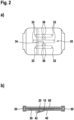
- the embodiment of the invention illustrated in Fig. 2 differs essentially from the embodiment shown in Fig. 1 in that the wound contact strips are 32 narrower and the interstices, in the region of which the substrate layer is not covered by the wound contact layer, are wider. As a result, a better flexibility of the wound dressing is achieved.
- the embodiment of the invention illustrated in Fig. 3 essentially differs from the embodiment explained with reference to Fig. 1 in that a total of eight narrow contact strips extend in mutually opposite directions approximately parallel to one another starting from a wound contact bar 34.
- the flexibility of the wound dressing is increased by increasing the number of intermediate spaces in which the carrier layer is not covered by the wound contact layer.
- the absorption capacity can be increased.
- the wound contact layer is made approximately meander-shaped.
- a total of four wound contact strips 32 are connected to one another via a total of three connection regions.
- the middle wound contact strips are connected at their one end via a curved connection region to a first adjacent wound contact strip extending approximately parallel thereto and at another end via a further connection region to a second adjacent wound contact strip arranged at a side of the at least one wound contact strip opposite to the first adjacent wound contact strip.
- wound contact layers revolving spirally. Two, three or more wound contact bars can be provided, via which the wound contact strips can be connected to one another. It is essential that the wound contact layer as a whole constitutes a coherent structure which is fixed to the carrier layer and forms intermediate spaces in which no contact of the wound contact layer with the wound takes place.
Landscapes
- Health & Medical Sciences (AREA)
- General Health & Medical Sciences (AREA)
- Engineering & Computer Science (AREA)
- Veterinary Medicine (AREA)
- Public Health (AREA)
- Life Sciences & Earth Sciences (AREA)
- Animal Behavior & Ethology (AREA)
- Vascular Medicine (AREA)
- Heart & Thoracic Surgery (AREA)
- Biomedical Technology (AREA)
- Chemical & Material Sciences (AREA)
- Hematology (AREA)
- Materials Engineering (AREA)
- Epidemiology (AREA)
- Dispersion Chemistry (AREA)
- Dermatology (AREA)
- Inorganic Chemistry (AREA)
- Chemical Kinetics & Catalysis (AREA)
- Materials For Medical Uses (AREA)
Description
- The invention relates to a wound dressing as specified in the pre-characterizing portion of appended
claim 1. - Such dressings are used to treat conventional wounds and burns. In this case exudate exiting the wound is taken up by the wound contact layer. In modern wound dressings, the wound contact layer may comprise a hydrogel or a silica gel, whereby the gel swells due to ingestion of liquid, but does not dissolve. The use of appropriate wound contact layers has the advantage that a gel may both accommodate or absorb, as well as release liquids, so as to adjust a desired moisture milieu in the area of the wound. This can promote the healing process.
- Hydrogels which can be used as a wound contact layer are disclosed in
WO 2015/059501 A1 . The disclosure of this document with respect to the composition of hydrogels and additives for hydrogels is hereby incorporated by express reference into this specification. - In the
EP 2 410 962 B1 it is proposed to improve the structural integrity of a hydrogel layer by means of a reinforcing layer. However, the wearing comfort of corresponding wound dressings is impaired by the reinforcing layer. The wearing comfort of wound dressings with wound contact layers having a hydrogel is in any case impaired by the swelling of the wound contact layer when liquids are taken up. - The wound dressing is usually fixed with an adhesive to the skin surrounding the wound. The adhesive may in this case be provided in a region of the wound surrounding the wound contact layer being on the side of the support layer facing the wound. In many cases, the carrier layer is fully coated with the adhesive. The adhesive also serves to fix the wound contact layer on the carrier layer.
- The wearing comfort of the wound dressing just described with a wound contact layer comprising a hydrogel or a silica gel, according to
WO 2015/059501 A1 , is improved by the wound contact layer being formed by discrete hydrogel islands, which are mounted at a distance from each other on the carrier layer. Such wound dressings of the type mentioned above can then be adapted to the wound or the skin surrounding the wound by adopting a desired shape. This may result in a satisfactory wearing comfort. - When using appropriate wound dressings, however, it may happen that individual hydrogel islands detach from the carrier layer and contaminate the wound. According to
WO 2015/059501 A1 , in view of this deficiency, an additional reinforcing layer can be incorporated into the individual hydrogel islands. Additionally or alternatively, a continuous absorption layer without intermediate spaces between individual wound contact surfaces can be applied to the end faces of the hydrogel islands facing away from the carrier layer. This, in turn, reduces the wearing comfort of these wound dressings. In addition, the production process for such wound dressings is complicated. - A wound dressing as specified in the pre-characterizing portion of claim1 is disclosed in
WO 95/14451 - In view of the above problems in the prior art, the invention has for its object to provide a wound dressing which on the one hand offers a satisfactory wearing comfort and on the other hand is easy to produce.
- According to the invention, this object is achieved by a further development of the known wound dressings as specified in the characterizing portion of appended
claim 1. - In this way, a wound contact layer is obtained, which has an overall coherent or contiguous topology. This avoids that individual wound contact layer islands can be easily detached from the carrier layer. Due to the distance between the wound contact surfaces, the wound contact layer, even in the swollen state in which it has already absorbed exudate, has sufficient flexibility to adapt it to the shape of the wound or of the skin surrounding the wound. The contact with the wound takes place at least in the area of the wound contact surfaces. In this area, the wound exudate can be absorbed directly by the wound contact layer. However, the wound exudate can also penetrate into the spaces between the wound contact surfaces and penetrate from there via lateral boundary surfaces into the wound contact layer and be absorbed there.
- In a preferred embodiment of the invention, the wound contact layer in at least one connection region has a smaller thickness in a direction perpendicular to the carrier layer than in the region of the contact surfaces. In this embodiment of the invention, the carrier layer in the area of the gaps is covered by the wound contact layer. However, through the lower thickness of the wound contact layer in this connection area a desired bending portion of the wound contact layer is provided which favors pliability of the wound contact layer and thus of the entire wound dressing. In this embodiment exudate penetrating into the interspaces between the wound contact surfaces can already be accommodated in the region of the interstices of the wound contact layer. The wound contact surfaces can be provided by a knob- or nap-shaped structure of the wound contact layer.
- In addition or as an alternative to the embodiment of the invention just described, the wound contact layer in at least one connection region may have approximately the same thickness as in the region of the wound contact surfaces and also in contact with the wound in this connection region. In this case, the wound contact surfaces, which are separated from one another by the intermediate spaces, in which the wound contact layer is not in contact with the wound, are connected to one another by the connecting areas which may also come into contact with the wound, wherein the gaps, in which the side of the support layer facing the wound is exposed, also provide desired bending points of the entire wound dressing, which favor the flexibility of the wound dressing as a whole.
- The interstices between individual wound contact surfaces with wound dressings according to the invention may be realized by wound contact layers which are at least partially concavely bounded. In the context of this invention, a topology of the wound contact layer is described by "concavely bounded" in cases where individual points on the edges of the wound contact layer are connected to each other at least in sections by straight lines running outside the wound contact layer. A concave boundary can also be provided by, for example, the wound contact layer as a whole being bounded in a bone or eight shape. In a preferred embodiment of the invention, at least two wound contact surfaces are at least partially approximately parallel to each other and preferably formed by approximately rectilinear wound contact strips. Between the wound contact strips a gap is formed, in which the wound-facing boundary surface of the carrier layer is not covered by the wound contact layer. This means that a concave boundary according to the invention can be provided both by rounded edges as well as by straight edge portions, as well as by combinations of rounded edge portions with straight edge portions.
- The distance between the wound contact strips may be 0.5 mm or more. However, to provide sufficient absorption performance, the distance between the wound contact strips is desirably 30 mm or less, more preferably 20 mm or less, more preferably 10 mm or less. The spaced wound contact strips may enclose an acute angle of 20° or less.
- In order to ensure the desired structural integrity of the wound contact layer while at the same time providing adequate flexibility of the wound contact layer, it has proved favorable if the wound contact strips emanate from a common wound contact bar, which preferably extends perpendicular to the wound contact strips, wherein the wound contact layer may also come into contact with the wound in the area of the wound contact bar. Additionally or alternatively, the wound contact bar can be made with a smaller thickness and form a gap between wound contact surfaces.
- At least two wound contact strips can extend from the wound contact bar in opposite directions. In the context of the invention, it is also contemplated that wound contact strips and wound contact bar form a herringbone pattern with each other, in which the wound contact strips include an angle of less than 90°, but preferably more than 45° with the wound contact bar.
- In addition or as an alternative to the embodiment of the invention just described, at least one wound contact strip may have at its one end a preferably curved connection region with a first adjacent wound contact strip approximately parallel or at an acute angle thereto and at its other end another, preferably also approximately curved executed connection region with a second adjacent wound contact strip disposed on the side facing away from the first adjacent wound contact strip . As mentioned above, the individual wound contact strips can be made approximately parallel to one another or at an acute angle.
- As already explained above in connection with wound dressings according to the prior art, the wound contact layer comprises or consists of a hydrogel and/or silica gel. Hydrogels which can be used in the context of the invention are described in
WO 2015/059501 A1 . - As with conventional wound dressings, an adhesive layer can be arranged between the carrier layer and the wound contact layer. In this case, the adhesive layer may also at least partially cover a region of the carrier layer that surrounds the wound contact layer and/or be applied in a grid or point like manner so as to enable the wound dressing to be attached to the skin surrounding the wound.
- To avoid premature bonding of the adhesive layer, this layer and/or the wound contact layer can be covered by at least one cover strip detachably disposed thereon, such as a dehesively finished, for example Si-coated, waterproof film and/or silicone paper . In order to further improve the wearing comfort of wound dressings according to the invention, it can be provided that the carrier layer has or consists of a preferably transparent PU film. Such a polyurethane film can be made very thin, permeable to water vapor, and pliable, so as to allow optimum adaptation of the wound dressing to the shape of the wound and the skin surrounding the wound.
- The application of wound dressings according to the invention can be facilitated if a support layer, in particular a support film, which is detachably attached to the side of the carrier layer facing away from the wound contact layer, is provided. In this case, the support film may preferably be connected via at least one film hinge with at least one cover strip. For application of wound dressings according to the invention, in the last-described embodiment of the invention the cover strip can first be removed from the wound dressing's boundary surface, then the wound dressing can be fixed on the wound or the skin surrounding the wound with the aid of the adhesive layer. Subsequently, the cover strip can be used as an aid to the detachment of the support layer or the support film so as to release the support layer from the carrier layer already fixed to the wound or the skin surrounding the wound.
- In the following, the invention will be explained with reference to the drawing, to which reference is expressly made with regard to all details essential to the invention and details which are not further detailed in the description. In the drawing shows:
- Fig. 1
- a first embodiment of a wound dressing according to the invention,
- Fig. 2
- a second embodiment of a wound dressing according to the invention,
- Fig. 3
- a third embodiment of a wound dressing according to the invention and
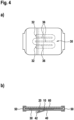
- Fig. 4
- A fourth embodiment of a wound dressing according to the invention.
- In
Fig. 1a ) a top view of a wound dressing according to the invention is shown.Fig. 1b ) shows a sectional view of the wound dressing shown inFig. 1a ). According toFig. 1b ), the wound dressing comprises acarrier layer 10, on which awound contact layer 30 is fixed with the aid of anadhesive layer 20. Theadhesive layer 20 circumscribes thewound contact layer 30 and thus makes it possible to fix the wound dressing in this peripheral adhesive area on the skin surrounding the wound. According toFig. 1b ), thewound contact layer 30 is covered bycover strips carrier layer 10. The cover strips 40 and 42 are connected byhinges 50, which run around edges of thecarrier layer 10, to asupport film 60. - For application of the wound dressing illustrated in
Fig. 1b ), the cover strips 40 and 42 are released from thewound contact layer 30 or the surrounding adhesive region 12. The wound dressing can then be fixed with the aid of theadhesive layer 20 on the skin surrounding the wound. Following this, the cover strips 40 and 42 can be used as grasping aid with which thesupport film 60 connected thereto via the hinge joints 50 can be removed from the side of thecarrier layer 10 facing away from the wound. - According to
Fig. 1a ), thewound contact layer 30 has a total of six wound contact strips 32, which are spaced apart from one another bygaps 36. In the area of theintermediate spaces 36, thecarrier layer 10 is not covered by thewound contact layer 30. The wound contact strips 32 extend approximately parallel to each other and extend from awound contact bar 34 in opposite directions approximately parallel to the edges of thecarrier layer 10. Thewound contact layer 30 according to the embodiment of the invention shown inFig. 1 has in all areas a thickness of about 0.5 to 1.5 mm, in particular about 1 mm. In use it preferably lies completely against the wound on its side facing the wound. - The embodiment of the invention illustrated in
Fig. 2 differs essentially from the embodiment shown inFig. 1 in that the wound contact strips are 32 narrower and the interstices, in the region of which the substrate layer is not covered by the wound contact layer, are wider. As a result, a better flexibility of the wound dressing is achieved. - The embodiment of the invention illustrated in
Fig. 3 essentially differs from the embodiment explained with reference toFig. 1 in that a total of eight narrow contact strips extend in mutually opposite directions approximately parallel to one another starting from awound contact bar 34. In this embodiment too, the flexibility of the wound dressing is increased by increasing the number of intermediate spaces in which the carrier layer is not covered by the wound contact layer. In addition, by increasing the number of strips in the inFig. 3 embodiment, the absorption capacity can be increased. - In the embodiment of the invention shown in
Fig. 4 , the wound contact layer is made approximately meander-shaped. A total of four wound contact strips 32 are connected to one another via a total of three connection regions. The middle wound contact strips are connected at their one end via a curved connection region to a first adjacent wound contact strip extending approximately parallel thereto and at another end via a further connection region to a second adjacent wound contact strip arranged at a side of the at least one wound contact strip opposite to the first adjacent wound contact strip. - The invention is not limited to the embodiments explained with reference to the drawing. It is also thought of wound contact layers revolving spirally. Two, three or more wound contact bars can be provided, via which the wound contact strips can be connected to one another. It is essential that the wound contact layer as a whole constitutes a coherent structure which is fixed to the carrier layer and forms intermediate spaces in which no contact of the wound contact layer with the wound takes place.
Claims (14)
- Wound dressing with a carrier layer and an absorbent wound contact layer (30) fixed to the carrier layer (10), which has wound contact surfaces spaced from one another by interstices (36), in which the absorbent wound contact layer (30) has no contact with the wound wherein the wound contact surfaces are connected to each other by connection regions (34) of the absorbent wound contact layer (30), wherein the absorbent wound contact layer (30) comprises or is a hydrogel and/or silica gel, characterized in that in the area of the interstices (36) the carrier layer (10) is not covered by the absorbent wound contact layer (30).
- Wound dressing according to claim 1, characterized in that the absorbent wound contact layer (30) in at least one connecting region (34) has a smaller thickness in a direction perpendicular to the carrier layer plane than in the region of the contact surfaces.
- Wound dressing according to one of the preceding claims, characterized in that the absorbent wound contact layer (30) has approximately the same thickness in at least one connecting region (34) as in the region of the wound contact surface and also comes into contact with the wound in this region.
- Wound dressing according to one of the preceding claims, characterized in that the absorbent wound contact layer (30) is at least partially bounded concavely.
- Wound dressing according to one of the preceding claims, characterized in that at least two wound contact surfaces are at least partially approximately parallel to each other.
- Wound dressing according to claim 5, characterized in that the wound contact surfaces are formed by approximately rectilinear wound contact strips and the distance between the wound contact strips is 0.5 mm or more, and / or 10 mm or less.
- Wound dressing according to claim 5 or 6, characterized in that the wound contact strips (32) emanate from a common wound contact bar (34.
- Wound dressing according to claim 7, characterized in that at least two wound contact strips (32) emanating from the wound contact bar (34) extend in opposite directions.
- Wound dressing according to one of claims 5 to 8, characterized in that the wound contact surfaces are formed by approximately rectilinear wound contact strips and at least one wound contact strip (32) is connected at its one end via a connection region to a first adjacent wound contact strip (32) and at its other end via a further connection region to a second adjacent wound contact strip (32) arranged at a side of the at least one wound contact strip (32) opposite to the first adjacent wound contact strip (32).
- Wound dressing according to one of the preceding claims, characterized in that an adhesive layer (20) is arranged between the carrier layer (10) and the absorbent wound contact layer (30).
- Wound dressing according to one of the preceding claims, characterized in that the adhesive layer (20) and/or the absorbent wound contact layer (30) is covered by at least one cover strip (40, 42) detachably mounted thereon.
- Wound dressing according to one of the preceding claims, characterized in that the carrier layer (10) comprises or consists of a PU film.
- Wound dressing according to one of the preceding claims, characterized by a support layer (60), in particular a support film, detachably mounted on the side of the carrier layer (10) facing away from the wound contact layer (30).
- Wound dressing according to claim 13, characterized in that the support film (60) is preferably connected via at least one film hinge (50) with at least one cover strip (40, 42).
Applications Claiming Priority (2)
| Application Number | Priority Date | Filing Date | Title |
|---|---|---|---|
| DE102018102126.7A DE102018102126A1 (en) | 2018-01-31 | 2018-01-31 | wound dressing |
| PCT/EP2019/050277 WO2019149476A1 (en) | 2018-01-31 | 2019-01-08 | Wound dressing |
Publications (2)
| Publication Number | Publication Date |
|---|---|
| EP3746020A1 EP3746020A1 (en) | 2020-12-09 |
| EP3746020B1 true EP3746020B1 (en) | 2023-08-23 |
Family
ID=65010790
Family Applications (1)
| Application Number | Title | Priority Date | Filing Date |
|---|---|---|---|
| EP19700217.3A Active EP3746020B1 (en) | 2018-01-31 | 2019-01-08 | Wound dressing |
Country Status (6)
| Country | Link |
|---|---|
| US (1) | US20210106469A1 (en) |
| EP (1) | EP3746020B1 (en) |
| CN (1) | CN111954511A (en) |
| AU (1) | AU2019215582B2 (en) |
| DE (1) | DE102018102126A1 (en) |
| WO (1) | WO2019149476A1 (en) |
Families Citing this family (1)
| Publication number | Priority date | Publication date | Assignee | Title |
|---|---|---|---|---|
| US20250127951A1 (en) * | 2022-01-04 | 2025-04-24 | Dukal, Llc | Silica gel foam dressing |
Citations (12)
| Publication number | Priority date | Publication date | Assignee | Title |
|---|---|---|---|---|
| US4915102A (en) | 1988-09-01 | 1990-04-10 | Bertek, Inc. | Hinged dermal applicator |
| US5628724A (en) | 1994-12-29 | 1997-05-13 | Deroyal Industries, Inc. | Wound dressing and delivery system therefor |
| WO1998025559A1 (en) | 1996-12-11 | 1998-06-18 | Lohmann Gmbh & Co. Kg | Application aid for film dressings |
| EP0769283B1 (en) | 1995-10-19 | 2001-03-28 | Kirsten Helvig Berndorff Jensen | Heel and elbow dressing |
| WO2010048480A1 (en) | 2008-10-24 | 2010-04-29 | 3M Innovative Properties Company | Wound dressing |
| US7982087B2 (en) | 2009-01-09 | 2011-07-19 | Smith & Nephew, Inc. | Wound dressing |
| BE1019122A3 (en) | 2009-12-22 | 2012-03-06 | Bouzid Nadia | BAND AID. |
| WO2012150235A1 (en) | 2011-05-02 | 2012-11-08 | Birgit Riesinger | Wound care article |
| WO2015059501A1 (en) | 2013-10-24 | 2015-04-30 | First Water Limited | Flexible hydrogel wound dressings |
| WO2015124936A1 (en) | 2014-02-19 | 2015-08-27 | Cambridge University Hospitals Nhs Foundation Trust | Brace for protecting a region of a limb |
| WO2017081469A1 (en) | 2015-11-13 | 2017-05-18 | First Water Limited | Compositions for application to wounds |
| US9820888B2 (en) | 2006-09-26 | 2017-11-21 | Smith & Nephew, Inc. | Wound dressing |
Family Cites Families (9)
| Publication number | Priority date | Publication date | Assignee | Title |
|---|---|---|---|---|
| WO1995014451A1 (en) * | 1993-11-27 | 1995-06-01 | Smith & Nephew Plc. | Dressing |
| US7154017B2 (en) * | 2002-12-31 | 2006-12-26 | Ossur Hf | Method for producing a wound dressing |
| DE102008062472A1 (en) * | 2008-12-16 | 2010-06-17 | Paul Hartmann Aktiengesellschaft | Wound dressing for negative pressure therapy |
| GB0905290D0 (en) | 2009-03-27 | 2009-05-13 | First Water Ltd | Multilayer compositions and dressings |
| EP2338529B1 (en) * | 2009-12-24 | 2013-05-29 | Paul Hartmann AG | Hydrogel matrix with improved adhesive characteristics |
| JP5631035B2 (en) * | 2010-03-29 | 2014-11-26 | ユニ・チャーム株式会社 | Nonwoven sheet |
| US20130172843A1 (en) * | 2010-06-01 | 2013-07-04 | Zuiko Corporation | Surface sheet for wound dressing and wound dressing |
| JP6502938B2 (en) * | 2013-08-05 | 2019-04-17 | スリーエム イノベイティブ プロパティズ カンパニー | Support device with contained buffer |
| DE102016125534A1 (en) * | 2016-12-23 | 2018-06-28 | Paul Hartmann Ag | Hydrous hydrogels for wound care |
-
2018
- 2018-01-31 DE DE102018102126.7A patent/DE102018102126A1/en active Pending
-
2019
- 2019-01-08 AU AU2019215582A patent/AU2019215582B2/en active Active
- 2019-01-08 CN CN201980021156.9A patent/CN111954511A/en active Pending
- 2019-01-08 US US16/965,319 patent/US20210106469A1/en not_active Abandoned
- 2019-01-08 WO PCT/EP2019/050277 patent/WO2019149476A1/en not_active Ceased
- 2019-01-08 EP EP19700217.3A patent/EP3746020B1/en active Active
Patent Citations (12)
| Publication number | Priority date | Publication date | Assignee | Title |
|---|---|---|---|---|
| US4915102A (en) | 1988-09-01 | 1990-04-10 | Bertek, Inc. | Hinged dermal applicator |
| US5628724A (en) | 1994-12-29 | 1997-05-13 | Deroyal Industries, Inc. | Wound dressing and delivery system therefor |
| EP0769283B1 (en) | 1995-10-19 | 2001-03-28 | Kirsten Helvig Berndorff Jensen | Heel and elbow dressing |
| WO1998025559A1 (en) | 1996-12-11 | 1998-06-18 | Lohmann Gmbh & Co. Kg | Application aid for film dressings |
| US9820888B2 (en) | 2006-09-26 | 2017-11-21 | Smith & Nephew, Inc. | Wound dressing |
| WO2010048480A1 (en) | 2008-10-24 | 2010-04-29 | 3M Innovative Properties Company | Wound dressing |
| US7982087B2 (en) | 2009-01-09 | 2011-07-19 | Smith & Nephew, Inc. | Wound dressing |
| BE1019122A3 (en) | 2009-12-22 | 2012-03-06 | Bouzid Nadia | BAND AID. |
| WO2012150235A1 (en) | 2011-05-02 | 2012-11-08 | Birgit Riesinger | Wound care article |
| WO2015059501A1 (en) | 2013-10-24 | 2015-04-30 | First Water Limited | Flexible hydrogel wound dressings |
| WO2015124936A1 (en) | 2014-02-19 | 2015-08-27 | Cambridge University Hospitals Nhs Foundation Trust | Brace for protecting a region of a limb |
| WO2017081469A1 (en) | 2015-11-13 | 2017-05-18 | First Water Limited | Compositions for application to wounds |
Non-Patent Citations (1)
| Title |
|---|
| ANONYMOUS: "Superabsorber", WIKIPEDIA, pages 1 - 2, XP093322097, Retrieved from the Internet <URL:https://de.wikipedia.org/w/index.php?title=Superabsorber&oldid=259352054> |
Also Published As
| Publication number | Publication date |
|---|---|
| CN111954511A (en) | 2020-11-17 |
| AU2019215582B2 (en) | 2024-09-26 |
| US20210106469A1 (en) | 2021-04-15 |
| AU2019215582A1 (en) | 2020-08-13 |
| DE102018102126A1 (en) | 2019-08-01 |
| EP3746020A1 (en) | 2020-12-09 |
| WO2019149476A1 (en) | 2019-08-08 |
Similar Documents
| Publication | Publication Date | Title |
|---|---|---|
| US11911525B2 (en) | Wound dressing | |
| EP1156838B1 (en) | Wound dressing | |
| US20200038252A1 (en) | Tri-layered wound dressing and method therefor | |
| US5820578A (en) | Bandage | |
| ES2657870T3 (en) | Wound dressing | |
| US5060662A (en) | Open air bandage | |
| RU2001126402A (en) | Wound dressing | |
| JP2005510296A (en) | Absorbable wound dressing comprising a hydrogel layer | |
| WO2008012443A2 (en) | Device for protection and/or healing | |
| AU2019215582B2 (en) | Wound dressing | |
| WO2002091964A3 (en) | A wound dressing | |
| EP3979962A1 (en) | Novel absorbent wound dressing construct that allows wound fluid assessment in use | |
| US12403042B2 (en) | Wound dressing | |
| KR20240140642A (en) | Medical Dressing Patch And Method For Manufacturing The Same | |
| CN118647350A (en) | Wound dressing with curved incision | |
| JP2008200341A (en) | Wound treatment pad | |
| CN214909201U (en) | Composite medical dressing | |
| CN224126167U (en) | Waterproof elastic bandage with good air permeability | |
| GB2451877A (en) | Adhesive bandage | |
| HK40111884A (en) | Wound dressing having arcuate indentations | |
| KR200275091Y1 (en) | Water-based medicated plaster | |
| WO2025059142A1 (en) | Dressing with improved edge adhesion | |
| EP2948119B1 (en) | Skin protection device | |
| KR20040050825A (en) | Skin protector bandage | |
| HK1218243B (en) | Skin protection device |
Legal Events
| Date | Code | Title | Description |
|---|---|---|---|
| STAA | Information on the status of an ep patent application or granted ep patent |
Free format text: STATUS: UNKNOWN |
|
| STAA | Information on the status of an ep patent application or granted ep patent |
Free format text: STATUS: THE INTERNATIONAL PUBLICATION HAS BEEN MADE |
|
| PUAI | Public reference made under article 153(3) epc to a published international application that has entered the european phase |
Free format text: ORIGINAL CODE: 0009012 |
|
| STAA | Information on the status of an ep patent application or granted ep patent |
Free format text: STATUS: REQUEST FOR EXAMINATION WAS MADE |
|
| 17P | Request for examination filed |
Effective date: 20200804 |
|
| AK | Designated contracting states |
Kind code of ref document: A1 Designated state(s): AL AT BE BG CH CY CZ DE DK EE ES FI FR GB GR HR HU IE IS IT LI LT LU LV MC MK MT NL NO PL PT RO RS SE SI SK SM TR |
|
| AX | Request for extension of the european patent |
Extension state: BA ME |
|
| DAV | Request for validation of the european patent (deleted) | ||
| DAX | Request for extension of the european patent (deleted) | ||
| STAA | Information on the status of an ep patent application or granted ep patent |
Free format text: STATUS: EXAMINATION IS IN PROGRESS |
|
| 17Q | First examination report despatched |
Effective date: 20210715 |
|
| GRAP | Despatch of communication of intention to grant a patent |
Free format text: ORIGINAL CODE: EPIDOSNIGR1 |
|
| STAA | Information on the status of an ep patent application or granted ep patent |
Free format text: STATUS: GRANT OF PATENT IS INTENDED |
|
| INTG | Intention to grant announced |
Effective date: 20230316 |
|
| GRAS | Grant fee paid |
Free format text: ORIGINAL CODE: EPIDOSNIGR3 |
|
| GRAA | (expected) grant |
Free format text: ORIGINAL CODE: 0009210 |
|
| STAA | Information on the status of an ep patent application or granted ep patent |
Free format text: STATUS: THE PATENT HAS BEEN GRANTED |
|
| AK | Designated contracting states |
Kind code of ref document: B1 Designated state(s): AL AT BE BG CH CY CZ DE DK EE ES FI FR GB GR HR HU IE IS IT LI LT LU LV MC MK MT NL NO PL PT RO RS SE SI SK SM TR |
|
| REG | Reference to a national code |
Ref country code: GB Ref legal event code: FG4D |
|
| REG | Reference to a national code |
Ref country code: CH Ref legal event code: EP |
|
| REG | Reference to a national code |
Ref country code: IE Ref legal event code: FG4D |
|
| REG | Reference to a national code |
Ref country code: DE Ref legal event code: R096 Ref document number: 602019035531 Country of ref document: DE |
|
| P01 | Opt-out of the competence of the unified patent court (upc) registered |
Effective date: 20230927 |
|
| REG | Reference to a national code |
Ref country code: LT Ref legal event code: MG9D |
|
| REG | Reference to a national code |
Ref country code: NL Ref legal event code: MP Effective date: 20230823 |
|
| PG25 | Lapsed in a contracting state [announced via postgrant information from national office to epo] |
Ref country code: GR Free format text: LAPSE BECAUSE OF FAILURE TO SUBMIT A TRANSLATION OF THE DESCRIPTION OR TO PAY THE FEE WITHIN THE PRESCRIBED TIME-LIMIT Effective date: 20231124 |
|
| PG25 | Lapsed in a contracting state [announced via postgrant information from national office to epo] |
Ref country code: IS Free format text: LAPSE BECAUSE OF FAILURE TO SUBMIT A TRANSLATION OF THE DESCRIPTION OR TO PAY THE FEE WITHIN THE PRESCRIBED TIME-LIMIT Effective date: 20231223 |
|
| PG25 | Lapsed in a contracting state [announced via postgrant information from national office to epo] |
Ref country code: SE Free format text: LAPSE BECAUSE OF FAILURE TO SUBMIT A TRANSLATION OF THE DESCRIPTION OR TO PAY THE FEE WITHIN THE PRESCRIBED TIME-LIMIT Effective date: 20230823 Ref country code: RS Free format text: LAPSE BECAUSE OF FAILURE TO SUBMIT A TRANSLATION OF THE DESCRIPTION OR TO PAY THE FEE WITHIN THE PRESCRIBED TIME-LIMIT Effective date: 20230823 Ref country code: PT Free format text: LAPSE BECAUSE OF FAILURE TO SUBMIT A TRANSLATION OF THE DESCRIPTION OR TO PAY THE FEE WITHIN THE PRESCRIBED TIME-LIMIT Effective date: 20231226 Ref country code: NO Free format text: LAPSE BECAUSE OF FAILURE TO SUBMIT A TRANSLATION OF THE DESCRIPTION OR TO PAY THE FEE WITHIN THE PRESCRIBED TIME-LIMIT Effective date: 20231123 Ref country code: NL Free format text: LAPSE BECAUSE OF FAILURE TO SUBMIT A TRANSLATION OF THE DESCRIPTION OR TO PAY THE FEE WITHIN THE PRESCRIBED TIME-LIMIT Effective date: 20230823 Ref country code: LV Free format text: LAPSE BECAUSE OF FAILURE TO SUBMIT A TRANSLATION OF THE DESCRIPTION OR TO PAY THE FEE WITHIN THE PRESCRIBED TIME-LIMIT Effective date: 20230823 Ref country code: LT Free format text: LAPSE BECAUSE OF FAILURE TO SUBMIT A TRANSLATION OF THE DESCRIPTION OR TO PAY THE FEE WITHIN THE PRESCRIBED TIME-LIMIT Effective date: 20230823 Ref country code: IS Free format text: LAPSE BECAUSE OF FAILURE TO SUBMIT A TRANSLATION OF THE DESCRIPTION OR TO PAY THE FEE WITHIN THE PRESCRIBED TIME-LIMIT Effective date: 20231223 Ref country code: HR Free format text: LAPSE BECAUSE OF FAILURE TO SUBMIT A TRANSLATION OF THE DESCRIPTION OR TO PAY THE FEE WITHIN THE PRESCRIBED TIME-LIMIT Effective date: 20230823 Ref country code: GR Free format text: LAPSE BECAUSE OF FAILURE TO SUBMIT A TRANSLATION OF THE DESCRIPTION OR TO PAY THE FEE WITHIN THE PRESCRIBED TIME-LIMIT Effective date: 20231124 Ref country code: FI Free format text: LAPSE BECAUSE OF FAILURE TO SUBMIT A TRANSLATION OF THE DESCRIPTION OR TO PAY THE FEE WITHIN THE PRESCRIBED TIME-LIMIT Effective date: 20230823 |
|
| PG25 | Lapsed in a contracting state [announced via postgrant information from national office to epo] |
Ref country code: PL Free format text: LAPSE BECAUSE OF FAILURE TO SUBMIT A TRANSLATION OF THE DESCRIPTION OR TO PAY THE FEE WITHIN THE PRESCRIBED TIME-LIMIT Effective date: 20230823 |
|
| PG25 | Lapsed in a contracting state [announced via postgrant information from national office to epo] |
Ref country code: ES Free format text: LAPSE BECAUSE OF FAILURE TO SUBMIT A TRANSLATION OF THE DESCRIPTION OR TO PAY THE FEE WITHIN THE PRESCRIBED TIME-LIMIT Effective date: 20230823 |
|
| PG25 | Lapsed in a contracting state [announced via postgrant information from national office to epo] |
Ref country code: SM Free format text: LAPSE BECAUSE OF FAILURE TO SUBMIT A TRANSLATION OF THE DESCRIPTION OR TO PAY THE FEE WITHIN THE PRESCRIBED TIME-LIMIT Effective date: 20230823 Ref country code: RO Free format text: LAPSE BECAUSE OF FAILURE TO SUBMIT A TRANSLATION OF THE DESCRIPTION OR TO PAY THE FEE WITHIN THE PRESCRIBED TIME-LIMIT Effective date: 20230823 Ref country code: ES Free format text: LAPSE BECAUSE OF FAILURE TO SUBMIT A TRANSLATION OF THE DESCRIPTION OR TO PAY THE FEE WITHIN THE PRESCRIBED TIME-LIMIT Effective date: 20230823 Ref country code: EE Free format text: LAPSE BECAUSE OF FAILURE TO SUBMIT A TRANSLATION OF THE DESCRIPTION OR TO PAY THE FEE WITHIN THE PRESCRIBED TIME-LIMIT Effective date: 20230823 Ref country code: DK Free format text: LAPSE BECAUSE OF FAILURE TO SUBMIT A TRANSLATION OF THE DESCRIPTION OR TO PAY THE FEE WITHIN THE PRESCRIBED TIME-LIMIT Effective date: 20230823 Ref country code: CZ Free format text: LAPSE BECAUSE OF FAILURE TO SUBMIT A TRANSLATION OF THE DESCRIPTION OR TO PAY THE FEE WITHIN THE PRESCRIBED TIME-LIMIT Effective date: 20230823 Ref country code: SK Free format text: LAPSE BECAUSE OF FAILURE TO SUBMIT A TRANSLATION OF THE DESCRIPTION OR TO PAY THE FEE WITHIN THE PRESCRIBED TIME-LIMIT Effective date: 20230823 |
|
| REG | Reference to a national code |
Ref country code: AT Ref legal event code: UEP Ref document number: 1601719 Country of ref document: AT Kind code of ref document: T Effective date: 20230823 |
|
| REG | Reference to a national code |
Ref country code: DE Ref legal event code: R026 Ref document number: 602019035531 Country of ref document: DE |
|
| PG25 | Lapsed in a contracting state [announced via postgrant information from national office to epo] |
Ref country code: IT Free format text: LAPSE BECAUSE OF FAILURE TO SUBMIT A TRANSLATION OF THE DESCRIPTION OR TO PAY THE FEE WITHIN THE PRESCRIBED TIME-LIMIT Effective date: 20230823 |
|
| PLBI | Opposition filed |
Free format text: ORIGINAL CODE: 0009260 |
|
| PLAX | Notice of opposition and request to file observation + time limit sent |
Free format text: ORIGINAL CODE: EPIDOSNOBS2 |
|
| 26 | Opposition filed |
Opponent name: ESSITY HYGIENE AND HEALTH AKTIEBOLAG Effective date: 20240523 |
|
| PG25 | Lapsed in a contracting state [announced via postgrant information from national office to epo] |
Ref country code: SI Free format text: LAPSE BECAUSE OF FAILURE TO SUBMIT A TRANSLATION OF THE DESCRIPTION OR TO PAY THE FEE WITHIN THE PRESCRIBED TIME-LIMIT Effective date: 20230823 |
|
| PG25 | Lapsed in a contracting state [announced via postgrant information from national office to epo] |
Ref country code: MC Free format text: LAPSE BECAUSE OF FAILURE TO SUBMIT A TRANSLATION OF THE DESCRIPTION OR TO PAY THE FEE WITHIN THE PRESCRIBED TIME-LIMIT Effective date: 20230823 |
|
| PG25 | Lapsed in a contracting state [announced via postgrant information from national office to epo] |
Ref country code: MC Free format text: LAPSE BECAUSE OF FAILURE TO SUBMIT A TRANSLATION OF THE DESCRIPTION OR TO PAY THE FEE WITHIN THE PRESCRIBED TIME-LIMIT Effective date: 20230823 |
|
| REG | Reference to a national code |
Ref country code: CH Ref legal event code: PL |
|
| PG25 | Lapsed in a contracting state [announced via postgrant information from national office to epo] |
Ref country code: LU Free format text: LAPSE BECAUSE OF NON-PAYMENT OF DUE FEES Effective date: 20240108 |
|
| PG25 | Lapsed in a contracting state [announced via postgrant information from national office to epo] |
Ref country code: LU Free format text: LAPSE BECAUSE OF NON-PAYMENT OF DUE FEES Effective date: 20240108 |
|
| PLBB | Reply of patent proprietor to notice(s) of opposition received |
Free format text: ORIGINAL CODE: EPIDOSNOBS3 |
|
| PG25 | Lapsed in a contracting state [announced via postgrant information from national office to epo] |
Ref country code: BE Free format text: LAPSE BECAUSE OF NON-PAYMENT OF DUE FEES Effective date: 20240131 |
|
| PG25 | Lapsed in a contracting state [announced via postgrant information from national office to epo] |
Ref country code: BE Free format text: LAPSE BECAUSE OF NON-PAYMENT OF DUE FEES Effective date: 20240131 |
|
| REG | Reference to a national code |
Ref country code: BE Ref legal event code: MM Effective date: 20240131 |
|
| PG25 | Lapsed in a contracting state [announced via postgrant information from national office to epo] |
Ref country code: BG Free format text: LAPSE BECAUSE OF FAILURE TO SUBMIT A TRANSLATION OF THE DESCRIPTION OR TO PAY THE FEE WITHIN THE PRESCRIBED TIME-LIMIT Effective date: 20230823 |
|
| PG25 | Lapsed in a contracting state [announced via postgrant information from national office to epo] |
Ref country code: BG Free format text: LAPSE BECAUSE OF FAILURE TO SUBMIT A TRANSLATION OF THE DESCRIPTION OR TO PAY THE FEE WITHIN THE PRESCRIBED TIME-LIMIT Effective date: 20230823 |
|
| PG25 | Lapsed in a contracting state [announced via postgrant information from national office to epo] |
Ref country code: IE Free format text: LAPSE BECAUSE OF NON-PAYMENT OF DUE FEES Effective date: 20240108 |
|
| PG25 | Lapsed in a contracting state [announced via postgrant information from national office to epo] |
Ref country code: IE Free format text: LAPSE BECAUSE OF NON-PAYMENT OF DUE FEES Effective date: 20240108 |
|
| PLAB | Opposition data, opponent's data or that of the opponent's representative modified |
Free format text: ORIGINAL CODE: 0009299OPPO |
|
| R26 | Opposition filed (corrected) |
Opponent name: ESSITY HYGIENE AND HEALTH AKTIEBOLAG Effective date: 20240523 |
|
| PG25 | Lapsed in a contracting state [announced via postgrant information from national office to epo] |
Ref country code: CY Free format text: LAPSE BECAUSE OF FAILURE TO SUBMIT A TRANSLATION OF THE DESCRIPTION OR TO PAY THE FEE WITHIN THE PRESCRIBED TIME-LIMIT; INVALID AB INITIO Effective date: 20190108 |
|
| PG25 | Lapsed in a contracting state [announced via postgrant information from national office to epo] |
Ref country code: HU Free format text: LAPSE BECAUSE OF FAILURE TO SUBMIT A TRANSLATION OF THE DESCRIPTION OR TO PAY THE FEE WITHIN THE PRESCRIBED TIME-LIMIT; INVALID AB INITIO Effective date: 20190108 |
|
| PG25 | Lapsed in a contracting state [announced via postgrant information from national office to epo] |
Ref country code: TR Free format text: LAPSE BECAUSE OF FAILURE TO SUBMIT A TRANSLATION OF THE DESCRIPTION OR TO PAY THE FEE WITHIN THE PRESCRIBED TIME-LIMIT Effective date: 20230823 |
|
| REG | Reference to a national code |
Ref country code: CH Ref legal event code: U11 Free format text: ST27 STATUS EVENT CODE: U-0-0-U10-U11 (AS PROVIDED BY THE NATIONAL OFFICE) Effective date: 20260201 |
|
| APAH | Appeal reference modified |
Free format text: ORIGINAL CODE: EPIDOSCREFNO |
|
| APBP | Date of receipt of notice of appeal recorded |
Free format text: ORIGINAL CODE: EPIDOSNNOA2O |
|
| PGFP | Annual fee paid to national office [announced via postgrant information from national office to epo] |
Ref country code: GB Payment date: 20260122 Year of fee payment: 8 |
|
| PGFP | Annual fee paid to national office [announced via postgrant information from national office to epo] |
Ref country code: DE Payment date: 20260120 Year of fee payment: 8 |
|
| PGFP | Annual fee paid to national office [announced via postgrant information from national office to epo] |
Ref country code: AT Payment date: 20260119 Year of fee payment: 8 |
|
| APBU | Appeal procedure closed |
Free format text: ORIGINAL CODE: EPIDOSNNOA9O |
|
| PGFP | Annual fee paid to national office [announced via postgrant information from national office to epo] |
Ref country code: FR Payment date: 20260127 Year of fee payment: 8 |
|
| PGFP | Annual fee paid to national office [announced via postgrant information from national office to epo] |
Ref country code: CH Payment date: 20260201 Year of fee payment: 8 |