EP3745813B1 - Verfahren zum betrieb einer bluetooth-vorrichtung - Google Patents
Verfahren zum betrieb einer bluetooth-vorrichtung Download PDFInfo
- Publication number
- EP3745813B1 EP3745813B1 EP19305702.3A EP19305702A EP3745813B1 EP 3745813 B1 EP3745813 B1 EP 3745813B1 EP 19305702 A EP19305702 A EP 19305702A EP 3745813 B1 EP3745813 B1 EP 3745813B1
- Authority
- EP
- European Patent Office
- Prior art keywords
- parameter
- bluetooth
- audio
- configuration
- communication link
- Prior art date
- Legal status (The legal status is an assumption and is not a legal conclusion. Google has not performed a legal analysis and makes no representation as to the accuracy of the status listed.)
- Active
Links
Images


Classifications
-
- H—ELECTRICITY
- H04—ELECTRIC COMMUNICATION TECHNIQUE
- H04W—WIRELESS COMMUNICATION NETWORKS
- H04W4/00—Services specially adapted for wireless communication networks; Facilities therefor
- H04W4/80—Services using short range communication, e.g. near-field communication [NFC], radio-frequency identification [RFID] or low energy communication
-
- H—ELECTRICITY
- H04—ELECTRIC COMMUNICATION TECHNIQUE
- H04W—WIRELESS COMMUNICATION NETWORKS
- H04W52/00—Power management, e.g. Transmission Power Control [TPC] or power classes
- H04W52/02—Power saving arrangements
- H04W52/0209—Power saving arrangements in terminal devices
- H04W52/0261—Power saving arrangements in terminal devices managing power supply demand, e.g. depending on battery level
- H04W52/0267—Power saving arrangements in terminal devices managing power supply demand, e.g. depending on battery level by controlling user interface components
-
- H—ELECTRICITY
- H04—ELECTRIC COMMUNICATION TECHNIQUE
- H04W—WIRELESS COMMUNICATION NETWORKS
- H04W84/00—Network topologies
- H04W84/18—Self-organising networks, e.g. ad-hoc networks or sensor networks
- H04W84/20—Leader-follower arrangements
-
- Y—GENERAL TAGGING OF NEW TECHNOLOGICAL DEVELOPMENTS; GENERAL TAGGING OF CROSS-SECTIONAL TECHNOLOGIES SPANNING OVER SEVERAL SECTIONS OF THE IPC; TECHNICAL SUBJECTS COVERED BY FORMER USPC CROSS-REFERENCE ART COLLECTIONS [XRACs] AND DIGESTS
- Y02—TECHNOLOGIES OR APPLICATIONS FOR MITIGATION OR ADAPTATION AGAINST CLIMATE CHANGE
- Y02D—CLIMATE CHANGE MITIGATION TECHNOLOGIES IN INFORMATION AND COMMUNICATION TECHNOLOGIES [ICT], I.E. INFORMATION AND COMMUNICATION TECHNOLOGIES AIMING AT THE REDUCTION OF THEIR OWN ENERGY USE
- Y02D30/00—Reducing energy consumption in communication networks
- Y02D30/70—Reducing energy consumption in communication networks in wireless communication networks
Definitions
- the present invention relates to wireless communication, and more specifically to a method for dynamically modifying configuration of a communication link between a Bluetooth source device and a Bluetooth multimedia (audio or video) sink device.
- configuration it is meant a set of parameters that determines how data are transmitted between the source device and the sink device. These parameters are referred to as “configuration parameters”.
- modifying configuration it is meant modifying one or several configuration parameters among the set of configuration parameters.
- the Bluetooth sink device may be a Bluetooth loudspeaker.
- loudspeaker it is meant any electroacoustic transducer, which converts an electrical audio signal into a corresponding sound.
- the term “loudspeaker” includes for instance audio speakers of a stereo system, headphones, earbuds, hearing aids, etc.
- the audio source device (or simply “source device”, or “source”) may be, for instance, a mobile phone, a portable game player, a portable media player, a computer, a tablet, a television, a control device of a stereo system, etc. In the following, the source device may also be referred to as "master device”.
- Bluetooth is a communication standard that is well-known to the person skilled in the art, managed by a group of organizations (Bluetooth SIG) that has issued successive versions. Bluetooth enables a short-distance bidirectional exchange of data (this is a piconet network, which designates a network covering a personal zone). Therefore, the range of Bluetooth equipment is limited to a few tens of meters. Bluetooth uses radio waves that are situated in the UHF band (between 300 MHz and 3 GHz). Bluetooth aims to simplify connections between electronic devices by removing cable connections. Thus Bluetooth enables cables between a source multimedia device (hi-fi system, car radio, computer, tablet, mobile telephone, etc.) to be replaced by wireless communications and multimedia sink devices such as speakers arranged to play a received multimedia stream. Bluetooth speakers have met with a certain success due to their high portability.
- the configuration of a Bluetooth link between a source device and a sink device is determined when the connection is established, and is not modified after.
- the master device may send a request to obtain the audio capabilities of the sink device and, based on the response, select the suitable audio parameters of the link.
- US 8,031,658 proposes to dynamically change the bit rate used in the Codec based on conditions of the Bluetooth connection.
- US 2013/0304458 relates to a source device wherein the controller is adapted for changing audio parameters based on the bandwidth between the communicating Bluetooth devices.
- reference CN 107 708 192 A discloses a method and device for automatically switching a working mode of a Bluetooth connection.
- An object of the present disclosure is therefore directed to a method for dynamically changing configuration (not only audio parameters) of a communication link between a Bluetooth source device and a Bluetooth multimedia sink device based on parameters that are not necessarily connection parameters.
- the invention is defined by an independent method claim 1, a corresponding apparatus claim 9, and a corresponding non-transitory computer readable storage medium claim 16.
- the method comprises:
- Bluetooth communication link it is meant a communication link established according any Bluetooth protocol (as described for instance in the Bluetooth Core Specification version 5.1 or in earlier versions of the Bluetooth Core Specification), including Bluetooth BR/EDR (Bluetooth Basic Rate/ Enhanced Data Rate), but also Bluetooth low energy (LE).
- Bluetooth BR/EDR Bluetooth Basic Rate/ Enhanced Data Rate
- LE Bluetooth low energy
- the operational parameter may be associated with an operating system running on the Bluetooth device or the second device.
- the operational parameter may be associated with an application running on the Bluetooth device or the second device.
- the modifying of the configuration parameter may be performed by a Bluetooth Host.
- the modifying of the configuration parameter may be performed by a Bluetooth Controller.
- the configuration parameter may be one of:
- the configuration parameter may be one audio configuration parameter among:
- the configuration parameter may be one Bluetooth connection parameter among:
- the Bluetooth device comprises a Bluetooth chip, a processor and a memory configured to:
- the operational parameter may be associated with an operating system of the Bluetooth device or the second device.
- the operational parameter may be associated with an application running on the Bluetooth device or the second device.
- the Bluetooth device may further comprise a Bluetooth Controller and the modifying of the configuration parameter may be performed by the Bluetooth Controller.
- the Bluetooth device may further comprise a Bluetooth Host, and, alternatively, the modifying of the configuration parameter may be performed by the Bluetooth Host.
- the operational parameter may be one of:
- the configuration parameter may be one of:
- the operational parameter may be one audio configuration parameter among:
- the operational parameter may be one Bluetooth connection parameter among:
- the non-transitory computer readable storage medium has stored thereon a computer program comprising program instructions, the computer program being loadable into a data-processing unit and adapted to cause the data-processing unit to carry out the steps of the above method when the computer program is run by the data-processing device.
- Types of non-transitory computer readable storage medium used in certain embodiments of the invention include magnetic hard disk drives (HDD), fixed optical storage media, field programable gate arrays (FPGA), programmable read-only memory (ROM) or flash-RAM devices. These non-transitory computer readable storage medium may be stand-alone or part of a larger Bluetooth enabled system.
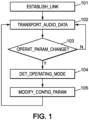
- Figure 1 is a flow chart describing a possible embodiment of the present invention.
- the steps of the flow chart of Fig. 1 may be performed by the master device and/or by the sink device.
- a wireless communication link is established between the master device and the sink device.
- This wireless communication link may be a Bluetooth link using the Advanced Audio Distribution Profile (A2DP) constructed from several layers defined by the Bluetooth standard.
- A2DP Advanced Audio Distribution Profile
- Audio information is therefore transported 102 over the established communication link.
- the audio information may be an audio or a stereo stream including packets incorporating audio data.
- the device implementing the method may further be configured to detect 103 a change of an operational parameter of at least one Bluetooth device among the master device and the sink device.
- This change may occur on the side of the master device or on the side of the sink device, whatever the device implementing the method.
- the master device may detect a change of one of its operational parameter, but also a change of an operational parameter of the sink device.
- step 103 As long as no change of an operational parameter is detected (step 103, "N"), the configuration of the wireless communication link between the master device and the sink device is not modified and audio data continues to be transported 102 on this communication link, according to this configuration.
- a new operating mode is determined 104 for the communication link between the master device and the sink device.
- the configuration of the communication link is then changed based on the determined operating mode, for the data to be transmitted between the master device and the source device according to this operating mode. To this purpose, at least one configuration parameter of the communication link is modified 105.
- the audio data is then sent/received 102 on this reconfigured link.
- operation parameter of a Bluetooth device it is meant a parameter relating to the operation of the Bluetooth device, for instance a parameter relating to the operating system running on the Bluetooth device.
- the operational parameter of a Bluetooth device may be associated with an application running on the Bluetooth device.
- the Bluetooth device is usually the master device, i.e. the operational parameter is associated with an application running on the master device.
- the parameter is a type of application (gaming or video streaming) launched or ended on the Bluetooth device, or a specific application launched on the Bluetooth device (e.g. the user is using Spotify ® and launches Youtube ® on his smartphone).
- a gaming application may require to activate a low latency mode.
- the operational parameter may be related to a multimedia content played by a Bluetooth device, which is usually the master device.
- operating mode it is meant a mode relating to a hardware component of one of the master device and the sink device, or a mode for transmitting data from one device to another.
- the operating mode may be relating to a power consumption of the master or the sink device (e.g. a power-saving mode), to a quality of the content (e.g. High-Quality mode), to a latency, etc.
- the "configuration" of a communication link between a source device and a sink device corresponds to a set of configuration parameters that determines how data are transmitted between the source device and the sink device.
- These configuration parameters may comprise Bluetooth connection parameters associated with the wireless communication link, and applicative parameters.
- Bluetooth connection parameters it is meant parameters related to low-level building blocks defined by the Bluetooth standard, such as the “Baseband” building block, the “LMP” ("Link Manager Protocol”) building block, the “L2CAP” ("Logical Link Control and Adaptation Protocol”) building block, or the “SDP” ("Service Discovery Protocol”).
- the Bluetooth parameters may include the number of retransmission, the packet type, the MTU, the FTO (or “Flush Timeout”) value, which defines the expiration period for a data packet in a buffer memory of a source device, a QoS (“Quality of service”) parameter, which defines the maximum latency between the inclusion of a packet to be transmitted in a L2CAP channel and its effective transmission, etc.
- applicative parameters parameters related to a chosen application, i.e. related to the application layer.
- audio transmission is defined by the Advanced Audio Distribution Profile (A2DP).
- A2DP profile is based on the Audio/Video Distribution Transport Protocol (AVDTP) building block which defines the procedures between Bluetooth devices for establishing the audio stream, negotiating the audio stream parameters and transmitting the audio stream data.
- A2DP profile is based on the Audio/Video Distribution Transport Protocol (AVDTP) building block which defines the procedures between Bluetooth devices for establishing the audio stream, negotiating the audio stream parameters and transmitting the audio stream data. Therefore, in case of audio transmission, the applicative parameters may be audio configuration parameters and may comprise:
- the determination of the new operating mode in case of a change of an operational parameter may be triggered automatically (e.g. if the battery level is under a predefined threshold or if the derivative of the battery level is under a predefined threshold, the saving-power mode is automatically activated), or manually, by a user action (e.g. when a user starts a game, a "gaming mode” may be activated, or when a user ends a game, the operating mode may switch from a "gaming mode” into a "standard mode”).
- the modification of configuration of the communication link based on the determined operating mode may be done in several ways.
- the "reconfigure command" of AVDTP (defined in the AVDTP specification) may be used. This command allows devices participating within a stream to change Application Service Capabilities.
- a "Suspend Streaming Procedure” may be performed for suspending the stream.
- a Reconfigure Command may be used for changing current capability settings.
- the streaming may be restarted by using the "Start Streaming Procedure”.
- Fig. 1 For illustration purposes only, some examples of the method of Fig. 1 are provided below. Some of these examples are based on the table below, presenting different possible operating modes. Tab 1. Examples of operational modes Operational parameters Operating Mode Link configuration Battery low event on the master or slave, or user manual input Power-saving mode Low complexity codec, low bitrate, bursty packet scheduling Start of a tagged gaming or real-time video application (PUBG, Fortnite), or user manual input Low-latency mode Low-latency codec, few retransmissions, precise packet scheduling to avoid bursts Start of a tagged audio application (Spotify, Apple Music), or user manual input High-Quality mode High-Quality codec, maximal bitrate, maximum retransmissions End of a previous operating mode (end of a gaming/audio application, battery not low) Standard mode Default configuration
- the operational parameter is a battery level (of the master device or of the sink device).
- the Bluetooth device performing the method may determine that the battery level falls under a predefined threshold.
- it is determined that the current operating mode of the communication link may be modified into a "power-saving mode". In consequence, at least one of the following configuration parameters may be modified (step 105):
- step 105 For instance one parameter among:
- operational parameter is a type of application.
- the type of application launched on the master device is a gaming or real-time video application
- at least one of the following configuration parameters may be modified (step 105):
- the operational parameter is a type of application
- a type of application e.g. gaming, audio or real-time video application
- Such “standard mode” may also be used in the case where the operational parameter is a battery level, and when it is detected at step 103 that the battery level again exceeds a predefined threshold.
- the operational parameter is a specific audio application (Spotify ® , Apple Music ® ).
- spotify ® , Apple Music ®
- the current operating mode of the communication link may be switched into a "high-quality mode”.
- at least one of the following configuration parameters may be modified (step 105):
- the modification 105 of a configuration parameter may comprise:
- the change 103 of an operational parameter may correspond to a change in the local source of audio data from a higher quality source to a lower quality source.
- the wireless communication link may then be reconfigured from a higher quality link with a higher data rate to a lower quality link having a reduced data rate in response to the change.
- FIGS 3 and 4 represent different possible embodiment of the present invention.
- the master device 203 may be an audio or video source device such as a computer, a tablet device or a smartphone.
- the master device 203 may be connected to a slave system 201 comprising at least one sink device.
- the slave system may be for instance a Bluetooth earbud / earphone, a pair of Bluetooth earbuds / earphones, a Bluetooth loudspeaker or a plurality of Bluetooth loudspeakers.
- the master device 203 may comprise a Bluetooth chip (not represented in Figure 2 ) arranged to generate several SEPs to control the sink devices 201 by creating a point-to-multipoint link between the master device 203 and the plurality of sink devices 201.
- the Bluetooth chip may generate a distinct Source SEP for each Sink SEP (corresponding to each Bluetooth sink device that it must control). This configuration seemingly consists in point-to-point links, from the source 203 to each of the sink devices 201.
- each link from the master device 203 to each of the sink devices may be reconfigured.
- a chained connection may be established between the master device 203, a first earbud and a second earbud (in case of a pair of earbuds 201).
- the first earbud may be connected to the master device 203 according to a first wireless link, for instance a Bluetooth link using the Advanced Audio Distribution Profile (A2DP).
- a stereo stream including packets incorporating stereo data for both left and right channels may be transmitted from the master device 203 to the first earbud.
- the first earbud may be configured:
- Another solution may consist in a wireless link from the master device 203 to one of the two earbuds, while the other earbud is configured to "sniff" (or “snoop") the wireless link.
- the first earbud may be connected to the master device 203 according to a first wireless link, for instance a Bluetooth link using the Advanced Audio Distribution Profile (A2DP).
- a stereo stream including one or more packets incorporating stereo data for both left and right channels may be transmitted from the master device 203 to the first earbud.
- the first earbud may be connected to the second earbud according to a second wireless link (a Bluetooth link for instance).
- the first earbud and the second earbud can exchange some parameters, including sniffing/decoding parameters for allowing the second earphone to sniff the first link and to retrieve the audio data relative to the right channel. However, no audio data is exchanged via the second link.
- the second earbud is not connected to the master device 203, and is configured to sniff the first wireless link.
- the master device 203 may be configured for transmitting audio information to a slave device 201 and may comprise:
- the master device 203 may be a Smartphone for transmitting audio information to a pair of earbuds 201, the earbuds comprising a left earbud and a right earbud, the master device comprising:
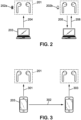
- Figure 2 is a representation of an example not according to the invention.
- the slave system 201 may be configured for supporting different types of codecs (e.g. SBC, LDAC, Apt-X, etc.), wherein each codec may be associated to one or several possible bit rates (e.g. LDAC at 990 kbits/s, kbps, or 660 kbps). Alternatively, the slave system 201 may be configured for supporting one type of codec, at different possible bit rates.
- codecs e.g. SBC, LDAC, Apt-X, etc.
- each codec may be associated to one or several possible bit rates (e.g. LDAC at 990 kbits/s, kbps, or 660 kbps).
- the slave system 201 may be configured for supporting one type of codec, at different possible bit rates.
- the slave system 201 has a battery level 202a, 202b and is configured to send a low battery signal to the master device 203 when the battery level 202a, 202b falls under a predefined threshold (e.g. 20% of the maximum battery level).
- a predefined threshold e.g. 20% of the maximum battery level.
- the low battery signal may be sent by using a BLE (Bluetooth Low Energy) transmission or AVRCP (Audio/Video Remote Control Profile) profile.
- the operational parameter is the battery level 202a, 202b, of the slave system 201.
- the fact that the battery level 202a, 202b falls below the predefined threshold corresponds to the change of the operational parameter, as defined above with reference to Fig. 1 .
- the new operating mode may be a power-saving mode, and the reconfiguration of the link (or the links in case of point-to-multipoint transmission) may include modifying the type of codec and/or the bit rate (e.g. reducing the bit rate).
- the master device 203 may send 204 to the slave system 201 audio packets processed via a first codec type (e.g. stereo LDAC at 990 kbps).
- a first codec type e.g. stereo LDAC at 990 kbps.
- the slave system 201 sends 205 a low battery signal to the master device 203.
- the Bluetooth audio link has to be switched into a power-saving mode, in which the audio packets to be sent 206 to the slave system 201 are processed via a second codec type (e.g. stereo SBC at 328 kbps).
- a message may be displayed on a screen of the master device 203 for requesting a confirmation from the user that the master device 203 may be switched into the power-saving mode.
- the modification of the configuration of the link / links is triggered by an explicit action of the user.
- the master device 203 may be automatically switched into the power-saving mode, without any confirmation of the user. In this case, the modification of the configuration of the link / links is triggered without any action of the user.
- the master device 203 may send 204 to the slave system 201 audio packets processed via a first codec type (e.g. stereo LDAC at 990 kbps).
- a first codec type e.g. stereo LDAC at 990 kbps.
- the slave system 201 may then send to the master device 203 information relative to configuration parameter(s) modified based on this new operating mode.
- the master device 203 may process audio packets with a second codec type before sending them to the slave system 201.
- a similar reconfiguration method may be applied in the case where the operational parameter is the battery level of the master device 203.
- a low-power level of the battery of the master device 203 may be detected.
- some configuration parameters may be modified. For instance, a data rate for the wireless link may be reduced.
- Figure 3 is a representation of an embodiment of the present invention.
- the slave system 201 may be configured for supporting different types of codecs (e.g. SBC, LDAC, Apt-X, etc.), wherein each codec may be associated to one or several possible bit rates (e.g. LDAC at 990 kbit/s, kbps, or 660 kbps). Alternatively, the slave system 201 may be configured for supporting one type of codec, at different possible bit rates.
- codecs e.g. SBC, LDAC, Apt-X, etc.
- each codec may be associated to one or several possible bit rates (e.g. LDAC at 990 kbit/s, kbps, or 660 kbps).
- the slave system 201 may be configured for supporting one type of codec, at different possible bit rates.
- the operational parameter is a specific application launched on the master device 203.
- a change of the operational parameter is detected when the user changes the application launched on the master device 203 (for instance, the user uses Spotify ® instead of Youtube ® ).
- two applications even if they belong to a same type of application (for instance, a streaming application) may not have the same sampling rates, and it may be advantageous to reconfigure the Bluetooth audio link so its sampling rate matches the one of the applications currently launched.
- Such reconfiguration avoids the audio server of the master device 203 to have to resample the audio data, which degrades the audio quality.
- the modification of the configuration of the link / links is implicitly triggered by an action of the user (the change of application).
- the user may use a first application for which the audio packets are processed by a first codec at a first sampling rate (e.g. a stereo SBC at a sampling frequency of 48000 Hz and a bit rate of 328 kbps) and sent 301 to the audio slave system 201.
- a first sampling rate e.g. a stereo SBC at a sampling frequency of 48000 Hz and a bit rate of 328 kbps
- the sampling frequency and/or the bit rate of the codec may be changed.
- the audio packets are processed by a second codec at a second sampling rate (e.g. a stereo SBC at a sampling frequency of 44100 Hz and a bit rate of 328 kbps).
- Figure 4 is a representation of a second possible embodiment of the present invention.
- the operational parameter is a type of application launched on the master device 203, for instance a gaming application (e.g. PlayerUnknown's Battlegrounds ® - PUBG, Fortnite ® , etc.).
- a change of the operational parameter is detected when the user starts a given type of application on the master device 203.
- some types of application require specific operating modes: for instance, a low-latency mode may be necessary to have a better gaming experience. Therefore, if the Bluetooth slave system 201 supports such low-latency mode, it is advantageous to reconfigure the link between the master device 203 and the slave system 201 into a low latency configuration.
- the modification of the configuration of the link / links is implicitly triggered by an action of the user (starting a specific type of application).
- the Bluetooth communication link between the master device 203 and the slave system 201 may correspond to a first operating mode (e.g. a standard mode in which the latency between the source and the decoded audio may be relatively high), in which the audio packets are processed by a first codec having a first latency and sent 401 to the audio slave system 201.
- a first operating mode e.g. a standard mode in which the latency between the source and the decoded audio may be relatively high
- the audio packets are processed by a first codec having a first latency and sent 401 to the audio slave system 201.
- a specific type of application e.g. gaming
- Such low latency mode may be activated in other situations, for instance, when the operational parameter is a local source of audio data, and when the change of this operational parameter corresponds to a change of application (e.g. switching from music playing to video gaming).
- Figure 5 is a representation of an example not according to the invention.
- the slave system 201 may consist of a pair of earbuds 201a, 201b.
- each earpiece may be configured for outputting respective audio data.
- the first earbud 201a may be configured to play audio data relative to one of the two channels (for instance, the right channel)
- the second earbud 201b may be configured to play audio data relative to the other one of the two channels (for instance, the left channel).
- each user 501, 502 may use a respective earbud 201a, 201b among the pair of earbuds connected to a master device 203.
- a master device 203 there is a lack of auditory comfort for the users 501, 502, since each user 501, 502 only receives audio content corresponding to one of the two channels.
- the transmission of audio packets may be performed based on a first codec (e.g. an SBC codec), the right earbud 201a being configured for playing audio data corresponding to the right channel and the left earbud 201b being configured for playing audio data corresponding to the left channel.
- a first codec e.g. an SBC codec
- the right earbud 201a being configured for playing audio data corresponding to the right channel
- the left earbud 201b being configured for playing audio data corresponding to the left channel.
- the first codec may be a stereo codec in case of a forwarding architecture, or a mono codec in a point-to-multipoint architecture.
- the transmission of audio packets may be performed based on a second codec (e.g. an SBC codec), wherein each packet includes data corresponding to both of the left and the right channel and is sent 503, 504 to both earbuds 201a and 201b. Therefore, both earbuds 201a and 201b are configured to play a same audio content based on the received packets.
- the second codec may be a mono codec, or a stereo codec with a same audio content on the two channels.
- An audio content may correspond for instance to a downmixed channel of a left channel and a corresponding right channel.
- the user may select the "sharing mode" on the master device 203 or on the slave system 201.
- the modification of the configuration of the link / links is explicitly triggered by an action of the user.
- the sharing mode may be automatically activated, for instance, when it is detected that the distance between the two earbuds 201a, 201b is above a predefined threshold.
- Figure 6 is a possible embodiment for a device that enables the present invention. Such device may be incorporated into the master device or into the slave device.
- the device 600 comprises a computer, this computer comprising a memory 605 to store program instructions loadable into a circuit and adapted to cause circuit 604 to carry out the steps of the present invention when the program instructions are run by the circuit 604.
- the memory 605 may also store data and useful information for carrying the steps of the present invention as described above.
- the circuit 604 may be for instance:
- This computer may comprise an input interface 603 for receiving information relative to a change of value of an operational parameter in either the Bluetooth device or the second device according to the invention, and an output interface 606 for providing a configuration parameter of the Bluetooth communication link based on a new operating mode.
- a screen 601 and a keyboard 602 may be provided and connected to the computer circuit 604.
- Figure 1 is a typical example of a program which some instructions can be performed by the device described 600.
- Figure 1 may thus correspond to the flowchart of the general algorithm of a computer program within the meaning of the invention.
- the Bluetooth operation is conducted by a Bluetooth driver stored in a first section of the memory 605, while the operational parameters are determined with an operating system stored in a second section of memory 605. Additionally, the operating system may interface with one or more applications to determine one or more operational parameters, where the application is located in a third section of memory 605. This advantageously separation of these functions allows for independent development of each without the need to alter the other functions at the same time.
- the modification of a configuration parameter may comprise changing a sound quality configuration parameter of an audio codec to a higher quality, wherein the audio codec processes information associated with the streaming application.
- the sound quality configuration parameter may be for instance a sampling rate for an audio codec, an audio codec selection parameter, or a configuration parameter changing the channel configuration from mono to stereo.
- the modification of a configuration parameter may comprise changing a channel configuration parameter from a unidirectional audio link to a bidirectional audio link.
- the slave system 201 When the slave system 201 consists in two earbuds 201a, 201b, it can happen that one of the two earbuds is disabled (e.g. if the communication link is interrupted to this earbud). In such a situation, it may be detected that one earbud is deactivated, and the channel configuration may be switched from stereo to mono. The deactivation of one earbud may be performed, for instance, by receiving a message on the master device.
- a similar change may be performed when a change in the local source of audio data from a stereo source to a mono source is detected.
- the wireless communication link may be reconfigured from a stereo link to a mono link in response to said change, and the audio data are then transmitted to the earbuds in mono format.
Landscapes
- Engineering & Computer Science (AREA)
- Computer Networks & Wireless Communication (AREA)
- Signal Processing (AREA)
- Human Computer Interaction (AREA)
- Mobile Radio Communication Systems (AREA)
Claims (16)
- Verfahren zum Betreiben einer Bluetooth-Vorrichtung (700), wobei das Verfahren Folgendes umfasst:Transportieren (102) von Audioinformationen über eine Bluetooth-Kommunikationsverbindung, die mit einer zweiten Vorrichtung hergestellt wurde (101);Bestimmen (104) eines neuen Betriebsmodus für die Bluetooth-Kommunikationsverbindung bei einer Änderung (103) des Wertes eines Betriebsparameters entweder in der Bluetooth-Vorrichtung (700) oder der zweiten Vorrichtung;Modifizieren (105) eines Konfigurationsparameters der Bluetooth-Kommunikationsverbindung basierend auf dem neuen Betriebsmodus;Transportieren (102) von Audioinformationen auf der Bluetooth-Kommunikationsverbindung gemäß dem modifizierten Konfigurationsparameter;wobei der Betriebsparameter ein Start (402) einer markierten Spiel- oder Echtzeit-Videoanwendung auf der Bluetooth-Vorrichtung oder der zweiten Vorrichtung ist und der neue Betriebsmodus ein Modus mit niedriger Latenzzeit ist.
- Verfahren nach Anspruch 1, wobei der Betriebsparameter einem auf der Bluetooth-Vorrichtung (700) oder der zweiten Vorrichtung laufenden Betriebssystem zugeordnet ist.
- Verfahren nach Anspruch 1, wobei der Betriebsparameter einer auf der Bluetooth-Vorrichtung (700) oder der zweiten Vorrichtung laufenden Anwendung zugeordnet ist.
- Verfahren nach einem der Ansprüche 1 bis 3, wobei das Modifizieren (105) des Konfigurationsparameters durch einen Bluetooth-Host durchgeführt wird.
- Verfahren nach einem der Ansprüche 1 bis 3, wobei das Modifizieren (105) des Konfigurationsparameters durch eine Bluetooth-Steuerung durchgeführt wird.
- Verfahren nach einem der vorhergehenden Ansprüche, wobei der Konfigurationsparameter einer von Folgenden ist:ein Audiokonfigurationsparameter odereinen Bluetooth-Verbindungsparameter.
- Verfahren nach Anspruch 6, wobei der Konfigurationsparameter ein Audiokonfigurationsparameter unter Folgendem ist:einem Typ von Codec,einem Parameter relativ zu einem Codec,einem Typ von Daten,einem Audiokanal-Auswahlparameter odereinem Abtastratenparameter.
- Verfahren nach Anspruch 6, wobei der Konfigurationsparameter ein Bluetooth-Verbindungsparameter unter Folgendem ist:einem Flush-Timeout-Parameter,einem Kanaltyp-Parameter,einem Dienstqualitätsparameter,mehreren Weitersendungsparametern,einem Parameter unter BLE-Verknüpfungsparametern,einem Pakettyp-Parameter undeinem Maximum-Transmission-Unit-, MTU-, Parameter.
- Bluetooth-Vorrichtung (700), umfassend einen Bluetooth-Chip, einen Prozessor und einen Speicher, konfiguriert zum:Transportieren (102) von Audioinformationen über eine Bluetooth-Kommunikationsverbindung, die mit einer zweiten Vorrichtung hergestellt wurde (101);Bestimmen (104) eines neuen Betriebsmodus für die Bluetooth-Kommunikationsverbindung bei einer Änderung (103) des Wertes eines Betriebsparameters entweder in der Bluetooth-Vorrichtung (700) oder der zweiten Vorrichtung;Modifizieren (105) eines Konfigurationsparameters der Bluetooth-Kommunikationsverbindung basierend auf dem bestimmten neuen Betriebsmodus;Transportieren (102) von Audioinformationen auf der Bluetooth-Kommunikationsverbindung gemäß dem modifizierten Konfigurationsparameter;wobei der Betriebsparameter ein Start (402) einer markierten Spiel- oder Echtzeit-Videoanwendung auf der Bluetooth-Vorrichtung oder der zweiten Vorrichtung ist und der neue Betriebsmodus ein Modus mit niedriger Latenzzeit ist.
- Bluetooth-Vorrichtung (700) nach Anspruch 9, wobei der Betriebsparameter einem Betriebssystem der Bluetooth-Vorrichtung (700) oder der zweiten Vorrichtung zugeordnet ist.
- Bluetooth-Vorrichtung (700) nach Anspruch 9, wobei der Betriebsparameter einer auf der Bluetooth-Vorrichtung (700) oder der zweiten Vorrichtung laufenden Anwendung zugeordnet ist.
- Bluetooth-Vorrichtung (700) nach einem der Ansprüche 9 bis 11, ferner umfassend eine Bluetooth-Steuerung und wobei das Modifizieren (105) des Konfigurationsparameters durch die Bluetooth-Steuerung durchgeführt wird.
- Bluetooth-Vorrichtung (700) nach einem der Ansprüche 9 bis 12, wobei der Konfigurationsparameter einer von Folgenden ist:ein Audiokonfigurationsparameter odereinen Bluetooth-Verbindungsparameter.
- Bluetooth-Vorrichtung (700) nach Anspruch 9, wobei der Betriebsparameter ein Audiokonfigurationsparameter unter Folgendem ist:einem Typ von Codec,einem Parameter relativ zu einem Codec,einem Typ von Daten,einem Audiokanal-Auswahlparameter odereinem Abtastratenparameter.
- Bluetooth-Vorrichtung (700) nach Anspruch 13, wobei der Betriebsparameter ein Bluetooth-Verbindungsparameter unter Folgendem ist:einem Flush-Timeout-Parameter,einem Kanaltyp-Parameter,einem Dienstqualitätsparameter,einer Anzahl von Weitersendungsparametern,einem Parameter unter BLE-Verknüpfungsparametern,einem Pakettyp-Parameter undeinem Maximum-Transmission-Unit-, MTU-, Parameter.
- Nichttransitorisches computerlesbares Speichermedium, das ein darauf gespeichertes Computerprogramm, das Programmanweisungen umfasst, aufweist, wobei das Computerprogramm in eine Datenverarbeitungseinheit geladen werden kann und dafür ausgelegt ist, die Datenverarbeitungseinheit zu veranlassen, die Schritte eines der Ansprüche 1 bis 8 durchzuführen, wenn das Computerprogramm durch die Datenverarbeitungsvorrichtung ausgeführt wird.
Priority Applications (9)
| Application Number | Priority Date | Filing Date | Title |
|---|---|---|---|
| EP24202632.6A EP4462889A3 (de) | 2019-05-31 | 2019-05-31 | Verfahren zum betreiben einer bluetooth-vorrichtung |
| EP19305702.3A EP3745813B1 (de) | 2019-05-31 | 2019-05-31 | Verfahren zum betrieb einer bluetooth-vorrichtung |
| KR1020237027887A KR102697310B1 (ko) | 2019-05-31 | 2020-05-29 | 블루투스 장치 동작 방법 |
| US17/607,728 US12543121B2 (en) | 2019-05-31 | 2020-05-29 | Method for operating a Bluetooth device |
| JP2021558952A JP7302006B2 (ja) | 2019-05-31 | 2020-05-29 | Bluetoothデバイスを操作するための方法 |
| PCT/EP2020/064993 WO2020239985A1 (en) | 2019-05-31 | 2020-05-29 | Method for operating a bluetooth device |
| KR1020217030912A KR102569374B1 (ko) | 2019-05-31 | 2020-05-29 | 블루투스 장치 동작 방법 |
| CN202080026742.5A CN114026894A (zh) | 2019-05-31 | 2020-05-29 | 操作蓝牙设备的方法 |
| JP2023101831A JP7638329B2 (ja) | 2019-05-31 | 2023-06-21 | Bluetoothデバイスを操作するための方法 |
Applications Claiming Priority (1)
| Application Number | Priority Date | Filing Date | Title |
|---|---|---|---|
| EP19305702.3A EP3745813B1 (de) | 2019-05-31 | 2019-05-31 | Verfahren zum betrieb einer bluetooth-vorrichtung |
Related Child Applications (2)
| Application Number | Title | Priority Date | Filing Date |
|---|---|---|---|
| EP24202632.6A Division EP4462889A3 (de) | 2019-05-31 | 2019-05-31 | Verfahren zum betreiben einer bluetooth-vorrichtung |
| EP24202632.6A Division-Into EP4462889A3 (de) | 2019-05-31 | 2019-05-31 | Verfahren zum betreiben einer bluetooth-vorrichtung |
Publications (2)
| Publication Number | Publication Date |
|---|---|
| EP3745813A1 EP3745813A1 (de) | 2020-12-02 |
| EP3745813B1 true EP3745813B1 (de) | 2025-01-22 |
Family
ID=67060343
Family Applications (2)
| Application Number | Title | Priority Date | Filing Date |
|---|---|---|---|
| EP19305702.3A Active EP3745813B1 (de) | 2019-05-31 | 2019-05-31 | Verfahren zum betrieb einer bluetooth-vorrichtung |
| EP24202632.6A Pending EP4462889A3 (de) | 2019-05-31 | 2019-05-31 | Verfahren zum betreiben einer bluetooth-vorrichtung |
Family Applications After (1)
| Application Number | Title | Priority Date | Filing Date |
|---|---|---|---|
| EP24202632.6A Pending EP4462889A3 (de) | 2019-05-31 | 2019-05-31 | Verfahren zum betreiben einer bluetooth-vorrichtung |
Country Status (1)
| Country | Link |
|---|---|
| EP (2) | EP3745813B1 (de) |
Families Citing this family (10)
| Publication number | Priority date | Publication date | Assignee | Title |
|---|---|---|---|---|
| CN116490923B (zh) * | 2020-12-07 | 2024-10-18 | Oppo广东移动通信有限公司 | 参数设置方法、装置、设备及存储介质 |
| CN115348567B (zh) * | 2021-05-13 | 2025-07-15 | 北京小米移动软件有限公司 | 蓝牙通信方法、蓝牙通信装置及存储介质 |
| CN115696279B (zh) * | 2021-07-23 | 2025-03-25 | 北京小米移动软件有限公司 | 信息处理方法、装置、电子设备及存储介质 |
| CN115811720A (zh) * | 2021-09-15 | 2023-03-17 | 北京小米移动软件有限公司 | 音频数据处理方法、装置、存储介质及电子设备 |
| CN115278625B (zh) * | 2022-07-26 | 2025-08-05 | 伟光有限公司 | 蓝牙多媒体包的传输方法、装置、设备和系统 |
| CN115664468B (zh) * | 2022-09-21 | 2023-11-21 | 深圳市酷开网络科技股份有限公司 | 蓝牙播放设备的数据传输方法、装置、终端设备及介质 |
| WO2024107237A1 (en) * | 2022-11-17 | 2024-05-23 | Google Llc | Low-latency dynamic spatial audio |
| WO2024152244A1 (zh) * | 2023-01-18 | 2024-07-25 | Oppo 广东移动通信有限公司 | 数据传输方法和系统、蓝牙设备及芯片 |
| CN116419359B (zh) * | 2023-06-09 | 2023-10-31 | 荣耀终端有限公司 | 蓝牙控制方法和设备 |
| CN119497207B (zh) * | 2025-01-20 | 2025-04-25 | 东莞市天翼通讯电子有限公司 | 低功耗双模蓝牙芯片的数据包传输控制方法及装置 |
Citations (2)
| Publication number | Priority date | Publication date | Assignee | Title |
|---|---|---|---|---|
| EP2292062B1 (de) * | 2008-06-25 | 2016-12-14 | Nokia Technologies Oy | Kanalmanagement über verknüpfungsparametereinstellungen |
| CN107708192A (zh) * | 2017-10-11 | 2018-02-16 | 普联技术有限公司 | 一种自动切换蓝牙工作模式的方法及装置 |
Family Cites Families (5)
| Publication number | Priority date | Publication date | Assignee | Title |
|---|---|---|---|---|
| JP4976440B2 (ja) | 2008-05-19 | 2012-07-18 | 創新音▲速▼股▲ふん▼有限公司 | 接続を再確立する方法及び通信装置 |
| KR101510736B1 (ko) * | 2008-11-21 | 2015-04-10 | 삼성전자주식회사 | 블루투스 디바이스의 배터리 레벨 통지 방법 및 시스템 |
| CN101977272A (zh) * | 2010-10-26 | 2011-02-16 | 浙江大学 | 一种用于Android操作系统手机的电量保护方法 |
| US8787403B2 (en) | 2012-05-14 | 2014-07-22 | Texas Instruments Incorporated | Audio convergence control facilitating bitpool value converging to stable level |
| US20160359925A1 (en) * | 2015-06-08 | 2016-12-08 | Lg Electronics Inc. | Method and apparatus for transmitting and receiving data in wireless communication system |
-
2019
- 2019-05-31 EP EP19305702.3A patent/EP3745813B1/de active Active
- 2019-05-31 EP EP24202632.6A patent/EP4462889A3/de active Pending
Patent Citations (2)
| Publication number | Priority date | Publication date | Assignee | Title |
|---|---|---|---|---|
| EP2292062B1 (de) * | 2008-06-25 | 2016-12-14 | Nokia Technologies Oy | Kanalmanagement über verknüpfungsparametereinstellungen |
| CN107708192A (zh) * | 2017-10-11 | 2018-02-16 | 普联技术有限公司 | 一种自动切换蓝牙工作模式的方法及装置 |
Also Published As
| Publication number | Publication date |
|---|---|
| EP4462889A3 (de) | 2025-01-15 |
| EP3745813A1 (de) | 2020-12-02 |
| EP4462889A2 (de) | 2024-11-13 |
Similar Documents
| Publication | Publication Date | Title |
|---|---|---|
| EP3745813B1 (de) | Verfahren zum betrieb einer bluetooth-vorrichtung | |
| US12543121B2 (en) | Method for operating a Bluetooth device | |
| US20250007973A1 (en) | Adaptive audio processing method, device, computer program, and recording medium thereof in wireless communication system | |
| US12382222B2 (en) | Method for managing a plurality of multimedia communication links in a point-to-multipoint Bluetooth network | |
| CN111527733B (zh) | 控制双模蓝牙低能耗多媒体装置 | |
| KR102847502B1 (ko) | 무선 통신 시스템에서 오디오 라우팅 방법, 장치, 컴퓨터 프로그램 및 그 기록 매체 | |
| US9008580B2 (en) | Configuring a codec for communicating audio data using a Bluetooth network connection | |
| WO2022120782A1 (en) | Multimedia playback synchronization | |
| US20250106920A1 (en) | Variable physical layer symbol rate for a wireless communication link | |
| KR102848361B1 (ko) | 무선 통신 시스템에서 주변 디바이스의 상태를 제어 및 관리하는 방법, 장치, 컴퓨터 프로그램 및 그 기록 매체 | |
| WO2021160040A1 (zh) | 音频传输方法及电子设备 | |
| US20240349371A1 (en) | Pairing a target device with a source device and pairing the target device with a partner device | |
| CN114615589B (zh) | 一种无线耳机的音量控制方法及无线耳机 | |
| WO2024066648A1 (zh) | 设备的控制方法、装置、蓝牙耳机以及存储介质 |
Legal Events
| Date | Code | Title | Description |
|---|---|---|---|
| PUAI | Public reference made under article 153(3) epc to a published international application that has entered the european phase |
Free format text: ORIGINAL CODE: 0009012 |
|
| STAA | Information on the status of an ep patent application or granted ep patent |
Free format text: STATUS: THE APPLICATION HAS BEEN PUBLISHED |
|
| AK | Designated contracting states |
Kind code of ref document: A1 Designated state(s): AL AT BE BG CH CY CZ DE DK EE ES FI FR GB GR HR HU IE IS IT LI LT LU LV MC MK MT NL NO PL PT RO RS SE SI SK SM TR |
|
| AX | Request for extension of the european patent |
Extension state: BA ME |
|
| STAA | Information on the status of an ep patent application or granted ep patent |
Free format text: STATUS: REQUEST FOR EXAMINATION WAS MADE |
|
| 17P | Request for examination filed |
Effective date: 20210602 |
|
| RBV | Designated contracting states (corrected) |
Designated state(s): AL AT BE BG CH CY CZ DE DK EE ES FI FR GB GR HR HU IE IS IT LI LT LU LV MC MK MT NL NO PL PT RO RS SE SI SK SM TR |
|
| RAP1 | Party data changed (applicant data changed or rights of an application transferred) |
Owner name: GOOGLE LLC |
|
| STAA | Information on the status of an ep patent application or granted ep patent |
Free format text: STATUS: EXAMINATION IS IN PROGRESS |
|
| 17Q | First examination report despatched |
Effective date: 20221109 |
|
| GRAP | Despatch of communication of intention to grant a patent |
Free format text: ORIGINAL CODE: EPIDOSNIGR1 |
|
| STAA | Information on the status of an ep patent application or granted ep patent |
Free format text: STATUS: GRANT OF PATENT IS INTENDED |
|
| INTG | Intention to grant announced |
Effective date: 20240311 |
|
| GRAJ | Information related to disapproval of communication of intention to grant by the applicant or resumption of examination proceedings by the epo deleted |
Free format text: ORIGINAL CODE: EPIDOSDIGR1 |
|
| STAA | Information on the status of an ep patent application or granted ep patent |
Free format text: STATUS: EXAMINATION IS IN PROGRESS |
|
| INTC | Intention to grant announced (deleted) | ||
| GRAP | Despatch of communication of intention to grant a patent |
Free format text: ORIGINAL CODE: EPIDOSNIGR1 |
|
| STAA | Information on the status of an ep patent application or granted ep patent |
Free format text: STATUS: GRANT OF PATENT IS INTENDED |
|
| INTG | Intention to grant announced |
Effective date: 20240812 |
|
| GRAS | Grant fee paid |
Free format text: ORIGINAL CODE: EPIDOSNIGR3 |
|
| GRAA | (expected) grant |
Free format text: ORIGINAL CODE: 0009210 |
|
| STAA | Information on the status of an ep patent application or granted ep patent |
Free format text: STATUS: THE PATENT HAS BEEN GRANTED |
|
| P01 | Opt-out of the competence of the unified patent court (upc) registered |
Free format text: CASE NUMBER: APP_65465/2024 Effective date: 20241211 |
|
| AK | Designated contracting states |
Kind code of ref document: B1 Designated state(s): AL AT BE BG CH CY CZ DE DK EE ES FI FR GB GR HR HU IE IS IT LI LT LU LV MC MK MT NL NO PL PT RO RS SE SI SK SM TR |
|
| REG | Reference to a national code |
Ref country code: GB Ref legal event code: FG4D |
|
| REG | Reference to a national code |
Ref country code: CH Ref legal event code: EP |
|
| REG | Reference to a national code |
Ref country code: IE Ref legal event code: FG4D |
|
| REG | Reference to a national code |
Ref country code: DE Ref legal event code: R096 Ref document number: 602019065048 Country of ref document: DE |
|
| REG | Reference to a national code |
Ref country code: NL Ref legal event code: FP |
|
| PGFP | Annual fee paid to national office [announced via postgrant information from national office to epo] |
Ref country code: NL Payment date: 20250526 Year of fee payment: 7 |
|
| PG25 | Lapsed in a contracting state [announced via postgrant information from national office to epo] |
Ref country code: RS Free format text: LAPSE BECAUSE OF FAILURE TO SUBMIT A TRANSLATION OF THE DESCRIPTION OR TO PAY THE FEE WITHIN THE PRESCRIBED TIME-LIMIT Effective date: 20250422 |
|
| PG25 | Lapsed in a contracting state [announced via postgrant information from national office to epo] |
Ref country code: FI Free format text: LAPSE BECAUSE OF FAILURE TO SUBMIT A TRANSLATION OF THE DESCRIPTION OR TO PAY THE FEE WITHIN THE PRESCRIBED TIME-LIMIT Effective date: 20250122 |
|
| PG25 | Lapsed in a contracting state [announced via postgrant information from national office to epo] |
Ref country code: PL Free format text: LAPSE BECAUSE OF FAILURE TO SUBMIT A TRANSLATION OF THE DESCRIPTION OR TO PAY THE FEE WITHIN THE PRESCRIBED TIME-LIMIT Effective date: 20250122 |
|
| PGFP | Annual fee paid to national office [announced via postgrant information from national office to epo] |
Ref country code: DE Payment date: 20250529 Year of fee payment: 7 |
|
| PG25 | Lapsed in a contracting state [announced via postgrant information from national office to epo] |
Ref country code: ES Free format text: LAPSE BECAUSE OF FAILURE TO SUBMIT A TRANSLATION OF THE DESCRIPTION OR TO PAY THE FEE WITHIN THE PRESCRIBED TIME-LIMIT Effective date: 20250122 |
|
| PGFP | Annual fee paid to national office [announced via postgrant information from national office to epo] |
Ref country code: GB Payment date: 20250527 Year of fee payment: 7 |
|
| REG | Reference to a national code |
Ref country code: LT Ref legal event code: MG9D |
|
| PG25 | Lapsed in a contracting state [announced via postgrant information from national office to epo] |
Ref country code: NO Free format text: LAPSE BECAUSE OF FAILURE TO SUBMIT A TRANSLATION OF THE DESCRIPTION OR TO PAY THE FEE WITHIN THE PRESCRIBED TIME-LIMIT Effective date: 20250422 Ref country code: IS Free format text: LAPSE BECAUSE OF FAILURE TO SUBMIT A TRANSLATION OF THE DESCRIPTION OR TO PAY THE FEE WITHIN THE PRESCRIBED TIME-LIMIT Effective date: 20250522 |
|
| REG | Reference to a national code |
Ref country code: AT Ref legal event code: MK05 Ref document number: 1762447 Country of ref document: AT Kind code of ref document: T Effective date: 20250122 |
|
| PG25 | Lapsed in a contracting state [announced via postgrant information from national office to epo] |
Ref country code: HR Free format text: LAPSE BECAUSE OF FAILURE TO SUBMIT A TRANSLATION OF THE DESCRIPTION OR TO PAY THE FEE WITHIN THE PRESCRIBED TIME-LIMIT Effective date: 20250122 |
|
| PG25 | Lapsed in a contracting state [announced via postgrant information from national office to epo] |
Ref country code: LV Free format text: LAPSE BECAUSE OF FAILURE TO SUBMIT A TRANSLATION OF THE DESCRIPTION OR TO PAY THE FEE WITHIN THE PRESCRIBED TIME-LIMIT Effective date: 20250122 Ref country code: PT Free format text: LAPSE BECAUSE OF FAILURE TO SUBMIT A TRANSLATION OF THE DESCRIPTION OR TO PAY THE FEE WITHIN THE PRESCRIBED TIME-LIMIT Effective date: 20250522 |
|
| PGFP | Annual fee paid to national office [announced via postgrant information from national office to epo] |
Ref country code: FR Payment date: 20250526 Year of fee payment: 7 |
|
| PG25 | Lapsed in a contracting state [announced via postgrant information from national office to epo] |
Ref country code: BG Free format text: LAPSE BECAUSE OF FAILURE TO SUBMIT A TRANSLATION OF THE DESCRIPTION OR TO PAY THE FEE WITHIN THE PRESCRIBED TIME-LIMIT Effective date: 20250122 Ref country code: GR Free format text: LAPSE BECAUSE OF FAILURE TO SUBMIT A TRANSLATION OF THE DESCRIPTION OR TO PAY THE FEE WITHIN THE PRESCRIBED TIME-LIMIT Effective date: 20250423 |
|
| PG25 | Lapsed in a contracting state [announced via postgrant information from national office to epo] |
Ref country code: AT Free format text: LAPSE BECAUSE OF FAILURE TO SUBMIT A TRANSLATION OF THE DESCRIPTION OR TO PAY THE FEE WITHIN THE PRESCRIBED TIME-LIMIT Effective date: 20250122 |
|
| PG25 | Lapsed in a contracting state [announced via postgrant information from national office to epo] |
Ref country code: SE Free format text: LAPSE BECAUSE OF FAILURE TO SUBMIT A TRANSLATION OF THE DESCRIPTION OR TO PAY THE FEE WITHIN THE PRESCRIBED TIME-LIMIT Effective date: 20250122 |
|
| PG25 | Lapsed in a contracting state [announced via postgrant information from national office to epo] |
Ref country code: SM Free format text: LAPSE BECAUSE OF FAILURE TO SUBMIT A TRANSLATION OF THE DESCRIPTION OR TO PAY THE FEE WITHIN THE PRESCRIBED TIME-LIMIT Effective date: 20250122 |
|
| PG25 | Lapsed in a contracting state [announced via postgrant information from national office to epo] |
Ref country code: DK Free format text: LAPSE BECAUSE OF FAILURE TO SUBMIT A TRANSLATION OF THE DESCRIPTION OR TO PAY THE FEE WITHIN THE PRESCRIBED TIME-LIMIT Effective date: 20250122 |
|
| PG25 | Lapsed in a contracting state [announced via postgrant information from national office to epo] |
Ref country code: IT Free format text: LAPSE BECAUSE OF FAILURE TO SUBMIT A TRANSLATION OF THE DESCRIPTION OR TO PAY THE FEE WITHIN THE PRESCRIBED TIME-LIMIT Effective date: 20250122 |
|
| PG25 | Lapsed in a contracting state [announced via postgrant information from national office to epo] |
Ref country code: CZ Free format text: LAPSE BECAUSE OF FAILURE TO SUBMIT A TRANSLATION OF THE DESCRIPTION OR TO PAY THE FEE WITHIN THE PRESCRIBED TIME-LIMIT Effective date: 20250122 Ref country code: EE Free format text: LAPSE BECAUSE OF FAILURE TO SUBMIT A TRANSLATION OF THE DESCRIPTION OR TO PAY THE FEE WITHIN THE PRESCRIBED TIME-LIMIT Effective date: 20250122 |
|
| REG | Reference to a national code |
Ref country code: DE Ref legal event code: R097 Ref document number: 602019065048 Country of ref document: DE |
|
| PG25 | Lapsed in a contracting state [announced via postgrant information from national office to epo] |
Ref country code: RO Free format text: LAPSE BECAUSE OF FAILURE TO SUBMIT A TRANSLATION OF THE DESCRIPTION OR TO PAY THE FEE WITHIN THE PRESCRIBED TIME-LIMIT Effective date: 20250122 |
|
| PG25 | Lapsed in a contracting state [announced via postgrant information from national office to epo] |
Ref country code: SK Free format text: LAPSE BECAUSE OF FAILURE TO SUBMIT A TRANSLATION OF THE DESCRIPTION OR TO PAY THE FEE WITHIN THE PRESCRIBED TIME-LIMIT Effective date: 20250122 |
|
| PLBE | No opposition filed within time limit |
Free format text: ORIGINAL CODE: 0009261 |
|
| STAA | Information on the status of an ep patent application or granted ep patent |
Free format text: STATUS: NO OPPOSITION FILED WITHIN TIME LIMIT |
|
| REG | Reference to a national code |
Ref country code: CH Ref legal event code: L10 Free format text: ST27 STATUS EVENT CODE: U-0-0-L10-L00 (AS PROVIDED BY THE NATIONAL OFFICE) Effective date: 20251203 |
|
| REG | Reference to a national code |
Ref country code: CH Ref legal event code: H13 Free format text: ST27 STATUS EVENT CODE: U-0-0-H10-H13 (AS PROVIDED BY THE NATIONAL OFFICE) Effective date: 20251223 |
|
| 26N | No opposition filed |
Effective date: 20251023 |
|
| PG25 | Lapsed in a contracting state [announced via postgrant information from national office to epo] |
Ref country code: LU Free format text: LAPSE BECAUSE OF NON-PAYMENT OF DUE FEES Effective date: 20250531 |
|
| PG25 | Lapsed in a contracting state [announced via postgrant information from national office to epo] |
Ref country code: CH Free format text: LAPSE BECAUSE OF NON-PAYMENT OF DUE FEES Effective date: 20250531 |
|
| PG25 | Lapsed in a contracting state [announced via postgrant information from national office to epo] |
Ref country code: MC Free format text: LAPSE BECAUSE OF FAILURE TO SUBMIT A TRANSLATION OF THE DESCRIPTION OR TO PAY THE FEE WITHIN THE PRESCRIBED TIME-LIMIT Effective date: 20250122 |