EP3744619B1 - Power train support structure for vehicle - Google Patents
Power train support structure for vehicle Download PDFInfo
- Publication number
- EP3744619B1 EP3744619B1 EP20160682.9A EP20160682A EP3744619B1 EP 3744619 B1 EP3744619 B1 EP 3744619B1 EP 20160682 A EP20160682 A EP 20160682A EP 3744619 B1 EP3744619 B1 EP 3744619B1
- Authority
- EP
- European Patent Office
- Prior art keywords
- power train
- front side
- fixing portion
- mounting bracket
- support structure
- Prior art date
- Legal status (The legal status is an assumption and is not a legal conclusion. Google has not performed a legal analysis and makes no representation as to the accuracy of the status listed.)
- Active
Links
Images








Classifications
-
- B—PERFORMING OPERATIONS; TRANSPORTING
- B62—LAND VEHICLES FOR TRAVELLING OTHERWISE THAN ON RAILS
- B62D—MOTOR VEHICLES; TRAILERS
- B62D21/00—Understructures, i.e. chassis frame on which a vehicle body may be mounted
- B62D21/15—Understructures, i.e. chassis frame on which a vehicle body may be mounted having impact absorbing means, e.g. a frame designed to permanently or temporarily change shape or dimension upon impact with another body
-
- B—PERFORMING OPERATIONS; TRANSPORTING
- B60—VEHICLES IN GENERAL
- B60K—ARRANGEMENT OR MOUNTING OF PROPULSION UNITS OR OF TRANSMISSIONS IN VEHICLES; ARRANGEMENT OR MOUNTING OF PLURAL DIVERSE PRIME-MOVERS IN VEHICLES; AUXILIARY DRIVES FOR VEHICLES; INSTRUMENTATION OR DASHBOARDS FOR VEHICLES; ARRANGEMENTS IN CONNECTION WITH COOLING, AIR INTAKE, GAS EXHAUST OR FUEL SUPPLY OF PROPULSION UNITS IN VEHICLES
- B60K1/00—Arrangement or mounting of electrical propulsion units
-
- B—PERFORMING OPERATIONS; TRANSPORTING
- B62—LAND VEHICLES FOR TRAVELLING OTHERWISE THAN ON RAILS
- B62D—MOTOR VEHICLES; TRAILERS
- B62D25/00—Superstructure or monocoque structure sub-units; Parts or details thereof not otherwise provided for
- B62D25/08—Front or rear portions
-
- B—PERFORMING OPERATIONS; TRANSPORTING
- B60—VEHICLES IN GENERAL
- B60K—ARRANGEMENT OR MOUNTING OF PROPULSION UNITS OR OF TRANSMISSIONS IN VEHICLES; ARRANGEMENT OR MOUNTING OF PLURAL DIVERSE PRIME-MOVERS IN VEHICLES; AUXILIARY DRIVES FOR VEHICLES; INSTRUMENTATION OR DASHBOARDS FOR VEHICLES; ARRANGEMENTS IN CONNECTION WITH COOLING, AIR INTAKE, GAS EXHAUST OR FUEL SUPPLY OF PROPULSION UNITS IN VEHICLES
- B60K5/00—Arrangement or mounting of internal-combustion or jet-propulsion units
- B60K5/12—Arrangement of engine supports
-
- B—PERFORMING OPERATIONS; TRANSPORTING
- B60—VEHICLES IN GENERAL
- B60K—ARRANGEMENT OR MOUNTING OF PROPULSION UNITS OR OF TRANSMISSIONS IN VEHICLES; ARRANGEMENT OR MOUNTING OF PLURAL DIVERSE PRIME-MOVERS IN VEHICLES; AUXILIARY DRIVES FOR VEHICLES; INSTRUMENTATION OR DASHBOARDS FOR VEHICLES; ARRANGEMENTS IN CONNECTION WITH COOLING, AIR INTAKE, GAS EXHAUST OR FUEL SUPPLY OF PROPULSION UNITS IN VEHICLES
- B60K5/00—Arrangement or mounting of internal-combustion or jet-propulsion units
- B60K5/12—Arrangement of engine supports
- B60K5/1208—Resilient supports
- B60K5/1216—Resilient supports characterised by the location of the supports relative to the motor or to each other
-
- B—PERFORMING OPERATIONS; TRANSPORTING
- B62—LAND VEHICLES FOR TRAVELLING OTHERWISE THAN ON RAILS
- B62D—MOTOR VEHICLES; TRAILERS
- B62D21/00—Understructures, i.e. chassis frame on which a vehicle body may be mounted
- B62D21/02—Understructures, i.e. chassis frame on which a vehicle body may be mounted comprising longitudinally or transversely arranged frame members
-
- B—PERFORMING OPERATIONS; TRANSPORTING
- B62—LAND VEHICLES FOR TRAVELLING OTHERWISE THAN ON RAILS
- B62D—MOTOR VEHICLES; TRAILERS
- B62D21/00—Understructures, i.e. chassis frame on which a vehicle body may be mounted
- B62D21/11—Understructures, i.e. chassis frame on which a vehicle body may be mounted with resilient means for suspension, e.g. of wheels or engine; sub-frames for mounting engine or suspensions
-
- B—PERFORMING OPERATIONS; TRANSPORTING
- B62—LAND VEHICLES FOR TRAVELLING OTHERWISE THAN ON RAILS
- B62D—MOTOR VEHICLES; TRAILERS
- B62D21/00—Understructures, i.e. chassis frame on which a vehicle body may be mounted
- B62D21/15—Understructures, i.e. chassis frame on which a vehicle body may be mounted having impact absorbing means, e.g. a frame designed to permanently or temporarily change shape or dimension upon impact with another body
- B62D21/152—Front or rear frames
-
- B—PERFORMING OPERATIONS; TRANSPORTING
- B62—LAND VEHICLES FOR TRAVELLING OTHERWISE THAN ON RAILS
- B62D—MOTOR VEHICLES; TRAILERS
- B62D25/00—Superstructure or monocoque structure sub-units; Parts or details thereof not otherwise provided for
- B62D25/08—Front or rear portions
- B62D25/082—Engine compartments
-
- B—PERFORMING OPERATIONS; TRANSPORTING
- B60—VEHICLES IN GENERAL
- B60K—ARRANGEMENT OR MOUNTING OF PROPULSION UNITS OR OF TRANSMISSIONS IN VEHICLES; ARRANGEMENT OR MOUNTING OF PLURAL DIVERSE PRIME-MOVERS IN VEHICLES; AUXILIARY DRIVES FOR VEHICLES; INSTRUMENTATION OR DASHBOARDS FOR VEHICLES; ARRANGEMENTS IN CONNECTION WITH COOLING, AIR INTAKE, GAS EXHAUST OR FUEL SUPPLY OF PROPULSION UNITS IN VEHICLES
- B60K6/00—Arrangement or mounting of plural diverse prime-movers for mutual or common propulsion, e.g. hybrid propulsion systems comprising electric motors and internal combustion engines
- B60K6/20—Arrangement or mounting of plural diverse prime-movers for mutual or common propulsion, e.g. hybrid propulsion systems comprising electric motors and internal combustion engines the prime-movers consisting of electric motors and internal combustion engines, e.g. HEVs
- B60K6/22—Arrangement or mounting of plural diverse prime-movers for mutual or common propulsion, e.g. hybrid propulsion systems comprising electric motors and internal combustion engines the prime-movers consisting of electric motors and internal combustion engines, e.g. HEVs characterised by apparatus, components or means specially adapted for HEVs
- B60K6/40—Arrangement or mounting of plural diverse prime-movers for mutual or common propulsion, e.g. hybrid propulsion systems comprising electric motors and internal combustion engines the prime-movers consisting of electric motors and internal combustion engines, e.g. HEVs characterised by apparatus, components or means specially adapted for HEVs characterised by the assembly or relative disposition of components
-
- B—PERFORMING OPERATIONS; TRANSPORTING
- B60—VEHICLES IN GENERAL
- B60Y—INDEXING SCHEME RELATING TO ASPECTS CROSS-CUTTING VEHICLE TECHNOLOGY
- B60Y2200/00—Type of vehicle
- B60Y2200/90—Vehicles comprising electric prime movers
- B60Y2200/91—Electric vehicles
-
- B—PERFORMING OPERATIONS; TRANSPORTING
- B60—VEHICLES IN GENERAL
- B60Y—INDEXING SCHEME RELATING TO ASPECTS CROSS-CUTTING VEHICLE TECHNOLOGY
- B60Y2200/00—Type of vehicle
- B60Y2200/90—Vehicles comprising electric prime movers
- B60Y2200/92—Hybrid vehicles
-
- B—PERFORMING OPERATIONS; TRANSPORTING
- B60—VEHICLES IN GENERAL
- B60Y—INDEXING SCHEME RELATING TO ASPECTS CROSS-CUTTING VEHICLE TECHNOLOGY
- B60Y2306/00—Other features of vehicle sub-units
- B60Y2306/01—Reducing damages in case of crash, e.g. by improving battery protection
-
- B—PERFORMING OPERATIONS; TRANSPORTING
- B62—LAND VEHICLES FOR TRAVELLING OTHERWISE THAN ON RAILS
- B62D—MOTOR VEHICLES; TRAILERS
- B62D25/00—Superstructure or monocoque structure sub-units; Parts or details thereof not otherwise provided for
- B62D25/08—Front or rear portions
- B62D25/14—Dashboards as superstructure sub-units
-
- B—PERFORMING OPERATIONS; TRANSPORTING
- B62—LAND VEHICLES FOR TRAVELLING OTHERWISE THAN ON RAILS
- B62D—MOTOR VEHICLES; TRAILERS
- B62D25/00—Superstructure or monocoque structure sub-units; Parts or details thereof not otherwise provided for
- B62D25/20—Floors or bottom sub-units
Definitions
- the present invention relates to a power train support structure for a vehicle.
- a space in front of a dashboard panel constituting a front wall of a passenger compartment is used as an accommodation room (a so-called engine room) for accommodating a power train including an engine or a motor, and the like. It is also general that a pair of left and right front side frames extending in the front-rear direction are disposed in the accommodation room, and the power train is supported by the paired left and right front side frames.
- a power train is a rigid member. Therefore, it is required to suppress the power train from retracting toward a passenger within a passenger compartment (a driver on a driver seat and/or a passenger on a passenger seat) in the event of collision from the front side.
- Japanese Unexamined Patent Application Publication No. 2007-261529 discloses that, in a structure in which a mounting bracket for supporting a power train is mounted on a front side frame, the power train is allowed to fall downward by breaking the mounting bracket in the event of vehicular collision from the front side.
- a power train to be accommodated within an accommodation room may be disposed to be offset to one of left and right sides (to one side in the vehicle width direction).
- the driver seat or the passenger seat is located substantially immediately behind the power train.
- the event of collision from the front side particularly, in the event of oblique collision in which a collision load is input obliquely from the front side to a position offset to the same side as the power train (to one of left and right sides) with respect to a center of the width of a front surface of a vehicle body, in other words, in the event of small overlap collision (hereinafter, referred to as SOL collision), it is highly likely that the power train may retract by receiving the collision load.
- how to protect a passenger from the power train that retracts in the event of oblique collision or SOL collision is a task.
- EP 3 483 040 A1 describes a vehicle front portion structure including a pair of front side members arranged at a distance from each other in a vehicle width direction, each of the front side members extending in a vehicle front-rear direction, a gusset attached to a vehicle width direction outside surface of each of the front side members, protruding outwards in the vehicle width direction beyond the front side member, and having a vehicle width direction dimension decreasing toward a rear of a vehicle, and an MC cross member stretching between the front side members, in which the MC cross member and the front side member face each other in a state where the MC cross member and the front side member are apart from each other in the vehicle width direction at the same vehicle front-rear direction position as a rear end of the gusset.
- an object of the present invention is to provide a power train support structure that enables to appropriately protect a passenger within a vehicle in which a power train is disposed to be offset to one of left and right sides.
- the present invention is directed to a structure for supporting a power train disposed to be offset to one of left and right sides within an accommodation room formed in a vehicle front portion having the features disclosed in independent claim 1. Specific embodiments are defined in the dependent claims.
- FIGS. 1 to 3 are diagrams illustrating a schematic structure of a vehicle to which a power train support structure according to a first embodiment of the present invention is applied.
- the vehicle illustrated in FIGS. 1 to 3 is an electric vehicle in which only a motor is provided as a power source, and an engine (an internal combustion engine) is not provided.
- an element indicated by the reference numeral 1 is a dashboard panel.
- An accommodation room 2 for accommodating a power train is formed in front of the dashboard panel 1, and a passenger compartment 3 is formed behind the dashboard panel 1.
- a pair of left and right front side frames 4A and 4B are disposed in the accommodation room 2.
- the paired left and right front side frames 4A and 4B are strengthening members, whose rear ends are connected to a pair of left and right side sills and floor frames via a torque box and the like.
- a floor surface of the passenger compartment 3 is defined by a floor panel (see FIGS. 2 and 3 ).
- An upwardly bulging tunnel portion 7 is formed on an intermediate portion of the floor panel 6 in the left-right direction (in the vehicle width direction).
- the tunnel portion 7 extends in the front-rear direction along the floor panel 6, and includes a front end connected to a lower end of the dashboard panel 1.
- an opening portion 7a (see FIG. 1 ) opened in an intermediate portion of a lower end of the dashboard panel 1 in the left-right direction is formed in a front end of the tunnel portion 7.
- an element indicated by the reference sign PT is a power train.
- the power train PT is an electric power device including a motor 11, a transaxle 12, and an inverter 13.
- the power train PT as a whole is disposed within the accommodation room 2 in such a way that the power train PT is offset to one of left and right sides (in the present embodiment, to the vehicle right side).
- the power train PT is disposed in such a way that a center of the power train PT in the left-right direction is offset to one of left and right sides with respect to the vehicle width center.
- the power train PT is disposed between the paired left and right front side frames 4A and 4B.
- the front side frame 4A is disposed on the right side (on one of left and right sides) of the power train PT
- the front side frame 4B is disposed on the left side (on the other of the left and right sides) of the power train PT.
- a distance in the left-right direction between the left front side frame 4B and the power train PT is larger than a distance in the left-right direction between the right front side frame 4A and the power train PT.
- the right front side frame 4A near the power train PT corresponds to a "first front side frame" in the present invention
- the left front side frame 4B far from the power train PT corresponds to a "second front side frame” in the present invention.
- the motor 11 and the transaxle 12 are arranged in this order from the vehicle right side.
- the motor 11 is disposed to occupy an area including a right end of the power train PT, and the transaxle 12 is mounted on a left side surface of the motor 11.
- the inverter 13 is mounted on an upper surface of the motor 11.
- a driving force generated in the motor 11 is transmitted to a pair of left and right driving shafts 14 ( FIG. 1 ) via the transaxle 12.
- a front wheel (not illustrated) as a driving wheel is mounted on a distal end of each of the driving shafts 14.
- the inverter 13 adjusts electric power to be supplied to the motor 11 during driving of the vehicle. Further, during deceleration of the vehicle, the inverter 13 supplies, to a battery, electric power generated in the motor 11 functioning as a power generator (charges the battery).
- the paired left and right front side frames 4A and 4B are connected to each other at a position behind the power train PT via a suspension support member 5, which extends in the left-right direction as a strengthening member.
- the power train PT is supported on the vehicle body as follows. Specifically, a right end of the motor 11 is mounted on the right front side frame 4A via a mount member 21. A left end of the transaxle 12 is mounted on the left front side frame 4B via a mounting bracket 30 extending in the left-right direction, and a mounting member 22. The transaxle 12 is mounted on an intermediate portion of the suspension support member 5 in the left-right direction via a support bracket 23 and a mounting member 24. In this way, the power train PT is supported on the vehicle body at three positions in total, namely, at a left position, a right position, and a middle position.
- the left mounting member 22 corresponds to a "connecting member" in the present invention.
- the left mounting member 22 includes a first connecting portion 22a to be connected to the mounting bracket 30 (specifically, to an extension portion 31b to be described later), and a second connecting portion 22b to be connected to the left front side frame 4B.
- a waist portion in which a size in the front-right direction is reduced is formed between the first connecting portion 22a and the second connecting portion 22b.
- the waist portion of the mounting member 22 functions as a starting point of displacement of the power train PT, which displaces rearwardly in the event of vehicular collision from the front side.
- the waist portion is referred to as a displacement starting point ⁇ 1.
- the displacement starting point ⁇ 1 corresponds to a "predetermined portion of a connecting member" in the present invention.
- the mounting bracket 30 includes a top wall 31, a vertical wall 32 extending substantially linearly and downwardly from an end of the top wall 31 on the transaxle 12 side (on the vehicle right side), a flange portion 33, and reinforcement ribs 34.
- a material of the mounting bracket 30 is not specifically limited, as far as the material has a strength necessary for supporting the power train PT. However, a metal material such as aluminum alloy may be used, for example.
- the top wall 31 is formed into a plate shape having an upper surface of a relatively large area, and extends from the transaxle 12 to the vicinity of the left front side frame 4B.
- An upper surface of the top wall 31 is formed into an inclined flat shape in such a way that a height of the top wall 31 decreases toward the transaxle 12 (toward the right side).
- a plurality of opening portions 31a for reducing vibration (resonance) during driving are formed in the top wall 31.
- a viewing hole 31c for allowing an operator to easily perform an operation of connecting the mounting bracket 30 to the power train PT, which will be described later, is formed in the top wall 31.
- the top wall 31 includes an extension portion 31b, on a left end thereof, which is connected to the first connecting portion 22a ( FIG. 3 ) of the mounting member 22 in an overlapping manner.
- the extension portion 31b is formed into a substantially trapezoidal shape in a plan view, which is associated with the shape of the first connecting portion 22a of the mounting member 22.
- the extension portion 31b includes a plurality of (in this example, three) fixing portions 31bl.
- the mounting bracket 30 and the mounting member 22 are connected to each other by fastening the fastening bolts 41 to the fixing portions 31b1 in a state that the extension portion 31b of the mounting bracket 30 and the first connecting portion 22a of the mounting member 22 overlap each other.
- the vertical wall 32 functions as a mounting surface (a connecting surface) with respect to the power train PT (the transaxle 12). As illustrated in FIGS. 6 , 10 , 11 , and the like, the vertical wall 32 includes a plurality of (in this example, four) fixing portions 32a to 32d to which fastening bolts 40 (connecting tools) are attached. An insertion hole h2 for passing the fastening bolt 40 is formed in each of the fixing portions 32a to 32d. Specifically, the mounting bracket 30 is fixed to the power train PT via the fastening bolts 40 to be fastened to the fixing portions 32a to 32d.
- the fixing portions 32a to 32d are respectively referred to as the first fixing portion 32a, the second fixing portion 32b, the third fixing portion 32c, and the fourth fixing portion 32d.
- the first fixing portion 32a and the second fixing portion 32b are disposed on the front side with respect to the third fixing portion 32c and the fourth fixing portion 32d. Further, the first fixing portion 32a is disposed on the upper side with respect to the second fixing portion 32b, and the third fixing portion 32c is disposed on the upper side with respect to the fourth fixing portion 32d.
- the first fixing portion 32a corresponds to a "front fixing portion” in the present invention
- the second fixing portion 32b corresponds to a "lower fixing portion” in the present invention
- the third fixing portion 32c and the fourth fixing portion 32d correspond to a "rear fixing portion" in the present invention.
- the vertical wall 32 includes downwardly extending two leg portions 321 and 322.
- the leg portion 321 is disposed on the front side with respect to the leg portion 322.
- the second fixing portion 32b is formed on a distal end (a lower end) of the front leg portion 321, and the fourth fixing portion 32d is formed on a distal end (a lower end) of the rear leg portion 322.
- the first fixing portion 32a is formed near a base end of the front leg portion 321
- the third fixing portion 32c is formed near a base end of the rear leg portion 322.
- the vertical wall 32 further includes positioning holes 32e and 32f ( FIG. 10 ).
- the positioning holes 32e and 32f are holes for positioning the vertical wall 32 when being connected to the power train PT.
- the positioning hole 32e is formed near the base end of the rear leg portion 322 and in the vicinity of the third fixing portion 32c.
- the positioning hole 32f is formed in a distal end of the rear leg portion 322 and in the vicinity of the fourth fixing portion 32d.
- the flange portion 33 extends downwardly by a short length from a front edge of the top wall 31.
- the flange portion 33 continues to a front end of the vertical wall 32. Forming the flange portion 33 enhances rigidity of the mounting bracket 30.
- a large number of reinforcement ribs 34 are formed along a back surface of the top wall 31. Each end of a part of the reinforcement ribs 34 is connected to each of back surfaces (an inner surface) of the vertical wall 32 or the flange portion 33.
- the reinforcement ribs 34 play a role of enhancing rigidity of the mounting bracket 30 in cooperation with the flange portion 33.
- the mounting bracket 30 is formed in such a way that a strength (rigidity) near the first fixing portion 32a particularly increases. Specifically, by employing at least one of a method of increasing the thickness of the vertical wall 32 near the first fixing portion 32a, and a method of disposing the reinforcement ribs 34 in such a way as to increase the strength near the first fixing portion 32a, the strength near the first fixing portion 32a increases, as compared with the strength near the other fixing portions 32b to 32d.
- mounting holes 12a to 12d constituted of screw holes are formed in a left side surface (an inner side surface in the vehicle width direction) of the transaxle 12 of the power train PT, in other words, in a mounting surface with respect to the mounting bracket 30, and two positioning pins 12e and 12f are mounted on the left side surface of the transaxle 12.
- the positioning pins 12e and 12f mounted on the transaxle 12 are engaged in positioning holes 32e and 32f formed in the mounting bracket 30. By the engagement, positioning of the transaxle 12 and the mounting bracket 30 is performed.
- the fastening bolts 40 are fastened to the first to fourth fixing portions 32a to 32d of the mounting bracket 30 in a state that the above positioning is performed. Specifically, by passing the fastening bolts 40 in the insertion holes h2 of the fixing portions 32a to 32d, and screwing the fastening bolts 40 in the mounting holes 12a to 12d of the transaxle 12, the mounting bracket 30 is connected to the power train PT (the transaxle 12) via the fastening bolts 40.
- illustration of the fastening bolts 40 is omitted in order to illustrate positions of the first to fourth fixing portions 32a to 32d.
- an operator P ( FIG. 14 ) performs an operation of fastening the fastening bolts 40, while visually checking the positions of the first to fourth fixing portions 32a to 32d (the insertion holes h2) formed on the mounting bracket 30.
- the first fixing portion 32a as a front fixing portion is shielded by the top wall 31, the flange portion 33, and the reinforcement ribs 34 of the mounting bracket 30. Consequently, the first fixing portion 32a is less likely to be visually recognized from any direction, namely, from above, from the front side, and from the rear side. It is possible to visually check the position of the first fixing portion 32a from below.
- the operator P has to look up obliquely in a crouching posture. This is very inefficient in terms of operability.
- visually checking the other fixing portions 32b to 32d is relatively easy.
- the operator P can basically view the other fixing portions 32b to 32d from above the mounting bracket 30 by looking down with his/her head tilted a little, while standing.
- the viewing hole 31c is formed in the top wall 31 of the mounting bracket 30 in order to aid the operator to view the first fixing portion 32a, which is shielded by the various elements of the mounting bracket 30 as described above.
- the viewing hole 31c is formed in a specific part of the top wall 31 associated with the first fixing portion 32a in such a way that the operator can view the first fixing portion 32a (and the insertion hole h2 thereof) from above through the viewing hole 31c. More specifically, the viewing hole 31c is formed in a front right end of the top wall 31 (in an inner portion in the vehicle width direction of a front end of the top wall 31). Further, as illustrated in a bottom plan view of FIG. 9 , the viewing hole 31c is formed in an area surrounded by the flange portion 33 and the reinforcement ribs 34.
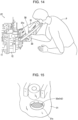
- FIG. 15 illustrates a state that the operator P is viewing the insertion hole h2 of the first fixing portion 32a through the viewing hole 31c.
- the first fixing portion 32a (the insertion hole h2) to be viewed is indicated by a hatched portion.
- the operator P can easily perform an operation of fastening the fastening bolt 40 with respect to the first fixing portion 32a, in other words, an operation of inserting the fastening bolt 40 into the insertion hole h2 of the first fixing portion 32a and screwing the fastening bolt 40 in the mounting hole 12a.
- connection of the power train PT and the mounting bracket 30 by the fastening bolts 40 may be disconnected.
- the operator can perform the disconnecting operation, while visually recognizing the fastening bolt 40 associated with the first fixing portion 32a through the viewing hole 31c.
- An assembly of the power train PT and the mounting bracket 30 connected by the fastening bolts 40 is, thereafter, mounted on the paired left and right front side frames 4A and 4B.
- Fixation by the fastening bolts 40 is preferably performed by performing provisional fixation in a state before the assembly of the power train PT and the mounting bracket 30 is installed on the front side frames 4A and 4B, and performing final fixation after the assembly is installed on the front side frames 4A and 4B.
- the reference sign ⁇ 1 indicates the displacement starting point of the left mounting member 22. Further, the reference sign ⁇ 2 indicates a connecting portion between the first fixing portion 32a of the mounting bracket 30, and the transaxle 12.
- the displacement starting point ⁇ 1 and the connecting portion ⁇ 2 are portions that are greatly related to movement of the power train PT in the event of collision from the front side.
- oblique collision or SOL collision
- a collision load is input obliquely from the front right side to a position offset to the right side (to the same side as the power train PT) with respect to a center of the width of the front surface of the vehicle body.
- the reference sign F indicates a collision load, which is supposed to be input obliquely from the front right side in the event of such oblique collision.
- the second to fourth fixing portions 32b to 32d having a relatively small strength among the connecting portions (fixing portions) of the mounting bracket 30 with respect to the transaxle 12 are broken at an early stage, and a state that the transaxle 12 and the mounting bracket 30 are connected only by the fixing portion 32a on the upper front side is acquired.
- a reaction force (a pushing force) of the mounting bracket 30 against the power train PT mainly acts from a front portion (the connecting portion ⁇ 2) of the mounting bracket 30, which corresponds to the first fixing portion 32a.
- the power train PT retracts, while performing yaw motion around the vicinity of the displacement starting point ⁇ 1 of the mounting member 22.
- the power train PT When yaw motion as described above is generated in the event of collision from the front side, the power train PT as a whole retracts, while displacing toward the vehicle width center, and is guided to a position between the driver seat and the passenger seat. In other words, the yaw motion plays a role of preventing or suppressing the power train PT from linearly retracting (moving toward the driver seat or the passenger seat).
- the power train PT displaces downwardly.
- the top wall 31 of the mounting bracket 30 is inclined in such a way that a height of the top wall 31 decreases toward the power train PT (toward the right side).
- the above-described shape of the mounting bracket 30 is preferable in terms of displacing the power train PT downwardly in the event of collision from the front side.
- Displacing the power train PT in the above-described direction in the event of collision from the front side means that the power train PT moves toward the opening portion 7a in the front end of the tunnel portion 7, which is located in the middle of the lower end of the dashboard panel 1. Therefore, even when a retraction amount of the power train PT is considerably large, the power train PT including the inverter 13, which is located at a relatively high position, moves in such a way as to enter the opening portion 7a. This prevents or suppresses the power train PT from entering the passenger compartment 3.
- FIG. 4 assumes a case that the collision load F is input obliquely from the front right side to a right portion of the front surface of the vehicle body.
- the above-described displacement of the power train PT (a displacement toward the opening portion 7a formed in the front end of the tunnel portion 7) is also observed in a case that a collision load is input linearly from the front side to the right portion of the front surface of the vehicle body (a position immediately in front of the power train PT).
- the vehicle body of the vehicle according to the present embodiment has a structure sharable between an electric vehicle without an engine, and a range extended electric vehicle including an engine exclusively used for power generation.
- the mounting bracket 30 is not provided.
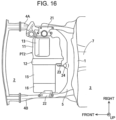
- FIG. 16 illustrates an installation example of a power train PT 2 for use in a range extended electric vehicle.
- a power train PT2 in place of a mounting bracket 30, an engine 15, and a power generator 16 to be powered by the engine 15 are disposed between a transaxle 12 and a mounting member 22.
- the power train PT2 has a structure in which a motor 11, the transaxle 12, the engine 15, and the power generator 16 are connected in series.
- FIGS. 17 to 19 illustrate a second embodiment according to the present invention.
- a measure for setting a position at which a collision load is input to a power train PT to a position away from a mounting member 22 as much as possible is provided in order to more securely acquire movement of the power train PT such that the power train PT retracts, while performing yaw motion in the event of collision from the front side.
- an element indicated by the reference numeral 51 is a casing as a strengthening member constituting an outer shell of the motor 11.
- an element indicated by the reference numeral 61 is a casing as a strengthening member constituting an outer shell of the transaxle 12.
- a boundary between the casings 51 and 61 is indicated by the reference sign ⁇ .
- a front surface 51a of the casing 51 of the motor 11 is formed to have a substantially arc shape projecting forwardly in a side view (particularly, see FIG. 19 ).
- the front surface 51a is formed in such a way that an amount of forward projection is the largest at an intermediate portion of the front surface 51a in the up-down direction, and the amount of forward projection decreases toward an upper or lower end of the front surface 51a.
- the front surface 51a of the casing 51 includes a load receiving portion 52 for receiving a collision load from the front side.
- the load receiving portion 52 includes a plurality of (in this example, two) projections 52a and 52b, each of which projects forwardly from the front surface 51a of the casing 51.
- the projections 52a and 52b are disposed away from each other in the up-down direction.
- the load receiving portion 52 (the projections 52a and 52b) is formed on a right end of the casing 51, in other words, at a position away from the mounting member 22 as much as possible. Therefore, when a collision load is input from the front side to the load receiving portion 52, moment for turning the power train PT rearwardly (moment for generating yaw motion) around the mounting member 22 (the displacement starting point ⁇ 1) is maximized.
- the plurality of projections 52a and 52b constituting the load receiving portion 52 are respectively formed into a substantially pillar shape, and have a strength (rigidity) sufficient for rigidly resisting against a collision load from the front side.
- the projections 52a and 52b are formed integrally with the casing 51.
- the casing 51 is a cast product made of aluminum alloy
- the projections 52a and 52b are simultaneously formed when the casing 51 is cast.
- a reinforcement rib 53 extending in the up-down direction and connecting the projections 52a and 52b is formed on the front surface 51a of the casing 51. Further, a plurality of horizontal reinforcement ribs 54 and a plurality of vertical reinforcement ribs 55 are formed on the front surface 51a of the casing 51. The reinforcement ribs 53 to 55 are integrally formed with the casing 51.
- the horizontal reinforcement ribs 54 extend by a certain length in a horizontal direction (in the left-right direction), and are away from one another in the up-down direction.
- two reinforcement ribs 54 namely, the uppermost reinforcement rib 54 and the lowermost reinforcement rib 54 continue to the projections 52a and 52b.
- the vertical reinforcement ribs 55 extend in an arc-shape in the up-down direction, and are away from one another in a horizontal direction (in the left-right direction).
- the vertical reinforcement ribs 55 are formed to connect the plurality of horizontal reinforcement ribs 54 one another.
- the reinforcement ribs 53 to 55 sufficiently reinforce the front surface 51a of the casing 51. Therefore, even when a collision load is input to the casing 51 of the motor 11 in the event of collision from the front side, there is no likelihood that the casing 51 is broken by the input load.
- the load receiving portion 52 is reinforced by the reinforcement rib 53 and the horizontal reinforcement ribs 54 continuing to the load receiving portion 52. In the event of collision from the front side, a collision load is received by the load receiving portion 52.
- the reinforced load receiving portion 52 is able to securely receive a collision load without causing crush and deformation by the collision load.
- connection pipes 56 and 57 constituted of a separate member are connected to an upper portion of the front surface 51a of the casing 51.
- the connection pipes 56 and 57 are configured to supply and discharge cooling water flowing through the casing 51.
- a front end of the load receiving portion 52 (the projections 52a and 52b) is located on the front side with respect to the other portions of the front surface 51a of the casing 51, and a front surface of the casing 61 of the transaxle 12.
- a front end of the load receiving portion 52 is a portion located forwardmost among the elements of the power train PT.
- the vehicle body member in a case that vehicular collision from the front side occurs, and a vehicle body member (e.g. a bumper reinforcement member) disposed in front of the power train PT retracts accompanied by the collision, the vehicle body member collides with the load receiving portion 52 at an early stage (first). Since the load receiving portion 52 is located on a right end of the power train PT (the motor 11), receiving a collision load at an early stage by the load receiving portion 52 causes moment for turning the power train PT rearwardly around the vicinity of the displacement starting point ⁇ 1 of the mounting member 22. Specifically, the presence of the load receiving portion 52 more securely evokes movement of the power train PT such that the power train PT retracts, while performing yaw motion.
- the number of the projections 52a and 52b constituting the load receiving portion 52 is not limited to two, and three or more projections may be available.
- FIG. 20 illustrates a modification in which the shape of the load receiving portion is modified, and is a diagram corresponding to FIG. 19 .
- a load receiving portion 72 has a shape extending in the up-down direction by a certain length.
- the load receiving portion 72 is integrally formed with a casing 51.
- the load receiving portion 72 may be a member independently of the casing 51, and may be mounted on a front surface 51a of the casing 51 afterwards. Further, the load receiving portion 72 may have a solid structure or a hollow structure.
- a direction in which the power train PT is offset with respect to the vehicle width center may be a side (a left side) opposite to the side in the embodiments.
- the number of the fastening bolts 40 for connecting the power train PT and the mounting bracket 30 is not specifically limited, as far as the number is plural.
- the positioning pins 12e and 12f are mounted on the power train PT, and the positioning holes 32e and 32f are formed in the mounting bracket 30, whereby the power train PT and the mounting bracket 30 are positioned to each other. Conversely, positioning may be performed by mounting a positioning pin on the mounting bracket 30, and forming a positioning hole in the power train PT.
- the viewing hole 31c is formed exclusively for the first fixing portion 32a.
- a viewing hole may be formed in association with a fixing portion, which is not easy to be viewed from above the mounting bracket 30, among the first to fourth fixing portions 32a to 32d, and a plurality of viewing holes associated with a plurality of fixing portions may be formed.
- the embodiments describe an example in which the present invention is applied to a vehicle employing a power train PT without an engine (in which only a motor is provided as a power source), in other words, an authentic electric vehicle.
- the present invention is also applicable to a vehicle employing a power train including an engine.
- a vehicle in this case may be a vehicle in which only an engine is provided as a power source, or a vehicle in which both of an engine and a motor are provided as power sources.
- a configuration of connecting respective units constituting a power train may be modified as necessary.
- the present invention implicitly includes providing a method for manufacturing automobiles in which an electric vehicle without an engine, and a range extender electric vehicle including an engine dedicatedly used for power generation are individually manufactured, while sharing a vehicle body. It is needless to say that an object of the present invention implicitly includes providing configurations expressed as substantially preferred or advantageous effects, not to mention explicitly expressed configurations.
- a power train support structure is a structure for supporting a power train disposed to be offset to one of left and right sides within an accommodation room formed in a vehicle front portion.
- the support structure includes: a first front side frame disposed on one of left and right sides of the power train; a second front side frame disposed on the other of the left and right sides of the power train, the second front side frame being greatly away from the power train with respect to the first front side frame; a mounting bracket extending in a left-right direction between the second front side frame and the power train, one of left and right ends of the mounting bracket being connected to the power train; and a connecting member for connecting the other of the left and right ends of the mounting bracket and the second front side frame.
- the mounting bracket includes a front fixing portion to be fixed to the power train, and a rear fixing portion to be fixed to the power train on a rear side with respect to the front fixing portion.
- a strength of each of the front fixing portion and the rear fixing portion is set to such a strength that the rear fixing portion is broken by the collision load and the front fixing portion is not broken in such a way that the power train in a plan view retracts, while performing yaw motion substantially around a predetermined portion of the connecting member.
- the power train retracts, while performing yaw motion toward the vehicle width center in the event of collision from the front side. Since the above configuration enables to guide the power train to a position between the driver seat and the passenger seat, it is possible to protect a passenger seated on the driver seat or the passenger seat. Further, since the rear fixing portion is broken, it is possible to actively guide at least a rear portion of the power train downwardly. This is more advantageous in protecting the passenger.
- the collision load from the front side is a collision load acting on the power train obliquely from a front side and one of left and right sides.
- the vehicle further includes a floor panel for defining a bottom surface of a passenger compartment, a dashboard panel for separating the accommodation room and the passenger compartment, and a tunnel portion formed on the floor panel and bulging upwardly.
- An opening portion opened in an intermediate portion of a lower end of the dashboard panel in the left-right direction is formed in a front end of the tunnel portion.
- the mounting bracket further includes a lower fixing portion to be fixed to the power train on a lower side with respect to the front fixing portion.
- the power train may include a motor, and an inverter connected to an upper surface of the motor.
- the mounting bracket may be disposed to incline in such a way that a height of the mounting bracket decreases toward the power train.
- the mounting bracket includes a reinforcement rib for reinforcing the front fixing portion in such a way that a strength of the front fixing portion increases, as compared with the other fixing portions.
- the reinforcement rib is formed on the mounting bracket, it is possible to set the strength of the front fixing portion to such a strength that the front fixing portion is not broken in the event of collision from the front side.
- a load receiving portion for receiving the collision load may be formed on one of left and right ends of a front surface of the power train.
- the load receiving portion may be formed to project forwardly from the front surface of the power train.
- the load receiving portion may include a plurality of projections disposed away from each other in an up-down direction.
- a collision load from the front side is input when a vehicle body member located on the front side with respect to the power train retracts, and collides with the power train.
- a position at which the vehicle body member collides with the power train varies in the up-down direction.
- a plurality of projections away from each other in the up-down direction are formed as the load receiving portion, even if the collision position varies in the up-down direction, it is possible to receive the collision load by one of the projections.
- a reinforcement rib continuing to the load receiving portion may be formed on the front surface of the power train.
- the reinforcement rib enables to reinforce not only the power train but also the load receiving portion. Therefore, in the event of collision from the front side, it is possible to securely receive the load from the front side by the reinforced load receiving portion. This enables to effectively use the load input to the load receiving portion, as a force of generating yaw motion of the power train.
- the power train may include, in an area including one of left and right ends of the power train, a motor for driving a wheel, and the load receiving portion may be integrally formed with a casing constituting an outer shell of the motor.
- the casing may be formed in such a way that a front end of the load receiving portion is located forwardmost.
- the power train may be formed in such a way that a front end of the load receiving portion is located forwardmost.
- the present invention is preferable as a safety measure against collision in a case that a power train is disposed to be offset to one of left and right sides.
Landscapes
- Engineering & Computer Science (AREA)
- Chemical & Material Sciences (AREA)
- Combustion & Propulsion (AREA)
- Transportation (AREA)
- Mechanical Engineering (AREA)
- Body Structure For Vehicles (AREA)
- Arrangement Or Mounting Of Propulsion Units For Vehicles (AREA)
Description
- The present invention relates to a power train support structure for a vehicle.
- In a vehicle, generally, a space in front of a dashboard panel constituting a front wall of a passenger compartment is used as an accommodation room (a so-called engine room) for accommodating a power train including an engine or a motor, and the like. It is also general that a pair of left and right front side frames extending in the front-rear direction are disposed in the accommodation room, and the power train is supported by the paired left and right front side frames.
- A power train is a rigid member. Therefore, it is required to suppress the power train from retracting toward a passenger within a passenger compartment (a driver on a driver seat and/or a passenger on a passenger seat) in the event of collision from the front side.
Japanese Unexamined Patent Application Publication No. 2007-261529 - A power train to be accommodated within an accommodation room may be disposed to be offset to one of left and right sides (to one side in the vehicle width direction). In this case, the driver seat or the passenger seat is located substantially immediately behind the power train. On the other hand, in the event of collision from the front side, particularly, in the event of oblique collision in which a collision load is input obliquely from the front side to a position offset to the same side as the power train (to one of left and right sides) with respect to a center of the width of a front surface of a vehicle body, in other words, in the event of small overlap collision (hereinafter, referred to as SOL collision), it is highly likely that the power train may retract by receiving the collision load. In view of the above, how to protect a passenger from the power train that retracts in the event of oblique collision or SOL collision is a task.
-
EP 3 483 040 A1 - In view of the above, an object of the present invention is to provide a power train support structure that enables to appropriately protect a passenger within a vehicle in which a power train is disposed to be offset to one of left and right sides.
- In order to achieve the above object, the present invention is directed to a structure for supporting a power train disposed to be offset to one of left and right sides within an accommodation room formed in a vehicle front portion having the features disclosed in
independent claim 1. Specific embodiments are defined in the dependent claims. -
-
FIG. 1 illustrates a first embodiment according to the present invention, and is a perspective view illustrating how a power train is disposed within an accommodation room. -
FIG. 2 is a cross-sectional view taken along the line X2-X2 inFIG. 1 . -
FIG. 3 is a plan view illustrating how the power train is disposed within the accommodation room. -
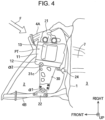
FIG. 4 is a plan view illustrating how a collision load acts obliquely from the front side in the event of oblique collision. -
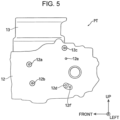
FIG. 5 is a side view illustrating one side surface of the power train including a mounting surface with respect to a mounting bracket. -
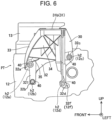
FIG. 6 is a side view illustrating a state that the mounting bracket is positioned with respect to the power train. -
FIG. 7 is a perspective view of the mounting bracket. -
FIG. 8 is a plan view of the mounting bracket viewed from above. -
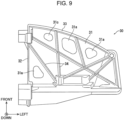
FIG. 9 is a bottom plan view of the mounting bracket viewed from below. -
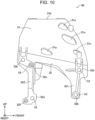
FIG. 10 is a side view of the mounting bracket viewed from the inner side in the vehicle width direction. -
FIG. 11 is a side view of the mounting bracket viewed from the outer side in the vehicle width direction. -
FIG. 12 is a rear view of the mounting bracket viewed from the rear side. -
FIG. 13 is a front view of the mounting bracket viewed from the front side. -
FIG. 14 is a diagram illustrating an operation of fixing the mounting bracket to the power train. -
FIG. 15 is an enlarged view of essential parts illustrating that a first fixing portion can be viewed from above the mounting bracket. -
FIG. 16 illustrates an example in which the power train including an engine and a power generator is mounted in a vehicle, and is a plan view corresponding toFIG. 3 . -
FIG. 17 illustrates a second embodiment according to the present invention, and is a plan view corresponding toFIG. 3 . -
FIG. 18 is a plan view of combinati on of a motor and a transaxle included in a power train inFIG. 17 , when viewed from above. -
FIG. 19 is a perspective view of the motor included in the power train inFIG. 17 , when viewed obliquely from the front side. -
FIG. 20 illustrates a modification of the second embodiment, and is a diagram corresponding toFIG. 19 . - In the following, preferred embodiments according to the present invention are described with reference to the drawings.
-
FIGS. 1 to 3 are diagrams illustrating a schematic structure of a vehicle to which a power train support structure according to a first embodiment of the present invention is applied. The vehicle illustrated inFIGS. 1 to 3 is an electric vehicle in which only a motor is provided as a power source, and an engine (an internal combustion engine) is not provided. - Referring to
FIGS. 1 to 3 , an element indicated by thereference numeral 1 is a dashboard panel. Anaccommodation room 2 for accommodating a power train is formed in front of thedashboard panel 1, and apassenger compartment 3 is formed behind thedashboard panel 1. A pair of left and rightfront side frames accommodation room 2. The paired left and rightfront side frames - A floor surface of the
passenger compartment 3 is defined by a floor panel (seeFIGS. 2 and3 ). An upwardly bulgingtunnel portion 7 is formed on an intermediate portion of thefloor panel 6 in the left-right direction (in the vehicle width direction). Thetunnel portion 7 extends in the front-rear direction along thefloor panel 6, and includes a front end connected to a lower end of thedashboard panel 1. In other words, anopening portion 7a (seeFIG. 1 ) opened in an intermediate portion of a lower end of thedashboard panel 1 in the left-right direction is formed in a front end of thetunnel portion 7. - In
FIGS. 1 to 3 , an element indicated by the reference sign PT is a power train. In the present embodiment, the power train PT is an electric power device including amotor 11, atransaxle 12, and aninverter 13. The power train PT as a whole is disposed within theaccommodation room 2 in such a way that the power train PT is offset to one of left and right sides (in the present embodiment, to the vehicle right side). In other words, the power train PT is disposed in such a way that a center of the power train PT in the left-right direction is offset to one of left and right sides with respect to the vehicle width center. - The power train PT is disposed between the paired left and right
front side frames front side frame 4A is disposed on the right side (on one of left and right sides) of the power train PT, and thefront side frame 4B is disposed on the left side (on the other of the left and right sides) of the power train PT. In the present embodiment, since the power train PT is disposed to be offset to the right side, a distance in the left-right direction between the leftfront side frame 4B and the power train PT is larger than a distance in the left-right direction between the rightfront side frame 4A and the power train PT. The rightfront side frame 4A near the power train PT corresponds to a "first front side frame" in the present invention, and the leftfront side frame 4B far from the power train PT corresponds to a "second front side frame" in the present invention. - The
motor 11 and thetransaxle 12 are arranged in this order from the vehicle right side. In other words, themotor 11 is disposed to occupy an area including a right end of the power train PT, and thetransaxle 12 is mounted on a left side surface of themotor 11. Theinverter 13 is mounted on an upper surface of themotor 11. - A driving force generated in the
motor 11 is transmitted to a pair of left and right driving shafts 14 (FIG. 1 ) via thetransaxle 12. A front wheel (not illustrated) as a driving wheel is mounted on a distal end of each of thedriving shafts 14. Theinverter 13 adjusts electric power to be supplied to themotor 11 during driving of the vehicle. Further, during deceleration of the vehicle, theinverter 13 supplies, to a battery, electric power generated in themotor 11 functioning as a power generator (charges the battery). - The paired left and right front side frames 4A and 4B are connected to each other at a position behind the power train PT via a
suspension support member 5, which extends in the left-right direction as a strengthening member. - The power train PT is supported on the vehicle body as follows. Specifically, a right end of the
motor 11 is mounted on the rightfront side frame 4A via amount member 21. A left end of thetransaxle 12 is mounted on the leftfront side frame 4B via a mountingbracket 30 extending in the left-right direction, and a mountingmember 22. Thetransaxle 12 is mounted on an intermediate portion of thesuspension support member 5 in the left-right direction via asupport bracket 23 and a mountingmember 24. In this way, the power train PT is supported on the vehicle body at three positions in total, namely, at a left position, a right position, and a middle position. Theleft mounting member 22 corresponds to a "connecting member" in the present invention. - As illustrated in
FIG. 3 , theleft mounting member 22 includes a first connecting portion 22a to be connected to the mounting bracket 30 (specifically, to anextension portion 31b to be described later), and a second connectingportion 22b to be connected to the leftfront side frame 4B. A waist portion in which a size in the front-right direction is reduced is formed between the first connecting portion 22a and the second connectingportion 22b. The waist portion of the mountingmember 22 functions as a starting point of displacement of the power train PT, which displaces rearwardly in the event of vehicular collision from the front side. In the following, the waist portion is referred to as a displacement starting point α1. The displacement starting point α1 corresponds to a "predetermined portion of a connecting member" in the present invention. - Next, details of the mounting
bracket 30 are described with reference toFIGS. 6 to 13 . The mountingbracket 30 includes atop wall 31, avertical wall 32 extending substantially linearly and downwardly from an end of thetop wall 31 on thetransaxle 12 side (on the vehicle right side), aflange portion 33, andreinforcement ribs 34. A material of the mountingbracket 30 is not specifically limited, as far as the material has a strength necessary for supporting the power train PT. However, a metal material such as aluminum alloy may be used, for example. - The
top wall 31 is formed into a plate shape having an upper surface of a relatively large area, and extends from thetransaxle 12 to the vicinity of the leftfront side frame 4B. An upper surface of thetop wall 31 is formed into an inclined flat shape in such a way that a height of thetop wall 31 decreases toward the transaxle 12 (toward the right side). A plurality of openingportions 31a for reducing vibration (resonance) during driving are formed in thetop wall 31. Further, aviewing hole 31c for allowing an operator to easily perform an operation of connecting the mountingbracket 30 to the power train PT, which will be described later, is formed in thetop wall 31. - The
top wall 31 includes anextension portion 31b, on a left end thereof, which is connected to the first connecting portion 22a (FIG. 3 ) of the mountingmember 22 in an overlapping manner. Theextension portion 31b is formed into a substantially trapezoidal shape in a plan view, which is associated with the shape of the first connecting portion 22a of the mountingmember 22. Theextension portion 31b includes a plurality of (in this example, three) fixing portions 31bl. An insertion hole h1 for passing a fastening bolt 41 (a connecting tool), which is illustrated inFIG. 3 , is formed in each of the fixing portions 31b1. Specifically, the mountingbracket 30 and the mountingmember 22 are connected to each other by fastening thefastening bolts 41 to the fixing portions 31b1 in a state that theextension portion 31b of the mountingbracket 30 and the first connecting portion 22a of the mountingmember 22 overlap each other. - The
vertical wall 32 functions as a mounting surface (a connecting surface) with respect to the power train PT (the transaxle 12). As illustrated inFIGS. 6 ,10 ,11 , and the like, thevertical wall 32 includes a plurality of (in this example, four) fixingportions 32a to 32d to which fastening bolts 40 (connecting tools) are attached. An insertion hole h2 for passing thefastening bolt 40 is formed in each of the fixingportions 32a to 32d. Specifically, the mountingbracket 30 is fixed to the power train PT via thefastening bolts 40 to be fastened to the fixingportions 32a to 32d. In the following, the fixingportions 32a to 32d are respectively referred to as thefirst fixing portion 32a, thesecond fixing portion 32b, thethird fixing portion 32c, and thefourth fixing portion 32d. - The
first fixing portion 32a and thesecond fixing portion 32b are disposed on the front side with respect to thethird fixing portion 32c and thefourth fixing portion 32d. Further, thefirst fixing portion 32a is disposed on the upper side with respect to thesecond fixing portion 32b, and thethird fixing portion 32c is disposed on the upper side with respect to thefourth fixing portion 32d. Thefirst fixing portion 32a corresponds to a "front fixing portion" in the present invention, and thesecond fixing portion 32b corresponds to a "lower fixing portion" in the present invention. Further, thethird fixing portion 32c and thefourth fixing portion 32d correspond to a "rear fixing portion" in the present invention. - The
vertical wall 32 includes downwardly extending twoleg portions leg portion 321 is disposed on the front side with respect to theleg portion 322. Thesecond fixing portion 32b is formed on a distal end (a lower end) of thefront leg portion 321, and thefourth fixing portion 32d is formed on a distal end (a lower end) of therear leg portion 322. Further, thefirst fixing portion 32a is formed near a base end of thefront leg portion 321, and thethird fixing portion 32c is formed near a base end of therear leg portion 322. - The
vertical wall 32 further includespositioning holes FIG. 10 ). The positioning holes 32e and 32f are holes for positioning thevertical wall 32 when being connected to the power train PT. Thepositioning hole 32e is formed near the base end of therear leg portion 322 and in the vicinity of thethird fixing portion 32c. Thepositioning hole 32f is formed in a distal end of therear leg portion 322 and in the vicinity of thefourth fixing portion 32d. - The
flange portion 33 extends downwardly by a short length from a front edge of thetop wall 31. Theflange portion 33 continues to a front end of thevertical wall 32. Forming theflange portion 33 enhances rigidity of the mountingbracket 30. - A large number of
reinforcement ribs 34 are formed along a back surface of thetop wall 31. Each end of a part of thereinforcement ribs 34 is connected to each of back surfaces (an inner surface) of thevertical wall 32 or theflange portion 33. Thereinforcement ribs 34 play a role of enhancing rigidity of the mountingbracket 30 in cooperation with theflange portion 33. - The mounting
bracket 30 is formed in such a way that a strength (rigidity) near thefirst fixing portion 32a particularly increases. Specifically, by employing at least one of a method of increasing the thickness of thevertical wall 32 near thefirst fixing portion 32a, and a method of disposing thereinforcement ribs 34 in such a way as to increase the strength near thefirst fixing portion 32a, the strength near thefirst fixing portion 32a increases, as compared with the strength near the other fixingportions 32b to 32d. - Next, connection between the power train PT and the mounting
bracket 30 is described. As illustrated inFIG. 5 , mountingholes 12a to 12d constituted of screw holes are formed in a left side surface (an inner side surface in the vehicle width direction) of thetransaxle 12 of the power train PT, in other words, in a mounting surface with respect to the mountingbracket 30, and twopositioning pins transaxle 12. - The positioning pins 12e and 12f mounted on the
transaxle 12 are engaged inpositioning holes bracket 30. By the engagement, positioning of thetransaxle 12 and the mountingbracket 30 is performed. - The
fastening bolts 40 are fastened to the first tofourth fixing portions 32a to 32d of the mountingbracket 30 in a state that the above positioning is performed. Specifically, by passing thefastening bolts 40 in the insertion holes h2 of the fixingportions 32a to 32d, and screwing thefastening bolts 40 in the mountingholes 12a to 12d of thetransaxle 12, the mountingbracket 30 is connected to the power train PT (the transaxle 12) via thefastening bolts 40. InFIG. 2 , illustration of thefastening bolts 40 is omitted in order to illustrate positions of the first tofourth fixing portions 32a to 32d. - When connection of the
transaxle 12 and the mountingbracket 30 is performed, an operator P (FIG. 14 ) performs an operation of fastening thefastening bolts 40, while visually checking the positions of the first tofourth fixing portions 32a to 32d (the insertion holes h2) formed on the mountingbracket 30. In this case, particularly, thefirst fixing portion 32a as a front fixing portion is shielded by thetop wall 31, theflange portion 33, and thereinforcement ribs 34 of the mountingbracket 30. Consequently, thefirst fixing portion 32a is less likely to be visually recognized from any direction, namely, from above, from the front side, and from the rear side. It is possible to visually check the position of thefirst fixing portion 32a from below. However, in this case, the operator P has to look up obliquely in a crouching posture. This is very inefficient in terms of operability. On the other hand, visually checking the other fixingportions 32b to 32d is relatively easy. For example, the operator P can basically view the other fixingportions 32b to 32d from above the mountingbracket 30 by looking down with his/her head tilted a little, while standing. - The
viewing hole 31c is formed in thetop wall 31 of the mountingbracket 30 in order to aid the operator to view thefirst fixing portion 32a, which is shielded by the various elements of the mountingbracket 30 as described above. Specifically, theviewing hole 31c is formed in a specific part of thetop wall 31 associated with thefirst fixing portion 32a in such a way that the operator can view thefirst fixing portion 32a (and the insertion hole h2 thereof) from above through theviewing hole 31c. More specifically, theviewing hole 31c is formed in a front right end of the top wall 31 (in an inner portion in the vehicle width direction of a front end of the top wall 31). Further, as illustrated in a bottom plan view ofFIG. 9 , theviewing hole 31c is formed in an area surrounded by theflange portion 33 and thereinforcement ribs 34. - As illustrated in
FIG. 14 , the operator P can view thefirst fixing portion 32a through theviewing hole 31c from above the mountingbracket 30.FIG. 15 illustrates a state that the operator P is viewing the insertion hole h2 of thefirst fixing portion 32a through theviewing hole 31c. InFIG. 15 , thefirst fixing portion 32a (the insertion hole h2) to be viewed is indicated by a hatched portion. As illustrated inFIG. 15 , the operator P can easily perform an operation of fastening thefastening bolt 40 with respect to thefirst fixing portion 32a, in other words, an operation of inserting thefastening bolt 40 into the insertion hole h2 of thefirst fixing portion 32a and screwing thefastening bolt 40 in the mountinghole 12a. - Further, during maintenance and the like of the vehicle, connection of the power train PT and the mounting
bracket 30 by thefastening bolts 40 may be disconnected. The operator can perform the disconnecting operation, while visually recognizing thefastening bolt 40 associated with thefirst fixing portion 32a through theviewing hole 31c. - An assembly of the power train PT and the mounting
bracket 30 connected by thefastening bolts 40 is, thereafter, mounted on the paired left and right front side frames 4A and 4B. Fixation by thefastening bolts 40 is preferably performed by performing provisional fixation in a state before the assembly of the power train PT and the mountingbracket 30 is installed on the front side frames 4A and 4B, and performing final fixation after the assembly is installed on the front side frames 4A and 4B. - In a plan view of
FIG. 3 , as already described, the reference sign α1 indicates the displacement starting point of theleft mounting member 22. Further, the reference sign α2 indicates a connecting portion between thefirst fixing portion 32a of the mountingbracket 30, and thetransaxle 12. The displacement starting point α1 and the connecting portion α2 are portions that are greatly related to movement of the power train PT in the event of collision from the front side. - Let us assume a case that vehicular collision from the front side, more specifically, oblique collision (or SOL collision), in which a collision load is input obliquely from the front right side to a position offset to the right side (to the same side as the power train PT) with respect to a center of the width of the front surface of the vehicle body, has occurred. In
FIG. 4 , the reference sign F indicates a collision load, which is supposed to be input obliquely from the front right side in the event of such oblique collision. - When the collision load F is input to the power train PT, the second to fourth fixing
portions 32b to 32d having a relatively small strength among the connecting portions (fixing portions) of the mountingbracket 30 with respect to thetransaxle 12 are broken at an early stage, and a state that thetransaxle 12 and the mountingbracket 30 are connected only by the fixingportion 32a on the upper front side is acquired. Then, a reaction force (a pushing force) of the mountingbracket 30 against the power train PT mainly acts from a front portion (the connecting portion α2) of the mountingbracket 30, which corresponds to thefirst fixing portion 32a. Thus, in a plan view ofFIG. 4 , the power train PT retracts, while performing yaw motion around the vicinity of the displacement starting point α1 of the mountingmember 22. - When yaw motion as described above is generated in the event of collision from the front side, the power train PT as a whole retracts, while displacing toward the vehicle width center, and is guided to a position between the driver seat and the passenger seat. In other words, the yaw motion plays a role of preventing or suppressing the power train PT from linearly retracting (moving toward the driver seat or the passenger seat).
- Further, in addition to retraction accompanying the yaw motion as described above, the power train PT displaces downwardly. As described above, in the present embodiment, the
top wall 31 of the mountingbracket 30 is inclined in such a way that a height of thetop wall 31 decreases toward the power train PT (toward the right side). The above-described shape of the mountingbracket 30 is preferable in terms of displacing the power train PT downwardly in the event of collision from the front side. - Displacing the power train PT in the above-described direction in the event of collision from the front side means that the power train PT moves toward the
opening portion 7a in the front end of thetunnel portion 7, which is located in the middle of the lower end of thedashboard panel 1. Therefore, even when a retraction amount of the power train PT is considerably large, the power train PT including theinverter 13, which is located at a relatively high position, moves in such a way as to enter theopening portion 7a. This prevents or suppresses the power train PT from entering thepassenger compartment 3. -
FIG. 4 assumes a case that the collision load F is input obliquely from the front right side to a right portion of the front surface of the vehicle body. The above-described displacement of the power train PT (a displacement toward theopening portion 7a formed in the front end of the tunnel portion 7) is also observed in a case that a collision load is input linearly from the front side to the right portion of the front surface of the vehicle body (a position immediately in front of the power train PT). - The vehicle body of the vehicle according to the present embodiment has a structure sharable between an electric vehicle without an engine, and a range extended electric vehicle including an engine exclusively used for power generation. However, in the case of a range extended electric vehicle, the mounting
bracket 30 is not provided. -
FIG. 16 illustrates an installation example of apower train PT 2 for use in a range extended electric vehicle. In the example ofFIG. 16 , in place of a mountingbracket 30, anengine 15, and apower generator 16 to be powered by theengine 15 are disposed between atransaxle 12 and a mountingmember 22. Specifically, the power train PT2 has a structure in which amotor 11, thetransaxle 12, theengine 15, and thepower generator 16 are connected in series. -
FIGS. 17 to 19 illustrate a second embodiment according to the present invention. In the present embodiment, a measure for setting a position at which a collision load is input to a power train PT to a position away from a mountingmember 22 as much as possible is provided in order to more securely acquire movement of the power train PT such that the power train PT retracts, while performing yaw motion in the event of collision from the front side. - In
FIGS. 17 to 19 , an element indicated by thereference numeral 51 is a casing as a strengthening member constituting an outer shell of themotor 11. Further, an element indicated by thereference numeral 61 is a casing as a strengthening member constituting an outer shell of thetransaxle 12. InFIG. 18 , a boundary between thecasings - In association with that a driving axis of the
motor 11 extends in the left-right direction (in the vehicle width direction), afront surface 51a of thecasing 51 of themotor 11 is formed to have a substantially arc shape projecting forwardly in a side view (particularly, seeFIG. 19 ). Specifically, thefront surface 51a is formed in such a way that an amount of forward projection is the largest at an intermediate portion of thefront surface 51a in the up-down direction, and the amount of forward projection decreases toward an upper or lower end of thefront surface 51a. - The
front surface 51a of thecasing 51 includes aload receiving portion 52 for receiving a collision load from the front side. As illustrated inFIG. 19 , theload receiving portion 52 includes a plurality of (in this example, two)projections front surface 51a of thecasing 51. Theprojections - The load receiving portion 52 (the
projections casing 51, in other words, at a position away from the mountingmember 22 as much as possible. Therefore, when a collision load is input from the front side to theload receiving portion 52, moment for turning the power train PT rearwardly (moment for generating yaw motion) around the mounting member 22 (the displacement starting point α1) is maximized. - The plurality of
projections load receiving portion 52 are respectively formed into a substantially pillar shape, and have a strength (rigidity) sufficient for rigidly resisting against a collision load from the front side. In the present embodiment, theprojections casing 51. For example, when thecasing 51 is a cast product made of aluminum alloy, theprojections casing 51 is cast. - A
reinforcement rib 53 extending in the up-down direction and connecting theprojections front surface 51a of thecasing 51. Further, a plurality ofhorizontal reinforcement ribs 54 and a plurality ofvertical reinforcement ribs 55 are formed on thefront surface 51a of thecasing 51. Thereinforcement ribs 53 to 55 are integrally formed with thecasing 51. - The
horizontal reinforcement ribs 54 extend by a certain length in a horizontal direction (in the left-right direction), and are away from one another in the up-down direction. Among thehorizontal reinforcement ribs 54, tworeinforcement ribs 54, namely, theuppermost reinforcement rib 54 and thelowermost reinforcement rib 54 continue to theprojections - The
vertical reinforcement ribs 55 extend in an arc-shape in the up-down direction, and are away from one another in a horizontal direction (in the left-right direction). Thevertical reinforcement ribs 55 are formed to connect the plurality ofhorizontal reinforcement ribs 54 one another. - The
reinforcement ribs 53 to 55 sufficiently reinforce thefront surface 51a of thecasing 51. Therefore, even when a collision load is input to thecasing 51 of themotor 11 in the event of collision from the front side, there is no likelihood that thecasing 51 is broken by the input load. Particularly, in the present embodiment, theload receiving portion 52 is reinforced by thereinforcement rib 53 and thehorizontal reinforcement ribs 54 continuing to theload receiving portion 52. In the event of collision from the front side, a collision load is received by theload receiving portion 52. The reinforcedload receiving portion 52 is able to securely receive a collision load without causing crush and deformation by the collision load. - A pair of
connection pipes front surface 51a of thecasing 51. Theconnection pipes casing 51. - As illustrated in
FIGS. 17 and18 , a front end of the load receiving portion 52 (theprojections front surface 51a of thecasing 51, and a front surface of thecasing 61 of thetransaxle 12. In other words, a front end of theload receiving portion 52 is a portion located forwardmost among the elements of the power train PT. - In the second embodiment having the above configuration, in a case that vehicular collision from the front side occurs, and a vehicle body member (e.g. a bumper reinforcement member) disposed in front of the power train PT retracts accompanied by the collision, the vehicle body member collides with the
load receiving portion 52 at an early stage (first). Since theload receiving portion 52 is located on a right end of the power train PT (the motor 11), receiving a collision load at an early stage by theload receiving portion 52 causes moment for turning the power train PT rearwardly around the vicinity of the displacement starting point α1 of the mountingmember 22. Specifically, the presence of theload receiving portion 52 more securely evokes movement of the power train PT such that the power train PT retracts, while performing yaw motion. The number of theprojections load receiving portion 52 is not limited to two, and three or more projections may be available. -
FIG. 20 illustrates a modification in which the shape of the load receiving portion is modified, and is a diagram corresponding toFIG. 19 . In the modification, aload receiving portion 72 has a shape extending in the up-down direction by a certain length. Theload receiving portion 72 is integrally formed with acasing 51. Alternatively, theload receiving portion 72 may be a member independently of thecasing 51, and may be mounted on afront surface 51a of thecasing 51 afterwards. Further, theload receiving portion 72 may have a solid structure or a hollow structure. - In the foregoing, preferred embodiments according to the present invention have been described. The present invention, however, is not limited to these embodiments, and may be modified as necessary within the scope of the claims. For example, a direction in which the power train PT is offset with respect to the vehicle width center may be a side (a left side) opposite to the side in the embodiments. The number of the
fastening bolts 40 for connecting the power train PT and the mountingbracket 30 is not specifically limited, as far as the number is plural. - In the embodiments, the positioning pins 12e and 12f are mounted on the power train PT, and the
positioning holes bracket 30, whereby the power train PT and the mountingbracket 30 are positioned to each other. Conversely, positioning may be performed by mounting a positioning pin on the mountingbracket 30, and forming a positioning hole in the power train PT. - In the embodiments, the
viewing hole 31c is formed exclusively for thefirst fixing portion 32a. A viewing hole may be formed in association with a fixing portion, which is not easy to be viewed from above the mountingbracket 30, among the first tofourth fixing portions 32a to 32d, and a plurality of viewing holes associated with a plurality of fixing portions may be formed. - The embodiments describe an example in which the present invention is applied to a vehicle employing a power train PT without an engine (in which only a motor is provided as a power source), in other words, an authentic electric vehicle. However, the present invention is also applicable to a vehicle employing a power train including an engine. A vehicle in this case may be a vehicle in which only an engine is provided as a power source, or a vehicle in which both of an engine and a motor are provided as power sources. Further, a configuration of connecting respective units constituting a power train may be modified as necessary.
- The present invention implicitly includes providing a method for manufacturing automobiles in which an electric vehicle without an engine, and a range extender electric vehicle including an engine dedicatedly used for power generation are individually manufactured, while sharing a vehicle body. It is needless to say that an object of the present invention implicitly includes providing configurations expressed as substantially preferred or advantageous effects, not to mention explicitly expressed configurations.
- The following is an overview of the embodiments.
- A power train support structure according to the embodiments is a structure for supporting a power train disposed to be offset to one of left and right sides within an accommodation room formed in a vehicle front portion. The support structure includes: a first front side frame disposed on one of left and right sides of the power train; a second front side frame disposed on the other of the left and right sides of the power train, the second front side frame being greatly away from the power train with respect to the first front side frame; a mounting bracket extending in a left-right direction between the second front side frame and the power train, one of left and right ends of the mounting bracket being connected to the power train; and a connecting member for connecting the other of the left and right ends of the mounting bracket and the second front side frame. The mounting bracket includes a front fixing portion to be fixed to the power train, and a rear fixing portion to be fixed to the power train on a rear side with respect to the front fixing portion. When a collision load from a front side acts on the power train, a strength of each of the front fixing portion and the rear fixing portion is set to such a strength that the rear fixing portion is broken by the collision load and the front fixing portion is not broken in such a way that the power train in a plan view retracts, while performing yaw motion substantially around a predetermined portion of the connecting member.
- In the above configuration, the power train retracts, while performing yaw motion toward the vehicle width center in the event of collision from the front side. Since the above configuration enables to guide the power train to a position between the driver seat and the passenger seat, it is possible to protect a passenger seated on the driver seat or the passenger seat. Further, since the rear fixing portion is broken, it is possible to actively guide at least a rear portion of the power train downwardly. This is more advantageous in protecting the passenger.
- The collision load from the front side is a collision load acting on the power train obliquely from a front side and one of left and right sides.
- When a collision load is input obliquely from the front side and one of left and right sides, in other words, in the event of oblique collision of the vehicle, it is highly likely that the power train may retract by receiving the collision load. The above configuration enables to securely protect the passenger in the event of such oblique collision.
- The vehicle further includes a floor panel for defining a bottom surface of a passenger compartment, a dashboard panel for separating the accommodation room and the passenger compartment, and a tunnel portion formed on the floor panel and bulging upwardly. An opening portion opened in an intermediate portion of a lower end of the dashboard panel in the left-right direction is formed in a front end of the tunnel portion. In this configuration, the mounting bracket further includes a lower fixing portion to be fixed to the power train on a lower side with respect to the front fixing portion. When the collision load obliquely from the front side acts on the power train, a strength of the lower fixing portion is set to such a strength that the lower fixing portion is broken by the collision load in such a way that the power train retracts toward the opening portion of the tunnel portion.
- In the above configuration, it is possible to actively guide the power train downwardly in the event of collision from the front side. Further, it is possible to move the power train into the tunnel portion located between the driver seat and the passenger seat. This enables to more securely protect the passenger.
- The power train may include a motor, and an inverter connected to an upper surface of the motor.
- In the above configuration, it is possible to protect the passenger by guiding the inverter located at a relatively high position into the tunnel portion located between the driver seat and the passenger seat.
- Preferably, the mounting bracket may be disposed to incline in such a way that a height of the mounting bracket decreases toward the power train.
- In the above configuration, it is possible to enhance an operation of guiding the power train downwardly, while suppressing an operation of the mounting bracket hindering a displacement in the left-right direction in the event of collision from the front side. This enables to more securely protect the passenger.
- The mounting bracket includes a reinforcement rib for reinforcing the front fixing portion in such a way that a strength of the front fixing portion increases, as compared with the other fixing portions.
- In the above configuration, by a simplified method in which the reinforcement rib is formed on the mounting bracket, it is possible to set the strength of the front fixing portion to such a strength that the front fixing portion is not broken in the event of collision from the front side.
- Preferably, a load receiving portion for receiving the collision load may be formed on one of left and right ends of a front surface of the power train.
- In this way, in a configuration that a collision load from the front side is received by the load receiving portion located far from the mounting bracket, it is possible to control movement of the power train in such a way that the power train retracts, while performing yaw motion in the event of collision from the front side. Further, forming the load receiving portion is preferable also in terms of reinforcing the power train.
- Preferably, the load receiving portion may be formed to project forwardly from the front surface of the power train.
- In the above configuration, it is possible to securely receive a collision load from the front side by the forwardly projecting load receiving portion.
- Preferably, the load receiving portion may include a plurality of projections disposed away from each other in an up-down direction.
- A collision load from the front side is input when a vehicle body member located on the front side with respect to the power train retracts, and collides with the power train. In this case, it is presumed that a position at which the vehicle body member collides with the power train varies in the up-down direction. However, in the above configuration, since a plurality of projections away from each other in the up-down direction are formed as the load receiving portion, even if the collision position varies in the up-down direction, it is possible to receive the collision load by one of the projections.
- Preferably, a reinforcement rib continuing to the load receiving portion may be formed on the front surface of the power train.
- In the above configuration, the reinforcement rib enables to reinforce not only the power train but also the load receiving portion. Therefore, in the event of collision from the front side, it is possible to securely receive the load from the front side by the reinforced load receiving portion. This enables to effectively use the load input to the load receiving portion, as a force of generating yaw motion of the power train.
- Preferably, the power train may include, in an area including one of left and right ends of the power train, a motor for driving a wheel, and the load receiving portion may be integrally formed with a casing constituting an outer shell of the motor.
- In the above configuration, it is possible to effectively use a part of the casing of the motor, as the load receiving portion.
- Preferably, the casing may be formed in such a way that a front end of the load receiving portion is located forwardmost.
- In the above configuration, it is possible to securely input the collision load from the front side to the loading receiving portion before the collision load is input to the other portions of the casing of the motor.
- Preferably, the power train may be formed in such a way that a front end of the load receiving portion is located forwardmost.
- In the above configuration, it is possible to securely input the collision load from the front side to the loading receiving portion before the collision load is input to the other portions of the power train.
- The present invention is preferable as a safety measure against collision in a case that a power train is disposed to be offset to one of left and right sides.
- This application is based on
Japanese Patent application No. 2019-100932 filed in Japan Patent Office on May 30,2019 Japanese Patent application No. 2019-141908 filed in Japan Patent Office on August 1, 2019 - Although the present invention has been fully described by way of example with reference to the accompanying drawings, it is to be understood that various changes and modifications will be apparent to those skilled in the art.
Claims (10)
- A power train support structure for a vehicle, the structure being configured to support a power train (PT) disposed to be offset to one of left and right sides within an accommodation room (2) formed in a vehicle front portion, comprising:a first front side frame (4A) disposed on one of left and right sides of the power train (PT);a second front side frame (4B) disposed on the other of the left and right sides of the power train (PT), the second front side frame (4B) being greatly away from the power train (PT) with respect to the first front side frame (4A);a mounting bracket (30) extending in a left-right direction between the second front side frame (4B) and the power train (PT), one of left and right ends of the mounting bracket (30) being connected to the power train (PT); anda connecting member (22) for connecting the other of the left and right ends of the mounting bracket (30) and the second front side frame (4B), whereinthe mounting bracket (30) includes a front fixing portion (32a) to be fixed to the power train (PT), and a rear fixing portion (32c, 32d) to be fixed to the power train (PT) on a rear side with respect to the front fixing portion (32a),when a collision load (F1) from a front side acts on the power train (PT), a strength of each of the front fixing portion (32a) and the rear fixing portion (32c, 32d) is set to such a strength that the rear fixing portion (32c, 32d) is broken by the collision load (F1) and the front fixing portion (32a) is not broken in such a way that the power train (PT) in a plan view retracts, while performing yaw motion substantially around a predetermined portion (α1) of the connecting member (22),the collision load (F1) from the front side is a collision load acting on the power train (PT) obliquely from a front side and one of left and right sides, the vehicle further includes a floor panel (6) for defining a bottom surface of a passenger compartment (3), a dashboard panel (1) for separating the accommodation room (2) and the passenger compartment (3), and a tunnel portion (7) formed on the floor panel (6) and bulging upwardly,an opening portion (7a) opened in an intermediate portion of a lower end of the dashboard panel (1) in the left-right direction is formed in a front end of the tunnel portion (7),the mounting bracket (30) further includes a lower fixing portion (32b) to be fixed to the power train (PT) on a lower side with respect to the front fixing portion (32a), and a reinforcement rib (34) for reinforcing the front fixing portion (32a) in such a way that a strength of the front fixing portion (32a) increases, as compared with the other fixing portions, andwhen the collision load (F1) obliquely from the front side acts on the power train (PT), a strength of the lower fixing portion (32b) is set to such a strength that the lower fixing portion (32b) is broken by the collision load (F1) in such a way that the power train (PT) retracts toward the opening portion (7a) of the tunnel portion (7).
- The power train support structure according to claim 1, wherein
the power train (PT) includes a motor (11), and an inverter (13) connected to an upper surface of the motor (11). - The power train support structure according to claim 1 or 2, wherein
the mounting bracket (30) is disposed to incline in such a way that a height of the mounting bracket (30) decreases toward the power train (PT). - The power train support structure according to any one of claims 1 to 3, wherein
a load receiving portion (52) for receiving the collision load (F1) is formed on one of left and right ends of a front surface of the power train (PT). - The power train support structure according to claim 4, wherein
the load receiving portion (52) is formed to project forwardly from the front surface of the power train (PT). - The power train support structure according to claim 5, wherein
the load receiving portion (52) includes a plurality of projections (52a, 52b) disposed away from each other in an up-down direction. - The power train support structure according to claim 5 or 6, wherein
a reinforcement rib (53, 54) continuing to the load receiving portion (52) is formed on the front surface of the power train (PT). - The power train support structure according to any one of claims 5 to 7, whereinthe power train (PT) includes, in an area including one of left and right ends of the power train (PT), a motor (11) for driving a wheel, andthe load receiving portion (52) is integrally formed with a casing (51) constituting an outer shell of the motor (11).
- The power train support structure according to claim 8, wherein
the casing (51) is formed in such a way that a front end of the load receiving portion (52) is located forwardmost. - The power train support structure according to any one of claims 5 to 9, wherein
the power train (PT) is formed in such a way that a front end of the load receiving portion (52) is located forwardmost.
Applications Claiming Priority (2)
| Application Number | Priority Date | Filing Date | Title |
|---|---|---|---|
| JP2019100932 | 2019-05-30 | ||
| JP2019141908A JP7307893B2 (en) | 2019-05-30 | 2019-08-01 | Vehicle powertrain support structure |
Publications (2)
| Publication Number | Publication Date |
|---|---|
| EP3744619A1 EP3744619A1 (en) | 2020-12-02 |
| EP3744619B1 true EP3744619B1 (en) | 2023-05-17 |
Family
ID=69770486
Family Applications (1)
| Application Number | Title | Priority Date | Filing Date |
|---|---|---|---|
| EP20160682.9A Active EP3744619B1 (en) | 2019-05-30 | 2020-03-03 | Power train support structure for vehicle |
Country Status (3)
| Country | Link |
|---|---|
| US (1) | US11420507B2 (en) |
| EP (1) | EP3744619B1 (en) |
| CN (1) | CN112009568B (en) |
Families Citing this family (8)
| Publication number | Priority date | Publication date | Assignee | Title |
|---|---|---|---|---|
| WO2020053625A1 (en) * | 2018-09-12 | 2020-03-19 | Arcelormittal | Engine cradle for a motor vehicle |
| JP7285684B2 (en) * | 2019-05-07 | 2023-06-02 | ダイハツ工業株式会社 | Power unit suspension structure |
| US11858550B2 (en) * | 2020-09-21 | 2024-01-02 | Ford Global Technologies, Llc | Electrified vehicle module brace assembly and supporting method |
| JP7552300B2 (en) * | 2020-11-27 | 2024-09-18 | マツダ株式会社 | Vehicle undercarriage |
| CN113147379A (en) * | 2021-05-28 | 2021-07-23 | 江麓机电集团有限公司 | Power transmission combination mounting device |
| CN113771956A (en) * | 2021-08-23 | 2021-12-10 | 合众新能源汽车有限公司 | CCB mounting bracket structure for vehicle body |
| EP4538083A4 (en) * | 2022-06-06 | 2025-11-05 | Nissan Motor | Mounting bracket |
| US12252173B1 (en) * | 2023-10-30 | 2025-03-18 | Kubota Corporation | Chassis of electric work vehicle including intermediate frame with depression on rear surface thereof |
Family Cites Families (31)
| Publication number | Priority date | Publication date | Assignee | Title |
|---|---|---|---|---|
| GB2329877A (en) * | 1997-10-01 | 1999-04-07 | Rover Group | Vehicle subframe attached to a structure by non-frangible and frangible mountings |
| JP4023208B2 (en) * | 2002-05-10 | 2007-12-19 | 日産自動車株式会社 | Powertrain support device |
| JP4122887B2 (en) * | 2002-08-05 | 2008-07-23 | 日産自動車株式会社 | Body front structure |
| JP4721404B2 (en) * | 2005-01-28 | 2011-07-13 | 本田技研工業株式会社 | Mount structure for vehicle power unit |
| JP4762769B2 (en) | 2006-03-29 | 2011-08-31 | 富士重工業株式会社 | Power unit support bracket and power unit support structure using the same |
| JP5288000B2 (en) * | 2010-03-02 | 2013-09-11 | トヨタ自動車株式会社 | Vehicle front structure |
| EP2657110A4 (en) * | 2011-02-09 | 2015-07-22 | Honda Motor Co Ltd | Structure for front side frames of automobile |
| JP5958005B2 (en) * | 2012-03-26 | 2016-07-27 | マツダ株式会社 | Front subframe structure of automobile |
| JP5953887B2 (en) * | 2012-04-02 | 2016-07-20 | マツダ株式会社 | Vehicle front structure |
| JP5765310B2 (en) * | 2012-09-14 | 2015-08-19 | トヨタ自動車株式会社 | Body front structure |
| US20140091585A1 (en) * | 2012-10-02 | 2014-04-03 | Toyota Motor Engineering & Manufacturing North America, Inc. | Small overlap frontal impact counter-measure |
| JP5664637B2 (en) * | 2012-12-07 | 2015-02-04 | トヨタ自動車株式会社 | Body front structure |
| JP5983400B2 (en) * | 2012-12-28 | 2016-08-31 | マツダ株式会社 | Front body structure |
| US9415805B2 (en) * | 2013-04-05 | 2016-08-16 | Nissan Motor Co., Ltd. | Front vehicle body structure |
| JP6070837B2 (en) * | 2013-05-27 | 2017-02-08 | トヨタ自動車株式会社 | Body front structure |
| JP5979084B2 (en) * | 2013-06-05 | 2016-08-24 | トヨタ自動車株式会社 | Body front structure |
| ITTO20130474A1 (en) * | 2013-06-07 | 2014-12-08 | Fiat Group Automobiles Spa | MOTOR VEHICLE EQUIPPED WITH A RELEASE SYSTEM TO DETACH A CROSS IN THE ENGINE COMPARTMENT IN CASE OF FRONTAL IMPACT |
| EP2886423B1 (en) * | 2013-12-18 | 2017-05-17 | Volvo Car Corporation | Front structure arrangement of a vehicle |
| WO2015122276A1 (en) | 2014-02-12 | 2015-08-20 | 本田技研工業株式会社 | Structure for front part of vehicle body |
| JP6421583B2 (en) * | 2014-12-17 | 2018-11-14 | 三菱自動車工業株式会社 | In-vehicle equipment fixing structure |
| JP6197241B2 (en) * | 2015-10-22 | 2017-09-20 | 本田技研工業株式会社 | Body front structure |
| JP6240986B2 (en) * | 2015-11-09 | 2017-12-06 | 本田技研工業株式会社 | Body front structure |
| EP3483040B1 (en) * | 2017-11-02 | 2020-11-25 | Toyota Jidosha Kabushiki Kaisha | Vehicle front portion structure |
| EP3483041B1 (en) * | 2017-11-02 | 2021-05-19 | Toyota Jidosha Kabushiki Kaisha | Supporting structure for vehicle high-voltage unit and vehicle front portion structure |
| CN109808771B (en) * | 2017-11-20 | 2020-09-29 | 上海汽车集团股份有限公司 | A vehicle, subframe mounting structure and design method thereof |
| JP7133307B2 (en) | 2017-12-06 | 2022-09-08 | 日本放送協会 | Performance evaluation device for optical deflection element |
| JP2019141908A (en) | 2018-02-19 | 2019-08-29 | 有限会社 ナプラ | Solder material, metal particle, paste, metal material, composite material, semiconductor device, electronic component, electrical equipment, optical equipment and lighting equipment |
| CA3110459C (en) * | 2018-08-24 | 2024-06-18 | Hexagon Purus North America Holdings Inc. | Battery system for heavy duty vehicles |
| JP7239375B2 (en) * | 2019-03-29 | 2023-03-14 | 株式会社エフテック | vehicle subframe |
| WO2020215023A1 (en) * | 2019-04-19 | 2020-10-22 | Hexagon Purus North America Holdings Inc. | Electric front end accessory devices assembly |
| US11040610B2 (en) * | 2019-04-19 | 2021-06-22 | Hexagon Purus North America Holdings Inc. | Electric powertrain system for heavy duty vehicles |
-
2020
- 2020-02-19 CN CN202010100875.4A patent/CN112009568B/en active Active
- 2020-03-03 EP EP20160682.9A patent/EP3744619B1/en active Active
- 2020-03-06 US US16/811,920 patent/US11420507B2/en active Active
Also Published As
| Publication number | Publication date |
|---|---|
| EP3744619A1 (en) | 2020-12-02 |
| US20200376946A1 (en) | 2020-12-03 |
| CN112009568B (en) | 2022-10-28 |
| US11420507B2 (en) | 2022-08-23 |
| CN112009568A (en) | 2020-12-01 |
Similar Documents
| Publication | Publication Date | Title |
|---|---|---|
| EP3744619B1 (en) | Power train support structure for vehicle | |
| JP5745877B2 (en) | Vehicle equipment mounting structure | |
| US8479858B2 (en) | Battery arrangement structure of vehicle | |
| CN103370230B (en) | Vehicle equipment carrying structure | |
| US12233699B2 (en) | Vehicle-body structure with improved passenger comfort and vehicle-body stiffness | |
| US12065030B2 (en) | Rear vehicle-body structure | |
| CN111746656B (en) | Front body structure | |
| KR101138509B1 (en) | Vehicle body | |
| JPWO2011145408A1 (en) | Power supply protection frame structure | |
| US11491922B2 (en) | Arrangement structure of auxiliary machine for vehicle | |
| US12565270B2 (en) | Vehicle-body front structure including a reinforcement structure that couples a motor arrangement portion and a cross structure together | |
| US20230264557A1 (en) | Vehicle-body front structure with side frame support | |
| JP6873572B2 (en) | Protective structure of wiring parts | |
| JP2023107098A (en) | Protective structure of in-vehicle equipment | |
| JP7307893B2 (en) | Vehicle powertrain support structure | |
| EP4234301B1 (en) | Vehicle-body front structure | |
| JP2007084041A (en) | Master cylinder front end structure | |
| EP4234375A1 (en) | Vehicle-body front structure | |
| EP4365032B1 (en) | Electric vehicle | |
| EP4234300B1 (en) | Vehicle-body front structure | |
| EP4234368A1 (en) | Vehicle-body front structure | |
| JP7281102B2 (en) | VEHICLE POWERTRAIN SUPPORT METHOD AND SUPPORT STRUCTURE | |
| CN224159256U (en) | Limiting structure and vehicle having it | |
| JP2015104954A (en) | Battery pack frame structure | |
| EP4234376A1 (en) | Vehicle-body front structure |
Legal Events
| Date | Code | Title | Description |
|---|---|---|---|
| PUAI | Public reference made under article 153(3) epc to a published international application that has entered the european phase |
Free format text: ORIGINAL CODE: 0009012 |
|
| STAA | Information on the status of an ep patent application or granted ep patent |
Free format text: STATUS: THE APPLICATION HAS BEEN PUBLISHED |
|
| AK | Designated contracting states |
Kind code of ref document: A1 Designated state(s): AL AT BE BG CH CY CZ DE DK EE ES FI FR GB GR HR HU IE IS IT LI LT LU LV MC MK MT NL NO PL PT RO RS SE SI SK SM TR |
|
| AX | Request for extension of the european patent |
Extension state: BA ME |
|
| STAA | Information on the status of an ep patent application or granted ep patent |
Free format text: STATUS: REQUEST FOR EXAMINATION WAS MADE |
|
| 17P | Request for examination filed |
Effective date: 20210520 |
|
| RBV | Designated contracting states (corrected) |
Designated state(s): AL AT BE BG CH CY CZ DE DK EE ES FI FR GB GR HR HU IE IS IT LI LT LU LV MC MK MT NL NO PL PT RO RS SE SI SK SM TR |
|
| GRAP | Despatch of communication of intention to grant a patent |
Free format text: ORIGINAL CODE: EPIDOSNIGR1 |
|
| STAA | Information on the status of an ep patent application or granted ep patent |
Free format text: STATUS: GRANT OF PATENT IS INTENDED |
|
| RIC1 | Information provided on ipc code assigned before grant |
Ipc: B60K 5/12 20060101ALI20221129BHEP Ipc: B60K 1/00 20060101ALI20221129BHEP Ipc: B62D 25/08 20060101ALI20221129BHEP Ipc: B62D 21/11 20060101AFI20221129BHEP |
|
| INTG | Intention to grant announced |
Effective date: 20221215 |
|
| RIN1 | Information on inventor provided before grant (corrected) |
Inventor name: KAMIMURA, KAZUKI Inventor name: NOGUCHI, YOSHIAKI Inventor name: AMANO, RYUICHIRO Inventor name: KASHIMOTO, MASAAKI Inventor name: OKI, YUSUKE Inventor name: YAMAOKA, YUYA Inventor name: UCHIBA, YUUKI Inventor name: HAMADA, TAKASHI Inventor name: KUWAHARA, WATARU |
|
| GRAS | Grant fee paid |
Free format text: ORIGINAL CODE: EPIDOSNIGR3 |
|
| GRAA | (expected) grant |
Free format text: ORIGINAL CODE: 0009210 |
|
| STAA | Information on the status of an ep patent application or granted ep patent |
Free format text: STATUS: THE PATENT HAS BEEN GRANTED |
|
| AK | Designated contracting states |
Kind code of ref document: B1 Designated state(s): AL AT BE BG CH CY CZ DE DK EE ES FI FR GB GR HR HU IE IS IT LI LT LU LV MC MK MT NL NO PL PT RO RS SE SI SK SM TR |
|
| REG | Reference to a national code |
Ref country code: GB Ref legal event code: FG4D |
|
| REG | Reference to a national code |
Ref country code: CH Ref legal event code: EP |
|
| REG | Reference to a national code |
Ref country code: DE Ref legal event code: R096 Ref document number: 602020010880 Country of ref document: DE |
|
| REG | Reference to a national code |
Ref country code: IE Ref legal event code: FG4D |
|
| REG | Reference to a national code |
Ref country code: AT Ref legal event code: REF Ref document number: 1568288 Country of ref document: AT Kind code of ref document: T Effective date: 20230615 |
|
| REG | Reference to a national code |
Ref country code: LT Ref legal event code: MG9D |
|
| REG | Reference to a national code |
Ref country code: NL Ref legal event code: MP Effective date: 20230517 |
|
| REG | Reference to a national code |
Ref country code: AT Ref legal event code: MK05 Ref document number: 1568288 Country of ref document: AT Kind code of ref document: T Effective date: 20230517 |
|
| PG25 | Lapsed in a contracting state [announced via postgrant information from national office to epo] |
Ref country code: SE Free format text: LAPSE BECAUSE OF FAILURE TO SUBMIT A TRANSLATION OF THE DESCRIPTION OR TO PAY THE FEE WITHIN THE PRESCRIBED TIME-LIMIT Effective date: 20230517 Ref country code: PT Free format text: LAPSE BECAUSE OF FAILURE TO SUBMIT A TRANSLATION OF THE DESCRIPTION OR TO PAY THE FEE WITHIN THE PRESCRIBED TIME-LIMIT Effective date: 20230918 Ref country code: NO Free format text: LAPSE BECAUSE OF FAILURE TO SUBMIT A TRANSLATION OF THE DESCRIPTION OR TO PAY THE FEE WITHIN THE PRESCRIBED TIME-LIMIT Effective date: 20230817 Ref country code: NL Free format text: LAPSE BECAUSE OF FAILURE TO SUBMIT A TRANSLATION OF THE DESCRIPTION OR TO PAY THE FEE WITHIN THE PRESCRIBED TIME-LIMIT Effective date: 20230517 Ref country code: ES Free format text: LAPSE BECAUSE OF FAILURE TO SUBMIT A TRANSLATION OF THE DESCRIPTION OR TO PAY THE FEE WITHIN THE PRESCRIBED TIME-LIMIT Effective date: 20230517 Ref country code: AT Free format text: LAPSE BECAUSE OF FAILURE TO SUBMIT A TRANSLATION OF THE DESCRIPTION OR TO PAY THE FEE WITHIN THE PRESCRIBED TIME-LIMIT Effective date: 20230517 |
|
| PG25 | Lapsed in a contracting state [announced via postgrant information from national office to epo] |
Ref country code: RS Free format text: LAPSE BECAUSE OF FAILURE TO SUBMIT A TRANSLATION OF THE DESCRIPTION OR TO PAY THE FEE WITHIN THE PRESCRIBED TIME-LIMIT Effective date: 20230517 Ref country code: PL Free format text: LAPSE BECAUSE OF FAILURE TO SUBMIT A TRANSLATION OF THE DESCRIPTION OR TO PAY THE FEE WITHIN THE PRESCRIBED TIME-LIMIT Effective date: 20230517 Ref country code: LV Free format text: LAPSE BECAUSE OF FAILURE TO SUBMIT A TRANSLATION OF THE DESCRIPTION OR TO PAY THE FEE WITHIN THE PRESCRIBED TIME-LIMIT Effective date: 20230517 Ref country code: LT Free format text: LAPSE BECAUSE OF FAILURE TO SUBMIT A TRANSLATION OF THE DESCRIPTION OR TO PAY THE FEE WITHIN THE PRESCRIBED TIME-LIMIT Effective date: 20230517 Ref country code: IS Free format text: LAPSE BECAUSE OF FAILURE TO SUBMIT A TRANSLATION OF THE DESCRIPTION OR TO PAY THE FEE WITHIN THE PRESCRIBED TIME-LIMIT Effective date: 20230917 Ref country code: HR Free format text: LAPSE BECAUSE OF FAILURE TO SUBMIT A TRANSLATION OF THE DESCRIPTION OR TO PAY THE FEE WITHIN THE PRESCRIBED TIME-LIMIT Effective date: 20230517 Ref country code: GR Free format text: LAPSE BECAUSE OF FAILURE TO SUBMIT A TRANSLATION OF THE DESCRIPTION OR TO PAY THE FEE WITHIN THE PRESCRIBED TIME-LIMIT Effective date: 20230818 |
|
| PG25 | Lapsed in a contracting state [announced via postgrant information from national office to epo] |
Ref country code: FI Free format text: LAPSE BECAUSE OF FAILURE TO SUBMIT A TRANSLATION OF THE DESCRIPTION OR TO PAY THE FEE WITHIN THE PRESCRIBED TIME-LIMIT Effective date: 20230517 |
|
| PG25 | Lapsed in a contracting state [announced via postgrant information from national office to epo] |
Ref country code: SK Free format text: LAPSE BECAUSE OF FAILURE TO SUBMIT A TRANSLATION OF THE DESCRIPTION OR TO PAY THE FEE WITHIN THE PRESCRIBED TIME-LIMIT Effective date: 20230517 |
|
| PG25 | Lapsed in a contracting state [announced via postgrant information from national office to epo] |
Ref country code: SM Free format text: LAPSE BECAUSE OF FAILURE TO SUBMIT A TRANSLATION OF THE DESCRIPTION OR TO PAY THE FEE WITHIN THE PRESCRIBED TIME-LIMIT Effective date: 20230517 Ref country code: SK Free format text: LAPSE BECAUSE OF FAILURE TO SUBMIT A TRANSLATION OF THE DESCRIPTION OR TO PAY THE FEE WITHIN THE PRESCRIBED TIME-LIMIT Effective date: 20230517 Ref country code: RO Free format text: LAPSE BECAUSE OF FAILURE TO SUBMIT A TRANSLATION OF THE DESCRIPTION OR TO PAY THE FEE WITHIN THE PRESCRIBED TIME-LIMIT Effective date: 20230517 Ref country code: EE Free format text: LAPSE BECAUSE OF FAILURE TO SUBMIT A TRANSLATION OF THE DESCRIPTION OR TO PAY THE FEE WITHIN THE PRESCRIBED TIME-LIMIT Effective date: 20230517 Ref country code: DK Free format text: LAPSE BECAUSE OF FAILURE TO SUBMIT A TRANSLATION OF THE DESCRIPTION OR TO PAY THE FEE WITHIN THE PRESCRIBED TIME-LIMIT Effective date: 20230517 Ref country code: CZ Free format text: LAPSE BECAUSE OF FAILURE TO SUBMIT A TRANSLATION OF THE DESCRIPTION OR TO PAY THE FEE WITHIN THE PRESCRIBED TIME-LIMIT Effective date: 20230517 |
|
| REG | Reference to a national code |
Ref country code: DE Ref legal event code: R097 Ref document number: 602020010880 Country of ref document: DE |
|
| PLBE | No opposition filed within time limit |
Free format text: ORIGINAL CODE: 0009261 |
|
| STAA | Information on the status of an ep patent application or granted ep patent |
Free format text: STATUS: NO OPPOSITION FILED WITHIN TIME LIMIT |
|
| 26N | No opposition filed |
Effective date: 20240220 |
|
| PG25 | Lapsed in a contracting state [announced via postgrant information from national office to epo] |
Ref country code: SI Free format text: LAPSE BECAUSE OF FAILURE TO SUBMIT A TRANSLATION OF THE DESCRIPTION OR TO PAY THE FEE WITHIN THE PRESCRIBED TIME-LIMIT Effective date: 20230517 |
|
| PG25 | Lapsed in a contracting state [announced via postgrant information from national office to epo] |
Ref country code: SI Free format text: LAPSE BECAUSE OF FAILURE TO SUBMIT A TRANSLATION OF THE DESCRIPTION OR TO PAY THE FEE WITHIN THE PRESCRIBED TIME-LIMIT Effective date: 20230517 Ref country code: IT Free format text: LAPSE BECAUSE OF FAILURE TO SUBMIT A TRANSLATION OF THE DESCRIPTION OR TO PAY THE FEE WITHIN THE PRESCRIBED TIME-LIMIT Effective date: 20230517 |
|
| REG | Reference to a national code |
Ref country code: CH Ref legal event code: PL |
|
| PG25 | Lapsed in a contracting state [announced via postgrant information from national office to epo] |
Ref country code: BG Free format text: LAPSE BECAUSE OF FAILURE TO SUBMIT A TRANSLATION OF THE DESCRIPTION OR TO PAY THE FEE WITHIN THE PRESCRIBED TIME-LIMIT Effective date: 20230517 |
|
| PG25 | Lapsed in a contracting state [announced via postgrant information from national office to epo] |
Ref country code: LU Free format text: LAPSE BECAUSE OF NON-PAYMENT OF DUE FEES Effective date: 20240303 |
|
| PG25 | Lapsed in a contracting state [announced via postgrant information from national office to epo] |
Ref country code: MC Free format text: LAPSE BECAUSE OF FAILURE TO SUBMIT A TRANSLATION OF THE DESCRIPTION OR TO PAY THE FEE WITHIN THE PRESCRIBED TIME-LIMIT Effective date: 20230517 |
|
| GBPC | Gb: european patent ceased through non-payment of renewal fee |
Effective date: 20240303 |
|
| PG25 | Lapsed in a contracting state [announced via postgrant information from national office to epo] |
Ref country code: MC Free format text: LAPSE BECAUSE OF FAILURE TO SUBMIT A TRANSLATION OF THE DESCRIPTION OR TO PAY THE FEE WITHIN THE PRESCRIBED TIME-LIMIT Effective date: 20230517 Ref country code: LU Free format text: LAPSE BECAUSE OF NON-PAYMENT OF DUE FEES Effective date: 20240303 Ref country code: BG Free format text: LAPSE BECAUSE OF FAILURE TO SUBMIT A TRANSLATION OF THE DESCRIPTION OR TO PAY THE FEE WITHIN THE PRESCRIBED TIME-LIMIT Effective date: 20230517 |
|
| REG | Reference to a national code |
Ref country code: BE Ref legal event code: MM Effective date: 20240331 |
|
| PG25 | Lapsed in a contracting state [announced via postgrant information from national office to epo] |
Ref country code: BE Free format text: LAPSE BECAUSE OF NON-PAYMENT OF DUE FEES Effective date: 20240331 |
|
| PG25 | Lapsed in a contracting state [announced via postgrant information from national office to epo] |
Ref country code: GB Free format text: LAPSE BECAUSE OF NON-PAYMENT OF DUE FEES Effective date: 20240303 |
|
| PG25 | Lapsed in a contracting state [announced via postgrant information from national office to epo] |
Ref country code: FR Free format text: LAPSE BECAUSE OF NON-PAYMENT OF DUE FEES Effective date: 20240331 |
|
| PG25 | Lapsed in a contracting state [announced via postgrant information from national office to epo] |
Ref country code: IE Free format text: LAPSE BECAUSE OF NON-PAYMENT OF DUE FEES Effective date: 20240303 |
|
| PG25 | Lapsed in a contracting state [announced via postgrant information from national office to epo] |
Ref country code: IE Free format text: LAPSE BECAUSE OF NON-PAYMENT OF DUE FEES Effective date: 20240303 Ref country code: GB Free format text: LAPSE BECAUSE OF NON-PAYMENT OF DUE FEES Effective date: 20240303 Ref country code: FR Free format text: LAPSE BECAUSE OF NON-PAYMENT OF DUE FEES Effective date: 20240331 Ref country code: BE Free format text: LAPSE BECAUSE OF NON-PAYMENT OF DUE FEES Effective date: 20240331 Ref country code: CH Free format text: LAPSE BECAUSE OF NON-PAYMENT OF DUE FEES Effective date: 20240331 |
|
| PG25 | Lapsed in a contracting state [announced via postgrant information from national office to epo] |
Ref country code: CY Free format text: LAPSE BECAUSE OF FAILURE TO SUBMIT A TRANSLATION OF THE DESCRIPTION OR TO PAY THE FEE WITHIN THE PRESCRIBED TIME-LIMIT; INVALID AB INITIO Effective date: 20200303 |
|
| PG25 | Lapsed in a contracting state [announced via postgrant information from national office to epo] |
Ref country code: HU Free format text: LAPSE BECAUSE OF FAILURE TO SUBMIT A TRANSLATION OF THE DESCRIPTION OR TO PAY THE FEE WITHIN THE PRESCRIBED TIME-LIMIT; INVALID AB INITIO Effective date: 20200303 |
|
| PG25 | Lapsed in a contracting state [announced via postgrant information from national office to epo] |
Ref country code: TR Free format text: LAPSE BECAUSE OF FAILURE TO SUBMIT A TRANSLATION OF THE DESCRIPTION OR TO PAY THE FEE WITHIN THE PRESCRIBED TIME-LIMIT Effective date: 20230517 |
|
| PGFP | Annual fee paid to national office [announced via postgrant information from national office to epo] |
Ref country code: DE Payment date: 20260128 Year of fee payment: 7 |