EP3743192B1 - Filter element, systems, and methods - Google Patents
Filter element, systems, and methods Download PDFInfo
- Publication number
- EP3743192B1 EP3743192B1 EP19704513.1A EP19704513A EP3743192B1 EP 3743192 B1 EP3743192 B1 EP 3743192B1 EP 19704513 A EP19704513 A EP 19704513A EP 3743192 B1 EP3743192 B1 EP 3743192B1
- Authority
- EP
- European Patent Office
- Prior art keywords
- media
- filter
- seal
- seal member
- tube sheet
- Prior art date
- Legal status (The legal status is an assumption and is not a legal conclusion. Google has not performed a legal analysis and makes no representation as to the accuracy of the status listed.)
- Active
Links
Images























Classifications
-
- B—PERFORMING OPERATIONS; TRANSPORTING
- B01—PHYSICAL OR CHEMICAL PROCESSES OR APPARATUS IN GENERAL
- B01D—SEPARATION
- B01D46/00—Filters or filtering processes specially modified for separating dispersed particles from gases or vapours
- B01D46/0002—Casings; Housings; Frame constructions
- B01D46/0004—Details of removable closures, lids, caps or filter heads
-
- B—PERFORMING OPERATIONS; TRANSPORTING
- B01—PHYSICAL OR CHEMICAL PROCESSES OR APPARATUS IN GENERAL
- B01D—SEPARATION
- B01D46/00—Filters or filtering processes specially modified for separating dispersed particles from gases or vapours
- B01D46/0002—Casings; Housings; Frame constructions
- B01D46/0005—Mounting of filtering elements within casings, housings or frames
-
- B—PERFORMING OPERATIONS; TRANSPORTING
- B01—PHYSICAL OR CHEMICAL PROCESSES OR APPARATUS IN GENERAL
- B01D—SEPARATION
- B01D46/00—Filters or filtering processes specially modified for separating dispersed particles from gases or vapours
- B01D46/24—Particle separators, e.g. dust precipitators, using rigid hollow filter bodies
- B01D46/2403—Particle separators, e.g. dust precipitators, using rigid hollow filter bodies characterised by the physical shape or structure of the filtering element
- B01D46/2411—Filter cartridges
- B01D46/2414—End caps including additional functions or special forms
-
- B—PERFORMING OPERATIONS; TRANSPORTING
- B01—PHYSICAL OR CHEMICAL PROCESSES OR APPARATUS IN GENERAL
- B01D—SEPARATION
- B01D46/00—Filters or filtering processes specially modified for separating dispersed particles from gases or vapours
- B01D46/52—Particle separators, e.g. dust precipitators, using filters embodying folded corrugated or wound sheet material
- B01D46/521—Particle separators, e.g. dust precipitators, using filters embodying folded corrugated or wound sheet material using folded, pleated material
-
- B—PERFORMING OPERATIONS; TRANSPORTING
- B01—PHYSICAL OR CHEMICAL PROCESSES OR APPARATUS IN GENERAL
- B01D—SEPARATION
- B01D46/00—Filters or filtering processes specially modified for separating dispersed particles from gases or vapours
- B01D46/52—Particle separators, e.g. dust precipitators, using filters embodying folded corrugated or wound sheet material
- B01D46/521—Particle separators, e.g. dust precipitators, using filters embodying folded corrugated or wound sheet material using folded, pleated material
- B01D46/525—Particle separators, e.g. dust precipitators, using filters embodying folded corrugated or wound sheet material using folded, pleated material which comprises flutes
-
- B—PERFORMING OPERATIONS; TRANSPORTING
- B01—PHYSICAL OR CHEMICAL PROCESSES OR APPARATUS IN GENERAL
- B01D—SEPARATION
- B01D46/00—Filters or filtering processes specially modified for separating dispersed particles from gases or vapours
- B01D46/52—Particle separators, e.g. dust precipitators, using filters embodying folded corrugated or wound sheet material
- B01D46/521—Particle separators, e.g. dust precipitators, using filters embodying folded corrugated or wound sheet material using folded, pleated material
- B01D46/525—Particle separators, e.g. dust precipitators, using filters embodying folded corrugated or wound sheet material using folded, pleated material which comprises flutes
- B01D46/526—Particle separators, e.g. dust precipitators, using filters embodying folded corrugated or wound sheet material using folded, pleated material which comprises flutes in stacked arrangement
-
- B—PERFORMING OPERATIONS; TRANSPORTING
- B01—PHYSICAL OR CHEMICAL PROCESSES OR APPARATUS IN GENERAL
- B01D—SEPARATION
- B01D46/00—Filters or filtering processes specially modified for separating dispersed particles from gases or vapours
- B01D46/52—Particle separators, e.g. dust precipitators, using filters embodying folded corrugated or wound sheet material
- B01D46/521—Particle separators, e.g. dust precipitators, using filters embodying folded corrugated or wound sheet material using folded, pleated material
- B01D46/525—Particle separators, e.g. dust precipitators, using filters embodying folded corrugated or wound sheet material using folded, pleated material which comprises flutes
- B01D46/527—Particle separators, e.g. dust precipitators, using filters embodying folded corrugated or wound sheet material using folded, pleated material which comprises flutes in wound arrangement
-
- B—PERFORMING OPERATIONS; TRANSPORTING
- B01—PHYSICAL OR CHEMICAL PROCESSES OR APPARATUS IN GENERAL
- B01D—SEPARATION
- B01D46/00—Filters or filtering processes specially modified for separating dispersed particles from gases or vapours
- B01D46/56—Filters or filtering processes specially modified for separating dispersed particles from gases or vapours with multiple filtering elements, characterised by their mutual disposition
- B01D46/58—Filters or filtering processes specially modified for separating dispersed particles from gases or vapours with multiple filtering elements, characterised by their mutual disposition connected in parallel
-
- B—PERFORMING OPERATIONS; TRANSPORTING
- B01—PHYSICAL OR CHEMICAL PROCESSES OR APPARATUS IN GENERAL
- B01D—SEPARATION
- B01D46/00—Filters or filtering processes specially modified for separating dispersed particles from gases or vapours
- B01D46/56—Filters or filtering processes specially modified for separating dispersed particles from gases or vapours with multiple filtering elements, characterised by their mutual disposition
- B01D46/58—Filters or filtering processes specially modified for separating dispersed particles from gases or vapours with multiple filtering elements, characterised by their mutual disposition connected in parallel
- B01D46/60—Filters or filtering processes specially modified for separating dispersed particles from gases or vapours with multiple filtering elements, characterised by their mutual disposition connected in parallel arranged concentrically or coaxially
-
- F—MECHANICAL ENGINEERING; LIGHTING; HEATING; WEAPONS; BLASTING
- F02—COMBUSTION ENGINES; HOT-GAS OR COMBUSTION-PRODUCT ENGINE PLANTS
- F02C—GAS-TURBINE PLANTS; AIR INTAKES FOR JET-PROPULSION PLANTS; CONTROLLING FUEL SUPPLY IN AIR-BREATHING JET-PROPULSION PLANTS
- F02C7/00—Features, components parts, details or accessories, not provided for in, or of interest apart form groups F02C1/00 - F02C6/00; Air intakes for jet-propulsion plants
- F02C7/04—Air intakes for gas-turbine plants or jet-propulsion plants
- F02C7/05—Air intakes for gas-turbine plants or jet-propulsion plants having provisions for obviating the penetration of damaging objects or particles
- F02C7/052—Air intakes for gas-turbine plants or jet-propulsion plants having provisions for obviating the penetration of damaging objects or particles with dust-separation devices
-
- B—PERFORMING OPERATIONS; TRANSPORTING
- B01—PHYSICAL OR CHEMICAL PROCESSES OR APPARATUS IN GENERAL
- B01D—SEPARATION
- B01D2271/00—Sealings for filters specially adapted for separating dispersed particles from gases or vapours
- B01D2271/02—Gaskets, sealings
- B01D2271/027—Radial sealings
-
- B—PERFORMING OPERATIONS; TRANSPORTING
- B01—PHYSICAL OR CHEMICAL PROCESSES OR APPARATUS IN GENERAL
- B01D—SEPARATION
- B01D2275/00—Filter media structures for filters specially adapted for separating dispersed particles from gases or vapours
- B01D2275/20—Shape of filtering material
- B01D2275/201—Conical shape
-
- B—PERFORMING OPERATIONS; TRANSPORTING
- B01—PHYSICAL OR CHEMICAL PROCESSES OR APPARATUS IN GENERAL
- B01D—SEPARATION
- B01D2279/00—Filters adapted for separating dispersed particles from gases or vapours specially modified for specific uses
- B01D2279/60—Filters adapted for separating dispersed particles from gases or vapours specially modified for specific uses for the intake of internal combustion engines or turbines
-
- F—MECHANICAL ENGINEERING; LIGHTING; HEATING; WEAPONS; BLASTING
- F05—INDEXING SCHEMES RELATING TO ENGINES OR PUMPS IN VARIOUS SUBCLASSES OF CLASSES F01-F04
- F05D—INDEXING SCHEME FOR ASPECTS RELATING TO NON-POSITIVE-DISPLACEMENT MACHINES OR ENGINES, GAS-TURBINES OR JET-PROPULSION PLANTS
- F05D2260/00—Function
- F05D2260/60—Fluid transfer
- F05D2260/607—Preventing clogging or obstruction of flow paths by dirt, dust, or foreign particles
Definitions
- This disclosure concerns filter for use in air intakes for systems such as gas turbines.
- this disclosure concerns filters and systems that ensure the correct filter element is being used for the system.
- Known filter elements are for example disclosed in US 6 511 101 B1 , US 5 071 456 A , US 2003/146149 A1 , US 2004/103626 A1 and WO 2017/139673 A1 .
- Air intake for gas turbines, and other such systems require filtration of the air so that particulates in the air do not damage downstream components, such as the turbine.
- the filters used are important, and having the proper filter element installed is important in protecting the downstream turbine. Improvements in such filter systems are desirable.
- a filter element and filter assembly are provided that improve the prior art.
- the claimed invention relates to a filter element as defined in independent claim 1.
- the claimed invention also relates to a filter assembly as defined in independent claim 7.
- the filter element of independent claim 1 comprises (a) a tubular section of filter media; and (b) a first end cap secured to the filter media; (i) the first end cap having a seal arrangement along an inner radial surface; (ii) the seal arrangement including a seal member having an inwardly radially directed seal surface and a thickness that varies along the seal member surface, the thickness of the seal member surface varying in a radial direction along the seal member surface; wherein the radially directed seal surface comprises a plurality of outwardly projecting and axially extending portions and a plurality of inwardly projecting and axially extending portions and (c) a second end cap secured to the filter media opposite of the first end cap; (i) the second end cap being closed except for a seal-receiving opening in the center of the second end cap; the seal-receiving opening having an outer diameter less than 20% of an outer diameter of the second end cap.
- a length of the seal member surface is constant in an axial direction.
- the seal member thickness varies by a minimum thickness and a maximum thickness, wherein the maximum thickness is at least 1.1 times the minimum thickness.
- the plurality of outwardly projecting and axially extending portions and the plurality of inwardly projecting and axially extending portions comprise curved portions.
- the filter media is pleated media.
- the tubular section of filter media has a round cross-section.
- the filter assembly of claim 7 comprises (a) a tube sheet having a filtered air aperture; (b) a tube sheet seal member along the aperture; the seal member having a plurality of alternating outward radial portions and alternating inward radial portions; and (c) a filter element of any one of claims 1-6 releasably secured to the tube sheet; wherein (i) the tubular section of filter media defining an interior volume in communication with the filtered air aperture; and (ii) the seal member forming a seal with the tube sheet seal member in that: (A) the tube sheet seal member inward radial portions receive the outwardly projecting and axially extending portions of the seal member; and (B) the inwardly projecting and axially extending portions of the seal member receive the tube sheet seal member outward radial portions.
- the tube sheet seal member is part of a seal plate having a collar and a neck, the collar being attachable to the tube sheet, and the neck projecting axially from the collar, the tube sheet seal member being along the neck.
- the filter assembly may further comprise a yoke plate secured to the tube sheet, the yoke plate including a fixture holding a rod removably securing the filter element to the tube sheet.
- the second end cap is an open end cap.
- the second end cap includes a second filter element seal member having a plurality of compressible alternating radial projections and alternating radially recesses.
- the filter assembly can further include an assembly cover having a plurality of alternating outward radial portions and alternating inward radially portions.
- the assembly cover may be received within and form a seal with the second end cap such that the assembly cover inward radial portions receive the second filter element seal member radial projections; and the second filter element seal member radial recesses receive the assembly cover outward radial portions.
- the filter assembly can further include a gasket washer and a pivotable handle, wherein the rod extends through the assembly cover and is secured to the gasket washer and handle to removably secure the filter element to the tube sheet.
- the filter element is one in a filter pair; the filter pair comprising either two cylindrical elements, or a conical element and a cylindrical element stacked axially.
- the assembly further includes an additional filter cartridge removably mounted within the second end cap.
- the additional filter cartridge has a media pack comprising opposite first end and second flow faces with flutes extending in a direction therebetween and a sidewall extending between the first and second flow faces. At least some of the flutes have an upstream portion adjacent the first flow face that are open and a downstream portion adjacent the second flow face that are closed. At least some of the flutes have an upstream portion adjacent the first flow face that are closed and a downstream portion adjacent the second flowface that are open.
- a band is around the sidewall of the additional filter cartridge. The band includes a plurality of alternating outward radial portions and alternating inward radial portions. The additional filter cartridge is received within and forms a seal with the second end cap such that the band inward radial portions receive the second filter element seal member radial projections; and the second filter element seal member radial recesses receive the band outward radial portions.
- the filter assembly may further include a gasket washer and a pivotable handle, wherein the rod extends through the additional filter cartridge and is secured to the gasket washer and handle to removably secure the filter element to the tube sheet.
- FIGS. 1 and 23 A. System, FIGS. 1 and 23
- FIGS. 1 and 23 depict two types of example gas turbine air intake systems (filter systems) at 20.
- the system of FIG. 1 includes filter elements that are horizontally oriented, while the system of FIG. 23 includes filter elements that are vertically oriented. Common parts will use the same reference number.
- the system 20 includes a chamber 21 having an air inlet side 22 and an air outlet side 23.
- Air enters the chamber 21 through a plurality of vertically spaced inlet hoods 26 positioned along the air inlet side 22.
- the inlet hoods 26 although not required, function to protect internal filters of the system 20 from the effects of rain, snow and sun.
- the inlet hoods 26 are configured such that air entering the inlet hoods 26 is first directed in an upward direction indicated by arrow 27, and then deflected by deflector plates 28 in a downward direction indicated by arrow 29.
- the initial upward movement of air causes some particulate material and moisture from the air stream to settle or accumulate on lower regions 30 of the inlet hoods 26.
- the subsequent downward movement of air forces dust within the chamber 21 downward toward a dust collection hopper 32 located at the bottom of the chamber 21.
- air inlet side 22 may have vanes and other mechanical moisture separator inlets.
- the chamber 21 of the system 20 is divided into upstream and downstream volumes 34 and 36 by a tube sheet 38 (also referred to also as partition 38), which is oriented vertically in the FIG. 1 embodiment and horizontally in the FIG. 23 embodiment.
- the upstream volume 34 generally represents the "dirty air section” of the air cleaner system 20, while the downstream volume 36 generally represents the "clean air section” of the system 20.
- the tube sheet 38 defines a plurality of apertures 40 for allowing air to flow from the upstream volume 34 to the downstream volume 36.
- Each aperture 40 is covered by a filter pair 41, comprising a cylindrical element 42 and a conical element 43.
- the filter pair 41 can include two cylindrical elements; or alternatively, instead of a filter pair 41, there may be only a single element such as cylindrical element 42.
- the conical air filter element 43 covers the aperture 40. Both elements 42 and 43 are located in the upstream volume 34 of the chamber. The filter elements 42, 43 are arranged and configured such that air flowing from the upstream volume 34 to the downstream volume 36 passes through the filter elements 42, 43 prior to passing through the apertures 40.
- Example filter elements 42 are described further below.
- air is directed from the upstream volume 34 through the filter elements 42. After being filtered, the air flows through the tube sheet 38, via apertures 40, into the downstream clean air volume 36. The clean air is then drawn out from the downstream volume 36 and into a gas turbine intake, not shown.
- the elements 42 in the system 20 of FIG. 1 , may be pulse cleaned to direct pulses of air backward through the interior of the element 42 to dislodge material on an upstream portion of the elements 42.
- the pulse jet air cleaners can be sequentially operated from the top to the bottom of the chamber 21 to eventually direct the dust particulate material blown from the filters into the lower hopper 32, for removal.
- a useful air pressure is generally within the range of 60 to 1500 psi, wherein 1 psi equals 0,069 bar.
- each aperture 40 of the tube sheet 38 includes a venturi tube 46 for directing a pulse jet air of air mounted in the downstream volume 36.
- a pulse jet air cleaner is operated to direct a pulse jet of air backwardly through the venturi tube 46 and into the interior of the associated air filter element 42 to dislodge particular material trapped in or on the air filter element 42.
- the air to be filtered flows upwardly at inlet side 22, then through the elements 42, and then through the venturis 46, into the downstream volume 36, and exits through the outlet 48.
- FIG. 2 is a perspective view of a filter assembly 100, which can be used in the system 20 of FIG. 23 .
- FIG. 24 shows a cross-sectional view of filter assembly 100, when filter pair 41 is used in the system of FIG. 1 .
- the filter assembly 100 can have many different embodiments. One example embodiment is in FIGS. 3 and 4 ; while another example embodiment is in FIGS. 17 and 18 ; another example embodiment shown in FIG 24 ; another example embodiment shown in FIGS. 54-56 ; and another example embodiment is in FIGS. 57-61 .
- These filter assemblies 100 have common components, and the same reference numerals will be used to show the same components (except for the embodiment of FIGS. 57-61 , which uses different reference numerals).
- the filter element 42 can be seen operably installed adjacent the tube sheet 38. As will be explained further below, the element 42 is sealed to seal plate 106, which is against the tube sheet 38. Also visible in FIG. 2 is a pivotable handle 102, which is part of a yoke assembly to removably secure the filter element 42 to the tube sheet 38.
- the handle 102 can be similar to the handle as described in U.S. 8,956,434 and U.S. 2017/0173512 .
- the aperture 40 ( FIG. 1 ) in the tube sheet 38 includes a tube sheet seal member 104.
- the tube sheet seal member 104 is along the aperture 40 and is attached to the tube sheet 38. It is releasably sealed to the filter element 42, as described further below.
- the tube sheet seal member 104 is part of seal plate 106. The seal plate 106 is described further below and is used to attach the tube sheet seal member 104 to the tube sheet 38.
- FIGS. 3 and 17 Also visible in FIGS. 3 and 17 is a rod 108 which can be held by a fixture 110, which is part of the yoke assembly for releasably holding the filter element 42 to the tube sheet 38.
- FIG. 24 includes a tri-pod of legs 109, which is part of the yoke assembly for releasably holding the filter pair 41 to the tube sheet 38.
- FIGS. 3 and 24 assemblies there is an assembly cover 112.
- the assembly cover 112 which is described further below, covers the end of the filter element 42 and receives the rod 108 ( FIG. 3 ) or tri-pod legs 109 ( FIG. 24 ) to allow the yoke assembly including the handle 102 to releasably secure the filter element 42 ( FIG. 3 ) or filter pair 41 ( FIG. 24 ) to the tube sheet 38.
- a gasket washer 114 which engages the handle 102 and helps to releasably lock the filter element 42 to the tube sheet 38.
- FIG. 17 embodiment instead of an assembly cover 112, there is a second or an additional filter cartridge 116.
- the additional filter cartridge 116 covers the open end of the filter element 42, which is opposite of the tube sheet 38, and provides for additional filtration. This is described further below.
- the additional filter cartridge 116 allows for the rod 108 to pass therethrough and engage the handle 102 and gasket washer 114.
- the filter element 42 includes a tubular section of filter media 118.
- the tubular section of media 118 in this embodiment, is cylindrical and has a round cross-section. In other embodiments, the tubular shape could be non-cylindrical and have an oval or elliptical cross-section.
- the media 118 is pleated media 120.
- the pleated media 120 can be made from cellulous. Many alternatives are possible.
- the filter element 42 further includes a first end cap 122 and an opposite second end cap 124.
- the filter media 118 is secured to and extends between the first end cap 122 and second end cap 124.
- the first end cap 122 is an open end cap in that it has an opening 126 in communication with an interior volume 128 defined by the tubular section of media 118.
- the second end cap 124 could be a closed end cap, in the embodiment depicted, the second end cap 124 is an open end cap defining an opening 130.
- the opening 130 is in communication with the interior volume 128. Further details about the first end cap 122 and second end cap 124 are discussed below.
- An inner liner 132 extends between the first end cap 122 and second end cap 124. As will be described further below, the inner liner 132 helps prevent the pleats of the pleated media 120 from collapsing and acts as a seal support. In alternate embodiments, no seal support is used, and in some of those alternate embodiments, no inner liner is used so that the element is inner-liner free.
- outer liner 134 there is also an optional outer liner 134.
- the outer liner 134 is radially outside of the outer pleat tips of the pleated media 120 and extends between the first end cap 122 and second end cap 124.
- the outer liner 134 can also help support the pleats. In alternative embodiments, there is no outer liner at all.
- FIGS. 2-5 it can be seen how, in this embodiment, there is an optional winding bead 136 around the exterior of the pleated media 120.
- the winding bead 136 can include, for example, tape or a hot melt adhesive.
- the winding bead 136 will help to support the pleats and prevent pleat collapse.
- the conical element is illustrated as having first end cap 122' and second end cap 124'. Because these end caps 122', 124' are used with the conically shaped element 43, they vary in proportion to the end caps 122, 124. It should be understood, however, that the description of the end caps 122, 124 generally applies to the end caps 122', 124' with the exception that the end caps 122', 124' are not identical to each other, and will vary in proportions. The end caps 122', 124' will form seals in the same general way as the end caps 122, 124, as described next.
- Each of the first end cap 122 and second end cap 124 has a seal arrangement 138, 140 along an inner radial surface 142, 144 of each of the end caps 122, 124. While many variations are possible, in the preferred embodiment shown, the seal arrangements 138, 140 are identical in that they have a same shape as the other. In this way, the filter element 42 can be installed in the system 20 in any orientation. That is, in this embodiment, it does not matter whether the first end cap 122 or the second end cap 124 is in connection with the tube sheet 38.
- both the first end cap 122 and second end cap 124 are attachable to the tube sheet 38.
- either one of the first end cap 122 or second end cap 124 is attachable to the other components including, for example, the assembly cover 112 ( FIGS. 3 and 24 ) or the additional filter cartridge 116 ( FIG. 17 ).
- the element 42 has end caps 122, 124 which are both attachable to assembly cover 112 or to the conical element 43.
- seal arrangements 138, 140 are identical, the same reference numerals and description will be used for each. It should be understood that in other arrangements, only one of the end caps would have the seal arrangement, while the opposite end cap could be a closed end cap or have a different configuration.
- the seal arrangements 138, 140 include seal support, in the form of inner liner 132, and a seal member 146 supported by the seal support 132.
- the seal member 146 has an inwardly radially directed seal surface 148 and a thickness between the seal support 132 and the seal member surface 148 that varies along the seal member surface 148. The thickness of the seal member 146 can also be measured from the inner pleat tips of the pleated media 120.
- Example useable seal arrangements are described in US 2017/0246571 .
- the thickness between the seal support 132 (or the inner pleat tips of the pleated media 120) and the seal member 146 varies in a radial direction along the seal member surface 148.
- the thickness between the seal support 132 and the seal member surface 148 is constant in an axial direction.
- the length of the seal member surface 148 along the seal support 132 is relatively constant in the axial direction, i.e., the direction generally parallel to the inner liner 132.
- the seal member thickness varies by a minimum thickness and a maximum thickness. In general, the maximum thickness is at least 1.1 times the minimum thickness. Many variations are possible. In embodiments in which the seal support is omitted, the thickness of the seal member 146 is measured from the inner pleat tips of the pleated media 120.
- the seal arrangements 138, 140 can be designed in accordance with the description of the seal arrangements provided in Patent Publication No. U.S. 2017/0246571 .
- the radially directed seal surface 148 includes a plurality of outwardly projecting and axially extending portions 150 and a plurality of inwardly projecting and axially extending portions 152. While many embodiments are possible, the plurality of outwardly projecting and axially extending portions 150 and the plurality of inwardly projecting and axially extending portions 152 comprise curved portions.
- the plurality of outwardly projecting and axially extending portions 150 alternate with the plurality of inwardly projecting and axially extending portions 152.
- the seal member 146 forms a plurality of compressible alternating radial projections 154 and alternating radial recesses 156.
- the radially directed seal surface 148 may comprise at least two of the radially outwardly projecting and axially extending portions 150 alternating with at least two of the radially inwardly projecting and axially extending portions 152 per inch along the seal support 132 extending around a central axis 158 of the filter element 42.
- radially directed seal surface 148 comprises greater than 20 of the radially outwardly projecting and axially extending portions 150 alternating with greater than 20 of the radially inwardly projecting and axially extending portions 152.
- the second end cap 124 is closed with the exception of a small opening in the center, which receives a non-removable or a removable seal.
- the first end cap 122 includes seal arrangement 138.
- the small opening in the center can have a diameter less than 20% of the outer diameter of the second end cap.
- the small opening in the center can receive a sealing washer around a shaft, used for retention, in which the seal is formed between the shaft and the hole.
- the seal could be molded into the hole.
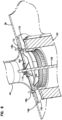
- FIGS. 7 and 8 show an example embodiment of how the filter element 42 is releasably attached to the tube sheet 38.
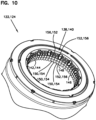
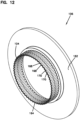
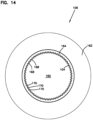
- the assembly 100 includes seal plate 106. Further views of the seal plate 106 are shown in FIGS. 12-14 .
- the seal plate 106 includes the tube sheet seal member 104 the tube sheet seal member 104 defines an inner opening 160 therethrough.
- the opening 160 is in communication with the aperture 40 in the tube sheet 38, when the seal plate 106 is operably mounted to the tube sheet 38.
- the seal plate 106 includes a collar 162 and a neck 164.
- the collar 162 includes an outer rim 166 which is against and adjacent the tube sheet 38.
- the collar 162, in this embodiment, extends generally along the tube sheet 38 and can be generally parallel to the tube sheet 38, although variations are possible.
- the neck 164 projects axially from the collar 162 and circumscribes the opening 160.
- the tube sheet seal member 104 is generally along and can be part of the neck 164.
- the neck 164 extends in an axial direction opposite of the direction that the rim 166 extends from the collar 162.
- the tube sheet seal member 104 is shaped to releasably seal with the seal arrangements 138, 140.
- the tube sheet seal member 104 has a plurality of alternating outward radial portions 168 and alternating inward radial portions 170. As can be seen in FIGS. 12-14 , there are greater than 20 outward radial portions 168 and inward radial portions 170.
- the outward radial portions 168 and inward radial portions 170 extend substantially a complete length of the neck 164.
- the seal member 146 forms a seal with the tube sheet seal member 104 in that the tube sheet seal member 104 inward radial portions 170 receive the first filter element seal member radial projections 154; and the seal member 146 having the radial recesses 156 receive the tube sheet seal member 104 outward radial portions 168.
- This connection helps to ensure a good seal is formed, and ensure that the correct filter element 42 is being installed within the filter assembly 100.
- the filter assembly 100 includes a yoke plate 172. Additional views of the yoke plate 172 can be seen in FIG. 9 .
- the yoke plate 172 is secured to the tube sheet on the clean side of the tube sheet 38, on an opposite side from where the filter element 42 is secured.
- FIG. 9 omits the presence of the tube sheet from the drawing, to enhance clarity.
- the yoke plate 172 defines an opening 174, which is generally coaxially aligned with the aperture 40 in the tube sheet 38 and opening 160 in the seal plate 106.
- the yoke plate 172 includes a surrounding band 176, surrounding the opening 174.
- the band 176 generally lies flat and against the tube sheet 138, although variations are possible.
- the band 176 can include a plurality of holes 178.
- the holes 178 accommodate fasteners, such as bolts 180.
- the bolts 180 extend through a portion of the venturi tube 46 and secure the venturi tube 46 to the tube sheet 38.
- the yoke plate 172 includes a chord extending across the opening 174 between edges of the band 176.
- the chord 182 extends across the geometric center of the opening 174, although there could be variations in other embodiments.
- the chord 182 includes the fixture 110 for removably holding the rod 108.
- the rod 108 is secured to the tube sheet 38 with the gasket washer 108 and the yoke plate 172.
- the rod 108 extends through the interior volume 128 of the filter element 42 and through either the assembly cover 112 or the additional filter cartridge 116, depending upon the embodiment.
- the end of the rod 108 includes radial projections 186, 187 ( FIGS. 3 and 4 ).
- the radially projections 186, 187 engage with the handle 102, such that when the handle 102 is pivoted in the locked position ( FIG. 2 ), with the grasping portion 188 ( FIG. 2 ) pointing generally radially outwardly, the filter element 42 is sealed to the tube sheet seal member 104 through a radial seal.
- the projections 186, 187 on the rod 108 are not tightly engaged with the handle 102, and the filter element 42 can be removed from the tube sheet seal member 104 and the tube sheet 38 by removing the handle 102 and removing the gasket washer 114.
- connection 52 piece In the FIG. 24 , embodiment, the cylindrical element 42 and conical element 43 are sealed together along connection 52 piece.
- the connection piece 52 can be shaped to be received by and form seals with end cap 124' and end cap 122; alternatively, the connection piece 52 can form an axial insert between elements 42 and 43 to form an axial seal therebetween.
- the filter assembly 100 includes assembly cover 112. Further views of the assembly cover 112 are shown in FIGS. 15 and 16 .
- the assembly cover 112 includes a surrounding wall 190.
- the wall 190 extends from an end plate 192.
- the wall 190 is perpendicular to the end plate 192.
- the wall 190 is sized to extend into the opening 130 of the second end cap 124 (or alternatively, into the opening 126 of the first end cap 122, when the filter element 42 is axially reversed).
- the end plate 192 is sized to extend over and cover the axial end of the second end cap 124 (or the first end cap 122, when the element 42 is reversed).
- the end plate 192 includes an aperture 194 in the center therethrough.
- the aperture 194 allows for passage of the rod 108.
- the end plate 192 includes an outer most brim 196, which is generally planar and flat.
- the surrounding wall 190 extends from an inside surface 198 of the brim 196.
- the end plate 192 Extending radially inwardly along the brim 196 and radially inwardly of where the wall 190 extends, the end plate 192 includes a concave section 200.
- the concave section 200 extends inwardly to be within the surrounding wall 190. In the center of the concave section 200 is the aperture 194. Many embodiments are possible.
- the assembly cover 112 includes a plurality alternating outward radial portions 202 and alternating inward radial portions 204.
- the outward radial portions 202 and inward radial portions 204 are part of the surrounding wall 190.
- the assembly cover 112 can be used to form a seal with the second end cap 124 (alternatively, with the first end cap 122).
- a releasable seal can be formed between the element 42 and assembly cover 112 by having the inward radial portions 204 of the assembly cover 112 receive the seal member radial projections 154; and the seal member radial recesses 156 receive the outward radial portions 202 of the assembly cover 112.
- the assembly 100 includes additional filter cartridge 116. Additional views of the additional filter cartridge 116 are depicted in FIGS. 20 and 21 . Alternative embodiments are shown in FIGS. 25 and 26 .
- the additional filter cartridge 116 is made from z-filter media 401.
- the filter media 401 can be used to form a "z-filter construction.”
- z-filter construction as used herein, is meant to include (but not be limited) a type of filter construction in which individual ones of corrugated, folded or otherwise formed filter flutes are used to define (typically in combination with facing media) sets of longitudinal, typically parallel, inlet and outlet filter flutes for fluid flow through the media.
- One type of z-filter media utilizes two specific media components joined together, to form the media construction.
- the two components are: (1) a fluted (typically corrugated) media sheet or sheet section, and, (2) a facing media sheet or sheet section.
- the facing media sheet is typically non-corrugated, however it can be corrugated, for example perpendicularly to the flute direction as described in U.S. provisional 60/543,804, filed February 11, 2004 , and published as PCT WO 05/077487 on August 25, 2005 .
- the fluted media section and facing media section can comprise separate materials between one another. However, they can also be sections of the single media sheet folded to bring the facing media material into appropriate juxtaposition with the fluted media portion of the media.
- the fluted (typically corrugated) media sheet and the facing media sheet or sheet section together are typically used to define media having parallel flutes.
- the fluted sheet and facing sheet are separate and then secured together and are then coiled, as a media strip, to form a z-filter media construction.
- Such arrangements are described, for example, in U.S. 6,235,195 and 6,179890 .
- some non-coiled sections or strips of fluted (typically corrugated) media secured to facing media are stacked with one another, to create a filter construction. An example of this is described in Fig. 11 of US 5,820 646 .
- strips of material comprising fluted sheet (sheet of media with ridges) secured to corrugated sheet, which are then assembled into stacks to form media packs, are sometimes referred to as "single facer strips,” “single faced strips,” or as “single facer” or “single faced” media.
- the terms and variants thereof, are meant to refer to a fact that one face, i.e., a single face, of the fluted (typically corrugated) sheet is faced by the facing sheet, in each strip.
- a strip of the fluted sheet/facing sheet (i.e., single facer) combination around itself, to create a coiled media pack is conducted with the facing sheet directed outwardly.
- Some techniques for coiling are described in U.S. provisional application 60/467,521, filed May 2, 2003 and PCT Application US 04/07927, filed March 17, 2004 , now published as WO 04/082795 .
- the resulting coiled arrangement generally has, as the outer surface of the media pack, a portion of the facing sheet, as a result.
- corrugated used herein to refer to structure in media, is often used to refer to a flute structure resulting from passing the media between two corrugation rollers, i.e., into a nip or bite between two rollers, each of which has surface features appropriate to cause corrugations in the resulting media.
- corrugation is however, not meant to be limited to such flutes, unless it is stated that they result from flutes that are by techniques involving passage of media into a bite between corrugation rollers.
- corrugated is meant to apply even if the media is further modified or deformed after corrugation, for example by the folding techniques described in PCT WO 04/007054, and published January 22, 2004 .
- Corrugated media is a specific form of fluted media.
- Fluted media is media which has individual flutes or ridges (for example formed by corrugating or folding) extending thereacross.
- Serviceable filter element or filter cartridge configurations utilizing z-filter media are sometimes referred to as "straight through flow configurations" or by variants thereof.
- the serviceable filter elements or cartridges generally have an inlet flow end (or face) and an opposite exit flow end (or face), with flow entering and exiting the filter cartridge in generally the same straight through direction.
- the term "serviceable” in this context is meant to refer to a media containing filter cartridge that is periodically removed and replaced from a corresponding fluid (e.g. air) cleaner.
- each of the inlet flow end (or face) and outlet flow end (or face) will be generally flat or planar, with the two parallel to one another. However, variations from this, for example non-planar faces, are possible.
- a straight through flow configuration (especially for a coiled or stacked media pack) is, for example, in contrast to serviceable filter cartridges such as cylindrical pleated filter cartridges of the type shown in U.S. Patent No. 6,039,778 , in which the flow generally makes a substantial turn as its passes into and out of the media. That is, in a 6,039,778 filter, the flow enters the cylindrical filter cartridge through a cylindrical side, and then turns to exit through an open end of the media (in forward-flow systems). In a typical reverse-flow system, the flow enters the serviceable cylindrical cartridge through an open end of the media and then turns to exit through a side of the cylindrical filter media. An example of such a reverse-flow system is shown in U.S. Patent No. 5,613 992 .
- z-filter media construction and variants thereof as used herein, without more, is meant to include, but not necessarily be limited to, any or all of: a web of corrugated or otherwise fluted media (media having media ridges) secured to (facing) media, whether the sheets are separate or part of a single web, with appropriate sealing (closure) to allow for definition of inlet and outlet flutes; and/or a media pack constructed or formed from such media into a three dimensional network of inlet and outlet flutes; and/or, a filter cartridge or construction including such a media pack.
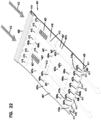
- FIG. 22 an example of media 401 useable in z-filter media is shown.
- the media 401 is formed from a corrugated (fluted) sheet 403 and a facing sheet 404.
- the corrugated sheet 403, FIG. 22 is of a type generally characterized herein as having a regular, curved, wave pattern of flutes or corrugations 407.
- wave pattern in this context, is meant to refer to a flute or corrugated pattern of alternating troughs 407b and ridges 407a.
- regular in this context is meant to refer to the fact that the pairs of troughs and ridges (407b, 407a) alternate with generally the same repeating corrugation (or flute) shape and size.
- each trough 407b is substantially an inverse of each ridge 407a.
- the term “regular” is thus meant to indicate that the corrugation (or flute) pattern comprises troughs and ridges with each pair (comprising an adjacent trough and ridge) repeating, without substantial modification in size and shape of the corrugations along at least 70% of the length of the flutes.
- substantially in this context, refers to a modification resulting from a change in the process or form used to create the corrugated or fluted sheet, as opposed to minor variations from the fact that the media sheet 403 is flexible. With respect to the characterization of a repeating pattern, it is not meant that in any given filter construction, an equal number of ridges and troughs is necessarily present.
- the media 401 could be terminated, for example, between a pair comprising a ridge and a trough, or partially along a pair comprising a ridge and a trough.
- the media 401 depicted in fragmentary has eight complete ridges 407a and seven complete troughs 407b.
- the opposite flute ends may vary from one another. Such variations in ends are disregarded in these definitions, unless specifically stated. That is, variations in the ends of flutes are intended to be covered by the above definitions.
- curved is meant to refer to a corrugation pattern that is not the result of a folded or creased shape provided to the media, but rather the apex 407a of each ridge and the bottom 407b of each trough is formed along a radiused curve.
- a typical radius for such z-filter media would be at least 0.25 mm and typically would be not more than 3 mm.
- Media that is not curved, by the above definition, can also be useable.
- An additional characteristic of the particular regular, curved, wave pattern depicted in FIG. 22 , for the corrugated sheet 403, is that at approximately a midpoint 430 between each trough and each adjacent ridge, along most of the length of the flutes 407, is located a transition region where the curvature inverts.
- trough 407b is a concave region
- ridge 407a is a convex region.
- region 430 can be a straight segment, instead of a point, with curvature inverting at ends of the straight segment 430.
- the media 401 has first and second opposite edges 408 and 409.
- edge 409 will form an inlet end for the media pack and edge 408 an outlet end, although an opposite orientation is possible as discussed below with respect to Fig. 24 .
- Adjacent edge 408 the sheets 403, 404 are sealed to one another, for example by sealant, in this instance in the form of a sealant bead 410, sealing the corrugated (fluted) sheet 403 and the facing sheet 404 together.
- Bead 410 will sometimes be referred to as a "single facer" bead, when it is applied as a bead between the corrugated sheet 403 and facing sheet 404, to form the single facer or media strip 401.
- Sealant bead 410 seals closed individual flutes 411 adjacent edge 408, to passage of air therefrom.
- Adjacent edge 409 is provided sealant, in this instance in the form of a seal bead 414.
- Seal bead 414 generally closes flutes 415 to passage of unfiltered fluid therein, adjacent edge 409.
- Bead 414 would typically be applied as the media 401 is coiled about itself, with the corrugated sheet 403 directed to the inside.
- bead 414 will form a seal between a back side 417 of facing sheet 404, and side 418 of the corrugated sheet 403.
- the bead 414 will sometimes be referred to as a "winding bead" when it is applied as the strip 401 is coiled into a coiled media pack. If the media 401 were cut in strips and stacked, instead of coiled, bead 414 would be a "stacking bead.”
- the corrugated sheet 403 is also tacked to the facing sheet 4 at various points along the flute length, as shown at lines 404a.
- the media 401 can be operated as follows. First, air in the direction of arrows 412, would enter open flutes 411 adjacent end 409. Due to the closure at end 408, by bead 410, the air would pass through the media shown by arrows 413. It could then exit the media pack, by passage through open ends 415a of the flutes 415, adjacent end 408 of the media pack. Of course operation could be conducted with air flow in the opposite direction, as discussed for example with respect to Fig. 24 . The point being that in typical air filter applications, at one end or face of the media pack unfiltered air flow goes in, and at an opposite end or face the filtered air flow goes out, with no unfiltered air flow through the pack or between the faces.
- the media contains a resin.
- the media can be heated to above the glass transition point of the resin. When the resin then cools, it will help to maintain the fluted shapes.
- the media of the corrugated sheet 403, facing sheet 404 or both can be provided with a fine fiber material on one or both sides thereof, for example in accord with U.S. 6,673,136 .
- the filter cartridge 116 includes a media pack 206 of straight flow through media, such as z-media 401.
- the media pack 206 includes a first flow face 208 and an opposite second flow face 210.
- the flutes 411, 415 extend in a direction between the opposite first and second flow faces 208, 210.
- a side wall 212 extends between the first and second flow faces 208, 210.
- the first flow face 208 corresponds to an inlet flow face
- the second flow face 210 corresponds to an outlet flow face
- the filter cartridge 116 includes a band 214 around the side wall 212.
- the band 214 is circumscribing and against the side wall 212, although alternatives are possible.
- the band 214 includes a plurality of alternating outward radial portions 216 and alternating inward radial portions 218.
- the additional filter cartridge 116 When the additional filter cartridge 116 is received within the second end cap 124 (alternatively, within the first end cap 122), it forms a seal with the seal member 146 of the end cap 122, 124 such that the inward radial portions 218 of the band 214 receive the seal member radial projections 154; and the seal member radial recesses 156 receive the outward radial portions 216 of the band 214.
- An alternative seal arrangement between the filter cartridge 116 and element 42 is discussed further below in connection with FIG. 26 .
- the band 214 is oriented between the first flow face 208 and second flow face 210. In this embodiment, the band 214 is also adjacent the first flow face 208. Many embodiments are possible.
- the band 214 can be part of an end piece 220.
- the end piece 220 has a plate 222 extending radially from the first flow face 208.
- the band 214 extends axially from the plate 222 and along the side wall 212.
- the band 214 is generally perpendicular to the plate 222.
- the plate 222 will extend over and cover an axial end of the second end cap 124, when operably installed.
- the element 42 and additional filter cartridge 116 are molded together in a single continuous end piece 240, so that they are one unitary element pair 242.
- the element 42 first end cap 122 includes the seal arrangement 138.
- the media pack 206 is preferably a coiled media pack.
- the media pack 206 defines a central, open channel 224 extending between and through the first and second flow faces 208, 210. This channel 224 allows the rod 108 to extend through the filter cartridge 116 in order to engage the handle 102. See FIG. 19 .
- the media pack 206 has a cross-sectional shape that matches the cross-sectional shape of the openings 126, 130 of the end caps 122, 124.
- the shape is round.
- the additional filter cartridge 116 allows for flow of unfiltered air through the first flow face 208.
- the media pack 206 removes particulate, and filtered air the flows through the second flow face 210 to reach the interior volume 128 of the filter element 42. From there, the filtered air flows through the aperture 40 and the tube sheet 38, through the venturi tube 46, and into the downstream volume 36 ( FIG. 1 ) of the system 20.
- the additional filter cartridge 116 helps to balance the filter gradient through the assembly 100 and add life to both elements 42, 116. Without the filter cartridge 116, the element 42 would load in the region nearest the tube sheet 38, but when the filter cartridge 116 is used, in some systems, the air will flow initially through the additional filter cartridge 116 first before flowing through the pleated media 120 of the element 42. This leads to a more balanced filter gradient through the pleated media 120 and lengthens the life of the element 42.
- the filter cartridge 116 instead of a seal being formed between the additional filter cartridge 116 and filter element 42 at seal member 146, the filter cartridge 116 has an end piece 250 secured to the second flow face 210.
- the end piece 250 has an axially projecting ring 252, which extends axially in a direction away from a remaining portion of the cartridge 116.
- the ring 252 extend radially outwardly from sidewall 212 of the cartridge 116 and is sized to fit snuggly around (e.g., circumscribe) an outer diameter 125 of the end cap 124 to form a releasable radial seal 254 between and against an inside surface of the ring 252 and the outer diameter 125 of the end cap 124 of the element 42.
- air to be filtered flows into the system 20 under the hoods 26 and into the upstream volume 34. From there, the filtered air flows through the filter elements 42.
- the media 118 filters the air, and the filtered air exits the filter elements 42 through the aperture 40 in the tube sheet 38 and then through the venturi tube 46.
- the filtered air enters the downstream volume 36, where it then flows to the downstream equipment a gas turbine.
- the filter elements 42 if the filter elements 42 become clogged, the unfiltered air will bypass the pleated media 120 and flow through the media pack 206 of the additional filter cartridge 116.
- the media pack 206 will filter the air, and the filtered air will flow into the interior volume 128 of the element 42 and then exit through the aperture 40 in the tube sheet 38.
- the system 20 will pulse clean the elements 42 by emitting a pulse of air through the venturi tube 46, where it will enter the interior volume 128 and knock of or blow off any dust or debris that has collected on the upstream side of the pleated media 120.
- the filter elements 42 will need to be removed and replaced with new filter elements 42.
- the filter element 42 is released by pivoting the quick release handle 102 from a locked position ( FIGS. 2 and 19 ) to an unlocked position, in which the handle 102 is pivoted to extend axially.
- the gasket washer 114 and handle 102 are removed from the rod 108.
- the assembly cover 112 is removed, and then the filter element 42 is removed from the tube sheet 38.
- a new filter element 42 is provided.
- either end of the filter element 42 is oriented toward the tube sheet 38.
- the new filter element 42 is sealed against the tube sheet 38 by creating a seal between the first (or second) end cap 122 and the tube sheet seal member 104. This is done by engaging the outward radial portions 168 and inward radial portions 170 of the tube sheet seal member 104 with the radial recesses 156 and radial projections 154 of the seal member 146 of the filter element 42.
- the rod 108 is extended through the aperture 194 of the assembly cover 112, while the outward radial portions 202 and inner radial portions 204 of the assembly cover form a seal with the radial recesses 156 and radial projections 154 of the seal member 146 of the second (or first) end cap 124 of the filter element 42.
- the gasket washer 114 and handle 102 are then put in engagement with the rod 108, and the handle 102 is pivoted into the locked position of FIGS. 2 and 19 to secure the new filter element 42 in place.
- the filter element 42 instead of forming a seal with the assembly cover 112, the filter element 42 forms a seal with the additional filter cartridge 116. This is done by engaging the outward radial portions 216 and inward radial portions 218 of the band 214 with the radial recesses 156 and radial projections 154 of the seal member 146 of the element 42.
- the rod 108 passes through the channel 224 and engages the gasket washer 114 and handle 102, in which the handle 102 is pivoted into the locked position to secure the element 42 to the tube sheet 38.
- the filter element 42 seals with the additional filter cartridge 116 at outer radial seal 254 along the outer diameter 125 of the end cap 124.
- FIGS. 54-56 H. Additional Example Arrangements, FIGS. 54-56
- the system 300 includes a filter arrangement 301.
- the filter arrangement 301 can be embodied as a single element 42 (as described previously), or it can be an element pair 302 operably installed adjacent the tube sheet 38.
- the filter element pair 302 includes a cylindrical element 304 and a conical element 305, axially aligned and stacked end-to-end. Alternatively, the element pair 302 can include two cylindrical elements.
- Yoke assembly 306 ( FIG. 56 ) releasably holds the filter arrangement 301 to the tube sheet 38.
- the yoke assembly 306 includes tri-pod of legs 109.
- Rod 108 extends from the leg tripod 109 at an end remote from the tube sheet 38.
- Pivotable handle 102 which is part of the yoke assembly 306, is secured to the free end of the rod 108 and operates to removably secure the filter arrangement 301 to the tube sheet 38.
- the handle 102 can be similar to the handle as described in U.S. 8,956,434 and U.S. 2017/0173512 .
- the filter element 304 has a first end cap 310 and an opposite second end cap 312.
- the first end cap 310 will form a seal with the tube sheet 38, and can include the seal arrangement 138 described above in connection with FIGS. 4-15 .
- the first end cap 310 is against the non-tube sheet end of the element 305.
- the tube sheet end 311 of the element 305 may include any of the various seal arrangements described above in connection with FIGS. 4-15 , such as seal arrangement 138. Alternatively, it may be a standard axial seal.
- the second end cap 312 of the filter element 304 includes a center, integrated gasket 314.
- the gasket 314 is made from a soft material and includes a seal member 316.
- the seal member 316 surrounds a rod-receiving through-aperture 318, through which the rod 108 passes.
- the seal member 316 has an inwardly radially directed seal surface 319 and a thickness that varies along the seal member surface 319. The thickness varies in a radial direction along the seal member surface 319. It should be understood that the seal surface 319 surrounds the through-aperture 318.
- the radially directed seal surface 319 can be seen to include a plurality of outwardly projecting projections 320 and a plurality of inwardly projecting recesses 322. These projections 320 and recesses 322 can be curved. In this example, a length of the seal member surface 319 is constant in an axial direction.
- the second end cap 312 has a recessed section 330 projecting inwardly into the filter interior 332.
- the integrated gasket 314 is centered in the recessed section 330.
- the integrated gasket 314 has an outer diameter less than that of the outer diameter of the second end cap 312.
- the diameter of the integrated gasket 314 is less than 50%, indeed less than 30%, and often less than 20% of an outer diameter of the second end cap 312.
- a portion of the rod 108 has a plurality of alternating outward radial sections 340 and alternating inward radial sections 342.
- the second end cap 312 receives the rod 108 through aperture 318 in the gasket 314 in that: the rod inward radial sections 342 receive the seal member radial projections 320; and the seal member radial recesses 322 receive the rod outward radial sections 340.
- the contact between the rod 108 and the gasket 314 helps to increase the contact between the filter element gasket 314 and the rod 108 to ensure good sealing over the entire life time of the filter element 304.
- the number of projections 320 and recesses 322 can vary according to the sealing compression factor that is needed.
- a pressure washer can be used to help spread the load of the clamping system onto the second end cap 312 of the filter element 304.
- FIGS. 57-61 I. Additional Example Arrangements, FIGS. 57-61
- a filter cartridge or element e.g., primary or main
- the filter cartridge 2350 as shown includes a first end piece (e.g., cap) 2352, a second end piece (e.g., cap) 2354, filter media 2356, and a liner 2358.
- the filter media 2356 includes a first end 2356a and a second end 2356b.
- the filter media first end 2356a can be embedded in the first end cap 2352
- the filter media second end 2356b can be embedded in the second end cap 2354.
- the liner 2358 includes a liner first end 2358a and a liner second end 2358b.
- the liner first end 2358a can also be embedded in the first end cap 2352, and the liner second end 2358b can be embedded in the second end cap 2354.
- the filter media 2256 can be provided as supported by the liner 2258.
- the filter media 2256 can be provided as cylindrical or conical pleated media, or as any other type of media configuration that provides the filter cartridge 2350 with a central open volume 2360.
- the first end piece (e.g., cap) 2352 is shown in detail.
- the first end cap 2352 includes a central open volume 2362 that is in communication with the filter element central open volume 2360. Accordingly, the first end cap 2352 can be characterized as an open end cap 364.
- the second end cap 2354 can also be an open end cap.
- the filter element 2350 can be used in, for example, the system 20 of FIGS. 1 or 23 .
- the seal members 138, 140 as characterized above, are further defined below, and this further definition can apply to any of the previously described seal members 138, 140.
- the open end cap 2364 includes a first end 2367, a second end 2369, and an internal surface 2370 extending between the first end 2367 and the second end 2369.
- the internal surface 2370 forms the central open volume 2362, and can be constructed to engage and seal against the tube sheet seal member 104 ( FIGS. 12-14 ) having a wavy wall.
- the internal surface 2370 can form an internally directed radial seal.
- the internal surface 2370 as shown includes a lead in region 2372, an optional peripherally uniform radial seal region 2378, a transition region 2374, and a peripherally non-uniform radial seal region 2376.
- the optional peripherally uniform seal radial seal region 2378 can be omitted from the filter element 2350, and is provided in the event it is desirable for the filter element 2350 to fit both a filter cartridge seal surface that can be characterized as a wavy wall tube sheet seal member and a prior art air tube sheet seal member having a peripherally uniform seal surface about an axis X.
- the lead in region 2372, the transition region 2374, and the peripherally non-uniform radial seal region 2376 can be characterized as having a plurality of radially outwardly projecting and axially extending portions 2390 alternating with a plurality of radially inwardly projecting and axially extending portions 2392. These portions 2390 and 2392 can be provided extending axially along each of regions 2372, 2374, and 2376 and not along region 2378 if region 2378 is present.
- the radially outwardly projecting and axially extending portions 2390 can be characterized as troughs 2394, and the and the radially inwardly projecting and axially extending portions 2392 can be characterized as peaks or ridges 2396.
- the lobes 2400 formed by the peaks 2396 between adjacent troughs 2394 can be provided so that they fit into the corresponding troughs (inward radial portions) 170 in the tube sheet seal member 104 ( FIGS. 12-14 ).
- the troughs 2394 are provided so that they receive the peaks (outward radial portions) 168 in the tube sheet seal member 104. It should be appreciated that the reference to “outwardly” and “inwardly” refer to a direction either away from or toward the central axis X.
- the outwardly projecting and axially extending portions 2390 can be referred to as troughs 2394
- the inwardly projecting and axially extending portions 2392 can be referred to as peaks 2396.
- the size and shape of the troughs 2394 and peaks 2396 can be altered and adjusted throughout the lead in region 2372, the transition region 2374, and the radially seal region 2376 in order to ease the insertion of the filter element 2350 onto the tube sheet seal member 104.
- the radial seal region 2376 includes a wavy wall seal member surface 2398 that also includes a plurality of lobes 2400.
- the wavy wall seal member surface can be characterized in terms of "pitch" which is the distance from peak to adjacent peak of the lobes 2400.
- the pitch can be defined as the distance between adjacent peaks.
- the pitch can be defined as the distance between the adjacent troughs.
- the wavy wall seal member surface 2376 can be characterized as having a pitch that allows the service provider (installer of the filter element) with a degree of indexing that allows the service provider to correctly index the filter element within the housing without having to re-grip the filter element.
- the lead in region 2372 engages the wavy wall of the tube sheet seal member 104 thereby indexing the filter cartridge 2350 into the correct orientation for further axial insertion.
- the peripherally uniform radial seal surface 2378 engages the wavy wall of the tube sheet seal member 104 with continued axial insertion. Further axial insertion results in the transition region 2374 engaging the wavy wall to help further orient the filter cartridge 2350 and ease the transition to the radial seal region 2376 engaging the wavy wall of the tube sheet seal member 104 where a radially directed seal is created.
- the peripherally non-uniform radial seal surface 2376 and the peripherally uniform radial seal surface 2378 are recessed from the first end 2367 of the open end cap 2364.
- the seal surfaces 2376 and 2378 can be characterized as provided inside of the filter media 2356.
- the seal surfaces 2376 and 2378 are protected from dust or debris when the filter cartridge 2350 is set on a dirty surface.
- the seal surfaces 2376 and 2378 can be axially recessed at least about 1 millimeter from the first end 2367.
- the second end cap 2354 can have an identical construction as the first end cap 2356 as characterized above.
- the filter cartridge would generally include a filter media therein, through which air and other gases pass, during a filtering operation.
- the media can be of a variety of types and configurations, and can be made from using a variety of materials.
- pleated media arrangements can be used in cartridges according to the principles of the present disclosure, as discussed below.
- the principles are particularly well adapted for use in situations in which the media is quite deep in extension between the inlet and outlet ends of the cartridge, but alternatives are possible. Also, the principles are often used in cartridges having relatively large cross-dimension sizes. With such arrangements, alternate media types to pleated media will often be desired.
- FIG. 27 in which z-filter media; i.e., a z-filter media construction 500, utilizing a regular, curved, wave pattern corrugated sheet 503, and a non-corrugated flat sheet 504, i.e., a single facer strip is schematically depicted.
- the length D2 of the arcuate media for the corrugated flute 508, over the same distance D1 is of course larger than D1, due to the shape of the corrugated flute 508.
- the linear length D2 of the media 508 between points 506 and 507 will often be at least 1.2 times D1.
- D2 would be within a range of 1.2 - 2.0 times D1, inclusive.
- One particularly convenient arrangement for air filters has a configuration in which D2 is about 1.25 - 1.35 x D1.
- Such media has, for example, been used commercially in Donaldson Powercore TM Z-filter arrangements.
- Another potentially convenient size would be one in which D2 is about 1.4 - 1.6 times D1.
- the ratio D2/D1 will sometimes be characterized as the flute/flat ratio or media draw for the corrugated media.
- Donaldson Company, Inc. (DCI) the assignee of the present disclosure, has used variations of the standard A and standard B flutes, in a variety of z-filter arrangements. These flutes are also defined in Table A and FIG. 28 . TABLE A (Flute definitions for FIG.
- DCI A Flute: Flute/flat 1.52:1;
- E Flute: Flute/flat 1.24:1;
- X Flute: Flute/flat 1.29:1;
- a Flute: Flute/flat 1.53:1;
- standard flute configurations from the corrugated box industry can be used to define corrugation shapes or approximate corrugation shapes for corrugated media. Comparisons above between the DCI A flute and DCI B flute, and the corrugation industry standard A and standard B flutes, indicate some convenient variations.
- FIG. 29 one example of a manufacturing process for making a media strip (single facer) corresponding to strip 1, FIG. 22 is shown.
- facing sheet 510 and the fluted (corrugated) sheet 512 having flutes 514 are brought together to form a media web 515, with an adhesive bead located therebetween at 516.
- the adhesive bead 516 will form a single facer bead 414, FIG. 22 .
- An optional darting process occurs at station 518 to form center darted section 520 located mid-web.
- the z-filter media or Z-media strip 522 can be cut or slit at 523 along the bead 516 to create two pieces or strips 524, 525 of z-filter media 522, each of which has an edge with a strip of sealant (single facer bead) extending between the corrugating and facing sheet.
- a strip of sealant single facer bead
- the edge with a strip of sealant would also have a set of flutes darted at this location.
- the z-filter media 522 before the z-filter media 522 is put through the darting station 518 and eventually slit at 523, it must be formed. In the schematic shown in FIG. 29 , this is done by passing a sheet of filter media 526 through a pair of corrugation rollers 528, 529. In the schematic shown in FIG. 29 , the sheet of filter media 526 is unrolled from a roll 530, wound around tension rollers 532, and then passed through a nip or bite 534 between the corrugation rollers 528, 529.
- the corrugation rollers 528, 529 have teeth 536 that will give the general desired shape of the corrugations after the flat sheet 526 passes through the nip 534.
- the sheet 526 After passing through the nip 534, the sheet 526 becomes corrugated across the machine direction and is referenced at 512 as the corrugated sheet.
- the corrugated sheet 512 is then secured to facing sheet 510.
- the corrugation process may involve heating the media, in some instances.
- the process also shows the facing sheet 510 being routed to the darting process station 518.
- the facing sheet 510 is depicted as being stored on a roll 106 and then directed to the corrugated sheet 512 to form the Z-media 522.
- the corrugated sheet 512 and the facing sheet 510 would typically be secured together by adhesive or by other means (for example by sonic welding).
- an adhesive line 516 is shown used to secure corrugated sheet 512 and facing sheet 510 together, as the sealant bead.
- the sealant bead for forming the facing bead could be applied as shown as 516a. If the sealant is applied at 516a, it may be desirable to put a gap in the corrugation roller 529, and possibly in both corrugation rollers 528, 529, to accommodate the bead 516a.
- FIG. 29 can be modified to provide for the tack beads 20, FIG. 22 , if desired.
- corrugation provided to the corrugated media is a matter of choice, and will be dictated by the corrugation or corrugation teeth of the corrugation rollers 528, 529.
- One useful corrugation pattern will be a regular curved wave pattern corrugation, of straight flutes or ridges, as defined herein above.
- a typical regular curved wave pattern used would be one in which the distance D2, as defined above, in a corrugated pattern is at least 1.2 times the distance D1 as defined above.
- typically D2 1.25 - 1.35 x D1
- the techniques may be applied with curved wave patterns that are not "regular," including, for example, ones that do not use straight flutes. Also, variations from the curved wave patterns shown, are possible.
- FIG. 29 shows, in cross-section, one of the flutes 514 after darting and slitting.
- a fold arrangement 538 can be seen to form a darted flute 540 with four creases 541a, 541b, 541c, 541d.
- the fold arrangement 538 includes a flat first layer or portion 542 that is secured to the facing sheet 510.
- a second layer or portion 544 is shown pressed against the first layer or portion 542.
- the second layer or portion 544 is preferably formed from folding opposite outer ends 546, 547 of the first layer or portion 542.
- two of the folds or creases 541a, 541b will generally be referred to herein as "upper, inwardly directed” folds or creases.
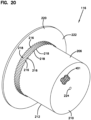
- the term “upper” in this context is meant to indicate that the creases lie on an upper portion of the entire fold 540, when the fold 540 is viewed in the orientation of FIG. 30 .
- the term “inwardly directed” is meant to refer to the fact that the fold line or crease line of each crease 541a, 541b, is directed toward the other.
- creases 541c, 541d will generally be referred to herein as “lower, outwardly directed” creases.
- the term “lower” in this context refers to the fact that the creases 541c, 541d are not located on the top as are creases 541a, 541b, in the orientation of FIG. 30 .
- the term “outwardly directed” is meant to indicate that the fold lines of the creases 541c, 541d are directed away from one another.
- upper and lower as used in this context are meant specifically to refer to the fold 540, when viewed from the orientation of FIG. 30 . That is, they are not meant to be otherwise indicative of direction when the fold 540 is oriented in an actual product for use.
- a regular fold arrangement 538 according to FIG. 30 in this disclosure is one which includes at least two "upper, inwardly directed, creases.” These inwardly directed creases are unique and help provide an overall arrangement in which the folding does not cause a significant encroachment on adjacent flutes.
- a third layer or portion 548 can also be seen pressed against the second layer or portion 544.
- the third layer or portion 548 is formed by folding from opposite inner ends 550, 551 of the third layer 548.
- the first layer or portion 542 is formed from an inverted ridge.
- the second layer or portion 544 corresponds to a double peak (after inverting the ridge) that is folded toward, and in preferred arrangements, folded against the inverted ridge.
- Coiled media or media pack arrangements can be provided with a variety of peripheral perimeter definitions.
- peripheral, perimeter definition and variants thereof, is meant to refer to the outside perimeter shape defined, looking at either the inlet end or the outlet end of the media or media pack.
- Typical shapes are circular as described in PCT WO 04/007054 .
- Other useable shapes are obround, some examples of obround being oval shape.
- oval shapes In general oval shapes have opposite curved ends attached by a pair of opposite sides. In some oval shapes, the opposite sides are also curved. In other oval shapes, sometimes called racetrack shapes, the opposite sides are generally straight. Racetrack shapes are described for example in PCT WO 04/007054 , and PCT application US 04/07927 , published as WO 04/082795 .
- Another way of describing the peripheral or perimeter shape is by defining the perimeter resulting from taking a cross-section through the media pack in a direction orthogonal to the winding access of the coil.
- Opposite flow ends or flow faces of the media or media pack can be provided with a variety of different definitions.
- the ends or end faces are generally flat (planer) and perpendicular to one another.
- one or both of the end faces include tapered, for example, stepped, portions which can either be defined to project axially outwardly from an axial end of the side wall of the media pack; or, to project axially inwardly from an end of the side wall of the media pack.
- the flute seals (for example from the single facer bead, winding bead or stacking bead) can be formed from a variety of materials.
- hot melt or polyurethane seals are described as possible for various applications.
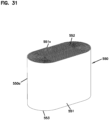
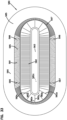
- a coiled media pack (or coiled media) 550 constructed by coiling a single strip of single faced media is depicted, generally.
- the particular coiled media pack depicted is an oval media pack 550a, specifically a racetrack shaped media pack 551.
- the tail end of the media, at the outside of the media pack 550 is shown at 551x. It will be typical to terminate that tail end along straight section of the media pack 550 for convenience and sealing.
- a hot melt seal bead or seal bead is positioned along that tail end to ensure sealing.
- the opposite flow (end) faces are designated at 552, 553. One would be an inlet flow face, the other an outlet flow face.
- FIG. 32 there is (schematically) shown a step of forming stacked z-filter media (or media pack) from strips of z-filter media, each strip being a fluted sheet secured to a facing sheet.
- single facer strip 560 is being shown added to a stack 561 of strips 562 analogous to strip 560.
- Strip 560 can be cut from either of strips 524, 525, FIG. 29 .
- application of a stacking bead 564 is shown, between each layer corresponding to a strip 560, 562 at an opposite edge from the single facer bead or seal. Stacking can also be done with each layer being added to the bottom of the stack, as opposed to the top.
- each strip 560, 562 has front and rear edges 565, 566 and opposite side edges 568a, 568b.
- Inlet and outlet flutes of the corrugated sheet/facing sheet combination comprising each strip 560, 562 generally extend between the front and rear edges 207, 566, and parallel to side edges 568a, 568b.
- opposite flow faces are indicated at 570, 571.
- the flow faces 570, 571 extend between opposite side faces 572, 573.
- the stacked media configuration or pack 561 shown being formed in FIG. 32 is sometimes referred to herein as a "blocked" stacked media pack.
- the term "blocked” in this context is an indication that the arrangement is formed to a rectangular block in which all faces are 90° relative to all adjoining wall faces.
- the stack can be created with each strip 560 being slightly offset from alignment with an adjacent strip, to create a parallelogram or slanted block shape, with the inlet face and outlet face parallel to one another, but not perpendicular to upper and bottom surfaces.
- the media or media pack will be referenced as having a parallelogram shape in any cross-section, meaning that any two opposite side faces extend generally parallel to one another.
- more than one stack can be incorporated into a single media pack.
- the stack can be generated with one or more flow faces that have a recess therein, for example, as shown in US 7,625,419 .
- FIGS. 33-35 Selected Media or Media Pack Arrangements Comprising Multiple Spaced Coils of Fluted Media; FIGS. 33-35
- FIGS. 33-35 An example of such alternate media arrangement or pack is depicted in FIGS. 33-35 .
- the media of FIGS. 33-35 is analogous to one depicted and described in DE 20 2008 017 059 U1 ; and as can sometimes found in arrangements available under the mark "IQORON" from Mann & Hummel.
- the media or media pack is indicated generally at 580.
- the media or media pack 580 comprises a first outer pleated (ridged) media loop 581 and a second, inner, pleated (ridged) media loop 582, each with pleat tips (or ridges) extending between opposite flow ends.
- the view of FIG. 33 is toward a media pack (flow) end 585.
- the end 585 depicted can be an inlet (flow) end or an outlet (flow) end, depending on selected flow direction.
- end 585 is an inlet flow end.
- the outer pleated (ridged) media loop 581 is configured in an oval shape, though alternatives are possible.
- a pleat end closure for example molded in place, is depicted closing ends of the pleats or ridges 581 at media pack end 585.
- Pleats, or ridges 582 are positioned surrounded by and spaced from loop 581, and thus pleated media loop 582 is also depicted in a somewhat oval configuration. In this instance, ends 582e of individual pleats or ridges 582p in a loop 582 are sealed closed. Also, loop 582 surrounds the center 582c that is closed by a center strip 583 of material, typically molded-in-place.
- end 585 is an inlet flow end
- air enters gap 595 between the two loops of media 581, 582.
- the air then flows either through loop 581 or loop 582, as it moves through the media pack 580, with filtering.
- loop 581 is configured slanting inwardly toward loop 582, in extension away from end 585. Also spacers 596 are shown supporting a centering ring 597 that surrounds an end of the loop 582, for structural integrity.
- FIG. 34 an end 586 of the cartridge 580, opposite end 585 is viewable.
- an interior of loop 582 can be seen, surrounding an open gas flow region 598.
- air that has entered media loop 581, FIG. 33 during filtering would generally pass around (over) an outer perimeter 586p of end 586.
- FIG. 35 a schematic cross sectional view of cartridge 580 is provided. Selected identified and described features are indicated by like reference numerals
- the cartridge 580 described is generally a cartridge which has media tips extending in a longitudinal direction between opposite flow ends 585, 586.
- the media pack 580 is depicted with an oval, in particular racetrack, shaped perimeter. It is depicted in this manner, since the air filter cartridges in many examples below also have an oval or racetrack shaped configuration. However, the principles can be embodied in a variety of alternate peripheral shapes.
- FIGS. 36-43 some schematic, fragmentary, cross-sectional views are provided of still further alternate variations of media types that can be used in selected applications of the principles characterized herein. Certain examples are described in USSN 62/077,749, filed November 10, 2014 and owned by the Assignee of the present disclosure, Donaldson Company, Inc.
- each of the arrangements of FIGS. 36-43 represents a media type that can be stacked or coiled into an arrangement that has opposite inlet and outlet flow ends (or faces), with straight through flow.
- FIG. 36 an example media arrangement 601 from USSN 62/077,749 (2658) is depicted, in which an embossed sheet 602 is secured to a non-embossed sheet 603, then stacked and coiled into a media pack, with seals along opposite edges of the type previously described for FIG. 22 herein.
- FIG. 37 an alternate example media pack 610 from USSN 62/077,749 is depicted, in which a first embossed sheet 611 is secured to a second embossed sheet 612 and then formed into a stacked or coiled media pack arrangement, having edge seals generally in accord with FIG. 22 herein.
- FIG. 38-40 a third example media arrangement 620 from USSN 62/077,749 is depicted.
- Edge seals can be conducted in either the upstream end or the downstream end, or in some instances both. Especially when the media is likely to encounter chemical material during filtering, it may be desirable to avoid a typical adhesive or sealant.
- FIG. 38 a cross-section is depicted in which the fluted sheet X has various embossments on it for engagement with the facing sheet Y. Again these can be separate, or sections of the same media sheet.
- FIG. 39 a schematic depiction of such an arrangement between the fluted sheet X and facing sheet Y is also shown.
- FIG. 40 a still further variation of such a principle is shown between a fluted sheet X and a facing sheet Y. These are meant to help understand how a wide variety of approaches are possible.
- FIG. 41-43 still another possible variation in fluted sheet X and facing sheet Y is shown.
- FIGS. 41-43 an example media arrangement 640 is depicted, in which a fluted sheet 642 is secured to a facing sheet 643.
- the facing sheet 643 may be a flat sheet.
- the media arrangement 6401 can then be stacked or coiled into a media pack, with seals along opposite edges of the type previously described for FIG. 22 herein.
- the flutes 644 of fluted sheet 642 have an undulating ridgeline including a series of peaks 645 and saddles 646.
- the peaks 645 of adjacent flutes 644 can be either aligned as shown in FIGS. 42 and 43 or offset. Further the peak height and/or density can increase, decrease, or remain constant along the length of the flutes 644.
- the ratio of the peak flute height to saddle flute height can vary from about 1.5, typically from 1.1 to about 1.
- the same media be used for the fluted sheet section and the facing sheet section.
- a different media can be desirable in each, to obtain different effects.
- one may be a cellulose media, while the other is a media containing some non-cellulose fiber. They may be provided with different porosity or different structural characteristics, to achieve desired results.
- the fluted sheet section or the facing sheet section can include a cellulose material, synthetic material, or a mixture thereof.
- one of the fluted sheet section and the facing sheet section includes a cellulose material and the other of the fluted sheet section and facing sheet section includes a synthetic material.
- Synthetic material(s) can include polymeric fibers, such as polyolefin, polyamide, polyester, polyvinyl chloride, polyvinyl alcohol (of various degrees of hydrolysis), and polyvinyl acetate fibers.
- Suitable synthetic fibers include, for example, polyethylene terephthalate, polyethylene, polypropylene, nylon, and rayon fibers.
- Other suitable synthetic fibers include those made from thermoplastic polymers, cellulosic and other fibers coated with thermoplastic polymers, and multi-component fibers in which at least one of the components includes a thermoplastic polymer.
- Single and multi-component fibers can be manufactured from polyester, polyethylene, polypropylene, and other conventional thermoplastic fibrous materials.
- FIGS. 36-43 are meant to indicate generally that a variety alternate media packs can be used in accord with the principles herein. Attention is also directed to USSN 62/077,749 with respect to the general principles of construction and application of some alternates media types.
- FIGS. 44-46 Additional examples of alternative types of media arrangements or packs that involve filtration media having flutes extending between opposite ends or flow faces in a straight through flow configuration are depicted in FIGS. 44-46 .
- the flutes can be considered inlet flutes when they are arranged to receive dirty air via an inlet flow face, and they can be considered outlet flutes when they are arranged to permit filtered air to flow out via an outlet flow face.
- the filtration media 6502 depicted in FIGS. 44-45B which is analogous to ones depicted in US 8,479,924 and US 9,919,256 assigned to Mann+Hummel GmbH, is illustrated in an arrangement that shows how the filtration media 6502 can be formed into a media pack arrangement 6504.
- the media pack arrangement 6504 can be considered as having relatively long or deep pleats from an inlet flow face 6506 to an outlet flow face 6508, and can also have varying pleat depths as illustrated. As the depth of pleats of a media pack increases, there is a tendency of the filtration media to collapse on each other thereby causing masking. Masking is undesirable because masked filtration media tends to no longer be available for filtration thereby decreasing dust holding capacity and flow through the media pack, and also potentially increasing pressure drop across the media pack. In order to reduce masking and to help the filtration media retain its shape, support structures are known to be applied to pleated media. In FIGS. 45A and 45B , support sections or spacers 6510 are provided. It should be appreciated that FIGS. 45A and 45B are illustrated in a folded configuration 6512 having pleat folds 6514, but are expanded or separated to show how the filtration media 6502 and the support sections or spacers 6510 can be arranged.
- the filtration media 6502 extends between a first side 6516 and a second side 6518.
- a support section 6510 is shown on each pleat face 6520, it should be appreciated that multiple support sections 6510 can be arranged along each pleat face 6520 so that when the filtration media 6502 is arranged into a media pack as illustrated in Fig. 44 as media pack 604, the volume between each of the support sections 6510 can be considered flutes extending between the inlet flow face 6506 and the outlet flow face 6508.
- the support sections 6510 can be arranged on each flow face 6520 so that opposite support sections 6510 contact or engage each other to help maintain the media pack shape while also limiting the amount of filtration media that would be contacted by the support sections 6510, as illustrated in FIG. 45A . Furthermore, by providing that the support sections 6510 have adhesive properties, the support sections 6510 can be provided so that opposing support sections 6510 can adhere to each other when the filtration media 6502 is arranged into the media pack 6504.
- the support sections 6510 can be arranged in a tapered configuration where support sections 6510 have a cross section at an interior fold 6522 and wherein the cross section increases toward an exterior fold 6524.
- the phrase "interior fold” refers to the side of the media that forms an acute angle
- the phrase “exterior fold” refers to the side of the media that forms an obtuse angle when the media is arranged into a media pack.
- the reference to changing the cross section of the support sections 6510 can refer to one or both of the height that the support section extends away from the media to which it is adhered and also to the width along the media to which it is adhered to in a direction toward or away from other support sections across adjacent flutes.
- Changing the shape of the support sections 6510 can help maintain the shape of the media pack and the resulting flutes, and can help reduce the amount of media that would otherwise be contacted by the support sections 6510 if they were not arranged in a tapered configuration.
- the support sections 6510 can be arranged in a non-tapered configuration. As illustrated in FIG. 45B , the support sections 6510 can be provided so that they extend over the exterior folds 6524 although it is not necessary for the support sections 6510 to extend over the exterior folds. In addition, it is not necessary for the support sections 6510 to extend into the interior folds 6522, although, if desired, the support sections 6510 can be provided so that they extend into the interior folds 6522.
- the support sections 6510 can be applied to the filtration media 6502 as adhesive extruded onto the filtration media 6502 where the adhesive forms the support sections 6510.
- the filtration media 6502 can be folded into the media pack arrangement 6504, which may or may not have varying pleat depths.
- the opposing support sections 6510 can become bonded or adhered to each other thereby forming flutes extending between the inlet flow face 6506 and the outlet flow face 6508.
- the filtration media 6502 can be provided with deformation, such as corrugations, extending across the media.
- the direction of deformation, such as corrugation, can be parallel or perpendicular to the pleat fold direction.
- the filtration media 6602 depicted in Fig. 46 is analogous to filtration media depicted in US 2018/02007566 assigned to Champion Laboratories, Inc. , as another example of a media pack arrangement 6604 having inlet and outlet flutes in a straight through flow arrangement.
- the filtration media pack arrangement 6604 can be formed by folding the filtration media 6602 to form an inlet flow face 6606 and an outlet flow face 6608.
- the pleat tips 6610 form the inlet flow face 6606, and the pleat tips 6612 form the outlet flow face 6608.
- Adhesive beads 6616 and 6618 which may be continuous or discontinuous, extend along the filtration media 6602 in multiple lines across the filtration media 6602 from a media first side 6620 to a media second side 6622.
- the adhesive beads 6616 and 6618 along the media first side 6620 and along the media second side 6620 can be thickened, if desired, and can be arranged to provide an edge seal along the media first side 6620 and the media second side 6622.
- a similar type of filtration media pack arrangement is commercially available under the name Enduracube from Baldwin Filters, Inc.
- the filtration media pack available under the name Enduracube from Baldwin Filters, Inc. is arranged in a pleated configuration forming inlet flutes and outlet flutes extending between an inlet flow face and an outlet flow face.
- the techniques characterized herein will preferably be applied when the media is oriented for filtering between opposite flow ends of the cartridge is media having flutes or pleat tips that extend in a direction between those opposite ends.
- the techniques characterized herein with respect to seal arrangement definition can be applied in filter cartridges that have opposite flow ends, with media positioned to filter fluid flow between those ends, even when the media does not include flutes or pleat tips extending in a direction between those ends.
- the media for example, can be depth media, can be pleated in an alternate direction, or it can be a non-pleated material.
- the techniques described herein were typically developed for advantageous application and arrangements involving media packs with straight through flow configurations, the techniques can be applied to advantage in other systems.
- the techniques can be applied when the cartridge comprises media surrounding a central interior, in which the cartridge has an open end.
- Such arrangements can involve "forward flow" in which air to be filtered enters the central open interior by passage through the media, and the exits through the open end; or, with reverse flow in which air to be filtered enters the open end and then turns and passes through the media.
- a variety of such arrangements are possible, including pleated media and alternate types of media. Configurations usable would include cylindrical and conical, among others.
- FIG. 48 is a perspective view of a filter arrangement 1020, constructed in accordance with principles of this disclosure.
- the filter arrangement 1020 includes a first open end cap 1022, an opposite second end cap 1024, a tubular section of filter media 1026 extending between the end caps 1022, 1024, and a filter cartridge 1160 mounted within an opening in the second end cap 1024.
- the filter media 1026 can be many different types, depending on the application. In many useful embodiments, the filter media 1026 is pleated. In many useful embodiments, the filter media 1026 is pleated cellulose.
- the filter media 1026 is tubular and surrounds an open interior volume 1028. The tubular shape can have a round cross-section, or it can have other shapes such as oval.
- the first end cap 1022 has an opening 1030 in communication with the interior volume 1028.
- the second end cap 1024 has an opening 1032 that accommodates the filter cartridge 1160.
- the end caps 1022, 1024 are secured to the ends of the filter media 1026. This can be done by molding the end caps 1022, 1024 directly onto the media 1026, but many alternatives are possible.
- the first end cap 1022 includes a seal member 1040 to form a releasable seal with a mating part, such as an outlet tube.
- the seal member 1040 can be an inwardly directed radial seal member 1042.
- the seal member 1040 can be molded as part of the first end cap 22, with a soft polyurethane foam. Alternative seal arrangements are possible, including pinch seals or axial seals.
- the filter cartridge 116 includes a media pack 1206.
- the media pack 1206 can include many different types of media including membrane, depth media, foam media, pleated, straight-through flow media, z-media, fluted media, and any of the various types described in Section II of this disclosure, above.
- the media pack 1206 includes a first flow face 1208 and an opposite second flow face 1210 for straight through flow.
- Flutes 411, 415 extend in a direction between the opposite first and second flow faces 1208, 1210.
- a side wall 1212 extends between the first and second flow faces 1208, 1210.
- the side wall 1212 forms an outer periphery of the cartridge 1016 and can include a hard shell, in some embodiments. In other embodiments, the side wall 1212 is the outer wall of the media pack 1206 and is free of a shell.
- first flow face 1208 corresponds to an inlet flow face
- second flow face 1210 corresponds to an outlet flow face
- the filter cartridge 1016 can either be removable and replaceable in the opening 1032 of the second end cap 1024, or it may be non-removably / permanently mounted therein.
- the end cap 1024 and filter cartridge 1016 are molded together in a single continuous end piece 1240, so that they are one unitary filter element.
- seal member 1050 radially formed between the sidewall 1212 of the media pack 1206 and a radial inner portion of the second end cap 1024. While the seal member 1050 shown in the drawings forms an inwardly directed radial seal, many other types of seals can be formed including a pinch seal or an axial seal.
- the distance 1245 can be: at least 0.3 cm; no greater 40% of the diameter of the opening 1032; typically less than 5 cm; and typically in a range of 0.5-2 cm.
- the media pack 1206 is preferably a coiled media pack, but in other embodiments, the media pack 1206 can be stacked, as described with respect to FIG. 32 above.
- the media pack 1206 has a cross-sectional shape that matches the cross-sectional shape of the openings 1126, 1130 of the end caps 1022, 1024.
- the shape is round.
- the media pack can be other shapes including, for example: non-round, obround, oval, racetrack-shaped, kidney-shaped, conical, frusto-conical, trapezoidal, regular or irregular polygon, banana-shaped; a sector of an annulus with rounded ends; or a segment of a circle.
- the media pack 1206 extends from the second end cap 1024 into the interior volume 1028 and toward the first end cap 1022 along an extension less than half of a distance between the first 1022 and second end caps 1024. In some embodiments, it extends less than one-third of the distance between the first 1022 and second 1024 end caps. Alternatives are possible including the media pack 1206 extending from the second end cap 1024 into the interior volume 1028 and toward the first end cap 1022 along an extension greater than 10%, or greater than 20%, or greater than 30%, or greater than 40%, or greater than 50% of a distance between the first 1022 and second end caps 1024.
- the filter cartridge 1116 allows for flow of unfiltered fluid, such as air, through the first flow face 1208.
- the media pack 1206 removes particulate, and filtered fluid the flows through the second flow face 1210 to reach the interior volume 1028 of the filter element 1042.
- unfiltered fluid flows through the filter media 1026 and into the interior volume 1028, joining the filtered fluid that passed through the filter cartridge 1116. From there, the filtered fluid flows through the aperture 1040.
- the filter cartridge 1116 helps to add life and more media to both the filter arrangement 1020 without creating a larger footprint.
- having two different media types e.g., pleated media 1026 and media 1206) leads to advantages including being able to filter different particle sizes.
- the two different media types can be helpful since they will often having different clogging behavior in high or low humid conditions.
- the different media types e.g., pleated 1026 and media 1206) can show different loading behavior over time, which can lower the overall pressure drop by providing more media and two options for the fluid (air) to pass.
- FIGS. 49-53 An alternative embodiment for the filter arrangement is shown in FIGS. 49-53 at 1020'.
- the filter arrangement 1020' can be the same as the filter arrangement 1020, described above, except that there is an alternative embodiment of the second end cap 1020'.
- the opening 1032' in the second end cap 1024' is off-center.
- the filter cartridge 1116' is oriented in the opening 1032', either removably or permanently.
- a seal member 1050' is around the periphery of the filter cartridge 1116'. The seal member 1050' can project from a remaining portion of the end cap 1020', as can be seen in FIG. 50 .
- the media pack 1206' can be any of the various types described above in section II of this disclosure.
- the media pack 1206' can be straight-through flow media, such as fluted media, pleated media, Z-media, membrane, depth media, foam media, and any variation as described in Section II.
- the outer perimeter shape of the filter cartridge 1116' is non-round. In the example shown in FIGS. 49-51 , the shape can include: a sector of an annulus with rounded ends; a segment of a circle; a kidney; or a banana.
- the filter cartridge 1116' can be operably installed in a filter housing, in which a portion of the housing has an opening that is sized to receive the axially projecting seal member 1050'.
- the seal member 1050' in the embodiment shown, is an outwardly extending radial seal to form a seal between the filter cartridge 1116' and the opening 1032' in the end cap 1024'.
- the seal member 1050' since it projects axially from the end cap 1024' is positioned to form a radially seal with a similar shaped opening (e.g., a sector of an annulus with rounded ends; a segment of a circle; a kidney; or a banana) in a portion of a filter housing, such as either the housing body or a housing cover.
- a similar shaped opening e.g., a sector of an annulus with rounded ends; a segment of a circle; a kidney; or a banana
- Alternative seals are possible including a radially inwardly extending radial seal, axial seal, pinch seal, or a combination.
- the media pack 1206' operates to filter any fluid flowing through the opening in the housing.
- the filter cartridge 1116' is non-removably a part of the end cap 1024'.
- the seal member 1050' projects axially from the end cap 1024' and is positioned to form a removable seal with a similar shaped opening (e.g., a sector of an annulus with rounded ends; a segment of a circle; a kidney; or a banana) in a portion of a filter housing, such as either the housing body or a housing cover.
- the removable seal can be a radial seal (inward or outward directed), axial seal, or pinch seal.
- the filter cartridge 1116' is removably inserted into the end cap 1024'.
- the first seal member 1050' between the cartridge 1116' and the end cap 1024' can be a radial seal, while the second seal member 1052 with the housing part can be an axial seal.
- the second seal member 1052 can have a periphery of many shapes, such as rectangular as shown in FIG. 52 .
- the filter cartridge 1116' may be a non-removable part of the end cap 1024'.
- the filter cartridge 1060 is round and made from straight-through flow media, including any of the types described in Section II above including fluted media, pleated media, Z-media, membrane, depth media, foam media.
- the filter cartridge 1060 is either removably or non-removably positioned in the end cap 1024'.
- a non-permeable closure material 1062 such as plastic, including a hard molded plastic.
- the periphery of the closure material 1062 can have the shape of a sector of an annulus with rounded ends; a segment of a circle; a kidney; or a banana).
- the seal member 1052 is shown surrounding the closure material 1062, which surrounds the filter cartridge 1060.
- seal member 1052 is shown as an axial seal.
- this embodiment can include seal member 1050' forming the periphery of the closure material 1062 and projecting axially from the end cap 1024' to be positioned to form a radially seal with a similar shaped opening (e.g., a sector of an annulus with rounded ends; a segment of a circle; a kidney; or a banana) in a portion of a filter housing, such as either the housing body or a housing cover.
- a similar shaped opening e.g., a sector of an annulus with rounded ends; a segment of a circle; a kidney; or a banana
Landscapes
- Chemical & Material Sciences (AREA)
- Chemical Kinetics & Catalysis (AREA)
- Engineering & Computer Science (AREA)
- Combustion & Propulsion (AREA)
- Physics & Mathematics (AREA)
- Geometry (AREA)
- Mechanical Engineering (AREA)
- General Engineering & Computer Science (AREA)
- Filtering Of Dispersed Particles In Gases (AREA)
Description
- This disclosure concerns filter for use in air intakes for systems such as gas turbines. In particular, this disclosure concerns filters and systems that ensure the correct filter element is being used for the system.
- Known filter elements are for example disclosed in
US 6 511 101 B1 ,US 5 071 456 A ,US 2003/146149 A1 ,US 2004/103626 A1 andWO 2017/139673 A1 . Air intake for gas turbines, and other such systems, require filtration of the air so that particulates in the air do not damage downstream components, such as the turbine. As such, the filters used are important, and having the proper filter element installed is important in protecting the downstream turbine. Improvements in such filter systems are desirable. - A filter element and filter assembly are provided that improve the prior art.
- The claimed invention is defined in
independent claims 1 and 7. - The claimed invention relates to a filter element as defined in
independent claim 1. - The claimed invention also relates to a filter assembly as defined in independent claim 7.
- Preferred configurations of the claimed filter element are defined in dependent claims 2-6.
- Preferred configurations of the claimed filter assembly are defined in
dependent claims 8 and 9. - The filter element of
independent claim 1 comprises (a) a tubular section of filter media; and (b) a first end cap secured to the filter media; (i) the first end cap having a seal arrangement along an inner radial surface; (ii) the seal arrangement including a seal member having an inwardly radially directed seal surface and a thickness that varies along the seal member surface, the thickness of the seal member surface varying in a radial direction along the seal member surface; wherein the radially directed seal surface comprises a plurality of outwardly projecting and axially extending portions and a plurality of inwardly projecting and axially extending portions and (c) a second end cap secured to the filter media opposite of the first end cap; (i) the second end cap being closed except for a seal-receiving opening in the center of the second end cap; the seal-receiving opening having an outer diameter less than 20% of an outer diameter of the second end cap. - In embodiments, a length of the seal member surface is constant in an axial direction.
- In some embodiments, the seal member thickness varies by a minimum thickness and a maximum thickness, wherein the maximum thickness is at least 1.1 times the minimum thickness.
- In some embodiments, the plurality of outwardly projecting and axially extending portions and the plurality of inwardly projecting and axially extending portions comprise curved portions.
- In embodiments, the filter media is pleated media.
- In embodiments, the tubular section of filter media has a round cross-section.
- The filter assembly of claim 7 comprises (a) a tube sheet having a filtered air aperture; (b) a tube sheet seal member along the aperture; the seal member having a plurality of alternating outward radial portions and alternating inward radial portions; and (c) a filter element of any one of claims 1-6 releasably secured to the tube sheet; wherein (i) the tubular section of filter media defining an interior volume in communication with the filtered air aperture; and (ii) the seal member forming a seal with the tube sheet seal member in that: (A) the tube sheet seal member inward radial portions receive the outwardly projecting and axially extending portions of the seal member; and (B) the inwardly projecting and axially extending portions of the seal member receive the tube sheet seal member outward radial portions.
- In some embodiments, the tube sheet seal member is part of a seal plate having a collar and a neck, the collar being attachable to the tube sheet, and the neck projecting axially from the collar, the tube sheet seal member being along the neck.
- The filter assembly may further comprise a yoke plate secured to the tube sheet, the yoke plate including a fixture holding a rod removably securing the filter element to the tube sheet.
- In some embodiments, the second end cap is an open end cap.
- In embodiments where the second end cap is an open end cap, the second end cap includes a second filter element seal member having a plurality of compressible alternating radial projections and alternating radially recesses.
- In embodiments that have a second open end cap, the filter assembly can further include an assembly cover having a plurality of alternating outward radial portions and alternating inward radially portions. The assembly cover may be received within and form a seal with the second end cap such that the assembly cover inward radial portions receive the second filter element seal member radial projections; and the second filter element seal member radial recesses receive the assembly cover outward radial portions.
- In embodiments that include an assembly cover, the filter assembly can further include a gasket washer and a pivotable handle, wherein the rod extends through the assembly cover and is secured to the gasket washer and handle to removably secure the filter element to the tube sheet.
- In some embodiments, the filter element is one in a filter pair; the filter pair comprising either two cylindrical elements, or a conical element and a cylindrical element stacked axially.
- In some embodiments that include a second open end cap, the assembly further includes an additional filter cartridge removably mounted within the second end cap. The additional filter cartridge has a media pack comprising opposite first end and second flow faces with flutes extending in a direction therebetween and a sidewall extending between the first and second flow faces. At least some of the flutes have an upstream portion adjacent the first flow face that are open and a downstream portion adjacent the second flow face that are closed. At least some of the flutes have an upstream portion adjacent the first flow face that are closed and a downstream portion adjacent the second flowface that are open. A band is around the sidewall of the additional filter cartridge. The band includes a plurality of alternating outward radial portions and alternating inward radial portions. The additional filter cartridge is received within and forms a seal with the second end cap such that the band inward radial portions receive the second filter element seal member radial projections; and the second filter element seal member radial recesses receive the band outward radial portions.
- In embodiments that include an additional filter cartridge, the filter assembly may further include a gasket washer and a pivotable handle, wherein the rod extends through the additional filter cartridge and is secured to the gasket washer and handle to removably secure the filter element to the tube sheet.
- A variety of examples of desirable product features or methods are set forth in the description that follows, and in part, will be apparent from the description, or may be learned by practicing various aspects of this disclosure. The aspects of this disclosure may relate to individual features, as well as combinations of features. It is to be understood that both the foregoing general description and the following detailed description are explanatory only, and are not restrictive of the claimed inventions.
-
-
FIG. 1 is a schematic view of a gas turbine air inlet system using filter elements and assemblies constructed in accordance with principles of this disclosure; -
FIG. 2 is a perspective view of a filter assembly which can be utilized in gas turbine filter systems, such as a system ofFIG. 23 , constructed in accordance with principles of this disclosure; -
FIG. 3 is a perspective, exploded view of the assembly ofFIG. 2 ; -
FIG. 4 is another perspective, exploded view of the assembly ofFIG. 2 ; -
FIG. 5 is a side view of the filter assembly ofFIG. 2 ; -
FIG. 6 is a cross-sectional view of a first embodiment of the filter assembly ofFIG. 2 , the cross section being taken along the line A-A ofFIG. 5 ; -
FIG. 7 is an enlarged perspective view of a portion of the filter assembly ofFIG. 6 and rotated 90° fromFIG. 6 ; -
FIG. 8 is another perspective view of the portion of the assembly depicted inFIG. 7 ; -
FIG. 9 is a perspective view of another portion of the assembly ofFIGS. 7 and8 ; -
FIG. 10 is an enlarged, perspective view of one of the end caps of the filter element used in the assembly ofFIG. 6 ; -
FIG. 11 is a cross-sectional view of the filter element used in the assembly ofFIG. 6 ; -
FIG. 12 is a perspective view of the seal plate shown in the assembly ofFIGS. 7 and8 ; -
FIG. 13 is another perspective view of the seal plate ofFIG. 12 ; -
FIG. 14 is a front view of the seal plate ofFIG. 12 ; -
FIG. 15 is a perspective view of an assembly cover used in the filter assembly ofFIGS. 3 and4 ; -
FIG. 16 is a cross-sectional view of the assembly cover ofFIG. 15 ; -
FIG. 17 is an exploded, perspective view of a second embodiment of a filter assembly that can be used in the system ofFIG. 1 orFIG. 23 ; -
FIG. 18 is another perspective view of the assembly ofFIG. 17 ; -
FIG. 19 is a cross-sectional view of the filter assembly ofFIGS. 17 and18 , the cross section being taken along the line A-A ofFIG. 5 , in whichFIG. 5 has the same outward assembled appearance in both the assembly ofFIGS. 6 and19 ; -
FIG. 20 is a perspective view of an additional filter cartridge used in the assembly ofFIGS. 17-19 ; -
FIG. 21 is a side view of the filter cartridge ofFIG. 20 ; -
FIG. 22 is a schematic, perspective view of filter media used in the additional filter cartridge ofFIGS. 20 and21 ; -
FIG. 23 is a schematic view of another gas turbine air inlet system using filter elements and assemblies constructed in accordance with principles of this disclosure; -
FIG. 24 is a cross-sectional view of another filter assembly that can be used in the system ofFIG. 1 ; -
FIG. 25 is an enlarged cross-sectional view of analternative filter assembly 100, varied from the assembly ofFIGS. 17-19 ; -
FIG. 26 is an enlarged cross-sectional view of anotheralternative filter assembly 100, varied from the assembly ofFIGS. 17-19 ; -
FIG. 27 is an enlarged, schematic, cross-sectional view of a portion of the media type depicted inFIG. 22 . -
FIG. 28 includes schematic views of examples of various fluted media definitions, for media of the type ofFIGS. 22 and27 . -
FIG. 29 is a schematic view of an example process for manufacturing media of the type ofFIGS. 22 ,27 , and28 . -
FIG. 30 is a schematic cross-sectional view of an optional end dart for media flutes of the type ofFIGS. 22 and27-29 . -
FIG. 31 is a schematic perspective view of a coiled filter arrangement usable in a filter cartridge having features in accord with the present disclosure, and made with a strip of media for example in accord withFIG. 22 . -
FIG. 32 is a schematic perspective view of a stacked media pack arrangement usable in a filter arrangement having selected features in accord with the present disclosure and made from a strip of media for example in accord withFIG. 22 . -
FIG. 33 is a schematic flow end view of a filter media pack using an alternate media to the media ofFIG. 22 , and alternately usable in selected filter cartridges in accord with the present disclosure. -
FIG. 34 is a schematic opposite flow end view to the view ofFIG. 33 . -
FIG. 35 is a schematic cross-sectional view of the media pack ofFIGS. 33 and34 . -
FIG. 36 is a schematic, fragmentary, cross-sectional view of a further alternate media type usable in a media pack of a filter cartridge having features in accord with the present disclosure. -
FIG. 37 is a schematic, fragmentary cross-sectional view, of a first variation of the media type ofFIG. 36 . -
FIG. 38 is a schematic fragmentary depiction of another usable fluted sheet/facing sheet combination in accord with the present disclosure. -
FIG. 39 is a fragmentary second schematic view of the type of media inFIG. 38 shown in a media pack. -
FIG. 40 is a schematic, fragmentary, plan view of still another media variation usable in arrangements according to the present disclosure. -
FIG. 41 is a schematic view of another variation of usable media in accord with the present disclosure. -
FIG. 42 is a schematic depiction of another usable fluted sheet/facing sheet combination in accord with the present disclosure. -
FIG. 43 is a perspective view of a portion of the usable fluted sheet/facing sheet combination depicted inFIG. 42 . -
FIG. 44 is a perspective view of another media variation useable in arrangements according to the present disclosure; -
FIG. 45A is a schematic, perspective view of a portion of a support section of the filter media ofFIG. 44 , illustrated in a folded configuration but expanded or separated for illustrative purposes; -
FIG. 45B is a schematic, cross-sectional view of a portion of the support section of the filter media ofFIG. 44 , illustrated in a folded configuration but expanded or separated for illustrative purposes; -
FIG. 46 is a perspective view of another media variation useable in arrangements according to the present disclosure. -
FIG. 47 is a perspective, exploded view of portions of the filter arrangement ofFIG. 48 ; -
FIG. 48 is a perspective view of a filter arrangement, constructed in accordance with principles of this disclosure; -
FIG. 49 is an end view of an alternative embodiment of a filter arrangement, constructed in accordance with principles of this disclosure; -
FIG. 50 is a perspective view of the filter arrangement ofFIG. 49 ; -
FIG. 51 is a side elevational view of the filter arrangement ofFIG. 49 ; -
FIG. 52 is an end view of an alternative embodiment of a filter arrangement, constructed in accordance with principles of this disclosure; -
FIG. 53 is an end view of an alternative embodiment of a filter arrangement, constructed in accordance with principles of this disclosure; -
FIG. 54 is a perspective view of an alternative embodiment of a filter arrangement useable with a gas turbine air intake system; -
FIG. 55 is a perspective, cross-sectional view of a portion of the filter arrangement ofFIG. 54 ; -
FIG. 56 is an exploded, perspective and partially cross-sectional view of portions of the filter arrangement ofFIGS. 54 and55 ; -
FIG. 57 is a perspective view of a filter cartridge constructed to engage the seal plate of the tube sheet ofFIG. 10 ; -
FIG. 58 is an end view of the filter cartridge ofFIG. 57 ; -
FIG. 59 is a sectional view of the filter cartridge ofFIG. 58 taken along line 59-59; -
FIG. 60 is a sectional view of the filter cartridge ofFIG. 58 taken along line 60-60; and -
FIG. 61 is a sectional view of the end piece of the filter cartridge ofFIG. 60 taken along line 61-61. -
FIGS. 1 and23 depict two types of example gas turbine air intake systems (filter systems) at 20. The system ofFIG. 1 includes filter elements that are horizontally oriented, while the system ofFIG. 23 includes filter elements that are vertically oriented. Common parts will use the same reference number. - In
FIG. 1 , thesystem 20 includes achamber 21 having anair inlet side 22 and anair outlet side 23. Air enters thechamber 21 through a plurality of vertically spacedinlet hoods 26 positioned along theair inlet side 22. Theinlet hoods 26, although not required, function to protect internal filters of thesystem 20 from the effects of rain, snow and sun. Also, theinlet hoods 26 are configured such that air entering theinlet hoods 26 is first directed in an upward direction indicated byarrow 27, and then deflected bydeflector plates 28 in a downward direction indicated byarrow 29. The initial upward movement of air causes some particulate material and moisture from the air stream to settle or accumulate onlower regions 30 of theinlet hoods 26. The subsequent downward movement of air forces dust within thechamber 21 downward toward adust collection hopper 32 located at the bottom of thechamber 21. It should also be noted thatair inlet side 22 may have vanes and other mechanical moisture separator inlets. - The
chamber 21 of thesystem 20 is divided into upstream anddownstream volumes FIG. 1 embodiment and horizontally in theFIG. 23 embodiment. Theupstream volume 34 generally represents the "dirty air section" of theair cleaner system 20, while thedownstream volume 36 generally represents the "clean air section" of thesystem 20. Thetube sheet 38 defines a plurality ofapertures 40 for allowing air to flow from theupstream volume 34 to thedownstream volume 36. Eachaperture 40 is covered by afilter pair 41, comprising acylindrical element 42 and aconical element 43. In other embodiments, thefilter pair 41 can include two cylindrical elements; or alternatively, instead of afilter pair 41, there may be only a single element such ascylindrical element 42. InFIG. 1 , the conicalair filter element 43, covers theaperture 40. Bothelements upstream volume 34 of the chamber. Thefilter elements upstream volume 34 to thedownstream volume 36 passes through thefilter elements apertures 40. - In general, during filtering, air is directed from the
upstream volume 34 through thefilter elements 42. After being filtered, the air flows through thetube sheet 38, viaapertures 40, into the downstreamclean air volume 36. The clean air is then drawn out from thedownstream volume 36 and into a gas turbine intake, not shown. Theelements 42, in thesystem 20 ofFIG. 1 , may be pulse cleaned to direct pulses of air backward through the interior of theelement 42 to dislodge material on an upstream portion of theelements 42. The pulse jet air cleaners can be sequentially operated from the top to the bottom of thechamber 21 to eventually direct the dust particulate material blown from the filters into thelower hopper 32, for removal. In many air pulse jet cleaning applications, a useful air pressure is generally within the range of 60 to 1500 psi, wherein 1 psi equals 0,069 bar. - In the
FIG. 23 embodiment, thetube sheet 38 is horizontal. In thesystem 20 ofFIG. 23 , eachaperture 40 of thetube sheet 38 includes aventuri tube 46 for directing a pulse jet air of air mounted in thedownstream volume 36. Periodically, a pulse jet air cleaner is operated to direct a pulse jet of air backwardly through theventuri tube 46 and into the interior of the associatedair filter element 42 to dislodge particular material trapped in or on theair filter element 42. The air to be filtered flows upwardly atinlet side 22, then through theelements 42, and then through theventuris 46, into thedownstream volume 36, and exits through theoutlet 48. -
FIG. 2 is a perspective view of afilter assembly 100, which can be used in thesystem 20 ofFIG. 23 .FIG. 24 shows a cross-sectional view offilter assembly 100, whenfilter pair 41 is used in the system ofFIG. 1 . Thefilter assembly 100 can have many different embodiments. One example embodiment is inFIGS. 3 and4 ; while another example embodiment is inFIGS. 17 and18 ; another example embodiment shown inFIG 24 ; another example embodiment shown inFIGS. 54-56 ; and another example embodiment is inFIGS. 57-61 . Thesefilter assemblies 100 have common components, and the same reference numerals will be used to show the same components (except for the embodiment ofFIGS. 57-61 , which uses different reference numerals). - In
FIG. 2 , thefilter element 42 can be seen operably installed adjacent thetube sheet 38. As will be explained further below, theelement 42 is sealed to sealplate 106, which is against thetube sheet 38. Also visible inFIG. 2 is apivotable handle 102, which is part of a yoke assembly to removably secure thefilter element 42 to thetube sheet 38. Thehandle 102 can be similar to the handle as described inU.S. 8,956,434 andU.S. 2017/0173512 . - In the embodiments of
FIGS. 3 ,17 , and24 , the aperture 40 (FIG. 1 ) in thetube sheet 38 includes a tubesheet seal member 104. The tubesheet seal member 104 is along theaperture 40 and is attached to thetube sheet 38. It is releasably sealed to thefilter element 42, as described further below. Many examples are possible, and in the example embodiments ofFIGS. 3 ,17 , and24 , the tubesheet seal member 104 is part ofseal plate 106. Theseal plate 106 is described further below and is used to attach the tubesheet seal member 104 to thetube sheet 38. - Also visible in
FIGS. 3 and17 is arod 108 which can be held by afixture 110, which is part of the yoke assembly for releasably holding thefilter element 42 to thetube sheet 38.FIG. 24 includes a tri-pod oflegs 109, which is part of the yoke assembly for releasably holding thefilter pair 41 to thetube sheet 38. - One difference between the
assemblies 100 ofFIGS. 3 ,24 andFIG. 17 is the assembly at the end of thefilter element 42 opposite of the end that connects to thetube sheet 38. In theFIGS. 3 and24 assemblies, there is anassembly cover 112. Theassembly cover 112, which is described further below, covers the end of thefilter element 42 and receives the rod 108 (FIG. 3 ) or tri-pod legs 109 (FIG. 24 ) to allow the yoke assembly including thehandle 102 to releasably secure the filter element 42 (FIG. 3 ) or filter pair 41 (FIG. 24 ) to thetube sheet 38. As can also be seen inFIG. 3 , there is agasket washer 114, which engages thehandle 102 and helps to releasably lock thefilter element 42 to thetube sheet 38. - In the
FIG. 17 embodiment, instead of anassembly cover 112, there is a second or anadditional filter cartridge 116. Theadditional filter cartridge 116 covers the open end of thefilter element 42, which is opposite of thetube sheet 38, and provides for additional filtration. This is described further below. Theadditional filter cartridge 116 allows for therod 108 to pass therethrough and engage thehandle 102 andgasket washer 114. - An example embodiment of
filter element 42 is now described further. Thefilter element 42 includes a tubular section offilter media 118. The tubular section ofmedia 118, in this embodiment, is cylindrical and has a round cross-section. In other embodiments, the tubular shape could be non-cylindrical and have an oval or elliptical cross-section. - In this embodiment, the
media 118 is pleatedmedia 120. Thepleated media 120 can be made from cellulous. Many alternatives are possible. - The
filter element 42 further includes afirst end cap 122 and an oppositesecond end cap 124. Thefilter media 118 is secured to and extends between thefirst end cap 122 andsecond end cap 124. - The
first end cap 122 is an open end cap in that it has anopening 126 in communication with aninterior volume 128 defined by the tubular section ofmedia 118. - While in some embodiments, the
second end cap 124 could be a closed end cap, in the embodiment depicted, thesecond end cap 124 is an open end cap defining anopening 130. Theopening 130 is in communication with theinterior volume 128. Further details about thefirst end cap 122 andsecond end cap 124 are discussed below. - An
inner liner 132 extends between thefirst end cap 122 andsecond end cap 124. As will be described further below, theinner liner 132 helps prevent the pleats of thepleated media 120 from collapsing and acts as a seal support. In alternate embodiments, no seal support is used, and in some of those alternate embodiments, no inner liner is used so that the element is inner-liner free. - In this embodiment, there is also an optional
outer liner 134. Theouter liner 134 is radially outside of the outer pleat tips of thepleated media 120 and extends between thefirst end cap 122 andsecond end cap 124. Theouter liner 134 can also help support the pleats. In alternative embodiments, there is no outer liner at all. - In
FIGS. 2-5 , it can be seen how, in this embodiment, there is an optional windingbead 136 around the exterior of thepleated media 120. The windingbead 136 can include, for example, tape or a hot melt adhesive. The windingbead 136 will help to support the pleats and prevent pleat collapse. - In reference now to
FIGS. 10 and11 , the first and second end caps 122, 124 are further discussed. In theFIG. 24 embodiment, the conical element is illustrated as having first end cap 122' and second end cap 124'. Because these end caps 122', 124' are used with the conically shapedelement 43, they vary in proportion to the end caps 122, 124. It should be understood, however, that the description of the end caps 122, 124 generally applies to the end caps 122', 124' with the exception that the end caps 122', 124' are not identical to each other, and will vary in proportions. The end caps 122', 124' will form seals in the same general way as the end caps 122, 124, as described next. - Each of the
first end cap 122 andsecond end cap 124 has aseal arrangement radial surface seal arrangements filter element 42 can be installed in thesystem 20 in any orientation. That is, in this embodiment, it does not matter whether thefirst end cap 122 or thesecond end cap 124 is in connection with thetube sheet 38. (As noted above, this is not the case for theconical element 43, in which the end cap 122' is the only end that connects to thetube sheet 38.) Both thefirst end cap 122 andsecond end cap 124 are attachable to thetube sheet 38. Likewise, at the end opposite of thetube sheet 38, either one of thefirst end cap 122 orsecond end cap 124 is attachable to the other components including, for example, the assembly cover 112 (FIGS. 3 and24 ) or the additional filter cartridge 116 (FIG. 17 ). InFIG. 24 , theelement 42 hasend caps assembly cover 112 or to theconical element 43. - Because in this embodiment the
seal arrangements - The
seal arrangements inner liner 132, and aseal member 146 supported by theseal support 132. Theseal member 146 has an inwardly radially directedseal surface 148 and a thickness between theseal support 132 and theseal member surface 148 that varies along theseal member surface 148. The thickness of theseal member 146 can also be measured from the inner pleat tips of thepleated media 120. Example useable seal arrangements are described inUS 2017/0246571 . - As can be appreciated by reviewing
FIG. 10 , the thickness between the seal support 132 (or the inner pleat tips of the pleated media 120) and theseal member 146 varies in a radial direction along theseal member surface 148. The thickness between theseal support 132 and theseal member surface 148 is constant in an axial direction. In other words, the length of theseal member surface 148 along theseal support 132 is relatively constant in the axial direction, i.e., the direction generally parallel to theinner liner 132. - While many variations are possible, the seal member thickness varies by a minimum thickness and a maximum thickness. In general, the maximum thickness is at least 1.1 times the minimum thickness. Many variations are possible. In embodiments in which the seal support is omitted, the thickness of the
seal member 146 is measured from the inner pleat tips of thepleated media 120. - The
seal arrangements U.S. 2017/0246571 . - In general, the radially directed
seal surface 148 includes a plurality of outwardly projecting and axially extendingportions 150 and a plurality of inwardly projecting and axially extendingportions 152. While many embodiments are possible, the plurality of outwardly projecting and axially extendingportions 150 and the plurality of inwardly projecting and axially extendingportions 152 comprise curved portions. - While many embodiments are possible, in the one shown, the plurality of outwardly projecting and axially extending
portions 150 alternate with the plurality of inwardly projecting and axially extendingportions 152. As such, theseal member 146 forms a plurality of compressible alternating radial projections 154 and alternating radial recesses 156. - There can be only a few or
many portions seal surface 148 may comprise at least two of the radially outwardly projecting and axially extendingportions 150 alternating with at least two of the radially inwardly projecting and axially extendingportions 152 per inch along theseal support 132 extending around acentral axis 158 of thefilter element 42. In many instances, radially directedseal surface 148 comprises greater than 20 of the radially outwardly projecting and axially extendingportions 150 alternating with greater than 20 of the radially inwardly projecting and axially extendingportions 152. - In an alternative embodiment, the
second end cap 124 is closed with the exception of a small opening in the center, which receives a non-removable or a removable seal. Thefirst end cap 122 includesseal arrangement 138. The small opening in the center can have a diameter less than 20% of the outer diameter of the second end cap. In some embodiments, the small opening in the center can receive a sealing washer around a shaft, used for retention, in which the seal is formed between the shaft and the hole. Alternatively, the seal could be molded into the hole. - Attention is directed to
FIGS. 7 and8 , which show an example embodiment of how thefilter element 42 is releasably attached to thetube sheet 38. As previously mentioned, theassembly 100 includesseal plate 106. Further views of theseal plate 106 are shown inFIGS. 12-14 . - The
seal plate 106 includes the tubesheet seal member 104 the tubesheet seal member 104 defines aninner opening 160 therethrough. Theopening 160 is in communication with theaperture 40 in thetube sheet 38, when theseal plate 106 is operably mounted to thetube sheet 38. - In this embodiment, the
seal plate 106 includes acollar 162 and aneck 164. Thecollar 162 includes anouter rim 166 which is against and adjacent thetube sheet 38. Thecollar 162, in this embodiment, extends generally along thetube sheet 38 and can be generally parallel to thetube sheet 38, although variations are possible. - The
neck 164 projects axially from thecollar 162 and circumscribes theopening 160. The tubesheet seal member 104 is generally along and can be part of theneck 164. Theneck 164 extends in an axial direction opposite of the direction that therim 166 extends from thecollar 162. - The tube
sheet seal member 104 is shaped to releasably seal with theseal arrangements sheet seal member 104 has a plurality of alternating outwardradial portions 168 and alternating inwardradial portions 170. As can be seen inFIGS. 12-14 , there are greater than 20 outwardradial portions 168 and inwardradial portions 170. The outwardradial portions 168 and inwardradial portions 170, in this embodiment, extend substantially a complete length of theneck 164. - When the
filter element 42 is removably attached to thetube sheet 38, theseal member 146 forms a seal with the tubesheet seal member 104 in that the tubesheet seal member 104 inwardradial portions 170 receive the first filter element seal member radial projections 154; and theseal member 146 having the radial recesses 156 receive the tubesheet seal member 104 outwardradial portions 168. This connection helps to ensure a good seal is formed, and ensure that thecorrect filter element 42 is being installed within thefilter assembly 100. - In reference again to
FIGS. 7 and8 , thefilter assembly 100 includes ayoke plate 172. Additional views of theyoke plate 172 can be seen inFIG. 9 . Theyoke plate 172 is secured to the tube sheet on the clean side of thetube sheet 38, on an opposite side from where thefilter element 42 is secured.FIG. 9 omits the presence of the tube sheet from the drawing, to enhance clarity. - The
yoke plate 172 defines anopening 174, which is generally coaxially aligned with theaperture 40 in thetube sheet 38 andopening 160 in theseal plate 106. - The
yoke plate 172 includes a surroundingband 176, surrounding theopening 174. Theband 176 generally lies flat and against thetube sheet 138, although variations are possible. - The
band 176 can include a plurality ofholes 178. Theholes 178 accommodate fasteners, such asbolts 180. Thebolts 180 extend through a portion of theventuri tube 46 and secure theventuri tube 46 to thetube sheet 38. - The
yoke plate 172 includes a chord extending across theopening 174 between edges of theband 176. In this example, thechord 182 extends across the geometric center of theopening 174, although there could be variations in other embodiments. Thechord 182 includes thefixture 110 for removably holding therod 108. As can be seen inFIG. 9 , there is agasket washer 184, which is part of thefixture 110, for holding therod 108. - The
rod 108 is secured to thetube sheet 38 with thegasket washer 108 and theyoke plate 172. Therod 108 extends through theinterior volume 128 of thefilter element 42 and through either theassembly cover 112 or theadditional filter cartridge 116, depending upon the embodiment. - The end of the
rod 108 includesradial projections 186, 187 (FIGS. 3 and4 ). Theradially projections handle 102, such that when thehandle 102 is pivoted in the locked position (FIG. 2 ), with the grasping portion 188 (FIG. 2 ) pointing generally radially outwardly, thefilter element 42 is sealed to the tubesheet seal member 104 through a radial seal. When thehandle 102 is in a released position with the graspingportion 188 pointing generally in an axial direction, theprojections rod 108 are not tightly engaged with thehandle 102, and thefilter element 42 can be removed from the tubesheet seal member 104 and thetube sheet 38 by removing thehandle 102 and removing thegasket washer 114. - In the
FIG. 24 , embodiment, thecylindrical element 42 andconical element 43 are sealed together alongconnection 52 piece. Theconnection piece 52 can be shaped to be received by and form seals with end cap 124' andend cap 122; alternatively, theconnection piece 52 can form an axial insert betweenelements - As mentioned previously, in the embodiment of
FIGS. 3 and4 , thefilter assembly 100 includesassembly cover 112. Further views of theassembly cover 112 are shown inFIGS. 15 and16 . - Referring now to
FIGS. 15 and16 , theassembly cover 112 includes asurrounding wall 190. Thewall 190 extends from anend plate 192. In general, thewall 190 is perpendicular to theend plate 192. Thewall 190 is sized to extend into theopening 130 of the second end cap 124 (or alternatively, into theopening 126 of thefirst end cap 122, when thefilter element 42 is axially reversed). - The
end plate 192 is sized to extend over and cover the axial end of the second end cap 124 (or thefirst end cap 122, when theelement 42 is reversed). - The
end plate 192 includes anaperture 194 in the center therethrough. Theaperture 194 allows for passage of therod 108. - In
FIG. 16 , it can be seen how theend plate 192 includes an outermost brim 196, which is generally planar and flat. The surroundingwall 190 extends from aninside surface 198 of thebrim 196. - Extending radially inwardly along the
brim 196 and radially inwardly of where thewall 190 extends, theend plate 192 includes aconcave section 200. Theconcave section 200 extends inwardly to be within the surroundingwall 190. In the center of theconcave section 200 is theaperture 194. Many embodiments are possible. - The
assembly cover 112 includes a plurality alternating outwardradial portions 202 and alternating inwardradial portions 204. In the embodiment shown, the outwardradial portions 202 and inwardradial portions 204 are part of the surroundingwall 190. As such, theassembly cover 112 can be used to form a seal with the second end cap 124 (alternatively, with the first end cap 122). A releasable seal can be formed between theelement 42 andassembly cover 112 by having the inwardradial portions 204 of theassembly cover 112 receive the seal member radial projections 154; and the seal member radial recesses 156 receive the outwardradial portions 202 of theassembly cover 112. - As mentioned previously, in the embodiment of
FIGS. 17-19 , theassembly 100 includesadditional filter cartridge 116. Additional views of theadditional filter cartridge 116 are depicted inFIGS. 20 and21 . Alternative embodiments are shown inFIGS. 25 and26 . - The
additional filter cartridge 116 is made from z-filter media 401. Thefilter media 401 can be used to form a "z-filter construction." The term "z-filter construction" as used herein, is meant to include (but not be limited) a type of filter construction in which individual ones of corrugated, folded or otherwise formed filter flutes are used to define (typically in combination with facing media) sets of longitudinal, typically parallel, inlet and outlet filter flutes for fluid flow through the media. Some examples of z-filter media are provided inU.S. patents 5,820,646 ;5,772,883 ;5,902,364 ;5,792,247 ;5,895,574 ;6,210,469 ;6,190,432 ;6,350,291 ;6,179,890 ;6,235,195 ; Des. 399,944; Des. 428,128; Des. 396,098; Des. 398,046; and, Des. 437,401. - One type of z-filter media, utilizes two specific media components joined together, to form the media construction. The two components are: (1) a fluted (typically corrugated) media sheet or sheet section, and, (2) a facing media sheet or sheet section. The facing media sheet is typically non-corrugated, however it can be corrugated, for example perpendicularly to the flute direction as described in
U.S. provisional 60/543,804, filed February 11, 2004 PCT WO 05/077487 on August 25, 2005 - The fluted media section and facing media section can comprise separate materials between one another. However, they can also be sections of the single media sheet folded to bring the facing media material into appropriate juxtaposition with the fluted media portion of the media.
- The fluted (typically corrugated) media sheet and the facing media sheet or sheet section together, are typically used to define media having parallel flutes. In some instances, the fluted sheet and facing sheet are separate and then secured together and are then coiled, as a media strip, to form a z-filter media construction. Such arrangements are described, for example, in
U.S. 6,235,195 and6,179890 . In certain other arrangements, some non-coiled sections or strips of fluted (typically corrugated) media secured to facing media, are stacked with one another, to create a filter construction. An example of this is described inFig. 11 ofUS 5,820 646 . - Herein, strips of material comprising fluted sheet (sheet of media with ridges) secured to corrugated sheet, which are then assembled into stacks to form media packs, are sometimes referred to as "single facer strips," "single faced strips," or as "single facer" or "single faced" media. The terms and variants thereof, are meant to refer to a fact that one face, i.e., a single face, of the fluted (typically corrugated) sheet is faced by the facing sheet, in each strip.
- Typically, coiling of a strip of the fluted sheet/facing sheet (i.e., single facer) combination around itself, to create a coiled media pack, is conducted with the facing sheet directed outwardly. Some techniques for coiling are described in
U.S. provisional application 60/467,521, filed May 2, 2003PCT Application US 04/07927, filed March 17, 2004 , now published asWO 04/082795 - The term "corrugated" used herein to refer to structure in media, is often used to refer to a flute structure resulting from passing the media between two corrugation rollers, i.e., into a nip or bite between two rollers, each of which has surface features appropriate to cause corrugations in the resulting media. The term "corrugation" is however, not meant to be limited to such flutes, unless it is stated that they result from flutes that are by techniques involving passage of media into a bite between corrugation rollers. The term "corrugated" is meant to apply even if the media is further modified or deformed after corrugation, for example by the folding techniques described in
PCT WO 04/007054, and published January 22, 2004 - Corrugated media is a specific form of fluted media. Fluted media is media which has individual flutes or ridges (for example formed by corrugating or folding) extending thereacross.
- Serviceable filter element or filter cartridge configurations utilizing z-filter media are sometimes referred to as "straight through flow configurations" or by variants thereof. In general, in this context what is meant is that the serviceable filter elements or cartridges generally have an inlet flow end (or face) and an opposite exit flow end (or face), with flow entering and exiting the filter cartridge in generally the same straight through direction. The term "serviceable" in this context is meant to refer to a media containing filter cartridge that is periodically removed and replaced from a corresponding fluid (e.g. air) cleaner. In some instances, each of the inlet flow end (or face) and outlet flow end (or face) will be generally flat or planar, with the two parallel to one another. However, variations from this, for example non-planar faces, are possible.
- A straight through flow configuration (especially for a coiled or stacked media pack) is, for example, in contrast to serviceable filter cartridges such as cylindrical pleated filter cartridges of the type shown in
U.S. Patent No. 6,039,778 , in which the flow generally makes a substantial turn as its passes into and out of the media. That is, in a 6,039,778 filter, the flow enters the cylindrical filter cartridge through a cylindrical side, and then turns to exit through an open end of the media (in forward-flow systems). In a typical reverse-flow system, the flow enters the serviceable cylindrical cartridge through an open end of the media and then turns to exit through a side of the cylindrical filter media. An example of such a reverse-flow system is shown inU.S. Patent No. 5,613 992 . - The term "z-filter media construction" and variants thereof as used herein, without more, is meant to include, but not necessarily be limited to, any or all of: a web of corrugated or otherwise fluted media (media having media ridges) secured to (facing) media, whether the sheets are separate or part of a single web, with appropriate sealing (closure) to allow for definition of inlet and outlet flutes; and/or a media pack constructed or formed from such media into a three dimensional network of inlet and outlet flutes; and/or, a filter cartridge or construction including such a media pack.
- In
FIG. 22 , an example ofmedia 401 useable in z-filter media is shown. Themedia 401 is formed from a corrugated (fluted)sheet 403 and a facingsheet 404. - In general, the
corrugated sheet 403,FIG. 22 , is of a type generally characterized herein as having a regular, curved, wave pattern of flutes orcorrugations 407. The term "wave pattern" in this context, is meant to refer to a flute or corrugated pattern of alternatingtroughs 407b and ridges 407a. The term "regular" in this context is meant to refer to the fact that the pairs of troughs and ridges (407b, 407a) alternate with generally the same repeating corrugation (or flute) shape and size. Also, typically in a regular configuration eachtrough 407b is substantially an inverse of each ridge 407a. The term "regular" is thus meant to indicate that the corrugation (or flute) pattern comprises troughs and ridges with each pair (comprising an adjacent trough and ridge) repeating, without substantial modification in size and shape of the corrugations along at least 70% of the length of the flutes. The term "substantial" in this context, refers to a modification resulting from a change in the process or form used to create the corrugated or fluted sheet, as opposed to minor variations from the fact that themedia sheet 403 is flexible. With respect to the characterization of a repeating pattern, it is not meant that in any given filter construction, an equal number of ridges and troughs is necessarily present. Themedia 401 could be terminated, for example, between a pair comprising a ridge and a trough, or partially along a pair comprising a ridge and a trough. For example, inFIG. 22 themedia 401 depicted in fragmentary has eight complete ridges 407a and sevencomplete troughs 407b. Also, the opposite flute ends (ends of the troughs and ridges) may vary from one another. Such variations in ends are disregarded in these definitions, unless specifically stated. That is, variations in the ends of flutes are intended to be covered by the above definitions. - In the context of the characterization of a "curved" wave pattern of corrugations, the term "curved" is meant to refer to a corrugation pattern that is not the result of a folded or creased shape provided to the media, but rather the apex 407a of each ridge and the bottom 407b of each trough is formed along a radiused curve. Although alternatives are possible, a typical radius for such z-filter media would be at least 0.25 mm and typically would be not more than 3 mm. Media that is not curved, by the above definition, can also be useable.
- An additional characteristic of the particular regular, curved, wave pattern depicted in
FIG. 22 , for thecorrugated sheet 403, is that at approximately amidpoint 430 between each trough and each adjacent ridge, along most of the length of theflutes 407, is located a transition region where the curvature inverts. For example, viewing back side or face 403a,FIG. 22 ,trough 407b is a concave region, and ridge 407a is a convex region. Of course when viewed toward front side or face 403b,trough 407b of side 403a forms a ridge; and, ridge 407a of face 403a, forms a trough. In some instances,region 430 can be a straight segment, instead of a point, with curvature inverting at ends of thestraight segment 430. - A characteristic of the particular regular, curved, wave pattern corrugated
sheet 403 shown inFIG. 22 , is that the individual corrugations are generally straight. By "straight" in this context, it is meant that through at least 70% (typically at least 80%) of the length betweenedges 408 and 409, the ridges 407a andtroughs 407b do not change substantially in cross-section. The term "straight" in reference to corrugation pattern shown inFIG. 22 , in part distinguishes the pattern from the tapered flutes of corrugated media described inFig. 1 ofWO 97/40918 PCT Publication WO 03/47722, published June 12, 2003 Fig. 1 ofWO 97/40918 - Referring to the present
FIG. 22 and as referenced above, themedia 401 has first and secondopposite edges 408 and 409. When themedia 401 is coiled and formed into a media pack, ingeneral edge 409 will form an inlet end for the media pack and edge 408 an outlet end, although an opposite orientation is possible as discussed below with respect toFig. 24 . - Adjacent edge 408 the
sheets sealant bead 410, sealing the corrugated (fluted)sheet 403 and the facingsheet 404 together.Bead 410 will sometimes be referred to as a "single facer" bead, when it is applied as a bead between thecorrugated sheet 403 and facingsheet 404, to form the single facer ormedia strip 401.Sealant bead 410 seals closedindividual flutes 411 adjacent edge 408, to passage of air therefrom. -
Adjacent edge 409, is provided sealant, in this instance in the form of aseal bead 414.Seal bead 414 generally closesflutes 415 to passage of unfiltered fluid therein,adjacent edge 409.Bead 414 would typically be applied as themedia 401 is coiled about itself, with thecorrugated sheet 403 directed to the inside. Thus,bead 414 will form a seal between aback side 417 of facingsheet 404, andside 418 of thecorrugated sheet 403. Thebead 414 will sometimes be referred to as a "winding bead" when it is applied as thestrip 401 is coiled into a coiled media pack. If themedia 401 were cut in strips and stacked, instead of coiled,bead 414 would be a "stacking bead." - In some applications, the
corrugated sheet 403 is also tacked to the facing sheet 4 at various points along the flute length, as shown at lines 404a. - Referring to
FIG. 22 , once themedia 401 is incorporated into a media pack, for example by coiling or stacking, it can be operated as follows. First, air in the direction ofarrows 412, would enteropen flutes 411adjacent end 409. Due to the closure at end 408, bybead 410, the air would pass through the media shown byarrows 413. It could then exit the media pack, by passage through open ends 415a of theflutes 415, adjacent end 408 of the media pack. Of course operation could be conducted with air flow in the opposite direction, as discussed for example with respect toFig. 24 . The point being that in typical air filter applications, at one end or face of the media pack unfiltered air flow goes in, and at an opposite end or face the filtered air flow goes out, with no unfiltered air flow through the pack or between the faces. - For the particular arrangement shown herein in
FIG. 22 , the parallel corrugations 7a, 7b are generally straight completely across the media, from edge 708 to edge 709. Straight flutes or corrugations can be deformed or folded at selected locations, especially at ends. Modifications at flute ends for closure are generally disregarded in the above definitions of "regular," "curved" and "wave pattern." - Z-filter constructions which do not utilize straight, regular curved wave pattern corrugation (flute) shapes are known. For example in
Yamada et al. U.S. 5,562,825 corrugation patterns which utilize somewhat semicircular (in cross section) inlet flutes adjacent narrow V-shaped (with curved sides) exit flutes are shown (seeFigs. 1 and3 , of 5,562,825). InMatsumoto, et al. U.S. 5,049,326 circular (in cross-section) or tubular flutes defined by one sheet having half tubes attached to another sheet having half tubes, with flat regions between the resulting parallel, straight, flutes are shown, seeFig. 2 of Matsumoto '326. InIshii, et al. U.S. 4,925,561 (Fig. 1 ) flutes folded to have a rectangular cross section are shown, in which the flutes taper along their lengths. InWO 97/40918 FIG. 1 ), flutes or parallel corrugations which have a curved, wave patterns (from adjacent curved convex and concave troughs) but which taper along their lengths (and thus are not straight) are shown. Also, inWO 97/40918 - In general, the filter media is a relatively flexible material, typically a non-woven fibrous material (of cellulose fibers, synthetic fibers or both) often including a resin therein, sometimes treated with additional materials. Thus, it can be conformed or configured into the various corrugated patterns, without unacceptable media damage. Also, it can be readily coiled or otherwise configured for use, again without unacceptable media damage. Of course, it must be of a nature such that it will maintain the required corrugated configuration, during use.
- In the corrugation process, an inelastic deformation is caused to the media. This prevents the media from returning to its original shape. However, once the tension is released the flute or corrugations will tend to spring back, recovering only a portion of the stretch and bending that has occurred. The facing sheet is sometimes tacked to the fluted sheet, to inhibit this spring back in the corrugated sheet.
- Also, typically, the media contains a resin. During the corrugation process, the media can be heated to above the glass transition point of the resin. When the resin then cools, it will help to maintain the fluted shapes.
- The media of the
corrugated sheet 403, facingsheet 404 or both, can be provided with a fine fiber material on one or both sides thereof, for example in accord withU.S. 6,673,136 . - An issue with respect to z-filter constructions relates to closing of the individual flute ends. Typically a sealant or adhesive is provided, to accomplish the closure. As is apparent from the discussion above, in typical z-filter media, especially that which uses straight flutes as opposed to tapered flutes, large sealant surface areas (and volume) at both the upstream end and the downstream end are needed. High quality seals at these locations are critical to proper operation of the media structure that results. The high sealant volume and area, creates issues with respect to this.
- Attention is again directed to
FIGS. 20 and21 . Thefilter cartridge 116 includes amedia pack 206 of straight flow through media, such as z-media 401. Themedia pack 206 includes afirst flow face 208 and an oppositesecond flow face 210. Theflutes 411, 415 (FIG. 22 ) extend in a direction between the opposite first and second flow faces 208, 210. Aside wall 212 extends between the first and second flow faces 208, 210. - In this embodiment, the
first flow face 208 corresponds to an inlet flow face, while thesecond flow face 210 corresponds to an outlet flow face. - The
filter cartridge 116 includes aband 214 around theside wall 212. In one example embodiment, theband 214 is circumscribing and against theside wall 212, although alternatives are possible. Theband 214 includes a plurality of alternating outwardradial portions 216 and alternating inwardradial portions 218. - When the
additional filter cartridge 116 is received within the second end cap 124 (alternatively, within the first end cap 122), it forms a seal with theseal member 146 of theend cap radial portions 218 of theband 214 receive the seal member radial projections 154; and the seal member radial recesses 156 receive the outwardradial portions 216 of theband 214. An alternative seal arrangement between thefilter cartridge 116 andelement 42 is discussed further below in connection withFIG. 26 . - As can be seen in
FIGS. 20 and21 , theband 214 is oriented between thefirst flow face 208 andsecond flow face 210. In this embodiment, theband 214 is also adjacent thefirst flow face 208. Many embodiments are possible. - The
band 214 can be part of anend piece 220. Theend piece 220 has aplate 222 extending radially from thefirst flow face 208. Theband 214 extends axially from theplate 222 and along theside wall 212. In this example embodiment, theband 214 is generally perpendicular to theplate 222. Theplate 222 will extend over and cover an axial end of thesecond end cap 124, when operably installed. - In an alternative embodiment of
FIG. 25 , theelement 42 andadditional filter cartridge 116 are molded together in a singlecontinuous end piece 240, so that they are oneunitary element pair 242. In this embodiment, only theelement 42first end cap 122 includes theseal arrangement 138. - The
media pack 206 is preferably a coiled media pack. In this embodiment, themedia pack 206 defines a central,open channel 224 extending between and through the first and second flow faces 208, 210. Thischannel 224 allows therod 108 to extend through thefilter cartridge 116 in order to engage thehandle 102. SeeFIG. 19 . - In this embodiment, the
media pack 206 has a cross-sectional shape that matches the cross-sectional shape of theopenings - The
additional filter cartridge 116 allows for flow of unfiltered air through thefirst flow face 208. Themedia pack 206 removes particulate, and filtered air the flows through thesecond flow face 210 to reach theinterior volume 128 of thefilter element 42. From there, the filtered air flows through theaperture 40 and thetube sheet 38, through theventuri tube 46, and into the downstream volume 36 (FIG. 1 ) of thesystem 20. - In general, the
additional filter cartridge 116 helps to balance the filter gradient through theassembly 100 and add life to bothelements filter cartridge 116, theelement 42 would load in the region nearest thetube sheet 38, but when thefilter cartridge 116 is used, in some systems, the air will flow initially through theadditional filter cartridge 116 first before flowing through thepleated media 120 of theelement 42. This leads to a more balanced filter gradient through thepleated media 120 and lengthens the life of theelement 42. - In the
FIG. 26 embodiment, instead of a seal being formed between theadditional filter cartridge 116 andfilter element 42 atseal member 146, thefilter cartridge 116 has anend piece 250 secured to thesecond flow face 210. Theend piece 250 has an axially projectingring 252, which extends axially in a direction away from a remaining portion of thecartridge 116. Thering 252 extend radially outwardly fromsidewall 212 of thecartridge 116 and is sized to fit snuggly around (e.g., circumscribe) anouter diameter 125 of theend cap 124 to form a releasableradial seal 254 between and against an inside surface of thering 252 and theouter diameter 125 of theend cap 124 of theelement 42. - In general, air to be filtered flows into the
system 20 under thehoods 26 and into theupstream volume 34. From there, the filtered air flows through thefilter elements 42. Themedia 118 filters the air, and the filtered air exits thefilter elements 42 through theaperture 40 in thetube sheet 38 and then through theventuri tube 46. The filtered air enters thedownstream volume 36, where it then flows to the downstream equipment a gas turbine. - In embodiments that include the
additional filter cartridge 116, if thefilter elements 42 become clogged, the unfiltered air will bypass thepleated media 120 and flow through themedia pack 206 of theadditional filter cartridge 116. Themedia pack 206 will filter the air, and the filtered air will flow into theinterior volume 128 of theelement 42 and then exit through theaperture 40 in thetube sheet 38. - Periodically, the
system 20 will pulse clean theelements 42 by emitting a pulse of air through theventuri tube 46, where it will enter theinterior volume 128 and knock of or blow off any dust or debris that has collected on the upstream side of thepleated media 120. - After a period of operation, the
system 20 will require servicing. To service thesystem 120, thefilter elements 42 will need to be removed and replaced withnew filter elements 42. To do that, thefilter element 42 is released by pivoting the quick release handle 102 from a locked position (FIGS. 2 and19 ) to an unlocked position, in which thehandle 102 is pivoted to extend axially. Thegasket washer 114 and handle 102 are removed from therod 108. In the embodiment ofFIGS. 3 and4 , theassembly cover 112 is removed, and then thefilter element 42 is removed from thetube sheet 38. Anew filter element 42 is provided. In embodiments that haveelements 42 withidentical seal members filter element 42 is oriented toward thetube sheet 38. Thenew filter element 42 is sealed against thetube sheet 38 by creating a seal between the first (or second)end cap 122 and the tubesheet seal member 104. This is done by engaging the outwardradial portions 168 and inwardradial portions 170 of the tubesheet seal member 104 with the radial recesses 156 and radial projections 154 of theseal member 146 of thefilter element 42. - The
rod 108 is extended through theaperture 194 of theassembly cover 112, while the outwardradial portions 202 and innerradial portions 204 of the assembly cover form a seal with the radial recesses 156 and radial projections 154 of theseal member 146 of the second (or first)end cap 124 of thefilter element 42. Thegasket washer 114 and handle 102 are then put in engagement with therod 108, and thehandle 102 is pivoted into the locked position ofFIGS. 2 and19 to secure thenew filter element 42 in place. - For the embodiment of
FIGS. 17 and18 , instead of forming a seal with theassembly cover 112, thefilter element 42 forms a seal with theadditional filter cartridge 116. This is done by engaging the outwardradial portions 216 and inwardradial portions 218 of theband 214 with the radial recesses 156 and radial projections 154 of theseal member 146 of theelement 42. Therod 108 passes through thechannel 224 and engages thegasket washer 114 and handle 102, in which thehandle 102 is pivoted into the locked position to secure theelement 42 to thetube sheet 38. InFIG. 26 , thefilter element 42 seals with theadditional filter cartridge 116 at outerradial seal 254 along theouter diameter 125 of theend cap 124. - In addition to the arrangement described above, all of which whose descriptions are incorporated here by reference, the following elements and systems are provided. The following arrangements can have any of the end caps, seal arrangements, and other various features as was previously described. Those features are not again described here.
- In
FIGS. 54-56 , an alternate system is shown at 300. Thesystem 300 includes afilter arrangement 301. Thefilter arrangement 301 can be embodied as a single element 42 (as described previously), or it can be anelement pair 302 operably installed adjacent thetube sheet 38. Thefilter element pair 302 includes acylindrical element 304 and aconical element 305, axially aligned and stacked end-to-end. Alternatively, theelement pair 302 can include two cylindrical elements. - Yoke assembly 306 (
FIG. 56 ) releasably holds thefilter arrangement 301 to thetube sheet 38. Theyoke assembly 306 includes tri-pod oflegs 109.Rod 108 extends from theleg tripod 109 at an end remote from thetube sheet 38. Pivotable handle 102, which is part of theyoke assembly 306, is secured to the free end of therod 108 and operates to removably secure thefilter arrangement 301 to thetube sheet 38. Thehandle 102 can be similar to the handle as described inU.S. 8,956,434 andU.S. 2017/0173512 . - The
filter element 304 has afirst end cap 310 and an oppositesecond end cap 312. In embodiments in which thefilter arrangement 301 includes only a single element (such as element 42), thefirst end cap 310 will form a seal with thetube sheet 38, and can include theseal arrangement 138 described above in connection withFIGS. 4-15 . In the embodiment shown, thefirst end cap 310 is against the non-tube sheet end of theelement 305. Thetube sheet end 311 of theelement 305 may include any of the various seal arrangements described above in connection withFIGS. 4-15 , such asseal arrangement 138. Alternatively, it may be a standard axial seal. - The
second end cap 312 of thefilter element 304 includes a center,integrated gasket 314. Thegasket 314 is made from a soft material and includes aseal member 316. Theseal member 316 surrounds a rod-receiving through-aperture 318, through which therod 108 passes. - The
seal member 316 has an inwardly radially directedseal surface 319 and a thickness that varies along theseal member surface 319. The thickness varies in a radial direction along theseal member surface 319. It should be understood that theseal surface 319 surrounds the through-aperture 318. - In
FIG. 56 , the radially directedseal surface 319 can be seen to include a plurality of outwardly projectingprojections 320 and a plurality of inwardly projecting recesses 322. Theseprojections 320 and recesses 322 can be curved. In this example, a length of theseal member surface 319 is constant in an axial direction. - The
second end cap 312 has a recessedsection 330 projecting inwardly into thefilter interior 332. Theintegrated gasket 314 is centered in the recessedsection 330. - In the example shown, the
integrated gasket 314 has an outer diameter less than that of the outer diameter of thesecond end cap 312. For example, the diameter of theintegrated gasket 314 is less than 50%, indeed less than 30%, and often less than 20% of an outer diameter of thesecond end cap 312. - In the
system 300, a portion of therod 108 has a plurality of alternating outwardradial sections 340 and alternating inwardradial sections 342. - The
second end cap 312 receives therod 108 throughaperture 318 in thegasket 314 in that: the rod inwardradial sections 342 receive the sealmember radial projections 320; and the seal member radial recesses 322 receive the rod outwardradial sections 340. - The contact between the
rod 108 and thegasket 314 helps to increase the contact between thefilter element gasket 314 and therod 108 to ensure good sealing over the entire life time of thefilter element 304. The number ofprojections 320 and recesses 322 can vary according to the sealing compression factor that is needed. A pressure washer can be used to help spread the load of the clamping system onto thesecond end cap 312 of thefilter element 304. - In addition to the arrangement described above, the following elements and systems are provided. The following arrangements can have any of the end caps, seal arrangements, and other various features as was previously described. Those features are not again described here.
- Now referring to
FIGS. 57-61 , a filter cartridge or element (e.g., primary or main) is shown atreference number 2350. Thefilter cartridge 2350 as shown includes a first end piece (e.g., cap) 2352, a second end piece (e.g., cap) 2354,filter media 2356, and aliner 2358. Thefilter media 2356 includes afirst end 2356a and a second end 2356b. In general, the filter mediafirst end 2356a can be embedded in thefirst end cap 2352, and the filter media second end 2356b can be embedded in thesecond end cap 2354. In addition, theliner 2358 includes a linerfirst end 2358a and a liner second end 2358b. The linerfirst end 2358a can also be embedded in thefirst end cap 2352, and the liner second end 2358b can be embedded in thesecond end cap 2354. In addition, the filter media 2256 can be provided as supported by the liner 2258. The filter media 2256 can be provided as cylindrical or conical pleated media, or as any other type of media configuration that provides thefilter cartridge 2350 with a centralopen volume 2360. - Now referring to
FIGS. 60-61 , the first end piece (e.g., cap) 2352 is shown in detail. Thefirst end cap 2352 includes a centralopen volume 2362 that is in communication with the filter element centralopen volume 2360. Accordingly, thefirst end cap 2352 can be characterized as an open end cap 364. Thesecond end cap 2354 can also be an open end cap. - The
filter element 2350 can be used in, for example, thesystem 20 ofFIGS. 1 or23 . Theseal members seal members - The
open end cap 2364 includes afirst end 2367, asecond end 2369, and aninternal surface 2370 extending between thefirst end 2367 and thesecond end 2369. Theinternal surface 2370 forms the centralopen volume 2362, and can be constructed to engage and seal against the tube sheet seal member 104 (FIGS. 12-14 ) having a wavy wall. Theinternal surface 2370 can form an internally directed radial seal. - The
internal surface 2370 as shown includes a lead inregion 2372, an optional peripherally uniformradial seal region 2378, atransition region 2374, and a peripherally non-uniformradial seal region 2376. The optional peripherally uniform sealradial seal region 2378 can be omitted from thefilter element 2350, and is provided in the event it is desirable for thefilter element 2350 to fit both a filter cartridge seal surface that can be characterized as a wavy wall tube sheet seal member and a prior art air tube sheet seal member having a peripherally uniform seal surface about an axis X. - The lead in
region 2372, thetransition region 2374, and the peripherally non-uniformradial seal region 2376 can be characterized as having a plurality of radially outwardly projecting and axially extendingportions 2390 alternating with a plurality of radially inwardly projecting and axially extendingportions 2392. Theseportions regions region 2378 ifregion 2378 is present. The radially outwardly projecting and axially extendingportions 2390 can be characterized astroughs 2394, and the and the radially inwardly projecting and axially extendingportions 2392 can be characterized as peaks orridges 2396. Thelobes 2400 formed by thepeaks 2396 betweenadjacent troughs 2394 can be provided so that they fit into the corresponding troughs (inward radial portions) 170 in the tube sheet seal member 104 (FIGS. 12-14 ). Similarly, thetroughs 2394 are provided so that they receive the peaks (outward radial portions) 168 in the tubesheet seal member 104. It should be appreciated that the reference to "outwardly" and "inwardly" refer to a direction either away from or toward the central axis X. Thus, the outwardly projecting and axially extendingportions 2390 can be referred to astroughs 2394, and the inwardly projecting and axially extendingportions 2392 can be referred to aspeaks 2396. The size and shape of thetroughs 2394 andpeaks 2396 can be altered and adjusted throughout the lead inregion 2372, thetransition region 2374, and theradially seal region 2376 in order to ease the insertion of thefilter element 2350 onto the tubesheet seal member 104. - The
radial seal region 2376 includes a wavy wallseal member surface 2398 that also includes a plurality oflobes 2400. The wavy wall seal member surface can be characterized in terms of "pitch" which is the distance from peak to adjacent peak of thelobes 2400. In the case of the wavy wallseal member surface 2376, the pitch can be defined as the distance between adjacent peaks. Alternatively, the pitch can be defined as the distance between the adjacent troughs. The wavy wallseal member surface 2376 can be characterized as having a pitch that allows the service provider (installer of the filter element) with a degree of indexing that allows the service provider to correctly index the filter element within the housing without having to re-grip the filter element. As thefilter cartridge 2350 is introduced into the wavy tube sheet seal member, the lead inregion 2372 engages the wavy wall of the tubesheet seal member 104 thereby indexing thefilter cartridge 2350 into the correct orientation for further axial insertion. The peripherally uniformradial seal surface 2378, if present, engages the wavy wall of the tubesheet seal member 104 with continued axial insertion. Further axial insertion results in thetransition region 2374 engaging the wavy wall to help further orient thefilter cartridge 2350 and ease the transition to theradial seal region 2376 engaging the wavy wall of the tubesheet seal member 104 where a radially directed seal is created. - It should be appreciated that for the
filter cartridge 2350, the peripherally non-uniformradial seal surface 2376 and the peripherally uniform radial seal surface 2378 (if present) are recessed from thefirst end 2367 of theopen end cap 2364. Furthermore, the seal surfaces 2376 and 2378 can be characterized as provided inside of thefilter media 2356. In addition, by recessing the seal surfaces 2376 and 2378 from thefirst end 2367, the seal surfaces 2376 and 2378 are protected from dust or debris when thefilter cartridge 2350 is set on a dirty surface. For example, the seal surfaces 2376 and 2378 can be axially recessed at least about 1 millimeter from thefirst end 2367. - In some embodiments, the
second end cap 2354 can have an identical construction as thefirst end cap 2356 as characterized above. - Principles according to the present disclosure relate to interactions between filter cartridges and air cleaner systems, in advantageous manners to achieve certain, selected, desired results discussed below. The filter cartridge would generally include a filter media therein, through which air and other gases pass, during a filtering operation. The media can be of a variety of types and configurations, and can be made from using a variety of materials. For example, pleated media arrangements can be used in cartridges according to the principles of the present disclosure, as discussed below.
- The principles are particularly well adapted for use in situations in which the media is quite deep in extension between the inlet and outlet ends of the cartridge, but alternatives are possible. Also, the principles are often used in cartridges having relatively large cross-dimension sizes. With such arrangements, alternate media types to pleated media will often be desired.
- In this section, examples of some media arrangements that are usable with the techniques described herein are provided. It will be understood, however, that a variety of alternate media types can be used. The choice of media type is generally one of preference for: availability; function in a given situation of application, ease of manufacturability, etc. and the choice is not necessarily specifically related to the overall function of selected ones of various filter cartridge/air cleaner interaction features characterized herein.
- Media pack arrangements using filter media having media ridges (flutes) secured to facing media is described above with respect to
FIG. 22 . - Attention is now directed to
FIG. 27 , in which z-filter media; i.e., a z-filter media construction 500, utilizing a regular, curved, wave pattern corrugatedsheet 503, and a non-corrugatedflat sheet 504, i.e., a single facer strip is schematically depicted. The distance D1, betweenpoints flat media 504 inregion 502 underneath a givencorrugated flute 508. The length D2 of the arcuate media for thecorrugated flute 508, over the same distance D1 is of course larger than D1, due to the shape of thecorrugated flute 508. For a typical regular shaped media used in fluted filter applications, the linear length D2 of themedia 508 betweenpoints - In the corrugated cardboard industry, various standard flutes have been defined. For example the standard E flute, standard X flute, standard B flute, standard C flute and standard A flute.
Figure 3 , attached, in combination with Table A below provides definitions of these flutes. - Donaldson Company, Inc., (DCI) the assignee of the present disclosure, has used variations of the standard A and standard B flutes, in a variety of z-filter arrangements. These flutes are also defined in Table A and
FIG. 28 .TABLE A (Flute definitions for FIG. 3 )DCI A Flute: Flute/flat = 1.52:1; The Radii (R) are as follows: R1000 = .0675 inch (1.715 mm); R1001 = .0581 inch (1.476 mm); R1002 = .0575 inch (1.461 mm); R1003 = .0681 inch (1.730 mm); DCIB Flute: Flute/flat = 1.32:1; The Radii (R) are as follows: R1004 = .0600 inch (1.524 mm); R1005 = .0520 inch (1.321 mm); R1006 = .0500 inch (1.270 mm); R1007 = .0620 inch (1.575 mm); Std. E Flute: Flute/flat = 1.24:1; The Radii (R) are as follows: R1008 = .0200 inch (.508 mm); R1009 = .0300 inch (.762 mm); R1010 = .0100 inch (.254 mm); R1011 = .0400 inch (1.016 mm); Std. X Flute: Flute/flat = 1.29:1; The Radii (R) are as follows: R1012 = .0250 inch (.635 mm); R1013 = .0150 inch (.381 mm); Std. B Flute: Flute/flat = 1.29:1; The Radii (R) are as follows: R1014 = .0410 inch (1.041 mm); R1015 = .0310 inch (.7874 mm); R1016 = .0310 inch (.7874 mm); Std. C Flute: Flute/flat = 1.46:1; The Radii (R) are as follows: R1017 = .0720 inch (1.829 mm); R1018 = .0620 inch (1.575 mm); Std. A Flute: Flute/flat = 1.53:1; The Radii (R) are as follows: R1019 = .0720 inch (1.829 mm); R1020 = .0620 inch (1.575 mm). - Of course other, standard, flutes definitions from the corrugated box industry are known.
- In general, standard flute configurations from the corrugated box industry can be used to define corrugation shapes or approximate corrugation shapes for corrugated media. Comparisons above between the DCI A flute and DCI B flute, and the corrugation industry standard A and standard B flutes, indicate some convenient variations.
- It is noted that alternative flute definitions such as those characterized in
USSN 12/215,718, filed June 26, 2008 US 2009/0127211 ;US 12/012,785, filed February 4, 2008 US 2008/0282890 ; and/orUS 12/537,069 US 2010/0032365 can be used, with air cleaner features as characterized herein below. The complete disclosures of each ofUS 2009/0127211 ,US 2008/0282890 andUS 2010/0032365 are referenced here. - Another media variation comprising fluted media with facing media secured thereto, can be used in arrangements according to the present disclosure, in either a stacked or coiled form, is described in
US 2014/0208705 A1, owned by Baldwin Filters, Inc., published July 31, 2014 , and referenced here. - In
FIG. 29 , one example of a manufacturing process for making a media strip (single facer) corresponding to strip 1,FIG. 22 is shown. In general, facingsheet 510 and the fluted (corrugated)sheet 512 havingflutes 514 are brought together to form a media web 515, with an adhesive bead located therebetween at 516. Theadhesive bead 516 will form asingle facer bead 414,FIG. 22 . An optional darting process occurs atstation 518 to form center dartedsection 520 located mid-web. The z-filter media or Z-media strip 522 can be cut or slit at 523 along thebead 516 to create two pieces orstrips filter media 522, each of which has an edge with a strip of sealant (single facer bead) extending between the corrugating and facing sheet. Of course, if the optional darting process is used, the edge with a strip of sealant (single facer bead) would also have a set of flutes darted at this location. - Techniques for conducting a process as characterized with respect to
FIG. 29 are described inPCT WO 04/007054, published January 22, 2004 - Still in reference to
FIG. 29 , before the z-filter media 522 is put through the dartingstation 518 and eventually slit at 523, it must be formed. In the schematic shown inFIG. 29 , this is done by passing a sheet offilter media 526 through a pair ofcorrugation rollers FIG. 29 , the sheet offilter media 526 is unrolled from aroll 530, wound aroundtension rollers 532, and then passed through a nip or bite 534 between thecorrugation rollers corrugation rollers teeth 536 that will give the general desired shape of the corrugations after theflat sheet 526 passes through thenip 534. After passing through thenip 534, thesheet 526 becomes corrugated across the machine direction and is referenced at 512 as the corrugated sheet. Thecorrugated sheet 512 is then secured to facingsheet 510. The corrugation process may involve heating the media, in some instances. - Still in reference to
FIG. 29 , the process also shows the facingsheet 510 being routed to thedarting process station 518. The facingsheet 510 is depicted as being stored on aroll 106 and then directed to thecorrugated sheet 512 to form the Z-media 522. Thecorrugated sheet 512 and the facingsheet 510 would typically be secured together by adhesive or by other means (for example by sonic welding). - Referring to
FIG. 29 , anadhesive line 516 is shown used to securecorrugated sheet 512 and facingsheet 510 together, as the sealant bead. Alternatively, the sealant bead for forming the facing bead could be applied as shown as 516a. If the sealant is applied at 516a, it may be desirable to put a gap in thecorrugation roller 529, and possibly in bothcorrugation rollers bead 516a. - Of course the equipment of
FIG. 29 can be modified to provide for thetack beads 20,FIG. 22 , if desired. - The type of corrugation provided to the corrugated media is a matter of choice, and will be dictated by the corrugation or corrugation teeth of the
corrugation rollers - As described, the process shown in
FIG. 29 can be used to create the center dartedsection 520.FIG. 30 shows, in cross-section, one of theflutes 514 after darting and slitting. - A
fold arrangement 538 can be seen to form adarted flute 540 with fourcreases fold arrangement 538 includes a flat first layer orportion 542 that is secured to the facingsheet 510. A second layer orportion 544 is shown pressed against the first layer orportion 542. The second layer orportion 544 is preferably formed from folding opposite outer ends 546, 547 of the first layer orportion 542. - Still referring to
FIG. 30 , two of the folds orcreases entire fold 540, when thefold 540 is viewed in the orientation ofFIG. 30 . The term "inwardly directed" is meant to refer to the fact that the fold line or crease line of eachcrease - In
FIG. 30 ,creases creases creases FIG. 30 . The term "outwardly directed" is meant to indicate that the fold lines of thecreases - The terms "upper" and "lower" as used in this context are meant specifically to refer to the
fold 540, when viewed from the orientation ofFIG. 30 . That is, they are not meant to be otherwise indicative of direction when thefold 540 is oriented in an actual product for use. - Based upon these characterizations and review of
FIG. 30 , it can be seen that aregular fold arrangement 538 according toFIG. 30 in this disclosure is one which includes at least two "upper, inwardly directed, creases." These inwardly directed creases are unique and help provide an overall arrangement in which the folding does not cause a significant encroachment on adjacent flutes. - A third layer or
portion 548 can also be seen pressed against the second layer orportion 544. The third layer orportion 548 is formed by folding from opposite inner ends 550, 551 of thethird layer 548. - Another way of viewing the
fold arrangement 538 is in reference to the geometry of alternating ridges and troughs of thecorrugated sheet 512. The first layer orportion 542 is formed from an inverted ridge. The second layer orportion 544 corresponds to a double peak (after inverting the ridge) that is folded toward, and in preferred arrangements, folded against the inverted ridge. - Techniques for providing the optional dart described in connection with
FIG. 30 , in a preferred manner, are described inPCT WO 04/007054 PCT application US 04/07927, filed March 17, 2004 and published asWO 04/082795 - Alternate approaches to darting the fluted ends closed are possible. Such approaches can involve, for example: darting which is not centered in each flute; and, rolling, pressing or folding over the various flutes. In general, darting involves folding or otherwise manipulating media adjacent to fluted end, to accomplish a compressed, closed, state.
- Techniques described herein are particularly well adapted for use in media packs that result from a step of coiling a single sheet comprising a corrugated sheet/facing sheet combination, i.e., a "single facer" strip. However, they can also be made into stacked arrangements.
- Coiled media or media pack arrangements can be provided with a variety of peripheral perimeter definitions. In this context the term "peripheral, perimeter definition" and variants thereof, is meant to refer to the outside perimeter shape defined, looking at either the inlet end or the outlet end of the media or media pack. Typical shapes are circular as described in
PCT WO 04/007054 PCT WO 04/007054 PCT application US 04/07927 , published asWO 04/082795 - Another way of describing the peripheral or perimeter shape is by defining the perimeter resulting from taking a cross-section through the media pack in a direction orthogonal to the winding access of the coil.
- Opposite flow ends or flow faces of the media or media pack can be provided with a variety of different definitions. In many arrangements, the ends or end faces are generally flat (planer) and perpendicular to one another. In other arrangements, one or both of the end faces include tapered, for example, stepped, portions which can either be defined to project axially outwardly from an axial end of the side wall of the media pack; or, to project axially inwardly from an end of the side wall of the media pack.
- The flute seals (for example from the single facer bead, winding bead or stacking bead) can be formed from a variety of materials. In various ones of the cited and incorporated references, hot melt or polyurethane seals are described as possible for various applications.
- In
FIG. 31 , a coiled media pack (or coiled media) 550 constructed by coiling a single strip of single faced media is depicted, generally. The particular coiled media pack depicted is anoval media pack 550a, specifically a racetrack shapedmedia pack 551. The tail end of the media, at the outside of themedia pack 550 is shown at 551x. It will be typical to terminate that tail end along straight section of themedia pack 550 for convenience and sealing. Typically, a hot melt seal bead or seal bead is positioned along that tail end to ensure sealing. In themedia pack 550, the opposite flow (end) faces are designated at 552, 553. One would be an inlet flow face, the other an outlet flow face. - In
FIG. 32 , there is (schematically) shown a step of forming stacked z-filter media (or media pack) from strips of z-filter media, each strip being a fluted sheet secured to a facing sheet. Referring toFIG. 6 ,single facer strip 560 is being shown added to astack 561 ofstrips 562 analogous to strip 560.Strip 560 can be cut from either ofstrips FIG. 29 . At 563,FIG. 31 , application of a stackingbead 564 is shown, between each layer corresponding to astrip - Referring to
FIG. 32 , eachstrip rear edges opposite side edges strip rear edges 207, 566, and parallel toside edges - Still referring to
FIG. 32 , in the media ormedia pack 561 being formed, opposite flow faces are indicated at 570, 571. The selection of which one offaces bead 564 is positioned adjacent the upstream orinlet face 571; in others the opposite is true. The flow faces 570, 571, extend between opposite side faces 572, 573. - The stacked media configuration or pack 561 shown being formed in
FIG. 32 , is sometimes referred to herein as a "blocked" stacked media pack. The term "blocked" in this context, is an indication that the arrangement is formed to a rectangular block in which all faces are 90° relative to all adjoining wall faces. For example, in some instances the stack can be created with eachstrip 560 being slightly offset from alignment with an adjacent strip, to create a parallelogram or slanted block shape, with the inlet face and outlet face parallel to one another, but not perpendicular to upper and bottom surfaces. - In some instances, the media or media pack will be referenced as having a parallelogram shape in any cross-section, meaning that any two opposite side faces extend generally parallel to one another.
- It is noted that a blocked, stacked arrangement corresponding to
FIG. 32 is described in the prior art ofU.S. 5,820,646 . It is also noted that stacked arrangements are described inU.S. 5,772,883 ;5,792,247 ;U.S. Provisional 60/457,255 filed March 25, 2003U.S.S.N. 10/731,564 filed December 8, 2003 2004/0187689 . It is noted that a stacked arrangement shown inU.S.S.N. 10/731,504 , published as2005/0130508 is a slanted stacked arrangement. - It is also noted that, in some instances, more than one stack can be incorporated into a single media pack. Also, in some instances, the stack can be generated with one or more flow faces that have a recess therein, for example, as shown in
US 7,625,419 . - Alternate types of media arrangements or packs that involve flutes between opposite ends extending between can be used with selected principles according to the present disclosure. An example of such alternate media arrangement or pack is depicted in
FIGS. 33-35 . The media ofFIGS. 33-35 is analogous to one depicted and described inDE 20 2008 017 059 U1 - Referring to
FIG. 33 , the media or media pack is indicated generally at 580. The media ormedia pack 580 comprises a first outer pleated (ridged)media loop 581 and a second, inner, pleated (ridged)media loop 582, each with pleat tips (or ridges) extending between opposite flow ends. The view ofFIG. 33 is toward a media pack (flow)end 585. Theend 585 depicted, can be an inlet (flow) end or an outlet (flow) end, depending on selected flow direction. For many arrangements using principles characterized having themedia pack 580 would be configured in a filter cartridge such thatend 585 is an inlet flow end. - Still referring to
FIG. 33 , the outer pleated (ridged)media loop 581 is configured in an oval shape, though alternatives are possible. At 590, a pleat end closure, for example molded in place, is depicted closing ends of the pleats orridges 581 atmedia pack end 585. - Pleats, or ridges 582 (and the related pleat tips) are positioned surrounded by and spaced from
loop 581, and thus pleatedmedia loop 582 is also depicted in a somewhat oval configuration. In this instance, ends 582e of individual pleats orridges 582p in aloop 582 are sealed closed. Also,loop 582 surrounds thecenter 582c that is closed by acenter strip 583 of material, typically molded-in-place. - During filtering, when
end 585 is an inlet flow end, air entersgap 595 between the two loops ofmedia loop 581 orloop 582, as it moves through themedia pack 580, with filtering. - In the example depicted,
loop 581 is configured slanting inwardly towardloop 582, in extension away fromend 585. Also spacers 596 are shown supporting a centeringring 597 that surrounds an end of theloop 582, for structural integrity. - In
FIG. 34 , anend 586 of thecartridge 580,opposite end 585 is viewable. Here, an interior ofloop 582 can be seen, surrounding an opengas flow region 598. When air is directed throughcartridge 580 in a general direction towardend 586 and away fromend 585, the portion of the air that passes throughloop 582 will entercentral region 598 and exit therefrom atend 586. Of course air that has enteredmedia loop 581,FIG. 33 during filtering would generally pass around (over) anouter perimeter 586p ofend 586. - In
FIG. 35 a schematic cross sectional view ofcartridge 580 is provided. Selected identified and described features are indicated by like reference numerals - It will be understood from a review of
FIGS. 33-35 , the above description, that thecartridge 580 described, is generally a cartridge which has media tips extending in a longitudinal direction between opposite flow ends 585, 586. - In the arrangement of
FIGS. 33-35 , themedia pack 580 is depicted with an oval, in particular racetrack, shaped perimeter. It is depicted in this manner, since the air filter cartridges in many examples below also have an oval or racetrack shaped configuration. However, the principles can be embodied in a variety of alternate peripheral shapes. - Herein, in
FIGS. 36-43 , some schematic, fragmentary, cross-sectional views are provided of still further alternate variations of media types that can be used in selected applications of the principles characterized herein. Certain examples are described inUSSN 62/077,749, filed November 10, 2014 FIGS. 36-43 represents a media type that can be stacked or coiled into an arrangement that has opposite inlet and outlet flow ends (or faces), with straight through flow. - In
FIG. 36 , anexample media arrangement 601 fromUSSN 62/077,749 embossed sheet 602 is secured to anon-embossed sheet 603, then stacked and coiled into a media pack, with seals along opposite edges of the type previously described forFIG. 22 herein. - In
FIG. 37 , an alternateexample media pack 610 fromUSSN 62/077,749 embossed sheet 611 is secured to a secondembossed sheet 612 and then formed into a stacked or coiled media pack arrangement, having edge seals generally in accord withFIG. 22 herein. - In
FIG. 38-40 , a thirdexample media arrangement 620 fromUSSN 62/077,749 - In
FIG. 38 , a cross-section is depicted in which the fluted sheet X has various embossments on it for engagement with the facing sheet Y. Again these can be separate, or sections of the same media sheet. - In
FIG. 39 , a schematic depiction of such an arrangement between the fluted sheet X and facing sheet Y is also shown. - In
FIG. 40 , a still further variation of such a principle is shown between a fluted sheet X and a facing sheet Y. These are meant to help understand how a wide variety of approaches are possible. - In
FIG. 41-43 , still another possible variation in fluted sheet X and facing sheet Y is shown. - In
FIGS. 41-43 , anexample media arrangement 640 is depicted, in which afluted sheet 642 is secured to a facingsheet 643. The facingsheet 643 may be a flat sheet. The media arrangement 6401 can then be stacked or coiled into a media pack, with seals along opposite edges of the type previously described forFIG. 22 herein. In the embodiment shown, theflutes 644 offluted sheet 642 have an undulating ridgeline including a series ofpeaks 645 and saddles 646. Thepeaks 645 ofadjacent flutes 644 can be either aligned as shown inFIGS. 42 and 43 or offset. Further the peak height and/or density can increase, decrease, or remain constant along the length of theflutes 644. The ratio of the peak flute height to saddle flute height can vary from about 1.5, typically from 1.1 to about 1. - It is noted that there is no specific requirement that the same media be used for the fluted sheet section and the facing sheet section. A different media can be desirable in each, to obtain different effects. For example, one may be a cellulose media, while the other is a media containing some non-cellulose fiber. They may be provided with different porosity or different structural characteristics, to achieve desired results.
- A variety of materials can be used. For example, the fluted sheet section or the facing sheet section can include a cellulose material, synthetic material, or a mixture thereof. In some embodiments, one of the fluted sheet section and the facing sheet section includes a cellulose material and the other of the fluted sheet section and facing sheet section includes a synthetic material.
- Synthetic material(s) can include polymeric fibers, such as polyolefin, polyamide, polyester, polyvinyl chloride, polyvinyl alcohol (of various degrees of hydrolysis), and polyvinyl acetate fibers. Suitable synthetic fibers include, for example, polyethylene terephthalate, polyethylene, polypropylene, nylon, and rayon fibers. Other suitable synthetic fibers include those made from thermoplastic polymers, cellulosic and other fibers coated with thermoplastic polymers, and multi-component fibers in which at least one of the components includes a thermoplastic polymer. Single and multi-component fibers can be manufactured from polyester, polyethylene, polypropylene, and other conventional thermoplastic fibrous materials.
- The examples of
FIGS. 36-43 , are meant to indicate generally that a variety alternate media packs can be used in accord with the principles herein. Attention is also directed toUSSN 62/077,749 - Additional examples of alternative types of media arrangements or packs that involve filtration media having flutes extending between opposite ends or flow faces in a straight through flow configuration are depicted in
FIGS. 44-46 . The flutes can be considered inlet flutes when they are arranged to receive dirty air via an inlet flow face, and they can be considered outlet flutes when they are arranged to permit filtered air to flow out via an outlet flow face. - The
filtration media 6502 depicted inFIGS. 44-45B , which is analogous to ones depicted inUS 8,479,924 andUS 9,919,256 filtration media 6502 can be formed into amedia pack arrangement 6504. - The
media pack arrangement 6504 can be considered as having relatively long or deep pleats from aninlet flow face 6506 to anoutlet flow face 6508, and can also have varying pleat depths as illustrated. As the depth of pleats of a media pack increases, there is a tendency of the filtration media to collapse on each other thereby causing masking. Masking is undesirable because masked filtration media tends to no longer be available for filtration thereby decreasing dust holding capacity and flow through the media pack, and also potentially increasing pressure drop across the media pack. In order to reduce masking and to help the filtration media retain its shape, support structures are known to be applied to pleated media. InFIGS. 45A and45B , support sections orspacers 6510 are provided. It should be appreciated thatFIGS. 45A and45B are illustrated in a foldedconfiguration 6512 having pleat folds 6514, but are expanded or separated to show how thefiltration media 6502 and the support sections orspacers 6510 can be arranged. - As illustrated in
FIGS. 45A-45B , thefiltration media 6502 extends between afirst side 6516 and asecond side 6518. Although only onesupport section 6510 is shown on eachpleat face 6520, it should be appreciated thatmultiple support sections 6510 can be arranged along eachpleat face 6520 so that when thefiltration media 6502 is arranged into a media pack as illustrated inFig. 44 as media pack 604, the volume between each of thesupport sections 6510 can be considered flutes extending between theinlet flow face 6506 and theoutlet flow face 6508. Thesupport sections 6510 can be arranged on eachflow face 6520 so thatopposite support sections 6510 contact or engage each other to help maintain the media pack shape while also limiting the amount of filtration media that would be contacted by thesupport sections 6510, as illustrated inFIG. 45A . Furthermore, by providing that thesupport sections 6510 have adhesive properties, thesupport sections 6510 can be provided so that opposingsupport sections 6510 can adhere to each other when thefiltration media 6502 is arranged into themedia pack 6504. - The
support sections 6510 can be arranged in a tapered configuration wheresupport sections 6510 have a cross section at aninterior fold 6522 and wherein the cross section increases toward anexterior fold 6524. In this context, the phrase "interior fold" refers to the side of the media that forms an acute angle, and the phrase "exterior fold" refers to the side of the media that forms an obtuse angle when the media is arranged into a media pack. Furthermore, the reference to changing the cross section of thesupport sections 6510 can refer to one or both of the height that the support section extends away from the media to which it is adhered and also to the width along the media to which it is adhered to in a direction toward or away from other support sections across adjacent flutes. Changing the shape of thesupport sections 6510 can help maintain the shape of the media pack and the resulting flutes, and can help reduce the amount of media that would otherwise be contacted by thesupport sections 6510 if they were not arranged in a tapered configuration. In addition, thesupport sections 6510 can be arranged in a non-tapered configuration. As illustrated inFIG. 45B , thesupport sections 6510 can be provided so that they extend over the exterior folds 6524 although it is not necessary for thesupport sections 6510 to extend over the exterior folds. In addition, it is not necessary for thesupport sections 6510 to extend into the interior folds 6522, although, if desired, thesupport sections 6510 can be provided so that they extend into the interior folds 6522. - The
support sections 6510 can be applied to thefiltration media 6502 as adhesive extruded onto thefiltration media 6502 where the adhesive forms thesupport sections 6510. Before the adhesive has a chance to fully cure, thefiltration media 6502 can be folded into themedia pack arrangement 6504, which may or may not have varying pleat depths. By forming themedia pack arrangement 6504 before the adhesive has fully cured, the opposingsupport sections 6510 can become bonded or adhered to each other thereby forming flutes extending between theinlet flow face 6506 and theoutlet flow face 6508. - It should be appreciated that the
filtration media 6502 can be provided with deformation, such as corrugations, extending across the media. The direction of deformation, such as corrugation, can be parallel or perpendicular to the pleat fold direction. - The
filtration media 6602 depicted inFig. 46 is analogous to filtration media depicted inUS 2018/02007566 assigned to Champion Laboratories, Inc. media pack arrangement 6604 having inlet and outlet flutes in a straight through flow arrangement. - The filtration
media pack arrangement 6604 can be formed by folding thefiltration media 6602 to form aninlet flow face 6606 and anoutlet flow face 6608. Thepleat tips 6610 form theinlet flow face 6606, and thepleat tips 6612 form theoutlet flow face 6608.Adhesive beads filtration media 6602 in multiple lines across thefiltration media 6602 from a mediafirst side 6620 to amedia second side 6622. Theadhesive beads first side 6620 and along themedia second side 6620 can be thickened, if desired, and can be arranged to provide an edge seal along the mediafirst side 6620 and themedia second side 6622. By providing that theadhesive beads filtration media 6602 is folded,inlet flutes 6630 andoutlet flutes 6632 can be formed in the straight throughmedia pack arrangement 6604. - A similar type of filtration media pack arrangement is commercially available under the name Enduracube from Baldwin Filters, Inc. The filtration media pack available under the name Enduracube from Baldwin Filters, Inc. is arranged in a pleated configuration forming inlet flutes and outlet flutes extending between an inlet flow face and an outlet flow face.
- Many of the techniques characterized herein will preferably be applied when the media is oriented for filtering between opposite flow ends of the cartridge is media having flutes or pleat tips that extend in a direction between those opposite ends. However, alternatives are possible. The techniques characterized herein with respect to seal arrangement definition can be applied in filter cartridges that have opposite flow ends, with media positioned to filter fluid flow between those ends, even when the media does not include flutes or pleat tips extending in a direction between those ends. The media, for example, can be depth media, can be pleated in an alternate direction, or it can be a non-pleated material.
- It is indeed the case, however, that the techniques characterized herein are particularly advantageous for use with cartridges that are relatively deep in extension between flow ends, usually at least 100mm, typically at least 150mm , often at least 200 mm, sometimes at least 250mm, and in some instances 300mm or more, and are configured for large loading volume during use. These types of systems will typically be ones in which the media is configured with pleat tips or flutes extending in a direction between opposite flow ends.
- It is also noted that while the techniques described herein were typically developed for advantageous application and arrangements involving media packs with straight through flow configurations, the techniques can be applied to advantage in other systems. For example, the techniques can be applied when the cartridge comprises media surrounding a central interior, in which the cartridge has an open end. Such arrangements can involve "forward flow" in which air to be filtered enters the central open interior by passage through the media, and the exits through the open end; or, with reverse flow in which air to be filtered enters the open end and then turns and passes through the media. A variety of such arrangements are possible, including pleated media and alternate types of media. Configurations usable would include cylindrical and conical, among others.
-
FIG. 48 is a perspective view of afilter arrangement 1020, constructed in accordance with principles of this disclosure. In general, thefilter arrangement 1020 includes a firstopen end cap 1022, an oppositesecond end cap 1024, a tubular section offilter media 1026 extending between theend caps second end cap 1024. - The
filter media 1026 can be many different types, depending on the application. In many useful embodiments, thefilter media 1026 is pleated. In many useful embodiments, thefilter media 1026 is pleated cellulose. Thefilter media 1026 is tubular and surrounds an openinterior volume 1028. The tubular shape can have a round cross-section, or it can have other shapes such as oval. - The
first end cap 1022 has anopening 1030 in communication with theinterior volume 1028. Thesecond end cap 1024 has anopening 1032 that accommodates the filter cartridge 1160. - The end caps 1022, 1024 are secured to the ends of the
filter media 1026. This can be done by molding theend caps media 1026, but many alternatives are possible. - In
FIG. 48 , thefirst end cap 1022 includes aseal member 1040 to form a releasable seal with a mating part, such as an outlet tube. Theseal member 1040 can be an inwardly directedradial seal member 1042. Theseal member 1040 can be molded as part of thefirst end cap 22, with a soft polyurethane foam. Alternative seal arrangements are possible, including pinch seals or axial seals. - The
filter cartridge 116 includes amedia pack 1206. Themedia pack 1206 can include many different types of media including membrane, depth media, foam media, pleated, straight-through flow media, z-media, fluted media, and any of the various types described in Section II of this disclosure, above. - In the example shown in the FIGS., the
media pack 1206 includes afirst flow face 1208 and an oppositesecond flow face 1210 for straight through flow. -
Flutes 411, 415 (FIG. 22 ) extend in a direction between the opposite first and second flow faces 1208, 1210. A side wall 1212 (FIG. 47 ) extends between the first and second flow faces 1208, 1210. Theside wall 1212 forms an outer periphery of the cartridge 1016 and can include a hard shell, in some embodiments. In other embodiments, theside wall 1212 is the outer wall of themedia pack 1206 and is free of a shell. - In this embodiment, the
first flow face 1208 corresponds to an inlet flow face, while thesecond flow face 1210 corresponds to an outlet flow face. - The filter cartridge 1016 can either be removable and replaceable in the
opening 1032 of thesecond end cap 1024, or it may be non-removably / permanently mounted therein. - In embodiments in which the cartridge 1016 is non-removably mounted, the
end cap 1024 and filter cartridge 1016 are molded together in a singlecontinuous end piece 1240, so that they are one unitary filter element. - In embodiments in which the filter cartridge 1016 is removably mounted in the
opening 1032 of thesecond end cap 1024, there can be aseal member 1050 radially formed between thesidewall 1212 of themedia pack 1206 and a radial inner portion of thesecond end cap 1024. While theseal member 1050 shown in the drawings forms an inwardly directed radial seal, many other types of seals can be formed including a pinch seal or an axial seal. - Preferably, to avoid blocking flow through the pleated media 1026 (i.e., masking), there will be a minimum and/or controlled distance 1245 (
FIG. 48 ) between the outer periphery of thecartridge 1116 and inner wall of thepleats 1026 along theinterior 1028. For example, thedistance 1245 can be: at least 0.3 cm; no greater 40% of the diameter of theopening 1032; typically less than 5 cm; and typically in a range of 0.5-2 cm. - The
media pack 1206 is preferably a coiled media pack, but in other embodiments, themedia pack 1206 can be stacked, as described with respect toFIG. 32 above. In this embodiment, themedia pack 1206 has a cross-sectional shape that matches the cross-sectional shape of the openings 1126, 1130 of theend caps - The
media pack 1206 extends from thesecond end cap 1024 into theinterior volume 1028 and toward thefirst end cap 1022 along an extension less than half of a distance between the first 1022 andsecond end caps 1024. In some embodiments, it extends less than one-third of the distance between the first 1022 and second 1024 end caps. Alternatives are possible including themedia pack 1206 extending from thesecond end cap 1024 into theinterior volume 1028 and toward thefirst end cap 1022 along an extension greater than 10%, or greater than 20%, or greater than 30%, or greater than 40%, or greater than 50% of a distance between the first 1022 andsecond end caps 1024. - The
filter cartridge 1116 allows for flow of unfiltered fluid, such as air, through thefirst flow face 1208. Themedia pack 1206 removes particulate, and filtered fluid the flows through thesecond flow face 1210 to reach theinterior volume 1028 of thefilter element 1042. Likewise, unfiltered fluid flows through thefilter media 1026 and into theinterior volume 1028, joining the filtered fluid that passed through thefilter cartridge 1116. From there, the filtered fluid flows through theaperture 1040. - In general, advantages are achieved with the
filter arrangement 1020 over the prior art. For example, thefilter cartridge 1116 helps to add life and more media to both thefilter arrangement 1020 without creating a larger footprint. In addition, having two different media types (e.g.,pleated media 1026 and media 1206) leads to advantages including being able to filter different particle sizes. The two different media types can be helpful since they will often having different clogging behavior in high or low humid conditions. For example, in changing humidity periods, the different media types (e.g., pleated 1026 and media 1206) can show different loading behavior over time, which can lower the overall pressure drop by providing more media and two options for the fluid (air) to pass. - An alternative embodiment for the filter arrangement is shown in
FIGS. 49-53 at 1020'. The filter arrangement 1020' can be the same as thefilter arrangement 1020, described above, except that there is an alternative embodiment of the second end cap 1020'. - In
FIG. 49 , the opening 1032' in the second end cap 1024' is off-center. The filter cartridge 1116' is oriented in the opening 1032', either removably or permanently. A seal member 1050' is around the periphery of the filter cartridge 1116'. The seal member 1050' can project from a remaining portion of the end cap 1020', as can be seen inFIG. 50 . - The media pack 1206' can be any of the various types described above in section II of this disclosure. For example, the media pack 1206' can be straight-through flow media, such as fluted media, pleated media, Z-media, membrane, depth media, foam media, and any variation as described in Section II. The outer perimeter shape of the filter cartridge 1116' is non-round. In the example shown in
FIGS. 49-51 , the shape can include: a sector of an annulus with rounded ends; a segment of a circle; a kidney; or a banana. - In some implementations, the filter cartridge 1116' can be operably installed in a filter housing, in which a portion of the housing has an opening that is sized to receive the axially projecting seal member 1050'. The seal member 1050', in the embodiment shown, is an outwardly extending radial seal to form a seal between the filter cartridge 1116' and the opening 1032' in the end cap 1024'. The seal member 1050', since it projects axially from the end cap 1024' is positioned to form a radially seal with a similar shaped opening (e.g., a sector of an annulus with rounded ends; a segment of a circle; a kidney; or a banana) in a portion of a filter housing, such as either the housing body or a housing cover. Alternative seals are possible including a radially inwardly extending radial seal, axial seal, pinch seal, or a combination. The media pack 1206' operates to filter any fluid flowing through the opening in the housing.
- In further examples, the filter cartridge 1116' is non-removably a part of the end cap 1024'. The seal member 1050' projects axially from the end cap 1024' and is positioned to form a removable seal with a similar shaped opening (e.g., a sector of an annulus with rounded ends; a segment of a circle; a kidney; or a banana) in a portion of a filter housing, such as either the housing body or a housing cover. The removable seal can be a radial seal (inward or outward directed), axial seal, or pinch seal.
- In further examples, the filter cartridge 1116' is removably inserted into the end cap 1024'. There can be a first seal member, in the form of seal member 1050', between the filter cartridge 1116' and the end cap 1024', and a second seal member in the form of seal member 1052 (
FIG. 52 ) projecting axially from the end cap 1024', which is positioned to form a removable seal over an opening, which could be many shapes (e.g., a sector of an annulus with rounded ends; a segment of a circle; a kidney; or a banana) in a portion of a filter housing, such as either the housing body or a housing cover. The first seal member 1050' between the cartridge 1116' and the end cap 1024' can be a radial seal, while thesecond seal member 1052 with the housing part can be an axial seal. Thesecond seal member 1052 can have a periphery of many shapes, such as rectangular as shown inFIG. 52 . In an alternative, the filter cartridge 1116' may be a non-removable part of the end cap 1024'. - In the example in
FIG. 53 , thefilter cartridge 1060 is round and made from straight-through flow media, including any of the types described in Section II above including fluted media, pleated media, Z-media, membrane, depth media, foam media. Thefilter cartridge 1060 is either removably or non-removably positioned in the end cap 1024'. Surrounding thefilter cartridge 1060 is anon-permeable closure material 1062, such as plastic, including a hard molded plastic. The periphery of theclosure material 1062 can have the shape of a sector of an annulus with rounded ends; a segment of a circle; a kidney; or a banana). Theseal member 1052 is shown surrounding theclosure material 1062, which surrounds thefilter cartridge 1060. Theseal member 1052 is shown as an axial seal. In an alternative, instead ofseal member 1052, this embodiment can include seal member 1050' forming the periphery of theclosure material 1062 and projecting axially from the end cap 1024' to be positioned to form a radially seal with a similar shaped opening (e.g., a sector of an annulus with rounded ends; a segment of a circle; a kidney; or a banana) in a portion of a filter housing, such as either the housing body or a housing cover.
Claims (9)
- A filter element (42) comprising:(a) a tubular section of filter media (118); and(b) a first end cap (122) secured to the filter media (118);(i) the first end cap (122) having a seal arrangement (138) along an inner radial surface (142);(ii) the seal arrangement (138) including a seal member (146) having an inwardly radially directed seal surface (148) and a thickness that varies along the inwardly radially directed seal surface (148), the thickness of the seal member surface varying in a radial direction along the inwardly radially directed seal surface (148); wherein the radially directed seal surface (148) comprises a plurality of outwardly projecting and axially extending portions (150) and a plurality of inwardly projecting and axially extending portions (152) the inwardly radially directed seal surface positioned to form a seal against a tube sheet seal member; and(c) a second end cap (124) secured to the filter media (118) opposite of the first end cap (122);(i) the second end cap (124) being closed except for a seal-receiving opening (130) in the center of the second end cap (124); the seal-receiving opening (130) having an outer diameter (125) less than 20% of an outer diameter (125) of the second end cap (124).
- The filter element (42) of claim 1, wherein a length of the seal member surface is constant in an axial direction (158).
- The filter element (42) of any one of claims 1 and 2 wherein the seal member (146) thickness varies by a minimum thickness and a maximum thickness, wherein the maximum thickness is at least 1.1 times the minimum thickness.
- The filter element (42) of any one of claims 1-3 wherein the plurality of outwardly projecting and axially extending portions (150) and the plurality of inwardly projecting and axially extending portions (152) comprise curved portions.
- The filter element (42) of any one of claims 1-4 wherein the filter media (118) is pleated media (120).
- The filter element (42) of any one of claims 1-5 wherein the tubular section of filter media (118) has a round cross-section.
- A filter assembly (100) comprising:(a) a tube sheet (38) having a filtered air aperture (40);(b) a tube sheet seal member (104) along the aperture (40); the seal member (104) having a plurality of alternating outward radial portions (168) and alternating inward radial portions (170); and(c) a filter element (42) of any one of claims 1-6 releasably secured to the tube sheet (38); wherein:(i) the tubular section of filter media (118) defining an interior volume (128) in communication with the filtered air aperture (40); and(ii) the seal member (146) forming a seal with the tube sheet seal member (104) in that:(A) the tube sheet seal member inward radial portions (170) receive the outwardly projecting and axially extending portions (150) of the seal member (146); and(B) the inwardly projecting and axially extending portions (152) of the seal member (146) receive the tube sheet seal member (104) outward radial portions (168).
- The filter assembly (100) of claim 7 wherein the tube sheet seal member (104) is part of a seal plate (106) having a collar (162) and a neck (164); the collar (162) being attachable to the tube sheet (38), and the neck (164) projecting axially from the collar (162); the tube sheet seal member (104) being along the neck (164).
- The filter assembly (100) of any one of claims 7 and 8 further comprising a yoke plate (172) secured to the tube sheet (38); the yoke plate (172) including a fixture (110) holding a rod (108) removably securing the filter element (42) to the tube sheet (38).
Priority Applications (1)
| Application Number | Priority Date | Filing Date | Title |
|---|---|---|---|
| EP24201850.5A EP4516379A1 (en) | 2018-01-24 | 2019-01-23 | Filter element, systems, and methods |
Applications Claiming Priority (3)
| Application Number | Priority Date | Filing Date | Title |
|---|---|---|---|
| US201862621364P | 2018-01-24 | 2018-01-24 | |
| US201962794205P | 2019-01-18 | 2019-01-18 | |
| PCT/US2019/014797 WO2019147704A1 (en) | 2018-01-24 | 2019-01-23 | Filter element, systems, and methods |
Related Child Applications (1)
| Application Number | Title | Priority Date | Filing Date |
|---|---|---|---|
| EP24201850.5A Division EP4516379A1 (en) | 2018-01-24 | 2019-01-23 | Filter element, systems, and methods |
Publications (2)
| Publication Number | Publication Date |
|---|---|
| EP3743192A1 EP3743192A1 (en) | 2020-12-02 |
| EP3743192B1 true EP3743192B1 (en) | 2024-09-25 |
Family
ID=65363396
Family Applications (2)
| Application Number | Title | Priority Date | Filing Date |
|---|---|---|---|
| EP19704513.1A Active EP3743192B1 (en) | 2018-01-24 | 2019-01-23 | Filter element, systems, and methods |
| EP24201850.5A Pending EP4516379A1 (en) | 2018-01-24 | 2019-01-23 | Filter element, systems, and methods |
Family Applications After (1)
| Application Number | Title | Priority Date | Filing Date |
|---|---|---|---|
| EP24201850.5A Pending EP4516379A1 (en) | 2018-01-24 | 2019-01-23 | Filter element, systems, and methods |
Country Status (8)
| Country | Link |
|---|---|
| US (3) | US11691101B2 (en) |
| EP (2) | EP3743192B1 (en) |
| KR (1) | KR102803632B1 (en) |
| CN (2) | CN112020387A (en) |
| AU (1) | AU2019212155B2 (en) |
| RU (1) | RU2020125384A (en) |
| SA (1) | SA520412489B1 (en) |
| WO (1) | WO2019147704A1 (en) |
Families Citing this family (17)
| Publication number | Priority date | Publication date | Assignee | Title |
|---|---|---|---|---|
| CN112020387A (en) * | 2018-01-24 | 2020-12-01 | 唐纳森公司 | Filter element, system, and method |
| WO2020236737A1 (en) * | 2019-05-20 | 2020-11-26 | Donaldson Company, Inc. | Air oil separator |
| US12292067B2 (en) | 2019-09-06 | 2025-05-06 | Yantai Jereh Petroleum Equipment & Technologies Co., Ltd. | Turbine engine air intake system and cabin |
| CN213838778U (en) * | 2020-11-23 | 2021-07-30 | 烟台杰瑞石油装备技术有限公司 | Nacelle for a turbine engine |
| CN110575043B (en) * | 2019-09-19 | 2021-04-23 | 安徽省唯一纺织有限公司 | Curtain |
| CN114829751B (en) * | 2019-12-18 | 2024-10-29 | 康明斯滤清系统公司 | Raised compressible filter seal design utilizing undercut |
| US11339750B2 (en) | 2020-04-29 | 2022-05-24 | Deere & Company | Combustion air filtration apparatus |
| CN112337228A (en) * | 2020-10-22 | 2021-02-09 | 无锡华南钢结构环保有限公司 | Filter element support for gas turbine |
| WO2022212527A2 (en) * | 2021-03-31 | 2022-10-06 | Parker-Hannfin Corporation | Filter system, filter mounting mechanism, and filter elements used in and with the filter system and filter mounting mechanism |
| CN113368625A (en) * | 2021-04-28 | 2021-09-10 | 熊洁 | Exhaust gas filtering device for automobile coating workshop |
| WO2023022721A1 (en) * | 2021-08-19 | 2023-02-23 | Donaldson Company, Inc. | Filter cartridges; features and methods of assembly; filter assemblies; and, filter cartridge combinations |
| US12515160B2 (en) | 2021-08-23 | 2026-01-06 | Parker-Hannifin Corporation | Gas filter separator filter cartridge with keys and/or baffle |
| US20230175717A1 (en) | 2021-12-07 | 2023-06-08 | Donaldson Company, Inc. | Air filtration for livestock |
| WO2023137271A1 (en) * | 2022-01-11 | 2023-07-20 | Parker-Hannifin Corporation | Closed filter with seal washer |
| SE545930C2 (en) * | 2022-07-11 | 2024-03-19 | Camfil Ab | An air filter front end plate, an air filter cartridge and an air filter arrangement |
| WO2024099730A1 (en) * | 2022-11-07 | 2024-05-16 | Altair (UK) Limited | Improved pulse filter with integral support |
| JP2024085072A (en) * | 2022-12-14 | 2024-06-26 | 株式会社神戸製鋼所 | Construct for liquid separation, liquid separation filter, compressor system, and method of producing liquid separation filter having multilayer structure |
Family Cites Families (62)
| Publication number | Priority date | Publication date | Assignee | Title |
|---|---|---|---|---|
| US396098A (en) | 1889-01-15 | Combined strawberry-vine cutter and cultivator | ||
| US399944A (en) | 1889-03-19 | Lantern-frame | ||
| US398046A (en) | 1889-02-19 | Garment fastener and support | ||
| US428128A (en) | 1890-05-20 | Cloth-piling machine | ||
| US437401A (en) | 1890-09-30 | John h | ||
| US1278508A (en) | 1917-07-14 | 1918-09-10 | Oscar C Roos | Radiotelegraph transmitting system. |
| US4925561A (en) | 1988-03-31 | 1990-05-15 | Tsuchiya Mfg. Co., Ltd. | Composite planar and triangularly pleated filter element |
| JP2830080B2 (en) | 1988-07-08 | 1998-12-02 | 株式会社デンソー | Filter element and manufacturing method thereof |
| DE3934433A1 (en) | 1989-10-14 | 1991-04-25 | Mann & Hummel Filter | AIR FILTER WITH RADIAL SEALING FILTER INSERT |
| JP3362453B2 (en) | 1993-05-21 | 2003-01-07 | 株式会社デンソー | Filtration element |
| US5613992A (en) | 1994-11-23 | 1997-03-25 | Donaldson Company, Inc. | Reverse flow air filter arrangement and method |
| US5803941A (en) * | 1995-01-12 | 1998-09-08 | Donaldson Company, Inc. | Filter element |
| US5902364A (en) | 1996-04-26 | 1999-05-11 | Donaldson Company, Inc. | Conical filter |
| US5895574A (en) | 1996-04-26 | 1999-04-20 | Donaldson Company, Inc. | Rolled liquid filter using fluted media |
| US5772883A (en) | 1996-04-26 | 1998-06-30 | Donaldson Company, Inc. | Slanted inline filter |
| US5792247A (en) | 1996-04-26 | 1998-08-11 | Donaldson Company, Inc. | Integrated resonator and filter apparatus |
| WO1997040918A1 (en) | 1996-04-26 | 1997-11-06 | Donaldson Company, Inc. | Fluted filter media |
| USD398046S (en) | 1996-04-26 | 1998-09-08 | Donaldson Company, Inc. | Combined filter element and frame therefor |
| USD399944S (en) | 1996-04-26 | 1998-10-20 | Donaldson Company, Inc. | Conical filter |
| US5820646A (en) | 1996-04-26 | 1998-10-13 | Donaldson Company, Inc. | Inline filter apparatus |
| DE19631278A1 (en) | 1996-08-02 | 1998-02-05 | Mann & Hummel Filter | Snap-in center tube |
| US6051042A (en) | 1997-09-12 | 2000-04-18 | Donaldson Company, Inc. | Air cleaner assembly |
| USD437401S1 (en) | 1999-02-26 | 2001-02-06 | Donaldson Company, Inc. | In-line air cleaner |
| US6235195B1 (en) | 1999-02-26 | 2001-05-22 | Donaldson Company, Inc. | Filter element incorporating a handle member |
| US6190432B1 (en) | 1999-02-26 | 2001-02-20 | Donaldson Company, Inc. | Filter arrangement; sealing system; and methods |
| US6210469B1 (en) | 1999-02-26 | 2001-04-03 | Donaldson Company, Inc. | Air filter arrangement having first and second filter media dividing a housing and methods |
| US6179890B1 (en) | 1999-02-26 | 2001-01-30 | Donaldson Company, Inc. | Air cleaner having sealing arrangement between media arrangement and housing |
| US6673136B2 (en) | 2000-09-05 | 2004-01-06 | Donaldson Company, Inc. | Air filtration arrangements having fluted media constructions and methods |
| DE10152552A1 (en) | 2001-10-24 | 2003-05-08 | Mann & Hummel Filter | Filter element, in particular for the filtration of liquids |
| CN1319624C (en) | 2001-12-03 | 2007-06-06 | 唐纳森公司 | Media, filter element using corrugated media sheet, corrugated sheet, and methods |
| CN101306277B (en) * | 2002-07-10 | 2011-11-02 | 唐纳森公司 | Fluted filter medium and process for its manufacture |
| US20040103626A1 (en) * | 2002-08-23 | 2004-06-03 | Warth Scott B. | Filter element, filter assembly, gas turbine system, and methods |
| US7282075B2 (en) | 2002-12-11 | 2007-10-16 | Donaldson Company, Inc. | Z-filter media with reverse-flow cleaning systems and methods |
| ATE469692T1 (en) | 2003-03-18 | 2010-06-15 | Donaldson Co Inc | IMPROVED METHOD FOR WINDING Z-FILTER MEDIA |
| CN100484607C (en) * | 2003-06-19 | 2009-05-06 | 唐纳森公司 | Cleanable high efficiency filter media structure and applications for use |
| US20050130508A1 (en) | 2003-12-10 | 2005-06-16 | Sheng-Hsing Yeh | Structure of connector |
| WO2005077487A1 (en) | 2004-02-10 | 2005-08-25 | Donaldson Company, Inc. | Media arrangement; filter constructions; and, methods |
| US7625419B2 (en) | 2006-05-10 | 2009-12-01 | Donaldson Company, Inc. | Air filter arrangement; assembly; and, methods |
| CN102743937B (en) | 2007-02-02 | 2015-09-16 | 唐纳森公司 | Air filtration media bag, filter element, air filtration media and method |
| EP2829310A1 (en) | 2007-06-26 | 2015-01-28 | Donaldson Company, Inc. | Filtration media pack |
| US8292984B2 (en) * | 2007-07-20 | 2012-10-23 | Donaldson Company, Inc. | Air cleaner arrangments with end support for cartridge; components; and, methods |
| WO2009106589A1 (en) | 2008-02-26 | 2009-09-03 | Mann+Hummel Gmbh | Multiple bellow-type filter with increased efficiency |
| MX2011001291A (en) | 2008-08-06 | 2011-03-15 | Donaldson Co Inc | Z-media having flute closures, methods and apparatus. |
| DE202008017059U1 (en) | 2008-12-23 | 2010-05-12 | Mann + Hummel Gmbh | Filter device for internal combustion engines |
| BRPI1011464A8 (en) | 2009-06-22 | 2019-01-29 | Donaldson Co Inc | filter element holder assembly, quick install system, and methods |
| DE102012005532A1 (en) | 2012-03-21 | 2013-09-26 | Mann + Hummel Gmbh | Filter element of a filter for filtering fluids and filters |
| DE102009040202B4 (en) | 2009-09-07 | 2015-10-01 | Mann + Hummel Gmbh | filter |
| EP2952241B1 (en) * | 2009-10-14 | 2020-06-17 | Donaldson Company, Inc. | Filter cartridge with seal member |
| WO2012071271A1 (en) * | 2010-11-22 | 2012-05-31 | Florida Power & Light Company | Systems and methods for air intake filter assemblies |
| US9089804B2 (en) | 2012-11-19 | 2015-07-28 | Donaldson Company, Inc. | Filter arrangements; components; assemblies; and, methods |
| US20140208705A1 (en) | 2013-01-25 | 2014-07-31 | Baldwin Filters, Inc. | Mutli-Pass Fluted Filter |
| US9283506B2 (en) * | 2013-03-15 | 2016-03-15 | K&N Engineering, Inc. | Air filter |
| US11331615B2 (en) * | 2013-03-15 | 2022-05-17 | K&N Engineering, Inc. | Air filter |
| DE102014014748A1 (en) * | 2013-10-30 | 2015-04-30 | Mann + Hummel Gmbh | Filter element and filter assembly |
| US9962641B2 (en) | 2014-04-04 | 2018-05-08 | Donaldson Company, Inc. | Filter elements with end cap features; element support assembly; and methods |
| CA2956397A1 (en) * | 2014-07-17 | 2016-01-21 | Cummins Filtration Ip, Inc. | Filter cartridge interface |
| WO2016077377A1 (en) | 2014-11-10 | 2016-05-19 | Donaldson Company, Inc. | Filtration media packs comprising plurality of bosses between filter media, filter elements, and methods for manufacturing |
| EP3237089B1 (en) * | 2014-12-27 | 2020-05-20 | Donaldson Company, Inc. | Air cleaner assembly and filter cartridge |
| AU2017217863B2 (en) * | 2016-02-12 | 2022-09-29 | Donaldson Company, Inc. | Filter elements, air cleaner assemblies, and methods of use and assembly |
| DE102017009689A1 (en) * | 2016-11-22 | 2018-05-24 | Mann + Hummel Gmbh | Filter element and method for its production |
| US11117079B2 (en) | 2017-01-20 | 2021-09-14 | Champion Laboratories, Inc. | Filter packs, processes for making filter packs, and air filters comprising filter packs |
| CN112020387A (en) * | 2018-01-24 | 2020-12-01 | 唐纳森公司 | Filter element, system, and method |
-
2019
- 2019-01-23 CN CN201980006982.6A patent/CN112020387A/en active Pending
- 2019-01-23 KR KR1020207022536A patent/KR102803632B1/en active Active
- 2019-01-23 WO PCT/US2019/014797 patent/WO2019147704A1/en not_active Ceased
- 2019-01-23 AU AU2019212155A patent/AU2019212155B2/en active Active
- 2019-01-23 US US16/963,486 patent/US11691101B2/en active Active
- 2019-01-23 RU RU2020125384A patent/RU2020125384A/en unknown
- 2019-01-23 EP EP19704513.1A patent/EP3743192B1/en active Active
- 2019-01-23 EP EP24201850.5A patent/EP4516379A1/en active Pending
- 2019-01-23 CN CN202211256645.2A patent/CN115671902A/en active Pending
-
2020
- 2020-07-23 SA SA520412489A patent/SA520412489B1/en unknown
-
2023
- 2023-06-29 US US18/216,419 patent/US12036502B2/en active Active
-
2024
- 2024-07-15 US US18/773,143 patent/US20240375032A1/en active Pending
Also Published As
| Publication number | Publication date |
|---|---|
| EP4516379A1 (en) | 2025-03-05 |
| RU2020125384A (en) | 2022-02-24 |
| US12036502B2 (en) | 2024-07-16 |
| RU2020125384A3 (en) | 2022-02-24 |
| KR102803632B1 (en) | 2025-05-07 |
| US20240375032A1 (en) | 2024-11-14 |
| CN112020387A (en) | 2020-12-01 |
| CN115671902A (en) | 2023-02-03 |
| WO2019147704A1 (en) | 2019-08-01 |
| AU2019212155A1 (en) | 2020-06-25 |
| KR20200110665A (en) | 2020-09-24 |
| US20230390685A1 (en) | 2023-12-07 |
| US11691101B2 (en) | 2023-07-04 |
| US20210046415A1 (en) | 2021-02-18 |
| EP3743192A1 (en) | 2020-12-02 |
| AU2019212155B2 (en) | 2024-08-15 |
| SA520412489B1 (en) | 2024-06-06 |
Similar Documents
| Publication | Publication Date | Title |
|---|---|---|
| US12036502B2 (en) | Filter element, systems, and methods | |
| US12357934B2 (en) | Filter cartridges; air cleaner assemblies; housings; features; components; and, methods | |
| US10632410B2 (en) | Air cleaner, components thereof, and methods | |
| US20220054963A1 (en) | Filter cartridges; air cleaner assemblies; housings; features; components; and, methods | |
| US9527027B2 (en) | Filter assembly; components therefor; and, methods | |
| US8961637B2 (en) | Filter element; components thereof; and methods | |
| EP3237089A2 (en) | Air cleaner assembly and filter cartridge | |
| US20240399278A1 (en) | Filter element, air cleaner assembly, and methods | |
| US20250099891A1 (en) | Filter cartridges; air cleaner assemblies; housing; features; components; and methods |
Legal Events
| Date | Code | Title | Description |
|---|---|---|---|
| STAA | Information on the status of an ep patent application or granted ep patent |
Free format text: STATUS: UNKNOWN |
|
| STAA | Information on the status of an ep patent application or granted ep patent |
Free format text: STATUS: THE INTERNATIONAL PUBLICATION HAS BEEN MADE |
|
| PUAI | Public reference made under article 153(3) epc to a published international application that has entered the european phase |
Free format text: ORIGINAL CODE: 0009012 |
|
| STAA | Information on the status of an ep patent application or granted ep patent |
Free format text: STATUS: REQUEST FOR EXAMINATION WAS MADE |
|
| 17P | Request for examination filed |
Effective date: 20200824 |
|
| AK | Designated contracting states |
Kind code of ref document: A1 Designated state(s): AL AT BE BG CH CY CZ DE DK EE ES FI FR GB GR HR HU IE IS IT LI LT LU LV MC MK MT NL NO PL PT RO RS SE SI SK SM TR |
|
| AX | Request for extension of the european patent |
Extension state: BA ME |
|
| DAV | Request for validation of the european patent (deleted) | ||
| DAX | Request for extension of the european patent (deleted) | ||
| STAA | Information on the status of an ep patent application or granted ep patent |
Free format text: STATUS: EXAMINATION IS IN PROGRESS |
|
| 17Q | First examination report despatched |
Effective date: 20210716 |
|
| RAP3 | Party data changed (applicant data changed or rights of an application transferred) |
Owner name: DONALDSON COMPANY, INC. |
|
| GRAP | Despatch of communication of intention to grant a patent |
Free format text: ORIGINAL CODE: EPIDOSNIGR1 |
|
| STAA | Information on the status of an ep patent application or granted ep patent |
Free format text: STATUS: GRANT OF PATENT IS INTENDED |
|
| INTG | Intention to grant announced |
Effective date: 20240419 |
|
| GRAS | Grant fee paid |
Free format text: ORIGINAL CODE: EPIDOSNIGR3 |
|
| GRAA | (expected) grant |
Free format text: ORIGINAL CODE: 0009210 |
|
| STAA | Information on the status of an ep patent application or granted ep patent |
Free format text: STATUS: THE PATENT HAS BEEN GRANTED |
|
| AK | Designated contracting states |
Kind code of ref document: B1 Designated state(s): AL AT BE BG CH CY CZ DE DK EE ES FI FR GB GR HR HU IE IS IT LI LT LU LV MC MK MT NL NO PL PT RO RS SE SI SK SM TR |
|
| REG | Reference to a national code |
Ref country code: GB Ref legal event code: FG4D |
|
| REG | Reference to a national code |
Ref country code: CH Ref legal event code: EP |
|
| REG | Reference to a national code |
Ref country code: DE Ref legal event code: R096 Ref document number: 602019059382 Country of ref document: DE |
|
| REG | Reference to a national code |
Ref country code: IE Ref legal event code: FG4D |
|
| REG | Reference to a national code |
Ref country code: LT Ref legal event code: MG9D |
|
| PG25 | Lapsed in a contracting state [announced via postgrant information from national office to epo] |
Ref country code: NO Free format text: LAPSE BECAUSE OF FAILURE TO SUBMIT A TRANSLATION OF THE DESCRIPTION OR TO PAY THE FEE WITHIN THE PRESCRIBED TIME-LIMIT Effective date: 20241225 |
|
| PG25 | Lapsed in a contracting state [announced via postgrant information from national office to epo] |
Ref country code: GR Free format text: LAPSE BECAUSE OF FAILURE TO SUBMIT A TRANSLATION OF THE DESCRIPTION OR TO PAY THE FEE WITHIN THE PRESCRIBED TIME-LIMIT Effective date: 20241226 Ref country code: FI Free format text: LAPSE BECAUSE OF FAILURE TO SUBMIT A TRANSLATION OF THE DESCRIPTION OR TO PAY THE FEE WITHIN THE PRESCRIBED TIME-LIMIT Effective date: 20240925 |
|
| PG25 | Lapsed in a contracting state [announced via postgrant information from national office to epo] |
Ref country code: BG Free format text: LAPSE BECAUSE OF FAILURE TO SUBMIT A TRANSLATION OF THE DESCRIPTION OR TO PAY THE FEE WITHIN THE PRESCRIBED TIME-LIMIT Effective date: 20240925 |
|
| PG25 | Lapsed in a contracting state [announced via postgrant information from national office to epo] |
Ref country code: LV Free format text: LAPSE BECAUSE OF FAILURE TO SUBMIT A TRANSLATION OF THE DESCRIPTION OR TO PAY THE FEE WITHIN THE PRESCRIBED TIME-LIMIT Effective date: 20240925 |
|
| PG25 | Lapsed in a contracting state [announced via postgrant information from national office to epo] |
Ref country code: RS Free format text: LAPSE BECAUSE OF FAILURE TO SUBMIT A TRANSLATION OF THE DESCRIPTION OR TO PAY THE FEE WITHIN THE PRESCRIBED TIME-LIMIT Effective date: 20241225 |
|
| REG | Reference to a national code |
Ref country code: NL Ref legal event code: MP Effective date: 20240925 |
|
| PG25 | Lapsed in a contracting state [announced via postgrant information from national office to epo] |
Ref country code: RS Free format text: LAPSE BECAUSE OF FAILURE TO SUBMIT A TRANSLATION OF THE DESCRIPTION OR TO PAY THE FEE WITHIN THE PRESCRIBED TIME-LIMIT Effective date: 20241225 Ref country code: NO Free format text: LAPSE BECAUSE OF FAILURE TO SUBMIT A TRANSLATION OF THE DESCRIPTION OR TO PAY THE FEE WITHIN THE PRESCRIBED TIME-LIMIT Effective date: 20241225 Ref country code: LV Free format text: LAPSE BECAUSE OF FAILURE TO SUBMIT A TRANSLATION OF THE DESCRIPTION OR TO PAY THE FEE WITHIN THE PRESCRIBED TIME-LIMIT Effective date: 20240925 Ref country code: GR Free format text: LAPSE BECAUSE OF FAILURE TO SUBMIT A TRANSLATION OF THE DESCRIPTION OR TO PAY THE FEE WITHIN THE PRESCRIBED TIME-LIMIT Effective date: 20241226 Ref country code: FI Free format text: LAPSE BECAUSE OF FAILURE TO SUBMIT A TRANSLATION OF THE DESCRIPTION OR TO PAY THE FEE WITHIN THE PRESCRIBED TIME-LIMIT Effective date: 20240925 Ref country code: BG Free format text: LAPSE BECAUSE OF FAILURE TO SUBMIT A TRANSLATION OF THE DESCRIPTION OR TO PAY THE FEE WITHIN THE PRESCRIBED TIME-LIMIT Effective date: 20240925 |
|
| REG | Reference to a national code |
Ref country code: AT Ref legal event code: MK05 Ref document number: 1726203 Country of ref document: AT Kind code of ref document: T Effective date: 20240925 |
|
| PG25 | Lapsed in a contracting state [announced via postgrant information from national office to epo] |
Ref country code: NL Free format text: LAPSE BECAUSE OF FAILURE TO SUBMIT A TRANSLATION OF THE DESCRIPTION OR TO PAY THE FEE WITHIN THE PRESCRIBED TIME-LIMIT Effective date: 20240925 |
|
| PG25 | Lapsed in a contracting state [announced via postgrant information from national office to epo] |
Ref country code: PT Free format text: LAPSE BECAUSE OF FAILURE TO SUBMIT A TRANSLATION OF THE DESCRIPTION OR TO PAY THE FEE WITHIN THE PRESCRIBED TIME-LIMIT Effective date: 20250127 Ref country code: IS Free format text: LAPSE BECAUSE OF FAILURE TO SUBMIT A TRANSLATION OF THE DESCRIPTION OR TO PAY THE FEE WITHIN THE PRESCRIBED TIME-LIMIT Effective date: 20250125 |
|
| PG25 | Lapsed in a contracting state [announced via postgrant information from national office to epo] |
Ref country code: SM Free format text: LAPSE BECAUSE OF FAILURE TO SUBMIT A TRANSLATION OF THE DESCRIPTION OR TO PAY THE FEE WITHIN THE PRESCRIBED TIME-LIMIT Effective date: 20240925 Ref country code: RO Free format text: LAPSE BECAUSE OF FAILURE TO SUBMIT A TRANSLATION OF THE DESCRIPTION OR TO PAY THE FEE WITHIN THE PRESCRIBED TIME-LIMIT Effective date: 20240925 |
|
| PG25 | Lapsed in a contracting state [announced via postgrant information from national office to epo] |
Ref country code: ES Free format text: LAPSE BECAUSE OF FAILURE TO SUBMIT A TRANSLATION OF THE DESCRIPTION OR TO PAY THE FEE WITHIN THE PRESCRIBED TIME-LIMIT Effective date: 20240925 |
|
| PG25 | Lapsed in a contracting state [announced via postgrant information from national office to epo] |
Ref country code: EE Free format text: LAPSE BECAUSE OF FAILURE TO SUBMIT A TRANSLATION OF THE DESCRIPTION OR TO PAY THE FEE WITHIN THE PRESCRIBED TIME-LIMIT Effective date: 20240925 Ref country code: AT Free format text: LAPSE BECAUSE OF FAILURE TO SUBMIT A TRANSLATION OF THE DESCRIPTION OR TO PAY THE FEE WITHIN THE PRESCRIBED TIME-LIMIT Effective date: 20240925 |
|
| PG25 | Lapsed in a contracting state [announced via postgrant information from national office to epo] |
Ref country code: CZ Free format text: LAPSE BECAUSE OF FAILURE TO SUBMIT A TRANSLATION OF THE DESCRIPTION OR TO PAY THE FEE WITHIN THE PRESCRIBED TIME-LIMIT Effective date: 20240925 Ref country code: PL Free format text: LAPSE BECAUSE OF FAILURE TO SUBMIT A TRANSLATION OF THE DESCRIPTION OR TO PAY THE FEE WITHIN THE PRESCRIBED TIME-LIMIT Effective date: 20240925 |
|
| PG25 | Lapsed in a contracting state [announced via postgrant information from national office to epo] |
Ref country code: IT Free format text: LAPSE BECAUSE OF FAILURE TO SUBMIT A TRANSLATION OF THE DESCRIPTION OR TO PAY THE FEE WITHIN THE PRESCRIBED TIME-LIMIT Effective date: 20240925 Ref country code: SK Free format text: LAPSE BECAUSE OF FAILURE TO SUBMIT A TRANSLATION OF THE DESCRIPTION OR TO PAY THE FEE WITHIN THE PRESCRIBED TIME-LIMIT Effective date: 20240925 |
|
| REG | Reference to a national code |
Ref country code: DE Ref legal event code: R097 Ref document number: 602019059382 Country of ref document: DE |
|
| PG25 | Lapsed in a contracting state [announced via postgrant information from national office to epo] |
Ref country code: DK Free format text: LAPSE BECAUSE OF FAILURE TO SUBMIT A TRANSLATION OF THE DESCRIPTION OR TO PAY THE FEE WITHIN THE PRESCRIBED TIME-LIMIT Effective date: 20240925 |
|
| PLBE | No opposition filed within time limit |
Free format text: ORIGINAL CODE: 0009261 |
|
| STAA | Information on the status of an ep patent application or granted ep patent |
Free format text: STATUS: NO OPPOSITION FILED WITHIN TIME LIMIT |
|
| REG | Reference to a national code |
Ref country code: CH Ref legal event code: PL |
|
| 26N | No opposition filed |
Effective date: 20250626 |
|
| PG25 | Lapsed in a contracting state [announced via postgrant information from national office to epo] |
Ref country code: SE Free format text: LAPSE BECAUSE OF FAILURE TO SUBMIT A TRANSLATION OF THE DESCRIPTION OR TO PAY THE FEE WITHIN THE PRESCRIBED TIME-LIMIT Effective date: 20240925 |
|
| PG25 | Lapsed in a contracting state [announced via postgrant information from national office to epo] |
Ref country code: LU Free format text: LAPSE BECAUSE OF NON-PAYMENT OF DUE FEES Effective date: 20250123 Ref country code: MC Free format text: LAPSE BECAUSE OF FAILURE TO SUBMIT A TRANSLATION OF THE DESCRIPTION OR TO PAY THE FEE WITHIN THE PRESCRIBED TIME-LIMIT Effective date: 20240925 |
|
| PG25 | Lapsed in a contracting state [announced via postgrant information from national office to epo] |
Ref country code: BE Free format text: LAPSE BECAUSE OF NON-PAYMENT OF DUE FEES Effective date: 20250131 |
|
| PG25 | Lapsed in a contracting state [announced via postgrant information from national office to epo] |
Ref country code: CH Free format text: LAPSE BECAUSE OF NON-PAYMENT OF DUE FEES Effective date: 20250131 |
|
| REG | Reference to a national code |
Ref country code: BE Ref legal event code: MM Effective date: 20250131 |
|
| PGFP | Annual fee paid to national office [announced via postgrant information from national office to epo] |
Ref country code: GB Payment date: 20251219 Year of fee payment: 8 |
|
| PG25 | Lapsed in a contracting state [announced via postgrant information from national office to epo] |
Ref country code: HR Free format text: LAPSE BECAUSE OF FAILURE TO SUBMIT A TRANSLATION OF THE DESCRIPTION OR TO PAY THE FEE WITHIN THE PRESCRIBED TIME-LIMIT Effective date: 20240925 |
|
| PGFP | Annual fee paid to national office [announced via postgrant information from national office to epo] |
Ref country code: FR Payment date: 20251217 Year of fee payment: 8 |
|
| PG25 | Lapsed in a contracting state [announced via postgrant information from national office to epo] |
Ref country code: IE Free format text: LAPSE BECAUSE OF NON-PAYMENT OF DUE FEES Effective date: 20250123 |
|
| PGFP | Annual fee paid to national office [announced via postgrant information from national office to epo] |
Ref country code: DE Payment date: 20251217 Year of fee payment: 8 |