EP3742399B1 - Systeme und verfahren zur bildregistrierung und kamerakalibrierung unter verwendung gelernter fehlerfunktionen - Google Patents
Systeme und verfahren zur bildregistrierung und kamerakalibrierung unter verwendung gelernter fehlerfunktionen Download PDFInfo
- Publication number
- EP3742399B1 EP3742399B1 EP20175677.2A EP20175677A EP3742399B1 EP 3742399 B1 EP3742399 B1 EP 3742399B1 EP 20175677 A EP20175677 A EP 20175677A EP 3742399 B1 EP3742399 B1 EP 3742399B1
- Authority
- EP
- European Patent Office
- Prior art keywords
- image
- error
- images
- input image
- registration
- Prior art date
- Legal status (The legal status is an assumption and is not a legal conclusion. Google has not performed a legal analysis and makes no representation as to the accuracy of the status listed.)
- Active
Links
Images

Classifications
-
- G—PHYSICS
- G06—COMPUTING OR CALCULATING; COUNTING
- G06T—IMAGE DATA PROCESSING OR GENERATION, IN GENERAL
- G06T7/00—Image analysis
- G06T7/70—Determining position or orientation of objects or cameras
- G06T7/73—Determining position or orientation of objects or cameras using feature-based methods
- G06T7/75—Determining position or orientation of objects or cameras using feature-based methods involving models
-
- G—PHYSICS
- G06—COMPUTING OR CALCULATING; COUNTING
- G06T—IMAGE DATA PROCESSING OR GENERATION, IN GENERAL
- G06T7/00—Image analysis
- G06T7/30—Determination of transform parameters for the alignment of images, i.e. image registration
-
- G—PHYSICS
- G06—COMPUTING OR CALCULATING; COUNTING
- G06T—IMAGE DATA PROCESSING OR GENERATION, IN GENERAL
- G06T7/00—Image analysis
- G06T7/30—Determination of transform parameters for the alignment of images, i.e. image registration
- G06T7/38—Registration of image sequences
-
- G—PHYSICS
- G06—COMPUTING OR CALCULATING; COUNTING
- G06T—IMAGE DATA PROCESSING OR GENERATION, IN GENERAL
- G06T7/00—Image analysis
- G06T7/80—Analysis of captured images to determine intrinsic or extrinsic camera parameters, i.e. camera calibration
-
- H—ELECTRICITY
- H04—ELECTRIC COMMUNICATION TECHNIQUE
- H04N—PICTORIAL COMMUNICATION, e.g. TELEVISION
- H04N23/00—Cameras or camera modules comprising electronic image sensors; Control thereof
- H04N23/80—Camera processing pipelines; Components thereof
-
- G—PHYSICS
- G06—COMPUTING OR CALCULATING; COUNTING
- G06T—IMAGE DATA PROCESSING OR GENERATION, IN GENERAL
- G06T2207/00—Indexing scheme for image analysis or image enhancement
- G06T2207/20—Special algorithmic details
- G06T2207/20081—Training; Learning
-
- G—PHYSICS
- G06—COMPUTING OR CALCULATING; COUNTING
- G06T—IMAGE DATA PROCESSING OR GENERATION, IN GENERAL
- G06T2207/00—Indexing scheme for image analysis or image enhancement
- G06T2207/20—Special algorithmic details
- G06T2207/20084—Artificial neural networks [ANN]
-
- G—PHYSICS
- G06—COMPUTING OR CALCULATING; COUNTING
- G06T—IMAGE DATA PROCESSING OR GENERATION, IN GENERAL
- G06T2207/00—Indexing scheme for image analysis or image enhancement
- G06T2207/30—Subject of image; Context of image processing
- G06T2207/30221—Sports video; Sports image
- G06T2207/30228—Playing field
-
- G—PHYSICS
- G06—COMPUTING OR CALCULATING; COUNTING
- G06T—IMAGE DATA PROCESSING OR GENERATION, IN GENERAL
- G06T2207/00—Indexing scheme for image analysis or image enhancement
- G06T2207/30—Subject of image; Context of image processing
- G06T2207/30244—Camera pose
Definitions
- the following relates to systems and methods for image registration and camera calibration using learned error functions, for example to automatically estimate a geometric transformation between two images, or between an image and a template model of the real world, to automatically estimate a homography transformation and camera parameters and implement a self-camera calibration mechanism.
- a calibration pattern can include a 3D object, a 2D plane, or a one-dimensional (1D) line.
- the camera parameters are being estimated using different views of the calibration pattern either by moving the camera on the calibration pattern [4].
- the correspondence between images and geometric features in the real world need to be identified to enable estimating the unknown camera parameters.
- Prior attempts at registering a sports field to broadcast videos typically rely on a set of pre-calibrated reference images, mining the database to find similar images with a known camera pose or homography. These calibrated references are used to estimate a relative pose to the image of interest. To retrieve the relative pose, these methods either assume that images correspond to consecutive frames in a video (reference [5]), or use local features, such as Scale Invariant Feature Transform (SIFT) and Maximally Stable Extremal Regions (MSER), to find correspondences (reference [6]). These methods, however, require that the set of calibrated images contains images with a similar appearance to the current image of interest, as traditional local features are found to be weak against long-term temporal changes.
- SIFT Scale Invariant Feature Transform
- MSER Maximally Stable Extremal Regions
- Prior attempts at performing a homography estimation between images include sparse feature-based approaches (reference [10]) and dense direct approaches, where in both approaches the homography is obtained by finding feature point correspondences between the two images and finding a geometric transformation that minimizes the projection error. Regardless of being sparse or dense, these approaches are mainly found to be limited by either the quality of the local features, or by the robustness of the objective function used for optimization. Deep learning-based approaches have also been used to learn the features for estimating homography between two images. Some approximation techniques such as deep neural networks (DNNs) have also been studied in prior solutions and have proposed to directly regress from one image to the six degrees-of-freedom (6 DoF) pose of a camera.
- DNNs deep neural networks
- WEI JIANG ET AL "Optimizing Through Learned Errors for Accurate Sports Field Registration”.
- ARXIV.ORG CORNELL UNIVERSITY LIBRARY, 201 OLIN LIBRARY CORNELL UNIVERSITY ITHACA, NY 14853, 17 September 2019 describes an optimization-based framework to register sports field templates onto broadcast videos.
- US 2018/336704 A1 describes a system and method for calibrating and re-calibrating an imaging device. Sascha E A Muenzing: "Learning-Based Approaches to Deformable Image Registration", 11 June 2014 describes machine learning methods for deformable registration of computed tomography (CT) scans of human lungs that are taken of the same patient at different points in time.
- CT computed tomography
- EPPENHOF KOEN A J ET AL "Error estimation of deformable image registration of pulmonary CR scans using convolutional neural networks", JOURNAL OF MEDICAL IMAGING, SOCIETY OF PHOT-OPTICAL INSTRUMENTATION ENGINEERS, 1000 20TH ST. BELLINGHAM WA 98225-6705 USA, vol. 5, no. 2, 1 April 2018, page 24003 describes error estimation in nonlinear medical image registration.
- ZITOVA B ET AL "IMAGE REGISTRATION METHODS: A SURVEY”, IMAGE AND VISION COMPUTING, ELSEVIER, GUILDFORD, GB, vol. 21, no. 11, 1 October 2003 (2003-10-01), pages 977-1000 describes a review of recent as well as classic image registration methods.
- the following relates to self-camera calibration, planar homography transformation estimation, image registration, and camera pose estimation, which optimizes a learned alignment error objective from observed images, and particularly to continuously re-calibrate and estimate camera parameters from a sequence of observed images.
- the system adaptively adjusts camera parameters, given a new observed image, to minimize the disparity between the re-projected image into a world coordinates system and a world template with known geometric properties.
- the system described herein is configured to register an image to a template or another image using a learning-based optimization process, thereby estimating the homography transformation and camera parameters.
- the system registers one image to a "reference image”, while in another aspect the method registers the image to a so called “template”, wherein the template is a representation of one or more 3D objects or one or more 2D planes with known dimensions.
- the word template can be used interchangeably with 3D objects and/or 2D planes in the following discussion.
- the system applies: i) an initial estimation process, which generates an initial approximation of the camera parameters or the homography transformation, ii) an error function that estimates the registration error between the received image and the template, iii) and an optimization process to iteratively update the homography transformation parameters to minimize the estimated error.
- An exemplary embodiment described below includes registering broadcast videos of a sports match or game to sports field models, and estimating the camera parameters. It can be appreciated that the system and methods described herein can also be used for other relevant applications such as simultaneous localization and mapping in robotics applications, camera pose estimation with respect to planar objects with known dimensions, and image-to-image registration for biomedical imaging applications, to name a few.
- the following also discloses a method for image registration ( with 6 DoF) by learning a mapping function to update a camera pose estimate and simultaneously learn an error function that predicts how well two images are aligned.
- the registration includes a mapping function that maps pixels from one image to another one, or to the camera pose, and can be either a geometric transformation or a non-linear transformation.
- the disclosed method includes a two stage process, wherein the first stage, which may be referred to as the initial registration network, provides a rough estimate of the registration, parameterized by a homography transform.
- the second stage includes a mapping function that takes the input of the first stage and calculates the error of the estimates, which may be referred to as the registration error network.
- the two networks can be used to provide an initial guess (using the first network), and refine the hypothesis using the gradients provided by differentiating through the second network. This allows more accurate estimates compared to prior solutions.
- the term "network” is used here as generic term for a function approximation method and should be not restricted to artificial neural networks (NNs).
- the disclosed system can also learn to evaluate registration errors for correction and measure an error metric by aligning a target template and the input image into a common space, which can also be the template space or the image space, and then evaluating its correctness. Aligning the image and the template allows the method to embed the conventional geometry frameworks within the inference process.
- a target template and the input image into a common space, which can also be the template space or the image space, and then evaluating its correctness. Aligning the image and the template allows the method to embed the conventional geometry frameworks within the inference process.
- An exemplary embodiment of the system can use a single image from a sport event broadcast video to register that image to a template by finding the geometric transformation between the two. Certain aspects are directed to a method for aligning sport event images and videos to the sport field template.
- the system includes an interface for inputting one or more images of the scene and methods for obtaining any of camera calibration, camera orientation and partial or full metric reconstruction of the scene.
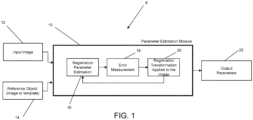
- FIG. 1 illustrates a parameter estimation system 8 providing a parameter estimation module 10 that can be configured to automatically estimate camera parameters and/or to estimate a geometric and non-linear transformation.
- a geometric transformation between an input image 12 and a reference object 14, which may include another image or a template.
- the transformation can include a homography transformation or generate a set of one or more camera parameters (i.e., a camera calibration). That is, the reference object 14 can be either an image, similar to the input image, or a template of the real world and having a known 3D geometry.
- the parameter estimation module 10 in the example configuration shown in FIG. 1 includes modules, routines, processes or units to perform a registration parameter estimation 16, an error measurement 18, and a registration transformation 20, to be applied to the image 12.
- the initial registration parameter estimation 16 can be a fully automated process, using a function approximation technique or a database search.
- the initial registration parameters are the parameters of a linear or non-linear function that maps the pixels of the input image 12 to the reference object 14.
- the initial registration parameters can be used to measure the accuracy of the estimated transformation, or the registration error, using a mechanism for performing the error measurement 18, which can be a separate process or a part of the same registration parameter estimation 16 and is thus shown separately for illustrative purposes.
- the registration transformation 20 can be applied to the input image 12 and the process can be repeated as shown in FIG. 1 .
- Prior knowledge can be used in the error measurement 18 if it is available, or the error measurement 18 can learn to estimate the error using function approximation techniques.
- the module 10 generates a set of one or more output parameters 22, which can include camera parameters, or parameters of the geometric and non-linear transformation, which are numerical values of the intrinsic and extrinsic camera parameters or a subset of them.
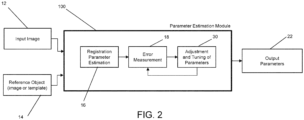
- FIG. 2 illustrates an alternative configuration for a parameter estimation module 100.
- a module, routine, process or unit is provided to perform an adjustment and tuning of parameters 30.
- the process shown in FIG. 2 can also be used for automated estimation of registration parameters to generate output parameters 22 using an error measurement 18, however, in this alternative configuration, after performing the error measurement 18, , the registration parameters are adjusted through an optimization process.
- FIG. 1 and FIG. 2 are representative of two ways in which to apply the iterative process.
- the iterative process in FIG. 1 applies the estimated transformation on the input image and re-estimates the parameters (repeating the process for convergence), while in FIG. 2 the parameters are adjusted differently. That is, FIG. 1 and 2 represent two different configurations of the same process.
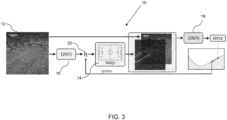
- FIG. 3 illustrates the registration and optimization process for sports images according to the configuration shown in FIG. 1 and the configuration shown in FIG. 2 .
- Different parameter adjustment methodologies are disclosed in order to minimize the error in the estimated parameters.
- the initial camera pose, or camera parameters, represented here by a homography transformation, h , 22, are obtained using a function approximation technique shown as a DNN 16 that regresses the images directly to the homography parameterization.
- the reference object 14 i.e. image, or template
- the error estimation process 18 takes the warped template of the input image and estimates the misalignment error between the two.
- the warping can be applied on the image 12 instead of the reference object 14 (template).
- the estimated error is then used as an objective function for iteratively optimizing the transformation parameters 22 and to update the parameters to maximize the alignment between the image 12 and the reference object 14 (template).
- An exemplary embodiment described illustrates how the proposed camera parameter/pose estimation and image registration can be applied for broadcast sports videos. More specifically, the calibration methodology presently described estimates the homography transformation of planar objects by aligning a planar template to the observed image of that template. However, the homography transformation can be augmented with non-linear transformations to model and measure the distortion coefficients in the intrinsic camera parameters, which can be a straightforward process to those familiar with prior camera calibration attempts.
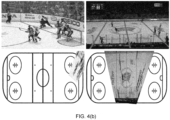
- the alignment of the image 12 to the reference object 14 (template) can be carried out by optimizing a learned error function that measures the accuracy of the alignment between the transformed image and the transformed template in the same common space, as shown in FIGS. 4(a) and 4(b) .
- the framework can be broken down into two stages: the first stage providing an initial estimate 16 of the homography matrix output 22, and the second stage which iteratively refines this estimate 16.
- the first stage can follow a function approximation procedure, and a feed-forward paradigm utilizing a function approximation technique such as a deep artificial NN can be employed.
- any method can be used here as an alternative, for example, a database search.
- the model of the playing-field can be warped to the current view, combined with the current observed image 12, and the registration error be evaluated through the second function approximation procedure, i.e. the error measurement 18, which can be chosen to be a NN.
- the warping of the template 14 and the image 12 is not required to be done necessarily to the current image space and can be done to any arbitrarily chosen space.
- the homography output parameters 22 e.g., as shown in FIG. 2
- the iterative update referred to as a refinement process, can be performed iteratively until convergence or until a desired number of maximum iterations is met. Any other optimization method can also be used, including ones that do not require gradients such as Particle Swarm Optimizations (PSOs).
- PSOs Particle Swarm Optimizations
- the homography parameters 22 can be used to iteratively update the homography parameters 22 (e.g., as shown in FIG. 1 ).
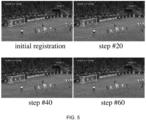
- FIG. 5 provides an example demonstrating the effect of the number of optimization iterations on the registration accuracy.
- the registration result at iteration 0 i.e. initial registration
- iterations 20, 40 and 60 can be compared to iterations 20, 40 and 60 to appreciate the improvement in registration accuracy. That is as more optimization iterations are performed, the registration can become more accurate.
- a "projected coordinates for pose” parameterization can be employed and in the case of homographies, this can be done with four (4) points.
- the lower parts of the image 12 are used since sport field broadcast videos are typically in a setup where the camera is looking down on the field.
- the playing-field model I is warped to obtain an image of the model in the current view, using a bilinear sampler to preserve differentiability.
- the gradient of ⁇ ( i ) with respect to ⁇ ( i ) can be retrieved and this gradient can be applied to retrieve an updated estimate.
- the learning process or training of the function approximation networks for the two stages of the disclosed method can be done either jointly or separately.
- the exemplary embodiment describes the how the training of the two function approximation networks can be done by decoupling them, however, the training process can readily be performed jointly.
- the target model can be warped to the image using the perturbed ground-truth homography, and can be concatenated with the input image 12 to be used as input data for training.
- the network model is trained to predict a registration error metric, e.g. the mean Intersection-over-Union (IoU).
- IoU mean Intersection-over-Union
- Other registration error metrics such as reprojection error or mutual information score can be used.
- uniform noise e.g., one for global translation, and one for local translation of each control point.
- the target model is then warped according to the perturbed homography to create our input data for training.
- the input to the registration error network for training is [ I ; ( m , h pert )]. Then, to train the network, one can minimize: where Err(,) is the error metric, for example the loU value.
- This exemplary embodiment uses the NNs for function approximation and the exemplary results are obtained using ResNet-18 architecture (reference [11]). It may be noted that any other function approximation technique other that NNs can be used here, and the system 10, 100 is not limited to the use of specific NN architecture. Instead of the classification head, one can simply replace the last fully connected layer to estimate eight (8) numbers without any activation.
- the registration error network For the registration error network, one can also rely on the ResNet-18 architecture, but with spectral normalization (reference [12]) on all convolutional layers, and take as input a 6-channel image, that is, the concatenation of the input image 12 and the warped target model. Spectral normalization smooths the error predictions by constraining the Lipschitz constant of the model, which limits the magnitude of its gradients. As the output of the registration error network cannot be negative, one can simply square the output of the network as the final activation function. For the registration network, as the input is very different from a typical image-based network, since the training is done from scratch.
- spectral normalization reference [12]
- the World Cup dataset (reference [7]) is a dataset made of broadcast videos of football plays. At the time of these tests, it had 209 images for training and validation, and 186 images for testing. This dataset is considered extremely small, making it unsuitable for feed-forward deep NNs to be trained on top of. Therefore, the state of the art for this dataset (reference [9]) relies on learning to transfer the input image 12 to look similar to the sports field model, then searching a database of known homographies and warped models to retrieve the estimate. For the experiments, thirty nine (39) images from the train-valid split were used as a validation dataset, and respect the original test split for testing.
- the Hockey dataset is composed of broadcast videos of National Hockey League (NHL) ice hockey games (reference [7]). This is a relatively larger dataset than the World Cup dataset, having 1.67M images in total at the time of these experiments. Of this large dataset, 800 consecutive chunks of images were used as validation and testing, respectively. It is ensured that images from similar time-frames do not fall into different splits. See FIGS. 4(a) and 4(b) for example images.
- FIGS. 4(a) and 4(b) provide examples of registering sports images to the templates in soccer ( FIG. 4(a) ) and hockey ( FIG. 4(b) ). In these images, the upper lines correspond to the sport field lines overlayed on the current view using estimated homographies. The lower current view is overlayed on sport field template.
- the disclosed method has been compared against three existing works for sport-field registration (references [7], [8],[9]). Since there is no publicly available implementation of the two other methods, the results are reported on the respective white papers for the World Cup dataset. For the Hockey dataset, the reported results were taken from reference [7] as a comparison point.
- the disclosed method has been compared against feed forward baselines - single stage feed-forward network ( SSF ) and a two-stage feed-forward refinement network ( FFR ). It was also further explored whether the error registration network can be used alone by retrieving the initial registration by searching a database of known poses, e.g. the training set, and using the example which gives the lowest error estimate.
- the initial registration obtained through this method as is referred to as NN, and the fully refined estimate is referred to as NNr .
- IoU part is the average intersection over union when only the visible region is considered, while IoU whole is the same considering the entire template.
- the present method performs best in terms of IoU part , and comparable to reference [9] in terms of IoU whole . Note, however, that the disclosed method does not require a database search. For the Hockey dataset, the disclosed method delivers near perfect results.
- the results can also be compared when a different target error is used for the training of the error network; comparing regressing to IoU whole , IoU part , and the average reprojection error of all pixels inside the current view (Reproj.). It may be noted that regressing to IoU part does not guarantee best performance in terms of IoU part . In all cases, regressing to IoU whole appears to give the best performance.
- NN and NNr provide insights into the capability of the error networks.
- NN provides initial estimates that are even comparable to the single-stage feed-forward network (SSF).
- SSF single-stage feed-forward network
- NNr the error estimation network gives registration results that are even more accurate than a two-stage feed-forward network.
- the best results can be obtained when the two networks are used together.
- the present application therefore discloses a two-stage pipeline for registering images 12 with an exemplary embodiment to register sports field models to broadcast videos accurately.
- the system described herein can use an optimization based inference that is based on learning a registration error function 18 (misalignment) to be optimized.
- the method makes use of two function approximation components, one that provides an initial estimate for the registration homography, and one that estimates the error of the current hypothesized homography.
- error measurement 18 By optimizing through the registration error network (i.e. error measurement 18), accurate results were obtained.
- the disclosed method can be trained with very few data, as little as 170 images, and achieve state-of-the-art performance.
- This exemplary embodiment discloses the use of one single image as the input for the method, but various modifications to make use of a sequence of images instead of one image are possible within the principles discussed herein. For example, one can naturally embed temporal consistency in a sequence of images by reusing the optimization state for consecutive images.
- any module or component exemplified herein that executes instructions may include or otherwise have access to computer readable media such as storage media, computer storage media, or data storage devices (removable and/or non-removable) such as, for example, magnetic disks, optical disks, or tape.
- Computer storage media may include volatile and non-volatile, removable and non-removable media implemented in any method or technology for storage of information, such as computer readable instructions, data structures, program modules, or other data.
- Examples of computer storage media include RAM, ROM, EEPROM, flash memory or other memory technology, CD-ROM, digital versatile disks (DVD) or other optical storage, magnetic cassettes, magnetic tape, magnetic disk storage or other magnetic storage devices, or any other medium which can be used to store the desired information and which can be accessed by an application, module, or both. Any such computer storage media may be part of the parameter estimation module 10, 100, any component of or related to the parameter estimation module 10, 100, etc., or accessible or connectable thereto. Any application or module herein described may be implemented using computer readable/executable instructions that may be stored or otherwise held by such computer readable media.
Landscapes
- Engineering & Computer Science (AREA)
- Computer Vision & Pattern Recognition (AREA)
- Physics & Mathematics (AREA)
- General Physics & Mathematics (AREA)
- Theoretical Computer Science (AREA)
- Multimedia (AREA)
- Signal Processing (AREA)
- Image Analysis (AREA)
Claims (15)
- Verfahren zum Ausrichten von Eingangsbildern auf Referenzobjekte, um Ausgangsparameter zu erzeugen, wobei das Verfahren Folgendes umfasst:Erhalten eines Eingangsbildes und eines Referenzobjekts, wobei das Referenzobjekt ein Referenzbild oder eine Schablone, die einem Inhaltsmodell in dem Referenzbild entspricht, enthält;Ausführen eines Ausrichtens des Eingangsbildes durch Schätzen von Transformationsparametern einer geometrischen Transformation, die Pixel von dem Eingangsbild auf das Referenzobjekt abbildet;Verzerren des Referenzobjekts oder des Eingangsbildes in Übereinstimmung mit den geschätzten Transformationsparametern und Messen eines Fehlausrichtungsfehlers zwischen dem Eingangsbild und dem Referenzobjekt unter Verwendung einer Funktionsapproximationstechnik, die basierend auf dem Vergleichen eines geschätzten Fehlers mit einer Fehlermetrik trainiert wird;iteratives Aktualisieren der Transformationsparameter, um den Fehlausrichtungsfehler zu minimieren; undErzeugen eines Satzes von Ausgangsparametern aus den aktualisierten Transformationsparametern, die einen Satz aus einem oder mehreren Kameraparametern oder einen Satz von Parametern einer geometrischen Transformation enthalten.
- Verfahren nach Anspruch 1, wobei das Ausrichten das Kalibrieren eine Bildgebungsvorrichtung umfasst und wobei die geometrische Transformation intrinsische und extrinsische Parameter der Bildgebungsvorrichtung repräsentiert.
- Verfahren nach Anspruch 2, wobei das Eingangsbild von der Bildgebungsvorrichtung empfangen wird und wobei eine ebene Oberfläche eines Objekts mit bekannter Geometrie aus dem empfangenden Eingangsbild beobachtbar ist und die Schablone einer Form des Objekts entspricht.
- Verfahren nach einem der Ansprüche 1 bis 3, wobei die Einstellung der iterativen Parameter zwei Bilder oder das Eingangsbild und die Schablone aufeinander ausrichtet, die geschätzte Transformation auf eines der Bilder anwendet und das transformierte Bild auf das andere Bild oder die Schablone durch Schätzen der geometrischen Transformation ausrichtet.
- Verfahren nach Anspruch 4, wobei der Vorgang des iterativen Einstellens wiederholt wird, bis eine Konvergenzbedingung erfüllt ist.
- Verfahren nach Anspruch 4 oder Anspruch 5, wobei das Einstellen iterativer Parameter eine Optimierungstechnik umfasst, die den Fehlausrichtungsfehler zwischen dem Eingangsbild und dem Referenzobjekt minimiert.
- Verfahren nach einem der Ansprüche 1 bis 6, das ferner das Schätzen der geometrischen Transformation unter Verwendung einer weiteren Funktionsapproximationstechnik umfasst, wobei optional die andere Funktionsapproximationstechnik das Verwenden eines künstlichen neuronalen Netzes umfasst.
- Verfahren nach einem der Ansprüche 1 bis 7, wobei die Funktionsapproximationstechnik das Verwenden eines künstlichen neuronalen Netzes umfasst.
- Verfahren nach Anspruch 8, wobei die Fehlermetrik ein Rückprojektionsfehler zwischen einem oder mehreren Ankerpunkten in zwei aufeinander ausgerichteten Bildern ist und/oder ein Jaccard-Koeffizient ist und/oder eine Bewertung gegenseitiger Informationen, "mutual information score", zwischen den aufeinander ausgerichteten Bildern nach dem Anwenden der Ausrichtung Technik ist.
- Verfahren nach einem der Ansprüche 1 bis 9, wobei der geschätzte Fehler des Fehlausrichtungsfehlers zwischen dem Eingangsbild und dem Referenzobjekt vorhanden ist.
- Verfahren nach einem der Ansprüche 1 bis 10, wobei das Bild einen Teil eines Sportplatzes zeigt und die Schablone eine Form des Sportplatzes enthält, wobei optional die geometrische Transformation eine Homografie zwischen einem Bild des Sportplatzes und seiner Schablone enthält.
- Verfahren nach Anspruch 2, wobei die Bildgebungsvorrichtung eine Rundfunkkamera enthält und das Eingangsbild von einem Sportereignis erhalten wird, wobei die geometrische Transformation jedes Pixel in dem Eingangsbild auf seinen entsprechenden Ort in der realen Welt abbildet.
- Computerlesbares Medium, das computerausführbare Anweisungen zum Ausrichten von Eingangsbildern auf Referenzobjekte, um Ausgangsparameter zu erzeugen, enthält, die Anweisungen umfassen, um das Verfahren nach einem der Ansprüche 1 bis 12 auszuführen.
- Elektronische Vorrichtung, die einen Prozessor und einen Speicher enthält, wobei der Speicher computerausführbare Anweisungen zum Ausrichten von Eingangsbildern auf Referenzobjekte zum Erzeugen von Ausgangsparametern nach einen der Ansprüche 1 bis 12 enthält.
- Elektronische Vorrichtung nach Anspruch 14, die mit einer Bildgebungsvorrichtung gekoppelt ist oder in die Bildgebungsvorrichtung eingebaut ist.
Applications Claiming Priority (1)
| Application Number | Priority Date | Filing Date | Title |
|---|---|---|---|
| US201962850910P | 2019-05-21 | 2019-05-21 |
Publications (3)
| Publication Number | Publication Date |
|---|---|
| EP3742399A1 EP3742399A1 (de) | 2020-11-25 |
| EP3742399B1 true EP3742399B1 (de) | 2025-03-05 |
| EP3742399C0 EP3742399C0 (de) | 2025-03-05 |
Family
ID=70802601
Family Applications (1)
| Application Number | Title | Priority Date | Filing Date |
|---|---|---|---|
| EP20175677.2A Active EP3742399B1 (de) | 2019-05-21 | 2020-05-20 | Systeme und verfahren zur bildregistrierung und kamerakalibrierung unter verwendung gelernter fehlerfunktionen |
Country Status (4)
| Country | Link |
|---|---|
| US (1) | US11455745B2 (de) |
| EP (1) | EP3742399B1 (de) |
| CA (1) | CA3081034C (de) |
| ES (1) | ES3019883T3 (de) |
Families Citing this family (11)
| Publication number | Priority date | Publication date | Assignee | Title |
|---|---|---|---|---|
| CN113243015B (zh) * | 2018-12-19 | 2024-03-26 | 浙江大华技术股份有限公司 | 视频监控系统 |
| PT4133406T (pt) | 2020-04-10 | 2025-05-08 | Stats Llc | Calibração de câmara de ponta a ponta para transmissão de vídeo |
| EP4033756B1 (de) | 2021-01-20 | 2026-03-11 | Hexagon Innovation Hub GmbH | Modellbasierte kompensation |
| US12530784B2 (en) | 2021-07-01 | 2026-01-20 | Naver Corporation | Vehicle speed estimation systems and methods |
| US11715215B2 (en) * | 2021-07-01 | 2023-08-01 | Naver Corporation | Untrained systems and methods for vehicle speed estimation |
| CN113516697B (zh) * | 2021-07-19 | 2024-02-02 | 北京世纪好未来教育科技有限公司 | 图像配准的方法、装置、电子设备及计算机可读存储介质 |
| CN113284196B (zh) * | 2021-07-20 | 2021-10-22 | 杭州先奥科技有限公司 | 一种摄像机畸变逐像素标定方法 |
| US11580690B1 (en) | 2021-08-31 | 2023-02-14 | Raytheon Company | Horizon-based navigation |
| CN113706635B (zh) * | 2021-10-28 | 2022-04-01 | 中国测绘科学研究院 | 一种基于点特征和线特征融合的长焦距相机标定方法 |
| EP4420081A4 (de) * | 2021-12-20 | 2025-08-27 | Sportlogiq Inc | Systeme und verfahren zur bildregistrierung und kalibrierung einer bildgebungsvorrichtung |
| CN115861200B (zh) * | 2022-11-23 | 2025-08-19 | 河南大学 | 一种基于强化特征融合的Sparse-rcnn的布匹瑕疵检测方法 |
Family Cites Families (7)
| Publication number | Priority date | Publication date | Assignee | Title |
|---|---|---|---|---|
| US9883163B2 (en) | 2012-01-09 | 2018-01-30 | Disney Enterprises, Inc. | Method and system for determining camera parameters from a long range gradient based on alignment differences in non-point image landmarks |
| CN102750697B (zh) | 2012-06-08 | 2014-08-20 | 华为技术有限公司 | 一种参数标定方法及装置 |
| CN105981074B (zh) * | 2014-11-04 | 2018-02-02 | 深圳市大疆创新科技有限公司 | 用于标定成像装置的系统、方法和装置 |
| JP6554873B2 (ja) * | 2015-03-31 | 2019-08-07 | 株式会社リコー | 投影システム、画像処理装置、校正方法およびプログラム |
| WO2016193018A1 (en) * | 2015-05-29 | 2016-12-08 | Unilever Plc | System and method for measuring hair diameter |
| US20170184698A1 (en) * | 2015-12-29 | 2017-06-29 | Rohde & Schwarz Gmbh & Co. Kg | Method and apparatus for calibration of a device under test |
| WO2017132766A1 (en) | 2016-02-03 | 2017-08-10 | Sportlogiq Inc. | Systems and methods for automated camera calibration |
-
2020
- 2020-05-20 CA CA3081034A patent/CA3081034C/en active Active
- 2020-05-20 ES ES20175677T patent/ES3019883T3/es active Active
- 2020-05-20 EP EP20175677.2A patent/EP3742399B1/de active Active
- 2020-05-20 US US16/878,748 patent/US11455745B2/en active Active
Non-Patent Citations (1)
| Title |
|---|
| ZITOVA B ET AL: "IMAGE REGISTRATION METHODS: A SURVEY", IMAGE AND VISION COMPUTING, ELSEVIER, GUILDFORD, GB, vol. 21, no. 11, 1 October 2003 (2003-10-01), pages 977 - 1000, XP001189327, ISSN: 0262-8856, DOI: 10.1016/S0262-8856(03)00137-9 * |
Also Published As
| Publication number | Publication date |
|---|---|
| EP3742399A1 (de) | 2020-11-25 |
| ES3019883T3 (en) | 2025-05-21 |
| US20200372679A1 (en) | 2020-11-26 |
| CA3081034A1 (en) | 2020-11-21 |
| EP3742399C0 (de) | 2025-03-05 |
| US11455745B2 (en) | 2022-09-27 |
| CA3081034C (en) | 2024-05-21 |
Similar Documents
| Publication | Publication Date | Title |
|---|---|---|
| EP3742399B1 (de) | Systeme und verfahren zur bildregistrierung und kamerakalibrierung unter verwendung gelernter fehlerfunktionen | |
| Citraro et al. | Real-time camera pose estimation for sports fields | |
| Jung et al. | Housecat6d-a large-scale multi-modal category level 6d object perception dataset with household objects in realistic scenarios | |
| Urban et al. | Multicol-slam-a modular real-time multi-camera slam system | |
| CN107481279B (zh) | 一种单目视频深度图计算方法 | |
| US10679361B2 (en) | Multi-view rotoscope contour propagation | |
| EP3411755B1 (de) | Systeme und verfahren zur automatischen kamerakalibrierung | |
| CN113012212A (zh) | 一种基于深度信息融合的室内场景三维点云重建方法和系统 | |
| Tang et al. | ESTHER: Joint camera self-calibration and automatic radial distortion correction from tracking of walking humans | |
| Chelani et al. | How privacy-preserving are line clouds? recovering scene details from 3d lines | |
| Liu et al. | Geometrized transformer for self-supervised homography estimation | |
| Repko et al. | 3D models from extended uncalibrated video sequences: Addressing key-frame selection and projective drift | |
| Bazin et al. | Globally optimal inlier set maximization with unknown rotation and focal length | |
| Ventura et al. | P1ac: Revisiting absolute pose from a single affine correspondence | |
| Shi et al. | SeFENet: robust deep homography estimation via semantic-driven feature enhancement | |
| Halperin et al. | Clear Skies Ahead: Towards Real‐Time Automatic Sky Replacement in Video | |
| Piccini et al. | Good edgels to track: Beating the aperture problem with epipolar geometry | |
| Blanton | Revisiting Absolute Pose Regression | |
| Imre et al. | Through-the-Lens multi-camera synchronisation and frame-drop detection for 3D reconstruction | |
| US20240296572A1 (en) | Systems and Methods for Image Registration and Imaging Device Calibration | |
| Lin et al. | Simultaneous camera pose and correspondence estimation with motion coherence | |
| Huang et al. | MPDG-SLAM: Motion Probability-Based 3DGS-SLAM in Dynamic Environment | |
| Behret et al. | Examination of real world bias on the localization accuracy of indirect SLAM | |
| Breytenbach et al. | YOCO-Sport: An End-to-End Framework for Deep Learning-Based Camera Calibration from Sports Broadcast Footage | |
| Xu | Stereo Visual Odometry with Windowed Bundle Adjustment |
Legal Events
| Date | Code | Title | Description |
|---|---|---|---|
| PUAI | Public reference made under article 153(3) epc to a published international application that has entered the european phase |
Free format text: ORIGINAL CODE: 0009012 |
|
| STAA | Information on the status of an ep patent application or granted ep patent |
Free format text: STATUS: THE APPLICATION HAS BEEN PUBLISHED |
|
| AK | Designated contracting states |
Kind code of ref document: A1 Designated state(s): AL AT BE BG CH CY CZ DE DK EE ES FI FR GB GR HR HU IE IS IT LI LT LU LV MC MK MT NL NO PL PT RO RS SE SI SK SM TR |
|
| AX | Request for extension of the european patent |
Extension state: BA ME |
|
| STAA | Information on the status of an ep patent application or granted ep patent |
Free format text: STATUS: REQUEST FOR EXAMINATION WAS MADE |
|
| 17P | Request for examination filed |
Effective date: 20210525 |
|
| RBV | Designated contracting states (corrected) |
Designated state(s): AL AT BE BG CH CY CZ DE DK EE ES FI FR GB GR HR HU IE IS IT LI LT LU LV MC MK MT NL NO PL PT RO RS SE SI SK SM TR |
|
| STAA | Information on the status of an ep patent application or granted ep patent |
Free format text: STATUS: EXAMINATION IS IN PROGRESS |
|
| 17Q | First examination report despatched |
Effective date: 20220706 |
|
| GRAP | Despatch of communication of intention to grant a patent |
Free format text: ORIGINAL CODE: EPIDOSNIGR1 |
|
| STAA | Information on the status of an ep patent application or granted ep patent |
Free format text: STATUS: GRANT OF PATENT IS INTENDED |
|
| INTG | Intention to grant announced |
Effective date: 20241008 |
|
| GRAS | Grant fee paid |
Free format text: ORIGINAL CODE: EPIDOSNIGR3 |
|
| GRAA | (expected) grant |
Free format text: ORIGINAL CODE: 0009210 |
|
| STAA | Information on the status of an ep patent application or granted ep patent |
Free format text: STATUS: THE PATENT HAS BEEN GRANTED |
|
| AK | Designated contracting states |
Kind code of ref document: B1 Designated state(s): AL AT BE BG CH CY CZ DE DK EE ES FI FR GB GR HR HU IE IS IT LI LT LU LV MC MK MT NL NO PL PT RO RS SE SI SK SM TR |
|
| REG | Reference to a national code |
Ref country code: GB Ref legal event code: FG4D |
|
| REG | Reference to a national code |
Ref country code: CH Ref legal event code: EP |
|
| REG | Reference to a national code |
Ref country code: IE Ref legal event code: FG4D |
|
| REG | Reference to a national code |
Ref country code: DE Ref legal event code: R096 Ref document number: 602020047088 Country of ref document: DE |
|
| U01 | Request for unitary effect filed |
Effective date: 20250327 |
|
| U07 | Unitary effect registered |
Designated state(s): AT BE BG DE DK EE FI FR IT LT LU LV MT NL PT RO SE SI Effective date: 20250403 |
|
| REG | Reference to a national code |
Ref country code: ES Ref legal event code: FG2A Ref document number: 3019883 Country of ref document: ES Kind code of ref document: T3 Effective date: 20250521 |
|
| U20 | Renewal fee for the european patent with unitary effect paid |
Year of fee payment: 6 Effective date: 20250521 |
|
| PG25 | Lapsed in a contracting state [announced via postgrant information from national office to epo] |
Ref country code: RS Free format text: LAPSE BECAUSE OF FAILURE TO SUBMIT A TRANSLATION OF THE DESCRIPTION OR TO PAY THE FEE WITHIN THE PRESCRIBED TIME-LIMIT Effective date: 20250605 |
|
| PGFP | Annual fee paid to national office [announced via postgrant information from national office to epo] |
Ref country code: GB Payment date: 20250519 Year of fee payment: 6 |
|
| PG25 | Lapsed in a contracting state [announced via postgrant information from national office to epo] |
Ref country code: NO Free format text: LAPSE BECAUSE OF FAILURE TO SUBMIT A TRANSLATION OF THE DESCRIPTION OR TO PAY THE FEE WITHIN THE PRESCRIBED TIME-LIMIT Effective date: 20250605 |
|
| PG25 | Lapsed in a contracting state [announced via postgrant information from national office to epo] |
Ref country code: HR Free format text: LAPSE BECAUSE OF FAILURE TO SUBMIT A TRANSLATION OF THE DESCRIPTION OR TO PAY THE FEE WITHIN THE PRESCRIBED TIME-LIMIT Effective date: 20250305 |
|
| PG25 | Lapsed in a contracting state [announced via postgrant information from national office to epo] |
Ref country code: GR Free format text: LAPSE BECAUSE OF FAILURE TO SUBMIT A TRANSLATION OF THE DESCRIPTION OR TO PAY THE FEE WITHIN THE PRESCRIBED TIME-LIMIT Effective date: 20250606 |
|
| PGFP | Annual fee paid to national office [announced via postgrant information from national office to epo] |
Ref country code: CH Payment date: 20250601 Year of fee payment: 6 |
|
| PG25 | Lapsed in a contracting state [announced via postgrant information from national office to epo] |
Ref country code: SM Free format text: LAPSE BECAUSE OF FAILURE TO SUBMIT A TRANSLATION OF THE DESCRIPTION OR TO PAY THE FEE WITHIN THE PRESCRIBED TIME-LIMIT Effective date: 20250305 |
|
| PGFP | Annual fee paid to national office [announced via postgrant information from national office to epo] |
Ref country code: ES Payment date: 20250630 Year of fee payment: 6 |
|
| PG25 | Lapsed in a contracting state [announced via postgrant information from national office to epo] |
Ref country code: PL Free format text: LAPSE BECAUSE OF FAILURE TO SUBMIT A TRANSLATION OF THE DESCRIPTION OR TO PAY THE FEE WITHIN THE PRESCRIBED TIME-LIMIT Effective date: 20250305 |
|
| PG25 | Lapsed in a contracting state [announced via postgrant information from national office to epo] |
Ref country code: CZ Free format text: LAPSE BECAUSE OF FAILURE TO SUBMIT A TRANSLATION OF THE DESCRIPTION OR TO PAY THE FEE WITHIN THE PRESCRIBED TIME-LIMIT Effective date: 20250305 |
|
| PG25 | Lapsed in a contracting state [announced via postgrant information from national office to epo] |
Ref country code: SK Free format text: LAPSE BECAUSE OF FAILURE TO SUBMIT A TRANSLATION OF THE DESCRIPTION OR TO PAY THE FEE WITHIN THE PRESCRIBED TIME-LIMIT Effective date: 20250305 |
|
| PG25 | Lapsed in a contracting state [announced via postgrant information from national office to epo] |
Ref country code: IS Free format text: LAPSE BECAUSE OF FAILURE TO SUBMIT A TRANSLATION OF THE DESCRIPTION OR TO PAY THE FEE WITHIN THE PRESCRIBED TIME-LIMIT Effective date: 20250705 |
|
| PLBE | No opposition filed within time limit |
Free format text: ORIGINAL CODE: 0009261 |
|
| STAA | Information on the status of an ep patent application or granted ep patent |
Free format text: STATUS: NO OPPOSITION FILED WITHIN TIME LIMIT |
|
| REG | Reference to a national code |
Ref country code: CH Ref legal event code: L10 Free format text: ST27 STATUS EVENT CODE: U-0-0-L10-L00 (AS PROVIDED BY THE NATIONAL OFFICE) Effective date: 20260114 |
|
| PG25 | Lapsed in a contracting state [announced via postgrant information from national office to epo] |
Ref country code: MC Free format text: LAPSE BECAUSE OF FAILURE TO SUBMIT A TRANSLATION OF THE DESCRIPTION OR TO PAY THE FEE WITHIN THE PRESCRIBED TIME-LIMIT Effective date: 20250305 |
|
| 26N | No opposition filed |
Effective date: 20251208 |
|
| PG25 | Lapsed in a contracting state [announced via postgrant information from national office to epo] |
Ref country code: IE Free format text: LAPSE BECAUSE OF NON-PAYMENT OF DUE FEES Effective date: 20250520 |