EP3741877B1 - High thermal conductivity aluminium alloy and preparation method therefor - Google Patents
High thermal conductivity aluminium alloy and preparation method therefor Download PDFInfo
- Publication number
- EP3741877B1 EP3741877B1 EP19840621.7A EP19840621A EP3741877B1 EP 3741877 B1 EP3741877 B1 EP 3741877B1 EP 19840621 A EP19840621 A EP 19840621A EP 3741877 B1 EP3741877 B1 EP 3741877B1
- Authority
- EP
- European Patent Office
- Prior art keywords
- aluminum alloy
- thermal conductivity
- high thermal
- graphene
- conductivity aluminum
- Prior art date
- Legal status (The legal status is an assumption and is not a legal conclusion. Google has not performed a legal analysis and makes no representation as to the accuracy of the status listed.)
- Active
Links
Classifications
-
- B—PERFORMING OPERATIONS; TRANSPORTING
- B22—CASTING; POWDER METALLURGY
- B22D—CASTING OF METALS; CASTING OF OTHER SUBSTANCES BY THE SAME PROCESSES OR DEVICES
- B22D17/00—Pressure die casting or injection die casting, i.e. casting in which the metal is forced into a mould under high pressure
- B22D17/007—Semi-solid pressure die casting
-
- B—PERFORMING OPERATIONS; TRANSPORTING
- B22—CASTING; POWDER METALLURGY
- B22D—CASTING OF METALS; CASTING OF OTHER SUBSTANCES BY THE SAME PROCESSES OR DEVICES
- B22D17/00—Pressure die casting or injection die casting, i.e. casting in which the metal is forced into a mould under high pressure
- B22D17/20—Accessories: Details
- B22D17/2015—Means for forcing the molten metal into the die
- B22D17/2069—Exerting after-pressure on the moulding material
-
- C—CHEMISTRY; METALLURGY
- C22—METALLURGY; FERROUS OR NON-FERROUS ALLOYS; TREATMENT OF ALLOYS OR NON-FERROUS METALS
- C22C—ALLOYS
- C22C1/00—Making non-ferrous alloys
- C22C1/02—Making non-ferrous alloys by melting
-
- C—CHEMISTRY; METALLURGY
- C22—METALLURGY; FERROUS OR NON-FERROUS ALLOYS; TREATMENT OF ALLOYS OR NON-FERROUS METALS
- C22C—ALLOYS
- C22C1/00—Making non-ferrous alloys
- C22C1/02—Making non-ferrous alloys by melting
- C22C1/026—Alloys based on aluminium
-
- C—CHEMISTRY; METALLURGY
- C22—METALLURGY; FERROUS OR NON-FERROUS ALLOYS; TREATMENT OF ALLOYS OR NON-FERROUS METALS
- C22C—ALLOYS
- C22C1/00—Making non-ferrous alloys
- C22C1/06—Making non-ferrous alloys with the use of special agents for refining or deoxidising
-
- C—CHEMISTRY; METALLURGY
- C22—METALLURGY; FERROUS OR NON-FERROUS ALLOYS; TREATMENT OF ALLOYS OR NON-FERROUS METALS
- C22C—ALLOYS
- C22C1/00—Making non-ferrous alloys
- C22C1/10—Alloys containing non-metals
- C22C1/1036—Alloys containing non-metals starting from a melt
-
- C—CHEMISTRY; METALLURGY
- C22—METALLURGY; FERROUS OR NON-FERROUS ALLOYS; TREATMENT OF ALLOYS OR NON-FERROUS METALS
- C22C—ALLOYS
- C22C1/00—Making non-ferrous alloys
- C22C1/10—Alloys containing non-metals
- C22C1/1036—Alloys containing non-metals starting from a melt
- C22C1/1073—Infiltration or casting under mechanical pressure, e.g. squeeze casting
-
- C—CHEMISTRY; METALLURGY
- C22—METALLURGY; FERROUS OR NON-FERROUS ALLOYS; TREATMENT OF ALLOYS OR NON-FERROUS METALS
- C22C—ALLOYS
- C22C1/00—Making non-ferrous alloys
- C22C1/12—Making non-ferrous alloys by processing in a semi-solid state, e.g. holding the alloy in the solid-liquid phase
-
- C—CHEMISTRY; METALLURGY
- C22—METALLURGY; FERROUS OR NON-FERROUS ALLOYS; TREATMENT OF ALLOYS OR NON-FERROUS METALS
- C22C—ALLOYS
- C22C21/00—Alloys based on aluminium
- C22C21/02—Alloys based on aluminium with silicon as the next major constituent
-
- C—CHEMISTRY; METALLURGY
- C22—METALLURGY; FERROUS OR NON-FERROUS ALLOYS; TREATMENT OF ALLOYS OR NON-FERROUS METALS
- C22C—ALLOYS
- C22C21/00—Alloys based on aluminium
- C22C21/02—Alloys based on aluminium with silicon as the next major constituent
- C22C21/04—Modified aluminium-silicon alloys
-
- C—CHEMISTRY; METALLURGY
- C22—METALLURGY; FERROUS OR NON-FERROUS ALLOYS; TREATMENT OF ALLOYS OR NON-FERROUS METALS
- C22F—CHANGING THE PHYSICAL STRUCTURE OF NON-FERROUS METALS AND NON-FERROUS ALLOYS
- C22F1/00—Changing the physical structure of non-ferrous metals or alloys by heat treatment or by hot or cold working
- C22F1/04—Changing the physical structure of non-ferrous metals or alloys by heat treatment or by hot or cold working of aluminium or alloys based thereon
-
- C—CHEMISTRY; METALLURGY
- C22—METALLURGY; FERROUS OR NON-FERROUS ALLOYS; TREATMENT OF ALLOYS OR NON-FERROUS METALS
- C22F—CHANGING THE PHYSICAL STRUCTURE OF NON-FERROUS METALS AND NON-FERROUS ALLOYS
- C22F1/00—Changing the physical structure of non-ferrous metals or alloys by heat treatment or by hot or cold working
- C22F1/04—Changing the physical structure of non-ferrous metals or alloys by heat treatment or by hot or cold working of aluminium or alloys based thereon
- C22F1/043—Changing the physical structure of non-ferrous metals or alloys by heat treatment or by hot or cold working of aluminium or alloys based thereon of alloys with silicon as the next major constituent
-
- H—ELECTRICITY
- H10—SEMICONDUCTOR DEVICES; ELECTRIC SOLID-STATE DEVICES NOT OTHERWISE PROVIDED FOR
- H10W—GENERIC PACKAGES, INTERCONNECTIONS, CONNECTORS OR OTHER CONSTRUCTIONAL DETAILS OF DEVICES COVERED BY CLASS H10
- H10W40/00—Arrangements for thermal protection or thermal control
- H10W40/20—Arrangements for cooling
- H10W40/25—Arrangements for cooling characterised by their materials
- H10W40/258—Metallic materials
Definitions
- the embodiments of the present invention relate to the field of metal materials, and particularly to an aluminum alloy.
- Aluminum alloys have a range of desirable properties. They have low density, high strength, good electrical and thermal conductivity, and are easy to process. They are able to meet various requirements in product structure and heat dissipation and are therefore widely used in the fields of automobiles, electronics, and communication. Pure aluminum has a relatively high thermal conductivity of around 238 W/(m ⁇ K) at room temperature. The thermal conductivity of wrought aluminum alloys, such as 6063, also reaches 209 W/(m.K). However, with the increase of elements in the aluminium alloy, the thermal conductivity of the alloy gradually decreases. The influence of different elements on the thermal conductivities of alloys varies significantly. This variation is mainly determined by the free electron conduction mechanism of metals. The electrical conductivity of an aluminum alloy is related to the degree of lattice distortion, defects, impurities, phase composition and distribution in its structure.
- CN105296818A discloses an aluminium alloy having good mechanical performance and high heat conductivity.
- the objective of the present invention is to provide a high thermal conductivity aluminium alloy having high electrical conductivity, optimized casting performance and semi-solid die-casting performance, and a preparation method thereof.
- a high thermal conductivity defined in claim 1 the method for preparing aluminum alloy is a high thermal conductivity aluminum alloy is defined in claim 4.
- the preferred embodiments are defined in dependent claims.
- the main alloy elements of the high thermal conductivity aluminum alloy of the present invention are Si, Fe, Zn, V, Sr, and graphene.
- the main alloying elements of Si, Fe, and Zn are optimized; on this basis, vanadium is added to refine and modify the Fe-rich phase; Sr is added to refine and modify eutectic silicon; graphene is added to increase thermal conductivity.
- the amounts of alloying elements and impurities are strictly controlled so that they coordinate to ensure the aluminum alloy has optimal performance.
- the alloy is a high thermal conductivity aluminium alloy that is highly thermally conductive and has good casting performance and excellent mechanical properties.
- Al is a major component in forming an aluminum alloy.
- the weight percentage of Al is within the range of 80% to 90%.
- Si is one of the important components in forming an aluminum alloy.
- the lattice constant of Si differs greatly from that of Al. Silicon dissolved in an aluminum matrix will lead to lattice distortion of the aluminum matrix. Under the effect of an external electric field, the resistance for electron wave propagation increases, resistance increases, the thermal conductivity of the aluminum alloy decreases.
- silicon could form an Al + Si eutectic liquid phase with Al in the aluminum alloy, which simultaneously increases the die-casting fluidity, the strength, and the mechanical and processing performance of the aluminum alloy.
- the presence of a larger amount of Si results in a larger eutectic liquid phase and better die-casting fluidity of the aluminum alloy; however, both the thermal conductivity and plasticity of the die-casting aluminum alloy decrease.
- the amount of Si is less than 6.5%, the fluidity of the aluminum alloy is such that the process requirements of semi-solid die-casting cannot be satisfied.
- the amount of Si exceeds 8.5%, the thermal conductivity of the aluminum alloy is greatly affected.
- the amount of silicon is within the range of 6.5% to 8.5%, preferably 6.8% to 8%, and more preferably 7.0% to 8%.
- Fe is an inevitable impurity present in the aluminum alloy. Fe forms a coarse ⁇ -AiFeSiFe phase in the aluminum alloy. This ⁇ -AlFeSiFe phase severely splits the aluminum alloy matrix, resulting in low strength and low plasticity of the aluminium alloy.
- the high thermal conductivity aluminum alloy of the present invention limits the amount of Fe impurity to be within the range of 0.2% to 0.5%, preferably 0.25% to 0.45%, and more preferably 0.3% to 0.4%.
- V mainly acts to refine and modify the ⁇ -AlFeSiFe phase.
- the growing direction of Fe in the Fe-rich phase of the aluminum alloy is changed and suppressed by adding V; as a result, the ⁇ -AlFeSiFe phase changes from a coarse needle shape to uniform, fine particles. This eliminates the impact of the Fe-rich phase on the strength and plasticity of the aluminum alloy; consequently, the aluminum alloy has high strength and high plasticity.
- the amount of V in the high thermal conductivity aluminum alloy of the present invention is 0.03% to 0.05%, the preferred amount of V is 0.035% to 0.045%, the more preferred amount of V is 0.038% to 0.042%, and the most preferred amount of V is 4%.
- Sr is one of the important components of the high thermal conductivity aluminum alloy of the present invention. Sr is added to the high thermal conductivity aluminum alloy of the present invention. In the semi-solid die-casting aluminum alloy, Sr acts to modify the eutectic silicon in the Al-Si alloy. Unmodified eutectic silicon in Al-Si alloy is mainly fibrous, long needle-shaped and unevenly distributed. In Al alloys, eutectic silicon usually has an elongated needle shape, such eutectic silicon will split the aluminum alloy matrix, which is an important cause for the low strength and low plasticity of traditional die-cast aluminum alloys.
- the refinement and modification of eutectic silicon are mainly carried out by adding Na, but the use of Na in modification has several drawbacks including short effective time and environmental pollution.
- the addition of Sr to the high thermal conductivity aluminum alloy of the present invention refines and modifies the eutectic silicon in the aluminum alloy, allowing it to change from fibrous, long needles to uniformly distributed short rods and spheres. This significantly improves the mechanical properties of the high thermal conductivity aluminum alloy of the present invention. Its technical effect is significantly better than that of the traditional Na modifier, and has the advantages of good stability, long effective time, and good reproducibility.
- the amount of Sr in the high thermal conductivity aluminum alloy of the present invention is 0.01% to 1%, the preferred amount of Sr is 0.015% to 0.8%, and the more preferred amount of Sr is 0.02% to 0.6%.
- Graphene is one of the important components of the high thermal conductivity aluminum alloy of the present invention and has very good thermal conductivity.
- the thermal conductivity of pure, defect-free single-layer graphene is as high as 5300W/mK; it is the carbon material with the highest thermal conductivity to this date, higher than single-walled carbon nanotubes (3500W/mK) and multi-walled carbon nanotubes (3000W/mK). When it is used as a carrier, its thermal conductivity can reach 600W/mK.
- Graphene is added to the high thermal conductivity aluminum alloy of the present invention to improve thermal conductivity.
- the amount of graphene added in the present invention is within the range of 0.02% - 0.08%, the preferred amount of graphene is 0.04% - 0.07%, the more preferred amount of graphene is 0.05% - 0.06%.
- a high thermal conductivity aluminium alloy that comprises the following components in percentage by weight:
- the thermal conduction coefficient of the high thermal conductivity aluminium alloy of reference embodiment 1 reaches a maximum of 198. It shows the best thermal conductivity.
- a high thermal conductivity aluminium alloy that comprises the following components in percentage by weight:
- the high thermal conductivity aluminium alloy of embodiment 2 is lighter per unit volume.
- a high thermal conductivity aluminium alloy that comprises the following components in percentage by weight:
- the molding rate of the high thermal conductivity aluminium alloy of reference embodiment 3 reaches 96.02%. Process steps are reduced, time and cost are saved.
- the parameters of the high thermal conductivity aluminium alloys from the various embodiments of the present invention are present in the table below. It should be noted that the total amount of the components in an embodiment is slightly less than 100%; this can be understood as due to the presence of a trace amount of impurities.
- Table 1 shows the thermal conductivity of some embodiments.
- Embodiments No. A4-A6 are reference embodiments and embodiments No. A7 and A8 are embodiments according to the present invention.
- TABLE 1 No. Chemical composition (mass fraction/%) Thermal Conductivity (W/mK) Si Fe Zn V Sr Graphene Al A4 6.5 0.2 0.8 0.03 0.01 0.02 Remaining amount 195 A5 6.9 0.27 1.5 0.033 0.24 0.031 Remaining amount 184 A6 7.4 0 2 0.04 0.52 0.042 Remaining amount 185 A7 8 0.45 2.4 0.046 0.71 0.057 Remaining amount 189 A8 8.5 0.5 3 0.05 1 0.08 Remaining amount 187
- Table 2 shows performance parameters of some reference embodiments.
- the amount of RE is presented in two columns.
- the first column is the amount of RE as a percentage of the total weight percentage of the high thermal conductivity aluminium alloy of the present invention.
- the second column is the amount of each rare-earth element as a percentage of the total weight percentage of RE.
Landscapes
- Chemical & Material Sciences (AREA)
- Engineering & Computer Science (AREA)
- Mechanical Engineering (AREA)
- Materials Engineering (AREA)
- Metallurgy (AREA)
- Organic Chemistry (AREA)
- Physics & Mathematics (AREA)
- Thermal Sciences (AREA)
- Crystallography & Structural Chemistry (AREA)
- Manufacture Of Alloys Or Alloy Compounds (AREA)
- Cooling Or The Like Of Semiconductors Or Solid State Devices (AREA)
- Powder Metallurgy (AREA)
- Manufacture Of Metal Powder And Suspensions Thereof (AREA)
Description
- The embodiments of the present invention relate to the field of metal materials, and particularly to an aluminum alloy.
- With the rapid development of modern electronic and information technology and manufacturing technology, electronic systems and 5G communication devices are developing towards achieving large-scale integration, miniaturization, lightweight, and high power. This undoubtedly leads to challenges in the efficient heat dissipation of electronic systems and 5G communication devices. According to research data, around half of electronic device failure can be attributed to overheating and heat-related problems. The research data also shows that for a semiconductor component, every 10 °C increase in its temperature undermines its reliability by 50%. When a component is working under very high temperatures, its failure rate increases exponentially with increasing temperature.
- Aluminum alloys have a range of desirable properties. They have low density, high strength, good electrical and thermal conductivity, and are easy to process. They are able to meet various requirements in product structure and heat dissipation and are therefore widely used in the fields of automobiles, electronics, and communication. Pure aluminum has a relatively high thermal conductivity of around 238 W/(m·K) at room temperature. The thermal conductivity of wrought aluminum alloys, such as 6063, also reaches 209 W/(m.K). However, with the increase of elements in the aluminium alloy, the thermal conductivity of the alloy gradually decreases. The influence of different elements on the thermal conductivities of alloys varies significantly. This variation is mainly determined by the free electron conduction mechanism of metals. The electrical conductivity of an aluminum alloy is related to the degree of lattice distortion, defects, impurities, phase composition and distribution in its structure.
-
CN105296818A discloses an aluminium alloy having good mechanical performance and high heat conductivity. - Therefore, it is a pressing need in the field of electronic communication devices to provide a high thermal conductivity aluminum alloy with prolonged service life and reduced damage caused by overheating. This has an important industrial application in improving the performance of electronic communication devices.
- The objective of the present invention is to provide a high thermal conductivity aluminium alloy having high electrical conductivity, optimized casting performance and semi-solid die-casting performance, and a preparation method thereof.
- According to the present invention, a high thermal conductivity defined in claim 1, the method for preparing aluminum alloy is a high thermal conductivity aluminum alloy is defined in claim 4. The preferred embodiments are defined in dependent claims.
- The main alloy elements of the high thermal conductivity aluminum alloy of the present invention are Si, Fe, Zn, V, Sr, and graphene. In the present invention, the main alloying elements of Si, Fe, and Zn are optimized; on this basis, vanadium is added to refine and modify the Fe-rich phase; Sr is added to refine and modify eutectic silicon; graphene is added to increase thermal conductivity. Additionally, the amounts of alloying elements and impurities are strictly controlled so that they coordinate to ensure the aluminum alloy has optimal performance. As a result, the alloy is a high thermal conductivity aluminium alloy that is highly thermally conductive and has good casting performance and excellent mechanical properties.
- The role and amount of each component in the high thermal conductivity aluminum alloy are described below.
- Al is a major component in forming an aluminum alloy. In the high thermal conductivity aluminum alloy of the present invention, the weight percentage of Al is within the range of 80% to 90%.
- Si is one of the important components in forming an aluminum alloy. The lattice constant of Si differs greatly from that of Al. Silicon dissolved in an aluminum matrix will lead to lattice distortion of the aluminum matrix. Under the effect of an external electric field, the resistance for electron wave propagation increases, resistance increases, the thermal conductivity of the aluminum alloy decreases. On the other hand, silicon could form an Al + Si eutectic liquid phase with Al in the aluminum alloy, which simultaneously increases the die-casting fluidity, the strength, and the mechanical and processing performance of the aluminum alloy. The presence of a larger amount of Si results in a larger eutectic liquid phase and better die-casting fluidity of the aluminum alloy; however, both the thermal conductivity and plasticity of the die-casting aluminum alloy decrease. When the amount of Si is less than 6.5%, the fluidity of the aluminum alloy is such that the process requirements of semi-solid die-casting cannot be satisfied. When the amount of Si exceeds 8.5%, the thermal conductivity of the aluminum alloy is greatly affected. To ensure that the aluminium alloy has high thermal conductivity and good semi-solid die-casting molding properties, the amount of silicon is within the range of 6.5% to 8.5%, preferably 6.8% to 8%, and more preferably 7.0% to 8%.
- Fe is an inevitable impurity present in the aluminum alloy. Fe forms a coarse β-AiFeSiFe phase in the aluminum alloy. This β-AlFeSiFe phase severely splits the aluminum alloy matrix, resulting in low strength and low plasticity of the aluminium alloy. The high thermal conductivity aluminum alloy of the present invention limits the amount of Fe impurity to be within the range of 0.2% to 0.5%, preferably 0.25% to 0.45%, and more preferably 0.3% to 0.4%.
- As one of the important components of the high thermal conductivity aluminum alloy of the present invention, V mainly acts to refine and modify the β-AlFeSiFe phase. In the high thermal conductivity aluminum alloy of the present invention, the growing direction of Fe in the Fe-rich phase of the aluminum alloy is changed and suppressed by adding V; as a result, the β-AlFeSiFe phase changes from a coarse needle shape to uniform, fine particles. This eliminates the impact of the Fe-rich phase on the strength and plasticity of the aluminum alloy; consequently, the aluminum alloy has high strength and high plasticity. The amount of V in the high thermal conductivity aluminum alloy of the present invention is 0.03% to 0.05%, the preferred amount of V is 0.035% to 0.045%, the more preferred amount of V is 0.038% to 0.042%, and the most preferred amount of V is 4%.
- Sr is one of the important components of the high thermal conductivity aluminum alloy of the present invention. Sr is added to the high thermal conductivity aluminum alloy of the present invention. In the semi-solid die-casting aluminum alloy, Sr acts to modify the eutectic silicon in the Al-Si alloy. Unmodified eutectic silicon in Al-Si alloy is mainly fibrous, long needle-shaped and unevenly distributed. In Al alloys, eutectic silicon usually has an elongated needle shape, such eutectic silicon will split the aluminum alloy matrix, which is an important cause for the low strength and low plasticity of traditional die-cast aluminum alloys. In the prior art, the refinement and modification of eutectic silicon are mainly carried out by adding Na, but the use of Na in modification has several drawbacks including short effective time and environmental pollution. The addition of Sr to the high thermal conductivity aluminum alloy of the present invention refines and modifies the eutectic silicon in the aluminum alloy, allowing it to change from fibrous, long needles to uniformly distributed short rods and spheres. This significantly improves the mechanical properties of the high thermal conductivity aluminum alloy of the present invention. Its technical effect is significantly better than that of the traditional Na modifier, and has the advantages of good stability, long effective time, and good reproducibility. The amount of Sr in the high thermal conductivity aluminum alloy of the present invention is 0.01% to 1%, the preferred amount of Sr is 0.015% to 0.8%, and the more preferred amount of Sr is 0.02% to 0.6%.
- Graphene is one of the important components of the high thermal conductivity aluminum alloy of the present invention and has very good thermal conductivity. The thermal conductivity of pure, defect-free single-layer graphene is as high as 5300W/mK; it is the carbon material with the highest thermal conductivity to this date, higher than single-walled carbon nanotubes (3500W/mK) and multi-walled carbon nanotubes (3000W/mK). When it is used as a carrier, its thermal conductivity can reach 600W/mK. Graphene is added to the high thermal conductivity aluminum alloy of the present invention to improve thermal conductivity. As graphene is expensive, the amount of graphene added in the present invention is within the range of 0.02% - 0.08%, the preferred amount of graphene is 0.04% - 0.07%, the more preferred amount of graphene is 0.05% - 0.06%.
- To clarify the objectives, technical solutions, and beneficial effects of the embodiments of the present invention, the technical solutions of the present invention will be clearly and fully described with reference to the embodiments of the present invention. The described embodiments are only a part of the embodiments of the present invention and do not cover all possible embodiments.
- The high thermal conductivity aluminium alloy provided in the present application will be explained in detail below with reference to specific embodiments.
- A high thermal conductivity aluminium alloy that comprises the following components in percentage by weight:
- Al: 90%;
- Si: 6.5%;
- Fe: 0.2%;
- Zn: 0.8%;
- V: 0.03%;
- Sr: 0.01%;
- graphene: 0.02%.
- The thermal conduction coefficient of the high thermal conductivity aluminium alloy of reference embodiment 1 reaches a maximum of 198. It shows the best thermal conductivity.
- A high thermal conductivity aluminium alloy that comprises the following components in percentage by weight:
- Al: 80%;
- Si: 8.5%;
- Fe: 00.5%;
- Zn: 3%;
- V: 0.05%;
- Sr: 1%;
- graphene: 0.08%.
- Comparing the molded high thermal conductivity aluminium alloy of reference embodiment 2 to high thermal conductivity aluminium alloys of other compositions, the high thermal conductivity aluminium alloy of embodiment 2 is lighter per unit volume.
- A high thermal conductivity aluminium alloy that comprises the following components in percentage by weight:
- Al: 90%;
- Si: 6.8%;
- Fe: 0.25%;
- Zn: 1%;
- V: 0.035%;
- Sr: 0.015%;
- graphene: 0.04%.
- The molding rate of the high thermal conductivity aluminium alloy of reference embodiment 3 reaches 96.02%. Process steps are reduced, time and cost are saved.
- The parameters of the high thermal conductivity aluminium alloys from the various embodiments of the present invention are present in the table below. It should be noted that the total amount of the components in an embodiment is slightly less than 100%; this can be understood as due to the presence of a trace amount of impurities.
- Table 1 shows the thermal conductivity of some embodiments. Embodiments No. A4-A6 are reference embodiments and embodiments No. A7 and A8 are embodiments according to the present invention.
TABLE 1 No. Chemical composition (mass fraction/%) Thermal Conductivity (W/mK) Si Fe Zn V Sr Graphene Al A4 6.5 0.2 0.8 0.03 0.01 0.02 Remaining amount 195 A5 6.9 0.27 1.5 0.033 0.24 0.031 Remaining amount 184 A6 7.4 0 2 0.04 0.52 0.042 Remaining amount 185 A7 8 0.45 2.4 0.046 0.71 0.057 Remaining amount 189 A8 8.5 0.5 3 0.05 1 0.08 Remaining amount 187 - Table 2 shows performance parameters of some reference embodiments.

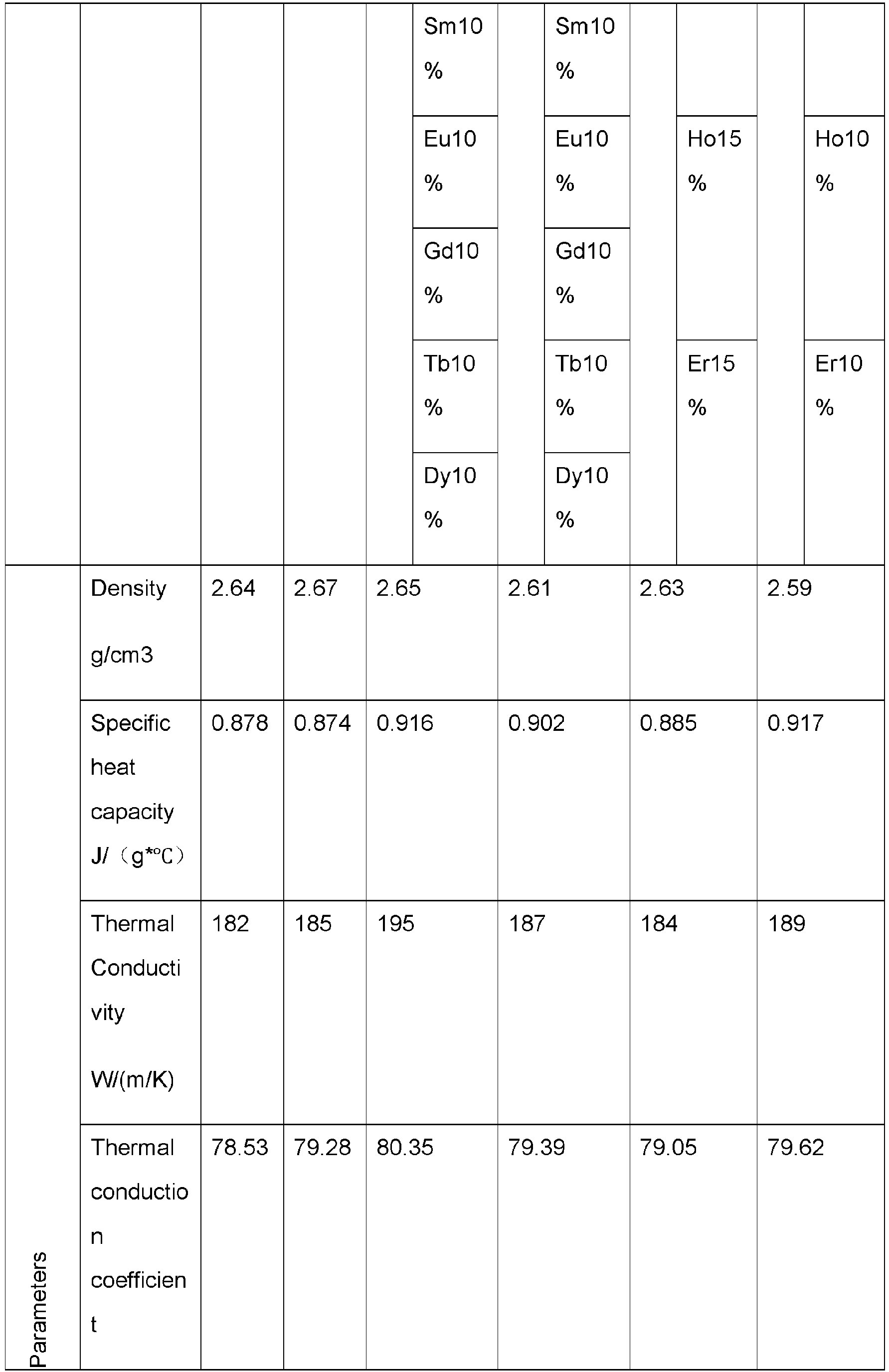

- In Table 2, the amount of RE is presented in two columns. The first column is the amount of RE as a percentage of the total weight percentage of the high thermal conductivity aluminium alloy of the present invention. The second column is the amount of each rare-earth element as a percentage of the total weight percentage of RE.
- The embodiments above are only used to illustrate the technical solutions of the present invention, but not to limit them. Although the present invention has been described in detail with reference to the above embodiments, a person of ordinary skill in the art should understand that they can still modify the technical solutions described in the embodiments above or equivalently replace some of the technical features therein.
-
- 1. The high thermal conductivity aluminium alloy of the present invention optimizes Si, Fe, Zn and other alloying elements, adds Sr, V, and graphene. The amount of each component is controlled so that they coordinate to allow high thermal conductivity, good casting performance, and excellent semi-solid die-casting performance.
- 2. Graphene is added to the high thermal conductivity aluminium alloy of the present invention. This exploits the good thermal conductivity of graphene and allows the formation of a high thermal conductivity aluminium alloy.
- 3. The high thermal conductivity aluminum alloy of the present invention lowers the amounts of silicon and other impurities dissolved in the aluminum alloy and reduces internal defects such as dispersed shrinkage and shrinkage holes, thereby reducing impurities inside crystal grains, reducing lattice distortion, and increasing the thermal conductivity of the aluminum alloy.
- 4. The high thermal conductivity aluminum alloy of the present invention has high electrical conductivity, which meets the latest development needs in the field of electronics communications; it can also meet the requirements placed by the rapid development in the field of communications on the performance of semiconductor components.
Claims (5)
- A high thermal conductivity aluminum alloy, wherein the high thermal conductivity aluminum alloy comprises the following components in percentage by weight:Al: 80% - 90%;Si: 6.5% - 8.5%;Fe: 0.2% - 0.5%;Zn: 0.8% - 3%;V: 0.03% - 0.05%;Sr: 0.01% -1%;graphene: 0.02% - 0.08%,the reminder being Al and a trace amount of impurities.
- The high thermal conductivity aluminum alloy according to claim 1, characterized in that the high thermal conductivity aluminum alloy comprises the following components in percentage by weight:Al: 82% - 90%;Si: 6.8% - 7.8%;Fe: 0.25% - 0.45%;Zn: 1% - 2.5%;V: 0.035% - 0.045%;Sr: 0.015% - 0.8%;graphene: 0.04% - 0.07%.
- The high thermal conductivity aluminum alloy according to claim 2, characterized in that the high thermal conductivity aluminum alloy comprises the following components in percentage by weight:Al: 85% - 88%;Si: 7% - 7.5%;Fe: 0.3% - 0.4%;Zn: 1.5% - 2%;V: 0.038% - 0.042%;Sr: 0.02% - 0.6%;graphene: 0.05% - 0.06%.
- A method for preparing a high thermal conductivity aluminum alloy according to any of claims 1 to 3,
wherein the method comprises the following:(1) weighing Al, Si, Fe, Zn, V, Sr and graphene according to their designated weight percentages; heating these components together at a melting temperature set at 700-750°C until molten to obtain an aluminum alloy liquid;(2) introducing the aluminum alloy liquid into a spraying device; performing powder injection refining using an inert gas as a carrier for an injection refining time set to 8 - 18 minutes; after refining, the aluminum alloy liquid is left to stand for 15 to 30 minutes, followed by filtering;(3) transferring the aluminum alloy liquid after the filtering in step (2) to a rotor degassing device; performing secondary degassing by blowing nitrogen gas into the aluminum alloy liquid under rotation, wherein the rotor degassing device has a rotational speed set to 500 to 600 rpm, a gas flow rate of 10-20 liters/min;(4) mechanically stirring a degassed aluminum alloy liquid obtained in step (3) until reaching a semi-solid state and a temperature of 580-610°C to obtain an aluminum alloy semi-solid slurry;(5) performing die-casting molding with the aluminum alloy semi-solid slurry obtained in step (4) at a temperature 575-590°C, an injection speed of 1.5-2.5 m/s, an injection specific pressure set to 30-50 MPa, and a boost pressure set to 60-80 MPa; holding pressure for 7s to 15s after completion of injection to obtain the high thermal conductivity aluminum alloy. - The method for preparing the high thermal conductivity aluminum alloy according to claim 4, characterized in that the method further comprises step (6): performing aging treatment at 300-500°C for 1 - 2 hours after the die-casting molding of the aluminum alloy semi-solid slurry in step (5); cooling to obtain the high thermal conductivity aluminum alloy.
Applications Claiming Priority (2)
| Application Number | Priority Date | Filing Date | Title |
|---|---|---|---|
| CN201811532160.5A CN109652686B (en) | 2018-12-14 | 2018-12-14 | High thermal conductivity aluminum alloy and preparation method thereof |
| PCT/CN2019/100502 WO2020020382A1 (en) | 2018-12-14 | 2019-08-14 | High thermal conductivity aluminium alloy and preparation method therefor |
Publications (3)
| Publication Number | Publication Date |
|---|---|
| EP3741877A1 EP3741877A1 (en) | 2020-11-25 |
| EP3741877A4 EP3741877A4 (en) | 2021-04-28 |
| EP3741877B1 true EP3741877B1 (en) | 2024-10-16 |
Family
ID=66114654
Family Applications (1)
| Application Number | Title | Priority Date | Filing Date |
|---|---|---|---|
| EP19840621.7A Active EP3741877B1 (en) | 2018-12-14 | 2019-08-14 | High thermal conductivity aluminium alloy and preparation method therefor |
Country Status (7)
| Country | Link |
|---|---|
| US (1) | US11898224B2 (en) |
| EP (1) | EP3741877B1 (en) |
| JP (1) | JP7121804B2 (en) |
| KR (1) | KR102523499B1 (en) |
| CN (1) | CN109652686B (en) |
| FI (1) | FI3741877T3 (en) |
| WO (1) | WO2020020382A1 (en) |
Families Citing this family (16)
| Publication number | Priority date | Publication date | Assignee | Title |
|---|---|---|---|---|
| CN109652686B (en) * | 2018-12-14 | 2020-05-26 | 珠海市润星泰电器有限公司 | High thermal conductivity aluminum alloy and preparation method thereof |
| CN111048228B (en) * | 2019-12-26 | 2020-09-25 | 远程电缆股份有限公司 | Special power distribution line for 5G transmission technology and production process thereof |
| CN111360233B (en) * | 2020-03-23 | 2022-01-11 | 中极氢能汽车(长治)有限公司 | Casting method of aluminum alloy casting for hydrogen energy automobile |
| CN112626391B (en) * | 2021-01-07 | 2022-05-03 | 重庆慧鼎华创信息科技有限公司 | Low-silicon high-heat-conductivity die-casting aluminum alloy and preparation method thereof |
| CN113106300B (en) * | 2021-02-23 | 2023-02-28 | 珠海市润星泰电器有限公司 | A heat-free treatment of high thermal conductivity aluminum alloy and its preparation method, radiator |
| CN115141957B (en) * | 2021-03-31 | 2023-06-13 | 比亚迪股份有限公司 | Aluminum alloy, preparation method thereof, structural member and mobile phone |
| CN114141402B (en) * | 2021-10-29 | 2024-04-26 | 安徽省恒泰动力科技有限公司 | Preparation process of aluminum-magnesium alloy product |
| CN114058909B (en) * | 2021-11-18 | 2023-01-31 | 国网江苏省电力有限公司 | A heat-resistant high-conductivity aluminum alloy monofilament for overhead wires and a preparation method thereof |
| EP4437152A4 (en) * | 2021-11-26 | 2025-11-05 | Indian Institute Of Tech Bhubaneswar | IMPROVEMENT OF THE THERMAL CONDUCTIVITY OF ALUMINUM BY DOTENATION OF GRAPHEN, FOLLOWED BY A MELTING AND CASTING PROCESS |
| CN115786781A (en) * | 2022-12-07 | 2023-03-14 | 吉林大学 | Graphene modified corrosion-resistant high-toughness cast aluminum-silicon alloy and preparation method thereof |
| CN116287912B (en) * | 2023-01-31 | 2025-07-15 | 广西民族大学 | High-strength high-heat-conductivity Al-Cu-Si die-casting aluminum alloy and preparation method thereof |
| CN117026026B (en) * | 2023-08-28 | 2024-02-23 | 南通众福新材料科技有限公司 | High-elongation aluminum alloy material based on recycled aluminum and preparation method thereof |
| CN117888006A (en) * | 2023-12-25 | 2024-04-16 | 栋梁铝业有限公司 | A high thermal conductivity die-casting aluminum alloy, and preparation method and application thereof |
| US12312656B1 (en) | 2024-02-16 | 2025-05-27 | GM Global Technology Operations LLC | Method for production of graphene composite components having enhanced thermal conductivity |
| CN117947319B (en) * | 2024-03-21 | 2024-06-25 | 北京车和家汽车科技有限公司 | Aluminum alloy and preparation method thereof, and aluminum alloy die casting |
| CN118291791A (en) * | 2024-04-08 | 2024-07-05 | 东莞理工学院 | A modification agent and modification method for iron-rich phase in recycled aluminum alloy |
Family Cites Families (20)
| Publication number | Priority date | Publication date | Assignee | Title |
|---|---|---|---|---|
| US20010043880A1 (en) * | 2000-03-20 | 2001-11-22 | Jen-Dong Hwang | Aluminum die casting alloy |
| JP5229934B2 (en) | 2007-07-05 | 2013-07-03 | 住友精密工業株式会社 | High thermal conductivity composite material |
| EP2226397A1 (en) | 2009-03-06 | 2010-09-08 | Rheinfelden Alloys GmbH & Co. KG | Aluminium alloy |
| WO2011105646A1 (en) * | 2010-02-23 | 2011-09-01 | 주식회사 인터프랙스퀀텀 | Zinc-aluminum alloy for die-casting |
| KR101375671B1 (en) * | 2011-10-10 | 2014-03-20 | 한국생산기술연구원 | Al-Si-Fe-Zn ALLOY HAVING HIGH THERMAL CONDUCTIVITY FOR DIE CASTING |
| US10174409B2 (en) * | 2011-10-28 | 2019-01-08 | Alcoa Usa Corp. | High performance AlSiMgCu casting alloy |
| JP5723058B2 (en) * | 2012-03-09 | 2015-05-27 | リサーチ アンド ビジネス ファンデーション ソンギュングァン ユニバーシティResearch & Business Foundation Sungkyunkwan University | Plate-type carbon nanoparticle manufacturing method and aluminum-carbon composite material manufacturing method using the same |
| KR20140129769A (en) * | 2013-04-30 | 2014-11-07 | 동양피스톤 주식회사 | Composition Of Aluminum Alloy For Local Enforcement And, Aluminum Piston With Local Enforcement Layer Using The Same |
| JP6186239B2 (en) | 2013-10-15 | 2017-08-23 | 株式会社Uacj | Aluminum alloy heat exchanger |
| CN105296818A (en) * | 2014-08-01 | 2016-02-03 | 比亚迪股份有限公司 | Aluminum alloy and preparation method and application thereof |
| CN104928541A (en) * | 2015-07-06 | 2015-09-23 | 苏州科茂电子材料科技有限公司 | Aluminum alloy material for cable and preparation method thereof |
| CN105127392B (en) * | 2015-09-21 | 2017-03-22 | 珠海市润星泰电器有限公司 | Semisolid extrusion die-casting method |
| US20170107599A1 (en) * | 2015-10-19 | 2017-04-20 | GM Global Technology Operations LLC | New high pressure die casting aluminum alloy for high temperature and corrosive applications |
| CN106916985A (en) * | 2015-12-28 | 2017-07-04 | 北京有色金属研究总院 | The preparation method of high heat conduction graphite/aluminium composite material |
| CN105671387B (en) * | 2016-02-19 | 2018-03-02 | 广州市雷子克电气机械有限公司 | A kind of aluminum matrix composite and preparation method thereof |
| CN107520418B (en) * | 2017-08-28 | 2019-01-08 | 珠海市润星泰电器有限公司 | A kind of production technology of radiating shell |
| CN108286001B (en) * | 2018-02-06 | 2019-01-08 | 珠海市润星泰电器有限公司 | A kind of preparation method of the high tough aluminium alloy of semisolid pressure casting |
| CN108531769A (en) * | 2018-04-16 | 2018-09-14 | 厦门奈福电子有限公司 | A kind of graphene-metallic composite and its prepare raw material, method and application |
| US12163206B2 (en) * | 2018-10-29 | 2024-12-10 | Fna Group, Inc. | Aluminum alloy |
| CN109652686B (en) * | 2018-12-14 | 2020-05-26 | 珠海市润星泰电器有限公司 | High thermal conductivity aluminum alloy and preparation method thereof |
-
2018
- 2018-12-14 CN CN201811532160.5A patent/CN109652686B/en active Active
-
2019
- 2019-08-14 FI FIEP19840621.7T patent/FI3741877T3/en active
- 2019-08-14 KR KR1020207018181A patent/KR102523499B1/en active Active
- 2019-08-14 EP EP19840621.7A patent/EP3741877B1/en active Active
- 2019-08-14 JP JP2020552094A patent/JP7121804B2/en active Active
- 2019-08-14 WO PCT/CN2019/100502 patent/WO2020020382A1/en not_active Ceased
- 2019-08-14 US US16/962,224 patent/US11898224B2/en active Active
Also Published As
| Publication number | Publication date |
|---|---|
| CN109652686A (en) | 2019-04-19 |
| KR102523499B1 (en) | 2023-04-19 |
| US20210062304A1 (en) | 2021-03-04 |
| WO2020020382A1 (en) | 2020-01-30 |
| FI3741877T3 (en) | 2024-11-29 |
| EP3741877A1 (en) | 2020-11-25 |
| JP2021507120A (en) | 2021-02-22 |
| CN109652686B (en) | 2020-05-26 |
| JP7121804B2 (en) | 2022-08-18 |
| EP3741877A4 (en) | 2021-04-28 |
| US11898224B2 (en) | 2024-02-13 |
| KR20200088454A (en) | 2020-07-22 |
Similar Documents
| Publication | Publication Date | Title |
|---|---|---|
| EP3741877A1 (en) | High thermal conductivity aluminium alloy and preparation method therefor | |
| CN110157932B (en) | A kind of preparation method of graphene-modified copper-based electrical contact material based on in-situ synthesis | |
| WO2020259534A1 (en) | High thermal conductivity aluminum alloy material and preparation method therefor | |
| CN109576539B (en) | High-conductivity aluminum alloy and preparation method thereof | |
| JP5464301B2 (en) | Method for manufacturing composite material for heat dissipation substrate | |
| WO2019001121A1 (en) | Aluminum alloy and preparation method therefor | |
| CN113462932A (en) | High-thermal-conductivity aluminum alloy material for semi-solid rheocasting and preparation method thereof | |
| CN101942592A (en) | Method for preparing molybdenum-copper alloy through activated sintering | |
| CN114015914A (en) | High-strength high-thermal-conductivity die-casting aluminum alloy material and preparation method thereof | |
| CN111636006B (en) | Aluminum-silicon alloy graphite composite heat conduction material and preparation and application thereof | |
| EP1473374B1 (en) | Copper alloy | |
| CN118880128A (en) | A high thermal conductivity and high strength Al-Si-Mg-Cu-Sb-Fe alloy and preparation method thereof | |
| JP2010126791A (en) | Heat dissipation material, heat dissipation plate for semiconductor and heat dissipation component for semiconductor using the same, and method for producing heat dissipation material | |
| CN113802036A (en) | High-thermal-conductivity high-elongation cast Al-Si alloy material and preparation method thereof | |
| CN113106300A (en) | Heat-treatment-free high-thermal-conductivity aluminum alloy, preparation method thereof and radiator | |
| CN106086514B (en) | A kind of neodymia dispersion-strengthened Cu based alloy and preparation method thereof | |
| CN120400607B (en) | Metal heat conduction material and preparation method and application thereof | |
| CN114941093B (en) | MXene/CNT reinforced aluminum alloy and preparation method thereof | |
| CN118910455B (en) | A high-strength semi-solid die-casting aluminum alloy and preparation method thereof | |
| JP2004323953A (en) | Copper-based low thermal expansion high thermal conduction member, and its production method | |
| Zhang et al. | Superior Combination of Strength and Electrical Conductivity in Cu/Al2O3 Composite by Introducing High-volume-fraction Ultrafine Grains | |
| CN119800164A (en) | A high elongation, high thermal conductivity TiB2-Al-Ce-La-Fe alloy, preparation method and use thereof | |
| KR20240068526A (en) | A Al-based high density thermal interface composite material and a method of manufacturing for it using a progressive liquid sintering | |
| CN119710382A (en) | High heat conduction aluminum alloy and preparation method thereof | |
| CN117230340A (en) | A kind of preparation method of graphene/copper composite material |
Legal Events
| Date | Code | Title | Description |
|---|---|---|---|
| STAA | Information on the status of an ep patent application or granted ep patent |
Free format text: STATUS: THE INTERNATIONAL PUBLICATION HAS BEEN MADE |
|
| PUAI | Public reference made under article 153(3) epc to a published international application that has entered the european phase |
Free format text: ORIGINAL CODE: 0009012 |
|
| STAA | Information on the status of an ep patent application or granted ep patent |
Free format text: STATUS: REQUEST FOR EXAMINATION WAS MADE |
|
| 17P | Request for examination filed |
Effective date: 20200818 |
|
| AK | Designated contracting states |
Kind code of ref document: A1 Designated state(s): AL AT BE BG CH CY CZ DE DK EE ES FI FR GB GR HR HU IE IS IT LI LT LU LV MC MK MT NL NO PL PT RO RS SE SI SK SM TR |
|
| AX | Request for extension of the european patent |
Extension state: BA ME |
|
| RIN1 | Information on inventor provided before grant (corrected) |
Inventor name: ZHANG, YING Inventor name: WANG, JICHENG Inventor name: TAN, JIE Inventor name: WANG, MINGFENG Inventor name: LI, GUNAN Inventor name: REN, HUAIDE |
|
| A4 | Supplementary search report drawn up and despatched |
Effective date: 20210329 |
|
| RIC1 | Information provided on ipc code assigned before grant |
Ipc: C22C 21/04 20060101AFI20210323BHEP Ipc: C22C 1/02 20060101ALI20210323BHEP Ipc: B22D 17/00 20060101ALI20210323BHEP Ipc: B22D 17/20 20060101ALI20210323BHEP Ipc: H01L 23/373 20060101ALI20210323BHEP |
|
| DAV | Request for validation of the european patent (deleted) | ||
| DAX | Request for extension of the european patent (deleted) | ||
| REG | Reference to a national code |
Ref country code: DE Ref legal event code: R079 Ipc: C22C0021040000 Ref country code: DE Ref legal event code: R079 Ref document number: 602019060589 Country of ref document: DE Free format text: PREVIOUS MAIN CLASS: C22C0021020000 Ipc: C22C0021040000 |
|
| GRAP | Despatch of communication of intention to grant a patent |
Free format text: ORIGINAL CODE: EPIDOSNIGR1 |
|
| STAA | Information on the status of an ep patent application or granted ep patent |
Free format text: STATUS: GRANT OF PATENT IS INTENDED |
|
| RIC1 | Information provided on ipc code assigned before grant |
Ipc: C22F 1/04 20060101ALI20240415BHEP Ipc: C22C 21/02 20060101ALI20240415BHEP Ipc: H01L 23/373 20060101ALI20240415BHEP Ipc: B22D 17/20 20060101ALI20240415BHEP Ipc: B22D 17/00 20060101ALI20240415BHEP Ipc: C22C 1/02 20060101ALI20240415BHEP Ipc: C22C 21/04 20060101AFI20240415BHEP |
|
| INTG | Intention to grant announced |
Effective date: 20240508 |
|
| GRAS | Grant fee paid |
Free format text: ORIGINAL CODE: EPIDOSNIGR3 |
|
| GRAA | (expected) grant |
Free format text: ORIGINAL CODE: 0009210 |
|
| STAA | Information on the status of an ep patent application or granted ep patent |
Free format text: STATUS: THE PATENT HAS BEEN GRANTED |
|
| AK | Designated contracting states |
Kind code of ref document: B1 Designated state(s): AL AT BE BG CH CY CZ DE DK EE ES FI FR GB GR HR HU IE IS IT LI LT LU LV MC MK MT NL NO PL PT RO RS SE SI SK SM TR |
|
| REG | Reference to a national code |
Ref country code: GB Ref legal event code: FG4D |
|
| REG | Reference to a national code |
Ref country code: CH Ref legal event code: EP |
|
| REG | Reference to a national code |
Ref country code: IE Ref legal event code: FG4D |
|
| REG | Reference to a national code |
Ref country code: DE Ref legal event code: R096 Ref document number: 602019060589 Country of ref document: DE |
|
| REG | Reference to a national code |
Ref country code: FI Ref legal event code: FGE |
|
| REG | Reference to a national code |
Ref country code: SE Ref legal event code: TRGR |
|
| REG | Reference to a national code |
Ref country code: LT Ref legal event code: MG9D |
|
| REG | Reference to a national code |
Ref country code: NL Ref legal event code: MP Effective date: 20241016 |
|
| REG | Reference to a national code |
Ref country code: AT Ref legal event code: MK05 Ref document number: 1732977 Country of ref document: AT Kind code of ref document: T Effective date: 20241016 |
|
| PG25 | Lapsed in a contracting state [announced via postgrant information from national office to epo] |
Ref country code: NL Free format text: LAPSE BECAUSE OF FAILURE TO SUBMIT A TRANSLATION OF THE DESCRIPTION OR TO PAY THE FEE WITHIN THE PRESCRIBED TIME-LIMIT Effective date: 20241016 |
|
| PG25 | Lapsed in a contracting state [announced via postgrant information from national office to epo] |
Ref country code: NL Free format text: LAPSE BECAUSE OF FAILURE TO SUBMIT A TRANSLATION OF THE DESCRIPTION OR TO PAY THE FEE WITHIN THE PRESCRIBED TIME-LIMIT Effective date: 20241016 |
|
| PG25 | Lapsed in a contracting state [announced via postgrant information from national office to epo] |
Ref country code: HR Free format text: LAPSE BECAUSE OF FAILURE TO SUBMIT A TRANSLATION OF THE DESCRIPTION OR TO PAY THE FEE WITHIN THE PRESCRIBED TIME-LIMIT Effective date: 20241016 Ref country code: IS Free format text: LAPSE BECAUSE OF FAILURE TO SUBMIT A TRANSLATION OF THE DESCRIPTION OR TO PAY THE FEE WITHIN THE PRESCRIBED TIME-LIMIT Effective date: 20250216 Ref country code: PT Free format text: LAPSE BECAUSE OF FAILURE TO SUBMIT A TRANSLATION OF THE DESCRIPTION OR TO PAY THE FEE WITHIN THE PRESCRIBED TIME-LIMIT Effective date: 20250217 |
|
| PG25 | Lapsed in a contracting state [announced via postgrant information from national office to epo] |
Ref country code: BG Free format text: LAPSE BECAUSE OF FAILURE TO SUBMIT A TRANSLATION OF THE DESCRIPTION OR TO PAY THE FEE WITHIN THE PRESCRIBED TIME-LIMIT Effective date: 20241016 |
|
| PG25 | Lapsed in a contracting state [announced via postgrant information from national office to epo] |
Ref country code: ES Free format text: LAPSE BECAUSE OF FAILURE TO SUBMIT A TRANSLATION OF THE DESCRIPTION OR TO PAY THE FEE WITHIN THE PRESCRIBED TIME-LIMIT Effective date: 20241016 |
|
| PG25 | Lapsed in a contracting state [announced via postgrant information from national office to epo] |
Ref country code: NO Free format text: LAPSE BECAUSE OF FAILURE TO SUBMIT A TRANSLATION OF THE DESCRIPTION OR TO PAY THE FEE WITHIN THE PRESCRIBED TIME-LIMIT Effective date: 20250116 |
|
| PG25 | Lapsed in a contracting state [announced via postgrant information from national office to epo] |
Ref country code: AT Free format text: LAPSE BECAUSE OF FAILURE TO SUBMIT A TRANSLATION OF THE DESCRIPTION OR TO PAY THE FEE WITHIN THE PRESCRIBED TIME-LIMIT Effective date: 20241016 Ref country code: GR Free format text: LAPSE BECAUSE OF FAILURE TO SUBMIT A TRANSLATION OF THE DESCRIPTION OR TO PAY THE FEE WITHIN THE PRESCRIBED TIME-LIMIT Effective date: 20250117 Ref country code: LV Free format text: LAPSE BECAUSE OF FAILURE TO SUBMIT A TRANSLATION OF THE DESCRIPTION OR TO PAY THE FEE WITHIN THE PRESCRIBED TIME-LIMIT Effective date: 20241016 |
|
| PG25 | Lapsed in a contracting state [announced via postgrant information from national office to epo] |
Ref country code: PL Free format text: LAPSE BECAUSE OF FAILURE TO SUBMIT A TRANSLATION OF THE DESCRIPTION OR TO PAY THE FEE WITHIN THE PRESCRIBED TIME-LIMIT Effective date: 20241016 |
|
| PG25 | Lapsed in a contracting state [announced via postgrant information from national office to epo] |
Ref country code: RS Free format text: LAPSE BECAUSE OF FAILURE TO SUBMIT A TRANSLATION OF THE DESCRIPTION OR TO PAY THE FEE WITHIN THE PRESCRIBED TIME-LIMIT Effective date: 20250116 |
|
| PG25 | Lapsed in a contracting state [announced via postgrant information from national office to epo] |
Ref country code: SM Free format text: LAPSE BECAUSE OF FAILURE TO SUBMIT A TRANSLATION OF THE DESCRIPTION OR TO PAY THE FEE WITHIN THE PRESCRIBED TIME-LIMIT Effective date: 20241016 |
|
| PG25 | Lapsed in a contracting state [announced via postgrant information from national office to epo] |
Ref country code: DK Free format text: LAPSE BECAUSE OF FAILURE TO SUBMIT A TRANSLATION OF THE DESCRIPTION OR TO PAY THE FEE WITHIN THE PRESCRIBED TIME-LIMIT Effective date: 20241016 |
|
| REG | Reference to a national code |
Ref country code: DE Ref legal event code: R097 Ref document number: 602019060589 Country of ref document: DE |
|
| PG25 | Lapsed in a contracting state [announced via postgrant information from national office to epo] |
Ref country code: EE Free format text: LAPSE BECAUSE OF FAILURE TO SUBMIT A TRANSLATION OF THE DESCRIPTION OR TO PAY THE FEE WITHIN THE PRESCRIBED TIME-LIMIT Effective date: 20241016 |
|
| PG25 | Lapsed in a contracting state [announced via postgrant information from national office to epo] |
Ref country code: RO Free format text: LAPSE BECAUSE OF FAILURE TO SUBMIT A TRANSLATION OF THE DESCRIPTION OR TO PAY THE FEE WITHIN THE PRESCRIBED TIME-LIMIT Effective date: 20241016 |
|
| PG25 | Lapsed in a contracting state [announced via postgrant information from national office to epo] |
Ref country code: SK Free format text: LAPSE BECAUSE OF FAILURE TO SUBMIT A TRANSLATION OF THE DESCRIPTION OR TO PAY THE FEE WITHIN THE PRESCRIBED TIME-LIMIT Effective date: 20241016 |
|
| PG25 | Lapsed in a contracting state [announced via postgrant information from national office to epo] |
Ref country code: CZ Free format text: LAPSE BECAUSE OF FAILURE TO SUBMIT A TRANSLATION OF THE DESCRIPTION OR TO PAY THE FEE WITHIN THE PRESCRIBED TIME-LIMIT Effective date: 20241016 |
|
| PG25 | Lapsed in a contracting state [announced via postgrant information from national office to epo] |
Ref country code: IT Free format text: LAPSE BECAUSE OF FAILURE TO SUBMIT A TRANSLATION OF THE DESCRIPTION OR TO PAY THE FEE WITHIN THE PRESCRIBED TIME-LIMIT Effective date: 20241016 |
|
| PLBE | No opposition filed within time limit |
Free format text: ORIGINAL CODE: 0009261 |
|
| STAA | Information on the status of an ep patent application or granted ep patent |
Free format text: STATUS: NO OPPOSITION FILED WITHIN TIME LIMIT |
|
| 26N | No opposition filed |
Effective date: 20250717 |
|
| PGFP | Annual fee paid to national office [announced via postgrant information from national office to epo] |
Ref country code: FI Payment date: 20250820 Year of fee payment: 7 |
|
| PGFP | Annual fee paid to national office [announced via postgrant information from national office to epo] |
Ref country code: DE Payment date: 20250826 Year of fee payment: 7 |
|
| PGFP | Annual fee paid to national office [announced via postgrant information from national office to epo] |
Ref country code: SE Payment date: 20250813 Year of fee payment: 7 |
|
| REG | Reference to a national code |
Ref country code: CH Ref legal event code: H13 Free format text: ST27 STATUS EVENT CODE: U-0-0-H10-H13 (AS PROVIDED BY THE NATIONAL OFFICE) Effective date: 20260324 |
|
| PG25 | Lapsed in a contracting state [announced via postgrant information from national office to epo] |
Ref country code: MC Free format text: LAPSE BECAUSE OF FAILURE TO SUBMIT A TRANSLATION OF THE DESCRIPTION OR TO PAY THE FEE WITHIN THE PRESCRIBED TIME-LIMIT Effective date: 20241016 |
|
| PG25 | Lapsed in a contracting state [announced via postgrant information from national office to epo] |
Ref country code: LU Free format text: LAPSE BECAUSE OF NON-PAYMENT OF DUE FEES Effective date: 20250814 |
|
| PG25 | Lapsed in a contracting state [announced via postgrant information from national office to epo] |
Ref country code: CH Free format text: LAPSE BECAUSE OF NON-PAYMENT OF DUE FEES Effective date: 20250831 |
|
| GBPC | Gb: european patent ceased through non-payment of renewal fee |
Effective date: 20250814 |