EP3741766A1 - Neue katalysatoren für die synthese von oligomeren isocyanaten - Google Patents
Neue katalysatoren für die synthese von oligomeren isocyanaten Download PDFInfo
- Publication number
- EP3741766A1 EP3741766A1 EP19176586.6A EP19176586A EP3741766A1 EP 3741766 A1 EP3741766 A1 EP 3741766A1 EP 19176586 A EP19176586 A EP 19176586A EP 3741766 A1 EP3741766 A1 EP 3741766A1
- Authority
- EP
- European Patent Office
- Prior art keywords
- radical
- solvent
- formula
- stands
- alkylene
- Prior art date
- Legal status (The legal status is an assumption and is not a legal conclusion. Google has not performed a legal analysis and makes no representation as to the accuracy of the status listed.)
- Granted
Links
Classifications
-
- C—CHEMISTRY; METALLURGY
- C07—ORGANIC CHEMISTRY
- C07F—ACYCLIC, CARBOCYCLIC OR HETEROCYCLIC COMPOUNDS CONTAINING ELEMENTS OTHER THAN CARBON, HYDROGEN, HALOGEN, OXYGEN, NITROGEN, SULFUR, SELENIUM OR TELLURIUM
- C07F9/00—Compounds containing elements of Groups 5 or 15 of the Periodic Table
- C07F9/02—Phosphorus compounds
- C07F9/547—Heterocyclic compounds, e.g. containing phosphorus as a ring hetero atom
- C07F9/6564—Heterocyclic compounds, e.g. containing phosphorus as a ring hetero atom having phosphorus atoms, with or without nitrogen, oxygen, sulfur, selenium or tellurium atoms, as ring hetero atoms
- C07F9/6568—Heterocyclic compounds, e.g. containing phosphorus as a ring hetero atom having phosphorus atoms, with or without nitrogen, oxygen, sulfur, selenium or tellurium atoms, as ring hetero atoms having phosphorus atoms as the only ring hetero atoms
-
- B—PERFORMING OPERATIONS; TRANSPORTING
- B01—PHYSICAL OR CHEMICAL PROCESSES OR APPARATUS IN GENERAL
- B01J—CHEMICAL OR PHYSICAL PROCESSES, e.g. CATALYSIS OR COLLOID CHEMISTRY; THEIR RELEVANT APPARATUS
- B01J27/00—Catalysts comprising the elements or compounds of halogens, sulfur, selenium, tellurium, phosphorus or nitrogen; Catalysts comprising carbon compounds
- B01J27/14—Phosphorus; Compounds thereof
- B01J27/182—Phosphorus; Compounds thereof with silicon
-
- C—CHEMISTRY; METALLURGY
- C07—ORGANIC CHEMISTRY
- C07F—ACYCLIC, CARBOCYCLIC OR HETEROCYCLIC COMPOUNDS CONTAINING ELEMENTS OTHER THAN CARBON, HYDROGEN, HALOGEN, OXYGEN, NITROGEN, SULFUR, SELENIUM OR TELLURIUM
- C07F9/00—Compounds containing elements of Groups 5 or 15 of the Periodic Table
- C07F9/02—Phosphorus compounds
- C07F9/547—Heterocyclic compounds, e.g. containing phosphorus as a ring hetero atom
- C07F9/6564—Heterocyclic compounds, e.g. containing phosphorus as a ring hetero atom having phosphorus atoms, with or without nitrogen, oxygen, sulfur, selenium or tellurium atoms, as ring hetero atoms
- C07F9/6568—Heterocyclic compounds, e.g. containing phosphorus as a ring hetero atom having phosphorus atoms, with or without nitrogen, oxygen, sulfur, selenium or tellurium atoms, as ring hetero atoms having phosphorus atoms as the only ring hetero atoms
- C07F9/65683—Heterocyclic compounds, e.g. containing phosphorus as a ring hetero atom having phosphorus atoms, with or without nitrogen, oxygen, sulfur, selenium or tellurium atoms, as ring hetero atoms having phosphorus atoms as the only ring hetero atoms the ring phosphorus atom being part of a phosphine
-
- C—CHEMISTRY; METALLURGY
- C07—ORGANIC CHEMISTRY
- C07F—ACYCLIC, CARBOCYCLIC OR HETEROCYCLIC COMPOUNDS CONTAINING ELEMENTS OTHER THAN CARBON, HYDROGEN, HALOGEN, OXYGEN, NITROGEN, SULFUR, SELENIUM OR TELLURIUM
- C07F9/00—Compounds containing elements of Groups 5 or 15 of the Periodic Table
- C07F9/02—Phosphorus compounds
- C07F9/547—Heterocyclic compounds, e.g. containing phosphorus as a ring hetero atom
- C07F9/6564—Heterocyclic compounds, e.g. containing phosphorus as a ring hetero atom having phosphorus atoms, with or without nitrogen, oxygen, sulfur, selenium or tellurium atoms, as ring hetero atoms
- C07F9/6568—Heterocyclic compounds, e.g. containing phosphorus as a ring hetero atom having phosphorus atoms, with or without nitrogen, oxygen, sulfur, selenium or tellurium atoms, as ring hetero atoms having phosphorus atoms as the only ring hetero atoms
- C07F9/65685—Heterocyclic compounds, e.g. containing phosphorus as a ring hetero atom having phosphorus atoms, with or without nitrogen, oxygen, sulfur, selenium or tellurium atoms, as ring hetero atoms having phosphorus atoms as the only ring hetero atoms the ring phosphorus atom being part of a phosphine oxide or thioxide
-
- C—CHEMISTRY; METALLURGY
- C08—ORGANIC MACROMOLECULAR COMPOUNDS; THEIR PREPARATION OR CHEMICAL WORKING-UP; COMPOSITIONS BASED THEREON
- C08G—MACROMOLECULAR COMPOUNDS OBTAINED OTHERWISE THAN BY REACTIONS ONLY INVOLVING UNSATURATED CARBON-TO-CARBON BONDS
- C08G18/00—Polymeric products of isocyanates or isothiocyanates
- C08G18/06—Polymeric products of isocyanates or isothiocyanates with compounds having active hydrogen
- C08G18/08—Processes
- C08G18/0838—Manufacture of polymers in the presence of non-reactive compounds
- C08G18/0842—Manufacture of polymers in the presence of non-reactive compounds in the presence of liquid diluents
- C08G18/0847—Manufacture of polymers in the presence of non-reactive compounds in the presence of liquid diluents in the presence of solvents for the polymers
- C08G18/0852—Manufacture of polymers in the presence of non-reactive compounds in the presence of liquid diluents in the presence of solvents for the polymers the solvents being organic
-
- C—CHEMISTRY; METALLURGY
- C08—ORGANIC MACROMOLECULAR COMPOUNDS; THEIR PREPARATION OR CHEMICAL WORKING-UP; COMPOSITIONS BASED THEREON
- C08G—MACROMOLECULAR COMPOUNDS OBTAINED OTHERWISE THAN BY REACTIONS ONLY INVOLVING UNSATURATED CARBON-TO-CARBON BONDS
- C08G18/00—Polymeric products of isocyanates or isothiocyanates
- C08G18/06—Polymeric products of isocyanates or isothiocyanates with compounds having active hydrogen
- C08G18/08—Processes
- C08G18/09—Processes comprising oligomerisation of isocyanates or isothiocyanates involving reaction of a part of the isocyanate or isothiocyanate groups with each other in the reaction mixture
- C08G18/092—Processes comprising oligomerisation of isocyanates or isothiocyanates involving reaction of a part of the isocyanate or isothiocyanate groups with each other in the reaction mixture oligomerisation to isocyanurate groups
-
- C—CHEMISTRY; METALLURGY
- C08—ORGANIC MACROMOLECULAR COMPOUNDS; THEIR PREPARATION OR CHEMICAL WORKING-UP; COMPOSITIONS BASED THEREON
- C08G—MACROMOLECULAR COMPOUNDS OBTAINED OTHERWISE THAN BY REACTIONS ONLY INVOLVING UNSATURATED CARBON-TO-CARBON BONDS
- C08G18/00—Polymeric products of isocyanates or isothiocyanates
- C08G18/06—Polymeric products of isocyanates or isothiocyanates with compounds having active hydrogen
- C08G18/08—Processes
- C08G18/09—Processes comprising oligomerisation of isocyanates or isothiocyanates involving reaction of a part of the isocyanate or isothiocyanate groups with each other in the reaction mixture
- C08G18/095—Processes comprising oligomerisation of isocyanates or isothiocyanates involving reaction of a part of the isocyanate or isothiocyanate groups with each other in the reaction mixture oligomerisation to carbodiimide or uretone-imine groups
-
- C—CHEMISTRY; METALLURGY
- C08—ORGANIC MACROMOLECULAR COMPOUNDS; THEIR PREPARATION OR CHEMICAL WORKING-UP; COMPOSITIONS BASED THEREON
- C08G—MACROMOLECULAR COMPOUNDS OBTAINED OTHERWISE THAN BY REACTIONS ONLY INVOLVING UNSATURATED CARBON-TO-CARBON BONDS
- C08G18/00—Polymeric products of isocyanates or isothiocyanates
- C08G18/06—Polymeric products of isocyanates or isothiocyanates with compounds having active hydrogen
- C08G18/08—Processes
- C08G18/09—Processes comprising oligomerisation of isocyanates or isothiocyanates involving reaction of a part of the isocyanate or isothiocyanate groups with each other in the reaction mixture
- C08G18/097—Processes comprising oligomerisation of isocyanates or isothiocyanates involving reaction of a part of the isocyanate or isothiocyanate groups with each other in the reaction mixture oligomerisation to urethdione groups
-
- C—CHEMISTRY; METALLURGY
- C08—ORGANIC MACROMOLECULAR COMPOUNDS; THEIR PREPARATION OR CHEMICAL WORKING-UP; COMPOSITIONS BASED THEREON
- C08G—MACROMOLECULAR COMPOUNDS OBTAINED OTHERWISE THAN BY REACTIONS ONLY INVOLVING UNSATURATED CARBON-TO-CARBON BONDS
- C08G18/00—Polymeric products of isocyanates or isothiocyanates
- C08G18/06—Polymeric products of isocyanates or isothiocyanates with compounds having active hydrogen
- C08G18/08—Processes
- C08G18/16—Catalysts
- C08G18/166—Catalysts not provided for in the groups C08G18/18 - C08G18/26
- C08G18/168—Organic compounds
-
- C—CHEMISTRY; METALLURGY
- C08—ORGANIC MACROMOLECULAR COMPOUNDS; THEIR PREPARATION OR CHEMICAL WORKING-UP; COMPOSITIONS BASED THEREON
- C08G—MACROMOLECULAR COMPOUNDS OBTAINED OTHERWISE THAN BY REACTIONS ONLY INVOLVING UNSATURATED CARBON-TO-CARBON BONDS
- C08G18/00—Polymeric products of isocyanates or isothiocyanates
- C08G18/06—Polymeric products of isocyanates or isothiocyanates with compounds having active hydrogen
- C08G18/70—Polymeric products of isocyanates or isothiocyanates with compounds having active hydrogen characterised by the isocyanates or isothiocyanates used
- C08G18/72—Polyisocyanates or polyisothiocyanates
- C08G18/73—Polyisocyanates or polyisothiocyanates acyclic
-
- C—CHEMISTRY; METALLURGY
- C08—ORGANIC MACROMOLECULAR COMPOUNDS; THEIR PREPARATION OR CHEMICAL WORKING-UP; COMPOSITIONS BASED THEREON
- C08G—MACROMOLECULAR COMPOUNDS OBTAINED OTHERWISE THAN BY REACTIONS ONLY INVOLVING UNSATURATED CARBON-TO-CARBON BONDS
- C08G18/00—Polymeric products of isocyanates or isothiocyanates
- C08G18/06—Polymeric products of isocyanates or isothiocyanates with compounds having active hydrogen
- C08G18/70—Polymeric products of isocyanates or isothiocyanates with compounds having active hydrogen characterised by the isocyanates or isothiocyanates used
- C08G18/72—Polyisocyanates or polyisothiocyanates
- C08G18/74—Polyisocyanates or polyisothiocyanates cyclic
- C08G18/75—Polyisocyanates or polyisothiocyanates cyclic cycloaliphatic
- C08G18/758—Polyisocyanates or polyisothiocyanates cyclic cycloaliphatic containing two or more cycloaliphatic rings
-
- C—CHEMISTRY; METALLURGY
- C08—ORGANIC MACROMOLECULAR COMPOUNDS; THEIR PREPARATION OR CHEMICAL WORKING-UP; COMPOSITIONS BASED THEREON
- C08G—MACROMOLECULAR COMPOUNDS OBTAINED OTHERWISE THAN BY REACTIONS ONLY INVOLVING UNSATURATED CARBON-TO-CARBON BONDS
- C08G18/00—Polymeric products of isocyanates or isothiocyanates
- C08G18/06—Polymeric products of isocyanates or isothiocyanates with compounds having active hydrogen
- C08G18/70—Polymeric products of isocyanates or isothiocyanates with compounds having active hydrogen characterised by the isocyanates or isothiocyanates used
- C08G18/72—Polyisocyanates or polyisothiocyanates
- C08G18/77—Polyisocyanates or polyisothiocyanates having heteroatoms in addition to the isocyanate or isothiocyanate nitrogen and oxygen or sulfur
- C08G18/78—Nitrogen
- C08G18/79—Nitrogen characterised by the polyisocyanates used, these having groups formed by oligomerisation of isocyanates or isothiocyanates
- C08G18/791—Nitrogen characterised by the polyisocyanates used, these having groups formed by oligomerisation of isocyanates or isothiocyanates containing isocyanurate groups
- C08G18/792—Nitrogen characterised by the polyisocyanates used, these having groups formed by oligomerisation of isocyanates or isothiocyanates containing isocyanurate groups formed by oligomerisation of aliphatic and/or cycloaliphatic isocyanates or isothiocyanates
-
- C—CHEMISTRY; METALLURGY
- C08—ORGANIC MACROMOLECULAR COMPOUNDS; THEIR PREPARATION OR CHEMICAL WORKING-UP; COMPOSITIONS BASED THEREON
- C08G—MACROMOLECULAR COMPOUNDS OBTAINED OTHERWISE THAN BY REACTIONS ONLY INVOLVING UNSATURATED CARBON-TO-CARBON BONDS
- C08G2115/00—Oligomerisation
- C08G2115/02—Oligomerisation to isocyanurate groups
-
- C—CHEMISTRY; METALLURGY
- C08—ORGANIC MACROMOLECULAR COMPOUNDS; THEIR PREPARATION OR CHEMICAL WORKING-UP; COMPOSITIONS BASED THEREON
- C08G—MACROMOLECULAR COMPOUNDS OBTAINED OTHERWISE THAN BY REACTIONS ONLY INVOLVING UNSATURATED CARBON-TO-CARBON BONDS
- C08G2115/00—Oligomerisation
- C08G2115/06—Oligomerisation to carbodiimide or uretone-imine groups
Definitions
- the present invention relates to novel catalysts for the preparation of oligomeric polyisocyanates. These catalysts contain polyhedral silsesquioxanes to which cyclic phosphorus (III) or phosphorus (V) compounds are coupled.
- Polyhedral silsesquioxanes as such are for example from WO 2011/107417 known.
- phosphines such as tributylphosphine are used to produce oligomeric polyisocyanates.
- phospholanes and phobanes for this purpose is also fundamental, for example from the EP 2 100 885 A1 , known.
- the prior art describes inactivating the catalyst by changing its chemical structure, e.g. by oxidation. Depending on the chemical structure of the catalyst, this is not always easy. In inactivated form, the catalyst remains part of the product mixture and can have detrimental effects in the further processing of the reaction product. In addition, an inactivated catalyst contained in the product cannot be reused. This can be economically disadvantageous depending on the price of the catalyst in question.
- Y can contain one or more double bonds between two carbon atoms of the C 4-20 alkylene radical, preferably the C 4-16 alkylene radical and particularly preferably the C 4-10 alkylene radical.
- the polycyclic C 6-30 alkylene radical, preferably the bicyclic C 6-10 alkylene radical, can also contain one or more double bonds.
- Y can be branched and / or substituted, here identical or different radicals selected from the group consisting of H, methyl and ethyl are preferred.
- Z is a divalent radical which connects a silicon atom of the polyhedral compound of the general formula (I) with the phosphorus atom of the formula (II).
- Y is C 4 alkylene or bicyclic C 8 alkylene.
- Polyhedral compounds of the general formula (I) can each have different substituents R 1 as defined above for R 1 , preferably R 1 is the same.
- R 1 in formula (I) represents isobutyl.
- Preferred structural elements of the formula (II) in which X is a free electron pair are selected from the group consisting of 1-methylene-1-phospholane, 1-ethylene-1-phospholane, 1-propylene-1-phospholane, 1-butylene -1-phospholane, 1-pentylene-1-phospholane, 1-hexylene-1-phospholane, 1-octylene-1-phospholane, 1-phenylene-1-phospholane, 9-methylene-9-phosphabicyclononane, 9-ethylene-9 -phosphabicyclononane, 9-propylene-9-phosphabicyclononane, 9-butylene-9-phosphabicyclononane, 9-pentylene-9-phosphabicyclonane, 9-hexylene-9-phosphabicyclononane, 9-octylene-9-phosphabicyclononane, 9-dodecylene-9-phosphabicyclononane , 9-
- Preferred structural elements of the formula (II) in which X is an oxygen atom are selected from the group consisting of 1-propylene-1-phospholane oxide, 1-butylene-1-phospholane oxide, 1-phenylene-1-phospholane oxide, 9-propylene-9-phosphabicyclononane oxide, 9-butylene-9-phosphabicyclononane oxide, 9-phenylene-9-phosphabicyclononane oxide, 1-propylene-3-methyl-1-phospholane oxide, 1-butylene-3-methyl-1-phospholane oxide, 1-phenylene-3-methyl-1-phospholane oxide, 1-propylene-3,4-dimethyl-1-phospholane oxide, 1-butylene-3,4-dimethyl-1-phospholane oxide, 1-phenylene-3,4-dimethyl-1-phospholane oxide, 1-phenylene-3,4-dimethyl-1-phospholane oxide, 1-propylene-1-phosphol-2-enoxide, 1-butylene-1-phosphol-2-enoxide, 1-phenylene
- the present invention relates to the use of the above-defined compound of the formula (I) for the oligomerization of isocyanates.
- the compound of formula (I) is preferably used in such a way that its proportion, based on the total amount of isocyanates used in moles, is between 5 ppm and 10%
- oligomerization of isocyanates refers to all processes in which higher molecular weight oligomer mixtures with uretdione, isocyanurate, carbodiimide and / or iminooxadiazinedione structures arise in the molecular structure.
- the oligo- or polymerisation of isocyanates is therefore based in principle on the same chemical reactions.
- the reaction of a small number of isocyanates with one another is known as oligomerization.
- the conversion of a large number of isocyanates is known as polymerization.
- oligomerization occurs when at least 90 mol% of the reaction products formed are built up from at most 15, preferably at most 10, monomers.
- catalysts in which X is a free electron pair in formula (II) preferably at least one structure selected from the group consisting of isocyanurate, iminooxadiazinedione, uretdione is formed and at least one isocyanurate structure is particularly preferably formed. It is likewise preferred that the compound of the formula (I) in which in formula (II) X is a free electron pair is used in a reaction solution comprising a polar and a non-polar phase.
- the reaction is preferably carried out with the formation of a carbodiimide structure. It is particularly preferred that at least 90% of the total crosslinking structures formed are carbodiimide groups.
- the catalysts of the invention are suitable for the oligomerization of all known isocyanates, i.e. they can be used for the oligomerization of isocyanates with aliphatically, cycloaliphatically, araliphatically and aromatically bonded groups. They are preferably used for the oligomerization of mono- and / or diisocyanates.
- polyisocyanates with aliphatically bonded isocyanate groups are n-butyl isocyanate and all isomers thereof, n-pentyl isocyanate and all isomers thereof, n-hexyl isocyanate and all isomers thereof, 1,5-diisocyanatopentane (PDI), 1,6-diisocyanatohexane (HDI), 2 -Methyl-1,5-diisocyanatopentane, 1,5-diisocyanato-2,2-dimethylpentane, 2,2,4- or 2,4,4-trimethyl-1,6-diisocyanatohexane and 1,10-diisocyanatodecane.
- PDI 1,5-diisocyanatopentane
- HDI 1,6-diisocyanatohexane
- 2 -Methyl-1,5-diisocyanatopentane 1,5-diisocyan
- At least one of the isocyanate groups is bonded to carbon atoms which are part of a closed ring of carbon atoms. This ring can be unsaturated in one or more places as long as it does not acquire an aromatic character due to the presence of double bonds.
- Preferred polyisocyanates with cycloaliphatically bound isocyanate groups are cyclohexyl isocyanate, 1,3- and 1,4-diisocyanatocyclohexane, 1,4-diisocyanato-3,3,5-trimethylcyclohexane, 1,3-diisocyanato-2-methylcyclohexane, 1,3-diisocyanato- 4-methylcyclohexane, 1-isocyanato-3,3,5-trimethyl-5-isocyanatomethyl-cyclohexane, isophorone diisocyanate; (IPDI), 1-isocyanato-1-methyl-4 (3) -isocyanatomethylcyclohexane, 2,4'- and / or 4,4'-diisocyanatodicyclohexylmethane (H12MDI), 1,3- and / or 1,4-bis ( isocyanatomethyl) cyclohexane, bis (is
- polyisocyanates with araliphatically bonded isocyanate groups are 1,3- and 1,4-bis (isocyanatomethyl) benzene (xylene diisocyanate; XDI), 1,3- and 1,4-bis (1-isocyanato-1-methyl-ethyl) - benzene (TMXDI) and bis (4- (1-isocyanato-1-methylethyl) phenyl) carbonate.
- isocyanate with an aromatically bonded isocyanate group all isocyanate groups are bonded directly to carbon atoms that are part of an aromatic ring.
- Preferred isocyanates with aromatically bound isocyanate groups are 2,4- and 2,6-diisocyanatotoluene (TDI), 2,4'- and 4,4'-diisocyanatodiphenylmethane (MDI) and 1,5-diisocyanatonaphthalene.
- any mixtures of the aforementioned isocyanates can also be used for the oligomerization.
- the catalysts of the invention are soluble in non-polar solvents in which oligomeric isocyanates are insoluble or only poorly soluble. This enables the catalyst to be removed from the reaction mixture and, if desired, to be recovered in active form.
- the reaction mixture provided in process step a) contains at least one isocyanate. However, as already stated above, it can also contain a mixture of different isocyanates. It contains at least one compound according to formula (I).
- the presence of further compounds which catalyze the oligomerization of isocyanates but do not come under formula (I) is in principle possible according to the invention. In order to fully realize the advantages of the invention, it is preferred that such compounds constitute at most 0.5% by weight, more preferably at most 0.1% by weight of the reaction mixture.
- the molar ratio of the compound according to formula (I) and the total amount of all isocyanates in the reaction mixture provided in process step a) is between 5 ppm and 10%, the amount of substance of the compound according to formula (I) in moles of phosphorus and the Amount of substance of all isocyanates contained can be determined in moles of NCO. Suitable analytical methods are known to the person skilled in the art.
- the process step of "providing" the reaction mixture ends with the most homogeneous possible mixture of the components contained therein. This result can be achieved by all mixing methods known in the prior art and suitable for the present components. It is preferred here to dissolve the catalyst in a suitable solvent before adding it to the isocyanate. These are in particular those solvents which do not contain any groups reactive with isocyanate groups and whose boiling point is above the reaction temperature prevailing in the process step. "Isocyanate-reactive groups" in the context of the present patent application means in particular hydroxyl, amino and thiol groups. Said solvents are also characterized in that oligomeric polyisocyanates are poorly soluble in them.
- the solvent A is preferably selected in such a way that the oligomers formed in process step b) are soluble therein to a maximum of 10% by weight.
- Particularly preferred solvents are branched, unbranched and cyclic alkanes having 6 to 20 carbon atoms, which are liquid at the reaction temperature.
- the “conversion of the at least one isocyanate into an oligomeric polyisocyanate” takes place by incubating the reaction mixture at a suitable temperature.
- This temperature can be determined by simple preliminary tests for the specific combination of isocyanate and catalyst in each case. Basically, the suitable temperatures are in the range between 40 ° C and 220 ° C. Depending on the catalyst used, different temperature ranges are particularly suitable here.
- temperatures of at least 20 ° C. are preferred. If isocyanates with aliphatically bonded isocyanate groups are to be oligomerized with these catalysts, minimum temperatures of 40 ° C. are preferred. In any case, the temperature should not exceed 200.degree. C., preferably 150.degree.
- the duration of process step b) is determined by the desired degree of conversion of the isocyanates. It is preferably in the range from 1 hour to 48 hours.
- the respective determination of the NCO content is carried out titrimetrically according to DIN EN ISO 11909: 2007-05.
- the compound according to formula (I) is extracted using a suitable solvent A.
- a suitable solvent A In particular, all of the catalyst solvents described above are suitable as individual substances or mixtures.
- Extraction with optionally branched alkanes is particularly preferred.
- This extraction in process step c) is carried out at least once. A multiple implementation is also possible and may be preferred.
- the method according to the invention is carried out in two phases.
- a further solvent B which is immiscible with the reaction mixture and the solvent A used to extract the compound according to formula (I), is added to the reaction mixture defined above.
- Said solvent B can be the product phase formed from the isocyanate to be converted and is generally selected so that the oligomeric isocyanates formed are more soluble in it than in solvent A, while the compound according to formula (I) is considerably less soluble therein. It can thus be achieved that, during the oligomerization, the reaction products pass continuously into a second phase or form this (converted isocyanate) in which little or no catalyst is present. On the one hand, the formation of larger oligomers is suppressed and, on the other hand, simple separation of the reaction products from the catalyst is made possible.
- a solvent pair that is characterized by the following parameters is particularly preferred:
- the solubility of the compound according to formula (I) is at least a factor of 10 higher in solvent A than in solvent B.
- Exemplary solvents A are alkanes in which the generally available monomeric (di) isocyanates are soluble.
- solubility of the oligomers formed in process step b) in solvent B must be at least a factor of 10 higher than in solvent A, which is particularly problem-free in the preferred case when solvent B is the product phase.
- aprotic, polar solvents such as acetonitrile are very suitable as solvent B.
- solvent B is particularly suitable as solvent A for combination with optionally branched alkanes.
- suitable aprotic solvents with miscibility gaps are known from the relevant specialist literature and tables such as the CRC Handbook of Chemistry and Physics (examples: diethyl ether (solvent A) / dimethyl sulfoxide (solvent B), alkanes (solvent A) / dimethyl sulfoxide (solvent B. ), Alkanes (solvent A) / dimethylformamide (solvent B), etc.) and can also be determined through simple preliminary tests.
- the non-polar solvent A is placed at the temperature to be investigated, im in the simplest case at room temperature, and the potentially immiscible polar solvent B is added dropwise with stirring until separation is observed.
- any mixtures can also be used as solvents A and / or B, as long as the corresponding mixtures have the above miscibility properties.
- Such mixtures include, for example, petroleum ether fractions.
- common paint solvents such as n-butyl acetate, methoxypropyl acetate, xylene, solvent naphtha, which per se do not have a miscibility gap with very non-polar solvents such as e.g. Forming alkanes, nevertheless suitable as solvent B if they are used in only a small amount, based on the amount of solvent A, in order to lower the viscosity of the product-carrying, catalyst-poor phase.
- the "small amount” mentioned above is understood to mean preferably below 30% by weight, more preferably below 20% by weight, even more preferably below 10% by weight and most preferably below 5% by weight.
- the present invention relates to an oligomeric polyisocyanate composition containing a content of phosphorus below 100 ppm by weight, preferably between 0 and 100 ppm by weight, particularly preferably between 0 and 50 ppm by weight and very particularly preferably between 0 and 20 ppm by weight based on the total weight of the oligomeric polyisocyanate composition.
- the present invention further provides an oligomeric polyisocyanate composition obtainable or obtained by the process according to the invention and its preferred embodiments.
- the oligomeric polyisocyanate composition according to the invention enables the combination of the use of phosphorus-containing catalysts while avoiding the addition of catalyst poisons which predominantly remain in the product.
- the phosphorus content in ppm is preferably determined by X-ray fluorescence analysis (XRF).
- the NCO content of the aforementioned oligomeric polyisocyanate composition according to the invention is preferably between 5% by weight and 35% by weight, more preferably between 10% by weight and 30% by weight and even more preferably between 15% by weight and 25% by weight.
- the NCO content is determined titrimetrically in accordance with DIN EN ISO 11909: 2007-05.
- Said oligomeric isocyanate composition preferably contains at least 90% by weight, more preferably at least 95% by weight, of aliphatic and / or cycloaliphatic and / or aromatic isocyanates, based on the total amount of all isocyanates.
- the NCO content was determined titrimetrically in accordance with DIN EN ISO 10283: 2007-11.
- the phosphorus content of the products according to the invention and of the comparison products was determined by X-ray fluorescence analysis (XRF).
- the compounds of the formula (I) are synthesized by methods known from the literature, using standard reactions for the formation of PC bonds (P-III compounds), optionally followed by an oxidation (P-oxides).
- Functionalized POSS precursors on the one hand haloalkyl POSS or vinyl or allyl POSS
- secondary phosphines are suitable for this, for example by radical addition to the double bond of the vinyl or allyl POSS components or, after deprotonation, by splitting off halides the haloalkyl POSS compounds can be bound. All starting materials, if not commercially available (Aldrich, ABCR, Hybrid Catalysis, Solvay (formerly Cytec), DuPont, Covestro Deutschland AG) were synthesized by methods known from the literature.
- reaction mixture was stirred at room temperature overnight, then concentrated to approx. 10 ml under reduced pressure and oxygen-free methanol (50 ml) was added with stirring. Filtration and repeated washing of the precipitate with oxygen-free methanol yielded 8.80 g (9.17 mmol, 83.9% of theory) of catalyst A as a white solid.
- HDI has no miscibility gap with iso- octane even at room temperature.
- the catalysts were recovered by diluting the reaction mixture with acetonitrile (10 ml) and subsequent extraction with iso- octane (3 ⁇ 20 ml) in a separating funnel from the polar, acetonitrile-rich phase.
- the phosphorus content of the polar, acetonitrile-rich phase was below 5 ppm P (below the detection limit).
- Isocyanurates Iminooxadiazinediones Oxadiazinetriones Uretdione Mn Mw D. 8th 61 mol% 23 mol% 2 mol% 14 mol% 565 616 1.1 9 66 mol% 22 mol% 1 mol% 10 mol% 735 851 1.2 6th 68 mol% 21 mol% 1 mol% 10 mol% 1092 1550 1.4
- Any desired removal of unreacted monomer from the polar, catalyst-poor to catalyst-free product phase can then be carried out using any methods of the prior art, preferably (further) extraction with non-polar solvent and / or distillation.
- the respective phosphorus (V) catalyst E , F and MPO (5 mmol each; E and F each in 3 ml iso- octane dissolved, MPO in substance,) and mixed with 100 g (0.38 mol) bis (4-isocyanatocyclohexyl) methane (Desmodur W; product from Covestro Deutschland AG).
- the mixtures were heated to 160 ° C. and the conversion was monitored at regular intervals over the course of 10 h by means of NCO titration, see Chap. Table 4.
Landscapes
- Chemical & Material Sciences (AREA)
- Organic Chemistry (AREA)
- Health & Medical Sciences (AREA)
- Chemical Kinetics & Catalysis (AREA)
- Medicinal Chemistry (AREA)
- Polymers & Plastics (AREA)
- General Health & Medical Sciences (AREA)
- Molecular Biology (AREA)
- Biochemistry (AREA)
- Life Sciences & Earth Sciences (AREA)
- Engineering & Computer Science (AREA)
- Materials Engineering (AREA)
- Manufacturing & Machinery (AREA)
- Polyurethanes Or Polyureas (AREA)
- Catalysts (AREA)
Abstract
Description
- Die vorliegende Erfindung betrifft neuartige Katalysatoren zur Herstellung oligomerer Polyisocyanate. Diese Katalysatoren enthalten polyedrische Silsesquioxane, an welche zyklische Phosphor-(III)- oder Phosphor-(V)-Verbindungen gekoppelt sind.
- Polyhedrische Silsesquioxane als solche sind beispielsweise aus
WO 2011/107417 bekannt. - Im Stand der Technik werden Phosphine wie z.B. das Tributylphosphin, zur Herstellung oligomerer Polyisocyanate verwendet. Der Einsatz von Phospholanen und Phobanen zu diesem Zweck ist ebenfalls grundsätzlich, beispielsweise aus der
EP 2 100 885 A1 , bekannt. - Um die Oligomerisierungsreaktion zu beenden, beschreibt der Stand der Technik die Inaktivierung des Katalysators durch Veränderung seiner chemischen Struktur, z.B. durch Oxidation. Dies ist - abhängig von der chemischen Struktur des Katalysators - nicht immer einfach. Der Katalysator bleibt in inaktivierter Form Teil des Produktgemisches und kann sich bei der weiteren Verarbeitung des Reaktionsprodukts nachteilig auswirken. Außerdem ist ein im Produkt enthaltener inaktivierter Katalysator nicht wiederverwendbar. Dies kann abhängig vom Preis des betreffenden Katalysators ökonomisch nachteilig sein.
- Aus diesem Grund bestand ein Bedarf nach neuartigen Verbindungen, welche die Oligomerisierung von Isocyanaten katalysieren und auf einfache Weise in aktiver Form vom Reaktionsprodukt abgetrennt werden können.
- Diese Aufgabe wird durch die in den Patentansprüchen und weiter unten in dieser Beschreibung offenbarten Ausführungsformen der vorliegenden Erfindung gelöst. Sofern sich aus dem Kontext nicht eindeutig das Gegenteil ergibt, können sie beliebig kombiniert werden.
- In einer ersten Ausführungsform betrifft die vorliegende Erfindung eine Polyedrische Verbindung der allgemeinen Formel (I)
[(R1SiO3/2)n-1(R2SiO3/2)]n (I)
worin - n für eine grade Zahl von 6 bis 18, vorzugsweise 6 bis 12, besonders bevorzugt 6 bis 10 und ganz besonders bevorzugt 8 steht,
- jeder Rest R1 unabhängig voneinander
- ein verzweigter oder unverzweigter C1-20-Alkylrest, vorzugsweise C1-10-Alkyl, besonders bevorzugt C1-6-Alkyl und ganz besonders bevorzugt iso-Butyl,
- ein verzweigter oder unverzweigter C1-20-Alkenylrest, vorzugsweise C1-10-Alkenyl, besonders bevorzugt C1-6-Alkenyl,
- ein verzweigter oder unverzweigter C1-20-Alkinylrest, vorzugsweise C1-10-Alkinyl, besonders bevorzugt C1-6-Alkinyl,
- ein C4-12-Cycloalkylrest, vorzugsweise C4-8-Cycloalkyl, besonders bevorzugt C4-6-Cycloalkyl,
- ein C1-20-Oxoalkylrest,
- ein C6-18 Arylrest, vorzugsweise C6-12-Aryl, besonders bevorzugt C6-10 Aryl, optional jeweils substituiert mit einem Heteroatom,
- ein Oxoarylrest,
- ein Hetarylrest,
- ein Perfluor-alkyl, -alkenyl, -alkinyl oder -arylrest,
- oder
- ein Arylalkylenrest ist, und
- R2 für ein Strukturelement der Formel (II) steht

- Z ausgewählt ist aus der Gruppe bestehend aus (CR3 2)m, ortho-, meta- oder para-C6R3 4, C6R3 4CR3 2, (CR3 2)2-Si(R3 2)-(CR3 2)o, C4-12-Cycloalkylen,
- Und wobei m für eine natürliche Zahl von 1 bis 15, bevorzugt 1 bis 10 und stärker bevorzugt 2 bis 5 steht, besonders bevorzugt für 3 oder 4,
- o für eine natürliche Zahl von 1 bis 4 steht,
- R3 für gleiche oder verschiedene Substituenten ausgewählt aus der Gruppe bestehend aus H, Methyl und Ethyl steht, bevorzugt für H;
- X für ein freies Elektronenpaar oder O-Atom steht;
- Y für C4-20-Alkylen steht, vorzugsweise C4-16-Alkylen, besonders bevorzugt C4-10-Alkylen, oder
- Y für ein polycyklisches C6-30-Alkylen steht, vorzugsweise bicyclisches C6-10-Alkylen.
- Hierbei ist die Substitution von einem oder mehreren C-Atomen durch O- oder S-Atom optional, wobei das O- oder S-Atom nicht direkt an das P-Atom gebunden ist. Weiterhin kann Y eine oder mehrere Doppelbindungen zwischen zwei C-Atomen des C4-20-Alkylen-Rests, vorzugsweise des C4-16-Alkylen-Rests und besonders bevorzugt des C4-10-Alkylen-Rests enthalten. Auch der polycyklische C6-30-Alkylen-Rest, vorzugsweise der bicyclische C6-10 Alkylen-Rest kann eine oder mehrere Doppelbindungen enthalten. Weiterhin kann Y verzweigt und/oder substituiert sein, hierbei sind gleiche oder verschiedene Reste ausgewählt aus der Gruppe bestehend aus H, Methyl und Ethyl bevorzugt.
- In den Strukturelementen der Formel (II) ist Z ein divalenter Rest, der ein Siliziumatom der polyedrischen Verbindung der allgemeinen Formel (I) mit dem Phosphoratom der Formel (II) verbindet.
- In besonders bevorzugten Ausführungsformen der Erfindung ist Y C4-Alkylen oder bicyclisches C8-Alkylen.
- Polyedrische Verbindungen der allgemeinen Formel (I) sind auch unter der Bezeichnung Silsesquioxane mit Käfigstrukturen bekannt. Diese können eine Eckenzahl von n= 6 bis n= 18 Ecken aufweisen. Ganz besonders bevorzugt ist die würfelförmige Struktur mit n=8.
- Polyedrische Verbindungen der allgemeinen Formel (I) können für R1 jeweils unterschiedliche Substituenten R1 wie vorstehend definiert aufweisen, vorzugsweise ist R1 gleich. In einer bevorzugten Ausführungsform steht R1 in Formel (I) für Isobutyl.
- Bevorzugte Strukturelemente der Formel (II), bei denen X ein freies Elektronenpaar ist, sind ausgewählt aus der Gruppe bestehend aus 1-Methylen-1-phospholan, 1-Ethylen-1-phospholan, 1-Propylen-1-phospholan, 1-Butylen-1-phospholan, 1-Pentylen-1-phospholan, 1-Hexylen-1-phospholan, 1-Octylen-1-phospholan, 1-Phenylen-1-phospholan, 9-Methylen-9-phosphabicyclononan, 9-Ethylen-9-phosphabicyclononan, 9-Propylen-9-phosphabicyclononan, 9-Butylen-9-phosphabicyclononan, 9-Pentylen-9-phosphabicyclononan, 9-Hexylen-9-phosphabicyclononan, 9-Octylen-9-phosphabicyclononan, 9-Dodecylen-9-phosphabicyclononan, 9-Eicosylen-9-phosphabicyclononan und 9-Phenylen-9-phosphabicyclononan,
- Bevorzugte Strukturelemente der Formel (II), bei denen X ein Sauerstoffatom ist sind ausgewählt aus der Gruppe bestehend aus
1-Propylen-1-phospholanoxid, 1-Butylen-1-phospholanoxid, 1-Phenylen-1-phospholanoxid, 9-Propylen-9-phosphabicyclononanoxid, 9-Butylen-9-phosphabicyclononanoxid, 9-Phenylen-9-phosphabicyclononanoxid,
1-Propylen-3-methyl-1-phospholanoxid, 1-Butylen-3-methyl-1-phospholanoxid, 1-Phenylen-3-methyl-1-phospholanoxid,
1-Propylen-3,4-dimethyl-1-phospholanoxid, 1-Butylen-3,4-dimethyl-1-phospholanoxid, 1-Phenylen-3,4-dimethyl-1-phospholanoxid,
1-Propylen-1-phosphol-2-enoxid, 1-Butylen-1-phosphol-2-enoxid, 1-Phenylen-1-phosphol-2-enoxid, 1-Propylen-1-phosphol-3-enoxid, 1-Butylen-1-phosphol-3-enoxid, 1-Phenylen-1-phosphol-3-enoxid,
1-Propylen-3-methyl-1-phosphol-2-enoxid, 1-Butylen-3-methyl-1-phosphol-2-enoxid, 1-Phenylen-3-methyl-1-phosphol-2-enoxid,
1-Propylen-3-methyl-1-phosphol-3-enoxid, 1-Butylen-3-methyl-1-phosphol-3-enoxid, 1-Phenylen-3-methyl-1-phosphol-3-enoxid,
1-Propylen-3,4-dimethyl-1-phosphol-2-enoxid, 1-Butylen-3,4-dimethyl-1-phosphol-2-enoxid, 1-Phenylen-3,4-dimethyl-1-phosphol-2-enoxid,
1-Propylen-3,4-dimethyl-1-phosphol-3-enoxid, 1-Butylen-3,4-dimethyl-1-phosphol-3-enoxid, 1-Phenylen-3,4-dimethyl-1-phosphol-3-enoxid
in bezüglich der Substitution am Segment Y isomerenreiner Form oder als beliebige Gemische untereinander. - In einer weiteren Ausführungsform betrifft die vorliegende Erfindung die Verwendung der oben definierten Verbindung gemäß Formel (I) zur Oligomerisierung von Isocyanaten.
- Für die erfindungsgemäße Verwendung wird die Verbindung nach Formel (I) vorzugsweise so eingesetzt, dass ihr Mengenanteil bezogen auf die Gesamtmenge der eingesetzten Isocyanate in Mol zwischen 5 ppm und 10 % liegt
- Der Begriff "Oligomerisierung von Isocyanaten" bezeichnet alle Prozesse, bei denen höhermolekulare Oligomerengemischen mit Uretdion-, Isocyanurat-, Carbodiimid und/oder Iminooxadiazindionstrukturen im Molekülgerüst entstehen. Somit liegen der Oligo- bzw. Polymerisierung von Isocyanaten prinzipiell die gleichen chemischen Reaktionen zugrunde. Die Umsetzung einer kleineren Anzahl von Isocyanaten miteinander bezeichnet man als Oligomerisierung. Die Umsetzung einer größeren Anzahl von Isocyanaten bezeichnet man als Polymerisierung. Eine Oligomerisierung im Sinne dieser Anmeldung liegt vor, wenn wenigstens 90 Mol-% der entstehenden Reaktionsprodukte aus höchstens 15, bevorzugt höchstens 10 Monomeren aufgebaut sind.
- Bei Verwendung von Katalysatoren, in denen in Formel (II) X ein freies Elektronenpaar ist, wird vorzugsweise wenigstens eine Struktur ausgewählt aus der Gruppe bestehend aus Isocyanurat, Iminooxadiazindion, Uretdion gebildet und besonders bevorzugt wird wenigstens eine Isocyanuratstruktur gebildet. Ebenfalls bevorzugt ist es, dass die Verbindung der Formel (I) in denen in Formel (II) X ein freies Elektronenpaar ist in einer Reaktionslösung umfassend eine polare und eine unpolare Phase eingesetzt wird.
- Bei Verwendung von Katalysatoren, in denen in Formel (II) X Sauerstoff ist, erfolgt die Umsetzung vorzugsweise unter Ausbildung einer Carbodiimidstruktur. Es ist besonders bevorzugt, dass wenigstens 90 % der insgesamt gebildeten vernetzenden Strukturen Carbodiimidgruppen sind.
- Grundsätzlich sind die erfindungsgemäßen Katalysatoren zur Oligomerisierung aller bekannten Isocyanate geeignet, d.h. sie können zur Oligomerisierung von Isocyanaten mit aliphatisch, cycloaliphatisch, araliphatisch und aromatisch gebundenen Gruppen verwendet werden. Bevorzugt werden sie für die Oligomerisierung von Mono- und/oder Diisocyanaten eingesetzt.
- Bei einem Isocyanat mit aliphatisch gebundenen Isocyanatgruppen sind alle Isocyanatgruppen an ein sp3-hybridisiertes Kohlenstoffatom gebunden. Bevorzugte Polyisocyanate mit aliphatisch gebundenen Isocyanatgruppen sind n-Butylisocyanat und alle Isomeren davon, n-Pentylisocyanat und alle Isomeren davon, n-Hexylisocyanat und alle Isomeren davon, 1,5-Diisocyanatopentan (PDI), 1,6-Diisocyanatohexan (HDI), 2-Methyl-1,5-diisocyanatopentan, 1,5-Diisocyanato-2,2-dimethylpentan, 2,2,4- bzw. 2,4,4-Trimethyl-1,6-diisocyanatohexan und 1,10-Diisocyanatodecan.
- Bei einem Isocyanat mit cycloaliphatisch gebundenen Isocyanatgruppen ist mindestens eine der Isocyanatgruppen an Kohlenstoffatome gebunden, die Teil eines geschlossenen Rings aus Kohlenstoffatomen sind. Dieser Ring kann an einer oder mehreren Stellen ungesättigt sein, solange er durch das Vorliegen von Doppelbindungen keinen aromatischen Charakter erhält. Bevorzugte Polyisocyanate mit cycloaliphatisch gebundenen Isocyanatgruppen sind Cyclohexylisocyanat, 1,3- und 1,4-Diisocyanatocyclohexan, 1,4-Diisocyanato-3,3,5-trimethylcyclohexan, 1,3-Diisocyanato-2-methylcyclohexan, 1,3-Diisocyanato-4-methylcyclohexan, 1-Isocyanato-3,3,5-trimethyl-5-isocyanatomethyl-cyclohexan Isophorondiisocyanat; (IPDI), 1-Isocyanato-1-methyl-4(3)-isocyanatomethylcyclohexan, 2,4'- und/oder 4,4'-Diisocyanatodicyclohexylmethan(H12MDI), 1,3- und/oder 1,4-Bis(isocyanatomethyl)cyclohexan, Bis-(isocyanatomethyl)-norbornan (NBDI), 4,4'-Diisocyanato-3,3'-dimethyldicyclohexylmethan, 4,4'-Diisocyanato-3,3',5,5'-tetramethyl-dicyclohexylmethan, 4,4'-Diisocyanato-1,1'-bi(cyclohexyl), 4,4'-Diisocyanato-3,3'-dimethyl-1,1'-bi(cyclohexyl), 4,4'-Diisocyanato-2,2',5,5'-tetra-methyl-1,1'-bi(cyclohexyl), 1,8-Diisocyanato-p-menthan, 1,3-Diisocyanato-adamantan und 1,3-Dimethyl-5,7-diisocyanatoadamantan.
- Bei einem Isocyanat mit araliphatisch gebundenen Isocyanatgruppen sind alle Isocyanatgruppen an Alkylenreste gebunden, der ihrerseits an einen aromatischen Ring gebunden sind. Bevorzugte Polyisocyanate mit araliphatisch gebundenen Isocyanatgruppen sind 1,3- und 1,4-Bis-(isocyanatomethyl)benzol (Xylendiisocyanat; XDI), 1,3- und 1,4-Bis(1-isocyanato-1-methyl-ethyl)-benzol (TMXDI) und Bis(4-(1-isocyanato-1-methylethyl)phenyl)-carbonat.
- Bei einem Isocyanat mit aromatisch gebundener Isocyanatgruppe sind alle Isocyanatgruppen direkt an Kohlenstoffatome gebunden, die Teil eines aromatischen Ringes sind. Bevorzugte Isocyanate mit aromatisch gebundenen Isocyanatgruppen sind 2,4- und 2,6-Diisocyanatotoluol (TDI), 2,4'- und 4,4'-Diisocyanatodiphenylmethan (MDI) und 1,5-Diisocyanatonaphthalin.
- Soweit es gewünscht ist, oligomere Polyisocyanate herzustellen, die aus mehr als einem Isocyanat aufgebaut sind, können für die Oligomerisierung auch beliebige Gemische der vorgenannten Isocyanate verwendet werden.
- Die der vorliegenden Erfindung zugrunde liegende Studie hat gezeigt, dass die erfindungsgemäßen Katalysatoren in unpolaren Lösemitteln löslich sind, in denen oligomere Isocyanate nicht oder nur schlecht löslich sind. Dies ermöglicht die Entfernung des Katalysators aus dem Reaktionsgemisch und, wenn gewünscht, seine Rückgewinnung in aktiver Form.
- Deswegen betrifft die vorliegende Erfindung in einer weiteren Ausführungsform ein Verfahren zur Herstellung einer Polyisocyanatzusammensetzung enthaltend oligomere Polyisocyanate enthaltend die Schritte
- a) Bereitstellen eines Reaktionsgemisches enthaltend wenigstens eine Verbindung gemäß der allgemeinen Formel (I) wie oben definiert und wenigstens ein Isocyanat;
- b) Umsetzung des wenigstens einen Isocyanats zu einem oligomeren Polyisocyanat;
- c) Extraktion der Verbindung gemäß Formel (I) aus dem Reaktionsgemisch durch Extraktion mit einem geeigneten Lösemittel A.
- Alle weiter oben zur Struktur der erfindungsgemäßen Katalysatoren und zu ihrer Verwendung gegebenen Definitionen gelten auch für diese Ausführungsform.
- Das in Verfahrensschritt a) bereitgestellte Reaktionsgemisch enthält wenigstens ein Isocyanat. Es kann aber auch, wie bereits oben ausgeführt, ein Gemisch unterschiedlicher Isocyanate enthalten. Es enthält wenigstens eine Verbindung gemäß Formel (I). Die Anwesenheit weiterer Verbindungen, welche die Oligomerisierung von Isocyanaten katalysieren, aber nicht unter Formel (I) fallen, ist erfindungsgemäß grundsätzlich möglich. Um die Vorteile der Erfindung vollständig zu realisieren, ist es bevorzugt, dass solche Verbindungen höchstens 0,5 Gew.-%, stärker bevorzugt höchstens 0,1 Gew.-% des Reaktionsgemisches ausmachen.
- Es ist bevorzugt, dass das molare Verhältnis der Verbindung gemäß Formel (I) und der Gesamtmenge aller Isocyanate im in Verfahrensschritt a) bereitgestellten Reaktionsgemisch zwischen 5 ppm und 10 % liegt, wobei die Stoffmenge der Verbindung nach Formel (I) in Mol Phosphor und die Stoffmenge aller enthaltenen Isocyanate in Mol NCO bestimmt werden. Geeignete Analyseverfahren sind dem Fachmann bekannt.
- Der Verfahrensschritt der "Bereitstellung" des Reaktionsgemisches endet mit einer möglichst homogenen Mischung der darin enthaltenen Komponenten. Dieses Ergebnis kann durch alle im Stand der Technik geläufigen und für die vorliegenden Komponenten geeigneten Mischverfahren erreicht werden. Hierbei ist es bevorzugt, den Katalysator vor der Zugabe zum Isocyanat in einem geeigneten Lösemittel zu lösen. Dieses sind insbesondere solche Lösemittel, die keine mit Isocyanatgruppen reaktive Gruppen enthalten und deren Siedepunkt über der in Verfahrensschritt herrschenden Reaktionstemperatur liegt. "Mit Isocyanat reaktive Gruppen" im Sinne der vorliegenden Patentanmeldung sind insbesondere Hydroxyl-, Amino- und Thiolgruppen gemeint. Weiter sind besagte Lösemittel dadurch gekennzeichnet, dass oligomere Polyisocyanate in ihnen schlecht löslich sind. Bevorzugt ist das Lösemittel A so ausgewählt, dass die in Verfahrensschritt b) gebildeten Oligomeren mit höchstens 10 Gew.-% darin löslich sind. Besonders bevorzugte Lösemittel sind verzweigte, unverzweigte und cyclische Alkane mit 6 bis 20 Kohlenstoffatomen, die bei Reaktionstemperatur flüssig sind.
- Die "Umsetzung des wenigstens einen Isocyanats zu einem oligomeren Polyisocyanat" erfolgt durch Inkubation des Reaktionsgemisches bei einer geeigneten Temperatur. Diese Temperatur kann durch einfache Vorversuche für die jeweils spezifische Kombination von Isocyanat und Katalysator bestimmt werden. Grundsätzlich liegen die geeigneten Temperaturen im Bereich zwischen 40 °C und 220 °C. Abhängig vom verwendeten Katalysator sind hier unterschiedliche Temperaturbereiche besonders gut geeignet.
- Bei Verwendung von Strukturelementen nach Formel (II), bei denen Z ein freies Elektronenpaar ist, zur Oligomerisierung aromatischer Isocyanate sind Temperaturen von wenigstens 20 °C bevorzugt. Wenn mit diesen Katalysatoren Isocyanate mit aliphatisch gebundenen Isocyanatgruppen oligomerisiert werden sollen, so sind Mindesttemperaturen von 40 °C bevorzugt. In jedem Fall sollte die Temperatur 200 °C, bevorzugt 150 °C nicht überschreiten.
- Bei Verwendung von Strukturelementen nach Formel (II), bei denen Z Sauerstoff ist, wird unabhängig vom eingesetzten Isocyanat ein Temperaturbereich von 100 °C bis 220 °C, insbesondere von 140 °C bis 200 °C, bevorzugt.
- Die Dauer des Verfahrensschrittes b) wird durch den gewünschten Umsetzungsgrad der Isocyanate bestimmt. Sie liegt bevorzugt im Bereich von 1 Stunden bis 48 Stunden. Die jeweilige Bestimmung des NCO-Gehaltes erfolgt titrimetrisch nach DIN EN ISO 11909:2007-05.
- Im anschließenden Verfahrensschritt c) wird die Verbindung nach Formel (I) durch ein geeignetes Lösemittel A extrahiert. Insbesondere kommen alle oben beschriebenen Katalysatorlösemittel als Einzelsubstanz oder Gemisch in Frage.
- Besonders bevorzugt ist die Extraktion mit ggf. verzweigten Alkanen. Bevorzugt werden bezogen auf die Masse des Reaktionsgemisches wenigstens 10 Gew.-% Lösemittel A zur Extraktion verwendet. Diese Extraktion in Verfahrensschritt c) wird wenigstens einmal durchgeführt. Eine mehrfache Durchführung ist aber ebenfalls möglich und kann bevorzugt sein.
- Es ist bevorzugt, dass am Ende des Verfahrensschrittes c) wenigstens 90 Mol-% der zu Beginn des Verfahrensschrittes c) im Reaktionsgemisch vorliegenden Verbindung nach Formel (I) im Lösemittel A gelöst sind.
- In einer weiteren Ausführungsform der vorliegenden Erfindung wird das erfindungsgemäße Verfahren zweiphasig durchgeführt. Zu dem oben definierten Reaktionsgemisch wird ein weiteres Lösemittel B, welches mit dem Reaktionsgemisch und dem zur Extraktion der Verbindung nach Formel (I) verwendeten Lösemittel A nicht mischbar ist zugegeben. Besagtes Lösemittel B kann die aus dem umzusetzenden Isocyanat gebildete Produktphase sein und wird ganz allgemein so ausgewählt, dass die entstehenden oligomeren Isocyanate darin besser löslich sind als im Lösemittel A, während die Verbindung nach Formel (I) darin erheblich schlechter löslich ist. So kann erreicht werden, dass während der Oligomerisierung die Reaktionsprodukte kontinuierlich in eine zweite Phase übergehen bzw. diese bilden (umgesetztes Isocyanat) in der wenig oder kein Katalysator vorliegt. So wird einerseits die Bildung von größeren Oligomeren unterdrückt und andererseits eine einfache Trennung der Reaktionsprodukte vom Katalysator ermöglicht.
- Besonders bevorzugt ist ein Lösemittelpaar, das durch folgende Parameter gekennzeichnet ist:
Die Löslichkeit der Verbindung nach Formel (I) ist in Lösemittel A wenigstens um einen Faktor 10 höher als in Lösemittel B. Beispielhafte Lösemittel A sind Alkane, in denen die allgemein verfügbaren monomeren (Di)isocyanate löslich sind. - Weiterhin muss die Löslichkeit der in Verfahrensschritt b) gebildeten Oligomere im Lösemittel B wenigstens um den Faktor 10 höher als in Lösemittel A sein, was im bevorzugten Falle, wenn Lösemittel B die Produktphase ist, besonders problemlos möglich ist.
- Neben den Verfahrensprodukten, sofern sie bei der angestrebten Reaktionstemperatur flüssig sind, sind aprotische, polare Lösemittel wie z.B. Acetonitril als Lösemittel B gut geeignet. Letzteres ist insbesondere für die Kombination mit ggf. verzweigten Alkanen als Lösemittel A geeignet. Weitere Kombinationen geeigneter aprotischer Lösemittel mit Mischungslücken sind aus der einschlägigen Fachliteratur und Tabellenwerken wie z.B. dem CRC Handbook of Chemistry and Physics bekannt (Beispiele hierfür: Diethylether (Lösemittel A) / Dimethylsulfoxid (Lösemittel B), Alkane (Lösemittel A) / Dimethylsulfoxid (Lösemittel B), Alkane (Lösemittel A) / Dimethylformamid (Lösemittel B), u.v.m.) und können zudem durch einfache Vortests ermittelt werden. Hierfür legt man das unpolare Lösemittel A bei der zu untersuchenden Temperatur, im einfachsten Fall bei Zimmertemperatur, vor und tropft unter Rühren so lange das potenziell nicht mischbare polare Lösemittel B zu, bis eine Entmischung beobachtet wird.
- Als Lösemittel A und/oder B können erfindungsgemäß auch beliebige Mischungen eingesetzt werden, solange die entsprechenden Mischungen die vorstehenden Mischbarkeitseigenschaften aufweisen. Solche Mischungen umfassen beispielsweise Petroletherfraktionen. Insbesondere sind gängige Lacklösemittel wie beispielsweise n-Butylacetat, Methoxypropylacetat, Xylol, Solventnaptha, die an sich bei Zimmertemperatur keine Mischungslücke mit sehr unpolaren Lösemitteln wie z.B. Alkanen ausbilden, als Lösemittel B trotzdem geeignet, wenn sie in nur geringer Menge, bezogen auf die Menge an Lösemittel A, eingesetzt werden um die Viskosität der Produkt-führenden, Katalysator-armen Phase zu erniedrigen. Als vorstehend genannte "geringe Menge" werden vorzugsweise unter 30 Gew.-%, stärker bevorzugt unter 20 Gew.-%, noch stärker bevorzugt unter 10 Gew.-% und am stärksten bevorzugt unter 5 Gew.-%, verstanden.
- In noch einer weiteren Ausführungsform betrifft die vorliegende Erfindung eine oligomere Polyisocyanatzusammensetzung enthaltend einen Gehalt an Phosphor unter 100 Gew.-ppm, bevorzugt zwischen 0 und 100 Gew.-ppm, besonders bevorzugt zwischen 0 und 50 Gew.-ppm und ganz besonders bevorzugt zwischen 0 und 20 Gew.-ppm, bezogen auf das Gesamtgewicht der oligomeren Polyisocyanatzusammensetzung. Anders ausgedrückt ist ein weiterer Gegenstand der vorliegenden Erfindung eine oligomere Polyisocyanatzusammensetzung, erhältlich oder erhalten durch das erfindungsgemäße Verfahren und seine bevorzugten Ausführungsformen. Die erfindungsgemäße oligomere Polyisocyanatzusammensetzung ermöglicht die Kombination der Verwendung phosphorhaltiger Katalysatoren bei gleichzeitiger Vermeidung der Zugabe von Katalysatorgiften, die überwiegend im Produkt verbleiben.
- Der Phosphorgehalt in ppm wird vorzugsweise durch Röntgenfluoreszenzanalyse (RFA) bestimmt.
- Der NCO-Gehalt der vorstehend genannten, erfindungsgemäßen oligomeren Polyisocyanatzusammensetzung liegt bevorzugt zwischen 5 Gew.-% und 35 Gew.-%, stärker bevorzugt zwischen 10 Gew.-% und 30 Gew.-% und noch stärker bevorzugt zwischen 15 Gew.-% und 25 Gew.-%. Die Bestimmung des NCO-Gehaltes erfolgt titrimetrisch nach DIN EN ISO 11909:2007-05.
- Besagte oligomere Isocyanatzusammensetzung enthält vorzugsweise zu wenigstens 90 Gew.-%, stärker bevorzugt wenigstens 95 Gew.-% aliphatische und/oder cycloaliphatische und/oder aromatische Isocyanate, bezogen auf die Gesamtmenge aller Isocyanate.
- Die nachfolgenden Ausführungsbeispiele dienen nur dazu, die Erfindung zu illustrieren. Sie sollen den Schutzumfang der Patentansprüche in keiner Weise beschränken.
- Alle Beispiele wurden zur Verdeutlichung der erfindungsgemäßen Effekte mit Hexamethylendiisocyanat und seinen Oligomeren (Oligomerisierungsreaktionen mit P-III-Verbindungen) bzw. mit Bis-(4-isocyanatocyclohexyl)methan (Carbodiimidisierungen mit P-V-Verbindungen, P-Oxiden) durchgeführt. Dies soll keine Einschränkung auf die in den Beispielen beschriebenen Katalysatoren und Isocyanate bedeuten.
- Alle %-Angaben beziehen sich, wenn nicht anders vermerkt, auf die Masse.
- Mol% Angaben wurden mittels 1H-NMR Spektroskopie ermittelt und beziehen sich, wenn nicht anders vermerkt, auf die Summe der Isocyanatfolgeprodukte. Sämtliche NMR-Messungen (1H; 13C, 29Si, 31P) erfolgten auf den Geräten Bruker Avance III HD-600 (600 MHz Protonenfrequenz) bzw. DRX 700 (700 MHz Protonenfrequenz) an ca. 1-2 %igen Lösungen in trockenem C6D6, wenn nicht anders vermerkt. Die chem. Verschiebung (in ppm) wurde auf das Signal nicht-deuterierter Reste im Lösemittel (C6D5 H: 7,15 ppm; C 6D6: 128,7 ppm) referenziert. 29Si- bzw. 31P-NMR Spektren werden extern auf Me4Si (0 ppm) bzw. 85%ige H3PO4 (0 ppm) referenziert.
- Der NCO-Gehalt wurde titrimetrisch gemäß DIN EN ISO 10283:2007-11 bestimmt.
- Größenausschlußchromatografie wurde gemäß DIN 55672-1:2016-03 und Tetrahydrofuran als Elutionslösemittel durchgeführt. Die mittels PSS-Standardkalibration erhaltenen Werte wurden zur Berechnung von Mn, Mw und D im Falle der HDI-Oligomeren rekalibriert (HDI, n=1: 168,2 g/mol, HDI-Dimer, n=2: 336,4 g/mol; HDI-Trimere, n=3: 504,6 g/mol; u.s.w.) unter der Annahme Fl.-% = Massen-%.
- Der Phosphorgehalt der erfindungsgemäßen sowie der Vergleichsprodukte wurde durch Röntgenfluoreszenzanalyse (RFA) bestimmt.
- Die Synthese der Verbindungen der Formel (I) erfolgt nach literaturbekannten Methoden durch Standardreaktionen zur P-C-Bindungsknüpfung (P-III-Verbindungen) optional gefolgt von einer Oxidation (P-Oxide). Hierfür geeignet sind funktionalisierte POSS-Precursoren einerseits (Halogenalkyl-POSS bzw. Vinyl- oder Allyl-POSS) und sekundäre Phosphane andererseits, die z.B. durch radikalische Addition an die Doppelbindung der Vinyl- oder Allyl-POSS-Bausteile bzw. nach Deprotonierung durch Halogenidabspaltung an die Halogenalkyl-POSS-Verbindungen gebunden werden können. Alle Ausgangsstoffe, sofern nicht kommerziell erhältlich (Fa. Aldrich, Fa. ABCR, Fa. Hybrid Catalysis, Fa. Solvay (vormals Cytec), Fa. DuPont, Fa. Covestro Deutschland AG) wurden nach literaturbekannten Methoden synthetisiert.
- Exemplarisch für das allgemeine Vorgehen bei der Synthese der Verbindungen der Formel (I) ist nachfolgend die einer C4-verbrückten Spezies über den Halogenalkyl-POSS-Pfad im Bsp. 1 und die einer C3-verbrückten Spezies über den Allyl-POSS-Pfad im Bsp. 2 angeführt. Durch Zugabe mindestens stöchiometrischer Mengen an Cumylhydroperoxid zu den P-III-Verbindungen A bis D wurden die entsprechenden P-V-Verbindungen (P-Oxide) E und F in nahezu quantitativer Ausbeute erhalten.
- Die als Katalysatoren in den erfindungsgemäßen Ausführungsbeispielen verwendeten Verbindungen A bis F sind in Tabelle 1 aufgeführt.
Tabelle 1: Übersicht der in den erfindungsgemäßen Beispielen verwendeten Katalysatoren Nr. Strukturformel Trivialname A 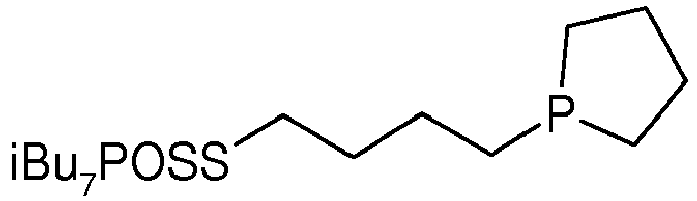
iBu7POSS-butylen-phospholan B 
iBu7POSS-propylen-phospholan C 
iBu7POSS-butylen-phoban, Isomerengemisch D 
iBu7POSS-propylen-phoban, Isomerengemisch E 
iBu7POSS-butylen-phospholanoxid F 
iBu7POSS-propylen-phospholanoxid - iBu7POSS =
 Verbindung zum P-substituierten Alkylenspacer
- In einem ausgeheizten Schlenkrohr wurden 0,96 g (10,94 mmol) Phospholan unter Stickstoffatmosphäre in 3 ml sauerstofffreiem, trockenem THF gelöst und auf -78 °C gekühlt. 3,67 g (13,23 mmol) n-Butyllithium wurden als 2,5 M Lösung in n-Hexan tropfenweise hinzugegeben. Die Reaktionsmischung wurde auf Zimmertemperatur gebracht, eine Stunde gerührt und erneut auf -78°C gekühlt. Anschließend wurde eine sauerstofffreie Lösung von 10,75 g (11,28 mmol) iBu7POSS-butylenbromid in 25 ml THF tropfenweise zur Phosphidlösung gegeben. Nach vollständiger Zugabe wurde die Reaktionsmischung bei Zimmertemperatur über Nacht gerührt, anschließend unter vermindertem Druck auf ca. 10 ml eingeengt und unter Rühren mit sauerstofffreiem Methanol (50 ml) versetzt. Filtration und mehrmaliges Waschen des ausgefallenen Niederschlags mit sauerstofffreiem Methanol lieferte 8,80 g (9,17 mmol, 83,9 % d. Th.) Katalysator A als weißen Feststoff.
- 1H-NMR (600 MHz, C6D6): δ(ppm) = 2.23 - 2.02 (m, 7H, CH), 1.76 - 1.68 (m, 2H, CH 2), 1.66 - 1.42 (m, 4H, CH 2), 1.34 - 1.25 (m, 2H, CH 2), 1.22 - 1.14 (m, 2H, CH 2), 1.13 - 1.06 (m, 42H, CH 3), 0.90 - 0.81 (m, 16H, CH 2).
- 13C-NMR (151 MHz, C6D6): δ(ppm) = 30.7, 29.6, 29.5, 28.3, 26.6, 26.5, 26.2, 24.7, 24.7, 23.3, 12.8.
- 31P-NMR (243 MHz, C6D6): δ(ppm) = -27.2.
- 29Si-NMR (119 MHz, C6D6): δ(ppm) = -66.7, -67.3, -67.6.
- 9 g (10,4 mmol) Allyl-heptaisobutyl-POSS wurden in einem vorher ausgeheizten Schlenkrohr unter Stickstoffatmosphäre in entgastem Toluol (20 ml) gelöst, mit 1,42 g (10 mmol) Phoban (Isomerengemisch, als 50%ige Lösung in Toluol) versetzt und unter Rückfluss und gelegentlicher Zugabe von summarisch 200 mg Azo-Initiator VAZO 76 (2,2'-Azobis(2-methylbutyronitril), als 5%ige Lösung in Toluol) über einen Zeitraum von 6 Stunden umgesetzt.
- Nach Entfernen aller flüchtigen Komponenten im Vakuum (0,1 mbar) bei maximal 150°C wurden 8,5 g (8,5 mmol; 85% Ausbeute) des Katalysators D als weißes Pulver erhalten. Die analytischen Daten unterscheiden sich nicht von dem Produkt welches gemäß der unter Bsp. 1 beschriebenen Methode aus 3-Chlorpropyl-heptaisobutyloctasilsesquioxan und mittels n-Butyllithium deprotonierten Phobans erhalten wurde.
- Um zu überprüfen, ob iso-Octan als unpolares Lösemittel für eine zweiphasige Oligomerisierung geeignet ist, wurden zunächst die Löslichkeiten von HDI einerseits und der HDI-Oligomeren mit niedrigstem Molekulargewicht ("Idealstrukturen", s. unten) andererseits in iso-Octan ermittelt. HDI hat auch bei Zimmertemperatur keine Mischungslücke mit iso-Octan. Die jeweiligen "Idealstrukturen", d.h. die Verbindungen mit jeweils minimal möglichem Molekulargewicht und damit höchstmöglicher potenzieller Löslichkeit in unpolaren Lösemitteln, wurden aus den kommerziell erhältlichen HDI-Polyisocyanaten der Fa. Covestro Deutschland AG (Desmodur N 3300, Desmodur N 3400, Desmodur N 3900) in Anlehnung an die in
EP 0798299 , Bsp. 3 und 6 beschriebene Verfahrensweise isoliert (s. auch ACS Sustainable Chem. Eng. 2018, 6, 9753-9759) und deren Löslichkeit in iso-Octan bei 23°C und bei 60°C bestimmt. Die Ergebnisse sind in Tabelle 2 dargestellt.Tabelle 2: Löslichkeiten ausgewählter HDI-Oligomere ("Idealstrukturen") in iso-Octana) Oligomer-"Idealstruktur" Löslichkeit bei 23°C [%] Löslichkeit bei 60°C [%] Bis-6-isocyanatohexyluretdion ("Dimer") 2,3 5,7 Tris-6-isocyanatohexylisocyanurat ("Trimer") 0,7 2,0 Tris-6-isocyanatohexyl-iminooxadiazindion / -isocyanurat ca. 40%/60% Gemisch ("asymmetrisch/symmetrisch Trimer") 1,0 3,1 a) ermittelt durch 1H-NMR - Wie sich hieraus ergibt, sind die Löslichkeiten selbst bei 60°C relativ gering, weshalb iso-Octan gut für die Extraktion eines unpolaren POSS-gebundenen Katalysators aus einem HDI und seine Oligomeren enthaltenden Produktgemisch sowie für eine zweiphasige Reaktionsführung geeignet sein sollte.
- Zur Untersuchung anderer Monomere und daraus resultierender Oligomere lassen sich mit beliebigen Lösemitteln bzw. Lösemittelkombinationen leicht analoge Vorversuche zur Überprüfung der Eignung der jeweiligen Lösemitteln bzw. Lösemittelkombinationen für den beabsichtigten Zweck ableiten.
- Zur Untersuchung der katalytischen Aktivität und Selektivität der Katalysatoren A bis D wurde unter Stickstoffatmosphäre der jeweilige Phosphor(III)katalysator A bis D (0,28 mmol) in iso-Octan (1 ml) gelöst und mit 14,2 g Hexamethylendiisocyanat (Produkt der Fa. Covestro Deutschland AG) versetzt. Die Lösungen wurden auf 60 °C erwärmt und in regelmäßigen Abständen der Umsatz und die Produktselektivität hinsichtlich der gebildeten IsocyanatFolgeprodukte mittels 1H-NMR untersucht. Die Bestimmung von Mn, Mw und D erfolgte wie eingangs beschrieben unter Vernachlässigung des Monomeranteils.
- Dabei zeigte sich, dass sowohl Turnover Frequenz (TOF) als auch Selektivität hinsichtlich der gebildeten Strukturtypen (Isocyanurat, Iminooxadiazindion und Uretdion) der Katalysatoren A bis D sehr ähnlich denen der nicht POSS-gebundenen Pendants - wie in
EP 08004769 - Die Rückgewinnung der Katalysatoren erfolgte durch Verdünnen der Reaktionsgemische mit Acetonitril (10 ml) und anschließender Extraktion mit iso-Octan (3x20 ml) in einem Scheidetrichter aus der polaren, Acetonitril-reichen Phase. Der Phosphorgehalt der polaren, Acetonitril-reichen Phase lag unterhalb 5 ppm P (unterhalb der Nachweisgrenze).
- Für die zweiphasigen Oligomerisierungen wurde Katalysator C:
- 0,41 g (0,45 mmol) Beispiel 8
- bzw.
- 3,28 g (3,6 mmol) Beispiel 9
- unter Stickstoffatmosphäre in iso-Octan (20 ml) gelöst und HDI (13,8 g, 82 mmol) hinzugegeben.
- Die homogenen, klaren Reaktionslösungen wurden auf 60 °C erwärmt und mit Hilfe eines Rührwerks auf niedrigster Stufe (39 min-1), um Emulsionsbildung zu vermeiden, gerührt. In beiden Fällen trat nach einiger Zeit (Beispiel 8: 3 h; Beispiel 9: 30 min) Phasenseparation durch Abscheidung des gebildeten HDI-Oligomerengemisches ein. Der Reaktionsabbruch erfolgte durch Zugabe elementaren Schwefels (15 mg, Beispiel 8, bzw. 120 mg, Beispiel 9) und weiteres, einstündiges Rühren bei 60°C und höherer Drehzahl des Rührwerks (400 min-1). Anschließend wurde bei 60°C unter stufenweise vermindertem Druck das gesamte Lösemittel entfernt und die verbleibenden, viskosen Rückstände mittels 1H-NMR-Spektroskopie und Größenausschlußchromatografie analysiert. Die Ergebnisse sind in Tabelle 3 zusammengefasst. Zum Vergleich ist das Ergebnis aus Beispiel 6, welches ebenfalls mit Katalysator C bis zu einem mit Beispiel 9 vergleichbaren Brutto-Monomerumsatz gefahren wurde (ca. 20% Monomer lt. Größenausschlußchromatografie) mit aufgeführt.
Tabelle 3: Vergleich der homogen (Beispiel 6) und heterogen (Beispiele 8 und 9) geführten HDI-Oligomerisierungen Bsp. Isocyanurate Iminooxadiazindione Oxadiazintrione Uretdione Mn Mw D 8 61 mol-% 23 mol-% 2 mol-% 14 mol-% 565 616 1,1 9 66 mol-% 22 mol-% 1 mol-% 10 mol-% 735 851 1,2 6 68 mol-% 21 mol-% 1 mol-% 10 mol-% 1092 1550 1,4 - Wie man den Ergebnissen entnehmen kann, wird bei heterogener Reaktionsführung eine deutlich engere Molekulargewichtsverteilung (niedrigerer Wert für die Polydispersität D bei vergleichbarem Monomerumsatz) gefunden, als im durchgängig homogen katalysierten Fall. Durch Wahl der Reaktionstemperatur, der Reaktionszeit (und damit des Monomer-Umsatzes), der Katalysatorkonzentration (-menge) und der Menge des unpolaren Lösemittels (Anfangsverdünnung) ist die Polydispersität der erhaltenen Produkte weiter variierbar.
- Die chemische Deaktivierung des Katalysators erfolgte hier nur zur Vereinfachung der analytischen Beurteilung des erfindungsgemäßen Effektes: engere Molekulargewichtsverteilung im Vergleich zum homogen katalysierten Fall bei vergleichbarem Monomerumsatz und kann bei kontinuierlicher Reaktionsführung unter ständiger Abtrennung der Produkt-reichen Phase und synchronem Zuführen frischen Monomers unterbleiben.
- Eine ggf. erwünschte Abtrennung nicht umgesetzten Monomers aus der polaren, Katalysator-armen bis -freien Produktphase kann im Anschluss nach beliebigen Methoden des Standes Technik, bevorzugt (weitere) Extraktion mit unpolarem Lösemittel und/oder Destillation erfolgen. Dabei profitiert man vom weitgehenden Verbleib des Katalysators in der wenig Oligomer (im Wesentlichen geringe Anteile der "Idealstrukturen" wie in Bsp. 3 aufgeführt), Monomer und unpolares Lösemittel führenden Phase, die sämtlich recycliert werden können und der fast völligen Abwesenheit des Katalysators im Produkt, was das Verfahren auch unter ökologischen und ökonomischen Aspekten sehr lukrativ erscheinen lässt.
- Zur Untersuchung der katalytischen Aktivität und Selektivität der Katalysatoren E und F und des nicht erfindungsgemäßen Vergleichskatalysators 1-Methylphospholanoxid (MPO) wurde unter Stickstoffatmosphäre der jeweilige Phosphor(V)katalysator E, F und MPO (jeweils 5 mmol; E und F jeweils in 3 ml iso-Octan gelöst, MPO in Substanz,) und mit 100 g (0,38 mol) Bis-(4-isocyanatocyclohexyl)methan (Desmodur W; Produkt der Fa. Covestro Deutschland AG) versetzt. Die Mischungen wurden auf 160 °C erwärmt und im Verlaufe von 10 h in regelmäßigen Abständen der Umsatz mittels NCO-Titration verfolgt, s. Tabelle 4.
Tabelle 4: Desmodur W Carbodiimidisierungen (10 und 11: erfindungsgemäß, 12: Vergleich) Bsp. Katalysator Umsatz nach 10 h 10 E 35 % 11 F 24 % 12 MPO 35 % - Zum Reaktionsabbruch wurde abgekühlt, mit Acetonitril verdünnt und anschließend die Acetonitrilphase mittels iso-Octan analog zum Vorgehen in Beispiel 4-7 extrahiert.
- Der Phosphorgehalt der polaren, Acetonitril-reichen Phase lag bei den erfindungsgemäßen Versuchen 10 und 11 unterhalb 5 ppm P (unterhalb der Nachweisgrenze).
- Das intensive Signal des MPO bei ca. 67 ppm im 31P-NMR-Spektrum des Produktes aus dem Vergleichsversuch 12 belegte die erwartungsgemäß schlechte Extrahierbarkeit des Katalysators im Vergleichsversuch 12, röntgenfluoreszensspektroskopisch wurden 567 ppm P gefunden.
Claims (15)
- Verbindung der allgemeinen Formel (I)
[(R1SiO3/2)n-1(R2SiO3/2)]n (I)
worinn für eine grade Zahl von 6 bis 18 steht,jeder Rest R1 unabhängig voneinanderein verzweigter oder unverzweigter C1-20-Alkylrest,ein verzweigter oder unverzweigter C1-20-Alkenylrest,ein verzweigter oder unverzweigter C1-20-Alkinylrest,ein C4-12-Cycloalkylrest,ein C1-20-Oxoalkylrest,ein C6-18 Arylrest,ein Oxoarylrest,ein Hetarylrest,ein Perfluor-alkyl, -alkenyl, -alkinyl, -alkoxyalkyl- oder -arylrest, oderein Arylalkylrest ist, undR2 für ein Strukturelement der Formel (II) steht Z ausgewählt ist aus der Gruppe bestehend aus (CR3 2)m, ortho-, meta- oder para-C6R3 4, C6R3 4CR3 2, (CR3 2)2-Si(R3 2)-(CR3 2)o, C4-12-Cycloalkylen,und wobei m für eine natürliche Zahl von 1 bis 15 steht,o für eine natürliche Zahl von 1 bis 4 steht,R3 für gleiche oder verschiedene Substituenten ausgewählt aus der Gruppe bestehend aus H, Methyl und Ethyl steht,Y für C4-20-Alkylen oder polyzyklisches C6-30-Alkylen steht undX für ein freies Elektronenpaar oder ein O-Atom steht.
 - Die Verbindung nach Anspruch 1, wobei
n eine grade Zahl von 6 bis 12, bevorzugt von 6 bis 10, besonders bevorzugt 8 ist,
jeder Rest R1 unabhängig voneinanderein verzweigter oder unverzweigter C1-10-Alkylrest, bevorzugt C1-6-Alkyl und besonders bevorzugt iso-Butyl,ein verzweigter oder unverzweigter C1-10-Alkenyl, bevorzugt C1-6-Alkenyl,ein verzweigter oder unverzweigter C1-10-Alkinyl, bevorzugt C1-6-Alkinyl,ein C4-8-Cycloalkyl, bevorzugt C4-6-Cycloalkyl,ein C6-12-Aryl, bevorzugt C6-10 Aryl, optional jeweils substituiert mit einem Heteroatom, ist,Z ausgewählt ist aus der Gruppe bestehend aus (CR3 2)m, ortho-, meta- oder para-C6R3 4, C6R3 4CR3 2, C4-12-Cycloalkylen,
m für eine natürliche Zahl von 1 bis 10, bevorzugt von 2 bis 5, besonders bevorzugt für 3 oder 4 steht,
R3 für H steht,
X für ein freies Elektronenpaar oder O-Atom steht und
Y für C4-16-Alkylen steht, bevorzugt für C4-10-Alkylen, besonders bevorzugt für C4-8-Alkylen oder
Y für ein bicyclisches C6-10-Alkylen steht. - Die Verbindung nach Anspruch 1 oder 2, wobei
n=8 ist,
R1 C4-Alkyl ist,
Z (CR3 2)m mit m=3 oder m=4 und R3=Wasserstoff ist,
Y C4-Alkylen oder Cs-Bicycloalkylen ist, und
X für ein freies Elektronenpaar oder O-Atom steht. - Verwendung einer Verbindung wie in einem der Ansprüche 1 bis 3 definiert zur Oligomerisierung von Isocyanaten.
- Die Verwendung nach Anspruch 4, wobei das molare Verhältnis der Verbindung gemäß Formel (I) und der Gesamtmenge aller Isocyanate zwischen 5 ppm und 10 % liegt.
- Die Verwendung nach Anspruch 4 oder 5, wobei X für ein freies Elektronenpaar steht und bei der Oligomerisierung wenigstens eine Struktur ausgewählt aus der Gruppe bestehend aus Isocyanurat, Iminooxadiazindion, Uretdion und besonders bevorzugt wenigstens eine Isocyanuratstruktur gebildet wird.
- Die Verwendung nach Anspruch 6, wobei die Verbindung der Formel (I) in einer Reaktionslösung umfassend eine polare und eine unpolare Phase eingesetzt wird.
- Die Verwendung nach Anspruch 4 oder 5, wobei X für Sauerstoff steht und die Oligomerisierung unter Ausbildung eines Carbodiimids abläuft.
- Verfahren zur Herstellung einer Polyisocyanatzusammensetzung enthaltend oligomere Polyisocyanate enthaltend die Schrittea) Bereitstellen eines Reaktionsgemisches enthaltend wenigstens eine Verbindung gemäß der allgemeinen Formel (I) wie in Anspruch 1 oder 2 definiert und wenigstens ein Isocyanat;b) Umsetzung des wenigstens einen Isocyanats zu einem oligomeren Polyisocyanat;c) Extraktion der Verbindung gemäß Formel (I) aus dem Reaktionsgemisch durch Extraktion mit einem Lösemittel A.
- Das Verfahren nach Anspruch 9, wobei nach dem Extraktionsschritt c) wenigstens 90 % der zu Beginn des Verfahrensschritts c) im Reaktionsgemisch vorliegenden Gesamtmenge der Verbindung nach Formel (I) im Lösemittel A gelöst sind.
- Das Verfahren nach Anspruch 9 oder 10, wobei das molare Verhältnis der Verbindung gemäß Formel (I) und der Gesamtmenge aller Diisocyanate im in Verfahrensschritt a) bereitgestellten Reaktionsgemisch zwischen 5 ppm und 10 % liegt.
- Das Verfahren nach einem der Ansprüche 9 bis 11, wobei bezogen auf die Masse des Reaktionsgemisches wenigstens 10 Gew.-% Lösemittel A zur Extraktion verwendet werden.
- Das Verfahren nach einem der Ansprüche 9 bis 12, wobei das Verfahren unter Zugabe eines mit dem Lösemittel A an sich oder in Gegenwart der oligomeren Polyisocyanatzusammensetzung eine Mischungslücke aufweisenden Lösemittels B durchgeführt wird und(i) die Löslichkeit der Verbindung nach Formel (I) in Lösemittel A wenigstens um einen Faktor 10 höher ist als in Lösemittel B und(ii) die Löslichkeit der in Verfahrensschritt b) gebildeten Oligomere in Lösemittel B wenigstens um einen Faktor von 10 höher als ist in Lösemittel A.
- Oligomere Polyisocyanatzusammensetzung enthaltend einen molaren Anteil von Phosphor zwischen 0 und 100 ppm, bezogen auf das Gesamtgewicht der oligomeren Polyisocyanatzusammensetzung.
- Die oligomere Polyisocyanatzusammensetzung nach Anspruch 14, dadurch gekennzeichnet, dass sie bezogen auf die Gesamtmenge aller in ihr enthaltenen Isocyanate zu wenigstens 90 Gew.-% aliphatische und/oder cycloaliphatische und/oder aromatische Isocyanate enthält.
Priority Applications (2)
| Application Number | Priority Date | Filing Date | Title |
|---|---|---|---|
| EP19176586.6A EP3741766B1 (de) | 2019-05-24 | 2019-05-24 | Neue katalysatoren für die synthese von oligomeren isocyanaten |
| US15/930,756 US20200369694A1 (en) | 2019-05-24 | 2020-05-13 | Novel catalysts for the synthesis of oligomeric isocyanates |
Applications Claiming Priority (1)
| Application Number | Priority Date | Filing Date | Title |
|---|---|---|---|
| EP19176586.6A EP3741766B1 (de) | 2019-05-24 | 2019-05-24 | Neue katalysatoren für die synthese von oligomeren isocyanaten |
Publications (2)
| Publication Number | Publication Date |
|---|---|
| EP3741766A1 true EP3741766A1 (de) | 2020-11-25 |
| EP3741766B1 EP3741766B1 (de) | 2022-08-31 |
Family
ID=66647332
Family Applications (1)
| Application Number | Title | Priority Date | Filing Date |
|---|---|---|---|
| EP19176586.6A Active EP3741766B1 (de) | 2019-05-24 | 2019-05-24 | Neue katalysatoren für die synthese von oligomeren isocyanaten |
Country Status (2)
| Country | Link |
|---|---|
| US (1) | US20200369694A1 (de) |
| EP (1) | EP3741766B1 (de) |
Families Citing this family (1)
| Publication number | Priority date | Publication date | Assignee | Title |
|---|---|---|---|---|
| CN112812245B (zh) * | 2021-01-25 | 2022-05-10 | 中国石油大学(华东) | 一种水基钻井液用抗高温承压封堵剂及其制备方法与应用 |
Citations (5)
| Publication number | Priority date | Publication date | Assignee | Title |
|---|---|---|---|---|
| DE2837770A1 (de) * | 1978-08-30 | 1980-03-13 | Basf Ag | Lagerbestaendige, fluessige carbodiimidgruppen aufweisende polyisocyanate und verfahren zu ihrer herstellung |
| EP0798299A1 (de) | 1996-03-26 | 1997-10-01 | Bayer Ag | Isocyanattrimerisate und Isocyanattrimerisatmischungen, deren Herstellung und Verwendung |
| DE102005058835A1 (de) * | 2005-12-09 | 2007-06-14 | Bayer Materialscience Ag | Verfahren zur Herstellung von Carbodiimid- und/oder Uretonimin-Gruppen enthaltenden Polyisocyanaten |
| EP2100885A1 (de) | 2008-03-14 | 2009-09-16 | Bayer MaterialScience AG | Herstellung von Polyisocyanaten vom Trimertyp |
| WO2011107417A1 (en) | 2010-03-01 | 2011-09-09 | Evonik Degussa Gmbh | Polyhedral oligomeric silsesquioxane (poss)-linked ligands |
-
2019
- 2019-05-24 EP EP19176586.6A patent/EP3741766B1/de active Active
-
2020
- 2020-05-13 US US15/930,756 patent/US20200369694A1/en not_active Abandoned
Patent Citations (5)
| Publication number | Priority date | Publication date | Assignee | Title |
|---|---|---|---|---|
| DE2837770A1 (de) * | 1978-08-30 | 1980-03-13 | Basf Ag | Lagerbestaendige, fluessige carbodiimidgruppen aufweisende polyisocyanate und verfahren zu ihrer herstellung |
| EP0798299A1 (de) | 1996-03-26 | 1997-10-01 | Bayer Ag | Isocyanattrimerisate und Isocyanattrimerisatmischungen, deren Herstellung und Verwendung |
| DE102005058835A1 (de) * | 2005-12-09 | 2007-06-14 | Bayer Materialscience Ag | Verfahren zur Herstellung von Carbodiimid- und/oder Uretonimin-Gruppen enthaltenden Polyisocyanaten |
| EP2100885A1 (de) | 2008-03-14 | 2009-09-16 | Bayer MaterialScience AG | Herstellung von Polyisocyanaten vom Trimertyp |
| WO2011107417A1 (en) | 2010-03-01 | 2011-09-09 | Evonik Degussa Gmbh | Polyhedral oligomeric silsesquioxane (poss)-linked ligands |
Non-Patent Citations (1)
| Title |
|---|
| ACS SUSTAINABLE CHEM. ENG., vol. 6, 2018, pages 9753 - 9759 |
Also Published As
| Publication number | Publication date |
|---|---|
| EP3741766B1 (de) | 2022-08-31 |
| US20200369694A1 (en) | 2020-11-26 |
Similar Documents
| Publication | Publication Date | Title |
|---|---|---|
| EP0896009B1 (de) | Verfahren zur Herstellung von Polyisocyanaten | |
| EP1521789B1 (de) | Uretdiongruppen aufweisende isocyanate | |
| EP0003765B1 (de) | Verfahren zur Herstellung von Isocyanuratgruppen aufweisenden Polyisocyanaten auf Basis von 1-Isocyanato-3,3,5-trimethyl-5-isocyanatomethylcyclohexan und ihre Verwendung als Isocyanatkomponente in Polyurethanlacken | |
| EP0798299B1 (de) | Isocyanattrimerisate und Isocyanattrimerisatmischungen, deren Herstellung und Verwendung | |
| EP0339396B1 (de) | Verfahren zur Herstellung von Isocyanuratgruppen aufweisenden Polyisocyanaten | |
| EP0330966B1 (de) | Verfahren zur Herstellung von Isocyanuratgruppen aufweisenden Polyisocyanaten | |
| EP2100886B1 (de) | Herstellung von Polyisocyanaten vom Trimertyp | |
| EP1982979B1 (de) | Herstellung uretdiongruppenhaltiger Polyisocyanate | |
| EP3107948A1 (de) | Verfahren zur isocyanatmodifizierung unter verwendung von spirocyclischen ammoniumsalzen als katalysator | |
| EP2415795B1 (de) | Verfahren zur Herstellung von Polyisocyanaten und deren Verwendung | |
| DE3902078A1 (de) | Verfahren zur herstellung von modifizierten, isocyanuratgruppen aufweisenden polyisocyanaten und ihre verwendung | |
| EP0962454A1 (de) | Verfahren zur Herstellung Iminooxadiazindiongruppen Enhaltender Polyisocyanate, die so Hergestellten Verfahrensprodukte und deren Verwendung | |
| DE4405054A1 (de) | Modifizierte (cyclo)aliphatische Polyisocyanatmischungen, Verfahren zu ihrer Herstellung und ihre Verwendung | |
| EP3107922A1 (de) | Verfahren zur isocyanatmodifizierung unter verwendung von katalysatoren mit n-p-n-sequenz | |
| DE19532060A1 (de) | Polycyclische Iminooxadiazindione, deren Herstellung und Verwendung | |
| EP2067773B1 (de) | Herstellung von Uretdion-Polyisocyanaten | |
| EP1399494B1 (de) | Verfahren zur dimerisierung von isophorondiisocyanat | |
| EP0896973B1 (de) | Verfahren zur Herstellung farbheller Uretdionpolyisocyanate | |
| EP3741766B1 (de) | Neue katalysatoren für die synthese von oligomeren isocyanaten | |
| EP0226109A1 (de) | Verfahren zur Herstellung von Isocyanuratgruppen aufweisenden Polyisocyanaten und ihre Verwendung als Isocyanatkomponente zur Herstellung von Polyurethanen | |
| EP0849268B1 (de) | Polycyclische Iminooxadiazindione aus (cyclo)aliphatischen 1,4-Diisocyanaten | |
| DE19824490A1 (de) | Verfahren zur Herstellung Imidooxadiazindiongruppen enthaltender Polyisocyanate, die so hergestellte Verfahrensprodukte und deren Verwendung | |
| EP4357382B1 (de) | Ionisch modifiziertes polyisocyanatgemisch | |
| EP0039864A1 (de) | Neue Isocyanato-isocyanurate, ein Verfahren zu ihrer Herstellung, sowie ihre Verwendung als Isocyanat-Komponente in Polyurethan-Lacken | |
| EP4574870A1 (de) | Blockiertes polyisocyanat |
Legal Events
| Date | Code | Title | Description |
|---|---|---|---|
| PUAI | Public reference made under article 153(3) epc to a published international application that has entered the european phase |
Free format text: ORIGINAL CODE: 0009012 |
|
| STAA | Information on the status of an ep patent application or granted ep patent |
Free format text: STATUS: THE APPLICATION HAS BEEN PUBLISHED |
|
| AK | Designated contracting states |
Kind code of ref document: A1 Designated state(s): AL AT BE BG CH CY CZ DE DK EE ES FI FR GB GR HR HU IE IS IT LI LT LU LV MC MK MT NL NO PL PT RO RS SE SI SK SM TR |
|
| AX | Request for extension of the european patent |
Extension state: BA ME |
|
| RAP1 | Party data changed (applicant data changed or rights of an application transferred) |
Owner name: COVESTRO INTELLECTUAL PROPERTY GMBH & CO. KG |
|
| STAA | Information on the status of an ep patent application or granted ep patent |
Free format text: STATUS: REQUEST FOR EXAMINATION WAS MADE |
|
| 17P | Request for examination filed |
Effective date: 20210525 |
|
| RBV | Designated contracting states (corrected) |
Designated state(s): AL AT BE BG CH CY CZ DE DK EE ES FI FR GB GR HR HU IE IS IT LI LT LU LV MC MK MT NL NO PL PT RO RS SE SI SK SM TR |
|
| STAA | Information on the status of an ep patent application or granted ep patent |
Free format text: STATUS: EXAMINATION IS IN PROGRESS |
|
| 17Q | First examination report despatched |
Effective date: 20210702 |
|
| GRAP | Despatch of communication of intention to grant a patent |
Free format text: ORIGINAL CODE: EPIDOSNIGR1 |
|
| STAA | Information on the status of an ep patent application or granted ep patent |
Free format text: STATUS: GRANT OF PATENT IS INTENDED |
|
| RIC1 | Information provided on ipc code assigned before grant |
Ipc: C08G 18/08 20060101ALI20220223BHEP Ipc: B01J 27/182 20060101ALI20220223BHEP Ipc: C08G 18/72 20060101ALI20220223BHEP Ipc: C07F 7/21 20060101AFI20220223BHEP Ipc: C08G 18/16 20060101ALI20220223BHEP Ipc: C08G 18/79 20060101ALI20220223BHEP Ipc: C08G 18/75 20060101ALI20220223BHEP Ipc: C08G 18/73 20060101ALI20220223BHEP Ipc: C08G 18/09 20060101ALI20220223BHEP |
|
| INTG | Intention to grant announced |
Effective date: 20220323 |
|
| GRAS | Grant fee paid |
Free format text: ORIGINAL CODE: EPIDOSNIGR3 |
|
| GRAA | (expected) grant |
Free format text: ORIGINAL CODE: 0009210 |
|
| STAA | Information on the status of an ep patent application or granted ep patent |
Free format text: STATUS: THE PATENT HAS BEEN GRANTED |
|
| AK | Designated contracting states |
Kind code of ref document: B1 Designated state(s): AL AT BE BG CH CY CZ DE DK EE ES FI FR GB GR HR HU IE IS IT LI LT LU LV MC MK MT NL NO PL PT RO RS SE SI SK SM TR |
|
| REG | Reference to a national code |
Ref country code: CH Ref legal event code: EP Ref country code: GB Ref legal event code: FG4D Free format text: NOT ENGLISH |
|
| REG | Reference to a national code |
Ref country code: AT Ref legal event code: REF Ref document number: 1515240 Country of ref document: AT Kind code of ref document: T Effective date: 20220915 Ref country code: DE Ref legal event code: R096 Ref document number: 502019005467 Country of ref document: DE |
|
| REG | Reference to a national code |
Ref country code: IE Ref legal event code: FG4D Free format text: LANGUAGE OF EP DOCUMENT: GERMAN |
|
| REG | Reference to a national code |
Ref country code: LT Ref legal event code: MG9D |
|
| REG | Reference to a national code |
Ref country code: NL Ref legal event code: MP Effective date: 20220831 |
|
| PG25 | Lapsed in a contracting state [announced via postgrant information from national office to epo] |
Ref country code: SE Free format text: LAPSE BECAUSE OF FAILURE TO SUBMIT A TRANSLATION OF THE DESCRIPTION OR TO PAY THE FEE WITHIN THE PRESCRIBED TIME-LIMIT Effective date: 20220831 Ref country code: RS Free format text: LAPSE BECAUSE OF FAILURE TO SUBMIT A TRANSLATION OF THE DESCRIPTION OR TO PAY THE FEE WITHIN THE PRESCRIBED TIME-LIMIT Effective date: 20220831 Ref country code: NO Free format text: LAPSE BECAUSE OF FAILURE TO SUBMIT A TRANSLATION OF THE DESCRIPTION OR TO PAY THE FEE WITHIN THE PRESCRIBED TIME-LIMIT Effective date: 20221130 Ref country code: LV Free format text: LAPSE BECAUSE OF FAILURE TO SUBMIT A TRANSLATION OF THE DESCRIPTION OR TO PAY THE FEE WITHIN THE PRESCRIBED TIME-LIMIT Effective date: 20220831 Ref country code: LT Free format text: LAPSE BECAUSE OF FAILURE TO SUBMIT A TRANSLATION OF THE DESCRIPTION OR TO PAY THE FEE WITHIN THE PRESCRIBED TIME-LIMIT Effective date: 20220831 Ref country code: FI Free format text: LAPSE BECAUSE OF FAILURE TO SUBMIT A TRANSLATION OF THE DESCRIPTION OR TO PAY THE FEE WITHIN THE PRESCRIBED TIME-LIMIT Effective date: 20220831 |
|
| PG25 | Lapsed in a contracting state [announced via postgrant information from national office to epo] |
Ref country code: PL Free format text: LAPSE BECAUSE OF FAILURE TO SUBMIT A TRANSLATION OF THE DESCRIPTION OR TO PAY THE FEE WITHIN THE PRESCRIBED TIME-LIMIT Effective date: 20220831 Ref country code: IS Free format text: LAPSE BECAUSE OF FAILURE TO SUBMIT A TRANSLATION OF THE DESCRIPTION OR TO PAY THE FEE WITHIN THE PRESCRIBED TIME-LIMIT Effective date: 20221231 Ref country code: HR Free format text: LAPSE BECAUSE OF FAILURE TO SUBMIT A TRANSLATION OF THE DESCRIPTION OR TO PAY THE FEE WITHIN THE PRESCRIBED TIME-LIMIT Effective date: 20220831 Ref country code: GR Free format text: LAPSE BECAUSE OF FAILURE TO SUBMIT A TRANSLATION OF THE DESCRIPTION OR TO PAY THE FEE WITHIN THE PRESCRIBED TIME-LIMIT Effective date: 20221201 |
|
| PG25 | Lapsed in a contracting state [announced via postgrant information from national office to epo] |
Ref country code: SM Free format text: LAPSE BECAUSE OF FAILURE TO SUBMIT A TRANSLATION OF THE DESCRIPTION OR TO PAY THE FEE WITHIN THE PRESCRIBED TIME-LIMIT Effective date: 20220831 Ref country code: RO Free format text: LAPSE BECAUSE OF FAILURE TO SUBMIT A TRANSLATION OF THE DESCRIPTION OR TO PAY THE FEE WITHIN THE PRESCRIBED TIME-LIMIT Effective date: 20220831 Ref country code: PT Free format text: LAPSE BECAUSE OF FAILURE TO SUBMIT A TRANSLATION OF THE DESCRIPTION OR TO PAY THE FEE WITHIN THE PRESCRIBED TIME-LIMIT Effective date: 20230102 Ref country code: ES Free format text: LAPSE BECAUSE OF FAILURE TO SUBMIT A TRANSLATION OF THE DESCRIPTION OR TO PAY THE FEE WITHIN THE PRESCRIBED TIME-LIMIT Effective date: 20220831 Ref country code: DK Free format text: LAPSE BECAUSE OF FAILURE TO SUBMIT A TRANSLATION OF THE DESCRIPTION OR TO PAY THE FEE WITHIN THE PRESCRIBED TIME-LIMIT Effective date: 20220831 Ref country code: CZ Free format text: LAPSE BECAUSE OF FAILURE TO SUBMIT A TRANSLATION OF THE DESCRIPTION OR TO PAY THE FEE WITHIN THE PRESCRIBED TIME-LIMIT Effective date: 20220831 |
|
| PG25 | Lapsed in a contracting state [announced via postgrant information from national office to epo] |
Ref country code: SK Free format text: LAPSE BECAUSE OF FAILURE TO SUBMIT A TRANSLATION OF THE DESCRIPTION OR TO PAY THE FEE WITHIN THE PRESCRIBED TIME-LIMIT Effective date: 20220831 Ref country code: EE Free format text: LAPSE BECAUSE OF FAILURE TO SUBMIT A TRANSLATION OF THE DESCRIPTION OR TO PAY THE FEE WITHIN THE PRESCRIBED TIME-LIMIT Effective date: 20220831 |
|
| REG | Reference to a national code |
Ref country code: DE Ref legal event code: R097 Ref document number: 502019005467 Country of ref document: DE |
|
| PG25 | Lapsed in a contracting state [announced via postgrant information from national office to epo] |
Ref country code: NL Free format text: LAPSE BECAUSE OF FAILURE TO SUBMIT A TRANSLATION OF THE DESCRIPTION OR TO PAY THE FEE WITHIN THE PRESCRIBED TIME-LIMIT Effective date: 20220831 Ref country code: AL Free format text: LAPSE BECAUSE OF FAILURE TO SUBMIT A TRANSLATION OF THE DESCRIPTION OR TO PAY THE FEE WITHIN THE PRESCRIBED TIME-LIMIT Effective date: 20220831 |
|
| PLBE | No opposition filed within time limit |
Free format text: ORIGINAL CODE: 0009261 |
|
| STAA | Information on the status of an ep patent application or granted ep patent |
Free format text: STATUS: NO OPPOSITION FILED WITHIN TIME LIMIT |
|
| 26N | No opposition filed |
Effective date: 20230601 |
|
| PG25 | Lapsed in a contracting state [announced via postgrant information from national office to epo] |
Ref country code: SI Free format text: LAPSE BECAUSE OF FAILURE TO SUBMIT A TRANSLATION OF THE DESCRIPTION OR TO PAY THE FEE WITHIN THE PRESCRIBED TIME-LIMIT Effective date: 20220831 |
|
| REG | Reference to a national code |
Ref country code: DE Ref legal event code: R119 Ref document number: 502019005467 Country of ref document: DE |
|
| REG | Reference to a national code |
Ref country code: CH Ref legal event code: PL |
|
| PG25 | Lapsed in a contracting state [announced via postgrant information from national office to epo] |
Ref country code: MC Free format text: LAPSE BECAUSE OF FAILURE TO SUBMIT A TRANSLATION OF THE DESCRIPTION OR TO PAY THE FEE WITHIN THE PRESCRIBED TIME-LIMIT Effective date: 20220831 |
|
| GBPC | Gb: european patent ceased through non-payment of renewal fee |
Effective date: 20230524 |
|
| REG | Reference to a national code |
Ref country code: BE Ref legal event code: MM Effective date: 20230531 |
|
| PG25 | Lapsed in a contracting state [announced via postgrant information from national office to epo] |
Ref country code: MC Free format text: LAPSE BECAUSE OF FAILURE TO SUBMIT A TRANSLATION OF THE DESCRIPTION OR TO PAY THE FEE WITHIN THE PRESCRIBED TIME-LIMIT Effective date: 20220831 Ref country code: LU Free format text: LAPSE BECAUSE OF NON-PAYMENT OF DUE FEES Effective date: 20230524 Ref country code: LI Free format text: LAPSE BECAUSE OF NON-PAYMENT OF DUE FEES Effective date: 20230531 Ref country code: CH Free format text: LAPSE BECAUSE OF NON-PAYMENT OF DUE FEES Effective date: 20230531 |
|
| REG | Reference to a national code |
Ref country code: IE Ref legal event code: MM4A |
|
| PG25 | Lapsed in a contracting state [announced via postgrant information from national office to epo] |
Ref country code: IE Free format text: LAPSE BECAUSE OF NON-PAYMENT OF DUE FEES Effective date: 20230524 |
|
| PG25 | Lapsed in a contracting state [announced via postgrant information from national office to epo] |
Ref country code: IE Free format text: LAPSE BECAUSE OF NON-PAYMENT OF DUE FEES Effective date: 20230524 Ref country code: DE Free format text: LAPSE BECAUSE OF NON-PAYMENT OF DUE FEES Effective date: 20231201 Ref country code: GB Free format text: LAPSE BECAUSE OF NON-PAYMENT OF DUE FEES Effective date: 20230524 |
|
| PG25 | Lapsed in a contracting state [announced via postgrant information from national office to epo] |
Ref country code: IT Free format text: LAPSE BECAUSE OF FAILURE TO SUBMIT A TRANSLATION OF THE DESCRIPTION OR TO PAY THE FEE WITHIN THE PRESCRIBED TIME-LIMIT Effective date: 20220831 Ref country code: FR Free format text: LAPSE BECAUSE OF NON-PAYMENT OF DUE FEES Effective date: 20230531 Ref country code: BE Free format text: LAPSE BECAUSE OF NON-PAYMENT OF DUE FEES Effective date: 20230531 |
|
| PG25 | Lapsed in a contracting state [announced via postgrant information from national office to epo] |
Ref country code: BG Free format text: LAPSE BECAUSE OF FAILURE TO SUBMIT A TRANSLATION OF THE DESCRIPTION OR TO PAY THE FEE WITHIN THE PRESCRIBED TIME-LIMIT Effective date: 20220831 |
|
| PG25 | Lapsed in a contracting state [announced via postgrant information from national office to epo] |
Ref country code: BG Free format text: LAPSE BECAUSE OF FAILURE TO SUBMIT A TRANSLATION OF THE DESCRIPTION OR TO PAY THE FEE WITHIN THE PRESCRIBED TIME-LIMIT Effective date: 20220831 |
|
| REG | Reference to a national code |
Ref country code: AT Ref legal event code: MM01 Ref document number: 1515240 Country of ref document: AT Kind code of ref document: T Effective date: 20240524 |
|
| PG25 | Lapsed in a contracting state [announced via postgrant information from national office to epo] |
Ref country code: AT Free format text: LAPSE BECAUSE OF NON-PAYMENT OF DUE FEES Effective date: 20240524 |
|
| PG25 | Lapsed in a contracting state [announced via postgrant information from national office to epo] |
Ref country code: CY Free format text: LAPSE BECAUSE OF FAILURE TO SUBMIT A TRANSLATION OF THE DESCRIPTION OR TO PAY THE FEE WITHIN THE PRESCRIBED TIME-LIMIT; INVALID AB INITIO Effective date: 20190524 |
|
| PG25 | Lapsed in a contracting state [announced via postgrant information from national office to epo] |
Ref country code: HU Free format text: LAPSE BECAUSE OF FAILURE TO SUBMIT A TRANSLATION OF THE DESCRIPTION OR TO PAY THE FEE WITHIN THE PRESCRIBED TIME-LIMIT; INVALID AB INITIO Effective date: 20190524 |
|
| PG25 | Lapsed in a contracting state [announced via postgrant information from national office to epo] |
Ref country code: TR Free format text: LAPSE BECAUSE OF FAILURE TO SUBMIT A TRANSLATION OF THE DESCRIPTION OR TO PAY THE FEE WITHIN THE PRESCRIBED TIME-LIMIT Effective date: 20220831 |
|
| PGFP | Annual fee paid to national office [announced via postgrant information from national office to epo] |
Ref country code: AT Payment date: 20260410 Year of fee payment: 5 |