EP3738447B1 - Electronic vapour provision system - Google Patents
Electronic vapour provision system Download PDFInfo
- Publication number
- EP3738447B1 EP3738447B1 EP20183945.3A EP20183945A EP3738447B1 EP 3738447 B1 EP3738447 B1 EP 3738447B1 EP 20183945 A EP20183945 A EP 20183945A EP 3738447 B1 EP3738447 B1 EP 3738447B1
- Authority
- EP
- European Patent Office
- Prior art keywords
- nicotine
- solution
- acid
- present
- protonated
- Prior art date
- Legal status (The legal status is an assumption and is not a legal conclusion. Google has not performed a legal analysis and makes no representation as to the accuracy of the status listed.)
- Active
Links
Images
Classifications
-
- A—HUMAN NECESSITIES
- A24—TOBACCO; CIGARS; CIGARETTES; SIMULATED SMOKING DEVICES; SMOKERS' REQUISITES
- A24B—MANUFACTURE OR PREPARATION OF TOBACCO FOR SMOKING OR CHEWING; TOBACCO; SNUFF
- A24B15/00—Chemical features or treatment of tobacco; Tobacco substitutes, e.g. in liquid form
- A24B15/10—Chemical features of tobacco products or tobacco substitutes
- A24B15/16—Chemical features of tobacco products or tobacco substitutes of tobacco substitutes
-
- A—HUMAN NECESSITIES
- A24—TOBACCO; CIGARS; CIGARETTES; SIMULATED SMOKING DEVICES; SMOKERS' REQUISITES
- A24B—MANUFACTURE OR PREPARATION OF TOBACCO FOR SMOKING OR CHEWING; TOBACCO; SNUFF
- A24B15/00—Chemical features or treatment of tobacco; Tobacco substitutes, e.g. in liquid form
- A24B15/10—Chemical features of tobacco products or tobacco substitutes
-
- A—HUMAN NECESSITIES
- A24—TOBACCO; CIGARS; CIGARETTES; SIMULATED SMOKING DEVICES; SMOKERS' REQUISITES
- A24B—MANUFACTURE OR PREPARATION OF TOBACCO FOR SMOKING OR CHEWING; TOBACCO; SNUFF
- A24B15/00—Chemical features or treatment of tobacco; Tobacco substitutes, e.g. in liquid form
- A24B15/10—Chemical features of tobacco products or tobacco substitutes
- A24B15/16—Chemical features of tobacco products or tobacco substitutes of tobacco substitutes
- A24B15/167—Chemical features of tobacco products or tobacco substitutes of tobacco substitutes in liquid or vaporisable form, e.g. liquid compositions for electronic cigarettes
-
- A—HUMAN NECESSITIES
- A24—TOBACCO; CIGARS; CIGARETTES; SIMULATED SMOKING DEVICES; SMOKERS' REQUISITES
- A24B—MANUFACTURE OR PREPARATION OF TOBACCO FOR SMOKING OR CHEWING; TOBACCO; SNUFF
- A24B15/00—Chemical features or treatment of tobacco; Tobacco substitutes, e.g. in liquid form
- A24B15/18—Treatment of tobacco products or tobacco substitutes
- A24B15/28—Treatment of tobacco products or tobacco substitutes by chemical substances
- A24B15/30—Treatment of tobacco products or tobacco substitutes by chemical substances by organic substances
-
- A—HUMAN NECESSITIES
- A24—TOBACCO; CIGARS; CIGARETTES; SIMULATED SMOKING DEVICES; SMOKERS' REQUISITES
- A24F—SMOKERS' REQUISITES; MATCH BOXES; SIMULATED SMOKING DEVICES
- A24F40/00—Electrically operated smoking devices; Component parts thereof; Manufacture thereof; Maintenance or testing thereof; Charging means specially adapted therefor
- A24F40/40—Constructional details, e.g. connection of cartridges and battery parts
- A24F40/42—Cartridges or containers for inhalable precursors
-
- A—HUMAN NECESSITIES
- A61—MEDICAL OR VETERINARY SCIENCE; HYGIENE
- A61K—PREPARATIONS FOR MEDICAL, DENTAL OR TOILETRY PURPOSES
- A61K31/00—Medicinal preparations containing organic active ingredients
- A61K31/33—Heterocyclic compounds
- A61K31/395—Heterocyclic compounds having nitrogen as a ring hetero atom, e.g. guanethidine or rifamycins
- A61K31/435—Heterocyclic compounds having nitrogen as a ring hetero atom, e.g. guanethidine or rifamycins having six-membered rings with one nitrogen as the only ring hetero atom
- A61K31/465—Nicotine; Derivatives thereof
-
- A—HUMAN NECESSITIES
- A61—MEDICAL OR VETERINARY SCIENCE; HYGIENE
- A61M—DEVICES FOR INTRODUCING MEDIA INTO, OR ONTO, THE BODY; DEVICES FOR TRANSDUCING BODY MEDIA OR FOR TAKING MEDIA FROM THE BODY; DEVICES FOR PRODUCING OR ENDING SLEEP OR STUPOR
- A61M15/00—Inhalators
- A61M15/06—Inhaling appliances shaped like cigars, cigarettes or pipes
-
- A—HUMAN NECESSITIES
- A24—TOBACCO; CIGARS; CIGARETTES; SIMULATED SMOKING DEVICES; SMOKERS' REQUISITES
- A24F—SMOKERS' REQUISITES; MATCH BOXES; SIMULATED SMOKING DEVICES
- A24F40/00—Electrically operated smoking devices; Component parts thereof; Manufacture thereof; Maintenance or testing thereof; Charging means specially adapted therefor
- A24F40/10—Devices using liquid inhalable precursors
-
- B—PERFORMING OPERATIONS; TRANSPORTING
- B29—WORKING OF PLASTICS; WORKING OF SUBSTANCES IN A PLASTIC STATE IN GENERAL
- B29K—INDEXING SCHEME ASSOCIATED WITH SUBCLASSES B29B, B29C OR B29D, RELATING TO MOULDING MATERIALS OR TO MATERIALS FOR MOULDS, REINFORCEMENTS, FILLERS OR PREFORMED PARTS, e.g. INSERTS
- B29K2023/00—Use of polyalkenes or derivatives thereof as moulding material
- B29K2023/10—Polymers of propylene
- B29K2023/12—PP, i.e. polypropylene
-
- B—PERFORMING OPERATIONS; TRANSPORTING
- B29—WORKING OF PLASTICS; WORKING OF SUBSTANCES IN A PLASTIC STATE IN GENERAL
- B29K—INDEXING SCHEME ASSOCIATED WITH SUBCLASSES B29B, B29C OR B29D, RELATING TO MOULDING MATERIALS OR TO MATERIALS FOR MOULDS, REINFORCEMENTS, FILLERS OR PREFORMED PARTS, e.g. INSERTS
- B29K2069/00—Use of PC, i.e. polycarbonates or derivatives thereof, as moulding material
-
- B—PERFORMING OPERATIONS; TRANSPORTING
- B29—WORKING OF PLASTICS; WORKING OF SUBSTANCES IN A PLASTIC STATE IN GENERAL
- B29L—INDEXING SCHEME ASSOCIATED WITH SUBCLASS B29C, RELATING TO PARTICULAR ARTICLES
- B29L2031/00—Other particular articles
- B29L2031/712—Containers; Packaging elements or accessories, Packages
- B29L2031/7142—Aerosol containers
-
- B—PERFORMING OPERATIONS; TRANSPORTING
- B29—WORKING OF PLASTICS; WORKING OF SUBSTANCES IN A PLASTIC STATE IN GENERAL
- B29L—INDEXING SCHEME ASSOCIATED WITH SUBCLASS B29C, RELATING TO PARTICULAR ARTICLES
- B29L2031/00—Other particular articles
- B29L2031/7414—Smokers'' requisites, e.g. pipe cleaners
- B29L2031/7416—Smokers'' requisites, e.g. pipe cleaners for cigars or cigarettes
Definitions
- the present disclosure relates to containers which contain a nicotine solution and to electronic vapour provision systems such as electronic nicotine delivery systems (e.g. e-cigarettes) incorporating such containers.
- electronic nicotine delivery systems e.g. e-cigarettes
- Electronic vapour provision systems such as e-cigarettes generally contain a reservoir of liquid which is to be vaporised, typically containing nicotine.
- Patent document WO2004/076289 discloses containers comprising nicotine for use in inhaling devices.
- a heater When a user inhales on the device, a heater is activated to vaporise a small amount of liquid, which is therefore inhaled by the user.
- the liquid to be vaporised in e-cigarettes is typically a solution containing nicotine.
- the solvent may be, for example, glycerol.
- the vaporising part of the device is often designed for multiple uses, although single use devices do exist. In multiple and single use devices a container holding the nicotine solution is present. The container is stored for significant periods from the time of filling until use. This period includes the time of distribution, stocking by a retailer and storage by the end user before use. During this storage period, loss of nicotine content may occur.
- an electronic vapour provision system comprising: a vaporiser for vaporising liquid for inhalation by a user of the electronic vapour provision system, a power supply comprising a cell or battery for supplying power to the vaporiser, a container in which is contained the nicotine solution, wherein at least 5 wt% of the nicotine present in the solution is in protonated form, and wherein at least a portion of the container in contact with the nicotine solution is formed from polycarbonate or polyproylene.
- an electronic vapour provision system comprising a vaporiser for vaporising liquid for inhalation by a user of the electronic vapour provision system, a power supply comprising a cell or battery for supplying power to the vaporiser, a container in which is contained the nicotine solution, wherein at least 5 wt% of the nicotine present in the solution is in protonated form, and wherein at least a portion of the container in contact with the nicotine solution is formed from polycarbonate or polypropylene.
- an electronic vapour provision system comprising:
- cartomiser for an electronic vapour provision system, wherein the cartomiser comprises:
- an electronic vapour provision system comprising:
- a container which may be used in an electronic vapour provision system, such as an e-cigarette is disclosed.
- an electronic vapour provision system such as an e-cigarette
- e-cigarette is used; however, this term may be used interchangeably with electronic vapour provision system.
- nicotine may exist in free base form, monoprotonated form or diprotonated form.
- the structures of each of these forms are given below.
- nicotine free base monoprotonated nicotine diprotonated nicotine Reference in the specification to protonated form means both monoprotonated nicotine and diprotonated nicotine. Reference in the specification to amounts in the protonated form means the combined amount of monoprotonated nicotine and diprotonated nicotine.
- a container in which is contained a nicotine solution, wherein at least 5 wt% of the nicotine present in the solution is in protonated form, wherein at least a portion of the container in contact with the nicotine solution is formed from polycarbonate or polypropylene.
- Nicotine 3-(1-methylpyrrolidin-2-yl) pyridine
- pKa 3.12 for the pyridine ring
- 8.02 for the pyrrolidine ring. It can exist in pH-dependent protonated (mono- and di-) and non-protonated forms which have different bioavailability.
- the fraction of non-protonated nicotine will be predominant at high pH levels whilst a decrease in the pH will see an increase of the fraction of protonated nicotine (mono- or di-depending on the pH). If the relative fraction of protonated nicotine and the total amount of nicotine in the sample are known, the absolute amount of protonated nicotine can be calculated.
- the relative fraction of protonated nicotine in solution can be calculated by using the Henderson-Hasselbalch equation, which describes the pH as a derivation of the acid dissociation constant equation, and it is extensively employed in chemical and biological systems.
- [B] is the amount of non-protonated nicotine (i.e. free base)
- [BH+] the amount of protonated nicotine (i.e. conjugate acid)
- Determination of pKa values of nicotine solutions may be was carried out using the basic approach described in " Spectroscopic investigations into the acid-base properties of nicotine at different temperatures", Peter M. Clayton, Carl A. Vas, Tam T. T. Bui, Alex F. Drake and Kevin McAdam, Anal. Methods, 2013,5, 81-88 . This method is summarised below.
- polycarbonate it is meant a polymer containing the following repeating unit
- At least a portion of the container in contact with the nicotine solution is formed from polycarbonate. In one aspect the majority of the container which is in contact with the nicotine solution is formed from polycarbonate. In one aspect all the container which is in contact with the nicotine solution is formed from polycarbonate. In one aspect the container is formed entirely from polycarbonate.
- polypropylene it is meant a polymer containing the following repeating unit
- At least a portion of the container in contact with the nicotine solution is formed from polypropylene. In one aspect the majority of the container which is in contact with the nicotine solution is formed from polypropylene. In one aspect all the container which is in contact with the nicotine solution is formed from polypropylene. In one aspect the container is formed entirely from polypropylene.
- the majority of the container which is in contact with the nicotine solution is formed from polycarbonate, polypropylene or a combination thereof. In one aspect all the container which is in contact with the nicotine solution is formed from polycarbonate, polypropylene or a combination thereof. In one aspect the container is formed entirely from polycarbonate, polypropylene or a combination thereof.
- the container is typically provided for the delivery of nicotine solution to or within an e-cigarette.
- the nicotine solution may be held within an e-cigarette or may be sold as a separate container for subsequent use with or in an e-cigarette.
- e-cigarettes typically contain a unit known as a cartomiser which comprises a reservoir of nicotine solution, a wick material and a heating element for vaporising the nicotine.
- the container is a cartomiser or is part of a cartomiser.
- the container is not a cartomiser or part of a cartomiser and is a container, such as a tank, bottle or the like, which may be used to deliver nicotine solution to or within an e-cigarette.
- an electronic vapour provision system comprising: a vaporiser for vaporising liquid for inhalation by a user of the electronic vapour provision system; a power supply comprising a cell or battery for supplying power to the vaporiser; a container in which is contained a nicotine solution, wherein at least 5 wt% of the nicotine present in the solution is in protonated form, and wherein at least a portion of the container in contact with the nicotine solution is formed from polycarbonate or polypropylene.
- contact may occur between the container and the nicotine solution by any means. Provided the body of the container is contacted with nicotine solution then the container and solution are in contact. It is envisaged that the nicotine solution could be 'free' in the sense that it is a liquid in direct contact with the walls of the container. In also envisaged, that the nicotine solution may be held within a matrix (such as a foam) and the foam is in contact with the body of the container.
- a matrix such as a foam
- the nicotine present in the solution is in protonated form. In one aspect at least 15 wt% of the nicotine present in the solution is in protonated form. In one aspect at least 20 wt% of the nicotine present in the solution is in protonated form. In one aspect at least 25 wt% of the nicotine present in the solution is in protonated form. In one aspect at least 30 wt% of the nicotine present in the solution is in protonated form. In one aspect at least 35 wt% of the nicotine present in the solution is in protonated form.
- At least 40 wt% of the nicotine present in the solution is in protonated form. In one aspect at least 45 wt% of the nicotine present in the solution is in protonated form. In one aspect at least 50 wt% of the nicotine present in the solution is in protonated form. In one aspect at least 55 wt% of the nicotine present in the solution is in protonated form. In one aspect at least 60 wt% of the nicotine present in the solution is in protonated form. In one aspect at least 65 wt% of the nicotine present in the solution is in protonated form. In one aspect at least 70 wt% of the nicotine present in the solution is in protonated form. In one aspect at least 75 wt% of the nicotine present in the solution is in protonated form.
- At least 80 wt% of the nicotine present in the solution is in protonated form. In one aspect at least 85 wt% of the nicotine present in the solution is in protonated form. In one aspect at least 90 wt% of the nicotine present in the solution is in protonated form. In one aspect at least 95 wt% of the nicotine present in the solution is in protonated form. In one aspect at least 99 wt% of the nicotine present in the solution is in protonated form.
- the nicotine protonation may be provided in such a manner to achieve the desired degree of protonation of nicotine.
- the nicotine is protonated by an organic acid.
- the nicotine is protonated by a carboxylic acid.
- the carboxylic acid may be any suitable carboxylic acid.
- the nicotine is protonated by a mono-carboxylic acid.
- the nicotine is protonated by an acid selected from the group consisting of acetic acid, lactic acid, formic acid, citric acid, benzoic acid, pyruvic acid, levulinic acid, succinic acid, tartaric acid, oleic acid, sorbic acid, propionic acid, phenylacetic acid, and mixtures thereof.
- an acid selected from the group consisting of acetic acid, lactic acid, formic acid, citric acid, benzoic acid, pyruvic acid, levulinic acid, succinic acid, tartaric acid, oleic acid, sorbic acid, propionic acid, phenylacetic acid, and mixtures thereof.
- the nicotine is protonated by an acid selected from the group consisting of benzoic acid, levulinic acid, and mixtures thereof. In one aspect the nicotine is protonated by levulinic acid. In one aspect the nicotine is protonated by benzoic acid. In one aspect the nicotine is protonated by a mixture of levulinic acid and benzoic acid.
- Nicotine may exist in free base form, monoprotonated form or diprotonated form.
- the present invention therefore provides a novel process for stabilising a nicotine solution.
- the present invention provides a process for stabilising a nicotine solution, the process comprising the steps of protonating the nicotine present in the solution such that at least 5 wt% of the nicotine present in the solution is in protonated form.
- the nicotine solution may be in contact with polycarbonate or polypropylene.
- the process provides for storage of the nicotine solution in contact with polycarbonate or polypropylene for a period of at least 7 days. In one aspect the process provides for storage of the nicotine solution in contact with polycarbonate or polypropylene for a period of at least 14 days. In one aspect the process provides for storage of the nicotine solution in contact with polycarbonate or polypropylene for a period of at least 21 days. In one aspect the process provides for storage of the nicotine solution in contact with polycarbonate or polypropylene for a period of at least 28 days. In one aspect the process provides for storage of the nicotine solution in contact with polycarbonate or polypropylene for a period of at least 2 months.
- the process provides for storage of the nicotine solution in contact with polycarbonate or polypropylene for a period of at least 3 months. In one aspect the process provides for storage of the nicotine solution in contact with polycarbonate or polypropylene for a period of at least 4 months. In one aspect the process provides for storage of the nicotine solution in contact with polycarbonate or polypropylene for a period of at least 5 months. In one aspect the process provides for storage of the nicotine solution in contact with polycarbonate or polypropylene for a period of at least 6 months.
- the present invention provides a novel use for stabilising a nicotine solution.
- the present invention provides use of protonation of nicotine for stabilising a nicotine solution.
- the present invention provides use of protonation of nicotine for improving storage stability of a nicotine solution.
- the present invention provides use of protonation of nicotine for reducing evaporative loss of nicotine from a nicotine solution.
- the present invention provides use of protonated nicotine for stabilising a solution containing nicotine free base. In one aspect the present invention provides use of protonated nicotine for improving storage stability of a solution containing nicotine free base. In one aspect the present invention provides use of protonated nicotine for reducing evaporative loss of nicotine from a nicotine free base solution. It will be understood that by 'nicotine free base solution' it may be meant a solution containing nicotine free base and protonated nicotine in an amount as described herein.
- the present invention provides use of an acid for stabilising a nicotine solution.
- the present invention provides use of an acid for improving storage stability of a nicotine solution.
- the acid is an organic acid.
- the acid is a carboxylic acid.
- the acid is a mono-carboxylic acid.
- the acid is selected from the group consisting of acetic acid, lactic acid, formic acid, citric acid, benzoic acid, pyruvic acid, levulinic acid, succinic acid, tartaric acid, oleic acid, sorbic acid, propionic acid, phenylacetic acid, and mixtures thereof.
- the acid is selected from the group consisting of benzoic acid, levulinic acid, and mixtures thereof. In one aspect of use in accordance with the present invention the acid is levulinic acid. In one aspect of use in accordance with the present invention the acid is benzoic acid. In one aspect of use in accordance with the present invention the acid is a mixture of levulinic acid and benzoic acid.
- the present invention provides use of an acid for stabilising a nicotine solution, wherein the acid is selected from the group consisting of benzoic acid, levulinic acid, and mixtures thereof.
- the present invention provides use of an acid for improving storage stability of a nicotine solution, wherein the acid is selected from the group consisting of benzoic acid, levulinic acid, and mixtures thereof.
- the present invention provides use of an acid for reducing evaporative loss of nicotine from a nicotine solution, wherein the acid is selected from the group consisting of benzoic acid, levulinic acid, and mixtures thereof.
- At least 5 wt% of the nicotine present in the nicotine solution may be in protonated form.
- the present invention provides use of protonation of nicotine for stabilising a nicotine solution with respect to polycarbonate or polypropylene.
- the present invention provides use of protonation of nicotine for improving storage stability of a nicotine solution with respect to polycarbonate or polypropylene.
- pKa values of nicotine in glycerol/water systems was carried out using the basic approach described in " Spectroscopic investigations into the acid-base properties of nicotine at different temperatures", Peter M. Clayton, Carl A. Vas, Tam T. T. Bui, Alex F. Drake and Kevin McAdam, ⁇ Anal. Methods, 2013,5, 81-88 , and summarised below. Because the system is predominately non-aqueous the parameter p s K a2 was measured, where subscript s refers to the solvent composition in this largely non-aqueous system, and subscript 2 refers to the pK a value of the pyrrolidyl nitrogen.
- a range of glycerol/water/nicotine solutions were prepared, with the water concentration fixed at 9%, the nicotine concentration varying from 30 ⁇ g/ml to 3mg/ml; and the glycerol content comprising the remainder of the solutions.
- UV absorbance & CD spectra were measured between 300-200 nm region, with various pathlengths depending upon the nicotine concentration of the solution - 10mm, 5mm, 2mm, 1mm, 0.5mm, 0.1mm and 0.01mm pathlengths.
- the instrument was flushed continuously with pure evaporated nitrogen throughout the measurements. Throughout measurements spectra were recorded with a 0.5 nm step size, a 1s measurement time-per-point and a spectral bandwidth of 2 nm. Where possible, all CD spectra were smoothed with a window factor of 4 using the Savitzky-Golay method for better presentation.
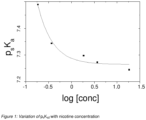
- Solutions of S-Nicotine in glycerol/water were pH titrated at 23°C. The pH of these solutions was raised towards alkaline by adding small aliquots of NaOH ( ⁇ pH10) and then lowered to pH2 by adding small aliquots of HCI. A series of 0.1M, 0.5M, 1M, 5M and 10M of HCI and NaOH solutions were used during the pH titration. pHs were measured at 23°C using a Corning pH105 pH meter with a RMS pH electrode. The p s K a2 values changed systematically with nicotine concentration ( Figure 1 ) and therefore values for p s K a2 were calculated at each nicotine concentration level (Table 1).
- the absorption of nicotine by a number of materials suitable for use in e-cigarettes was studied. The objective of this study was to determine whether there was any absorption of nicotine from a liquid formulation into a variety of materials occurring over time. 5g of a nicotine solution comprising 3.7 wt% nicotine, 9% water and 87.3% glycerol was loaded into 40ml amber glass vials. Pieces of polypropylene and polycarbonate were added to solutions (except for control samples), the vials were sealed with screw caps and stored in an at ambient temperatures or at 40°C in an oven for a period of eight weeks. Sampling was performed on day 1, then at 1 week, 2 weeks, 4 weeks and 8 weeks.
- polypropylene (PP) and polycarbonate (PC) both of which are desirable materials for use in e-cigarettes were found to result in significant loss of nicotine when stored in contact with a nicotine solution containing nicotine only in free base form.
- the effect on storage stability of protonating nicotine was studied by examining 3 nicotine solutions loaded into cartomizer e-cigarettes ("Device") containing PP and PC.
- the three nicotine solutions were an acid free nicotine solution and two protonated solutions, one protonated with 1.0 Molar equivalent levulinic acid and one protonated with 1.0 Molar equivalent benzoic acid.
- a 2.5% w/w nicotine amount was used, together with 9% water and sufficient glycerol to make the solution to 100%.
- the stability protocol incorporated filling a series of e-cigarettes for each formulation, as well as loading a number of sealed glass vials (used as control samples) to understand the source of any observed nicotine losses.
- the e-cigarettes were puffed on a 20-channel linear smoking machine (SM450) compliant with ISO 3308, but using the following puffing parameters: 80ml puff volume, 3 second puff duration and 30 second interpuff interval.
- SM450 20-channel linear smoking machine
- Each port of the smoking engine was fitted with a holder containing a Cambridge filter (CF) pad to trap particulate matter.
- TPM was determined as the weight difference of the CF before and after puffing, in accordance with ISO 4387.
- the CF pad containing trapped aerosol was extracted into 20 ml high purity propan-2-ol containing appropriate internal standards. Nicotine and water were determined by GC analysis containing combined FID/TCD detectors.
Landscapes
- Health & Medical Sciences (AREA)
- Chemical & Material Sciences (AREA)
- General Chemical & Material Sciences (AREA)
- Chemical Kinetics & Catalysis (AREA)
- Engineering & Computer Science (AREA)
- General Health & Medical Sciences (AREA)
- Animal Behavior & Ethology (AREA)
- Life Sciences & Earth Sciences (AREA)
- Public Health (AREA)
- Veterinary Medicine (AREA)
- Hematology (AREA)
- Biomedical Technology (AREA)
- Heart & Thoracic Surgery (AREA)
- Anesthesiology (AREA)
- Bioinformatics & Cheminformatics (AREA)
- Pulmonology (AREA)
- Medicinal Chemistry (AREA)
- Epidemiology (AREA)
- Pharmacology & Pharmacy (AREA)
- Toxicology (AREA)
- Pharmaceuticals Containing Other Organic And Inorganic Compounds (AREA)
- Feeding, Discharge, Calcimining, Fusing, And Gas-Generation Devices (AREA)
- Filling, Topping-Up Batteries (AREA)
- Manufacture Of Tobacco Products (AREA)
Description
- The present disclosure relates to containers which contain a nicotine solution and to electronic vapour provision systems such as electronic nicotine delivery systems (e.g. e-cigarettes) incorporating such containers.
- Electronic vapour provision systems such as e-cigarettes generally contain a reservoir of liquid which is to be vaporised, typically containing nicotine. Patent document
WO2004/076289 discloses containers comprising nicotine for use in inhaling devices. - When a user inhales on the device, a heater is activated to vaporise a small amount of liquid, which is therefore inhaled by the user.
- The use of e-cigarettes in the UK has grown rapidly, and it has been estimated that there are now over a million people using them in the UK.
- The liquid to be vaporised in e-cigarettes is typically a solution containing nicotine. The solvent may be, for example, glycerol. The vaporising part of the device is often designed for multiple uses, although single use devices do exist. In multiple and single use devices a container holding the nicotine solution is present. The container is stored for significant periods from the time of filling until use. This period includes the time of distribution, stocking by a retailer and storage by the end user before use. During this storage period, loss of nicotine content may occur.
- According to the invention it is provided the use of protonation of nicotine for stabilising a nicotine solution with respect to polycarbonate or polypropylene.
- According to the invention it is also provided the use of protonation of nicotine for improving storage stability of a nicotine solution in an electronic vapour provision system comprising: a vaporiser for vaporising liquid for inhalation by a user of the electronic vapour provision system, a power supply comprising a cell or battery for supplying power to the vaporiser, a container in which is contained the nicotine solution, wherein at least 5 wt% of the nicotine present in the solution is in protonated form, and wherein at least a portion of the container in contact with the nicotine solution is formed from polycarbonate or polyproylene.
- According to the invention it is further provided the use of protonation of nicotine for improving storage stability of a nicotine solution with respect to polycarbonate or polypropylene in an electronic vapour provision system comprising a vaporiser for vaporising liquid for inhalation by a user of the electronic vapour provision system, a power supply comprising a cell or battery for supplying power to the vaporiser, a container in which is contained the nicotine solution, wherein at least 5 wt% of the nicotine present in the solution is in protonated form, and wherein at least a portion of the container in contact with the nicotine solution is formed from polycarbonate or polypropylene.
- It is further provided an electronic vapour provision system comprising:
- a vaporiser for vaporising liquid for inhalation by a user of the electronic vapour provision system;
- a power supply comprising a cell or battery for supplying power to the vaporiser
- a container in which is contained a nicotine solution, wherein at least 60 wt% of the nicotine present in the solution is in protonated form, and wherein at least a portion of the container in contact with the nicotine solution is formed from polycarbonate or polypropylene.
- It is provided a cartomiser for an electronic vapour provision system, wherein the cartomiser comprises:
- a container in which is contained a nicotine solution,
- a wick material, and
- a heating element for vaporising the nicotine;
- wherein at least 60wt% of the nicotine present in the solution is in protonated form, and wherein at least a portion of the container in contact with the nicotine solution is formed from polycarbonate or polypropylene.
- It is provided a contained nicotine solution comprising
- (i) a container; and
- (ii) a nicotine solution contained within the container, wherein at least 5 wt% of the nicotine present in the solution is in protonated form,
- It is provided an electronic vapour provision system comprising:
- a vaporiser for vaporising liquid for inhalation by a user of the electronic vapour provision system;
- a power supply comprising a cell or battery for supplying power to the vaporiser
- a container in which is contained a nicotine solution, wherein at least 5 wt% of the nicotine present in the solution is in protonated form, and wherein at least a portion of the container in contact with the nicotine solution is formed from polycarbonate or polypropylene.
- It is also provided a process for stabilising a nicotine solution, the process comprising the steps of protonating the nicotine present in the solution such that at least 5 wt% of the nicotine present in the solution is in protonated form.
- A container which may be used in an electronic vapour provision system, such as an e-cigarette is disclosed. Throughout the following description the term "e-cigarette" is used; however, this term may be used interchangeably with electronic vapour provision system.
- We have found that by protonating at least some of the nicotine present in a solution, the stability of the nicotine solution may be enhanced. We have found that solutions of nicotine when stored for significant periods suffer loss of nicotine content. By protonating at least a portion of the nicotine, and specifically at least 5 wt.% of the nicotine present, loss of the nicotine during storage is reduced. It has been found that loss of nicotine is particularly observed when nicotine solution is stored in contact with polycarbonate or polypropylene. These materials are desirable for use in -e-cigarettes due to their cost and their feel when held by a user. However, loss of nicotine may prohibit their use without the stabilisation of nicotine provided by the present invention.
- As is understood by one skilled in the art, nicotine may exist in free base form, monoprotonated form or diprotonated form. The structures of each of these forms are given below.

- For ease of reference, these and further aspects of the present invention are now discussed under appropriate section headings. However, the teachings under each section are not necessarily limited to each particular section.
- It is provided a container in which is contained a nicotine solution, wherein at least 5 wt% of the nicotine present in the solution is in protonated form, wherein at least a portion of the container in contact with the nicotine solution is formed from polycarbonate or polypropylene.
- The relevant amounts of nicotine which are present in the solution in protonated form are specified herein. These amounts may be readily calculated by one skilled in the art. Nicotine, 3-(1-methylpyrrolidin-2-yl) pyridine, is a diprotic base with pKa of 3.12 for the pyridine ring and 8.02 for the pyrrolidine ring. It can exist in pH-dependent protonated (mono- and di-) and non-protonated forms which have different bioavailability.

- The distribution of protonated and non-protonated nicotine will vary at various pH increments.

- The fraction of non-protonated nicotine will be predominant at high pH levels whilst a decrease in the pH will see an increase of the fraction of protonated nicotine (mono- or di-depending on the pH). If the relative fraction of protonated nicotine and the total amount of nicotine in the sample are known, the absolute amount of protonated nicotine can be calculated.
- The relative fraction of protonated nicotine in solution can be calculated by using the Henderson-Hasselbalch equation, which describes the pH as a derivation of the acid dissociation constant equation, and it is extensively employed in chemical and biological systems. Consider the following equilibrium:

- The Henderson-Hasselbalch equation for this equilibrium is:

- Where [B] is the amount of non-protonated nicotine (i.e. free base), [BH+] the amount of protonated nicotine (i.e. conjugate acid) and pKa is the reference pKa value for the pyrrolidine ring nitrogen of nicotine (pKa=8.02). The relative fraction of protonated nicotine can be derived from the alpha value of the non-protonated nicotine calculated from the Henderson-Hasselbalch equation as:

- Determination of pKa values of nicotine solutions may be was carried out using the basic approach described in "Spectroscopic investigations into the acid-base properties of nicotine at different temperatures", Peter M. Clayton, Carl A. Vas, Tam T. T. Bui, Alex F. Drake and Kevin McAdam, Anal. Methods, 2013,5, 81-88. This method is summarised below.
- As will be understood by one skilled in the art, by polycarbonate it is meant a polymer containing the following repeating unit

- In one aspect at least a portion of the container in contact with the nicotine solution is formed from polycarbonate. In one aspect the majority of the container which is in contact with the nicotine solution is formed from polycarbonate. In one aspect all the container which is in contact with the nicotine solution is formed from polycarbonate. In one aspect the container is formed entirely from polycarbonate.
- As will be understood by one skilled in the art, by polypropylene it is meant a polymer containing the following repeating unit

- In one aspect at least a portion of the container in contact with the nicotine solution is formed from polypropylene. In one aspect the majority of the container which is in contact with the nicotine solution is formed from polypropylene. In one aspect all the container which is in contact with the nicotine solution is formed from polypropylene. In one aspect the container is formed entirely from polypropylene.
- In one aspect the majority of the container which is in contact with the nicotine solution is formed from polycarbonate, polypropylene or a combination thereof. In one aspect all the container which is in contact with the nicotine solution is formed from polycarbonate, polypropylene or a combination thereof. In one aspect the container is formed entirely from polycarbonate, polypropylene or a combination thereof.
- As discussed herein, the container is typically provided for the delivery of nicotine solution to or within an e-cigarette. The nicotine solution may be held within an e-cigarette or may be sold as a separate container for subsequent use with or in an e-cigarette. As understood by one skilled in the art, e-cigarettes typically contain a unit known as a cartomiser which comprises a reservoir of nicotine solution, a wick material and a heating element for vaporising the nicotine. In one aspect the container is a cartomiser or is part of a cartomiser. In one aspect the container is not a cartomiser or part of a cartomiser and is a container, such as a tank, bottle or the like, which may be used to deliver nicotine solution to or within an e-cigarette.
- The container is part of an e-cigarette. Therefore it is disclosed an electronic vapour provision system comprising: a vaporiser for vaporising liquid for inhalation by a user of the electronic vapour provision system; a power supply comprising a cell or battery for supplying power to the vaporiser; a container in which is contained a nicotine solution, wherein at least 5 wt% of the nicotine present in the solution is in protonated form, and wherein at least a portion of the container in contact with the nicotine solution is formed from polycarbonate or polypropylene.
- As will be understood by one skilled in the art, contact may occur between the container and the nicotine solution by any means. Provided the body of the container is contacted with nicotine solution then the container and solution are in contact. It is envisaged that the nicotine solution could be 'free' in the sense that it is a liquid in direct contact with the walls of the container. In also envisaged, that the nicotine solution may be held within a matrix (such as a foam) and the foam is in contact with the body of the container.
- As discussed herein, we have found that by protonating at least a portion of the nicotine, and specifically at least 5 wt.% of the nicotine present, loss of the nicotine during storage is reduced. In one aspect at least 10 wt% of the nicotine present in the solution is in protonated form. In one aspect at least 15 wt% of the nicotine present in the solution is in protonated form. In one aspect at least 20 wt% of the nicotine present in the solution is in protonated form. In one aspect at least 25 wt% of the nicotine present in the solution is in protonated form. In one aspect at least 30 wt% of the nicotine present in the solution is in protonated form. In one aspect at least 35 wt% of the nicotine present in the solution is in protonated form. In one aspect at least 40 wt% of the nicotine present in the solution is in protonated form. In one aspect at least 45 wt% of the nicotine present in the solution is in protonated form. In one aspect at least 50 wt% of the nicotine present in the solution is in protonated form. In one aspect at least 55 wt% of the nicotine present in the solution is in protonated form. In one aspect at least 60 wt% of the nicotine present in the solution is in protonated form. In one aspect at least 65 wt% of the nicotine present in the solution is in protonated form. In one aspect at least 70 wt% of the nicotine present in the solution is in protonated form. In one aspect at least 75 wt% of the nicotine present in the solution is in protonated form. In one aspect at least 80 wt% of the nicotine present in the solution is in protonated form. In one aspect at least 85 wt% of the nicotine present in the solution is in protonated form. In one aspect at least 90 wt% of the nicotine present in the solution is in protonated form. In one aspect at least 95 wt% of the nicotine present in the solution is in protonated form. In one aspect at least 99 wt% of the nicotine present in the solution is in protonated form.
- The nicotine protonation may be provided in such a manner to achieve the desired degree of protonation of nicotine. In one aspect the nicotine is protonated by an organic acid. In one aspect the nicotine is protonated by a carboxylic acid. The carboxylic acid may be any suitable carboxylic acid. In one aspect the nicotine is protonated by a mono-carboxylic acid.
- In one aspect the nicotine is protonated by an acid selected from the group consisting of acetic acid, lactic acid, formic acid, citric acid, benzoic acid, pyruvic acid, levulinic acid, succinic acid, tartaric acid, oleic acid, sorbic acid, propionic acid, phenylacetic acid, and mixtures thereof.
- In one aspect the nicotine is protonated by an acid selected from the group consisting of benzoic acid, levulinic acid, and mixtures thereof. In one aspect the nicotine is protonated by levulinic acid. In one aspect the nicotine is protonated by benzoic acid. In one aspect the nicotine is protonated by a mixture of levulinic acid and benzoic acid.
- Nicotine may exist in free base form, monoprotonated form or diprotonated form.
- As discussed herein we have found that by protonating at least some of the nicotine present in a solution, the stability of the nicotine solution may be enhanced. We have found that solutions of nicotine when stored for significant periods suffer loss of nicotine content. Although problems of stability are particularly observed when nicotine solution is stored in contact with polycarbonate or polypropylene, the problems are not exclusive to those materials. The present invention therefore provides a novel process for stabilising a nicotine solution. The present invention provides a process for stabilising a nicotine solution, the process comprising the steps of protonating the nicotine present in the solution such that at least 5 wt% of the nicotine present in the solution is in protonated form.
- In the process of the present invention the nicotine solution may be in contact with polycarbonate or polypropylene.
- We have found that extended periods of storage are possible with the practice of the present invention. In one aspect the process provides for storage of the nicotine solution in contact with polycarbonate or polypropylene for a period of at least 7 days. In one aspect the process provides for storage of the nicotine solution in contact with polycarbonate or polypropylene for a period of at least 14 days. In one aspect the process provides for storage of the nicotine solution in contact with polycarbonate or polypropylene for a period of at least 21 days. In one aspect the process provides for storage of the nicotine solution in contact with polycarbonate or polypropylene for a period of at least 28 days. In one aspect the process provides for storage of the nicotine solution in contact with polycarbonate or polypropylene for a period of at least 2 months. In one aspect the process provides for storage of the nicotine solution in contact with polycarbonate or polypropylene for a period of at least 3 months. In one aspect the process provides for storage of the nicotine solution in contact with polycarbonate or polypropylene for a period of at least 4 months. In one aspect the process provides for storage of the nicotine solution in contact with polycarbonate or polypropylene for a period of at least 5 months. In one aspect the process provides for storage of the nicotine solution in contact with polycarbonate or polypropylene for a period of at least 6 months.
- The present invention provides a novel use for stabilising a nicotine solution. In one aspect the present invention provides use of protonation of nicotine for stabilising a nicotine solution. In one aspect the present invention provides use of protonation of nicotine for improving storage stability of a nicotine solution. In one aspect the present invention provides use of protonation of nicotine for reducing evaporative loss of nicotine from a nicotine solution.
- In one aspect the present invention provides use of protonated nicotine for stabilising a solution containing nicotine free base. In one aspect the present invention provides use of protonated nicotine for improving storage stability of a solution containing nicotine free base. In one aspect the present invention provides use of protonated nicotine for reducing evaporative loss of nicotine from a nicotine free base solution. It will be understood that by 'nicotine free base solution' it may be meant a solution containing nicotine free base and protonated nicotine in an amount as described herein.
- In one aspect the present invention provides use of an acid for stabilising a nicotine solution.
- In one aspect the present invention provides use of an acid for improving storage stability of a nicotine solution. In one aspect of use in accordance with the present invention the acid is an organic acid. In one aspect of use in accordance with the present invention the acid is a carboxylic acid. In one aspect of use in accordance with the present invention the acid is a mono-carboxylic acid. In one aspect of use in accordance with the present invention the acid is selected from the group consisting of acetic acid, lactic acid, formic acid, citric acid, benzoic acid, pyruvic acid, levulinic acid, succinic acid, tartaric acid, oleic acid, sorbic acid, propionic acid, phenylacetic acid, and mixtures thereof. In one aspect of use in accordance with the present invention the acid is selected from the group consisting of benzoic acid, levulinic acid, and mixtures thereof. In one aspect of use in accordance with the present invention the acid is levulinic acid. In one aspect of use in accordance with the present invention the acid is benzoic acid. In one aspect of use in accordance with the present invention the acid is a mixture of levulinic acid and benzoic acid.
- In one aspect the present invention provides use of an acid for stabilising a nicotine solution, wherein the acid is selected from the group consisting of benzoic acid, levulinic acid, and mixtures thereof. In one aspect the present invention provides use of an acid for improving storage stability of a nicotine solution, wherein the acid is selected from the group consisting of benzoic acid, levulinic acid, and mixtures thereof. In one aspect the present invention provides use of an acid for reducing evaporative loss of nicotine from a nicotine solution, wherein the acid is selected from the group consisting of benzoic acid, levulinic acid, and mixtures thereof.
- In the use aspects of the present invention at least 5 wt% of the nicotine present in the nicotine solution may be in protonated form.
- The present invention provides use of protonation of nicotine for stabilising a nicotine solution with respect to polycarbonate or polypropylene. In one aspect the present invention provides use of protonation of nicotine for improving storage stability of a nicotine solution with respect to polycarbonate or polypropylene.
- The invention will now be described with reference to the following non-limiting examples and with reference to the accompanying figure in which:
Figure 1 shows a graph. - The determination of pKa values of nicotine in glycerol/water systems was carried out using the basic approach described in "Spectroscopic investigations into the acid-base properties of nicotine at different temperatures", Peter M. Clayton, Carl A. Vas, Tam T. T. Bui, Alex F. Drake and Kevin McAdam, ·Anal. Methods, 2013,5, 81-88, and summarised below. Because the system is predominately non-aqueous the parameter psKa2 was measured, where subscript s refers to the solvent composition in this largely non-aqueous system, and subscript 2 refers to the pKa value of the pyrrolidyl nitrogen.
- Further information on the determination of pKa values of nicotine in e-cigarette solutions is provided in "Use of chiroptical spectroscopy to determine the ionisation status of (S)-nicotine in e-cigarette formulations and snus", Clayton et al, ST 49, CORESTA Congress, Québec City, Canada, 12-16 October 2014 (available at http://www.bat-science.com/groupms/sites/BAT_9GVJXS.nsf/vwPagesWebLive/DQ9PVC3G/$FILE/CORES TA_PC_2014.pdf)
- A range of glycerol/water/nicotine solutions were prepared, with the water concentration fixed at 9%, the nicotine concentration varying from 30µg/ml to 3mg/ml; and the glycerol content comprising the remainder of the solutions.
- Simultaneous UV & CD spectra of glycerol/s-nicotine/water solutions were measured on the Applied Photophysics Ltd (Leatherhead, UK) Chiracsan Plus spectrometer. The UV absorbance & CD spectra were measured between 300-200 nm region, with various pathlengths depending upon the nicotine concentration of the solution - 10mm, 5mm, 2mm, 1mm, 0.5mm, 0.1mm and 0.01mm pathlengths. The instrument was flushed continuously with pure evaporated nitrogen throughout the measurements. Throughout measurements spectra were recorded with a 0.5 nm step size, a 1s measurement time-per-point and a spectral bandwidth of 2 nm. Where possible, all CD spectra were smoothed with a window factor of 4 using the Savitzky-Golay method for better presentation.
- Solutions of S-Nicotine in glycerol/water were pH titrated at 23°C. The pH of these solutions was raised towards alkaline by adding small aliquots of NaOH (~pH10) and then lowered to pH2 by adding small aliquots of HCI. A series of 0.1M, 0.5M, 1M, 5M and 10M of HCI and NaOH solutions were used during the pH titration. pHs were measured at 23°C using a Corning pH105 pH meter with a RMS pH electrode. The psKa2 values changed systematically with nicotine concentration (
Figure 1 ) and therefore values for psKa2 were calculated at each nicotine concentration level (Table 1). Due to the viscosity of the solutions, and the optical density in the CD spectra of the high nicotine concentration solutions, very small path-length cells were required for nicotine concentrations above 3mg/ml. Satisfactory sample preparation and spectroscopy could not be achieved with the necessary small cells at these concentrations, and therefore the psKa2 at higher concentrations were calculated from a regression fit toFigure 1 .Table 1: psKa2 values measured at various nicotine concentrations in a 9% water, nicotine/glycerol system. pSKa2 conc (g/L) conc (mM) log10 [conc] 7.49 0.03 0.185 -0.732 7.34 0.06 0.370 -0.431 7.30 0.3 1.85 0.268 7.27 0.6 3.70 0.569 7.25 3 18.53 1.268 - Curve fitting, using the equation y= 0.0233e (-(log10[nicotine])/ 0.325) + 7.26 provided a psKa2 value of 7.26 at 30 mg/ml nicotine concentration. Use of this psKa2 value with the Henderson-Hasselbalch equation allows calculation of the degree of nicotine protonationm at any pH value.
- The materials were formulated as described and the pH determined as described in Example 1. Based on the pKa of 7.26 determined in Example 1, the percentage of nicotine that was protonated was calculated using the Henderson-Hasselbalch equation. The results obtained are tabulated below.
Formation composition (% w/w) Flavours Average pH Average Temp (0C) % protonated Formulation Nicotine Glycerol Water PG + flavour level Benzoic acid level Levulinic acid level 4% w/w Nicotine in glvcerol/water 4 87 9 0 0.00 0.00 not present 9.21 22.1 1.1 4% w/w Nicotine in glvcerol/water/PG 4 62.00 9 25 0.00 0.00 not present 9.18 21.8 1.2 4% w/w Nicotine + Cherry flavour 4 62.00 9 25 0.00 0.00 present 8.23 22.7 9.7 4% w/w Nicotine + Cherry flavour + 0.4M Benzoic Acid 4 60.80 9 25 1.20 0.00 present 7.16 21.0 55.7 4% w/w Nicotine + Cherry flavour + 0.4M Levulinic Acid 4 60.85 9 25 0.00 1.15 present 6.99 21.0 65.1 1.8% w/w Nicotine + glvcerol/water 1.86 89.2 9 0 0.00 0.00 not present 9.32 22.2 0.9 1.8% w/w Nicotine in glvcerol/water/PG 1.86 42.2 25 25 0.00 0.00 not present 9.21 22.2 1.1 1.8% w/w Nicotine + Cherry flavour 1.86 42.2 25 25 0.00 0.00 present 8.14 21.2 11.6 1.8% w/w Nicotine + Cherry flavour + 0.4M Benzoic Acid 1.86 47.59 25 25 0.55 0.00 present 7.34 21.3 45.4 1.8% w/w Nicotine + Cherry + 0.4M Levulinic Acid 1.86 47.62 25 25 0.00 0.52 present 7.08 21.2 60.2 4% w/w Nicotine in glycerol/water 4 87 9 0 0.00 0.00 not present 9.21 22.1 1.1 4% w/w Nicotine in glvcerol/water/PG 4 52 9 35 0.00 0.00 not present 9.11 22.4 1.4 4% w/w Nicotine + Menthol 4 50.5 9 36.5 0.00 0.00 present 9.36 22.3 0.8 4% w/w Nicotine + Menthol + 0.4M Benzoic Acid 4 49.3 9 36.5 1.20 0.00 present 6.95 21.1 67.1 4% w/w Nicotine + Menthol + 0.4M Levulinic Acid 4 49.35 9 36.5 0.00 1.15 present 6.81 21.1 73.8 1.8% w/w Nicotine in glvcerol/water 1.86 89.2 9 0 0.00 0.00 not present 9.32 22.2 0.9 1.8% w/w Nicotine in glvcerol/water/PG 1.86 38.14 25 35 0.00 0.00 not present 9.08 22.7 1.5 1.8% w/w Nicotine + Menthol 1.86 36.64 25 36.5 0.00 0.00 present 9.07 21.2 1.5 1.8% w/w Nicotine + Menthol + 0.4M Benzoic Acid 1.86 36.09 25 36.5 0.55 0.00 present 7.13 21.1 57.4 1.8% w/w Nicotine + Menthol + 0.4M Levulinic Acid 1.86 36.145 25 36.5 0.00 0.50 present 6.95 21.4 67.1 1.8% Nicotine, 25% Water, 25% PG with Tobacco flavour "A" 1.8 48.2 25 25 0.00 0.00 present 8.5 5.4 1.8% Nicotine, 25% Water, 25% PG with Tobacco flavour "A", 0.3 Molar equivalent Benzoic 1.8 47.79 25 25 0.41 0.00 present 7.4 42.0 1.8% Nicotine, 25% Water, 25% PG with Tobacco flavour "A" 0.75 Molar equivalent Benzoic 1.8 47.17 25 25 1.03 0.00 present 6.8 74.3 N/N-H: Nicotine/Protonated nicotine
PG: propylene glycol - The absorption of nicotine by a number of materials suitable for use in e-cigarettes was studied. The objective of this study was to determine whether there was any absorption of nicotine from a liquid formulation into a variety of materials occurring over time. 5g of a nicotine solution comprising 3.7 wt% nicotine, 9% water and 87.3% glycerol was loaded into 40ml amber glass vials. Pieces of polypropylene and polycarbonate were added to solutions (except for control samples), the vials were sealed with screw caps and stored in an at ambient temperatures or at 40°C in an oven for a period of eight weeks. Sampling was performed on
day 1, then at 1 week, 2 weeks, 4 weeks and 8 weeks. - An accurately weighed aliquot of solution was removed from the vials using a Pasteur pipette and diluted with water (~40mg sample in 1 ml). The final solution weights were also recorded. Analysis for nicotine was performed by LC-UV. using a Waters Acquity LC system incorporating a Diode Array detector.
- All analyses were performed using a 1000ppm external nicotine standard prepared in water. Linearity of analysis of nicotine was checked at each time-point with 500ppm, 1000ppm and 2000ppm standards.
- Time-Point Time in Storage Analysis Date
T = 0 1 day T = 1 1 week T = 2 2 weeks T = 4 4 weeks T = 8 8 weeks - The findings are reported below in tabulated format.
Container Temp T = 0 T = 1 T = 2 T = 3 T = 4 Control Ambient wt% Nicotine 4.16 4.17 4.10 4.06 3.84 % loss 0.25 -1.51 -2.39 -7.71 Control 40°C wt% Nicotine 4.16 4.18 4.05 4.10 3.97 % loss 0.41 -2.62 -1.38 -4.68 PP Ambient wt% Nicotine 4.20 4.16 4.03 4.07 3.61 % loss -0.92 -3.98 -3.18 -14.05 PP 40°C wt% Nicotine 4.27 4.09 3.96 3.94 3.70 % loss -4.24 -7.35 -7.80 -13.37 PC Ambient wt% Nicotine 4.10 4.10 4.12 4.01 3.58 % loss 0.03 0.60 -2.15 -12.57 PC 40°C wt% Nicotine 4.20 4.09 4.08 4.07 3.61 % loss -2.66 -2.84 -3.16 -14.10 - As can be seen from the above Table, polypropylene (PP) and polycarbonate (PC) both of which are desirable materials for use in e-cigarettes were found to result in significant loss of nicotine when stored in contact with a nicotine solution containing nicotine only in free base form.
- The effect on storage stability of protonating nicotine was studied by examining 3 nicotine solutions loaded into cartomizer e-cigarettes ("Device") containing PP and PC. The three nicotine solutions were an acid free nicotine solution and two protonated solutions, one protonated with 1.0 Molar equivalent levulinic acid and one protonated with 1.0 Molar equivalent benzoic acid. For each of the formulations manufactured a 2.5% w/w nicotine amount was used, together with 9% water and sufficient glycerol to make the solution to 100%. The stability protocol incorporated filling a series of e-cigarettes for each formulation, as well as loading a number of sealed glass vials (used as control samples) to understand the source of any observed nicotine losses.
- Over the duration of the study samples were stored at 25deg Celsius/ 60% relative humidity and 40deg Celsius/ 75% relative humidity for a total of 9 weeks, data was collected at
time points 1, 5 and 9 weeks. During the study time the e-cigarette solution was in contact with the internal materials of the cartomizer (including PP and PC) in a manner reflecting real-world use. In the table below, T0 = 1 week, T4 = 5 Weeks and T8 = 9 Weeks. - At each of the above time points the amount of nicotine present within formulation was determined as follows.
- For analysis of e-liquids: approximately 100 µl liquid was extracted into 20 ml extraction solvent and analysed as described for aerosol determination.
- The e-cigarettes were puffed on a 20-channel linear smoking machine (SM450) compliant with ISO 3308, but using the following puffing parameters: 80ml puff volume, 3 second puff duration and 30 second interpuff interval. Each port of the smoking engine was fitted with a holder containing a Cambridge filter (CF) pad to trap particulate matter. After puffing TPM was determined as the weight difference of the CF before and after puffing, in accordance with ISO 4387. The CF pad containing trapped aerosol was extracted into 20 ml high purity propan-2-ol containing appropriate internal standards. Nicotine and water were determined by GC analysis containing combined FID/TCD detectors.
- The data below reports the nicotine levels measured.
T0 (25°C/60%RH) Nicotine (%w/w) Formulation Vial Device Standard 2.36 2.11 + Levulinic Acid 2.35 2.29 + Benzoic Acid 2.37 2.31 T4 (25°C/60%RH) Nicotine (%w/w) Formulation Vial Device Standard 2.49 1.48 + Levulinic Acid 2.51 2.03 + Benzoic Acid 2.53 2.12 T4 (40°C/75%RH) Nicotine (%w/w) Formulation Vial Device Standard 2.49 0.94 + Levulinic Acid 2.5 1.68 + Benzoic Acid 2.52 1.8 T8 (25°C/60%RH) Nicotine (%w/w) Formulation Vial Device Standard 2.42 0.94 + Levulinic Acid 2.4 1.55 + Benzoic Acid 2.43 1.7 T8 (40°C/75%RH) Nicotine (%w/w) Formulation Vial Device Standard 2.41 0.18 + Levulinic Acid 2.44 0.96 + Benzoic Acid 2.44 1.2
Claims (13)
- Use of protonation of nicotine for stabilising a nicotine solution with respect to polycarbonate or polypropylene.
- Use according to claim 1 for improving storage stability of the nicotine solution.
- Use according to claim 1 or 2 wherein at least 5 wt% of the nicotine present in the nicotine solution is in protonated form.
- Use according to any one of claims 1 to 3 wherein evaporative loss is reduced.
- Use of protonation of nicotine for improving storage stability of a nicotine solution in an electronic vapour provision system comprising:a vaporiser for vaporising liquid for inhalation by a user of the electronic vapour provision system;a power supply comprising a cell or battery for supplying power to the vaporisera container in which is contained the nicotine solution, wherein at least 5 wt% of the nicotine present in the solution is in protonated form, and wherein at least a portion of the container in contact with the nicotine solution is formed from polycarbonate or polypropylene.
- Use of protonation of nicotine for improving storage stability of a nicotine solution with respect to polycarbonate or polypropylene in an electronic vapour provision system comprising:a vaporiser for vaporising liquid for inhalation by a user of the electronic vapour provision system;a power supply comprising a cell or battery for supplying power to the vaporisera container in which is contained the nicotine solution, wherein at least 5 wt% of the nicotine present in the solution is in protonated form, and wherein at least a portion of the container in contact with the nicotine solution is formed from polycarbonate or polypropylene.
- Use according to claim 5 or 6 wherein the majority of the container in contact with the nicotine solution is formed from polycarbonate.
- Use according to claim 5 or 6 wherein the majority of the container in contact with the nicotine solution is formed from polypropylene.
- Use according to any one of claims 1 to 8 wherein at least 20 wt% of the nicotine present in the solution is in protonated form, such as at least 40 wt% of the nicotine present in the solution is in protonated form, such as at least 70 wt% of the nicotine present in the solution is in protonated form, such as at least 80 wt% of the nicotine present in the solution is in protonated form.
- Use according to any one of claims 1 to 9 wherein the nicotine is protonated by an acid selected from the group consisting of acetic acid, lactic acid, formic acid, citric acid, benzoic acid, pyruvic acid, levulinic acid, succinic acid, tartaric acid, oleic acid, sorbic acid, propionic acid, phenylacetic acid, and mixtures thereof.
- Use according to any one of claims 1 to 10 wherein the nicotine is protonated by levulinic acid.
- Use according to any one of claims 1 to 10 wherein the nicotine is protonated by benzoic acid.
- Use according to any one of claims 1 to 10 wherein the nicotine is protonated by lactic acid.
Priority Applications (1)
| Application Number | Priority Date | Filing Date | Title |
|---|---|---|---|
| EP24192713.6A EP4430961A3 (en) | 2014-11-07 | 2015-11-06 | Electronic vapour provision system |
Applications Claiming Priority (4)
| Application Number | Priority Date | Filing Date | Title |
|---|---|---|---|
| GB1419866.7A GB2532062A (en) | 2014-11-07 | 2014-11-07 | Container |
| PCT/GB2015/053369 WO2016071706A1 (en) | 2014-11-07 | 2015-11-06 | Container containing a nicotine solution |
| EP15794254.1A EP3214957B1 (en) | 2014-11-07 | 2015-11-06 | Container containng a nicotine solution |
| EP18212381.0A EP3491941B1 (en) | 2014-11-07 | 2015-11-06 | Electronic vapour provision system |
Related Parent Applications (3)
| Application Number | Title | Priority Date | Filing Date |
|---|---|---|---|
| EP18212381.0A Division EP3491941B1 (en) | 2014-11-07 | 2015-11-06 | Electronic vapour provision system |
| EP18212381.0A Division-Into EP3491941B1 (en) | 2014-11-07 | 2015-11-06 | Electronic vapour provision system |
| EP15794254.1A Division EP3214957B1 (en) | 2014-11-07 | 2015-11-06 | Container containng a nicotine solution |
Related Child Applications (2)
| Application Number | Title | Priority Date | Filing Date |
|---|---|---|---|
| EP24192713.6A Division-Into EP4430961A3 (en) | 2014-11-07 | 2015-11-06 | Electronic vapour provision system |
| EP24192713.6A Division EP4430961A3 (en) | 2014-11-07 | 2015-11-06 | Electronic vapour provision system |
Publications (2)
| Publication Number | Publication Date |
|---|---|
| EP3738447A1 EP3738447A1 (en) | 2020-11-18 |
| EP3738447B1 true EP3738447B1 (en) | 2024-09-11 |
Family
ID=52118166
Family Applications (4)
| Application Number | Title | Priority Date | Filing Date |
|---|---|---|---|
| EP24192713.6A Pending EP4430961A3 (en) | 2014-11-07 | 2015-11-06 | Electronic vapour provision system |
| EP20183945.3A Active EP3738447B1 (en) | 2014-11-07 | 2015-11-06 | Electronic vapour provision system |
| EP18212381.0A Revoked EP3491941B1 (en) | 2014-11-07 | 2015-11-06 | Electronic vapour provision system |
| EP15794254.1A Revoked EP3214957B1 (en) | 2014-11-07 | 2015-11-06 | Container containng a nicotine solution |
Family Applications Before (1)
| Application Number | Title | Priority Date | Filing Date |
|---|---|---|---|
| EP24192713.6A Pending EP4430961A3 (en) | 2014-11-07 | 2015-11-06 | Electronic vapour provision system |
Family Applications After (2)
| Application Number | Title | Priority Date | Filing Date |
|---|---|---|---|
| EP18212381.0A Revoked EP3491941B1 (en) | 2014-11-07 | 2015-11-06 | Electronic vapour provision system |
| EP15794254.1A Revoked EP3214957B1 (en) | 2014-11-07 | 2015-11-06 | Container containng a nicotine solution |
Country Status (21)
| Country | Link |
|---|---|
| US (1) | US20180228214A1 (en) |
| EP (4) | EP4430961A3 (en) |
| JP (1) | JP6450002B2 (en) |
| KR (2) | KR101984834B1 (en) |
| CN (2) | CN109965357B (en) |
| AR (2) | AR102579A1 (en) |
| AU (1) | AU2015341517B2 (en) |
| BR (1) | BR112017009258B1 (en) |
| CA (1) | CA2964829C (en) |
| CL (1) | CL2017001137A1 (en) |
| ES (2) | ES2718222T3 (en) |
| GB (1) | GB2532062A (en) |
| HU (2) | HUE044286T2 (en) |
| MX (2) | MX2017005939A (en) |
| MY (2) | MY198202A (en) |
| PH (2) | PH12020500540A1 (en) |
| PL (3) | PL3491941T3 (en) |
| RU (2) | RU2695839C2 (en) |
| TR (1) | TR201904005T4 (en) |
| UA (1) | UA122864C2 (en) |
| WO (1) | WO2016071706A1 (en) |
Families Citing this family (47)
| Publication number | Priority date | Publication date | Assignee | Title |
|---|---|---|---|---|
| US20160345631A1 (en) | 2005-07-19 | 2016-12-01 | James Monsees | Portable devices for generating an inhalable vapor |
| US8991402B2 (en) | 2007-12-18 | 2015-03-31 | Pax Labs, Inc. | Aerosol devices and methods for inhaling a substance and uses thereof |
| AT507187B1 (en) | 2008-10-23 | 2010-03-15 | Helmut Dr Buchberger | INHALER |
| AU2012214085B2 (en) | 2011-02-11 | 2015-07-09 | Nicoventures Trading Limited | Inhaler component |
| US10279934B2 (en) | 2013-03-15 | 2019-05-07 | Juul Labs, Inc. | Fillable vaporizer cartridge and method of filling |
| ES2999088T3 (en) | 2013-05-06 | 2025-02-24 | Juul Labs Inc | Nicotine salt formulations for aerosol devices and methods thereof |
| CN119606056A (en) | 2013-12-05 | 2025-03-14 | 尤尔实验室有限公司 | Nicotine liquid formulations for aerosol devices and methods thereof |
| USD825102S1 (en) | 2016-07-28 | 2018-08-07 | Juul Labs, Inc. | Vaporizer device with cartridge |
| USD842536S1 (en) | 2016-07-28 | 2019-03-05 | Juul Labs, Inc. | Vaporizer cartridge |
| US10076139B2 (en) | 2013-12-23 | 2018-09-18 | Juul Labs, Inc. | Vaporizer apparatus |
| US10159282B2 (en) | 2013-12-23 | 2018-12-25 | Juul Labs, Inc. | Cartridge for use with a vaporizer device |
| US9549573B2 (en) | 2013-12-23 | 2017-01-24 | Pax Labs, Inc. | Vaporization device systems and methods |
| US10058129B2 (en) | 2013-12-23 | 2018-08-28 | Juul Labs, Inc. | Vaporization device systems and methods |
| US20160366947A1 (en) | 2013-12-23 | 2016-12-22 | James Monsees | Vaporizer apparatus |
| PL3513673T3 (en) | 2013-12-23 | 2024-07-08 | Juul Labs International Inc. | Vaporization device systems and methods |
| US11478021B2 (en) | 2014-05-16 | 2022-10-25 | Juul Labs, Inc. | Systems and methods for aerosolizing a vaporizable material |
| US10508096B2 (en) | 2014-05-27 | 2019-12-17 | R.J. Reynolds Tobacco Company | Nicotine salts, co-crystals, and salt co-crystal complexes |
| WO2015183801A1 (en) | 2014-05-27 | 2015-12-03 | R. J. Reynolds Tobacco Company | Nicotine salts, co-crystals, and salt co-crystal complexes |
| US9896429B2 (en) | 2014-05-27 | 2018-02-20 | R.J. Reynolds Tobacco Company | Nicotine salts, co-crystals, and salt co-crystal complexes |
| GB2535427A (en) | 2014-11-07 | 2016-08-24 | Nicoventures Holdings Ltd | Solution |
| GB2532062A (en) | 2014-11-07 | 2016-05-11 | Nicoventures Holdings Ltd | Container |
| EP4464356A3 (en) | 2014-12-05 | 2025-01-08 | Juul Labs, Inc. | Calibrated dose control |
| GB2542838B (en) | 2015-10-01 | 2022-01-12 | Nicoventures Trading Ltd | Aerosol provision system |
| UA125687C2 (en) | 2016-02-11 | 2022-05-18 | Джуул Лебз, Інк. | EVAPORATOR DEVICE FILLING CARTRIDGE AND METHODS OF FILLING IT |
| SG10202108578XA (en) | 2016-02-11 | 2021-09-29 | Juul Labs Inc | Securely attaching cartridges for vaporizer devices |
| US10405582B2 (en) | 2016-03-10 | 2019-09-10 | Pax Labs, Inc. | Vaporization device with lip sensing |
| USD849996S1 (en) | 2016-06-16 | 2019-05-28 | Pax Labs, Inc. | Vaporizer cartridge |
| USD836541S1 (en) | 2016-06-23 | 2018-12-25 | Pax Labs, Inc. | Charging device |
| USD848057S1 (en) | 2016-06-23 | 2019-05-07 | Pax Labs, Inc. | Lid for a vaporizer |
| USD851830S1 (en) | 2016-06-23 | 2019-06-18 | Pax Labs, Inc. | Combined vaporizer tamp and pick tool |
| US11660403B2 (en) | 2016-09-22 | 2023-05-30 | Juul Labs, Inc. | Leak-resistant vaporizer device |
| USD887632S1 (en) | 2017-09-14 | 2020-06-16 | Pax Labs, Inc. | Vaporizer cartridge |
| US12114688B2 (en) | 2017-10-24 | 2024-10-15 | Rai Strategic Holdings, Inc. | Method for formulating aerosol precursor for aerosol delivery device |
| CN109171010A (en) * | 2018-09-10 | 2019-01-11 | 深圳市新宜康科技股份有限公司 | Liquid nicotine salt and preparation method thereof |
| US12232526B2 (en) | 2018-10-12 | 2025-02-25 | Rai Strategic Holdings, Inc. | Connectors for forming electrical and mechanical connections between interchangeable units in an aerosol delivery system |
| US11678700B2 (en) | 2018-10-12 | 2023-06-20 | Rai Strategic Holdings, Inc. | Aerosol delivery device with visible indicator |
| US10791767B2 (en) | 2018-10-12 | 2020-10-06 | Rai Strategic Holdings, Inc. | Connectors for forming electrical and mechanical connections between interchangeable units in an aerosol delivery system |
| US12342860B2 (en) | 2018-10-12 | 2025-07-01 | Rai Strategic Holdings, Inc. | Heater and liquid transport for an aerosol delivery system |
| US11974603B2 (en) | 2018-10-12 | 2024-05-07 | Rai Strategic Holdings, Inc. | Aerosol delivery device with visible indicator |
| US11588287B2 (en) | 2018-10-12 | 2023-02-21 | Rai Strategic Holdings, Inc. | Aerosol delivery device with improved connectivity, airflow, and aerosol paths |
| GB201817861D0 (en) * | 2018-11-01 | 2018-12-19 | Nicoventures Trading Ltd | Gel and crystalline powder |
| GB201818711D0 (en) | 2018-11-16 | 2019-01-02 | Nicoventures Trading Ltd | Method |
| BR112021010593A2 (en) * | 2018-12-31 | 2021-08-24 | Philip Morris Products S.A. | Low viscosity liquid nicotine formulation |
| US20200261439A1 (en) * | 2019-02-15 | 2020-08-20 | Bn Intellectual Properties, Inc. | Nicotine formulation for active mesh nebulizer |
| CN113840545A (en) * | 2019-05-31 | 2021-12-24 | 日本烟草国际股份有限公司 | Nicotine liquid formulations |
| CN117615663A (en) * | 2021-02-24 | 2024-02-27 | 莱战略控股公司 | Aerosol precursor formulation |
| EP4494486A1 (en) | 2023-07-19 | 2025-01-22 | Martin Steinbauer | Nicotine composition with improved stability and toxicology |
Citations (20)
| Publication number | Priority date | Publication date | Assignee | Title |
|---|---|---|---|---|
| US4579858A (en) | 1983-01-21 | 1986-04-01 | Aktiebolaget Leo | Smoking substitutes for nasal administration-I |
| US4597961A (en) | 1985-01-23 | 1986-07-01 | Etscorn Frank T | Transcutaneous application of nicotine |
| US5626866A (en) | 1994-03-07 | 1997-05-06 | Theratech, Inc. | Drug-containing adhesive composite transdermal delivery device |
| WO2003101454A1 (en) | 2002-06-03 | 2003-12-11 | Pfizer Health Ab | A buffered, liquid nicotine composition for pulmonary administration |
| WO2004076289A2 (en) | 2003-02-28 | 2004-09-10 | Pfizer Health Ab | A container comprising nicotine and the use and manufacture thereof |
| EP1618803A1 (en) | 2003-04-29 | 2006-01-25 | Lik Hon | A flameless electronic atomizing cigarette |
| US20070267031A1 (en) | 2004-04-14 | 2007-11-22 | Lik Hon | Electronic Atomization Cigarette |
| US20080092912A1 (en) | 2006-10-18 | 2008-04-24 | R. J. Reynolds Tobacco Company | Tobacco-Containing Smoking Article |
| US20080138423A1 (en) | 1999-07-16 | 2008-06-12 | Igor Gonda | Systems and methods for effecting cessation of tobacco use |
| US20080302375A1 (en) | 2003-02-28 | 2008-12-11 | Mcneil Ab | Container Comprising Nicotine and the Use and Manufacture Thereof |
| US8156944B2 (en) | 2006-05-16 | 2012-04-17 | Ruyan Investments (Holdings) Limited | Aerosol electronic cigarette |
| WO2012134380A1 (en) | 2011-03-29 | 2012-10-04 | Chill Of Sweden Ab | Pouch containing nicotine in free salt form |
| WO2013116558A1 (en) | 2012-01-31 | 2013-08-08 | Altria Client Services Inc. | Electronic cigarette |
| WO2014004648A1 (en) | 2012-06-28 | 2014-01-03 | R. J. Reynolds Tobacco Company | Reservoir and heater system for controllable delivery of multiple aerosolizable materials in an electronic smoking article |
| US20140261486A1 (en) | 2013-03-12 | 2014-09-18 | R.J. Reynolds Tobacco Company | Electronic smoking article having a vapor-enhancing apparatus and associated method |
| WO2014151434A2 (en) | 2013-03-15 | 2014-09-25 | Altria Client Services Inc. | Modifying taste and sensory irritation of smokeless tobacco and non-tobacco products |
| WO2014190079A2 (en) | 2013-05-22 | 2014-11-27 | Njoy, Inc. | Compositions, devices, and methods for nicotine aerosol delivery |
| WO2015179292A1 (en) | 2014-05-23 | 2015-11-26 | R. J. Reynolds Tobacco Company | Cartridge with electronics compartment for an aerosol delivery device and related assembly method |
| EP2993999A1 (en) | 2013-05-06 | 2016-03-16 | PAX Labs, Inc. | Nicotine salt formulations for aerosol devices and methods thereof |
| WO2016071705A1 (en) | 2014-11-07 | 2016-05-12 | Nicoventures Holdings Limited | Solution comprising nicotine in unprotonated from and protonated form |
Family Cites Families (20)
| Publication number | Priority date | Publication date | Assignee | Title |
|---|---|---|---|---|
| GB1502132A (en) * | 1975-05-27 | 1978-02-22 | Ici Ltd | Smoking materials |
| GB2133691B (en) * | 1983-01-21 | 1986-05-21 | Leo Ab | Smoking substitutes for nasal administration |
| US4800903A (en) * | 1985-05-24 | 1989-01-31 | Ray Jon P | Nicotine dispenser with polymeric reservoir of nicotine |
| ES2043692T3 (en) * | 1987-02-10 | 1994-01-01 | Reynolds Tobacco Co R | CIGARETTE. |
| US5031646A (en) * | 1990-01-16 | 1991-07-16 | R. J. Reynolds Tobacco Company | Cigarette |
| SE9900215D0 (en) * | 1999-01-26 | 1999-01-26 | Pharmacia & Upjohn Ab | New use |
| AU2002234179A1 (en) * | 2000-11-03 | 2002-05-21 | Recovery Pharmaceuticals, Inc. | Device and method for the cessation of smoking |
| JP2003024036A (en) * | 2001-07-18 | 2003-01-28 | Ikeda Denki Seisakusho:Kk | Smoking-prohibiting tool |
| US7767698B2 (en) * | 2002-06-03 | 2010-08-03 | Mcneil Ab | Formulation and use thereof |
| WO2006004646A1 (en) * | 2004-06-28 | 2006-01-12 | Nektar Therapeutics | Aerosol formulation comprising nicotine salt |
| CN101437496A (en) * | 2006-03-16 | 2009-05-20 | 尼科诺瓦姆股份公司 | Chewing gum compositions providing rapid release of nicotine |
| US8657843B2 (en) | 2006-05-03 | 2014-02-25 | Applied Medical Resources Corporation | Shield lockout for bladed obturator and trocars |
| US8991402B2 (en) * | 2007-12-18 | 2015-03-31 | Pax Labs, Inc. | Aerosol devices and methods for inhaling a substance and uses thereof |
| NZ599060A (en) * | 2009-09-16 | 2014-10-31 | Philip Morris Products Sa | Improved device and method for delivery of a medicament |
| AT509046B1 (en) * | 2010-03-10 | 2011-06-15 | Helmut Dr Buchberger | FLAT EVAPORATOR |
| US9351522B2 (en) | 2011-09-29 | 2016-05-31 | Robert Safari | Cartomizer e-cigarette |
| WO2014150245A1 (en) | 2013-03-15 | 2014-09-25 | Aradigm Corporation | Methods for inhalation of smoke-free nicotine |
| GB2513637A (en) | 2013-05-02 | 2014-11-05 | Nicoventures Holdings Ltd | Electronic cigarette |
| SG11201605012UA (en) | 2013-12-19 | 2016-07-28 | Philip Morris Products Sa | Aerosol-generating system for generating and controlling the quantity of nicotine salt particles |
| GB2532062A (en) | 2014-11-07 | 2016-05-11 | Nicoventures Holdings Ltd | Container |
-
2014
- 2014-11-07 GB GB1419866.7A patent/GB2532062A/en not_active Withdrawn
-
2015
- 2015-11-06 BR BR112017009258-1A patent/BR112017009258B1/en active IP Right Grant
- 2015-11-06 RU RU2019100397A patent/RU2695839C2/en active
- 2015-11-06 AR ARP150103631A patent/AR102579A1/en active IP Right Grant
- 2015-11-06 PL PL18212381T patent/PL3491941T3/en unknown
- 2015-11-06 WO PCT/GB2015/053369 patent/WO2016071706A1/en not_active Ceased
- 2015-11-06 PL PL20183945.3T patent/PL3738447T3/en unknown
- 2015-11-06 JP JP2017523310A patent/JP6450002B2/en active Active
- 2015-11-06 CN CN201910110391.5A patent/CN109965357B/en active Active
- 2015-11-06 AU AU2015341517A patent/AU2015341517B2/en active Active
- 2015-11-06 ES ES15794254T patent/ES2718222T3/en active Active
- 2015-11-06 MY MYPI2017701451A patent/MY198202A/en unknown
- 2015-11-06 EP EP24192713.6A patent/EP4430961A3/en active Pending
- 2015-11-06 TR TR2019/04005T patent/TR201904005T4/en unknown
- 2015-11-06 EP EP20183945.3A patent/EP3738447B1/en active Active
- 2015-11-06 UA UAA201704357A patent/UA122864C2/en unknown
- 2015-11-06 EP EP18212381.0A patent/EP3491941B1/en not_active Revoked
- 2015-11-06 ES ES18212381T patent/ES2832751T3/en active Active
- 2015-11-06 PH PH1/2020/500540A patent/PH12020500540A1/en unknown
- 2015-11-06 MY MYPI2021002961A patent/MY203663A/en unknown
- 2015-11-06 RU RU2017115501A patent/RU2677847C2/en active
- 2015-11-06 MX MX2017005939A patent/MX2017005939A/en unknown
- 2015-11-06 PL PL15794254T patent/PL3214957T3/en unknown
- 2015-11-06 CA CA2964829A patent/CA2964829C/en active Active
- 2015-11-06 HU HUE15794254 patent/HUE044286T2/en unknown
- 2015-11-06 HU HUE18212381A patent/HUE051844T2/en unknown
- 2015-11-06 KR KR1020177012228A patent/KR101984834B1/en active Active
- 2015-11-06 CN CN201580060720.XA patent/CN107072287B/en active Active
- 2015-11-06 US US15/525,163 patent/US20180228214A1/en active Pending
- 2015-11-06 KR KR1020197014770A patent/KR102035196B1/en active Active
- 2015-11-06 EP EP15794254.1A patent/EP3214957B1/en not_active Revoked
-
2017
- 2017-05-05 PH PH12017500837A patent/PH12017500837B1/en unknown
- 2017-05-05 CL CL2017001137A patent/CL2017001137A1/en unknown
- 2017-05-08 MX MX2023011896A patent/MX2023011896A/en unknown
-
2020
- 2020-02-26 AR ARP200100515A patent/AR118187A2/en active IP Right Grant
Patent Citations (26)
| Publication number | Priority date | Publication date | Assignee | Title |
|---|---|---|---|---|
| US4579858A (en) | 1983-01-21 | 1986-04-01 | Aktiebolaget Leo | Smoking substitutes for nasal administration-I |
| US4597961A (en) | 1985-01-23 | 1986-07-01 | Etscorn Frank T | Transcutaneous application of nicotine |
| US5626866A (en) | 1994-03-07 | 1997-05-06 | Theratech, Inc. | Drug-containing adhesive composite transdermal delivery device |
| US20080138423A1 (en) | 1999-07-16 | 2008-06-12 | Igor Gonda | Systems and methods for effecting cessation of tobacco use |
| WO2003101454A1 (en) | 2002-06-03 | 2003-12-11 | Pfizer Health Ab | A buffered, liquid nicotine composition for pulmonary administration |
| EP1509227B1 (en) * | 2002-06-03 | 2009-10-07 | McNeil AB | A buffered, liquid nicotine composition for pulmonary administration |
| WO2004076289A2 (en) | 2003-02-28 | 2004-09-10 | Pfizer Health Ab | A container comprising nicotine and the use and manufacture thereof |
| US20080302375A1 (en) | 2003-02-28 | 2008-12-11 | Mcneil Ab | Container Comprising Nicotine and the Use and Manufacture Thereof |
| US20060196518A1 (en) | 2003-04-29 | 2006-09-07 | Lik Hon | Flameless electronic atomizing cigarette |
| EP1618803A1 (en) | 2003-04-29 | 2006-01-25 | Lik Hon | A flameless electronic atomizing cigarette |
| US20070267031A1 (en) | 2004-04-14 | 2007-11-22 | Lik Hon | Electronic Atomization Cigarette |
| US8156944B2 (en) | 2006-05-16 | 2012-04-17 | Ruyan Investments (Holdings) Limited | Aerosol electronic cigarette |
| US20080092912A1 (en) | 2006-10-18 | 2008-04-24 | R. J. Reynolds Tobacco Company | Tobacco-Containing Smoking Article |
| WO2008108889A1 (en) | 2006-10-18 | 2008-09-12 | R.J.Reynolds Tobacco Company | Tobacco-containing smoking article |
| US8079371B2 (en) | 2006-10-18 | 2011-12-20 | R.J. Reynolds Tobacco Company | Tobacco containing smoking article |
| WO2012134380A1 (en) | 2011-03-29 | 2012-10-04 | Chill Of Sweden Ab | Pouch containing nicotine in free salt form |
| WO2013116561A1 (en) | 2012-01-31 | 2013-08-08 | Altria Client Services Inc. | Electronic cigarette |
| WO2013116558A1 (en) | 2012-01-31 | 2013-08-08 | Altria Client Services Inc. | Electronic cigarette |
| WO2014004648A1 (en) | 2012-06-28 | 2014-01-03 | R. J. Reynolds Tobacco Company | Reservoir and heater system for controllable delivery of multiple aerosolizable materials in an electronic smoking article |
| US20140261486A1 (en) | 2013-03-12 | 2014-09-18 | R.J. Reynolds Tobacco Company | Electronic smoking article having a vapor-enhancing apparatus and associated method |
| WO2014159250A1 (en) | 2013-03-12 | 2014-10-02 | R. J. Reynolds Tobacco Company | An electronic smoking article having a vapor-enhancing apparatus and associated method |
| WO2014151434A2 (en) | 2013-03-15 | 2014-09-25 | Altria Client Services Inc. | Modifying taste and sensory irritation of smokeless tobacco and non-tobacco products |
| EP2993999A1 (en) | 2013-05-06 | 2016-03-16 | PAX Labs, Inc. | Nicotine salt formulations for aerosol devices and methods thereof |
| WO2014190079A2 (en) | 2013-05-22 | 2014-11-27 | Njoy, Inc. | Compositions, devices, and methods for nicotine aerosol delivery |
| WO2015179292A1 (en) | 2014-05-23 | 2015-11-26 | R. J. Reynolds Tobacco Company | Cartridge with electronics compartment for an aerosol delivery device and related assembly method |
| WO2016071705A1 (en) | 2014-11-07 | 2016-05-12 | Nicoventures Holdings Limited | Solution comprising nicotine in unprotonated from and protonated form |
Non-Patent Citations (26)
| Title |
|---|
| ANONYMOUS §: "the eGo-C User Manual - Changeable System", USER MANUAL, JOYETECH, 10 December 2011 (2011-12-10), pages 1 - 29, XP093297134, Retrieved from the Internet <URL:https://www.steam-store.de/media/product/ego-c/ego-c-anleitung.pdf> |
| ANONYMOUS: "FAQ's (Frequently Asked Questions)", THE VAPOR PRO, 11 September 2013 (2013-09-11), pages 1 - 18, XP093286975, Retrieved from the Internet <URL:https://web.archive.org/web/20130911044932/http://www.thevaporpro.com/faq.html> [retrieved on 20250616] |
| ANONYMOUS: "FAQ's (Frequently Asked Questions)", THE VAPOR PRO, 23 February 2014 (2014-02-23), pages 1 - 18, XP093286973, Retrieved from the Internet <URL:https://web.archive.org/web/20140223102416/http://www.thevaporpro.com/faq.html> [retrieved on 20250616] |
| ANONYMOUS: "Hon Lik", WIKIPEDIA, 30 September 2019 (2019-09-30), pages 1 - 4, XP093287035, Retrieved from the Internet <URL:https://en.wikipedia.org/w/index.php?title=Hon_Lik&oldid=918720803> |
| ANONYMOUS: "The eRoll User Manual", JOYETECH, 8 October 2012 (2012-10-08), pages 1 - 9, XP009562136 |
| CLAYTON PETER M, VAS CARL, MCADAM KEVIN: "Use of chiroptical spectroscopy to determine the ionisation status of (S)-nicotine in e-cigarette formulations and snus", ST49 CORESTA CONGRESS, 1 January 2014 (2014-01-01), Québec City , Canada, pages 1 - 16, XP093287024 |
| D12 - Technical Report on the Absorption Behaviour of Nicotine Freebase |
| D15 - Technical report on the Absorption Behaviour of Protonated Nicotine |
| D1b - Technical Analysis of Joyetech eRoll cartridge and Joyetech eGo-C cartridge |
| D1c - Declaration of Marc Döring |
| D1d - Declaration of John McKeon |
| D1e - Declaration of Joseph P. Hamilton |
| D1f - Declaration of Sara Luisa Mellor de Sousa |
| D24 - Grounds for the decision of the opposition division revoking EP3214957 |
| D25 - Communication of the Board of Appeal pursuant to Art. 15(1) RPBA in T1696/21 |
| D27 - Witness Statement of Noori Brifcani |
| D2a - US 14/286,552 (priority application for D2 as received by the International Bureau |
| D5 - Inventor declaration for US 2008/0228214 |
| JEFFREY I. SEEMAN, JAY A FOURNIER, JOHN B. PAINE, BRUCE E. WAYMACK: "The Form of Nicotine in Tobacco. Thermal Transfer of Nicotine and Nicotine Acid Salts to Nicotine in the Gas Phase", JOURNAL OF AGRICULTURAL AND FOOD CHEMISTRY, vol. 47, no. 12, 1 December 1999 (1999-12-01), US , pages 5133 - 5145, XP055656020, ISSN: 0021-8561, DOI: 10.1021/jf990409b |
| LIPOWICZ P.J., PIADÉ J.J.: "Evaporation and subsequent deposition of nicotine from mainstream cigarette smoke in a denuder tube - Abstract", JOURNAL OF AEROSOL SCIENCE, vol. 35, no. 1, 1 January 2004 (2004-01-01), AMSTERDAM, NL , pages 1 - 5, XP093287030, ISSN: 0021-8502, DOI: 10.1016/S0021-8502(03)00385-9 |
| MAIER CLIVE , TERESA CALAFUT: "Polypropylene, the definitive user's guide and databook", 1 January 1998, PLASTICS DESIGN LIBRARY , ISBN: 978-1-884207-58-7, article MAIER CLIVE , TERESA CALAFUT: "12 - Design principles", pages: 122 - 124, XP093287018 |
| PETER M. CLAYTON, CARL A. VAS, TAM T. T. BUI, ALEX F. DRAKE, KEVIN MCADAM: "Spectroscopic investigations into the acid-base properties of nicotine at different temperatures", ANALYTICAL METHODS, vol. 5, no. 1, 1 January 2013 (2013-01-01), GB , pages 81 - 88, XP055656356, ISSN: 1759-9660, DOI: 10.1039/C2AY25678A |
| RICHTEL MATT : "The E-Cigarette Industry, Waiting to Exhale", THE NEW YORK TIMES, 26 October 2013 (2013-10-26), pages 1 - 10, XP093286997, Retrieved from the Internet <URL:https://www.nytimes.com/2013/10/27/business/the-e-cigarette-industry-waiting-to-exhale.html> |
| SASTRI VINNY R: "Plastics in Medical Devices", 1 January 2010, ELSEVIER INC , ISBN: 978-0-8155-2027-6, article SASTRI VINNY R: "Chapter 9 - Other Polymers: Styrenics, Silicones, Thermoplastic Elastomers, Biopolymers, and Thermosets", pages: 230 - 230, XP093287014 |
| SEEMAN JEFFREY I. , JAY A FOURNIER, JOHN B. PAINE III, BRUCE E. WAYMACK: "Bringing attention to e-cigarette pH as an important element for research and regulation", TOB CONTROL, vol. 24, no. 4, 1 July 2015 (2015-07-01), pages 413 - 414, XP055656377, DOI: 10.1136/tobaccocontrol-2014-051540 |
| TRIPATHI DEVESH : "Practical Guide to Polypropylene", RAPRA TECHNOLOGY LIMITED, 1 January 2002 (2002-01-01), pages 1 - 4, XP093287001 |
Also Published As
Similar Documents
| Publication | Publication Date | Title |
|---|---|---|
| EP3738447B1 (en) | Electronic vapour provision system | |
| AU2018201513B2 (en) | Solution comprising nicotine in unprotonated form and protonated form | |
| HK40002425A (en) | Electronic vapour provision system | |
| HK1236759B (en) | Container containing a nicotine solution | |
| HK1236759A1 (en) | Container containing a nicotine solution |
Legal Events
| Date | Code | Title | Description |
|---|---|---|---|
| PUAI | Public reference made under article 153(3) epc to a published international application that has entered the european phase |
Free format text: ORIGINAL CODE: 0009012 |
|
| STAA | Information on the status of an ep patent application or granted ep patent |
Free format text: STATUS: THE APPLICATION HAS BEEN PUBLISHED |
|
| AC | Divisional application: reference to earlier application |
Ref document number: 3491941 Country of ref document: EP Kind code of ref document: P Ref document number: 3214957 Country of ref document: EP Kind code of ref document: P |
|
| AK | Designated contracting states |
Kind code of ref document: A1 Designated state(s): AL AT BE BG CH CY CZ DE DK EE ES FI FR GB GR HR HU IE IS IT LI LT LU LV MC MK MT NL NO PL PT RO RS SE SI SK SM TR |
|
| RAP1 | Party data changed (applicant data changed or rights of an application transferred) |
Owner name: NICOVENTURES TRADING LIMITED |
|
| STAA | Information on the status of an ep patent application or granted ep patent |
Free format text: STATUS: REQUEST FOR EXAMINATION WAS MADE |
|
| 17P | Request for examination filed |
Effective date: 20210413 |
|
| RBV | Designated contracting states (corrected) |
Designated state(s): AL AT BE BG CH CY CZ DE DK EE ES FI FR GB GR HR HU IE IS IT LI LT LU LV MC MK MT NL NO PL PT RO RS SE SI SK SM TR |
|
| P01 | Opt-out of the competence of the unified patent court (upc) registered |
Effective date: 20230504 |
|
| RIC1 | Information provided on ipc code assigned before grant |
Ipc: A24B 15/167 20200101ALI20240216BHEP Ipc: A24F 47/00 20200101ALI20240216BHEP Ipc: A24F 40/42 20200101ALI20240216BHEP Ipc: A24F 40/10 20200101ALI20240216BHEP Ipc: A24B 15/16 20200101AFI20240216BHEP |
|
| GRAP | Despatch of communication of intention to grant a patent |
Free format text: ORIGINAL CODE: EPIDOSNIGR1 |
|
| STAA | Information on the status of an ep patent application or granted ep patent |
Free format text: STATUS: GRANT OF PATENT IS INTENDED |
|
| INTG | Intention to grant announced |
Effective date: 20240404 |
|
| GRAS | Grant fee paid |
Free format text: ORIGINAL CODE: EPIDOSNIGR3 |
|
| GRAA | (expected) grant |
Free format text: ORIGINAL CODE: 0009210 |
|
| STAA | Information on the status of an ep patent application or granted ep patent |
Free format text: STATUS: THE PATENT HAS BEEN GRANTED |
|
| AC | Divisional application: reference to earlier application |
Ref document number: 3214957 Country of ref document: EP Kind code of ref document: P Ref document number: 3491941 Country of ref document: EP Kind code of ref document: P |
|
| AK | Designated contracting states |
Kind code of ref document: B1 Designated state(s): AL AT BE BG CH CY CZ DE DK EE ES FI FR GB GR HR HU IE IS IT LI LT LU LV MC MK MT NL NO PL PT RO RS SE SI SK SM TR |
|
| REG | Reference to a national code |
Ref country code: GB Ref legal event code: FG4D |
|
| RIN1 | Information on inventor provided before grant (corrected) |
Inventor name: TRANI, MARINA Inventor name: BRUTON, CONNOR Inventor name: MCADAM, KEVIN GERARD |
|
| REG | Reference to a national code |
Ref country code: CH Ref legal event code: EP |
|
| REG | Reference to a national code |
Ref country code: DE Ref legal event code: R096 Ref document number: 602015089900 Country of ref document: DE |
|
| REG | Reference to a national code |
Ref country code: IE Ref legal event code: FG4D |
|
| REG | Reference to a national code |
Ref country code: LT Ref legal event code: MG9D |
|
| PG25 | Lapsed in a contracting state [announced via postgrant information from national office to epo] |
Ref country code: NO Free format text: LAPSE BECAUSE OF FAILURE TO SUBMIT A TRANSLATION OF THE DESCRIPTION OR TO PAY THE FEE WITHIN THE PRESCRIBED TIME-LIMIT Effective date: 20241211 |
|
| REG | Reference to a national code |
Ref country code: NL Ref legal event code: MP Effective date: 20240911 |
|
| PG25 | Lapsed in a contracting state [announced via postgrant information from national office to epo] |
Ref country code: GR Free format text: LAPSE BECAUSE OF FAILURE TO SUBMIT A TRANSLATION OF THE DESCRIPTION OR TO PAY THE FEE WITHIN THE PRESCRIBED TIME-LIMIT Effective date: 20241212 Ref country code: FI Free format text: LAPSE BECAUSE OF FAILURE TO SUBMIT A TRANSLATION OF THE DESCRIPTION OR TO PAY THE FEE WITHIN THE PRESCRIBED TIME-LIMIT Effective date: 20240911 |
|
| PG25 | Lapsed in a contracting state [announced via postgrant information from national office to epo] |
Ref country code: BG Free format text: LAPSE BECAUSE OF FAILURE TO SUBMIT A TRANSLATION OF THE DESCRIPTION OR TO PAY THE FEE WITHIN THE PRESCRIBED TIME-LIMIT Effective date: 20240911 |
|
| PG25 | Lapsed in a contracting state [announced via postgrant information from national office to epo] |
Ref country code: LV Free format text: LAPSE BECAUSE OF FAILURE TO SUBMIT A TRANSLATION OF THE DESCRIPTION OR TO PAY THE FEE WITHIN THE PRESCRIBED TIME-LIMIT Effective date: 20240911 |
|
| PG25 | Lapsed in a contracting state [announced via postgrant information from national office to epo] |
Ref country code: HR Free format text: LAPSE BECAUSE OF FAILURE TO SUBMIT A TRANSLATION OF THE DESCRIPTION OR TO PAY THE FEE WITHIN THE PRESCRIBED TIME-LIMIT Effective date: 20240911 |
|
| PG25 | Lapsed in a contracting state [announced via postgrant information from national office to epo] |
Ref country code: RS Free format text: LAPSE BECAUSE OF FAILURE TO SUBMIT A TRANSLATION OF THE DESCRIPTION OR TO PAY THE FEE WITHIN THE PRESCRIBED TIME-LIMIT Effective date: 20241211 Ref country code: ES Free format text: LAPSE BECAUSE OF FAILURE TO SUBMIT A TRANSLATION OF THE DESCRIPTION OR TO PAY THE FEE WITHIN THE PRESCRIBED TIME-LIMIT Effective date: 20240911 |
|
| PG25 | Lapsed in a contracting state [announced via postgrant information from national office to epo] |
Ref country code: RS Free format text: LAPSE BECAUSE OF FAILURE TO SUBMIT A TRANSLATION OF THE DESCRIPTION OR TO PAY THE FEE WITHIN THE PRESCRIBED TIME-LIMIT Effective date: 20241211 Ref country code: NO Free format text: LAPSE BECAUSE OF FAILURE TO SUBMIT A TRANSLATION OF THE DESCRIPTION OR TO PAY THE FEE WITHIN THE PRESCRIBED TIME-LIMIT Effective date: 20241211 Ref country code: LV Free format text: LAPSE BECAUSE OF FAILURE TO SUBMIT A TRANSLATION OF THE DESCRIPTION OR TO PAY THE FEE WITHIN THE PRESCRIBED TIME-LIMIT Effective date: 20240911 Ref country code: HR Free format text: LAPSE BECAUSE OF FAILURE TO SUBMIT A TRANSLATION OF THE DESCRIPTION OR TO PAY THE FEE WITHIN THE PRESCRIBED TIME-LIMIT Effective date: 20240911 Ref country code: GR Free format text: LAPSE BECAUSE OF FAILURE TO SUBMIT A TRANSLATION OF THE DESCRIPTION OR TO PAY THE FEE WITHIN THE PRESCRIBED TIME-LIMIT Effective date: 20241212 Ref country code: FI Free format text: LAPSE BECAUSE OF FAILURE TO SUBMIT A TRANSLATION OF THE DESCRIPTION OR TO PAY THE FEE WITHIN THE PRESCRIBED TIME-LIMIT Effective date: 20240911 Ref country code: ES Free format text: LAPSE BECAUSE OF FAILURE TO SUBMIT A TRANSLATION OF THE DESCRIPTION OR TO PAY THE FEE WITHIN THE PRESCRIBED TIME-LIMIT Effective date: 20240911 Ref country code: BG Free format text: LAPSE BECAUSE OF FAILURE TO SUBMIT A TRANSLATION OF THE DESCRIPTION OR TO PAY THE FEE WITHIN THE PRESCRIBED TIME-LIMIT Effective date: 20240911 |
|
| REG | Reference to a national code |
Ref country code: AT Ref legal event code: MK05 Ref document number: 1721860 Country of ref document: AT Kind code of ref document: T Effective date: 20240911 |
|
| PG25 | Lapsed in a contracting state [announced via postgrant information from national office to epo] |
Ref country code: NL Free format text: LAPSE BECAUSE OF FAILURE TO SUBMIT A TRANSLATION OF THE DESCRIPTION OR TO PAY THE FEE WITHIN THE PRESCRIBED TIME-LIMIT Effective date: 20240911 |
|
| RAP4 | Party data changed (patent owner data changed or rights of a patent transferred) |
Owner name: NICOVENTURES TRADING LIMITED |
|
| PG25 | Lapsed in a contracting state [announced via postgrant information from national office to epo] |
Ref country code: PT Free format text: LAPSE BECAUSE OF FAILURE TO SUBMIT A TRANSLATION OF THE DESCRIPTION OR TO PAY THE FEE WITHIN THE PRESCRIBED TIME-LIMIT Effective date: 20250113 Ref country code: IS Free format text: LAPSE BECAUSE OF FAILURE TO SUBMIT A TRANSLATION OF THE DESCRIPTION OR TO PAY THE FEE WITHIN THE PRESCRIBED TIME-LIMIT Effective date: 20250111 |
|
| PG25 | Lapsed in a contracting state [announced via postgrant information from national office to epo] |
Ref country code: SM Free format text: LAPSE BECAUSE OF FAILURE TO SUBMIT A TRANSLATION OF THE DESCRIPTION OR TO PAY THE FEE WITHIN THE PRESCRIBED TIME-LIMIT Effective date: 20240911 Ref country code: RO Free format text: LAPSE BECAUSE OF FAILURE TO SUBMIT A TRANSLATION OF THE DESCRIPTION OR TO PAY THE FEE WITHIN THE PRESCRIBED TIME-LIMIT Effective date: 20240911 |
|
| PG25 | Lapsed in a contracting state [announced via postgrant information from national office to epo] |
Ref country code: EE Free format text: LAPSE BECAUSE OF FAILURE TO SUBMIT A TRANSLATION OF THE DESCRIPTION OR TO PAY THE FEE WITHIN THE PRESCRIBED TIME-LIMIT Effective date: 20240911 Ref country code: AT Free format text: LAPSE BECAUSE OF FAILURE TO SUBMIT A TRANSLATION OF THE DESCRIPTION OR TO PAY THE FEE WITHIN THE PRESCRIBED TIME-LIMIT Effective date: 20240911 |
|
| PG25 | Lapsed in a contracting state [announced via postgrant information from national office to epo] |
Ref country code: CZ Free format text: LAPSE BECAUSE OF FAILURE TO SUBMIT A TRANSLATION OF THE DESCRIPTION OR TO PAY THE FEE WITHIN THE PRESCRIBED TIME-LIMIT Effective date: 20240911 |
|
| PG25 | Lapsed in a contracting state [announced via postgrant information from national office to epo] |
Ref country code: SK Free format text: LAPSE BECAUSE OF FAILURE TO SUBMIT A TRANSLATION OF THE DESCRIPTION OR TO PAY THE FEE WITHIN THE PRESCRIBED TIME-LIMIT Effective date: 20240911 |
|
| REG | Reference to a national code |
Ref country code: DE Ref legal event code: R026 Ref document number: 602015089900 Country of ref document: DE |
|
| PLBI | Opposition filed |
Free format text: ORIGINAL CODE: 0009260 |
|
| PLAB | Opposition data, opponent's data or that of the opponent's representative modified |
Free format text: ORIGINAL CODE: 0009299OPPO |
|
| PLBI | Opposition filed |
Free format text: ORIGINAL CODE: 0009260 |
|
| PLAB | Opposition data, opponent's data or that of the opponent's representative modified |
Free format text: ORIGINAL CODE: 0009299OPPO |
|
| PLAX | Notice of opposition and request to file observation + time limit sent |
Free format text: ORIGINAL CODE: EPIDOSNOBS2 |
|
| REG | Reference to a national code |
Ref country code: CH Ref legal event code: PL |
|
| PG25 | Lapsed in a contracting state [announced via postgrant information from national office to epo] |
Ref country code: MC Free format text: LAPSE BECAUSE OF FAILURE TO SUBMIT A TRANSLATION OF THE DESCRIPTION OR TO PAY THE FEE WITHIN THE PRESCRIBED TIME-LIMIT Effective date: 20240911 |
|
| 26 | Opposition filed |
Opponent name: IMPERIAL TOBACCO LIMITED Effective date: 20250528 |
|
| PG25 | Lapsed in a contracting state [announced via postgrant information from national office to epo] |
Ref country code: DK Free format text: LAPSE BECAUSE OF FAILURE TO SUBMIT A TRANSLATION OF THE DESCRIPTION OR TO PAY THE FEE WITHIN THE PRESCRIBED TIME-LIMIT Effective date: 20240911 |
|
| PG25 | Lapsed in a contracting state [announced via postgrant information from national office to epo] |
Ref country code: LU Free format text: LAPSE BECAUSE OF NON-PAYMENT OF DUE FEES Effective date: 20241106 |
|
| REG | Reference to a national code |
Ref country code: CH Ref legal event code: PL |
|
| 26 | Opposition filed |
Opponent name: PHILIP MORRIS PRODUCTS S.A. Effective date: 20250610 Opponent name: HEHN, CHRISTIAN Effective date: 20250611 |
|
| R26 | Opposition filed (corrected) |
Opponent name: IMPERIAL TOBACCO LIMITED Effective date: 20250528 |
|
| PG25 | Lapsed in a contracting state [announced via postgrant information from national office to epo] |
Ref country code: CH Free format text: LAPSE BECAUSE OF NON-PAYMENT OF DUE FEES Effective date: 20241130 |
|
| R26 | Opposition filed (corrected) |
Opponent name: HEHN, CHRISTIAN Effective date: 20250611 |
|
| REG | Reference to a national code |
Ref country code: BE Ref legal event code: MM Effective date: 20241130 |
|
| PG25 | Lapsed in a contracting state [announced via postgrant information from national office to epo] |
Ref country code: SE Free format text: LAPSE BECAUSE OF FAILURE TO SUBMIT A TRANSLATION OF THE DESCRIPTION OR TO PAY THE FEE WITHIN THE PRESCRIBED TIME-LIMIT Effective date: 20240911 |
|
| PG25 | Lapsed in a contracting state [announced via postgrant information from national office to epo] |
Ref country code: BE Free format text: LAPSE BECAUSE OF NON-PAYMENT OF DUE FEES Effective date: 20241130 |
|
| PG25 | Lapsed in a contracting state [announced via postgrant information from national office to epo] |
Ref country code: IE Free format text: LAPSE BECAUSE OF NON-PAYMENT OF DUE FEES Effective date: 20241106 |
|
| PLBB | Reply of patent proprietor to notice(s) of opposition received |
Free format text: ORIGINAL CODE: EPIDOSNOBS3 |
|
| PGFP | Annual fee paid to national office [announced via postgrant information from national office to epo] |
Ref country code: DE Payment date: 20251119 Year of fee payment: 11 |
|
| PGFP | Annual fee paid to national office [announced via postgrant information from national office to epo] |
Ref country code: GB Payment date: 20251121 Year of fee payment: 11 |
|
| PGFP | Annual fee paid to national office [announced via postgrant information from national office to epo] |
Ref country code: IT Payment date: 20251119 Year of fee payment: 11 |
|
| PGFP | Annual fee paid to national office [announced via postgrant information from national office to epo] |
Ref country code: FR Payment date: 20251126 Year of fee payment: 11 |
|
| PGFP | Annual fee paid to national office [announced via postgrant information from national office to epo] |
Ref country code: PL Payment date: 20251027 Year of fee payment: 11 |