EP3737784B1 - Gewebtes besatzstück - Google Patents
Gewebtes besatzstück Download PDFInfo
- Publication number
- EP3737784B1 EP3737784B1 EP19702325.2A EP19702325A EP3737784B1 EP 3737784 B1 EP3737784 B1 EP 3737784B1 EP 19702325 A EP19702325 A EP 19702325A EP 3737784 B1 EP3737784 B1 EP 3737784B1
- Authority
- EP
- European Patent Office
- Prior art keywords
- yarns
- face
- woven
- trim piece
- warp yarns
- Prior art date
- Legal status (The legal status is an assumption and is not a legal conclusion. Google has not performed a legal analysis and makes no representation as to the accuracy of the status listed.)
- Active
Links
Images



Classifications
-
- A—HUMAN NECESSITIES
- A41—WEARING APPAREL
- A41D—OUTERWEAR; PROTECTIVE GARMENTS; ACCESSORIES
- A41D27/00—Details of garments or of their making
- A41D27/08—Trimmings; Ornaments
-
- A—HUMAN NECESSITIES
- A41—WEARING APPAREL
- A41F—GARMENT FASTENINGS; SUSPENDERS
- A41F9/00—Belts, girdles, or waistbands for trousers or skirts
-
- A—HUMAN NECESSITIES
- A41—WEARING APPAREL
- A41D—OUTERWEAR; PROTECTIVE GARMENTS; ACCESSORIES
- A41D1/00—Garments
- A41D1/06—Trousers
- A41D1/08—Trousers specially adapted for sporting purposes
- A41D1/089—Shorts
-
- A—HUMAN NECESSITIES
- A41—WEARING APPAREL
- A41C—CORSETS; BRASSIERES
- A41C3/00—Brassieres
- A41C3/005—Brassieres specially adapted for specific purposes
- A41C3/0057—Brassieres specially adapted for specific purposes for sport activities
-
- A—HUMAN NECESSITIES
- A41—WEARING APPAREL
- A41D—OUTERWEAR; PROTECTIVE GARMENTS; ACCESSORIES
- A41D31/00—Materials specially adapted for outerwear
- A41D31/04—Materials specially adapted for outerwear characterised by special function or use
- A41D31/18—Elastic
-
- D—TEXTILES; PAPER
- D03—WEAVING
- D03D—WOVEN FABRICS; METHODS OF WEAVING; LOOMS
- D03D1/00—Woven fabrics designed to make specified articles
-
- D—TEXTILES; PAPER
- D03—WEAVING
- D03D—WOVEN FABRICS; METHODS OF WEAVING; LOOMS
- D03D1/00—Woven fabrics designed to make specified articles
- D03D1/0094—Belts
-
- D—TEXTILES; PAPER
- D03—WEAVING
- D03D—WOVEN FABRICS; METHODS OF WEAVING; LOOMS
- D03D13/00—Woven fabrics characterised by the special disposition of the warp or weft threads, e.g. with curved weft threads, with discontinuous warp threads, with diagonal warp or weft
- D03D13/004—Woven fabrics characterised by the special disposition of the warp or weft threads, e.g. with curved weft threads, with discontinuous warp threads, with diagonal warp or weft with weave pattern being non-standard or providing special effects
-
- D—TEXTILES; PAPER
- D03—WEAVING
- D03D—WOVEN FABRICS; METHODS OF WEAVING; LOOMS
- D03D15/00—Woven fabrics characterised by the material, structure or properties of the fibres, filaments, yarns, threads or other warp or weft elements used
- D03D15/20—Woven fabrics characterised by the material, structure or properties of the fibres, filaments, yarns, threads or other warp or weft elements used characterised by the material of the fibres or filaments constituting the yarns or threads
- D03D15/283—Woven fabrics characterised by the material, structure or properties of the fibres, filaments, yarns, threads or other warp or weft elements used characterised by the material of the fibres or filaments constituting the yarns or threads synthetic polymer-based, e.g. polyamide or polyester fibres
-
- D—TEXTILES; PAPER
- D03—WEAVING
- D03D—WOVEN FABRICS; METHODS OF WEAVING; LOOMS
- D03D15/00—Woven fabrics characterised by the material, structure or properties of the fibres, filaments, yarns, threads or other warp or weft elements used
- D03D15/30—Woven fabrics characterised by the material, structure or properties of the fibres, filaments, yarns, threads or other warp or weft elements used characterised by the structure of the fibres or filaments
- D03D15/33—Ultrafine fibres, e.g. microfibres or nanofibres
-
- D—TEXTILES; PAPER
- D03—WEAVING
- D03D—WOVEN FABRICS; METHODS OF WEAVING; LOOMS
- D03D15/00—Woven fabrics characterised by the material, structure or properties of the fibres, filaments, yarns, threads or other warp or weft elements used
- D03D15/50—Woven fabrics characterised by the material, structure or properties of the fibres, filaments, yarns, threads or other warp or weft elements used characterised by the properties of the yarns or threads
- D03D15/56—Woven fabrics characterised by the material, structure or properties of the fibres, filaments, yarns, threads or other warp or weft elements used characterised by the properties of the yarns or threads elastic
-
- D—TEXTILES; PAPER
- D03—WEAVING
- D03D—WOVEN FABRICS; METHODS OF WEAVING; LOOMS
- D03D15/00—Woven fabrics characterised by the material, structure or properties of the fibres, filaments, yarns, threads or other warp or weft elements used
- D03D15/50—Woven fabrics characterised by the material, structure or properties of the fibres, filaments, yarns, threads or other warp or weft elements used characterised by the properties of the yarns or threads
- D03D15/58—Woven fabrics characterised by the material, structure or properties of the fibres, filaments, yarns, threads or other warp or weft elements used characterised by the properties of the yarns or threads characterised by the coefficients of friction
-
- D—TEXTILES; PAPER
- D03—WEAVING
- D03D—WOVEN FABRICS; METHODS OF WEAVING; LOOMS
- D03D3/00—Woven fabrics characterised by their shape
- D03D3/005—Tapes or ribbons not otherwise provided for
-
- D—TEXTILES; PAPER
- D03—WEAVING
- D03D—WOVEN FABRICS; METHODS OF WEAVING; LOOMS
- D03D3/00—Woven fabrics characterised by their shape
- D03D3/04—Endless fabrics
-
- A—HUMAN NECESSITIES
- A41—WEARING APPAREL
- A41D—OUTERWEAR; PROTECTIVE GARMENTS; ACCESSORIES
- A41D2400/00—Functions or special features of garments
- A41D2400/80—Friction or grip reinforcement
- A41D2400/82—Friction or grip reinforcement with the body of the user
-
- A—HUMAN NECESSITIES
- A41—WEARING APPAREL
- A41D—OUTERWEAR; PROTECTIVE GARMENTS; ACCESSORIES
- A41D2500/00—Materials for garments
- A41D2500/20—Woven
-
- A—HUMAN NECESSITIES
- A41—WEARING APPAREL
- A41D—OUTERWEAR; PROTECTIVE GARMENTS; ACCESSORIES
- A41D2600/00—Uses of garments specially adapted for specific purposes
- A41D2600/10—Uses of garments specially adapted for specific purposes for sport activities
-
- D—TEXTILES; PAPER
- D10—INDEXING SCHEME ASSOCIATED WITH SUBLASSES OF SECTION D, RELATING TO TEXTILES
- D10B—INDEXING SCHEME ASSOCIATED WITH SUBLASSES OF SECTION D, RELATING TO TEXTILES
- D10B2331/00—Fibres made from polymers obtained otherwise than by reactions only involving carbon-to-carbon unsaturated bonds, e.g. polycondensation products
- D10B2331/02—Fibres made from polymers obtained otherwise than by reactions only involving carbon-to-carbon unsaturated bonds, e.g. polycondensation products polyamides
-
- D—TEXTILES; PAPER
- D10—INDEXING SCHEME ASSOCIATED WITH SUBLASSES OF SECTION D, RELATING TO TEXTILES
- D10B—INDEXING SCHEME ASSOCIATED WITH SUBLASSES OF SECTION D, RELATING TO TEXTILES
- D10B2331/00—Fibres made from polymers obtained otherwise than by reactions only involving carbon-to-carbon unsaturated bonds, e.g. polycondensation products
- D10B2331/04—Fibres made from polymers obtained otherwise than by reactions only involving carbon-to-carbon unsaturated bonds, e.g. polycondensation products polyesters, e.g. polyethylene terephthalate [PET]
-
- D—TEXTILES; PAPER
- D10—INDEXING SCHEME ASSOCIATED WITH SUBLASSES OF SECTION D, RELATING TO TEXTILES
- D10B—INDEXING SCHEME ASSOCIATED WITH SUBLASSES OF SECTION D, RELATING TO TEXTILES
- D10B2401/00—Physical properties
- D10B2401/06—Load-responsive characteristics
- D10B2401/061—Load-responsive characteristics elastic
-
- D—TEXTILES; PAPER
- D10—INDEXING SCHEME ASSOCIATED WITH SUBLASSES OF SECTION D, RELATING TO TEXTILES
- D10B—INDEXING SCHEME ASSOCIATED WITH SUBLASSES OF SECTION D, RELATING TO TEXTILES
- D10B2403/00—Details of fabric structure established in the fabric forming process
- D10B2403/03—Shape features
- D10B2403/031—Narrow fabric of constant width
- D10B2403/0311—Small thickness fabric, e.g. ribbons, tapes or straps
-
- D—TEXTILES; PAPER
- D10—INDEXING SCHEME ASSOCIATED WITH SUBLASSES OF SECTION D, RELATING TO TEXTILES
- D10B—INDEXING SCHEME ASSOCIATED WITH SUBLASSES OF SECTION D, RELATING TO TEXTILES
- D10B2501/00—Wearing apparel
- D10B2501/02—Underwear
-
- D—TEXTILES; PAPER
- D10—INDEXING SCHEME ASSOCIATED WITH SUBLASSES OF SECTION D, RELATING TO TEXTILES
- D10B—INDEXING SCHEME ASSOCIATED WITH SUBLASSES OF SECTION D, RELATING TO TEXTILES
- D10B2501/00—Wearing apparel
- D10B2501/06—Details of garments
Definitions
- the present invention relates to a woven trim piece, that, when incorporated into an article, provides additional traction and friction for securing the article to a wearer's body.
- trim pieces such as waistbands
- These trim pieces may use post-processing treatments such as silicone on the inner-facing surface of the trim piece to provide a degree of traction to help, for instance, keep a shirt or jersey that is tucked into the pant or short from shifting or becoming untucked during wear.
- post-processing treatments such as silicone on the inner-facing surface of the trim piece to provide a degree of traction to help, for instance, keep a shirt or jersey that is tucked into the pant or short from shifting or becoming untucked during wear.
- sweat or perspiration from the wearer may cause these types of post-processing treatments to become slippery which may negatively impact its traction function.
- a woven trim piece with a traction function is known from US 2011/0111673 A1 .
- aspects herein are directed to a woven trim piece incorporating one or more yarns having a very high number of filaments within a single yarn strand.
- a single yarn strand may comprise up to 7000 or greater number of filaments such that the decitex per filament of the single yarn strand is less than or equal to 0.01 (denier per filament of the single yarn strand is less than or equal to 0.01) (referred to herein as "grip yams").
- the grip yarn may comprise polyethylene terephthalate (PET) (commonly known as polyester).
- PET polyethylene terephthalate
- the large number of filaments provides a large surface-to-volume ratio for the single yarn strand which contributes to the gripping function of the yarn.
- the large number of filaments within the single yarn strand causes the single yarn strand to have a higher coefficient of friction as compared to, for example, more typical yarns that incorporate a smaller number of filaments within a single yarn strand such as yarns that incorporate from between, for example, 50 filaments to 500 filaments per single yarn strand.
- the grip yarns are incorporated into the woven trim piece in such a way that a greater percentage of the grip yarns are exposed on a first face of the woven trim piece as compared to a second opposite face of the woven trim piece.
- the first face of the woven trim piece may comprise an inner-facing surface of the trim piece when the trim piece is incorporated into an article of apparel.
- One way of achieving a greater percentage of the grip yarns on the first face is by utilizing the grip yarns as warp yarns and repetitively floating the grip yarns over, for instance, three or more filling yarns on the first face of the trim piece.
- the grip yarn floats are oriented so that their long axes are parallel to a first longitudinal edge and a second longitudinal edge of the woven trim piece.
- the orientation of the grip yarn floats would be generally perpendicular to gravitational forces when a wearer wearing the short or pant is in a standing position. Due to their gripping function, the grip yarn floats may help to prevent a short or pant from shifting downward during wear, especially wear during vigorous activities such as basketball or soccer. Further, the orientation of the grip yarn floats would also be generally perpendicular to tensioning forces created by, for example, an upward movement of the wearer's arms or shoulders or from a twisting of the wearer's torso. Again, due to their gripping function, the grip yarn floats may help to prevent a jersey or shirt tucked into the waistband from becoming untucked or displaced during wear.
- the woven trim piece may also incorporate non-grip yarns having a low moisture regain to help provide moisture-management features to the woven trim piece as further described below.
- the non-grip yarns may comprise PET yarns incorporated as warp yarns that are woven or interlaced with filling yarns such that a greater percentage of the non-grip PET warp yarns are exposed on the second face of the woven trim piece. This may be achieved by repetitively floating the non-grip PET warp yarns over, for instance, three or more filling yarns on the second face of the woven trim piece.
- Non-grip PET yarns may also be utilized as filling yarns in accordance with aspects herein.
- aspects herein are directed to a woven trim piece comprising a first longitudinal edge, a second longitudinal edge opposite the first longitudinal edge, a first face, and a second face opposite the first face.
- the woven trim piece further comprises a first plurality of warp yarns extending parallel to at least the first longitudinal edge, the first plurality of warp yarns each having a decitex per filament of less than or equal to 0.01 (a denier per filament of less than or equal to 0.01), a second plurality of warp yarns extending parallel to at least the first longitudinal edge, and a plurality of filling yarns extending generally perpendicular to at least the first longitudinal edge.
- the first plurality of warp yarns are interlaced with the plurality of filling yarns to form a repeating pattern of floats on the first face of the trim piece
- the second plurality of warp yarns are interlaced with the plurality of filling yarns to form a repeating pattern of floats on the second face of the trim piece.
- the floats formed from the first plurality of warp yarns extend over at least three filling yarns on the first face of the trim piece
- the floats formed from the second plurality of warp yarns extend over at least three filling yarns on the second face of the trim piece.
- a woven waistband comprising a first longitudinal edge, a second longitudinal edge opposite the first longitudinal edge, a first face and a second face opposite the first face.
- the woven waistband comprises a first plurality of warp yarns extending parallel to at least the first longitudinal edge, the first plurality of warp yarns each having a decitex per filament of less than or equal to 0.01 (a denier per filament of less than or equal to 0.01), and a second plurality of warp yarns extending parallel to at least the first longitudinal edge, and a plurality of filling yarns extending generally perpendicular to at least the first longitudinal edge, wherein the first plurality of warp yarns are interlaced with the plurality of filling yarns to form a repeating pattern of floats on the first face of the woven waistband, the second plurality of warp yarns are interlaced with the plurality of filling yarns to form a repeating pattern of floats on the second face of the woven waistband, the floats
- aspects herein are generally directed to a lower-body garment comprising a torso portion defining a waist opening, two leg portions extending from the torso portion, each leg portion defining a leg opening, and a woven waistband.
- the woven waistband comprises a first longitudinal edge, a second longitudinal edge opposite the first longitudinal edge, wherein the second longitudinal edge is coupled to the waist opening of the torso portion, a first face, a second face opposite the first face.
- the lower-body garment further comprises a first plurality of warp yarns extending parallel to at least the first longitudinal edge, the first plurality of warp yarns each having a decitex per filament of less than or equal to 0.01 (a denier per filament of less than or equal to 0.01), a second plurality of warp yarns extending parallel to at least the first longitudinal edge, and a plurality of filling yarns extending generally perpendicular to at least the first longitudinal edge, wherein the first plurality of warp yarns are interlaced with the plurality of filling yarns to form a repeating pattern of floats on the first face of the woven waistband, the second plurality of warp yarns are interlaced with the plurality of filling yarns to form a repeating pattern of floats on the second face of the woven waistband, the floats formed from the first plurality of warp yarns extend over at least three filling yarns on the first face of the woven waistband, and the floats formed from the second plurality of warp
- yarn as used herein may comprise any type of filament yarn such as a monofilament yarn or a multi-filament yarn that forms a continuous strand.
- the term yarn may also mean an assemblage of fibers twisted or laid together so as to form a continuous strand.
- the yarns may comprise synthetic yarns such as PET yarns, polyamide (e.g., nylon) yarns, and/or elastic yarns and may also comprise natural yarns such as, for example, cotton.
- the term “weaving” as used herein may mean a process by which yarns are interlaced at right angles.
- the term "interlacing” may be defined as the point at which a yarn changes its position from one side or one face of the textile to the other side or other face of the textile.
- one-over-one interlacing refers to a weaving structure in which a warp yarn is threaded over a first weft yarn, under an adjacent second weft yarn, and over an adjacent third weft yarn.
- float as used herein may be defined as a yarn that crosses over more than one perpendicularly oriented yarn at a time before changing position to the other side or face of the textile.
- warp yarn refers to a yarn that is threaded through a loom in a woven fabric such that it is parallel to the selvage.
- filling yarn or “weft yarn” as used herein refers to a yarn that is perpendicular to the selvage of the woven fabric and that is interlaced with warp yarns.
- the components of a woven trim piece comprise warp yarns and filling (or weft) yarns, where the warp yarns extend in the lengthwise direction of the trim piece and the filling yarns extend in the cross-wise direction of the trim piece (i.e., extend across the width of the trim piece).
- the woven trim piece in exemplary aspects, may be woven during a single weaving event. As such, a particular warp yarn may extend the length of the woven trim piece.
- the present disclosure contemplates a number of different types of looms used to weave the woven trim piece such as air-jet looms, rapier looms, water-jet looms, projectile looms, multi-width or multi-beam looms, multiple-shed looms, circular looms, Jacquard looms, and the like.
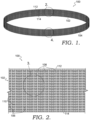
- FIG. 1 a perspective view of a woven trim piece 100 is depicted, in accordance with aspects herein.
- the woven trim piece 100 is shown in a circular or circumferential form to indicate how it would likely be incorporated into a garment or an article of apparel.
- the woven trim piece 100 may be incorporated as a waistband in a short or pant, an underband of a bra or support garment, a cuff of a jacket or shirt, a cuff of a pant or short, a bottom hem of a jacket or coat, and the like.
- the woven trim piece 100 would comprise a longitudinal strip when taken off the loom, where the strip would have a first end and a second end opposite the first end. The first and second ends may be joined to produce the woven trim piece 100 of FIG. 1 .
- the woven trim piece 100 comprises a first face 102 and a second face 104 opposite the first face 102.
- the first face 102 may face toward a wearer when a garment incorporating the trim piece 100 is donned, with the second face 104 being positioned opposite the first face (e.g., away from a wearer when the garment is donned).
- the first face 102 may also comprise an outer-facing surface of the trim piece 100
- the second face 104 may comprise an inner-facing surface of the trim piece 100. Any and all aspects, and any variation thereof, are contemplated as being within aspects herein.
- the first face 102 will generally be referred to as the portion of the woven trim piece 100 which faces a wearer's body surface when the garment is donned (otherwise known as an "inner-facing surface")
- the second face 104 will generally be referred to as the portion of the woven trim piece 100 which faces away from the wearer when the garment is donned (otherwise known as an "outer-facing surface”).
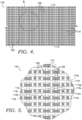
- the woven trim piece 100 comprises a first longitudinal edge 112 and a second longitudinal edge 114 opposite the first longitudinal edge 112, with the first face 102 and the second face 104 extending between the first longitudinal edge 112 and the second longitudinal edge 114.
- the woven trim piece 100 is constructed through a weaving process.
- the yarns positioned parallel to the first longitudinal edge 112 and the second longitudinal edge 114 comprise warp yarns, while the yarns positioned perpendicular to the first longitudinal edge 112 and the second longitudinal edge 114 comprise filling yarns.
- the warp yarns comprise at least a first plurality of grip yarns 106 (shown with hatching) and a second plurality of non-grip yarns 108 (shown without hatching).
- the filling yarns comprise at least a third plurality of non-grip filling yarns 110 (shown without hatching).
- FIG. 3 illustrates a magnified view of the first face 102 of the woven trim piece 100 taken at the area indicated in FIG. 2 in accordance with aspects herein.
- grip yarns 106 extend parallel to the first longitudinal edge 112 and the second longitudinal edge 114.
- the grip yarns 106 generally comprise PET yarns having a high number of filaments (e.g., 7000 or greater) per single yarn strand such that the decitex per filament of the grip yarn 106 is around 0.01 or less (denier per filament of the grip yarn 106 is around 0.01 or less).
- the grip yarns 106 may be formed through an "islands-in-the-process.”
- non-grip yarns 108 also extend parallel to the first longitudinal edge 112 and the second longitudinal edge 114.
- non-grip yarns 108 may be a natural yarn, such as cotton, or a synthetic yarn, such as PET or polyamide yarns.
- the non-grip yarns 108 comprise an air-jet-spun 167 decitex/144 filament (150 denier/144 filament) PET yarn. Use of air-jet-spun yarns contributes to a softer feel or hand.
- the plurality of filling yarns 110 which extend generally perpendicular to at least the first longitudinal edge 112.
- the plurality of filling yarns 110 may also be referred to as weft yarns.
- Examples of filling yarns 110 may be a natural yarn, such as cotton, or a synthetic yarn, such as polyester or nylon.
- the filling yarns 110 comprise a textured 167 decitex/48 filament (150 denier/48 filament) PET yarn.
- the grip yarns 106 alternate every other yarn with the non-grip yarns 108 along the length of the trim piece 100.
- the weaving pattern of the trim piece 100 is such that each individual grip yarn, such as grip yarn 107, is floated over a first set of three filling yarns 110 (e.g., filling yarns 110a, 110b, and 110c) and is then interlaced with a second set of filling yarns 110 (e.g., filling yarns 110d, 110e, and 110f) in a one-over-one pattern before being floated over a third set of three filling yarns 110 (e.g., filling yarns 110g, 110h, and 110i).
- first set of three filling yarns 110 e.g., filling yarns 110a, 110b, and 110c
- a second set of filling yarns 110 e.g., filling yarns 110d, 110e, and 110f
- each float such as float 109, has a long axis 111, and the long axis 111 of the float 109 is oriented parallel to the first longitudinal edge 112 and to the second longitudinal edge 114.
- the result of the weaving pattern shown in FIG. 3 is that the surface area of the first face 102 of the trim piece 100 comprises a greater percentage of the grip yarns 106 as compared to the non-grip yarns 108.
- Another result of the weaving pattern shown in FIG. 3 is that the long axes of the floats formed from the grip yarns 106, such as the long axis 111 of the float 109, are configured to be oriented perpendicular to likely tensioning forces and/or gravitational forces when the trim piece 100 is incorporated into a garment.
- ASTM D1894.2001 standards indicates that the trim piece 100 increases in coefficient of friction when transitioning from dry conditions to wet conditions, while traditional silicone treatments decrease in coefficient of friction when transitioning from dry conditions to wet conditions.
- ASTM D1894.2001 standards indicates that the coefficient of friction of the trim piece 100 increases from about 15 to about 45 percent when transitioning from dry conditions to wet conditions (as used herein, the term "about" means within ⁇ 10%).
- this may be due to the grip yarns having a high number of filaments per yarn strand, enabling the grip yarn to trap a larger volume of water between the filaments as compared to yarns having a fewer number of filaments. This may result in swelling of the grip yarn which results in a greater surface area (i.e., a greater surface-to-volume ratio) for providing a frictional force. Said another way, the greater amount of filaments in the grip yarns allows for the grip yarn to trap more moisture than a non-grip yarn, and thus, the surface area expansion of a grip yarn is greater than the surface area expansion of a non-grip yarn.
- a functional benefit is also achieved by having the long axes of the grip yarn floats oriented parallel to the first and second longitudinal edges 112/114 and perpendicular to likely gravitational forces and/or tensioning forces. For instance, when the trim piece 100 is incorporated into, for example, a waistband of a pant or short, gravitational forces exert a downward force on the waistband. By having the grip yarn floats oriented perpendicular to this gravitational force, the gripping function of the grip yarns 106 helps to maintain the waistband in a relatively fixed position. Using this same example, when a shirt or jersey is tucked into the waistband it may be subject to upward tensioning forces produced by, for example, the wearer raising her arms. This may be especially true during athletic activities such as basketball. By having the grip yarn floats oriented generally perpendicular to this type of tensioning force, the gripping function of the grip yarns 106 helps to keep the shirt or jersey tucked in and may prevent the shirt or jersey from twisting during wear.
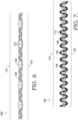
- FIG. 4 the second face 104 of the woven trim piece 100 is depicted, in accordance with aspects herein. Similar to what is depicted in FIG. 2 , FIG. 4 depicts that the second face 104 extends between the first longitudinal edge 112 and the second longitudinal edge 114. In accordance with aspects herein, the second face 104 differs from the first face 102 inasmuch as the non-grip yarns 108 are floated over the filling yarns 110, as opposed to the grip yarns 106 being floated over the filling yarns. To describe it differently, the grip yarns 106 form floats on the first face 102 of the woven trim piece 100, while the non-grip yarns 108 form floats on the second face 104 of the woven trim piece 100.
- FIG. 5 a magnified view of the second face 104 of the woven trim piece 100 taken at the area indicated in FIG. 4 is depicted.
- the weaving pattern of the second face 104 is the inverse of the weaving pattern shown in FIG. 3 .
- the non-grip yarns 108 alternate every other yarn with the grip yarns 106 along the length of the trim piece 100.
- each individual non-grip yarn such as non-grip yarn 113, is floated over a first set of three filling yarns 110 (e.g., filling yarns 110j, 1 10k, and 1101) and is then interlaced with a second set of filling yarns (e.g., filling yarns 110m, 110n, and 110o) in a one-over-one pattern before being floated over a third set of filling yarns 110 (e.g., filling yarns 110p, 110q, and 110r).
- This pattern continues the length of the trim piece 100.
- the remaining non-grip yarns 108 are woven in the same pattern such that floats formed from the individual non-grip yarns 108 are vertically aligned across the width of the trim piece 100. Similar to the floats formed from the grip yarns 106, each float formed from the non-grip yarns 108 has a long axis and the long axes of the non-grip yarn floats are oriented parallel to the first longitudinal edge 112 and the second longitudinal edge 114. Because of this construction, the second face 104 comprises a greater percentage of the non-grip yarns 108 than the grip yarns 106. As depicted in FIGs.
- the grip yarns 106 and the non-grip yarns 108 are depicted as being floated over three filling yarns 110. This depiction is merely exemplary, and the grip yarns 106 and the non-grip yarns 108 may be floated over greater than three filling yarns 110 to provide the desired characteristics of the woven trim piece 100.
- a functional benefit achieved by having a greater percentage of non-grip yarns 108 on the second face 104 of the trim piece 100 is that the non-grip yarns 108 may help to spread moisture in the form of perspiration or sweat over the second face 104 of the trim piece 104 where it can more easily evaporate leading to quicker drying times for the trim piece 100.
- This may be facilitated by forming the non-grip yarns 108 from, for example, PET or polyamide. These yarns typically absorb less moisture than, for example, cotton yarns and thus dry quicker. For instance, the moisture regain for textiles formed from PET yarns is around 0.4% and the moisture regain for textiles formed from polyamide yarns is around 4.5%.
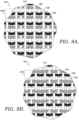
- FIG. 6 an exemplary weaving diagram 600 of the woven trim piece 100 is depicted.
- the weaving diagram 600 is depicted as a cross-sectional view cut parallel to the warp yarns.
- the warp yarns comprise grip yarn 106 and non-grip yarn 108, and the filling yarns are represented by reference numeral 110.
- the grip yarn 106 is woven in a repeating pattern such that the grip yarn 106 passes over (or floats over) three adjacent filling yarns 110 on the first face 102 of the trim piece 100 before traveling to the second face 104 of the trim piece.
- the grip yarn 106 interlaces with a next set of three adjacent filling yarns 110 in a one-over-one interlacing pattern. After the set of one-over-one interlacings, the grip yarn 106 passes over (or floats over) a next set of three filling yarns 110 on the first face 102 of the trim piece 100 before traveling to the second face 104 of the trim piece 100.
- the non-grip yarn 108 is woven in the inverse pattern such that the non-grip yarn floats are positioned on the second face 104 of the trim piece.
- the grip yarn 106 and non-grip yarn 108 are woven in an over-under-over configuration (i.e., an odd number of interlacings), such that the next float in the pattern for the grip yarn 106 appears on the same face of the trim piece 100 (i.e., the first face 102) as the previous float for the grip yarn 106, and the next float in the pattern for the non-grip yarn 108 appears on the same face of the trim piece 100 (i.e., the second face 104) as the previous float for the non-grip yarn 108.
- the trim piece 100 may comprise one or more elastic yarns (yarns that may provide a maximum stretch greater than 200% under load prior to returning to its non-stretched state when the load is removed).
- An exemplary elastic yarn may comprise, for example, an 933 decitex (840 denier) elastic yarn that is covered with a PET yarn.
- the elastic yarns may be positioned in the warp such that they extend the length of the trim piece 100.
- FIG. 7 illustrates an exemplary weaving diagram 700 of a woven trim piece having an elastic warp yarn 109 (shown with black shading) incorporated therein. Similar to FIG.
- the weaving diagram 700 is depicted as a cross-sectional view cut parallel to the warp yarns.
- the weaving configuration of the grip yarn 106 and the non-grip yarn 108 in FIG. 7 is similar to the weaving configuration of the grip yarn 106 and the non-grip yarn 108 depicted in FIG. 6 .
- the elastic yarn 109 is interlaced with the filling yarns 110 in an over-under-over configuration (i.e., a one-over-one interlacing pattern). Similar to the grip yarn 106 and the non-grip yarn 108, the elastic yarn 109 is configured to extend parallel to at least the first longitudinal edge 112 and the second longitudinal edge 114 of the trim piece 100
- FIG. 8A a different view of the weaving pattern 700 is depicted, in accordance with aspects herein.
- FIG. 8A which illustrates the second face 104 of an exemplary trim piece
- the warp yarns alternate in a triplet-like pattern 805, with the grip yarn 106 followed by the non-grip yarn 108 followed by the elastic yarn 109.
- the warp yarn pattern then repeats itself, with another grip yarn 106 being placed sequentially after or adjacent to the preceding elastic yarn 109.
- the elastic yarns 109 may be used to achieve a desired stretch characteristic of the woven trim piece 100.
- FIG. 8B depicts a triplet-like pattern 810, in an alternate configuration.
- the triplet-like pattern 810 defines the warp yarns of this weaving diagram, beginning with the grip yarn 106 and ending with the non-grip yarn 108, with the elastic yarn 109 positioned between the grip yarn 106 and the non-grip yarn 108.
- This triplet-like pattern is repeated throughout the structure of FIG. 8B .
- the elastic yarns 109 may be used to achieve a desired stretch characteristic of the woven trim piece 100.
- the grip yarns 106 and the non-grip yarns 108 may be floated over more than three filling yarns.
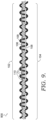
- FIG. 9 depicts a weaving diagram 900 taken in cross-section parallel to the warp yarns.
- the weaving diagram 900 depicts, for instance, grip yarn 106 being floated over five filling yarns 110 on the first face 102 of the trim piece, and non-grip yarn 108 being floated over the same five filling yarns on the second face 104 of the trim piece 100.
- adjacent floats for the grip yarn 106 and adjacent floats for the non-grip yarn 108 are separated by a set of one-over-one interlacings (three interlacings in this example).
- the weaving diagram 900 further illustrates the incorporation of the elastic yarn 109 that is woven in an under-over-under configuration (i.e., a one-over-one interlacing pattern). It is contemplated herein, that the elastic yarn 109 may not be utilized.
- the woven trim piece 100 is depicted as incorporated into a lower-body garment 200.
- the lower-body garment 200 is depicted as a pair of athletic shorts, although other types of lower-body garments are considered to be within the scope of this disclosure.
- the lower-body garment 200 may be a pair of sweatpants or another type of athletic pant.
- the lower-body garment 200 may be tailored specifically to one sport, such as a pair of football pants. Any and all types of lower-body garments are considered to be within the scope of this disclosure.
- FIG. 10 the lower-body garment 200 is depicted as a pair of athletic shorts, although other types of lower-body garments are considered to be within the scope of this disclosure.
- the lower-body garment 200 may be a pair of sweatpants or another type of athletic pant.
- the lower-body garment 200 may be tailored specifically to one sport, such as a pair of football pants. Any and all types of lower-body garments are considered to be within the scope of this disclosure.
- the lower-body garment 200 comprises a torso portion 220 which defines a waist opening 222, and two leg portions 224A and 224B extending from the torso portion 220. Additionally, each leg portion 224A and 224B defines a leg opening 226A and 2226B.
- the woven trim piece 100 described herein is affixed to the lower-body garment 200 (via, for instance, stitching, bonding, welding, and the like), such that the woven trim piece 100 at least partially defines the waist opening 222. Accordingly, in FIG. 10 , the woven trim piece 100 serves as a waistband for securing the lower-body garment 200 to the body of a wearer. Additionally, in accordance with aspects herein, the woven trim piece 100 may be integrally formed into the lower-body garment 200, such that the woven trim piece 100 and lower-body garment 200 comprise a unitary construction.
- the first face 102 of the trim piece 100 is positioned to face inwards so as to be adjacent to a body surface of a wearer when the lower-body garment 200 is worn.
- the first face 102 of the trim piece 100 comprises a greater percentage of grip yarns 106 as compared to the second face 104 of the trim piece 100.
- the greater percentage of grip yarns 106 helps to increase the coefficient of friction of the first face 102 which may help to prevent the lower-body garment 200 from shifting during wear and also may help shirts or jerseys tucked into the lower-body garment 200 from becoming untucked.
- the second face 104 of the trim piece 100 is positioned to face outwards when the lower-body garment 200 is worn.
- the second face 104 comprises a greater percentage of non-grip yarns 108 (e.g., PET yarns) as compared to the first face 102 of the trim piece 100.
- the greater percentage of non-grip yarns 108 helps to spread any moisture wicked from the wearer's body over the second face 104 where it can subsequently evaporate.
- the woven trim piece 100 is depicted as incorporated into an upper-body garment 300.
- the upper-body garment 300 is depicted as a support garment such as a sport bra, although other types of upper-body garments are considered to be within the scope of this disclosure.
- the upper-body garment 300 may be a sweatshirt, a hoodie, a running or winter jacket, a short or long sleeve t-shirt, and the like and the trim piece 100 may comprise a bottom waistband, a cuff, a collar, and the like.
- the upper-body garment 300 comprises a torso portion 320, a lower-body opening 322, and two arm holes 324A and 324B.
- the woven trim piece 100 is affixed to the upper-body garment 300 such that the woven trim piece 100 at least partially defines the lower-body opening 322.
- the trim piece 100 as incorporated into the upper-body garment 300 would serve similar purposes as that described in relation to the lower-body garment 200 (e.g., prevent the garment 300 from shifting during wear, and the like).
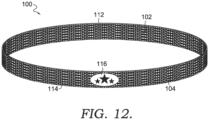
- the woven trim piece 100 described herein is depicted as further comprising a graphic 116 created by, for example, sublimation printing.
- the graphic 116 is represented in FIG. 12 as two small stars with a larger star placed therebetween, although this configuration is merely exemplary of one type of graphic considered to be within the scope of this disclosure.
- sublimation printing produces a print or graphic by heat-transferring sublimation dyes throughout a fabric as opposed to layering inks onto a fabric's surface. It is known that sublimation dyes have an affinity to (or optimally bond with) PET yarns and are better absorbed by textiles formed from PET as opposed to textiles formed from, for example, cotton.
- the woven waistband 100 comprises a large percentage of PET, as both the non-grip warp yarns 108 and the filling yarns 110 may comprise PET filaments.
- the second face 104 of the woven trim piece 100 By forming the second face 104 of the woven trim piece 100 to comprise a greater percentage of PET, the second face 104 presents an optimized surface for sublimation printing.
Landscapes
- Engineering & Computer Science (AREA)
- Textile Engineering (AREA)
- Chemical & Material Sciences (AREA)
- Nanotechnology (AREA)
- Woven Fabrics (AREA)
Claims (18)
- Gewebtes Bordürenteil (100), umfassend:eine erste Längskante (112);eine zweite Längskante (114) gegenüber der ersten Längskante (112);eine erste Fläche (102);eine zweite Fläche (104) gegenüber der ersten Fläche (102);eine erste Mehrzahl von Kettfäden (106), die sich parallel zu mindestens der ersten Längskante (112) erstrecken, wobei die erste Mehrzahl von Kettfäden (106) jeweils einen Decitex pro Filament von weniger als oder gleich 0,01 (ein Denier pro Filament von weniger als oder gleich 0,01) aufweist;eine zweite Mehrzahl von Kettfäden (108), die sich parallel zu mindestens der ersten Längskante (112) erstrecken; undeine Mehrzahl von Schussfäden (110), die sich im Allgemeinen senkrecht zu mindestens der ersten Längskante (112) erstrecken, wobei:die erste Mehrzahl von Kettfäden (106) mit der Mehrzahl von Schussfäden (110) verflochten sind, um eine sich wiederholende Struktur von Flottierungen auf der ersten Fläche (102) des Bordürenteils (100) zu bilden,die zweite Mehrzahl von Kettfäden (108) mit der Mehrzahl von Schussfäden (110) verflochten sind, um eine sich wiederholende Struktur von Flottierungen auf der zweiten Fläche (104) des Bordürenteils (100) zu bilden,die aus der ersten Mehrzahl von Kettfäden (106) gebildeten Flottierungen sich über mindestens drei Schussfäden (110) auf der ersten Fläche (102) des Bordürenteils (100) erstrecken, unddadurch gekennzeichnet, dassdie aus der zweiten Mehrzahl von Kettfäden (108) gebildeten Flottierungen sich über mindestens drei Schussfäden (110) auf der zweiten Fläche (104) des Bordürenteils (100) erstrecken.
- Gewebtes Bordürenteil (100) nach Anspruch 1, wobei jeder Kettfaden in der ersten Mehrzahl von Kettfäden (106) sich mit einem Kettfaden in der zweiten Mehrzahl von Kettfäden (108) über eine Breite des Bordürenteils (100) abwechselt.
- Gewebtes Bordürenteil (100) nach Anspruch 2, wobei für jeden Kettfaden in der ersten Mehrzahl von Kettfäden (106) die sich wiederholende Struktur von Flottierungen auf der ersten Fläche (102) des Bordürenteils (100) eine erste Flottierung umfasst, die von einer zweiten Flottierung durch einen ersten Satz von Eins-über-eins-Verflechtungen getrennt ist.
- Gewebtes Bordürenteil (100) nach Anspruch 3, wobei der erste Satz von Eins-über-eins-Verflechtungen mindestens drei Verflechtungen umfasst.
- Gewebtes Bordürenteil (100) nach Anspruch 2, wobei für jeden Kettfaden in der zweiten Mehrzahl von Kettfäden (108) die sich wiederholende Struktur von Flottierungen auf der zweiten Fläche (104) des Bordürenteils (100) eine erste Flottierung umfasst, die von einer zweiten Flottierung durch einen zweiten Satz von Eins-über-eins-Verflechtungen getrennt ist.
- Gewebtes Bordürenteil (100) nach Anspruch 5, wobei der zweite Satz von Eins-über-eins-Verflechtungen mindestens drei Verflechtungen umfasst.
- Gewebtes Bordürenteil (100) nach Anspruch 1, wobei die erste Mehrzahl von Kettfäden (106) einen Polyethylenterephthalat (PET)-Faden umfasst.
- Gewebtes Bordürenteil (100) nach Anspruch 1, wobei die zweite Mehrzahl von Kettfäden (108) eines aus Polyamidfäden und Polyethylenterephthalat (PET)-Fäden umfasst.
- Gewebtes Bordürenteil (100) nach Anspruch 1, wobei die Mehrzahl von Schussfäden (110) Polyethylenterephthalat (PET)-Fäden umfasst.
- Gewebtes Bordürenteil (100) nach Anspruch 1, weiter umfassend eine dritte Mehrzahl von Kettfäden (109), die sich parallel zu mindestens der ersten Längskante (112) erstrecken, wobei die dritte Mehrzahl von Kettfäden (109) elastische Fäden umfasst.
- Gewebtes Bordürenteil nach Anspruch 10, wobei die dritte Mehrzahl von Kettfäden (109) mit der Mehrzahl von Schussfäden (110) in einer Eins-über-eins-Verflechtungsstruktur verflochten ist.
- Gewebter Taillenbund, umfassend:eine erste Längskante (112);eine zweite Längskante (114) gegenüber der ersten Längskante (112);eine erste Fläche (102);eine zweite Fläche (104) gegenüber der ersten Fläche (102);eine erste Mehrzahl von Kettfäden (106), die sich parallel zu mindestens der ersten Längskante (112) erstrecken, wobei die erste Mehrzahl von Kettfäden (106) jeweils einen Decitex pro Filament von weniger als oder gleich 0,01 (ein Denier pro Filament von weniger als oder gleich 0,01) aufweist;eine zweite Mehrzahl von Kettfäden (108), die sich parallel zu mindestens der ersten Längskante (112) erstrecken; undeine Mehrzahl von Schussfäden (110), die sich im Allgemeinen senkrecht zu mindestens der ersten Längskante (112) erstrecken, wobei:die erste Mehrzahl von Kettfäden (106) mit der Mehrzahl von Schussfäden (110) verflochten sind, um eine sich wiederholende Struktur von Flottierungen auf der ersten Fläche (102) des gewebten Taillenbunds zu bilden,die zweite Mehrzahl von Kettfäden (108) mit der Mehrzahl von Schussfäden (110) verflochten sind, um eine sich wiederholende Struktur von Flottierungen auf der zweiten Fläche (104) des gewebten Taillenbunds zu bilden,die aus der ersten Mehrzahl von Kettfäden (106) gebildeten Flottierungen sich über mindestens drei Schussfäden (110) auf der ersten Fläche (102) des gewebten Taillenbunds erstrecken, unddadurch gekennzeichnet, dassdie aus der zweiten Mehrzahl von Kettfäden (108) gebildeten Flottierungen sich über mindestens drei Schussfäden (110) auf der zweiten Fläche (104) des gewebten Taillenbunds erstrecken.
- Gewebter Taillenbund nach Anspruch 12, weiter umfassend einen Sublimationsdruck auf der zweiten Fläche (104) des gewebten Taillenbunds.
- Gewebter Taillenbund nach Anspruch 13, wobei die erste Fläche (102) des gewebten Taillenbunds eine nach innen gerichtete Oberfläche umfasst, wenn der gewebte Taillenbund in ein Bekleidungsstück eingearbeitet ist.
- Unterkörperkleidungsstück (200), umfassend:einen Torsoabschnitt (220), der eine Taillenöffnung (222) definiert;zwei Beinabschnitte (224A, 224B), die sich von dem Torsoabschnitt (220) erstrecken, wobei jeder Beinabschnitt (224A, 224B) eine Beinöffnung (226A, 226B) definiert; undeinen gewebten Taillenbund nach Anspruch 12.
- Kleidungsstück nach Anspruch 15, wobei die erste Fläche (102) eine nach innen gerichtete Oberfläche des gewebten Taillenbunds bildet, und wobei die zweite Fläche (104) eine nach außen gerichtete Oberfläche des gewebten Taillenbunds bildet.
- Kleidungsstück nach Anspruch 15, wobei der gewebte Taillenbund weiter eine dritte Mehrzahl von Kettfäden (109) umfasst, die sich parallel zu mindestens der ersten Längskante (112) erstrecken, wobei die dritte Mehrzahl von Kettfäden (109) elastische Fäden umfasst.
- Kleidungsstück nach Anspruch 17, wobei die dritte Mehrzahl von Kettfäden (109) mit der Mehrzahl von Schussfäden (110) in einer Eins-über-eins-Verflechtungsstruktur verflochten ist.
Applications Claiming Priority (3)
| Application Number | Priority Date | Filing Date | Title |
|---|---|---|---|
| US201862616598P | 2018-01-12 | 2018-01-12 | |
| US16/242,808 US20190216149A1 (en) | 2018-01-12 | 2019-01-08 | Woven Trim Piece |
| PCT/US2019/013224 WO2019140213A1 (en) | 2018-01-12 | 2019-01-11 | Woven trim piece |
Publications (2)
| Publication Number | Publication Date |
|---|---|
| EP3737784A1 EP3737784A1 (de) | 2020-11-18 |
| EP3737784B1 true EP3737784B1 (de) | 2023-09-06 |
Family
ID=67213340
Family Applications (1)
| Application Number | Title | Priority Date | Filing Date |
|---|---|---|---|
| EP19702325.2A Active EP3737784B1 (de) | 2018-01-12 | 2019-01-11 | Gewebtes besatzstück |
Country Status (4)
| Country | Link |
|---|---|
| US (2) | US20190216149A1 (de) |
| EP (1) | EP3737784B1 (de) |
| CN (2) | CN111566270A (de) |
| WO (1) | WO2019140213A1 (de) |
Families Citing this family (7)
| Publication number | Priority date | Publication date | Assignee | Title |
|---|---|---|---|---|
| US8336118B2 (en) * | 2007-05-31 | 2012-12-25 | Nike, Inc. | Articles of apparel providing enhanced body position feedback |
| USD959155S1 (en) * | 2017-02-09 | 2022-08-02 | Curver Luxembourg Sarl | Sheet material |
| US10828864B2 (en) * | 2018-12-05 | 2020-11-10 | Talon Technologies, Inc. | Absorbent, wicking, expandable bandrolls, and waistbands and garments with same |
| USD959739S1 (en) | 2019-07-26 | 2022-08-02 | Sparkly Soul, Inc. | Thin, glittered headband with a single row of stitching |
| USD959740S1 (en) | 2019-07-26 | 2022-08-02 | Sparkly Soul, Inc. | Thin headband with a single row of stitching |
| USD1011768S1 (en) * | 2020-04-27 | 2024-01-23 | Southern Mills, Inc. | Fabric |
| USD1027460S1 (en) * | 2020-09-26 | 2024-05-21 | Casper Sleep Inc. | Woven textile |
Family Cites Families (5)
| Publication number | Priority date | Publication date | Assignee | Title |
|---|---|---|---|---|
| US2268809A (en) * | 1938-10-27 | 1942-01-06 | Blue Bird Silk Mfg Co Inc | Woven elastic fabric |
| US4813459A (en) * | 1984-09-25 | 1989-03-21 | Semtronics Corporation | Stretchable material having redundant conductive sections |
| EP1583856B1 (de) * | 2002-11-15 | 2010-12-08 | Sage Automotive Interiors, Inc. | Cloqué mit internen verbindungselementen |
| EP2338363A4 (de) * | 2008-10-22 | 2014-05-28 | Teijin Ltd | Schlupfschutzband und textilprodukt damit |
| WO2016168160A1 (en) * | 2015-04-17 | 2016-10-20 | Dashamerica, Inc. D/B/A Pearl Izumi Usa, Inc. | Micro-fiber gripping region for sports apparel |
-
2019
- 2019-01-08 US US16/242,808 patent/US20190216149A1/en not_active Abandoned
- 2019-01-11 CN CN201980007370.9A patent/CN111566270A/zh active Pending
- 2019-01-11 EP EP19702325.2A patent/EP3737784B1/de active Active
- 2019-01-11 WO PCT/US2019/013224 patent/WO2019140213A1/en not_active Ceased
- 2019-01-11 CN CN202211105379.3A patent/CN115474721A/zh active Pending
-
2021
- 2021-10-06 US US17/450,105 patent/US20220022580A1/en not_active Abandoned
Also Published As
| Publication number | Publication date |
|---|---|
| US20220022580A1 (en) | 2022-01-27 |
| US20190216149A1 (en) | 2019-07-18 |
| WO2019140213A1 (en) | 2019-07-18 |
| CN111566270A (zh) | 2020-08-21 |
| EP3737784A1 (de) | 2020-11-18 |
| CN115474721A (zh) | 2022-12-16 |
Similar Documents
| Publication | Publication Date | Title |
|---|---|---|
| US20220022580A1 (en) | Woven trim piece | |
| CN110337247B (zh) | 衣服用布料及使用了该布料的衣服 | |
| CN100577046C (zh) | 结合植绒材料的服饰 | |
| KR101220658B1 (ko) | 물습윤에 의해 통기성이 향상되는 권축 복합 섬유 함유직편물 및 의복 | |
| CN106133223B (zh) | 伸缩织物及含有该伸缩织物的运动用衣和泳衣 | |
| CN101083920A (zh) | 结合压纹材料的服饰 | |
| TW201016916A (en) | Slippage prevention tape and textile product | |
| JP2017025466A (ja) | 衣服及びその生産方法 | |
| US20130086726A1 (en) | Clothing components and articles of clothing including fabric woven with a multi-layered region and a single-layered region, and methods of making such woven fabrics | |
| JP2006249595A (ja) | ぬれ感の少ない編地および衣料 | |
| JP5929100B2 (ja) | ストレッチ織物 | |
| WO2009022883A2 (en) | Method of making a garment and a garment maded by using therof | |
| JP5768329B2 (ja) | ストレッチ織物 | |
| US20020071939A1 (en) | Antislip fabric and strips of such fabric | |
| EP3861157B1 (de) | Gewebte atmungsaktive textilie | |
| HK40031754A (en) | Woven trim piece | |
| JP6609115B2 (ja) | 通気性織物 | |
| JP2017020133A (ja) | 通気性を有する軽量高密度織物 | |
| JP2006225784A (ja) | 異方的な吸水拡散性を有する編地および衣料 | |
| CN115573075B (zh) | 弹力隧道织带及其制备方法以及松紧部件 | |
| CN216359833U (zh) | 一种单向导湿梭织面料及服装 | |
| EP3802931B1 (de) | Gewebtes kleidungsstück mit griffgarnen | |
| US20150259833A1 (en) | Knitting fabric | |
| CN106793840A (zh) | 泳衣 | |
| CN214629970U (zh) | 一种舒适型运动短裤 |
Legal Events
| Date | Code | Title | Description |
|---|---|---|---|
| STAA | Information on the status of an ep patent application or granted ep patent |
Free format text: STATUS: UNKNOWN |
|
| STAA | Information on the status of an ep patent application or granted ep patent |
Free format text: STATUS: THE INTERNATIONAL PUBLICATION HAS BEEN MADE |
|
| PUAI | Public reference made under article 153(3) epc to a published international application that has entered the european phase |
Free format text: ORIGINAL CODE: 0009012 |
|
| STAA | Information on the status of an ep patent application or granted ep patent |
Free format text: STATUS: REQUEST FOR EXAMINATION WAS MADE |
|
| 17P | Request for examination filed |
Effective date: 20200604 |
|
| AK | Designated contracting states |
Kind code of ref document: A1 Designated state(s): AL AT BE BG CH CY CZ DE DK EE ES FI FR GB GR HR HU IE IS IT LI LT LU LV MC MK MT NL NO PL PT RO RS SE SI SK SM TR |
|
| AX | Request for extension of the european patent |
Extension state: BA ME |
|
| DAV | Request for validation of the european patent (deleted) | ||
| DAX | Request for extension of the european patent (deleted) | ||
| STAA | Information on the status of an ep patent application or granted ep patent |
Free format text: STATUS: EXAMINATION IS IN PROGRESS |
|
| 17Q | First examination report despatched |
Effective date: 20220120 |
|
| RIC1 | Information provided on ipc code assigned before grant |
Ipc: D03D 15/58 20210101ALI20230216BHEP Ipc: D03D 15/33 20210101ALI20230216BHEP Ipc: A41F 9/00 20060101ALI20230216BHEP Ipc: D03D 13/00 20060101ALI20230216BHEP Ipc: D03D 3/00 20060101ALI20230216BHEP Ipc: D03D 1/00 20060101AFI20230216BHEP |
|
| GRAP | Despatch of communication of intention to grant a patent |
Free format text: ORIGINAL CODE: EPIDOSNIGR1 |
|
| STAA | Information on the status of an ep patent application or granted ep patent |
Free format text: STATUS: GRANT OF PATENT IS INTENDED |
|
| INTG | Intention to grant announced |
Effective date: 20230330 |
|
| P01 | Opt-out of the competence of the unified patent court (upc) registered |
Effective date: 20230515 |
|
| GRAS | Grant fee paid |
Free format text: ORIGINAL CODE: EPIDOSNIGR3 |
|
| GRAA | (expected) grant |
Free format text: ORIGINAL CODE: 0009210 |
|
| STAA | Information on the status of an ep patent application or granted ep patent |
Free format text: STATUS: THE PATENT HAS BEEN GRANTED |
|
| AK | Designated contracting states |
Kind code of ref document: B1 Designated state(s): AL AT BE BG CH CY CZ DE DK EE ES FI FR GB GR HR HU IE IS IT LI LT LU LV MC MK MT NL NO PL PT RO RS SE SI SK SM TR |
|
| REG | Reference to a national code |
Ref country code: GB Ref legal event code: FG4D |
|
| REG | Reference to a national code |
Ref country code: CH Ref legal event code: EP |
|
| REG | Reference to a national code |
Ref country code: DE Ref legal event code: R096 Ref document number: 602019036701 Country of ref document: DE |
|
| REG | Reference to a national code |
Ref country code: IE Ref legal event code: FG4D |
|
| REG | Reference to a national code |
Ref country code: LT Ref legal event code: MG9D |
|
| REG | Reference to a national code |
Ref country code: NL Ref legal event code: MP Effective date: 20230906 |
|
| PG25 | Lapsed in a contracting state [announced via postgrant information from national office to epo] |
Ref country code: GR Free format text: LAPSE BECAUSE OF FAILURE TO SUBMIT A TRANSLATION OF THE DESCRIPTION OR TO PAY THE FEE WITHIN THE PRESCRIBED TIME-LIMIT Effective date: 20231207 |
|
| PG25 | Lapsed in a contracting state [announced via postgrant information from national office to epo] |
Ref country code: SE Free format text: LAPSE BECAUSE OF FAILURE TO SUBMIT A TRANSLATION OF THE DESCRIPTION OR TO PAY THE FEE WITHIN THE PRESCRIBED TIME-LIMIT Effective date: 20230906 Ref country code: RS Free format text: LAPSE BECAUSE OF FAILURE TO SUBMIT A TRANSLATION OF THE DESCRIPTION OR TO PAY THE FEE WITHIN THE PRESCRIBED TIME-LIMIT Effective date: 20230906 Ref country code: NO Free format text: LAPSE BECAUSE OF FAILURE TO SUBMIT A TRANSLATION OF THE DESCRIPTION OR TO PAY THE FEE WITHIN THE PRESCRIBED TIME-LIMIT Effective date: 20231206 Ref country code: LV Free format text: LAPSE BECAUSE OF FAILURE TO SUBMIT A TRANSLATION OF THE DESCRIPTION OR TO PAY THE FEE WITHIN THE PRESCRIBED TIME-LIMIT Effective date: 20230906 Ref country code: LT Free format text: LAPSE BECAUSE OF FAILURE TO SUBMIT A TRANSLATION OF THE DESCRIPTION OR TO PAY THE FEE WITHIN THE PRESCRIBED TIME-LIMIT Effective date: 20230906 Ref country code: HR Free format text: LAPSE BECAUSE OF FAILURE TO SUBMIT A TRANSLATION OF THE DESCRIPTION OR TO PAY THE FEE WITHIN THE PRESCRIBED TIME-LIMIT Effective date: 20230906 Ref country code: GR Free format text: LAPSE BECAUSE OF FAILURE TO SUBMIT A TRANSLATION OF THE DESCRIPTION OR TO PAY THE FEE WITHIN THE PRESCRIBED TIME-LIMIT Effective date: 20231207 Ref country code: FI Free format text: LAPSE BECAUSE OF FAILURE TO SUBMIT A TRANSLATION OF THE DESCRIPTION OR TO PAY THE FEE WITHIN THE PRESCRIBED TIME-LIMIT Effective date: 20230906 |
|
| REG | Reference to a national code |
Ref country code: AT Ref legal event code: MK05 Ref document number: 1608671 Country of ref document: AT Kind code of ref document: T Effective date: 20230906 |
|
| PG25 | Lapsed in a contracting state [announced via postgrant information from national office to epo] |
Ref country code: NL Free format text: LAPSE BECAUSE OF FAILURE TO SUBMIT A TRANSLATION OF THE DESCRIPTION OR TO PAY THE FEE WITHIN THE PRESCRIBED TIME-LIMIT Effective date: 20230906 |
|
| PG25 | Lapsed in a contracting state [announced via postgrant information from national office to epo] |
Ref country code: IS Free format text: LAPSE BECAUSE OF FAILURE TO SUBMIT A TRANSLATION OF THE DESCRIPTION OR TO PAY THE FEE WITHIN THE PRESCRIBED TIME-LIMIT Effective date: 20240106 |
|
| PG25 | Lapsed in a contracting state [announced via postgrant information from national office to epo] |
Ref country code: AT Free format text: LAPSE BECAUSE OF FAILURE TO SUBMIT A TRANSLATION OF THE DESCRIPTION OR TO PAY THE FEE WITHIN THE PRESCRIBED TIME-LIMIT Effective date: 20230906 |
|
| PG25 | Lapsed in a contracting state [announced via postgrant information from national office to epo] |
Ref country code: ES Free format text: LAPSE BECAUSE OF FAILURE TO SUBMIT A TRANSLATION OF THE DESCRIPTION OR TO PAY THE FEE WITHIN THE PRESCRIBED TIME-LIMIT Effective date: 20230906 |
|
| PG25 | Lapsed in a contracting state [announced via postgrant information from national office to epo] |
Ref country code: SM Free format text: LAPSE BECAUSE OF FAILURE TO SUBMIT A TRANSLATION OF THE DESCRIPTION OR TO PAY THE FEE WITHIN THE PRESCRIBED TIME-LIMIT Effective date: 20230906 Ref country code: RO Free format text: LAPSE BECAUSE OF FAILURE TO SUBMIT A TRANSLATION OF THE DESCRIPTION OR TO PAY THE FEE WITHIN THE PRESCRIBED TIME-LIMIT Effective date: 20230906 Ref country code: IS Free format text: LAPSE BECAUSE OF FAILURE TO SUBMIT A TRANSLATION OF THE DESCRIPTION OR TO PAY THE FEE WITHIN THE PRESCRIBED TIME-LIMIT Effective date: 20240106 Ref country code: ES Free format text: LAPSE BECAUSE OF FAILURE TO SUBMIT A TRANSLATION OF THE DESCRIPTION OR TO PAY THE FEE WITHIN THE PRESCRIBED TIME-LIMIT Effective date: 20230906 Ref country code: EE Free format text: LAPSE BECAUSE OF FAILURE TO SUBMIT A TRANSLATION OF THE DESCRIPTION OR TO PAY THE FEE WITHIN THE PRESCRIBED TIME-LIMIT Effective date: 20230906 Ref country code: CZ Free format text: LAPSE BECAUSE OF FAILURE TO SUBMIT A TRANSLATION OF THE DESCRIPTION OR TO PAY THE FEE WITHIN THE PRESCRIBED TIME-LIMIT Effective date: 20230906 Ref country code: AT Free format text: LAPSE BECAUSE OF FAILURE TO SUBMIT A TRANSLATION OF THE DESCRIPTION OR TO PAY THE FEE WITHIN THE PRESCRIBED TIME-LIMIT Effective date: 20230906 Ref country code: SK Free format text: LAPSE BECAUSE OF FAILURE TO SUBMIT A TRANSLATION OF THE DESCRIPTION OR TO PAY THE FEE WITHIN THE PRESCRIBED TIME-LIMIT Effective date: 20230906 Ref country code: PT Free format text: LAPSE BECAUSE OF FAILURE TO SUBMIT A TRANSLATION OF THE DESCRIPTION OR TO PAY THE FEE WITHIN THE PRESCRIBED TIME-LIMIT Effective date: 20240108 |
|
| PG25 | Lapsed in a contracting state [announced via postgrant information from national office to epo] |
Ref country code: PL Free format text: LAPSE BECAUSE OF FAILURE TO SUBMIT A TRANSLATION OF THE DESCRIPTION OR TO PAY THE FEE WITHIN THE PRESCRIBED TIME-LIMIT Effective date: 20230906 Ref country code: IT Free format text: LAPSE BECAUSE OF FAILURE TO SUBMIT A TRANSLATION OF THE DESCRIPTION OR TO PAY THE FEE WITHIN THE PRESCRIBED TIME-LIMIT Effective date: 20230906 |
|
| REG | Reference to a national code |
Ref country code: DE Ref legal event code: R097 Ref document number: 602019036701 Country of ref document: DE |
|
| PG25 | Lapsed in a contracting state [announced via postgrant information from national office to epo] |
Ref country code: DK Free format text: LAPSE BECAUSE OF FAILURE TO SUBMIT A TRANSLATION OF THE DESCRIPTION OR TO PAY THE FEE WITHIN THE PRESCRIBED TIME-LIMIT Effective date: 20230906 |
|
| PLBE | No opposition filed within time limit |
Free format text: ORIGINAL CODE: 0009261 |
|
| STAA | Information on the status of an ep patent application or granted ep patent |
Free format text: STATUS: NO OPPOSITION FILED WITHIN TIME LIMIT |
|
| PG25 | Lapsed in a contracting state [announced via postgrant information from national office to epo] |
Ref country code: DK Free format text: LAPSE BECAUSE OF FAILURE TO SUBMIT A TRANSLATION OF THE DESCRIPTION OR TO PAY THE FEE WITHIN THE PRESCRIBED TIME-LIMIT Effective date: 20230906 Ref country code: SI Free format text: LAPSE BECAUSE OF FAILURE TO SUBMIT A TRANSLATION OF THE DESCRIPTION OR TO PAY THE FEE WITHIN THE PRESCRIBED TIME-LIMIT Effective date: 20230906 |
|
| 26N | No opposition filed |
Effective date: 20240607 |
|
| PG25 | Lapsed in a contracting state [announced via postgrant information from national office to epo] |
Ref country code: MC Free format text: LAPSE BECAUSE OF FAILURE TO SUBMIT A TRANSLATION OF THE DESCRIPTION OR TO PAY THE FEE WITHIN THE PRESCRIBED TIME-LIMIT Effective date: 20230906 |
|
| PG25 | Lapsed in a contracting state [announced via postgrant information from national office to epo] |
Ref country code: MC Free format text: LAPSE BECAUSE OF FAILURE TO SUBMIT A TRANSLATION OF THE DESCRIPTION OR TO PAY THE FEE WITHIN THE PRESCRIBED TIME-LIMIT Effective date: 20230906 |
|
| REG | Reference to a national code |
Ref country code: CH Ref legal event code: PL |
|
| PG25 | Lapsed in a contracting state [announced via postgrant information from national office to epo] |
Ref country code: LU Free format text: LAPSE BECAUSE OF NON-PAYMENT OF DUE FEES Effective date: 20240111 |
|
| PG25 | Lapsed in a contracting state [announced via postgrant information from national office to epo] |
Ref country code: LU Free format text: LAPSE BECAUSE OF NON-PAYMENT OF DUE FEES Effective date: 20240111 |
|
| PG25 | Lapsed in a contracting state [announced via postgrant information from national office to epo] |
Ref country code: BE Free format text: LAPSE BECAUSE OF NON-PAYMENT OF DUE FEES Effective date: 20240131 |
|
| PG25 | Lapsed in a contracting state [announced via postgrant information from national office to epo] |
Ref country code: CH Free format text: LAPSE BECAUSE OF NON-PAYMENT OF DUE FEES Effective date: 20240131 |
|
| PG25 | Lapsed in a contracting state [announced via postgrant information from national office to epo] |
Ref country code: CH Free format text: LAPSE BECAUSE OF NON-PAYMENT OF DUE FEES Effective date: 20240131 Ref country code: BE Free format text: LAPSE BECAUSE OF NON-PAYMENT OF DUE FEES Effective date: 20240131 |
|
| REG | Reference to a national code |
Ref country code: BE Ref legal event code: MM Effective date: 20240131 |
|
| PG25 | Lapsed in a contracting state [announced via postgrant information from national office to epo] |
Ref country code: BG Free format text: LAPSE BECAUSE OF FAILURE TO SUBMIT A TRANSLATION OF THE DESCRIPTION OR TO PAY THE FEE WITHIN THE PRESCRIBED TIME-LIMIT Effective date: 20230906 |
|
| PG25 | Lapsed in a contracting state [announced via postgrant information from national office to epo] |
Ref country code: BG Free format text: LAPSE BECAUSE OF FAILURE TO SUBMIT A TRANSLATION OF THE DESCRIPTION OR TO PAY THE FEE WITHIN THE PRESCRIBED TIME-LIMIT Effective date: 20230906 |
|
| PG25 | Lapsed in a contracting state [announced via postgrant information from national office to epo] |
Ref country code: IE Free format text: LAPSE BECAUSE OF NON-PAYMENT OF DUE FEES Effective date: 20240111 |
|
| PG25 | Lapsed in a contracting state [announced via postgrant information from national office to epo] |
Ref country code: IE Free format text: LAPSE BECAUSE OF NON-PAYMENT OF DUE FEES Effective date: 20240111 |
|
| PG25 | Lapsed in a contracting state [announced via postgrant information from national office to epo] |
Ref country code: CY Free format text: LAPSE BECAUSE OF FAILURE TO SUBMIT A TRANSLATION OF THE DESCRIPTION OR TO PAY THE FEE WITHIN THE PRESCRIBED TIME-LIMIT; INVALID AB INITIO Effective date: 20190111 |
|
| PG25 | Lapsed in a contracting state [announced via postgrant information from national office to epo] |
Ref country code: HU Free format text: LAPSE BECAUSE OF FAILURE TO SUBMIT A TRANSLATION OF THE DESCRIPTION OR TO PAY THE FEE WITHIN THE PRESCRIBED TIME-LIMIT; INVALID AB INITIO Effective date: 20190111 |
|
| PG25 | Lapsed in a contracting state [announced via postgrant information from national office to epo] |
Ref country code: TR Free format text: LAPSE BECAUSE OF FAILURE TO SUBMIT A TRANSLATION OF THE DESCRIPTION OR TO PAY THE FEE WITHIN THE PRESCRIBED TIME-LIMIT Effective date: 20230906 |
|
| PGFP | Annual fee paid to national office [announced via postgrant information from national office to epo] |
Ref country code: GB Payment date: 20251120 Year of fee payment: 8 |
|
| PGFP | Annual fee paid to national office [announced via postgrant information from national office to epo] |
Ref country code: FR Payment date: 20251110 Year of fee payment: 8 |
|
| PGFP | Annual fee paid to national office [announced via postgrant information from national office to epo] |
Ref country code: DE Payment date: 20251119 Year of fee payment: 8 |