EP3734308B1 - Thermal runaway detection circuit and method - Google Patents
Thermal runaway detection circuit and method Download PDFInfo
- Publication number
- EP3734308B1 EP3734308B1 EP19198158.8A EP19198158A EP3734308B1 EP 3734308 B1 EP3734308 B1 EP 3734308B1 EP 19198158 A EP19198158 A EP 19198158A EP 3734308 B1 EP3734308 B1 EP 3734308B1
- Authority
- EP
- European Patent Office
- Prior art keywords
- battery pack
- thermal runaway
- cell
- temperature
- resistor
- Prior art date
- Legal status (The legal status is an assumption and is not a legal conclusion. Google has not performed a legal analysis and makes no representation as to the accuracy of the status listed.)
- Active
Links
Images


Classifications
-
- G—PHYSICS
- G01—MEASURING; TESTING
- G01R—MEASURING ELECTRIC VARIABLES; MEASURING MAGNETIC VARIABLES
- G01R31/00—Arrangements for testing electric properties; Arrangements for locating electric faults; Arrangements for electrical testing characterised by what is being tested not provided for elsewhere
- G01R31/36—Arrangements for testing, measuring or monitoring the electrical condition of accumulators or electric batteries, e.g. capacity or state of charge [SoC]
- G01R31/385—Arrangements for measuring battery or accumulator variables
-
- G—PHYSICS
- G01—MEASURING; TESTING
- G01R—MEASURING ELECTRIC VARIABLES; MEASURING MAGNETIC VARIABLES
- G01R31/00—Arrangements for testing electric properties; Arrangements for locating electric faults; Arrangements for electrical testing characterised by what is being tested not provided for elsewhere
- G01R31/36—Arrangements for testing, measuring or monitoring the electrical condition of accumulators or electric batteries, e.g. capacity or state of charge [SoC]
- G01R31/392—Determining battery ageing or deterioration, e.g. state of health
-
- H—ELECTRICITY
- H02—GENERATION; CONVERSION OR DISTRIBUTION OF ELECTRIC POWER
- H02J—ELECTRIC POWER NETWORKS; CIRCUIT ARRANGEMENTS OR SYSTEMS FOR SUPPLYING OR DISTRIBUTING ELECTRIC POWER; SYSTEMS FOR STORING ELECTRIC ENERGY
- H02J7/00—Circuit arrangements for charging or discharging batteries or for supplying loads from batteries
- H02J7/40—Circuit arrangements for charging or discharging batteries or for supplying loads from batteries characterised by the exchange of charge or discharge related data
- H02J7/443—Circuit arrangements for charging or discharging batteries or for supplying loads from batteries characterised by the exchange of charge or discharge related data using passive battery identification means, e.g. resistors or capacitors
- H02J7/445—Circuit arrangements for charging or discharging batteries or for supplying loads from batteries characterised by the exchange of charge or discharge related data using passive battery identification means, e.g. resistors or capacitors in response to measured battery parameters, e.g. voltage, current or temperature profile
-
- G—PHYSICS
- G01—MEASURING; TESTING
- G01K—MEASURING TEMPERATURE; MEASURING QUANTITY OF HEAT; THERMALLY-SENSITIVE ELEMENTS NOT OTHERWISE PROVIDED FOR
- G01K3/00—Thermometers giving results other than momentary value of temperature
- G01K3/005—Circuits arrangements for indicating a predetermined temperature
-
- G—PHYSICS
- G01—MEASURING; TESTING
- G01R—MEASURING ELECTRIC VARIABLES; MEASURING MAGNETIC VARIABLES
- G01R31/00—Arrangements for testing electric properties; Arrangements for locating electric faults; Arrangements for electrical testing characterised by what is being tested not provided for elsewhere
- G01R31/36—Arrangements for testing, measuring or monitoring the electrical condition of accumulators or electric batteries, e.g. capacity or state of charge [SoC]
- G01R31/364—Battery terminal connectors with integrated measuring arrangements
-
- G—PHYSICS
- G01—MEASURING; TESTING
- G01R—MEASURING ELECTRIC VARIABLES; MEASURING MAGNETIC VARIABLES
- G01R31/00—Arrangements for testing electric properties; Arrangements for locating electric faults; Arrangements for electrical testing characterised by what is being tested not provided for elsewhere
- G01R31/36—Arrangements for testing, measuring or monitoring the electrical condition of accumulators or electric batteries, e.g. capacity or state of charge [SoC]
- G01R31/382—Arrangements for monitoring battery or accumulator variables, e.g. SoC
-
- H—ELECTRICITY
- H01—ELECTRIC ELEMENTS
- H01M—PROCESSES OR MEANS, e.g. BATTERIES, FOR THE DIRECT CONVERSION OF CHEMICAL ENERGY INTO ELECTRICAL ENERGY
- H01M10/00—Secondary cells; Manufacture thereof
- H01M10/42—Methods or arrangements for servicing or maintenance of secondary cells or secondary half-cells
- H01M10/425—Structural combination with electronic components, e.g. electronic circuits integrated to the outside of the casing
-
- H—ELECTRICITY
- H01—ELECTRIC ELEMENTS
- H01M—PROCESSES OR MEANS, e.g. BATTERIES, FOR THE DIRECT CONVERSION OF CHEMICAL ENERGY INTO ELECTRICAL ENERGY
- H01M10/00—Secondary cells; Manufacture thereof
- H01M10/42—Methods or arrangements for servicing or maintenance of secondary cells or secondary half-cells
- H01M10/48—Accumulators combined with arrangements for measuring, testing or indicating the condition of cells, e.g. the level or density of the electrolyte
- H01M10/482—Accumulators combined with arrangements for measuring, testing or indicating the condition of cells, e.g. the level or density of the electrolyte for several batteries or cells simultaneously or sequentially
-
- H—ELECTRICITY
- H01—ELECTRIC ELEMENTS
- H01M—PROCESSES OR MEANS, e.g. BATTERIES, FOR THE DIRECT CONVERSION OF CHEMICAL ENERGY INTO ELECTRICAL ENERGY
- H01M10/00—Secondary cells; Manufacture thereof
- H01M10/42—Methods or arrangements for servicing or maintenance of secondary cells or secondary half-cells
- H01M10/48—Accumulators combined with arrangements for measuring, testing or indicating the condition of cells, e.g. the level or density of the electrolyte
- H01M10/486—Accumulators combined with arrangements for measuring, testing or indicating the condition of cells, e.g. the level or density of the electrolyte for measuring temperature
-
- H—ELECTRICITY
- H02—GENERATION; CONVERSION OR DISTRIBUTION OF ELECTRIC POWER
- H02J—ELECTRIC POWER NETWORKS; CIRCUIT ARRANGEMENTS OR SYSTEMS FOR SUPPLYING OR DISTRIBUTING ELECTRIC POWER; SYSTEMS FOR STORING ELECTRIC ENERGY
- H02J7/00—Circuit arrangements for charging or discharging batteries or for supplying loads from batteries
- H02J7/60—Circuit arrangements for charging or discharging batteries or for supplying loads from batteries including safety or protection arrangements
- H02J7/65—Circuit arrangements for charging or discharging batteries or for supplying loads from batteries including safety or protection arrangements against overtemperature
-
- G—PHYSICS
- G01—MEASURING; TESTING
- G01K—MEASURING TEMPERATURE; MEASURING QUANTITY OF HEAT; THERMALLY-SENSITIVE ELEMENTS NOT OTHERWISE PROVIDED FOR
- G01K7/00—Measuring temperature based on the use of electric or magnetic elements directly sensitive to heat ; Power supply therefor, e.g. using thermoelectric elements
- G01K7/02—Measuring temperature based on the use of electric or magnetic elements directly sensitive to heat ; Power supply therefor, e.g. using thermoelectric elements using thermoelectric elements, e.g. thermocouples
- G01K7/021—Particular circuit arrangements
-
- H—ELECTRICITY
- H01—ELECTRIC ELEMENTS
- H01M—PROCESSES OR MEANS, e.g. BATTERIES, FOR THE DIRECT CONVERSION OF CHEMICAL ENERGY INTO ELECTRICAL ENERGY
- H01M10/00—Secondary cells; Manufacture thereof
- H01M10/42—Methods or arrangements for servicing or maintenance of secondary cells or secondary half-cells
- H01M10/425—Structural combination with electronic components, e.g. electronic circuits integrated to the outside of the casing
- H01M2010/4271—Battery management systems including electronic circuits, e.g. control of current or voltage to keep battery in healthy state, cell balancing
-
- Y—GENERAL TAGGING OF NEW TECHNOLOGICAL DEVELOPMENTS; GENERAL TAGGING OF CROSS-SECTIONAL TECHNOLOGIES SPANNING OVER SEVERAL SECTIONS OF THE IPC; TECHNICAL SUBJECTS COVERED BY FORMER USPC CROSS-REFERENCE ART COLLECTIONS [XRACs] AND DIGESTS
- Y02—TECHNOLOGIES OR APPLICATIONS FOR MITIGATION OR ADAPTATION AGAINST CLIMATE CHANGE
- Y02E—REDUCTION OF GREENHOUSE GAS [GHG] EMISSIONS, RELATED TO ENERGY GENERATION, TRANSMISSION OR DISTRIBUTION
- Y02E60/00—Enabling technologies; Technologies with a potential or indirect contribution to GHG emissions mitigation
- Y02E60/10—Energy storage using batteries
Definitions
- the present disclosure generally relates to batteries, and more particularly to a thermal runaway detection circuit and method.
- a battery pack may be used as power sources to power new energy vehicles, new energy ships, new energy aircraft, and so on.
- the battery pack may generate heat during operation. Under normal conditions, the heat generated by the battery pack is controllable. However, in an abnormal state, such as collision, overcharge, etc., the heat generated by the battery pack is uncontrollable, resulting in thermal runaway. In the event of thermal runaway, a fire may be caused, which may threaten safety of the battery pack, the devices in which the battery pack is installed, and personal safety of the person concerned.
- a battery management system In order to improve the safety of the battery pack, a battery management system (BMS) is currently used to monitor change of voltage or temperature to determine whether thermal runaway occurs.
- BMS battery management system
- a circuit board or a monitoring unit used to communicate with the BMS may be sputtered and burned by the high-temperature electrolyte generated from the thermal runaway. Therefore, the BMS cannot detect the thermal runaway and the safety of the battery pack is reduced.
- DE202017103776U1 discloses an automatic warning device for thermal runaway of batteries.
- the device comprises a plurality of securing elements connected in series, a control circuit and a warning indicator.
- Each securing element is arranged on the outside of a respective battery cell, and the securing element will be fused when a certain threshold value is reached so that the control circuit may cause the warning indicator to send out a warning signal.
- JP2013024718A discloses a temperature abnormality detection sensor.
- a temperature abnormality detection sensor includes a plurality of temperature detection units connected in parallel.
- Each temperature detection unit includes a PTC thermistor, an anti-fuse element and a resistance elements.
- the anti-fuse element and the resistance element are electrically connected in series, and they are electrically connected in parallel to a respective PTC thermistor.
- CN109494419A discloses a monitoring device for thermal runaway of a power battery and a module positioning method.
- the device comprises a battery controller and thermal runaway monitoring modules.
- the thermal runaway monitoring modules are arranged in power batteries, each battery module is provided with the corresponding thermal runaway monitoring module, and each thermal runaway monitoring module is used for generating resistance value change during the thermal runaway of the unit battery in each battery module.
- the battery controller is used for collecting the resistance values of the thermal runaway monitoring modules in real time through the electric connecting loop so as to realize the thermal runaway monitoring of each battery module in the power battery and determining the battery module in a thermal runaway state according to the resistance values generated by the thermal runaway monitoring modules.
- the present disclosure provides a thermal runaway detection circuit and method, which may improve safety of a battery pack.
- the thermal runaway detection circuit may include: a sensing module including a terminating resistor, wherein the terminating resistor is connected to a temperature sensitive cable, wherein a distance between at least a portion of the temperature sensitive cable and a cell of a battery pack is less than a temperature sensitive distance threshold, and wherein the temperature sensitive cable comprises a wire A and a wire B which are in a twisted-pair structure, the wire A and the wire B are wrapped with heat-sensitive material, the heat-sensitive material is to melt when its temperature exceeds a high-temperature threshold; a detection module including a first voltage dividing resistor set and a second voltage dividing resistor set, wherein the first voltage dividing resistor set comprises at least a resistor, the second voltage dividing resistor set comprises at least a resistor, and wherein the first voltage dividing resistor set is connected to the terminating resistor via the wire A and the second voltage dividing resistor set is connected to the terminating resistor
- the present disclosure provides a method for thermal runaway detection applied in the thermal runaway detection circuit of the first aspect.
- the method may include: obtaining, by the processing module, thermal runaway detection data; and determining, by the processing module, whether thermal runaway occurs in the battery pack based on the thermal runaway detection data; wherein the thermal runaway detection data includes first sampled data collected from a first sampling point and second sampled data collected from a second sampling point, the first sampling point is disposed between the other end of the first voltage dividing resistor set and the terminating resistor, and the second sampling point is disposed between the other end of the second voltage dividing resistor set and the terminating resistor.
- the method further comprises: determining an on-off state of the temperature sensitive cable based on the first sampled data and the second sampled data, the on-off state comprising a short-circuit state, an open-circuit state, or a normal-path state; and determining whether thermal runaway occurs in the battery pack based on the on-off state of the temperature sensitive cable.
- Embodiments of the present disclosure provide a thermal runaway detection circuit and method.
- the thermal runaway detection circuit includes a sensing module, a detection module, and a processing module.
- the terminating resistor in the sensing module is connected with the temperature sensitive cable, and the terminating resistor is connected in series with the first voltage dividing resistor set and the second voltage dividing resistor set through the temperature sensitive cable.
- the distance between at least a portion of the temperature sensitive cable and a cell in the battery pack is less than a temperature sensitive distance threshold, such that the temperature sensitive cable can be affected by the temperature of the cell in the battery pack.
- the processing module may detect the thermal runaway in the battery pack in time based on the thermal runaway detection data. As a result, the safety of the battery pack is improved.
- Embodiments of the present disclosure provide a thermal runaway detection circuit, method, and storage medium, which may be used in a scenario for monitoring a thermal runaway of a battery pack.
- the battery pack may include at least one cell.
- the battery pack may be a battery module, a battery package, or the like, which is not limited herein.
- the thermal runaway detection circuit may detect the thermal runaway of the battery pack in time and facilitate corresponding measures in the subsequent process, so as to improve the safety of the battery pack.
- Fig. 1 is a schematic structure diagram of a thermal runaway detection circuit according to an embodiment of the present disclosure.
- the thermal runaway detection circuit may include a sensing module P1, a detection module P2, and a processing module P3.
- the sensing module P1 may include a terminating resistor.
- the terminating resistor may be connected to a temperature sensitive cable. The distance between at least a portion of the temperature sensitive cable and a cell of the battery pack is less than a temperature sensitive distance threshold.
- Two wires may be included within the temperature sensitive cable. Each of the two wires may be wrapped with heat-sensitive material. The two wires are in a twisted-pair structure.
- the temperature sensitive cable is represented by two separate wires A and B. In an actual scenario, the two wires A and B are located in the same temperature sensitive cable. Under normal circumstances, the two wires in the temperature sensitive cable do not contact with each other directly.
- the heat-sensitive material wrapped around the two wires may melt with each other, so that the two wires within the temperature sensitive cable are twisted and connected together due to the torsion force, so that a short circuit is caused in the temperature sensitive cable.
- the high-temperature threshold may be set according to specific operation scenarios and operation requirements, and is not limited herein.
- the high-temperature threshold may be 85°C, 105°C or 125°C, and the like.
- the temperature sensitive distance threshold is a distance threshold with which the temperature sensitive cable is able to sensitively sense that the temperature of a cell in the battery pack is above the temperature threshold.
- the temperature sensitive distance threshold may be set based on a characteristic parameter of the temperature sensitive cable and a characteristic parameter of the cell in combination with specific operation scenarios and operation requirements, which is not limited herein.
- At least a portion of the temperature sensitive cable may be disposed right above a cell explosion-proof valve port of the cell of the battery pack.
- the cell explosion-proof valve port will rupture, and high-temperature electrolyte, high-temperature gas, etc. will be ejected from the explosion-proof valve port of the cell.
- At least a portion of the temperature sensitive cable being disposed right above the cell explosion-proof valve port of the cell of the battery pack may make the temperature sensitive cable more sensitive to thermal runaway sensing of the battery pack. As a result, accuracy and timeliness in thermal runaway detection may be further improved.
- the detection module P2 may include a first voltage dividing resistor set and a second voltage dividing resistor set. One end of the first voltage dividing resistor set is connected to a first power supply terminal, and one end of the second voltage dividing resistor set is connected to ground.
- the first voltage dividing resistor set, the terminating resistor, and the second voltage dividing resistor set are connected in series via the temperature sensitive cable. In particular, one wire of the temperature sensitive cable connected to the terminating resistor is connected to the other end of the first voltage dividing resistor set, and the other wire of the temperature sensitive cable is connected to the other end of the second voltage-dividing resistor set.
- the first voltage dividing resistor set may include at least one resistor. If the first voltage dividing resistor set includes a plurality of resistors, the number of resistors and the connection relationship therebetween are not limited herein.
- the second voltage dividing resistor set may include at least one resistor. If the first voltage dividing resistor set includes a plurality of resistors, the number of resistors and the connection relationship therebetween are not limited herein.
- the specific structure of the first voltage dividing resistor set and the second voltage dividing resistor set may be set according to specific operation scenarios and operation requirements, which is not limited herein.
- the first voltage dividing resistor set may include a resistor R1
- the second voltage dividing resistor set may include a resistor R2
- the terminating resistor is a resistor R3.
- the resistor R1, the resistor R3, and the resistor R2 are connected in series.
- the resistor R1 and the resistor R3 are connected through the wire A within the temperature sensitive cable.
- the resistor R2 and the resistor R3 are connected through the wire B within the temperature sensitive cable.
- the detection module P2 may be specifically disposed in a Battery Management Unit (BMU).
- the BMU may include a housing structure for protection.
- the detection module P2 may be protected from the high-temperature electrolyte generated from thermal runaway of the battery pack.
- the position of the detection module P2 is not specifically limited, and the detection module P2 may be provided with a protective cover to protect the detection module P2 from the high-temperature electrolyte generated from thermal runaway of the battery pack, so as to further ensure the timeliness of the detection of the thermal runaway and the safety of the thermal runaway detection circuit.
- the processing module P3 may be connected to the detection module P2.
- the processing module P3 may be configured to obtain thermal runaway detection data, and determine whether thermal runaway occurs in the battery pack based on the thermal runaway detection data.
- the thermal runaway detection data may include first sampled data collected from a first sampling point and second sampled data collected from a second sampling point.
- the first sampling point may be disposed between the other end of the first voltage dividing resistor set and the terminating resistor.
- the second sampling point may be disposed between the other end of the second voltage dividing resistor set and the terminating resistor.
- the first sampling point is labeled as AD1
- the second sampling point is labeled as AD2.
- sampling ports can be separately set at each of the first sampling point and the second sampling point.
- the processing module P3 may be a micro control unit (MCU) in the BMU, or the processing module P3 may also be independently set, which is not limited herein.
- MCU micro control unit
- the first sampled data and the second sampled data may specifically be electrical signal parameter data, such as a voltage value, a current value, and the like, which is not limited herein.
- the on-off state of the temperature sensitive cable may be determined, that is, the cable sense line is short-circuited, open-circuited, or in normal-path state.
- whether there is the thermal runaway in the battery pack can be directly determined based on the on-off state of the temperature sensitive cable.
- other thermal runaway detection data may be combined together to determine whether there is the thermal runaway in the battery pack in addition to the first sampled data and the second sampled data,.
- the thermal runaway detection circuit may include the sensing module P1, the detection module P2, and the processing module P3.
- the terminating resistor in the sensing module P1 is connected with the temperature sensitive cable, and the terminating resistor is connected in series with the first voltage dividing resistor set and the second voltage dividing resistor set through the temperature sensitive cable.
- the distance between at least a portion of the temperature sensitive cable and the cell in the battery pack is less than the temperature sensitive distance threshold, such that the temperature sensitive cable can be affected by the temperature of the cell in the battery pack.
- the processing module P3 may detect the thermal runaway in the battery pack in time based on the thermal runaway detection data. As a result, the safety of the battery pack can be improved.
- the state of the BMU may include an operating state and a sleep state.
- a power module of the BMU may supply power to the BMU to enable the BMU to perform normal data monitoring on the battery pack, such as voltage monitoring, current monitoring, temperature monitoring, insulation monitoring, and state of charge monitoring, etc., so as to obtain voltage, current, temperature, state of charge, etc. as the thermal runaway detection data.
- the power module of the BMU may stop supplying power to the BMU, and the BMU may stop monitoring data of the battery pack.
- thermal runaway occurs in the battery pack when the BMU is in the sleep state
- the BMU stops monitoring the data of the battery pack and cannot provide thermal runaway detection data. If the function of the processing module P3 is integrated in the BMU, when the BMU is in the sleep state, the detection of the thermal runaway cannot be performed.
- the detection module P2 in the above embodiments may further include a sleep-wakeup submodule P21.
- Fig. 2 is a schematic structure diagram of a thermal runaway detecting circuit according to another embodiment of the present disclosure (the processing module P3 is not shown). As shown in Fig. 2 , the detection module P2 may further include the sleep wakeup submodule P21.
- the sleep-wakeup submodule P21 may be connected to the other end of the second voltage dividing resistor set.
- the sleep-wakeup submodule P21 may be configured to receive a driving signal transmitted by the sensing module P1, and transmit a wakeup signal to a power module P4 of the battery management unit if the driving signal indicates that the sleep-wakeup submodule P21 is turned on.
- the driving signal transmitted from the temperature sensitive cable may control the sleep-wakeup submodule P21 to be turned off, with the BMU still in the sleep state.
- the driving signal transmitted from the temperature sensitive cable may control the sleep-wakeup submodule P21 to be turned on and send a wakeup signal to the power module of the BMU.
- the power module of the BMU may receive the wakeup signal, and the BMU may switch from the sleep state to the operating state.
- the sleep-wakeup submodule P21 may include a first resistor set, a first switch tube, a second resistor set, a second switch tube, and a third resistor set.
- the first resistor set may include at least one resistor. If the first resistor set includes a plurality of resistors, the number of resistors and the connection relationship therebetween are not limited herein.
- the second resistor set and the third resistor set are the same as the first resistor set, and are not described herein again.
- the first switch tube and the second switch tube may be metal oxide semiconductor (MOS) tubes or other switch tubes, which is not limited herein.
- MOS metal oxide semiconductor
- One end of the first resistor set may be connected to a second power supply terminal, and the other end of the first resistor set may be connected to both of a first terminal of the first switch tube and a control terminal of the second switch tube.
- a control terminal of the first switch tube may be connected to the other end of the second voltage dividing resistor set, and a second terminal of the first switch tube may be connected to the ground.
- One end of the second resistor set may be connected to a third power supply terminal, and the other end of the second resistor set may be connected to a first terminal of the second switch tube.
- a second terminal of the second switch tube may be connected to both of one end of a third resistor set and the power module of the battery management unit. The other end of the third resistor set may be connected to the ground.
- the power module can be implemented as a power chip, such as a System Basis Chip (SBC), which is not limited herein.
- SBC System Basis Chip
- the voltages provided by the first power supply terminal, the second power supply terminal, and the third power supply terminal may be the same or different, which is not limited herein.
- the first power supply terminal, the second power supply terminal, and the third power supply terminal may provide a voltage of 5V. If the battery pack and the thermal runaway detection circuit are installed in a car, the voltage of 5V at the first power supply terminal, the second power supply terminal, and the third power supply terminal may be supplied by a lead-acid battery in the car.
- the first resistor set may include a resistor R4, the second resistor set may include a resistor R5, and the third resistor set may include a resistor R6.
- the first switch tube may be an N-channel Metal Oxide Semiconductor (MOS) transistor Q1.
- the control terminal of the first switch tube Q1 may be a gate electrode, the first terminal may be a drain electrode, and the second terminal may be a source electrode.
- the second switch tube may be a P-channel MOS transistor Q2.
- the control terminal of the second switch tube Q2 may be a gate electrode, the first terminal may be a source electrode, and the second terminal may be a drain electrode.
- the BMU is in the sleep state. Thermal runaway occurs in the battery pack, and the temperature sensitive cable is short circuited due to melting.
- the electric potential of the control terminal of the first switch tube is pulled high, and the first switch tube is turned on.
- the electric potential of the control terminal of the second switch tube is pulled down to a break-over voltage drop of the first switch tube, and the second switch tube is turned on.
- the wakeup signal may be sent to the power module P4 of the BMU through a wakeup signal line between the second terminal of the second switch tube and the power module P4 to wake up the BMU.
- a fourth power supply terminal may be disposed to continuously provide a wakeup signal to the power module P4 of the BMU.
- the fourth power supply terminal is powered on when the BMU is in operating state, so as to ensure continuous provision of the wakeup signal to the BMU.
- the fourth power supply terminal is powered off when the BMU is in the sleep state, and then the BMU may be waked up by the sleep-wakeup submodule P21.
- a resistor R7 may be disposed between the fourth power supply terminal V4 and the BMU.
- the value of the voltage provided by the fourth power supply terminal may be the same as the value of the voltage provided by the first power supply terminal, or may be different, which is not limited herein.
- the voltage supplied by the fourth power supply terminal may be 12V.
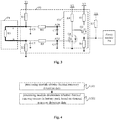
- Fig. 3 is a schematic structure diagram of a thermal runaway detection circuit according to yet another embodiment of the present disclosure (the processing module P3 is not shown).
- Fig. 3 differs from Fig. 2 in that the thermal runaway detection circuit shown in Fig. 3 further includes some protection devices and/or filter devices.
- the thermal runaway detection circuit may also include a first protection capacitor and/or a second protection capacitor.
- the thermal runaway detection circuit may further include a first filter capacitor and a first filter resistor, and/or a second filter capacitor and a second filter resistor.
- the thermal runaway detection circuit includes a first protection capacitor C1, a second protection capacitor C2, a first filter capacitor C3, a second filter capacitor C4, a first filter resistor R8, and a second filter resistor. R9, for example.
- One end of the first protection capacitor may be connected to the other end of the first voltage dividing resistor set, and the other end of the first protection capacitor may be connected to the ground.
- One end of the second protection capacitor may be connected to the other end of the second voltage dividing resistor set, and the other end of the second protection capacitor may be connected to the ground.
- the first protection capacitor and the second protection capacitor may prevent the occurrence of Electro Static Discharge (ESD) in the thermal runaway detection circuit.
- ESD Electro Static Discharge
- one end of the first protection capacitor C1 may be connected to the other end of the resistor R1, and the other end of the first protection capacitor C1 may be connected to the ground.
- One end of the second protection capacitor C2 may be connected to the other end of the resistor R2, and the other end of the second protection capacitor C2 may be connected to the ground.
- One end of the first filter capacitor may be connected to the first sampling point, and the other end of the first filter capacitor may be connected to the ground.
- One end of the second filter capacitor may be connected to the second sampling point, and the other end of the second filter capacitor may be connected to the ground.
- One end of the first filter resistor may be connected to the other end of the first voltage dividing resistor set, and the other end of the first filter resistor may be connected to the first sampling point.
- One end of the second filter resistor may be connected to the other end of the second voltage dividing resistor set, and the other end of the second filter resistor may be connected to the second sampling point.
- the first filter capacitor and the first filter resistor may form an RC filter circuit to filter the first sampled data
- the second filter capacitor and the second filter resistor may form an RC filter circuit to filter the second sampled data, so as to improve accuracy of the first sampled data and the second sampled data. As a result, the accuracy of the thermal runaway detection.
- one end of the first filter capacitor C3 may be connected to the first sampling point AD1, and the other end of the first filter capacitor C3 may be connected to the ground.
- One end of the second filter capacitor C4 may be connected to the second sampling point AD2, and the other end of the second filter capacitor C4 may be connected to the ground.
- One end of the first filter resistor R8 may be connected to the other end of the resistor R1, and the other end of the first filter resistor R8 may be connected to the first sampling point AD1.
- One end of the second filter resistor R9 may be connected to the other end of the resistor R2, and the other end of the second filter resistor R9 may be connected to the second sampling point AD2.
- the processing module P3 may be further configured to send an alarm signal to a vehicle controller to notify relevant personnel to take corresponding measures in time, when it is determined that thermal runaway occurs in the battery pack.
- the processing module P3 may be configured to determine the on-off state of the temperature sensitive cable based on the first sampled data and the second sampled data.
- the on-off state may include a short-circuit state, an open-circuit state, or a normal-path state.
- thermal runaway detection will be described below using voltage values as the first sampled data and the second sampled data.
- the processing module P3 may be configured to determine that the temperature sensitive cable is short circuited if the first sampled data is equal to the second sampled data; and determine that thermal runaway occurs in the battery pack if the temperature sensitive cable is short circuited,.
- the temperature sensitive cable is short circuited. Due to the harsh conditions of short-circuiting of the temperature sensitive cable, the temperature sensitive cable generally is not short circuited in the case of non-thermal-runaway. Therefore, if the temperature sensitive cable is short circuited, it can be determined that thermal runaway occurs in the battery pack.
- the thermal runaway detection data described above may also include battery pack parameters.
- the processing module P3 may be configured to: determine that the temperature sensitive cable is open circuited if the first sampled data is the same as the value of the voltage provided by the first power supply terminal and the second sampled data is zero; and determine that thermal runaway occurs in the battery pack if it is determined that the temperature sensitive cable is open circuited within a preset period and at least one of the battery pack parameters satisfies a fault condition.
- the voltage supplied by the first power supply terminal is 5V. If the voltage value collected from the first sampling point is 5V, and the voltage value collected from the second sampling point is 0V, it can be determined that the temperature sensitive cable is open circuited.
- the preset period may be set according to the specific operation scenes and operation requirements, which is not limited herein. Setting of the preset period can effectively avoid at least a part misjudgment for the thermal runaway and improve the reliability of the thermal runaway detection.
- the battery pack parameters may include one or more of the following parameters: a maximum temperature of a cell in the battery pack, a temperature change rate of a cell in the battery pack, a difference between the maximum temperature and a minimum temperature of a cell in the battery pack, a minimum voltage of a cell in the battery pack, a number of voltage sampling open-circuit faults of the battery pack, a temperature sensing failure parameter, and a cell monitoring communication failure parameter.
- the number of voltage sampling open-circuit faults of the battery pack may indicate the number of open-circuit faults in voltage sampling performed on each of cells of the battery pack.
- the temperature sensing failure parameter may characterize whether the sensor or sensing component used for temperature sensing fails.
- a negative temperature coefficient (NTC) thermistor may be provided in the battery pack, and the temperature sensing failure parameter may indicate whether the NTC thermistor disposed in the battery pack fails completely.
- the cell monitoring communication failure parameter may characterize whether a communication between the component that monitors the cell and the BMU fails (i.e., whether the communication is lost).
- the cell of the battery pack may be equipped with a Cell Supervision Circuit (CSC), and the cell monitoring communication failure parameter may indicate whether the communication between the CSC and the BMU fails.
- CSC Cell Supervision Circuit
- the fault condition may include a parameter exceeding the safety parameter threshold range or a parameter characterizing a failure.
- Each parameter of the battery pack parameters may be associated with a different safety parameter threshold range from each other.
- the safety parameter threshold range corresponding to the maximum temperature of a cell in the battery pack may specifically be a maximum temperature safety threshold range.
- the safety parameter threshold range corresponding to the temperature change rate of a cell in the battery pack may specifically be a temperature change rate safety threshold range.
- the safety parameter threshold range corresponding to the difference between the maximum temperature and the minimum temperature of a cell in the battery pack may specifically be a temperature difference safety threshold range.
- the safety parameter threshold range corresponding to the minimum voltage of a cell in the battery pack may specifically be a minimum voltage safety threshold range.
- the safety parameter threshold range corresponding to the number of voltage sampling open-circuit faults of the battery pack may specifically be a fault data safety threshold range.
- fault condition may be set according to a specific operation scenario and operation requirements, which is not limited herein.
- the thermal runaway of the battery pack may include, but is not limited to, the following examples.
- the first sampled data and the second sampled data are voltages specifically.
- the first normal data threshold range is a first normal voltage threshold range
- the second normal data threshold range is a second normal voltage threshold range, specifically.
- the processing module P3 may be configured to: determine that the temperature sensitive cable is in the normal-path state, when the first sampled data is within a first normal data threshold range and the second sampled data is within a second normal data threshold range; and determine that thermal runaway occurs in the battery pack, when the temperature sensitive cable is in the normal-path state and at least a set of parameters of the battery pack parameters meets a fault condition.
- other thermal runaway detection data is needed to assist in determining if thermal runaway occurs in the battery pack to improve the reliability of the thermal runaway detection.
- the set of parameters may include at least two parameters.
- the fault condition may include a parameter exceeding the safety parameter threshold range or a parameter characterizing a failure.
- the first normal voltage threshold range and the second normal voltage threshold range may be determined based on the voltage provided by the first power supply terminal, the resistance value of the first voltage dividing resistor set, the resistance value of the terminating resistor, the resistance value of the second voltage dividing resistor set, and an acceptable error fluctuation range.
- the above set of parameters may include any of the following sets of parameters: the minimum voltage of a cell in the battery pack, and the maximum temperature of a cell in the battery pack; the minimum voltage of a cell in the battery pack, and the temperature change rate of a cell in the battery pack; the minimum voltage of a cell in the battery pack, and the difference between the maximum temperature of a cell in the battery pack and the minimum temperature of a cell in the battery pack; the temperature change rate of a cell in the battery pack, and the maximum temperature of a cell in the battery pack; the temperature change rate of a cell in the battery pack, and the difference between the maximum temperature of a cell in the battery pack and the minimum temperature of a cell in the battery pack; the number of voltage sampling open-circuit faults of the battery pack, and the maximum temperature of a cell in the battery pack; the number of voltage sampling open-circuit faults of the battery pack, and the temperature change rate of a cell in the battery pack; the number of voltage sampling open-circuit faults of the battery pack, and the difference between the maximum
- fault conditions may be set according to specific operation scenarios and operation requirements, which is not limited herein.
- a plurality of parameters and their corresponding fault conditions are listed below. If at least one set of parameters meets its corresponding fault condition, it can be determined that thermal runaway occurs in the battery pack. At least one set of parameters satisfying its corresponding fault condition may further improve the reliability of the thermal runaway detection. It should be noted that the parameters and fault conditions in the embodiments of the present disclosure may include, but be not limited to, the following parameters.
- the first set of parameters and corresponding fault conditions the minimum voltage of a cell in the battery pack is less than 2V for 300 milliseconds, and the maximum temperature of a cell in the battery pack is greater than 68°C for 2 seconds.
- the second set of parameters and corresponding fault conditions the minimum voltage of a cell in the battery pack is less than 2V for 300 milliseconds, and the temperature change rate of a cell in the battery pack is greater than 3°C/second for 2 seconds.
- the third set of parameters and corresponding fault conditions the minimum voltage of a cell in the battery pack is less than 2V for 300 milliseconds, and the difference between the maximum temperature and the minimum temperature of a cell in the battery pack is greater than 30°C.
- the fourth set of parameters and corresponding fault conditions the temperature change rate of a cell in the battery pack is greater than 3°C/second for 2 seconds, and the maximum temperature of a cell in the battery pack is greater than 68°C for 2 seconds.
- the fifth set of parameters and corresponding fault conditions the temperature change rate of a cell in the battery pack is greater than 3°C/second for 2 seconds, and the difference between the maximum temperature and the minimum temperature of a cell in the battery pack is greater than 30°C.
- the sixth set of parameters and corresponding fault conditions the number of voltage sampling open-circuit faults of the battery pack is greater than or equal to 1, and the maximum temperature of a cell in the battery pack is greater than 68°C for 2 seconds.
- the seventh set of parameters and corresponding fault conditions the number of voltage sampling open-circuit faults of the battery pack is greater than or equal to 1, and the temperature change rate of a cell in the battery pack is greater than 3°C/second for 2 seconds.
- the eighth set of parameters and corresponding fault conditions the number of voltage sampling open-circuit faults of the battery pack is greater than or equal to 1, and the difference between the maximum temperature and the minimum temperature of a cell in the battery pack is greater than 30°C.
- the ninth set of parameters and corresponding fault conditions the number of voltage sampling open-circuit faults of the battery pack is greater than or equal to 1, and the temperature sensing failure parameter characterizes that the NTC thermistor disposed in the battery pack completely fails.
- the thermal runaway detection data may also include battery pack parameters.
- the battery pack parameters may include a maximum voltage of a cell in the battery pack during charging, an actual state of charge of the battery pack during charging, and a charging current of the battery pack during charging.
- the fault conditions may include a parameter exceeding the safety parameter threshold range.
- the processing module P3 may be further configured to: determine that the temperature sensitive cable is in a normal-path state, when the first sampled data is within the first normal data threshold range and the second sampled data is within the second normal data threshold range; and send a thermal runaway warning message, when the temperature sensitive cable is in the normal-path state and the battery pack parameters satisfy the fault condition.
- the temperature sensitive cable is determined to be in the normal-path state, the maximum voltage of a cell in the battery pack during charging exceeds a voltage safety parameter threshold range, the actual state of charge of the battery pack during charging exceeds a state of charge safety parameter threshold range, and the charging current of the battery pack during charging exceeds a current safety parameter threshold range, it may be predicted that thermal runaway is about to occur in the battery pack.
- the thermal runaway warning message may be sent, so that corresponding measures can be taken in advance to avoid thermal runaway and further improve the safety of the battery pack.
- the thermal runaway warning message may be sent.
- the processing module P3 may send a prompt message about thermal runaway detection fault.
- Fig. 4 is a flowchart of a method for thermal runaway detection according to an embodiment of the present disclosure. As shown in Fig. 4 , the method for thermal runaway detection may include steps S101 to S102.
- step S101 the processing module may obtain thermal runaway detection data.
- the thermal runaway detection data may include first sampled data collected from the first sampling point and second sampled data obtained from the second sampling point. As shown in the thermal runaway detection circuit in the above embodiments, the first sampling point is disposed between the other end of the first voltage dividing resistor set and the terminating resistor. The second sampling point is disposed between the other end of the second voltage dividing resistor set and the terminating resistor.
- step S102 the processing module may determine whether thermal runaway occurs in the battery pack based on the thermal runaway detection data.
- the thermal runaway detection circuit may include a sensing module, a detection module, and a processing module.
- the terminating resistor in the sensing module is connected with the temperature sensitive cable, and the terminating resistor is connected in series with the first voltage dividing resistor set and the second voltage dividing resistor set through the temperature sensitive cable.
- the distance between at least a portion of the temperature sensitive cable and the cell in the battery pack is less than the temperature sensitive distance threshold, such that the temperature sensitive cable can be affected by the temperature of the cell in the battery pack.
- the processing module may determine whether thermal runaway occurs in the battery pack based on the thermal runaway detection data so as to detect the thermal runaway of the battery pack in time. As a result, the safety of the battery pack can be improved.
- the step S102 may be refined as follows: the processing module may determine an on-off state of the temperature sensitive cable based on the first sampled data and the second sampled data, the on-off state comprising a short-circuit state, an open-circuit state, or a normal-path state; and the processing module may determine whether thermal runaway occurs in the battery pack based on the on-off state of the temperature sensitive cable.
- the first sampled data and the second sampled data are voltage values.
- the above step S102 may be refined as follows: the processing module may determine that the temperature sensitive cable is short circuited when the first sampled data is equal to the second sampled data; and the processing module may determine that thermal runaway occurs in the battery pack when the temperature sensitive cable is short circuited.
- the thermal runaway detection data may also include battery pack parameters.
- the battery pack parameters may include one or more of: the maximum temperature of a cell in the battery pack, the temperature change rate of a cell in the battery pack, the difference between the maximum temperature and the minimum temperature of a cell in the battery pack, the minimum voltage of a cell in the battery pack, the number of voltage sampling open-circuit faults of the battery pack, the temperature sensing failure parameter, and the cell monitoring communication failure parameter,
- step S102 may be refined as follows: the processing module may determine that the temperature sensitive cable is open circuited, when the first sampled data is the same as data provided by the first power supply terminal and the second sampled data is the same as data provided by the ground; and the processing module may determine that thermal runaway occurs in the battery pack, when it is determined that the temperature sensitive cable is open circuited within a preset period and at least one of the battery pack parameters satisfies a fault condition.
- the thermal runaway detection data may also include battery pack parameters.
- step S102 may be refined as follows: the processing module may determine that the temperature sensitive cable is in a normal-path state, when the first sampled data is within a first normal data threshold range and the second sampled data is within a second normal data threshold range; and the processing module may determine that thermal runaway occurs in the battery pack, when the temperature sensitive cable is in the normal-path state and at least a set of parameters of the battery pack parameters meets a fault condition.
- the set of parameters may include at least two parameters.
- the set of parameters may include any of the following sets of parameters: the minimum voltage of a cell in the battery pack, and the maximum temperature of a cell in the battery pack; the minimum voltage of a cell in the battery pack, and the temperature change rate of a cell in the battery pack; the minimum voltage of a cell in the battery pack, and the difference between the maximum temperature of a cell in the battery pack and the minimum temperature of a cell in the battery pack; the temperature change rate of a cell in the battery pack, and the maximum temperature of a cell in the battery pack; the temperature change rate of a cell in the battery pack, and the difference between the maximum temperature of a cell in the battery pack and the minimum temperature of a cell in the battery pack; the number of voltage sampling open-circuit faults of the battery pack, and the maximum temperature of a cell in the battery pack; the number of voltage sampling open-circuit faults of the battery pack, and the temperature change rate of a cell in the battery pack; the number of voltage sampling open-circuit fault
- the fault condition may include a parameter exceeding the safety parameter threshold range or a parameter characterizing a failure.
- the thermal runaway detection data further includes battery pack parameters including the maximum voltage of a cell in the battery pack during charging, the actual state of charge of the battery pack during charging, and the charging current of the battery pack during charging.
- the fault conditions may include a parameter exceeding a safety parameter threshold range
- the above method for thermal runaway detection may further include: determining that the temperature sensitive cable is in a normal-path state, when the first sampled data is within a first normal data threshold range and the second sampled data is within a second normal data threshold range; and sending a thermal runaway warning message, when the temperature sensitive cable is in the normal-path state and the battery pack parameters satisfy the fault condition.
- the detection module may further include a sleep-wakeup submodule.
- Fig. 5 is a flowchart of a method for thermal runaway detection according to another embodiment of the present disclosure. Fig.5 is different from Fig. 4 in that the above method for thermal runaway detection may further include step S103 and step S104.
- step S103 if the battery management unit is in the sleep state, the power module P4 of the battery management unit may receive the wakeup signal sent by the sleep-wakeup submodule, and control the battery management unit to switch from the sleep state to the operating state.
- the wakeup signal is sent when the sleep-wakeup submodule is turned on.
- step S104 the processing module may send an alarm signal to the vehicle controller when it is determined that thermal runaway occurs in the battery pack.
- An embodiment of the present disclosure further provides a computer readable storage medium storing computer programs thereon, which, when executed by a processor(s), may implement the method for thermal runaway detection in the above embodiments.
Landscapes
- Engineering & Computer Science (AREA)
- Manufacturing & Machinery (AREA)
- Chemical & Material Sciences (AREA)
- Chemical Kinetics & Catalysis (AREA)
- Electrochemistry (AREA)
- General Chemical & Material Sciences (AREA)
- Physics & Mathematics (AREA)
- General Physics & Mathematics (AREA)
- Power Engineering (AREA)
- Microelectronics & Electronic Packaging (AREA)
- Secondary Cells (AREA)
Description
- The present disclosure generally relates to batteries, and more particularly to a thermal runaway detection circuit and method.
- With the rapid development of new energy sources, new energy sources may provide power for more and more devices. For example, a battery pack may be used as power sources to power new energy vehicles, new energy ships, new energy aircraft, and so on. The battery pack may generate heat during operation. Under normal conditions, the heat generated by the battery pack is controllable. However, in an abnormal state, such as collision, overcharge, etc., the heat generated by the battery pack is uncontrollable, resulting in thermal runaway. In the event of thermal runaway, a fire may be caused, which may threaten safety of the battery pack, the devices in which the battery pack is installed, and personal safety of the person concerned.
- In order to improve the safety of the battery pack, a battery management system (BMS) is currently used to monitor change of voltage or temperature to determine whether thermal runaway occurs. However, in the event of thermal runaway, a circuit board or a monitoring unit used to communicate with the BMS may be sputtered and burned by the high-temperature electrolyte generated from the thermal runaway. Therefore, the BMS cannot detect the thermal runaway and the safety of the battery pack is reduced.
-
DE202017103776U1 discloses an automatic warning device for thermal runaway of batteries. The device comprises a plurality of securing elements connected in series, a control circuit and a warning indicator. Each securing element is arranged on the outside of a respective battery cell, and the securing element will be fused when a certain threshold value is reached so that the control circuit may cause the warning indicator to send out a warning signal. -
JP2013024718A -
CN109494419A discloses a monitoring device for thermal runaway of a power battery and a module positioning method. The device comprises a battery controller and thermal runaway monitoring modules. The thermal runaway monitoring modules are arranged in power batteries, each battery module is provided with the corresponding thermal runaway monitoring module, and each thermal runaway monitoring module is used for generating resistance value change during the thermal runaway of the unit battery in each battery module. The battery controller is used for collecting the resistance values of the thermal runaway monitoring modules in real time through the electric connecting loop so as to realize the thermal runaway monitoring of each battery module in the power battery and determining the battery module in a thermal runaway state according to the resistance values generated by the thermal runaway monitoring modules. - The present disclosure provides a thermal runaway detection circuit and method, which may improve safety of a battery pack.
- In a first aspect, the present disclosure provides a thermal runaway detection circuit. The thermal runaway detection circuit may include: a sensing module including a terminating resistor, wherein the terminating resistor is connected to a temperature sensitive cable, wherein a distance between at least a portion of the temperature sensitive cable and a cell of a battery pack is less than a temperature sensitive distance threshold, and wherein the temperature sensitive cable comprises a wire A and a wire B which are in a twisted-pair structure, the wire A and the wire B are wrapped with heat-sensitive material, the heat-sensitive material is to melt when its temperature exceeds a high-temperature threshold; a detection module including a first voltage dividing resistor set and a second voltage dividing resistor set, wherein the first voltage dividing resistor set comprises at least a resistor, the second voltage dividing resistor set comprises at least a resistor, and wherein the first voltage dividing resistor set is connected to the terminating resistor via the wire A and the second voltage dividing resistor set is connected to the terminating resistor via the wire B so that the first voltage dividing resistor set, the terminating resistor, and the second voltage dividing resistor set are connected in series via the temperature sensitive cable, and wherein one end of the first voltage dividing resistor set is connected to a first power supply terminal, and one end of the second voltage dividing resistor set is connected to ground; and a processing module connected to the detection module, wherein the processing module is configured to obtain thermal runaway detection data, wherein the thermal runaway detection data includes first sampled data collected from a first sampling point and second sampled data collected from a second sampling point, the first sampling point is disposed between the other end of the first voltage dividing resistor set and the terminating resistor, and the second sampling point is disposed between the other end of the second voltage dividing resistor set and the terminating resistor, and wherein the processing module is further configured to: determine an on-off state of the temperature sensitive cable based on the first sampled data and the second sampled data, the on-off state comprising a short-circuit state, an open-circuit state, or a normal-path state; and determine whether thermal runaway occurs in the battery pack based on the on-off state of the temperature sensitive cable.
- In a second aspect, the present disclosure provides a method for thermal runaway detection applied in the thermal runaway detection circuit of the first aspect. The method may include: obtaining, by the processing module, thermal runaway detection data; and determining, by the processing module, whether thermal runaway occurs in the battery pack based on the thermal runaway detection data; wherein the thermal runaway detection data includes first sampled data collected from a first sampling point and second sampled data collected from a second sampling point, the first sampling point is disposed between the other end of the first voltage dividing resistor set and the terminating resistor, and the second sampling point is disposed between the other end of the second voltage dividing resistor set and the terminating resistor. The method further comprises: determining an on-off state of the temperature sensitive cable based on the first sampled data and the second sampled data, the on-off state comprising a short-circuit state, an open-circuit state, or a normal-path state; and determining whether thermal runaway occurs in the battery pack based on the on-off state of the temperature sensitive cable.
- Embodiments of the present disclosure provide a thermal runaway detection circuit and method. The thermal runaway detection circuit includes a sensing module, a detection module, and a processing module. The terminating resistor in the sensing module is connected with the temperature sensitive cable, and the terminating resistor is connected in series with the first voltage dividing resistor set and the second voltage dividing resistor set through the temperature sensitive cable. The distance between at least a portion of the temperature sensitive cable and a cell in the battery pack is less than a temperature sensitive distance threshold, such that the temperature sensitive cable can be affected by the temperature of the cell in the battery pack. When the temperature sensitive cable is affected by the temperature of the cell, the on-off state of the temperature sensitive cable will change, so that the first sampled data and the second sampled data in the obtained thermal runaway detection data will change. The processing module may detect the thermal runaway in the battery pack in time based on the thermal runaway detection data. As a result, the safety of the battery pack is improved.
- The present disclosure will be better understood by reading the following detailed description with reference to the appended drawings, in which the same or similar numerals represent the same or similar features.
-
Fig. 1 is a schematic structure diagram of a thermal runaway detection circuit according to an embodiment of the present disclosure; -
Fig. 2 is a schematic structure diagram of a thermal runaway detection circuit according to another embodiment of the present disclosure; -
Fig. 3 is a schematic structure diagram of a thermal runaway detection circuit according to yet another embodiment of the present disclosure; -
Fig. 4 is a flowchart of a method for thermal runaway detection according to an embodiment of the present disclosure; -
Fig. 5 is a flowchart of a method for thermal runaway detection according to another embodiment of the present disclosure. - Features of various aspects and exemplary embodiments of the present disclosure will be described in detail below. In the following detailed description, many specific details are disclosed to provide a thorough understanding of the present disclosure. However, it is apparent to a person skilled in the art that the present disclosure may be practiced without some of these specific details. The following descriptions of embodiments are merely to provide a better understanding of the present disclosure through illustrating examples of the present disclosure. The present disclosure is by no means limited to any specific configuration and algorithm disclosed below, but rather covering any modification, substitution, and improvement of elements, components, and algorithms without departing from the scope of the present disclosure. In the appended drawings and the following descriptions, well-known structures and techniques are not illustrated to avoid unnecessarily obscuring the present disclosure.
- Embodiments of the present disclosure provide a thermal runaway detection circuit, method, and storage medium, which may be used in a scenario for monitoring a thermal runaway of a battery pack. The battery pack may include at least one cell. The battery pack may be a battery module, a battery package, or the like, which is not limited herein. In the embodiments of the disclosure, the thermal runaway detection circuit may detect the thermal runaway of the battery pack in time and facilitate corresponding measures in the subsequent process, so as to improve the safety of the battery pack.
-
Fig. 1 is a schematic structure diagram of a thermal runaway detection circuit according to an embodiment of the present disclosure. As shown, the thermal runaway detection circuit may include a sensing module P1, a detection module P2, and a processing module P3. - The sensing module P1 may include a terminating resistor. The terminating resistor may be connected to a temperature sensitive cable. The distance between at least a portion of the temperature sensitive cable and a cell of the battery pack is less than a temperature sensitive distance threshold.
- Two wires (e.g. steel wires) may be included within the temperature sensitive cable. Each of the two wires may be wrapped with heat-sensitive material. The two wires are in a twisted-pair structure. For example, as shown in
Fig. 1 , for ease of understanding, the temperature sensitive cable is represented by two separate wires A and B. In an actual scenario, the two wires A and B are located in the same temperature sensitive cable. Under normal circumstances, the two wires in the temperature sensitive cable do not contact with each other directly. When the temperature of a part of the temperature sensitive cable rises rapidly and exceeds beyond a high-temperature threshold, the heat-sensitive material wrapped around the two wires may melt with each other, so that the two wires within the temperature sensitive cable are twisted and connected together due to the torsion force, so that a short circuit is caused in the temperature sensitive cable. The high-temperature threshold may be set according to specific operation scenarios and operation requirements, and is not limited herein. For example, the high-temperature threshold may be 85°C, 105°C or 125°C, and the like. - The temperature sensitive distance threshold is a distance threshold with which the temperature sensitive cable is able to sensitively sense that the temperature of a cell in the battery pack is above the temperature threshold. When the distance between the temperature sensitive cable and the cell in the battery pack is less than the temperature sensitive distance threshold, the error between the temperature corresponding to the on-off state of the temperature sensitive cable being caused to change and the actual temperature of the cell in the battery pack is within an acceptable range. The temperature sensitive distance threshold may be set based on a characteristic parameter of the temperature sensitive cable and a characteristic parameter of the cell in combination with specific operation scenarios and operation requirements, which is not limited herein.
- In some examples, in order to be able to detect thermal runaway of the battery pack more timely, at least a portion of the temperature sensitive cable may be disposed right above a cell explosion-proof valve port of the cell of the battery pack. When thermal runaway occurs in the battery pack, the cell explosion-proof valve port will rupture, and high-temperature electrolyte, high-temperature gas, etc. will be ejected from the explosion-proof valve port of the cell. At least a portion of the temperature sensitive cable being disposed right above the cell explosion-proof valve port of the cell of the battery pack may make the temperature sensitive cable more sensitive to thermal runaway sensing of the battery pack. As a result, accuracy and timeliness in thermal runaway detection may be further improved.
- The detection module P2 may include a first voltage dividing resistor set and a second voltage dividing resistor set. One end of the first voltage dividing resistor set is connected to a first power supply terminal, and one end of the second voltage dividing resistor set is connected to ground. The first voltage dividing resistor set, the terminating resistor, and the second voltage dividing resistor set are connected in series via the temperature sensitive cable. In particular, one wire of the temperature sensitive cable connected to the terminating resistor is connected to the other end of the first voltage dividing resistor set, and the other wire of the temperature sensitive cable is connected to the other end of the second voltage-dividing resistor set.
- The first voltage dividing resistor set may include at least one resistor. If the first voltage dividing resistor set includes a plurality of resistors, the number of resistors and the connection relationship therebetween are not limited herein. The second voltage dividing resistor set may include at least one resistor. If the first voltage dividing resistor set includes a plurality of resistors, the number of resistors and the connection relationship therebetween are not limited herein. The specific structure of the first voltage dividing resistor set and the second voltage dividing resistor set may be set according to specific operation scenarios and operation requirements, which is not limited herein.
- For example, as shown in
Fig. 1 , the first voltage dividing resistor set may include a resistor R1, the second voltage dividing resistor set may include a resistor R2, and the terminating resistor is a resistor R3. The resistor R1, the resistor R3, and the resistor R2 are connected in series. The resistor R1 and the resistor R3 are connected through the wire A within the temperature sensitive cable. The resistor R2 and the resistor R3 are connected through the wire B within the temperature sensitive cable. - In some examples, the detection module P2 may be specifically disposed in a Battery Management Unit (BMU). The BMU may include a housing structure for protection. The detection module P2 may be protected from the high-temperature electrolyte generated from thermal runaway of the battery pack. Alternatively, the position of the detection module P2 is not specifically limited, and the detection module P2 may be provided with a protective cover to protect the detection module P2 from the high-temperature electrolyte generated from thermal runaway of the battery pack, so as to further ensure the timeliness of the detection of the thermal runaway and the safety of the thermal runaway detection circuit.
- The processing module P3 may be connected to the detection module P2. The processing module P3 may be configured to obtain thermal runaway detection data, and determine whether thermal runaway occurs in the battery pack based on the thermal runaway detection data.
- The thermal runaway detection data may include first sampled data collected from a first sampling point and second sampled data collected from a second sampling point. The first sampling point may be disposed between the other end of the first voltage dividing resistor set and the terminating resistor. The second sampling point may be disposed between the other end of the second voltage dividing resistor set and the terminating resistor. As shown in
Fig. 1 , the first sampling point is labeled as AD1 and the second sampling point is labeled as AD2. Specifically, sampling ports can be separately set at each of the first sampling point and the second sampling point. - In some examples, the processing module P3 may be a micro control unit (MCU) in the BMU, or the processing module P3 may also be independently set, which is not limited herein.
- The first sampled data and the second sampled data may specifically be electrical signal parameter data, such as a voltage value, a current value, and the like, which is not limited herein.
- According to the first sampled data and the second sampled data, the on-off state of the temperature sensitive cable may be determined, that is, the cable sense line is short-circuited, open-circuited, or in normal-path state.
- In some examples, whether there is the thermal runaway in the battery pack can be directly determined based on the on-off state of the temperature sensitive cable. In order to further improve the detection accuracy of thermal runaway, other thermal runaway detection data may be combined together to determine whether there is the thermal runaway in the battery pack in addition to the first sampled data and the second sampled data,.
- In an embodiment of the present disclosure, the thermal runaway detection circuit may include the sensing module P1, the detection module P2, and the processing module P3. The terminating resistor in the sensing module P1 is connected with the temperature sensitive cable, and the terminating resistor is connected in series with the first voltage dividing resistor set and the second voltage dividing resistor set through the temperature sensitive cable. The distance between at least a portion of the temperature sensitive cable and the cell in the battery pack is less than the temperature sensitive distance threshold, such that the temperature sensitive cable can be affected by the temperature of the cell in the battery pack. When the temperature sensitive cable is affected by the temperature of the cell, the on-off state of the temperature sensitive cable will change, so that the first sampled data and the second sampled data of the thermal runaway detection data obtained from the detection module P2 will change. The processing module P3 may detect the thermal runaway in the battery pack in time based on the thermal runaway detection data. As a result, the safety of the battery pack can be improved.
- In some examples, the state of the BMU may include an operating state and a sleep state. When the BMU is in the operating state, a power module of the BMU may supply power to the BMU to enable the BMU to perform normal data monitoring on the battery pack, such as voltage monitoring, current monitoring, temperature monitoring, insulation monitoring, and state of charge monitoring, etc., so as to obtain voltage, current, temperature, state of charge, etc. as the thermal runaway detection data. When the BMU is in the sleep state, the power module of the BMU may stop supplying power to the BMU, and the BMU may stop monitoring data of the battery pack.
- If thermal runaway occurs in the battery pack when the BMU is in the sleep state, the BMU stops monitoring the data of the battery pack and cannot provide thermal runaway detection data. If the function of the processing module P3 is integrated in the BMU, when the BMU is in the sleep state, the detection of the thermal runaway cannot be performed.
- In order to perform thermal runaway detection and obtain the thermal runaway detection data during the thermal runaway detection when the BMU is in the sleep state, the detection module P2 in the above embodiments may further include a sleep-wakeup submodule P21.
Fig. 2 is a schematic structure diagram of a thermal runaway detecting circuit according to another embodiment of the present disclosure (the processing module P3 is not shown). As shown inFig. 2 , the detection module P2 may further include the sleep wakeup submodule P21. - The sleep-wakeup submodule P21 may be connected to the other end of the second voltage dividing resistor set. The sleep-wakeup submodule P21 may be configured to receive a driving signal transmitted by the sensing module P1, and transmit a wakeup signal to a power module P4 of the battery management unit if the driving signal indicates that the sleep-wakeup submodule P21 is turned on. Specifically, if the temperature sensitive cable connected to the terminating resistor of the sensing module P1 is in the normal-path state or open circuited, the driving signal transmitted from the temperature sensitive cable may control the sleep-wakeup submodule P21 to be turned off, with the BMU still in the sleep state. If the temperature sensitive cable connected to the terminating resistor of the sensing module P1 is short circuited, the driving signal transmitted from the temperature sensitive cable may control the sleep-wakeup submodule P21 to be turned on and send a wakeup signal to the power module of the BMU. The power module of the BMU may receive the wakeup signal, and the BMU may switch from the sleep state to the operating state.
- In some examples, the sleep-wakeup submodule P21 may include a first resistor set, a first switch tube, a second resistor set, a second switch tube, and a third resistor set. The first resistor set may include at least one resistor. If the first resistor set includes a plurality of resistors, the number of resistors and the connection relationship therebetween are not limited herein. The second resistor set and the third resistor set are the same as the first resistor set, and are not described herein again. The first switch tube and the second switch tube may be metal oxide semiconductor (MOS) tubes or other switch tubes, which is not limited herein.
- One end of the first resistor set may be connected to a second power supply terminal, and the other end of the first resistor set may be connected to both of a first terminal of the first switch tube and a control terminal of the second switch tube. A control terminal of the first switch tube may be connected to the other end of the second voltage dividing resistor set, and a second terminal of the first switch tube may be connected to the ground. One end of the second resistor set may be connected to a third power supply terminal, and the other end of the second resistor set may be connected to a first terminal of the second switch tube. A second terminal of the second switch tube may be connected to both of one end of a third resistor set and the power module of the battery management unit. The other end of the third resistor set may be connected to the ground. The power module can be implemented as a power chip, such as a System Basis Chip (SBC), which is not limited herein. The voltages provided by the first power supply terminal, the second power supply terminal, and the third power supply terminal may be the same or different, which is not limited herein. For example, the first power supply terminal, the second power supply terminal, and the third power supply terminal may provide a voltage of 5V. If the battery pack and the thermal runaway detection circuit are installed in a car, the voltage of 5V at the first power supply terminal, the second power supply terminal, and the third power supply terminal may be supplied by a lead-acid battery in the car.
- For example, as shown in
Fig. 2 , the first resistor set may include a resistor R4, the second resistor set may include a resistor R5, and the third resistor set may include a resistor R6. The first switch tube may be an N-channel Metal Oxide Semiconductor (MOS) transistor Q1. The control terminal of the first switch tube Q1 may be a gate electrode, the first terminal may be a drain electrode, and the second terminal may be a source electrode. The second switch tube may be a P-channel MOS transistor Q2. The control terminal of the second switch tube Q2 may be a gate electrode, the first terminal may be a source electrode, and the second terminal may be a drain electrode. - For example, the BMU is in the sleep state. Thermal runaway occurs in the battery pack, and the temperature sensitive cable is short circuited due to melting. The electric potential of the control terminal of the first switch tube is pulled high, and the first switch tube is turned on. The electric potential of the control terminal of the second switch tube is pulled down to a break-over voltage drop of the first switch tube, and the second switch tube is turned on. The wakeup signal may be sent to the power module P4 of the BMU through a wakeup signal line between the second terminal of the second switch tube and the power module P4 to wake up the BMU.
- It should be noted that if the BMU is in the operating state, a fourth power supply terminal may be disposed to continuously provide a wakeup signal to the power module P4 of the BMU. The fourth power supply terminal is powered on when the BMU is in operating state, so as to ensure continuous provision of the wakeup signal to the BMU. The fourth power supply terminal is powered off when the BMU is in the sleep state, and then the BMU may be waked up by the sleep-wakeup submodule P21. As shown in
Fig. 2 , a resistor R7 may be disposed between the fourth power supply terminal V4 and the BMU. The value of the voltage provided by the fourth power supply terminal may be the same as the value of the voltage provided by the first power supply terminal, or may be different, which is not limited herein. For example, the voltage supplied by the fourth power supply terminal may be 12V. -
Fig. 3 is a schematic structure diagram of a thermal runaway detection circuit according to yet another embodiment of the present disclosure (the processing module P3 is not shown).Fig. 3 differs fromFig. 2 in that the thermal runaway detection circuit shown inFig. 3 further includes some protection devices and/or filter devices. - The thermal runaway detection circuit may also include a first protection capacitor and/or a second protection capacitor. The thermal runaway detection circuit may further include a first filter capacitor and a first filter resistor, and/or a second filter capacitor and a second filter resistor. For ease of explanation, as shown in
Fig. 3 , the thermal runaway detection circuit includes a first protection capacitor C1, a second protection capacitor C2, a first filter capacitor C3, a second filter capacitor C4, a first filter resistor R8, and a second filter resistor. R9, for example. - One end of the first protection capacitor may be connected to the other end of the first voltage dividing resistor set, and the other end of the first protection capacitor may be connected to the ground. One end of the second protection capacitor may be connected to the other end of the second voltage dividing resistor set, and the other end of the second protection capacitor may be connected to the ground. The first protection capacitor and the second protection capacitor may prevent the occurrence of Electro Static Discharge (ESD) in the thermal runaway detection circuit.
- For example, as shown in
Fig. 3 , one end of the first protection capacitor C1 may be connected to the other end of the resistor R1, and the other end of the first protection capacitor C1 may be connected to the ground. One end of the second protection capacitor C2 may be connected to the other end of the resistor R2, and the other end of the second protection capacitor C2 may be connected to the ground. - One end of the first filter capacitor may be connected to the first sampling point, and the other end of the first filter capacitor may be connected to the ground. One end of the second filter capacitor may be connected to the second sampling point, and the other end of the second filter capacitor may be connected to the ground. One end of the first filter resistor may be connected to the other end of the first voltage dividing resistor set, and the other end of the first filter resistor may be connected to the first sampling point. One end of the second filter resistor may be connected to the other end of the second voltage dividing resistor set, and the other end of the second filter resistor may be connected to the second sampling point. The first filter capacitor and the first filter resistor may form an RC filter circuit to filter the first sampled data, and the second filter capacitor and the second filter resistor may form an RC filter circuit to filter the second sampled data, so as to improve accuracy of the first sampled data and the second sampled data. As a result, the accuracy of the thermal runaway detection.
- For example, as shown in
Fig. 3 , one end of the first filter capacitor C3 may be connected to the first sampling point AD1, and the other end of the first filter capacitor C3 may be connected to the ground. One end of the second filter capacitor C4 may be connected to the second sampling point AD2, and the other end of the second filter capacitor C4 may be connected to the ground. One end of the first filter resistor R8 may be connected to the other end of the resistor R1, and the other end of the first filter resistor R8 may be connected to the first sampling point AD1. One end of the second filter resistor R9 may be connected to the other end of the resistor R2, and the other end of the second filter resistor R9 may be connected to the second sampling point AD2. - In some examples, the processing module P3 may be further configured to send an alarm signal to a vehicle controller to notify relevant personnel to take corresponding measures in time, when it is determined that thermal runaway occurs in the battery pack.
- In an embodiment of the present disclosure, the processing module P3 may be configured to determine the on-off state of the temperature sensitive cable based on the first sampled data and the second sampled data. The on-off state may include a short-circuit state, an open-circuit state, or a normal-path state.
- For ease of explanation, the thermal runaway detection will be described below using voltage values as the first sampled data and the second sampled data.
- In some examples, the processing module P3 may be configured to determine that the temperature sensitive cable is short circuited if the first sampled data is equal to the second sampled data; and determine that thermal runaway occurs in the battery pack if the temperature sensitive cable is short circuited,.
- As shown in
Fig. 1 to Fig. 3 , if the voltage value at the first sampling point is equal to the voltage value at the second sampling point, it can be determined that the temperature sensitive cable is short circuited. Due to the harsh conditions of short-circuiting of the temperature sensitive cable, the temperature sensitive cable generally is not short circuited in the case of non-thermal-runaway. Therefore, if the temperature sensitive cable is short circuited, it can be determined that thermal runaway occurs in the battery pack. - In some examples, the thermal runaway detection data described above may also include battery pack parameters.
- The processing module P3 may be configured to: determine that the temperature sensitive cable is open circuited if the first sampled data is the same as the value of the voltage provided by the first power supply terminal and the second sampled data is zero; and determine that thermal runaway occurs in the battery pack if it is determined that the temperature sensitive cable is open circuited within a preset period and at least one of the battery pack parameters satisfies a fault condition.
- For example, the voltage supplied by the first power supply terminal is 5V. If the voltage value collected from the first sampling point is 5V, and the voltage value collected from the second sampling point is 0V, it can be determined that the temperature sensitive cable is open circuited.
- The preset period may be set according to the specific operation scenes and operation requirements, which is not limited herein. Setting of the preset period can effectively avoid at least a part misjudgment for the thermal runaway and improve the reliability of the thermal runaway detection.
- The battery pack parameters may include one or more of the following parameters: a maximum temperature of a cell in the battery pack, a temperature change rate of a cell in the battery pack, a difference between the maximum temperature and a minimum temperature of a cell in the battery pack, a minimum voltage of a cell in the battery pack, a number of voltage sampling open-circuit faults of the battery pack, a temperature sensing failure parameter, and a cell monitoring communication failure parameter.
- The number of voltage sampling open-circuit faults of the battery pack may indicate the number of open-circuit faults in voltage sampling performed on each of cells of the battery pack.
- The temperature sensing failure parameter may characterize whether the sensor or sensing component used for temperature sensing fails. For example, a negative temperature coefficient (NTC) thermistor may be provided in the battery pack, and the temperature sensing failure parameter may indicate whether the NTC thermistor disposed in the battery pack fails completely.
- The cell monitoring communication failure parameter may characterize whether a communication between the component that monitors the cell and the BMU fails (i.e., whether the communication is lost). For example, the cell of the battery pack may be equipped with a Cell Supervision Circuit (CSC), and the cell monitoring communication failure parameter may indicate whether the communication between the CSC and the BMU fails.
- The fault condition may include a parameter exceeding the safety parameter threshold range or a parameter characterizing a failure.
- Each parameter of the battery pack parameters may be associated with a different safety parameter threshold range from each other. The safety parameter threshold range corresponding to the maximum temperature of a cell in the battery pack may specifically be a maximum temperature safety threshold range. The safety parameter threshold range corresponding to the temperature change rate of a cell in the battery pack may specifically be a temperature change rate safety threshold range. The safety parameter threshold range corresponding to the difference between the maximum temperature and the minimum temperature of a cell in the battery pack may specifically be a temperature difference safety threshold range. The safety parameter threshold range corresponding to the minimum voltage of a cell in the battery pack may specifically be a minimum voltage safety threshold range. The safety parameter threshold range corresponding to the number of voltage sampling open-circuit faults of the battery pack may specifically be a fault data safety threshold range.
- It should be noted that the fault condition may be set according to a specific operation scenario and operation requirements, which is not limited herein.
- For example, following seven examples of determination of the thermal runaway of the battery pack are provided in the case of determining that the temperature sensitive cable is open circuited. However, it should be noted that the determination of the thermal runaway of the battery pack may include, but is not limited to, the following examples.
- Example 1: if it is determined that the temperature sensitive cable is open circuited within 10 minutes, and the maximum temperature of a cell in the battery pack is greater than 68.4°C for 2 seconds, it can be determined that thermal runaway occurs in the battery pack.
- Example 2: if it is determined that the temperature sensitive cable is open circuited within 10 minutes, and the temperature change rate of a cell in the battery pack is greater than 3°C/second for 2 seconds, it can be determined that thermal runaway occurs in the battery pack.
- Example 3: if it is determined that the temperature sensitive cable is open circuited within 10 minutes, and the difference between the maximum temperature and the minimum temperature of a cell in the battery pack is greater than 30°C, it can be determined that thermal runaway occurs in the battery pack.
- Example 4: if it is determined that the temperature sensitive cable is open circuited within 10 minutes, and the minimum voltage of a cell in the battery is less than 2V for 300 milliseconds, it can be determined that thermal runaway occurs in the battery pack.
- Example 5: if it is determined that the temperature sensitive cable is open circuited within 10 minutes, and the number of voltage sampling open-circuit faults of the battery pack is greater than or equal to 1, it can be determined that thermal runaway occurs in the battery pack.
- Example 6: if it is determined that the temperature sensitive cable is open circuited within 10 minutes, and the temperature sensing failure parameter may indicate that the NTC thermistor disposed in the battery pack fails completely, it can be determined that thermal runaway occurs in the battery pack.
- Example 7: if it is determined that the temperature sensitive cable is open circuited within 10 minutes, and the cell monitoring communication failure parameter may characterize that the communication between the CSC and the BMU fails, it can be determined that thermal runaway occurs in the battery pack.
- In some examples, the first sampled data and the second sampled data are voltages specifically. Correspondingly, the first normal data threshold range is a first normal voltage threshold range, and the second normal data threshold range is a second normal voltage threshold range, specifically. The processing module P3 may be configured to: determine that the temperature sensitive cable is in the normal-path state, when the first sampled data is within a first normal data threshold range and the second sampled data is within a second normal data threshold range; and determine that thermal runaway occurs in the battery pack, when the temperature sensitive cable is in the normal-path state and at least a set of parameters of the battery pack parameters meets a fault condition. In this example, other thermal runaway detection data is needed to assist in determining if thermal runaway occurs in the battery pack to improve the reliability of the thermal runaway detection.
- The set of parameters may include at least two parameters. The fault condition may include a parameter exceeding the safety parameter threshold range or a parameter characterizing a failure.
- The first normal voltage threshold range and the second normal voltage threshold range may be determined based on the voltage provided by the first power supply terminal, the resistance value of the first voltage dividing resistor set, the resistance value of the terminating resistor, the resistance value of the second voltage dividing resistor set, and an acceptable error fluctuation range.
- The above set of parameters may include any of the following sets of parameters: the minimum voltage of a cell in the battery pack, and the maximum temperature of a cell in the battery pack; the minimum voltage of a cell in the battery pack, and the temperature change rate of a cell in the battery pack; the minimum voltage of a cell in the battery pack, and the difference between the maximum temperature of a cell in the battery pack and the minimum temperature of a cell in the battery pack; the temperature change rate of a cell in the battery pack, and the maximum temperature of a cell in the battery pack; the temperature change rate of a cell in the battery pack, and the difference between the maximum temperature of a cell in the battery pack and the minimum temperature of a cell in the battery pack; the number of voltage sampling open-circuit faults of the battery pack, and the maximum temperature of a cell in the battery pack; the number of voltage sampling open-circuit faults of the battery pack, and the temperature change rate of a cell in the battery pack; the number of voltage sampling open-circuit faults of the battery pack, and the difference between the maximum temperature of a cell in the battery pack and the minimum temperature of a cell in the battery pack; and the number of voltage sampling open-circuit faults of the battery pack, and the temperature sensing failure parameter.
- It should be noted that the fault conditions may be set according to specific operation scenarios and operation requirements, which is not limited herein.
- For example, as an example, a plurality of parameters and their corresponding fault conditions are listed below. If at least one set of parameters meets its corresponding fault condition, it can be determined that thermal runaway occurs in the battery pack. At least one set of parameters satisfying its corresponding fault condition may further improve the reliability of the thermal runaway detection. It should be noted that the parameters and fault conditions in the embodiments of the present disclosure may include, but be not limited to, the following parameters.
- The first set of parameters and corresponding fault conditions: the minimum voltage of a cell in the battery pack is less than 2V for 300 milliseconds, and the maximum temperature of a cell in the battery pack is greater than 68°C for 2 seconds.
- The second set of parameters and corresponding fault conditions: the minimum voltage of a cell in the battery pack is less than 2V for 300 milliseconds, and the temperature change rate of a cell in the battery pack is greater than 3°C/second for 2 seconds.
- The third set of parameters and corresponding fault conditions: the minimum voltage of a cell in the battery pack is less than 2V for 300 milliseconds, and the difference between the maximum temperature and the minimum temperature of a cell in the battery pack is greater than 30°C.
- The fourth set of parameters and corresponding fault conditions: the temperature change rate of a cell in the battery pack is greater than 3°C/second for 2 seconds, and the maximum temperature of a cell in the battery pack is greater than 68°C for 2 seconds.
- The fifth set of parameters and corresponding fault conditions: the temperature change rate of a cell in the battery pack is greater than 3°C/second for 2 seconds, and the difference between the maximum temperature and the minimum temperature of a cell in the battery pack is greater than 30°C.
- The sixth set of parameters and corresponding fault conditions: the number of voltage sampling open-circuit faults of the battery pack is greater than or equal to 1, and the maximum temperature of a cell in the battery pack is greater than 68°C for 2 seconds.
- The seventh set of parameters and corresponding fault conditions: the number of voltage sampling open-circuit faults of the battery pack is greater than or equal to 1, and the temperature change rate of a cell in the battery pack is greater than 3°C/second for 2 seconds.
- The eighth set of parameters and corresponding fault conditions: the number of voltage sampling open-circuit faults of the battery pack is greater than or equal to 1, and the difference between the maximum temperature and the minimum temperature of a cell in the battery pack is greater than 30°C.
- The ninth set of parameters and corresponding fault conditions: the number of voltage sampling open-circuit faults of the battery pack is greater than or equal to 1, and the temperature sensing failure parameter characterizes that the NTC thermistor disposed in the battery pack completely fails.
- If at least one set of the above nine sets of parameters satisfies corresponding fault conditions, it may be determined that thermal runaway occurs in the battery pack.
- In some examples, the thermal runaway detection data may also include battery pack parameters. The battery pack parameters may include a maximum voltage of a cell in the battery pack during charging, an actual state of charge of the battery pack during charging, and a charging current of the battery pack during charging. The fault conditions may include a parameter exceeding the safety parameter threshold range.
- The processing module P3 may be further configured to: determine that the temperature sensitive cable is in a normal-path state, when the first sampled data is within the first normal data threshold range and the second sampled data is within the second normal data threshold range; and send a thermal runaway warning message, when the temperature sensitive cable is in the normal-path state and the battery pack parameters satisfy the fault condition.
- That is to say, if the temperature sensitive cable is determined to be in the normal-path state, the maximum voltage of a cell in the battery pack during charging exceeds a voltage safety parameter threshold range, the actual state of charge of the battery pack during charging exceeds a state of charge safety parameter threshold range, and the charging current of the battery pack during charging exceeds a current safety parameter threshold range, it may be predicted that thermal runaway is about to occur in the battery pack. The thermal runaway warning message may be sent, so that corresponding measures can be taken in advance to avoid thermal runaway and further improve the safety of the battery pack.
- For example, during the charging, if the maximum voltage of a cell in the battery pack is greater than 1.1 times the tertiary overvoltage threshold, the actual state of charge of the battery pack is greater than 115%, and the charging current is greater than or equal to 0.33 times the rated charge current under one-hour-rate, it may be predicted that thermal runaway is about to occur in the battery pack. Then the thermal runaway warning message may be sent.
- It is worth mentioning that if the first sampled data exceeds the first normal voltage threshold range, the second sampled data exceeds the second normal voltage threshold range, the first sampled data is not equal to the second sampled data, the first sampled data is different from the value of the voltage supplied by the first power supply terminal, and the second sampled data is not zero, it may be determined that there is a fault at the first sampling point and the second sampling point. The processing module P3 may send a prompt message about thermal runaway detection fault.
- Corresponding to the thermal runaway detection circuit in the above embodiments,
Fig. 4 is a flowchart of a method for thermal runaway detection according to an embodiment of the present disclosure. As shown inFig. 4 , the method for thermal runaway detection may include steps S101 to S102. - In step S101, the processing module may obtain thermal runaway detection data.
- The thermal runaway detection data may include first sampled data collected from the first sampling point and second sampled data obtained from the second sampling point. As shown in the thermal runaway detection circuit in the above embodiments, the first sampling point is disposed between the other end of the first voltage dividing resistor set and the terminating resistor. The second sampling point is disposed between the other end of the second voltage dividing resistor set and the terminating resistor.
- In step S102, the processing module may determine whether thermal runaway occurs in the battery pack based on the thermal runaway detection data.
- In the embodiments of the present disclosure, the thermal runaway detection circuit may include a sensing module, a detection module, and a processing module. The terminating resistor in the sensing module is connected with the temperature sensitive cable, and the terminating resistor is connected in series with the first voltage dividing resistor set and the second voltage dividing resistor set through the temperature sensitive cable. The distance between at least a portion of the temperature sensitive cable and the cell in the battery pack is less than the temperature sensitive distance threshold, such that the temperature sensitive cable can be affected by the temperature of the cell in the battery pack. When the temperature sensitive cable is affected by the temperature of the cell, the on-off state of the temperature sensitive cable will change, so that the first sampled data and the second sampled data of the obtained thermal runaway detection data will change. The processing module may determine whether thermal runaway occurs in the battery pack based on the thermal runaway detection data so as to detect the thermal runaway of the battery pack in time. As a result, the safety of the battery pack can be improved.
- In some examples, the step S102 may be refined as follows: the processing module may determine an on-off state of the temperature sensitive cable based on the first sampled data and the second sampled data, the on-off state comprising a short-circuit state, an open-circuit state, or a normal-path state; and the processing module may determine whether thermal runaway occurs in the battery pack based on the on-off state of the temperature sensitive cable.
- In some examples, the first sampled data and the second sampled data are voltage values. The above step S102 may be refined as follows: the processing module may determine that the temperature sensitive cable is short circuited when the first sampled data is equal to the second sampled data; and the processing module may determine that thermal runaway occurs in the battery pack when the temperature sensitive cable is short circuited.
- In some examples, the thermal runaway detection data may also include battery pack parameters. The battery pack parameters may include one or more of: the maximum temperature of a cell in the battery pack, the temperature change rate of a cell in the battery pack, the difference between the maximum temperature and the minimum temperature of a cell in the battery pack, the minimum voltage of a cell in the battery pack, the number of voltage sampling open-circuit faults of the battery pack, the temperature sensing failure parameter, and the cell monitoring communication failure parameter,
- The fault condition may include a parameter exceeding a safety parameter threshold range or a parameter characterizing a failure
- The above step S102 may be refined as follows: the processing module may determine that the temperature sensitive cable is open circuited, when the first sampled data is the same as data provided by the first power supply terminal and the second sampled data is the same as data provided by the ground; and the processing module may determine that thermal runaway occurs in the battery pack, when it is determined that the temperature sensitive cable is open circuited within a preset period and at least one of the battery pack parameters satisfies a fault condition.
- In some examples, the thermal runaway detection data may also include battery pack parameters.
- The above step S102 may be refined as follows: the processing module may determine that the temperature sensitive cable is in a normal-path state, when the first sampled data is within a first normal data threshold range and the second sampled data is within a second normal data threshold range; and the processing module may determine that thermal runaway occurs in the battery pack, when the temperature sensitive cable is in the normal-path state and at least a set of parameters of the battery pack parameters meets a fault condition.
- The set of parameters may include at least two parameters. The set of parameters may include any of the following sets of parameters: the minimum voltage of a cell in the battery pack, and the maximum temperature of a cell in the battery pack; the minimum voltage of a cell in the battery pack, and the temperature change rate of a cell in the battery pack; the minimum voltage of a cell in the battery pack, and the difference between the maximum temperature of a cell in the battery pack and the minimum temperature of a cell in the battery pack; the temperature change rate of a cell in the battery pack, and the maximum temperature of a cell in the battery pack; the temperature change rate of a cell in the battery pack, and the difference between the maximum temperature of a cell in the battery pack and the minimum temperature of a cell in the battery pack; the number of voltage sampling open-circuit faults of the battery pack, and the maximum temperature of a cell in the battery pack; the number of voltage sampling open-circuit faults of the battery pack, and the temperature change rate of a cell in the battery pack; the number of voltage sampling open-circuit faults of the battery pack, and the difference between the maximum temperature of a cell in the battery pack and the minimum temperature of a cell in the battery pack; and the number of voltage sampling open-circuit faults of the battery pack, and the temperature sensing failure parameter.
- The fault condition may include a parameter exceeding the safety parameter threshold range or a parameter characterizing a failure.
- In some examples, the thermal runaway detection data further includes battery pack parameters including the maximum voltage of a cell in the battery pack during charging, the actual state of charge of the battery pack during charging, and the charging current of the battery pack during charging. The fault conditions may include a parameter exceeding a safety parameter threshold range
- The above method for thermal runaway detection may further include: determining that the temperature sensitive cable is in a normal-path state, when the first sampled data is within a first normal data threshold range and the second sampled data is within a second normal data threshold range; and sending a thermal runaway warning message, when the temperature sensitive cable is in the normal-path state and the battery pack parameters satisfy the fault condition.
- In some examples, the detection module may further include a sleep-wakeup submodule.
Fig. 5 is a flowchart of a method for thermal runaway detection according to another embodiment of the present disclosure.Fig.5 is different fromFig. 4 in that the above method for thermal runaway detection may further include step S103 and step S104. - In step S103, if the battery management unit is in the sleep state, the power module P4 of the battery management unit may receive the wakeup signal sent by the sleep-wakeup submodule, and control the battery management unit to switch from the sleep state to the operating state.
- The wakeup signal is sent when the sleep-wakeup submodule is turned on.
- In step S104, the processing module may send an alarm signal to the vehicle controller when it is determined that thermal runaway occurs in the battery pack.
- Details for the steps of the method for thermal runaway detection may refer to the related description in the embodiments of the thermal runaway detection circuit, which are not described herein again.
- An embodiment of the present disclosure further provides a computer readable storage medium storing computer programs thereon, which, when executed by a processor(s), may implement the method for thermal runaway detection in the above embodiments.
- It is to be understood that various embodiments in the specification are described in a progressive manner. The same or similar parts between the various embodiments may be referred to each other, and each embodiment focuses on a different part from other embodiments. For device embodiments, service device embodiments, and computer readable storage medium embodiments, reference may be made to the description for the method embodiments. The disclosure is not limited to the specific steps and structures described above and illustrated in the drawings. A person skilled in the art may make various changes, modifications and additions, or change the order between the steps after understanding the scope of the disclosure. Also, a detailed description of known method techniques is omitted herein for the sake of brevity.
- Those skilled in the art should understand that the above embodiments are exemplary rather than limitative. Different technical features in different embodiments may be combined to obtain beneficial effects. Other variations of the described embodiments can be understood and practiced by those skilled in the art upon studying the drawings, the specification and the claims herein. In the claims, the term "comprising" does not exclude other means or steps; the indefinite article "a" does not exclude a plurality of; the terms "first", "second" are used to illustrate names rather than to indicate any particular order. Any reference numerals in the claims should not be construed as limiting the scope of protection. The functions of the various parts in the claims may be implemented by a single hardware or software module. The presence of certain features in different dependent claims does not indicate that these technical features cannot be combined to achieve beneficial effects, taking into account the claim dependencies. The scope of the invention is defined by the appended claims.
Claims (14)
- A thermal runaway detection circuit, comprising:a sensing module (P1) comprising a terminating resistor (R3), wherein the terminating resistor (R3) is connected to a temperature sensitive cable (A, B), wherein a distance between at least a portion of the temperature sensitive cable (A, B) and a cell of a battery pack is less than a temperature sensitive distance threshold, and wherein the temperature sensitive cable (A, B) comprises a wire A and a wire B which are in a twisted-pair structure, the wire A and the wire B are wrapped with heat-sensitive material, the heat-sensitive material is to melt when its temperature exceeds a high-temperature threshold;a detection module (P2) comprising a first voltage dividing resistor set (R1) and a second voltage dividing resistor set (R2), wherein the first voltage dividing resistor set (R1) comprises at least a resistor, the second voltage dividing resistor set (R2) comprises at least a resistor, and wherein the first voltage dividing resistor set (R1) is connected to the terminating resistor (R3) via the wire A and the second voltage dividing resistor set (R2) is connected to the terminating resistor (R3) via the wire B so that the first voltage dividing resistor set (R1), the terminating resistor (R3), and the second voltage dividing resistor set (R2) are connected in series via the temperature sensitive cable (A, B), and wherein one end of the first voltage dividing resistor set (R1) is connected to a first power supply terminal (V1), and one end of the second voltage dividing resistor set (R2) is connected to ground; anda processing module (P3) connected to the detection module (P2), wherein the processing module (P3) is configured to obtain thermal runaway detection data,wherein the thermal runaway detection data comprises first sampled data collected from a first sampling point (AD1) and second sampled data collected from a second sampling point (AD2), the first sampling point (AD1) is disposed between the other end of the first voltage dividing resistor set (R1) and the terminating resistor (R3), and the second sampling point (AD2) is disposed between the other end of the second voltage dividing resistor set (R2) and the terminating resistor (R3), andwherein the processing module (P3) is further configured to:determine an on-off state of the temperature sensitive cable (A, B) based on the first sampled data and the second sampled data, the on-off state comprising a short-circuit state, an open-circuit state, or a normal-path state; anddetermine whether thermal runaway occurs in the battery pack based on the on-off state of the temperature sensitive cable (A, B).
- The thermal runaway detection circuit of claim 1, wherein at least a portion of the temperature sensitive cable (A, B) is disposed right above a cell explosion-proof valve port of the cell of the battery pack.
- The thermal runaway detection circuit of claim 1, wherein the detection module (P2) further comprises:
a sleep-wakeup submodule (P21) connected to the other end of the second voltage dividing resistor set (R2), wherein the sleep-wakeup submodule (P21) is configured to receive a driving signal transmitted from the sensing module (P1), and send a wakeup signal to a power module (P4) of a battery management unit when the driving signal is to control the sleep-wakeup submodule (P21) to be turned on. - The thermal runaway detection circuit of claim 3, wherein the sleep-wakeup submodule (P21) comprises:a first resistor set (R4), wherein one end of the first resistor set (R4) is connected to a second power supply terminal (V2), and the other end of the first resistor set (R4) is connected to both of a first terminal of a first switch tube (Q1) and a control terminal of a second switch tube (Q2);the first switch tube (Q1), wherein a control terminal of the first switch tube (Q1) is connected to the other end of the second voltage dividing resistor set (R2), and a second terminal of the first switch tube (Q1) is connected to the ground;a second resistor set (R5), wherein one end of the second resistor set (R5) is connected to a third power supply terminal (V3), and the other end of the second resistor set (R5) is connected to a first terminal of the second switch tube (Q2);the second switch tube (Q2), wherein a second terminal of the second switch tube (Q2) is connected to both of one end of a third resistor set (R6) and the power module (P4) of the battery management unit; andthe third resistor set (R6), wherein the other end of the third resistor set (R6) is connected to the ground.
- The thermal runaway detection circuit of claim 1, further comprising a first protection capacitor (C1) and/or a second protection capacitor (C2), wherein:one end of the first protection capacitor (C1) is connected to the other end of the first voltage dividing resistor set (R1), and the other end of the first protection capacitor (C1) is connected to the ground; andone end of the second protection capacitor (C2) is connected to the other end of the second voltage dividing resistor set (R2), and the other end of the second protection capacitor (C2) is connected to the ground.
- The thermal runaway detection circuit of claim 1, further comprising:a first filter capacitor (C3) and a first filter resistor (R8); and/ora second filter capacitor (C4) and a second filter resistor (R9), wherein:one end of the first filter capacitor (C3) is connected to the first sampling point (AD1), and the other end of the first filter capacitor (C3) is connected to the ground;one end of the first filter resistor (R8) is connected to the other end of the first voltage dividing resistor set (R1), and the other end of the first filter resistor (R8) is connected to the first sampling point (AD1);one end of the second filter capacitor (C4) is connected to the second sampling point (AD2), and the other end of the second filter capacitor (C4) is connected to the ground; andone end of the second filter resistor (R9) is connected to the other end of the second voltage dividing resistor set (R2), and the other end of the second filter resistor (R9) is connected to the second sampling point (AD2).
- The thermal runaway detection circuit of claim 1, wherein the processing module (P3) is configured to:determine that the temperature sensitive cable (A, B) is short circuited when the first sampled data is equal to the second sampled data; anddetermine that thermal runaway occurs in the battery pack when the temperature sensitive cable (A, B) is short circuited.
- The thermal runaway detection circuit of claim 1, wherein the thermal runaway detection data further comprises battery pack parameters, and wherein the processing module (P3) is configured to:determine that the temperature sensitive cable (A, B) is open circuited, when the first sampled data is the same as data provided by the first power supply terminal (V1) and the second sampled data is the same as data provided by the ground; anddetermine that thermal runaway occurs in the battery pack, when it is determined that the temperature sensitive cable (A, B) is open circuited within a preset period and at least one of the battery pack parameters satisfies a fault condition.
- The thermal runaway detection circuit of claim 8, wherein the battery pack parameters comprise one or more of:a maximum temperature of a cell in the battery pack, a temperature change rate of a cell in the battery pack, a difference between the maximum temperature and a minimum temperature of a cell in the battery pack, a minimum voltage of a cell in the battery pack, a number of voltage sampling open-circuit faults of the battery pack, a temperature sensing failure parameter, and a cell monitoring communication failure parameter,wherein the fault condition comprises a parameter exceeding a safety parameter threshold range or a parameter characterizing a failure.
- The thermal runaway detection circuit of claim 1, wherein the thermal runaway detection data further comprises battery pack parameters, and wherein the processing module (P3) is configured to:determine that the temperature sensitive cable (A, B) is in a normal-path state, when the first sampled data is within a first normal data threshold range and the second sampled data is within a second normal data threshold range; anddetermine that thermal runaway occurs in the battery pack, when the temperature sensitive cable (A, B) is in the normal-path state and at least a set of parameters of the battery pack parameters meets a fault condition, wherein the set of parameters comprises at least two parameters.
- The thermal runaway detection circuit of claim 10, wherein the set of parameters comprises any set of the following sets of parameters:a minimum voltage of a cell in the battery pack, and a maximum temperature of a cell in the battery pack;the minimum voltage of a cell in the battery pack, and a temperature change rate of a cell in the battery pack;the minimum voltage of a cell in the battery pack, and a difference between the maximum temperature of a cell in the battery pack and a minimum temperature of a cell in the battery pack;the temperature change rate of a cell in the battery pack, and the maximum temperature of a cell in the battery pack;the temperature change rate of a cell in the battery pack, and the difference between the maximum temperature of a cell in the battery pack and the minimum temperature of a cell in the battery pack;a number of voltage sampling open-circuit faults of the battery pack, and the maximum temperature of a cell in the battery pack;the number of voltage sampling open-circuit faults of the battery pack, and the temperature change rate of a cell in the battery pack;the number of voltage sampling open-circuit faults of the battery pack, and the difference between the maximum temperature of a cell in the battery pack and the minimum temperature of a cell in the battery pack; andthe number of voltage sampling open-circuit faults of the battery pack, and a temperature sensing failure parameter,wherein the fault condition comprises a parameter exceeding a safety parameter threshold range or a parameter characterizing a failure.
- The thermal runaway detection circuit of claim 1, wherein the thermal runaway detection data further comprises battery pack parameters, and wherein the processing module (P3) is further configured to:determine that the temperature sensitive cable (A, B) is in a normal-path state, when the first sampled data is within a first normal data threshold range and the second sampled data is within a second normal data threshold range; andsend a thermal runaway warning message, when the temperature sensitive cable (A, B) is in the normal-path state and the battery pack parameters satisfy a fault condition,wherein the battery pack parameters comprise a maximum voltage of a cell in the battery pack during charging, an actual state of charge of the battery pack during charging, and a charging current of the battery pack during charging; andwherein the fault condition comprises a parameter exceeding a safety parameter threshold range.
- The thermal runaway detection circuit of claim 1, wherein the processing module (P3) is further configured to:
send an alarm signal to a vehicle controller when it is determined that thermal runaway occurs in the battery pack. - A method for thermal runaway detection applied in the thermal runaway detection circuit of any of claims 1 to 13, the method comprising:obtaining (S101), by the processing module (P3), thermal runaway detection data; anddetermining (S102), by the processing module (P3), whether thermal runaway occurs in the battery pack based on the thermal runaway detection data;wherein the thermal runaway detection data comprises first sampled data collected from a first sampling point (AD1) and second sampled data collected from a second sampling point (AD2), the first sampling point (AD1) is disposed between the other end of the first voltage dividing resistor set (R1) and the terminating resistor (R3), and the second sampling point (AD2) is disposed between the other end of the second voltage dividing resistor set (R2) and the terminating resistor (R3),wherein the method further comprises:determining an on-off state of the temperature sensitive cable (A, B) based on the first sampled data and the second sampled data, the on-off state comprising a short-circuit state, an open-circuit state, or a normal-path state; anddetermining whether thermal runaway occurs in the battery pack based on the on-off state of the temperature sensitive cable (A, B).
Applications Claiming Priority (1)
| Application Number | Priority Date | Filing Date | Title |
|---|---|---|---|
| CN201910363818.2A CN110967643B (en) | 2019-04-30 | 2019-04-30 | Thermal runaway detection circuit and method |
Publications (2)
| Publication Number | Publication Date |
|---|---|
| EP3734308A1 EP3734308A1 (en) | 2020-11-04 |
| EP3734308B1 true EP3734308B1 (en) | 2021-02-17 |
Family
ID=67997541
Family Applications (1)
| Application Number | Title | Priority Date | Filing Date |
|---|---|---|---|
| EP19198158.8A Active EP3734308B1 (en) | 2019-04-30 | 2019-09-18 | Thermal runaway detection circuit and method |
Country Status (4)
| Country | Link |
|---|---|
| US (1) | US10985575B2 (en) |
| EP (1) | EP3734308B1 (en) |
| CN (1) | CN110967643B (en) |
| WO (1) | WO2020220882A1 (en) |
Families Citing this family (25)
| Publication number | Priority date | Publication date | Assignee | Title |
|---|---|---|---|---|
| CN110907056A (en) * | 2018-09-14 | 2020-03-24 | 宁德时代新能源科技股份有限公司 | A battery pack temperature detection system |
| CN109782160A (en) * | 2019-02-25 | 2019-05-21 | 宁德时代新能源科技股份有限公司 | High-voltage interlocking circuit and detection method thereof |
| CN210442486U (en) * | 2019-04-30 | 2020-05-01 | 宁德时代新能源科技股份有限公司 | Thermal runaway detection circuit |
| CN110895171B (en) * | 2019-12-26 | 2024-11-26 | 南京工业大学 | Overheated battery warning and positioning system and method inside lithium-ion battery pack |
| CN113696779A (en) * | 2020-05-22 | 2021-11-26 | 惠州比亚迪电池有限公司 | Battery pack monitoring method and system, automobile and computer equipment |
| DE102020209398A1 (en) * | 2020-07-24 | 2022-01-27 | Robert Bosch Gesellschaft mit beschränkter Haftung | Method for detecting electrical error states of a replaceable battery pack and/or an electrical device that can be connected to the replaceable battery pack and system for carrying out the method |
| CN114079092B (en) * | 2020-08-12 | 2024-05-07 | 比亚迪股份有限公司 | Battery thermal management method, device, medium and equipment |
| US20220166762A1 (en) * | 2020-11-25 | 2022-05-26 | Microsoft Technology Licensing, Llc | Integrated circuit for obtaining enhanced privileges for a network-based resource and performing actions in accordance therewith |
| CN112504514B (en) * | 2020-12-03 | 2022-06-14 | 安徽江淮汽车集团股份有限公司 | Oil temperature sensor state detection method and vehicle |
| CN112730988B (en) * | 2020-12-18 | 2024-06-14 | 中车永济电机有限公司 | Temperature sensing cable fireproof detection device for high-speed motor train unit converter |
| CN112670604B (en) * | 2020-12-22 | 2024-08-13 | 阳光电源股份有限公司 | Energy storage battery protection method and application device |
| CN114690042B (en) * | 2020-12-31 | 2025-07-25 | 比亚迪丰田电动车科技有限公司 | Power battery safety monitoring device and vehicle |
| CN112784441B (en) * | 2021-03-01 | 2024-05-03 | 苏州联胜新能源科技有限公司 | Multi-path temperature sensing data multistage filtering processing method for lithium battery system |
| CN113517477B (en) * | 2021-03-04 | 2024-07-12 | 淮安骏盛新能源科技有限公司 | Auxiliary monitoring method and alarm device for thermal runaway of power battery in battery pack |
| DE102021203310A1 (en) * | 2021-03-31 | 2022-10-06 | Rolls-Royce Deutschland Ltd & Co Kg | Battery cell module with temperature sensor element |
| BR112023021461A2 (en) * | 2021-04-15 | 2023-12-19 | Clarios Germany Gmbh & Co Kg | SMART LEAD-ACID BATTERY SYSTEM AND METHOD FOR OPERATING IT |
| CN113253125B (en) * | 2021-05-19 | 2023-02-17 | 北方工业大学 | A thermal runaway monitoring method and system for lithium iron phosphate batteries based on information fusion |
| CN113253119B (en) * | 2021-06-25 | 2021-10-12 | 蜂巢能源科技有限公司 | Battery sudden thermal runaway monitoring method, device and readable storage medium |
| CN113904008A (en) * | 2021-09-27 | 2022-01-07 | 江西昌河汽车有限责任公司 | Thermal runaway early warning system for automobile power battery |
| CN113890148B (en) * | 2021-09-30 | 2022-07-29 | 中天宽带技术有限公司 | Battery short-circuit protection circuit and battery charging and discharging circuit |
| CN116298954A (en) * | 2021-12-20 | 2023-06-23 | 比亚迪股份有限公司 | Monitoring method, system, device and storage medium |
| CN115184808B (en) * | 2022-07-05 | 2024-06-18 | 东莞新能安科技有限公司 | Battery thermal runaway risk detection method, device, equipment and computer storage medium |
| US12233749B2 (en) | 2022-09-13 | 2025-02-25 | Ford Global Technologies, Llc | Electrified vehicle configured to identify battery condition by classifying data set |
| CN115972982A (en) * | 2022-12-06 | 2023-04-18 | 浙江吉利控股集团有限公司 | Thermal runaway warning method, device, equipment and readable storage medium |
| CN116936976A (en) * | 2023-07-28 | 2023-10-24 | 成都沃飞天驭科技有限公司 | Battery detection method, system, battery pack, low-altitude vehicle and storage medium |
Family Cites Families (24)
| Publication number | Priority date | Publication date | Assignee | Title |
|---|---|---|---|---|
| DE102006036169B3 (en) | 2006-08-01 | 2008-02-14 | Priamus System Technologies Ag | Circuit for better synchronization suppression in galvanically directly coupled temperature amplifiers |
| CN101226670B (en) | 2008-02-02 | 2011-11-09 | 张陈 | Shorted fault and alarming method for beyond-retrieve-type cable-type line-type heat fire detector |
| CN201465255U (en) | 2009-07-24 | 2010-05-12 | 谢斌鑫 | Thermocouple principle-based linear temperature sensing detector |
| JP2013024718A (en) | 2011-07-21 | 2013-02-04 | Auto Network Gijutsu Kenkyusho:Kk | Temperature abnormality detecting sensor |
| CN104215823B (en) * | 2014-08-12 | 2017-09-08 | 上海申通地铁集团有限公司 | Vehicular battery safety monitoring system |
| KR102308633B1 (en) * | 2014-10-20 | 2021-10-05 | 삼성에스디아이 주식회사 | Battery module |
| CN105653380B (en) * | 2014-11-12 | 2021-02-19 | 联想(北京)有限公司 | Control method and electronic equipment |
| KR20160085621A (en) * | 2015-01-08 | 2016-07-18 | 삼성에스디아이 주식회사 | Battery module |
| KR102411932B1 (en) * | 2015-05-15 | 2022-06-22 | 삼성에스디아이 주식회사 | Rechargeable battery |
| CH711926A1 (en) * | 2015-12-17 | 2017-06-30 | Greenteg Ag | Measurement setup for function control of rechargeable batteries. |
| CN106205029B (en) * | 2016-07-22 | 2019-01-25 | 北京航空航天大学 | A power battery thermal runaway automatic alarm device and method |
| CN106114275B (en) * | 2016-08-23 | 2019-11-08 | 新能瑞驰(北京)能源技术有限公司 | A kind of intelligent power battery pack and new-energy automobile |
| EP3401980A1 (en) | 2017-05-08 | 2018-11-14 | Lithium Energy and Power GmbH & Co. KG | Battery module with reduced short circuit current |
| CN108181592A (en) * | 2018-01-17 | 2018-06-19 | 华霆(合肥)动力技术有限公司 | Cell safety test fixture and system |
| CN108446434B (en) * | 2018-02-07 | 2020-02-11 | 清华大学 | Prediction method and device for thermal runaway safety of power battery and computer readable storage medium |
| CN208760433U (en) * | 2018-06-08 | 2019-04-19 | 吉林大学 | Electric car fire behavior active response and auxiliary self-rescue system based on novel battery cabinet |
| US10985552B2 (en) * | 2018-06-22 | 2021-04-20 | Bourns, Inc. | Circuit breakers |
| CN109142856A (en) | 2018-09-13 | 2019-01-04 | 江苏恩达通用设备有限公司 | A kind of the startup power detection device and method of engine |
| CN109364399B (en) * | 2018-11-21 | 2023-06-06 | 南京工业大学 | A fire extinguishing and blocking device for thermal runaway of lithium ion battery module and its realization method |
| CN109435692A (en) * | 2018-11-23 | 2019-03-08 | 北斗航天汽车(北京)有限公司 | A kind of pure electric vehicle controller and control method of finished |
| CN109494419B (en) * | 2018-12-12 | 2021-03-09 | 安徽江淮汽车集团股份有限公司 | Power battery thermal runaway monitoring device |
| CN109334514B (en) * | 2018-12-18 | 2020-09-01 | 安徽江淮汽车集团股份有限公司 | Thermal runaway monitoring circuit of power battery |
| CN111864292B (en) * | 2019-04-30 | 2025-03-11 | 宁德时代新能源科技股份有限公司 | Battery modules and battery packs |
| CN209860056U (en) * | 2019-04-30 | 2019-12-27 | 宁德时代新能源科技股份有限公司 | Battery modules and battery packs |
-
2019
- 2019-04-30 CN CN201910363818.2A patent/CN110967643B/en active Active
- 2019-08-29 US US16/555,006 patent/US10985575B2/en active Active
- 2019-09-18 EP EP19198158.8A patent/EP3734308B1/en active Active
-
2020
- 2020-03-26 WO PCT/CN2020/081472 patent/WO2020220882A1/en not_active Ceased
Non-Patent Citations (1)
| Title |
|---|
| None * |
Also Published As
| Publication number | Publication date |
|---|---|
| CN110967643A (en) | 2020-04-07 |
| US20200350770A1 (en) | 2020-11-05 |
| US10985575B2 (en) | 2021-04-20 |
| WO2020220882A1 (en) | 2020-11-05 |
| CN110967643B (en) | 2021-01-22 |
| EP3734308A1 (en) | 2020-11-04 |
Similar Documents
| Publication | Publication Date | Title |
|---|---|---|
| EP3734308B1 (en) | Thermal runaway detection circuit and method | |
| CN210442486U (en) | Thermal runaway detection circuit | |
| US11353515B2 (en) | Thermal runaway detection circuit and method | |
| US9263878B2 (en) | Circuit protector | |
| EP2894759B1 (en) | Secondary Battery Protection With Permanent Disable | |
| US20110273809A1 (en) | Method and Device for Protecting a Lithium Ion Battery in a Vehicle | |
| US8922959B2 (en) | Safety component by fuse at high voltage battery sensing line | |
| US20160043583A1 (en) | Battery pack, mobile body, and control method thereof | |
| US11456494B2 (en) | Method for early detection of an imminent overheating of at least one battery cell of a battery, detection device, and motor vehicle | |
| CN114919457A (en) | Power battery system for vehicle and thermal evaluation method | |
| JP4612099B2 (en) | Battery system | |
| US10629964B2 (en) | Method for operating an energy storage unit, battery management system for performing such a method and energy storage unit with such a battery management system | |
| CN206442130U (en) | Power battery charging protection device | |
| WO2021253848A1 (en) | Battery protection circuit, battery management system, and battery device and control method therefor | |
| CN213149194U (en) | Storage battery pack open circuit detection device and system | |
| JP2020167770A (en) | Battery module, how to operate the battery module | |
| CN110758103A (en) | Battery safety management method and device and new energy automobile | |
| KR102956483B1 (en) | Battery operation control device and method using wiring temperature monitoring | |
| RU2682894C1 (en) | Nickel-cadmium storage battery on-board of aircraft thermal acceleration automatic prevention method by the storage battery temperature | |
| CN121898628A (en) | Battery pack manual service switch temperature monitoring component and temperature monitoring system | |
| KR20260050198A (en) | Battery operation control device and method using wiring temperature monitoring | |
| CN116853075A (en) | A charging monitoring and protection mechanism for new energy heavy truck commercial vehicle batteries | |
| CN119362659A (en) | Energy storage control circuit and device |
Legal Events
| Date | Code | Title | Description |
|---|---|---|---|
| PUAI | Public reference made under article 153(3) epc to a published international application that has entered the european phase |
Free format text: ORIGINAL CODE: 0009012 |
|
| STAA | Information on the status of an ep patent application or granted ep patent |
Free format text: STATUS: REQUEST FOR EXAMINATION WAS MADE |
|
| 17P | Request for examination filed |
Effective date: 20200626 |
|
| AK | Designated contracting states |
Kind code of ref document: A1 Designated state(s): AL AT BE BG CH CY CZ DE DK EE ES FI FR GB GR HR HU IE IS IT LI LT LU LV MC MK MT NL NO PL PT RO RS SE SI SK SM TR |
|
| AX | Request for extension of the european patent |
Extension state: BA ME |
|
| GRAP | Despatch of communication of intention to grant a patent |
Free format text: ORIGINAL CODE: EPIDOSNIGR1 |
|
| STAA | Information on the status of an ep patent application or granted ep patent |
Free format text: STATUS: GRANT OF PATENT IS INTENDED |
|
| INTG | Intention to grant announced |
Effective date: 20201118 |
|
| GRAS | Grant fee paid |
Free format text: ORIGINAL CODE: EPIDOSNIGR3 |
|
| GRAA | (expected) grant |
Free format text: ORIGINAL CODE: 0009210 |
|
| STAA | Information on the status of an ep patent application or granted ep patent |
Free format text: STATUS: THE PATENT HAS BEEN GRANTED |
|
| AK | Designated contracting states |
Kind code of ref document: B1 Designated state(s): AL AT BE BG CH CY CZ DE DK EE ES FI FR GB GR HR HU IE IS IT LI LT LU LV MC MK MT NL NO PL PT RO RS SE SI SK SM TR |
|
| REG | Reference to a national code |
Ref country code: GB Ref legal event code: FG4D |
|
| REG | Reference to a national code |
Ref country code: CH Ref legal event code: EP |
|
| REG | Reference to a national code |
Ref country code: DE Ref legal event code: R096 Ref document number: 602019002593 Country of ref document: DE |
|
| REG | Reference to a national code |
Ref country code: AT Ref legal event code: REF Ref document number: 1362152 Country of ref document: AT Kind code of ref document: T Effective date: 20210315 |
|
| REG | Reference to a national code |
Ref country code: IE Ref legal event code: FG4D |
|
| REG | Reference to a national code |
Ref country code: LT Ref legal event code: MG9D |
|
| REG | Reference to a national code |
Ref country code: NL Ref legal event code: MP Effective date: 20210217 |
|
| PG25 | Lapsed in a contracting state [announced via postgrant information from national office to epo] |
Ref country code: GR Free format text: LAPSE BECAUSE OF FAILURE TO SUBMIT A TRANSLATION OF THE DESCRIPTION OR TO PAY THE FEE WITHIN THE PRESCRIBED TIME-LIMIT Effective date: 20210518 Ref country code: FI Free format text: LAPSE BECAUSE OF FAILURE TO SUBMIT A TRANSLATION OF THE DESCRIPTION OR TO PAY THE FEE WITHIN THE PRESCRIBED TIME-LIMIT Effective date: 20210217 Ref country code: BG Free format text: LAPSE BECAUSE OF FAILURE TO SUBMIT A TRANSLATION OF THE DESCRIPTION OR TO PAY THE FEE WITHIN THE PRESCRIBED TIME-LIMIT Effective date: 20210517 Ref country code: HR Free format text: LAPSE BECAUSE OF FAILURE TO SUBMIT A TRANSLATION OF THE DESCRIPTION OR TO PAY THE FEE WITHIN THE PRESCRIBED TIME-LIMIT Effective date: 20210217 Ref country code: LT Free format text: LAPSE BECAUSE OF FAILURE TO SUBMIT A TRANSLATION OF THE DESCRIPTION OR TO PAY THE FEE WITHIN THE PRESCRIBED TIME-LIMIT Effective date: 20210217 Ref country code: NO Free format text: LAPSE BECAUSE OF FAILURE TO SUBMIT A TRANSLATION OF THE DESCRIPTION OR TO PAY THE FEE WITHIN THE PRESCRIBED TIME-LIMIT Effective date: 20210517 Ref country code: PT Free format text: LAPSE BECAUSE OF FAILURE TO SUBMIT A TRANSLATION OF THE DESCRIPTION OR TO PAY THE FEE WITHIN THE PRESCRIBED TIME-LIMIT Effective date: 20210617 |
|
| REG | Reference to a national code |
Ref country code: AT Ref legal event code: MK05 Ref document number: 1362152 Country of ref document: AT Kind code of ref document: T Effective date: 20210217 |
|
| PG25 | Lapsed in a contracting state [announced via postgrant information from national office to epo] |
Ref country code: SE Free format text: LAPSE BECAUSE OF FAILURE TO SUBMIT A TRANSLATION OF THE DESCRIPTION OR TO PAY THE FEE WITHIN THE PRESCRIBED TIME-LIMIT Effective date: 20210217 Ref country code: RS Free format text: LAPSE BECAUSE OF FAILURE TO SUBMIT A TRANSLATION OF THE DESCRIPTION OR TO PAY THE FEE WITHIN THE PRESCRIBED TIME-LIMIT Effective date: 20210217 Ref country code: LV Free format text: LAPSE BECAUSE OF FAILURE TO SUBMIT A TRANSLATION OF THE DESCRIPTION OR TO PAY THE FEE WITHIN THE PRESCRIBED TIME-LIMIT Effective date: 20210217 Ref country code: PL Free format text: LAPSE BECAUSE OF FAILURE TO SUBMIT A TRANSLATION OF THE DESCRIPTION OR TO PAY THE FEE WITHIN THE PRESCRIBED TIME-LIMIT Effective date: 20210217 Ref country code: NL Free format text: LAPSE BECAUSE OF FAILURE TO SUBMIT A TRANSLATION OF THE DESCRIPTION OR TO PAY THE FEE WITHIN THE PRESCRIBED TIME-LIMIT Effective date: 20210217 |
|
| PG25 | Lapsed in a contracting state [announced via postgrant information from national office to epo] |
Ref country code: IS Free format text: LAPSE BECAUSE OF FAILURE TO SUBMIT A TRANSLATION OF THE DESCRIPTION OR TO PAY THE FEE WITHIN THE PRESCRIBED TIME-LIMIT Effective date: 20210617 |
|
| PG25 | Lapsed in a contracting state [announced via postgrant information from national office to epo] |
Ref country code: EE Free format text: LAPSE BECAUSE OF FAILURE TO SUBMIT A TRANSLATION OF THE DESCRIPTION OR TO PAY THE FEE WITHIN THE PRESCRIBED TIME-LIMIT Effective date: 20210217 Ref country code: CZ Free format text: LAPSE BECAUSE OF FAILURE TO SUBMIT A TRANSLATION OF THE DESCRIPTION OR TO PAY THE FEE WITHIN THE PRESCRIBED TIME-LIMIT Effective date: 20210217 Ref country code: SM Free format text: LAPSE BECAUSE OF FAILURE TO SUBMIT A TRANSLATION OF THE DESCRIPTION OR TO PAY THE FEE WITHIN THE PRESCRIBED TIME-LIMIT Effective date: 20210217 Ref country code: AT Free format text: LAPSE BECAUSE OF FAILURE TO SUBMIT A TRANSLATION OF THE DESCRIPTION OR TO PAY THE FEE WITHIN THE PRESCRIBED TIME-LIMIT Effective date: 20210217 |
|
| REG | Reference to a national code |
Ref country code: DE Ref legal event code: R097 Ref document number: 602019002593 Country of ref document: DE |
|
| PG25 | Lapsed in a contracting state [announced via postgrant information from national office to epo] |
Ref country code: DK Free format text: LAPSE BECAUSE OF FAILURE TO SUBMIT A TRANSLATION OF THE DESCRIPTION OR TO PAY THE FEE WITHIN THE PRESCRIBED TIME-LIMIT Effective date: 20210217 Ref country code: RO Free format text: LAPSE BECAUSE OF FAILURE TO SUBMIT A TRANSLATION OF THE DESCRIPTION OR TO PAY THE FEE WITHIN THE PRESCRIBED TIME-LIMIT Effective date: 20210217 Ref country code: SK Free format text: LAPSE BECAUSE OF FAILURE TO SUBMIT A TRANSLATION OF THE DESCRIPTION OR TO PAY THE FEE WITHIN THE PRESCRIBED TIME-LIMIT Effective date: 20210217 |
|
| PLBE | No opposition filed within time limit |
Free format text: ORIGINAL CODE: 0009261 |
|
| STAA | Information on the status of an ep patent application or granted ep patent |
Free format text: STATUS: NO OPPOSITION FILED WITHIN TIME LIMIT |
|
| 26N | No opposition filed |
Effective date: 20211118 |
|
| PG25 | Lapsed in a contracting state [announced via postgrant information from national office to epo] |
Ref country code: ES Free format text: LAPSE BECAUSE OF FAILURE TO SUBMIT A TRANSLATION OF THE DESCRIPTION OR TO PAY THE FEE WITHIN THE PRESCRIBED TIME-LIMIT Effective date: 20210217 Ref country code: AL Free format text: LAPSE BECAUSE OF FAILURE TO SUBMIT A TRANSLATION OF THE DESCRIPTION OR TO PAY THE FEE WITHIN THE PRESCRIBED TIME-LIMIT Effective date: 20210217 |
|
| PG25 | Lapsed in a contracting state [announced via postgrant information from national office to epo] |
Ref country code: IT Free format text: LAPSE BECAUSE OF FAILURE TO SUBMIT A TRANSLATION OF THE DESCRIPTION OR TO PAY THE FEE WITHIN THE PRESCRIBED TIME-LIMIT Effective date: 20210217 |
|
| REG | Reference to a national code |
Ref country code: GB Ref legal event code: 732E Free format text: REGISTERED BETWEEN 20220407 AND 20220413 |
|
| REG | Reference to a national code |
Ref country code: BE Ref legal event code: MM Effective date: 20210930 |
|
| PG25 | Lapsed in a contracting state [announced via postgrant information from national office to epo] |
Ref country code: IS Free format text: LAPSE BECAUSE OF FAILURE TO SUBMIT A TRANSLATION OF THE DESCRIPTION OR TO PAY THE FEE WITHIN THE PRESCRIBED TIME-LIMIT Effective date: 20210617 Ref country code: MC Free format text: LAPSE BECAUSE OF FAILURE TO SUBMIT A TRANSLATION OF THE DESCRIPTION OR TO PAY THE FEE WITHIN THE PRESCRIBED TIME-LIMIT Effective date: 20210217 |
|
| REG | Reference to a national code |
Ref country code: DE Ref legal event code: R081 Ref document number: 602019002593 Country of ref document: DE Owner name: CONTEMPORARY AMPEREX RUNZHI SOFTWARE TECHNOLOG, CN Free format text: FORMER OWNER: CONTEMPORARY AMPEREX TECHNOLOGY CO., LTD., NINGDE CITY, FUJIAN, CN |
|
| PG25 | Lapsed in a contracting state [announced via postgrant information from national office to epo] |
Ref country code: LU Free format text: LAPSE BECAUSE OF NON-PAYMENT OF DUE FEES Effective date: 20210918 Ref country code: IE Free format text: LAPSE BECAUSE OF NON-PAYMENT OF DUE FEES Effective date: 20210918 Ref country code: BE Free format text: LAPSE BECAUSE OF NON-PAYMENT OF DUE FEES Effective date: 20210930 |
|
| REG | Reference to a national code |
Ref country code: CH Ref legal event code: PL |
|
| P01 | Opt-out of the competence of the unified patent court (upc) registered |
Effective date: 20230516 |
|
| PG25 | Lapsed in a contracting state [announced via postgrant information from national office to epo] |
Ref country code: CY Free format text: LAPSE BECAUSE OF FAILURE TO SUBMIT A TRANSLATION OF THE DESCRIPTION OR TO PAY THE FEE WITHIN THE PRESCRIBED TIME-LIMIT Effective date: 20210217 |
|
| PG25 | Lapsed in a contracting state [announced via postgrant information from national office to epo] |
Ref country code: LI Free format text: LAPSE BECAUSE OF NON-PAYMENT OF DUE FEES Effective date: 20220930 Ref country code: HU Free format text: LAPSE BECAUSE OF FAILURE TO SUBMIT A TRANSLATION OF THE DESCRIPTION OR TO PAY THE FEE WITHIN THE PRESCRIBED TIME-LIMIT; INVALID AB INITIO Effective date: 20190918 Ref country code: CH Free format text: LAPSE BECAUSE OF NON-PAYMENT OF DUE FEES Effective date: 20220930 |
|
| PG25 | Lapsed in a contracting state [announced via postgrant information from national office to epo] |
Ref country code: SI Free format text: LAPSE BECAUSE OF FAILURE TO SUBMIT A TRANSLATION OF THE DESCRIPTION OR TO PAY THE FEE WITHIN THE PRESCRIBED TIME-LIMIT Effective date: 20210217 |
|
| PG25 | Lapsed in a contracting state [announced via postgrant information from national office to epo] |
Ref country code: MK Free format text: LAPSE BECAUSE OF FAILURE TO SUBMIT A TRANSLATION OF THE DESCRIPTION OR TO PAY THE FEE WITHIN THE PRESCRIBED TIME-LIMIT Effective date: 20210217 |
|
| PG25 | Lapsed in a contracting state [announced via postgrant information from national office to epo] |
Ref country code: MT Free format text: LAPSE BECAUSE OF FAILURE TO SUBMIT A TRANSLATION OF THE DESCRIPTION OR TO PAY THE FEE WITHIN THE PRESCRIBED TIME-LIMIT Effective date: 20210217 |
|
| PGFP | Annual fee paid to national office [announced via postgrant information from national office to epo] |
Ref country code: DE Payment date: 20250702 Year of fee payment: 7 |
|
| PGFP | Annual fee paid to national office [announced via postgrant information from national office to epo] |
Ref country code: GB Payment date: 20250703 Year of fee payment: 7 |
|
| PGFP | Annual fee paid to national office [announced via postgrant information from national office to epo] |
Ref country code: FR Payment date: 20250708 Year of fee payment: 7 |
|
| PG25 | Lapsed in a contracting state [announced via postgrant information from national office to epo] |
Ref country code: TR Free format text: LAPSE BECAUSE OF FAILURE TO SUBMIT A TRANSLATION OF THE DESCRIPTION OR TO PAY THE FEE WITHIN THE PRESCRIBED TIME-LIMIT Effective date: 20210217 |