EP3734026B1 - Gas turbine engine yoke and build support - Google Patents
Gas turbine engine yoke and build support Download PDFInfo
- Publication number
- EP3734026B1 EP3734026B1 EP20172547.0A EP20172547A EP3734026B1 EP 3734026 B1 EP3734026 B1 EP 3734026B1 EP 20172547 A EP20172547 A EP 20172547A EP 3734026 B1 EP3734026 B1 EP 3734026B1
- Authority
- EP
- European Patent Office
- Prior art keywords
- yoke
- gas turbine
- turbine engine
- component
- mounting
- Prior art date
- Legal status (The legal status is an assumption and is not a legal conclusion. Google has not performed a legal analysis and makes no representation as to the accuracy of the status listed.)
- Active
Links
Images

Classifications
-
- F—MECHANICAL ENGINEERING; LIGHTING; HEATING; WEAPONS; BLASTING
- F01—MACHINES OR ENGINES IN GENERAL; ENGINE PLANTS IN GENERAL; STEAM ENGINES
- F01D—NON-POSITIVE DISPLACEMENT MACHINES OR ENGINES, e.g. STEAM TURBINES
- F01D25/00—Component parts, details, or accessories, not provided for in, or of interest apart from, other groups
- F01D25/28—Supporting or mounting arrangements, e.g. for turbine casing
- F01D25/285—Temporary support structures, e.g. for testing, assembling, installing, repairing; Assembly methods using such structures
-
- B—PERFORMING OPERATIONS; TRANSPORTING
- B25—HAND TOOLS; PORTABLE POWER-DRIVEN TOOLS; MANIPULATORS
- B25H—WORKSHOP EQUIPMENT, e.g. FOR MARKING-OUT WORK; STORAGE MEANS FOR WORKSHOPS
- B25H1/00—Work benches; Portable stands or supports for positioning portable tools or work to be operated on thereby
- B25H1/0007—Work benches; Portable stands or supports for positioning portable tools or work to be operated on thereby for engines, motor-vehicles or bicycles
-
- F—MECHANICAL ENGINEERING; LIGHTING; HEATING; WEAPONS; BLASTING
- F05—INDEXING SCHEMES RELATING TO ENGINES OR PUMPS IN VARIOUS SUBCLASSES OF CLASSES F01-F04
- F05D—INDEXING SCHEME FOR ASPECTS RELATING TO NON-POSITIVE-DISPLACEMENT MACHINES OR ENGINES, GAS-TURBINES OR JET-PROPULSION PLANTS
- F05D2230/00—Manufacture
- F05D2230/60—Assembly methods
- F05D2230/68—Assembly methods using auxiliary equipment for lifting or holding
-
- Y—GENERAL TAGGING OF NEW TECHNOLOGICAL DEVELOPMENTS; GENERAL TAGGING OF CROSS-SECTIONAL TECHNOLOGIES SPANNING OVER SEVERAL SECTIONS OF THE IPC; TECHNICAL SUBJECTS COVERED BY FORMER USPC CROSS-REFERENCE ART COLLECTIONS [XRACs] AND DIGESTS
- Y02—TECHNOLOGIES OR APPLICATIONS FOR MITIGATION OR ADAPTATION AGAINST CLIMATE CHANGE
- Y02T—CLIMATE CHANGE MITIGATION TECHNOLOGIES RELATED TO TRANSPORTATION
- Y02T50/00—Aeronautics or air transport
- Y02T50/60—Efficient propulsion technologies, e.g. for aircraft
Definitions
- the application relates generally to gas turbine engines and, more particularly, to supports for gas turbines.
- the invention relates to a build support for a gas turbine engine and to a method of assembling a gas turbine engine.
- US 2 825 477 A discloses a build support for a gas turbine engine according to the preamble of claim 1.
- US 2 586 263 A discloses a conveyor system
- US 2 703 252 A discloses a multiple tilting art support
- WO 2017/072449 A1 discloses an engine assembly stand
- US 4 010 942 A discloses a repair support assembly for automotive transmissions
- US 3 085 798 A discloses a multi-purpose powerplant stand.
- a build support for a gas turbine engine as set forth in claim 1.
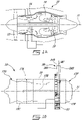
- Fig. 1A illustrates a gas turbine engine 10 of a type preferably provided for use in subsonic flight, generally comprising in serial flow communication a fan 12 through which ambient air is propelled, a compressor section 14 for pressurizing the air, a combustor 16 in which the compressed air is mixed with fuel and ignited for generating an annular stream of hot combustion gases, and a turbine section 18 for extracting energy from the combustion gases.
- Components of the gas turbine engine 10 rotate about a longitudinal center axis 11 of the gas turbine engine 10.
- Fig. 1B shows a gas turbine engine yoke 20.
- the gas turbine engine yoke 20 (sometimes referred to herein simply as “yoke 20") is a frame, harness or other suitable body used to support the gas turbine engine 10 and its components when the gas turbine engine 10 is being assembled and disassembled.
- the yoke 20 supports a first component of the gas turbine engine 10 during assembly or build of the gas turbine engine 10.
- the first component in the embodiment shown in Fig. 1B is an intermediate case 13 of the gas turbine engine 10.
- the intermediate case 13 is supported by the yoke 20, other components of the gas turbine engine 10 can be assembled to the intermediate case 13.
- a second component of the gas turbine engine 10 mounted to the intermediate case 13 is a core assembly 15 of the gas turbine engine 10.
- the core assembly 15 includes a high pressure compressor, a diffuser, and a high pressure turbine. After the core assembly 15 has been mounted to the intermediate case 13, other components of the gas turbine engine 10 can be assembled.
- MTF mid turbine frame
- LP low pressure
- LPT low pressure turbine
- TEC turbine exhaust case
- LPBOV low pressure bleed-off valve
- LPC low pressure compressor
- a build support 19 includes the yoke 20 and a stand 19A.
- the build support 19 is a structural assembly used to support components of the gas turbine engine 10 as it is being assembled and disassembled, and is thus an assembly/disassembly apparatus for the gas turbine engine 10.
- the stand 19A is a body or structure to which the yoke 20 is mounted.
- the stand 19A shown in Fig. 2A has a vertical orientation.
- the stand 19A is in the form of a vertical column in Fig. 2A which extends along an upright axis.
- the stand 19A rests on, and is supported by, a floor surface 19B, such as the internal floor surface of a manufacturing facility.
- the stand 19A is a support post.
- the stand 19A is fixed in place on the floor surface 19B.
- the stand 19A is displaceable along the floor surface 19B, such as by using wheels 19C. Displacing the stand 19A may facilitate storage, and free up floor space.
- the yoke 20 has a body 22 that forms the corpus of the yoke 20 and provides structure thereto.
- the body 22 includes an inner wall 24A spaced apart from an outer wall 24B, and first and second side walls 26A,26B which extend between the inner and outer walls 24A,24B.
- the inner wall 24A is the portion of the body 22 which is closest to the component of the gas turbine engine 10 supported by the yoke 20.
- the body 22 also defines a center line 21 of the yoke 20.
- the outer wall 24B is spaced outwardly from the inner wall 24A along a line being radial to the center line 21.
- the outer wall 24B is spaced radially outwardly from the inner wall 24A along a radial line from the center axis 11 of the gas turbine engine 10.
- the center line 21 and the center axis 11 are collinear.
- the first and second side walls 26A,26B are spaced apart from each other along a line parallel to the center line 21 of the yoke 20. The distance separating the first and second side walls 26A,26B defines the thickness of the yoke 20.
- One or both of the first and second side walls 26A,26B have recessed regions 26C which reduce the thickness of the yoke 20 at the recessed regions 26C, and which also reduce the overall weight of the yoke 20.
- the body 22 in the depicted embodiment is made from aluminum.
- the body 22 in an embodiment is made entirely from aluminum.
- the body 22 of the yoke 20 is arcuate. "Arcuate” indicates that at least some portion of the body 22 has a curvature.
- the inner and outer walls 24A,24B of the body 22 are curved along at least some of their length.
- the body 22 has a curved segment 22A extending between opposed ends, and straight segments 22B which each extend from one of the ends of the curved segment 22A.
- the curved segment 22A has a greater curvature than the straight segments 22B.
- the straight segments 22B in an embodiment have zero curvature.
- the straight segments 22B define the distal ends of the yoke 20, and are disposed on opposite ends of the curved segment 22A.
- the outer wall 24B has a greater radius, measured from the center line 21 of the yoke 20, than the radius of the inner wall 24A.
- the yoke 20 in Fig. 2A thus forms a "horseshoe" shape, and may surround more than roughly half of a circumference of the gas turbine engine 10.
- Other shapes for the yoke 20 are possible.
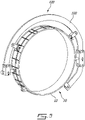
- Fig. 5 shows another yoke 120 whose body 122 surrounds roughly two-thirds of the circumference of the intermediate case 13 of the gas turbine engine 10.
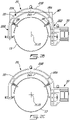
- the yoke 20 is rotatable between a horizontal orientation (see Fig. 2B ) and an upright orientation (see Fig. 2C ).
- the yoke 20 and its body 22 are rotatable with respect to the stand 19A.
- the first and second side walls 26A,26B have an upright or vertical orientation.
- the outer wall 24B is above the inner wall 24A.
- the center line 21 of the yoke 20 and the center axis 11 of the gas turbine engine 10 have a horizontal orientation and are parallel to the floor surface 19B.
- the first and second side walls 26A,26B have a horizontal orientation.
- the inner and outer walls 24A,24B have an upright or vertical orientation.
- the center line 21 of the yoke 20 and the center axis 11 of the gas turbine engine 10 have an upright or vertical orientation and are normal to the floor surface 19B.
- the yoke 20 is also rotatable to any orientation between the horizontal and upright orientations, and may to held in that orientation to support the gas turbine engine 10. Regardless of the orientation of the yoke 20, the inner wall 24A remains the portion of the body 22 which is closest to the component of the gas turbine engine 10 supported by the yoke 20.
- the body 22 of the yoke 20 defines a mounting plane MP, which is most easily visualized in Fig. 1B .
- the mounting plane MP shown from the side in Fig. 1B , extends through the inner and outer walls 24A,24B of the body 22.
- the mounting plane MP is also located between the first and second side walls 26A,26B. All of the yoke 20 lies in the mounting plane MP, such that the mounting plane MP extends through the curved segment 22A and the straight segments 22B of the body 22. This is shown visually in Figs. 1B , 2B and 3 , where portions of the mounting plane MP which are outside the body 22 are shown in solid lines, and where portions of the mounting plane MP within the body 22 are shown in dashed lines.
- the body 22 of the yoke 20 is parallel to the mounting plane MP.
- the mounting plane MP is normal to the center axis 11 of the gas turbine engine 10 irrespective of the orientation of the gas turbine engine 10.
- the mounting plane MP is transverse to the center line 21 of the yoke 20 irrespective of the orientation of the yoke 20.
- the mounting plane MP is normal to the center line 21 of the yoke 20 irrespective of the orientation of the yoke 20.
- the mounting plane MP is spaced from both the first and second side walls 26A,26B in a direction inwardly into the body 22 of the yoke 20.
- the mounting plane MP lies in the thickness of the body 22.
- the mounting plane MP is parallel to one or both of the first and second side walls 26A,26B.
- the mounting plane MP is normal to both the inner and outer walls 24A,24B of the body 22.
- the mounting plane MP is defined by one of the first and second side walls 26A,26B.
- the mounting plane MP is shown from the front in Fig. 2B .
- the yoke 20 has multiple engine attachments 28 which are attached to the yoke 20 and to the first component of the gas turbine engine 10, and thus help to mount the first component of the gas turbine engine 10 to the yoke 20, and help the yoke 20 to support the weight of the gas turbine engine 10 irrespective of its orientation.
- the engine attachments 28 therefore define points or positions at which the first component of the gas turbine engine 10 is joined to the yoke 20.
- the engine attachments 28 are spaced apart from each other along the inner wall 24A of the body 22.
- the engine attachments 28 are spaced apart from each other in a circumferential direction along the inner wall 24A of the body 22.
- the engine attachments 28 lie in the mounting plane MP. It will thus be appreciated that the first component of the gas turbine engine 10 is mounted to the yoke 20 along a single plane of attachment (i.e. the mounting plane MP). The points of attachment of the first component to the yoke 20 are within the mounting plane MP defined by the yoke 20. The points of attachment of the yoke 20 to the first component are all within the thickness of yoke 20. This allows the yoke 20 to grab the intermediate case 13, for example, at different points all in the same mounting plane MP.
- the engine attachments 28 seize the first component of the gas turbine engine 10 at the same locations on the first component where the aircraft supports the first component. The yoke 20 in such an embodiment is thus able to support the first component in the same plane as the aircraft does.
- the engine attachments 28 are shown as brackets.
- the brackets are selected at least in part based on the type of gas turbine engine 10 and/or its component to be supported by the yoke 20.
- Each of the engine attachments 28 have a first end 29A fixedly mounted to the inner wall 24A of the body 22, and a second end 29B fixedly mountable to the first component of the gas turbine engine 10, such as the horns of the intermediate case 13. It is understood by “fixedly mountable” and “fixedly mounted” that the engine attachments 28 prevent relative displacement or relative rotation between themselves and the objects to which they are attached. Therefore, the engine attachments 28 prevent a pivoting or rotating motion of the first component relative to the yoke 20.
- the engine attachments 28 are thus "anti-rotation" features, which may be helpful when rotating the yoke 20 and the gas turbine engine 10 between the horizontal and upright orientations.
- the first end 29A of each engine attachment is fixedly mounted to a flange 24A' extending inwardly toward the center line center line 21 of the yoke 20 from the inner wall 24A.
- the flanges 24A' have a mounting hole through which the first end 29A of the engine attachments 28 are secured.
- all of the engine attachments 28 are circumferentially spaced apart along the inner wall 24A of the curved segment 22A.
- the straight segments 22B are free of engine attachments 28.
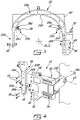
- the engine attachments 28 extend between the first and second ends 29A,29B, and an entirety of the engine attachments 28 lie in the mounting plane MP, as shown in Fig. 3 .
- the build support 19 also has an adapter 30 that is removably mountable to the yoke 20, and removably mounted to the stand 19A.
- the adapter 30 is thus positioned between the yoke 20 and the stand 19A. More particularly, the adapter 30 helps to suspend the yoke 20 from the stand 19A, and thus forms with the yoke 20 an assembly cantilevered from the stand 19A.
- the adapter 30 may be removed from both the yoke 20 and the stand 19A, and may also be secured thereto. The removability of the adapter 30 allows the build support 19 to be more easily disassembled, such that the yoke 20 and the stand 19A may be displaced to another location.
- the removability of the adapter 30 also helps with storage of the components of the build support 19.
- the adapter 30 allows another yoke 20, such as a second yoke 20 different from the one shown in the depicted embodiment, to be used with the same stand 19A.
- the adapter 30 thus allows the build support 19 to use multiple yokes 20 interchangeably. It will be appreciated that using the same adapter 30 with different types of yokes 20 allows the build support 19 to support different models of gas turbine engines 10.
- the adapter 30 is rotatable with the yoke 20 between the horizontal and upright orientations.
- the adapter 30 is rotatable with respect to the stand 19A.
- the adapter 30 has arm portions 32, each of which engage the first and second side walls 26A,26B of the body 22 of the yoke 20.
- the arm portions 32 are secured to the first and second side walls 26A,26B with any suitable fastener 33.
- the adapter 30 has a mounting portion 34 which is mounted to part of the stand 19A and secured thereto. In Fig. 4 , the mounting portion 34 is secured to a rotatable arm 19D of the stand 19A.
- the rotatable arm 19D defines an axis of rotation 27, about which the adapter 30 and the yoke 20 rotate between the horizontal and upright positions.
- the axis of rotation 27 of the adapter 30 and of the yoke 20 is defined by a bushing 35 in the rotatable arm 19D of the stand 19A.
- the adapter 30 in the depicted embodiment is made of aluminum.
- the adapter 30 may be mounted to a portable or displaceable stand 19A.
- trunnions 40 are used with the yoke 20 to further secure the gas turbine engine 10 to the yoke 20.
- the yoke 20 has holes 25 extending through the yoke 20 between the inner and outer walls 24A,24B.
- the holes 25 in Figs. 3 and 4 are located at the distal ends of the body 22.
- the holes 25 in Figs. 3 and 4 are present in only the straight segments 22B of the body 22.
- Each trunnion 40 is displaceable through one of the holes 25 to engage and support part of the first component of the gas turbine engine 10. In Figs.
- the trunnions 40 are displaceable along a line being radial to the center line 21 of the yoke 20. In Figs. 3 and 4 , the trunnions 40 are displaceable along a line being radial to the center axis 11 of the gas turbine engine 10. The trunnions 40 thus extend and retract to engage the first component, such as by engaging the intermediate case 13 in an appropriate location, such as a thrust bearing. The trunnions 40 are thus positioned along the yoke 20 to mimic how the gas turbine engine 10 is supported by the aircraft. The displaceability of the trunnions 40 allows for them to accommodate different engine sizes. In Figs.
- the adapter 30 has a recess 36 delimited by the arm portions 32.
- the trunnions 40 are displaceable into and out of the recess 36.
- the adapter 30 is thus designed to allow for the trunnion 40 to be fully retracted on one side of the yoke 20.
- the trunnions 40 may be secured in their position using any suitable technique, including for example with a pin 42.
- a method of assembling the gas turbine engine 10 includes mounting the first component of the gas turbine engine 10 to the yoke 20,120 along attachment points (e.g. the engine attachments 28) which lie in the single mounting plane MP defined by the yoke 20,120.
- the method includes rotating the yoke 20,120 to rotate the first component between the horizontal orientation and the upright orientation.
- the method also includes mounting another, second component of the gas turbine engine 10 to the first component.
- the method also applies mutatis mutandis to the disassembly of the gas turbine engine 10.
- mounting the first component includes mounting the intermediate case 13 to the yoke 20, 120
- mounting the second component includes mounting the core assembly 15 to the intermediate case 13.
- other components of the gas turbine engine 10 can be assembled, such as the mid turbine frame (MTF) module 17A, the low pressure (LP) shaft assembly 17B, the low pressure turbine (LPT) module 17C, the turbine exhaust case (TEC) 17D, the low pressure bleed-off valve (LPBOV) module 17E, and the low pressure compressor (LPC) module 17F.
- Core externals may also be installed.
- the process of assembling the gas turbine engine 10 begins by installing the intermediate case 13 into the yoke 20,120, and then mating the core assembly 15 to the intermediate case 13. If the yoke 20,120, and thus the intermediate case 13, are in the horizontal orientation, the core assembly 15 may be mated to the intermediate case 13 using a chain lift or ground-based tooling. If the yoke 20,120, and thus the intermediate case 13, are in the upright orientation, the core assembly 15 may be mated to the intermediate case 13 using a chain lift or ground-based tooling. If the core assembly 15 is installed vertically without the MTF module 17A, the MTF module 17A may then be installed while the gas turbine engine 10 remains in the upright orientation, via the chain lift.
- the gas turbine engine 10 may be rotated to the horizontal orientation, and the build can continue, such as by installing the LP Shaft assembly 17B, the LPT module 17C, the LPBOV module 17E, and the TEC 17D.
- the core assembly 15 can be mated to the intermediate case 13 using a core cart.
- the build support 19 and its yoke 20 disclosed herein allow for assembly/disassembly of the gas turbine engine 10 without being completely reliant on an immobile carrier, while using existing infrastructure such as the stand 19A.
- the build support 19 helps to reduce the utilization of expensive carrier infrastructure to progress the build of the gas turbine engine 10 past the MTF module 17A mating with the core assembly 15.
Landscapes
- Engineering & Computer Science (AREA)
- Mechanical Engineering (AREA)
- General Engineering & Computer Science (AREA)
- Turbine Rotor Nozzle Sealing (AREA)
- Structures Of Non-Positive Displacement Pumps (AREA)
Description
- The application relates generally to gas turbine engines and, more particularly, to supports for gas turbines. In particular, the invention relates to a build support for a gas turbine engine and to a method of assembling a gas turbine engine.
- Structures such as carriers are used to support components of gas turbine engines as the engine is being assembled and disassembled. Some carriers are bulky and occupy a lot of floor space, and do not permit easy access to the components of the engine. Some carriers do not allow for displacing the components, or changing their orientation.
US 2 825 477 A discloses a build support for a gas turbine engine according to the preamble of claim 1.US 2 586 263 A discloses a conveyor system,US 2 703 252 A discloses a multiple tilting art support,WO 2017/072449 A1 discloses an engine assembly stand,US 4 010 942 A discloses a repair support assembly for automotive transmissions, andUS 3 085 798 A discloses a multi-purpose powerplant stand. - According to a first aspect of the invention, there is provided a build support for a gas turbine engine as set forth in claim 1.
- According to a further aspect of the invention, there is provided a method of assembling a gas turbine engine as set forth in claim 9.
- Advantageous aspects of the invention are set forth in the dependent claims.
- Reference is now made to the accompanying figures in which:
-
Fig. 1A is a schematic cross-sectional view of a gas turbine engine; -
Fig. 1B is a side elevational view of a yoke for the gas turbine engine ofFig. 1A , parts of the gas turbine engine being shown; -
Fig. 2A is a perspective view of the yoke ofFig. 1B shown supporting a first component of the gas turbine engine ofFig. 1A ; -
Fig. 2B is a front view of the yoke and the first component shown inFig. 2A , both the yoke and the first component shown having a horizontal orientation; -
Fig. 2C is a top view of the yoke and the first component shown inFig. 2A , both the yoke and the first component shown having an upright orientation; -
Fig. 3 is a front view of the yoke ofFig. 1B ; -
Fig. 4 is an exploded view of part of the yoke ofFig. 1B and an adapter; and -
Fig. 5 is a perspective view of another yoke for the gas turbine engine ofFig. 1A . -
Fig. 1A illustrates agas turbine engine 10 of a type preferably provided for use in subsonic flight, generally comprising in serial flow communication afan 12 through which ambient air is propelled, acompressor section 14 for pressurizing the air, acombustor 16 in which the compressed air is mixed with fuel and ignited for generating an annular stream of hot combustion gases, and aturbine section 18 for extracting energy from the combustion gases. Components of thegas turbine engine 10 rotate about alongitudinal center axis 11 of thegas turbine engine 10. -
Fig. 1B shows a gasturbine engine yoke 20. The gas turbine engine yoke 20 (sometimes referred to herein simply as "yoke 20") is a frame, harness or other suitable body used to support thegas turbine engine 10 and its components when thegas turbine engine 10 is being assembled and disassembled. - For example, and as shown in
Fig. 1B , theyoke 20 supports a first component of thegas turbine engine 10 during assembly or build of thegas turbine engine 10. The first component in the embodiment shown inFig. 1B is anintermediate case 13 of thegas turbine engine 10. Once theintermediate case 13 is supported by theyoke 20, other components of thegas turbine engine 10 can be assembled to theintermediate case 13. For example, and as shown inFig. 1B , a second component of thegas turbine engine 10 mounted to theintermediate case 13 is acore assembly 15 of thegas turbine engine 10. In the depicted embodiment, thecore assembly 15 includes a high pressure compressor, a diffuser, and a high pressure turbine. After thecore assembly 15 has been mounted to theintermediate case 13, other components of thegas turbine engine 10 can be assembled. Some non-limiting examples of these other components which can be installed include the mid turbine frame (MTF)module 17A, the low pressure (LP)shaft assembly 17B, the low pressure turbine (LPT)module 17C, the turbine exhaust case (TEC) 17D, the low pressure bleed-off valve (LPBOV)module 17E, and the low pressure compressor (LPC)module 17F. Core externals may also be installed. - Referring to
Fig. 2A , abuild support 19 includes theyoke 20 and astand 19A. Thebuild support 19 is a structural assembly used to support components of thegas turbine engine 10 as it is being assembled and disassembled, and is thus an assembly/disassembly apparatus for thegas turbine engine 10. Thestand 19A is a body or structure to which theyoke 20 is mounted. Thestand 19A shown inFig. 2A has a vertical orientation. Thestand 19A is in the form of a vertical column inFig. 2A which extends along an upright axis. Thestand 19A rests on, and is supported by, a floor surface 19B, such as the internal floor surface of a manufacturing facility. In an embodiment, thestand 19A is a support post. In the depicted embodiment, thestand 19A is fixed in place on the floor surface 19B. In an alternate embodiment, thestand 19A is displaceable along the floor surface 19B, such as by usingwheels 19C. Displacing thestand 19A may facilitate storage, and free up floor space. - Referring to
Fig. 2A , theyoke 20 has abody 22 that forms the corpus of theyoke 20 and provides structure thereto. Thebody 22 includes aninner wall 24A spaced apart from anouter wall 24B, and first andsecond side walls outer walls inner wall 24A is the portion of thebody 22 which is closest to the component of thegas turbine engine 10 supported by theyoke 20. Thebody 22 also defines a center line 21 of theyoke 20. Theouter wall 24B is spaced outwardly from theinner wall 24A along a line being radial to the center line 21. Theouter wall 24B is spaced radially outwardly from theinner wall 24A along a radial line from thecenter axis 11 of thegas turbine engine 10. InFig. 2A , the center line 21 and thecenter axis 11 are collinear. The first andsecond side walls yoke 20. The distance separating the first andsecond side walls yoke 20. One or both of the first andsecond side walls regions 26C which reduce the thickness of theyoke 20 at the recessedregions 26C, and which also reduce the overall weight of theyoke 20. Thebody 22 in the depicted embodiment is made from aluminum. Thebody 22 in an embodiment is made entirely from aluminum. - The
body 22 of theyoke 20 is arcuate. "Arcuate" indicates that at least some portion of thebody 22 has a curvature. The inner andouter walls body 22 are curved along at least some of their length. In the embodiment ofFig. 2A , thebody 22 has acurved segment 22A extending between opposed ends, andstraight segments 22B which each extend from one of the ends of thecurved segment 22A. Thecurved segment 22A has a greater curvature than thestraight segments 22B. Thestraight segments 22B in an embodiment have zero curvature. Thestraight segments 22B define the distal ends of theyoke 20, and are disposed on opposite ends of thecurved segment 22A. In the depicted embodiment, theouter wall 24B has a greater radius, measured from the center line 21 of theyoke 20, than the radius of theinner wall 24A. Theyoke 20 inFig. 2A thus forms a "horseshoe" shape, and may surround more than roughly half of a circumference of thegas turbine engine 10. Other shapes for theyoke 20 are possible. For example,Fig. 5 shows anotheryoke 120 whosebody 122 surrounds roughly two-thirds of the circumference of theintermediate case 13 of thegas turbine engine 10. - Referring to
Figs. 2B and 2C , theyoke 20 is rotatable between a horizontal orientation (seeFig. 2B ) and an upright orientation (seeFig. 2C ). Theyoke 20 and itsbody 22 are rotatable with respect to thestand 19A. In the horizontal orientation shown inFig. 2B , the first andsecond side walls outer wall 24B is above theinner wall 24A. When theyoke 20 is in the horizontal orientation, the center line 21 of theyoke 20 and thecenter axis 11 of thegas turbine engine 10 have a horizontal orientation and are parallel to the floor surface 19B. In the upright orientation shown inFig. 2C , the first andsecond side walls outer walls yoke 20 is in the upright orientation, the center line 21 of theyoke 20 and thecenter axis 11 of thegas turbine engine 10 have an upright or vertical orientation and are normal to the floor surface 19B. Theyoke 20 is also rotatable to any orientation between the horizontal and upright orientations, and may to held in that orientation to support thegas turbine engine 10. Regardless of the orientation of theyoke 20, theinner wall 24A remains the portion of thebody 22 which is closest to the component of thegas turbine engine 10 supported by theyoke 20. - The
body 22 of theyoke 20 defines a mounting plane MP, which is most easily visualized inFig. 1B . The mounting plane MP, shown from the side inFig. 1B , extends through the inner andouter walls body 22. The mounting plane MP is also located between the first andsecond side walls yoke 20 lies in the mounting plane MP, such that the mounting plane MP extends through thecurved segment 22A and thestraight segments 22B of thebody 22. This is shown visually inFigs. 1B ,2B and3 , where portions of the mounting plane MP which are outside thebody 22 are shown in solid lines, and where portions of the mounting plane MP within thebody 22 are shown in dashed lines. Thebody 22 of theyoke 20 is parallel to the mounting plane MP. As shown inFig. 1B , the mounting plane MP is normal to thecenter axis 11 of thegas turbine engine 10 irrespective of the orientation of thegas turbine engine 10. The mounting plane MP is transverse to the center line 21 of theyoke 20 irrespective of the orientation of theyoke 20. The mounting plane MP is normal to the center line 21 of theyoke 20 irrespective of the orientation of theyoke 20. The mounting plane MP is spaced from both the first andsecond side walls body 22 of theyoke 20. The mounting plane MP lies in the thickness of thebody 22. InFig. 1B , the mounting plane MP is parallel to one or both of the first andsecond side walls outer walls body 22. In an embodiment, the mounting plane MP is defined by one of the first andsecond side walls Fig. 2B . - Referring to
Fig. 2B , theyoke 20 hasmultiple engine attachments 28 which are attached to theyoke 20 and to the first component of thegas turbine engine 10, and thus help to mount the first component of thegas turbine engine 10 to theyoke 20, and help theyoke 20 to support the weight of thegas turbine engine 10 irrespective of its orientation. Theengine attachments 28 therefore define points or positions at which the first component of thegas turbine engine 10 is joined to theyoke 20. Theengine attachments 28 are spaced apart from each other along theinner wall 24A of thebody 22. Theengine attachments 28 are spaced apart from each other in a circumferential direction along theinner wall 24A of thebody 22. - The
engine attachments 28 lie in the mounting plane MP. It will thus be appreciated that the first component of thegas turbine engine 10 is mounted to theyoke 20 along a single plane of attachment (i.e. the mounting plane MP). The points of attachment of the first component to theyoke 20 are within the mounting plane MP defined by theyoke 20. The points of attachment of theyoke 20 to the first component are all within the thickness ofyoke 20. This allows theyoke 20 to grab theintermediate case 13, for example, at different points all in the same mounting plane MP. Providing the points of attachment defined by theengine attachments 28 in a single plane helps to provide greater access to the first component and/or other components of thegas turbine engine 10 during its assembly, to all sides of these components, because no structure of theyoke 20 is hindering access. Having theengine attachments 28 in the same mounting plane MP frees up space around theyoke 20, improving accessibility to thegas turbine engine 10. This may allow greater access for technicians to flanges and horns of the first component and other components of thegas turbine engine 10, permitting them to build more freely, which may allow for less time when installing externally mounted hardware like wiring harness and tubes. In an embodiment, theengine attachments 28 seize the first component of thegas turbine engine 10 at the same locations on the first component where the aircraft supports the first component. Theyoke 20 in such an embodiment is thus able to support the first component in the same plane as the aircraft does. - Referring to
Fig. 3 , theengine attachments 28 are shown as brackets. The brackets are selected at least in part based on the type ofgas turbine engine 10 and/or its component to be supported by theyoke 20. Each of theengine attachments 28 have afirst end 29A fixedly mounted to theinner wall 24A of thebody 22, and asecond end 29B fixedly mountable to the first component of thegas turbine engine 10, such as the horns of theintermediate case 13. It is understood by "fixedly mountable" and "fixedly mounted" that theengine attachments 28 prevent relative displacement or relative rotation between themselves and the objects to which they are attached. Therefore, theengine attachments 28 prevent a pivoting or rotating motion of the first component relative to theyoke 20. Theengine attachments 28 are thus "anti-rotation" features, which may be helpful when rotating theyoke 20 and thegas turbine engine 10 between the horizontal and upright orientations. InFig. 3 , thefirst end 29A of each engine attachment is fixedly mounted to aflange 24A' extending inwardly toward the center line center line 21 of theyoke 20 from theinner wall 24A. Theflanges 24A' have a mounting hole through which thefirst end 29A of theengine attachments 28 are secured. InFig. 3 , all of theengine attachments 28 are circumferentially spaced apart along theinner wall 24A of thecurved segment 22A. InFig. 3 , thestraight segments 22B are free ofengine attachments 28. Theengine attachments 28 extend between the first and second ends 29A,29B, and an entirety of theengine attachments 28 lie in the mounting plane MP, as shown inFig. 3 . - Referring to
Fig. 4 , thebuild support 19 also has anadapter 30 that is removably mountable to theyoke 20, and removably mounted to thestand 19A. Theadapter 30 is thus positioned between theyoke 20 and thestand 19A. More particularly, theadapter 30 helps to suspend theyoke 20 from thestand 19A, and thus forms with theyoke 20 an assembly cantilevered from thestand 19A. Theadapter 30 may be removed from both theyoke 20 and thestand 19A, and may also be secured thereto. The removability of theadapter 30 allows thebuild support 19 to be more easily disassembled, such that theyoke 20 and thestand 19A may be displaced to another location. The removability of theadapter 30 also helps with storage of the components of thebuild support 19. Thus, the fact that theadapter 30 is not permanently fastened to theyoke 20 or to thestand 19A allows thebuild support 19 to be dismounted relatively easily in order to maximise floor space and versatility. For example, theadapter 30 allows anotheryoke 20, such as asecond yoke 20 different from the one shown in the depicted embodiment, to be used with thesame stand 19A. Theadapter 30 thus allows thebuild support 19 to usemultiple yokes 20 interchangeably. It will be appreciated that using thesame adapter 30 with different types ofyokes 20 allows thebuild support 19 to support different models ofgas turbine engines 10. Theadapter 30 is rotatable with theyoke 20 between the horizontal and upright orientations. Theadapter 30 is rotatable with respect to thestand 19A. - Many configurations of the
adapter 30 are possible and within the scope of the present disclosure to achieve the functionality described above. One possible example of the configuration ofadapter 30 is now described in greater detail with reference toFig. 4 . Theadapter 30 hasarm portions 32, each of which engage the first andsecond side walls body 22 of theyoke 20. Thearm portions 32 are secured to the first andsecond side walls suitable fastener 33. Theadapter 30 has a mountingportion 34 which is mounted to part of thestand 19A and secured thereto. InFig. 4 , the mountingportion 34 is secured to arotatable arm 19D of thestand 19A. Therotatable arm 19D defines an axis ofrotation 27, about which theadapter 30 and theyoke 20 rotate between the horizontal and upright positions. InFig. 4 , the axis ofrotation 27 of theadapter 30 and of theyoke 20 is defined by abushing 35 in therotatable arm 19D of thestand 19A. Theadapter 30 in the depicted embodiment is made of aluminum. Theadapter 30 may be mounted to a portable ordisplaceable stand 19A. - Additional mounts or objects may be used to further secure the
yoke 20 to the first component of thegas turbine engine 10. Referring toFigs. 3 and 4 ,trunnions 40 are used with theyoke 20 to further secure thegas turbine engine 10 to theyoke 20. Theyoke 20 hasholes 25 extending through theyoke 20 between the inner andouter walls holes 25 inFigs. 3 and 4 are located at the distal ends of thebody 22. Theholes 25 inFigs. 3 and 4 are present in only thestraight segments 22B of thebody 22. Eachtrunnion 40 is displaceable through one of theholes 25 to engage and support part of the first component of thegas turbine engine 10. InFigs. 3 and 4 , thetrunnions 40 are displaceable along a line being radial to the center line 21 of theyoke 20. InFigs. 3 and 4 , thetrunnions 40 are displaceable along a line being radial to thecenter axis 11 of thegas turbine engine 10. Thetrunnions 40 thus extend and retract to engage the first component, such as by engaging theintermediate case 13 in an appropriate location, such as a thrust bearing. Thetrunnions 40 are thus positioned along theyoke 20 to mimic how thegas turbine engine 10 is supported by the aircraft. The displaceability of thetrunnions 40 allows for them to accommodate different engine sizes. InFigs. 3 and 4 , theadapter 30 has arecess 36 delimited by thearm portions 32. Thetrunnions 40 are displaceable into and out of therecess 36. Theadapter 30 is thus designed to allow for thetrunnion 40 to be fully retracted on one side of theyoke 20. Thetrunnions 40 may be secured in their position using any suitable technique, including for example with a pin 42. - Referring to
Fig. 2A , a method of assembling thegas turbine engine 10 is also disclosed. The method includes mounting the first component of thegas turbine engine 10 to the yoke 20,120 along attachment points (e.g. the engine attachments 28) which lie in the single mounting plane MP defined by the yoke 20,120. The method includes rotating the yoke 20,120 to rotate the first component between the horizontal orientation and the upright orientation. The method also includes mounting another, second component of thegas turbine engine 10 to the first component. The method also applies mutatis mutandis to the disassembly of thegas turbine engine 10. - In an embodiment, mounting the first component includes mounting the
intermediate case 13 to theyoke core assembly 15 to theintermediate case 13. Referring toFig. 1B , after thecore assembly 15 has been mounted to theintermediate case 13, other components of thegas turbine engine 10 can be assembled, such as the mid turbine frame (MTF)module 17A, the low pressure (LP)shaft assembly 17B, the low pressure turbine (LPT)module 17C, the turbine exhaust case (TEC) 17D, the low pressure bleed-off valve (LPBOV)module 17E, and the low pressure compressor (LPC)module 17F. Core externals may also be installed. - In an embodiment, the process of assembling the
gas turbine engine 10 begins by installing theintermediate case 13 into the yoke 20,120, and then mating thecore assembly 15 to theintermediate case 13. If the yoke 20,120, and thus theintermediate case 13, are in the horizontal orientation, thecore assembly 15 may be mated to theintermediate case 13 using a chain lift or ground-based tooling. If the yoke 20,120, and thus theintermediate case 13, are in the upright orientation, thecore assembly 15 may be mated to theintermediate case 13 using a chain lift or ground-based tooling. If thecore assembly 15 is installed vertically without theMTF module 17A, theMTF module 17A may then be installed while thegas turbine engine 10 remains in the upright orientation, via the chain lift. After theMTF module 17A installation, thegas turbine engine 10 may be rotated to the horizontal orientation, and the build can continue, such as by installing theLP Shaft assembly 17B, theLPT module 17C, theLPBOV module 17E, and theTEC 17D. Similarly, if the yoke 20,120, and thus theintermediate case 13, are in the horizontal orientation, thecore assembly 15 can be mated to theintermediate case 13 using a core cart. - The
build support 19 and itsyoke 20 disclosed herein allow for assembly/disassembly of thegas turbine engine 10 without being completely reliant on an immobile carrier, while using existing infrastructure such as thestand 19A. Thebuild support 19 helps to reduce the utilization of expensive carrier infrastructure to progress the build of thegas turbine engine 10 past theMTF module 17A mating with thecore assembly 15. - The above description is meant to be exemplary only, and one skilled in the art will recognize that changes may be made to the embodiments described without departing from the scope of the invention disclosed. Still other modifications which fall within the scope of the present invention will be apparent to those skilled in the art, in light of a review of this disclosure, and such modifications are intended to fall within the appended claims.
Claims (13)
- A build support (19) for a gas turbine engine (10), comprising:a stand (19A);a yoke (20) comprising an arcuate body (22) mountable to a stand (19A), characterised in that:the yoke (20) is rotatable between an upright orientation and a horizontal orientation, the arcuate body (22) having an inner wall (24A) spaced apart from an outer wall (24B) and first and second side walls (26A, 26B) extending between the inner and outer walls (24A, 24B), a mounting plane of the yoke (20) extending through the inner and outer walls (24A, 24B) and positioned between the first and second side walls (26A, 26B), and engine attachments (28) spaced apart along the inner wall (24A) and lying in the mounting plane; andthe build support (19) further comprises an adapter (30) removably mountable to the yoke (20) and removably mountable to the stand (19A) to mount the yoke (20) to the stand (19A), the adapter (30) being rotatable between the upright orientation and the horizontal orientation to thereby rotate the yoke (20) between the upright orientation and the horizontal orientation.
- The build support (19) of claim 1, wherein the mounting plane is parallel to one or both of the first and second side walls (26A, 26B).
- The build support (19) of claim 1 or 2, wherein the body (22) has holes (25) extending through the body (22) between the inner and outer walls (24A, 24B), the yoke (20) having trunnions (40) displaceable through the holes (25) to engage a gas turbine engine (10).
- The build support (19) of any of claims 1 to 3, wherein the engine attachments (28) have a first end (29A) fixedly mounted to the inner wall (24A) and a second end (29B) fixedly mountable to the gas turbine engine (10), the engine attachments (28) extending between the first and second ends (29A, 29B) and an entirety of the engine attachments (28) lying in the mounting plane.
- The build support (19) of any preceding claim, wherein the body (22) has a curved segment (22A) extending between ends thereof, and straight segments (22B) each extending from one of the ends of the curved segment (22A).
- The build support (19) of claim 5, wherein the engine attachments (28) are spaced apart along the inner wall (24A) of the curved segment (22A).
- The build support (19) of any preceding claim, comprising a second yoke (20) different from the yoke (20), the adapter (30) mountable separately to each of the second yoke (20) and the yoke (20).
- The build support (19) of any preceding claim, wherein the stand (19A) is displaceable along a floor surface.
- A method of assembling a gas turbine engine (10), comprising:mounting a first component of the gas turbine engine (10) to a yoke (20) along attachment points lying in a single mounting plane (MP) defined by the yoke (20);rotating the yoke (20) to rotate the first component between a horizontal orientation and an upright orientation; andmounting a second component of the gas turbine engine (10) to the first component.
- The method of claim 9, wherein mounting the first component includes mounting an intermediate case (13) of the gas turbine engine (10) to the yoke (20), and mounting the second component includes mounting a core assembly (15) of the gas turbine engine (10) to the first component, the core assembly (15) including a high pressure compressor, a diffuser, and a high pressure turbine.
- The method of claim 9 or 10, wherein mounting the first component includes securing the first component to the attachment points at circumferentially spaced-apart locations on the yoke (20).
- The method of any one of claims 9 to 11 , wherein mounting the first component includes engaging the first component with trunnions (40) being displaceable through the yoke (20).
- The method of any one of claims 9 to 12, comprising mounting the yoke (20) to a displaceable stand (19A), and displacing the yoke (20) and the first component mounted thereto along a floor surface (19B).
Applications Claiming Priority (1)
| Application Number | Priority Date | Filing Date | Title |
|---|---|---|---|
| US16/398,824 US11248497B2 (en) | 2019-04-30 | 2019-04-30 | Gas turbine engine yoke and build support |
Publications (2)
| Publication Number | Publication Date |
|---|---|
| EP3734026A1 EP3734026A1 (en) | 2020-11-04 |
| EP3734026B1 true EP3734026B1 (en) | 2022-06-01 |
Family
ID=70482467
Family Applications (1)
| Application Number | Title | Priority Date | Filing Date |
|---|---|---|---|
| EP20172547.0A Active EP3734026B1 (en) | 2019-04-30 | 2020-04-30 | Gas turbine engine yoke and build support |
Country Status (3)
| Country | Link |
|---|---|
| US (1) | US11248497B2 (en) |
| EP (1) | EP3734026B1 (en) |
| CA (1) | CA3080345A1 (en) |
Cited By (1)
| Publication number | Priority date | Publication date | Assignee | Title |
|---|---|---|---|---|
| EP4656527A1 (en) * | 2024-05-30 | 2025-12-03 | Pratt & Whitney Canada Corp. | Support stand assembly for aircraft engine |
Families Citing this family (7)
| Publication number | Priority date | Publication date | Assignee | Title |
|---|---|---|---|---|
| FR3076236B1 (en) * | 2017-12-28 | 2019-12-06 | Safran Aircraft Engines | TOOL FOR DISASSEMBLING AN ANNULAR PART OF A TURBOMACHINE, METHOD FOR DISASSEMBLY AND ASSEMBLY THEREOF |
| FR3090588B1 (en) * | 2018-12-21 | 2021-01-22 | Safran Aircraft Engines | TOOLS FOR PLACING A PROPELLENT ASSEMBLY FROM A HORIZONTAL POSITION TO A VERTICAL POSITION |
| US11686221B2 (en) | 2021-12-01 | 2023-06-27 | Pratt & Whitney Canada Corp. | Aircraft engine repair tool and method for removal and installation of a mid turbine frame in an aircraft engine |
| DE102024116524A1 (en) * | 2024-06-12 | 2025-12-18 | Broetje-Automation Gmbh | Method for mounting a turbine |
| US20260001660A1 (en) * | 2024-06-28 | 2026-01-01 | Pratt & Whitney Canada Corp. | Aircraft engine assembly stand |
| US20260015952A1 (en) * | 2024-07-15 | 2026-01-15 | Ge Infrastructure Technology Llc | Inner compressor case suspension device and method of alignment |
| US20260021896A1 (en) * | 2024-07-22 | 2026-01-22 | Pratt & Whitney Canada Corp. | Aircraft engine assembly stand and method of using the same |
Family Cites Families (12)
| Publication number | Priority date | Publication date | Assignee | Title |
|---|---|---|---|---|
| US2586263A (en) | 1944-10-12 | 1952-02-19 | Webb Co Jervis B | Conveyer |
| US2703252A (en) | 1952-04-02 | 1955-03-01 | Rohr Aircraft Corp | Multiple tilting arc support |
| US2825477A (en) | 1953-09-04 | 1958-03-04 | Henry M Ross | Engine work stand and method of using the same |
| US3085798A (en) | 1959-02-19 | 1963-04-16 | Lockheed Aircraft Corp | Multi-purpose powerplant stand |
| US4010942A (en) | 1974-03-04 | 1977-03-08 | Gary Lee Ward | Repair support assembly for automotive transmissions |
| DE2719850C3 (en) | 1977-05-04 | 1981-06-25 | MTU Motoren- und Turbinen-Union München GmbH, 8000 München | Device for the maintenance of gas turbine engines, in particular gas turbine jet engines |
| JP2877296B2 (en) | 1995-09-11 | 1999-03-31 | 三菱重工業株式会社 | Gas turbine combustor installation and removal equipment |
| FR2952922B1 (en) * | 2009-11-20 | 2012-05-25 | Snecma | HANDLING ASSEMBLY FOR AN AIRCRAFT ENGINE MODULE |
| US9228451B2 (en) | 2011-05-03 | 2016-01-05 | Pratt & Whitney Canada Corp. | Gas turbine engine module adapter to a carrier |
| KR101559950B1 (en) * | 2011-06-23 | 2015-10-13 | 히라따기꼬오 가부시키가이샤 | Workpiece support device |
| FR3043000B1 (en) | 2015-10-29 | 2018-04-13 | Safran Aircraft Engines | ENGINE ASSEMBLY PORTIC |
| FR3058987B1 (en) * | 2016-11-24 | 2019-08-02 | Safran Aircraft Engines | ORGAN AND TROLLEY FOR THE REMOVAL, TRANSPORT, AND MAINTENANCE OF A TURBOMACHINE |
-
2019
- 2019-04-30 US US16/398,824 patent/US11248497B2/en active Active
-
2020
- 2020-04-28 CA CA3080345A patent/CA3080345A1/en active Pending
- 2020-04-30 EP EP20172547.0A patent/EP3734026B1/en active Active
Cited By (1)
| Publication number | Priority date | Publication date | Assignee | Title |
|---|---|---|---|---|
| EP4656527A1 (en) * | 2024-05-30 | 2025-12-03 | Pratt & Whitney Canada Corp. | Support stand assembly for aircraft engine |
Also Published As
| Publication number | Publication date |
|---|---|
| US20200347752A1 (en) | 2020-11-05 |
| US11248497B2 (en) | 2022-02-15 |
| CA3080345A1 (en) | 2020-10-30 |
| EP3734026A1 (en) | 2020-11-04 |
Similar Documents
| Publication | Publication Date | Title |
|---|---|---|
| US11248497B2 (en) | Gas turbine engine yoke and build support | |
| US10808622B2 (en) | Turbine engine case mount and dismount | |
| US10329956B2 (en) | Multi-function boss for a turbine exhaust case | |
| US10458282B2 (en) | Gas turbine engine module adapter to a carrier | |
| EP2855881B1 (en) | Nacelle bifurcation for gas turbine engine | |
| US9481470B2 (en) | Intermediate structure for independently de-mountable propulsion components | |
| EP2938847B1 (en) | Installation mounts for a turbine exhaust case | |
| US12078072B2 (en) | Turbomachine module provided with a propeller and offset stator vanes | |
| US9266202B2 (en) | Rotor centralization for turbine engine assembly | |
| US20130233997A1 (en) | Turbine engine case mount | |
| KR102191182B1 (en) | Cantilever slide for installing and removing a rotor block | |
| EP3421408B1 (en) | Turbomachine component handling assembly | |
| US9709276B2 (en) | Method and tool for installation of a transition duct | |
| EP2938862B1 (en) | Multi-purpose mounting | |
| CN113356949B (en) | A fixed support device for aero-engine casings | |
| CN114394533B (en) | Gas turbine inlet cylinder overhaul and transfer system and overhaul and transfer method | |
| CN110494256B (en) | Method for mounting and/or dismounting, device applied to method, burner adapter, transition adapter, arrangement and application of robot | |
| US12473845B2 (en) | System and method for applying trim balance to a module of the gas turbine engine | |
| US20260021896A1 (en) | Aircraft engine assembly stand and method of using the same | |
| US11927107B2 (en) | Tool and method for disassembling and moving a TRV-type turbine casing of an aircraft turbine engine | |
| WO2025239222A1 (en) | Method for disassembling and assembling vehicle exhaust chamber, and support device for lower half of bearing stand |
Legal Events
| Date | Code | Title | Description |
|---|---|---|---|
| PUAI | Public reference made under article 153(3) epc to a published international application that has entered the european phase |
Free format text: ORIGINAL CODE: 0009012 |
|
| STAA | Information on the status of an ep patent application or granted ep patent |
Free format text: STATUS: THE APPLICATION HAS BEEN PUBLISHED |
|
| AK | Designated contracting states |
Kind code of ref document: A1 Designated state(s): AL AT BE BG CH CY CZ DE DK EE ES FI FR GB GR HR HU IE IS IT LI LT LU LV MC MK MT NL NO PL PT RO RS SE SI SK SM TR |
|
| AX | Request for extension of the european patent |
Extension state: BA ME |
|
| STAA | Information on the status of an ep patent application or granted ep patent |
Free format text: STATUS: REQUEST FOR EXAMINATION WAS MADE |
|
| 17P | Request for examination filed |
Effective date: 20210504 |
|
| RBV | Designated contracting states (corrected) |
Designated state(s): AL AT BE BG CH CY CZ DE DK EE ES FI FR GB GR HR HU IE IS IT LI LT LU LV MC MK MT NL NO PL PT RO RS SE SI SK SM TR |
|
| GRAP | Despatch of communication of intention to grant a patent |
Free format text: ORIGINAL CODE: EPIDOSNIGR1 |
|
| STAA | Information on the status of an ep patent application or granted ep patent |
Free format text: STATUS: GRANT OF PATENT IS INTENDED |
|
| INTG | Intention to grant announced |
Effective date: 20211222 |
|
| GRAS | Grant fee paid |
Free format text: ORIGINAL CODE: EPIDOSNIGR3 |
|
| GRAA | (expected) grant |
Free format text: ORIGINAL CODE: 0009210 |
|
| STAA | Information on the status of an ep patent application or granted ep patent |
Free format text: STATUS: THE PATENT HAS BEEN GRANTED |
|
| AK | Designated contracting states |
Kind code of ref document: B1 Designated state(s): AL AT BE BG CH CY CZ DE DK EE ES FI FR GB GR HR HU IE IS IT LI LT LU LV MC MK MT NL NO PL PT RO RS SE SI SK SM TR |
|
| REG | Reference to a national code |
Ref country code: GB Ref legal event code: FG4D |
|
| REG | Reference to a national code |
Ref country code: AT Ref legal event code: REF Ref document number: 1495496 Country of ref document: AT Kind code of ref document: T Effective date: 20220615 Ref country code: CH Ref legal event code: EP Ref country code: DE Ref legal event code: R096 Ref document number: 602020003337 Country of ref document: DE |
|
| REG | Reference to a national code |
Ref country code: IE Ref legal event code: FG4D |
|
| REG | Reference to a national code |
Ref country code: LT Ref legal event code: MG9D |
|
| REG | Reference to a national code |
Ref country code: NL Ref legal event code: MP Effective date: 20220601 |
|
| PG25 | Lapsed in a contracting state [announced via postgrant information from national office to epo] |
Ref country code: SE Free format text: LAPSE BECAUSE OF FAILURE TO SUBMIT A TRANSLATION OF THE DESCRIPTION OR TO PAY THE FEE WITHIN THE PRESCRIBED TIME-LIMIT Effective date: 20220601 Ref country code: NO Free format text: LAPSE BECAUSE OF FAILURE TO SUBMIT A TRANSLATION OF THE DESCRIPTION OR TO PAY THE FEE WITHIN THE PRESCRIBED TIME-LIMIT Effective date: 20220901 Ref country code: LT Free format text: LAPSE BECAUSE OF FAILURE TO SUBMIT A TRANSLATION OF THE DESCRIPTION OR TO PAY THE FEE WITHIN THE PRESCRIBED TIME-LIMIT Effective date: 20220601 Ref country code: HR Free format text: LAPSE BECAUSE OF FAILURE TO SUBMIT A TRANSLATION OF THE DESCRIPTION OR TO PAY THE FEE WITHIN THE PRESCRIBED TIME-LIMIT Effective date: 20220601 Ref country code: GR Free format text: LAPSE BECAUSE OF FAILURE TO SUBMIT A TRANSLATION OF THE DESCRIPTION OR TO PAY THE FEE WITHIN THE PRESCRIBED TIME-LIMIT Effective date: 20220902 Ref country code: FI Free format text: LAPSE BECAUSE OF FAILURE TO SUBMIT A TRANSLATION OF THE DESCRIPTION OR TO PAY THE FEE WITHIN THE PRESCRIBED TIME-LIMIT Effective date: 20220601 Ref country code: BG Free format text: LAPSE BECAUSE OF FAILURE TO SUBMIT A TRANSLATION OF THE DESCRIPTION OR TO PAY THE FEE WITHIN THE PRESCRIBED TIME-LIMIT Effective date: 20220901 |
|
| REG | Reference to a national code |
Ref country code: AT Ref legal event code: MK05 Ref document number: 1495496 Country of ref document: AT Kind code of ref document: T Effective date: 20220601 |
|
| PG25 | Lapsed in a contracting state [announced via postgrant information from national office to epo] |
Ref country code: RS Free format text: LAPSE BECAUSE OF FAILURE TO SUBMIT A TRANSLATION OF THE DESCRIPTION OR TO PAY THE FEE WITHIN THE PRESCRIBED TIME-LIMIT Effective date: 20220601 Ref country code: PL Free format text: LAPSE BECAUSE OF FAILURE TO SUBMIT A TRANSLATION OF THE DESCRIPTION OR TO PAY THE FEE WITHIN THE PRESCRIBED TIME-LIMIT Effective date: 20220601 Ref country code: LV Free format text: LAPSE BECAUSE OF FAILURE TO SUBMIT A TRANSLATION OF THE DESCRIPTION OR TO PAY THE FEE WITHIN THE PRESCRIBED TIME-LIMIT Effective date: 20220601 |
|
| PG25 | Lapsed in a contracting state [announced via postgrant information from national office to epo] |
Ref country code: NL Free format text: LAPSE BECAUSE OF FAILURE TO SUBMIT A TRANSLATION OF THE DESCRIPTION OR TO PAY THE FEE WITHIN THE PRESCRIBED TIME-LIMIT Effective date: 20220601 |
|
| PG25 | Lapsed in a contracting state [announced via postgrant information from national office to epo] |
Ref country code: SM Free format text: LAPSE BECAUSE OF FAILURE TO SUBMIT A TRANSLATION OF THE DESCRIPTION OR TO PAY THE FEE WITHIN THE PRESCRIBED TIME-LIMIT Effective date: 20220601 Ref country code: SK Free format text: LAPSE BECAUSE OF FAILURE TO SUBMIT A TRANSLATION OF THE DESCRIPTION OR TO PAY THE FEE WITHIN THE PRESCRIBED TIME-LIMIT Effective date: 20220601 Ref country code: RO Free format text: LAPSE BECAUSE OF FAILURE TO SUBMIT A TRANSLATION OF THE DESCRIPTION OR TO PAY THE FEE WITHIN THE PRESCRIBED TIME-LIMIT Effective date: 20220601 Ref country code: PT Free format text: LAPSE BECAUSE OF FAILURE TO SUBMIT A TRANSLATION OF THE DESCRIPTION OR TO PAY THE FEE WITHIN THE PRESCRIBED TIME-LIMIT Effective date: 20221003 Ref country code: ES Free format text: LAPSE BECAUSE OF FAILURE TO SUBMIT A TRANSLATION OF THE DESCRIPTION OR TO PAY THE FEE WITHIN THE PRESCRIBED TIME-LIMIT Effective date: 20220601 Ref country code: EE Free format text: LAPSE BECAUSE OF FAILURE TO SUBMIT A TRANSLATION OF THE DESCRIPTION OR TO PAY THE FEE WITHIN THE PRESCRIBED TIME-LIMIT Effective date: 20220601 Ref country code: CZ Free format text: LAPSE BECAUSE OF FAILURE TO SUBMIT A TRANSLATION OF THE DESCRIPTION OR TO PAY THE FEE WITHIN THE PRESCRIBED TIME-LIMIT Effective date: 20220601 Ref country code: AT Free format text: LAPSE BECAUSE OF FAILURE TO SUBMIT A TRANSLATION OF THE DESCRIPTION OR TO PAY THE FEE WITHIN THE PRESCRIBED TIME-LIMIT Effective date: 20220601 |
|
| PG25 | Lapsed in a contracting state [announced via postgrant information from national office to epo] |
Ref country code: IS Free format text: LAPSE BECAUSE OF FAILURE TO SUBMIT A TRANSLATION OF THE DESCRIPTION OR TO PAY THE FEE WITHIN THE PRESCRIBED TIME-LIMIT Effective date: 20221001 |
|
| REG | Reference to a national code |
Ref country code: DE Ref legal event code: R097 Ref document number: 602020003337 Country of ref document: DE |
|
| PG25 | Lapsed in a contracting state [announced via postgrant information from national office to epo] |
Ref country code: AL Free format text: LAPSE BECAUSE OF FAILURE TO SUBMIT A TRANSLATION OF THE DESCRIPTION OR TO PAY THE FEE WITHIN THE PRESCRIBED TIME-LIMIT Effective date: 20220601 |
|
| PLBE | No opposition filed within time limit |
Free format text: ORIGINAL CODE: 0009261 |
|
| STAA | Information on the status of an ep patent application or granted ep patent |
Free format text: STATUS: NO OPPOSITION FILED WITHIN TIME LIMIT |
|
| PG25 | Lapsed in a contracting state [announced via postgrant information from national office to epo] |
Ref country code: DK Free format text: LAPSE BECAUSE OF FAILURE TO SUBMIT A TRANSLATION OF THE DESCRIPTION OR TO PAY THE FEE WITHIN THE PRESCRIBED TIME-LIMIT Effective date: 20220601 |
|
| 26N | No opposition filed |
Effective date: 20230302 |
|
| PG25 | Lapsed in a contracting state [announced via postgrant information from national office to epo] |
Ref country code: SI Free format text: LAPSE BECAUSE OF FAILURE TO SUBMIT A TRANSLATION OF THE DESCRIPTION OR TO PAY THE FEE WITHIN THE PRESCRIBED TIME-LIMIT Effective date: 20220601 |
|
| P01 | Opt-out of the competence of the unified patent court (upc) registered |
Effective date: 20230530 |
|
| REG | Reference to a national code |
Ref country code: CH Ref legal event code: PL |
|
| PG25 | Lapsed in a contracting state [announced via postgrant information from national office to epo] |
Ref country code: LU Free format text: LAPSE BECAUSE OF NON-PAYMENT OF DUE FEES Effective date: 20230430 |
|
| REG | Reference to a national code |
Ref country code: BE Ref legal event code: MM Effective date: 20230430 |
|
| PG25 | Lapsed in a contracting state [announced via postgrant information from national office to epo] |
Ref country code: MC Free format text: LAPSE BECAUSE OF FAILURE TO SUBMIT A TRANSLATION OF THE DESCRIPTION OR TO PAY THE FEE WITHIN THE PRESCRIBED TIME-LIMIT Effective date: 20220601 |
|
| PG25 | Lapsed in a contracting state [announced via postgrant information from national office to epo] |
Ref country code: MC Free format text: LAPSE BECAUSE OF FAILURE TO SUBMIT A TRANSLATION OF THE DESCRIPTION OR TO PAY THE FEE WITHIN THE PRESCRIBED TIME-LIMIT Effective date: 20220601 Ref country code: LI Free format text: LAPSE BECAUSE OF NON-PAYMENT OF DUE FEES Effective date: 20230430 Ref country code: IT Free format text: LAPSE BECAUSE OF FAILURE TO SUBMIT A TRANSLATION OF THE DESCRIPTION OR TO PAY THE FEE WITHIN THE PRESCRIBED TIME-LIMIT Effective date: 20220601 Ref country code: CH Free format text: LAPSE BECAUSE OF NON-PAYMENT OF DUE FEES Effective date: 20230430 |
|
| REG | Reference to a national code |
Ref country code: IE Ref legal event code: MM4A |
|
| PG25 | Lapsed in a contracting state [announced via postgrant information from national office to epo] |
Ref country code: BE Free format text: LAPSE BECAUSE OF NON-PAYMENT OF DUE FEES Effective date: 20230430 |
|
| PG25 | Lapsed in a contracting state [announced via postgrant information from national office to epo] |
Ref country code: IE Free format text: LAPSE BECAUSE OF NON-PAYMENT OF DUE FEES Effective date: 20230430 |
|
| PG25 | Lapsed in a contracting state [announced via postgrant information from national office to epo] |
Ref country code: IE Free format text: LAPSE BECAUSE OF NON-PAYMENT OF DUE FEES Effective date: 20230430 |
|
| PG25 | Lapsed in a contracting state [announced via postgrant information from national office to epo] |
Ref country code: BG Free format text: LAPSE BECAUSE OF FAILURE TO SUBMIT A TRANSLATION OF THE DESCRIPTION OR TO PAY THE FEE WITHIN THE PRESCRIBED TIME-LIMIT Effective date: 20220601 |
|
| PG25 | Lapsed in a contracting state [announced via postgrant information from national office to epo] |
Ref country code: BG Free format text: LAPSE BECAUSE OF FAILURE TO SUBMIT A TRANSLATION OF THE DESCRIPTION OR TO PAY THE FEE WITHIN THE PRESCRIBED TIME-LIMIT Effective date: 20220601 |
|
| PGFP | Annual fee paid to national office [announced via postgrant information from national office to epo] |
Ref country code: DE Payment date: 20250319 Year of fee payment: 6 |
|
| PG25 | Lapsed in a contracting state [announced via postgrant information from national office to epo] |
Ref country code: CY Free format text: LAPSE BECAUSE OF FAILURE TO SUBMIT A TRANSLATION OF THE DESCRIPTION OR TO PAY THE FEE WITHIN THE PRESCRIBED TIME-LIMIT; INVALID AB INITIO Effective date: 20200430 |
|
| PG25 | Lapsed in a contracting state [announced via postgrant information from national office to epo] |
Ref country code: HU Free format text: LAPSE BECAUSE OF FAILURE TO SUBMIT A TRANSLATION OF THE DESCRIPTION OR TO PAY THE FEE WITHIN THE PRESCRIBED TIME-LIMIT; INVALID AB INITIO Effective date: 20200430 |
|
| PG25 | Lapsed in a contracting state [announced via postgrant information from national office to epo] |
Ref country code: TR Free format text: LAPSE BECAUSE OF FAILURE TO SUBMIT A TRANSLATION OF THE DESCRIPTION OR TO PAY THE FEE WITHIN THE PRESCRIBED TIME-LIMIT Effective date: 20220601 |
|
| PGFP | Annual fee paid to national office [announced via postgrant information from national office to epo] |
Ref country code: GB Payment date: 20260319 Year of fee payment: 7 |
|
| PGFP | Annual fee paid to national office [announced via postgrant information from national office to epo] |
Ref country code: FR Payment date: 20260320 Year of fee payment: 7 |