EP3733769A1 - Thermoplastic resin composition for laser direct structuring process, and molded product comprising same - Google Patents
Thermoplastic resin composition for laser direct structuring process, and molded product comprising same Download PDFInfo
- Publication number
- EP3733769A1 EP3733769A1 EP18895076.0A EP18895076A EP3733769A1 EP 3733769 A1 EP3733769 A1 EP 3733769A1 EP 18895076 A EP18895076 A EP 18895076A EP 3733769 A1 EP3733769 A1 EP 3733769A1
- Authority
- EP
- European Patent Office
- Prior art keywords
- thermoplastic resin
- resin composition
- weight
- polycarbonate
- monomer
- Prior art date
- Legal status (The legal status is an assumption and is not a legal conclusion. Google has not performed a legal analysis and makes no representation as to the accuracy of the status listed.)
- Granted
Links
Images
Classifications
-
- C—CHEMISTRY; METALLURGY
- C08—ORGANIC MACROMOLECULAR COMPOUNDS; THEIR PREPARATION OR CHEMICAL WORKING-UP; COMPOSITIONS BASED THEREON
- C08L—COMPOSITIONS OF MACROMOLECULAR COMPOUNDS
- C08L69/00—Compositions of polycarbonates; Compositions of derivatives of polycarbonates
-
- C—CHEMISTRY; METALLURGY
- C08—ORGANIC MACROMOLECULAR COMPOUNDS; THEIR PREPARATION OR CHEMICAL WORKING-UP; COMPOSITIONS BASED THEREON
- C08G—MACROMOLECULAR COMPOUNDS OBTAINED OTHERWISE THAN BY REACTIONS ONLY INVOLVING UNSATURATED CARBON-TO-CARBON BONDS
- C08G64/00—Macromolecular compounds obtained by reactions forming a carbonic ester link in the main chain of the macromolecule
- C08G64/18—Block or graft polymers
- C08G64/186—Block or graft polymers containing polysiloxane sequences
-
- C—CHEMISTRY; METALLURGY
- C08—ORGANIC MACROMOLECULAR COMPOUNDS; THEIR PREPARATION OR CHEMICAL WORKING-UP; COMPOSITIONS BASED THEREON
- C08G—MACROMOLECULAR COMPOUNDS OBTAINED OTHERWISE THAN BY REACTIONS ONLY INVOLVING UNSATURATED CARBON-TO-CARBON BONDS
- C08G63/00—Macromolecular compounds obtained by reactions forming a carboxylic ester link in the main chain of the macromolecule
- C08G63/02—Polyesters derived from hydroxycarboxylic acids or from polycarboxylic acids and polyhydroxy compounds
- C08G63/12—Polyesters derived from hydroxycarboxylic acids or from polycarboxylic acids and polyhydroxy compounds derived from polycarboxylic acids and polyhydroxy compounds
- C08G63/16—Dicarboxylic acids and dihydroxy compounds
- C08G63/18—Dicarboxylic acids and dihydroxy compounds the acids or hydroxy compounds containing carbocyclic rings
- C08G63/181—Acids containing aromatic rings
- C08G63/183—Terephthalic acids
-
- C—CHEMISTRY; METALLURGY
- C08—ORGANIC MACROMOLECULAR COMPOUNDS; THEIR PREPARATION OR CHEMICAL WORKING-UP; COMPOSITIONS BASED THEREON
- C08G—MACROMOLECULAR COMPOUNDS OBTAINED OTHERWISE THAN BY REACTIONS ONLY INVOLVING UNSATURATED CARBON-TO-CARBON BONDS
- C08G63/00—Macromolecular compounds obtained by reactions forming a carboxylic ester link in the main chain of the macromolecule
- C08G63/02—Polyesters derived from hydroxycarboxylic acids or from polycarboxylic acids and polyhydroxy compounds
- C08G63/12—Polyesters derived from hydroxycarboxylic acids or from polycarboxylic acids and polyhydroxy compounds derived from polycarboxylic acids and polyhydroxy compounds
- C08G63/16—Dicarboxylic acids and dihydroxy compounds
- C08G63/18—Dicarboxylic acids and dihydroxy compounds the acids or hydroxy compounds containing carbocyclic rings
- C08G63/199—Acids or hydroxy compounds containing cycloaliphatic rings
-
- C—CHEMISTRY; METALLURGY
- C08—ORGANIC MACROMOLECULAR COMPOUNDS; THEIR PREPARATION OR CHEMICAL WORKING-UP; COMPOSITIONS BASED THEREON
- C08K—Use of inorganic or non-macromolecular organic substances as compounding ingredients
- C08K3/00—Use of inorganic substances as compounding ingredients
- C08K3/18—Oxygen-containing compounds, e.g. metal carbonyls
- C08K3/20—Oxides; Hydroxides
- C08K3/22—Oxides; Hydroxides of metals
-
- C—CHEMISTRY; METALLURGY
- C08—ORGANIC MACROMOLECULAR COMPOUNDS; THEIR PREPARATION OR CHEMICAL WORKING-UP; COMPOSITIONS BASED THEREON
- C08K—Use of inorganic or non-macromolecular organic substances as compounding ingredients
- C08K3/00—Use of inorganic substances as compounding ingredients
- C08K3/32—Phosphorus-containing compounds
-
- C—CHEMISTRY; METALLURGY
- C08—ORGANIC MACROMOLECULAR COMPOUNDS; THEIR PREPARATION OR CHEMICAL WORKING-UP; COMPOSITIONS BASED THEREON
- C08L—COMPOSITIONS OF MACROMOLECULAR COMPOUNDS
- C08L51/00—Compositions of graft polymers in which the grafted component is obtained by reactions only involving carbon-to-carbon unsaturated bonds; Compositions of derivatives of such polymers
- C08L51/04—Compositions of graft polymers in which the grafted component is obtained by reactions only involving carbon-to-carbon unsaturated bonds; Compositions of derivatives of such polymers grafted on to rubbers
-
- C—CHEMISTRY; METALLURGY
- C08—ORGANIC MACROMOLECULAR COMPOUNDS; THEIR PREPARATION OR CHEMICAL WORKING-UP; COMPOSITIONS BASED THEREON
- C08L—COMPOSITIONS OF MACROMOLECULAR COMPOUNDS
- C08L67/00—Compositions of polyesters obtained by reactions forming a carboxylic ester link in the main chain; Compositions of derivatives of such polymers
- C08L67/02—Polyesters derived from dicarboxylic acids and dihydroxy compounds
-
- C—CHEMISTRY; METALLURGY
- C08—ORGANIC MACROMOLECULAR COMPOUNDS; THEIR PREPARATION OR CHEMICAL WORKING-UP; COMPOSITIONS BASED THEREON
- C08L—COMPOSITIONS OF MACROMOLECULAR COMPOUNDS
- C08L83/00—Compositions of macromolecular compounds obtained by reactions forming in the main chain of the macromolecule a linkage containing silicon with or without sulfur, nitrogen, oxygen or carbon only; Compositions of derivatives of such polymers
- C08L83/04—Polysiloxanes
-
- C—CHEMISTRY; METALLURGY
- C08—ORGANIC MACROMOLECULAR COMPOUNDS; THEIR PREPARATION OR CHEMICAL WORKING-UP; COMPOSITIONS BASED THEREON
- C08L—COMPOSITIONS OF MACROMOLECULAR COMPOUNDS
- C08L83/00—Compositions of macromolecular compounds obtained by reactions forming in the main chain of the macromolecule a linkage containing silicon with or without sulfur, nitrogen, oxygen or carbon only; Compositions of derivatives of such polymers
- C08L83/10—Block- or graft-copolymers containing polysiloxane sequences
-
- C—CHEMISTRY; METALLURGY
- C23—COATING METALLIC MATERIAL; COATING MATERIAL WITH METALLIC MATERIAL; CHEMICAL SURFACE TREATMENT; DIFFUSION TREATMENT OF METALLIC MATERIAL; COATING BY VACUUM EVAPORATION, BY SPUTTERING, BY ION IMPLANTATION OR BY CHEMICAL VAPOUR DEPOSITION, IN GENERAL; INHIBITING CORROSION OF METALLIC MATERIAL OR INCRUSTATION IN GENERAL
- C23C—COATING METALLIC MATERIAL; COATING MATERIAL WITH METALLIC MATERIAL; SURFACE TREATMENT OF METALLIC MATERIAL BY DIFFUSION INTO THE SURFACE, BY CHEMICAL CONVERSION OR SUBSTITUTION; COATING BY VACUUM EVAPORATION, BY SPUTTERING, BY ION IMPLANTATION OR BY CHEMICAL VAPOUR DEPOSITION, IN GENERAL
- C23C18/00—Chemical coating by decomposition of either liquid compounds or solutions of the coating forming compounds, without leaving reaction products of surface material in the coating; Contact plating
- C23C18/16—Chemical coating by decomposition of either liquid compounds or solutions of the coating forming compounds, without leaving reaction products of surface material in the coating; Contact plating by reduction or substitution, e.g. electroless plating
- C23C18/1601—Process or apparatus
- C23C18/1603—Process or apparatus coating on selected surface areas
- C23C18/1607—Process or apparatus coating on selected surface areas by direct patterning
- C23C18/1612—Process or apparatus coating on selected surface areas by direct patterning through irradiation means
-
- C—CHEMISTRY; METALLURGY
- C23—COATING METALLIC MATERIAL; COATING MATERIAL WITH METALLIC MATERIAL; CHEMICAL SURFACE TREATMENT; DIFFUSION TREATMENT OF METALLIC MATERIAL; COATING BY VACUUM EVAPORATION, BY SPUTTERING, BY ION IMPLANTATION OR BY CHEMICAL VAPOUR DEPOSITION, IN GENERAL; INHIBITING CORROSION OF METALLIC MATERIAL OR INCRUSTATION IN GENERAL
- C23C—COATING METALLIC MATERIAL; COATING MATERIAL WITH METALLIC MATERIAL; SURFACE TREATMENT OF METALLIC MATERIAL BY DIFFUSION INTO THE SURFACE, BY CHEMICAL CONVERSION OR SUBSTITUTION; COATING BY VACUUM EVAPORATION, BY SPUTTERING, BY ION IMPLANTATION OR BY CHEMICAL VAPOUR DEPOSITION, IN GENERAL
- C23C18/00—Chemical coating by decomposition of either liquid compounds or solutions of the coating forming compounds, without leaving reaction products of surface material in the coating; Contact plating
- C23C18/16—Chemical coating by decomposition of either liquid compounds or solutions of the coating forming compounds, without leaving reaction products of surface material in the coating; Contact plating by reduction or substitution, e.g. electroless plating
- C23C18/18—Pretreatment of the material to be coated
- C23C18/20—Pretreatment of the material to be coated of organic surfaces, e.g. resins
- C23C18/2006—Pretreatment of the material to be coated of organic surfaces, e.g. resins by other methods than those of C23C18/22 - C23C18/30
- C23C18/2026—Pretreatment of the material to be coated of organic surfaces, e.g. resins by other methods than those of C23C18/22 - C23C18/30 by radiant energy
- C23C18/204—Radiation, e.g. UV, laser
-
- H—ELECTRICITY
- H05—ELECTRIC TECHNIQUES NOT OTHERWISE PROVIDED FOR
- H05K—PRINTED CIRCUITS; CASINGS OR CONSTRUCTIONAL DETAILS OF ELECTRIC APPARATUS; MANUFACTURE OF ASSEMBLAGES OF ELECTRICAL COMPONENTS
- H05K1/00—Printed circuits
- H05K1/02—Details
- H05K1/03—Use of materials for the substrate
- H05K1/0313—Organic insulating material
- H05K1/0353—Organic insulating material consisting of two or more materials, e.g. two or more polymers, polymer + filler, + reinforcement
- H05K1/0373—Organic insulating material consisting of two or more materials, e.g. two or more polymers, polymer + filler, + reinforcement containing additives, e.g. fillers
-
- C—CHEMISTRY; METALLURGY
- C08—ORGANIC MACROMOLECULAR COMPOUNDS; THEIR PREPARATION OR CHEMICAL WORKING-UP; COMPOSITIONS BASED THEREON
- C08G—MACROMOLECULAR COMPOUNDS OBTAINED OTHERWISE THAN BY REACTIONS ONLY INVOLVING UNSATURATED CARBON-TO-CARBON BONDS
- C08G77/00—Macromolecular compounds obtained by reactions forming a linkage containing silicon with or without sulfur, nitrogen, oxygen or carbon in the main chain of the macromolecule
- C08G77/42—Block-or graft-polymers containing polysiloxane sequences
- C08G77/448—Block-or graft-polymers containing polysiloxane sequences containing polycarbonate sequences
-
- C—CHEMISTRY; METALLURGY
- C08—ORGANIC MACROMOLECULAR COMPOUNDS; THEIR PREPARATION OR CHEMICAL WORKING-UP; COMPOSITIONS BASED THEREON
- C08K—Use of inorganic or non-macromolecular organic substances as compounding ingredients
- C08K3/00—Use of inorganic substances as compounding ingredients
- C08K3/32—Phosphorus-containing compounds
- C08K2003/321—Phosphates
-
- C—CHEMISTRY; METALLURGY
- C08—ORGANIC MACROMOLECULAR COMPOUNDS; THEIR PREPARATION OR CHEMICAL WORKING-UP; COMPOSITIONS BASED THEREON
- C08K—Use of inorganic or non-macromolecular organic substances as compounding ingredients
- C08K3/00—Use of inorganic substances as compounding ingredients
- C08K3/32—Phosphorus-containing compounds
- C08K2003/321—Phosphates
- C08K2003/328—Phosphates of heavy metals
-
- C—CHEMISTRY; METALLURGY
- C08—ORGANIC MACROMOLECULAR COMPOUNDS; THEIR PREPARATION OR CHEMICAL WORKING-UP; COMPOSITIONS BASED THEREON
- C08L—COMPOSITIONS OF MACROMOLECULAR COMPOUNDS
- C08L2207/00—Properties characterising the ingredient of the composition
- C08L2207/53—Core-shell polymer
-
- H—ELECTRICITY
- H05—ELECTRIC TECHNIQUES NOT OTHERWISE PROVIDED FOR
- H05K—PRINTED CIRCUITS; CASINGS OR CONSTRUCTIONAL DETAILS OF ELECTRIC APPARATUS; MANUFACTURE OF ASSEMBLAGES OF ELECTRICAL COMPONENTS
- H05K2201/00—Indexing scheme relating to printed circuits covered by H05K1/00
- H05K2201/01—Dielectrics
- H05K2201/0104—Properties and characteristics in general
- H05K2201/0129—Thermoplastic polymer, e.g. auto-adhesive layer; Shaping of thermoplastic polymer
-
- H—ELECTRICITY
- H05—ELECTRIC TECHNIQUES NOT OTHERWISE PROVIDED FOR
- H05K—PRINTED CIRCUITS; CASINGS OR CONSTRUCTIONAL DETAILS OF ELECTRIC APPARATUS; MANUFACTURE OF ASSEMBLAGES OF ELECTRICAL COMPONENTS
- H05K2201/00—Indexing scheme relating to printed circuits covered by H05K1/00
- H05K2201/09—Shape and layout
- H05K2201/09009—Substrate related
- H05K2201/09118—Moulded substrate
-
- H—ELECTRICITY
- H05—ELECTRIC TECHNIQUES NOT OTHERWISE PROVIDED FOR
- H05K—PRINTED CIRCUITS; CASINGS OR CONSTRUCTIONAL DETAILS OF ELECTRIC APPARATUS; MANUFACTURE OF ASSEMBLAGES OF ELECTRICAL COMPONENTS
- H05K2203/00—Indexing scheme relating to apparatus or processes for manufacturing printed circuits covered by H05K3/00
- H05K2203/10—Using electric, magnetic and electromagnetic fields; Using laser light
- H05K2203/107—Using laser light
-
- H—ELECTRICITY
- H05—ELECTRIC TECHNIQUES NOT OTHERWISE PROVIDED FOR
- H05K—PRINTED CIRCUITS; CASINGS OR CONSTRUCTIONAL DETAILS OF ELECTRIC APPARATUS; MANUFACTURE OF ASSEMBLAGES OF ELECTRICAL COMPONENTS
- H05K3/00—Apparatus or processes for manufacturing printed circuits
- H05K3/10—Apparatus or processes for manufacturing printed circuits in which conductive material is applied to the insulating support in such a manner as to form the desired conductive pattern
- H05K3/105—Apparatus or processes for manufacturing printed circuits in which conductive material is applied to the insulating support in such a manner as to form the desired conductive pattern by conversion of non-conductive material on or in the support into conductive material, e.g. by using an energy beam
Definitions
- the present invention relates to a thermoplastic resin composition for laser direct structuring and a molded product comprising the same.
- a laser direct structuring (LDS) process may be used to form a metal layer on at least a portion of a surface of a molded product produced from a thermoplastic resin composition.
- the LDS process is a pretreatment method to modify a plating target region to have suitable properties for plating by irradiating the surface of the molded product with laser beams.
- a thermoplastic resin composition is required to contain an additive for laser direct structuring (LDS additive), which can form metal nuclei upon irradiation with laser beams.
- the LDS additive is decomposed to generate metal nuclei upon irradiation with the laser beams.
- a region irradiated with laser beams has a roughened surface. Due to such metal nuclei and surface roughness, the laser-modified region becomes suitable for plating.
- the LDS process allows rapid and economic formation of electronic/electric circuits on a three-dimensional molded product.
- the LDS process may be advantageously used in manufacture of antennas for portable electronic devices, radio frequency identification (RFID) antennas, and the like.
- RFID radio frequency identification
- antennas for mobile electronic devices such as smart phones and the like, require separate electrodes corresponding to frequency bands and it is important to realize fine patterns corresponding to the frequency bands.
- the LDS process can realize fine patterns at a desired location, thereby securing a high degree of freedom in design.
- thermoplastic resin composition for laser direct structuring which has good properties in terms of durability, plating reliability and thermal stability under high temperature/humidity conditions, and can suppress gas generation upon injection molding, and a molded product including the same.
- thermoplastic resin composition for laser direct structuring which has good plating reliability under high temperature/humidity conditions.
- thermoplastic resin composition for laser direct structuring which has good impact resistance and heat resistance.
- thermoplastic resin composition for laser direct structuring.
- thermoplastic resin composition according to the present invention has good plating reliability under high temperature/humidity conditions, good impact resistance after plating, and good heat resistance.
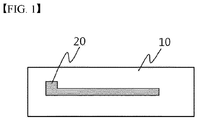
- FIG. 1 is a view of a molded product according to one embodiment of the present invention.
- Thermoplastic resin composition for laser direct structuring is thermoplastic resin composition for laser direct structuring
- thermoplastic resin composition for laser direct structuring.
- the thermoplastic resin composition includes a base resin; an LDS additive; and an impact modifier.
- the base resin comprises a polycarbonate resin, a polycarbonate-polysiloxane copolymer, and a polyester resin containing an alicyclic group in a main chain.
- the polycarbonate resin may be selected from any polycarbonate resins used in a typical thermoplastic resin composition.
- the polycarbonate resin may be an aromatic polycarbonate resin prepared by reacting diphenols (aromatic diol compounds) with a precursor, such as phosgene, halogen formate, or carbonate diester: wherein A is a single bond, a substituted or unsubstituted C 1 to C 30 linear or branched alkylene group, a substituted or unsubstituted C 2 to C 5 alkenylene, a substituted or unsubstituted C 2 to C 5 alkylidene, a substituted or unsubstituted C 1 to C 30 linear or branched halo-alkylene group, a substituted or unsubstituted C 5 to C 6 cycloalkylene group, a substituted or unsubstituted C 5 to C 6 cycloalkenylene, a substituted or unsubstituted or unsubstitute
- Examples of the diphenols represented by Formula 1 may include 4,4'-biphenol, 2,2-bis(4-hydroxyphenyl)propane, 2,4-bis(4-hydroxyphenyl)-2-methylbutane, 1,1-bis(4-hydroxyphenyl)cyclohexane, 2,2-bis(3-methyl-4-hydroxyphenyl)propane, 2,2-bis(3,5-dimethyl-4-hydroxyphenyl)propane, 2,2-bis(3-chloro-4-hydroxyphenyl)propane, and 2,2-bis(3,5-dichloro-4-hydroxyphenyl)propane, without being limited thereto.
- the diphenols may be 2,2-bis(4-hydroxyphenyl)propane, 2,2-bis(3-methyl-4-hydroxyphenyl)propane, 2,2-bis(3,5-dimethyl-4-hydroxyphenyl)propane, 2,2-bis(3,5-dichloro-4-hydroxyphenyl)propane, or 1,1-bis(4-hydroxyphenyl)cyclohexane, specifically 2,2-bis-(4-hydroxyphenyl)propane, which is also referred to as bisphenol A.
- the polycarbonate resin may be a mixture of a copolymer obtained from two or more diphenols.
- the polycarbonate resin may include a linear polycarbonate resin.
- the linear polycarbonate resin may be a bisphenol-A polycarbonate resin.
- the polycarbonate resin may be a branched polycarbonate resin.
- the polycarbonate resin may be a branched polycarbonate resin obtained by adding about 0.05 mol% to about 2 mol% of a tri- or higher polyfunctional compound, specifically, a tri- or higher valent phenol group-containing compound based on the total number of moles of the diphenols used in polymerization.
- the polycarbonate resin may be a homopolycarbonate resin, a copolycarbonate resin, or a blend thereof.
- the polycarbonate resin may be partially or completely replaced by an aromatic polyester-carbonate resin obtained by polymerization in the presence of an ester precursor, for example, a bifunctional carboxylic acid.
- the polycarbonate resin may have a weight average molecular weight (Mw) of about 10,000 g/mol to about 200,000 g/mol, as measured by gel permeation chromatography (GPC).
- Mw weight average molecular weight
- the polycarbonate resin may have a weight average molecular weight (Mw) of about 15,000 g/mol to about 80,000 g/mol, without being limited thereto.
- the polycarbonate resin may be present in an amount of about 20 wt% to about 70 wt% based on 100 wt% of the base resin. If the content of the polycarbonate resin is less than about 20 wt%, the thermoplastic resin composition can suffer from deterioration in processability and external appearance, and if the content of the polycarbonate resin exceeds about 70 wt%, the thermoplastic resin composition can suffer from deterioration in plating reliability and impact resistance. For example, the polycarbonate resin may be present in an amount of about 30 wt% to about 65 wt%.
- the polycarbonate-polysiloxane copolymer comprises a polycarbonate block and a polysiloxane block.
- the polycarbonate block may comprise a structural unit derived from the polycarbonate resin and the polysiloxane block may comprise a structural unit derived from Formula 2:
- R 3 and R 4 are identical to or different from each other and are a hydrogen atom, a substituted or unsubstituted C 1 to C 20 alkyl group, a substituted or unsubstituted C 2 to C 20 alkenyl group, a substituted or unsubstituted C 2 to C 20 alkynyl group, a substituted or unsubstituted C 1 to C 20 alkoxy group, a substituted or unsubstituted C3 to C30 cycloalkyl group, a substituted or unsubstituted C 3 to C 30 cycloalkenyl group, a substituted or unsubstituted C 3 to C 30 cycloalkynyl group, a substituted or unsubstituted C 6 to C 30 aryl group, a substituted or unsubstituted C 6 to C 30 aryloxy group, a substituted or unsubstituted C 6 to C 30 aryl group, or NRR' (R
- n ranges from 2 to 10,000, for example, 2 to 1,000. Within this range, the thermoplastic resin composition exhibits good impact resistance and suitable viscosity to allow efficient extrusion. For example, n ranges from 10 to 100, specifically from 25 to 80.
- the polycarbonate-polysiloxane copolymer may comprise about 80 to about 95 wt% of the polycarbonate block and about 5 to about 20 wt% of the polysiloxane block. Within these ranges, the thermoplastic resin composition can have good heat resistance and impact resistance.
- the polycarbonate-polysiloxane copolymer may have a weight average molecular weight (Mw) of about 10,000 g/mol to about 50,000 g/mol.
- Mw weight average molecular weight
- the polycarbonate-polysiloxane copolymer may have a weight average molecular weight (Mw) of about 15,000 g/mol to about 40,000 g/mol.
- the thermoplastic resin composition can have good impact resistance.
- the polycarbonate-polysiloxane copolymer may have a melt flow index (MI) of about 3 g/10 min to about 100 g/10 min, as measured under conditions of 300°C and 1.2 kgf in accordance with ASTM D1238. Within this range, the thermoplastic resin composition can have good mechanical properties and flowability.
- the polycarbonate-polysiloxane copolymer may have a melt flow index (MI) of about 10 g/10 min to about 70 g/10 min.
- the polycarbonate-polysiloxane copolymer may be present in an amount of about 10 wt% to about 70 wt% based on 100 wt% of the base resin. If the content of the polycarbonate-polysiloxane copolymer is less than about 10 wt%, the thermoplastic resin composition can suffer from deterioration in plating reliability under high temperature/humidity conditions and impact resistance after painting, and if the content of the polycarbonate-polysiloxane copolymer exceeds about 70 wt%, the thermoplastic resin composition can suffer from deterioration in impact resistance, heat resistance, and processability. For example, the polycarbonate-polysiloxane copolymer may be present in an amount of about 20 wt% to about 60 wt%.
- the polyester resin may contain an alicyclic group in a main chain thereof.
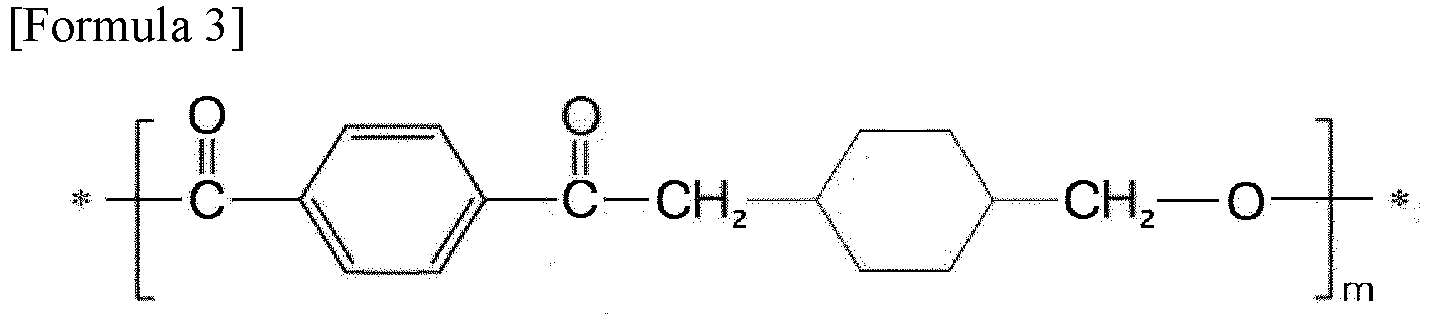
- the polyester resin may comprise a poly(1,4-cyclohexylene dimethylene terephthalate) (PCT) resin comprising a repeat unit represented by Formula 3: wherein m is an integer of 50 to 500 and * is a linking site.
- PCT poly(1,4-cyclohexylene dimethylene terephthalate)
- the polyester resin may have an intrinsic viscosity [ ⁇ ] of about 0.4 dl/g to about 1.5 dl/g.
- the intrinsic viscosity may be measured at 35°C in an o-chlorophenol solution.
- the polyester resin can improve mechanical properties and molding processability of the thermoplastic resin composition.
- the polyester resin may have an intrinsic viscosity of about 0.6 dl/g to about 1.2 dl/g.
- the polyester resin may be present in an amount of about 5 wt% to about 30 wt% based on 100 wt% of the base resin. If the content of the polyester resin is less than about 5 wt%, the thermoplastic resin composition can suffer from deterioration in plating reliability under high temperature/humidity conditions and hydrolysis resistance, and if the content of the polyester resin exceeds about 30 wt%, the thermoplastic resin composition can suffer from deterioration in impact resistance.
- the polyester resin may be present in an amount of about 10 wt% to about 25 wt%.
- the LDS additive serves to form metal nuclei upon irradiation with laser beams and may comprise any typical LDS additive used in resin compositions for LDS.
- laser beam means light amplified through simulated emission (simulated emission light) and may be UV light having a wavelength of about 100 nm to about 400 nm, visible light having a wavelength of about 400 nm to about 800 nm, or infrared (IR) light having a wavelength of about 800 nm to about 25,000 nm, for example, IR light having a wavelength of about 1,000 nm to about 2,000 nm.
- the LDS additive may comprise at least one selected from the group of a heavy metal complex oxide spinel and a copper salt.
- the heavy metal complex oxide spinel may be represented by Formula 4: [Formula 4] AB 2 O 4 ,
- A is a metal cation having a valence of 2, for example, magnesium, copper, cobalt, zinc, tin, iron, manganese, nickel, and a combination thereof
- B is a metal cation having a valence of 3, for example, manganese, nickel, copper, cobalt, tin, titanium, iron, aluminum, chromium, and a combination thereof.
- A provides a monovalent cation component of a metal oxide cluster and B provides a monovalent cation component of a metal cation cluster.
- the metal oxide cluster comprising A may have a tetrahedral structure and the metal oxide cluster comprising B may have an octahedral structure.
- the heavy metal complex oxide spinel represented by Formula 4 may have a structure in which oxygen atoms are arranged in a cubic close-packed lattice, and B and A occupy octahedral and tetrahedral sites in the lattice, respectively.
- the heavy metal complex oxide spinel may include magnesium aluminum oxide (MgAl 2 O 4 ), zinc aluminum oxide (ZnAl 2 O 4 ), iron aluminum oxide (FeAl 2 O 4 ), copper iron oxide (CuFe 2 O 4 ), copper chromium oxide (CuCr 2 O 4 ), manganese iron oxide (MnFe 2 O 4 ), nickel iron oxide (NiFe 2 O 4 ), titanium iron oxide (TiFe 2 O 4 ), iron chromium oxide (FeCr 2 O 4 ), magnesium chromium oxide (MgCr 2 O 4 ), and combinations thereof.
- the heavy metal complex oxide spinel may be copper chromium oxide (CuCr 2 O 4 ).
- the copper chromium oxide (CuCr 2 O 4 ) has a dark color and thus is advantageous when a final molded product is required to be black or grey.
- the copper salt may comprise copper hydroxide phosphate, copper phosphate, copper sulfate, cuprous thiocyanate, and combinations thereof, without being limited thereto.
- the copper salt may be copper hydroxide phosphate.
- the copper hydroxide phosphate is a compound in which copper phosphate is combined with copper hydroxide, and may comprise Cu 3 (PO 4 ) 2 ⁇ 2Cu(OH) 2 , Cu 3 (PO 4 ) 2 ⁇ Cu(OH) 2 , and the like.
- the copper hydroxide phosphate does not affect color-reproduction properties of a colorant, as an additive, and thus allows a molded product having a desired color to be easily obtained.
- the LDS additive may have an average particle diameter of about 0.01 ⁇ m to about 50 ⁇ m, for example, about 0.1 ⁇ m to about 30 ⁇ m, specifically about 0.5 ⁇ m to about 10 ⁇ m. Within this range, it is possible to form a uniform coating surface through laser direct structuring.
- average particle diameter refers to D50 (a diameter at a distribution rate of 50%) which is a number average particle diameter.
- the LDS additive may be present in an amount of about 0.1 to about 20 parts by weight relative to 100 parts by weight of the base resin. If the content of the LDS additive is less than about 0.1 parts by weight, a sufficient amount of metal nuclei is not formed in the coating during irradiation of the thermoplastic resin composition (molded product) with laser beams, thereby causing deterioration in plating adhesion, and if the content of the LDS additive exceeds about 20 parts by weight, the thermoplastic resin composition can suffer from deterioration in impact resistance and heat resistance.
- the LDS additive may be present in an amount of about 0.1 to about 10 parts by weight. Alternatively, the LDS additive may be present in an amount of about 1 to about 8 parts by weight.
- the impact modifier serves to improve durability and impact resistance of the thermoplastic resin composition.
- the impact modifier may comprise an impact modifier of a core-shell structure obtained by grafting an unsaturated compound comprising at least one selected from the group of an acrylic monomer, an aromatic vinyl monomer, an unsaturated nitrile monomer and polymers thereof to a rubber polymer obtained through polymerization of a diene monomer or a rubber polymer obtained through copolymerization of a monomer comprising at least one monomer selected from the group of a diene monomer, an acrylic monomer, a silicone monomer, and a styrene monomer.
- the diene monomer used in formation of the rubber polymer may comprise butadiene, isoprene, and the like. Specifically, butadiene may be used as the diene monomer.
- the acrylic monomer used in formation of the rubber polymer may comprise alkyl (meth)acrylates, such as methyl acrylate, ethyl acrylate, n-propyl acrylate, n-butyl acrylate, 2-ethyl hexyl acrylate, hexyl methacrylate, and 2-ethyl hexyl methacrylate.
- alkyl means C 1 to C 10 alkyl.
- a crosslinking agent such as ethylene glycol dimethacrylate, propylene glycol dimethacrylate, 1,3-butylene glycol dimethacrylate, 1,4-butylene glycol dimethacrylate, allyl methacrylate, and triallylcyanurate, may be used.
- the silicone monomer used in formation of the rubber polymer may comprise linear siloxane monomers, such as dimethyl siloxane, methyl ethyl siloxane, methyl phenyl siloxane, methyl hydroxyl siloxane, methyl propyl siloxane, methyl butyl siloxane, and the like; and cyclosiloxane monomers, such as hexamethylcyclotrisiloxane, octamethylcyclotetrasiloxane, decamethylcyclopentasiloxane, dodecamethylcyclohexasiloxane, trimethyltriphenylcyclotrisiloxane, tetramethyltetraphenylcyclotetrasiloxane, octaphenylcyclotetrasiloxane, and the like.
- linear siloxane monomers such as dimethyl siloxane, methyl ethyl siloxane, methyl phenyl
- crosslinking agent such as trimethoxymethylsilane, triethoxyphenylsilane, tetramethoxysilane, tetraethoxysilane, and the like, may be used.
- the styrene monomer used in formation of the rubber polymer may comprise one selected from the group consisting of styrene, C 1 to C 10 alkyl substituted styrene, halogen substituted styrene, and a combination thereof.
- the rubber polymer obtained through polymerization of the diene monomer may comprise polybutadiene.
- the rubber polymer obtained through copolymerization of the diene monomer and at least one monomer selected from the group of an acrylic monomer, a silicone monomer, and a styrene monomer may comprise a copolymer of butadiene and alkyl (meth)acrylate, a copolymer of butadiene, alkyl (meth)acrylate and cyclosiloxane, and the like. These rubber polymers may be used alone or as a mixture thereof.
- the rubber polymer (rubber particle) may have an average particle diameter (Z-average) of about 0.05 ⁇ m to about 6 ⁇ m. Within this range, the thermoplastic resin composition can have good impact resistance and external appearance.
- the rubber polymer (rubber particle) may have an average particle diameter of about 0.15 ⁇ m to about 4 ⁇ m.
- the rubber polymer (rubber particle) may have an average particle diameter of about 0.25 ⁇ m to about 3.5 ⁇ m.
- the acrylic monomer may comprise at least one selected from the group of alkyl (meth)acrylic acid esters and (meth)acrylic acid esters.
- alkyl means C 1 to C 10 alkyl.
- the alkyl (meth)acrylic acid esters may comprise methyl (meth)acrylate, ethyl (meth)acrylate, propyl (meth)acrylate, butyl (meth)acrylate, and the like.
- methyl (meth)acrylate may be used.
- the aromatic vinyl monomer may comprise at least one selected from the group consisting of styrene, C 1 to C 10 alkyl substituted styrene, halogen substituted styrene, and a combination thereof.
- alkyl substituted styrene may comprise o-ethyl styrene, m-ethyl styrene, p-ethyl styrene, and ⁇ -methyl styrene.
- the unsaturated nitrile monomer may comprise at least one selected from the group consisting of acrylonitrile, methacrylonitrile, ethacrylonitrile, and a combination thereof.
- the impact modifier may be present in an amount of about 1 to about 20 parts by weight relative to 100 parts by weight of the base resin. If the content of the impact modifier is less than about 1 part by weight, the thermoplastic resin composition exhibits insignificant impact reinforcement, and if the content of the impact modifier exceeds about 20 parts by weight, the thermoplastic resin composition can suffer from deterioration in heat resistance and formability.
- the impact modifier may be present in an amount of about 0.1 to about 10 parts by weight. Alternatively, the impact modifier may be present in an amount of about 1 to about 8 parts by weight.
- the impact modifier and the polycarbonate-polysiloxane copolymer may be present in a weight ratio of about 1:5 to about 1:10. Within this range, the thermoplastic resin composition can exhibit good properties in terms of impact resistance, flowability and appearance.
- the impact modifier and the polycarbonate-polysiloxane copolymer may be present in a weight ratio of about 1:5 to about 1:8.
- the LDS additive and the impact modifier may be present in a weight ratio of about 1:1 to about 1:3.
- the thermoplastic resin composition can exhibit good appearance and plating adhesion without deterioration in impact resistance and heat resistance.
- the LDS additive and the impact modifier may be present in a weight ratio of about 1:1 to about 1:2.
- thermoplastic resin composition may be prepared in pellet form by mixing the aforementioned components, followed by melt extrusion at about 200°C to about 300°C, for example, at about 220°C to about 260°C in a typical twin-screw extruder.
- the thermoplastic resin composition may have a notched Izod impact strength of about 50 kgf ⁇ cm/cm or more, as measured on a 1/8" thick specimen in accordance with ASTM D256.
- the thermoplastic resin composition may have a notched Izod impact strength of about 60 to about 90 kgf ⁇ cm/cm.
- the thermoplastic resin composition may have about 90 grid-lattices or more remaining without being peeled off when a tape is attached to and is then detached from an injection-molded specimen having a size of 50 mm ⁇ 90 mm ⁇ 3.2 mm after leaving the specimen at 25°C for 6 hours, activating a surface of the specimen in stripe form through laser direct structuring, forming a 35 ⁇ m thick copper layer on the activated surface of the specimen through plating (copper electroless plating), leaving the specimen in a chamber under conditions of 85°C and 85% RH for 120 hours, and carving 100 grid-lattices each having a size of 1 mm ⁇ 1 mm on the plating layer (copper layer).
- the thermoplastic resin composition may have 92 to 100 grid-lattices.
- the thermoplastic resin composition may have a weight-dropping height of about 60 cm or more, at which cracks are generated on a specimen of the thermoplastic resin composition upon dropping a metal tip having a weight of 500 g on the specimen in accordance with the DuPont drop test method, in which the specimen is prepared by dipping an injection molded specimen having a size of 100 mm x 100 mm x 3.2 mm in a thinner solution (T-280, Noroo paint®) for 2 minutes, drying the specimen at 80°C for 20 minutes, and leaving the specimen at room temperature for 24 hours.
- the thermoplastic resin composition may have a weight-dropping height of about 60 cm to about 130 cm.
- the thermoplastic resin composition may further comprise any typical additives commonly used in thermoplastic resin compositions without deteriorating the effects of the present invention, as needed.
- the additives may comprise lubricants, colorants, antistatic agents, and flame retardants, without being limited thereto.
- the additives may be present in an amount of 0.01 parts by weight to 20 parts by weight relative to about 100 parts by weight of the base resin.
- thermoplastic resin composition according to the present invention has good heat resistance and plating reliability under high temperature/humidity conditions, particularly good impact resistance after plating.
- the molded product may be prepared by any suitable molding method, such as injection molding, dual injection molding, blow molding, extrusion molding, heat molding, and the like using the thermoplastic resin composition.
- the molded product can be easily formed by a person having ordinary skill in the art.
- FIG. 1 is a schematic view of a molded product according to one embodiment of the present invention. It should be noted that the drawing is exaggerated in thickness of lines or size of components for descriptive convenience and clarity only.
- a molded product 10 according to this embodiment may include a metal layer 20 formed on at least a portion of a surface thereof through LDS and plating.
- the molded product 10 according to the embodiment may be a circuit carrier used in manufacture of antennas.
- the molded product 10 may be manufactured by preparing a preform 10 through injection molding using the thermoplastic resin composition and irradiating a specific region (a portion to be formed with the metal layer 20) on the surface of the preform 10 with laser beams, followed by metallization (plating) of the irradiated region to form the metal layer 20.
- the LDS additive included in the preform 10 is decomposed to form metal nuclei upon irradiation with laser beams.
- the laser beam-irradiated region has a suitable surface roughness for plating.
- the laser beams may have a wavelength of about 248 nm, about 308 nm, about 355 nm, about 532 nm, about 1,064 nm, or about 10,600 nm.
- the metallization may be performed by any typical plating process.
- the metallization may include dipping the laser beam-irradiated preform 10 in at least one electroless plating bath to form the metal layer 20 (electrically conductive path) on the laser beam-irradiated region of the surface of the preform 10.
- electroless plating may include copper plating, gold plating, nickel plating, silver plating, zinc plating, and tin plating.
- the molded product having the metal layer formed on at least a portion of the surface thereof by LDS can be easily manufactured by those skilled in the art.
- the prepared pellets were dried at 100°C for 4 hours and subjected to injection molding using a 10 oz injection molding machine at an injection temperature of 300°C, thereby preparing specimens.
- the prepared specimens were evaluated as to the following properties by the following methods, and evaluation results are shown in Tables 1 to 2.
- thermoplastic resin compositions according to the present invention had good properties in terms of impact resistance, plating reliability under high temperature/humidity conditions, and surface impact strength after plating.
- thermoplastic resin compositions of Comparative Examples 1, 2, 4 and 6 prepared without using the polycarbonate-polysiloxane copolymer had lower impact strength and lower surface impact strength after plating than those of Examples 1 and 2; the thermoplastic resin composition of Comparative Example 3 prepared without using the polycarbonate-polysiloxane copolymer and the polyester resin had lower impact strength after plating than those of Examples 1 and 2; and the thermoplastic resin composition of Comparative Example 5 prepared without using the polycarbonate-polysiloxane copolymer and the impact modifier had much lower impact strength and surface impact strength after plating than those of Examples 1 and 2.
- thermoplastic resin composition of Comparative Example 7 prepared using an excess of the LDS additive and the thermoplastic resin composition of Comparative Example 8 prepared using an excess of the impact modifier suffered from deterioration in plating reliability, as compared with Examples 1 and 2.
- thermoplastic resin compositions of Comparative Examples 9 to 14 prepared using the polycarbonate resin, the polycarbonate-polysiloxane copolymer or the polyester resin of the base resin not within the inventive range of the present invention suffered from deterioration in balance between plating reliability and impact resistance; and the thermoplastic resin composition of Comparative Example 15 prepared using a different kind of polyester resin than that of the present invention suffered from deterioration in plane impact strength after plating.
Landscapes
- Chemical & Material Sciences (AREA)
- Health & Medical Sciences (AREA)
- Chemical Kinetics & Catalysis (AREA)
- Organic Chemistry (AREA)
- Medicinal Chemistry (AREA)
- Polymers & Plastics (AREA)
- Engineering & Computer Science (AREA)
- Materials Engineering (AREA)
- Toxicology (AREA)
- General Chemical & Material Sciences (AREA)
- Mechanical Engineering (AREA)
- Metallurgy (AREA)
- Microelectronics & Electronic Packaging (AREA)
- Physics & Mathematics (AREA)
- Optics & Photonics (AREA)
- Compositions Of Macromolecular Compounds (AREA)
- Chemically Coating (AREA)
- Laminated Bodies (AREA)
Abstract
Description
- The present invention relates to a thermoplastic resin composition for laser direct structuring and a molded product comprising the same.
- A laser direct structuring (LDS) process may be used to form a metal layer on at least a portion of a surface of a molded product produced from a thermoplastic resin composition. The LDS process is a pretreatment method to modify a plating target region to have suitable properties for plating by irradiating the surface of the molded product with laser beams. To this end, a thermoplastic resin composition is required to contain an additive for laser direct structuring (LDS additive), which can form metal nuclei upon irradiation with laser beams. The LDS additive is decomposed to generate metal nuclei upon irradiation with the laser beams. In addition, a region irradiated with laser beams has a roughened surface. Due to such metal nuclei and surface roughness, the laser-modified region becomes suitable for plating.
- The LDS process allows rapid and economic formation of electronic/electric circuits on a three-dimensional molded product. For example, the LDS process may be advantageously used in manufacture of antennas for portable electronic devices, radio frequency identification (RFID) antennas, and the like.
- On the other hand, antennas for mobile electronic devices, such as smart phones and the like, require separate electrodes corresponding to frequency bands and it is important to realize fine patterns corresponding to the frequency bands. The LDS process can realize fine patterns at a desired location, thereby securing a high degree of freedom in design.
- A typical LDS additive decomposes a thermoplastic resin composition at a processing temperature of the thermoplastic resin composition, thereby causing discoloration, gas generation, carbonization and the like through deterioration in thermal stability. Therefore, there is a need for development of a thermoplastic resin composition for laser direct structuring which has good properties in terms of durability, plating reliability and thermal stability under high temperature/humidity conditions, and can suppress gas generation upon injection molding, and a molded product including the same.
- The background technique of the present invention is disclosed in Korean Patent Laid-open Publication No.
2016-0016957 - It is one aspect of the present invention to provide a thermoplastic resin composition for laser direct structuring which has good plating reliability under high temperature/humidity conditions.
- It is another aspect of the present invention to provide a thermoplastic resin composition for laser direct structuring which has good impact resistance and heat resistance.
- It is a further aspect of the present invention to provide a molded product formed of the thermoplastic resin composition for laser direct structuring.
-
- 1. One aspect of the present invention relates to a thermoplastic resin composition for laser direct structuring. In one embodiment, the thermoplastic resin composition may comprise: 100 parts by weight of a base resin comprising about 20% by weight (wt%) to about 70 wt% of a polycarbonate resin; about 10 wt% to about 70 wt% of a polycarbonate-polysiloxane copolymer, and about 5 wt% to about 30 wt% of a polyester resin containing an alicyclic group in a main chain; about 0.1 to about 20 parts by weight of an additive for laser direct structuring; and about 1 to about 20 parts by weight of an impact modifier.
- 2. In Embodiment 1, the polyester resin may comprise poly(1,4-cyclohexylene dimethylene terephthalate) (PCT).
- 3. In Embodiments 1 and 2, the polycarbonate-polysiloxane copolymer may comprise about 80 wt% to about 95 wt% of a polycarbonate block and about 5 wt% to about 20 wt% of a polysiloxane block.
- 4. In Embodiments 1 to 3, the polycarbonate-polysiloxane copolymer may have a weight average molecular weight of about 10,000 g/mol to about 50,000 g/mol.
- 5. In Embodiments 1 to 4, the additive for laser direct structuring may comprise at least one selected from the group of a heavy metal oxide complex spinel and a copper salt.
- 6. In Embodiments 1 to 5, the impact modifier may comprise an impact modifier of a core-shell structure obtained by grafting an unsaturated compound comprising at least one selected from the group of an acrylic monomer, an aromatic vinyl monomer, an unsaturated nitrile monomer and polymers thereof to a rubber polymer obtained through polymerization of a diene monomer or a rubber polymer obtained through copolymerization of at least one monomer selected from the group of a diene monomer, an acrylic monomer, a silicone monomer, and a styrene monomer.
- 7. In Embodiments 1 to 6, the impact modifier and the polycarbonate-polysiloxane copolymer may be present in a weight ratio of about 1:5 to about 1:10.
- 8. In Embodiments 1 to 7, the additive for laser direct structuring and the impact modifier may be present in a weight ratio of about 1:1 to about 1:3.
- 9. In Embodiments 1 to 8, the thermoplastic resin composition may have a weight-dropping height of about 60 cm or more, at which cracks are generated on a specimen of the thermoplastic resin composition upon dropping a metal tip having a weight of 500 g on the specimen in accordance with the DuPont drop test method, in which the specimen is prepared by dipping an injection molded specimen having a size of 100 mm x 100 mm x 3.2 mm in a thinner solution (T-280, Noroo paint®) for 2 minutes, drying the specimen at 80°C for 20 minutes, and leaving the specimen at room temperature for 24 hours.
- 10. Another aspect of the present invention relates to a molded product formed of the thermoplastic resin compositions of Embodiments 1 to 9.
- 11. In
Embodiment 10, the molded product may include a metal layer formed on at least part of a surface thereof by laser direct structuring and plating. - A molded product produced using the thermoplastic resin composition according to the present invention has good plating reliability under high temperature/humidity conditions, good impact resistance after plating, and good heat resistance.
-
FIG. 1 is a view of a molded product according to one embodiment of the present invention. - Hereinafter, embodiments of the present invention will be described in detail with reference to the accompanying drawings. Description of known functions and constructions which can unnecessarily obscure the subject matter of the present invention will be omitted herein.
- The terms used herein are defined by taking functions of the present invention into account and can be changed according to user or operator's custom or intention. Therefore, definition of the terms should be made according to the overall disclosure set forth herein.
- One aspect of the present invention relates to a thermoplastic resin composition for laser direct structuring. In one embodiment, the thermoplastic resin composition includes a base resin; an LDS additive; and an impact modifier.
- The base resin comprises a polycarbonate resin, a polycarbonate-polysiloxane copolymer, and a polyester resin containing an alicyclic group in a main chain.
- According to the present invention, the polycarbonate resin may be selected from any polycarbonate resins used in a typical thermoplastic resin composition. For example, the polycarbonate resin may be an aromatic polycarbonate resin prepared by reacting diphenols (aromatic diol compounds) with a precursor, such as phosgene, halogen formate, or carbonate diester:


- Examples of the diphenols represented by Formula 1 may include 4,4'-biphenol, 2,2-bis(4-hydroxyphenyl)propane, 2,4-bis(4-hydroxyphenyl)-2-methylbutane, 1,1-bis(4-hydroxyphenyl)cyclohexane, 2,2-bis(3-methyl-4-hydroxyphenyl)propane, 2,2-bis(3,5-dimethyl-4-hydroxyphenyl)propane, 2,2-bis(3-chloro-4-hydroxyphenyl)propane, and 2,2-bis(3,5-dichloro-4-hydroxyphenyl)propane, without being limited thereto. For example, the diphenols may be 2,2-bis(4-hydroxyphenyl)propane, 2,2-bis(3-methyl-4-hydroxyphenyl)propane, 2,2-bis(3,5-dimethyl-4-hydroxyphenyl)propane, 2,2-bis(3,5-dichloro-4-hydroxyphenyl)propane, or 1,1-bis(4-hydroxyphenyl)cyclohexane, specifically 2,2-bis-(4-hydroxyphenyl)propane, which is also referred to as bisphenol A.
- The polycarbonate resin may be a mixture of a copolymer obtained from two or more diphenols. For example, the polycarbonate resin may include a linear polycarbonate resin. The linear polycarbonate resin may be a bisphenol-A polycarbonate resin.
- In some embodiments, the polycarbonate resin may be a branched polycarbonate resin. For example, the polycarbonate resin may be a branched polycarbonate resin obtained by adding about 0.05 mol% to about 2 mol% of a tri- or higher polyfunctional compound, specifically, a tri- or higher valent phenol group-containing compound based on the total number of moles of the diphenols used in polymerization.
- The polycarbonate resin may be a homopolycarbonate resin, a copolycarbonate resin, or a blend thereof.
- The polycarbonate resin may be partially or completely replaced by an aromatic polyester-carbonate resin obtained by polymerization in the presence of an ester precursor, for example, a bifunctional carboxylic acid.
- The polycarbonate resin may have a weight average molecular weight (Mw) of about 10,000 g/mol to about 200,000 g/mol, as measured by gel permeation chromatography (GPC). For example, the polycarbonate resin may have a weight average molecular weight (Mw) of about 15,000 g/mol to about 80,000 g/mol, without being limited thereto.
- In one embodiment, the polycarbonate resin may be present in an amount of about 20 wt% to about 70 wt% based on 100 wt% of the base resin. If the content of the polycarbonate resin is less than about 20 wt%, the thermoplastic resin composition can suffer from deterioration in processability and external appearance, and if the content of the polycarbonate resin exceeds about 70 wt%, the thermoplastic resin composition can suffer from deterioration in plating reliability and impact resistance. For example, the polycarbonate resin may be present in an amount of about 30 wt% to about 65 wt%.
- The polycarbonate-polysiloxane copolymer comprises a polycarbonate block and a polysiloxane block.
- In one embodiment, the polycarbonate block may comprise a structural unit derived from the polycarbonate resin and the polysiloxane block may comprise a structural unit derived from Formula 2:

- wherein R3 and R4 are identical to or different from each other and are a hydrogen atom, a substituted or unsubstituted C1 to C20 alkyl group, a substituted or unsubstituted C2 to C20 alkenyl group, a substituted or unsubstituted C2 to C20 alkynyl group, a substituted or unsubstituted C1 to C20 alkoxy group, a substituted or unsubstituted C3 to C30 cycloalkyl group, a substituted or unsubstituted C3 to C30 cycloalkenyl group, a substituted or unsubstituted C3 to C30 cycloalkynyl group, a substituted or unsubstituted C6 to C30 aryl group, a substituted or unsubstituted C6 to C30 aryloxy group, a substituted or unsubstituted C6 to C30 aryl group, or NRR' (R and R' being identical to or different from each other and being a hydrogen atom or a substituted or unsubstituted C1 to C20 alkyl group), and * is a linking site.
- In Formula 2, n ranges from 2 to 10,000, for example, 2 to 1,000. Within this range, the thermoplastic resin composition exhibits good impact resistance and suitable viscosity to allow efficient extrusion. For example, n ranges from 10 to 100, specifically from 25 to 80.
- In one embodiment, the polycarbonate-polysiloxane copolymer may comprise about 80 to about 95 wt% of the polycarbonate block and about 5 to about 20 wt% of the polysiloxane block. Within these ranges, the thermoplastic resin composition can have good heat resistance and impact resistance.
- In one embodiment, the polycarbonate-polysiloxane copolymer may have a weight average molecular weight (Mw) of about 10,000 g/mol to about 50,000 g/mol. For example, the polycarbonate-polysiloxane copolymer may have a weight average molecular weight (Mw) of about 15,000 g/mol to about 40,000 g/mol. Within this range, the thermoplastic resin composition can have good impact resistance.
- In one embodiment, the polycarbonate-polysiloxane copolymer may have a melt flow index (MI) of about 3 g/10 min to about 100 g/10 min, as measured under conditions of 300°C and 1.2 kgf in accordance with ASTM D1238. Within this range, the thermoplastic resin composition can have good mechanical properties and flowability. For example, the polycarbonate-polysiloxane copolymer may have a melt flow index (MI) of about 10 g/10 min to about 70 g/10 min.
- The polycarbonate-polysiloxane copolymer may be present in an amount of about 10 wt% to about 70 wt% based on 100 wt% of the base resin. If the content of the polycarbonate-polysiloxane copolymer is less than about 10 wt%, the thermoplastic resin composition can suffer from deterioration in plating reliability under high temperature/humidity conditions and impact resistance after painting, and if the content of the polycarbonate-polysiloxane copolymer exceeds about 70 wt%, the thermoplastic resin composition can suffer from deterioration in impact resistance, heat resistance, and processability. For example, the polycarbonate-polysiloxane copolymer may be present in an amount of about 20 wt% to about 60 wt%.
- The polyester resin may contain an alicyclic group in a main chain thereof. For example, the polyester resin may comprise a poly(1,4-cyclohexylene dimethylene terephthalate) (PCT) resin comprising a repeat unit represented by Formula 3:
- The polyester resin may have an intrinsic viscosity [η] of about 0.4 dl/g to about 1.5 dl/g. The intrinsic viscosity may be measured at 35°C in an o-chlorophenol solution. Within this range of viscosity, the polyester resin can improve mechanical properties and molding processability of the thermoplastic resin composition. For example, the polyester resin may have an intrinsic viscosity of about 0.6 dl/g to about 1.2 dl/g.
- The polyester resin may be present in an amount of about 5 wt% to about 30 wt% based on 100 wt% of the base resin. If the content of the polyester resin is less than about 5 wt%, the thermoplastic resin composition can suffer from deterioration in plating reliability under high temperature/humidity conditions and hydrolysis resistance, and if the content of the polyester resin exceeds about 30 wt%, the thermoplastic resin composition can suffer from deterioration in impact resistance. For example, the polyester resin may be present in an amount of about 10 wt% to about 25 wt%.
- The LDS additive serves to form metal nuclei upon irradiation with laser beams and may comprise any typical LDS additive used in resin compositions for LDS. Here, the term "laser beam" means light amplified through simulated emission (simulated emission light) and may be UV light having a wavelength of about 100 nm to about 400 nm, visible light having a wavelength of about 400 nm to about 800 nm, or infrared (IR) light having a wavelength of about 800 nm to about 25,000 nm, for example, IR light having a wavelength of about 1,000 nm to about 2,000 nm.
- In one embodiment, the LDS additive may comprise at least one selected from the group of a heavy metal complex oxide spinel and a copper salt.
- In one embodiment, the heavy metal complex oxide spinel may be represented by Formula 4:
[Formula 4] AB2O4,
- wherein A is a metal cation having a valence of 2, for example, magnesium, copper, cobalt, zinc, tin, iron, manganese, nickel, and a combination thereof, and B is a metal cation having a valence of 3, for example, manganese, nickel, copper, cobalt, tin, titanium, iron, aluminum, chromium, and a combination thereof.
- In the heavy metal complex oxide spinel represented by Formula 4, A provides a monovalent cation component of a metal oxide cluster and B provides a monovalent cation component of a metal cation cluster. For example, the metal oxide cluster comprising A may have a tetrahedral structure and the metal oxide cluster comprising B may have an octahedral structure. Specifically, the heavy metal complex oxide spinel represented by Formula 4 may have a structure in which oxygen atoms are arranged in a cubic close-packed lattice, and B and A occupy octahedral and tetrahedral sites in the lattice, respectively.
- In one embodiment, the heavy metal complex oxide spinel may include magnesium aluminum oxide (MgAl2O4), zinc aluminum oxide (ZnAl2O4), iron aluminum oxide (FeAl2O4), copper iron oxide (CuFe2O4), copper chromium oxide (CuCr2O4), manganese iron oxide (MnFe2O4), nickel iron oxide (NiFe2O4), titanium iron oxide (TiFe2O4), iron chromium oxide (FeCr2O4), magnesium chromium oxide (MgCr2O4), and combinations thereof. For example, the heavy metal complex oxide spinel may be copper chromium oxide (CuCr2O4). The copper chromium oxide (CuCr2O4) has a dark color and thus is advantageous when a final molded product is required to be black or grey.
- In one embodiment, the copper salt may comprise copper hydroxide phosphate, copper phosphate, copper sulfate, cuprous thiocyanate, and combinations thereof, without being limited thereto. For example, the copper salt may be copper hydroxide phosphate. The copper hydroxide phosphate is a compound in which copper phosphate is combined with copper hydroxide, and may comprise Cu3(PO4)2·2Cu(OH)2, Cu3(PO4)2·Cu(OH)2, and the like. The copper hydroxide phosphate does not affect color-reproduction properties of a colorant, as an additive, and thus allows a molded product having a desired color to be easily obtained.
- In one embodiment, the LDS additive may have an average particle diameter of about 0.01 µm to about 50 µm, for example, about 0.1 µm to about 30 µm, specifically about 0.5 µm to about 10 µm. Within this range, it is possible to form a uniform coating surface through laser direct structuring.
- As used herein, unless otherwise specifically stated, the term "average particle diameter" refers to D50 (a diameter at a distribution rate of 50%) which is a number average particle diameter.
- The LDS additive may be present in an amount of about 0.1 to about 20 parts by weight relative to 100 parts by weight of the base resin. If the content of the LDS additive is less than about 0.1 parts by weight, a sufficient amount of metal nuclei is not formed in the coating during irradiation of the thermoplastic resin composition (molded product) with laser beams, thereby causing deterioration in plating adhesion, and if the content of the LDS additive exceeds about 20 parts by weight, the thermoplastic resin composition can suffer from deterioration in impact resistance and heat resistance. For example, the LDS additive may be present in an amount of about 0.1 to about 10 parts by weight. Alternatively, the LDS additive may be present in an amount of about 1 to about 8 parts by weight.
- The impact modifier serves to improve durability and impact resistance of the thermoplastic resin composition. In one embodiment, the impact modifier may comprise an impact modifier of a core-shell structure obtained by grafting an unsaturated compound comprising at least one selected from the group of an acrylic monomer, an aromatic vinyl monomer, an unsaturated nitrile monomer and polymers thereof to a rubber polymer obtained through polymerization of a diene monomer or a rubber polymer obtained through copolymerization of a monomer comprising at least one monomer selected from the group of a diene monomer, an acrylic monomer, a silicone monomer, and a styrene monomer.
- The diene monomer used in formation of the rubber polymer may comprise butadiene, isoprene, and the like. Specifically, butadiene may be used as the diene monomer.
- The acrylic monomer used in formation of the rubber polymer may comprise alkyl (meth)acrylates, such as methyl acrylate, ethyl acrylate, n-propyl acrylate, n-butyl acrylate, 2-ethyl hexyl acrylate, hexyl methacrylate, and 2-ethyl hexyl methacrylate. Here, alkyl means C1 to C10 alkyl. Here, a crosslinking agent, such as ethylene glycol dimethacrylate, propylene glycol dimethacrylate, 1,3-butylene glycol dimethacrylate, 1,4-butylene glycol dimethacrylate, allyl methacrylate, and triallylcyanurate, may be used.
- The silicone monomer used in formation of the rubber polymer may comprise linear siloxane monomers, such as dimethyl siloxane, methyl ethyl siloxane, methyl phenyl siloxane, methyl hydroxyl siloxane, methyl propyl siloxane, methyl butyl siloxane, and the like; and cyclosiloxane monomers, such as hexamethylcyclotrisiloxane, octamethylcyclotetrasiloxane, decamethylcyclopentasiloxane, dodecamethylcyclohexasiloxane, trimethyltriphenylcyclotrisiloxane, tetramethyltetraphenylcyclotetrasiloxane, octaphenylcyclotetrasiloxane, and the like. These may be used alone or as a mixture thereof. Here, a crosslinking agent, such as trimethoxymethylsilane, triethoxyphenylsilane, tetramethoxysilane, tetraethoxysilane, and the like, may be used.
- The styrene monomer used in formation of the rubber polymer may comprise one selected from the group consisting of styrene, C1 to C10 alkyl substituted styrene, halogen substituted styrene, and a combination thereof.
- The rubber polymer obtained through polymerization of the diene monomer may comprise polybutadiene. In addition, the rubber polymer obtained through copolymerization of the diene monomer and at least one monomer selected from the group of an acrylic monomer, a silicone monomer, and a styrene monomer may comprise a copolymer of butadiene and alkyl (meth)acrylate, a copolymer of butadiene, alkyl (meth)acrylate and cyclosiloxane, and the like. These rubber polymers may be used alone or as a mixture thereof.
- In one embodiment, the rubber polymer (rubber particle) may have an average particle diameter (Z-average) of about 0.05 µm to about 6 µm. Within this range, the thermoplastic resin composition can have good impact resistance and external appearance. For example, the rubber polymer (rubber particle) may have an average particle diameter of about 0.15 µm to about 4 µm. Alternatively, the rubber polymer (rubber particle) may have an average particle diameter of about 0.25 µm to about 3.5 µm.
- Among the unsaturated compounds, the acrylic monomer may comprise at least one selected from the group of alkyl (meth)acrylic acid esters and (meth)acrylic acid esters. Here, alkyl means C1 to C10 alkyl. Examples of the alkyl (meth)acrylic acid esters may comprise methyl (meth)acrylate, ethyl (meth)acrylate, propyl (meth)acrylate, butyl (meth)acrylate, and the like. For example, methyl (meth)acrylate may be used.
- Among the unsaturated compounds, the aromatic vinyl monomer may comprise at least one selected from the group consisting of styrene, C1 to C10 alkyl substituted styrene, halogen substituted styrene, and a combination thereof. Examples of the alkyl substituted styrene may comprise o-ethyl styrene, m-ethyl styrene, p-ethyl styrene, and α-methyl styrene.
- Among the unsaturated compounds, the unsaturated nitrile monomer may comprise at least one selected from the group consisting of acrylonitrile, methacrylonitrile, ethacrylonitrile, and a combination thereof.
- The impact modifier may be present in an amount of about 1 to about 20 parts by weight relative to 100 parts by weight of the base resin. If the content of the impact modifier is less than about 1 part by weight, the thermoplastic resin composition exhibits insignificant impact reinforcement, and if the content of the impact modifier exceeds about 20 parts by weight, the thermoplastic resin composition can suffer from deterioration in heat resistance and formability. For example, the impact modifier may be present in an amount of about 0.1 to about 10 parts by weight. Alternatively, the impact modifier may be present in an amount of about 1 to about 8 parts by weight.
- In one embodiment, the impact modifier and the polycarbonate-polysiloxane copolymer may be present in a weight ratio of about 1:5 to about 1:10. Within this range, the thermoplastic resin composition can exhibit good properties in terms of impact resistance, flowability and appearance. For example, the impact modifier and the polycarbonate-polysiloxane copolymer may be present in a weight ratio of about 1:5 to about 1:8.
- In one embodiment, the LDS additive and the impact modifier may be present in a weight ratio of about 1:1 to about 1:3. Within this range, the thermoplastic resin composition can exhibit good appearance and plating adhesion without deterioration in impact resistance and heat resistance. For example, the LDS additive and the impact modifier may be present in a weight ratio of about 1:1 to about 1:2.
- In one embodiment, the thermoplastic resin composition may be prepared in pellet form by mixing the aforementioned components, followed by melt extrusion at about 200°C to about 300°C, for example, at about 220°C to about 260°C in a typical twin-screw extruder.
- In one embodiment, the thermoplastic resin composition may have a notched Izod impact strength of about 50 kgf·cm/cm or more, as measured on a 1/8" thick specimen in accordance with ASTM D256. For example, the thermoplastic resin composition may have a notched Izod impact strength of about 60 to about 90 kgf·cm/cm.
- In one embodiment, the thermoplastic resin composition may have about 90 grid-lattices or more remaining without being peeled off when a tape is attached to and is then detached from an injection-molded specimen having a size of 50 mm × 90 mm × 3.2 mm after leaving the specimen at 25°C for 6 hours, activating a surface of the specimen in stripe form through laser direct structuring, forming a 35 µm thick copper layer on the activated surface of the specimen through plating (copper electroless plating), leaving the specimen in a chamber under conditions of 85°C and 85% RH for 120 hours, and carving 100 grid-lattices each having a size of 1 mm × 1 mm on the plating layer (copper layer). For example, the thermoplastic resin composition may have 92 to 100 grid-lattices.
- In one embodiment, the thermoplastic resin composition may have a weight-dropping height of about 60 cm or more, at which cracks are generated on a specimen of the thermoplastic resin composition upon dropping a metal tip having a weight of 500 g on the specimen in accordance with the DuPont drop test method, in which the specimen is prepared by dipping an injection molded specimen having a size of 100 mm x 100 mm x 3.2 mm in a thinner solution (T-280, Noroo paint®) for 2 minutes, drying the specimen at 80°C for 20 minutes, and leaving the specimen at room temperature for 24 hours. For example, the thermoplastic resin composition may have a weight-dropping height of about 60 cm to about 130 cm.
- In one embodiment, the thermoplastic resin composition may further comprise any typical additives commonly used in thermoplastic resin compositions without deteriorating the effects of the present invention, as needed. Examples of the additives may comprise lubricants, colorants, antistatic agents, and flame retardants, without being limited thereto. The additives may be present in an amount of 0.01 parts by weight to 20 parts by weight relative to about 100 parts by weight of the base resin.
- A molded product produced using the thermoplastic resin composition according to the present invention has good heat resistance and plating reliability under high temperature/humidity conditions, particularly good impact resistance after plating.
- Another aspect of the present invention relates to a molded product formed of the thermoplastic resin composition as set forth above. For example, the molded product may be prepared by any suitable molding method, such as injection molding, dual injection molding, blow molding, extrusion molding, heat molding, and the like using the thermoplastic resin composition. The molded product can be easily formed by a person having ordinary skill in the art.
-
FIG. 1 is a schematic view of a molded product according to one embodiment of the present invention. It should be noted that the drawing is exaggerated in thickness of lines or size of components for descriptive convenience and clarity only. Referring toFIG. 1 , a moldedproduct 10 according to this embodiment may include ametal layer 20 formed on at least a portion of a surface thereof through LDS and plating. The moldedproduct 10 according to the embodiment may be a circuit carrier used in manufacture of antennas. For example, the moldedproduct 10 may be manufactured by preparing apreform 10 through injection molding using the thermoplastic resin composition and irradiating a specific region (a portion to be formed with the metal layer 20) on the surface of thepreform 10 with laser beams, followed by metallization (plating) of the irradiated region to form themetal layer 20. - In one embodiment, the LDS additive included in the
preform 10 is decomposed to form metal nuclei upon irradiation with laser beams. In addition, the laser beam-irradiated region has a suitable surface roughness for plating. Here, the laser beams may have a wavelength of about 248 nm, about 308 nm, about 355 nm, about 532 nm, about 1,064 nm, or about 10,600 nm. - In one embodiment, the metallization may be performed by any typical plating process. For example, the metallization may include dipping the laser beam-irradiated
preform 10 in at least one electroless plating bath to form the metal layer 20 (electrically conductive path) on the laser beam-irradiated region of the surface of thepreform 10. Here, examples of electroless plating may include copper plating, gold plating, nickel plating, silver plating, zinc plating, and tin plating. - The molded product having the metal layer formed on at least a portion of the surface thereof by LDS can be easily manufactured by those skilled in the art.
- Next, the present invention will be described in more detail with reference to some examples. It should be understood that these examples are provided for illustration only and are not to be construed in any way as limiting the present invention.
- Details of components used in Examples and Comparative Examples are as follows.
- (A) Base resin
- (A1) Polycarbonate resin: L-1225WX (Teijin Limited).
- (A2) Polycarbonate-polysiloxane copolymer: FG1700 (Idemitsu-Kosan Co., Ltd.).
- (A3) Polyester resin: SkyPURA 0502 (poly(1,4-cyclohexylene dimethylene terephthalate) (PCT) resin, intrinsic viscosity: 0.75 dl/g, SK Chemicals Co., Ltd.)
- (A4) Polyester resin: DHK 011 (polybutylene terephthalate (PBT) resin, intrinsic viscosity: 1.20 dl/g, Shinkong Co., Ltd.).
- (B) LDS additive: Iriotec® 884X series (copper hydroxide phosphate, Merck Performance Materials Co., Ltd.).
- (C) Impact modifier: Metablen S-2100 (impact modifier of a core-shell structure obtained by grafting methyl methacrylate to a copolymer rubber core of an acrylic monomer and a silicone monomer, Mitsubishi Rayon Co., Ltd.).
- The aforementioned components were weighed in amounts as listed in Tables 1 and 2 and subjected to extrusion in a twin-screw extruder (L/D=36, Φ: 45 mm) at a barrel temperature of 250°C under conditions of a screw rotational speed of 250 rpm and a total ejection rate of 60 kg/h, thereby preparing thermoplastic resin compositions in pellet form. The prepared pellets were dried at 100°C for 4 hours and subjected to injection molding using a 10 oz injection molding machine at an injection temperature of 300°C, thereby preparing specimens. The prepared specimens were evaluated as to the following properties by the following methods, and evaluation results are shown in Tables 1 to 2.
-
- (1) Impact resistance (kgf·cm/cm): Izod impact strength was measured on a 1/8" thick notched Izod specimen in accordance with ASTM D256.
- (2) Plating reliability: An injection-molded specimen having a size of 50 mm × 90 mm × 3.2 mm was left at 25°C for 6 hours, followed by activating a surface of the specimen in stripe form through laser direct structuring. Then, a 35 µm thick copper layer was formed on the activated surface of the specimen through plating (copper electroless plating) and left in a chamber under conditions of 85°C and 85% RH for 120 hours, followed by carving 100 grid-lattices each having a size of 1 mm × 1 mm on the plating layer (copper layer). Then, a tape was attached to the plating layer and plating reliability was evaluated based on the number of grid-lattices remaining on the plating layer upon detachment of the tape from the plating layer. Upon detachment of the tape from the plating layer, 90 or more grid lattices remaining on the plating layer was rated as "good" and less than 90 grid lattices remaining on the plating layer was rated as "poor".
- (3) Plane impact resistance after plating (cm): An injection molded specimen having a size of 100 mm x 100 mm x 3.2 mm was dipped in a thinner solution (T-280, Noroo paint®) for 2 minutes, dried at 80°C for 20 minutes, and left at room temperature for 24 hours, followed by measuring a weight-dropping height, at which cracks were generated on the specimen upon dropping a metal tip having a weight of 500 g on the specimen in accordance with the DuPont drop test method.
- As shown in Table 1, it could be seen that the thermoplastic resin compositions according to the present invention had good properties in terms of impact resistance, plating reliability under high temperature/humidity conditions, and surface impact strength after plating.
- It could be seen that the thermoplastic resin compositions of Comparative Examples 1, 2, 4 and 6 prepared without using the polycarbonate-polysiloxane copolymer had lower impact strength and lower surface impact strength after plating than those of Examples 1 and 2; the thermoplastic resin composition of Comparative Example 3 prepared without using the polycarbonate-polysiloxane copolymer and the polyester resin had lower impact strength after plating than those of Examples 1 and 2; and the thermoplastic resin composition of Comparative Example 5 prepared without using the polycarbonate-polysiloxane copolymer and the impact modifier had much lower impact strength and surface impact strength after plating than those of Examples 1 and 2.
- In addition, it could be seen that the thermoplastic resin composition of Comparative Example 7 prepared using an excess of the LDS additive and the thermoplastic resin composition of Comparative Example 8 prepared using an excess of the impact modifier suffered from deterioration in plating reliability, as compared with Examples 1 and 2. Further, it could be seen that the thermoplastic resin compositions of Comparative Examples 9 to 14 prepared using the polycarbonate resin, the polycarbonate-polysiloxane copolymer or the polyester resin of the base resin not within the inventive range of the present invention suffered from deterioration in balance between plating reliability and impact resistance; and the thermoplastic resin composition of Comparative Example 15 prepared using a different kind of polyester resin than that of the present invention suffered from deterioration in plane impact strength after plating.
- It should be understood that various modifications, changes, alterations, and equivalent embodiments can be made by those skilled in the art without departing from the spirit and scope of the present invention.
| Example | Comparative Example | ||||||||
| 1 | 2 | 1 | 2 | 3 | 4 | 5 | 6 | ||
| (A) (wt%) | (A1) | 60 | 40 | 70 | 80 | 100 | 60 | 70 | 95 |
| (A2) | 20 | 40 | - | - | - | - | - | - | |
| (A3) | 20 | 20 | 30 | 20 | - | 40 | 30 | 5 | |
| (B) (parts by weight) | 4 | 4 | 4 | 4 | 4 | 4 | 4 | 4 | |
| (C) (parts by weight) | 4 | 4 | 4 | 4 | 4 | 4 | - | 4 | |
| Impact strength | 70 | 70 | 50 | 56 | 70 | 10 | 8 | 70 | |
| Plating reliability | Good | Good | Good | Good | Good | Good | Good | Good | |
| Plane impact resistance after plating | 82 | 110 | 22 | 33 | 50 | Less than 10 | Less than 10 | 50 | |
| Comparative Example | ||||||||||
| 7 | 8 | 9 | 11 | 12 | 13 | 14 | 15 | 16 | ||
| (A) (wt%) | (A1) | 60 | 80 | 18 | 75 | 65 | 22 | 65 | 40 | 60 |
| (A2) | 20 | - | 42 | 15 | 5 | 73 | 32 | 15 | 20 | |
| (A3) | 20 | 20 | 40 | 10 | 30 | 5 | 3 | 45 | - | |
| (A4) | - | - | - | - | - | - | - | - | 20 | |
| (B) (parts by weight) | 22 | - | 4 | 4 | 4 | 4 | 4 | 4 | 4 | |
| (C) (parts by weight) | - | 25 | 4 | 4 | 4 | 4 | 4 | 4 | 4 | |
| Impact strength | 8 | 50 | 10 | 62 | 50 | 70 | 70 | 10 | 20 | |
| Plating reliability | Poor | Poor | Good | Poor | Good | Poor | Poor | Good | Good | |
| Plane impact resistance after plating | Less than 10 | 110 | 15 | 32 | 25 | 110 | 85 | Less than 10 | Less than 10 | |
Claims (11)
- A thermoplastic resin composition comprising:100 parts by weight of a base resin comprising about 20 wt% to about 70 wt% of a polycarbonate resin, about 10 wt% to about 70 wt% of a polycarbonate-polysiloxane copolymer, and about 5 wt% to about 30 wt% of a polyester resin containing an alicyclic group in a main chain;about 0.1 to about 20 parts by weight of an additive for laser direct structuring; andabout 1 to about 20 parts by weight of an impact modifier.
- The thermoplastic resin composition according to claim 1, wherein the polyester resin comprises poly(1,4-cyclohexylene dimethylene terephthalate) (PCT).
- The thermoplastic resin composition according to claim 1 or 2, wherein the polycarbonate-polysiloxane copolymer comprises about 80 wt% to about 95 wt% of a polycarbonate block and about 5 wt% to about 20 wt% of a polysiloxane block.
- The thermoplastic resin composition according to any one of claims 1 to 3, wherein the polycarbonate-polysiloxane copolymer has a weight average molecular weight of about 10,000 g/mol to about 50,000 g/mol.
- The thermoplastic resin composition according to any one of claims 1 to 4, wherein the additive for laser direct structuring comprises at least one selected from the group of a heavy metal oxide complex spinel and a copper salt.
- The thermoplastic resin composition according to any one of claims 1 to 5, wherein the impact modifier comprises an impact modifier of a core-shell structure obtained by grafting an unsaturated compound comprising at least one selected from the group of an acrylic monomer, an aromatic vinyl monomer, an unsaturated nitrile monomer and polymers thereof to a rubber polymer obtained through polymerization of a diene monomer or a rubber polymer obtained through copolymerization of at least one monomer selected from the group of a diene monomer, an acrylic monomer, a silicone monomer, and a styrene monomer.
- The thermoplastic resin composition according to any one of claims 1 to 6, wherein the impact modifier and the polycarbonate-polysiloxane copolymer are present in a weight ratio of about 1:5 to about 1:10.
- The thermoplastic resin composition according to any one of claims 1 to 7, wherein the additive for laser direct structuring and the impact modifier are present in a weight ratio of about 1:1 to about 1:3.
- The thermoplastic resin composition according to any one of claims 1 to 8, having a weight-dropping height of about 60 cm or more, at which cracks are generated on a specimen of the thermoplastic resin composition upon dropping a metal tip having a weight of 500 g on the specimen in accordance with a DuPont drop test method, the specimen being prepared by dipping an injection molded specimen having a size of 100 mm x 100 mm x 3.2 mm in a thinner solution (T-280, Noroo paint®) for 2 minutes, drying the specimen at 80°C for 20 minutes, and leaving the specimen at room temperature for 24 hours.
- A molded product formed of the thermoplastic resin composition according to any one of claims 1 to 9.
- The molded product according to claim 10, wherein the molded product comprises a metal layer formed on at least part of a surface thereof by laser direct structuring and plating.
Applications Claiming Priority (2)
| Application Number | Priority Date | Filing Date | Title |
|---|---|---|---|
| KR1020170185036A KR102012108B1 (en) | 2017-12-31 | 2017-12-31 | Thermoplastic resin composition for laser direct structuring process and article comprising the same |
| PCT/KR2018/015345 WO2019132292A1 (en) | 2017-12-31 | 2018-12-05 | Thermoplastic resin composition for laser direct structuring process, and molded product comprising same |
Publications (3)
| Publication Number | Publication Date |
|---|---|
| EP3733769A1 true EP3733769A1 (en) | 2020-11-04 |
| EP3733769A4 EP3733769A4 (en) | 2021-09-22 |
| EP3733769B1 EP3733769B1 (en) | 2024-03-06 |
Family
ID=67067815
Family Applications (1)
| Application Number | Title | Priority Date | Filing Date |
|---|---|---|---|
| EP18895076.0A Active EP3733769B1 (en) | 2017-12-31 | 2018-12-05 | Thermoplastic resin composition for laser direct structuring process, and molded product comprising same |
Country Status (5)
| Country | Link |
|---|---|
| US (1) | US11718750B2 (en) |
| EP (1) | EP3733769B1 (en) |
| KR (1) | KR102012108B1 (en) |
| CN (1) | CN111757914B (en) |
| WO (1) | WO2019132292A1 (en) |
Families Citing this family (3)
| Publication number | Priority date | Publication date | Assignee | Title |
|---|---|---|---|---|
| KR102012108B1 (en) | 2017-12-31 | 2019-08-19 | 롯데첨단소재(주) | Thermoplastic resin composition for laser direct structuring process and article comprising the same |
| EP3957685A1 (en) * | 2020-08-17 | 2022-02-23 | SHPP Global Technologies B.V. | Laser direct structuring compositions including a crystalline polyester |
| CN112812517B (en) * | 2020-12-31 | 2023-04-14 | 广东国立科技股份有限公司 | A chemical-resistant transparent PC material for NCL process and preparation method thereof |
Family Cites Families (17)
| Publication number | Priority date | Publication date | Assignee | Title |
|---|---|---|---|---|
| EP2272917B1 (en) * | 2001-01-22 | 2012-11-28 | Idemitsu Kosan Co., Ltd. | Use of a polycarbonate resin compositions for laser marking and molded articles made thereof |
| US6969745B1 (en) * | 2004-06-30 | 2005-11-29 | General Electric Company | Thermoplastic compositions |
| KR20120051675A (en) * | 2009-08-07 | 2012-05-22 | 미츠비시 가스 가가쿠 가부시키가이샤 | Polyester resin composition |
| US8816019B2 (en) | 2013-01-07 | 2014-08-26 | Sabic Global Technologies B.V. | Thermoplastic compositions for laser direct structuring and methods for the manufacture and use thereof |
| US20140206800A1 (en) * | 2013-01-22 | 2014-07-24 | Sabic Innovative Plastics Ip B.V. | Thermoplastic Compositions Containing Nanoscale-Sized Particle Additives For Laser Direct Structuring And Methods For The Manufacture And Use Thereof |
| US9944768B2 (en) | 2013-04-01 | 2018-04-17 | Sabic Global Technologies B.V. | High modulus laser direct structuring polycarbonate composites with enhanced plating performance and broad laser window and methods for the manufacture and use thereof |
| KR102056808B1 (en) | 2013-06-04 | 2020-01-14 | 사빅 글로벌 테크놀러지스 비.브이. | Thermally conductive polymer compositions with laser direct structuring function |
| KR101702167B1 (en) * | 2013-09-30 | 2017-02-13 | 주식회사 엘지화학 | Thermoplastic resin composition |
| JP6795981B2 (en) * | 2014-04-07 | 2020-12-02 | ミツビシ ケミカル ヨーロッパ ゲーエムベーハー | Thermoplastic composition |
| KR20160073449A (en) | 2014-12-16 | 2016-06-27 | 삼성에스디아이 주식회사 | Polycarbonate resin composition and molded article using thereof |
| KR101795134B1 (en) * | 2015-04-30 | 2017-11-08 | 롯데첨단소재(주) | Polycarbonate resin composition and molded article using thereof |
| KR20160129974A (en) * | 2015-04-30 | 2016-11-10 | 롯데첨단소재(주) | Polycarbonate resin composition and molded article using thereof |
| KR20180023977A (en) * | 2015-07-23 | 2018-03-07 | 사빅 글로벌 테크놀러지스 비.브이. | Polymer blend composition for electronic communication device |
| KR20170024894A (en) * | 2015-08-26 | 2017-03-08 | 에스케이케미칼주식회사 | Polymer resin composition and molded product of the same |
| WO2017109591A1 (en) * | 2015-12-21 | 2017-06-29 | Sabic Global Technologies B.V. | Thermoplastic compositions for laser direct structuring and methods for the manufacture and use thereof |
| KR20170092143A (en) * | 2017-07-28 | 2017-08-10 | 롯데첨단소재(주) | Polycarbonate resin composition and molded article using the same |
| KR102012108B1 (en) | 2017-12-31 | 2019-08-19 | 롯데첨단소재(주) | Thermoplastic resin composition for laser direct structuring process and article comprising the same |
-
2017
- 2017-12-31 KR KR1020170185036A patent/KR102012108B1/en active Active
-
2018
- 2018-12-05 EP EP18895076.0A patent/EP3733769B1/en active Active
- 2018-12-05 CN CN201880090219.1A patent/CN111757914B/en active Active
- 2018-12-05 US US16/958,860 patent/US11718750B2/en active Active
- 2018-12-05 WO PCT/KR2018/015345 patent/WO2019132292A1/en not_active Ceased
Also Published As
| Publication number | Publication date |
|---|---|
| US11718750B2 (en) | 2023-08-08 |
| EP3733769A4 (en) | 2021-09-22 |
| US20210070984A1 (en) | 2021-03-11 |
| KR20190082430A (en) | 2019-07-10 |
| KR102012108B1 (en) | 2019-08-19 |
| CN111757914A (en) | 2020-10-09 |
| EP3733769B1 (en) | 2024-03-06 |
| WO2019132292A1 (en) | 2019-07-04 |
| CN111757914B (en) | 2023-07-14 |
Similar Documents
| Publication | Publication Date | Title |
|---|---|---|
| US9085687B2 (en) | Polycarbonate blends having improved electroplate adhesion | |
| TWI492984B (en) | Aromatic polycarbonate composition | |
| EP3044265B1 (en) | Mineral reinforced thermoplastic polymer compositions with improved properties | |
| CN107531987B (en) | Polycarbonate resin composition and molded article using the same | |
| KR101795134B1 (en) | Polycarbonate resin composition and molded article using thereof | |
| CN110312751A (en) | Laser direct forming composition with high thermal stability and broader color space | |
| EP3733769B1 (en) | Thermoplastic resin composition for laser direct structuring process, and molded product comprising same | |
| KR102013020B1 (en) | Thermoplastic resin composition for laser direct structuring process and composite comprising the same | |
| KR101993509B1 (en) | Thermoplastic resin composition for laser direct structuring process and article comprising the same | |
| US9969876B2 (en) | Resin composition for laser direct structuring, resin molded article, and method of manufacturing resin molded article with plated layer | |
| KR20180079064A (en) | Thermal conductive resin composition and composite comprising the same | |
| US20220213317A1 (en) | Thermoplastic Resin Composition for Laser Direct Structuring Process, and Molded Product Comprising Same | |
| KR102473912B1 (en) | Thermoplastic resin composition for laser direct structuring process and article comprising the same | |
| CN106065170B (en) | Poly carbonate resin composition and the mechanograph being produced from it | |
| JP5440373B2 (en) | Electromagnetic wave suppression resin molded product | |
| KR102094590B1 (en) | Polycarbonate resin composition and molded article using thereof | |
| KR101924257B1 (en) | Polycarbonate resin composition and molded article using thereof | |
| KR102340429B1 (en) | Thermoplastic resin composition for laser direct structuring process and article comprising the same | |
| JP2012236945A (en) | Resin composition for shielding electromagnetic waves and molded article | |
| KR20170015022A (en) | Thermoplastic resin composition for laser direct structuring process and article comprising the same | |
| KR101792325B1 (en) | Polycarbonate resin composition and molded parts using the same | |
| US20230112893A1 (en) | Thermoplastic resin composition for high-brightness unpainted metallic material and a molded article including the same |
Legal Events
| Date | Code | Title | Description |
|---|---|---|---|
| STAA | Information on the status of an ep patent application or granted ep patent |
Free format text: STATUS: THE INTERNATIONAL PUBLICATION HAS BEEN MADE |
|
| PUAI | Public reference made under article 153(3) epc to a published international application that has entered the european phase |
Free format text: ORIGINAL CODE: 0009012 |
|
| STAA | Information on the status of an ep patent application or granted ep patent |
Free format text: STATUS: REQUEST FOR EXAMINATION WAS MADE |
|
| 17P | Request for examination filed |
Effective date: 20200716 |
|
| AK | Designated contracting states |
Kind code of ref document: A1 Designated state(s): AL AT BE BG CH CY CZ DE DK EE ES FI FR GB GR HR HU IE IS IT LI LT LU LV MC MK MT NL NO PL PT RO RS SE SI SK SM TR |
|
| AX | Request for extension of the european patent |
Extension state: BA ME |
|
| RIN1 | Information on inventor provided before grant (corrected) |
Inventor name: KIM, JUNG KI Inventor name: KIM, NAM HYUN Inventor name: HONG, SANG HYUN |
|
| DAV | Request for validation of the european patent (deleted) | ||
| DAX | Request for extension of the european patent (deleted) | ||
| A4 | Supplementary search report drawn up and despatched |
Effective date: 20210819 |
|
| RIC1 | Information provided on ipc code assigned before grant |
Ipc: H05K 1/03 20060101ALI20210813BHEP Ipc: C08L 51/04 20060101ALI20210813BHEP Ipc: C08K 3/22 20060101ALI20210813BHEP Ipc: C08G 77/448 20060101ALI20210813BHEP Ipc: C08G 64/18 20060101ALI20210813BHEP Ipc: C08G 63/183 20060101ALI20210813BHEP Ipc: C08G 63/199 20060101ALI20210813BHEP Ipc: C08L 67/02 20060101ALI20210813BHEP Ipc: C08L 83/10 20060101ALI20210813BHEP Ipc: C08L 69/00 20060101AFI20210813BHEP |
|
| GRAP | Despatch of communication of intention to grant a patent |
Free format text: ORIGINAL CODE: EPIDOSNIGR1 |
|
| RIC1 | Information provided on ipc code assigned before grant |
Ipc: C08G 64/18 20060101ALI20230825BHEP Ipc: H05K 1/03 20060101ALI20230825BHEP Ipc: C08L 83/10 20060101ALI20230825BHEP Ipc: H05K 3/10 20060101ALI20230825BHEP Ipc: C08K 3/32 20060101ALI20230825BHEP Ipc: C08G 77/448 20060101ALI20230825BHEP Ipc: C08L 67/02 20060101ALI20230825BHEP Ipc: C08G 63/199 20060101ALI20230825BHEP Ipc: C08G 63/183 20060101ALI20230825BHEP Ipc: C08L 69/00 20060101AFI20230825BHEP |
|
| STAA | Information on the status of an ep patent application or granted ep patent |
Free format text: STATUS: GRANT OF PATENT IS INTENDED |
|
| INTG | Intention to grant announced |
Effective date: 20231005 |
|
| GRAS | Grant fee paid |
Free format text: ORIGINAL CODE: EPIDOSNIGR3 |
|
| GRAA | (expected) grant |
Free format text: ORIGINAL CODE: 0009210 |
|
| STAA | Information on the status of an ep patent application or granted ep patent |
Free format text: STATUS: THE PATENT HAS BEEN GRANTED |
|
| P01 | Opt-out of the competence of the unified patent court (upc) registered |
Effective date: 20240111 |
|
| AK | Designated contracting states |
Kind code of ref document: B1 Designated state(s): AL AT BE BG CH CY CZ DE DK EE ES FI FR GB GR HR HU IE IS IT LI LT LU LV MC MK MT NL NO PL PT RO RS SE SI SK SM TR |
|
| REG | Reference to a national code |
Ref country code: GB Ref legal event code: FG4D |
|
| REG | Reference to a national code |
Ref country code: CH Ref legal event code: EP |
|
| REG | Reference to a national code |
Ref country code: IE Ref legal event code: FG4D |
|
| REG | Reference to a national code |
Ref country code: DE Ref legal event code: R096 Ref document number: 602018066399 Country of ref document: DE |
|
| REG | Reference to a national code |
Ref country code: NL Ref legal event code: FP |
|
| REG | Reference to a national code |
Ref country code: LT Ref legal event code: MG9D |
|
| PG25 | Lapsed in a contracting state [announced via postgrant information from national office to epo] |
Ref country code: LT Free format text: LAPSE BECAUSE OF FAILURE TO SUBMIT A TRANSLATION OF THE DESCRIPTION OR TO PAY THE FEE WITHIN THE PRESCRIBED TIME-LIMIT Effective date: 20240306 |
|
| PG25 | Lapsed in a contracting state [announced via postgrant information from national office to epo] |
Ref country code: GR Free format text: LAPSE BECAUSE OF FAILURE TO SUBMIT A TRANSLATION OF THE DESCRIPTION OR TO PAY THE FEE WITHIN THE PRESCRIBED TIME-LIMIT Effective date: 20240607 |
|
| PG25 | Lapsed in a contracting state [announced via postgrant information from national office to epo] |
Ref country code: HR Free format text: LAPSE BECAUSE OF FAILURE TO SUBMIT A TRANSLATION OF THE DESCRIPTION OR TO PAY THE FEE WITHIN THE PRESCRIBED TIME-LIMIT Effective date: 20240306 Ref country code: RS Free format text: LAPSE BECAUSE OF FAILURE TO SUBMIT A TRANSLATION OF THE DESCRIPTION OR TO PAY THE FEE WITHIN THE PRESCRIBED TIME-LIMIT Effective date: 20240606 |
|
| PG25 | Lapsed in a contracting state [announced via postgrant information from national office to epo] |
Ref country code: ES Free format text: LAPSE BECAUSE OF FAILURE TO SUBMIT A TRANSLATION OF THE DESCRIPTION OR TO PAY THE FEE WITHIN THE PRESCRIBED TIME-LIMIT Effective date: 20240306 |
|
| PG25 | Lapsed in a contracting state [announced via postgrant information from national office to epo] |
Ref country code: RS Free format text: LAPSE BECAUSE OF FAILURE TO SUBMIT A TRANSLATION OF THE DESCRIPTION OR TO PAY THE FEE WITHIN THE PRESCRIBED TIME-LIMIT Effective date: 20240606 Ref country code: NO Free format text: LAPSE BECAUSE OF FAILURE TO SUBMIT A TRANSLATION OF THE DESCRIPTION OR TO PAY THE FEE WITHIN THE PRESCRIBED TIME-LIMIT Effective date: 20240606 Ref country code: LT Free format text: LAPSE BECAUSE OF FAILURE TO SUBMIT A TRANSLATION OF THE DESCRIPTION OR TO PAY THE FEE WITHIN THE PRESCRIBED TIME-LIMIT Effective date: 20240306 Ref country code: HR Free format text: LAPSE BECAUSE OF FAILURE TO SUBMIT A TRANSLATION OF THE DESCRIPTION OR TO PAY THE FEE WITHIN THE PRESCRIBED TIME-LIMIT Effective date: 20240306 Ref country code: GR Free format text: LAPSE BECAUSE OF FAILURE TO SUBMIT A TRANSLATION OF THE DESCRIPTION OR TO PAY THE FEE WITHIN THE PRESCRIBED TIME-LIMIT Effective date: 20240607 Ref country code: FI Free format text: LAPSE BECAUSE OF FAILURE TO SUBMIT A TRANSLATION OF THE DESCRIPTION OR TO PAY THE FEE WITHIN THE PRESCRIBED TIME-LIMIT Effective date: 20240306 Ref country code: ES Free format text: LAPSE BECAUSE OF FAILURE TO SUBMIT A TRANSLATION OF THE DESCRIPTION OR TO PAY THE FEE WITHIN THE PRESCRIBED TIME-LIMIT Effective date: 20240306 Ref country code: BG Free format text: LAPSE BECAUSE OF FAILURE TO SUBMIT A TRANSLATION OF THE DESCRIPTION OR TO PAY THE FEE WITHIN THE PRESCRIBED TIME-LIMIT Effective date: 20240306 |
|
| REG | Reference to a national code |
Ref country code: AT Ref legal event code: MK05 Ref document number: 1663483 Country of ref document: AT Kind code of ref document: T Effective date: 20240306 |
|
| PG25 | Lapsed in a contracting state [announced via postgrant information from national office to epo] |
Ref country code: SE Free format text: LAPSE BECAUSE OF FAILURE TO SUBMIT A TRANSLATION OF THE DESCRIPTION OR TO PAY THE FEE WITHIN THE PRESCRIBED TIME-LIMIT Effective date: 20240306 Ref country code: LV Free format text: LAPSE BECAUSE OF FAILURE TO SUBMIT A TRANSLATION OF THE DESCRIPTION OR TO PAY THE FEE WITHIN THE PRESCRIBED TIME-LIMIT Effective date: 20240306 |
|
| PG25 | Lapsed in a contracting state [announced via postgrant information from national office to epo] |
Ref country code: IS Free format text: LAPSE BECAUSE OF FAILURE TO SUBMIT A TRANSLATION OF THE DESCRIPTION OR TO PAY THE FEE WITHIN THE PRESCRIBED TIME-LIMIT Effective date: 20240706 |
|
| PG25 | Lapsed in a contracting state [announced via postgrant information from national office to epo] |
Ref country code: PT Free format text: LAPSE BECAUSE OF FAILURE TO SUBMIT A TRANSLATION OF THE DESCRIPTION OR TO PAY THE FEE WITHIN THE PRESCRIBED TIME-LIMIT Effective date: 20240708 Ref country code: SM Free format text: LAPSE BECAUSE OF FAILURE TO SUBMIT A TRANSLATION OF THE DESCRIPTION OR TO PAY THE FEE WITHIN THE PRESCRIBED TIME-LIMIT Effective date: 20240306 |
|
| PG25 | Lapsed in a contracting state [announced via postgrant information from national office to epo] |
Ref country code: EE Free format text: LAPSE BECAUSE OF FAILURE TO SUBMIT A TRANSLATION OF THE DESCRIPTION OR TO PAY THE FEE WITHIN THE PRESCRIBED TIME-LIMIT Effective date: 20240306 Ref country code: CZ Free format text: LAPSE BECAUSE OF FAILURE TO SUBMIT A TRANSLATION OF THE DESCRIPTION OR TO PAY THE FEE WITHIN THE PRESCRIBED TIME-LIMIT Effective date: 20240306 |
|
| PG25 | Lapsed in a contracting state [announced via postgrant information from national office to epo] |
Ref country code: AT Free format text: LAPSE BECAUSE OF FAILURE TO SUBMIT A TRANSLATION OF THE DESCRIPTION OR TO PAY THE FEE WITHIN THE PRESCRIBED TIME-LIMIT Effective date: 20240306 |
|
| PG25 | Lapsed in a contracting state [announced via postgrant information from national office to epo] |
Ref country code: PL Free format text: LAPSE BECAUSE OF FAILURE TO SUBMIT A TRANSLATION OF THE DESCRIPTION OR TO PAY THE FEE WITHIN THE PRESCRIBED TIME-LIMIT Effective date: 20240306 |
|
| PG25 | Lapsed in a contracting state [announced via postgrant information from national office to epo] |
Ref country code: SK Free format text: LAPSE BECAUSE OF FAILURE TO SUBMIT A TRANSLATION OF THE DESCRIPTION OR TO PAY THE FEE WITHIN THE PRESCRIBED TIME-LIMIT Effective date: 20240306 |
|
| PG25 | Lapsed in a contracting state [announced via postgrant information from national office to epo] |
Ref country code: SM Free format text: LAPSE BECAUSE OF FAILURE TO SUBMIT A TRANSLATION OF THE DESCRIPTION OR TO PAY THE FEE WITHIN THE PRESCRIBED TIME-LIMIT Effective date: 20240306 Ref country code: SK Free format text: LAPSE BECAUSE OF FAILURE TO SUBMIT A TRANSLATION OF THE DESCRIPTION OR TO PAY THE FEE WITHIN THE PRESCRIBED TIME-LIMIT Effective date: 20240306 Ref country code: RO Free format text: LAPSE BECAUSE OF FAILURE TO SUBMIT A TRANSLATION OF THE DESCRIPTION OR TO PAY THE FEE WITHIN THE PRESCRIBED TIME-LIMIT Effective date: 20240306 Ref country code: PT Free format text: LAPSE BECAUSE OF FAILURE TO SUBMIT A TRANSLATION OF THE DESCRIPTION OR TO PAY THE FEE WITHIN THE PRESCRIBED TIME-LIMIT Effective date: 20240708 Ref country code: PL Free format text: LAPSE BECAUSE OF FAILURE TO SUBMIT A TRANSLATION OF THE DESCRIPTION OR TO PAY THE FEE WITHIN THE PRESCRIBED TIME-LIMIT Effective date: 20240306 Ref country code: IS Free format text: LAPSE BECAUSE OF FAILURE TO SUBMIT A TRANSLATION OF THE DESCRIPTION OR TO PAY THE FEE WITHIN THE PRESCRIBED TIME-LIMIT Effective date: 20240706 Ref country code: EE Free format text: LAPSE BECAUSE OF FAILURE TO SUBMIT A TRANSLATION OF THE DESCRIPTION OR TO PAY THE FEE WITHIN THE PRESCRIBED TIME-LIMIT Effective date: 20240306 Ref country code: CZ Free format text: LAPSE BECAUSE OF FAILURE TO SUBMIT A TRANSLATION OF THE DESCRIPTION OR TO PAY THE FEE WITHIN THE PRESCRIBED TIME-LIMIT Effective date: 20240306 Ref country code: AT Free format text: LAPSE BECAUSE OF FAILURE TO SUBMIT A TRANSLATION OF THE DESCRIPTION OR TO PAY THE FEE WITHIN THE PRESCRIBED TIME-LIMIT Effective date: 20240306 |
|
| PG25 | Lapsed in a contracting state [announced via postgrant information from national office to epo] |
Ref country code: IT Free format text: LAPSE BECAUSE OF FAILURE TO SUBMIT A TRANSLATION OF THE DESCRIPTION OR TO PAY THE FEE WITHIN THE PRESCRIBED TIME-LIMIT Effective date: 20240306 |
|
| REG | Reference to a national code |
Ref country code: DE Ref legal event code: R097 Ref document number: 602018066399 Country of ref document: DE |
|
| PG25 | Lapsed in a contracting state [announced via postgrant information from national office to epo] |
Ref country code: IT Free format text: LAPSE BECAUSE OF FAILURE TO SUBMIT A TRANSLATION OF THE DESCRIPTION OR TO PAY THE FEE WITHIN THE PRESCRIBED TIME-LIMIT Effective date: 20240306 |
|
| PLBE | No opposition filed within time limit |
Free format text: ORIGINAL CODE: 0009261 |
|
| STAA | Information on the status of an ep patent application or granted ep patent |
Free format text: STATUS: NO OPPOSITION FILED WITHIN TIME LIMIT |
|
| PG25 | Lapsed in a contracting state [announced via postgrant information from national office to epo] |
Ref country code: DK Free format text: LAPSE BECAUSE OF FAILURE TO SUBMIT A TRANSLATION OF THE DESCRIPTION OR TO PAY THE FEE WITHIN THE PRESCRIBED TIME-LIMIT Effective date: 20240306 |
|
| PG25 | Lapsed in a contracting state [announced via postgrant information from national office to epo] |
Ref country code: DK Free format text: LAPSE BECAUSE OF FAILURE TO SUBMIT A TRANSLATION OF THE DESCRIPTION OR TO PAY THE FEE WITHIN THE PRESCRIBED TIME-LIMIT Effective date: 20240306 |
|
| 26N | No opposition filed |
Effective date: 20241209 |
|
| PG25 | Lapsed in a contracting state [announced via postgrant information from national office to epo] |
Ref country code: SI Free format text: LAPSE BECAUSE OF FAILURE TO SUBMIT A TRANSLATION OF THE DESCRIPTION OR TO PAY THE FEE WITHIN THE PRESCRIBED TIME-LIMIT Effective date: 20240306 |
|
| PG25 | Lapsed in a contracting state [announced via postgrant information from national office to epo] |
Ref country code: MC Free format text: LAPSE BECAUSE OF FAILURE TO SUBMIT A TRANSLATION OF THE DESCRIPTION OR TO PAY THE FEE WITHIN THE PRESCRIBED TIME-LIMIT Effective date: 20240306 |
|
| REG | Reference to a national code |
Ref country code: CH Ref legal event code: PL |
|
| PG25 | Lapsed in a contracting state [announced via postgrant information from national office to epo] |
Ref country code: LU Free format text: LAPSE BECAUSE OF NON-PAYMENT OF DUE FEES Effective date: 20241205 |
|
| GBPC | Gb: european patent ceased through non-payment of renewal fee |
Effective date: 20241205 |
|
| REG | Reference to a national code |
Ref country code: BE Ref legal event code: MM Effective date: 20241231 |
|
| PG25 | Lapsed in a contracting state [announced via postgrant information from national office to epo] |
Ref country code: GB Free format text: LAPSE BECAUSE OF NON-PAYMENT OF DUE FEES Effective date: 20241205 Ref country code: BE Free format text: LAPSE BECAUSE OF NON-PAYMENT OF DUE FEES Effective date: 20241231 |
|
| PG25 | Lapsed in a contracting state [announced via postgrant information from national office to epo] |
Ref country code: FR Free format text: LAPSE BECAUSE OF NON-PAYMENT OF DUE FEES Effective date: 20241231 |
|
| PG25 | Lapsed in a contracting state [announced via postgrant information from national office to epo] |
Ref country code: CH Free format text: LAPSE BECAUSE OF NON-PAYMENT OF DUE FEES Effective date: 20241231 |
|
| PG25 | Lapsed in a contracting state [announced via postgrant information from national office to epo] |
Ref country code: IE Free format text: LAPSE BECAUSE OF NON-PAYMENT OF DUE FEES Effective date: 20241205 |
|
| PGFP | Annual fee paid to national office [announced via postgrant information from national office to epo] |
Ref country code: NL Payment date: 20251112 Year of fee payment: 8 |
|
| PGFP | Annual fee paid to national office [announced via postgrant information from national office to epo] |
Ref country code: DE Payment date: 20251104 Year of fee payment: 8 |
|
| PG25 | Lapsed in a contracting state [announced via postgrant information from national office to epo] |
Ref country code: CY Free format text: LAPSE BECAUSE OF FAILURE TO SUBMIT A TRANSLATION OF THE DESCRIPTION OR TO PAY THE FEE WITHIN THE PRESCRIBED TIME-LIMIT; INVALID AB INITIO Effective date: 20181205 |