EP3732175B1 - A catalyst composition for a producing process of an unsaturated carboxylic acid salt and its derivatives from carbon dioxide and olefin - Google Patents
A catalyst composition for a producing process of an unsaturated carboxylic acid salt and its derivatives from carbon dioxide and olefin Download PDFInfo
- Publication number
- EP3732175B1 EP3732175B1 EP18896172.6A EP18896172A EP3732175B1 EP 3732175 B1 EP3732175 B1 EP 3732175B1 EP 18896172 A EP18896172 A EP 18896172A EP 3732175 B1 EP3732175 B1 EP 3732175B1
- Authority
- EP
- European Patent Office
- Prior art keywords
- group
- sodium
- catalyst composition
- carbon dioxide
- olefin
- Prior art date
- Legal status (The legal status is an assumption and is not a legal conclusion. Google has not performed a legal analysis and makes no representation as to the accuracy of the status listed.)
- Active
Links
Classifications
-
- C—CHEMISTRY; METALLURGY
- C07—ORGANIC CHEMISTRY
- C07C—ACYCLIC OR CARBOCYCLIC COMPOUNDS
- C07C57/00—Unsaturated compounds having carboxyl groups bound to acyclic carbon atoms
- C07C57/02—Unsaturated compounds having carboxyl groups bound to acyclic carbon atoms with only carbon-to-carbon double bonds as unsaturation
- C07C57/03—Monocarboxylic acids
-
- C—CHEMISTRY; METALLURGY
- C07—ORGANIC CHEMISTRY
- C07D—HETEROCYCLIC COMPOUNDS
- C07D309/00—Heterocyclic compounds containing six-membered rings having one oxygen atom as the only ring hetero atom, not condensed with other rings
- C07D309/32—Heterocyclic compounds containing six-membered rings having one oxygen atom as the only ring hetero atom, not condensed with other rings having two double bonds between ring members or between ring members and non-ring members
-
- B—PERFORMING OPERATIONS; TRANSPORTING
- B01—PHYSICAL OR CHEMICAL PROCESSES OR APPARATUS IN GENERAL
- B01J—CHEMICAL OR PHYSICAL PROCESSES, e.g. CATALYSIS OR COLLOID CHEMISTRY; THEIR RELEVANT APPARATUS
- B01J31/00—Catalysts comprising hydrides, coordination complexes or organic compounds
- B01J31/16—Catalysts comprising hydrides, coordination complexes or organic compounds containing coordination complexes
- B01J31/22—Organic complexes
- B01J31/2204—Organic complexes the ligands containing oxygen or sulfur as complexing atoms
- B01J31/2208—Oxygen, e.g. acetylacetonates
- B01J31/2217—At least one oxygen and one nitrogen atom present as complexing atoms in an at least bidentate or bridging ligand
-
- C—CHEMISTRY; METALLURGY
- C07—ORGANIC CHEMISTRY
- C07C—ACYCLIC OR CARBOCYCLIC COMPOUNDS
- C07C51/00—Preparation of carboxylic acids or their salts, halides or anhydrides
- C07C51/15—Preparation of carboxylic acids or their salts, halides or anhydrides by reaction of organic compounds with carbon dioxide, e.g. Kolbe-Schmitt synthesis
-
- B—PERFORMING OPERATIONS; TRANSPORTING
- B01—PHYSICAL OR CHEMICAL PROCESSES OR APPARATUS IN GENERAL
- B01J—CHEMICAL OR PHYSICAL PROCESSES, e.g. CATALYSIS OR COLLOID CHEMISTRY; THEIR RELEVANT APPARATUS
- B01J2231/00—Catalytic reactions performed with catalysts classified in B01J31/00
- B01J2231/40—Substitution reactions at carbon centres, e.g. C-C or C-X, i.e. carbon-hetero atom, cross-coupling, C-H activation or ring-opening reactions
-
- B—PERFORMING OPERATIONS; TRANSPORTING
- B01—PHYSICAL OR CHEMICAL PROCESSES OR APPARATUS IN GENERAL
- B01J—CHEMICAL OR PHYSICAL PROCESSES, e.g. CATALYSIS OR COLLOID CHEMISTRY; THEIR RELEVANT APPARATUS
- B01J2531/00—Additional information regarding catalytic systems classified in B01J31/00
- B01J2531/80—Complexes comprising metals of Group VIII as the central metal
- B01J2531/82—Metals of the platinum group
- B01J2531/824—Palladium
Definitions
- the present disclosure relates to a catalyst composition for a producing process of the unsaturated carboxylic acid salt and its derivatives from carbon dioxide and olefin.
- Carbon dioxide gas is one of the greenhouse gases which is the main factor of global warming causing an environmental problem affected largely to human. Carbon dioxide in atmosphere generated from both natural and human. From the analysis results of Carbon Dioxide Information Analysis Center, about 9.17 thousands million tons of carbon dioxide by mass of carbon was released into atmosphere in 2010 generated from petroleum energy and cement production. It was 4.9 % higher than in 2009. This tremendous amount of carbon dioxide affects the global surface temperature at least 2 times higher than other gases together.
- carbon dioxide is one of the important natural resources because carbon dioxide can be used as raw material in production process of fuel and chemicals. Said used carbon dioxide is renewable resource.
- the main problem of the usage of carbon dioxide is its inert property toward chemical reactions so that it is required a high reactivity substance or catalyst in order to transform carbon dioxide into desired products.
- Carbon dioxide has been used as precursor in the production process of desired chemicals such as the precursor in the production of the unsaturated carboxylic acid salt, especially the acrylic acid salt and its derivatives, which further used as precursor in the synthesis of acrylate polymer.
- Said acrylate polymer can be applied to many applications.
- the unsaturated carboxylic acid salt and its derivatives can be produced from carboxylation of carbon dioxide and small molecule olefins.
- the products obtained from this process are cheap and can be produced in large amount in petrochemical industry.
- carbon dioxide is one of the optional for a preparation of sodium acrylate and its derivatives in order to produce acrylate polymer for a long time, the usage of olefins in this process has been used for less than 10 years.
- WO 2017/158469 A1 discloses a method for producing an ⁇ , ⁇ -unsaturated carboxylic acid including reacting an alkene and carbon dioxide with a catalytic composition comprising a metal containing carboxylation catalyst comprising at least one transition metal, preferably nickel (Ni) or palladium (Pd), and a coordinating ligand having at least two or more coordination atoms selected from nitrogen (N), oxygen (O), sulfur (S), and a carbene that can coordinate with the metal in the carboxylation catalyst.
- a metal containing carboxylation catalyst comprising at least one transition metal, preferably nickel (Ni) or palladium (Pd), and a coordinating ligand having at least two or more coordination atoms selected from nitrogen (N), oxygen (O), sulfur (S), and a carbene that can coordinate with the metal in the carboxylation catalyst.
- this catalyst is unstable and highly air-sensitive due to its electron-rich nature, which is not suitable for large scale or industrial use.
- WO 2017/178282 A1 discloses a catalytic process for preparing an ⁇ , ⁇ -ethylenically unsaturated carboxylic acid salt.
- the catalyst comprises Ni(0) and Pd(0) in the form of Ni(COD) 2 and Pd(PPh 3 ) 4 mixed with other salts and neutral bidentate P, X ligands, wherein X is selected from P, N, O, or carbene in amide or a urea as a solvent.
- This catalyst is highly air-sensitive and requires its handling under an inert atmosphere using gloveboxes or Schlenk techniques.
- WO2013098772 and US20130172616 disclose the synthesis of sodium acrylate from the reactions of transition metal-alkene complex and carbon dioxide, followed by the reaction with base and alkene, wherein the catalyst composition comprises bis(cyclooctadiene)nickel, Ni(COD) 2 ), reducing agent, ligand in phosphorous group, and carbine, base, and solvent.
- the TON obtained was 10.
- Chemical Communications (2015 ) discloses the reaction of carbon dioxide and alkene using dichloro(1 ,5 - cyclooctadiene)palladium(II), (COD)PdCl 2 ) as the catalyst in the synthesis of sodium acrylate and its derivatives (TON less than 29) using Zn(0) as the reducing agent to transform Pd(II) to Pd(0) in catalytic cycle with bis(dicyclohexylphosphino)ethane.
- ChemCatChem (2017 ) discloses the synthesis of sodium acrylate in high boiling point solvent such as N-cyclohexylpyrrolidone, while increasing the pressure of carbon dioxide. It was found that the efficiency of the preparation of sodium acrylate is increase at TON of 514.
- WO2015173295 discloses the synthesis of sodium acrylate using transition metal complex fixed on solid support such as silica or crosslinked polystyrene including base and solvent at different temperatures, times, and pressures of ethylene and carbon dioxide as co-components.
- WO2015173296 discloses the synthesis of sodium acrylate using base fixed on solid support such as silica or crosslinked polystyrene with bis(cyclooctadiene)nickel (Ni(COD) 2 ), bis(dicyclohexylphosphino)ethane, base, and solvent at different temperatures, times, and pressures of ethylene and carbon dioxide as co-components.
- TON was found to be 1.1.
- Patent document WO2015173307A1 discloses the synthesis of sodium acrylate using tertiary amines and phosphazene as bases, and bis(cyclooctadiene)nickel (Ni(COD) 2 ), bis(dicyclohexylphosphino)ethane, and tetrahydrofuran (THF) as solvents at different temperatures, times, and pressures of ethylene and carbon dioxide as co-components.
- TON was found to be 18.8.
- US20160229782 disclose the synthesis of acrylic acid and its derivatives using treated solid oxide for acrylate elimination from nickelalactone at different temperatures, times, and pressures as co-components. TON was found to be 1.81.
- the catalyst for the production process of the unsaturated carboxylic acid salt and its derivatives from carbon dioxide and olefin disclosed so far is limited to the palladium complex and ligands in group of cyclooctadiene or triphenylphosphine only. These substances have not been improved in their structures in order to increase their catalytic abilities.
- palladium compounds and ligands in a group of triphenylphosphine or cyclooctadiene ligand such as dichloro(1,5-cyclooctadiene)palladium(II), (COD)PdCl 2 ), and tetrakis(triphenylphosphine)palladium (Pd(PPh 3 ) 4 ) are very expensive, causing limits in the large applications in industrial scale.
- the present invention aims to prepare the catalyst composition for a producing process of the unsaturated carboxylic acid salt and its derivatives having working stability under normal condition, low air sensitive, cheap, and high efficiency.
- This invention relates to a catalyst composition for a producing process of the unsaturated carboxylic acid salt and its derivatives from carbon dioxide and olefin, wherein this catalyst composition can catalyze carboxylation effectively, wherein said catalyst composition comprises:
- the present invention relates to the catalyst composition for a producing process of the unsaturated carboxylic acid salt and its derivatives from carbon dioxide and olefin, wherein the catalyst composition according to this invention is efficiently catalyze the production process of unsaturated carboxylic acid salt and its derivatives.
- the catalyst composition according to the invention is easily synthesized from cheap precursors, stable to air and humid, wherein the catalyst composition according to the invention will be described according to the following description of the invention.
- any tools, equipment, methods, or chemicals named here mean tools, equipment, methods, or chemicals being used commonly by an ordinary person skilled in the art unless stated otherwise that they are tools, equipment, methods, or chemicals specific only in this invention.
- This invention relates to the catalyst composition for a producing process of the unsaturated carboxylic acid salt and its derivatives from carbon dioxide and olefin, wherein the said catalyst composition comprises:
- the palladium metal complex in a) is represented by the structure (I) wherein R 1 , R 2 , R 3 , and R 4 independently represents a group selected from hydrogen atom, chlorine atom, tert-butyl group, methoxy group, trifluoromethyl group, or diethylamine group.
- the palladium metal complex in a) is represented by the structure (I) wherein R 5 represents a group selected from to ethylene, 1,2-phenylene, binaphthyl, or 1,2-cyclohexyl.
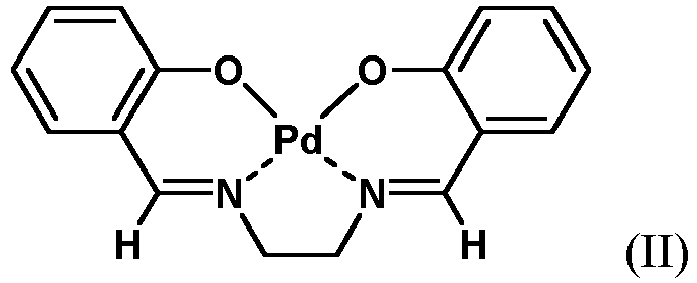
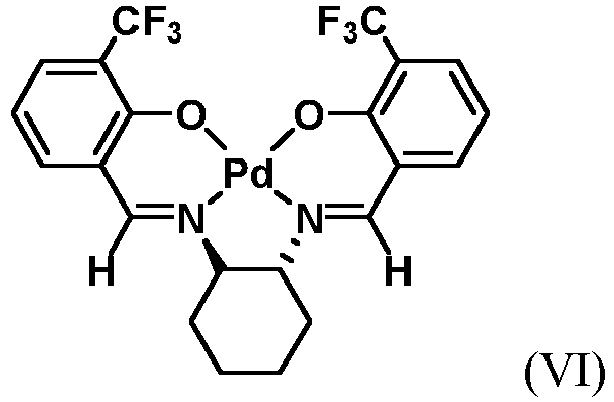
- the palladium metal complex in a) is selected from the palladium metal complex as shown in structure (II), (III), (IV), (V), (VI), or (VIII);
- the palladium metal precursor is selected from, but not limited to palladium chloride (PdCl 2 ), palladium bromide (PdBr 2 ), palladium trifluoroacetate (Pd(TFA) 2 ), or palladium acetate (Pd(OAc) 2 ), preferably palladium acetate.
- PdCl 2 palladium chloride
- PdBr 2 palladium bromide
- Pd(TFA) 2 palladium trifluoroacetate
- Pd(OAc) 2 palladium acetate
- the organophosphorus compound in b) is selected from diphosphine group with a general formula PR 7 3 CH 2 CH 2 PR 7 3 , wherein R 7 is selected from alkyl group, phenyl group, or cycloalkyl group.
- the organophosphorus compound in diphosphine group is selected from bis(dicyclohexylphosphino)ethane, (S,S',R,R')-TangPhos, (R,R)-(-)-2,3-bis(tert-butylmethylphosphino)quinoxaline, (1R,1'R,2S,2'S)-DuanPhos, and (-)-1,2-bis [(2R,SR)-2,5-dimethylphospholano]benzene, preferably bis(dicyclohexylphosphino)ethane.
- the base in c) is selected from sodium tert-butoxide, sodium isopropoxide, sodium 2,6-dimethylphenolate, sodium 2,6-difluorophenolate, sodium 2-methylphenolate, or sodium 2-fluorophenolate, preferable is sodium tert-butoxide or sodium 2-fluorophenolate, most preferable is sodium tert-butoxide.
- the reducing agent in d) is selected from zinc, L-ascorbic acid, or sodium citrate, preferably zinc and sodium citrate, most preferably zinc.
- said catalyst further comprises additive selected from phosphorus compound with a general formula PR 3 8 wherein R 8 is selected from alkoxy group, cycloalkyl group, aryl group, or alkoxy aryl group.
- the additive is selected from, but not limited to triphenylphosphine, tricyclohexylphosphine, tris(2-methoxyphenyl)phosphine, tris(4-methoxyphenyl)phosphine, tris(2,6-dimethoxyphenyl)phosphine), tristearyl phosphite, triphenyl phosphite, tris(2,4-di-tert-butylphenyl) phosphite, tri-p-tolyl phosphite, or the mixture thereof, preferably triphenylphosphine or tristearyl phosphite.
- the mole ratio of the catalyst composition comprising:
- this invention relates to the producing process of the unsaturated carboxylic acid salt and its derivatives from carbon dioxide and olefin comprises:
- the producing process of the unsaturated carboxylic acid salt and its derivatives from carbon dioxide and olefin comprises:
- olefin is selected from, but not limited to ethylene, 1,3-butadiene, or 1-hexene.
- the organic solvent may be selected from, but not limited to tetrahydrofuran, anisole, N-cyclohexyl-2-pyrrolidone, phenyl butyl ether, dibutyl glycol ether, dibutyl ether, N,N-dimethylacetamide, N,N-dimethylformamide, N,N-dibutylformamide, or the mixture thereof.
- the producing process of the unsaturated carboxylic acid salt and its derivatives according to this invention further comprises the step of drying if needed.
- Said step is selected from, but not limited to stirring evaporation, vacuum drying, etc.
- the producing process of the unsaturated carboxylic acid salt and its derivatives according to this invention may be operated in the reactor, but not limited to fixed-bed reactor, batch reactor or continuous reactor.
- the complex compounds (II) to (VII) were tested for their catalytic performance in the production of unsaturated carboxylic acid salt and its derivatives for the reaction of carbon dioxide and olefins, wherein dichloro(1 ,5 - cyclooctadiene)palladium(II) (COD)PdCl 2 ) (Sigma Aldrich) is used as the reference catalyst (REF CAT).
- the palladium complex compound (0.1 mmol), ligand (0.11 mmol), base (30 mmol), reducing agent (1 - 10 mmol), and solvent (30 mL) were added into reactor. Then, olefins (10 bars) and carbon dioxide (20 - 40 bars) were condensed into reactor. Then, reactor was heated at the temperature of 100 - 180 °C for 20 - 25 hours. Then, the temperature was reduced to the room temperature. The obtained mixture was subjected to removal of olefins and carbon dioxide under vacuum.
- the obtained mixture was used to identify product by NMR spectroscopy, wherein the turn over number (TON) was calculated by the following equation:
- the turn over number TON mole of obtained product / mole of catalyst wherein sodium 3-(trimethylsilyl)-2,2,3,3-d4-propionate is used as the internal standard calculated from H 2 O suppression by NMR spectroscopy.
- Table 1 Catalytic efficiency of 1,3-butadiene and carbon dioxide catalysts of the catalyst compositions according to this invention
- Catalyst compositions Catalyst Phosphorous compound Base Reducing agent Additive Solvent TON a (COD)PdCl 2 dcpe Sodium 2-fluorophenolate Zinc - Tetrahydrofuran 4 (COD)PdCl 2 dcpe Sodium tert-butoxide Zinc - Tetrahydrofuran 21 III dcpe Sodium 2-fluorophenolate Zinc - Tetrahydrofuran 2 III dcpe Sodium tert-butoxide Zinc Triphenylphosphine N-cyclohexyl-2-pyrrolidone 32 III dcpe Sodium tert-butoxide Trisodium cit
- Table 2 Catalytic efficiency of ethylene and carbon dioxide of the catalyst compositions according to this invention
- Catalyst compositions Catalyst Phosphorous compound Base Reducing agent Additive Solvent TON a III dcpe Sodium tert-butoxide Zinc tris(2-methoxyphenyl)phosphine N-cyclohexyl-2-pyrrolidone 16 III dcpe Sodium tert-butoxide Zinc tri-p-tolyl phosphite N-cyclohexyl-2-pyrrolidone 14 III dcpe Sodium tert-butoxide Zinc tris(2,4-di-tert-butylphenyl) phosphite N-cyclohexyl-2-pyrrolidone 11 III dcpe Sodium tert-butoxide Zinc Triphenylphosphine N-cyclohexyl-2-pyrrolidone 24 III dcpe Sodium tert-
- Table 1 shows the catalytic efficiency of 1,3-butadiene and carbon dioxide of the catalyst compositions according to this invention. It was found that the palladium catalyst II, III, IV, or V had higher turn over number (TON) than the reference catalyst (REF CAT), which showed that the catalyst compositions according to the invention has high catalytic efficiency in the production process of unsaturated carboxylic acid salt and its derivatives from carbon dioxide and olefins.
- Table 2 shows the catalytic efficiency of ethylene and carbon dioxide. Samples in the table aimed to show the application of the catalyst compositions according to the invention, but not intended to limit the scope of the invention by the sample being shown. From the table, the catalyst compositions according to the invention had high turn over number (TON) for catalyzing the production process of the unsaturated carboxylic acid salt and its derivatives from carbon dioxide and ethylene especially when additives were added into the catalyst compositions.
- TON turn over number
- the catalyst compositions according to the invention has high efficiency in catalyzing the producing process of an unsaturated carboxylic acid salt and its derivatives from carbon dioxide and olefin as aimed in the objective of the invention.
Landscapes
- Chemical & Material Sciences (AREA)
- Organic Chemistry (AREA)
- Chemical Kinetics & Catalysis (AREA)
- Engineering & Computer Science (AREA)
- Inorganic Chemistry (AREA)
- Materials Engineering (AREA)
- Oil, Petroleum & Natural Gas (AREA)
- Organic Low-Molecular-Weight Compounds And Preparation Thereof (AREA)
- Catalysts (AREA)
- Pyrane Compounds (AREA)
- Low-Molecular Organic Synthesis Reactions Using Catalysts (AREA)
Description
- The present disclosure relates to a catalyst composition for a producing process of the unsaturated carboxylic acid salt and its derivatives from carbon dioxide and olefin.
- Carbon dioxide gas is one of the greenhouse gases which is the main factor of global warming causing an environmental problem affected largely to human. Carbon dioxide in atmosphere generated from both natural and human. From the analysis results of Carbon Dioxide Information Analysis Center, about 9.17 thousands million tons of carbon dioxide by mass of carbon was released into atmosphere in 2010 generated from petroleum energy and cement production. It was 4.9 % higher than in 2009. This tremendous amount of carbon dioxide affects the global surface temperature at least 2 times higher than other gases together.
- It is well known that carbon dioxide is one of the important natural resources because carbon dioxide can be used as raw material in production process of fuel and chemicals. Said used carbon dioxide is renewable resource. However, the main problem of the usage of carbon dioxide is its inert property toward chemical reactions so that it is required a high reactivity substance or catalyst in order to transform carbon dioxide into desired products.
- Carbon dioxide has been used as precursor in the production process of desired chemicals such as the precursor in the production of the unsaturated carboxylic acid salt, especially the acrylic acid salt and its derivatives, which further used as precursor in the synthesis of acrylate polymer. Said acrylate polymer can be applied to many applications.
- Normally, the unsaturated carboxylic acid salt and its derivatives can be produced from carboxylation of carbon dioxide and small molecule olefins. The products obtained from this process are cheap and can be produced in large amount in petrochemical industry. Although carbon dioxide is one of the optional for a preparation of sodium acrylate and its derivatives in order to produce acrylate polymer for a long time, the usage of olefins in this process has been used for less than 10 years.
-
WO 2017/158469 A1 discloses a method for producing an α,β-unsaturated carboxylic acid including reacting an alkene and carbon dioxide with a catalytic composition comprising a metal containing carboxylation catalyst comprising at least one transition metal, preferably nickel (Ni) or palladium (Pd), and a coordinating ligand having at least two or more coordination atoms selected from nitrogen (N), oxygen (O), sulfur (S), and a carbene that can coordinate with the metal in the carboxylation catalyst. However, this catalyst is unstable and highly air-sensitive due to its electron-rich nature, which is not suitable for large scale or industrial use. -
WO 2017/178282 A1 discloses a catalytic process for preparing an α,β-ethylenically unsaturated carboxylic acid salt. The catalyst comprises Ni(0) and Pd(0) in the form of Ni(COD)2 and Pd(PPh3)4 mixed with other salts and neutral bidentate P, X ligands, wherein X is selected from P, N, O, or carbene in amide or a urea as a solvent. This catalyst is highly air-sensitive and requires its handling under an inert atmosphere using gloveboxes or Schlenk techniques. - Chemistry - A European Journal (2012) discloses the production of sodium acrylate from carbon dioxide and ethylene by catalyzed reaction of bis(cyclooctadiene)nickel, Ni(COD)2), and strong base via deprotonation of nickelalactone to produce π-complex of stable acrylate salt with TON at 10.2.
-
WO2013098772 andUS20130172616 disclose the synthesis of sodium acrylate from the reactions of transition metal-alkene complex and carbon dioxide, followed by the reaction with base and alkene, wherein the catalyst composition comprises bis(cyclooctadiene)nickel, Ni(COD)2), reducing agent, ligand in phosphorous group, and carbine, base, and solvent. The TON obtained was 10. - Chemistry - A European Journal (2014) and patent document
WO2015173276 disclose the use of bis(cyclooctadiene)nickel in the synthesis of the unsaturated carboxylic acid salt from ethylene or butadiene by varying the precursors. It was found that base and solvent played important roles in yield production. Sodium 2-fluorophenolate was the best base (TON less than 116) but it is necessary to use (R,R)-(+)-1,2-Bis(di-t-butylmethylphosphino)benzene as the ligand for this reactions. - Chemical Communications (2015) discloses the reaction of carbon dioxide and alkene using dichloro(1 ,5 - cyclooctadiene)palladium(II), (COD)PdCl2) as the catalyst in the synthesis of sodium acrylate and its derivatives (TON less than 29) using Zn(0) as the reducing agent to transform Pd(II) to Pd(0) in catalytic cycle with bis(dicyclohexylphosphino)ethane.
- European Journal of Organic Chemistry (2015) and patent socument
WO2015173277 disclose the catalyst compositions comprising tetrakis(triphenylphosphine)palladium(0) and bis(dicyclohexylphosphino)ethane as the main compositions. It was found that the said catalytic system yield sodium acrylate at TON of 106. - ChemCatChem (2017) discloses the synthesis of sodium acrylate in high boiling point solvent such as N-cyclohexylpyrrolidone, while increasing the pressure of carbon dioxide. It was found that the efficiency of the preparation of sodium acrylate is increase at TON of 514.
-
WO2015173295 discloses the synthesis of sodium acrylate using transition metal complex fixed on solid support such as silica or crosslinked polystyrene including base and solvent at different temperatures, times, and pressures of ethylene and carbon dioxide as co-components. -
WO2015173296 discloses the synthesis of sodium acrylate using base fixed on solid support such as silica or crosslinked polystyrene with bis(cyclooctadiene)nickel (Ni(COD)2), bis(dicyclohexylphosphino)ethane, base, and solvent at different temperatures, times, and pressures of ethylene and carbon dioxide as co-components. TON was found to be 1.1. - Patent document
WO2015173307A1 discloses the synthesis of sodium acrylate using tertiary amines and phosphazene as bases, and bis(cyclooctadiene)nickel (Ni(COD)2), bis(dicyclohexylphosphino)ethane, and tetrahydrofuran (THF) as solvents at different temperatures, times, and pressures of ethylene and carbon dioxide as co-components. TON was found to be 18.8. -
US20160229782 disclose the synthesis of acrylic acid and its derivatives using treated solid oxide for acrylate elimination from nickelalactone at different temperatures, times, and pressures as co-components. TON was found to be 1.81. - However, the catalyst for the production process of the unsaturated carboxylic acid salt and its derivatives from carbon dioxide and olefin disclosed so far is limited to the palladium complex and ligands in group of cyclooctadiene or triphenylphosphine only. These substances have not been improved in their structures in order to increase their catalytic abilities. Moreover, palladium compounds and triphenylphosphine ligand are expensive, air sensitive, and needed to be kept at low temperature (bis(cyclooctadiene)nickel (Ni(COD)2) = 2-8 °C and tetrakis(triphenylphosphine)palladium(0 ), Pd(PPh3)4) = -2 0 ° C), causing limits in the application at normal condition. Moreover, palladium compounds and ligands in a group of triphenylphosphine or cyclooctadiene ligand such as dichloro(1,5-cyclooctadiene)palladium(II), (COD)PdCl2), and tetrakis(triphenylphosphine)palladium (Pd(PPh3)4) are very expensive, causing limits in the large applications in industrial scale.
- From all above reasons, the present invention aims to prepare the catalyst composition for a producing process of the unsaturated carboxylic acid salt and its derivatives having working stability under normal condition, low air sensitive, cheap, and high efficiency.
- This invention relates to a catalyst composition for a producing process of the unsaturated carboxylic acid salt and its derivatives from carbon dioxide and olefin, wherein this catalyst composition can catalyze carboxylation effectively, wherein said catalyst composition comprises:
- a) a palladium metal complex as shown in structure (I);

- R1, R2, R3, and R4 independently represents a group selected from hydrogen atom, chlorine atom, tert-butyl group, methoxy group, trifluoromethyl group, or diethylamine group;
- R5 represents a group selected from ethylene, 1,2-phenylene, binaphthyl, or 1,2-cyclohexyl;
- b) a ligand selected from organophosphorus compound selected from diphosphine group with a general formula PR7 3CH2CH2PR7 3, wherein R7 is selected from alkyl group, phenyl group, or cycloalkyl group;
- c) a base selected from sodium tert-butoxide, sodium isopropoxide, sodium 2,6-dimethylphenolate, sodium 2,6-difluorophenolate, sodium 2-methylphenolate, or sodium 2-fluorophenolate); and
- d) a reducing agent selected from zinc, L-ascorbic acid, or sodium citrate.
- The present invention relates to the catalyst composition for a producing process of the unsaturated carboxylic acid salt and its derivatives from carbon dioxide and olefin, wherein the catalyst composition according to this invention is efficiently catalyze the production process of unsaturated carboxylic acid salt and its derivatives. Moreover, the catalyst composition according to the invention is easily synthesized from cheap precursors, stable to air and humid, wherein the catalyst composition according to the invention will be described according to the following description of the invention.
- Any aspect showed herein is meant to include its application to other aspects of this invention unless stated otherwise.
- Technical terms or scientific terms used herein have definitions as by an ordinary person skilled in the art unless stated otherwise.
- Any tools, equipment, methods, or chemicals named here mean tools, equipment, methods, or chemicals being used commonly by an ordinary person skilled in the art unless stated otherwise that they are tools, equipment, methods, or chemicals specific only in this invention.
- Use of singular noun or singular pronoun with "comprising" in claims or specification means "one" and including "one or more", "at least one", and "one or more than one".
- All compositions and/or methods disclosed and claims in this application aim to cover embodiments from any action, performance, modification, or adjustment, as long as they are within the scope of the invention as defined in the appended claims. Therefore, substitutable or similar object to the present embodiment, including any little modification or adjustment that clearly seen by an ordinary person skilled in the art is covered, as long as within the scope of the invention as defined in the appended claims.
- Throughout this application, term "about" means any number that appeared or showed here that could be varied or deviated from any error of equipment, method, or personal using said equipment or method.
- Hereafter, invention embodiments are shown without any purpose to limit any scope of the invention.
- This invention relates to the catalyst composition for a producing process of the unsaturated carboxylic acid salt and its derivatives from carbon dioxide and olefin, wherein the said catalyst composition comprises:
- a) a palladium metal complex as shown in structure (I);

- R1, R2, R3, and R4 independently represents a group selected from hydrogen atom, chlorine atom, tert-butyl group, methoxy group, trifluoromethyl group, or diethylamine group;
- R5 represents a group selected from ethylene, 1,2-phenylene, binaphthyl, or 1,2-cyclohexyl;
- b) a ligand selected from organophosphorus compound selected from diphosphine group with a general formula PR7 3CH2CH2PR7 3, wherein R7 is selected from alkyl group, phenyl group, or cycloalkyl group;
- c) a base selected from sodium tert-butoxide, sodium isopropoxide, sodium 2,6-dimethylphenolate, sodium 2,6-difluorophenolate, sodium 2-methylphenolate, or sodium 2-fluorophenolate); and
- d) a reducing agent, selected from zinc, L-ascorbic acid, or sodium citrate.
- In one embodiment, the palladium metal complex in a) is represented by the structure (I) wherein R1, R2, R3, and R4 independently represents a group selected from hydrogen atom, chlorine atom, tert-butyl group, methoxy group, trifluoromethyl group, or diethylamine group.
- In one embodiment, the palladium metal complex in a) is represented by the structure (I) wherein R5 represents a group selected from to ethylene, 1,2-phenylene, binaphthyl, or 1,2-cyclohexyl.
- In one embodiment, the palladium metal complex in a) is selected from the palladium metal complex as shown in structure (II), (III), (IV), (V), (VI), or (VIII);


- In one embodiment, the palladium metal precursor is selected from, but not limited to palladium chloride (PdCl2), palladium bromide (PdBr2), palladium trifluoroacetate (Pd(TFA)2), or palladium acetate (Pd(OAc)2), preferably palladium acetate.
- In one embodiment, the organophosphorus compound in b) is selected from diphosphine group with a general formula PR7 3CH2CH2PR7 3, wherein R7 is selected from alkyl group, phenyl group, or cycloalkyl group.
- In one embodiment, the organophosphorus compound in diphosphine group is selected from bis(dicyclohexylphosphino)ethane, (S,S',R,R')-TangPhos, (R,R)-(-)-2,3-bis(tert-butylmethylphosphino)quinoxaline, (1R,1'R,2S,2'S)-DuanPhos, and (-)-1,2-bis [(2R,SR)-2,5-dimethylphospholano]benzene, preferably bis(dicyclohexylphosphino)ethane.
- In one embodiment, the base in c) is selected from sodium tert-butoxide, sodium isopropoxide, sodium 2,6-dimethylphenolate, sodium 2,6-difluorophenolate, sodium 2-methylphenolate, or sodium 2-fluorophenolate, preferable is sodium tert-butoxide or sodium 2-fluorophenolate, most preferable is sodium tert-butoxide.
- In one embodiment, the reducing agent in d) is selected from zinc, L-ascorbic acid, or sodium citrate, preferably zinc and sodium citrate, most preferably zinc.
- In one embodiment, said catalyst further comprises additive selected from phosphorus compound with a general formula

- In one embodiment, the additive is selected from, but not limited to triphenylphosphine, tricyclohexylphosphine, tris(2-methoxyphenyl)phosphine, tris(4-methoxyphenyl)phosphine, tris(2,6-dimethoxyphenyl)phosphine), tristearyl phosphite, triphenyl phosphite, tris(2,4-di-tert-butylphenyl) phosphite, tri-p-tolyl phosphite, or the mixture thereof, preferably triphenylphosphine or tristearyl phosphite.
- In one embodiment, the mole ratio of the catalyst composition comprising:
- a) 1 part of the palladium metal complex;
- b) from 0.5 to 2 parts of ligand;
- c) from 50 to 400 parts of base; and
- d) from 50 to 500 parts of reducing agent.
- In one embodiment, this invention relates to the producing process of the unsaturated carboxylic acid salt and its derivatives from carbon dioxide and olefin comprises:
- a) adding of the catalyst composition according to any one of claims 1 to 16 in the solvent into the reactor; and
- b) condensing olefin and carbon dioxide with mixture obtained from step a) in the reactor;
then, rising the temperature from 100 to 180 °C, and heated for 10 - 25 hours, wherein the mole ratio of olefin to carbon dioxide is from 1 to 2 to 1 to 4. - Preferably, the producing process of the unsaturated carboxylic acid salt and its derivatives from carbon dioxide and olefin comprises:
- a) adding of the catalyst composition according to any one of claims 1 to 16 in the solvent into the reactor; and
- b) condensing olefin and carbon dioxide with mixture obtained from step a) in the reactor. Then, rising the temperature from 130 to 150 °C and heated for 50 - 25 hours, wherein the mole ratio of olefin to carbon dioxide is from 1 to 4.
- In one embodiment, olefin is selected from, but not limited to ethylene, 1,3-butadiene, or 1-hexene.
- In each step of the producing process of the unsaturated carboxylic acid salt and its derivatives according to the invention, unless being stated otherwise, the organic solvent may be selected from, but not limited to tetrahydrofuran, anisole, N-cyclohexyl-2-pyrrolidone, phenyl butyl ether, dibutyl glycol ether, dibutyl ether, N,N-dimethylacetamide, N,N-dimethylformamide, N,N-dibutylformamide, or the mixture thereof.
- The producing process of the unsaturated carboxylic acid salt and its derivatives according to this invention further comprises the step of drying if needed. Said step is selected from, but not limited to stirring evaporation, vacuum drying, etc.
- In one embodiment, the producing process of the unsaturated carboxylic acid salt and its derivatives according to this invention may be operated in the reactor, but not limited to fixed-bed reactor, batch reactor or continuous reactor.
- The following examples are for demonstrating of the embodiments of this invention only, not for limitation of the scope of this invention in any way.
-

- Palladium acetate (0.89 mmol) was dissolved in hot methanol solvent. Then, N,N'-bis(salicylidene)ethylenediamine (0.89 mmol) in acetone solvent was added and stirred overnight. The obtained suspension was filtered and washed with acetone solvent. The dried yellow powder complex compound was obtained.
-

- Palladium acetate (0.89 mmol) was dissolved in hot methanol solvent. Then, (S,S)-(+)-N,N'-bis(salicylidene)-1 ,2-cyclohexanediamine (0.89 mmol) in acetone solvent was added and stirred overnight. The obtained suspension was filtered and washed with acetone solvent. The dried green powder complex compound was obtained.
-

- Palladium acetate (1.34 mmol) was dissolved in hot methanol solvent. Then, (S,S)-(+)-N,N'-bis(5-methoxylsalicylidene)-1,2-cyclohexanediamine (1.34 mmol) in acetone solvent was added and stirred overnight. The obtained suspension was filtered and washed with acetone solvent. The dried green powder complex compound was obtained.
-

- Palladium acetate (1.34 mmol) was dissolved in hot methanol solvent. Then, (S,S)-(+)-N,N'-bis(3,5-dichlorosalicylidene)-1,2-cyclohexanedi-amine (1.34 mmol) in acetone solvent was added and stirred overnight. The obtained suspension was filtered and washed with acetone solvent. The dried green powder complex compound was obtained.
-

- Palladium acetate (1.34 mmol) was dissolved in hot methanol solvent. Then, (S,S)-(+)-N,N'-bis(3 - trifluoromethylsalicylidene)-1 ,2 - cyclohexanediamine (1.34 mmol) in acetone solvent was added and stirred overnight. The obtained suspension was filtered and washed with acetone solvent. The dried green powder complex compound was obtained.
-

- Palladium acetate (0.65 mmol) was dissolved in hot methanol solvent. Then, (S,S)-(+)-N,N'-bis(4-diethylaminosalicylidene)-1,2-cyclohexanedi-amine (1.34 mmol) in acetone solvent was added and stirred overnight. The obtained suspension was filtered and washed with acetone solvent. The dried green powder complex compound was obtained.
- The complex compounds (II) to (VII) were tested for their catalytic performance in the production of unsaturated carboxylic acid salt and its derivatives for the reaction of carbon dioxide and olefins, wherein dichloro(1 ,5 - cyclooctadiene)palladium(II) (COD)PdCl2) (Sigma Aldrich) is used as the reference catalyst (REF CAT).
- The palladium complex compound (0.1 mmol), ligand (0.11 mmol), base (30 mmol), reducing agent (1 - 10 mmol), and solvent (30 mL) were added into reactor. Then, olefins (10 bars) and carbon dioxide (20 - 40 bars) were condensed into reactor. Then, reactor was heated at the temperature of 100 - 180 °C for 20 - 25 hours. Then, the temperature was reduced to the room temperature. The obtained mixture was subjected to removal of olefins and carbon dioxide under vacuum. The obtained mixture was used to identify product by NMR spectroscopy, wherein the turn over number (TON) was calculated by the following equation:

wherein sodium 3-(trimethylsilyl)-2,2,3,3-d4-propionate is used as the internal standard calculated from H2O suppression by NMR spectroscopy. - The following is the testing examples for properties of palladium catalysts produced according to this invention. The methods and instruments used for testing of properties are methods and instruments being used generally and not intended to limit the scope of the invention.
Table 1: Catalytic efficiency of 1,3-butadiene and carbon dioxide catalysts of the catalyst compositions according to this invention Catalyst compositions Catalyst Phosphorous compound Base Reducing agent Additive Solvent TON a (COD)PdCl2 dcpe Sodium 2-fluorophenolate Zinc - Tetrahydrofuran 4 (COD)PdCl2 dcpe Sodium tert-butoxide Zinc - Tetrahydrofuran 21 III dcpe Sodium 2-fluorophenolate Zinc - Tetrahydrofuran 2 III dcpe Sodium tert-butoxide Zinc Triphenylphosphine N-cyclohexyl-2-pyrrolidone 32 III dcpe Sodium tert-butoxide Trisodium citrate Triphenylphosphine N-cyclohexyl-2-pyrrolidone 7 II dcpe Sodium tert-butoxide Zinc - Tetrahydrofuran 34 III dcpe Sodium tert-butoxide Zinc - Tetrahydrofuran 35 IV dcpe Sodium tert-butoxide Zinc - Tetrahydrofuran 29 V dcpe Sodium tert-butoxide Zinc - Tetrahydrofuran 35 VI dcpe Sodium tert-butoxide Zinc - Tetrahydrofuran 18 VII dcpe Sodium tert-butoxide Zinc - Tetrahy drofuran 20 a The turn over number (TON) was recorded as (mole of product) / (mole of palladium catalyst), wherein sodium 3-(trimethylsilyl)-2,2,3,3-d4-propionate is used as the internal standard calculated from H2O suppression by NMR spectroscopy;
- (COD)PdCl2 was the reference catalyst (REF CAT); and
- dcpe represented bis(dicyclohexylphosphino)ethane).Table 2: Catalytic efficiency of ethylene and carbon dioxide of the catalyst compositions according to this invention Catalyst compositions Catalyst Phosphorous compound Base Reducing agent Additive Solvent TON a III dcpe Sodium tert-butoxide Zinc tris(2-methoxyphenyl)phosphine N-cyclohexyl-2-pyrrolidone 16 III dcpe Sodium tert-butoxide Zinc tri-p-tolyl phosphite N-cyclohexyl-2-pyrrolidone 14 III dcpe Sodium tert-butoxide Zinc tris(2,4-di-tert-butylphenyl) phosphite N-cyclohexyl-2-pyrrolidone 11 III dcpe Sodium tert-butoxide Zinc Triphenylphosphine N-cyclohexyl-2-pyrrolidone 24 III dcpe Sodium tert-butoxide Trisodium citrate Triphenylphosphine N-cyclohexyl-2-pyrrolidone 23 III dcpe Sodium tert-butoxide L-ascorbic acid Triphenylphosphine N-cyclohexyl-2-pyrrolidone 22 III dcpe Sodium tert-butoxide Trisodium citrate tristearyl phosphite N-cyclohexyl-2-pyrrolidone 29 III dcpe Sodium tert-butoxide Trisodium citrate tri-p-tolyl phosphite N-cyclohexyl-2-pyrrolidone 16 II dcpe Sodium 2-fluorophenolate Zinc - N-cyclohexyl-2-pyrrolidone 14 III dcpe Sodium 2-fluorophenolate Zinc - N-cyclohexyl-2-pyrrolidone 16 IV dcpe Sodium 2-fluorophenolate Zinc - N-cyclohexyl-2-pyrrolidone 20 V dcpe Sodium 2-fluorophenolate Zinc - N-cyclohexyl-2-pyrrolidone 21 II dcpe Sodium 2-fluorophenolate Zinc Triphenylphosphine N-cyclohexyl-2-pyrrolidone 21 III dcpe Sodium 2-fluorophenolate Zinc Triphenylphosphine N-cyclohexyl-2-pyrrolidone 19 IV dcpe Sodium 2-fluorophenolate Zinc Triphenylphosphine N-cyclohexyl-2-pyrrolidone 23 V dcpe Sodium 2-fluorophenolate Zinc Triphenylphosphine N-cyclohexyl-2-pyrrolidone 23 a The turn over number (TON) was recorded as (mole of product) / (mole of palladium catalyst), wherein sodium 3-(trimethylsilyl)-2,2,3,3-d4-propionate is used as the internal standard calculated from H2O suppression by NMR spectroscopy;
- (COD)PdCl2 was the reference catalyst (REF CAT); and
- dcpe represented bis(dicyclohexylphosphino)ethane). - Table 1 shows the catalytic efficiency of 1,3-butadiene and carbon dioxide of the catalyst compositions according to this invention. It was found that the palladium catalyst II, III, IV, or V had higher turn over number (TON) than the reference catalyst (REF CAT), which showed that the catalyst compositions according to the invention has high catalytic efficiency in the production process of unsaturated carboxylic acid salt and its derivatives from carbon dioxide and olefins.
- Table 2 shows the catalytic efficiency of ethylene and carbon dioxide. Samples in the table aimed to show the application of the catalyst compositions according to the invention, but not intended to limit the scope of the invention by the sample being shown. From the table, the catalyst compositions according to the invention had high turn over number (TON) for catalyzing the production process of the unsaturated carboxylic acid salt and its derivatives from carbon dioxide and ethylene especially when additives were added into the catalyst compositions.
- From all above results, it can be said that the catalyst compositions according to the invention has high efficiency in catalyzing the producing process of an unsaturated carboxylic acid salt and its derivatives from carbon dioxide and olefin as aimed in the objective of the invention.
Claims (11)
- A catalyst composition for a producing process of an unsaturated carboxylic acid salt and its derivatives from carbon dioxide and olefin, wherein said catalyst composition comprises:a) a palladium metal complex as shown in structure (I);
 R1, R2, R3, and R4 independently represents a group selected from hydrogen atom, chlorine atom, tert-butyl group, methoxy group, trifluoromethyl group, or diethylamine group; andR5 represents a group selected from ethylene, 1,2-phenylene, binaphthyl, or 1,2-cyclohexyl;b) a ligand selected from organophosphorus compound selected from diphosphine group with a general formula PR7 3CH2CH2PR7 3, wherein R7 is selected from alkyl group, phenyl group, or cycloalkyl group;c) a base selected from sodium tert-butoxide, sodium isopropoxide, sodium 2,6-dimethylphenolate, sodium 2,6-difluorophenolate, sodium 2-methylphenolate, or sodium 2-fluorophenolate); andd) a reducing agent selected from zinc, L-ascorbic acid, or sodium citrate.
 - The catalyst composition according to claim 1, wherein the palladium metal complex in a) is selected from the palladium metal complex as shown in structure (II), (III), (IV), (V), (VI), or (VII);



- The catalyst composition according to claim 1, wherein the organophosphorus compound in diphosphine group is selected from bis(dicyclohexylphosphino)ethane, (S,S',R,R')-TangPhos, (R,R)-(-)-2,3-bis(tert-butylmethylphosphino)quinoxaline, (1R,1'R,2S,2'S)-DuanPhos, and (-)-1,2-bis[(2R,5R)-2,5-dimethylphospholano]benzene.
- The catalyst composition according to claim 1, wherein the base in c) is sodium tert-butoxide or sodium 2-fluorophenolate.
- The catalyst composition according to claim 1, wherein said catalyst further comprises an additive selected from phosphorus compound with a general formula

- The catalyst composition according to claim 5, wherein the additive is selected from triphenylphosphine, tricyclohexylphosphine, tris(2-methoxyphenyl)phosphine, tris(4-methoxyphenyl)phosphine, tris(2,6-dimethoxyphenyl)phosphine), tristearyl phosphite, triphenyl phosphite, tris(2,4-di-tert-butylphenyl) phosphite, tri-p-tolyl phosphite, or the mixture thereof.
- The catalyst composition according to claim 1, wherein the mole ratio of the catalyst composition comprising:a) 1 part of the palladium metal complex;b) from 0.5 to 2 parts of ligand;c) from 50 to 400 parts of base; andd) from 50 to 500 parts of reducing agent.
- The catalyst composition according to claim 7, wherein said catalyst composition further comprises 0 to 8 parts of additive.
- A producing process of an unsaturated carboxylic acid salt and its derivatives from carbon dioxide and olefin, wherein said process comprises:a) adding the catalyst composition according to any one of claims 1 to 8 in the solvent into the reactor; andb) condensing olefin and carbon dioxide with the mixture obtained from step a) in the reactor, then rising the temperature from 100 to 180 °C and heating for 10 - 25 hours.
- The process according to claim 9, wherein the mole ratio of olefin to carbon dioxide is from 1 to 2 to 1 to 4.
- The process according to claim 9, wherein olefin is selected from ethylene, 1,3-butadiene, or 1-hexene, and the solvent in a) is selected from tetrahydrofuran, anisole, N-cyclohexyl-2-pyrrolidone, phenyl butyl ether, dibutyl glycol ether, dibutyl ether, N,N-dimethylacetamide, N,N-dimethylformamide, N,N-dibutylformamide, or the mixture thereof.
Applications Claiming Priority (2)
| Application Number | Priority Date | Filing Date | Title |
|---|---|---|---|
| TH1701007764A TH1701007764A (en) | 2017-12-25 | Catalyst components for the production process of unsaturated carboxylic acid salts and their derivatives from carbon dioxide and olefins. | |
| PCT/TH2018/000053 WO2019132784A1 (en) | 2017-12-25 | 2018-11-23 | A catalyst composition for a producing process of an unsaturated carboxylic acid salt and its derivatives from carbon dioxide and olefin |
Publications (3)
| Publication Number | Publication Date |
|---|---|
| EP3732175A1 EP3732175A1 (en) | 2020-11-04 |
| EP3732175A4 EP3732175A4 (en) | 2021-08-11 |
| EP3732175B1 true EP3732175B1 (en) | 2023-08-16 |
Family
ID=67067945
Family Applications (1)
| Application Number | Title | Priority Date | Filing Date |
|---|---|---|---|
| EP18896172.6A Active EP3732175B1 (en) | 2017-12-25 | 2018-11-23 | A catalyst composition for a producing process of an unsaturated carboxylic acid salt and its derivatives from carbon dioxide and olefin |
Country Status (5)
| Country | Link |
|---|---|
| US (1) | US10934243B2 (en) |
| EP (1) | EP3732175B1 (en) |
| JP (1) | JP7019912B2 (en) |
| CN (1) | CN111587246B (en) |
| WO (1) | WO2019132784A1 (en) |
Families Citing this family (2)
| Publication number | Priority date | Publication date | Assignee | Title |
|---|---|---|---|---|
| CN115403465B (en) * | 2022-05-20 | 2023-08-18 | 湖南工程学院 | A kind of preparation method of carbon dioxide and olefin synthetic organic carboxylate |
| CN118179589A (en) * | 2022-12-14 | 2024-06-14 | 中国石油化工股份有限公司 | A catalyst for synthesizing acrylic acid, and its preparation method and application |
Family Cites Families (19)
| Publication number | Priority date | Publication date | Assignee | Title |
|---|---|---|---|---|
| DE19843012A1 (en) * | 1998-09-21 | 2000-03-23 | Studiengesellschaft Kohle Mbh | (Hetero)aryl-substituted olefin preparation for use e.g. as polymer or drug intermediate, by Heck reaction using inexpensive catalyst system of divalent palladium compound and nitrogen-containing additive |
| CN101516824A (en) * | 2006-08-08 | 2009-08-26 | 先正达参股股份有限公司 | Process for the production of aromatic amines in the presence of a palladium complex comprising a ferrocenyl biphosphine ligand |
| IN2014CN04656A (en) | 2011-12-29 | 2015-09-18 | Basf Se | |
| US8697909B2 (en) * | 2011-12-29 | 2014-04-15 | Basf Se | Preparation of α,β-ethylenically unsaturated carboxylic salts by catalytic carboxylation of alkenes |
| CN102580775A (en) | 2011-12-30 | 2012-07-18 | 河北工业大学 | Schiff base complex catalyst for synthesizing diphenyl carbonate through oxidative carbonylation of phenol |
| EP2781503A1 (en) * | 2013-03-18 | 2014-09-24 | Bayer MaterialScience AG | Oxidative carbonylation of monohydroxy aryl compounds by methyl formate |
| CN103254408B (en) * | 2013-05-07 | 2015-03-04 | 吉林大学 | Self-immobilized porous organic polymer material, preparation method and application thereof |
| CN104415791B (en) | 2013-08-30 | 2018-06-19 | 中国石油化工股份有限公司 | A kind of preparation method of the molybdenum base metal complex catalysts of acrylic acid synthesizing |
| DE102014203951A1 (en) * | 2014-03-05 | 2015-09-10 | Evonik Degussa Gmbh | Synthesis of alpha, beta-unsaturated carboxylic acids (meth) acrylates from olefins |
| WO2015173296A1 (en) | 2014-05-16 | 2015-11-19 | Basf Se | Preparing an unsaturated carboxylic acid salt from an alkene and carbon dioxide using a heterogeneous base |
| US9758461B2 (en) * | 2014-05-16 | 2017-09-12 | Basf Se | Process for preparing an unsaturated carboxylic acid salt using an aryloxide |
| US10011551B2 (en) | 2014-05-16 | 2018-07-03 | Basf Se | Process for preparing an unsaturated carboxylic acid salt |
| WO2015173307A1 (en) | 2014-05-16 | 2015-11-19 | Basf Se | Preparing an unsaturated carboxylic acid salt from an alkene and carbon dioxide using a heterogeneous alkalinity reservoir |
| WO2015173295A1 (en) | 2014-05-16 | 2015-11-19 | Basf Se | Preparing an unsaturated carboxylic acid salt from an alkene and carbon dioxide using a covalently immobilized transition metal complex |
| US9725393B2 (en) | 2014-10-08 | 2017-08-08 | Chevron Phillips Chemical Company Lp | Methods for the production of α,β-unsaturated carboxylic acids and salts thereof |
| CN105622383B (en) | 2014-10-28 | 2018-03-16 | 中国石油化工股份有限公司 | A kind of synthesis of conjugated carboxylic alkeneacid |
| KR20180008621A (en) | 2015-05-13 | 2018-01-24 | 바스프 에스이 | Preparation of unsaturated carboxylic acid salt |
| WO2017158469A1 (en) * | 2016-03-15 | 2017-09-21 | Sabic Global Technologies B.V. | Methods of making alpha, beta-unsaturated carboxylic acids or salts |
| CN108884010B (en) | 2016-04-11 | 2022-11-08 | 巴斯夫欧洲公司 | Process for preparing unsaturated carboxylic acid salts |
-
2018
- 2018-11-23 CN CN201880078740.3A patent/CN111587246B/en active Active
- 2018-11-23 US US16/768,196 patent/US10934243B2/en active Active
- 2018-11-23 EP EP18896172.6A patent/EP3732175B1/en active Active
- 2018-11-23 WO PCT/TH2018/000053 patent/WO2019132784A1/en not_active Ceased
- 2018-11-23 JP JP2020522817A patent/JP7019912B2/en active Active
Also Published As
| Publication number | Publication date |
|---|---|
| US10934243B2 (en) | 2021-03-02 |
| JP7019912B2 (en) | 2022-02-16 |
| US20200317598A1 (en) | 2020-10-08 |
| EP3732175A1 (en) | 2020-11-04 |
| JP2021504098A (en) | 2021-02-15 |
| EP3732175A4 (en) | 2021-08-11 |
| WO2019132784A1 (en) | 2019-07-04 |
| CN111587246B (en) | 2023-05-26 |
| CN111587246A (en) | 2020-08-25 |
Similar Documents
| Publication | Publication Date | Title |
|---|---|---|
| EP2280017B1 (en) | Catalytic complex for olefin metathesis reactions, process for the preparation thereof and use thereof | |
| Brassat et al. | Synthesis and catalytic activity of allyl, methallyl and methyl complexes of nickel (II) and palladium (II) with biphosphine monoxide ligands: oligomerization of ethylene and copolymerization of ethylene and carbon monoxide | |
| Sun et al. | Synthesis and characterization of novel nickel (II) complexes bearing N, P ligands and their catalytic activity in ethylene oligomerization | |
| Guiu et al. | Iridium‐Catalyzed Enantioselective Hydrogenation of Imines with Xylose Diphosphite and Diphosphinite Ligands | |
| KR100791202B1 (en) | Catalytic System and Carbonylation Method for Carbonylation | |
| KR102280005B1 (en) | Ligand based chromium catalyst and application in catalyzing ethylene oligomerization | |
| EP2955188B1 (en) | Ligand compound, organic chromium compound, catalyst system for ethylene oligomerization, and ethylene oligomerization method using same | |
| CN108525704B (en) | Catalyst for olefin hydroformylation reaction and its preparation method and application | |
| Lee et al. | Polyhedral oligomeric silsesquioxane-conjugated bis (diphenylphosphino) amine ligand for chromium (III) catalyzed ethylene trimerization and tetramerization | |
| JP2021536469A (en) | Mobile hydroformylation for the production of oxygen-containing compounds | |
| EP2062906A1 (en) | Coordination complex system comprising tautomeric ligands | |
| Tyagi et al. | N‐Substituted Iminopyridine Arene–Ruthenium Complexes for the Regioselective Catalytic Hydration of Terminal Alkynes | |
| EP3101039B1 (en) | Ligand compound, organic chrome compound, catalyst system for olefin oligomerization, and method for oligomerizing olefin using same | |
| US10934243B2 (en) | Catalyst composition for a producing process of an unsaturated carboxylic acid salt and its derivatives from carbon dioxide and olefin | |
| KR102181401B1 (en) | Heterogeneous catalyst for hydrogenation reaction and Method for synthesizing thereof | |
| EP3562815B1 (en) | A catalyst composition for a production process of delta-lactone from carbon dioxide and 1,3-butadiene | |
| KR20100092169A (en) | Methods for producing aldehyde using phosphorus-containing catalyst composition | |
| Skarżyńska et al. | Palladium complexes with hydrophosphorane ligands (HP∼ O and HP∼ N), catalysts for Heck cross-coupling reactions | |
| Feuerstein et al. | Dramatic acceleration of the catalytic process of the amination of allyl acetates in the presence of a tetraphosphine/palladium system | |
| CN114656501B (en) | 2,2' -bipyridine skeleton biphosphine ligand, and preparation method and application thereof | |
| CN110092725B (en) | Method for synthesizing chiral amine compound | |
| JP2014528911A (en) | Method for preparing palladium(I) tri-t-butylphosphine bromide dimer and process for its use in isomerization reactions | |
| CN114437135A (en) | Tripleene carbene tridentate platyne complex and application thereof | |
| JP2022530783A (en) | Catalyst for catalytic synthesis of urea | |
| CN1251056A (en) | Prepn. of catalyst |
Legal Events
| Date | Code | Title | Description |
|---|---|---|---|
| STAA | Information on the status of an ep patent application or granted ep patent |
Free format text: STATUS: THE INTERNATIONAL PUBLICATION HAS BEEN MADE |
|
| PUAI | Public reference made under article 153(3) epc to a published international application that has entered the european phase |
Free format text: ORIGINAL CODE: 0009012 |
|
| STAA | Information on the status of an ep patent application or granted ep patent |
Free format text: STATUS: REQUEST FOR EXAMINATION WAS MADE |
|
| 17P | Request for examination filed |
Effective date: 20200429 |
|
| AK | Designated contracting states |
Kind code of ref document: A1 Designated state(s): AL AT BE BG CH CY CZ DE DK EE ES FI FR GB GR HR HU IE IS IT LI LT LU LV MC MK MT NL NO PL PT RO RS SE SI SK SM TR |
|
| AX | Request for extension of the european patent |
Extension state: BA ME |
|
| DAV | Request for validation of the european patent (deleted) | ||
| DAX | Request for extension of the european patent (deleted) | ||
| REG | Reference to a national code |
Ref country code: DE Ref legal event code: R079 Free format text: PREVIOUS MAIN CLASS: C07D0309300000 Ipc: C07C0051150000 Ref document number: 602018055702 Country of ref document: DE |
|
| A4 | Supplementary search report drawn up and despatched |
Effective date: 20210709 |
|
| RIC1 | Information provided on ipc code assigned before grant |
Ipc: C07C 51/15 20060101AFI20210705BHEP Ipc: C07C 57/04 20060101ALI20210705BHEP Ipc: C07C 57/03 20060101ALI20210705BHEP Ipc: C07D 309/32 20060101ALI20210705BHEP |
|
| STAA | Information on the status of an ep patent application or granted ep patent |
Free format text: STATUS: EXAMINATION IS IN PROGRESS |
|
| 17Q | First examination report despatched |
Effective date: 20220516 |
|
| GRAP | Despatch of communication of intention to grant a patent |
Free format text: ORIGINAL CODE: EPIDOSNIGR1 |
|
| STAA | Information on the status of an ep patent application or granted ep patent |
Free format text: STATUS: GRANT OF PATENT IS INTENDED |
|
| INTG | Intention to grant announced |
Effective date: 20230511 |
|
| GRAS | Grant fee paid |
Free format text: ORIGINAL CODE: EPIDOSNIGR3 |
|
| GRAA | (expected) grant |
Free format text: ORIGINAL CODE: 0009210 |
|
| STAA | Information on the status of an ep patent application or granted ep patent |
Free format text: STATUS: THE PATENT HAS BEEN GRANTED |
|
| AK | Designated contracting states |
Kind code of ref document: B1 Designated state(s): AL AT BE BG CH CY CZ DE DK EE ES FI FR GB GR HR HU IE IS IT LI LT LU LV MC MK MT NL NO PL PT RO RS SE SI SK SM TR |
|
| REG | Reference to a national code |
Ref country code: CH Ref legal event code: EP Ref country code: DE Ref legal event code: R096 Ref document number: 602018055702 Country of ref document: DE |
|
| REG | Reference to a national code |
Ref country code: IE Ref legal event code: FG4D |
|
| REG | Reference to a national code |
Ref country code: NL Ref legal event code: FP |
|
| REG | Reference to a national code |
Ref country code: LT Ref legal event code: MG9D |
|
| REG | Reference to a national code |
Ref country code: AT Ref legal event code: MK05 Ref document number: 1599936 Country of ref document: AT Kind code of ref document: T Effective date: 20230816 |
|
| PG25 | Lapsed in a contracting state [announced via postgrant information from national office to epo] |
Ref country code: GR Free format text: LAPSE BECAUSE OF FAILURE TO SUBMIT A TRANSLATION OF THE DESCRIPTION OR TO PAY THE FEE WITHIN THE PRESCRIBED TIME-LIMIT Effective date: 20231117 |
|
| PG25 | Lapsed in a contracting state [announced via postgrant information from national office to epo] |
Ref country code: IS Free format text: LAPSE BECAUSE OF FAILURE TO SUBMIT A TRANSLATION OF THE DESCRIPTION OR TO PAY THE FEE WITHIN THE PRESCRIBED TIME-LIMIT Effective date: 20231216 |
|
| PG25 | Lapsed in a contracting state [announced via postgrant information from national office to epo] |
Ref country code: SE Free format text: LAPSE BECAUSE OF FAILURE TO SUBMIT A TRANSLATION OF THE DESCRIPTION OR TO PAY THE FEE WITHIN THE PRESCRIBED TIME-LIMIT Effective date: 20230816 Ref country code: RS Free format text: LAPSE BECAUSE OF FAILURE TO SUBMIT A TRANSLATION OF THE DESCRIPTION OR TO PAY THE FEE WITHIN THE PRESCRIBED TIME-LIMIT Effective date: 20230816 Ref country code: PT Free format text: LAPSE BECAUSE OF FAILURE TO SUBMIT A TRANSLATION OF THE DESCRIPTION OR TO PAY THE FEE WITHIN THE PRESCRIBED TIME-LIMIT Effective date: 20231218 Ref country code: NO Free format text: LAPSE BECAUSE OF FAILURE TO SUBMIT A TRANSLATION OF THE DESCRIPTION OR TO PAY THE FEE WITHIN THE PRESCRIBED TIME-LIMIT Effective date: 20231116 Ref country code: LV Free format text: LAPSE BECAUSE OF FAILURE TO SUBMIT A TRANSLATION OF THE DESCRIPTION OR TO PAY THE FEE WITHIN THE PRESCRIBED TIME-LIMIT Effective date: 20230816 Ref country code: LT Free format text: LAPSE BECAUSE OF FAILURE TO SUBMIT A TRANSLATION OF THE DESCRIPTION OR TO PAY THE FEE WITHIN THE PRESCRIBED TIME-LIMIT Effective date: 20230816 Ref country code: IS Free format text: LAPSE BECAUSE OF FAILURE TO SUBMIT A TRANSLATION OF THE DESCRIPTION OR TO PAY THE FEE WITHIN THE PRESCRIBED TIME-LIMIT Effective date: 20231216 Ref country code: HR Free format text: LAPSE BECAUSE OF FAILURE TO SUBMIT A TRANSLATION OF THE DESCRIPTION OR TO PAY THE FEE WITHIN THE PRESCRIBED TIME-LIMIT Effective date: 20230816 Ref country code: GR Free format text: LAPSE BECAUSE OF FAILURE TO SUBMIT A TRANSLATION OF THE DESCRIPTION OR TO PAY THE FEE WITHIN THE PRESCRIBED TIME-LIMIT Effective date: 20231117 Ref country code: FI Free format text: LAPSE BECAUSE OF FAILURE TO SUBMIT A TRANSLATION OF THE DESCRIPTION OR TO PAY THE FEE WITHIN THE PRESCRIBED TIME-LIMIT Effective date: 20230816 Ref country code: AT Free format text: LAPSE BECAUSE OF FAILURE TO SUBMIT A TRANSLATION OF THE DESCRIPTION OR TO PAY THE FEE WITHIN THE PRESCRIBED TIME-LIMIT Effective date: 20230816 |
|
| PG25 | Lapsed in a contracting state [announced via postgrant information from national office to epo] |
Ref country code: PL Free format text: LAPSE BECAUSE OF FAILURE TO SUBMIT A TRANSLATION OF THE DESCRIPTION OR TO PAY THE FEE WITHIN THE PRESCRIBED TIME-LIMIT Effective date: 20230816 |
|
| PG25 | Lapsed in a contracting state [announced via postgrant information from national office to epo] |
Ref country code: ES Free format text: LAPSE BECAUSE OF FAILURE TO SUBMIT A TRANSLATION OF THE DESCRIPTION OR TO PAY THE FEE WITHIN THE PRESCRIBED TIME-LIMIT Effective date: 20230816 |
|
| PG25 | Lapsed in a contracting state [announced via postgrant information from national office to epo] |
Ref country code: SM Free format text: LAPSE BECAUSE OF FAILURE TO SUBMIT A TRANSLATION OF THE DESCRIPTION OR TO PAY THE FEE WITHIN THE PRESCRIBED TIME-LIMIT Effective date: 20230816 Ref country code: RO Free format text: LAPSE BECAUSE OF FAILURE TO SUBMIT A TRANSLATION OF THE DESCRIPTION OR TO PAY THE FEE WITHIN THE PRESCRIBED TIME-LIMIT Effective date: 20230816 Ref country code: ES Free format text: LAPSE BECAUSE OF FAILURE TO SUBMIT A TRANSLATION OF THE DESCRIPTION OR TO PAY THE FEE WITHIN THE PRESCRIBED TIME-LIMIT Effective date: 20230816 Ref country code: EE Free format text: LAPSE BECAUSE OF FAILURE TO SUBMIT A TRANSLATION OF THE DESCRIPTION OR TO PAY THE FEE WITHIN THE PRESCRIBED TIME-LIMIT Effective date: 20230816 Ref country code: DK Free format text: LAPSE BECAUSE OF FAILURE TO SUBMIT A TRANSLATION OF THE DESCRIPTION OR TO PAY THE FEE WITHIN THE PRESCRIBED TIME-LIMIT Effective date: 20230816 Ref country code: CZ Free format text: LAPSE BECAUSE OF FAILURE TO SUBMIT A TRANSLATION OF THE DESCRIPTION OR TO PAY THE FEE WITHIN THE PRESCRIBED TIME-LIMIT Effective date: 20230816 Ref country code: SK Free format text: LAPSE BECAUSE OF FAILURE TO SUBMIT A TRANSLATION OF THE DESCRIPTION OR TO PAY THE FEE WITHIN THE PRESCRIBED TIME-LIMIT Effective date: 20230816 |
|
| REG | Reference to a national code |
Ref country code: DE Ref legal event code: R097 Ref document number: 602018055702 Country of ref document: DE |
|
| PLBE | No opposition filed within time limit |
Free format text: ORIGINAL CODE: 0009261 |
|
| STAA | Information on the status of an ep patent application or granted ep patent |
Free format text: STATUS: NO OPPOSITION FILED WITHIN TIME LIMIT |
|
| REG | Reference to a national code |
Ref country code: CH Ref legal event code: PL |
|
| PG25 | Lapsed in a contracting state [announced via postgrant information from national office to epo] |
Ref country code: MC Free format text: LAPSE BECAUSE OF FAILURE TO SUBMIT A TRANSLATION OF THE DESCRIPTION OR TO PAY THE FEE WITHIN THE PRESCRIBED TIME-LIMIT Effective date: 20230816 |
|
| PG25 | Lapsed in a contracting state [announced via postgrant information from national office to epo] |
Ref country code: LU Free format text: LAPSE BECAUSE OF NON-PAYMENT OF DUE FEES Effective date: 20231123 |
|
| PG25 | Lapsed in a contracting state [announced via postgrant information from national office to epo] |
Ref country code: CH Free format text: LAPSE BECAUSE OF NON-PAYMENT OF DUE FEES Effective date: 20231130 |
|
| 26N | No opposition filed |
Effective date: 20240517 |
|
| PG25 | Lapsed in a contracting state [announced via postgrant information from national office to epo] |
Ref country code: MC Free format text: LAPSE BECAUSE OF FAILURE TO SUBMIT A TRANSLATION OF THE DESCRIPTION OR TO PAY THE FEE WITHIN THE PRESCRIBED TIME-LIMIT Effective date: 20230816 Ref country code: LU Free format text: LAPSE BECAUSE OF NON-PAYMENT OF DUE FEES Effective date: 20231123 Ref country code: IT Free format text: LAPSE BECAUSE OF FAILURE TO SUBMIT A TRANSLATION OF THE DESCRIPTION OR TO PAY THE FEE WITHIN THE PRESCRIBED TIME-LIMIT Effective date: 20230816 Ref country code: CH Free format text: LAPSE BECAUSE OF NON-PAYMENT OF DUE FEES Effective date: 20231130 Ref country code: SI Free format text: LAPSE BECAUSE OF FAILURE TO SUBMIT A TRANSLATION OF THE DESCRIPTION OR TO PAY THE FEE WITHIN THE PRESCRIBED TIME-LIMIT Effective date: 20230816 |
|
| REG | Reference to a national code |
Ref country code: IE Ref legal event code: MM4A |
|
| PG25 | Lapsed in a contracting state [announced via postgrant information from national office to epo] |
Ref country code: IE Free format text: LAPSE BECAUSE OF NON-PAYMENT OF DUE FEES Effective date: 20231123 |
|
| PG25 | Lapsed in a contracting state [announced via postgrant information from national office to epo] |
Ref country code: IE Free format text: LAPSE BECAUSE OF NON-PAYMENT OF DUE FEES Effective date: 20231123 |
|
| PG25 | Lapsed in a contracting state [announced via postgrant information from national office to epo] |
Ref country code: BG Free format text: LAPSE BECAUSE OF FAILURE TO SUBMIT A TRANSLATION OF THE DESCRIPTION OR TO PAY THE FEE WITHIN THE PRESCRIBED TIME-LIMIT Effective date: 20230816 |
|
| PG25 | Lapsed in a contracting state [announced via postgrant information from national office to epo] |
Ref country code: BG Free format text: LAPSE BECAUSE OF FAILURE TO SUBMIT A TRANSLATION OF THE DESCRIPTION OR TO PAY THE FEE WITHIN THE PRESCRIBED TIME-LIMIT Effective date: 20230816 |
|
| REG | Reference to a national code |
Ref country code: DE Ref legal event code: R082 Ref document number: 602018055702 Country of ref document: DE Representative=s name: PLASSERAUD IP GMBH, DE |
|
| PG25 | Lapsed in a contracting state [announced via postgrant information from national office to epo] |
Ref country code: CY Free format text: LAPSE BECAUSE OF FAILURE TO SUBMIT A TRANSLATION OF THE DESCRIPTION OR TO PAY THE FEE WITHIN THE PRESCRIBED TIME-LIMIT; INVALID AB INITIO Effective date: 20181123 |
|
| PG25 | Lapsed in a contracting state [announced via postgrant information from national office to epo] |
Ref country code: HU Free format text: LAPSE BECAUSE OF FAILURE TO SUBMIT A TRANSLATION OF THE DESCRIPTION OR TO PAY THE FEE WITHIN THE PRESCRIBED TIME-LIMIT; INVALID AB INITIO Effective date: 20181123 |
|
| PG25 | Lapsed in a contracting state [announced via postgrant information from national office to epo] |
Ref country code: TR Free format text: LAPSE BECAUSE OF FAILURE TO SUBMIT A TRANSLATION OF THE DESCRIPTION OR TO PAY THE FEE WITHIN THE PRESCRIBED TIME-LIMIT Effective date: 20230816 |
|
| PGFP | Annual fee paid to national office [announced via postgrant information from national office to epo] |
Ref country code: NL Payment date: 20251128 Year of fee payment: 8 |
|
| PGFP | Annual fee paid to national office [announced via postgrant information from national office to epo] |
Ref country code: GB Payment date: 20251226 Year of fee payment: 8 |
|
| PGFP | Annual fee paid to national office [announced via postgrant information from national office to epo] |
Ref country code: FR Payment date: 20251127 Year of fee payment: 8 |
|
| PGFP | Annual fee paid to national office [announced via postgrant information from national office to epo] |
Ref country code: BE Payment date: 20251128 Year of fee payment: 8 |
|
| PGFP | Annual fee paid to national office [announced via postgrant information from national office to epo] |
Ref country code: DE Payment date: 20251231 Year of fee payment: 8 |