EP3728487B1 - Verfahren zur entfernung von heteroatome enthaltendem polymermaterial von einer oberfläche unter verwendung von zusammensetzungen, die eine keto-ester-verbindung enthalten - Google Patents
Verfahren zur entfernung von heteroatome enthaltendem polymermaterial von einer oberfläche unter verwendung von zusammensetzungen, die eine keto-ester-verbindung enthalten Download PDFInfo
- Publication number
- EP3728487B1 EP3728487B1 EP18890921.2A EP18890921A EP3728487B1 EP 3728487 B1 EP3728487 B1 EP 3728487B1 EP 18890921 A EP18890921 A EP 18890921A EP 3728487 B1 EP3728487 B1 EP 3728487B1
- Authority
- EP
- European Patent Office
- Prior art keywords
- composition
- sodium
- acid
- methyl
- oxygen containing
- Prior art date
- Legal status (The legal status is an assumption and is not a legal conclusion. Google has not performed a legal analysis and makes no representation as to the accuracy of the status listed.)
- Active
Links
Images
Classifications
-
- C—CHEMISTRY; METALLURGY
- C09—DYES; PAINTS; POLISHES; NATURAL RESINS; ADHESIVES; COMPOSITIONS NOT OTHERWISE PROVIDED FOR; APPLICATIONS OF MATERIALS NOT OTHERWISE PROVIDED FOR
- C09D—COATING COMPOSITIONS, e.g. PAINTS, VARNISHES OR LACQUERS; FILLING PASTES; CHEMICAL PAINT OR INK REMOVERS; INKS; CORRECTING FLUIDS; WOODSTAINS; PASTES OR SOLIDS FOR COLOURING OR PRINTING; USE OF MATERIALS THEREFOR
- C09D9/00—Chemical paint or ink removers
- C09D9/005—Chemical paint or ink removers containing organic solvents
-
- C—CHEMISTRY; METALLURGY
- C11—ANIMAL OR VEGETABLE OILS, FATS, FATTY SUBSTANCES OR WAXES; FATTY ACIDS THEREFROM; DETERGENTS; CANDLES
- C11D—DETERGENT COMPOSITIONS; USE OF SINGLE SUBSTANCES AS DETERGENTS; SOAP OR SOAP-MAKING; RESIN SOAPS; RECOVERY OF GLYCEROL
- C11D17/00—Detergent materials or soaps characterised by their shape or physical properties
- C11D17/0008—Detergent materials or soaps characterised by their shape or physical properties aqueous liquid non soap compositions
-
- C—CHEMISTRY; METALLURGY
- C11—ANIMAL OR VEGETABLE OILS, FATS, FATTY SUBSTANCES OR WAXES; FATTY ACIDS THEREFROM; DETERGENTS; CANDLES
- C11D—DETERGENT COMPOSITIONS; USE OF SINGLE SUBSTANCES AS DETERGENTS; SOAP OR SOAP-MAKING; RESIN SOAPS; RECOVERY OF GLYCEROL
- C11D3/00—Other compounding ingredients of detergent compositions covered in group C11D1/00
- C11D3/16—Organic compounds
- C11D3/20—Organic compounds containing oxygen
- C11D3/2003—Alcohols; Phenols
-
- C—CHEMISTRY; METALLURGY
- C11—ANIMAL OR VEGETABLE OILS, FATS, FATTY SUBSTANCES OR WAXES; FATTY ACIDS THEREFROM; DETERGENTS; CANDLES
- C11D—DETERGENT COMPOSITIONS; USE OF SINGLE SUBSTANCES AS DETERGENTS; SOAP OR SOAP-MAKING; RESIN SOAPS; RECOVERY OF GLYCEROL
- C11D3/00—Other compounding ingredients of detergent compositions covered in group C11D1/00
- C11D3/16—Organic compounds
- C11D3/20—Organic compounds containing oxygen
- C11D3/2072—Aldehydes-ketones
-
- C—CHEMISTRY; METALLURGY
- C11—ANIMAL OR VEGETABLE OILS, FATS, FATTY SUBSTANCES OR WAXES; FATTY ACIDS THEREFROM; DETERGENTS; CANDLES
- C11D—DETERGENT COMPOSITIONS; USE OF SINGLE SUBSTANCES AS DETERGENTS; SOAP OR SOAP-MAKING; RESIN SOAPS; RECOVERY OF GLYCEROL
- C11D3/00—Other compounding ingredients of detergent compositions covered in group C11D1/00
- C11D3/16—Organic compounds
- C11D3/20—Organic compounds containing oxygen
- C11D3/2093—Esters; Carbonates
-
- C—CHEMISTRY; METALLURGY
- C11—ANIMAL OR VEGETABLE OILS, FATS, FATTY SUBSTANCES OR WAXES; FATTY ACIDS THEREFROM; DETERGENTS; CANDLES
- C11D—DETERGENT COMPOSITIONS; USE OF SINGLE SUBSTANCES AS DETERGENTS; SOAP OR SOAP-MAKING; RESIN SOAPS; RECOVERY OF GLYCEROL
- C11D2111/00—Cleaning compositions characterised by the objects to be cleaned; Cleaning compositions characterised by non-standard cleaning or washing processes
- C11D2111/10—Objects to be cleaned
- C11D2111/14—Hard surfaces
Definitions
- compositions are known to be less harmful than the ones described in the paragraph above, these often have long wait times between applying the composition and removing a polymeric material containing heteroatoms. It is the further intention of the inventors to disclose a safe, low toxicity composition for removing a polymeric material containing heteroatoms, that exhibits the same or lower wait times between applying the safe, low toxicity composition for removing a polymeric material containing heteroatoms as the incumbents which employ methanol, dichloromethane or d-limonene.
- compositions for removing a polymeric material containing heteroatoms excluding the use of substances considered highly volatile, toxic, sensitizing or considered to cause cancer.
- the compositions have been shown to be particularly advantageous in comparison to commonly utilized polymer removal compositions because of the speed at which the polymers are dissolved and removed as well as the inherent safety of the compositions.
- compositions can also include optional components selected surfactants, co-solvents, emollients, chelating agents, preservatives, oxidants, processing aids, thickeners or combination thereof.
- compositions can be useful for the safe, low toxicity removal of polymeric materials containing heteroatoms, especially inks, paint, coatings and glues, from surfaces such as wood, metal, concrete, plasterboard, masonry, plastics and many more.
- the composition includes the keto-carboxylic acid ester which is the compound of formula II, which is butyl levulinate. Butyl levulinate has been demonstrated as safe.
- US Patent No. 8,834,635 includes a table showing data from toxicity studies.
- Butyl levulinate can be synthesized by esterification of the keto-carboxylic acid with the corresponding alcohol.
- Keto-carboxylic acids can be obtained from natural resources (see for example US Patent No. 4,136,111 , and US Patent No. 2,813,900 ) or can be synthesized from petrochemical resources (see for example, US Patent No. 5,189,215 and US Patent No. 3,549,693 ).
- compositions also include one or more low molecular weight, oxygenated solvents.
- the inclusion of the one or more low molecular weight, oxygenated solvents may improve the ability of the composition to remove polymeric materials while significantly reducing the time necessary to dissolve or lift the polymers from the surface.
- Inclusion of at least one low molecular weight solvent can also enhance the compatibility of the composition with surfaces such as engineered thermoplastics and elastomers.
- a low molecular weight solvent is one that has a molecular weight of not greater than 130 g/mol.
- useful solvents can include those that have an atomic weight due to oxygen of at least 20% with respect to the entire molecule, in some embodiments, useful solvents can have an atomic weight due to oxygen of at least 25% with respect to the entire molecule, or in some embodiments useful solvents can have an atomic weight due to oxygen of at least 50% with respect to the entire molecule. In some embodiments useful solvents include one oxygen atom.
- Illustrative specific examples of low molecular weight oxygen containing solvents that can be utilized include alcohols such as ethanol, ethylene glycol, 2-propanol, 1,2-propanediol, 1,3-propanol, propylene glycol, 1,2-butanediol, 1,3-butanediol, and glycerol; and glycol ethers such as methyl-propylene glycol, dipropylene glycol; water; or combinations thereof.
- the oxygen containing solvent includes ethanol, 2-propanol, water, or combinations thereof.
- the oxygen containing solvent is water.
- the oxygen containing solvent is a mixture of two or more oxygen containing solvents.
- disclosed compositions can include not less than 20% by weight of at least one low molecular weight oxygen containing solvent with respect to the total weight of the composition, or not less than 50% by weight of at least one low molecular weight oxygen containing solvent with respect to the total weight of the composition. In some embodiments, disclosed compositions can include not greater than 95% by weight of at least one low molecular weight oxygen containing solvent with respect to the total weight of the composition, or not greater than 75% by weight of at least one low molecular weight oxygen containing solvent with respect to the total weight of the composition. In some embodiments, disclosed compositions that include from 20% by weight to 75% by weight based on the total weight of the composition can be useful for removing polymeric materials containing heteroatoms from surfaces such as wood, masonry, concrete, leather, glass or stone, for example.
- compositions can also include one or more optional components.
- optional components that can be included in disclosed compositions can include, for example surfactants, co-solvents, emollients, chelating agents, preservatives, oxidants, processing aids, thickeners, or combinations thereof.
- the surfactant may be chosen from the list of the following 1-hydroxydodecanesulfonic acid sodium salt, the inner salts of 3-amino-N-(carboxymethyl)-N,N-dimethyl-N-(C8-18 and C18-unsaturatedacyl) 1-propanaminium ( CAS 147170-44-3 ), the chorides and sodium salts of 3-amino-N-(carboxymethyl)-N,N-dimethyl-N-coco-acyl-1-Propanaminium ( CAS 61789-39-7 ), the inner salts of 3-amino-N-(carboxymethyl)-N,N-dimethyl-N-coco-acyl-1-Propanaminium ( CAS 61789-40-0 ), the inner salt of N-(carboxymethyl)-N,N-dimethyl-3-[(1-oxodecyl)amino]-1-Propanaminium ( CAS 73772-45-9 ), the inner
- These polymers are used in combination with pigments and other components to make materials comprising polymers containing heteroatoms such as coatings such as paints, finishes, varnishes, and inks, adhesives, sealants or used as such in molds, calendared coatings, coextruded coatings, spunbond textile coatings, thermoformed coatings and other processing equipment to make a variety of products. Once the lifetime of these polymers has passed, these polymers need to be removed from the surfaces. Removal of a polymeric material containing heteroatoms can be useful in a variety of applications such paint stripping and removal and cleaning surfaces of inks, paints, coatings, adhesives, resins, or varnishes.
- compositions to remove polymeric materials from a surface. Such methods include steps of contacting the composition with the surface and removing the composition from the surface.
- the composition can be removed from the surface by wiping the composition and at least some portion of the polymeric material from the surface. In some embodiments, there can be a delay between the steps of contacting the composition with the surface and removing the composition from the surface.
- acrylic paint is being removed
- the composition can remain on the surface at least 5 minutes or at least 10 minutes.
- oil based paint is being removed, the composition can remain on the surface at least 15 minutes or at least 20 minutes, or 15 to 30 minutes for example.
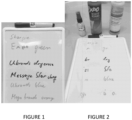
- a whiteboard cleaning formulation was prepared by mixing 10g butyl levulinate and 10g of the surfactant Biosoft N-900 (Stepan Company). The butyllevulinate surfactant solution was diluted with 194g water yielding a slightly milky emulsion. 30g of isopropanol was added yielding a clear solution. A new whiteboard (UBrands purchased at Target) was subjected to writing with
- the inks on the whiteboard were allowed to sit for 3 weeks, simulating a difficult cleaning task on the whiteboard.
- the whiteboard was treated with the following whiteboard cleaners: the composition of Example 3, Expo Whiteboard CARETM, Sustainable Earth TM Whiteboard cleaner as follows: the liquid of 5 pumps of a cleaner was sprayed on a defined section of the whiteboard. The cleaner was allowed to sit for 30 seconds. The whiteboard was wiped once with a clean regular kitchen use paper towel.
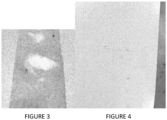
- Example 3 provided a clean surface with the first wipe erasing all marks and restoring the surface completely. Both Expo Whiteboard CARE TM and Sustainable Earth TM Whiteboard cleaner were effective in removing the dry erase markers but both did not remove the permanent marker while the composition of Example 3 did remove the permanent marker completely.
- Figure 1 shows the whiteboard before cleaning.
- Figure 2 shows the same whiteboard as in Figure 1 after cleaning with the composition of Example 3, Expo Whiteboard CARE TM , Sustainable Earth TM Whiteboard cleaner. Only the composition of Example 3 was effective in cleaning the permanent marker.
- An adhesive removal composition was prepared by adding 10g of the Stock Solution of Example 1 to 10g of water under vigorous stirring. The solution was applied to an adhesive that had been left behind after pulling off an adhesive tape that had been on a plastic-coated table surface (melamine formaldehyde coating). The composition was left on the adhesive for 30 seconds and then wiped with a few swipes of a paper towel for regular kitchen use. The table surface was not harmed and the adhesive was removed.
- a 101.6 mm by 203.2 mm (4 inch by 8 inch) plywood panel was sanded with a 180grit sandpaper.
- the sanding dust was removed and the panel was painted with a water based primer (ZINSSER ® , Rust-oleum Corporation, Vernon Hills IL).
- ZINSSER ® a water based primer
- the primer was sanded with 180grit sandpaper and wiped with a cloth wetted with isopropyl alcohol.
- a layer of blue exterior oil paint (Rust-oleum Corporation, Vernon Hills, IL) was applied, allowed to dry for 24hours before sanding with 180grit sandpaper and wiping with a cloth wetted with isopropyl alcohol.
- a layer of white exterior/interior latex paint (Rust-oleum Corporation, Vernon Hills, IL) was applied, allowed to dry for 24 hours before sanding with 180grit sandpaper and wiping with a cloth wetted with isopropyl alcohol.
- a layer of red exterior/interior latex paint (Rust-oleum Corporation, Vernon Hills, IL) was applied, allowed to dry for 24 hours before sanding with 180grit sandpaper and wiping with a cloth wetted with isopropyl alcohol.
- a layer of yellow exterior oil paint (Rust-oleum Corporation, Vernon Hills, IL) was applied, allowed to dry for 24 hours before sanding with 180grit sandpaper and wiping with a cloth wetted with isopropyl alcohol.
- the panel was allowed to dry for 72 hours upon which it was cured for 30 days at 60°C in an incubator.
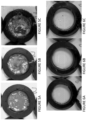
- the paint stripper showed effectiveness on 4 layers of mixed paint within 60 minutes.
- a 25.4 mm (1 inch) inner diameter gasket was glued to a coupon as described in example 5 with superglue to hold any liquid paint stripper formulation contained within the ring.
- the comparative paint stripper formulation showed no effectiveness even after 60 minutes.
- a 25.4 mm (1 inch) inner diameter gasket was glued to a coupon as described in example 5 with superglue to hold any liquid paint stripper formulation contained within the ring.
- Comparative paint stripper formulation B 2.5mL of Comparative paint stripper formulation B was applied into the gasket and covered with a watch glass to prevent evaporation. After 20 minutes the paint stripper formulation was removed with a pipette and the paint was scraped with a wooden scraper. No change was visible after the 20 minutes exposure. The paint stripper formula was re-applied and after another 20 minutes the scraping procedure was repeated. No change was visible after a total of 40 minutes exposure. The paint stripper formula was re-applied and after another 20 minutes the scraping procedure was repeated No change was visible after a total of 60 minutes exposure.
- Comparative paint stripper formulation B showed no effectiveness after 60 minutes.
Landscapes
- Chemical & Material Sciences (AREA)
- Organic Chemistry (AREA)
- Engineering & Computer Science (AREA)
- Chemical Kinetics & Catalysis (AREA)
- Wood Science & Technology (AREA)
- Life Sciences & Earth Sciences (AREA)
- Oil, Petroleum & Natural Gas (AREA)
- Health & Medical Sciences (AREA)
- Emergency Medicine (AREA)
- General Chemical & Material Sciences (AREA)
- Materials Engineering (AREA)
- Detergent Compositions (AREA)
- Organic Low-Molecular-Weight Compounds And Preparation Thereof (AREA)
- Addition Polymer Or Copolymer, Post-Treatments, Or Chemical Modifications (AREA)
Claims (6)
- Ein Verfahren zum Entfernen von polymerem Material mit Heteroatomen, von einer Oberfläche, wobei das Verfahren umfasst:
in Kontakt bringen der Oberfläche mit einer Zusammensetzung, wobei die Zusammensetzung umfasst:eine Verbindung gemäß Formel (II) mindestens ein sauerstoffhaltiges Lösungsmittel mit einem Molekulargewicht von nicht höher als 130 g/mol; undAbwischen der Zusammensetzung und mindestens eines Anteils des Polymers von der Oberfläche.
 - Das Verfahren gemäß Anspruch 1, wobei das sauerstoffhaltige Lösungsmittel ausgewählt ist aus Ethanol, Ethylenglykol, 2-Propanol, Propylenglykol, 1,2-Butandiol, 1,3-Butandiol, Glycerin, Methylpropylenglykol, Dipropylenglykol, Wasser und Kombinationen davon, wobei das sauerstoffhaltige Lösungsmittel bevorzugt ausgewählt ist aus Ethanol, 2-Propanol, Wasser und Kombinationen davon, stärker bevorzugt ist das sauerstoffhaltige Lösungsmittel Wasser.
- Das Verfahren gemäß Anspruch 1 oder 2, wobei das sauerstoffhaltige Lösungsmittel in der Zusammensetzung in einer Menge von nicht weniger als 20 Gew.-%, bezogen auf das Gewicht der gesamten Zusammensetzung, vorhanden ist, wobei das sauerstoffhaltige Lösungsmittel in der Zusammensetzung bevorzugt in einer Menge von nicht weniger als 50 Gew.-%, bezogen auf das Gesamtgewicht der gesamten Zusammensetzung, vorhanden ist.
- Das Verfahren gemäß einem der Ansprüche 1 bis 3, wobei das sauerstoffhaltige Lösungsmittel in der Zusammensetzung in einer Menge von nicht mehr als 95 Gew.-%, bezogen auf das Gesamtgewicht der gesamten Zusammensetzung, vorhanden ist, wobei das sauerstoffhaltige Lösungsmittel in der Zusammensetzung bevorzugt in einer Menge von nicht mehr als 75 Gew.-%, bezogen auf das Gesamtgewicht der gesamten Zusammensetzung, vorhanden ist.
- Das Verfahren gemäß einem der Ansprüche 1 bis 4, wobei das polymere Material ausgewählt ist aus: Polyurethanen, Epoxidharzen, Harzen auf Vinylbasis, Harzen auf Acrylsäurebasis, Polyestern und Copolymeren, Polyamiden Acrylharzen, Aminoharzen, Cyanoacrylaten, Polyethern, Polycarbonaten, Alkydharzen, natürlichen Polymeren, natürlichen Harzen.
- Das Verfahren gemäß einem der Ansprüche 1 bis 5, wobei die Oberfläche ausgewählt ist aus: Glas, Stein, Keramik, Porzellan, Beton, Mauerwerk, Holz und von Holz abgeleiteten Verbundstoffen und Produkten, Leder, Metallen und Polymeroberflächen wie Polyolefinen, technischen Thermoplasten und technischen Thermoplastverbundstoffen, Elastomeren, Naturtextilien und Textilien auf Polyolefinbasis.
Applications Claiming Priority (2)
| Application Number | Priority Date | Filing Date | Title |
|---|---|---|---|
| US201762609995P | 2017-12-22 | 2017-12-22 | |
| PCT/US2018/067416 WO2019126815A2 (en) | 2017-12-22 | 2018-12-22 | Compositions including keto-ester compounds and methods of using the same |
Publications (4)
| Publication Number | Publication Date |
|---|---|
| EP3728487A2 EP3728487A2 (de) | 2020-10-28 |
| EP3728487A4 EP3728487A4 (de) | 2021-11-03 |
| EP3728487C0 EP3728487C0 (de) | 2025-07-02 |
| EP3728487B1 true EP3728487B1 (de) | 2025-07-02 |
Family
ID=66993928
Family Applications (1)
| Application Number | Title | Priority Date | Filing Date |
|---|---|---|---|
| EP18890921.2A Active EP3728487B1 (de) | 2017-12-22 | 2018-12-22 | Verfahren zur entfernung von heteroatome enthaltendem polymermaterial von einer oberfläche unter verwendung von zusammensetzungen, die eine keto-ester-verbindung enthalten |
Country Status (4)
| Country | Link |
|---|---|
| US (1) | US11370996B2 (de) |
| EP (1) | EP3728487B1 (de) |
| CA (1) | CA3086697A1 (de) |
| WO (1) | WO2019126815A2 (de) |
Families Citing this family (1)
| Publication number | Priority date | Publication date | Assignee | Title |
|---|---|---|---|---|
| BR102020018628A2 (pt) | 2020-09-11 | 2022-03-22 | Rhodia Brasil S.A. | Composições para limpeza multiuso, processo de preparo, uso das ditas composições e produto de limpeza multiuso |
Family Cites Families (11)
| Publication number | Priority date | Publication date | Assignee | Title |
|---|---|---|---|---|
| GB423919A (en) * | 1933-05-08 | 1935-02-11 | Du Pont | Improvements in or relating to the production of esters and compositions containing same |
| GB432025A (en) | 1933-12-19 | 1935-07-27 | Harold Allden Auden | Improvements in or relating to coating compositions |
| US2813900A (en) | 1953-08-05 | 1957-11-19 | Quaker Oats Co | Process for producing levulinic acid |
| DE1643195A1 (de) | 1967-01-10 | 1972-01-27 | Wacker Chemie Gmbh | Verfahren zur Herstellung von Acetessigsaeureestern |
| US4136111A (en) | 1976-11-02 | 1979-01-23 | Hill Brothers Chemical Company, Inc. | Process for the production of pyruvic acid |
| US5189215A (en) | 1989-06-05 | 1993-02-23 | Chemie Linz Gesellschaft M.B.H. | Process for the preparation of storage-stable levulinic acid |
| US7179775B2 (en) * | 2002-09-11 | 2007-02-20 | Henkel Kommanditgesellschaft Auf Aktien | Coating removal compositions |
| ATE554743T1 (de) | 2007-09-19 | 2012-05-15 | Bubbles & Beyond Gmbh | Reinigungsmittel zur entfernung von farbschichten von oberflächen, verfahren zur herstellung des mittels und verfahren zur reinigung |
| FR2949116B1 (fr) * | 2009-08-13 | 2012-08-31 | Rhodia Operations | Composition de nettoyage de graffiti |
| EP2540871A1 (de) * | 2011-06-29 | 2013-01-02 | Institut Univ. de Ciència i Tecnologia, S.A. | Entfettungszusammensetzungen, die von Lävulinsäure (einer aus Biomasse erhältlichen Verbindung) abgeleitet sind, und Verfahren zur Entfettung von Metallflächen |
| FR3027310B1 (fr) | 2014-10-15 | 2017-12-15 | Commissariat Energie Atomique | Gel pour eliminer les graffitis et procede pour eliminer les graffitis utilisant ce gel. |
-
2018
- 2018-12-22 EP EP18890921.2A patent/EP3728487B1/de active Active
- 2018-12-22 WO PCT/US2018/067416 patent/WO2019126815A2/en not_active Ceased
- 2018-12-22 US US16/954,940 patent/US11370996B2/en active Active
- 2018-12-22 CA CA3086697A patent/CA3086697A1/en active Pending
Also Published As
| Publication number | Publication date |
|---|---|
| EP3728487C0 (de) | 2025-07-02 |
| US11370996B2 (en) | 2022-06-28 |
| US20200377823A1 (en) | 2020-12-03 |
| EP3728487A2 (de) | 2020-10-28 |
| CA3086697A1 (en) | 2019-06-27 |
| WO2019126815A3 (en) | 2019-08-08 |
| WO2019126815A2 (en) | 2019-06-27 |
| EP3728487A4 (de) | 2021-11-03 |
Similar Documents
| Publication | Publication Date | Title |
|---|---|---|
| AU2011289224B2 (en) | Carboxy ester ketal removal compositions, methods of manufacture, and uses thereof | |
| CN101861381B (zh) | 用于从表面除去有色涂层和各种污垢层的配料、制备此试剂的方法以及清洁方法 | |
| CN104379715B (zh) | 基于萜烯和脂肪酸衍生物的水性硬表面清洁剂 | |
| CN101517058B (zh) | 包括非水性浓缩物和稀释水溶液的涂鸦清洁用溶液 | |
| MX2010011939A (es) | Composiciones de limpieza que incorporan solventes naturales y metodos para uso. | |
| CN102428165A (zh) | 油墨清洁组合物及其使用方法 | |
| CN103038327A (zh) | 生态友好型微乳液在清洁油应用中的用途 | |
| CN101730727A (zh) | 保护基底和从该基底去除污染物的方法 | |
| JP5265185B2 (ja) | ゼロないし低vocガラス用及び一般用クリーナー | |
| WO2015017175A1 (en) | Aqueous cleaning compositions including an alkyl 3-hydroxybutyrate | |
| JP7451609B2 (ja) | 中性床用クリーナー組成物 | |
| EP1879687B1 (de) | Verfahren zur oberflächenbehandlung eines metall- oder fasermaterials | |
| WO1999043773A1 (en) | Improvements in or relating to organic compositions | |
| EP3728487B1 (de) | Verfahren zur entfernung von heteroatome enthaltendem polymermaterial von einer oberfläche unter verwendung von zusammensetzungen, die eine keto-ester-verbindung enthalten | |
| JP5876989B2 (ja) | 粘着ラベル剥離剤組成物及び粘着ラベルの剥離方法 | |
| CN104204177A (zh) | 低voc含量的无水清洗剂及用其浸渍的制品 | |
| US20250154433A1 (en) | Cleaner for Hard Surfaces | |
| WO2010139107A1 (en) | Cleaning compositions and methods | |
| TWI713724B (zh) | 利用伸展鏈界面活性劑之組合增加溶解度 | |
| MX2013009792A (es) | Solucion para remover manchas. | |
| EP3835326B1 (de) | Waschmittelzusammensetzung, die einen inversen latex umfasst, der einen speziellen komplexbildner und einen polyelektrolyten mit einer schwachen säurefunktion kombiniert | |
| WO2015114994A1 (ja) | バイオフィルム除去剤および除去方法 | |
| JP2008184604A (ja) | 塗装面用洗浄剤 |
Legal Events
| Date | Code | Title | Description |
|---|---|---|---|
| STAA | Information on the status of an ep patent application or granted ep patent |
Free format text: STATUS: THE INTERNATIONAL PUBLICATION HAS BEEN MADE |
|
| PUAI | Public reference made under article 153(3) epc to a published international application that has entered the european phase |
Free format text: ORIGINAL CODE: 0009012 |
|
| STAA | Information on the status of an ep patent application or granted ep patent |
Free format text: STATUS: REQUEST FOR EXAMINATION WAS MADE |
|
| 17P | Request for examination filed |
Effective date: 20200722 |
|
| AK | Designated contracting states |
Kind code of ref document: A2 Designated state(s): AL AT BE BG CH CY CZ DE DK EE ES FI FR GB GR HR HU IE IS IT LI LT LU LV MC MK MT NL NO PL PT RO RS SE SI SK SM TR |
|
| AX | Request for extension of the european patent |
Extension state: BA ME |
|
| DAV | Request for validation of the european patent (deleted) | ||
| DAX | Request for extension of the european patent (deleted) | ||
| A4 | Supplementary search report drawn up and despatched |
Effective date: 20211001 |
|
| RIC1 | Information provided on ipc code assigned before grant |
Ipc: C11D 17/00 20060101ALI20210927BHEP Ipc: C11D 11/00 20060101ALI20210927BHEP Ipc: C11D 3/20 20060101ALI20210927BHEP Ipc: C09D 9/00 20060101AFI20210927BHEP |
|
| GRAP | Despatch of communication of intention to grant a patent |
Free format text: ORIGINAL CODE: EPIDOSNIGR1 |
|
| STAA | Information on the status of an ep patent application or granted ep patent |
Free format text: STATUS: GRANT OF PATENT IS INTENDED |
|
| INTG | Intention to grant announced |
Effective date: 20250213 |
|
| GRAS | Grant fee paid |
Free format text: ORIGINAL CODE: EPIDOSNIGR3 |
|
| GRAA | (expected) grant |
Free format text: ORIGINAL CODE: 0009210 |
|
| STAA | Information on the status of an ep patent application or granted ep patent |
Free format text: STATUS: THE PATENT HAS BEEN GRANTED |
|
| AK | Designated contracting states |
Kind code of ref document: B1 Designated state(s): AL AT BE BG CH CY CZ DE DK EE ES FI FR GB GR HR HU IE IS IT LI LT LU LV MC MK MT NL NO PL PT RO RS SE SI SK SM TR |
|
| REG | Reference to a national code |
Ref country code: GB Ref legal event code: FG4D |
|
| REG | Reference to a national code |
Ref country code: CH Ref legal event code: EP |
|
| REG | Reference to a national code |
Ref country code: DE Ref legal event code: R096 Ref document number: 602018083311 Country of ref document: DE |
|
| REG | Reference to a national code |
Ref country code: IE Ref legal event code: FG4D |
|
| U01 | Request for unitary effect filed |
Effective date: 20250702 |
|
| U07 | Unitary effect registered |
Designated state(s): AT BE BG DE DK EE FI FR IT LT LU LV MT NL PT RO SE SI Effective date: 20250710 |
|
| PG25 | Lapsed in a contracting state [announced via postgrant information from national office to epo] |
Ref country code: IS Free format text: LAPSE BECAUSE OF FAILURE TO SUBMIT A TRANSLATION OF THE DESCRIPTION OR TO PAY THE FEE WITHIN THE PRESCRIBED TIME-LIMIT Effective date: 20251102 |
|
| PGFP | Annual fee paid to national office [announced via postgrant information from national office to epo] |
Ref country code: GB Payment date: 20251229 Year of fee payment: 8 |
|
| PG25 | Lapsed in a contracting state [announced via postgrant information from national office to epo] |
Ref country code: NO Free format text: LAPSE BECAUSE OF FAILURE TO SUBMIT A TRANSLATION OF THE DESCRIPTION OR TO PAY THE FEE WITHIN THE PRESCRIBED TIME-LIMIT Effective date: 20251002 |
|
| PG25 | Lapsed in a contracting state [announced via postgrant information from national office to epo] |
Ref country code: HR Free format text: LAPSE BECAUSE OF FAILURE TO SUBMIT A TRANSLATION OF THE DESCRIPTION OR TO PAY THE FEE WITHIN THE PRESCRIBED TIME-LIMIT Effective date: 20250702 |
|
| PG25 | Lapsed in a contracting state [announced via postgrant information from national office to epo] |
Ref country code: GR Free format text: LAPSE BECAUSE OF FAILURE TO SUBMIT A TRANSLATION OF THE DESCRIPTION OR TO PAY THE FEE WITHIN THE PRESCRIBED TIME-LIMIT Effective date: 20251003 |
|
| PG25 | Lapsed in a contracting state [announced via postgrant information from national office to epo] |
Ref country code: CZ Free format text: LAPSE BECAUSE OF FAILURE TO SUBMIT A TRANSLATION OF THE DESCRIPTION OR TO PAY THE FEE WITHIN THE PRESCRIBED TIME-LIMIT Effective date: 20250702 |
|
| PG25 | Lapsed in a contracting state [announced via postgrant information from national office to epo] |
Ref country code: PL Free format text: LAPSE BECAUSE OF FAILURE TO SUBMIT A TRANSLATION OF THE DESCRIPTION OR TO PAY THE FEE WITHIN THE PRESCRIBED TIME-LIMIT Effective date: 20250702 |
|
| PG25 | Lapsed in a contracting state [announced via postgrant information from national office to epo] |
Ref country code: RS Free format text: LAPSE BECAUSE OF FAILURE TO SUBMIT A TRANSLATION OF THE DESCRIPTION OR TO PAY THE FEE WITHIN THE PRESCRIBED TIME-LIMIT Effective date: 20251002 |
|
| PG25 | Lapsed in a contracting state [announced via postgrant information from national office to epo] |
Ref country code: ES Free format text: LAPSE BECAUSE OF FAILURE TO SUBMIT A TRANSLATION OF THE DESCRIPTION OR TO PAY THE FEE WITHIN THE PRESCRIBED TIME-LIMIT Effective date: 20250702 |
|
| U20 | Renewal fee for the european patent with unitary effect paid |
Year of fee payment: 8 Effective date: 20251229 |