EP3727193B1 - Tissue repair laminates - Google Patents
Tissue repair laminates Download PDFInfo
- Publication number
- EP3727193B1 EP3727193B1 EP18893268.5A EP18893268A EP3727193B1 EP 3727193 B1 EP3727193 B1 EP 3727193B1 EP 18893268 A EP18893268 A EP 18893268A EP 3727193 B1 EP3727193 B1 EP 3727193B1
- Authority
- EP
- European Patent Office
- Prior art keywords
- less
- polyurethane
- barrier layer
- months
- tissue repair
- Prior art date
- Legal status (The legal status is an assumption and is not a legal conclusion. Google has not performed a legal analysis and makes no representation as to the accuracy of the status listed.)
- Active
Links
Images



Classifications
-
- C—CHEMISTRY; METALLURGY
- C08—ORGANIC MACROMOLECULAR COMPOUNDS; THEIR PREPARATION OR CHEMICAL WORKING-UP; COMPOSITIONS BASED THEREON
- C08G—MACROMOLECULAR COMPOUNDS OBTAINED OTHERWISE THAN BY REACTIONS ONLY INVOLVING UNSATURATED CARBON-TO-CARBON BONDS
- C08G18/00—Polymeric products of isocyanates or isothiocyanates
- C08G18/06—Polymeric products of isocyanates or isothiocyanates with compounds having active hydrogen
- C08G18/28—Polymeric products of isocyanates or isothiocyanates with compounds having active hydrogen characterised by the compounds used containing active hydrogen
- C08G18/40—High-molecular-weight compounds
- C08G18/42—Polycondensates having carboxylic or carbonic ester groups in the main chain
- C08G18/4266—Polycondensates having carboxylic or carbonic ester groups in the main chain prepared from hydroxycarboxylic acids and/or lactones
- C08G18/428—Lactides
-
- A—HUMAN NECESSITIES
- A61—MEDICAL OR VETERINARY SCIENCE; HYGIENE
- A61L—METHODS OR APPARATUS FOR STERILISING MATERIALS OR OBJECTS IN GENERAL; DISINFECTION, STERILISATION OR DEODORISATION OF AIR; CHEMICAL ASPECTS OF BANDAGES, DRESSINGS, ABSORBENT PADS OR SURGICAL ARTICLES; MATERIALS FOR BANDAGES, DRESSINGS, ABSORBENT PADS OR SURGICAL ARTICLES
- A61L27/00—Materials for grafts or prostheses or for coating grafts or prostheses
- A61L27/50—Materials characterised by their function or physical properties, e.g. injectable or lubricating compositions, shape-memory materials, surface modified materials
- A61L27/56—Porous materials, e.g. foams or sponges
-
- A—HUMAN NECESSITIES
- A61—MEDICAL OR VETERINARY SCIENCE; HYGIENE
- A61L—METHODS OR APPARATUS FOR STERILISING MATERIALS OR OBJECTS IN GENERAL; DISINFECTION, STERILISATION OR DEODORISATION OF AIR; CHEMICAL ASPECTS OF BANDAGES, DRESSINGS, ABSORBENT PADS OR SURGICAL ARTICLES; MATERIALS FOR BANDAGES, DRESSINGS, ABSORBENT PADS OR SURGICAL ARTICLES
- A61L27/00—Materials for grafts or prostheses or for coating grafts or prostheses
- A61L27/14—Macromolecular materials
- A61L27/18—Macromolecular materials obtained otherwise than by reactions only involving carbon-to-carbon unsaturated bonds
-
- A—HUMAN NECESSITIES
- A61—MEDICAL OR VETERINARY SCIENCE; HYGIENE
- A61L—METHODS OR APPARATUS FOR STERILISING MATERIALS OR OBJECTS IN GENERAL; DISINFECTION, STERILISATION OR DEODORISATION OF AIR; CHEMICAL ASPECTS OF BANDAGES, DRESSINGS, ABSORBENT PADS OR SURGICAL ARTICLES; MATERIALS FOR BANDAGES, DRESSINGS, ABSORBENT PADS OR SURGICAL ARTICLES
- A61L27/00—Materials for grafts or prostheses or for coating grafts or prostheses
- A61L27/50—Materials characterised by their function or physical properties, e.g. injectable or lubricating compositions, shape-memory materials, surface modified materials
- A61L27/58—Materials at least partially resorbable by the body
-
- A—HUMAN NECESSITIES
- A61—MEDICAL OR VETERINARY SCIENCE; HYGIENE
- A61L—METHODS OR APPARATUS FOR STERILISING MATERIALS OR OBJECTS IN GENERAL; DISINFECTION, STERILISATION OR DEODORISATION OF AIR; CHEMICAL ASPECTS OF BANDAGES, DRESSINGS, ABSORBENT PADS OR SURGICAL ARTICLES; MATERIALS FOR BANDAGES, DRESSINGS, ABSORBENT PADS OR SURGICAL ARTICLES
- A61L31/00—Materials for other surgical articles, e.g. stents, stent-grafts, shunts, surgical drapes, guide wires, materials for adhesion prevention, occluding devices, surgical gloves, tissue fixation devices
- A61L31/04—Macromolecular materials
- A61L31/06—Macromolecular materials obtained otherwise than by reactions only involving carbon-to-carbon unsaturated bonds
-
- A—HUMAN NECESSITIES
- A61—MEDICAL OR VETERINARY SCIENCE; HYGIENE
- A61L—METHODS OR APPARATUS FOR STERILISING MATERIALS OR OBJECTS IN GENERAL; DISINFECTION, STERILISATION OR DEODORISATION OF AIR; CHEMICAL ASPECTS OF BANDAGES, DRESSINGS, ABSORBENT PADS OR SURGICAL ARTICLES; MATERIALS FOR BANDAGES, DRESSINGS, ABSORBENT PADS OR SURGICAL ARTICLES
- A61L31/00—Materials for other surgical articles, e.g. stents, stent-grafts, shunts, surgical drapes, guide wires, materials for adhesion prevention, occluding devices, surgical gloves, tissue fixation devices
- A61L31/14—Materials characterised by their function or physical properties, e.g. injectable or lubricating compositions, shape-memory materials, surface modified materials
- A61L31/146—Porous materials, e.g. foams or sponges
-
- A—HUMAN NECESSITIES
- A61—MEDICAL OR VETERINARY SCIENCE; HYGIENE
- A61L—METHODS OR APPARATUS FOR STERILISING MATERIALS OR OBJECTS IN GENERAL; DISINFECTION, STERILISATION OR DEODORISATION OF AIR; CHEMICAL ASPECTS OF BANDAGES, DRESSINGS, ABSORBENT PADS OR SURGICAL ARTICLES; MATERIALS FOR BANDAGES, DRESSINGS, ABSORBENT PADS OR SURGICAL ARTICLES
- A61L31/00—Materials for other surgical articles, e.g. stents, stent-grafts, shunts, surgical drapes, guide wires, materials for adhesion prevention, occluding devices, surgical gloves, tissue fixation devices
- A61L31/14—Materials characterised by their function or physical properties, e.g. injectable or lubricating compositions, shape-memory materials, surface modified materials
- A61L31/148—Materials at least partially resorbable by the body
-
- B—PERFORMING OPERATIONS; TRANSPORTING
- B32—LAYERED PRODUCTS
- B32B—LAYERED PRODUCTS, i.e. PRODUCTS BUILT-UP OF STRATA OF FLAT OR NON-FLAT, e.g. CELLULAR OR HONEYCOMB, FORM
- B32B27/00—Layered products comprising a layer of synthetic resin
- B32B27/06—Layered products comprising a layer of synthetic resin as the main or only constituent of a layer, which is next to another layer of the same or of a different material
- B32B27/065—Layered products comprising a layer of synthetic resin as the main or only constituent of a layer, which is next to another layer of the same or of a different material of foam
-
- B—PERFORMING OPERATIONS; TRANSPORTING
- B32—LAYERED PRODUCTS
- B32B—LAYERED PRODUCTS, i.e. PRODUCTS BUILT-UP OF STRATA OF FLAT OR NON-FLAT, e.g. CELLULAR OR HONEYCOMB, FORM
- B32B27/00—Layered products comprising a layer of synthetic resin
- B32B27/40—Layered products comprising a layer of synthetic resin comprising polyurethanes
-
- B—PERFORMING OPERATIONS; TRANSPORTING
- B32—LAYERED PRODUCTS
- B32B—LAYERED PRODUCTS, i.e. PRODUCTS BUILT-UP OF STRATA OF FLAT OR NON-FLAT, e.g. CELLULAR OR HONEYCOMB, FORM
- B32B5/00—Layered products characterised by the non- homogeneity or physical structure, i.e. comprising a fibrous, filamentary, particulate or foam layer; Layered products characterised by having a layer differing constitutionally or physically in different parts
- B32B5/02—Layered products characterised by the non- homogeneity or physical structure, i.e. comprising a fibrous, filamentary, particulate or foam layer; Layered products characterised by having a layer differing constitutionally or physically in different parts characterised by structural features of a fibrous or filamentary layer
- B32B5/022—Non-woven fabric
-
- B—PERFORMING OPERATIONS; TRANSPORTING
- B32—LAYERED PRODUCTS
- B32B—LAYERED PRODUCTS, i.e. PRODUCTS BUILT-UP OF STRATA OF FLAT OR NON-FLAT, e.g. CELLULAR OR HONEYCOMB, FORM
- B32B5/00—Layered products characterised by the non- homogeneity or physical structure, i.e. comprising a fibrous, filamentary, particulate or foam layer; Layered products characterised by having a layer differing constitutionally or physically in different parts
- B32B5/02—Layered products characterised by the non- homogeneity or physical structure, i.e. comprising a fibrous, filamentary, particulate or foam layer; Layered products characterised by having a layer differing constitutionally or physically in different parts characterised by structural features of a fibrous or filamentary layer
- B32B5/024—Woven fabric
-
- B—PERFORMING OPERATIONS; TRANSPORTING
- B32—LAYERED PRODUCTS
- B32B—LAYERED PRODUCTS, i.e. PRODUCTS BUILT-UP OF STRATA OF FLAT OR NON-FLAT, e.g. CELLULAR OR HONEYCOMB, FORM
- B32B5/00—Layered products characterised by the non- homogeneity or physical structure, i.e. comprising a fibrous, filamentary, particulate or foam layer; Layered products characterised by having a layer differing constitutionally or physically in different parts
- B32B5/18—Layered products characterised by the non- homogeneity or physical structure, i.e. comprising a fibrous, filamentary, particulate or foam layer; Layered products characterised by having a layer differing constitutionally or physically in different parts characterised by features of a layer of foamed material
-
- B—PERFORMING OPERATIONS; TRANSPORTING
- B32—LAYERED PRODUCTS
- B32B—LAYERED PRODUCTS, i.e. PRODUCTS BUILT-UP OF STRATA OF FLAT OR NON-FLAT, e.g. CELLULAR OR HONEYCOMB, FORM
- B32B5/00—Layered products characterised by the non- homogeneity or physical structure, i.e. comprising a fibrous, filamentary, particulate or foam layer; Layered products characterised by having a layer differing constitutionally or physically in different parts
- B32B5/22—Layered products characterised by the non- homogeneity or physical structure, i.e. comprising a fibrous, filamentary, particulate or foam layer; Layered products characterised by having a layer differing constitutionally or physically in different parts characterised by the presence of two or more layers which are next to each other and are fibrous, filamentary, formed of particles or foamed
- B32B5/24—Layered products characterised by the non- homogeneity or physical structure, i.e. comprising a fibrous, filamentary, particulate or foam layer; Layered products characterised by having a layer differing constitutionally or physically in different parts characterised by the presence of two or more layers which are next to each other and are fibrous, filamentary, formed of particles or foamed one layer being a fibrous or filamentary layer
- B32B5/245—Layered products characterised by the non- homogeneity or physical structure, i.e. comprising a fibrous, filamentary, particulate or foam layer; Layered products characterised by having a layer differing constitutionally or physically in different parts characterised by the presence of two or more layers which are next to each other and are fibrous, filamentary, formed of particles or foamed one layer being a fibrous or filamentary layer another layer next to it being a foam layer
-
- B—PERFORMING OPERATIONS; TRANSPORTING
- B32—LAYERED PRODUCTS
- B32B—LAYERED PRODUCTS, i.e. PRODUCTS BUILT-UP OF STRATA OF FLAT OR NON-FLAT, e.g. CELLULAR OR HONEYCOMB, FORM
- B32B7/00—Layered products characterised by the relation between layers; Layered products characterised by the relative orientation of features between layers, or by the relative values of a measurable parameter between layers, i.e. products comprising layers having different physical, chemical or physicochemical properties; Layered products characterised by the interconnection of layers
- B32B7/04—Interconnection of layers
- B32B7/12—Interconnection of layers using interposed adhesives or interposed materials with bonding properties
-
- C—CHEMISTRY; METALLURGY
- C08—ORGANIC MACROMOLECULAR COMPOUNDS; THEIR PREPARATION OR CHEMICAL WORKING-UP; COMPOSITIONS BASED THEREON
- C08G—MACROMOLECULAR COMPOUNDS OBTAINED OTHERWISE THAN BY REACTIONS ONLY INVOLVING UNSATURATED CARBON-TO-CARBON BONDS
- C08G18/00—Polymeric products of isocyanates or isothiocyanates
- C08G18/06—Polymeric products of isocyanates or isothiocyanates with compounds having active hydrogen
- C08G18/08—Processes
- C08G18/10—Prepolymer processes involving reaction of isocyanates or isothiocyanates with compounds having active hydrogen in a first reaction step
-
- C—CHEMISTRY; METALLURGY
- C08—ORGANIC MACROMOLECULAR COMPOUNDS; THEIR PREPARATION OR CHEMICAL WORKING-UP; COMPOSITIONS BASED THEREON
- C08G—MACROMOLECULAR COMPOUNDS OBTAINED OTHERWISE THAN BY REACTIONS ONLY INVOLVING UNSATURATED CARBON-TO-CARBON BONDS
- C08G18/00—Polymeric products of isocyanates or isothiocyanates
- C08G18/06—Polymeric products of isocyanates or isothiocyanates with compounds having active hydrogen
- C08G18/70—Polymeric products of isocyanates or isothiocyanates with compounds having active hydrogen characterised by the isocyanates or isothiocyanates used
- C08G18/72—Polyisocyanates or polyisothiocyanates
- C08G18/73—Polyisocyanates or polyisothiocyanates acyclic
-
- C—CHEMISTRY; METALLURGY
- C08—ORGANIC MACROMOLECULAR COMPOUNDS; THEIR PREPARATION OR CHEMICAL WORKING-UP; COMPOSITIONS BASED THEREON
- C08J—WORKING-UP; GENERAL PROCESSES OF COMPOUNDING; AFTER-TREATMENT NOT COVERED BY SUBCLASSES C08B, C08C, C08F, C08G or C08H
- C08J5/00—Manufacture of articles or shaped materials containing macromolecular substances
- C08J5/18—Manufacture of films or sheets
-
- C—CHEMISTRY; METALLURGY
- C08—ORGANIC MACROMOLECULAR COMPOUNDS; THEIR PREPARATION OR CHEMICAL WORKING-UP; COMPOSITIONS BASED THEREON
- C08L—COMPOSITIONS OF MACROMOLECULAR COMPOUNDS
- C08L75/00—Compositions of polyureas or polyurethanes; Compositions of derivatives of such polymers
- C08L75/04—Polyurethanes
- C08L75/06—Polyurethanes from polyesters
-
- A—HUMAN NECESSITIES
- A61—MEDICAL OR VETERINARY SCIENCE; HYGIENE
- A61F—FILTERS IMPLANTABLE INTO BLOOD VESSELS; PROSTHESES; DEVICES PROVIDING PATENCY TO, OR PREVENTING COLLAPSING OF, TUBULAR STRUCTURES OF THE BODY, e.g. STENTS; ORTHOPAEDIC, NURSING OR CONTRACEPTIVE DEVICES; FOMENTATION; TREATMENT OR PROTECTION OF EYES OR EARS; BANDAGES, DRESSINGS OR ABSORBENT PADS; FIRST-AID KITS
- A61F2/00—Filters implantable into blood vessels; Prostheses, i.e. artificial substitutes or replacements for parts of the body; Appliances for connecting them with the body; Devices providing patency to, or preventing collapsing of, tubular structures of the body, e.g. stents
- A61F2/0063—Implantable repair or support meshes, e.g. hernia meshes
-
- A—HUMAN NECESSITIES
- A61—MEDICAL OR VETERINARY SCIENCE; HYGIENE
- A61F—FILTERS IMPLANTABLE INTO BLOOD VESSELS; PROSTHESES; DEVICES PROVIDING PATENCY TO, OR PREVENTING COLLAPSING OF, TUBULAR STRUCTURES OF THE BODY, e.g. STENTS; ORTHOPAEDIC, NURSING OR CONTRACEPTIVE DEVICES; FOMENTATION; TREATMENT OR PROTECTION OF EYES OR EARS; BANDAGES, DRESSINGS OR ABSORBENT PADS; FIRST-AID KITS
- A61F2/00—Filters implantable into blood vessels; Prostheses, i.e. artificial substitutes or replacements for parts of the body; Appliances for connecting them with the body; Devices providing patency to, or preventing collapsing of, tubular structures of the body, e.g. stents
- A61F2/0077—Special surfaces of prostheses, e.g. for improving ingrowth
-
- A—HUMAN NECESSITIES
- A61—MEDICAL OR VETERINARY SCIENCE; HYGIENE
- A61F—FILTERS IMPLANTABLE INTO BLOOD VESSELS; PROSTHESES; DEVICES PROVIDING PATENCY TO, OR PREVENTING COLLAPSING OF, TUBULAR STRUCTURES OF THE BODY, e.g. STENTS; ORTHOPAEDIC, NURSING OR CONTRACEPTIVE DEVICES; FOMENTATION; TREATMENT OR PROTECTION OF EYES OR EARS; BANDAGES, DRESSINGS OR ABSORBENT PADS; FIRST-AID KITS
- A61F2/00—Filters implantable into blood vessels; Prostheses, i.e. artificial substitutes or replacements for parts of the body; Appliances for connecting them with the body; Devices providing patency to, or preventing collapsing of, tubular structures of the body, e.g. stents
- A61F2/0077—Special surfaces of prostheses, e.g. for improving ingrowth
- A61F2002/009—Special surfaces of prostheses, e.g. for improving ingrowth for hindering or preventing attachment of biological tissue
-
- A—HUMAN NECESSITIES
- A61—MEDICAL OR VETERINARY SCIENCE; HYGIENE
- A61F—FILTERS IMPLANTABLE INTO BLOOD VESSELS; PROSTHESES; DEVICES PROVIDING PATENCY TO, OR PREVENTING COLLAPSING OF, TUBULAR STRUCTURES OF THE BODY, e.g. STENTS; ORTHOPAEDIC, NURSING OR CONTRACEPTIVE DEVICES; FOMENTATION; TREATMENT OR PROTECTION OF EYES OR EARS; BANDAGES, DRESSINGS OR ABSORBENT PADS; FIRST-AID KITS
- A61F2210/00—Particular material properties of prostheses classified in groups A61F2/00 - A61F2/26 or A61F2/82 or A61F9/00 or A61F11/00 or subgroups thereof
- A61F2210/0071—Particular material properties of prostheses classified in groups A61F2/00 - A61F2/26 or A61F2/82 or A61F9/00 or A61F11/00 or subgroups thereof thermoplastic
-
- A—HUMAN NECESSITIES
- A61—MEDICAL OR VETERINARY SCIENCE; HYGIENE
- A61F—FILTERS IMPLANTABLE INTO BLOOD VESSELS; PROSTHESES; DEVICES PROVIDING PATENCY TO, OR PREVENTING COLLAPSING OF, TUBULAR STRUCTURES OF THE BODY, e.g. STENTS; ORTHOPAEDIC, NURSING OR CONTRACEPTIVE DEVICES; FOMENTATION; TREATMENT OR PROTECTION OF EYES OR EARS; BANDAGES, DRESSINGS OR ABSORBENT PADS; FIRST-AID KITS
- A61F2210/00—Particular material properties of prostheses classified in groups A61F2/00 - A61F2/26 or A61F2/82 or A61F9/00 or A61F11/00 or subgroups thereof
- A61F2210/0076—Particular material properties of prostheses classified in groups A61F2/00 - A61F2/26 or A61F2/82 or A61F9/00 or A61F11/00 or subgroups thereof multilayered, e.g. laminated structures
-
- A—HUMAN NECESSITIES
- A61—MEDICAL OR VETERINARY SCIENCE; HYGIENE
- A61F—FILTERS IMPLANTABLE INTO BLOOD VESSELS; PROSTHESES; DEVICES PROVIDING PATENCY TO, OR PREVENTING COLLAPSING OF, TUBULAR STRUCTURES OF THE BODY, e.g. STENTS; ORTHOPAEDIC, NURSING OR CONTRACEPTIVE DEVICES; FOMENTATION; TREATMENT OR PROTECTION OF EYES OR EARS; BANDAGES, DRESSINGS OR ABSORBENT PADS; FIRST-AID KITS
- A61F2240/00—Manufacturing or designing of prostheses classified in groups A61F2/00 - A61F2/26 or A61F2/82 or A61F9/00 or A61F11/00 or subgroups thereof
- A61F2240/001—Designing or manufacturing processes
-
- A—HUMAN NECESSITIES
- A61—MEDICAL OR VETERINARY SCIENCE; HYGIENE
- A61F—FILTERS IMPLANTABLE INTO BLOOD VESSELS; PROSTHESES; DEVICES PROVIDING PATENCY TO, OR PREVENTING COLLAPSING OF, TUBULAR STRUCTURES OF THE BODY, e.g. STENTS; ORTHOPAEDIC, NURSING OR CONTRACEPTIVE DEVICES; FOMENTATION; TREATMENT OR PROTECTION OF EYES OR EARS; BANDAGES, DRESSINGS OR ABSORBENT PADS; FIRST-AID KITS
- A61F2250/00—Special features of prostheses classified in groups A61F2/00 - A61F2/26 or A61F2/82 or A61F9/00 or A61F11/00 or subgroups thereof
- A61F2250/0014—Special features of prostheses classified in groups A61F2/00 - A61F2/26 or A61F2/82 or A61F9/00 or A61F11/00 or subgroups thereof having different values of a given property or geometrical feature, e.g. mechanical property or material property, at different locations within the same prosthesis
- A61F2250/003—Special features of prostheses classified in groups A61F2/00 - A61F2/26 or A61F2/82 or A61F9/00 or A61F11/00 or subgroups thereof having different values of a given property or geometrical feature, e.g. mechanical property or material property, at different locations within the same prosthesis differing in adsorbability or resorbability, i.e. in adsorption or resorption time
- A61F2250/0031—Special features of prostheses classified in groups A61F2/00 - A61F2/26 or A61F2/82 or A61F9/00 or A61F11/00 or subgroups thereof having different values of a given property or geometrical feature, e.g. mechanical property or material property, at different locations within the same prosthesis differing in adsorbability or resorbability, i.e. in adsorption or resorption time made from both resorbable and non-resorbable prosthetic parts, e.g. adjacent parts
-
- A—HUMAN NECESSITIES
- A61—MEDICAL OR VETERINARY SCIENCE; HYGIENE
- A61F—FILTERS IMPLANTABLE INTO BLOOD VESSELS; PROSTHESES; DEVICES PROVIDING PATENCY TO, OR PREVENTING COLLAPSING OF, TUBULAR STRUCTURES OF THE BODY, e.g. STENTS; ORTHOPAEDIC, NURSING OR CONTRACEPTIVE DEVICES; FOMENTATION; TREATMENT OR PROTECTION OF EYES OR EARS; BANDAGES, DRESSINGS OR ABSORBENT PADS; FIRST-AID KITS
- A61F2250/00—Special features of prostheses classified in groups A61F2/00 - A61F2/26 or A61F2/82 or A61F9/00 or A61F11/00 or subgroups thereof
- A61F2250/0014—Special features of prostheses classified in groups A61F2/00 - A61F2/26 or A61F2/82 or A61F9/00 or A61F11/00 or subgroups thereof having different values of a given property or geometrical feature, e.g. mechanical property or material property, at different locations within the same prosthesis
- A61F2250/0051—Special features of prostheses classified in groups A61F2/00 - A61F2/26 or A61F2/82 or A61F9/00 or A61F11/00 or subgroups thereof having different values of a given property or geometrical feature, e.g. mechanical property or material property, at different locations within the same prosthesis differing in tissue ingrowth capacity, e.g. made from both ingrowth-promoting and ingrowth-preventing parts
-
- A—HUMAN NECESSITIES
- A61—MEDICAL OR VETERINARY SCIENCE; HYGIENE
- A61L—METHODS OR APPARATUS FOR STERILISING MATERIALS OR OBJECTS IN GENERAL; DISINFECTION, STERILISATION OR DEODORISATION OF AIR; CHEMICAL ASPECTS OF BANDAGES, DRESSINGS, ABSORBENT PADS OR SURGICAL ARTICLES; MATERIALS FOR BANDAGES, DRESSINGS, ABSORBENT PADS OR SURGICAL ARTICLES
- A61L2420/00—Materials or methods for coatings medical devices
- A61L2420/08—Coatings comprising two or more layers
-
- B—PERFORMING OPERATIONS; TRANSPORTING
- B29—WORKING OF PLASTICS; WORKING OF SUBSTANCES IN A PLASTIC STATE IN GENERAL
- B29C—SHAPING OR JOINING OF PLASTICS; SHAPING OF MATERIAL IN A PLASTIC STATE, NOT OTHERWISE PROVIDED FOR; AFTER-TREATMENT OF THE SHAPED PRODUCTS, e.g. REPAIRING
- B29C65/00—Joining or sealing of preformed parts, e.g. welding of plastics materials; Apparatus therefor
- B29C65/02—Joining or sealing of preformed parts, e.g. welding of plastics materials; Apparatus therefor by heating, with or without pressure
- B29C65/08—Joining or sealing of preformed parts, e.g. welding of plastics materials; Apparatus therefor by heating, with or without pressure using ultrasonic vibrations
-
- B—PERFORMING OPERATIONS; TRANSPORTING
- B32—LAYERED PRODUCTS
- B32B—LAYERED PRODUCTS, i.e. PRODUCTS BUILT-UP OF STRATA OF FLAT OR NON-FLAT, e.g. CELLULAR OR HONEYCOMB, FORM
- B32B2250/00—Layers arrangement
- B32B2250/02—2 layers
-
- B—PERFORMING OPERATIONS; TRANSPORTING
- B32—LAYERED PRODUCTS
- B32B—LAYERED PRODUCTS, i.e. PRODUCTS BUILT-UP OF STRATA OF FLAT OR NON-FLAT, e.g. CELLULAR OR HONEYCOMB, FORM
- B32B2250/00—Layers arrangement
- B32B2250/24—All layers being polymeric
-
- B—PERFORMING OPERATIONS; TRANSPORTING
- B32—LAYERED PRODUCTS
- B32B—LAYERED PRODUCTS, i.e. PRODUCTS BUILT-UP OF STRATA OF FLAT OR NON-FLAT, e.g. CELLULAR OR HONEYCOMB, FORM
- B32B2250/00—Layers arrangement
- B32B2250/40—Symmetrical or sandwich layers, e.g. ABA, ABCBA, ABCCBA
-
- B—PERFORMING OPERATIONS; TRANSPORTING
- B32—LAYERED PRODUCTS
- B32B—LAYERED PRODUCTS, i.e. PRODUCTS BUILT-UP OF STRATA OF FLAT OR NON-FLAT, e.g. CELLULAR OR HONEYCOMB, FORM
- B32B2262/00—Composition or structural features of fibres which form a fibrous or filamentary layer or are present as additives
- B32B2262/02—Synthetic macromolecular fibres
- B32B2262/0292—Polyurethane fibres
-
- B—PERFORMING OPERATIONS; TRANSPORTING
- B32—LAYERED PRODUCTS
- B32B—LAYERED PRODUCTS, i.e. PRODUCTS BUILT-UP OF STRATA OF FLAT OR NON-FLAT, e.g. CELLULAR OR HONEYCOMB, FORM
- B32B2266/00—Composition of foam
- B32B2266/02—Organic
- B32B2266/0214—Materials belonging to B32B27/00
- B32B2266/0278—Polyurethane
-
- B—PERFORMING OPERATIONS; TRANSPORTING
- B32—LAYERED PRODUCTS
- B32B—LAYERED PRODUCTS, i.e. PRODUCTS BUILT-UP OF STRATA OF FLAT OR NON-FLAT, e.g. CELLULAR OR HONEYCOMB, FORM
- B32B2266/00—Composition of foam
- B32B2266/10—Composition of foam characterised by the foam pores
- B32B2266/104—Micropores, i.e. with average diameter in the range from 0.1 µm to 0.1 mm
-
- B—PERFORMING OPERATIONS; TRANSPORTING
- B32—LAYERED PRODUCTS
- B32B—LAYERED PRODUCTS, i.e. PRODUCTS BUILT-UP OF STRATA OF FLAT OR NON-FLAT, e.g. CELLULAR OR HONEYCOMB, FORM
- B32B2305/00—Condition, form or state of the layers or laminate
- B32B2305/02—Cellular or porous
- B32B2305/022—Foam
-
- B—PERFORMING OPERATIONS; TRANSPORTING
- B32—LAYERED PRODUCTS
- B32B—LAYERED PRODUCTS, i.e. PRODUCTS BUILT-UP OF STRATA OF FLAT OR NON-FLAT, e.g. CELLULAR OR HONEYCOMB, FORM
- B32B2305/00—Condition, form or state of the layers or laminate
- B32B2305/02—Cellular or porous
- B32B2305/026—Porous
-
- B—PERFORMING OPERATIONS; TRANSPORTING
- B32—LAYERED PRODUCTS
- B32B—LAYERED PRODUCTS, i.e. PRODUCTS BUILT-UP OF STRATA OF FLAT OR NON-FLAT, e.g. CELLULAR OR HONEYCOMB, FORM
- B32B2305/00—Condition, form or state of the layers or laminate
- B32B2305/10—Fibres of continuous length
- B32B2305/18—Fabrics, textiles
- B32B2305/186—Knitted fabrics
-
- B—PERFORMING OPERATIONS; TRANSPORTING
- B32—LAYERED PRODUCTS
- B32B—LAYERED PRODUCTS, i.e. PRODUCTS BUILT-UP OF STRATA OF FLAT OR NON-FLAT, e.g. CELLULAR OR HONEYCOMB, FORM
- B32B2305/00—Condition, form or state of the layers or laminate
- B32B2305/10—Fibres of continuous length
- B32B2305/20—Fibres of continuous length in the form of a non-woven mat
-
- B—PERFORMING OPERATIONS; TRANSPORTING
- B32—LAYERED PRODUCTS
- B32B—LAYERED PRODUCTS, i.e. PRODUCTS BUILT-UP OF STRATA OF FLAT OR NON-FLAT, e.g. CELLULAR OR HONEYCOMB, FORM
- B32B2305/00—Condition, form or state of the layers or laminate
- B32B2305/38—Meshes, lattices or nets
-
- B—PERFORMING OPERATIONS; TRANSPORTING
- B32—LAYERED PRODUCTS
- B32B—LAYERED PRODUCTS, i.e. PRODUCTS BUILT-UP OF STRATA OF FLAT OR NON-FLAT, e.g. CELLULAR OR HONEYCOMB, FORM
- B32B2307/00—Properties of the layers or laminate
- B32B2307/50—Properties of the layers or laminate having particular mechanical properties
- B32B2307/514—Oriented
- B32B2307/518—Oriented bi-axially
-
- B—PERFORMING OPERATIONS; TRANSPORTING
- B32—LAYERED PRODUCTS
- B32B—LAYERED PRODUCTS, i.e. PRODUCTS BUILT-UP OF STRATA OF FLAT OR NON-FLAT, e.g. CELLULAR OR HONEYCOMB, FORM
- B32B2307/00—Properties of the layers or laminate
- B32B2307/50—Properties of the layers or laminate having particular mechanical properties
- B32B2307/54—Yield strength; Tensile strength
-
- B—PERFORMING OPERATIONS; TRANSPORTING
- B32—LAYERED PRODUCTS
- B32B—LAYERED PRODUCTS, i.e. PRODUCTS BUILT-UP OF STRATA OF FLAT OR NON-FLAT, e.g. CELLULAR OR HONEYCOMB, FORM
- B32B2307/00—Properties of the layers or laminate
- B32B2307/50—Properties of the layers or laminate having particular mechanical properties
- B32B2307/558—Impact strength, toughness
-
- B—PERFORMING OPERATIONS; TRANSPORTING
- B32—LAYERED PRODUCTS
- B32B—LAYERED PRODUCTS, i.e. PRODUCTS BUILT-UP OF STRATA OF FLAT OR NON-FLAT, e.g. CELLULAR OR HONEYCOMB, FORM
- B32B2307/00—Properties of the layers or laminate
- B32B2307/50—Properties of the layers or laminate having particular mechanical properties
- B32B2307/582—Tearability
- B32B2307/5825—Tear resistant
-
- B—PERFORMING OPERATIONS; TRANSPORTING
- B32—LAYERED PRODUCTS
- B32B—LAYERED PRODUCTS, i.e. PRODUCTS BUILT-UP OF STRATA OF FLAT OR NON-FLAT, e.g. CELLULAR OR HONEYCOMB, FORM
- B32B2307/00—Properties of the layers or laminate
- B32B2307/70—Other properties
- B32B2307/716—Degradable
- B32B2307/7163—Biodegradable
-
- B—PERFORMING OPERATIONS; TRANSPORTING
- B32—LAYERED PRODUCTS
- B32B—LAYERED PRODUCTS, i.e. PRODUCTS BUILT-UP OF STRATA OF FLAT OR NON-FLAT, e.g. CELLULAR OR HONEYCOMB, FORM
- B32B2307/00—Properties of the layers or laminate
- B32B2307/70—Other properties
- B32B2307/72—Density
-
- B—PERFORMING OPERATIONS; TRANSPORTING
- B32—LAYERED PRODUCTS
- B32B—LAYERED PRODUCTS, i.e. PRODUCTS BUILT-UP OF STRATA OF FLAT OR NON-FLAT, e.g. CELLULAR OR HONEYCOMB, FORM
- B32B2307/00—Properties of the layers or laminate
- B32B2307/70—Other properties
- B32B2307/732—Dimensional properties
-
- B—PERFORMING OPERATIONS; TRANSPORTING
- B32—LAYERED PRODUCTS
- B32B—LAYERED PRODUCTS, i.e. PRODUCTS BUILT-UP OF STRATA OF FLAT OR NON-FLAT, e.g. CELLULAR OR HONEYCOMB, FORM
- B32B2307/00—Properties of the layers or laminate
- B32B2307/70—Other properties
- B32B2307/748—Releasability
-
- B—PERFORMING OPERATIONS; TRANSPORTING
- B32—LAYERED PRODUCTS
- B32B—LAYERED PRODUCTS, i.e. PRODUCTS BUILT-UP OF STRATA OF FLAT OR NON-FLAT, e.g. CELLULAR OR HONEYCOMB, FORM
- B32B2310/00—Treatment by energy or chemical effects
- B32B2310/028—Treatment by energy or chemical effects using vibration, e.g. sonic or ultrasonic
-
- B—PERFORMING OPERATIONS; TRANSPORTING
- B32—LAYERED PRODUCTS
- B32B—LAYERED PRODUCTS, i.e. PRODUCTS BUILT-UP OF STRATA OF FLAT OR NON-FLAT, e.g. CELLULAR OR HONEYCOMB, FORM
- B32B2375/00—Polyureas; Polyurethanes
-
- B—PERFORMING OPERATIONS; TRANSPORTING
- B32—LAYERED PRODUCTS
- B32B—LAYERED PRODUCTS, i.e. PRODUCTS BUILT-UP OF STRATA OF FLAT OR NON-FLAT, e.g. CELLULAR OR HONEYCOMB, FORM
- B32B2535/00—Medical equipment, e.g. bandage, prostheses or catheter
-
- B—PERFORMING OPERATIONS; TRANSPORTING
- B32—LAYERED PRODUCTS
- B32B—LAYERED PRODUCTS, i.e. PRODUCTS BUILT-UP OF STRATA OF FLAT OR NON-FLAT, e.g. CELLULAR OR HONEYCOMB, FORM
- B32B2556/00—Patches, e.g. medical patches, repair patches
-
- B—PERFORMING OPERATIONS; TRANSPORTING
- B32—LAYERED PRODUCTS
- B32B—LAYERED PRODUCTS, i.e. PRODUCTS BUILT-UP OF STRATA OF FLAT OR NON-FLAT, e.g. CELLULAR OR HONEYCOMB, FORM
- B32B37/00—Methods or apparatus for laminating, e.g. by curing or by ultrasonic bonding
- B32B37/04—Methods or apparatus for laminating, e.g. by curing or by ultrasonic bonding characterised by the partial melting of at least one layer
-
- B—PERFORMING OPERATIONS; TRANSPORTING
- B32—LAYERED PRODUCTS
- B32B—LAYERED PRODUCTS, i.e. PRODUCTS BUILT-UP OF STRATA OF FLAT OR NON-FLAT, e.g. CELLULAR OR HONEYCOMB, FORM
- B32B37/00—Methods or apparatus for laminating, e.g. by curing or by ultrasonic bonding
- B32B37/14—Methods or apparatus for laminating, e.g. by curing or by ultrasonic bonding characterised by the properties of the layers
- B32B37/144—Methods or apparatus for laminating, e.g. by curing or by ultrasonic bonding characterised by the properties of the layers using layers with different mechanical or chemical conditions or properties, e.g. layers with different thermal shrinkage, layers under tension during bonding
-
- B—PERFORMING OPERATIONS; TRANSPORTING
- B32—LAYERED PRODUCTS
- B32B—LAYERED PRODUCTS, i.e. PRODUCTS BUILT-UP OF STRATA OF FLAT OR NON-FLAT, e.g. CELLULAR OR HONEYCOMB, FORM
- B32B37/00—Methods or apparatus for laminating, e.g. by curing or by ultrasonic bonding
- B32B37/14—Methods or apparatus for laminating, e.g. by curing or by ultrasonic bonding characterised by the properties of the layers
- B32B37/146—Methods or apparatus for laminating, e.g. by curing or by ultrasonic bonding characterised by the properties of the layers whereby one or more of the layers is a honeycomb structure
-
- B—PERFORMING OPERATIONS; TRANSPORTING
- B32—LAYERED PRODUCTS
- B32B—LAYERED PRODUCTS, i.e. PRODUCTS BUILT-UP OF STRATA OF FLAT OR NON-FLAT, e.g. CELLULAR OR HONEYCOMB, FORM
- B32B37/00—Methods or apparatus for laminating, e.g. by curing or by ultrasonic bonding
- B32B37/14—Methods or apparatus for laminating, e.g. by curing or by ultrasonic bonding characterised by the properties of the layers
- B32B37/16—Methods or apparatus for laminating, e.g. by curing or by ultrasonic bonding characterised by the properties of the layers with all layers existing as coherent layers before laminating
- B32B37/18—Methods or apparatus for laminating, e.g. by curing or by ultrasonic bonding characterised by the properties of the layers with all layers existing as coherent layers before laminating involving the assembly of discrete sheets or panels only
- B32B37/182—Methods or apparatus for laminating, e.g. by curing or by ultrasonic bonding characterised by the properties of the layers with all layers existing as coherent layers before laminating involving the assembly of discrete sheets or panels only one or more of the layers being plastic
-
- B—PERFORMING OPERATIONS; TRANSPORTING
- B32—LAYERED PRODUCTS
- B32B—LAYERED PRODUCTS, i.e. PRODUCTS BUILT-UP OF STRATA OF FLAT OR NON-FLAT, e.g. CELLULAR OR HONEYCOMB, FORM
- B32B5/00—Layered products characterised by the non- homogeneity or physical structure, i.e. comprising a fibrous, filamentary, particulate or foam layer; Layered products characterised by having a layer differing constitutionally or physically in different parts
- B32B5/02—Layered products characterised by the non- homogeneity or physical structure, i.e. comprising a fibrous, filamentary, particulate or foam layer; Layered products characterised by having a layer differing constitutionally or physically in different parts characterised by structural features of a fibrous or filamentary layer
- B32B5/026—Knitted fabric
-
- B—PERFORMING OPERATIONS; TRANSPORTING
- B32—LAYERED PRODUCTS
- B32B—LAYERED PRODUCTS, i.e. PRODUCTS BUILT-UP OF STRATA OF FLAT OR NON-FLAT, e.g. CELLULAR OR HONEYCOMB, FORM
- B32B7/00—Layered products characterised by the relation between layers; Layered products characterised by the relative orientation of features between layers, or by the relative values of a measurable parameter between layers, i.e. products comprising layers having different physical, chemical or physicochemical properties; Layered products characterised by the interconnection of layers
- B32B7/02—Physical, chemical or physicochemical properties
- B32B7/022—Mechanical properties
-
- B—PERFORMING OPERATIONS; TRANSPORTING
- B32—LAYERED PRODUCTS
- B32B—LAYERED PRODUCTS, i.e. PRODUCTS BUILT-UP OF STRATA OF FLAT OR NON-FLAT, e.g. CELLULAR OR HONEYCOMB, FORM
- B32B7/00—Layered products characterised by the relation between layers; Layered products characterised by the relative orientation of features between layers, or by the relative values of a measurable parameter between layers, i.e. products comprising layers having different physical, chemical or physicochemical properties; Layered products characterised by the interconnection of layers
- B32B7/04—Interconnection of layers
-
- C—CHEMISTRY; METALLURGY
- C08—ORGANIC MACROMOLECULAR COMPOUNDS; THEIR PREPARATION OR CHEMICAL WORKING-UP; COMPOSITIONS BASED THEREON
- C08G—MACROMOLECULAR COMPOUNDS OBTAINED OTHERWISE THAN BY REACTIONS ONLY INVOLVING UNSATURATED CARBON-TO-CARBON BONDS
- C08G2230/00—Compositions for preparing biodegradable polymers
-
- C—CHEMISTRY; METALLURGY
- C08—ORGANIC MACROMOLECULAR COMPOUNDS; THEIR PREPARATION OR CHEMICAL WORKING-UP; COMPOSITIONS BASED THEREON
- C08J—WORKING-UP; GENERAL PROCESSES OF COMPOUNDING; AFTER-TREATMENT NOT COVERED BY SUBCLASSES C08B, C08C, C08F, C08G or C08H
- C08J2207/00—Foams characterised by their intended use
- C08J2207/10—Medical applications, e.g. biocompatible scaffolds
-
- C—CHEMISTRY; METALLURGY
- C08—ORGANIC MACROMOLECULAR COMPOUNDS; THEIR PREPARATION OR CHEMICAL WORKING-UP; COMPOSITIONS BASED THEREON
- C08J—WORKING-UP; GENERAL PROCESSES OF COMPOUNDING; AFTER-TREATMENT NOT COVERED BY SUBCLASSES C08B, C08C, C08F, C08G or C08H
- C08J2375/00—Characterised by the use of polyureas or polyurethanes; Derivatives of such polymers
- C08J2375/04—Polyurethanes
- C08J2375/06—Polyurethanes from polyesters
-
- D—TEXTILES; PAPER
- D01—NATURAL OR MAN-MADE THREADS OR FIBRES; SPINNING
- D01F—CHEMICAL FEATURES IN THE MANUFACTURE OF ARTIFICIAL FILAMENTS, THREADS, FIBRES, BRISTLES OR RIBBONS; APPARATUS SPECIALLY ADAPTED FOR THE MANUFACTURE OF CARBON FILAMENTS
- D01F6/00—Monocomponent artificial filaments or the like of synthetic polymers; Manufacture thereof
- D01F6/58—Monocomponent artificial filaments or the like of synthetic polymers; Manufacture thereof from homopolycondensation products
- D01F6/70—Monocomponent artificial filaments or the like of synthetic polymers; Manufacture thereof from homopolycondensation products from polyurethanes
-
- D—TEXTILES; PAPER
- D04—BRAIDING; LACE-MAKING; KNITTING; TRIMMINGS; NON-WOVEN FABRICS
- D04B—KNITTING
- D04B21/00—Warp knitting processes for the production of fabrics or articles not dependent on the use of particular machines; Fabrics or articles defined by such processes
- D04B21/06—Patterned fabrics or articles
- D04B21/08—Patterned fabrics or articles characterised by thread material
-
- D—TEXTILES; PAPER
- D04—BRAIDING; LACE-MAKING; KNITTING; TRIMMINGS; NON-WOVEN FABRICS
- D04H—MAKING TEXTILE FABRICS, e.g. FROM FIBRES OR FILAMENTARY MATERIAL; FABRICS MADE BY SUCH PROCESSES OR APPARATUS, e.g. FELTS, NON-WOVEN FABRICS; COTTON-WOOL; WADDING ; NON-WOVEN FABRICS FROM STAPLE FIBRES, FILAMENTS OR YARNS, BONDED WITH AT LEAST ONE WEB-LIKE MATERIAL DURING THEIR CONSOLIDATION
- D04H1/00—Non-woven fabrics formed wholly or mainly of staple fibres or like relatively short fibres
- D04H1/40—Non-woven fabrics formed wholly or mainly of staple fibres or like relatively short fibres from fleeces or layers composed of fibres without existing or potential cohesive properties
- D04H1/42—Non-woven fabrics formed wholly or mainly of staple fibres or like relatively short fibres from fleeces or layers composed of fibres without existing or potential cohesive properties characterised by the use of certain kinds of fibres insofar as this use has no preponderant influence on the consolidation of the fleece
- D04H1/4326—Condensation or reaction polymers
- D04H1/4358—Polyurethanes
-
- D—TEXTILES; PAPER
- D04—BRAIDING; LACE-MAKING; KNITTING; TRIMMINGS; NON-WOVEN FABRICS
- D04H—MAKING TEXTILE FABRICS, e.g. FROM FIBRES OR FILAMENTARY MATERIAL; FABRICS MADE BY SUCH PROCESSES OR APPARATUS, e.g. FELTS, NON-WOVEN FABRICS; COTTON-WOOL; WADDING ; NON-WOVEN FABRICS FROM STAPLE FIBRES, FILAMENTS OR YARNS, BONDED WITH AT LEAST ONE WEB-LIKE MATERIAL DURING THEIR CONSOLIDATION
- D04H1/00—Non-woven fabrics formed wholly or mainly of staple fibres or like relatively short fibres
- D04H1/40—Non-woven fabrics formed wholly or mainly of staple fibres or like relatively short fibres from fleeces or layers composed of fibres without existing or potential cohesive properties
- D04H1/54—Non-woven fabrics formed wholly or mainly of staple fibres or like relatively short fibres from fleeces or layers composed of fibres without existing or potential cohesive properties by welding together the fibres, e.g. by partially melting or dissolving
- D04H1/56—Non-woven fabrics formed wholly or mainly of staple fibres or like relatively short fibres from fleeces or layers composed of fibres without existing or potential cohesive properties by welding together the fibres, e.g. by partially melting or dissolving in association with fibre formation, e.g. immediately following extrusion of staple fibres
- D04H1/565—Non-woven fabrics formed wholly or mainly of staple fibres or like relatively short fibres from fleeces or layers composed of fibres without existing or potential cohesive properties by welding together the fibres, e.g. by partially melting or dissolving in association with fibre formation, e.g. immediately following extrusion of staple fibres by melt-blowing
-
- D—TEXTILES; PAPER
- D10—INDEXING SCHEME ASSOCIATED WITH SUBLASSES OF SECTION D, RELATING TO TEXTILES
- D10B—INDEXING SCHEME ASSOCIATED WITH SUBLASSES OF SECTION D, RELATING TO TEXTILES
- D10B2331/00—Fibres made from polymers obtained otherwise than by reactions only involving carbon-to-carbon unsaturated bonds, e.g. polycondensation products
- D10B2331/10—Fibres made from polymers obtained otherwise than by reactions only involving carbon-to-carbon unsaturated bonds, e.g. polycondensation products polyurethanes
-
- D—TEXTILES; PAPER
- D10—INDEXING SCHEME ASSOCIATED WITH SUBLASSES OF SECTION D, RELATING TO TEXTILES
- D10B—INDEXING SCHEME ASSOCIATED WITH SUBLASSES OF SECTION D, RELATING TO TEXTILES
- D10B2401/00—Physical properties
- D10B2401/08—Physical properties foamed
-
- D—TEXTILES; PAPER
- D10—INDEXING SCHEME ASSOCIATED WITH SUBLASSES OF SECTION D, RELATING TO TEXTILES
- D10B—INDEXING SCHEME ASSOCIATED WITH SUBLASSES OF SECTION D, RELATING TO TEXTILES
- D10B2401/00—Physical properties
- D10B2401/10—Physical properties porous
-
- D—TEXTILES; PAPER
- D10—INDEXING SCHEME ASSOCIATED WITH SUBLASSES OF SECTION D, RELATING TO TEXTILES
- D10B—INDEXING SCHEME ASSOCIATED WITH SUBLASSES OF SECTION D, RELATING TO TEXTILES
- D10B2401/00—Physical properties
- D10B2401/12—Physical properties biodegradable
-
- D—TEXTILES; PAPER
- D10—INDEXING SCHEME ASSOCIATED WITH SUBLASSES OF SECTION D, RELATING TO TEXTILES
- D10B—INDEXING SCHEME ASSOCIATED WITH SUBLASSES OF SECTION D, RELATING TO TEXTILES
- D10B2509/00—Medical; Hygiene
- D10B2509/08—Hernia repair mesh
Definitions
- tissue repair laminates which promote cellular in-growth but also prevent or mitigate tissue adhesion.
- the laminates comprise biodegradable polyurethanes and find use in, for example, the repair of herniated tissue, particularly, but not limited to hernias in the abdominal wall.
- Hernias occur when an organ pushes through a defect in muscle or tissue that holds the organ in place, for example the intestines may break through a weakened area in the abdominal wall. Hernias are most common in the abdominal wall but also occur in other parts of the body such as the upper thigh, groin and navel. Inguinal (groin), hiatal (diaphragm), umbilical, abdominal and incisional hernias are commonly treated by surgical intervention.
- Biodegradable synthetics, non-degradable synthetics and biologics have been investigated as mesh materials. Examples include polypropylene, PTFE, polyester and human or porcine derived dermal matrices. Suitable materials are hemostatic, ideally biodegradable, to minimize or eliminate the need for surgical removal, bind well to the repair site, but conversely do not adhere to surrounding tissues.
- Polypropylene based mesh has been used in soft tissue reinforcement and defect closure.
- polypropylene may form postoperative adhesions with the abdominal viscera, such as the intestines, when used in the repair of inguinal hernias and other abdominal wall defects.
- polypropylene is not biodegradable. Thus, the implant remains in the body, and, if necessary, must be removed surgically following the healing process.
- Another material which has been employed to prevent adhesions is an expanded polytetrafluoroethylene material marketed as Gore-Tex ® . This material, however, is not hemostatic and is also not biodegradable in the human body. Another material is a mesh barrier of carboxymethylcellulose marketed as Interceed ® . This material, however, may not be applied in a blood-rich environment as under such conditions the material quickly loses its barrier function. Films formed from poly(ethyleneoxide) and polyethylene terephthalate have also been proposed as barrier materials to prevent surgical adhesions.
- All meshes produce adhesions when placed adjacent to bowel, but the extent of the adhesions are determined by numerous characteristics of the mesh including pore size, filament structure and surface area. Heavy-weight meshes induce an intense fibrotic reaction which ensures strong adherence to the abdominal wall but also causes dense adhesions. In contrast, microporous materials do not allow tissue in-growth and so have a very low risk of adhesion formation, but are unable to adhere strongly to the abdominal wall.
- tissue repair device for the repair of tissue or muscle wall defects that exhibits acceptable tissue in-growth properties yet is resistant to adhesion to sensitive organs or tissues.
- tissue repair devices to be biodegradable and to resist contraction in use.
- tissue repair laminate comprising:
- tissue repair laminate comprising:
- tissue repair laminate comprising:
- tissue repair laminate comprising:
- tissue repair laminate comprising:
- the first major surface of the foam layer is wound facing and the second major surface of the barrier layer is cavity facing.
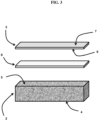
- the tissue repair laminates are advantageous as, in use, the first major surface of the foam layer may be positioned to face, for example, the abdominal wall and the second major surface of the barrier layer exposed to internal organs.
- the barrier layer surface facing the internal organs substantially resists adherence, whereas the foam layer surface facing, for example, the abdominal wall may adhere to tissue and facilitate tissue regeneration, for example, abdominal wall regeneration.
- the foam layer comprises a thermoset polyurethane.
- the foam layer comprises a cross-linked polyurethane.
- the barrier layer comprises a thermoplastic polyurethane.
- the barrier layer may be designed to degrade at a different rate to the foam layer or at substantially the same rate.
- biodegradable refers generally to the capability of being broken down in the normal functioning of living organisms/tissue, preferably into innocuous, non-toxic or biocompatible products.
- the foam layer may degrade faster than the barrier layer.
- the tissue repair laminate may comprise any one or more of the following features:
- the tissue repair laminate may shrink less than 20%, or less than 15%, or less than 10%, or less than 5%, independently, in any single surface area, after 10 days under in vivo conditions.
- the tissue repair laminate may shrink less than 20%, or less than 15%, or less than 10%, or less than 5%, independently, in any single surface area, after 20 days under in vivo conditions or after 60 days under in vivo conditions, or after 90 days under in vivo conditions, or after 120 days under in vivo conditions, or after 200 days under in vivo conditions, or after 1 year under in vivo conditions, or after 2 years under in vivo conditions.
- the foam layer may have a thickness between about 0.1 mm and about 10 mm, or between about 0.2 mm and about 5 mm, or between about 0.3 mm and about 3 mm, or between about 0.3 mm and about 2 mm, or between about 0.4 mm and about 2 mm.
- the foam layer may have thickness of less than about 10 mm, or less than about 6 mm, or less than about 4 mm, or less than about 2 mm, or less than about 1 mm, or less than about 0.5 mm.
- the foam layer has a thickness of between 0.3 mm and about 3 mm.
- the barrier layer may have a thickness between about 20 ⁇ m and about 1000 ⁇ m, or between about 50 ⁇ m and about 500 ⁇ m, or between about 50 ⁇ m and about 400 ⁇ m.
- the foam layer has a thickness between about 0.3 mm and about 3 mm and the barrier layer has a thickness between about 50 ⁇ m and about 400 ⁇ m.
- the foam layer has a thickness between about 0.3 mm and about 2 mm and the barrier layer has a thickness between about 100 ⁇ m and about 300 ⁇ m.
- the foam layer has a thickness between about 0.3 mm and about 1 mm and the barrier layer has a thickness between about 100 ⁇ m and about 300 ⁇ m.
- the foam may be a non-reticulated foam. In some embodiments the foam may be a reticulated foam.
- the foam may, preferably, have interconnecting pores. Preferably the foam is a non-reticulated foam.
- 'non-reticulated' polyurethane foam refers to a polyurethane foam which has not been subjected to a post manufacturing step to remove cell windows using either chemicals (such as alkaline solution), heat (such as controlled combustion of hydrogen and oxygen), or solvents.
- the foam may have a density between 3 g/100ml and 12 g/100 ml, or between 4 g/100ml and 10 g/100 ml, or between 5 g/100ml and 8 g/100 ml.
- the porosity of the foam may be greater than 50%, or greater than 75%, or from 80 to 95%, or from 95 to 99.9%. It is desirable that the porosity should be as high as possible while maintaining other mechanical specifications. If the porosity is too low the pores may not interconnect. If the porosity is too high the structural integrity of the foam may be mechanically compromised.
- the average pore size of the foams may be greater than 50 ⁇ m, or greater than 75 ⁇ m, or greater than 100 ⁇ m, or greater than 200 ⁇ m, or in the range 100 to 600 ⁇ m, or in the range 100 to 400 ⁇ m.
- the average pore size of the foam is in the range 50 to 600 ⁇ m, or in the range 60 to 600 ⁇ m, or in the range 70 to 600 ⁇ m, or in the range 75 to 400 ⁇ m, or in the range 75 to 300 ⁇ m, or in the range 100 to 300 ⁇ m.
- the average pore size of the foam is greater than 75 ⁇ m, more preferably between 100 and 300 ⁇ m.
- the tissue repair laminate may have a weight between 50 and 800 g/m 2 , or between 100 and 600 g/m 2 , or between 200 and 500 g/m 2 .
- the second major surface of the barrier layer is substantially non-adherent to tissue.
- substantially non-adherent it is meant, in some embodiments, that the barrier layer either does not adhere to tissue or only adheres such that it can be easily released from tissue without damage to the tissue.
- the second major surface of the barrier layer has a higher surface smoothness than the first major surface of the foam layer.
- the term 'smooth' in relation to a surface, means that the surface is substantially non-adherent to tissue.
- first major surface of the foam layer and the second major surface of the barrier layer are in direct contact with each other. In some embodiments the first major surface of the foam layer and the second major surface of the barrier layer are fused to each other.
- the laminate may comprise one or more further layers disposed between the foam layer and the barrier layer.
- the one or more further layers may be an adhesive layer.
- the biodegradable polyurethane foam layer may be biodegradable within a living organism to biocompatible degradation products.
- the polyurethane foam layer may be in vivo degradable.
- the polyurethane foam layer may be degradable at temperatures between about 35°C and about 42°C.
- the polyurethane foam layer may degrade by hydrolysis.
- the polyurethane foam layer may degrade by hydrolysis of ester functionalities.
- the polyurethane foam may be derived from one or more biodegradable polyols and one or more isocyanates.
- the polyurethane foam may be derived from a mixture of one or more biodegradable polyols and one or more non-biodegradable polyols and one or more isocyanates.
- the biodegradable polyols are polyester polyols.
- the biodegradable polyols may have a molecular weight of less than or equal to about 10,000 Daltons, or less than or equal to about 8,000 Daltons, or less than or equal to about 6,000 Daltons, or less than or equal to about 4,000 Daltons, or less than or equal to about 2,000 Daltons, or less than or equal to about 1,500 Daltons, or less than or equal to about 1,000 Daltons, or less than or equal to about 800 Daltons, or less than or equal to about 600 Daltons, or less than or equal to about 500 Daltons, or less than or equal to about 400 Daltons, or less than or equal to about 350 Daltons, or less than or equal to about 300 Daltons.
- the biodegradable polyols may have a molecular weight of less than 500 Daltons or less than 400 Daltons or less than 350 Daltons, or less than 300 Daltons.
- the biodegradable polyols may be in the liquid state at 20°C and atmospheric pressure.
- the biodegradable polyols may be in the solid state at 20°C and atmospheric pressure.
- the polyols may in the form of a mixture of solid and liquid at 20°C.
- the biodegradable polyols may be derived from one or more polyol initiators and one or more hydroxy acids, diacids or cyclic esters and combinations thereof.
- the biodegradable polyol may be derived from one or more polyol initiators and at least one hydroxy acid.
- biodegradable polyol may be derived from one or more polyol initiators and at least one diacid.
- the biodegradable polyol may be derived from one or more polyol initiators and at least one cyclic ester.
- the biodegradable polyol may be derived from one or more polyol initiators, at least one hydroxy acid and at least one diacid.
- the biodegradable polyol may be derived from one or more polyol initiators, at least one hydroxy acid and at least one cyclic ester.
- the biodegradable polyol may be derived from one or more polyol initiators, at least one diacid and at least one cyclic ester.
- the biodegradable polyol may be derived from one or more polyol initiators, at least one hydroxyl acid, at least one diacid and at least one cyclic ester.
- the one or more polyol initiators may be pentaerythritol, trimethylol propane, glycerol, 1,4-butanediol, ethylene glycol, sorbitol, glucose, sucrose, 1,2-propanediol, 1,3-propanediol, pentane diol, myoinositol, hexamethylenediol, heptanediol, octanediol, nonanediol, decanediol, dodecanediol, 2-ethyl-1,3-hexanediol (EHD), 2,2,4-trimethyl pentane-1,3-diol (TMPD), 1,4-cyclohexane dimethanol, diethylene glycol, dipropylene glycol, and combinations thereof.
- EHD 2-ethyl-1,3-hexanediol
- TMPD 2,2,4-
- Non-limiting examples of hydroxy acids include l-lactic acid, d-lactic acid, d,l-lactic acid, mandelic acid, phenyl-lactic acid, hydroxybutyric acid, hydroxyvaleric acid or glycolic acid and combinations thereof.
- Non-limiting examples of cyclic esters include ⁇ -caprolactone, glycolide, lactide, mandelide, and ⁇ -dioxanone and combinations thereof.
- the biodegradable polyols may be prepared via a ring-opening polymerisation reaction or a condensation reaction.
- Non-limiting examples of diacids include oxalic acid, malonic acid, succinic acid, glutaric acid, adipic acid, pimelic acid, suberic acid, azelaic acid, sebacic acid, undecanedioic acid, dodecanedioic acid, tridecanedioic acid, and hexadecanedioic acid and combinations thereof.
- the biodegradable polyols may be prepared via a ring-opening polymerisation reaction or a condensation reaction or via both a ring-opening polymerisation reaction and a condensation reaction.
- the one or more non-biodegradable polyols may be a polyether polyol.
- the polyether polyol may be one or more of glycerol ethoxylate, glycerol propoxylate, glycerol ethoxylate-co-propoxylate, glycerol ethoxylate-block-propoxylate, pentaerythritol ethoxylate, pentaerythritol propoxylate and trimethylolpropane propoxylate.
- the one or more non-biodegradable polyols may have a molecular weight of less than or equal to about 2000 Daltons, or less than or equal to about 1500 Daltons, or less than or equal to about 1300 Daltons.
- the non-biodegradable polyols may have a molecular weight between about 200 and about 2,000 Daltons, or between about 200 and about 1,500 Daltons, or between about 200 and about 1,300 Daltons, or between about 600 and about 1500 Daltons, or between about 900 and about 1300 Daltons.
- the non-biodegradable polyols may have a molecular weight of less than or equal to about 10,000 Daltons, or less than or equal to about 8,000 Daltons, or less than or equal to about 6,000 Daltons, or less than or equal to about 4,000 Daltons, or less than or equal to about 2,000 Daltons, or less than or equal to about 1,500 Daltons, or less than or equal to about 1,000 Daltons, or less than or equal to about 800 Daltons, or less than or equal to about 600 Daltons, or less than or equal to about 500 Daltons, or less than or equal to about 400 Daltons, or less than or equal to about 350 Daltons, or less than or equal to about 300 Daltons.
- the non-biodegradable polyols may have a molecular weight of less than 500 Daltons or less than 400 Daltons or less than 350 Daltons, or less than 300 Daltons.
- the biodegradable polyols impart biodegradability to the foam.
- the polyols may be prepared by condensation polymerization or ring-opening polymerization with a high proportion of initiator (or starter) to control the molecular weight.
- the amount of initiator may range from between 1 mole of initiator per 200 g of polyol and 1 mole of initiator per 5000 g of polyol, or between 1 mole of initiator per 500 g polyol and 1 mole of initiator per 2000 g of polyol.
- Non-limiting examples of suitable monomers for the initiator include pentaerythritol (4-arm), trimethylol propane (3-arm), glycerol (3-arm), 1,4-butanediol (2-arm), myo-inositol (6-arm). Mixtures of initiators may be utilized. Mixtures of polyols may be utilized. It may be preferable to minimize the number of components. However, in some instances it may be advantageous to utilise more than one polyol, or more than two.
- the polyol may have a hydroxyl functionality of 2 or more. Polyols having only a single hydroxyl functionality, when used in large amounts, may not result in an adequate foam. However, minor amounts may be used to adjust the properties of the foam, for example, adding a few percent of a mono-hydroxyl compound which has a long-chain lipophilic chain, may influence the hydrophobicity/hydrophilicity of the foam.
- the rate of degradation of the foam layer may be controlled by altering the ratio of biodegradable polyol to that of non-biodegradable polyol. By reducing or eliminating a non-biodegradable polyol from the formulation, faster degrading foam layers may be produced which may be desirable in certain applications. Monomer selection may also influence the rate of degradation due to kinetic differences in the rate of hydrolysis of different ester linkages.
- Biodegradable and non-biodegradable polyols have different functions in the foam layer of the tissue repair laminate.
- Non-biodegradable polyols may be selected from the polyether polyols, for example, glycerol ethoxylate, glycerol propoxylate and glycerol ethoxylate-co-propoxylate.
- Such non-biodegradable polyols may stabilize the foam through the introduction of non-biodegradable function. Further they may provide a mechanism to control the hydrophilic/hydrophobic balance through, for example, the ethoxylate/propoxylate content. They may also improve foam resilience by lowering the glass transition temperature (Tg).
- Biodegradable polyols may be solid at lower molecular weights than non-biodegradable polyols, for example, polycaprolactone diol of 500 molecular weight is a solid at room temperature, whereas poly(propylene glycol) remains a liquid to a much higher molecular weight.
- High molecular weight non-biodegradable liquid polyols may act as a 'filler' to reduce the isocyanate content and hence reduce the likelihood of scorching through excessive exothermic reaction during preparation of the foams.
- Biodegradable polyols may be derived from one or more polyol initiators and at least one hydroxy acid and/or cyclic ester. They may contribute to lowering the Tg in circumstances where the Tg has not been reduced sufficiently by the non-biodegradable polyether.
- the polyol may be a 3-arm, glycerol-initiated polyol based on ⁇ -caprolactone and one of glycolic acid or lactic acid.
- the amount of the CL:(LA and/or GA) may influence both the glass transition as well as the degradation time. More caprolactone lowers the Tg and increases the degradation time.
- the molecular weight may be 800-1200 Daltons. The molecular weight may be low enough to be liquid, but high enough to not require high amounts of isocyanate for reaction in order to avoid scorching.
- the polyurethanes from which the foam layer is prepared may be derived from one or more biodegradable polyols and one or more isocyanates.
- the molar ratio of isocyanate functions to hydroxy and other isocyanate reactive functions from which the foam is derived (the isocyanate index) may be less than or equal to 1.0, or less than or equal to 0.9, or less than or equal to 0.8, or less than or equal to 0.7, or less than or equal to 0.6.
- the isocyanate index may be between 0.4 and 1.0, or between 0.6 and 0.9.
- the polyurethane foam may be derived from polyols and isocyanates having an isocyanate content (that is, the content of NCO functions) of less than 20% by weight, or less than 19%, or less than 18%, or less than 17%, or less than 16%, or less than 15%, or less than 14%, or less than 13%, or less than 12%, or less than 11%, or less than 10%, or less than 9%, or less than 8% by weight based on the total weight of polyols and isocyanates.
- the foam may have an isocyanate content of between 5% and 20%, or between 8% and 17%, or between 11% and 14% by weight based on the total weight of polyol and isocyanate.
- the degradation products from aliphatic isocyanates are generally considered to be more biocompatible than the degradation products from aromatic diisocyanates. Accordingly, isocyanates such as hexamethylene diisocyanate (HDI) and ELDI may be particularly suitable. Isophorone diisocyanate (IPDI) may also be used but may impart a higher glass transition temperature which may result in a stiffening of the foam. Combinations of isocyanates may be used and may in some instances be preferable, for example, glass transition can be adjusted by combinations of HDI and IPDI. Trimethylhexamethylenediisocyanate, 1,4-butane diisocyanate, methyl-lysine diisocyanate (MLDI) and other isocyanates commonly used in polyurethane synthesis may also be suitable.
- isocyanates such as hexamethylene diisocyanate (HDI) and ELDI may be particularly suitable.
- Isophorone diisocyanate (IPDI) may also be
- a biodegradable polyurethane foam is advantageous since it may be designed to include the properties of resilience, resistance to premature degradation, resistance to contraction, prevention of excessive acidic degradation products, biocompatibility, controlled water absorption, compatibility with other polyurethane layers and ease of incorporating additives during synthesis.
- the foams may be soft and conformable to a desired shape.
- the foams may be designed to degrade at a specific rate. They may be designed to retain structural integrity for over, for example, three months or they may be designed to retain structural integrity for as little as, for example, a few days, even one or two days.
- the polyurethane foam layer may degrade, under the conditions of ASTM F1635, such that the mass of the foam layer decreases by between about 10% and about 90% in a period of one year or less.
- the mass of the foam layer may decrease by between about 10% and about 90% in a period of eleven months or less, or ten months or less, or nine months or less, or eight months or less, or seven months or less, or six months or less, or five months or less, or four months or less, or three months or less, or two months or less, or one month or less.
- the rate of degradation under the conditions of ASTM F1635, may be controlled through varying the nature and ratios of the components of the polyurethane. Accordingly, the polyurethane may be designed to degrade within a specific period of time. This is advantageous in providing materials that are partially, fully, or substantially fully degradable in a specific period of time, for example, when the functional aspects of the polyurethane foam layer are no longer required.
- the rate of degradation of the foam may be controlled by altering the ratio of biodegradable polyol to non-biodegradable polyol or through choice of monomers. By reducing or eliminating a non-biodegradable polyol from the formulation, faster degrading materials may be produced which may be desirable in certain applications.
- the foams may be derived from at least one prepolymer which may be prepared by contacting one or more biodegradable polyols and/or one or more polyol initiators with one or more polyisocyanates.
- polyol initiators are, for example, pentaerythritol, trimethylol propane, glycerol, 1,4-butanediol and myo-inositol, ethylene glycol, sorbitol, glucose, sucrose, 1,2-propanediol and mixtures thereof.
- the foam may be derived from a mixture of such so-formed prepolymers and further polyisocyanate.
- the foam may contain less than 50% by weight of prepolymer and greater than 50% by weight of polyisocyanate based on the combined weight of these components.
- the foam may contain from less than 30% by weight of prepolymer and greater than 70% by weight of polyisocyanate based on the combined weight of these components. Foams prepared in this way advantageously may possess high strength and fine cell structure.
- the foam may be derived from a biodegradable polyol and a non-biodegradable polyol wherein the molecular weight of the biodegradable polyol is less than our equal to about 1300 Dalton and from polyols and polyisocyanates having an isocyanate (NCO) content is less than 20%, or less than 19%, or less than 18%, or less than 17%, or less than 16%, or less than 15%, or less than 14%, or less than 13%, or less than 12%, or less than 11%, or less than 10%, or less than 9%, or less than 8% by weight based on the total weight of polyols and polyisocyanates.
- NCO isocyanate
- the foam may be derived from a biodegradable polyol having a molecular weight less than or equal to about 1300 Dalton and from polyols and polyisocyanates having an isocyanate (NCO) content of less than 20%, or less than 19%, or less than 18%, or less than 17%, or less than 16%, or less than 15%, or less than 14%, or less than 13%, or less than 12%, or less than 11%, or less than 10%, or less than 9%, or less than 8% by weight based on the total weight of polyols and polyisocyanates and a molar ratio of isocyanate functions to hydroxy and other isocyanate reactive functions (the isocyanate index) less than or equal to 1.0.
- NCO isocyanate
- the foam may be derived from a biodegradable polyol and a non-biodegradable polyol wherein the molecular weight of the biodegradable polyol is less than our equal to about 1300 Dalton and from polyols and polyisocyanates having an isocyanate (NCO) content is less than 20%, or less than 19%, or less than 18%, or less than 17%, or less than 16%, or less than 15%, or less than 14%, or less than 13%, or less than 12%, or less than 11%, or less than 10%, or less than 9%, or less than 8% by weight based on the total weight of polyols and polyisocyanates and a molar ratio of isocyanate functions to hydroxy and other isocyanate reactive functions (the isocyanate index) less than or equal to 1.0.
- NCO isocyanate
- additives known in the fields of polyurethane foam technology and tissue engineering may be added to the foam. These additives may be added during or after synthesis of the foam. The additives in some cases may react during the foam synthesis and be incorporated covalently into the foam.
- Exemplary additives include antimicrobial agents, plasticizers, pore openers, antioxidants, antistatic agents, catalysts, fillers, flame retardants, softeners/flexibilisers, cell control agents, release agents, stabilizers, fillers, dyes, pigments, pigment dispersants, solvents, anaesthetics, cells, enzymes, proteins, growth factors, growth inhibitors, haemostatic agents and bioactive agents such as drugs.
- the additives may or may not be chemically bonded to the foam.
- catalysts known in the field of polyurethane synthesis that may be used in the preparation of the polyurethanes of the present disclosure.
- Various catalysts may be used in the preparation of the compositions and these may provide different attributes.
- dibutyltin dilaurate (DBTL) stannous octoate and amine-based catalysts, such as DABCO.
- Bismuth, zinc and titanium-based catalysts are also known to catalyze urethane formation effectively and exhibit low toxicity.
- COSCAT Z-22 is a zinc-based catalyst and is an example of a catalyst that can be used that has low toxicity and gives effective results.
- Mercury and lead-containing catalysts are effective but are considered toxic (non-biocompatible) and therefore unsuitable. Combinations of catalysts are known to be effective. Minimisation of catalyst amount is also desirable.
- the function of the surfactant is to assist in preventing the bubbles in the foam from bursting when they are formed during the reaction, which allows them to rise and create a stable foam which can then cure.
- Surfactants may be siloxane-ether copolymers, fluoro-ether copolymers, or other amphiphilic compounds containing a hydrophobic portion and a hydrophilic portion.
- Amounts used vary from 0.01% to 1.5% by mass of the overall formulation. Preferred amounts are in the range 0.01% to 0.20% of the formulation. The most suitable amount depends on the molecular weight of the surfactant and the composition and type, as well as the remainder of the formulation - some formulations may be more hydrophobic and some may be more hydrophilic and hence may require different amounts of stabilisation.
- Useful surfactants may be simple block copolymers and brush-type copolymers. It is straightforward for the skilled person to vary the concentration of surfactant and determine which concentration is most effective in stabilizing the foam layer.
- the foams may be blown by any method known in the art.
- the blowing agent may be generated during formation of the foam and/or may be added as one or more further components.
- Water may be used in the formulation to react with isocyanate, thus forming a urea linkage and CO2 gas.
- the CO2 gas creates the bubbles and blows the foam.
- Temperature, mixing and choice of surfactant, for example, may all affect the size of the bubbles (cell size).
- polyurethane foams range in pore size from microporous (low density shoe soles) through to open cell large-celled foams (for example in filters or foam mattresses).
- Desirable porosities may be obtained by using 0.1 to 4% by weight of water, preferably 1.0 to 1.5% by weight of water in the overall formulation. This results in an appropriate level of foaming. Less water results in a denser foam. Higher amounts of water may be useful, but there will be a limit where the mechanical properties are negatively affected and scorching becomes likely.
- Pentane and other low-boiling hydrocarbons may also be suitable as blowing agents. Foams produced in this manner may be advantageously urea-free due to the absence of water. Desirably, the absence of water reduces the amount of isocyanate required to react in the formulation, which consequently reduces the amount of heat generated when the foam is produced. This is particularly advantageous in large scale preparations where the heat of reaction may be more difficult to dissipate from the foam.
- the foam layer may comprise any one or more of the herein disclosed features in any combination.
- the foams may be simply prepared by a one-pot method. All the components may be combined and mixed with or without the application of heat, and the foam will rise and cure. Alternatively, the foams may be prepared by any of the continuous or semi-continuous processes well known in the art.
- one or more polyols or polyol initiators is/are first treated with a polyisocyanate to form a prepolymer.
- This prepolymer is in turn treated with further components so to form the foam.
- further polyisocyanate over and above that utilized to form the prepolymer may be utilized.
- all components, apart from the polyisocyanate component(s) are mixed together to form one part.
- the polyisocyanate is then added so as to begin the reaction. This is advantageous in that the two parts are both stable prior to mixing them together.
- the foam may be prepared in a solvent free process.
- the foams may be advantageously prepared by a one-pot batch procedure which may require no isolation or purification of intermediate materials.
- the foams may be prepared from low cost raw materials.
- Reticulation results in the removal of cell windows so as to increase the amount of open cell material. This may be advantageous when fluid transfer is a requirement. This may be performed in a special chamber (reticulation chamber) where hydrogen and oxygen are introduced to the foam and ignited to disrupt and remove any cell windows.
- Cell openers or cell opening agents may be added to the foam mixture to, for example, disrupt the pore structure during the foaming process, thereby creating foams with a natural sponge structure. Cell openers may reduce the tightness and shrinkage of the foam, resulting in dimensionally stable foams with inter-connected pores. Cell openers and other reaction components of polyurethane foams are discussed, for example in Szycher, M, Szycher's Handbook of Polyurethanes, CRC Press, New York, N.Y., 9-6 to 9-8 (1999). Cell openers suitable for use include powdered divalent metal salts of long-chain fatty acids having from about 1-22 carbon atoms. Divalent metal salts of stearic acid, such as calcium and magnesium stearate, are examples of cell openers. The concentrations of cell openers in the resin mix may be in the range of approximately 0.1-7.0 % by weight or in the range of approximately 0.3 to 1 % by weight.
- Bioactive agents may optionally be added to the foam mix.
- the term 'bioactive' refers generally to an agent, a molecule, or a compound that affects biological or chemical events in a host.
- the barrier layer of the presently disclosed tissue repair laminate may be substantially resistant to adhesion to sensitive tissues and organs.
- the barrier lay may be non-adhesiogenic or substantially non-adhesiogenic.
- the barrier layer may consist of more than one layer.
- the barrier layer may be a laminate of two or more sheets of the same or different polyurethanes.
- the barrier layer polyurethane comprises an oriented polyurethane.
- the oriented polyurethane comprises a biaxially oriented polyurethane.
- the oriented polyurethane is annealed.
- the barrier layer should be flexible enough to conform to the shape of the foam layer.
- the barrier layer may be composed of one or more layers of polyurethane.
- the barrier layer may be biodegradable or non-biodegradable but should preferably be biocompatible.
- the barrier layer may be a thermoformed sheet.
- the barrier layer may be formed by casting a film.
- the barrier layer may be subjected to orientation either in one direction or in two directions.
- the barrier layer provides strength to the tissue repair laminate.
- an oriented barrier layer provides high strength to the tissue repair laminate.
- the barrier layer may be a woven or non-woven layer of fibres which prevents tissue adhesion, as may be obtained for example by electrospinning.
- Barrier layers of 50-400 ⁇ m thickness offer a good balance between strength (increases with thickness), permeability (decreases with thickness) and handling (stiffer as it gets thicker). Additionally, the mass of the barrier layer may become too high compared to the mass of the foam layer if it is too thick.
- the tissue repair laminate may comprise a biocompatible and/or biodegradable adhesive located between the foam layer and the barrier layer.
- no adhesive may be utilised and the barrier layer may be melted directly onto the foam layer.
- the barrier layer may comprise a biodegradable polyurethane.
- the barrier layer may be derived from one or more polyols, one or more isocyanates and one or more chain extenders.
- the chain extenders may be biodegradable or non-degradable, preferably the chain extenders comprise biodegradable chain extenders.
- the barrier layer polyurethane may be derived from: one or more chain extenders represented by formula (1) or formula (2)
- the barrier layer polyurethane may have a number average molecular weight (M n ) up to 200,000 Daltons, or up to 150,000 Daltons, or up to 100,000 Daltons, or up to 60,000 Daltons, or up to 40,000 Daltons, or up to 20,000 Daltons.
- M n number average molecular weight
- the barrier layer polyurethane may have a number average molecular weight (M n ) between 2,000 and 200,000 Daltons, or between 5,000 and 150,000 Daltons or between 10,000 and 100,000 Daltons or between 20,000 and 100,000 Daltons or between 2,000 and 60,000 Daltons, or between 2,000 and 40,000 Daltons or between 2,000 and 20,000 Daltons.
- M n number average molecular weight
- the polyurethane may have a number average molecular weight (M n ) up to 100,000 Daltons, or up to 75,000 Daltons, or up to 50,000 Daltons, or up to 30,000 Daltons, or up to 20,000 Daltons, or up to 10,000 Daltons.
- M n number average molecular weight
- the number average molecular weight of the polyurethane is between 50,000 and 100,000 Daltons.
- the polyurethane may have a polydispersity (M w /M n ) between 1.0 and 4.0, or between 1.0 and 3.5, or between 1.5 and 3.0. Preferably the polydispersity is between 1.0 and 2.0.
- the polyols may comprise one or more polyester polyols.
- the polyols may have a molecular weight between about 200 and about 2,000 Daltons, or between about 200 and about 1,500 Daltons, or between about 200 and about 1,300 Daltons.
- the polyols may have a molecular weight of less than or equal to about 10,000 Daltons, or less than or equal to about 8,000 Daltons, or less than or equal to about 6,000 Daltons, or less than or equal to about 4,000 Daltons, or less than or equal to about 2,000 Daltons, or less than or equal to about 1,500 Daltons, or less than or equal to about 1,000 Daltons, or less than or equal to about 800 Daltons, or less than or equal to about 600 Daltons, or less than or equal to about 500 Daltons, or less than or equal to about 400 Daltons, or less than or equal to about 350 Daltons, or less than or equal to about 300 Daltons.
- the polyols may have a molecular weight of less than 500 Daltons or less than 400 Daltons or less than 350 Daltons, or less than 300 Daltons.
- the polyols may be in the liquid state at 20°C and atmospheric pressure. Alternatively, the polyols may be in the solid state at 20°C and atmospheric pressure.
- the polyols may be derived from one or more diol initiators and one or more hydroxy acids, diacids or cyclic esters and combinations thereof.
- the polyol may be derived from one or more diol initiators and at least one hydroxy acid.
- the polyol may be derived from one or more diol initiators and at least one diacid.
- the polyol may be derived from one or more diol initiators and at least one cyclic ester.
- the polyol may be derived from one or more diol initiators, at least one hydroxy acid and at least one diacid.
- the polyol may be derived from one or more diol initiators, at least one hydroxy acid and at least one cyclic ester.
- the polyol may be derived from one or more diol initiators, at least one diacid and at least one cyclic ester.
- the polyol may be derived from one or more diol initiators, at least one hydroxyl acid, at least one diacid and at least one cyclic ester.
- Non-limiting examples of the one or more diol initiators include ethylene glycol, 1,3-propanediol, 1,2-propanediol, 1,4-butanediol, pentanediol, hexamethylenediol, heptanediol, octanediol, nonanediol, decanediol, dodecanediol, 2-ethyl-1,3-hexanediol (EHD), 2,2,4-trimethyl pentane-1,3-diol (TMPD), 1,4-cyclohexane dimethanol, diethylene glycol, dipropylene glycol, and combinations thereof.
- EHD 2-ethyl-1,3-hexanediol
- TMPD 2,2,4-trimethyl pentane-1,3-diol
- 1,4-cyclohexane dimethanol diethylene glycol, dipropylene
- Non-limiting examples of diacids include oxalic acid, malonic acid, succinic acid, glutaric acid, adipic acid, pimelic acid, suberic acid, azelaic acid, sebacic acid, undecanedioic acid, dodecanedioic acid, tridecanedioic acid, and hexadecanedioic acid and combinations thereof.
- Non-limiting examples of hydroxy acids include l-lactic acid, d-lactic acid, d,l-lactic acid, mandelic acid, phenyl-lactic acid, hydroxybutyric acid, hydroxyvaleric acid or glycolic acid and combinations thereof.
- Non-limiting examples of cyclic esters include ⁇ -caprolactone, glycolide, lactide, mandelide, and ⁇ -dioxanone and combinations thereof.
- the polyols may be prepared via a ring-opening polymerisation reaction or a condensation reaction or via both a ring-opening polymerisation reaction and a condensation reaction.
- R1, R2 and R3 of formulae (1) and (2) are independently selected from optionally substituted C1-6 alkylene and optionally substituted C2-6 alkenylene.
- optionally substituted refers to a group which may or may not be further substituted with one or more groups selected from C1-6 alkyl, C2-6 alkenyl, C2-6 alkynyl, halo, halo C1-6alkyl, halo C2-6 alkenyl, halo C2-6 alkynyl, hydroxy, C1-6 alkoxy, C2-6 alkenyloxy, halo C1-6 alkoxy, haloalkenyloxy, nitro, nitro C1-6 alkyl, nitro C2- 6 alkenyl, nitro C-6 alkynyl, nitroheterocyclyl, amino, C1-6 alkylamino, C1-6 dialkylamino, C2-6 alkenylamino, C2-6 alkynylamino, acyl, alkenylacyl, alkynylacyl, acylamino, diacylamino, acyloxy, C1-6 alkylsulphonyloxy, heterocycly
- the chain extender of formula (1) or formula (2) is preferably hydroxy-acetic acid 3-hydroxy-propyl ester, 6-hydroxy-hexanoic acid 2-hydroxyethyl ester, 6-hydroxy-hexanoic acid 4-hydroxybutyl ester, ethylene glycol succinic acid diester diol, ethylene glycol fumaric acid diester diol, glycolic acid-ethylene glycol dimer and lactic acid-ethylene glycol dimer;and mixtures thereof.
- the chain extender of formula (1) of formula (2) may be prepared from one or more diols and one or more hydroxy acids and/or cyclic esters.
- Non-limiting examples of the one or more diols include ethylene glycol, 1,3-propanediol, 1,2-propanediol, 1,4-butanediol, pentanediol, hexamethylenediol, heptanediol, octanediol, nonanediol, decanediol, dodecanediol, 2-ethyl-1,3-hexanediol (EHD), 2,2,4-trimethyl pentane-1,3-diol (TMPD), 1,4-cyclohexane dimethanol, diethylene glycol, dipropylene glycol, and combinations thereof.
- EHD 2-ethyl-1,3-hexanediol
- TMPD 2,2,4-trimethyl pentane-1,3-diol
- 1,4-cyclohexane dimethanol diethylene glycol, dipropylene glyco
- Non-limiting examples of hydroxy acids include l-lactic acid, d-lactic acid, d,l-lactic acid, mandelic acid, phenyl-lactic acid, hydroxybutyric acid, hydroxyvaleric acid or glycolic acid and combinations thereof.
- Non-limiting examples of cyclic esters include ⁇ -caprolactone, glycolide, lactide, mandelide, and ⁇ -dioxanone and combinations thereof.
- the polyurethane may further comprise one or more aliphatic polyol chain extenders which are hydrolytically non-degradable under in vivo conditions.
- the polyurethane may further comprise one or more diol chain extenders which do not contain ester functionality in their backbones.
- the non-degradable chain extender is an alkane diol having up to 30 carbon atoms, for example, ethylene glycol, 1,3-propanediol, 1,2-propanediol, 1,4-butanediol, pentanediol, hexamethylenediol, heptanediol, nonanediol, dodecanediol, 2-ethyl-1,3-hexanediol (EHD), 2,2,4-trimethyl pentane-1,3-diol (TMPD), 1,6-hexanediol, 1,4-cyclohexane dimethanol, diethylene glycol, dipropylene glycol, and mixtures thereof.
- alkane diol having up to 30 carbon atoms
- the aliphatic diisocyanate is preferably 4,4'-methylene dicyclohexyl diisocyanate (HMDI), 1,6-hexane diisocyanate (HDI), 1,4-butane diisocyanate (BDI), L-lysine diisocyanate (LDI), ethyl-L-lysine diisocyanate (ELDI), methyl-L-lysine diisocyanate (MLDI), 2,4,4-trimethylhexamethylenediisocyanate, other similar diisocyanates, and mixtures thereof.
- HMDI 4,4'-methylene dicyclohexyl diisocyanate
- HDI 1,6-hexane diisocyanate
- BDI 1,4-butane diisocyanate
- L-lysine diisocyanate L-lysine diisocyanate
- ELDI ethyl-L-lysine diisocyanate
- MLDI
- the degradation products from aliphatic isocyanates are generally considered to be more biocompatible than the degradation products from aromatic diisocyanates. Accordingly, isocyanates such as hexamethylene diisocyanate (HDI) and ELDI may be particularly suitable. Isophorone diisocyanate (IPDI) may also be used. Combinations of isocyanates may be used and may in some instances be preferable - for example, glass transition can be adjusted by combinations of HDI and IPDI. Trimethylhexamethylenediisocyanate, 1,4-butane diisocyanate, methyl-lysine diisocyanate (MLDI) and other isocyanates commonly used in polyurethane synthesis may also be suitable.
- isocyanates such as hexamethylene diisocyanate (HDI) and ELDI may be particularly suitable. Isophorone diisocyanate (IPDI) may also be used. Combinations of isocyanates may be used and may in some instances be preferable -
- the polyurethane may contain hard and soft segments.
- the ratio of hard to soft segment influences the melting point of the polyurethane.
- the hard segment content (% HS) of the polyurethane (that is, the combined content of the components derived from the chain extender of formula (1) or formula (2) and isocyanate, expressed by weight percentage) may range from 2 to 100 wt. %, or from 5 to 80 wt %, or from 10 to 70 wt %.
- the soft segment content (% SS) of the polyurethane (that is, the percentage by weight of the components derived from the polyester polyol) may range from 5-98%, and in some embodiments, is at least 25% or at least 40%.
- the polyurethane comprises hard and soft segments wherein the hard segment content (% HS) of the polyurethane is less than 60%, preferably between 30 and 60%.
- the amount of chain extender of formula (1) or formula (2) in the polyurethane may be varied to vary the non-degradable length of continuous urethane in the hard segment.
- the non-degradable length of the hard segment may have an average molecular weight between 100 and 10,000 Daltons, or between 200 and 5,000 Daltons, or between 400 and 2,000 Daltons, or between 200 and 700 Daltons or between 320 and 700 Daltons.
- the barrier layer polyurethane may degrade, under the conditions of ASTM F1635, such that the number average molecular weight (M n ) of the polyurethane decreases and/or the mass of the barrier layer decreases by between 10% and 90% in a period of one year or less.
- the barrier layer polyurethane may be in vivo degradable.
- the polyurethane may be degradable at temperatures between 35 and 42°C.
- the number average molecular weight (M n ) of the polyurethane may decrease and/or the mass of the barrier layer may decrease by between 10% and 90% in a period of eleven months or less, or ten months or less, or nine months or less, or eight months or less, or seven months or less, or six months or less, or five months or less, or four months or less, or three months or less, or two months or less, or one month or less.
- the rate of degradation under the conditions of ASTM F1635, may be controlled through varying the nature and ratios of the components of the polyurethane. Accordingly, the polyurethane may be designed to degrade within a specific time period. This is advantageous in providing materials that are partially, fully, or substantially fully degradable in a specific time period, for example, when the functional aspects of the polyurethane are no longer required.
- the melting point of the polyurethane of the barrier layer may be between 60°C and 190°C.
- the melting point may be between 60°C and 180°C, or between 60°C and 170°C, or between 60°C and 160°C, or between 60°C and 150°C, or between 60°C and 140°C, or between 60°C and 130°C, or between 60°C and 120°C, or between 60°C and 110°C, or between 60°C and 100°C, or between 60°C and 100°C, or between 60°C and 90°C, or between 60°C and 80°C, or between 60°C and 70°C.
- the melting point may be determined by differential scanning calorimetry. Other techniques know to those skilled in the art, such as dynamic mechanical thermal analysis, may also be utilised.
- the barrier layer may be laminated to the foam layer by a combination of heat and pressure.
- the barrier layer may be laminated to the foam layer so as there are substantially no gaps (for example, air bubbles) between the materials.
- the foam layer and the barrier layer may be of substantially equal dimensions of length and width.
- the barrier layer may be of larger dimensions of length and/or width than the foam layer.
- the barrier layer may be laminated to the foam layer through an interaction between the two materials through the application of heat or pressure or a combination of heat and pressure.
- the barrier layer may be covalently bonded to the foam layer.
- the barrier layer may be laminated to the foam layer with the aid of a suitable adhesive according to any of the aforementioned embodiments.
- the second surface of the barrier layer may be rendered substantially smooth, or substantially non-adherent to tissue by pressing against a smooth surface.
- the second surface of the barrier layer may be pressed against a PTFE surface.
- the pressing operation is conducted when the barrier layer polyurethane is tacky.
- the thickness of the barrier layer is between 0.03 and 1 mm.
- the thickness of the foam layer is between 0.2 and 5 mm.
- the melt pressing may be performed at a temperature between 100 and 200°C.
- the melt pressing may be performed at a pressure of up to 30 t.
- the melt pressing may be performed between two smooth sheets.
- the sheets may be substantially smooth although some degree of surface texturing is acceptable.
- the melt pressing may be performed between two PTFE sheets, for example glass fibre reinforced PTFE sheets.
- the fusing may be performed in the absence of applied pressure.
- the fusing may be performed by applying heat to the second major surface of the barrier layer, for example by exposing the second major surface to a temperature between 100 and 200°C.
- the barrier layer may, alternatively, be applied to the foam layer by spraying or spreading.
- the barrier layer may be formed by other thermal processing methods known in the art such as, for example, cast extrusion and blown film extrusion.
- the foam may be bonded or fused to the barrier layer by calendering with heat or with the use of solvents or using ultrasonic means.
- the barrier layer may be bonded to the foam layer through ultrasonic welding. This is a particularly useful method of bonding the layers where an oriented barrier layer is utilized.
- Suitable adhesives include, but are not limited to, solvent-based adhesives, latex adhesives, pressure-sensitive adhesives, hot-melt adhesives, and reactive adhesives, such as a biodegradable or non-biodegradable thermoset polyurethane reactive mixture.
- Suitable pressure-sensitive adhesives include, but are not limited to, pressure-sensitive adhesives made from acrylics, natural latexes, styrene-butadiene rubbers, and reclaimed rubbers.
- Suitable hot-melt adhesives include, but are not limited to, polyamides, polyolefins, and poly(ethylene-co-vinyl acetate).
- the barrier layer may itself be an adhesive. In other embodiments, no adhesive may be utilised - the barrier layer is melted directly onto the foam layer.
- tissue repair laminate as disclosed herein for effecting tissue repair.
- a method of repair of tissue damage in a subject in need thereof comprises surgically implanting the herein disclosed tissue repair laminate into a site of the tissue damage in the subject.
- the damage may comprise, for example, a hernia, a ventral abdominal wall hernia, a rotator cuff injury, a pelvic organ prolapse, or a uro-gynecological injury.
- the site of the damage may be, for example, a soft tissue, a mesenchymal tissue, an intraperitoneal tissue, a rotator cuff tissue, a pelvic tissue, or a uro-gynecological tissue.
- the intraperitoneal tissue may be, for example, a ventral abdominal wall tissue.
- the rotator cuff tissue may be, for example, a rotator cuff tendon.
- the pelvic tissue may be, for example, a bladder tissue.
- the uro-gynecological tissue may be, for example, a urethral tissue.
- the method may comprise surgically implanting the tissue repair laminate into a site, e.g. an intraperitoneal tissue, such as a ventral abdominal wall tissue, of a hernia, e.g. a ventral abdominal wall hernia, in the subject.
- the method may comprise surgically implanting the tissue repair laminate, e.g. a rotator cuff repair laminate, into a site, e.g. a rotator cuff tissue, such as a rotator cuff tendon, of a rotator cuff injury in the subject.
- the method may comprise surgically implanting the tissue repair laminate, e.g. a pelvic organ prolapse repair laminate, into a site, e.g. a pelvic tissue, such as a bladder tissue, of a pelvic organ prolapse in the subject.
- the method may comprise surgically implanting the tissue repair laminate, e.g. a uro-gynecological reconstruction laminate, into a site, e.g. a uro-gynecological tissue, such as a urethral tissue, of a uro-gynecological injury in the subject.
- tissue repair laminates may also be useful in reinforcing tissues in surgical procedures such as abdominoplasty, breast reconstruction, midline closures, lateral closures, hernia repair, retrorectus hernia repair, Rives-Stoppa procedures, incisional hernias, cosmetic surgery, and the like.
- the term "about” is understood as within a range of normal tolerance in the art, for example within two standard deviations of the mean. 'About' can be understood as within 10%, 9%, 8%, 7%, 6%, 5%, 4%, 3%, 2%, 1%, 0.5%, 0.1%, 0.05%, or 0.01% of the stated value. Unless otherwise clear from context, all numerical values provided herein in the specification and the claim can be modified by the term 'about'.
- tissue repair laminate comprising:
- tissue repair laminate comprising:
- tissue repair laminate comprising:
- Bioactive substances may optionally be added to the polyurethanes of the foam layer, the barrier layer or both layers.
- the bioactive substance may be formulated with the polyurethane to form a composition.
- the formulation may be facilitated by, for example, melt processing, additive manufacturing or dissolution in an appropriate solvent.
- Bioactive substances may be synthetic molecules, biomolecules, or multimolecular entities and include, but are not limited to, enzymes, organic catalysts, ribozymes, organometallics, proteins, glycoproteins, peptides, polyamino acids, antibodies, nucleic acids, steroidal molecules, antibiotics, silver, silver oxide, antivirals, antimycotics, anticancer agents, analgesic agents, antirejection agents, immunosuppressants, cytokines, carbohydrates, oleophobics, lipids, extracellular matrix and/or its individual components, demineralized bone matrix, hydroxyapatite, tricalcium phosphate, pharmaceuticals, chemotherapeutics, and therapeutics.
- Cells and non-cellular biological entities, such as viruses, virus vectors and prions can also be bioactive substances.
- the bioactive substances may be chemically bonded to the polyurethane.
- bioactive compounds can be classified in more than one of these classes.
- a wide range of bioactive substances may be incorporated into the presently disclosed polyurethanes and may be consequently delivered with the tissue repair laminates as herein disclosed.
- cardiovascular drugs in particular antihypertensive agents (e.g. calcium channel blockers or calcium antagonists) and antiarrhythmic agents; congestive heart-failure pharmaceuticals; inotropic agents; vasodilators; ACE inhibitors; diuretics; carbonic anhydrase inhibitors; cardiac glycosides; phosphodiesterase inhibitors; ⁇ -blockers; ⁇ -blockers; sodium channel blockers; potassium channel blockers; ⁇ -adrenergic agonists; platelet inhibitors; angiotensin antagonists; anticoagulants; thrombolytic agents; treatments for bleeding; treatments for anaemia; thrombin inhibitors; antiparasitic agents; antibacterial agents; insulin; human growth hormone and peptides; vaccines; anti-inflammatory agents, in particular non-steroidal anti-inflammatory agents (NSAIDs), more particularly COX-2 inhibitors; steroidal anti-inflammatory agents; prophylactic anti-inflammatory agents; anti glaucoma agents; mast cell stabilisers;
- NSAIDs non-ster
- pharmaceutically, nutraceutically or cosmeceutically acceptable derivatives includes, but is not limited to, pharmaceutically, nutraceutically or cosmeceutically acceptable salts, esters, salts of such esters, ethers, or any other derivative including prodrugs and metabolites, which upon administration to a subject (e.g. patient, human or animal) in need is capable of providing, directly or indirectly, a bioactive substance as otherwise described herein.
- the term "pharmaceutically, nutraceutically or cosmeceutically acceptable salt” refers to those salts which are, within the scope of sound medical judgment, suitable for use in contact with the tissues of humans and lower animals without undue toxicity, irritation, allergic response and the like, and are commensurate with a reasonable benefit/risk ratio.
- nutraceutically or cosmeceutically acceptable salts are well known in the art.
- S. M. Berge, et al. describe pharmaceutically, nutraceutically or cosmeceutically acceptable salts in detail in J. Pharmaceutical Sciences, 66:1-1 9, 1977 .
- Examples of pharmaceutically, nutraceutically or cosmeceutically acceptable nontoxic acid addition salts are salts of an amino group formed with inorganic acids such as hydrochloric acid, hydrobromic acid, phosphoric acid, sulfuric acid and perchloric acid or with organic acids such as-acetic-acid, oxalic acid, maleic acid, tartaric acid citric acid, succinic acid, or malonic acid or by using other methods used in the art such as ion exchange.
- inorganic acids such as hydrochloric acid, hydrobromic acid, phosphoric acid, sulfuric acid and perchloric acid
- organic acids such as-acetic-acid, oxalic acid, maleic acid, tartaric acid citric acid, succinic acid, or malonic acid or by using other methods used in the art such as ion exchange.
- salts include adipate, alginate, ascorbate, aspartate, benzenesulfonate, benzoate, bisulfate, borate, butyrate, camphorate, camphorsulfonate, citrate, cyclopentanepropionate, digluconate, dodecylsulfate, ethanesulfonate, formate, fumarate, glucoheptonate, glycerophosphate, gluconate, hernisulfate, heptanoate, hexanoate, hydroiodide, 2 hydroxy-ethanesulfonate, lactobionate, lactate, laurate, lauryl sulfate, malate, maleate, malonate, methanesulfonate, 2-naphthalenesulfonate, nicotinate, nitrate, oleate, oxalate, palmitate, pamoate, pectinate
- alkali or alkaline earth metal salts include sodium, lithium, potassium, calcium, magnesium, and the like.
- Further pharmaceutically acceptable salts include, when appropriate, nontoxic ammonium, quaternary ammonium, and amine cations formed using counterions such as halide, hydroxide, carboxylate, sulfate, phosphate, nitrate, loweralkyl sulfonate, and aryl sulfonate.
- esters which are hydrolysed in vivo and include those that break down readily in the human body to leave the parent compound or a salt thereof.
- Suitable ester groups include, for example, those derived from pharmaceutically, nutraceutically or cosmeceutically acceptable aliphatic carboxylic acids, particularly alkanoic, alkenoic, cycloalkanoic and alkanedioic acids, in which each alkyl or alkenyl moiety advantageously has not more than 6 carbon atoms.
- esters include formates, acetates, propionates, butyrates, acrylates and ethylsuccinates.
- prodrugs as used herein includes those prodrugs of the biologically active substances which are, within the scope of sound medical judgment, suitable for use in contact with the tissues of a subject with undue toxicity, irritation, allergic response, and the like, commensurate with a reasonable benefit/risk ratio, and effective for their intended use, as well as the zwitterionic forms, where possible, of the biologically active substances.
- prodrug refers to compounds that are rapidly transformed in vivo to yield a parent compound, for example by hydrolysis in blood.
- a thorough discussion is provided in T. Higuchi and V. Stella, Pro-drugs as Novel Delivery Systems, Vol. 14 of the A.C.S. Symposium Series , and in Edward B. Roche, ed., Bioreversible Carriers in Drug Design, American Pharmaceutical Association and Pergamon Press, 1987 .
- the present disclosure is further not limited solely to the administration of one biologically active substance: more than one biologically active substance or other therapeutic compounds may be incorporated into the foam layer and/or barrier layer.
- the polyurethanes of either the foam layer or the barrier layer or both layers of the tissue repair laminate of the present disclosure may be designed to degrade in vivo or under in vivo conditions at controlled rates.
- the polyurethanes may be degradable at temperatures between 35 and 42°C.
- the number average molecular weight (M n ) of the barrier layer polyurethane and the mass of the foam layer may independently decrease by between 20% and 90% in a period of eleven months or less, or ten months or less, or nine months or less, or eight months or less, or seven months or less, or six months or less, or five months or less, or four months or less, or three months or less, or two months or less, or one month or less.
- the number average molecular weight (M n ) of the barrier layer polyurethane and the mass of the foam layer may independently decrease by between 30% and 90% in a period of eleven months or less, or ten months or less, or nine months or less, or eight months or less, or seven months or less, or six months or less, or five months or less, or four months or less, or three months or less, or two months or less, or one month or less.
- the number average molecular weight (M n ) of the barrier layer polyurethane and the mass of the foam layer may independently decrease by between 40% and 90% in a period of eleven months or less, or ten months or less, or nine months or less, or eight months or less, or seven months or less, or six months or less, or five months or less, or four months or less, or three months or less, or two months or less, or one month or less.
- the number average molecular weight (M n ) of the barrier layer polyurethane and the mass of the foam layer may independently decrease by between 50% and 90% in a period of eleven months or less, or ten months or less, or nine months or less, or eight months or less, or seven months or less, or six months or less, or five months or less, or four months or less, or three months or less, or two months or less, or one month or less.
- the number average molecular weight (M n ) of the barrier layer polyurethane and the mass of the foam layer may independently decrease by between 60% and 90% in a period of eleven months or less, or ten months or less, or nine months or less, or eight months or less, or seven months or less, or six months or less, or five months or less, or four months or less, or three months or less, or two months or less, or one month or less.
- the number average molecular weight (M n ) of the barrier layer polyurethane and the mass of the foam layer may independently decrease by between 70% and 90% in a period of eleven months or less, or ten months or less, or nine months or less, or eight months or less, or seven months or less, or six months or less, or five months or less, or four months or less, or three months or less, or two months or less, or one month or less.
- the number average molecular weight (M n ) of the barrier layer polyurethane and the mass of the foam layer may independently decrease by between 80% and 90% in a period of eleven months or less, or ten months or less, or nine months or less, or eight months or less, or seven months or less, or six months or less, or five months or less, or four months or less, or three months or less, or two months or less, or one month or less.
- the number average molecular weight (M n ) of the barrier layer polyurethane and the mass of the foam layer may independently decrease by between 20% and 70% in a period of eleven months or less, or ten months or less, or nine months or less, or eight months or less, or seven months or less, or six months or less, or five months or less, or four months or less, or three months or less, or two months or less, or one month or less.
- the number average molecular weight (M n ) of the barrier layer polyurethane and the mass of the foam layer may independently decrease by between 30% and 70% in a period of eleven months or less, or ten months or less, or nine months or less, or eight months or less, or seven months or less, or six months or less, or five months or less, or four months or less, or three months or less, or two months or less, or one month or less.
- the number average molecular weight (M n ) of the barrier layer polyurethanes and the mass of the foam layer may independently decrease by between 40% and 70% in a period of eleven months or less, or ten months or less, or nine months or less, or eight months or less, or seven months or less, or six months or less, or five months or less, or four months or less, or three months or less, or two months or less, or one month or less.
- the number average molecular weight (M n ) of the barrier layer polyurethane and the mass of the foam layer may independently decrease by between 50% and 70% in a period of eleven months or less, or ten months or less, or nine months or less, or eight months or less, or seven months or less, or six months or less, or five months or less, or four months or less, or three months or less, or two months or less, or one month or less.
- the number average molecular weight (M n ) of the barrier layer polyurethanes and the mass of the foam layer may independently decrease by between 60% and 70% in a period of eleven months or less, or ten months or less, or nine months or less, or eight months or less, or seven months or less, or six months or less, or five months or less, or four months or less, or three months or less, or two months or less, or one month or less.
- a biodegradable polyurethane thermoset foam was prepared according to the present disclosure.
- the foam was cut into sheets of various thickness using conventional foam slicing equipment.
- Polyols were prepared by condensation of L-lactic acid (LLA), ⁇ -caprolactone (CL) and 1,4-butane diol (BDO). All components were weighed into a glass reactor fitted with stirring, nitrogen outgassing, a condenser, and a heat source. The temperature was set to between 130°C and 210°C and the stirring and nitrogen flow started. Water was removed from the vessel via the condenser as the reaction proceeded. The reaction was continued until completion as indicated by residual acid measurement at which point the polyol was cooled and stored for use.
- LPA L-lactic acid
- CL ⁇ -caprolactone
- BDO 1,4-butane diol
- Polyols of molecular weight of about 400 were prepared as above using weight ratios of LLA:CL of 30:70 along with BDO initiator.
- the chain extender was prepared by ring opening polymerisation of ⁇ -caprolactone (CL) and 1,4-butane diol (BDO) in a 1:5 molar ratio. The temperature was set to between 130°C and 210°C with stirring and nitrogen. The reaction was continued until completion as indicated by gas chromatography (GC) analysis at which point the chain extender was cooled and stored for use.
- CL ⁇ -caprolactone
- BDO 1,4-butane diol
- Example 1 Under nitrogen and stirring, 3 kg of the polyol of Example 1 was combined with HDI (1.734 kg). BDO-CL (Example 2; 63.5 g) and organozinc catalyst were added with heating to complete a prepolymer and the isocyanate content assayed. This was then chain extended using BDO (407.6 g) and further zinc catalyst. The stirred mixture was then poured into PTFE-lined trays and cured in an oven for 2 hours at 120°C. The cured polymer was then granulated.
- BDO-CL Example 2
- organozinc catalyst organozinc catalyst
- Dried granulated polymer from Example 5 was extruded on a small-scale cast film line equipped with extruder and chill rolls to provide a continuous film of between 235 and 420 ⁇ m thickness. Temperature during extrusion was between 160-185 °C, and a lower temperature in the feeding zone.
- Polymer granules prepared as in Example 4 were melt pressed between glass fibre-reinforced PTFE sheets at 175°C, 10 t pressure on a Carver melt-press, to form a film 0.2 mm thick.
- a 1 mm foam sheet (biodegradable polyester-urethane-urea thermoset foam) was applied to the top of the melt-pressed barrier layer of Example 8 and heated on the melt-press platen without pressure at 175 °C for 45 seconds to bond the two layers together.
- Specimens of the laminate were cut (3 cm x 7 cm) and heat sealed individually in two layers of medical grade packaging (oriented polyamide and foil pouches). Sterilised at >25 kGy gamma irradiation.
- a spunbond polyurethane was prepared using the same polyurethane as for the above prepared barrier layer.
- the areal weight (weight of fabric per unit area) of the spunbond fabric (dry) was measured as 198 g/m 2 .
- a warp knit polyurethane was prepared using the same polyurethane as for the above prepared barrier layer and spunbond.
- the polyurethane was extruded on a conventional extruder equipped with a take-off system including heated godets. Spools of monofilament were produced and tested and the results are collected in Table 3. Table 3 Diameter (mm) Linear Density (Denier) Break Load (N) Max.
- the spools of filament were warp-knitted using a double-knit pattern to produce a mesh which was then stentered.
- the mesh had an issue with curling that was not fixed under the conditions of the stentering.
- Samples of mesh were hydrated in water for 2 hours prior to mechanical testing the results of which are collected in Table 4.
- a laminate was prepared using film of example 7 and annealed at 70 °C prior to use, and 2 mm thick foam (biodegradable polyester-urethane-urea thermoset foam).
- the foam sheet was placed on top of the stretched and annealed film and welded together using an ultrasonic probe (40 kHz probe, Dukane IQ) with settings of 3 Joules per weld and 50 Amplitude.
- the sheets were welded with a 4 mm spot weld and in a square array of 14 mm spacing (centre to centre).
- Tensile specimens were prepared and tested on an Instron model 5566 (10cm length, 2.6 cm width, 2 columns of welds per specimen, 50 mm gauge length, 500 mm/min). The welds were secure and the film was smooth on the non-bonded side.
- the average mechanical properties of the laminate was as follows: Ultimate tensile strength 56.6 N/cm, Elongation 126%.
- Figure 7 illustrates the stress-strain curve for
- the foam layers absent a barrier layer performed very poorly. Even foam layers of 4 mm thickness performed extremely poorly compared to the 1 mm foam layer laminated with a 200 ⁇ m barrier layer.
- Test A was a laminate according to the present disclosure.
- Comparative Test B was the spunbond polyurethane mesh and Comparative Test C was the knitted polyurethane mesh.
- Each of the test articles were 7 cm x 3 cm in size (surface area 21 cm 2 ).
- Test A the laminate of the present disclosure was used such that the foam layer faced the abdominal wall and the barrier layer faced the internal organs.
- Tables 8 and 9 collect the average results on adhesion and Figures 4 and 5 illustrate the results graphically.
- Table 8 Group Adhesions amounts (Score 0-4) 1 0.3 2 3.0 3 3.4 4 0.4 5 4.0
- Table 9 Group Type of adhesions (Score 0-3) 1 0.4 2 3.0 3 2.8 4 0.6 5 3.0
- Group 1 (Test A) exhibited the least shrinkage when compared to all other groups.
- Group 4 (AlloDerm ® ) showed the next least overall amount of shrinkage.
- Table 10 Group Graft size (width cm) Graft size (length cm) Graft area (cm 2 ) 1 3.2 6.7 21 2 3.0 6.5 19.5 3 3.1 6.1 19 4 3.1 6.6 20.5 5 2.9 6.2 18
- the synthetic tissue repair laminate of the present disclosure performed exceptionally well, there being effectively no tissue adhesion to the barrier layer surface and no shrinkage of the laminate.
- the barrier layer of the laminate, the spunbond and the warp knit were all formed from the same polyurethane resin, both the spunbond and the warp knit were highly adhesive to tissue and showed significant shrinkage in vivo.
Landscapes
- Health & Medical Sciences (AREA)
- Chemical & Material Sciences (AREA)
- Life Sciences & Earth Sciences (AREA)
- Veterinary Medicine (AREA)
- Public Health (AREA)
- General Health & Medical Sciences (AREA)
- Animal Behavior & Ethology (AREA)
- Medicinal Chemistry (AREA)
- Epidemiology (AREA)
- Chemical Kinetics & Catalysis (AREA)
- Vascular Medicine (AREA)
- Heart & Thoracic Surgery (AREA)
- Engineering & Computer Science (AREA)
- Oral & Maxillofacial Surgery (AREA)
- Transplantation (AREA)
- Organic Chemistry (AREA)
- Surgery (AREA)
- Polymers & Plastics (AREA)
- Dermatology (AREA)
- Dispersion Chemistry (AREA)
- Cardiology (AREA)
- Biomedical Technology (AREA)
- Textile Engineering (AREA)
- Manufacturing & Machinery (AREA)
- Materials Engineering (AREA)
- Materials For Medical Uses (AREA)
- Laminated Bodies (AREA)
- Polyurethanes Or Polyureas (AREA)
- Manufacture Of Porous Articles, And Recovery And Treatment Of Waste Products (AREA)
- Biological Depolymerization Polymers (AREA)
- Prostheses (AREA)
Applications Claiming Priority (2)
| Application Number | Priority Date | Filing Date | Title |
|---|---|---|---|
| AU2017905176A AU2017905176A0 (en) | 2017-12-22 | Tissue repair laminates | |
| PCT/AU2018/051386 WO2019119061A1 (en) | 2017-12-22 | 2018-12-21 | Tissue repair laminates |
Publications (3)
| Publication Number | Publication Date |
|---|---|
| EP3727193A1 EP3727193A1 (en) | 2020-10-28 |
| EP3727193A4 EP3727193A4 (en) | 2021-09-15 |
| EP3727193B1 true EP3727193B1 (en) | 2025-05-14 |
Family
ID=66992359
Family Applications (1)
| Application Number | Title | Priority Date | Filing Date |
|---|---|---|---|
| EP18893268.5A Active EP3727193B1 (en) | 2017-12-22 | 2018-12-21 | Tissue repair laminates |
Country Status (9)
| Country | Link |
|---|---|
| US (2) | US10898614B2 (https=) |
| EP (1) | EP3727193B1 (https=) |
| JP (2) | JP2021506556A (https=) |
| CN (1) | CN111712214A (https=) |
| AU (1) | AU2018390992B2 (https=) |
| CA (1) | CA3086350A1 (https=) |
| NZ (1) | NZ765659A (https=) |
| WO (1) | WO2019119061A1 (https=) |
| ZA (1) | ZA202004239B (https=) |
Families Citing this family (4)
| Publication number | Priority date | Publication date | Assignee | Title |
|---|---|---|---|---|
| CA3086350A1 (en) * | 2017-12-22 | 2019-06-27 | Polynovo Biomaterials Pty Limited | Tissue repair laminates |
| CN113195197A (zh) * | 2018-12-21 | 2021-07-30 | 宝利诺沃生物材料有限公司 | 定向生物可降解聚氨酯 |
| WO2023063883A2 (en) * | 2021-10-11 | 2023-04-20 | Agency For Science, Technology And Research | Photo-crosslinkable acrylates for nail cosmetic applications |
| CN120570716B (zh) * | 2025-08-05 | 2025-11-04 | 四川大学华西医院 | 一种植入假体和义肢密封的固定装置 |
Citations (1)
| Publication number | Priority date | Publication date | Assignee | Title |
|---|---|---|---|---|
| EP3687588B1 (en) * | 2017-09-29 | 2022-07-20 | Polyganics IP B.V. | Tissue-adhesive sealant device |
Family Cites Families (29)
| Publication number | Priority date | Publication date | Assignee | Title |
|---|---|---|---|---|
| US6702848B1 (en) * | 1999-07-20 | 2004-03-09 | Peter Paul Zilla | Foam-type vascular prosthesis with well-defined anclio-permissive open porosity |
| AUPQ170799A0 (en) * | 1999-07-20 | 1999-08-12 | Cardiac Crc Nominees Pty Limited | Shape memory polyurethane or polyurethane-urea polymers |
| IL137090A (en) * | 2000-06-29 | 2010-04-15 | Pentech Medical Devices Ltd | Polymeric stent |
| CA2365376C (en) * | 2000-12-21 | 2006-03-28 | Ethicon, Inc. | Use of reinforced foam implants with enhanced integrity for soft tissue repair and regeneration |
| US7022135B2 (en) * | 2001-08-17 | 2006-04-04 | Medtronic, Inc. | Film with highly porous vascular graft prostheses |
| AU2002950340A0 (en) * | 2002-07-23 | 2002-09-12 | Commonwealth Scientific And Industrial Research Organisation | Biodegradable polyurethane/urea compositions |
| DE602004032514D1 (de) * | 2003-01-09 | 2011-06-16 | Polyganics Bv | Biomedizinische schäume |
| US8197837B2 (en) * | 2003-03-07 | 2012-06-12 | Depuy Mitek, Inc. | Method of preparation of bioabsorbable porous reinforced tissue implants and implants thereof |
| US7479157B2 (en) * | 2003-08-07 | 2009-01-20 | Boston Scientific Scimed, Inc. | Stent designs which enable the visibility of the inside of the stent during MRI |
| EP1729783B2 (en) | 2004-03-24 | 2023-01-18 | Polynovo Biomaterials Pty Limited | Biodegradable polyurethane and polyurethane ureas |
| US8460378B2 (en) * | 2004-07-26 | 2013-06-11 | DePuy Sythes Products, LLC | Biocompatible, biodegradable polyurethane materials with controlled hydrophobic to hydrophilic ratio |
| ES2395154T3 (es) * | 2004-08-13 | 2013-02-08 | Mast Biosurgery Ag | Prótesis quirúrgica con regiones biodegradables y no biodegradables |
| US20070005140A1 (en) * | 2005-06-29 | 2007-01-04 | Kim Daniel H | Fabrication and use of biocompatible materials for treating and repairing herniated spinal discs |
| EP1743911A1 (en) * | 2005-07-14 | 2007-01-17 | DSM IP Assets B.V. | Polyurethane composition |
| CN101296958B (zh) * | 2005-09-20 | 2012-07-18 | 宝利诺沃生物材料有限公司 | 扩链剂 |
| US8357767B2 (en) * | 2007-10-03 | 2013-01-22 | Polynovo Biomaterials Limited | High modulus polyurethane and polyurethane/urea compositions |
| US9943302B2 (en) * | 2008-08-12 | 2018-04-17 | Covidien Lp | Medical device for wound closure and method of use |
| EP2391395A4 (en) * | 2009-02-02 | 2014-04-09 | Biomerix Corp | COMPOSITE NETWORKING DEVICE AND METHOD FOR SOFTWARE SAVING |
| WO2010093333A1 (en) | 2009-02-11 | 2010-08-19 | Nanyang Technological University | Multi-layered surgical prosthesis |
| US20140142199A1 (en) | 2010-02-17 | 2014-05-22 | Bezwada Biomedical, Llc | Absorbable branched polyesters and polyurethanes |
| CA2831893C (en) * | 2011-03-29 | 2020-12-01 | Smith & Nephew, Inc. | Fracture fixation systems having intramedullary support |
| US20130190857A1 (en) * | 2011-09-09 | 2013-07-25 | Endoluminal Sciences Pty Ltd. | Means for controlled sealing of endovascular devices |
| GB201117295D0 (en) * | 2011-10-07 | 2011-11-16 | Neotherix Ltd | Compressible dressing |
| CN104414773B (zh) * | 2013-08-23 | 2017-03-01 | 深圳迈普再生医学科技有限公司 | 防粘连组织修复膜及其制备方法 |
| MX2016009476A (es) * | 2014-01-21 | 2016-10-13 | Smith & Nephew | Aparatos para tratamiento de heridas. |
| US9328192B2 (en) | 2014-03-12 | 2016-05-03 | Bezwada Biomedical, Llc | Bio-based monomers and polymers |
| US20180140744A1 (en) * | 2015-10-19 | 2018-05-24 | Skin Tissue Engineering Pty Ltd | Porous matrix with incorporated cells |
| CN107286313A (zh) * | 2017-07-10 | 2017-10-24 | 陕西瑞盛生物科技有限公司 | 一种可降解的聚氨酯泡沫及其应用 |
| CA3086350A1 (en) * | 2017-12-22 | 2019-06-27 | Polynovo Biomaterials Pty Limited | Tissue repair laminates |
-
2018
- 2018-12-21 CA CA3086350A patent/CA3086350A1/en active Pending
- 2018-12-21 WO PCT/AU2018/051386 patent/WO2019119061A1/en not_active Ceased
- 2018-12-21 US US16/625,294 patent/US10898614B2/en active Active
- 2018-12-21 NZ NZ765659A patent/NZ765659A/en unknown
- 2018-12-21 CN CN201880089168.0A patent/CN111712214A/zh active Pending
- 2018-12-21 EP EP18893268.5A patent/EP3727193B1/en active Active
- 2018-12-21 AU AU2018390992A patent/AU2018390992B2/en active Active
- 2018-12-21 JP JP2020554332A patent/JP2021506556A/ja active Pending
-
2020
- 2020-07-10 ZA ZA2020/04239A patent/ZA202004239B/en unknown
- 2020-12-15 US US17/122,155 patent/US12496376B2/en active Active
-
2023
- 2023-08-16 JP JP2023132690A patent/JP7654729B2/ja active Active
Patent Citations (1)
| Publication number | Priority date | Publication date | Assignee | Title |
|---|---|---|---|---|
| EP3687588B1 (en) * | 2017-09-29 | 2022-07-20 | Polyganics IP B.V. | Tissue-adhesive sealant device |
Also Published As
| Publication number | Publication date |
|---|---|
| US20210100933A1 (en) | 2021-04-08 |
| JP2023164432A (ja) | 2023-11-10 |
| JP2021506556A (ja) | 2021-02-22 |
| US10898614B2 (en) | 2021-01-26 |
| AU2018390992A1 (en) | 2019-09-12 |
| CN111712214A (zh) | 2020-09-25 |
| NZ765659A (en) | 2023-03-31 |
| EP3727193A4 (en) | 2021-09-15 |
| US12496376B2 (en) | 2025-12-16 |
| US20200368397A1 (en) | 2020-11-26 |
| EP3727193A1 (en) | 2020-10-28 |
| WO2019119061A1 (en) | 2019-06-27 |
| JP7654729B2 (ja) | 2025-04-01 |
| ZA202004239B (en) | 2022-01-26 |
| CA3086350A1 (en) | 2019-06-27 |
| AU2018390992B2 (en) | 2019-12-05 |
Similar Documents
| Publication | Publication Date | Title |
|---|---|---|
| AU2018390991B2 (en) | Soft tissue implant pocket | |
| US12496376B2 (en) | Tissue repair laminates | |
| EP2629762B1 (en) | Pendant hydrophile bearing biodegradable compositions and related devices | |
| EP2196485A2 (en) | Polyester compositions, methods of manufacturing said compositions, and articles made therefrom | |
| AU2018387125B2 (en) | Tissue repair laminates | |
| EP3898171B1 (en) | Biaxially oriented biodegradable polyurethanes | |
| CN109851744B (zh) | 一种可降解聚氨酯生物材料及其制备方法和应用 | |
| US20120107366A1 (en) | Block Copolymer Systems and Their Use in Medical Devices | |
| AU2011221369A1 (en) | Block copolymer systems and their use in medical devices |
Legal Events
| Date | Code | Title | Description |
|---|---|---|---|
| STAA | Information on the status of an ep patent application or granted ep patent |
Free format text: STATUS: THE INTERNATIONAL PUBLICATION HAS BEEN MADE |
|
| PUAI | Public reference made under article 153(3) epc to a published international application that has entered the european phase |
Free format text: ORIGINAL CODE: 0009012 |
|
| STAA | Information on the status of an ep patent application or granted ep patent |
Free format text: STATUS: REQUEST FOR EXAMINATION WAS MADE |
|
| 17P | Request for examination filed |
Effective date: 20200612 |
|
| AK | Designated contracting states |
Kind code of ref document: A1 Designated state(s): AL AT BE BG CH CY CZ DE DK EE ES FI FR GB GR HR HU IE IS IT LI LT LU LV MC MK MT NL NO PL PT RO RS SE SI SK SM TR |
|
| AX | Request for extension of the european patent |
Extension state: BA ME |
|
| DAV | Request for validation of the european patent (deleted) | ||
| DAX | Request for extension of the european patent (deleted) | ||
| A4 | Supplementary search report drawn up and despatched |
Effective date: 20210817 |
|
| RIC1 | Information provided on ipc code assigned before grant |
Ipc: C08G 18/42 20060101ALI20210811BHEP Ipc: C08G 18/73 20060101ALI20210811BHEP Ipc: C08G 18/10 20060101ALI20210811BHEP Ipc: B32B 27/06 20060101ALI20210811BHEP Ipc: B32B 7/12 20060101ALI20210811BHEP Ipc: B32B 5/24 20060101ALI20210811BHEP Ipc: B32B 5/02 20060101ALI20210811BHEP Ipc: A61L 31/14 20060101ALI20210811BHEP Ipc: A61F 2/00 20060101ALI20210811BHEP Ipc: C08L 75/06 20060101ALI20210811BHEP Ipc: C08G 18/00 20060101ALI20210811BHEP Ipc: B32B 27/40 20060101ALI20210811BHEP Ipc: B32B 5/18 20060101ALI20210811BHEP Ipc: A61L 31/06 20060101ALI20210811BHEP Ipc: A61F 2/02 20060101AFI20210811BHEP |
|
| STAA | Information on the status of an ep patent application or granted ep patent |
Free format text: STATUS: EXAMINATION IS IN PROGRESS |
|
| 17Q | First examination report despatched |
Effective date: 20230706 |
|
| GRAP | Despatch of communication of intention to grant a patent |
Free format text: ORIGINAL CODE: EPIDOSNIGR1 |
|
| STAA | Information on the status of an ep patent application or granted ep patent |
Free format text: STATUS: GRANT OF PATENT IS INTENDED |
|
| INTG | Intention to grant announced |
Effective date: 20241212 |
|
| GRAS | Grant fee paid |
Free format text: ORIGINAL CODE: EPIDOSNIGR3 |
|
| GRAA | (expected) grant |
Free format text: ORIGINAL CODE: 0009210 |
|
| STAA | Information on the status of an ep patent application or granted ep patent |
Free format text: STATUS: THE PATENT HAS BEEN GRANTED |
|
| AK | Designated contracting states |
Kind code of ref document: B1 Designated state(s): AL AT BE BG CH CY CZ DE DK EE ES FI FR GB GR HR HU IE IS IT LI LT LU LV MC MK MT NL NO PL PT RO RS SE SI SK SM TR |
|
| P01 | Opt-out of the competence of the unified patent court (upc) registered |
Free format text: CASE NUMBER: APP_17025/2025 Effective date: 20250408 |
|
| REG | Reference to a national code |
Ref country code: GB Ref legal event code: FG4D |
|
| REG | Reference to a national code |
Ref country code: CH Ref legal event code: EP |
|
| REG | Reference to a national code |
Ref country code: DE Ref legal event code: R096 Ref document number: 602018082014 Country of ref document: DE |
|
| REG | Reference to a national code |
Ref country code: IE Ref legal event code: FG4D |
|
| REG | Reference to a national code |
Ref country code: NL Ref legal event code: FP |
|
| PG25 | Lapsed in a contracting state [announced via postgrant information from national office to epo] |
Ref country code: PT Free format text: LAPSE BECAUSE OF FAILURE TO SUBMIT A TRANSLATION OF THE DESCRIPTION OR TO PAY THE FEE WITHIN THE PRESCRIBED TIME-LIMIT Effective date: 20250915 Ref country code: FI Free format text: LAPSE BECAUSE OF FAILURE TO SUBMIT A TRANSLATION OF THE DESCRIPTION OR TO PAY THE FEE WITHIN THE PRESCRIBED TIME-LIMIT Effective date: 20250514 Ref country code: ES Free format text: LAPSE BECAUSE OF FAILURE TO SUBMIT A TRANSLATION OF THE DESCRIPTION OR TO PAY THE FEE WITHIN THE PRESCRIBED TIME-LIMIT Effective date: 20250514 |
|
| REG | Reference to a national code |
Ref country code: LT Ref legal event code: MG9D |
|
| PG25 | Lapsed in a contracting state [announced via postgrant information from national office to epo] |
Ref country code: NO Free format text: LAPSE BECAUSE OF FAILURE TO SUBMIT A TRANSLATION OF THE DESCRIPTION OR TO PAY THE FEE WITHIN THE PRESCRIBED TIME-LIMIT Effective date: 20250814 Ref country code: GR Free format text: LAPSE BECAUSE OF FAILURE TO SUBMIT A TRANSLATION OF THE DESCRIPTION OR TO PAY THE FEE WITHIN THE PRESCRIBED TIME-LIMIT Effective date: 20250815 |
|
| PG25 | Lapsed in a contracting state [announced via postgrant information from national office to epo] |
Ref country code: PL Free format text: LAPSE BECAUSE OF FAILURE TO SUBMIT A TRANSLATION OF THE DESCRIPTION OR TO PAY THE FEE WITHIN THE PRESCRIBED TIME-LIMIT Effective date: 20250514 |
|
| REG | Reference to a national code |
Ref country code: AT Ref legal event code: MK05 Ref document number: 1794193 Country of ref document: AT Kind code of ref document: T Effective date: 20250514 |
|
| PG25 | Lapsed in a contracting state [announced via postgrant information from national office to epo] |
Ref country code: BG Free format text: LAPSE BECAUSE OF FAILURE TO SUBMIT A TRANSLATION OF THE DESCRIPTION OR TO PAY THE FEE WITHIN THE PRESCRIBED TIME-LIMIT Effective date: 20250514 |
|
| PG25 | Lapsed in a contracting state [announced via postgrant information from national office to epo] |
Ref country code: HR Free format text: LAPSE BECAUSE OF FAILURE TO SUBMIT A TRANSLATION OF THE DESCRIPTION OR TO PAY THE FEE WITHIN THE PRESCRIBED TIME-LIMIT Effective date: 20250514 |
|
| PG25 | Lapsed in a contracting state [announced via postgrant information from national office to epo] |
Ref country code: AT Free format text: LAPSE BECAUSE OF FAILURE TO SUBMIT A TRANSLATION OF THE DESCRIPTION OR TO PAY THE FEE WITHIN THE PRESCRIBED TIME-LIMIT Effective date: 20250514 |
|
| PG25 | Lapsed in a contracting state [announced via postgrant information from national office to epo] |
Ref country code: RS Free format text: LAPSE BECAUSE OF FAILURE TO SUBMIT A TRANSLATION OF THE DESCRIPTION OR TO PAY THE FEE WITHIN THE PRESCRIBED TIME-LIMIT Effective date: 20250814 |
|
| PG25 | Lapsed in a contracting state [announced via postgrant information from national office to epo] |
Ref country code: IS Free format text: LAPSE BECAUSE OF FAILURE TO SUBMIT A TRANSLATION OF THE DESCRIPTION OR TO PAY THE FEE WITHIN THE PRESCRIBED TIME-LIMIT Effective date: 20250914 |
|
| PG25 | Lapsed in a contracting state [announced via postgrant information from national office to epo] |
Ref country code: LV Free format text: LAPSE BECAUSE OF FAILURE TO SUBMIT A TRANSLATION OF THE DESCRIPTION OR TO PAY THE FEE WITHIN THE PRESCRIBED TIME-LIMIT Effective date: 20250514 |
|
| PGFP | Annual fee paid to national office [announced via postgrant information from national office to epo] |
Ref country code: NL Payment date: 20251003 Year of fee payment: 8 |
|
| PGFP | Annual fee paid to national office [announced via postgrant information from national office to epo] |
Ref country code: DE Payment date: 20250930 Year of fee payment: 8 |
|
| PGFP | Annual fee paid to national office [announced via postgrant information from national office to epo] |
Ref country code: GB Payment date: 20251001 Year of fee payment: 8 |
|
| PG25 | Lapsed in a contracting state [announced via postgrant information from national office to epo] |
Ref country code: SM Free format text: LAPSE BECAUSE OF FAILURE TO SUBMIT A TRANSLATION OF THE DESCRIPTION OR TO PAY THE FEE WITHIN THE PRESCRIBED TIME-LIMIT Effective date: 20250514 Ref country code: DK Free format text: LAPSE BECAUSE OF FAILURE TO SUBMIT A TRANSLATION OF THE DESCRIPTION OR TO PAY THE FEE WITHIN THE PRESCRIBED TIME-LIMIT Effective date: 20250514 |
|
| PGFP | Annual fee paid to national office [announced via postgrant information from national office to epo] |
Ref country code: FR Payment date: 20251008 Year of fee payment: 8 |
|
| PG25 | Lapsed in a contracting state [announced via postgrant information from national office to epo] |
Ref country code: CZ Free format text: LAPSE BECAUSE OF FAILURE TO SUBMIT A TRANSLATION OF THE DESCRIPTION OR TO PAY THE FEE WITHIN THE PRESCRIBED TIME-LIMIT Effective date: 20250514 |
|
| PG25 | Lapsed in a contracting state [announced via postgrant information from national office to epo] |
Ref country code: EE Free format text: LAPSE BECAUSE OF FAILURE TO SUBMIT A TRANSLATION OF THE DESCRIPTION OR TO PAY THE FEE WITHIN THE PRESCRIBED TIME-LIMIT Effective date: 20250514 |
|
| PG25 | Lapsed in a contracting state [announced via postgrant information from national office to epo] |
Ref country code: RO Free format text: LAPSE BECAUSE OF FAILURE TO SUBMIT A TRANSLATION OF THE DESCRIPTION OR TO PAY THE FEE WITHIN THE PRESCRIBED TIME-LIMIT Effective date: 20250514 Ref country code: SK Free format text: LAPSE BECAUSE OF FAILURE TO SUBMIT A TRANSLATION OF THE DESCRIPTION OR TO PAY THE FEE WITHIN THE PRESCRIBED TIME-LIMIT Effective date: 20250514 |
|
| PG25 | Lapsed in a contracting state [announced via postgrant information from national office to epo] |
Ref country code: IT Free format text: LAPSE BECAUSE OF FAILURE TO SUBMIT A TRANSLATION OF THE DESCRIPTION OR TO PAY THE FEE WITHIN THE PRESCRIBED TIME-LIMIT Effective date: 20250514 |
|
| REG | Reference to a national code |
Ref country code: DE Ref legal event code: R097 Ref document number: 602018082014 Country of ref document: DE |
|
| PLBE | No opposition filed within time limit |
Free format text: ORIGINAL CODE: 0009261 |
|
| STAA | Information on the status of an ep patent application or granted ep patent |
Free format text: STATUS: NO OPPOSITION FILED WITHIN TIME LIMIT |
|
| REG | Reference to a national code |
Ref country code: CH Ref legal event code: L10 Free format text: ST27 STATUS EVENT CODE: U-0-0-L10-L00 (AS PROVIDED BY THE NATIONAL OFFICE) Effective date: 20260325 |
|
| 26N | No opposition filed |
Effective date: 20260217 |