EP3726550A1 - Electrolyte composition and use thereof - Google Patents
Electrolyte composition and use thereof Download PDFInfo
- Publication number
- EP3726550A1 EP3726550A1 EP18888435.7A EP18888435A EP3726550A1 EP 3726550 A1 EP3726550 A1 EP 3726550A1 EP 18888435 A EP18888435 A EP 18888435A EP 3726550 A1 EP3726550 A1 EP 3726550A1
- Authority
- EP
- European Patent Office
- Prior art keywords
- electrolyte composition
- electrolyte
- iodine
- dye
- composition according
- Prior art date
- Legal status (The legal status is an assumption and is not a legal conclusion. Google has not performed a legal analysis and makes no representation as to the accuracy of the status listed.)
- Pending
Links
- 239000000203 mixture Substances 0.000 title claims abstract description 86
- 239000003792 electrolyte Substances 0.000 title claims abstract description 80
- 239000008151 electrolyte solution Substances 0.000 claims abstract description 69
- ZCYVEMRRCGMTRW-UHFFFAOYSA-N 7553-56-2 Chemical compound [I] ZCYVEMRRCGMTRW-UHFFFAOYSA-N 0.000 claims abstract description 30
- 229910052740 iodine Inorganic materials 0.000 claims abstract description 30
- 239000011630 iodine Substances 0.000 claims abstract description 30
- 150000003464 sulfur compounds Chemical class 0.000 claims abstract description 23
- 229910017464 nitrogen compound Inorganic materials 0.000 claims abstract description 19
- 150000002830 nitrogen compounds Chemical class 0.000 claims abstract description 19
- 150000003573 thiols Chemical class 0.000 claims abstract description 17
- JUJWROOIHBZHMG-UHFFFAOYSA-N Pyridine Chemical compound C1=CC=NC=C1 JUJWROOIHBZHMG-UHFFFAOYSA-N 0.000 claims abstract description 14
- XMBWDFGMSWQBCA-UHFFFAOYSA-M iodide Chemical compound [I-] XMBWDFGMSWQBCA-UHFFFAOYSA-M 0.000 claims abstract description 14
- 150000003839 salts Chemical class 0.000 claims abstract description 12
- 238000002834 transmittance Methods 0.000 claims abstract description 10
- BWGNESOTFCXPMA-UHFFFAOYSA-N Dihydrogen disulfide Chemical compound SS BWGNESOTFCXPMA-UHFFFAOYSA-N 0.000 claims abstract description 9
- UCKMPCXJQFINFW-UHFFFAOYSA-N Sulphide Chemical compound [S-2] UCKMPCXJQFINFW-UHFFFAOYSA-N 0.000 claims abstract description 9
- 150000001412 amines Chemical class 0.000 claims abstract description 9
- UMJSCPRVCHMLSP-UHFFFAOYSA-N pyridine Natural products COC1=CC=CN=C1 UMJSCPRVCHMLSP-UHFFFAOYSA-N 0.000 claims abstract description 7
- 230000003287 optical effect Effects 0.000 claims abstract description 6
- 150000001924 cycloalkanes Chemical group 0.000 claims abstract description 5
- 229920000858 Cyclodextrin Polymers 0.000 claims description 9
- HFHDHCJBZVLPGP-UHFFFAOYSA-N schardinger α-dextrin Chemical compound O1C(C(C2O)O)C(CO)OC2OC(C(C2O)O)C(CO)OC2OC(C(C2O)O)C(CO)OC2OC(C(O)C2O)C(CO)OC2OC(C(C2O)O)C(CO)OC2OC2C(O)C(O)C1OC2CO HFHDHCJBZVLPGP-UHFFFAOYSA-N 0.000 claims description 6
- PNDPGZBMCMUPRI-UHFFFAOYSA-N iodine Chemical compound II PNDPGZBMCMUPRI-UHFFFAOYSA-N 0.000 abstract description 10
- 229940021013 electrolyte solution Drugs 0.000 description 65
- -1 nitroxy radical compound Chemical class 0.000 description 32
- 239000004065 semiconductor Substances 0.000 description 20
- 238000006243 chemical reaction Methods 0.000 description 19
- WEVYAHXRMPXWCK-UHFFFAOYSA-N Acetonitrile Chemical compound CC#N WEVYAHXRMPXWCK-UHFFFAOYSA-N 0.000 description 18
- GWEVSGVZZGPLCZ-UHFFFAOYSA-N Titan oxide Chemical compound O=[Ti]=O GWEVSGVZZGPLCZ-UHFFFAOYSA-N 0.000 description 12
- OGIDPMRJRNCKJF-UHFFFAOYSA-N titanium oxide Inorganic materials [Ti]=O OGIDPMRJRNCKJF-UHFFFAOYSA-N 0.000 description 12
- HSZCZNFXUDYRKD-UHFFFAOYSA-M lithium iodide Chemical compound [Li+].[I-] HSZCZNFXUDYRKD-UHFFFAOYSA-M 0.000 description 10
- RAXXELZNTBOGNW-UHFFFAOYSA-N imidazole Natural products C1=CNC=N1 RAXXELZNTBOGNW-UHFFFAOYSA-N 0.000 description 9
- 150000001875 compounds Chemical class 0.000 description 8
- 239000003054 catalyst Substances 0.000 description 7
- 230000000052 comparative effect Effects 0.000 description 7
- 239000002904 solvent Substances 0.000 description 7
- RTZKZFJDLAIYFH-UHFFFAOYSA-N Diethyl ether Chemical compound CCOCC RTZKZFJDLAIYFH-UHFFFAOYSA-N 0.000 description 6
- JGFZNNIVVJXRND-UHFFFAOYSA-N N,N-Diisopropylethylamine (DIPEA) Chemical compound CCN(C(C)C)C(C)C JGFZNNIVVJXRND-UHFFFAOYSA-N 0.000 description 6
- 238000005259 measurement Methods 0.000 description 6
- 239000000049 pigment Substances 0.000 description 6
- BASFCYQUMIYNBI-UHFFFAOYSA-N platinum Chemical compound [Pt] BASFCYQUMIYNBI-UHFFFAOYSA-N 0.000 description 6
- LFQSCWFLJHTTHZ-UHFFFAOYSA-N Ethanol Chemical compound CCO LFQSCWFLJHTTHZ-UHFFFAOYSA-N 0.000 description 5
- LYCAIKOWRPUZTN-UHFFFAOYSA-N Ethylene glycol Chemical compound OCCO LYCAIKOWRPUZTN-UHFFFAOYSA-N 0.000 description 5
- WNAHIZMDSQCWRP-UHFFFAOYSA-N dodecane-1-thiol Chemical compound CCCCCCCCCCCCS WNAHIZMDSQCWRP-UHFFFAOYSA-N 0.000 description 5
- 239000000243 solution Substances 0.000 description 5
- OISVCGZHLKNMSJ-UHFFFAOYSA-N 2,6-dimethylpyridine Chemical compound CC1=CC=CC(C)=N1 OISVCGZHLKNMSJ-UHFFFAOYSA-N 0.000 description 4
- SECXISVLQFMRJM-UHFFFAOYSA-N N-Methylpyrrolidone Chemical compound CN1CCCC1=O SECXISVLQFMRJM-UHFFFAOYSA-N 0.000 description 4
- DKGAVHZHDRPRBM-UHFFFAOYSA-N Tert-Butanol Chemical compound CC(C)(C)O DKGAVHZHDRPRBM-UHFFFAOYSA-N 0.000 description 4
- HPYNZHMRTTWQTB-UHFFFAOYSA-N dimethylpyridine Natural products CC1=CC=CN=C1C HPYNZHMRTTWQTB-UHFFFAOYSA-N 0.000 description 4
- 239000011521 glass Substances 0.000 description 4
- 239000007788 liquid Substances 0.000 description 4
- HNJBEVLQSNELDL-UHFFFAOYSA-N pyrrolidin-2-one Chemical compound O=C1CCCN1 HNJBEVLQSNELDL-UHFFFAOYSA-N 0.000 description 4
- 239000000758 substrate Substances 0.000 description 4
- CWERGRDVMFNCDR-UHFFFAOYSA-N thioglycolic acid Chemical compound OC(=O)CS CWERGRDVMFNCDR-UHFFFAOYSA-N 0.000 description 4
- YSHMQTRICHYLGF-UHFFFAOYSA-N 4-tert-butylpyridine Chemical compound CC(C)(C)C1=CC=NC=C1 YSHMQTRICHYLGF-UHFFFAOYSA-N 0.000 description 3
- BVKZGUZCCUSVTD-UHFFFAOYSA-L Carbonate Chemical compound [O-]C([O-])=O BVKZGUZCCUSVTD-UHFFFAOYSA-L 0.000 description 3
- QMMFVYPAHWMCMS-UHFFFAOYSA-N Dimethyl sulfide Chemical compound CSC QMMFVYPAHWMCMS-UHFFFAOYSA-N 0.000 description 3
- OKKJLVBELUTLKV-UHFFFAOYSA-N Methanol Chemical compound OC OKKJLVBELUTLKV-UHFFFAOYSA-N 0.000 description 3
- ZMXDDKWLCZADIW-UHFFFAOYSA-N N,N-Dimethylformamide Chemical compound CN(C)C=O ZMXDDKWLCZADIW-UHFFFAOYSA-N 0.000 description 3
- ZMANZCXQSJIPKH-UHFFFAOYSA-N Triethylamine Chemical compound CCN(CC)CC ZMANZCXQSJIPKH-UHFFFAOYSA-N 0.000 description 3
- 239000000654 additive Substances 0.000 description 3
- 230000000996 additive effect Effects 0.000 description 3
- 150000003973 alkyl amines Chemical class 0.000 description 3
- 229940107816 ammonium iodide Drugs 0.000 description 3
- HOPRXXXSABQWAV-UHFFFAOYSA-N anhydrous collidine Natural products CC1=CC=NC(C)=C1C HOPRXXXSABQWAV-UHFFFAOYSA-N 0.000 description 3
- JFDZBHWFFUWGJE-UHFFFAOYSA-N benzonitrile Chemical compound N#CC1=CC=CC=C1 JFDZBHWFFUWGJE-UHFFFAOYSA-N 0.000 description 3
- 239000006185 dispersion Substances 0.000 description 3
- 229910052736 halogen Inorganic materials 0.000 description 3
- XMBWDFGMSWQBCA-UHFFFAOYSA-N hydrogen iodide Chemical compound I XMBWDFGMSWQBCA-UHFFFAOYSA-N 0.000 description 3
- 238000000034 method Methods 0.000 description 3
- 150000002825 nitriles Chemical class 0.000 description 3
- 229910052697 platinum Inorganic materials 0.000 description 3
- NLKNQRATVPKPDG-UHFFFAOYSA-M potassium iodide Chemical compound [K+].[I-] NLKNQRATVPKPDG-UHFFFAOYSA-M 0.000 description 3
- 229920005989 resin Polymers 0.000 description 3
- 239000011347 resin Substances 0.000 description 3
- 239000003566 sealing material Substances 0.000 description 3
- FVAUCKIRQBBSSJ-UHFFFAOYSA-M sodium iodide Chemical compound [Na+].[I-] FVAUCKIRQBBSSJ-UHFFFAOYSA-M 0.000 description 3
- RMVRSNDYEFQCLF-UHFFFAOYSA-N thiophenol Chemical compound SC1=CC=CC=C1 RMVRSNDYEFQCLF-UHFFFAOYSA-N 0.000 description 3
- 125000004169 (C1-C6) alkyl group Chemical group 0.000 description 2
- PMBXCGGQNSVESQ-UHFFFAOYSA-N 1-Hexanethiol Chemical compound CCCCCCS PMBXCGGQNSVESQ-UHFFFAOYSA-N 0.000 description 2
- MCTWTZJPVLRJOU-UHFFFAOYSA-N 1-methyl-1H-imidazole Chemical compound CN1C=CN=C1 MCTWTZJPVLRJOU-UHFFFAOYSA-N 0.000 description 2
- PAMIQIKDUOTOBW-UHFFFAOYSA-N 1-methylpiperidine Chemical compound CN1CCCCC1 PAMIQIKDUOTOBW-UHFFFAOYSA-N 0.000 description 2
- GQHTUMJGOHRCHB-UHFFFAOYSA-N 2,3,4,6,7,8,9,10-octahydropyrimido[1,2-a]azepine Chemical compound C1CCCCN2CCCN=C21 GQHTUMJGOHRCHB-UHFFFAOYSA-N 0.000 description 2
- JJWJFWRFHDYQCN-UHFFFAOYSA-J 2-(4-carboxypyridin-2-yl)pyridine-4-carboxylate;ruthenium(2+);tetrabutylazanium;dithiocyanate Chemical compound [Ru+2].[S-]C#N.[S-]C#N.CCCC[N+](CCCC)(CCCC)CCCC.CCCC[N+](CCCC)(CCCC)CCCC.OC(=O)C1=CC=NC(C=2N=CC=C(C=2)C([O-])=O)=C1.OC(=O)C1=CC=NC(C=2N=CC=C(C=2)C([O-])=O)=C1 JJWJFWRFHDYQCN-UHFFFAOYSA-J 0.000 description 2
- ICSNLGPSRYBMBD-UHFFFAOYSA-N 2-aminopyridine Chemical compound NC1=CC=CC=N1 ICSNLGPSRYBMBD-UHFFFAOYSA-N 0.000 description 2
- BSKHPKMHTQYZBB-UHFFFAOYSA-N 2-methylpyridine Chemical compound CC1=CC=CC=N1 BSKHPKMHTQYZBB-UHFFFAOYSA-N 0.000 description 2
- OOWFYDWAMOKVSF-UHFFFAOYSA-N 3-methoxypropanenitrile Chemical compound COCCC#N OOWFYDWAMOKVSF-UHFFFAOYSA-N 0.000 description 2
- YEJRWHAVMIAJKC-UHFFFAOYSA-N 4-Butyrolactone Chemical compound O=C1CCCO1 YEJRWHAVMIAJKC-UHFFFAOYSA-N 0.000 description 2
- CSCPPACGZOOCGX-UHFFFAOYSA-N Acetone Chemical compound CC(C)=O CSCPPACGZOOCGX-UHFFFAOYSA-N 0.000 description 2
- OKTJSMMVPCPJKN-UHFFFAOYSA-N Carbon Chemical compound [C] OKTJSMMVPCPJKN-UHFFFAOYSA-N 0.000 description 2
- CETBSQOFQKLHHZ-UHFFFAOYSA-N Diethyl disulfide Chemical compound CCSSCC CETBSQOFQKLHHZ-UHFFFAOYSA-N 0.000 description 2
- LCGLNKUTAGEVQW-UHFFFAOYSA-N Dimethyl ether Chemical compound COC LCGLNKUTAGEVQW-UHFFFAOYSA-N 0.000 description 2
- GUUVPOWQJOLRAS-UHFFFAOYSA-N Diphenyl disulfide Chemical compound C=1C=CC=CC=1SSC1=CC=CC=C1 GUUVPOWQJOLRAS-UHFFFAOYSA-N 0.000 description 2
- LSDPWZHWYPCBBB-UHFFFAOYSA-N Methanethiol Chemical compound SC LSDPWZHWYPCBBB-UHFFFAOYSA-N 0.000 description 2
- JLTDJTHDQAWBAV-UHFFFAOYSA-N N,N-dimethylaniline Chemical compound CN(C)C1=CC=CC=C1 JLTDJTHDQAWBAV-UHFFFAOYSA-N 0.000 description 2
- SJRJJKPEHAURKC-UHFFFAOYSA-N N-Methylmorpholine Chemical compound CN1CCOCC1 SJRJJKPEHAURKC-UHFFFAOYSA-N 0.000 description 2
- 229910019142 PO4 Inorganic materials 0.000 description 2
- WYURNTSHIVDZCO-UHFFFAOYSA-N Tetrahydrofuran Chemical compound C1CCOC1 WYURNTSHIVDZCO-UHFFFAOYSA-N 0.000 description 2
- XLOMVQKBTHCTTD-UHFFFAOYSA-N Zinc monoxide Chemical compound [Zn]=O XLOMVQKBTHCTTD-UHFFFAOYSA-N 0.000 description 2
- 229910001516 alkali metal iodide Inorganic materials 0.000 description 2
- 125000005210 alkyl ammonium group Chemical group 0.000 description 2
- 150000001450 anions Chemical class 0.000 description 2
- 150000004982 aromatic amines Chemical class 0.000 description 2
- 239000011230 binding agent Substances 0.000 description 2
- WTEOIRVLGSZEPR-UHFFFAOYSA-N boron trifluoride Chemical compound FB(F)F WTEOIRVLGSZEPR-UHFFFAOYSA-N 0.000 description 2
- KVNRLNFWIYMESJ-UHFFFAOYSA-N butyronitrile Chemical compound CCCC#N KVNRLNFWIYMESJ-UHFFFAOYSA-N 0.000 description 2
- 229910052799 carbon Inorganic materials 0.000 description 2
- 125000003178 carboxy group Chemical group [H]OC(*)=O 0.000 description 2
- 238000013329 compounding Methods 0.000 description 2
- CMKBCTPCXZNQKX-UHFFFAOYSA-N cyclohexanethiol Chemical compound SC1CCCCC1 CMKBCTPCXZNQKX-UHFFFAOYSA-N 0.000 description 2
- 238000011161 development Methods 0.000 description 2
- LJSQFQKUNVCTIA-UHFFFAOYSA-N diethyl sulfide Chemical compound CCSCC LJSQFQKUNVCTIA-UHFFFAOYSA-N 0.000 description 2
- GGSUCNLOZRCGPQ-UHFFFAOYSA-N diethylaniline Chemical compound CCN(CC)C1=CC=CC=C1 GGSUCNLOZRCGPQ-UHFFFAOYSA-N 0.000 description 2
- WQOXQRCZOLPYPM-UHFFFAOYSA-N dimethyl disulfide Chemical compound CSSC WQOXQRCZOLPYPM-UHFFFAOYSA-N 0.000 description 2
- ALVPFGSHPUPROW-UHFFFAOYSA-N dipropyl disulfide Chemical compound CCCSSCCC ALVPFGSHPUPROW-UHFFFAOYSA-N 0.000 description 2
- 230000000694 effects Effects 0.000 description 2
- DNJIEGIFACGWOD-UHFFFAOYSA-N ethanethiol Chemical compound CCS DNJIEGIFACGWOD-UHFFFAOYSA-N 0.000 description 2
- 238000011156 evaluation Methods 0.000 description 2
- 229910052731 fluorine Inorganic materials 0.000 description 2
- 150000004694 iodide salts Chemical class 0.000 description 2
- 150000002596 lactones Chemical class 0.000 description 2
- 230000031700 light absorption Effects 0.000 description 2
- 229910001511 metal iodide Inorganic materials 0.000 description 2
- 229910044991 metal oxide Inorganic materials 0.000 description 2
- 150000004706 metal oxides Chemical class 0.000 description 2
- 239000002245 particle Substances 0.000 description 2
- NBIIXXVUZAFLBC-UHFFFAOYSA-K phosphate Chemical compound [O-]P([O-])([O-])=O NBIIXXVUZAFLBC-UHFFFAOYSA-K 0.000 description 2
- 239000010452 phosphate Substances 0.000 description 2
- SUVIGLJNEAMWEG-UHFFFAOYSA-N propane-1-thiol Chemical compound CCCS SUVIGLJNEAMWEG-UHFFFAOYSA-N 0.000 description 2
- 125000001453 quaternary ammonium group Chemical group 0.000 description 2
- 125000000020 sulfo group Chemical group O=S(=O)([*])O[H] 0.000 description 2
- 150000003462 sulfoxides Chemical class 0.000 description 2
- 150000003568 thioethers Chemical class 0.000 description 2
- 125000003396 thiol group Chemical group [H]S* 0.000 description 2
- XOLBLPGZBRYERU-UHFFFAOYSA-N tin dioxide Chemical compound O=[Sn]=O XOLBLPGZBRYERU-UHFFFAOYSA-N 0.000 description 2
- 229910001887 tin oxide Inorganic materials 0.000 description 2
- GETQZCLCWQTVFV-UHFFFAOYSA-N trimethylamine Chemical compound CN(C)C GETQZCLCWQTVFV-UHFFFAOYSA-N 0.000 description 2
- 238000002371 ultraviolet--visible spectrum Methods 0.000 description 2
- XLYOFNOQVPJJNP-UHFFFAOYSA-N water Substances O XLYOFNOQVPJJNP-UHFFFAOYSA-N 0.000 description 2
- DXBFFBPYEJFFIZ-UHFFFAOYSA-N (cyclodecyldisulfanyl)cyclodecane Chemical compound C1(CCCCCCCCC1)SSC1CCCCCCCCC1 DXBFFBPYEJFFIZ-UHFFFAOYSA-N 0.000 description 1
- CHBCNWGUTDXNSW-UHFFFAOYSA-N (cycloheptyldisulfanyl)cycloheptane Chemical compound C1CCCCCC1SSC1CCCCCC1 CHBCNWGUTDXNSW-UHFFFAOYSA-N 0.000 description 1
- IXPQULUUNGAGJE-UHFFFAOYSA-N (cyclooctyldisulfanyl)cyclooctane Chemical compound C1CCCCCCC1SSC1CCCCCCC1 IXPQULUUNGAGJE-UHFFFAOYSA-N 0.000 description 1
- QEJZCKJXVYGWMY-UHFFFAOYSA-N (cyclopentyldisulfanyl)cyclopentane Chemical compound C1CCCC1SSC1CCCC1 QEJZCKJXVYGWMY-UHFFFAOYSA-N 0.000 description 1
- ZZXUZKXVROWEIF-UHFFFAOYSA-N 1,2-butylene carbonate Chemical compound CCC1COC(=O)O1 ZZXUZKXVROWEIF-UHFFFAOYSA-N 0.000 description 1
- IDJPKRIELSFBPE-UHFFFAOYSA-N 1-(decyldisulfanyl)decane Chemical compound CCCCCCCCCCSSCCCCCCCCCC IDJPKRIELSFBPE-UHFFFAOYSA-N 0.000 description 1
- GAYUSSOCODCSNF-UHFFFAOYSA-N 1-(dodecyldisulfanyl)dodecane Chemical compound CCCCCCCCCCCCSSCCCCCCCCCCCC GAYUSSOCODCSNF-UHFFFAOYSA-N 0.000 description 1
- GJPDBURPGLWRPW-UHFFFAOYSA-N 1-(hexyldisulfanyl)hexane Chemical compound CCCCCCSSCCCCCC GJPDBURPGLWRPW-UHFFFAOYSA-N 0.000 description 1
- TXIBBNMZMRYADF-UHFFFAOYSA-N 1-(naphthalen-1-yldisulfanyl)naphthalene Chemical compound C1=CC=C2C(SSC=3C4=CC=CC=C4C=CC=3)=CC=CC2=C1 TXIBBNMZMRYADF-UHFFFAOYSA-N 0.000 description 1
- MQQKTNDBASEZSD-UHFFFAOYSA-N 1-(octadecyldisulfanyl)octadecane Chemical compound CCCCCCCCCCCCCCCCCCSSCCCCCCCCCCCCCCCCCC MQQKTNDBASEZSD-UHFFFAOYSA-N 0.000 description 1
- AROCLDYPZXMJPW-UHFFFAOYSA-N 1-(octyldisulfanyl)octane Chemical compound CCCCCCCCSSCCCCCCCC AROCLDYPZXMJPW-UHFFFAOYSA-N 0.000 description 1
- GDCCFQMGFUZVKK-UHFFFAOYSA-N 1-butyl-2h-pyridine Chemical compound CCCCN1CC=CC=C1 GDCCFQMGFUZVKK-UHFFFAOYSA-N 0.000 description 1
- RKYMVQJWYYOIJB-UHFFFAOYSA-N 1-decylsulfanyldecane Chemical compound CCCCCCCCCCSCCCCCCCCCC RKYMVQJWYYOIJB-UHFFFAOYSA-N 0.000 description 1
- ONQBOTKLCMXPOF-UHFFFAOYSA-N 1-ethylpyrrolidine Chemical compound CCN1CCCC1 ONQBOTKLCMXPOF-UHFFFAOYSA-N 0.000 description 1
- LHNRHYOMDUJLLM-UHFFFAOYSA-N 1-hexylsulfanylhexane Chemical compound CCCCCCSCCCCCC LHNRHYOMDUJLLM-UHFFFAOYSA-N 0.000 description 1
- FGYADSCZTQOAFK-UHFFFAOYSA-N 1-methylbenzimidazole Chemical compound C1=CC=C2N(C)C=NC2=C1 FGYADSCZTQOAFK-UHFFFAOYSA-N 0.000 description 1
- AVFZOVWCLRSYKC-UHFFFAOYSA-N 1-methylpyrrolidine Chemical compound CN1CCCC1 AVFZOVWCLRSYKC-UHFFFAOYSA-N 0.000 description 1
- IHWDIGHWDQPQMQ-UHFFFAOYSA-N 1-octadecylsulfanyloctadecane Chemical compound CCCCCCCCCCCCCCCCCCSCCCCCCCCCCCCCCCCCC IHWDIGHWDQPQMQ-UHFFFAOYSA-N 0.000 description 1
- LOXRGHGHQYWXJK-UHFFFAOYSA-N 1-octylsulfanyloctane Chemical compound CCCCCCCCSCCCCCCCC LOXRGHGHQYWXJK-UHFFFAOYSA-N 0.000 description 1
- SEULWJSKCVACTH-UHFFFAOYSA-N 1-phenylimidazole Chemical compound C1=NC=CN1C1=CC=CC=C1 SEULWJSKCVACTH-UHFFFAOYSA-N 0.000 description 1
- JBOIAZWJIACNJF-UHFFFAOYSA-N 1h-imidazole;hydroiodide Chemical compound [I-].[NH2+]1C=CN=C1 JBOIAZWJIACNJF-UHFFFAOYSA-N 0.000 description 1
- RNFJDJUURJAICM-UHFFFAOYSA-N 2,2,4,4,6,6-hexaphenoxy-1,3,5-triaza-2$l^{5},4$l^{5},6$l^{5}-triphosphacyclohexa-1,3,5-triene Chemical compound N=1P(OC=2C=CC=CC=2)(OC=2C=CC=CC=2)=NP(OC=2C=CC=CC=2)(OC=2C=CC=CC=2)=NP=1(OC=1C=CC=CC=1)OC1=CC=CC=C1 RNFJDJUURJAICM-UHFFFAOYSA-N 0.000 description 1
- AHDSRXYHVZECER-UHFFFAOYSA-N 2,4,6-tris[(dimethylamino)methyl]phenol Chemical compound CN(C)CC1=CC(CN(C)C)=C(O)C(CN(C)C)=C1 AHDSRXYHVZECER-UHFFFAOYSA-N 0.000 description 1
- GEHIXSKXGCIKJJ-UHFFFAOYSA-N 2-(chloromethyl)-5-(4-methoxyphenyl)-1,3,4-oxadiazole Chemical compound C1=CC(OC)=CC=C1C1=NN=C(CCl)O1 GEHIXSKXGCIKJJ-UHFFFAOYSA-N 0.000 description 1
- OIALIKXMLIAOSN-UHFFFAOYSA-N 2-Propylpyridine Chemical compound CCCC1=CC=CC=N1 OIALIKXMLIAOSN-UHFFFAOYSA-N 0.000 description 1
- PQAMFDRRWURCFQ-UHFFFAOYSA-N 2-ethyl-1h-imidazole Chemical compound CCC1=NC=CN1 PQAMFDRRWURCFQ-UHFFFAOYSA-N 0.000 description 1
- NRGGMCIBEHEAIL-UHFFFAOYSA-N 2-ethylpyridine Chemical compound CCC1=CC=CC=N1 NRGGMCIBEHEAIL-UHFFFAOYSA-N 0.000 description 1
- QKPVEISEHYYHRH-UHFFFAOYSA-N 2-methoxyacetonitrile Chemical compound COCC#N QKPVEISEHYYHRH-UHFFFAOYSA-N 0.000 description 1
- SFPQDYSOPQHZAQ-UHFFFAOYSA-N 2-methoxypropanenitrile Chemical compound COC(C)C#N SFPQDYSOPQHZAQ-UHFFFAOYSA-N 0.000 description 1
- LXBGSDVWAMZHDD-UHFFFAOYSA-N 2-methyl-1h-imidazole Chemical compound CC1=NC=CN1 LXBGSDVWAMZHDD-UHFFFAOYSA-N 0.000 description 1
- ZCUJYXPAKHMBAZ-UHFFFAOYSA-N 2-phenyl-1h-imidazole Chemical compound C1=CNC(C=2C=CC=CC=2)=N1 ZCUJYXPAKHMBAZ-UHFFFAOYSA-N 0.000 description 1
- FUOZJYASZOSONT-UHFFFAOYSA-N 2-propan-2-yl-1h-imidazole Chemical compound CC(C)C1=NC=CN1 FUOZJYASZOSONT-UHFFFAOYSA-N 0.000 description 1
- PFYPDUUXDADWKC-UHFFFAOYSA-N 2-propan-2-ylpyridine Chemical compound CC(C)C1=CC=CC=N1 PFYPDUUXDADWKC-UHFFFAOYSA-N 0.000 description 1
- AZYTZQYCOBXDGY-UHFFFAOYSA-N 2-pyrrolidin-1-ylpyridine Chemical compound C1CCCN1C1=CC=CC=N1 AZYTZQYCOBXDGY-UHFFFAOYSA-N 0.000 description 1
- UUIMDJFBHNDZOW-UHFFFAOYSA-N 2-tert-butylpyridine Chemical compound CC(C)(C)C1=CC=CC=N1 UUIMDJFBHNDZOW-UHFFFAOYSA-N 0.000 description 1
- DKIDEFUBRARXTE-UHFFFAOYSA-N 3-mercaptopropanoic acid Chemical compound OC(=O)CCS DKIDEFUBRARXTE-UHFFFAOYSA-N 0.000 description 1
- VHYFNPMBLIVWCW-UHFFFAOYSA-N 4-Dimethylaminopyridine Chemical compound CN(C)C1=CC=NC=C1 VHYFNPMBLIVWCW-UHFFFAOYSA-N 0.000 description 1
- LWMDPZVQAMQFOC-UHFFFAOYSA-N 4-butylpyridine Chemical compound CCCCC1=CC=NC=C1 LWMDPZVQAMQFOC-UHFFFAOYSA-N 0.000 description 1
- HVCNXQOWACZAFN-UHFFFAOYSA-N 4-ethylmorpholine Chemical compound CCN1CCOCC1 HVCNXQOWACZAFN-UHFFFAOYSA-N 0.000 description 1
- VJXRKZJMGVSXPX-UHFFFAOYSA-N 4-ethylpyridine Chemical compound CCC1=CC=NC=C1 VJXRKZJMGVSXPX-UHFFFAOYSA-N 0.000 description 1
- XQABVLBGNWBWIV-UHFFFAOYSA-N 4-methoxypyridine Chemical compound COC1=CC=NC=C1 XQABVLBGNWBWIV-UHFFFAOYSA-N 0.000 description 1
- RGUKYNXWOWSRET-UHFFFAOYSA-N 4-pyrrolidin-1-ylpyridine Chemical compound C1CCCN1C1=CC=NC=C1 RGUKYNXWOWSRET-UHFFFAOYSA-N 0.000 description 1
- VGUCJSBVDMSYSU-UHFFFAOYSA-N 5-methyl-2-propan-2-yl-1h-imidazole Chemical compound CC(C)C1=NC(C)=CN1 VGUCJSBVDMSYSU-UHFFFAOYSA-N 0.000 description 1
- ULKLGIFJWFIQFF-UHFFFAOYSA-N 5K8XI641G3 Chemical compound CCC1=NC=C(C)N1 ULKLGIFJWFIQFF-UHFFFAOYSA-N 0.000 description 1
- QTBSBXVTEAMEQO-UHFFFAOYSA-M Acetate Chemical compound CC([O-])=O QTBSBXVTEAMEQO-UHFFFAOYSA-M 0.000 description 1
- 229910015900 BF3 Inorganic materials 0.000 description 1
- LSNNMFCWUKXFEE-UHFFFAOYSA-M Bisulfite Chemical compound OS([O-])=O LSNNMFCWUKXFEE-UHFFFAOYSA-M 0.000 description 1
- WKBOTKDWSSQWDR-UHFFFAOYSA-N Bromine atom Chemical compound [Br] WKBOTKDWSSQWDR-UHFFFAOYSA-N 0.000 description 1
- UNMYWSMUMWPJLR-UHFFFAOYSA-L Calcium iodide Chemical compound [Ca+2].[I-].[I-] UNMYWSMUMWPJLR-UHFFFAOYSA-L 0.000 description 1
- 239000004215 Carbon black (E152) Substances 0.000 description 1
- WVDYBOADDMMFIY-UHFFFAOYSA-N Cyclopentanethiol Chemical compound SC1CCCC1 WVDYBOADDMMFIY-UHFFFAOYSA-N 0.000 description 1
- CUDSBWGCGSUXDB-UHFFFAOYSA-N Dibutyl disulfide Chemical compound CCCCSSCCCC CUDSBWGCGSUXDB-UHFFFAOYSA-N 0.000 description 1
- HTIRHQRTDBPHNZ-UHFFFAOYSA-N Dibutyl sulfide Chemical compound CCCCSCCCC HTIRHQRTDBPHNZ-UHFFFAOYSA-N 0.000 description 1
- ODHAQPXNQDBHSH-UHFFFAOYSA-N Dicyclohexyl disulfide Chemical compound C1CCCCC1SSC1CCCCC1 ODHAQPXNQDBHSH-UHFFFAOYSA-N 0.000 description 1
- OIFBSDVPJOWBCH-UHFFFAOYSA-N Diethyl carbonate Chemical compound CCOC(=O)OCC OIFBSDVPJOWBCH-UHFFFAOYSA-N 0.000 description 1
- LZAZXBXPKRULLB-UHFFFAOYSA-N Diisopropyl disulfide Chemical compound CC(C)SSC(C)C LZAZXBXPKRULLB-UHFFFAOYSA-N 0.000 description 1
- ZERULLAPCVRMCO-UHFFFAOYSA-N Dipropyl sulfide Chemical compound CCCSCCC ZERULLAPCVRMCO-UHFFFAOYSA-N 0.000 description 1
- KMTRUDSVKNLOMY-UHFFFAOYSA-N Ethylene carbonate Chemical compound O=C1OCCO1 KMTRUDSVKNLOMY-UHFFFAOYSA-N 0.000 description 1
- YCKRFDGAMUMZLT-UHFFFAOYSA-N Fluorine atom Chemical compound [F] YCKRFDGAMUMZLT-UHFFFAOYSA-N 0.000 description 1
- BDAGIHXWWSANSR-UHFFFAOYSA-M Formate Chemical compound [O-]C=O BDAGIHXWWSANSR-UHFFFAOYSA-M 0.000 description 1
- VEXZGXHMUGYJMC-UHFFFAOYSA-N Hydrochloric acid Chemical compound Cl VEXZGXHMUGYJMC-UHFFFAOYSA-N 0.000 description 1
- CPELXLSAUQHCOX-UHFFFAOYSA-N Hydrogen bromide Chemical class Br CPELXLSAUQHCOX-UHFFFAOYSA-N 0.000 description 1
- KWYHDKDOAIKMQN-UHFFFAOYSA-N N,N,N',N'-tetramethylethylenediamine Chemical compound CN(C)CCN(C)C KWYHDKDOAIKMQN-UHFFFAOYSA-N 0.000 description 1
- FXHOOIRPVKKKFG-UHFFFAOYSA-N N,N-Dimethylacetamide Chemical compound CN(C)C(C)=O FXHOOIRPVKKKFG-UHFFFAOYSA-N 0.000 description 1
- UEEJHVSXFDXPFK-UHFFFAOYSA-N N-dimethylaminoethanol Chemical compound CN(C)CCO UEEJHVSXFDXPFK-UHFFFAOYSA-N 0.000 description 1
- HTLZVHNRZJPSMI-UHFFFAOYSA-N N-ethylpiperidine Chemical compound CCN1CCCCC1 HTLZVHNRZJPSMI-UHFFFAOYSA-N 0.000 description 1
- AHVYPIQETPWLSZ-UHFFFAOYSA-N N-methyl-pyrrolidine Natural products CN1CC=CC1 AHVYPIQETPWLSZ-UHFFFAOYSA-N 0.000 description 1
- 229910002651 NO3 Inorganic materials 0.000 description 1
- 229920000557 Nafion® Polymers 0.000 description 1
- NHNBFGGVMKEFGY-UHFFFAOYSA-N Nitrate Chemical compound [O-][N+]([O-])=O NHNBFGGVMKEFGY-UHFFFAOYSA-N 0.000 description 1
- BPQQTUXANYXVAA-UHFFFAOYSA-N Orthosilicate Chemical compound [O-][Si]([O-])([O-])[O-] BPQQTUXANYXVAA-UHFFFAOYSA-N 0.000 description 1
- 239000002202 Polyethylene glycol Substances 0.000 description 1
- OZBDFBJXRJWNAV-UHFFFAOYSA-N Rimantadine hydrochloride Chemical compound Cl.C1C(C2)CC3CC2CC1(C(N)C)C3 OZBDFBJXRJWNAV-UHFFFAOYSA-N 0.000 description 1
- KJTLSVCANCCWHF-UHFFFAOYSA-N Ruthenium Chemical compound [Ru] KJTLSVCANCCWHF-UHFFFAOYSA-N 0.000 description 1
- QAOWNCQODCNURD-UHFFFAOYSA-L Sulfate Chemical compound [O-]S([O-])(=O)=O QAOWNCQODCNURD-UHFFFAOYSA-L 0.000 description 1
- GSEJCLTVZPLZKY-UHFFFAOYSA-N Triethanolamine Chemical compound OCCN(CCO)CCO GSEJCLTVZPLZKY-UHFFFAOYSA-N 0.000 description 1
- AZWHFTKIBIQKCA-UHFFFAOYSA-N [Sn+2]=O.[O-2].[In+3] Chemical compound [Sn+2]=O.[O-2].[In+3] AZWHFTKIBIQKCA-UHFFFAOYSA-N 0.000 description 1
- 150000001335 aliphatic alkanes Chemical class 0.000 description 1
- 125000001931 aliphatic group Chemical group 0.000 description 1
- 150000001338 aliphatic hydrocarbons Chemical class 0.000 description 1
- 229910052783 alkali metal Inorganic materials 0.000 description 1
- 229910001619 alkaline earth metal iodide Inorganic materials 0.000 description 1
- 125000003368 amide group Chemical group 0.000 description 1
- 150000001408 amides Chemical class 0.000 description 1
- 150000004945 aromatic hydrocarbons Chemical class 0.000 description 1
- 125000001797 benzyl group Chemical group [H]C1=C([H])C([H])=C(C([H])=C1[H])C([H])([H])* 0.000 description 1
- UENWRTRMUIOCKN-UHFFFAOYSA-N benzyl thiol Chemical compound SCC1=CC=CC=C1 UENWRTRMUIOCKN-UHFFFAOYSA-N 0.000 description 1
- LRRJQNMXIDXNIM-UHFFFAOYSA-M benzyl(trimethyl)azanium;iodide Chemical compound [I-].C[N+](C)(C)CC1=CC=CC=C1 LRRJQNMXIDXNIM-UHFFFAOYSA-M 0.000 description 1
- 230000015572 biosynthetic process Effects 0.000 description 1
- 229910052796 boron Inorganic materials 0.000 description 1
- 150000003842 bromide salts Chemical class 0.000 description 1
- GDTBXPJZTBHREO-UHFFFAOYSA-N bromine Substances BrBr GDTBXPJZTBHREO-UHFFFAOYSA-N 0.000 description 1
- 229910052794 bromium Inorganic materials 0.000 description 1
- WQAQPCDUOCURKW-UHFFFAOYSA-N butanethiol Chemical compound CCCCS WQAQPCDUOCURKW-UHFFFAOYSA-N 0.000 description 1
- 239000001030 cadmium pigment Substances 0.000 description 1
- XQPRBTXUXXVTKB-UHFFFAOYSA-M caesium iodide Chemical compound [I-].[Cs+] XQPRBTXUXXVTKB-UHFFFAOYSA-M 0.000 description 1
- 229910001640 calcium iodide Inorganic materials 0.000 description 1
- 229940046413 calcium iodide Drugs 0.000 description 1
- SKOLWUPSYHWYAM-UHFFFAOYSA-N carbonodithioic O,S-acid Chemical compound SC(S)=O SKOLWUPSYHWYAM-UHFFFAOYSA-N 0.000 description 1
- HDFRDWFLWVCOGP-UHFFFAOYSA-N carbonothioic O,S-acid Chemical compound OC(S)=O HDFRDWFLWVCOGP-UHFFFAOYSA-N 0.000 description 1
- 150000001732 carboxylic acid derivatives Chemical class 0.000 description 1
- ZCDOYSPFYFSLEW-UHFFFAOYSA-N chromate(2-) Chemical compound [O-][Cr]([O-])(=O)=O ZCDOYSPFYFSLEW-UHFFFAOYSA-N 0.000 description 1
- 239000011248 coating agent Substances 0.000 description 1
- 238000000576 coating method Methods 0.000 description 1
- UTBIMNXEDGNJFE-UHFFFAOYSA-N collidine Natural products CC1=CC=C(C)C(C)=N1 UTBIMNXEDGNJFE-UHFFFAOYSA-N 0.000 description 1
- 239000003086 colorant Substances 0.000 description 1
- 238000005260 corrosion Methods 0.000 description 1
- 230000007797 corrosion Effects 0.000 description 1
- 150000004292 cyclic ethers Chemical class 0.000 description 1
- 125000000753 cycloalkyl group Chemical group 0.000 description 1
- LRHHDROFNGSHHB-UHFFFAOYSA-N cyclodecanethiol Chemical compound SC1CCCCCCCCC1 LRHHDROFNGSHHB-UHFFFAOYSA-N 0.000 description 1
- ABRDVQPNPOXIAP-UHFFFAOYSA-N cyclodecylsulfanylcyclodecane Chemical compound C1(CCCCCCCCC1)SC1CCCCCCCCC1 ABRDVQPNPOXIAP-UHFFFAOYSA-N 0.000 description 1
- JRVFLEPKNRTFHN-UHFFFAOYSA-N cycloheptanethiol Chemical compound SC1CCCCCC1 JRVFLEPKNRTFHN-UHFFFAOYSA-N 0.000 description 1
- GCKOWZAMXHDDJV-UHFFFAOYSA-N cycloheptylsulfanylcycloheptane Chemical compound C1CCCCCC1SC1CCCCCC1 GCKOWZAMXHDDJV-UHFFFAOYSA-N 0.000 description 1
- FTAORUVBXKFVDA-UHFFFAOYSA-N cyclohexylsulfanylcyclohexane Chemical compound C1CCCCC1SC1CCCCC1 FTAORUVBXKFVDA-UHFFFAOYSA-N 0.000 description 1
- ZOCDYAFYDIXKLG-UHFFFAOYSA-N cyclooctanethiol Chemical compound SC1CCCCCCC1 ZOCDYAFYDIXKLG-UHFFFAOYSA-N 0.000 description 1
- UAIZOVQYOPNYIW-UHFFFAOYSA-N cyclooctylsulfanylcyclooctane Chemical compound C1CCCCCCC1SC1CCCCCCC1 UAIZOVQYOPNYIW-UHFFFAOYSA-N 0.000 description 1
- MSXKFSFICXVOAJ-UHFFFAOYSA-N cyclopentylsulfanylcyclopentane Chemical compound C1CCCC1SC1CCCC1 MSXKFSFICXVOAJ-UHFFFAOYSA-N 0.000 description 1
- 229960002887 deanol Drugs 0.000 description 1
- VTXVGVNLYGSIAR-UHFFFAOYSA-N decane-1-thiol Chemical compound CCCCCCCCCCS VTXVGVNLYGSIAR-UHFFFAOYSA-N 0.000 description 1
- XYWDPYKBIRQXQS-UHFFFAOYSA-N di-isopropyl sulphide Natural products CC(C)SC(C)C XYWDPYKBIRQXQS-UHFFFAOYSA-N 0.000 description 1
- XXBDWLFCJWSEKW-UHFFFAOYSA-N dimethylbenzylamine Chemical compound CN(C)CC1=CC=CC=C1 XXBDWLFCJWSEKW-UHFFFAOYSA-N 0.000 description 1
- LTYMSROWYAPPGB-UHFFFAOYSA-N diphenyl sulfide Chemical compound C=1C=CC=CC=1SC1=CC=CC=C1 LTYMSROWYAPPGB-UHFFFAOYSA-N 0.000 description 1
- HSXUHWZMNJHFRV-UHFFFAOYSA-L disodium;6-oxido-5-phenyldiazenyl-4-sulfonaphthalene-2-sulfonate Chemical compound [Na+].[Na+].OC1=CC=C2C=C(S([O-])(=O)=O)C=C(S([O-])(=O)=O)C2=C1N=NC1=CC=CC=C1 HSXUHWZMNJHFRV-UHFFFAOYSA-L 0.000 description 1
- 150000002019 disulfides Chemical class 0.000 description 1
- 238000001035 drying Methods 0.000 description 1
- 230000007613 environmental effect Effects 0.000 description 1
- 239000003822 epoxy resin Substances 0.000 description 1
- 125000004185 ester group Chemical group 0.000 description 1
- 150000002148 esters Chemical class 0.000 description 1
- 239000010408 film Substances 0.000 description 1
- 239000003063 flame retardant Substances 0.000 description 1
- 150000004673 fluoride salts Chemical class 0.000 description 1
- 239000011737 fluorine Substances 0.000 description 1
- 125000000524 functional group Chemical group 0.000 description 1
- 239000011245 gel electrolyte Substances 0.000 description 1
- PCHJSUWPFVWCPO-UHFFFAOYSA-N gold Chemical compound [Au] PCHJSUWPFVWCPO-UHFFFAOYSA-N 0.000 description 1
- 229910052737 gold Inorganic materials 0.000 description 1
- 239000010931 gold Substances 0.000 description 1
- ZRALSGWEFCBTJO-UHFFFAOYSA-O guanidinium Chemical compound NC(N)=[NH2+] ZRALSGWEFCBTJO-UHFFFAOYSA-O 0.000 description 1
- 150000008282 halocarbons Chemical class 0.000 description 1
- 150000002367 halogens Chemical class 0.000 description 1
- 238000010438 heat treatment Methods 0.000 description 1
- 229930195733 hydrocarbon Natural products 0.000 description 1
- 150000002430 hydrocarbons Chemical class 0.000 description 1
- 150000002440 hydroxy compounds Chemical class 0.000 description 1
- WGCNASOHLSPBMP-UHFFFAOYSA-N hydroxyacetaldehyde Natural products OCC=O WGCNASOHLSPBMP-UHFFFAOYSA-N 0.000 description 1
- 229910017053 inorganic salt Inorganic materials 0.000 description 1
- 229940006461 iodide ion Drugs 0.000 description 1
- 239000002608 ionic liquid Substances 0.000 description 1
- 229920000554 ionomer Polymers 0.000 description 1
- 150000002576 ketones Chemical class 0.000 description 1
- 239000003446 ligand Substances 0.000 description 1
- BLQJIBCZHWBKSL-UHFFFAOYSA-L magnesium iodide Chemical compound [Mg+2].[I-].[I-] BLQJIBCZHWBKSL-UHFFFAOYSA-L 0.000 description 1
- 229910001641 magnesium iodide Inorganic materials 0.000 description 1
- 238000004519 manufacturing process Methods 0.000 description 1
- 229910052751 metal Inorganic materials 0.000 description 1
- 239000002184 metal Substances 0.000 description 1
- 239000012046 mixed solvent Substances 0.000 description 1
- DMQSHEKGGUOYJS-UHFFFAOYSA-N n,n,n',n'-tetramethylpropane-1,3-diamine Chemical compound CN(C)CCCN(C)C DMQSHEKGGUOYJS-UHFFFAOYSA-N 0.000 description 1
- OCZBPNBIXHLBFM-UHFFFAOYSA-N n,n-di(propan-2-yl)cyclohexanamine Chemical compound CC(C)N(C(C)C)C1CCCCC1 OCZBPNBIXHLBFM-UHFFFAOYSA-N 0.000 description 1
- MXHTZQSKTCCMFG-UHFFFAOYSA-N n,n-dibenzyl-1-phenylmethanamine Chemical compound C=1C=CC=CC=1CN(CC=1C=CC=CC=1)CC1=CC=CC=C1 MXHTZQSKTCCMFG-UHFFFAOYSA-N 0.000 description 1
- CIXSDMKDSYXUMJ-UHFFFAOYSA-N n,n-diethylcyclohexanamine Chemical compound CCN(CC)C1CCCCC1 CIXSDMKDSYXUMJ-UHFFFAOYSA-N 0.000 description 1
- XRKQMIFKHDXFNQ-UHFFFAOYSA-N n-cyclohexyl-n-ethylcyclohexanamine Chemical compound C1CCCCC1N(CC)C1CCCCC1 XRKQMIFKHDXFNQ-UHFFFAOYSA-N 0.000 description 1
- FYRPPKVRTLQLRQ-UHFFFAOYSA-N n-cyclohexyl-n-propan-2-ylcyclohexanamine Chemical compound C1CCCCC1N(C(C)C)C1CCCCC1 FYRPPKVRTLQLRQ-UHFFFAOYSA-N 0.000 description 1
- SEXOVMIIVBKGGM-UHFFFAOYSA-N naphthalene-1-thiol Chemical compound C1=CC=C2C(S)=CC=CC2=C1 SEXOVMIIVBKGGM-UHFFFAOYSA-N 0.000 description 1
- QJAOYSPHSNGHNC-UHFFFAOYSA-N octadecane-1-thiol Chemical compound CCCCCCCCCCCCCCCCCCS QJAOYSPHSNGHNC-UHFFFAOYSA-N 0.000 description 1
- KZCOBXFFBQJQHH-UHFFFAOYSA-N octane-1-thiol Chemical compound CCCCCCCCS KZCOBXFFBQJQHH-UHFFFAOYSA-N 0.000 description 1
- 239000003002 pH adjusting agent Substances 0.000 description 1
- 239000003504 photosensitizing agent Substances 0.000 description 1
- 229920003023 plastic Polymers 0.000 description 1
- 229920000647 polyepoxide Polymers 0.000 description 1
- 229920001223 polyethylene glycol Polymers 0.000 description 1
- 238000002360 preparation method Methods 0.000 description 1
- KJRCEJOSASVSRA-UHFFFAOYSA-N propane-2-thiol Chemical compound CC(C)S KJRCEJOSASVSRA-UHFFFAOYSA-N 0.000 description 1
- FVSKHRXBFJPNKK-UHFFFAOYSA-N propionitrile Chemical compound CCC#N FVSKHRXBFJPNKK-UHFFFAOYSA-N 0.000 description 1
- RUOJZAUFBMNUDX-UHFFFAOYSA-N propylene carbonate Chemical compound CC1COC(=O)O1 RUOJZAUFBMNUDX-UHFFFAOYSA-N 0.000 description 1
- KOUKXHPPRFNWPP-UHFFFAOYSA-N pyrazine-2,5-dicarboxylic acid;hydrate Chemical compound O.OC(=O)C1=CN=C(C(O)=O)C=N1 KOUKXHPPRFNWPP-UHFFFAOYSA-N 0.000 description 1
- BJDYCCHRZIFCGN-UHFFFAOYSA-N pyridin-1-ium;iodide Chemical compound I.C1=CC=NC=C1 BJDYCCHRZIFCGN-UHFFFAOYSA-N 0.000 description 1
- QGKLPGKXAVVPOJ-UHFFFAOYSA-N pyrrolidin-3-one Chemical compound O=C1CCNC1 QGKLPGKXAVVPOJ-UHFFFAOYSA-N 0.000 description 1
- 150000003242 quaternary ammonium salts Chemical class 0.000 description 1
- 238000004064 recycling Methods 0.000 description 1
- 238000011160 research Methods 0.000 description 1
- 229910052707 ruthenium Inorganic materials 0.000 description 1
- 238000007650 screen-printing Methods 0.000 description 1
- 238000007789 sealing Methods 0.000 description 1
- 229920002050 silicone resin Polymers 0.000 description 1
- 238000005245 sintering Methods 0.000 description 1
- 235000009518 sodium iodide Nutrition 0.000 description 1
- 159000000000 sodium salts Chemical class 0.000 description 1
- 239000007787 solid Substances 0.000 description 1
- 239000007784 solid electrolyte Substances 0.000 description 1
- 125000006850 spacer group Chemical group 0.000 description 1
- 239000003381 stabilizer Substances 0.000 description 1
- HXJUTPCZVOIRIF-UHFFFAOYSA-N sulfolane Chemical compound O=S1(=O)CCCC1 HXJUTPCZVOIRIF-UHFFFAOYSA-N 0.000 description 1
- BDHFUVZGWQCTTF-UHFFFAOYSA-M sulfonate Chemical compound [O-]S(=O)=O BDHFUVZGWQCTTF-UHFFFAOYSA-M 0.000 description 1
- 150000003457 sulfones Chemical class 0.000 description 1
- GFYHSKONPJXCDE-UHFFFAOYSA-N sym-collidine Natural products CC1=CN=C(C)C(C)=C1 GFYHSKONPJXCDE-UHFFFAOYSA-N 0.000 description 1
- 238000003786 synthesis reaction Methods 0.000 description 1
- 150000003512 tertiary amines Chemical class 0.000 description 1
- KBLZDCFTQSIIOH-UHFFFAOYSA-M tetrabutylazanium;perchlorate Chemical compound [O-]Cl(=O)(=O)=O.CCCC[N+](CCCC)(CCCC)CCCC KBLZDCFTQSIIOH-UHFFFAOYSA-M 0.000 description 1
- UQFSVBXCNGCBBW-UHFFFAOYSA-M tetraethylammonium iodide Chemical compound [I-].CC[N+](CC)(CC)CC UQFSVBXCNGCBBW-UHFFFAOYSA-M 0.000 description 1
- YLQBMQCUIZJEEH-UHFFFAOYSA-N tetrahydrofuran Natural products C=1C=COC=1 YLQBMQCUIZJEEH-UHFFFAOYSA-N 0.000 description 1
- 229920005992 thermoplastic resin Polymers 0.000 description 1
- 229920001187 thermosetting polymer Polymers 0.000 description 1
- 239000010409 thin film Substances 0.000 description 1
- IMFACGCPASFAPR-UHFFFAOYSA-N tributylamine Chemical compound CCCCN(CCCC)CCCC IMFACGCPASFAPR-UHFFFAOYSA-N 0.000 description 1
- RKBCYCFRFCNLTO-UHFFFAOYSA-N triisopropylamine Chemical compound CC(C)N(C(C)C)C(C)C RKBCYCFRFCNLTO-UHFFFAOYSA-N 0.000 description 1
- YFTHZRPMJXBUME-UHFFFAOYSA-N tripropylamine Chemical compound CCCN(CCC)CCC YFTHZRPMJXBUME-UHFFFAOYSA-N 0.000 description 1
- 239000011787 zinc oxide Substances 0.000 description 1
Images



Classifications
-
- H—ELECTRICITY
- H01—ELECTRIC ELEMENTS
- H01G—CAPACITORS; CAPACITORS, RECTIFIERS, DETECTORS, SWITCHING DEVICES, LIGHT-SENSITIVE OR TEMPERATURE-SENSITIVE DEVICES OF THE ELECTROLYTIC TYPE
- H01G9/00—Electrolytic capacitors, rectifiers, detectors, switching devices, light-sensitive or temperature-sensitive devices; Processes of their manufacture
- H01G9/20—Light-sensitive devices
- H01G9/2004—Light-sensitive devices characterised by the electrolyte, e.g. comprising an organic electrolyte
- H01G9/2013—Light-sensitive devices characterised by the electrolyte, e.g. comprising an organic electrolyte the electrolyte comprising ionic liquids, e.g. alkyl imidazolium iodide
-
- H—ELECTRICITY
- H01—ELECTRIC ELEMENTS
- H01G—CAPACITORS; CAPACITORS, RECTIFIERS, DETECTORS, SWITCHING DEVICES, LIGHT-SENSITIVE OR TEMPERATURE-SENSITIVE DEVICES OF THE ELECTROLYTIC TYPE
- H01G9/00—Electrolytic capacitors, rectifiers, detectors, switching devices, light-sensitive or temperature-sensitive devices; Processes of their manufacture
- H01G9/20—Light-sensitive devices
- H01G9/2004—Light-sensitive devices characterised by the electrolyte, e.g. comprising an organic electrolyte
-
- H—ELECTRICITY
- H01—ELECTRIC ELEMENTS
- H01G—CAPACITORS; CAPACITORS, RECTIFIERS, DETECTORS, SWITCHING DEVICES, LIGHT-SENSITIVE OR TEMPERATURE-SENSITIVE DEVICES OF THE ELECTROLYTIC TYPE
- H01G9/00—Electrolytic capacitors, rectifiers, detectors, switching devices, light-sensitive or temperature-sensitive devices; Processes of their manufacture
- H01G9/20—Light-sensitive devices
- H01G9/2027—Light-sensitive devices comprising an oxide semiconductor electrode
- H01G9/2031—Light-sensitive devices comprising an oxide semiconductor electrode comprising titanium oxide, e.g. TiO2
-
- H—ELECTRICITY
- H01—ELECTRIC ELEMENTS
- H01G—CAPACITORS; CAPACITORS, RECTIFIERS, DETECTORS, SWITCHING DEVICES, LIGHT-SENSITIVE OR TEMPERATURE-SENSITIVE DEVICES OF THE ELECTROLYTIC TYPE
- H01G9/00—Electrolytic capacitors, rectifiers, detectors, switching devices, light-sensitive or temperature-sensitive devices; Processes of their manufacture
- H01G9/20—Light-sensitive devices
- H01G9/2059—Light-sensitive devices comprising an organic dye as the active light absorbing material, e.g. adsorbed on an electrode or dissolved in solution
-
- Y—GENERAL TAGGING OF NEW TECHNOLOGICAL DEVELOPMENTS; GENERAL TAGGING OF CROSS-SECTIONAL TECHNOLOGIES SPANNING OVER SEVERAL SECTIONS OF THE IPC; TECHNICAL SUBJECTS COVERED BY FORMER USPC CROSS-REFERENCE ART COLLECTIONS [XRACs] AND DIGESTS
- Y02—TECHNOLOGIES OR APPLICATIONS FOR MITIGATION OR ADAPTATION AGAINST CLIMATE CHANGE
- Y02E—REDUCTION OF GREENHOUSE GAS [GHG] EMISSIONS, RELATED TO ENERGY GENERATION, TRANSMISSION OR DISTRIBUTION
- Y02E10/00—Energy generation through renewable energy sources
- Y02E10/50—Photovoltaic [PV] energy
- Y02E10/542—Dye sensitized solar cells
-
- Y—GENERAL TAGGING OF NEW TECHNOLOGICAL DEVELOPMENTS; GENERAL TAGGING OF CROSS-SECTIONAL TECHNOLOGIES SPANNING OVER SEVERAL SECTIONS OF THE IPC; TECHNICAL SUBJECTS COVERED BY FORMER USPC CROSS-REFERENCE ART COLLECTIONS [XRACs] AND DIGESTS
- Y02—TECHNOLOGIES OR APPLICATIONS FOR MITIGATION OR ADAPTATION AGAINST CLIMATE CHANGE
- Y02P—CLIMATE CHANGE MITIGATION TECHNOLOGIES IN THE PRODUCTION OR PROCESSING OF GOODS
- Y02P70/00—Climate change mitigation technologies in the production process for final industrial or consumer products
- Y02P70/50—Manufacturing or production processes characterised by the final manufactured product
Definitions
- the present invention relates to an electrolyte composition that can be utilized for an electrolyte solution for dye-sensitized solar cells and the like, and a use of the electrolyte composition.
- Solar cells are attracting attention as a "clean energy" source with a small environmental load and are actually put into practical use.
- the solar cells have problems including low conversion efficiency for weak light, such as room light.
- development is actively carried out to improve the photoelectric conversion efficiency of the solar cells by improving a photoelectric conversion device itself.
- development to improve an electrolyte solution is also carried out to improve the photoelectric conversion efficiency of the solar cells.
- Patent Document 1 JP 2009-76369 A discloses, as a dye-sensitized solar cell with improved electromotive force, maximum output, and recycling properties, a dye-sensitized solar cell including an electrolyte layer containing a nitroxy radical compound. This document also states that a new type of dye-sensitized solar cell system containing no halogen ion, such as an iodine ion, can be constructed, thereby preventing corrosion due to leak of a halogen ion contained in the electrolyte.
- halogen ion such as an iodine ion
- electrolytic solutions are prepared, including: an electrolyte solution containing a nitroxy compound as a redox mediator, tetrabutylammonium perchlorate, and methoxypropionitrile; and an electrolyte solution prepared by adding a nitroxy compound to an I - /I 3 - electrolyte solution.
- this electrolyte layer when containing iodine, has reduced transparency due to coloration and reduced photoelectric conversion efficiency.
- Patent Document 2 JP 2012-195280 A discloses, as a photoelectric conversion device, such as a solar cell, with improved durability, a photoelectric conversion device including an electrolyte layer containing a salt having an anion with a molecular weight of 59.04 g/mol or greater and an additive with 6.04 ⁇ pKa ⁇ 7.3.
- an electrolyte solution containing iodine is prepared, where the electrolyte solution includes guanidinium trifluorosulfonate (GuOTf) or the like as the salt having an anion and further containing 2-aminopyridine, 4-methoxypyridine, 4-ethylpyridine, N-methylimidazole, lutidine, or the like as the additive with 6.04 ⁇ pKa ⁇ 7.3.
- guOTf guanidinium trifluorosulfonate
- this electrolyte layer also has reduced transparency due to coloration and reduced photoelectric conversion efficiency.
- Patent Document 3 discloses, as an electrolyte composition for dye-sensitized solar cells, the electrolyte composition in which coloration due to iodine is suppressed without causing a decrease in photoelectric conversion efficiency over time, an electrolyte composition containing a medium and an iodine-cyclodextrin inclusion compound that is poorly soluble in the medium and has an average particle size of 20 ⁇ m or less.
- an electrolyte composition is prepared, the electrolyte composition including the inclusion compound, lithium iodide, 4-t-butylpyridine, 1-propyl-2,3-dimethylimidazolium-iodine, and 3-methoxypropionitrile.
- this electrolyte composition not only needs cyclodextrin but also requires synthesis of the iodine-cyclodextrin inclusion compound in advance and control of the particle size of the inclusion compound poorly soluble in the medium, thus reducing handling property and productivity.
- the iodine-cyclodextrin inclusion compound is poorly soluble in the medium, and only a limited amount can be added, thus failing to provide sufficient iodine concentration.
- an object of the present invention is to provide an electrolyte composition that can be easily and conveniently prepared and, although contains iodine, is highly transparent and also has reduced coloration, and use of the electrolyte composition.
- Another object of the present invention is to provide an electrolyte composition, with which short-circuit current of an electrolyte solution can be increased, and use of such an electrolyte composition.
- Still another object of the present invention is to provide an electrolyte composition, with which output characteristics of an electrolyte solution for dye-sensitized solar cells can be improved, and use of such an electrolyte composition.
- an electrolyte composition containing iodine, a specific sulfur compound, and a basic nitrogen compound is highly transparent and less colored even if the electrolyte composition contains iodine, and that such an electrolyte composition can be easily and conveniently prepared, and thus completed the present invention.
- an electrolyte composition according to an embodiment of the present invention contains iodine (A), a sulfur compound (B) excluding organic salts, and a basic nitrogen compound (C).
- This electrolyte composition may have a light transmittance at a wavelength of 400 nm in an optical path length of 1 cm of 30% or higher.
- the sulfur compound (B) may be at least one selected from the group consisting of a thiol, a sulfide, and a disulfide (particularly a thiol having a chain or cyclic alkane backbone, such as a linear or branched C 4-18 alkanethiol).
- the basic nitrogen compound (C) may be an amine (particularly a pyridine).
- a proportion of the sulfur compound (B) may be approximately from 0.1 to 2 times the molar amount of the basic nitrogen compound (C).
- the electrolyte composition may further contain an iodide salt (D).
- the electrolyte composition may be a composition containing no cyclodextrin.
- the electrolyte composition may be an electrolyte solution.
- An embodiment of the present invention also includes a dye-sensitized solar cell in which an electrolyte solution is the electrolyte composition.
- a highly transparent electrolyte composition containing iodine, a specific sulfur compound, and a basic nitrogen compound can be easily and conveniently prepared.
- This electrolyte composition is highly transparent and less colored even if the electrolyte composition contains iodine, and thus can increase short-circuit current when used as an electrolyte solution.
- the electrolyte composition can improve output characteristics as an electrolyte solution for dye-sensitized solar cells.
- An electrolyte composition according to an embodiment of the present invention although contains iodine (A), contains a combination of a specific sulfur compound (B) and a basic nitrogen compound (C) and thus has high transparency.
- the iodine (A) may be in the form of a molecular iodine I2 in the composition but may be ionized and may be present in the form of I - or I 3- .
- the electrolyte composition according to an embodiment of the present invention may have a light transmittance, at a wavelength of 450 nm in an optical path length of 1 cm, of 10% or higher (e.g., from 30 to 100%), for example, 50% or higher (e.g., from 50 to 100%), preferably 70% or higher (e.g., from 70 to 99.9%), more preferably 80% or higher (e.g., from 80 to 99%), and particularly 90% or higher (e.g., from 90 to 98%).
- the electrolyte composition exhibits high transmittance in such visible light region and thus has excellent transparency.
- the electrolyte composition according to an embodiment of the present invention may have a light transmittance, at a wavelength of 400 nm in an optical path length of 1 cm, of 10% or higher (e.g., from 20 to 100%), for example, 30% or higher (e.g., from 30 to 99%), preferably 40% or higher (e.g., from 40 to 95%), more preferably 50% or higher (e.g., from 50 to 90%), and particularly 60% or higher (e.g., from 60 to 80%).
- the electrolyte composition also exhibits high transmittance of high-energy light in such a short wavelength, and thus light energy can be effectively utilized in a photoelectric conversion device.
- the electrolyte composition according to an embodiment of the present invention does not exhibit a brownish or orange hue unique to iodine, and is less colored.
- the electrolyte composition according to an embodiment may be light-colored or colorless, and is preferably colorless and transparent.
- the electrolyte composition according to an embodiment of the present invention is not particularly limited in its form, as long as the electrolyte composition has light transmittance as described above.
- the electrolyte composition may be any of a liquid, a gel, or a solid, and can be selected according to the use. In a dye-sensitized solar cell, the electrolyte composition is typically utilized as an electrolyte solution and thus is a liquid.
- the sulfur compound (B) needs to be a sulfur compound other than an organic salt.
- the sulfur compound include a thiol, a thioether, a sulfoxide, a sulfone, a thioketone, a sulfonic acid, and a disulfide. These sulfur compounds can be used alone or in combination of two or more. Among these sulfur compounds, a thiol, a sulfide, and a disulfide effectively improve the transparency of the composition, and therefore are preferable.
- the thiol needs to be a compound having a thiol group, and examples of the thiol include an alkanethiol (e.g., such as a linear or branched C 1-24 alkanethiol, such as methanethiol, ethanethiol, propanethiol, isopropanethiol, n-butanethiol, hexanethiol, octanethiol, decanethiol, dodecanethiol, and octadecanethiol), a cycloalkanethiol (e.g., such as a C 4-10 cycloalkanethiol, such as cyclopentanethiol, cyclohexanethiol, cycloheptanethiol, cyclooctanethiol, and cyclodecanethiol), an arenethiol (e.g., such
- the sulfide needs to be a compound having a sulfide bond, and examples of the sulfide include a dialkyl sulfide (e.g., such as a di linear or branched C 1-24 alkyl sulfide, such as dimethyl sulfide, diethyl sulfide, dipropyl sulfide, diisopropyl sulfide, di n-butyl sulfide, dihexyl sulfide, dioctyl sulfide, didecyl sulfide, didodecyl sulfide, and dioctadecyl sulfide), a dicycloalkyl sulfide (e.g., such as a di C 4-10 cycloalkyl sulfide, such as dicyclopentyl sulfide, dicyclohexyl sulfide, di
- the disulfide needs to be a compound having a disulfide bond
- examples of the disulfide include a dialkyl disulfide (e.g., such as a di linear or branched C 1-24 alkyl disulfide, such as dimethyl disulfide, diethyl disulfide, dipropyl disulfide, diisopropyl disulfide, di n-butyl disulfide, dihexyl disulfide, dioctyl disulfide, didecyl disulfide, didodecyl disulfide, and dioctadecyl disulfide), a dicycloalkyl disulfide (e.g., such as a di C 4-10 cycloalkyl disulfide, such as dicyclopentyl disulfide, dicyclohexyl disulfide, dicycloheptyl disulfide, dicyclooctyl
- a thiol is particularly preferred, and among thiols, from the viewpoint of capability to improve transparency of the composition, a thiol having an aliphatic backbone (a chain or cyclic alkane backbone, such as a linear or branched C 4-18 alkane or a C 5-8 cycloalkane) is preferred, and a linear or branched C 8-16 alkane thiol (particularly a linear or branched C 10-16 alkane thiol), such as 1-dodecanethiol, is particularly preferred.
- aliphatic backbone a chain or cyclic alkane backbone, such as a linear or branched C 4-18 alkane or a C 5-8 cycloalkane
- a linear or branched C 8-16 alkane thiol particularly a linear or branched C 10-16 alkane thiol
- 1-dodecanethiol is particularly preferred.
- a proportion of the sulfur compound (B) may be 0.5 times or greater the molar amount (e.g., from 0.5 to 20 times the molar amount) of the iodine (A) (iodine as I2) and is, for example, approximately from 1 to 10 times the molar amount, preferably from 1.2 to 5 times the molar amount, and more preferably from 1.5 to 4 times the molar amount (particularly from 2 to 3 times the molar amount) of the iodine (A) (iodine as I2).
- the proportion of the sulfur compound (B) less than these values may reduce the transparency of the composition.
- a proportion of the sulfur compound (B) may be 0.01 times or greater the molar amount (e.g., from 0.01 to 10 times the molar amount) of the basic nitrogen compound (C) and is, for example, approximately from 0.1 to 2 times the molar amount (e.g., from 0.2 to 1.7 times the molar amount), preferably from 0.3 to 1.5 times the molar amount (e.g., from 0.3 to 1 time the molar amount), and more preferably from 0.4 to 0.7 times the molar amount (particularly from 0.5 to 0.6 times the molar amount) of the basic nitrogen compound (C).
- the proportion of the sulfur compound (B) less than these values may reduce the transparency of the composition.
- the basic nitrogen compound (C) is not particularly limited as long as it is a nitrogen compound having an unconjugated electron pair, but an amine or a quaternary ammonium salt (excluding a quaternary ammonium iodide salt described below) can be typically used, and from the viewpoint of handling property, an amine (such as a tertiary amine), such as an aliphatic tertiary amine, an aromatic amine, or a heterocyclic amine, is commonly used.
- Examples of the aliphatic tertiary amine include a tri C 1-6 alkylamine, such as trimethylamine, triethylamine, tri-n-propylamine, tri-n-butylamine, N,N-diisopropylethylamine, and triisopropylamine; an N,N-di C 1-6 alkyl C 5-8 cycloalkylamine, such as N,N-diethylcyclohexylamine and N,N-diisopropylcyclohexylamine; an N,N-di C 5-8 cycloalkyl C 1-6 alkylamine, such as N,N-dicyclohexylethylamine and N,N-dicyclohexylisopropylamine; a triaralkylamine, such as tribenzylamine; a tetra C 1-6 alkylalkanediamine, such as N,N,N',N'-tetramethylethylene
- aromatic amine examples include a di C 1-6 alkylaniline, such as N,N-dimethylaniline and N,N-diethylaniline; an aralkyldialkylamine, such as benzyldimethylamine; and a dialkylaminophenol, such as tris(dimethylaminomethyl)phenol.
- the heterocyclic amine includes a pyridine, a pyrrolidone, an imidazole, and the like.
- pyridine examples include pyridine; a linear or branched C 1-10 alkylpyridine, such as methylpyridine (picoline), ethylpyridine, propylpyridine, isopropylpyridine, n-butylpyridine, and t-butylpyridine; a di C 1-6 alkylpyridine, such as dimethylpyridine (lutidine); a tri C 1-4 alkylpyridine, such as trimethylpyridine (collidine); a C 1-10 alkylaminopyridine, such as N,N-dimethyl-4-aminopyridine; and a pyrrolidinopyridine, such as 4-pyrrolidinopyridine.
- a linear or branched C 1-10 alkylpyridine such as methylpyridine (picoline), ethylpyridine, propylpyridine, isopropylpyridine, n-butylpyridine, and t-butylpyridine
- pyrrolidone examples include a pyrrolidone, such as 2-pyrrolidone and 3-pyrrolidone; and an N-C 1-6 alkylpyrrolidone, such as N-methyl-2-pyrrolidone (NMP).
- a pyrrolidone such as 2-pyrrolidone and 3-pyrrolidone
- NMP N-methyl-2-pyrrolidone
- imidazole examples include imidazole; a C 1-6 alkylimidazole, such as 1-methylimidazole, 2-methylimidazole, 2-ethylimidazole, and 2-isopropylimidazole; a di C 1-6 alkylimidazole, such as 2-ethyl-4-methylimidazole and 2-isopropyl-4-methylimidazole; a C 6-10 arylimidazole, such as 1-phenylimidazole and 2-phenylimidazole; and a C 1-6 alkylbenzimidazole, such as 1-methylbenzimidazole.
- the salt may be exemplified by an inorganic salt (e.g., such as a hydrochloride, a hydrogen bromide salt, a sulfate, a nitrate, a phosphate, a carbonate, and a boron trifluoride) and an organic salt (e.g., such as a formate, an acetate, and a sulfonate).
- an inorganic salt e.g., such as a hydrochloride, a hydrogen bromide salt, a sulfate, a nitrate, a phosphate, a carbonate, and a boron trifluoride
- organic salt e.g., such as a formate, an acetate, and a sulfonate
- amines can be used alone or in combination of two or more.
- an aliphatic tertiary amine particularly a tri C 2-4 alkylamine, such as N,N-diisopropylethylamine
- a heterocyclic amine particularly a pyridine
- a linear or branched C 2-6 alkylpyridine particularly a branched C 3-4 alkylpyridine, such as 4-t-butylpyridine
- a proportion of the basic nitrogen compound (C) may be 1 time or greater the molar amount (e.g., from 1 to 30 times the molar amount) of the iodine (A) (iodine as I2) and is, for example, approximately from 2 to 20 times the molar amount, preferably from 2 to 10 times the molar amount, and more preferably from 3 to 8 times the molar amount (particularly from 4 to 6 times the molar amount) of the iodine (A) (iodine as I2).
- the proportion of the basic nitrogen compound (C) less than these values may reduce the redox function of the composition.
- the electrolyte composition according to an embodiment of the present invention preferably further contains an iodide salt (D) from the viewpoint of capability to promote ionization of the iodine (A) and to improve output characteristics of cells when utilized for an electrolyte solution for dye-sensitized solar cells or the like.
- D iodide salt
- the iodide salt examples include a metal iodide salt (e.g., an alkali metal iodide salt, such as lithium iodide, sodium iodide, potassium iodide, and cesium iodide; and an alkaline earth metal iodide salt, such as magnesium iodide and calcium iodide), and a quaternary ammonium iodide (e.g., a tetra C 1-6 alkylammonium iodide, such as tetraethylammonium iodide; a benzyl tri C 1-6 alkylammonium iodide, such as benzyltrimethylammonium iodide; pyridinium iodide; and an imidazolium iodide, such as 1,2-dimethyl-3-ammonium iodide).
- a metal iodide salt e.
- a proportion of the iodide salt (D) may be 1 time or greater the molar amount (e.g., from 1 to 10 times the molar amount) of the iodine (A) (iodine as I2) and is, for example, approximately from 1.1 to 5 times the molar amount, preferably from 1.2 to 3 times the molar amount, and more preferably from 1.5 to 2.5 times the molar amount (particularly from 1.8 to 2.2 times the molar amount) of the iodine (A) (iodine as I2).
- the proportion of the iodide salt (D) less than these values may fail to exhibit the effect of the iodide salt (D).
- the electrolyte composition according to an embodiment of the present invention when it is in a liquid form, preferably further contains a solvent (E).
- a solvent examples include water, an alcohol, an ether, an ester, a lactone, a ketone, an amide, a sulfolane, a sulfoxide, a nitrile, a carbonate, a hydrocarbon (such as an aliphatic hydrocarbon and an aromatic hydrocarbon), and a halogenated hydrocarbon. These solvents may be non-flammable. These solvents can be used alone or in combination of two or more.
- solvents can be appropriately selected according to the use, and from the viewpoint of high relative permittivity, the following solvents are preferred: such as an alcohol (e.g., an alkanol, such as ethanol; and a glycol, such as ethylene glycol and polyethylene glycol), a nitrile (e.g., such as acetonitrile, butyronitrile, methoxyacetonitrile, propionitrile, 3 - methoxypropionitrile, and benzonitrile), a carbonate (e.g., such as ethylene carbonate, propylene carbonate, butylene carbonate, and diethyl carbonate), a lactone (e.g., such as ⁇ -butyrolactone), an ether (e.g., a chain ether, such as dimethyl ether; and a cyclic ether, such as tetrahydrofuran), and an amido (e.g., such as N,N-dimethylformamide and N,N-d
- a nitrile e.g., such as a C 2-6 alkanenitrile, such as acetonitrile or butyronitrile
- an alcohol e.g., an alkanol, such as t-butanol
- a proportion of the solvent (E) is selected to make a concentration (mol/L) of the iodine (A) (iodine as I 2 ) in the composition in a range of approximately 0.0001 to 10 M and may be, for example, approximately from 0.0005 to 1 M (e.g., from 0.001 to 0.1 M), preferably from 0.001 to 0.01 M, and more preferably from 0.003 to 0.008 M.
- the electrolyte composition according to an embodiment of the present invention may further contain, as an additional component, an additional electrolyte (e.g., such as an additional halogen element, such as bromine; an additional halide salt, such as a bromide salt or a fluoride salt; an ionic liquid (a room temperature molten salt), a gel electrolyte, or a solid electrolyte) or an additive commonly used in the art (e.g., such as a stabilizer, a flame retardant, or a pH adjusting agent).
- an additional electrolyte e.g., such as an additional halogen element, such as bromine; an additional halide salt, such as a bromide salt or a fluoride salt; an ionic liquid (a room temperature molten salt), a gel electrolyte, or a solid electrolyte
- an additive commonly used in the art e.g., such as a stabilizer, a flame retardant, or a pH adjusting agent
- a proportion of the additional component is, for example, approximately from 0.001 to 0.5 times the molar amount, preferably from 0.005 to 0.1 times the molar amount, and more preferably from 0.01 to 0.05 times the molar amount of the iodine (A) (iodine as I 2 ).
- the electrolyte composition according to an embodiment of the present invention can improve the transparency of the composition when combined with the sulfur compound (B) and the basic nitrogen compound (C), and thus eliminates the need for compounding cyclodextrin, which is used in Patent Document 3.
- the electrolyte composition according to an embodiment of the present invention preferably contains substantially no cyclodextrin and particularly preferably contains no cyclodextrin.
- the electrolyte composition according to an embodiment of the present invention can be utilized for various uses which require ionic conductivity (e.g., such as cells, semiconductor devices, and photoelectric conversion devices), and may be utilized for uses which utilize the redox ability of the iodine (A).
- the electrolyte composition is preferably utilized for photoelectric conversion devices, such as solar cells and is particularly preferably utilized as an electrolyte solution for dye-sensitized solar cells.
- the electrolyte composition when utilized as an electrolyte solution for dye-sensitized solar cells, can suppress absorption of light of an iodide ion and thus can suppress reduction of light contributing to photoelectric conversion and suppress decrease in short-circuit current and the like.
- the dye-sensitized solar cell according to an embodiment of the present invention is not particularly limited as long as the electrolyte solution is the electrolyte composition described above.
- the dye-sensitized solar cell may be constituted of a transparent electrode including a photoelectric conversion layer containing a semiconductor and a dye; a counter electrode disposed opposite to this transparent electrode; and an electrolyte solution interposed between the electrodes and sealed.
- the transparent electrode typically includes a photoelectric conversion layer layered on one surface of a transparent conductive layer, the photoelectric conversion layer containing a semiconductor and a dye, and the transparent conductive layer is formed of a transparent substrate, such as a glass plate or a transparent plastic plate, and a transparent conductive layer layered on the transparent substrate, where the transparent conductive layer may be a fluorine-doped tin oxide (FTO) or an indium oxide-tin oxide complex oxide (ITO).
- FTO fluorine-doped tin oxide
- ITO indium oxide-tin oxide complex oxide
- the semiconductor a semiconductor commonly used for dye-sensitized solar cells in the art can be utilized, and the semiconductor may be an organic semiconductor.
- the semiconductor is preferably an inorganic semiconductor and is typically constituted of an n-type semiconductor (e.g., a metal oxide, such as titanium oxide or zinc oxide).
- the semiconductor (such as titanium oxide) may be formed on the transparent conductive layer by sintering or may be formed by coating a dispersion (such as a water dispersion) of the semiconductor in a mixture with an ionic binder (and a dye described below) and then drying or heating.
- the ionic binder may be, for example, a fluorine-containing resin having a sulfo group (such as Nafion (trade name)).
- a commercially available semiconductor may be utilized, or a semiconductor synthesized utilizing a method commonly used in the art may be used.
- a dispersion of titanium oxide can be prepared by a method described in JP 4522886 B or the like.
- the dye a dye commonly used for dye-sensitized solar cells in the art can be utilized, and the dye is not particularly limited as long as it is a component that functions as a sensitizer (a sensitizer dye or a photosensitizer dye).
- an organic dye or an inorganic dye e.g., such as a carbon pigment, a chromate pigment, a cadmium pigment, a ferrocyanide pigment, a metal oxide pigment, a silicate pigment, or a phosphate pigment
- a dye having a functional group such as a carboxyl group, an ester group, or a sulfo group, as a ligand (e.g., a ruthenium dye having a carboxyl group, such as N719) is typically used.
- the dye may be mixed with the semiconductor and layered on the transparent conductive layer as described above or may be adsorbed to the semiconductor layered on the transparent conductive layer.
- the counter electrode a counter electrode commonly used for dye-sensitized solar cells in the art can be utilized.
- the counter electrode may be constituted of a conductive layer (such as a transparent conductive layer similar to the transparent electrode described above) and a catalyst layer formed on this conductive layer.
- the counter electrode may be a cathode or an anode depending on the type of semiconductor constituting the transparent electrode described above. That is, when the semiconductor is an n-type semiconductor, the counter electrode serves as a cathode.
- the catalyst layer (a cathode catalyst layer or an anode catalyst layer) is not particularly limited and can be formed of a conductive metal (such as gold or platinum), carbon, or the like.
- the catalyst layer need not necessarily be provided.
- the catalyst layer or the conductive catalyst layer of the counter electrode is disposed opposite to the photoelectric conversion layer of the transparent electrode.
- the electrolyte solution needs to be interposed between the transparent electrode and the counter electrode, and is typically encapsulated in a space or a gap formed by sealing both electrodes (or edges of the electrodes) with a sealing material (e.g., such as a sealing material constituted of a thermoplastic resin (such as an ionomer resin) or a thermosetting resin (such as an epoxy resin or a silicone resin)).
- a sealing material e.g., such as a sealing material constituted of a thermoplastic resin (such as an ionomer resin) or a thermosetting resin (such as an epoxy resin or a silicone resin)).
- Electrolyte solutions A to F, A + , B + , and D + (Examples 1 to 9) and electrolyte solutions G to I (Comparative Examples 1 to 3) were prepared by adding 4-butylpyridine, N,N-diisopropylethylamine, 1-dodecanethiol, cyclohexanethiol, and lithium iodide in molar ratios to 1 mol of iodine shown in Table 1 and dissolving them in acetonitrile to make an iodine concentration of 0.005 M.
- a fluorine-doped tin oxide (FTO) transparent conductive glass washed with acetone, a titanium oxide paste (Ti-Nanooxide T/SP available from SOLARONIX SA) was deposited in a square (4 mm square) with a thickness of 10 ⁇ m by a screen printing method.
- the FTO transparent glass was dried at 100°C on a hot plate then calcined at 500°C for 1 hour, and a titanium oxide electrode was formed.
- an N719 dye available from SOLARONIX SA
- the titanium oxide electrode was immersed in this solution and left stand for 24 hours at room temperature, and the N719 dye was adsorbed to the titanium oxide electrode (titanium oxide surface).
- the titanium oxide electrode taken out of the dye solution was washed with methanol and dried, and thus a dye-adsorbed titanium oxide electrode was obtained.
- the FTO layer side of the resulting dye-adsorbed titanium oxide electrode (dye adsorbing side) and the FTO layer side of the platinum FTO glass substrate (platinum thin film side) were sandwiched with a spacer ("Himilan” available from Du Pont-Mitsui Polychemicals Co., Ltd.) interposed between, the electrolyte solution was filled into a gap (or a space sealed with a sealing material) formed between both substrates, and a dye-sensitized solar cell was produced.
- a spacer available from Du Pont-Mitsui Polychemicals Co., Ltd.
- the performance of the resulting dye-sensitized solar cell was measured under the condition of 1000 Lux and 25 °C using a white LED light (LED Desk Lamp CDS-90a, available from Cosmotechno Co., Ltd.).
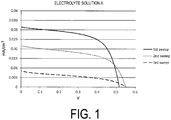
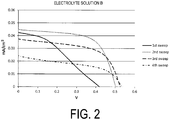
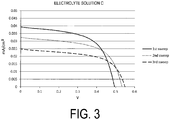
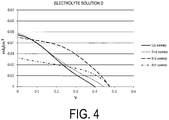
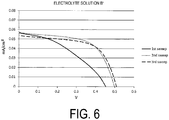
- the output characteristics of the dye-sensitized solar cells in which the electrolyte solutions A to D, A + , B + , or D + was used are shown in FIGS. 1 to 7 .
- a fill factor (FF) maintaining an initial value for a long period is preferable, and the output characteristics are preferable when a shape surrounded by vertical and horizontal axes and a curve is closer to a rectangle.
- the electrolyte solution did not sufficiently penetrate the titanium oxide film, and thus the characteristics (particularly current) were not stable and degraded
- the 4th sweep which was a fourth measurement, the characteristics degraded because of volatilization of the electrolyte solution (see graphs in FIGS 1 to 7 ).
- the output characteristics of the solar cells were evaluated in second and third measurements (2nd and 3rd sweeps).
- Example 1 Composition (molar ratio) Color Light transmittance Output/cycle characteristics Iodine Butyl pyridine Diisopropylethylamine Dodecanethiol Cyclohexanethiol Lithium iodide
- Example 1 (electrolyte solution A) 1 2 - 2 - - Light orange G/A
- Example 2 (electrolyte solution B) 1 5 - 3 - - Colorless and transparent G/A
- Example 3 (electrolyte solution C) 1 5 - 2 - - Light yellow G/A
- Example 4 (electrolyte solution D) 1 2 - 3 - - Colorless and transparent A/A
- Example 5 (electrolyte solution E) 1 - 4 4 - - Colorless and transparent -
- Example 6 (electrolyte solution F) 1 4 - - 4 - Colorless and transparent -
- Example 7 (electrolyte solution A+) 1 2
- the electrolyte solutions B, D to F, B + , and D + were transparent. Colors of the electrolyte solutions G to I containing only either one of the amine compound or the thiol compound did not exhibit any changes from the iodine-derived orange. In addition, the results of the electrolyte solutions A to D revealed that the molar ratio of the amine compound and the thiol compound, the former/latter, in a range of about 2/3 to 5/3 provided excellent transparency.
- FIGS. 1 to 4 when the proportion of 1-dodecanethiol was in excess, the output characteristics was likely to degrade, and a comparison of FIGS. 1 and 5 , a comparison of FIGS. 2 and 6 , and a comparison of FIGS. 3 and 7 illustrate that compounding the metal iodide readily stabilized the output characteristics.
- FIG. 8 A comparison of output characteristics of dye-sensitized solar cells in which the following electrolyte solutions were used is shown in FIG. 8 : an electrolyte solution known in the art (Comparative Example 4: an acetonitrile solution containing 0.05 M of iodine, 0.01 M of lithium iodide, 0.5 M of 1,2-dimethyl-3-propylimidazorium iodide, and 0.5 M of 4-t-butylpyridine) and an electrolyte solution (Example 10) prepared by adding 0.15 M of 1-dodecanethiol to the electrolyte known in the art to make the solution transparent.
- UV-Vis spectra of these electrolyte solutions are illustrated in FIG. 9 .
- the electrolyte solution of Example 10 was transparent and less colored, and thus had lower reduction in light use efficiency due to light absorption of the electrolyte solution, providing a higher current value than the electrolyte solution known in the art.
- the electrolyte composition according to an embodiment of the present invention can be utilized as an electrolyte composition that needs ionic conductivity (e.g., such as a composition utilized for various devices, such as batteries, semiconductor devices, and photoelectric conversion devices) and may be used in applications utilizing a redox system of iodine (I - /I 3 - system).
- the electrolyte composition may be in liquid form but is transparent and less colored and thus can be utilized as an electrolyte solution for various devices.
- the electrolyte composition is useful as an electrolyte solution for solar cells (particularly dye-sensitized solar cells) in that the electrolyte composition is less colored and can improve photoelectric conversion efficiency.
Landscapes
- Engineering & Computer Science (AREA)
- Power Engineering (AREA)
- Chemical & Material Sciences (AREA)
- Chemical Kinetics & Catalysis (AREA)
- Electrochemistry (AREA)
- Microelectronics & Electronic Packaging (AREA)
- Hybrid Cells (AREA)
- Photovoltaic Devices (AREA)
Abstract
Description
- The present invention relates to an electrolyte composition that can be utilized for an electrolyte solution for dye-sensitized solar cells and the like, and a use of the electrolyte composition.
- Solar cells are attracting attention as a "clean energy" source with a small environmental load and are actually put into practical use. However, the solar cells have problems including low conversion efficiency for weak light, such as room light. Thus, development is actively carried out to improve the photoelectric conversion efficiency of the solar cells by improving a photoelectric conversion device itself. On the other hand, development to improve an electrolyte solution is also carried out to improve the photoelectric conversion efficiency of the solar cells.
-
JP 2009-76369 A - However, this electrolyte layer, when containing iodine, has reduced transparency due to coloration and reduced photoelectric conversion efficiency.
-
JP 2012-195280 A - However, this electrolyte layer also has reduced transparency due to coloration and reduced photoelectric conversion efficiency.
-
WO 2006/123785 (Patent Document 3) discloses, as an electrolyte composition for dye-sensitized solar cells, the electrolyte composition in which coloration due to iodine is suppressed without causing a decrease in photoelectric conversion efficiency over time, an electrolyte composition containing a medium and an iodine-cyclodextrin inclusion compound that is poorly soluble in the medium and has an average particle size of 20 µm or less. In an example, an electrolyte composition is prepared, the electrolyte composition including the inclusion compound, lithium iodide, 4-t-butylpyridine, 1-propyl-2,3-dimethylimidazolium-iodine, and 3-methoxypropionitrile. - However, this electrolyte composition not only needs cyclodextrin but also requires synthesis of the iodine-cyclodextrin inclusion compound in advance and control of the particle size of the inclusion compound poorly soluble in the medium, thus reducing handling property and productivity. In addition, the iodine-cyclodextrin inclusion compound is poorly soluble in the medium, and only a limited amount can be added, thus failing to provide sufficient iodine concentration.
-
- Patent Document 1:
JP 2009-76369 A Claim 1, Paragraph [0009], and Examples) - Patent Document 2:
JP 2012-195280 A Claims 1 and 3, and Examples) - Patent Document 3:
WO 2006/123785 (Claim 1, Paragraph [0008], and Examples) - Thus, an object of the present invention is to provide an electrolyte composition that can be easily and conveniently prepared and, although contains iodine, is highly transparent and also has reduced coloration, and use of the electrolyte composition.
- Another object of the present invention is to provide an electrolyte composition, with which short-circuit current of an electrolyte solution can be increased, and use of such an electrolyte composition.
- Still another object of the present invention is to provide an electrolyte composition, with which output characteristics of an electrolyte solution for dye-sensitized solar cells can be improved, and use of such an electrolyte composition.
- As a result of diligent research to achieve the objects described above, the present inventor found that an electrolyte composition containing iodine, a specific sulfur compound, and a basic nitrogen compound, is highly transparent and less colored even if the electrolyte composition contains iodine, and that such an electrolyte composition can be easily and conveniently prepared, and thus completed the present invention.
- That is, an electrolyte composition according to an embodiment of the present invention contains iodine (A), a sulfur compound (B) excluding organic salts, and a basic nitrogen compound (C). This electrolyte composition may have a light transmittance at a wavelength of 400 nm in an optical path length of 1 cm of 30% or higher. The sulfur compound (B) may be at least one selected from the group consisting of a thiol, a sulfide, and a disulfide (particularly a thiol having a chain or cyclic alkane backbone, such as a linear or branched C4-18 alkanethiol). The basic nitrogen compound (C) may be an amine (particularly a pyridine). A proportion of the sulfur compound (B) may be approximately from 0.1 to 2 times the molar amount of the basic nitrogen compound (C). The electrolyte composition may further contain an iodide salt (D). The electrolyte composition may be a composition containing no cyclodextrin. The electrolyte composition may be an electrolyte solution.
- An embodiment of the present invention also includes a dye-sensitized solar cell in which an electrolyte solution is the electrolyte composition.
- In an embodiment of the present invention, a highly transparent electrolyte composition containing iodine, a specific sulfur compound, and a basic nitrogen compound can be easily and conveniently prepared. This electrolyte composition is highly transparent and less colored even if the electrolyte composition contains iodine, and thus can increase short-circuit current when used as an electrolyte solution. Thus, the electrolyte composition can improve output characteristics as an electrolyte solution for dye-sensitized solar cells.
-
-
FIG. 1 is a graph showing output characteristics of an electrolyte solution obtained in Example 1. -
FIG. 2 is a graph showing output characteristics of an electrolyte solution obtained in Example 2. -
FIG. 3 is a graph showing output characteristics of an electrolyte solution obtained in Example 3. -
FIG. 4 is a graph showing output characteristics of an electrolyte solution obtained in Example 4. -
FIG. 5 is a graph showing output characteristics of an electrolyte solution obtained in Example 7. -
FIG. 6 is a graph showing output characteristics of an electrolyte solution obtained in Example 8. -
FIG. 7 is a graph showing output characteristics of an electrolyte solution obtained in Example 9. -
FIG. 8 is a graph comparing output characteristics of an electrolyte solution according to an embodiment of the present invention and an electrolyte solution known in the art. -
FIG. 9 is UV-Vis spectra of an electrolyte solution according to an embodiment of the present invention and an electrolyte solution known in the art. - An electrolyte composition according to an embodiment of the present invention, although contains iodine (A), contains a combination of a specific sulfur compound (B) and a basic nitrogen compound (C) and thus has high transparency. The iodine (A) may be in the form of a molecular iodine I2 in the composition but may be ionized and may be present in the form of I- or I3-.
- The electrolyte composition according to an embodiment of the present invention may have a light transmittance, at a wavelength of 450 nm in an optical path length of 1 cm, of 10% or higher (e.g., from 30 to 100%), for example, 50% or higher (e.g., from 50 to 100%), preferably 70% or higher (e.g., from 70 to 99.9%), more preferably 80% or higher (e.g., from 80 to 99%), and particularly 90% or higher (e.g., from 90 to 98%). In an embodiment of the present invention, the electrolyte composition exhibits high transmittance in such visible light region and thus has excellent transparency.
- The electrolyte composition according to an embodiment of the present invention may have a light transmittance, at a wavelength of 400 nm in an optical path length of 1 cm, of 10% or higher (e.g., from 20 to 100%), for example, 30% or higher (e.g., from 30 to 99%), preferably 40% or higher (e.g., from 40 to 95%), more preferably 50% or higher (e.g., from 50 to 90%), and particularly 60% or higher (e.g., from 60 to 80%). In an embodiment of the present invention, the electrolyte composition also exhibits high transmittance of high-energy light in such a short wavelength, and thus light energy can be effectively utilized in a photoelectric conversion device.
- The electrolyte composition according to an embodiment of the present invention does not exhibit a brownish or orange hue unique to iodine, and is less colored. The electrolyte composition according to an embodiment may be light-colored or colorless, and is preferably colorless and transparent.
- The electrolyte composition according to an embodiment of the present invention is not particularly limited in its form, as long as the electrolyte composition has light transmittance as described above. The electrolyte composition may be any of a liquid, a gel, or a solid, and can be selected according to the use. In a dye-sensitized solar cell, the electrolyte composition is typically utilized as an electrolyte solution and thus is a liquid.
- The sulfur compound (B) needs to be a sulfur compound other than an organic salt. Examples of the sulfur compound include a thiol, a thioether, a sulfoxide, a sulfone, a thioketone, a sulfonic acid, and a disulfide. These sulfur compounds can be used alone or in combination of two or more. Among these sulfur compounds, a thiol, a sulfide, and a disulfide effectively improve the transparency of the composition, and therefore are preferable.
- The thiol needs to be a compound having a thiol group, and examples of the thiol include an alkanethiol (e.g., such as a linear or branched C1-24 alkanethiol, such as methanethiol, ethanethiol, propanethiol, isopropanethiol, n-butanethiol, hexanethiol, octanethiol, decanethiol, dodecanethiol, and octadecanethiol), a cycloalkanethiol (e.g., such as a C4-10 cycloalkanethiol, such as cyclopentanethiol, cyclohexanethiol, cycloheptanethiol, cyclooctanethiol, and cyclodecanethiol), an arenethiol (e.g., such as a C6-10 arenethiol, such as thiophenol and naphthalenethiol), an aralkyl mercaptan (e.g., such as benzyl mercaptan), thioacetic acid, and a mercaptocarboxylic acid (e.g., such as a mercapto C2-6 carboxylic acid, such as thioglycolic acid (mercaptoacetic acid) and mercaptopropionic acid). These thiols may form salts similarly to a hydroxy compound. The salt may be exemplified by an alkali metal salt (such as a sodium salt). These thiols can be used alone or in combination of two or more.
- The sulfide needs to be a compound having a sulfide bond, and examples of the sulfide include a dialkyl sulfide (e.g., such as a di linear or branched C1-24 alkyl sulfide, such as dimethyl sulfide, diethyl sulfide, dipropyl sulfide, diisopropyl sulfide, di n-butyl sulfide, dihexyl sulfide, dioctyl sulfide, didecyl sulfide, didodecyl sulfide, and dioctadecyl sulfide), a dicycloalkyl sulfide (e.g., such as a di C4-10 cycloalkyl sulfide, such as dicyclopentyl sulfide, dicyclohexyl sulfide, dicycloheptyl sulfide, dicyclooctyl sulfide, and dicyclodecyl sulfide), and a diaryl sulfide (e.g., such as a di C6-10 aryl sulfide, such as diphenyl sulfide and dinaphthyl sulfide). These sulfides can be used alone or in combination of two or more.
- The disulfide needs to be a compound having a disulfide bond, and examples of the disulfide include a dialkyl disulfide (e.g., such as a di linear or branched C1-24 alkyl disulfide, such as dimethyl disulfide, diethyl disulfide, dipropyl disulfide, diisopropyl disulfide, di n-butyl disulfide, dihexyl disulfide, dioctyl disulfide, didecyl disulfide, didodecyl disulfide, and dioctadecyl disulfide), a dicycloalkyl disulfide (e.g., such as a di C4-10 cycloalkyl disulfide, such as dicyclopentyl disulfide, dicyclohexyl disulfide, dicycloheptyl disulfide, dicyclooctyl disulfide, and dicyclodecyl disulfide), and a diaryl disulfide (e.g., such as a di C6-10 aryl disulfide, such as diphenyl disulfide and dinaphthyl disulfide). These disulfides can be used alone or in combination of two or more.
- Among these sulfur compounds, a thiol is particularly preferred, and among thiols, from the viewpoint of capability to improve transparency of the composition, a thiol having an aliphatic backbone (a chain or cyclic alkane backbone, such as a linear or branched C4-18 alkane or a C5-8 cycloalkane) is preferred, and a linear or branched C8-16 alkane thiol (particularly a linear or branched C10-16 alkane thiol), such as 1-dodecanethiol, is particularly preferred.
- A proportion of the sulfur compound (B) may be 0.5 times or greater the molar amount (e.g., from 0.5 to 20 times the molar amount) of the iodine (A) (iodine as I2) and is, for example, approximately from 1 to 10 times the molar amount, preferably from 1.2 to 5 times the molar amount, and more preferably from 1.5 to 4 times the molar amount (particularly from 2 to 3 times the molar amount) of the iodine (A) (iodine as I2). The proportion of the sulfur compound (B) less than these values may reduce the transparency of the composition.
- A proportion of the sulfur compound (B) may be 0.01 times or greater the molar amount (e.g., from 0.01 to 10 times the molar amount) of the basic nitrogen compound (C) and is, for example, approximately from 0.1 to 2 times the molar amount (e.g., from 0.2 to 1.7 times the molar amount), preferably from 0.3 to 1.5 times the molar amount (e.g., from 0.3 to 1 time the molar amount), and more preferably from 0.4 to 0.7 times the molar amount (particularly from 0.5 to 0.6 times the molar amount) of the basic nitrogen compound (C). The proportion of the sulfur compound (B) less than these values may reduce the transparency of the composition.
- The basic nitrogen compound (C) is not particularly limited as long as it is a nitrogen compound having an unconjugated electron pair, but an amine or a quaternary ammonium salt (excluding a quaternary ammonium iodide salt described below) can be typically used, and from the viewpoint of handling property, an amine (such as a tertiary amine), such as an aliphatic tertiary amine, an aromatic amine, or a heterocyclic amine, is commonly used.
- Examples of the aliphatic tertiary amine include a tri C1-6 alkylamine, such as trimethylamine, triethylamine, tri-n-propylamine, tri-n-butylamine, N,N-diisopropylethylamine, and triisopropylamine; an N,N-di C1-6 alkyl C5-8 cycloalkylamine, such as N,N-diethylcyclohexylamine and N,N-diisopropylcyclohexylamine; an N,N-di C5-8 cycloalkyl C1-6 alkylamine, such as N,N-dicyclohexylethylamine and N,N-dicyclohexylisopropylamine; a triaralkylamine, such as tribenzylamine; a tetra C1-6 alkylalkanediamine, such as N,N,N',N'-tetramethylethylenediamine and N,N,N',N'-tetramethylpropanediamine; a 1-C1-6 alkylpyrrolidine, such as 1-methylpyrrolidine and 1-ethylpyrrolidine; a 1-C1-6 alkylpiperidine, such as 1-methylpiperidine and 1-ethylpiperidine; a 2,6-di C1-6 alkylpiperazine, such as 2,6-dimethylpiperadine; a 4-C1-6 alkylmorpholine, such as 4-methylmorpholine and 4-ethylmorpholine; a tri C1-6 alkanolamine, such as triethanolamine; a di C1-6 alkyl C1-6 alkanolamine, such as dimethylaminoethanol; and a cyclic amine, such as 1,5-diazabicyclo[4.3.0]nonene-5 (DBN) and 1,8-diazabicyclo[5.4.0]-undecene-7 (DBU).
- Examples of the aromatic amine include a di C1-6 alkylaniline, such as N,N-dimethylaniline and N,N-diethylaniline; an aralkyldialkylamine, such as benzyldimethylamine; and a dialkylaminophenol, such as tris(dimethylaminomethyl)phenol.
- The heterocyclic amine includes a pyridine, a pyrrolidone, an imidazole, and the like.
- Examples of the pyridine include pyridine; a linear or branched C1-10 alkylpyridine, such as methylpyridine (picoline), ethylpyridine, propylpyridine, isopropylpyridine, n-butylpyridine, and t-butylpyridine; a di C1-6 alkylpyridine, such as dimethylpyridine (lutidine); a tri C1-4 alkylpyridine, such as trimethylpyridine (collidine); a C1-10 alkylaminopyridine, such as N,N-dimethyl-4-aminopyridine; and a pyrrolidinopyridine, such as 4-pyrrolidinopyridine.
- Examples of the pyrrolidone include a pyrrolidone, such as 2-pyrrolidone and 3-pyrrolidone; and an N-C1-6 alkylpyrrolidone, such as N-methyl-2-pyrrolidone (NMP).
- Examples of the imidazole include imidazole; a C1-6 alkylimidazole, such as 1-methylimidazole, 2-methylimidazole, 2-ethylimidazole, and 2-isopropylimidazole; a di C1-6 alkylimidazole, such as 2-ethyl-4-methylimidazole and 2-isopropyl-4-methylimidazole; a C6-10 arylimidazole, such as 1-phenylimidazole and 2-phenylimidazole; and a C1-6 alkylbenzimidazole, such as 1-methylbenzimidazole.
- These amines may be in the form of salts. The salt may be exemplified by an inorganic salt (e.g., such as a hydrochloride, a hydrogen bromide salt, a sulfate, a nitrate, a phosphate, a carbonate, and a boron trifluoride) and an organic salt (e.g., such as a formate, an acetate, and a sulfonate).
- These amines can be used alone or in combination of two or more. Among these amines, from the viewpoint of the redox function of the composition, an aliphatic tertiary amine (particularly a tri C2-4 alkylamine, such as N,N-diisopropylethylamine), a heterocyclic amine (particularly a pyridine) is preferred, and a linear or branched C2-6 alkylpyridine (particularly a branched C3-4 alkylpyridine, such as 4-t-butylpyridine) is particularly preferred.
- A proportion of the basic nitrogen compound (C) may be 1 time or greater the molar amount (e.g., from 1 to 30 times the molar amount) of the iodine (A) (iodine as I2) and is, for example, approximately from 2 to 20 times the molar amount, preferably from 2 to 10 times the molar amount, and more preferably from 3 to 8 times the molar amount (particularly from 4 to 6 times the molar amount) of the iodine (A) (iodine as I2). The proportion of the basic nitrogen compound (C) less than these values may reduce the redox function of the composition.
- The electrolyte composition according to an embodiment of the present invention preferably further contains an iodide salt (D) from the viewpoint of capability to promote ionization of the iodine (A) and to improve output characteristics of cells when utilized for an electrolyte solution for dye-sensitized solar cells or the like. Examples of the iodide salt include a metal iodide salt (e.g., an alkali metal iodide salt, such as lithium iodide, sodium iodide, potassium iodide, and cesium iodide; and an alkaline earth metal iodide salt, such as magnesium iodide and calcium iodide), and a quaternary ammonium iodide (e.g., a tetra C1-6 alkylammonium iodide, such as tetraethylammonium iodide; a benzyl tri C1-6 alkylammonium iodide, such as benzyltrimethylammonium iodide; pyridinium iodide; and an imidazolium iodide, such as 1,2-dimethyl-3-ammonium iodide). These iodide salts can be used alone or in combination of two or more. Among these iodide salts, an alkali metal iodide salt, such as lithium iodide is commonly used.
- A proportion of the iodide salt (D) may be 1 time or greater the molar amount (e.g., from 1 to 10 times the molar amount) of the iodine (A) (iodine as I2) and is, for example, approximately from 1.1 to 5 times the molar amount, preferably from 1.2 to 3 times the molar amount, and more preferably from 1.5 to 2.5 times the molar amount (particularly from 1.8 to 2.2 times the molar amount) of the iodine (A) (iodine as I2). The proportion of the iodide salt (D) less than these values may fail to exhibit the effect of the iodide salt (D).
- The electrolyte composition according to an embodiment of the present invention, when it is in a liquid form, preferably further contains a solvent (E). Examples of the solvent include water, an alcohol, an ether, an ester, a lactone, a ketone, an amide, a sulfolane, a sulfoxide, a nitrile, a carbonate, a hydrocarbon (such as an aliphatic hydrocarbon and an aromatic hydrocarbon), and a halogenated hydrocarbon. These solvents may be non-flammable. These solvents can be used alone or in combination of two or more.
- These solvents can be appropriately selected according to the use, and from the viewpoint of high relative permittivity, the following solvents are preferred: such as an alcohol (e.g., an alkanol, such as ethanol; and a glycol, such as ethylene glycol and polyethylene glycol), a nitrile (e.g., such as acetonitrile, butyronitrile, methoxyacetonitrile, propionitrile, 3 - methoxypropionitrile, and benzonitrile), a carbonate (e.g., such as ethylene carbonate, propylene carbonate, butylene carbonate, and diethyl carbonate), a lactone (e.g., such as γ-butyrolactone), an ether (e.g., a chain ether, such as dimethyl ether; and a cyclic ether, such as tetrahydrofuran), and an amido (e.g., such as N,N-dimethylformamide and N,N-dimethylacetamide). In an electrolyte solution for dye-sensitized solar cells, a nitrile (e.g., such as a C2-6 alkanenitrile, such as acetonitrile or butyronitrile) or an alcohol (e.g., an alkanol, such as t-butanol) is commonly used.
- A proportion of the solvent (E) is selected to make a concentration (mol/L) of the iodine (A) (iodine as I2) in the composition in a range of approximately 0.0001 to 10 M and may be, for example, approximately from 0.0005 to 1 M (e.g., from 0.001 to 0.1 M), preferably from 0.001 to 0.01 M, and more preferably from 0.003 to 0.008 M.
- The electrolyte composition according to an embodiment of the present invention may further contain, as an additional component, an additional electrolyte (e.g., such as an additional halogen element, such as bromine; an additional halide salt, such as a bromide salt or a fluoride salt; an ionic liquid (a room temperature molten salt), a gel electrolyte, or a solid electrolyte) or an additive commonly used in the art (e.g., such as a stabilizer, a flame retardant, or a pH adjusting agent). A proportion of the additional component is, for example, approximately from 0.001 to 0.5 times the molar amount, preferably from 0.005 to 0.1 times the molar amount, and more preferably from 0.01 to 0.05 times the molar amount of the iodine (A) (iodine as I2).
- The electrolyte composition according to an embodiment of the present invention can improve the transparency of the composition when combined with the sulfur compound (B) and the basic nitrogen compound (C), and thus eliminates the need for compounding cyclodextrin, which is used in Patent Document 3. Thus, the electrolyte composition according to an embodiment of the present invention preferably contains substantially no cyclodextrin and particularly preferably contains no cyclodextrin.
- The electrolyte composition according to an embodiment of the present invention can be utilized for various uses which require ionic conductivity (e.g., such as cells, semiconductor devices, and photoelectric conversion devices), and may be utilized for uses which utilize the redox ability of the iodine (A). In particular, from the viewpoint of excellent transparency and non-coloration, the electrolyte composition is preferably utilized for photoelectric conversion devices, such as solar cells and is particularly preferably utilized as an electrolyte solution for dye-sensitized solar cells. The electrolyte composition, when utilized as an electrolyte solution for dye-sensitized solar cells, can suppress absorption of light of an iodide ion and thus can suppress reduction of light contributing to photoelectric conversion and suppress decrease in short-circuit current and the like.
- The dye-sensitized solar cell according to an embodiment of the present invention is not particularly limited as long as the electrolyte solution is the electrolyte composition described above. For example, the dye-sensitized solar cell may be constituted of a transparent electrode including a photoelectric conversion layer containing a semiconductor and a dye; a counter electrode disposed opposite to this transparent electrode; and an electrolyte solution interposed between the electrodes and sealed.
- The transparent electrode typically includes a photoelectric conversion layer layered on one surface of a transparent conductive layer, the photoelectric conversion layer containing a semiconductor and a dye, and the transparent conductive layer is formed of a transparent substrate, such as a glass plate or a transparent plastic plate, and a transparent conductive layer layered on the transparent substrate, where the transparent conductive layer may be a fluorine-doped tin oxide (FTO) or an indium oxide-tin oxide complex oxide (ITO).
- For the semiconductor, a semiconductor commonly used for dye-sensitized solar cells in the art can be utilized, and the semiconductor may be an organic semiconductor. From the viewpoint of durability, the semiconductor is preferably an inorganic semiconductor and is typically constituted of an n-type semiconductor (e.g., a metal oxide, such as titanium oxide or zinc oxide). The semiconductor (such as titanium oxide) may be formed on the transparent conductive layer by sintering or may be formed by coating a dispersion (such as a water dispersion) of the semiconductor in a mixture with an ionic binder (and a dye described below) and then drying or heating. The ionic binder may be, for example, a fluorine-containing resin having a sulfo group (such as Nafion (trade name)). In addition, a commercially available semiconductor may be utilized, or a semiconductor synthesized utilizing a method commonly used in the art may be used. For example, a dispersion of titanium oxide can be prepared by a method described in
JP 4522886 B - Also, for the dye, a dye commonly used for dye-sensitized solar cells in the art can be utilized, and the dye is not particularly limited as long as it is a component that functions as a sensitizer (a sensitizer dye or a photosensitizer dye). For example, an organic dye or an inorganic dye (e.g., such as a carbon pigment, a chromate pigment, a cadmium pigment, a ferrocyanide pigment, a metal oxide pigment, a silicate pigment, or a phosphate pigment) can be utilized, and a dye having a functional group, such as a carboxyl group, an ester group, or a sulfo group, as a ligand (e.g., a ruthenium dye having a carboxyl group, such as N719) is typically used. The dye may be mixed with the semiconductor and layered on the transparent conductive layer as described above or may be adsorbed to the semiconductor layered on the transparent conductive layer.
- For the counter electrode, a counter electrode commonly used for dye-sensitized solar cells in the art can be utilized. For example, the counter electrode may be constituted of a conductive layer (such as a transparent conductive layer similar to the transparent electrode described above) and a catalyst layer formed on this conductive layer. The counter electrode may be a cathode or an anode depending on the type of semiconductor constituting the transparent electrode described above. That is, when the semiconductor is an n-type semiconductor, the counter electrode serves as a cathode. The catalyst layer (a cathode catalyst layer or an anode catalyst layer) is not particularly limited and can be formed of a conductive metal (such as gold or platinum), carbon, or the like. Here, when the conductive layer has a reducing power in addition to conductivity, the catalyst layer need not necessarily be provided. The catalyst layer or the conductive catalyst layer of the counter electrode is disposed opposite to the photoelectric conversion layer of the transparent electrode.
- The electrolyte solution needs to be interposed between the transparent electrode and the counter electrode, and is typically encapsulated in a space or a gap formed by sealing both electrodes (or edges of the electrodes) with a sealing material (e.g., such as a sealing material constituted of a thermoplastic resin (such as an ionomer resin) or a thermosetting resin (such as an epoxy resin or a silicone resin)).
- Hereinafter, the present invention is described in greater detail based on examples, but the present invention is not limited to these examples.
- Electrolyte solutions A to F, A+, B+, and D+ (Examples 1 to 9) and electrolyte solutions G to I (Comparative Examples 1 to 3) were prepared by adding 4-butylpyridine, N,N-diisopropylethylamine, 1-dodecanethiol, cyclohexanethiol, and lithium iodide in molar ratios to 1 mol of iodine shown in Table 1 and dissolving them in acetonitrile to make an iodine concentration of 0.005 M. The hue and light transmittance of each electrolyte solution were visually observed and determined with a spectrophotometer (UV-Vis: an optical path length: 1 cm, blank: acetonitrile, a measurement temperature: room temperature, and a measurement instrument: U-3900H Spectrophotometer (available from Hitachi High-Tech Science Corporation)), and the results are shown in Table 1.
- On a fluorine-doped tin oxide (FTO) transparent conductive glass washed with acetone, a titanium oxide paste (Ti-Nanooxide T/SP available from SOLARONIX SA) was deposited in a square (4 mm square) with a thickness of 10 µm by a screen printing method. The FTO transparent glass was dried at 100°C on a hot plate then calcined at 500°C for 1 hour, and a titanium oxide electrode was formed.
- In a mixed solvent of 50 mL of acetonitrile and 50 mL of t-butanol, 35.6 mg of an N719 dye (available from SOLARONIX SA) was dissolved. The titanium oxide electrode was immersed in this solution and left stand for 24 hours at room temperature, and the N719 dye was adsorbed to the titanium oxide electrode (titanium oxide surface). The titanium oxide electrode taken out of the dye solution was washed with methanol and dried, and thus a dye-adsorbed titanium oxide electrode was obtained.
- The FTO layer side of the resulting dye-adsorbed titanium oxide electrode (dye adsorbing side) and the FTO layer side of the platinum FTO glass substrate (platinum thin film side) were sandwiched with a spacer ("Himilan" available from Du Pont-Mitsui Polychemicals Co., Ltd.) interposed between, the electrolyte solution was filled into a gap (or a space sealed with a sealing material) formed between both substrates, and a dye-sensitized solar cell was produced.
- The performance of the resulting dye-sensitized solar cell was measured under the condition of 1000 Lux and 25 °C using a white LED light (LED Desk Lamp CDS-90a, available from Cosmotechno Co., Ltd.). The output characteristics of the dye-sensitized solar cells in which the electrolyte solutions A to D, A+, B+, or D+ was used are shown in
FIGS. 1 to 7 . In the graph of the output characteristics, a fill factor (FF) maintaining an initial value for a long period is preferable, and the output characteristics are preferable when a shape surrounded by vertical and horizontal axes and a curve is closer to a rectangle. Here, in the present evaluation method, in the 1st sweep, which was a first measurement, the electrolyte solution did not sufficiently penetrate the titanium oxide film, and thus the characteristics (particularly current) were not stable and degraded, and in the 4th sweep, which was a fourth measurement, the characteristics degraded because of volatilization of the electrolyte solution (see graphs inFIGS 1 to 7 ). Thus, the output characteristics of the solar cells were evaluated in second and third measurements (2nd and 3rd sweeps). - Evaluation results of the output characteristics and cycle characteristics (E: extremely good, G: good, A: average, and P: poor) are shown in Table 1.
-
Table 1 Composition (molar ratio) Color Light transmittance Output/cycle characteristics Iodine Butyl pyridine Diisopropylethylamine Dodecanethiol Cyclohexanethiol Lithium iodide Example 1 (electrolyte solution A) 1 2 - 2 - - Light orange G/A Example 2 (electrolyte solution B) 1 5 - 3 - - Colorless and transparent G/A Example 3 (electrolyte solution C) 1 5 - 2 - - Light yellow G/A Example 4 (electrolyte solution D) 1 2 - 3 - - Colorless and transparent A/A Example 5 (electrolyte solution E) 1 - 4 4 - - Colorless and transparent - Example 6 (electrolyte solution F) 1 4 - - 4 - Colorless and transparent - Example 7 (electrolyte solution A+) 1 2 - 2 - 2 Light orange G/G Example 8 (electrolyte solution B+) 1 5 - 3 - 2 Colorless and transparent 400 nm: 69.1% 450 nm: 94.6% E/E Example 9 (electrolyte solution D+) 1 2 - 3 - 2 Colorless and transparent E/G Comparative Example 1 (electrolyte solution G) 1 - - 4 - - Orange (no change) - Comparative Example 2 (electrolyte solution H) 1 - - 4 - 2 Orange (no change) - Comparative Example 3 (electrolyte solution I) 1 4 - - - - Orange (no change) 400 nm: 0.32% 450 nm: 0.33% - - As is clear from the results in Table 1, the electrolyte solutions B, D to F, B+, and D+ were transparent. Colors of the electrolyte solutions G to I containing only either one of the amine compound or the thiol compound did not exhibit any changes from the iodine-derived orange. In addition, the results of the electrolyte solutions A to D revealed that the molar ratio of the amine compound and the thiol compound, the former/latter, in a range of about 2/3 to 5/3 provided excellent transparency.
- As is clear from the results in
FIGS. 1 to 4 , when the proportion of 1-dodecanethiol was in excess, the output characteristics was likely to degrade, and a comparison ofFIGS. 1 and5 , a comparison ofFIGS. 2 and6 , and a comparison ofFIGS. 3 and7 illustrate that compounding the metal iodide readily stabilized the output characteristics. - A comparison of output characteristics of dye-sensitized solar cells in which the following electrolyte solutions were used is shown in
FIG. 8 : an electrolyte solution known in the art (Comparative Example 4: an acetonitrile solution containing 0.05 M of iodine, 0.01 M of lithium iodide, 0.5 M of 1,2-dimethyl-3-propylimidazorium iodide, and 0.5 M of 4-t-butylpyridine) and an electrolyte solution (Example 10) prepared by adding 0.15 M of 1-dodecanethiol to the electrolyte known in the art to make the solution transparent. In addition, UV-Vis spectra of these electrolyte solutions are illustrated inFIG. 9 . - As is clear from
FIG. 8 , the electrolyte solution of Example 10 was transparent and less colored, and thus had lower reduction in light use efficiency due to light absorption of the electrolyte solution, providing a higher current value than the electrolyte solution known in the art. - The electrolyte composition according to an embodiment of the present invention can be utilized as an electrolyte composition that needs ionic conductivity (e.g., such as a composition utilized for various devices, such as batteries, semiconductor devices, and photoelectric conversion devices) and may be used in applications utilizing a redox system of iodine (I-/I3 - system). The electrolyte composition may be in liquid form but is transparent and less colored and thus can be utilized as an electrolyte solution for various devices. Among others, the electrolyte composition is useful as an electrolyte solution for solar cells (particularly dye-sensitized solar cells) in that the electrolyte composition is less colored and can improve photoelectric conversion efficiency.
Claims (12)
- An electrolyte composition comprising iodine (A), a sulfur compound (B) excluding organic salts, and a basic nitrogen compound (C).
- The electrolyte composition according to claim 1, wherein a light transmittance at a wavelength of 400 nm in an optical path length of 1 cm is 30% or higher.
- The electrolyte composition according to claim 1 or 2, wherein the sulfur compound (B) is at least one selected from the group consisting of a thiol, a sulfide, and a disulfide.
- The electrolyte composition according to claim 3, wherein the thiol is a thiol comprising a chain or cyclic alkane backbone.
- The electrolyte composition according to claim 3 or 4, wherein the thiol is a linear or branched C4-18 alkanethiol.
- The electrolyte composition according to any of claims 1 to 5, wherein the basic nitrogen compound (C) is an amine.
- The electrolyte composition according to claim 6, wherein the amine is a pyridine.
- The electrolyte composition according to any of claims 1 to 7, wherein a proportion of the sulfur compound (B) is from 0.1 to 2 times the molar amount of the basic nitrogen compound (C).
- The electrolyte composition according to any of claims 1 to 8, further comprising an iodide salt (D).
- The electrolyte composition according to any of claims 1 to 9, comprising no cyclodextrin.
- The electrolyte composition according to any of claims 1 to 10, wherein the electrolyte composition is an electrolyte solution.
- A dye-sensitized solar cell, wherein an electrolyte solution is the electrolyte composition described in any of claims 1 to 11.
Applications Claiming Priority (2)
| Application Number | Priority Date | Filing Date | Title |
|---|---|---|---|
| JP2017238672A JP7002313B2 (en) | 2017-12-13 | 2017-12-13 | Electrolyte composition and its uses |
| PCT/JP2018/043371 WO2019116865A1 (en) | 2017-12-13 | 2018-11-26 | Electrolyte composition and use thereof |
Publications (2)
| Publication Number | Publication Date |
|---|---|
| EP3726550A1 true EP3726550A1 (en) | 2020-10-21 |
| EP3726550A4 EP3726550A4 (en) | 2021-09-08 |
Family
ID=66820182
Family Applications (1)
| Application Number | Title | Priority Date | Filing Date |
|---|---|---|---|
| EP18888435.7A Pending EP3726550A4 (en) | 2017-12-13 | 2018-11-26 | Electrolyte composition and use thereof |
Country Status (7)
| Country | Link |
|---|---|
| US (1) | US20200294726A1 (en) |
| EP (1) | EP3726550A4 (en) |
| JP (1) | JP7002313B2 (en) |
| CN (1) | CN111480210B (en) |
| CA (1) | CA3077672A1 (en) |
| TW (1) | TW201930194A (en) |
| WO (1) | WO2019116865A1 (en) |
Family Cites Families (15)
| Publication number | Priority date | Publication date | Assignee | Title |
|---|---|---|---|---|
| JP4462187B2 (en) * | 2002-08-13 | 2010-05-12 | 株式会社ブリヂストン | Dye-sensitized solar cell and electrolyte thereof |
| JP4836411B2 (en) * | 2003-04-22 | 2011-12-14 | 大阪瓦斯株式会社 | Fluorene-based composition and molded article thereof |
| KR101058101B1 (en) * | 2004-06-26 | 2011-08-24 | 삼성에스디아이 주식회사 | Electrolytic solution composition and solar cell using same |
| JP4522886B2 (en) | 2005-02-25 | 2010-08-11 | 株式会社ピアレックス・テクノロジーズ | Photocatalyst paint, steel sheet coated with the paint, and tent |
| JP4982361B2 (en) | 2005-05-19 | 2012-07-25 | 日宝化学株式会社 | Electrolyte composition |
| JP2009076369A (en) | 2007-09-21 | 2009-04-09 | Adeka Corp | Dye-sensitized solar cell |
| US8383831B2 (en) * | 2008-08-06 | 2013-02-26 | Mitsubishi Paper Mills Limited | Dye for dye-sensitized solar cell, semiconductor electrode, and dye-sensitized solar cell |
| TW201117453A (en) | 2009-11-05 | 2011-05-16 | Everlight Chem Ind Corp | An electrolyte composition for dye-sensitized solar cell and the dye-sensitized solar cell utilizing said electrolyte composition |
| JP5204317B2 (en) * | 2010-01-28 | 2013-06-05 | 日本カーリット株式会社 | Electrolyte for dye-sensitized solar cell and dye-sensitized solar cell using the same |
| US9093722B2 (en) * | 2010-09-30 | 2015-07-28 | Uchicago Argonne, Llc | Functionalized ionic liquid electrolytes for lithium ion batteries |
| JP2012156096A (en) | 2011-01-28 | 2012-08-16 | Peccell Technologies Inc | Photoelectric conversion element, and dye-sensitized solar cell comprising the same |
| JP2012195280A (en) | 2011-03-02 | 2012-10-11 | Sony Corp | Photoelectric conversion element, method for manufacturing photoelectric conversion element, electronic device, and building |
| JP6004839B2 (en) | 2012-08-24 | 2016-10-12 | 大阪瓦斯株式会社 | Electrolytic solution and photoelectric conversion element |
| WO2014084296A1 (en) | 2012-11-30 | 2014-06-05 | 日本化薬株式会社 | Dye-sensitized solar cell |
| US20170140880A1 (en) * | 2014-07-08 | 2017-05-18 | Zeon Corporation | Viscous dispersion liquid and method for producing same, porous semiconductor electrode substrate, and dye-sensitized solar cell |
-
2017
- 2017-12-13 JP JP2017238672A patent/JP7002313B2/en active Active
-
2018
- 2018-11-26 CA CA3077672A patent/CA3077672A1/en active Pending
- 2018-11-26 EP EP18888435.7A patent/EP3726550A4/en active Pending
- 2018-11-26 WO PCT/JP2018/043371 patent/WO2019116865A1/en not_active Ceased
- 2018-11-26 US US16/650,915 patent/US20200294726A1/en not_active Abandoned
- 2018-11-26 CN CN201880080340.6A patent/CN111480210B/en active Active
- 2018-12-12 TW TW107144710A patent/TW201930194A/en unknown
Also Published As
| Publication number | Publication date |
|---|---|
| CN111480210B (en) | 2022-02-25 |
| US20200294726A1 (en) | 2020-09-17 |
| TW201930194A (en) | 2019-08-01 |
| JP7002313B2 (en) | 2022-01-20 |
| EP3726550A4 (en) | 2021-09-08 |
| JP2019106472A (en) | 2019-06-27 |
| WO2019116865A1 (en) | 2019-06-20 |
| CA3077672A1 (en) | 2019-06-20 |
| CN111480210A (en) | 2020-07-31 |
Similar Documents
| Publication | Publication Date | Title |
|---|---|---|
| Kawano et al. | Anomaly of charge transport of an iodide/tri-iodide redox couple in an ionic liquid and its importance in dye-sensitized solar cells | |
| Cao et al. | Dye-sensitized solar cells with solvent-free ionic liquid electrolytes | |
| US8790537B2 (en) | Process for the preparation of solid polymer electrolytes using ionic liquids | |
| EP3116019A1 (en) | CRYSTAL GROWTH CONTROL AGENT, METHOD FOR FORMING p-TYPE SEMICONDUCTOR MICROPARTICLES OR p-TYPE SEMICONDUCTOR MICROPARTICLE FILM, COMPOSITION FOR FORMING HOLE TRANSPORT LAYER, AND SOLAR CELL | |
| US10545387B2 (en) | Electrochromic device for applying voltage to electrodes | |
| CN101436467B (en) | Ionic liquid electrolyte containing bis(fluorosulfonyl)imide ionic liquid and iodide ion and its application | |
| KR101916845B1 (en) | Self-powering electrochromic devices containing small molecule organic ligand-metal oxide layer | |
| EP2572402B1 (en) | Ionic liquid based electrolytes containing sulfide/polysulfide redox couple and uses thereof | |
| US20100065119A1 (en) | ELECTRODE HAVING A CoS LAYER THEREON, PROCESS OF PREPARATION, AND USES THEREOF | |
| EP2933874A1 (en) | Photoelectric conversion element | |
| KR102052440B1 (en) | Electrochromic supercapacitor | |
| Chatzivasiloglou et al. | The influence of the metal cation and the filler on the performance of dye-sensitized solar cells using polymer-gel redox electrolytes | |
| Costa et al. | Photoelectrochromic devices: Influence of device architecture and electrolyte composition | |
| US20130206234A1 (en) | Electrolyte for photoelectric conversion element, and photoelectric conversion element and dye-sensitised solar cell using same | |
| KR102387913B1 (en) | Photo-electrochromic elements | |
| US9183992B2 (en) | Dye-sensitized solar cell and method for preventing elution of catalyst from catalyst electrode | |
| KR20050122966A (en) | Electrolyte composition and solar cell using the same | |
| Gusatti et al. | Fabrication and performance evaluation of a nanostructured ZnO-based solid-state electrochromic device | |
| Pande et al. | Influence of ITO electrode on the electrochromic performance outcomes of viologen-functionalized polyhedral oligomeric silsesquioxanes | |
| US20200294726A1 (en) | Electrolyte composition and use thereof | |
| KR20060118068A (en) | Polymer electrolyte and dye-sensitized solar cell comprising the same | |
| JP2003161963A (en) | Electrochromic element | |
| US20140000715A1 (en) | Dye-sensitized solar cell for low illumination | |
| KR20150089689A (en) | Electrolyte for dye-sensitized solar cell and dye-sensitized solar cell including the same | |
| JP6051567B2 (en) | Electrolyte for photoelectric conversion element and photoelectric conversion element and dye-sensitized solar cell using the electrolyte |
Legal Events
| Date | Code | Title | Description |
|---|---|---|---|
| STAA | Information on the status of an ep patent application or granted ep patent |
Free format text: STATUS: THE INTERNATIONAL PUBLICATION HAS BEEN MADE |
|
| PUAI | Public reference made under article 153(3) epc to a published international application that has entered the european phase |
Free format text: ORIGINAL CODE: 0009012 |
|
| STAA | Information on the status of an ep patent application or granted ep patent |
Free format text: STATUS: REQUEST FOR EXAMINATION WAS MADE |
|
| 17P | Request for examination filed |
Effective date: 20200619 |
|
| AK | Designated contracting states |
Kind code of ref document: A1 Designated state(s): AL AT BE BG CH CY CZ DE DK EE ES FI FR GB GR HR HU IE IS IT LI LT LU LV MC MK MT NL NO PL PT RO RS SE SI SK SM TR |
|
| AX | Request for extension of the european patent |
Extension state: BA ME |
|
| DAV | Request for validation of the european patent (deleted) | ||
| DAX | Request for extension of the european patent (deleted) | ||
| A4 | Supplementary search report drawn up and despatched |
Effective date: 20210809 |
|
| RIC1 | Information provided on ipc code assigned before grant |
Ipc: H01G 9/20 20060101AFI20210803BHEP |