EP3722795A1 - Method and system for inspecting quality of unvulcanized rubber material, and method and system for manufacturing unvulcanized rubber material - Google Patents
Method and system for inspecting quality of unvulcanized rubber material, and method and system for manufacturing unvulcanized rubber material Download PDFInfo
- Publication number
- EP3722795A1 EP3722795A1 EP18886746.9A EP18886746A EP3722795A1 EP 3722795 A1 EP3722795 A1 EP 3722795A1 EP 18886746 A EP18886746 A EP 18886746A EP 3722795 A1 EP3722795 A1 EP 3722795A1
- Authority
- EP
- European Patent Office
- Prior art keywords
- rubber material
- unvulcanized rubber
- compounding
- final
- compounding agent
- Prior art date
- Legal status (The legal status is an assumption and is not a legal conclusion. Google has not performed a legal analysis and makes no representation as to the accuracy of the status listed.)
- Withdrawn
Links
- 239000000463 material Substances 0.000 title claims abstract description 176
- 238000004519 manufacturing process Methods 0.000 title claims abstract description 34
- 238000000034 method Methods 0.000 title claims abstract description 24
- 238000013329 compounding Methods 0.000 claims abstract description 227
- 239000003795 chemical substances by application Substances 0.000 claims abstract description 126
- 238000007689 inspection Methods 0.000 claims abstract description 34
- 238000005259 measurement Methods 0.000 claims abstract description 28
- 239000006185 dispersion Substances 0.000 claims description 49
- 238000002156 mixing Methods 0.000 claims description 9
- 238000004898 kneading Methods 0.000 claims description 5
- VYPSYNLAJGMNEJ-UHFFFAOYSA-N Silicium dioxide Chemical compound O=[Si]=O VYPSYNLAJGMNEJ-UHFFFAOYSA-N 0.000 claims description 4
- NINIDFKCEFEMDL-UHFFFAOYSA-N Sulfur Chemical compound [S] NINIDFKCEFEMDL-UHFFFAOYSA-N 0.000 claims description 4
- 239000006229 carbon black Substances 0.000 claims description 4
- 239000000203 mixture Substances 0.000 claims description 4
- 229910052717 sulfur Inorganic materials 0.000 claims description 4
- 239000011593 sulfur Substances 0.000 claims description 4
- 238000004073 vulcanization Methods 0.000 claims description 3
- 239000012936 vulcanization activator Substances 0.000 claims description 3
- 239000000377 silicon dioxide Substances 0.000 claims description 2
- 230000001066 destructive effect Effects 0.000 abstract description 3
- 238000001125 extrusion Methods 0.000 description 6
- 238000010586 diagram Methods 0.000 description 5
- 239000004594 Masterbatch (MB) Substances 0.000 description 3
- 230000007423 decrease Effects 0.000 description 3
- 239000000356 contaminant Substances 0.000 description 2
- 230000001678 irradiating effect Effects 0.000 description 2
- 238000002360 preparation method Methods 0.000 description 2
- 238000012935 Averaging Methods 0.000 description 1
- VEXZGXHMUGYJMC-UHFFFAOYSA-M Chloride anion Chemical compound [Cl-] VEXZGXHMUGYJMC-UHFFFAOYSA-M 0.000 description 1
- 238000005520 cutting process Methods 0.000 description 1
- 230000000694 effects Effects 0.000 description 1
- 238000002844 melting Methods 0.000 description 1
- 230000008018 melting Effects 0.000 description 1
- 238000009840 oxygen flask method Methods 0.000 description 1
- PFUVRDFDKPNGAV-UHFFFAOYSA-N sodium peroxide Chemical compound [Na+].[Na+].[O-][O-] PFUVRDFDKPNGAV-UHFFFAOYSA-N 0.000 description 1
Images



Classifications
-
- B—PERFORMING OPERATIONS; TRANSPORTING
- B29—WORKING OF PLASTICS; WORKING OF SUBSTANCES IN A PLASTIC STATE IN GENERAL
- B29B—PREPARATION OR PRETREATMENT OF THE MATERIAL TO BE SHAPED; MAKING GRANULES OR PREFORMS; RECOVERY OF PLASTICS OR OTHER CONSTITUENTS OF WASTE MATERIAL CONTAINING PLASTICS
- B29B7/00—Mixing; Kneading
- B29B7/30—Mixing; Kneading continuous, with mechanical mixing or kneading devices
- B29B7/34—Mixing; Kneading continuous, with mechanical mixing or kneading devices with movable mixing or kneading devices
- B29B7/38—Mixing; Kneading continuous, with mechanical mixing or kneading devices with movable mixing or kneading devices rotary
- B29B7/40—Mixing; Kneading continuous, with mechanical mixing or kneading devices with movable mixing or kneading devices rotary with single shaft
- B29B7/42—Mixing; Kneading continuous, with mechanical mixing or kneading devices with movable mixing or kneading devices rotary with single shaft with screw or helix
- B29B7/426—Mixing; Kneading continuous, with mechanical mixing or kneading devices with movable mixing or kneading devices rotary with single shaft with screw or helix with consecutive casings or screws, e.g. for charging, discharging, mixing
-
- B—PERFORMING OPERATIONS; TRANSPORTING
- B29—WORKING OF PLASTICS; WORKING OF SUBSTANCES IN A PLASTIC STATE IN GENERAL
- B29B—PREPARATION OR PRETREATMENT OF THE MATERIAL TO BE SHAPED; MAKING GRANULES OR PREFORMS; RECOVERY OF PLASTICS OR OTHER CONSTITUENTS OF WASTE MATERIAL CONTAINING PLASTICS
- B29B7/00—Mixing; Kneading
- B29B7/002—Methods
- B29B7/007—Methods for continuous mixing
-
- B—PERFORMING OPERATIONS; TRANSPORTING
- B29—WORKING OF PLASTICS; WORKING OF SUBSTANCES IN A PLASTIC STATE IN GENERAL
- B29B—PREPARATION OR PRETREATMENT OF THE MATERIAL TO BE SHAPED; MAKING GRANULES OR PREFORMS; RECOVERY OF PLASTICS OR OTHER CONSTITUENTS OF WASTE MATERIAL CONTAINING PLASTICS
- B29B7/00—Mixing; Kneading
- B29B7/30—Mixing; Kneading continuous, with mechanical mixing or kneading devices
- B29B7/34—Mixing; Kneading continuous, with mechanical mixing or kneading devices with movable mixing or kneading devices
- B29B7/38—Mixing; Kneading continuous, with mechanical mixing or kneading devices with movable mixing or kneading devices rotary
- B29B7/40—Mixing; Kneading continuous, with mechanical mixing or kneading devices with movable mixing or kneading devices rotary with single shaft
- B29B7/42—Mixing; Kneading continuous, with mechanical mixing or kneading devices with movable mixing or kneading devices rotary with single shaft with screw or helix
-
- B—PERFORMING OPERATIONS; TRANSPORTING
- B29—WORKING OF PLASTICS; WORKING OF SUBSTANCES IN A PLASTIC STATE IN GENERAL
- B29B—PREPARATION OR PRETREATMENT OF THE MATERIAL TO BE SHAPED; MAKING GRANULES OR PREFORMS; RECOVERY OF PLASTICS OR OTHER CONSTITUENTS OF WASTE MATERIAL CONTAINING PLASTICS
- B29B7/00—Mixing; Kneading
- B29B7/30—Mixing; Kneading continuous, with mechanical mixing or kneading devices
- B29B7/58—Component parts, details or accessories; Auxiliary operations
- B29B7/60—Component parts, details or accessories; Auxiliary operations for feeding, e.g. end guides for the incoming material
-
- B—PERFORMING OPERATIONS; TRANSPORTING
- B29—WORKING OF PLASTICS; WORKING OF SUBSTANCES IN A PLASTIC STATE IN GENERAL
- B29B—PREPARATION OR PRETREATMENT OF THE MATERIAL TO BE SHAPED; MAKING GRANULES OR PREFORMS; RECOVERY OF PLASTICS OR OTHER CONSTITUENTS OF WASTE MATERIAL CONTAINING PLASTICS
- B29B7/00—Mixing; Kneading
- B29B7/30—Mixing; Kneading continuous, with mechanical mixing or kneading devices
- B29B7/58—Component parts, details or accessories; Auxiliary operations
- B29B7/72—Measuring, controlling or regulating
- B29B7/726—Measuring properties of mixture, e.g. temperature or density
-
- B—PERFORMING OPERATIONS; TRANSPORTING
- B29—WORKING OF PLASTICS; WORKING OF SUBSTANCES IN A PLASTIC STATE IN GENERAL
- B29B—PREPARATION OR PRETREATMENT OF THE MATERIAL TO BE SHAPED; MAKING GRANULES OR PREFORMS; RECOVERY OF PLASTICS OR OTHER CONSTITUENTS OF WASTE MATERIAL CONTAINING PLASTICS
- B29B7/00—Mixing; Kneading
- B29B7/74—Mixing; Kneading using other mixers or combinations of mixers, e.g. of dissimilar mixers ; Plant
- B29B7/7466—Combinations of similar mixers
-
- B—PERFORMING OPERATIONS; TRANSPORTING
- B29—WORKING OF PLASTICS; WORKING OF SUBSTANCES IN A PLASTIC STATE IN GENERAL
- B29B—PREPARATION OR PRETREATMENT OF THE MATERIAL TO BE SHAPED; MAKING GRANULES OR PREFORMS; RECOVERY OF PLASTICS OR OTHER CONSTITUENTS OF WASTE MATERIAL CONTAINING PLASTICS
- B29B7/00—Mixing; Kneading
- B29B7/74—Mixing; Kneading using other mixers or combinations of mixers, e.g. of dissimilar mixers ; Plant
- B29B7/7476—Systems, i.e. flow charts or diagrams; Plants
- B29B7/748—Plants
-
- B—PERFORMING OPERATIONS; TRANSPORTING
- B29—WORKING OF PLASTICS; WORKING OF SUBSTANCES IN A PLASTIC STATE IN GENERAL
- B29B—PREPARATION OR PRETREATMENT OF THE MATERIAL TO BE SHAPED; MAKING GRANULES OR PREFORMS; RECOVERY OF PLASTICS OR OTHER CONSTITUENTS OF WASTE MATERIAL CONTAINING PLASTICS
- B29B7/00—Mixing; Kneading
- B29B7/74—Mixing; Kneading using other mixers or combinations of mixers, e.g. of dissimilar mixers ; Plant
- B29B7/7476—Systems, i.e. flow charts or diagrams; Plants
- B29B7/7485—Systems, i.e. flow charts or diagrams; Plants with consecutive mixers, e.g. with premixing some of the components
-
- B—PERFORMING OPERATIONS; TRANSPORTING
- B29—WORKING OF PLASTICS; WORKING OF SUBSTANCES IN A PLASTIC STATE IN GENERAL
- B29B—PREPARATION OR PRETREATMENT OF THE MATERIAL TO BE SHAPED; MAKING GRANULES OR PREFORMS; RECOVERY OF PLASTICS OR OTHER CONSTITUENTS OF WASTE MATERIAL CONTAINING PLASTICS
- B29B7/00—Mixing; Kneading
- B29B7/74—Mixing; Kneading using other mixers or combinations of mixers, e.g. of dissimilar mixers ; Plant
- B29B7/7476—Systems, i.e. flow charts or diagrams; Plants
- B29B7/7495—Systems, i.e. flow charts or diagrams; Plants for mixing rubber
-
- B—PERFORMING OPERATIONS; TRANSPORTING
- B29—WORKING OF PLASTICS; WORKING OF SUBSTANCES IN A PLASTIC STATE IN GENERAL
- B29B—PREPARATION OR PRETREATMENT OF THE MATERIAL TO BE SHAPED; MAKING GRANULES OR PREFORMS; RECOVERY OF PLASTICS OR OTHER CONSTITUENTS OF WASTE MATERIAL CONTAINING PLASTICS
- B29B7/00—Mixing; Kneading
- B29B7/80—Component parts, details or accessories; Auxiliary operations
- B29B7/88—Adding charges, i.e. additives
- B29B7/90—Fillers or reinforcements, e.g. fibres
-
- B—PERFORMING OPERATIONS; TRANSPORTING
- B29—WORKING OF PLASTICS; WORKING OF SUBSTANCES IN A PLASTIC STATE IN GENERAL
- B29C—SHAPING OR JOINING OF PLASTICS; SHAPING OF MATERIAL IN A PLASTIC STATE, NOT OTHERWISE PROVIDED FOR; AFTER-TREATMENT OF THE SHAPED PRODUCTS, e.g. REPAIRING
- B29C48/00—Extrusion moulding, i.e. expressing the moulding material through a die or nozzle which imparts the desired form; Apparatus therefor
- B29C48/03—Extrusion moulding, i.e. expressing the moulding material through a die or nozzle which imparts the desired form; Apparatus therefor characterised by the shape of the extruded material at extrusion
- B29C48/07—Flat, e.g. panels
-
- B—PERFORMING OPERATIONS; TRANSPORTING
- B29—WORKING OF PLASTICS; WORKING OF SUBSTANCES IN A PLASTIC STATE IN GENERAL
- B29C—SHAPING OR JOINING OF PLASTICS; SHAPING OF MATERIAL IN A PLASTIC STATE, NOT OTHERWISE PROVIDED FOR; AFTER-TREATMENT OF THE SHAPED PRODUCTS, e.g. REPAIRING
- B29C48/00—Extrusion moulding, i.e. expressing the moulding material through a die or nozzle which imparts the desired form; Apparatus therefor
- B29C48/25—Component parts, details or accessories; Auxiliary operations
- B29C48/92—Measuring, controlling or regulating
-
- C—CHEMISTRY; METALLURGY
- C08—ORGANIC MACROMOLECULAR COMPOUNDS; THEIR PREPARATION OR CHEMICAL WORKING-UP; COMPOSITIONS BASED THEREON
- C08J—WORKING-UP; GENERAL PROCESSES OF COMPOUNDING; AFTER-TREATMENT NOT COVERED BY SUBCLASSES C08B, C08C, C08F, C08G or C08H
- C08J3/00—Processes of treating or compounding macromolecular substances
- C08J3/20—Compounding polymers with additives, e.g. colouring
- C08J3/203—Solid polymers with solid and/or liquid additives
-
- G—PHYSICS
- G01—MEASURING; TESTING
- G01N—INVESTIGATING OR ANALYSING MATERIALS BY DETERMINING THEIR CHEMICAL OR PHYSICAL PROPERTIES
- G01N29/00—Investigating or analysing materials by the use of ultrasonic, sonic or infrasonic waves; Visualisation of the interior of objects by transmitting ultrasonic or sonic waves through the object
- G01N29/04—Analysing solids
-
- G—PHYSICS
- G01—MEASURING; TESTING
- G01N—INVESTIGATING OR ANALYSING MATERIALS BY DETERMINING THEIR CHEMICAL OR PHYSICAL PROPERTIES
- G01N33/00—Investigating or analysing materials by specific methods not covered by groups G01N1/00 - G01N31/00
- G01N33/44—Resins; Plastics; Rubber; Leather
- G01N33/445—Rubber
-
- B—PERFORMING OPERATIONS; TRANSPORTING
- B29—WORKING OF PLASTICS; WORKING OF SUBSTANCES IN A PLASTIC STATE IN GENERAL
- B29C—SHAPING OR JOINING OF PLASTICS; SHAPING OF MATERIAL IN A PLASTIC STATE, NOT OTHERWISE PROVIDED FOR; AFTER-TREATMENT OF THE SHAPED PRODUCTS, e.g. REPAIRING
- B29C2948/00—Indexing scheme relating to extrusion moulding
- B29C2948/92—Measuring, controlling or regulating
- B29C2948/92009—Measured parameter
- B29C2948/92238—Electrical properties
-
- B—PERFORMING OPERATIONS; TRANSPORTING
- B29—WORKING OF PLASTICS; WORKING OF SUBSTANCES IN A PLASTIC STATE IN GENERAL
- B29C—SHAPING OR JOINING OF PLASTICS; SHAPING OF MATERIAL IN A PLASTIC STATE, NOT OTHERWISE PROVIDED FOR; AFTER-TREATMENT OF THE SHAPED PRODUCTS, e.g. REPAIRING
- B29C2948/00—Indexing scheme relating to extrusion moulding
- B29C2948/92—Measuring, controlling or regulating
- B29C2948/92323—Location or phase of measurement
- B29C2948/92447—Moulded article
-
- B—PERFORMING OPERATIONS; TRANSPORTING
- B29—WORKING OF PLASTICS; WORKING OF SUBSTANCES IN A PLASTIC STATE IN GENERAL
- B29K—INDEXING SCHEME ASSOCIATED WITH SUBCLASSES B29B, B29C OR B29D, RELATING TO MOULDING MATERIALS OR TO MATERIALS FOR MOULDS, REINFORCEMENTS, FILLERS OR PREFORMED PARTS, e.g. INSERTS
- B29K2021/00—Use of unspecified rubbers as moulding material
- B29K2021/006—Thermosetting elastomers
-
- B—PERFORMING OPERATIONS; TRANSPORTING
- B29—WORKING OF PLASTICS; WORKING OF SUBSTANCES IN A PLASTIC STATE IN GENERAL
- B29K—INDEXING SCHEME ASSOCIATED WITH SUBCLASSES B29B, B29C OR B29D, RELATING TO MOULDING MATERIALS OR TO MATERIALS FOR MOULDS, REINFORCEMENTS, FILLERS OR PREFORMED PARTS, e.g. INSERTS
- B29K2105/00—Condition, form or state of moulded material or of the material to be shaped
- B29K2105/0005—Condition, form or state of moulded material or of the material to be shaped containing compounding ingredients
-
- B—PERFORMING OPERATIONS; TRANSPORTING
- B29—WORKING OF PLASTICS; WORKING OF SUBSTANCES IN A PLASTIC STATE IN GENERAL
- B29K—INDEXING SCHEME ASSOCIATED WITH SUBCLASSES B29B, B29C OR B29D, RELATING TO MOULDING MATERIALS OR TO MATERIALS FOR MOULDS, REINFORCEMENTS, FILLERS OR PREFORMED PARTS, e.g. INSERTS
- B29K2105/00—Condition, form or state of moulded material or of the material to be shaped
- B29K2105/24—Condition, form or state of moulded material or of the material to be shaped crosslinked or vulcanised
- B29K2105/246—Uncured, e.g. green
-
- B—PERFORMING OPERATIONS; TRANSPORTING
- B29—WORKING OF PLASTICS; WORKING OF SUBSTANCES IN A PLASTIC STATE IN GENERAL
- B29K—INDEXING SCHEME ASSOCIATED WITH SUBCLASSES B29B, B29C OR B29D, RELATING TO MOULDING MATERIALS OR TO MATERIALS FOR MOULDS, REINFORCEMENTS, FILLERS OR PREFORMED PARTS, e.g. INSERTS
- B29K2507/00—Use of elements other than metals as filler
- B29K2507/04—Carbon
-
- B—PERFORMING OPERATIONS; TRANSPORTING
- B29—WORKING OF PLASTICS; WORKING OF SUBSTANCES IN A PLASTIC STATE IN GENERAL
- B29K—INDEXING SCHEME ASSOCIATED WITH SUBCLASSES B29B, B29C OR B29D, RELATING TO MOULDING MATERIALS OR TO MATERIALS FOR MOULDS, REINFORCEMENTS, FILLERS OR PREFORMED PARTS, e.g. INSERTS
- B29K2509/00—Use of inorganic materials not provided for in groups B29K2503/00 - B29K2507/00, as filler
- B29K2509/08—Glass
-
- C—CHEMISTRY; METALLURGY
- C08—ORGANIC MACROMOLECULAR COMPOUNDS; THEIR PREPARATION OR CHEMICAL WORKING-UP; COMPOSITIONS BASED THEREON
- C08J—WORKING-UP; GENERAL PROCESSES OF COMPOUNDING; AFTER-TREATMENT NOT COVERED BY SUBCLASSES C08B, C08C, C08F, C08G or C08H
- C08J2321/00—Characterised by the use of unspecified rubbers
-
- C—CHEMISTRY; METALLURGY
- C08—ORGANIC MACROMOLECULAR COMPOUNDS; THEIR PREPARATION OR CHEMICAL WORKING-UP; COMPOSITIONS BASED THEREON
- C08J—WORKING-UP; GENERAL PROCESSES OF COMPOUNDING; AFTER-TREATMENT NOT COVERED BY SUBCLASSES C08B, C08C, C08F, C08G or C08H
- C08J2321/00—Characterised by the use of unspecified rubbers
- C08J2321/02—Latex
-
- C—CHEMISTRY; METALLURGY
- C08—ORGANIC MACROMOLECULAR COMPOUNDS; THEIR PREPARATION OR CHEMICAL WORKING-UP; COMPOSITIONS BASED THEREON
- C08J—WORKING-UP; GENERAL PROCESSES OF COMPOUNDING; AFTER-TREATMENT NOT COVERED BY SUBCLASSES C08B, C08C, C08F, C08G or C08H
- C08J2421/00—Characterised by the use of unspecified rubbers
-
- G—PHYSICS
- G01—MEASURING; TESTING
- G01N—INVESTIGATING OR ANALYSING MATERIALS BY DETERMINING THEIR CHEMICAL OR PHYSICAL PROPERTIES
- G01N2291/00—Indexing codes associated with group G01N29/00
- G01N2291/02—Indexing codes associated with the analysed material
- G01N2291/023—Solids
- G01N2291/0235—Plastics; polymers; soft materials, e.g. rubber
-
- G—PHYSICS
- G01—MEASURING; TESTING
- G01N—INVESTIGATING OR ANALYSING MATERIALS BY DETERMINING THEIR CHEMICAL OR PHYSICAL PROPERTIES
- G01N2291/00—Indexing codes associated with group G01N29/00
- G01N2291/02—Indexing codes associated with the analysed material
- G01N2291/028—Material parameters
- G01N2291/02863—Electric or magnetic parameters
Definitions
- the present invention relates to a quality inspection method and a quality inspection system for unvulcanized rubber material, and a production method and a production system for unvulcanized rubber material.
- Producing a rubber product such as a tire or the like includes a step of kneading an unvulcanized rubber and a compounding agent using a mixer (mixing machine) or a rubber extruder to produce an unvulcanized rubber material.
- the compounding agent is added at a compounding ratio set for the unvulcanized rubber. If the compounding ratio of the actually added compounding agent deviates from the reference range, the quality of the produced unvulcanized rubber material will be affected. This also affects the quality of the rubber product produced using this unvulcanized rubber material.
- An oxygen flask combustion method or a sodium peroxide melting method have been are known as methods for inspecting the compounded amount of sulfur in an unvulcanized rubber material.
- procedures and preparations are complex, and time required for inspection is long.
- these inspection methods require complicated procedures and preparations and cannot perform inspection on the production line for the unvulcanized rubber material, failing to produce the unvulcanized rubber material of predetermined quality with good productivity.
- An object of the present invention is to provide a quality inspection method and a quality inspection system for unvulcanized rubber material that can easily and quickly determine the acceptability of the compounding ratio of a compounding agent in the unvulcanized rubber material.
- Another object of the present invention is to provide a production method and a production system for unvulcanized rubber material that can produce the unvulcanized rubber material on the production line for the unvulcanized rubber material with good productivity, with a compounding agent of predetermined type being mixed with unvulcanized rubber at an appropriate compounding ratio.
- a quality inspection method for unvulcanized rubber material includes: based on a dielectric constant of an unvulcanized rubber material in which a compounding agent of predetermined type is mixed with unvulcanized rubber, calculating a compounding ratio of the compounding agent to the unvulcanized rubber material by a calculator; and determining whether or not the calculated compounding ratio is within a preset compounding reference range by the calculator.
- a quality inspection system for unvulcanized rubber material according to the present invention including:
- a production method for unvulcanized rubber material for feeding a primary rubber material that is a mixture of unvulcanized rubber and an unvulcanizing compounding agent of predetermined type, and a vulcanizing compounding agent of predetermined type into an extruder, and perform mixing to continuously produce a final rubber material includes: calculating a compounding ratio of the vulcanizing compounding agent to the final rubber material by a final calculator based on a dielectric constant of the final rubber material extruded from the extruder; and adjusting a ratio of the vulcanizing compounding agent fed to the extruder to the unvulcanized rubber such that the calculated compounding ratio is within a preset vulcanizing compounding reference range.
- a production system for unvulcanized rubber material includes: an extruder configured to mix a primary rubber material that is a mixture of unvulcanized rubber and an unvulcanizing compounding agent of predetermined type, and a vulcanizing compounding agent of predetermined type, and extrude a final rubber material; a vulcanizing compounding agent supply unit configured to feed the vulcanizing compounding agent into the extruder; a final dielectric constant measurement device configured to detect a dielectric constant of the final rubber material; a final calculator configured to receive an input of the dielectric constant detected by the final dielectric constant measurement device; and a final controller configured to control the vulcanizing compounding agent supply unit, wherein a compounding ratio of the vulcanizing compounding agent to the final rubber material is calculated by the final calculator based on the dielectric constant, the vulcanizing compounding agent supply unit is controlled by the final controller based on comparison of the calculated compounding ratio and a preset vulcanizing compounding reference range, and a ratio of the vul
- the compounding ratio of the compounding agent of the unvulcanized rubber material may be calculated to rapidly determine the acceptability of the compounding ratio. Moreover, since it is no need to acquire data using various solutions, inspection may be easily performed.
- the compounding ratio of the vulcanizing compounding agent to the final rubber material may be calculated to determine the acceptability of the compounding ratio easily and rapidly. Therefore, by adjusting the ratio of the vulcanizing compounding agent fed to the extruder to the unvulcanized rubber based on the determination result, it is possible to acquire an unvulcanized rubber material in which the vulcanizing compounding agent is mixed with the unvulcanized rubber at an appropriate compounding ratio within the vulcanizing compounding reference range. Moreover, since the acceptability of the compounding ratio may be determined on the production line of the unvulcanized rubber material, the unvulcanized rubber material of predetermined quality may be produced with good productivity.
- a quality inspection method and a quality inspection system for unvulcanized rubber material according to the present invention will be described below based on the illustrated embodiments.
- a quality inspection system 1 for unvulcanized rubber material (hereinafter referred to as the inspection system 1) according to the present invention in FIG. 1 includes a dielectric constant measurement device 5, a calculator 6 that receives an input of the dielectric constant detected by the dielectric constant measurement device 5, and a monitor 8 connected to the calculator 6 in a wired or wireless manner.
- the present invention may inspect, as an unvulcanized rubber material R, both a primary rubber material R1 in which an unvulcanized rubber M and an unvulcanizing compounding agent Ac of predetermined type are mixed, and a final rubber materials R2 in which the primary rubber material R1 and a vulcanizing compounding agent As of predetermined type are mixed.
- the final rubber material R2 just extruded by the extruder 4 is used as the inspection target.
- Examples of the unvulcanizing compounding agent Ac include carbon black and silica.
- Examples of the vulcanizing compounding agent As include at least one of a vulcanization activator, a vulcanization accelerator, and sulfur. A master batch in which the vulcanization activator, the vulcanization accelerator, and the sulfur are mixed at prescribed ratios may be used as the vulcanizing compounding agent As.
- An extruder 4 includes a cylinder 4a provided with a rotationally-driven screw, a material feeding port 4b formed on a top surface of a rear end of the cylinder 4a, a hopper 4d disposed on the material feeding port 4b, and an extrusion port 4c formed on the tip of the cylinder 4a.
- a conveyance means such as a conveyor extends in front of the extrusion port 4c.
- a compounding agent supply unit 7 that feeds the vulcanizing compounding agent As of predetermined type to the material feeding port 4b via the hopper 4d is provided.
- a sheet-like primary rubber material R1 is continuously fed into the cylinder 4a of the extruder 4 from the material feeding port 4b via the hopper 4d.
- the vulcanizing compounding agent As of predetermined type is continuously fed from the material feeding port 4b via the hopper 4d by the compounding agent supply unit 7.
- the vulcanizing compounding agent As is set to be fed at a predetermined ratio preset for 100 weight parts of the unvulcanized rubber M.
- the fed primary rubber material R1 and the vulcanizing compounding agent As move forward while being mixed and kneaded in the cylinder 4a by the rotating screw. Then, the final rubber material R2 formed into a sheet form is continuously extruded from the extrusion port 4c.
- the dielectric constant measurement device 5 may use equipment various known specifications. Preferable equipment is capable of irradiating the inspection target (unvulcanized rubber material R) with ultrasonic waves and detecting the dielectric constant in a non-contact manner. For example, the dielectric constant measurement device 5 sequentially detects the dielectric constant in the range through which the final rubber material R2 passes while being extruded.
- the dielectric constant measurement device 5 may be configured to be movable in the width direction of the final rubber material R2. By employing these configurations, the substantially entire width of the final rubber material R2 can be inspected.
- correlation data between the compounding ratio of the vulcanizing compounding agent As of predetermined type in the final rubber material R2 and the dielectric constant of the final rubber material R2 are input to the calculator 6. Specifically, as the compounding ratio of the master batch used as the vulcanizing compounding agent As increases, the dielectric constant of the final rubber material R2 tends to decrease.
- the calculator 6 calculates a compounding ratio D1 of the vulcanizing compounding agent As in the final rubber material R2 on the basis of the correlation data and the sequentially-input dielectric constant.
- correlation data between the compounding ratio of the unvulcanizing compounding agent Ac of predetermined type in the primary rubber material R1 and the dielectric constant of the primary rubber material R1 is also input to the calculator 6.
- the dielectric constant of the primary rubber material R1 tends to increase.
- the type of the compounding agents A (Ac, As)
- the correlation between the compounding ratio and the dielectric constant of the unvulcanized rubber material R mixed with the compounding agent A (which the dielectric constant increases or decreases proportionally, the degree of change in the dielectric constant) varies, and therefore, for each compounding agent A, the correlation data is previously acquired and input to the calculator 6.
- the determination result of the calculator 6 is sequentially displayed on the monitor 8.
- the displayed determination result may be a warning simply indicating that the calculated compounding ratio D1 is out of the range of the compounding reference range C1, or a change in the compounding ratio D1 over time illustrated in FIG. 3 may be sequentially displayed.
- the acceptability of the compounding ratio can be rapidly determined by the non-destructive inspection. Moreover, unlike the known inspection method, there is no need to acquire data using various solutions, achieving simple inspection.
- the extruded final rubber material R2 is divided into multiple segments in a plan view, and the dielectric constant is detected for each divided segment. Then, based on the magnitude of a variation in the detected dielectric constants of the segments, the calculator 6 calculates a degree of dispersion D2 of the vulcanizing compounding agent As in the final rubber material R2.
- a reference dielectric constant Cd is set, and a value acquired by averaging absolute values of differences between the reference dielectric constant Cd and the dielectric constants of the segments in a predetermined area range (per unit area) is defined as the degree of dispersion D2.
- a preset average allowable range is previously set to the dispersion reference range C2, and it is determined that the dispersion is poor when the degree of dispersion D2 is greater than the dispersion reference range C2.
- a preset local allowable range is set to the dispersion reference range C2, and it may be determined that the dispersion is poor when a segment where the degree of dispersion D2 is larger than the dispersion reference range C2 is present. At least one of the above-mentioned average allowable range and local allowable range may be adopted as the dispersion reference range C2, but both are preferably adopted.
- the determination result of the calculator 6 is sequentially displayed on the monitor 8.
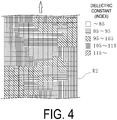
- the displayed determination result may be a warning that simply indicates that the calculated degree of dispersion D2 is outside the range of the dispersion reference range C2, but as illustrated in FIG. 4 , the dispersion of the dielectric constant (or the compounding ratio D1) may be displayed.
- the segments are categorized into a plurality of ranks (for example, an index such as less than 85, 85 to 95, ...) by the calculator 6 according to the magnitude of the dielectric constant.
- Each segment is then displayed on the monitor 8 such that its rank is distinguishable.
- the categorized ranks are distinguishable using blank and line patterns, but may be distinguishable using the difference in color or shade of color. With such display, the acceptability of the dispersion of the vulcanizing compounding agent As may be easily recognized by simply looking at the monitor 8.
- the contents described above may be applied to the primary rubber material R1 as well.
- the compounding ratio of the unvulcanizing compounding agent Ac in the primary rubber material R1 and the acceptability of the compounding ratio may be rapidly determined.
- the acceptability of the dispersion of the unvulcanizing compounding agent Ac in the primary rubber material R1 may be determined in the same manner as in the final rubber material R2.
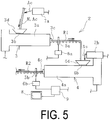
- a production system 2 for unvulcanized rubber material (hereinafter referred to as production system 2) according to the present invention illustrated in FIGS. 5 and 6 utilizes the above-described inspection system 1 according to the present invention.
- the production system 2 includes an extruder 4 that extrudes the final rubber material R2, a vulcanizing compounding agent supply unit 7b that feeds the vulcanizing compounding agent As into the extruder 4, a final dielectric constant measurement device 5b, a final calculator 6b that receives an input of the dielectric constant detected by the final dielectric constant measurement device 5b, and a final controller 9 that controls the vulcanizing compounding agent supply unit 7b.
- the final dielectric constant measurement device 5b is intended to inspect the final rubber material R2 just extruded by the extruder 4.
- the final rubber material R2 is formed by mixing the primary rubber material R1 and the vulcanizing compounding agent As of predetermined type, and the primary rubber material R1 is formed by mixing unvulcanized rubber M and the unvulcanizing compounding agent Ac of predetermined type.
- the final calculator 6b is connected to the final controller 9 in a wired or wireless manner.
- the production system 2 in the embodiment includes equipment for the primary rubber material R1, which is similar to the above-mentioned equipment for the final rubber material R2.
- the production system includes an extruder 3 that extrudes the primary rubber material R1, an unvulcanizing compounding agent supply unit 7a that feeds the unvulcanizing compounding agent Ac into the extruder 3, a primary dielectric constant measurement device 5a, a primary calculator 6a that receives an input of the dielectric constant detected by the primary dielectric constant measurement device 5a is input, and a primary controller 9 that controls the unvulcanizing compounding agent supply unit 7a.
- the primary dielectric constant measurement device 5a is intended to inspect the primary rubber material R1 just extruded by the extruder 3.
- the primary calculator 6a is connected to the primary controller 9 in a wired or wirelessly manner.
- one controller 9 is shared by the primary controller 9 and the final controller 9, but the controllers may be individually provided.
- the primary calculator 6a and the final calculator 6b are separately provided, but one calculator may be shared.
- the primary calculator 6a, the final calculator 6b, and the controller 9 may be integrated into a single computer, for example.
- various kneading means for example, a mixer capable of mixing the unvulcanized rubber M and the unvulcanizing compounding agent Ac of predetermined type to produce the primary rubber material R1 may be used in place of the extruder 3.
- a mixer capable of mixing the unvulcanized rubber M and the unvulcanizing compounding agent Ac of predetermined type to produce the primary rubber material R1
- one monitor 8 connected to the controller 9 in a wired or wirelessly manner is provided.
- the controllers may be connected to the primary monitor 8 and the final monitor 8, respectively.
- the extruder 4 has the configuration described in the previous embodiment, and the sheet-like primary rubber material R1 is continuously fed into the cylinder 4a from the material feeding port 4b via the hopper 4d.
- the vulcanizing compounding agent As of predetermined type is continuously fed from the material feeding port 4b via the hopper 4d by the vulcanizing compounding agent supply unit 7b.
- the vulcanizing compounding agent As is set to be fed at a predetermined ratio preset for 100 weight parts of the unvulcanized rubber M.
- the fed primary rubber material R1 and the vulcanizing compounding agent As move forward while being mixed and kneaded in the cylinder 4a by the rotating screw. Then, the final rubber material R2 formed into a sheet form is continuously extruded from the extrusion port 4c.
- the final dielectric constant measurement device 5b may use equipment various known specifications. Preferable equipment is capable of irradiating the inspection target (final rubber material R2) with ultrasonic waves and detecting the dielectric constant in a non-contact manner. For example, the final dielectric constant measurement device 5b sequentially detects the dielectric constant in the range through which the final rubber material R2 passes while being extruded.
- the final dielectric constant measurement device 5b may be aligned in the width direction of the final rubber material R2.
- the final dielectric constant measurement device 5b may be configured to be movable in the width direction of the final rubber material R2.
- the substantially entire width of the final rubber material R2 can be inspected.
- the dielectric constant in a specific range in the width direction of the final rubber material R2 may be detected, but the dielectric constant is preferably detected over the entire width and the entire length of the final rubber material R2.
- correlation data between the compounding ratio of the vulcanizing compounding agent As of predetermined type in the final rubber material R2 and the dielectric constant of the final rubber material R2 are input to the final calculator 6b.
- the final calculator 6b calculates the compounding ratio D1 of the vulcanizing compounding agent As in the final rubber material R2 on the basis of the correlation data and the sequentially-input dielectric constant.
- correlation data between the compounding ratio of the unvulcanizing compounding agent Ac of predetermined type in the primary rubber material R1 and the dielectric constant of the primary rubber material R1 is also input to the primary calculator 6a.
- the type of the compounding agents A (Ac, As)
- the correlation between the compounding ratio and the dielectric constant of the unvulcanized rubber material R mixed with the compounding agent A (which the dielectric constant increases or decreases proportionally, the degree of change in the dielectric constant) varies, and therefore, for each compounding agent A, the correlation data is previously acquired and input to the primary calculator 6a or the final calculator 6b.
- the final calculator 6b sequentially compares the calculated compounding ratio D1 with the vulcanizing compounding reference range C1, and sequentially determines whether or not the compounding ratio D1 is within the vulcanizing compounding reference range C1.
- the final controller 9 controls the vulcanizing compounding agent supply unit 7b based on comparison between the calculated compounding ratio D1 and a vulcanizing compounding reference range C21. Under this control, the ratio of the vulcanizing compounding agent As fed into the extruder 4 to the unvulcanized rubber M is adjusted such that the compounding ratio D1 of the vulcanizing compounding agent As, which is calculated by the final calculator 6b, is within the preset vulcanizing compounding reference range C1.
- the determination result of the final calculator 6b is sequentially displayed on the monitor 8.
- the displayed determination result may be a warning simply indicating that the calculated compounding ratio D1 is out of the range of the vulcanizing compounding reference range C1, or a change in the compounding ratio D1 over time illustrated in FIG. 4 may be sequentially displayed.
- the acceptability of the compounding ratio can be determined easily and rapidly by the non-destructive inspection. Therefore, by adjusting the ratio of the vulcanizing compounding agent As fed into the extruder 4 to the unvulcanized rubber M based on the determination result, it possible to obtain the final rubber material R2 in which the vulcanizing compounding agent As is mixed with the unvulcanized rubber M at an appropriate compounding ratio within the vulcanizing compounding reference range C1. Moreover, since the acceptability of the compounding ratio may be determined on the production line of the unvulcanized rubber material R, the final rubber material R2 of predetermined quality may be produced with good productivity.
- the extruded final rubber material R2 is divided into multiple segments in a plan view, and the dielectric constant is detected for each divided segment. Then, based on the magnitude of a variation in the detected dielectric constants of the segments, the final calculator 6b calculates a degree of dispersion D2 of the vulcanizing compounding agent As in the final rubber material R2.
- the final calculator 6b sequentially compares the calculated degree of dispersion D2 with the vulcanizing dispersion reference range C2 to determine whether or not the degree of dispersion D2 is within the vulcanizing dispersion reference range C2.
- the degree of dispersion D2 described in the previous embodiment may be used.
- the acceptability of the dispersion is determined based on the degree of dispersion D2.
- the determination result of the final calculator 6b is sequentially displayed on the monitor 8.
- the displayed determination result may be a warning that simply indicates that the calculated degree of dispersion D2 is outside the range of the vulcanizing dispersion reference range C2, but as illustrated in FIG. 4 , the dispersion of the dielectric constant (or the compounding ratio D2) may be displayed. Then, the contents described in the previous embodiment are displayed on the monitor 8.
- the portion may be removed by a cutting machine such as a cutter installed on the production line.
- a cutting machine such as a cutter installed on the production line.
- the contents described above may be applied to the primary rubber material R1 as well.
- the compounding ratio of the unvulcanizing compounding agent Ac in the primary rubber material R1 may be calculated to rapidly determine the acceptability of the compounding ratio.
- the ratio of the unvulcanizing compounding agent Ac fed into the extruder 3 to the unvulcanized rubber M based on this determination result, it is possible to obtain the primary rubber material R1 in which the unvulcanizing compounding agent Ac is mixed with the unvulcanized rubber M at an appropriate compounding ratio within the unvulcanizing compounded reference range.
- the acceptability of the dispersion of the unvulcanizing compounding agent Ac in the primary rubber material R1 may be determined in the same manner as in the final rubber material R2.
Landscapes
- Engineering & Computer Science (AREA)
- Mechanical Engineering (AREA)
- Chemical & Material Sciences (AREA)
- Health & Medical Sciences (AREA)
- Life Sciences & Earth Sciences (AREA)
- Physics & Mathematics (AREA)
- Medicinal Chemistry (AREA)
- Immunology (AREA)
- Analytical Chemistry (AREA)
- Biochemistry (AREA)
- General Health & Medical Sciences (AREA)
- General Physics & Mathematics (AREA)
- Pathology (AREA)
- Organic Chemistry (AREA)
- Food Science & Technology (AREA)
- Polymers & Plastics (AREA)
- Chemical Kinetics & Catalysis (AREA)
- Acoustics & Sound (AREA)
- Investigating Or Analyzing Materials By The Use Of Electric Means (AREA)
- Extrusion Moulding Of Plastics Or The Like (AREA)
Abstract
Description
- The present invention relates to a quality inspection method and a quality inspection system for unvulcanized rubber material, and a production method and a production system for unvulcanized rubber material.
- Producing a rubber product such as a tire or the like includes a step of kneading an unvulcanized rubber and a compounding agent using a mixer (mixing machine) or a rubber extruder to produce an unvulcanized rubber material. In this production step, the compounding agent is added at a compounding ratio set for the unvulcanized rubber. If the compounding ratio of the actually added compounding agent deviates from the reference range, the quality of the produced unvulcanized rubber material will be affected. This also affects the quality of the rubber product produced using this unvulcanized rubber material.
- An oxygen flask combustion method or a sodium peroxide melting method have been are known as methods for inspecting the compounded amount of sulfur in an unvulcanized rubber material. However, in these inspection methods, procedures and preparations are complex, and time required for inspection is long. In addition, these inspection methods require complicated procedures and preparations and cannot perform inspection on the production line for the unvulcanized rubber material, failing to produce the unvulcanized rubber material of predetermined quality with good productivity.
- As a method for determining the quality of an unvulcanized rubber material, a method has been proposed in which ultrasonic waves (0.5 MHz to 20 MHz) are transmitted to the extruded unvulcanized rubber material, and an attenuation amount of the strength of the ultrasonic waves transmitted through the unvulcanized rubber material (see Patent Document 1). The proposed method can recognize the presence or absence of contaminants in the unvulcanized rubber material, and the relative change in the content of the contaminants on the basis of the attenuation amount of the strength of the ultrasonic waves, but does not determine whether or not the compounding ratio of the compounding agent in the unvulcanized rubber material is appropriate.
- A method for measuring the concentration, the content rate, and the like of the chloride in concrete, although not unvulcanized rubber material, has been known (for example, see Patent Document 2).
-
- Patent Document 1:
JP 2014-521948 T - Patent Document 2:
JP 2006-214941 A - An object of the present invention is to provide a quality inspection method and a quality inspection system for unvulcanized rubber material that can easily and quickly determine the acceptability of the compounding ratio of a compounding agent in the unvulcanized rubber material. Another object of the present invention is to provide a production method and a production system for unvulcanized rubber material that can produce the unvulcanized rubber material on the production line for the unvulcanized rubber material with good productivity, with a compounding agent of predetermined type being mixed with unvulcanized rubber at an appropriate compounding ratio.
- In order to achieve the object described above, a quality inspection method for unvulcanized rubber material according to the present invention includes: based on a dielectric constant of an unvulcanized rubber material in which a compounding agent of predetermined type is mixed with unvulcanized rubber, calculating a compounding ratio of the compounding agent to the unvulcanized rubber material by a calculator; and determining whether or not the calculated compounding ratio is within a preset compounding reference range by the calculator.
- A quality inspection system for unvulcanized rubber material according to the present invention including:
- a dielectric constant measurement device configured to detect a dielectric constant of an unvulcanized rubber material obtained by mixing a compounding agent of predetermined type to unvulcanized rubber; and
- a calculator configured to receive an input of the dielectric constant detected by the dielectric constant measurement device, wherein the calculator calculates a compounding ratio of the compounding agent in the unvulcanized rubber material based on the dielectric constant, and determines whether or not the calculated compounding ratio is within a compounding reference range input to the calculator.
- According to the present invention, a production method for unvulcanized rubber material for feeding a primary rubber material that is a mixture of unvulcanized rubber and an unvulcanizing compounding agent of predetermined type, and a vulcanizing compounding agent of predetermined type into an extruder, and perform mixing to continuously produce a final rubber material includes: calculating a compounding ratio of the vulcanizing compounding agent to the final rubber material by a final calculator based on a dielectric constant of the final rubber material extruded from the extruder; and adjusting a ratio of the vulcanizing compounding agent fed to the extruder to the unvulcanized rubber such that the calculated compounding ratio is within a preset vulcanizing compounding reference range.
- A production system for unvulcanized rubber material according to the present invention includes: an extruder configured to mix a primary rubber material that is a mixture of unvulcanized rubber and an unvulcanizing compounding agent of predetermined type, and a vulcanizing compounding agent of predetermined type, and extrude a final rubber material; a vulcanizing compounding agent supply unit configured to feed the vulcanizing compounding agent into the extruder; a final dielectric constant measurement device configured to detect a dielectric constant of the final rubber material; a final calculator configured to receive an input of the dielectric constant detected by the final dielectric constant measurement device; and a final controller configured to control the vulcanizing compounding agent supply unit, wherein a compounding ratio of the vulcanizing compounding agent to the final rubber material is calculated by the final calculator based on the dielectric constant, the vulcanizing compounding agent supply unit is controlled by the final controller based on comparison of the calculated compounding ratio and a preset vulcanizing compounding reference range, and a ratio of the vulcanizing compounding agent fed to the extruder to the unvulcanized rubber is adjusted such that the compounding ratio calculated by the final calculator is within the vulcanizing compounding reference range.
- In the quality inspection method and the quality inspection system for the unvulcanized rubber material according to the present invention, by detecting the dielectric constant of the unvulcanized rubber material, and performing calculation based on the dielectric constant by the calculator, the compounding ratio of the compounding agent of the unvulcanized rubber material may be calculated to rapidly determine the acceptability of the compounding ratio. Moreover, since it is no need to acquire data using various solutions, inspection may be easily performed.
- In the production method and the production system for unvulcanized rubber material according to the present invention, by detecting the dielectric constant of the final rubber material extruded from the extruder, and performing calculation based on the dielectric constant by the final calculator, the compounding ratio of the vulcanizing compounding agent to the final rubber material may be calculated to determine the acceptability of the compounding ratio easily and rapidly. Therefore, by adjusting the ratio of the vulcanizing compounding agent fed to the extruder to the unvulcanized rubber based on the determination result, it is possible to acquire an unvulcanized rubber material in which the vulcanizing compounding agent is mixed with the unvulcanized rubber at an appropriate compounding ratio within the vulcanizing compounding reference range. Moreover, since the acceptability of the compounding ratio may be determined on the production line of the unvulcanized rubber material, the unvulcanized rubber material of predetermined quality may be produced with good productivity.
-
- FIG. 1
- is an explanatory diagram illustrating a quality inspection system for unvulcanized rubber material according to the present invention.
- FIG. 2
- is a graph schematically illustrating the relationship between each of the compounding ratio of carbon black and the compounding ratio of a master batch and the dielectric constant of the unvulcanized rubber material.
- FIG. 3
- is an explanatory diagram illustrating contents (change in the compounding ratio of the compounding agent over time) displayed on a monitor.
- FIG. 4
- is an explanatory diagram illustrating another type of contents (the dispersion of the compounding agent) displayed on a monitor.
- FIG. 5
- is an explanatory diagram illustrating a production system for unvulcanized rubber material according to the present invention.
- FIG. 6
- is a partial enlarged diagram illustrating the production system of
FIG. 5 . - A quality inspection method and a quality inspection system for unvulcanized rubber material according to the present invention will be described below based on the illustrated embodiments.
- A
quality inspection system 1 for unvulcanized rubber material (hereinafter referred to as the inspection system 1) according to the present invention inFIG. 1 includes a dielectricconstant measurement device 5, acalculator 6 that receives an input of the dielectric constant detected by the dielectricconstant measurement device 5, and amonitor 8 connected to thecalculator 6 in a wired or wireless manner. The present invention may inspect, as an unvulcanized rubber material R, both a primary rubber material R1 in which an unvulcanized rubber M and an unvulcanizing compounding agent Ac of predetermined type are mixed, and a final rubber materials R2 in which the primary rubber material R1 and a vulcanizing compounding agent As of predetermined type are mixed. In this embodiment, the final rubber material R2 just extruded by theextruder 4 is used as the inspection target. - Examples of the unvulcanizing compounding agent Ac include carbon black and silica. Examples of the vulcanizing compounding agent As include at least one of a vulcanization activator, a vulcanization accelerator, and sulfur. A master batch in which the vulcanization activator, the vulcanization accelerator, and the sulfur are mixed at prescribed ratios may be used as the vulcanizing compounding agent As.
- An
extruder 4 includes acylinder 4a provided with a rotationally-driven screw, amaterial feeding port 4b formed on a top surface of a rear end of thecylinder 4a, ahopper 4d disposed on thematerial feeding port 4b, and anextrusion port 4c formed on the tip of thecylinder 4a. A conveyance means such as a conveyor extends in front of theextrusion port 4c. Additionally, a compoundingagent supply unit 7 that feeds the vulcanizing compounding agent As of predetermined type to thematerial feeding port 4b via thehopper 4d is provided. - A sheet-like primary rubber material R1 is continuously fed into the
cylinder 4a of theextruder 4 from thematerial feeding port 4b via thehopper 4d. In addition, the vulcanizing compounding agent As of predetermined type is continuously fed from thematerial feeding port 4b via thehopper 4d by the compoundingagent supply unit 7. The vulcanizing compounding agent As is set to be fed at a predetermined ratio preset for 100 weight parts of the unvulcanized rubber M. - The fed primary rubber material R1 and the vulcanizing compounding agent As move forward while being mixed and kneaded in the
cylinder 4a by the rotating screw. Then, the final rubber material R2 formed into a sheet form is continuously extruded from theextrusion port 4c. - The dielectric
constant measurement device 5 may use equipment various known specifications. Preferable equipment is capable of irradiating the inspection target (unvulcanized rubber material R) with ultrasonic waves and detecting the dielectric constant in a non-contact manner. For example, the dielectricconstant measurement device 5 sequentially detects the dielectric constant in the range through which the final rubber material R2 passes while being extruded. - Not only a single but a plurality of dielectric
constant measurement devices 5 may be aligned in the width direction of the final rubber material R2. Alternatively, the dielectricconstant measurement device 5 may be configured to be movable in the width direction of the final rubber material R2. By employing these configurations, the substantially entire width of the final rubber material R2 can be inspected. - As illustrated in
FIG. 2 , correlation data between the compounding ratio of the vulcanizing compounding agent As of predetermined type in the final rubber material R2 and the dielectric constant of the final rubber material R2 are input to thecalculator 6. Specifically, as the compounding ratio of the master batch used as the vulcanizing compounding agent As increases, the dielectric constant of the final rubber material R2 tends to decrease. Thecalculator 6 calculates a compounding ratio D1 of the vulcanizing compounding agent As in the final rubber material R2 on the basis of the correlation data and the sequentially-input dielectric constant. - In this embodiment, correlation data between the compounding ratio of the unvulcanizing compounding agent Ac of predetermined type in the primary rubber material R1 and the dielectric constant of the primary rubber material R1 is also input to the
calculator 6. Specifically, as the compounding ratio of carbon black used as the unvulcanizing compounding agent Ac increases, the dielectric constant of the primary rubber material R1 tends to increase. According to the type of the compounding agents A (Ac, As), the correlation between the compounding ratio and the dielectric constant of the unvulcanized rubber material R mixed with the compounding agent A (which the dielectric constant increases or decreases proportionally, the degree of change in the dielectric constant) varies, and therefore, for each compounding agent A, the correlation data is previously acquired and input to thecalculator 6. - A compounding reference range C1 indicating the appropriate compounding ratio for each type of the vulcanizing compounding agent As is also input to the
calculator 6. As illustrated inFIG. 3 , thecalculator 6 sequentially compares the calculated compounding ratio D1 with the compounding reference range C1, and sequentially determines whether or not the compounding ratio D1 is within the compounding reference range C1. - The determination result of the
calculator 6 is sequentially displayed on themonitor 8. The displayed determination result may be a warning simply indicating that the calculated compounding ratio D1 is out of the range of the compounding reference range C1, or a change in the compounding ratio D1 over time illustrated inFIG. 3 may be sequentially displayed. - As described above, according to the present invention, by detecting the dielectric constant of the final rubber material R2 and performing calculation based on the dielectric constant to calculate the compounding ratio of the vulcanizing compounding agent As in the final rubber material R2, the acceptability of the compounding ratio can be rapidly determined by the non-destructive inspection. Moreover, unlike the known inspection method, there is no need to acquire data using various solutions, achieving simple inspection.
- Even when the vulcanizing compounding agent As is added to the primary rubber material R1 at a compounding ratio within the compounding reference range C1, unless the vulcanizing compounding agent As is sufficiently dispersed and mixed with the unvulcanized rubber M (primary rubber material R1), the quality of the final rubber material R2 produced is disadvantageously affected. Therefore, it is more preferable to determine the acceptability of the dispersion of the vulcanizing compounding agent As as well.
- Thus, the extruded final rubber material R2 is divided into multiple segments in a plan view, and the dielectric constant is detected for each divided segment. Then, based on the magnitude of a variation in the detected dielectric constants of the segments, the
calculator 6 calculates a degree of dispersion D2 of the vulcanizing compounding agent As in the final rubber material R2. - A dispersion reference range C2 indicating the appropriate degree of dispersion D2 for each type of the vulcanizing compounding agent As is input to the
calculator 6. Then, thecalculator 6 sequentially compares the calculated degree of dispersion D2 with the dispersion reference range C2, and determines whether or not the degree of dispersion D2 is within the dispersion reference range C2. - For example, a reference dielectric constant Cd is set, and a value acquired by averaging absolute values of differences between the reference dielectric constant Cd and the dielectric constants of the segments in a predetermined area range (per unit area) is defined as the degree of dispersion D2. As the degree of dispersion D2 is larger, dispersion of the vulcanizing compounding agent As becomes worse, and thus, a preset average allowable range is previously set to the dispersion reference range C2, and it is determined that the dispersion is poor when the degree of dispersion D2 is greater than the dispersion reference range C2.
- Also when the dielectric constant is locally too large or too small, it can be deemed that the vulcanizing compounding agent As is not well dispersed. Thus, a preset local allowable range is set to the dispersion reference range C2, and it may be determined that the dispersion is poor when a segment where the degree of dispersion D2 is larger than the dispersion reference range C2 is present. At least one of the above-mentioned average allowable range and local allowable range may be adopted as the dispersion reference range C2, but both are preferably adopted.
- The determination result of the
calculator 6 is sequentially displayed on themonitor 8. The displayed determination result may be a warning that simply indicates that the calculated degree of dispersion D2 is outside the range of the dispersion reference range C2, but as illustrated inFIG. 4 , the dispersion of the dielectric constant (or the compounding ratio D1) may be displayed. - In displaying as illustrated in
FIG. 4 , the segments are categorized into a plurality of ranks (for example, an index such as less than 85, 85 to 95, ...) by thecalculator 6 according to the magnitude of the dielectric constant. Each segment is then displayed on themonitor 8 such that its rank is distinguishable. InFIG. 4 , the categorized ranks are distinguishable using blank and line patterns, but may be distinguishable using the difference in color or shade of color. With such display, the acceptability of the dispersion of the vulcanizing compounding agent As may be easily recognized by simply looking at themonitor 8. - The contents described above may be applied to the primary rubber material R1 as well. In other words, by detecting the dielectric constant of the primary rubber material R1 and performing calculation based on the dielectric constant, the compounding ratio of the unvulcanizing compounding agent Ac in the primary rubber material R1 and the acceptability of the compounding ratio may be rapidly determined. Additionally, the acceptability of the dispersion of the unvulcanizing compounding agent Ac in the primary rubber material R1 may be determined in the same manner as in the final rubber material R2.
- Next, a production method and a production system for unvulcanized rubber material according to the present invention will be described with reference to the illustrated embodiment.
- A
production system 2 for unvulcanized rubber material (hereinafter referred to as production system 2) according to the present invention illustrated inFIGS. 5 and6 utilizes the above-describedinspection system 1 according to the present invention. Theproduction system 2 includes anextruder 4 that extrudes the final rubber material R2, a vulcanizing compoundingagent supply unit 7b that feeds the vulcanizing compounding agent As into theextruder 4, a final dielectricconstant measurement device 5b, afinal calculator 6b that receives an input of the dielectric constant detected by the final dielectricconstant measurement device 5b, and afinal controller 9 that controls the vulcanizing compoundingagent supply unit 7b. The final dielectricconstant measurement device 5b is intended to inspect the final rubber material R2 just extruded by theextruder 4. The final rubber material R2 is formed by mixing the primary rubber material R1 and the vulcanizing compounding agent As of predetermined type, and the primary rubber material R1 is formed by mixing unvulcanized rubber M and the unvulcanizing compounding agent Ac of predetermined type. Thefinal calculator 6b is connected to thefinal controller 9 in a wired or wireless manner. - The
production system 2 in the embodiment includes equipment for the primary rubber material R1, which is similar to the above-mentioned equipment for the final rubber material R2. Specifically, the production system includes anextruder 3 that extrudes the primary rubber material R1, an unvulcanizing compounding agent supply unit 7a that feeds the unvulcanizing compounding agent Ac into theextruder 3, a primary dielectricconstant measurement device 5a, aprimary calculator 6a that receives an input of the dielectric constant detected by the primary dielectricconstant measurement device 5a is input, and aprimary controller 9 that controls the unvulcanizing compounding agent supply unit 7a. The primary dielectricconstant measurement device 5a is intended to inspect the primary rubber material R1 just extruded by theextruder 3. Theprimary calculator 6a is connected to theprimary controller 9 in a wired or wirelessly manner. - In this embodiment, one
controller 9 is shared by theprimary controller 9 and thefinal controller 9, but the controllers may be individually provided. In addition, in this embodiment, theprimary calculator 6a and thefinal calculator 6b are separately provided, but one calculator may be shared. Alternatively, theprimary calculator 6a, thefinal calculator 6b, and thecontroller 9 may be integrated into a single computer, for example. - In addition, in the present invention, to produce the primary rubber material R1, various kneading means (for example, a mixer) capable of mixing the unvulcanized rubber M and the unvulcanizing compounding agent Ac of predetermined type to produce the primary rubber material R1 may be used in place of the
extruder 3. In this embodiment, onemonitor 8 connected to thecontroller 9 in a wired or wirelessly manner is provided. In the configuration in which theprimary controller 9 and thefinal controller 9 are separately provided, the controllers may be connected to theprimary monitor 8 and thefinal monitor 8, respectively. - The
extruder 4 has the configuration described in the previous embodiment, and the sheet-like primary rubber material R1 is continuously fed into thecylinder 4a from thematerial feeding port 4b via thehopper 4d. In addition, the vulcanizing compounding agent As of predetermined type is continuously fed from thematerial feeding port 4b via thehopper 4d by the vulcanizing compoundingagent supply unit 7b. The vulcanizing compounding agent As is set to be fed at a predetermined ratio preset for 100 weight parts of the unvulcanized rubber M. - The fed primary rubber material R1 and the vulcanizing compounding agent As move forward while being mixed and kneaded in the
cylinder 4a by the rotating screw. Then, the final rubber material R2 formed into a sheet form is continuously extruded from theextrusion port 4c. - The final dielectric
constant measurement device 5b may use equipment various known specifications. Preferable equipment is capable of irradiating the inspection target (final rubber material R2) with ultrasonic waves and detecting the dielectric constant in a non-contact manner. For example, the final dielectricconstant measurement device 5b sequentially detects the dielectric constant in the range through which the final rubber material R2 passes while being extruded. - Not only a single but a plurality of final dielectric
constant measurement devices 5b may be aligned in the width direction of the final rubber material R2. Alternatively, the final dielectricconstant measurement device 5b may be configured to be movable in the width direction of the final rubber material R2. By employing these configurations, the substantially entire width of the final rubber material R2 can be inspected. The dielectric constant in a specific range in the width direction of the final rubber material R2 may be detected, but the dielectric constant is preferably detected over the entire width and the entire length of the final rubber material R2. - As illustrated in
FIG. 2 , correlation data between the compounding ratio of the vulcanizing compounding agent As of predetermined type in the final rubber material R2 and the dielectric constant of the final rubber material R2 are input to thefinal calculator 6b. Thefinal calculator 6b calculates the compounding ratio D1 of the vulcanizing compounding agent As in the final rubber material R2 on the basis of the correlation data and the sequentially-input dielectric constant. - In this embodiment, as illustrated in
FIG. 2 , correlation data between the compounding ratio of the unvulcanizing compounding agent Ac of predetermined type in the primary rubber material R1 and the dielectric constant of the primary rubber material R1 is also input to theprimary calculator 6a. According to the type of the compounding agents A (Ac, As), the correlation between the compounding ratio and the dielectric constant of the unvulcanized rubber material R mixed with the compounding agent A (which the dielectric constant increases or decreases proportionally, the degree of change in the dielectric constant) varies, and therefore, for each compounding agent A, the correlation data is previously acquired and input to theprimary calculator 6a or thefinal calculator 6b. - A compounding vulcanizing reference range C1 indicating the appropriate compounding ratio for each type of the vulcanizing compounding agent As is also input to the
final calculator 6b. As illustrated inFIG. 3 , thefinal calculator 6b sequentially compares the calculated compounding ratio D1 with the vulcanizing compounding reference range C1, and sequentially determines whether or not the compounding ratio D1 is within the vulcanizing compounding reference range C1. - The
final controller 9 controls the vulcanizing compoundingagent supply unit 7b based on comparison between the calculated compounding ratio D1 and a vulcanizing compounding reference range C21. Under this control, the ratio of the vulcanizing compounding agent As fed into theextruder 4 to the unvulcanized rubber M is adjusted such that the compounding ratio D1 of the vulcanizing compounding agent As, which is calculated by thefinal calculator 6b, is within the preset vulcanizing compounding reference range C1. - The determination result of the
final calculator 6b is sequentially displayed on themonitor 8. The displayed determination result may be a warning simply indicating that the calculated compounding ratio D1 is out of the range of the vulcanizing compounding reference range C1, or a change in the compounding ratio D1 over time illustrated inFIG. 4 may be sequentially displayed. - As described above, according to the present invention, by detecting the dielectric constant of the final rubber material R2 and performing calculation based on the detected dielectric constant to calculate the compounding ratio of the vulcanizing compounding agent As in the final rubber material R2, the acceptability of the compounding ratio can be determined easily and rapidly by the non-destructive inspection. Therefore, by adjusting the ratio of the vulcanizing compounding agent As fed into the
extruder 4 to the unvulcanized rubber M based on the determination result, it possible to obtain the final rubber material R2 in which the vulcanizing compounding agent As is mixed with the unvulcanized rubber M at an appropriate compounding ratio within the vulcanizing compounding reference range C1. Moreover, since the acceptability of the compounding ratio may be determined on the production line of the unvulcanized rubber material R, the final rubber material R2 of predetermined quality may be produced with good productivity. - As described in the previous embodiments, it is more preferable to determine the acceptability of the dispersion of the vulcanizing compounding agent As as well. That is, the extruded final rubber material R2 is divided into multiple segments in a plan view, and the dielectric constant is detected for each divided segment. Then, based on the magnitude of a variation in the detected dielectric constants of the segments, the
final calculator 6b calculates a degree of dispersion D2 of the vulcanizing compounding agent As in the final rubber material R2. - A vulcanizing dispersion reference range C2 indicating the appropriate degree of dispersion D2 for each type of the vulcanizing compounding agent As is input to the
final calculator 6b. Then, thefinal calculator 6b sequentially compares the calculated degree of dispersion D2 with the vulcanizing dispersion reference range C2 to determine whether or not the degree of dispersion D2 is within the vulcanizing dispersion reference range C2. Specifically, the degree of dispersion D2 described in the previous embodiment may be used. Then, the acceptability of the dispersion is determined based on the degree of dispersion D2. - The determination result of the
final calculator 6b is sequentially displayed on themonitor 8. The displayed determination result may be a warning that simply indicates that the calculated degree of dispersion D2 is outside the range of the vulcanizing dispersion reference range C2, but as illustrated inFIG. 4 , the dispersion of the dielectric constant (or the compounding ratio D2) may be displayed. Then, the contents described in the previous embodiment are displayed on themonitor 8. - When the final rubber material R2 includes a portion having an inadequate compounding ratio or the dispersion, the portion may be removed by a cutting machine such as a cutter installed on the production line. As a result, only the final rubber material R2 that satisfy predetermined quality is transported to the subsequent step of the production line, and the final rubber material R2 that satisfies the predetermined quality is excluded from the production line.
- The contents described above may be applied to the primary rubber material R1 as well. In other words, by detecting the dielectric constant of the primary rubber material R1 and performing calculation based on the detected dielectric constant, the compounding ratio of the unvulcanizing compounding agent Ac in the primary rubber material R1 may be calculated to rapidly determine the acceptability of the compounding ratio. By adjusting the ratio of the unvulcanizing compounding agent Ac fed into the
extruder 3 to the unvulcanized rubber M based on this determination result, it is possible to obtain the primary rubber material R1 in which the unvulcanizing compounding agent Ac is mixed with the unvulcanized rubber M at an appropriate compounding ratio within the unvulcanizing compounded reference range. Additionally, the acceptability of the dispersion of the unvulcanizing compounding agent Ac in the primary rubber material R1 may be determined in the same manner as in the final rubber material R2. -
- 1:
- Inspection system
- 2:
- Production system
- 3:
- Extruder (kneading means)
- 3a:
- Cylinder
- 3b:
- Material feeding port
- 3c:
- Extrusion port
- 3d:
- Hopper
- 4:
- Extruder
- 4a:
- Cylinder
- 4b:
- Material feeding port
- 4c:
- Extrusion port
- 4d:
- Hopper
- 5:
- Dielectric constant measurement device
- 5a:
- Primary dielectric constant measurement device
- 5b:
- Final dielectric constant measurement device
- 6:
- Calculator
- 6a:
- Primary calculator
- 6b:
- Final calculator
- 7:
- Compounding agent supply unit
- 7a:
- Unvulcanizing compounding agent supply unit
- 7b:
- Vulcanizing compounding agent supply unit
- 8:
- Monitor (primary monitor, final monitor)
- 9:
- Controller (primary controller, final controller)
- R:
- Unvulcanized rubber material
- R1:
- Primary rubber material
- R2:
- Final rubber material
- M:
- Unvulcanized rubber
- A:
- Compounding agent
- Ac:
- Unvulcanizing compounding agent
- As:
- Vulcanizing compounding agent
- C1:
- Compounding reference range
- C2:
- Dispersion reference range
Claims (10)
- A quality inspection method for unvulcanized rubber material comprising:based on a dielectric constant of an unvulcanized rubber material in which a compounding agent of predetermined type is mixed with unvulcanized rubber, calculating a compounding ratio of the compounding agent to the unvulcanized rubber material by a calculator; anddetermining whether or not the calculated compounding ratio is within a preset compounding reference range by the calculator.
- The quality inspection method for unvulcanized rubber material according to claim 1, further comprising:dividing the unvulcanized rubber material into multiple segments in a plan view and detecting the dielectric constant for each of the segments;calculating a degree of dispersion of the compounding agent in the unvulcanized rubber material by the calculator based on a magnitude of a variation in the detected dielectric constants in the segments; anddetermining whether or not the calculated degree of dispersion is within a preset dispersion reference range.
- The quality inspection method for unvulcanized rubber material according to claim 2, wherein
the segments are categorized into a plurality of ranks by the calculator based on a magnitude of the dielectric constants of the segments, and the segments are displayed on a monitor such that the respective categorized ranks are distinguishable. - The quality inspection method for unvulcanized rubber material according to any one of claims 1 to 3, wherein
the compounding agent is at least one of carbon black, silica, vulcanization activator, vulcanization accelerator, and sulfur. - A quality inspection system for unvulcanized rubber material comprising:a dielectric constant measurement device configured to detect a dielectric constant of an unvulcanized rubber material obtained by mixing a compounding agent of predetermined type to unvulcanized rubber; anda calculator configured to receive an input of the dielectric constant detected by the dielectric constant measurement device, whereinthe calculator calculates a compounding ratio of the compounding agent in the unvulcanized rubber material based on the dielectric constant, and determines whether or not the calculated compounding ratio is within a compounding reference range input to the calculator.
- A production method for unvulcanized rubber material for feeding a primary rubber material that is a mixture of unvulcanized rubber and an unvulcanizing compounding agent of predetermined type, and a vulcanizing compounding agent of predetermined type into an extruder, and perform mixing to continuously produce a final rubber material, the method comprising:calculating a compounding ratio of the vulcanizing compounding agent to the final rubber material by a final calculator based on a dielectric constant of the final rubber material extruded from the extruder; andadjusting a ratio of the vulcanizing compounding agent fed to the extruder to the unvulcanized rubber such that the calculated compounding ratio is within a preset vulcanizing compounding reference range.
- The production method for unvulcanized rubber material according to claim 6, further comprising:dividing the final rubber material into multiple segments in a plan view and detecting the dielectric constant for each of the segments;calculating a degree of dispersion of the vulcanizing compounding agent in the final rubber material by the final calculator based on a magnitude of a variation in the detected dielectric constants in the segments; anddetermining whether or not the calculated degree of dispersion of the vulcanizing compounding agent is within a preset vulcanizing dispersion reference range.
- The production method for unvulcanized rubber material according to claim 7, further comprising:categorizing the segments into a plurality of ranks by the final calculator based on a magnitude of the dielectric constants of the segments, anddisplaying the segments on a final monitor such that the respective categorized ranks are distinguishable.
- The production method for unvulcanized rubber material according to any one of claims 6 to 8, further comprising:feeding the unvulcanized rubber and the unvulcanizing compounding agent into a kneading means other than the extruder and performing mixing to continuously produce the primary rubber material;calculating a compounding ratio of the unvulcanizing compounding agent to the primary rubber material by a primary calculator based on a dielectric constant of the primary rubber material; andadjusting a ratio of the unvulcanizing compounding agent fed to the kneading means to the unvulcanized rubber such that the calculated compounding ratio of the unvulcanizing compounding agent is within a preset unvulcanizing compounded reference range.
- A production system for unvulcanized rubber material comprising:an extruder configured to mix a primary rubber material that is a mixture of unvulcanized rubber and an unvulcanizing compounding agent of predetermined type, and a vulcanizing compounding agent of predetermined type, and extrude a final rubber material;a vulcanizing compounding agent supply unit configured to feed the vulcanizing compounding agent into the extruder;a final dielectric constant measurement device configured to detect a dielectric constant of the final rubber material;
a final calculator configured to receive an input of the dielectric constant detected by the final dielectric constant measurement device; anda final controller configured to control the vulcanizing compounding agent supply unit, whereina compounding ratio of the vulcanizing compounding agent to the final rubber material is calculated by the final calculator based on the dielectric constant,
the vulcanizing compounding agent supply unit is controlled by the final controller based on comparison of the calculated compounding ratio and a preset vulcanizing compounding reference range, and
a ratio of the vulcanizing compounding agent fed to the extruder to the unvulcanized rubber is adjusted such that the compounding ratio calculated by the final calculator is within the vulcanizing compounding reference range.
Applications Claiming Priority (3)
| Application Number | Priority Date | Filing Date | Title |
|---|---|---|---|
| JP2017236178A JP6566014B2 (en) | 2017-12-08 | 2017-12-08 | Quality inspection method and quality inspection system for unvulcanized rubber material |
| JP2017236179A JP6566015B2 (en) | 2017-12-08 | 2017-12-08 | Method and system for producing unvulcanized rubber material |
| PCT/JP2018/035774 WO2019111500A1 (en) | 2017-12-08 | 2018-09-26 | Method and system for inspecting quality of unvulcanized rubber material, and method and system for manufacturing unvulcanized rubber material |
Publications (2)
| Publication Number | Publication Date |
|---|---|
| EP3722795A1 true EP3722795A1 (en) | 2020-10-14 |
| EP3722795A4 EP3722795A4 (en) | 2021-09-01 |
Family
ID=66750127
Family Applications (1)
| Application Number | Title | Priority Date | Filing Date |
|---|---|---|---|
| EP18886746.9A Withdrawn EP3722795A4 (en) | 2017-12-08 | 2018-09-26 | Method and system for inspecting quality of unvulcanized rubber material, and method and system for manufacturing unvulcanized rubber material |
Country Status (4)
| Country | Link |
|---|---|
| US (1) | US11826928B2 (en) |
| EP (1) | EP3722795A4 (en) |
| CN (1) | CN111448451A (en) |
| WO (1) | WO2019111500A1 (en) |
Families Citing this family (2)
| Publication number | Priority date | Publication date | Assignee | Title |
|---|---|---|---|---|
| DE102017108943A1 (en) * | 2016-12-02 | 2018-06-07 | Kraussmaffei Berstorff Gmbh | A method of making a tread and treadmill |
| CN114707869A (en) * | 2022-04-11 | 2022-07-05 | 扬中市橡胶塑料厂有限公司 | A quality management system for unvulcanized rubber materials |
Family Cites Families (10)
| Publication number | Priority date | Publication date | Assignee | Title |
|---|---|---|---|---|
| DE2932445A1 (en) * | 1979-08-10 | 1981-02-26 | Troester Maschf Paul | Determining crosslinking rate of rubber or plastics prods. - using crosslinking agent with variable polarity and measuring dielectric constant prior to and after crosslinking |
| JPS6015110A (en) * | 1983-07-08 | 1985-01-25 | Kobe Steel Ltd | Double-screw coupled kneader for rubber |
| JP2005001228A (en) * | 2003-06-11 | 2005-01-06 | Toyo Tire & Rubber Co Ltd | Rubber continuous kneading equipment and rubber continuous kneading method |
| JP4710061B2 (en) | 2005-02-04 | 2011-06-29 | 株式会社竹中工務店 | Concrete component measuring apparatus and measuring method |
| WO2007137404A1 (en) * | 2006-05-25 | 2007-12-06 | Fpinnovations | Dielectric mapping device and method |
| JP5377454B2 (en) * | 2010-10-21 | 2013-12-25 | 住友ゴム工業株式会社 | Rubber composition for band topping, rubber composition for breaker edge strip, and pneumatic tire |
| EP2551087A1 (en) | 2011-07-28 | 2013-01-30 | Rhein Chemie Rheinau GmbH | Method for determining the quality of unlinked rubber mixtures and corresponding device |
| DE102011053478B4 (en) * | 2011-09-09 | 2015-02-19 | Contitech Ag | A method of determining a composition of a plasticized elastomer blend based on at least one polar or non-polar rubber |
| US9830523B2 (en) * | 2012-05-31 | 2017-11-28 | Korea Institute Of Science And Technology | Method and apparatus for recognizing object material using spatial image and spatial radar information |
| DE102013104183A1 (en) * | 2013-04-25 | 2014-10-30 | Continental Reifen Deutschland Gmbh | A method of identifying a rubber compound in the manufacture of tire components from unvulcanized rubber material |
-
2018
- 2018-09-26 EP EP18886746.9A patent/EP3722795A4/en not_active Withdrawn
- 2018-09-26 WO PCT/JP2018/035774 patent/WO2019111500A1/en not_active Ceased
- 2018-09-26 US US16/770,934 patent/US11826928B2/en active Active
- 2018-09-26 CN CN201880078888.7A patent/CN111448451A/en active Pending
Also Published As
| Publication number | Publication date |
|---|---|
| CN111448451A (en) | 2020-07-24 |
| WO2019111500A1 (en) | 2019-06-13 |
| US20210162632A1 (en) | 2021-06-03 |
| US11826928B2 (en) | 2023-11-28 |
| EP3722795A4 (en) | 2021-09-01 |
Similar Documents
| Publication | Publication Date | Title |
|---|---|---|
| KR101136017B1 (en) | Extrusion conveying device | |
| CA3112384C (en) | Method and device for controlling a production system for planar or strand-shaped bodies | |
| US11826928B2 (en) | Quality inspection method and quality inspection system for unvulcanized rubber material, and production method and production system for unvulcanized rubber material | |
| CN102083893B (en) | Method and device for producing a cross-linkable rubber mixture | |
| JPH03183430A (en) | Quality control during food processing | |
| WO2009062525A1 (en) | Process and plant for producing an elastomeric compound | |
| JP6566015B2 (en) | Method and system for producing unvulcanized rubber material | |
| JP6772684B2 (en) | Manufacturing method and equipment for rubber extrusions | |
| JP6566014B2 (en) | Quality inspection method and quality inspection system for unvulcanized rubber material | |
| TWI848076B (en) | Arrangement and method for upgrading plastics | |
| JP7684567B2 (en) | Method and system for mixing unvulcanized rubber | |
| JP2019078665A (en) | Inspection apparatus for thermoplastic adhesive product and manufacturing apparatus for thermoplastic adhesive including the inspection apparatus | |
| CN116880160A (en) | Method and system for monitoring pill making process of medicine strips | |
| CN108603000B (en) | Method for testing in situ silanization of bright fillers | |
| KR20120017180A (en) | Extruded nonconforming display for tire manufacturing | |
| JP7035817B2 (en) | Rubber material manufacturing method and manufacturing system | |
| JP2005001228A (en) | Rubber continuous kneading equipment and rubber continuous kneading method | |
| JP2025160666A (en) | Method and system for manufacturing kneaded rubber | |
| JPS6176337A (en) | Molten resin extruder | |
| JP2023023717A (en) | rubber mixing method | |
| JP6658055B2 (en) | Apparatus and method for supplying rubber material to rubber extruder | |
| WO2019131042A1 (en) | Material feeding system | |
| KR101327355B1 (en) | Auto cutting apparatus of raw material rubber | |
| KR100452931B1 (en) | Extrude Process Control Apparatus for Tire Manufacture | |
| CN117885319A (en) | A temperature control system for tire cold feed extruder |
Legal Events
| Date | Code | Title | Description |
|---|---|---|---|
| STAA | Information on the status of an ep patent application or granted ep patent |
Free format text: STATUS: THE INTERNATIONAL PUBLICATION HAS BEEN MADE |
|
| PUAI | Public reference made under article 153(3) epc to a published international application that has entered the european phase |
Free format text: ORIGINAL CODE: 0009012 |
|
| STAA | Information on the status of an ep patent application or granted ep patent |
Free format text: STATUS: REQUEST FOR EXAMINATION WAS MADE |
|
| 17P | Request for examination filed |
Effective date: 20200515 |
|
| AK | Designated contracting states |
Kind code of ref document: A1 Designated state(s): AL AT BE BG CH CY CZ DE DK EE ES FI FR GB GR HR HU IE IS IT LI LT LU LV MC MK MT NL NO PL PT RO RS SE SI SK SM TR |
|
| AX | Request for extension of the european patent |
Extension state: BA ME |
|
| DAV | Request for validation of the european patent (deleted) | ||
| DAX | Request for extension of the european patent (deleted) | ||
| A4 | Supplementary search report drawn up and despatched |
Effective date: 20210730 |
|
| RIC1 | Information provided on ipc code assigned before grant |
Ipc: G01N 27/00 20060101AFI20210726BHEP Ipc: C08J 5/00 20060101ALI20210726BHEP Ipc: G01N 27/02 20060101ALI20210726BHEP Ipc: G01N 33/44 20060101ALI20210726BHEP Ipc: B29B 7/42 20060101ALI20210726BHEP Ipc: B29B 7/60 20060101ALI20210726BHEP Ipc: B29B 7/72 20060101ALI20210726BHEP Ipc: B29B 7/74 20060101ALI20210726BHEP Ipc: B29C 48/00 20190101ALI20210726BHEP |
|
| STAA | Information on the status of an ep patent application or granted ep patent |
Free format text: STATUS: THE APPLICATION IS DEEMED TO BE WITHDRAWN |
|
| 18D | Application deemed to be withdrawn |
Effective date: 20220301 |