EP3716682B1 - Aktualisierung von konfliktfreien direktzugriffsressourcen während einer bedingten übergabe - Google Patents
Aktualisierung von konfliktfreien direktzugriffsressourcen während einer bedingten übergabe Download PDFInfo
- Publication number
- EP3716682B1 EP3716682B1 EP20161098.7A EP20161098A EP3716682B1 EP 3716682 B1 EP3716682 B1 EP 3716682B1 EP 20161098 A EP20161098 A EP 20161098A EP 3716682 B1 EP3716682 B1 EP 3716682B1
- Authority
- EP
- European Patent Office
- Prior art keywords
- cfra
- random access
- target cell
- contention free
- free random
- Prior art date
- Legal status (The legal status is an assumption and is not a legal conclusion. Google has not performed a legal analysis and makes no representation as to the accuracy of the status listed.)
- Active
Links
Images




Classifications
-
- H—ELECTRICITY
- H04—ELECTRIC COMMUNICATION TECHNIQUE
- H04W—WIRELESS COMMUNICATION NETWORKS
- H04W36/00—Hand-off or reselection arrangements
- H04W36/34—Reselection control
-
- H—ELECTRICITY
- H04—ELECTRIC COMMUNICATION TECHNIQUE
- H04W—WIRELESS COMMUNICATION NETWORKS
- H04W36/00—Hand-off or reselection arrangements
- H04W36/0005—Control or signalling for completing the hand-off
- H04W36/0055—Transmission or use of information for re-establishing the radio link
- H04W36/0077—Transmission or use of information for re-establishing the radio link of access information of target access point
-
- H—ELECTRICITY
- H04—ELECTRIC COMMUNICATION TECHNIQUE
- H04W—WIRELESS COMMUNICATION NETWORKS
- H04W36/00—Hand-off or reselection arrangements
- H04W36/0005—Control or signalling for completing the hand-off
- H04W36/0055—Transmission or use of information for re-establishing the radio link
- H04W36/0058—Transmission of hand-off measurement information, e.g. measurement reports
-
- H—ELECTRICITY
- H04—ELECTRIC COMMUNICATION TECHNIQUE
- H04W—WIRELESS COMMUNICATION NETWORKS
- H04W36/00—Hand-off or reselection arrangements
- H04W36/0005—Control or signalling for completing the hand-off
- H04W36/0055—Transmission or use of information for re-establishing the radio link
- H04W36/0072—Transmission or use of information for re-establishing the radio link of resource information of target access point
-
- H—ELECTRICITY
- H04—ELECTRIC COMMUNICATION TECHNIQUE
- H04W—WIRELESS COMMUNICATION NETWORKS
- H04W36/00—Hand-off or reselection arrangements
- H04W36/0005—Control or signalling for completing the hand-off
- H04W36/0083—Determination of parameters used for hand-off, e.g. generation or modification of neighbour cell lists
- H04W36/00838—Resource reservation for handover
-
- H—ELECTRICITY
- H04—ELECTRIC COMMUNICATION TECHNIQUE
- H04W—WIRELESS COMMUNICATION NETWORKS
- H04W36/00—Hand-off or reselection arrangements
- H04W36/08—Reselecting an access point
-
- H—ELECTRICITY
- H04—ELECTRIC COMMUNICATION TECHNIQUE
- H04W—WIRELESS COMMUNICATION NETWORKS
- H04W74/00—Wireless channel access
- H04W74/04—Scheduled access
Definitions
- Some examples may generally relate to mobile or wireless telecommunication systems, such as Long Term Evolution (LTE) or fifth generation (5G) radio access technology or new radio (NR) access technology, or other communications systems.
- LTE Long Term Evolution
- 5G fifth generation
- NR new radio
- certain examples may relate to systems and/or methods for updating contention free random access (CFRA) resources during conditional handover (CHO).
- CFRA contention free random access
- Examples of mobile or wireless telecommunication systems may include the Universal Mobile Telecommunications System (UMTS) Terrestrial Radio Access Network (UTRAN), Long Term Evolution (LTE) Evolved UTRAN (E-UTRAN), LTE-Advanced (LTE-A), MulteFire, LTE-A Pro, and/or fifth generation (5G) radio access technology or new radio (NR) access technology.
- UMTS Universal Mobile Telecommunications System
- UTRAN Universal Mobile Telecommunications System
- LTE Long Term Evolution
- E-UTRAN Evolved UTRAN
- LTE-A LTE-Advanced
- MulteFire LTE-A Pro
- 5G wireless systems refer to the next generation (NG) of radio systems and network architecture.
- 5G is mostly built on a new radio (NR), but a 5G (or NG) network can also build on E-UTRA radio.
- NR may provide bitrates on the order of 10-20 Gbit/s or higher, and may support at least enhanced mobile broadband (eMBB) and ultra-reliable low-latency-communication (URLLC) as well as massive machine type communication (mMTC).
- eMBB enhanced mobile broadband
- URLLC ultra-reliable low-latency-communication
- mMTC massive machine type communication
- NR is expected to deliver extreme broadband and ultra-robust, low latency connectivity and massive networking to support the Internet of Things (IoT).
- IoT Internet of Things
- M2M machine-to-machine
- the nodes that can provide radio access functionality to a user equipment may be named gNB when built on NR radio and may be named NG-eNB when built on E-UTRA radio.
- WO 2018/175721 relates to a wireless transmit/receive unit configured to utilize conditional reconfiguration when a trigger condition is met, where a first conditional reconfiguration at the wireless unit may be overwritten with a second conditional reconfiguration sent to the wireless unit by the network.
- Beam aware RACH procedure and beam refinement during handover relates to beam aware random access procedures during handover, where a user equipment is able to select a beam for access to a base station which meets a predetermined condition.
- WO 2018/127264 relates to beam selection in handover signaling, where a source cell determines whether to hand a UE over to a target cell based on beam quality measurements made by the UE in relation to the target cell.
- an apparatus is provided according to claim 1.
- a gNB or the execution of some examples using a gNB is just one example and examples should not be considered as being limited to just this example.
- certain examples may also be applied in other network nodes, such as a base station, access node, access point, node B (NB), evolved NB (eNB), distributed unit, central unit, or the like.
- NB node B
- eNB evolved NB
- Fig. 1 illustrates an example message sequence diagram depicting CHO, according to one example.
- the steps shown as part of "Phase 1" may be similar to the legacy handover (HO).
- a configured event may trigger the user equipment (UE) 101 to send a measurement report to a source gNB 102.
- the source gNB 102 may prepare the target gNB 103 for the handover, e.g., via a Handover Request and Handover Request Acknowledgement.
- the source gNB 102 may then send a handover command to the UE 101.
- the UE would immediately access the target gNB 103 to complete the handover. Instead, for CHO as shown in "Phase 2", the UE may access the target gNB 103 once an additional CHO execution condition is satisfied.
- the CHO execution condition may be configured, for example, by the source gNB 102 through a HO Command.
- the HO command can be sent very early, when the UE is still safe in the source cell, without risking the access in and the stability of the target cell.
- the HO Command may be generated by the target cell and included into the "Handover Request Acknowledgement," before the source cell forwards it to the UE via a radio resource control (RRC) signalling.
- RRC radio resource control
- the HO command may include random access parameters, for example "contention free random access” (CFRA) resources, such as dedicated preambles, so that the UE can perform CFRA. Without CFRA resources, the UE would have to perform “contention based random access” (CBRA) which is subject to potential collisions, takes longer, and produces more overhead.
- CFRA contention free random access
- CBRA Cell Radio Network Temporary Identifier
- the cells may use multiple beams to create full coverage.
- frequency range 2 “millimetre waves”
- pathloss and diffraction effects might become critical such that coverage with conventional omni-antennas and conventional power amplifiers cannot be achieved with a decent cell size.
- frequency range 1 such as 3.5GHz
- coverage may become critical when existing LTE sites are to be reused, and therefore beamforming may be used as well.
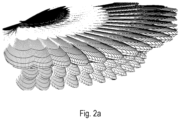
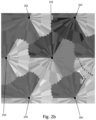
- Figs. 2a-2b illustrate an example of how such a beamforming method may work in NR.
- Fig. 2a illustrates an example of 32 beam patterns in a polar diagram. In the example of Fig. 2a , some narrow beams have a flat tilt in elevation pointing towards the cell edge, some beams broader in elevation have a steeper tilt pointing towards the cell center, and a single beam broad in elevation and azimuth, is pointing very steep to the ground.
- Fig. 2b illustrates an example of the resulting beam layout on the ground, where the dots 201, 202, 203, 204, 205, 206 denote the base stations and the darker areas indicate the area where a particular beam is the strongest.
- a portion of the beam layout may include beams labeled as 1 through 10.
- the target cell may reserve CFRA resources only in a single beam, typically the beam associated with the strongest measurement result in the measurement report.
- a preamble that is reserved as a dedicated preamble for a UE expected to show up in beam 6 may be allocated to another beam 5 by the target cell as well.
- a target cell may also reserve CFRA resources in multiple beams, or even in all beams (and configure this in the HO Command), but this may create significant costs, since those reserved resources cannot be used for idle users (for initial access) or for other users in a legacy handover situation (and potentially beam recovery).
- the beam(s), for which the CFRA resource(s) have been reserved become invalid (e.g., received with weak signal strength/quality) by the time the UE accesses the target cell, since the time gap between the measurement report and the random access can easily be some tens of milliseconds. For the CHO, this time gap may be much larger, since the UE typically sends the measurement report very early and does not access the target cell immediately, but rather after a condition has been met. This may take a much longer time, possibly multiple seconds in a worst case scenario.
- the CHO preparation might be initiated when beam 8 is the strongest in the neighboring target cell (i.e., handover candidate), to make sure that the quality in the source cell is good enough to send the HO Command.
- CHO may postpone the execution (i.e., the random access) until the target cell is stable enough, which may happen, for example, when the UE has proceeded, e.g., in beam 5.
- the network has configured a UE for a CHO, for example, from a source cell A to a candidate target cell B (e.g., via HO Command).
- the configuration for the UE may include resources for CFRA in the candidate target cell B.
- the resources for CFRA may be coupled to a first set of one or multiple beams in target cell B (these are referred to as "CFRA-beams" in the following).
- the UE may send measurement reports to the network, e.g., to source cell A, which indicate that the currently configured CFRA resources are outdated.
- a target cell may provide a set of CFRA resources (e.g., one or more dedicated preambles associated with a beam) to the source cell.
- the set of CFRA resources may be provided before, after, or along with a HO command.
- the set of CFRA resources are not dedicated for a single UE, but are to be used by multiple UEs that are configured to perform a conditional handover from source cell A to target cell B.
- the source cell may administrate the set of resources autonomously, i.e., the source cell can update the CFRA-beams for the UE without involving the target cell.
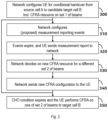
- Fig. 3 illustrates an example flow chart of a method, according to one example.
- the method may include, at 300, the network configuring the UE for CHO to a candidate target cell B, for example via a HO command.
- the configuring 300 may be performed by the source cell, with part of the configured information to the UE being prepared by target cell.
- the configuring 300 may include informing the UE of a set of reserved CFRA resources on a first set of beams, for example via a HO command.
- the method may include, at 310, the network configuring measurement, e.g., configuring a measurement report periodicity or one or more measurement events.
- the method may include the UE sending a measurement report to the network. This measurement report may include the beam-level measurement results.
- the method may then include, at 330, the network deciding on a new set of CFRA resources on a second set of beams, e.g., according to examples discussed below.
- the method may include the network sending the new set of CFRA configuration to the UE.
- the method may include, at 350, the UE performing CFRA when the CHO condition is satisfied (which means that the CHO is finally executed) based on the new set of CFRA resources.
- Fig. 4 illustrates an example flow diagram of a method depicting how the network may decide on a new set of CFRA resources on a second set of beams, according to certain examples.
- a neighboring cell B which may become or which may already be a candidate target cell
- a set S (“a pool") of CFRA resources including beams for CFRA to the source cell.
- This allows the source cell to autonomously allocate these CFRA resources to UEs which require a CFRA update.
- these CFRA resources are not just assigned to a specific UE.
- This provision of the set (or pool) of CFRA resources may happen proactively before a CHO is configured for a certain UE, after the CHO is configured for a certain UE, or along with the CHO configuration of a UE (i.e., with the Handover Request Acknowledgement message).
- the target neighboring cell may reserve these CFRA resources, i.e., it does not use those resources for other purposes (e.g., HOs from other cells or initial access).
- the method may also include, at 410, the source cell receiving a measurement report from a specific UE 1, which has previously been prepared for CHO to this neighboring cell B, i.e., the neighboring cell B is already a candidate target cell for the specific UE 1. This may trigger a CFRA update procedure. Then, at 420, the source cell may autonomously decide on new CFRA resources (and new beams) based on the set S provided by neighboring cell B beforehand, without involving the target cell. At 430, the source cell may send the new configuration to the UE that has sent the "CFRA update" measurement report.
- the UE 1 may perform a CFRA.
- the target cell may not identify the UE only based on the dedicated preamble, since this preamble was not assigned uniquely to this UE 1.
- some candidate solutions are provided below to achieve all CFRA benefits.
- the UE may attach an identifier (e.g., a C-RNTI received in the HO Command) to message 3 of the CFRA, to enable the identification of the UE by the target cell.
- an identifier e.g., a C-RNTI received in the HO Command
- the UE may optionally include the identifier (e.g., the C-RNTI) in the payload of the first RACH message, MsgA.
- the UE does not have to include its C-RNTI, for example, if it selects and performs random access using a CFRA preamble that was provided directly by the target cell in the handover command.
- the UE would include its identifier (e.g., C-RNTI) only if it performs random access using a CFRA preamble that was updated by the source cell. This would apply for both normal CFRA RACH access and two-step RACH.
- the UE may be configured as to whether to include its identifier into a RACH message.
- the source cell when the source cell sends the new configuration to the UE, at 440, the source cell may also inform the target cell that the new CFRA resources are assigned to the UE (using again the C-RNTI). This has the additional advantage, that the target can release the reservation of the original CFRA resource.
- the CFRA resource set S may be advantageous to dynamically update to tailor it to the current traffic condition, and to the currently pending handovers. This can be triggered by the source cell, or by the neighbor target cell B, for example.
- the set S of CFRA resources provided by the neighboring target cell to the source cell may be valid only for a certain time period that can be indicated by the target cell. In this example, after expiry of this time period, the source cell autonomously releases the set S of CFRA resources without being notified by the target cell.
- the measurement report from the UE may be triggered, for example, based on one or more of the following: periodic radio resource control (RRC) reports, periodic medium access control (MAC)-level reports (e.g., beam reporting on physical uplink control channel), and/or reports driven by measurement reporting events (e.g., non-CFRA beam becomes offset better than strongest CFRA beam, or number of CFRA beams above certain threshold falls below N).
- RRC radio resource control
- MAC medium access control
- the measurement quantity in the reports and/or the measurement reporting events may include, for example, signal strength, signal quality, or signal-to-interference-plus-noise ratio (SINR).
- SINR signal-to-interference-plus-noise ratio
- measurement reporting events may include, for instance, when a signal strength and/or signal quality exceeds a threshold.
- Examples provide at least the advantage that the update of CFRA resources can be much faster and slimmer, i.e., with less overhead.
- examples are able to avoid the race condition that arises in conventional methods. Additionally or alternatively, some examples can save CFRA resources under certain circumstances, compared with configuring multiple CFRA resources for a single CHO.
- CFRA resources can be allocated initially, in the extreme case only 1.
- the target cell may reserve some additional backup resources on the most "busy" beams (typically, not all the beams are relevant for handover), for example 1 additional CFRA resource on 6 additional beams.
- just 9 preambles need to be allocated permanently.
- certain examples still maintain the CFRA benefits, but with a slimmer procedure without the aforementioned issues related to signaling overhead, delay and race conditions. It is noted that certain examples can create even more benefits when a cell boundary is very busy and/or if mobility on this cell boundary involves a small number of beams.
- Fig. 5a illustrates an example flow diagram of a method for updating CFRA resources during conditional handover (CHO), according to one example.
- the flow diagram of Fig. 5a may be performed by a network node serving a cell, such as a base station, node B, eNB, gNB, or any other access node, or one or more servers in a 5GC or cloud configuration, for instance.
- the method of Fig. 5a may be performed by a source network node, such as a gNB, which may also be referred to as a source cell. It is noted that the steps of the method depicted in Fig. 5a may be performed in a different order than that shown in this example, according to certain examples.
- the method may include, at 505, configuring a UE for CHO to a candidate target cell.
- the configuring 505 may optionally include indicating reserved CFRA resources for the UE on a first set of beams, for example, in a HO command.
- the configuring 505 may be performed by the source cell, where part of the configured information to the UE may be prepared by the candidate target cell. Therefore, in some examples, optionally, the method may further include, at 500, the network node receiving at least a part of the configured information, which may include the set of reserved CFRA resources for the UE on the first set of beams, from the candidate target cell.
- the method may include, at 503, receiving, from a neighboring cell (which may become or already be a candidate target cell), a pool of CFRA resources including beams for CFRA.
- the received pool of CFRA resources are not just assigned for a specific UE, but may be used by a plurality of UEs.
- the receiving 503 of the pool of CFRA resources may occur proactively before a CHO is configured for any UE, after the CHO is configured for the UE, or along with the CHO configuration of the UE (i.e., with the Handover Request Acknowledgement message).
- the neighboring cell may reserve the pool of CFRA resources by not using those resources for other purposes.
- the method may also include, at 510, configuring one or more measurement events.
- the configuring 510 of the measurement event(s) may be done along with the HO command or separately afterwards.
- the method may further include, at 520, receiving a measurement report from the UE.
- the receiving 520 may include receiving the measurement report when or after the measurement event occurs.
- the measurement report may include the beam-level measurement results.
- the received measurement report from the UE may be triggered, for example, based on periodic radio resource control (RRC) reports, periodic medium access control (MAC)-level reports (e.g., beam reporting on physical uplink control channel), and/or reports driven by measurement reporting events (e.g., non-CFRA beam becomes offset better than strongest CFRA beam, or number of CFRA beams above certain threshold falls below N).
- RRC radio resource control
- MAC medium access control
- measurement reporting events e.g., non-CFRA beam becomes offset better than strongest CFRA beam, or number of CFRA beams above certain threshold falls below N.
- the measurement quantity of the reports and/or the measurement reporting events may include, e.g., signal strength, signal quality, or signal-to-interference-plus-noise ratio (SINR).
- the method may then include, at 530, deciding on a new set of CFRA resources on a second set of beams based on the pool of CFRA resources provided by the neighboring cell.
- the deciding 530 on the new set of CFRA resources may be triggered by receiving the measurement report at 520 from the UE, which has previously been prepared for CHO to the neighboring cell, i.e., the neighboring cell is already a candidate target cell.
- the deciding 530 on the new set of CFRA resources may include autonomously deciding, by the source cell, on new CFRA resources and possibly new beams based on the pool of CFRA resources provided by the neighboring cell beforehand, without involving the neighboring candidate target cell in the decision on the new set of CFRA resources.
- the method may further include, at 540, sending configuration for the decided new set of CFRA resources to the UE that sent the measurement report.
- steps 510, 520, 525, 530 and 540 may be repeated before the CHO is actually executed.
- the method may also include, at 550, informing the target cell that the new CFRA resources have been assigned to the UE. The target cell may then release the reservation of the original pool of CFRA resources.
- 'a pool of CFRA resources' may refer to a reservation of a single or multiple CFRA resources.
- the method may include receiving an updated pool of CFRA resources from the target cell, to adapt to the current traffic condition and/or to the currently pending handovers.
- This dynamic update may be triggered by the source cell or by the neighbor target cell B, for example.
- the pool of CFRA resources provided by the neighboring target cell may be valid only for a certain time period that can be indicated by the target cell.
- the method may include autonomously releasing the pool of CFRA resources without being notified by the target cell.
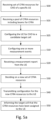
- Fig. 5b illustrates an example flow diagram of a method for receiving updated CFRA resources in conjunction with conditional handover (CHO), according to one example.
- the method of Fig. 5b may be performed by a mobile station, mobile device, UE, IoT device, terminal, or the like, for instance.
- the method may include, at 560, receiving from the network a configuration for CHO to a candidate target cell.
- the configuration for CHO may include CFRA resources on a first set of beams in the candidate target cell, for example.
- the receiving 560 may include receiving the configuration for CHO in a HO command.
- the method may also include, at 570, receiving a measurement configuration, e.g., a report periodicity or a configuration for one or more measurement events.
- the receiving 570 of the configuration of measurement event(s) may be done along with the HO command or separately afterwards.
- the method may further include, at 580, sending a measurement report to the network.
- the sending 580 may include sending the measurement report when or after the measurement event occurs.
- the measurement report may include the beam-level measurement results.
- the sending 580 of the measurement report to the network may be triggered, for example, based on periodic radio resource control (RRC) reports, periodic medium access control (MAC)-level reports (e.g., beam reporting on physical uplink control channel), and/or reports driven by measurement reporting events (e.g., non-CFRA beam becomes offset better than strongest CFRA beam, or number of CFRA beams above certain threshold falls below N).
- RRC radio resource control
- MAC medium access control
- measurement reporting events e.g., non-CFRA beam becomes offset better than strongest CFRA beam, or number of CFRA beams above certain threshold falls below N.
- the measurement quantity of the reports and/or the measurement reporting events may include, e.g., signal strength, signal quality, or signal-to-interference-plus-noise ratio (SINR).
- the method may further include, at 590, receiving a configuration for new CFRA resources from the network.
- the method may then include, at 595, performing CFRA based on the new CFRA resource.
- the performing 595 may include performing CFRA when the CHO condition is satisfied and/or the CHO is executed.
- the target cell may not identify the UE based on the dedicated preamble, since this preamble may not be assigned uniquely to the UE. Therefore, in one example, the performing 595 of CFRA may optionally include attaching an identifier (e.g., the C-RNTI received in the HO Command) to message 3 of the CFRA.
- an identifier e.g., the C-RNTI received in the HO Command
- a two-step RACH (which may include a MsgA and a MsgB) procedure may be used for CFRA, and the performing 595 of CFRA may optionally include attaching the C-RNTI in the payload of the first RACH message MsgA.
- the performing 595 of CFRA may optionally include selecting and performing random access using a CFRA preamble that was provided directly by the target cell in the HO command, without including an identifier or C-RNTI.
- the identifier or C-RNTI may be included if performing random access using CFRA preamble that was updated by the source cell.
- Fig. 5c illustrates an example flow diagram of a method for updating CFRA resources during conditional handover (CHO), according to one example.
- the flow diagram of Fig. 5c may be performed by a network node serving a cell, such as a base station, node B, eNB, gNB, or any other access node, or one or more servers in a 5GC or cloud configuration, for instance.
- the method of Fig. 5c may be performed by a target network node, such as a gNB, which may also be referred to as a target cell.
- the method of Fig. 5c may optionally include, at 600, a network node sending, to a further network node serving a neighbor cell, a configuration of a set of CFRA resources for CHO for a specific UE.
- the network node is a network node serving a target cell or a neighbor cell of the UE, and the further network node is a network node serving the source cell of the UE.
- the method of Fig. 5c may further include, at 610, the network node sending a pool of CFRA resources to the further network node.
- the pool of CFRA resources is for use by a plurality of UEs served by the further network node for CHO.
- the method may further include, at 620, the network node receiving an information, from the further network node, that a new set of CFRA resources associated to a new set of beams has been assigned to a UE which has previously been prepared for CHO.
- the method may include, at 630, the network node releasing previously reserved CFRA resources.
- the method may further include the network node receiving a random access message from the UE and identifying the UE based on one of: an identifier of the UE included in the random access message, or a preamble used by the UE.
- apparatus 10 may be a node, host, or server in a communications network or serving such a network.
- apparatus 10 may be a satellite, base station, a Node B, an evolved Node B (eNB), 5G Node B or access point, next generation Node B (NG-NB or gNB), and/or WLAN access point, associated with a radio access network, such as a LTE network, 5G or NR.
- apparatus 10 may be an eNB in LTE or gNB in 5G.
- apparatus 10 may be comprised of an edge cloud server as a distributed computing system where the server and the radio node may be stand-alone apparatuses communicating with each other via a radio path or via a wired connection, or they may be located in a same entity communicating via a wired connection.
- apparatus 10 represents a gNB
- it may be configured in a central unit (CU) and distributed unit (DU) architecture that divides the gNB functionality.
- the CU may be a logical node that includes gNB functions such as transfer of user data, mobility control, radio access network sharing, positioning, and/or session management, etc.
- the CU may control the operation of DU(s) over a front-haul interface.
- the DU may be a logical node that includes a subset of the gNB functions, depending on the functional split option. It should be noted that one of ordinary skill in the art would understand that apparatus 10 may include components or features not shown in Fig. 6a .
- apparatus 10 may include a processor 12 for processing information and executing instructions or operations.
- processor 12 may be any type of general or specific purpose processor.
- processor 12 may include one or more of general-purpose computers, special purpose computers, microprocessors, digital signal processors (DSPs), field-programmable gate arrays (FPGAs), application-specific integrated circuits (ASICs), and processors based on a multi-core processor architecture, as examples. While a single processor 12 is shown in Fig. 6a , multiple processors may be utilized according to other examples.
- apparatus 10 may include two or more processors that may form a multiprocessor system (e.g., in this case processor 12 may represent a multiprocessor) that may support multiprocessing.
- processor 12 may represent a multiprocessor
- the multiprocessor system may be tightly coupled or loosely coupled (e.g., to form a computer cluster).
- Processor 12 may perform functions associated with the operation of apparatus 10, which may include, for example, precoding of antenna gain/phase parameters, encoding and decoding of individual bits forming a communication message, formatting of information, and overall control of the apparatus 10, including processes related to management of communication resources.
- Apparatus 10 may further include or be coupled to a memory 14 (internal or external), which may be coupled to processor 12, for storing information and instructions that may be executed by processor 12.
- Memory 14 may be one or more memories and of any type suitable to the local application environment, and may be implemented using any suitable volatile or nonvolatile data storage technology such as a semiconductor-based memory device, a magnetic memory device and system, an optical memory device and system, fixed memory, and/or removable memory.
- memory 14 can be comprised of any combination of random access memory (RAM), read only memory (ROM), static storage such as a magnetic or optical disk, hard disk drive (HDD), or any other type of non-transitory machine or computer readable media.
- the instructions stored in memory 14 may include program instructions or computer program code that, when executed by processor 12, enable the apparatus 10 to perform tasks as described herein.
- apparatus 10 may further include or be coupled to (internal or external) a drive or port that is configured to accept and read an external computer readable storage medium, such as an optical disc, USB drive, flash drive, or any other storage medium.
- an external computer readable storage medium such as an optical disc, USB drive, flash drive, or any other storage medium.
- the external computer readable storage medium may store a computer program or software for execution by processor 12 and/or apparatus 10.
- apparatus 10 may also include or be coupled to one or more antennas 15 for transmitting and receiving signals and/or data to and from apparatus 10.
- Apparatus 10 may further include or be coupled to a transceiver 18 configured to transmit and receive information.
- the transceiver 18 may include, for example, a plurality of radio interfaces that may be coupled to the antenna(s) 15.
- the radio interfaces may correspond to a plurality of radio access technologies including one or more of GSM, NB-IoT, LTE, 5G, WLAN, Bluetooth, BT-LE, NFC, radio frequency identifier (RFID), ultrawideband (UWB), MulteFire, and the like.
- the radio interface may include components, such as filters, converters (for example, digital-to-analog converters and the like), mappers, a Fast Fourier Transform (FFT) module, and the like, to generate symbols for a transmission via one or more downlinks and to receive symbols (for example, via an uplink).
- filters for example, digital-to-analog converters and the like
- mappers for example, mappers
- FFT Fast Fourier Transform
- transceiver 18 may be configured to modulate information on to a carrier waveform for transmission by the antenna(s) 15 and demodulate information received via the antenna(s) 15 for further processing by other elements of apparatus 10.
- transceiver 18 may be capable of transmitting and receiving signals or data directly.
- apparatus 10 may include an input and/or output device (I/O device).
- memory 14 may store software modules that provide functionality when executed by processor 12.
- the modules may include, for example, an operating system that provides operating system functionality for apparatus 10.
- the memory may also store one or more functional modules, such as an application or program, to provide additional functionality for apparatus 10.
- the components of apparatus 10 may be implemented in hardware, or as any suitable combination of hardware and software.
- processor 12 and memory 14 may be included in or may form a part of processing circuitry or control circuitry.
- transceiver 18 may be included in or may form a part of transceiver circuitry.
- circuitry may refer to hardware-only circuitry implementations (e.g., analog and/or digital circuitry), combinations of hardware circuits and software, combinations of analog and/or digital hardware circuits with software/firmware, any portions of hardware processor(s) with software (including digital signal processors) that work together to case an apparatus (e.g., apparatus 10) to perform various functions, and/or hardware circuit(s) and/or processor(s), or portions thereof, that use software for operation but where the software may not be present when it is not needed for operation.
- hardware-only circuitry implementations e.g., analog and/or digital circuitry
- combinations of hardware circuits and software e.g., combinations of analog and/or digital hardware circuits with software/firmware
- any portions of hardware processor(s) with software including digital signal processors
- circuitry may also cover an implementation of merely a hardware circuit or processor (or multiple processors), or portion of a hardware circuit or processor, and its accompanying software and/or firmware.
- circuitry may also cover, for example, a baseband integrated circuit in a server, cellular network node or device, or other computing or network device.
- apparatus 10 may be a network node or RAN node, such as a base station, access point, Node B, eNB, gNB, WLAN access point, or the like. According to certain examples, apparatus 10 may be controlled by memory 14 and processor 12 to perform the functions associated with any of the examples described herein, such as the flow or signaling diagrams illustrated in Figs. 3 , 4 , 5a or 5c . In some examples, apparatus 10 may be configured to perform a procedure for updating CFRA resources in conjunction with CHO, for example. In an example, apparatus 10 may represent a source network node, such as a gNB, which may also be referred to as a source cell.
- a source network node such as a gNB, which may also be referred to as a source cell.
- apparatus 10 may be controlled by memory 14 and processor 12 to configure a UE for CHO to a candidate target cell.
- the configuring of the UE may optionally include indicating reserved CFRA resources on a first set of beams, for example, in a HO command.
- at least a part of the configured information to the UE may be prepared by the candidate target cell.
- apparatus 10 may be controlled by memory 14 and processor 12 to receive the configured information, which may include the set of reserved CFRA resources for the UE on the first set of beams, prepared by the candidate target cell prior to configuring it to the UE.
- apparatus 10 may be controlled by memory 14 and processor 12 to configure measurement for the UE, e.g., to configure one or more measurement events.
- the measurement event(s) may be configured along with the HO command or separately afterwards.
- apparatus 10 may be controlled by memory 14 and processor 12 to receive a measurement report from the UE.
- the measurement report may be received when, or after, the measurement event occurs.
- the measurement report may include the beam-level measurement results from the UE.
- the measurement report received from the UE may be triggered, for example, based on periodic radio resource control (RRC) reports, periodic medium access control (MAC)-level reports (e.g., beam reporting on physical uplink control channel), and/or reports driven by measurement reporting events (e.g., non-CFRA beam becomes offset better than strongest CFRA beam, or number of CFRA beams above certain threshold falls below N).
- RRC radio resource control
- MAC medium access control
- measurement reporting events e.g., non-CFRA beam becomes offset better than strongest CFRA beam, or number of CFRA beams above certain threshold falls below N.
- the measurement quantity of the reports and/or the measurement reporting events may include, e.g., signal strength, signal quality, or signal-to-interference-plus-noise ratio (SINR).
- apparatus 10 may be controlled by memory 14 and processor 12 to receive, from a neighboring cell (which may become or already be a candidate target cell), a pool of CFRA resources including beams for CFRA.
- a neighboring cell which may become or already be a candidate target cell
- the received pool of CFRA resources are not just assigned for a specific UE.
- the pool of CFRA resources may be received proactively before a CHO is configured for the UE, after the CHO is configured for the UE, or along with the CHO configuration of the UE.
- the neighboring cell may reserve the pool of CFRA resources by not using those resources for other purposes.
- apparatus 10 may be controlled by memory 14 and processor 12 to decide on a new set of CFRA resources on a second set of beams, based on the pool of CFRA resources provided by the neighboring cell.
- the decision on the new set of CFRA resources may be triggered by receipt of the measurement report from the UE, which has previously been prepared for CHO to the neighboring cell.
- apparatus 10 may then be controlled by memory 14 and processor 12 to autonomously decide on the new CFRA resources and possibly new beams based on the pool of CFRA resources provided by the neighboring cell beforehand, without involving the neighboring candidate target cell in the decision on the new CFRA resources.
- apparatus 10 may be controlled by memory 14 and processor 12 to transmit configuration for the new CFRA resources to the UE that sent the measurement report.
- apparatus 10 may be controlled by memory 14 and processor 12 to inform the target cell that the CFRA resources have been assigned to the UE. The target cell may then release the reservation of the original pool of CFRA resources.
- apparatus 10 may be controlled by memory 14 and processor 12 to receive, from the neighboring target cell, a dynamically updated pool of reserved CFRA resources such that the reserved CFRA resources are tailored to the current traffic condition and/or to the currently pending handovers.
- the pool of CFRA resources received from the neighboring target cell may be valid only for a certain time period as indicated by the target cell. In this example, after expiry of this time duration, apparatus 10 may be controlled by memory 14 and processor 12 to autonomously release the pool of CFRA resources without notification from the target cell.
- apparatus 10 may be a network node serving a target cell or a neighbor cell of the UE.
- apparatus 10 may be controlled by memory 14 and processor 12 to send, to a further network node serving a neighbor cell, a configuration of a set of CFRA resources for CHO.
- the set of CFRA resources is for use by a plurality of UEs served by the further network node for CHO.
- the further network node is a network node serving the source cell of the UE.
- apparatus 10 may be further controlled by memory 14 and processor 12 to send an update of the set of CFRA resources to the further network node.
- apparatus 10 may be controlled by memory 14 and processor 12 to receive an information, from the further network node, that a new set of CFRA resources associated to a new set of beams has been assigned to a UE which has previously been prepared for CHO.
- apparatus 10 may be controlled by memory 14 and processor 12 to release previously reserved CFRA resources.
- apparatus 10 may be controlled by memory 14 and processor 12 to receive a random access message from the UE and identifying the UE based on one of: an identifier of the UE included in the random access message, or a preamble used by the UE.
- apparatus 20 may be a node or element in a communications network or associated with such a network, such as a UE, mobile equipment (ME), mobile station, mobile device, stationary device, IoT device, or other device.
- UE may alternatively be referred to as, for example, a mobile station, mobile equipment, mobile unit, mobile device, user device, subscriber station, wireless terminal, tablet, smart phone, IoT device, sensor or NB-IoT device, or the like.
- apparatus 20 may be implemented in, for instance, a wireless handheld device, a wireless plug-in accessory, or the like.
- apparatus 20 may include one or more processors, one or more computer-readable storage medium (for example, memory, storage, or the like), one or more radio access components (for example, a modem, a transceiver, or the like), and/or a user interface.
- apparatus 20 may be configured to operate using one or more radio access technologies, such as GSM, LTE, LTE-A, NR, 5G, WLAN, WiFi, NB-IoT, Bluetooth, NFC, MulteFire, and/or any other radio access technologies. It should be noted that one of ordinary skill in the art would understand that apparatus 20 may include components or features not shown in Fig. 6b .
- apparatus 20 may include or be coupled to a processor 22 for processing information and executing instructions or operations.
- processor 22 may be any type of general or specific purpose processor.
- processor 22 may include one or more of general-purpose computers, special purpose computers, microprocessors, digital signal processors (DSPs), field-programmable gate arrays (FPGAs), application-specific integrated circuits (ASICs), and processors based on a multi-core processor architecture, as examples. While a single processor 22 is shown in Fig. 6b , multiple processors may be utilized according to other examples.
- apparatus 20 may include two or more processors that may form a multiprocessor system (e.g., in this case processor 22 may represent a multiprocessor) that may support multiprocessing.
- processor 22 may represent a multiprocessor
- the multiprocessor system may be tightly coupled or loosely coupled (e.g., to form a computer cluster).
- Processor 22 may perform functions associated with the operation of apparatus 20 including, as some examples, precoding of antenna gain/phase parameters, encoding and decoding of individual bits forming a communication message, formatting of information, and overall control of the apparatus 20, including processes related to management of communication resources.
- Apparatus 20 may further include or be coupled to a memory 24 (internal or external), which may be coupled to processor 22, for storing information and instructions that may be executed by processor 22.
- Memory 24 may be one or more memories and of any type suitable to the local application environment, and may be implemented using any suitable volatile or nonvolatile data storage technology such as a semiconductor-based memory device, a magnetic memory device and system, an optical memory device and system, fixed memory, and/or removable memory.
- memory 24 can be comprised of any combination of random access memory (RAM), read only memory (ROM), static storage such as a magnetic or optical disk, hard disk drive (HDD), or any other type of non-transitory machine or computer readable media.
- the instructions stored in memory 24 may include program instructions or computer program code that, when executed by processor 22, enable the apparatus 20 to perform tasks as described herein.
- apparatus 20 may further include or be coupled to (internal or external) a drive or port that is configured to accept and read an external computer readable storage medium, such as an optical disc, USB drive, flash drive, or any other storage medium.
- an external computer readable storage medium such as an optical disc, USB drive, flash drive, or any other storage medium.
- the external computer readable storage medium may store a computer program or software for execution by processor 22 and/or apparatus 20.
- apparatus 20 may also include or be coupled to one or more antennas 25 for receiving a downlink signal and for transmitting via an uplink from apparatus 20.
- Apparatus 20 may further include a transceiver 28 configured to transmit and receive information.
- the transceiver 28 may also include a radio interface (e.g., a modem) coupled to the antenna 25.
- the radio interface may correspond to a plurality of radio access technologies including one or more of GSM, LTE, LTE-A, 5G, NR, WLAN, NB-IoT, Bluetooth, BT-LE, NFC, RFID, UWB, and the like.
- the radio interface may include other components, such as filters, converters (for example, digital-to-analog converters and the like), symbol demappers, signal shaping components, an Inverse Fast Fourier Transform (IFFT) module, and the like, to process symbols, such as OFDMA symbols, carried by a downlink or an uplink.
- filters for example, digital-to-analog converters and the like
- symbol demappers for example, digital-to-analog converters and the like
- signal shaping components for example, an Inverse Fast Fourier Transform (IFFT) module, and the like
- IFFT Inverse Fast Fourier Transform
- transceiver 28 may be configured to modulate information on to a carrier waveform for transmission by the antenna(s) 25 and demodulate information received via the antenna(s) 25 for further processing by other elements of apparatus 20.
- transceiver 28 may be capable of transmitting and receiving signals or data directly.
- apparatus 20 may include an input and/or output device (I/O device).
- apparatus 20 may further include a user interface, such as a graphical user interface or touchscreen.
- memory 24 stores software modules that provide functionality when executed by processor 22.
- the modules may include, for example, an operating system that provides operating system functionality for apparatus 20.
- the memory may also store one or more functional modules, such as an application or program, to provide additional functionality for apparatus 20.
- the components of apparatus 20 may be implemented in hardware, or as any suitable combination of hardware and software.
- apparatus 20 may optionally be configured to communicate with apparatus 10 via a wireless or wired communications link 70 according to any radio access technology, such as NR.
- processor 22 and memory 24 may be included in or may form a part of processing circuitry or control circuitry.
- transceiver 28 may be included in or may form a part of transceiving circuitry.
- apparatus 20 may be a UE, mobile device, mobile station, ME, IoT device and/or NB-IoT device, for example.
- apparatus 20 may be controlled by memory 24 and processor 22 to perform the functions associated with examples described herein.
- apparatus 20 may be configured to perform one or more of the processes depicted in any of the flow charts or signaling diagrams described herein, such as those illustrated in Figs. 3 , 4 , or 5b .
- apparatus 20 may be configured to perform a procedure for receiving updated CFRA resources in conjunction with CHO, for instance.
- apparatus 20 may be controlled by memory 24 and processor 22 to receive from the network a configuration for CHO to a candidate target cell.
- the configuration for CHO may optionally include CFRA resources on a first set of beams in the candidate target cell, for example.
- apparatus 20 may be controlled by memory 24 and processor 22 to receive the configuration for CHO in a HO command.
- apparatus 20 may be controlled by memory 24 and processor 22 to receive a measurement configuration, e.g., a configuration for one or more measurement events.
- the configuration for the measurement event(s) may be received along with the HO command or separately afterwards.
- apparatus 20 may be controlled by memory 24 and processor 22 to transmit or send a measurement report to the network.
- the measurement report may be sent when, or after, the measurement event occurs.
- the measurement report may include the beam-level measurement results.
- apparatus 20 may be triggered to send the measurement report to the network, for example, based on periodic radio resource control (RRC) reports, periodic medium access control (MAC)-level reports (e.g., beam reporting on physical uplink control channel), and/or reports driven by measurement reporting events (e.g., non-CFRA beam becomes offset better than strongest CFRA beam, or number of CFRA beams above certain threshold falls below N).
- RRC radio resource control
- MAC medium access control
- measurement reporting events e.g., non-CFRA beam becomes offset better than strongest CFRA beam, or number of CFRA beams above certain threshold falls below N.
- the measurement quantity of the reports and/or the measurement reporting events may include, e.g., signal strength, signal quality, or signal-to-interference-plus-noise ratio (SINR).
- SINR signal-to-interference-plus-noise ratio
- apparatus 20 may be controlled by memory 24 and processor 22 to receive a configuration for new CFRA resources from the network. According to one example, apparatus 20 may be further controlled by memory 24 and processor 22 to perform CFRA based on the new CFRA resource. For example, in one example, apparatus 20 may be controlled by memory 24 and processor 22 to perform CFRA when the CHO condition is satisfied and/or the CHO is executed.
- apparatus 20 may be optionally controlled by memory 24 and processor 22 to attach an identifier (e.g., the C-RNTI received in the HO Command) to message 3 of the CFRA.
- an identifier e.g., the C-RNTI received in the HO Command
- a two-step RACH (which may include a MsgA and a MsgB) may be used by the apparatus for CHO, and apparatus 20 may be optionally controlled by memory 24 and processor 22 to attach the identifier (e.g., C-RNTI) in the payload of the first RACH message MsgA.
- apparatus 20 may be optionally controlled by memory 24 and processor 22 to select and perform random access using CFRA preamble that was provided directly by the target cell in the HO command, without including an identifier (e.g., C-RNTI).
- identifier e.g., C-RNTI
- the identifier or C-RNTI may be included if performing random access using CFRA preamble that was updated by the source cell.
- certain examples provide several technical improvements, enhancements, and/or advantages.
- one benefit of examples is that the update of CFRA resources can be much faster and more slim, i.e., with less overhead.
- examples are able to avoid the race condition that arises in conventional methods.
- examples can save CFRA resources under certain circumstances, compared with configuring multiple CFRA resources for a single CHO. Accordingly, the use of certain examples results in improved functioning of communications networks and their nodes.
- any of the methods, processes, signaling diagrams, algorithms or flow charts described herein may be implemented by software and/or computer program code or portions of code stored in memory or other computer readable or tangible media, and executed by a processor.
- an apparatus may be included or be associated with at least one software application, module, unit or entity configured as arithmetic operation(s), or as a program or portions of it (including an added or updated software routine), executed by at least one operation processor.
- Programs also called program products or computer programs, including software routines, applets and macros, may be stored in any apparatus-readable data storage medium and may include program instructions to perform particular tasks.
- a computer program product may include one or more computer-executable components which, when the program is run, are configured to carry out some examples.
- the one or more computer-executable components may be at least one software code or portions of code. Modifications and configurations required for implementing functionality of an example may be performed as routine(s), which may be implemented as added or updated software routine(s). In one example, software routine(s) may be downloaded into the apparatus.
- software or a computer program code or portions of code may be in a source code form, object code form, or in some intermediate form, and it may be stored in some sort of carrier, distribution medium, or computer readable medium, which may be any entity or device capable of carrying the program.
- carrier may include a record medium, computer memory, read-only memory, photoelectrical and/or electrical carrier signal, telecommunications signal, and/or software distribution package, for example.
- the computer program may be executed in a single electronic digital computer or it may be distributed amongst a number of computers.
- the computer readable medium or computer readable storage medium may be a non-transitory medium.
- the functionality may be performed by hardware or circuitry included in an apparatus (e.g., apparatus 10 or apparatus 20), for example through the use of an application specific integrated circuit (ASIC), a programmable gate array (PGA), a field programmable gate array (FPGA), or any other combination of hardware and software.
- ASIC application specific integrated circuit
- PGA programmable gate array
- FPGA field programmable gate array
- the functionality may be implemented as a signal, such as a non-tangible means that can be carried by an electromagnetic signal downloaded from the Internet or other network.
- an apparatus such as a node, device, or a corresponding component, may be configured as circuitry, a computer or a microprocessor, such as single-chip computer element, or as a chipset, which may include at least a memory for providing storage capacity used for arithmetic operation(s) and/or an operation processor for executing the arithmetic operation(s).
- a method that may be implemented by a network node may include the network node configuring a UE for CHO to a candidate target cell.
- the configuration may include one or more CFRA resources associated with a first set of beams which are reserved by a target cell for the UE.
- the configuring of the UE for CHO may include indicating the reserved CFRA resources associated with the first set of beams, for example, in a HO command.
- the configuring of the UE for CHO may be performed by the network node serving the source cell, where part of the configured information (e.g., reserved CFRA resources) to the UE may be prepared by the candidate target cell.
- the method may further comprise the network node configuring measurements reports for the UE.
- the network node may configure periodic measurements reports for the UE which requires the UE to report a measurement result periodically.
- the network node may configure event triggered measurement report for the UE which requires the UE to report a measurement report when or after a measurement event occurs.
- the method may also include configuring one or more measurement events for the UE. In a variant, the configuring of the measurement event(s) may be performed along with the HO command or separately afterwards.
- the method may also include the network node receiving an indication of a pool of CFRA resources from a candidate target cell/neighbor cell.
- the CFRA resources are reserved, by the target cell, for a plurality of UEs, rather than dedicated for a single UE.
- the method may include the network node receiving, from a neighboring cell, a configuration of the pool of CFRA resources including beams for CFRA.
- the receiving of the configuration of the pool of CFRA resources may occur proactively before a CHO is configured for the UE, after the CHO is configured for the UE, or along with the CHO configuration of the UE.
- the neighboring cell may reserve the pool of CFRA resources by not using those resources for other purposes.
- the method may further include receiving a measurement report from the UE.
- the receiving of the measurement report may include receiving the measurement report which is triggered based on the measurement event.
- the measurement reporting event (also referred to as measurement event) may include, for example but is not limited to, non-CFRA beam becomes better than the strongest CFRA beam by an offset, or the number of CFRA beams above certain threshold (e.g., a receiving signal power threshold) falls below a predefined number N.
- the receiving of the measurement report from the UE may be triggered periodically, for example, based on periodic radio resource control (RRC) reports, periodic medium access control (MAC)-level reports, or beam reporting on a physical uplink control channel.
- RRC radio resource control
- MAC medium access control
- the measurement report may include beam-level measurement result(s) from the UE.
- measurement quantity may include one or more of, e.g., signal strength, signal quality, or signal-to-interference-plus-noise ratio (SINR).
- SINR signal-to-interference-plus-noise ratio
- the method may further include deciding on a new set of CFRA resources associated with a second set of beams.
- the method may further include transmitting configuration for the new set of CFRA resources to the UE.
- the deciding on the new set of CFRA resources may be triggered by receiving the measurement report from the UE, which has previously been configured for CHO to a target cell.
- the deciding on the new set of CFRA resources may then include autonomously deciding by the network node on new CFRA resources and possibly new beams based on the pool of CFRA resources previously provided by the neighboring cell.
- the method may also include informing the target cell that one or more CFRA resources have been assigned to the UE which deviate from the previously assigned CFRA resources.
- the pool of CFRA resources may be tailored to the current traffic condition and/or to the currently pending handovers dynamically.
- the method may further include receiving an update on the pool of CFRA resources from the neighbor cell.
- the pool of CFRA resources received from the neighboring target cell may be valid only for a certain time period that can be indicated by the target cell or predefined.
- the method may include autonomously releasing the pool of CFRA resources after expiry of this indicated or predefined time period, without being notified by the target cell.
- the method may include the UE receiving, from a network node, a configuration for CHO to a candidate target cell.
- the receiving of the configuration for CHO may include receiving the configuration for CHO in a HO command.
- the configuration for CHO may optionally include a set of CFRA resources associated with a first set of beams in a candidate target cell, for example.
- the method may also include receiving a measurement configuration.
- the measurement event(s) may be received along with the HO command or separately afterwards.
- the measurement configuration may include a configuration for one or more measurement events and/or a reporting periodicity.
- the method may further include sending a measurement report to the network node.
- the network node may be a network node serving the source cell of the UE.
- the sending of the measurement report may include sending the measurement report periodically, or when or after the measurement event occurs.
- the measurement report may include the beam-level measurement results.
- the sending of the measurement report to the network node may be triggered periodically, for example, based on periodic radio resource control (RRC) reports, periodic medium access control (MAC)-level reports, or periodic beam reporting on physical uplink control channel.
- RRC radio resource control
- MAC medium access control
- the sending of the reports may be driven by measurement reporting events.
- the measurement reporting event (also referred to as measurement event) may include, but is not limited to, non-CFRA beam becoming better than strongest CFRA beam by an offset, or the number of CFRA beams above certain threshold falling below a predefined number N.
- the measurement report may indicate measurement quantity that may include one or more of, e.g., signal strength, signal quality, or signal-to-interference-plus-noise ratio (SINR).
- SINR signal-to-interference-plus-noise ratio
- the method may further include receiving a configuration for a new set CFRA resources from the network node, and performing CFRA based on the new set of CFRA resources.
- the performing of CFRA may include performing CFRA when the CHO condition is satisfied and/or the CHO is executed.
- the performing of CFRA may optionally include attaching an identifier of the UE, such as a C-RNTI, to message 3 of the CFRA.
- a two-step RACH (which may include a MsgA and a MsgB) may be used for CHO, and the performing of CFRA may optionally include attaching the identifier of the UE (e.g., the C-RNTI received in the HO Command) in the payload of the first RACH message (e.g., MsgA).
- the performing of CFRA may optionally include using a CFRA resource (e.g., a RACH preamble) that was provided directly by the target cell (e.g., in the HO command) for performing the random access, without including/indicating the identifier of the UE.
- the UE may include/indicate its identifier (e.g., the C-RNTI) only if it performs the random access using a CFRA resource (e.g., a preamble) that was updated by the source cell. This would apply to both normal CFRA RACH procedure and two-step RACH procedure. That is, in some examples, the UE may decide whether to indicate its identifier during CFRA based on whether the CFRA resource to be used is different from the one configured by the target cell.
- the UE may receive a configuration as to whether the identifier is to be provided during CFRA.
- This configuration may be received, for example, in a HO command, or via a separate message.
- still another method that may be implemented by a network node is provided.
- the method may optionally include the network node sending, to a further network node serving a neighbor cell, a configuration of a set of CFRA resources for CHO for a specific UE.
- the method may further comprise the network node sending a pool of CFRA resources to the further network node.
- the pool of CFRA resources is for use by a plurality of UEs served by the further network node for CHO.
- the network node is a network node serving a target cell or a neighbor cell of the UE, and the further network node is a network node serving the source cell of the UE.
- the method may further comprise the receiving an information from the further network node, that a new set of CFRA resources associated to a new set of beams has been assigned to a UE which has previously been prepared for CHO.
- the network node may release previously reserved CFRA resources.
- the method may further comprise the receiving a random access message from the UE and identifying the UE based on one of: an identifier of the UE included in the random access message, or a preamble used by the UE.
- an apparatus in a fourth aspect of the present disclosure, includes at least one processor and at least one memory comprising computer program code.
- the at least one memory and computer program code may be configured, with the at least one processor, to cause the apparatus at least to perform the method according to the first, second or third aspect, or any of their variants.
- a fifth aspect is directed to an apparatus that may include circuitry configured to perform the method according to the first, second or third aspect, or any of the variants discussed above.
- a sixth aspect is directed to an apparatus that may include means for performing the method according to the first, second or third aspect, or any of the variants discussed above.
- a seventh aspect is directed to a computer readable medium comprising program instructions stored thereon for performing at least the method according to the first, second or third aspect, or any of the variants discussed above.
Landscapes
- Engineering & Computer Science (AREA)
- Computer Networks & Wireless Communication (AREA)
- Signal Processing (AREA)
- Mobile Radio Communication Systems (AREA)
Claims (12)
- Vorrichtung (10), die Mittel zum Durchführen von Folgendem umfasst:Empfangen einer Anzeige eines Pools von konfliktfreien Direktzugriffsressourcen an einer Quellzelle von einer Zielzelle;Auslegen einer Teilnehmereinrichtung mit einem ersten Satz von konfliktfreien Direktzugriffsressourcen für eine bedingte Übergabe von der Quellzelle an die Zielzelle durch die Quellzelle, wobei der erste Satz von konfliktfreien Direktzugriffsressourcen mit einem ersten Satz von Strahlen verknüpft ist;Empfangen eines Messberichts an der Quellzelle von der Teilnehmereinrichtung;Bestimmen eines zweiten Satzes von konfliktfreien Direktzugriffsressourcen, die mit einem zweiten Satz von Strahlen verknüpft sind, an der Quellzelle aus dem empfangenen Pool von konfliktfreien Direktzugriffsressourcen, wobei sich der zweite Satz vom ersten Satz unterscheidet; undAuslegen der Teilnehmereinrichtung mit dem bestimmten zweiten Satz von konfliktfreien Direktzugriffsressourcen für die bedingte Übergabe von der Quellzelle an die Zielzelle durch die Quellzelle.
- Vorrichtung (10) nach Anspruch 1, die ferner Mittel zum Durchführen von Folgendem umfasst:
Informieren der Zielzelle, dass der zweite Satz von konfliktfreien Direktzugriffsressourcen der Teilnehmereinrichtung zugewiesen wurde. - Vorrichtung (10) nach Anspruch 1 oder 2, die ferner Mittel zum Durchführen von Folgendem umfasst:
Erhalten einer Anzeige des ersten Satzes von konfliktfreien Direktzugriffsressourcen von der Zielzelle. - System, das die Vorrichtung (10) nach einem der Ansprüche 1 bis 3 und eine Teilnehmereinrichtung umfasst, die Mittel zum Durchführen von Folgendem umfasst:Empfangen einer Auslegung des ersten Satzes von konfliktfreien Direktzugriffsressourcen für eine bedingte Übergabe an die Zielzelle von der Quellzelle, wobei der erste Satz von konfliktfreien Direktzugriffsressourcen mit dem ersten Satz von Strahlen verknüpft ist;Übertragen des Messberichts zur Quellzelle; undEmpfangen des zweiten Satzes von konfliktfreien Direktzugriffsressourcen für eine bedingte Übergabe an die Zielzelle von der Quellzelle, wobei der zweite Satz von konfliktfreien Direktzugriffsressourcen mit dem zweiten Satz von Strahlen verknüpft ist und aus dem Pool von konfliktfreien Direktzugriffsressourcen, die der Quellzelle von der Zielzelle angezeigt werden, ausgewählt wird.
- System nach Anspruch 4, wobei die Teilnehmereinrichtung ferner Mittel zum Durchführen einer bedingten Übergabe auf Basis des zweiten Satzes von konfliktfreien Direktzugriffsressourcen an die Zielzelle umfasst.
- System nach Anspruch 5, wobei das Durchführen einer bedingten Übergabe an die Zielzelle das Anzeigen einer Kennung der Teilnehmereinrichtung während eines konfliktfreien Direktzugriffs in einer Nachricht für die Zielzelle umfasst.
- Verfahren, das Folgendes umfasst:Empfangen (503) einer Anzeige eines Pools von konfliktfreien Direktzugriffsressourcen an einer Quellzelle von einer Zielzelle;Auslegen (505) einer Teilnehmereinrichtung (20) mit einem ersten Satz von konfliktfreien Direktzugriffsressourcen für eine bedingte Übergabe von der Quellzelle an die Zielzelle durch die Quellzelle, wobei der erste Satz von konfliktfreien Direktzugriffsressourcen mit einem ersten Satz von Strahlen verknüpft ist;Empfangen (520) eines Messberichts an der Quellzelle von der Teilnehmereinrichtung (20);Bestimmen (530) eines zweiten Satzes von konfliktfreien Direktzugriffsressourcen, die mit einem zweiten Satz von Strahlen verknüpft sind, an der Quellzelle aus dem empfangenen Pool von konfliktfreien Direktzugriffsressourcen, wobei sich der zweite Satz vom ersten Satz unterscheidet; undAuslegen (540) der Teilnehmereinrichtung (20) mit dem bestimmten zweiten Satz von konfliktfreien Direktzugriffsressourcen für die bedingte Übergabe von der Quellzelle an die Zielzelle durch die Quellzelle.
- Verfahren nach Anspruch 7, das ferner Folgendes umfasst:
Informieren (550, 440) der Zielzelle, dass der zweite Satz von konfliktfreien Direktzugriffsressourcen der Teilnehmereinrichtung (20) zugewiesen wurde. - Verfahren nach Anspruch 7 oder 8, das ferner Folgendes umfasst:
Erhalten (500) einer Anzeige des ersten Satzes von konfliktfreien Direktzugriffsressourcen von der Zielzelle. - Verfahren nach einem der Ansprüche 7 bis 9, das ferner Folgendes umfasst:Empfangen einer Auslegung des ersten Satzes von konfliktfreien Direktzugriffsressourcen für eine bedingte Übergabe an die Zielzelle an der Teilnehmereinrichtung von der Quellzelle, wobei der erste Satz von konfliktfreien Direktzugriffsressourcen mit dem ersten Satz von Strahlen verknüpft ist;Übertragen des Messberichts von der Teilnehmereinrichtung zur Quellzelle; undEmpfangen des zweiten Satzes von konfliktfreien Direktzugriffsressourcen für eine bedingte Übergabe an die Zielzelle an der Teilnehmereinrichtung von der Quellzelle, wobei der zweite Satz von konfliktfreien Direktzugriffsressourcen mit dem zweiten Satz von Strahlen verknüpft ist und aus dem Pool von konfliktfreien Direktzugriffsressourcen, die der Quellzelle von der Zielzelle angezeigt werden, ausgewählt wird.
- Verfahren nach Anspruch 10, das ferner Folgendes umfasst:
Durchführen einer bedingten Übergabe durch die Teilnehmereinrichtung auf Basis des zweiten Satzes von konfliktfreien Direktzugriffsressourcen an die Zielzelle. - Verfahren nach Anspruch 11, wobei das Durchführen einer bedingten Übergabe an die Zielzelle das Anzeigen einer Kennung der Teilnehmereinrichtung während eines konfliktfreien Direktzugriffs in einer Nachricht für die Zielzelle umfasst.
Applications Claiming Priority (1)
| Application Number | Priority Date | Filing Date | Title |
|---|---|---|---|
| US201962823931P | 2019-03-26 | 2019-03-26 |
Publications (2)
| Publication Number | Publication Date |
|---|---|
| EP3716682A1 EP3716682A1 (de) | 2020-09-30 |
| EP3716682B1 true EP3716682B1 (de) | 2025-03-26 |
Family
ID=69770722
Family Applications (1)
| Application Number | Title | Priority Date | Filing Date |
|---|---|---|---|
| EP20161098.7A Active EP3716682B1 (de) | 2019-03-26 | 2020-03-05 | Aktualisierung von konfliktfreien direktzugriffsressourcen während einer bedingten übergabe |
Country Status (1)
| Country | Link |
|---|---|
| EP (1) | EP3716682B1 (de) |
Families Citing this family (7)
| Publication number | Priority date | Publication date | Assignee | Title |
|---|---|---|---|---|
| US12133065B2 (en) | 2019-07-30 | 2024-10-29 | Nokia Technologies Oy | Apparatus, method and computer program for handover |
| WO2024173488A1 (en) * | 2023-02-14 | 2024-08-22 | Interdigital Patent Holdings, Inc. | Prach transmission triggering associated with measurement report |
| WO2024170821A1 (en) * | 2023-02-17 | 2024-08-22 | Nokia Technologies Oy | Resources for lower layer triggered mobility |
| CN118695262A (zh) * | 2023-03-24 | 2024-09-24 | 维沃移动通信有限公司 | 资源配置方法、装置、终端、设备和存储介质 |
| WO2024246409A1 (en) * | 2023-06-01 | 2024-12-05 | Nokia Technologies Oy | Allocation of contention-free random access preamble resources |
| WO2025035000A1 (en) * | 2023-08-09 | 2025-02-13 | Ofinno, Llc | Rach or rach-less cell switching in split architecture |
| WO2025065312A1 (en) * | 2023-09-27 | 2025-04-03 | Qualcomm Incorporated | Techniques for lower layer triggered mobility candidate cells that include serving cells |
Family Cites Families (3)
| Publication number | Priority date | Publication date | Assignee | Title |
|---|---|---|---|---|
| EP4333501B1 (de) * | 2017-01-05 | 2024-12-25 | Nokia Technologies Oy | Verfahren und benutzergerät zur auswahl eines strahls für handover |
| CN110622559A (zh) * | 2017-03-22 | 2019-12-27 | Idac控股公司 | 基于触发条件的无线网络中的延迟切换执行 |
| US10728823B2 (en) * | 2017-05-14 | 2020-07-28 | FG Innovation Company Limited | Methods, devices, and systems for beam refinement during handover |
-
2020
- 2020-03-05 EP EP20161098.7A patent/EP3716682B1/de active Active
Also Published As
| Publication number | Publication date |
|---|---|
| EP3716682A1 (de) | 2020-09-30 |
Similar Documents
| Publication | Publication Date | Title |
|---|---|---|
| EP3716682B1 (de) | Aktualisierung von konfliktfreien direktzugriffsressourcen während einer bedingten übergabe | |
| EP4008122B1 (de) | Positionsspezifische strahlverfeinerung für die übertragung von nachbarzellenpositionierungsreferenzsignalen (prs) | |
| CN105940704B (zh) | 基站、机器对机器(m2m)终端、方法和计算机可读介质 | |
| JP2023513904A (ja) | ビーム管理レポーティングのための方法および装置 | |
| US12375960B2 (en) | Beam tracking for reduced latency | |
| US11770751B2 (en) | Signaling for target-initiated conditional handover modification via cancellation | |
| US11716779B2 (en) | User equipment context relocation at radio access network notification area edge | |
| WO2018203306A1 (en) | User equipment measurements upon secondary radio link failure for long term evolution – new radio tight interworking | |
| EP3753292B1 (de) | Verfahren und vorrichtungen zum priorisierten zufallszugriff während der übergabe | |
| KR102666326B1 (ko) | 비면허 대역의 이동통신 시스템에서 셀 재선택 절차를 수행하는 방법 및 장치 | |
| US11838861B2 (en) | Handling UE context upon inactivity | |
| US11729046B2 (en) | Failure indication of master cell group with fallback to radio resource control re-establishment | |
| EP4154578B1 (de) | Austausch von informationen im zusammenhang mit maximal zulässigen expositionen während der übergabe | |
| US12069603B2 (en) | Time of arrival based method for extended connection range | |
| US11601855B2 (en) | Mobility failure evidence-related operations | |
| US11291044B2 (en) | Apparatuses and methods for preamble sequence management for contention based access | |
| US11812322B2 (en) | Channel state information reference signal configuration for inter-cell mobility | |
| US20250183988A1 (en) | User equipment reception beam refinement based on measurement of second user equipment | |
| CN111165059A (zh) | 用于使用波束形成的无线网络的切换程序 |
Legal Events
| Date | Code | Title | Description |
|---|---|---|---|
| PUAI | Public reference made under article 153(3) epc to a published international application that has entered the european phase |
Free format text: ORIGINAL CODE: 0009012 |
|
| STAA | Information on the status of an ep patent application or granted ep patent |
Free format text: STATUS: THE APPLICATION HAS BEEN PUBLISHED |
|
| AK | Designated contracting states |
Kind code of ref document: A1 Designated state(s): AL AT BE BG CH CY CZ DE DK EE ES FI FR GB GR HR HU IE IS IT LI LT LU LV MC MK MT NL NO PL PT RO RS SE SI SK SM TR |
|
| AX | Request for extension of the european patent |
Extension state: BA ME |
|
| STAA | Information on the status of an ep patent application or granted ep patent |
Free format text: STATUS: REQUEST FOR EXAMINATION WAS MADE |
|
| 17P | Request for examination filed |
Effective date: 20210318 |
|
| RBV | Designated contracting states (corrected) |
Designated state(s): AL AT BE BG CH CY CZ DE DK EE ES FI FR GB GR HR HU IE IS IT LI LT LU LV MC MK MT NL NO PL PT RO RS SE SI SK SM TR |
|
| STAA | Information on the status of an ep patent application or granted ep patent |
Free format text: STATUS: EXAMINATION IS IN PROGRESS |
|
| 17Q | First examination report despatched |
Effective date: 20210816 |
|
| GRAP | Despatch of communication of intention to grant a patent |
Free format text: ORIGINAL CODE: EPIDOSNIGR1 |
|
| STAA | Information on the status of an ep patent application or granted ep patent |
Free format text: STATUS: GRANT OF PATENT IS INTENDED |
|
| RIC1 | Information provided on ipc code assigned before grant |
Ipc: H04W 36/34 20090101ALI20241004BHEP Ipc: H04W 36/08 20090101ALI20241004BHEP Ipc: H04W 74/04 20090101ALI20241004BHEP Ipc: H04W 36/00 20090101AFI20241004BHEP |
|
| INTG | Intention to grant announced |
Effective date: 20241016 |
|
| GRAS | Grant fee paid |
Free format text: ORIGINAL CODE: EPIDOSNIGR3 |
|
| GRAA | (expected) grant |
Free format text: ORIGINAL CODE: 0009210 |
|
| STAA | Information on the status of an ep patent application or granted ep patent |
Free format text: STATUS: THE PATENT HAS BEEN GRANTED |
|
| AK | Designated contracting states |
Kind code of ref document: B1 Designated state(s): AL AT BE BG CH CY CZ DE DK EE ES FI FR GB GR HR HU IE IS IT LI LT LU LV MC MK MT NL NO PL PT RO RS SE SI SK SM TR |
|
| REG | Reference to a national code |
Ref country code: GB Ref legal event code: FG4D |
|
| REG | Reference to a national code |
Ref country code: CH Ref legal event code: EP |
|
| REG | Reference to a national code |
Ref country code: DE Ref legal event code: R096 Ref document number: 602020048202 Country of ref document: DE |
|
| REG | Reference to a national code |
Ref country code: IE Ref legal event code: FG4D |
|
| PG25 | Lapsed in a contracting state [announced via postgrant information from national office to epo] |
Ref country code: RS Free format text: LAPSE BECAUSE OF FAILURE TO SUBMIT A TRANSLATION OF THE DESCRIPTION OR TO PAY THE FEE WITHIN THE PRESCRIBED TIME-LIMIT Effective date: 20250626 |
|
| PG25 | Lapsed in a contracting state [announced via postgrant information from national office to epo] |
Ref country code: FI Free format text: LAPSE BECAUSE OF FAILURE TO SUBMIT A TRANSLATION OF THE DESCRIPTION OR TO PAY THE FEE WITHIN THE PRESCRIBED TIME-LIMIT Effective date: 20250326 |
|
| REG | Reference to a national code |
Ref country code: LT Ref legal event code: MG9D |
|
| PG25 | Lapsed in a contracting state [announced via postgrant information from national office to epo] |
Ref country code: NO Free format text: LAPSE BECAUSE OF FAILURE TO SUBMIT A TRANSLATION OF THE DESCRIPTION OR TO PAY THE FEE WITHIN THE PRESCRIBED TIME-LIMIT Effective date: 20250626 |
|
| PG25 | Lapsed in a contracting state [announced via postgrant information from national office to epo] |
Ref country code: HR Free format text: LAPSE BECAUSE OF FAILURE TO SUBMIT A TRANSLATION OF THE DESCRIPTION OR TO PAY THE FEE WITHIN THE PRESCRIBED TIME-LIMIT Effective date: 20250326 |
|
| PG25 | Lapsed in a contracting state [announced via postgrant information from national office to epo] |
Ref country code: LV Free format text: LAPSE BECAUSE OF FAILURE TO SUBMIT A TRANSLATION OF THE DESCRIPTION OR TO PAY THE FEE WITHIN THE PRESCRIBED TIME-LIMIT Effective date: 20250326 |
|
| PG25 | Lapsed in a contracting state [announced via postgrant information from national office to epo] |
Ref country code: GR Free format text: LAPSE BECAUSE OF FAILURE TO SUBMIT A TRANSLATION OF THE DESCRIPTION OR TO PAY THE FEE WITHIN THE PRESCRIBED TIME-LIMIT Effective date: 20250627 Ref country code: BG Free format text: LAPSE BECAUSE OF FAILURE TO SUBMIT A TRANSLATION OF THE DESCRIPTION OR TO PAY THE FEE WITHIN THE PRESCRIBED TIME-LIMIT Effective date: 20250326 |
|
| REG | Reference to a national code |
Ref country code: NL Ref legal event code: MP Effective date: 20250326 |
|
| PG25 | Lapsed in a contracting state [announced via postgrant information from national office to epo] |
Ref country code: NL Free format text: LAPSE BECAUSE OF FAILURE TO SUBMIT A TRANSLATION OF THE DESCRIPTION OR TO PAY THE FEE WITHIN THE PRESCRIBED TIME-LIMIT Effective date: 20250326 |
|
| PG25 | Lapsed in a contracting state [announced via postgrant information from national office to epo] |
Ref country code: SE Free format text: LAPSE BECAUSE OF FAILURE TO SUBMIT A TRANSLATION OF THE DESCRIPTION OR TO PAY THE FEE WITHIN THE PRESCRIBED TIME-LIMIT Effective date: 20250326 |
|
| REG | Reference to a national code |
Ref country code: AT Ref legal event code: MK05 Ref document number: 1780229 Country of ref document: AT Kind code of ref document: T Effective date: 20250326 |
|
| PG25 | Lapsed in a contracting state [announced via postgrant information from national office to epo] |
Ref country code: SM Free format text: LAPSE BECAUSE OF FAILURE TO SUBMIT A TRANSLATION OF THE DESCRIPTION OR TO PAY THE FEE WITHIN THE PRESCRIBED TIME-LIMIT Effective date: 20250326 |
|
| PG25 | Lapsed in a contracting state [announced via postgrant information from national office to epo] |
Ref country code: PT Free format text: LAPSE BECAUSE OF FAILURE TO SUBMIT A TRANSLATION OF THE DESCRIPTION OR TO PAY THE FEE WITHIN THE PRESCRIBED TIME-LIMIT Effective date: 20250728 Ref country code: ES Free format text: LAPSE BECAUSE OF FAILURE TO SUBMIT A TRANSLATION OF THE DESCRIPTION OR TO PAY THE FEE WITHIN THE PRESCRIBED TIME-LIMIT Effective date: 20250326 |
|
| PG25 | Lapsed in a contracting state [announced via postgrant information from national office to epo] |
Ref country code: PL Free format text: LAPSE BECAUSE OF FAILURE TO SUBMIT A TRANSLATION OF THE DESCRIPTION OR TO PAY THE FEE WITHIN THE PRESCRIBED TIME-LIMIT Effective date: 20250326 Ref country code: IT Free format text: LAPSE BECAUSE OF FAILURE TO SUBMIT A TRANSLATION OF THE DESCRIPTION OR TO PAY THE FEE WITHIN THE PRESCRIBED TIME-LIMIT Effective date: 20250326 |
|
| PG25 | Lapsed in a contracting state [announced via postgrant information from national office to epo] |
Ref country code: AT Free format text: LAPSE BECAUSE OF FAILURE TO SUBMIT A TRANSLATION OF THE DESCRIPTION OR TO PAY THE FEE WITHIN THE PRESCRIBED TIME-LIMIT Effective date: 20250326 |
|
| PG25 | Lapsed in a contracting state [announced via postgrant information from national office to epo] |
Ref country code: EE Free format text: LAPSE BECAUSE OF FAILURE TO SUBMIT A TRANSLATION OF THE DESCRIPTION OR TO PAY THE FEE WITHIN THE PRESCRIBED TIME-LIMIT Effective date: 20250326 |
|
| PG25 | Lapsed in a contracting state [announced via postgrant information from national office to epo] |
Ref country code: RO Free format text: LAPSE BECAUSE OF FAILURE TO SUBMIT A TRANSLATION OF THE DESCRIPTION OR TO PAY THE FEE WITHIN THE PRESCRIBED TIME-LIMIT Effective date: 20250326 |
|
| PG25 | Lapsed in a contracting state [announced via postgrant information from national office to epo] |
Ref country code: SK Free format text: LAPSE BECAUSE OF FAILURE TO SUBMIT A TRANSLATION OF THE DESCRIPTION OR TO PAY THE FEE WITHIN THE PRESCRIBED TIME-LIMIT Effective date: 20250326 |
|
| PG25 | Lapsed in a contracting state [announced via postgrant information from national office to epo] |
Ref country code: IS Free format text: LAPSE BECAUSE OF FAILURE TO SUBMIT A TRANSLATION OF THE DESCRIPTION OR TO PAY THE FEE WITHIN THE PRESCRIBED TIME-LIMIT Effective date: 20250726 |
|
| PG25 | Lapsed in a contracting state [announced via postgrant information from national office to epo] |
Ref country code: DK Free format text: LAPSE BECAUSE OF FAILURE TO SUBMIT A TRANSLATION OF THE DESCRIPTION OR TO PAY THE FEE WITHIN THE PRESCRIBED TIME-LIMIT Effective date: 20250326 |
|
| PG25 | Lapsed in a contracting state [announced via postgrant information from national office to epo] |
Ref country code: CZ Free format text: LAPSE BECAUSE OF FAILURE TO SUBMIT A TRANSLATION OF THE DESCRIPTION OR TO PAY THE FEE WITHIN THE PRESCRIBED TIME-LIMIT Effective date: 20250326 |
|
| PLBE | No opposition filed within time limit |
Free format text: ORIGINAL CODE: 0009261 |
|
| STAA | Information on the status of an ep patent application or granted ep patent |
Free format text: STATUS: NO OPPOSITION FILED WITHIN TIME LIMIT |
|
| REG | Reference to a national code |
Ref country code: CH Ref legal event code: L10 Free format text: ST27 STATUS EVENT CODE: U-0-0-L10-L00 (AS PROVIDED BY THE NATIONAL OFFICE) Effective date: 20260211 |