EP3715921A1 - Anti-reflective film, polarizing plate, and display apparatus - Google Patents
Anti-reflective film, polarizing plate, and display apparatus Download PDFInfo
- Publication number
- EP3715921A1 EP3715921A1 EP19873013.7A EP19873013A EP3715921A1 EP 3715921 A1 EP3715921 A1 EP 3715921A1 EP 19873013 A EP19873013 A EP 19873013A EP 3715921 A1 EP3715921 A1 EP 3715921A1
- Authority
- EP
- European Patent Office
- Prior art keywords
- reflective film
- substituted
- film according
- fluorine
- functional groups
- Prior art date
- Legal status (The legal status is an assumption and is not a legal conclusion. Google has not performed a legal analysis and makes no representation as to the accuracy of the status listed.)
- Pending
Links
Images
Classifications
-
- B—PERFORMING OPERATIONS; TRANSPORTING
- B29—WORKING OF PLASTICS; WORKING OF SUBSTANCES IN A PLASTIC STATE IN GENERAL
- B29D—PRODUCING PARTICULAR ARTICLES FROM PLASTICS OR FROM SUBSTANCES IN A PLASTIC STATE
- B29D11/00—Producing optical elements, e.g. lenses or prisms
- B29D11/00634—Production of filters
- B29D11/00644—Production of filters polarizing
-
- C—CHEMISTRY; METALLURGY
- C08—ORGANIC MACROMOLECULAR COMPOUNDS; THEIR PREPARATION OR CHEMICAL WORKING-UP; COMPOSITIONS BASED THEREON
- C08F—MACROMOLECULAR COMPOUNDS OBTAINED BY REACTIONS ONLY INVOLVING CARBON-TO-CARBON UNSATURATED BONDS
- C08F283/00—Macromolecular compounds obtained by polymerising monomers on to polymers provided for in subclass C08G
- C08F283/006—Macromolecular compounds obtained by polymerising monomers on to polymers provided for in subclass C08G on to polymers provided for in C08G18/00
-
- C—CHEMISTRY; METALLURGY
- C08—ORGANIC MACROMOLECULAR COMPOUNDS; THEIR PREPARATION OR CHEMICAL WORKING-UP; COMPOSITIONS BASED THEREON
- C08F—MACROMOLECULAR COMPOUNDS OBTAINED BY REACTIONS ONLY INVOLVING CARBON-TO-CARBON UNSATURATED BONDS
- C08F290/00—Macromolecular compounds obtained by polymerising monomers on to polymers modified by introduction of aliphatic unsaturated end or side groups
- C08F290/02—Macromolecular compounds obtained by polymerising monomers on to polymers modified by introduction of aliphatic unsaturated end or side groups on to polymers modified by introduction of unsaturated end groups
- C08F290/06—Polymers provided for in subclass C08G
- C08F290/067—Polyurethanes; Polyureas
-
- C—CHEMISTRY; METALLURGY
- C08—ORGANIC MACROMOLECULAR COMPOUNDS; THEIR PREPARATION OR CHEMICAL WORKING-UP; COMPOSITIONS BASED THEREON
- C08F—MACROMOLECULAR COMPOUNDS OBTAINED BY REACTIONS ONLY INVOLVING CARBON-TO-CARBON UNSATURATED BONDS
- C08F290/00—Macromolecular compounds obtained by polymerising monomers on to polymers modified by introduction of aliphatic unsaturated end or side groups
- C08F290/08—Macromolecular compounds obtained by polymerising monomers on to polymers modified by introduction of aliphatic unsaturated end or side groups on to polymers modified by introduction of unsaturated side groups
- C08F290/14—Polymers provided for in subclass C08G
- C08F290/147—Polyurethanes; Polyureas
-
- C—CHEMISTRY; METALLURGY
- C08—ORGANIC MACROMOLECULAR COMPOUNDS; THEIR PREPARATION OR CHEMICAL WORKING-UP; COMPOSITIONS BASED THEREON
- C08G—MACROMOLECULAR COMPOUNDS OBTAINED OTHERWISE THAN BY REACTIONS ONLY INVOLVING UNSATURATED CARBON-TO-CARBON BONDS
- C08G18/00—Polymeric products of isocyanates or isothiocyanates
- C08G18/06—Polymeric products of isocyanates or isothiocyanates with compounds having active hydrogen
- C08G18/28—Polymeric products of isocyanates or isothiocyanates with compounds having active hydrogen characterised by the compounds used containing active hydrogen
- C08G18/67—Unsaturated compounds having active hydrogen
- C08G18/671—Unsaturated compounds having only one group containing active hydrogen
- C08G18/672—Esters of acrylic or alkyl acrylic acid having only one group containing active hydrogen
- C08G18/673—Esters of acrylic or alkyl acrylic acid having only one group containing active hydrogen containing two or more acrylate or alkylacrylate ester groups
-
- C—CHEMISTRY; METALLURGY
- C08—ORGANIC MACROMOLECULAR COMPOUNDS; THEIR PREPARATION OR CHEMICAL WORKING-UP; COMPOSITIONS BASED THEREON
- C08G—MACROMOLECULAR COMPOUNDS OBTAINED OTHERWISE THAN BY REACTIONS ONLY INVOLVING UNSATURATED CARBON-TO-CARBON BONDS
- C08G18/00—Polymeric products of isocyanates or isothiocyanates
- C08G18/06—Polymeric products of isocyanates or isothiocyanates with compounds having active hydrogen
- C08G18/70—Polymeric products of isocyanates or isothiocyanates with compounds having active hydrogen characterised by the isocyanates or isothiocyanates used
- C08G18/72—Polyisocyanates or polyisothiocyanates
- C08G18/74—Polyisocyanates or polyisothiocyanates cyclic
- C08G18/76—Polyisocyanates or polyisothiocyanates cyclic aromatic
- C08G18/7614—Polyisocyanates or polyisothiocyanates cyclic aromatic containing only one aromatic ring
- C08G18/7621—Polyisocyanates or polyisothiocyanates cyclic aromatic containing only one aromatic ring being toluene diisocyanate including isomer mixtures
-
- C—CHEMISTRY; METALLURGY
- C08—ORGANIC MACROMOLECULAR COMPOUNDS; THEIR PREPARATION OR CHEMICAL WORKING-UP; COMPOSITIONS BASED THEREON
- C08G—MACROMOLECULAR COMPOUNDS OBTAINED OTHERWISE THAN BY REACTIONS ONLY INVOLVING UNSATURATED CARBON-TO-CARBON BONDS
- C08G77/00—Macromolecular compounds obtained by reactions forming a linkage containing silicon with or without sulfur, nitrogen, oxygen or carbon in the main chain of the macromolecule
- C08G77/04—Polysiloxanes
- C08G77/045—Polysiloxanes containing less than 25 silicon atoms
-
- C—CHEMISTRY; METALLURGY
- C08—ORGANIC MACROMOLECULAR COMPOUNDS; THEIR PREPARATION OR CHEMICAL WORKING-UP; COMPOSITIONS BASED THEREON
- C08J—WORKING-UP; GENERAL PROCESSES OF COMPOUNDING; AFTER-TREATMENT NOT COVERED BY SUBCLASSES C08B, C08C, C08F, C08G or C08H
- C08J5/00—Manufacture of articles or shaped materials containing macromolecular substances
- C08J5/18—Manufacture of films or sheets
-
- C—CHEMISTRY; METALLURGY
- C08—ORGANIC MACROMOLECULAR COMPOUNDS; THEIR PREPARATION OR CHEMICAL WORKING-UP; COMPOSITIONS BASED THEREON
- C08J—WORKING-UP; GENERAL PROCESSES OF COMPOUNDING; AFTER-TREATMENT NOT COVERED BY SUBCLASSES C08B, C08C, C08F, C08G or C08H
- C08J7/00—Chemical treatment or coating of shaped articles made of macromolecular substances
- C08J7/04—Coating
- C08J7/042—Coating with two or more layers, where at least one layer of a composition contains a polymer binder
-
- C—CHEMISTRY; METALLURGY
- C08—ORGANIC MACROMOLECULAR COMPOUNDS; THEIR PREPARATION OR CHEMICAL WORKING-UP; COMPOSITIONS BASED THEREON
- C08J—WORKING-UP; GENERAL PROCESSES OF COMPOUNDING; AFTER-TREATMENT NOT COVERED BY SUBCLASSES C08B, C08C, C08F, C08G or C08H
- C08J7/00—Chemical treatment or coating of shaped articles made of macromolecular substances
- C08J7/04—Coating
- C08J7/046—Forming abrasion-resistant coatings; Forming surface-hardening coatings
-
- C—CHEMISTRY; METALLURGY
- C08—ORGANIC MACROMOLECULAR COMPOUNDS; THEIR PREPARATION OR CHEMICAL WORKING-UP; COMPOSITIONS BASED THEREON
- C08K—Use of inorganic or non-macromolecular organic substances as compounding ingredients
- C08K7/00—Use of ingredients characterised by shape
- C08K7/22—Expanded, porous or hollow particles
-
- C—CHEMISTRY; METALLURGY
- C08—ORGANIC MACROMOLECULAR COMPOUNDS; THEIR PREPARATION OR CHEMICAL WORKING-UP; COMPOSITIONS BASED THEREON
- C08L—COMPOSITIONS OF MACROMOLECULAR COMPOUNDS
- C08L25/00—Compositions of, homopolymers or copolymers of compounds having one or more unsaturated aliphatic radicals, each having only one carbon-to-carbon double bond, and at least one being terminated by an aromatic carbocyclic ring; Compositions of derivatives of such polymers
- C08L25/02—Homopolymers or copolymers of hydrocarbons
- C08L25/04—Homopolymers or copolymers of styrene
- C08L25/08—Copolymers of styrene
- C08L25/14—Copolymers of styrene with unsaturated esters
-
- C—CHEMISTRY; METALLURGY
- C08—ORGANIC MACROMOLECULAR COMPOUNDS; THEIR PREPARATION OR CHEMICAL WORKING-UP; COMPOSITIONS BASED THEREON
- C08L—COMPOSITIONS OF MACROMOLECULAR COMPOUNDS
- C08L51/00—Compositions of graft polymers in which the grafted component is obtained by reactions only involving carbon-to-carbon unsaturated bonds; Compositions of derivatives of such polymers
- C08L51/08—Compositions of graft polymers in which the grafted component is obtained by reactions only involving carbon-to-carbon unsaturated bonds; Compositions of derivatives of such polymers grafted on to macromolecular compounds obtained otherwise than by reactions only involving unsaturated carbon-to-carbon bonds
-
- C—CHEMISTRY; METALLURGY
- C09—DYES; PAINTS; POLISHES; NATURAL RESINS; ADHESIVES; COMPOSITIONS NOT OTHERWISE PROVIDED FOR; APPLICATIONS OF MATERIALS NOT OTHERWISE PROVIDED FOR
- C09D—COATING COMPOSITIONS, e.g. PAINTS, VARNISHES OR LACQUERS; FILLING PASTES; CHEMICAL PAINT OR INK REMOVERS; INKS; CORRECTING FLUIDS; WOODSTAINS; PASTES OR SOLIDS FOR COLOURING OR PRINTING; USE OF MATERIALS THEREFOR
- C09D133/00—Coating compositions based on homopolymers or copolymers of compounds having one or more unsaturated aliphatic radicals, each having only one carbon-to-carbon double bond, and at least one being terminated by only one carboxyl radical, or of salts, anhydrides, esters, amides, imides, or nitriles thereof; Coating compositions based on derivatives of such polymers
- C09D133/04—Homopolymers or copolymers of esters
- C09D133/06—Homopolymers or copolymers of esters of esters containing only carbon, hydrogen and oxygen, the oxygen atom being present only as part of the carboxyl radical
- C09D133/08—Homopolymers or copolymers of acrylic acid esters
-
- C—CHEMISTRY; METALLURGY
- C09—DYES; PAINTS; POLISHES; NATURAL RESINS; ADHESIVES; COMPOSITIONS NOT OTHERWISE PROVIDED FOR; APPLICATIONS OF MATERIALS NOT OTHERWISE PROVIDED FOR
- C09D—COATING COMPOSITIONS, e.g. PAINTS, VARNISHES OR LACQUERS; FILLING PASTES; CHEMICAL PAINT OR INK REMOVERS; INKS; CORRECTING FLUIDS; WOODSTAINS; PASTES OR SOLIDS FOR COLOURING OR PRINTING; USE OF MATERIALS THEREFOR
- C09D151/00—Coating compositions based on graft polymers in which the grafted component is obtained by reactions only involving carbon-to-carbon unsaturated bonds; Coating compositions based on derivatives of such polymers
- C09D151/08—Coating compositions based on graft polymers in which the grafted component is obtained by reactions only involving carbon-to-carbon unsaturated bonds; Coating compositions based on derivatives of such polymers grafted on to macromolecular compounds obtained otherwise than by reactions only involving carbon-to-carbon unsaturated bonds
-
- G—PHYSICS
- G02—OPTICS
- G02B—OPTICAL ELEMENTS, SYSTEMS OR APPARATUS
- G02B1/00—Optical elements characterised by the material of which they are made; Optical coatings for optical elements
- G02B1/10—Optical coatings produced by application to, or surface treatment of, optical elements
- G02B1/11—Anti-reflection coatings
- G02B1/111—Anti-reflection coatings using layers comprising organic materials
-
- G—PHYSICS
- G02—OPTICS
- G02B—OPTICAL ELEMENTS, SYSTEMS OR APPARATUS
- G02B1/00—Optical elements characterised by the material of which they are made; Optical coatings for optical elements
- G02B1/10—Optical coatings produced by application to, or surface treatment of, optical elements
- G02B1/12—Optical coatings produced by application to, or surface treatment of, optical elements by surface treatment, e.g. by irradiation
-
- G—PHYSICS
- G02—OPTICS
- G02B—OPTICAL ELEMENTS, SYSTEMS OR APPARATUS
- G02B1/00—Optical elements characterised by the material of which they are made; Optical coatings for optical elements
- G02B1/10—Optical coatings produced by application to, or surface treatment of, optical elements
- G02B1/14—Protective coatings, e.g. hard coatings
-
- G—PHYSICS
- G02—OPTICS
- G02B—OPTICAL ELEMENTS, SYSTEMS OR APPARATUS
- G02B5/00—Optical elements other than lenses
- G02B5/30—Polarising elements
- G02B5/3025—Polarisers, i.e. arrangements capable of producing a definite output polarisation state from an unpolarised input state
- G02B5/3033—Polarisers, i.e. arrangements capable of producing a definite output polarisation state from an unpolarised input state in the form of a thin sheet or foil, e.g. Polaroid
- G02B5/3041—Polarisers, i.e. arrangements capable of producing a definite output polarisation state from an unpolarised input state in the form of a thin sheet or foil, e.g. Polaroid comprising multiple thin layers, e.g. multilayer stacks
- G02B5/305—Polarisers, i.e. arrangements capable of producing a definite output polarisation state from an unpolarised input state in the form of a thin sheet or foil, e.g. Polaroid comprising multiple thin layers, e.g. multilayer stacks including organic materials, e.g. polymeric layers
-
- B—PERFORMING OPERATIONS; TRANSPORTING
- B82—NANOTECHNOLOGY
- B82Y—SPECIFIC USES OR APPLICATIONS OF NANOSTRUCTURES; MEASUREMENT OR ANALYSIS OF NANOSTRUCTURES; MANUFACTURE OR TREATMENT OF NANOSTRUCTURES
- B82Y30/00—Nanotechnology for materials or surface science, e.g. nanocomposites
-
- C—CHEMISTRY; METALLURGY
- C08—ORGANIC MACROMOLECULAR COMPOUNDS; THEIR PREPARATION OR CHEMICAL WORKING-UP; COMPOSITIONS BASED THEREON
- C08J—WORKING-UP; GENERAL PROCESSES OF COMPOUNDING; AFTER-TREATMENT NOT COVERED BY SUBCLASSES C08B, C08C, C08F, C08G or C08H
- C08J2301/00—Characterised by the use of cellulose, modified cellulose or cellulose derivatives
- C08J2301/08—Cellulose derivatives
- C08J2301/10—Esters of organic acids
- C08J2301/12—Cellulose acetate
-
- C—CHEMISTRY; METALLURGY
- C08—ORGANIC MACROMOLECULAR COMPOUNDS; THEIR PREPARATION OR CHEMICAL WORKING-UP; COMPOSITIONS BASED THEREON
- C08J—WORKING-UP; GENERAL PROCESSES OF COMPOUNDING; AFTER-TREATMENT NOT COVERED BY SUBCLASSES C08B, C08C, C08F, C08G or C08H
- C08J2333/00—Characterised by the use of homopolymers or copolymers of compounds having one or more unsaturated aliphatic radicals, each having only one carbon-to-carbon double bond, and only one being terminated by only one carboxyl radical, or of salts, anhydrides, esters, amides, imides, or nitriles thereof; Derivatives of such polymers
- C08J2333/04—Characterised by the use of homopolymers or copolymers of compounds having one or more unsaturated aliphatic radicals, each having only one carbon-to-carbon double bond, and only one being terminated by only one carboxyl radical, or of salts, anhydrides, esters, amides, imides, or nitriles thereof; Derivatives of such polymers esters
-
- C—CHEMISTRY; METALLURGY
- C08—ORGANIC MACROMOLECULAR COMPOUNDS; THEIR PREPARATION OR CHEMICAL WORKING-UP; COMPOSITIONS BASED THEREON
- C08J—WORKING-UP; GENERAL PROCESSES OF COMPOUNDING; AFTER-TREATMENT NOT COVERED BY SUBCLASSES C08B, C08C, C08F, C08G or C08H
- C08J2345/00—Characterised by the use of homopolymers or copolymers of compounds having no unsaturated aliphatic radicals in side chain, and having one or more carbon-to-carbon double bonds in a carbocyclic or in a heterocyclic ring system; Derivatives of such polymers
-
- C—CHEMISTRY; METALLURGY
- C08—ORGANIC MACROMOLECULAR COMPOUNDS; THEIR PREPARATION OR CHEMICAL WORKING-UP; COMPOSITIONS BASED THEREON
- C08J—WORKING-UP; GENERAL PROCESSES OF COMPOUNDING; AFTER-TREATMENT NOT COVERED BY SUBCLASSES C08B, C08C, C08F, C08G or C08H
- C08J2367/00—Characterised by the use of polyesters obtained by reactions forming a carboxylic ester link in the main chain; Derivatives of such polymers
-
- C—CHEMISTRY; METALLURGY
- C08—ORGANIC MACROMOLECULAR COMPOUNDS; THEIR PREPARATION OR CHEMICAL WORKING-UP; COMPOSITIONS BASED THEREON
- C08J—WORKING-UP; GENERAL PROCESSES OF COMPOUNDING; AFTER-TREATMENT NOT COVERED BY SUBCLASSES C08B, C08C, C08F, C08G or C08H
- C08J2367/00—Characterised by the use of polyesters obtained by reactions forming a carboxylic ester link in the main chain; Derivatives of such polymers
- C08J2367/02—Polyesters derived from dicarboxylic acids and dihydroxy compounds
-
- C—CHEMISTRY; METALLURGY
- C08—ORGANIC MACROMOLECULAR COMPOUNDS; THEIR PREPARATION OR CHEMICAL WORKING-UP; COMPOSITIONS BASED THEREON
- C08J—WORKING-UP; GENERAL PROCESSES OF COMPOUNDING; AFTER-TREATMENT NOT COVERED BY SUBCLASSES C08B, C08C, C08F, C08G or C08H
- C08J2367/00—Characterised by the use of polyesters obtained by reactions forming a carboxylic ester link in the main chain; Derivatives of such polymers
- C08J2367/02—Polyesters derived from dicarboxylic acids and dihydroxy compounds
- C08J2367/03—Polyesters derived from dicarboxylic acids and dihydroxy compounds the dicarboxylic acids and dihydroxy compounds having the hydroxy and the carboxyl groups directly linked to aromatic rings
-
- C—CHEMISTRY; METALLURGY
- C08—ORGANIC MACROMOLECULAR COMPOUNDS; THEIR PREPARATION OR CHEMICAL WORKING-UP; COMPOSITIONS BASED THEREON
- C08J—WORKING-UP; GENERAL PROCESSES OF COMPOUNDING; AFTER-TREATMENT NOT COVERED BY SUBCLASSES C08B, C08C, C08F, C08G or C08H
- C08J2369/00—Characterised by the use of polycarbonates; Derivatives of polycarbonates
-
- C—CHEMISTRY; METALLURGY
- C08—ORGANIC MACROMOLECULAR COMPOUNDS; THEIR PREPARATION OR CHEMICAL WORKING-UP; COMPOSITIONS BASED THEREON
- C08J—WORKING-UP; GENERAL PROCESSES OF COMPOUNDING; AFTER-TREATMENT NOT COVERED BY SUBCLASSES C08B, C08C, C08F, C08G or C08H
- C08J2433/00—Characterised by the use of homopolymers or copolymers of compounds having one or more unsaturated aliphatic radicals, each having only one carbon-to-carbon double bond, and only one being terminated by only one carboxyl radical, or of salts, anhydrides, esters, amides, imides, or nitriles thereof; Derivatives of such polymers
- C08J2433/04—Characterised by the use of homopolymers or copolymers of compounds having one or more unsaturated aliphatic radicals, each having only one carbon-to-carbon double bond, and only one being terminated by only one carboxyl radical, or of salts, anhydrides, esters, amides, imides, or nitriles thereof; Derivatives of such polymers esters
-
- C—CHEMISTRY; METALLURGY
- C08—ORGANIC MACROMOLECULAR COMPOUNDS; THEIR PREPARATION OR CHEMICAL WORKING-UP; COMPOSITIONS BASED THEREON
- C08J—WORKING-UP; GENERAL PROCESSES OF COMPOUNDING; AFTER-TREATMENT NOT COVERED BY SUBCLASSES C08B, C08C, C08F, C08G or C08H
- C08J2435/00—Characterised by the use of homopolymers or copolymers of compounds having one or more unsaturated aliphatic radicals, each having only one carbon-to-carbon double bond, and at least one being terminated by a carboxyl radical, and containing at least one other carboxyl radical in the molecule, or of salts, anhydrides, esters, amides, imides or nitriles thereof; Derivatives of such polymers
- C08J2435/02—Characterised by the use of homopolymers or copolymers of esters
-
- C—CHEMISTRY; METALLURGY
- C08—ORGANIC MACROMOLECULAR COMPOUNDS; THEIR PREPARATION OR CHEMICAL WORKING-UP; COMPOSITIONS BASED THEREON
- C08J—WORKING-UP; GENERAL PROCESSES OF COMPOUNDING; AFTER-TREATMENT NOT COVERED BY SUBCLASSES C08B, C08C, C08F, C08G or C08H
- C08J2475/00—Characterised by the use of polyureas or polyurethanes; Derivatives of such polymers
- C08J2475/04—Polyurethanes
- C08J2475/06—Polyurethanes from polyesters
-
- C—CHEMISTRY; METALLURGY
- C08—ORGANIC MACROMOLECULAR COMPOUNDS; THEIR PREPARATION OR CHEMICAL WORKING-UP; COMPOSITIONS BASED THEREON
- C08J—WORKING-UP; GENERAL PROCESSES OF COMPOUNDING; AFTER-TREATMENT NOT COVERED BY SUBCLASSES C08B, C08C, C08F, C08G or C08H
- C08J2483/00—Characterised by the use of macromolecular compounds obtained by reactions forming in the main chain of the macromolecule a linkage containing silicon with or without sulfur, nitrogen, oxygen, or carbon only; Derivatives of such polymers
- C08J2483/04—Polysiloxanes
-
- C—CHEMISTRY; METALLURGY
- C08—ORGANIC MACROMOLECULAR COMPOUNDS; THEIR PREPARATION OR CHEMICAL WORKING-UP; COMPOSITIONS BASED THEREON
- C08K—Use of inorganic or non-macromolecular organic substances as compounding ingredients
- C08K2201/00—Specific properties of additives
- C08K2201/011—Nanostructured additives
-
- C—CHEMISTRY; METALLURGY
- C08—ORGANIC MACROMOLECULAR COMPOUNDS; THEIR PREPARATION OR CHEMICAL WORKING-UP; COMPOSITIONS BASED THEREON
- C08K—Use of inorganic or non-macromolecular organic substances as compounding ingredients
- C08K3/00—Use of inorganic substances as compounding ingredients
- C08K3/34—Silicon-containing compounds
- C08K3/36—Silica
-
- C—CHEMISTRY; METALLURGY
- C08—ORGANIC MACROMOLECULAR COMPOUNDS; THEIR PREPARATION OR CHEMICAL WORKING-UP; COMPOSITIONS BASED THEREON
- C08K—Use of inorganic or non-macromolecular organic substances as compounding ingredients
- C08K7/00—Use of ingredients characterised by shape
- C08K7/22—Expanded, porous or hollow particles
- C08K7/24—Expanded, porous or hollow particles inorganic
- C08K7/26—Silicon- containing compounds
Definitions
- the present invention relates to an anti-reflective film, a polarizing plate, and a display apparatus.
- an anti-reflective film is installed so as to minimize the reflection of incident light from the outside.
- Methods for minimizing the reflection of light include a method of dispersing filler such as inorganic fine particles, etc. in resin, coating it on a substrate film, and forming unevenness (anti-glare: AG coating); a method of using light interference by forming plural layers having different refractive indexes on a substrate film (anti-reflectivel; AR coating), or a method of using them together, etc.
- the present invention provides an anti-reflective film that has low reflectance deviation and light transmittance deviation, can simultaneously realize high scratch resistance and anti-fouling property, and can increase screen sharpness of a display apparatus.
- the present invention also provides a polarizing plate comprising the above anti-reflective film.
- the present invention further provides a display apparatus that comprises the above anti-reflective film and provides high screen sharpness.
- An anti-reflective film which comprises a low moisture permeable polymer film; a hard coating layer; and a low refractive index layer, wherein the mean of intervals between peaks is 160 to 200°, in an azimuthal angle distribution curve, calculated by azimuthal scan of diffraction pattern obtained by transmission mode X-ray diffraction (XRD), at 2 ⁇ of 17 to 18°.
- XRD transmission mode X-ray diffraction
- a polarizing plate comprising the above explained anti-reflective film is also provided herein.
- a low refractive index layer may mean a layer having low refractive index, for example, a layer having refractive index of about 1.2 to 1.8 at the wavelength of 550nm.
- a peak means that part.
- the maximum value means the largest value in the peripheral part, and the extreme value means a value where instantaneous rate of change is 0.
- hollow inorganic particles mean particles wherein an empty space exists on the surface and/or inside of the inorganic particles.
- (meth)acryl includes both acryl and methacryl.
- (co)polymer includes both copolymer and homopolymer.
- a fluorine-containing compound means a compound comprising at least one fluorine atom in the compound.
- a photopolymerizable compound commonly designates a polymer compound that is polymerized by the irradiation of light, for example, by the irradiation of visible rays or ultraviolet rays.
- an anti-reflective film comprising a low moisture permeable polymer film; a hard coating layer; and a low refractive index layer, wherein the mean of intervals between peaks is 160 to 200°, in the azimuthal angle distribution curve, calculated by azimuthal scan of diffraction pattern obtained by transmission mode X-ray diffraction (XRD), at 2 ⁇ of 17 to 18°, is provided.
- the mean of intervals between peaks means the arithmetic mean of intervals between peaks in the azimuthal angle distribution curve in the range of 0 to 360°.
- the present inventors progressed studies on an anti-reflective film, confirmed through experiments that an anti-reflective film wherein the mean of intervals between peaks is 160 to 200°, in the azimuthal angle distribution curve, calculated by azimuthal scan of diffraction pattern obtained by transmission mode X-ray diffraction(XRD), at 2 ⁇ of 17 to 18°, exhibits similar reflectance and light transmittance through the whole anti-reflective film, and thus, has small reflectance deviation and light transmittance deviation, can simultaneously realize high scratch resistance and anti-fouling property, and has screen sharpness of a display apparatus, and completed the present invention.
- XRD transmission mode X-ray diffraction
- the anti-reflective film has small reflectance deviation and light transmittance deviation through the whole film, and thus, can increase screen sharpness of a display apparatus, and has excellent scratch resistance and high anti-fouling property, and thus, can be easily applied for the manufacturing process of a display apparatus or a polarizing plate, and the like, without specific limitations.
- the X-ray diffraction pattern can be obtained using a transmission mode, among X-ray diffraction modes, and specifically, X-ray enters into a measurement subject, and then, scattered by the atomic layer in the crystals of the measurement subject, thus obtaining X-ray diffraction pattern.
- a transmission mode among X-ray diffraction modes, and specifically, X-ray enters into a measurement subject, and then, scattered by the atomic layer in the crystals of the measurement subject, thus obtaining X-ray diffraction pattern.
- the crystalline structure of material can be confirmed, and qualitative analysis can be made.
- the azimuthal angle distribution curve can be calculated.
- the mean of intervals between peaks may be 160 to 200°, 165 to 195°, 170 to 190° or 175 to 185°.
- 3 or more peaks may appear in the azimuthal angle distribution curve, and the mea of intervals between 3 or more peaks may be 160 to 200°, 165 to 195°, 170 to 190° or 175 to 185°.
- the mean of intervals between peaks is the arithmetic mean of intervals between peaks in the azimuthal angle distribution curve in the range of 0 to 360°.
- the incident angle( ⁇ ) means an angle made by a crystal plane and X-ray, when X-ray is irradiated to a specific crystal plane, and the diffraction peak means a point where the first derivative(gradient of tangent line, dy/dx) is 0, where the first derivative(gradient of tangent line, dy/dx) of the y-axis of diffraction intensity to the x-axis of 2 ⁇ value changes from positive to negative, as the x-axis of 2 times(2 ⁇ ) of the incident angle of entering X-ray increases in a positive direction, in a graph wherein the x-axis of the x-y plane is 2 times(2 ⁇ ) of the incident angle of entering X-ray, and the y-axis of x-y plane is diffraction intensity.
- the diffraction peak means a peak of which full width at half maximum is 5° or more in the azimuthal angle distribution curve.
- the mean of intervals between peaks in the azimuthal angle distribution curve may result from the crystalline state of polymer and the uniformity of crystal direction of polymer in the low moisture permeable polymer film.
- the polymer crystals in the low moisture permeable polymer film is observed in transmission mode X-ray diffraction(XRD) pattern, and more specifically, a (010) crystal plane in the low moisture permeable polymer film may be shown as a peak at 2 ⁇ of 17 to 18°.
- the uniformity of polymer crystal direction in the low moisture permeable polymer film may be shown as intervals between peaks in the azimuthal angle distribution curve calculated by azimuthal scan at 2 ⁇ of 17 to 18°, and for example, the intervals between peaks may be 160°to 200°.
- the low refractive index layer may comprise binder resin, and inorganic nanoparticles dispersed in the binder resin.
- the binder resin may comprise (co)polymer of photopolymerizable compounds.
- the photopolymerizable compound forming the binder resin may include monomers or oligomers comprising vinyl groups or (meth)acrylate.
- the photopolymerizable compound may include monomers or oligomers comprising 1 or more, or 2 or more, or 3 or more vinyl groups or (meth)acrylate.
- the monomers or oligomers comprising (meth)acrylate, pentaerythritol tri(meth)acrylate, pentaerythritol tetra(meth)acrylate, dipentaerythritol penta(meth)acrylate, dipentaerythritol hexa(meth)acrylate, tripentaerythritol hepta(meth)acrylate, trilene diisocyanate, xylene diisocyanate, hexamethylene diisocyanate, trimethylolpropane tri(meth)acrylate, trimethylolpropane polyethoxy tri(meth)acrylate, trimethylolpropane trimethacrylate, ethyleneglycol dimethacrylate, butanediol dimethacrylate, hexaethyl methacrylate, butyl methacrylate or mixtures of two or more kinds thereof, or urethane modified acrylate,
- the content of a part derived from the photopolymerizable compounds in the binder resin is not significantly limited, considering the mechanical properties of the finally prepared low refractive index layer or anti-reflective film, the content of the photopolymerizable compounds may be 10wt% to 80wt%, 15 to 70wt%, 20 to 60wt%, or 30 to 50wt%. If the content of the photopolymerizable compounds is less than 10 wt%, scratch resistance or anti-fouling property of the low refractive index layer may be significantly deteriorated, and if it exceeds 80wt%, reflectance may increase.
- the binder resin may further comprise crosslinked polymer of a photopolymeriazble compound, a fluorine-containing compound comprising a photoreactive functional group, and polysilsesquioxane substituted with one or more reactive functional groups.
- the interaction energy of the anti-reflective film with liquids or organic substances may be lowered, and thus, the amount of pollutants transferred to the anti-reflective film may be reduced, transferred pollutants may be prevented from remaining on the surface, and pollutants themselves may be easily removed.
- the reactive functional group included in the fluorine-containing compound comprising a photoreactive functional group may act as crosslink, thereby increasing physical durability, scratch resistance and thermal stability of the low refractive index layer and anti-reflective film.
- one or more photoreactive functional groups may be included or substituted, and the photoreactive functional group means a functional group capable of participating in a polymerization reaction by the irradiation of light, for example, by the irradiation of visible rays or ultraviolet rays.
- the photoreactive functional group may include various functional groups capable of participating in a polymerization reaction by the irradiation of light, and specific examples thereof may include a (meth)acrylate group, an epoxide group, a vinyl group or a thiol group.
- the fluorine-containing compound comprising a photoreactive functional group may have weight average molecular weight(weight average molecular weight converted in terms of polystyrene, measured by GPC) of 2,000 to 200,000, preferably 5,000 to 100,000.
- the fluorine-containing compounds may not be uniformly and effectively arranged on the surface of the low refractive index layer but be positioned inside, and thus, the anti-fouling property of the surface of the low refractive index layer and anti-reflective film may be deteriorated, and the crosslinking density inside of the low refractive index layer and anti-reflective film may be lowered, and thus, mechanical properties such as overall strength or scratch resistance, and the like may be deteriorated.
- the weight average molecular weight of the fluorine-containing compound comprising a photoreactive functional group is too high, haze of the low refractive index layer and anti-reflective film may increase, or light transmittance may decrease, and the strength of the low refractive index layer and anti-reflective film may be also deteriorated.
- the fluorine-containing compound comprising a photoreactive functional group may be one or more selected from the group consisting of i) aliphatic compounds or alicyclic compounds substituted with one or more photoreactive functional groups, in which at least one carbon is substituted with one or more fluorine atoms; ii) heteroaliphatic compounds or heteroalicyclic compounds substituted with one or more photoreactive functional groups, in which at least one hydrogen is substituted with fluorine, and at least one carbon is substituted with silicon; iii) polydialkyl siloxane-based polymer substituted with one or more photoreactive functional groups, in which at least one silicon is substituted with one or more fluorine atoms(for example, polydimethylsiloxane-based polymer); iv) polyether compounds substituted with one or more photoreactive functional groups, in which at least one hydrogen is substituted with fluorine.
- the crosslinked polymer may comprise, based on 100 parts by weight of parts derived from the photopolymerizable compound, 1 to 300 parts by weight, 2 to 250 parts by weight, 3 to 200 parts by weight, 5 to 190 parts by weight, or 10 to 180 parts by weight of parts derived from the fluorine-containing compound comprising a photoreactive functional group, If the fluorine-containing compound comprising a photoreactive functional group is excessively added compared to the photopolymerizable compound, the low refractive index layer may not have sufficient durability or scratch resistance.
- the low refractive index layer may not have sufficient mechanical properties such as anti-fouling property or scratch resistance, and the like.
- the fluorine-containing compound comprising a photoreactive functional group may further comprise silicon or a silicon compound.
- the fluorine-containing compound comprising a photoreactive functional group may optionally contain silicon or a silicon compound inside, and specifically, the content of silicon in the fluorine-containing compound comprising a photoreactive functional group may be 0.1 to 20 wt%.
- the content of silicon or a silicon compound included in the fluorine-containing compound comprising a photoreactive functional group may be confirmed by a commonly known analysis method, for example, ICP [Inductively Coupled Plasma] analysis.
- the silicon included in the fluorine-containing compound comprising a photoreactive functional group may increase compatibility with other components included in the low refractive index layer, thereby preventing generation of haze in the finally prepared low refractive index layer and increasing transparency, and may improve slip property of the surface of the finally prepared low refractive index layer or anti-reflective film to increase scratch resistance.
- the low refractive index layer or anti-reflective film may not have sufficient light transmittance or anti-reflection performance, and anti-fouling property of the surface may be also deteriorated.
- the polysilsesquioxane substituted with one or more reactive functional groups may increase mechanical properties, for example, scratch resistance of the low refractive index layer due to the reactive functional groups existing on the surface, and contrary to the case of using previously known fine particles such as silica, alumina, zeolite, and the like, it may improve alkali resistance of the low refractive index layer, and improve average reflectance or appearance property such as color, and the like.
- the polysilsesquioxane may be written as (RSiO 1.5 ) n (wherein, n is 4 to 30 or 8 to 20), and it may have various structures such as a random structure, a ladder type, a cage and a partial cage, and the like.
- n is 4 to 30 or 8 to 20
- polysilsesquioxane substituted with one or more reactive functional groups polyhedral oligomeric silsesquioxane substituted with one or more reactive functional groups and having a cage structure may be used.
- the polyhedral oligomeric silsesquioxane substituted with one or more reactive functional groups and having a cage structure may comprise 8 to 20 silicon atoms in the molecule.
- At least one of the silicon atoms of the polyhedral oligomeric silsesquioxane having a cage structure may be substituted with a reactive functional group, and the silicon atoms not substituted with a reactive functional group may be substituted with the above-explained non-reactive functional groups.
- the mechanical properties of the low refractive index layer and the binder resin may be improved, and since remaining silicon atoms are substituted with non-reactive functional groups, steric hindrance appears to significantly decrease the frequency or probability of siloxane bonds(-Si-O-) being exposed outside, thereby improving alkali resistance of the low refractive index layer and the binder resin.
- the reactive functional group substituted at polysilsesquioxane may include one or more functional groups selected from the group consisting of alcohol, amine, carboxylic acid, epoxide, imide, (meth)acrylate, nitrile, norbornene, olefin(allyl, cycloalkenyl or vinyldimethylsilyl, and the like), polyethyleneglycol, thiol and vinyl groups, preferably, epoxide or (meth)acrylate.
- (meth)acrylate C1-20 alkyl (meth)acrylate, C3-20 cycloalkyl epoxide, C1-10 alkyl cycloalkane epoxide may be mentioned.
- the alkyl (meth)acrylate means that another part of 'alkyl' that is not bonded with (meth)acrylate is a bonding position
- the cycloalkyl epoxide means that another part of 'cycloalkyl' that is not bonded with epoxide is a bonding position
- the alkyl cycloalkane epoxide means that another part of 'alkyl' that is not bonded with cycloalkane epoxide is a bonding position.
- the polysilsesquioxane substituted with one or more reactive functional groups may further comprise one or more non-reactive functional groups selected from the group consisting of a C1-20 linear or branched alkyl group, a C6-20 cyclohexyl group and a C6-20 aryl group, in addition to the above explained reactive functional groups. Since reactive functional groups and non-reactive functional groups are substituted on the surface of the polysilsesquioxane, in the polysilsesquioxane substituted with one or more reactive functional groups, siloxane bonds(-Si-O) may be positioned inside of the molecule without being exposed outside, thereby further increasing alkali resistance and scratch resistance of the low refractive index layer and anti-reflective film.
- polyhedral oligomeric silsesquioxane(POSS) substituted with one or more reactive functional groups and having a cage structure POSS substituted with one or more alcohol such as TMP diollsobutyl POSS, cyclohexanediol isobutyl POSS, 1,2-propanediollsobutyl POSS, octa(3-hydroxy-3 methylbutyldimethylsiloxy) POSS, and the like; POSS substituted with one or more amine such as aminopropyllsobutyl POSS, aminopropyllsooctyl POSS, aminoethylaminopropyl isobutyl POSS, N-phenylaminopropyl POSS, N-methylaminopropyl isobutyl POSS, octaammonium POSS, aminophenyl cyclohexyl POSS, aminophenyl isobutyl POSS, and the like
- the crosslinked polymer of a photopolymeriazble compound, a fluorine-containing compound comprising a photoreactive functional group, and polysilsesquioxane substituted with one or more reactive functional groups may comprise, based on 100 parts by weight of the photopolymeriazble compound, 0.5 to 60 parts by weight, 1.5 to 45 parts by weight, 3 to 40 parts by weight, or 5 to 30 parts by weight of the polysilsesquioxane substituted with one or more reactive functional groups.
- the content of parts derived from the polysilsesquioxane substituted with one or more reactive functional groups compared to parts derived from the photopolymeriazble compound in the binder resin is too small, it may be difficult to sufficiently secure scratch resistance of the low refractive index layer. And, if the content of parts derived from the polysilsesquioxane substituted with one or more reactive functional groups compared to parts derived from the photopolymeriazble compound in the binder resin is too large, transparency of the low refractive index layer or anti-reflective film may be deteriorated, and scratch resistance may be deteriorated to the contrary.
- the inorganic fine particles mean inorganic particles having nanometer or micrometer sized diameters.
- the inorganic fine particles may include solid inorganic nanoparticles and/or hollow inorganic nanoparticles.
- the solid inorganic nanoparticles mean particles having an average diameter of 100 nm or less, inside of which an empty space does not exist.
- the hollow inorganic nanoparticles mean particles having an average diameter of 200 nm or less, on the surface and/or inside of which an empty space exists.
- the solid inorganic nanoparticles may have an average diameter of 0.5 to 100nm, 1 to 80nm, 2 to 70nm or 5 to 60nm.
- the hollow inorganic nanoparticles may have an average diameter of 1 to 200nm, 10 to 150nm, 20 to 130nm, 30 to 110nm or 40 to 100nm.
- each of the solid inorganic nanoparticles and the hollow inorganic nanoparticles may include one or more reactive functional groups selected from the group consisting of a (meth)acrylate group, an epoxide group, a vinyl group and a thiol group on the surface. Since each of the solid inorganic nanoparticle and the hollow inorganic nanoparticle includes the above explained reactive functional groups on the surface, the low refractive index layer may have higher crosslinking density, thereby securing further improved scratch resistance and anti-fouling property.
- nanoparticles coated with a fluorine-containing compound on the surface may be used alone, or in combination with hollow inorganic nanoparticles that are not coated with a fluorine-containing compound on the surface. If the surface of the hollow inorganic nanoparticles is coated with a fluorine-containing compound, surface energy may be further lowered, thereby further increasing durability or scratch resistance of the low refractive index layer.
- a method of coating a fluorine-containing compound on the surface of the hollow inorganic naoparticles commonly known particle coating method or polymerization method may be used without specific limitations, and for example, the hollow inorganic nanoparticles and fluorine-containing compound may be subjected to a sol-gel reaction in the presence of water and a catalyst to bind the fluorine-containing compound on the surface of the hollow inorganic nanoparticles through hydrolysis and condensation reaction.
- hollow inorganic nanoparticles may include hollow silica particles.
- the hollow silica may comprise functional groups substituted on the surface so that it may be more easily dispersed in an organic solvent.
- organic functional groups that can be substituted on the surface of the hollow silica particles are not significantly limited, and for example, a (meth)acrylate group, a vinyl group, a hydroxyl group, an amine group, an allyl group, an epoxy group, an isocyanate group, an amine group, or fluorine, and the like may be substituted on the surface of the hollow silica.
- the binder resin of the low refractive index layer may comprise, based on 100 parts by weight of the photopolymerizable compound, 10 to 600 parts by weight of, 20 to 550 parts by weight of, 50 to 500 parts by weight of, 100 to 400 parts by weight of, or 150 to 350 parts by weight of the inorganic fine particles. If the inorganic fine particles are excessively added, due to decrease in the content of binder, scratch resistance or abrasion resistance of the coating film may be deteriorated.
- the low refractive index layer may be obtained by coating a photocurable coating composition comprising a photopolymerizable compound, a fluorine-containing compound comprising a reactive functional group, polysilsesquioxane substituted with one or more reactive functional groups, and the inorganic fine particles on the low moisture permeable polymer film, and photocuring the coated product.
- the photocurable coating composition may further comprise a photoinitiator.
- the photopolymerization initiator may remain.
- photopolymerization initiator compounds known to be usable in a photocurable resin composition may be used without specific limitations, and specifically, a benzophenon-based compound, an acetophenon-based compound, a biimidazole-based compound, a triazine-based compound, an oxime-based compound or mixtures of two or more thereof may be used.
- the photopolymerization initiator may be used in the content of 1 to 100 parts by weight, 5 to 90 parts by weight, 10 to 80 parts by weight, 20 to 70 parts by weight, or 30 to 60 parts by weight. If the amount of the photopolymerization initiator is too small, materials that are not-cured in the photocuring step and remain may be generated. If the amount of the photopolymerization initiator is too large, non-reacted initiator may remain as impurity or crosslinking density may decrease, and thus, the mechanical properties of the prepared film may be deteriorated or reflectance may be significantly increased.
- the photocurable coating composition may further comprise an organic solvent.
- organic solvent may include ketones, alcohols, acetates and ethers, or mixtures of two or more kinds thereof.
- ketones such as methylethyl ketone, methyl isobutyl ketone, acetylacetone or isobutyl ketone, and the like; alcohols such as methanol, ethanol, n-propanol, i-propanl, n-butanol, i-butanol or t-butanol, and the like; acetates such as ethyl acetate, i-propyl acetate, or polyethyleneglycol monomethylether acetate, and the like; ethers such as tetrahydrofuran or propyleneglycol monomethylether, and the like; mixtures of two or more kinds thereof may be mentioned.
- ketones such as methylethyl ketone, methyl isobutyl ketone, acetylacetone or isobutyl ketone, and the like
- alcohols such as methanol, ethanol, n-propanol, i-propanl
- the organic solvent may be added when mixing each component included in the photocurable coating composition, or it may be included in the photocurable coating composition while each component is dispersed or mixed in the organic solvent and added. If the content of the organic solvent in the photocurable coating composition is too small, flowability of the photocurable coating composition may be deteriorated to generate defects such as stripes in the finally prepared film. And, if the organic solvent is excessively added, solid content may decrease, and thus, coating and film formation may not be sufficiently achieved, and the properties or surface properties of the film may be deteriorated, and defects may be generated during drying and curing processes.
- the photocurable coating composition may comprise an organic solvent such that the total solid content concentration of the included components may become 1 wt% to 50 wt%, or 2 to 20 wt%.
- photocurable coating composition for the application of the photocurable coating composition, commonly used methods and apparatuses may be used without specific limitations, and for example, bar coating such as Meyer bar, etc., gravure coating, 2 roll reverse coating, vacuum slot die coating, 2 roll coating, etc. may be used.
- UV or visible rays of 200-400 nm wavelength may be irradiated, and the exposure amount may be preferably 100 to 4,000 mJ/cm 2 .
- the exposure time is not specifically limited, and may be appropriately changed according to the exposure apparatus used, the wavelength of irradiated light rays or exposure amount.
- nitrogen purging, etc. may be conducted so as to apply nitrogen atmosphere condition.
- hard coating layer commonly known hard coating layers may be used without specific limitations.
- the hard coating layer may include a hard coating layer comprising binder resin comprising photocurable resin; and organic or inorganic fine particles dispersed in the binder resin.
- the photocurable resin included in the hard coating layer may be polymer of photocurable compounds capable of inducing a polymerization reaction if light such as UV, etc. is irradiated, commonly known in the art.
- the photocurable resin may include one or more selected from the group consisting of: reactive acrylate oligomers such as urethane acrylate oligomer, epoxide acrylate oligomer, polyester acrylate, and polyether acrylate; and multifunctional acrylate monomers such as dipentaerythritol hexaacrylate, dipentaerythritol hydroxy pentaacrylate, pentaerythritol tetraacrylate, pentaerythritol triacrylate, trimethylene propyl triacrylate, propoxylated glycerol triacrylate, trimethylpropane ethoxy triacrylate, 1,6-hexanediol acrylate, propoxylated glycerol triacrylate
- the particle diameter of the organic or inorganic fine particles is not specifically limited, for example, the organic fine particles may have a particle diameter of 1 to 10 ⁇ m, and the inorganic fine particles may have a particle diameter of 1 nm to 500 nm, or 1nm to 300nm.
- the particle diameter of the organic or inorganic fine particles may be defined as a volume average particle diameter.
- the organic or inorganic fine particles included in the hard coating film are not specifically limited, for example, the organic or inorganic fine particles may be organic fine particles selected from the group consisting of acryl-based resin, styrene-based resin, epoxide resin and nylon resin, or inorganic fine particles selected from the group consisting of silicon oxide, titanium dioxide, indium oxide, tin oxide, zirconium oxide and zinc oxide.
- the binder resin of the hard coating layer may further comprise high molecular weight (co)polymer having a number average molecular weight of 10,000 or more. 13,000 or more, 15,000 to 100,000, or 20,000 to 80,000.
- the high molecular weight (co)polymer may be one or more selected from the group consisting of cellulose-based polymer, acryl-based polymer, styrene-based polymer, epoxide-based polymer, nylon-based polymer, urethane-based polymer, and polyolefin-based polymer.
- the hard coating layer may include a hard coating layer comprising organic polymer resin of photocurable resin; and an antistatic agent dispersed in the organic polymer resin.
- the antistatic agent may be a quaternary ammonium salt compound; a pyridinium salt; a cationic compound having 1 to 3 amino groups; an anionic compound such as sulfonic acid base, sulfuric ester base, phorphoric ester base, phosphonic acid base, and the like; an amphoteric compound such as an amino acid-based or an amino sulfuric ester-based compound, and the like; a non-ionic compound such as an imino alcohol-based compound, a glycerine-based compound, a polyethylene glycol-based compound, and the like; an organometallic compound such as a metal alkoxide compound including tin or titanium, and the like; a metal chelate compound such as an acetylacetonate salt of the organometallic compound; a reaction product or polymerization product of two or more kinds thereof; a mixture of two or more kinds thereof.
- the quaternary ammonium salt compound may be a compound having one or more quaternary
- conductive polymer and metal oxide fine particles may be also used.
- conductive polymer aromatic conjugated poly(paraphenylene), heterocyclic conjugated polypyrrole, polythiophene, aliphatic conjugated polyacetylene, conjugated polyaniline containing hetero atoms, mixed type conjugated poly(phenylene vinylene), double chain type conjugated compounds having multiple conjugated chains in the molecule, conductive composites wherein conjugated polymer chains are grafted or block-polymerized to saturated polymer, and the like may be mentioned.
- metal oxide fine particles zinc oxide, antimony oxide, tin oxide, cerium oxide, indium tin oxide, indium oxide, aluminum oxide, antimony doped tin oxide, aluminum doped zinc oxide, and the like may be mentioned.
- the hard coating layer comprising organic polymer resin of photopolymerizable resin; and an anti-static agent dispersed in the organic polymer resin may further comprise one or more compounds selected from the group consisting of alkoxy silane-based oligomer and metal alkoxide-based oligomer.
- the alkoxy silane-based compound may be one commonly used in the art, for example, it may be one or more compounds selected form the group consisting of tetramethoxysilane, tetraethoxysilane, tetraisopropoxysilane, methyltrimethoxysilane, methyltriethoxysilane, methacryloxypropyltrimethoxysilane, glycidoxy propyl trimethoxy silane, and glycidoxy propyl triethoxy silane.
- the metal alkoxide-based oligomer may be prepared by the sol-gel reaction of a composition comprising a metal alkoxide-based compound and water.
- the sol-gel reaction may be conducted by a method similar to the above explained preparation method of alkoxy silane-based oligomer.
- the sol-gel reaction may be conducted by diluting the metal alkoxide-based compound in an organic solvent, and then, slowly dropping water. At this time, considering the reaction efficiency, it is preferable that the mole ratio of the metal alkoxide-based compound to water (based on metal ions) is controlled within a range of 3 to 170.
- the metal alkoxide-based compound may be one or more compounds selected from the group consisting of titanium tetra-isopropoxide, zirconium isopropoxide and aluminum isopropoxide.
- the low moisture permeable film may be a transparent film having light transmittance of 90% or more, and haze of 1% or less.
- the low moisture permeable film may be a polymer film having low moisture permeability in which moisture permeation, i.e., the movement of moisture from a place having high vapor pressure to a place having low vapor pressure, hardly occurs through the film, and for example, the low moisture permeable polymer film may have moisture permeability of 50 g/m 2 ⁇ day or less, 30 g/m 2 ⁇ day or less, 20 g/m 2 ⁇ day or less or 15 g/m 2 ⁇ day or less, under temperature of 30 to 40°C and relative humidity of 90 to 100%.
- the moisture permeability of the low moisture permeable polymer film is greater than 10g/m 2 ⁇ day, moisture may be permeated into the anti-reflective film, and thus, deterioration of a display applying the anti-reflective film may be generated under a high temperature environment.
- the mean of intervals between peaks in the azimuthal angle distribution curve may result from the crystalline state of polymer and crystal direction of polymer in the low moisture permeable polymer film.
- the alignment degree of polymer crystals in the low moisture permeable polymer film may be related to a Stretching ratio in the manufacturing process of a low moisture permeable polymer film, Stretching temperature, cooling speed after Stretching, and process temperature, and the like, and for example, since the alignment degree of polymer crystals in the low moisture permeable polymer film may be in disorder at high temperature, in order to prevent this, a process temperature may be controlled to 100°C or less.
- the alignment degree of polymer crystals in the low moisture permeable polymer film may be related to tensile strength ratio in one direction and a direction perpendicular to the one direction of the low moisture permeable polymer film.
- the low moisture permeable polymer film exhibits different tensile strength values in one direction and in a direction perpendicular to the one direction, and for example, a ratio of tensile strength in one direction to tensile strength in a direction perpendicular to the one direction, may be 2 or more, 2.1 to 20, 2.2 to 10, or 2.3 to 5.
- the tensile strength in a direction perpendicular to the one direction is smaller than the tensile strength in one direction. If the tensile strength ratio is less than 2, reflectance deviation and light transmittance deviation according to the part of the anti-reflective film may be large, and rainbow phenomenon due to the interference of UV may be generated.
- the tensile strength in one direction may be tensile strength in MD(Machine Direction) or TD (Transverse Direction) of the low moisture permeable polymer film, and specifically, it may be 30Mpa to 1Gpa, 40Mpa to 900Mpa, or 50Mpa to 800Mpa.
- the tensile strength perpendicular to the one direction may be tensile strength in MD or TD of the low moisture permeable polymer film, and specifically, it may be 30Mpa to 1Gpa, 40Mpa to 900Mpa, or 50Mpa to 800Mpa.
- the low moisture permeable polymer film may have thickness direction retardation(Rth) measured at a wavelength of 550nm, of 5,000 nm or more, 7,000 to 50,000nm, or 8,000 to 40,000nm.
- Rth thickness direction retardation
- a uniaxially stretched polyethylene terephthalate film or a biaxially stretched polyethylene terephthlate film may be mentioned.
- the thickness direction retardation(Rth) of the low moisture permeable polymer film is less than 5,000 nm, reflectance deviation and light transmittance deviation according to the part of the anti-reflective film may be large, and rainbow phenomenon due to the interference of UV may be generated.
- the thickness direction retardation may be confirmed through commonly known measuring method and measuring apparatus.
- a product name AxoScan manufactured by AXOMETRICS Inc. may be mentioned.
- the thickness direction retardation(Rth) may be calculated by inputting the refractive index value(589nm) of the light-transmitting substrate film in the measuring device, and then, measuring the thickness direction retardation of the light-transmitting substrate film using light of 590nm wavelength under temperature of 25°C and humidity of 40%, and converting it into a retardation value per a film thickness of 10 ⁇ m, based on the measured value of thickness direction retardation(value obtained by the automatic measurement(automatic calculation) of the measuring device).
- the size of the light-transmitting substrate is not specifically limited as long as it is larger than a sidelight part(diameter: about 1 cm) of the stage of the measuring device, but it may have a dimension of height 76mm, width 52mm and thickness 13 ⁇ m.
- the value of ⁇ refractive index of the light-transmitting substrate(589nm) ⁇ that is used for the measurement of thickness direction retardation(Rth) may be calculated by forming a non-stretching film comprising the same kind of a resin film to the light transmitting substrate that forms a film of which retardation is to be measured, and then, measuring refractive index to 589nm light of the in-plane direction of a measuring sample(a direction vertical to the thickness direction), using the non-stretch film as a meausirng sample (in case a film to be measured is a non-stretch film, the film itself may be used as a measurement sample), using a refractive measuring apparatus(product name ⁇ NAR-1T SOLID ⁇ manufactured by Atagoa Co,. Ltd), using a light source of 589nm, under temperature condition of 23 °C.
- the material of the low moisture permeable polymer film may be triacetylcellulose, cycloolefin polymer, polyacrylate, polycarbonate, polyethylene terephthalate, and the like.
- the thickness of the base film may be 10 to 300 ⁇ m considering productivity, and the like, but not limited thereto.
- the anti-reflective film of one embodiment exhibits low reflectance, and thus, can realize high light transmittance and excellent optical properties.
- the anti-reflective film may have an average reflectance of 2.0% or less, 1.6% or less, 1.2% or less, 0.05% to 0.9%, 0.10% to 0.70%, or 0.2% to 0.5%, in the wavelength region of 380nm to 780nm.
- the anti-reflective film of one embodiment exhibits low reflectance deviation and light transmittance deviation, and thus, can realize excellent optical properties.
- the average reflectance deviation of the anti-reflective film may be 0.2%p or less, 0.01 to 0.15%p or 0.01 to 0.1%p.
- the light transmittance deviation of the anti-reflective film may be 0.2%p or less, 0.01 to 0.15%p or 0.01 to 0.1%p.
- the average reflectance deviation means a difference(absolute value) between each average reflectance in the wavelength region of 380 to 780nm of two or more specific points selected in the anti-reflective film, and the mean of the average reflectances.
- the average reflectance deviation may be calculated by 1) selecting two or more points in an anti-reflective film, 2) measuring each average reflectance at the two or more points, 3) calculating the arithmetic mean of the average reflectances measured in the step 2), and 4) calculating a difference(absolute value) between the average reflectance of each point and the arithmetic mean of step 3), thus finally calculating two or more average reflectance deviations.
- the largest average reflectance deviation may be 0.2%p or less.
- the light transmittance deviation means a difference(absolute value) between each light transmittance of two or more specific points selected in the anti-reflective film, and the mean of the light transmittances, and the light transmittance deviation may be calculated by the same method as the method of calculating the average reflectance deviation, except that light transmittance is measured instead of average reflectance.
- the largest light transmittance deviation may be 0.2%p or less.
- a polarizing plate comprising the anti-reflective film according to the above embodiment.
- the polarizing plate may comprise a polarizer and an anti-reflective film formed on at least one side of the polarizer.
- the material and preparation method of the polarizing film are not specifically limited, and those commonly known in the art may be used.
- the polarizer may be a polyvinylalcohol-based polarizer.
- the polarizer and the anti-reflective film may be laminated by adhesive such as aqueous adhesive or non-aqueous adhesive, and the like.
- a display apparatus comprising the above explained anti-reflective film is provided.
- the display apparatus may be a liquid crystal display, a plasma display apparatus, an organic light emitting diode, and the like.
- the display apparatus may be a liquid display apparatus comprising one pair of polarizing plates facing each other; a thin film transistor, a color filer and a liquid crystal cell sequentially stacked between the one pair of polarizing plates; and a backlight unit.
- the anti-reflective film may be positioned at the side of an observer of a display panel or at the outermost surface of the backlight.
- an anti-reflective film may be positioned on one side of the polarizing plate relatively distant from the backlight unit, among the one pair of polarizing plates.
- the display apparatus may comprise a display panel, a polarizer positioned on at least one side of the panel, and an anti-reflective film positioned on the opposite side.
- an anti-reflective film that has low reflectance deviation and light transmittance deviation, can simultaneously realize high scratch resistance and anti-fouling property, and can increase screen sharpness of a display apparatus, a polarizing plate comprising the anti-reflective film, and a display apparatus comprising the anti-reflective film, are provided.
- TMPTA trimethylolpropane triacrylate
- 283g of hollow silica nanoparticles hollow silica nanoparticles (diameter range: about 42 nm to 66 nm, a product from JSC catalyst and chemicals), 59g of solid silica nanoparticles (diameter range: about 12 nm to 19 nm), 115g of a first fluorine-containing compound (X-71-1203M, ShinEtsu), 15.5 g of a second fluorine-containing compound (RS-537, DIC) and 10g of an initiator(Irgacure 127, Ciba) were diluted in a solvent of MIBK(methyl isobutyl ketone) such that solid content concentration became 3 wt%, thus preparing a coating solution (a photocurable coating composition) for forming a low refractive index layer.
- MIBK methyl isobutyl ketone
- DPHA dipentaerythritol hexaacrylate
- 143g of hollow silica nanoparticles (diameter range: about 51 nm to 72 nm, a product from JSC catalyst and chemicals), 29g of solid silica nanoparticles (diameter range: about 12 nm to 19 nm)
- 56g of a fluorine-containing compound(RS-537, DIC) and 3.1g of an initiator(Irgacure 127, Ciba Company) were diluted in a solvent of MIBK(methyl isobutyl ketone) such that solid content concentration became 3.5 wt%, thus preparing a coating solution (a photocurable coating composition) for forming a low refractive index layer.
- MIBK methyl isobutyl ketone
- each coating solution(B1, B2, B3) for forming a hard coating layer prepared above was coated with #12 mayer bar, and then, dried at 60°C for 2 minutes, and UV cured to form a hard coating layer(coating thickness 5 ⁇ m).
- each coating solution(C1, C2) for forming a low refractive index layer was coated with #4 mayer bar to a thickness of about 110 to 120nm, and dried at 40°C for 1 minute and cured. During curing, UV was irradiated at 252mJ/cm 2 to the dried coating solution under nitrogen purging.
- Bruker AXS D8 Discover XRD was used, the voltage and current used were respectively 50kV and 1000 ⁇ A, and the optics and detector used were as follows.
- the conversion of X-ray diffraction pattern by the Cu-K ⁇ rays and the analysis were conducted using DIFFRAC.EVA program of Bruker, and by 2 ⁇ -integration of the region having 2 ⁇ of 17.25°to 18.25°using wedge cursor, converted into 1D-pattern.
- Each pattern measured and converted at each psi position was shifted each 30°, 60°, and 90° so as to correspond to the practically measured chi value and combined, and the pattern was shifted such that the extreme value in data obtained at Chi 0° is positioned at gamma 0°, thus obtaining the azimuthal angle distribution curve.
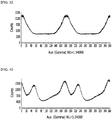
- the X-axis is gamma (degree) and 0° is a position where a stretching axis is perpendicular to a sample stage
- the Y-axis is integrated intensity of the (010) plane
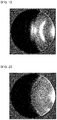
- Fig. 1 and Fig. 2 shows transmission mode diffraction pattern of the anti-reflective film of Example 1. Particularly, in Fig. 1 and Fig. 2 , the anti-reflective film of Example 1 is rotated 90°and is abraded.
- Fig. 3 shows the azimuthal angle distribution curve calculated from the anti-reflective film of Example 1
- Fig. 4 shows the azimuthal angle distribution curve calculated from the anti-reflective film of Comparative Example 1.
- Examples 1 to 4 fulfill intervals between peaks of 160 to 200°, and have remarkably low average reflectance deviation and light transmittance deviation, compared to Comparative Examples 1 to 4.
Landscapes
- Chemical & Material Sciences (AREA)
- Organic Chemistry (AREA)
- Health & Medical Sciences (AREA)
- Chemical Kinetics & Catalysis (AREA)
- Medicinal Chemistry (AREA)
- Polymers & Plastics (AREA)
- Physics & Mathematics (AREA)
- General Physics & Mathematics (AREA)
- Optics & Photonics (AREA)
- Engineering & Computer Science (AREA)
- Manufacturing & Machinery (AREA)
- Materials Engineering (AREA)
- Life Sciences & Earth Sciences (AREA)
- Wood Science & Technology (AREA)
- Ophthalmology & Optometry (AREA)
- Mechanical Engineering (AREA)
- Surface Treatment Of Optical Elements (AREA)
- Laminated Bodies (AREA)
- Polarising Elements (AREA)
- Liquid Crystal (AREA)
Abstract
Description
- This application claims the benefit of Korean Patent Application No.
10-2018-0123703 filed on October 17, 2018 10-2018-0123704 filed on October 17, 2018 10-2019-0128927 filed on October 17, 2019 10-2019-0128928 filed on October 17, 2019 - The present invention relates to an anti-reflective film, a polarizing plate, and a display apparatus.
- In general, in flat panel display devices such as PDP, LCD, etc., an anti-reflective film is installed so as to minimize the reflection of incident light from the outside. Methods for minimizing the reflection of light include a method of dispersing filler such as inorganic fine particles, etc. in resin, coating it on a substrate film, and forming unevenness (anti-glare: AG coating); a method of using light interference by forming plural layers having different refractive indexes on a substrate film (anti-reflectivel; AR coating), or a method of using them together, etc.
- Among them, in the case of AG coating, although the absolute amount of reflected light is equivalent to common hard coatings, low reflection effect can be obtained by reducing the amount of light entering the eyes using light scattering through unevenness. However, since the AG coating has lowered screen sharpness due to the surface unevenness, recently, many studies are being progressed on AR coating.
- As a film using the AR coating, those having a multi-layered structure in which a hard coating layer (high refractive index layer), low reflective index coating layer, etc. are stacked on a light transmitting substrate film are being commercialized. However, the existing anti-reflective film using AR coating has a problem in that reflectance deviation and light transmittance deviation are large according to the part of the film. And, since the method of forming plural layers separately conducts the processes of forming each layer, it has a disadvantage in that scratch resistance is lowered due to weak interlayer adhesion (interface adhesion).
- And, previously, in order to improve scratch resistance of the low refractive index layer included in the anti-reflective film, a method of adding various particles of nanometer size (for example, silica, alumina, zeolite, etc.) was mainly attempted. However, in case nanometer-sized particles are used, it was difficult to simultaneously increase scratch resistance while lowering the reflectance of the low refractive layer, and due to the nanometer-sized particles, the anti-fouling property of the surface of the low refractive index layer was significantly deteriorated.
- Accordingly, in order to reduce the absolute reflection amount of incident light from the outside, reduce reflectance deviation and light transmittance deviation according to the part of the film, and improve anti-fouling property as well as scratch resistance of the surface, many studies are being progressed, but the resulting property improvement degree is unsatisfactory.
- The present invention provides an anti-reflective film that has low reflectance deviation and light transmittance deviation, can simultaneously realize high scratch resistance and anti-fouling property, and can increase screen sharpness of a display apparatus.
- The present invention also provides a polarizing plate comprising the above anti-reflective film.
- The present invention further provides a display apparatus that comprises the above anti-reflective film and provides high screen sharpness.
- An anti-reflective film is provided herein, which comprises a low moisture permeable polymer film; a hard coating layer; and a low refractive index layer, wherein the mean of intervals between peaks is 160 to 200°, in an azimuthal angle distribution curve, calculated by azimuthal scan of diffraction pattern obtained by transmission mode X-ray diffraction (XRD), at 2θ of 17 to 18°.
- And, a polarizing plate comprising the above explained anti-reflective film is also provided herein.
- And, a display apparatus comprising the above explained anti-reflective film is also provided herein.
- Hereinafter, an anti-reflective film, a polarizing plate and a display apparatus according to specific embodiments of the invention will be explained in more detail.
- As used herein, a low refractive index layer may mean a layer having low refractive index, for example, a layer having refractive index of about 1.2 to 1.8 at the wavelength of 550nm.
- And, for specific measured quantities x and y, when the x value is changed and the y value is recorded according to the x value, if the maximum value(or extreme value) of the y appears, a peak means that part. The maximum value means the largest value in the peripheral part, and the extreme value means a value where instantaneous rate of change is 0.
- And, hollow inorganic particles mean particles wherein an empty space exists on the surface and/or inside of the inorganic particles.
- And, (meth)acryl includes both acryl and methacryl.
- And, (co)polymer includes both copolymer and homopolymer.
- And, a fluorine-containing compound means a compound comprising at least one fluorine atom in the compound.
- As used herein, a photopolymerizable compound commonly designates a polymer compound that is polymerized by the irradiation of light, for example, by the irradiation of visible rays or ultraviolet rays.
- According to one embodiment of the invention, an anti-reflective film comprising a low moisture permeable polymer film; a hard coating layer; and a low refractive index layer, wherein the mean of intervals between peaks is 160 to 200°, in the azimuthal angle distribution curve, calculated by azimuthal scan of diffraction pattern obtained by transmission mode X-ray diffraction (XRD), at 2θ of 17 to 18°, is provided. The mean of intervals between peaks means the arithmetic mean of intervals between peaks in the azimuthal angle distribution curve in the range of 0 to 360°.
- The present inventors progressed studies on an anti-reflective film, confirmed through experiments that an anti-reflective film wherein the mean of intervals between peaks is 160 to 200°, in the azimuthal angle distribution curve, calculated by azimuthal scan of diffraction pattern obtained by transmission mode X-ray diffraction(XRD), at 2θ of 17 to 18°, exhibits similar reflectance and light transmittance through the whole anti-reflective film, and thus, has small reflectance deviation and light transmittance deviation, can simultaneously realize high scratch resistance and anti-fouling property, and has screen sharpness of a display apparatus, and completed the present invention.
- The anti-reflective film has small reflectance deviation and light transmittance deviation through the whole film, and thus, can increase screen sharpness of a display apparatus, and has excellent scratch resistance and high anti-fouling property, and thus, can be easily applied for the manufacturing process of a display apparatus or a polarizing plate, and the like, without specific limitations.
- The X-ray diffraction pattern can be obtained using a transmission mode, among X-ray diffraction modes, and specifically, X-ray enters into a measurement subject, and then, scattered by the atomic layer in the crystals of the measurement subject, thus obtaining X-ray diffraction pattern. Through the X-ray diffraction pattern, the crystalline structure of material can be confirmed, and qualitative analysis can be made.
- And, by azimuthal scan of the X-ray diffraction pattern obtained from the anti-reflective film according to one embodiment, at 2θ of 17 to 18°, the azimuthal angle distribution curve can be calculated.
- In the azimuthal angle distribution curve calculated from the hard coating film according to one embodiment, the mean of intervals between peaks may be 160 to 200°, 165 to 195°, 170 to 190° or 175 to 185°.
- And, 3 or more peaks may appear in the azimuthal angle distribution curve, and the mea of intervals between 3 or more peaks may be 160 to 200°, 165 to 195°, 170 to 190° or 175 to 185°. The mean of intervals between peaks is the arithmetic mean of intervals between peaks in the azimuthal angle distribution curve in the range of 0 to 360°.
- As the mean of intervals between peaks fulfills the above explained range, similar reflectance and light transmittance may be exhibited through the whole anti-reflective film, thus realizing an anti-reflective film having low reflectance deviation and light transmittance deviation, and improving scratch resistance or anti-fouling property.
- Meanwhile, the incident angle(θ) means an angle made by a crystal plane and X-ray, when X-ray is irradiated to a specific crystal plane, and the diffraction peak means a point where the first derivative(gradient of tangent line, dy/dx) is 0, where the first derivative(gradient of tangent line, dy/dx) of the y-axis of diffraction intensity to the x-axis of 2θ value changes from positive to negative, as the x-axis of 2 times(2θ) of the incident angle of entering X-ray increases in a positive direction, in a graph wherein the x-axis of the x-y plane is 2 times(2θ) of the incident angle of entering X-ray, and the y-axis of x-y plane is diffraction intensity.
- Meanwhile, the diffraction peak means a peak of which full width at half maximum is 5° or more in the azimuthal angle distribution curve. A peak having full width at half maximum less than 5°corresponds to noise.
- The mean of intervals between peaks in the azimuthal angle distribution curve may result from the crystalline state of polymer and the uniformity of crystal direction of polymer in the low moisture permeable polymer film.
- Specifically, the polymer crystals in the low moisture permeable polymer film is observed in transmission mode X-ray diffraction(XRD) pattern, and more specifically, a (010) crystal plane in the low moisture permeable polymer film may be shown as a peak at 2θ of 17 to 18°.
- And, the uniformity of polymer crystal direction in the low moisture permeable polymer film may be shown as intervals between peaks in the azimuthal angle distribution curve calculated by azimuthal scan at 2θ of 17 to 18°, and for example, the intervals between peaks may be 160°to 200°.
- The low refractive index layer may comprise binder resin, and inorganic nanoparticles dispersed in the binder resin.
- Meanwhile, the binder resin may comprise (co)polymer of photopolymerizable compounds. The photopolymerizable compound forming the binder resin may include monomers or oligomers comprising vinyl groups or (meth)acrylate. Specifically, the photopolymerizable compound may include monomers or oligomers comprising 1 or more, or 2 or more, or 3 or more vinyl groups or (meth)acrylate.
- As specific examples of the monomers or oligomers comprising (meth)acrylate, pentaerythritol tri(meth)acrylate, pentaerythritol tetra(meth)acrylate, dipentaerythritol penta(meth)acrylate, dipentaerythritol hexa(meth)acrylate, tripentaerythritol hepta(meth)acrylate, trilene diisocyanate, xylene diisocyanate, hexamethylene diisocyanate, trimethylolpropane tri(meth)acrylate, trimethylolpropane polyethoxy tri(meth)acrylate, trimethylolpropane trimethacrylate, ethyleneglycol dimethacrylate, butanediol dimethacrylate, hexaethyl methacrylate, butyl methacrylate or mixtures of two or more kinds thereof, or urethane modified acrylate oligomer, epoxide acrylate oligomer, ether acrylate oligomer, dendritic acrylate oligomer, or mixtures of two or more kinds thereof may be mentioned. The molecular weight of the oligomer may be 1,000 to 10,000.
- As specific examples of the monomers or oligomers comprising vinyl groups, divinyl benzene, styrene or paramethyl styrene may be mentioned.
- Although the content of a part derived from the photopolymerizable compounds in the binder resin is not significantly limited, considering the mechanical properties of the finally prepared low refractive index layer or anti-reflective film, the content of the photopolymerizable compounds may be 10wt% to 80wt%, 15 to 70wt%, 20 to 60wt%, or 30 to 50wt%. If the content of the photopolymerizable compounds is less than 10 wt%, scratch resistance or anti-fouling property of the low refractive index layer may be significantly deteriorated, and if it exceeds 80wt%, reflectance may increase.
- Meanwhile, the binder resin may further comprise crosslinked polymer of a photopolymeriazble compound, a fluorine-containing compound comprising a photoreactive functional group, and polysilsesquioxane substituted with one or more reactive functional groups.
- Due to the properties of the fluorine atom included in the fluorine-containing compound comprising a photoreactive functional group, the interaction energy of the anti-reflective film with liquids or organic substances may be lowered, and thus, the amount of pollutants transferred to the anti-reflective film may be reduced, transferred pollutants may be prevented from remaining on the surface, and pollutants themselves may be easily removed.
- And, in the process of forming the low refractive index layer and anti-reflective film, the reactive functional group included in the fluorine-containing compound comprising a photoreactive functional group may act as crosslink, thereby increasing physical durability, scratch resistance and thermal stability of the low refractive index layer and anti-reflective film.
- In the fluorine-containing compound comprising a photoreactive functional group, one or more photoreactive functional groups may be included or substituted, and the photoreactive functional group means a functional group capable of participating in a polymerization reaction by the irradiation of light, for example, by the irradiation of visible rays or ultraviolet rays. The photoreactive functional group may include various functional groups capable of participating in a polymerization reaction by the irradiation of light, and specific examples thereof may include a (meth)acrylate group, an epoxide group, a vinyl group or a thiol group.
- The fluorine-containing compound comprising a photoreactive functional group may have weight average molecular weight(weight average molecular weight converted in terms of polystyrene, measured by GPC) of 2,000 to 200,000, preferably 5,000 to 100,000.
- If the weight average molecular weight of the fluorine-containing compound comprising a photoreactive functional group is too small, the fluorine-containing compounds may not be uniformly and effectively arranged on the surface of the low refractive index layer but be positioned inside, and thus, the anti-fouling property of the surface of the low refractive index layer and anti-reflective film may be deteriorated, and the crosslinking density inside of the low refractive index layer and anti-reflective film may be lowered, and thus, mechanical properties such as overall strength or scratch resistance, and the like may be deteriorated. And, if the weight average molecular weight of the fluorine-containing compound comprising a photoreactive functional group is too high, haze of the low refractive index layer and anti-reflective film may increase, or light transmittance may decrease, and the strength of the low refractive index layer and anti-reflective film may be also deteriorated.
- Specifically, the fluorine-containing compound comprising a photoreactive functional group may be one or more selected from the group consisting of i) aliphatic compounds or alicyclic compounds substituted with one or more photoreactive functional groups, in which at least one carbon is substituted with one or more fluorine atoms; ii) heteroaliphatic compounds or heteroalicyclic compounds substituted with one or more photoreactive functional groups, in which at least one hydrogen is substituted with fluorine, and at least one carbon is substituted with silicon; iii) polydialkyl siloxane-based polymer substituted with one or more photoreactive functional groups, in which at least one silicon is substituted with one or more fluorine atoms(for example, polydimethylsiloxane-based polymer); iv) polyether compounds substituted with one or more photoreactive functional groups, in which at least one hydrogen is substituted with fluorine.
- The crosslinked polymer may comprise, based on 100 parts by weight of parts derived from the photopolymerizable compound, 1 to 300 parts by weight, 2 to 250 parts by weight, 3 to 200 parts by weight, 5 to 190 parts by weight, or 10 to 180 parts by weight of parts derived from the fluorine-containing compound comprising a photoreactive functional group, If the fluorine-containing compound comprising a photoreactive functional group is excessively added compared to the photopolymerizable compound, the low refractive index layer may not have sufficient durability or scratch resistance. And, if the content of the fluorine-containing compound comprising a photoreactive functional group compared to on the photopolymerizable compound is too small, the low refractive index layer may not have sufficient mechanical properties such as anti-fouling property or scratch resistance, and the like.
- The fluorine-containing compound comprising a photoreactive functional group may further comprise silicon or a silicon compound. Namely, the fluorine-containing compound comprising a photoreactive functional group may optionally contain silicon or a silicon compound inside, and specifically, the content of silicon in the fluorine-containing compound comprising a photoreactive functional group may be 0.1 to 20 wt%.
- The content of silicon or a silicon compound included in the fluorine-containing compound comprising a photoreactive functional group may be confirmed by a commonly known analysis method, for example, ICP [Inductively Coupled Plasma] analysis.
- The silicon included in the fluorine-containing compound comprising a photoreactive functional group may increase compatibility with other components included in the low refractive index layer, thereby preventing generation of haze in the finally prepared low refractive index layer and increasing transparency, and may improve slip property of the surface of the finally prepared low refractive index layer or anti-reflective film to increase scratch resistance.
- Meanwhile, if the content of silicon in the fluorine-containing compound comprising a photoreactive functional group becomes too large, the low refractive index layer or anti-reflective film may not have sufficient light transmittance or anti-reflection performance, and anti-fouling property of the surface may be also deteriorated.
- Meanwhile, the polysilsesquioxane substituted with one or more reactive functional groups may increase mechanical properties, for example, scratch resistance of the low refractive index layer due to the reactive functional groups existing on the surface, and contrary to the case of using previously known fine particles such as silica, alumina, zeolite, and the like, it may improve alkali resistance of the low refractive index layer, and improve average reflectance or appearance property such as color, and the like.
- The polysilsesquioxane may be written as (RSiO1.5)n(wherein, n is 4 to 30 or 8 to 20), and it may have various structures such as a random structure, a ladder type, a cage and a partial cage, and the like. For example, in order to increase the properties and quality of the low refractive index layer and anti-reflective film, as the polysilsesquioxane substituted with one or more reactive functional groups, polyhedral oligomeric silsesquioxane substituted with one or more reactive functional groups and having a cage structure may be used.
- And, for example, the polyhedral oligomeric silsesquioxane substituted with one or more reactive functional groups and having a cage structure may comprise 8 to 20 silicon atoms in the molecule.
- And, at least one of the silicon atoms of the polyhedral oligomeric silsesquioxane having a cage structure may be substituted with a reactive functional group, and the silicon atoms not substituted with a reactive functional group may be substituted with the above-explained non-reactive functional groups.
- Since at least one of the silicon atoms of the polyhedral oligomeric silsesquioxane having a cage structure is substituted with a reactive functional group, the mechanical properties of the low refractive index layer and the binder resin may be improved, and since remaining silicon atoms are substituted with non-reactive functional groups, steric hindrance appears to significantly decrease the frequency or probability of siloxane bonds(-Si-O-) being exposed outside, thereby improving alkali resistance of the low refractive index layer and the binder resin.
- The reactive functional group substituted at polysilsesquioxane may include one or more functional groups selected from the group consisting of alcohol, amine, carboxylic acid, epoxide, imide, (meth)acrylate, nitrile, norbornene, olefin(allyl, cycloalkenyl or vinyldimethylsilyl, and the like), polyethyleneglycol, thiol and vinyl groups, preferably, epoxide or (meth)acrylate.
- As specific examples of the reactive functional groups, (meth)acrylate, C1-20 alkyl (meth)acrylate, C3-20 cycloalkyl epoxide, C1-10 alkyl cycloalkane epoxide may be mentioned. The alkyl (meth)acrylate means that another part of 'alkyl' that is not bonded with (meth)acrylate is a bonding position, the cycloalkyl epoxide means that another part of 'cycloalkyl' that is not bonded with epoxide is a bonding position, and the alkyl cycloalkane epoxide means that another part of 'alkyl' that is not bonded with cycloalkane epoxide is a bonding position.
- Meanwhile, the polysilsesquioxane substituted with one or more reactive functional groups may further comprise one or more non-reactive functional groups selected from the group consisting of a C1-20 linear or branched alkyl group, a C6-20 cyclohexyl group and a C6-20 aryl group, in addition to the above explained reactive functional groups. Since reactive functional groups and non-reactive functional groups are substituted on the surface of the polysilsesquioxane, in the polysilsesquioxane substituted with one or more reactive functional groups, siloxane bonds(-Si-O) may be positioned inside of the molecule without being exposed outside, thereby further increasing alkali resistance and scratch resistance of the low refractive index layer and anti-reflective film.
- As examples of the polyhedral oligomeric silsesquioxane(POSS) substituted with one or more reactive functional groups and having a cage structure, POSS substituted with one or more alcohol such as TMP diollsobutyl POSS, cyclohexanediol isobutyl POSS, 1,2-propanediollsobutyl POSS, octa(3-hydroxy-3 methylbutyldimethylsiloxy) POSS, and the like; POSS substituted with one or more amine such as aminopropyllsobutyl POSS, aminopropyllsooctyl POSS, aminoethylaminopropyl isobutyl POSS, N-phenylaminopropyl POSS, N-methylaminopropyl isobutyl POSS, octaammonium POSS, aminophenyl cyclohexyl POSS, aminophenyl isobutyl POSS, and the like; POSS substituted with one or more carboxylic acid such as maleamic acid-cyclohexyl POSS, maleamic acid-isobutyl POSS, octa maleamic acid POSS, and the like; POSS substituted with one or more epoxide such as epoxy cyclohexyl isobutyl POSS, epoxy cyclohexyl POSS, glycidyl POSS, glycidylethyl POSS, glycidylisobutyl POSS, glycidylisooctyl POSS, and the like; POSS substituted with one or more imide such as POSS maleimide cyclohexyl, POSS maleimide isobutyl, and the like; POSS substituted with one or more (meth)acrylate such as acrylolsobutyl POSS, (meth)acryl isobutyl POSS, (meth)acrylate cyclohexyl POSS, (meth)acrylate isobutyl POSS, (meth)acrylate ethyl POSS, (meth)acryl ethyl POSS, (meth)acrylate isooctyl POSS, (meth)acryl isooctyl POSS, (meth)acryl phenyl POSS, (meth)acryl POSS, acrylo POSS, and the like; POSS substituted with one or more nitrile groups such as cyanopropylIsobutyl POSS, and the like; POSS substituted with one or more norbornene groups such as norbornenyl ethyl ethyl POSS, norbornenyl ethyl isobutyl POSS, norbornenyl ethyl disilanoisobutyl POSS, trisnorbornenyl isobutyl POSS, and the like; POSS substituted with one or more vinyl groups such as allyl isobutyl POSS, monovinylisobutyl POSS, octacyclohexenyldimethylsilyl POSS, octavinyldimethylsilyl POSS, octavinyl POSS, and the like; POSS substituted with one or more olefin such as allylisobutyl POSS, monovinylisobutyl POSS, octacyclohexenyldimethylsilyl POSS, octavinyldimethylsilyl POSS, octavinyl POSS, and the like; POSS substituted with C5-30 PEG; POSS substituted with one or more thiol groups such as mercaptopropylIsobutyl POSS or mercaptopropylIsooctyl POSS, and the like, may be mentioned.
- The crosslinked polymer of a photopolymeriazble compound, a fluorine-containing compound comprising a photoreactive functional group, and polysilsesquioxane substituted with one or more reactive functional groups may comprise, based on 100 parts by weight of the photopolymeriazble compound, 0.5 to 60 parts by weight, 1.5 to 45 parts by weight, 3 to 40 parts by weight, or 5 to 30 parts by weight of the polysilsesquioxane substituted with one or more reactive functional groups.
- If the content of parts derived from the polysilsesquioxane substituted with one or more reactive functional groups compared to parts derived from the photopolymeriazble compound in the binder resin is too small, it may be difficult to sufficiently secure scratch resistance of the low refractive index layer. And, if the content of parts derived from the polysilsesquioxane substituted with one or more reactive functional groups compared to parts derived from the photopolymeriazble compound in the binder resin is too large, transparency of the low refractive index layer or anti-reflective film may be deteriorated, and scratch resistance may be deteriorated to the contrary.
- Meanwhile, the inorganic fine particles mean inorganic particles having nanometer or micrometer sized diameters.
- Specifically, the inorganic fine particles may include solid inorganic nanoparticles and/or hollow inorganic nanoparticles.
- The solid inorganic nanoparticles mean particles having an average diameter of 100 nm or less, inside of which an empty space does not exist.
- And, the hollow inorganic nanoparticles mean particles having an average diameter of 200 nm or less, on the surface and/or inside of which an empty space exists.
- The solid inorganic nanoparticles may have an average diameter of 0.5 to 100nm, 1 to 80nm, 2 to 70nm or 5 to 60nm.
- The hollow inorganic nanoparticles may have an average diameter of 1 to 200nm, 10 to 150nm, 20 to 130nm, 30 to 110nm or 40 to 100nm.
- Meanwhile, each of the solid inorganic nanoparticles and the hollow inorganic nanoparticles may include one or more reactive functional groups selected from the group consisting of a (meth)acrylate group, an epoxide group, a vinyl group and a thiol group on the surface. Since each of the solid inorganic nanoparticle and the hollow inorganic nanoparticle includes the above explained reactive functional groups on the surface, the low refractive index layer may have higher crosslinking density, thereby securing further improved scratch resistance and anti-fouling property.
- As the hollow inorganic nanoparticles, nanoparticles coated with a fluorine-containing compound on the surface may be used alone, or in combination with hollow inorganic nanoparticles that are not coated with a fluorine-containing compound on the surface. If the surface of the hollow inorganic nanoparticles is coated with a fluorine-containing compound, surface energy may be further lowered, thereby further increasing durability or scratch resistance of the low refractive index layer.
- As a method of coating a fluorine-containing compound on the surface of the hollow inorganic naoparticles, commonly known particle coating method or polymerization method may be used without specific limitations, and for example, the hollow inorganic nanoparticles and fluorine-containing compound may be subjected to a sol-gel reaction in the presence of water and a catalyst to bind the fluorine-containing compound on the surface of the hollow inorganic nanoparticles through hydrolysis and condensation reaction.
- Specific examples of the hollow inorganic nanoparticles may include hollow silica particles. The hollow silica may comprise functional groups substituted on the surface so that it may be more easily dispersed in an organic solvent. Examples of the organic functional groups that can be substituted on the surface of the hollow silica particles are not significantly limited, and for example, a (meth)acrylate group, a vinyl group, a hydroxyl group, an amine group, an allyl group, an epoxy group, an isocyanate group, an amine group, or fluorine, and the like may be substituted on the surface of the hollow silica.
- The binder resin of the low refractive index layer may comprise, based on 100 parts by weight of the photopolymerizable compound, 10 to 600 parts by weight of, 20 to 550 parts by weight of, 50 to 500 parts by weight of, 100 to 400 parts by weight of, or 150 to 350 parts by weight of the inorganic fine particles. If the inorganic fine particles are excessively added, due to decrease in the content of binder, scratch resistance or abrasion resistance of the coating film may be deteriorated.
- Meanwhile, the low refractive index layer may be obtained by coating a photocurable coating composition comprising a photopolymerizable compound, a fluorine-containing compound comprising a reactive functional group, polysilsesquioxane substituted with one or more reactive functional groups, and the inorganic fine particles on the low moisture permeable polymer film, and photocuring the coated product.
- And, the photocurable coating composition may further comprise a photoinitiator. Thus, in the low refractive index layer prepared from the above explained photocurable coating composition, the photopolymerization initiator may remain.
- As the photopolymerization initiator, compounds known to be usable in a photocurable resin composition may be used without specific limitations, and specifically, a benzophenon-based compound, an acetophenon-based compound, a biimidazole-based compound, a triazine-based compound, an oxime-based compound or mixtures of two or more thereof may be used.
- Based on 100 parts by weight of the photopolymerization compound, the photopolymerization initiator may be used in the content of 1 to 100 parts by weight, 5 to 90 parts by weight, 10 to 80 parts by weight, 20 to 70 parts by weight, or 30 to 60 parts by weight. If the amount of the photopolymerization initiator is too small, materials that are not-cured in the photocuring step and remain may be generated. If the amount of the photopolymerization initiator is too large, non-reacted initiator may remain as impurity or crosslinking density may decrease, and thus, the mechanical properties of the prepared film may be deteriorated or reflectance may be significantly increased.
- And, the photocurable coating composition may further comprise an organic solvent. Non-limiting examples of the organic solvent may include ketones, alcohols, acetates and ethers, or mixtures of two or more kinds thereof.
- As specific examples of the organic solvent, ketones such as methylethyl ketone, methyl isobutyl ketone, acetylacetone or isobutyl ketone, and the like; alcohols such as methanol, ethanol, n-propanol, i-propanl, n-butanol, i-butanol or t-butanol, and the like; acetates such as ethyl acetate, i-propyl acetate, or polyethyleneglycol monomethylether acetate, and the like; ethers such as tetrahydrofuran or propyleneglycol monomethylether, and the like; mixtures of two or more kinds thereof may be mentioned.
- The organic solvent may be added when mixing each component included in the photocurable coating composition, or it may be included in the photocurable coating composition while each component is dispersed or mixed in the organic solvent and added. If the content of the organic solvent in the photocurable coating composition is too small, flowability of the photocurable coating composition may be deteriorated to generate defects such as stripes in the finally prepared film. And, if the organic solvent is excessively added, solid content may decrease, and thus, coating and film formation may not be sufficiently achieved, and the properties or surface properties of the film may be deteriorated, and defects may be generated during drying and curing processes. Thus, the photocurable coating composition may comprise an organic solvent such that the total solid content concentration of the included components may become 1 wt% to 50 wt%, or 2 to 20 wt%.
- Meanwhile, for the application of the photocurable coating composition, commonly used methods and apparatuses may be used without specific limitations, and for example, bar coating such as Meyer bar, etc., gravure coating, 2 roll reverse coating, vacuum slot die coating, 2 roll coating, etc. may be used.
- In the step of photocuring the photocurable coating composition, UV or visible rays of 200-400 nm wavelength may be irradiated, and the exposure amount may be preferably 100 to 4,000 mJ/cm2. The exposure time is not specifically limited, and may be appropriately changed according to the exposure apparatus used, the wavelength of irradiated light rays or exposure amount.
- And, in the step of photocuring the photocurable coating composition, nitrogen purging, etc. may be conducted so as to apply nitrogen atmosphere condition.
- Meanwhile, as the hard coating layer, commonly known hard coating layers may be used without specific limitations.
- One example of the hard coating layer may include a hard coating layer comprising binder resin comprising photocurable resin; and organic or inorganic fine particles dispersed in the binder resin.
- The photocurable resin included in the hard coating layer may be polymer of photocurable compounds capable of inducing a polymerization reaction if light such as UV, etc. is irradiated, commonly known in the art. Specifically, the photocurable resin may include one or more selected from the group consisting of: reactive acrylate oligomers such as urethane acrylate oligomer, epoxide acrylate oligomer, polyester acrylate, and polyether acrylate; and multifunctional acrylate monomers such as dipentaerythritol hexaacrylate, dipentaerythritol hydroxy pentaacrylate, pentaerythritol tetraacrylate, pentaerythritol triacrylate, trimethylene propyl triacrylate, propoxylated glycerol triacrylate, trimethylpropane ethoxy triacrylate, 1,6-hexanediol acrylate, propoxylated glycerol triacrylate, tripropylene glycol diacrylate, and ethylene glycol diacrylate.
- Although the particle diameter of the organic or inorganic fine particles is not specifically limited, for example, the organic fine particles may have a particle diameter of 1 to 10 µm, and the inorganic fine particles may have a particle diameter of 1 nm to 500 nm, or 1nm to 300nm. The particle diameter of the organic or inorganic fine particles may be defined as a volume average particle diameter.
- And, although examples of the organic or inorganic fine particles included in the hard coating film are not specifically limited, for example, the organic or inorganic fine particles may be organic fine particles selected from the group consisting of acryl-based resin, styrene-based resin, epoxide resin and nylon resin, or inorganic fine particles selected from the group consisting of silicon oxide, titanium dioxide, indium oxide, tin oxide, zirconium oxide and zinc oxide.
- The binder resin of the hard coating layer may further comprise high molecular weight (co)polymer having a number average molecular weight of 10,000 or more. 13,000 or more, 15,000 to 100,000, or 20,000 to 80,000. The high molecular weight (co)polymer may be one or more selected from the group consisting of cellulose-based polymer, acryl-based polymer, styrene-based polymer, epoxide-based polymer, nylon-based polymer, urethane-based polymer, and polyolefin-based polymer.
- Meanwhile, another example of the hard coating layer may include a hard coating layer comprising organic polymer resin of photocurable resin; and an antistatic agent dispersed in the organic polymer resin.
- The antistatic agent may be a quaternary ammonium salt compound; a pyridinium salt; a cationic compound having 1 to 3 amino groups; an anionic compound such as sulfonic acid base, sulfuric ester base, phorphoric ester base, phosphonic acid base, and the like; an amphoteric compound such as an amino acid-based or an amino sulfuric ester-based compound, and the like; a non-ionic compound such as an imino alcohol-based compound, a glycerine-based compound, a polyethylene glycol-based compound, and the like; an organometallic compound such as a metal alkoxide compound including tin or titanium, and the like; a metal chelate compound such as an acetylacetonate salt of the organometallic compound; a reaction product or polymerization product of two or more kinds thereof; a mixture of two or more kinds thereof. Here, the quaternary ammonium salt compound may be a compound having one or more quaternary ammonium salt groups in the molecule, and low molecular type or high molecular type may be used without limitations.
- And, as the anti-static agent, conductive polymer and metal oxide fine particles may be also used. As the conductive polymer, aromatic conjugated poly(paraphenylene), heterocyclic conjugated polypyrrole, polythiophene, aliphatic conjugated polyacetylene, conjugated polyaniline containing hetero atoms, mixed type conjugated poly(phenylene vinylene), double chain type conjugated compounds having multiple conjugated chains in the molecule, conductive composites wherein conjugated polymer chains are grafted or block-polymerized to saturated polymer, and the like may be mentioned. And, as the metal oxide fine particles, zinc oxide, antimony oxide, tin oxide, cerium oxide, indium tin oxide, indium oxide, aluminum oxide, antimony doped tin oxide, aluminum doped zinc oxide, and the like may be mentioned.
- The hard coating layer comprising organic polymer resin of photopolymerizable resin; and an anti-static agent dispersed in the organic polymer resin may further comprise one or more compounds selected from the group consisting of alkoxy silane-based oligomer and metal alkoxide-based oligomer.
- Although the alkoxy silane-based compound may be one commonly used in the art, for example, it may be one or more compounds selected form the group consisting of tetramethoxysilane, tetraethoxysilane, tetraisopropoxysilane, methyltrimethoxysilane, methyltriethoxysilane, methacryloxypropyltrimethoxysilane, glycidoxy propyl trimethoxy silane, and glycidoxy propyl triethoxy silane.
- And, the metal alkoxide-based oligomer may be prepared by the sol-gel reaction of a composition comprising a metal alkoxide-based compound and water. The sol-gel reaction may be conducted by a method similar to the above explained preparation method of alkoxy silane-based oligomer. However, since the metal alkoxide-based compound may rapidly react with water, the sol-gel reaction may be conducted by diluting the metal alkoxide-based compound in an organic solvent, and then, slowly dropping water. At this time, considering the reaction efficiency, it is preferable that the mole ratio of the metal alkoxide-based compound to water (based on metal ions) is controlled within a range of 3 to 170.
- Here, the metal alkoxide-based compound may be one or more compounds selected from the group consisting of titanium tetra-isopropoxide, zirconium isopropoxide and aluminum isopropoxide.
- Meanwhile, the low moisture permeable film may be a transparent film having light transmittance of 90% or more, and haze of 1% or less.
- The low moisture permeable film may be a polymer film having low moisture permeability in which moisture permeation, i.e., the movement of moisture from a place having high vapor pressure to a place having low vapor pressure, hardly occurs through the film, and for example, the low moisture permeable polymer film may have moisture permeability of 50 g/m2·day or less, 30 g/m2·day or less, 20 g/m2·day or less or 15 g/m2·day or less, under temperature of 30 to 40°C and relative humidity of 90 to 100%. If the moisture permeability of the low moisture permeable polymer film is greater than 10g/m2·day, moisture may be permeated into the anti-reflective film, and thus, deterioration of a display applying the anti-reflective film may be generated under a high temperature environment.
- As explained above, the mean of intervals between peaks in the azimuthal angle distribution curve may result from the crystalline state of polymer and crystal direction of polymer in the low moisture permeable polymer film.
- And, the alignment degree of polymer crystals in the low moisture permeable polymer film may be related to a Stretching ratio in the manufacturing process of a low moisture permeable polymer film, Stretching temperature, cooling speed after Stretching, and process temperature, and the like, and for example, since the alignment degree of polymer crystals in the low moisture permeable polymer film may be in disorder at high temperature, in order to prevent this, a process temperature may be controlled to 100°C or less.
- And, the alignment degree of polymer crystals in the low moisture permeable polymer film may be related to tensile strength ratio in one direction and a direction perpendicular to the one direction of the low moisture permeable polymer film.
- Specifically, the low moisture permeable polymer film exhibits different tensile strength values in one direction and in a direction perpendicular to the one direction, and for example, a ratio of tensile strength in one direction to tensile strength in a direction perpendicular to the one direction, may be 2 or more, 2.1 to 20, 2.2 to 10, or 2.3 to 5. The tensile strength in a direction perpendicular to the one direction is smaller than the tensile strength in one direction. If the tensile strength ratio is less than 2, reflectance deviation and light transmittance deviation according to the part of the anti-reflective film may be large, and rainbow phenomenon due to the interference of UV may be generated.
- The tensile strength in one direction may be tensile strength in MD(Machine Direction) or TD (Transverse Direction) of the low moisture permeable polymer film, and specifically, it may be 30Mpa to 1Gpa, 40Mpa to 900Mpa, or 50Mpa to 800Mpa.
- The tensile strength perpendicular to the one direction may be tensile strength in MD or TD of the low moisture permeable polymer film, and specifically, it may be 30Mpa to 1Gpa, 40Mpa to 900Mpa, or 50Mpa to 800Mpa.
- The low moisture permeable polymer film may have thickness direction retardation(Rth) measured at a wavelength of 550nm, of 5,000 nm or more, 7,000 to 50,000nm, or 8,000 to 40,000nm. As specific examples of such low moisture permeable polymer film, a uniaxially stretched polyethylene terephthalate film or a biaxially stretched polyethylene terephthlate film may be mentioned.
- If the thickness direction retardation(Rth) of the low moisture permeable polymer film is less than 5,000 nm, reflectance deviation and light transmittance deviation according to the part of the anti-reflective film may be large, and rainbow phenomenon due to the interference of UV may be generated.
- The thickness direction retardation may be confirmed through commonly known measuring method and measuring apparatus. For example, as the measuring apparatus of thickness direction retardation, a product name AxoScan manufactured by AXOMETRICS Inc. may be mentioned.
- For example, the thickness direction retardation(Rth) may be calculated by inputting the refractive index value(589nm) of the light-transmitting substrate film in the measuring device, and then, measuring the thickness direction retardation of the light-transmitting substrate film using light of 590nm wavelength under temperature of 25°C and humidity of 40%, and converting it into a retardation value per a film thickness of 10 µm, based on the measured value of thickness direction retardation(value obtained by the automatic measurement(automatic calculation) of the measuring device). And, the size of the light-transmitting substrate is not specifically limited as long as it is larger than a sidelight part(diameter: about 1 cm) of the stage of the measuring device, but it may have a dimension of height 76mm, width 52mm and thickness 13µm.
- And, the value of ┌refractive index of the light-transmitting substrate(589nm)┘ that is used for the measurement of thickness direction retardation(Rth) may be calculated by forming a non-stretching film comprising the same kind of a resin film to the light transmitting substrate that forms a film of which retardation is to be measured, and then, measuring refractive index to 589nm light of the in-plane direction of a measuring sample(a direction vertical to the thickness direction), using the non-stretch film as a meausirng sample (in case a film to be measured is a non-stretch film, the film itself may be used as a measurement sample), using a refractive measuring apparatus(product name ┌NAR-1T SOLID┘ manufactured by Atagoa Co,. Ltd), using a light source of 589nm, under temperature condition of 23 °C.
- And, the material of the low moisture permeable polymer film may be triacetylcellulose, cycloolefin polymer, polyacrylate, polycarbonate, polyethylene terephthalate, and the like. And, the thickness of the base film may be 10 to 300µm considering productivity, and the like, but not limited thereto.
- The anti-reflective film of one embodiment exhibits low reflectance, and thus, can realize high light transmittance and excellent optical properties. Specifically, the anti-reflective film may have an average reflectance of 2.0% or less, 1.6% or less, 1.2% or less, 0.05% to 0.9%, 0.10% to 0.70%, or 0.2% to 0.5%, in the wavelength region of 380nm to 780nm.
- And, the anti-reflective film of one embodiment exhibits low reflectance deviation and light transmittance deviation, and thus, can realize excellent optical properties. Specifically, the average reflectance deviation of the anti-reflective film may be 0.2%p or less, 0.01 to 0.15%p or 0.01 to 0.1%p. And, the light transmittance deviation of the anti-reflective film may be 0.2%p or less, 0.01 to 0.15%p or 0.01 to 0.1%p.
- The average reflectance deviation means a difference(absolute value) between each average reflectance in the wavelength region of 380 to 780nm of two or more specific points selected in the anti-reflective film, and the mean of the average reflectances. Specifically, the average reflectance deviation may be calculated by 1) selecting two or more points in an anti-reflective film, 2) measuring each average reflectance at the two or more points, 3) calculating the arithmetic mean of the average reflectances measured in the step 2), and 4) calculating a difference(absolute value) between the average reflectance of each point and the arithmetic mean of step 3), thus finally calculating two or more average reflectance deviations. Among the two or more average reflectance deviations, the largest average reflectance deviation may be 0.2%p or less.
- Meanwhile, the light transmittance deviation means a difference(absolute value) between each light transmittance of two or more specific points selected in the anti-reflective film, and the mean of the light transmittances, and the light transmittance deviation may be calculated by the same method as the method of calculating the average reflectance deviation, except that light transmittance is measured instead of average reflectance. Among the two or more light transmittance deviations, the largest light transmittance deviation may be 0.2%p or less.
- According to another embodiment of the invention, a polarizing plate comprising the anti-reflective film according to the above embodiment is provided. The polarizing plate may comprise a polarizer and an anti-reflective film formed on at least one side of the polarizer.
- The material and preparation method of the polarizing film are not specifically limited, and those commonly known in the art may be used. For example, the polarizer may be a polyvinylalcohol-based polarizer.
- The polarizer and the anti-reflective film may be laminated by adhesive such as aqueous adhesive or non-aqueous adhesive, and the like.
- According to yet another embodiment of the invention, a display apparatus comprising the above explained anti-reflective film is provided. Although specific examples of the display apparatus are not limited, for example, it may be a liquid crystal display, a plasma display apparatus, an organic light emitting diode, and the like.
- For example, the display apparatus may be a liquid display apparatus comprising one pair of polarizing plates facing each other; a thin film transistor, a color filer and a liquid crystal cell sequentially stacked between the one pair of polarizing plates; and a backlight unit.
- In the display apparatus, the anti-reflective film may be positioned at the side of an observer of a display panel or at the outermost surface of the backlight.
- In the display apparatus comprising the anti-reflective film, an anti-reflective film may be positioned on one side of the polarizing plate relatively distant from the backlight unit, among the one pair of polarizing plates.
- And, the display apparatus may comprise a display panel, a polarizer positioned on at least one side of the panel, and an anti-reflective film positioned on the opposite side.
- According to the present invention, an anti-reflective film that has low reflectance deviation and light transmittance deviation, can simultaneously realize high scratch resistance and anti-fouling property, and can increase screen sharpness of a display apparatus, a polarizing plate comprising the anti-reflective film, and a display apparatus comprising the anti-reflective film, are provided.
-
-
Fig. 1 and Fig. 2 show transmission mode diffraction patterns of the anti-reflective film of Example 1. -
Fig. 3 shows the azimuthal angle distribution curve calculated from the anti-reflective film of Example 1. -
Fig. 4 shows the azimuthal angle distribution curve calculated from the anti-reflective film of Comparative Example 1. - The present invention will be explained in detail in the following Examples. However, these examples are presented only as the illustrations of the present invention, and the scope of the present invention is not limited thereby.
- The components described in the following Table 1 were mixed to prepare coating solutions(B1, B2 and B3) for forming a hard coating layer.
[Table 1] (unit: g) B1 B2 B3 DPHA - 6.237 - PETA 16.421 10.728 13.413 UA-306T 3.079 2.069 6.114 8BR-500 6.158 6.537 6.114 IRG-184 1.026 1.023 1.026 Tego-270 0.051 0.051 0.051 BYK350 0.051 0.051 0.051 2-butanol 25.92 32.80 36.10 IPA 45.92 38.80 35.70 XX-103BQ(2.0µm 1.515) 0.318 0.460 0.600 XX-113BQ(2.0µm 1.555) 0.708 0.563 0.300 MA-ST(30% in MeOH) 0.342 0.682 0.542 DPHA: dipentaerythritol hexaacrylate
PETA: pentaerythritol triacrylate
UA-306T: urethane acrylate, a reaction product of toluene diisocyante and pentaerythritol triacrylate (a product from Kyoeisha)
8BR-500: photocurable urethane acrylate polymer (Mw 200,000, a product from Taisei Fine Chemical)
IRG-184: initiator (Irgacure 184, a product from Ciba)
Tego-270: leveling agent (a product from Tego)
BYK350: leveling agent (a product from BYK)
IPA isopropyl alcohol
XX-103BQ (diameter: 2.0µm, Refractive index: 1.515): copolymer particles of polystyrene and polymethyl methacrylate (a product from Sekisui Plastic)
XX-113BQ(diameter: 2.0µm, Refractive index: 1.555): copolymer particles of polystyrene and polymethyl methacrylate (a product from Sekisui Plastic)
MA-ST (30% in MeOH): dispersion in which nanosilica particles having a size of 10∼15nm are dispersed in methyl alcohol (a product from Nissan Chemical) - 100g of trimethylolpropane triacrylate (TMPTA), 283g of hollow silica nanoparticles (diameter range: about 42 nm to 66 nm, a product from JSC catalyst and chemicals), 59g of solid silica nanoparticles (diameter range: about 12 nm to 19 nm), 115g of a first fluorine-containing compound (X-71-1203M, ShinEtsu), 15.5 g of a second fluorine-containing compound (RS-537, DIC) and 10g of an initiator(Irgacure 127, Ciba) were diluted in a solvent of MIBK(methyl isobutyl ketone) such that solid content concentration became 3 wt%, thus preparing a coating solution (a photocurable coating composition) for forming a low refractive index layer.
- 100g of dipentaerythritol hexaacrylate(DPHA), 143g of hollow silica nanoparticles (diameter range: about 51 nm to 72 nm, a product from JSC catalyst and chemicals), 29g of solid silica nanoparticles (diameter range: about 12 nm to 19 nm), 56g of a fluorine-containing compound(RS-537, DIC) and 3.1g of an initiator(Irgacure 127, Ciba Company) were diluted in a solvent of MIBK(methyl isobutyl ketone) such that solid content concentration became 3.5 wt%, thus preparing a coating solution (a photocurable coating composition) for forming a low refractive index layer.
- On each low moisture permeable polymer film(thickness 80µm) described in the following Table 2, each coating solution(B1, B2, B3) for forming a hard coating layer prepared above was coated with #12 mayer bar, and then, dried at 60°C for 2 minutes, and UV cured to form a hard coating layer(coating thickness 5µm). As an UV lamp, H bulb was used, and a curing reaction was progressed under nitrogen atmosphere. The quantity of UV irradiated during curing was 100mJ/cm2.
- On the hard coating layer, each coating solution(C1, C2) for forming a low refractive index layer was coated with #4 mayer bar to a thickness of about 110 to 120nm, and dried at 40°C for 1 minute and cured. During curing, UV was irradiated at 252mJ/cm2 to the dried coating solution under nitrogen purging.
[Table 2] Anti-reflective film Tensile strength ratio* Hard coating layer Low refractive index layer Example 1 3.9 Coating solution (B1) Coating solution (C1) Example 2 3.6 Coating solution (B2) Coating solution (C1) Example 3 4.2 Coating solution (B2) Coating solution (C1) Example 4 2.5 Coating solution (B3) Coating solution (C1) Example 5 2.3 Coating solution (B1) Coating solution (C2) Comparative Example 1 1.0 Coating solution (B3) Coating solution (C1) Comparative Example 2 1.5 Coating solution (B2) Coating solution (C1) Comparative Example 3 1.2 Coating solution (B2) Coating solution (C1) Comparative Example 4 1.9 Coating solution (B1) Coating solution (C2) Comparative Example 5 1.7 Coating solution (B1) Coating solution (C2) *tensile strength ratio: a ratio of tensile strength in one direction having larger value, to tensile strength in a direction perpendicular to the one direction having smaller value, in the low moisture permeable polymer film - For the anti-reflective films obtained in Examples and Comparative Examples, 2cm*2cm (width*length) samples were prepared, and then, Cu-Kα rays of 1.54 Å wavelength were irradiated.
- Specifically, 10 samples were overlapped and fixed in a holder, and positioned on a gomiometer center. The samples were stacked such that one direction having lower tensile strength and a direction perpendicular to the one direction having higher tensile strength in each low moisture polymer film of each sample are the same.
- As the measuring apparatus, Bruker AXS D8 Discover XRD was used, the voltage and current used were respectively 50kV and 1000 µA, and the optics and detector used were as follows.
- Primary (incident beam) optics: beam collimator (0.3mm)
- Secondary (diffracted beam) optics: none
- VANTEC-500 (2D detector)
- θ was fixed to 0° and detector was fixed to 24° such that a (010) crystal plane in the low moisture permeable polymer film is measured around 2 θ = 17.6°, and then, measurement was conducted at
psi 0° to 90° at an interval of 30°, 2400 seconds with 4 frame, using 0.33 mm beam collimator. The conversion of X-ray diffraction pattern by the Cu-Kα rays and the analysis were conducted using DIFFRAC.EVA program of Bruker, and by 2 θ -integration of the region having 2 θ of 17.25°to 18.25°using wedge cursor, converted into 1D-pattern. - Each pattern measured and converted at each psi position was shifted each 30°, 60°, and 90° so as to correspond to the practically measured chi value and combined, and the pattern was shifted such that the extreme value in data obtained at
Chi 0° is positioned atgamma 0°, thus obtaining the azimuthal angle distribution curve. - In the azimuthal angle distribution curve, the X-axis is gamma (degree) and 0° is a position where a stretching axis is perpendicular to a sample stage, and the Y-axis is integrated intensity of the (010) plane, and intervals between peaks appearing at the azimuthal angle distribution curve were measured and the arithmetic mean was calculated, and the results were shown in the following Table 3.
- Meanwhile,
Fig. 1 and Fig. 2 shows transmission mode diffraction pattern of the anti-reflective film of Example 1. Particularly, inFig. 1 and Fig. 2 , the anti-reflective film of Example 1 is rotated 90°and is abraded.Fig. 3 shows the azimuthal angle distribution curve calculated from the anti-reflective film of Example 1, andFig. 4 shows the azimuthal angle distribution curve calculated from the anti-reflective film of Comparative Example 1. - The rear side (one side of the low moisture permeable polymer film on which a hard coating layer is not formed) of each anti-reflective film obtained in Examples and Comparative Examples was darkened, and then, average reflectance in the wavelength region of 380nm to 780nm was measured using a reflectance mode of Solidspec 3700 (SHIMADZU), and the results were shown in the following Table 3.
- For each anti-reflective film obtained in Examples and Comparative Examples, 20 points were randomly selected, and for each point, average reflectance was measured by the method of 2. Evaluation of average reflectance. Thereafter, the arithmetic mean of the measured average reflectances of 20 points was calculated. Thereafter, a difference (absolute value) between the average reflectance at each point and the arithmetic mean was defined as average reflectance deviation, and each average reflectance deviation was calculated at each of 20 points. Among the 20 average reflectance deviations, the largest average reflectance deviation was described in the following Table 3.
- For each anti-reflective film obtained in Examples and Comparative Examples, 20 points were randomly selected, and for each point, light transmittance was measured. Specifically, average light transmittance in the wavelength region of 380 to 780 nm was measured using a transmittance mode of Solidspec 3700 (SHIMADZU).
- Thereafter, the arithmetic mean of the measured light transmittances of 20 points was calculated. Thereafter, a difference (absolute value) between the light transmittance at each point and the arithmetic mean was defined as light transmittance deviation, and each light transmittance deviation was calculated at each of 20 points. Among the 20 light transmittance deviations, the largest light transmittance deviation was described in the following Table 3.
- The moisture permeability of each anti-reflective film obtained in Examples and Comparative Examples was measured at a temperature of 38°C and relative humidity of 100%, using MOCON test apparatus (PERMATRAN-W, MODEL 3/61).
[Table 3] Mean of intervals between peaks (°) Average reflectance (%) Average reflectance deviation (%p) Light transmittance deviation (%p) Moisture permeability (g/m2·day) Example 1 173 1.05 0.04 0.02 10.61 Example 2 181 1.13 0.11 0.09 11.18 Example 3 195 1.12 0.07 0.08 10.44 Example 4 169 1.07 0.16 0.11 12.21 Example 5 177 1.6 0.03 0.15 11.81 Comparative Example 1 103.3 1.13 0.35 0.22 12.35 Comparative Example 2 79.8 1.04 0.26 0.23 10.54 Comparative Example 3 46.5 0.99 0.28 0.3 11.38 Comparative Example 4 50.6 1.55 0.25 0.28 11.25 Comparative Example 5 52.1 1.5 0.35 0.32 10.91 - From the Table 3, it was confirmed that Examples 1 to 4 fulfill intervals between peaks of 160 to 200°, and have remarkably low average reflectance deviation and light transmittance deviation, compared to Comparative Examples 1 to 4.
Claims (16)
- An anti-reflective film comprising
a low moisture permeable polymer film; a hard coating layer; and a low refractive index layer,
wherein the anti-reflective film has a mean of intervals between peaks of 160 to 200° in an azimuthal angle distribution curve calculated from an azimuthal scan of diffraction pattern obtained by transmission mode X-ray diffraction (XRD), at 2θ of 17 to 18°. - The anti-reflective film according to claim 1,
wherein the azimuthal angle distribution curve contains at least 3 peaks. - The anti-reflective film according to claim 1,
wherein the low refractive index layer comprises a binder resin, and inorganic fine particles dispersed in the binder resin. - The anti-reflective film according to claim 3,
wherein the binder resin comprises (co)polymer of photopolymerizable compounds. - The anti-reflective film according to claim 4,
wherein the binder resin further comprises a crosslinked polymer of a photopolymeriazble compound, a fluorine-containing compound comprising a photoreactive functional group, and polysilsesquioxane substituted with one or more reactive functional groups. - The anti-reflective film according to claim 5,
wherein the fluorine-containing compound comprising a photoreactive functional group comprises one or more selected from the group consisting of i) aliphatic compounds or alicyclic compounds substituted with one or more photoreactive functional groups, in which at least one carbon is substituted with one or more fluorine atoms; ii) heteroaliphatic compounds or heteroalicyclic compounds substituted with one or more photoreactive functional groups, in which at least one hydrogen is substituted with fluorine, and at least one carbon is substituted with silicon; iii) polydialkyl siloxane-based polymer substituted with one or more photoreactive functional groups, in which at least one silicon is substituted with one or more fluorine atoms; and iv) polyether compounds substituted with one or more photoreactive functional groups, in which at least one hydrogen is substituted with fluorine. - The anti-reflective film according to claim 5,
wherein the reactive functional group substituted at polysilsesquioxane includes one or more functional groups selected from the group consisting of alcohol, amine, carboxylic acid, epoxide, imide, (meth)acrylate, nitrile, norbornene, olefin, polyethyleneglycol, thiol and vinyl groups. - The anti-reflective film according to claim 3,
wherein the inorganic fine particles include one or more nanoparticles selected from solid inorganic nanoparticles having an average diameter of 0.5 to 100m, and hollow inorganic nanoparticles having an average diameter of 1 to 200nm. - The anti-reflective film according to claim 1,
wherein the hard coating layer comprises a binder resin comprising photocurable resin, and organic or inorganic fine particles dispersed in the binder resin. - The anti-reflective film according to claim 9,
wherein the binder resin of the hard coating layer further comprises high molecular weight (co)polymer having a number average molecular weight of 10,000 or more. - The anti-reflective film according to claim 1,
wherein the low moisture permeable polymer film has
a thickness direction retardation(Rth) measured at a wavelength of 550nm, of 5,000 nm or more, and
a ratio of a first tensile strength in one direction to a second tensile strength in a direction perpendicular to the one direction, of 2 or more, and
the second tensile strength is smaller than the first tensile strength in one direction. - The anti-reflective film according to claim 1,
wherein the low moisture permeable polymer film is a polyethylene terephthalate film. - The anti-reflective film according to claim 1,
wherein the anti-reflective film has average reflectance in the wavelength region of 380nm to 780nm, of 2.0% or less. - The anti-reflective film according to claim 1,
wherein the anti-reflective film has
an average reflectance deviation of 0.2%p or less, and
a light transmittance deviation of 0.2%p or less. - A polarizing plate comprising the anti-reflective film according to claim 1, and a polarizer.
- A display apparatus comprising the anti-reflective film according to claim 1.
Applications Claiming Priority (3)
| Application Number | Priority Date | Filing Date | Title |
|---|---|---|---|
| KR20180123704 | 2018-10-17 | ||
| KR20180123703 | 2018-10-17 | ||
| PCT/KR2019/013680 WO2020080859A1 (en) | 2018-10-17 | 2019-10-17 | Anti-reflective film, polarizing plate, and display apparatus |
Publications (2)
| Publication Number | Publication Date |
|---|---|
| EP3715921A1 true EP3715921A1 (en) | 2020-09-30 |
| EP3715921A4 EP3715921A4 (en) | 2021-03-24 |
Family
ID=72074006
Family Applications (2)
| Application Number | Title | Priority Date | Filing Date |
|---|---|---|---|
| EP19873266.1A Active EP3786673B1 (en) | 2018-10-17 | 2019-10-17 | Anti-reflective film, polarizing plate, and display apparatus |
| EP19873013.7A Pending EP3715921A4 (en) | 2018-10-17 | 2019-10-17 | ANTI-REFLECTIVE FILM, POLARIZING PLATE AND DISPLAY DEVICE |
Family Applications Before (1)
| Application Number | Title | Priority Date | Filing Date |
|---|---|---|---|
| EP19873266.1A Active EP3786673B1 (en) | 2018-10-17 | 2019-10-17 | Anti-reflective film, polarizing plate, and display apparatus |
Country Status (5)
| Country | Link |
|---|---|
| US (2) | US20210206935A1 (en) |
| EP (2) | EP3786673B1 (en) |
| JP (2) | JP7321463B2 (en) |
| CN (2) | CN112219142B (en) |
| TW (2) | TWI734223B (en) |
Families Citing this family (9)
| Publication number | Priority date | Publication date | Assignee | Title |
|---|---|---|---|---|
| KR101941649B1 (en) * | 2017-11-24 | 2019-01-23 | 주식회사 엘지화학 | Polarizing plate and image display apparatus comprising the same |
| KR102194998B1 (en) * | 2018-06-26 | 2020-12-24 | 주식회사 엘지화학 | Anti-reflective film, polarizing plate, and display apparatus |
| JP7321463B2 (en) * | 2018-10-17 | 2023-08-07 | エルジー・ケム・リミテッド | Antireflection films, polarizers and display devices |
| KR102371580B1 (en) * | 2019-05-28 | 2022-03-07 | 주식회사 엘지화학 | Anti-reflective film, polarizing plate, and display apparatus |
| KR102581428B1 (en) | 2019-05-28 | 2023-09-21 | 주식회사 엘지화학 | Anti-reflective film, polarizing plate, and display apparatus |
| WO2022108053A1 (en) * | 2020-11-19 | 2022-05-27 | 주식회사 엘지화학 | Cover window for flexible display device, and flexible display device |
| WO2022255340A1 (en) * | 2021-06-03 | 2022-12-08 | 三菱瓦斯化学株式会社 | Antireflection film, laminate having antireflection film, and method for manufacturing antireflection film |
| CN115933015A (en) * | 2022-09-30 | 2023-04-07 | 中山金利宝新材料股份有限公司 | A high-definition anti-glare anti-reflection film and its preparation method |
| CN119408269B (en) * | 2024-12-03 | 2025-11-25 | 浙江和顺新材料有限公司 | A hydrophobic, wear-resistant, and high-transmittance thin film and its preparation method |
Family Cites Families (67)
| Publication number | Priority date | Publication date | Assignee | Title |
|---|---|---|---|---|
| JPS62197424A (en) | 1986-02-26 | 1987-09-01 | Asahi Chem Ind Co Ltd | Finely powdered polyester particle and its production |
| US5863468A (en) * | 1997-10-31 | 1999-01-26 | Raychem Corporation | Preparation of calcined ceramic powders |
| JP4031624B2 (en) | 2000-06-23 | 2008-01-09 | 株式会社東芝 | Substrate with transparent coating, coating liquid for forming transparent coating, and display device |
| JP3879657B2 (en) * | 2002-11-20 | 2007-02-14 | 日東電工株式会社 | Curable resin composition for antireflection layer, antireflection layer, antireflection film, optical element and image display device |
| US7282091B2 (en) | 2003-06-04 | 2007-10-16 | Fujifilm Corporation | Cellulose acylate-based dope, cellulose acylate film, and method of producing a cellulose acylate film |
| JP4662703B2 (en) | 2003-06-04 | 2011-03-30 | 富士フイルム株式会社 | Cellulose acylate dope and method for producing cellulose acylate film |
| JP4475016B2 (en) | 2003-06-30 | 2010-06-09 | 東レ株式会社 | Hard coat film, antireflection film and image display device |
| JP2005196122A (en) | 2003-12-12 | 2005-07-21 | Fuji Photo Film Co Ltd | Antireflection film, protective film for polarizing plate, those manufacturing methods, polarizing plate, and image display apparatus |
| JP4855712B2 (en) | 2005-05-17 | 2012-01-18 | 東洋製罐株式会社 | Square battery container |
| WO2007037276A1 (en) * | 2005-09-29 | 2007-04-05 | Dai Nippon Printing Co., Ltd. | Antireflection film |
| US7655289B2 (en) * | 2005-12-12 | 2010-02-02 | Eastman Kodak Company | Optical film composite having spatially controlled adhesive strength |
| JP2007241661A (en) * | 2006-03-08 | 2007-09-20 | Canon Inc | Image forming apparatus and control method thereof |
| US20080044596A1 (en) | 2006-08-21 | 2008-02-21 | Fujifilm Corporation | Polymer film, production method thereof, and polarizing plate and liquid crystal display device using the polymer film |
| JP2009073960A (en) | 2007-09-21 | 2009-04-09 | Sumitomo Chemical Co Ltd | Optical film |
| JP2009098658A (en) | 2007-09-25 | 2009-05-07 | Fujifilm Corp | Optical film, polarizing plate, and image display device |
| JP5353039B2 (en) | 2008-03-26 | 2013-11-27 | 大日本印刷株式会社 | Liquid crystal display |
| KR20100121281A (en) * | 2009-05-08 | 2010-11-17 | 동우 화인켐 주식회사 | High hard coating film, polarizing plate and display device including the same |
| JP5519217B2 (en) | 2009-08-31 | 2014-06-11 | 帝人デュポンフィルム株式会社 | Film for polarizer support substrate |
| WO2011046149A1 (en) | 2009-10-16 | 2011-04-21 | 大日本印刷株式会社 | Optical film and display panel |
| EP2537886B1 (en) | 2010-02-19 | 2015-06-17 | LG Chem, Ltd. | Coating layer for an antiglare film, and an antiglare film comprising the same |
| KR20140006922A (en) | 2011-04-26 | 2014-01-16 | 다이니폰 인사츠 가부시키가이샤 | Antireflection film, polarizing plate, and image display device |
| TWI542907B (en) | 2011-05-18 | 2016-07-21 | 東洋紡績股份有限公司 | Liquid crystal device, polarizing plate and polarizer protection film |
| KR101501682B1 (en) * | 2011-07-18 | 2015-03-11 | 주식회사 엘지화학 | Anti-Glare Coating Composition Having Improved Anti-Fingerprinting and Anti-Glare Coating Film Prepared Therefrom |
| TWI498639B (en) * | 2011-09-01 | 2015-09-01 | Chi Mei Materials Technology Corp | Display device polarization plate for multi-domain vertical alignment (mva) liquid crystal display |
| JP2013076841A (en) | 2011-09-30 | 2013-04-25 | Toppan Printing Co Ltd | Antireflection film, and polarizing plate, display and backlight member having the antireflection film |
| TW201407185A (en) | 2012-05-29 | 2014-02-16 | Kuraray Co | Antireflection film |
| JP5304939B1 (en) | 2012-05-31 | 2013-10-02 | 大日本印刷株式会社 | Optical laminate, polarizing plate, method for manufacturing polarizing plate, image display device, method for manufacturing image display device, and method for improving visibility of image display device |
| KR20140047548A (en) | 2012-10-12 | 2014-04-22 | 후지필름 가부시키가이샤 | Optical film and method for producing the same, polarizing plate, and liquid crystal display device |
| DE102012112742A1 (en) * | 2012-10-23 | 2014-04-24 | Fraunhofer-Gesellschaft zur Förderung der angewandten Forschung e.V. | Highly absorbent layer system, method for producing the layer system and suitable sputtering target |
| US9250371B2 (en) * | 2012-11-06 | 2016-02-02 | Samsung Electronics Co., Ltd. | Polarizing film, anti-reflective film and display device including the same |
| KR101691691B1 (en) | 2013-12-30 | 2016-12-30 | 제일모직주식회사 | Polarizer, method for preparing the same, polarizing plate comprising the same and optical display apparatus comprising the same |
| JP6226762B2 (en) | 2014-01-31 | 2017-11-08 | 富士フイルム株式会社 | OPTICAL POLYESTER FILM, POLARIZING PLATE, IMAGE DISPLAY DEVICE, OPTICAL POLYESTER FILM MANUFACTURING METHOD, AND COMPOSITION FOR Easily Adhesive Layer |
| KR101659161B1 (en) * | 2014-09-03 | 2016-09-23 | 삼성에스디아이 주식회사 | Polarizing plate and liquid crystal display apparatus comprising the same |
| US10338276B2 (en) * | 2014-09-12 | 2019-07-02 | Fujifilm Corporation | Antireflective film, polarizing plate, cover glass, image display device, and method of manufacturing antireflective film |
| JP6645420B2 (en) | 2014-10-30 | 2020-02-14 | 東洋紡株式会社 | Liquid crystal display and polarizing plate |
| WO2016093277A1 (en) | 2014-12-12 | 2016-06-16 | 住友化学株式会社 | Method for producing polarizing film, and polarizing film |
| JP6346307B2 (en) | 2014-12-12 | 2018-06-20 | 住友化学株式会社 | Manufacturing method of polarizing film |
| US10131122B2 (en) * | 2015-06-18 | 2018-11-20 | Flex Films (Usa) Inc. | Formable films, laminate structures, and related methods |
| KR102018287B1 (en) | 2015-09-11 | 2019-09-05 | 주식회사 엘지화학 | Anti-reflective filmand display device |
| KR102086054B1 (en) * | 2015-09-24 | 2020-03-06 | 주식회사 엘지화학 | Photosesitive coating compositoin, low reflection film, and anti-reflective film |
| JP6859951B2 (en) | 2015-10-16 | 2021-04-14 | 東洋紡株式会社 | Liquid crystal display device and polarizing plate |
| WO2017078428A1 (en) | 2015-11-04 | 2017-05-11 | 주식회사 엘지화학 | Anti-reflective film and manufacturing method therefor |
| KR102016710B1 (en) | 2016-01-07 | 2019-09-02 | 주식회사 엘지화학 | Anti-reflective film |
| JP6862183B2 (en) * | 2016-01-18 | 2021-04-21 | リケンテクノス株式会社 | Hard coat laminated film |
| CN108367560B (en) | 2016-02-18 | 2021-02-19 | 富士胶片株式会社 | Decorative film, image display device, touch panel, and method for manufacturing decorative film |
| JP6789593B2 (en) * | 2016-03-09 | 2020-11-25 | エルジー・ケム・リミテッド | Anti-reflective film |
| WO2017155336A1 (en) * | 2016-03-09 | 2017-09-14 | 주식회사 엘지화학 | Antireflective film |
| KR101889955B1 (en) | 2016-03-14 | 2018-08-20 | 주식회사 엘지화학 | Anti-reflective film |
| JP2017194620A (en) * | 2016-04-22 | 2017-10-26 | コニカミノルタ株式会社 | Polarizing plate and liquid crystal display |
| KR101730855B1 (en) | 2016-06-20 | 2017-04-27 | 에스케이씨 주식회사 | A protective film for a polarizer, a polarizing plate comprising the same, and a display device with the polarizing plate |
| CN109415609B (en) | 2016-06-23 | 2021-03-16 | 株式会社寺冈制作所 | Adhesive composition and adhesive sheet |
| KR101961333B1 (en) | 2016-07-14 | 2019-03-22 | 주식회사 엘지화학 | Anti-reflective film |
| CN110632686B (en) | 2016-07-14 | 2021-10-29 | 株式会社Lg化学 | Anti-reflection film |
| KR101953860B1 (en) * | 2016-07-28 | 2019-03-04 | 주식회사 엘지화학 | Optical film for protecting polarizing element, polarizer and display device comprising the same |
| KR101819414B1 (en) | 2016-08-10 | 2018-01-16 | 스미또모 가가꾸 가부시키가이샤 | A polarizing film |
| KR102040223B1 (en) * | 2017-01-20 | 2019-11-04 | 주식회사 엘지화학 | Anti-reflective film |
| KR101977933B1 (en) * | 2016-09-27 | 2019-08-28 | 주식회사 엘지화학 | Anti-reflective film and preparation method of the same |
| KR101977934B1 (en) | 2016-10-20 | 2019-08-28 | 주식회사 엘지화학 | Anti-reflective film |
| EP3413100B1 (en) | 2016-09-27 | 2020-11-04 | LG Chem, Ltd. | Antireflection film |
| TWI750280B (en) * | 2016-12-14 | 2021-12-21 | 日商東洋紡股份有限公司 | Liquid crystal display device, polarizer and polarizer protective film |
| KR102303171B1 (en) | 2017-03-31 | 2021-09-16 | 도요보 가부시키가이샤 | Polarizer protective film, polarizer and image display device |
| KR20190097639A (en) * | 2018-02-12 | 2019-08-21 | 삼성에스디아이 주식회사 | Antireflection film, polarizing plate comprising the same and optical display apparatus comprising the same |
| KR102196429B1 (en) * | 2018-03-16 | 2020-12-29 | 주식회사 엘지화학 | Anti-reflective film, polarizing plate, and display apparatus |
| JP7321463B2 (en) | 2018-10-17 | 2023-08-07 | エルジー・ケム・リミテッド | Antireflection films, polarizers and display devices |
| KR102061215B1 (en) | 2018-12-28 | 2019-12-31 | 에스케이씨 주식회사 | Optical polyester film |
| KR102371580B1 (en) * | 2019-05-28 | 2022-03-07 | 주식회사 엘지화학 | Anti-reflective film, polarizing plate, and display apparatus |
| KR102903579B1 (en) * | 2020-05-18 | 2025-12-24 | 삼성디스플레이 주식회사 | Resin composition, adhesive member, and display device including the same |
-
2019
- 2019-10-17 JP JP2020537515A patent/JP7321463B2/en active Active
- 2019-10-17 US US17/059,783 patent/US20210206935A1/en not_active Abandoned
- 2019-10-17 EP EP19873266.1A patent/EP3786673B1/en active Active
- 2019-10-17 TW TW108137545A patent/TWI734223B/en active
- 2019-10-17 EP EP19873013.7A patent/EP3715921A4/en active Pending
- 2019-10-17 US US16/964,715 patent/US12596205B2/en active Active
- 2019-10-17 CN CN201980035545.7A patent/CN112219142B/en active Active
- 2019-10-17 TW TW108137544A patent/TWI754178B/en active
- 2019-10-17 JP JP2020566248A patent/JP7486878B2/en active Active
- 2019-10-17 CN CN201980007718.4A patent/CN111566523A/en active Pending
Also Published As
| Publication number | Publication date |
|---|---|
| TWI754178B (en) | 2022-02-01 |
| US12596205B2 (en) | 2026-04-07 |
| JP7486878B2 (en) | 2024-05-20 |
| TWI734223B (en) | 2021-07-21 |
| CN112219142A (en) | 2021-01-12 |
| CN111566523A (en) | 2020-08-21 |
| CN112219142B (en) | 2022-11-04 |
| TW202030503A (en) | 2020-08-16 |
| US20200348450A1 (en) | 2020-11-05 |
| JP2021509973A (en) | 2021-04-08 |
| EP3786673A1 (en) | 2021-03-03 |
| EP3786673A4 (en) | 2021-08-04 |
| JP2021524941A (en) | 2021-09-16 |
| EP3786673B1 (en) | 2022-07-20 |
| TW202023827A (en) | 2020-07-01 |
| JP7321463B2 (en) | 2023-08-07 |
| EP3715921A4 (en) | 2021-03-24 |
| US20210206935A1 (en) | 2021-07-08 |
Similar Documents
| Publication | Publication Date | Title |
|---|---|---|
| US12596205B2 (en) | Anti-reflective film, polarizing plate, and display apparatus | |
| KR102016710B1 (en) | Anti-reflective film | |
| KR102371580B1 (en) | Anti-reflective film, polarizing plate, and display apparatus | |
| KR101951864B1 (en) | Anti-reflective film and display device | |
| JP7191340B2 (en) | Antireflection films, polarizers and display devices | |
| US20180230316A1 (en) | Anti-reflective film (as amended) | |
| US12174408B2 (en) | Anti-reflective film, polarizing plate, and display apparatus | |
| JP7150384B2 (en) | Antireflection films, polarizers and display devices | |
| KR102363875B1 (en) | Anti-reflective film, polarizing plate, and display apparatus | |
| KR102235481B1 (en) | Anti-reflective film, polarizing plate, and display apparatus | |
| KR102760376B1 (en) | Anti-reflective film, polarizing plate, and display apparatus | |
| TWI744919B (en) | Anti-reflective film, polarizing plate, and display apparatus |
Legal Events
| Date | Code | Title | Description |
|---|---|---|---|
| STAA | Information on the status of an ep patent application or granted ep patent |
Free format text: STATUS: THE INTERNATIONAL PUBLICATION HAS BEEN MADE |
|
| PUAI | Public reference made under article 153(3) epc to a published international application that has entered the european phase |
Free format text: ORIGINAL CODE: 0009012 |
|
| STAA | Information on the status of an ep patent application or granted ep patent |
Free format text: STATUS: REQUEST FOR EXAMINATION WAS MADE |
|
| 17P | Request for examination filed |
Effective date: 20200624 |
|
| AK | Designated contracting states |
Kind code of ref document: A1 Designated state(s): AL AT BE BG CH CY CZ DE DK EE ES FI FR GB GR HR HU IE IS IT LI LT LU LV MC MK MT NL NO PL PT RO RS SE SI SK SM TR |
|
| AX | Request for extension of the european patent |
Extension state: BA ME |
|
| A4 | Supplementary search report drawn up and despatched |
Effective date: 20210224 |
|
| RIC1 | Information provided on ipc code assigned before grant |
Ipc: B29D 11/00 20060101ALI20210218BHEP Ipc: G02B 1/10 20150101ALI20210218BHEP Ipc: C08J 5/18 20060101ALI20210218BHEP Ipc: G02F 1/1335 20060101ALI20210218BHEP Ipc: G02B 1/111 20150101ALI20210218BHEP Ipc: B32B 27/36 20060101ALI20210218BHEP Ipc: B32B 27/08 20060101ALI20210218BHEP Ipc: G02B 5/20 20060101AFI20210218BHEP Ipc: G02B 1/14 20150101ALI20210218BHEP Ipc: B29C 55/02 20060101ALI20210218BHEP Ipc: G02B 5/30 20060101ALI20210218BHEP |
|
| DAV | Request for validation of the european patent (deleted) | ||
| DAX | Request for extension of the european patent (deleted) | ||
| STAA | Information on the status of an ep patent application or granted ep patent |
Free format text: STATUS: EXAMINATION IS IN PROGRESS |
|
| 17Q | First examination report despatched |
Effective date: 20230313 |
|
| RAP1 | Party data changed (applicant data changed or rights of an application transferred) |
Owner name: XINMEI FONTANA HOLDING (HONG KONG) LIMITED |
|
| REG | Reference to a national code |
Ref country code: DE Ref legal event code: R079 Free format text: PREVIOUS MAIN CLASS: G02B0005200000 Ipc: G02B0001140000 |
|
| GRAP | Despatch of communication of intention to grant a patent |
Free format text: ORIGINAL CODE: EPIDOSNIGR1 |
|
| STAA | Information on the status of an ep patent application or granted ep patent |
Free format text: STATUS: GRANT OF PATENT IS INTENDED |
|
| RIC1 | Information provided on ipc code assigned before grant |
Ipc: G02B 1/14 20150101AFI20260302BHEP Ipc: G02B 1/111 20150101ALI20260302BHEP Ipc: G02B 5/30 20060101ALI20260302BHEP Ipc: C08F 290/06 20060101ALI20260302BHEP Ipc: C08F 290/14 20060101ALI20260302BHEP Ipc: C08J 7/04 20200101ALI20260302BHEP Ipc: C08J 7/046 20200101ALI20260302BHEP Ipc: C09D 151/08 20060101ALI20260302BHEP Ipc: B29D 11/00 20060101ALI20260302BHEP |
|
| INTG | Intention to grant announced |
Effective date: 20260316 |