EP3709843B1 - Mattresses including an elastomeric cushioning element and a pocketed coil layer and related methods - Google Patents
Mattresses including an elastomeric cushioning element and a pocketed coil layer and related methods Download PDFInfo
- Publication number
- EP3709843B1 EP3709843B1 EP18812494.5A EP18812494A EP3709843B1 EP 3709843 B1 EP3709843 B1 EP 3709843B1 EP 18812494 A EP18812494 A EP 18812494A EP 3709843 B1 EP3709843 B1 EP 3709843B1
- Authority
- EP
- European Patent Office
- Prior art keywords
- cushioning element
- layer
- mattress assembly
- coil
- elastomeric cushioning
- Prior art date
- Legal status (The legal status is an assumption and is not a legal conclusion. Google has not performed a legal analysis and makes no representation as to the accuracy of the status listed.)
- Active
Links
Images




Classifications
-
- A—HUMAN NECESSITIES
- A47—FURNITURE; DOMESTIC ARTICLES OR APPLIANCES; COFFEE MILLS; SPICE MILLS; SUCTION CLEANERS IN GENERAL
- A47C—CHAIRS; SOFAS; BEDS
- A47C27/00—Spring, stuffed or fluid mattresses or cushions specially adapted for chairs, beds or sofas
- A47C27/001—Spring, stuffed or fluid mattresses or cushions specially adapted for chairs, beds or sofas with several cushions, mattresses or the like, to be put together in one cover
-
- A—HUMAN NECESSITIES
- A47—FURNITURE; DOMESTIC ARTICLES OR APPLIANCES; COFFEE MILLS; SPICE MILLS; SUCTION CLEANERS IN GENERAL
- A47C—CHAIRS; SOFAS; BEDS
- A47C27/00—Spring, stuffed or fluid mattresses or cushions specially adapted for chairs, beds or sofas
- A47C27/04—Spring, stuffed or fluid mattresses or cushions specially adapted for chairs, beds or sofas with spring inlays
- A47C27/05—Spring, stuffed or fluid mattresses or cushions specially adapted for chairs, beds or sofas with spring inlays with padding material, e.g. foamed material, in top, bottom, or side layers
- A47C27/056—Spring, stuffed or fluid mattresses or cushions specially adapted for chairs, beds or sofas with spring inlays with padding material, e.g. foamed material, in top, bottom, or side layers with different layers of foamed material
-
- A—HUMAN NECESSITIES
- A47—FURNITURE; DOMESTIC ARTICLES OR APPLIANCES; COFFEE MILLS; SPICE MILLS; SUCTION CLEANERS IN GENERAL
- A47C—CHAIRS; SOFAS; BEDS
- A47C27/00—Spring, stuffed or fluid mattresses or cushions specially adapted for chairs, beds or sofas
- A47C27/04—Spring, stuffed or fluid mattresses or cushions specially adapted for chairs, beds or sofas with spring inlays
- A47C27/06—Spring inlays or spring units therefor
-
- A—HUMAN NECESSITIES
- A47—FURNITURE; DOMESTIC ARTICLES OR APPLIANCES; COFFEE MILLS; SPICE MILLS; SUCTION CLEANERS IN GENERAL
- A47C—CHAIRS; SOFAS; BEDS
- A47C27/00—Spring, stuffed or fluid mattresses or cushions specially adapted for chairs, beds or sofas
- A47C27/04—Spring, stuffed or fluid mattresses or cushions specially adapted for chairs, beds or sofas with spring inlays
- A47C27/06—Spring inlays or spring units therefor
- A47C27/063—Spring inlays or spring units therefor wrapped or otherwise protected
- A47C27/064—Pocketed springs
-
- A—HUMAN NECESSITIES
- A47—FURNITURE; DOMESTIC ARTICLES OR APPLIANCES; COFFEE MILLS; SPICE MILLS; SUCTION CLEANERS IN GENERAL
- A47C—CHAIRS; SOFAS; BEDS
- A47C27/00—Spring, stuffed or fluid mattresses or cushions specially adapted for chairs, beds or sofas
- A47C27/14—Spring, stuffed or fluid mattresses or cushions specially adapted for chairs, beds or sofas with foamed material inlays
- A47C27/142—Spring, stuffed or fluid mattresses or cushions specially adapted for chairs, beds or sofas with foamed material inlays with projections, depressions or cavities
- A47C27/146—Spring, stuffed or fluid mattresses or cushions specially adapted for chairs, beds or sofas with foamed material inlays with projections, depressions or cavities on the outside surface of the mattress or cushion
-
- A—HUMAN NECESSITIES
- A47—FURNITURE; DOMESTIC ARTICLES OR APPLIANCES; COFFEE MILLS; SPICE MILLS; SUCTION CLEANERS IN GENERAL
- A47C—CHAIRS; SOFAS; BEDS
- A47C27/00—Spring, stuffed or fluid mattresses or cushions specially adapted for chairs, beds or sofas
- A47C27/14—Spring, stuffed or fluid mattresses or cushions specially adapted for chairs, beds or sofas with foamed material inlays
- A47C27/148—Spring, stuffed or fluid mattresses or cushions specially adapted for chairs, beds or sofas with foamed material inlays of different resilience
-
- A—HUMAN NECESSITIES
- A47—FURNITURE; DOMESTIC ARTICLES OR APPLIANCES; COFFEE MILLS; SPICE MILLS; SUCTION CLEANERS IN GENERAL
- A47C—CHAIRS; SOFAS; BEDS
- A47C27/00—Spring, stuffed or fluid mattresses or cushions specially adapted for chairs, beds or sofas
- A47C27/14—Spring, stuffed or fluid mattresses or cushions specially adapted for chairs, beds or sofas with foamed material inlays
- A47C27/15—Spring, stuffed or fluid mattresses or cushions specially adapted for chairs, beds or sofas with foamed material inlays consisting of two or more layers
-
- A—HUMAN NECESSITIES
- A47—FURNITURE; DOMESTIC ARTICLES OR APPLIANCES; COFFEE MILLS; SPICE MILLS; SUCTION CLEANERS IN GENERAL
- A47C—CHAIRS; SOFAS; BEDS
- A47C27/00—Spring, stuffed or fluid mattresses or cushions specially adapted for chairs, beds or sofas
- A47C27/14—Spring, stuffed or fluid mattresses or cushions specially adapted for chairs, beds or sofas with foamed material inlays
- A47C27/20—Spring, stuffed or fluid mattresses or cushions specially adapted for chairs, beds or sofas with foamed material inlays with springs moulded in, or situated in openings in foamed material
Definitions
- Embodiments of the disclosure relate generally to cushioning elements such as mattresses including a pocketed coil layer, and to methods of making such mattresses.
- Cushioning materials have a variety of uses, such as for mattresses, seating surfaces, shoe inserts, packaging, medical devices, etc.
- Cushioning materials may be formulated and/or configured to reduce peak pressure on a cushioned body, which may increase comfort for humans or animals, and may protect objects from damage.
- Cushioning materials may be formed of materials that deflect or deform under load, such as polyethylene or polyurethane foams ( e.g ., convoluted foam), vinyl, rubber, springs, natural or synthetic fibers, fluid-filled flexible containers, etc. Different cushioning materials may have different responses to a given pressure, and some materials may be well suited to different applications.
- Cushioning materials may be used in combination with one another to achieve selected properties.
- mattresses may include pocketed coils in combination with layers of foam, elastomer gels, etc., in order to achieve desired results in the cushioning materials.
- springs e.g ., coil springs
- Springs may be preferable to foam for their durability and ability to withstand compression. Springs may also impart a feel that may be more desirable to users than that of foam. Despite these advantages, springs may not provide a positive aesthetic and/or tactile experience if they are seen or felt through side panels of the mattress, prompting manufacturers to conceal the feel of springs on the sides of mattresses.
- One solution includes a wire frame around the edge of the mattress to provide structure to a cover of the mattress. However, the metal of the wire frame may be felt through the cover of the mattress.
- such a wire frame may not be particularly suited to handle compression during use and to packing mattresses for shipping and/or storage, such as direct-to-consumer mattresses that are shipped in logs, boxes, etc.
- WO 2011/072022 A1 describes a pillowtop mattress which comprises a base mattress and a renewable pillowtop removably attached to the base mattress portion.
- the present invention provides a mattress assembly according to claim 1.
- the present invention further provides a method of forming a mattress assembly according to claim 13.
- any relational term such as “first,” “second,” “top,” “bottom,” “upper,” “base,” etc., is used for clarity and convenience in understanding the disclosure and accompanying drawings, and does not connote or depend on any specific preference or order, except where the context clearly indicates otherwise.
- these terms may refer to an orientation of elements of a mattress when oriented for sleeping in a conventional manner.
- these terms may refer to an orientation of elements of a mattress assembly as illustrated in the drawings.
- the term "substantially" in reference to a given parameter, property, or condition means and includes to a degree that one skilled in the art would understand that the given parameter, property, or condition is met with a small degree of variance, such as within acceptable manufacturing tolerances.
- a parameter that is substantially met may be at least about 90% met, at least about 95% met, or even at least about 99% met.
- elastomeric polymer means and includes a polymer capable of recovering its original size and shape after deformation.
- an elastomeric polymer is a polymer having elastic or viscoelastic properties.
- Elastomeric polymers may also be referred to as “elastomers” in the art.
- Elastomeric polymers include, without limitation, homopolymers (polymers having a single chemical unit repeated) and copolymers (polymers having two or more chemical units).
- elastomeric block copolymer means and includes an elastomeric polymer having groups or blocks of homopolymers linked together, such as A-B diblock copolymers and A-B-A triblock copolymers.
- A-B diblock copolymers have two distinct blocks of homopolymers.
- A-B-A triblock copolymers have two blocks of a single homopolymer (A) each linked to a single block of a different homopolymer (B).
- plasticizer means and includes a substance added to another material (e.g., an elastomeric polymer) to increase a workability of the material.
- a plasticizer may increase the flexibility, softness, or extensibility of the material.
- Plasticizers include, without limitation, hydrocarbon fluids, such as mineral oils. Hydrocarbon plasticizers may be aromatic or aliphatic.
- elastomeric material means and includes elastomeric polymers and mixtures of elastomeric polymers with plasticizers and/or other materials. Elastomeric materials are elastic (i.e., capable of recovering size and shape after deformation). Elastomeric materials include, without limitation, materials referred to in the art as “elastomer gels,” “gelatinous elastomers,” or simply “gels.”
- Embodiments of the present disclosure include a mattress assembly having an elastomeric cushioning element that comprises between about 15.0% and about 32.0% of an overall thickness of the mattress assembly.
- the elastomeric cushioning element may comprise about 30.8% of the overall thickness of the mattress assembly.
- the mattress assembly according to the invention has a coil layer that includes a plurality of coils with each coil of the plurality of coils being disposed in multiple casings (e.g., bags).
- each coil may be disposed within two or more polypropylene bags.
- FIG. 1 shows a mattress assembly 100 according to one or more embodiments of the present disclosure.
- FIG. 2 shows a simplified top perspective view of the mattress assembly 100 of FIG. 1 .
- various portions of the mattress assembly 100 are removed to provide a cutaway view and to better show internal components of the mattress assembly 100.
- the mattress assembly 100 includes a base layer 102, a coil layer 104, an upper layer 106, an elastomeric cushioning element 108, and an outer covering 112, and may include an edge portion 119, and one or more side panels 114.
- the base layer 102 may have generally planar top and bottom surfaces.
- the coil layer 104 is disposed on the top surface of the base layer 102 and between the base layer 102 and the upper layer 106.
- the upper layer 106 is disposed over and may at least substantially extend over the coil layer 104.
- the elastomeric cushioning element 108 is disposed over an upper surface of the upper layer 106 and may extend over at least a portion of the upper layer 106.
- the edge portion 119 may extend around an outer peripheral edge of the elastomeric cushioning element 108.
- the one or more side panels 114 may extend along outer perimeters of the base layer 102 and the upper layer 106 and may be disposed between the upper layer 106 and the base layer 102.
- the one or more side panels 114 may extend within a plane perpendicular to a plane defined by the top surface of the base layer 102.
- the outer covering 112 may extend from the base layer 102 and encases the coil layer 104, upper layer 106, and elastomeric cushioning element 108.
- the mattress assembly 100 includes a stabilization material 116 between the elastomeric cushioning element 108 and the upper layer 106.
- the stabilization material 116 includes a relatively thin material (e.g., cotton spandex blend "scrim") and may be used to provide a surface for adhering (e.g., gluing) the elastomeric cushioning element 108 to surrounding materials, such as another elastomeric cushioning element 108 and/or an upper surface of the upper layer 106.
- the stabilization material 116 comprises the relatively thin material or a scrim fabric (e.g., a woven or non-woven fabric material) and portions of the elastomeric cushioning element 108 seep through (e.g., be melt-fused into, bleed through, push through, leak through, pass through, etc. ) the stabilization material 116.
- a scrim fabric e.g., a woven or non-woven fabric material
- portions of the elastomeric cushioning element 108 seep through e.g., be melt-fused into, bleed through, push through, leak through, pass through, etc.
- portions of the gel material may be heat fused through the stabilization material 116.
- the non-slip surface or reduced slip surface created by the elastomeric cushioning element 108 may help the cushioning materials stay in place relative to one another.
- an adhesive may be disposed between the stabilization material 116 and the upper surface of the upper layer 106. However, an adhesive may not be disposed between the edge portion 119 and the upper layer 106. Furthermore, an adhesive may be disposed between the base layer 102 and the coil layer 104. Moreover, an adhesive may be disposed between the coil layer 104 and the upper layer 106. Additionally, an adhesive may be disposed between the one or more side panels 114 and the coil layer 104. In some embodiments the adhesive(s) may include a latex water based adhesive. For instance, in one or more embodiments, the adhesive(s) may include one or more of SIMALFA ® 338 and SIMALFA ® 310.
- an adhesive may be disposed between the stabilization material 116 and the upper surface of the upper layer 106.
- the adhesive may include any of the adhesives described above.
- the outer covering 112 may comprise a stretchable material that may be secured to or be integral with the elastomeric cushioning element 108.
- a stretchable material is described in U.S. Patent Application No. 15/062,621, to Pearce, filed March 7, 2016 .
- the upper layer 106 comprises a foam and is disposed over the coil layer 104.
- the base layer 102 and the upper layer 106 may include a polyurethane foam.
- the base layer 102 and the upper layer 106 may include one or more of a memory polyurethane foam, a latex foam rubber, or any other suitable foam.
- the base layer 102 may include a polyurethane foam having a nominal density of about 2.0 lb/ft 3 (about 32 kg/m 3 ) and an indention load deflection (ILD) of 55 (i.e., 55 ILD).
- the upper layer 106 may include a polyurethane foam having a nominal density of about 2.0 lb/ft 3 (about 32 kg/m 3 ) and 18 ILD.
- the one or more side panels 114 may also include a polyurethane foam or any other spacer fabric known in the art.
- the one or more side panels 114 may include any of the side panels described in U.S. Patent Application No. 15/662,934, to Moon et al., filed July 28, 2017 .
- the coil layer 104 includes a plurality of coils 118 (e.g., steel coils), and each coil 118 of the plurality of coils 118 is encased in at least one respective casing 120 (e.g., polypropylene socks or bags). Each casing 120 forms a pocket for a respective coil 118. In other words, the plurality of coils 118 includes a plurality of pocketed coils 118. In some embodiments, each coil 118 may include a relatively thin-gauge, barrel-shaped (e.g., helical-shaped), knotless coil. Furthermore, in one or more embodiments, each coil 118 may be encased in multiple casings 120. For instance, each coil 118 may be double bagged or triple bagged. In one or more embodiments, the casings 120 may include a polypropylene material.
- each coil 118 of the plurality of coils 118 is encased in at least one respective casing 120 (e.g., polypropylene socks or bags). Each
- the casings 120 may include a two-ply polypropylene non-woven material.
- the polypropylene non-woven material may include one or more of BERRY ® products 1430408, 1430379, and 1430538.
- each ply of the casings 120 may have a thickness within a range of about 0.10 mm and about 0.40 mm.
- each ply of the casings 120 may have a thickness within a range of about 0.15 mm and about 0.30 mm.
- any suitable material may be used.
- the casings 120 may provide sound dampening effects.
- the mattress assembly 100 was tested according to a test method of utilizing the application SOUND METER by Abc Apps from the Google Play Store on a Galaxy S6 Active phone to measure sound levels from the mattress assembly 100.
- a 3x3 coil structure having each coil 118 covered by the above-described casings 120 was compressed multiple times for the duration of 15 seconds, and the 3x3 coil structure exhibited an average sound level within a range of about 35 decibels and about 45 decibels.
- the 3x3 coil structure exhibited an average sound level of about 40 decibels.
- conventional mattresses when tested according to the above test method, exhibited an average sound level of about 50 decibels.
- the mattress assembly 100 of the present disclosure may be advantageous over conventional mattress assemblies.
- the mattress assembly 100 may be quieter than conventional mattresses (e.g., may exhibit about 20% less sound than conventional mattresses).
- each casing 120 of each coil 118 of the plurality of coils 118 may be individual and discrete.
- the casings 120 of the plurality of coils 118 may be connected (i.e., joined) and may form a single body.
- each coil 118 of the plurality of coils 118 may extend longitudinally in a direction at least substantially orthogonal (i.e., normal) to an upper surface of the base layer 102.
- the plurality of coils 118 may be oriented next to each other in an array (e.g., rows and columns or a grid pattern) to form the coil layer 104.
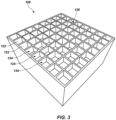
- FIG. 3 is a simplified perspective view of the elastomeric cushioning element 108.
- the elastomeric cushioning element 108 may include a singly-molded elastomeric cushioning element 108.
- the entirety of the elastomeric cushioning element 108 may be formed via a single molding process.
- the elastomeric cushioning element 108 includes buckling walls 122.
- the buckling walls 122 of the elastomeric cushioning element 108 are interconnected to one another and define hollow columns 124 or voids in an expanded form.
- the term "expanded form" means and includes a state in which an elastomeric cushioning element 108 has its original size and shape and wherein the buckling walls 122 are separated and define hollow columns 124.
- the buckling walls 122 may extend in two directions, intersecting at right angles, and defining square voids 126. However, in some embodiments, the buckling walls 122 may intersect at other angles and define voids 126 of other shapes, such as triangles, parallelograms, hexagons, etc.
- the elastomeric cushioning element 108 may comprise additional structures and configurations such as those structures and configurations described in, for example, U.S. Patent 8,434,748, titled “Cushions Comprising Gel Springs,” issued May 7, 2013 ; U.S. Patent 8,628,067, titled “Cushions Comprising Core Structures and Related Methods," issued January 14, 2014 ; U.S.
- Patent 8,919,750 titled “Cushioning Elements Comprising Buckling Walls and Methods of Forming Such Cushioning Elements," issued December 30, 2014 ; and U.S. Patent 8,932,692, titled “Cushions Comprising Deformable Members and Related Methods,” issued January 13, 2015 .
- the buckling walls 122 may be formed of an elastomeric material.
- Elastomeric materials are described in, for example, U.S. Patent 5,994,450, titled “Gelatinous Elastomer and Methods of Making and Using the Same and Articles Made Therefrom," issued November 30, 1999 (hereinafter "the '450 Patent”); U.S. Patent 7,964,664, titled “Gel with Wide Distribution of MW in Mid-Block" issued June 21, 2011 ; U.S. Patent 4,369,284, titled "Thermoplastic Elastomer Gelatinous Compositions" issued January 18, 1983 ; U.S.
- the elastomeric material may include an elastomeric polymer and a plasticizer.
- the elastomeric material may be a gelatinous elastomer (also referred to in the art as gel, elastomer gel, or elastomeric gel), a thermoplastic elastomer, a natural rubber, a synthetic elastomer, a blend of natural and synthetic elastomers, etc.
- the elastomeric polymer may be an A-B-A triblock copolymer such as styrene ethylene propylene styrene (SEPS), styrene ethylene butylene styrene (SEBS), and styrene ethylene ethylene propylene styrene (SEEPS).
- SEPS styrene ethylene propylene styrene
- SEBS styrene ethylene butylene styrene
- SEEPS styrene ethylene ethylene propylene styrene
- A-B-A triblock copolymers are currently commercially available from Kuraray America, Inc., of Houston, TX, under the trade name SEPTON ® 4055, and from Kraton Polymers, LLC, of Houston, TX, under the trade names KRATON ® E1830, KRATON ® G1650, and KRATON ® G1651.
- the "A" blocks are styrene.
- the "B” block may be rubber (e.g ., butadiene, isoprene, etc. ) or hydrogenated rubber (e.g ., ethylene/propylene or ethylene/butylene or ethylene/ethylene/propylene) capable of being plasticized with mineral oil or other hydrocarbon fluids.
- the elastomeric material may include elastomeric polymers other than styrene-based copolymers, such as non-styrenic elastomeric polymers that are thermoplastic in nature or that can be solvated by plasticizers or that are multi-component thermoset elastomers.
- the elastomeric material may include one or more plasticizers, such as hydrocarbon fluids.
- plasticizers such as hydrocarbon fluids.
- elastomeric materials may include aromatic-free food-grade white paraffinic mineral oils, such as those sold by Sonneborn, Inc., of Mahwah, NJ, under the trade names BLANDOL ® and CARNATION ® .
- the elastomeric material may have a plasticizer-to-polymer ratio from about 0.1:1 to about 50:1 by weight.
- elastomeric materials may have plasticizer-to-polymer ratios from about 1:1 to about 30:1 by weight, or even from about 1.5:1 to about 10:1 by weight.
- elastomeric materials may have plasticizer-to-polymer ratios of about 4:1 by weight.
- the elastomeric material may have one or more fillers (e.g., lightweight microspheres). Fillers may affect thermal properties, density, processing, etc., of the elastomeric material.
- Fillers may affect thermal properties, density, processing, etc., of the elastomeric material.
- hollow microspheres e.g., hollow glass microspheres or hollow acrylic microspheres
- hollow microspheres may decrease the thermal conductivity of the elastomeric material by acting as an insulator because such hollow microspheres (e.g., hollow glass microspheres or hollow acrylic microspheres) may have lower thermal conductivity than the plasticizer or the polymer.
- metal particles e.g., aluminum, copper, etc .
- Microspheres filled with wax or another phase-change material may provide temperature stability at or near the phase-change temperature of the wax or other phase-change material within the microspheres ( i.e., due to the heat of fusion of the phase change).
- the phase-change material may have a melting point from about 20°C to about 45°C.
- the elastomeric material may also include antioxidants.
- Antioxidants may reduce the effects of thermal degradation during processing or may improve long-term stability.
- Antioxidants include, for example, pentaerythritol tetrakis(3-(3,5-di-tert-butyl-4-hydroxyphenyl) propionate), commercially available as IRGANOX ® 1010, from BASF Corp., of Iselin, NJ or as EVERNOX ® -10, from Everspring Corp. USA, of Los Angeles, CA; octadecyl-3-(3,5-di-tert-butyl-4-hydroxyphenyl) propionate, commercially available as IRGANOX ® 1076, from BASF Corp.
- One or more antioxidants may be combined in a single formulation of elastomeric material.
- the use of antioxidants in mixtures of plasticizers and polymers is described in columns 25 and 26 of the '450 Patent.
- the elastomeric material may include up to about 5 wt% antioxidants.
- the elastomeric material may include from about 0.10 wt% to about 1.0 wt% antioxidants.
- the elastomeric material may include a resin.
- the resin may be selected to modify the elastomeric material to slow a rebound of the elastomeric cushioning element 108 after deformation.
- the resin if present, may include a hydrogenated pure monomer hydrocarbon resin, such as those commercially available from Eastman Chemical Company, of Kingsport, TN, under the trade name REGALREZ ® .
- the resin if present, may function as a tackifier, increasing the stickiness of a surface of the elastomeric material.
- the elastomeric material may include a pigment or a combination of pigments.
- Pigments may be aesthetic and/or functional. That is, pigments may provide the elastomeric cushioning element 108 with an appearance appealing to consumers.
- an elastomeric cushioning element 108 having a dark color may absorb radiation differently than an elastomeric cushioning element 108 having a light color.
- the elastomeric material may include any type of gelatinous elastomer.
- the elastomeric material may include a melt-blend of one part by weight of a styrene-ethylene-ethylene-propylene-styrene (SEEPS) elastomeric triblock copolymer (e.g., SEPTON ® 4055) with four parts by weight of a 70-weight straight-cut white paraffinic mineral oil (e.g., CARNATION ® white mineral oil) and, optionally, pigments, antioxidants, and/or other additives.
- SEEPS styrene-ethylene-ethylene-propylene-styrene
- the elastomeric material may include a material that may return to its original shape after deformation, and that may be elastically stretched.
- the elastomeric material may be rubbery in feel, but may deform to the shape of an object applying a deforming pressure better than conventional rubber materials, and may have a durometer hardness lower than conventional rubber materials.
- the elastomeric material may have a hardness on the Shore A scale of less than about 50, from about 0.1 to about 50, or less than about 5.
- a configuration of having the coil layer 104 with the upper layer 106 on top of the coil layer 104 and the elastomeric cushioning element 108 on top of the upper layer 106 may provide advantages over conventional mattress assemblies.
- the plurality of coils 118 of the coil layer 104 may better conform to an upper surface of the mattress assembly 100.
- a weight e.g., a person on the mattress assembly 100
- the plurality of coils 118 of the coil layer 104 may better conform to the deformation.
- the configuration may provide an increase in lateral stability in comparison to conventional mattress assemblies.
- the foregoing configuration may make methods of manufacturing the mattress assembly 100 easier in comparison to conventional methods of manufacturing mattresses because it removes a need to laminate/glue the coil layer 104 to the elastomeric cushioning element 108.
- Having the upper layer 106 between the coil layer 104 and the elastomeric cushioning element 108 provides a porous surface to adhere to both of the coil layer 104 and the elastomeric cushioning element 108.
- the upper layer 106 dampens sound from the coil layer 104.
- FIGS. 4-7 show schematic side cross-sectional views of mattress assemblies according to embodiments of the present disclosure.
- the elastomeric cushioning element 108 may not cover an entirety of an upper surface of the upper layer 106 of the mattress assembly 100.
- the mattress assembly 100 may further include one or more segments 128 of foam (e.g., a polyurethane foam) in place of the elastomeric cushioning element 108 to provide an at least substantially planar upper surface of the mattress assembly 100.
- the one or more segments 128 of foam may be disposed adjacent to the elastomeric cushioning element 108 on the upper layer 106 of the mattress assembly 100.
- the elastomeric cushioning element 108 may be disposed only over a center portion of the upper layer 106 of the mattress assembly 100.
- the elastomeric cushioning element 108 may not cover a portion of the upper layer 106 extending around a perimeter of the upper layer 106 of the mattress assembly 100.
- the segments of foam 128 may be disposed over the portion of the upper layer 106 extending around a perimeter of the upper layer 106.
- the foregoing configuration may be utilized with mattress sizes where only one sleeper is expected (i.e., twin and full sized mattress).
- the elastomeric cushioning element 108 may be disposed only in areas anticipated as predominant sleeping areas of sleepers.
- the elastomeric cushioning element 108 may include two separate sections centered on opposing longitudinal halves of the mattress assembly 100.
- the foregoing configuration may be utilized with mattress sizes where two sleepers are expected (i.e., king, queen, and full sized mattresses).
- the foregoing embodiment is described in further detail with reference to FIG. 8 .
- a thickness of the elastomeric cushioning element 108 may vary.
- the elastomeric cushioning element 108 has a thickness T of within a range of about 2.0 inches (5.08 cm) to about 4.5 inches (11.43 cm).
- the thickness T of the elastomeric cushioning element 108 may comprise between about 15.0% and about 20.0% of an overall thickness of the mattress assembly 100.
- the elastomeric cushioning element 108 may have a thickness T of about 2.0 inches (5.08 cm) and a thickness T that comprises about 18.2% of the overall thickness of the mattress assembly 100.
- the elastomeric cushioning element 108 may have a thickness T of within a range of about 2.5 inches (6.35 cm) to about 3.5 inches (8.89 cm). Moreover, in some embodiments, the thickness T of the elastomeric cushioning element 108 may comprise between about 20.0% and about 30.0% of an overall thickness of the mattress assembly 100. For example, the elastomeric cushioning element 108 may have a thickness T of about 3.0 inches (7.62 cm) and a thickness T that comprises about 25.0% of the overall thickness of the mattress assembly 100. In further embodiments, the elastomeric cushioning element 108 may have a thickness T of within a range of about 3.5 inches (8.89 cm) to about 4.5 inches (11.43 cm).
- the thickness T of the elastomeric cushioning element 108 may comprise between about 30.0% and about 35.0% of an overall thickness of the mattress assembly 100.
- the elastomeric cushioning element 108 may have a thickness T of about 4.0 inches (10.16 cm) and a thickness T that comprises about 30.8% of the overall thickness of the mattress assembly 100.
- the upper layer 106 of the mattress assembly 100 may have a thickness within a range of about 0.25 inch (0.635 cm) and about 0.75 inch (1.905 cm). For instance, the upper layer 106 of the mattress assembly 100 may have a thickness of about 0.50 inch (1.27 cm). Additionally, the coil layer 104 of the mattress assembly 100 may have a thickness (e.g., height) within range of about 6.0 inches (15.24 cm) and about 9.0 inches (22.86 cm). For example, the coil layer 104 of the mattress assembly 100 may have a thickness of about 7.5 inches (1.905 cm).
- the base layer 102 of the mattress assembly 100 may a thickness within a range of about 0.50 inch (1.27 cm) and about 1.50 inches (3.81 cm). As a non-limiting example, the base layer 102 may have a thickness of about 1.00 inch (2.54 cm).
- FIGS. 8 and 9 show top views of mattress assemblies according to embodiments of the present disclosure.
- the mattress assembly 800 may include one or more elastomeric cushioning element sections 802, 804 (e.g., a plurality of distinct elastomeric cushioning elements).
- the one or more elastomeric cushioning element sections 802, 804 may be disposed (e.g., located) in anticipated sleeping areas of one or more sleepers.
- the mattress assembly 800 may include a first elastomeric cushioning element section 802 and a second elastomeric cushioning element section 804.
- the first elastomeric cushioning element section 802 may be centered longitudinally within a first half 806 of the overall mattress assembly 800 (divided longitudinally), and the second elastomeric cushioning element section 804 may be centered longitudinally within a second half 808 of the overall mattress assembly 800.
- each of the first elastomeric cushioning element section 802 and the second elastomeric cushioning element section 804 may have a width within a range of about 22.0 inches (55.88 cm) to about 28.0 inches (71.12 cm).
- each of the first and second elastomeric cushioning element sections 802, 804 may have a width of about 25.0 inches (63.5 cm).
- each of the first and second elastomeric cushioning element sections 802, 804 may have a length (e.g., longitudinal length) within a range of about 50.0 inches (127 cm) to about 65 inches (165.1 cm).
- the first and second elastomeric cushioning element sections 802, 804 may have a length of about 56.0 inches (142.24 cm).
- a polyurethane foam 810 may be disposed where coverage is not provided by the first and second elastomeric cushioning element sections 802, 804.
- the polyurethane foam 810 may include a polyurethane foam having a nominal density of about 2.0 lb/ft 3 (about 32 kg/m 3 ) and 18 ILD.
- the elastomeric cushioning element 902 may provide complete coverage over a mattress assembly 900.
- the elastomeric cushioning element 902 may cover at least substantially an entire upper surface of the upper layer 106 ( FIG. 2 ) of the mattress assembly 900.
- FIG. 10 shows a schematic flowchart of a method 1000 of forming a mattress assembly 100.
- the method 1000 includes an act 1010 of disposing a coil layer 104 over a base layer 102.
- act 1010 may include disposing a plurality of coils 118 within a plurality of casings 120, wherein each coil 118 of the plurality of coils 118 is disposed within at least two respective casings 120, and disposing the plurality of coils 118 over the base layer 102.
- act 1010 can include disposing the plurality of coils 118 within polypropylene bags.
- act 1010 may include orienting the plurality of coils 118 within an array (e.g., rows and columns) over the base layer 102.
- act 1010 may include disposing the coil layer 104 over the base layer 102 according to any of the configurations described above in regard to FIGS. 1 , 2 , and 4-7 .
- the method 1000 includes an act 1020 of disposing an upper layer 106 over the coil layer 104.
- act 1020 may not include disposing a stabilization material between the coil layer 104 and the upper layer 106.
- act 1020 may include disposing an adhesive between the coil layer 104 and the upper layer 106.
- act 1020 may include disposing any of the adhesives described above between the coil layer 104 and the upper layer 106.
- act 1020 may include disposing an upper layer 106 over the coil layer 104 according to any of the configurations described above in regard to FIGS. 1 , 2 , and 4-7 .
- the method 1000 includes an act 1030 of disposing an elastomeric cushioning element 108 over the upper layer 106.
- Act 1030 includes disposing an elastomeric cushioning element 108 over the upper layer 106 that comprises between about 15.0% and about 32.0% of an overall thickness of the mattress assembly 100.
- a thickness of the elastomeric cushioning element 108 comprises between about 20.0% and about 32.0% of an overall thickness of the mattress assembly 100.
- act 1030 can include disposing an elastomeric cushioning element 108 over the upper layer 106 that comprises between about 25.0% and about 32.0% of an overall thickness of the mattress assembly 100.
- act 1030 can include disposing an elastomeric cushioning element 108 over the upper layer 106 that comprises between about 30.0% and about 32.0% of an overall thickness of the mattress assembly 100.
- act 1030 can include disposing an elastomeric cushioning element 108 over the upper layer 106 that comprises about 30.8% of an overall thickness of the mattress assembly 100.
- act 1030 can include disposing a plurality of elastomeric cushioning element 108 segments over the upper layer 106. Moreover, act 1030 can include disposing an elastomeric cushioning element 108 over the upper layer 106 according to any of the configurations described above and including any of the materials described in regard to FIGS. 1-9 .
- the method 1000 includes act 1040 of disposing an outer covering 112 over at least the upper layer 106.
- act 1040 can include disposing an outer covering 112 over the mattress assembly 100 such that the outer covering 112 covers at least substantially an entirety of the upper layer 106 and side panels 114 of the mattress assembly 100.
- the method 600 can include disposing an adhesive between any of the layers of the mattress assembly 100.
Landscapes
- Mattresses And Other Support Structures For Chairs And Beds (AREA)
Description
- This application claims the benefit of the filing date of
United States Patent Application Serial No. 15/816,983, filed November 17, 2017 - Embodiments of the disclosure relate generally to cushioning elements such as mattresses including a pocketed coil layer, and to methods of making such mattresses.
- Cushioning materials have a variety of uses, such as for mattresses, seating surfaces, shoe inserts, packaging, medical devices, etc. Cushioning materials may be formulated and/or configured to reduce peak pressure on a cushioned body, which may increase comfort for humans or animals, and may protect objects from damage. Cushioning materials may be formed of materials that deflect or deform under load, such as polyethylene or polyurethane foams (e.g., convoluted foam), vinyl, rubber, springs, natural or synthetic fibers, fluid-filled flexible containers, etc. Different cushioning materials may have different responses to a given pressure, and some materials may be well suited to different applications. Cushioning materials may be used in combination with one another to achieve selected properties. For example, mattresses may include pocketed coils in combination with layers of foam, elastomer gels, etc., in order to achieve desired results in the cushioning materials.
- In mattresses, springs (e.g., coil springs) may be preferable to foam for their durability and ability to withstand compression. Springs may also impart a feel that may be more desirable to users than that of foam. Despite these advantages, springs may not provide a positive aesthetic and/or tactile experience if they are seen or felt through side panels of the mattress, prompting manufacturers to conceal the feel of springs on the sides of mattresses. One solution includes a wire frame around the edge of the mattress to provide structure to a cover of the mattress. However, the metal of the wire frame may be felt through the cover of the mattress. In addition, such a wire frame may not be particularly suited to handle compression during use and to packing mattresses for shipping and/or storage, such as direct-to-consumer mattresses that are shipped in logs, boxes, etc.
-
WO 2011/072022 A1 describes a pillowtop mattress which comprises a base mattress and a renewable pillowtop removably attached to the base mattress portion. - The present invention provides a mattress assembly according to claim 1.
- The present invention further provides a method of forming a mattress assembly according to claim 13.
- While the specification concludes with claims particularly pointing out and distinctly claiming what are regarded as embodiments of the present disclosure, various features and advantages of embodiments of the disclosure may be more readily ascertained from the following description of example embodiments of the disclosure when read in conjunction with the accompanying drawings, in which:
-
FIG. 1 is a perspective view of a mattress assembly according to the present disclosure; -
FIG. 2 is a simplified perspective view of the mattress assembly ofFIG. 1 ; -
FIG. 3 is a perspective view of an elastomeric cushioning element according to one or more embodiments of the present disclosure; -
FIG. 4 is a side cross-sectional view of a mattress assembly according to one or more embodiments of the present disclosure; -
FIG. 5 is a side cross-sectional view of a mattress assembly according to one or more embodiments of the present disclosure; -
FIG. 6 is a side cross-sectional view of a mattress assembly according to one or more embodiments of the present disclosure; -
FIG. 7 is a side cross-sectional view of a mattress assembly according to one or more embodiments of the present disclosure; -
FIG. 8 is a top schematic view of a mattress assembly according to one or more embodiments of the present disclosure; -
FIG. 9 is a top schematic view of a mattress assembly according to one or more embodiments of the present disclosure; and -
FIG. 10 is a flowchart of a method of forming a mattress assembly according to one or more embodiments of the present disclosure. - The following description provides specific details, such as material types, manufacturing processes, uses, and structures in order to provide a thorough description of embodiments of the disclosure. However, a person of ordinary skill in the art will understand that the embodiments of the disclosure may be practiced without employing these specific details. Indeed, the embodiments of the disclosure may be practiced in conjunction with conventional manufacturing techniques and materials employed in the industry.
- In the following detailed description, reference is made to the accompanying drawings, which form a part hereof, and in which is shown, by way of illustration, specific embodiments in which the disclosure may be practiced. These embodiments are described in sufficient detail to enable a person of ordinary skill in the art to practice the disclosure. However, other embodiments may be utilized, and structural, procedural, and other changes may be made without departing from the scope of the disclosure. The illustrations presented herein are not meant to be actual views of any particular system, device, structure, or process, but are idealized representations that are employed to describe the embodiments of the disclosure. The drawings presented herein are not necessarily drawn to scale. Similar structures or components in the various drawings may retain the same or similar numbering for the convenience of the reader; however, the similarity in numbering does not mean that the structures or components are necessarily identical in size, composition, configuration, or other property.
- As used herein, any relational term, such as "first," "second," "top," "bottom," "upper," "base," etc., is used for clarity and convenience in understanding the disclosure and accompanying drawings, and does not connote or depend on any specific preference or order, except where the context clearly indicates otherwise. For example, these terms may refer to an orientation of elements of a mattress when oriented for sleeping in a conventional manner. Furthermore, these terms may refer to an orientation of elements of a mattress assembly as illustrated in the drawings.
- As used herein, the term "substantially" in reference to a given parameter, property, or condition means and includes to a degree that one skilled in the art would understand that the given parameter, property, or condition is met with a small degree of variance, such as within acceptable manufacturing tolerances. For example, a parameter that is substantially met may be at least about 90% met, at least about 95% met, or even at least about 99% met.
- As used herein, the term "elastomeric polymer" means and includes a polymer capable of recovering its original size and shape after deformation. In other words, an elastomeric polymer is a polymer having elastic or viscoelastic properties. Elastomeric polymers may also be referred to as "elastomers" in the art. Elastomeric polymers include, without limitation, homopolymers (polymers having a single chemical unit repeated) and copolymers (polymers having two or more chemical units).
- As used herein, the term "elastomeric block copolymer" means and includes an elastomeric polymer having groups or blocks of homopolymers linked together, such as A-B diblock copolymers and A-B-A triblock copolymers. A-B diblock copolymers have two distinct blocks of homopolymers. A-B-A triblock copolymers have two blocks of a single homopolymer (A) each linked to a single block of a different homopolymer (B).
- As used herein, the term "plasticizer" means and includes a substance added to another material (e.g., an elastomeric polymer) to increase a workability of the material. For example, a plasticizer may increase the flexibility, softness, or extensibility of the material. Plasticizers include, without limitation, hydrocarbon fluids, such as mineral oils. Hydrocarbon plasticizers may be aromatic or aliphatic.
- As used herein, the term "elastomeric material" means and includes elastomeric polymers and mixtures of elastomeric polymers with plasticizers and/or other materials. Elastomeric materials are elastic (i.e., capable of recovering size and shape after deformation). Elastomeric materials include, without limitation, materials referred to in the art as "elastomer gels," "gelatinous elastomers," or simply "gels."
- Embodiments of the present disclosure include a mattress assembly having an elastomeric cushioning element that comprises between about 15.0% and about 32.0% of an overall thickness of the mattress assembly. For example, the elastomeric cushioning element may comprise about 30.8% of the overall thickness of the mattress assembly.
- The mattress assembly according to the invention has a coil layer that includes a plurality of coils with each coil of the plurality of coils being disposed in multiple casings (e.g., bags). For example, each coil may be disposed within two or more polypropylene bags.
- Further embodiments of the present disclosure include a mattress assembly having a latex water based adhesive disposed between one or more layers of the mattress assembly.
-
FIG. 1 shows amattress assembly 100 according to one or more embodiments of the present disclosure.FIG. 2 shows a simplified top perspective view of themattress assembly 100 ofFIG. 1 . InFIG. 2 , various portions of themattress assembly 100 are removed to provide a cutaway view and to better show internal components of themattress assembly 100. Referring toFIGS. 1 and2 together, in one or more embodiments, themattress assembly 100 includes abase layer 102, acoil layer 104, anupper layer 106, anelastomeric cushioning element 108, and anouter covering 112, and may include anedge portion 119, and one ormore side panels 114. - The
base layer 102 may have generally planar top and bottom surfaces. Thecoil layer 104 is disposed on the top surface of thebase layer 102 and between thebase layer 102 and theupper layer 106. In particular, theupper layer 106 is disposed over and may at least substantially extend over thecoil layer 104. Theelastomeric cushioning element 108 is disposed over an upper surface of theupper layer 106 and may extend over at least a portion of theupper layer 106. Theedge portion 119 may extend around an outer peripheral edge of theelastomeric cushioning element 108. The one ormore side panels 114 may extend along outer perimeters of thebase layer 102 and theupper layer 106 and may be disposed between theupper layer 106 and thebase layer 102. Furthermore, the one ormore side panels 114 may extend within a plane perpendicular to a plane defined by the top surface of thebase layer 102. Theouter covering 112 may extend from thebase layer 102 and encases thecoil layer 104,upper layer 106, andelastomeric cushioning element 108. - The
mattress assembly 100 includes astabilization material 116 between theelastomeric cushioning element 108 and theupper layer 106. Thestabilization material 116 includes a relatively thin material (e.g., cotton spandex blend "scrim") and may be used to provide a surface for adhering (e.g., gluing) theelastomeric cushioning element 108 to surrounding materials, such as anotherelastomeric cushioning element 108 and/or an upper surface of theupper layer 106. Thestabilization material 116 comprises the relatively thin material or a scrim fabric (e.g., a woven or non-woven fabric material) and portions of theelastomeric cushioning element 108 seep through (e.g., be melt-fused into, bleed through, push through, leak through, pass through, etc.) thestabilization material 116. For example, when theelastomeric cushioning element 108 includes a gel material (as described below), portions of the gel material may be heat fused through thestabilization material 116. The portions of theelastomeric cushioning element 108 that extend through the scrim fabric of thestabilization material 116 create a non-slip surface or reduced slip surface on a lower surface of the stabilization material 116 (e.g., surface that would contact an upper surface of the upper layer 106). The non-slip surface or reduced slip surface created by theelastomeric cushioning element 108 may help the cushioning materials stay in place relative to one another. - Furthermore, in some embodiments, an adhesive may be disposed between the
stabilization material 116 and the upper surface of theupper layer 106. However, an adhesive may not be disposed between theedge portion 119 and theupper layer 106. Furthermore, an adhesive may be disposed between thebase layer 102 and thecoil layer 104. Moreover, an adhesive may be disposed between thecoil layer 104 and theupper layer 106. Additionally, an adhesive may be disposed between the one ormore side panels 114 and thecoil layer 104. In some embodiments the adhesive(s) may include a latex water based adhesive. For instance, in one or more embodiments, the adhesive(s) may include one or more of SIMALFA® 338 and SIMALFA® 310. - In some instances, an adhesive may be disposed between the
stabilization material 116 and the upper surface of theupper layer 106. For example, the adhesive may include any of the adhesives described above. - In some embodiments, the
outer covering 112 may comprise a stretchable material that may be secured to or be integral with theelastomeric cushioning element 108. Such a stretchable material is described inU.S. Patent Application No. 15/062,621, to Pearce, filed March 7, 2016 . - The
upper layer 106 comprises a foam and is disposed over thecoil layer 104. In one or more embodiments, thebase layer 102 and theupper layer 106 may include a polyurethane foam. In additional embodiments, thebase layer 102 and theupper layer 106 may include one or more of a memory polyurethane foam, a latex foam rubber, or any other suitable foam. In some embodiments, thebase layer 102 may include a polyurethane foam having a nominal density of about 2.0 lb/ft3 (about 32 kg/m3) and an indention load deflection (ILD) of 55 (i.e., 55 ILD). Additionally, theupper layer 106 may include a polyurethane foam having a nominal density of about 2.0 lb/ft3 (about 32 kg/m3) and 18 ILD. The one ormore side panels 114 may also include a polyurethane foam or any other spacer fabric known in the art. For example, the one ormore side panels 114 may include any of the side panels described inU.S. Patent Application No. 15/662,934, to Moon et al., filed July 28, 2017 - The
coil layer 104 includes a plurality of coils 118 (e.g., steel coils), and eachcoil 118 of the plurality ofcoils 118 is encased in at least one respective casing 120 (e.g., polypropylene socks or bags). Eachcasing 120 forms a pocket for arespective coil 118. In other words, the plurality ofcoils 118 includes a plurality of pocketed coils 118. In some embodiments, eachcoil 118 may include a relatively thin-gauge, barrel-shaped (e.g., helical-shaped), knotless coil. Furthermore, in one or more embodiments, eachcoil 118 may be encased inmultiple casings 120. For instance, eachcoil 118 may be double bagged or triple bagged. In one or more embodiments, thecasings 120 may include a polypropylene material. - The
casings 120 may include a two-ply polypropylene non-woven material. In one or more embodiments, the polypropylene non-woven material may include one or more of BERRY® products 1430408, 1430379, and 1430538. In some embodiments, each ply of thecasings 120 may have a thickness within a range of about 0.10 mm and about 0.40 mm. As a non-limiting example, each ply of thecasings 120 may have a thickness within a range of about 0.15 mm and about 0.30 mm. However, any suitable material may be used. Thecasings 120 may provide sound dampening effects. - For example, the
mattress assembly 100 was tested according to a test method of utilizing the application SOUND METER by Abc Apps from the Google Play Store on a Galaxy S6 Active phone to measure sound levels from themattress assembly 100. During the test method, a 3x3 coil structure having eachcoil 118 covered by the above-describedcasings 120 was compressed multiple times for the duration of 15 seconds, and the 3x3 coil structure exhibited an average sound level within a range of about 35 decibels and about 45 decibels. For example, the 3x3 coil structure exhibited an average sound level of about 40 decibels. In comparison, conventional mattresses, when tested according to the above test method, exhibited an average sound level of about 50 decibels. Accordingly, by encasing eachcoil 118 with multiple casings 120 (e.g., afirst casing 120 and a second casing 120), themattress assembly 100 of the present disclosure may be advantageous over conventional mattress assemblies. For example, themattress assembly 100 may be quieter than conventional mattresses (e.g., may exhibit about 20% less sound than conventional mattresses). - In some embodiments, each
casing 120 of eachcoil 118 of the plurality ofcoils 118 may be individual and discrete. In additional embodiments, thecasings 120 of the plurality ofcoils 118 may be connected (i.e., joined) and may form a single body. Furthermore, eachcoil 118 of the plurality ofcoils 118 may extend longitudinally in a direction at least substantially orthogonal (i.e., normal) to an upper surface of thebase layer 102. Furthermore, the plurality ofcoils 118 may be oriented next to each other in an array (e.g., rows and columns or a grid pattern) to form thecoil layer 104. -
FIG. 3 is a simplified perspective view of theelastomeric cushioning element 108. Theelastomeric cushioning element 108 may include a singly-moldedelastomeric cushioning element 108. For example, the entirety of theelastomeric cushioning element 108 may be formed via a single molding process. Theelastomeric cushioning element 108 includes bucklingwalls 122. The bucklingwalls 122 of theelastomeric cushioning element 108 are interconnected to one another and definehollow columns 124 or voids in an expanded form. As used herein, the term "expanded form" means and includes a state in which anelastomeric cushioning element 108 has its original size and shape and wherein the bucklingwalls 122 are separated and definehollow columns 124. - The buckling
walls 122 may extend in two directions, intersecting at right angles, and defining square voids 126. However, in some embodiments, the bucklingwalls 122 may intersect at other angles and definevoids 126 of other shapes, such as triangles, parallelograms, hexagons, etc. Theelastomeric cushioning element 108 may comprise additional structures and configurations such as those structures and configurations described in, for example,U.S. Patent 8,434,748, titled "Cushions Comprising Gel Springs," issued May 7, 2013 ;U.S. Patent 8,628,067, titled "Cushions Comprising Core Structures and Related Methods," issued January 14, 2014 ;U.S. Patent 8,919,750, titled "Cushioning Elements Comprising Buckling Walls and Methods of Forming Such Cushioning Elements," issued December 30, 2014 ; andU.S. Patent 8,932,692, titled "Cushions Comprising Deformable Members and Related Methods," issued January 13, 2015 . - The buckling
walls 122 may be formed of an elastomeric material. Elastomeric materials are described in, for example,U.S. Patent 5,994,450, titled "Gelatinous Elastomer and Methods of Making and Using the Same and Articles Made Therefrom," issued November 30, 1999 (hereinafter "the '450 Patent");U.S. Patent 7,964,664, titled "Gel with Wide Distribution of MW in Mid-Block" issued June 21, 2011 ;U.S. Patent 4,369,284, titled "Thermoplastic Elastomer Gelatinous Compositions" issued January 18, 1983 ;U.S. Patent 8,919,750, titled "Cushioning Elements Comprising Buckling Walls and Methods of Forming Such Cushioning Elements," issued December 30, 2014 (hereinafter "the '750 Patent"). The elastomeric material may include an elastomeric polymer and a plasticizer. The elastomeric material may be a gelatinous elastomer (also referred to in the art as gel, elastomer gel, or elastomeric gel), a thermoplastic elastomer, a natural rubber, a synthetic elastomer, a blend of natural and synthetic elastomers, etc. - The elastomeric polymer may be an A-B-A triblock copolymer such as styrene ethylene propylene styrene (SEPS), styrene ethylene butylene styrene (SEBS), and styrene ethylene ethylene propylene styrene (SEEPS). For example, A-B-A triblock copolymers are currently commercially available from Kuraray America, Inc., of Houston, TX, under the trade name SEPTON® 4055, and from Kraton Polymers, LLC, of Houston, TX, under the trade names KRATON® E1830, KRATON® G1650, and KRATON® G1651. In these examples, the "A" blocks are styrene. The "B" block may be rubber (e.g., butadiene, isoprene, etc.) or hydrogenated rubber (e.g., ethylene/propylene or ethylene/butylene or ethylene/ethylene/propylene) capable of being plasticized with mineral oil or other hydrocarbon fluids. The elastomeric material may include elastomeric polymers other than styrene-based copolymers, such as non-styrenic elastomeric polymers that are thermoplastic in nature or that can be solvated by plasticizers or that are multi-component thermoset elastomers.
- The elastomeric material may include one or more plasticizers, such as hydrocarbon fluids. For example, elastomeric materials may include aromatic-free food-grade white paraffinic mineral oils, such as those sold by Sonneborn, Inc., of Mahwah, NJ, under the trade names BLANDOL® and CARNATION®.
- In some embodiments, the elastomeric material may have a plasticizer-to-polymer ratio from about 0.1:1 to about 50:1 by weight. For example, elastomeric materials may have plasticizer-to-polymer ratios from about 1:1 to about 30:1 by weight, or even from about 1.5:1 to about 10:1 by weight. In further embodiments, elastomeric materials may have plasticizer-to-polymer ratios of about 4:1 by weight.
- The elastomeric material may have one or more fillers (e.g., lightweight microspheres). Fillers may affect thermal properties, density, processing, etc., of the elastomeric material. For example, hollow microspheres (e.g., hollow glass microspheres or hollow acrylic microspheres) may decrease the thermal conductivity of the elastomeric material by acting as an insulator because such hollow microspheres (e.g., hollow glass microspheres or hollow acrylic microspheres) may have lower thermal conductivity than the plasticizer or the polymer. As another example, metal particles (e.g., aluminum, copper, etc.) may increase the thermal conductivity of the resulting elastomeric material because such particles may have greater thermal conductivity than the plasticizer or polymer. Microspheres filled with wax or another phase-change material (i.e., a material formulated to undergo a phase change near a temperature at which a cushioning element may be used) may provide temperature stability at or near the phase-change temperature of the wax or other phase-change material within the microspheres (i.e., due to the heat of fusion of the phase change). The phase-change material may have a melting point from about 20°C to about 45°C.
- The elastomeric material may also include antioxidants. Antioxidants may reduce the effects of thermal degradation during processing or may improve long-term stability. Antioxidants include, for example, pentaerythritol tetrakis(3-(3,5-di-tert-butyl-4-hydroxyphenyl) propionate), commercially available as
IRGANOX ® 1010, from BASF Corp., of Iselin, NJ or as EVERNOX®-10, from Everspring Corp. USA, of Los Angeles, CA; octadecyl-3-(3,5-di-tert-butyl-4-hydroxyphenyl) propionate, commercially available as IRGANOX® 1076, from BASF Corp. or as EVERNOX® 76, from Everspring Chemical; and tris(2,4-di-tert-butylphenyl)phosphite, commercially available as IRGAFOS® 168, from BASF Corp. or as EVERFOS® 168, from Everspring Chemical. One or more antioxidants may be combined in a single formulation of elastomeric material. The use of antioxidants in mixtures of plasticizers and polymers is described in columns 25 and 26 of the '450 Patent. The elastomeric material may include up to about 5 wt% antioxidants. For instance, the elastomeric material may include from about 0.10 wt% to about 1.0 wt% antioxidants. - In some embodiments, the elastomeric material may include a resin. The resin may be selected to modify the elastomeric material to slow a rebound of the
elastomeric cushioning element 108 after deformation. The resin, if present, may include a hydrogenated pure monomer hydrocarbon resin, such as those commercially available from Eastman Chemical Company, of Kingsport, TN, under the trade name REGALREZ®. The resin, if present, may function as a tackifier, increasing the stickiness of a surface of the elastomeric material. - In some embodiments, the elastomeric material may include a pigment or a combination of pigments. Pigments may be aesthetic and/or functional. That is, pigments may provide the
elastomeric cushioning element 108 with an appearance appealing to consumers. In addition, anelastomeric cushioning element 108 having a dark color may absorb radiation differently than anelastomeric cushioning element 108 having a light color. - The elastomeric material may include any type of gelatinous elastomer. For example, the elastomeric material may include a melt-blend of one part by weight of a styrene-ethylene-ethylene-propylene-styrene (SEEPS) elastomeric triblock copolymer (e.g., SEPTON® 4055) with four parts by weight of a 70-weight straight-cut white paraffinic mineral oil (e.g., CARNATION® white mineral oil) and, optionally, pigments, antioxidants, and/or other additives.
- The elastomeric material may include a material that may return to its original shape after deformation, and that may be elastically stretched. The elastomeric material may be rubbery in feel, but may deform to the shape of an object applying a deforming pressure better than conventional rubber materials, and may have a durometer hardness lower than conventional rubber materials. For example, the elastomeric material may have a hardness on the Shore A scale of less than about 50, from about 0.1 to about 50, or less than about 5.
- Referring again to
FIG. 2 again, a configuration of having thecoil layer 104 with theupper layer 106 on top of thecoil layer 104 and theelastomeric cushioning element 108 on top of theupper layer 106 may provide advantages over conventional mattress assemblies. For example, in comparison to conventional mattress assemblies, the plurality ofcoils 118 of thecoil layer 104 may better conform to an upper surface of themattress assembly 100. For instance, when subjected to a weight (e.g., a person on the mattress assembly 100) and a resulting deformation, the plurality ofcoils 118 of thecoil layer 104 may better conform to the deformation. Furthermore, the configuration may provide an increase in lateral stability in comparison to conventional mattress assemblies. Additionally, the foregoing configuration may make methods of manufacturing themattress assembly 100 easier in comparison to conventional methods of manufacturing mattresses because it removes a need to laminate/glue thecoil layer 104 to theelastomeric cushioning element 108. Having theupper layer 106 between thecoil layer 104 and theelastomeric cushioning element 108 provides a porous surface to adhere to both of thecoil layer 104 and theelastomeric cushioning element 108. Furthermore, theupper layer 106 dampens sound from thecoil layer 104. -
FIGS. 4-7 show schematic side cross-sectional views of mattress assemblies according to embodiments of the present disclosure. As shown inFIG. 4 , in some embodiments, theelastomeric cushioning element 108 may not cover an entirety of an upper surface of theupper layer 106 of themattress assembly 100. In such embodiments, themattress assembly 100 may further include one ormore segments 128 of foam (e.g., a polyurethane foam) in place of theelastomeric cushioning element 108 to provide an at least substantially planar upper surface of themattress assembly 100. For instance, the one ormore segments 128 of foam may be disposed adjacent to theelastomeric cushioning element 108 on theupper layer 106 of themattress assembly 100. - In some embodiments, the
elastomeric cushioning element 108 may be disposed only over a center portion of theupper layer 106 of themattress assembly 100. For example, theelastomeric cushioning element 108 may not cover a portion of theupper layer 106 extending around a perimeter of theupper layer 106 of themattress assembly 100. In such embodiments, the segments offoam 128 may be disposed over the portion of theupper layer 106 extending around a perimeter of theupper layer 106. The foregoing configuration may be utilized with mattress sizes where only one sleeper is expected (i.e., twin and full sized mattress). - In additional embodiments, the
elastomeric cushioning element 108 may be disposed only in areas anticipated as predominant sleeping areas of sleepers. For example, theelastomeric cushioning element 108 may include two separate sections centered on opposing longitudinal halves of themattress assembly 100. The foregoing configuration may be utilized with mattress sizes where two sleepers are expected (i.e., king, queen, and full sized mattresses). Furthermore, the foregoing embodiment is described in further detail with reference toFIG. 8 . - As show in
FIGS. 5-7 , a thickness of theelastomeric cushioning element 108 may vary. According to the invention, theelastomeric cushioning element 108 has a thickness T of within a range of about 2.0 inches (5.08 cm) to about 4.5 inches (11.43 cm). Furthermore, in some instances, the thickness T of theelastomeric cushioning element 108 may comprise between about 15.0% and about 20.0% of an overall thickness of themattress assembly 100. For instance, theelastomeric cushioning element 108 may have a thickness T of about 2.0 inches (5.08 cm) and a thickness T that comprises about 18.2% of the overall thickness of themattress assembly 100. In additional embodiments, theelastomeric cushioning element 108 may have a thickness T of within a range of about 2.5 inches (6.35 cm) to about 3.5 inches (8.89 cm). Moreover, in some embodiments, the thickness T of theelastomeric cushioning element 108 may comprise between about 20.0% and about 30.0% of an overall thickness of themattress assembly 100. For example, theelastomeric cushioning element 108 may have a thickness T of about 3.0 inches (7.62 cm) and a thickness T that comprises about 25.0% of the overall thickness of themattress assembly 100. In further embodiments, theelastomeric cushioning element 108 may have a thickness T of within a range of about 3.5 inches (8.89 cm) to about 4.5 inches (11.43 cm). Additionally, in one or more embodiments, the thickness T of theelastomeric cushioning element 108 may comprise between about 30.0% and about 35.0% of an overall thickness of themattress assembly 100. As a non-limiting example, theelastomeric cushioning element 108 may have a thickness T of about 4.0 inches (10.16 cm) and a thickness T that comprises about 30.8% of the overall thickness of themattress assembly 100. - Referring still to
FIGS. 5-7 , in some embodiments, theupper layer 106 of themattress assembly 100 may have a thickness within a range of about 0.25 inch (0.635 cm) and about 0.75 inch (1.905 cm). For instance, theupper layer 106 of themattress assembly 100 may have a thickness of about 0.50 inch (1.27 cm). Additionally, thecoil layer 104 of themattress assembly 100 may have a thickness (e.g., height) within range of about 6.0 inches (15.24 cm) and about 9.0 inches (22.86 cm). For example, thecoil layer 104 of themattress assembly 100 may have a thickness of about 7.5 inches (1.905 cm). Moreover, thebase layer 102 of themattress assembly 100 may a thickness within a range of about 0.50 inch (1.27 cm) and about 1.50 inches (3.81 cm). As a non-limiting example, thebase layer 102 may have a thickness of about 1.00 inch (2.54 cm). -
FIGS. 8 and 9 show top views of mattress assemblies according to embodiments of the present disclosure. As shown inFIG. 8 , in some embodiments, themattress assembly 800 may include one or more elastomericcushioning element sections 802, 804 (e.g., a plurality of distinct elastomeric cushioning elements). Furthermore, the one or more elastomericcushioning element sections mattress assembly 800 may include a first elastomericcushioning element section 802 and a second elastomericcushioning element section 804. The first elastomericcushioning element section 802 may be centered longitudinally within afirst half 806 of the overall mattress assembly 800 (divided longitudinally), and the second elastomericcushioning element section 804 may be centered longitudinally within asecond half 808 of theoverall mattress assembly 800. In some embodiments, each of the first elastomericcushioning element section 802 and the second elastomericcushioning element section 804 may have a width within a range of about 22.0 inches (55.88 cm) to about 28.0 inches (71.12 cm). For instance, each of the first and second elastomericcushioning element sections cushioning element sections cushioning element sections polyurethane foam 810 may be disposed where coverage is not provided by the first and second elastomericcushioning element sections polyurethane foam 810 may include a polyurethane foam having a nominal density of about 2.0 lb/ft3 (about 32 kg/m3) and 18 ILD. - As shown in
FIG. 9 , in some embodiments, theelastomeric cushioning element 902 may provide complete coverage over amattress assembly 900. For example, theelastomeric cushioning element 902 may cover at least substantially an entire upper surface of the upper layer 106 (FIG. 2 ) of themattress assembly 900. -
FIG. 10 shows a schematic flowchart of amethod 1000 of forming amattress assembly 100. According to the invention, themethod 1000 includes anact 1010 of disposing acoil layer 104 over abase layer 102. For example,act 1010 may include disposing a plurality ofcoils 118 within a plurality ofcasings 120, wherein eachcoil 118 of the plurality ofcoils 118 is disposed within at least tworespective casings 120, and disposing the plurality ofcoils 118 over thebase layer 102. Additionally,act 1010 can include disposing the plurality ofcoils 118 within polypropylene bags. Furthermore,act 1010 may include orienting the plurality ofcoils 118 within an array (e.g., rows and columns) over thebase layer 102. Moreover,act 1010 may include disposing thecoil layer 104 over thebase layer 102 according to any of the configurations described above in regard toFIGS. 1 ,2 , and4-7 . - Additionally, the
method 1000 includes anact 1020 of disposing anupper layer 106 over thecoil layer 104. In some embodiments,act 1020 may not include disposing a stabilization material between thecoil layer 104 and theupper layer 106. However, in some embodiments,act 1020 may include disposing an adhesive between thecoil layer 104 and theupper layer 106. For example,act 1020 may include disposing any of the adhesives described above between thecoil layer 104 and theupper layer 106. Furthermore,act 1020 may include disposing anupper layer 106 over thecoil layer 104 according to any of the configurations described above in regard toFIGS. 1 ,2 , and4-7 . - Moreover, the
method 1000 includes anact 1030 of disposing anelastomeric cushioning element 108 over theupper layer 106.Act 1030 includes disposing anelastomeric cushioning element 108 over theupper layer 106 that comprises between about 15.0% and about 32.0% of an overall thickness of themattress assembly 100. For instance, a thickness of theelastomeric cushioning element 108 comprises between about 20.0% and about 32.0% of an overall thickness of themattress assembly 100. In additional embodiments,act 1030 can include disposing anelastomeric cushioning element 108 over theupper layer 106 that comprises between about 25.0% and about 32.0% of an overall thickness of themattress assembly 100. In further embodiments,act 1030 can include disposing anelastomeric cushioning element 108 over theupper layer 106 that comprises between about 30.0% and about 32.0% of an overall thickness of themattress assembly 100. For instance,act 1030 can include disposing anelastomeric cushioning element 108 over theupper layer 106 that comprises about 30.8% of an overall thickness of themattress assembly 100. - In some embodiments,
act 1030 can include disposing a plurality ofelastomeric cushioning element 108 segments over theupper layer 106. Moreover,act 1030 can include disposing anelastomeric cushioning element 108 over theupper layer 106 according to any of the configurations described above and including any of the materials described in regard toFIGS. 1-9 . - Additionally, the
method 1000 includesact 1040 of disposing anouter covering 112 over at least theupper layer 106. For example,act 1040 can include disposing anouter covering 112 over themattress assembly 100 such that theouter covering 112 covers at least substantially an entirety of theupper layer 106 andside panels 114 of themattress assembly 100. In one or more embodiments, the method 600 can include disposing an adhesive between any of the layers of themattress assembly 100.
Claims (15)
- A mattress assembly (100), comprising:a base layer (102);a coil layer (104) disposed over the base layer (102), the coil layer (104) comprising a plurality of pocketed coils (118);an upper layer (106) comprising a foam disposed over the coil layer (104);an elastomeric cushioning element (108) disposed over an upper surface of the upper layer (106); andan outer covering (112) encasing at least the elastomeric cushioning element (108), the upper layer (106), and the coil layer (104);the mattress assembly (100) characterized by:a stabilization material (116) comprising a relatively thin material or a scrim fabric between the elastomeric cushioning element (108) and the upper layer (106) with portions of the elastomeric cushioning element (108) seeping through the stabilization material (116) and creating a non-slip or reduced slip surface on a lower surface of the stabilization material (116) and contacting the upper surface of the upper layer (106); andthe elastomeric cushioning element (108) comprising buckling walls (122) interconnected to one another and defining voids (124), the elastomeric cushioning element (108) having a thickness of about 5.08 cm (2.0 inches) to about 11.43 cm (4.5 inches).
- The mattress assembly (100) of claim 1, wherein the coil layer (104) has a thickness of about 15.24 cm (6.00 inches) to about 20.32 cm (8.00 inches).
- The mattress assembly (100) of claim 2, wherein the coil layer (104) has a thickness of about 19.05 cm (7.50 inches).
- The mattress assembly (100) of claim 1, further comprising:one or more side panels (114) extending around outer perimeters of the base layer (102) and the upper layer (106); andthe outer covering (112) disposed over the upper layer (106) at least partially around the one or more side panels (114).
- The mattress assembly (100) of claim 1, wherein the base layer (102) and the upper layer (106) both comprise a polyurethane foam.
- The mattress assembly (100) of any one of claims 1 through 5, wherein the elastomeric cushioning element (108) has a thickness of about 10.16 cm (4.0 inches).
- The mattress assembly (100) of any one of claims 1 through 5, further comprising an adhesive disposed between the stabilization material (116) and the upper surface of the upper layer (106).
- The mattress assembly (100) of claim 7, wherein the adhesive comprises a latex water based adhesive.
- The mattress assembly (100) of any one of claims 1 through 5, wherein the base layer (102) has a thickness of about 1.905 cm (0.75 inch) to about 3.81 cm (1.50 inches), and wherein the upper layer (106) has a thickness of about 0.635 cm (0.25 inch) to about 1.905 cm (0.75 inch).
- The mattress assembly (100) of any one of claims 1 through 5, wherein each pocketed coil (118) of the plurality of pocketed coils (118) comprises:a plurality of casings (120); anda coil (118) disposed within the plurality of casings (120).
- The mattress assembly (100) of claim 10, wherein the plurality of casings (120) of each pocketed coil (118) comprises:a first casing; anda second casing disposed within the first casing, wherein the coil is disposed within the second casing.
- The mattress assembly (100) of claim 10, wherein the at least one elastomeric cushioning element (108) comprises a plurality of distinct elastomeric cushioning elements (804) disposed at different locations over the upper layer (106).
- A method of forming a mattress assembly (100), comprising:disposing a coil layer (104) over a base layer (102), the coil layer (104) comprising a plurality of pocketed coils (118);disposing an upper layer (106) comprising a foam over the coil layer (104);disposing an elastomeric cushioning element (108) over an upper surface of the upper layer (106); anddisposing an outer covering (112) over and encasing at least the elastomeric cushioning element (108), the upper layer (106), and the coil layer (104);the method characterized by:the act of disposing the elastomeric cushioning element (108) comprising positioning a stabilization material (116) comprising a relatively thin material or a scrim fabric on the upper layer (106) with portions of the elastomeric cushioning element (108) seeping through the stabilization material (116) and creating a non-slip or reduced slip surface on a lower surface of the stabilization material (116) contacting the upper surface of the upper layer (106); andthe elastomeric cushioning element (108) comprising buckling walls (122) interconnected to one another and defining voids (124), a thickness of the elastomeric cushioning element (108) comprising about 15.0% to about 32.0% of an overall thickness of the mattress assembly (100).
- The method of claim 13, wherein disposing a coil layer (104) over a base layer (102) comprises:disposing a plurality of coils (118) within a plurality of casings (120), wherein each coil (118) of the plurality of coils (118) is disposed within at least two respective casings (120); anddisposing the plurality of coils (118) over the base layer (102).
- The method of claim 14, wherein disposing a plurality of coils (118) within a plurality of casings (120) comprises disposing the plurality of coils (118) within polypropylene bags (120).
Priority Applications (1)
| Application Number | Priority Date | Filing Date | Title |
|---|---|---|---|
| EP24205596.0A EP4467038A3 (en) | 2017-11-17 | 2018-11-13 | Mattresses including an elastomeric cushioning element and a pocketed coil layer and related methods |
Applications Claiming Priority (2)
| Application Number | Priority Date | Filing Date | Title |
|---|---|---|---|
| US15/816,983 US11317733B2 (en) | 2017-11-17 | 2017-11-17 | Mattresses including an elastomeric cushioning element and a pocketed coil layer and related methods |
| PCT/US2018/060680 WO2019099359A1 (en) | 2017-11-17 | 2018-11-13 | Mattresses including an elastomeric cushioning element and a pocketed coil layer and related methods |
Related Child Applications (1)
| Application Number | Title | Priority Date | Filing Date |
|---|---|---|---|
| EP24205596.0A Division EP4467038A3 (en) | 2017-11-17 | 2018-11-13 | Mattresses including an elastomeric cushioning element and a pocketed coil layer and related methods |
Publications (2)
| Publication Number | Publication Date |
|---|---|
| EP3709843A1 EP3709843A1 (en) | 2020-09-23 |
| EP3709843B1 true EP3709843B1 (en) | 2024-10-16 |
Family
ID=64572525
Family Applications (2)
| Application Number | Title | Priority Date | Filing Date |
|---|---|---|---|
| EP24205596.0A Pending EP4467038A3 (en) | 2017-11-17 | 2018-11-13 | Mattresses including an elastomeric cushioning element and a pocketed coil layer and related methods |
| EP18812494.5A Active EP3709843B1 (en) | 2017-11-17 | 2018-11-13 | Mattresses including an elastomeric cushioning element and a pocketed coil layer and related methods |
Family Applications Before (1)
| Application Number | Title | Priority Date | Filing Date |
|---|---|---|---|
| EP24205596.0A Pending EP4467038A3 (en) | 2017-11-17 | 2018-11-13 | Mattresses including an elastomeric cushioning element and a pocketed coil layer and related methods |
Country Status (9)
| Country | Link |
|---|---|
| US (3) | US11317733B2 (en) |
| EP (2) | EP4467038A3 (en) |
| JP (1) | JP7024080B2 (en) |
| KR (1) | KR102414730B1 (en) |
| CN (2) | CN116138586A (en) |
| AU (1) | AU2018368359B2 (en) |
| CA (1) | CA3084510C (en) |
| PL (1) | PL3709843T3 (en) |
| WO (1) | WO2019099359A1 (en) |
Families Citing this family (24)
| Publication number | Priority date | Publication date | Assignee | Title |
|---|---|---|---|---|
| US20170251824A1 (en) | 2016-03-07 | 2017-09-07 | Purple Innovation, Llc | Cushions including a coated elastomeric cushioning element and related methods |
| US12053092B1 (en) * | 2016-11-01 | 2024-08-06 | Mattress Angel, Llc | Compressible foam foundation for mattress support |
| US12096858B2 (en) * | 2017-07-20 | 2024-09-24 | Purple Innovation, Llc | Cushions including a coated elastomeric cushioning element and related methods |
| US10881217B2 (en) | 2017-07-28 | 2021-01-05 | Purple Innovation, Llc | Mattresses including spacer fabric and related methods |
| US11109688B2 (en) * | 2018-04-20 | 2021-09-07 | Inno-Sports Co., Ltd | Regimen mattress |
| EP4103019A4 (en) | 2020-02-13 | 2024-06-05 | Purple Innovation, LLC | COMPOSITE MATTRESS WITH AIR CHAMBERS |
| US20210298486A1 (en) * | 2020-03-25 | 2021-09-30 | L&P Property Management Company | Pocketed Spring Assembly |
| CA3174871A1 (en) | 2020-04-06 | 2021-10-14 | James T. Grutta | Ventilated mattresses |
| WO2022081761A1 (en) * | 2020-10-13 | 2022-04-21 | Elements Group LLC | Body support structures |
| CA3211590A1 (en) | 2021-03-09 | 2022-09-15 | Purple Innovation, Llc | Adjustable mattress side rails |
| AU2022245228B2 (en) * | 2021-03-22 | 2025-11-06 | Purple Innovation, Llc | Mattress assemblies |
| US20220338641A1 (en) * | 2021-04-27 | 2022-10-27 | Soft-Tex International, Inc. | Mattresses, cushions, and body-support pads or mats with deformable walls having fiber strands embedded therein |
| NL2029662B1 (en) * | 2021-11-08 | 2023-06-05 | Koninklijke Auping B V | A method to produce a mattress, a mattress obtainable with this method and a system for applying this method |
| KR102691222B1 (en) * | 2022-02-15 | 2024-08-05 | 김경진 | Sleeping mattress assembly including hard and thin cushion mat, bed including the same and cushion mat therefor |
| CN120916672A (en) * | 2022-07-25 | 2025-11-07 | 紫色创新有限责任公司 | Optimized cushioning element |
| US20240090687A1 (en) * | 2022-09-18 | 2024-03-21 | Elements Group LLC | Body support article cover containing segments from stitching or quilting and having gel-type structures integrated with foam |
| US20240251958A1 (en) * | 2023-01-27 | 2024-08-01 | Purple Innovation, Llc | Mattresses including an elastomeric cushioning element on pocketed coils with cushioning coil toppers |
| WO2024156090A1 (en) * | 2023-01-28 | 2024-08-02 | Healthcare Co., Ltd. | Elastomeric grid including discrete cushioning elements |
| KR102701772B1 (en) * | 2023-02-17 | 2024-09-03 | 주식회사 렉스필 | hybrid mattress |
| EP4622508A4 (en) * | 2023-02-23 | 2026-01-14 | Qingdao Youmeng Home Furnishing Tech Co Ltd | COMPOSITE UPHOLSTERY SYSTEM |
| EP4483757A1 (en) * | 2023-06-26 | 2025-01-01 | Emma Sleep GmbH | Cushioning layer for a mattress assembly and mattress assembly |
| WO2024213751A1 (en) * | 2023-04-12 | 2024-10-17 | Emma Sleep Gmbh | Mattress assembly and method of adjusting a mattress assembly |
| PL444782A1 (en) * | 2023-05-08 | 2024-11-12 | Nestor Springs Spółka Z Ograniczoną Odpowiedzialnością Spółka Komandytowa | Pocket mattress insert containing barrel springs in pockets |
| JP2025004548A (en) * | 2023-06-26 | 2025-01-15 | エマ・スリープ・ゲゼルシャフト・ミット・ベシュレンクテル・ハフツング | Cushioning layer for a mattress assembly and a mattress assembly |
Citations (4)
| Publication number | Priority date | Publication date | Assignee | Title |
|---|---|---|---|---|
| JPS6134951U (en) * | 1984-07-31 | 1986-03-04 | アイシン精機株式会社 | Spring structure for pine tress |
| WO2011072022A1 (en) * | 2009-12-08 | 2011-06-16 | Otis Bed Manufacturing Company, Inc. | Renewable mattress |
| US8434748B1 (en) * | 2007-10-03 | 2013-05-07 | Edizone, Llc | Cushions comprising gel springs |
| US20170251825A1 (en) * | 2016-03-07 | 2017-09-07 | Purple Innovation, Llc | Mattresses and mattress toppers including knitted fabric, and related methods |
Family Cites Families (95)
| Publication number | Priority date | Publication date | Assignee | Title |
|---|---|---|---|---|
| US174344A (en) * | 1876-03-07 | Improvement in gage-cocks | ||
| US3512192A (en) * | 1968-06-03 | 1970-05-19 | United Bedding Corp | Fire resistant mattress |
| US4092752A (en) * | 1976-11-29 | 1978-06-06 | The Upjohn Company | Fire retardant box spring and mattress |
| US5336708A (en) * | 1977-03-17 | 1994-08-09 | Applied Elastomerics, Inc. | Gelatinous elastomer articles |
| US4369284A (en) | 1977-03-17 | 1983-01-18 | Applied Elastomerics, Incorporated | Thermoplastic elastomer gelatinous compositions |
| US4234981A (en) * | 1978-10-26 | 1980-11-25 | Hanson Paul B | Mattress for articulated beds |
| US4213214A (en) * | 1978-12-26 | 1980-07-22 | Gilhooly James E | Multiple firmness multiple sleeper mattress |
| JPS6239752Y2 (en) | 1981-06-19 | 1987-10-09 | ||
| GB2105633B (en) * | 1981-08-28 | 1985-07-31 | Dowty Rotol Ltd | Foam-containing structures |
| US4504991A (en) * | 1982-06-07 | 1985-03-19 | Sealy, Incorporated | Fire-resistant mattress and high strength fire-retardant composite |
| JPS6134951A (en) * | 1984-07-26 | 1986-02-19 | Toshiba Corp | Monitor section for evaluating semiconductor device capacity |
| US4866799A (en) * | 1984-11-09 | 1989-09-19 | Glackin Steven F | Fire retardant mattress |
| DE3609095A1 (en) | 1985-03-28 | 1986-10-09 | Keiper Recaro GmbH & Co KG, 5630 Remscheid | Vehicle seat |
| US5065485A (en) * | 1990-02-15 | 1991-11-19 | George Zocco | Enclosed innerspring mattress cover and process for assembling same |
| DE4029947A1 (en) | 1990-07-11 | 1992-01-16 | Werner Lueck | MATTRESS |
| US5179742A (en) | 1991-11-01 | 1993-01-19 | Stryker Corporation | Pressure reduction mattress |
| US5613257A (en) | 1992-02-20 | 1997-03-25 | Graebe; Robert H. | Modular cushion construction with detachable pommel |
| US5327596A (en) * | 1993-07-29 | 1994-07-12 | Hickory Springs Manufacturing Company | Combination spring/foam cushioning |
| US5994450A (en) | 1996-07-01 | 1999-11-30 | Teksource, Lc | Gelatinous elastomer and methods of making and using the same and articles made therefrom |
| CN2272697Y (en) | 1996-11-25 | 1998-01-21 | 顺德金宝马家私制造有限公司 | Bagged independent spring mattress |
| SE508801C2 (en) | 1997-12-19 | 1998-11-09 | Stjernfjaedrar Ab | Double spring mattress and manufacturing method for such a mattress |
| GB9813805D0 (en) * | 1998-06-27 | 1998-08-26 | Harrison Bedding Limited A | Spring units |
| US6701557B2 (en) * | 2001-11-29 | 2004-03-09 | Sealy Technology Llc | Single piece foam toppers with perimeter areas having variable support and firmness properties |
| ITUD20020008A1 (en) | 2002-01-21 | 2003-07-21 | Homomensura Srl | DIFFERENTIATED DENSITY MULTIFUNCTIONAL MATTRESS |
| US6901618B2 (en) * | 2002-03-07 | 2005-06-07 | Dreamwell Ltd. | Low profile mattress |
| WO2005004779A1 (en) * | 2003-06-13 | 2005-01-20 | Charles Arthur Lachenbruch | Self-powered steady-state skin-cooling support surfaces |
| US20110173757A1 (en) * | 2009-09-02 | 2011-07-21 | Denver Mattress Co. Llc | Cushioning devices and methods |
| US7273490B2 (en) * | 2004-06-08 | 2007-09-25 | Charles Arthur Lachenbruch | Heat wick for skin cooling |
| US20050223667A1 (en) * | 2004-02-25 | 2005-10-13 | Mccann Barry | Cushioned apparatus |
| US8997279B1 (en) | 2004-05-20 | 2015-04-07 | King Koil Licensing Company, Inc. | Multi-layer mattress with an air filtration foundation |
| US20060048301A1 (en) * | 2004-09-03 | 2006-03-09 | Serta, Inc. | Fire-resistant mattress having combustible material compartmentalized between fire-resistant layers |
| US8429776B2 (en) * | 2004-09-03 | 2013-04-30 | Serta, Inc. | Fire-resistant mattress having combustible material compartmentalized between fire-resistant layers |
| AR051137A1 (en) * | 2004-10-12 | 2006-12-20 | Dreamwell Ltd | MATTRESS WITH BARRIER ANTIHUMEDAD RESISTENTE TO THE FLAME. |
| US7640611B1 (en) * | 2005-01-25 | 2010-01-05 | Kluft Earl S | Mattress design |
| US7964664B2 (en) | 2005-02-02 | 2011-06-21 | Edizone, Llc | Gel with wide distribution of Mw in mid-block |
| US7665159B2 (en) * | 2005-09-08 | 2010-02-23 | Doug Fowkes | Bathtub cushion with elastomeric gel and method of using same |
| KR200402461Y1 (en) * | 2005-09-13 | 2005-11-30 | 주식회사 에이스침대 | Miniature for display of bed-mattress |
| US20070226911A1 (en) * | 2006-04-03 | 2007-10-04 | Dreamwell, Ltd | Mattress or mattress pad with gel section |
| US20070246157A1 (en) * | 2006-04-25 | 2007-10-25 | Technogel Gmbh & Co. | Process for preparing an apparatus comprising a gel layer |
| US9032571B2 (en) * | 2006-05-05 | 2015-05-19 | Nubatech Inc. | Cushioning structures for body parts |
| US20150217534A1 (en) | 2006-05-05 | 2015-08-06 | Nubatech Inc. | Method of fusing a foam material to an elastomeric gel material and product thereof |
| US8607387B2 (en) * | 2006-11-20 | 2013-12-17 | Stryker Corporation | Multi-walled gelastic mattress system |
| US7730566B2 (en) * | 2006-11-20 | 2010-06-08 | Gaymar Industries, Inc. | Multi-walled gelastic material |
| WO2008088740A1 (en) * | 2007-01-18 | 2008-07-24 | Nomaco, Inc. | Method for manufacturing enhanced foam thermoplastic products |
| US8266745B2 (en) * | 2007-02-07 | 2012-09-18 | L&P Property Management Company | Slow acting pocketed spring core having fill material inside pockets |
| US20080229507A1 (en) * | 2007-02-22 | 2008-09-25 | Rkd Premium Products, Inc. | Mattress, mattress topper and mattress cover |
| US7845036B2 (en) * | 2007-07-09 | 2010-12-07 | Hickory Springs Manufacturing Company | Edge support for mattress assembly and method for making and using the same |
| KR100881350B1 (en) | 2007-10-09 | 2009-02-02 | 안정호 | mattress |
| DE202008001877U1 (en) * | 2008-02-11 | 2008-04-24 | Neubauer, Norbert | In close skin contact to be worn textile shirts, pullovers, T-shirts or pants, containing drug layers with a gradually releasing drug depot |
| US8549684B2 (en) * | 2008-03-25 | 2013-10-08 | Stryker Corporation | Gelastic material having variable or same hardness and balanced, independent buckling in a mattress system |
| US8474805B2 (en) | 2008-04-18 | 2013-07-02 | Dreamwell, Ltd. | Microalloyed spring |
| US7793372B2 (en) * | 2008-05-23 | 2010-09-14 | Latex Foam International Holdings, Inc. | Latex foam bedding products including phase change microcapsules |
| US8932692B2 (en) | 2008-10-03 | 2015-01-13 | Edizone, Llc | Cushions comprising deformable members and related methods |
| US9603461B2 (en) * | 2008-10-03 | 2017-03-28 | Edizone, Llc | Breathable gel |
| US20100175196A1 (en) | 2008-12-17 | 2010-07-15 | Patrick Lafleche | Patient support |
| US20100192299A1 (en) | 2009-02-03 | 2010-08-05 | Ferdinand Schermel | Modular component mattress |
| US20130081209A1 (en) * | 2011-09-30 | 2013-04-04 | Nomaco Inc. | Cellular mattress assemblies and related methods |
| US20100237082A1 (en) * | 2009-03-20 | 2010-09-23 | Products Of Tomorrow, Inc. | Gel cushion mat |
| WO2010135565A2 (en) | 2009-05-21 | 2010-11-25 | Edizone, Llc | Cushions comprising core structures having joiner ribs and related methods |
| US8561236B2 (en) * | 2009-06-22 | 2013-10-22 | Nomaco Inc. | Stepped-edge and side-support members, assemblies, systems, and related methods, particularly for bedding and seating |
| CN201438986U (en) * | 2009-07-20 | 2010-04-21 | 绿能奈米科技有限公司 | Environment protection anti-skid sanitary mattress |
| US20110179579A1 (en) * | 2010-01-27 | 2011-07-28 | Nomaco Inc. | Expandable edge-support members, assemblies, and related methods, suitable for bedding and seating applications and innersprings |
| US20110197363A1 (en) * | 2010-02-12 | 2011-08-18 | Noel Group Llc | Composite cushioning structure(s) with spatially variable cushioning properties and related materials, cushioning assemblies, and methods for producing same |
| US8813286B2 (en) * | 2010-06-10 | 2014-08-26 | Indratech Llc | Tunable spring mattress and method of making same |
| US8919750B2 (en) | 2011-08-16 | 2014-12-30 | Edizone, Llc | Cushioning elements comprising buckling walls and methods of forming such cushioning elements |
| ITVR20110206A1 (en) * | 2011-11-21 | 2013-05-22 | Technogel Italia Srl | SUPPORTING ELEMENT AND METHOD FOR THE REALIZATION OF THE SAME |
| US20130152305A1 (en) * | 2011-12-20 | 2013-06-20 | Justin Lall | Mattress support element |
| US20130174344A1 (en) | 2012-01-09 | 2013-07-11 | Steve Klancnik | Component with multiple layers |
| US20150067967A1 (en) * | 2012-01-25 | 2015-03-12 | Sealy Technology Llc | Engineered foams and foam mattress constructions |
| TWM440042U (en) * | 2012-02-15 | 2012-11-01 | Forsound Corp | Structure of soft mattress |
| CA2812477C (en) * | 2012-04-18 | 2016-02-02 | Otis Bed Manufacturing Company, Inc. | Linked coil mattress assembly |
| PL2892488T3 (en) | 2012-09-07 | 2019-01-31 | Huntleigh Technology Limited | Patient support devices with low air losses (LAL) |
| MX2015005158A (en) * | 2012-11-09 | 2015-07-17 | Noel Group Llc | All-foam mattress assemblies with foam engineered cores having thermoplastic and thermoset materials, and related assemblies and methods. |
| US9504332B2 (en) * | 2012-12-14 | 2016-11-29 | Dreamwell, Ltd. | Hybrid mattress assemblies |
| JP2016501672A (en) * | 2012-12-28 | 2016-01-21 | テンピュール−ペディック・マネジメント・リミテッド・ライアビリティ・カンパニー | Mobility enhancement mattress |
| US9538855B2 (en) * | 2013-01-25 | 2017-01-10 | Serta, Inc. | Component with multiple layers |
| DK2789267T3 (en) * | 2013-04-08 | 2015-07-20 | Stjernfjädrar Ab | Coil springs in individual bags with protective pads, and bag spring mattresses with such coil springs in individual bags |
| US9861208B2 (en) * | 2013-06-07 | 2018-01-09 | Mattress Development Company Of Delaware, Llc | Multifunctional mattress systems |
| US9427090B2 (en) * | 2013-06-19 | 2016-08-30 | L&P Property Management Company | Pocketed spring assembly comprising strings of springs having Y-shaped seams |
| US9814324B2 (en) * | 2013-10-04 | 2017-11-14 | Levitation Sciences Llc | Passive mattress encasement |
| US9138087B2 (en) * | 2014-02-07 | 2015-09-22 | Latitude Innovations | Universal prone/supine pillow |
| US10582793B1 (en) * | 2014-05-06 | 2020-03-10 | Let's Gel Incorporated | Anti-fatigue mat with an encapsulatively sealed gel member |
| GB201409252D0 (en) * | 2014-05-23 | 2014-07-09 | First Water Ltd | Apertured hydrogel compositions and wound dressings |
| CN105747678A (en) | 2014-12-15 | 2016-07-13 | 焦伽 | Hard-edge independent bagged spring mattress |
| CN204734212U (en) | 2015-05-14 | 2015-11-04 | 重庆玮兰床垫家具有限公司 | A inner bag and mattress for mattress |
| CN204838771U (en) | 2015-05-14 | 2015-12-09 | 重庆玮兰床垫家具有限公司 | A inner bag and mattress for mattress |
| CN205321883U (en) | 2015-12-03 | 2016-06-22 | 法蕾雅(泉州)家居用品有限公司 | Ventilative worry fungus mattress |
| US10477979B2 (en) * | 2016-08-19 | 2019-11-19 | L&P Property Management Company | Pocketed spring assembly |
| CN206565654U (en) | 2016-11-15 | 2017-10-20 | 深圳市博斯贝尔家居有限公司 | A kind of monoblock type packed spring-in-spring mattress |
| US10835051B2 (en) * | 2016-12-15 | 2020-11-17 | Stryker Corporation | Person support |
| US11192993B2 (en) * | 2017-01-26 | 2021-12-07 | Blueshift Materials, Inc. | Organic polymer aerogels comprising microstructures |
| US10722044B2 (en) * | 2017-06-27 | 2020-07-28 | L&P Property Management Company | Dual-layered fabric for use in pocketed spring assembly |
| US10881217B2 (en) | 2017-07-28 | 2021-01-05 | Purple Innovation, Llc | Mattresses including spacer fabric and related methods |
| US11571075B2 (en) * | 2021-04-30 | 2023-02-07 | L&P Property Management Company | Bedding or seating product having topper with at least one thermally enhanced foam component |
| US11950704B2 (en) * | 2021-10-26 | 2024-04-09 | Dreamwell, Ltd. | Bedding components including a convoluted foam layer |
-
2017
- 2017-11-17 US US15/816,983 patent/US11317733B2/en active Active
-
2018
- 2018-07-23 CN CN202310137251.3A patent/CN116138586A/en active Pending
- 2018-07-23 CN CN201810811684.1A patent/CN109793391B/en active Active
- 2018-11-13 CA CA3084510A patent/CA3084510C/en active Active
- 2018-11-13 EP EP24205596.0A patent/EP4467038A3/en active Pending
- 2018-11-13 PL PL18812494.5T patent/PL3709843T3/en unknown
- 2018-11-13 JP JP2020527078A patent/JP7024080B2/en active Active
- 2018-11-13 AU AU2018368359A patent/AU2018368359B2/en active Active
- 2018-11-13 WO PCT/US2018/060680 patent/WO2019099359A1/en not_active Ceased
- 2018-11-13 EP EP18812494.5A patent/EP3709843B1/en active Active
- 2018-11-13 KR KR1020207016996A patent/KR102414730B1/en active Active
-
2020
- 2020-11-25 US US17/105,208 patent/US20210076835A1/en active Pending
-
2022
- 2022-05-03 US US17/735,795 patent/US20220257025A1/en active Pending
Patent Citations (4)
| Publication number | Priority date | Publication date | Assignee | Title |
|---|---|---|---|---|
| JPS6134951U (en) * | 1984-07-31 | 1986-03-04 | アイシン精機株式会社 | Spring structure for pine tress |
| US8434748B1 (en) * | 2007-10-03 | 2013-05-07 | Edizone, Llc | Cushions comprising gel springs |
| WO2011072022A1 (en) * | 2009-12-08 | 2011-06-16 | Otis Bed Manufacturing Company, Inc. | Renewable mattress |
| US20170251825A1 (en) * | 2016-03-07 | 2017-09-07 | Purple Innovation, Llc | Mattresses and mattress toppers including knitted fabric, and related methods |
Also Published As
| Publication number | Publication date |
|---|---|
| PL3709843T3 (en) | 2025-01-20 |
| KR102414730B1 (en) | 2022-06-29 |
| KR20200081490A (en) | 2020-07-07 |
| US11317733B2 (en) | 2022-05-03 |
| EP4467038A3 (en) | 2025-05-07 |
| EP4467038A2 (en) | 2024-11-27 |
| AU2018368359A1 (en) | 2020-06-18 |
| JP2021503335A (en) | 2021-02-12 |
| CN109793391B (en) | 2023-03-10 |
| WO2019099359A1 (en) | 2019-05-23 |
| CN109793391A (en) | 2019-05-24 |
| JP7024080B2 (en) | 2022-02-22 |
| US20190150632A1 (en) | 2019-05-23 |
| CN116138586A (en) | 2023-05-23 |
| AU2018368359B2 (en) | 2022-02-03 |
| CA3084510A1 (en) | 2019-05-23 |
| EP3709843A1 (en) | 2020-09-23 |
| US20210076835A1 (en) | 2021-03-18 |
| CA3084510C (en) | 2023-04-04 |
| US20220257025A1 (en) | 2022-08-18 |
Similar Documents
| Publication | Publication Date | Title |
|---|---|---|
| US20220257025A1 (en) | Mattresses including a coil layer and an elastomeric cushioning element | |
| AU2020200278B2 (en) | Mattresses and mattress toppers including knitted fabric, and related methods | |
| US12349799B2 (en) | Cushions with reinforced corners | |
| EP3300633B1 (en) | Hybrid mattress assemblies | |
| US20130167302A1 (en) | Cushioning elements comprising buckling walls | |
| EP3709844B1 (en) | Methods of manufacture of cushions | |
| US8919750B2 (en) | Cushioning elements comprising buckling walls and methods of forming such cushioning elements | |
| US20220167753A1 (en) | Mattresses including a zoned cushioning layer and related methods | |
| US9603461B2 (en) | Breathable gel | |
| US20240251958A1 (en) | Mattresses including an elastomeric cushioning element on pocketed coils with cushioning coil toppers |
Legal Events
| Date | Code | Title | Description |
|---|---|---|---|
| STAA | Information on the status of an ep patent application or granted ep patent |
Free format text: STATUS: UNKNOWN |
|
| STAA | Information on the status of an ep patent application or granted ep patent |
Free format text: STATUS: THE INTERNATIONAL PUBLICATION HAS BEEN MADE |
|
| PUAI | Public reference made under article 153(3) epc to a published international application that has entered the european phase |
Free format text: ORIGINAL CODE: 0009012 |
|
| STAA | Information on the status of an ep patent application or granted ep patent |
Free format text: STATUS: REQUEST FOR EXAMINATION WAS MADE |
|
| 17P | Request for examination filed |
Effective date: 20200602 |
|
| AK | Designated contracting states |
Kind code of ref document: A1 Designated state(s): AL AT BE BG CH CY CZ DE DK EE ES FI FR GB GR HR HU IE IS IT LI LT LU LV MC MK MT NL NO PL PT RO RS SE SI SK SM TR |
|
| AX | Request for extension of the european patent |
Extension state: BA ME |
|
| DAV | Request for validation of the european patent (deleted) | ||
| DAX | Request for extension of the european patent (deleted) | ||
| STAA | Information on the status of an ep patent application or granted ep patent |
Free format text: STATUS: EXAMINATION IS IN PROGRESS |
|
| 17Q | First examination report despatched |
Effective date: 20210503 |
|
| GRAP | Despatch of communication of intention to grant a patent |
Free format text: ORIGINAL CODE: EPIDOSNIGR1 |
|
| STAA | Information on the status of an ep patent application or granted ep patent |
Free format text: STATUS: GRANT OF PATENT IS INTENDED |
|
| INTG | Intention to grant announced |
Effective date: 20230818 |
|
| GRAJ | Information related to disapproval of communication of intention to grant by the applicant or resumption of examination proceedings by the epo deleted |
Free format text: ORIGINAL CODE: EPIDOSDIGR1 |
|
| STAA | Information on the status of an ep patent application or granted ep patent |
Free format text: STATUS: EXAMINATION IS IN PROGRESS |
|
| INTC | Intention to grant announced (deleted) | ||
| GRAP | Despatch of communication of intention to grant a patent |
Free format text: ORIGINAL CODE: EPIDOSNIGR1 |
|
| STAA | Information on the status of an ep patent application or granted ep patent |
Free format text: STATUS: GRANT OF PATENT IS INTENDED |
|
| INTG | Intention to grant announced |
Effective date: 20240129 |
|
| GRAJ | Information related to disapproval of communication of intention to grant by the applicant or resumption of examination proceedings by the epo deleted |
Free format text: ORIGINAL CODE: EPIDOSDIGR1 |
|
| STAA | Information on the status of an ep patent application or granted ep patent |
Free format text: STATUS: EXAMINATION IS IN PROGRESS |
|
| GRAP | Despatch of communication of intention to grant a patent |
Free format text: ORIGINAL CODE: EPIDOSNIGR1 |
|
| STAA | Information on the status of an ep patent application or granted ep patent |
Free format text: STATUS: GRANT OF PATENT IS INTENDED |
|
| INTC | Intention to grant announced (deleted) | ||
| INTG | Intention to grant announced |
Effective date: 20240508 |
|
| GRAS | Grant fee paid |
Free format text: ORIGINAL CODE: EPIDOSNIGR3 |
|
| GRAA | (expected) grant |
Free format text: ORIGINAL CODE: 0009210 |
|
| STAA | Information on the status of an ep patent application or granted ep patent |
Free format text: STATUS: THE PATENT HAS BEEN GRANTED |
|
| AK | Designated contracting states |
Kind code of ref document: B1 Designated state(s): AL AT BE BG CH CY CZ DE DK EE ES FI FR GB GR HR HU IE IS IT LI LT LU LV MC MK MT NL NO PL PT RO RS SE SI SK SM TR |
|
| REG | Reference to a national code |
Ref country code: GB Ref legal event code: FG4D |
|
| REG | Reference to a national code |
Ref country code: CH Ref legal event code: EP |
|
| REG | Reference to a national code |
Ref country code: IE Ref legal event code: FG4D |
|
| REG | Reference to a national code |
Ref country code: DE Ref legal event code: R096 Ref document number: 602018075566 Country of ref document: DE |
|
| P01 | Opt-out of the competence of the unified patent court (upc) registered |
Free format text: CASE NUMBER: APP_56502/2024 Effective date: 20241016 |
|
| REG | Reference to a national code |
Ref country code: LT Ref legal event code: MG9D |
|
| REG | Reference to a national code |
Ref country code: NL Ref legal event code: MP Effective date: 20241016 |
|
| REG | Reference to a national code |
Ref country code: AT Ref legal event code: MK05 Ref document number: 1732190 Country of ref document: AT Kind code of ref document: T Effective date: 20241016 |
|
| PG25 | Lapsed in a contracting state [announced via postgrant information from national office to epo] |
Ref country code: NL Free format text: LAPSE BECAUSE OF FAILURE TO SUBMIT A TRANSLATION OF THE DESCRIPTION OR TO PAY THE FEE WITHIN THE PRESCRIBED TIME-LIMIT Effective date: 20241016 |
|
| PG25 | Lapsed in a contracting state [announced via postgrant information from national office to epo] |
Ref country code: NL Free format text: LAPSE BECAUSE OF FAILURE TO SUBMIT A TRANSLATION OF THE DESCRIPTION OR TO PAY THE FEE WITHIN THE PRESCRIBED TIME-LIMIT Effective date: 20241016 |
|
| PG25 | Lapsed in a contracting state [announced via postgrant information from national office to epo] |
Ref country code: PT Free format text: LAPSE BECAUSE OF FAILURE TO SUBMIT A TRANSLATION OF THE DESCRIPTION OR TO PAY THE FEE WITHIN THE PRESCRIBED TIME-LIMIT Effective date: 20250217 Ref country code: HR Free format text: LAPSE BECAUSE OF FAILURE TO SUBMIT A TRANSLATION OF THE DESCRIPTION OR TO PAY THE FEE WITHIN THE PRESCRIBED TIME-LIMIT Effective date: 20241016 Ref country code: IS Free format text: LAPSE BECAUSE OF FAILURE TO SUBMIT A TRANSLATION OF THE DESCRIPTION OR TO PAY THE FEE WITHIN THE PRESCRIBED TIME-LIMIT Effective date: 20250216 |
|
| PG25 | Lapsed in a contracting state [announced via postgrant information from national office to epo] |
Ref country code: FI Free format text: LAPSE BECAUSE OF FAILURE TO SUBMIT A TRANSLATION OF THE DESCRIPTION OR TO PAY THE FEE WITHIN THE PRESCRIBED TIME-LIMIT Effective date: 20241016 |
|
| PG25 | Lapsed in a contracting state [announced via postgrant information from national office to epo] |
Ref country code: BG Free format text: LAPSE BECAUSE OF FAILURE TO SUBMIT A TRANSLATION OF THE DESCRIPTION OR TO PAY THE FEE WITHIN THE PRESCRIBED TIME-LIMIT Effective date: 20241016 |
|
| PG25 | Lapsed in a contracting state [announced via postgrant information from national office to epo] |
Ref country code: ES Free format text: LAPSE BECAUSE OF FAILURE TO SUBMIT A TRANSLATION OF THE DESCRIPTION OR TO PAY THE FEE WITHIN THE PRESCRIBED TIME-LIMIT Effective date: 20241016 |
|
| PG25 | Lapsed in a contracting state [announced via postgrant information from national office to epo] |
Ref country code: NO Free format text: LAPSE BECAUSE OF FAILURE TO SUBMIT A TRANSLATION OF THE DESCRIPTION OR TO PAY THE FEE WITHIN THE PRESCRIBED TIME-LIMIT Effective date: 20250116 |
|
| PG25 | Lapsed in a contracting state [announced via postgrant information from national office to epo] |
Ref country code: AT Free format text: LAPSE BECAUSE OF FAILURE TO SUBMIT A TRANSLATION OF THE DESCRIPTION OR TO PAY THE FEE WITHIN THE PRESCRIBED TIME-LIMIT Effective date: 20241016 Ref country code: GR Free format text: LAPSE BECAUSE OF FAILURE TO SUBMIT A TRANSLATION OF THE DESCRIPTION OR TO PAY THE FEE WITHIN THE PRESCRIBED TIME-LIMIT Effective date: 20250117 Ref country code: LV Free format text: LAPSE BECAUSE OF FAILURE TO SUBMIT A TRANSLATION OF THE DESCRIPTION OR TO PAY THE FEE WITHIN THE PRESCRIBED TIME-LIMIT Effective date: 20241016 |
|
| PG25 | Lapsed in a contracting state [announced via postgrant information from national office to epo] |
Ref country code: RS Free format text: LAPSE BECAUSE OF FAILURE TO SUBMIT A TRANSLATION OF THE DESCRIPTION OR TO PAY THE FEE WITHIN THE PRESCRIBED TIME-LIMIT Effective date: 20250116 |
|
| REG | Reference to a national code |
Ref country code: CH Ref legal event code: PL |
|
| PG25 | Lapsed in a contracting state [announced via postgrant information from national office to epo] |
Ref country code: SM Free format text: LAPSE BECAUSE OF FAILURE TO SUBMIT A TRANSLATION OF THE DESCRIPTION OR TO PAY THE FEE WITHIN THE PRESCRIBED TIME-LIMIT Effective date: 20241016 |
|
| PG25 | Lapsed in a contracting state [announced via postgrant information from national office to epo] |
Ref country code: MC Free format text: LAPSE BECAUSE OF FAILURE TO SUBMIT A TRANSLATION OF THE DESCRIPTION OR TO PAY THE FEE WITHIN THE PRESCRIBED TIME-LIMIT Effective date: 20241016 |
|
| PG25 | Lapsed in a contracting state [announced via postgrant information from national office to epo] |
Ref country code: DK Free format text: LAPSE BECAUSE OF FAILURE TO SUBMIT A TRANSLATION OF THE DESCRIPTION OR TO PAY THE FEE WITHIN THE PRESCRIBED TIME-LIMIT Effective date: 20241016 |
|
| PG25 | Lapsed in a contracting state [announced via postgrant information from national office to epo] |
Ref country code: LU Free format text: LAPSE BECAUSE OF NON-PAYMENT OF DUE FEES Effective date: 20241113 |
|
| REG | Reference to a national code |
Ref country code: CH Ref legal event code: PL |
|
| REG | Reference to a national code |
Ref country code: DE Ref legal event code: R097 Ref document number: 602018075566 Country of ref document: DE |
|
| PG25 | Lapsed in a contracting state [announced via postgrant information from national office to epo] |
Ref country code: EE Free format text: LAPSE BECAUSE OF FAILURE TO SUBMIT A TRANSLATION OF THE DESCRIPTION OR TO PAY THE FEE WITHIN THE PRESCRIBED TIME-LIMIT Effective date: 20241016 |
|
| PG25 | Lapsed in a contracting state [announced via postgrant information from national office to epo] |
Ref country code: CH Free format text: LAPSE BECAUSE OF NON-PAYMENT OF DUE FEES Effective date: 20241130 |
|
| PG25 | Lapsed in a contracting state [announced via postgrant information from national office to epo] |
Ref country code: RO Free format text: LAPSE BECAUSE OF FAILURE TO SUBMIT A TRANSLATION OF THE DESCRIPTION OR TO PAY THE FEE WITHIN THE PRESCRIBED TIME-LIMIT Effective date: 20241016 |
|
| PG25 | Lapsed in a contracting state [announced via postgrant information from national office to epo] |
Ref country code: SK Free format text: LAPSE BECAUSE OF FAILURE TO SUBMIT A TRANSLATION OF THE DESCRIPTION OR TO PAY THE FEE WITHIN THE PRESCRIBED TIME-LIMIT Effective date: 20241016 |
|
| PG25 | Lapsed in a contracting state [announced via postgrant information from national office to epo] |
Ref country code: CZ Free format text: LAPSE BECAUSE OF FAILURE TO SUBMIT A TRANSLATION OF THE DESCRIPTION OR TO PAY THE FEE WITHIN THE PRESCRIBED TIME-LIMIT Effective date: 20241016 |
|
| PLBE | No opposition filed within time limit |
Free format text: ORIGINAL CODE: 0009261 |
|
| STAA | Information on the status of an ep patent application or granted ep patent |
Free format text: STATUS: NO OPPOSITION FILED WITHIN TIME LIMIT |
|
| REG | Reference to a national code |
Ref country code: BE Ref legal event code: MM Effective date: 20241130 |
|
| PG25 | Lapsed in a contracting state [announced via postgrant information from national office to epo] |
Ref country code: SE Free format text: LAPSE BECAUSE OF FAILURE TO SUBMIT A TRANSLATION OF THE DESCRIPTION OR TO PAY THE FEE WITHIN THE PRESCRIBED TIME-LIMIT Effective date: 20241016 |
|
| 26N | No opposition filed |
Effective date: 20250717 |
|
| PG25 | Lapsed in a contracting state [announced via postgrant information from national office to epo] |
Ref country code: BE Free format text: LAPSE BECAUSE OF NON-PAYMENT OF DUE FEES Effective date: 20241130 |
|
| PG25 | Lapsed in a contracting state [announced via postgrant information from national office to epo] |
Ref country code: IE Free format text: LAPSE BECAUSE OF NON-PAYMENT OF DUE FEES Effective date: 20241113 |
|
| PGFP | Annual fee paid to national office [announced via postgrant information from national office to epo] |
Ref country code: DE Payment date: 20251126 Year of fee payment: 8 |
|
| PGFP | Annual fee paid to national office [announced via postgrant information from national office to epo] |
Ref country code: GB Payment date: 20251120 Year of fee payment: 8 |
|
| PGFP | Annual fee paid to national office [announced via postgrant information from national office to epo] |
Ref country code: IT Payment date: 20251126 Year of fee payment: 8 |
|
| PGFP | Annual fee paid to national office [announced via postgrant information from national office to epo] |
Ref country code: FR Payment date: 20251124 Year of fee payment: 8 |
|
| PGFP | Annual fee paid to national office [announced via postgrant information from national office to epo] |
Ref country code: PL Payment date: 20251110 Year of fee payment: 8 |
|
| PG25 | Lapsed in a contracting state [announced via postgrant information from national office to epo] |
Ref country code: HU Free format text: LAPSE BECAUSE OF FAILURE TO SUBMIT A TRANSLATION OF THE DESCRIPTION OR TO PAY THE FEE WITHIN THE PRESCRIBED TIME-LIMIT; INVALID AB INITIO Effective date: 20181113 |
|
| PG25 | Lapsed in a contracting state [announced via postgrant information from national office to epo] |
Ref country code: CY Free format text: LAPSE BECAUSE OF FAILURE TO SUBMIT A TRANSLATION OF THE DESCRIPTION OR TO PAY THE FEE WITHIN THE PRESCRIBED TIME-LIMIT; INVALID AB INITIO Effective date: 20181113 |