EP3706859B1 - System zur verminderung der nykturie - Google Patents
System zur verminderung der nykturie Download PDFInfo
- Publication number
- EP3706859B1 EP3706859B1 EP18876833.7A EP18876833A EP3706859B1 EP 3706859 B1 EP3706859 B1 EP 3706859B1 EP 18876833 A EP18876833 A EP 18876833A EP 3706859 B1 EP3706859 B1 EP 3706859B1
- Authority
- EP
- European Patent Office
- Prior art keywords
- user
- sleep
- nocturia
- bladder
- urinate
- Prior art date
- Legal status (The legal status is an assumption and is not a legal conclusion. Google has not performed a legal analysis and makes no representation as to the accuracy of the status listed.)
- Active
Links
Images


Classifications
-
- A—HUMAN NECESSITIES
- A61—MEDICAL OR VETERINARY SCIENCE; HYGIENE
- A61N—ELECTROTHERAPY; MAGNETOTHERAPY; RADIATION THERAPY; ULTRASOUND THERAPY
- A61N1/00—Electrotherapy; Circuits therefor
- A61N1/18—Applying electric currents by contact electrodes
- A61N1/32—Applying electric currents by contact electrodes alternating or intermittent currents
- A61N1/36—Applying electric currents by contact electrodes alternating or intermittent currents for stimulation
- A61N1/36007—Applying electric currents by contact electrodes alternating or intermittent currents for stimulation of urogenital or gastrointestinal organs, e.g. for incontinence control
-
- A—HUMAN NECESSITIES
- A61—MEDICAL OR VETERINARY SCIENCE; HYGIENE
- A61B—DIAGNOSIS; SURGERY; IDENTIFICATION
- A61B5/00—Measuring for diagnostic purposes; Identification of persons
- A61B5/48—Other medical applications
- A61B5/4806—Sleep evaluation
- A61B5/4809—Sleep detection, i.e. determining whether a subject is asleep or not
-
- A—HUMAN NECESSITIES
- A61—MEDICAL OR VETERINARY SCIENCE; HYGIENE
- A61B—DIAGNOSIS; SURGERY; IDENTIFICATION
- A61B5/00—Measuring for diagnostic purposes; Identification of persons
- A61B5/68—Arrangements of detecting, measuring or recording means, e.g. sensors, in relation to patient
- A61B5/6801—Arrangements of detecting, measuring or recording means, e.g. sensors, in relation to patient specially adapted to be attached to or worn on the body surface
- A61B5/6813—Specially adapted to be attached to a specific body part
- A61B5/6829—Foot or ankle
-
- A—HUMAN NECESSITIES
- A61—MEDICAL OR VETERINARY SCIENCE; HYGIENE
- A61B—DIAGNOSIS; SURGERY; IDENTIFICATION
- A61B5/00—Measuring for diagnostic purposes; Identification of persons
- A61B5/68—Arrangements of detecting, measuring or recording means, e.g. sensors, in relation to patient
- A61B5/6801—Arrangements of detecting, measuring or recording means, e.g. sensors, in relation to patient specially adapted to be attached to or worn on the body surface
- A61B5/683—Means for maintaining contact with the body
- A61B5/6832—Means for maintaining contact with the body using adhesives
- A61B5/6833—Adhesive patches
-
- A—HUMAN NECESSITIES
- A61—MEDICAL OR VETERINARY SCIENCE; HYGIENE
- A61B—DIAGNOSIS; SURGERY; IDENTIFICATION
- A61B8/00—Diagnosis using ultrasonic, sonic or infrasonic waves
- A61B8/08—Clinical applications
-
- A—HUMAN NECESSITIES
- A61—MEDICAL OR VETERINARY SCIENCE; HYGIENE
- A61B—DIAGNOSIS; SURGERY; IDENTIFICATION
- A61B8/00—Diagnosis using ultrasonic, sonic or infrasonic waves
- A61B8/42—Details of probe positioning or probe attachment to the patient
- A61B8/4209—Details of probe positioning or probe attachment to the patient by using holders, e.g. positioning frames
- A61B8/4227—Details of probe positioning or probe attachment to the patient by using holders, e.g. positioning frames characterised by straps, belts, cuffs or braces
-
- A—HUMAN NECESSITIES
- A61—MEDICAL OR VETERINARY SCIENCE; HYGIENE
- A61B—DIAGNOSIS; SURGERY; IDENTIFICATION
- A61B8/00—Diagnosis using ultrasonic, sonic or infrasonic waves
- A61B8/52—Devices using data or image processing specially adapted for diagnosis using ultrasonic, sonic or infrasonic waves
- A61B8/5215—Devices using data or image processing specially adapted for diagnosis using ultrasonic, sonic or infrasonic waves involving processing of medical diagnostic data
- A61B8/5223—Devices using data or image processing specially adapted for diagnosis using ultrasonic, sonic or infrasonic waves involving processing of medical diagnostic data for extracting a diagnostic or physiological parameter from medical diagnostic data
-
- A—HUMAN NECESSITIES
- A61—MEDICAL OR VETERINARY SCIENCE; HYGIENE
- A61N—ELECTROTHERAPY; MAGNETOTHERAPY; RADIATION THERAPY; ULTRASOUND THERAPY
- A61N1/00—Electrotherapy; Circuits therefor
- A61N1/02—Details
- A61N1/04—Electrodes
- A61N1/0404—Electrodes for external use
- A61N1/0408—Use-related aspects
- A61N1/0456—Specially adapted for transcutaneous electrical nerve stimulation [TENS]
-
- A—HUMAN NECESSITIES
- A61—MEDICAL OR VETERINARY SCIENCE; HYGIENE
- A61N—ELECTROTHERAPY; MAGNETOTHERAPY; RADIATION THERAPY; ULTRASOUND THERAPY
- A61N1/00—Electrotherapy; Circuits therefor
- A61N1/02—Details
- A61N1/04—Electrodes
- A61N1/0404—Electrodes for external use
- A61N1/0472—Structure-related aspects
- A61N1/0492—Patch electrodes
-
- A—HUMAN NECESSITIES
- A61—MEDICAL OR VETERINARY SCIENCE; HYGIENE
- A61N—ELECTROTHERAPY; MAGNETOTHERAPY; RADIATION THERAPY; ULTRASOUND THERAPY
- A61N1/00—Electrotherapy; Circuits therefor
- A61N1/18—Applying electric currents by contact electrodes
- A61N1/32—Applying electric currents by contact electrodes alternating or intermittent currents
- A61N1/36—Applying electric currents by contact electrodes alternating or intermittent currents for stimulation
- A61N1/36014—External stimulators, e.g. with patch electrodes
- A61N1/3603—Control systems
- A61N1/36031—Control systems using physiological parameters for adjustment
-
- G—PHYSICS
- G16—INFORMATION AND COMMUNICATION TECHNOLOGY [ICT] SPECIALLY ADAPTED FOR SPECIFIC APPLICATION FIELDS
- G16H—HEALTHCARE INFORMATICS, i.e. INFORMATION AND COMMUNICATION TECHNOLOGY [ICT] SPECIALLY ADAPTED FOR THE HANDLING OR PROCESSING OF MEDICAL OR HEALTHCARE DATA
- G16H20/00—ICT specially adapted for therapies or health-improving plans, e.g. for handling prescriptions, for steering therapy or for monitoring patient compliance
- G16H20/30—ICT specially adapted for therapies or health-improving plans, e.g. for handling prescriptions, for steering therapy or for monitoring patient compliance relating to physical therapies or activities, e.g. physiotherapy, acupressure or exercising
-
- G—PHYSICS
- G16—INFORMATION AND COMMUNICATION TECHNOLOGY [ICT] SPECIALLY ADAPTED FOR SPECIFIC APPLICATION FIELDS
- G16H—HEALTHCARE INFORMATICS, i.e. INFORMATION AND COMMUNICATION TECHNOLOGY [ICT] SPECIALLY ADAPTED FOR THE HANDLING OR PROCESSING OF MEDICAL OR HEALTHCARE DATA
- G16H50/00—ICT specially adapted for medical diagnosis, medical simulation or medical data mining; ICT specially adapted for detecting, monitoring or modelling epidemics or pandemics
- G16H50/30—ICT specially adapted for medical diagnosis, medical simulation or medical data mining; ICT specially adapted for detecting, monitoring or modelling epidemics or pandemics for calculating health indices; for individual health risk assessment
-
- A—HUMAN NECESSITIES
- A61—MEDICAL OR VETERINARY SCIENCE; HYGIENE
- A61B—DIAGNOSIS; SURGERY; IDENTIFICATION
- A61B5/00—Measuring for diagnostic purposes; Identification of persons
- A61B5/20—Measuring for diagnostic purposes; Identification of persons for measuring urological functions restricted to the evaluation of the urinary system
- A61B5/202—Assessing bladder functions, e.g. incontinence assessment
- A61B5/204—Determining bladder volume
-
- A—HUMAN NECESSITIES
- A61—MEDICAL OR VETERINARY SCIENCE; HYGIENE
- A61B—DIAGNOSIS; SURGERY; IDENTIFICATION
- A61B5/00—Measuring for diagnostic purposes; Identification of persons
- A61B5/48—Other medical applications
- A61B5/4806—Sleep evaluation
- A61B5/4812—Detecting sleep stages or cycles
-
- A—HUMAN NECESSITIES
- A61—MEDICAL OR VETERINARY SCIENCE; HYGIENE
- A61B—DIAGNOSIS; SURGERY; IDENTIFICATION
- A61B5/00—Measuring for diagnostic purposes; Identification of persons
- A61B5/72—Signal processing specially adapted for physiological signals or for diagnostic purposes
- A61B5/7235—Details of waveform analysis
- A61B5/7264—Classification of physiological signals or data, e.g. using neural networks, statistical classifiers, expert systems or fuzzy systems
Definitions
- the invention is defined by claims 1 and 7 and is directed generally to improving bladder control to reduce the side effects of nocturia and reducing interruptions to sleep from nocturia.
- Preferred embodiments are defined by the dependent claims. Further embodiments and examples disclosed herein are for exemplary purpose only and do not form part of the claimed invention.
- Nocturia affects the quality of sleep and aggravates the dangers of nighttime injury, particularly among the elderly.
- Nocturia (or "nycturia") is the complaint that the individual has to wake at night one or more times for voiding the bladder (i.e., to urinate). Studies have shown that more than 50% of men and women over the age of 60 have been measured to have nocturia. Nocturia symptoms often worsen with age.
- Nocturia affects the individual in direct and indirect ways.
- a direct effect is a loss of quality sleep due to the repeated waking interruptions.
- An indirect effect is injury due to waking and getting out of bed to use the toilet in the dark of night, and stumbling or falling on the way. This latter, indirect effect is particularly serious for old and infirm individuals, as the injuries may lead to complications or death.
- WO 2017/132067 A2 discloses a tibia stimulation device for treatment of overactive bladder.
- Embodiments of the invention utilize externally positioned nerve stimulation to modify human behavior to reduce the interruptions to sleep and the incidence of nocturnal injury attributed to nocturia, by reducing the urge to urinate and deferring micturitions until a later time.
- PTNS Percutaneous tibial nerve stimulation
- the "micturition reflex” the urge to urinate
- This reduction in the squeezing action of the detrusor muscle reduces the urgency to urinate, which may occur in users whose bladders are holding a much smaller volume of liquid than normally needs to be voided.
- examples of the invention eschew percutaneous stimulation in favor of transcutaneous stimulation, avoiding the penetration of the skin.
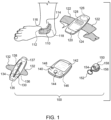
- Fig. 1 illustrates an example nocturia reduction system 100.
- System 100 includes patch 110 (also referred to a tibial Topical Nerve Stimulator/Sensor ("TNSS”), Topical Nerve Activator (“TNA”) patch, smart band aid or smartpad) that includes a securing mechanism 112 adapted to secure patch 110 near a user's ankle 114, a power source 116 and a processor 118 (including instructions executed by processor 118).
- System 100 further includes a bladder monitoring device 120 that includes a securing mechanism 122, a bladder sensor 124, a power source 126 and a processor 128 (including instructions executed by processor 128).
- System 100 further includes a posture indication device 130 that includes a securing mechanism 132, an alignment mark 134, a lower detector sensor 135, a power source 136, an upper detector sensor 137 and a processor 138 (including instructions executed by processor 138).
- System 100 further includes a smart controller 140 with a display 142, an acknowledgment button 144, a power source 146, a microphone (not shown) and a processor 148 (including instructions executed by processor 148).
- System 100 further includes a fob 150 that includes a securing mechanism 152, a button 154, a power source 156, and a processor 158 (including instructions executed by processor 158).
- Patch 110 includes electrodes that are oriented to be aligned with a human tibial nerve on ankle 114.
- Patch 110 in one example can include a flexible substrate, a malleable dermis conforming bottom surface of the substrate including adhesive and adapted to contact the dermis, a flexible top outer surface of the substrate approximately parallel to the bottom surface, electrodes positioned on the patch proximal to the bottom surface and located beneath the top outer surface and directly contacting the flexible substrate, electronic circuitry embedded in the patch and located beneath the top outer surface and integrated as a system on a chip that is directly contacting the flexible substrate, the electronic circuitry integrated as the system on the chip and including an electrical signal generator integral to the malleable dermis conforming bottom surface configured to electrically activate the electrodes, a signal activator coupled to the electrical signal generator, a nerve stimulation sensor that provides feedback in response to a stimulation of one or more nerves, an antenna configured to communicate with a remote activation device, a power source in electrical communication with the electrical signal generator, and the signal activator, where the
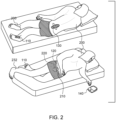
- Fig. 2 illustrates a user 200 using an example nocturia reduction system 100.
- user 200 has an abdomen 210, a bladder 220, a left ankle 230 and a right ankle 232.
- User 200 is shown in a prone posture/state, as if sleeping.
- nocturia reduction system 100 includes patch 110 with fob 150.
- system 100 includes patch 110, bladder monitoring device 120 and fob 150.
- the elements described in conjunction with Fig. 1 may be combined in a variety of ways to implement systems which range from user activated implementations to fully automatic, without user intervention, pre-urge stimulation.
- Nocturia reduction system 100 incorporates the generation of signals to patch 110 to stimulate the tibial nerve.
- the nerve stimulation acts to suppress the urge to urinate.
- repeated stimulation of the tibial nerve has effects on the micturition urge for shorter and shorter periods of time, until eventually the stimulation of the tibial nerve has no effect on the urge.
- the urge then cannot be overcome by further stimulation and then the user must act on this urge by voiding their bladder.
- the times between urges may lengthen as the bladder nerves adapt to repeated stimulations, and this may reduce the number of excursions to the bathroom as well, resulting in a plasticity effect.
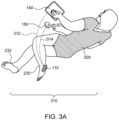
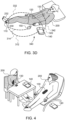
- Fig. 3A illustrates a user 200 using an example nocturia reduction system 310.
- System 310 includes patch 110, and a smart controller 140, such as a smartphone or tablet, or fob 150.
- User 200 may indicate to smart controller 140 or fob 150 directly through a user interaction when the user is beginning a "sleep period" and again when the user is ending a sleep period.
- the designation of a sleep period can also be determined by other external signals such as time of day, location of the user, amount of activity, posture, and other signals.
- the user senses an urge to urinate, the user then indicates through a button or similar user interaction on smart controller 140 or fob 150 that the urge is to be suppressed.
- Smart controller 140 or fob 150 then signals, via signal 312 or 314, respectively, to patch 110.
- Patch 110 then stimulates, via external electrodes, the tibial nerve in the left ankle 230 or the right ankle 232, and the urge is suppressed for a period of time.
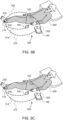
- Fig. 3B illustrates a user 200 using an example nocturia reduction system 320.
- System 320 includes patch 110, bladder monitoring device 120, and smart controller 140 or fob 150.
- bladder monitoring device 120 anticipates that the user may experience an urge to urinate
- bladder monitoring device 120 signals 322 to smart controller 140 or fob 150 to notify user 200.
- Smart controller 140 or fob 150 signals user 200, using for example an audible or visual annunciator, that an urge to urinate is expected.
- smart controller 140 or fob 150 signals, via signal 312 or 314, respectively, to patch 110.
- Patch 110 then stimulates, via external electrodes, the tibial nerve in the left ankle 230 or the right ankle 232, and the urge is suppressed for a period of time.
- Fig. 3C illustrates a user 200 using an example nocturia reduction system 330.
- System 330 includes patch 110, bladder monitoring device 120, and smart controller 140 or fob 150.
- bladder monitoring device 120 signals patch 110 via signal 332, and patch 110 then stimulates, via external electrodes, the tibial nerve in the left ankle 230 or the right ankle 232, and the urge is suppressed for a period of time, thus preventing the user from waking up.
- Fig. 3D illustrates a user 200 using an example nocturia reduction system 340.
- System 340 includes patch 110, bladder monitoring device 120, posture indication device 130 and smart controller 140 or fob 150.
- Posture indication device 130 determines through postural measurements when the user is beginning a sleep period and when the user is ending a sleep period and then signals via signal 342 the determination to smart controller 140.
- bladder monitoring device 120 anticipates that the user may experience an urge to urinate, bladder monitoring device 120 signals via 322 to smart controller 140 or fob 150.
- Smart controller 140 or fob 150 then signals, via signal 312 or 314, respectively, to patch 110 and patch 110 stimulates, via external electrodes, the tibial nerve in the left ankle 230 or the right ankle 232, and the urge is suppressed for a period of time.
- User input is not needed for system 340, other than for the user to opt in to the system.
- bladder monitoring device 120 may signal directly to patch 110 to suppress the urge to urinate via signal 332, thus bypassing smart controller 140.
- patch 110 stimulates the tibial nerve to elicit a suppressive nerve response, which, in turn, suppresses the urination impulse.
- bladder monitoring device 120 measures the state of the user's bladder 220 to determine the degree of urgency in voiding bladder 220. In some examples, bladder monitoring device 120 uses ultrasound to measure the state of bladder 220.
- bladder monitoring device 120 may measure other biometric attributes of user 200 to determine the degree of urgency in voiding bladder 220. Examples of these measurements may be a clenching of abdominal muscles, or restlessness during sleep, or the shape or opacity of the bladder when imaged.
- Biometrics refers to body measurements and calculations and metrics related to human characteristics. Biometric identifiers are the distinctive, measurable characteristics used to label and describe individuals and include physiological and behavioral characteristics. Physiological characteristics are related to the shape of the body. Examples include veins, face recognition, DNA, palm print, hand geometry, iris recognition, retina and odor/scent. Behavioral characteristics are related to the pattern of behavior of a person, including typing rhythm, gait, and voice.
- bladder monitoring device 120 measurements are correlated to "empty”, “partially-full”, and “full” bladder states by interaction between user 200, and one or both of smart controller 140 and fob 150.
- Fig. 4 illustrates user 200 with posture indication device 130 secured to user 200 on the surface of the abdomen, with alignment mark 134 (not shown on Fig. 4 ) aligned vertically on the user's body.
- the signal value sent from posture indication device 130 to one or both of patch 110 and smart controller 140 is a member of a set of signal values for which each signal value is interpreted uniquely by patch 110 or smart controller 140, or both, to be an indication of the user's prone versus non-prone posture/state.
- one signal value may correspond to a prone position
- a second signal value may correspond to a reclining position
- a third signal value may correspond to a seated position
- a fourth signal value may correspond to a standing position (not shown in Fig. 4 ).
- posture indication device 130 provides one measurement value when the user is in the prone posture; and a second, distinct measurement value for all non-prone user postures, and functions as a sleep detection device.
- the prone position of user 200 is determined without the use of posture indication device 130, such as through the use of GPS, an accelerometer and other sensors that can be incorporated in other devices such as bladder monitoring device 120.
- the data from these elements can be analyzed to determine the prone position.
- the location of smart controller 140 or fob 150, or both, at the bedside or in the bed for longer than a pre-set time limit may be used as an indicator that user 200 is in the bed and in a prone position.
- user 200 indicates explicitly their position as either prone or non-prone on smart controller 140 through interaction with display 142 (e.g., a touchscreen) or acknowledgment button 144, or through interaction with fob 150, or other means.
- display 142 e.g., a touchscreen
- acknowledgment button 144 e.g., a button
- fob 150 e.g., fob 150
- smart controller 140 places patch 110 and bladder monitoring device 120 into a state of monitoring urination urges.
- smart controller 140 is informed of the user's non-prone position, such as during daylight activities, smart controller 140 places patch 110 and bladder monitoring device 120 into a state of standby, thereby no longer monitoring bladder states.
- posture indication device 130 is not used.
- a first patch 110 is located on left ankle 230 and a second patch 110 is located on right ankle 232.
- Smart controller 140 can use the two patches 110 to analyze location data and determine the position of user 200.
- user 200 uses fob 150 to send data and control information to smart controller 140.
- user 200 uses smart controller 140 directly, and fob 150 is not used.
- fob 150 communicates data and controls with smart controller 140 through wireless means.
- user 200 does not wear patch 110, or bladder monitoring device 120, or both, when in the non-prone or waking state.
- analysis of bladder monitoring device 120 measurements and posture indication device 130 measurements are performed by one or both of patch 110 and smart controller 140, or by any other available processor of system 100.
- the communication of data and control among the smart controller 140, patch 110, bladder monitoring device 120 and posture indication device 130 may be by wireless means through the use of Bluetooth Low Energy ("BLE”), Wi-Fi, or other means. In some examples, the communication of data and control between bladder monitoring device 120 and posture indication device 130 may be by wired means.
- BLE Bluetooth Low Energy
- Wi-Fi Wireless Fidelity
- bladder monitoring device 120 and posture indication device 130 may be combined into one unit with a common processor and common power source, data and control between bladder monitoring device 120 and posture indication device 130 being in this case through wired or wireless means.
- This combined unit may communicate data and control with smart controller 140 and patch 110 through wireless means.
- bladder monitoring device 120 and posture indication device 130 and smart controller 140 may be combined into one unit with a common processor and common power source, data and control between bladder monitoring device 120, posture indication device 130 and smart controller 140 being in this case through wired or wireless means.
- This combined unit may communicate data and control with patch 110 through wireless means.
- the power sources of patch 110, bladder monitoring device 120, posture indication device 130, smart controller 140 and fob 150 may be powered by battery or rechargeable means, including movement based kinetic energy, solar or other alternative energy.
- user 200 indicates to smart controller 140 the level of pressure they experience in bladder 220 (i.e., the degree of urge to urinate).
- Smart controller 140 through analysis of repeated inputs from the user, matches the measurements of the bladder from bladder monitoring device 120 to the user's degree of urge to urinate, such that smart controller 140 may, using only bladder monitoring device 120 measurements and the smart controller's own analysis, anticipate the user's degree of urge to urinate. This repetition of user input to smart controller 140 serves to calibrate the smart controller's response to measurements from bladder monitoring device 120.
- analysis of measurements from one or both of smart controller 140 and bladder monitoring device 120 may be performed by processing in a remote server, in the cloud, or on a computer separate from smart controller 140 but local to the user, such as a local server.
- artificial intelligence and machine learning may be implemented in order to perform analysis of when an individual may have an urge to urinate.
- the inputted data used to train a machine learning algorithm such as linear regression, clustering, or a neural network, in order to generate a trained model, can be a history of an individual's sleep patterns over an extended period of time. Further, many users' data can be uploaded to the cloud and the history of a large population can be analyzed.
- Machine learning pattern matching can be used to match a user to accumulated data for parameters for the user, such as the user's age, sex, type of medicine being used, or any other relevant data.
- User 200 may choose to allow the "automatic mode” (thereby opting in to the feature), or to allow only the “basic” or “semi-automatic” modes, or both (thereby opting out of the "automatic mode” feature).
- patch 110 in “semi-automatic mode” or “automatic mode”, sends an activation signal (i.e., electrical stimulation), via external electrodes, to the tibial nerve in the user's left ankle 230 or right ankle 232 and repeats this signal according to a timer preset by user 200.
- the interval between activations is selected to effectively postpone the urge to urinate according to the user's preference.
- nocturia reduction system 100 measures the user's sleep schedule over a period of days or weeks or longer, noting the clock time when the user begins the sleep period and the clock time when the user wakes during or at the end of the sleep period.
- System 100 analyzes this data and determines the most effective clock times to wake user 200, assuming that when the user is in the sleep period they are asleep. The system thereby wakes the user at times more suited to preserving effective sleep instead of the times of the user's own urges to urinate, while also providing sufficient waking times for the user to wake, go to the toilet, void the bladder, and return to sleep, all without wetting or soiling the bed or bedclothes.
- System 100 can wake the user multiple ways, including using an audible or visual annunciator that is part of smart controller 140.
- the activation of the electrodes of patch 110 may be used to wake up the user if the level of charge that is applied is high enough to generate some electrical discomfort.
- the activation of the electrodes of patch 110 actually prevents the user from waking up by delaying an urge to urinate that would ordinarily wake up the user.
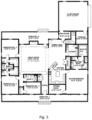
- Fig. 5 illustrates several paths from bed to bath and toilet to show that there may be a variety of obstacles and opportunities for injury along each route. From the Master Bedroom to the Master Bath, the user must not only pass through the door to the bathroom, but also through a second door to the toilet. Bedroom #2 and #2 lead through two doorways each to Bath #2. Bedroom #4 to Bath #3 includes a hallway. Any of these paths may be made more complex by objects on the floors, threshold steps and the need to enable lights.
- nocturia reduction system 100 sends the suppressing signal to patch 110 or sends a warning message to the user with sufficient lead time before it anticipates an urge to urinate that user 200 will have sufficient time to wake, navigate to the toilet along routes such as those in Fig. 5 , and be ready to urinate, thus reducing the risk of soiling the bed clothes or night clothes.
- nocturia reduction system 100 determines that user 200 has moved to a non-prone position, and smart controller 140 then sends signals to lighting fixtures on the user's route from the bed to the toilet, thereby reducing the risk of falls in the dark.
- This process of controlling lighting may be enhanced to account for the time of day or degree of darkness in the rooms, or both, such that the lighting activations occur only when the existing level of illumination is insufficient for the user when they move from bed to toilet and back to bed.
- nocturia reduction system 100 determines that the user 200 has moved to a non-prone position, and smart controller 140 then sends signals to the user's bed to adjust the position of the bed to facilitate the user's egress from bed to floor.
- Fig. 6 illustrates the phases of the sleep cycle.
- a personal device or “sleep stage monitoring device” or sleep detection device, which may be part of nocturia reduction system 100, may monitor these phases, such that the start and duration may be measured for a Slow Wave Sleep (“SWS”) period, also known as “deep sleep”, and a rapid eye movement (“REM”) period, where dreams occur.
- SWS Slow Wave Sleep
- REM rapid eye movement
- examples of the invention are used to defer urges to urinate, thereby reducing or avoiding the interruptions to sleep during these critical periods of sleep.
- awakening an individual from a deep sleep, Stages 3 and 4, or during REM sleep can lead to disorientation upon awakening and increased risk of falls.
- the sleep stage monitoring device measures the user's sleep cycle.
- the stage of sleep is signaled to smart controller 140 when the user enters and exits deep sleep or REM sleep.
- smart controller 140 suppresses the urge to urinate when the user is in deep sleep or REM sleep.
- nocturia reduction system 100 reduces the number of interruptions to sleep during deep sleep and REM sleep periods.
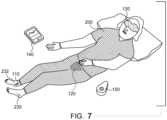
- Fig. 7 illustrates another example of a user 200 using nocturia reduction system 100.
- user 200 wears patch 110 on the medial left ankle 230 or on the medial right ankle 232.
- User 200 wears bladder monitoring device 120 on their abdomen and a sleep stage monitoring device 170 on their eyes, as an example sleep stage measurement method.
- Both smart controller 140 and fob 150 are included in Fig. 7 .
- sleep stage monitoring device 170 measures eye movement, using electro-oculography with an optical sensor.
- sleep stage monitoring device 170 is a smart phone or tablet or is implemented with smart controller 140, with a microphone or other sensors, running a sleep cycle application, which can measure the various stages of sleep.
- sleep stage monitoring device 170 is a personal fitness device that executes software, which can measure the various stages of sleep.
- sleep stage monitoring device 170 measures brain activity using electroencephalographic (“EEG”) sensors, and the monitoring device is worn on the scalp.
- EEG electroencephalographic
- sleep stage monitoring device 170 measures cardio activity using electrocardiographic (“ECG”) sensors, and the monitoring device is worn on the chest.
- Similar methods may be used to measure a person's biometrics to detect REM sleep periods. Examples can determine that the user has the urge to urinate by collecting the user's biometric data, determining when a user has an urge to urinate, correlating the user's biometric data with the urge to urinate to detect urination patterns, and creating a user profile of urination patterns based on the urination patterns. Examples further can integrate the user's medical data into the user profile.
- Fig. 8 further illustrates and defines the periods and stages of sleep.
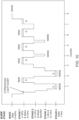
- Fig. 9 illustrates how a person's sleep proceeds through several sleep cycles per night, for each cycle progressing through Stage 1 to 4 for NREM sleep, then to Stage 2, then to REM sleep.
- the percentages of sleep time in each stage and type of sleep alters as a person ages.
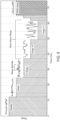
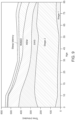
- Fig. 10 illustrates how sleep patterns of young adults change as the sleep period progresses through the hours.
- the Stage 2 cycles become longer, offering more opportunity for nocturia reduction system 100 to allow urges to urinate to interrupt sleep, with less interference with SWS and REM sleep.
- Fig. 11 illustrates how sleep patterns change with advancing age, showing more fractured sleep, and less time in SWS.
- Nocturia reduction system 100 has more opportunities to allow the urge to urinate to wake the older user, with less impact to restfulness than interruptions to SWS or REM sleep.
- nocturia reduction system 100 stimulates the user's tibial nerve at the ankle 114, using external electrodes, the stimulation counteracting the urge to urinate.
- nocturia reduction system 100 in “semi-automatic mode” or “automatic mode”, measures the user's sleep cycle, moving between non-REM (NREM) and REM sleep, and the system coordinates the activation of the patch 110 to avoid waking the user during SWS periods and REM periods in order to reduce the interruptions of REM sleep caused by untimely urges to urinate.
- NREM non-REM
- smart controller 140 predicts an oncoming urge to urinate through repeated recording of a user 200's nocturnal bathroom and voiding behavior, detecting specific patterns, and then applying a stimulation treatment with patch 110 at the appropriate times to postpone the urge to urinate, thereby avoiding waking the user.
- sleep stage monitoring device 170 and bladder monitoring device 120 are not needed.
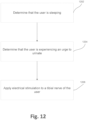
- Fig. 12 is a flow diagram of the functionality of one or more of the elements Figs. 1 or 7 , such as patch 110, smart controller 140, bladder monitoring device 120, etc., when reducing nocturia with example nocturia reduction systems disclosed herein.
- the functionality of the flow diagram of Fig. 12 is implemented by software stored in memory or other computer readable or tangible medium, and executed by a processor.
- the functionality may be performed by hardware, for example through the use of an application specific integrated circuit ("ASIC"), a programmable gate array (“PGA”), a field programmable gate array (“FPGA”), etc., or any combination of hardware and software.
- ASIC application specific integrated circuit
- PGA programmable gate array
- FPGA field programmable gate array
- the user is sleeping. In one example, this is automatically implemented using, for example, sleep stage monitoring device 170. In one example, the particular sleep stage is determined.
- an electrical stimulation via external electrodes, is applied to a tibial nerve of the user.
- the electrical stimulation can be repeated as needed or based on a predetermined schedule.
- the signal sent to patch 110 to activate the electrodes can be in response to a user manual intervention, such as interfacing with fob 150 or smart controller 140 when the user feels the need to urinate.
- the signal can also be generated automatically at a regularly scheduled while the user is sleeping to delay the urge to urinate.
- the signal can also be generated at calculated time intervals to coincide with sleep cycles, such as during REM, where it is least desirable for the user to be awoken in order to urinate.
- examples include fob 150 communicating with patch 110, as well as other elements of Figs. 1 and 7 communicating with each other using BLE.
- the elements when using BLE will undergo a pairing process. For example, fob 150 will attempt to pair with a patch 110 it detects with the strongest RSSI signal, only if the patch is within 2 feet or some other predefined distance, in the event that in the user's environment there are multiple patches 110. In other examples where a single user wears two patches 110, as disclosed above, fob 150 may pair with both patches.
- the fob will attempt to pair again, yet only complete a pairing with the patch it had immediately before.
- the fob software will not recognize other patches that may reply to the "ping" of the fob searching for its partner.
- the fob pings the patch periodically as a kind of "heartbeat" to make sure that the patch is still there. Therefore, the fob knows within a margin of error that the patch is still there. This avoids the fob having to initiate a new pairing when the user presses a START button for a stimulation, such as when patch 110 provides neural stimulation.
- the stimulation can begin immediately, without the "5 second" delay or other predefined amount of delay needed to complete a pairing sequence. Users do not want a delay of several seconds when they press START and expect the stimulation to start right away.
- the fob If the fob detects that it has a low battery level, it saves the ID information, state and strength of the connected patch. This data is saved into nonvolatile memory in the fob. The power for the fob can then be fixed. The Fob can then immediately re-pair with the patch it used before, assumed still to be in range and on the user.
- the fob fails to pair with a patch, then the fob tries again. This is useful when a patch moves out of range of its fob. This is repeated, but the time between attempts increases slowly, to the point where the fob gives up. This saves power by reducing the number of "pings.” If a ping is successful, then the fob checks the ID of that patch, and the patch checks the ID of the fob. If they are as remembered from the most recent paired condition, then the connection is reinstated.
Landscapes
- Health & Medical Sciences (AREA)
- Life Sciences & Earth Sciences (AREA)
- Engineering & Computer Science (AREA)
- Public Health (AREA)
- General Health & Medical Sciences (AREA)
- Biomedical Technology (AREA)
- Animal Behavior & Ethology (AREA)
- Veterinary Medicine (AREA)
- Biophysics (AREA)
- Radiology & Medical Imaging (AREA)
- Nuclear Medicine, Radiotherapy & Molecular Imaging (AREA)
- Heart & Thoracic Surgery (AREA)
- Medical Informatics (AREA)
- Pathology (AREA)
- Surgery (AREA)
- Physics & Mathematics (AREA)
- Molecular Biology (AREA)
- Physiology (AREA)
- Gastroenterology & Hepatology (AREA)
- Epidemiology (AREA)
- Primary Health Care (AREA)
- Computer Vision & Pattern Recognition (AREA)
- Anesthesiology (AREA)
- Physical Education & Sports Medicine (AREA)
- Data Mining & Analysis (AREA)
- Databases & Information Systems (AREA)
- Measurement Of The Respiration, Hearing Ability, Form, And Blood Characteristics Of Living Organisms (AREA)
- Electrotherapy Devices (AREA)
Claims (11)
- System zur Verminderung der Nykturie (100), umfassend:ein Patch (110), das eingerichtet ist, an einem Knöchel (114) eines Benutzers (200) befestigt zu werden, und das einen Prozessor (118, 128, 138, 148, 158), Elektroden und eine Kommunikationsvorrichtung umfasst;eine Blasenüberwachungsvorrichtung (120), die eingerichtet ist, einen Zustand einer Blase (220) des Benutzers (200) zu ermitteln; undeine Schlafdetektionsvorrichtung, die eingerichtet ist, einen Schlafzustand des Benutzers (200) zu ermitteln; wobei der Schritt zum Ermitteln des Schlafzustands Ermitteln eines Schlafzyklus des Benutzers (200) umfasst, während der Benutzer (200) schläft;wobei das Patch (110) weiter eingerichtet ist, elektrische Stimulation über die Elektroden bei einem Tibialisnerv des Benutzers (200) in Reaktion auf ein Aktivierungssignal anzuwenden;dadurch gekennzeichnet, dass die externe elektrische Stimulation an dem Tibialisnerv des Benutzers (200) eingerichtet ist, während eines REM- (Rapid Eye Movement) Schlafzyklus und während Schlafzyklen der Stufe 3 und 4 aufzutreten, um Harndrang zu verzögern und dadurch die Schlafunterbrechungen während dieser kritischen Schlafperioden zu vermindern oder zu vermeiden.
- System (100) zur Verminderung der Nykturie nach Anspruch 1, in welchem das Ermitteln des Schlafzustands Ermitteln, ob der Benutzer (200) in einer Bauchlage oder in einer Nicht-Bauchlage ist, umfasst.
- System (100) zur Verminderung der Nykturie nach Anspruch 1, weiter umfassend Aufheben der Anwendung externer elektrischer Stimulation an dem Tibialisnerv des Benutzers (200) während eines NREM- (Non Rapid Eye Movement) Schlafzyklus.
- System (100) zur Verminderung der Nykturie nach Anspruch 1, wobei die Blasenüberwachungsvorrichtung (120) weiter Ultraschallmessung der Blase (220) umfasst.
- System (100) zur Verminderung der Nykturie nach Anspruch 1, wobei der Zustand der Blase (220) weiter einen Harndrang des Benutzers (200) umfasst, wobei der Zustand mit Hilfe eines Maschinenlernmodells ermittelt wird, das anhand eines Schlafverlaufs einer Vielzahl von Benutzern trainiert ist.
- System (100) zur Verminderung der Nykturie nach Anspruch 1, wobei das Aktivierungssignal automatisch von der Blasenüberwachungsvorrichtung (120) erzeugt wird.
- Nicht transitorisches, computerlesbares Medium, auf dem Anweisungen gespeichert sind, die, wenn sie von einem oder mehreren Prozessoren (118, 128, 138, 148, 158) ausgeführt werden, die Prozessoren (118, 128, 138, 148, 158) veranlassen, Nykturie für einen Benutzer (200) zu vermindern, wobei das Vermindern Folgendes umfasst:Ermitteln, dass der Benutzer (200) schläft;Ermitteln eines Schlafzyklus des Benutzers (200), während der Benutzer (200) schläft;Ermitteln, dass der Benutzer (200) einen Harndrang hat; undAnwenden externer elektrischer Stimulation an einem Tibialisnerv des Benutzers (200); dadurch gekennzeichnet, dass das Vermindern weiter Folgendes umfasst:
Anwenden externer elektrischer Stimulation an dem Tibialisnerv des Benutzers (200) während eines REM- (Rapid Eye Movement) Schlafzyklus und während Schlafzyklen der Stufe 3 und 4, um Harndrang zu verzögern und dadurch die Schlafunterbrechungen während dieser kritischen Schlafperioden zu vermindern oder zu vermeiden. - Nicht transitorisches, computerlesbares Medium nach Anspruch 8, wobei das Ermitteln, dass der Benutzer (200) schläft, weiter Ermitteln umfasst, ob der Benutzer (200) in einer Bauchlage oder in einer Nicht-Bauchlage ist.
- Nicht transitorisches, computerlesbares Medium nach Anspruch 8, wobei das Vermindern weiter Folgendes umfasst:
Aufheben des Anwendens externer elektrischer Stimulation an dem Tibialisnerv des Benutzers (200) während eines NREM- (Non Rapid Eye Movement) Schlafzyklus. - Nicht transitorisches, computerlesbares Medium nach Anspruch 8, wobei das Ermitteln, dass der Benutzer (200) einen Harndrang hat, weiter Messen eines Zustands einer Blase (220) des Benutzers (200) umfasst.
- Nicht transitorisches, computerlesbares Medium nach Anspruch 8, wobei das Ermitteln, dass der Benutzer (200) einen Harndrang hat, weiter Verwenden eines Maschinenlernmodells umfasst, das anhand eines Schlafverlaufs einer Vielzahl von Benutzern trainiert ist.
Applications Claiming Priority (4)
| Application Number | Priority Date | Filing Date | Title |
|---|---|---|---|
| US201762584790P | 2017-11-11 | 2017-11-11 | |
| US201762590829P | 2017-11-27 | 2017-11-27 | |
| US16/142,258 US11305113B2 (en) | 2017-11-11 | 2018-09-26 | Nocturia reduction system |
| PCT/US2018/057776 WO2019094208A1 (en) | 2017-11-11 | 2018-10-26 | Nocturia reduction system |
Publications (3)
| Publication Number | Publication Date |
|---|---|
| EP3706859A1 EP3706859A1 (de) | 2020-09-16 |
| EP3706859A4 EP3706859A4 (de) | 2021-08-25 |
| EP3706859B1 true EP3706859B1 (de) | 2023-07-26 |
Family
ID=66432807
Family Applications (1)
| Application Number | Title | Priority Date | Filing Date |
|---|---|---|---|
| EP18876833.7A Active EP3706859B1 (de) | 2017-11-11 | 2018-10-26 | System zur verminderung der nykturie |
Country Status (7)
| Country | Link |
|---|---|
| US (1) | US11305113B2 (de) |
| EP (1) | EP3706859B1 (de) |
| JP (1) | JP6979134B2 (de) |
| KR (1) | KR102527482B1 (de) |
| CN (1) | CN111542369A (de) |
| CA (1) | CA3082372C (de) |
| WO (1) | WO2019094208A1 (de) |
Families Citing this family (6)
| Publication number | Priority date | Publication date | Assignee | Title |
|---|---|---|---|---|
| AU2019444064A1 (en) | 2019-04-08 | 2020-12-03 | Sleep Number Corporation | Bed having environmental sensing and control features |
| US12249422B2 (en) | 2019-11-08 | 2025-03-11 | Tata Consultancy Services Limited | Method and system for detection and validation of nocturia in a person |
| CN111000541A (zh) * | 2019-12-25 | 2020-04-14 | 南京宁康中科医疗技术有限公司 | 个性化深呼吸训练处方的制定和实施方法、系统及装置 |
| CN116348177A (zh) * | 2020-10-30 | 2023-06-27 | 宝洁公司 | 柔性经皮神经刺激装置 |
| KR102460829B1 (ko) * | 2020-11-03 | 2022-10-28 | 재단법인대구경북과학기술원 | 방광 모니터링 장치 및 방광 모니터링 장치의 제어 방법 |
| CN112617863B (zh) * | 2020-12-30 | 2023-01-24 | 天津职业技术师范大学(中国职业培训指导教师进修中心) | 一种面向左右脚运动意图侧向性识别的混合在线脑机接口方法 |
Family Cites Families (40)
| Publication number | Priority date | Publication date | Assignee | Title |
|---|---|---|---|---|
| US20020019652A1 (en) | 1999-07-08 | 2002-02-14 | Cyclotec Advanced Medical Technologies | Two part tens bandage |
| US7643874B2 (en) | 2001-10-24 | 2010-01-05 | Power Paper Ltd. | Dermal patch |
| US20040054008A1 (en) | 2002-09-13 | 2004-03-18 | Tohru Araki | Medicament for treatment of nocturia |
| DE20301973U1 (de) | 2003-02-07 | 2004-06-17 | Gerromed Pflege- Und Medizintechnik Handelsgesellschaft Mbh | Mehrschichtige Kombination aus Elektrostimulationselektrode und Wundverband |
| WO2005023361A2 (en) | 2003-09-10 | 2005-03-17 | Power Paper Ltd. | Disposable electric bandage |
| US8204597B2 (en) | 2007-05-30 | 2012-06-19 | Medtronic, Inc. | Evaluating patient incontinence |
| US8260439B2 (en) | 2007-11-16 | 2012-09-04 | Ethicon, Inc. | Nerve stimulation patches and methods for stimulating selected nerves |
| WO2009094050A1 (en) * | 2008-01-25 | 2009-07-30 | Medtronic, Inc. | Sleep stage detection |
| US8098017B2 (en) * | 2009-01-22 | 2012-01-17 | Daniel William Chidester | Automatic, low level floor lighting system |
| US10213593B2 (en) | 2010-01-15 | 2019-02-26 | Stimmed Llc | Method and apparatus for noninvasive inhibition of deep vein thrombosis |
| GB201009977D0 (en) * | 2010-06-15 | 2010-07-21 | Sky Medical Technology Ltd | Incontinence treatment |
| US20140018636A1 (en) * | 2010-06-29 | 2014-01-16 | Oliver M. Contant | Dynamic scale and accurate food measuring |
| US8788046B2 (en) | 2010-11-11 | 2014-07-22 | Spr Therapeutics, Llc | Systems and methods for the treatment of pain through neural fiber stimulation |
| US20120143107A1 (en) | 2010-12-03 | 2012-06-07 | Henley Ernest J | Device and method for treating nocturia |
| US8816149B2 (en) | 2011-10-28 | 2014-08-26 | Kimberly-Clark Worldwide, Inc. | System for detection and monitoring of body exudates using a gas emitting substance for use in interactive toilet training |
| WO2013116013A1 (en) | 2012-02-02 | 2013-08-08 | The United States Government, As Represented By The Department Of Veterans Affairs | Integrated surface stimulation device for pain management and wound therapy |
| US20140121473A1 (en) | 2012-10-31 | 2014-05-01 | Matt Banet | Vital sign monitoring system featuring electronic diaper |
| US9084897B2 (en) * | 2012-11-20 | 2015-07-21 | Ams Research Corporation | Tibial nerve stimulation therapy device calibration |
| US10814131B2 (en) | 2012-11-26 | 2020-10-27 | Thync Global, Inc. | Apparatuses and methods for neuromodulation |
| TW201427740A (zh) | 2013-01-07 | 2014-07-16 | Ind Tech Res Inst | 電刺激裝置與方法 |
| US12453853B2 (en) * | 2013-01-21 | 2025-10-28 | Cala Health, Inc. | Multi-modal stimulation for treating tremor |
| US20180318585A1 (en) | 2013-03-15 | 2018-11-08 | Fast Track Technologies, Inc. | Electro-stimulation of systematically compounded modulation of current intensity with other output parameters for affecting biological materials |
| US20160263376A1 (en) | 2013-11-27 | 2016-09-15 | The Governing Council Of The University Of Toronto | Systems and methods for improved treatment of overactive bladder |
| US9610442B2 (en) * | 2015-05-21 | 2017-04-04 | The Governing Council Of The University Of Toronto | Systems and methods for treatment of urinary dysfunction |
| EP3116385B1 (de) | 2014-03-14 | 2019-11-06 | Nalu Medical, Inc. | Vorrichtung für vielseitige, minimalinvasive neuromodulatoren |
| WO2015183620A2 (en) | 2014-05-25 | 2015-12-03 | Thync, Inc. | Wearable transdermal neurostimulators |
| US20160015962A1 (en) | 2014-07-16 | 2016-01-21 | Mehdi Shokoueinejad Maragheh | Smart Patch For Wound Management |
| US10035020B2 (en) * | 2014-10-03 | 2018-07-31 | Boston Scientific Scimed, Inc. | Systems and methods for neurostimulation therapy |
| US20160125759A1 (en) * | 2014-10-29 | 2016-05-05 | Transcontinental Industries, Inc. | Conditioned response toilet training systems and methods |
| US10478612B2 (en) * | 2014-10-31 | 2019-11-19 | Avent, Inc. | Method and system for monitoring and treating a medical condition via posterior tibial nerve stimulation |
| JP2016093209A (ja) | 2014-11-04 | 2016-05-26 | スティヒティング アイメック ネダーランドStichting IMEC Nederland | 失禁を監視するシステム |
| US11077301B2 (en) * | 2015-02-21 | 2021-08-03 | NeurostimOAB, Inc. | Topical nerve stimulator and sensor for bladder control |
| JP2017012245A (ja) * | 2015-06-26 | 2017-01-19 | 富士通株式会社 | 失禁抑制方法及び失禁抑制装置 |
| EP3117807A1 (de) | 2015-07-16 | 2017-01-18 | Carag AG | Multifunktioneller wundbehandlungsverband |
| WO2017024136A1 (en) * | 2015-08-05 | 2017-02-09 | Boston Scientific Scimed, Inc. | Control of bladder function using high frequency pacing |
| EP3405251A4 (de) | 2016-01-21 | 2019-08-28 | Cala Health, Inc. | Systeme, verfahren und vorrichtungen zur peripheren neuromodulation zur behandlung von erkrankungen im zusammenhang mit blasenhyperaktivität |
| AU2017249318B2 (en) | 2016-04-12 | 2022-03-24 | GOGO Band, Inc. | Urination prediction and monitoring |
| WO2018129351A1 (en) | 2017-01-05 | 2018-07-12 | Shriram Raghunathan | Restless leg syndrome or overactive nerve treatment |
| US11135428B2 (en) * | 2017-07-02 | 2021-10-05 | Ebt Medical, Inc. | Systems and methods for providing patient signaling and contingent stimulation |
| EP3843831B1 (de) | 2018-08-31 | 2022-10-19 | Avation Medical, Inc. | System, verfahren und vorrichtung zur anwendung von transkutaner elektrischer stimulation |
-
2018
- 2018-09-26 US US16/142,258 patent/US11305113B2/en active Active
- 2018-10-26 CN CN201880081459.5A patent/CN111542369A/zh active Pending
- 2018-10-26 EP EP18876833.7A patent/EP3706859B1/de active Active
- 2018-10-26 KR KR1020207016863A patent/KR102527482B1/ko active Active
- 2018-10-26 JP JP2020544327A patent/JP6979134B2/ja active Active
- 2018-10-26 CA CA3082372A patent/CA3082372C/en active Active
- 2018-10-26 WO PCT/US2018/057776 patent/WO2019094208A1/en not_active Ceased
Also Published As
| Publication number | Publication date |
|---|---|
| CA3082372A1 (en) | 2019-05-16 |
| JP6979134B2 (ja) | 2021-12-08 |
| JP2021502212A (ja) | 2021-01-28 |
| KR20200075011A (ko) | 2020-06-25 |
| WO2019094208A1 (en) | 2019-05-16 |
| US11305113B2 (en) | 2022-04-19 |
| CA3082372C (en) | 2023-02-21 |
| CN111542369A (zh) | 2020-08-14 |
| US20190143108A1 (en) | 2019-05-16 |
| KR102527482B1 (ko) | 2023-04-28 |
| EP3706859A1 (de) | 2020-09-16 |
| EP3706859A4 (de) | 2021-08-25 |
Similar Documents
| Publication | Publication Date | Title |
|---|---|---|
| EP3706859B1 (de) | System zur verminderung der nykturie | |
| US12161865B2 (en) | Systems, methods and devices for peripheral neuromodulation | |
| CN114449943B (zh) | 用于睡眠障碍性呼吸(sdb)护理的睡眠检测 | |
| US11135428B2 (en) | Systems and methods for providing patient signaling and contingent stimulation | |
| US20240245911A1 (en) | Intelligent determination of therapeutic stimulation intensity for transcutaneous electrical nerve stimulation | |
| JP2019531775A (ja) | 末梢神経刺激による心機能不全の治療のためのシステムおよび方法任意の優先権出願への参照による組込み | |
| CN108778411A (zh) | 用来治疗与膀胱过动症相关的疾病的用于外周神经调制的系统、方法和装置 | |
| WO2023091405A1 (en) | Peripheral nerve stimulation for rls or plmd with sensors for monitoring of sleep-related data | |
| WO2015049108A1 (en) | Body illumination system and method | |
| US20200129762A1 (en) | Detection and treatment of obstructive sleep apnea | |
| US11058349B2 (en) | Non-invasive handling of sleep apnea, snoring and emergency situations | |
| JP2016158700A (ja) | 生体刺激装置、生体刺激システム、および刺激装置 | |
| US11712557B2 (en) | Detection and treatment of obstructive sleep apnea | |
| EP4642523A1 (de) | Schlaferkennung | |
| US20240123223A1 (en) | Triggering peripheral nerve stimulation for rls or plmd based on sleep-related data | |
| US20240123227A1 (en) | Triggering peripheral nerve stimulation for rls or plmd based on sleep-related data | |
| EP4642521A1 (de) | Erkennung von schlafbeginn und -wachverhalten | |
| WO2022038596A1 (en) | Emotion and stress regulative assistance device, method, and system |
Legal Events
| Date | Code | Title | Description |
|---|---|---|---|
| STAA | Information on the status of an ep patent application or granted ep patent |
Free format text: STATUS: THE INTERNATIONAL PUBLICATION HAS BEEN MADE |
|
| PUAI | Public reference made under article 153(3) epc to a published international application that has entered the european phase |
Free format text: ORIGINAL CODE: 0009012 |
|
| STAA | Information on the status of an ep patent application or granted ep patent |
Free format text: STATUS: REQUEST FOR EXAMINATION WAS MADE |
|
| 17P | Request for examination filed |
Effective date: 20200527 |
|
| AK | Designated contracting states |
Kind code of ref document: A1 Designated state(s): AL AT BE BG CH CY CZ DE DK EE ES FI FR GB GR HR HU IE IS IT LI LT LU LV MC MK MT NL NO PL PT RO RS SE SI SK SM TR |
|
| AX | Request for extension of the european patent |
Extension state: BA ME |
|
| DAV | Request for validation of the european patent (deleted) | ||
| DAX | Request for extension of the european patent (deleted) | ||
| A4 | Supplementary search report drawn up and despatched |
Effective date: 20210723 |
|
| RIC1 | Information provided on ipc code assigned before grant |
Ipc: A61N 1/36 20060101AFI20210719BHEP Ipc: A61N 1/04 20060101ALI20210719BHEP Ipc: G16H 50/30 20180101ALI20210719BHEP Ipc: A61B 8/08 20060101ALI20210719BHEP Ipc: A61B 8/00 20060101ALI20210719BHEP Ipc: A61B 5/20 20060101ALN20210719BHEP Ipc: A61B 5/00 20060101ALN20210719BHEP |
|
| RIC1 | Information provided on ipc code assigned before grant |
Ipc: A61B 5/00 19680901ALN20221231BHEP Ipc: A61B 5/20 19850101ALN20221231BHEP Ipc: A61B 8/00 19850101ALI20221231BHEP Ipc: A61B 8/08 19850101ALI20221231BHEP Ipc: G16H 50/30 20180101ALI20221231BHEP Ipc: A61N 1/04 19680901ALI20221231BHEP Ipc: A61N 1/36 19680901AFI20221231BHEP |
|
| RIC1 | Information provided on ipc code assigned before grant |
Ipc: A61B 5/00 19680901ALN20230111BHEP Ipc: A61B 5/20 19850101ALN20230111BHEP Ipc: A61B 8/00 19850101ALI20230111BHEP Ipc: A61B 8/08 19850101ALI20230111BHEP Ipc: G16H 50/30 20180101ALI20230111BHEP Ipc: A61N 1/04 19680901ALI20230111BHEP Ipc: A61N 1/36 19680901AFI20230111BHEP |
|
| GRAP | Despatch of communication of intention to grant a patent |
Free format text: ORIGINAL CODE: EPIDOSNIGR1 |
|
| STAA | Information on the status of an ep patent application or granted ep patent |
Free format text: STATUS: GRANT OF PATENT IS INTENDED |
|
| INTG | Intention to grant announced |
Effective date: 20230221 |
|
| GRAS | Grant fee paid |
Free format text: ORIGINAL CODE: EPIDOSNIGR3 |
|
| GRAA | (expected) grant |
Free format text: ORIGINAL CODE: 0009210 |
|
| STAA | Information on the status of an ep patent application or granted ep patent |
Free format text: STATUS: THE PATENT HAS BEEN GRANTED |
|
| AK | Designated contracting states |
Kind code of ref document: B1 Designated state(s): AL AT BE BG CH CY CZ DE DK EE ES FI FR GB GR HR HU IE IS IT LI LT LU LV MC MK MT NL NO PL PT RO RS SE SI SK SM TR |
|
| RAP3 | Party data changed (applicant data changed or rights of an application transferred) |
Owner name: NEUROSTIM SOLUTIONS LLC |
|
| REG | Reference to a national code |
Ref country code: CH Ref legal event code: EP |
|
| REG | Reference to a national code |
Ref country code: IE Ref legal event code: FG4D |
|
| REG | Reference to a national code |
Ref country code: DE Ref legal event code: R096 Ref document number: 602018054273 Country of ref document: DE |
|
| P01 | Opt-out of the competence of the unified patent court (upc) registered |
Effective date: 20230726 |
|
| REG | Reference to a national code |
Ref country code: LT Ref legal event code: MG9D |
|
| REG | Reference to a national code |
Ref country code: NL Ref legal event code: MP Effective date: 20230726 |
|
| REG | Reference to a national code |
Ref country code: AT Ref legal event code: MK05 Ref document number: 1591229 Country of ref document: AT Kind code of ref document: T Effective date: 20230726 |
|
| PG25 | Lapsed in a contracting state [announced via postgrant information from national office to epo] |
Ref country code: NL Free format text: LAPSE BECAUSE OF FAILURE TO SUBMIT A TRANSLATION OF THE DESCRIPTION OR TO PAY THE FEE WITHIN THE PRESCRIBED TIME-LIMIT Effective date: 20230726 |
|
| PG25 | Lapsed in a contracting state [announced via postgrant information from national office to epo] |
Ref country code: GR Free format text: LAPSE BECAUSE OF FAILURE TO SUBMIT A TRANSLATION OF THE DESCRIPTION OR TO PAY THE FEE WITHIN THE PRESCRIBED TIME-LIMIT Effective date: 20231027 |
|
| PG25 | Lapsed in a contracting state [announced via postgrant information from national office to epo] |
Ref country code: IS Free format text: LAPSE BECAUSE OF FAILURE TO SUBMIT A TRANSLATION OF THE DESCRIPTION OR TO PAY THE FEE WITHIN THE PRESCRIBED TIME-LIMIT Effective date: 20231126 |
|
| PG25 | Lapsed in a contracting state [announced via postgrant information from national office to epo] |
Ref country code: SE Free format text: LAPSE BECAUSE OF FAILURE TO SUBMIT A TRANSLATION OF THE DESCRIPTION OR TO PAY THE FEE WITHIN THE PRESCRIBED TIME-LIMIT Effective date: 20230726 Ref country code: RS Free format text: LAPSE BECAUSE OF FAILURE TO SUBMIT A TRANSLATION OF THE DESCRIPTION OR TO PAY THE FEE WITHIN THE PRESCRIBED TIME-LIMIT Effective date: 20230726 Ref country code: PT Free format text: LAPSE BECAUSE OF FAILURE TO SUBMIT A TRANSLATION OF THE DESCRIPTION OR TO PAY THE FEE WITHIN THE PRESCRIBED TIME-LIMIT Effective date: 20231127 Ref country code: NO Free format text: LAPSE BECAUSE OF FAILURE TO SUBMIT A TRANSLATION OF THE DESCRIPTION OR TO PAY THE FEE WITHIN THE PRESCRIBED TIME-LIMIT Effective date: 20231026 Ref country code: LV Free format text: LAPSE BECAUSE OF FAILURE TO SUBMIT A TRANSLATION OF THE DESCRIPTION OR TO PAY THE FEE WITHIN THE PRESCRIBED TIME-LIMIT Effective date: 20230726 Ref country code: LT Free format text: LAPSE BECAUSE OF FAILURE TO SUBMIT A TRANSLATION OF THE DESCRIPTION OR TO PAY THE FEE WITHIN THE PRESCRIBED TIME-LIMIT Effective date: 20230726 Ref country code: IS Free format text: LAPSE BECAUSE OF FAILURE TO SUBMIT A TRANSLATION OF THE DESCRIPTION OR TO PAY THE FEE WITHIN THE PRESCRIBED TIME-LIMIT Effective date: 20231126 Ref country code: HR Free format text: LAPSE BECAUSE OF FAILURE TO SUBMIT A TRANSLATION OF THE DESCRIPTION OR TO PAY THE FEE WITHIN THE PRESCRIBED TIME-LIMIT Effective date: 20230726 Ref country code: GR Free format text: LAPSE BECAUSE OF FAILURE TO SUBMIT A TRANSLATION OF THE DESCRIPTION OR TO PAY THE FEE WITHIN THE PRESCRIBED TIME-LIMIT Effective date: 20231027 Ref country code: FI Free format text: LAPSE BECAUSE OF FAILURE TO SUBMIT A TRANSLATION OF THE DESCRIPTION OR TO PAY THE FEE WITHIN THE PRESCRIBED TIME-LIMIT Effective date: 20230726 Ref country code: AT Free format text: LAPSE BECAUSE OF FAILURE TO SUBMIT A TRANSLATION OF THE DESCRIPTION OR TO PAY THE FEE WITHIN THE PRESCRIBED TIME-LIMIT Effective date: 20230726 |
|
| PG25 | Lapsed in a contracting state [announced via postgrant information from national office to epo] |
Ref country code: PL Free format text: LAPSE BECAUSE OF FAILURE TO SUBMIT A TRANSLATION OF THE DESCRIPTION OR TO PAY THE FEE WITHIN THE PRESCRIBED TIME-LIMIT Effective date: 20230726 |
|
| PG25 | Lapsed in a contracting state [announced via postgrant information from national office to epo] |
Ref country code: ES Free format text: LAPSE BECAUSE OF FAILURE TO SUBMIT A TRANSLATION OF THE DESCRIPTION OR TO PAY THE FEE WITHIN THE PRESCRIBED TIME-LIMIT Effective date: 20230726 |
|
| REG | Reference to a national code |
Ref country code: DE Ref legal event code: R097 Ref document number: 602018054273 Country of ref document: DE |
|
| PG25 | Lapsed in a contracting state [announced via postgrant information from national office to epo] |
Ref country code: SM Free format text: LAPSE BECAUSE OF FAILURE TO SUBMIT A TRANSLATION OF THE DESCRIPTION OR TO PAY THE FEE WITHIN THE PRESCRIBED TIME-LIMIT Effective date: 20230726 Ref country code: RO Free format text: LAPSE BECAUSE OF FAILURE TO SUBMIT A TRANSLATION OF THE DESCRIPTION OR TO PAY THE FEE WITHIN THE PRESCRIBED TIME-LIMIT Effective date: 20230726 Ref country code: ES Free format text: LAPSE BECAUSE OF FAILURE TO SUBMIT A TRANSLATION OF THE DESCRIPTION OR TO PAY THE FEE WITHIN THE PRESCRIBED TIME-LIMIT Effective date: 20230726 Ref country code: EE Free format text: LAPSE BECAUSE OF FAILURE TO SUBMIT A TRANSLATION OF THE DESCRIPTION OR TO PAY THE FEE WITHIN THE PRESCRIBED TIME-LIMIT Effective date: 20230726 Ref country code: DK Free format text: LAPSE BECAUSE OF FAILURE TO SUBMIT A TRANSLATION OF THE DESCRIPTION OR TO PAY THE FEE WITHIN THE PRESCRIBED TIME-LIMIT Effective date: 20230726 Ref country code: CZ Free format text: LAPSE BECAUSE OF FAILURE TO SUBMIT A TRANSLATION OF THE DESCRIPTION OR TO PAY THE FEE WITHIN THE PRESCRIBED TIME-LIMIT Effective date: 20230726 Ref country code: SK Free format text: LAPSE BECAUSE OF FAILURE TO SUBMIT A TRANSLATION OF THE DESCRIPTION OR TO PAY THE FEE WITHIN THE PRESCRIBED TIME-LIMIT Effective date: 20230726 |
|
| REG | Reference to a national code |
Ref country code: DE Ref legal event code: R119 Ref document number: 602018054273 Country of ref document: DE |
|
| PG25 | Lapsed in a contracting state [announced via postgrant information from national office to epo] |
Ref country code: IT Free format text: LAPSE BECAUSE OF FAILURE TO SUBMIT A TRANSLATION OF THE DESCRIPTION OR TO PAY THE FEE WITHIN THE PRESCRIBED TIME-LIMIT Effective date: 20230726 Ref country code: MC Free format text: LAPSE BECAUSE OF FAILURE TO SUBMIT A TRANSLATION OF THE DESCRIPTION OR TO PAY THE FEE WITHIN THE PRESCRIBED TIME-LIMIT Effective date: 20230726 |
|
| PLBE | No opposition filed within time limit |
Free format text: ORIGINAL CODE: 0009261 |
|
| REG | Reference to a national code |
Ref country code: CH Ref legal event code: PL |
|
| STAA | Information on the status of an ep patent application or granted ep patent |
Free format text: STATUS: NO OPPOSITION FILED WITHIN TIME LIMIT |
|
| REG | Reference to a national code |
Ref country code: BE Ref legal event code: MM Effective date: 20231031 |
|
| PG25 | Lapsed in a contracting state [announced via postgrant information from national office to epo] |
Ref country code: LU Free format text: LAPSE BECAUSE OF NON-PAYMENT OF DUE FEES Effective date: 20231026 |
|
| GBPC | Gb: european patent ceased through non-payment of renewal fee |
Effective date: 20231026 |
|
| PG25 | Lapsed in a contracting state [announced via postgrant information from national office to epo] |
Ref country code: LU Free format text: LAPSE BECAUSE OF NON-PAYMENT OF DUE FEES Effective date: 20231026 |
|
| 26N | No opposition filed |
Effective date: 20240429 |
|
| PG25 | Lapsed in a contracting state [announced via postgrant information from national office to epo] |
Ref country code: GB Free format text: LAPSE BECAUSE OF NON-PAYMENT OF DUE FEES Effective date: 20231026 |
|
| PG25 | Lapsed in a contracting state [announced via postgrant information from national office to epo] |
Ref country code: CH Free format text: LAPSE BECAUSE OF NON-PAYMENT OF DUE FEES Effective date: 20231031 |
|
| PG25 | Lapsed in a contracting state [announced via postgrant information from national office to epo] |
Ref country code: GB Free format text: LAPSE BECAUSE OF NON-PAYMENT OF DUE FEES Effective date: 20231026 Ref country code: FR Free format text: LAPSE BECAUSE OF NON-PAYMENT OF DUE FEES Effective date: 20231031 Ref country code: DE Free format text: LAPSE BECAUSE OF NON-PAYMENT OF DUE FEES Effective date: 20240501 Ref country code: CH Free format text: LAPSE BECAUSE OF NON-PAYMENT OF DUE FEES Effective date: 20231031 Ref country code: SI Free format text: LAPSE BECAUSE OF FAILURE TO SUBMIT A TRANSLATION OF THE DESCRIPTION OR TO PAY THE FEE WITHIN THE PRESCRIBED TIME-LIMIT Effective date: 20230726 |
|
| PG25 | Lapsed in a contracting state [announced via postgrant information from national office to epo] |
Ref country code: BE Free format text: LAPSE BECAUSE OF NON-PAYMENT OF DUE FEES Effective date: 20231031 |
|
| PG25 | Lapsed in a contracting state [announced via postgrant information from national office to epo] |
Ref country code: IE Free format text: LAPSE BECAUSE OF NON-PAYMENT OF DUE FEES Effective date: 20231026 |
|
| PG25 | Lapsed in a contracting state [announced via postgrant information from national office to epo] |
Ref country code: IE Free format text: LAPSE BECAUSE OF NON-PAYMENT OF DUE FEES Effective date: 20231026 |
|
| PG25 | Lapsed in a contracting state [announced via postgrant information from national office to epo] |
Ref country code: BG Free format text: LAPSE BECAUSE OF FAILURE TO SUBMIT A TRANSLATION OF THE DESCRIPTION OR TO PAY THE FEE WITHIN THE PRESCRIBED TIME-LIMIT Effective date: 20230726 |
|
| PG25 | Lapsed in a contracting state [announced via postgrant information from national office to epo] |
Ref country code: BG Free format text: LAPSE BECAUSE OF FAILURE TO SUBMIT A TRANSLATION OF THE DESCRIPTION OR TO PAY THE FEE WITHIN THE PRESCRIBED TIME-LIMIT Effective date: 20230726 |
|
| PG25 | Lapsed in a contracting state [announced via postgrant information from national office to epo] |
Ref country code: CY Free format text: LAPSE BECAUSE OF FAILURE TO SUBMIT A TRANSLATION OF THE DESCRIPTION OR TO PAY THE FEE WITHIN THE PRESCRIBED TIME-LIMIT; INVALID AB INITIO Effective date: 20181026 |
|
| PG25 | Lapsed in a contracting state [announced via postgrant information from national office to epo] |
Ref country code: HU Free format text: LAPSE BECAUSE OF FAILURE TO SUBMIT A TRANSLATION OF THE DESCRIPTION OR TO PAY THE FEE WITHIN THE PRESCRIBED TIME-LIMIT; INVALID AB INITIO Effective date: 20181026 |
|
| PG25 | Lapsed in a contracting state [announced via postgrant information from national office to epo] |
Ref country code: TR Free format text: LAPSE BECAUSE OF FAILURE TO SUBMIT A TRANSLATION OF THE DESCRIPTION OR TO PAY THE FEE WITHIN THE PRESCRIBED TIME-LIMIT Effective date: 20230726 |