EP3705487A1 - Method for preparing cholic acid compound - Google Patents
Method for preparing cholic acid compound Download PDFInfo
- Publication number
- EP3705487A1 EP3705487A1 EP18873405.7A EP18873405A EP3705487A1 EP 3705487 A1 EP3705487 A1 EP 3705487A1 EP 18873405 A EP18873405 A EP 18873405A EP 3705487 A1 EP3705487 A1 EP 3705487A1
- Authority
- EP
- European Patent Office
- Prior art keywords
- compound
- formula
- preparation
- acid
- reaction
- Prior art date
- Legal status (The legal status is an assumption and is not a legal conclusion. Google has not performed a legal analysis and makes no representation as to the accuracy of the status listed.)
- Granted
Links
- -1 cholic acid compound Chemical class 0.000 title claims abstract description 9
- 238000000034 method Methods 0.000 title abstract description 11
- 235000019416 cholic acid Nutrition 0.000 title abstract description 6
- KXGVEGMKQFWNSR-UHFFFAOYSA-N deoxycholic acid Natural products C1CC2CC(O)CCC2(C)C2C1C1CCC(C(CCC(O)=O)C)C1(C)C(O)C2 KXGVEGMKQFWNSR-UHFFFAOYSA-N 0.000 title abstract description 5
- BHQCQFFYRZLCQQ-UHFFFAOYSA-N (3alpha,5alpha,7alpha,12alpha)-3,7,12-trihydroxy-cholan-24-oic acid Natural products OC1CC2CC(O)CCC2(C)C2C1C1CCC(C(CCC(O)=O)C)C1(C)C(O)C2 BHQCQFFYRZLCQQ-UHFFFAOYSA-N 0.000 title abstract description 3
- 239000004380 Cholic acid Substances 0.000 title abstract description 3
- 229960002471 cholic acid Drugs 0.000 title abstract description 3
- 150000001875 compounds Chemical class 0.000 claims abstract description 96
- 238000002360 preparation method Methods 0.000 claims abstract description 35
- IKHGUXGNUITLKF-UHFFFAOYSA-N Acetaldehyde Chemical compound CC=O IKHGUXGNUITLKF-UHFFFAOYSA-N 0.000 claims abstract description 8
- 125000003178 carboxy group Chemical group [H]OC(*)=O 0.000 claims abstract description 8
- 125000004093 cyano group Chemical group *C#N 0.000 claims abstract description 6
- 125000000026 trimethylsilyl group Chemical group [H]C([H])([H])[Si]([*])(C([H])([H])[H])C([H])([H])[H] 0.000 claims abstract description 4
- 238000007254 oxidation reaction Methods 0.000 claims abstract description 3
- LFQSCWFLJHTTHZ-UHFFFAOYSA-N Ethanol Chemical compound CCO LFQSCWFLJHTTHZ-UHFFFAOYSA-N 0.000 claims description 33
- YMWUJEATGCHHMB-UHFFFAOYSA-N Dichloromethane Chemical compound ClCCl YMWUJEATGCHHMB-UHFFFAOYSA-N 0.000 claims description 27
- XEKOWRVHYACXOJ-UHFFFAOYSA-N Ethyl acetate Chemical compound CCOC(C)=O XEKOWRVHYACXOJ-UHFFFAOYSA-N 0.000 claims description 27
- HEMHJVSKTPXQMS-UHFFFAOYSA-M Sodium hydroxide Chemical compound [OH-].[Na+] HEMHJVSKTPXQMS-UHFFFAOYSA-M 0.000 claims description 27
- OKKJLVBELUTLKV-UHFFFAOYSA-N Methanol Chemical compound OC OKKJLVBELUTLKV-UHFFFAOYSA-N 0.000 claims description 24
- WYURNTSHIVDZCO-UHFFFAOYSA-N Tetrahydrofuran Chemical compound C1CCOC1 WYURNTSHIVDZCO-UHFFFAOYSA-N 0.000 claims description 16
- QTBSBXVTEAMEQO-UHFFFAOYSA-N Acetic acid Chemical compound CC(O)=O QTBSBXVTEAMEQO-UHFFFAOYSA-N 0.000 claims description 14
- ZMANZCXQSJIPKH-UHFFFAOYSA-N Triethylamine Chemical compound CCN(CC)CC ZMANZCXQSJIPKH-UHFFFAOYSA-N 0.000 claims description 12
- BDAGIHXWWSANSR-UHFFFAOYSA-N methanoic acid Natural products OC=O BDAGIHXWWSANSR-UHFFFAOYSA-N 0.000 claims description 12
- ZCSHNCUQKCANBX-UHFFFAOYSA-N lithium diisopropylamide Chemical compound [Li+].CC(C)[N-]C(C)C ZCSHNCUQKCANBX-UHFFFAOYSA-N 0.000 claims description 10
- BZLVMXJERCGZMT-UHFFFAOYSA-N Methyl tert-butyl ether Chemical compound COC(C)(C)C BZLVMXJERCGZMT-UHFFFAOYSA-N 0.000 claims description 8
- KDLHZDBZIXYQEI-UHFFFAOYSA-N Palladium Chemical compound [Pd] KDLHZDBZIXYQEI-UHFFFAOYSA-N 0.000 claims description 8
- 125000006239 protecting group Chemical group 0.000 claims description 8
- YLQBMQCUIZJEEH-UHFFFAOYSA-N tetrahydrofuran Natural products C=1C=COC=1 YLQBMQCUIZJEEH-UHFFFAOYSA-N 0.000 claims description 8
- 125000002485 formyl group Chemical group [H]C(*)=O 0.000 claims description 7
- 239000012046 mixed solvent Substances 0.000 claims description 7
- OSWFIVFLDKOXQC-UHFFFAOYSA-N 4-(3-methoxyphenyl)aniline Chemical compound COC1=CC=CC(C=2C=CC(N)=CC=2)=C1 OSWFIVFLDKOXQC-UHFFFAOYSA-N 0.000 claims description 6
- CSCPPACGZOOCGX-UHFFFAOYSA-N Acetone Chemical compound CC(C)=O CSCPPACGZOOCGX-UHFFFAOYSA-N 0.000 claims description 6
- WEVYAHXRMPXWCK-UHFFFAOYSA-N Acetonitrile Chemical compound CC#N WEVYAHXRMPXWCK-UHFFFAOYSA-N 0.000 claims description 6
- RTZKZFJDLAIYFH-UHFFFAOYSA-N Diethyl ether Chemical compound CCOCC RTZKZFJDLAIYFH-UHFFFAOYSA-N 0.000 claims description 6
- MZRVEZGGRBJDDB-UHFFFAOYSA-N N-Butyllithium Chemical compound [Li]CCCC MZRVEZGGRBJDDB-UHFFFAOYSA-N 0.000 claims description 6
- JRNVZBWKYDBUCA-UHFFFAOYSA-N N-chlorosuccinimide Chemical compound ClN1C(=O)CCC1=O JRNVZBWKYDBUCA-UHFFFAOYSA-N 0.000 claims description 6
- DTQVDTLACAAQTR-UHFFFAOYSA-N Trifluoroacetic acid Chemical compound OC(=O)C(F)(F)F DTQVDTLACAAQTR-UHFFFAOYSA-N 0.000 claims description 6
- WTEOIRVLGSZEPR-UHFFFAOYSA-N boron trifluoride Chemical compound FB(F)F WTEOIRVLGSZEPR-UHFFFAOYSA-N 0.000 claims description 6
- KRKNYBCHXYNGOX-UHFFFAOYSA-N citric acid Chemical compound OC(=O)CC(O)(C(O)=O)CC(O)=O KRKNYBCHXYNGOX-UHFFFAOYSA-N 0.000 claims description 6
- XBDQKXXYIPTUBI-UHFFFAOYSA-N dimethylselenoniopropionate Natural products CCC(O)=O XBDQKXXYIPTUBI-UHFFFAOYSA-N 0.000 claims description 6
- 235000019253 formic acid Nutrition 0.000 claims description 6
- LPXPTNMVRIOKMN-UHFFFAOYSA-M sodium nitrite Chemical compound [Na+].[O-]N=O LPXPTNMVRIOKMN-UHFFFAOYSA-M 0.000 claims description 6
- QAEDZJGFFMLHHQ-UHFFFAOYSA-N trifluoroacetic anhydride Chemical compound FC(F)(F)C(=O)OC(=O)C(F)(F)F QAEDZJGFFMLHHQ-UHFFFAOYSA-N 0.000 claims description 6
- GNFTZDOKVXKIBK-UHFFFAOYSA-N 3-(2-methoxyethoxy)benzohydrazide Chemical compound COCCOC1=CC=CC(C(=O)NN)=C1 GNFTZDOKVXKIBK-UHFFFAOYSA-N 0.000 claims description 5
- 230000001590 oxidative effect Effects 0.000 claims description 5
- BDERNNFJNOPAEC-UHFFFAOYSA-N propan-1-ol Chemical compound CCCO BDERNNFJNOPAEC-UHFFFAOYSA-N 0.000 claims description 5
- 239000002904 solvent Substances 0.000 claims description 5
- MHAJPDPJQMAIIY-UHFFFAOYSA-N Hydrogen peroxide Chemical compound OO MHAJPDPJQMAIIY-UHFFFAOYSA-N 0.000 claims description 4
- JGFZNNIVVJXRND-UHFFFAOYSA-N N,N-Diisopropylethylamine (DIPEA) Chemical compound CCN(C(C)C)C(C)C JGFZNNIVVJXRND-UHFFFAOYSA-N 0.000 claims description 4
- JUJWROOIHBZHMG-UHFFFAOYSA-N Pyridine Chemical compound C1=CC=NC=C1 JUJWROOIHBZHMG-UHFFFAOYSA-N 0.000 claims description 4
- 239000005708 Sodium hypochlorite Substances 0.000 claims description 4
- KPUWHANPEXNPJT-UHFFFAOYSA-N disiloxane Chemical group [SiH3]O[SiH3] KPUWHANPEXNPJT-UHFFFAOYSA-N 0.000 claims description 4
- 239000007800 oxidant agent Substances 0.000 claims description 4
- KMUONIBRACKNSN-UHFFFAOYSA-N potassium dichromate Chemical compound [K+].[K+].[O-][Cr](=O)(=O)O[Cr]([O-])(=O)=O KMUONIBRACKNSN-UHFFFAOYSA-N 0.000 claims description 4
- 238000006722 reduction reaction Methods 0.000 claims description 4
- SUKJFIGYRHOWBL-UHFFFAOYSA-N sodium hypochlorite Chemical compound [Na+].Cl[O-] SUKJFIGYRHOWBL-UHFFFAOYSA-N 0.000 claims description 4
- JIAARYAFYJHUJI-UHFFFAOYSA-L zinc dichloride Chemical compound [Cl-].[Cl-].[Zn+2] JIAARYAFYJHUJI-UHFFFAOYSA-L 0.000 claims description 4
- 229910015900 BF3 Inorganic materials 0.000 claims description 3
- WKBOTKDWSSQWDR-UHFFFAOYSA-N Bromine atom Chemical compound [Br] WKBOTKDWSSQWDR-UHFFFAOYSA-N 0.000 claims description 3
- FGUUSXIOTUKUDN-IBGZPJMESA-N C1(=CC=CC=C1)N1C2=C(NC([C@H](C1)NC=1OC(=NN=1)C1=CC=CC=C1)=O)C=CC=C2 Chemical compound C1(=CC=CC=C1)N1C2=C(NC([C@H](C1)NC=1OC(=NN=1)C1=CC=CC=C1)=O)C=CC=C2 FGUUSXIOTUKUDN-IBGZPJMESA-N 0.000 claims description 3
- PCLIMKBDDGJMGD-UHFFFAOYSA-N N-bromosuccinimide Chemical compound BrN1C(=O)CCC1=O PCLIMKBDDGJMGD-UHFFFAOYSA-N 0.000 claims description 3
- 235000011054 acetic acid Nutrition 0.000 claims description 3
- GDTBXPJZTBHREO-UHFFFAOYSA-N bromine Substances BrBr GDTBXPJZTBHREO-UHFFFAOYSA-N 0.000 claims description 3
- 229910052794 bromium Inorganic materials 0.000 claims description 3
- 235000019260 propionic acid Nutrition 0.000 claims description 3
- IUVKMZGDUIUOCP-BTNSXGMBSA-N quinbolone Chemical compound O([C@H]1CC[C@H]2[C@H]3[C@@H]([C@]4(C=CC(=O)C=C4CC3)C)CC[C@@]21C)C1=CCCC1 IUVKMZGDUIUOCP-BTNSXGMBSA-N 0.000 claims description 3
- 235000010288 sodium nitrite Nutrition 0.000 claims description 3
- BJEPYKJPYRNKOW-REOHCLBHSA-N (S)-malic acid Chemical compound OC(=O)[C@@H](O)CC(O)=O BJEPYKJPYRNKOW-REOHCLBHSA-N 0.000 claims description 2
- ZAFNJMIOTHYJRJ-UHFFFAOYSA-N Diisopropyl ether Chemical compound CC(C)OC(C)C ZAFNJMIOTHYJRJ-UHFFFAOYSA-N 0.000 claims description 2
- 229910019020 PtO2 Inorganic materials 0.000 claims description 2
- NPXOKRUENSOPAO-UHFFFAOYSA-N Raney nickel Chemical compound [Al].[Ni] NPXOKRUENSOPAO-UHFFFAOYSA-N 0.000 claims description 2
- 229910021627 Tin(IV) chloride Inorganic materials 0.000 claims description 2
- AZFNGPAYDKGCRB-XCPIVNJJSA-M [(1s,2s)-2-amino-1,2-diphenylethyl]-(4-methylphenyl)sulfonylazanide;chlororuthenium(1+);1-methyl-4-propan-2-ylbenzene Chemical compound [Ru+]Cl.CC(C)C1=CC=C(C)C=C1.C1=CC(C)=CC=C1S(=O)(=O)[N-][C@@H](C=1C=CC=CC=1)[C@@H](N)C1=CC=CC=C1 AZFNGPAYDKGCRB-XCPIVNJJSA-M 0.000 claims description 2
- CBDGLRSQAOFPAS-UHFFFAOYSA-N [Br+].Cl[O-] Chemical compound [Br+].Cl[O-] CBDGLRSQAOFPAS-UHFFFAOYSA-N 0.000 claims description 2
- 239000002253 acid Substances 0.000 claims description 2
- YKIOKAURTKXMSB-UHFFFAOYSA-N adams's catalyst Chemical compound O=[Pt]=O YKIOKAURTKXMSB-UHFFFAOYSA-N 0.000 claims description 2
- 229910052783 alkali metal Inorganic materials 0.000 claims description 2
- BJEPYKJPYRNKOW-UHFFFAOYSA-N alpha-hydroxysuccinic acid Natural products OC(=O)C(O)CC(O)=O BJEPYKJPYRNKOW-UHFFFAOYSA-N 0.000 claims description 2
- VSCWAEJMTAWNJL-UHFFFAOYSA-K aluminium trichloride Chemical compound Cl[Al](Cl)Cl VSCWAEJMTAWNJL-UHFFFAOYSA-K 0.000 claims description 2
- 239000011230 binding agent Substances 0.000 claims description 2
- 239000003054 catalyst Substances 0.000 claims description 2
- 235000015165 citric acid Nutrition 0.000 claims description 2
- RBTARNINKXHZNM-UHFFFAOYSA-K iron trichloride Chemical compound Cl[Fe](Cl)Cl RBTARNINKXHZNM-UHFFFAOYSA-K 0.000 claims description 2
- YNESATAKKCNGOF-UHFFFAOYSA-N lithium bis(trimethylsilyl)amide Chemical compound [Li+].C[Si](C)(C)[N-][Si](C)(C)C YNESATAKKCNGOF-UHFFFAOYSA-N 0.000 claims description 2
- 239000001630 malic acid Substances 0.000 claims description 2
- 235000011090 malic acid Nutrition 0.000 claims description 2
- 150000007524 organic acids Chemical class 0.000 claims description 2
- 229910052763 palladium Inorganic materials 0.000 claims description 2
- YHBDIEWMOMLKOO-UHFFFAOYSA-I pentachloroniobium Chemical compound Cl[Nb](Cl)(Cl)(Cl)Cl YHBDIEWMOMLKOO-UHFFFAOYSA-I 0.000 claims description 2
- BASFCYQUMIYNBI-UHFFFAOYSA-N platinum Chemical compound [Pt] BASFCYQUMIYNBI-UHFFFAOYSA-N 0.000 claims description 2
- IUBQJLUDMLPAGT-UHFFFAOYSA-N potassium bis(trimethylsilyl)amide Chemical compound C[Si](C)(C)N([K])[Si](C)(C)C IUBQJLUDMLPAGT-UHFFFAOYSA-N 0.000 claims description 2
- 239000004304 potassium nitrite Substances 0.000 claims description 2
- 235000010289 potassium nitrite Nutrition 0.000 claims description 2
- ZMJJCODMIXQWCQ-UHFFFAOYSA-N potassium;di(propan-2-yl)azanide Chemical compound [K+].CC(C)[N-]C(C)C ZMJJCODMIXQWCQ-UHFFFAOYSA-N 0.000 claims description 2
- UMJSCPRVCHMLSP-UHFFFAOYSA-N pyridine Natural products COC1=CC=CN=C1 UMJSCPRVCHMLSP-UHFFFAOYSA-N 0.000 claims description 2
- MHOVAHRLVXNVSD-UHFFFAOYSA-N rhodium atom Chemical compound [Rh] MHOVAHRLVXNVSD-UHFFFAOYSA-N 0.000 claims description 2
- WRIKHQLVHPKCJU-UHFFFAOYSA-N sodium bis(trimethylsilyl)amide Chemical compound C[Si](C)(C)N([Na])[Si](C)(C)C WRIKHQLVHPKCJU-UHFFFAOYSA-N 0.000 claims description 2
- YHOBGCSGTGDMLF-UHFFFAOYSA-N sodium;di(propan-2-yl)azanide Chemical compound [Na+].CC(C)[N-]C(C)C YHOBGCSGTGDMLF-UHFFFAOYSA-N 0.000 claims description 2
- 125000001981 tert-butyldimethylsilyl group Chemical group [H]C([H])([H])[Si]([H])(C([H])([H])[H])[*]C(C([H])([H])[H])(C([H])([H])[H])C([H])([H])[H] 0.000 claims description 2
- 125000000037 tert-butyldiphenylsilyl group Chemical group [H]C1=C([H])C([H])=C([H])C([H])=C1[Si]([H])([*]C(C([H])([H])[H])(C([H])([H])[H])C([H])([H])[H])C1=C([H])C([H])=C([H])C([H])=C1[H] 0.000 claims description 2
- HPGGPRDJHPYFRM-UHFFFAOYSA-J tin(iv) chloride Chemical compound Cl[Sn](Cl)(Cl)Cl HPGGPRDJHPYFRM-UHFFFAOYSA-J 0.000 claims description 2
- IMFACGCPASFAPR-UHFFFAOYSA-N tributylamine Chemical compound CCCCN(CCCC)CCCC IMFACGCPASFAPR-UHFFFAOYSA-N 0.000 claims description 2
- 235000005074 zinc chloride Nutrition 0.000 claims description 2
- 239000011592 zinc chloride Substances 0.000 claims description 2
- 238000011403 purification operation Methods 0.000 abstract description 2
- 238000009903 catalytic hydrogenation reaction Methods 0.000 abstract 1
- 238000004519 manufacturing process Methods 0.000 abstract 1
- 238000006243 chemical reaction Methods 0.000 description 34
- RUDATBOHQWOJDD-UHFFFAOYSA-N (3beta,5beta,7alpha)-3,7-Dihydroxycholan-24-oic acid Natural products OC1CC2CC(O)CCC2(C)C2C1C1CCC(C(CCC(O)=O)C)C1(C)CC2 RUDATBOHQWOJDD-UHFFFAOYSA-N 0.000 description 11
- 102100038495 Bile acid receptor Human genes 0.000 description 10
- 101000603876 Homo sapiens Bile acid receptor Proteins 0.000 description 10
- IJGRMHOSHXDMSA-UHFFFAOYSA-N Atomic nitrogen Chemical compound N#N IJGRMHOSHXDMSA-UHFFFAOYSA-N 0.000 description 9
- 229960001091 chenodeoxycholic acid Drugs 0.000 description 9
- XLYOFNOQVPJJNP-UHFFFAOYSA-N water Substances O XLYOFNOQVPJJNP-UHFFFAOYSA-N 0.000 description 9
- UIIMBOGNXHQVGW-UHFFFAOYSA-M Sodium bicarbonate Chemical compound [Na+].OC([O-])=O UIIMBOGNXHQVGW-UHFFFAOYSA-M 0.000 description 8
- 239000007864 aqueous solution Substances 0.000 description 8
- RUDATBOHQWOJDD-BSWAIDMHSA-N chenodeoxycholic acid Chemical compound C([C@H]1C[C@H]2O)[C@H](O)CC[C@]1(C)[C@@H]1[C@@H]2[C@@H]2CC[C@H]([C@@H](CCC(O)=O)C)[C@@]2(C)CC1 RUDATBOHQWOJDD-BSWAIDMHSA-N 0.000 description 8
- 239000000243 solution Substances 0.000 description 8
- 239000012074 organic phase Substances 0.000 description 7
- IMNFDUFMRHMDMM-UHFFFAOYSA-N N-Heptane Chemical compound CCCCCCC IMNFDUFMRHMDMM-UHFFFAOYSA-N 0.000 description 6
- YXFVVABEGXRONW-UHFFFAOYSA-N Toluene Chemical compound CC1=CC=CC=C1 YXFVVABEGXRONW-UHFFFAOYSA-N 0.000 description 6
- JHJLBTNAGRQEKS-UHFFFAOYSA-M sodium bromide Chemical compound [Na+].[Br-] JHJLBTNAGRQEKS-UHFFFAOYSA-M 0.000 description 6
- PMZURENOXWZQFD-UHFFFAOYSA-L Sodium Sulfate Chemical compound [Na+].[Na+].[O-]S([O-])(=O)=O PMZURENOXWZQFD-UHFFFAOYSA-L 0.000 description 5
- 238000001914 filtration Methods 0.000 description 5
- 239000000203 mixture Substances 0.000 description 5
- 229910052757 nitrogen Inorganic materials 0.000 description 5
- 239000002994 raw material Substances 0.000 description 5
- HPALAKNZSZLMCH-UHFFFAOYSA-M sodium;chloride;hydrate Chemical class O.[Na+].[Cl-] HPALAKNZSZLMCH-UHFFFAOYSA-M 0.000 description 5
- VEXZGXHMUGYJMC-UHFFFAOYSA-N Hydrochloric acid Chemical compound Cl VEXZGXHMUGYJMC-UHFFFAOYSA-N 0.000 description 4
- LRHPLDYGYMQRHN-UHFFFAOYSA-N N-Butanol Chemical compound CCCCO LRHPLDYGYMQRHN-UHFFFAOYSA-N 0.000 description 4
- 239000012065 filter cake Substances 0.000 description 4
- VLKZOEOYAKHREP-UHFFFAOYSA-N n-Hexane Chemical compound CCCCCC VLKZOEOYAKHREP-UHFFFAOYSA-N 0.000 description 4
- IOLCXVTUBQKXJR-UHFFFAOYSA-M potassium bromide Chemical compound [K+].[Br-] IOLCXVTUBQKXJR-UHFFFAOYSA-M 0.000 description 4
- 239000008213 purified water Substances 0.000 description 4
- 235000017557 sodium bicarbonate Nutrition 0.000 description 4
- 229910000030 sodium bicarbonate Inorganic materials 0.000 description 4
- 239000008346 aqueous phase Substances 0.000 description 3
- 239000002812 cholic acid derivative Substances 0.000 description 3
- 150000001842 cholic acids Chemical class 0.000 description 3
- 239000012043 crude product Substances 0.000 description 3
- 239000000706 filtrate Substances 0.000 description 3
- 239000003446 ligand Substances 0.000 description 3
- 239000012044 organic layer Substances 0.000 description 3
- 239000000047 product Substances 0.000 description 3
- 229910052938 sodium sulfate Inorganic materials 0.000 description 3
- 235000011152 sodium sulphate Nutrition 0.000 description 3
- 239000007787 solid Substances 0.000 description 3
- KZMGYPLQYOPHEL-UHFFFAOYSA-N Boron trifluoride etherate Chemical compound FB(F)F.CCOCC KZMGYPLQYOPHEL-UHFFFAOYSA-N 0.000 description 2
- WHWSJBKYZPHTHP-FKIGPEECSA-N C[C@H](CC(O)=O)[C@@H](CC1)[C@@](C)(CC[C@@H]2[C@@](C)(CC[C@H](C3)O)[C@@H]3[C@H]3C)[C@@H]1[C@@H]2C3=O Chemical compound C[C@H](CC(O)=O)[C@@H](CC1)[C@@](C)(CC[C@@H]2[C@@](C)(CC[C@H](C3)O)[C@@H]3[C@H]3C)[C@@H]1[C@@H]2C3=O WHWSJBKYZPHTHP-FKIGPEECSA-N 0.000 description 2
- DCERHCFNWRGHLK-UHFFFAOYSA-N C[Si](C)C Chemical compound C[Si](C)C DCERHCFNWRGHLK-UHFFFAOYSA-N 0.000 description 2
- DHMQDGOQFOQNFH-UHFFFAOYSA-N Glycine Chemical compound NCC(O)=O DHMQDGOQFOQNFH-UHFFFAOYSA-N 0.000 description 2
- UFHFLCQGNIYNRP-UHFFFAOYSA-N Hydrogen Chemical compound [H][H] UFHFLCQGNIYNRP-UHFFFAOYSA-N 0.000 description 2
- SMEROWZSTRWXGI-UHFFFAOYSA-N Lithocholsaeure Natural products C1CC2CC(O)CCC2(C)C2C1C1CCC(C(CCC(O)=O)C)C1(C)CC2 SMEROWZSTRWXGI-UHFFFAOYSA-N 0.000 description 2
- 108020005497 Nuclear hormone receptor Proteins 0.000 description 2
- 102000034527 Retinoid X Receptors Human genes 0.000 description 2
- 108010038912 Retinoid X Receptors Proteins 0.000 description 2
- CDBYLPFSWZWCQE-UHFFFAOYSA-L Sodium Carbonate Chemical compound [Na+].[Na+].[O-]C([O-])=O CDBYLPFSWZWCQE-UHFFFAOYSA-L 0.000 description 2
- 125000004429 atom Chemical group 0.000 description 2
- IJOOHPMOJXWVHK-UHFFFAOYSA-N chlorotrimethylsilane Chemical compound C[Si](C)(C)Cl IJOOHPMOJXWVHK-UHFFFAOYSA-N 0.000 description 2
- 238000007796 conventional method Methods 0.000 description 2
- KXGVEGMKQFWNSR-LLQZFEROSA-N deoxycholic acid Chemical compound C([C@H]1CC2)[C@H](O)CC[C@]1(C)[C@@H]1[C@@H]2[C@@H]2CC[C@H]([C@@H](CCC(O)=O)C)[C@@]2(C)[C@@H](O)C1 KXGVEGMKQFWNSR-LLQZFEROSA-N 0.000 description 2
- 229960003964 deoxycholic acid Drugs 0.000 description 2
- 125000001495 ethyl group Chemical group [H]C([H])([H])C([H])([H])* 0.000 description 2
- 125000000816 ethylene group Chemical group [H]C([H])([*:1])C([H])([H])[*:2] 0.000 description 2
- 239000001257 hydrogen Substances 0.000 description 2
- 229910052739 hydrogen Inorganic materials 0.000 description 2
- 230000003301 hydrolyzing effect Effects 0.000 description 2
- 125000002887 hydroxy group Chemical group [H]O* 0.000 description 2
- 239000011261 inert gas Substances 0.000 description 2
- SMEROWZSTRWXGI-HVATVPOCSA-N lithocholic acid Chemical compound C([C@H]1CC2)[C@H](O)CC[C@]1(C)[C@@H]1[C@@H]2[C@@H]2CC[C@H]([C@@H](CCC(O)=O)C)[C@@]2(C)CC1 SMEROWZSTRWXGI-HVATVPOCSA-N 0.000 description 2
- 210000004185 liver Anatomy 0.000 description 2
- UKVIEHSSVKSQBA-UHFFFAOYSA-N methane;palladium Chemical compound C.[Pd] UKVIEHSSVKSQBA-UHFFFAOYSA-N 0.000 description 2
- 238000003541 multi-stage reaction Methods 0.000 description 2
- 102000006255 nuclear receptors Human genes 0.000 description 2
- 108020004017 nuclear receptors Proteins 0.000 description 2
- 238000005580 one pot reaction Methods 0.000 description 2
- GEHJYWRUCIMESM-UHFFFAOYSA-L sodium sulfite Chemical compound [Na+].[Na+].[O-]S([O-])=O GEHJYWRUCIMESM-UHFFFAOYSA-L 0.000 description 2
- 239000000126 substance Substances 0.000 description 2
- XOAAWQZATWQOTB-UHFFFAOYSA-N taurine Chemical compound NCCS(O)(=O)=O XOAAWQZATWQOTB-UHFFFAOYSA-N 0.000 description 2
- RUDATBOHQWOJDD-UZVSRGJWSA-N ursodeoxycholic acid Chemical compound C([C@H]1C[C@@H]2O)[C@H](O)CC[C@]1(C)[C@@H]1[C@@H]2[C@@H]2CC[C@H]([C@@H](CCC(O)=O)C)[C@@]2(C)CC1 RUDATBOHQWOJDD-UZVSRGJWSA-N 0.000 description 2
- 229960001661 ursodiol Drugs 0.000 description 2
- BTCYNEFYYHSVME-UKCSCJOGSA-N CCC([C@H](C[C@@H](CC1)O)[C@@]1(C)[C@@H](C1)[C@@H]2[C@H](CC[C@@H]3[C@H](C)CC#N)[C@]33C1=C3)C2=O Chemical compound CCC([C@H](C[C@@H](CC1)O)[C@@]1(C)[C@@H](C1)[C@@H]2[C@H](CC[C@@H]3[C@H](C)CC#N)[C@]33C1=C3)C2=O BTCYNEFYYHSVME-UKCSCJOGSA-N 0.000 description 1
- OZXXUOVZVFOSTQ-HMEFQIBUSA-N C[C@H](CC#N)[C@@H](CC1)[C@@](C)(CC[C@@H]2[C@@](C)(CC[C@H](C3)O)[C@@H]3C3)[C@@H]1[C@@H]2C3=O Chemical compound C[C@H](CC#N)[C@@H](CC1)[C@@](C)(CC[C@@H]2[C@@](C)(CC[C@H](C3)O)[C@@H]3C3)[C@@H]1[C@@H]2C3=O OZXXUOVZVFOSTQ-HMEFQIBUSA-N 0.000 description 1
- 0 C[C@](CC#N)[C@@](CC1)[C@]2(C)[C@]1[C@]1C(*)=C[C@@](C[C@](*)CC3)[C@@]3(C)C1CC2 Chemical compound C[C@](CC#N)[C@@](CC1)[C@]2(C)[C@]1[C@]1C(*)=C[C@@](C[C@](*)CC3)[C@@]3(C)C1CC2 0.000 description 1
- 108020004414 DNA Proteins 0.000 description 1
- 239000004471 Glycine Substances 0.000 description 1
- 241000238631 Hexapoda Species 0.000 description 1
- 108091023040 Transcription factor Proteins 0.000 description 1
- 102000040945 Transcription factor Human genes 0.000 description 1
- 239000004480 active ingredient Substances 0.000 description 1
- 210000004100 adrenal gland Anatomy 0.000 description 1
- 125000000217 alkyl group Chemical group 0.000 description 1
- 238000004458 analytical method Methods 0.000 description 1
- 125000004432 carbon atom Chemical group C* 0.000 description 1
- 239000007810 chemical reaction solvent Substances 0.000 description 1
- 239000003795 chemical substances by application Substances 0.000 description 1
- 239000002299 complementary DNA Substances 0.000 description 1
- 230000003247 decreasing effect Effects 0.000 description 1
- 108010057988 ecdysone receptor Proteins 0.000 description 1
- 230000000694 effects Effects 0.000 description 1
- 229940121360 farnesoid X receptor (fxr) agonists Drugs 0.000 description 1
- 239000000833 heterodimer Substances 0.000 description 1
- 238000011065 in-situ storage Methods 0.000 description 1
- 210000000936 intestine Anatomy 0.000 description 1
- 210000003734 kidney Anatomy 0.000 description 1
- 239000010410 layer Substances 0.000 description 1
- 239000011259 mixed solution Substances 0.000 description 1
- QJGQUHMNIGDVPM-UHFFFAOYSA-N nitrogen group Chemical group [N] QJGQUHMNIGDVPM-UHFFFAOYSA-N 0.000 description 1
- 108091008686 nuclear receptors type II Proteins 0.000 description 1
- 102000027507 nuclear receptors type II Human genes 0.000 description 1
- 239000002773 nucleotide Substances 0.000 description 1
- 125000003729 nucleotide group Chemical group 0.000 description 1
- 108090000629 orphan nuclear receptors Proteins 0.000 description 1
- 102000004164 orphan nuclear receptors Human genes 0.000 description 1
- 238000010992 reflux Methods 0.000 description 1
- 150000004492 retinoid derivatives Chemical class 0.000 description 1
- 102000027483 retinoid hormone receptors Human genes 0.000 description 1
- 108091008679 retinoid hormone receptors Proteins 0.000 description 1
- 229910000029 sodium carbonate Inorganic materials 0.000 description 1
- 235000010265 sodium sulphite Nutrition 0.000 description 1
- 108020003113 steroid hormone receptors Proteins 0.000 description 1
- 102000005969 steroid hormone receptors Human genes 0.000 description 1
- 150000003431 steroids Chemical class 0.000 description 1
- 125000001424 substituent group Chemical group 0.000 description 1
- 229960003080 taurine Drugs 0.000 description 1
- ILMRJRBKQSSXGY-UHFFFAOYSA-N tert-butyl(dimethyl)silicon Chemical compound C[Si](C)C(C)(C)C ILMRJRBKQSSXGY-UHFFFAOYSA-N 0.000 description 1
- DVFXLNFDWATPMW-IWOKLKJTSA-N tert-butyldiphenylsilyl Chemical compound O=C1NC(=O)C(C)=CN1[C@@H]1O[C@H](CO[Si](C=2C=CC=CC=2)(C=2C=CC=CC=2)C(C)(C)C)[C@@H](OP(O)(=O)OC[C@@H]2[C@H](C[C@@H](O2)N2C3=C(C(NC(N)=N3)=O)N=C2)OP(O)(=O)OC[C@@H]2[C@H](C[C@@H](O2)N2C3=C(C(NC(N)=N3)=O)N=C2)OP(O)(=O)OC[C@@H]2[C@H](C[C@@H](O2)N2C3=C(C(NC(N)=N3)=O)N=C2)OP(O)(=O)OC[C@@H]2[C@H](CC(O2)N2C3=NC=NC(N)=C3N=C2)OP(O)(=O)OC[C@@H]2[C@H](C[C@@H](O2)N2C3=C(C(NC(N)=N3)=O)N=C2)O)C1 DVFXLNFDWATPMW-IWOKLKJTSA-N 0.000 description 1
- 102000004217 thyroid hormone receptors Human genes 0.000 description 1
- 108090000721 thyroid hormone receptors Proteins 0.000 description 1
- 239000005051 trimethylchlorosilane Substances 0.000 description 1
Classifications
-
- C—CHEMISTRY; METALLURGY
- C07—ORGANIC CHEMISTRY
- C07J—STEROIDS
- C07J9/00—Normal steroids containing carbon, hydrogen, halogen or oxygen substituted in position 17 beta by a chain of more than two carbon atoms, e.g. cholane, cholestane, coprostane
- C07J9/005—Normal steroids containing carbon, hydrogen, halogen or oxygen substituted in position 17 beta by a chain of more than two carbon atoms, e.g. cholane, cholestane, coprostane containing a carboxylic function directly attached or attached by a chain containing only carbon atoms to the cyclopenta[a]hydrophenanthrene skeleton
-
- C—CHEMISTRY; METALLURGY
- C07—ORGANIC CHEMISTRY
- C07J—STEROIDS
- C07J41/00—Normal steroids containing one or more nitrogen atoms not belonging to a hetero ring
- C07J41/0033—Normal steroids containing one or more nitrogen atoms not belonging to a hetero ring not covered by C07J41/0005
- C07J41/0094—Normal steroids containing one or more nitrogen atoms not belonging to a hetero ring not covered by C07J41/0005 containing nitrile radicals, including thiocyanide radicals
-
- C—CHEMISTRY; METALLURGY
- C07—ORGANIC CHEMISTRY
- C07J—STEROIDS
- C07J51/00—Normal steroids with unmodified cyclopenta(a)hydrophenanthrene skeleton not provided for in groups C07J1/00 - C07J43/00
Definitions
- the present application belongs to the field of pharmaceutical chemistry, and specifically, the present application relates to a method for preparing a cholic acid compound.
- Farnesoid X receptor is an orphan nuclear receptor originally identified from rat liver cDNA libraries ( BM. Forman, et al., Cell 81: 687-693 (1995 )), which is closely related to insect ecdysone receptors.
- FXR is a member of the family of ligand-activated transcription factor nuclear receptors, including steroid, retinoid and thyroid hormone receptors ( DJ. Mangelsdorf, et al., Cell 83: 841-850 (1995 )). It is revealed by Northern and in situ analyses that FXR is abundantly expressed in the liver, intestine, kidney, and adrenal gland ( BM.
- FXR forms a heterodimer with the 9-cis retinoic acid receptor (RXR), thereby binding to DNA.
- RXR 9-cis retinoic acid receptor
- the FXR/RXR heterodimer preferentially binds to a component consisting of two nuclear receptor half-sites of the consensus AG(G/T)TCA, which forms inverted repeats and is separated by one nucleotide (IR-1 motif) ( BM. Forman, et al., Cell 81: 687-693 (1995 )).
- cholic acids bind to and activate FXR at physiological concentrations ( PCT WO 00/37077, published on June 29, 2000 ).
- the cholic acids as the FXR ligands include chenodeoxycholic acid (CDCA), deoxycholic acid (DCA), lithocholic acid (LCA), and taurine and glycine conjugates of these cholic acids.
- This route uses CDCA as the raw material, firstly oxidizing a hydroxyl group at position 7 and converting a carboxyl group at position 23 to methyl carboxylate, and then attaching an ethylene group to position 6 and reducing it to ethyl, and hydrolyzing the methyl carboxylate at position 23 of the resultant product, then protecting a hydroxyl group at position 3 with a formyl group, converting the carboxyl group at position 23 to a cyano group at position 22 and further converting it to a carboxyl group at position 22, and removing the formyl group at position 3 of the resultant product to obtain a compound of formula I.
- the yield of this route is low, which is 34.9%.
- WO2016173524 discloses the following route:
- the present application provides a preparation method for a compound of formula I, comprising the following steps:
- the present application provides a preparation method for the compound of formula 2 comprising the following steps:
- the present application provides a preparation method for the compound of formula I using CDCA as the raw material, which comprises the method for preparing the compound of formula 2 from the compound of formula 7 and the method for preparing the compound of formula I from the compound of formula 2 as described above.
- the silyl ether protecting group is preferably selected from trimethylsilyl (TMS), triethylsilyl (TES), tert-butyldimethylsilyl (TBDMS), or tert-butyldiphenylsilyl (TBDPS), preferably trimethylsilyl (TMS).
- an oxidant used in said step a) is selected from sodium hypochlorite, bromine hypochlorite, N-bromosuccinimide (NBS), N-chlorosuccinimide (NCS), hydrogen peroxide, or potassium dichromate, preferably selected from sodium hypochlorite.
- a molar ratio of the compound of formula 2 to the oxidant is selected from 1:(1 to 5), preferably 1:(1 to 2), and more preferably 1:1.
- said step a) is performed in the presence of bromine; preferably, the compound providing bromine can be selected from sodium bromide or potassium bromide.
- a molar ratio of the compound of formula 2 to sodium bromide or potassium bromide is selected from 1:(0.1 to 2), preferably 1:(0.1 to 2) or 1:(0.1 to 0.5), and more preferably 1:0.2.
- a solvent of said step a) is selected from dichloromethane, methanol, ethanol, propanol, diethyl ether, isopropyl ether, tetrahydrofuran, methyl tert-butyl ether, ethyl acetate, acetonitrile, acetone, or a mixed solvent thereof, preferably selected from dichloromethane, methanol, ethyl acetate, or a mixed solvent thereof.
- said step a) is performed in the presence of an organic acid, which is selected from formic acid, acetic acid, propionic acid, citric acid or malic acid, preferably formic acid, acetic acid or propionic acid.
- an organic acid which is selected from formic acid, acetic acid, propionic acid, citric acid or malic acid, preferably formic acid, acetic acid or propionic acid.
- a reaction temperature of said step a) is selected from -50 °C to 50 °C, preferably -30 °C to 40 °C, and more preferably -20 °C to 40 °C.
- said step b) is performed in the presence of an alkali metal cationic organic base, which is selected from lithium diisopropylamide (LDA), n-butyl lithium (nBuLi), sodium diisopropylamide, potassium diisopropylamide, sodium hexamethyldisilazide, potassium hexamethyldisilazide or lithium hexamethyldisilazide, preferably LDA.
- LDA lithium diisopropylamide
- nBuLi n-butyl lithium
- sodium diisopropylamide sodium diisopropylamide
- potassium diisopropylamide sodium hexamethyldisilazide
- potassium hexamethyldisilazide potassium hexamethyldisilazide
- lithium hexamethyldisilazide preferably LDA.
- said step b) is performed in the presence of an acid-binding agent, which is selected from triethylamine, diisopropylethylamine, tributylamine or pyridine, preferably triethylamine.
- an acid-binding agent which is selected from triethylamine, diisopropylethylamine, tributylamine or pyridine, preferably triethylamine.
- said step b) is performed under the protection of an inert gas, which is selected from nitrogen.
- a solvent of said step b) is selected from n-heptane, n-hexane, tetrahydrofuran, methyl tert-butyl ether or toluene, preferably tetrahydrofuran.
- a reaction temperature of said step b) is selected from -90 °C to - 50 °C, preferably -85 °C to -60 °C, and more preferably -80 °C to -70 °C.
- said step c) is performed in the presence of boron trifluoride, aluminum trichloride, iron trichloride, zinc chloride, tin tetrachloride or niobium pentachloride, preferably boron trifluoride.
- a solvent of said step c) is selected from n-heptane, n-hexane, tetrahydrofuran, methyl tert-butyl ether, toluene or dichloromethane, preferably dichloromethane.
- a reaction temperature of said step c) is selected from -90 °C to - 50 °C, preferably -75 °C to -55 °C.
- said step b) is performed under the protection of an inert gas, which is selected from nitrogen.
- a catalyst of said step d) is selected from Pd/C, Pt/C, Rh/C, Pd(OH) 2 , Raney Ni or PtO 2 , preferably Pd/C.
- H 2 pressure of said step d) is selected from 1.0 to 3.0 MPa, preferably 1.5 to 2.5 MPa.
- a solvent of said step d) is selected from methanol, ethanol, propanol or tetrahydrofuran, preferably methanol or tetrahydrofuran.
- a reaction temperature of said step d) is selected from 30 °C to 70 °C, preferably 40 °C to 60 °C, and more preferably 45 °C to 55 °C.
- said step e) is performed in the presence of NaOH or KOH, preferably NaOH.
- a reaction solvent of said step e) is a mixed solvent of water and one or more selected from methanol, ethanol, propanol or butanol, preferably a mixed solvent of water and one or more selected from ethanol, propanol or butanol, more preferably a mixed solvent of ethanol and water, and more preferably a mixed solvent of ethanol and water in a volume ratio of 1:1.
- a reaction temperature of said step e) is selected from 60 °C to 125 °C, preferably 70 °C to 115 °C.
- the reaction temperature of said step e) is selected from 60 °C to 78 °C, preferably 70 °C to 78 °C.
- said step f) is performed in formic acid.
- a temperature of the reaction step f) is selected from 30 °C to 60 °C, preferably 40 °C to 50 °C.
- the compound of formula 8 in the reaction step g), is converted to the compound of formula 9 in the presence of trifluoroacetic acid and trifluoroacetic anhydride.
- the compound of formula 8 in the reaction step g), is converted to the compound of formula 9 in the presence of sodium nitrite or potassium nitrite.
- a reaction temperature of the reaction step g) for converting the compound of formula 8 to the compound of formula 9 is selected from -10 °C to 40 °C, preferably -10 °C to 10 °C, and more preferably -5 °C to 5 °C.
- a reaction of removing the formyl group from the compound of formula 9 to obtain the compound of formula 2 in the reaction step g) is performed in an aqueous solution of NaOH or KOH, preferably the aqueous solution of NaOH.
- the protecting group and the method for attaching or removing the same can be achieved by using a conventional method in the art, and the method can be one-step reaction or multi-step reaction, such as, but not limited to referring to Greene's Protective Groups in Organic Synthesis-4th Edition published by Wiley Press, or Protecting Groups published by Chemical Industry Press .
- the compounds may exist in specific geometric or stereoisomeric forms. All such compounds envisaged in the present application include cis and trans isomers, (-)- and (+)-enantiomers, ( R )- and ( S )-enantiomers, diastereomers, ( D )-isomers, ( L )-isomers, and racemic mixtures and other mixtures thereof, such as enantiomeric or diastereomeric excess mixtures, and all of these mixtures fall within the scope of the present application. Additional asymmetric carbon atoms may be present in the substituents such as alkyl. All these isomers and mixtures thereof are included in the scope of the present invention.
- the protecting group and the method for attaching or removing the same can be achieved by using a conventional method in the art, and the method can be one-step reaction or multi-step reaction, such as, but not limited to, referring to Greene's Protective Groups in Organic Synthesis-4th Edition published by Wiley Press, or Protecting Groups published by Chemical Industry Press .
- the atoms of a steroid compound can be numbered according to the common knowledge in the field, such as, but not limited to referring to Fundamental Organic Chemistry-3rd Edition edited by Qiyi XING and published by Higher Education Press .
- CDCA compound for example, some atom numbers thereof are marked as follows:
- compounds of formula 2 in which position 7 is in the ⁇ configuration or ⁇ configuration both can be used as the raw material for reaction to obtain the compound of formula I.
- both chenodeoxycholic acid (CDCA) and ursodeoxycholic acid (UDCA) can be used as the raw material for preparing the compound of formula 2 according to the method provided in the present application.
- the preparation route of the present application has high yield, requires less purification operations, and is suitable for industrial application.
- the reaction was monitored by TLC until completed, followed by being heated up to -30 °C to -20 °C, and 1350 g of sodium bicarbonate solution (9%) was added dropwise, which was stirred at 0 °C to 10 °C for 1 h after adding.
- the organic layer was separated, and the aqueous phase was extracted with ethyl acetate.
- the organic phases were combined, washed with 1.2 L of sodium bicarbonate solution (5%), 1.2 L of purified water, and 1.2 L of saturated brine successively, dried over anhydrous sodium sulfate and filtered, and the filtrate was concentrated to dryness under reduced pressure at 50 °C to obtain an orange-yellow semi-solid, which was directly used for the next step.
- chenodeoxycholic acid (CDCA) was added into 1 L of formic acid, and stirred and heated up to 40 °C to 50 °C.
- the reaction of the raw materials was monitored by TLC until completed, followed by being cooled down to crystallize, and being subjected to air pump filtration, and the filter cake was added with 2 L of purified water and stirred for 1 h at room temperature, subjected to air pump filtration, and blast dried at 70 °C to obtain 198.1 g of the compound of formula 8 (7 ⁇ ). The yield was 86.7%.
Landscapes
- Chemical & Material Sciences (AREA)
- Organic Chemistry (AREA)
- Health & Medical Sciences (AREA)
- General Health & Medical Sciences (AREA)
- Toxicology (AREA)
- Steroid Compounds (AREA)
Abstract
Description
- The present application belongs to the field of pharmaceutical chemistry, and specifically, the present application relates to a method for preparing a cholic acid compound.
- Farnesoid X receptor (FXR) is an orphan nuclear receptor originally identified from rat liver cDNA libraries (BM. Forman, et al., Cell 81: 687-693 (1995)), which is closely related to insect ecdysone receptors. FXR is a member of the family of ligand-activated transcription factor nuclear receptors, including steroid, retinoid and thyroid hormone receptors (DJ. Mangelsdorf, et al., Cell 83: 841-850 (1995)). It is revealed by Northern and in situ analyses that FXR is abundantly expressed in the liver, intestine, kidney, and adrenal gland (BM. Forman, et al., Cell 81: 687-693 (1995) and W. Seol, et al., Mol. Endocrinnol, 9: 72-85 (1995)). FXR forms a heterodimer with the 9-cis retinoic acid receptor (RXR), thereby binding to DNA. The FXR/RXR heterodimer preferentially binds to a component consisting of two nuclear receptor half-sites of the consensus AG(G/T)TCA, which forms inverted repeats and is separated by one nucleotide (IR-1 motif) (BM. Forman, et al., Cell 81: 687-693 (1995)). However, these compounds fail to activate FXR of mouse and human, making the natural nature of endogenous FXR ligands uncertain. Some naturally occurring cholic acids bind to and activate FXR at physiological concentrations (
PCT WO 00/37077, published on June 29, 2000 - J. Med. Chem. 2014, 57, 937-954 and
WO2016173524 report a compound of formula I which can be used as an intermediate for the preparation of various FXR agonists and a method for preparing the compound:
- D' Amore et al. reports the following preparation route in J. Med. Chem. 2014, 57, 937-954:

- This route uses CDCA as the raw material, firstly oxidizing a hydroxyl group at position 7 and converting a carboxyl group at position 23 to methyl carboxylate, and then attaching an ethylene group to position 6 and reducing it to ethyl, and hydrolyzing the methyl carboxylate at position 23 of the resultant product, then protecting a hydroxyl group at position 3 with a formyl group, converting the carboxyl group at position 23 to a cyano group at position 22 and further converting it to a carboxyl group at position 22, and removing the formyl group at position 3 of the resultant product to obtain a compound of formula I. The yield of this route is low, which is 34.9%.
-
WO2016173524 discloses the following route:
- The difference between this route and the route reported by J. Med. Chem. 2014, 57, 937-954 is that the sequence of the steps of reducing the ethylene group at position 6 to ethyl and hydrolyzing the methyl carboxylate at position 23 is different. J. Med. Chem. 2014, 57, 937-954 is reduction followed by hydrolyzation, while
WO2016173524 is hydrolyzation followed by reduction. The yield of the route inWO2016173524 is 13.1%. - Therefore, a preparation route with high yield needs to be developed, so as to suit for industrial application.
- In one aspect, the present application provides a preparation method for a compound of formula I,

- a) subjecting a compound of formula 2 to an oxidization reaction to obtain a compound of formula 3,

- b) attaching a protecting group to the compound of formula 3 to obtain a compound of formula 4,

- c) reacting the compound of formula 4 with acetaldehyde to obtain a compound of formula 5,

- d) subjecting a compound of formula 5 to a reduction reaction to obtain a compound of formula 6,

- e) converting a cyano group of the compound of formula 6 to a carboxyl group to give the compound of formula I,

- In another aspect, the present application provides a preparation method for the compound of formula 2 comprising the following steps:
- f) attaching a formyl group to a compound of formula 7 to obtain a compound of formula 8,
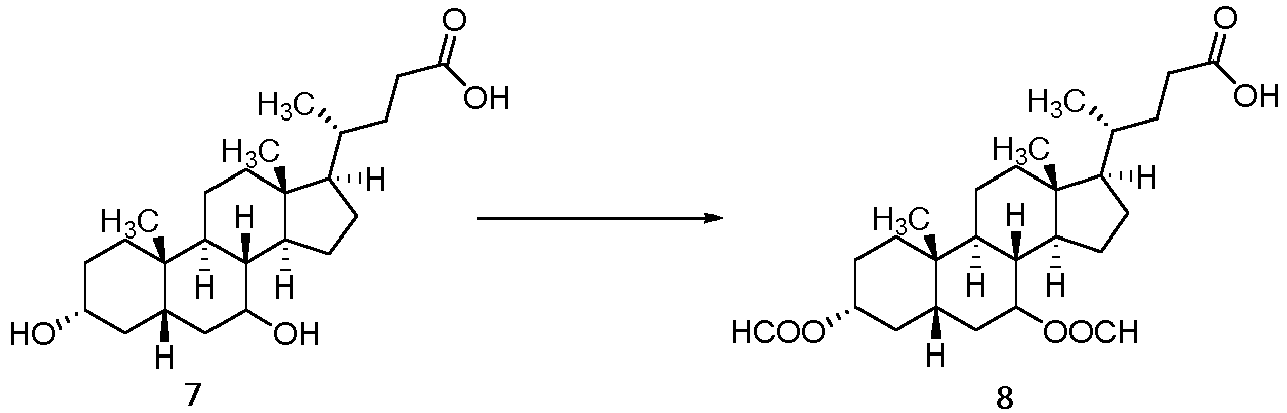
- g) converting a carboxyl group at position 23 of the compound of formula 8 to a cyano group at position 22 to obtain a compound of formula 9, and removing a formyl group from the compound of formula 9 to obtain the compound of formula 2,

- In another aspect, the present application provides a preparation method for the compound of formula I using CDCA as the raw material, which comprises the method for preparing the compound of formula 2 from the compound of formula 7 and the method for preparing the compound of formula I from the compound of formula 2 as described above.
- In some embodiments, the silyl ether protecting group is preferably selected from trimethylsilyl (TMS), triethylsilyl (TES), tert-butyldimethylsilyl (TBDMS), or tert-butyldiphenylsilyl (TBDPS), preferably trimethylsilyl (TMS).
- In some embodiments, an oxidant used in said step a) is selected from sodium hypochlorite, bromine hypochlorite, N-bromosuccinimide (NBS), N-chlorosuccinimide (NCS), hydrogen peroxide, or potassium dichromate, preferably selected from sodium hypochlorite. In terms of adding amount, a molar ratio of the compound of formula 2 to the oxidant is selected from 1:(1 to 5), preferably 1:(1 to 2), and more preferably 1:1.
- In some embodiments, said step a) is performed in the presence of bromine; preferably, the compound providing bromine can be selected from sodium bromide or potassium bromide. In terms of adding amount, a molar ratio of the compound of formula 2 to sodium bromide or potassium bromide is selected from 1:(0.1 to 2), preferably 1:(0.1 to 2) or 1:(0.1 to 0.5), and more preferably 1:0.2.
- In some embodiments, a solvent of said step a) is selected from dichloromethane, methanol, ethanol, propanol, diethyl ether, isopropyl ether, tetrahydrofuran, methyl tert-butyl ether, ethyl acetate, acetonitrile, acetone, or a mixed solvent thereof, preferably selected from dichloromethane, methanol, ethyl acetate, or a mixed solvent thereof.
- In some embodiments, said step a) is performed in the presence of an organic acid, which is selected from formic acid, acetic acid, propionic acid, citric acid or malic acid, preferably formic acid, acetic acid or propionic acid.
- In some embodiments, a reaction temperature of said step a) is selected from -50 °C to 50 °C, preferably -30 °C to 40 °C, and more preferably -20 °C to 40 °C.
- In some embodiments, said step b) is performed in the presence of an alkali metal cationic organic base, which is selected from lithium diisopropylamide (LDA), n-butyl lithium (nBuLi), sodium diisopropylamide, potassium diisopropylamide, sodium hexamethyldisilazide, potassium hexamethyldisilazide or lithium hexamethyldisilazide, preferably LDA.
- In some embodiments, said step b) is performed in the presence of an acid-binding agent, which is selected from triethylamine, diisopropylethylamine, tributylamine or pyridine, preferably triethylamine.
- In some embodiments, said step b) is performed under the protection of an inert gas, which is selected from nitrogen.
- In some embodiments, a solvent of said step b) is selected from n-heptane, n-hexane, tetrahydrofuran, methyl tert-butyl ether or toluene, preferably tetrahydrofuran.
- In some embodiments, a reaction temperature of said step b) is selected from -90 °C to - 50 °C, preferably -85 °C to -60 °C, and more preferably -80 °C to -70 °C.
- In some embodiments, said step c) is performed in the presence of boron trifluoride, aluminum trichloride, iron trichloride, zinc chloride, tin tetrachloride or niobium pentachloride, preferably boron trifluoride.
- In some embodiments, a solvent of said step c) is selected from n-heptane, n-hexane, tetrahydrofuran, methyl tert-butyl ether, toluene or dichloromethane, preferably dichloromethane.
- In some embodiments, a reaction temperature of said step c) is selected from -90 °C to - 50 °C, preferably -75 °C to -55 °C.
- In some embodiments, said step b) is performed under the protection of an inert gas, which is selected from nitrogen.
- In some embodiments, a catalyst of said step d) is selected from Pd/C, Pt/C, Rh/C, Pd(OH)2, Raney Ni or PtO2, preferably Pd/C.
- In some embodiments, H2 pressure of said step d) is selected from 1.0 to 3.0 MPa, preferably 1.5 to 2.5 MPa.
- In some embodiments, a solvent of said step d) is selected from methanol, ethanol, propanol or tetrahydrofuran, preferably methanol or tetrahydrofuran.
- In some embodiments, a reaction temperature of said step d) is selected from 30 °C to 70 °C, preferably 40 °C to 60 °C, and more preferably 45 °C to 55 °C.
- In some embodiments, said step e) is performed in the presence of NaOH or KOH, preferably NaOH.
- In some embodiments, a reaction solvent of said step e) is a mixed solvent of water and one or more selected from methanol, ethanol, propanol or butanol, preferably a mixed solvent of water and one or more selected from ethanol, propanol or butanol, more preferably a mixed solvent of ethanol and water, and more preferably a mixed solvent of ethanol and water in a volume ratio of 1:1.
- In some embodiments, a reaction temperature of said step e) is selected from 60 °C to 125 °C, preferably 70 °C to 115 °C.
- In some embodiments, the reaction temperature of said step e) is selected from 60 °C to 78 °C, preferably 70 °C to 78 °C.
- In some embodiments, said step f) is performed in formic acid.
- In some embodiments, a temperature of the reaction step f) is selected from 30 °C to 60 °C, preferably 40 °C to 50 °C.
- In some embodiments, in the reaction step g), the compound of formula 8 is converted to the compound of formula 9 in the presence of trifluoroacetic acid and trifluoroacetic anhydride.
- In some embodiments, in the reaction step g), the compound of formula 8 is converted to the compound of formula 9 in the presence of sodium nitrite or potassium nitrite.
- In some embodiments, a reaction temperature of the reaction step g) for converting the compound of formula 8 to the compound of formula 9 is selected from -10 °C to 40 °C, preferably -10 °C to 10 °C, and more preferably -5 °C to 5 °C.
- In some embodiments, a reaction of removing the formyl group from the compound of formula 9 to obtain the compound of formula 2 in the reaction step g) is performed in an aqueous solution of NaOH or KOH, preferably the aqueous solution of NaOH.
- Unless otherwise stated, the terms and phrases used herein have the meanings listed below. A particular term or phrase should not be considered as being indefinite or unclear in the absence of a specific definition, but should be interpreted according to the meaning generally understood by those skilled in the art. When a trade name appears herein, it is intended to refer to corresponding commodity or active ingredient thereof.
- In the present application, the protecting group and the method for attaching or removing the same can be achieved by using a conventional method in the art, and the method can be one-step reaction or multi-step reaction, such as, but not limited to referring to Greene's Protective Groups in Organic Synthesis-4th Edition published by Wiley Press, or Protecting Groups published by Chemical Industry Press.
- In the present application, the compounds may exist in specific geometric or stereoisomeric forms. All such compounds envisaged in the present application include cis and trans isomers, (-)- and (+)-enantiomers, (R)- and (S)-enantiomers, diastereomers, (D)-isomers, (L)-isomers, and racemic mixtures and other mixtures thereof, such as enantiomeric or diastereomeric excess mixtures, and all of these mixtures fall within the scope of the present application. Additional asymmetric carbon atoms may be present in the substituents such as alkyl. All these isomers and mixtures thereof are included in the scope of the present invention.
- In the present application, the protecting group and the method for attaching or removing the same can be achieved by using a conventional method in the art, and the method can be one-step reaction or multi-step reaction, such as, but not limited to, referring to Greene's Protective Groups in Organic Synthesis-4th Edition published by Wiley Press, or Protecting Groups published by Chemical Industry Press.
- In this application, the atoms of a steroid compound can be numbered according to the common knowledge in the field, such as, but not limited to referring to Fundamental Organic Chemistry-3rd Edition edited by Qiyi XING and published by Higher Education Press. In the present application, taking the CDCA compound for example, some atom numbers thereof are marked as follows:

- In the present application, compounds of formula 2 in which position 7 is in the α configuration or β configuration both can be used as the raw material for reaction to obtain the compound of formula I. Correspondingly, both chenodeoxycholic acid (CDCA) and ursodeoxycholic acid (UDCA) can be used as the raw material for preparing the compound of formula 2 according to the method provided in the present application.
- The preparation route of the present application has high yield, requires less purification operations, and is suitable for industrial application.
- For better understanding the content of the present invention, the following detailed description is made in combination with the specific examples, but the specific examples are not intended to limit the content of the present invention.
-

- 130 mL of dichloromethane, 130 mL of methanol, 390 mL of AcOH, and 130 g of the compound of formula 2 (7α) were added into a reaction flask and stirred to dissolve. 130 mL of aqueous solution of 7.4 g of sodium bromide was added thereto, followed by being cooled down to -30 °C to -20 °C, and 268 g of 10% sodium hypochlorite solution was added dropwise. The reaction was monitored by TLC until completed, and an aqueous solution of sodium sulfite (20%) was added thereto. The organic layer was separated, and the aqueous layer was extracted with dichloromethane. The organic phases were combined, washed with purified water, and adjusted to pH 7-8 by adding 15% sodium carbonate aqueous solution. The organic phase was separated, washed with saturated brine, dried over anhydrous sodium sulfate, and concentrated to dryness under reduced pressure at 45 °C to obtain the compound of formula 3. The crude product was refluxed by adding 650 mL of ethyl acetate, cooled down to crystallize, and subjected to air pump filtration, and the filter cake was blast dried at 60 °C for 12 h to obtain 114.5 g of the compound of formula 3. The yield was 88.6%. MS: m/z: 358.40 (M+), 340.36 (M-18), 322.36 (M-2×18).
-

- 1 L of tetrahydrofuran and 129 g of the compound of formula 3 were added into a reaction flask, and stirred to dissolve at room temperature. Then 235g of trimethylchlorosilane was added thereto, followed by being cooled down to -70 °C under the protection of nitrogen. LDA (2M) was added dropwise while the temperature was maintained at -70 °C or less, and it was stirred for 0.5 h at a temperature of -70 °C or less after adding. 255 g of triethylamine was added dropwise, which was stirred for 2 h at the same temperature after adding. The reaction was monitored by TLC until completed, followed by being heated up to -30 °C to -20 °C, and 1350 g of sodium bicarbonate solution (9%) was added dropwise, which was stirred at 0 °C to 10 °C for 1 h after adding. The organic layer was separated, and the aqueous phase was extracted with ethyl acetate. The organic phases were combined, washed with 1.2 L of sodium bicarbonate solution (5%), 1.2 L of purified water, and 1.2 L of saturated brine successively, dried over anhydrous sodium sulfate and filtered, and the filtrate was concentrated to dryness under reduced pressure at 50 °C to obtain an orange-yellow semi-solid, which was directly used for the next step.
-

- 108 mL of dichloromethane and 18.0 g of the compound of formula 4a were added into a reaction flask, and cooled down to a temperature of -75 °C or less under the protection of nitrogen, to which 5.2 mL of acetaldehyde was added, and 40 mL of boron trifluoride diethyl etherate was added dropwise when controlling a temperature at -70 °C or less, followed by being stirred for 2 h when maintaining a temperature at -60 °C or less after adding. The reaction was monitored by TLC until completed, followed by being heated up to 0 °C and stirred for 1 h. 300 g of sodium bicarbonate solution (9%) was added dropwise and stirred for 30 min. The organic layer was separated, and the aqueous phase was extracted with dichloromethane. The organic phases were combined, washed with 5% sodium bicarbonate solution, purified water, and saturated brine successively, dried over sodium sulfate and filtered, and the filtrate was concentrated to dryness under reduced pressure at 40°C to 50 °C to obtain an orange-yellow foamed solid, which was directly used for the reaction of the next step. MS: m/z: 456.42 (M+), 438.44 (M-18).
-

- 40 g of the compound of formula 5a was added into 200 mL of methanol, and stirred to dissolve at room temperature, to which 10 g of palladium-carbon (5%) was added, stirred well, and transferred to an autoclave. A reaction was performed with the hydrogen pressure being increased to 1.5 to 2.5 MPa and the temperature being increased to 50 °C, until the hydrogen pressure no longer decreased. The reaction was monitored by TLC until completed. The reaction solution was transferred out after being replaced with nitrogen, the palladium-carbon was removed by filtration and the filtrate was concentrated to dryness under reduced pressure. The yield was above 100% and the product was directly used for the next step. MS: m/z: 386.45 (M+), 368.41 (M-18).
-

- 52 g of sodium hydroxide was dissolved in 100 mL of water, to which 100 mL of ethanol and 10 g of the compound of formula 6 were added, followed by being heated to perform a reflux reaction. The reaction was monitored by TLC until completed, followed by being cooled down to room temperature and concentrated under reduced pressure to remove the ethanol. The pH was adjusted to 2-3 with hydrochloric acid. 100 mL of ethyl acetate was added and stirred to dissolve. The organic phase was separated, and the aqueous phase was extracted with ethyl acetate. The organic phases were combined, washed with saturated brine, dried over sodium sulfate, and concentrated to dryness under reduced pressure to obtain 9.8 g of the compound of formula I. The yield was 93.3% (combined yield of steps 1-2 to 1-5). MS: m/z: 405.51 (M+), 387.49 (M-18).
-

- 200 g of chenodeoxycholic acid (CDCA) was added into 1 L of formic acid, and stirred and heated up to 40 °C to 50 °C. The reaction of the raw materials was monitored by TLC until completed, followed by being cooled down to crystallize, and being subjected to air pump filtration, and the filter cake was added with 2 L of purified water and stirred for 1 h at room temperature, subjected to air pump filtration, and blast dried at 70 °C to obtain 198.1 g of the compound of formula 8 (7α). The yield was 86.7%.
-

- 44.9 g of the compound of formula 8 (7α) was added into a mixed solution of 135 mL of trifluoroacetic acid and 168 g of trifluoroacetic anhydride, stirred and cooled down to - 5 °C to 5 °C, and 10.3 g of sodium nitrite was added in portions. After adding, it was stirred under a temperature maintained at -5 °C to 5 °C for 1 h, and then heated up to 40 °C for reaction. The reaction was monitored by TLC, and it was cooled down after the reaction. The reaction solution was added dropwise into 640 g of aqueous solution (20%) of sodium hydroxide. Afterward, it was filtered and the filter cake was added into 160 g of aqueous solution (15%) of sodium hydroxide, to which 90mL of ethanol was added and a reaction is performed at 50 °C. The reaction was monitored by TLC until completed, and the ethanol was removed by concentration under reduced pressure. The remaining reaction solution was extracted with 135 mL of ethyl acetate. The organic phases were combined and washed with sodium hydroxide aqueous solution (5%), hydrochloric acid (1 mol/L), and saturated brine, dried over sodium sulfate, and concentrated to dryness under reduced pressure at 50 °C to obtain the crude product of the compound of formula 2 (7α).
- The crude product was added with 90 mL of ethyl acetate, stirred at 55 °C for 2 h, cooled down to room temperature and stirred to crystallize, and subjected to air pump filtration, and the filter cake was blast dried to obtain 30.5 g of an off-white solid, which was the compound of formula 2 (7α). The yield was 84.7%. MS: m/z: 342.43 (M-18), 324.38 (M-2×18).
Claims (15)
- A preparation method for a compound of formula I,
 a) subjecting a compound of formula 2 to an oxidization reaction to obtain a compound of formula 3,
 b) attaching a protecting group to the compound of formula 3 to obtain a compound of formula 4,
 c) reacting the compound of formula 4 with acetaldehyde to obtain a compound of formula 5,
 d) subjecting the compound of formula 5 to a reduction reaction to obtain a compound of formula 6,
 e) converting a cyano group of the compound of formula 6 to a carboxyl group to give the compound of formula I,
- The preparation method of claim 1, wherein a preparation method for the compound of formula 2 comprises the following steps:f) attaching a formyl group to a compound of formula 7 to obtain a compound of formula 8,
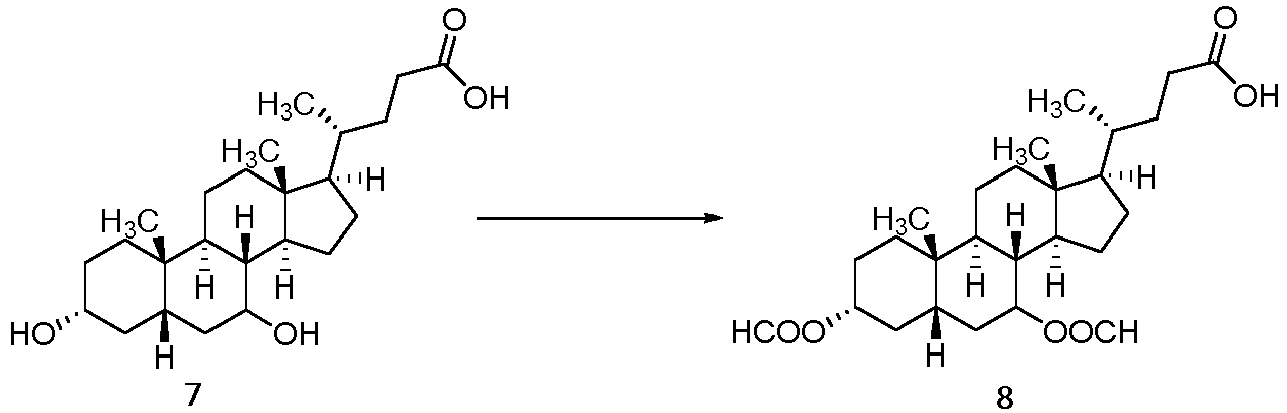 g) converting a carboxyl group at position 23 of the compound of formula 8 to a cyano group at position 22 to obtain a compound of formula 9, and removing a formyl group from the compound of formula 9 to obtain the compound of formula 2,
- The preparation method of claim 1, wherein the silyl ether protecting group is preferably selected from trimethylsilyl, triethylsilyl, tert-butyldimethylsilyl, or tert-butyldiphenylsilyl.
- The preparation method of claim 1, wherein an oxidant used in said step a) is selected from sodium hypochlorite, bromine hypochlorite, N-bromosuccinimide, N-chlorosuccinimide, hydrogen peroxide or potassium dichromate.
- The preparation method of claim 1, wherein in said step a), a molar ratio of the compound of formula 2 to the oxidant is selected from 1:(1 to 5).
- The preparation method of claim 1, wherein said step a) is performed in the presence of bromine.
- The preparation method of claim 1, wherein a solvent of said step a) is selected from dichloromethane, methanol, ethanol, propanol, diethyl ether, isopropyl ether, tetrahydrofuran, methyl tert-butyl ether, ethyl acetate, acetonitrile, acetone, or a mixed solvent thereof.
- The preparation method of claim 1, wherein said step a) is performed in the presence of an organic acid, which is selected from formic acid, acetic acid, propionic acid, citric acid or malic acid.
- The preparation method of claim 1, wherein said step b) is performed in the presence of an alkali metal cationic organic base, which is selected from lithium diisopropylamide, n-butyllithium, sodium diisopropylamide, potassium diisopropylamide, sodium hexamethyldisilazide, potassium hexamethyldisilazide or lithium hexamethyldisilazide.
- The preparation method of claim 1, wherein said step b) is performed in the presence of an acid-binding agent, which is selected from triethylamine, diisopropylethylamine, tributylamine or pyridine.
- The preparation method of claim 1, wherein said step c) is performed in the presence of boron trifluoride, aluminum trichloride, iron trichloride, zinc chloride, tin tetrachloride or niobium pentachloride.
- The preparation method of claim 1, wherein a catalyst of said step d) is selected from Pd/C, Pt/C, Rh/C, Pd(OH)2, Raney Ni, or PtO2.
- The preparation method of claim 1, wherein said step e) is performed in the presence of NaOH or KOH.
- The preparation method of claim 1, wherein said step f) is performed in formic acid.
- The preparation method of claim 1, wherein in said step g), the compound of formula 8 is converted to the compound of formula 9 in the presence of trifluoroacetic acid or trifluoroacetic anhydride, and sodium nitrite or potassium nitrite.
Applications Claiming Priority (2)
| Application Number | Priority Date | Filing Date | Title |
|---|---|---|---|
| CN201711062367 | 2017-11-02 | ||
| PCT/CN2018/113326 WO2019085963A1 (en) | 2017-11-02 | 2018-11-01 | Method for preparing cholic acid compound |
Publications (3)
| Publication Number | Publication Date |
|---|---|
| EP3705487A1 true EP3705487A1 (en) | 2020-09-09 |
| EP3705487A4 EP3705487A4 (en) | 2021-08-04 |
| EP3705487B1 EP3705487B1 (en) | 2022-10-26 |
Family
ID=66332811
Family Applications (1)
| Application Number | Title | Priority Date | Filing Date |
|---|---|---|---|
| EP18873405.7A Not-in-force EP3705487B1 (en) | 2017-11-02 | 2018-11-01 | Method for preparing cholic acid compound |
Country Status (4)
| Country | Link |
|---|---|
| US (1) | US11111265B2 (en) |
| EP (1) | EP3705487B1 (en) |
| CN (1) | CN111247160B (en) |
| WO (1) | WO2019085963A1 (en) |
Families Citing this family (2)
| Publication number | Priority date | Publication date | Assignee | Title |
|---|---|---|---|---|
| CN112944910B (en) * | 2021-04-02 | 2024-12-06 | 北京首钢国际工程技术有限公司 | A device for preventing wind from flowing between grate drums and partition walls |
| CN115611961B (en) * | 2022-10-18 | 2024-02-13 | 湖南科瑞生物制药股份有限公司 | Cholic acid intermediate A2 and preparation method thereof |
Family Cites Families (7)
| Publication number | Priority date | Publication date | Assignee | Title |
|---|---|---|---|---|
| ES2326850T3 (en) | 1998-12-23 | 2009-10-20 | Glaxo Group Limited | TESTS FOR NUCLEAR RECEPTORS LIGANDOS. |
| ITMI20021532A1 (en) * | 2002-07-12 | 2004-01-12 | Roberto Pellicciari | CHEMICAL COMPOUNDS |
| SG11201503697TA (en) * | 2012-11-28 | 2015-06-29 | Intercept Pharmaceuticals Inc | Treatment of pulmonary disease |
| EP3626725B1 (en) * | 2014-05-29 | 2022-11-30 | Bar Pharmaceuticals S.r.l. | Cholane derivatives for use in the treatment and/or prevention of fxr and tgr5/gpbar1 mediated diseases |
| TW201704251A (en) * | 2015-04-29 | 2017-02-01 | 正大天晴藥業集團股份有限公司 | Chenodeoxycholic acid derivative |
| US10800807B2 (en) * | 2015-06-19 | 2020-10-13 | Intercept Pharmaceuticals, Inc. | TGR5 modulators and methods of use thereof |
| EP3409684B1 (en) * | 2016-01-28 | 2024-01-03 | Chia Tai Tianqing Pharmaceutical Group Co., Ltd. | Steroid derivative fxr agonist |
-
2018
- 2018-11-01 CN CN201880069969.0A patent/CN111247160B/en active Active
- 2018-11-01 WO PCT/CN2018/113326 patent/WO2019085963A1/en not_active Ceased
- 2018-11-01 EP EP18873405.7A patent/EP3705487B1/en not_active Not-in-force
- 2018-11-01 US US16/759,134 patent/US11111265B2/en active Active
Also Published As
| Publication number | Publication date |
|---|---|
| EP3705487B1 (en) | 2022-10-26 |
| CN111247160A (en) | 2020-06-05 |
| CN111247160B (en) | 2021-09-28 |
| US11111265B2 (en) | 2021-09-07 |
| WO2019085963A1 (en) | 2019-05-09 |
| US20200347091A1 (en) | 2020-11-05 |
| EP3705487A4 (en) | 2021-08-04 |
Similar Documents
| Publication | Publication Date | Title |
|---|---|---|
| CA1308095C (en) | 11.beta.-ARYLESTRADINENES, THE PRODUCTION, AND PHARMACEUTICAL PREPARATIONS CONTAINING SAME | |
| EP3705487B1 (en) | Method for preparing cholic acid compound | |
| EP0189951B1 (en) | New process for the preparation of certain steroids, especially intermediates for the preparation of proligestone and related compounds, and new intermediates formed in this process | |
| FR2569408A1 (en) | NOVEL STEROIDS SUBSTITUTED IN POSITION 10 BY A RADICAL COMPRISING A DOUBLE OR TRIPLE BINDING, THEIR PROCESS OF PREPARATION, THEIR APPLICATION AS MEDICAMENTS, THE PHARMACEUTICAL COMPOSITIONS CONTAINING SAME | |
| CN102532233B (en) | The preparation technology of desogestrel and new midbody compound thereof | |
| JP5129899B2 (en) | Process for the preparation of 17-hydroxy-6β, 7β; 15β, 16β-bismethylene-17α-pregne-4-en-3-one-21-carboxylic acid γ-lactone and important intermediates for this method | |
| CA2150738C (en) | Process for preparing a 16.beta.-methyl steroid and new intermediates | |
| DE3231827A1 (en) | 11SS-ARYL-17 (ALPHA) -ALKINYL-17SS-HYDROXY-4.9 (10) - ESTRADIEN-3-ON DERIVATIVES, THEIR PRODUCTION AND THEIR PHARMACEUTICAL PREPARATIONS CONTAINING THEM | |
| WO1991018918A1 (en) | PROCESS FOR PRODUCING 10β-H-STEROIDS | |
| CN86102560A (en) | 17 α-ethynyl-17 beta-hydroxies-18-methyl-4, the preparation method of 15-estradiene-3-ketone | |
| DE2417846A1 (en) | 7-POSITION SUBSTITUTED STEROIDS OF THE OESTRAN SERIES | |
| CA1069117A (en) | PROCESS FOR THE PREPARATION OF 11.beta.-HYDROXY-18-ALKYL-ESTRANE COMPOUNDS | |
| CN104628807B (en) | The synthetic method of 16-alkene-20-hydroxy-steroids | |
| Künzer et al. | Regioselective functionalization of 3-oxygenated estra-1, 3, 5 (10)-trienes AT C-1 VIA (η6-arene) Cr (CO) 3 complexes | |
| WO2015063408A2 (en) | Method for preparing steroidal derivatives | |
| DE4218743A1 (en) | Prodn. of 7-substd. 1,3,5-oestratriene derivs. - via reaction of new 6-organo:sulphonyl-1,3,5,6-oestratetraene derivs. with nucleophile(s) | |
| DE4319998A1 (en) | Process for the preparation of derivatives of oestra-1,3,5(10),14-tetraene-3,17 alpha -diol | |
| DE2749105C2 (en) | Process for the preparation of Δ → 1 → → 5 → -17α-chloroethinyl and propynyl steroids of the estran series | |
| DE2749104C2 (en) | Process for the preparation of?? 15? -Steroids | |
| EP0534582A1 (en) | Methylation or ethylation agent and process for an 1,4-addition of a methyl- or ethylgroup to an alpha, beta-insaturated ketogroup | |
| DE4018828C2 (en) | Process for the preparation of C7-alpha-substituted 8alpha- and 8ß-Estra-1,3,5 (10) -trienes and C8-alpha-substituted Estra-1,3,5 (10) -trienes as well as new intermediates for this process | |
| DE4301461A1 (en) | Process for the preparation of derivatives of oestra-1,3,5(10),14-tetraene-3,17 alpha -diol | |
| CA2431328A1 (en) | 14(15)-unsaturated 15- and/or 16- substituted androgens with mixed androgen-progestational profile | |
| CN1152045C (en) | Preparation method and intermediate of 4,4-dimethyl-3β-hydroxypregna-8,14-diene-21-carboxylate | |
| DE4311028A1 (en) | Methylating or ethylating agent and method for 1,4-addition of a methyl or ethyl group to an alpha, beta-unsaturated keto compound |
Legal Events
| Date | Code | Title | Description |
|---|---|---|---|
| STAA | Information on the status of an ep patent application or granted ep patent |
Free format text: STATUS: THE INTERNATIONAL PUBLICATION HAS BEEN MADE |
|
| PUAI | Public reference made under article 153(3) epc to a published international application that has entered the european phase |
Free format text: ORIGINAL CODE: 0009012 |
|
| STAA | Information on the status of an ep patent application or granted ep patent |
Free format text: STATUS: REQUEST FOR EXAMINATION WAS MADE |
|
| 17P | Request for examination filed |
Effective date: 20200424 |
|
| AK | Designated contracting states |
Kind code of ref document: A1 Designated state(s): AL AT BE BG CH CY CZ DE DK EE ES FI FR GB GR HR HU IE IS IT LI LT LU LV MC MK MT NL NO PL PT RO RS SE SI SK SM TR |
|
| AX | Request for extension of the european patent |
Extension state: BA ME |
|
| DAV | Request for validation of the european patent (deleted) | ||
| DAX | Request for extension of the european patent (deleted) | ||
| A4 | Supplementary search report drawn up and despatched |
Effective date: 20210706 |
|
| RIC1 | Information provided on ipc code assigned before grant |
Ipc: C07J 9/00 20060101AFI20210701BHEP Ipc: C07J 41/00 20060101ALI20210701BHEP Ipc: C07J 51/00 20060101ALI20210701BHEP |
|
| RIC1 | Information provided on ipc code assigned before grant |
Ipc: C07J 51/00 20060101ALI20220413BHEP Ipc: C07J 41/00 20060101ALI20220413BHEP Ipc: C07J 9/00 20060101AFI20220413BHEP |
|
| GRAP | Despatch of communication of intention to grant a patent |
Free format text: ORIGINAL CODE: EPIDOSNIGR1 |
|
| STAA | Information on the status of an ep patent application or granted ep patent |
Free format text: STATUS: GRANT OF PATENT IS INTENDED |
|
| INTG | Intention to grant announced |
Effective date: 20220524 |
|
| RAP3 | Party data changed (applicant data changed or rights of an application transferred) |
Owner name: CHIA TAI TIANQING PHARMACEUTICAL GROUP CO., LTD. |
|
| GRAS | Grant fee paid |
Free format text: ORIGINAL CODE: EPIDOSNIGR3 |
|
| GRAA | (expected) grant |
Free format text: ORIGINAL CODE: 0009210 |
|
| STAA | Information on the status of an ep patent application or granted ep patent |
Free format text: STATUS: THE PATENT HAS BEEN GRANTED |
|
| AK | Designated contracting states |
Kind code of ref document: B1 Designated state(s): AL AT BE BG CH CY CZ DE DK EE ES FI FR GB GR HR HU IE IS IT LI LT LU LV MC MK MT NL NO PL PT RO RS SE SI SK SM TR |
|
| REG | Reference to a national code |
Ref country code: GB Ref legal event code: FG4D |
|
| REG | Reference to a national code |
Ref country code: CH Ref legal event code: EP |
|
| REG | Reference to a national code |
Ref country code: AT Ref legal event code: REF Ref document number: 1526987 Country of ref document: AT Kind code of ref document: T Effective date: 20221115 |
|
| REG | Reference to a national code |
Ref country code: DE Ref legal event code: R096 Ref document number: 602018042398 Country of ref document: DE |
|
| REG | Reference to a national code |
Ref country code: IE Ref legal event code: FG4D |
|
| PGFP | Annual fee paid to national office [announced via postgrant information from national office to epo] |
Ref country code: GB Payment date: 20221110 Year of fee payment: 5 Ref country code: FR Payment date: 20221122 Year of fee payment: 5 Ref country code: DE Payment date: 20221116 Year of fee payment: 5 |
|
| REG | Reference to a national code |
Ref country code: LT Ref legal event code: MG9D |
|
| REG | Reference to a national code |
Ref country code: NL Ref legal event code: MP Effective date: 20221026 |
|
| REG | Reference to a national code |
Ref country code: AT Ref legal event code: MK05 Ref document number: 1526987 Country of ref document: AT Kind code of ref document: T Effective date: 20221026 |
|
| PG25 | Lapsed in a contracting state [announced via postgrant information from national office to epo] |
Ref country code: NL Free format text: LAPSE BECAUSE OF FAILURE TO SUBMIT A TRANSLATION OF THE DESCRIPTION OR TO PAY THE FEE WITHIN THE PRESCRIBED TIME-LIMIT Effective date: 20221026 |
|
| PG25 | Lapsed in a contracting state [announced via postgrant information from national office to epo] |
Ref country code: SE Free format text: LAPSE BECAUSE OF FAILURE TO SUBMIT A TRANSLATION OF THE DESCRIPTION OR TO PAY THE FEE WITHIN THE PRESCRIBED TIME-LIMIT Effective date: 20221026 Ref country code: PT Free format text: LAPSE BECAUSE OF FAILURE TO SUBMIT A TRANSLATION OF THE DESCRIPTION OR TO PAY THE FEE WITHIN THE PRESCRIBED TIME-LIMIT Effective date: 20230227 Ref country code: NO Free format text: LAPSE BECAUSE OF FAILURE TO SUBMIT A TRANSLATION OF THE DESCRIPTION OR TO PAY THE FEE WITHIN THE PRESCRIBED TIME-LIMIT Effective date: 20230126 Ref country code: LT Free format text: LAPSE BECAUSE OF FAILURE TO SUBMIT A TRANSLATION OF THE DESCRIPTION OR TO PAY THE FEE WITHIN THE PRESCRIBED TIME-LIMIT Effective date: 20221026 Ref country code: FI Free format text: LAPSE BECAUSE OF FAILURE TO SUBMIT A TRANSLATION OF THE DESCRIPTION OR TO PAY THE FEE WITHIN THE PRESCRIBED TIME-LIMIT Effective date: 20221026 Ref country code: ES Free format text: LAPSE BECAUSE OF FAILURE TO SUBMIT A TRANSLATION OF THE DESCRIPTION OR TO PAY THE FEE WITHIN THE PRESCRIBED TIME-LIMIT Effective date: 20221026 Ref country code: AT Free format text: LAPSE BECAUSE OF FAILURE TO SUBMIT A TRANSLATION OF THE DESCRIPTION OR TO PAY THE FEE WITHIN THE PRESCRIBED TIME-LIMIT Effective date: 20221026 |
|
| PG25 | Lapsed in a contracting state [announced via postgrant information from national office to epo] |
Ref country code: RS Free format text: LAPSE BECAUSE OF FAILURE TO SUBMIT A TRANSLATION OF THE DESCRIPTION OR TO PAY THE FEE WITHIN THE PRESCRIBED TIME-LIMIT Effective date: 20221026 Ref country code: PL Free format text: LAPSE BECAUSE OF FAILURE TO SUBMIT A TRANSLATION OF THE DESCRIPTION OR TO PAY THE FEE WITHIN THE PRESCRIBED TIME-LIMIT Effective date: 20221026 Ref country code: LV Free format text: LAPSE BECAUSE OF FAILURE TO SUBMIT A TRANSLATION OF THE DESCRIPTION OR TO PAY THE FEE WITHIN THE PRESCRIBED TIME-LIMIT Effective date: 20221026 Ref country code: IS Free format text: LAPSE BECAUSE OF FAILURE TO SUBMIT A TRANSLATION OF THE DESCRIPTION OR TO PAY THE FEE WITHIN THE PRESCRIBED TIME-LIMIT Effective date: 20230226 Ref country code: HR Free format text: LAPSE BECAUSE OF FAILURE TO SUBMIT A TRANSLATION OF THE DESCRIPTION OR TO PAY THE FEE WITHIN THE PRESCRIBED TIME-LIMIT Effective date: 20221026 Ref country code: GR Free format text: LAPSE BECAUSE OF FAILURE TO SUBMIT A TRANSLATION OF THE DESCRIPTION OR TO PAY THE FEE WITHIN THE PRESCRIBED TIME-LIMIT Effective date: 20230127 |
|
| REG | Reference to a national code |
Ref country code: CH Ref legal event code: PL |
|
| P01 | Opt-out of the competence of the unified patent court (upc) registered |
Effective date: 20230601 |
|
| REG | Reference to a national code |
Ref country code: DE Ref legal event code: R097 Ref document number: 602018042398 Country of ref document: DE Ref country code: BE Ref legal event code: MM Effective date: 20221130 |
|
| PG25 | Lapsed in a contracting state [announced via postgrant information from national office to epo] |
Ref country code: SM Free format text: LAPSE BECAUSE OF FAILURE TO SUBMIT A TRANSLATION OF THE DESCRIPTION OR TO PAY THE FEE WITHIN THE PRESCRIBED TIME-LIMIT Effective date: 20221026 Ref country code: RO Free format text: LAPSE BECAUSE OF FAILURE TO SUBMIT A TRANSLATION OF THE DESCRIPTION OR TO PAY THE FEE WITHIN THE PRESCRIBED TIME-LIMIT Effective date: 20221026 Ref country code: MC Free format text: LAPSE BECAUSE OF FAILURE TO SUBMIT A TRANSLATION OF THE DESCRIPTION OR TO PAY THE FEE WITHIN THE PRESCRIBED TIME-LIMIT Effective date: 20221026 Ref country code: EE Free format text: LAPSE BECAUSE OF FAILURE TO SUBMIT A TRANSLATION OF THE DESCRIPTION OR TO PAY THE FEE WITHIN THE PRESCRIBED TIME-LIMIT Effective date: 20221026 Ref country code: DK Free format text: LAPSE BECAUSE OF FAILURE TO SUBMIT A TRANSLATION OF THE DESCRIPTION OR TO PAY THE FEE WITHIN THE PRESCRIBED TIME-LIMIT Effective date: 20221026 Ref country code: CZ Free format text: LAPSE BECAUSE OF FAILURE TO SUBMIT A TRANSLATION OF THE DESCRIPTION OR TO PAY THE FEE WITHIN THE PRESCRIBED TIME-LIMIT Effective date: 20221026 Ref country code: CH Free format text: LAPSE BECAUSE OF NON-PAYMENT OF DUE FEES Effective date: 20221130 Ref country code: LI Free format text: LAPSE BECAUSE OF NON-PAYMENT OF DUE FEES Effective date: 20221130 |
|
| PG25 | Lapsed in a contracting state [announced via postgrant information from national office to epo] |
Ref country code: SK Free format text: LAPSE BECAUSE OF FAILURE TO SUBMIT A TRANSLATION OF THE DESCRIPTION OR TO PAY THE FEE WITHIN THE PRESCRIBED TIME-LIMIT Effective date: 20221026 Ref country code: LU Free format text: LAPSE BECAUSE OF NON-PAYMENT OF DUE FEES Effective date: 20221101 Ref country code: AL Free format text: LAPSE BECAUSE OF FAILURE TO SUBMIT A TRANSLATION OF THE DESCRIPTION OR TO PAY THE FEE WITHIN THE PRESCRIBED TIME-LIMIT Effective date: 20221026 |
|
| PLBE | No opposition filed within time limit |
Free format text: ORIGINAL CODE: 0009261 |
|
| STAA | Information on the status of an ep patent application or granted ep patent |
Free format text: STATUS: NO OPPOSITION FILED WITHIN TIME LIMIT |
|
| 26N | No opposition filed |
Effective date: 20230727 |
|
| PG25 | Lapsed in a contracting state [announced via postgrant information from national office to epo] |
Ref country code: IE Free format text: LAPSE BECAUSE OF NON-PAYMENT OF DUE FEES Effective date: 20221101 |
|
| PG25 | Lapsed in a contracting state [announced via postgrant information from national office to epo] |
Ref country code: SI Free format text: LAPSE BECAUSE OF FAILURE TO SUBMIT A TRANSLATION OF THE DESCRIPTION OR TO PAY THE FEE WITHIN THE PRESCRIBED TIME-LIMIT Effective date: 20221026 Ref country code: BE Free format text: LAPSE BECAUSE OF NON-PAYMENT OF DUE FEES Effective date: 20221130 |
|
| PG25 | Lapsed in a contracting state [announced via postgrant information from national office to epo] |
Ref country code: CY Free format text: LAPSE BECAUSE OF FAILURE TO SUBMIT A TRANSLATION OF THE DESCRIPTION OR TO PAY THE FEE WITHIN THE PRESCRIBED TIME-LIMIT Effective date: 20221026 |
|
| PG25 | Lapsed in a contracting state [announced via postgrant information from national office to epo] |
Ref country code: MK Free format text: LAPSE BECAUSE OF FAILURE TO SUBMIT A TRANSLATION OF THE DESCRIPTION OR TO PAY THE FEE WITHIN THE PRESCRIBED TIME-LIMIT Effective date: 20221026 Ref country code: IT Free format text: LAPSE BECAUSE OF FAILURE TO SUBMIT A TRANSLATION OF THE DESCRIPTION OR TO PAY THE FEE WITHIN THE PRESCRIBED TIME-LIMIT Effective date: 20221026 Ref country code: HU Free format text: LAPSE BECAUSE OF FAILURE TO SUBMIT A TRANSLATION OF THE DESCRIPTION OR TO PAY THE FEE WITHIN THE PRESCRIBED TIME-LIMIT; INVALID AB INITIO Effective date: 20181101 |
|
| REG | Reference to a national code |
Ref country code: DE Ref legal event code: R119 Ref document number: 602018042398 Country of ref document: DE |
|
| PG25 | Lapsed in a contracting state [announced via postgrant information from national office to epo] |
Ref country code: TR Free format text: LAPSE BECAUSE OF FAILURE TO SUBMIT A TRANSLATION OF THE DESCRIPTION OR TO PAY THE FEE WITHIN THE PRESCRIBED TIME-LIMIT Effective date: 20221026 |
|
| GBPC | Gb: european patent ceased through non-payment of renewal fee |
Effective date: 20231101 |
|
| PG25 | Lapsed in a contracting state [announced via postgrant information from national office to epo] |
Ref country code: BG Free format text: LAPSE BECAUSE OF FAILURE TO SUBMIT A TRANSLATION OF THE DESCRIPTION OR TO PAY THE FEE WITHIN THE PRESCRIBED TIME-LIMIT Effective date: 20221026 |
|
| PG25 | Lapsed in a contracting state [announced via postgrant information from national office to epo] |
Ref country code: MT Free format text: LAPSE BECAUSE OF FAILURE TO SUBMIT A TRANSLATION OF THE DESCRIPTION OR TO PAY THE FEE WITHIN THE PRESCRIBED TIME-LIMIT Effective date: 20221026 |
|
| PG25 | Lapsed in a contracting state [announced via postgrant information from national office to epo] |
Ref country code: DE Free format text: LAPSE BECAUSE OF NON-PAYMENT OF DUE FEES Effective date: 20240601 |
|
| PG25 | Lapsed in a contracting state [announced via postgrant information from national office to epo] |
Ref country code: GB Free format text: LAPSE BECAUSE OF NON-PAYMENT OF DUE FEES Effective date: 20231101 |
|
| PG25 | Lapsed in a contracting state [announced via postgrant information from national office to epo] |
Ref country code: FR Free format text: LAPSE BECAUSE OF NON-PAYMENT OF DUE FEES Effective date: 20231130 |
|
| PG25 | Lapsed in a contracting state [announced via postgrant information from national office to epo] |
Ref country code: GB Free format text: LAPSE BECAUSE OF NON-PAYMENT OF DUE FEES Effective date: 20231101 Ref country code: FR Free format text: LAPSE BECAUSE OF NON-PAYMENT OF DUE FEES Effective date: 20231130 Ref country code: DE Free format text: LAPSE BECAUSE OF NON-PAYMENT OF DUE FEES Effective date: 20240601 |