EP3705040A1 - Vorrichtung zur analyse von laufschwingungen, verfahren zur laufschwingungsanalyse und computerlesbares aufzeichnungsmedium - Google Patents
Vorrichtung zur analyse von laufschwingungen, verfahren zur laufschwingungsanalyse und computerlesbares aufzeichnungsmedium Download PDFInfo
- Publication number
- EP3705040A1 EP3705040A1 EP18874775.2A EP18874775A EP3705040A1 EP 3705040 A1 EP3705040 A1 EP 3705040A1 EP 18874775 A EP18874775 A EP 18874775A EP 3705040 A1 EP3705040 A1 EP 3705040A1
- Authority
- EP
- European Patent Office
- Prior art keywords
- individual
- data
- walking
- walking vibration
- acquired
- Prior art date
- Legal status (The legal status is an assumption and is not a legal conclusion. Google has not performed a legal analysis and makes no representation as to the accuracy of the status listed.)
- Pending
Links
Images






Classifications
-
- A—HUMAN NECESSITIES
- A61—MEDICAL OR VETERINARY SCIENCE; HYGIENE
- A61B—DIAGNOSIS; SURGERY; IDENTIFICATION
- A61B5/00—Measuring for diagnostic purposes; Identification of persons
- A61B5/117—Identification of persons
-
- G—PHYSICS
- G06—COMPUTING OR CALCULATING; COUNTING
- G06N—COMPUTING ARRANGEMENTS BASED ON SPECIFIC COMPUTATIONAL MODELS
- G06N7/00—Computing arrangements based on specific mathematical models
- G06N7/01—Probabilistic graphical models, e.g. probabilistic networks
-
- A—HUMAN NECESSITIES
- A61—MEDICAL OR VETERINARY SCIENCE; HYGIENE
- A61B—DIAGNOSIS; SURGERY; IDENTIFICATION
- A61B5/00—Measuring for diagnostic purposes; Identification of persons
- A61B5/103—Measuring devices for testing the shape, pattern, colour, size or movement of the body or parts thereof, for diagnostic purposes
- A61B5/11—Measuring movement of the entire body or parts thereof, e.g. head or hand tremor or mobility of a limb
- A61B5/112—Gait analysis
-
- G—PHYSICS
- G06—COMPUTING OR CALCULATING; COUNTING
- G06F—ELECTRIC DIGITAL DATA PROCESSING
- G06F2218/00—Aspects of pattern recognition specially adapted for signal processing
- G06F2218/08—Feature extraction
- G06F2218/10—Feature extraction by analysing the shape of a waveform, e.g. extracting parameters relating to peaks
Definitions
- the example embodiments relates to a walking vibration analysis apparatus and a walking vibration analysis method that are for analyzing vibration that occurs due to walking, and furthermore relates to a computer-readable recording medium that includes a program recorded thereon for realizing the apparatus and method.
- Patent Document 1 discloses a system that specifies an individual from walking vibration.
- a frequency of vibration produced due to an action of a person within a space or a period of multiple steps is extracted as a feature amount of an individual from measured walking vibration, and collated with frequencies or periods of individuals collected in advance to specify an individual.
- Non-Patent Document 1 also discloses a system that specifies an individual from walking vibration.
- the system disclosed in Non-Patent Document 1 specifies an individual by utilizing the fact that vibration patterns differ between individuals.
- Patent Document 1 Japanese Patent Laid-Open Publication No. 2004-227053
- Non-Patent Document 1 Kazuki ITO et al., "Construction of Individual Identification System using Gait Vibration Data” [online], Symposium on the Living Body, Sensibility and Advanced Information Processing, 2017 [viewed on August 31, 2015], Internet URL http://pelican.nagaokaut.ac.jp/2017symposium/pdf/09-S-1%E3%80%80%E4%BC%8A%E8%97%A4%E3%80%80%E5%92%8C%E8%BC%9D%EF% BC%88%E9%98%BF%E5%8D%97%E5%B7%A5%E6%A5%AD%E9%AB%98%E7%AD%8 9%E5%B0%82%E9%96%80%E5%AD%A6%E6%A0%A1%EF%BC%89. pdf
- An example object of the example embodiments is to solve the above problems and provide a walking vibration analysis apparatus, a walking vibration analysis method, and a computer-readable recording medium that can enable an individual to be specified from walking vibration, even in the case where variation occurs in the walking vibration.
- a walking vibration analysis method includes:
- a computer-readable recording medium includes a program recorded thereon, the program including instructions that cause the computer to carry out:
- an individual can be specified from walking vibration, even in the case where variation occurs in the walking vibration.
- FIG. 1 is a block diagram showing a schematic configuration of the walking vibration analysis apparatus according to the example embodiment.
- a walking vibration analysis apparatus 10 is an apparatus for specifying an individual by analyzing vibration that occurs due to walking. As shown in FIG. 1 , the walking vibration analysis apparatus 10 includes a binarization processing unit 11 and an individual determination unit 12.
- the binarization processing unit 11 acquires walking vibration data specifying walking vibration produced in association with walking, and converts the acquired walking vibration data into binary data.
- the binary data is data representing the value of vibration over time from the start of walking with two values, namely, high level and low level.
- the individual determination unit 12 specifies the individual from which the walking vibration data was acquired, by collating the binary data obtained through conversion with individual specification data.
- the individual specification data is data created, for each individual in advance, by converting the walking vibration data of the individual into binary data.
- the walking vibration analysis apparatus 10 extracts features of an individual in the walking vibration through binarization, and specifies an individual by the extracted features.
- an individual can be specified from walking vibration, even in the case where variation occurs in the walking vibration.
- FIG. 2 is a block diagram more specifically showing the configuration of the walking vibration analysis apparatus according to the example embodiment.
- the walking vibration analysis apparatus 10 is connected to a vibration sensor 20 for detecting walking vibration.
- An acceleration sensor for example, is used as the vibration sensor 20.
- the vibration sensor 20 is attached to the floor of a building 22 such as a residence, for example, and detects vibration that occurs due to walking of a person 21 who is in the building 22.
- the binarization processing unit 11 first, acquires sensor data output by the vibration sensor 20.
- the sensor data is walking vibration data specifying walking vibration produced in association with walking.
- the binarization processing unit 11 then calculates a standard deviation ⁇ of the walking vibration data (sensor data), and converts the walking vibration data into binary data, using the calculated standard deviation ⁇ as a threshold value.
- FIG. 3 is a diagram showing an example of walking vibration data that is acquired in the example embodiment.
- the given interval is the interval of one step, and includes from the point in time (time point A) at which the heel of one foot of the person contacts the floor until the point in time (time point C) at which the toe of the person contacts the floor.
- time point B is the point in time at which the toe of the other foot lifts off the floor.
- the walking vibration data shown in FIG. 3 is one step of walking vibration data.
- the binarization processing unit 11 calculates the standard deviation ⁇ , based on the following equation 1, for each piece of acquired walking vibration data (a m0 to a mN ).
- a is the average value of a m0 to a mN .
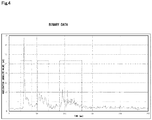
- FIG. 4 is a diagram showing an example of binary data that is obtained in the example embodiment.
- the horizontal axis shows time and the vertical axis shows signal probability.
- the binarization processing unit 11 calculates an average value Av of the walking vibration data every 10 ms, for example, and compares the calculated average value with the standard deviation ⁇ .
- the binarization processing unit 11, as shown in the following equation 2, then sets the value a mn of the walking vibration data targeted for comparison to "b mn 0", in the case where the result of comparison indicates that the average value Av is smaller than the standard deviation ⁇ .
- Av ⁇ ⁇ : a mn ⁇ b mn 1
- Av ⁇ ⁇ : a mn ⁇ b mn 1
- the walking vibration analysis apparatus 10 includes an individual specification data creation unit 13 and a data storage unit 14, in addition to the binarization processing unit 11 and the individual determination unit 12.
- the individual specification data creation unit 13 creates, for each individual, individual specification data of the individual. Also, the individual specification data creation unit 13 stores the created individual specification data in the data storage unit 14.
- the individual specification data creation unit 13 first, acquires, for each individual, a plurality of steps of walking vibration data of the individual.
- the walking vibration data that is acquired at this time is data to be used in creating individual specification data, and will be notated hereinafter as "sample data”.
- the individual specification data creation unit 13 converts, for each individual, the acquired plurality of steps of sample data of the individual into binary data. Note that, at this time, the individual specification data creation unit 13 may perform binarization with similar processing to the binarization processing unit 11, or may instruct the binarization processing unit 11 to binarize the sample data.
- FIG. 5 is a diagram showing an example of sample data that is acquired in the example embodiment.
- FIG. 6 is a diagram showing a state where the sample data shown in FIG. 5 has been binarized.
- the sample data obtained with the first step and the sample data obtained with the second step of walking by a certain individual are shown. Since these pieces of sample data do not coincide despite having been acquired from the same person, the data will also differ from each other after binarization as shown in FIG. 6.
- FIG. 6 similarly shows time on the horizontal axis and signal probability on the vertical axis.
- the individual specification data creation unit 13 calculates the probability of occurrence of high-level portions in association with elapsed time from the start of walking, based on the plurality of steps of walking vibration data converted into binary data, and takes the calculated probability of occurrence as the individual specification data of the individual. This point will be described in detail using FIGS. 7 to 10 .
- the individual specification data creation unit 13 filters the sample data after composition, using a threshold value ⁇ shown in the following equation 4.
- the threshold value ⁇ is used for filtering parts that have a low signal probability and possibly contain noise.
- the value c n of the sample data is thereby converted into d n based on the threshold value ⁇ .
- FIG. 8 is a diagram showing a state after filtering of the sample data shown in FIG. 7 .
- FIG. 8 similarly shows time on the horizontal axis and signal probability on the vertical axis.
- the threshold value ⁇ is set to 0.25.
- the obtained data after filtering shown in FIG. 8 will indicate the probability of occurrence of high-level portions in the walking vibration data of the specific individual.
- the non-zero portions indicate portions where high-level portions occur with high probability.
- the data shown in FIG. 8 will be notated as "high-level data”.
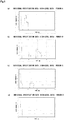
- high-level data is created for each individual, as shown in FIGS. 9.
- FIGS. 9 are diagrams showing an example of created high-level data in the example embodiment.
- FIGS. 9(a) to 9(d) respectively show the high-level data of different individuals.
- portions corresponding to time point A shown in FIG. 3 will be notated as "peak 1"
- portions corresponding to time point B shown in FIG. 3 will be notated as “peak 2”
- portions corresponding to time point C shown in FIG. 3 will be notated as "peak 3”.
- FIG. 9(a) It is evident from FIG. 9(a) that, with person A, the probability of occurrence of peaks 1 and 2 is high. Similarly, it is evident from FIG. 9(b) that, with person B, the probability of occurrence of peaks 1, 2 and 3 is high. Also, it is evident from FIG. 9(c) that, with person C, the probability of occurrence of peaks 1 and 3 is high. Furthermore, it is evident from FIG. 9(d) that, with person D, the probability of occurrence of peak 1 is high.
- the high-level data, respectively shown in FIGS. 9(a) to 9(d) , obtained in this manner will be the individual specification data of each individual.
- the probability of occurrence of high-level portions is associated with elapsed time from the start of walking.
- individual specification data is created, by superimposing a plurality of steps of walking vibration, and indexing the probability of a high-level portion occurring at respective timings.
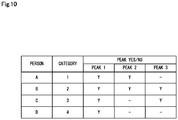
- the individual specification data creation unit 13 creates a table shown in FIG. 10 from the individual specification data of each individual.
- FIG. 10 is a diagram showing an example of a table consolidating individual specification data that is created in the example embodiment.
- persons A to D are sorted into one of categories 1 to 4, depending on the combination of peaks with a high probability of occurrence.
- the individual determination unit 12 first, acquires the individual specification data of each individual created by the individual specification data creation unit 13 from the data storage unit 14. Next, the individual determination unit 12 acquires binary data targeted for determination from the binarization processing unit 11. The individual determination unit 12 then contrasts, for each piece of individual specification data, high-level portions of the acquired binary data with the probability of occurrence of high-level portions of the individual specification data.
- FIG. 11 is a diagram showing an example of binary data targeted for determination in the example embodiment.
- FIG. 12(a) is a diagram showing a state where the binary data shown in FIG. 11 and the individual specification data of person A are superimposed
- FIG. 12(b) is a diagram showing a state where the binary data shown in FIG. 11 and the individual specification data of person B are superimposed.
- the individual determination unit 12 calculates, for each piece of individual specification data, the probability of the individual from which the walking vibration data was acquired being the individual corresponding to the individual specification data, based on the results of contrasting the binary data and the individual specification data.
- the individual determination unit 12 first, calculates the sum of products S of the values (d 0 to d N ) of the individual specification data and the values (s 0 to s N ) of the binary data, based on the following equation 5, where so to s N are the respective values of the binary data targeted for determination.
- S ⁇ d n ⁇ s n
- the individual determination unit 12 normalizes the sum of products S calculated by the above equation 5, based on the following equation 6, in order to eliminate deviation of the distribution of the probabilities of occurrence for each person.
- the individual specification data is the data shown in FIGS. 9(a) to 9(d)
- the binary data of the walking vibration data of the individual targeted for determination is the binary data shown in FIG. 11 .
- the calculation results of the probability s by the individual determination unit 12 will be as follows. Accordingly, the individual determination unit 12 determines that the individual from which the walking vibration data targeted for determination was acquired is "person A". In this way, in the example embodiment, the individual is specified by contrasting the obtained binary data of walking vibration data with individual specification data, and verifying the similarity.
- the individual determination unit 12 may determine the individual from which the walking vibration data targeted for determination was acquired, by deriving the positions of the peaks in the binary data shown in FIG. 11 , and contrasting the derived positions of the peaks with the table shown in FIG. 10 .
- FIGS. 13 and 14 the operations of the walking vibration analysis apparatus 10 according to the example embodiment will be described using FIGS. 13 and 14 .
- FIGS. 1 to 12 will be taken into consideration as appropriate.
- the walking vibration analysis method is implemented by operating the walking vibration analysis apparatus 10. Therefore, description of the walking vibration analysis method according to the example embodiment will be replaced by the following description of the operations of the walking vibration analysis apparatus 10.
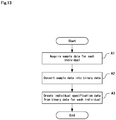
- FIG. 13 is a flow diagram showing operations at the time of individual specification data creation processing by the walking vibration analysis apparatus according to the example embodiment.
- the individual specification data creation unit 13 acquires, for each individual, a plurality of steps of walking vibration data of the individual as sample data (step A1).
- the sample data may be acquired from the vibration sensor 20, or may be input from another terminal device or the like.
- the individual specification data creation unit 13 converts, for each individual, the plurality of steps of sample data of the individual acquired in step A1 into binary data (step A2).
- the individual specification data creation unit 13 creates, for each individual, individual specification data from the binary data, and stores the created individual specification data in the data storage unit 14 (step A3).
- the individual specification data creation unit 13 composites, for each individual, the sample data using the abovementioned equation 3.
- the individual specification data creation unit 13 then creates high-level data from the sample data after composition, further using equation 4, and calculates the probability of occurrence of high-level portions. Thereafter, the individual specification data creation unit 13 stores, for each individual, the calculated probability of occurrence in the data storage unit 14 as the individual specification data of the individual.
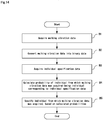
- FIG. 14 is a flow diagram showing operations at the time of individual specification processing by the walking vibration analysis apparatus according to the example embodiment.
- the binarization processing unit 11 acquires sensor data output by the vibration sensor 20, as walking vibration data (step B1).
- the binarization processing unit 11 converts the walking vibration data acquired in step B1 into binary data (step B2). Also, the binarization processing unit 11 passes the binary data obtained through conversion to the individual determination unit 12.
- the individual determination unit 12 upon receiving the binary data, acquires the individual specification data of each individual created by the individual specification data creation unit 13 from the data storage unit 14 (step B3).
- the individual determination unit 12 contrasts, for each piece of individual specification data, high-level portions of the binary data acquired in step B1 with the probability of occurrence of high-level portions of the individual specification data acquired in step B3.
- the individual determination unit 12 then calculates the probability of the individual from which the walking vibration data was acquired being the individual corresponding to the individual specification data, based on the contrast results (step B4).
- the individual determination unit 12 specifies the individual from which the walking vibration data acquired in step B1 was acquired, using the probabilities calculated in step B4 (step B5).
- individual specification data is created, by superimposing a plurality of steps of walking vibration, and indexing the probability of a high-level portion occurring at respective timings. Because the probability of occurrence of high-level portions is a value unique to each individual, an individual can be specified by contrasting obtained binary data of walking vibration data with individual specification data. Thus, according to the example embodiment, an individual can be specified from walking vibration, even in the case where variation occurs in the walking vibration.
- a program according to the example embodiment need only be a program that causes a computer to carry out steps A1 to A3 shown in FIG. 13 and steps B1 to B5 shown in FIG. 14 .
- the walking vibration analysis apparatus 10 and the walking vibration analysis method according to the example embodiment can be realized, by this program being installing on a computer and executed.
- a processor of the computer performs processing while functioning as the binarization processing unit 11, the individual determination unit 12, and the individual specification data creation unit 13.
- each computer may respectively function as one of the binarization processing unit 11, the individual determination unit 12, and the individual specification data creation unit 13.
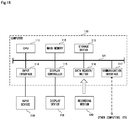
- FIG. 15 is a block diagram showing an example of a computer that realizes the walking vibration analysis apparatus according to the example embodiment.
- a computer 110 includes a CPU (Central Processing Unit) 111, a main memory 112, a storage device 113, an input interface 114, a display controller 115, a data reader/writer 116, and a communication interface 117. These units are connected to each other in a manner that enables data communication, via a bus 121.
- the computer 110 may include a GPU (Graphics Processing Unit) or an FPGA (Field-Programmable Gate Array), in addition to the CPU 111 or instead of the CPU 111.
- the CPU 111 implements various computational operations, by extracting programs (code) according to the example embodiment that are stored in the storage device 113 to the main memory 112, and executing these programs in predetermined order.
- the main memory 112 typically, is a volatile storage device such as a DRAM (Dynamic Random Access Memory).
- programs according to the example embodiment are provided in a state of being stored in a computer-readable recording medium 120. Note that programs according to the example embodiment may be distributed over the Internet connected via the communication interface 117.
- a semiconductor storage device such as a flash memory is given as a specific example of the storage device 113, other than a hard disk drive.
- the input interface 114 mediates data transmission between the CPU 111 and input devices 118 such as a keyboard and a mouse.
- the display controller 115 is connected to a display device 119 and controls display by the display device 119.
- the data reader/writer 116 mediates data transmission between the CPU 111 and the recording medium 120, and executes readout of programs from the recording medium 120 and writing of processing results of the computer 110 to the recording medium 120.
- the communication interface 117 mediates data transmission between the CPU 111 and other computers.
- a general-purpose semiconductor storage device such as a CF (Compact Flash (registered trademark)) card or an SD (Secure Digital) card, a magnetic recording medium such as a flexible disk, and an optical recording medium such as a CD-ROM (Compact Disk Read Only Memory) are given as specific examples of the recording medium 120.
- CF Compact Flash (registered trademark)
- SD Secure Digital
- CD-ROM Compact Disk Read Only Memory
- the walking vibration analysis apparatus 10 is also realizable by using hardware corresponding to the respective units, rather than by a computer on which programs are installed. Furthermore, the walking vibration analysis apparatus 10 may be realized in part by programs, and the remaining portion may be realized by hardware.
- example embodiments of the present application has been described above with reference to example embodiments, the example embodiments is not limited to the example embodiments described above. Various modifications apparent to those skilled in the art can be made to the configurations and details of the example embodiments within the scope of the example embodiments.
- an individual can be specified from walking vibration, even in the case where variation occurs in the walking vibration.
- the example embodiments is useful in systems that seek to specify individuals from walking vibration, such as systems that watch over elderly people and crime prevention systems, for example.
Landscapes
- Health & Medical Sciences (AREA)
- Life Sciences & Earth Sciences (AREA)
- Engineering & Computer Science (AREA)
- Physics & Mathematics (AREA)
- Surgery (AREA)
- Animal Behavior & Ethology (AREA)
- General Health & Medical Sciences (AREA)
- Molecular Biology (AREA)
- Public Health (AREA)
- Medical Informatics (AREA)
- Heart & Thoracic Surgery (AREA)
- Biomedical Technology (AREA)
- Pathology (AREA)
- Biophysics (AREA)
- Veterinary Medicine (AREA)
- General Physics & Mathematics (AREA)
- Theoretical Computer Science (AREA)
- Oral & Maxillofacial Surgery (AREA)
- Dentistry (AREA)
- Physiology (AREA)
- Evolutionary Computation (AREA)
- Artificial Intelligence (AREA)
- Mathematical Optimization (AREA)
- Mathematical Analysis (AREA)
- Computing Systems (AREA)
- Data Mining & Analysis (AREA)
- Computational Mathematics (AREA)
- Pure & Applied Mathematics (AREA)
- Algebra (AREA)
- Probability & Statistics with Applications (AREA)
- General Engineering & Computer Science (AREA)
- Mathematical Physics (AREA)
- Software Systems (AREA)
- Measurement Of The Respiration, Hearing Ability, Form, And Blood Characteristics Of Living Organisms (AREA)
Applications Claiming Priority (2)
| Application Number | Priority Date | Filing Date | Title |
|---|---|---|---|
| JP2017212737 | 2017-11-02 | ||
| PCT/JP2018/032779 WO2019087563A1 (ja) | 2017-11-02 | 2018-09-04 | 歩行振動解析装置、歩行振動解析方法、及びコンピュータ読み取り可能な記録媒体 |
Publications (2)
| Publication Number | Publication Date |
|---|---|
| EP3705040A1 true EP3705040A1 (de) | 2020-09-09 |
| EP3705040A4 EP3705040A4 (de) | 2021-08-18 |
Family
ID=66333034
Family Applications (1)
| Application Number | Title | Priority Date | Filing Date |
|---|---|---|---|
| EP18874775.2A Pending EP3705040A4 (de) | 2017-11-02 | 2018-09-04 | Vorrichtung zur analyse von laufschwingungen, verfahren zur laufschwingungsanalyse und computerlesbares aufzeichnungsmedium |
Country Status (4)
| Country | Link |
|---|---|
| US (1) | US20200289029A1 (de) |
| EP (1) | EP3705040A4 (de) |
| JP (2) | JP6801923B2 (de) |
| WO (1) | WO2019087563A1 (de) |
Families Citing this family (1)
| Publication number | Priority date | Publication date | Assignee | Title |
|---|---|---|---|---|
| EP3705040A4 (de) * | 2017-11-02 | 2021-08-18 | NEC Solution Innovators, Ltd. | Vorrichtung zur analyse von laufschwingungen, verfahren zur laufschwingungsanalyse und computerlesbares aufzeichnungsmedium |
Family Cites Families (17)
| Publication number | Priority date | Publication date | Assignee | Title |
|---|---|---|---|---|
| JP2001059742A (ja) * | 1999-08-25 | 2001-03-06 | Sharp Corp | 歩行データ計測器 |
| JP2001190527A (ja) * | 2000-01-12 | 2001-07-17 | Sharp Corp | 個人認識装置および個人認識方法 |
| JP2002197437A (ja) * | 2000-12-27 | 2002-07-12 | Sony Corp | 歩行検出システム、歩行検出装置、デバイス、歩行検出方法 |
| JP2004227053A (ja) | 2003-01-20 | 2004-08-12 | Yamatake Corp | 生活見守り装置 |
| JP2006110072A (ja) * | 2004-10-14 | 2006-04-27 | Mitsubishi Heavy Ind Ltd | 非接触歩行検出方法とシステム及び該システムを用いた個人認証方法とシステム |
| JP4927441B2 (ja) * | 2006-05-12 | 2012-05-09 | 関西電力株式会社 | 個体特定システム及びセキュリティシステム |
| KR101000789B1 (ko) * | 2008-08-04 | 2010-12-13 | 한국전자통신연구원 | 사용자 인식 장치 및 사용자 인식 방법 |
| JP2010051548A (ja) * | 2008-08-28 | 2010-03-11 | Seiko Instruments Inc | ピッチ計測機能を有する電子機器 |
| JP2011164993A (ja) * | 2010-02-10 | 2011-08-25 | Toyota Motor Corp | 個人認証システム |
| JP5485924B2 (ja) * | 2011-02-10 | 2014-05-07 | 日本電信電話株式会社 | 歩行音分析装置、方法、およびプログラム |
| US9811720B2 (en) * | 2013-10-22 | 2017-11-07 | Bae Systems Information And Electronic Systems Integration Inc. | Mobile device based gait biometrics |
| JP6164154B2 (ja) | 2013-12-27 | 2017-07-19 | キヤノンマーケティングジャパン株式会社 | 認証情報管理システムと画像形成装置と、その処理方法及びプログラム |
| JP6259301B2 (ja) * | 2014-01-30 | 2018-01-10 | ジーイー・メディカル・システムズ・グローバル・テクノロジー・カンパニー・エルエルシー | 移動運動解析装置、方法及びシステム並びにプログラム |
| JP6795980B2 (ja) * | 2014-01-30 | 2020-12-02 | コーニンクレッカ フィリップス エヌ ヴェKoninklijke Philips N.V. | 加速度の測定値を処理して、ユーザによるステップを識別する方法及び対応するコンピュータプログラム、並びに加速度の測定値を処理して、ユーザによるステップを識別する装置及びそのような装置を備えるデバイス |
| US10614299B2 (en) * | 2015-02-09 | 2020-04-07 | Carnegie Mellon University | Indoor identification of individuals through footstep induced structural vibration |
| JP6780868B2 (ja) * | 2016-04-28 | 2020-11-04 | Necソリューションイノベータ株式会社 | 歩行振動解析システム、振動解析装置、歩行振動解析方法、及びプログラム |
| EP3705040A4 (de) * | 2017-11-02 | 2021-08-18 | NEC Solution Innovators, Ltd. | Vorrichtung zur analyse von laufschwingungen, verfahren zur laufschwingungsanalyse und computerlesbares aufzeichnungsmedium |
-
2018
- 2018-09-04 EP EP18874775.2A patent/EP3705040A4/de active Pending
- 2018-09-04 US US16/759,864 patent/US20200289029A1/en not_active Abandoned
- 2018-09-04 WO PCT/JP2018/032779 patent/WO2019087563A1/ja not_active Ceased
- 2018-09-04 JP JP2019549904A patent/JP6801923B2/ja active Active
-
2020
- 2020-11-20 JP JP2020193315A patent/JP7074299B2/ja active Active
Also Published As
| Publication number | Publication date |
|---|---|
| WO2019087563A1 (ja) | 2019-05-09 |
| JP6801923B2 (ja) | 2020-12-16 |
| EP3705040A4 (de) | 2021-08-18 |
| US20200289029A1 (en) | 2020-09-17 |
| JP2021015657A (ja) | 2021-02-12 |
| JP7074299B2 (ja) | 2022-05-24 |
| JPWO2019087563A1 (ja) | 2020-11-12 |
Similar Documents
| Publication | Publication Date | Title |
|---|---|---|
| KR101656566B1 (ko) | 생체 특징 벡터 추출 장치, 생체 특징 벡터 추출 방법, 및 생체 특징 벡터 추출 프로그램 | |
| EP2199945B1 (de) | Vorrichtung und Verfahren zur biometrischen Authentisierung, mit einem biometrischen Authentisierungscomputerprogramm aufgezeichnetes computerlesbares Aufzeichnungsmedium und Computersystem | |
| JP6027132B2 (ja) | 質量分析法とスコア正規化による微生物の特定方法 | |
| US20140039274A1 (en) | Apparatus, system, and method for detecting activities and anomalies in time series data | |
| CN111191201B (zh) | 基于数据埋点的用户识别方法、装置、设备及存储介质 | |
| EP3809317A1 (de) | Informationsidentifikationssystem und -verfahren | |
| EP4242928A1 (de) | Datenverstärkungsverfahren, lernvorrichtung und programm | |
| US20190311099A1 (en) | Behavioral biometric feature extraction and verification | |
| EP3594896B1 (de) | Vorrichtung zur biometrischen authentifizierung, verfahren zur biometrischen authentifizierung und programm zur biometrischen authentifizierung | |
| Fernandez-Lopez et al. | Optimizing resources on smartphone gait recognition | |
| Tabi Fouda et al. | Events detection and recognition by the fiber vibration system based on power spectrum estimation | |
| Liu et al. | Coal-gangue interface detection based on Hilbert spectral analysis of vibrations due to rock impacts on a longwall mining machine | |
| EP3705040A1 (de) | Vorrichtung zur analyse von laufschwingungen, verfahren zur laufschwingungsanalyse und computerlesbares aufzeichnungsmedium | |
| KR102570069B1 (ko) | Ecg 센서 신호의 잡음을 제거하는 방법 및 그 장치 | |
| de la Cal et al. | A low-power HAR method for fall and high-intensity ADLs identification using wrist-worn accelerometer devices | |
| CN104281640B (zh) | 特征量抽取装置、特征量抽取方法 | |
| EP3872808B1 (de) | Audioverarbeitungsvorrichtung, audioverarbeitungsverfahren und programm | |
| CN118116086A (zh) | 模型训练、人脸伪造攻击检测方法、装置及存储介质 | |
| Davis | Footstep localization and force estimation through structural vibrations using the FEEL Algorithm | |
| KR101792631B1 (ko) | 퍼지 해싱을 사용한 함수의 api 기반 소프트웨어의 유사성 측정방법 및 그 시스템 | |
| Qian et al. | Context‐based approach of separating contactless captured high‐resolution overlapped latent fingerprints | |
| Du et al. | Spectral analysis of microarray gene expression time series data of Plasmodium falciparum | |
| JP6355307B2 (ja) | 顔照合装置、顔照合方法及び顔照合プログラム | |
| CN107995181B (zh) | 一种基于步态的身份验证方法、装置、设备及存储介质 | |
| Peng et al. | Corner detection method based on wavelet transform |
Legal Events
| Date | Code | Title | Description |
|---|---|---|---|
| STAA | Information on the status of an ep patent application or granted ep patent |
Free format text: STATUS: THE INTERNATIONAL PUBLICATION HAS BEEN MADE |
|
| PUAI | Public reference made under article 153(3) epc to a published international application that has entered the european phase |
Free format text: ORIGINAL CODE: 0009012 |
|
| STAA | Information on the status of an ep patent application or granted ep patent |
Free format text: STATUS: REQUEST FOR EXAMINATION WAS MADE |
|
| 17P | Request for examination filed |
Effective date: 20200602 |
|
| AK | Designated contracting states |
Kind code of ref document: A1 Designated state(s): AL AT BE BG CH CY CZ DE DK EE ES FI FR GB GR HR HU IE IS IT LI LT LU LV MC MK MT NL NO PL PT RO RS SE SI SK SM TR |
|
| AX | Request for extension of the european patent |
Extension state: BA ME |
|
| DAV | Request for validation of the european patent (deleted) | ||
| DAX | Request for extension of the european patent (deleted) | ||
| A4 | Supplementary search report drawn up and despatched |
Effective date: 20210715 |
|
| RIC1 | Information provided on ipc code assigned before grant |
Ipc: A61B 5/117 20160101AFI20210709BHEP Ipc: A61B 5/11 20060101ALI20210709BHEP Ipc: G01G 7/00 20060101ALI20210709BHEP Ipc: G01G 19/52 20060101ALI20210709BHEP Ipc: G06K 9/00 20060101ALI20210709BHEP |
|
| STAA | Information on the status of an ep patent application or granted ep patent |
Free format text: STATUS: EXAMINATION IS IN PROGRESS |
|
| 17Q | First examination report despatched |
Effective date: 20230511 |