EP3704483B1 - Elektrochemische sequenzierung von dna unter verwendung einer randelektrode - Google Patents
Elektrochemische sequenzierung von dna unter verwendung einer randelektrode Download PDFInfo
- Publication number
- EP3704483B1 EP3704483B1 EP18795460.7A EP18795460A EP3704483B1 EP 3704483 B1 EP3704483 B1 EP 3704483B1 EP 18795460 A EP18795460 A EP 18795460A EP 3704483 B1 EP3704483 B1 EP 3704483B1
- Authority
- EP
- European Patent Office
- Prior art keywords
- dna
- electrode
- strand
- edge
- nucleotide
- Prior art date
- Legal status (The legal status is an assumption and is not a legal conclusion. Google has not performed a legal analysis and makes no representation as to the accuracy of the status listed.)
- Active
Links
Images






Classifications
-
- G—PHYSICS
- G01—MEASURING; TESTING
- G01N—INVESTIGATING OR ANALYSING MATERIALS BY DETERMINING THEIR CHEMICAL OR PHYSICAL PROPERTIES
- G01N27/00—Investigating or analysing materials by the use of electric, electrochemical, or magnetic means
- G01N27/26—Investigating or analysing materials by the use of electric, electrochemical, or magnetic means by investigating electrochemical variables; by using electrolysis or electrophoresis
- G01N27/28—Electrolytic cell components
- G01N27/30—Electrodes, e.g. test electrodes; Half-cells
- G01N27/327—Biochemical electrodes, e.g. electrical or mechanical details for in vitro measurements
- G01N27/3275—Sensing specific biomolecules, e.g. nucleic acid strands, based on an electrode surface reaction
- G01N27/3277—Sensing specific biomolecules, e.g. nucleic acid strands, based on an electrode surface reaction being a redox reaction, e.g. detection by cyclic voltammetry
-
- C—CHEMISTRY; METALLURGY
- C12—BIOCHEMISTRY; BEER; SPIRITS; WINE; VINEGAR; MICROBIOLOGY; ENZYMOLOGY; MUTATION OR GENETIC ENGINEERING
- C12Q—MEASURING OR TESTING PROCESSES INVOLVING ENZYMES, NUCLEIC ACIDS OR MICROORGANISMS; COMPOSITIONS OR TEST PAPERS THEREFOR; PROCESSES OF PREPARING SUCH COMPOSITIONS; CONDITION-RESPONSIVE CONTROL IN MICROBIOLOGICAL OR ENZYMOLOGICAL PROCESSES
- C12Q1/00—Measuring or testing processes involving enzymes, nucleic acids or microorganisms; Compositions therefor; Processes of preparing such compositions
- C12Q1/68—Measuring or testing processes involving enzymes, nucleic acids or microorganisms; Compositions therefor; Processes of preparing such compositions involving nucleic acids
- C12Q1/6813—Hybridisation assays
- C12Q1/6816—Hybridisation assays characterised by the detection means
- C12Q1/6825—Nucleic acid detection involving sensors
-
- C—CHEMISTRY; METALLURGY
- C12—BIOCHEMISTRY; BEER; SPIRITS; WINE; VINEGAR; MICROBIOLOGY; ENZYMOLOGY; MUTATION OR GENETIC ENGINEERING
- C12Q—MEASURING OR TESTING PROCESSES INVOLVING ENZYMES, NUCLEIC ACIDS OR MICROORGANISMS; COMPOSITIONS OR TEST PAPERS THEREFOR; PROCESSES OF PREPARING SUCH COMPOSITIONS; CONDITION-RESPONSIVE CONTROL IN MICROBIOLOGICAL OR ENZYMOLOGICAL PROCESSES
- C12Q1/00—Measuring or testing processes involving enzymes, nucleic acids or microorganisms; Compositions therefor; Processes of preparing such compositions
- C12Q1/68—Measuring or testing processes involving enzymes, nucleic acids or microorganisms; Compositions therefor; Processes of preparing such compositions involving nucleic acids
- C12Q1/6869—Methods for sequencing
-
- G—PHYSICS
- G01—MEASURING; TESTING
- G01N—INVESTIGATING OR ANALYSING MATERIALS BY DETERMINING THEIR CHEMICAL OR PHYSICAL PROPERTIES
- G01N27/00—Investigating or analysing materials by the use of electric, electrochemical, or magnetic means
- G01N27/26—Investigating or analysing materials by the use of electric, electrochemical, or magnetic means by investigating electrochemical variables; by using electrolysis or electrophoresis
- G01N27/28—Electrolytic cell components
- G01N27/30—Electrodes, e.g. test electrodes; Half-cells
- G01N27/327—Biochemical electrodes, e.g. electrical or mechanical details for in vitro measurements
- G01N27/3275—Sensing specific biomolecules, e.g. nucleic acid strands, based on an electrode surface reaction
- G01N27/3278—Sensing specific biomolecules, e.g. nucleic acid strands, based on an electrode surface reaction involving nanosized elements, e.g. nanogaps or nanoparticles
-
- G—PHYSICS
- G01—MEASURING; TESTING
- G01N—INVESTIGATING OR ANALYSING MATERIALS BY DETERMINING THEIR CHEMICAL OR PHYSICAL PROPERTIES
- G01N33/00—Investigating or analysing materials by specific methods not covered by groups G01N1/00 - G01N31/00
- G01N33/48—Biological material, e.g. blood, urine; Haemocytometers
- G01N33/483—Physical analysis of biological material
- G01N33/487—Physical analysis of biological material of liquid biological material
- G01N33/48707—Physical analysis of biological material of liquid biological material by electrical means
- G01N33/48721—Investigating individual macromolecules, e.g. by translocation through nanopores
Definitions
- aspects of the present invention relate to a method for sequencing of polynucleotides.
- DNA DNA
- Electronic readout leverages the highly reproducible miniaturization techniques employed within the microelectronics industry.
- the primary modality of detecting DNA electronically is the nanopore concept, where DNA translocation through a nanopore is monitored as a change in resistivity dependent on the DNA base(s) occupying the pore.
- ALD atomic layer deposition
- the scope of the present invention is defined by the independent claims.
- the present invention makes use of the principle of modifiability of nucleotides with redox species, with nanoscale fabrication techniques and DNA linearization techniques, to electrochemically sequence strands of polynucleotides, including strands of DNA.
- Integrating a nanoscale edge electrode and linearized and electrochemically labeled DNA provides a method to sequence DNA using electrochemistry.
- embodiments of the present invention provide the ability to have long read lengths on the order of 1000s of base pairs (bp), providing a linear sequence readout of a strand of DNA in real time.
- the planar fabrication method allows for multiple edge electrode stack structures to be fabricated within a single reading device. This allows the same strand of DNA to be probed by multiple electrodes within the same reading run, enabling improved redundancy of the readout and thus improved accuracy of sequencing.
- Use of spacers to integrate a noncoding, non-redox region of DNA or other polymeric material between the electrochemically modified DNA to isolate the electrochemical groups as they pass over the electrode can be used to improve single base resolution.
- Atomic layer deposition and graphene chemical vapor deposition technologies may be used to create an electrode edge and/or insulator layer on the same scale as the species being probed.
- the process is also compatible with current microfabrication protocols and is accurate and reproducible.
- a device is fabricated to ensure that a DNA travels in proximity to an electrode, such that bases are sequentially electrochemically addressable to give single base resolution.
- the proximity is in a range of 0 nm to about 10 nm.
- a device to electrochemically sequence DNA comprising redox species includes: (a) at least one edge electrode; (b) at least one stack of insulator material; (c) a pair of DNA translocation electrodes, the electrodes including a DNA translocation working electrode and a DNA translocation counter electrode; and (d) a means for applying a voltage to the at least one edge electrode for the oxidation or the reduction of the modified nucleotide as the modified nucleotide passes over the at least one edge electrode; where the thickness of the at least one edge electrode is about 0.5 nanometers and the thickness of the at least one stack of insulator material is about 10 nanometers.
- the device includes 1 to 50 edge electrodes and 1 to 50 stacks of insulator material, where the edge electrodes and stacks of insulator material alternate and the total thickness of the edge electrodes and stacks of insulator material is about 20 nanometers to about 1000 nanometers. In some advantageous example embodiments, the device includes, more specifically, 10 to 50 edge electrodes and 10 to 50 stacks of insulator material, where the edge electrodes and stacks of insulator material alternate and the total thickness of the edge electrodes and stacks of insulator material is about 105 nanometers to about 1000 nanometers.
- the at least one edge electrode comprises a conductive material
- the insulator material comprises a dielectric material
- the at least one edge electrode is titanium nitride or platinum
- the insulator material is selected from the group consisting of silicon dioxide, silicon nitride, and aluminum oxide.
- the at least one edge electrode and the insulator material are micro-structured or nano-structured by a suitably appropriate micro- or nano-fabrication structuring technique, for example, by dry etching, wet etching, reactive ion etching, lift off, chemical mechanical polishing, or ion beam milling processes.
- the device includes multiple pairs of edge electrodes, where at least any two pairs of edge electrodes are configured to measure or set a speed of translocation of the DNA across the multiple pairs of edge electrodes.
- the speed of translocation of the DNA across the multiple pairs of edge electrodes is uniform.
- the speed of translocation of the DNA across the multiple pairs of edge electrodes changes at a constant rate.
- a method of electrochemically sequencing a strand of DNA by using the device of the present invention includes: (a) modifying each nucleotide of at least two nucleotide base groups of the strand of DNA to incorporate a redox species; (b) applying a voltage to at least one edge electrode; (c) passing the strand of DNA over the at least one edge electrode; (d) oxidizing or reducing, using the at least one edge electrode, each modified nucleotide as each passes over the at least one edge electrode, where the oxidizing or reducing generates an electrochemical signal comprising a change in current; (e) identifying each modified nucleotide based on the electrochemical signal; and (f) determining a sequence of the strand of DNA, where each nucleotide of a first nucleotide base group has been modified to incorporate a first redox species having a first oxidation or reduction potential, and each nucleotide of a second nucleotide base group has been modified to
- the first and second nucleotide base groups are different, and the first and second nucleotide base groups are not complementary to each other.
- the method further includes incorporating the redox modified nucleotides using polymerase chain reaction, multiple displacement amplification, or isothermal amplification.
- the method further includes inserting a spacer between adjacent nucleotides of the strand of DNA.
- applying the voltage to the at least one edge electrode includes cycling the voltage from an oxidation potential to a reducing potential.
- each modified nucleotide is oxidized or reduced multiple times as each passes over the at least one edge electrode.
- the method further includes passing the strand of DNA over multiple edge electrodes that are spaced at regular distances in parallel, where the sequence of the strand of DNA is determined multiple times using each edge electrode.
- the method further includes amplifying the modified strands of DNA.
- the method further includes amplifying the strand of DNA prior to modifying each nucleotide of the strand of DNA to incorporate a redox species.
- the method further includes ligating a known strand of DNA to each amplified strand of DNA;
- the method further includes introducing a spacer between adjacent nucleotides of each amplified strand of DNA.
- each modified nucleotide in a first group is either a redox modified Adenine or Thymine deoxynucleoside triphosphate (dNTP), and each modified nucleotide in a second of the groups is either a redox modified Cytosine or Guanine dNTP.
- dNTP Thymine deoxynucleoside triphosphate
- Example embodiments of the present invention provide a DNA sequencing platform that can readout in real time the genetic sequence of a strand of DNA of any length, with minimal requirement for data post processing. This can be achieved using electrochemical techniques that can be translated into digital format, e . g ., using multiple sampling to improve data fidelity and methods that are scalable for manufacturing.
- Example embodiments of the present invention use the modification of DNA with redox-active species, a novel microfabrication method to pattern nanoscale planar electrode edge structures, and/or a method to control the translocation of DNA across the nanoscale electrode edge structures.
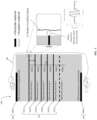
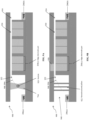
- FIG. 3 shows device 100 that includes edge electrode 102(1), stack of insulator material 104(1), and a pair of DNA translocation electrodes 106 including DNA translocation working electrode 106(a) and DNA translocation counter electrode 106(b).
- the thickness x of edge electrode 102(1) is about 0.5 nanometers
- the thickness y of stack of insulator material 104(1) is about 10 nanometers (for proper insulation and reduction of cross-talk between electrode-layers).
- device 100 includes a reference electrode.
- device 100 can include multiple edge electrodes 102 (102(1), 102(2), 102(3), 102(4), 102(5), ... 102(x)) that are fabricated at regular distances, and also multiple stacks of insulator material 104 (104(1), 104(2), 104(3), 104(4), 104(5), ... 104(x)). As shown in FIG. 3 , edge electrodes 102 and stacks of insulator material 104 alternate.
- device 100 includes a sequence of 2 to 100 ALD-layer pairs, or 1 to 50 edge electrodes 102 and 1 to 50 stacks of insulator material 104, and with the thickness x of each edge electrode 102 at about 0.5 nanometers, and the thickness y of each stack of insulator material 104 at about 10 nanometers, the total thickness of edge electrodes 102 and stacks of insulator material 104 is about 20 nanometers to about 1000 nanometers.
- edge electrode 102 is made of a conductive material, such as titanium nitride or platinum.
- stack of insulator material 104 is made of a dielectric material, such as silicon dioxide, silicon nitride, or aluminum oxide. According to an example embodiment, stack of insulator material 104 and edge electrode 102 are controlled by precision deposition via ALD.
- strand of DNA 108 is translocated from the top of device 100 to the bottom of device 100, and thus translocates across each of edge electrodes 102.
- Such translocation can be achieved by applying a voltage bias on the pair of DNA translocation electrodes 106, or by applying a shuttling bias on edge electrodes 102.
- a redox chemical reaction occurs between the redox modified nucleotide base 110 and edge electrode 102.
- use of multiple electrodes spaced at regular distances allows strand of DNA 108 to be probed multiple times, and because the space between nucleotide bases is well characterized, the resulting signals can be overlaid and averaged to improve accuracy.
- the speed of translocation of strand of DNA 108 across edge electrodes 102 is uniform, and is set to be slow enough to generate a readable signal and fast enough to ensure a rapid DNA sequencing test.
- the speed of translocation of strand of DNA 108 is set by at least any two pairs of edge electrodes, such as the first two edge electrodes 102(1) and 102(2).
- strand of DNA 108 can be linearized by confining it into a nanochannel, by using hydrodynamic forces, by a pore technique to pull strand of DNA 108 close to the surface, or by an electrical charge-based method including surface modification or an additional electrode on the nanochannel surface. While FIG. 3 illustrates a vertical structure, the present invention can also be a planar structure.
- edge electrodes 102 operate a cyclic voltammetric measurement resulting in a current spike as a redox active base interacts with the electrode 102 as it traverses over the edge.
- rapid cycling of the oxidation or reduction potentials occurs at edge electrodes 102, such that multiple cycles of oxidation or reduction are applied to probed strand of DNA 108; and if there is more than one nucleotide base being probed, observation of the electrochemical signal transients will improve the deconvolution of the base sequence.
- the edge electrode 102 and stack of insulator material 104 are micro-structured by dry etching, wet etching, reactive ion etching, lift off, chemical mechanical polishing, ion beam milling processes, or any other micro- or nano-fabrication structuring technique.
- Both selective and non-selective chemistries can be used (e.g., SF6 is selective to TiN; ion beam milling is non-selective to TiN, etc. ) .
- there are selective wet-etchants available for TiN (NH4OH, H 2 O 2 , H2O) and SiO 2 (buffered HF), respectively.
- structuring after deposition of the multilayer on top of a silicon surface is performed as follows:
- the electrical attraction of the DNA to the sampling sidewall, transport along the sampling sidewall, and readout at the sampling sidewall is performed by "travelling electrical waves” or “switched electrical potentials in a travelling wave logic" along the TiN layers, combined with current sampling.
- redox species are incorporated that correlate to the target DNA strand to be sequenced.
- a polymerase is used to integrate the corresponding redox modified DNA with high fidelity during amplification.
- PCR Polymerase Chain Reaction
- multiple displacement amplification isothermal Amplification, or any other method to replicate a target strand of DNA that can incorporate one or more redox modified base with high fidelity is used.
- B-family thermostable polymerases can be used ( Vent ( exo- ) , Pwo, KOD ) as enzymes that will tolerate incorporation of the modified nucleotide. See, e.g., Pale ⁇ ek.
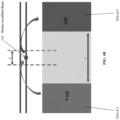
- FIG. 4A shows device 200 that includes edge electrode pair 202(1), stack of insulator material 204(1), and a pair of DNA translocation electrodes 206 including DNA translocation working electrode 206(a) and DNA translocation counter electrode 206(b) .
- Edge electrode pair 202(1) includes first electrode 202(1)(1) and second electrode 202(1)(2) separated by insulating layer z.
- device 200 includes a reference electrode.
- device 200 can include multiple edge electrode pairs 202 (202(1), 202(2) , 202(3) , 202(4) , 202(5) , ... 202(x)) that are fabricated at regular distances, where each edge electrode pair includes first electrode 202(x)(1) and second electrode 202(x)(2) separated by insulating layer z.
- Device 200 can thus also include multiple stacks of insulator material 204 (204(1), 204(2), 204(3), 204(4), 204(5), ... 204(x)) .
- edge electrode pairs 202 and stacks of insulator material 204 alternate.
- device 200 includes a sequence of 20 to 100 electrodes, or 10 to 50 edge electrode pairs 202 and 10 to 50 stacks of insulator material 204.
- edge electrode pair 202 is made of a conductive material, such as titanium nitride or platinum
- stack of insulator material 204 is made of a dielectric material, such as silicon dioxide, silicon nitride, or aluminum oxide.
- deposition of insulating layer z is controlled by precision deposition via ALD.
- strand of DNA 208 is translocated from the top of device 200 to the bottom of device 200, and thus translocates across each of edge electrode pairs 202.
- Such translocation can be achieved by applying a voltage bias on the pair of DNA translocation electrodes 206, or by applying a shuttling bias on edge electrode pairs 202.
- FIG. 4A illustrate a vertical structure, the present invention can also be a planar structure.
- first electrode 202(x)(1) can be held at an oxidizing bias and thus can oxidize a redox species incorporated into redox modified base 210 that comes within proximity
- second electrode 202(x)(2) can be held at a reducing bias and thus can reduce a redox species incorporated into redox modified base 210 that comes within proximity
- the redox species of redox modified base 210 can be oxidized by first electrode 202(x)(1) and lose an electron, and be reduced by second electrode 202(x)(2) and gain an electron, thus becoming an electron shuttle between second electrode 202(x)(2) and first electrode 202(x)(1).
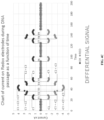
- the simultaneous oxidation and reduction of the redox species of redox modified base 210 while in sensing zone Z creates a differential signal.
- this differential signal is amplified and/or detected.
- insulating layer z is large enough to prevent shuttling of electrons in the absence of a redox species within electrode pair 202(x) between first electrode 202(x)(1) and second electrodes 202(x)(2).
- a differential signal is generated as a redox chemical reaction occurs between the redox modified nucleotide base 210 and edge electrode pair 202.
- This embodiment where electrode pairs are provided, can provide a better sensor signal than the embodiment in which single electrodes are provided, because, in part, the differential signal is a much stronger indication than the non-differential signal provided by a single electrode.
- the differential signal is beneficial because the noise from the two electrodes in the electrode pair will be the same, and thus can be cancelled out when looking at the differential signal. Further, with electrode pairs, the shuttling of electrons between electrodes will amplify the current passing between the electrodes.
- use of multiple electrodes spaced at regular distances allows strand of DNA 208 to be probed multiple times, and because the space between nucleotide bases is well characterized, the resulting signals can be overlaid and averaged to improve accuracy.
- the speed of translocation of strand of DNA 208 across edge electrode pairs 202 is uniform, and is slow enough to generate a readable signal, and fast enough to ensure a rapid DNA sequencing test.
- the speed of translocation of strand of DNA 208 is determined by the first two edge electrode pairs 202(1) and 202(2).
- strand of DNA 208 can be linearized by confining it into a nanochannel, by using hydrodynamic forces, by a pore technique to pull strand of DNA 208 close to the surface, or by using electrical charge-based methods to attract or repel strand of DNA 208 to or from the nanochannel wall such that it traverses the nanochannel close to the surface where edge electrode pairs 202 are located.
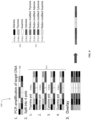
- more than one redox modified base 210 can be in sensing zone Z at the same time.
- a first redox modified base enters sensing zone Z and is simultaneously oxidized by positive first electrode 202(x)(1) (thereby generating current C1) and reduced by negative second electrode 202(x)(2) (thereby generating corresponding current -C1) .
- a second redox modified base enters sensing zone Z and is simultaneously oxidized by positive first electrode 202(x)(1) (thereby generating current C2 and an overall current equal to C1 plus C2) and reduced by negative second electrode 202(x)(2) (thereby generating corresponding current -C2 and an overall current equal to -C1 plus -C2).
- a third redox modified base enters sensing zone Z and is simultaneously oxidized by positive first electrode 202(x)(1) (thereby generating current C3 and an overall current equal to C1 plus C2 plus C3) and reduced by negative second electrode 202(x)(2) (thereby generating corresponding current -C3 and an overall current equal to -C1 plus -C2 plus -C3).
- the first redox modified base leaves sensing zone Z while the second and third redox modified bases remain in sensing zone Z, resulting in a drop in the overall current generated such that the overall current from oxidation is now equal to C2 plus C3, and the overall current from reduction is now equal to -C2 plus -C3.
- the second redox modified base leaves sensing zone Z while the third redox modified base remains in sensing zone Z, resulting in another drop in overall current such that the overall current from oxidation is now equal to C3, and the overall current from reduction is now equal to -C3.
- No more redox modified bases enter sensing zone Z until time T6, where a fourth modified base enters sensing zone Z.
- sensing zone Z is small enough to sense only a small number of redox modified bases at the same time, and large enough to correct for nonlinearity effects from the stretching of DNA.
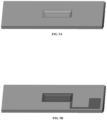
- the fabrication of a device with an electrode pair is as follows:
- the fabrication of a device with an electrode pair is as follows:
- FIGS. 7 and 8 illustrate two different methods to generate the same outcome by changing the way the redox species are incorporated into the target strand of DNA and how the DNA is read out.
- each nucleotide base 710 (adenine 710(a), thymine 710(b), guanine 710(c), and cytosine 710(d)) of target strand of DNA 708 is modified with a unique redox species specific to that base 710, resulting in redox modified bases 712 (712(a), 712(b), 712(c), and 712(d)).
- Redox modified bases 712 are incorporated into the copy strand of the DNA during PCR.
- an electrode such as edge electrode 102 can be used to probe each redox modified nucleotide base 712 to determine at what potential oxidation or reduction takes place.
- the unique redox species is reversible within the stable window of the electrode, is biocompatible with any biochemistry in solution, and is stable under standard laboratory conditions. If multiple redox species are used, there should be sufficient difference in electrochemical response to enable differentiation between species.
- redox species include anthraquinone (which has an oxidation potential of 0.40 V), methylene blue (which has an oxidation potential of 0.20 V), ferrocene (which has an oxidation potential of 0.50 V), and phenothiazine (which has an oxidation potential of 0.60 V) (all potentials versus Ag/AgCl).
- the nucleotide bases will be oxidized or reduced sequentially (depending on the incorporated redox species), and the current peaks as a function of probing voltage can be used to identify each passing nucleotide base and assign a base sequence to the strand of DNA.
- a single electrode can be used that sweeps the electrode voltage rapidly (akin to cyclic voltammetry), and the spike in current as a function of voltage is used to specify the redox species of interest, and thus identify the passing nucleotide base. Multiple cycles can be used to ensure enough signal is sampled to detect from the noise.
- multiple electrodes can be used, where a positive or negative bias is applied to different electrodes in the stack that sequentially changes in magnitude as the strand of DNA progresses along the stack over the electrodes.
- a positive or negative bias is applied to different electrodes in the stack that sequentially changes in magnitude as the strand of DNA progresses along the stack over the electrodes.
- a redox species with a low oxidation voltage would be excited by one electrode in the stack, while another redox species with a higher oxidation potential would only oxidize at another electrode with higher bias further down the stack.
- any gap in signal is equivalent to the last encoded base where there is sufficient DNA translocation control (i.e., a consistent time per base probing period).
- Methods for DNA translocation control within the literature include voltage, enzyme mediated, optical tweezers, and magnetic tweezers. See, e.g., Carson et al., "Challenges in DNA motion control and sequence readout using nanopore devices," Nanotechnology, 26(7):074004 (2015 ).
- FIG. 8 illustrates a 4 pot method 850, according to an example embodiment.
- target DNA strand 808 is first amplified by traditional PCR, followed by splitting the material into 4 pots 814, each pot corresponding to one group of nucleotide bases (e . g ., a thymine pot 814(a), an adenine pot 814(b), a cytosine pot 814(c), and a guanine pot 814(d)).
- a second round of PCR is used to introduce a unique redox species for that pot's nucleotide base group, resulting in a group of modified nucleotide bases 812 (812(a), 812(b), 812(c), and 812(d)) while the remaining three groups of nucleotide bases 810 (810(a), 810(b), 810(c), and 810(d)) remain unmodified as standard dNTPs.
- a known strand of DNA is ligated to the target/copy DNA strands to denote the zero point for base classification.
- the 4 pots 814 are then introduced to a device (like device 100) with at least one probing edge electrode (like edge electrode 102), and then indexed based on the known strand of DNA.
- the 4 pots 814 can be sequentially introduced to the device (like device 100) with at least one probing edge electrode (like edge electrode 102).
- the translocation rate over the probing edge electrode should be highly controlled to ensure that indexing can be accurate.
- the multi-pot method 850 illustrated in FIG. 8 can utilize only 2 pots due to the complementary nature of DNA strands.
- the first pot would correspond to either a thymine pot 814(a) or an adenine pot 814(b), and the second pot would correspond to either a cytosine pot 814(c) or a guanine pot 814(d).
- a spacer region can be introduced to improve the accuracy of single base probing.
- a spacer is inserted between all nucleotide bases within the DNA strand, leading to the separation of individual bases by the length of the spacer.
- the probability that the edge electrode will probe more than one redox species at a time is reduced. This also reduces the requirements for translocation accuracy, as there is a larger window of time per nucleotide base for data processing.
- the spacer attaches between bases and then chemically cleaves between the bases, resulting in the cross linking of the spacer between two bases.
- the spacer used to expand the DNA region does not include any coding correlated to the base being expanded; a nanopore is not used to probe the DNA substrate; the DNA sequence is not determined by a change in resistivity over a nanopore, but rather by a redox reaction between the electrode and the electrochemically modified base; and the DNA base chemistry uses one or more redox modifications.
- strand of DNA 908 can be translocated using a trapping principle.
- Particle 920 (such as a latex bead or a paramagnetic bead) is attached to the 5' or 3' end of strand of DNA 908 , or to a complementary primer strand to strand of DNA 908, and particle 920 is used as a tether to move strand of DNA 908 within the tweezers (such as optical tweezers or magnetic tweezers), while at the same time being pulled by the electric field or hydrodynamic flow into edge sensing device 900.
- Possible trap types include optical trapping and magnetic trapping.
- strand of DNA 908 can be translocated using electrophoretic forces.
- Strand of DNA 908 has a negatively charged backbone.
- strand of DNA 908 will move towards the anode, i.e., DNA translocation counter electrode 206(b) .
- anode i.e., DNA translocation counter electrode 206(b) .
- strand of DNA 908 will be dragged through nanochannel 930, where it will be linearized.
- strand of DNA 908 can be translocated using electrophoretic forces coupled with topology/structuring.
- Nanostructures 922 can be placed within microchannel 940 upstream of nanochannel inlet 932 to slow down strand of DNA 908 as strand of DNA 908 interacts with nanostructures 922 (for example, by wrapping around or throughout them).
- Strand of DNA 908 will therefore travel quickly within nanochannel 930, but slower at microchannel 940, leading to a drag on strand of DNA 908 that can induce linearization (as a portion of strand of DNA 908 will be in nanochannel 930 while the other portion is still interacting with nanostructures 922 in the microchannel 940).
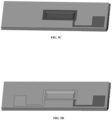
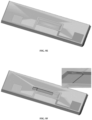
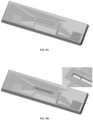
- the drag effect can also be used to help localize strand of DNA 908 to the bottom or top of nanochannel 930, e.g., FIG. 9B illustrating strand of DNA 908 being closer to the bottom of nanochannel 930. Also illustrated in FIG. 9B is electrode 950 that pushes down strand of DNA 908 in nanochannel 930.
- nanopores 924(a) and 924(b) can be used to drag strand of DNA 908 across surface 936 of edge electrodes and edge electrode pairs. Strand of DNA 908 can be dragged through both nanopores 924(a) and 924(b), linearizing strand of DNA 908 and simultaneously keeping it close to surface 936.
- strand of DNA 908 can be translocated using pressure driven flow.
- Strand of DNA 908 is introduced into first nanochannel 930(a) via microchannel 940(a) adjacent to inlet 932(a).
- Second nanochannel 930(b) intersects first nanochannel 930(a), running perpendicular at the center of first nanochannel 930(a).
- the flow rate in the channels can be changed to alter the pressure in the channels. This pressure differential across first nanochannel 930(a) leads to hydrodynamic shearing that can linearize strand of DNA 908.
Landscapes
- Life Sciences & Earth Sciences (AREA)
- Chemical & Material Sciences (AREA)
- Health & Medical Sciences (AREA)
- Engineering & Computer Science (AREA)
- Physics & Mathematics (AREA)
- Molecular Biology (AREA)
- Organic Chemistry (AREA)
- Analytical Chemistry (AREA)
- Proteomics, Peptides & Aminoacids (AREA)
- General Health & Medical Sciences (AREA)
- Biochemistry (AREA)
- Immunology (AREA)
- Zoology (AREA)
- Wood Science & Technology (AREA)
- Biomedical Technology (AREA)
- Biophysics (AREA)
- Spectroscopy & Molecular Physics (AREA)
- Pathology (AREA)
- General Physics & Mathematics (AREA)
- General Engineering & Computer Science (AREA)
- Genetics & Genomics (AREA)
- Biotechnology (AREA)
- Microbiology (AREA)
- Bioinformatics & Cheminformatics (AREA)
- Nanotechnology (AREA)
- Chemical Kinetics & Catalysis (AREA)
- Electrochemistry (AREA)
- Hematology (AREA)
- Urology & Nephrology (AREA)
- Food Science & Technology (AREA)
- Medicinal Chemistry (AREA)
- Measuring Or Testing Involving Enzymes Or Micro-Organisms (AREA)
- Apparatus Associated With Microorganisms And Enzymes (AREA)
Claims (16)
- Vorrichtung (100) zum elektrochemischen Sequenzieren von DNA, die Redoxspezies umfasst, die in modifizierte Nukleotide des DNA-Strangs eingebaut sind, die Vorrichtung (100) umfassend:mindestens eine Randelektrode (102), dazu konfiguriert, das modifizierte Nukleotid zu oxidieren oder zu reduzieren, wenn das modifizierte Nukleotid über die mindestens eine Randelektrode (102) läuft;mindestens einen Stapel aus Isolatormaterial (104) zum Isolieren und Reduzieren von Nebensprechen zwischen Elektrodenschichten;ein Paar DNA-Translokationselektroden (106), das eine DNA-Translokations-Arbeitselektrode (106(a)) und eine DNA-Translokations-Gegenelektrode (106(b)) enthält; undein Mittel zum Anlegen einer Spannung an die mindestens eine Randelektrode (102) für die Oxidation oder die Reduktion,wobei:eine Dicke jeder der mindestens einen Randelektrode (102) 0,5 Nanometer beträgt;eine Dicke von jedem des mindestens einen Stapels aus Isolatormaterial (104) 10 Nanometer beträgt;
unddie mindestens eine Randelektrode (102) und der mindestens eine Stapel aus Isolatormaterial (104) zwischen der DNA-Translokations-Arbeitselektrode (106(a)) und der DNA-Translokations-Gegenelektrode (106(b)) alternieren. - Vorrichtung nach Anspruch 1, wobei:die mindestens eine Randelektrode (102) 1 bis 50 Randelektroden (102) enthält und der mindestens eine Stapel aus Isolatormaterial (104) 1 bis 50 Stapel aus Isolatormaterial (104) enthält; undeine Gesamtdicke der mindestens einen Randelektrode (102) und des mindestens einen Stapels aus Isolatormaterial (104) 20 Nanometer bis 1000 Nanometer beträgt.
- Vorrichtung (100) nach Anspruch 1, wobei die mindestens eine Randelektrode (102) ein leitfähiges Material umfasst und das Isolatormaterial ein dielektrisches Material umfasst.
- Vorrichtung (100) nach Anspruch 3, wobei die mindestens eine Randelektrode (102) Titannitrid oder Platin ist und das Isolatormaterial ausgewählt ist aus der Gruppe bestehend aus Siliziumdioxid, Siliziumnitrid und Aluminiumoxid.
- Vorrichtung (100) nach Anspruch 4, wobei die mindestens eine Randelektrode (102) und das Isolatormaterial durch Trockenätzen, Nassätzen, reaktives Ionenätzen, Abheben, chemisch-mechanisches Polieren oder ein Ionenstrahl-Fräsverfahren mikrostrukturiert oder nanostrukturiert sind.
- Verfahren zum elektrochemischen Sequenzieren eines DNA-Strangs unter Verwendung der Vorrichtung (100) nach einem der Ansprüche 1 bis 5, das Verfahren umfassend:Modifizieren jedes Nukleotids von mindestens zwei Nukleotidbasengruppen des DNA-Strangs, um eine Redoxspezies einzubauen, einschließlich (a) Modifizieren jedes Nukleotids einer ersten Nukleotidbasengruppe, um eine erste Redoxspezies mit einem ersten Oxidations- oder Reduktionspotential einzubauen, und (b) Modifizieren jedes Nukleotids einer zweiten Nukleotidbasengruppe, um eine zweite Redoxspezies mit einem zweiten Oxidations- oder Reduktionspotential einzubauen;Anlegen einer Spannung an die mindestens eine Randelektrode (102);Führen des DNA-Strangs über die mindestens eine Randelektrode (102);Oxidieren oder Reduzieren jedes modifizierten Nukleotids unter Verwendung der mindestens einen Randelektrode (102), während das jeweilige modifizierte Nukleotid über die mindestens eine Randelektrode (102) läuft, wobei das Oxidieren oder Reduzieren ein elektrochemisches Signal erzeugt, das eine Stromänderung beinhaltet;Identifizieren jedes modifizierten Nukleotids basierend auf dem elektrochemischen Signal; undBestimmen einer Sequenz des DNA-Strangs;
- Verfahren nach Anspruch 6, wobei:die erste und die zweite Nukleotidbasengruppe voneinander verschieden sind; unddie erste und die zweite Nukleotidbasengruppe nicht komplementär zueinander sind.
- Verfahren nach Anspruch 6, ferner umfassend das Einbauen der redoxmodifizierten Nukleotide unter Verwendung von Polymerasekettenreaktion, multipler Verdrängungsamplifikation oder isothermer Amplifikation.
- Verfahren nach Anspruch 6, wobei das Anlegen der Spannung an die mindestens eine Randelektrode (102) das zyklische Wechseln der Spannung zwischen einem Oxidationspotential und einem Reduktionspotential umfasst.
- Verfahren nach Anspruch 6, wobei jedes modifizierte Nukleotid mehrere Male oxidiert oder reduziert wird, wenn das jeweilige modifizierte Nukleotid über die mindestens eine Randelektrode (102) läuft.
- Verfahren nach Anspruch 6, ferner umfassend das Leiten des DNA-Strangs über mehrere Randelektroden (102), die in regelmäßigen Abständen parallel beabstandet sind, wobei die Sequenz des DNA-Strangs mehrere Male unter Verwendung jeder der Randelektroden (102) bestimmt wird.
- Verfahren nach Anspruch 7, ferner umfassend das Amplifizieren der modifizierten DNA-Stränge.
- Verfahren nach Anspruch 12, ferner umfassend das Amplifizieren des DNA-Strangs vor dem Modifizieren jedes Nukleotids des DNA-Strangs, um eine Redoxspezies einzubinden.
- Verfahren nach Anspruch 13, ferner umfassend das Ligieren eines bekannten DNA-Strangs an jeden der amplifizierten DNA-Stränge.
- Verfahren nach Anspruch 6 oder 12, ferner umfassend das Einführen eines Spacers zwischen benachbarte Nukleotide des DNA-Strangs.
- Verfahren nach Anspruch 12, wobei jedes modifizierte Nukleotid in der ersten Gruppe entweder ein redoxmodifiziertes Adenin- oder Thymin-Desoxynukleosidtriphosphat (dNTP) ist und jedes modifizierte Nukleotid in der zweiten Gruppe entweder ein redoxmodifiziertes Cytosin- oder Guanin-dNTP ist.
Applications Claiming Priority (3)
| Application Number | Priority Date | Filing Date | Title |
|---|---|---|---|
| US201762581366P | 2017-11-03 | 2017-11-03 | |
| US16/009,766 US11131646B2 (en) | 2017-11-03 | 2018-06-15 | Electrochemical sequencing of DNA using an edge electrode |
| PCT/EP2018/079133 WO2019086305A1 (en) | 2017-11-03 | 2018-10-24 | Electrochemical sequencing of dna using an edge electrode |
Publications (2)
| Publication Number | Publication Date |
|---|---|
| EP3704483A1 EP3704483A1 (de) | 2020-09-09 |
| EP3704483B1 true EP3704483B1 (de) | 2023-05-10 |
Family
ID=66326988
Family Applications (1)
| Application Number | Title | Priority Date | Filing Date |
|---|---|---|---|
| EP18795460.7A Active EP3704483B1 (de) | 2017-11-03 | 2018-10-24 | Elektrochemische sequenzierung von dna unter verwendung einer randelektrode |
Country Status (4)
| Country | Link |
|---|---|
| US (1) | US11131646B2 (de) |
| EP (1) | EP3704483B1 (de) |
| CN (1) | CN111512156B (de) |
| WO (1) | WO2019086305A1 (de) |
Families Citing this family (15)
| Publication number | Priority date | Publication date | Assignee | Title |
|---|---|---|---|---|
| EP3791179A4 (de) | 2018-05-09 | 2022-01-26 | Arizona Board of Regents on behalf of Arizona State University | Verfahren zur elektronischen detektion und quantifizierung von antikörpern |
| IL278769B2 (en) | 2018-05-17 | 2025-06-01 | Stuart Lindsay | Device, system and method for direct electrical measurement of enzyme activity |
| AU2020214334A1 (en) | 2019-01-30 | 2021-08-12 | Arizona Board Of Regents On Behalf Of Arizona State University | Bioelectronic circuits, systems and methods for preparing and using them |
| US11814675B2 (en) | 2019-08-29 | 2023-11-14 | Robert Bosch Gmbh | Edge sequencing with an immobilized translocator |
| CN115380120A (zh) | 2020-02-28 | 2022-11-22 | 代表亚利桑那大学的亚利桑那校董事会 | 用于对生物聚合物进行测序的方法 |
| CN115552030A (zh) | 2020-04-17 | 2022-12-30 | 代表亚利桑那大学的亚利桑那校董事会 | 单分子电子序列检测器及其使用方法 |
| AU2021263432A1 (en) | 2020-04-30 | 2022-12-01 | Arizona Board Of Regents On Behalf Of Arizona State University | Methods for sequencing biopolymers |
| CA3110732C (en) * | 2020-05-07 | 2022-03-15 | Citrix Systems, Inc. | Dynamic region based application operations |
| US12276653B2 (en) | 2020-05-29 | 2025-04-15 | Arizona Board Of Regents On Behalf Of Arizona State University | Bioelectronic devices with programmable adaptors |
| US12624389B2 (en) | 2021-06-07 | 2026-05-12 | Arizona Board Of Regents On Behalf Of Arizona State University | Methods for sequencing biopolymers |
| EP4536856A1 (de) * | 2022-06-06 | 2025-04-16 | Robert Bosch GmbH | Nukleinsäuresequenzierung über enzymtranslokatoren |
| US20250154580A1 (en) | 2023-11-13 | 2025-05-15 | Robert Bosch Gmbh | Enzyme translocators in nanogap with 3' -esters |
| US20250320550A1 (en) | 2024-04-12 | 2025-10-16 | Robert Bosch Gmbh | Sequencing by synthesis using electroactively labeled 3-oh-modified nucleotides |
| US20250321204A1 (en) * | 2024-04-15 | 2025-10-16 | Robert Bosch Gmbh | Sensor unit of a nucleic acid analysis system |
| US20250354208A1 (en) | 2024-05-14 | 2025-11-20 | Robert Bosch Gmbh | Method for sequencing a dna-strand |
Family Cites Families (16)
| Publication number | Priority date | Publication date | Assignee | Title |
|---|---|---|---|---|
| US6649350B2 (en) * | 1997-04-09 | 2003-11-18 | California Institute Of Technology | Electrochemical sensor using intercalative, redox-active moieties |
| WO2008157696A2 (en) | 2007-06-19 | 2008-12-24 | Stratos Genomics Inc. | High throughput nucleic acid sequencing by expansion |
| US8372585B2 (en) * | 2007-12-31 | 2013-02-12 | Intel Corporation | Electronic sensing for nucleic acid sequencing |
| US9175338B2 (en) * | 2008-12-11 | 2015-11-03 | Pacific Biosciences Of California, Inc. | Methods for identifying nucleic acid modifications |
| US8860438B2 (en) * | 2009-05-11 | 2014-10-14 | Clemson University Research Foundation | Electrical double layer capacitive devices and methods of using same for sequencing polymers and detecting analytes |
| US8864969B2 (en) * | 2009-06-25 | 2014-10-21 | The Board Of Trustees Of The Leland Stanford Junior University | Electro-diffusion enhanced bio-molecule charge detection using electrostatic interaction |
| US8110410B2 (en) * | 2009-06-29 | 2012-02-07 | International Business Machines Corporation | Nanofludic field effect transistor based on surface charge modulated nanochannel |
| EP2517028B1 (de) * | 2010-02-02 | 2017-12-13 | Arizona Board Of Regents | Gesteuerte tunnelvorrichtung zur sequenzierung von polymeren |
| US9005425B2 (en) * | 2010-03-05 | 2015-04-14 | University Of Utah Research Foundation | Detection of nucleic acid lesions and adducts using nanopores |
| US20120193231A1 (en) * | 2011-01-28 | 2012-08-02 | International Business Machines Corporation | Dna sequencing using multiple metal layer structure with organic coatings forming transient bonding to dna bases |
| CN104011866B (zh) * | 2011-07-27 | 2017-06-09 | 伊利诺伊大学评议会 | 用于生物分子表征的纳米孔传感器 |
| GB2498021A (en) * | 2011-09-07 | 2013-07-03 | Univ Utah Res Found | Detection of Nucleic acid lesions and adducts using nanopores |
| WO2013056241A2 (en) * | 2011-10-14 | 2013-04-18 | Pacific Biosciences Of California, Inc. | Real-time redox sequencing |
| US8890121B1 (en) * | 2013-05-06 | 2014-11-18 | International Business Machines Corporation | Integrated nanowire/nanosheet nanogap and nanopore for DNA and RNA sequencing |
| US9377431B2 (en) * | 2013-07-24 | 2016-06-28 | Globalfoundries Inc. | Heterojunction nanopore for sequencing |
| CN104359946B (zh) * | 2014-10-23 | 2017-05-31 | 北京大学 | 一种基于纳米对电极的单分子核酸测序器件 |
-
2018
- 2018-06-15 US US16/009,766 patent/US11131646B2/en active Active
- 2018-10-24 CN CN201880085143.3A patent/CN111512156B/zh active Active
- 2018-10-24 WO PCT/EP2018/079133 patent/WO2019086305A1/en not_active Ceased
- 2018-10-24 EP EP18795460.7A patent/EP3704483B1/de active Active
Also Published As
| Publication number | Publication date |
|---|---|
| EP3704483A1 (de) | 2020-09-09 |
| CN111512156B (zh) | 2023-01-31 |
| US20190137435A1 (en) | 2019-05-09 |
| WO2019086305A1 (en) | 2019-05-09 |
| US11131646B2 (en) | 2021-09-28 |
| CN111512156A (zh) | 2020-08-07 |
Similar Documents
| Publication | Publication Date | Title |
|---|---|---|
| US11131646B2 (en) | Electrochemical sequencing of DNA using an edge electrode | |
| JP7279219B2 (ja) | 流体通路を含むナノポアセンサ | |
| US11782047B2 (en) | Nanopore-containing substrates with aligned nanoscale electronic elements and methods of making and using same | |
| CN116042789B (zh) | 纳米孔设备及其制造方法 | |
| CN107683337B (zh) | 微孔电极及分析化学物质的方法 | |
| JP5717634B2 (ja) | 流体チャネル内の生体分子および他の分析物の電圧感知のための、長手方向に変位されるナノスケールの電極の使用 | |
| CN103975240B (zh) | 金刚石电极纳米间隙换能器 | |
| KR102023754B1 (ko) | 생체분자 특성규명용 나노포어 센서 | |
| US20160187282A1 (en) | Device for single molecule detection and fabrication methods thereof | |
| JP2013090576A (ja) | 核酸分析デバイス及びそれを用いた核酸分析装置 | |
| WO2010117470A2 (en) | Nanopore sequencing devices and methods | |
| TWI592661B (zh) | 單分子檢測 | |
| US9630175B2 (en) | Self-aligned nanogap fabrication |
Legal Events
| Date | Code | Title | Description |
|---|---|---|---|
| STAA | Information on the status of an ep patent application or granted ep patent |
Free format text: STATUS: UNKNOWN |
|
| STAA | Information on the status of an ep patent application or granted ep patent |
Free format text: STATUS: THE INTERNATIONAL PUBLICATION HAS BEEN MADE |
|
| PUAI | Public reference made under article 153(3) epc to a published international application that has entered the european phase |
Free format text: ORIGINAL CODE: 0009012 |
|
| STAA | Information on the status of an ep patent application or granted ep patent |
Free format text: STATUS: REQUEST FOR EXAMINATION WAS MADE |
|
| 17P | Request for examination filed |
Effective date: 20200603 |
|
| AK | Designated contracting states |
Kind code of ref document: A1 Designated state(s): AL AT BE BG CH CY CZ DE DK EE ES FI FR GB GR HR HU IE IS IT LI LT LU LV MC MK MT NL NO PL PT RO RS SE SI SK SM TR |
|
| AX | Request for extension of the european patent |
Extension state: BA ME |
|
| DAV | Request for validation of the european patent (deleted) | ||
| DAX | Request for extension of the european patent (deleted) | ||
| STAA | Information on the status of an ep patent application or granted ep patent |
Free format text: STATUS: EXAMINATION IS IN PROGRESS |
|
| 17Q | First examination report despatched |
Effective date: 20210302 |
|
| GRAP | Despatch of communication of intention to grant a patent |
Free format text: ORIGINAL CODE: EPIDOSNIGR1 |
|
| STAA | Information on the status of an ep patent application or granted ep patent |
Free format text: STATUS: GRANT OF PATENT IS INTENDED |
|
| INTG | Intention to grant announced |
Effective date: 20221220 |
|
| GRAS | Grant fee paid |
Free format text: ORIGINAL CODE: EPIDOSNIGR3 |
|
| GRAA | (expected) grant |
Free format text: ORIGINAL CODE: 0009210 |
|
| STAA | Information on the status of an ep patent application or granted ep patent |
Free format text: STATUS: THE PATENT HAS BEEN GRANTED |
|
| AK | Designated contracting states |
Kind code of ref document: B1 Designated state(s): AL AT BE BG CH CY CZ DE DK EE ES FI FR GB GR HR HU IE IS IT LI LT LU LV MC MK MT NL NO PL PT RO RS SE SI SK SM TR |
|
| REG | Reference to a national code |
Ref country code: GB Ref legal event code: FG4D |
|
| REG | Reference to a national code |
Ref country code: AT Ref legal event code: REF Ref document number: 1567171 Country of ref document: AT Kind code of ref document: T Effective date: 20230515 Ref country code: CH Ref legal event code: EP |
|
| REG | Reference to a national code |
Ref country code: DE Ref legal event code: R096 Ref document number: 602018049697 Country of ref document: DE |
|
| REG | Reference to a national code |
Ref country code: IE Ref legal event code: FG4D |
|
| REG | Reference to a national code |
Ref country code: LT Ref legal event code: MG9D |
|
| REG | Reference to a national code |
Ref country code: NL Ref legal event code: MP Effective date: 20230510 |
|
| REG | Reference to a national code |
Ref country code: AT Ref legal event code: MK05 Ref document number: 1567171 Country of ref document: AT Kind code of ref document: T Effective date: 20230510 |
|
| PG25 | Lapsed in a contracting state [announced via postgrant information from national office to epo] |
Ref country code: SE Free format text: LAPSE BECAUSE OF FAILURE TO SUBMIT A TRANSLATION OF THE DESCRIPTION OR TO PAY THE FEE WITHIN THE PRESCRIBED TIME-LIMIT Effective date: 20230510 Ref country code: PT Free format text: LAPSE BECAUSE OF FAILURE TO SUBMIT A TRANSLATION OF THE DESCRIPTION OR TO PAY THE FEE WITHIN THE PRESCRIBED TIME-LIMIT Effective date: 20230911 Ref country code: NO Free format text: LAPSE BECAUSE OF FAILURE TO SUBMIT A TRANSLATION OF THE DESCRIPTION OR TO PAY THE FEE WITHIN THE PRESCRIBED TIME-LIMIT Effective date: 20230810 Ref country code: NL Free format text: LAPSE BECAUSE OF FAILURE TO SUBMIT A TRANSLATION OF THE DESCRIPTION OR TO PAY THE FEE WITHIN THE PRESCRIBED TIME-LIMIT Effective date: 20230510 Ref country code: ES Free format text: LAPSE BECAUSE OF FAILURE TO SUBMIT A TRANSLATION OF THE DESCRIPTION OR TO PAY THE FEE WITHIN THE PRESCRIBED TIME-LIMIT Effective date: 20230510 Ref country code: AT Free format text: LAPSE BECAUSE OF FAILURE TO SUBMIT A TRANSLATION OF THE DESCRIPTION OR TO PAY THE FEE WITHIN THE PRESCRIBED TIME-LIMIT Effective date: 20230510 |
|
| PG25 | Lapsed in a contracting state [announced via postgrant information from national office to epo] |
Ref country code: RS Free format text: LAPSE BECAUSE OF FAILURE TO SUBMIT A TRANSLATION OF THE DESCRIPTION OR TO PAY THE FEE WITHIN THE PRESCRIBED TIME-LIMIT Effective date: 20230510 Ref country code: PL Free format text: LAPSE BECAUSE OF FAILURE TO SUBMIT A TRANSLATION OF THE DESCRIPTION OR TO PAY THE FEE WITHIN THE PRESCRIBED TIME-LIMIT Effective date: 20230510 Ref country code: LV Free format text: LAPSE BECAUSE OF FAILURE TO SUBMIT A TRANSLATION OF THE DESCRIPTION OR TO PAY THE FEE WITHIN THE PRESCRIBED TIME-LIMIT Effective date: 20230510 Ref country code: LT Free format text: LAPSE BECAUSE OF FAILURE TO SUBMIT A TRANSLATION OF THE DESCRIPTION OR TO PAY THE FEE WITHIN THE PRESCRIBED TIME-LIMIT Effective date: 20230510 Ref country code: IS Free format text: LAPSE BECAUSE OF FAILURE TO SUBMIT A TRANSLATION OF THE DESCRIPTION OR TO PAY THE FEE WITHIN THE PRESCRIBED TIME-LIMIT Effective date: 20230910 Ref country code: HR Free format text: LAPSE BECAUSE OF FAILURE TO SUBMIT A TRANSLATION OF THE DESCRIPTION OR TO PAY THE FEE WITHIN THE PRESCRIBED TIME-LIMIT Effective date: 20230510 Ref country code: GR Free format text: LAPSE BECAUSE OF FAILURE TO SUBMIT A TRANSLATION OF THE DESCRIPTION OR TO PAY THE FEE WITHIN THE PRESCRIBED TIME-LIMIT Effective date: 20230811 |
|
| PG25 | Lapsed in a contracting state [announced via postgrant information from national office to epo] |
Ref country code: FI Free format text: LAPSE BECAUSE OF FAILURE TO SUBMIT A TRANSLATION OF THE DESCRIPTION OR TO PAY THE FEE WITHIN THE PRESCRIBED TIME-LIMIT Effective date: 20230510 |
|
| PG25 | Lapsed in a contracting state [announced via postgrant information from national office to epo] |
Ref country code: SK Free format text: LAPSE BECAUSE OF FAILURE TO SUBMIT A TRANSLATION OF THE DESCRIPTION OR TO PAY THE FEE WITHIN THE PRESCRIBED TIME-LIMIT Effective date: 20230510 |
|
| PG25 | Lapsed in a contracting state [announced via postgrant information from national office to epo] |
Ref country code: SM Free format text: LAPSE BECAUSE OF FAILURE TO SUBMIT A TRANSLATION OF THE DESCRIPTION OR TO PAY THE FEE WITHIN THE PRESCRIBED TIME-LIMIT Effective date: 20230510 Ref country code: SK Free format text: LAPSE BECAUSE OF FAILURE TO SUBMIT A TRANSLATION OF THE DESCRIPTION OR TO PAY THE FEE WITHIN THE PRESCRIBED TIME-LIMIT Effective date: 20230510 Ref country code: RO Free format text: LAPSE BECAUSE OF FAILURE TO SUBMIT A TRANSLATION OF THE DESCRIPTION OR TO PAY THE FEE WITHIN THE PRESCRIBED TIME-LIMIT Effective date: 20230510 Ref country code: EE Free format text: LAPSE BECAUSE OF FAILURE TO SUBMIT A TRANSLATION OF THE DESCRIPTION OR TO PAY THE FEE WITHIN THE PRESCRIBED TIME-LIMIT Effective date: 20230510 Ref country code: DK Free format text: LAPSE BECAUSE OF FAILURE TO SUBMIT A TRANSLATION OF THE DESCRIPTION OR TO PAY THE FEE WITHIN THE PRESCRIBED TIME-LIMIT Effective date: 20230510 Ref country code: CZ Free format text: LAPSE BECAUSE OF FAILURE TO SUBMIT A TRANSLATION OF THE DESCRIPTION OR TO PAY THE FEE WITHIN THE PRESCRIBED TIME-LIMIT Effective date: 20230510 |
|
| REG | Reference to a national code |
Ref country code: DE Ref legal event code: R097 Ref document number: 602018049697 Country of ref document: DE |
|
| PLBE | No opposition filed within time limit |
Free format text: ORIGINAL CODE: 0009261 |
|
| STAA | Information on the status of an ep patent application or granted ep patent |
Free format text: STATUS: NO OPPOSITION FILED WITHIN TIME LIMIT |
|
| 26N | No opposition filed |
Effective date: 20240213 |
|
| PG25 | Lapsed in a contracting state [announced via postgrant information from national office to epo] |
Ref country code: SI Free format text: LAPSE BECAUSE OF FAILURE TO SUBMIT A TRANSLATION OF THE DESCRIPTION OR TO PAY THE FEE WITHIN THE PRESCRIBED TIME-LIMIT Effective date: 20230510 |
|
| PG25 | Lapsed in a contracting state [announced via postgrant information from national office to epo] |
Ref country code: SI Free format text: LAPSE BECAUSE OF FAILURE TO SUBMIT A TRANSLATION OF THE DESCRIPTION OR TO PAY THE FEE WITHIN THE PRESCRIBED TIME-LIMIT Effective date: 20230510 Ref country code: IT Free format text: LAPSE BECAUSE OF FAILURE TO SUBMIT A TRANSLATION OF THE DESCRIPTION OR TO PAY THE FEE WITHIN THE PRESCRIBED TIME-LIMIT Effective date: 20230510 Ref country code: MC Free format text: LAPSE BECAUSE OF FAILURE TO SUBMIT A TRANSLATION OF THE DESCRIPTION OR TO PAY THE FEE WITHIN THE PRESCRIBED TIME-LIMIT Effective date: 20230510 |
|
| REG | Reference to a national code |
Ref country code: CH Ref legal event code: PL |
|
| REG | Reference to a national code |
Ref country code: BE Ref legal event code: MM Effective date: 20231031 |
|
| PG25 | Lapsed in a contracting state [announced via postgrant information from national office to epo] |
Ref country code: LU Free format text: LAPSE BECAUSE OF NON-PAYMENT OF DUE FEES Effective date: 20231024 |
|
| PG25 | Lapsed in a contracting state [announced via postgrant information from national office to epo] |
Ref country code: LU Free format text: LAPSE BECAUSE OF NON-PAYMENT OF DUE FEES Effective date: 20231024 |
|
| PG25 | Lapsed in a contracting state [announced via postgrant information from national office to epo] |
Ref country code: CH Free format text: LAPSE BECAUSE OF NON-PAYMENT OF DUE FEES Effective date: 20231031 |
|
| PG25 | Lapsed in a contracting state [announced via postgrant information from national office to epo] |
Ref country code: FR Free format text: LAPSE BECAUSE OF NON-PAYMENT OF DUE FEES Effective date: 20231031 Ref country code: CH Free format text: LAPSE BECAUSE OF NON-PAYMENT OF DUE FEES Effective date: 20231031 |
|
| PG25 | Lapsed in a contracting state [announced via postgrant information from national office to epo] |
Ref country code: BE Free format text: LAPSE BECAUSE OF NON-PAYMENT OF DUE FEES Effective date: 20231031 |
|
| PG25 | Lapsed in a contracting state [announced via postgrant information from national office to epo] |
Ref country code: IE Free format text: LAPSE BECAUSE OF NON-PAYMENT OF DUE FEES Effective date: 20231024 |
|
| PG25 | Lapsed in a contracting state [announced via postgrant information from national office to epo] |
Ref country code: IE Free format text: LAPSE BECAUSE OF NON-PAYMENT OF DUE FEES Effective date: 20231024 |
|
| PG25 | Lapsed in a contracting state [announced via postgrant information from national office to epo] |
Ref country code: BG Free format text: LAPSE BECAUSE OF FAILURE TO SUBMIT A TRANSLATION OF THE DESCRIPTION OR TO PAY THE FEE WITHIN THE PRESCRIBED TIME-LIMIT Effective date: 20230510 |
|
| PG25 | Lapsed in a contracting state [announced via postgrant information from national office to epo] |
Ref country code: BG Free format text: LAPSE BECAUSE OF FAILURE TO SUBMIT A TRANSLATION OF THE DESCRIPTION OR TO PAY THE FEE WITHIN THE PRESCRIBED TIME-LIMIT Effective date: 20230510 |
|
| PG25 | Lapsed in a contracting state [announced via postgrant information from national office to epo] |
Ref country code: CY Free format text: LAPSE BECAUSE OF FAILURE TO SUBMIT A TRANSLATION OF THE DESCRIPTION OR TO PAY THE FEE WITHIN THE PRESCRIBED TIME-LIMIT; INVALID AB INITIO Effective date: 20181024 |
|
| PG25 | Lapsed in a contracting state [announced via postgrant information from national office to epo] |
Ref country code: HU Free format text: LAPSE BECAUSE OF FAILURE TO SUBMIT A TRANSLATION OF THE DESCRIPTION OR TO PAY THE FEE WITHIN THE PRESCRIBED TIME-LIMIT; INVALID AB INITIO Effective date: 20181024 |
|
| PG25 | Lapsed in a contracting state [announced via postgrant information from national office to epo] |
Ref country code: TR Free format text: LAPSE BECAUSE OF FAILURE TO SUBMIT A TRANSLATION OF THE DESCRIPTION OR TO PAY THE FEE WITHIN THE PRESCRIBED TIME-LIMIT Effective date: 20230510 |
|
| PGFP | Annual fee paid to national office [announced via postgrant information from national office to epo] |
Ref country code: DE Payment date: 20251209 Year of fee payment: 8 |
|
| PGFP | Annual fee paid to national office [announced via postgrant information from national office to epo] |
Ref country code: GB Payment date: 20251024 Year of fee payment: 8 |