EP3702893B1 - Berührungssensorsignalverarbeitungsverfahren und system - Google Patents
Berührungssensorsignalverarbeitungsverfahren und system Download PDFInfo
- Publication number
- EP3702893B1 EP3702893B1 EP18884386.6A EP18884386A EP3702893B1 EP 3702893 B1 EP3702893 B1 EP 3702893B1 EP 18884386 A EP18884386 A EP 18884386A EP 3702893 B1 EP3702893 B1 EP 3702893B1
- Authority
- EP
- European Patent Office
- Prior art keywords
- touch
- signal
- sensing signal
- operating system
- sensor
- Prior art date
- Legal status (The legal status is an assumption and is not a legal conclusion. Google has not performed a legal analysis and makes no representation as to the accuracy of the status listed.)
- Active
Links
Images


Classifications
-
- G—PHYSICS
- G06—COMPUTING OR CALCULATING; COUNTING
- G06F—ELECTRIC DIGITAL DATA PROCESSING
- G06F3/00—Input arrangements for transferring data to be processed into a form capable of being handled by the computer; Output arrangements for transferring data from processing unit to output unit, e.g. interface arrangements
- G06F3/01—Input arrangements or combined input and output arrangements for interaction between user and computer
- G06F3/03—Arrangements for converting the position or the displacement of a member into a coded form
- G06F3/041—Digitisers, e.g. for touch screens or touch pads, characterised by the transducing means
- G06F3/0414—Digitisers, e.g. for touch screens or touch pads, characterised by the transducing means using force sensing means to determine a position
-
- G—PHYSICS
- G06—COMPUTING OR CALCULATING; COUNTING
- G06F—ELECTRIC DIGITAL DATA PROCESSING
- G06F3/00—Input arrangements for transferring data to be processed into a form capable of being handled by the computer; Output arrangements for transferring data from processing unit to output unit, e.g. interface arrangements
- G06F3/01—Input arrangements or combined input and output arrangements for interaction between user and computer
- G06F3/03—Arrangements for converting the position or the displacement of a member into a coded form
- G06F3/041—Digitisers, e.g. for touch screens or touch pads, characterised by the transducing means
- G06F3/0416—Control or interface arrangements specially adapted for digitisers
-
- G—PHYSICS
- G06—COMPUTING OR CALCULATING; COUNTING
- G06F—ELECTRIC DIGITAL DATA PROCESSING
- G06F3/00—Input arrangements for transferring data to be processed into a form capable of being handled by the computer; Output arrangements for transferring data from processing unit to output unit, e.g. interface arrangements
- G06F3/01—Input arrangements or combined input and output arrangements for interaction between user and computer
- G06F3/03—Arrangements for converting the position or the displacement of a member into a coded form
- G06F3/041—Digitisers, e.g. for touch screens or touch pads, characterised by the transducing means
- G06F3/042—Digitisers, e.g. for touch screens or touch pads, characterised by the transducing means by opto-electronic means
-
- G—PHYSICS
- G06—COMPUTING OR CALCULATING; COUNTING
- G06F—ELECTRIC DIGITAL DATA PROCESSING
- G06F3/00—Input arrangements for transferring data to be processed into a form capable of being handled by the computer; Output arrangements for transferring data from processing unit to output unit, e.g. interface arrangements
- G06F3/01—Input arrangements or combined input and output arrangements for interaction between user and computer
- G06F3/03—Arrangements for converting the position or the displacement of a member into a coded form
- G06F3/041—Digitisers, e.g. for touch screens or touch pads, characterised by the transducing means
- G06F3/044—Digitisers, e.g. for touch screens or touch pads, characterised by the transducing means by capacitive means
-
- G—PHYSICS
- G06—COMPUTING OR CALCULATING; COUNTING
- G06F—ELECTRIC DIGITAL DATA PROCESSING
- G06F3/00—Input arrangements for transferring data to be processed into a form capable of being handled by the computer; Output arrangements for transferring data from processing unit to output unit, e.g. interface arrangements
- G06F3/01—Input arrangements or combined input and output arrangements for interaction between user and computer
- G06F3/03—Arrangements for converting the position or the displacement of a member into a coded form
- G06F3/041—Digitisers, e.g. for touch screens or touch pads, characterised by the transducing means
- G06F3/045—Digitisers, e.g. for touch screens or touch pads, characterised by the transducing means using resistive elements, e.g. a single continuous surface or two parallel surfaces put in contact
-
- G—PHYSICS
- G06—COMPUTING OR CALCULATING; COUNTING
- G06F—ELECTRIC DIGITAL DATA PROCESSING
- G06F3/00—Input arrangements for transferring data to be processed into a form capable of being handled by the computer; Output arrangements for transferring data from processing unit to output unit, e.g. interface arrangements
- G06F3/01—Input arrangements or combined input and output arrangements for interaction between user and computer
- G06F3/03—Arrangements for converting the position or the displacement of a member into a coded form
- G06F3/041—Digitisers, e.g. for touch screens or touch pads, characterised by the transducing means
- G06F3/046—Digitisers, e.g. for touch screens or touch pads, characterised by the transducing means by electromagnetic means
Definitions
- the present invention relates to the field of touch control technology, and in particular, to a method, a system, and an apparatus for processing a touch signal, and an electronic device.
- a large number of electronic devices are equipped with various types of touch devices, such as capacitive, resistive, electromagnetic or infrared touch devices.
- touch devices such as capacitive, resistive, electromagnetic or infrared touch devices.
- a touch sensor of the touch device is able to collect a touch sensing signal, where the touch sensing signal will be different when the type of the touch device is different.
- the touch sensing signal collected includes a variation of magnetic flux and a frequency of a received electromagnetic signal
- the touch sensing signal collected includes a variation of capacitance.
- US 2015/0091837 A1 discloses a method of touch engine processing remotely from a touch screen, where the touch screen command processing may be offloaded to a remote processor already provided within the host.
- CN 102622136 A discloses a stable multi-touch system data processing method for improving effectiveness and stability of multi-touch , and shortening the system development cycle.
- US 2011/0285636 A1 discloses a touch screen for displaying joystick data based on user interaction.
- a control chip of the touch device converts the touch sensing signal to a touch signal, codes the touch signal according to a data coding specification supported by an operating system and then transfers to the operating system of the electronic device, and then a touch response is made by the operating system.
- the touch device needs to adopt a high-performance chip.
- the high-performance chip has a high cost and a large volume, which will cause the cost and volume of the touch devices to increase.
- embodiments of the present invention provide a method, a system, and an apparatus for processing a touch sensing signal, and an electronic device, so as to solve the problem of the high cost and large volume of the control chip raised by the high-performance chip.
- embodiments of the present disclosure provide a system for processing a touch sensing signal, comprising the features of claim 1.
- the touch sensor comprises one or more of following: an infrared touch frame, an electromagnetic panel, a capacitive touch panel, a resistive touch panel, or a pressure sensor.
- the touch sensing signal comprises a variation of magnetic flux and a frequency of a received electromagnetic signal
- the touch signal comprises a touch position signal corresponding to the variation of magnetic flux and a pressure sensitive signal corresponding to the frequency
- the touch device sends the touch sensing signal to the operating system via any one of following interfaces: a USB-bulk interface, a USB-hid interface, an RS232 interface.
- the touch device sends the coded touch signal to the operating system via the USB-hid interface.
- the present embodiment also provides a method for processing a touch sensing signal, applied to an operating system, the method comprising the steps according to claim 10.
- a touch sensor of a touch device generates a touch sensing signal and then transfers the touch sensing signal to an operating system, the operating system converts the touch sensing signal to a touch signal and returns back to the touch device, and then the touch device codes the touch signal according to a standard data coding specification and then returns it to the operating system. Consequently, the touch device does not need to perform conversion processing from the touch sensing signal to the touch signal, which can reduce the performance requirement on the control chip, then enable the touch device to adopt a low performance chip as the control chip, and thus lower the cost and the volume of the touch device.
- first, second, third may be used to describe various information, the information should not be limited by these terms. Instead, they are only used to distinguish the information of the same type from each other.
- first information may be referred to as the second information, and likewise, the second information may be referred to as the first information as well.
- word “if' as used herein may be explained as “as” or "when” or "in response to determination”.
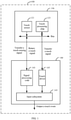
- FIG. 1 is an architecture diagram of a system 100 for processing a touch sensing signal described in an example not forming part of the present invention.
- the system 100 for processing may include a touch device 120 and a host device 140, the touch device 120 may include a touch sensor 121, the host device 140 may be equipped with an operating system (not shown in FIG. 1 ), and the operating system may include signal process code 141 and a touch drive 145.
- the host device 140 may refer to a host of an electronic device or a part capable of realizing a touch response in the host.
- the touch device 120 may refer to a touch input device independent of the electronic device or a touch input device installed on the electronic device.
- the electronic device may be a laptop, a cell phone, a camera phone, a smart phone, a personal digital assistant, a media player, a navigation device, a smart writing device, an email sending and receiving device, a game console, a tablet computer, a wearable device, a smart vehicle, a driverless car, a smart refrigerator, or other smart home devices or any combination of these devices.
- the smart writing device may be an electronic white board, an electronic black board and so on.
- a type of touch screen corresponding to the touch device 120 may be electromagnetic, infrared, capacitive, resistive, pressure sensitive and so on, and for example, the type of touch screen of a smart phone is capacitive or resistive, the type of touch screen of a smart writing board is electromagnetic, the type of touch screen of an infrared display is infrared.
- the type of touch screen corresponding to the touch device 120 is different, the type of the touch sensor 121 is different, the touch sensing signal it collects is different and the converted touch signal is not identical either.
- Some examples of the touch sensor 121 are illustrated for various types of touch screens in the following.
- Type 1 the touch screen is infrared, and the touch sensor 121 is an infrared touch frame, the touch sensing signal it collects may include a signal indicating that an infrared ray is interrupted, and the converted touch signal may include a touch position signal which may include X and Y coordinates of a touch position.
- the touch screen is an electromagnetic touch screen
- the touch sensor 121 is an electromagnetic panel
- the touch sensing signal it collects may include a variation of magnetic flux and a frequency of a received electromagnetic signal
- the converted touch signal may include a touch position signal corresponding to the variation of magnetic flux and a pressure sensitive signal corresponding to the frequency.
- the touch position signal may include X and Y coordinates of a touch position.
- the pressure sensitive signal may include a pressure value.
- Type 3 the touch screen is a capacitive touch screen, and the touch sensor 121 is a capacitive touch panel, the touch sensing signal it collects may include currents flowing through respective electrodes of the touch screen, the converted touch signal may include a touch position signal which may include X and Y coordinates of a touch position.
- Type 4 the touch screen is a resistive touch screen, and the touch sensor 121 is a resistive touch panel, the touch sensing signal it collects may include a voltage at a touch position, the converted touch signal may include a touch position signal which may include X and Y coordinates of the touch position.
- Type 5 the touch screen is a pressure-sensitive touch screen, and the touch sensor 121 is a pressure sensor, the touch sensing signal it collects may include a pressure signal, the converted touch signal may include a touch position signal, and the touch position signal may include X and Y coordinates of a touch position.
- the touch screen of the touch device 120 may include at least two types of touch screens of an electromagnetic touch screen, an infrared touch screen, a capacitive touch screen, a resistive touch screen, a pressure-sensitive touch screen, and correspondingly, the touch sensor 121 may include at least two of an infrared touch frame, an electromagnetic panel, a capacitive touch panel, a resistive panel and a pressure sensor. Or, the touch device 120 may be other types of touch screens as well, which is not limited in the embodiments of the description.
- the touch sensing signal may be transferred by the touch sensor 121 to the operating system directly through a predetermined interface.
- the mentioned predetermined interface may be a USB-bulk interface, an RS232 interface or a USB-hid interface (hid is an abbreviation of Human Interface Devices) and so on.
- the USB-hid interface may be a versatile USB-hid interface.
- the predetermined interfaces may also be a signal transfer interface customized by a designer of the solution according to the present invention or other equipment producers.
- the touch device 120 may also include a touch processing chip 123.
- the touch processing chip 123 mentioned may be a main control chip (also referred to as a main processing chip or a central processing unit) of the touch device, or may be other processing chips additionally configured for the touch device 120, which may be provided in the touch device 120, or outside the touch device 120.
- the signal processing code 141 receives the touch sensing signal.
- the signal processing code 141 is a module in a logical sense and is configured to convert the received touch sensing signal to the touch signal and then return it back to the touch device 120.
- the signal processing code 141 may be generated by means of reading corresponding computer program instructions in a readable medium, such as a non-volatile storage, into a memory by a central processing unit (which also may be referred to as a main control chip or a main processing processor) of the host device 140 or by other processing chips than the central processing unit, and then running.
- the processor of the host device 140 or other chips than the processor may read program instructions stored in the storage thereof and convert the touch sensing signal to the touch signal in response.
- the touch sensing signal is converted to the touch signal
- different conversion methods may be adopted corresponding to different types of touch screens based on their respective operating modes.
- the touch sensing signal is currents flowing through respective electrodes of a capacitive touch screen generated by the touch screen, and X and Y coordinates of a touch position may be determined according to the proportion of the currents of the respective electrodes.
- the signal processing code 141 may transfer the touch signal to the touch device 120.
- the touch signal may also be transferred via the above-mentioned predetermined interface when being transferred.
- touch device 120 may include a memory and a non-volatile storage.
- the storage may store code used for coding the touch signal.
- the code includes executable program instructions.
- the touch processing chip 123 of the touch device 120 may read the executable program instructions from the non-volatile storage to the memory to run, to generate a module in a logical sense. This module may be referred to as signal coding code.
- the signal coding code may code the received touch signal according to a standard data coding specification and then transfer it to the operating system.
- the touch signal coded by the touch device 120 is then analyzed by the touch drive 145 of the operating system.
- a different type of the touch device 120 may correspond to a different type of the standard data coding specification.
- the standard data coding specification mentioned herein may be a standard USB multitouch hid protocol corresponding to the USB-hid interface, and accordingly, the touch diver 145 may be a multitouch driver (hid-multitouch driver).
- the system 100 for processing may be applied to an electronic device.
- the touch device 120 may include a touch screen, and the touch sensor 121 may be installed on the touch screen, or may be independent of the touch screen.
- the system 100 for processing may also include an interface (which is not shown in FIG. 1 and may be the above-mentioned predetermined interface) provided between the touch device 120 and the operating system.
- the operating system may include an input subsystem (input_device) 143 as well.
- input_device input subsystem
- the touch sensor 121 may generate a touch sensing signal which is sent by the touch device 120 to the operating system.
- the signal processing code 141 in the operating system may convert the received touch sensing signal to the touch signal and return it back to the touch device 120.
- the touch processing chip 123 of the touch device 120 may code the touch signal according to a standard data coding specification and transfer the coded touch signal to the operating system.
- the touch driver 145 of the operating system analyzes the coded touch signal, and the analyzed touch signal may be transferred to the input subsystem 143.
- the input subsystem 143 recognizes the analyzed touch signal directly to generate a touch event.
- the input subsystem 143 may consist of a device driver tier, a core input tier and an event processing tier.
- the device driver tier may convert a hardware input on a bottom tier to a unified event form and report to the core input tier.
- the core input tier may act as a connecting link between tiers, which may register with an operation interface for an input event on the device driver tier, and notify the event processing tier of handling the event.
- the touch sensing signal may be transferred via the above predetermined interface according to various demands. For example, if a high communication speed is required, the touch sensing signal may be transferred via a USB-bulk interface; if a high communication speed as well as high communication stability is required, the touch sensing signal may be transferred via a USB-hid interface; if a concise communication process is required, the touch sensing signal may be transferred via an RS232 interface.
- the touch sensing signal may be converted to a protocol supported by the corresponding interface, and then transferred via the corresponding interface.
- the operating system may also convert the touch signal to the protocol supported by the corresponding interface, and then transfer via the corresponding interface.
- the operating system may also convert the touch signal to the protocol supported by the corresponding interface, and then transfer via the corresponding interface.
- other types of interfaces may be adopted to transfer the touch sensing signal or return the touch signal, which is not limited in the present invention.
- the touch signal may not be returned back to the touch device in an embodiment of the present invention. Instead, the touch signal may be transferred to the input subsystem (input_device) in other manners to respond, and reference can be made to the architecture diagram of a system 200 for processing a touch sensing signal shown in FIG. 2 for the details.
- the system 200 for processing may include a touch device 220 and a host device 240, the touch device 220 may include a touch sensor 221, the host device 240 is equipped with an operating system, and the operating system may include signal processing code 241, a virtual touch device 242, an input subsystem 243 and a touch driver 245.
- the touch device 220, the touch sensor 221, the signal processing code 241, the touch driver 245 and the input subsystem 243 in the present embodiment correspond to the technical contents in the embodiments related to FIG. 1 .
- the touch sensor 221, the signal processing code 241, the touch driver 245 and the input subsystem 243 in the present embodiment correspond to the technical contents in the embodiments related to FIG. 1 .
- corresponding technical contents in the embodiments related to FIG. 1 are also involved, which are not repeated herein.
- the touch signal may not be sent to the touch device 220, but rather to the virtual touch device 242; the virtual touch device 242 codes the received touch signal according to a data coding specification supported by the input subsystem 243 and sends to the input subsystem 243, and the input subsystem 243 responds to the touch signal coded by the virtual touch device and generates a corresponding touch event.
- the virtual touch device 242 is a virtual device which is simulated with software, functions as the touch device 20 and operates in the operating system.
- a data coding specification of a signal which is later transferred to the input subsystem 243 that is, a data coding specification supported by the input subsystem 243, may be predetermined for the input subsystem 243.
- the data coding specification may be an effective data coding specification extracted from a standard data coding specification, or may be a predetermined data coding specification.
- the type of the touch device 220 is different, the type of the virtual touch device 240 may be different, and the data coding specification supported by the input subsystem 243 may also be different.
- the touch device 220 is an infrared touch frame device
- the virtual touch device 240 is a virtual touch frame device.
- the data coding specification supported by the input subsystem 243 may be an effective touch data protocol extracted from a USB multitouch hid protocol corresponding to a USB-hid interface.
- the word "extract" is used to emphasize that: the standard USB multitouch hid protocol will add some header and message required by a USB transfer protocol to the effective touch data protocol, for USB protocol transfer, whilst the added data is not needed by the input subsystem.
- the data coding specification supported by the input subsystem 243 also may be a data coding specification predetermined by a designer of the solution according to an applicational requirement of the touch device 220, which is not limited in the embodiments of the description.
- the system 200 for processing may be applied to an electronic device, the touch device 220 may include a touch screen, the touch sensor 221 may be installed on the touch screen, or may be independent of the touch screen.
- the system 200 for processing may also include an interface (the above predetermined interface) provided between the touch device 220 and the operating system.
- the touch sensor 221 may generate a touch sensing signal and the touch device 220 sends the touch sensing signal to the operating system.
- the signal processing code 241 in the operating system may convert the received touch sensing signal to the touch signal and send the touch signal to the virtual touch device 242.
- the virtual touch device 242 codes the touch signal according to the data coding specification supported by the input subsystem 243, and sends the coded touch signal to the input subsystem 243 which, in turn, generates a corresponding touch event in response to the coded touch signal.
- the data coding specification that the virtual touch device 242 adopts when coding the touch signal may be related to the type of the touch screen corresponding to the touch device 220.
- the data coding specification adopted may be a USB protocol which supports input of a signal electromagnetic pen, and the touch signal is coded as a touch signal triggered by a signal electromagnetic pen, then the coded touch signal is mapped to a packet body of the USB protocol.
- the touch signal may be mapped to the packet body of the USB protocol according to the format in table 1 (corresponding to descriptors of hid pen) Table 1 Byte number Function 0 Message ID (0x10) 1 Function key (5 bits for Tip/Barrel/Eraser/Invert/In Range, the other 3 bits are reserved) 2 Low byte data of X coordinate of the point 3 High byte data of X coordinate of the point 4 Low byte data of Y coordinate of the point 5 High byte data of Y coordinate of the point 6 Low byte data of pressure of the point 7 High byte data of pressure of the point
- the data coding specification adopted may be a multitouch protocol.
- the touch signal is coded to be data satisfying a format specified by the multitouch protocol and the coded touch signal is then packed into the packet body of the same packet.
- the touch signal may be mapped to the packet body of the multitouch protocol according to the format in table 2 (corresponding to descriptors of hid multitouch): Table 2: Byte number Function 0 Message ID (0x03) 1 State of the first point (0x03 :press down ;0x02 :lift up ;0x00 : no touch) 2 ID of the first point (0x00) 3 Low byte data of X coordinate of the first point 4 High byte data of X coordinate of the first point 5 Low byte data of Y coordinate of the first point 6 High byte data of Y coordinate of the first point 7 Low byte data of pressure of the first point 8 High byte data of pressure of the first point 9 ⁇ 16 Data of the second point 17 Number of effective points
- data of the first touch point includes information of state, ID, X, Y and Pressure, corresponding to byte numbers 1 to 8;
- data of the second touch point includes information of state, ID, X, Y and Pressure, corresponding to byte numbers 9 to 16;
- byte number 17 indicates the number of touch points (the number of pens) included in the data packet.
- the resolution of touch screen is 32767 ⁇ 32767
- the origin of coordinates is the top left corner of the touch screen
- the touch signal may include data of more points, such as position coordinates of six or more pixel points.
- the virtual touch device 242 may code the touch signal by group according to the data coding specification, and each group of touch signals is coded to generate one data packet which includes position coordinates of up to six pixel points.
- coding is carried out by group.
- the touch signal may be mapped to the packet body of a data packet according to the format in table 3: Table 3: Byte Content Specification 10 ⁇ n+1 State of the nth point
- the value of n is [0:5] 0x02 : press down at the touch point 0x03 : move from the touch point 0x02 : lift up from the touch point 0x00 : ineffective touch point 10 ⁇ n+2 id of the nth point id is [0:5] 10 ⁇ n+3 Low byte of X coordinate of the nth point Value range is 0 ⁇ 32767
- x coordinate approaches to 32767 10 ⁇ n+5 Low byte of Y coordinate of the nth point Value range is 0 ⁇ 32767
- On the top edge x coordinate approaches to 0 10 ⁇ n+
- Data of up to 6 touch points is included in each data packet.
- the data packets are sent separately.
- the first data packet sent may include the number of effective touch points triggered by the present touch.
- the other data packets carry 0x00 at corresponding places.
- the input subsystem 243 may distinguish various points by IDs of the touch points.
- a corresponding protocol may be adopted to analyze the touch signal to obtain the analyzed touch signal, which is then converted to a corresponding touch event.
- FIG. 3 is a flow chart for a processing method of a touch sensing signal described in an exemplary embodiment of the present invention.
- the embodiment is applied to an operating system and may include steps S301 to S305 as below
- Step S301 receiving a touch sensing signal generated by a touch sensor of a touch device.
- Step S302 converting the touch sensing signal to a touch signal, where the touch signal at least includes a touch position signal.
- Step S303 sending the touch signal to the touch device so that the touch device codes the touch signal according to a standard data coding specification.
- Step S304 receiving the touch signal coded by the touch device.
- Step S305 transferring the coded touch signal to a touch driver so that the touch driver analyzes the coded touch signal.
- the embodiments of the present invention may be applied to the operating system shown in FIG. 2 .
- the operating system may be an operating system of various electronic devices having a touch screen, such as a display, a learning machine, a smart writing board, etc.
- the smart writing board may be an electronic black board, an electronic white board, etc.
- applications required by users are installed, such as a text editing application, an image editing application, a social networking application, an e-commerce application, a searching application, an internet browsing application, etc.
- the text editing application may be, for example, an application applied to a white board.
- the input subsystem of the operating system generates the corresponding touch event according to the received touch signal, and then upload to a corresponding application to assist the application to make a response to the event.
- the touch event corresponding to the touch signal triggered by the electromagnetic pen is an event of adding written contents.
- the operating system may assist the application to control to display the written contents triggered by the electromagnetic pen.
- the method for processing a touch sensing signal according to the present invention may also send the touch signal to a virtual touch device if the virtual touch device is detected, so that the virtual touch device codes the touch signal according to the data coding specification supported by the input subsystem and sends the touch signal to the input subsystem.
- the input subsystem is configured to generate a corresponding touch event in response to the touch signal coded by the virtual touch device.
- the step of sending the touch signal to the touch device is executed when the virtual touch device is not detected. Reference can be made to the technical contents in the embodiment related to FIG. 1 for the details, which will not be repeated herein.
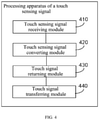
- FIG. 4 is a block diagram of an apparatus for processing a touch signal described in an exemplary embodiment of the present invention.
- the apparatus may be applied to an operating system, and include: a touch sensing signal receiving module 410, a touch sensing signal converting module 420, a touch signal returning module 430 and a touch signal transferring module 440.
- the touch sensing signal receiving module 410 is configured to receive a touch sensing signal generated by a touch sensor of a touch device.
- the touch sensing signal converting module 420 is configured to convert the touch sensing signal to a touch signal, where the touch signal at least includes a touch position signal.
- the touch signal returning module 430 is configured to send the touch signal to the touch device so that the touch device codes the touch signal according to a standard data coding specification.
- the touch signal transferring module 440 is configured to receive the touch signal coded by the touch device and send to a touch driver, so that the touch diver analyzes the touch signal that is received by the touch diver.
- the touch sensor includes one or more of the following:
- an infrared touch frame an electromagnetic panel, a capacitive panel, a resistive panel and a pressure sensor.
- the touch sensing signal when the touch sensor is the electromagnetic panel, the touch sensing signal includes a variation of magnetic flux and a frequency of a received electromagnetic signal, and the touch signal includes a touch position signal corresponding to the variation of magnetic flux and a pressure signal corresponding to the frequency.
- the touch device sends the touch sensing signal to the operating system via any of the following interfaces: a USB-bulk interface, a USB-hid interface, an RS232 interface.
- the touch device sends the coded touch signal to the operating system via the USB-hid interface.
- the apparatus for processing a touch signal includes:
- the apparatus embodiments because they basically correspond to the method embodiments, reference can be made to the part of description of the method embodiments for relevant parts.
- the apparatus embodiments described above are only illustrative, where the units or modules described as separate parts may be or may not be separated physically, the components displayed as units or modules may be or may not be physical units or modules, that is, may be in one place, or distributed among a number of network units or modules. Part or all of the modules could be selected according to practical requirements, to realize the objective of the present invention. Those of ordinary skill in the art could understand and implement them without making any creative effort.
- the embodiments of the apparatus for processing a touch signal may be applied to an electronic device, and may be specifically implemented by a computer chip or entity, or a product with a certain function.
- the specific form of the electronic device may be those with an electromagnetic screen, such as a personal computer, a laptop, a cellphone, a camera phone, a smart phone, a personal digital assistant, a media player, a navigation device, a smart writing device, an email sending and receiving device, a game console, a tablet computer, a wearable device, an Internet television, a smart vehicle, a driverless car, a smart refrigerator, other smart home devices or any combination of these devices.
- the smart writing device may be an electronic white board, an electronic black board and so on.
- the apparatus embodiments may be implemented with software, or the combination of hardware and software.
- software as an example, as an apparatus in a logical sense, it is generated by means of reading corresponding computer program instructions in a readable medium, such as a non-volatile storage, into a memory by a processor of the electronic device where the apparatus is located, and running.
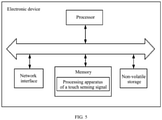
- FIG. 5 which is a hardware structural diagram of an electronic device where the apparatus for processing a touch signal according to the present invention is located.
- FIG. 5 which is a hardware structural diagram of an electronic device where the apparatus for processing a touch signal according to the present invention is located.
- FIG. 5 which is a hardware structural diagram of an electronic device where the apparatus for processing a touch signal according to the present invention is located.
- FIG. 5 which is a hardware structural diagram of an electronic device where the apparatus for processing a touch signal according to the present invention is located.
- the electronic device where the apparatus is located usually may be equipped with a touch device according to a real function of the electronic device, and the equipped touch devices may be installed on or independent of the electronic device.
- the touch device may include a touch sensor, for example, being equipped with an electromagnetic touch screen which includes an electromagnetic sensor, or may include other hardware, which is not detailed herein.
- the storage of the electronic device may store program instructions executable by the processor.
- the processor may be coupled with the memory and configured to read the program instructions stored in the storage, and in response, execute the following operations: receiving a touch sensing signal generated by the touch sensor; converting the touch sensing signal to a touch signal, where the touch signal at least includes a touch position signal; sending the touch signal to the touch device so that the touch device codes the touch signal according to a standard data coding specification; receiving the touch signal coded by the touch device, and transferring to a touch driver so that the touch driver analyzes the coded touch signal.
- the processor is further configured to execute the following operations:
- the electronic device includes a smart writing board.
- the smart writing board includes an electronic white board.
- the embodiments of the present invention also provide a machine-readable storage medium (storage of an electronic device).
- program instructions are stored.
- the program instructions include instructions corresponding to the steps of the method for processing a touch sensing signal described above, which when executed by one or more processors cause the one or more processors to execute the above the method for processing a touch sensing signal.
- the embodiments of the present invention may be implemented in the form of a computer program product which is implemented on one or more readable storage media (including, but not limited to, a disk memory, a CD-ROM, an optical memory) containing program code.
- a readable storage medium that can be used by a computer includes volatile and nonvolatile, removable and non-removable medium, and the information storage may be achieved by any method or technology.
- the information may be computer readable instructions, data structure, program modules or other data.
- machine readable storage medium includes, but is not limited to, a phase change memory (PRAM), a static random access memory (SRAM), a dynamic random access memory (DRAM), random access memories (RAM) of any other types, a read only memory (ROM), an electrically erasable and programmable read only memory (EEPROM), a flash memory or other memory technology, a compact disk read only memory (CD-ROM), a digital versatile disk (DVD) or other optical storage, magnetic cassette tape, magnetic tape storage or other magnetic storage device or any other non-transfer medium, which can be used to store information that can be accessed by a computer.
- PRAM phase change memory
- SRAM static random access memory
- DRAM dynamic random access memory
- RAM random access memories
- ROM read only memory
- EEPROM electrically erasable and programmable read only memory
- flash memory or other memory technology
- CD-ROM compact disk read only memory
- DVD digital versatile disk
- magnetic cassette tape magnetic tape storage or other magnetic storage device or any other non-transfer medium, which can
Landscapes
- Engineering & Computer Science (AREA)
- General Engineering & Computer Science (AREA)
- Theoretical Computer Science (AREA)
- Physics & Mathematics (AREA)
- Human Computer Interaction (AREA)
- General Physics & Mathematics (AREA)
- Electromagnetism (AREA)
- User Interface Of Digital Computer (AREA)
Claims (13)
- System (200) zum Verarbeiten eines Berührungssensorsignals, das eine Berührungsvorrichtung (220) und eine Hostvorrichtung (240) aufweist,wobei die Berührungsvorrichtung (220) einen Berührungssensor (221) aufweist, die Hostvorrichtung (240) mit einem Betriebssystem ausgestattet ist, das Betriebssystem einen Signalverarbeitungskode (241), eine virtuelle Berührungsvorrichtung (242), einen Berührungstreiber (245) beziehungsweise ein Eingabesubsystem (243) aufweist;wobei die Komponenten des Systems (200) zum Verarbeiten eines Berührungssensorsignals derart ausgebildet sind, dass sie dann, wenn die virtuelle Berührungsvorrichtung (242) detektiert wird, gemäß einem ersten Arbeitsmodus durchführen:der Berührungssensor (221) erzeugt ein Berührungssensorsignal, die Berührungsvorrichtung (220) sendet das Berührungssensorsignal zu dem Betriebssystem;der Signalverarbeitungskode (241) wandelt das von dem Betriebssystem empfangene Berührungssensorsignal in ein Berührungssignal um und sendet das Berührungssignal zu der virtuellen Berührungsvorrichtung (242), wobei das Berührungssignal zumindest ein Berührungspositionssignal aufweist;die virtuelle Berührungsvorrichtung (242) kodiert das Berührungssignal gemäß einer von dem Eingabesubsystem (243) unterstützten Datenkodierungsspezifikation und sendet das kodierte Berührungssignal zu dem Eingabesubsystem (243);das Eingabesubsystem (243) erzeugt ein entsprechendes Berührungsereignis in Reaktion auf das kodierte Berührungssignal; undwenn die virtuelle Berührungsvorrichtung (242) nicht detektiert wird, gemäß einem zweiten Arbeitsmodus durchführen:der Berührungssensor (221) erzeugt ein Berührungssensorsignal, und die Berührungsvorrichtung (220) sendet das Berührungssensorsignal zu dem Betriebssystem;der Signalverarbeitungskode (241) wandelt das von dem Betriebssystem empfangene Berührungssensorsignal in das Berührungssignal um und sendet dann das Berührungssignal zu der Berührungsvorrichtung (220);die Berührungsvorrichtung (220) kodiert das Berührungssignal gemäß einer Standard-Datenkodierungsspezifikation und sendet das kodierte Berührungssignal zu dem Betriebssystem;der Berührungstreiber (245) analysiert das kodierte Berührungssignal und überträgt es zu dem Eingabesubsystem (243);das Eingabesubsystem (243) erkennt das analysierte Berührungssignal und erzeugt ein entsprechendes Berührungsereignis.
- System (200) nach Anspruch 1, bei dem die Hostvorrichtung (240) einen Verarbeitungschip, eine Speicherungseinrichtung und einen Speicher aufweist und der Signalverarbeitungskode (241) von dem Verarbeitungschip gebildet wird, der in der Speicherungseinrichtung gespeicherte Computerprogrammanweisungen zum Betrieb in den Speicher einliest.
- System (200) nach Anspruch 1, bei dem der Berührungssensor (221) auch eine Vorrichtung mit Funktionen der Steuerung ist, die Berührungsvorrichtung (220) das Berührungssensorsignal wie folgt an das Betriebssystem sendet:
Übertragen des Berührungssensorsignals mittels des Berührungssensors (221) durch die Signalübertragungsschnittstelle der Berührungsvorrichtung (220) zu dem Betriebssystem. - System (200) nach Anspruch 1, bei dem die Berührungsvorrichtung (220) auch einen Berührungsverarbeitungschip (123) aufweist, die Berührungsvorrichtung (220) das Berührungssignal wie folgt zu dem Betriebssystem sendet:
Übertragen des Berührungssensorsignals mittels des Berührungsverarbeitungschips (123) durch die Signalübertragungsschnittstelle der Berührungsvorrichtung (220) zu dem Betriebssystem, wobei das Berührungssensorsignal von dem Berührungsverarbeitungschip (123) aus dem Berührungssensor (221) ausgelesen wird. - System (200) nach Anspruch 1, bei dem die Datenkodierungsspezifikation eine Standard-Datenkodierungsspezifikation oder eine vorbestimmte Datenkodierungsspezifikation ist, oder
sich die Datenkodierungsspezifikation auf einen Typ eines Berührungsbildschirms der Berührungsvorrichtung (220) bezieht. - System (200) nach Anspruch 1, bei dem der Berührungssensor (221) eines oder mehrere von Folgenden aufweist:
einen Infrarotberührungsrahmen, ein elektromagnetisches Feld, ein kapazitives Berührungsfeld, ein resistives Berührungsfeld oder einen Drucksensor. - System (200) nach Anspruch 6, bei dem dann, wenn der Berührungssensor (221) das elektromagnetische Feld ist, das Berührungssensorsignal eine Variation eines Magnetflusses und eine Frequenz eines empfangenen elektromagnetischen Signals aufweist und das Berührungssignal ein Berührungspositionssignal, das der Variation des Magnetflusses entspricht, und ein Drucksignal, das der Frequenz entspricht, aufweist.
- System (200) nach Anspruch 1, bei dem die Berührungsvorrichtung (220) das Berührungssensorsignal über eine der folgenden Schnittstellen zu dem Betriebssystem sendet:eine USB-Bulk-Schnittstelle, eine USB-HID-Schnittstelle, eine RS232-Schnittstelle;und die Berührungsvorrichtung (220) das Berührungssensorsignal in ein von der Schnittstelle unterstütztes Protokoll umwandelt und dann die umgewandelten Protokolldaten über die Schnittstelle zu dem Betriebssystem sendet.
- System (200) nach einem der Ansprüche 1 bis 5, bei dem dann, wenn das Berührungssignal Positionskoordinaten von sechs oder mehr Pixelpunkten aufweist, die virtuelle Berührungsvorrichtung (242) das Berührungssignal gruppenweise gemäß der Datenkodierungsspezifikation kodiert und nach dem Kodieren jeder Gruppe des Berührungssignals ein Datenpaket erzeugt, wobei jedes Datenpaket Positionskoordinaten von bis zu sechs Pixelpunkten aufweist.
- Verfahren zum Verarbeiten eines Berührungssensorsignals, das bei einem Betriebssystem angewendet wird, wobei das Verfahren dann, wenn eine virtuelle Berührungsvorrichtung (242) detektiert wird, die folgenden Schritte umfasst:Empfangen eines Berührungssensorsignals, das von einem Berührungssensor (221) einer Berührungsvorrichtung (220) erzeugt wird;Umwandeln des Berührungssensorsignals mittels eines Signalverarbeitungskodes (241) in ein Berührungssignal, wobei das Berührungssignal zumindest ein Berührungspositionssignal aufweist;Kodieren des Berührungssignals mittels einer virtuellen Berührungsvorrichtung (242) gemäß einer von einem Eingabesubsystem (243) unterstützten Datenkodierungsspezifikation und Übertragen des kodierten Berührungssignals zu dem Eingabesubsystem (243);Erzeugen eines entsprechenden Berührungsereignisses mittels des Eingabesubsystems (243) in Reaktion auf das kodierte Berührungssignal; unddas Verfahren dann, wenn die virtuelle Berührungsvorrichtung (242) nicht detektiert wird, die folgenden Schritte umfasst:Empfangen eines Berührungssensorsignals, das von einem Berührungssensor (221) einer Berührungsvorrichtung (220) erzeugt wird;Umwandeln des Berührungssensorsignals mittels eines Signalverarbeitungskodes (241) in ein Berührungssignal, wobei das Berührungssignal zumindest ein Berührungspositionssignal aufweist;Kodieren des Berührungssignals mittels der Berührungsvorrichtung (220) gemäß der von dem Eingabesubsystem (243) unterstützten Datenkodierungsspezifikation und dann Senden des Berührungssignals zu der Berührungsvorrichtung (220);Empfangen des von der Berührungsvorrichtung (220) gesendeten kodierten Berührungssignals und Übertragen zu einem Berührungstreiber (245);Analysieren des kodierten Berührungssignals mittels des Berührungstreibers (245).
- Verfahren nach Anspruch 10, bei dem das 'Kodieren des Berührungssignals gemäß der von einem Eingabesubsystem (243) unterstützten Datenkodierungsspezifikation' umfasst:
wenn das Berührungssignal Positionskoordinaten von sechs oder mehr Pixelpunkten aufweist, gruppenweises Kodieren des Berührungssignals gemäß der Datenkodierungsspezifikation, Erzeugen eines Datenpakets nach dem Kodieren jeder Gruppe des Berührungssignals, wobei jedes Datenpaket Positionskoordinaten von bis zu sechs Pixelpunkten aufweist. - Verfahren nach einem der Ansprüche 10 bis 11, bei dem das 'Empfangen eines Berührungssensorsignals, das von einem Berührungssensor (221) einer Berührungsvorrichtung (220) erzeugt wird', ferner umfasst:
Empfangen eines Berührungssensorsignals, das von einem Berührungssensor (221) einer Berührungsvorrichtung (220) erzeugt wird, mittels des Berührungssensors (221) durch eine Signalübertragungsschnittstelle der Berührungsvorrichtung (220). - Verfahren nach einem der Ansprüche 10 bis 11, bei dem das 'Empfangen eines Berührungssensorsignals, das von einem Berührungssensor (221) einer Berührungsvorrichtung (220) erzeugt wird', ferner umfasst:
Empfangen eines von einem Berührungsverarbeitungschip (123) erzeugten Berührungssensorsignals durch eine Signalübertragungsschnittstelle der Berührungsvorrichtung (220), wobei der Berührungsverarbeitungschip (123) das Berührungssignal aus dem Berührungssensor (221) ausliest.
Applications Claiming Priority (2)
| Application Number | Priority Date | Filing Date | Title |
|---|---|---|---|
| CN201711225565.XA CN107844220B (zh) | 2017-11-29 | 2017-11-29 | 触感信号的处理方法、系统、装置及电子设备 |
| PCT/CN2018/114062 WO2019105188A1 (zh) | 2017-11-29 | 2018-11-06 | 触感信号的处理方法、系统、装置及电子设备 |
Publications (3)
| Publication Number | Publication Date |
|---|---|
| EP3702893A1 EP3702893A1 (de) | 2020-09-02 |
| EP3702893A4 EP3702893A4 (de) | 2020-12-23 |
| EP3702893B1 true EP3702893B1 (de) | 2022-01-26 |
Family
ID=61679264
Family Applications (1)
| Application Number | Title | Priority Date | Filing Date |
|---|---|---|---|
| EP18884386.6A Active EP3702893B1 (de) | 2017-11-29 | 2018-11-06 | Berührungssensorsignalverarbeitungsverfahren und system |
Country Status (5)
| Country | Link |
|---|---|
| US (1) | US11036329B2 (de) |
| EP (1) | EP3702893B1 (de) |
| CN (1) | CN107844220B (de) |
| ES (1) | ES2910513T3 (de) |
| WO (1) | WO2019105188A1 (de) |
Families Citing this family (4)
| Publication number | Priority date | Publication date | Assignee | Title |
|---|---|---|---|---|
| CN107844220B (zh) * | 2017-11-29 | 2020-02-11 | 广州视源电子科技股份有限公司 | 触感信号的处理方法、系统、装置及电子设备 |
| CN110308824A (zh) * | 2019-07-04 | 2019-10-08 | 深圳市康冠商用科技有限公司 | 一种红外触摸数据的处理方法、系统及相关组件 |
| CN113835612B (zh) * | 2020-06-24 | 2025-05-27 | 北京小米移动软件有限公司 | 数据处理方法、装置及介质 |
| CN112256619A (zh) * | 2020-10-27 | 2021-01-22 | 深圳市朗强科技有限公司 | 触摸屏指令的发送、接收方法、系统及设备 |
Family Cites Families (15)
| Publication number | Priority date | Publication date | Assignee | Title |
|---|---|---|---|---|
| TW201203052A (en) * | 2010-05-03 | 2012-01-16 | Flatfrog Lab Ab | Touch determination by tomographic reconstruction |
| US9262073B2 (en) * | 2010-05-20 | 2016-02-16 | John W. Howard | Touch screen with virtual joystick and methods for use therewith |
| CN102622136B (zh) * | 2012-02-29 | 2016-03-30 | 广东威创视讯科技股份有限公司 | 一种多点触摸系统数据处理方法及装置 |
| CN103488319B (zh) * | 2012-06-13 | 2016-11-09 | 腾讯科技(深圳)有限公司 | 一种虚拟触摸实现方法和系统 |
| US20140062889A1 (en) * | 2012-09-06 | 2014-03-06 | Samsung Electronics Co., Ltd. | Method of processing touch input for mobile device |
| TW201500977A (zh) | 2013-06-18 | 2015-01-01 | Waltop Int Corp | 觸控輸入方法 |
| US20150091837A1 (en) * | 2013-09-27 | 2015-04-02 | Raman M. Srinivasan | Providing Touch Engine Processing Remotely from a Touch Screen |
| KR102320767B1 (ko) * | 2015-02-23 | 2021-11-02 | 삼성디스플레이 주식회사 | 터치 센싱 장치 및 그 구동 방법 |
| CN105045414B (zh) | 2015-08-04 | 2018-11-27 | 青岛歌尔声学科技有限公司 | 一种触控笔、实现方法以及一种触控系统 |
| CN105335007B (zh) * | 2015-11-20 | 2019-10-08 | 努比亚技术有限公司 | 触摸控制方法、用户设备、输入处理方法和移动终端 |
| KR20170129372A (ko) * | 2016-05-17 | 2017-11-27 | 삼성전자주식회사 | 디스플레이를 구비하는 전자 장치 |
| CN107272955A (zh) * | 2017-06-19 | 2017-10-20 | 广州视源电子科技股份有限公司 | 一种触摸响应的方法、人机交互设备、芯片和智能设备 |
| CN107861657B (zh) | 2017-11-29 | 2020-04-14 | 广州视源电子科技股份有限公司 | 触感信号的处理方法、系统、装置及电子设备 |
| CN107844220B (zh) * | 2017-11-29 | 2020-02-11 | 广州视源电子科技股份有限公司 | 触感信号的处理方法、系统、装置及电子设备 |
| CN207473575U (zh) | 2017-11-29 | 2018-06-08 | 广州视源电子科技股份有限公司 | 触感信号处理系统 |
-
2017
- 2017-11-29 CN CN201711225565.XA patent/CN107844220B/zh active Active
-
2018
- 2018-11-06 ES ES18884386T patent/ES2910513T3/es active Active
- 2018-11-06 US US16/768,012 patent/US11036329B2/en active Active
- 2018-11-06 EP EP18884386.6A patent/EP3702893B1/de active Active
- 2018-11-06 WO PCT/CN2018/114062 patent/WO2019105188A1/zh not_active Ceased
Also Published As
| Publication number | Publication date |
|---|---|
| US20200363898A1 (en) | 2020-11-19 |
| EP3702893A4 (de) | 2020-12-23 |
| CN107844220A (zh) | 2018-03-27 |
| CN107844220B (zh) | 2020-02-11 |
| US11036329B2 (en) | 2021-06-15 |
| ES2910513T3 (es) | 2022-05-12 |
| EP3702893A1 (de) | 2020-09-02 |
| WO2019105188A1 (zh) | 2019-06-06 |
Similar Documents
| Publication | Publication Date | Title |
|---|---|---|
| EP3702893B1 (de) | Berührungssensorsignalverarbeitungsverfahren und system | |
| CN107861657B (zh) | 触感信号的处理方法、系统、装置及电子设备 | |
| US10585581B2 (en) | Controlling display object on display screen | |
| WO2020019616A1 (zh) | 触控数据处理的方法、装置、智能设备和存储介质 | |
| CN104991682B (zh) | 一种触控驱动方法、触控驱动装置及触控显示装置 | |
| CN104199552A (zh) | 多屏显示方法、设备及系统 | |
| CN107066174A (zh) | 浮层显示方法、装置及用户终端 | |
| WO2020062985A1 (zh) | 块设备访问追踪方法以及装置、存储介质及终端 | |
| CN108628531A (zh) | 取色书写的方法、装置、电子设备、存储介质及智能笔 | |
| CN110069165A (zh) | 触摸数据的处理方法、装置、及设备和存储介质 | |
| CN207473575U (zh) | 触感信号处理系统 | |
| CN111897484B (zh) | 一种数据存储方法、装置、电子设备及存储介质 | |
| CN107704126A (zh) | 一种触摸数据的分离方法、装置、设备和存储介质 | |
| WO2021068382A1 (zh) | 多窗口操作控制方法、装置、设备及存储介质 | |
| CN207780738U (zh) | 触感信号处理系统 | |
| US11010661B2 (en) | Neural network chip, method of using neural network chip to implement de-convolution operation, electronic device, and computer readable storage medium | |
| CN108762637A (zh) | 控制方法、装置及系统 | |
| US10802675B2 (en) | Information processing apparatus and non-transitory computer readable medium storing information processing program | |
| CN110502198B (zh) | 基于fpga的界面显示系统 | |
| CN114089878A (zh) | 远程控制方法、终端、电子设备及存储介质 | |
| US20260010260A1 (en) | Touch Operation Processing Method, Device, and Storage Medium | |
| CN116301440B (zh) | 信号处理方法、装置、电子设备及存储介质 | |
| CN118057279B (zh) | 进入全局批注的方法和装置 | |
| KR20250080097A (ko) | 호스트와 공유 메모리를 이용하여 통신하는 연산 스토리지 장치 및 그 동작 방법 | |
| JPS59136783A (ja) | マルチウインドウビツトマツプデイスプレイ装置 |
Legal Events
| Date | Code | Title | Description |
|---|---|---|---|
| STAA | Information on the status of an ep patent application or granted ep patent |
Free format text: STATUS: THE INTERNATIONAL PUBLICATION HAS BEEN MADE |
|
| PUAI | Public reference made under article 153(3) epc to a published international application that has entered the european phase |
Free format text: ORIGINAL CODE: 0009012 |
|
| STAA | Information on the status of an ep patent application or granted ep patent |
Free format text: STATUS: REQUEST FOR EXAMINATION WAS MADE |
|
| 17P | Request for examination filed |
Effective date: 20200527 |
|
| AK | Designated contracting states |
Kind code of ref document: A1 Designated state(s): AL AT BE BG CH CY CZ DE DK EE ES FI FR GB GR HR HU IE IS IT LI LT LU LV MC MK MT NL NO PL PT RO RS SE SI SK SM TR |
|
| AX | Request for extension of the european patent |
Extension state: BA ME |
|
| STAA | Information on the status of an ep patent application or granted ep patent |
Free format text: STATUS: EXAMINATION IS IN PROGRESS |
|
| A4 | Supplementary search report drawn up and despatched |
Effective date: 20201119 |
|
| RIC1 | Information provided on ipc code assigned before grant |
Ipc: G06F 3/041 20060101AFI20201113BHEP |
|
| 17Q | First examination report despatched |
Effective date: 20201202 |
|
| DAV | Request for validation of the european patent (deleted) | ||
| DAX | Request for extension of the european patent (deleted) | ||
| GRAJ | Information related to disapproval of communication of intention to grant by the applicant or resumption of examination proceedings by the epo deleted |
Free format text: ORIGINAL CODE: EPIDOSDIGR1 |
|
| STAA | Information on the status of an ep patent application or granted ep patent |
Free format text: STATUS: GRANT OF PATENT IS INTENDED |
|
| GRAP | Despatch of communication of intention to grant a patent |
Free format text: ORIGINAL CODE: EPIDOSNIGR1 |
|
| INTG | Intention to grant announced |
Effective date: 20211020 |
|
| GRAS | Grant fee paid |
Free format text: ORIGINAL CODE: EPIDOSNIGR3 |
|
| GRAA | (expected) grant |
Free format text: ORIGINAL CODE: 0009210 |
|
| STAA | Information on the status of an ep patent application or granted ep patent |
Free format text: STATUS: THE PATENT HAS BEEN GRANTED |
|
| AK | Designated contracting states |
Kind code of ref document: B1 Designated state(s): AL AT BE BG CH CY CZ DE DK EE ES FI FR GB GR HR HU IE IS IT LI LT LU LV MC MK MT NL NO PL PT RO RS SE SI SK SM TR |
|
| REG | Reference to a national code |
Ref country code: GB Ref legal event code: FG4D |
|
| REG | Reference to a national code |
Ref country code: CH Ref legal event code: EP |
|
| REG | Reference to a national code |
Ref country code: AT Ref legal event code: REF Ref document number: 1465801 Country of ref document: AT Kind code of ref document: T Effective date: 20220215 |
|
| REG | Reference to a national code |
Ref country code: IE Ref legal event code: FG4D |
|
| REG | Reference to a national code |
Ref country code: DE Ref legal event code: R096 Ref document number: 602018030311 Country of ref document: DE |
|
| REG | Reference to a national code |
Ref country code: NL Ref legal event code: FP |
|
| REG | Reference to a national code |
Ref country code: ES Ref legal event code: FG2A Ref document number: 2910513 Country of ref document: ES Kind code of ref document: T3 Effective date: 20220512 |
|
| REG | Reference to a national code |
Ref country code: LT Ref legal event code: MG9D |
|
| REG | Reference to a national code |
Ref country code: AT Ref legal event code: MK05 Ref document number: 1465801 Country of ref document: AT Kind code of ref document: T Effective date: 20220126 |
|
| PG25 | Lapsed in a contracting state [announced via postgrant information from national office to epo] |
Ref country code: SE Free format text: LAPSE BECAUSE OF FAILURE TO SUBMIT A TRANSLATION OF THE DESCRIPTION OR TO PAY THE FEE WITHIN THE PRESCRIBED TIME-LIMIT Effective date: 20220126 Ref country code: RS Free format text: LAPSE BECAUSE OF FAILURE TO SUBMIT A TRANSLATION OF THE DESCRIPTION OR TO PAY THE FEE WITHIN THE PRESCRIBED TIME-LIMIT Effective date: 20220126 Ref country code: PT Free format text: LAPSE BECAUSE OF FAILURE TO SUBMIT A TRANSLATION OF THE DESCRIPTION OR TO PAY THE FEE WITHIN THE PRESCRIBED TIME-LIMIT Effective date: 20220526 Ref country code: NO Free format text: LAPSE BECAUSE OF FAILURE TO SUBMIT A TRANSLATION OF THE DESCRIPTION OR TO PAY THE FEE WITHIN THE PRESCRIBED TIME-LIMIT Effective date: 20220426 Ref country code: LT Free format text: LAPSE BECAUSE OF FAILURE TO SUBMIT A TRANSLATION OF THE DESCRIPTION OR TO PAY THE FEE WITHIN THE PRESCRIBED TIME-LIMIT Effective date: 20220126 Ref country code: HR Free format text: LAPSE BECAUSE OF FAILURE TO SUBMIT A TRANSLATION OF THE DESCRIPTION OR TO PAY THE FEE WITHIN THE PRESCRIBED TIME-LIMIT Effective date: 20220126 Ref country code: BG Free format text: LAPSE BECAUSE OF FAILURE TO SUBMIT A TRANSLATION OF THE DESCRIPTION OR TO PAY THE FEE WITHIN THE PRESCRIBED TIME-LIMIT Effective date: 20220426 |
|
| PG25 | Lapsed in a contracting state [announced via postgrant information from national office to epo] |
Ref country code: PL Free format text: LAPSE BECAUSE OF FAILURE TO SUBMIT A TRANSLATION OF THE DESCRIPTION OR TO PAY THE FEE WITHIN THE PRESCRIBED TIME-LIMIT Effective date: 20220126 Ref country code: LV Free format text: LAPSE BECAUSE OF FAILURE TO SUBMIT A TRANSLATION OF THE DESCRIPTION OR TO PAY THE FEE WITHIN THE PRESCRIBED TIME-LIMIT Effective date: 20220126 Ref country code: GR Free format text: LAPSE BECAUSE OF FAILURE TO SUBMIT A TRANSLATION OF THE DESCRIPTION OR TO PAY THE FEE WITHIN THE PRESCRIBED TIME-LIMIT Effective date: 20220427 Ref country code: FI Free format text: LAPSE BECAUSE OF FAILURE TO SUBMIT A TRANSLATION OF THE DESCRIPTION OR TO PAY THE FEE WITHIN THE PRESCRIBED TIME-LIMIT Effective date: 20220126 Ref country code: AT Free format text: LAPSE BECAUSE OF FAILURE TO SUBMIT A TRANSLATION OF THE DESCRIPTION OR TO PAY THE FEE WITHIN THE PRESCRIBED TIME-LIMIT Effective date: 20220126 |
|
| PG25 | Lapsed in a contracting state [announced via postgrant information from national office to epo] |
Ref country code: IS Free format text: LAPSE BECAUSE OF FAILURE TO SUBMIT A TRANSLATION OF THE DESCRIPTION OR TO PAY THE FEE WITHIN THE PRESCRIBED TIME-LIMIT Effective date: 20220526 |
|
| REG | Reference to a national code |
Ref country code: DE Ref legal event code: R097 Ref document number: 602018030311 Country of ref document: DE |
|
| PG25 | Lapsed in a contracting state [announced via postgrant information from national office to epo] |
Ref country code: SM Free format text: LAPSE BECAUSE OF FAILURE TO SUBMIT A TRANSLATION OF THE DESCRIPTION OR TO PAY THE FEE WITHIN THE PRESCRIBED TIME-LIMIT Effective date: 20220126 Ref country code: SK Free format text: LAPSE BECAUSE OF FAILURE TO SUBMIT A TRANSLATION OF THE DESCRIPTION OR TO PAY THE FEE WITHIN THE PRESCRIBED TIME-LIMIT Effective date: 20220126 Ref country code: RO Free format text: LAPSE BECAUSE OF FAILURE TO SUBMIT A TRANSLATION OF THE DESCRIPTION OR TO PAY THE FEE WITHIN THE PRESCRIBED TIME-LIMIT Effective date: 20220126 Ref country code: EE Free format text: LAPSE BECAUSE OF FAILURE TO SUBMIT A TRANSLATION OF THE DESCRIPTION OR TO PAY THE FEE WITHIN THE PRESCRIBED TIME-LIMIT Effective date: 20220126 Ref country code: DK Free format text: LAPSE BECAUSE OF FAILURE TO SUBMIT A TRANSLATION OF THE DESCRIPTION OR TO PAY THE FEE WITHIN THE PRESCRIBED TIME-LIMIT Effective date: 20220126 Ref country code: CZ Free format text: LAPSE BECAUSE OF FAILURE TO SUBMIT A TRANSLATION OF THE DESCRIPTION OR TO PAY THE FEE WITHIN THE PRESCRIBED TIME-LIMIT Effective date: 20220126 |
|
| PG25 | Lapsed in a contracting state [announced via postgrant information from national office to epo] |
Ref country code: AL Free format text: LAPSE BECAUSE OF FAILURE TO SUBMIT A TRANSLATION OF THE DESCRIPTION OR TO PAY THE FEE WITHIN THE PRESCRIBED TIME-LIMIT Effective date: 20220126 |
|
| PLBE | No opposition filed within time limit |
Free format text: ORIGINAL CODE: 0009261 |
|
| STAA | Information on the status of an ep patent application or granted ep patent |
Free format text: STATUS: NO OPPOSITION FILED WITHIN TIME LIMIT |
|
| 26N | No opposition filed |
Effective date: 20221027 |
|
| PG25 | Lapsed in a contracting state [announced via postgrant information from national office to epo] |
Ref country code: SI Free format text: LAPSE BECAUSE OF FAILURE TO SUBMIT A TRANSLATION OF THE DESCRIPTION OR TO PAY THE FEE WITHIN THE PRESCRIBED TIME-LIMIT Effective date: 20220126 |
|
| PG25 | Lapsed in a contracting state [announced via postgrant information from national office to epo] |
Ref country code: MC Free format text: LAPSE BECAUSE OF FAILURE TO SUBMIT A TRANSLATION OF THE DESCRIPTION OR TO PAY THE FEE WITHIN THE PRESCRIBED TIME-LIMIT Effective date: 20220126 |
|
| REG | Reference to a national code |
Ref country code: CH Ref legal event code: PL |
|
| REG | Reference to a national code |
Ref country code: BE Ref legal event code: MM Effective date: 20221130 |
|
| PG25 | Lapsed in a contracting state [announced via postgrant information from national office to epo] |
Ref country code: LI Free format text: LAPSE BECAUSE OF NON-PAYMENT OF DUE FEES Effective date: 20221130 Ref country code: IT Free format text: LAPSE BECAUSE OF FAILURE TO SUBMIT A TRANSLATION OF THE DESCRIPTION OR TO PAY THE FEE WITHIN THE PRESCRIBED TIME-LIMIT Effective date: 20220126 Ref country code: CH Free format text: LAPSE BECAUSE OF NON-PAYMENT OF DUE FEES Effective date: 20221130 |
|
| P01 | Opt-out of the competence of the unified patent court (upc) registered |
Effective date: 20230714 |
|
| PG25 | Lapsed in a contracting state [announced via postgrant information from national office to epo] |
Ref country code: LU Free format text: LAPSE BECAUSE OF NON-PAYMENT OF DUE FEES Effective date: 20221106 |
|
| PG25 | Lapsed in a contracting state [announced via postgrant information from national office to epo] |
Ref country code: IE Free format text: LAPSE BECAUSE OF NON-PAYMENT OF DUE FEES Effective date: 20221106 |
|
| PG25 | Lapsed in a contracting state [announced via postgrant information from national office to epo] |
Ref country code: BE Free format text: LAPSE BECAUSE OF NON-PAYMENT OF DUE FEES Effective date: 20221130 |
|
| PG25 | Lapsed in a contracting state [announced via postgrant information from national office to epo] |
Ref country code: CY Free format text: LAPSE BECAUSE OF FAILURE TO SUBMIT A TRANSLATION OF THE DESCRIPTION OR TO PAY THE FEE WITHIN THE PRESCRIBED TIME-LIMIT Effective date: 20220126 |
|
| PG25 | Lapsed in a contracting state [announced via postgrant information from national office to epo] |
Ref country code: MK Free format text: LAPSE BECAUSE OF FAILURE TO SUBMIT A TRANSLATION OF THE DESCRIPTION OR TO PAY THE FEE WITHIN THE PRESCRIBED TIME-LIMIT Effective date: 20220126 Ref country code: HU Free format text: LAPSE BECAUSE OF FAILURE TO SUBMIT A TRANSLATION OF THE DESCRIPTION OR TO PAY THE FEE WITHIN THE PRESCRIBED TIME-LIMIT; INVALID AB INITIO Effective date: 20181106 |
|
| PG25 | Lapsed in a contracting state [announced via postgrant information from national office to epo] |
Ref country code: TR Free format text: LAPSE BECAUSE OF FAILURE TO SUBMIT A TRANSLATION OF THE DESCRIPTION OR TO PAY THE FEE WITHIN THE PRESCRIBED TIME-LIMIT Effective date: 20220126 |
|
| PG25 | Lapsed in a contracting state [announced via postgrant information from national office to epo] |
Ref country code: MT Free format text: LAPSE BECAUSE OF FAILURE TO SUBMIT A TRANSLATION OF THE DESCRIPTION OR TO PAY THE FEE WITHIN THE PRESCRIBED TIME-LIMIT Effective date: 20220126 |
|
| PGFP | Annual fee paid to national office [announced via postgrant information from national office to epo] |
Ref country code: NL Payment date: 20251119 Year of fee payment: 8 |
|
| PGFP | Annual fee paid to national office [announced via postgrant information from national office to epo] |
Ref country code: DE Payment date: 20251119 Year of fee payment: 8 |
|
| PGFP | Annual fee paid to national office [announced via postgrant information from national office to epo] |
Ref country code: GB Payment date: 20251121 Year of fee payment: 8 |
|
| PGFP | Annual fee paid to national office [announced via postgrant information from national office to epo] |
Ref country code: FR Payment date: 20251126 Year of fee payment: 8 |
|
| PGFP | Annual fee paid to national office [announced via postgrant information from national office to epo] |
Ref country code: ES Payment date: 20251229 Year of fee payment: 8 |