EP3699443A1 - Arbre de transmission comportant une pluralite d'enroulements helicoidaux - Google Patents
Arbre de transmission comportant une pluralite d'enroulements helicoidaux Download PDFInfo
- Publication number
- EP3699443A1 EP3699443A1 EP20158950.4A EP20158950A EP3699443A1 EP 3699443 A1 EP3699443 A1 EP 3699443A1 EP 20158950 A EP20158950 A EP 20158950A EP 3699443 A1 EP3699443 A1 EP 3699443A1
- Authority
- EP
- European Patent Office
- Prior art keywords
- shaft
- windings
- main axis
- circular arc
- helical
- Prior art date
- Legal status (The legal status is an assumption and is not a legal conclusion. Google has not performed a legal analysis and makes no representation as to the accuracy of the status listed.)
- Granted
Links
Images

Classifications
-
- F—MECHANICAL ENGINEERING; LIGHTING; HEATING; WEAPONS; BLASTING
- F16—ENGINEERING ELEMENTS AND UNITS; GENERAL MEASURES FOR PRODUCING AND MAINTAINING EFFECTIVE FUNCTIONING OF MACHINES OR INSTALLATIONS; THERMAL INSULATION IN GENERAL
- F16C—SHAFTS; FLEXIBLE SHAFTS; ELEMENTS OR CRANKSHAFT MECHANISMS; ROTARY BODIES OTHER THAN GEARING ELEMENTS; BEARINGS
- F16C3/00—Shafts; Axles; Cranks; Eccentrics
- F16C3/02—Shafts; Axles
-
- F—MECHANICAL ENGINEERING; LIGHTING; HEATING; WEAPONS; BLASTING
- F16—ENGINEERING ELEMENTS AND UNITS; GENERAL MEASURES FOR PRODUCING AND MAINTAINING EFFECTIVE FUNCTIONING OF MACHINES OR INSTALLATIONS; THERMAL INSULATION IN GENERAL
- F16C—SHAFTS; FLEXIBLE SHAFTS; ELEMENTS OR CRANKSHAFT MECHANISMS; ROTARY BODIES OTHER THAN GEARING ELEMENTS; BEARINGS
- F16C2240/00—Specified values or numerical ranges of parameters; Relations between them
- F16C2240/30—Angles, e.g. inclinations
-
- F—MECHANICAL ENGINEERING; LIGHTING; HEATING; WEAPONS; BLASTING
- F16—ENGINEERING ELEMENTS AND UNITS; GENERAL MEASURES FOR PRODUCING AND MAINTAINING EFFECTIVE FUNCTIONING OF MACHINES OR INSTALLATIONS; THERMAL INSULATION IN GENERAL
- F16C—SHAFTS; FLEXIBLE SHAFTS; ELEMENTS OR CRANKSHAFT MECHANISMS; ROTARY BODIES OTHER THAN GEARING ELEMENTS; BEARINGS
- F16C2240/00—Specified values or numerical ranges of parameters; Relations between them
- F16C2240/94—Volume
-
- F—MECHANICAL ENGINEERING; LIGHTING; HEATING; WEAPONS; BLASTING
- F16—ENGINEERING ELEMENTS AND UNITS; GENERAL MEASURES FOR PRODUCING AND MAINTAINING EFFECTIVE FUNCTIONING OF MACHINES OR INSTALLATIONS; THERMAL INSULATION IN GENERAL
- F16C—SHAFTS; FLEXIBLE SHAFTS; ELEMENTS OR CRANKSHAFT MECHANISMS; ROTARY BODIES OTHER THAN GEARING ELEMENTS; BEARINGS
- F16C2360/00—Engines or pumps
- F16C2360/23—Gas turbine engines
Definitions
- the invention relates to a transmission shaft, in particular a transmission shaft belonging to an aircraft turbomachine.
- the energy produced is used on the one hand to generate propulsion, it also serves to drive accessories forming part of the turbomachine or else of the aircraft equipped with the turbomachine.
- an accessory drive box also designated by the English acronym A.G.B. (for Accessory Gear Box) is connected to one of the main shafts of the turbomachine to take part of the power produced.
- a drive system connecting the AGB to the main shaft comprises a first transmission shaft coupled to a pinion integral with the main shaft of the turbomachine, an angular transmission system and a second transmission shaft.
- Each transmission shaft is a tubular element and it is subjected to numerous stresses generated by its high speed of rotation and the torque to be transmitted.
- Another constraint is the reduction in the size of the transmission shaft, in particular its external diameter and the reduction in the mass of the transmission shaft.
- the natural frequency of the shaft is the frequency at which the shaft is excited and for which the amplitude of the bending vibrations of the shaft becomes maximum.
- the object of the invention is to provide a transmission shaft having a design making it possible to reinforce the mechanical properties of the shaft while having a reduced size and weight.
- the invention proposes a shaft having a main axis A and comprising a plurality of helical windings extending around the main axis A,
- each helical winding is, in cross section, bounded by a first radially inner circular arc centered on the main axis A, a second radially outer circular arc centered on the main axis A and two segments each have segment connects one end of the first circular arc to one end of the second circular arc, the two segments defining between them an angle A1.
- the value of the angle A1 is less than 90 °.
- each helical winding comprises a strip of constant section winding around and at a distance from the main axis A, the inclination of which between a transverse plane perpendicular to the strip and a plane perpendicular to the main axis A is between 30 ° and 60 °.
- the shaft comprises first windings winding around the main axis in a first direction and which are distributed equidistant from each other. others around the main axis A, and comprises second windings winding around the main axis A in a second direction opposite to the first direction and which are distributed equidistant from each other around the main axis A .
- the number and the distance between two first windings are equal to the number and the distance between two second windings, respectively.
- the number and the distance between two first windings are different from the number and the distance between two second windings, respectively.
- the shaft comprises an annular skin centered on the main axis A, the radius of which is equal to one or the other of the radius R1 of the first circular arc or the radius R2 of the second circular arc and which is integral with the helical windings.
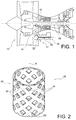
- turbomachine 10 comprising a system 12 for driving accessories for the turbomachine 10.
- the system 12 comprises a first transmission shaft 14 which extends radially with respect to a main axis of the turbomachine and which is coupled to a high pressure shaft 16 of the turbomachine by a coupling with bevel gears 18.
- the system 12 comprises a second transmission shaft 20 which is oriented substantially parallel to the main axis of the turbomachine and which is coupled to the first transmission shaft 14 by a bevel gear 22, which comprises a bevel gear coupling.
- the second transmission shaft 20 is coupled to the accessories of the turbomachine 10 to be driven, in particular via an accessory drive box 24, also called AGB (for Accessory Gear Box).
- AGB for Accessory Gear Box
- a transmission shaft 26 which may be one and / or the other of the first transmission shaft 14 or of the second transmission shaft 20.
- the transmission shaft 26 comprises at least one section 28 having an annular lattice structure extending around a main axis A of the transmission shaft 26.
- the transmission shaft 26 comprises a plurality of helical windings 30, 32 which wrap around the main axis A in one direction and in the other, crossing each other.
- the transmission shaft 26 thus comprises first helical windings 30 which wind around the main axis A in a first direction, which is here to the right with reference to the figure 2 .
- the first windings 30 are offset axially and circumferentially with respect to each other at the same pitch.
- the transmission shaft 26 also has second helical windings 32 which wind around the main axis A in a second direction, which is here to the left with reference to the figure. figure 2 .
- the second windings 32 are axially and circumferentially offset with respect to each other at the same pitch.
- each helical winding 30, 32 is inclined relative to a radial plane, that is to say relative to a plane perpendicular to the main axis A according to a predefined angle A2 which is identical for all windings 30, 32.
- the value of the angle A2 is 45 degrees.
- first helical windings 30 and the second helical windings 32 are identical.
- Each helical winding 30, 32 comprises a strip of constant section which is wound around the main axis A at a distance from the latter, forming a helix.
- the inclination of the strip relative to the main axis A that is to say the angle delimited by a radial plane perpendicular to the main axis A and a transverse plane perpendicular to the strip, at any point, is between 30 and 60 degrees.
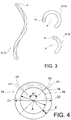
- Each helical winding 30, 32 has a section 34, taken along a plane transverse to this strip, which is delimited radially, with respect to the main axis A by a first radially internal circular arc 36, a second radially internal circular arc 38 external, these two arcs of a circle being centered on the main axis A.
- the section 34 is delimited transversely by two segments 41 connecting the same transverse ends of each circular arc 36, 38, that is to say a first segment 41 located to the right of the figure 4 connects the right end of the first circular arc 36 to the right end of the second circular arc 38 and a second segment 41 located to the left of the figure 4 connects the left end of the first arc 36 to the left end of the second arc 38
- the two straight lines 40, which carry these segments 41, define an opening angle A1 of section 34.
- this angle A1 is less than 90 °, in particular in order to improve the flexibility of the shaft 26.
- the windings 30, 32 have the function of stiffening the shaft 26, which thus comprises a solid cylindrical skin which has no opening, and which carries the windings 30, 32 on its face. internal or its external face.
- the radius of this skin is equal to one or the other of the radius R1 of the inner circle 36 and the radius R2 of the outer circle 38.
- Improving the dimensioning of the shaft consists in predefining certain dimensions of the shaft 26, then in calculating the other dimensions of the shaft from the predefined dimensions.
- the dimensions of the shaft 26 which are predefined are the external radius R2 of the shaft 26 and its thickness E (and consequently the internal radius R1).
- the ratio between the number of windings 30, 32 is predefined. Indeed, depending on the stresses that the shaft 26 may undergo, the number of first windings 30 may be equal to or different from the number of second windings 32.
- the pitch between two adjacent first windings 30 is equal to the pitch between two adjacent second windings 32.
- the design constraints of the shaft 26 are the maximum natural frequency of the shaft and the maximum value of the internal stresses in the shaft 26.
- the number of windings 30, 32 and the value of the opening angle A1 of the ring sector are calculated from the dimensions and design constraints which have been predefined according to the previous steps.
- the spacing between the windings 30, 32 depends on the number of windings 30, 32 and on the value of the angel A1. Consequently, this number of windings also has an influence on the value of the edge delimited by two windings 30, 32 crossing each other.
- a first curve 42 represents the value of the maximum natural frequency of the shaft 26 and a second curve 44 represents the maximum value of the internal stresses in the shaft 26 as a function of the number of windings 30, 32, for the same size and the same volume (R1, R2 fixed).
- a low number of windings 30, 32 implies a high natural frequency of the shaft 26, but also high internal stresses.
Landscapes
- Engineering & Computer Science (AREA)
- General Engineering & Computer Science (AREA)
- Ocean & Marine Engineering (AREA)
- Mechanical Engineering (AREA)
- Shafts, Cranks, Connecting Bars, And Related Bearings (AREA)
- Flexible Shafts (AREA)
Abstract
Description
- L'invention concerne un arbre de transmission, notamment un arbre de transmission appartenant à une turbomachine d'aéronef.
- Dans une turbomachine, l'énergie produite sert d'une part à générer de la propulsion, elle sert aussi à l'entrainement d'accessoires faisant partie de la turbomachine ou bien de l'aéronef équipé de la turbomachine.
- Pour cela, un boitier d'entrainement d'accessoires, aussi désigné par l'acronyme anglais A.G.B. (pour Accessory Gear Box) est relié à l'un des arbres principaux de la turbomachine pour prélever une partie de la puissance produite.
- Un système d'entrainement reliant l'AGB à l'arbre principal comporte un premier arbre de transmission accouplé à un pignon solidaire de l'arbre principal de la turbomachine, un système de renvoi d'angle et un deuxième arbre de transmission.
- Chaque arbre de transmission est un élément tubulaire et il subit de nombreuses contraintes générées par sa vitesse de rotation importante et le couple à transmettre.
- Une autre contrainte est la réduction de l'encombrement de l'arbre de transmission, en particulier son diamètre externe et la réduction de la masse de l'arbre de transmission.
- Pour réduire la masse de l'arbre de transmission, il a été proposé de le réaliser sous la forme d'un arbre ajouré, comportant de nombreuses ouvertures réparties sur sa longueur et autour de l'axe principal de l'arbre.
- De telles ouvertures ont ainsi une influence sur la fréquence propre de l'arbre et la concentration de contraintes dans l'arbre.
- La fréquence propre de l'arbre est la fréquence à laquelle l'arbre est excité et pour laquelle l'amplitude des vibrations en flexion de l'arbre devient maximale.
- Ainsi, en optimisant la conception de l'arbre, il est recherché d'avoir une fréquence propre importante, qui est éloignée d'une plage de fréquence correspondant à la plage de vitesse de rotation que l'arbre parcourt en fonctionnement.
- D'une part, pour renforcer un arbre, il faut augmenter sa raideur qui est dépendante du diamètre de l'arbre.
- D'autre part, bien qu'un diamètre important de l'arbre permette d'augmenter la raideur, cela nuit à l'exigence selon laquelle l'encombrement de l'arbre doit être réduit.
- L'invention a pour but de proposer un arbre de transmission ayant une conception permettant de renforcer les propriétés mécaniques de l'arbre tout en ayant un encombrement et un poids réduit.
- L'invention propose un Arbre présentant un axe principal A et comportant une pluralité d'enroulements hélicoïdaux s'étendant autour de l'axe principal A,
- caractérisé en ce que chaque enroulement hélicoïdal est, en section transversale, délimité par un premier arc de cercle radialement interne centré sur l'axe principal A, un deuxième arc de de cercle radialement externe centré sur l'axe principal A et deux segments ont chaque segment relie une extrémité du premier arc de cercle à une extrémité du deuxième arc de cercle, les deux segment définissant entre-eux un angle A1.
- De préférence, la valeur de l'angle A1 est inférieure à 90°.
- De préférence, chaque enroulement hélicoïdal comprend une bande de section constante s'enroulant autour de, et à distance de l'axe principal A, dont l'inclinaison entre un plan transversal perpendiculaire à la bande et un plan perpendiculaire à l'axe principal A est comprise entre 30° et 60°.
- De préférence, l'arbre comporte des premiers enroulements s'enroulant autour de l'axe principal dans un premier sens et qui sont répartis à équidistance les uns des autres autour de l'axe principal A, et comporte des deuxièmes enroulements s'enroulant autour de l'axe principal A dans un deuxième sens opposé au premier sens et qui sont répartis à équidistance les uns des autres autour de l'axe principal A.
- De préférence, le nombre et la distance entre deux premiers enroulements sont égaux au nombre et à la distance entre deux deuxièmes enroulements, respectivement.
- De préférence, le nombre et la distance entre deux premiers enroulements sont différents du nombre et à de la distance entre deux deuxièmes enroulements, respectivement.
- De préférence, l'arbre comporte une peau annulaire centrée sur l'axe principal A, dont le rayon est égal à l'un ou l'autre du rayon R1 du premier arc de cercle ou du rayon R2 du deuxième arc de cercle et qui est solidaire des enroulements hélicoïdaux.
- L'invention propose aussi un procédé de dimensionnement d'un arbre selon l'invention, qui comporte :
- une première étape consistant à fixer les rayons R1 et R2 délimitant radialement la section de chaque enroulement hélicoïdal
- une deuxième étape consistant à définir le volume total de l'arbre
- une troisième étape consistant à définir la valeur d'au moins une contrainte de conception de l'arbre parmi la fréquence propre de l'arbre et les contraintes internes maximales que l'arbre est destiné à subir
- une quatrième étape de calcul du nombre d'enroulement hélicoïdaux et de la valeur de l'angle A1 en fonction des valeurs définies dans les étapes 1 à 3 précédentes.
-
- [
Fig. 1 ] est une représentation schématique en section axiale d'une turbomachine d'aéronef comportant au moins un arbre de transmission réalisé selon l'invention ; - [
Fig. 2 ] est une représentation schématique en perspective d'un tronçon d'un arbre de transmission réalisé selon l'invention ; - [
Fig. 3 ] est une représentation schématique d'un enroulement hélicoïdal formant l'arbre de transmission représenté à lafigure 2 ; - [
Fig. 4 ] est une section selon un plan radial de l'enroulement représenté à lafigure 3 ; - [
Fig. 5 ] est représentation schématique de deux arbres de transmission montrant, pour un même volume, l'influence du nombre d'enroulement sur l'ouverture de leur section ; - [
Fig. 6 ] est un graphique montrant la variation de la contrainte interne à l'arbre et de la fréquence propre de l'arbre en fonction du nombre d'enroulements. - On a représenté à la
figure 1 une turbomachine 10 comportant un système 12 pour l'entrainement d'accessoires de la turbomachine 10. - Le système 12 comporte un premier arbre de transmission 14 qui s'étend radialement par rapport à un axe principal de la turbomachine et qui est accouplé à un arbre haute pression 16 de la turbomachine par un accouplement à pignons coniques 18.
- Le système 12 comporte un deuxième arbre de transmission 20 qui est orienté sensiblement parallèlement à l'axe principal de la turbomachine et qui est accouplé au premier arbre de transmission 14 par un renvoi d'angle 22, qui comprend un accouplement à pignons coniques.
- Le deuxième arbre de transmission 20 est accouplé aux accessoires de la turbomachine 10 à entrainer, notamment par l'intermédiaire d'un boitier d'entrainement d'accessoires 24, aussi appelé AGB (pour Accessory Gear Box).
- On a représenté à la
figure 2 un arbre de transmission 26 qui peut être l'un et/ou l'autre du premier arbre de transmission 14 ou du deuxième arbre de transmission 20. - Dans la description qui va suivre, on décrira un seul arbre 26. Il sera compris que cette description s'applique indifféremment au premier arbre de transmission ou au deuxième arbre de transmission 20.
- L'arbre de transmission 26 comporte au moins un tronçon 28 ayant une structure en treillis annulaire s'étendant autour d'un axe principal A de l'arbre de transmission 26.
- Plus spécifiquement, l'arbre de transmission 26 comprend une pluralité d'enroulements hélicoïdaux 30, 32 qui s'enroulent autour de l'axe principal A dans un sens et dans l'autre en se croisant mutuellement.
- L'arbre de transmission 26 comporte ainsi des premiers enroulements hélicoïdaux 30 qui s'enroulent autour de l'axe principal A dans un premier sens, qui est ici vers la droite en se reportant à la
figure 2 . Les premiers enroulements 30 sont décalés axialement et circonférentiellement les uns par rapport aux autres selon un même pas. - L'arbre de transmission 26 comporte aussi des deuxièmes enroulements hélicoïdaux 32 qui s'enroulent autour de l'axe principal A dans un deuxième sens, qui est ici vers la gauche en se reportant à la
figure 2 . Les deuxièmes enroulements 32 sont décalés axialement et circonférentiellement les uns par rapport aux autres selon un même pas. - Selon un mode de réalisation préféré, chaque enroulement hélicoïdal 30, 32 est incliné par rapport à un plan radial, c'est-à-dire par rapport à un plan perpendiculaire à l'axe principal A selon un angle A2 prédéfini qui est identique pour tous les enroulements 30, 32.
- Ici, de préférence, la valeur de l'angle A2 est de 45 degrés.
- Ainsi, mise à part leur inclinaison, les premiers enroulements hélicoïdaux 30 et les deuxièmes enroulements hélicoïdaux 32 sont identiques.
- Chaque enroulement hélicoïdal 30, 32 comprend une bande de section constante qui est enroulée autour de l'axe principal A à distance de celui-ci, en formant une hélice. L'inclinaison de la bande par rapport à l'axe principal A, c'est-à-dire l'angle délimité par un plan radial perpendiculaire à l'axe principal A et un plan transversal perpendiculaire à la bande, en tout point, est comprise entre 30 et 60 degrés.
- Chaque enroulement hélicoïdal 30, 32 présente une section 34, prise selon un plan transversal à cette bande, qui est délimitée radialement, par rapport à l'axe principal A par un premier arc de cercle 36 radialement interne, un deuxième arc de cercle 38 radialement externe, ces deux arcs de cercle étant centrés sur l'axe principal A.
- La différence entre les rayons R1, R2 des arcs de cercle 36, 38 délimitant radialement la section 34 détermine l'épaisseur radiale E de l'arbre de transmission 26 par la formule E=R2-R1.
- La section 34 est délimitée transversalement par deux segments 41 reliant les mêmes extrémités transversales de chaque arc de cercle 36, 38, c'est-à-dire un premier segment 41 situé à droite de la
figure 4 relie l'extrémité de droite du premier arc de cercle 36 à l'extrémité de droite du deuxième arc de cercle 38 et un deuxième segment 41 situé à gauche de lafigure 4 relie l'extrémité de gauche du premier arc de cercle 36 à l'extrémité de gauche du deuxième arc de cercle 38 - Les deux droites 40, qui portent ces segments 41, délimitent un angle A1 d'ouverture de la section 34. De préférence, cet angle A1 est inférieur à 90°, afin notamment d'améliorer la flexibilité de l'arbre 26.
- Selon une variante de réalisation de l'arbre 26, les enroulements 30, 32 ont pour fonction de rigidifier l'arbre 26, qui comporte ainsi une peau cylindrique pleine qui ne comporte aucune ouverture, et qui porte les enroulements 30, 32 sur sa face interne ou sa face externe.
- Ainsi, le rayon de cette peau est égal à l'un ou l'autre du rayon R1 du cercle interne 36 et du rayon R2 du cercle externe 38.
- L'amélioration du dimensionnement de l'arbre consiste à prédéfinir certaines dimensions de l'arbre 26, puis à calculer les autres dimensions de l'arbre à partir des dimensions prédéfinies.
- Dans la description qui va suivre, on décrira les étapes successives d'un procédé pour dimensionner un arbre 26 constitué d'une pluralité de premiers enroulements hélicoïdaux 30 et de deuxièmes enroulements hélicoïdaux 32 qui vient d'être décrit précédemment.
- De préférence, dans une première étape, les dimensions de l'arbre 26 qui sont prédéfinies sont le rayon externe R2 de l'arbre 26 et son épaisseur E (et par conséquent le rayon interne R1).
- Ensuite, dans une deuxième étape, le volume total de l'arbre est défini. Cette deuxième étape permet de fixer la masse de l'arbre.
- Ensuite, dans une troisième étape, le rapport entre le nombre d'enroulements 30, 32 est prédéfini. En effet, selon les contraintes que l'arbre 26 peut subir, le nombre de premiers enroulements 30 peut être égal ou différent du nombre de deuxièmes enroulements 32.
- Ainsi, il faut définir la différence entre ces deux nombres avant de débuter le dimensionnement de l'arbre.
- Si le nombre de premiers enroulements 30 est égal au nombre de deuxièmes enroulements 32, le pas entre deux premiers enroulements 30 adjacents est égal au pas entre deux deuxièmes enroulements 32 adjacents.
- Ensuite, on définit des contraintes de conception de l'arbre qui doivent être respectées par le dimensionnement de l'arbre 26 et qui sont définies à partir des conditions de fonctionnement de l'arbre 26.
- Ainsi, selon un mode de réalisation préféré, les contraintes de conception de l'arbre 26 sont la fréquence propre maximale de l'arbre et la valeur maximale des contraintes internes dans l'arbre 26.
- Selon une dernière étape, le nombre d'enroulements 30, 32 et la valeur de l'angle A1 d'ouverture du secteur d'anneau sont calculés à partir des dimensions et des contraintes de conception qui ont été prédéfinies selon les étapes antérieures.
- A l'issue de cette dernière étape, on obtient une relation entre le nombre d'enroulements 30, 32 et la valeur de l'angle A1 d'ouverture du secteur d'anneau.
- Comme on peut le voir à la
figure 5 , le choix d'un faible nombre d'enroulements 30, 32 implique une valeur faible de l'angle A1 et inversement, le choix d'un nombre important d'enroulements 30, 32 implique une valeur élevée de l'angle A1 - Par la suite, le nombre d'enroulements 30, 32 ou la valeur de l'ange A1 est choisi, l'autre valeur sera déduite par cette relation.
- Le choix est effectué selon la contrainte de conception de l'arbre 26 que l'on souhaite privilégier, tout en restant dans les limites imposées précédemment.
- L'écartement entre les enroulements 30, 32 est dépendant du nombre d'enroulements 30, 32 et de la valeur de l'ange A1. Par conséquent, ce nombre d'enroulement a aussi une influence sur la valeur de l'arête délimitée par deux enroulements 30, 32 se croisant.
- On a représenté à la
figure 6 un graphique dans lequel une première courbe 42 représente la valeur de la fréquence propre maximale de l'arbre 26 et une deuxième courbe 44 représente la valeur maximale des contraintes internes dans l'arbre 26 en fonction du nombre d'enroulements 30, 32, pour un même encombrement et un même volume (R1, R2 fixés). - Comme on peut le constater, un faible nombre d'enroulements 30, 32 implique une fréquence propre de l'arbre 26 élevée, mais aussi des contraintes internes élevées.
- Par contre, un nombre important d'enroulements 30, 32 implique une fréquence propre de l'arbre 26 faible, mais aussi des contraintes internes faibles.
Claims (8)
- Arbre (26) présentant un axe principal A et comportant une pluralité d'enroulements hélicoïdaux (30) s'étendant autour de l'axe principal A,
caractérisé en ce que chaque enroulement hélicoïdal (30, 32) est, en section transversale, délimité par un premier arc de cercle (36) radialement interne centré sur l'axe principal A, un deuxième arc de de cercle (38) radialement externe centré sur l'axe principal A et deux segments (41) dont chaque segment (41) relie une extrémité du premier arc de cercle (36) à une extrémité du deuxième arc de cercle (38), les deux segments 41 définissant entre-eux un angle A1. - Arbre (26) selon la revendication précédente, caractérisé en ce que la valeur de l'angle A1 est inférieure à 90°.
- Arbre (26) selon l'une quelconque des revendications précédentes, caractérisé en ce que chaque enroulement hélicoïdal (30, 32) comprend une bande de section constante s'enroulant autour de, et à distance de l'axe principal A, dont l'inclinaison entre un plan transversal perpendiculaire à la bande et un plan perpendiculaire à l'axe principal A est comprise entre 30° et 60°.
- Arbre (26) selon l'une quelconque des revendications précédentes, caractérisé en ce qu'il comporte des premiers enroulements (30) s'enroulant autour de l'axe principal dans un premier sens et qui sont répartis à équidistance les uns des autres autour de l'axe principal A,
et comporte des deuxièmes enroulements (32) s'enroulant autour de l'axe principal A dans un deuxième sens opposé au premier sens et qui sont répartis à équidistance les uns des autres autour de l'axe principal A. - Arbre (26) selon la revendication 4, caractérisé en ce que le nombre et la distance entre deux premiers enroulements (30) sont égaux au nombre et à la distance entre deux deuxièmes enroulements (32), respectivement.
- Arbre (26) selon la revendication 4, caractérisé en ce que le nombre et la distance entre deux premiers enroulements (30) sont différents du nombre et à de la distance entre deux deuxièmes enroulements (32), respectivement.
- Arbre (26) selon l'une quelconque des revendications précédentes, caractérisé en ce que il comporte une peau annulaire centrée sur l'axe principal A, dont le rayon est égal à l'un ou l'autre du rayon R1 du premier arc de cercle (36) ou du rayon R2 du deuxième arc de cercle (38) et qui est solidaire des enroulements hélicoïdaux (30, 32).
- Procédé de dimensionnement d'un arbre (26) selon l'une quelconque des revendications précédentes, qui comporte :- une première étape consistant à fixer les rayons R1 et R2 délimitant radialement la section (34) de chaque enroulement hélicoïdal (30)- une deuxième étape consistant à définir le volume total de l'arbre (26)- une troisième étape consistant à définir la valeur d'au moins une contrainte de conception de l'arbre (26) parmi la fréquence propre de l'arbre (26) et les contraintes internes maximales que l'arbre (26) est destiné à subir- une quatrième étape de calcul du nombre d'enroulement hélicoïdaux (30, 32) et de la valeur de l'angle A1 en fonction des valeurs définies dans les étapes 1 à 3 précédentes.
Applications Claiming Priority (1)
| Application Number | Priority Date | Filing Date | Title |
|---|---|---|---|
| FR1901892A FR3093145B1 (fr) | 2019-02-25 | 2019-02-25 | Arbre de transmission comportant une pluralite d'enroulements helicoidaux |
Publications (2)
| Publication Number | Publication Date |
|---|---|
| EP3699443A1 true EP3699443A1 (fr) | 2020-08-26 |
| EP3699443B1 EP3699443B1 (fr) | 2021-09-15 |
Family
ID=67262597
Family Applications (1)
| Application Number | Title | Priority Date | Filing Date |
|---|---|---|---|
| EP20158950.4A Active EP3699443B1 (fr) | 2019-02-25 | 2020-02-24 | Arbre de transmission comportant une pluralite d'enroulements helicoidaux |
Country Status (2)
| Country | Link |
|---|---|
| EP (1) | EP3699443B1 (fr) |
| FR (1) | FR3093145B1 (fr) |
Citations (6)
| Publication number | Priority date | Publication date | Assignee | Title |
|---|---|---|---|---|
| FR324123A (fr) * | 1902-08-30 | 1903-03-24 | Wilson Lida | Perfectionnements dans la fabrication des arbres |
| US2821092A (en) * | 1956-08-16 | 1958-01-28 | Teleflex Inc | Control system and conduit cable |
| DE4010901A1 (de) * | 1990-04-04 | 1991-10-17 | Gkn Automotive Ag | Antriebswelle |
| US5868627A (en) * | 1997-01-07 | 1999-02-09 | Martin H. Stark | Expandable drive shaft damper and method of forming |
| WO2007100593A2 (fr) * | 2006-02-27 | 2007-09-07 | American Axle & Manufacturing, Inc. | Procede pour attenuer les vibrations de chaine cinematique |
| DE102011054110A1 (de) * | 2011-09-30 | 2013-04-04 | Gkn Driveline Deutschland Gmbh | Antriebswellenanordnung |
-
2019
- 2019-02-25 FR FR1901892A patent/FR3093145B1/fr active Active
-
2020
- 2020-02-24 EP EP20158950.4A patent/EP3699443B1/fr active Active
Patent Citations (6)
| Publication number | Priority date | Publication date | Assignee | Title |
|---|---|---|---|---|
| FR324123A (fr) * | 1902-08-30 | 1903-03-24 | Wilson Lida | Perfectionnements dans la fabrication des arbres |
| US2821092A (en) * | 1956-08-16 | 1958-01-28 | Teleflex Inc | Control system and conduit cable |
| DE4010901A1 (de) * | 1990-04-04 | 1991-10-17 | Gkn Automotive Ag | Antriebswelle |
| US5868627A (en) * | 1997-01-07 | 1999-02-09 | Martin H. Stark | Expandable drive shaft damper and method of forming |
| WO2007100593A2 (fr) * | 2006-02-27 | 2007-09-07 | American Axle & Manufacturing, Inc. | Procede pour attenuer les vibrations de chaine cinematique |
| DE102011054110A1 (de) * | 2011-09-30 | 2013-04-04 | Gkn Driveline Deutschland Gmbh | Antriebswellenanordnung |
Also Published As
| Publication number | Publication date |
|---|---|
| EP3699443B1 (fr) | 2021-09-15 |
| FR3093145B1 (fr) | 2021-09-24 |
| FR3093145A1 (fr) | 2020-08-28 |
Similar Documents
| Publication | Publication Date | Title |
|---|---|---|
| EP2521851B1 (fr) | Système d'hélices contrarotatives pour turbomachine d'aéronef | |
| EP2435304B1 (fr) | Dispositif pour la commande de l'orientation des pales de soufflante d'un turbopropulseur | |
| EP2893158B1 (fr) | Turmomachine comportant des moyens de mesure de la vitesse et du couple de torsion d'un arbre de la turbomachine et procede de surveillance dudit arbre | |
| EP3927989B1 (fr) | Arbre de transmission comprenant une section fusible et procédé de protection contre un sur-couple d'un tel arbre de transmission | |
| EP2435303B1 (fr) | Dispositif a verin mobile pour la commande de l'orientation des pales de soufflante d'un turbopropulseur. | |
| EP3732384B1 (fr) | Porte-satellites pour un réducteur de vitesse a train épicycloïdal | |
| WO2021165604A1 (fr) | Pale composite pour rotor de turbomachine | |
| FR2645907A1 (fr) | Moteur a turbine a gaz comportant un amortisseur inertiel, amortisseur inertiel et assemblage de rotor de moteur a turbine a gaz | |
| WO2014118480A1 (fr) | Procédé de fabrication amélioré d'un arbre de transmission, de préférence pour système de boîte d'accessoires de turbomachine d'aéronef | |
| FR3021706A1 (fr) | Turbopropulseur d'aeronef comportant deux helices coaxiales. | |
| FR2836186A1 (fr) | Ventilateur a flux axial | |
| EP2485675B1 (fr) | Alesoir a canaux comprenant une pluralite de levres de coupe helicoïdales | |
| EP3699443B1 (fr) | Arbre de transmission comportant une pluralite d'enroulements helicoidaux | |
| WO2014041297A1 (fr) | Procede de montage d'un panneau acoustique dans un carter d'une turbomachine et turbomachine comportant un panneau acoustique | |
| EP3759353B1 (fr) | Turbomachine comportant un circuit de prelevement d'air | |
| EP3274610B1 (fr) | Boîte à engrenages comportant un réducteur amélioré | |
| WO2017144807A1 (fr) | Moyeu d'hélice à pales à calage variable avec variation radiale et axiale de dimensionnement | |
| WO2019053372A1 (fr) | Pivot pour palier lisse | |
| FR2942508A1 (fr) | Pale d'eolienne du type axe horizontal et eolienne en faisant application | |
| EP3994089B1 (fr) | Bobine pour l'enroulement et le deroulement d'un lien | |
| EP2160584B1 (fr) | Outillage de fixation d'un arbre de transmission et banc d'équilibrage comportant un tel outillage | |
| FR2609125A1 (fr) | Disque d'embrayage; notamment ressort pour ce disque | |
| FR3138469A1 (fr) | Carter fixe d’une turbomachine dont les bras sont non équirépartis | |
| WO2022079378A1 (fr) | Système propulsif aéronautique ayant un rendement propulsif amélioré | |
| EP1929181A1 (fr) | Transmission à courroie en spirale |
Legal Events
| Date | Code | Title | Description |
|---|---|---|---|
| PUAI | Public reference made under article 153(3) epc to a published international application that has entered the european phase |
Free format text: ORIGINAL CODE: 0009012 |
|
| STAA | Information on the status of an ep patent application or granted ep patent |
Free format text: STATUS: THE APPLICATION HAS BEEN PUBLISHED |
|
| AK | Designated contracting states |
Kind code of ref document: A1 Designated state(s): AL AT BE BG CH CY CZ DE DK EE ES FI FR GB GR HR HU IE IS IT LI LT LU LV MC MK MT NL NO PL PT RO RS SE SI SK SM TR |
|
| AX | Request for extension of the european patent |
Extension state: BA ME |
|
| STAA | Information on the status of an ep patent application or granted ep patent |
Free format text: STATUS: REQUEST FOR EXAMINATION WAS MADE |
|
| 17P | Request for examination filed |
Effective date: 20210223 |
|
| RBV | Designated contracting states (corrected) |
Designated state(s): AL AT BE BG CH CY CZ DE DK EE ES FI FR GB GR HR HU IE IS IT LI LT LU LV MC MK MT NL NO PL PT RO RS SE SI SK SM TR |
|
| GRAP | Despatch of communication of intention to grant a patent |
Free format text: ORIGINAL CODE: EPIDOSNIGR1 |
|
| STAA | Information on the status of an ep patent application or granted ep patent |
Free format text: STATUS: GRANT OF PATENT IS INTENDED |
|
| INTG | Intention to grant announced |
Effective date: 20210503 |
|
| GRAS | Grant fee paid |
Free format text: ORIGINAL CODE: EPIDOSNIGR3 |
|
| GRAA | (expected) grant |
Free format text: ORIGINAL CODE: 0009210 |
|
| STAA | Information on the status of an ep patent application or granted ep patent |
Free format text: STATUS: THE PATENT HAS BEEN GRANTED |
|
| AK | Designated contracting states |
Kind code of ref document: B1 Designated state(s): AL AT BE BG CH CY CZ DE DK EE ES FI FR GB GR HR HU IE IS IT LI LT LU LV MC MK MT NL NO PL PT RO RS SE SI SK SM TR |
|
| REG | Reference to a national code |
Ref country code: CH Ref legal event code: EP |
|
| REG | Reference to a national code |
Ref country code: DE Ref legal event code: R096 Ref document number: 602020000536 Country of ref document: DE |
|
| REG | Reference to a national code |
Ref country code: IE Ref legal event code: FG4D Free format text: LANGUAGE OF EP DOCUMENT: FRENCH |
|
| REG | Reference to a national code |
Ref country code: AT Ref legal event code: REF Ref document number: 1430732 Country of ref document: AT Kind code of ref document: T Effective date: 20211015 |
|
| REG | Reference to a national code |
Ref country code: LT Ref legal event code: MG9D |
|
| REG | Reference to a national code |
Ref country code: NL Ref legal event code: MP Effective date: 20210915 |
|
| PG25 | Lapsed in a contracting state [announced via postgrant information from national office to epo] |
Ref country code: HR Free format text: LAPSE BECAUSE OF FAILURE TO SUBMIT A TRANSLATION OF THE DESCRIPTION OR TO PAY THE FEE WITHIN THE PRESCRIBED TIME-LIMIT Effective date: 20210915 Ref country code: FI Free format text: LAPSE BECAUSE OF FAILURE TO SUBMIT A TRANSLATION OF THE DESCRIPTION OR TO PAY THE FEE WITHIN THE PRESCRIBED TIME-LIMIT Effective date: 20210915 Ref country code: NO Free format text: LAPSE BECAUSE OF FAILURE TO SUBMIT A TRANSLATION OF THE DESCRIPTION OR TO PAY THE FEE WITHIN THE PRESCRIBED TIME-LIMIT Effective date: 20211215 Ref country code: LT Free format text: LAPSE BECAUSE OF FAILURE TO SUBMIT A TRANSLATION OF THE DESCRIPTION OR TO PAY THE FEE WITHIN THE PRESCRIBED TIME-LIMIT Effective date: 20210915 Ref country code: BG Free format text: LAPSE BECAUSE OF FAILURE TO SUBMIT A TRANSLATION OF THE DESCRIPTION OR TO PAY THE FEE WITHIN THE PRESCRIBED TIME-LIMIT Effective date: 20211215 Ref country code: SE Free format text: LAPSE BECAUSE OF FAILURE TO SUBMIT A TRANSLATION OF THE DESCRIPTION OR TO PAY THE FEE WITHIN THE PRESCRIBED TIME-LIMIT Effective date: 20210915 Ref country code: RS Free format text: LAPSE BECAUSE OF FAILURE TO SUBMIT A TRANSLATION OF THE DESCRIPTION OR TO PAY THE FEE WITHIN THE PRESCRIBED TIME-LIMIT Effective date: 20210915 |
|
| REG | Reference to a national code |
Ref country code: AT Ref legal event code: MK05 Ref document number: 1430732 Country of ref document: AT Kind code of ref document: T Effective date: 20210915 |
|
| PG25 | Lapsed in a contracting state [announced via postgrant information from national office to epo] |
Ref country code: LV Free format text: LAPSE BECAUSE OF FAILURE TO SUBMIT A TRANSLATION OF THE DESCRIPTION OR TO PAY THE FEE WITHIN THE PRESCRIBED TIME-LIMIT Effective date: 20210915 Ref country code: GR Free format text: LAPSE BECAUSE OF FAILURE TO SUBMIT A TRANSLATION OF THE DESCRIPTION OR TO PAY THE FEE WITHIN THE PRESCRIBED TIME-LIMIT Effective date: 20211216 |
|
| PG25 | Lapsed in a contracting state [announced via postgrant information from national office to epo] |
Ref country code: AT Free format text: LAPSE BECAUSE OF FAILURE TO SUBMIT A TRANSLATION OF THE DESCRIPTION OR TO PAY THE FEE WITHIN THE PRESCRIBED TIME-LIMIT Effective date: 20210915 |
|
| PG25 | Lapsed in a contracting state [announced via postgrant information from national office to epo] |
Ref country code: IS Free format text: LAPSE BECAUSE OF FAILURE TO SUBMIT A TRANSLATION OF THE DESCRIPTION OR TO PAY THE FEE WITHIN THE PRESCRIBED TIME-LIMIT Effective date: 20220115 Ref country code: SM Free format text: LAPSE BECAUSE OF FAILURE TO SUBMIT A TRANSLATION OF THE DESCRIPTION OR TO PAY THE FEE WITHIN THE PRESCRIBED TIME-LIMIT Effective date: 20210915 Ref country code: SK Free format text: LAPSE BECAUSE OF FAILURE TO SUBMIT A TRANSLATION OF THE DESCRIPTION OR TO PAY THE FEE WITHIN THE PRESCRIBED TIME-LIMIT Effective date: 20210915 Ref country code: RO Free format text: LAPSE BECAUSE OF FAILURE TO SUBMIT A TRANSLATION OF THE DESCRIPTION OR TO PAY THE FEE WITHIN THE PRESCRIBED TIME-LIMIT Effective date: 20210915 Ref country code: PT Free format text: LAPSE BECAUSE OF FAILURE TO SUBMIT A TRANSLATION OF THE DESCRIPTION OR TO PAY THE FEE WITHIN THE PRESCRIBED TIME-LIMIT Effective date: 20220117 Ref country code: PL Free format text: LAPSE BECAUSE OF FAILURE TO SUBMIT A TRANSLATION OF THE DESCRIPTION OR TO PAY THE FEE WITHIN THE PRESCRIBED TIME-LIMIT Effective date: 20210915 Ref country code: NL Free format text: LAPSE BECAUSE OF FAILURE TO SUBMIT A TRANSLATION OF THE DESCRIPTION OR TO PAY THE FEE WITHIN THE PRESCRIBED TIME-LIMIT Effective date: 20210915 Ref country code: ES Free format text: LAPSE BECAUSE OF FAILURE TO SUBMIT A TRANSLATION OF THE DESCRIPTION OR TO PAY THE FEE WITHIN THE PRESCRIBED TIME-LIMIT Effective date: 20210915 Ref country code: EE Free format text: LAPSE BECAUSE OF FAILURE TO SUBMIT A TRANSLATION OF THE DESCRIPTION OR TO PAY THE FEE WITHIN THE PRESCRIBED TIME-LIMIT Effective date: 20210915 Ref country code: CZ Free format text: LAPSE BECAUSE OF FAILURE TO SUBMIT A TRANSLATION OF THE DESCRIPTION OR TO PAY THE FEE WITHIN THE PRESCRIBED TIME-LIMIT Effective date: 20210915 Ref country code: AL Free format text: LAPSE BECAUSE OF FAILURE TO SUBMIT A TRANSLATION OF THE DESCRIPTION OR TO PAY THE FEE WITHIN THE PRESCRIBED TIME-LIMIT Effective date: 20210915 |
|
| REG | Reference to a national code |
Ref country code: DE Ref legal event code: R097 Ref document number: 602020000536 Country of ref document: DE |
|
| PLBE | No opposition filed within time limit |
Free format text: ORIGINAL CODE: 0009261 |
|
| STAA | Information on the status of an ep patent application or granted ep patent |
Free format text: STATUS: NO OPPOSITION FILED WITHIN TIME LIMIT |
|
| PG25 | Lapsed in a contracting state [announced via postgrant information from national office to epo] |
Ref country code: DK Free format text: LAPSE BECAUSE OF FAILURE TO SUBMIT A TRANSLATION OF THE DESCRIPTION OR TO PAY THE FEE WITHIN THE PRESCRIBED TIME-LIMIT Effective date: 20210915 |
|
| 26N | No opposition filed |
Effective date: 20220616 |
|
| PG25 | Lapsed in a contracting state [announced via postgrant information from national office to epo] |
Ref country code: SI Free format text: LAPSE BECAUSE OF FAILURE TO SUBMIT A TRANSLATION OF THE DESCRIPTION OR TO PAY THE FEE WITHIN THE PRESCRIBED TIME-LIMIT Effective date: 20210915 |
|
| PG25 | Lapsed in a contracting state [announced via postgrant information from national office to epo] |
Ref country code: MC Free format text: LAPSE BECAUSE OF FAILURE TO SUBMIT A TRANSLATION OF THE DESCRIPTION OR TO PAY THE FEE WITHIN THE PRESCRIBED TIME-LIMIT Effective date: 20210915 |
|
| REG | Reference to a national code |
Ref country code: BE Ref legal event code: MM Effective date: 20220228 |
|
| PG25 | Lapsed in a contracting state [announced via postgrant information from national office to epo] |
Ref country code: LU Free format text: LAPSE BECAUSE OF NON-PAYMENT OF DUE FEES Effective date: 20220224 |
|
| PG25 | Lapsed in a contracting state [announced via postgrant information from national office to epo] |
Ref country code: IT Free format text: LAPSE BECAUSE OF FAILURE TO SUBMIT A TRANSLATION OF THE DESCRIPTION OR TO PAY THE FEE WITHIN THE PRESCRIBED TIME-LIMIT Effective date: 20210915 Ref country code: IE Free format text: LAPSE BECAUSE OF NON-PAYMENT OF DUE FEES Effective date: 20220224 |
|
| PG25 | Lapsed in a contracting state [announced via postgrant information from national office to epo] |
Ref country code: BE Free format text: LAPSE BECAUSE OF NON-PAYMENT OF DUE FEES Effective date: 20220228 |
|
| REG | Reference to a national code |
Ref country code: CH Ref legal event code: PL |
|
| PG25 | Lapsed in a contracting state [announced via postgrant information from national office to epo] |
Ref country code: LI Free format text: LAPSE BECAUSE OF NON-PAYMENT OF DUE FEES Effective date: 20230228 Ref country code: CH Free format text: LAPSE BECAUSE OF NON-PAYMENT OF DUE FEES Effective date: 20230228 |
|
| PG25 | Lapsed in a contracting state [announced via postgrant information from national office to epo] |
Ref country code: MK Free format text: LAPSE BECAUSE OF FAILURE TO SUBMIT A TRANSLATION OF THE DESCRIPTION OR TO PAY THE FEE WITHIN THE PRESCRIBED TIME-LIMIT Effective date: 20210915 Ref country code: CY Free format text: LAPSE BECAUSE OF FAILURE TO SUBMIT A TRANSLATION OF THE DESCRIPTION OR TO PAY THE FEE WITHIN THE PRESCRIBED TIME-LIMIT Effective date: 20210915 |
|
| PG25 | Lapsed in a contracting state [announced via postgrant information from national office to epo] |
Ref country code: HU Free format text: LAPSE BECAUSE OF FAILURE TO SUBMIT A TRANSLATION OF THE DESCRIPTION OR TO PAY THE FEE WITHIN THE PRESCRIBED TIME-LIMIT; INVALID AB INITIO Effective date: 20200224 |
|
| PG25 | Lapsed in a contracting state [announced via postgrant information from national office to epo] |
Ref country code: TR Free format text: LAPSE BECAUSE OF FAILURE TO SUBMIT A TRANSLATION OF THE DESCRIPTION OR TO PAY THE FEE WITHIN THE PRESCRIBED TIME-LIMIT Effective date: 20210915 |
|
| PG25 | Lapsed in a contracting state [announced via postgrant information from national office to epo] |
Ref country code: MT Free format text: LAPSE BECAUSE OF FAILURE TO SUBMIT A TRANSLATION OF THE DESCRIPTION OR TO PAY THE FEE WITHIN THE PRESCRIBED TIME-LIMIT Effective date: 20210915 |
|
| PGFP | Annual fee paid to national office [announced via postgrant information from national office to epo] |
Ref country code: GB Payment date: 20260219 Year of fee payment: 7 |
|
| PGFP | Annual fee paid to national office [announced via postgrant information from national office to epo] |
Ref country code: DE Payment date: 20260217 Year of fee payment: 7 |
|
| PGFP | Annual fee paid to national office [announced via postgrant information from national office to epo] |
Ref country code: FR Payment date: 20260219 Year of fee payment: 7 |