EP3699287A2 - Method for purifying 1,5-diaminopentane - Google Patents
Method for purifying 1,5-diaminopentane Download PDFInfo
- Publication number
- EP3699287A2 EP3699287A2 EP18869252.9A EP18869252A EP3699287A2 EP 3699287 A2 EP3699287 A2 EP 3699287A2 EP 18869252 A EP18869252 A EP 18869252A EP 3699287 A2 EP3699287 A2 EP 3699287A2
- Authority
- EP
- European Patent Office
- Prior art keywords
- diaminopentane
- composition
- distillation
- evaporation
- distillation column
- Prior art date
- Legal status (The legal status is an assumption and is not a legal conclusion. Google has not performed a legal analysis and makes no representation as to the accuracy of the status listed.)
- Pending
Links
- VHRGRCVQAFMJIZ-UHFFFAOYSA-N cadaverine Chemical compound NCCCCCN VHRGRCVQAFMJIZ-UHFFFAOYSA-N 0.000 title claims abstract description 315
- 238000000034 method Methods 0.000 title claims abstract description 39
- 238000001704 evaporation Methods 0.000 claims abstract description 117
- 239000000203 mixture Substances 0.000 claims abstract description 107
- 230000008020 evaporation Effects 0.000 claims abstract description 101
- XLYOFNOQVPJJNP-UHFFFAOYSA-N water Substances O XLYOFNOQVPJJNP-UHFFFAOYSA-N 0.000 claims abstract description 50
- 150000005323 carbonate salts Chemical class 0.000 claims abstract description 42
- 238000007670 refining Methods 0.000 claims abstract description 16
- 238000010438 heat treatment Methods 0.000 claims abstract description 7
- 238000004821 distillation Methods 0.000 claims description 174
- 239000002904 solvent Substances 0.000 claims description 13
- 230000001580 bacterial effect Effects 0.000 claims description 9
- 239000011261 inert gas Substances 0.000 claims description 7
- ABOPCLLUZXTPIQ-UHFFFAOYSA-N carbonic acid;pentane-1,5-diamine Chemical compound OC(O)=O.NCCCCCN ABOPCLLUZXTPIQ-UHFFFAOYSA-N 0.000 claims description 4
- 238000005979 thermal decomposition reaction Methods 0.000 description 61
- 239000000243 solution Substances 0.000 description 48
- 230000000052 comparative effect Effects 0.000 description 31
- 238000004458 analytical method Methods 0.000 description 25
- CURLTUGMZLYLDI-UHFFFAOYSA-N Carbon dioxide Chemical compound O=C=O CURLTUGMZLYLDI-UHFFFAOYSA-N 0.000 description 24
- 150000007524 organic acids Chemical class 0.000 description 24
- 239000010802 sludge Substances 0.000 description 17
- 235000001014 amino acid Nutrition 0.000 description 15
- 238000000855 fermentation Methods 0.000 description 14
- 230000004151 fermentation Effects 0.000 description 14
- IJGRMHOSHXDMSA-UHFFFAOYSA-N Atomic nitrogen Chemical compound N#N IJGRMHOSHXDMSA-UHFFFAOYSA-N 0.000 description 13
- 150000002500 ions Chemical class 0.000 description 13
- 239000001569 carbon dioxide Substances 0.000 description 12
- 229910002092 carbon dioxide Inorganic materials 0.000 description 12
- 239000007789 gas Substances 0.000 description 10
- 239000002609 medium Substances 0.000 description 10
- 244000005700 microbiome Species 0.000 description 10
- BVKZGUZCCUSVTD-UHFFFAOYSA-N carbonic acid Chemical compound OC(O)=O BVKZGUZCCUSVTD-UHFFFAOYSA-N 0.000 description 6
- 230000003247 decreasing effect Effects 0.000 description 6
- 239000012153 distilled water Substances 0.000 description 6
- WQZGKKKJIJFFOK-GASJEMHNSA-N Glucose Natural products OC[C@H]1OC(O)[C@H](O)[C@@H](O)[C@@H]1O WQZGKKKJIJFFOK-GASJEMHNSA-N 0.000 description 5
- 238000012258 culturing Methods 0.000 description 5
- 239000008103 glucose Substances 0.000 description 5
- 229910052757 nitrogen Inorganic materials 0.000 description 5
- YBJHBAHKTGYVGT-ZKWXMUAHSA-N (+)-Biotin Chemical compound N1C(=O)N[C@@H]2[C@H](CCCCC(=O)O)SC[C@@H]21 YBJHBAHKTGYVGT-ZKWXMUAHSA-N 0.000 description 4
- GHOKWGTUZJEAQD-ZETCQYMHSA-N (D)-(+)-Pantothenic acid Chemical compound OCC(C)(C)[C@@H](O)C(=O)NCCC(O)=O GHOKWGTUZJEAQD-ZETCQYMHSA-N 0.000 description 4
- KDXKERNSBIXSRK-YFKPBYRVSA-N L-lysine Chemical compound NCCCC[C@H](N)C(O)=O KDXKERNSBIXSRK-YFKPBYRVSA-N 0.000 description 4
- CSNNHWWHGAXBCP-UHFFFAOYSA-L Magnesium sulfate Chemical compound [Mg+2].[O-][S+2]([O-])([O-])[O-] CSNNHWWHGAXBCP-UHFFFAOYSA-L 0.000 description 4
- PVNIIMVLHYAWGP-UHFFFAOYSA-N Niacin Chemical compound OC(=O)C1=CC=CN=C1 PVNIIMVLHYAWGP-UHFFFAOYSA-N 0.000 description 4
- NBIIXXVUZAFLBC-UHFFFAOYSA-N Phosphoric acid Chemical compound OP(O)(O)=O NBIIXXVUZAFLBC-UHFFFAOYSA-N 0.000 description 4
- 150000001413 amino acids Chemical class 0.000 description 4
- QVGXLLKOCUKJST-UHFFFAOYSA-N atomic oxygen Chemical compound [O] QVGXLLKOCUKJST-UHFFFAOYSA-N 0.000 description 4
- 239000006227 byproduct Substances 0.000 description 4
- 238000006243 chemical reaction Methods 0.000 description 4
- 238000004508 fractional distillation Methods 0.000 description 4
- 238000004128 high performance liquid chromatography Methods 0.000 description 4
- 239000012535 impurity Substances 0.000 description 4
- 238000002347 injection Methods 0.000 description 4
- 239000007924 injection Substances 0.000 description 4
- 239000001301 oxygen Substances 0.000 description 4
- 229910052760 oxygen Inorganic materials 0.000 description 4
- 238000011218 seed culture Methods 0.000 description 4
- 238000007086 side reaction Methods 0.000 description 4
- 239000002002 slurry Substances 0.000 description 4
- 238000003756 stirring Methods 0.000 description 4
- QTBSBXVTEAMEQO-UHFFFAOYSA-N Acetic acid Chemical compound CC(O)=O QTBSBXVTEAMEQO-UHFFFAOYSA-N 0.000 description 3
- BVKZGUZCCUSVTD-UHFFFAOYSA-M Bicarbonate Chemical compound OC([O-])=O BVKZGUZCCUSVTD-UHFFFAOYSA-M 0.000 description 3
- 102000004190 Enzymes Human genes 0.000 description 3
- 108090000790 Enzymes Proteins 0.000 description 3
- 239000004472 Lysine Substances 0.000 description 3
- 238000010170 biological method Methods 0.000 description 3
- 239000013078 crystal Substances 0.000 description 3
- 229910001873 dinitrogen Inorganic materials 0.000 description 3
- 238000004519 manufacturing process Methods 0.000 description 3
- 238000000691 measurement method Methods 0.000 description 3
- 238000006116 polymerization reaction Methods 0.000 description 3
- 239000000047 product Substances 0.000 description 3
- 238000011084 recovery Methods 0.000 description 3
- 229910001220 stainless steel Inorganic materials 0.000 description 3
- 239000010935 stainless steel Substances 0.000 description 3
- 239000004475 Arginine Substances 0.000 description 2
- XKRFYHLGVUSROY-UHFFFAOYSA-N Argon Chemical compound [Ar] XKRFYHLGVUSROY-UHFFFAOYSA-N 0.000 description 2
- GHOKWGTUZJEAQD-UHFFFAOYSA-N Chick antidermatitis factor Natural products OCC(C)(C)C(O)C(=O)NCCC(O)=O GHOKWGTUZJEAQD-UHFFFAOYSA-N 0.000 description 2
- KDXKERNSBIXSRK-UHFFFAOYSA-N Lysine Natural products NCCCCC(N)C(O)=O KDXKERNSBIXSRK-UHFFFAOYSA-N 0.000 description 2
- 239000004952 Polyamide Substances 0.000 description 2
- 240000008042 Zea mays Species 0.000 description 2
- 235000005824 Zea mays ssp. parviglumis Nutrition 0.000 description 2
- 235000002017 Zea mays subsp mays Nutrition 0.000 description 2
- 238000005273 aeration Methods 0.000 description 2
- 229910000147 aluminium phosphate Inorganic materials 0.000 description 2
- ODKSFYDXXFIFQN-UHFFFAOYSA-N arginine Natural products OC(=O)C(N)CCCNC(N)=N ODKSFYDXXFIFQN-UHFFFAOYSA-N 0.000 description 2
- 229960002685 biotin Drugs 0.000 description 2
- 235000020958 biotin Nutrition 0.000 description 2
- 239000011616 biotin Substances 0.000 description 2
- 159000000007 calcium salts Chemical class 0.000 description 2
- 229910052799 carbon Inorganic materials 0.000 description 2
- 150000001875 compounds Chemical class 0.000 description 2
- 235000005822 corn Nutrition 0.000 description 2
- 239000006783 corn meal agar Substances 0.000 description 2
- 239000013530 defoamer Substances 0.000 description 2
- 239000011521 glass Substances 0.000 description 2
- 235000018977 lysine Nutrition 0.000 description 2
- 229910052943 magnesium sulfate Inorganic materials 0.000 description 2
- 235000019341 magnesium sulphate Nutrition 0.000 description 2
- VUZPPFZMUPKLLV-UHFFFAOYSA-N methane;hydrate Chemical compound C.O VUZPPFZMUPKLLV-UHFFFAOYSA-N 0.000 description 2
- 235000013379 molasses Nutrition 0.000 description 2
- 229960003512 nicotinic acid Drugs 0.000 description 2
- 235000001968 nicotinic acid Nutrition 0.000 description 2
- 239000011664 nicotinic acid Substances 0.000 description 2
- 229940055726 pantothenic acid Drugs 0.000 description 2
- 235000019161 pantothenic acid Nutrition 0.000 description 2
- 239000011713 pantothenic acid Substances 0.000 description 2
- 229920002647 polyamide Polymers 0.000 description 2
- 229920002635 polyurethane Polymers 0.000 description 2
- 239000004814 polyurethane Substances 0.000 description 2
- 238000002360 preparation method Methods 0.000 description 2
- 230000001954 sterilising effect Effects 0.000 description 2
- 238000004659 sterilization and disinfection Methods 0.000 description 2
- 239000000126 substance Substances 0.000 description 2
- 229960000344 thiamine hydrochloride Drugs 0.000 description 2
- 235000019190 thiamine hydrochloride Nutrition 0.000 description 2
- 239000011747 thiamine hydrochloride Substances 0.000 description 2
- DPJRMOMPQZCRJU-UHFFFAOYSA-M thiamine hydrochloride Chemical compound Cl.[Cl-].CC1=C(CCO)SC=[N+]1CC1=CN=C(C)N=C1N DPJRMOMPQZCRJU-UHFFFAOYSA-M 0.000 description 2
- 238000007738 vacuum evaporation Methods 0.000 description 2
- GOJUJUVQIVIZAV-UHFFFAOYSA-N 2-amino-4,6-dichloropyrimidine-5-carbaldehyde Chemical group NC1=NC(Cl)=C(C=O)C(Cl)=N1 GOJUJUVQIVIZAV-UHFFFAOYSA-N 0.000 description 1
- QGZKDVFQNNGYKY-UHFFFAOYSA-N Ammonia Chemical compound N QGZKDVFQNNGYKY-UHFFFAOYSA-N 0.000 description 1
- 241000894006 Bacteria Species 0.000 description 1
- BVKZGUZCCUSVTD-UHFFFAOYSA-L Carbonate Chemical compound [O-]C([O-])=O BVKZGUZCCUSVTD-UHFFFAOYSA-L 0.000 description 1
- 241000186226 Corynebacterium glutamicum Species 0.000 description 1
- 239000005909 Kieselgur Substances 0.000 description 1
- 235000019766 L-Lysine Nutrition 0.000 description 1
- VYPSYNLAJGMNEJ-UHFFFAOYSA-N Silicium dioxide Chemical compound O=[Si]=O VYPSYNLAJGMNEJ-UHFFFAOYSA-N 0.000 description 1
- 239000000654 additive Substances 0.000 description 1
- 230000000996 additive effect Effects 0.000 description 1
- 125000003277 amino group Chemical group 0.000 description 1
- 238000005571 anion exchange chromatography Methods 0.000 description 1
- 229910052786 argon Inorganic materials 0.000 description 1
- 238000005119 centrifugation Methods 0.000 description 1
- 239000012141 concentrate Substances 0.000 description 1
- 238000002425 crystallisation Methods 0.000 description 1
- 230000008025 crystallization Effects 0.000 description 1
- 238000006114 decarboxylation reaction Methods 0.000 description 1
- 238000000354 decomposition reaction Methods 0.000 description 1
- 230000000694 effects Effects 0.000 description 1
- 238000005516 engineering process Methods 0.000 description 1
- 230000002255 enzymatic effect Effects 0.000 description 1
- 238000001914 filtration Methods 0.000 description 1
- 238000005189 flocculation Methods 0.000 description 1
- 230000016615 flocculation Effects 0.000 description 1
- 238000004817 gas chromatography Methods 0.000 description 1
- 239000012528 membrane Substances 0.000 description 1
- 230000000813 microbial effect Effects 0.000 description 1
- 230000003647 oxidation Effects 0.000 description 1
- 238000007254 oxidation reaction Methods 0.000 description 1
- VMNZBBHWHOMWAQ-UHFFFAOYSA-N pentane-1,5-diamine Chemical compound NCCCCCN.NCCCCCN VMNZBBHWHOMWAQ-UHFFFAOYSA-N 0.000 description 1
- GPCKFIWBUTWTDH-UHFFFAOYSA-N pentane-3,3-diamine Chemical compound CCC(N)(N)CC GPCKFIWBUTWTDH-UHFFFAOYSA-N 0.000 description 1
- 229920000642 polymer Polymers 0.000 description 1
- 239000004810 polytetrafluoroethylene Substances 0.000 description 1
- 229920001343 polytetrafluoroethylene Polymers 0.000 description 1
- 238000001556 precipitation Methods 0.000 description 1
- 239000003507 refrigerant Substances 0.000 description 1
- 238000002390 rotary evaporation Methods 0.000 description 1
- 239000007787 solid Substances 0.000 description 1
- 238000001256 steam distillation Methods 0.000 description 1
- 238000003860 storage Methods 0.000 description 1
- 239000010409 thin film Substances 0.000 description 1
Images



Classifications
-
- C—CHEMISTRY; METALLURGY
- C12—BIOCHEMISTRY; BEER; SPIRITS; WINE; VINEGAR; MICROBIOLOGY; ENZYMOLOGY; MUTATION OR GENETIC ENGINEERING
- C12P—FERMENTATION OR ENZYME-USING PROCESSES TO SYNTHESISE A DESIRED CHEMICAL COMPOUND OR COMPOSITION OR TO SEPARATE OPTICAL ISOMERS FROM A RACEMIC MIXTURE
- C12P13/00—Preparation of nitrogen-containing organic compounds
- C12P13/001—Amines; Imines
-
- B—PERFORMING OPERATIONS; TRANSPORTING
- B01—PHYSICAL OR CHEMICAL PROCESSES OR APPARATUS IN GENERAL
- B01D—SEPARATION
- B01D3/00—Distillation or related exchange processes in which liquids are contacted with gaseous media, e.g. stripping
- B01D3/14—Fractional distillation or use of a fractionation or rectification column
- B01D3/143—Fractional distillation or use of a fractionation or rectification column by two or more of a fractionation, separation or rectification step
- B01D3/148—Fractional distillation or use of a fractionation or rectification column by two or more of a fractionation, separation or rectification step in combination with at least one evaporator
-
- C—CHEMISTRY; METALLURGY
- C07—ORGANIC CHEMISTRY
- C07C—ACYCLIC OR CARBOCYCLIC COMPOUNDS
- C07C209/00—Preparation of compounds containing amino groups bound to a carbon skeleton
- C07C209/82—Purification; Separation; Stabilisation; Use of additives
- C07C209/84—Purification
-
- C—CHEMISTRY; METALLURGY
- C07—ORGANIC CHEMISTRY
- C07C—ACYCLIC OR CARBOCYCLIC COMPOUNDS
- C07C211/00—Compounds containing amino groups bound to a carbon skeleton
- C07C211/01—Compounds containing amino groups bound to a carbon skeleton having amino groups bound to acyclic carbon atoms
- C07C211/02—Compounds containing amino groups bound to a carbon skeleton having amino groups bound to acyclic carbon atoms of an acyclic saturated carbon skeleton
- C07C211/09—Diamines
Definitions
- One or more embodiments relate to a method of refining 1,5-diaminopentane.
- 1,5-diaminopentane (cadaverine) is an important base chemical in industrial applications and may be used as an additive or as a component of polymers such as polyamides or polyurethanes through polymerization processes.
- 1,5-diaminopentane may be produced by chemical or biological methods. Specifically, the biological methods may be classified into a method of producing 1,5-diaminopentane through enzymatic decarboxylation after L-lysine microbial cultivation (Japanese Laid-Open Patent Application No. 2005-006650 ) or a method of producing 1,5-diaminopentane by culturing a microorganism that produces 1,5-diaminopentane (Korean Patent Registration No.
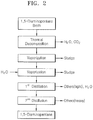
- One or more embodiments include a method of refining 1,5-diaminopentane, the method including preparing a fermented broth including a carbonate salt of 1,5-diaminopentane; preparing, by heating the fermented broth, a first composition in which the carbonate salt of 1,5-diaminopentane is thermally decomposed; preparing a second composition and an evaporation residue by evaporating the first composition; preparing a third composition by adding water to the evaporation residue and evaporating the water; and recovering 1,5-diaminopentane by distilling the second composition and the third composition.
- One or more embodiments include a method of refining 1,5-diaminopentane, the method including preparing a fermented broth including a carbonate salt of 1,5-diaminopentane; preparing, by heating the fermented broth, a first composition in which the carbonate salt of 1,5-diaminopentane is thermally decomposed; preparing a second composition and an evaporation residue by evaporating the first composition; preparing a third composition by adding water to the evaporation residue and evaporating the water; and recovering 1,5-diaminopentane by distilling the second composition and the third composition.
- 1,5-diaminopentane with a high purity may be obtained at a high yield.
- a method of refining 1,5-diaminopentane may include preparing a fermented broth including a carbonate salt of 1,5-diaminopentane; preparing, by heating the fermented broth, a first composition in which the carbonate salt of 1,5-diaminopentane is thermally decomposed; preparing a second composition and an evaporation residue by evaporating the first composition; preparing a third composition by adding water to the evaporation residue and evaporating the water; and recovering 1,5-diaminopentane by distilling the second composition and the third composition.
- the preparing of a fermented broth including a carbonate salt of 1,5-diaminopentane may be preparing a fermented broth including a carbonate salt of 1,5-diaminopentane obtained by fermentation of microorganisms.
- 'carbonate salt of 1,5-diaminopentane' refers to at least one selected from 1,5-diaminopentane carbonate and 1,5-diaminopentane bicarbonate.
- embodiments are not limited thereto. Any suitable compound formed by binding of 1,5-diaminopentane and carbonate ions in a fermented broth may be used.
- the term 'fermented broth including a carbonate salt of 1,5-diaminopentane' refers to a fermented broth including a carbonate salt of 1,5-diaminopentane produced during a fermentation process.
- a fermented broth may be obtained by culturing a microorganism in a medium including glucose or by enzyme conversion in a fermented broth obtained by culturing a microorganism.
- a fermented broth including a carbonate salt of 1,5-diaminopentane may be a fermented broth including a carbonate salt of 1,5-diaminopentane obtained by direct production by culturing a microorganism in a medium including glucose.
- a fermented broth including a carbonate salt of 1,5-diaminopentane may be a fermented broth including a carbonate salt of 1,5-diaminopentane obtained by enzyme conversion using lysine dicarboxylase of lysine produced by culturing a microorganism in a medium including glucose.
- a type of microorganism used in production of a fermented broth including a carbonate salt of 1,5-diaminopentane is not particularly limited. Any suitable microorganism may be used, provided that the microorganism may directly produce a carbonate salt of 1,5-diaminopentane by fermentation or produce a carbonate salt of 1,5-diaminopentane by enzyme conversion.
- the method may further include removing bacterial cells from the fermented broth, after the preparing of the fermented broth including the carbonate salt of 1,5-diaminopentane.
- the method of removing bacterial cells from the fermented broth is not particularly limited. Any suitable method available in the art may be used. For example, a centrifugal separator, a filter press, a squeeze filter, a diatomaceous earth filter, a rotary vacuum filter, a membrane filter, and a flocculation/floatation method may be used to remove bacterial cells.
- first composition' may be a composition having 1,5-diaminopentane, as a major component, resulting from thermal decomposition of a carbonate salt of 1,5-diaminopentane by heating the fermented broth including a carbonate salt of 1,5-diaminopentane.
- thermal decomposition of the carbonate salt of 1,5-diaminopentane may be performed at a temperature in a range of 165 °C to 175 °C for 1 to 6 hours.
- thermal decomposition of the carbonate salt of 1,5-diaminopentane may be performed at a temperature in a range of 165 °C to 174 °C, 165 °C to 173 °C, 165 °C to 172 °C, 165 °C to 171 °C, or 165 °C to 170 °C.
- the fermented broth including a carbonate salt of 1,5-diaminopentane is heated at a temperature in a range of 165 °C to 175 °C
- the carbonate salt of 1,5-diaminopentane may be thermally decomposed into 1,5-diaminopentane, carbon dioxide, and water.
- the carbon dioxide and water may be removed by evaporation, or the like.
- a thermal decomposition temperature of the carbonate salt of 1,5-diaminopentane in a case where a thermal decomposition temperature of the carbonate salt of 1,5-diaminopentane is lower than 165 °C, decomposition of the carbonate salt of 1,5-diaminopentane may not be complete. Thus, a recovery rate of 1,5-diaminopentane may decrease.
- the target product in the preparing of the first composition, in a case where a thermal decomposition temperature of the carbonate salt of 1,5-diaminopentane is higher than 175 °C, 1,5-diaminopentane, the target product, may be thermally decomposed.
- a thermal decomposition temperature of the carbonate salt of 1,5-diaminopentane in a range of 165 °C to 175 °C may be maintained for 1 hour to 6 hours, for example, 2 hours to 5 hours, and for example, 3 hours to 4 hours.
- thermal decomposition of the carbonate salt of 1,5-diaminopentane may not be complete. Thus, a recovery rate of 1,5-diaminopentane may decrease.
- an inert gas may be additionally provided.
- the first composition or in a reactor containing the first composition may be provided with an inert gas.
- the inert gas may be, for example, nitrogen, argon, or the like. But embodiments are not limited thereto. Any suitable gas that does not oxidize 1,5-diaminopentane may be used. Due to the provision of an inert gas to the first composition or in a reactor containing the first composition, a partial pressure of carbon dioxide generated due to thermal decomposition of a carbonate salt of 1,5-diaminopentane and a partial pressure of oxygen in the air may be decreased. Therefore, thermal decomposition of a carbonate salt of 1,5-diaminopentane may be facilitated, and occurrence of a side reaction may be suppressed. In conclusion, recovery rate of 1,5-diaminopentane may improve.
- the second composition and the evaporation residue may be prepared by evaporating the first composition. Any evaporation method known in the art may be used. In detail, evaporation under reduced pressure may be used. Upon reducing a pressure, the pressure may be 0.5 bar or lower, for example, 0.4 bar or lower, for example, 0.2 bar or lower, or for example, 0.1 bar or lower. Upon evaporation, a temperature of the first composition may be 90 °C or higher, for example, 100 °C or higher, for example, 110 °C or higher, or for example, 120 °C or higher.
- the first composition may be condensed by evaporation and may contain 1,5-diaminopentane as a major component.
- the evaporation residue may be a residual composition obtained by removing at least some of 1,5-diaminopentane from the first composition by evaporation under reduced pressure.
- the third composition may be prepared by evaporation after addition of a solvent to the evaporation residue, and the evaporation method may be selected from known manners by one of ordinary skill in the art. Also, during evaporation under reduced pressure, the evaporator may rotate and the evaporated composition may be concentrated and obtained in a form of a concentrate or a condensate. The evaporation method may be selected depending on whether the evaporation is performed under a reduced pressure, a range of a reduced pressure, whether the evaporator rotates, or whether the third composition is concentrated.
- the evaporation method may be selected from concentration under reduced pressure, vacuum concentration, evaporation concentration under reduced pressure, vacuum evaporation concentration, rotary evaporation concentration under reduced pressure, rotary vacuum evaporation concentration, and the like.
- the evaporation method may be evaporation under reduced pressure.
- the third composition may be prepared by evaporation under reduced pressure. Upon reducing a pressure, the pressure may be 0.5 bar or lower, for example, 0.4 bar or lower, for example, 0.2 bar or lower, or for example, 0.1 bar or lower.
- a temperature of the evaporation residue may be 90 °C or higher, for example, 100 °C or higher, for example, 110 °C or higher, or for example, 120 °C or higher.
- a content of a solvent added to the evaporation residue may be in a range of 80 parts to 300 parts by weight, for example, 100 parts to 280 parts by weight, or for example, 130 parts to 260 parts by weight, based on 100 parts by weight of the evaporation residue.
- a content of the solvent added to the evaporation residue is excessively large, a problem, i.e., an increase in energy (steam, etc.) usage to remove water in the following distillation, may occur.
- a content of the solvent added to the evaporation residue is excessively small, a problem, i.e., a low yield of 1,5-diaminopentane, may occur.
- the solvent to be added to the evaporation residue may be selected from known solvents in the art by one of ordinary skill in the art.
- the solvent may be water.
- by-product may be recovered from the remaining residual composition.
- by-product may be recovered from the residual composition as a remaining slurry through an additional refining process.
- distilled water may be further added to the slurry to completely dissolve the slurry to thereby separate the bacterial cells and recover by-product.
- the recovering of 1,5-diaminopentane by distilling the second composition and the third composition may be recovering 1,5-diaminopentane from a mixture of the second composition and the third composition by distillation.
- the distillation may be performed using a method known to one of ordinary skill in the art. For example, fractional distillation, steam distillation, thin film distillation may be performed.
- fractional distillation 1,5-diaminopentane
- impurities, and a solvent may be separated and recovered.
- 1,5-diaminopentane may be recovered, and the two or more times of fractional distillations may be performed consecutively or inconsecutively.
- the recovering of 1,5-diaminopentane may include preparing a fourth composition containing 1,5-diaminopentane by removing a solvent from the second composition and the third composition by a first distillation; and recovering 1,5-diaminopentane from the fourth composition by a second distillation.
- the fourth composition may be obtained by removing the solvent by the first distillation from the second composition and the third composition.
- the preparing of the fourth composition may be performed in a distillation column, and a temperature of an upper part of the distillation column may be in a range of 40 °C to 50 °C, for example, 44 °C to 49 °C, or for example, 46 °C to 47 °C.
- a temperature of a lower part of the distillation column may be in a range of 100 °C to 120 °C, for example, 105 °C to 115 °C, or for example, 110 °C to 112 °C.
- An internal pressure of the distillation column may be in a range of 10 mmHg to 760 mmHg, for example, 40 mmHg to 600 mmHg, or for example, 60 mmHg to 200 mmHg.
- the fourth composition including 1,5-diaminopentane may be separated at a high yield.
- the fourth composition including 1,5-diaminopentane may remain in a container for distillation of the second composition and the third composition, may be recovered from a lower part of the distillation column, or may be recovered from a storage pool between the distillation columns.
- the fourth composition may be subjected to a secondary distillation to thereby recover 1,5-diaminopentane.
- the recovering of 1,5-diaminopentane may be performed in a distillation column.
- the fourth composition including 1,5-diaminopentane may be added through a lower part of a distillation column, however, the position through which the fourth composition is added may vary depending on specific reaction conditions and distillation column conditions.
- a temperature of an upper part of the distillation column may be in a range of 100 °C to 120 °C, for example, 105 °C to 115 °C, or for example, 109 °C to 110 °C.
- a temperature of a lower part of the distillation column may be in a range of 100 °C to 120 °C, for example, 105 °C to 115 °C, or for example, 110 °C to 112 °C.
- An internal pressure of the distillation column may be in a range of 10 mmHg to 760 mmHg, for example, 40 mmHg to 600 mmHg, or for example, 60 mmHg to 200 mmHg. Under such conditions, 1,5-diaminopentane may be recovered at a high yield.
- 1,5-diaminopentane may be recovered in a form of a condensate in the upper part of the distillation column.
- water and other impurities may be recovered in the lower part of the distillation column.
- embodiments are not limited thereto.
- a yield of 1,5-diaminopentane recovered at the upper part of the distillation column may be 75% or higher, 80% or higher, or 95% or higher.
- a purity of 1,5-diaminopentane recovered at the upper part of the distillation column may be 99.90 % or higher, 99.92 % or higher, or 99.95 % or higher.
- additional refining may be included before and after the recovering of 1,5-diaminopentane by distillation from the second composition and third composition.
- the refining process may be performed using a method known to one of ordinary skill in the art. For example, filtration, centrifugation, anion exchange chromatography, crystallization, and high-performance liquid chromatography (HPLC) may be used.
- the medium was heated at a temperature of 120 °C for 20 minutes for sterilization.
- the glass fermenter was cooled to a temperature of 30 °C, and Corynebacterium glutamicum LU11271 LdcC (Korea Patent Registration No. 10-1457229 ) bacterial cells grown for 12 hours in a corn meal agar (CMA) solid medium were inoculated into a sterilized medium.
- CMA corn meal agar
- the cells were cultured at a temperature of 30 °C under sufficient aeration and stirring to obtain a seed culture.
- the stainless steel fermenters were cooled to a temperature of 30 °C, and 2.22 L of the seed culture prepared in Section 1) was added to each of the stainless steel fermenters to inoculate the seed culture in the sterilized medium. Subsequently, the cells were cultured at a temperature of 30 °C under sufficient aeration and stirring to obtain the main culture. Ammonia gas was supplied thereto such that a nitrogen source of the culture solution was not depleted.
- a distillation column (available from Aceglass, perforated plate, jacketed, silvered, stage 10 ⁇ 3 ea) and a distillation head (available from Aceglass) at the top of the distillation column were installed on a 5-L four-neck round flask (available from Daihan Scientific Co., Ltd.).
- the refrigerant supplied to the distillation head was injected at 10 °C using a low-temperature constant-temperature circulating water bath (JEIO tech, Model No. HTRC-20).
- the heat source used was a stirring mantle (available from Misung Scientific Co., Ltd., Model No. MS-DMS639, 5 L), and heating was performed based on the temperature inside the round flask.
- a distillation column was connected to the inlet at the center of the 5-L four-neck round flask, and a thermometer, a gas injection device, and an injection device for the fermented broth prepared during the fermentation were installed at the other inlets, and stirring was performed using a magnetic bar (available from Cowie Co., Ltd., PTFE Oval-type stirrer bar egg, 20x40 millimeters (mm)). Both the 5 L four-neck round flask and the distillation head were equipped with a thermometer (available from Misung Scientific Co., Ltd., K type) to test the internal temperature of the round flask and the distillation column.
- a thermometer available from Misung Scientific Co., Ltd., K type
- Table 2 Component Fermented broth (9) Condensate and gas after thermal decomposition (g) Solution in the lower part of the distillation column after thermal decomposition (g) Water 3,778.1 3,914.7 35.1 1,5-diaminopentane 515.0 2.6 510.6 lons 16.5 - 16.5 Carbonic acid - 444.3 - Bicarbonate 616.0 - - Amino acid 3.8 - 3.8 Organic acid 4.3 - 2.5 Etc. 66.3 - 69.9 Total 5,000.0 4,361.6 638.4
- the distillation column used during the thermal decomposition was used in the same manner.
- a temperature of the lower part of the distillation column was 110 °C to 112 °C and a pressure was 0.1 bar.
- 447.8 g of condensate after evaporation from the Evaporation was added, and the distillation head was maintained at a temperature of 46 °C to 47 °C.
- 37.9 g of the distillation column condensate was removed, and 409.9 g of the solution of the lower part of the distillation column was recovered.
- Table 4 shows a composition analysis result after the first distillation.
- the condensate receiver containing the condensate was replaced, and distillation was performed under reduced pressure with a temperature of the lower part of the distillation column in a range of 110 °C to 112 °C, at a pressure of 0.1 bar.
- a temperature of the distillation head was maintained at 109 °C to 110 °C, and 406.3 g of the condensate in the distillation column was recovered. Then, 3.3 g of solution remained in the distillation column.
- the components were analyzed by using GC and the Karl-Fischer method. Table 5 shows the component analysis result after the second distillation.
- a fermented broth was prepared in the same manner as in Comparative Example 1.
- Table 6 shows a composition analysis result before and after the thermal decomposition.
- Table 6 Component Fermented broth (g) Condensate and gas (g) Solution in the lower part of the distillation column (g) Water 3,778.1 3,911.3 38.5 1,5-diaminopentane 515.0 2.7 510.6 Ions 16.5 - 16.5 Carbonic acid - 444.3 - Bicarbonate 616.0 - - Amino acid 3.8 - 3.8 Organic acid 4.3 - 2.7 Etc. 66.3 - 69.6 Total 5,000.0 4,358.3 641.7
- Table 7 shows a composition analysis results of before and after the second evaporation.
- Table 7 Component Solution in the lower part of the distillation column (g) Sludge after second evaporation (g) Condensate after second evaporation (g) Water 38.5 - 288.5 1,5-diaminopentane 510.6 22.9 487.7 Ions 16.5 16.5 - Amino acid 3.8 3.8 - Organic acid 2.7 2.3 0.4 Etc. 69.6 69.5 2.1 Total 641.7 113.0 778.7
- the yield of 1,5-diaminopentane after the second evaporation increased to 95.5 % in Example 1 that further included the second evaporation.
- a first distillation was performed in a distillation column in the same manner as in Comparative Example 1. 778.7 g of the evaporation condensate was added thereto, 290.2 g of the distillation column condensate was removed, and 488.5 g of the solution in the lower part of the distillation column was recovered. Table 8 shows the component analysis result after the first distillation. A temperature in the upper part of the distillation column was in a range of 45 °C to 50 °C, and a temperature in the lower part of the distillation column was in a range of 110 °C to 112 °C. Distillation was performed under reduced pressure of 0.1 bar.
- a second distillation was performed in a distillation column in the same manner as in Comparative Example 1. 488.5 g of the distillation column condensate was recovered, and 4.3 g of the solution in the lower part of the distillation column remained. The components were analyzed by using GC and the Karl-Fischer method. Table 9 shows composition analysis results after the second distillation. A temperature in the upper part of the distillation column was in a range of 109 °C to 110 °C, and a temperature in the lower part of the distillation column was in a range of 110 °C to 112 °C. Distillation was performed under a reduced pressure of 0.1 bar.
- a purity of 1,5-diaminopentane in the recovered condensate was 99.90 %, and a yield thereof was 93.9 %. As compared with the yield of 1,5-diaminopentane in Comparative Example 1, that is, 78.9%, the yield was increased by 15 %. In the second evaporation, 1,5-diaminopentane remaining in the rotary evaporator was further evaporated, thereby increasing the yield of 1,5-diaminopentane.
- Example 2 was performed in the same manner as in Example 1, except that 300 g of distilled water was added to 195.1 g of sludge remaining in the rotary evaporator during the second evaporation.
- a purity of 1,5-diaminopentane in the final condensate recovered from the second distillation was 99.94 %, and a yield thereof was 93.1 %.
- Example 3 was performed in the same manner as in Example 1, except that 350 g of distilled water was added to 190.1 g of sludge remaining in the rotary evaporator during the second evaporation.
- a purity of 1,5-diaminopentane in the final condensate recovered from the second distillation was 99.93 %, and a yield thereof was 93.5 %.
- Example 4 was performed in the same manner as in Example 1, except that 250 g of distilled water was added twice (i.e., 500 g of distilled water in total was added) to 193.4 g of sludge remaining in the rotary evaporator during the second evaporation.
- a purity of 1,5-diaminopentane in the final condensate recovered from the second distillation was 99.90 %, and a yield thereof was 95.1 %.
- Example 5 Thermal decomposition temperature changed to 175 °C
- Thermal decomposition was performed in the same manner as in Example 1, except that during the thermal decomposition, an internal temperature of the round flask was raised to 175 °C and maintained for 3 hours.
- a purity of 1,5-diaminopentane in the final condensate recovered from the second distillation was 99.95 %, and a yield thereof was 82.1 %.
- a fermented broth was prepared in the same manner as in Comparative Example 1.
- Thermal decomposition was performed in the same manner as in Comparative Example 1, except that 5,000 g of fermented broth was added to the lower part of the distillation column, and nitrogen gas was not added.
- Table 10 shows composition analysis results of before and after the thermal decomposition.
- Table 10 Component Fermented broth (g) Condensate and gas after thermal decomposition (g) Solution in the lower part of the distillation column after thermal decomposition (g) Water 3,778.1 3,914.8 35.0 1,5-diaminopentane 515.0 4.7 507.5 Ions 16.5 - 16.5 Carbonic acid - 444.3 - Bicarbonate 616.0 - - Amino acid 3.8 - 3.8 Organic acid 4.3 - 1.5 Etc. 66.3 - 71.9 Total 5,000.0 4,363.8 636.2
- a first distillation was performed in a distillation column in the same manner as in Comparative Example 1. 441.6 g of the evaporation condensate was added thereto, 41.4 g of the distillation column condensate was removed, and 400.2 g of the solution in the lower part of the distillation column was recovered.
- Table 12 shows the component analysis results for after the first distillation. Table 12 Component Condensate after evaporation (g) Condensate after distillation (g) Solution in the lower part of the distillation column after distillation (g) Water 35.0 34.6 0.4 1,5-diaminopentane 402.9 6.8 396.1 Organic acid 0.1 - 0.1 Etc. 3.6 - 3.6 Total 441.6 41.4 400.2
- a purity of 1,5-diaminopentane in the recovered condensate was 99.77 %, and a yield thereof was 76.3 %.
- Table 13 Component Solution in the lower part of the distillation column after distillation (g) Condensate after second distillation (g) Solution in the lower part of the distillation column after second distillation (g) Water 0.4 0.4 1,5-diaminopentane 396.1 392.9 3.2 Organic acid 0.1 0.1 Etc. 3.6 0.5 3.1 Total 400.2 393.8 6.4
- a fermented broth was prepared in the same manner as in Comparative Example 1.
- Thermal decomposition was performed in the same manner as in Comparative Example 1, except that 5,000 g of fermented broth was added to the lower part of the distillation column, and air was added instead of nitrogen gas.
- Table 14 shows composition analysis results for before and after the thermal decomposition.
- Table 14 Component Fermented broth (g) Condensate and gas after thermal decomposition (g) Solution in the lower part of the distillation column after thermal decomposition (g) Water 3,778.1 3,914.9 34.9 1,5-diaminopentane 515.0 6.2 504.9 Ions 16.5 - 16.5 Carbonic acid - 444.3 - Bicarbonate 616.0 - - Amino acid 3.8 - 3.8 Organic acid 4.3 - 1.2 Etc. 66.3 - 72.5 Total 5,000.0 4,365.4 634.6
- a purity of 1,5-pentadiamine in the recovered condensate was 97.74 %, and a yield thereof was 76.2 %.
- a fermented broth was prepared in the same manner as in Comparative Example 1.
- Thermal decomposition was performed on 5,000 g of the fermentation broth in the same manner as in Example 1, except that during the thermal decomposition, an internal temperature of the round flask was raised to 160 °C and maintained for 3 hours.
- Table 18 shows composition analysis results for before and after the thermal decomposition.
- Table 18 Component Fermented broth (g) Condensate and gas after thermal decomposition (g) Solution in the lower part of the distillation column after thermal decomposition (g) Water 3,778.1 3,912.2 32.7 1,5-diaminopentane 515.0 2.6 510.0 Ions 16.5 - 16.5 Carbonic acid - 431.0 - carbonate - - 18.2 Bicarbonate 616.0 - - Amino acid 3.8 - 3.8 Organic acid 4.3 - 1.9 Etc. 66.3 - 71.2 Total 5,000.0 4,345.8 654.2
- a first distillation was performed in the distillation column in the same manner as in Comparative Example 1, however, during the first distillation, an excessive amount of the crystals of the carbonate salt of 1,5-diaminopentane was precipitated in the lower part of the distillation column. Thus, a second distillation was not performed.
- a yield and a purity of 1,5-diaminopentane were decreased. Therefore, when a thermal decomposition temperature is 160 °C or lower in the method of refining 1,5-diaminopentane according to one or more embodiments, a yield of 1,5-diaminopentane is significantly low
- a fermented broth was prepared in the same manner as in Comparative Example 1.
- Thermal decomposition was performed on 5,000 g of the fermentation broth in the same manner as in Example 1, except that during the thermal decomposition, an internal temperature of the round flask was raised to 180 °C and maintained for 3 hours.
- Table 20 shows composition analysis results for before and after the thermal decomposition.
- Table 20 Component Fermented broth (g) Condensate and gas after thermal decomposition (g) Solution in the lower part of the distillation column after thermal decomposition (g) Water 3,778.1 3,940.4 9.4 1,5-diaminopentane 515.0 14.4 498.1 Ions 16.5 - 16.5 Carbonic acid - 444.3 - carbonate - - - Bicarbonate 616.0 - - Amino acid 3.8 - 3.8 Organic acid 4.3 - 1.9 Etc. 66.3 - 71.2 Total 5,000.0 4,399.1 600.9
- a purity of 1,5-pentadiamine in the recovered condensate was 99.74 %, and a yield thereof was 72.2 %.
- Comparative Example 4 when thermal decomposition was performed at a temperature of 165 °C, crystals of 1,5-diaminopentane were generated. Thus, the purity and the yield were decreased, as compared with Example 1 (purity: 99.9 %, yield: 93.9 %).
- 1,5-diaminopentane with a high purity may be obtained at a high yield.
Landscapes
- Chemical & Material Sciences (AREA)
- Organic Chemistry (AREA)
- Life Sciences & Earth Sciences (AREA)
- Zoology (AREA)
- Engineering & Computer Science (AREA)
- Wood Science & Technology (AREA)
- Chemical Kinetics & Catalysis (AREA)
- Biotechnology (AREA)
- Microbiology (AREA)
- General Chemical & Material Sciences (AREA)
- Proteomics, Peptides & Aminoacids (AREA)
- Health & Medical Sciences (AREA)
- Biochemistry (AREA)
- Bioinformatics & Cheminformatics (AREA)
- General Engineering & Computer Science (AREA)
- General Health & Medical Sciences (AREA)
- Genetics & Genomics (AREA)
- Organic Low-Molecular-Weight Compounds And Preparation Thereof (AREA)
- Preparation Of Compounds By Using Micro-Organisms (AREA)
Abstract
Description
- One or more embodiments relate to a method of refining 1,5-diaminopentane.
- 1,5-diaminopentane (cadaverine) is an important base chemical in industrial applications and may be used as an additive or as a component of polymers such as polyamides or polyurethanes through polymerization processes. 1,5-diaminopentane may be produced by chemical or biological methods. Specifically, the biological methods may be classified into a method of producing 1,5-diaminopentane through enzymatic decarboxylation after L-lysine microbial cultivation (Japanese Laid-Open Patent Application No.
2005-006650 10-1457229 5548864 - Therefore, a method of effectively refining 1,5-diaminopentane from a fermented broth is required.
- One or more embodiments include a method of refining 1,5-diaminopentane, the method including preparing a fermented broth including a carbonate salt of 1,5-diaminopentane; preparing, by heating the fermented broth, a first composition in which the carbonate salt of 1,5-diaminopentane is thermally decomposed; preparing a second composition and an evaporation residue by evaporating the first composition; preparing a third composition by adding water to the evaporation residue and evaporating the water; and recovering 1,5-diaminopentane by distilling the second composition and the third composition.
- One or more embodiments include a method of refining 1,5-diaminopentane, the method including preparing a fermented broth including a carbonate salt of 1,5-diaminopentane; preparing, by heating the fermented broth, a first composition in which the carbonate salt of 1,5-diaminopentane is thermally decomposed; preparing a second composition and an evaporation residue by evaporating the first composition; preparing a third composition by adding water to the evaporation residue and evaporating the water; and recovering 1,5-diaminopentane by distilling the second composition and the third composition.
- When a method of refining 1,5-diaminopentane according to one or more embodiments is used, 1,5-diaminopentane with a high purity may be obtained at a high yield.
-
-
FIG. 1 shows a flowchart of a method of refining 1,5-diaminopentane, according to one or more example embodiments; -
FIG. 2 shows a flowchart of a method of refining 1,5-diaminopentane, according to Example 1; -
FIG. 3 shows a flowchart of the preparation of a fermented broth inFIG. 1 in detail; and -
FIG. 4 shows a flowchart of the preparation of a fermented broth inFIG. 2 in detail. - As the inventive concept allows for various changes and numerous embodiments, particular embodiments will be illustrated in the drawings and described in detail in the written description. However, this is not intended to limit the inventive concept to particular modes of practice, and it is to be appreciated that all changes, equivalents, and substitutes that do not depart from the spirit and technical scope of the inventive concept are encompassed in the inventive concept.
- While such terms as "first," "second," "third," "fourth, or the like, may be used to describe various components, such components must not be limited to the above terms. The above terms are used only to distinguish one component from another.
- According to one or more embodiments, a method of refining 1,5-diaminopentane may include preparing a fermented broth including a carbonate salt of 1,5-diaminopentane; preparing, by heating the fermented broth, a first composition in which the carbonate salt of 1,5-diaminopentane is thermally decomposed; preparing a second composition and an evaporation residue by evaporating the first composition; preparing a third composition by adding water to the evaporation residue and evaporating the water; and recovering 1,5-diaminopentane by distilling the second composition and the third composition.
- The preparing of a fermented broth including a carbonate salt of 1,5-diaminopentane may be preparing a fermented broth including a carbonate salt of 1,5-diaminopentane obtained by fermentation of microorganisms.
- The term 'carbonate salt of 1,5-diaminopentane', as used herein, refers to at least one selected from 1,5-diaminopentane carbonate and 1,5-diaminopentane bicarbonate. However, embodiments are not limited thereto. Any suitable compound formed by binding of 1,5-diaminopentane and carbonate ions in a fermented broth may be used.
- The term 'fermented broth including a carbonate salt of 1,5-diaminopentane', as used herein, refers to a fermented broth including a carbonate salt of 1,5-diaminopentane produced during a fermentation process. A fermented broth may be obtained by culturing a microorganism in a medium including glucose or by enzyme conversion in a fermented broth obtained by culturing a microorganism. For example, a fermented broth including a carbonate salt of 1,5-diaminopentane may be a fermented broth including a carbonate salt of 1,5-diaminopentane obtained by direct production by culturing a microorganism in a medium including glucose. For example, a fermented broth including a carbonate salt of 1,5-diaminopentane may be a fermented broth including a carbonate salt of 1,5-diaminopentane obtained by enzyme conversion using lysine dicarboxylase of lysine produced by culturing a microorganism in a medium including glucose. A type of microorganism used in production of a fermented broth including a carbonate salt of 1,5-diaminopentane is not particularly limited. Any suitable microorganism may be used, provided that the microorganism may directly produce a carbonate salt of 1,5-diaminopentane by fermentation or produce a carbonate salt of 1,5-diaminopentane by enzyme conversion.
- The method may further include removing bacterial cells from the fermented broth, after the preparing of the fermented broth including the carbonate salt of 1,5-diaminopentane.
- The method of removing bacterial cells from the fermented broth is not particularly limited. Any suitable method available in the art may be used. For example, a centrifugal separator, a filter press, a squeeze filter, a diatomaceous earth filter, a rotary vacuum filter, a membrane filter, and a flocculation/floatation method may be used to remove bacterial cells.
- The term 'first composition', as used herein, may be a composition having 1,5-diaminopentane, as a major component, resulting from thermal decomposition of a carbonate salt of 1,5-diaminopentane by heating the fermented broth including a carbonate salt of 1,5-diaminopentane. In the preparing of the first composition, thermal decomposition of the carbonate salt of 1,5-diaminopentane may be performed at a temperature in a range of 165 °C to 175 °C for 1 to 6 hours. For example, in the preparing of the first composition, thermal decomposition of the carbonate salt of 1,5-diaminopentane may be performed at a temperature in a range of 165 °C to 174 °C, 165 °C to 173 °C, 165 °C to 172 °C, 165 °C to 171 °C, or 165 °C to 170 °C. When the fermented broth including a carbonate salt of 1,5-diaminopentane is heated at a temperature in a range of 165 °C to 175 °C, the carbonate salt of 1,5-diaminopentane may be thermally decomposed into 1,5-diaminopentane, carbon dioxide, and water. The carbon dioxide and water may be removed by evaporation, or the like. In the preparing of the first composition, in a case where a thermal decomposition temperature of the carbonate salt of 1,5-diaminopentane is lower than 165 °C, decomposition of the carbonate salt of 1,5-diaminopentane may not be complete. Thus, a recovery rate of 1,5-diaminopentane may decrease. In the preparing of the first composition, in a case where a thermal decomposition temperature of the carbonate salt of 1,5-diaminopentane is higher than 175 °C, 1,5-diaminopentane, the target product, may be thermally decomposed. Thus, a yield thereof may be deteriorated, and impurities may increase. In the preparing of the first composition, a thermal decomposition temperature of the carbonate salt of 1,5-diaminopentane in a range of 165 °C to 175 °C may be maintained for 1 hour to 6 hours, for example, 2 hours to 5 hours, and for example, 3 hours to 4 hours. When the time for a temperature of the fermented broth in a range of 165 °C to 175 °C to be maintained is excessively short, thermal decomposition of the carbonate salt of 1,5-diaminopentane may not be complete. Thus, a recovery rate of 1,5-diaminopentane may decrease. When the time for a temperature of the fermented broth in a range of 165 °C to 175 °C to be maintained is excessively long, 1,5-diaminopentane, the target product, may be thermally decomposed. Thus, a yield thereof may be deteriorated, and impurities may increase.
- In the preparing of the first composition, an inert gas may be additionally provided. For example, the first composition or in a reactor containing the first composition may be provided with an inert gas. The inert gas may be, for example, nitrogen, argon, or the like. But embodiments are not limited thereto. Any suitable gas that does not oxidize 1,5-diaminopentane may be used. Due to the provision of an inert gas to the first composition or in a reactor containing the first composition, a partial pressure of carbon dioxide generated due to thermal decomposition of a carbonate salt of 1,5-diaminopentane and a partial pressure of oxygen in the air may be decreased. Therefore, thermal decomposition of a carbonate salt of 1,5-diaminopentane may be facilitated, and occurrence of a side reaction may be suppressed. In conclusion, recovery rate of 1,5-diaminopentane may improve.
- The second composition and the evaporation residue may be prepared by evaporating the first composition. Any evaporation method known in the art may be used. In detail, evaporation under reduced pressure may be used. Upon reducing a pressure, the pressure may be 0.5 bar or lower, for example, 0.4 bar or lower, for example, 0.2 bar or lower, or for example, 0.1 bar or lower. Upon evaporation, a temperature of the first composition may be 90 °C or higher, for example, 100 °C or higher, for example, 110 °C or higher, or for example, 120 °C or higher. The first composition may be condensed by evaporation and may contain 1,5-diaminopentane as a major component. The evaporation residue may be a residual composition obtained by removing at least some of 1,5-diaminopentane from the first composition by evaporation under reduced pressure.
- The third composition may be prepared by evaporation after addition of a solvent to the evaporation residue, and the evaporation method may be selected from known manners by one of ordinary skill in the art. Also, during evaporation under reduced pressure, the evaporator may rotate and the evaporated composition may be concentrated and obtained in a form of a concentrate or a condensate. The evaporation method may be selected depending on whether the evaporation is performed under a reduced pressure, a range of a reduced pressure, whether the evaporator rotates, or whether the third composition is concentrated. For example, the evaporation method may be selected from concentration under reduced pressure, vacuum concentration, evaporation concentration under reduced pressure, vacuum evaporation concentration, rotary evaporation concentration under reduced pressure, rotary vacuum evaporation concentration, and the like. For example, the evaporation method may be evaporation under reduced pressure. In particular, the third composition may be prepared by evaporation under reduced pressure. Upon reducing a pressure, the pressure may be 0.5 bar or lower, for example, 0.4 bar or lower, for example, 0.2 bar or lower, or for example, 0.1 bar or lower. Upon evaporation, a temperature of the evaporation residue may be 90 °C or higher, for example, 100 °C or higher, for example, 110 °C or higher, or for example, 120 °C or higher. By obtaining the third composition, after the first composition is obtained, a yield of 1,5-diaminopentane may be more improved.
- When preparing the third composition, a content of a solvent added to the evaporation residue may be in a range of 80 parts to 300 parts by weight, for example, 100 parts to 280 parts by weight, or for example, 130 parts to 260 parts by weight, based on 100 parts by weight of the evaporation residue. When a content of the solvent added to the evaporation residue is excessively large, a problem, i.e., an increase in energy (steam, etc.) usage to remove water in the following distillation, may occur. When a content of the solvent added to the evaporation residue is excessively small, a problem, i.e., a low yield of 1,5-diaminopentane, may occur.
- The solvent to be added to the evaporation residue may be selected from known solvents in the art by one of ordinary skill in the art. For example, the solvent may be water.
- After the third composition is prepared, by-product may be recovered from the remaining residual composition. For example, after the second composition and the third composition based on 1,5-diaminopentane are separated from the first composition, by-product may be recovered from the residual composition as a remaining slurry through an additional refining process. When the slurry contains bacterial cells, distilled water may be further added to the slurry to completely dissolve the slurry to thereby separate the bacterial cells and recover by-product.
- The recovering of 1,5-diaminopentane by distilling the second composition and the third composition may be recovering 1,5-diaminopentane from a mixture of the second composition and the third composition by distillation. The distillation may be performed using a method known to one of ordinary skill in the art. For example, fractional distillation, steam distillation, thin film distillation may be performed. For example, by performing fractional distillation 1,5-diaminopentane, impurities, and a solvent may be separated and recovered. For example, by performed two or more times of fractional distillations, 1,5-diaminopentane may be recovered, and the two or more times of fractional distillations may be performed consecutively or inconsecutively.
- The recovering of 1,5-diaminopentane may include preparing a fourth composition containing 1,5-diaminopentane by removing a solvent from the second composition and the third composition by a first distillation; and recovering 1,5-diaminopentane from the fourth composition by a second distillation.
- The fourth composition may be obtained by removing the solvent by the first distillation from the second composition and the third composition. For example, the preparing of the fourth composition may be performed in a distillation column, and a temperature of an upper part of the distillation column may be in a range of 40 °C to 50 °C, for example, 44 °C to 49 °C, or for example, 46 °C to 47 °C. A temperature of a lower part of the distillation column may be in a range of 100 °C to 120 °C, for example, 105 °C to 115 °C, or for example, 110 °C to 112 °C. An internal pressure of the distillation column may be in a range of 10 mmHg to 760 mmHg, for example, 40 mmHg to 600 mmHg, or for example, 60 mmHg to 200 mmHg. Under such conditions, the fourth composition including 1,5-diaminopentane may be separated at a high yield. The fourth composition including 1,5-diaminopentane may remain in a container for distillation of the second composition and the third composition, may be recovered from a lower part of the distillation column, or may be recovered from a storage pool between the distillation columns. However, embodiments are not limited thereto. Also, the fourth composition may be subjected to a secondary distillation to thereby recover 1,5-diaminopentane.
- For example, the recovering of 1,5-diaminopentane may be performed in a distillation column. The fourth composition including 1,5-diaminopentane may be added through a lower part of a distillation column, however, the position through which the fourth composition is added may vary depending on specific reaction conditions and distillation column conditions.
- In the recovering of 1,5-diaminopentane, a temperature of an upper part of the distillation column may be in a range of 100 °C to 120 °C, for example, 105 °C to 115 °C, or for example, 109 °C to 110 °C. A temperature of a lower part of the distillation column may be in a range of 100 °C to 120 °C, for example, 105 °C to 115 °C, or for example, 110 °C to 112 °C. An internal pressure of the distillation column may be in a range of 10 mmHg to 760 mmHg, for example, 40 mmHg to 600 mmHg, or for example, 60 mmHg to 200 mmHg. Under such conditions, 1,5-diaminopentane may be recovered at a high yield.
- 1,5-diaminopentane may be recovered in a form of a condensate in the upper part of the distillation column. For example, water and other impurities may be recovered in the lower part of the distillation column. However, embodiments are not limited thereto.
- A yield of 1,5-diaminopentane recovered at the upper part of the distillation column may be 75% or higher, 80% or higher, or 95% or higher. A purity of 1,5-diaminopentane recovered at the upper part of the distillation column may be 99.90 % or higher, 99.92 % or higher, or 99.95 % or higher.
- In addition, additional refining may be included before and after the recovering of 1,5-diaminopentane by distillation from the second composition and third composition. The refining process may be performed using a method known to one of ordinary skill in the art. For example, filtration, centrifugation, anion exchange chromatography, crystallization, and high-performance liquid chromatography (HPLC) may be used.
- The present disclosure is described in detail through the following Examples and Comparative Examples. However, these Examples are for illustrative purposes only, and the present disclosure is not intended to be limited by these Examples.
- 2.0 liters (L) of a medium containing 30.0 grams per liter (g/L) of glucose, 15 g/L of molasses, 1.11 g/L of phosphoric acid, 5.8 g/L of magnesium sulfate 7 hydrate, 10.0 g/L of corn steep liquor, 0.5 g/L of arginine, 1.0 mg/L of biotin, 20.0 mg/L of thiamine hydrochloride, 20.0 mg/L of calcium salt of pantothenic acid, 20.0 mg/L of nicotinic acid, and 0.2 g/L of defoamer was added to a 5-L glass fermenter. Subsequently, the medium was heated at a temperature of 120 °C for 20 minutes for sterilization. The glass fermenter was cooled to a temperature of 30 °C, and Corynebacterium glutamicum LU11271 LdcC (Korea Patent Registration No.
10-1457229 - 9.0 L of a medium containing 270 g/L of glucose, 7.0 g/L of molasses, 0.7 g/L of phosphoric acid, 2.0 g/L of magnesium sulfate 7 hydrate, 5.0 g/L of corn steep liquor, 0.5 g/L of arginine, 1.0 mg/L of biotin, 20.0 mg/L of thiamine hydrochloride, 20.0 mg/L of calcium salt of pantothenic acid, 20.0 mg/L of nicotinic acid, and 0.3 g/L of defoamer was added to three 30-L stainless steel fermenters. Subsequently, the medium was heated at a temperature of 120 °C for 20 minutes for sterilization. The stainless steel fermenters were cooled to a temperature of 30 °C, and 2.22 L of the seed culture prepared in Section 1) was added to each of the stainless steel fermenters to inoculate the seed culture in the sterilized medium. Subsequently, the cells were cultured at a temperature of 30 °C under sufficient aeration and stirring to obtain the main culture. Ammonia gas was supplied thereto such that a nitrogen source of the culture solution was not depleted.
- Subsequently, the bacterial cells were separated and 50 kilograms (kg) of 1,5-diaminopentane fermented broth was obtained.
Table 1 Component Fermented broth (g) Water 37,781.0 1,5-diaminopentane 5,150.0 Ions 165.2 Bicarbonate 6,159.8 Amino acid 37.7 Organic acid 43.1 Etc. 663.3 Bacterial cells 0 Total 50,000.0 - A distillation column (available from Aceglass, perforated plate, jacketed, silvered, stage 10 × 3 ea) and a distillation head (available from Aceglass) at the top of the distillation column were installed on a 5-L four-neck round flask (available from Daihan Scientific Co., Ltd.). The refrigerant supplied to the distillation head was injected at 10 °C using a low-temperature constant-temperature circulating water bath (JEIO tech, Model No. HTRC-20). The heat source used was a stirring mantle (available from Misung Scientific Co., Ltd., Model No. MS-DMS639, 5 L), and heating was performed based on the temperature inside the round flask. A distillation column was connected to the inlet at the center of the 5-L four-neck round flask, and a thermometer, a gas injection device, and an injection device for the fermented broth prepared during the fermentation were installed at the other inlets, and stirring was performed using a magnetic bar (available from Cowie Co., Ltd., PTFE Oval-type stirrer bar egg, 20x40 millimeters (mm)). Both the 5 L four-neck round flask and the distillation head were equipped with a thermometer (available from Misung Scientific Co., Ltd., K type) to test the internal temperature of the round flask and the distillation column. 3,000 g of the fermented broth was added to the flask, and then 200 g of the fermented broth per each addition was sequentially further added using a pump (available from EYELA Co., Ltd., Model No. RP-2000) while thermal decomposition of the carbonate salt of 1,5-diaminopentane was carried out until the total amount of the added fermentation broth became 5,000 g. The internal temperature of the round flask was elevated from a temperature of 100 °C to 165 °C over 12 hours, and the temperature was maintained at 165 °C for 3 hours to perform thermal decomposition. Nitrogen gas was injected through a gas injection inlet connected to the gas injection device. A condensate and carbon dioxide generated from the thermal decomposition of the carbonate salt of 1,5-diaminopentane were removed from the distillation head. 3,917.3 g of the condensate and 638.4 g of the solution in the lower part of the distillation column were recovered, and 444.3 g of carbon dioxide was released into the air. Table 2 shows a composition analysis result before and after the thermal decomposition. In Table 2, 1,5-diaminopentane, amino acid, organic acid, bicarbonate, and ions were analyzed by using high-performance liquid chromatography (HPLC), and moisture analysis was performed using the Karl-Fischer moisture measurement method.
Table 2 Component Fermented broth (9) Condensate and gas after thermal decomposition (g) Solution in the lower part of the distillation column after thermal decomposition (g) Water 3,778.1 3,914.7 35.1 1,5-diaminopentane 515.0 2.6 510.6 lons 16.5 - 16.5 Carbonic acid - 444.3 - Bicarbonate 616.0 - - Amino acid 3.8 - 3.8 Organic acid 4.3 - 2.5 Etc. 66.3 - 69.9 Total 5,000.0 4,361.6 638.4 - 638.4 g of the solution in the lower part of the distillation column prepared during the thermal decomposition was introduced into a rotary evaporator (Model No. N-1200B available from EYELA Co., Ltd.) having a condensing tube with a volume of 1 L, and evaporation was performed under reduced pressure of 0.05 bar with an oil bath at a temperature of 120 °C. After evaporation, 447.8 g of the condensate was recovered, and 190.6 g of sludge after evaporation remained in the rotary evaporator. Table 3 shows a composition analysis result after the evaporation. In Table 3, 1,5-diaminopentane, amino acid, organic acid, and ions were analyzed by using HPLC, and moisture analysis was performed using the Karl-Fischer moisture measurement method. The yield of 1,5-diaminopentane from the evaporation was 80.5 %.
Table 3 Component Solution in the lower part after thermal decomposition (g) Sludge after evaporation (g) Condensate after evaporation (g) Water 35.1 - 35.1 1,5-diaminopentane 510.6 99.6 411.0 lons 16.5 16.5 - Amino acid 3.8 3.8 - Organic acid 2.5 2.2 0.3 Etc. 69.9 68.5 1.4 Total 638.4 190.6 447.8 - The distillation column used during the thermal decomposition was used in the same manner. A temperature of the lower part of the distillation column was 110 °C to 112 °C and a pressure was 0.1 bar. 447.8 g of condensate after evaporation from the Evaporation was added, and the distillation head was maintained at a temperature of 46 °C to 47 °C. Subsequently, 37.9 g of the distillation column condensate was removed, and 409.9 g of the solution of the lower part of the distillation column was recovered. Table 4 shows a composition analysis result after the first distillation. In Table 4, 1,5-diaminopentane was analyzed by using gas chromatography (GC, 7890A, column HP-5 available from Agilent Technologies), and the organic acid was analyzed by using HPLC. Moisture analysis was performed using the Karl-Fischer moisture measurement method.
Table 4 Component Condensate after evaporation (g) Condensate after distillation (g) Solution in the lower part of the distillation column after distillation (g) Water 35.1 35.0 0.1 1,5-diaminopentane 411.0 2.8 408.2 Organic acid 0.3 0.1 0.2 Etc. 1.4 - 1.4 Total 447.8 37.9 409.9 - After distillation, the condensate receiver containing the condensate was replaced, and distillation was performed under reduced pressure with a temperature of the lower part of the distillation column in a range of 110 °C to 112 °C, at a pressure of 0.1 bar. A temperature of the distillation head was maintained at 109 °C to 110 °C, and 406.3 g of the condensate in the distillation column was recovered. Then, 3.3 g of solution remained in the distillation column. The components were analyzed by using GC and the Karl-Fischer method. Table 5 shows the component analysis result after the second distillation. A purity of 1,5-diaminopentane was 99.94 %, and a yield of 1,5-diaminopentane based on the fermented broth including a carbonate salt of 1,5-diaminopentane was 78.9 %.
Table 5 Component Solution in the lower part of the distillation column after distillation (g) Condensate after second distillation (g) Solution in the lower part of the distillation column after second distillation (g) Water 0.1 0.1 - 1,5-diaminopentane 408.2 406.3 1.8 Organic acid 0.2 - 0.2 Etc. 1.4 0.1 1.3 Total 409.9 406.6 3.3 - A fermented broth was prepared in the same manner as in Comparative Example 1.
- Thermal decomposition was performed on 5,000 g of the fermented broth in the same manner as in Comparative Example 1.
- 3,914.0 g of the condensate and 641.7 g of the solution in the lower part of the distillation column were recovered, and 444.3 g of carbon dioxide was released into the air. Table 6 shows a composition analysis result before and after the thermal decomposition.
Table 6 Component Fermented broth (g) Condensate and gas (g) Solution in the lower part of the distillation column (g) Water 3,778.1 3,911.3 38.5 1,5-diaminopentane 515.0 2.7 510.6 Ions 16.5 - 16.5 Carbonic acid - 444.3 - Bicarbonate 616.0 - - Amino acid 3.8 - 3.8 Organic acid 4.3 - 2.7 Etc. 66.3 - 69.6 Total 5,000.0 4,358.3 641.7 - The solution in the lower part of the distillation column prepared during the thermal decomposition was subjected to evaporation in the same manner as in Comparative Example 1 to thereby recover a condensate including water and 1,5-diaminobutane. 192.3 g of sludge remained in the rotary evaporator.
- After the first evaporation, 250 g of distilled water was added to 192.3 g of the sludge remaining in the rotary evaporator. Subsequently, evaporation was additionally performed under reduced pressure in the same manner as in the first evaporation.
- 778.7 g of the condensate was recovered, and after the evaporation, 113.0 g of sludge remained in the rotary evaporator. Table 7 shows a composition analysis results of before and after the second evaporation.
Table 7 Component Solution in the lower part of the distillation column (g) Sludge after second evaporation (g) Condensate after second evaporation (g) Water 38.5 - 288.5 1,5-diaminopentane 510.6 22.9 487.7 Ions 16.5 16.5 - Amino acid 3.8 3.8 - Organic acid 2.7 2.3 0.4 Etc. 69.6 69.5 2.1 Total 641.7 113.0 778.7 - As compared with 80.5 % yield of 1,5-diaminopentane after evaporation in Comparative Example 1 that included the first evaporation only, the yield of 1,5-diaminopentane after the second evaporation increased to 95.5 % in Example 1 that further included the second evaporation.
- A first distillation was performed in a distillation column in the same manner as in Comparative Example 1. 778.7 g of the evaporation condensate was added thereto, 290.2 g of the distillation column condensate was removed, and 488.5 g of the solution in the lower part of the distillation column was recovered. Table 8 shows the component analysis result after the first distillation. A temperature in the upper part of the distillation column was in a range of 45 °C to 50 °C, and a temperature in the lower part of the distillation column was in a range of 110 °C to 112 °C. Distillation was performed under reduced pressure of 0.1 bar.
Table 8 Component Condensate after evaporation (g) Condensate after distillation (g) Solution in the lower part of the distillation column after distillation (g) Water 288.5 288.2 0.3 1,5-diaminopentane 487.7 2.0 485.7 Organic acid 0.4 0.4 Etc. 2.1 2.1 Total 778.7 290.2 488.5 - A second distillation was performed in a distillation column in the same manner as in Comparative Example 1. 488.5 g of the distillation column condensate was recovered, and 4.3 g of the solution in the lower part of the distillation column remained. The components were analyzed by using GC and the Karl-Fischer method. Table 9 shows composition analysis results after the second distillation. A temperature in the upper part of the distillation column was in a range of 109 °C to 110 °C, and a temperature in the lower part of the distillation column was in a range of 110 °C to 112 °C. Distillation was performed under a reduced pressure of 0.1 bar.
- A purity of 1,5-diaminopentane in the recovered condensate was 99.90 %, and a yield thereof was 93.9 %. As compared with the yield of 1,5-diaminopentane in Comparative Example 1, that is, 78.9%, the yield was increased by 15 %. In the second evaporation, 1,5-diaminopentane remaining in the rotary evaporator was further evaporated, thereby increasing the yield of 1,5-diaminopentane.
Table 9 Component Solution in the lower part of the distillation column after distillation (g) Condensate after second distillation (g) Solution in the lower part of the distillation column after second distillation (g) Water 0.3 0.3 - 1,5-diaminopentane 485.7 483.7 2.0 Organic acid 0.4 - 0.4 Etc. 2.1 0.2 1.9 Total 488.5 484.2 4.3 - Example 2 was performed in the same manner as in Example 1, except that 300 g of distilled water was added to 195.1 g of sludge remaining in the rotary evaporator during the second evaporation.
- A purity of 1,5-diaminopentane in the final condensate recovered from the second distillation was 99.94 %, and a yield thereof was 93.1 %.
- Example 3 was performed in the same manner as in Example 1, except that 350 g of distilled water was added to 190.1 g of sludge remaining in the rotary evaporator during the second evaporation.
- A purity of 1,5-diaminopentane in the final condensate recovered from the second distillation was 99.93 %, and a yield thereof was 93.5 %.
- Example 4 was performed in the same manner as in Example 1, except that 250 g of distilled water was added twice (i.e., 500 g of distilled water in total was added) to 193.4 g of sludge remaining in the rotary evaporator during the second evaporation.
- A purity of 1,5-diaminopentane in the final condensate recovered from the second distillation was 99.90 %, and a yield thereof was 95.1 %.
- Thermal decomposition was performed in the same manner as in Example 1, except that during the thermal decomposition, an internal temperature of the round flask was raised to 175 °C and maintained for 3 hours.
- A purity of 1,5-diaminopentane in the final condensate recovered from the second distillation was 99.95 %, and a yield thereof was 82.1 %.
- A fermented broth was prepared in the same manner as in Comparative Example 1.
- Thermal decomposition was performed in the same manner as in Comparative Example 1, except that 5,000 g of fermented broth was added to the lower part of the distillation column, and nitrogen gas was not added.
- 3,919.5 g of the condensate and 636.2 g of the solution in the lower part of the distillation column were recovered, and 444.3 g of carbon dioxide was released into the air. Table 10 shows composition analysis results of before and after the thermal decomposition.
Table 10 Component Fermented broth (g) Condensate and gas after thermal decomposition (g) Solution in the lower part of the distillation column after thermal decomposition (g) Water 3,778.1 3,914.8 35.0 1,5-diaminopentane 515.0 4.7 507.5 Ions 16.5 - 16.5 Carbonic acid - 444.3 - Bicarbonate 616.0 - - Amino acid 3.8 - 3.8 Organic acid 4.3 - 1.5 Etc. 66.3 - 71.9 Total 5,000.0 4,363.8 636.2 - Evaporation was performed in the same manner as in Comparative Example 1. 441.6 g of the condensate was recovered, and after the evaporation, 194.6 g of sludge remained in the rotary evaporator. Table 11 shows composition analysis results of before and after the evaporation.
Table 11 Component Solution in the lower part after thermal decomposition (g) Sludge after evaporation (g) Condensate after evaporation (g) Water 35.0 - 35.0 1,5-diaminopentane 507.5 104.6 402.9 Ions 16.5 16.5 - Amino acid 3.8 3.8 - Organic acid 1.5 1.4 0.1 Etc. 71.9 68.3 3.6 Total 636.2 194.6 441.6 - A first distillation was performed in a distillation column in the same manner as in Comparative Example 1. 441.6 g of the evaporation condensate was added thereto, 41.4 g of the distillation column condensate was removed, and 400.2 g of the solution in the lower part of the distillation column was recovered. Table 12 shows the component analysis results for after the first distillation.
Table 12 Component Condensate after evaporation (g) Condensate after distillation (g) Solution in the lower part of the distillation column after distillation (g) Water 35.0 34.6 0.4 1,5-diaminopentane 402.9 6.8 396.1 Organic acid 0.1 - 0.1 Etc. 3.6 - 3.6 Total 441.6 41.4 400.2 - A second distillation was performed in a distillation column in the same manner as in Comparative Example 1. 393.8 g of the distillation column condensate was recovered, and 6.4 g of the solution remained in the lower part of the distillation column. The components were analyzed by using GC and the Karl-Fischer method. Table 13 shows the component analysis results for after the second distillation.
- A purity of 1,5-diaminopentane in the recovered condensate was 99.77 %, and a yield thereof was 76.3 %.
Table 13 Component Solution in the lower part of the distillation column after distillation (g) Condensate after second distillation (g) Solution in the lower part of the distillation column after second distillation (g) Water 0.4 0.4 1,5-diaminopentane 396.1 392.9 3.2 Organic acid 0.1 0.1 Etc. 3.6 0.5 3.1 Total 400.2 393.8 6.4 - During the thermal decomposition, when an inert gas such as nitrogen was added, oxygen and carbon dioxide were removed from the fermented broth, and thus, a side reaction did not occur. Thus, the purity of 1,5-diaminopentane was higher than 99.9%.
- On the other hand, when an inert gas was not added, oxygen and carbon dioxide remaining in the fermented broth may cause a side reaction. Thus, the purity of 1,5-diaminopentane was decreased to 99.77 %.
- A fermented broth was prepared in the same manner as in Comparative Example 1.
- Thermal decomposition was performed in the same manner as in Comparative Example 1, except that 5,000 g of fermented broth was added to the lower part of the distillation column, and air was added instead of nitrogen gas.
- 3,921.1 g of the condensate and 634.6 g of the solution were recovered from the lower part of the distillation column, and 444.3 g of carbon dioxide was released into the air. Table 14 shows composition analysis results for before and after the thermal decomposition.
Table 14 Component Fermented broth (g) Condensate and gas after thermal decomposition (g) Solution in the lower part of the distillation column after thermal decomposition (g) Water 3,778.1 3,914.9 34.9 1,5-diaminopentane 515.0 6.2 504.9 Ions 16.5 - 16.5 Carbonic acid - 444.3 - Bicarbonate 616.0 - - Amino acid 3.8 - 3.8 Organic acid 4.3 - 1.2 Etc. 66.3 - 72.5 Total 5,000.0 4,365.4 634.6 - Evaporation was performed in the same manner as in Comparative Example 1. 449.1 g of the condensate was recovered, and after the evaporation, 185.5 g of sludge remained in the rotary evaporator. Table 15 shows composition analysis results for after the evaporation.
Table 15 Component Solution in the lower part after the thermal decomposition (g) Sludge after evaporation (g) Condensate after evaporation (g) Water 34.9 34.9 1,5-diaminopentane 505.7 104.0 401.7 Ions 16.5 16.5 Amino acid 3.8 3.8 Organic acid 1.2 1.1 0.1 Etc. 72.5 60.2 12.3 Total 634.6 185.5 449.1 - A first distillation was performed in a distillation column in the same manner as in Comparative Example 1. 449.1 g of the evaporation condensate was added thereto, 38.2 g of the distillation column condensate was removed, and 410.9 g of the solution was recovered from the lower part of the distillation column. Table 16 shows the component analysis results for after the first distillation.
Table 16 Component Condensate after evaporation (g) Condensate after distillation (g) Solution in the lower part of the distillation column after distillation (g) Water 34.9 34.5 0.4 1,5-diaminopentane 401.7 3.7 398.0 Organic acid 0.1 - 0.1 Etc. 12.3 - 12.3 Total 449.1 38.2 410.9 - A second distillation was performed in a distillation column in the same manner as in Comparative Example 1. 401.7 g of the distillation column condensate was recovered, and 9.3 g of the solution in the lower part of the distillation column remained. The components were analyzed by using GC and the Karl-Fischer method. Table 17 shows the component analysis results for after the second distillation.
- A purity of 1,5-pentadiamine in the recovered condensate was 97.74 %, and a yield thereof was 76.2 %.
- When air was added thereto, the purity of 1,5-diaminopentane decreased due to side reactions such as oxidation caused by oxygen in the air.
Table 17 Component Solution in the lower part of the distillation column after distillation (g) Condensate after second distillation (g) Solution in the lower part of the distillation column after second distillation (g) Water 0.4 0.4 1,5-diaminopentane 398.0 392.6 5.5 Organic acid 0.1 0.1 Etc. 12.3 8.6 3.7 Total 410.9 401.6 9.3 - A fermented broth was prepared in the same manner as in Comparative Example 1.
- Thermal decomposition was performed on 5,000 g of the fermentation broth in the same manner as in Example 1, except that during the thermal decomposition, an internal temperature of the round flask was raised to 160 °C and maintained for 3 hours.
- 3,914.8 g of the condensate and 654.2 g of the solution in the lower part of the distillation column were recovered, and 444.3 g of carbon dioxide was released into the air. Table 18 shows composition analysis results for before and after the thermal decomposition.
Table 18 Component Fermented broth (g) Condensate and gas after thermal decomposition (g) Solution in the lower part of the distillation column after thermal decomposition (g) Water 3,778.1 3,912.2 32.7 1,5-diaminopentane 515.0 2.6 510.0 Ions 16.5 - 16.5 Carbonic acid - 431.0 - carbonate - - 18.2 Bicarbonate 616.0 - - Amino acid 3.8 - 3.8 Organic acid 4.3 - 1.9 Etc. 66.3 - 71.2 Total 5,000.0 4,345.8 654.2 - Evaporation was performed in the same manner as in Comparative Example 1. 414.6 g of the condensate was recovered, and after the evaporation, 239.7 g of sludge remained in the rotary evaporator. Table 19 shows composition analysis results for after the evaporation.
Table 19 Component Solution in the lower part after the thermal decomposition (g) Sludge after evaporation (g) Condensate after evaporation (g) Water 32.7 - 32.7 1,5- 510.0 147.9 362.1 diaminopentane Ions 16.5 16.5 - carbonate 18.2 18.2 Amino acid 3.8 3.8 - Organic acid 1.9 1.7 0.2 Etc. 71.2 69.8 1.4 Total 654.2 239.7 414.6 - A first distillation was performed in the distillation column in the same manner as in Comparative Example 1, however, during the first distillation, an excessive amount of the crystals of the carbonate salt of 1,5-diaminopentane was precipitated in the lower part of the distillation column. Thus, a second distillation was not performed.
- Due to the precipitation of crystals of 1,5-diaminopentane, a yield and a purity of 1,5-diaminopentane were decreased. Therefore, when a thermal decomposition temperature is 160 °C or lower in the method of refining 1,5-diaminopentane according to one or more embodiments, a yield of 1,5-diaminopentane is significantly low
- A fermented broth was prepared in the same manner as in Comparative Example 1.
- Thermal decomposition was performed on 5,000 g of the fermentation broth in the same manner as in Example 1, except that during the thermal decomposition, an internal temperature of the round flask was raised to 180 °C and maintained for 3 hours.
- 3,954.8 g of the condensate and 600.9 g of the solution in the lower part of the distillation column were recovered, and 444.3 g of carbon dioxide was released into the air. Table 20 shows composition analysis results for before and after the thermal decomposition.
Table 20 Component Fermented broth (g) Condensate and gas after thermal decomposition (g) Solution in the lower part of the distillation column after thermal decomposition (g) Water 3,778.1 3,940.4 9.4 1,5-diaminopentane 515.0 14.4 498.1 Ions 16.5 - 16.5 Carbonic acid - 444.3 - carbonate - - - Bicarbonate 616.0 - - Amino acid 3.8 - 3.8 Organic acid 4.3 - 1.9 Etc. 66.3 - 71.2 Total 5,000.0 4,399.1 600.9 - Evaporation was performed in the same manner as in Comparative Example 1. 389.9 g of the condensate was recovered, and after the evaporation, 211.0 g of sludge remained in the rotary evaporator. Table 21 shows composition analysis results for after the evaporation.
Table 21 Component Solution in the lower part after the thermal decomposition (g) Sludge after evaporation (g) Condensate after evaporation (g) Water 9.4 - 9.4 1,5-diaminopentane 498.1 123.5 374.6 Ions 16.5 16.5 - Carbonate salt - - - Amino acid 3.8 3.8 - Organic acid 1.9 1.7 0.2 Etc. 71.2 65.5 5.7 Total 600.9 211.0 389.9 - A first distillation was performed in a distillation column in the same manner as in Comparative Example 1. 389.9 g of the evaporation condensate was added thereto, 10.4 g of the distillation column condensate was removed, and 379.5 g of the solution was recovered from the lower part of the distillation column. Table 22 shows composition analysis results for after the evaporation.
Table 22 Component Condensate after evaporation (g) Condensate after distillation (g) Solution in the lower part of the distillation column after distillation (g) Water 9.4 9.3 0.1 1,5-diaminopentane 374.6 1.1 373.5 Organic acid 0.2 - 0.2 Etc. 5.7 - 5.7 Total 389.9 10.4 379.5 - A second distillation was performed in a distillation column in the same manner as in Comparative Example 1. 372.6 g of the distillation column condensate was recovered, and 6.9 g of the solution remained in the lower part of the distillation column. The components were analyzed by using GC and the Karl-Fischer method. Table 23 shows the component analysis results for after the second distillation.
- A purity of 1,5-pentadiamine in the recovered condensate was 99.74 %, and a yield thereof was 72.2 %.
- When thermal decomposition was performed at a temperature of 180 °C, 1,5-diaminopentane was thermally decomposed. Thus, the purity and the yield were decreased, as compared with Example 1 (purity: 99.9 %, yield: 93.9 %).
- Also, as shown in Comparative Example 4, when thermal decomposition was performed at a temperature of 165 °C, crystals of 1,5-diaminopentane were generated. Thus, the purity and the yield were decreased, as compared with Example 1 (purity: 99.9 %, yield: 93.9 %).
- Therefore, according to the above results, it was found that a purity and a yield of 1,5-diaminopentane were significantly high when thermal decomposition was performed at a temperature in a range of 165 °C to 175 °C, as compared with a case where thermal decomposition is performed at a temperature higher or lower than a range of 165 °C to 175 °C. It was also found that a purity and a yield were improved by performing additional evaporation by adding a solvent after evaporation of a thermal decomposition solution.
Table 23 Component Solution in the lower part of the distillation column after distillation (g) Distillation column condensate after second distillation (g) Solution in the lower part of the distillation column after second distillation (g) Water 0.1 0.1 - 1,5-diaminopentane 373.5 371.6 1.9 Organic acid 0.2 - 0.2 Etc. 5.7 0.9 4.8 Total 379.5 372.6 6.9 - When a method of refining 1,5-diaminopentane according to one or more embodiments is used, 1,5-diaminopentane with a high purity may be obtained at a high yield.
Claims (8)
- A method of refining 1,5-diaminopentane, the method comprising:preparing a fermented broth comprising a carbonate salt of 1,5-diaminopentane;preparing, by heating the fermented broth, a first composition in which the carbonate salt of 1,5-diaminopentane is thermally decomposed;preparing a second composition and an evaporation residue by evaporating the first composition;preparing a third composition by adding water to the evaporation residue and evaporating the water; andrecovering 1,5-diaminopentane by distilling the second composition and the third composition.
- The method of claim 1, wherein the carbonate salt of 1,5-diaminopentane is at least one selected from 1,5-diaminopentane carbonate and 1,5-diaminopentane bicarbonate.
- The method of claim 1, wherein the preparing of the first composition is performed at a temperature in a range of 165 °C to 175 °C for 3 hours to 4 hours.
- The method of claim 1, wherein an inert gas is supplied in the preparing of the first composition.
- The method of claim 1, wherein a content of a solvent added to the evaporation residue is in a range of 130 parts to 260 parts by weight, based on 100 parts by weight of the evaporation residue.
- The method of claim 1, wherein the recovering of 1,5-diaminopentane by distilling the second composition and the third composition comprises
preparing a fourth composition containing 1,5-diaminopentane by removing a solvent from the second composition and the third composition by a first distillation; and
recovering 1,5-diaminopentane from the fourth composition by a second distillation. - The method of claim 6, wherein the preparing of the fourth composition is performed in a distillation column, and a temperature of an upper part of the distillation column is in a range of 40 °C to 50 °C.
- The method of claim 1, further comprising removing bacterial cells from the fermented broth after the preparing of the fermented broth comprising the carbonate salt of 1,5-diaminopentane.
Applications Claiming Priority (2)
| Application Number | Priority Date | Filing Date | Title |
|---|---|---|---|
| KR1020170135232A KR102094348B1 (en) | 2017-10-18 | 2017-10-18 | Refining method of 1,5-diaminopentane |
| PCT/KR2018/011828 WO2019078528A2 (en) | 2017-10-18 | 2018-10-08 | Method for purifying 1,5-diaminopentane |
Publications (2)
| Publication Number | Publication Date |
|---|---|
| EP3699287A2 true EP3699287A2 (en) | 2020-08-26 |
| EP3699287A4 EP3699287A4 (en) | 2021-07-28 |
Family
ID=66174575
Family Applications (1)
| Application Number | Title | Priority Date | Filing Date |
|---|---|---|---|
| EP18869252.9A Pending EP3699287A4 (en) | 2017-10-18 | 2018-10-08 | Method for purifying 1,5-diaminopentane |
Country Status (8)
| Country | Link |
|---|---|
| US (1) | US11098004B2 (en) |
| EP (1) | EP3699287A4 (en) |
| JP (1) | JP6994805B2 (en) |
| KR (1) | KR102094348B1 (en) |
| CN (1) | CN111148843B (en) |
| BR (1) | BR112020007402A2 (en) |
| TW (1) | TWI710638B (en) |
| WO (1) | WO2019078528A2 (en) |
Families Citing this family (1)
| Publication number | Priority date | Publication date | Assignee | Title |
|---|---|---|---|---|
| KR102352784B1 (en) * | 2020-03-19 | 2022-01-18 | 씨제이제일제당 주식회사 | Membrane seperation process for carbonate-contaning diaminoalkane solution |
Family Cites Families (13)
| Publication number | Priority date | Publication date | Assignee | Title |
|---|---|---|---|---|
| GB1312553A (en) | 1971-01-15 | 1973-04-04 | Smidth & Co As F L | Grinding mills |
| JP2005006650A (en) | 2003-05-26 | 2005-01-13 | Ajinomoto Co Inc | Method for producing cadaverine-dicarboxylic acid salt |
| JP2008193898A (en) * | 2005-05-19 | 2008-08-28 | Ajinomoto Co Inc | Method for producing cadaverine |
| BRPI0709628A2 (en) | 2006-03-30 | 2011-07-19 | Basf Se | process for producing cadaverine, and a polyamide, and recombinant microorganism |
| EP2235194B1 (en) | 2008-01-23 | 2011-07-20 | Basf Se | Method for fermentatively producing 1,5-diaminopentane |
| JP5548864B2 (en) | 2008-07-03 | 2014-07-16 | 三菱化学株式会社 | Method for producing purified pentamethylenediamine and method for producing polyamide resin |
| CN102056889B (en) | 2008-07-03 | 2016-01-20 | 三菱化学株式会社 | Method for producing pentamethylenediamine and method for producing polyamide resin |
| WO2011082976A1 (en) | 2009-12-17 | 2011-07-14 | Basf Se | Method for purifying compounds comprising amino groups |
| JP5729085B2 (en) | 2010-03-31 | 2015-06-03 | 三菱化学株式会社 | Method for producing pentamethylenediamine and method for producing polyamide resin |
| EP2948558B1 (en) | 2013-01-28 | 2020-10-28 | Cathay Biotech Inc. | Purification of cadaverine using high boiling point solvent |
| US9546127B2 (en) | 2013-01-28 | 2017-01-17 | Cathay R&D Center Co., Ltd. | Purification of cadaverine |
| KR20150115533A (en) | 2014-04-04 | 2015-10-14 | 씨제이제일제당 (주) | Refining method of organic amine |
| KR101773135B1 (en) | 2015-05-08 | 2017-08-30 | 씨제이제일제당 주식회사 | Refining method of 1,4-diaminobutane |
-
2017
- 2017-10-18 KR KR1020170135232A patent/KR102094348B1/en active Active
-
2018
- 2018-10-08 BR BR112020007402-0A patent/BR112020007402A2/en not_active Application Discontinuation
- 2018-10-08 EP EP18869252.9A patent/EP3699287A4/en active Pending
- 2018-10-08 US US16/646,651 patent/US11098004B2/en active Active
- 2018-10-08 WO PCT/KR2018/011828 patent/WO2019078528A2/en not_active Ceased
- 2018-10-08 JP JP2020518707A patent/JP6994805B2/en active Active
- 2018-10-08 CN CN201880062023.1A patent/CN111148843B/en active Active
- 2018-10-16 TW TW107136387A patent/TWI710638B/en active
Also Published As
| Publication number | Publication date |
|---|---|
| CN111148843B (en) | 2023-12-19 |
| TW201923086A (en) | 2019-06-16 |
| US20200270198A1 (en) | 2020-08-27 |
| WO2019078528A2 (en) | 2019-04-25 |
| EP3699287A4 (en) | 2021-07-28 |
| CN111148843A (en) | 2020-05-12 |
| WO2019078528A3 (en) | 2019-06-06 |
| TWI710638B (en) | 2020-11-21 |
| US11098004B2 (en) | 2021-08-24 |
| JP6994805B2 (en) | 2022-01-14 |
| BR112020007402A2 (en) | 2020-10-27 |
| JP2020535824A (en) | 2020-12-10 |
| KR20190043322A (en) | 2019-04-26 |
| KR102094348B1 (en) | 2020-03-27 |
Similar Documents
| Publication | Publication Date | Title |
|---|---|---|
| EP2185682B1 (en) | Carboxylic acid producing member of the pasteurellaceae | |
| EP2658986B1 (en) | Methods for production of l-methionine | |
| CN102858731A (en) | Processes for producing succinic acid from fermentation broths containing diammonium succinate | |
| US11060118B2 (en) | Production of vanillin by fermentation | |
| EP3296287B1 (en) | Method for purifying 1,4-diaminobutane | |
| JP6050895B2 (en) | Method for purifying 1,4-diaminobutane, 1,4-diaminobutane purified by the method, and polyamide produced therefrom | |
| EP2749649B1 (en) | Method for separating and purifying 1,4-diaminobutane from fermented solution | |
| CN103025699A (en) | Processes for producing diaminobutane (dab), succinic dinitrile (sdn) and succinamide (dam) | |
| US11098004B2 (en) | Method of purifying 1,5-diaminopentane | |
| CN105612257A (en) | Purification of cadaverine using high boiling point solvent | |
| RU2780399C1 (en) | Method for purification of 1,4-diaminobutane | |
| JP4544695B2 (en) | Microbial production of glycine | |
| US20060154347A1 (en) | Process for the manufacture of spiroketals | |
| JP4497659B2 (en) | Method for microbiologically producing glycine |
Legal Events
| Date | Code | Title | Description |
|---|---|---|---|
| STAA | Information on the status of an ep patent application or granted ep patent |
Free format text: STATUS: THE INTERNATIONAL PUBLICATION HAS BEEN MADE |
|
| PUAI | Public reference made under article 153(3) epc to a published international application that has entered the european phase |
Free format text: ORIGINAL CODE: 0009012 |
|
| STAA | Information on the status of an ep patent application or granted ep patent |
Free format text: STATUS: REQUEST FOR EXAMINATION WAS MADE |
|
| 17P | Request for examination filed |
Effective date: 20200211 |
|
| AK | Designated contracting states |
Kind code of ref document: A2 Designated state(s): AL AT BE BG CH CY CZ DE DK EE ES FI FR GB GR HR HU IE IS IT LI LT LU LV MC MK MT NL NO PL PT RO RS SE SI SK SM TR |
|
| AX | Request for extension of the european patent |
Extension state: BA ME |
|
| DAV | Request for validation of the european patent (deleted) | ||
| DAX | Request for extension of the european patent (deleted) | ||
| A4 | Supplementary search report drawn up and despatched |
Effective date: 20210624 |
|
| RIC1 | Information provided on ipc code assigned before grant |
Ipc: C12P 13/00 20060101AFI20210618BHEP Ipc: C07C 209/84 20060101ALI20210618BHEP Ipc: C07C 211/09 20060101ALI20210618BHEP |
|
| P01 | Opt-out of the competence of the unified patent court (upc) registered |
Effective date: 20230606 |