EP3697606B1 - Procédé de fabrication d'un sous-assemblage pour un pneumatique comprenant un tissu ou un tricot tridimensionnel et utilisant un élément de solidarisation - Google Patents
Procédé de fabrication d'un sous-assemblage pour un pneumatique comprenant un tissu ou un tricot tridimensionnel et utilisant un élément de solidarisation Download PDFInfo
- Publication number
- EP3697606B1 EP3697606B1 EP18800701.7A EP18800701A EP3697606B1 EP 3697606 B1 EP3697606 B1 EP 3697606B1 EP 18800701 A EP18800701 A EP 18800701A EP 3697606 B1 EP3697606 B1 EP 3697606B1
- Authority
- EP
- European Patent Office
- Prior art keywords
- subassembly
- assembly
- manufacturing
- securing element
- axis
- Prior art date
- Legal status (The legal status is an assumption and is not a legal conclusion. Google has not performed a legal analysis and makes no representation as to the accuracy of the status listed.)
- Active
Links
Images



Classifications
-
- B—PERFORMING OPERATIONS; TRANSPORTING
- B32—LAYERED PRODUCTS
- B32B—LAYERED PRODUCTS, i.e. PRODUCTS BUILT-UP OF STRATA OF FLAT OR NON-FLAT, e.g. CELLULAR OR HONEYCOMB, FORM
- B32B37/00—Methods or apparatus for laminating, e.g. by curing or by ultrasonic bonding
- B32B37/02—Methods or apparatus for laminating, e.g. by curing or by ultrasonic bonding characterised by a sequence of laminating steps, e.g. by adding new layers at consecutive laminating stations
-
- B—PERFORMING OPERATIONS; TRANSPORTING
- B29—WORKING OF PLASTICS; WORKING OF SUBSTANCES IN A PLASTIC STATE IN GENERAL
- B29D—PRODUCING PARTICULAR ARTICLES FROM PLASTICS OR FROM SUBSTANCES IN A PLASTIC STATE
- B29D30/00—Producing pneumatic or solid tyres or parts thereof
- B29D30/06—Pneumatic tyres or parts thereof (e.g. produced by casting, moulding, compression moulding, injection moulding, centrifugal casting)
- B29D30/08—Building tyres
- B29D30/20—Building tyres by the flat-tyre method, i.e. building on cylindrical drums
- B29D30/30—Applying the layers; Guiding or stretching the layers during application
-
- B—PERFORMING OPERATIONS; TRANSPORTING
- B29—WORKING OF PLASTICS; WORKING OF SUBSTANCES IN A PLASTIC STATE IN GENERAL
- B29D—PRODUCING PARTICULAR ARTICLES FROM PLASTICS OR FROM SUBSTANCES IN A PLASTIC STATE
- B29D30/00—Producing pneumatic or solid tyres or parts thereof
- B29D30/06—Pneumatic tyres or parts thereof (e.g. produced by casting, moulding, compression moulding, injection moulding, centrifugal casting)
- B29D30/38—Textile inserts, e.g. cord or canvas layers, for tyres; Treatment of inserts prior to building the tyre
- B29D30/46—Cutting textile inserts to required shape
-
- B—PERFORMING OPERATIONS; TRANSPORTING
- B32—LAYERED PRODUCTS
- B32B—LAYERED PRODUCTS, i.e. PRODUCTS BUILT-UP OF STRATA OF FLAT OR NON-FLAT, e.g. CELLULAR OR HONEYCOMB, FORM
- B32B37/00—Methods or apparatus for laminating, e.g. by curing or by ultrasonic bonding
- B32B37/0076—Methods or apparatus for laminating, e.g. by curing or by ultrasonic bonding characterised in that the layers are not bonded on the totality of their surfaces
- B32B37/0084—Point bonding
-
- B—PERFORMING OPERATIONS; TRANSPORTING
- B32—LAYERED PRODUCTS
- B32B—LAYERED PRODUCTS, i.e. PRODUCTS BUILT-UP OF STRATA OF FLAT OR NON-FLAT, e.g. CELLULAR OR HONEYCOMB, FORM
- B32B37/00—Methods or apparatus for laminating, e.g. by curing or by ultrasonic bonding
- B32B37/12—Methods or apparatus for laminating, e.g. by curing or by ultrasonic bonding characterised by using adhesives
-
- B—PERFORMING OPERATIONS; TRANSPORTING
- B32—LAYERED PRODUCTS
- B32B—LAYERED PRODUCTS, i.e. PRODUCTS BUILT-UP OF STRATA OF FLAT OR NON-FLAT, e.g. CELLULAR OR HONEYCOMB, FORM
- B32B38/00—Ancillary operations in connection with laminating processes
- B32B38/0004—Cutting, tearing or severing, e.g. bursting; Cutter details
-
- B—PERFORMING OPERATIONS; TRANSPORTING
- B32—LAYERED PRODUCTS
- B32B—LAYERED PRODUCTS, i.e. PRODUCTS BUILT-UP OF STRATA OF FLAT OR NON-FLAT, e.g. CELLULAR OR HONEYCOMB, FORM
- B32B5/00—Layered products characterised by the non- homogeneity or physical structure, i.e. comprising a fibrous, filamentary, particulate or foam layer; Layered products characterised by having a layer differing constitutionally or physically in different parts
- B32B5/02—Layered products characterised by the non- homogeneity or physical structure, i.e. comprising a fibrous, filamentary, particulate or foam layer; Layered products characterised by having a layer differing constitutionally or physically in different parts characterised by structural features of a fibrous or filamentary layer
- B32B5/024—Woven fabric
-
- B—PERFORMING OPERATIONS; TRANSPORTING
- B32—LAYERED PRODUCTS
- B32B—LAYERED PRODUCTS, i.e. PRODUCTS BUILT-UP OF STRATA OF FLAT OR NON-FLAT, e.g. CELLULAR OR HONEYCOMB, FORM
- B32B5/00—Layered products characterised by the non- homogeneity or physical structure, i.e. comprising a fibrous, filamentary, particulate or foam layer; Layered products characterised by having a layer differing constitutionally or physically in different parts
- B32B5/02—Layered products characterised by the non- homogeneity or physical structure, i.e. comprising a fibrous, filamentary, particulate or foam layer; Layered products characterised by having a layer differing constitutionally or physically in different parts characterised by structural features of a fibrous or filamentary layer
- B32B5/026—Knitted fabric
-
- B—PERFORMING OPERATIONS; TRANSPORTING
- B32—LAYERED PRODUCTS
- B32B—LAYERED PRODUCTS, i.e. PRODUCTS BUILT-UP OF STRATA OF FLAT OR NON-FLAT, e.g. CELLULAR OR HONEYCOMB, FORM
- B32B5/00—Layered products characterised by the non- homogeneity or physical structure, i.e. comprising a fibrous, filamentary, particulate or foam layer; Layered products characterised by having a layer differing constitutionally or physically in different parts
- B32B5/02—Layered products characterised by the non- homogeneity or physical structure, i.e. comprising a fibrous, filamentary, particulate or foam layer; Layered products characterised by having a layer differing constitutionally or physically in different parts characterised by structural features of a fibrous or filamentary layer
- B32B5/06—Layered products characterised by the non- homogeneity or physical structure, i.e. comprising a fibrous, filamentary, particulate or foam layer; Layered products characterised by having a layer differing constitutionally or physically in different parts characterised by structural features of a fibrous or filamentary layer characterised by a fibrous or filamentary layer mechanically connected, e.g. by needling to another layer, e.g. of fibres, of paper
-
- B—PERFORMING OPERATIONS; TRANSPORTING
- B32—LAYERED PRODUCTS
- B32B—LAYERED PRODUCTS, i.e. PRODUCTS BUILT-UP OF STRATA OF FLAT OR NON-FLAT, e.g. CELLULAR OR HONEYCOMB, FORM
- B32B5/00—Layered products characterised by the non- homogeneity or physical structure, i.e. comprising a fibrous, filamentary, particulate or foam layer; Layered products characterised by having a layer differing constitutionally or physically in different parts
- B32B5/22—Layered products characterised by the non- homogeneity or physical structure, i.e. comprising a fibrous, filamentary, particulate or foam layer; Layered products characterised by having a layer differing constitutionally or physically in different parts characterised by the presence of two or more layers which are next to each other and are fibrous, filamentary, formed of particles or foamed
- B32B5/24—Layered products characterised by the non- homogeneity or physical structure, i.e. comprising a fibrous, filamentary, particulate or foam layer; Layered products characterised by having a layer differing constitutionally or physically in different parts characterised by the presence of two or more layers which are next to each other and are fibrous, filamentary, formed of particles or foamed one layer being a fibrous or filamentary layer
- B32B5/26—Layered products characterised by the non- homogeneity or physical structure, i.e. comprising a fibrous, filamentary, particulate or foam layer; Layered products characterised by having a layer differing constitutionally or physically in different parts characterised by the presence of two or more layers which are next to each other and are fibrous, filamentary, formed of particles or foamed one layer being a fibrous or filamentary layer another layer next to it also being fibrous or filamentary
-
- B—PERFORMING OPERATIONS; TRANSPORTING
- B32—LAYERED PRODUCTS
- B32B—LAYERED PRODUCTS, i.e. PRODUCTS BUILT-UP OF STRATA OF FLAT OR NON-FLAT, e.g. CELLULAR OR HONEYCOMB, FORM
- B32B7/00—Layered products characterised by the relation between layers; Layered products characterised by the relative orientation of features between layers, or by the relative values of a measurable parameter between layers, i.e. products comprising layers having different physical, chemical or physicochemical properties; Layered products characterised by the interconnection of layers
- B32B7/04—Interconnection of layers
- B32B7/08—Interconnection of layers by mechanical means
- B32B7/09—Interconnection of layers by mechanical means by stitching, needling or sewing
-
- B—PERFORMING OPERATIONS; TRANSPORTING
- B32—LAYERED PRODUCTS
- B32B—LAYERED PRODUCTS, i.e. PRODUCTS BUILT-UP OF STRATA OF FLAT OR NON-FLAT, e.g. CELLULAR OR HONEYCOMB, FORM
- B32B7/00—Layered products characterised by the relation between layers; Layered products characterised by the relative orientation of features between layers, or by the relative values of a measurable parameter between layers, i.e. products comprising layers having different physical, chemical or physicochemical properties; Layered products characterised by the interconnection of layers
- B32B7/04—Interconnection of layers
- B32B7/12—Interconnection of layers using interposed adhesives or interposed materials with bonding properties
-
- B—PERFORMING OPERATIONS; TRANSPORTING
- B60—VEHICLES IN GENERAL
- B60C—VEHICLE TYRES; TYRE INFLATION; TYRE CHANGING; CONNECTING VALVES TO INFLATABLE ELASTIC BODIES IN GENERAL; DEVICES OR ARRANGEMENTS RELATED TO TYRES
- B60C7/00—Non-inflatable or solid tyres
- B60C7/10—Non-inflatable or solid tyres characterised by means for increasing resiliency
- B60C7/14—Non-inflatable or solid tyres characterised by means for increasing resiliency using springs
-
- B—PERFORMING OPERATIONS; TRANSPORTING
- B60—VEHICLES IN GENERAL
- B60C—VEHICLE TYRES; TYRE INFLATION; TYRE CHANGING; CONNECTING VALVES TO INFLATABLE ELASTIC BODIES IN GENERAL; DEVICES OR ARRANGEMENTS RELATED TO TYRES
- B60C7/00—Non-inflatable or solid tyres
- B60C7/10—Non-inflatable or solid tyres characterised by means for increasing resiliency
- B60C7/14—Non-inflatable or solid tyres characterised by means for increasing resiliency using springs
- B60C7/146—Non-inflatable or solid tyres characterised by means for increasing resiliency using springs extending substantially radially, e.g. like spokes
-
- B—PERFORMING OPERATIONS; TRANSPORTING
- B60—VEHICLES IN GENERAL
- B60C—VEHICLE TYRES; TYRE INFLATION; TYRE CHANGING; CONNECTING VALVES TO INFLATABLE ELASTIC BODIES IN GENERAL; DEVICES OR ARRANGEMENTS RELATED TO TYRES
- B60C9/00—Reinforcements or ply arrangement of pneumatic tyres
- B60C9/02—Carcasses
-
- B—PERFORMING OPERATIONS; TRANSPORTING
- B29—WORKING OF PLASTICS; WORKING OF SUBSTANCES IN A PLASTIC STATE IN GENERAL
- B29D—PRODUCING PARTICULAR ARTICLES FROM PLASTICS OR FROM SUBSTANCES IN A PLASTIC STATE
- B29D30/00—Producing pneumatic or solid tyres or parts thereof
- B29D30/06—Pneumatic tyres or parts thereof (e.g. produced by casting, moulding, compression moulding, injection moulding, centrifugal casting)
- B29D30/38—Textile inserts, e.g. cord or canvas layers, for tyres; Treatment of inserts prior to building the tyre
- B29D30/46—Cutting textile inserts to required shape
- B29D2030/463—Holding the textile inserts during cutting; means therefor
-
- B—PERFORMING OPERATIONS; TRANSPORTING
- B32—LAYERED PRODUCTS
- B32B—LAYERED PRODUCTS, i.e. PRODUCTS BUILT-UP OF STRATA OF FLAT OR NON-FLAT, e.g. CELLULAR OR HONEYCOMB, FORM
- B32B38/00—Ancillary operations in connection with laminating processes
- B32B2038/0052—Other operations not otherwise provided for
- B32B2038/008—Sewing, stitching
-
- B—PERFORMING OPERATIONS; TRANSPORTING
- B32—LAYERED PRODUCTS
- B32B—LAYERED PRODUCTS, i.e. PRODUCTS BUILT-UP OF STRATA OF FLAT OR NON-FLAT, e.g. CELLULAR OR HONEYCOMB, FORM
- B32B2250/00—Layers arrangement
- B32B2250/20—All layers being fibrous or filamentary
-
- B—PERFORMING OPERATIONS; TRANSPORTING
- B32—LAYERED PRODUCTS
- B32B—LAYERED PRODUCTS, i.e. PRODUCTS BUILT-UP OF STRATA OF FLAT OR NON-FLAT, e.g. CELLULAR OR HONEYCOMB, FORM
- B32B2260/00—Layered product comprising an impregnated, embedded, or bonded layer wherein the layer comprises an impregnation, embedding, or binder material
- B32B2260/04—Impregnation, embedding, or binder material
- B32B2260/048—Natural or synthetic rubber
-
- B—PERFORMING OPERATIONS; TRANSPORTING
- B32—LAYERED PRODUCTS
- B32B—LAYERED PRODUCTS, i.e. PRODUCTS BUILT-UP OF STRATA OF FLAT OR NON-FLAT, e.g. CELLULAR OR HONEYCOMB, FORM
- B32B2605/00—Vehicles
- B32B2605/08—Cars
-
- B—PERFORMING OPERATIONS; TRANSPORTING
- B32—LAYERED PRODUCTS
- B32B—LAYERED PRODUCTS, i.e. PRODUCTS BUILT-UP OF STRATA OF FLAT OR NON-FLAT, e.g. CELLULAR OR HONEYCOMB, FORM
- B32B2605/00—Vehicles
- B32B2605/18—Aircraft
Definitions
- the invention relates generally to the field of tires for a vehicle, typically a passenger vehicle, with two wheels, heavy goods, agricultural, civil engineering or an airplane or, more generally, for any rolling device. More precisely, the invention relates to the flattening of such a tire.
- a tire 4 is a toric structure intended to be mounted on a rim, pressurized by an inflation gas and crushed on the ground under the action of a load.
- a tire 4 has a tread surface (that is to say a surface intended to come into contact with a ground), a tread plane (that is to say a plane normal to the axis of revolution YY 'and which intersects the rolling surface), a circumferential axis XX' (which corresponds to an axis of the rolling plane which is tangent to the rolling surface) and a radial axis ZZ '( which corresponds to an axis transverse to the axis of revolution YY 'of the tire 4 and which intersects the axis of revolution Y-Y').
- the tire 4 comprises, from the axis of revolution Y-Y 'towards its tread surface, a carcass, a crown arranged radially outside the carcass 3 and a tread 7.
- the carcass is a structure of revolution comprising a carcass ply comprising carcass reinforcement elements.
- the carcass reinforcement elements are substantially parallel to each other in a given direction and form an angle greater than or equal to 65 °, preferably greater than or equal to 80 ° and here more preferably substantially equal to 90 ° with the circumferential axis of the tire 4.
- the carcass reinforcement elements can in particular comprise textile filament reinforcing elements, for example comprising two strands of 144 tex polyester wound at 290 turns together.
- the crown 6 is a structure of revolution arranged radially on the outside of the carcass and comprises two working plies and a hooping ply.
- Each working ply includes working reinforcement elements.
- the working reinforcement elements are substantially parallel to each other in one direction and form an angle ranging from 15 ° and 40 °, preferably ranging from 20 ° to 30 ° with the circumferential axis of the tire 4 and here equal to 26 °.
- the working reinforcement elements are crossed from one working ply to the other. They can in particular comprise metallic wire reinforcement elements, for example 2 x 0.30 mm structure cables.
- the hooping ply is arranged radially on the outside of the working plies and comprises wire hooping reinforcing elements substantially parallel to each other forming an angle at most equal to 10 °, preferably ranging from 5 ° to 10 ° with the circumferential direction of the tire 4 and here equal to 5 °.
- the hoop reinforcing elements may comprise textile filament reinforcing elements, for example comprising two strands of aramid of 167 tex wound at 315 turns together.
- the tread 7 is arranged radially outside the crown and is intended to come into contact with a ground.
- the tread surface therefore corresponds to all or part of the radially outer face of the tread.
- the carcass ply, the working plies and the hooping ply are made from one or more polymeric compositions, for example elastomeric compositions comprising at least one elastomer, preferably diene, for example natural rubber, in which the elements are embedded. corresponding reinforcements.
- the tread 7 is made from a polymeric composition, for example an elastomeric composition comprising at least one elastomer, preferably diene, for example natural rubber.
- first structure formed of first wire elements
- second structure formed of second wire elements
- supporting structure comprising wire-carrying elements connecting the first structure and the second structure.
- the first structure and the second structure can be coated or impregnated with an elastomeric composition, typically rubber, for example by calendering.
- This assembly can for example be formed from a three-dimensional fabric or a three-dimensional knit.
- Such an assembly makes it possible to significantly improve the flattening of the tread when the tire 4 is subjected to a load.
- An objective of the invention is to provide a novel assembly, an associated manufacturing method as well as a tire and a manufacturing method of such a tire, which make it possible to overcome the difficulties of aligning the first and the the second structure of the assembly of a simple, efficient and inexpensive manner without slowing down the manufacture of the assembly and of the tire, and which makes it possible to ensure that a tire is obtained in which the flattening of the tread is markedly improved.
- assemblies 1 comprising these three structures 10, 12, 14 and which can be used have for example been described in detail in the documents WO2017 / 103490 and WO2017 / 103491 described above.
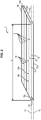
- the first structure 10 is generally trapezoidal (for example parallelepipedal or rectangular) and has a first longitudinal edge 10a extending in a first direction which defines a first axis 11, a second longitudinal edge 10b opposite to the first longitudinal edge 10a and two opposite transverse edges 10c, 10d, extending transversely to the first and second longitudinal edges 10a, 10b.
- the second structure 12 comprising is generally trapezoidal (for example parallelepiped or rectangular) and has a first longitudinal edge 12a extending in a second direction which defines a second axis 13, a second longitudinal edge 12b opposite to the first longitudinal edge 12a and two opposite transverse edges 12c, 12d, extending transversely to the first and second longitudinal edges 12a, 12b.
- the first and second structure 10, 12 may comprise a fabric formed by an interweaving of warp threads (the wire elements of the first and second structure 10, 12) and weft threads.
- the assembly 1 is then a three-dimensional fabric.
- first and the second structure 10, 12 may comprise a knit, in which case the assembly 1 is a three-dimensional knit.
- the reinforcement of the fabric of the first and / or of the second structure 12 may be of the canvas, serge, knit or satin type.
- a weave of the cloth type makes it possible to achieve good mechanical performance.
- one of the first and second structures 10, 12 comprises a fabric, the other of the first and second structures 10, 12 then possibly comprising a knit.
- the assembly 1 can comprise a fabric or a three-dimensional knitting of the plain or double-wall plain weave type, such as for example: the double-wall fabric PF-Farbroller-GR3-7103_01 sold by the company PILE FABRICS GmbH; the knit N-02570-A01 marketed by the company HEATHCOAT FABRICS Limited.
- the assembly 1 further comprises a securing element 18 integrally fixing the first structure 10 on the second structure 12 in order to prevent their respective movement so that the first axis 11 and the second axis 13 are parallel. It will of course be understood that, in this configuration, the first and the second structure 10, 12 are fixed to one another.
- the first axis 11 and the second axis 13 are further superimposed and / or the first and second transverse edges 10a, 12a, 10b, 12b of the first and the second structure 12, respectively, are superimposed.
- the first axis 11 and the second axis 13 (respectively the first and second transverse edges 10a, 12a, 10b, 12b) belong to a determined plane which corresponds to the plane passing through the first axis 11 (respectively the first transverse edge 10a or the second transverse edge 10b) and which is perpendicular to the surface of the first structure 10 when the first structure 10 is laid flat on a flat surface.
- the alignment tolerance of the first axis 11 and of the second axis 13 and the tolerance of superposition of the edges is less than or equal to two millimeters, preferably less than or equal to one millimeter.
- both the first axis 11 and the second axis 13 on the one hand and the transverse edges 10c, 10d, 12c, 12d of the first and of the second structure 12 on the other hand are superimposed, so so that the first and the second structure 10, 12 are perfectly superimposed and aligned (with a tolerance less than or equal to two millimeters, preferably less than or equal to one millimeter). This alignment is also ensured during the entire handling of the assembly 1, until at least its first installation on a tire building drum 5 4, thanks to the securing element 18 which allows their integral fixing. .
- the securing element 18 may comprise at least one of the following elements: an adhesive 18 (as illustrated for example in figures 6a and 6b ), a weld line 18 (as illustrated for example in figures 5a and 5b ) and / or a sewing thread 18 (as illustrated for example in figures 4a and 4b ). A combination of these elements within the same assembly 1 can of course be envisaged.
- the adhesive 18 comprises an industrially non-intrusive glue.
- the adhesive 18 may comprise a glue such as, for example, Loctite 3421 A&B.
- a step of polymerization of the glue may be considered.
- the adhesive 18 can then be applied in spots, as illustrated in the figures 6a and 6b , or linearly (not visible in the figures).
- the weld line 18 can be produced for example by ultrasonic welding, by heating blade, by laser or by high frequencies.
- the weld lines 18 are continuous. This is not, however, limiting, the weld lines 18 possibly being discontinuous, as we will see in what follows.
- the seam can be carried out using a thread 18 capable of withstanding the gluing temperatures.
- the sewing thread therefore has a melting point of greater than 200 ° C.
- certain polyamides and polyesters are likely to be used.
- the sewing thread 18 is then interwoven with the wire elements of the first structure 10 and with the wire elements of the second structure 12, so as to keep them fixed integrally.
- An example of interlacing is for example illustrated in figures 4a and 4b . In this example, the interlacing is carried out according to a regular pitch: an irregular or periodic pitch is however also possible.
- the securing element 18 extends along an axis parallel to the first 11 and to the second axis 13. As we will see below, such a configuration of the securing element 18 then makes it possible to limit assembly offcuts 1 during the production of a sub-assembly 3 1 with a view to manufacturing a tire 4.
- the securing element 18 can be final, that is to say that it does not break when it is subjected to normal handling during the production of the assembly 1, its handling, his bet in place on the rim. Furthermore, the securing element 18 is preferably fixed with respect to the first and second structures 10, 12 and not elastic (that is to say that its length is constant under normal conditions of use) .
- the securing element 18 can extend continuously or discontinuously between the transverse edges of the first and second structures 10, 12.
- the securing element 18 extends over the entire length L of the first structure 10 (which corresponds to the smallest distance between the transverse edges 10c, 10d of the first structure 10 when the first structure 10 is flat or, more simply, the length L of its longitudinal edges 10a, 10b when the first structure 10 is parallelepiped or rectangular).
- the securing element 18 extends over only part of the length L of the first structure 10, preferably over at least 50% of its length L.
- the securing element 18 preferably comprises at least two adjacent segments 19a separated by a distance 19b.
- the distance 19b can in particular be at most equal to one meter. In one embodiment, the distance 19b is less than one meter, preferably less than 75 cm.
- the segments 19a can be punctual, that is to say that their largest dimension is of the order of a few millimeters, or be linear, that is to say that their largest dimension is equal to several centimeters or even several meters. In order to cover at least 50% of the length L of the first structure 10, it will be understood that the number of segments 19a of the securing element 18 increases when their size decreases.
- the width y3 (dimension in the plane of the first structure 10 and extending in a direction perpendicular to the longitudinal edges 10a, 10b of the first structure 10) of the securing element 18 can be continuous over the length L of the first structure 10, or variable.
- a continuous width y3 is however easier to achieve industrially.
- the securing element 18 may extend along and adjacent to one of the longitudinal edges 10a, 10b of the first structure 10 or alternatively at a distance from said longitudinal edge 10a, 10b.
- the assembly 1 can comprise one or more joining elements 18.
- the external face (that is to say the face opposite to the space 2 formed between the first and the second structure 10, 12) of the first structure 10 and the second structure 12 can be impregnated with an elastomeric composition.
- a first step S1 an assembly comprising a first structure 10, a second structure 12 and a supporting structure 14 is supplied.
- This assembly is generally produced beforehand in a manner known per se and / or can be supplied in the form of a roll, for example from the companies PILE FABRICS GmbH or GIRMES INTERNATIONAL GmbH.
- the assembly is supplied in the form of a roll
- the assembly is unwound and laid flat so that one of the first and second structures 10, 12 is on a support surface.
- the first and the second structure 10, 12 are therefore stacked on the support surface, the wire elements of the supporting structure 14 already being interlaced with the wire elements of the first and of the second structure 12.
- a second step S2 the position of the first and of the second structure 10, 12 is adjusted so that the first axis 11 and the second axis 13 become parallel, and where appropriate superimposed.
- their position is also adjusted so that their first transverse edges 10c, 12c and / or their second transverse edges 10d, 12d are superimposed.
- the position of the first and of the second structure 10, 12 is adjusted so that the first axis 11 and the second axis 13 are parallel and superimposed and that their first and second transverse edges 10c, 10d, 12c, 12d are superimposed.
- steps S1, S2 and S3 can be carried out simultaneously or successively, in which case these steps S1, S2 and S3 can be implemented in a different order without thereby departing from the scope of the invention.
- the first and second structure 10, 12 can be flat over their entire length L, or in a variant the assembly can only be unwound in part, the rest of the assembly being unrolled progressively during the third step of the S0 process.
- the first and the second structure 10, 12 are fixedly fixed by at least one securing element 18 in order to prevent their respective movement.
- the first and the second structure 10, 12 can be fixed integrally by a single joining element 18 in order to prevent their respective movement.
- the first and the second structure 10, 12 can be fixed integrally by several distinct joining elements 18.
- the separate securing elements 18 preferably extend parallel to each other, in order to optimize the number of sub-assemblies 3 capable of being manufactured from the assembly 1.
- the fixing S4 can be produced by gluing (in which case the securing element 18 comprises an adhesive 18) (see for example figures 6a and 6b ), by ultrasonic welding (in which case the securing element 18 comprises a weld line 18) (see for example figures 5a and 5b ) and / or by sewing (in which case the securing element 18 comprises a sewing thread 18 (see for example figures 4a and 4b ).
- steps S1 to S4 can be carried out directly at the weaver's premises in the loom used for making the assembly, in order to ensure that the first and the second structure 10, 12 are perfectly aligned and avoid winding and unwinding operations likely to generate alignment difficulties.
- the external face of the first structure 10 and the second structure 12 can be impregnated with an elastomeric composition, typically rubber, for example by calendering. This impregnation can be carried out after the integral attachment S4 of the first and second structure 12 by the attachment element 18.
- an elastomeric composition typically rubber
- the assembly 1 can then be handled and in particular wound around a cylinder with a view to its storage before its use. This handling is in particular facilitated by the integral fixing of the first structure 10 with the second structure 12, which prevents any sliding of one of the structures 10, 12 relative to the other 12, 10.
- the assembly 1 thus obtained can in particular be used in the manufacture S of a tire 4.
- a fifth step S5 the securing element 18 is separated from the first and second structure 12, for example by cutting.
- the cutting of the securing element 18 can be carried out all at once or in several stages, for example by simultaneously or successively cutting the assembly 1 on either side of the securing element 18, over the entire length L of the first structure 10.
- At least one sub-assembly 3 comprising the part of the first structure 10, of the second structure 12 and of the supporting structure 14 which extended from one of the longitudinal edges 10a, 10b from the first structure 10 to the connecting element 18.
- these securing elements 18 can be separated S5 simultaneously or successively from the rest of the assembly 1, so as to form several sub-assemblies 3.
- the sub-assembly (s) 3 can be deburred.
- step S7 one of the sub-assemblies 3 thus obtained is then placed on a building drum 5 with a view to producing a tire 4.
- the integral fixing of the first and second structures 10, 12 using the fastening elements 18 makes it possible to guarantee the correct positioning of the first structure 10 relative to the second structure 12 until they are placed on the building drum 5, even if this withdrawal occurs before said installation, the risks of the first structure 10 slipping relative to the second structure 12 (or vice versa) being mainly due to the handling and storage of the assembly 1.
- annular space 2 delimited radially by an internal face of the first structure 10 and an internal face of the second structure 12 is formed.
- the annular space 2 can for example be formed by inflation.
- the tire 4 is then formed by bringing together and successively fixing a crown and a tread.
- the crown 6 and the tread 7 can be conventional.
Landscapes
- Engineering & Computer Science (AREA)
- Mechanical Engineering (AREA)
- Textile Engineering (AREA)
- Tyre Moulding (AREA)
- Tires In General (AREA)
Applications Claiming Priority (2)
| Application Number | Priority Date | Filing Date | Title |
|---|---|---|---|
| FR1759761 | 2017-10-18 | ||
| PCT/FR2018/052604 WO2019077282A1 (fr) | 2017-10-18 | 2018-10-18 | Procédé de fabrication d'un sous-assemblage pour un pneumatique comprenant un tissu ou un tricot tridimensionnel et utilisant un élément de solidarisation |
Publications (2)
| Publication Number | Publication Date |
|---|---|
| EP3697606A1 EP3697606A1 (fr) | 2020-08-26 |
| EP3697606B1 true EP3697606B1 (fr) | 2021-08-18 |
Family
ID=61223994
Family Applications (1)
| Application Number | Title | Priority Date | Filing Date |
|---|---|---|---|
| EP18800701.7A Active EP3697606B1 (fr) | 2017-10-18 | 2018-10-18 | Procédé de fabrication d'un sous-assemblage pour un pneumatique comprenant un tissu ou un tricot tridimensionnel et utilisant un élément de solidarisation |
Country Status (5)
| Country | Link |
|---|---|
| US (1) | US11518158B2 (cg-RX-API-DMAC7.html) |
| EP (1) | EP3697606B1 (cg-RX-API-DMAC7.html) |
| JP (1) | JP7164604B2 (cg-RX-API-DMAC7.html) |
| CN (1) | CN111246993B (cg-RX-API-DMAC7.html) |
| WO (1) | WO2019077282A1 (cg-RX-API-DMAC7.html) |
Families Citing this family (4)
| Publication number | Priority date | Publication date | Assignee | Title |
|---|---|---|---|---|
| FR3090497B3 (fr) | 2018-12-24 | 2020-12-04 | Michelin & Cie | Assemblage pour un pneumatique, pneumatique et procédés de fabrication associés |
| FR3090498A3 (fr) | 2018-12-24 | 2020-06-26 | Michelin & Cie | Assemblage pour un pneumatique, pneumatique et procédés de fabrication associés |
| FR3098440B1 (fr) * | 2019-07-11 | 2021-07-16 | Michelin & Cie | Assemblage comprenant un tissu déformable plastiquement et une structure porteuse |
| FR3129158B1 (fr) * | 2021-11-15 | 2023-11-10 | Michelin & Cie | Procédé de découpe d’un tissu tridimensionnel comprenant deux nappes de tissu reliées l’une a l’autre par des haubans |
Family Cites Families (7)
| Publication number | Priority date | Publication date | Assignee | Title |
|---|---|---|---|---|
| US3701299A (en) * | 1971-03-02 | 1972-10-31 | Stumpf Guenter | Apparatus for forming stacks of cloth webs which are cut to length |
| DE602004005090T2 (de) * | 2003-02-13 | 2007-12-13 | Société de Technologie Michelin | Formgebung und Anlegen einer Reifengürtellage auf eine Haltevorrichtung |
| FR2986455B1 (fr) * | 2012-02-08 | 2014-10-31 | Michelin & Cie | Renfort composite gaine d'une couche de polymere auto-adherente au caoutchouc |
| FR3038543B1 (fr) | 2015-07-06 | 2017-07-21 | Michelin & Cie | Dispositif de type pneumatique pour vehicule |
| FR3045462B1 (fr) | 2015-12-17 | 2017-12-29 | Michelin & Cie | Ensemble pour pneumatique comprenant des tissu(s) ou tricot(s) impregnes et un moyen de maintien sacrificiel |
| FR3045463B1 (fr) | 2015-12-17 | 2017-12-29 | Michelin & Cie | Assemblage pour pneumatique comprenant des tissu(s) ou tricot(s) comprenant des elements filaires pre-encolles |
| US20180154694A1 (en) * | 2016-12-01 | 2018-06-07 | The Goodyear Tire & Rubber Company | Lightweight tire assembly |
-
2018
- 2018-10-18 US US16/757,118 patent/US11518158B2/en active Active
- 2018-10-18 CN CN201880068315.6A patent/CN111246993B/zh active Active
- 2018-10-18 JP JP2020521879A patent/JP7164604B2/ja active Active
- 2018-10-18 WO PCT/FR2018/052604 patent/WO2019077282A1/fr not_active Ceased
- 2018-10-18 EP EP18800701.7A patent/EP3697606B1/fr active Active
Also Published As
| Publication number | Publication date |
|---|---|
| CN111246993B (zh) | 2021-12-24 |
| US20200238677A1 (en) | 2020-07-30 |
| JP2021500247A (ja) | 2021-01-07 |
| JP7164604B2 (ja) | 2022-11-01 |
| WO2019077282A1 (fr) | 2019-04-25 |
| CN111246993A (zh) | 2020-06-05 |
| EP3697606A1 (fr) | 2020-08-26 |
| US11518158B2 (en) | 2022-12-06 |
Similar Documents
| Publication | Publication Date | Title |
|---|---|---|
| EP3568291B1 (fr) | Assemblage pour pneumatique comprenant une structure rompable et une structure porteuse, pneumatique et procédé de fabrication dudit pneu | |
| EP3902692B1 (fr) | Assemblage pour un pneumatique, pneumatique et procédés de fabrication associés | |
| EP3568289B1 (fr) | Assemblage comprenant une structure élastique et une structure porteuse | |
| EP3390114B1 (fr) | Ensemble pour pneumatique comprenant des tissu(s) ou tricot(s) imprégnés et un moyen de maintien sacrificiel | |
| EP3568290B1 (fr) | Assemblage comprenant un tissu partiellement rompable et une structure porteuse | |
| EP3390115B1 (fr) | Assemblage pour pneumatique comprenant des tissu(s) ou tricot(s) comprenant des éléments filaires pré-encollés | |
| EP3319814B1 (fr) | Dispositif de type pneumatique pour vehicule | |
| EP3697606A1 (fr) | Procédé de fabrication d'un sous-assemblage pour un pneumatique comprenant un tissu ou un tricot tridimensionnel et utilisant un élément de solidarisation | |
| EP3697629B1 (fr) | Assemblage | |
| EP3902687B1 (fr) | Assemblage pour un pneumatique, pneumatique et procédés de fabrication associés | |
| EP1565328B1 (fr) | Pneumatique a mobilite etendue avec flancs ondules | |
| FR2741013A1 (fr) | Pneu radial avec nappe carcasse a soudure par recouvrement oblique | |
| EP3490814A1 (fr) | Dispositif de type pneumatique pour véhicule | |
| FR2745754A1 (fr) | Pneu radial comportant une nappe carcasse dont la soudure par recouvrement est pourvue de decoupes | |
| EP3877199B1 (fr) | Procede de fabrication d'un pneumatique | |
| EP3877165B1 (fr) | Procede de fabrication anti-relaxation d'un pneumatique |
Legal Events
| Date | Code | Title | Description |
|---|---|---|---|
| STAA | Information on the status of an ep patent application or granted ep patent |
Free format text: STATUS: UNKNOWN |
|
| STAA | Information on the status of an ep patent application or granted ep patent |
Free format text: STATUS: THE INTERNATIONAL PUBLICATION HAS BEEN MADE |
|
| PUAI | Public reference made under article 153(3) epc to a published international application that has entered the european phase |
Free format text: ORIGINAL CODE: 0009012 |
|
| STAA | Information on the status of an ep patent application or granted ep patent |
Free format text: STATUS: REQUEST FOR EXAMINATION WAS MADE |
|
| 17P | Request for examination filed |
Effective date: 20200518 |
|
| AK | Designated contracting states |
Kind code of ref document: A1 Designated state(s): AL AT BE BG CH CY CZ DE DK EE ES FI FR GB GR HR HU IE IS IT LI LT LU LV MC MK MT NL NO PL PT RO RS SE SI SK SM TR |
|
| AX | Request for extension of the european patent |
Extension state: BA ME |
|
| DAV | Request for validation of the european patent (deleted) | ||
| DAX | Request for extension of the european patent (deleted) | ||
| GRAP | Despatch of communication of intention to grant a patent |
Free format text: ORIGINAL CODE: EPIDOSNIGR1 |
|
| STAA | Information on the status of an ep patent application or granted ep patent |
Free format text: STATUS: GRANT OF PATENT IS INTENDED |
|
| INTG | Intention to grant announced |
Effective date: 20210504 |
|
| GRAS | Grant fee paid |
Free format text: ORIGINAL CODE: EPIDOSNIGR3 |
|
| GRAA | (expected) grant |
Free format text: ORIGINAL CODE: 0009210 |
|
| STAA | Information on the status of an ep patent application or granted ep patent |
Free format text: STATUS: THE PATENT HAS BEEN GRANTED |
|
| AK | Designated contracting states |
Kind code of ref document: B1 Designated state(s): AL AT BE BG CH CY CZ DE DK EE ES FI FR GB GR HR HU IE IS IT LI LT LU LV MC MK MT NL NO PL PT RO RS SE SI SK SM TR |
|
| REG | Reference to a national code |
Ref country code: GB Ref legal event code: FG4D Free format text: NOT ENGLISH |
|
| REG | Reference to a national code |
Ref country code: CH Ref legal event code: EP |
|
| REG | Reference to a national code |
Ref country code: DE Ref legal event code: R096 Ref document number: 602018022155 Country of ref document: DE |
|
| REG | Reference to a national code |
Ref country code: IE Ref legal event code: FG4D Free format text: LANGUAGE OF EP DOCUMENT: FRENCH Ref country code: AT Ref legal event code: REF Ref document number: 1421260 Country of ref document: AT Kind code of ref document: T Effective date: 20210915 |
|
| REG | Reference to a national code |
Ref country code: LT Ref legal event code: MG9D |
|
| REG | Reference to a national code |
Ref country code: NL Ref legal event code: MP Effective date: 20210818 |
|
| REG | Reference to a national code |
Ref country code: AT Ref legal event code: MK05 Ref document number: 1421260 Country of ref document: AT Kind code of ref document: T Effective date: 20210818 |
|
| PG25 | Lapsed in a contracting state [announced via postgrant information from national office to epo] |
Ref country code: SE Free format text: LAPSE BECAUSE OF FAILURE TO SUBMIT A TRANSLATION OF THE DESCRIPTION OR TO PAY THE FEE WITHIN THE PRESCRIBED TIME-LIMIT Effective date: 20210818 Ref country code: RS Free format text: LAPSE BECAUSE OF FAILURE TO SUBMIT A TRANSLATION OF THE DESCRIPTION OR TO PAY THE FEE WITHIN THE PRESCRIBED TIME-LIMIT Effective date: 20210818 Ref country code: HR Free format text: LAPSE BECAUSE OF FAILURE TO SUBMIT A TRANSLATION OF THE DESCRIPTION OR TO PAY THE FEE WITHIN THE PRESCRIBED TIME-LIMIT Effective date: 20210818 Ref country code: FI Free format text: LAPSE BECAUSE OF FAILURE TO SUBMIT A TRANSLATION OF THE DESCRIPTION OR TO PAY THE FEE WITHIN THE PRESCRIBED TIME-LIMIT Effective date: 20210818 Ref country code: ES Free format text: LAPSE BECAUSE OF FAILURE TO SUBMIT A TRANSLATION OF THE DESCRIPTION OR TO PAY THE FEE WITHIN THE PRESCRIBED TIME-LIMIT Effective date: 20210818 Ref country code: BG Free format text: LAPSE BECAUSE OF FAILURE TO SUBMIT A TRANSLATION OF THE DESCRIPTION OR TO PAY THE FEE WITHIN THE PRESCRIBED TIME-LIMIT Effective date: 20211118 Ref country code: AT Free format text: LAPSE BECAUSE OF FAILURE TO SUBMIT A TRANSLATION OF THE DESCRIPTION OR TO PAY THE FEE WITHIN THE PRESCRIBED TIME-LIMIT Effective date: 20210818 Ref country code: LT Free format text: LAPSE BECAUSE OF FAILURE TO SUBMIT A TRANSLATION OF THE DESCRIPTION OR TO PAY THE FEE WITHIN THE PRESCRIBED TIME-LIMIT Effective date: 20210818 Ref country code: PT Free format text: LAPSE BECAUSE OF FAILURE TO SUBMIT A TRANSLATION OF THE DESCRIPTION OR TO PAY THE FEE WITHIN THE PRESCRIBED TIME-LIMIT Effective date: 20211220 Ref country code: NO Free format text: LAPSE BECAUSE OF FAILURE TO SUBMIT A TRANSLATION OF THE DESCRIPTION OR TO PAY THE FEE WITHIN THE PRESCRIBED TIME-LIMIT Effective date: 20211118 |
|
| PG25 | Lapsed in a contracting state [announced via postgrant information from national office to epo] |
Ref country code: PL Free format text: LAPSE BECAUSE OF FAILURE TO SUBMIT A TRANSLATION OF THE DESCRIPTION OR TO PAY THE FEE WITHIN THE PRESCRIBED TIME-LIMIT Effective date: 20210818 Ref country code: LV Free format text: LAPSE BECAUSE OF FAILURE TO SUBMIT A TRANSLATION OF THE DESCRIPTION OR TO PAY THE FEE WITHIN THE PRESCRIBED TIME-LIMIT Effective date: 20210818 Ref country code: GR Free format text: LAPSE BECAUSE OF FAILURE TO SUBMIT A TRANSLATION OF THE DESCRIPTION OR TO PAY THE FEE WITHIN THE PRESCRIBED TIME-LIMIT Effective date: 20211119 |
|
| PG25 | Lapsed in a contracting state [announced via postgrant information from national office to epo] |
Ref country code: NL Free format text: LAPSE BECAUSE OF FAILURE TO SUBMIT A TRANSLATION OF THE DESCRIPTION OR TO PAY THE FEE WITHIN THE PRESCRIBED TIME-LIMIT Effective date: 20210818 |
|
| PG25 | Lapsed in a contracting state [announced via postgrant information from national office to epo] |
Ref country code: DK Free format text: LAPSE BECAUSE OF FAILURE TO SUBMIT A TRANSLATION OF THE DESCRIPTION OR TO PAY THE FEE WITHIN THE PRESCRIBED TIME-LIMIT Effective date: 20210818 |
|
| REG | Reference to a national code |
Ref country code: DE Ref legal event code: R119 Ref document number: 602018022155 Country of ref document: DE |
|
| PG25 | Lapsed in a contracting state [announced via postgrant information from national office to epo] |
Ref country code: SM Free format text: LAPSE BECAUSE OF FAILURE TO SUBMIT A TRANSLATION OF THE DESCRIPTION OR TO PAY THE FEE WITHIN THE PRESCRIBED TIME-LIMIT Effective date: 20210818 Ref country code: SK Free format text: LAPSE BECAUSE OF FAILURE TO SUBMIT A TRANSLATION OF THE DESCRIPTION OR TO PAY THE FEE WITHIN THE PRESCRIBED TIME-LIMIT Effective date: 20210818 Ref country code: RO Free format text: LAPSE BECAUSE OF FAILURE TO SUBMIT A TRANSLATION OF THE DESCRIPTION OR TO PAY THE FEE WITHIN THE PRESCRIBED TIME-LIMIT Effective date: 20210818 Ref country code: EE Free format text: LAPSE BECAUSE OF FAILURE TO SUBMIT A TRANSLATION OF THE DESCRIPTION OR TO PAY THE FEE WITHIN THE PRESCRIBED TIME-LIMIT Effective date: 20210818 Ref country code: CZ Free format text: LAPSE BECAUSE OF FAILURE TO SUBMIT A TRANSLATION OF THE DESCRIPTION OR TO PAY THE FEE WITHIN THE PRESCRIBED TIME-LIMIT Effective date: 20210818 Ref country code: AL Free format text: LAPSE BECAUSE OF FAILURE TO SUBMIT A TRANSLATION OF THE DESCRIPTION OR TO PAY THE FEE WITHIN THE PRESCRIBED TIME-LIMIT Effective date: 20210818 |
|
| REG | Reference to a national code |
Ref country code: CH Ref legal event code: PL |
|
| REG | Reference to a national code |
Ref country code: BE Ref legal event code: MM Effective date: 20211031 |
|
| PLBE | No opposition filed within time limit |
Free format text: ORIGINAL CODE: 0009261 |
|
| STAA | Information on the status of an ep patent application or granted ep patent |
Free format text: STATUS: NO OPPOSITION FILED WITHIN TIME LIMIT |
|
| PG25 | Lapsed in a contracting state [announced via postgrant information from national office to epo] |
Ref country code: MC Free format text: LAPSE BECAUSE OF FAILURE TO SUBMIT A TRANSLATION OF THE DESCRIPTION OR TO PAY THE FEE WITHIN THE PRESCRIBED TIME-LIMIT Effective date: 20210818 |
|
| 26N | No opposition filed |
Effective date: 20220519 |
|
| PG25 | Lapsed in a contracting state [announced via postgrant information from national office to epo] |
Ref country code: LU Free format text: LAPSE BECAUSE OF NON-PAYMENT OF DUE FEES Effective date: 20211018 Ref country code: IT Free format text: LAPSE BECAUSE OF FAILURE TO SUBMIT A TRANSLATION OF THE DESCRIPTION OR TO PAY THE FEE WITHIN THE PRESCRIBED TIME-LIMIT Effective date: 20210818 Ref country code: DE Free format text: LAPSE BECAUSE OF NON-PAYMENT OF DUE FEES Effective date: 20220503 Ref country code: BE Free format text: LAPSE BECAUSE OF NON-PAYMENT OF DUE FEES Effective date: 20211031 |
|
| PG25 | Lapsed in a contracting state [announced via postgrant information from national office to epo] |
Ref country code: SI Free format text: LAPSE BECAUSE OF FAILURE TO SUBMIT A TRANSLATION OF THE DESCRIPTION OR TO PAY THE FEE WITHIN THE PRESCRIBED TIME-LIMIT Effective date: 20210818 Ref country code: LI Free format text: LAPSE BECAUSE OF NON-PAYMENT OF DUE FEES Effective date: 20211031 Ref country code: CH Free format text: LAPSE BECAUSE OF NON-PAYMENT OF DUE FEES Effective date: 20211031 |
|
| PG25 | Lapsed in a contracting state [announced via postgrant information from national office to epo] |
Ref country code: IE Free format text: LAPSE BECAUSE OF NON-PAYMENT OF DUE FEES Effective date: 20211018 |
|
| GBPC | Gb: european patent ceased through non-payment of renewal fee |
Effective date: 20221018 |
|
| PG25 | Lapsed in a contracting state [announced via postgrant information from national office to epo] |
Ref country code: CY Free format text: LAPSE BECAUSE OF FAILURE TO SUBMIT A TRANSLATION OF THE DESCRIPTION OR TO PAY THE FEE WITHIN THE PRESCRIBED TIME-LIMIT Effective date: 20210818 |
|
| PG25 | Lapsed in a contracting state [announced via postgrant information from national office to epo] |
Ref country code: HU Free format text: LAPSE BECAUSE OF FAILURE TO SUBMIT A TRANSLATION OF THE DESCRIPTION OR TO PAY THE FEE WITHIN THE PRESCRIBED TIME-LIMIT; INVALID AB INITIO Effective date: 20181018 |
|
| PG25 | Lapsed in a contracting state [announced via postgrant information from national office to epo] |
Ref country code: GB Free format text: LAPSE BECAUSE OF NON-PAYMENT OF DUE FEES Effective date: 20221018 |
|
| PG25 | Lapsed in a contracting state [announced via postgrant information from national office to epo] |
Ref country code: MK Free format text: LAPSE BECAUSE OF FAILURE TO SUBMIT A TRANSLATION OF THE DESCRIPTION OR TO PAY THE FEE WITHIN THE PRESCRIBED TIME-LIMIT Effective date: 20210818 |
|
| PG25 | Lapsed in a contracting state [announced via postgrant information from national office to epo] |
Ref country code: MT Free format text: LAPSE BECAUSE OF FAILURE TO SUBMIT A TRANSLATION OF THE DESCRIPTION OR TO PAY THE FEE WITHIN THE PRESCRIBED TIME-LIMIT Effective date: 20210818 |
|
| PG25 | Lapsed in a contracting state [announced via postgrant information from national office to epo] |
Ref country code: TR Free format text: LAPSE BECAUSE OF FAILURE TO SUBMIT A TRANSLATION OF THE DESCRIPTION OR TO PAY THE FEE WITHIN THE PRESCRIBED TIME-LIMIT Effective date: 20210818 |
|
| PGFP | Annual fee paid to national office [announced via postgrant information from national office to epo] |
Ref country code: FR Payment date: 20251030 Year of fee payment: 8 |