EP3695476B1 - Arc detection based on variance of current flow - Google Patents
Arc detection based on variance of current flow Download PDFInfo
- Publication number
- EP3695476B1 EP3695476B1 EP18865486.7A EP18865486A EP3695476B1 EP 3695476 B1 EP3695476 B1 EP 3695476B1 EP 18865486 A EP18865486 A EP 18865486A EP 3695476 B1 EP3695476 B1 EP 3695476B1
- Authority
- EP
- European Patent Office
- Prior art keywords
- variance
- processor
- current
- current values
- arc
- Prior art date
- Legal status (The legal status is an assumption and is not a legal conclusion. Google has not performed a legal analysis and makes no representation as to the accuracy of the status listed.)
- Active
Links
Images





Classifications
-
- H—ELECTRICITY
- H02—GENERATION; CONVERSION OR DISTRIBUTION OF ELECTRIC POWER
- H02H—EMERGENCY PROTECTIVE CIRCUIT ARRANGEMENTS
- H02H1/00—Details of emergency protective circuit arrangements
- H02H1/0007—Details of emergency protective circuit arrangements concerning the detecting means
- H02H1/0015—Using arc detectors
-
- G—PHYSICS
- G01—MEASURING; TESTING
- G01R—MEASURING ELECTRIC VARIABLES; MEASURING MAGNETIC VARIABLES
- G01R31/00—Arrangements for testing electric properties; Arrangements for locating electric faults; Arrangements for electrical testing characterised by what is being tested not provided for elsewhere
- G01R31/005—Testing of electric installations on transport means
- G01R31/006—Testing of electric installations on transport means on road vehicles, e.g. automobiles or trucks
-
- G—PHYSICS
- G01—MEASURING; TESTING
- G01R—MEASURING ELECTRIC VARIABLES; MEASURING MAGNETIC VARIABLES
- G01R31/00—Arrangements for testing electric properties; Arrangements for locating electric faults; Arrangements for electrical testing characterised by what is being tested not provided for elsewhere
- G01R31/08—Locating faults in cables, transmission lines, or networks
- G01R31/088—Aspects of digital computing
-
- G—PHYSICS
- G01—MEASURING; TESTING
- G01R—MEASURING ELECTRIC VARIABLES; MEASURING MAGNETIC VARIABLES
- G01R31/00—Arrangements for testing electric properties; Arrangements for locating electric faults; Arrangements for electrical testing characterised by what is being tested not provided for elsewhere
- G01R31/50—Testing of electric apparatus, lines, cables or components for short-circuits, continuity, leakage current or incorrect line connections
- G01R31/52—Testing for short-circuits, leakage current or ground faults
-
- G—PHYSICS
- G05—CONTROLLING; REGULATING
- G05B—CONTROL OR REGULATING SYSTEMS IN GENERAL; FUNCTIONAL ELEMENTS OF SUCH SYSTEMS; MONITORING OR TESTING ARRANGEMENTS FOR SUCH SYSTEMS OR ELEMENTS
- G05B1/00—Comparing elements, i.e. elements for effecting comparison directly or indirectly between a desired value and existing or anticipated values
- G05B1/01—Comparing elements, i.e. elements for effecting comparison directly or indirectly between a desired value and existing or anticipated values electric
-
- H—ELECTRICITY
- H02—GENERATION; CONVERSION OR DISTRIBUTION OF ELECTRIC POWER
- H02H—EMERGENCY PROTECTIVE CIRCUIT ARRANGEMENTS
- H02H3/00—Emergency protective circuit arrangements for automatic disconnection directly responsive to an undesired change from normal electric working condition with or without subsequent reconnection ; integrated protection
- H02H3/08—Emergency protective circuit arrangements for automatic disconnection directly responsive to an undesired change from normal electric working condition with or without subsequent reconnection ; integrated protection responsive to excess current
-
- G—PHYSICS
- G05—CONTROLLING; REGULATING
- G05B—CONTROL OR REGULATING SYSTEMS IN GENERAL; FUNCTIONAL ELEMENTS OF SUCH SYSTEMS; MONITORING OR TESTING ARRANGEMENTS FOR SUCH SYSTEMS OR ELEMENTS
- G05B23/00—Testing or monitoring of control systems or parts thereof
- G05B23/02—Electric testing or monitoring
- G05B23/0205—Electric testing or monitoring by means of a monitoring system capable of detecting and responding to faults
- G05B23/0218—Electric testing or monitoring by means of a monitoring system capable of detecting and responding to faults characterised by the fault detection method dealing with either existing or incipient faults
- G05B23/0224—Process history based detection method, e.g. whereby history implies the availability of large amounts of data
- G05B23/0227—Qualitative history assessment, whereby the type of data acted upon, e.g. waveforms, images or patterns, is not relevant, e.g. rule based assessment; if-then decisions
- G05B23/0235—Qualitative history assessment, whereby the type of data acted upon, e.g. waveforms, images or patterns, is not relevant, e.g. rule based assessment; if-then decisions based on a comparison with predetermined threshold or range, e.g. "classical methods", carried out during normal operation; threshold adaptation or choice; when or how to compare with the threshold
-
- H—ELECTRICITY
- H02—GENERATION; CONVERSION OR DISTRIBUTION OF ELECTRIC POWER
- H02H—EMERGENCY PROTECTIVE CIRCUIT ARRANGEMENTS
- H02H1/00—Details of emergency protective circuit arrangements
- H02H1/0092—Details of emergency protective circuit arrangements concerning the data processing means, e.g. expert systems, neural networks
-
- H—ELECTRICITY
- H02—GENERATION; CONVERSION OR DISTRIBUTION OF ELECTRIC POWER
- H02H—EMERGENCY PROTECTIVE CIRCUIT ARRANGEMENTS
- H02H3/00—Emergency protective circuit arrangements for automatic disconnection directly responsive to an undesired change from normal electric working condition with or without subsequent reconnection ; integrated protection
- H02H3/50—Emergency protective circuit arrangements for automatic disconnection directly responsive to an undesired change from normal electric working condition with or without subsequent reconnection ; integrated protection responsive to the appearance of abnormal wave forms, e.g. AC in DC installations
Definitions
- the present disclosure generally relates to detecting current arcs and particularly to detecting current arcs in circuits.
- Electrical distribution systems are found in many settings. For example, residential buildings, commercial buildings, industrial settings, automobiles, airplanes, ships, trains, etc. all typically have some type of electrical distribution system. Various faults in an electrical distribution system may lead to the occurrence of arcing, which carries a risk of fire and/or heat damage to the system.
- US 2009/284265 A1 relates to: 'An arc detecting device includes: a detector for acquiring time series data concerning a characteristic quantity, such as a voltage or a current in a circuit, targeted for detecting an arc; a basic data generator for generating basic data made of a plurality of frequency components, through frequency analysis from the acquired time series data; a data processor for statistically processing the generated basic data, thereby converting the basic data to an evaluation value highly correlative to an occurrence of the arc; and an arc judging unit for judging the occurrence of the arc, if the evaluation value exceeds a predetermined arc judgment threshold value.
- the arc detecting device that is capable of effectively detecting the arc in a direct-current power supply circuit is provided.
- US 2007/085548 A1 relates to an insulation degradation diagnostic device comprises a current transformer, a first amplifier, a first high-pass filter, a low-pass filter, a second amplifier, a second high-pass filter and a discharge judgment section.
- the feedback control mechanism includes features for receiving data points relating to an output of the tool.
- the data points include a current data point and at least one previous data point.
- the feedback control mechanism also includes features for determining whether the current data point is an erroneous outlier by comparing the current data point to a statistical representation of the at least one previous data point, and based on whether the at least one previous data point is an outlier.
- the feedback control mechanism further includes features for disregarding the current data point in calculating a feedback value of the feedback control mechanism if the current data point is determined as an erroneous outlier.
- the present invention provides an apparatus according to claim 1. Preferred embodiments are defined in dependent claims. The invention is set out in the appended set of claims.
- Current arc detectors and methods of detecting current arcs are provided. The embodiments detailed herein are described in the context of an automobile electrical distribution system. However, this is done for convenience and clarity of presentation and not to be limiting.
- the current variance arc detectors detailed herein, and the associated methods can be provided to detect arcs in electrical distribution systems implemented in other areas, outside automobiles, such as, for example, avionics, aerospace, residential, commercial, or other settings where arc detection in electrical distribution systems is desired.
- an electrical distribution system can develop either a serial or a parallel arc.
- serial arcing the main current continues to flow through the supplied electric load and therefore does not increase beyond expected nominal current values, which makes detection of a serial arcing fault difficult to achieve.
- parallel arcing a new current path in parallel to the connected load forms.
- the arcing current can reach short circuit current values and be detected by conventional circuit protection systems.
- parallel arcing can remain unnoticed. Accordingly, many conventional devices are unable to detect arcing in high impedance systems as the arcing current is below a threshold value and/or cannot be distinguished from the normal operating condition currents.
- Arcing is typically accompanied by the generation of disturbances and electromagnetic radiation with a broad frequency spectrum. Arc signatures related to these disturbances are used to detect arcs.
- complicating arc detection in automotive systems is the fact that operating conditions of many electric loads in an automotive power distribution system lead to diverse time-current curves. Many loads are switched on and off with different transient behaviors. Pulse-modulated controlled loads or switching converters create numerous disturbances in the distribution system. All these factors complicate arc detection as clear and consistent arc signatures are difficult to determine.
- FIG. 1 illustrates an electrical distribution system 100 in accordance with an exemplary embodiment.
- the electrical distribution system 100 includes a battery 110 coupled to several loads 120.
- the electrical distribution system 100 could be implemented in an automotive vehicle.
- the battery 110 may be a single battery or several batteries.
- battery 110 could be a bank of batteries coupled in series, parallel, or some combination of series and parallel connection.
- the battery 110 may be any of a variety of types of batteries.
- battery 110 could be a lead-acid based battery, a nickel-cadmium (NiCad) based battery, a nickel-metal hydride based battery, a lithium-ion (Li-ion) based battery, a Li-ion polymer based battery, a zinc-air based battery, or a molten-salt battery. Examples are not limited in this context.
- loads 120 could be any of a variety of loads arranged to draw power from the battery 110. That is, loads 120 could be DC loads in an electrical distribution system, such an automotive distribution system. For example, loads 120 could be any number or combination of motors, relays, pumps, safety devices, entertainment devices, or the like. Examples are not limited in this context.
- the current variance arc fault detector 130 is coupled between the battery 110 and the loads 120. In general, the current variance arc fault detector 130 is arranged to detect current arc faults between the battery 110 and one (or more) of the loads 120. Additionally, the current variance arc fault detector 130 is arranged to detect current arc faults between one (or more) of the loads 120 and ground. As used herein, a current arc fault is an electrical breakdown of the resistance of air resulting in an electric arc. Arc faults can occur where there is sufficient voltage in the electrical distribution system 100 and a path to a lower voltage or ground. Examples of such arc faults are serial arc faults, parallel arc faults and ground arc faults.
- the current variance arc fault detector 130 is configured to detect, based on a variance of periodic current measurements, an arc fault in the electrical distribution system 100.
- the current variance arc fault detector 130 can repeatedly measure a current flow between battery 110 and loads 120, derive a variance between the values of the repeatedly measured current flow values, and determine whether a current arc fault is present between the battery 110 and one (or more) of the loads 120 or between one (or more) of the loads 120 and ground based on the derived variance.
- current variance arc fault detector 130 could be arranged to repeatedly measure current between the battery and several of the loads 120 to determine the presence of an arc fault on any one of the load branches within the electrical distribution system 100.
- FIG. 2 illustrates an electrical distribution system 200 in accordance with an exemplary embodiment.
- the electrical distribution system 200 includes a source 210 coupled to several loads 220.
- the source 210 is an alternating current (AC) power source.
- the source 210 could be a single-phase source, or a multiple (e.g., 3, or the like) phase source.
- the electrical distribution system 200 could be implemented in any of a variety of settings, such as, for example, industrial, commercial, residential, transportations, or the like.
- loads 220 could be any of a variety of loads arranged to draw power from the source 210.
- loads 220 could be AC loads in an electrical distribution system.
- loads 220 could be any number or combination of motors, relays, pumps, safety devices, entertainment devices, or the like. Examples are not limited in this context.
- the current variance arc fault detector 230 is coupled between the source 210 and the loads 220.
- the current variance arc fault detector 230 is arranged to detect current arc faults between the source 210 and one (or more) of the loads 220.
- arc faults within distribution system 200 could occur between phases of source 210, between a phase of source 210 and ground, or between a phase of source 210 and neutral.
- arc faults could occur between loads 220 or between one (or more) loads 220 and ground.
- an arc fault could develop within a panel in which loads 220 are coupled to source 210.
- the current variance arc fault detector 230 may be arranged to detect any such arc faults.
- the current variance arc fault detector 230 is configured to detect, based on a variance of periodic current measurements, an arc fault in the electrical distribution system 200.
- the current variance arc fault detector 230 can repeatedly measure a current flow between source 210 and loads 220, derive a variance between the values of the repeatedly measured current flow values, and determine whether a current arc fault is present between the source 210 and one of the loads 220 or between one of the loads 220 and ground based on the derived variance.
- current variance arc fault detector 230 could be arranged to repeatedly measure current between the source 210 and several of the loads 220 to determine the presence of an arc fault on any one of the load branches within the electrical distribution system 200.
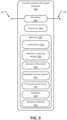
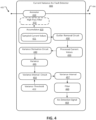
- FIGS. 3-4 depict example embodiments of current variance arc fault detectors 300 and 400, respectively.
- Current variance arc fault detectors 300 and 400 could be implemented in the electrical distribution system 100 and/or 200, for example, as current variance arc fault detector 130, 230, etc. It is noted, however, that current variance arc fault detectors 300 and 400 are described with reference to the electrical distribution system 100 of FIG. 1 for purposes of convenience and not limitation.
- the current variance arc fault detectors 300 and 400 could be implemented in an electrical distribution system different from the electrical distribution system 100 depicted in FIG. 1 , such as, for example, the distribution system 200 of FIG 2 .
- reference to a battery, DC source, or other type of feature from distribution system 100 is done for example only and not to be limiting.
- Current variance arc fault detector 300 includes terminals 302 and 304, which can couple to a source and load, respectively, in an electrical distribution system.
- terminal 302 could couple to battery 110 while terminal 304 can couple to one (or more) of loads 120 from the electrical distribution system 100 of FIG. 1 .
- Current variance arc fault detector 300 includes an ammeter 310 coupled in series between terminals 302 and 304.
- Ammeter 310 is arranged to measure a current flowing between terminals 302 and 304.
- ammeter 310 can measure a current flowing between a source and a load in an electrical distribution system, such as, current flowing between battery 110 and one (or more) of loads 120.
- ammeter 210 could be a hall effect sensor, a shunt, or a rogowski coil.
- other current sensor devices and/or circuits arranged to measure a current could be implemented without departing from the scope of the claimed subject matter.
- Current variance arc detector 300 further includes processor 320 and a memory 330.
- Processor 320 can be any of a variety of processors, such as, for example, a microprocessor, a general-purpose processor, an application specific integrated circuit, or a field programmable gate array.
- Memory 330 can be any of a variety of computer-readable mediums arranged to store, in a non-transitory manner, instructions 332, machine learning model 334, and a variance threshold 336.
- Instructions 332 can comprise instructions, executable by processor 320, which when executed by processor 320 cause current variance arc fault detector 300 to implement any of a variety of actions as described herein. Instructions 332 can be firmware for current variance arc fault detector 300 arranged to enable current variance arc fault detector 300 to detect an arc fault as detailed herein.
- Machine learning model 334 can be a machine-leaning model, executable by processor 320, to cause current variance arc fault detector 300 to detect an arc fault as detailed herein.
- machine learning model 334 could be a neural network, a fuzzy logic model, convolutional network, or other such model trained to detect arc faults as detailed herein.
- processor 320 in executing instructions 332, can cause ammeter 310 to repeatedly measure current flowing between terminals 302 and 304.
- processor 320 in executing instructions 332, can cause ammeter 310 to periodically measure current flowing between terminals 302 and 304.
- processor 320 in executing instructions 332, can cause ammeter 310 to measure current flowing between terminals 302 and 304 at a sampling rate between 0.1 and 5 mega-samples per second (MS/s).
- processor 320 in executing instructions 332, can cause ammeter 310 to measure current flowing between terminals 302 and 304 at a sampling rate of 1 MS/s.
- Processor 320, in executing instructions 332 can store, in memory 330, the repeatedly (or periodically) measured current values as sampled current values 331.
- Processor 320 in executing instructions 332, can identify and remove outliers from the sampled current values.
- processor 320 in executing instructions 332, identifies and removes outliers from a portion of the sampled current values, such as, a range of recent current values (e.g., 250 to 100,000, or the like).
- processor 320 in executing instructions 332, can process the most recent 1,000 samples from sampled current values and can identify and remove outliers from the 1,000 most recent samples.
- outliers are identified and removed based on a confidence interval of twice the standard deviation within the data set (e.g., most recent 1,000 sampled current values 331, or the like).
- the processor 320 in executing instructions 332, can store, in memory 330, the subset of current values with outliers removed as processed current values 333.
- processor 320 in executing instructions 332, can prefilter sampled current values 331.
- Processor 320, in executing instructions 332 could apply filtering, such as, high pass filtering, to sampled current values 331 before and/or in conjunction with identifying and removing outliers as described above.
- processor 320, in executing instructions 332 could apply a high pass filter with a cut-off frequency of between 40 kilo Hertz (kHz) and 200 kHz to sampled current values 331.
- Processor 320 in executing instructions 332, can derive, calculate, or determine, a variance of the processed current values 333 and can store, in memory 330, the derived variance as variance 335.
- Processor 320 in executing instructions 332, can determine whether the variance 335 exceeds variance threshold 336.
- Processor 320 in executing instructions 332, increment a variance interval 337 based on a determination that the variance 335 exceeds the variance threshold 336.
- variance interval 337 is incremented 0.001 each cycle that processor 320 determines the variance 335 exceeds the variance threshold 336.
- Processor 320 in executing instructions 332, can reset variance interval 337 to zero based on a determination that that variance 335 does not exceed the variance threshold 336.
- the variance threshold 336 can be a maximum level of the variance observed during normal operation of the monitored load branch where arcing is not present. Said differently, the variance threshold 336 may be determined in advance and programmed based on the type and/or specific circuit to be monitored for arcing.
- Processor 320 in executing machine learning model 334, can determine whether an arc fault exists in the electrical distribution line corresponding to terminals 302 and 304 based on the variance interval 337. For example, processor 320, in executing machine learning model 334, can detect an arc fault between battery 110 and one of loads 120 (or between load(s) 120 and ground) based on the determined variance interval 337. This is described in greater detail below, for example, with reference to FIG. 5 and FIGS. 6A-6D .
- Current variance arc fault detector 400 includes terminals 402 and 404, which can couple to a source and load, respectively, in an electrical distribution system.
- terminal 402 could couple to battery 110 while terminal 404 can couple to one (or more) of loads 120 from the electrical distribution system 100 of FIG. 1 .
- Current variance arc fault detector 400 includes an ammeter 410 coupled in series between terminals 402 and 404.
- Ammeter 410 is arranged to measure a current flowing between terminals 402 and 404.
- ammeter 410 can measure a current flowing between a source and a load in an electrical distribution system, such as, current flowing between battery 110 and one (or more) of loads 120.
- ammeter 410 could be a hall effect sensor, a shunt, or a rogowski coil.
- Current variance arc fault detector 400 additionally includes an accumulator 420, an outlier removal circuit 430, a variance derivation circuit 440, a variance interval circuit 450 and a filter 460. Furthermore, current variance arc fault detector 400 could include a memory (e.g., registers, flash, random access memory, or the like) arranged to store values as described herein. However, memory is not depicted within this figure for purposes of convenience.
- a memory e.g., registers, flash, random access memory, or the like
- Accumulator 420 is arranged to accumulate sampled current values 421.
- Sampled current values 421 can be current values measured by ammeter 410 on a repeating basis. The repeating basis can be periodic.
- accumulator 420 can be arranged to store measured current values at a sampling rate of between 0.1 and 5 mega-samples per second (MS/s).
- accumulator 420 can be arranged to store measured current values at a sampling rate of 1 MS/s.
- Accumulator 420 can store the measured current values as sampled current values 421.
- accumulator 420 can be arranged to store a specified number of measured current values, such as, for example, 250 to 100,000.
- accumulator 420 can store 1,000 measured current values as sampled current values 421.
- Accumulator 420 could be arranged with registers or a buffer to store measured current values.
- accumulator 420 could include a first in first out (FIFO) buffer arranged to store the most recent (e.g., 1,000, or the like) current values measured by ammeter 410.
- FIFO first in first out
- Current variance arc fault detector 400 could optionally include a high-pass filter 470 arranged between ammeter 410 and accumulator 420.
- High-pass filter 470 could be, for example, a butterworth filter (or the like) arranged to with a cut-off frequency of between 40 kHz and 200 kHz.
- High-pass filter 470 could be implemented to filter raw current values measured by ammeter 410 and only pass current values above the cut-off frequency to accumulator 420.
- Outlier removal circuit 430 is arranged to identify and remove outliers from sampled current values 421.
- outlier removal circuit 430 removes outliers based on a confidence interval of twice the standard deviation within the data set (e.g., sampled current values 421) and stores (e.g., in memory, or the like) the sampled current values with outliers removed as processed current values 433.
- outlier removal circuit 430 can be a logical circuit comprised of gates, transistors, and/or registers arranged to average sampled current values and remove ones of the sampled current values outside a defined limit of the average.
- outlier removal circuit can 430 be an FPGA arranged to generate processed current values 433 from sampled current values 421 as discussed above.
- Variance derivation circuit 440 can derive, calculate, or determine, a variance of the processed current values 433 and can store the derived variance as variance 445.
- variance derivation circuit 440 can be a logical circuit comprised of gates, transistors, and/or registers arranged to determine a variance between the processed current values and store (e.g., in memory, or the like) the derived variance as variance 445.
- variance deviation circuit can 440 be an FPGA arranged to generate variance 445 from processed current values 433 as discussed above.
- Variance interval circuit 450 can increment a variance interval 457 based on a determination that the variance 445 exceeds a variance threshold 452. In some examples, variance interval 457 is incremented 0.001 each cycle that variance interval circuit 450 determines variance 445 exceeds variance threshold 452. Additionally, variance interval circuit 450 can reset variance interval 457 to zero based on a determination that variance 445 does not exceeds variance threshold 452. With some examples, the variance threshold 452 can be a maximum level of the variance observed during normal operation of the monitored load branch where arcing is not present. Said differently, the variance threshold 452 may be determined in advance and programmed based on the type and/or specific circuit to be monitored for arcing.
- Filter 460 can output arc detection signal 469 based on an input of variance interval 457.
- filter 460 can be a machine learning model (e.g., neural network, convolutional network, fuzzy logic model, or the like) arranged to operate as a low pass filter.
- filter 460 can be a low pass filter tuned to output arc detection signal 469 from variance interval 457.
- FIG. 5 depicts a logic flow 500, which can be implemented by the current variance arc fault detectors described herein.
- logic flow 500 can be implemented by current variance arc fault detector 130, current variance arc fault detector 230, current variance arc fault detector 300 and/or current variance arc fault detector 400.
- logic flow 500 could be implemented by a current variance arc fault detector different than those described herein without departing from the sprit and scope of the disclosure.
- FIGS. 6A-6D depict waveforms, or time curves, of several signals which may be measured and/or determined according to the present disclosure.
- FIG. 6A depicts a time curve 610 of measured load current
- FIG. 6B depicts a time curve 620 of derived variance
- FIG. 6C depicts a time curve 630 of a determined variance interval
- FIG. 6D depicts a time curve 640 of an arc detection signal.
- Logic flow 500 may begin with block 510.
- block 510 "periodically measure current values between a source and a load” current values between a source and a load are periodically measured.
- processor 320 in executing instructions 332, can cause ammeter 310 to periodically measure current values between a source (e.g., battery 110) and a load (e.g., load 120). These periodically measured current values can be stored as sampled current values 331.
- FIG 6A depicts an example time curve 610 illustrating periodically measured current values 611 between the source and the load.
- a variance of the periodically measured current values can be derived.
- processor 320 in executing instructions 332, can derive a variance of the sampled current values, 331, or the values measured at block 510.
- FIG 6B depicts an example time curve 620 illustrating the derived variance 621 of the periodically measured current values 611 between the source and the load.
- decision block 530 "is the variance greater than a threshold variance?" it can be determined whether the variance is greater than a threshold variance.
- processor 320 in executing instructions 332, can determine whether the variance derived at block 520 is greater than a threshold variance value.
- Logic flow 500 can continue from decision block 530 to either block 540 or block 550.
- processor 320 in executing instructions 332, can increment a variance interval based on a determination that the derived variance is greater than the threshold variance.
- block 550 "reset a variance interval” processor 320, in executing instructions 332, can reset the variance interval based on a determination that the derived variance is not greater than the variance threshold.
- FIG 6C depicts an example time curve 630 illustrating a variance interval signal 631 corresponding to an incremented variance interval 621, which is reset where the derived variance is not greater than a threshold.
- the variance interval signal 631 has the appearance of a "saw tooth" signal where the "teeth" of the signal may be larger in the presence of arcing.
- FIG 6D depicts an example time curve 640 illustrating an arc fault signal 641 generated from the variance interval 631.
- the time curve 640 can correspond to a signal generated by inputting the variance interval 631 of the time curve 630 into a machine learning model (e.g., a neural network, or the like) to detect the presence of arcing based on the derived variance and an incremented variance interval as detailed herein.
- Logic flow 500 may further include blocks to extinguish the detected arc.
- logic flow 500 could include a block to cause a switch or arc protection device to open thereby shunting the flow of current and extinguishing the detected arc.
- FIG. 7 depicts an example machine learning model 700 according to the present disclosure.
- the machine learning model 700 can be implemented as the machine learning model 334, the filter 460, or the like. That is, the machine learning model 700 can be arranged to detect or output a signal to detect an arc fault based on a variance interval (e.g., variance interval 337, variance interval 457, or the like.)
- the machine learning model 700 depicted in this figure is a recurrent neural network having a single hidden layer. It is noted, that the machine learning model 700 could be a different type of neural network or could have a different arrangement, such as, different number of hidden layer or different number of nodes, etc.
- the machine learning model 700 takes as input a variance interval 731 and outputs a fault signal 741.
- the input 731 is processed at nodes 780 connected via connections 790.
- the input to the connection is scaled by a weight (W) and then processed by an activation function at the node.
- W weight
- an activation function at the node.
- a number of activation functions can be utilized, and an exhaustive list is not provided here.
- recurrence of prior inputs is accounted for by the loops 792.
- inputs 731 are input to the machine learning model 700. For example, let X represent a time series of variance intervals X for times T. The variance intervals 731 X t can be fed into the machine learning model 700, which is scaled by connections 790-11 and 790-12 and then processed by nodes 780-11 and 780-12.
- Nodes 780-11 and 780-12 also receive as input the output from each respective node at the prior time (e.g., output of the node resulting from input X t-1 ).
- the output from nodes 780-11 and 780-12 are scaled by connections 790-12 and 790-22 and then processed by node 780-21.
- Th output from node 780-21 is the fault signal 741.
- the weights W at which each connection 790 scales is learned during a training phase of the machine learning model 700.
- the machine learning model 700 may be trained, for example, using conventional machine learning training techniques from a data set including variance interval signals corresponding to known arc faults, or the like. Said differently, the machine learning model 700 can be iterated until the weights in the nodes converge upon an acceptable solution to detect arc flashing as detailed herein. As such, the machine learning model 700 may be "trained” to detect (or output a fault signal 741) indicating the presence of an arc fault based on variance interval 731 signals during operation of a current variance arc fault detector as detailed herein.
- FIG. 8 illustrates an embodiment of a storage medium 800.
- the storage medium 800 may comprise an article of manufacture.
- the storage medium 800 may include any non-transitory computer readable medium or machine readable medium, such as an optical, magnetic or semiconductor storage.
- the storage medium 800 may store various types of processor executable instructions or machine learning models 802.
- storage medium 800 can be coupled to processor(s) described herein (e.g., processor 320, etc.) while such processor(s) can be arranged to execute instructions and/or machine learning models.
- the storage medium 800 may store various types of computer executable instructions to implement logic flow 500.
- the storage medium 800 may store a description or values representative of the machine learning model 334.
- the storage medium 800 may store a description or values representative of the filter 460 (e.g., connection weights, nodes, activations functions, etc.) As another example, the storage medium 800 may store a description or values representative of the machine learning model 700. Additionally, the storage medium 800 may store computer executable instructions to execute the machine learning models or filter.
- a description or values representative of the filter 460 e.g., connection weights, nodes, activations functions, etc.
- the storage medium 800 may store a description or values representative of the machine learning model 700.
- the storage medium 800 may store computer executable instructions to execute the machine learning models or filter.
- Examples of a computer readable or machine-readable storage medium may include any tangible media capable of storing electronic data, including volatile memory or non-volatile memory, removable or non-removable memory, erasable or non-erasable memory, writeable or re-writeable memory, and so forth.
- Examples of computer executable instructions may include any suitable type of code, such as source code, compiled code, interpreted code, executable code, static code, dynamic code, object-oriented code, visual code, and the like. The examples are not limited in this context.
Landscapes
- Physics & Mathematics (AREA)
- General Physics & Mathematics (AREA)
- Engineering & Computer Science (AREA)
- Automation & Control Theory (AREA)
- Emergency Protection Circuit Devices (AREA)
- Mathematical Physics (AREA)
- Theoretical Computer Science (AREA)
- Chemical & Material Sciences (AREA)
- Combustion & Propulsion (AREA)
- Testing Of Short-Circuits, Discontinuities, Leakage, Or Incorrect Line Connections (AREA)
- Testing Relating To Insulation (AREA)
Applications Claiming Priority (2)
| Application Number | Priority Date | Filing Date | Title |
|---|---|---|---|
| US201762570959P | 2017-10-11 | 2017-10-11 | |
| PCT/US2018/055440 WO2019075217A1 (en) | 2017-10-11 | 2018-10-11 | ARC DETECTION BASED ON CURRENT FLOW VARIANCE |
Publications (3)
| Publication Number | Publication Date |
|---|---|
| EP3695476A1 EP3695476A1 (en) | 2020-08-19 |
| EP3695476A4 EP3695476A4 (en) | 2020-12-09 |
| EP3695476B1 true EP3695476B1 (en) | 2025-01-08 |
Family
ID=66101742
Family Applications (1)
| Application Number | Title | Priority Date | Filing Date |
|---|---|---|---|
| EP18865486.7A Active EP3695476B1 (en) | 2017-10-11 | 2018-10-11 | Arc detection based on variance of current flow |
Country Status (5)
| Country | Link |
|---|---|
| US (1) | US10804688B2 (https=) |
| EP (1) | EP3695476B1 (https=) |
| JP (1) | JP7275448B2 (https=) |
| CN (1) | CN111095712B (https=) |
| WO (1) | WO2019075217A1 (https=) |
Families Citing this family (16)
| Publication number | Priority date | Publication date | Assignee | Title |
|---|---|---|---|---|
| CN110596554A (zh) * | 2019-10-11 | 2019-12-20 | 珠海格力电器股份有限公司 | 一种故障电弧检测方法、装置、存储介质及插座 |
| JP7437584B2 (ja) * | 2019-11-19 | 2024-02-26 | ヒタチ・エナジー・リミテッド | 送電線の外乱分類のための機械学習ベースの方法および装置 |
| CN114076855B (zh) * | 2020-08-10 | 2025-03-11 | 施耐德电器工业公司 | 变压器的涌流检测方法、设备以及计算机可读存储介质 |
| CN111806308B (zh) * | 2020-08-13 | 2024-12-03 | 池代臻 | 吊弦检测设备及吊弦异常检测方法 |
| CN114076903B (zh) * | 2020-08-21 | 2024-08-20 | 荆雁 | 一种电弧性短路的故障类型判定方法 |
| JP7590717B2 (ja) * | 2020-10-06 | 2024-11-27 | 愛知県 | 接続異常検出装置及び分電盤接続異常検出システム |
| EP3996224A3 (en) * | 2020-11-04 | 2022-08-17 | Abb Schweiz Ag | Nuisance trip decision management using data analytics in electrical protection system |
| CN113092955B (zh) * | 2021-03-10 | 2024-11-29 | 浙江华消科技有限公司 | 一种电弧故障检测方法、装置、设备及存储介质 |
| CN117501140A (zh) * | 2021-06-15 | 2024-02-02 | 立维腾制造有限公司 | 使用机器学习的电弧故障检测 |
| EP4206692B1 (en) * | 2021-12-29 | 2024-12-11 | Melexis Technologies SA | Current supervisory device |
| CN115032508B (zh) * | 2022-08-12 | 2022-11-01 | 国网山东省电力公司电力科学研究院 | 一种基于目标识别的分布式输电线路故障诊断方法及系统 |
| FR3147006A1 (fr) | 2023-03-20 | 2024-09-27 | Safran | Procédé de détection de la présence d’un arc électrique et dispositif associé |
| EP4684222A1 (fr) | 2023-03-20 | 2026-01-28 | Safran | Procédé de détection de la présence d'un arc électrique et dispositif associé |
| CN116679228B (zh) * | 2023-04-23 | 2026-04-28 | 清华大学 | 电弧检测方法、装置、设备和存储介质 |
| CN121114669A (zh) * | 2024-06-11 | 2025-12-12 | 兆易创新科技集团股份有限公司 | 拉弧检测方法及系统 |
| CN120352121B (zh) * | 2025-03-27 | 2026-03-20 | 清华大学 | 一种故障检测方法、装置、设备以及计算机存储介质 |
Family Cites Families (22)
| Publication number | Priority date | Publication date | Assignee | Title |
|---|---|---|---|---|
| US4072200A (en) * | 1976-05-12 | 1978-02-07 | Morris Fred J | Surveying of subterranean magnetic bodies from an adjacent off-vertical borehole |
| US4933640A (en) * | 1988-12-30 | 1990-06-12 | Vector Magnetics | Apparatus for locating an elongated conductive body by electromagnetic measurement while drilling |
| DE19619629C1 (de) * | 1996-05-15 | 1997-10-09 | Aeg Sensorsysteme Gmbh | Verfahren und Anordnung zur automatischen Überwachung von Fehlerstromschutzschaltern |
| US6564883B2 (en) * | 2000-11-30 | 2003-05-20 | Baker Hughes Incorporated | Rib-mounted logging-while-drilling (LWD) sensors |
| KR20050026099A (ko) * | 2002-08-01 | 2005-03-14 | 어플라이드 머티어리얼즈 인코포레이티드 | 고급 처리 제어 시스템 내의 부정확한 계측 데이터의 취급방법, 시스템 및 매체 |
| GB2422967B (en) * | 2003-10-22 | 2007-06-06 | Fujikura Ltd | Insulation degradation diagnostic device |
| US7339134B2 (en) | 2004-04-01 | 2008-03-04 | Lincoln Global, Inc. | Extension lift truck modification |
| US7408750B2 (en) * | 2004-09-09 | 2008-08-05 | Sensata Technologies Massachusetts, Inc. | Methods of detecting arc faults characterized by consecutive periods of arcing |
| US20080157781A1 (en) * | 2006-12-27 | 2008-07-03 | General Electric Company | Methods and systems for detecting series arcs in electrical systems |
| US7463465B2 (en) * | 2006-12-28 | 2008-12-09 | General Electric Company | Series arc fault current interrupters and methods |
| JP5369490B2 (ja) * | 2008-05-13 | 2013-12-18 | シンフォニアテクノロジー株式会社 | アーク検出装置及びこれを備えた航空機 |
| EP2169799B1 (fr) * | 2008-09-25 | 2019-09-04 | Schneider Electric Industries SAS | Détection directionnelle d'un défaut à la terre |
| CN101777757A (zh) * | 2009-01-12 | 2010-07-14 | 杭州德力西集团有限公司 | 一种小电流接地选线方法 |
| US8817431B2 (en) * | 2009-12-18 | 2014-08-26 | True-Safe Technologies, Inc. | System and integrated method for a parallel and series arc fault circuit interrupter |
| CN102201653A (zh) * | 2010-03-24 | 2011-09-28 | 鸿富锦精密工业(深圳)有限公司 | 过流保护电路设计系统及方法 |
| JP5247874B2 (ja) * | 2011-12-06 | 2013-07-24 | パナソニック株式会社 | 蓄電池移転支援装置および蓄電池移転支援方法 |
| WO2014122832A1 (ja) * | 2013-02-06 | 2014-08-14 | 日本電気株式会社 | 蓄電装置及び劣化判定方法 |
| FR3002644B1 (fr) * | 2013-02-22 | 2015-03-27 | Commissariat Energie Atomique | Procede et dispositif de detection d'arc electrique dans une installation photovoltaique |
| CN105629112B (zh) * | 2016-02-15 | 2018-04-06 | 珠海派诺科技股份有限公司 | 一种故障电弧检测装置及方法 |
| CN107171030B (zh) * | 2016-03-08 | 2022-02-11 | 松下知识产权经营株式会社 | 蓄电系统及蓄电系统的控制方法 |
| CN106560718B (zh) * | 2016-05-06 | 2019-03-22 | 艾思玛新能源技术(上海)有限公司 | 一种接地故障电流检测保护方法及装置 |
| CN106549358B (zh) * | 2016-11-04 | 2019-01-22 | 珠海格力电器股份有限公司 | 电路故障的检测控制装置及空调 |
-
2018
- 2018-10-11 US US16/158,047 patent/US10804688B2/en active Active
- 2018-10-11 CN CN201880060530.1A patent/CN111095712B/zh active Active
- 2018-10-11 WO PCT/US2018/055440 patent/WO2019075217A1/en not_active Ceased
- 2018-10-11 EP EP18865486.7A patent/EP3695476B1/en active Active
- 2018-10-11 JP JP2020516440A patent/JP7275448B2/ja active Active
Also Published As
| Publication number | Publication date |
|---|---|
| CN111095712A (zh) | 2020-05-01 |
| WO2019075217A1 (en) | 2019-04-18 |
| CN111095712B (zh) | 2023-01-20 |
| US10804688B2 (en) | 2020-10-13 |
| EP3695476A4 (en) | 2020-12-09 |
| JP2020537118A (ja) | 2020-12-17 |
| EP3695476A1 (en) | 2020-08-19 |
| JP7275448B2 (ja) | 2023-05-18 |
| US20190199081A1 (en) | 2019-06-27 |
Similar Documents
| Publication | Publication Date | Title |
|---|---|---|
| EP3695476B1 (en) | Arc detection based on variance of current flow | |
| JP2020537118A5 (https=) | ||
| US7219023B2 (en) | Method and device for the detection of fault current arcing in electric circuits | |
| US11275122B2 (en) | Battery diagnosis method, battery diagnosis program, battery management apparatus, and power storage system | |
| EP3563162B1 (en) | Method and control system for faulted phase detection | |
| US10935609B2 (en) | Methods and systems for ground fault detection in a power distribution system | |
| US10852332B2 (en) | Isolation monitoring device and method | |
| EP3066481B1 (en) | Systems and methods for insulation impedance monitoring | |
| US9768605B2 (en) | Arc fault detection system and method and circuit interrupter employing same | |
| EP3120433B1 (en) | Method and apparatus for the protection of dc distribution systems | |
| Jiani et al. | Li-ion battery SOC estimation using particle filter based on an equivalent circuit model | |
| CN106415286A (zh) | 用于脉冲接地故障检测和定位的系统和方法 | |
| Yao et al. | Review and recent developments in DC arc fault detection | |
| US9612267B2 (en) | Arc fault detection system and method and circuit interrupter employing same | |
| EP3208904A1 (en) | Apparatus for determination of a ground fault and associated method | |
| EP2808194A1 (en) | Loose plug detection | |
| US11932131B2 (en) | Electric vehicle charging monitoring device and method | |
| CN106856347B (zh) | 充电检测方法和充电检测装置 | |
| EP3442087B1 (en) | Method for ac arc fault detection using multidimensional energy points | |
| US10295587B2 (en) | Method and device for detecting arcing in electrical installation for DC power | |
| US10228406B2 (en) | Detecting a fault, in particular a transient fault, in an electrical network | |
| US20150226779A1 (en) | Ground fault detection | |
| CN110892276B (zh) | 用于识别电弧的设备和方法 | |
| RU2437109C2 (ru) | Способ контроля электрического сопротивления изоляции и защитного отключения электрооборудования | |
| EP4510422A1 (en) | Microgrid error handling framework and method |
Legal Events
| Date | Code | Title | Description |
|---|---|---|---|
| STAA | Information on the status of an ep patent application or granted ep patent |
Free format text: STATUS: THE INTERNATIONAL PUBLICATION HAS BEEN MADE |
|
| PUAI | Public reference made under article 153(3) epc to a published international application that has entered the european phase |
Free format text: ORIGINAL CODE: 0009012 |
|
| STAA | Information on the status of an ep patent application or granted ep patent |
Free format text: STATUS: REQUEST FOR EXAMINATION WAS MADE |
|
| 17P | Request for examination filed |
Effective date: 20200421 |
|
| AK | Designated contracting states |
Kind code of ref document: A1 Designated state(s): AL AT BE BG CH CY CZ DE DK EE ES FI FR GB GR HR HU IE IS IT LI LT LU LV MC MK MT NL NO PL PT RO RS SE SI SK SM TR |
|
| AX | Request for extension of the european patent |
Extension state: BA ME |
|
| A4 | Supplementary search report drawn up and despatched |
Effective date: 20201106 |
|
| RIC1 | Information provided on ipc code assigned before grant |
Ipc: H02H 3/08 20060101ALI20201102BHEP Ipc: G01R 31/08 20200101ALI20201102BHEP Ipc: G05B 23/02 20060101ALI20201102BHEP Ipc: G05B 1/01 20060101ALI20201102BHEP Ipc: H02H 3/02 20060101AFI20201102BHEP Ipc: H02H 1/06 20060101ALI20201102BHEP |
|
| DAV | Request for validation of the european patent (deleted) | ||
| DAX | Request for extension of the european patent (deleted) | ||
| STAA | Information on the status of an ep patent application or granted ep patent |
Free format text: STATUS: EXAMINATION IS IN PROGRESS |
|
| 17Q | First examination report despatched |
Effective date: 20220809 |
|
| GRAP | Despatch of communication of intention to grant a patent |
Free format text: ORIGINAL CODE: EPIDOSNIGR1 |
|
| STAA | Information on the status of an ep patent application or granted ep patent |
Free format text: STATUS: GRANT OF PATENT IS INTENDED |
|
| INTG | Intention to grant announced |
Effective date: 20240730 |
|
| P01 | Opt-out of the competence of the unified patent court (upc) registered |
Free format text: CASE NUMBER: APP_48097/2024 Effective date: 20240821 |
|
| GRAS | Grant fee paid |
Free format text: ORIGINAL CODE: EPIDOSNIGR3 |
|
| GRAA | (expected) grant |
Free format text: ORIGINAL CODE: 0009210 |
|
| STAA | Information on the status of an ep patent application or granted ep patent |
Free format text: STATUS: THE PATENT HAS BEEN GRANTED |
|
| AK | Designated contracting states |
Kind code of ref document: B1 Designated state(s): AL AT BE BG CH CY CZ DE DK EE ES FI FR GB GR HR HU IE IS IT LI LT LU LV MC MK MT NL NO PL PT RO RS SE SI SK SM TR |
|
| REG | Reference to a national code |
Ref country code: GB Ref legal event code: FG4D |
|
| REG | Reference to a national code |
Ref country code: CH Ref legal event code: EP |
|
| REG | Reference to a national code |
Ref country code: DE Ref legal event code: R096 Ref document number: 602018078417 Country of ref document: DE |
|
| REG | Reference to a national code |
Ref country code: IE Ref legal event code: FG4D |
|
| REG | Reference to a national code |
Ref country code: LT Ref legal event code: MG9D |
|
| REG | Reference to a national code |
Ref country code: NL Ref legal event code: MP Effective date: 20250108 |
|
| REG | Reference to a national code |
Ref country code: AT Ref legal event code: MK05 Ref document number: 1758966 Country of ref document: AT Kind code of ref document: T Effective date: 20250108 |
|
| PG25 | Lapsed in a contracting state [announced via postgrant information from national office to epo] |
Ref country code: NL Free format text: LAPSE BECAUSE OF FAILURE TO SUBMIT A TRANSLATION OF THE DESCRIPTION OR TO PAY THE FEE WITHIN THE PRESCRIBED TIME-LIMIT Effective date: 20250108 |
|
| PG25 | Lapsed in a contracting state [announced via postgrant information from national office to epo] |
Ref country code: RS Free format text: LAPSE BECAUSE OF FAILURE TO SUBMIT A TRANSLATION OF THE DESCRIPTION OR TO PAY THE FEE WITHIN THE PRESCRIBED TIME-LIMIT Effective date: 20250408 |
|
| PG25 | Lapsed in a contracting state [announced via postgrant information from national office to epo] |
Ref country code: FI Free format text: LAPSE BECAUSE OF FAILURE TO SUBMIT A TRANSLATION OF THE DESCRIPTION OR TO PAY THE FEE WITHIN THE PRESCRIBED TIME-LIMIT Effective date: 20250108 |
|
| PG25 | Lapsed in a contracting state [announced via postgrant information from national office to epo] |
Ref country code: PL Free format text: LAPSE BECAUSE OF FAILURE TO SUBMIT A TRANSLATION OF THE DESCRIPTION OR TO PAY THE FEE WITHIN THE PRESCRIBED TIME-LIMIT Effective date: 20250108 |
|
| PG25 | Lapsed in a contracting state [announced via postgrant information from national office to epo] |
Ref country code: ES Free format text: LAPSE BECAUSE OF FAILURE TO SUBMIT A TRANSLATION OF THE DESCRIPTION OR TO PAY THE FEE WITHIN THE PRESCRIBED TIME-LIMIT Effective date: 20250108 |
|
| PG25 | Lapsed in a contracting state [announced via postgrant information from national office to epo] |
Ref country code: IS Free format text: LAPSE BECAUSE OF FAILURE TO SUBMIT A TRANSLATION OF THE DESCRIPTION OR TO PAY THE FEE WITHIN THE PRESCRIBED TIME-LIMIT Effective date: 20250508 Ref country code: NO Free format text: LAPSE BECAUSE OF FAILURE TO SUBMIT A TRANSLATION OF THE DESCRIPTION OR TO PAY THE FEE WITHIN THE PRESCRIBED TIME-LIMIT Effective date: 20250408 |
|
| PG25 | Lapsed in a contracting state [announced via postgrant information from national office to epo] |
Ref country code: HR Free format text: LAPSE BECAUSE OF FAILURE TO SUBMIT A TRANSLATION OF THE DESCRIPTION OR TO PAY THE FEE WITHIN THE PRESCRIBED TIME-LIMIT Effective date: 20250108 |
|
| PG25 | Lapsed in a contracting state [announced via postgrant information from national office to epo] |
Ref country code: LV Free format text: LAPSE BECAUSE OF FAILURE TO SUBMIT A TRANSLATION OF THE DESCRIPTION OR TO PAY THE FEE WITHIN THE PRESCRIBED TIME-LIMIT Effective date: 20250108 Ref country code: PT Free format text: LAPSE BECAUSE OF FAILURE TO SUBMIT A TRANSLATION OF THE DESCRIPTION OR TO PAY THE FEE WITHIN THE PRESCRIBED TIME-LIMIT Effective date: 20250508 |
|
| PG25 | Lapsed in a contracting state [announced via postgrant information from national office to epo] |
Ref country code: BG Free format text: LAPSE BECAUSE OF FAILURE TO SUBMIT A TRANSLATION OF THE DESCRIPTION OR TO PAY THE FEE WITHIN THE PRESCRIBED TIME-LIMIT Effective date: 20250108 Ref country code: GR Free format text: LAPSE BECAUSE OF FAILURE TO SUBMIT A TRANSLATION OF THE DESCRIPTION OR TO PAY THE FEE WITHIN THE PRESCRIBED TIME-LIMIT Effective date: 20250409 |
|
| PG25 | Lapsed in a contracting state [announced via postgrant information from national office to epo] |
Ref country code: AT Free format text: LAPSE BECAUSE OF FAILURE TO SUBMIT A TRANSLATION OF THE DESCRIPTION OR TO PAY THE FEE WITHIN THE PRESCRIBED TIME-LIMIT Effective date: 20250108 |
|
| PG25 | Lapsed in a contracting state [announced via postgrant information from national office to epo] |
Ref country code: SE Free format text: LAPSE BECAUSE OF FAILURE TO SUBMIT A TRANSLATION OF THE DESCRIPTION OR TO PAY THE FEE WITHIN THE PRESCRIBED TIME-LIMIT Effective date: 20250108 |
|
| PG25 | Lapsed in a contracting state [announced via postgrant information from national office to epo] |
Ref country code: SM Free format text: LAPSE BECAUSE OF FAILURE TO SUBMIT A TRANSLATION OF THE DESCRIPTION OR TO PAY THE FEE WITHIN THE PRESCRIBED TIME-LIMIT Effective date: 20250108 |
|
| REG | Reference to a national code |
Ref country code: DE Ref legal event code: R097 Ref document number: 602018078417 Country of ref document: DE |
|
| PG25 | Lapsed in a contracting state [announced via postgrant information from national office to epo] |
Ref country code: DK Free format text: LAPSE BECAUSE OF FAILURE TO SUBMIT A TRANSLATION OF THE DESCRIPTION OR TO PAY THE FEE WITHIN THE PRESCRIBED TIME-LIMIT Effective date: 20250108 |
|
| PGFP | Annual fee paid to national office [announced via postgrant information from national office to epo] |
Ref country code: FR Payment date: 20250908 Year of fee payment: 8 |
|
| PG25 | Lapsed in a contracting state [announced via postgrant information from national office to epo] |
Ref country code: CZ Free format text: LAPSE BECAUSE OF FAILURE TO SUBMIT A TRANSLATION OF THE DESCRIPTION OR TO PAY THE FEE WITHIN THE PRESCRIBED TIME-LIMIT Effective date: 20250108 Ref country code: EE Free format text: LAPSE BECAUSE OF FAILURE TO SUBMIT A TRANSLATION OF THE DESCRIPTION OR TO PAY THE FEE WITHIN THE PRESCRIBED TIME-LIMIT Effective date: 20250108 |
|
| PG25 | Lapsed in a contracting state [announced via postgrant information from national office to epo] |
Ref country code: RO Free format text: LAPSE BECAUSE OF FAILURE TO SUBMIT A TRANSLATION OF THE DESCRIPTION OR TO PAY THE FEE WITHIN THE PRESCRIBED TIME-LIMIT Effective date: 20250108 |
|
| PG25 | Lapsed in a contracting state [announced via postgrant information from national office to epo] |
Ref country code: SK Free format text: LAPSE BECAUSE OF FAILURE TO SUBMIT A TRANSLATION OF THE DESCRIPTION OR TO PAY THE FEE WITHIN THE PRESCRIBED TIME-LIMIT Effective date: 20250108 |
|
| PLBE | No opposition filed within time limit |
Free format text: ORIGINAL CODE: 0009261 |
|
| STAA | Information on the status of an ep patent application or granted ep patent |
Free format text: STATUS: NO OPPOSITION FILED WITHIN TIME LIMIT |
|
| 26N | No opposition filed |
Effective date: 20251009 |
|
| PGFP | Annual fee paid to national office [announced via postgrant information from national office to epo] |
Ref country code: DE Payment date: 20250902 Year of fee payment: 8 |