EP3693285B1 - Verpackungsanordnung und sammelpackung - Google Patents
Verpackungsanordnung und sammelpackung Download PDFInfo
- Publication number
- EP3693285B1 EP3693285B1 EP20154348.5A EP20154348A EP3693285B1 EP 3693285 B1 EP3693285 B1 EP 3693285B1 EP 20154348 A EP20154348 A EP 20154348A EP 3693285 B1 EP3693285 B1 EP 3693285B1
- Authority
- EP
- European Patent Office
- Prior art keywords
- package
- section
- exoskeleton
- attached
- package assembly
- Prior art date
- Legal status (The legal status is an assumption and is not a legal conclusion. Google has not performed a legal analysis and makes no representation as to the accuracy of the status listed.)
- Active
Links
Images



Classifications
-
- B—PERFORMING OPERATIONS; TRANSPORTING
- B65—CONVEYING; PACKING; STORING; HANDLING THIN OR FILAMENTARY MATERIAL
- B65D—CONTAINERS FOR STORAGE OR TRANSPORT OF ARTICLES OR MATERIALS, e.g. BAGS, BARRELS, BOTTLES, BOXES, CANS, CARTONS, CRATES, DRUMS, JARS, TANKS, HOPPERS, FORWARDING CONTAINERS; ACCESSORIES, CLOSURES, OR FITTINGS THEREFOR; PACKAGING ELEMENTS; PACKAGES
- B65D71/00—Bundles of articles held together by packaging elements for convenience of storage or transport, e.g. portable segregating carrier for plural receptacles such as beer cans or pop bottles; Bales of material
- B65D71/0085—Packaging elements adhered to the articles, e.g. a carton sheet
-
- B—PERFORMING OPERATIONS; TRANSPORTING
- B65—CONVEYING; PACKING; STORING; HANDLING THIN OR FILAMENTARY MATERIAL
- B65D—CONTAINERS FOR STORAGE OR TRANSPORT OF ARTICLES OR MATERIALS, e.g. BAGS, BARRELS, BOTTLES, BOXES, CANS, CARTONS, CRATES, DRUMS, JARS, TANKS, HOPPERS, FORWARDING CONTAINERS; ACCESSORIES, CLOSURES, OR FITTINGS THEREFOR; PACKAGING ELEMENTS; PACKAGES
- B65D5/00—Rigid or semi-rigid containers of polygonal cross-section, e.g. boxes, cartons or trays, formed by folding or erecting one or more blanks made of paper
- B65D5/42—Details of containers or of foldable or erectable container blanks
- B65D5/44—Integral, inserted or attached portions forming internal or external fittings
- B65D5/441—Reinforcements
- B65D5/445—Reinforcements formed separately from the container
-
- B—PERFORMING OPERATIONS; TRANSPORTING
- B65—CONVEYING; PACKING; STORING; HANDLING THIN OR FILAMENTARY MATERIAL
- B65D—CONTAINERS FOR STORAGE OR TRANSPORT OF ARTICLES OR MATERIALS, e.g. BAGS, BARRELS, BOTTLES, BOXES, CANS, CARTONS, CRATES, DRUMS, JARS, TANKS, HOPPERS, FORWARDING CONTAINERS; ACCESSORIES, CLOSURES, OR FITTINGS THEREFOR; PACKAGING ELEMENTS; PACKAGES
- B65D5/00—Rigid or semi-rigid containers of polygonal cross-section, e.g. boxes, cartons or trays, formed by folding or erecting one or more blanks made of paper
- B65D5/42—Details of containers or of foldable or erectable container blanks
- B65D5/72—Contents-dispensing means
- B65D5/74—Spouts
- B65D5/746—Spouts formed separately from the container
-
- B—PERFORMING OPERATIONS; TRANSPORTING
- B65—CONVEYING; PACKING; STORING; HANDLING THIN OR FILAMENTARY MATERIAL
- B65D—CONTAINERS FOR STORAGE OR TRANSPORT OF ARTICLES OR MATERIALS, e.g. BAGS, BARRELS, BOTTLES, BOXES, CANS, CARTONS, CRATES, DRUMS, JARS, TANKS, HOPPERS, FORWARDING CONTAINERS; ACCESSORIES, CLOSURES, OR FITTINGS THEREFOR; PACKAGING ELEMENTS; PACKAGES
- B65D53/00—Sealing or packing elements; Sealings formed by liquid or plastics material
-
- B—PERFORMING OPERATIONS; TRANSPORTING
- B65—CONVEYING; PACKING; STORING; HANDLING THIN OR FILAMENTARY MATERIAL
- B65D—CONTAINERS FOR STORAGE OR TRANSPORT OF ARTICLES OR MATERIALS, e.g. BAGS, BARRELS, BOTTLES, BOXES, CANS, CARTONS, CRATES, DRUMS, JARS, TANKS, HOPPERS, FORWARDING CONTAINERS; ACCESSORIES, CLOSURES, OR FITTINGS THEREFOR; PACKAGING ELEMENTS; PACKAGES
- B65D2575/00—Packages comprising articles or materials partially or wholly enclosed in strips, sheets, blanks, tubes or webs of flexible sheet material, e.g. in folded wrappers
- B65D2575/52—Details
- B65D2575/58—Opening or contents-removing devices added or incorporated during package manufacture
- B65D2575/586—Opening or contents-removing devices added or incorporated during package manufacture with means for reclosing
Definitions
- the invention generally relates to liquid food packaging. More particularly, it is related to a package assembly with improved support and protection properties and a multi-pack comprising a number of package assemblies.
- the Tetra Brik TM packaging machine is an example of a roll-fed packaging machine, sometimes also referred to as a roll-fed filling machine.
- a web of packaging material provided to the packaging machine on a reel, is formed into a tube and a longitudinal sealing is provided. After having formed the tube and provided the longitudinal sealing, the tube is filled with product. From a lower end of the tube, transversal sealings are continuously made. In connection with making the transversal sealings, the lower end of the tube is cut off such that packages filled with liquid product are formed.
- These packages are thereafter transferred to a folding device that folds the packages into their final form by making use of pre-made folding lines, sometimes also referred to as weakening lines, provided in the packaging material.
- a blank is thus in this context to be seen as a sleeve-shaped piece of packaging material.
- the blank is erected, i.e. unfolded such that an inner space is formed. After being erected a closed end is formed by providing a transversal sealing in one end of the sleeve.
- product is filled into the sleeve and thereafter another end of the sleeve is closed by providing a transversal seal such that a closed package is formed.
- the packages After having produced the packages, either by the roll-fed packaging machine or the blanks-fed packaging machine, these are transferred to secondary packaging machines.
- the secondary packaging machines are often used for forming multi-packs by combining e.g. three packages, often referred to as primary packages in this context, into a group of packages, placing the group on a cardboard tray, and finally wrapping the group and the tray with a plastic film.
- the packages After having provided the secondary packaging, the packages are transferred to a palletizer that stacks the secondary packages holding the packages on a pallet.
- the secondary packages are not attached to the primary packages, but there are examples in which the secondary packages are glued to the primary packages.
- the secondary package can be attached to the primary package such that a space can be formed between the two. This is advantageous for example in that a straw can be placed in the space such that this is reliably held during transportation and distribution of the packages.
- the package may comprise a top section provided with a top transversal seal, and the exoskeleton may be arranged to face the top section such that the top transversal seal is protected.
- the top transversal seal may be provided in a top fin, and the top fin may be folded towards the longitudinal seal, wherein the exoskeleton may be arranged to face the top fin that forms part of the top section such that the top fin is held in place.
- the package may further comprise a bottom section provided with a bottom transversal seal, and the exoskeleton may be attached to the bottom section such that the bottom transversal seal is protected.
- the top section is provided with an opening device
- the exoskeleton comprises a rear section element attached to the rear section of the package, and a top protection arrangement arranged to be in a protective state and a non-protective state
- said top protection arrangement comprises a first element that in the protective state is arranged to face the top section of the package, a second element that in the protective state is arranged to form a stacking surface of the package assembly, and a third element connected to the first and second element, and that in the protective state is arranged to provide a distance between the first and second element such that a space is formed.
- the opening device is a cap, and the first element is be provided with a first opening for holding the cap in the protective state, and the space is arranged for holding the cap in the protective state between the first and second element.
- the second element is provided with a second opening for holding the cap in the protective state.
- the top section may be a slanted top section.
- the package may comprise a side section placed next to the rear section, and an intermediate section placed between the rear section and the side section, wherein the exoskeleton may be attached to the intermediate section.
- the exoskeleton may comprise a cardboard layer.
- a multi-pack comprising a number of package assemblies according to the invention, wherein a number of exoskeletons of the number of package assemblies are attached to each other.
- Rear section elements of the number of package assemblies may be attached to each other in a first attachment section and a second attachment section, wherein the first and second attachment sections are spaced apart from each other.
- Bottom section elements of the exoskeletons may be attached to each other.
- a method for producing a package assembly comprising a package arranged to hold a food product, wherein the package comprises a rear section provided with a longitudinal seal, and an exoskeleton, said method comprising providing the package, and attaching the exoskeleton to the rear section of the package such that an improved robustness is achieved and that the longitudinal seal is protected.
- a method for producing a multi-pack comprising a number of package assemblies, each comprising a package arranged to hold a food product, wherein each package comprises a rear section provided with a longitudinal seal, wherein a number of exoskeletons of the number of package assemblies are attached to each other, said method comprising providing the packages, and attaching the number of exoskeletons to the rear sections of the packages such that an improved robustness is achieved, that the longitudinal seals (LS) are protected, and that the number of packages are attached to each other.
- LS longitudinal seals
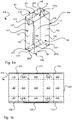
- Fig. 1a generally illustrates an example of a package 100, herein exemplified by a carton package, made from a piece of package material illustrated in fig. 1b .
- the package 100 comprises a number of panels divided from each other by weakening lines.
- the weakening lines provide for that the piece of packaging material can be reliably and efficiently folded into the package 100 by a packaging machine, also known as a filling machine.
- the package 100 comprises a first rear panel 102, a left panel 104, a front panel 106, a right panel 108 and a second rear panel 110, which together form a sleeve-shaped main body of the package 100.
- the sleeve-shaped main body may have a rectangular cross-section.
- the first and second rear panel 102, 110 can be attached to each other by a so-called longitudinal sealing LS.
- a peripheral part of the second rear panel 110, that is placed inside a peripheral part of the first rear panel 102 can be protected by a plastic strip, sometimes referred to as a longitudinal sealing strip.
- the package 100 comprises a first top rear panel 112, a left corner top panel 114, a top front panel 116, a right corner panel 118 and a second top rear panel 120, which together form a top section of the package 100.
- the first and second rear top panels 112, 120 are attached to each other.
- the first and second rear top panels 112, 120 are attached to the top front panel 116, two sections of the left corner top panel 114 are attached to each other, and two sections of the right corner top panel 118 are attached to each other.
- This is provided by a top transversal seal TTS made in the packaging machine after the package is filled with the product, or if filled upside down before the package is filled.
- the package 100 also comprises a first bottom rear panel 122, a left corner bottom panel 124, a bottom front panel 126, a right corner bottom panel 128 and a second bottom rear panel 130, which together form a bottom of the package.
- first and second bottom rear panels 122, 130 are attached to each other.
- first and second bottom rear panels 122, 130 are attached to the bottom front panel 126, two sections of the left corner bottom panel 124 are attached to each other, and two sections of the right corner bottom panel 128 are attached to each other, such that a bottom transversal seal BTS is formed.
- the package 100 is produced in a roll-fed packaging machine, a number of pieces of packaging material is provided after one another on a reel of packaging material.
- the pieces of packaging material arranged in this way the top transversal seal TTS can be formed at the same time as the bottom transversal seal BTS is made in a subsequent package.
- the packages can be separated from each other by cutting them apart in a section between the transversal seals.
- a first top seal section 134 and a second top sealing section 132 as well as a first bottom sealing section 136 and a second top sealing section 138 can be provided.
- the packaging material can be separated such that the first top sealing section 132 and the second top sealing section 134 form an upper part of the top of the package 100, and in the first bottom sealing section 136 and the second bottom sealing section 138 form a lower part of the bottom of the package 100.
- a longitudinal sealing section 140 can be used.
- the longitudinal seal LS is provided beforehand, that is, the first rear panel 102 is attached to the second rear panel 110 via the longitudinal section 140, such that a sleeve-shaped piece of packaging material is provided.
- the separation also referred to as cutting, can be made when producing blanks to be fed into the blanks-fed packaging machine.
- the longitudinal seal LS may be placed in an intersection between a rear section 140 and one of the side sections 142, 144, that is, the rear section 140 of the package 100 may comprise only one panel.
- the top section 146 may be formed by folding down a top fin 150, comprising the top transversal seal TTS, towards a front section 152.
- a top fin 150 comprising the top transversal seal TTS
- a front section 152 is folded down towards the rear section 140.
- a bottom fin 154 can be folded down towards the front section 152 or towards the rear section 140.
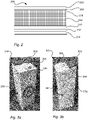
- Fig. 2 generally illustrates by way of example a packaging material 200 that can be used for forming the package 100.
- an outer coating 202 may be provided.
- the outer coating 202 may serve the purpose of avoiding that moisture of water is coming into contact with a printing layer 204 placed inside the outer coating 202.
- the printing layer 204 can comprise ink or any other material used for providing a print on the package 100.
- a first and a second paperboard layer 206, 208 can be provided inside the printing layer 204.
- the first and second paperboard layers 206, 208 provide robustness to the package 100.
- the first paperboard layer 206 may be bleached paperboard with or without clay coat.
- the second paperboard layer 208 may be bleached or unbleached paperboard.
- a lamination layer 210 made of plastic material can be provided.
- the lamination layer 210 can provide for that microorganisms are hindered from coming into contact with the product held inside the package 100.
- an Aluminum foil 212 can be provided inside the lamination layer 210.
- the Aluminum foil 212 can provide for that light, oxygen and odors are hindered from coming into contact with the product held inside the package 100, but also that flavors inside the package can be released from the package 100.
- the Aluminum foil 212 does however not exist in all types of packaging material. For instance, in the packaging material used for packages for chilled products, i.e. products that will be refrigerated, the Aluminum foil 212 is most often left out and replaced by a combination of lamination layers and paperboard layers.
- a first and a second internal coating 214, 216 made of e.g. plastics material, can be provided.
- a first and a second internal coating 214, 216 made of e.g. plastics material.
- One purpose with these are that the product is hindered from coming in direct contact with the Aluminum foil 212.
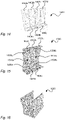
- Fig. 3a and 3b illustrate by way of example a package assembly 300 that is not part of the invention comprising a package 302, similar to the package 100 illustrated in fig. 1a and 1b , but with a slanted top section 304 and provided with a cap 306.
- an exoskeleton 308 in the form of a cardboard element that is a piece comprising at least one layer of cardboard, is attached to the package.
- the exoskeleton 308 is attached to the rear section of the package, to a part of the top section and to the bottom section. By having the exoskeleton 308 attached to the rear section, the longitudinal seal can be protected.
- the bottom transversal seal can be protected, e.g. in that flaps formed by the left and right corner bottom panels can be securely kept in place.
- the top transversal seal TTS can be protected.
- the top transversal seal TTS can be folded down towards the rear section. Since the longitudinal seal LS forms part of the top transversal seal TTS and is placed on the rear section, folding the top transversal seal TTS towards the rear section implies that the longitudinal seal LS is folded, that is, four layers of packaging material is folded. This results in that there is increased risk that the top fin is raised, that is, the top fin does not lay down close to the top section. By having the exoskeleton 308 placed such that this covers at least part of the top transversal seal TTS, the risk that the top fin is raised can be mitigated.
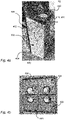
- Fig. 4a illustrates a package assembly 400 according to the invention.
- the exoskeleton 402 used in this exemplified package assembly comprises, in line with the exoskeleton 308 illustrated in fig. 3 , a rear section element 404 attached to the rear section of the package 302, that is, the same type of package as illustrated in fig. 3 , and a bottom section element 406 attached to the bottom section of the package.
- the exoskeleton 402 illustrated in fig. 4 is provided with a top protection arrangement 408.
- the top protection arrangement 408 can be embodied in various ways.
- a first element 410 may be arranged to face the top section of the package 302, and a second element 412 may be used for forming a flat surface, also referred to as a stacking surface, such that stacking properties can be improved.
- a third element 414 may be used to form the flat surface.
- the third element 414 may be connected to the first and second element 410, 412 such that the top protection arrangement is wedge-shaped and thereby compensate for the slanted top section such that the flat surface can be obtained.
- the second element 412 is attached to the rear section element 404, but it is also possible to have the first element 410 attached to the rear section element 404.
- the first and second element 410, 412 can be held at a distance D from each other.
- a space 416 between the first and second element 410, 412 can be formed.
- the cap 306 can be held in the space 416.
- a first opening 418 may be provided in the first element and a second opening 420 may be provided in the second element 412.
- the second opening 420 may be left out.
- Fig. 4b illustrates by way of example four package assemblies 400, illustrated in fig. 4a , placed in a cardboard box.
- the package assemblies 400 provided with the top protection arrangements 408, a risk that the top sections are damaged during transport can be reduced. This may by way of example be relevant in e-commerce when the packages 302 are distributed by ordinary mail package services.
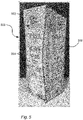
- Fig. 5 illustrates another example of a package assembly 500 that is not part of the invention.
- the package 302 similar to the packages illustrated in fig. 3 and 4 , has an exoskeleton 502 attached thereto that has a rear section element 504 that is different from the rear section of the package.
- the rear section of the package 302 may be rectangular-shaped, while the rear section element 504 is hourglass-shaped.
- an advantage is that a user may be directed on how to grip the package assembly 500 when using it.
- the package assembly 500 can be easier for the user to grip, in particular if the packaging material 200 the package 302 provides more flexibility than the exoskeleton 502.
- Fig. 6 to 13 illustrate eight different examples of exoskeletons that can be attached to packages whereby only the embodiments shown on the figures 6 and 7 are in accordance with the present invention.
- Fig. 6 illustrates a first example of an exoskeleton 600 in isolation.
- the exoskeleton 600 comprises a first and a second intermediate section element 602a, 602b that can be attached to intermediate sections of a package, that is, sections placed between the side sections and the rear section of the package.
- An example of a package with intermediate sections is Tetra Prisma TM sold and marketed by Tetra Pak TM .
- the exoskeleton 600 is further provided with a top protection arrangement 604 that comprises a first element 606 arranged to face the top section of the package, a second element 608 placed at a distance from the first element 606, a third element 610 connecting the first and second element 606, 608 and a fourth element 612 connected to the second element 608.
- a top protection arrangement 604 that comprises a first element 606 arranged to face the top section of the package, a second element 608 placed at a distance from the first element 606, a third element 610 connecting the first and second element 606, 608 and a fourth element 612 connected to the second element 608.
- the top protection arrangement 408 illustrated in fig. 4a the top protection arrangement 604 is arranged to protect the top section of the package as well as the cap during transportation.
- the first element In the protective state PS, the first element may be attached to the top section of the package, and the elements may be divided by folding lines such that the top protection arrangement 604 can be moved easily between the protective state PS and a non-protective state NPS, that is, when at least part of the top protection arrangement 604 has been removed or displaced by the user.
- Fig. 7 illustrates another example of an exoskeleton 700.
- the exoskeleton 700 is provided with an hourglass-shaped rear section element that can be attached to the same type of package as the exoskeleton 600 illustrated in fig. 6 , but unlike the exoskeleton 600 illustrated in fig. 6 , the exoskeleton 700 is not provided with intermediate side section elements.
- the exoskeleton 700 may also be attached to a brick-shaped package, such as Tetra Brik TM marketed by Tetra Pak TM , such that a package assembly similar to the package assembly 500 illustrated in fig. 5 can be achieved.
- the exoskeleton 700 can be provided with a top protection arrangement 702. This may comprise a first element 704 arranged to face the top section of the package, a second element 706 arranged to form the flat surface, spaced apart from the first element 704, a third element 708 connecting the first and second element 704, 706, a fourth element 710 connecting the second element 706 to the rear section. Folding lines may be provided between the different elements such that the top protection arrangement 702 can be removed by the user before opening the package.
- an exoskeleton 800 is illustrated.
- the exoskeleton 800 is provided with a first and second intermediate section elements 802a,b. Since the first and second intermediate section elements 802,802b is inclined with respect to the rear section element of the exoskeleton 800, having the intermediate section elements may provide increased robustness to the package assembly. Further, even though two intermediate section elements are illustrated, another option is to have the exoskeleton 800 provided with only one intermediate section element. The same holds true for the exoskeleton 600 illustrated in fig. 6 . Unlike the exoskeleton 600 illustrated in fig. 6 , the exoskeleton 800 is only provided with a first element 804.
- fig. 9 still another example of an exoskeleton 900 is illustrated.
- the exoskeleton 900 can, for the same reasons as mentioned above with respect to fig. 7 , be provided with a rear section element that is non-rectangular.
- a first element 902 may be provided for protection of the top section of the package.
- the exoskeleton 1000 can be provided with a rear section element 1002 with one side being straight and the other side being curved.
- the curved side may be provided to fit with the package to which the exoskeleton is to be attached, or it may, e.g. if the exoskeleton 1000 is to attached to the package 302 with rectangular-shaped rear section, illustrated in fig 3a and 3b , provide improved gripping properties.
- a further example of an exoskeleton 1100 is illustrated in fig. 11 .
- the exoskeleton 1100 can be provided with a rear section element 1102 with one side being straight and the other side being curved.
- a first intermediate side section 1104 may be provided.
- the first intermediate section element 1104 may be provided to fit with the package to which the exoskeleton is to be attached.
- exoskeleton 1200 is illustrated in fig. 12 .
- the exoskeleton 1200 is provided with a rear section element that is rectangular-shaped, a top section element for protecting the top section of the package and a bottom section element for protecting the bottom section.
- the exoskeleton 1300 is provided with an upper flap 1302 that is arranged to extend above the package to which it is attached.
- the upper flap 1302 may comprise of a rear section element that is arranged to extend above the rear section of the package, a flap element 1304 and a top section element 1306 arranged to be attached to the top section of the package.
- the upper flap 1302 may be provided with e.g. an opening such that the package assembly formed when the exoskeleton is attached to the package can be hanged on a hook.
- a group 1400 comprising a number of exoskeletons 1402a, 1402b, 1402c, 1402d that can be attached to a number of packages such that a multipack is formed is illustrated by way of example.
- the exoskeletons 1402a, 1402b, 1402c, 1402d each comprises the rear section element and the bottom section element.
- perforation lines 1404a, 1404b, 1404c may be provided.
- a group 1500 comprising a number of exoskeletons 1502a, 1502b, 1502c connected via perforation lines 1504a, 1504b, 1504c, also referred to as tearing lines, is illustrated by way of example.
- the rear section elements of the exoskeletons 1502a, 1502b, 1502c may be attached to each other in first attachment sections 1506a, 1506b and second attachment sections 1508a, 1508b.
- the first attachment sections 1506a, 1506b and the second attachment sections 1508a, 1508b may be spaced apart and openings 1510a, 1510b may be provided between them as illustrated.
- An advantage of having the first and second attachment sections 1506a, 1506b, 1508a, 1508b may be that separation of the package assemblies can be facilitated.
- FIG. 16 yet another group 1600 of exoskeletons is illustrated by way of example.
- the exoskeletons of the group 1600 are similar to the exoskeletons of the group 1500 illustrated in fig. 15 , but in addition to the group 1500 illustrated in fig. 15 , the group 1600 is connected such that a 2x3 multi-pack can be achieved. Put differently, the group 1600 is designed such that packages can be placed side-to-side as well as front-to-front.
- Fig. 17 is a flow chart illustrating a method for producing the package assembly.
- the package In a first step 1702, the package is provided, and in a second step 1704 the exoskeleton is attached to the rear section of the package such that an improved robustness is achieved and that the longitudinal seal is protected.
- Fig. 18 Method forming multi-pack
- Fig. 18 is a flow chart illustrating a method for producing the multi-pack
- the packages are provided, and in a second step 1704 the exoskeletons are attached to the rear sections of the packages such that an improved robustness is achieved, that the longitudinal seals are protected, and that the packages are attached to each other.
Landscapes
- Engineering & Computer Science (AREA)
- Mechanical Engineering (AREA)
- Packages (AREA)
- Packging For Living Organisms, Food Or Medicinal Products That Are Sensitive To Environmental Conditiond (AREA)
Claims (10)
- Verpackungsanordnung (300, 400, 500), Folgendes umfassend:eine Verpackung (100, 302), die dazu angeordnet ist, ein Lebensmittelprodukt zu halten, wobei die Verpackung (100, 302) einen hinteren Abschnitt (140), der mit einer Längsnaht (LS) versehen ist, und einen oberen Abschnitt (146), der mit einer Öffnungsvorrichtung (306) versehen ist, umfasst,ein Exoskelett (308, 402, 502, 600, 700, 800, 900, 1000, 1100, 1200, 1300), das an dem hinteren Abschnitt (140) der Verpackung (100, 302) befestigt ist, sodass eine verstärkte Robustheit erreicht wird und die Längsnaht (LS) geschützt wird;wobei das Exoskelett (402, 600, 700) Folgendes umfasst:ein Hinterabschnittselement (404), das an dem hinteren Abschnitt der Verpackung befestigt ist, undeine obere Schutzanordnung (408, 604, 702), die dazu angeordnet ist, sich in einem geschützten Zustand (PS) und einem ungeschützten Zustand (NPS) zu befinden, wobei die Verpackungsanordnung dadurch gekennzeichnet ist,dass die obere Schutzanordnung Folgendes umfasst:ein erstes Element (410, 606, 704), das im geschützten Zustand (PS) dazu angeordnet ist, dem oberen Abschnitt (146) der Verpackung zugewandt zu sein,ein zweites Element (412, 608, 706), das im geschützten Zustand (PS) dazu angeordnet ist, eine Stapelfläche der Verpackungsanordnung auszubilden, undein drittes Element (414, 610, 708), das mit dem ersten und zweiten Element verbunden ist und das im geschützten Zustand (PS) dazu angeordnet ist, einen Abstand (D) zwischen dem ersten und zweiten Element auszubilden, sodass ein Zwischenraum (416) ausgebildet wird,wobei die Öffnungsvorrichtung (306) eine Kappe (306) ist und das erste Element (410) mit einer ersten Öffnung (418) versehen ist, um die Kappe (306) im geschützten Zustand (PS) zu halten, und wobei der Zwischenraum (416) dazu angeordnet ist, die Kappe (306) im geschützten Zustand (PS) zwischen dem ersten und zweiten Element (410, 412) zu halten,wobei das zweite Element (412) mit einer zweiten Öffnung (420) versehen ist, um die Kappe (306) im geschützten Zustand (PS) zu halten.
- Verpackungsanordnung (300, 400, 500) nach Anspruch 1, wobei der obere Abschnitt mit einer oberen Quernaht (TTS) versehen ist und das Exoskelett dazu angeordnet ist, dem oberen Abschnitt (146) derart zugewandt zu sein, dass die obere Quernaht (TTS) geschützt ist.
- Verpackungsanordnung (300, 400) nach Anspruch 2, wobei die obere Quernaht (TTS) in einer oberen Lamelle (150) vorgesehen ist und die obere Lamelle (150) zur Längsnaht (LS) hin gefaltet ist, wobei das Exoskelett (308, 402, 600, 700) dazu angeordnet ist, der oberen Lamelle (150), die einen Teil des oberen Abschnitts (146) ausbildet, derart zugewandt zu sein, dass die obere Lamelle (150) fixiert wird.
- Verpackungsanordnung (300, 400, 500) nach einem der vorstehenden Ansprüche, wobei die Verpackung (302) ferner einen Bodenabschnitt (148) umfasst, der mit einer unteren Quernaht (BTS) versehen ist, und das Exoskelett (308, 402, 502, 600, 700, 800, 900, 1000, 1100, 1200, 1300) derart am Bodenabschnitt (148) befestigt ist, dass die untere Quernaht (BTS) geschützt ist.
- Verpackungsanordnung (300) nach einem der vorstehenden Ansprüche, wobei der obere Abschnitt ein abgeschrägter oberer Abschnitt (304) ist.
- Verpackungsanordnung nach einem der vorstehenden Ansprüche, wobei die Verpackung einen Seitenabschnitt, der neben dem hinteren Abschnitt angeordnet ist, und einen Zwischenabschnitt, der zwischen dem hinteren Abschnitt und dem Seitenabschnitt angeordnet ist, umfasst, wobei das Exoskelett (600, 800) an dem Zwischenabschnitt befestigt ist.
- Verpackungsanordnung (300, 400, 500) nach einem der vorstehenden Ansprüche, wobei das Exoskelett (308, 402, 502) eine Kartonschicht umfasst.
- Sammelpackung, mehrere Verpackungsanordnungen nach einem der vorstehenden Ansprüche umfassend,
wobei mehrere Exoskelette (1402a, 1402b, 1402c, 1402d, 1502a, 1502b, 1502c) der mehreren Verpackungsanordnungen aneinander befestigt sind. - Sammelpackung nach Anspruch 8, wobei die Hinterabschnittselemente der mehreren Verpackungsanordnungen an einem ersten Befestigungsabschnitt (1506a, 1506b) und einem zweiten Befestigungsabschnitt (1508a, 1508b) aneinander befestigt sind, wobei der erste und zweite Befestigungsabschnitt voneinander beabstandet sind.
- Sammelpackung nach Anspruch 8 oder 9, wobei Bodenabschnittselemente der Exoskelette (1402a, 1402b, 1402c, 1402d, 1502a, 1502b, 1502c) aneinander befestigt sind.
Applications Claiming Priority (1)
| Application Number | Priority Date | Filing Date | Title |
|---|---|---|---|
| EP19155906 | 2019-02-07 |
Publications (2)
| Publication Number | Publication Date |
|---|---|
| EP3693285A1 EP3693285A1 (de) | 2020-08-12 |
| EP3693285B1 true EP3693285B1 (de) | 2022-11-09 |
Family
ID=65363116
Family Applications (1)
| Application Number | Title | Priority Date | Filing Date |
|---|---|---|---|
| EP20154348.5A Active EP3693285B1 (de) | 2019-02-07 | 2020-01-29 | Verpackungsanordnung und sammelpackung |
Country Status (4)
| Country | Link |
|---|---|
| US (1) | US12297021B2 (de) |
| EP (1) | EP3693285B1 (de) |
| MX (1) | MX2021009332A (de) |
| WO (1) | WO2020160977A1 (de) |
Families Citing this family (2)
| Publication number | Priority date | Publication date | Assignee | Title |
|---|---|---|---|---|
| USD1069578S1 (en) * | 2022-08-08 | 2025-04-08 | Tetra Laval Holdings & Finance S.A. | Lid for containers |
| USD1124859S1 (en) * | 2023-12-30 | 2026-05-05 | Parksons Packaging Ltd. | Fluid dispenser |
Family Cites Families (7)
| Publication number | Priority date | Publication date | Assignee | Title |
|---|---|---|---|---|
| NZ238520A (en) * | 1991-06-13 | 1996-06-25 | Printpac Ueb Ltd Substituted F | Beverage can package: rims of cans engaged by slotted sheet with central channel, sheet reinforced by separate bridge part |
| US5419431A (en) * | 1992-07-28 | 1995-05-30 | Gerhardt Schubert Gmbh | Separable container for storage of plural articles |
| KR20030036628A (ko) * | 2000-07-31 | 2003-05-09 | 테트라 라발 홀딩스 앤드 피낭스 소시에떼아노님 | 종이 포장 용기 제조 방법 및 종이 포장 용기 |
| JP4442796B2 (ja) * | 2003-01-24 | 2010-03-31 | 日本テトラパック株式会社 | 包装容器および包装容器に取付けられる注ぎ栓 |
| MX337224B (es) * | 2010-12-06 | 2016-02-18 | Tetra Laval Holdings & Finance | Metodo para fabricar recipiente de empaque y recipiente de empaque. |
| WO2014014738A1 (en) * | 2012-07-17 | 2014-01-23 | Meadwestvaco Packaging Systems, Llc | Carton and blank therefor |
| WO2016173907A1 (en) | 2015-04-30 | 2016-11-03 | Tetra Laval Holdings & Finance S.A. | Method for producing a package assembly, a package assembly and a blank to be shaped into a secondary package |
-
2020
- 2020-01-29 WO PCT/EP2020/052161 patent/WO2020160977A1/en not_active Ceased
- 2020-01-29 MX MX2021009332A patent/MX2021009332A/es unknown
- 2020-01-29 EP EP20154348.5A patent/EP3693285B1/de active Active
- 2020-01-29 US US17/310,407 patent/US12297021B2/en active Active
Also Published As
| Publication number | Publication date |
|---|---|
| US20220089343A1 (en) | 2022-03-24 |
| WO2020160977A1 (en) | 2020-08-13 |
| BR112021013627A2 (pt) | 2021-09-14 |
| US12297021B2 (en) | 2025-05-13 |
| MX2021009332A (es) | 2021-09-08 |
| EP3693285A1 (de) | 2020-08-12 |
Similar Documents
| Publication | Publication Date | Title |
|---|---|---|
| US7448492B2 (en) | Carrier package and blank | |
| US10202228B2 (en) | Carton with asymmetrical corners | |
| ES2699727T3 (es) | Envase sellado para productos alimenticios vertibles y material de envase para producir envases sellados para productos alimenticios vertibles | |
| EP3140217B1 (de) | Träger für behälter | |
| ES2592630T3 (es) | Dispositivo de transporte con característica de retención | |
| US11299314B2 (en) | Package sleeve, package and method for manufacturing a package | |
| US9783334B2 (en) | Shipping and display container | |
| US9896234B2 (en) | Wraparound shipping box blank with system and method of forming blank into a shipping case | |
| CN104837737B (zh) | 具有手柄的纸箱 | |
| US20100133330A1 (en) | Carrier with retention features | |
| US9840358B2 (en) | Carton with article protection feature | |
| KR20130136498A (ko) | 용기 패키지 | |
| US20190337664A1 (en) | Package Sleeve, Package and Method for Manufacturing a Package | |
| US12258185B2 (en) | Paper-based or paperboard-based container and related methods | |
| EP3693285A1 (de) | Verpackungsanordnung und verfahren zur herstellung der verpackungsanordnung | |
| US20190337666A1 (en) | Sleeve Blank, Package Sleeve, Package and Method for Manufacturing a Sleeve Blank, a Package Sleeve and a Package | |
| CN105452124A (zh) | 具有插入件的纸箱 | |
| US20160340099A1 (en) | Packaging container with opening device and method for manufacturing the same | |
| US8272559B2 (en) | Packs and methods of erecting packs | |
| US20250178773A1 (en) | Paper-based or paperboard-based container and related methods | |
| US6209785B1 (en) | Boxes | |
| CA2900923C (en) | Carton with article protection feature | |
| US12617595B2 (en) | Sleeve for holding containers | |
| BR112021013627B1 (pt) | Conjunto de embalagem, embalagem tipo multi-pack, e, métodos para produzir um conjunto de embalagem e uma embalagem tipo multi-pack | |
| WO2021234022A1 (en) | Paper-based or paperboard-based container and method |
Legal Events
| Date | Code | Title | Description |
|---|---|---|---|
| PUAI | Public reference made under article 153(3) epc to a published international application that has entered the european phase |
Free format text: ORIGINAL CODE: 0009012 |
|
| STAA | Information on the status of an ep patent application or granted ep patent |
Free format text: STATUS: THE APPLICATION HAS BEEN PUBLISHED |
|
| AK | Designated contracting states |
Kind code of ref document: A1 Designated state(s): AL AT BE BG CH CY CZ DE DK EE ES FI FR GB GR HR HU IE IS IT LI LT LU LV MC MK MT NL NO PL PT RO RS SE SI SK SM TR |
|
| AX | Request for extension of the european patent |
Extension state: BA ME |
|
| STAA | Information on the status of an ep patent application or granted ep patent |
Free format text: STATUS: REQUEST FOR EXAMINATION WAS MADE |
|
| 17P | Request for examination filed |
Effective date: 20210212 |
|
| RBV | Designated contracting states (corrected) |
Designated state(s): AL AT BE BG CH CY CZ DE DK EE ES FI FR GB GR HR HU IE IS IT LI LT LU LV MC MK MT NL NO PL PT RO RS SE SI SK SM TR |
|
| STAA | Information on the status of an ep patent application or granted ep patent |
Free format text: STATUS: EXAMINATION IS IN PROGRESS |
|
| 17Q | First examination report despatched |
Effective date: 20210713 |
|
| REG | Reference to a national code |
Ref country code: DE Ref legal event code: R079 Ref document number: 602020006104 Country of ref document: DE Free format text: PREVIOUS MAIN CLASS: B65D0005740000 Ipc: B65D0005440000 |
|
| GRAP | Despatch of communication of intention to grant a patent |
Free format text: ORIGINAL CODE: EPIDOSNIGR1 |
|
| STAA | Information on the status of an ep patent application or granted ep patent |
Free format text: STATUS: GRANT OF PATENT IS INTENDED |
|
| RIC1 | Information provided on ipc code assigned before grant |
Ipc: B65D 5/06 20060101ALI20220503BHEP Ipc: B65D 77/28 20060101ALI20220503BHEP Ipc: B65D 71/00 20060101ALI20220503BHEP Ipc: B65D 5/74 20060101ALI20220503BHEP Ipc: B65D 5/44 20060101AFI20220503BHEP |
|
| INTG | Intention to grant announced |
Effective date: 20220603 |
|
| GRAS | Grant fee paid |
Free format text: ORIGINAL CODE: EPIDOSNIGR3 |
|
| GRAA | (expected) grant |
Free format text: ORIGINAL CODE: 0009210 |
|
| STAA | Information on the status of an ep patent application or granted ep patent |
Free format text: STATUS: THE PATENT HAS BEEN GRANTED |
|
| AK | Designated contracting states |
Kind code of ref document: B1 Designated state(s): AL AT BE BG CH CY CZ DE DK EE ES FI FR GB GR HR HU IE IS IT LI LT LU LV MC MK MT NL NO PL PT RO RS SE SI SK SM TR |
|
| REG | Reference to a national code |
Ref country code: GB Ref legal event code: FG4D |
|
| REG | Reference to a national code |
Ref country code: CH Ref legal event code: EP Ref country code: AT Ref legal event code: REF Ref document number: 1530210 Country of ref document: AT Kind code of ref document: T Effective date: 20221115 |
|
| REG | Reference to a national code |
Ref country code: DE Ref legal event code: R096 Ref document number: 602020006104 Country of ref document: DE |
|
| REG | Reference to a national code |
Ref country code: IE Ref legal event code: FG4D |
|
| REG | Reference to a national code |
Ref country code: LT Ref legal event code: MG9D |
|
| REG | Reference to a national code |
Ref country code: NL Ref legal event code: MP Effective date: 20221109 |
|
| REG | Reference to a national code |
Ref country code: AT Ref legal event code: MK05 Ref document number: 1530210 Country of ref document: AT Kind code of ref document: T Effective date: 20221109 |
|
| PG25 | Lapsed in a contracting state [announced via postgrant information from national office to epo] |
Ref country code: SE Free format text: LAPSE BECAUSE OF FAILURE TO SUBMIT A TRANSLATION OF THE DESCRIPTION OR TO PAY THE FEE WITHIN THE PRESCRIBED TIME-LIMIT Effective date: 20221109 Ref country code: PT Free format text: LAPSE BECAUSE OF FAILURE TO SUBMIT A TRANSLATION OF THE DESCRIPTION OR TO PAY THE FEE WITHIN THE PRESCRIBED TIME-LIMIT Effective date: 20230309 Ref country code: NO Free format text: LAPSE BECAUSE OF FAILURE TO SUBMIT A TRANSLATION OF THE DESCRIPTION OR TO PAY THE FEE WITHIN THE PRESCRIBED TIME-LIMIT Effective date: 20230209 Ref country code: LT Free format text: LAPSE BECAUSE OF FAILURE TO SUBMIT A TRANSLATION OF THE DESCRIPTION OR TO PAY THE FEE WITHIN THE PRESCRIBED TIME-LIMIT Effective date: 20221109 Ref country code: FI Free format text: LAPSE BECAUSE OF FAILURE TO SUBMIT A TRANSLATION OF THE DESCRIPTION OR TO PAY THE FEE WITHIN THE PRESCRIBED TIME-LIMIT Effective date: 20221109 Ref country code: ES Free format text: LAPSE BECAUSE OF FAILURE TO SUBMIT A TRANSLATION OF THE DESCRIPTION OR TO PAY THE FEE WITHIN THE PRESCRIBED TIME-LIMIT Effective date: 20221109 Ref country code: AT Free format text: LAPSE BECAUSE OF FAILURE TO SUBMIT A TRANSLATION OF THE DESCRIPTION OR TO PAY THE FEE WITHIN THE PRESCRIBED TIME-LIMIT Effective date: 20221109 |
|
| PG25 | Lapsed in a contracting state [announced via postgrant information from national office to epo] |
Ref country code: RS Free format text: LAPSE BECAUSE OF FAILURE TO SUBMIT A TRANSLATION OF THE DESCRIPTION OR TO PAY THE FEE WITHIN THE PRESCRIBED TIME-LIMIT Effective date: 20221109 Ref country code: PL Free format text: LAPSE BECAUSE OF FAILURE TO SUBMIT A TRANSLATION OF THE DESCRIPTION OR TO PAY THE FEE WITHIN THE PRESCRIBED TIME-LIMIT Effective date: 20221109 Ref country code: LV Free format text: LAPSE BECAUSE OF FAILURE TO SUBMIT A TRANSLATION OF THE DESCRIPTION OR TO PAY THE FEE WITHIN THE PRESCRIBED TIME-LIMIT Effective date: 20221109 Ref country code: IS Free format text: LAPSE BECAUSE OF FAILURE TO SUBMIT A TRANSLATION OF THE DESCRIPTION OR TO PAY THE FEE WITHIN THE PRESCRIBED TIME-LIMIT Effective date: 20230309 Ref country code: HR Free format text: LAPSE BECAUSE OF FAILURE TO SUBMIT A TRANSLATION OF THE DESCRIPTION OR TO PAY THE FEE WITHIN THE PRESCRIBED TIME-LIMIT Effective date: 20221109 Ref country code: GR Free format text: LAPSE BECAUSE OF FAILURE TO SUBMIT A TRANSLATION OF THE DESCRIPTION OR TO PAY THE FEE WITHIN THE PRESCRIBED TIME-LIMIT Effective date: 20230210 |
|
| P01 | Opt-out of the competence of the unified patent court (upc) registered |
Effective date: 20230426 |
|
| PG25 | Lapsed in a contracting state [announced via postgrant information from national office to epo] |
Ref country code: NL Free format text: LAPSE BECAUSE OF FAILURE TO SUBMIT A TRANSLATION OF THE DESCRIPTION OR TO PAY THE FEE WITHIN THE PRESCRIBED TIME-LIMIT Effective date: 20221109 |
|
| PG25 | Lapsed in a contracting state [announced via postgrant information from national office to epo] |
Ref country code: SM Free format text: LAPSE BECAUSE OF FAILURE TO SUBMIT A TRANSLATION OF THE DESCRIPTION OR TO PAY THE FEE WITHIN THE PRESCRIBED TIME-LIMIT Effective date: 20221109 Ref country code: RO Free format text: LAPSE BECAUSE OF FAILURE TO SUBMIT A TRANSLATION OF THE DESCRIPTION OR TO PAY THE FEE WITHIN THE PRESCRIBED TIME-LIMIT Effective date: 20221109 Ref country code: EE Free format text: LAPSE BECAUSE OF FAILURE TO SUBMIT A TRANSLATION OF THE DESCRIPTION OR TO PAY THE FEE WITHIN THE PRESCRIBED TIME-LIMIT Effective date: 20221109 Ref country code: DK Free format text: LAPSE BECAUSE OF FAILURE TO SUBMIT A TRANSLATION OF THE DESCRIPTION OR TO PAY THE FEE WITHIN THE PRESCRIBED TIME-LIMIT Effective date: 20221109 Ref country code: CZ Free format text: LAPSE BECAUSE OF FAILURE TO SUBMIT A TRANSLATION OF THE DESCRIPTION OR TO PAY THE FEE WITHIN THE PRESCRIBED TIME-LIMIT Effective date: 20221109 |
|
| REG | Reference to a national code |
Ref country code: DE Ref legal event code: R097 Ref document number: 602020006104 Country of ref document: DE |
|
| PG25 | Lapsed in a contracting state [announced via postgrant information from national office to epo] |
Ref country code: SK Free format text: LAPSE BECAUSE OF FAILURE TO SUBMIT A TRANSLATION OF THE DESCRIPTION OR TO PAY THE FEE WITHIN THE PRESCRIBED TIME-LIMIT Effective date: 20221109 Ref country code: AL Free format text: LAPSE BECAUSE OF FAILURE TO SUBMIT A TRANSLATION OF THE DESCRIPTION OR TO PAY THE FEE WITHIN THE PRESCRIBED TIME-LIMIT Effective date: 20221109 |
|
| REG | Reference to a national code |
Ref country code: CH Ref legal event code: PL |
|
| PLBE | No opposition filed within time limit |
Free format text: ORIGINAL CODE: 0009261 |
|
| STAA | Information on the status of an ep patent application or granted ep patent |
Free format text: STATUS: NO OPPOSITION FILED WITHIN TIME LIMIT |
|
| PG25 | Lapsed in a contracting state [announced via postgrant information from national office to epo] |
Ref country code: LU Free format text: LAPSE BECAUSE OF NON-PAYMENT OF DUE FEES Effective date: 20230129 |
|
| REG | Reference to a national code |
Ref country code: BE Ref legal event code: MM Effective date: 20230131 |
|
| 26N | No opposition filed |
Effective date: 20230810 |
|
| PG25 | Lapsed in a contracting state [announced via postgrant information from national office to epo] |
Ref country code: LI Free format text: LAPSE BECAUSE OF NON-PAYMENT OF DUE FEES Effective date: 20230131 Ref country code: CH Free format text: LAPSE BECAUSE OF NON-PAYMENT OF DUE FEES Effective date: 20230131 |
|
| PG25 | Lapsed in a contracting state [announced via postgrant information from national office to epo] |
Ref country code: SI Free format text: LAPSE BECAUSE OF FAILURE TO SUBMIT A TRANSLATION OF THE DESCRIPTION OR TO PAY THE FEE WITHIN THE PRESCRIBED TIME-LIMIT Effective date: 20221109 Ref country code: FR Free format text: LAPSE BECAUSE OF NON-PAYMENT OF DUE FEES Effective date: 20230131 Ref country code: BE Free format text: LAPSE BECAUSE OF NON-PAYMENT OF DUE FEES Effective date: 20230131 |
|
| PG25 | Lapsed in a contracting state [announced via postgrant information from national office to epo] |
Ref country code: IE Free format text: LAPSE BECAUSE OF NON-PAYMENT OF DUE FEES Effective date: 20230129 |
|
| PG25 | Lapsed in a contracting state [announced via postgrant information from national office to epo] |
Ref country code: MC Free format text: LAPSE BECAUSE OF FAILURE TO SUBMIT A TRANSLATION OF THE DESCRIPTION OR TO PAY THE FEE WITHIN THE PRESCRIBED TIME-LIMIT Effective date: 20221109 |
|
| PG25 | Lapsed in a contracting state [announced via postgrant information from national office to epo] |
Ref country code: MC Free format text: LAPSE BECAUSE OF FAILURE TO SUBMIT A TRANSLATION OF THE DESCRIPTION OR TO PAY THE FEE WITHIN THE PRESCRIBED TIME-LIMIT Effective date: 20221109 |
|
| GBPC | Gb: european patent ceased through non-payment of renewal fee |
Effective date: 20240129 |
|
| PG25 | Lapsed in a contracting state [announced via postgrant information from national office to epo] |
Ref country code: GB Free format text: LAPSE BECAUSE OF NON-PAYMENT OF DUE FEES Effective date: 20240129 |
|
| PG25 | Lapsed in a contracting state [announced via postgrant information from national office to epo] |
Ref country code: GB Free format text: LAPSE BECAUSE OF NON-PAYMENT OF DUE FEES Effective date: 20240129 |
|
| PG25 | Lapsed in a contracting state [announced via postgrant information from national office to epo] |
Ref country code: BG Free format text: LAPSE BECAUSE OF FAILURE TO SUBMIT A TRANSLATION OF THE DESCRIPTION OR TO PAY THE FEE WITHIN THE PRESCRIBED TIME-LIMIT Effective date: 20221109 |
|
| PG25 | Lapsed in a contracting state [announced via postgrant information from national office to epo] |
Ref country code: BG Free format text: LAPSE BECAUSE OF FAILURE TO SUBMIT A TRANSLATION OF THE DESCRIPTION OR TO PAY THE FEE WITHIN THE PRESCRIBED TIME-LIMIT Effective date: 20221109 |
|
| PGFP | Annual fee paid to national office [announced via postgrant information from national office to epo] |
Ref country code: DE Payment date: 20250129 Year of fee payment: 6 |
|
| PGFP | Annual fee paid to national office [announced via postgrant information from national office to epo] |
Ref country code: IT Payment date: 20250122 Year of fee payment: 6 |
|
| PGFP | Annual fee paid to national office [announced via postgrant information from national office to epo] |
Ref country code: TR Payment date: 20250117 Year of fee payment: 6 |
|
| PG25 | Lapsed in a contracting state [announced via postgrant information from national office to epo] |
Ref country code: CY Free format text: LAPSE BECAUSE OF FAILURE TO SUBMIT A TRANSLATION OF THE DESCRIPTION OR TO PAY THE FEE WITHIN THE PRESCRIBED TIME-LIMIT; INVALID AB INITIO Effective date: 20200129 |
|
| PG25 | Lapsed in a contracting state [announced via postgrant information from national office to epo] |
Ref country code: HU Free format text: LAPSE BECAUSE OF FAILURE TO SUBMIT A TRANSLATION OF THE DESCRIPTION OR TO PAY THE FEE WITHIN THE PRESCRIBED TIME-LIMIT; INVALID AB INITIO Effective date: 20200129 |