EP3693160A1 - Water-repellent, oil-repellent member and method for manufacturing water-repellent, oil-repellent member - Google Patents
Water-repellent, oil-repellent member and method for manufacturing water-repellent, oil-repellent member Download PDFInfo
- Publication number
- EP3693160A1 EP3693160A1 EP18865192.1A EP18865192A EP3693160A1 EP 3693160 A1 EP3693160 A1 EP 3693160A1 EP 18865192 A EP18865192 A EP 18865192A EP 3693160 A1 EP3693160 A1 EP 3693160A1
- Authority
- EP
- European Patent Office
- Prior art keywords
- water
- oil repellent
- integer
- group
- repellent
- Prior art date
- Legal status (The legal status is an assumption and is not a legal conclusion. Google has not performed a legal analysis and makes no representation as to the accuracy of the status listed.)
- Pending
Links
- 0 C(CC1CC1)CC1C=C2C*C1CC2 Chemical compound C(CC1CC1)CC1C=C2C*C1CC2 0.000 description 5
- LFFRHZAGVMODPV-UHFFFAOYSA-N CC(C1)C2C(C)C(C)C1C2 Chemical compound CC(C1)C2C(C)C(C)C1C2 LFFRHZAGVMODPV-UHFFFAOYSA-N 0.000 description 1
Classifications
-
- C—CHEMISTRY; METALLURGY
- C08—ORGANIC MACROMOLECULAR COMPOUNDS; THEIR PREPARATION OR CHEMICAL WORKING-UP; COMPOSITIONS BASED THEREON
- C08J—WORKING-UP; GENERAL PROCESSES OF COMPOUNDING; AFTER-TREATMENT NOT COVERED BY SUBCLASSES C08B, C08C, C08F, C08G or C08H
- C08J7/00—Chemical treatment or coating of shaped articles made of macromolecular substances
- C08J7/04—Coating
- C08J7/042—Coating with two or more layers, where at least one layer of a composition contains a polymer binder
- C08J7/0423—Coating with two or more layers, where at least one layer of a composition contains a polymer binder with at least one layer of inorganic material and at least one layer of a composition containing a polymer binder
-
- C—CHEMISTRY; METALLURGY
- C09—DYES; PAINTS; POLISHES; NATURAL RESINS; ADHESIVES; COMPOSITIONS NOT OTHERWISE PROVIDED FOR; APPLICATIONS OF MATERIALS NOT OTHERWISE PROVIDED FOR
- C09K—MATERIALS FOR MISCELLANEOUS APPLICATIONS, NOT PROVIDED FOR ELSEWHERE
- C09K3/00—Materials not provided for elsewhere
- C09K3/18—Materials not provided for elsewhere for application to surfaces to minimize adherence of ice, mist or water thereto; Thawing or antifreeze materials for application to surfaces
-
- B—PERFORMING OPERATIONS; TRANSPORTING
- B05—SPRAYING OR ATOMISING IN GENERAL; APPLYING FLUENT MATERIALS TO SURFACES, IN GENERAL
- B05D—PROCESSES FOR APPLYING FLUENT MATERIALS TO SURFACES, IN GENERAL
- B05D1/00—Processes for applying liquids or other fluent materials
- B05D1/36—Successively applying liquids or other fluent materials, e.g. without intermediate treatment
-
- B—PERFORMING OPERATIONS; TRANSPORTING
- B05—SPRAYING OR ATOMISING IN GENERAL; APPLYING FLUENT MATERIALS TO SURFACES, IN GENERAL
- B05D—PROCESSES FOR APPLYING FLUENT MATERIALS TO SURFACES, IN GENERAL
- B05D3/00—Pretreatment of surfaces to which liquids or other fluent materials are to be applied; After-treatment of applied coatings, e.g. intermediate treating of an applied coating preparatory to subsequent applications of liquids or other fluent materials
-
- B—PERFORMING OPERATIONS; TRANSPORTING
- B05—SPRAYING OR ATOMISING IN GENERAL; APPLYING FLUENT MATERIALS TO SURFACES, IN GENERAL
- B05D—PROCESSES FOR APPLYING FLUENT MATERIALS TO SURFACES, IN GENERAL
- B05D5/00—Processes for applying liquids or other fluent materials to surfaces to obtain special surface effects, finishes or structures
-
- B—PERFORMING OPERATIONS; TRANSPORTING
- B05—SPRAYING OR ATOMISING IN GENERAL; APPLYING FLUENT MATERIALS TO SURFACES, IN GENERAL
- B05D—PROCESSES FOR APPLYING FLUENT MATERIALS TO SURFACES, IN GENERAL
- B05D5/00—Processes for applying liquids or other fluent materials to surfaces to obtain special surface effects, finishes or structures
- B05D5/08—Processes for applying liquids or other fluent materials to surfaces to obtain special surface effects, finishes or structures to obtain an anti-friction or anti-adhesive surface
- B05D5/083—Processes for applying liquids or other fluent materials to surfaces to obtain special surface effects, finishes or structures to obtain an anti-friction or anti-adhesive surface involving the use of fluoropolymers
-
- B—PERFORMING OPERATIONS; TRANSPORTING
- B05—SPRAYING OR ATOMISING IN GENERAL; APPLYING FLUENT MATERIALS TO SURFACES, IN GENERAL
- B05D—PROCESSES FOR APPLYING FLUENT MATERIALS TO SURFACES, IN GENERAL
- B05D7/00—Processes, other than flocking, specially adapted for applying liquids or other fluent materials to particular surfaces or for applying particular liquids or other fluent materials
-
- B—PERFORMING OPERATIONS; TRANSPORTING
- B05—SPRAYING OR ATOMISING IN GENERAL; APPLYING FLUENT MATERIALS TO SURFACES, IN GENERAL
- B05D—PROCESSES FOR APPLYING FLUENT MATERIALS TO SURFACES, IN GENERAL
- B05D7/00—Processes, other than flocking, specially adapted for applying liquids or other fluent materials to particular surfaces or for applying particular liquids or other fluent materials
- B05D7/02—Processes, other than flocking, specially adapted for applying liquids or other fluent materials to particular surfaces or for applying particular liquids or other fluent materials to macromolecular substances, e.g. rubber
-
- B—PERFORMING OPERATIONS; TRANSPORTING
- B05—SPRAYING OR ATOMISING IN GENERAL; APPLYING FLUENT MATERIALS TO SURFACES, IN GENERAL
- B05D—PROCESSES FOR APPLYING FLUENT MATERIALS TO SURFACES, IN GENERAL
- B05D7/00—Processes, other than flocking, specially adapted for applying liquids or other fluent materials to particular surfaces or for applying particular liquids or other fluent materials
- B05D7/14—Processes, other than flocking, specially adapted for applying liquids or other fluent materials to particular surfaces or for applying particular liquids or other fluent materials to metal, e.g. car bodies
-
- B—PERFORMING OPERATIONS; TRANSPORTING
- B05—SPRAYING OR ATOMISING IN GENERAL; APPLYING FLUENT MATERIALS TO SURFACES, IN GENERAL
- B05D—PROCESSES FOR APPLYING FLUENT MATERIALS TO SURFACES, IN GENERAL
- B05D7/00—Processes, other than flocking, specially adapted for applying liquids or other fluent materials to particular surfaces or for applying particular liquids or other fluent materials
- B05D7/24—Processes, other than flocking, specially adapted for applying liquids or other fluent materials to particular surfaces or for applying particular liquids or other fluent materials for applying particular liquids or other fluent materials
-
- B—PERFORMING OPERATIONS; TRANSPORTING
- B05—SPRAYING OR ATOMISING IN GENERAL; APPLYING FLUENT MATERIALS TO SURFACES, IN GENERAL
- B05D—PROCESSES FOR APPLYING FLUENT MATERIALS TO SURFACES, IN GENERAL
- B05D7/00—Processes, other than flocking, specially adapted for applying liquids or other fluent materials to particular surfaces or for applying particular liquids or other fluent materials
- B05D7/50—Multilayers
- B05D7/52—Two layers
- B05D7/53—Base coat plus clear coat type
- B05D7/534—Base coat plus clear coat type the first layer being let to dry at least partially before applying the second layer
-
- B—PERFORMING OPERATIONS; TRANSPORTING
- B05—SPRAYING OR ATOMISING IN GENERAL; APPLYING FLUENT MATERIALS TO SURFACES, IN GENERAL
- B05D—PROCESSES FOR APPLYING FLUENT MATERIALS TO SURFACES, IN GENERAL
- B05D7/00—Processes, other than flocking, specially adapted for applying liquids or other fluent materials to particular surfaces or for applying particular liquids or other fluent materials
- B05D7/50—Multilayers
- B05D7/52—Two layers
- B05D7/54—No clear coat specified
- B05D7/544—No clear coat specified the first layer is let to dry at least partially before applying the second layer
-
- B—PERFORMING OPERATIONS; TRANSPORTING
- B32—LAYERED PRODUCTS
- B32B—LAYERED PRODUCTS, i.e. PRODUCTS BUILT-UP OF STRATA OF FLAT OR NON-FLAT, e.g. CELLULAR OR HONEYCOMB, FORM
- B32B27/00—Layered products comprising a layer of synthetic resin
-
- B—PERFORMING OPERATIONS; TRANSPORTING
- B32—LAYERED PRODUCTS
- B32B—LAYERED PRODUCTS, i.e. PRODUCTS BUILT-UP OF STRATA OF FLAT OR NON-FLAT, e.g. CELLULAR OR HONEYCOMB, FORM
- B32B27/00—Layered products comprising a layer of synthetic resin
- B32B27/28—Layered products comprising a layer of synthetic resin comprising synthetic resins not wholly covered by any one of the sub-groups B32B27/30 - B32B27/42
- B32B27/283—Layered products comprising a layer of synthetic resin comprising synthetic resins not wholly covered by any one of the sub-groups B32B27/30 - B32B27/42 comprising polysiloxanes
-
- B—PERFORMING OPERATIONS; TRANSPORTING
- B32—LAYERED PRODUCTS
- B32B—LAYERED PRODUCTS, i.e. PRODUCTS BUILT-UP OF STRATA OF FLAT OR NON-FLAT, e.g. CELLULAR OR HONEYCOMB, FORM
- B32B27/00—Layered products comprising a layer of synthetic resin
- B32B27/28—Layered products comprising a layer of synthetic resin comprising synthetic resins not wholly covered by any one of the sub-groups B32B27/30 - B32B27/42
- B32B27/285—Layered products comprising a layer of synthetic resin comprising synthetic resins not wholly covered by any one of the sub-groups B32B27/30 - B32B27/42 comprising polyethers
-
- B—PERFORMING OPERATIONS; TRANSPORTING
- B32—LAYERED PRODUCTS
- B32B—LAYERED PRODUCTS, i.e. PRODUCTS BUILT-UP OF STRATA OF FLAT OR NON-FLAT, e.g. CELLULAR OR HONEYCOMB, FORM
- B32B33/00—Layered products characterised by particular properties or particular surface features, e.g. particular surface coatings; Layered products designed for particular purposes not covered by another single class
-
- C—CHEMISTRY; METALLURGY
- C08—ORGANIC MACROMOLECULAR COMPOUNDS; THEIR PREPARATION OR CHEMICAL WORKING-UP; COMPOSITIONS BASED THEREON
- C08G—MACROMOLECULAR COMPOUNDS OBTAINED OTHERWISE THAN BY REACTIONS ONLY INVOLVING UNSATURATED CARBON-TO-CARBON BONDS
- C08G65/00—Macromolecular compounds obtained by reactions forming an ether link in the main chain of the macromolecule
- C08G65/002—Macromolecular compounds obtained by reactions forming an ether link in the main chain of the macromolecule from unsaturated compounds
- C08G65/005—Macromolecular compounds obtained by reactions forming an ether link in the main chain of the macromolecule from unsaturated compounds containing halogens
- C08G65/007—Macromolecular compounds obtained by reactions forming an ether link in the main chain of the macromolecule from unsaturated compounds containing halogens containing fluorine
-
- C—CHEMISTRY; METALLURGY
- C08—ORGANIC MACROMOLECULAR COMPOUNDS; THEIR PREPARATION OR CHEMICAL WORKING-UP; COMPOSITIONS BASED THEREON
- C08G—MACROMOLECULAR COMPOUNDS OBTAINED OTHERWISE THAN BY REACTIONS ONLY INVOLVING UNSATURATED CARBON-TO-CARBON BONDS
- C08G65/00—Macromolecular compounds obtained by reactions forming an ether link in the main chain of the macromolecule
- C08G65/02—Macromolecular compounds obtained by reactions forming an ether link in the main chain of the macromolecule from cyclic ethers by opening of the heterocyclic ring
- C08G65/32—Polymers modified by chemical after-treatment
- C08G65/329—Polymers modified by chemical after-treatment with organic compounds
- C08G65/336—Polymers modified by chemical after-treatment with organic compounds containing silicon
-
- C—CHEMISTRY; METALLURGY
- C08—ORGANIC MACROMOLECULAR COMPOUNDS; THEIR PREPARATION OR CHEMICAL WORKING-UP; COMPOSITIONS BASED THEREON
- C08J—WORKING-UP; GENERAL PROCESSES OF COMPOUNDING; AFTER-TREATMENT NOT COVERED BY SUBCLASSES C08B, C08C, C08F, C08G or C08H
- C08J7/00—Chemical treatment or coating of shaped articles made of macromolecular substances
- C08J7/04—Coating
- C08J7/043—Improving the adhesiveness of the coatings per se, e.g. forming primers
-
- C—CHEMISTRY; METALLURGY
- C08—ORGANIC MACROMOLECULAR COMPOUNDS; THEIR PREPARATION OR CHEMICAL WORKING-UP; COMPOSITIONS BASED THEREON
- C08J—WORKING-UP; GENERAL PROCESSES OF COMPOUNDING; AFTER-TREATMENT NOT COVERED BY SUBCLASSES C08B, C08C, C08F, C08G or C08H
- C08J7/00—Chemical treatment or coating of shaped articles made of macromolecular substances
- C08J7/04—Coating
- C08J7/046—Forming abrasion-resistant coatings; Forming surface-hardening coatings
-
- C—CHEMISTRY; METALLURGY
- C08—ORGANIC MACROMOLECULAR COMPOUNDS; THEIR PREPARATION OR CHEMICAL WORKING-UP; COMPOSITIONS BASED THEREON
- C08J—WORKING-UP; GENERAL PROCESSES OF COMPOUNDING; AFTER-TREATMENT NOT COVERED BY SUBCLASSES C08B, C08C, C08F, C08G or C08H
- C08J7/00—Chemical treatment or coating of shaped articles made of macromolecular substances
- C08J7/04—Coating
- C08J7/054—Forming anti-misting or drip-proofing coatings
-
- C—CHEMISTRY; METALLURGY
- C09—DYES; PAINTS; POLISHES; NATURAL RESINS; ADHESIVES; COMPOSITIONS NOT OTHERWISE PROVIDED FOR; APPLICATIONS OF MATERIALS NOT OTHERWISE PROVIDED FOR
- C09D—COATING COMPOSITIONS, e.g. PAINTS, VARNISHES OR LACQUERS; FILLING PASTES; CHEMICAL PAINT OR INK REMOVERS; INKS; CORRECTING FLUIDS; WOODSTAINS; PASTES OR SOLIDS FOR COLOURING OR PRINTING; USE OF MATERIALS THEREFOR
- C09D171/00—Coating compositions based on polyethers obtained by reactions forming an ether link in the main chain; Coating compositions based on derivatives of such polymers
- C09D171/02—Polyalkylene oxides
-
- C—CHEMISTRY; METALLURGY
- C09—DYES; PAINTS; POLISHES; NATURAL RESINS; ADHESIVES; COMPOSITIONS NOT OTHERWISE PROVIDED FOR; APPLICATIONS OF MATERIALS NOT OTHERWISE PROVIDED FOR
- C09D—COATING COMPOSITIONS, e.g. PAINTS, VARNISHES OR LACQUERS; FILLING PASTES; CHEMICAL PAINT OR INK REMOVERS; INKS; CORRECTING FLUIDS; WOODSTAINS; PASTES OR SOLIDS FOR COLOURING OR PRINTING; USE OF MATERIALS THEREFOR
- C09D183/00—Coating compositions based on macromolecular compounds obtained by reactions forming in the main chain of the macromolecule a linkage containing silicon, with or without sulfur, nitrogen, oxygen, or carbon only; Coating compositions based on derivatives of such polymers
- C09D183/02—Polysilicates
-
- C—CHEMISTRY; METALLURGY
- C09—DYES; PAINTS; POLISHES; NATURAL RESINS; ADHESIVES; COMPOSITIONS NOT OTHERWISE PROVIDED FOR; APPLICATIONS OF MATERIALS NOT OTHERWISE PROVIDED FOR
- C09D—COATING COMPOSITIONS, e.g. PAINTS, VARNISHES OR LACQUERS; FILLING PASTES; CHEMICAL PAINT OR INK REMOVERS; INKS; CORRECTING FLUIDS; WOODSTAINS; PASTES OR SOLIDS FOR COLOURING OR PRINTING; USE OF MATERIALS THEREFOR
- C09D183/00—Coating compositions based on macromolecular compounds obtained by reactions forming in the main chain of the macromolecule a linkage containing silicon, with or without sulfur, nitrogen, oxygen, or carbon only; Coating compositions based on derivatives of such polymers
- C09D183/04—Polysiloxanes
-
- C—CHEMISTRY; METALLURGY
- C08—ORGANIC MACROMOLECULAR COMPOUNDS; THEIR PREPARATION OR CHEMICAL WORKING-UP; COMPOSITIONS BASED THEREON
- C08G—MACROMOLECULAR COMPOUNDS OBTAINED OTHERWISE THAN BY REACTIONS ONLY INVOLVING UNSATURATED CARBON-TO-CARBON BONDS
- C08G77/00—Macromolecular compounds obtained by reactions forming a linkage containing silicon with or without sulfur, nitrogen, oxygen or carbon in the main chain of the macromolecule
- C08G77/04—Polysiloxanes
- C08G77/14—Polysiloxanes containing silicon bound to oxygen-containing groups
- C08G77/16—Polysiloxanes containing silicon bound to oxygen-containing groups to hydroxy groups
-
- C—CHEMISTRY; METALLURGY
- C08—ORGANIC MACROMOLECULAR COMPOUNDS; THEIR PREPARATION OR CHEMICAL WORKING-UP; COMPOSITIONS BASED THEREON
- C08G—MACROMOLECULAR COMPOUNDS OBTAINED OTHERWISE THAN BY REACTIONS ONLY INVOLVING UNSATURATED CARBON-TO-CARBON BONDS
- C08G77/00—Macromolecular compounds obtained by reactions forming a linkage containing silicon with or without sulfur, nitrogen, oxygen or carbon in the main chain of the macromolecule
- C08G77/04—Polysiloxanes
- C08G77/14—Polysiloxanes containing silicon bound to oxygen-containing groups
- C08G77/18—Polysiloxanes containing silicon bound to oxygen-containing groups to alkoxy or aryloxy groups
-
- C—CHEMISTRY; METALLURGY
- C08—ORGANIC MACROMOLECULAR COMPOUNDS; THEIR PREPARATION OR CHEMICAL WORKING-UP; COMPOSITIONS BASED THEREON
- C08G—MACROMOLECULAR COMPOUNDS OBTAINED OTHERWISE THAN BY REACTIONS ONLY INVOLVING UNSATURATED CARBON-TO-CARBON BONDS
- C08G77/00—Macromolecular compounds obtained by reactions forming a linkage containing silicon with or without sulfur, nitrogen, oxygen or carbon in the main chain of the macromolecule
- C08G77/04—Polysiloxanes
- C08G77/22—Polysiloxanes containing silicon bound to organic groups containing atoms other than carbon, hydrogen and oxygen
- C08G77/24—Polysiloxanes containing silicon bound to organic groups containing atoms other than carbon, hydrogen and oxygen halogen-containing groups
-
- C—CHEMISTRY; METALLURGY
- C08—ORGANIC MACROMOLECULAR COMPOUNDS; THEIR PREPARATION OR CHEMICAL WORKING-UP; COMPOSITIONS BASED THEREON
- C08J—WORKING-UP; GENERAL PROCESSES OF COMPOUNDING; AFTER-TREATMENT NOT COVERED BY SUBCLASSES C08B, C08C, C08F, C08G or C08H
- C08J2400/00—Characterised by the use of unspecified polymers
- C08J2400/14—Water soluble or water swellable polymers, e.g. aqueous gels
-
- C—CHEMISTRY; METALLURGY
- C08—ORGANIC MACROMOLECULAR COMPOUNDS; THEIR PREPARATION OR CHEMICAL WORKING-UP; COMPOSITIONS BASED THEREON
- C08J—WORKING-UP; GENERAL PROCESSES OF COMPOUNDING; AFTER-TREATMENT NOT COVERED BY SUBCLASSES C08B, C08C, C08F, C08G or C08H
- C08J2427/00—Characterised by the use of homopolymers or copolymers of compounds having one or more unsaturated aliphatic radicals, each having only one carbon-to-carbon double bond, and at least one being terminated by a halogen; Derivatives of such polymers
- C08J2427/02—Characterised by the use of homopolymers or copolymers of compounds having one or more unsaturated aliphatic radicals, each having only one carbon-to-carbon double bond, and at least one being terminated by a halogen; Derivatives of such polymers not modified by chemical after-treatment
- C08J2427/12—Characterised by the use of homopolymers or copolymers of compounds having one or more unsaturated aliphatic radicals, each having only one carbon-to-carbon double bond, and at least one being terminated by a halogen; Derivatives of such polymers not modified by chemical after-treatment containing fluorine atoms
-
- C—CHEMISTRY; METALLURGY
- C08—ORGANIC MACROMOLECULAR COMPOUNDS; THEIR PREPARATION OR CHEMICAL WORKING-UP; COMPOSITIONS BASED THEREON
- C08J—WORKING-UP; GENERAL PROCESSES OF COMPOUNDING; AFTER-TREATMENT NOT COVERED BY SUBCLASSES C08B, C08C, C08F, C08G or C08H
- C08J2471/00—Characterised by the use of polyethers obtained by reactions forming an ether link in the main chain; Derivatives of such polymers
- C08J2471/02—Polyalkylene oxides
Definitions
- This invention relates to a water/oil repellent member and a method for preparing the same. More particularly, it relates to a water/oil repellent member having a primer layer formed between a substrate and a water/oil repellent layer using an organosilicon compound having a plurality of silanol groups, and a method for preparing the same.
- Patent Document 1 JP-A 2011-116947 discloses a fluorooxyalkylene group-containing polymer composition having the following average compositional formula: [Chem.
- Rf 1 is a divalent linear fluorooxyalkylene group containing 5 to 100 repeating units: -C d F 2d O- wherein d is an integer of 1 to 6 and may be different among repeating units
- a and B are each independently a group selected from Rf 2 and the following formula: Rf 2 is F, H, or a monovalent fluorinated group terminated with -CF 3 or -CF 2 H group, Q is a divalent organic group, Z is a di- to heptavalent organopolysiloxane residue having a siloxane bond, R is C 1-4 alkyl or phenyl, X is a hydrolyzable group, a is 2 or 3, b is an integer of 1 to 6, c is an integer of 1 to 5, and ⁇ is an integer of 0 or 1.
- Patent Document 1 Although the treating agent of Patent Document 1 exhibits relatively good durability on surfaces of substrates typically of glass where a number of silanol groups are present, it is difficult to provide good adhesion of the agent to metals, metal oxides and resins.
- Patent Document 2 discloses a method of depositing a SiO 2 layer as a primer layer by a dry process like evaporation or sputtering. It is described that a water/oil repellent layer having good durability is formed by this method.
- the range of application of this method is limited from the standpoints of productivity and production cost because treatment must be conducted in vacuum and a massive unit is necessary for coating large-size substrates.
- Patent Document 3 discloses a polysilazane solution from which a primer layer is deposited by a wet process. After the polysilazane solution is coated, the polysilazane is converted to silica glass through reaction with moisture.
- this method is superior to the dry method in that the vacuum process is not used, there are left problems of productivity and cost because high-temperature heating or humidifying over a long term is necessary to stabilize the adhesion of a water/oil repellent layer. Another problem arises from the aspect of heat resistance that the substrates to which the method is applicable are limited.
- An object of the invention which has been made under the above-mentioned circumstances, is to provide a water/oil repellent member having improved abrasion resistance, and a method for preparing a water/oil repellent member by depositing a water/oil repellent layer having improved abrasion resistance on any one of various substrates by the wet or dry technique.
- a water/oil repellent member in which a primer layer composed mainly of an organosilicon compound having a plurality of silanol groups and having a specific thickness is deposited on any one of various substrates, and a water/oil repellent layer composed mainly of a cured product of a fluorinated compound and having a specific thickness is then deposited on the primer layer is obtained by a method comprising the steps of wet coating a solution of an organosilicon compound having a plurality of silanol groups in a solvent onto the surface of a substrate, drying the solvent to form a primer layer, wet coating a solution of a fluorinated compound in a solvent onto the primer layer and drying the solvent, or dry coating onto the primer layer the fluorinated compound obtained by evaporating the solvent from the solution, and curing the fluorinated compound to form a water/oil repellent layer; that the water/oil repellent member can endow various substrates with
- the invention provides a water/oil repellent member and a method for preparing the same, as defined below.
- a water/oil repellent member having an antifouling layer with improved water/oil repellent properties tightly adhered to its surface.
- the method for preparing the water/oil repellent member enables to form the relevant layer by the wet process (e.g., brush coating, spin coating, spraying, gravure coating, die coating, bar coating or slit coating) without resorting essentially to the vacuum process or high-temperature heating process.
- the water/oil repellent member and the method are useful in a variety of applications, for example, articles which must have an antifouling surface, typically electronic instrument housings, wearable terminals, kitchen wares, sanitary wares, transportation vehicle bodies, touch panel displays, protective films, and the like.
- the invention provides a water/oil repellent member comprising a substrate, a primer layer disposed on the substrate, composed mainly of an organosilicon compound having a plurality of silanol groups, and having a thickness of 0.5 to 500 nm, and a water/oil repellent layer disposed on the primer layer, composed mainly of a cured product of a fluorinated organic compound, and having a thickness of 0.5 to 30 nm, which is prepared, for example, by a method comprising the steps of wet coating a solution of an organosilicon compound having a plurality of silanol groups in a solvent onto a surface (at least one surface) of a substrate, drying the solvent to form a primer layer, wet coating a solution of a fluorinated compound in a solvent (i.e., water/oil repellent agent) onto the primer layer and then drying the solvent, or providing a solution of a fluorinated compound in a solvent, evaporating off the solvent, and dry coating
- the substrate which can be used herein is not particularly limited and is preferably selected from metal oxides, metals, resins, ceramics, quartz, glass, sapphire, and diamond.
- Suitable substrate-forming metal oxides include SiO, SiO 2 , Al 2 O 3 , ITO, In 2 O 3 , SnO 2 , ZrO 2 , TiO 2 , Ti 2 O 3 , Ti 4 O 7 , Ti 3 O 5 , Nb 2 O 5 , Ta 2 O 5 , Y 2 O 3 , WO 3 , HfO 2 , and La 2 Ti 2 O 7 .
- Suitable substrate-forming metals include magnesium, magnesium alloys, titanium, titanium alloys, chromium, iron, nickel, cobalt, copper, zinc, yttrium, zirconium, niobium, molybdenum, ruthenium, rhodium, palladium, silver, tungsten, platinum, gold, stainless steel, aluminum, aluminum alloys, duralumin, and Hastelloy.
- Suitable substrate-forming resins include thermoplastic resins and thermosetting resins.
- suitable thermoplastic resins include celluloid, cellulose acetate, cellulose propionate, cellulose butyrate, aliphatic polyamides such as nylon 6, nylon 66, nylon 12, aromatic polyamides, (meth)acrylic resins, ABS resins, AS resins, polystyrene, polyolefins such as polyethylene (low density or high density) and polypropylene, polyvinyl chloride, polyvinylidene chloride, ethylene-vinyl acetate copolymers, polyvinyl alcohol, polyacetal, saturated polyesters such as polycarbonate, polyethylene terephthalate, polybutylene terephthalate, aromatic polyesters, polyether ketones, polyether ether ketones, polysulfone, polyether sulfone, polyether imide, polyarylate, polymethylpentene, ionomers, liquid crystal polymers, polyimides, polyamide imides, fluoro-
- thermosetting resins include epoxy resins, unsaturated polyesters, thermosetting polyurethane, polyimide, diethylene glycol bisallyl carbonate polymers (commonly known as CR-39), (co)polymers of di(meth)acrylate of (halogenated) bisphenol A, (co)polymers of urethane-modified di(meth)acrylate of (halogenated) bisphenol A, and copolymers of diacrylate compounds or vinyl benzyl alcohol with unsaturated thiol compounds.
- the primer layer disposed on the substrate is composed mainly of an organosilicon compound having a plurality of silanol groups, preferably at least 50% by weight of the organosilicon compound, and has a thickness of 0.5 to 500 nm.
- the primer layer may be formed by wet coating a solution of an organosilicon compound having a plurality of silanol groups in a solvent onto the surface of a substrate, and drying the solution to remove the solvent.
- the organosilicon compound having a plurality of silanol groups should preferably have at least two, more preferably at least three, and even more preferably at least four silanol groups per molecule. If the number of silanol groups is less than two, the coating itself may be weak. It is noted that the organosilicon compound having a plurality of silanol groups should preferably have a silanol content of 0.0001 to 0.05 mol/g, more preferably 0.001 to 0.04 mol/g, and even more preferably 0.005 to 0.03 mol/g.
- the organosilicon compound having a plurality of silanol groups may be prepared by hydrolyzing an organosilicon compound having a plurality of hydrolyzable groups.
- organosilicon compound having a plurality of hydrolyzable groups examples include methyltrimethoxysilane, dimethyldimethoxysilane, phenyltrimethoxysilane, dimethoxydiphenylsilane, tetraethoxysilane, methyltriethoxysilane, dimethyldiethoxysilane, phenyltriethoxysilane, n-propyltrimethoxysilane, n-propyltriethoxysilane, hexyltrimethoxysilane, hexyltriethoxysilane, decyltrimethoxysilane, 1,6-bis(trimethoxysilyl)hexane, trifluoropropyltrimethoxysilane, vinyltrimethoxysilane, vinyltriethoxysilane, 2-(3,4-epoxycyclohexyl)ethyltrimethoxysilane, 3-glycidoxy
- a higher molecular weight product obtained by hydrolyzing an organosilicon compound having a plurality of hydrolyzable groups as mentioned above, and effecting dehydrating condensation is preferably used as the organosilicon compound having a plurality of silanol groups.
- the hydrolytic dehydrated condensate should preferably have a weight average molecular weight (Mw) of 300 to 100,000, more preferably 5,000 to 50,000.
- Mw weight average molecular weight
- the weight average molecular weight (Mw) may be determined, for example, by gel permeation chromatography (GPC) using toluene as developing solvent versus polystyrene standards (the same holds true, hereinafter).
- the organosilicon compound having a plurality of silanol groups used herein is a hydrolytic dehydrated condensate of tetraethoxysilane.
- the organosilicon compound having a plurality of silanol groups is desirably diluted with a solvent.
- the solvent for diluting the organosilicon compound having a plurality of silanol groups include alcohols such as methanol, ethanol, isopropanol and butanol, and ethers such as propylene glycol monomethyl ether and polyethylene glycol monopropyl ether, but are not limited thereto.
- An appropriate solvent may be selected in view of substrate wetting and boiling point.
- the solution of the organosilicon compound having a plurality of silanol groups in a solvent should preferably contain the organosilicon compound in a concentration of 0.01 to 10% by weight, more preferably 0.1 to 2% by weight. If the concentration is too low, more portions may be left uncoated. If the concentration is too high, secondary agglomeration can take place between silanol groups.
- additives such as UV absorbers, light stabilizers, antioxidants, leveling agents, anti-foaming agents, pigments, dyes, dispersants, antistatic agents, anti-fogging agents, and surfactants may be used if necessary.
- a primer layer composed mainly of the organosilicon compound having a plurality of silanol groups may be formed by coating the solution of the organosilicon compound having a plurality of silanol groups in a solvent onto a substrate surface by a wet coating process, specifically dipping, brush coating, spin coating, spray coating, gravure coating, die coating, bar coating, slit coating or flow coating, and then drying off the solvent. If desired, the coating may be heated at a temperature in the range which does not affect the substrate, for example, at 40 to 500°C for 1 minute to 24 hours.
- the primer layer disposed on the substrate surface typically has a thickness of 0.5 to 500 nm, preferably 3 to 200 nm, more preferably 10 to 100 nm although the thickness is selected as appropriate depending on a particular substrate. As used herein, the thickness may be measured by any well-known methods such as spectral ellipsometry and X-ray reflection method.
- an antifouling surface layer (or water/oil repellent layer) is formed by coating a water/oil repellent agent onto the surface of the primer layer and curing the agent.
- the water/oil repellent agent is based on a fluorinated organosilicon compound.
- any of the fluorinated organosilicon compounds may be used which are described in JP-A 2007-197425 , JP-A 2007-297589 , JP-A 2007-297543 , JP-A 2008-088412 , JP-A 2008-144144 , JP-A 2010-031184 , JP-A 2010-047516 , JP-A 2011-116947 , JP-A 2011-178835 , JP-A 2014-084405 , JP-A 2014-105235 , JP-A 2013-253228 , JP-A 2014-218639 , and WO 2013/121984 (Patent Documents 1, 4 to 16).
- the fluorinated organosilicon compound (or fluorinated compound) is described below in further detail.
- the fluorinated compound used herein is preferably a fluorinated compound having at least one hydrolyzable group at one or more ends. More preferably the compound is an organosilicon compound having a hydrolyzable group in the molecule and fluorine, the hydrolyzable group being typically selected from C 1-12 , especially C 1-10 alkoxy groups such as methoxy, ethoxy, propoxy and butoxy, C 2-12 , especially C 2-10 alkoxyalkoxy groups such as methoxymethoxy and methoxyethoxy, C 1-10 acyloxy groups such as acetoxy, C 2-10 alkenyloxy groups such as isopropenoxy, halogen groups such as chloro, bromo and iodo, amino groups, and silazane groups.
- the hydrolyzable group being typically selected from C 1-12 , especially C 1-10 alkoxy groups such as methoxy, ethoxy, propoxy and butoxy, C 2-12 , especially C 2-10 alkoxyalkoxy groups
- the fluorinated compound is preferably a compound having a fluorooxyalkylene group.
- the fluorooxyalkylene group refers to a compound of (poly)fluorooxyalkylene structure having a plurality of repeating units: -C j F 2j O- bonded wherein j is an integer of at least 1, preferably 1 to 6, more preferably 1 to 4.
- the structure may have 3 to 500, preferably 15 to 200, more preferably 20 to 100, even more preferably 25 to 80 repeating units.
- the repeating units: -C j F 2j O- may be linear or branched. Examples include the following units while repeating units of more than one type may be bonded. -CF 2 O- -CF 2 CF 2 O- -CF 2 CF 2 CF 2 O- -CF(CF 3 )CF 2 O- -CF 2 CF 2 CF 2 O- -CF 2 CF 2 CF 2 O- -C(CF 3 ) 2 O-
- the (poly)fluorooxyalkylene structure is -(CF 2 ) d -O-(CF 2 O) p (CF 2 CF 2 O) q (CF 2 CF 2 CF 2 O) r (CF 2 CF 2 CF 2 O) s (CF(CF 3 )CF 2 O) t -(CF 2 ) d -, wherein p, q, r, s, and t are each independently an integer of 0 to 200, preferably p is an integer of 5 to 100, q is an integer of 5 to 100, r is an integer of 0 to 100, s is an integer of 0 to 50, t is an integer of 0 to 100, and p+q+r+s+t is an integer of 3 to 500, preferably an integer of 10 to 105.
- Each unit in parentheses may be randomly arranged.
- the subscript d is independently an integer of 0 to 8, preferably an integer of 0 to 5, more preferably an integer of 0 to 2, and the unit with d may be linear or branched. Specific examples are shown by the following structures.
- p', q', r', s', and t' are each independently an integer of 1 to 200, the sum of p', q', r', s', and t' is 3 to 500, each unit in parentheses may be randomly arranged, d' is independently an integer of 0 to 5, and the unit with d' may be linear or branched.
- the fluorinated compound used herein is a hydrolyzable fluorinated organosilicon compound (or hydrolyzable fluorine-containing organosilicon compound) having any one of the general formulae (1) to (5).
- the compounds may be used alone or in admixture.
- (A-Rf) ⁇ -ZW ⁇ (1) Rf-(ZW ⁇ ) 2 (2) Z'-(Rf-ZW ⁇ ) ⁇ (3)
- Rf is -(CF 2 ) d -O-(CF 2 O) p (CF 2 CF 2 O) q (CF 2 CF 2 CF 2 O) r (CF 2 CF 2 CF 2 O) s (CF(CF 3 )CF 2 O) t -(CF 2 ) d -, p, q, r, s, and t are each independently an integer of 0 to 200, p+q+r+s+t is 3 to 500, each unit in parentheses may be randomly arranged, d is an integer of 0 to 8, the unit with d may be linear or branched.
- A is fluorine, hydrogen or a monovalent fluorinated group terminated with -CF 3 , -CF 2 H or -CH 2 F group
- Z and Z' are each independently a single bond, or a di- to octavalent organic group which may contain nitrogen, oxygen, silicon, phosphorus or sulfur and which may be fluorinated
- W is a monovalent organic group terminated with a hydrolyzable group.
- the subscripts ⁇ and ⁇ are each independently an integer of 1 to 7, preferably ⁇ is an integer of 1 to 3, more preferably 1, ⁇ is an integer of 1 to 3, ⁇ + ⁇ is an integer of 2 to 8, preferably an integer of 2 to 4, and ⁇ is an integer of 2 to 8, preferably 2 or 3.
- Q is a single bond or divalent organic group
- ⁇ is independently an integer of 1 to 10
- Y is a divalent organic group having a hydrolyzable group
- B is hydrogen, C 1-4 alkyl or halogen.
- Rf is the above-described (poly)fluorooxyalkylene structure: -(CF 2 ) d -O-(CF 2 O) p (CF 2 CF 2 O) q (CF 2 CF 2 CF 2 O) r (CF 2 CF 2 CF 2 O) s (CF(CF 3 )CF 2 O) t -(CF 2 ) d -, examples of which are as illustrated above.
- A is fluorine, hydrogen or a monovalent fluorinated group terminated with -CF 3 , -CF 2 H or -CH 2 F group.
- -CF 3 , -CF 2 CF 3 and -CF 2 CF 2 CF 3 groups are preferred.
- Z and Z' are each independently a single bond, or a di- to octavalent organic group which may contain nitrogen, oxygen, silicon, phosphorus or sulfur and which may be fluorinated.
- the organic group may be represented by (L) e -M wherein e is an integer of 1 to 7, preferably 1 to 3.
- L is a single bond, oxygen, sulfur or a divalent organic group.
- L in Z is a linking group between Rf group and M group (or W group)
- L in Z' is a linking group between M group (or Rf group) and Rf group.
- the divalent organic group is preferably an unsubstituted or substituted C 2-12 divalent organic group which may contain one or more selected from the group consisting of amide bond, ether bond, ester bond, diorganosilylene groups such as dimethylsilylene, and groups of the formula: -Si[OH][(CH 2 ) f Si(CH 3 ) 3 ]- wherein f is an integer of 2 to 4, more preferably an unsubstituted or substituted C 2-12 divalent hydrocarbon group which may contain the foregoing structure.
- Examples of the unsubstituted or substituted C 2-12 divalent hydrocarbon group include alkylene groups such as ethylene, propylene (trimethylene or methylethylene), butylene (tetramethylene or methylpropylene), hexamethylene, and octamethylene, arylene groups such as phenylene, and combinations of two or more such groups, such as alkylene-arylene groups. In these groups, some or all of carbon-bonded hydrogen atoms may be substituted by halogen atoms such as fluorine and iodine. Inter alia, unsubstituted or substituted C 2-4 alkylene groups or phenylene groups are preferred.
- divalent organic group L examples include groups of the following structure, and combinations of two or more such groups. [Chem. 30] -(CH 2 ) u -O-(CH 2 ) v -
- f is an integer of 2 to 4
- b is an integer of 2 to 6, preferably 2 to 4
- u and v each are an integer of 1 to 4
- g is an integer of 2 to 4
- Me is methyl.
- M is a single bond, nitrogen, silicon, carbon, phosphorus or a group containing such atom, or a di- to octavalent organic group.
- M in Z is a linking group between L (or Rf group) and W group
- M in Z' is a group to link with Rf group via L.
- R 1 is each independently a C 1-3 alkyl group, hydroxyl group, group having repeating unit of C 1-3 oxyalkylene group which may have an intervening diorganosiloxane structure of 2 to 51 silicon atoms, or silyl ether group represented by R 2 3 SiO-.
- R 2 is each independently hydrogen, a C 1-3 alkyl group, aryl group such as phenyl, or C 1-3 alkoxy group.
- R 3 is each independently a C 1-3 alkyl group, C 2 or C 3 alkenyl group, C 1-3 alkoxy group, or chloro.
- R 4 is a C 1-3 alkyl group or C 6-10 aryl group such as phenyl.
- M is a siloxane residue
- it preferably has a straight, branched or cyclic organopolysiloxane structure of 2 to 51 silicon atoms, preferably 2 to 13 silicon atoms, more preferably 2 to 11 silicon atoms, even more preferably 2 to 5 silicon atoms.
- the organopolysiloxane having an unsubstituted or fluorinated alkyl group of 1 to 8 carbon atoms, more preferably 1 to 4 carbon atoms such as methyl, ethyl, propyl, butyl or C 3 F 7 -C 3 H 6 -, or phenyl group is preferred.
- the organopolysiloxane may also contain a silalkylene structure in which two silicon atoms are linked by an alkylene group, that is, Si-(CH 2 ) n -Si wherein n is an integer of 2 to 6, preferably an integer of 2 to 4.
- i is an integer of 1 to 20
- c is an integer of 1 to 50
- Me is methyl
- W is a monovalent organic group terminated with a hydrolyzable group, preferably represented by the following formula.
- R is C 1-4 alkyl or phenyl
- X is a hydrolyzable group
- a is 2 or 3
- m is an integer of 0 to 10.
- examples of the hydrolyzable group X include alkoxy groups of 1 to 12 carbon atoms, especially 1 to 10 carbon atoms such as methoxy, ethoxy, propoxy and butoxy, alkoxyalkoxy groups of 2 to 12 carbon atoms, especially 2 to 10 carbon atoms such as methoxymethoxy and methoxyethoxy, acyloxy groups of 1 to 10 carbon atoms such as acetoxy, alkenyloxy groups of 2 to 10 carbon atoms such as isopropenoxy, halogen groups such as chloro, bromo and iodo, and amino groups.
- methoxy and ethoxy groups are preferred.
- R is C 1-4 alkyl such as methyl or ethyl, or phenyl, with methyl being preferred.
- the subscript "a” is 2 or 3. From the standpoints of reactivity and substrate adhesion, "a” is preferably equal to 3.
- the subscript m is an integer of 0 to 10, preferably an integer of 2 to 8, more preferably 2 or 3.
- examples of the structures represented by (-) ⁇ ZW ⁇ and -ZW ⁇ include the following structures.
- L, R, X, f, c, and a are as defined above;
- m1 is an integer of 0 to 10, preferably an integer of 2 to 8
- m2 is an integer of 1 to 10, preferably an integer of 2 to 8
- Me is methyl.
- Q is a single bond or divalent organic group, that is a linking group between Rf group and Y group.
- the divalent organic group represented by Q is preferably an unsubstituted or substituted C 2-12 divalent organic group which may contain at least one structure selected from amide bond, ether bond, ester bond, diorganosilylene groups such as dimethylsilylene, and groups represented by -Si[OH][(CH 2 ) f Si(CH 3 ) 3 ]-wherein f is an integer of 2 to 4, more preferably an unsubstituted or substituted C 2-12 divalent hydrocarbon group which may contain the aforementioned structure.
- Examples of the unsubstituted or substituted C 2-12 divalent hydrocarbon group are as exemplified above for the unsubstituted or substituted C 2-12 divalent hydrocarbon group L.
- divalent organic group Q examples include groups of the following structure. [Chem. 45] -(CH 2 ) u -O-(CH 2 ) v -
- f is an integer of 2 to 4
- b is an integer of 2 to 6, preferably 2 to 4
- u and v each are an integer of 1 to 4
- g is an integer of 2 to 4
- Me is methyl.
- Y is each independently a divalent organic group having a hydrolyzable group, preferably a group of the following formula.
- R, X, and a are as defined above; k is an integer of 0 to 10, preferably an integer of 1 to 10, more preferably an integer of 2 to 8, even more preferably an integer of 2 to 6; h is an integer of 1 to 6, preferably 1 or 2.
- M' is an unsubstituted or substituted tri- to octavalent, preferably tri- or tetravalent hydrocarbon group, in which some or all of the carbon atoms may be replaced by silicon atoms and some or all of the carbon-bonded hydrogen atoms may be substituted by halogen atoms such as fluorine.
- M' is selected from groups of the following structures.
- M 1 is a single bond, unsubstituted or substituted C 1-6 divalent hydrocarbon group, or diorganosilylene group such as dimethylsilylene.
- R 1 and R 3 are as defined above.
- R 5 is hydrogen or a monovalent hydrocarbon group, typically C 1-6 alkyl group such as methyl, ethyl or propyl.
- M 1 are a single bond, phenylene, dimethylsilylene and tetrafluoroethylene. The following is typical of M 2 .
- Me is methyl
- Y is selected from the following groups.
- X is as defined above, k1 is an integer of 0 to 10, preferably an integer of 1 to 8, k2 is an integer of 2 to 10, preferably an integer of 2 to 8, and Me is methyl.
- ⁇ is an integer of 1 to 10, preferably an integer of 1 to 4.
- B is each independently selected from hydrogen, C 1-4 alkyl groups such as methyl, ethyl, propyl and butyl, and halogen atoms such as fluorine, chlorine, bromine and iodine.
- hydrolyzable fluorinated organosilicon compounds hydrolyzable fluorine-containing organosilicon compounds having formulae (1) to (5) include the structures shown below.
- Me is methyl
- p1, q1, r1, s1, and t1 are each independently an integer of 1 to 200
- the sum of p1, q1, r1, s1, and t1 is 3 to 500
- each unit in parentheses may be randomly arranged.
- the hydrolyzable fluorinated organosilicon compound (hydrolyzable fluorine-containing organosilicon compound) having any of formulae (1) to (5) may contain such compounds in which some or all of the hydrolyzable groups (X) are hydrolyzed, that is, X is OH group and may further contain such compounds in which some or all of the OH groups are condensed.
- the fluorinated compound is previously diluted with a solvent.
- the solvent used herein is not particularly limited as long as the fluorinated compound is uniformly dissolved.
- examples include fluorine-modified aliphatic hydrocarbon solvents (e.g., perfluoroheptane and perfluorooctane), fluorine-modified aromatic hydrocarbon solvents (e.g., 1,3-trifluoromethylbenzene), fluorine-modified ether solvents (e.g., methyl perfluorobutyl ether, ethyl perfluorobutyl ether, perfluoro(2-butyltetrahydrofuran)), fluorine-modified alkylamine solvents (e.g., perfluorotributylamine, perfluorotripentylamine), hydrocarbon solvents (e.g., petroleum benzine, toluene, xylene), and ketone solvents (e.g., acetone,
- the foregoing solvents may be used alone or in admixture.
- the solvent is preferably used in such amounts that the concentration of the fluorinated compound may fall in a range of 0.01 to 50% by weight, more preferably 0.03 to 10% by weight, even more preferably 0.05 to 1% by weight of the water/oil repellent agent (solution of the fluorinated compound in the solvent).
- the water/oil repellent agent containing the fluorinated compound may be applied to substrates by any well-known processes such as wet coating processes (e.g., dipping, brush coating, spin coating, spraying, gravure coating, die coating, bar coating, and slit coating) and evaporation.
- wet coating processes e.g., dipping, brush coating, spin coating, spraying, gravure coating, die coating, bar coating, and slit coating
- evaporation e.g., dipping, brush coating, spin coating, spraying, gravure coating, die coating, bar coating, and slit coating
- the fluorinated compound may be cured at room temperature (25°C) for 1 to 24 hours. Cure may be completed within a shorter time by heating at 30 to 200°C for 1 minute to 1 hour. Cure under humid conditions (RH 50 to 90%) is preferred for accelerating hydrolysis.
- the surface of the primer layer on the substrate may be cleaned or activated by plasma treatment, UV treatment or ozone treatment before the water/oil repellent agent containing the fluorinated compound is coated thereon.
- the fluorinated layer (water/oil repellent layer) of the inventive water/oil repellent member has a thickness of 0.5 to 30 nm, preferably 1 to 20 nm. If the layer is too thick, the treating agent may agglomerate together, exacerbating visibility. If the layer is too thin, surface properties and abrasion resistance may be insufficient.
- Examples of the inventive water/oil repellent member thus obtained include housings of car navigation systems, PC tablets, smartphones, digital cameras, digital video cameras, PDAs, portable audio players, car audio players, and video game consoles; optical articles such as lenses (e.g., camera lenses, eyeglass lenses, sunglasses, AR lenses, and VR lenses), medical instruments (e.g., gastroscopes, surgical knives, blood pressure gauges, X-ray CT, and MRI), liquid crystal displays, organic EL displays, flexible devices, touch panel displays, protective films, antireflective films, compact disks, DVDs, and Blu-ray disks; sanitary wares such as bathtubs and washbowls; kitchen wares such as kitchen counters; windowpanes and headlamp covers of automobiles, trains and aircraft; building exterior members; kitchen building members; waiting rooms; art works; bodies, aluminum wheels and mirrors of transportation vehicles; and extremely high frequency (EHF) sensor covers.
- optical articles such as lenses (e.g., camera lenses, eyeglass lenses, sunglasses, AR lenses, and VR lenses), medical
- Primer layers 1 to 5 were formed on acrylic resin substrates (Engineering Test Service Co., Ltd., Acrylic Delaglas A, specimen substrate of 2 mm thickness, 50 mm width, 100 mm length) by the following methods.
- Primer layer 2 of 20 nm thickness was formed on the substrate.
- the dip coating included dipping the substrate in the treating liquid for 30 seconds and pulling up at 150 mm/min.
- Primer layer 3 of 18 nm thickness was formed on the substrate.
- the dip coating included dipping the substrate in the treating liquid for 30 seconds and pulling up at 150 mm/min.
- Primer layer 4 of 23 nm thickness was formed on the substrate.
- the dip coating included dipping the substrate in the treating liquid for 30 seconds and pulling up at 150 mm/min.
- Primer layer 5 of 20 nm thickness was formed on the substrate.
- a water/oil repellent layer was formed on each of the substrates having Primer layers 1 to 5 formed thereon, by the following method.
- Compound 1 shown below was diluted with a fluorochemical solvent (Novec 7200 by 3M) in a concentration of 0.1 wt% as solids. Using a spray coater (NST-51 by T&K Co., Ltd.), the dilution was sprayed onto the primer layer on the substrate. The coating was cured at 80°C for 30 minutes to form a cured film (or water/oil repellent layer), yielding a specimen.
- the water/oil repellent layer had an average thickness of about 10 nm as computed from the F content detected by an X-ray fluorescence analyzer (ZSXmini2 by Rigaku Corp.).
- Example 1 was the substrate having Primer layer 1 formed thereon.
- Comparative Examples 1, 2, 3 and 4 were the substrates having Primer layers 2, 3, 4, and 5 formed thereon, respectively.
- Comparative Example 5 a water/oil repellent layer was formed directly on an acrylic resin substrate by the above method without forming a primer layer. Using the specimens, various properties were evaluated by the following methods. The results are shown in Table 1.
- the cured film (water/oil repellent layer) was measured for a coefficient of dynamic friction with respect to fabric Bemcot (Asahi Kasei Corp.) under the following conditions. contact area: 10 mm ⁇ 30 mm load: 100 g
- Example 1 exhibited effective sebum stain wipe-off because of excellent water/oil repellency and a low coefficient of dynamic friction. It exhibited excellent water/oil repellency as demonstrated by a contact angle with water of more than 100° before and after the abrasion test.
- Comparative Examples 1 and 2 using organosilicon compounds which had undergone no hydrolysis or were free of silanol groups, initial properties were unsatisfactory and abrasion resistance was poor.
- Comparative Example 3 using perhydropolysilazane which was typical in the wet coating of a silica film, initial properties were excellent, but abrasion resistance was insufficient.
- Comparative Example 4 using a sputtered SiO 2 film which was typical in the dry coating of a silica film, initial properties were excellent, but abrasion resistance was unsatisfactory. Comparative Example 5 using no primer failed to exhibit satisfactory performance. Since silanol groups are adhesive to substrates and reactive with fluorinated compounds having hydrolyzable groups, an antifouling film having excellent abrasion resistance can be formed.
- a water/oil repellent member having a cured film (water/oil repellent layer) with excellent water/oil repellent properties is formed by only wet coating and room temperature process. Although the need for heat curing and vacuum process is eliminated, abrasion resistance surpassing the prior art level is available.
- the technology of the invention enables large area coating.
- the water/oil repellent member of the invention enables production of functional film in roll form. Even when the invention is applied to articles which are of daily use and frequent touch, for example, electronic instrument housings and kitchen wares, a satisfactory antifouling surface is maintained over a long period of time.
Landscapes
- Chemical & Material Sciences (AREA)
- Engineering & Computer Science (AREA)
- Organic Chemistry (AREA)
- Chemical Kinetics & Catalysis (AREA)
- Wood Science & Technology (AREA)
- Life Sciences & Earth Sciences (AREA)
- Medicinal Chemistry (AREA)
- Polymers & Plastics (AREA)
- Health & Medical Sciences (AREA)
- Materials Engineering (AREA)
- Combustion & Propulsion (AREA)
- Inorganic Chemistry (AREA)
- General Chemical & Material Sciences (AREA)
- Materials Applied To Surfaces To Minimize Adherence Of Mist Or Water (AREA)
- Paints Or Removers (AREA)
- Laminated Bodies (AREA)
- Application Of Or Painting With Fluid Materials (AREA)
- Compositions Of Macromolecular Compounds (AREA)
Abstract
Description
- This invention relates to a water/oil repellent member and a method for preparing the same. More particularly, it relates to a water/oil repellent member having a primer layer formed between a substrate and a water/oil repellent layer using an organosilicon compound having a plurality of silanol groups, and a method for preparing the same.
- For the purpose of improving aesthetic appearance or visibility, the demand for the technology of rendering articles unsusceptible to staining or the technology of cleaning off stains is increasing every year. In particular, since eyeglass lenses, smartphones, wearable terminals, car navigation panels, electronic instrument housings, kitchen cabinets, and transportation vehicle bodies are susceptible to deposition of sebum and oil stains on their surface, it is desired to provide their surface with a water/oil repellent layer. However, fluorinated compounds used as the water/oil repellent agent are non-adhesive or non-bondable to various substrates because of very low surface free energy. It is thus difficult to attach the water/oil repellent agent directly to substrates.
- To address the problem, as a treating agent capable of water/oil repellent treatment on surfaces of glass and other substrates, for example, Patent Document 1 (
JP-A 2011-116947
[Chem. 1] A-Rf1-B
wherein Rf1 is a divalent linear fluorooxyalkylene group containing 5 to 100 repeating units: -CdF2dO- wherein d is an integer of 1 to 6 and may be different among repeating units, A and B are each independently a group selected from Rf2 and the following formula:
- Although the treating agent of Patent Document 1 exhibits relatively good durability on surfaces of substrates typically of glass where a number of silanol groups are present, it is difficult to provide good adhesion of the agent to metals, metal oxides and resins.
- As the means for improving adhesion, Patent Document 2 (
WO 2014/097388 ) discloses a method of depositing a SiO2 layer as a primer layer by a dry process like evaporation or sputtering. It is described that a water/oil repellent layer having good durability is formed by this method. However, the range of application of this method is limited from the standpoints of productivity and production cost because treatment must be conducted in vacuum and a massive unit is necessary for coating large-size substrates. - On the other hand, Patent Document 3 (
WO 2010/038648 ) discloses a polysilazane solution from which a primer layer is deposited by a wet process. After the polysilazane solution is coated, the polysilazane is converted to silica glass through reaction with moisture. Although this method is superior to the dry method in that the vacuum process is not used, there are left problems of productivity and cost because high-temperature heating or humidifying over a long term is necessary to stabilize the adhesion of a water/oil repellent layer. Another problem arises from the aspect of heat resistance that the substrates to which the method is applicable are limited. - As the prior art technology relating to the present invention, the following documents are cited as well as the above-cited documents.
-
- Patent Document 1:
JP-A 2011-116947 - Patent Document 2:
WO 2014/097388 - Patent Document 3:
WO 2010/038648 - Patent Document 4:
JP-A 2007-197425 - Patent Document 5:
JP-A 2007-297589 - Patent Document 6:
JP-A 2007-297543 - Patent Document 7:
JP-A 2008-088412 - Patent Document 8:
JP-A 2008-144144 - Patent Document 9:
JP-A 2010-031184 - Patent Document 10:
JP-A 2010-047516 - Patent Document 11:
JP-A 2011-178835 - Patent Document 12:
JP-A 2014-084405 - Patent Document 13:
JP-A 2014-105235 - Patent Document 14:
JP-A 2013-253228 - Patent Document 15:
JP-A 2014-218639 - Patent Document 16:
WO 2013/121984 - An object of the invention, which has been made under the above-mentioned circumstances, is to provide a water/oil repellent member having improved abrasion resistance, and a method for preparing a water/oil repellent member by depositing a water/oil repellent layer having improved abrasion resistance on any one of various substrates by the wet or dry technique.
- Making extensive investigations to attain the above object, the inventors have found that a water/oil repellent member in which a primer layer composed mainly of an organosilicon compound having a plurality of silanol groups and having a specific thickness is deposited on any one of various substrates, and a water/oil repellent layer composed mainly of a cured product of a fluorinated compound and having a specific thickness is then deposited on the primer layer is obtained by a method comprising the steps of wet coating a solution of an organosilicon compound having a plurality of silanol groups in a solvent onto the surface of a substrate, drying the solvent to form a primer layer, wet coating a solution of a fluorinated compound in a solvent onto the primer layer and drying the solvent, or dry coating onto the primer layer the fluorinated compound obtained by evaporating the solvent from the solution, and curing the fluorinated compound to form a water/oil repellent layer; that the water/oil repellent member can endow various substrates with a water/oil repellent film having improved abrasion resistance in a consistent simple manner; and that the primer layer and the water/oil repellent layer can be coated by the room temperature (25°C) process. The invention is predicated on this finding.
- Accordingly, the invention provides a water/oil repellent member and a method for preparing the same, as defined below.
- [1] A water/oil repellent member comprising a substrate, a primer layer deposited on at least one surface of the substrate as a first layer, and a water/oil repellent layer deposited thereon as a second layer,
the primer layer being composed mainly of an organosilicon compound having a plurality of silanol groups and having a thickness of 0.5 to 500 nm,
the water/oil repellent layer being composed mainly of a cured product of a fluorinated compound and having a thickness of 0.5 to 30 nm. - [2] The water/oil repellent member of [1] wherein the organosilicon compound having a plurality of silanol groups is a hydrolytic dehydrated condensate of tetraethoxysilane.
- [3] The water/oil repellent member of [1] or [2] wherein the fluorinated compound has at least one hydrolyzable group at one or more ends, the hydrolyzable group being selected from among C1-12 alkoxy groups, C1-12 alkoxyalkoxy groups, C1-10 acyloxy groups, C2-10 alkenyloxy groups, halogen, amino, and silazane groups.
- [4] The water/oil repellent member of any one of [1] to [3] wherein the fluorinated compound is a fluorooxyalkylene group-containing organosilicon compound having in the molecule -(CF2)d-O-(CF2O)p(CF2CF2O)q(CF2CF2CF2O)r(CF2CF2CF2CF2O)s(CF(CF3)CF2O)t-(CF2)d-, wherein p, q, r, s, and t are each independently an integer of 0 to 200, p+q+r+s+t is 3 to 500, each unit in parentheses may be randomly arranged, d is an integer of 0 to 8, the unit with d may be linear or branched, and having at least one hydrolyzable group at one or more ends.
- [5] The water/oil repellent member of any one of [1] to [4] wherein the fluorinated compound is at least one compound selected from hydrolyzable fluorinated organosilicon compounds having the general formulae (1), (2), (3), (4), and (5):
(A-Rf)α-ZWβ (1)
Rf-(ZWβ)2 (2)
Z'-(Rf-ZWβ)γ (3)
wherein Rf is -(CF2)d-O-(CF2O)p(CF2CF2O)q(CF2CF2CF2O)r(CF2CF2CF2CF2O)s(CF(CF3)CF2O)t-(CF2)d-, p, q, r, s, and t are each independently an integer of 0 to 200, p+q+r+s+t is 3 to 500, each unit in parentheses may be randomly arranged, d is an integer of 0 to 8, the unit with d may be linear or branched, A is fluorine, hydrogen or a monovalent fluorinated group terminated with -CF3, -CF2H or -CH2F group, Z and Z' are each independently a single bond, or a di- to octavalent organic group which may contain nitrogen, oxygen, silicon, phosphorus or sulfur and which may be fluorinated, W is a monovalent organic group terminated with a hydrolyzable group, α and β are each independently an integer of 1 to 7, α+β is 2 to 8, and γ is an integer of 2 to 8,
A-Rf-Q-(Y)δ-B (4)
Rf-(Q-(Y)δ-B)2 (5)
wherein Rf and A are as defined above, Q is a single bond or divalent organic group, δ is an integer of 1 to 10, Y is a divalent organic group having a hydrolyzable group, and B is hydrogen, C1-4 alkyl or halogen. - [6] The water/oil repellent member of [5] wherein the hydrolyzable fluorinated organosilicon compounds having formulae (1) to (5) are the following:


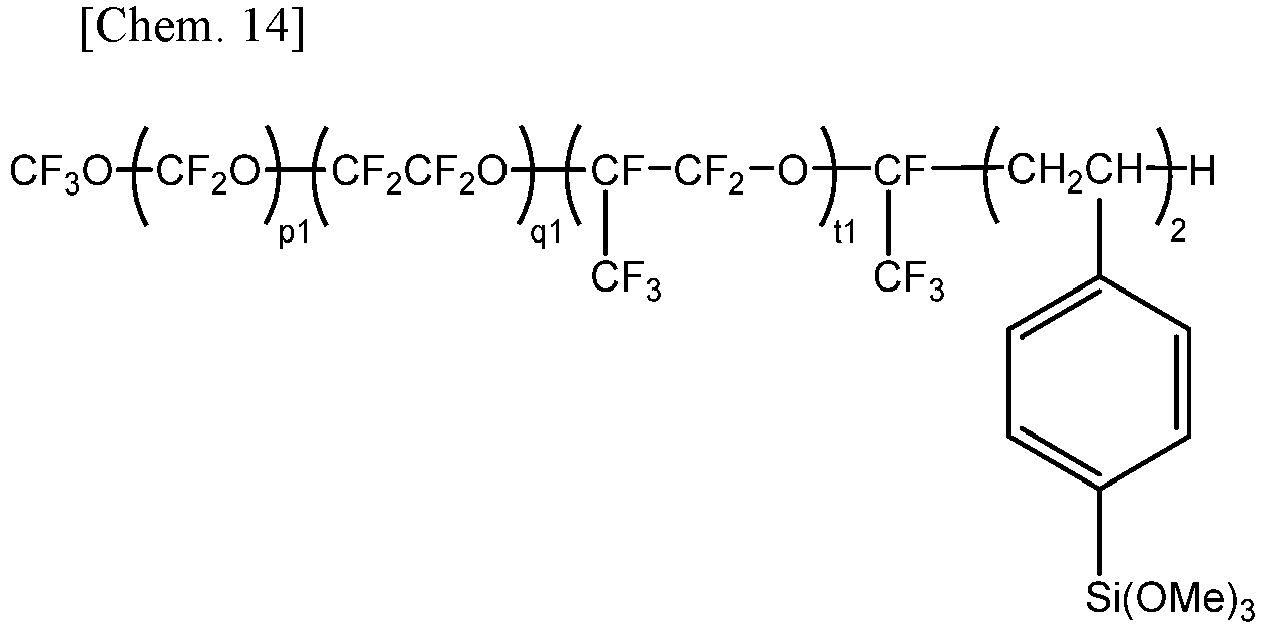


- [7] The water/oil repellent member of any one of [1] to [6] wherein the substrate is of a metal oxide, metal, resin, ceramic, quartz, glass, sapphire, or diamond.
- [8] A method for preparing the water/oil repellent member of any one of [1] to [7], the method comprising the steps of:
- wet coating a solution of an organosilicon compound having a plurality of silanol groups in a solvent onto a surface of a substrate,
- drying the solvent to form a primer layer,
- wet coating a solution of a fluorinated compound in a solvent onto the primer layer and then drying the solvent, or providing a solution of a fluorinated compound in a solvent, evaporating off the solvent, and dry coating the fluorinated compound onto the primer layer, and
- curing the fluorinated compound to form a water/oil repellent layer.
- According to the invention, there is provided a water/oil repellent member having an antifouling layer with improved water/oil repellent properties tightly adhered to its surface. The method for preparing the water/oil repellent member enables to form the relevant layer by the wet process (e.g., brush coating, spin coating, spraying, gravure coating, die coating, bar coating or slit coating) without resorting essentially to the vacuum process or high-temperature heating process. The water/oil repellent member and the method are useful in a variety of applications, for example, articles which must have an antifouling surface, typically electronic instrument housings, wearable terminals, kitchen wares, sanitary wares, transportation vehicle bodies, touch panel displays, protective films, and the like.
- Now the invention is described in detail.
- The invention provides a water/oil repellent member comprising a substrate, a primer layer disposed on the substrate, composed mainly of an organosilicon compound having a plurality of silanol groups, and having a thickness of 0.5 to 500 nm, and a water/oil repellent layer disposed on the primer layer, composed mainly of a cured product of a fluorinated organic compound, and having a thickness of 0.5 to 30 nm, which is prepared, for example, by a method comprising the steps of wet coating a solution of an organosilicon compound having a plurality of silanol groups in a solvent onto a surface (at least one surface) of a substrate, drying the solvent to form a primer layer, wet coating a solution of a fluorinated compound in a solvent (i.e., water/oil repellent agent) onto the primer layer and then drying the solvent, or providing a solution of a fluorinated compound in a solvent, evaporating off the solvent, and dry coating the fluorinated compound onto the primer layer, and curing the fluorinated compound to form a water/oil repellent layer.
- The substrate which can be used herein is not particularly limited and is preferably selected from metal oxides, metals, resins, ceramics, quartz, glass, sapphire, and diamond.
- Suitable substrate-forming metal oxides include SiO, SiO2, Al2O3, ITO, In2O3, SnO2, ZrO2, TiO2, Ti2O3, Ti4O7, Ti3O5, Nb2O5, Ta2O5, Y2O3, WO3, HfO2, and La2Ti2O7.
- Suitable substrate-forming metals include magnesium, magnesium alloys, titanium, titanium alloys, chromium, iron, nickel, cobalt, copper, zinc, yttrium, zirconium, niobium, molybdenum, ruthenium, rhodium, palladium, silver, tungsten, platinum, gold, stainless steel, aluminum, aluminum alloys, duralumin, and Hastelloy.
- Suitable substrate-forming resins include thermoplastic resins and thermosetting resins. Specifically stated, suitable thermoplastic resins include celluloid, cellulose acetate, cellulose propionate, cellulose butyrate, aliphatic polyamides such as nylon 6, nylon 66, nylon 12, aromatic polyamides, (meth)acrylic resins, ABS resins, AS resins, polystyrene, polyolefins such as polyethylene (low density or high density) and polypropylene, polyvinyl chloride, polyvinylidene chloride, ethylene-vinyl acetate copolymers, polyvinyl alcohol, polyacetal, saturated polyesters such as polycarbonate, polyethylene terephthalate, polybutylene terephthalate, aromatic polyesters, polyether ketones, polyether ether ketones, polysulfone, polyether sulfone, polyether imide, polyarylate, polymethylpentene, ionomers, liquid crystal polymers, polyimides, polyamide imides, fluoro-resins, polyphenylene sulfide, (modified) polyphenylene oxide, and thermoplastic polyurethane. Suitable thermosetting resins include epoxy resins, unsaturated polyesters, thermosetting polyurethane, polyimide, diethylene glycol bisallyl carbonate polymers (commonly known as CR-39), (co)polymers of di(meth)acrylate of (halogenated) bisphenol A, (co)polymers of urethane-modified di(meth)acrylate of (halogenated) bisphenol A, and copolymers of diacrylate compounds or vinyl benzyl alcohol with unsaturated thiol compounds.
- The primer layer disposed on the substrate is composed mainly of an organosilicon compound having a plurality of silanol groups, preferably at least 50% by weight of the organosilicon compound, and has a thickness of 0.5 to 500 nm. The primer layer may be formed by wet coating a solution of an organosilicon compound having a plurality of silanol groups in a solvent onto the surface of a substrate, and drying the solution to remove the solvent.
- The organosilicon compound having a plurality of silanol groups should preferably have at least two, more preferably at least three, and even more preferably at least four silanol groups per molecule. If the number of silanol groups is less than two, the coating itself may be weak. It is noted that the organosilicon compound having a plurality of silanol groups should preferably have a silanol content of 0.0001 to 0.05 mol/g, more preferably 0.001 to 0.04 mol/g, and even more preferably 0.005 to 0.03 mol/g.
- The organosilicon compound having a plurality of silanol groups may be prepared by hydrolyzing an organosilicon compound having a plurality of hydrolyzable groups.
- Examples of the organosilicon compound having a plurality of hydrolyzable groups include methyltrimethoxysilane, dimethyldimethoxysilane, phenyltrimethoxysilane, dimethoxydiphenylsilane, tetraethoxysilane, methyltriethoxysilane, dimethyldiethoxysilane, phenyltriethoxysilane, n-propyltrimethoxysilane, n-propyltriethoxysilane, hexyltrimethoxysilane, hexyltriethoxysilane, decyltrimethoxysilane, 1,6-bis(trimethoxysilyl)hexane, trifluoropropyltrimethoxysilane, vinyltrimethoxysilane, vinyltriethoxysilane, 2-(3,4-epoxycyclohexyl)ethyltrimethoxysilane, 3-glycidoxypropylmethyldimethoxysilane, 3-glycidoxypropyltrimethoxysilane, 3-glycidoxypropyltriethoxysilane, p-styryltrimethoxysilane, 3-methacryloxypropylmethyldimethoxysilane, 3-methacryloxypropyltrimethoxysilane, 3-methacryloxypropylmethyldiethoxysilane, 3-methacryloxypropyltriethoxysilane, 3-acryloxypropyltrimethoxysilane, tris(trimethoxysilylpropyl) isocyanurate, trichlorosilane, and dichlorosilane, which may be used in admixture.
- In the practice of the invention, a higher molecular weight product obtained by hydrolyzing an organosilicon compound having a plurality of hydrolyzable groups as mentioned above, and effecting dehydrating condensation is preferably used as the organosilicon compound having a plurality of silanol groups.
- The hydrolytic dehydrated condensate should preferably have a weight average molecular weight (Mw) of 300 to 100,000, more preferably 5,000 to 50,000. As used herein, the weight average molecular weight (Mw) may be determined, for example, by gel permeation chromatography (GPC) using toluene as developing solvent versus polystyrene standards (the same holds true, hereinafter).
- Most preferably, the organosilicon compound having a plurality of silanol groups used herein is a hydrolytic dehydrated condensate of tetraethoxysilane.
- The organosilicon compound having a plurality of silanol groups is desirably diluted with a solvent. Preferred examples of the solvent for diluting the organosilicon compound having a plurality of silanol groups include alcohols such as methanol, ethanol, isopropanol and butanol, and ethers such as propylene glycol monomethyl ether and polyethylene glycol monopropyl ether, but are not limited thereto. An appropriate solvent may be selected in view of substrate wetting and boiling point. The solution of the organosilicon compound having a plurality of silanol groups in a solvent should preferably contain the organosilicon compound in a concentration of 0.01 to 10% by weight, more preferably 0.1 to 2% by weight. If the concentration is too low, more portions may be left uncoated. If the concentration is too high, secondary agglomeration can take place between silanol groups.
- In the solution of the organosilicon compound having a plurality of silanol groups in a solvent, additives such as UV absorbers, light stabilizers, antioxidants, leveling agents, anti-foaming agents, pigments, dyes, dispersants, antistatic agents, anti-fogging agents, and surfactants may be used if necessary.
- A primer layer composed mainly of the organosilicon compound having a plurality of silanol groups may be formed by coating the solution of the organosilicon compound having a plurality of silanol groups in a solvent onto a substrate surface by a wet coating process, specifically dipping, brush coating, spin coating, spray coating, gravure coating, die coating, bar coating, slit coating or flow coating, and then drying off the solvent. If desired, the coating may be heated at a temperature in the range which does not affect the substrate, for example, at 40 to 500°C for 1 minute to 24 hours.
- The primer layer disposed on the substrate surface typically has a thickness of 0.5 to 500 nm, preferably 3 to 200 nm, more preferably 10 to 100 nm although the thickness is selected as appropriate depending on a particular substrate. As used herein, the thickness may be measured by any well-known methods such as spectral ellipsometry and X-ray reflection method.
- Next, an antifouling surface layer (or water/oil repellent layer) is formed by coating a water/oil repellent agent onto the surface of the primer layer and curing the agent. The water/oil repellent agent is based on a fluorinated organosilicon compound. Any of the fluorinated organosilicon compounds may be used which are described in
JP-A 2007-197425 JP-A 2007-297589 JP-A 2007-297543 JP-A 2008-088412 JP-A 2008-144144 JP-A 2010-031184 JP-A 2010-047516 JP-A 2011-116947 JP-A 2011-178835 JP-A 2014-084405 JP-A 2014-105235 JP-A 2013-253228 JP-A 2014-218639 WO 2013/121984 (Patent Documents 1, 4 to 16). - The fluorinated organosilicon compound (or fluorinated compound) is described below in further detail.
- The fluorinated compound used herein is preferably a fluorinated compound having at least one hydrolyzable group at one or more ends. More preferably the compound is an organosilicon compound having a hydrolyzable group in the molecule and fluorine, the hydrolyzable group being typically selected from C1-12, especially C1-10 alkoxy groups such as methoxy, ethoxy, propoxy and butoxy, C2-12, especially C2-10 alkoxyalkoxy groups such as methoxymethoxy and methoxyethoxy, C1-10 acyloxy groups such as acetoxy, C2-10 alkenyloxy groups such as isopropenoxy, halogen groups such as chloro, bromo and iodo, amino groups, and silazane groups. The fluorinated compound is preferably a compound having a fluorooxyalkylene group. The fluorooxyalkylene group refers to a compound of (poly)fluorooxyalkylene structure having a plurality of repeating units: -CjF2jO- bonded wherein j is an integer of at least 1, preferably 1 to 6, more preferably 1 to 4. Especially, the structure may have 3 to 500, preferably 15 to 200, more preferably 20 to 100, even more preferably 25 to 80 repeating units.
- The repeating units: -CjF2jO- may be linear or branched. Examples include the following units while repeating units of more than one type may be bonded.
-CF2O-
-CF2CF2O-
-CF2CF2CF2O-
-CF(CF3)CF2O-
-CF2CF2CF2CF2O-
-CF2CF2CF2CF2CF2O-
-C(CF3)2O-
- Most preferably, the (poly)fluorooxyalkylene structure is -(CF2)d-O-(CF2O)p(CF2CF2O)q(CF2CF2CF2O)r(CF2CF2CF2CF2O)s(CF(CF3)CF2O)t-(CF2)d-, wherein p, q, r, s, and t are each independently an integer of 0 to 200, preferably p is an integer of 5 to 100, q is an integer of 5 to 100, r is an integer of 0 to 100, s is an integer of 0 to 50, t is an integer of 0 to 100, and p+q+r+s+t is an integer of 3 to 500, preferably an integer of 10 to 105. Each unit in parentheses may be randomly arranged. The subscript d is independently an integer of 0 to 8, preferably an integer of 0 to 5, more preferably an integer of 0 to 2, and the unit with d may be linear or branched. Specific examples are shown by the following structures.

- Herein p', q', r', s', and t' are each independently an integer of 1 to 200, the sum of p', q', r', s', and t' is 3 to 500, each unit in parentheses may be randomly arranged, d' is independently an integer of 0 to 5, and the unit with d' may be linear or branched.
- More preferably, the fluorinated compound used herein is a hydrolyzable fluorinated organosilicon compound (or hydrolyzable fluorine-containing organosilicon compound) having any one of the general formulae (1) to (5). The compounds may be used alone or in admixture.
(A-Rf)α-ZWβ (1)
Rf-(ZWβ)2 (2)
Z'-(Rf-ZWβ)γ (3)
A-Rf-Q-(Y)δ-B (4)
Rf-(Q-(Y)δ-B)2 (5)
- In formulae (1) to (5), Rf is -(CF2)d-O-(CF2O)p(CF2CF2O)q(CF2CF2CF2O)r(CF2CF2CF2CF2O)s(CF(CF3)CF2O)t-(CF2)d-, p, q, r, s, and t are each independently an integer of 0 to 200, p+q+r+s+t is 3 to 500, each unit in parentheses may be randomly arranged, d is an integer of 0 to 8, the unit with d may be linear or branched. "A" is fluorine, hydrogen or a monovalent fluorinated group terminated with -CF3, -CF2H or -CH2F group, Z and Z' are each independently a single bond, or a di- to octavalent organic group which may contain nitrogen, oxygen, silicon, phosphorus or sulfur and which may be fluorinated, W is a monovalent organic group terminated with a hydrolyzable group. The subscripts α and β are each independently an integer of 1 to 7, preferably α is an integer of 1 to 3, more preferably 1, β is an integer of 1 to 3, α+β is an integer of 2 to 8, preferably an integer of 2 to 4, and γ is an integer of 2 to 8, preferably 2 or 3.
- Q is a single bond or divalent organic group, δ is independently an integer of 1 to 10, Y is a divalent organic group having a hydrolyzable group, and B is hydrogen, C1-4 alkyl or halogen.
- In formulae (1) to (5), Rf is the above-described (poly)fluorooxyalkylene structure: -(CF2)d-O-(CF2O)p(CF2CF2O)q(CF2CF2CF2O)r(CF2CF2CF2CF2O)s(CF(CF3)CF2O)t-(CF2)d-, examples of which are as illustrated above.
- In formulae (1) and (4), "A" is fluorine, hydrogen or a monovalent fluorinated group terminated with -CF3, -CF2H or -CH2F group. Inter alia, -CF3, -CF2CF3 and -CF2CF2CF3 groups are preferred.
- In formulae (1) to (3), Z and Z' are each independently a single bond, or a di- to octavalent organic group which may contain nitrogen, oxygen, silicon, phosphorus or sulfur and which may be fluorinated. The organic group may be represented by (L)e-M wherein e is an integer of 1 to 7, preferably 1 to 3.
- Herein L is a single bond, oxygen, sulfur or a divalent organic group. In formulae (1) to (3), L in Z is a linking group between Rf group and M group (or W group), and L in Z' is a linking group between M group (or Rf group) and Rf group. The divalent organic group is preferably an unsubstituted or substituted C2-12 divalent organic group which may contain one or more selected from the group consisting of amide bond, ether bond, ester bond, diorganosilylene groups such as dimethylsilylene, and groups of the formula: -Si[OH][(CH2)fSi(CH3)3]- wherein f is an integer of 2 to 4, more preferably an unsubstituted or substituted C2-12 divalent hydrocarbon group which may contain the foregoing structure.
- Examples of the unsubstituted or substituted C2-12 divalent hydrocarbon group include alkylene groups such as ethylene, propylene (trimethylene or methylethylene), butylene (tetramethylene or methylpropylene), hexamethylene, and octamethylene, arylene groups such as phenylene, and combinations of two or more such groups, such as alkylene-arylene groups. In these groups, some or all of carbon-bonded hydrogen atoms may be substituted by halogen atoms such as fluorine and iodine. Inter alia, unsubstituted or substituted C2-4 alkylene groups or phenylene groups are preferred.
- Examples of the divalent organic group L include groups of the following structure, and combinations of two or more such groups.
[Chem. 30] -(CH2)u-O-(CH2)v-


- Herein f is an integer of 2 to 4, b is an integer of 2 to 6, preferably 2 to 4, u and v each are an integer of 1 to 4, g is an integer of 2 to 4, and Me is methyl.
- Also, M is a single bond, nitrogen, silicon, carbon, phosphorus or a group containing such atom, or a di- to octavalent organic group. Specifically, M is a single bond, divalent group -R1 2C-, divalent group -R3 2Si-, divalent group -NR4-, trivalent group -N=, trivalent group -P=, trivalent group -PO=, trivalent group -R1C=, trivalent group -R3Si=, tetravalent group -C≡, tetravalent group -O-C≡, tetravalent group -Si≡, or di- to octavalent siloxane residues. In formulae (1) to (3), M in Z is a linking group between L (or Rf group) and W group, and M in Z' is a group to link with Rf group via L.
- Herein, R1 is each independently a C1-3 alkyl group, hydroxyl group, group having repeating unit of C1-3 oxyalkylene group which may have an intervening diorganosiloxane structure of 2 to 51 silicon atoms, or silyl ether group represented by R2 3SiO-. R2 is each independently hydrogen, a C1-3 alkyl group, aryl group such as phenyl, or C1-3 alkoxy group. R3 is each independently a C1-3 alkyl group, C2 or C3 alkenyl group, C1-3 alkoxy group, or chloro. R4 is a C1-3 alkyl group or C6-10 aryl group such as phenyl. When M is a siloxane residue, it preferably has a straight, branched or cyclic organopolysiloxane structure of 2 to 51 silicon atoms, preferably 2 to 13 silicon atoms, more preferably 2 to 11 silicon atoms, even more preferably 2 to 5 silicon atoms. The organopolysiloxane having an unsubstituted or fluorinated alkyl group of 1 to 8 carbon atoms, more preferably 1 to 4 carbon atoms such as methyl, ethyl, propyl, butyl or C3F7-C3H6-, or phenyl group is preferred. The organopolysiloxane may also contain a silalkylene structure in which two silicon atoms are linked by an alkylene group, that is, Si-(CH2)n-Si wherein n is an integer of 2 to 6, preferably an integer of 2 to 4.
- The following are exemplary of M defined above.


- Herein i is an integer of 1 to 20, c is an integer of 1 to 50, and Me is methyl.
- In formulae (1) to (3), W is a monovalent organic group terminated with a hydrolyzable group, preferably represented by the following formula.

- Herein R is C1-4 alkyl or phenyl, X is a hydrolyzable group, a is 2 or 3, and m is an integer of 0 to 10.
- In the above formula, examples of the hydrolyzable group X include alkoxy groups of 1 to 12 carbon atoms, especially 1 to 10 carbon atoms such as methoxy, ethoxy, propoxy and butoxy, alkoxyalkoxy groups of 2 to 12 carbon atoms, especially 2 to 10 carbon atoms such as methoxymethoxy and methoxyethoxy, acyloxy groups of 1 to 10 carbon atoms such as acetoxy, alkenyloxy groups of 2 to 10 carbon atoms such as isopropenoxy, halogen groups such as chloro, bromo and iodo, and amino groups. Inter alia, methoxy and ethoxy groups are preferred.
- R is C1-4 alkyl such as methyl or ethyl, or phenyl, with methyl being preferred.
- The subscript "a" is 2 or 3. From the standpoints of reactivity and substrate adhesion, "a" is preferably equal to 3. The subscript m is an integer of 0 to 10, preferably an integer of 2 to 8, more preferably 2 or 3.
- In formulae (1) to (3), examples of the structures represented by (-)αZWβ and -ZWβ include the following structures.


- In formulae (4) and (5), Q is a single bond or divalent organic group, that is a linking group between Rf group and Y group. The divalent organic group represented by Q is preferably an unsubstituted or substituted C2-12 divalent organic group which may contain at least one structure selected from amide bond, ether bond, ester bond, diorganosilylene groups such as dimethylsilylene, and groups represented by -Si[OH][(CH2)fSi(CH3)3]-wherein f is an integer of 2 to 4, more preferably an unsubstituted or substituted C2-12 divalent hydrocarbon group which may contain the aforementioned structure.
- Examples of the unsubstituted or substituted C2-12 divalent hydrocarbon group are as exemplified above for the unsubstituted or substituted C2-12 divalent hydrocarbon group L.
- Examples of the divalent organic group Q include groups of the following structure.
[Chem. 45] -(CH2)u-O-(CH2)v-
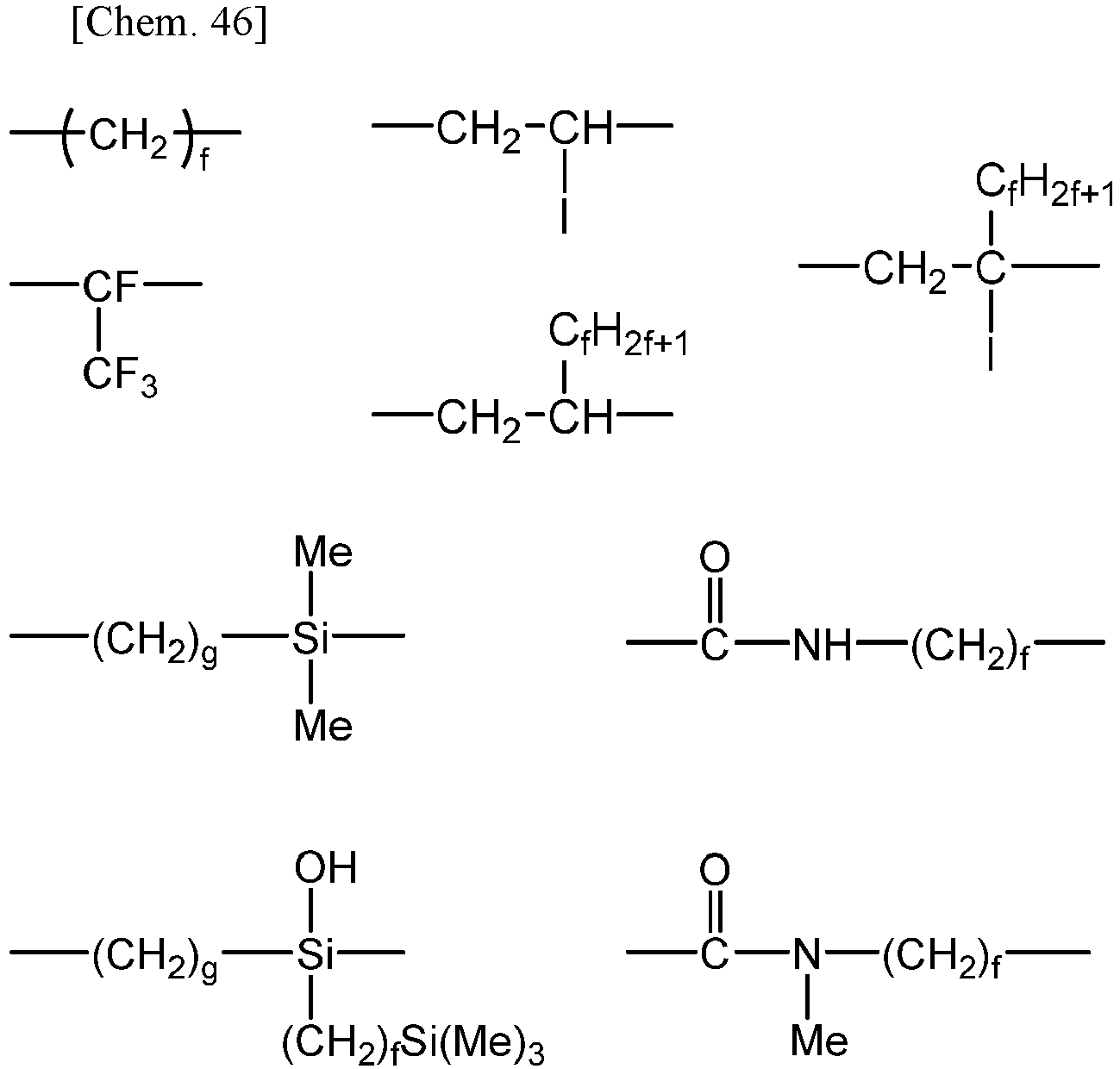


- Herein f is an integer of 2 to 4, b is an integer of 2 to 6, preferably 2 to 4, u and v each are an integer of 1 to 4, g is an integer of 2 to 4, and Me is methyl.
- In formulae (4) and (5), Y is each independently a divalent organic group having a hydrolyzable group, preferably a group of the following formula.
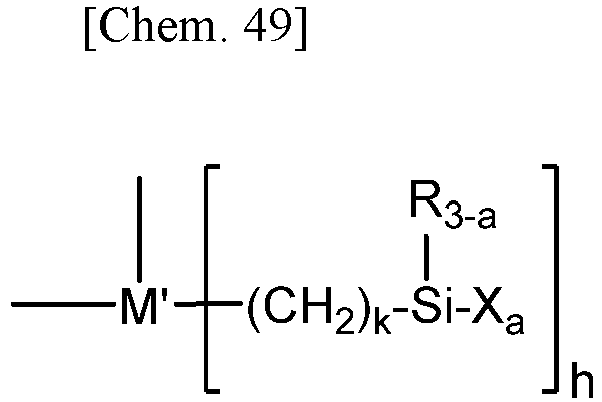
- Herein R, X, and a are as defined above; k is an integer of 0 to 10, preferably an integer of 1 to 10, more preferably an integer of 2 to 8, even more preferably an integer of 2 to 6; h is an integer of 1 to 6, preferably 1 or 2. M' is an unsubstituted or substituted tri- to octavalent, preferably tri- or tetravalent hydrocarbon group, in which some or all of the carbon atoms may be replaced by silicon atoms and some or all of the carbon-bonded hydrogen atoms may be substituted by halogen atoms such as fluorine.
- Preferably M' is selected from groups of the following structures.

- Herein M1 is a single bond, unsubstituted or substituted C1-6 divalent hydrocarbon group, or diorganosilylene group such as dimethylsilylene. M2 is a trivalent group of the formula: -R1C= or trivalent group of the formula: -R3Si=. R1 and R3 are as defined above. R5 is hydrogen or a monovalent hydrocarbon group, typically C1-6 alkyl group such as methyl, ethyl or propyl.
- Exemplary of M1 are a single bond, phenylene, dimethylsilylene and tetrafluoroethylene. The following is typical of M2.

- Herein Me is methyl.
- For example, Y is selected from the following groups.


- Herein X is as defined above, k1 is an integer of 0 to 10, preferably an integer of 1 to 8, k2 is an integer of 2 to 10, preferably an integer of 2 to 8, and Me is methyl.
- In formulae (4) and (5), δ is an integer of 1 to 10, preferably an integer of 1 to 4.
- B is each independently selected from hydrogen, C1-4 alkyl groups such as methyl, ethyl, propyl and butyl, and halogen atoms such as fluorine, chlorine, bromine and iodine.
- Examples of the hydrolyzable fluorinated organosilicon compounds (hydrolyzable fluorine-containing organosilicon compounds) having formulae (1) to (5) include the structures shown below.


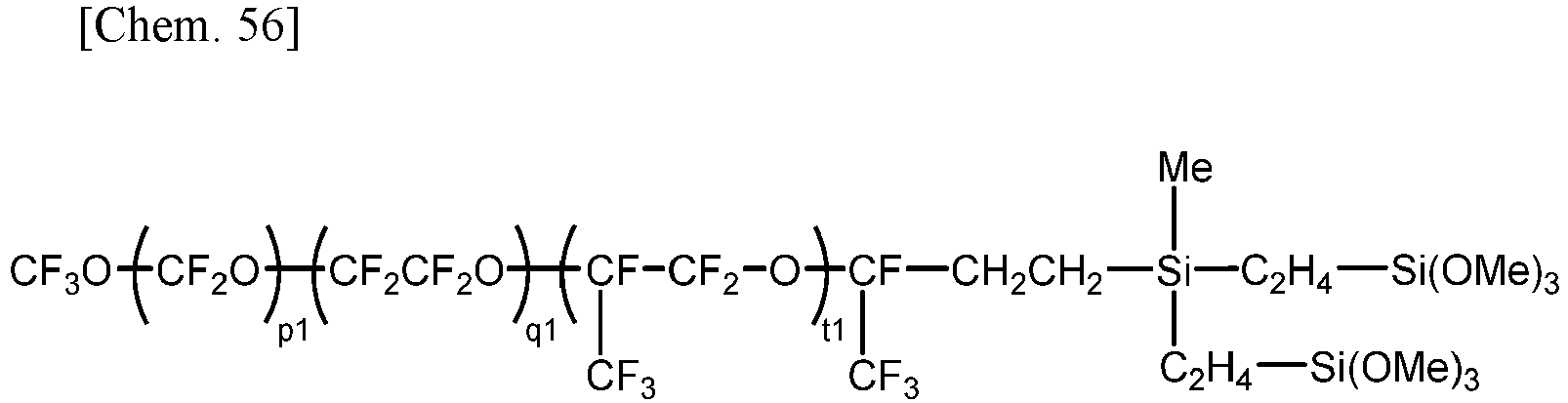


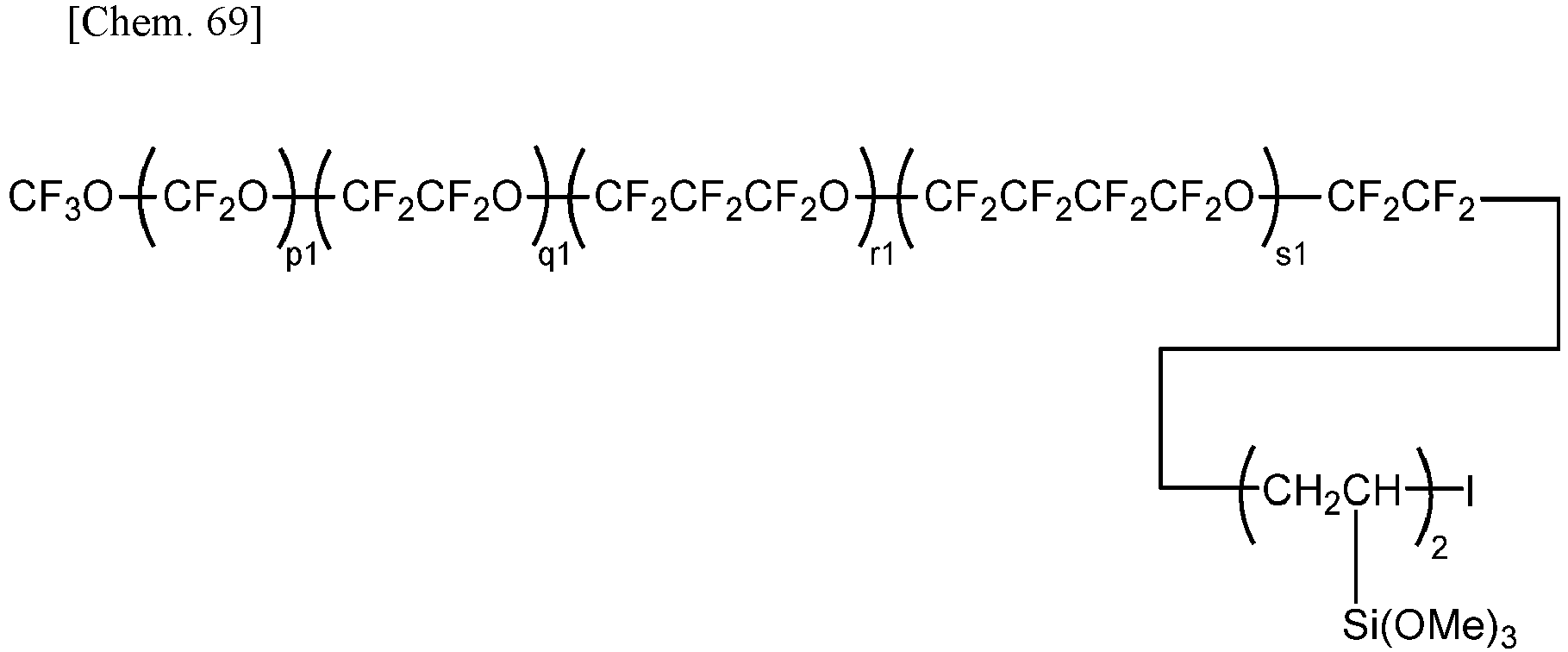


- Herein Me is methyl, p1, q1, r1, s1, and t1 are each independently an integer of 1 to 200, the sum of p1, q1, r1, s1, and t1 is 3 to 500, each unit in parentheses may be randomly arranged.
- The hydrolyzable fluorinated organosilicon compound (hydrolyzable fluorine-containing organosilicon compound) having any of formulae (1) to (5) may contain such compounds in which some or all of the hydrolyzable groups (X) are hydrolyzed, that is, X is OH group and may further contain such compounds in which some or all of the OH groups are condensed.
- Desirably the fluorinated compound is previously diluted with a solvent. The solvent used herein is not particularly limited as long as the fluorinated compound is uniformly dissolved. Examples include fluorine-modified aliphatic hydrocarbon solvents (e.g., perfluoroheptane and perfluorooctane), fluorine-modified aromatic hydrocarbon solvents (e.g., 1,3-trifluoromethylbenzene), fluorine-modified ether solvents (e.g., methyl perfluorobutyl ether, ethyl perfluorobutyl ether, perfluoro(2-butyltetrahydrofuran)), fluorine-modified alkylamine solvents (e.g., perfluorotributylamine, perfluorotripentylamine), hydrocarbon solvents (e.g., petroleum benzine, toluene, xylene), and ketone solvents (e.g., acetone, methyl ethyl ketone, methyl isobutyl ketone). Of these, fluorine-modified solvents are desirable for solubility and stability, and fluorine-modified ether solvents and fluorine-modified aromatic hydrocarbon solvents are especially preferred.
- The foregoing solvents may be used alone or in admixture.
- The solvent is preferably used in such amounts that the concentration of the fluorinated compound may fall in a range of 0.01 to 50% by weight, more preferably 0.03 to 10% by weight, even more preferably 0.05 to 1% by weight of the water/oil repellent agent (solution of the fluorinated compound in the solvent).
- The water/oil repellent agent containing the fluorinated compound may be applied to substrates by any well-known processes such as wet coating processes (e.g., dipping, brush coating, spin coating, spraying, gravure coating, die coating, bar coating, and slit coating) and evaporation. Although coating and other conditions may accord with the prior art well-known process, it is efficient that the water/oil repellent agent containing the fluorinated compound is deposited by the wet coating process because the primer layer is deposited by the wet coating process.
- The fluorinated compound may be cured at room temperature (25°C) for 1 to 24 hours. Cure may be completed within a shorter time by heating at 30 to 200°C for 1 minute to 1 hour. Cure under humid conditions (RH 50 to 90%) is preferred for accelerating hydrolysis.
- It is noted that the surface of the primer layer on the substrate may be cleaned or activated by plasma treatment, UV treatment or ozone treatment before the water/oil repellent agent containing the fluorinated compound is coated thereon.
- The fluorinated layer (water/oil repellent layer) of the inventive water/oil repellent member has a thickness of 0.5 to 30 nm, preferably 1 to 20 nm. If the layer is too thick, the treating agent may agglomerate together, exacerbating visibility. If the layer is too thin, surface properties and abrasion resistance may be insufficient.
- Examples of the inventive water/oil repellent member thus obtained include housings of car navigation systems, PC tablets, smartphones, digital cameras, digital video cameras, PDAs, portable audio players, car audio players, and video game consoles; optical articles such as lenses (e.g., camera lenses, eyeglass lenses, sunglasses, AR lenses, and VR lenses), medical instruments (e.g., gastroscopes, surgical knives, blood pressure gauges, X-ray CT, and MRI), liquid crystal displays, organic EL displays, flexible devices, touch panel displays, protective films, antireflective films, compact disks, DVDs, and Blu-ray disks; sanitary wares such as bathtubs and washbowls; kitchen wares such as kitchen counters; windowpanes and headlamp covers of automobiles, trains and aircraft; building exterior members; kitchen building members; waiting rooms; art works; bodies, aluminum wheels and mirrors of transportation vehicles; and extremely high frequency (EHF) sensor covers.
- Examples and Comparative Examples are shown below for further illustrating the invention although the invention is not limited thereby.
- Primer layers 1 to 5 were formed on acrylic resin substrates (Engineering Test Service Co., Ltd., Acrylic Delaglas A, specimen substrate of 2 mm thickness, 50 mm width, 100 mm length) by the following methods.
- By dip coating the substrate with a treating liquid of the hydrolytic dehydrated condensate of tetraethoxysilane (Mw 25,000, silanol content 0.01 mol/g) diluted with butanol in a concentration of 0.5 wt% as solids and drying the coating at room temperature (25°C) for 1 hour, Primer layer 1 of 20 nm thickness was formed on the substrate. The dip coating step included dipping the substrate in the treating liquid for 30 seconds and pulling up at 150 mm/min.
- By dip coating the substrate with a treating liquid of tetraethoxysilane diluted with ethanol in a concentration of 0.5 wt% as solids and curing the coating at 80°C and 80% RH for 24 hours, Primer layer 2 of 20 nm thickness was formed on the substrate. The dip coating included dipping the substrate in the treating liquid for 30 seconds and pulling up at 150 mm/min.
- By dip coating the substrate with a treating liquid of a pentamer of tetraethoxysilane diluted with butanol in a concentration of 0.5 wt% as solids and curing the coating at 80°C and 80% RH for 24 hours, Primer layer 3 of 18 nm thickness was formed on the substrate. The dip coating included dipping the substrate in the treating liquid for 30 seconds and pulling up at 150 mm/min.
- By dip coating the substrate with a treating liquid of perhydropolysilazane diluted with dibutyl ether in a concentration of 0.5 wt% as solids and curing the coating at 80°C and 80% RH for 24 hours, Primer layer 4 of 23 nm thickness was formed on the substrate. The dip coating included dipping the substrate in the treating liquid for 30 seconds and pulling up at 150 mm/min.
- By sputter depositing a SiO2 layer on the substrate, Primer layer 5 of 20 nm thickness was formed on the substrate.
- Further, a water/oil repellent layer was formed on each of the substrates having Primer layers 1 to 5 formed thereon, by the following method.
- Compound 1 shown below was diluted with a fluorochemical solvent (Novec 7200 by 3M) in a concentration of 0.1 wt% as solids. Using a spray coater (NST-51 by T&K Co., Ltd.), the dilution was sprayed onto the primer layer on the substrate. The coating was cured at 80°C for 30 minutes to form a cured film (or water/oil repellent layer), yielding a specimen. The water/oil repellent layer had an average thickness of about 10 nm as computed from the F content detected by an X-ray fluorescence analyzer (ZSXmini2 by Rigaku Corp.).
-

- Example 1 was the substrate having Primer layer 1 formed thereon. Comparative Examples 1, 2, 3 and 4 were the substrates having Primer layers 2, 3, 4, and 5 formed thereon, respectively. In Comparative Example 5, a water/oil repellent layer was formed directly on an acrylic resin substrate by the above method without forming a primer layer. Using the specimens, various properties were evaluated by the following methods. The results are shown in Table 1.
- Using a contact angle meter (DropMaster by Kyowa Interface Science Co., Ltd.), the contact angles of the cured film (water/oil repellent layer) with water and oleic acid were measured.
- Using a surface property tester (Shinto Scientific Co., Ltd.), the cured film (water/oil repellent layer) was measured for a coefficient of dynamic friction with respect to fabric Bemcot (Asahi Kasei Corp.) under the following conditions.
contact area: 10 mm × 30 mm
load: 100 g - Seven panelists transferred sebum on their forehead to the surface of the cured film (water/oil repellent layer) with the finger, wiped the film surface with fabric Bemcot (Asahi Kasei Corp.), and evaluated wipe-off according to the following criteria.
- A: complete wipe-off within 2 strokes
- B: complete wipe-off within 3 to 5 strokes
- C: some residues after 5 stroke wipe-off
- D: little wipe-off after 5 strokes
- Using a both-way wear tester (Heidon 30S, Shinto Scientific Co., Ltd.), an abrasion resistance test was carried out on the cured film (or water/oil repellent layer) under the following conditions. The cured film (or water/oil repellent layer) after the abrasion resistance test was measured for a contact angle with water using a contact angle meter (DropMaster by Kyowa Interface Science Co., Ltd.).
- environmental conditions: 25°C, humidity 40%
- rubbing member: tip portion (10 mm × 10 mm) of the tester to come in contact with the specimen was wrapped with 8 stacked non-woven fabric sheets, which was secured by rubber band.
- load: 1 kg
- rubbing distance (one way): 30 mm
- rubbing speed: 3,600 mm/min
- reciprocation: 5,000 cycles
- As is evident from the results in Table 1, Example 1 exhibited effective sebum stain wipe-off because of excellent water/oil repellency and a low coefficient of dynamic friction. It exhibited excellent water/oil repellency as demonstrated by a contact angle with water of more than 100° before and after the abrasion test. In Comparative Examples 1 and 2 using organosilicon compounds which had undergone no hydrolysis or were free of silanol groups, initial properties were unsatisfactory and abrasion resistance was poor. In Comparative Example 3 using perhydropolysilazane which was typical in the wet coating of a silica film, initial properties were excellent, but abrasion resistance was insufficient. In Comparative Example 4 using a sputtered SiO2 film which was typical in the dry coating of a silica film, initial properties were excellent, but abrasion resistance was unsatisfactory. Comparative Example 5 using no primer failed to exhibit satisfactory performance. Since silanol groups are adhesive to substrates and reactive with fluorinated compounds having hydrolyzable groups, an antifouling film having excellent abrasion resistance can be formed.
- According to the invention, a water/oil repellent member having a cured film (water/oil repellent layer) with excellent water/oil repellent properties is formed by only wet coating and room temperature process. Although the need for heat curing and vacuum process is eliminated, abrasion resistance surpassing the prior art level is available. The technology of the invention enables large area coating. Thus the water/oil repellent member of the invention enables production of functional film in roll form. Even when the invention is applied to articles which are of daily use and frequent touch, for example, electronic instrument housings and kitchen wares, a satisfactory antifouling surface is maintained over a long period of time.
| Primer layer | Water/oil repellency | Coefficient of dynamic friction | Sebum stain wipe-off | Abrasion resistance test | ||
| Water contact angle (°) | Oleic acid contact angle (°) | Water contact angle (°) | ||||
| Example 1 | 1 | 115 | 73 | 0.03 | A | 110 |
| Comparative Example 1 | 2 | 103 | 64 | 0.15 | D | - |
| Comparative Example 2 | 3 | 104 | 65 | 0.13 | C | - |
| Comparative Example 3 | 4 | 112 | 71 | 0.04 | A | 85 |
| Comparative Example 4 | 5 | 115 | 73 | 0.04 | A | 97 |
| Comparative Example 5 | none | 110 | 67 | 0.10 | D | - |
Claims (8)
- A water/oil repellent member comprising a substrate, a primer layer deposited on at least one surface of the substrate as a first layer, and a water/oil repellent layer deposited thereon as a second layer,
the primer layer being composed mainly of an organosilicon compound having a plurality of silanol groups and having a thickness of 0.5 to 500 nm,
the water/oil repellent layer being composed mainly of a cured product of a fluorinated compound and having a thickness of 0.5 to 30 nm. - The water/oil repellent member of claim 1 wherein the organosilicon compound having a plurality of silanol groups is a hydrolytic dehydrated condensate of tetraethoxysilane.
- The water/oil repellent member of claim 1 or 2 wherein the fluorinated compound has at least one hydrolyzable group at one or more ends, the hydrolyzable group being selected from among C1-12 alkoxy groups, C1-12 alkoxyalkoxy groups, C1-10 acyloxy groups, C2-10 alkenyloxy groups, halogen, amino, and silazane groups.
- The water/oil repellent member of any one of claims 1 to 3 wherein the fluorinated compound is a fluorooxyalkylene group-containing organosilicon compound having in the molecule -(CF2)d-O-(CF2O)p(CF2CF2O)q(CF2CF2CF2O)r(CF2CF2CF2CF2O)s(CF(CF3)CF2O)t-(CF2)d-, wherein p, q, r, s, and t are each independently an integer of 0 to 200, p+q+r+s+t is 3 to 500, each unit in parentheses may be randomly arranged, d is an integer of 0 to 8, the unit with d may be linear or branched, and having at least one hydrolyzable group at one or more ends.
- The water/oil repellent member of any one of claims 1 to 4 wherein the fluorinated compound is at least one compound selected from hydrolyzable fluorinated organosilicon compounds having the general formulae (1), (2), (3), (4), and (5):
(A-Rf)α-ZWβ (1)
Rf-(ZWβ)2 (2)
Z'-(Rf-ZWβ)γ (3)
wherein Rf is -(CF2)d-O-(CF2O)p(CF2CF2O)q(CF2CF2CF2O)r(CF2CF2CF2CF2O)s(CF(CF3)CF2O)t-(CF2)d-, p, q, r, s, and t are each independently an integer of 0 to 200, p+q+r+s+t is 3 to 500, each unit in parentheses may be randomly arranged, d is an integer of 0 to 8, the unit with d may be linear or branched, A is fluorine, hydrogen or a monovalent fluorinated group terminated with -CF3, -CF2H or -CH2F group, Z and Z' are each independently a single bond, or a di- to octavalent organic group which may contain nitrogen, oxygen, silicon, phosphorus or sulfur and which may be fluorinated, W is a monovalent organic group terminated with a hydrolyzable group, α and β are each independently an integer of 1 to 7, α+β is 2 to 8, andγ is an integer of 2 to 8,
A-Rf-Q-(Y)δ-B (4)
Rf-(Q-(Y)δ-B)2 (5)
wherein Rf and A are as defined above, Q is a single bond or divalent organic group, δ is an integer of 1 to 10, Y is a divalent organic group having a hydrolyzable group, and B is hydrogen, C1-4 alkyl or halogen. - The water/oil repellent member of claim 5 wherein the hydrolyzable fluorinated organosilicon compounds having formulae (1) to (5) are the following:


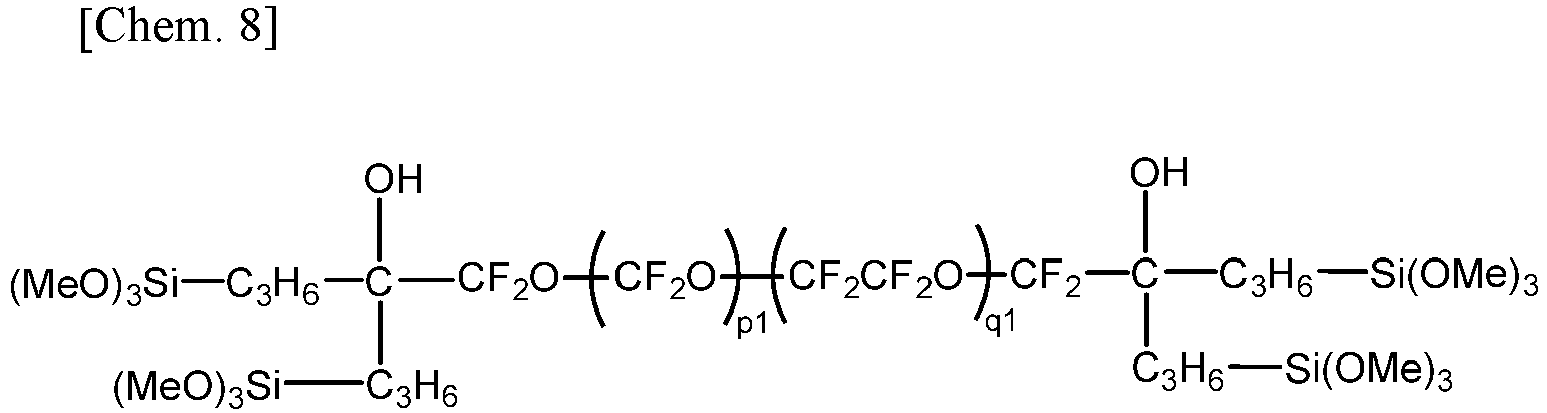


- The water/oil repellent member of any one of claims 1 to 6 wherein the substrate is of a metal oxide, metal, resin, ceramic, quartz, glass, sapphire, or diamond.
- A method for preparing the water/oil repellent member of any one of claims 1 to 7, the method comprising the steps of:wet coating a solution of an organosilicon compound having a plurality of silanol groups in a solvent onto a surface of a substrate,drying the solvent to form a primer layer,wet coating a solution of a fluorinated compound in a solvent onto the primer layer and then drying the solvent, or providing a solution of a fluorinated compound in a solvent, evaporating off the solvent, and dry coating the fluorinated compound onto the primer layer, andcuring the fluorinated compound to form a water/oil repellent layer.
Applications Claiming Priority (2)
| Application Number | Priority Date | Filing Date | Title |
|---|---|---|---|
| JP2017193240 | 2017-10-03 | ||
| PCT/JP2018/033635 WO2019069642A1 (en) | 2017-10-03 | 2018-09-11 | Water-repellent, oil-repellent member and method for manufacturing water-repellent, oil-repellent member |
Publications (2)
| Publication Number | Publication Date |
|---|---|
| EP3693160A1 true EP3693160A1 (en) | 2020-08-12 |
| EP3693160A4 EP3693160A4 (en) | 2021-07-07 |
Family
ID=65994214
Family Applications (1)
| Application Number | Title | Priority Date | Filing Date |
|---|---|---|---|
| EP18865192.1A Pending EP3693160A4 (en) | 2017-10-03 | 2018-09-11 | Water-repellent, oil-repellent member and method for manufacturing water-repellent, oil-repellent member |
Country Status (7)
| Country | Link |
|---|---|
| US (1) | US12146040B2 (en) |
| EP (1) | EP3693160A4 (en) |
| JP (1) | JP6988905B2 (en) |
| KR (1) | KR102602479B1 (en) |
| CN (1) | CN111163936B (en) |
| TW (1) | TWI772527B (en) |
| WO (1) | WO2019069642A1 (en) |
Cited By (1)
| Publication number | Priority date | Publication date | Assignee | Title |
|---|---|---|---|---|
| EP3970963A4 (en) * | 2019-05-14 | 2023-06-14 | Shin-Etsu Chemical Co., Ltd. | Water repellent and oil repellent member, and method for producing water repellent and oil repellent member |
Families Citing this family (11)
| Publication number | Priority date | Publication date | Assignee | Title |
|---|---|---|---|---|
| WO2019240093A1 (en) * | 2018-06-13 | 2019-12-19 | Agc株式会社 | Fouling-resistant article and production method therefor |
| JP7211423B2 (en) * | 2018-08-20 | 2023-01-24 | 信越化学工業株式会社 | Water- and oil-repellent member and method for manufacturing water- and oil-repellent member |
| US12163044B2 (en) * | 2019-08-20 | 2024-12-10 | Shin-Etsu Chemical Co., Ltd. | Water- and oil-repelling member and water- and oil-repelling member production method |
| CN114630871B (en) * | 2019-10-31 | 2023-11-21 | 信越化学工业株式会社 | Alkali-resistant water-repellent member, method for producing same, and method for improving alkali resistance and abrasion resistance of water-repellent member |
| CN114746475B (en) * | 2019-12-03 | 2024-03-22 | 信越化学工业株式会社 | Fluoropolyether group-containing polymer, surface treatment agent, and article |
| JPWO2021117688A1 (en) * | 2019-12-13 | 2021-06-17 | ||
| CN111362587B (en) * | 2020-04-28 | 2022-05-24 | 东莞南玻太阳能玻璃有限公司 | A kind of high-hardness moisture-proof and anti-reflection solar glass and preparation method thereof |
| CN114381200A (en) * | 2020-10-21 | 2022-04-22 | 惠州市海兰新材料有限公司 | Composite antibacterial mildew-proof coating and use method thereof |
| WO2022209489A1 (en) * | 2021-03-30 | 2022-10-06 | Agc株式会社 | Laminate and method for manufacturing same |
| KR20240015668A (en) * | 2021-05-31 | 2024-02-05 | 신에쓰 가가꾸 고교 가부시끼가이샤 | Water- and oil-repellent members with antibacterial, anti-fungal and anti-viral properties, methods and products for manufacturing water- and oil-repellent members |
| WO2025239180A1 (en) * | 2024-05-17 | 2025-11-20 | 信越化学工業株式会社 | Surface treatment agent and article |
Family Cites Families (36)
| Publication number | Priority date | Publication date | Assignee | Title |
|---|---|---|---|---|
| JP3454110B2 (en) * | 1996-11-18 | 2003-10-06 | 日本板硝子株式会社 | Water repellent glass |
| DE69710678T2 (en) | 1996-11-18 | 2002-08-01 | Nippon Sheet Glass Co., Ltd. | Water-repellent glass pane and process for its manufacture |
| FR2866643B1 (en) * | 2004-02-24 | 2006-05-26 | Saint Gobain | SUBSTRATE, ESPECIALLY GLASS, WITH A HYDROPHOBIC SURFACE, WITH IMPROVED DURABILITY OF HYDROPHOBIC PROPERTIES |
| JP5064012B2 (en) | 2005-12-26 | 2012-10-31 | 信越化学工業株式会社 | Fluorine-containing organopolysiloxane, surface treatment agent containing the same, and article surface-treated with the surface treatment agent |
| JP5126869B2 (en) | 2006-01-25 | 2013-01-23 | 信越化学工業株式会社 | Fluorine-containing organopolysiloxane, surface treatment agent containing the same, and article treated with the surface treatment agent |
| JP4761057B2 (en) | 2006-05-01 | 2011-08-31 | 信越化学工業株式会社 | SUBSTRATE HAVING COMPOSITE HARD COAT LAYER WITH ANTIFOIDING COATING AGENT FIXED TO HARD COATING LAYER |
| JP5008192B2 (en) | 2006-09-08 | 2012-08-22 | 信越化学工業株式会社 | Perfluoropolyether-polyorganosiloxane copolymer and surface treatment agent containing the same |
| JP5385146B2 (en) * | 2006-10-20 | 2014-01-08 | スリーエム イノベイティブ プロパティズ カンパニー | Method for easy cleaning substrate and article thereby |
| JP2008144144A (en) | 2006-11-15 | 2008-06-26 | Shin Etsu Chem Co Ltd | Coating agent composition |
| US7847015B2 (en) | 2006-11-15 | 2010-12-07 | Shin-Etsu Chemical Co., Ltd. | Coating composition |
| JP4709256B2 (en) | 2008-07-30 | 2011-06-22 | 信越化学工業株式会社 | Perfluoroether part-containing polymer and surface treatment agent containing the polymer |
| JP4666667B2 (en) | 2008-08-21 | 2011-04-06 | 信越化学工業株式会社 | Fluorine-containing surface treatment agent and article treated with the surface treatment agent |
| CN102171299B (en) | 2008-10-01 | 2013-10-16 | 株式会社T&K | Coating composition, antifouling treatment method, and antifouling base material |
| JP5669257B2 (en) * | 2009-10-27 | 2015-02-12 | 信越化学工業株式会社 | Fluorooxyalkylene group-containing polymer composition, surface treatment agent containing the composition, and article surface-treated with the surface treatment agent |
| JP5375668B2 (en) | 2010-02-26 | 2013-12-25 | 信越化学工業株式会社 | Perfluoroether group-containing organopolysiloxane and surface treatment composition, article and optical component |
| EP2638107A1 (en) | 2010-11-10 | 2013-09-18 | 3M Innovative Properties Company | Hydrophobic fluorinated coatings |
| JP5857942B2 (en) * | 2011-11-30 | 2016-02-10 | 信越化学工業株式会社 | Fluorine surface treatment agent for vapor deposition and article vapor-deposited with the surface treatment agent |
| WO2013121984A1 (en) | 2012-02-17 | 2013-08-22 | 旭硝子株式会社 | Fluorine-containing ether compound, fluorine-containing ether composition and coating fluid, and substrate having surface-treated layer and method for producing said substrate |
| WO2013168514A1 (en) | 2012-05-10 | 2013-11-14 | ダイキン工業株式会社 | Fluoropolyether group-containing silicone compound |
| JP5814209B2 (en) | 2012-10-24 | 2015-11-17 | 信越化学工業株式会社 | Coating agent composition, surface treatment agent containing the composition, and article surface-treated with the surface treatment agent |
| CN104769009B (en) | 2012-11-05 | 2017-08-11 | 大金工业株式会社 | Containing perfluor (poly-) ether silane compound |
| JP5768805B2 (en) | 2012-11-26 | 2015-08-26 | 信越化学工業株式会社 | Perfluoropolyether-modified polysilazane, method for producing the same, surface treatment agent, and article treated with the surface treatment agent |
| CN104870683B (en) | 2012-12-18 | 2018-08-31 | 株式会社爱发科 | Film-forming method and film-forming apparatus |
| JP5992875B2 (en) * | 2013-07-01 | 2016-09-14 | 信越化学工業株式会社 | Fluorine-based surface treatment agent and article treated with the surface treatment agent |
| CN106102935A (en) * | 2014-03-18 | 2016-11-09 | 3M创新有限公司 | Treated goods and preparation method thereof |
| WO2015187739A1 (en) * | 2014-06-02 | 2015-12-10 | California Institute Of Technology | Large-scale space-based solar power station: efficient power generation tiles |
| JP6248858B2 (en) * | 2014-08-07 | 2017-12-20 | 信越化学工業株式会社 | Fluorine-based surface treatment agent and article surface-treated with the surface treatment agent |
| JP6274083B2 (en) * | 2014-11-17 | 2018-02-07 | 信越化学工業株式会社 | Water- and oil-repellent treatment agent having heat resistance, method for producing the same, and article |
| JP6601492B2 (en) | 2015-05-22 | 2019-11-06 | ダイキン工業株式会社 | Method for producing article having surface treatment layer |
| US11292920B2 (en) | 2015-06-10 | 2022-04-05 | Ppg Industries Ohio, Inc. | Water repellant surface treatment for aircraft transparencies and methods of treating aircraft transparencies |
| CN108139506B (en) | 2015-07-31 | 2019-11-15 | 日产化学工业株式会社 | Glass substrates suitable for cover glass, etc. for mobile display devices |
| JP2017125324A (en) * | 2016-01-13 | 2017-07-20 | 清水建設株式会社 | Base isolation structure |
| JP6140348B2 (en) | 2016-08-18 | 2017-05-31 | 信越化学工業株式会社 | Fluorine-based surface treatment agent and article treated with the surface treatment agent |
| WO2018034138A1 (en) * | 2016-08-19 | 2018-02-22 | 旭硝子株式会社 | Composition for forming water-repellent film, water-repellent film, and water-repellent-film-attached substrate and article |
| US12187931B2 (en) * | 2018-04-24 | 2025-01-07 | Shin-Etsu Chemical Co., Ltd. | Release film for pressure-sensitive silicone adhesive and production method therefor |
| JP7211423B2 (en) * | 2018-08-20 | 2023-01-24 | 信越化学工業株式会社 | Water- and oil-repellent member and method for manufacturing water- and oil-repellent member |
-
2018
- 2018-09-11 JP JP2019546600A patent/JP6988905B2/en active Active
- 2018-09-11 EP EP18865192.1A patent/EP3693160A4/en active Pending
- 2018-09-11 WO PCT/JP2018/033635 patent/WO2019069642A1/en not_active Ceased
- 2018-09-11 US US16/753,019 patent/US12146040B2/en active Active
- 2018-09-11 CN CN201880064458.XA patent/CN111163936B/en active Active
- 2018-09-11 KR KR1020207012556A patent/KR102602479B1/en active Active
- 2018-09-28 TW TW107134240A patent/TWI772527B/en active
Cited By (1)
| Publication number | Priority date | Publication date | Assignee | Title |
|---|---|---|---|---|
| EP3970963A4 (en) * | 2019-05-14 | 2023-06-14 | Shin-Etsu Chemical Co., Ltd. | Water repellent and oil repellent member, and method for producing water repellent and oil repellent member |
Also Published As
| Publication number | Publication date |
|---|---|
| TWI772527B (en) | 2022-08-01 |
| CN111163936A (en) | 2020-05-15 |
| US20200254482A1 (en) | 2020-08-13 |
| JPWO2019069642A1 (en) | 2020-11-05 |
| TW201923021A (en) | 2019-06-16 |
| JP6988905B2 (en) | 2022-01-05 |
| CN111163936B (en) | 2022-06-14 |
| KR102602479B1 (en) | 2023-11-16 |
| KR20200062294A (en) | 2020-06-03 |
| EP3693160A4 (en) | 2021-07-07 |
| WO2019069642A1 (en) | 2019-04-11 |
| US12146040B2 (en) | 2024-11-19 |
Similar Documents
| Publication | Publication Date | Title |
|---|---|---|
| US12146040B2 (en) | Water-repellent, oil-repellent member and method for manufacturing water-repellent, oil-repellent member | |
| US12077678B2 (en) | Water-repellent, oil-repellent member and method for manufacturing water-repellent, oil-repellent member | |
| US11905368B2 (en) | Water-repellent member and method for manufacturing water-repellent member | |
| JP7236624B2 (en) | Water- and oil-repellent member and method for manufacturing water- and oil-repellent member | |
| JP7287488B2 (en) | Alkali-resistant water-repellent member, method for manufacturing said water-repellent member, and method for improving alkali resistance and abrasion resistance of water-repellent member | |
| JP7255692B2 (en) | Water- and oil-repellent member and method for manufacturing water- and oil-repellent member | |
| US12630722B2 (en) | Water repellent and oil repellent member, and method for producing water repellent and oil repellent member |
Legal Events
| Date | Code | Title | Description |
|---|---|---|---|
| STAA | Information on the status of an ep patent application or granted ep patent |
Free format text: STATUS: THE INTERNATIONAL PUBLICATION HAS BEEN MADE |
|
| PUAI | Public reference made under article 153(3) epc to a published international application that has entered the european phase |
Free format text: ORIGINAL CODE: 0009012 |
|
| STAA | Information on the status of an ep patent application or granted ep patent |
Free format text: STATUS: REQUEST FOR EXAMINATION WAS MADE |
|
| 17P | Request for examination filed |
Effective date: 20200403 |
|
| AK | Designated contracting states |
Kind code of ref document: A1 Designated state(s): AL AT BE BG CH CY CZ DE DK EE ES FI FR GB GR HR HU IE IS IT LI LT LU LV MC MK MT NL NO PL PT RO RS SE SI SK SM TR |
|
| AX | Request for extension of the european patent |
Extension state: BA ME |
|
| DAV | Request for validation of the european patent (deleted) | ||
| DAX | Request for extension of the european patent (deleted) | ||
| REG | Reference to a national code |
Ref country code: DE Ref legal event code: R079 Free format text: PREVIOUS MAIN CLASS: B32B0027000000 Ipc: C08J0007040000 |
|
| A4 | Supplementary search report drawn up and despatched |
Effective date: 20210609 |
|
| RIC1 | Information provided on ipc code assigned before grant |
Ipc: C08J 7/04 20200101AFI20210602BHEP Ipc: C08J 7/043 20200101ALI20210602BHEP Ipc: C08J 7/046 20200101ALI20210602BHEP |
|
| STAA | Information on the status of an ep patent application or granted ep patent |
Free format text: STATUS: EXAMINATION IS IN PROGRESS |
|
| 17Q | First examination report despatched |
Effective date: 20240517 |