EP3691401A2 - Netzwerkgestützter verbindungsaufbau und netzwerkgestützte verbindungsfreigabe - Google Patents
Netzwerkgestützter verbindungsaufbau und netzwerkgestützte verbindungsfreigabe Download PDFInfo
- Publication number
- EP3691401A2 EP3691401A2 EP19215625.5A EP19215625A EP3691401A2 EP 3691401 A2 EP3691401 A2 EP 3691401A2 EP 19215625 A EP19215625 A EP 19215625A EP 3691401 A2 EP3691401 A2 EP 3691401A2
- Authority
- EP
- European Patent Office
- Prior art keywords
- wireless device
- amf
- rrc
- message
- release
- Prior art date
- Legal status (The legal status is an assumption and is not a legal conclusion. Google has not performed a legal analysis and makes no representation as to the accuracy of the status listed.)
- Granted
Links
Images
















Classifications
-
- H—ELECTRICITY
- H04—ELECTRIC COMMUNICATION TECHNIQUE
- H04W—WIRELESS COMMUNICATION NETWORKS
- H04W76/00—Connection management
- H04W76/30—Connection release
- H04W76/34—Selective release of ongoing connections
-
- H—ELECTRICITY
- H04—ELECTRIC COMMUNICATION TECHNIQUE
- H04W—WIRELESS COMMUNICATION NETWORKS
- H04W76/00—Connection management
- H04W76/20—Manipulation of established connections
- H04W76/27—Transitions between radio resource control [RRC] states
-
- H—ELECTRICITY
- H04—ELECTRIC COMMUNICATION TECHNIQUE
- H04W—WIRELESS COMMUNICATION NETWORKS
- H04W76/00—Connection management
- H04W76/30—Connection release
-
- H—ELECTRICITY
- H04—ELECTRIC COMMUNICATION TECHNIQUE
- H04W—WIRELESS COMMUNICATION NETWORKS
- H04W88/00—Devices specially adapted for wireless communication networks, e.g. terminals, base stations or access point devices
- H04W88/02—Terminal devices
- H04W88/06—Terminal devices adapted for operation in multiple networks or having at least two operational modes, e.g. multi-mode terminals
Definitions
- the technology herein may relate to a core network (e.g., 5GC), a 5G network, 4G, and/or other systems.
- the communication systems may comprise any quantity and/or type of devices, such as, for example, computing devices, wireless devices, base stations, network devices, mobile devices, handsets, tablets, laptops, internet of things (IoT) devices, hotspots, cellular repeaters, computing devices, and/or, more generally, user equipment (e.g., UE).
- IoT internet of things
- UE user equipment
- any device herein may comprise any one or more of the above types of devices or similar devices.
- An AMF 155, 255 region may comprise of one or multiple AMF 155, 255 sets.
- AMF 155, 255 set may comprise of some AMFs 155, 255 that serve a given area and/or network slice(s). Multiple AMF 155, 255 sets may be per AMF 155, 255 region and/or network slice(s).
- Application identifiers may be mapped to one or more specific application traffic detection rules.
- a configured NSSAI may be a NSSAI that has been provisioned in a wireless device 100, 200.
- DN 115, 215 access identifier (DNAI), for a DNN may be an identifier of a user plane access to a DN 115, 215.
- the session management function (SMF) 160, 260 may comprise one or more of the following functionalities: session management (e.g., session establishment, modify and release, comprising tunnel maintain between UPF 110, 210 and an AN such as RAN 105, 205 node), wireless device IP address allocation & management (comprising optional authorization), selection and control of user plane function(s), configuration of traffic steering at UPF 110, 210 to route traffic to its proper destination, termination of interfaces towards policy control functions, control part of policy enforcement and QoS, lawful intercept (for SM events and interface to LI system), termination of SM parts of NAS messages, downlink data notification, initiation of AN specific SM information, sent via AMF 155, 255 over N2 to (R)AN 105, 205, determination of SSC mode of a session, roaming functionality, handling local enforcement to apply QoS SLAs (VPLMN), charging data collection and charging interface (VPLMN), lawful intercept (in VPLMN for SM events and interface to LI system), and/or
- IP address management may comprise allocation and release of the wireless device IP address as well as renewal of the allocated IP address.
- the wireless device 100, 200 sets the requested PDU type during the PDU session establishment procedure based on its IP stack capabilities and configuration.
- the SMF 160, 260 may select PDU type of a PDU session as follows: if the SMF 160, 260 receives a request with PDU type set to IP, the SMF 160, 260 may select either PDU type IPv4 or IPv6 based on DNN configuration and/or operator policies.
- the SMF 160, 260 may also provide a cause value to the wireless device 100, 200 to indicate whether the other IP version (e.g. IPv6 if IPv4 is selected and vice versa) may be supported on the DNN.
- non-3GPP interworking function N3IWF 170, 270 for non-3GPP access 265 may comprise at least one or more of the following: supporting of IPsec tunnel establishment with the wireless device, terminating the IKEv2/IPsec protocols with the wireless device 100, 200 over NWu, relaying over N2 the information needed to authenticate the wireless device 100 and authorize its access to the 5GC, terminating of N2 and N3 interfaces to 5GC for control-plane and user-plane respectively, relaying uplink and downlink control-plane NAS (N1) signaling between the wireless device 100, 200 and AMF 155, 255, handling of N2 signaling from SMF 160, 260 (which may be relayed by AMF 155, 255) related to PDU sessions and QoS, establishing of IPsec security association (IPsec SA) to support PDU session traffic, relaying uplink and downlink user-plane packets between the wireless device 100, 200 and UPF 110, 210, enforcing QoS corresponding to N3 packet marking,
- the control plane interface between the (R)AN 105, 205 and the 5GC may support connection of multiple different kinds of ANs, such as 3GPP (R)AN 105, 25 and/or N3IWF 170, 270, to the 5GC via a unique control plane protocol.
- a single N2 AP protocol may be employed for both the 3GPP access 105, 205 and non-3GPP access 265 and/or for decoupling between AMF 155, 255 and other functions such as SMF 160, 260 that may need to control the services supported by AN(s) (e.g. control of the UP resources in the AN 105, 205 for a PDU session).
- a wireless device 100, 200 may need to register with the network to receive services that require registration.
- the wireless device 100, 200 may update its registration with the network, for example, periodically, after the wireless device is registered, to remain reachable (e.g. periodic registration update), on mobility (e.g. mobility registration update), and/or to update its capabilities or re-negotiate protocol parameters.
- An initial registration procedure such as in the examples shown in FIG. 8 and FIG. 9 , may involve execution of network access control functions (e.g. user authentication and access authorization based on subscription profiles in UDM 140, 240).
- network access control functions e.g. user authentication and access authorization based on subscription profiles in UDM 140, 240.
- the identity of the serving AMF 155, 255 may be registered in UDM 140, 240.
- the registration management (RM) procedures may be applicable over both 3GPP access 105, 205 and non-3GPP access 265.
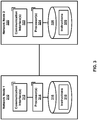
- FIG. 3 shows hardware elements of a first network node 310 (e.g., a wireless device) and a second network node 320 (e.g., a base station).
- a communication network may include at least one first network node 310 and at least one second network node 320.
- the first network node 310 may include one or more communication interface 312, one or more processors 314, and one or more sets of program code instructions 318 stored in non-transitory memory 316 and executable by the one or more processors 314.
- the second network node may include one or more communication interface 322, one or more processors 324, and one or more sets of program code instructions 328 stored in non-transitory memory 326 and executable by the one or more processors 324.
- Transceivers may be employed in devices such as wireless devices, base stations, relay nodes, and/or the like. Examples for radio technology implemented in the communication interfaces 312, 322 and the wireless link are shown in FIG. 3 , FIG. 4A , and 4B , and associated text.
- the communication network may comprise any number and/or type of devices, such as, for example, computing devices, wireless devices, mobile devices, handsets, tablets, laptops, internet of things (IoT) devices, hotspots, cellular repeaters, computing devices, and/or, more generally, user equipment (e.g., UE).
- IoT internet of things
- a gNB or an ng-eNB may host functions such as: radio resource management and scheduling, IP header compression, encryption and integrity protection of data, selection of Access and Mobility Management Function (AMF) at User Equipment (UE) attachment, routing of user plane and control plane data, connection setup and release, scheduling and transmission of paging messages (originated from the AMF), scheduling and transmission of system broadcast information (originated from the AMF or Operation and Maintenance (O&M)), measurement and measurement reporting configuration, transport level packet marking in the uplink, session management, support of network slicing, Quality of Service (QoS) flow management and mapping to data radio bearers, support of wireless devices in RRC_INACTIVE state, distribution function for Non-Access Stratum (NAS) messages, RAN sharing, and dual connectivity or tight interworking between NR and E-UTRA.
- AMF Access and Mobility Management Function
- UE User Equipment
- O&M Operation and Maintenance
- a UPF may host functions such as anchor point for intra-/inter-Radio Access Technology (RAT) mobility (if applicable), external PDU session point of interconnect to data network, packet routing and forwarding, packet inspection and user plane part of policy rule enforcement, traffic usage reporting, uplink classifier to support routing traffic flows to a data network, branching point to support multi-homed PDU session, QoS handling for user plane, for example, packet filtering, gating, Uplink (UL)/Downlink (DL) rate enforcement, uplink traffic verification (e.g. Service Data Flow (SDF) to QoS flow mapping), downlink packet buffering and/or downlink data notification triggering.
- RAT Radio Access Technology
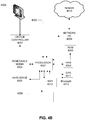
- the computing device 400 may include one or more output devices, such as the display and/or touchpad 428 (e.g., a screen, a display device, a monitor, a television, etc.), and may include one or more output device controllers, such as a video processor. There may also be one or more user input devices, such as a remote control, keyboard, mouse, touch screen, microphone, etc., that may be configured, for example, as one or more of the peripherals 438.
- the computing device 400 may also include one or more network interfaces, such as a network interface, the may be a wired interface, a wireless interface such as the transceiver 420, or a combination of the two.
- the computing device 4000 may also include one or more network interfaces, such as a network interface 4009, which may be a wired interface, a wireless interface, or a combination of the two.
- the network interface 4009 may provide an interface for the computing device 4000 to communicate with a network 4010 (e.g., a RAN, or any other network).
- Some or all of the entities described herein may be software based, and may co-exist in a common physical platform (e.g., a requesting entity may be a separate software process and program from a dependent entity, both of which may be executed as software on a common computing device).
- Base stations, wireless devices, relay nodes, and other communication devices may comprise one or more transceivers.
- a transceiver may be a device that comprises both a transmitter and receiver.
- the communication network may comprise any number and/or type of devices, such as, for example, computing devices, wireless devices, mobile devices, handsets, tablets, laptops, internet of things (IoT) devices, hotspots, cellular repeaters, computing devices, and/or, more generally, user equipment.
- IoT internet of things
- any device herein may comprise any one or more of the above types of devices or similar devices.
- the term "base station” may comprise one or more of: a base station, a node, a Node B, a gNB, an eNB, am ng-eNB, a relay node (e.g., an integrated access and backhaul (IAB) node), a donor node (e.g., a donor eNB, a donor gNB, etc.), an access point (e.g., a WiFi access point), a computing device, a device capable of wirelessly communicating, and/or any other device capable of sending and/or receiving signals.
- a base station may comprise one or more of: a base station, a node, a Node B, a gNB, an eNB, am ng-eNB, a relay node (e.g., an integrated access and backhaul (IAB) node), a donor node (e.g., a donor eNB, a donor gNB, etc.), an access point (e.g.,
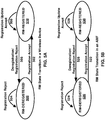
- FIG. 5A and FIG. 5B depict examples of the RM states of a wireless device, such as the wireless device 100, 200 as observed by the wireless device 100, 200 and AMF 155, 255.
- FIG. 5A shows RM state transition in the wireless device.
- Two RM states may be used in a wireless device 100, 200 (and possibly in the AMF 155, 255) that may reflect the registration status of the wireless device 100, 200 in the selected PLMN.
- the registration status of the wireless device 100, 200 in the selected PLMN may be RM-DEREGISTERED 500 or RM-REGISTERED 510.
- the wireless device 100, 200 may not be registered with a network.
- a wireless device 100, 200 may be CM-CONNECTED 610 with RRC inactive state, the wireless device 100, 200 may resume the RRC connection (e.g., due to uplink data pending), may execute a mobile initiated signaling procedure (e.g., as a response to (R)AN 105, 205 paging), and/or notify the network that it has left the (R)AN 105, 205 notification area.
- NAS signaling connection management may comprise the functions of establishing and releasing a NAS signaling connection.
- NAS signaling connection establishment function may be provided by the wireless device 100, 200 and the AMF 155, 255 to establish a NAS signaling connection for a wireless device 100, 200 in CM-IDLE 600 state.
- the procedure of releasing a NAS signaling connection may be initiated by the 5G (R)AN 105, 205 node or the AMF 155, 255.
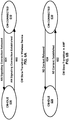
- FIG. 6B shows CM state transitions in the AMF 155, 255.
- Two CM states may be used for a wireless device 100, 200 at the AMF 155, 255: CM-IDLE 620 and CM-CONNECTED 630.
- the state of CM-IDLE 600 in the wireless device 100, 200 may correspond to the state of CM-IDLE 620 in the AMF 155, 255.
- the state of CM-CONNECTED 610 in the wireless device 100, 200 may correspond to the state of CM-CONNECTED 630 in the AMF 155, 255.
- the wireless device 100, 200 and the AMF 155, 255 may negotiate wireless device 100, 200 reachability characteristics in CM-IDLE 600 and/or 620 states during registration and registration update procedures.
- a variety of wireless device reachability categories may be negotiated between a wireless device 100, 200 and an AMF 155, 255 for CM-IDLE 600 and/or 620 states, such as wireless device 100, 200 reachability providing mobile device terminated data.
- the wireless device 100, 200 may be CM-IDLE 600 mode and mobile initiated connection only (MICO) mode.
- the 5GC may support a PDU connectivity service that provides exchange of PDUs between a wireless device 100, 200 and a data network identified by a DNN.
- the PDU connectivity service may be supported via PDU sessions that may be established, for example, after request from the wireless device 100, 200.
- QoS flow may be granular of QoS differentiation in a PDU session.
- a QoS Flow IDQFI may be used to identify a QoS flow in a 5G system.
- User plane traffic with the same QFI within a PDU session may receive the same traffic forwarding treatment.
- the QFI may be carried in an encapsulation header on N3 (and N9), for example, without any changes to an end-to-end packet header.
- the QFI may be used with PDUs having different types of payload.
- the QFI may be unique within a PDU session.
- QoS flow may be granular for QoS forwarding treatment in a system (e.g., a 5GS). Traffic mapped to the same QoS flow may receive the same forwarding treatment (e.g., scheduling policy, queue management policy, rate shaping policy, RLC configuration, and/or the like). Providing different QoS forwarding treatment may require separate QoS flow.
- a QoS indicator may be used as a reference to a specific QoS forwarding behavior (e.g., packet loss rate, and/or packet delay budget) to be provided to a QoS flow. This QoS indicator may be implemented in the access network by the 5QI referencing node specific parameters that control the QoS forwarding treatment (e.g., scheduling weights, admission thresholds, queue management thresholds, link layer protocol configuration, and/or the like.).
- One or more devices may support edge computing and may provide operators and/or third party services to be hosted close to the wireless device access point of attachment.
- the one or more devices may select a UPF 110, 210 close to the wireless device 100, 210 and may execute the traffic steering from the UPF 110, 210 to the LADN via a N6 interface. This selecting a UPF 110, 210 close to the wireless device may be based on the wireless device subscription data, wireless device location, the information from application function AF 145, 245, policy, and/or other related traffic rules.
- the one or more devices may expose network information and capabilities to an edge computing application function.
- the functionality support for edge computing may comprise local routing where the one or more devices (e.g., a 5GC) may select UPF 110, 210 to route the user traffic to the LADN, traffic steering where the one or more devices (e.g., a 5GC) selects the traffic to be routed to the applications in the LADN, session and service continuity to provide wireless device 100, 200 and application mobility, user plane selection and reselection (e.g., based on input from application function), network capability exposure where the one or more devices (e.g., a 5GC) and application function may provide information to each other via NEF, QoS and charging where PCF may provide rules for QoS control and charging for the traffic routed to the LADN, and/or support of local area data network where the one or more devices (e.g., a 5GC) may provide support to connect to the LADN in a certain area where the applications are deployed.
- the one or more devices e.g., a 5GC
- UPF 110, 210 to route the user
- An example system may be a 3GPP system comprising of 5G access network 105, 205, 5GC and a wireless device 100, 200, and/or the like.
- Provided NSSAI may be an NSSAI provided by a serving PLMN, for example, during a registration procedure, indicating the NSSAI provided by the network for the wireless device 100, 200 in the serving PLMN for the current registration area.
- a periodic registration update may be wireless device 100, 200 re-registration at expiry of a periodic registration timer.
- a requested NSSAI may be a NSSAI that the wireless device 100, 200 may provide to the network.
- a service-based interface may represent how a set of services may be provided/exposed by a given NF.
- a PDU connectivity service may provide exchange of PDUs between a wireless device 100, 200 and a data network.
- PDU session may be an association between a wireless device 100 and a data network, DN that provides a PDU connectivity service.
- the type of association may be IP, Ethernet, or unstructured.
- Service continuity may comprise an uninterrupted user experience of a service, for example, if the IP address and/or anchoring point change.
- Session continuity may comprise the continuity of a PDU session. For a PDU session of an IP type session, continuity may indicate that the IP address may be preserved for the lifetime of the PDU session.
- An uplink classifier may be a UPF functionality that aims at diverting uplink traffic, for example, based on filter rules provided by SMF, towards a data network.
- the system architecture may support data connectivity and services enabling deployments to use techniques such as, but not limited to, network function virtualization and/or software defined networking.
- the system architecture may leverage service-based interactions between control plane (CP) network functions where identified.
- CP control plane
- UP user plane
- a system may provide a network function to interact with other NF(s) directly if required.
- a system may reduce dependencies between the access network (AN) and the core network (CN).
- the architecture may comprise a converged access-agnostic core network with a common AN-CN interface that integrates different 3GPP and non-3GPP access types.
- a system furthermore may support a unified authentication framework, stateless NFs (e.g., where the compute resource may be decoupled from the storage resource), capability exposure, and/or concurrent access to local and centralized services.
- UP functions may be deployed close to the access network, for example, to support low latency services and access to LADNs.
- a system may support roaming with both home routed traffic as well as local breakout traffic in the visited PLMN.
- An example architecture may be service-based and the interaction between network functions may be represented in a variety of ways.
- FIG. 1 shows an example service-based representation, where network functions within the control plane may provide other authorized network functions to access their services. This service-based representation shown in FIG. 1 may also comprise point-to-point reference points where necessary.
- FIG. 1 shows an example reference point representation, showing the interaction between the NF services in the network functions described by point-to-point reference point (e.g., N11) between any two network functions.
- point-to-point reference point e.g., N11
- a network slice may comprise or be associated with the core network control plane and/or user plane network functions such as, for example, a 5G RAN, the N3IWF functions to the non-3GPP Access Network, and/or the like.
- Network slices may support differing features and/or network function implementations.
- An operator may deploy multiple network slice instances delivering the same features for different groups of wireless devices, to deliver different committed service, and/or because the network slice instances may be dedicated to an individual customer.
- the NSSF 120 may store the mapping information between a slice instance ID and an NF ID (and/or NF address).
- a wireless device 100, 200 may simultaneously be served by one or more network slice instances via, for example, a 5G-AN.
- An AMF 155, 255 instance serving the wireless device 100, 200 may belong to a network slice instance serving the wireless device 100.
- a PDU session may belong to one specific network slice instance per PLMN. Different network slice instances may not share a PDU session. Different slices may have slice-specific PDU sessions using the same DNN, or different DNNs.
- a Single Network Slice Selection Assistance Information may indicate (e.g., identify) a network slice.
- An S-NSSAI may comprise a slice/service type (SST) and/or a slice differentiator (SD).
- the SST may refer to the expected network slice behavior in terms of features and services.
- An SD may be optional information that may complement the slice/service type(s), for example, to allow further differentiation for selecting a network slice instance from potentially multiple network slice instances that comply with the indicated slice/service type.
- the same network slice instance may be selected using different S-NSSAIs.
- the CN part of a network slice instance(s) serving a wireless 100, 200 may be selected by the CN.
- Subscription data may include the S-NSSAI(s) of the network slices to which the wireless device 100, 200 may subscribe.
- One or more S-NSSAIs may be indicated (e.g., marked) as a default S-NSSAI.
- the wireless device 100, 200 may subscribe to more than 8 S-NSSAIs, or up to or more than any other quantity of S-NSSAIs.
- a wireless device 100, 200 may be configured, by the HPLMN, with a configured NSSAI per PLMN.
- the wireless device 100, 200 may obtain, from the AMF 155, an allowed NSSAI for a PLMN (which may include one or more S-NSSAIs), for example, based on or after successful completion of a wireless device's registration procedure.
- the allowed NSSAI may take precedence over the configured NSSAI, for example, for a PLMN.
- the wireless device 100, 200 may use the S-NSSAIs in the allowed NSSAI corresponding to a network slice for the subsequent network slice selection related procedures in the serving PLMN.
- the establishment of user plane connectivity to a data network via a network slice instance(s) may comprise: performing an RM procedure to select an AMF 155, 255 that supports the required network slices, establishing one or more PDU sessions to the required data network via the network slice instance(s), and/or the like.
- the wireless device 100, 200 may provide a requested NSSAI to the network in the RRC and NAS layer.
- the requested NSAAI may comprise the S-NSSAI(s) corresponding to the slice(s) to which the wireless device 100, 200 attempts to register, a temporary user ID if one was assigned to the wireless device 100, 200 and/or the like.
- the wireless device 100, 200 may provide the requested NSSA, for example, if the wireless device 100, 200 registers with a PLMN, and/or if the wireless device 100, 200 for the PLMN has a configured NSSAI or an allowed NSSAI.
- the requested NSSAI may be a configured-NSSAI, an allowed-NSSAI, and/or the like.
- the RAN 105, 205 may route NAS signaling to and/or from the wireless device 100, 200 to and/or from a default AMF 155, 255.
- the RAN 105, 205 may route NAS signaling to and/or from the wireless device 100, 200 to and/or from a default AMF 155, 255, for example, if a wireless device 100, 200 registers with a PLMN and does not have a configured NSSAI or allowed NSSAI for the PLMN.
- the network may change the set of permitted network slice(s) to which the wireless device 100, 200 is registered.
- the network may change the set of permitted network slice(s) to which the wireless device 100, 200 is registered, for example, based on local policies, subscription changes, and/or wireless device 100, 200 mobility.
- the network may change the set of permitted network slice(s) for a registration procedure.
- the network may trigger a notification to be sent to the wireless device 100, notifying the wireless device 100 of the change of the supported network slices using an RM procedure (which may trigger a registration procedure).
- the network may provide the wireless device 100 with a new allowed NSSAI and tracking area list.
- the AMF 155, 255 that first receives the registration request may redirect the registration request to another AMF 155, 255 via the RAN 105, 205 and/or via direct signaling between the initial AMF 155, 255 and the target AMF 155, 255.
- the AMF 155, 255 that first receives the registration request may redirect the registration request to another AMF 155, 255 via the RAN 105, 205 and/or via direct signaling between the initial AMF 155, 255 and the target AMF 155, 255, for example, if the network decides that the wireless device 100, 200 should be served by a different AMF 155, 255, for example, based on network slice(s) aspects.
- the network operator may provision the wireless device 100 with an NSSP.
- the NSSP may comprise one or more NSSP rules.
- the wireless device 100, 200 may route the user data of the application in one or more of the PDU sessions.
- the wireless device 100, 200 may route the user data of the application in one or more of the PDU sessions, for example, if a wireless device 100, 200 has one or more established PDU sessions corresponding to the a specific S-NSSAI, unless other conditions in the wireless device 100, 200 prohibit the use of the PDU sessions.
- the wireless device 100, 200 may consider the DNN to determine which PDU session to use if the application provides a DNN.
- the wireless device 100, 200 may request a new PDU session corresponding to the S-NSSAI.
- the wireless device 100, 200 may request a new PDU session corresponding to the S-NSSAI, for example, with the DNN that may be provided by the application, if the wireless device 100, 200 does not have a PDU session established with the specific S-NSSAI.
- the RAN 105, 205 may be aware of the network slices used by the wireless 100, 200 in order for the RAN 105, 205 to select a proper resource for supporting network slicing in the RAN 105, 205.
- An AMF 155, 255 may select an SMF 160, 260 in a network slice instance, for example, based on the S-NSSAI, DNN, and/or other information (e.g., wireless device 100, 200 subscription and local operator policies, and/or the like).
- An AMF 155, 255 may select an SMF 160, 260 in a network slice instance based on the S-NSSAI, DNN, and/or other information, for example, if the wireless device 100, 200 triggers the establishment of a PDU session.
- the selected SMF 160, 260 may establish the PDU session based on the S-NSSAI and DNN.
- the wireless device 100, 200 may or may not include the NSSAI in NAS signaling.
- the wireless device 100, 200 may not include the NSSAI in NAS signaling, for example, in order to support network-controlled privacy of slice information for the slices that the wireless device 100, 200 may access.
- the wireless device 100, 200 may not include the NSSAI in NAS signaling, for example, unless the wireless device 100, 200 has a NAS security context.
- the wireless device 100, 200 may not include NSSAI, for example, in unprotected RRC signaling.
- the wireless device 100, 200 may not include NSSAI, for example, if the wireless device 100, 200 is aware of or configured such that privacy considerations are used for the NSSAI.
- Network slice specific network functions in VPLMN and HPLMN may be selected, for example, for a wireless device that may be roaming.
- the network slice specific network functions in VPLMN and HPLMN may be selected, for example, based on the S-NSSAI provided by the wireless device 100, 200 PDU connection establishment.
- Selection of slice specific NF instances may be performed by each PLMN or by one or more PLMNs.
- Selection of slice specific NF instances may be performed by a PLMN, for example, if a standardized S-NSSAI is used.
- Selection of slice specific NF instances may be performed by a PLMN, for example, based on the provided S-NSSAI.
- the VPLMN may map the S-NSSAI of HPLMN to a S-NSSAI of VPLMN, for example, based on a roaming agreement (e.g., including mapping to a default S-NSSAI of VPLMN).
- the selection of slice specific NF instance in a VPLMN may be, for example, based on the S-NSSAI of VPLMN.
- the selection of any slice specific NF instance in HPLMN may be, for example, based on the S-NSSAI of an HPLMN.
- FIG. 8 and FIG. 9 show an example call flow for an initial registration procedure.
- the initial registration procedure may involve execution of network access control functions (e.g., user authentication and access authorization, which may be based on subscription profiles in UDM 140, 240).
- the identity of the serving AMF 155, 255 may be registered in a UDM 140, 240, for example, based on or as a result of the initial registration procedure.
- the RM procedures may be applicable for both a 3GPP access RAN 105, 205 and a non-3GPP access RAN 265.
- a registration procedure may be performed by the wireless device 100, 200.
- the registration procedure may be performed by the wireless device 100, 200, for example, to become authorized to receive services, to enable mobility tracking, to enable reachability, and/or the like.
- the wireless device 100, 200 may send a registration request message 805 to the RAN 105 (or 205).
- the registration request message 805 may comprise, for example, AN parameters and/or an RM-NAS registration request (e.g., registration type, SUCI or SUPI or GUTI (e.g., 5G-GUTI), last visited TAI (if available), security parameters, requested NSSAI, mapping of requested NSSAI, wireless device 5GC capability, PDU session status, PDU session(s) to be re-activated, follow on request, MICO mode preference, and/or the like), and/or the like.
- the AN parameters may include, for example, SUCI, SUPI, the GUTI (e.g., 5G-GUTI), the selected PLMN ID and requested NSSAI, and/or the like (e.g., for the RAN).
- the AN parameters may comprise an establishment cause.
- the establishment cause may provide a reason for requesting an establishment of an RRC connection.
- the registration type may indicate, for example, whether the wireless device 100 determines and/or requests to perform an initial registration (e.g., if the wireless device 100, 200 is in the RM-DEREGISTERED state), a mobility registration update (e.g., if the wireless device 100, 200 is in the RM-REGISTERED state and initiates a registration procedure, such as due to mobility), a periodic registration update (e.g., if the wireless device 100, 200 is in the RM-REGISTERED state and may initiate a registration procedure, such as due to the periodic registration update timer expiry) or an emergency registration (e.g., if the wireless device 100, 200 is in a limited service state).
- an initial registration e.g., if the wireless device 100, 200 is in the RM-DEREGISTERED state
- a mobility registration update e.g., if the wireless
- the wireless device 100, 200 may include its SUCI or SUPI in the registration request.
- the wireless device 100, 200 may include its SUCI or SUPI in the registration request, for example, if the wireless device 100, 200 is performing an initial registration (e.g., if the wireless device 100 is in the RM-DEREGISTERED state) to a PLMN for which the wireless device 100, 200 does not already have a GUTI (e.g., 5G-GUTI).
- the SUCI may be included in the registration request, for example, if the home network has provisioned the public key to protect SUPI in the wireless device 100, 200.
- the wireless device 100, 200 may perform an initial registration.
- the wireless device 100, 200 may include the SUPI in a registration request message.
- the wireless device 100, 200 may include the SUPI in the registration request message, for example, if the wireless device 100, 200 receives a wireless device configuration update command indicating that the wireless device 100, 200 may be required to re-register and/or that the 5G-GUTI is invalid.
- the SUPI may be included the registration request message, for example, for an emergency registration.
- the SUPI may be included for an emergency registration, for example, if the wireless device 100, 200 does not have a valid GUTI (e.g., 5G-GUTI) available.
- the PEI may be included for an emergency request, for example, if the wireless device 100, 20 has no SUPI and no valid GUTI (e.g., 5G-GUTI).
- the GUTI (e.g., 5G-GUTI) may be included and may indicate the old (e.g., last serving) AMF 856.
- the wireless device 100, 200 may not provide the GUTI (e.g., 5G-GUTI) allocated by the AMF 155, 255 over the 3GPP access, for example, during the registration procedure over the non-3GPP access.
- the wireless device 100, 200 may not provide the GUTI allocated by the AMF 155, 255, for example, if the wireless device 100 is already registered via a non-3GPP access in a PLMN different from the new PLMN (e.g., not the registered PLMN or a PLMN equivalent to the registered PLMN) of the 3GPP access.
- the wireless device 100, 200 may not provide access to the GUTI (e.g., 5G-GUTI) allocated by the AMF 155 over the non-3GPP during the registration procedure over the 3GPP access.
- the wireless device 100 may not provide access to the GUTI, for example, if the wireless device 100 is already registered via a 3GPP access in a PLMN (e.g., the registered PLMN) different from the new PLMN (e.g., not the registered PLMN or a PLMN equivalent to the registered PLMN) of the non-3GPP access.
- the wireless device 100, 200 may provide the wireless device's 100, 200 usage setting.
- the wireless device 100, 200 may provide the wireless device's 100, 200 usage setting, for example, based on its configuration.
- the wireless device 100, 200 may include the mapping of requested NSSAI for initial registration or mobility registration updates.
- the mapping of requested NSSAI may comprise the mapping of each S-NSSAI of the requested NSSAI to the S-NSSAIs of the configured NSSAI for the HPLMN.
- the wireless device 100, 200 may include the mapping of requested NSSAI, for example, to ensure that the network is able to verify whether the S-NSSAI(s) in the requested NSSAI are permitted (e.g., based on the subscribed S-NSSAIs).
- the last visited TAI may be included in the mapping of requested NSSAI.
- the last visited TAI may be included in the mapping of requested NSSAI, for example, to help the AMF 155, 255 produce a registration area for the wireless device.
- Security parameters may be used for authentication and integrity protection.
- a requested NSSAI may indicate the network slice selection assistance information.
- the PDU session status may indicate the previously established PDU sessions in the wireless device 100, 200.
- the PDU session status may indicate the established PDU session of the current PLMN in the wireless device 100, 200.
- the PDU session status may indicate the established PDU session of the current PLMN in the wireless device 100, 200, for example, if the wireless device 100, 200 is connected to two AMF 155, 255 belonging to different PLMNs (e.g., via 3GPP access and via non-3GPP access).
- the PDU session(s) to be re-activated may be included, for example, to indicate the PDU session(s) for which the wireless device 100, 200 may intend to activate UP connections.
- a PDU session corresponding to an LADN may not be included in the PDU session(s) to be re-activated.
- the PDU session corresponding to a LADN may not be included in the PDU session(s) to be re-activated, for example, if the wireless device 100, 200 is outside the area of availability of the LADN.
- the follow-on request may be included, for example, if the wireless device 100, 200 has a pending uplink signaling that the wireless device 100, 200 does not include PDU session(s) to be re-activated, or if the registration type indicates the wireless device 100, 200 may want to perform an emergency registration.
- the RAN 105, 205 may perform AMF selection 808.
- the RAN 105, 205 may perform AMF selection 808, for example, based on RAT and a requested NSSAI (e.g., if available).
- the RAN 105, 205 may perform AMF selection 808, for example, if an SUPI is included or if the GUTI (e.g., 5G-GUTI) does not indicate a valid AMF 155, 255.
- the RAN 105, 205 may forward the registration request message 810 to a new AMF 855.
- the RAN 105, 205 may forward the registration request message 810 to a new AMF 855, for example, on the N2 connection of the wireless device 100, 200 if the wireless device 100, 200 is in the CM-CONNECTED state.
- the RAN 105, 205 may forward the registration request 810 to the new AMF 855, which may have been configured to perform AMF selection 808.
- the RAN 105, 205 may forward the registration request 810 to the new AMF 855, for example, if the RAN 105, 205 does not select an appropriate new AMF 855.
- the RAN 105, 205 may send an N2 registration request message 810 to the new AMF 855.
- the N2 registration request message 810 may comprise, for example, N2 parameters, RM-NAS registration request (e.g., registration type, SUPI or 5G-GUTI, last visited TAI (if available), security parameters, requested NSSAI, mapping of requested NSSAI, wireless device 5GC capability, PDU session status, PDU session(s) to be re-activated, follow on request, and MICO mode preference), and/or the like.
- RM-NAS registration request e.g., registration type, SUPI or 5G-GUTI, last visited TAI (if available)
- security parameters e.g., requested NSSAI, mapping of requested NSSAI, wireless device 5GC capability, PDU session status, PDU session(s) to be re-activated, follow on request, and MICO mode preference
- the N2 parameters may comprise the selected PLMN ID, location information, cell identity, and the RAT type related to the cell in which the wireless device 100, 200 is communicating (e.g., camping on) for example, if the RAN 105, 205 is used.
- the N2 parameters may comprise the establishment cause.
- the N2 parameters may comprise the establishment cause, for example, if the RAN 105, 205 is used.
- a new AMF 855 may send, to the old AMF 856, complete registration request (e.g., an Namf_Communication_UEContextTransfer) 815.
- the new AMF 855 may invoke an operation (e.g., the Namf_Communication_UEContextTransfer 815 service operation) on the old AMF 856.
- the new AMF 855 may invoke an operation (e.g., the Namf_Communication_UEContextTransfer 815 service operation) on the old AMF 856 (which may include the complete registration request IE), for example, if the wireless device's GUTI (e.g., 5G-GUTI) is included in the registration request and the serving AMF 155, 255 has changed since last registration procedure.
- GUTI e.g., 5G-GUTI
- the complete registration request IE may be integrity protected.
- the new AMF 855 may invoke the operation (e.g., the Namf_Communication_UEContextTransfer 815 service operation) on the old AMF 856, for example, to request the wireless device's 100 SUPI and MM Context.
- the old AMF 856 may use the integrity protected complete registration request IE, for example, to verify whether the context transfer service operation invocation corresponds to the wireless device 100, 200 requested.
- the old AMF 856 may transfer the event subscriptions information by each NF consumer, for the wireless device 100, 200, to the new AMF 855.
- the SUPI request may or may not be skipped.
- the SUPI request may be skipped, for example, if the wireless device 100, 200 indicates (e.g., identifies) itself with PEI.
- the old AMF 856 may send, to the new AMF 855, a response 815 to the transfer message (e.g., Namf_Communication_UEContextTransfer).
- the response 815 may comprise, for example, SUPI, MM context, SMF 160 information, and/or a PCF ID).
- the old AMF 856 may respond, to the new AMF 855, based on an operation (e.g., Namf_Communication_UEContextTransfer invocation).
- the old AMF 856 may respond to the new AMF 855, for example, by including the wireless device's SUPI and/or MM context.
- the old AMF 856 may include SMF 160, 260 information which may comprise, for example, S-NSSAI(s), SMF 160, 260 identities, and/or a PDU session ID (e.g., if the old AMF 856 has information about established PDU sessions).
- the old AMF 856 may have information about the NGAP wireless device-TNLA bindings.
- the old AMF 856 may include information about the NGAP wireless device-TNLA bindings in one or more messages, for example, if the old AMF 856 has information about active NGAP wireless device-TNLA bindings to the N3IWF 270.
- the identity request procedure 820 may be initiated, for example, by the new AMF 855 sending an identity request message 820 to the wireless device 100, 200 from the SUCI.
- the identity request message 820 may be initiated, for example, if the SUPI has not been provided by the wireless device 100, 200 and/or if the SUPI has not been retrieved from the old AMF 856.
- the wireless device 100, 200 may respond, to the identity request message 820 (e.g., identity request procedure), with an identity response message 822.
- the identity response message 822 may include the SUCI.
- the wireless device 100, 200 may determine (e.g., derive) the SUCI, for example, by using the provisioned public key of the HPLMN.
- the new AMF 855 may determine to initiate an AUSF selection 825.
- the AUSF selection 825 may be to initiate the wireless device authentication 830 (e.g., wireless device security).
- the new AMF 855 may initiate the AUSF selection 825, for example, by invoking an AUSF 150, 250.
- the new AMF 855 may select an AUSF 150, 250, for example, based on the SUPI and/or the SUCI.
- the new AMF 855 may perform or skip the authentication 830 and/or the security setup.
- the new AMF 855 may accept that the authentication 830 may fail and continue the registration procedure.
- the new AMF 855 may accept that the authentication 830 may fail and continue the registration procedure, for example, if the new AMF 855 is configured to support emergency registration for unauthenticated SUPIs.
- the new AMF 855 may accept that the authentication 830 may fail and continue the registration procedure, for example, if the wireless device 100, 200 indicates that the registration type is an emergency registration.
- the authentication 830 may be performed by the Nudm_UEAuthenticate_Get operation.
- the AUSF 150 may discover a UDM 140, 240.
- the AUSF 150 may return the SUPI to the new AMF 855, for example, after the authentication 830 is successful.
- the AUSF 150, 250 may return the SUPI to the new AMF 855 after the authentication 830 is successful, for example, if the new AMF 855 provides a SUCI to AUSF 150, 250.
- the new AMF 855 may determine whether the registration request must/should be rerouted (e.g., rerouted from the AMF 155 operating as an initial AMF), for example, if network slicing is used.
- the new AMF 855 may initiate NAS security functions.
- the new AMF 855 may initiate an NGAP procedure.
- the initiation may, for example, enable an AN (e.g., 5G-AN) to use the NGAP procedure for securing procedures with the wireless device 100 upon completion of a NAS security function setup.
- the AN e.g., 5G-AN
- the AN may store the security context.
- the AN may acknowledge completion of the NAS security function setup to the AMF 155, 255.
- the AN (e.g., 5G-AN) may use the security context, for example, to protect the messages exchanged with the wireless device 100, 200.
- a new AMF 855 may send Namf_Communication_RegistrationCompleteNotify 835 to the old AMF 856.
- the new AMF 855 may notify the old AMF 856 that the registration of the wireless device 100, 200 in the new AMF 855 is completed.
- the new AMF 855 may notify the old AMF 856 that the registration of the wireless device 100, 200 in the new AMF 855 is completed (e.g., if the new AMF 855 has changed) by invoking the Namf_Communication_RegistrationCompleteNotify service operation.
- the registration may be rejected.
- the new AMF 855 may invoke the Namf_Communication_RegistrationCompleteNotify 835 service operation, for example, if the registration is rejected.
- the new AMF 855 may send a reject indication reason code to the old AMF 856.
- the old AMF 856 may continue as if the wireless device context transfer service operation was never received.
- the old AMF 856 may continue as if the wireless device context transfer service operation was never received, for example, if the authentication/security procedure fails.
- the new AMF 855 may determine which (if any) of one or more PDU sessions may not be supported in the new registration area.
- the new AMF 855 may determine which (if any) of one or more PDU sessions may not be supported in the new registration area, for example, if one or more of the S-NSSAIs used in the old registration area are not served in the target registration area.
- the new AMF 855 may invoke the Namf_Communication_RegistrationCompleteNotify 835 service operation, which may include the rejected PDU session ID and/or a reject cause (e.g., the S-NSSAI becomes no longer available) in one or more messages to the old AMF 856.
- the new AMF 855 may modify the PDU session status.
- the old AMF 856 may inform one or more SMFs (e.g., the corresponding SMF 160) to locally release the wireless device's SM context, for example, by invoking the
- the new AMF 855 may send an identity request/response 840 (e.g., PEI) to the wireless device 100, 200.
- An identity request procedure may be initiated by the new AMF 855.
- the identity request procedure may be initiated by the new AMF 855, for example, by sending an identity request message 840 to the wireless device 100 to retrieve the PEI (e.g., if the PEI was not provided by the wireless device 100, 200 and/or if the PEI was not retrieved from the old AMF 856).
- the PEI may be encrypted for transfer, unless, for example, the wireless device 100, 200 performs emergency registration and is not authenticated.
- the wireless device 100, 200 may include the PEI in the registration request for an emergency registration.
- the new AMF 855 may initiate ME identity check.
- the new AMF 855 may initiate ME identity check, for example, by invoking an N5g-eir_EquipmentIdentityCheck_Get service operation 845 (e.g., with an Equipment Identity Register
- the new AMF 855 may perform UDM selection 905 to select a UDM 140, 240.
- the UDM 140, 240 may select a UDR instance.
- the new AMF 855 may register with the UDM 140, 240.
- the new AMF 855 may register with the UDM 140, for example, by using a Nudm_UECM_Registration 910.
- the UDM 140, 240 may store the AMF 155, 255 identity associated with a first access type and may not remove the AMF 155, 255 identity associated with one or more second access types.
- the UDM 140, 240 may store information provided at registration in UDR with Nudr_UDM_Update.
- the AMF 155, 255 may retrieve the access and mobility subscription data and SMF 160, 260 selection subscription data, for example, by using Nudm_SDM_Get 915.
- the UDM 140, 240 may retrieve the access and mobility subscription data and SMF 160, 260 selection subscription data information from UDR, for example, with Nudr_UDM_Query.
- the AMF 155, 255 may subscribe to be notified based on a successful response and/or after a successful response is received.
- the AMF 155, 255 may subscribe to be notified based on a successful response and/or after a successful response is received, for example, if the data requested is modified using Nudm_SDM_Subscribe 920.
- the UDM 140, 240 may subscribe to UDR, for example, by using Nudr_UDM_Subscribe 920.
- the GPSI may be provided to the new AMF 855 in the subscription data from the UDM 140, 240.
- the GPSI may be provided in the subscription data from the UDM 140, 240, for example, if the GPSI is available in the wireless device 100, 200 subscription data.
- the new AMF 855 may provide the access type it serves for the wireless device 100 to the UDM 140.
- the access type may, for example, be set to 3GPP access.
- the UDM 140 may store the associated access type together with the serving AMF 155 in UDR, for example, with Nudr_UDM_Update.
- the new AMF 855 may create an MM context for the wireless device 100, 200.
- the new AMF 855 may create an MM context for the wireless device 100, 200, for example, in response to getting the mobility subscription data from the UDM 140, 240.
- the UDM 140, 240 may initiate Nudm_UECM_DeregistrationNotification 921 to the old AMF 856, corresponding to 3GPP, access.
- the UDM 140, 240 may initiate Nudm_UECM_DeregistrationNotification 921, for example, if the UDM 140, 240 stores the associated access type together with the serving AMF 155, 255.
- the old AMF 856 may remove the MM context of the wireless device 100, 200.
- the old AMF 856 may invoke a Namf_EventExposure_Notify service operation, for example, by sending one or more messages to the associated SMFs 160, 260 of the wireless device 100, 200.
- the old AMF 856 may invoke the service operation, for example, to notify the associated SMFs 160, 260 that the wireless device 100, 200 is deregistered from the old AMF 856.
- the SMF 160, 260 may release the PDU session(s).
- the SMF 160, 260 may release the PDU session(s), for example, based on the notification, if the serving NF removal reason indicated by the UDM 140, 240 is initial registration.
- the old AMF 856 may unsubscribe with the UDM 140, 240 for subscription data, for example, by using Nudm_SDM_unsubscribe 922.
- the new AMF 855 may select 925 a PCF 135, 235.
- the new AMF 855 may select 925 a PCF 135, 235, for example, if the AMF 155, 255 determines to initiate PCF 135, 235 communication (e.g., the new AMF 855 has not yet obtained access and mobility policy for the wireless device 100, 200 and/or if the access and mobility policy in the new AMF 855 is no longer valid).
- the new AMF 855 may select the (V-)PCF identified by the PCF ID.
- the new AMF 855 may select the (V-)PCF identified by the PCF ID, for example, if the new AMF 855 receives a PCF ID from the old AMF 856 and successfully contacts the PCF 135, 235 indicated (e.g., identified) by the PCF ID.
- the new AMF 855 may select 925 a PCF 135, 235.
- the new AMF 855 may select 925 a PCF 135, 235, for example, if the PCF 135, 235 indicated (e.g., identified) by the PCF ID is not used (e.g., no response from the PCF 135 is received) and/or if there is no PCF ID received from the old AMF 856.
- the new AMF 855 may perform a policy association establishment 930.
- the new AMF 855 may perform the policy association establishment 930, for example, during registration procedure.
- the new AMF 855 may include the PCF-ID in a Npcf_AMPolicyControl Get operation for the policy association establishment 930.
- the new AMF 855 may include the PCF-ID in the Npcf_AMPolicyControl Get operation, for example, if the new AMF 855 communicates with or contacts the PCF 135, 235 indicated (e.g., identified) by the (V-)PCF ID received, for example, during inter-AMF mobility.
- the PCF 135, 235 may provide the updated mobility restrictions to the new AMF 855.
- the PCF 135, 235 may provide the updated mobility restrictions to the new AMF 855, for example, if the AMF 155, 255 notifies the mobility restrictions (e.g., wireless device 100, 200 location) to the PCF 135, 235 for adjustment, or if the PCF 135, 235 updates the mobility restrictions itself due to some conditions (e.g., application in use, time and date).
- the PCF 135, 235 may invoke Namf_EventExposure_Subscribe 935 service operation for the wireless device 100, 200 event subscription.
- the new AMF 855 may send, to the SMF 160, 260 an Nsmf_PDUSession_UpdateSMContext 936.
- the new AMF 855 may invoke the Nsmf_PDUSession_UpdateSMContext 936.
- the new AMF 855 may invoke the Nsmf_PDUSession_UpdateSMContext 936, for example, if the PDU session(s) to be re-activated is included in the registration request.
- the new AMF 855 may send the Nsmf_PDUSession_UpdateSMContext 936 request to the SMF(s) 160 associated with the PDU session(s).
- the new AMF 855 may send the Nsmf_PDUSession_UpdateSMContext 936 request, for example, to activate user plane connections of the PDU session(s).
- the SMF 160, 260 may decide to trigger (e.g., the intermediate UPF 110, 210 insertion) removal or change of PSA.
- the procedure may be performed without N11 and N2 interactions.
- the procedure may be performed without N11 and N2 interactions, for example, to update the N3 user plane between the RAN 105, 205 and the CN (e.g., 5GC) if the intermediate UPF 110, 210 insertion, removal, and/or relocation is performed for the PDU session(s) that is/are not included in PDU session(s) to be re-activated.
- the new AMF 855 may invoke the Nsmf_PDUSession_ReleaseSMContext 936 service operation towards the SMF 160, 260 (e.g., by sending one or more messages to the SMF 16, 260).
- the new AMF 855 may invoke the Nsmf_PDUSession_ReleaseSMContext 936 service operation, for example, if any PDU session status indicates that it is released at the wireless device 100, 200.
- the new AMF 855 may invoke the Nsmf_PDUSession_ReleaseSMContext 936 service operation towards the SMF 160, 260 (e.g., by sending one or more messages to the SMF 16, 260).
- the new AMF 855 may invoke the Nsmf_PDUSession_ReleaseSMContext 936 service operation, for example, in order to release any network resources related to the PDU session.
- the new AMF 855 may send a wireless device Context Modification Request 940 to a N3IWF 938.
- the new AMF 855 may create an NGAP wireless device association, towards the N3IWF 938 to which the wireless device 100, 200 is connected (e.g., by sending one or more messages to the N3IWF 938).
- the new AMF 855 may create the NGAP wireless device association, for example, if the AMF 155, 255 has changed.
- the N3IWF 938 may respond to the new AMF 855, for example, with a wireless device Context Modification Response 942.
- the new AMF 855 may send, to the wireless device 100, 200, a registration accept message 955.
- the registration accept message 955 may comprise, for example, GUTI (e.g., 5G-GUTI), registration area, mobility restrictions, PDU session status, allowed NSSAI (or mapping of allowed NSSAI), periodic registration update timer, LADN information and accepted MICO mode, IMS voice over PS session supported indication, emergency service support indicator, and/or the like.
- the new AMF 855 may send the registration accept message 955, for example, to the wireless device 100, 200.
- the registration accept message 955 may, for example, indicate that the registration request has been accepted.
- the registration accept message 955 may include GUTI (e.g., 5G-GUTI), for example, if the new AMF 855 allocates a new GUTI (e.g., 5G-GUTI).
- the new AMF 855 may send the registration area to the wireless device 100, 200.
- the new AMF 855 may send the registration area, for example, via a registration accept message 955 if, for example, the new AMF 855 allocates a new registration area.
- the wireless device 100, 200 may determine that the old registration area is valid or consider the old registration area to be valid.
- the wireless device 100, 200 may determine that the old registration area is valid (or consider the old registration area to be valid), for example, if there is no registration area included in the registration accept message.
- Mobility restrictions may be included in the registration accept message 955. Mobility restrictions may be included in the registration accept message 955, for example if mobility restrictions are used for the wireless device 100, 200 and if the registration type is not an emergency registration.
- the new AMF 855 may indicate the established PDU sessions to the wireless device 100, 200, for example, in the PDU session status.
- the wireless device 100, 200 may locally remove internal resources related to PDU sessions.
- the wireless device 100, 200 may locally remove internal resources related to PDU sessions, for example, that are not marked as established in the received PDU session status.
- the wireless device 100, 200 may locally remove internal resources related to the PDU session of the current PLMN that are not marked as established in received PDU session status.
- the wireless device 100, 200 may locally remove internal resources related to the PDU session of the current PLMN that are not marked as established in received PDU session status, for example, if the wireless device 100, 200 is connected to the two AMFs 155, 255 belonging to different PLMN via 3GPP access and non-3GPP access.
- the new AMF 855 may indicate the PDU session status to the wireless device 100, 200.
- the new AMF 855 may indicate the PDU session status to the wireless device 100, 200, for example, if the PDU session status information is in the registration request.
- the mapping of the allowed NSSAI may be, for example, the mapping of each S-NSSAI of the allowed NSSAI to the S-NSSAIs of the configured NSSAI for the HPLMN.
- the new AMF 855 may include, in the registration accept message 955, the LADN information for LADNs that are or may be available within the registration area determined by the new AMF 855 for the wireless device 100, 200.
- the new AMF 855 may indicate whether MICO mode may be used.
- the new AMF 855 may indicate whether MICO mode may be used, for example, if the wireless device 100, 200 includes MICO mode in the request.
- the new AMF 855 may set the IMS voice over PS session supported indication.
- the new AMF 855 may perform a wireless device/RAN radio information and compatibility request procedure.
- the new AMF 855 may perform a wireless device/RAN radio information and compatibility request procedure, for example, to check the compatibility of the wireless device 100, 200 and RAN radio capabilities related to IMS voice over PS to set the IMS voice over PS session supported indication.
- the emergency service support indicator may inform the wireless device 100, 200 that emergency services are supported (e.g., the wireless device 100, 200 may request PDU session for emergency services.)
- the handover restriction list and wireless device-AMBR may be provided, to RAN 105, 205, by the new AMF 855.
- the wireless device 100, 200 may send a registration complete message 960 to the new AMF 855.
- the wireless device 100, 200 may send the registration complete message 960 to the new AMF 855, for example, to acknowledge that a new GUTI (e.g., 5G-GUTI) has been assigned.
- the new AMF 855 may release the signaling connection with the wireless device 100, 200.
- the new AMF 855 may release the signaling connection with the wireless device 100, 200, for example, if information about the PDU session(s) to be re-activated is not included in the registration request.
- the new AMF 855 may not release the signaling connection after the completion of the registration procedure.
- the new AMF 855 may not release the signaling connection after the completion of the registration procedure, for example, if the follow-on request is included in the registration request.
- the new AMF 855 may not release the signaling connection after the completion of the registration procedure, for example, if the new AMF 855 is aware that some signaling is pending in the new AMF 855 or between the wireless device 100, 200 and the CN (e.g., 5GC).
- FIG. 10 and FIG. 11 show an example call flow for a service request procedure.
- a service request procedure e.g., a wireless device 100 triggered service request procedure
- a wireless device 100, 200 in a CM-IDLE state, for example, to request the establishment of a secure connection to an AMF 155, 255.
- FIG. 11 shows a service request procedure that may be a continuation of FIG. 10 .
- the service request procedure may be used, for example, to activate a user plane connection for an established PDU session.
- the service request procedure may be triggered by the wireless device 100, 200 or the CN (e.g., 5GC).
- the service request procedure may be used, for example, if the wireless device 100, 200 is in the CM-IDLE state and/or in the CM-CONNECTED state.
- the service request procedure may, for example, selectively allow activation of user plane connections for some of the established PDU sessions.
- a wireless device 100, 200 in the CM-IDLE state may initiate the service request procedure.
- a wireless device 100, 200 in the CM-IDLE state may initiate the service request procedure, for example, to send uplink signaling messages, user data, and/or the like, as a response to a network paging request, and/or the like.
- the wireless device 100, 200 may send the service request 1005 to a RAN 105, 205.
- the RAN may forward the service request 1010 to the AMF 155, 255.
- the AMF 155, 255 may perform authentication.
- the AMF 155, 255 may perform authentication, for example, after receiving the service request message 1010.
- the wireless device 100, 200 and/or a network device may send one or more messages (e.g., PDU session establishment from the wireless device 100, 200 to a SMF 160, 260) via the AMF 155, 255, for example, after the establishment of the signaling connection to the AMF 155, 255.
- one or more messages e.g., PDU session establishment from the wireless device 100, 200 to a SMF 160, 260
- the AMF 155, 255 for example, after the establishment of the signaling connection to the AMF 155, 255.
- the AMF 155, 255 may respond, to the service request, with a service accept message.
- the AMF 155, 255 may respond with a service accept message, for example, to synchronize PDU session status between the wireless device 100, 200 and network.
- the AMF 155, 255 may respond with a service reject message to the wireless device 100, 200, for example, if the service request is not accepted by the network.
- the service reject message may include an indication and/or cause code requesting the wireless device 100, 200 to perform a registration update procedure.
- a network device e.g., the CN
- the network may take perform one or more operations for a service request, for example, if the user plane connection activation is unsuccessful.
- more than one UPF e.g., New UPF 1002, old UPF 1004, and PDU session Anchor PSA UPF 1006
- New UPF 1002 old UPF 1004, and PDU session Anchor PSA UPF 1006
- PDU session Anchor PSA UPF 1006 may be involved in one or more operations relating to the service requests.
- the wireless device 100, 200 may send, to the RAN 105, 205, an AN message.
- the AN message may comprise, for example, AN parameters, mobility management, MM NAS service request (e.g., list of PDU sessions to be activated, list of allowed PDU sessions, security parameters, PDU session status, and/or the like), and/or the like.
- the wireless device 100, 200 may provide the list of PDU sessions that may be activated, for example, if the wireless device 100, 200 re-activates the PDU session(s).
- the list of allowed PDU sessions may be provided by the wireless device 100, 200.
- the list of allowed PDU sessions may be provided by the wireless device 100, 200, for example, if the service request may be a response of a paging or a NAS notification.
- the list of allowed PDU sessions may indicate (e.g., identify) the PDU sessions that may be transferred and/or associated to the access on which the service request may be sent.
- the AN parameters may include a selected PLMN ID and/or an establishment cause for the RAN.
- the establishment cause may provide a reason for requesting the establishment of an RRC connection.
- the wireless device 100, 200 may send a NAS service request message 1005, encapsulated in an RRC message to the RAN 105, 205, towards the AMF 155, 255.
- the wireless device 100, 200 may indicate (e.g., identify), using the list of PDU sessions to be activated, the PDU session(s) for which the UP connections are to be activated in the NAS service request message.
- the wireless device 100, 200 may indicate (e.g., identify) the PDU session(s) for which the UP connections are to be activated in the NAS service request message, for example, if the service request is triggered for user data.
- the wireless device 100, 200 may not indicate (e.g., identify) any PDU session(s).
- the wireless device 100, 200 may not indicate (e.g., identify) any PDU session(s), for example, if the service request is triggered for signaling.
- the wireless device 100, 200 may indicate (e.g., identify) the PDU session(s) having UP connections that may be activated in a MM NAS service request message.
- the wireless device 100, 200 may indicate (e.g., identify) the PDU session(s) having UP connections that may be activated, for example, by a list of PDU sessions to be activated if the identification procedure is triggered for a paging response, and/or if the wireless device 100, 200 has (e.g., at the same time) user data to be transferred.
- the NAS service request message 1005 may indicate (e.g., identify), in the list of allowed PDU sessions, the list of PDU sessions associated with the non-3GPP access that may be re-activated over 3GPP.
- the NAS service request message 1005 may indicate (e.g., identify) the list of PDU sessions associated with the non-3GPP access that may be re-activated over 3GPP, for example, if the service request over 3GPP access is triggered in response to a paging indicating non-3GPP access.
- the PDU session status may indicate the PDU sessions available to the wireless device 100, 200.
- the wireless device 100, 200 may not trigger the service request procedure for a PDU session corresponding to a LADN.
- the wireless device 100, 200 may not trigger the service request procedure for a PDU session corresponding to a LADN, for example, if the wireless device 100, 200 is outside the area of availability of the LADN.
- the wireless device 100, 200 may not indicate (e.g., identify) such PDU session(s) in the list of PDU sessions to be activated.
- the wireless device 100, 200 may not indicate (e.g., identify) such PDU session(s) in the list of PDU sessions to be activated, for example, if the service request is triggered for other reasons.
- the RAN 105, 205 may send an N2 service request message 1010 (e.g., a service request) to the AMF 155, 255.
- the N2 service request message 1010 may comprise N2 parameters, a MM NAS service request, and/or the like.
- the AMF 155, 255 may reject the N2 message.
- the AMF 155, 255 may reject the N2 message, for example, if the AMF 155, 255 is unable to handle the service request.
- the N2 parameters may include, for example, the GUTI (e.g., 5G-GUTI), selected PLMN ID, location information, RAT type, establishment cause, and/or the like, for example, if the RAN 105, 205 (e.g., NG-RAN) is used.
- the GUTI (e.g., 5G-GUTI) may be obtained in an RRC procedure.
- the RAN 105, 205 may select the AMF 155, 255 based on or according to the GUTI (e.g., 5G-GUTI).
- the location information and/or the RAT type may relate to the cell in which the wireless device 100, 200 may be communicating (e.g., camping on).
- the AMF 155, 255 may initiate a PDU session release procedure.
- the AMF 155, 255 may initiate a PDU session release procedure, for example, in the network for the PDU sessions that have PDU session ID(s) that are indicated by the wireless device 100, 200 (e.g., based on the PDU session status) as not available.
- the AMF 155, 255 may initiate a NAS authentication/security procedure 1015.
- the AMF 155, 255 may initiate a NAS authentication/security procedure 1015, for example, if the service request is not integrity protected or if integrity protection verification failed.
- the wireless device 100, 200 and the network may exchange NAS signaling based on or after successful establishment of the signaling connection.
- the wireless device 100, 200 and the network may exchange NAS signaling, for example, if the wireless device 100, 200 triggers the service request to establish a signaling connection.
- the AMF 155, 255 may send, to the SMF 160, 260, a PDU session update context request 1020 (e.g., Nsmf_PDUSession_UpdateSMContext request comprising PDU session ID(s), cause(s), wireless device location information, access type, and/or the like).
- a PDU session update context request 1020 e.g., Nsmf_PDUSession_UpdateSMContext request comprising PDU session ID(s), cause(s), wireless device location information, access type, and/or the like.
- the context request 1020 (e.g., Nsmf_PDUSession_UpdateSMContext) may be invoked by the AMF 155.
- the context request 1020 may be invoked, for example, if the wireless device 100, 200 indicated (e.g., identifies) PDU session(s) to be activated in the NAS service request message.
- the context request 1020 (e.g., Nsmf_PDUSession_UpdateSMContext request) may be triggered by the SMF 160, 260.
- the PDU session(s) indicated (e.g., identified) by the wireless device 100 may correlate to PDU session ID(s) other than the PDU session that may be triggering the procedure.
- the current wireless device location may be outside the area of validity for the N2 information provided by the SMF 160, for example, during a network triggered service request procedure.
- the AMF 155, 255 may not send the N2 information provided by the SMF 160, 260, for example, during the network triggered service request procedure.
- the AMF 155, 255 may notify the SMF 160, 260 that the user plane for the PDU session may not be re-activated.
- the AMF 155, 255 may notify the SMF 160, 260 that the user plane for the PDU session may not be re-activated, for example, if the procedure is triggered based on or in response to paging indicating non-3GPP access and/or if the list of allowed PDU sessions provided by the wireless device 100 does not include the PDU session for which the wireless device 100, 200 was paged.
- the service request procedure may succeed without re-activating the user plane of any PDU sessions.
- the AMF 155, 255 may notify the wireless device 100, 200 that the request procedure has succeeded (e.g., without re-activating the user plane of any PDU sessions).
- the SMF 160, 260 may determine to keep the PDU session.
- the SMF 160, 260 may determine to keep the PDU session, for example, based on local policies and/or based on the wireless device location reporting from the AMF 155, 255, for example, if the PDU session ID corresponds to a LADN and/or if the SMF 160, 260 determines that the wireless device 100, 200 is outside the area of availability of the LADN.
- the SMF 160, 260 may reject the activation of a user plane connection.
- the SMF 160, 260 may reject the activation of a user plane connection, for example, for the PDU session.
- the SMF 160, 260 may determine to release the PDU session.
- the SMF 160, 260 may determine to release the PDU session, for example, based on local policies and/or based on the wireless device 100, 200 location reporting from the AMF 155, 255.
- the SMF 160, 260 may determine to release the PDU session, for example, if the PDU session ID corresponds to a LADN and/or if the SMF 160, 260 determines that the wireless device 100, 200 is outside the area of availability of the LADN.
- the SMF 160, 260 may locally release the PDU session and/or may inform the AMF 155, 255 that the PDU session may be released.
- the SMF 160, 260 may respond, to the AMF 155, 255, with an appropriate reject cause.
- the user plane activation of the PDU session may be stopped.
- the user plane activation of the PDU session may be stopped, for example, based on or in response to the reject cause.
- the SMF 160, 260 may check the UPF Selection 1025 criteria.
- the SMF 160, 260 may check the UPF Selection 1025 criteria, for example, based on the location information received from the AMF 155, 255, (e.g., slice isolation requirements, slice coexistence requirements, UPF's dynamic load, UPF's relative static capacity among UPFs supporting the same DNN, UPF location available at the SMF 160, 260, wireless device 100, 200 location information, capability of the UPF and the functionality required for the particular wireless device 100, 200 session) if the UP activation of the PDU session is accepted by the SMF 160, 260.
- the location information received from the AMF 155, 255 e.g., slice isolation requirements, slice coexistence requirements, UPF's dynamic load, UPF's relative static capacity among UPFs supporting the same DNN, UPF location available at the SMF 160, 260, wireless device 100, 200 location information, capability of the UPF and the functionality required for the particular wireless device 100, 200 session
- the wireless device 100, 200 may initiate PDU session re-establishment for the PDU session(s) that may be re-established.
- the wireless device 100, 200 may initiate PDU session re-establishment, for example, after the service request procedure is complete.
- the wireless device 100, 200 may initiate PDU session re-establishment, for example, if the N1 SM information is sent (e.g., transmitted) to the wireless device 100 and indicates that some PDU session(s) may be re-established.
- the uplink data from the wireless device 100 may be sent/forwarded to the RAN 105, 205.
- the uplink data from the wireless device 100 may be sent/forwarded to the RAN 105, 205, for example, after the user plane radio resources are setup.
- the request type may indicate an initial request, for example, if the PDU session establishment is a request to establish the new PDU session.
- the request type may indicate an existing PDU session, for example, if the request refers to an existing PDU session between a 3GPP access and a non-3GPP access or to an existing PDN connection in EPC.
- the request type may indicate an emergency request, for example, if the PDU session establishment is a request to establish a PDU session for emergency services.
- the request type for example, may indicate an existing emergency PDU session, for example, if the request refers to an existing PDU session for emergency services between a 3GPP access and a non-3GPP access.
- the SMF 160, 260 may allocate an interface identifier to the wireless device 100, 200 for the wireless device 100, 200, for example, to build its link-local address if the PDU type is IPv6.
- the SMF 160, 260 may allocate an IPv6 prefix for the PDU session and N6 point-to-point tunneling (based on UDP/IPv6).
- the SMF 160, 260 may allocate an IPv6 prefix for the PDU session and N6 point-to-point tunneling, for example, if the PDU type is unstructured.
- the SMF 160, 260 may perform PCF selection 1235.
- the SMF 160, 260 may perform PCF selection 1235, for example, if dynamic PCC is deployed.
- the SMF 160, 260 may use the PCF 135, 235 already selected for the PDU session.
- the SMF 160, 260 may use the PCF 135, 235 already selected for the PDU session, for example, if the request type indicates an existing PDU session or an existing emergency PDU session.
- the SMF 160, 260 may use local policy.
- the SMF 160, 260 may use local policy, for example, if dynamic PCC is not deployed.
- the PCF 135, 235 may update policy information in the SMF 160, 260, for example, if the request type in the N11 message 1215 indicates an existing PDU session.
- the PCF 135, 235 may provide authorized session-AMBR, the authorized 5QI, and/or ARP to the SMF 160, 260.
- the PCF 135, 235 may subscribe to the IP allocation/release event in the SMF 160, 260 (and/or may subscribe to other events).
- the PCF 135, 235 may set the ARP of the PCC rules to a value that may be reserved for emergency services, for example, based on the emergency DNN.
- the SMF 160, 260 may select an SSC mode for the PDU session.
- the SMF 160, 260 may select an SSC mode for the PDU session, for example, if the request type in the N11 message 1215 indicates an initial request.
- the SMF 160, 260 may, for example, select, during UPF selection 1245, one or more UPFs as needed.
- the SMF 160, 260 for example, may allocate an IP address/prefix for the PDU session for PDU type IPv4 or IPv6.
- the SMF 160, 260 may allocate an interface identifier to the wireless device 100, 200.
- the SMF 160, 260 may perform a session management policy modification procedure 1250.
- the SMF 160, 260 may perform a session management policy modification procedure 1250, for example, to report an event to the PCF 135, 235 that has previously subscribed.
- the SMF 160, 260 may send to the PCF 135, 235 (that may have been previously subscribed) an indication/notification of the allocated wireless device IP address/prefix.
- the SMF 160, 260 may send to the PCF 135, 235 (that has previously subscribed) an indication/notification of the allocated wireless device IP address/prefix, for example, if the request type is an initial request, if dynamic PCC is deployed, and if the PDU type is IPv4 or IPv6.
- the PCF 135, 235 may provide one or more updated policies to the SMF 160, 260.
- the PCF 135 may provide authorized session-AMBR, the authorized 5QI, and/or the ARP to the SMF 160, 260.
- the RAN 105, 205 may issue an AN specific signaling exchange 1315 (e.g., AN specific resource setup) with the wireless device 100, 200.
- the RAN 105, 205 may issue an AN specific signaling exchange 1315 (e.g., AN specific resource setup) with the wireless device 100, 200, for example, that may be related to the information received from the SMF 160, 260.
- An RRC connection reconfiguration procedure may be performed by the wireless device 100, 200 and the RAN 105, 205.
- the RRC connection reconfiguration procedure may be performed, for example, to establish the necessary RAN 105, 205 resources related to the QoS Rules for the N2 PDU session request 1310 for a RAN 105, 205 (e.g., 3GPP RAN).
- the RAN 105, 205 may send/forward the N2 PDU Session Request 1310 (e.g., NAS message, PDU session ID and N1 SM container (PDU session establishment accept)), for example, to the wireless device 100, 200.
- the RAN 105, 205 may send/provide the NAS message to the wireless device 100, 200.
- the RAN 105, 205 may send/provide the NAS message to the wireless device 100, 200, for example, if the necessary RAN 105, 205 resources are established and if the allocation of RAN 105, 205 tunnel information is successful.
- the N2 PDU session response 1320 may comprise a PDU session ID, cause, N2 SM information (e.g., PDU session ID, AN tunnel info, and list of accepted/rejected QFI(s)), and/or the like.
- the AN tunnel information may correspond to the access network address of the N3 tunnel corresponding to the PDU session.
- the wireless device 100, 200 may send first uplink data to the UPF 110, 210.
- the SMF 160, 260 may initiate an N4 session modification procedure 1335 with the UPF 110, 210.
- the N4 session modification procedure 1335 may comprise an N4 session modification request and/or an N4 session modification response.
- the N4 session modification request may be sent, from the SMF 160, 260, to the UPF 110, 210.
- the N4 session modification response may be sent, from the UPF 110, 210, to the SMF 160, 260.
- the SMF 160, 260 may provide AN tunnel information and/or the corresponding forwarding rules to the UPF 110, 210.
- the UPF 110, 210 may provide an N4 session modification response 1335 to the SMF 160, 260.
- the SMF 160, 260 may send, to the AMF 155, 255, an Nsmf_PDUSession_UpdateSMContext response message 1340 (e.g., cause message).
- the SMF 160, 260 may subscribe to the wireless device 100, 200 mobility event notification, from the AMF 155, 255 (e.g., location reporting and wireless device 100, 200 moving into or out of area of interest), by invoking an Namf_EventExposure_Subscribe service operation.
- the SMF 160, 260 may subscribe, for LADN, to the wireless device 100, 200 moving into or out of LADN service area event notification.
- the SMF 160, 260 may subscribe, for LADN, to the wireless device 100, 200 moving into or out of LADN service area event notification, for example, by providing the LADN DNN as an indicator for the area of interest.
- the AMF 155, 255 may forward relevant subscribed to events to the SMF 160, 260.
- the SMF 160, 260 may send, to the AMF 155, 255, an Nsmf_PDUSession_SMContextStatusNotify message 1345 (e.g., release message).
- the SMF 160, 260 may inform the AMF 155, 255, that the PDU session establishment is not successful.
- the SMF 160, 260 may inform the AMF 155, 255, that the PDU session establishment is not successful, for example, by invoking Nsmf_PDUSession_SMContextStatusNotify 1345.
- the SMF 160, 260 may release N4 session(s) created, PDU session addresses if allocated (e.g., IP address), and association with the PCF 135, 235.
- a wireless device may operate in one or more states.
- the wireless device may be managed/controlled/instructed/etc. by another device.
- the device that may manage the wireless device may be determined, for example, based on the state of the wireless device.
- a core network e.g., AMF
- AMF may manage the mobility of the wireless device, such as using CN paging, a registration procedure, and/or releasing RRC security.
- a RAN device e.g., a base station, gNB, etc.
- a CN may not receive an indication that a wireless device is in a specific RRC state. Additional messaging to the CN to indicate the RRC state of a wireless device may be performed, but may require additional overhead. Messaging the CN to indicate the RRC state of a wireless device, however, may enable wireless device resume procedures without paging. A reduction in paging may provide a reduction of resources necessary to perform resume procedures, and/or may provide power savings over existing technologies that may use inefficient paging (e.g., RAN paging, CN paging, etc.). The improvements described herein may provide resource conservation, faster transition into and out of inactive RRC states (e.g., RRC-INACTIVE state), and/or faster release of an inactive wireless device.
- inactive RRC states e.g., RRC-INACTIVE state
- a wireless device 100, 200 in CM-CONNECTED and/or RRC-CONNECTED 1402 may transition to CM-CONNECTED and/or RRC-INACTIVE 1406.
- the transition from CM-CONNECTED and/or RRC-CONNECTED 1402 may correspond to an RRC connection suspended message 1414.
- a wireless device 100, 200 in CM-CONNECTED and/or RRC-INACTIVE 1406 may transition to CM-CONNECTED and/or RRC-CONNECTED 1402.
- the transition from CM-CONNECTED and/or RRC-INACTIVE 1406 to CM-CONNECTED and/or RRC-CONNECTED 1402 may correspond to an RRC connection resumed message 1416.
- a wireless device 1530 (e.g., which may be the same as wireless device 100, 200 or another wireless device) in RRC-IDLE 1500 may send an RRC setup request message 1540 to a RAN node 1532 (e.g., NG-RAN node, base station, gNB, etc.).
- the wireless device 1530 in RRC-IDLE 1500 may send the RRC setup request message 1540 to the RAN node, for example, to request RRC connection setup with the RAN node 1532.
- the wireless device 1530 may receive an RRC setup message 1542 from the RAN node 1532.
- the wireless device may respond to the RRC setup message 1542, for example, by sending an RRC setup complete message 1544 to the RAN node 1532.
- the RRC state maintained at the RAN node 1532 may be updated to reflect the current RRC state of the wireless device 1530.
- the RRC state maintained at the RAN node 1532 maybe updated to reflect that the current RRC state of the wireless device 1530, for example, is RRC-CONNECTED 1510 after receiving the RRC setup complete message 1544.
- the RAN node 1532 may send an RRC release 1546 message, to the wireless device 1530.
- the RAN node 1532 may send the RRC release 1546 message, for example, to request suspension of an RRC connection.
- the RRC release message 1546 may include suspend information that indicates, to the wireless device 1530, that the RRC release message 1546 is for suspending instead of releasing the RRC connection.
- the suspend information may comprise a radio network temporary identity (RNTI) value, a radio access network (RAN) paging cycle, RAN notification area information, and/or the like.
- RNTI radio network temporary identity
- RAN radio access network
- the wireless device 1530 may send an RRC resume request message 1548 to the RAN node 1532 for the RRC state transition from RRC-INACTIVE 1520 to RRC-CONNECTED 1510.
- the wireless device 1530 may send the RRC resume request message 1548, for example, to request that the suspended RRC connection be resumed.
- the wireless device 1530 may receive an RRC resume message 1550 from the RAN node 1532.
- the wireless device 1530 may receive the RRC resume message 1550 from the RAN node 1532, for example, based on or in response to the RRC resume request message 1548.
- the wireless device 1530 may transition from RRC-INANCTIVE 1520 to RRC-CONNECTED 1510 state.
- the wireless device 1530 may transition from RRC-INANCTIVE 1520 to RRC-CONNECTED 1510 state, for example, based on or in response to the RRC resume message 1550 from the RAN node 1532.
- the wireless device may send an RRC resume complete message 1552 to the RAN node 1532.
- the RRC state maintained at the wireless device 1530 may be updated, for example, to reflect that the current RRC state of the wireless device 1530 is RRC-CONNECTED 1510 after the state transition.
- the RRC state maintained at the RAN node 1532 may be updated, for example, to reflect that the current RRC state of the wireless device 1530 is RRC-CONNECTED 1510 after receiving the RRC resume complete message 1552 from the wireless device 1530.
- the RAN node 1532 may send an RRC release message 1554, to the wireless device 1530, for the RRC state transition from RRC-CONNECTED 1510 to RRC-IDLE 1500.
- the NG-RAN node 1532 may send an RRC release message 1554, to the wireless device 1530, to request that the RRC connection be released.
- the wireless device 1530 may transition from RRC-CONNECTED 1510 to RRC-IDLE 1500.
- the wireless device 1530 may transition from RRC-CONNECTED 1510 to RRC-IDLE 1500, for example, based on or in response to receiving the RRC release message 1554 from the RAN node.
- a wireless device 1600 may register to or with an AMF 1602 via both a 3GPP access network 1604 (e.g., via path 1618) and a non-3GPP access network 1606 (e.g., via path 1619), as shown in FIG. 16 .
- the 3GPP access network 1604 may be, for example, a 5G access network (e.g., NG-RAN), a 4G access network (e.g., LTE), or any other 3GPP access network.
- the non-3GPP access network 1606 may, for example, be a wireless local access network (WLAN), such as a WLAN implemented in accordance with one of IEEE's 802.11 specifications, a wired LAN, or any other non-3GPP access network.
- WLAN wireless local access network
- a core network may support connectivity to the wireless device 1600 via the non-3GPP access network 1606.
- the CN may comprise, for example, the AMF 1602, an SMF 1608, a UPF 1610, and a non-3GPP InterWorking Function (N3IWF) 1612.
- the non-3GPP access network 1606 may connect to or communicate with the CN via the N3IWF 1612.
- the interface between the N3IWF 1612 and the AMF 1602 e.g., CN CP
- the interface between the N3IWF 1612 and the UPF 1610 (e.g., 5G Core UP functions) may be one or more N3 interfaces 1616.
- the UPF 1610 may interface with a data network 1626 over an N6 interface 1628.
- the CN may use the N2 interface 1613 and N3 interface 1616 to communicate with non-3GPP access networks 1606.
- a wireless device 1600 that accesses the CN (e.g., 5GC) via a non-3GPP access network 1606 may send NAS signaling to the AMF 1602 (e.g., CN CP) functions using the N1 1618 reference point.
- the 3GPP access network 1604 may communicate with the AMF 1602 via the N2 interface 1614.
- the wireless device 1600 may communicate with the AMF 1602 via a 3GPP access 1604 (e.g., NG-RAN).
- the wireless device 1600 may communicate, via a non-3GPP 1606 access network, with the AMF 1602.
- Two N1 instances 1618, 1619 may be provided for the wireless device 1600.
- the N1 instance 1618 maybe provided between the 3GPP access 1604 (e.g., NG-RAN) and the wireless device 1600.
- the N1 instance 1619 may be provided between the non-3GPP access 1606 and the wireless device 1600.
- a wireless device 1600 having a connection to the same CN (e.g., 5GC) of a PLMN over a 3GPP access network 1604 and a non-3GPP access network 1606 may register via a single AMF (e.g., the AMF 1602).
- CN e.g., 5GC
- AMF e.g., the AMF 1602
- the SMF 1608 may communicate with the UPF 1610 via an N4 interface 1630.
- the UPF 1610 may communicate with the 3GPP access network 1604 via the N3 interface 1616.
- the SMF 1608 may communicate with the AMF 1602 via and N11 interface 1632.
- the 3GPP access network 1604 may communicate with the wireless device 1600 via a Uu interface 1632.
- a Y1 reference point 1620 may be used as an interface between the wireless device 1600 and the non-3GPP access network 1606.
- a Y2 reference point 1622 between the non-3GPP access network 1606 and the N3IWF 1612 may be provided for the transport of NWu traffic.
- An NWu reference point 1624 may be provided between the wireless device 1600 and the N3IWF 1612, for example, to establish a secure tunnel between the wireless device 1600 and the N3IWF 1612.
- the wireless device 1700 may include, in the registration request message 1710, a wireless device identity (e.g., a 5G globally unique temporary identifier (GUTI) and/or a subscription concealed identifier (SUCI)) for the initial registration via the first access network 1702.
- the AMF 1708 may accept the registration request 1710.
- the AMF 1708 may accept the registration request 1710, for example, by sending a registration accept message 1712 to the wireless device 1700 via the first access network 1702.
- the registration accept message 1712 may comprise a wireless device temporary identity (e.g., a 5G-GUTI).
- the wireless device 1700 may be in the RM-REGISTERED state 1720 for the first access network 1702, for example, based on or in response to the registration message exchange.
- the wireless device 1700 may register with the same AMF 1708 via the second access network 1704.
- the wireless device 1700 may register with the same AMF 1708 via the second access network 1704, for example, by sending a second registration request message 1714 comprising a wireless device identity (e.g., a 5G globally unique temporary identifier (GUTI)) for the initial registration via the second access network 1704.
- the wireless device 1700 may use the GUTI (e.g., 5G-GUTI) assigned by the AMF, for example, during the registration with the first access network to route to the same AMF.
- the AMF 1708 may accept the second registration request 1714.
- a CN paging procedure may be a mechanism by which the CN (e.g., an AMF of the CN) communicates to a wireless device, in an idle state (e.g., CM-IDLE), that the CN has something (e.g., data and/or signaling) to send to the wireless device.
- the network may have location information of the wireless device at a granularity of a registration area.
- the registration area may comprise a group of tracking areas.
- the group of tracking areas may include, for example, 10 cells, 100 cells, 1000 cells, or any other quantity of cells.
- the network may send one or more paging messages to all cells (or a subset of all cells) in the registration area of the wireless device.
- the network may send one or more paging messages to all cells (or a subset of all cells) in the registration area of the wireless device, for example, to activate/reactivate (e.g., "wake-up,” resume, etc.) the wireless devices 100, 200.
- activate/reactivate e.g., "wake-up," resume, etc.
- the wireless device may move within the RNA without notifying the RAN (e.g., NG-RAN).
- a wireless device in RRC-INACTIVE state may send a RAN notification area update message to a RAN (e.g., NG-RAN).
- the wireless device in the RRC-INACTIVE state may send the RAN notification area update message to a RAN, for example, if the wireless device moves out of the RNA, which may notify the RAN of a change of a location of the wireless device.
- the RNA may include a large number of cells, such as, for example, 10 cells, 100 cells, greater than 1000 cells, or any quantity of cells.
- Using paging resources to release an existing connection may decrease the utilization of paging resources for connection setup. A service delay may occur due to a lack of paging resources. Enhancements described herein may provide improved connection release methods with a wireless device in an inactive state (e.g., RRC-INACTIVE) for paging resource utilization efficiency.
- a network node may assist in a release operation of a wireless device (e.g., the wireless device 100, 200, 1700 or any other wireless device) for a first access technology (e.g., 3GPP network).
- the network node may assist in the release operation of a wireless device for a first access technology, for example, by using a connection established via a second access technology (e.g., non-3GPP network, wireless LAN, CDMA, etc.) with the wireless device.
- the first access technology and the second access technology may (or may not) both be 3GPP networks.
- the first access technology and the second access technology may (or may not) both be 5G networks (e.g., a multi-sim wireless device may connect to two 5G networks).
- the first access technology may be a 5G network and the second access technology may be a satellite network or other non-5G network.
- a wireless device may register to or with the common network node via multiple base stations of different access technologies.
- the wireless device may register with the network node, for example, via a 3GPP access technology (e.g., LTE and/or 5G-NR) and via a non-3GPP access technology (e.g., wireless LAN).
- the network node for example, may be an AMF.
- the AMF may indicate, to a base station of the first access technology, the availability of a sending a release notification via the second access technology to a wireless device.
- the base station of the first access technology may not send a paging message to perform a release operation of the first access technology with the wireless device, for example, based on the availability of the sending release notification via the second access technology.
- the wireless device for example, may be in an inactive state (e.g., RRC-INACTIVE) for the first access technology if the release operation is performed.
- Radio resource utilization efficiency may be increased by reducing paging messages sent to perform paging procedures and/or RRC connection setup procedures (e.g., for a wireless device in an RRC-INACTIVE state).
- FIG. 18 shows an example assisted connection release method (e.g., a CN assisted connection release method).
- a wireless device 1800 may register via different access technologies with a network node (e.g., a common network node, an AMF 1802, etc.).
- the network node may be an AMF 1802.
- the wireless device 1800 may register with the AMF 1802, via a first base station 1804, using a first access technology (e.g., LTE, NR, WCDMA, or any other access technology).
- the wireless device 1800 may register with the AMF 1802, via a second base station 1806, using a second access technology (e.g., wireless LAN, WiFi, or any other access technology) which may (or may not) be different from the first access technology.
- a second access technology e.g., wireless LAN, WiFi, or any other access technology
- the wireless device 1800 may suspend the RRC connection for the first access technology and transition, from RRC-CONNECTED to RRC-INACTIVE.
- the wireless device 1800 may suspend the RRC connection, for example, based on or in response to receiving the suspend information in the RRC release message 1546.
- the AMF 1802 may send a wireless device context release command message 1812 to the first base station 1804.
- the wireless device context release command message 1812 may request a release of the wireless device context for the first access technology.
- the AMF 1802 may send the wireless device context release command message 1812.
- the AMF 1802 may send the wireless device context release command message 1812, for example, to enforce detachment of the wireless device 1800 (e.g., for network maintenance).
- the AMF 1802 may send the wireless device context release command message 1812, for example, based on or in response to receiving a wireless device release request message from the first base station 1804.
- the AMF 1802 may send a release notification message 1810, to the wireless device 1800, via the second base station 1806 of the second access technology.
- the release notification message 1810 may request a wireless device context release of the first access technology.
- the wireless device 1804 may enter an idle state (e.g., CM-IDLE/RRC-IDLE) from an inactive state (e.g., CM-CONNECTED/RRC-INACTIVE).
- the wireless device 1804 may enter an idle state, for example, based on or in response to receiving the release notification message 1810.
- FIG. 19 shows an example call flow for a RAN initiated wireless device context release.
- a wireless device context release may be initiated by a first base station 1902 of a first access technology or an AMF 1906.
- a wireless device 1900 may be in an inactive state 1910 (e.g., RRC-INACTIVE).
- the first base station 1902 using a first access technology e.g., LTE, NR, WCDMA, or any other access technology
- the first base station 1902 may send a wireless device context release request message 1912 (e.g., next generation application protocol (NGAP) wireless device context release request message) to the AMF 1906.
- the first base station 1902 may send the wireless device context release request message 1912 requesting, for example, a wireless device context and connection release.
- the NGAP may provide a signaling service between the RAN node and an AMF 1906.
- NGAP next generation application protocol
- the wireless device context release request message 1912 may comprise, for example, one or more of: AMF wireless device NGAP ID, RAN wireless device NGAP ID, a cause, an RRC state, a release notification request, and/or the like.
- the AMF wireless device NGAP ID may uniquely indicate (e.g., identify) a wireless device association over the NG interface (e.g., N2 interface) within the AMF (e.g., AMF side).
- the RAN wireless device NGAP ID for example, may uniquely indicate (e.g., identify) a wireless device association over the NG interface within the NG-RAN side.
- the RRC state for example, may be an RRC state of the wireless device and/or may indicate RRC-INACTIVE 1910.
- the AMF may determine to send (e.g., determine a need for sending) a release notification message 1914, to the wireless device 1900, via a second base station 1904, using a second access technology (e.g., wireless LAN, or any other access technology).
- the AMF may determine to send (e.g., determine the need for sending) a release notification message 1914 to the wireless device, for example, based on the RRC state and/or the release notification request.
- the AMF 1906 may determine to send (e.g., determine a need for sending) a release notification message 1914 via the second base station 1904, to the wireless device 1900, for example, if the RRC state is RRC-INACTIVE 1910.
- the AMF 1906 may determine to send (e.g., determine a need for sending) a release notification message 1914 via the second base station 1904, to the wireless device 1900, for example, if the release notification request is set (e.g., set as '1').
- the cause may indicate, for example, a reason for an event for the NGAP protocol.
- the cause may indicate the reason for an event, such as, for example, radio resources not being available, redirection to another cell and/or RAT, and/or a release due to core network detected mobility.
- the AMF 1906 may determine to send the release notification message 1918, for example, based on the connection state of the wireless device 1900 for the second access technology, the RRC state of the wireless device for the first access technology, the release notification request, local policy, and/or the like.
- the AMF 1906 may determine to send the release notification message 1918.
- the AMF 1906 may determine to send the release notification message 1918, for example, if the connection state of the wireless device 1900 for the second access technology is a connected state (e.g., CM-CONNECTED).
- the AMF 1906 may send a wireless device context release command message 1916 (e.g., context release command message and/or NGAP wireless device context release command message) to the first base station 1902.
- the wireless device context release command message 1916 may comprise one or more of: AMF wireless device NGAP ID, RAN wireless device NGAP ID, a cause, a release notification proceeding information element and/or the like.
- the AMF 1906 may include the release notification proceeding information element in the wireless device context release command message 1916.
- the AMF 1906 may include the release notification proceeding information element in the wireless device context release command message 1916, for example, based on or in response to the determination to send the release notification message 1918 to the wireless device.
- the wireless device may enter an RRC idle state 1920 (e.g., CM-IDLE/RRC-IDLE) for the first access technology.
- the wireless device may enter the RRC idle state 1920, for example, based on or in response to receiving the release notification message 1918 via the second access technology.
- the wireless device 1900 may use an idle mode mobility (e.g., use idle mode DRX period, perform mobility-based registration procedure) and/or delete a wireless device context of the first access technology for an existing connection upon entering RRC idle state 1920.
- the wireless device 1900 may send a release notification response message 1922 to the AMF 1906 via the second access technology.
- the first base station 1902 may send a wireless device context release complete message 1924 (e.g., Release complete message, NGAP wireless device context release complete message) to the AMF 1906.
- the first base station 1902 may send the wireless device context release complete message 1924, for example, indicating a completion of a wireless device context release (e.g., deleting a wireless device context of the wireless device, deleting a N2/N3 connection for the wireless device), based on or in response to receiving the wireless device context release command message 1916.
- the first base station 1902 may skip an RRC release procedure 1926 with the wireless device 1900.
- the first base station 1902 may skip an RRC release procedure 1926 with the wireless device 1900, for example, based on the indication of release notification proceeding.
- the first base station may skip paging the wireless device 1900 and/or may not send an RRC release message to the wireless device 1900.
- FIG. 20 shows an example call flow for a RAN initiated context release.
- a wireless device 2000 e.g., the wireless device 100, 200, or any other wireless device
- a first base station 2002 using a first access technology (e.g., LTE, NR, WCDMA, or any other access technology), may determine to perform a connection release (e.g., context release) with the wireless device 2000.
- the first base station 2002 may send a wireless device context release request message 2012 (e.g., context release request message, next generation application protocol (NGAP) wireless device context release request message, etc.) to an AMF 2006.
- the context release request message 2012 may request a wireless device context and connection release.
- NGAP next generation application protocol
- An NGAP may provide a signaling service between the RAN (e.g., NG-RAN) node and an AMF.
- the wireless device context release request message 2012 may comprise one or more of: an AMF wireless device NGAP ID, a RAN wireless device NGAP ID, a cause, an RRC state, a release notification request, and/or the like.
- the AMF wireless device NGAP ID may uniquely indicate (e.g., identify) a wireless device association over the NG interface (e.g., N2 interface) within the AMF (e.g., AMF side).
- the RAN wireless device NGAP ID may uniquely indicate (e.g., identify) a wireless device association over the NG interface within the NG-RAN side.
- the RRC state may be an RRC state of the wireless device 2000 for the first access technology and/or may indicate RRC-INACTIVE.
- the AMF 2006 may check the connection state (e.g., CM-CONNECTED, CM-IDLE) of the wireless device 2000 for the second access technology.
- the AMF 2006 may check the connection state of the wireless device 2000 for the second access technology, for example, based on receiving the wireless device context release request message 2012.
- the AMF 2006 may determine whether sending a release notification message, via the second base station 2004, to the wireless device 2000, is available 2014.
- the availability of sending a release notification message for example, may be based on the RRC state, the release notification request, the connection state of the wireless device for the second access technology, local policy, and/or the like.
- the AMF 2006 may send a wireless device context release command message 2016 (e.g., context release command message, NGAP wireless device context release command message) to the first base station 2002.
- the AMF 2006 may send a wireless device context release command message 2016 to the first base station 2002, for example, based on determining whether sending a release notification is available 2014.
- the wireless device context release command message 2016, for example, may comprise one or more of: an AMF wireless device NGAP ID, RAN wireless device NGAP ID, a cause, and/or an availability of sending release notification information element, based on or in response to the determination 2014 of whether the sending of the release notification request message 2020 to the wireless device 2000 via the second base station 2004 is available.
- the first base station 2002 may determine whether to perform RRC release with the wireless device 2000 locally or explicitly.
- the first base station 2002 may determine whether to perform RRC release with the wireless device 2000 locally or explicitly, for example, based on the release notification availability 2014, paging resource condition of the NG-RAN, local policy, and/or the like.
- RRC release locally may be an RRC release without sending a paging message to the wireless device 2000 to transfer the RRC release message to the wireless device 2000.
- An RRC release explicitly may be an RRC release by sending a paging message to the wireless device 2000 and/or transferring an RRC release message to the wireless device 2000.
- the first base station 2002 may send a wireless device context release complete message 2018 (e.g., context release command and/or NGAP wireless device context release command), to the AMF 2006.
- the first base station 2002 may send the wireless device context release complete message 2018, for example, based on or in response to receiving the wireless device context release command message 2016.
- the wireless device context release complete message 2018 may comprise one or more of: an AMF wireless device NGAP ID, RAN wireless device NGAP ID, user location information, a request for the release notification information element, and/or the like.
- the first base station 2002 may include the request for the release notification information element in the wireless device context release complete message 2018.
- the first base station 2002 may include the request for the release notification information element in the wireless device context release complete message 2018, for example, based on or in response to the determination of whether to perform RRC release with the wireless device locally or explicitly.
- the first base station 2002 may determine to skip the RRC release procedure 2019.
- the first base station 2002 may determine to skip the RRC release procedure 2019, for example, based on or in response to the wireless device context release command message 2016.
- the AMF 2006 may send a release notification message 2020, to the wireless device 2000, via the second base station 2004 using the second access technology.
- the AMF 2006 may send the release notification message 2020, for example, requesting a connection release (e.g., wireless device context release) of the first access technology, based on or in response to the request for the release notification.
- the release notification message 2020 may be a non-access stratum (NAS) message.
- the wireless device 2000 may send a release notification response message 2022 to the AMF 2006 via the second access technology.
- the wireless device 2000 may send the release notification response message 2022 to the AMF 2006 via the second access technology, for example, based on or in response to receiving the release notification message 2020.
- the wireless device may enter RRC-IDLE 2024 (e.g., CM-IDLE/RRC-IDLE) for the first access technology.
- the wireless device may enter RRC-IDLE 2024 for the first access technology, for example, based on or in response to receiving the release notification message 2020 via the second access technology.
- the wireless device 2000 may use an idle mode mobility (e.g., use idle mode DRX period and/or perform mobility-based registration procedure) and/or delete a wireless device context of the first access technology for an existing connection upon entering RRC-IDLE 2024.
- FIG. 21 shows an example call flow for an AMF initiated context release.
- An AMF 2106 may determine to release a context/connection with a wireless device 2100 (e.g., wireless device 100, 200, or any other wireless device) for a first access technology.
- the wireless device 2100 maybe in an inactive state 2120 (e.g., RRC-INACTIVE).
- the AMF 2106 may determine the release of the wireless device context/connection.
- the AMF 2106 may determine the release of the wireless device context/connection, for example, based on maintenance issues, local policy, load balancing, resource availability, and/or the like.
- the AMF 2106 may determine an availability of sending a release notification message to the wireless device 2100 for a first access technology. The determination may be based on a connection state (e.g., CM-CONNECTED, CM-IDLE) of the wireless device 2100 for the second access technology, local policy, and/or an RRC state of the wireless device 2100 for the first access technology, if available.
- the AMF 2106 may query the RRC state of a wireless device.
- the AMF 2106 may query the RRC state of a wireless device, for example, by sending an N2 message (e.g., wireless device state transition notification request) to the first base station 2102.
- the AMF 2106 may determine that sending a release notification is available.
- the AMF 2106 may determine that sending a release notification is available, for example, if the connection state of the wireless device 2100 for the second access technology is CM-CONNECTED.
- the AMF 2106 may send a wireless device context release command message 2122 (e.g., context release command, NGAP wireless device context release command) to a first base station 2102.
- the context release command message 2122 may request a release of a wireless device context (e.g., release of a N2/N3 connection) of the first access technology.
- the wireless device context release command message may comprise one or more of: an AMF wireless device NGAP ID, RAN wireless device NGAP ID, a cause, and/or an availability of sending release notification information element.
- the AMF 2106 may include the availability of sending a release notification information element in the wireless device context release commend message 2122.
- the AMF 2106 may include the availability of sending a release notification information element in the wireless device context release commend message 2122, for example, based on or in response to the determination to send the release notification.
- the first base station 2102 may determine whether to perform RRC release, with the wireless device 2100, locally or explicitly.
- the first base station 2102 may determine whether to perform RRC release locally or explicitly, for example, based on the availability of sending a release notification information element, paging resource condition of the NG-RAN, local policy, and/or the like.
- RRC release locally may comprise RRC release without sending a paging message to the wireless device 2100 to transfer the RRC release message to the wireless device 2100.
- An RRC release explicitly for example, may comprise an RRC release by sending a paging message to the wireless device 2100 and/or transferring an RRC release message to the wireless device 2100.
- the first base station 2102 may send a wireless device context release complete message 2124 (e.g., context release command, NGAP wireless device context release command) to the AMF 2106.
- the first base station 2102 may send a wireless device context release complete message 2124 to the AMF 2106, for example, based on or in response to receiving the wireless device context release command message 2122.
- the wireless device context release complete message 2124 may comprise the RRC state, AMF wireless device NGAP ID, RAN wireless device NGAP ID, user location information, a request for the release notification information element, and/or the like.
- the first base station 2102 may include the request for the release notification information element in the wireless device context release complete message.
- the first base station 2102 may include the request for the release notification information element in the wireless device context release complete message, for example, based on or in response to the determination to perform RRC release locally or explicitly.
- the first base station 2102 may include the request for the release notification information element in the wireless device context release complete message 2124.
- the first base station 2102 may include the request for the release notification information element in the wireless device context release complete message 2124, for example, if the first base station 2102 determines to perform RRC release locally.
- the AMF 2106 may send a release notification message 2126 to the wireless device 2100 via the second access technology.
- the AMF 2106 may send a release notification message 2126 to the wireless device 2100 via the second access technology, for example, based on or in response to the request for the release notification information.
- the AMF 2106 may send a release notification message 2126 to the wireless device 2100 via the second access technology, for example, requesting a connection release (e.g., wireless device context release) of the first access technology.
- the release notification message 2126 for example, may be a non-access stratum (NAS) message.
- NAS non-access stratum
- the wireless device 2100 may send a release notification response message 2128, to the AMF 2106, via the second access technology.
- the wireless device 2100 may send a release notification response message 2128, to the AMF 2106, via the second access technology, for example, based on or in response to receiving the release notification message 2126.
- the wireless device 2100 may enter an RRC idle state 2130, (e.g., CM-IDLE/RRC-IDLE) for the first access technology. 2126.
- the wireless device 2100 may enter an RRC idle state 2130 for the first access technology, for example, based on or in response to receiving the release notification message 2126 via the second access technology.
- the wireless device 2100 may use an idle mode mobility (e.g., use an idle mode DRX period, perform mobility-based registration procedure) and/or delete a wireless device context of the first access technology for an existing connection upon entering RRC idle state.
- the first base station 2102 may skip an RRC release procedure 2132 with the wireless device 2100.
- the first base station 2102 may skip an RRC release procedure 2132 with the wireless device 2100, for example, based on the wireless device context release command 2122 if the first base station 2102 sent the release notification message 2126.
- FIG. 22A, FIG. 22B, and FIG. 22C show example call flows for context releases.
- FIG. 22A shows an example call flow between a first base station 2200 (e.g., NG-RAN node, gNB, access network) and an AMF 2202, for a RAN initiated wireless device context release.
- the first base station 2200 may determine to perform a connection release with a wireless device (e.g., the wireless device 100, 200, or any other wireless device).
- the first base station 2200 may send, to the AMF 2202, a wireless device context release request message 2210.
- the AMF 2202 may receive the wireless context release request message 2210 from the first base station 2200.
- the AMF 2202 may send, to the first base station 2200, a wireless device context release command message 2212.
- the AMF 2202 may send, to the first base station 2200, the wireless device context release command message 2212, for example, based on or in response to receiving the wireless device context release request 2210.
- the wireless device context release command message 1916 may comprise one or more of: an AMF wireless device NGAP ID, a RAN wireless device NGAP ID, a cause, a release notification proceeding information element, and/or the like.
- the first base station 2200 may receive the wireless device context release command message 2212 from the AMF 2202.
- the first base station 2200 may perform a wireless device context release (e.g., deleting a wireless device context of the wireless device, deleting an N2/N3 connection for the wireless device, etc.).
- the first base station 2200 may perform a wireless device context release, for example, based on or in response to receiving the wireless device context release command message 2212.
- the first base station 2200 may send a wireless device context release complete message 2214 to the AMF 2202.
- the first base station 2200 may send a wireless device context release complete message 2214 to the AMF 2202, for example, to notify the AMF 2202 that the first base station 2200 has performed the wireless device context release.
- the AMF 2202 may receive, from the first base station 2200, the wireless device context release complete message 2214.
- FIG. 22B shows a call flow between a first base station 2200 (e.g., NG-RAN node, gNB, access network) and an AMF 2202, for a RAN initiated wireless device context.
- the first base station 2200 may determine to perform a connection release with a wireless device (e.g., the wireless device 100, 200, or any other wireless device).
- the first base station 2200 may send a wireless device context release request message 2220 to the AMF 2202.
- the AMF 2202 may receive the wireless device context release request message 2220 from the first base station 2200.
- the wireless device context release request message 2220 may request a wireless device context and connection release.
- the wireless device context release request message 2220 may comprise one or more of: an AMF wireless device NGAP ID, a RAN wireless device NGAP ID, a cause, an RRC state, a release notification request, and/or the like.
- the AMF 2202 may send a wireless device context release command message 2222 to the first base station 2200.
- the AMF 2202 may send the wireless device context release command message 2222 to the first base station 2200, for example, based on or in response to receiving the wireless device context release request message 2220.
- the wireless device context release command message 2016 may comprise one or more of: an AMF wireless device NGAP ID, a RAN wireless device NGAP ID, a cause, an availability of sending a release notification information element, and/or the like.
- the first base station 2200 may receive the wireless device context release command message 2222 from the AMF 2202.
- the first base station 2200 may perform a wireless device context release (e.g., deleting a wireless device context of the wireless device, deleting an N2/N3 connection for the wireless device, etc.).
- the first base station 2200 may perform a wireless device context release, for example, based on or in response to receiving the wireless device context release command message 2222.
- the first base station 220 may determine the wireless device context release is a local release or an explicit release, for example, based on an availability to send a release notification.
- the first base station 2200 may send a wireless device context release complete message 2224 to the AMF 2202.
- the first base station 2200 may send a wireless device context release complete message 2224 to the AMF 2202, for example, to notify the AMF 2202 that the first base station 2200 has performed the wireless device context release.
- the AMF 2202 may receive the wireless device context release complete message 2224 from the first base station 2200.
- FIG. 22C shows a call flow between a first base station (e.g., NG-RAN node, gNB, access network) and an AMF for an AMF initiated context release.
- the AMF 2202 may initiate the context release of a wireless device (e.g., the wireless device 100, 200, or any other wireless device).
- the AMF 2202 may initiate the context release of a wireless device 100, 200, for example, based on maintenance issues, local policy, and/or the like.
- the AMF 2202 may determine if sending a release notification message is available.
- the AMF 2202 may send a wireless device context release command message 2230 to the first base station.
- the wireless device context release command message 2230 may comprise one or more of: an AMF wireless device NGAP ID, RAN wireless device NGAP ID, a cause, and/or an availability of sending release notification information element.
- the first base station 2200 may receive the wireless device context release command 2230.
- the first base station 2200 may determine (e.g., based on receiving the wireless device context release command 2230) whether to perform RRC release locally or explicitly.
- the first base station 2200 may determine whether to perform RRC release locally or explicitly, for example, based on if sending the release notification information element is available, the paging resource condition of the NG-RAN, local policy, and/ or the like.
- the first base station may send a wireless device context release complete message 2232 to the AMF 2202.
- the wireless device context release complete message 2232 may comprise one or more of: the RRC state, AMF wireless device NGAP ID, RAN wireless device NGAP ID, user location information, a request for the release notification information element, and/or the like.
- An RRC inactive state may be referred to as, for example, an RRC-INACTIVE and/or an RRC-inactive state.
- An RRC idle state may be referred to as, for example, an RRC-IDLE and/or an RRC-idle state.
- An RRC connected state may be referred to as, for example, an RRC-CONNECTED and/or an RRC-connected state.
- a CM idle state may be referred to as, for example, a CM-IDLE and/or a CM-idle state.
- a CM connected state may be referred to as, for example, a CM-CONNECTED and/or a CM-connected state.
- FIG. 23A shows an example of a release notification message.
- a release notification message may comprise a message type, an access type, a notification type, and/or the like, as shown in FIG. 23A .
- the message type may comprise, for example, a registration request, a registration accept, a service request, a service accept, a notification, a notification response, a packet data unit (PDU) session establishment request, and/or the like.
- the presence of the notification message identity may be mandatory.
- the access type for example, may comprise a 3GPP access, a non-3GPP access, and/or the like.
- the access type may be mandatory.
- the notification type may comprise, for example, a connection request, a release request, and/or the like.
- the notification type may be mandatory.
- the message type of the release notification message may be, for example, a notification.
- the access type of the release notification message may be, for example, a 3GPP access.
- the notification type of the release notification message may be, for example, a release request.
- the notification type may indicate, for example, the type of notification that is provided, (e.g., connection request, release request).
- the notification type element for example, may reuse an existing notification message or add an additional field to an existing message.
- FIG. 23B shows an example call flow between a wireless device and an AMF for a release notification message context.
- the release notification message context may be for a wireless device access stratum of a first access technology 2300, a wireless device access stratum of the second access technology 2304, a wireless device NAS 2302, and/or an AMF 2306.
- the AMF 2306 may send a notification message 2310 (e.g., release notification message) to the wireless device access stratum of the second access technology 2304.
- the access type for the notification message 2310 may be a first access (e.g., 3GPP access).
- the notification type may be a release request for the notification message 2310.
- the wireless device access stratum of the second access technology 2304 may forward the notification message 2310 to the wireless device NAS 2302.
- the wireless device NAS 2302 may process the notification message 2310.
- the wireless device NAS 2302 may respond to the AMF 2306, for example, by sending a notification response message 2312 via the wireless device access stratum of the second access technology 2304.
- the wireless device NAS 2302 may indicate, to the wireless device access stratum of the first access technology 2300, a release 2311 of the context of the first access technology.
- the wireless device NAS 2302 may indicate, to the wireless device access stratum of the first access technology 2300, a release 2311 of the context of the first access technology, for example, based on or in response to the notification type (e.g., a release notification) of the notification message 2310.
- a release 2311 of the context of the first access technology for example, based on or in response to the notification type (e.g., a release notification) of the notification message 2310.
- FIG. 24A shows an example release notification message.
- a release notification message may comprise a release notification message identity, an access type, and/or the like.
- the release notification message identity may comprise a message type.
- the message type may comprise, for example, a registration request, a registration accept, a service request, a service accept, a notification, a notification response, a release notification, a packet data unit (PDU) session establishment request, and/or the like.
- the release notification message identity may be mandatory.
- the access type may comprise, for example, a 3GPP access, a Non-3GPP access, and/or the like.
- the access type may be mandatory.
- the message type of the release notification message may be, for example, a release notification.
- the access type of the release notification message may be, for example, a 3GPP access.
- the release notification message may be, for example, a new message that is not in existing network technologies.
- the release notification message may be used to indicate, for example, the notification type (e.g., connection request, release request) which may indicate a state change to be performed.
- the notification type e.g., connection request, release request
- FIG. 24B shows an example call flow between a wireless device and an AMF for a release notification message context.
- the release notification message context may be for a wireless device access stratum of a first access technology 2400, a wireless device access stratum of a second access technology 2404, a wireless device NAS 2402, and/or an AMF 2406.
- the AMF 2406 may send a release notification message 2410 to the wireless device access stratum of the second access technology 2404.
- the access type may be a first access (e.g., 3GPP access).
- the wireless device access stratum of the second access technology 2404 may forward the release notification message 2410 to the wireless device NAS.
- the wireless device NAS may process the release notification message 2410.
- the wireless device NAS may respond, to the AMF 2406, by sending a release notification response message 2412 via the wireless device access stratum of the second access technology 2404.
- the wireless device NAS 2402 may indicate, to the wireless device access stratum of the first access technology 2400, a release of the context of the first access technology based on or in response to the message type (e.g., a release notification) of the release notification message 2410.
- messaging 2413 may be sent between the wireless device AS 2400 and the wireless device NAS 2402 (e.g., 3GPP may specify interactions between the wireless device AS 2400 and the wireless device NAS 2402).
- FIG. 25 shows an example method for a release procedure.
- the method may be performed by a wireless device (e.g., the wireless device 100, 200, or any other wireless device).
- the wireless device may be in an RRC-CONNECTED state for a first base station of a first access technology (e.g., at step 2500).
- the first access technology may be, for example, a 3GPP access.
- the wireless device may receive an RRC release message from the first base station of the first access technology.
- the RRC release message may comprise a suspension configuration parameter.
- the wireless device may determine if the RRC release message comprises a suspension configuration parameter (e.g., step 2504).
- the wireless device may release the RRC connection for the first access technology and/or transition from the RRC-CONNECTED state to the RRC-IDLE state (e.g., step 2514). If the RRC release message contains a suspension configuration parameter (e.g., step 2504: YES), the wireless device may transition from the RRC-CONNECTED state to RRC-INACTIVE for the first base station of the first access technology and/or store an RRC context and/or resume identity (e.g., step 2506). The wireless device may monitor and/or measure the quality of a serving cell and/or neighbor cells (e.g., step 2508).
- the wireless device may perform cell reselection and/or monitor RAN paging (e.g., step 2508).
- the wireless device may receive a release notification message from an AMF via the second access technology (e.g., step 2512), for example, if the wireless device is connected to an AMF via a second access technology (e.g., step 2510: YES).
- the wireless device may release the RRC connection for the first access technology and/or transition from the RRC-INACTIVE state to the RRC-IDLE state (step 2514), for example, if the wireless device receives a release notification message from the AMF via the second access technology (e.g., step 2512: YES).
- the wireless device may continue monitoring and/or measuring the quality of a serving cell and/or neighbor cells, and/or perform cell reselection and/or monitoring RAN paging (e.g., step 2508), for example, if the wireless device does not receive a release notification message from the AMF via a second access
- the wireless device may monitor/continue monitoring and/or measure/continue measuring the quality of a serving cell and/or neighbor cells, and/or perform cell reselection and/or monitoring RAN paging (e.g., step 2508), for example, if the wireless device does not receive an RRC release message from the first base station via the first access technology (e.g., step 2516: NO).
- FIG. 26 shows an example method for a release procedure.
- the release procedure may be performed by a network device, such as an AMF, or any CN device.
- the release procedure maybe for a wireless device release (e.g., the wireless device 100, 200, or any other wireless device) that may be in the RRC-CONNECTED state.
- An AMF may receive a context release request message, from a first base station of a first access technology, requesting a context release (e.g., connection release) for the first base station (e.g., step 2600).
- the context release request message may comprise an RRC state for the first access technology (e.g., step 2602).
- the AMF may determine if the wireless device is connected via a second access technology (e.g., non-3GPP access technology) such that the AMF may send a release notification message, for the first access technology, via the second access technology (e.g., based on a connection management state of the second access technology and/or an RRC state) (e.g., step 2604).
- a second access technology e.g., non-3GPP access technology
- the AMF may send a release notification message, for the first access technology, via the second access technology (e.g., based on a connection management state of the second access technology and/or an RRC state) (e.g., step 2604).
- the AMF may send a release notification message, to the wireless device, via the second access technology (e.g., step 2606), for example, if the wireless device is connected, to the AMF, via a second access technology and the AMF may send a release notification message, for the first access technology, via the second access technology (e.g., step 2604: YES).
- the AMF may send a context release command message to the first base station and/or set a release notification preceding to a positive indication, such as a YES, a 1, etc. (e.g., step 2608).
- the AMF may receive, via the second access technology, a release notification response message via the second access technology (e.g., step 2610).
- the AMF may receive a context release complete message from the first base station (e.g., step 2612).
- the AMF may set the release notification proceeding to a negative indication such as a NO, zero, etc. (e.g., step 2614), if the wireless device is not connected, to the AMF, via a second access technology and/or if the AMF may not send a release notification message, for the first access technology, via the second access technology (e.g., step 2604: NO).
- the AMF may send a context release command message to the first base station, for example, to allow the first base station to set the release notification proceeding to a negative indication, such as a NO, a zero, etc. (e.g., step 2616).
- the AMF may receive a context release complete message from the base station, for example, if the release was successful at the base station (e.g., step 2612).
- FIG. 27 shows an example method for a release procedure.
- the release procedure may be performed by a base station, or any other device, for a wireless device (e.g., the wireless device 100, 200, or any other wireless device) that may be in an RRC-CONNECTED state.
- a first base station of a first access technology may send an RRC message, to a wireless device, to transition the wireless device from RRC-CONNECTED to RRC-INACTIVE (e.g., step 2700).
- the base station may transition a connected wireless device from RRC-CONNECTED to RRC-INACTIVE, for example, due to inactivity of the wireless device.
- the first base station may determine to release an RRC connection of the first access technology, for the wireless device in the RRC-INACTIVE state (e.g., step 2702).
- the first base station may send, to the AMF, a context release request message, for the RRC state, requesting a release of an N2 connection (e.g., context) of the wireless device (e.g., step 2704).
- the first base station may receive, from the AMF, a context release command (e.g., release notification proceeding) message indicating the release of the N2 connection (e.g., context) (e.g., step 2706).
- a context release command e.g., release notification proceeding
- the first base station may check the context release command for the release notification proceeding (e.g., step 2708).
- the first base station may skip the RRC release procedure with the wireless device (e.g., step 2710), for example, if the release notification proceeding is a positive indication such as a YES, a 1, etc. (e.g., step 2708: YES).
- the first base station may not (e.g., may not have to) perform the RRC release procedure with the wireless device.
- the first base station may send a context release complete message to the AMF (e.g., step 2712).
- the first base station may perform the RRC release procedure with the wireless device (e.g., step 2714), for example, if the release notification proceeding received by the first base station is a negative indication such as a NO, a zero, etc. (e.g., step 2708: NO).
- the first base station may send the context release complete message to the AMF (e.g., step 2712), for example, based on or in response to the RRC release procedure.
- a wireless device may be in a CM-CONNECTED/RRC-INACTIVE state for a first base station of a first access technology.
- the wireless device may be in a CM-CONNECTED state for a second base station of a second access technology.
- a wireless device may receive an RRC message from a first base station of a first access technology.
- the wireless device may receive the RRC message, from the first base station of the first access technology, for example, to transition the wireless device from an RRC connected state to an RRC inactive state for a first access technology.
- the wireless device may receive, from an access and mobility management function (AMF) and via a second base station of a second access technology, a release notification message requesting a release of an RRC connection with the first base station.
- the wireless device may release the RRC connection with the first base station to transition, from the RRC inactive state to an RRC idle state, for the first access technology.
- AMF access and mobility management function
- the wireless device may release the RRC connection with the first base station to transition, from the RRC inactive state to the RRC idle state, for the first access technology, for example, based on the release notification message.
- the wireless device may send a notification response message to the AMF and via the second base station.
- the notification response message to the AMF may indicate a completion of the release of the RRC connection.
- the first access technology may be a 3GPP access technology.
- the second access technology may be a non-3GPP access technology.
- the second access technology may not require a paging procedure for RRC connection setup.
- a NAS layer of the wireless device may request, to the access stratum (AS) layer of the first access technology of the wireless device, a release of the AS resource of the first access.
- the release notification message may comprise an information element indicating an access network type.
- the access network type may comprise a 3GPP access, a non-3GPP access, and/or the like.
- a wireless device may send, to the AMF and via the second base station of the second access technology, a non-access stratum (NAS) message.
- the NAS message may comprise a registration request message, a service request message, a deregistration request, and/or the like.
- the AMF may determine whether the wireless device is applicable for the notification procedure via the second base station of the second access technology.
- the AMF may determine whether the wireless device is applicable for the notification procedure via the second base station of the second access technology, for example, based on a local policy, subscription information of the wireless device 100, 200, connection management state of the wireless device for the second access technology, the RRC state of the wireless device for the first access technology, and/or the like.
- the AMF may send, to the wireless device via the second base station of the second access technology, the release notification message.
- the wireless device may be capable of simultaneously accessing two different radio accesses, wherein the two different radio accesses are 3GPP access and non-3GPP access.
- the wireless device may register to or with the same AMF with both 3GPP access and non-3GPP access.
- the wireless device and the first base station of the first access technology may support RRC-Inactive state functionality.
- a wireless device may receive, from a first base station, an RRC message indicating a suspension of an RRC connection with the first base station.
- the wireless device may transition, based on the RRC message, from an RRC connected state to an RRC inactive state for the first access technology.
- the wireless device may receive, from an AMF and via a second base station of a second access technology, a release notification message requesting a release of the RRC connection with the first base station.
- the wireless device may release, based on the release notification message, the RRC connection with the first base station and transition from the RRC inactive state to an RRC idle state for the first access technology.
- the wireless device may send, to the AMF and via the second base station, a notification response message indicating a completion of the release of the RRC connection.
- a wireless device may transition an RRC connection with a first base station from an RRC connected state to an RRC inactive state for a first access technology.
- the wireless device may receive, from an AMF via a second base station of a second access technology, a release notification message requesting a release of the RRC connection with the first base station.
- the wireless device may release the RRC connection with the first base station, based on the release notification message, to transition from the RRC inactive state to an RRC idle state for the first access technology.
- the wireless device may send, to the AMF via the second base station, a notification response message indicating a completion of the release of the RRC connection.
- a wireless device may transition an RRC connection with a first base station from an RRC connected state to an RRC inactive state for a first access technology.
- the wireless device may receive, from an AMF via a second base station of a second access technology, a release notification message requesting a release of the RRC connection with the first base station.
- the wireless device may release, based on the release notification message, the RRC connection with the first base station to transition from the RRC inactive state to an RRC idle state for the first access technology.
- the wireless device may send, to the AMF via the second base station, a notification response message indicating a completion of the release of the RRC connection.
- An AMF may receive, from a first base station of a first access technology, a context release request message requesting a connection and context release with the first base station of a wireless device, wherein the context release request message comprises an RRC state of the first access technology of the wireless device 100, 200.
- the AMF may determine, based on a CM state of a second access technology and the RRC state, an availability of sending a release notification message via the second access technology to the wireless device 100, 200.
- the AMF may send, to the wireless device via a second base station, a release notification message indicating a release of an RRC connection with the first access technology.
- the AMF may send the release notification message, for example, based on or in response to the availability of sending a release notification message via the second access technology.
- the AMF may send, to the first base station, a context release command message, wherein the context release command message may comprise an indication of a release notification proceeding.
- the AMF may receive, from the wireless device via a second base station of the second access technology, a release notification response message.
- the release notification response message may be a response to the release notification message.
- the AMF may receive, from the first base station, a context release complete message indicating a completion of a wireless device context release.
- the context release request message comprises an indication requesting assisted connection release by an AMF.
- An AMF may receive, from a first base station of a first access technology, a context release request message requesting a connection and context release with the first base station of a wireless device.
- the context release request message may comprise an RRC state of the first access technology of the wireless device.
- the AMF may determine an availability of sending a release notification message via the second access technology and to the wireless device, based on a CM state of a second access technology and/or the RRC state.
- the AMF may send, to the first base station, a context release command message.
- the context release command message may comprise the availability of sending a release notification message.
- the AMF may receive, from the first base station, a context release complete message indicating a completion of a wireless device context release.
- the context release complete message may comprise a request for the release notification.
- the AMF may send, to the wireless device via a second base station, a release notification message indicating a release of an RRC connection with the first access technology.
- the AMF may send the release notification message, for example, based on or in response to the request for the release notification.
- the AMF may receive, from the wireless device via a second base station of the second access technology, a release notification response message.
- the release notification response message may be a response to the release notification message.
- the AMF may determine a context release of a wireless device for a first access technology, based on a local policy or occurring of network recovery.
- the AMF may determine an availability of sending a release notification message of the first access technology, via the second access technology and to the wireless device, based on a CM state of a second access technology.
- the AMF may send, to the first base station, a context release command message.
- the context release command message may comprise the availability of sending a release notification message.
- the AMF may receive, from the first base station, a context release complete message indicating a completion of a wireless device context release.
- the context release complete message may comprise a RRC state of the wireless device.
- the AMF may determine whether to send a release notification message via the second access technology, based on the CM state of a second access technology and the RRC state.
- the AMF may send, to the wireless device via a second base station, a release notification message indicating a release of an RRC connection with the first access technology.
- the AMF may send the release notification message, for example, based on or in response to determining whether to send the release notification message via the second access technology.
- the AMF may receive, from the wireless device via a second base station of the second access technology, a release notification response message.
- the release notification response message may be a response to the release notification message.
- the context release complete message may comprise an indication requesting assisted connection release by an AMF.
- a first base station of a first access technology may send, to a wireless device, an RRC message, to transition the wireless device from an RRC connected state to an RRC inactive state for the first access technology.
- the first base station may determine a release of an RRC connection of the first access technology with the wireless device.
- the first base station may send, to an AMF, a context release request message requesting a release of a N2 connection of the wireless device with the first base station.
- the context release request message may comprise the RRC state of the wireless device.
- the first base station may receive, from the AMF, a context release command message indicating the release of the N2 connection.
- the context release command message may comprise an indication of release notification proceeding.
- the first base station may send, to the AMF, a context release complete message indicating a completion of the N2 connection release.
- the first base station may release the RRC connection for the first access technology.
- the first base station may skip an RRC release procedure with the wireless device, for example, based on the indication of release notification proceeding.
- the first base station may determine the release of the RRC connection, for example, based on a long period of inactivity of the wireless device with the first base station.
- a network node may assist in a connection setup operation of a wireless device for a first access technology (e.g., 3GPP network) using a connection established via a second access technology (e.g., non-3GPP network, wireless LAN, CDMA, or any other access technology) with the wireless device.
- the connection setup operation may support a wireless device in the RRC-INACTIVE state.
- the AMF may indicate, via a notification message, if the connection setup is initiated/triggered by a core network or a radio access network.
- the wireless device may respond (e.g., respond to the notification message) by sending an RRC setup message (e.g., a proper RRC setup message, such as an RRC setup request, RRC resume request, etc.).
- the wireless device may send the RRC setup message, for example, based on a connection setup type in the received notification message.
- the improvements described herein may provide advantages such as increased radio resource utilization efficiency (e.g., by reducing RAN paging messages that may otherwise be sent) to perform RRC connection resume procedures for a wireless device in an RRC-INACTIVE state.
- Resume procedures for a wireless device in an inactive state may require RAN paging, for example, if an AMF has a pending NAS message for a wireless device in an inactive state for a first access technology.
- a second access technology may be used to improve the connection setup and resume procedures for a wireless device.
- An AMF may query a base station of the first access technology to determine the state of the wireless device for which the AMF may have a pending NAS message.
- the AMF may determine whether the wireless device is connected via a second access technology, for example, if the wireless device is inactive for the first access technology.
- the second access technology may be used, by the AMF, to send a message to the wireless device.
- the message may include a notification to perform connection setup for the wireless device and/or to resume with the wireless device for a previous connection.
- Messaging using the second access technology may decrease resources used for the first access technology, for example, by reducing the amount of RAN paging.
- Reduced RAN paging may reduce power consumption of the wireless device.
- FIG. 28 shows an example call flow of an RRC state transport report for a wireless device
- an AMF 2804 e.g., CN node, 5G core network node, etc.
- the AMF 2804 may query the RAN node 2802, for example to retrieve RRC state transition information of a wireless device 2800 (e.g., which may be the wireless device 100, 200, or any other wireless device).
- the core network may be, for example, the AMF 2804.
- the AMF 2804 may send a wireless device state transition notification request message 2810 (e.g., wireless device state transition notification request message, RRC state notification message, etc.) to the RAN node 2802.
- a wireless device state transition notification request message 2810 e.g., wireless device state transition notification request message, RRC state notification message, etc.
- the AMF 2804 may send a wireless device state transition notification request message 2810 to the RAN node 2802, for example, requesting the RAN node 2802 to report the RRC state transition information for the wireless device 2800.
- the wireless device state transition notification request message 2810 may comprise one or more of: an AMF wireless device NGAP ID, RAN wireless device NGAP ID, an RRC inactive transition report request information element (IE), and/or the like.
- the AMF wireless device NGAP ID may uniquely indicate (e.g., identify) a wireless device association over the NG interface (e.g., N2 interface) within the AMF (e.g., AMF side).
- the RAN wireless device NGAP ID may uniquely indicate (e.g., identify) a wireless device association over the NG interface within the NG-RAN side.
- the RRC inactive transition report request IE may indicate a condition of RRC state transition reporting and/or may comprise a subsequent state transition report, single RRC connected state report, cancel report, and/or the like.
- the RAN node 2802 may report to the AMF 2804 by sending a wireless device notification message 2812 (e.g., RRC INACTIVE TRANSITION REPORT, RRC state information message, etc.).
- the wireless device notification message 2812 may comprise an RRC state of the wireless device, whether the wireless device transitions between RRC-CONNECTED and RRC-INACTIVE, and/or whether the RRC inactive transition report request information element (IE) is set to "subsequent state transition report" or the like.
- the RAN node 2802 may report to the AMF 2804.
- the RAN node 2802 may report to the AMF 2804, for example, by sending the wireless device notification message 2812 and/or no subsequent wireless device notification messages (e.g., if the wireless device is in RRC_CONNECTED state and/or if the RRC inactive transition report request wireless device is set to "single RRC connected state report" or the like).
- the RAN node 2802 may send a wireless device notification message 2812 to the AMF 2804.
- the RAN node 2802 may send a subsequent wireless device notification message 2814 to the AMF.
- the RAN node 2802 may send a subsequent wireless device notification message 2814 to the AMF, for example, if the RRC state transitions 2820 to RRC_CONNECTED state, if the wireless device 2800 is in RRC_INACTIVE state, and/or if the RRC inactive transition report request wireless device is set to "single RRC connected state report" or the like.
- the RAN node 2802 may not report (or stop reporting) the RRC state of the wireless device 2800 to the AMF 2804.
- the RAN node 2802 may not report (or stop reporting) the RRC state of the wireless device 2800 to the AMF 2804, for example, if the RRC inactive transition report request IE is set to "cancel report” or the like.
- the wireless device notification message 2812 may further comprise an AMF wireless device NGAP ID, RAN wireless device NGAP ID, user location information, and/or the like.
- the user location information may comprise a tracking area identity, a cell global identity, an age of location (e.g., time stamp information as defined in IETF RFC 5905) of the location information, and/or the like.
- the reporting of RRC state transitions 2820 may be requested, per wireless device, by the AMF 2804.
- the continuous reporting may be enabled, for example, by local configuration by setting "subsequent state transition report" (or the like) for all (or at least some) RRC state transitions 2820.
- FIG. 29 shows an example assisted connection setup method.
- the assisted connection setup method may be a core network assisted connection setup method.
- a wireless device 2900 e.g., the wireless device 100, 200, or any other wireless device
- the common network node may be an AMF 2902.
- the wireless device 2900 may register with the AMF 2902 via a first base station 2904 using a first access technology (e.g., LTE, NR, WCDMA, or any other access technology.) and via a second base station 2906 using a second access technology (e.g., wireless LAN, WiFi, or any other access technology).
- a first access technology e.g., LTE, NR, WCDMA, or any other access technology.
- second base station 2906 e.g., wireless LAN, WiFi, or any other access technology
- the first access technology may be different from (or the same as) the second access technology.
- the AMF 2902 may communicate with the second base station 2906 via an active communication/connection 2916.
- the AMF 2902 may communicate with the first base station 2904 via an active N2 connection 2918.
- the first base station 2904 may detect a time period of inactivity (e.g., 10 seconds or any other time duration/period). The first base station 2904 may detect a time period of inactivity, for example, in terms of data transmission/reception with the wireless device 2900 for a time period. The first base station 2904 may determine to suspend an RRC connection with the wireless device 2900. The first base station 2904 may determine to suspend an RRC connection with the wireless device 2900, for example, based on detecting the inactivity. The first base station 2904 may send an RRC release message to the wireless device 2900. The RRC release message may request a suspension of the RRC connection with the first access technology. The wireless device 2900 may transition from RRC-CONNECTED to RRC-INACTIVE. The wireless device 2900 may transition from RRC-CONNECTED to RRC-INACTIVE, for example, based on or in response to receiving the RRC release message. The RRC release message may comprise a suspend configuration parameter.
- the RRC release message may comprise a
- the AMF 2902 may determine the connection setup method with the wireless device 2900.
- the AMF 2902 may determine the connection setup method with the wireless device 2900, for the first access technology.
- the AMF 2902 may determine the connection setup method with the wireless device 2900, for example, based on a CM state of the wireless device 2900 for the first access technology, a CM state of the wireless device 2900 for the second access technology, an RRC state of the wireless device 2900 for the first access technology, local policy, and/or the like.
- the AMF 2902 may determine to page the wireless device 300 via the first access technology.
- the AMF 2902 may determine to page the wireless device 300 via the first access technology, for example, if the wireless device is in a CM-IDLE/RRC-IDLE state for the first access technology.
- the AMF 2902 may determine to send a NAS message to the serving RAN node (e.g., NG-RAN node).
- the AMF 2902 may determine to send the NAS message to the serving RAN node, for example, if the wireless device 2900 is in a CM-CONNECTED/RRC-CONNECTED state.
- the AMF 2902 may determine to send a notification message via the second access technology.
- the AMF 2902 may determine to send a notification message via the second access technology, for example, if the wireless device 2900 is in a CM-IDLE or CM-CONNECTED/RRC-INACTIVE state for the first access technology and/or in a CM-CONNECTED state for the second access technology.
- the RRC state may be transparent to the AMF 2902.
- the AMF 2902 may send a wireless device state transition notification request message to the serving RAN node (e.g., NG-RAN node).
- the wireless device state transition notification request message may request the RAN node to report the RRC state of the wireless device 2900.
- the wireless device state transition notification request message may comprise one or more of: an AMF wireless device NGAP ID, RAN wireless device NGAP ID, and/or an RRC inactive transition report request information element (IE).
- the AMF wireless device NGAP ID may uniquely indicate (e.g., identify) a wireless device association over the NG interface (e.g., N2 interface) within the AMF (e.g., AMF side).
- the RAN wireless device NGAP ID may uniquely indicate (e.g., identify) a wireless device association over the NG interface within the NG-RAN (e.g., NG-RAN side).
- the RRC inactive transition report request IE may indicate a condition of RRC state transition reporting and may comprise a subsequent state transition report, single RRC connected state report, cancel report, and/or the like.
- the RAN node may send a wireless device notification message to the AMF 2902.
- the RAN node may send the wireless device notification message, for example, in response to receiving the wireless device state transition notification request.
- the RRC state in the wireless device notification message may indicate that the wireless device is in an RRC-INACTIVE state.
- a network operator and/or a service provider may configure the local policy in a core network function (e.g., AMF, MME, etc.).
- the local policy may indicate whether the operator allows sending a notification message, to assist a connection setup of the wireless device for the first access technology, via the second access technology.
- the local policy may allow for sending a notification message to assist a connection setup of the wireless device, for the first access technology, via the second access technology.
- the AMF 2902 may send the notification message 2912 via the second base station 2906 using a second access technology.
- the notification message 2912 may request a connection setup of the wireless device 2900 for the first access technology.
- the notification message 2912 may comprise information of an RRC setup type.
- the RRC setup type may be based on the RRC state of the wireless device.
- the RRC setup type may indicate that the connection setup is initiated/triggered by a core network, for example, if the wireless device is in the CM-IDLE/RRC-IDLE state for the first access technology.
- the RRC setup type may indicate that the connection setup is initiated/triggered by the radio access network.
- the RRC setup type may indicate that the connection setup is initiated/triggered by the radio access network, for example, if the wireless device is in the CM-CONNECTED/RRC-INACTIVE state for the first access technology.
- the wireless device 2900 may perform the RRC connection setup procedure.
- the wireless device 2900 may perform the RRC connection setup procedure, for example, by sending an RRC message 2914, to the first base station 2904, based on or in response to receiving the notification message 2912.
- the RRC message 2914 may be an RRC setup request message.
- the RRC message 2914 may be an RRC setup request message, for example, if the RRC connection setup type indicates that the connection setup is initiated/triggered by a core network.
- the RRC message 2914 may be an RRC resume request message.
- the RRC message 2914 may be an RRC resume request message, for example, if the RRC connection setup type indicates that the connection setup is initiated/triggered by a radio access network.
- FIG. 30 shows an example assisted connection setup method.
- the assisted connection setup method may be a continuation of the assisted connection setup method described above with respect to FIG. 29 .
- the assisted connection setup method may be performed, for example, after the wireless device 2900 sends the RRC message 2914 to the first base station 2904.
- the AMF 2902 may be connected to the second base station 2906 via an active connection 2916.
- the AMF 2902 may communicate with the first base station 2904 via an active N2 connection 2918.
- the first base station 2904 may resume the existing RRC connection setup.
- the first base station 2904 may resume the existing RRC connection setup, for example, based on or in response to receiving the RRC message 2914 (e.g., RRC resume request message) from the wireless device 2900.
- the RRC message 2914 e.g., RRC resume request message
- the RRC state of the wireless device 2900 may transition into an active state (e.g., the RRC-CONNECTED 3020 state) from an inactive state (e.g., the RRC-INACTIVE state).
- the first base station 2904 may send a wireless device notification message indicating a change of the RRC state.
- the first base station 2904 may send the wireless device notification message indicating the change of the RRC state, for example, based on or in response to the change of RRC state of the wireless device 2900.
- the AMF 2902 may send a NAS message 3010 to the wireless device 2900, via the first base station 2904.
- the AMF 2902 may send a NAS message 3010 to the wireless device 2900, via the first base station 2904, for example, based on or in response to receiving the wireless device notification message indicating the RRC state of the wireless device is transitioning into the RRC-CONNECTED 3020 state.
- FIG. 31 shows an example call flow for an RRC resume procedure.
- the RRC resume procedure may be for a wireless device 3100 (e.g., which may be the wireless device 100, 200, or any other wireless device) in an inactive state.
- An AMF 3106 may receive a communication request message 3110 from an NF 3108.
- the communication request message 3110 may request delivery of a NAS message 3120 to the wireless device 3100 from a network function.
- the AMF 3106 may send (or need to send) the NAS message 3120 to the wireless device 3100.
- the AMF may query 3112 an RRC state of the wireless device 3100.
- the AMF may query 3112 an RRC state of the wireless device 3100, for example, if the CM state of the wireless device 3100 for the first access technology is in a connected state (e.g., CM-CONNECTED).
- the AMF may query 3112 an RRC state of the wireless device 3100 for the first access technology, for example, by sending a wireless device state transition notification request to the first base station 3102 (e.g., NG-RAN node).
- the AMF 3106 may determine the connection setup method 3113.
- the first base station 3102 may send a wireless device notification 3118 to the AMF 3106.
- the AMF 3106 may send the NAS message 3120 to the wireless device 3100 via the first base station 3102 (e.g., NG-RAN node) of the first access technology.
- the AMF 3106 may send the NAS message 3120 to the wireless device 3100 via the first base station 3102 of the first access technology, for example, if the RRC state of the wireless device is RRC-CONNECTED.
- the AMF 3106 may send a notification message 3114 comprising an RRC setup type (e.g., connection setup type), to the wireless device 3100, via a second base station 3104 of a second access technology.
- an RRC setup type e.g., connection setup type
- the AMF 3106 may send a notification message 3114, for example, if the RRC state of the wireless device 3100 is RRC-INACTIVE and/or if the CM state of the wireless device 3100 for the second access technology is CM-CONNECTED.
- the RRC setup type may indicate that the connection setup is initiated/triggered by a radio access network.
- the wireless device 3100 may send an RRC resume request message to the first base station 3100 (e.g., NG-RAN).
- the RRC resume request message may request to resume an existing RRC connection for the first access technology.
- the RRC resume request message may be sent, for example, based on or in response to receiving the notification message 3114 (e.g., as part of an RRC resume procedure 3116).
- the RRC state of the wireless device 3100 may transition into the RRC-CONNECTED state from the RRC-INACTIVE state.
- the RRC state of the wireless device 3100 may transition into the RRC-CONNECTED state from the RRC-INACTIVE state, for example, based on or in response to performing the RRC resume procedure 3116.
- the first base station 3102 e.g., NG-RAN
- the first base station 3102 may report the change of the RRC state to the AMF 3106.
- the first base station 3102 may report the change of the RRC state to the AMF 3106, for example, based on or in response to the successful resumption of the RRC connection of the wireless device 3100 for the first access technology.
- the AMF 3106 may send the pending NAS message 3120, to the wireless device 3100, via the first base station 3102 of the first access technology.
- the AMF 3106 may send the pending NAS message 3120 to the wireless device 3100, for example, based on or in response to the change of RRC state from RRC-INACTIVE to RRC-CONNECTED.
- FIG. 32A shows an example of a notification message.
- the notification message may comprise a notification message identity, an access type, a connection setup type (e.g., RRC setup type), and/or the like.
- the notification message identity may comprise a message type.
- the message type may comprise, for example, a registration request, a registration accept, a service request, a service accept, a notification, a notification response, packet data unit (PDU) session establishment request, and/or the like.
- the notification message identity may be mandatory.
- the access type may comprise, for example, a 3GPP access, a non-3GPP access, and/or the like.
- the access type may be mandatory.
- the connection setup type may comprise, for example, a CN triggered/initiated, RAN initiated/triggered, and/or the like.
- the message type of the notification message may be, for example, RAN initiated/triggered.
- the setup type may be mandatory.
- the access type of the notification message for example, may be a 3GPP access.
- FIG. 32B shows an example call flow for a CN assisted connection setup procedure.
- the CN assisted connection setup procedure may comprise a notification procedure among a wireless device access stratum (AS) layer of a for a first access technology 3202, an AS layer of the wireless device for a second access technology 3206, a NAS layer of a wireless device 3204, a first base station 3208, a second base station 3210 and, and an AMF 3212.
- a wireless device 3200 (e.g., which may be the wireless device 100, 200, or any other wireless device) may comprise a NAS layer 3204, an AS layer for the first access technology 3202, an AS layer for the second access technology 3206, and/or the like.
- the AMF 3212 may send a notification message 3220 to the AS layer of the wireless device for the second access technology 3206.
- the access type may be a first access (e.g., 3GPP access).
- the connection setup type may be a RAN initiated/triggered setup.
- the AS layer of the wireless device 3200 for the second access technology 3206 may forward the notification message to the NAS layer of the wireless device 3204.
- the AS layer of the wireless device 3200 for the second access technology 3206 may forward the notification message to the NAS layer of the wireless device 3204, for example, based on or in response to receiving the notification message 3220 from the AMF 3212 via the second base station 3210.
- the NAS layer of the wireless device 3204 may indicate, to the AS layer of the wireless device for the first access technology 3202, to resume the RRC connection for the first access technology.
- the NAS layer of the wireless device 3204 may indicate to resume the RRC connection for the first access technology, for example, based on the connection setup type being RAN initiated/triggered.
- the AS layer of the wireless device for the first access technology 3206 may send an RRC resume request message 3222 to the first base station 3208.
- the AS layer of the wireless device for the first access technology 3206 may send an RRC resume request message 3222 to the first base station 3208, for example, based on or in response to receiving the notification 3220 from the NAS layer of the wireless device 3204.
- FIG. 33 shows an example method for an RRC resume procedure.
- the RRC resume procedure may be performed by a wireless device (e.g., the wireless device 100, 200, or any other wireless device) in an inactive state for a first access technology.
- the wireless device may be in a CM-CONNECTED state and an RRC-INACTIVE state for a first base station of a first access technology, and/or a CM-CONNECTED state for a second base station of a second access technology (e.g., step 3300).
- the wireless device may receive a notification message via the second base station of the second access technology requesting a connection setup with the first base station of the first access technology (e.g., step 3302).
- the wireless device may determine if the notification message indicates that the connection setup request is RAN triggered (e.g., initiated) (e.g., step 3304).
- the wireless device may send an RRC resume request message to the first base station for the first access technology (e.g., step 3306), for example, if the notification message indicates that the setup request is a RAN triggered (e.g., initiated) connection setup (e.g., step 3304: YES).
- the connection setup may be a CN triggered (e.g., initiated) connection setup (e.g., step 3308), for example, if the notification message indicates that the setup request is not a RAN triggered (e.g., initiated) connection setup (e.g., step 3304: NO).
- the wireless device may perform the RRC setup and/or send a message to the first base station (e.g., step 3310).
- FIG. 34 shows an example method for an RRC resume procedure.
- the RRC resume procedure may be a network device-initiated (e.g., an AMF-initiated) RRC resume procedure for a wireless device (e.g., the wireless device 100, 200, or any other wireless device) in an inactive state for a first access technology. While AMF is provided as an example herein, the RRC resume procedure may be performed by any network device (e.g., AMF, MME, CN device, or any other network device).
- the AMF may receive a communication request message, from a network function, requesting that the AMF deliver a NAS message to a wireless device via a first access technology (e.g., 3GPP access) (e.g., step 3400).
- the AMF may send (or need to send) a NAS message to the wireless device via the first access technology (e.g., step 3400).
- the AMF may check a CM state of the wireless device for the first access technology (e.g., 3GPP) and/or for a second access technology (e.g., non-3GPP access) (e.g., step 3402).
- the AMF may page the wireless device, via the first base station for the first access technology, to setup a connection with the wireless device for the first access technology (e.g., step 3418), for example, if the wireless device is not connected (e.g., not in the CM-CONNECTED state) for the first access technology (e.g., 3GPP access) (e.g., step 3404: NO).
- the AMF may send the NAS message to the wireless device (e.g., step 3416), for example, based on or after the connection setup.
- the AMF may send a notification for CN triggered setup (e.g., step 3420), for example, if the first access technology is not connected (e.g., not in the CM-CONNECTED state) for the first access technology (e.g., 3GPP access) (e.g., step 3404: NO).
- the AMF may send the NAS message to the wireless device (e.g., step 3416), for example, based on or after the AMF sends a notification for a CN triggered setup.
- the AMF may determine whether the wireless device 100, 200 is connected (e.g., in the CM-CONNECTED state) for a second access technology (e.g., non-3GPP access) (e.g., step 3406), for example, if the wireless device is connected (e.g., in the CM-CONNECTED state) for the first access technology (e.g., step 3404: YES).
- the AMF may page the wireless device 100, 200 via the first access technology for a connection setup (e.g., step 3407), for example, if the wireless device is not connected for the second access technology (e.g., step 3406: NO).
- the AMF may send the NAS message to wireless device (e.g., step 3416) via the first access technology, for example, based on or after the AMF pages the wireless device via the first access technology for a connection setup (e.g., step 3407).
- the AMF may query a first base station for the first access technology to acquire an RRC state of the wireless device for the first access technology (e.g., step 3408), for example, if the wireless device is connected for the second access technology (e.g., step 3406: YES).
- the AMF may send the NAS message to the wireless device (e.g., step 3416) over the first access technology, for example, if the RRC state for the wireless device for the first access technology is not inactive (e.g., not RCC-INACTIVE) (e.g., step 3410: NO).
- the AMF may send a notification message via the second base station for the second access technology (e.g., non-3GPP access) requesting a connection resumption of the wireless device for the first access technology (e.g., step 3412), for example, if the RRC state for the wireless device for the first access technology is inactive (e.g., RCC-INACTIVE) (e.g., step 3410: YES).
- the AMF may receive, from the first base station for the first access technology, the RCC state of the wireless device for the first access technology.
- the AMF may be notified, by the first base station, that the RRC state of the wireless device, for the first access technology, has transitioned to the RCC-CONNECTED state (e.g., step 3414).
- the RAN may wait (or continue to wait) until notification arrives (e.g., step 3414), for example, if the RAN (e.g., NG-RAN) is not notified that the RRC state for the first access technology is RCC-CONNECTED (e.g., step 3414: NO).
- the AMF may stop waiting for the notification to arrive (e.g., step 3415), for example, if the RAN does not receive the RRC state of the wireless device for the first access technology (e.g., step 3414: NO).
- the RAN may wait until notification arrives (e.g., step 3414), for example, if the AMF determines to continue waiting for the notification to arrive (e.g., step 3415: NO).
- the AMF may send a notification message via the second base station for the second access technology (e.g., non-3GPP access) requesting a connection resumption of the wireless device for the first access technology (e.g., step 3412), for example, if AMF stops waiting for the notification to arrive (e.g., step 3415: YES).
- the AMF may send the NAS message to the wireless device (e.g., step 3416), for example, if the RAN is notified that the RRC state for the first access technology is RCC-CONNECTED (e.g., step 3414: YES).
- a wireless device may receive, from a first base station, an RRC message to transition the wireless device from an RRC connected state to an RRC inactive state for a first access technology.
- the wireless device may receive, from an AMF via a second base station of a second access technology, a notification message.
- the wireless device may receive, from an AMF via a second base station of a second access technology, a notification message, for example, requesting a connection setup of the wireless device for the first access technology.
- the notification message may comprise a type of the connection setup.
- the wireless device may send, to a third base station of the second access technology and based on the type of the connection setup, an RRC message.
- the RRC message may be an RRC setup request message.
- the RRC message may be an RRC resume request message.
- the first base station may be the third base station.
- the first access technology may be a 3GPP access technology.
- the second access technology may be a non--3GPP access technology.
- the type of the connection setup may comprise at least one of an indication that the connection setup is initiated/triggered by a core network, an indication that the connection setup is initiated/triggered by an access network, and/or the like.
- the CN may comprise the AMF, a session management function (SMF), a short message service function (SMSF), a network exposure function (NEF), a policy control function (PCF), and/or the like.
- the access network may comprise a base station coupled with a CN (e.g., 5th-generation core network), a base station coupled with a CN (e.g., 5th-generation core network), and/or the like.
- the type of the connection setup may comprise at least one of an indication that the connection setup is an RRC setup, an indication that the connection setup is an RRC resume, and/or the like.
- the type of the connection setup may indicate at least one of a radio access network paging, a core network paging, and/or the like.
- the wireless device may send an RRC setup request message based on the type of connection setup comprising an indication that the connection setup is initiated/triggered by a core network.
- the wireless device may send an RRC resume request message, for example, based on the type of connection setup comprising an indication that the connection setup is initiated/triggered by an access network.
- the access network may be the first base station.
- the connection management state of the wireless device for the second access technology may be a connected state (CM-CONNECTED).
- the wireless device may register with 3GPP access.
- the wireless device may register with non-3GPP access.
- the wireless device may register via 3GPP access and Non-3GPP access to the same AMF.
- the wireless device and the first base station may support RRC inactive functionally.
- the wireless device may comprise at least one of a non-access stratum (NAS) layer, an access stratum (AS) layer for the first access technology, an AS layer for the second access technology, and/or the like.
- the AS layer for the second access technology of the wireless device may forward, to the NAS layer of the wireless device, the notification message.
- the NAS layer of the wireless device may indicate, to the AS layer of the first access technology of the wireless device, a release of the AS resource of the first access, in response to receiving the notification message.
- the notification message may further comprise an access network type, and the access network type may be a 3GPP access, a non-3GPP access, and/or the like.
- a wireless device may receive, from a first base station of a first access technology, an RRC setup message to establish an RRC connection with the first base station.
- the wireless device may receive, from the first base station, an RRC release message to transition the wireless device from an RRC connected state to an RRC inactive state for the first access technology.
- the wireless device may suspend the RRC connection with the first base station.
- the wireless device may receive, from an AMF via a second base station of a second access technology, a notification message requesting to resume the RRC connection of the wireless device with the first base station.
- the wireless device may send, to a third base station of the first access technology, an RRC resume request message requesting to resume the RRC connection with the first base station.
- the third base station may be the first base station.
- the wireless device may receive, from a first base station of a first access technology, an RRC setup message to establish an RRC connection with the first base station.
- the wireless device may receive, from the first base station, an RRC release message to transition the wireless device from an RRC connected state to an RRC inactive state for the first access technology.
- the wireless device may suspend the RRC connection with the first base station.
- the wireless device may receive, from an access and mobility management function (AMF) via a second base station of a second access technology, a notification message requesting a new RRC connection setup with the first base station.
- AMF access and mobility management function
- the wireless device may send, to the AMF via the first base station, a non-access stratum (NAS) message requesting a registration request with the AMF to recover an asynchronous state between the wireless device and the AMF.
- NAS non-access stratum
- the asynchronous state between the wireless device and the AMF may happen if the first base station releases a connection, for the wireless device, between the first base station and the AMF and does not indicate release to the wireless device.
- An AMF may receive, from a first base station of a first access technology, an N2 message notifying a RRC state of a wireless device that the first access technology is RRC inactive.
- the AMF may receive a communication request message requesting the AMF to send a NAS message, via the first access technology, to the wireless device.
- the AMF may determine whether to send a notification message to the wireless device via a second base station of a second access technology is available.
- the AMF may send, in response to the determining whether to send a notification message to the wireless device via the second base station of the second access technology is available, a notification message, comprising a connection setup type, to the wireless device via the second base station.
- the AMF may receive, from a third base station of the first access technology, an N2 message notifying an RRC state of a wireless device is RRC connected.
- the AMF may send, to the wireless device and via the third base station, the NAS message.
- the determining whether to send a notification message to the wireless device via the second base station of the second access technology is available may be based on a connection management state of the wireless device for the second access technology, the RRC state, a local policy, and/or the like.
- the connection setup type may comprise an indication that the connection setup is initiated/triggered by a core network and/or an indication that the connection setup is initiated/triggered by an access network.
- any of the methods/communications/operations/etc. disclosed herein may be performed if certain criteria are met, for example, in a wireless device, a base station, a radio environment, a network, a combination of the above, and/or the like.
- Example criteria may be based on, for example, wireless device and/or network node configurations, traffic load, initial system set up, packet sizes, traffic characteristics, a combination of the above, and/or the like. If the one or more criteria are met, various examples may be used. It may be possible to implement examples that selectively implement disclosed protocols.
- a wireless device may receive from a first base station of a first access technology, a radio resource control (RRC) message to transition the wireless device from an RRC connected state to an RRC inactive state for the first access technology.
- the wireless device in the RRC inactive state may receive, from an access and mobility management function (AMF) via a second base station of a second access technology, a release notification message requesting a release of an RRC connection for the first access technology.
- the wireless device may transition, based on the release notification message, from the RRC inactive state to an RRC idle state for the first access technology.
- RRC radio resource control
- a wireless device may receive, from a first base station of a first access technology, a radio resource control (RRC) message to suspend an RRC connection of the wireless device by transitioning the wireless device from an RRC connected state to an RRC inactive state for the first access technology.
- RRC radio resource control
- the wireless device may receive, from an access and mobility management function (AMF) via a second base station of a second access technology, a release notification message requesting a release of the suspended RRC connection for the first access technology.
- the wireless device may transition, based on the release notification message, from the RRC inactive state to an RRC idle state for the first access technology.
- a wireless device may receive, from a first base station, a radio resource control (RRC) message indicating a suspension of an RRC connection with the first base station.
- the wireless device may transition, based on the RRC message, from an RRC connected state to an RRC inactive state for the first access technology.
- the wireless device may receive, from an access and mobility management function (AMF) via a second base station of a second access technology, a release notification message requesting a release of the RRC connection with the first base station.
- the wireless device may release, based on the release notification message, the RRC connection with the first base station to transition from the RRC inactive state to an RRC idle state for the first access technology.
- the first base station may send, to the AMF via the second base station, a notification response message indicating a completion of the release of the RRC connection.
- a wireless device may transition an RRC connection, with a first base station, from a radio resource control (RRC) connected state to an RRC inactive state for a first access technology.
- the wireless device may receive, from an access and mobility management function (AMF) and via a second base station of a second access technology, a release notification message requesting a release of the RRC connection with the first base station.
- the wireless device may release, based on the release notification message, the RRC connection with the first base station to transition from the RRC inactive state to an RRC idle state for the first access technology.
- the wireless device may send, to the AMF via the second base station, a notification response message indicating a completion of the release of the RRC connection.
- An access and mobility management function may receive, from a first base station of a first access technology, a context release request message requesting a connection and context release with the first base station of a wireless device.
- the context release request message may comprise a radio resource control (RRC) state of the first access technology of the wireless device.
- the AMF may determine, based on a connection management (CM) state of a second access technology and the RRC state, an availability of sending a release notification message via the second access technology to the wireless device.
- CM connection management
- the AMF may send, to the wireless device via a second base station and in response to the determining, a release notification message indicating a release of an RRC connection with the first access technology.
- the AMF may send, to the first base station, a context release command message.
- the context release command message may comprise an indication of a release notification proceeding.
- the AMF may receive, from the wireless device via a second base station of the second access technology, a release notification response message.
- the release notification response message may be a response to the release notification message.
- the AMF may receive, from the first base station, a context release complete message, indicating a completion of a wireless device context release.
- An access and mobility management function may receive, from a first base station of a first access technology, a context release request message requesting a connection and context release with the first base station of a wireless device.
- the context release request message may comprise a radio resource control (RRC) state of the first access technology of the wireless device.
- RRC radio resource control
- the AMF may determine, based on a connection management (CM) state of a second access technology and the RRC state, an availability of sending a release notification message via the second access technology to the wireless device.
- the AMF may send, to the first base station, a context release command message.
- the context release command message may comprise the availability of sending a release notification message.
- the AMF may receive, from the first base station, a context release complete message, indicating a completion of a wireless device context release.
- the context release complete message may comprise a request for the release notification.
- the AMF may send, to the wireless device via a second base station and in response to the request for the release notification, a release notification message indicating a release of an RRC connection with the first access technology.
- the AMF may receive, from the wireless device via a second base station of the second access technology, a release notification response message.
- the release notification response message may be a response to the release notification message.
- the AMF may determine, based on a local policy or occurring of network recovery, a context release of a wireless device for a first access technology.
- the AMF may determine, based on a connection management (CM) state of a second access technology, an availability of sending a release notification message of the first access technology via the second access technology to the wireless device.
- the AMF may send, to the first base station, a context release command message.
- the context release command message may comprise the availability of sending a release notification message.
- the AMF may receive, from the first base station, a context release complete message, indicating a completion of a wireless device context release.
- the context release complete message may comprise a radio resource control (RRC) state of the wireless device.
- RRC radio resource control
- the AMF may determine, based on the CM state of a second access technology and the RRC state, whether to send a release notification message via the second access technology.
- the AMF may send, to the wireless device via a second base station and in response to the determining, a release notification message indicating a release of an RRC connection with the first access technology.
- the AMF may receive, from the wireless device via a second base station of the second access technology, a release notification response message.
- the release notification response message may be a response to the release notification message.
- a first base station of a first access technology may send, to a wireless device, a radio resource control (RRC) message to transition the wireless device from an RRC connected state to an RRC inactive state for the first access technology.
- the first base station may determine a release of an RRC connection of the first access technology with the wireless device.
- the first base station may send, to an access and mobility management function (AMF), a context release request message requesting a release of a N2 connection of the wireless device with the first base station.
- the context release request message may comprise a RRC state of the wireless device.
- the first base station may receive, from the AMF, a context release command message indicating the release of the N2 connection.
- the context release command message may comprise an indication of release notification proceeding.
- the first base station may send, to the AMF, a context release complete message indicating a completion of the N2 connection release.
- the first base station may release the RRC connection for the first access technology.
- the first base station may skip an RRC release procedure with the wireless device based on the indication of release notification proceeding.
- a wireless device may receive, from a first base station, a radio resource control (RRC) message to transition the wireless device from an RRC connected state to an RRC inactive state for a first access technology.
- the wireless device in the RRC inactive state may receive, from an access and mobility management function (AMF) via a second base station of a second access technology, a notification message requesting a connection setup of the wireless device for the first access technology.
- the notification message may comprise one or more parameters indicating a type of the connection setup.
- the type of the connection setup may comprise a core network-initiated connection setup or a radio access network-initiated connection setup.
- the wireless device may send, to a third base station of the first access technology, an RRC request message based on the type of the connection setup.
- the RRC request message may be selected between an RRC setup request message and an RRC resume request message.
- a wireless device may receive, from a first base station, a radio resource control (RRC) message to transition the wireless device from an RRC connected state to an RRC inactive state for a first access technology.
- the wireless device in the RRC inactive state may receive, from an access and mobility management function (AMF) via a second base station of a second access technology, a notification message requesting a connection setup of the wireless device for the first access technology.
- the notification message may comprise one or more parameters indicating a type of the connection setup.
- the type of the connection setup may comprise a core network-initiated connection setup or a radio access network-initiated connection setup.
- the wireless device may send, to a third base station of the first access technology, an RRC request message based on the type of the connection setup.
- a wireless device may receive, from a first base station, a radio resource control (RRC) message to transition the wireless device from an RRC connected state to an RRC inactive state for a first access technology.
- the wireless device in the RRC inactive state may receive, from an access and mobility management function (AMF) via a second base station of a second access technology, a notification message requesting a connection setup of the wireless device for the first access technology.
- the notification message may comprise a type of the connection setup.
- the wireless device may send, to a third base station of the first access technology and based on the type of the connection setup, an RRC setup request message or an RRC resume request message.
- a wireless device from a first base station of a first access technology a radio resource control (RRC) setup message to establish an RRC connection with the first base station.
- the wireless device may receive, from the first base station, an RRC release message to transition the wireless device from an RRC connected state to an RRC inactive state for the first access technology.
- the wireless device may suspend the RRC connection with the first base station.
- the wireless device may receive, from an access and mobility management function (AMF) via a second base station of a second access technology, a notification message requesting to resume the RRC connection of the wireless device with the first base station.
- the wireless device may send, to the first base station or to a third base station of the first access technology, an RRC resume request message requesting to resume the RRC connection with the first base station.
- AMF access and mobility management function
- a wireless device may receive, from a first base station of a first access technology, a radio resource control (RRC) setup message to establish an RRC connection with the first base station.
- the wireless device may receive, from the first base station, an RRC release message to transition the wireless device from an RRC connected state to an RRC inactive state for the first access technology.
- the wireless device may suspend the RRC connection with the first base station.
- the wireless device may receive, from an access and mobility management function (AMF) via a second base station of a second access technology, a notification message requesting a new RRC connection setup with the first base station.
- the wireless device may send, to the AMF via the first base station, a non-access stratum (NAS) message requesting a registration request with the AMF to recover an asynchronous state between the wireless device and the AMF.
- NAS non-access stratum
- An access and mobility management function may receive, from a first base station of a first access technology, a N2 message notifying that a radio resource control (RRC) state of a wireless device for the first access technology is RRC inactive.
- the AMF may receive, from a network function, a communication request message, requesting to send a non-access stratum (NAS) message via the first access technology to the wireless device.
- the AMF may determine if sending a notification message to the wireless device via a second base station of a second access technology is available.
- the AMF may send, in response to the determining if sending a notification message is available, a notification message comprising a type of connection setup, to the wireless device via the second base station.
- the AMF may receive, from a third base station of the first access technology, a N2 message notifying that an RRC state of a wireless device is RRC connected.
- the AMF may send, to the wireless device via the third base station, the NAS message.
- a wireless device may receive, from a first base station, and via a first access technology, a radio resource control (RRC) message indicating a change of a state of the wireless device from an RRC connected state to an RRC inactive state for the first access technology.
- the wireless device may receive a notification message indicating the wireless device to transition out of the RRC inactive state for the first access technology.
- the wireless device may receive the notification message during the RRC inactive state, from a network device, via a second base station, and via a second access technology.
- the wireless device may transition, based on the notification message, to an RRC state for the first access technology different from the RRC inactive state for the first access technology.
- the first access technology may be a third-generation partnership project (3GPP) access technology
- the second access technology may be a non-third generation partnership project (non-3GPP) access technology.
- the RRC state different from the RRC inactive state may be at least one of an RRC connected state or an RRC idle state.
- the notification message may comprise a release notification message.
- the transition to the RRC state different from the RRC inactive state may comprises releasing an RRC connection, and transitioning from the RRC inactive state to an RRC idle state.
- the notification message may comprise an indication for a connection setup of the wireless device for the first access technology.
- the transitioning to the RRC state different from the RRC inactive state may comprise establishing a connection setup of the wireless device, and transitioning from the RRC inactive state to an RRC connected state.
- the notification message may comprise one or more parameters indicating a type of the connection setup, and the type of the connection setup may comprise at least one of a core network-initiated connection setup or a radio access network-initiated connection setup.
- the transition from the RRC inactive state to an RRC connected state may comprise transitioning to the RRC connected state with a third base station using the first access technology.
- the network device may comprise an access and mobility management function (AMF).
- AMF access and mobility management function
- a network device may receive a first message indicating that a radio resource control (RRC) state of a wireless device for the first access technology is an RRC inactive state, from a first base station, and via a first access technology.
- the AMF may determine that a second base station is available to communicate with the wireless device via a second access technology.
- the network device may send, to the wireless device, via the second base station, and based on the determining that the second base station is available to communicate with the wireless device via the second access technology, a second message indicating the wireless device to transition out of the RRC inactive state.
- the first access technology may be a third-generation partnership project (3GPP) access technology
- the second access technology may be a non-third generation partnership project (non-3GPP) access technology.
- the RRC state different from the RRC inactive state may be at least one of an RRC connected state or an RRC idle state.
- the network device may receive, via the first access technology, a third message indicating that the RRC state of the wireless device has transitioned to an RRC state for the first technology different from the RRC inactive state.
- the network device may send, to the wireless device, via the first access technology, a fourth message.
- the network device may receive, from a network function, a message requesting the network device to send, to the wireless device via the first access technology, a non-access stratum (NAS) message.
- the fourth message may be the NAS message.
- the second message may comprise a type of connection setup for the wireless device.
- the connection setup for the wireless device may comprise at least one of an indication that the connection setup is triggered by a core network or an indication that the connection setup is triggered by an access network.
- the network device may comprise an access and mobility management function (AMF).
- AMF access and mobility management function
- a base station may receive, from a network device, via a first access technology, a notification message to change a state of a wireless device, out of a radio resource control (RRC) inactive state for a second access technology.
- the base station may send, to the wireless device, and based on the notification message, an indication for the wireless device to transition to an RRC state different from the RRC inactive state.
- the base station may receive, from the wireless device, a response message for the network device.
- the base station may send the response message to the network device.
- the notification message may comprise a release notification message.
- the transition to the RRC state different from the RRC inactive state may comprise a release of an RRC connection and a transition from the RRC inactive state to an RRC idle state.
- the notification message may comprise a request for a connection setup of the wireless device for the second access technology.
- the transition to the RRC state different from the RRC inactive state may comprise a connection setup of the wireless device and a transition from the RRC inactive state to an RRC connected state.
- the response message may comprise an indication of a completion of a release of an RRC connection.
- the first access technology and the second access technology may comprise at least one of a third-generation partnership project (3GPP) access technology or a non-third generation partnership project (non-3GPP) access technology.
- the network device may comprise an access and mobility management function (AMF).
- AMF access and mobility management function
- a base station may communicate with a mix of wireless devices.
- Wireless devices and/or base stations may support multiple technologies, and/or multiple releases of the same technology.
- Wireless devices may have some specific capability(ies) depending on wireless device category and/or capability(ies).
- Abase station may comprise multiple sectors.
- a base station communicating with a plurality of wireless devices may refer to base station communicating with a subset of the total wireless devices in a coverage area.
- Wireless devices referred to herein may correspond to a plurality of wireless devices of a particular LTE or 5G release with a given capability and in a given sector of a base station.
- a plurality of wireless devices may refer to a selected plurality of wireless devices, and/or a subset of total wireless devices in a coverage area.
- Such devices may operate, function, and/or perform based on or according to drawings and/or descriptions herein, and/or the like.
- One or more features described herein may be implemented in a computer-usable data and/or computer-executable instructions, such as in one or more program modules, executed by one or more computers or other devices.
- program modules include routines, programs, objects, components, data structures, etc. that perform particular tasks or implement particular abstract data types when executed by a processor in a computer or other data processing device.
- the computer executable instructions may be stored on one or more computer readable media such as a hard disk, optical disk, removable storage media, solid state memory, RAM, etc.
- the functionality of the program modules may be combined or distributed as desired.
- the functionality may be implemented in whole or in part in firmware or hardware equivalents such as integrated circuits, field programmable gate arrays (FPGA), and the like.
- Particular data structures may be used to more effectively implement one or more features described herein, and such data structures are contemplated within the scope of computer executable instructions and computer-usable data described herein.
- modules may be an isolatable element that performs a defined function and has a defined interface to other elements.
- the modules may be implemented in hardware, software in combination with hardware, firmware, wetware (i.e., hardware with a biological element) or a combination thereof, all of which may be behaviorally equivalent.
- modules may be implemented as a software routine written in a computer language configured to be executed by a hardware machine (such as C, C++, Fortran, Java, Basic, Matlab or the like) or a modeling/simulation program such as Simulink, Stateflow, GNU Script, or LabVIEWMathScript.
- modules may comprise physical hardware that incorporates discrete or programmable analog, digital and/or quantum hardware.
- programmable hardware may comprise: computers, microcontrollers, microprocessors, application-specific integrated circuits (ASICs); field programmable gate arrays (FPGAs); and complex programmable logic devices (CPLDs).
- Computers, microcontrollers, and microprocessors may be programmed using languages such as assembly, C, C++ or the like.
- FPGAs, ASICs, and CPLDs may be programmed using hardware description languages (HDL), such as VHSIC hardware description language (VHDL) or Verilog, which may configure connections between internal hardware modules with lesser functionality on a programmable device.
- HDL hardware description languages
- VHDL VHSIC hardware description language
- Verilog Verilog
- a non-transitory tangible computer readable media may comprise instructions executable by one or more processors configured to cause operations of multi-carrier communications described herein.
- An article of manufacture may comprise a non-transitory tangible computer readable machine-accessible medium having instructions encoded thereon for enabling programmable hardware to cause a device (e.g., a wireless device, wireless communicator, a wireless device, a base station, and the like) to allow operation of multi-carrier communications described herein.
- the device, or one or more devices such as in a system may include one or more processors, memory, interfaces, and/or the like.
- Other examples may comprise communication networks comprising devices such as base stations, wireless devices or user equipment (wireless device), servers, switches, antennas, and/or the like.
- a network may comprise any wireless technology, including but not limited to, cellular, wireless, WiFi, 4G, 5G, any generation of 3GPP or other cellular standard or recommendation, wireless local area networks, wireless personal area networks, wireless ad hoc networks, wireless metropolitan area networks, wireless wide area networks, global area networks, space networks, and any other network using wireless communications.
- Any device e.g., a wireless device, a base station, or any other device
- combination of devices may be used to perform any combination of one or more of steps described herein, including, for example, any complementary step or steps of one or more of the above steps.
Landscapes
- Engineering & Computer Science (AREA)
- Computer Networks & Wireless Communication (AREA)
- Signal Processing (AREA)
- Mobile Radio Communication Systems (AREA)
Applications Claiming Priority (2)
| Application Number | Priority Date | Filing Date | Title |
|---|---|---|---|
| US201862778644P | 2018-12-12 | 2018-12-12 | |
| US201862784182P | 2018-12-21 | 2018-12-21 |
Publications (3)
| Publication Number | Publication Date |
|---|---|
| EP3691401A2 true EP3691401A2 (de) | 2020-08-05 |
| EP3691401A3 EP3691401A3 (de) | 2020-09-23 |
| EP3691401B1 EP3691401B1 (de) | 2025-10-15 |
Family
ID=68887328
Family Applications (1)
| Application Number | Title | Priority Date | Filing Date |
|---|---|---|---|
| EP19215625.5A Active EP3691401B1 (de) | 2018-12-12 | 2019-12-12 | Netzwerkgestützter verbindungsaufbau und netzwerkgestützte verbindungsfreigabe |
Country Status (3)
| Country | Link |
|---|---|
| US (2) | US12295056B2 (de) |
| EP (1) | EP3691401B1 (de) |
| CA (1) | CA3064904A1 (de) |
Cited By (1)
| Publication number | Priority date | Publication date | Assignee | Title |
|---|---|---|---|---|
| EP3755066A4 (de) * | 2018-04-08 | 2021-04-28 | Huawei Technologies Co., Ltd. | Verfahren zur datenübertragung und vorrichtung zur datenübertragung |
Families Citing this family (34)
| Publication number | Priority date | Publication date | Assignee | Title |
|---|---|---|---|---|
| CN111436057B (zh) * | 2019-01-15 | 2022-06-28 | 华为技术有限公司 | 一种会话管理方法及装置 |
| CN111586892B (zh) * | 2019-02-19 | 2022-04-12 | 华为技术有限公司 | 一种传输方法及装置 |
| US12133190B2 (en) * | 2019-05-03 | 2024-10-29 | Nec Corporation | Core network node, UE, access network node and controlling method |
| CN119545511A (zh) * | 2019-06-07 | 2025-02-28 | 交互数字专利控股公司 | 用于支持多sim用户装备的蜂窝系统增强的装置、系统、方法和计算机可读介质 |
| WO2020257265A1 (en) * | 2019-06-18 | 2020-12-24 | Nokia Technologies Oy | Event subscription notification |
| US11503667B2 (en) * | 2019-10-08 | 2022-11-15 | Mediatek Inc. | Enhancement for multi-access PDU session release |
| WO2021096193A1 (ko) * | 2019-11-14 | 2021-05-20 | 엘지전자 주식회사 | 릴레이 통신 |
| US11770734B2 (en) * | 2020-01-28 | 2023-09-26 | Verizon Patent And Licensing Inc. | Method and system for edge network exposure function with MEC network |
| US11140231B2 (en) * | 2020-02-07 | 2021-10-05 | Verizon Patent And Licensing Inc. | Mechanisms for enabling negotiation of API versions and supported features |
| US12047424B2 (en) * | 2020-02-12 | 2024-07-23 | Apple Inc. | IMS support for non-voice services |
| WO2021179272A1 (en) * | 2020-03-12 | 2021-09-16 | Nokia Shanghai Bell Co., Ltd. | Dynamical change in access and mobility policy |
| KR20210118608A (ko) * | 2020-03-23 | 2021-10-01 | 삼성전자주식회사 | UPF 서비스 기반 Packet Delay Status Event Exposure Service 방법 및 장치 |
| CN113825184B (zh) * | 2020-06-19 | 2022-10-11 | 大唐移动通信设备有限公司 | 小区切换方法、装置、电子设备及计算机可读存储介质 |
| WO2022000129A1 (en) * | 2020-06-28 | 2022-01-06 | Qualcomm Incorporated | Multi-network slicing routing for dual plmns of dual subscriber identity module user equipments |
| WO2022005168A1 (en) | 2020-06-29 | 2022-01-06 | Samsung Electronics Co., Ltd. | Method and device for handling paging messages with non-3gpp access as decision point |
| WO2022061842A1 (zh) | 2020-09-27 | 2022-03-31 | 华为技术有限公司 | 数据通信方法及通信装置 |
| EP4264986A1 (de) * | 2020-12-15 | 2023-10-25 | Telefonaktiebolaget LM Ericsson (publ) | Verfahren, entitäten und computerlesbare medien für nicht-3gpp-zugangsauthentifizierung |
| US11974356B2 (en) | 2020-12-29 | 2024-04-30 | FG Innovation Company Limited | Method for maintaining multi-SIM configuration and user equipment |
| CN116868601A (zh) * | 2021-02-01 | 2023-10-10 | 瑞典爱立信有限公司 | 基于UE标识符(UE ID)支持受限的基于邻近的服务(ProSe)直接发现的方法和系统 |
| CN115087139B (zh) * | 2021-03-16 | 2025-03-11 | 中国电信股份有限公司 | 连接控制方法及装置、无线通信系统、存储介质、设备 |
| US11729699B2 (en) * | 2021-03-17 | 2023-08-15 | T-Mobile Innovations Llc | User equipment (UE) control by a non-third generation partnership project (non-3GPP) access node using 3GPP signaling |
| CN117280856A (zh) | 2021-05-06 | 2023-12-22 | 三星电子株式会社 | 分手过程触发的方法和系统 |
| CN117751652A (zh) * | 2021-07-20 | 2024-03-22 | 上海诺基亚贝尔股份有限公司 | 半持久调度增强 |
| EP4380293A4 (de) * | 2021-07-30 | 2024-11-20 | Guangdong Oppo Mobile Telecommunications Corp., Ltd. | Kommunikationssystem mit null stromverbrauch und kommunikationsverfahren dafür |
| US11864050B2 (en) * | 2021-08-04 | 2024-01-02 | GM Global Technology Operations LLC | Radio access network notification area selection and paging based on travel information |
| US12477409B2 (en) * | 2021-08-04 | 2025-11-18 | Sharp Kabushiki Kaisha | Implementing the idle mode while out of a RAN coverage area |
| WO2023028527A1 (en) * | 2021-08-25 | 2023-03-02 | Interdigital Patent Holdings, Inc. | Authorization, creation, and management of personal networks |
| EP4500954A1 (de) * | 2022-04-21 | 2025-02-05 | Ofinno, LLC | Kleindatenübertragung |
| EP4684566A1 (de) * | 2023-03-21 | 2026-01-28 | Ofinno, LLC | Handhabung von datenlieferung mit mehreren zugängen |
| WO2025007137A1 (en) * | 2023-06-29 | 2025-01-02 | Ofinno, Llc | Multiple access connection control |
| WO2025072153A1 (en) * | 2023-09-29 | 2025-04-03 | Ofinno, Llc | Signaling using multiple accesses |
| WO2025149844A1 (en) * | 2024-01-12 | 2025-07-17 | Telefonaktiebolaget Lm Ericsson (Publ) | Ngap connectivity for wireless access and backhaul |
| WO2025160728A1 (en) * | 2024-01-30 | 2025-08-07 | Zte Corporation | A method for registering dual-terminal to dual-access network |
| US12483934B2 (en) * | 2025-06-05 | 2025-11-25 | H3NITY Co., Ltd. | Method for generating EMM transport message |
Citations (1)
| Publication number | Priority date | Publication date | Assignee | Title |
|---|---|---|---|---|
| US10708966B2 (en) * | 2017-03-17 | 2020-07-07 | Huawei Technologies Co., Ltd. | Method and apparatus for uplink data transmission using multiple radio access technologies |
Family Cites Families (17)
| Publication number | Priority date | Publication date | Assignee | Title |
|---|---|---|---|---|
| WO2009018164A2 (en) | 2007-07-27 | 2009-02-05 | Interdigital Patent Holdings, Inc. | Method and apparatus for handling mobility between non-3gpp to 3gpp networks |
| CN107666693B (zh) * | 2016-07-29 | 2019-09-17 | 电信科学技术研究院 | 终端路径转移、控制终端状态转换的方法、终端及基站 |
| EP3547769B1 (de) | 2016-11-27 | 2021-05-12 | LG Electronics Inc. | Abmeldeverfahren in einem drahtloskommunikationssystem und vorrichtung dafür |
| ES2929669T3 (es) | 2017-01-09 | 2022-11-30 | Lg Electronics Inc | Método para el interfuncionamiento entre redes en un sistema de comunicación inalámbrica y aparatos para el mismo |
| US11356838B2 (en) | 2017-01-16 | 2022-06-07 | Telefonaktiebolaget Lm Ericsson (Publ) | Tracking area update in RRC_INACTIVE |
| WO2018139888A1 (ko) | 2017-01-29 | 2018-08-02 | 엘지전자 주식회사 | 단말 컨텍스트의 관리 방법 및 이를 지원하는 장치 |
| US10624150B2 (en) * | 2017-01-30 | 2020-04-14 | FG Innovation Company Limited | Radio resource control connection resume method of wireless communication system |
| WO2018143774A1 (en) | 2017-02-06 | 2018-08-09 | Samsung Electronics Co., Ltd. | Registration management method for terminal accessing 5g network on non-3gpp access |
| US20190394711A1 (en) | 2017-02-22 | 2019-12-26 | Lg Electronics Inc. | Method for receiving data related to non-3gpp via 3gpp access in wireless communication system, and apparatus for same |
| US10327278B2 (en) | 2017-03-24 | 2019-06-18 | Qualcomm Incorporated | Mechanisms for establishing user plane connectivity for non-3GPP access |
| CN109246772B (zh) * | 2017-05-05 | 2021-02-23 | 华为技术有限公司 | 一种数据传输方法、相关设备及系统 |
| CN109548109B (zh) * | 2017-08-14 | 2021-03-09 | 电信科学技术研究院 | 一种ue和网络状态不匹配的处理方法及装置、存储介质 |
| AU2017430487A1 (en) * | 2017-09-05 | 2019-12-12 | Guangdong Oppo Mobile Telecommunications Corp., Ltd. | Data transmission method and network device |
| EP3678449B1 (de) * | 2017-09-21 | 2022-06-01 | Huawei Technologies Co., Ltd. | Verbindungsverwaltungsverfahren und benutzervorrichtung |
| US20190116546A1 (en) | 2017-10-17 | 2019-04-18 | Electronics And Telecommunications Research Institute | Method for notifying downlink data in a network, network triggered service request method, and network entity performing the same |
| WO2019097110A1 (en) * | 2017-11-15 | 2019-05-23 | Nokia Technologies Oy | Connection establishment in inter-rat communication system |
| US10986602B2 (en) | 2018-02-09 | 2021-04-20 | Intel Corporation | Technologies to authorize user equipment use of local area data network features and control the size of local area data network information in access and mobility management function |
-
2019
- 2019-12-12 US US16/712,827 patent/US12295056B2/en active Active
- 2019-12-12 EP EP19215625.5A patent/EP3691401B1/de active Active
- 2019-12-12 CA CA3064904A patent/CA3064904A1/en active Pending
-
2025
- 2025-04-01 US US19/097,321 patent/US20250234420A1/en active Pending
Patent Citations (1)
| Publication number | Priority date | Publication date | Assignee | Title |
|---|---|---|---|---|
| US10708966B2 (en) * | 2017-03-17 | 2020-07-07 | Huawei Technologies Co., Ltd. | Method and apparatus for uplink data transmission using multiple radio access technologies |
Cited By (2)
| Publication number | Priority date | Publication date | Assignee | Title |
|---|---|---|---|---|
| EP3755066A4 (de) * | 2018-04-08 | 2021-04-28 | Huawei Technologies Co., Ltd. | Verfahren zur datenübertragung und vorrichtung zur datenübertragung |
| US11405852B2 (en) | 2018-04-08 | 2022-08-02 | Huawei Technologies Co., Ltd. | Data transmission method and data transmission apparatus |
Also Published As
| Publication number | Publication date |
|---|---|
| US20250234420A1 (en) | 2025-07-17 |
| US20200196375A1 (en) | 2020-06-18 |
| US12295056B2 (en) | 2025-05-06 |
| CA3064904A1 (en) | 2020-06-12 |
| EP3691401A3 (de) | 2020-09-23 |
| EP3691401B1 (de) | 2025-10-15 |
Similar Documents
| Publication | Publication Date | Title |
|---|---|---|
| US20250234420A1 (en) | Network Assisted Connection | |
| US20230389112A1 (en) | Network Assisted Connection | |
| US20230422208A1 (en) | Wireless Communications for Communication Setup/Response | |
| US11889471B2 (en) | Paging time adjustment in a wireless network | |
| US12127127B2 (en) | Base station handling of transitioning wireless device to inactive state | |
| US11317374B2 (en) | RAN paging handling | |
| EP3884719B1 (de) | Funkruf einer drahtlosen vorrichtung durch ein drahtloses netzwerk | |
| EP4082290B1 (de) | Session-management für edge-computing | |
| EP3788826B1 (de) | Kern-paging-handhabung | |
| EP4154566B1 (de) | Netzwerkschichtspezifische authentifizierung und autorisierung | |
| US20220248370A1 (en) | Signaling Delivery in a Wireless Network |
Legal Events
| Date | Code | Title | Description |
|---|---|---|---|
| PUAI | Public reference made under article 153(3) epc to a published international application that has entered the european phase |
Free format text: ORIGINAL CODE: 0009012 |
|
| STAA | Information on the status of an ep patent application or granted ep patent |
Free format text: STATUS: THE APPLICATION HAS BEEN PUBLISHED |
|
| AK | Designated contracting states |
Kind code of ref document: A2 Designated state(s): AL AT BE BG CH CY CZ DE DK EE ES FI FR GB GR HR HU IE IS IT LI LT LU LV MC MK MT NL NO PL PT RO RS SE SI SK SM TR |
|
| AX | Request for extension of the european patent |
Extension state: BA ME |
|
| PUAL | Search report despatched |
Free format text: ORIGINAL CODE: 0009013 |
|
| AK | Designated contracting states |
Kind code of ref document: A3 Designated state(s): AL AT BE BG CH CY CZ DE DK EE ES FI FR GB GR HR HU IE IS IT LI LT LU LV MC MK MT NL NO PL PT RO RS SE SI SK SM TR |
|
| AX | Request for extension of the european patent |
Extension state: BA ME |
|
| RIC1 | Information provided on ipc code assigned before grant |
Ipc: H04W 76/30 20180101ALI20200814BHEP Ipc: H04W 88/06 20090101ALI20200814BHEP Ipc: H04W 76/27 20180101AFI20200814BHEP Ipc: H04W 76/34 20180101ALI20200814BHEP |
|
| STAA | Information on the status of an ep patent application or granted ep patent |
Free format text: STATUS: REQUEST FOR EXAMINATION WAS MADE |
|
| 17P | Request for examination filed |
Effective date: 20210323 |
|
| RBV | Designated contracting states (corrected) |
Designated state(s): AL AT BE BG CH CY CZ DE DK EE ES FI FR GB GR HR HU IE IS IT LI LT LU LV MC MK MT NL NO PL PT RO RS SE SI SK SM TR |
|
| STAA | Information on the status of an ep patent application or granted ep patent |
Free format text: STATUS: EXAMINATION IS IN PROGRESS |
|
| 17Q | First examination report despatched |
Effective date: 20230105 |
|
| P01 | Opt-out of the competence of the unified patent court (upc) registered |
Effective date: 20230505 |
|
| GRAP | Despatch of communication of intention to grant a patent |
Free format text: ORIGINAL CODE: EPIDOSNIGR1 |
|
| STAA | Information on the status of an ep patent application or granted ep patent |
Free format text: STATUS: GRANT OF PATENT IS INTENDED |
|
| INTG | Intention to grant announced |
Effective date: 20240802 |
|
| GRAJ | Information related to disapproval of communication of intention to grant by the applicant or resumption of examination proceedings by the epo deleted |
Free format text: ORIGINAL CODE: EPIDOSDIGR1 |
|
| STAA | Information on the status of an ep patent application or granted ep patent |
Free format text: STATUS: EXAMINATION IS IN PROGRESS |
|
| GRAP | Despatch of communication of intention to grant a patent |
Free format text: ORIGINAL CODE: EPIDOSNIGR1 |
|
| STAA | Information on the status of an ep patent application or granted ep patent |
Free format text: STATUS: GRANT OF PATENT IS INTENDED |
|
| INTC | Intention to grant announced (deleted) | ||
| INTG | Intention to grant announced |
Effective date: 20241212 |
|
| GRAJ | Information related to disapproval of communication of intention to grant by the applicant or resumption of examination proceedings by the epo deleted |
Free format text: ORIGINAL CODE: EPIDOSDIGR1 |
|
| STAA | Information on the status of an ep patent application or granted ep patent |
Free format text: STATUS: EXAMINATION IS IN PROGRESS |
|
| GRAP | Despatch of communication of intention to grant a patent |
Free format text: ORIGINAL CODE: EPIDOSNIGR1 |
|
| STAA | Information on the status of an ep patent application or granted ep patent |
Free format text: STATUS: GRANT OF PATENT IS INTENDED |
|
| INTC | Intention to grant announced (deleted) | ||
| INTG | Intention to grant announced |
Effective date: 20250507 |
|
| GRAS | Grant fee paid |
Free format text: ORIGINAL CODE: EPIDOSNIGR3 |
|
| GRAA | (expected) grant |
Free format text: ORIGINAL CODE: 0009210 |
|
| STAA | Information on the status of an ep patent application or granted ep patent |
Free format text: STATUS: THE PATENT HAS BEEN GRANTED |
|
| AK | Designated contracting states |
Kind code of ref document: B1 Designated state(s): AL AT BE BG CH CY CZ DE DK EE ES FI FR GB GR HR HU IE IS IT LI LT LU LV MC MK MT NL NO PL PT RO RS SE SI SK SM TR |
|
| REG | Reference to a national code |
Ref country code: GB Ref legal event code: FG4D Ref country code: CH Ref legal event code: F10 Free format text: ST27 STATUS EVENT CODE: U-0-0-F10-F00 (AS PROVIDED BY THE NATIONAL OFFICE) Effective date: 20251015 |
|
| REG | Reference to a national code |
Ref country code: IE Ref legal event code: FG4D |
|
| REG | Reference to a national code |
Ref country code: DE Ref legal event code: R096 Ref document number: 602019076830 Country of ref document: DE |
|
| PGFP | Annual fee paid to national office [announced via postgrant information from national office to epo] |
Ref country code: GB Payment date: 20251229 Year of fee payment: 7 |
|
| PGFP | Annual fee paid to national office [announced via postgrant information from national office to epo] |
Ref country code: FR Payment date: 20251226 Year of fee payment: 7 |
|
| REG | Reference to a national code |
Ref country code: NL Ref legal event code: MP Effective date: 20251015 |
|
| REG | Reference to a national code |
Ref country code: AT Ref legal event code: MK05 Ref document number: 1848253 Country of ref document: AT Kind code of ref document: T Effective date: 20251015 |
|
| PG25 | Lapsed in a contracting state [announced via postgrant information from national office to epo] |
Ref country code: NL Free format text: LAPSE BECAUSE OF FAILURE TO SUBMIT A TRANSLATION OF THE DESCRIPTION OR TO PAY THE FEE WITHIN THE PRESCRIBED TIME-LIMIT Effective date: 20251015 |
|
| PG25 | Lapsed in a contracting state [announced via postgrant information from national office to epo] |
Ref country code: ES Free format text: LAPSE BECAUSE OF FAILURE TO SUBMIT A TRANSLATION OF THE DESCRIPTION OR TO PAY THE FEE WITHIN THE PRESCRIBED TIME-LIMIT Effective date: 20251015 |
|
| REG | Reference to a national code |
Ref country code: LT Ref legal event code: MG9D |
|
| PG25 | Lapsed in a contracting state [announced via postgrant information from national office to epo] |
Ref country code: NO Free format text: LAPSE BECAUSE OF FAILURE TO SUBMIT A TRANSLATION OF THE DESCRIPTION OR TO PAY THE FEE WITHIN THE PRESCRIBED TIME-LIMIT Effective date: 20260115 |
|
| PGFP | Annual fee paid to national office [announced via postgrant information from national office to epo] |
Ref country code: DE Payment date: 20251229 Year of fee payment: 7 |
|
| PG25 | Lapsed in a contracting state [announced via postgrant information from national office to epo] |
Ref country code: AT Free format text: LAPSE BECAUSE OF FAILURE TO SUBMIT A TRANSLATION OF THE DESCRIPTION OR TO PAY THE FEE WITHIN THE PRESCRIBED TIME-LIMIT Effective date: 20251015 Ref country code: FI Free format text: LAPSE BECAUSE OF FAILURE TO SUBMIT A TRANSLATION OF THE DESCRIPTION OR TO PAY THE FEE WITHIN THE PRESCRIBED TIME-LIMIT Effective date: 20251015 Ref country code: HR Free format text: LAPSE BECAUSE OF FAILURE TO SUBMIT A TRANSLATION OF THE DESCRIPTION OR TO PAY THE FEE WITHIN THE PRESCRIBED TIME-LIMIT Effective date: 20251015 |
|
| PG25 | Lapsed in a contracting state [announced via postgrant information from national office to epo] |
Ref country code: RS Free format text: LAPSE BECAUSE OF FAILURE TO SUBMIT A TRANSLATION OF THE DESCRIPTION OR TO PAY THE FEE WITHIN THE PRESCRIBED TIME-LIMIT Effective date: 20260115 |
|
| PG25 | Lapsed in a contracting state [announced via postgrant information from national office to epo] |
Ref country code: IS Free format text: LAPSE BECAUSE OF FAILURE TO SUBMIT A TRANSLATION OF THE DESCRIPTION OR TO PAY THE FEE WITHIN THE PRESCRIBED TIME-LIMIT Effective date: 20260215 |