EP3690984A1 - Porous film, separator for secondary batteries, and secondary battery - Google Patents
Porous film, separator for secondary batteries, and secondary battery Download PDFInfo
- Publication number
- EP3690984A1 EP3690984A1 EP18861995.1A EP18861995A EP3690984A1 EP 3690984 A1 EP3690984 A1 EP 3690984A1 EP 18861995 A EP18861995 A EP 18861995A EP 3690984 A1 EP3690984 A1 EP 3690984A1
- Authority
- EP
- European Patent Office
- Prior art keywords
- resin
- porous
- porous layer
- porous film
- less
- Prior art date
- Legal status (The legal status is an assumption and is not a legal conclusion. Google has not performed a legal analysis and makes no representation as to the accuracy of the status listed.)
- Withdrawn
Links
Classifications
-
- H—ELECTRICITY
- H01—ELECTRIC ELEMENTS
- H01M—PROCESSES OR MEANS, e.g. BATTERIES, FOR THE DIRECT CONVERSION OF CHEMICAL ENERGY INTO ELECTRICAL ENERGY
- H01M50/00—Constructional details or processes of manufacture of the non-active parts of electrochemical cells other than fuel cells, e.g. hybrid cells
- H01M50/40—Separators; Membranes; Diaphragms; Spacing elements inside cells
- H01M50/409—Separators, membranes or diaphragms characterised by the material
- H01M50/449—Separators, membranes or diaphragms characterised by the material having a layered structure
-
- H—ELECTRICITY
- H01—ELECTRIC ELEMENTS
- H01M—PROCESSES OR MEANS, e.g. BATTERIES, FOR THE DIRECT CONVERSION OF CHEMICAL ENERGY INTO ELECTRICAL ENERGY
- H01M50/00—Constructional details or processes of manufacture of the non-active parts of electrochemical cells other than fuel cells, e.g. hybrid cells
- H01M50/40—Separators; Membranes; Diaphragms; Spacing elements inside cells
- H01M50/409—Separators, membranes or diaphragms characterised by the material
- H01M50/411—Organic material
- H01M50/414—Synthetic resins, e.g. thermoplastics or thermosetting resins
-
- B—PERFORMING OPERATIONS; TRANSPORTING
- B32—LAYERED PRODUCTS
- B32B—LAYERED PRODUCTS, i.e. PRODUCTS BUILT-UP OF STRATA OF FLAT OR NON-FLAT, e.g. CELLULAR OR HONEYCOMB, FORM
- B32B27/00—Layered products comprising a layer of synthetic resin
-
- B—PERFORMING OPERATIONS; TRANSPORTING
- B32—LAYERED PRODUCTS
- B32B—LAYERED PRODUCTS, i.e. PRODUCTS BUILT-UP OF STRATA OF FLAT OR NON-FLAT, e.g. CELLULAR OR HONEYCOMB, FORM
- B32B27/00—Layered products comprising a layer of synthetic resin
- B32B27/28—Layered products comprising a layer of synthetic resin comprising synthetic resins not wholly covered by any one of the sub-groups B32B27/30 - B32B27/42
- B32B27/281—Layered products comprising a layer of synthetic resin comprising synthetic resins not wholly covered by any one of the sub-groups B32B27/30 - B32B27/42 comprising polyimides
-
- B—PERFORMING OPERATIONS; TRANSPORTING
- B32—LAYERED PRODUCTS
- B32B—LAYERED PRODUCTS, i.e. PRODUCTS BUILT-UP OF STRATA OF FLAT OR NON-FLAT, e.g. CELLULAR OR HONEYCOMB, FORM
- B32B27/00—Layered products comprising a layer of synthetic resin
- B32B27/34—Layered products comprising a layer of synthetic resin comprising polyamides
-
- B—PERFORMING OPERATIONS; TRANSPORTING
- B32—LAYERED PRODUCTS
- B32B—LAYERED PRODUCTS, i.e. PRODUCTS BUILT-UP OF STRATA OF FLAT OR NON-FLAT, e.g. CELLULAR OR HONEYCOMB, FORM
- B32B5/00—Layered products characterised by the non- homogeneity or physical structure, i.e. comprising a fibrous, filamentary, particulate or foam layer; Layered products characterised by having a layer differing constitutionally or physically in different parts
- B32B5/22—Layered products characterised by the non- homogeneity or physical structure, i.e. comprising a fibrous, filamentary, particulate or foam layer; Layered products characterised by having a layer differing constitutionally or physically in different parts characterised by the presence of two or more layers which are next to each other and are fibrous, filamentary, formed of particles or foamed
- B32B5/32—Layered products characterised by the non- homogeneity or physical structure, i.e. comprising a fibrous, filamentary, particulate or foam layer; Layered products characterised by having a layer differing constitutionally or physically in different parts characterised by the presence of two or more layers which are next to each other and are fibrous, filamentary, formed of particles or foamed at least two layers being foamed and next to each other
-
- H—ELECTRICITY
- H01—ELECTRIC ELEMENTS
- H01M—PROCESSES OR MEANS, e.g. BATTERIES, FOR THE DIRECT CONVERSION OF CHEMICAL ENERGY INTO ELECTRICAL ENERGY
- H01M10/00—Secondary cells; Manufacture thereof
- H01M10/05—Accumulators with non-aqueous electrolyte
- H01M10/052—Li-accumulators
- H01M10/0525—Rocking-chair batteries, i.e. batteries with lithium insertion or intercalation in both electrodes; Lithium-ion batteries
-
- H—ELECTRICITY
- H01—ELECTRIC ELEMENTS
- H01M—PROCESSES OR MEANS, e.g. BATTERIES, FOR THE DIRECT CONVERSION OF CHEMICAL ENERGY INTO ELECTRICAL ENERGY
- H01M50/00—Constructional details or processes of manufacture of the non-active parts of electrochemical cells other than fuel cells, e.g. hybrid cells
- H01M50/40—Separators; Membranes; Diaphragms; Spacing elements inside cells
- H01M50/409—Separators, membranes or diaphragms characterised by the material
-
- H—ELECTRICITY
- H01—ELECTRIC ELEMENTS
- H01M—PROCESSES OR MEANS, e.g. BATTERIES, FOR THE DIRECT CONVERSION OF CHEMICAL ENERGY INTO ELECTRICAL ENERGY
- H01M50/00—Constructional details or processes of manufacture of the non-active parts of electrochemical cells other than fuel cells, e.g. hybrid cells
- H01M50/40—Separators; Membranes; Diaphragms; Spacing elements inside cells
- H01M50/409—Separators, membranes or diaphragms characterised by the material
- H01M50/411—Organic material
- H01M50/414—Synthetic resins, e.g. thermoplastics or thermosetting resins
- H01M50/417—Polyolefins
-
- H—ELECTRICITY
- H01—ELECTRIC ELEMENTS
- H01M—PROCESSES OR MEANS, e.g. BATTERIES, FOR THE DIRECT CONVERSION OF CHEMICAL ENERGY INTO ELECTRICAL ENERGY
- H01M50/00—Constructional details or processes of manufacture of the non-active parts of electrochemical cells other than fuel cells, e.g. hybrid cells
- H01M50/40—Separators; Membranes; Diaphragms; Spacing elements inside cells
- H01M50/409—Separators, membranes or diaphragms characterised by the material
- H01M50/411—Organic material
- H01M50/414—Synthetic resins, e.g. thermoplastics or thermosetting resins
- H01M50/42—Acrylic resins
-
- H—ELECTRICITY
- H01—ELECTRIC ELEMENTS
- H01M—PROCESSES OR MEANS, e.g. BATTERIES, FOR THE DIRECT CONVERSION OF CHEMICAL ENERGY INTO ELECTRICAL ENERGY
- H01M50/00—Constructional details or processes of manufacture of the non-active parts of electrochemical cells other than fuel cells, e.g. hybrid cells
- H01M50/40—Separators; Membranes; Diaphragms; Spacing elements inside cells
- H01M50/409—Separators, membranes or diaphragms characterised by the material
- H01M50/411—Organic material
- H01M50/414—Synthetic resins, e.g. thermoplastics or thermosetting resins
- H01M50/423—Polyamide resins
-
- H—ELECTRICITY
- H01—ELECTRIC ELEMENTS
- H01M—PROCESSES OR MEANS, e.g. BATTERIES, FOR THE DIRECT CONVERSION OF CHEMICAL ENERGY INTO ELECTRICAL ENERGY
- H01M50/00—Constructional details or processes of manufacture of the non-active parts of electrochemical cells other than fuel cells, e.g. hybrid cells
- H01M50/40—Separators; Membranes; Diaphragms; Spacing elements inside cells
- H01M50/409—Separators, membranes or diaphragms characterised by the material
- H01M50/411—Organic material
- H01M50/414—Synthetic resins, e.g. thermoplastics or thermosetting resins
- H01M50/426—Fluorocarbon polymers
-
- H—ELECTRICITY
- H01—ELECTRIC ELEMENTS
- H01M—PROCESSES OR MEANS, e.g. BATTERIES, FOR THE DIRECT CONVERSION OF CHEMICAL ENERGY INTO ELECTRICAL ENERGY
- H01M50/00—Constructional details or processes of manufacture of the non-active parts of electrochemical cells other than fuel cells, e.g. hybrid cells
- H01M50/40—Separators; Membranes; Diaphragms; Spacing elements inside cells
- H01M50/409—Separators, membranes or diaphragms characterised by the material
- H01M50/443—Particulate material
-
- H—ELECTRICITY
- H01—ELECTRIC ELEMENTS
- H01M—PROCESSES OR MEANS, e.g. BATTERIES, FOR THE DIRECT CONVERSION OF CHEMICAL ENERGY INTO ELECTRICAL ENERGY
- H01M50/00—Constructional details or processes of manufacture of the non-active parts of electrochemical cells other than fuel cells, e.g. hybrid cells
- H01M50/40—Separators; Membranes; Diaphragms; Spacing elements inside cells
- H01M50/409—Separators, membranes or diaphragms characterised by the material
- H01M50/446—Composite material consisting of a mixture of organic and inorganic materials
-
- H—ELECTRICITY
- H01—ELECTRIC ELEMENTS
- H01M—PROCESSES OR MEANS, e.g. BATTERIES, FOR THE DIRECT CONVERSION OF CHEMICAL ENERGY INTO ELECTRICAL ENERGY
- H01M50/00—Constructional details or processes of manufacture of the non-active parts of electrochemical cells other than fuel cells, e.g. hybrid cells
- H01M50/40—Separators; Membranes; Diaphragms; Spacing elements inside cells
- H01M50/489—Separators, membranes, diaphragms or spacing elements inside the cells, characterised by their physical properties, e.g. swelling degree, hydrophilicity or shut down properties
-
- H—ELECTRICITY
- H01—ELECTRIC ELEMENTS
- H01M—PROCESSES OR MEANS, e.g. BATTERIES, FOR THE DIRECT CONVERSION OF CHEMICAL ENERGY INTO ELECTRICAL ENERGY
- H01M50/00—Constructional details or processes of manufacture of the non-active parts of electrochemical cells other than fuel cells, e.g. hybrid cells
- H01M50/40—Separators; Membranes; Diaphragms; Spacing elements inside cells
- H01M50/489—Separators, membranes, diaphragms or spacing elements inside the cells, characterised by their physical properties, e.g. swelling degree, hydrophilicity or shut down properties
- H01M50/491—Porosity
-
- Y—GENERAL TAGGING OF NEW TECHNOLOGICAL DEVELOPMENTS; GENERAL TAGGING OF CROSS-SECTIONAL TECHNOLOGIES SPANNING OVER SEVERAL SECTIONS OF THE IPC; TECHNICAL SUBJECTS COVERED BY FORMER USPC CROSS-REFERENCE ART COLLECTIONS [XRACs] AND DIGESTS
- Y02—TECHNOLOGIES OR APPLICATIONS FOR MITIGATION OR ADAPTATION AGAINST CLIMATE CHANGE
- Y02E—REDUCTION OF GREENHOUSE GAS [GHG] EMISSIONS, RELATED TO ENERGY GENERATION, TRANSMISSION OR DISTRIBUTION
- Y02E60/00—Enabling technologies; Technologies with a potential or indirect contribution to GHG emissions mitigation
- Y02E60/10—Energy storage using batteries
-
- Y—GENERAL TAGGING OF NEW TECHNOLOGICAL DEVELOPMENTS; GENERAL TAGGING OF CROSS-SECTIONAL TECHNOLOGIES SPANNING OVER SEVERAL SECTIONS OF THE IPC; TECHNICAL SUBJECTS COVERED BY FORMER USPC CROSS-REFERENCE ART COLLECTIONS [XRACs] AND DIGESTS
- Y02—TECHNOLOGIES OR APPLICATIONS FOR MITIGATION OR ADAPTATION AGAINST CLIMATE CHANGE
- Y02P—CLIMATE CHANGE MITIGATION TECHNOLOGIES IN THE PRODUCTION OR PROCESSING OF GOODS
- Y02P70/00—Climate change mitigation technologies in the production process for final industrial or consumer products
- Y02P70/50—Manufacturing or production processes characterised by the final manufactured product
Definitions
- the present invention relates to a porous film, a secondary battery separator, and a secondary battery.
- a secondary battery such as a lithium ion battery has been widely used for portable digital equipment such as a smart phone, a tablet, a mobile phone, a notebook computer, a digital camera, a digital video camera, and a handheld game console, portable equipment such as an electric tool, an electric motorcycle, and an electric assist bicycle, and an automobile such as an electric automobile, a hybrid vehicle, and a plug-in hybrid vehicle.
- the lithium ion battery has a structure in which a secondary battery separator and electrolytes are interposed between a positive electrode in which a positive electrode active material is laminated on a positive electrode current collector, and a negative electrode in which a negative electrode active material is laminated on a negative electrode current collector.
- a polyolefin-based porous substrate is used as the secondary battery separator.
- characteristics required for the secondary battery separator include: a characteristic that the secondary battery separator contains an electrolytic solution in a porous structure and enables movement of ions, and a shutdown characteristic that when a lithium ion battery generates heat abnormally, the porous structure is closed due to melting by the heat and the movement of ions is stopped, causing power generation to stop.
- the secondary battery separator is required to have not only the above characteristics but also higher heat resistance along with higher capacity and a higher output of the lithium ion battery in recent years.
- the battery is further heated after the above shutdown characteristic is activated when the lithium ion battery generates heat abnormally, film rupture of the secondary battery separator occurs.
- the secondary battery separator when shock is applied to the lithium ion battery, the secondary battery separator generates heat under pressure locally applied, and then, film rupture of the secondary battery separator may occur.
- the secondary battery separator is required to have heat rupture resistance at high temperature in addition to the shutdown characteristic.
- a step for producing a secondary battery adhesiveness between a separator before impregnation with an electrolytic solution and an electrode is required in order to: (i) maintain a laminated body which is obtained by laminating a positive electrode, a separator, and a negative electrode, when the laminated body is transported; (ii) prevent deformation of a shape of a laminated body of a wound positive electrode, separator, and negative electrode when the laminated body is inserted into a can such as a cylindrical type can and a square type can while being pressed; (iii) increase energy density by placing more laminated bodies in a can via pressing the laminated body; and (iv) further prevent deformation of a shape of a laminated body after the laminated body is inserted into an exterior material in the laminate type battery.
- the lithium ion battery is also required to have excellent battery characteristics such as high output and long life, so that battery characteristics are not allowed to deteriorate when the heat resistance is imparted to the secondary battery separator, and the lithium ion battery is required to exhibit good battery characteristics.
- Patent Literature 1 describes that a heat shrinkage ratio is reduced by laminating a porous layer containing inorganic particles on a porous film mainly containing a polyolefin.
- Patent Literature 2 describes that heat resistance is improved by laminating a heat resistant layer containing heat resistant resins.
- Patent Literature 3 describes that heat resistance is improved by laminating heat resistant resins and adhesiveness with an electrode after an electrolytic solution is injected is improved by laminating fluorine resins.
- Patent Literature 1 Although the heat shrinkage ratio is reduced by the inorganic particles in Patent Literature 1, when temperature reaches a high-temperature range after shutdown, thermal film rupture of both the porous layer containing inorganic particles and a polyolefin as a substrate is likely to occur, and sufficient heat resistance cannot be ensured. In addition, adhesiveness with the electrode is not provided, and thus efficiency in the step of producing a secondary battery and high energy density cannot be achieved.
- Patent Literatures 2 and 3 although the heat resistant resins are laminated, heat rupture resistance is low due to high porosity of the surface. When a proportion of the heat resistant resins is increased to improve the heat rupture resistance, the deterioration of the battery characteristics is large and the cost also increases.
- the adhesiveness of the adhesive porous layer described in Patent Literature 3 is the adhesiveness with the electrode after injection of the electrolytic solution and is different from the adhesiveness with the electrode before the injection of the electrolytic solution, which is involved in an object of the present invention.
- an object of the present invention is to provide a porous film and a secondary battery separator at low cost, which have high heat rupture resistance and adhesiveness with an electrode, and excellent battery characteristics. Further, another object of the present invention is to provide a secondary battery with high heat resistance, high productivity, high capacity, high output, long life and low cost.
- the present inventors have been diligently made a study to provide a porous film at low cost, the porous film having high heat rupture resistance, adhesiveness with an electrode, and excellent battery characteristics.
- a porous film including a porous substrate and a porous layer provided on at least one surface of the porous substrate, the porous layer containing a resin A (resin A: a resin having a melting point of 150°C or higher, or a resin having no substantial melting point) and a resin B (resin B: a resin having a melting point of lower than 150°C or an amorphous resin), and satisfying that ⁇ / ⁇ is less than 1.0, wherein ⁇ is a surface opening ratio of the porous layer and ⁇ is a cross-sectional porosity of the porous layer, the porous film which has high heat rupture resistance and adhesiveness with an electrode and has excellent battery characteristics can be provided at low cost.
- the porous film in the present invention has the following constitutions.
- the porous film including a porous substrate and a porous layer provided on at least one surface of the porous substrate, the porous layer containing a resin A (resin A: a resin having a melting point of 150°C or higher, or a resin having no substantial melting point) and a resin B (resin B: a resin having a melting point of lower than 150°C or an amorphous resin), and satisfying that ⁇ / ⁇ is less than 1.0, wherein ⁇ is a surface opening ratio of the porous layer and ⁇ is a cross-sectional porosity of the porous layer, the porous film which has high heat rupture resistance and adhesiveness with an electrode and has excellent battery characteristics can be provided at low cost.
- a resin A resin having a melting point of 150°C or higher, or a resin having no substantial melting point
- a resin B resin having a melting point of lower than 150°C or an amorphous resin
- a porous film in the present invention includes a porous substrate and a porous layer provided on at least one surface of the porous substrate, and the porous layer contains a resin A (resin A: a resin having a melting point of 150°C or higher, or a resin having no substantial melting point) and a resin B (resin B: a resin having a melting point of lower than 150°C or an amorphous resin), and satisfies that ⁇ / ⁇ is less than 1.0, wherein ⁇ is a surface opening ratio of the porous layer and ⁇ is a cross-sectional porosity of the porous layer.
- ⁇ is a surface opening ratio of the porous layer and ⁇ is a cross-sectional porosity of the porous layer.
- the porous layer in an embodiment of the present invention includes a porous structure.
- the porous structure refers to a structure including voids therein.
- a surface opening ratio of the porous layer is denoted by ⁇ and a cross-sectional porosity of the porous layer is denoted by ⁇
- ⁇ / ⁇ for the porous structure of the porous layer in the embodiment of the present invention is less than 1.0.
- ⁇ / ⁇ represents a ratio of the surface opening ratio to the porosity of the entire porous layer, and is a value indicating compatibility of heat rupture resistance and battery characteristics since ⁇ represents a value indicating the heat rupture resistance, and ⁇ represents a value indicating the battery characteristics, ⁇ / ⁇ is preferably 0.9 or less, more preferably 0.6 or less, still more preferably 0.4 or less, and most preferably 0.3 or less.
- ⁇ / ⁇ is 1.0 or more, the porous film may not have sufficient heat rupture resistance, or may not have sufficient battery characteristics.
- the surface opening ratio ⁇ of the porous layer is preferably 50% or less.
- the surface opening ratio ⁇ of the porous layer is more preferably 40% or less, still more preferably 30% or less, and most preferably 20% or less. When the surface opening ratio ⁇ of the porous layer is 50% or less, sufficient heat rupture resistance can be obtained.
- the surface opening ratio ⁇ of the porous layer can be adjusted depending on a content of the resin A, a monomer of the resin A, a ratio or coating conditions.
- the cross-sectional porosity ⁇ of the porous layer can be adjusted depending on the content of the resin A, the monomer of the resin A, a ratio, a content of the resin B, or coating conditions.
- the cross-sectional porosity ⁇ of the porous layer is preferably 40% or more and 80% or less.
- the cross-sectional porosity ⁇ is more preferably 45% or more and 75% or less, and still more preferably 50% or more and 70% or less.
- the cross-sectional porosity ⁇ of the porous layer is 40% or more, sufficient ion permeability can be obtained and battery characteristics are excellent.
- the cross-sectional porosity ⁇ is 80% or less, sufficient heat rupture resistance can be obtained.
- the surface opening ratio ⁇ and cross-sectional porosity ⁇ of the porous layer is obtained by using the following methods. Ion coating is performed on a surface and cross section of a porous layer, and image data of the surface and the cross section is obtained by a field emission scanning electron microscope (FE-SEM). Image analysis of the obtained image data is performed, and unopened parts are subtracted from the entire image, so that an area of the opening portions is calculated and the surface opening ratio ⁇ and the cross-sectional porosity ⁇ can be obtained.
- FE-SEM field emission scanning electron microscope
- the resin A in the present invention means a resin having a melting point of 150°C or higher, or a resin having no substantial melting point.
- DSC Differential Scanning Calorimetry
- a peak top of an endothermic peak at a second temperature rise is defined as the melting point.
- the resin having a melting point of 150°C or higher refers to a resin having the above peak top, in the temperature region of 150°C or higher.
- the resin having no substantial melting point refers to a resin that does not have the peak top in a measurement temperature range of -20°C to 300°C, and has a glass transition temperature of 150°C or higher, or a resin that does not have the peak top in a measurement temperature range of -20°C to 300°C and does not have baseline shift in differential scanning calorimetry (DSC).
- DSC differential scanning calorimetry
- the method for measuring the melting point is not particularly limited.
- a porous layer is separated from a porous substrate in the porous film by using a solvent which is good for the porous layer and does not dissolve the porous substrate, for example, N-methyl-2-pyrrolidone.
- solid matter such as inorganic particles is removed from the obtained solution by a common method such as a centrifugation method, a sedimentation method, or a filtration method, and the remaining resins are separated by a using a common separation method such as liquid chromatography, gas chromatography, thin layer chromatography, a distillation method, a recrystallization method, or a precipitation method.
- Melting points of the obtained resin components can be measured by a differential scanning calorimeter.
- the above resin A preferably includes resins such as polyamides, polyamide-imides, polyimides, polyetherimides, polyvinylidene fluorides, vinylidene fluoride-hexafluoropropylene copolymers, polytetrafluoroethylenes, polysulfones, polyketones, polyetherketones, polycarbonates, and polyacetals, from the viewpoint of improving heat rupture resistance.
- the resin A is preferably at least one kind of resin selected from the group consisting of polyamides, polyamide-imides, and polyimides.
- the resin A is more preferably aromatic polyamides, aromatic polyamide-imides, or aromatic polyimides, and is still more preferably aromatic polyamides.
- aromatic polyamides examples include meta-oriented aromatic polyamides and para-oriented aromatic polyamides.
- meta-oriented aromatic polyamides either of meta-oriented aromatic polyamides or para-oriented aromatic polyamides may be used. From the viewpoint that the strength of the porous layer and the heat rupture resistance are excellent, para-oriented aromatic polyamides are preferred.
- para-oriented aromatic polyamides are obtained by polymerization of para-oriented aromatic diamines and para-oriented aromatic dicarboxylic halides, and contain repeating units represented by the chemical formula (1) and/or chemical formula (2) as a basic skeleton.
- Ar 1 , Ar 2 and Ar 3 include a group represented by the following chemical formulas (3) to (7).
- each of X and Y in the chemical formulas (6) and (7) may be selected from -O-, -CO-, -SO 2 -, -CH 2 -, -S-, -C (CH 3 ) 2 , and the like, and are not limited to these.
- aromatic diamines include paraphenylenediamine, 4,4'-diaminodiphenyl ether, 3,4'-diaminodiphenyl ether, 4,4'-diaminobenzophenone, 3,3'-diaminobenzophenone, 2-chloro-1,4-phenylenediamine, 1,5'-naphthalenediamine, 4,4'-diaminodiphenyl sulfone, and the like, and aromatic diamines are not limited to these examples.
- aromatic dicarboxylic halides include terephthalic acid chloride, 2-chloroterephthalic acid chloride, isophthalic acid chloride, 2-chloroisophthalic acid chloride, 2,6'-naphthalenedicarboxylic acid chloride, and the like, and the aromatic dicarboxylic halides are not limited to these examples.
- the resin A in the present invention preferably contains an aromatic polyamide having a structure represented by the following formula (1). -NH-Ar 1 -NH-CO-Ar 2 -CO- (1)
- Ar 1 and Ar 2 each represent an aromatic group.
- 5 mol% or more and 80 mol% or less of Ar 1 represented by the chemical formula (1) is preferably an aromatic group having ether groups. More preferred molar ratio thereof is 7 mol% or more and 60 mol% or less, and still more preferred molar ratio thereof is 10 mol% or more and 40 mol% or less.
- the amount of the aromatic group having ether groups is less than 5 mol%, a sufficient porous structure may not be obtained, and battery characteristics may decrease.
- the amount of the aromatic group is more than 80 mol%, sufficient heat rupture resistance may not be obtained. The strength of the porous layer may decrease, and sufficient heat resistance may not be obtained.
- elimination or deformation of the porous layer may occur in the production step.
- a content of aromatic groups having ether groups in Ar 1 can be calculated as follows. First, 100 parts by mass of porous film samples in which a porous layer is laminated on a porous substrate, are fixed to a metal frame, and are immersed for 24 hours at room temperature in 100 parts by mass of concentrated sulfuric acid, thereby recovering the porous layers from the samples. Then, insoluble contents (e.g., inorganic particles) are removed with a centrifugal separator, and the recovered resin components are subjected to a combination of chemical methods (molecular weight analysis, mass spectrometry, nuclear magnetic resonance, fourier transform infrared spectroscopy, etc.) so as to calculate the content of aromatic groups having ether groups.
- chemical methods molecular weight analysis, mass spectrometry, nuclear magnetic resonance, fourier transform infrared spectroscopy, etc.
- At least a part of the aromatic group of Ar 1 and Ar 2 in the chemical formula (1) is preferably substituted with an electron-withdrawing group.
- 30 mol% to 100 mol% of the total amount of all the aromatic groups are more preferably aromatic groups having substituted electron-withdrawing group(s), and 50 mol% to 100 mol% thereof are still more preferably the aromatic groups having substituted electron-withdrawing group(s).
- the electron-withdrawing group in the present invention refers to a group having electronegativity of 2.5 or more.
- Examples of the electron-withdrawing group include halogen groups such as a fluoro group, a chloro group, and a bromo group, halogenated alkyl groups such as a trifluoromethyl group, nitro groups, cyano groups, cyanate groups, phenyl groups, and the like.
- the intrinsic viscosity ( ⁇ ) of the aromatic polyamide is preferably 3.0 dl/g or more and 8.0 dl/g or less, more preferably 3.3 dl/g or more and 7.0 dl/g or less, and still more preferably 3.6 dl/g or more and 6.0 dl/g or less.
- the intrinsic viscosity ( ⁇ ) is 3.0 dl/g or more, sufficient heat rupture resistance can be obtained.
- the content of the aromatic polyamide is increased to improve the heat rupture resistance, the air permeability is increased, and the porosity is decreased. Accordingly, the battery characteristics may deteriorate.
- the intrinsic viscosity ( ⁇ ) is 8.0 dl/g or less, the handleability during polymerization and the productivity are excellent.
- the aromatic polyamide can be sufficiently solved in a solvent, and aggregation of the aromatic polyamide molecules can be prevented, and a porous film can be easily formed.
- resin B in the present invention means a resin having a melting point of lower than 150°C, or an amorphous resin.
- the resin having a melting point of lower than 150°C is preferably a resin having a melting point of lower than 140°C, and more preferably a resin having a melting point of lower than 130°C.
- the above resin is still more preferably a resin having a melting point of lower than 100°C.
- amorphous resin refers to a resin that does not have a melting point at a temperature range of -20°C to 300°C, that is, does not have an endothermic peak, and has a glass transition temperature of lower than 150°C, in a measurement by a differential scanning calorimetry analyzer.
- the glass transition temperature is measured by differential scanning calorimetry (DSC) according to the regulation of "JIS K7121: 2012 Method for measuring transition temperature of plastic", in which an intersection point of a straight line obtained by extending a baseline on a low temperature side, at the second temperature rise after temperature is raised for the first time and lowered, to the high temperature side, and a tangent drawn at a point where a slope of a curve at a step change part of glass transition is maximized, is determined as the glass transition temperature.
- DSC differential scanning calorimetry
- the resin B is preferably a resin having a melting point of lower than 150°C or an amorphous resin because high adhesiveness with an electrode is obtained.
- the resin B is preferably a resin having a melting point of lower than 150°C or an amorphous resin because a part of the porous layer enters a gap between the active materials of the electrode by heat or press, and the anchor effect is exhibited to enable adhesion to the electrode.
- the resin B is a resin having a melting point of 150°C or higher, sufficient adhesiveness with an electrode may not be obtained.
- the "melting point" and the "method for measuring the melting point" of the resin B are as described in the items of the resin A.
- Examples of the resin B constituting the porous layer in the present invention include fluororesins, acrylic resins, olefin resins such as polyethylenes and polypropylenes, styrene-butadiene resins, crosslinked polystyrenes, methyl methacrylate-styrene copolymers, polyimides, melamine resins, phenolic resins, polyacrylonitrile, silicon resins, urethane resins, polycarbonates, carboxymethyl celluloseresins, and the like, and one kind of these resins may be used alone, or a plurality thereof may be used in combination. Among them, at least one kind selected from fluororesins, acrylic resins, and olefin resins is preferably used, and fluororesins or acrylic resins are more preferred, from the viewpoint of electrical stability and oxidation resistance.
- fluororesins acrylic resins
- olefin resins such as polyethylenes and polypropylenes
- fluororesins examples include homopolymers such as polyvinylidene fluoride, polytetrafluoroethylene, polyvinyl fluoride, and polychlorotrifluoroethylene, and copolymers such as an ethylene-tetrafluoroethylene polymer and an ethylene-chlorotrifluoroethylene polymer.
- examples thereof include copolymers of homopolymers and tetrafluoroethylene, hexafluoropropylene, trifluoroethylene, or the like.
- polyvinylidene fluoride resins particularly, resins made of copolymers of vinylidene fluoride and hexafluoropropylene is preferably used from the viewpoint of electrical stability and oxidation resistance.
- the weight average molecular weight of the fluororesins is preferably 50,000 or more and 2,000,000 or less.
- the weight average molecular weight is more preferably 100,000 or more and 1,500,000 or less.
- the weight average molecular weight is still more preferably 200,000 or more and 1,000,000 or less.
- the weight average molecular weight is less than 50,000, sufficient adhesiveness with an electrode may not be obtained.
- the weight average molecular weight is more than 2,000,000, handling properties and coatability may decrease due to an increase in viscosity.
- acrylic resins examples include poly (meth)acrylic acid and poly (meth)acrylic acid ester.
- examples of a monomer of the poly (meth)acrylic acid include acrylic acid and methacrylic acid
- examples of a monomer of poly (meth)acrylic acid ester include methyl acrylate, methyl methacrylate, ethyl acrylate, ethyl methacrylate, butyl acrylate, butyl methacrylate, and the like.
- One kind of these compounds may be used alone, or two or more kinds thereof may be used in combination.
- the porous layer in an embodiment of the present invention preferably contains inorganic particles.
- the porous layer contains inorganic particles, thermal dimensional stability and prevention of short circuit due to foreign matters can be imparted.
- the inorganic particles include inorganic oxide particles such as aluminum oxide, boehmite, silica, titanium oxide, zirconium oxide, iron oxide, and magnesium oxide, inorganic nitride particles such as aluminum nitride and silicon nitride, poorly soluble ionic crystal particles such as calcium fluoride, barium fluoride, and barium sulfate.
- inorganic oxide particles such as aluminum oxide, boehmite, silica, titanium oxide, zirconium oxide, iron oxide, and magnesium oxide
- inorganic nitride particles such as aluminum nitride and silicon nitride
- poorly soluble ionic crystal particles such as calcium fluoride, barium fluoride, and barium sulfate.
- One kind of these particles may be used, or two or more kinds thereof may be mixed and used.
- the average particle diameter of the inorganic particles to be used is preferably 0.05 ⁇ m or more and 5.0 ⁇ m or less.
- the average particle diameter thereof is more preferably 0.10 ⁇ m or more and 3.0 ⁇ m or less, and still more preferably 0.20 ⁇ m or more and 1.0 ⁇ m or less.
- air permeability may increase due to dense porous layer.
- the impregnation property of the electrolytic solution may decrease and the productivity may be affected.
- the average particle diameter is more than 5.0 ⁇ m, sufficient dimensional stability may not be obtained, and the thickness of the porous layer may increase, resulting in a decrease in battery characteristics.
- Examples of the shape of the particles to be used include a spherical shape, a plate shape, a needle shape, a rod shape, and an oval shape, and any shape may be used.
- the spherical shape is preferred from the viewpoint of a surface modification property, dispersibility, and coatability.
- the porous film in the present invention includes a porous substrate and a porous layer provided on at least one surface of the porous substrate, and the porous layer contains a resin A (resin A: a resin having a melting point of 150°C or higher, or a resin having no substantial melting point) and a resin B (resin B: a resin having a melting point of lower than 150°C or an amorphous resin), and satisfies that ⁇ / ⁇ is less than 1.0, wherein ⁇ is a surface opening ratio of the porous layer and ⁇ is a cross-sectional porosity of the porous layer.
- the porous film may be obtained by a method for producing a porous film, and the method is described below.
- the aromatic polyamides which are manufactured by a common production method such as solution polymerization of a diamine with an acid dichloride such as 2-chloroterephthaloyl chloride used as raw materials, resins, and inorganic particles, are dispersed in a solvent, thereby preparing a coating liquid.
- an aprotic organic polar solvent such as N-methyl-2-pyrrolidone, N,N-dimethylacetamide, dimethylformamide, and dimethyl sulfoxide may be used as N-methyl-2-pyrrolidone is particularly preferred from the viewpoint of formation of a porous structure in the later step.
- a poor solvent for an aromatic polyamide may be added to facilitate the porosification.
- the poor solvent is not particularly limited as long as it is a liquid that hardly causes solvation with the aromatic polyamide, and specific examples thereof include water, alcohol-based solvents, and mixed solvents thereof. Among them, water is preferably added, and the amount of water to be added is preferably 500 parts by mass or less with respect to 100 parts by mass of aromatic polyamides. When the amount of water added is greater than 500 parts by mass, aromatic polyamides may be solidified in the coating liquid, and the stability of the coating agent may not be sufficiently obtained.
- dispersants may be added to the coating liquid as necessary.
- a method for dispersing the coating liquid a common method may be used.
- the coating liquid is dispersed by, for example, a ball mill, a bead mill, a sand mill, a roll mill, a homogenizer, an ultrasonic homogenizer, a high pressure homogenizer, an ultrasonic device, paint shaker, and the like.
- the plurality of mixing and dispersing machines may be combined to perform dispersion stepwise.
- the order of preparing the coating liquid is not particularly limited. From the viewpoint of efficiency of a dispersion step, an order of preparing a coating liquid by mixing aromatic polyamides with an aprotic organic polar solvent and allowing the aromatic polyamides to dissolve therein, and adding resins, inorganic particles and other additives to the solution is preferred.
- the obtained coating liquid is applied to the porous substrate, followed by being immersed in a water tank and performing drying, and the porous layer is laminated.
- coating may be performed by common methods. It is possible to utilize, for example, dip coating, gravure coating, slit die coating, knife coating, comma coating, kiss coating, roll coating, bar coating, spray painting, dip coating, spin coating, screen printing, ink jetting printing, pat printing, other kinds of printing, and the like.
- the coating method is not limited to these, and a coating method may be selected depending on preferred conditions for the resin A to be used, the resin B, inorganic particles, binders, dispersants, leveling agents, a solvent to be used, a substrate, and the like.
- a surface treatment for a surface to be coated such as a corona treatment or a plasma treatment, may be performed on the porous substrate.
- the content of the resin A in the porous layer is preferably equal to or more than 1 mass% and less than 50 mass%, and more preferably equal to or more than 3 mass% and less than 30 mass%, based on 100 mass% of the entire porous layer.
- the content of the resin A is still more preferably equal to or more than 5 mass% and less than 20 mass%.
- the content of the resin A in the porous layer is 1 mass% or more, sufficient heat rupture resistance may be obtained.
- the content of the resin A in the porous layer is less than 50 mass%, the content of the resin A is not too large, a sufficient porous structure can be obtained, and the battery characteristics are improved. In addition, it is also advantageous in terms of cost.
- the porous film contains a plurality of porous layers, regarding each porous layer, the content of the resin A in at least one layer is preferably equal to or more than 1 mass% and less than 50 mass%, and the content of the resin A in all the porous layers is more preferably equal to or more than 1 mass% and less than 50 mass%.
- the content of the resin B in the porous layer is preferably 0.1 mass% or more and 30 mass% or less, more preferably 0.3 mass% or more and 10 mass% or less, and still more preferably 0.5 mass% or more and 5 mass% or less, based on 100 mass% of the entire porous layer.
- the content of the resin B in the porous layer is 0.1 mass% or more, sufficient adhesiveness with the electrode can be obtained.
- the content of the resin B in the porous layer is 30 mass% or less, the content of the resin B is not too large, and sufficient heat rupture resistance can be obtained.
- a thickness of the porous layer is preferably 1 ⁇ m or more and 8 ⁇ m or less.
- the thickness is more preferably 1.5 ⁇ m or more and 6 ⁇ m or less.
- the thickness is still more preferably 2 ⁇ m or more and 5 ⁇ m or less.
- the "thickness of the porous layer” refers to the thickness of the porous layer when the porous film includes a porous layer provided on one surface of the porous substrate, and refers to the total thickness of two porous layers when the porous film includes porous layers on both surfaces of the porous substrate. When the thickness of the porous layer is 1 ⁇ m or more, sufficient heat rupture resistance can be obtained.
- the thickness of the porous layer is 8 ⁇ m or less, a sufficient porous structure can be obtained and battery characteristics can be prevented from decreasing. In addition, it is also advantageous in terms of cost.
- the porous film includes porous layers on both surfaces of the porous substrate, the total thickness of the two porous layers is preferably 1 ⁇ m or more and 8 ⁇ m or less.
- a rising value of air permeability due to lamination of porous layers is preferably 250 secs/100 cc or less.
- the above rising value is more preferably 200 secs/100 cc or less.
- the rising value of air permeability due to lamination of porous layers refers to a value obtained by subtracting the air permeability of the porous substrate alone from air permeability of the porous film having a porous layer, and represents a rising value of air permeability due to lamination of the porous layers.
- the rising value of air permeability due to lamination of porous layers is 250 secs/100 cc or less, the battery characteristics are excellent.
- the porous substrate in the present invention refers to a substrate having pores inside.
- examples of the porous substrate include a porous membrane with pores inside, a nonwoven fabric, or a porous membrane sheet made of fibrous materials, and the like.
- a resin that is electrically insulating, electrically stable, and stable in electrolytic solutions preferably constitutes the porous substrate.
- a resin to be used is preferably a thermoplastic resin having a melting point of 200°C or lower, from the viewpoint of imparting shutdown functions.
- the shutdown function here refers to a function that when a lithium ion battery generates heat abnormally, the porous structure is closed due to melting by the heat and the movement of ions is stopped, causing power generation to stop.
- thermoplastic resin examples include polyolefin-based resins
- the above porous substrate is preferably a polyolefin-based porous substrate.
- the polyolefin-based porous substrate is more preferably a polyolefin-based porous substrate having a melting point of 200°C or lower.
- Specific examples of the polyolefin-based resins include polyethylene, polypropylene, a copolymer thereof, and a mixture combining these compounds.
- a single-layer porous substrate containing 90 mass% or more of polyethylene, a multilayer porous substrate composed of polyethylene and polypropylene, and the like may be exemplified.
- Examples of methods for producing the porous substrate include a porosification method in which a polyolefin-based resin is made into a sheet and then was stretched to become porous, and a porosification method in which a polyolefin-based resin is dissolved in a solvent such as liquid paraffin, and is made into a sheet, followed by extracting the solvent.
- the thickness of the porous substrate is preferably 3 ⁇ m or more and 50 ⁇ m or less, and more preferably 5 ⁇ m or more and 30 ⁇ m or less.
- the thickness of the porous substrate is more than 50 ⁇ m, internal resistance of porous substrate may increase.
- the thickness of the porous substrate is less than 3 ⁇ m, production may become difficult and sufficient mechanical characteristics may not be obtained.
- the air permeability of the porous substrate is preferably 50 secs/100 cc or more and 1,000 secs/100 cc or less.
- the air permeability is more preferably 50 secs/100 cc or more and 500 secs/100 cc or less.
- the air permeability is more than 1,000 secs/100 cc, sufficient ion mobility may not be obtained, and the battery characteristics may deteriorate.
- the air permeability is less than 50 secs/100 cc, sufficient mechanical characteristics may not be obtained.
- the porous film in the present invention is a porous film including the above porous layer provided on at least one surface of the porous substrate.
- the porous layer is preferably sufficiently porous to have ion permeability, and air permeability of the porous film is preferably 50 secs/100cc or more and 1,000 secs/100 cc or less.
- the air permeability is more preferably 50 secs/100 cc or more and 500 secs/100 cc or less.
- the air permeability is still more preferably 50 secs/100 cc or more and 300 secs/100 cc or less.
- the air permeability is more than 1,000 secs/100 cc, sufficient ion mobility may not be obtained, and the battery characteristics may deteriorate.
- the air permeability is less than 50 secs/100 cc, sufficient mechanical characteristics may not be obtained.
- the porous film in the present invention may be preferably used for a separator for a secondary battery such as a lithium ion battery.
- the lithium ion battery has a structure in which a secondary battery separator and electrolytes are interposed between a positive electrode in which a positive electrode active material is laminated on a positive electrode current collector, and a negative electrode in which a negative electrode active material is laminated on a negative electrode current collector.
- the positive electrode is an electrode in which a positive electrode material composed of active materials, binder resins, and conductive assistants is laminated on a current collector, and examples of the active materials include layered lithium-containing transition metal oxides such as LiCoO 2 , LiNiO 2 , and Li(NiCoMn)O 2 , spinel-type manganese oxides such as LiMn 2 O 4 , iron-based compounds such as LiFePO 4 , and the like.
- the binder resin a resin having high oxidation resistance may be used. Specific examples thereof include fluororesins, acrylic resins, styrene-butadiene resins, and the like.
- the conductive assistant a carbon material such as carbon black and graphite may be used.
- As the current collector a metal foil is preferred, and aluminum is particularly preferably used.
- the negative electrode is an electrode in which a negative electrode material composed of active materials and binder resins is laminated on a current collector, and examples of the active materials include carbon materials such as artificial graphite, natural graphite, hard carbon, and soft carbon, lithium alloy materials with tin, silicon or the like, metal materials such as Li, lithium titanate (Li 4 Ti 5 O 12 ), and the like.
- the binder resin fluororesins, acrylic resins, styrene-butadiene resins, and the like may be used.
- a metal foil is preferred, and a copper foil is particularly preferably used.
- the electrolytic solution provides a field for moving ions between a positive electrode and a negative electrode in a secondary battery, and is obtained by dissolving the electrolyte in an organic solvent.
- the electrolyte include LiPF6, LiBF4, LiClO 4 , and the like, and LiPF6 may be preferably used from the viewpoint of solubility in organic solvents and ionic conductivity.
- the organic solvent include ethylene carbonate, propylene carbonate, fluoroethylene carbonate, dimethyl carbonate, diethyl carbonate, ethyl methyl carbonate, gamma-butyrolactone, sulfolane, and the like, and two or more kinds of these organic solvents may be mixed and used.
- the active materials and conductive assistants are dispersed in a binder solution to prepare a coating liquid for an electrode, the coating liquid is applied to a current collector, and the solvent is dried, thereby obtaining each of a positive electrode and a negative electrode.
- the thickness of the coating film after drying is preferably 50 ⁇ m or more and 500 ⁇ m or less.
- a secondary battery separator is disposed between the obtained positive electrode and negative electrode so as to contact an active material layer of each electrode, and they are sealed in an exterior material such as an aluminum laminate film, followed by injection of an electrolytic solution, and then a negative electrode lead or a safety valve are installed and the exterior material is sealed.
- the secondary battery obtained in this way has high heat rupture resistance and excellent battery characteristics, and further, production at low cost is enabled.
- ion coating was performed on a surface of a porous film by using an ion coater, thereby preparing a sample.
- a porous film was frozen with liquid nitrogen and was irradiated with argon beams from an upper portion thereof to prepare a cross section (Cryo-BIB method), and ion coating was performed on the cross section by using an ion coater, thereby preparing a sample for measurement.
- the surface of the obtained sample and the cross section of the obtained sample for measurement were observed at a magnification of 20,000 times and a magnification of 40,000 times, respectively, by using a field emission scanning electron microscope (FE-SEM) S4800 manufactured by Hitachi High-Technologies Corporation under an acceleration voltage of 1.5 kV, and image data was obtained (image of only an observation part without a display such as a scale bar). An image was cut out from the obtained image data so as to only remain the porous layer, image analysis was performed using HALCON Ver. 10.0 manufactured by MVTec, and the surface opening ratio ⁇ (%) and cross sectional porosity ⁇ (%) were determined. In the image analysis method, an 11-pixel average image A and a 3-pixel average image B were generated for a 256-tone monochrome image first, and an area (Area_all) of the entire image B was determined.
- FE-SEM field emission scanning electron microscope
- the image A was removed from the image B as difference to generate image C, and a region D satisfying "luminance ⁇ 10" was extracted therefrom.
- the extracted region D was divided into blocks, and a region E satisfying "area ⁇ 100" was extracted.
- a region F subjected to closing treatment with a circular element having a radius of 2.5 pixels was generated for the region E, and a region G subjected to an opening treatment with a rectangular element of 1 (horizontal) ⁇ 5 (vertical) pixels was generated, so that pixels satisfying "vertical size ⁇ 5" was removed.
- the extracted region G was divided into blocks, and a region H satisfying "area ⁇ 500" was extracted therefrom, so that a fibril region was extracted.
- a region I satisfying "image ⁇ 5" was extracted from the image C, the region I was divided into blocks, and a region J satisfying "area ⁇ 300" was extracted therefrom.
- the region J was subjected to an opening treatment with a circular element having a radius of 1.5 pixels and then subjected to a closing treatment with a circular element with a radius of 8.5 pixels, thereby generating a region K.
- a region L satisfying "area ⁇ 200" was extracted.
- a region M which was obtained by filling dark areas satisfying "area ⁇ 4,000 pixels” with bright areas in the region L was generated, thereby extracting a region of unopened parts other than fibrils.
- ⁇ / ⁇ was calculated in accordance with the following equation based on the obtained surface opening ratio ⁇ and cross-sectional porosity ⁇ .
- a porous film having a size of 50 mm ⁇ 50 mm was cut out to be a sample, the sample was interposed between two stainless steel plates each having a through hole of 12 mm at the center thereof, and further, the two stainless steel plates were interposed between two heating block plates each having a through hole of 12 mm at the center thereof from both surfaces thereof.
- a ball having a diameter of 9.5 mm made of tungsten was placed in the through hole, the temperature of the heating blocks was raised at 5°C/min and the temperature at which the ball fell was measured.
- Five samples each having a size of 50 mm ⁇ 50 mm were prepared, and the average value of the performed measurements was determined as the thermal film rupture temperature.
- the temperature being lower than 160°C was evaluated as "D"
- the temperature being equal to or higher than 160°C and lower than 250°C was evaluated as “C”
- the temperature being equal to or higher than 250°C and lower than 300°C was evaluated as "B”
- the temperature being equal to or higher than 300°C was evaluated as "A”.
- adhesive strength between a porous film and a negative electrode in which an active material was graphite, a binder was a vinylidene fluoride resin, and a conductive assistant was carbon black was also measured, each of the positive electrode and the negative electrode was evaluated, and the result was defined as the adhesive strength.
- An aluminum foil was coated with a positive electrode slurry which was obtained by dispersing 92 parts by mass of Li(Ni 5/10 Mn 2/10 Co 3/10 )O 2 as a positive electrode active material, 2.5 parts by mass of acetylene black and graphite as the positive electrode conductive assistant, and 3 parts by mass of polyvinylidene fluoride as a positive electrode binder into N-methyl-2-pyrrolidone by using a planetary mixer, followed by performing drying and rolling, thereby producing a positive electrode sheet (coating basis weight: 9.5 mg/cm 2 ).
- This positive electrode sheet was cut out to be 40 mm ⁇ 40 mm.
- a current-collecting tab-attached portion having no active material layer was cut out so as to have a size of 5 mm ⁇ 5 mm outside an active material surface.
- An aluminum tab having a width of 5 mm and a thickness of 0.1 mm was ultrasonically welded to the tab-attached portion.
- a copper foil was coated with a negative electrode slurry which was obtained by dispersing 98 parts by mass of natural graphite as a negative electrode active material, 1 part by mass of carboxymethylcellulose as a thickener, 1 part by mass of styrene-butadiene copolymer as a negative electrode binder into water by using a planetary mixer, followed by performing drying and rolling, thereby producing a negative electrode sheet (coating basis weight: 5.5 mg/cm 2 ).
- This negative electrode sheet was cut out to be 45 mm ⁇ 45 mm.
- a current-collecting tab-attached portion having no active material layer was cut out so as to have a size of 5 mm ⁇ 5 mm outside an active material surface.
- a copper tab having the same size as the positive electrode tab was ultrasonically welded to the tab-attached portion.
- the porous film was cut out to be 55 mm ⁇ 55 mm, the positive electrode and the negative electrode are stacked on both surfaces of the porous film so that the porous film was interposed between the active material layers, and all the positive electrode coating portion was disposed to face the negative electrode coating portion, so as to obtain an electrode group.
- the above positive electrode, negative electrode and porous film were interposed between one sheet of aluminum laminated film of 90 mm ⁇ 200 mm, long sides of the aluminum laminated film were folded, and the two long sides of the aluminum laminated film were heat-sealed to form a bag.
- Tests were performed on the discharge load characteristics according to the following procedure, and the discharge load characteristics were evaluated based on a discharge capacity retention ratio.
- the above laminate type battery was measured in terms of discharge capacity at the time of discharging at 0.5 C at 25°C and discharge capacity at the time of discharging at 10 C at 25°C, and a discharge capacity retention ratio was calculated as follows: "(discharge capacity at 10 C)/(discharge capacity at 0.5 C) ⁇ 100".
- a charge condition was constant current charge at 0.5 C and 4.3 V
- a discharge condition was constant current discharge at 2.7 V.
- Five laminated type batteries were produced, and an average value of three measurement results obtained by removing results of the maximum discharge capacity retention ratio and the minimum discharge capacity retention ratio from the five measurement results, was determined as the capacity retention ratio.
- Tests were performed on the charge and discharge cycle characteristics according to the following procedure, and the charge and discharge cycle characteristics were evaluated based on a discharge capacity retention ratio.
- One charge and one discharge were regarded as one cycle, and charge and discharge was repeated 300 times at 25°C under a charge condition of constant current charge at 2 C and 4.3 V and a discharge condition of constant current discharge at 2 C and 2.7 V.
- the discharge capacity retention ratio was calculated as follows: (discharge capacity at 300th cycle)/(discharge capacity at 1st cycle) ⁇ 100. Five laminated type batteries were produced, and an average value of three measurement results obtained by removing results of the maximum discharge capacity retention ratio and the minimum discharge capacity retention ratio from the five measurement results, was determined as the capacity retention ratio. The case where a discharge capacity retention ratio was less than 60% was evaluated as "D”, the case where a discharge capacity retention ratio was 60% or more and less than 70% was evaluated as "B”, and the case where a discharge capacity retention ratio was 70% or more was evaluated as "A".
- 2-chloro-1,4-phenylenediamine equivalent to 85 mol% based on the total amount of diamine and 4,4'-diaminodiphenyl ether equivalent to 15 mol% were dissolved in dehydrated N-methyl-2-pyrrolidone.
- 2-chloroterephthaloyl chloride equivalent to 98.5 mol% to the total amount of diamine was added as acid dichloride to the above obtained solution, followed by stirring, thereby polymerizing the aromatic polyamides.
- the obtained polymerization solution was neutralized with lithium carbonate in an amount of 97 mol% based on the total amount of the acid dichloride, and further was neutralized with 15 mol% of diethanolamine and 25 mol% of triethanolamine, and thus an aromatic polyamide solution having a concentration of the aromatic polyamide being 10 mass% was obtained.
- the intrinsic viscosity ( ⁇ ) of the aromatic polyamide was 3.0 dl/g, and the aromatic polyamide was a resin having no melting point within -20°C to 300°C and showing no baseline shift in differential scanning calorimetry (DSC).
- N-methyl-2-pyrrolidone was added to the obtained aromatic polyamide solution, further fluororesin (copolymer of vinylidene fluoride and hexafluoropropylene, melting point: 130°C) was added as the resin B such that the concentration was 1 mass% in 100 mass% of the entire porous layer, and the mixture was stirred by a stirrer. Then, alumina particles (average particle diameter: 0.4 ⁇ m) were added so that the concentration of the aromatic polyamide was 10 mass% in 100 mass% of the entire porous layer. The mixed solution was preliminarily dispersed by a stirrer, and then dispersed using a bead mill to obtain a coating liquid.
- fluororesin copolymer of vinylidene fluoride and hexafluoropropylene, melting point: 130°C
- alumina particles average particle diameter: 0.4 ⁇ m
- the obtained coating liquid was applied to both surfaces of a polyethylene porous substrate (thickness: 5 ⁇ m, air permeability: 120 seconds/100 cc) by dip coating, followed by being immersed in a water tank and drying until the solvent contained therein was volatilized, thereby forming a porous layer, and thus the porous film in the present invention was obtained.
- Table 1 shows the measurement results of the obtained porous film in terms of the surface opening ratio ⁇ and the cross-sectional porosity ⁇ of the porous layer, thickness of the porous layers on both surfaces, thermal film rupture temperature, adhesiveness with an electrode, discharge load characteristics, and charge and discharge cycle characteristics.
- a porous film in the present invention was obtained in the same manner as Example 1 except that the resin B was added such that the concentration was 5 mass% in 100 mass% of the entire porous layer.
- a porous film in the present invention was obtained in the same manner as Example 1 except that the concentration of the aromatic polyamide was changed to 20 mass% in 100 mass% of the entire porous layer.
- a porous film in the present invention was obtained in the same manner as Example 1 except that the concentration of the aromatic polyamide was changed to 4 mass% in 100 mass% of the entire porous layer.
- a porous film in the present invention was obtained in the same manner as Example 1 except that the resin A was changed to an aromatic polyamide (which was obtained in the same manner as Example 1 except that 2-chloroterephthaloyl chloride equivalent to 99.0 mol% based on the total amount of diamine was added as acid dichloride; and which was a resin having an intrinsic viscosity ( ⁇ ) of 4.3 dl/g, having no melting point within -20°C to 300°C, and showing no baseline shift in differential scanning calorimetry (DSC)).
- ⁇ intrinsic viscosity
- a porous film in the present invention was obtained in the same manner as Example 1 except that the resin A was changed to an aromatic polyamide (which was obtained in the same manner as Example 1 except that 2-chloroterephthaloyl chloride equivalent to 99.5 mol% based on the total amount of diamine was added as acid dichloride; and which was a resin having an intrinsic viscosity ( ⁇ ) of 5.0 dl/g, having no melting point within -20°C to 300°C, and showing no baseline shift in differential scanning calorimetry (DSC)), and the resin B was added such that the concentration was 5 mass% in 100 mass% of the entire porous layer.
- an aromatic polyamide which was obtained in the same manner as Example 1 except that 2-chloroterephthaloyl chloride equivalent to 99.5 mol% based on the total amount of diamine was added as acid dichloride
- ⁇ intrinsic viscosity
- DSC differential scanning calorimetry
- a porous film in the present invention was obtained in the same manner as Example 1 except that the resin B was added such that the concentration was 10 mass% in 100 mass% of the entire porous layer.
- a porous film in the present invention was obtained in the same manner as Example 1 except that the resin A was changed to an aromatic polyamide (which was obtained in the same manner as Example 1 except that 2-chloroterephthaloyl chloride equivalent to 98.0 mol% based on the total amount of diamine was added as acid dichloride; and which was a resin having an intrinsic viscosity ( ⁇ ) of 2.5 dl/g, having no melting point within -20°C to 300°C, and showing no baseline shift in differential scanning calorimetry (DSC)).
- ⁇ intrinsic viscosity
- a porous film in the present invention was obtained in the same manner as Example 1 except that the coating liquid was applied to both surfaces of the polyethylene porous substrate by dip coating, followed by maintaining it for 10 seconds in an environment of a temperature of 60°C and a humidity of 60%.
- a porous film in the present invention was obtained in the same manner as Example 1 except that the fluororesin (a copolymer of vinylidene fluoride and hexafluoropropylene, amorphous resin having no melting point and having a glass transition temperature of -40°C) was added as the resin B such that the concentration was 5 mass% in 100 mass% of the entire porous layer.
- the fluororesin a copolymer of vinylidene fluoride and hexafluoropropylene, amorphous resin having no melting point and having a glass transition temperature of -40°C
- a porous film in the present invention was obtained in the same manner as Example 1 except that an acrylic resin (an aqueous dispersion of particles having an average particle diameter of 100 nm, melting point: 50°C) was added as the resin B such that the concentration was 5 mass% in 100 mass% of the entire porous layer.
- an acrylic resin an aqueous dispersion of particles having an average particle diameter of 100 nm, melting point: 50°C
- a porous film in the present invention was obtained in the same manner as Example 1 except that a polyethylene resin (an aqueous dispersion of particles having an average particle diameter of 100 nm, melting point: 90°C) was added as the resin B such that the concentration was 5 mass% in 100 mass% of the entire porous layer.
- a polyethylene resin an aqueous dispersion of particles having an average particle diameter of 100 nm, melting point: 90°C
- a porous film was obtained in the same manner as Example 1 except that the fluororesin (a copolymer of vinylidene fluoride and hexafluoropropylene, melting point: 165°C) was added as the resin B such that the concentration was 5 mass% in 100 mass% of the entire porous layer.
- the fluororesin a copolymer of vinylidene fluoride and hexafluoropropylene, melting point: 165°C
- a porous film was obtained in the same manner as Example 1 except that the resin B was added such that the concentration was 5 mass% in 100 mass% of the entire porous layer, and the obtained coating liquid was applied to both surfaces of the polyethylene porous substrate by dip coating, followed by maintaining it for 10 seconds in an environment of a temperature of 80°C and a humidity of 80%.
- Example 6 Aromatic polyamide 5.0 10 Fluororesin 130 5 10 55 0.2
- the porous films in all the Examples 1 to 12 are a porous film including a porous substrate and a porous layer provided on at least one surface of the porous substrate, in which the porous layer contains a resin A and a resin B, the resin B has a melting point of lower than 150°C or is an amorphous resin, and satisfies that ⁇ / ⁇ is less than 1.0 wherein ⁇ is a surface opening ratio of the porous layer and ⁇ is a cross-sectional porosity of the porous layer. Accordingly, sufficient heat rupture resistance, adhesiveness with an electrode, and good battery characteristics are obtained.
- Comparative Example 1 the melting point of the resin used was high, and sufficient adhesiveness with an electrode is not be obtained.
- Comparative Example 2 since the surface opening ratio is high and ⁇ / ⁇ is more than 1.0, sufficient heat rupture resistance is not be obtained.
- the porous composite film in the embodiment of the present invention has high heat rupture resistance and adhesiveness with an electrode, and the secondary battery separator having excellent battery characteristics can be provided at low cost. Further, the secondary battery with high heat resistance, high productivity, high capacity, high output, long life and low cost can be provided.
Landscapes
- Chemical & Material Sciences (AREA)
- Chemical Kinetics & Catalysis (AREA)
- Electrochemistry (AREA)
- General Chemical & Material Sciences (AREA)
- Engineering & Computer Science (AREA)
- Materials Engineering (AREA)
- Composite Materials (AREA)
- Inorganic Chemistry (AREA)
- Manufacturing & Machinery (AREA)
- Cell Separators (AREA)
- Secondary Cells (AREA)
- Laminated Bodies (AREA)
Abstract
Description
- The present invention relates to a porous film, a secondary battery separator, and a secondary battery.
- A secondary battery such as a lithium ion battery has been widely used for portable digital equipment such as a smart phone, a tablet, a mobile phone, a notebook computer, a digital camera, a digital video camera, and a handheld game console, portable equipment such as an electric tool, an electric motorcycle, and an electric assist bicycle, and an automobile such as an electric automobile, a hybrid vehicle, and a plug-in hybrid vehicle.
- In general, the lithium ion battery has a structure in which a secondary battery separator and electrolytes are interposed between a positive electrode in which a positive electrode active material is laminated on a positive electrode current collector, and a negative electrode in which a negative electrode active material is laminated on a negative electrode current collector.
- As the secondary battery separator, a polyolefin-based porous substrate is used. Examples of characteristics required for the secondary battery separator include: a characteristic that the secondary battery separator contains an electrolytic solution in a porous structure and enables movement of ions, and a shutdown characteristic that when a lithium ion battery generates heat abnormally, the porous structure is closed due to melting by the heat and the movement of ions is stopped, causing power generation to stop.
- However, the secondary battery separator is required to have not only the above characteristics but also higher heat resistance along with higher capacity and a higher output of the lithium ion battery in recent years. In the case where the battery is further heated after the above shutdown characteristic is activated when the lithium ion battery generates heat abnormally, film rupture of the secondary battery separator occurs. In addition, when shock is applied to the lithium ion battery, the secondary battery separator generates heat under pressure locally applied, and then, film rupture of the secondary battery separator may occur. In order to prevent these problems, the secondary battery separator is required to have heat rupture resistance at high temperature in addition to the shutdown characteristic.
- In a step for producing a secondary battery, adhesiveness between a separator before impregnation with an electrolytic solution and an electrode is required in order to: (i) maintain a laminated body which is obtained by laminating a positive electrode, a separator, and a negative electrode, when the laminated body is transported; (ii) prevent deformation of a shape of a laminated body of a wound positive electrode, separator, and negative electrode when the laminated body is inserted into a can such as a cylindrical type can and a square type can while being pressed; (iii) increase energy density by placing more laminated bodies in a can via pressing the laminated body; and (iv) further prevent deformation of a shape of a laminated body after the laminated body is inserted into an exterior material in the laminate type battery.
- On the other hand, the lithium ion battery is also required to have excellent battery characteristics such as high output and long life, so that battery characteristics are not allowed to deteriorate when the heat resistance is imparted to the secondary battery separator, and the lithium ion battery is required to exhibit good battery characteristics.
- For these requests, Patent Literature 1 describes that a heat shrinkage ratio is reduced by laminating a porous layer containing inorganic particles on a porous film mainly containing a polyolefin. Patent Literature 2 describes that heat resistance is improved by laminating a heat resistant layer containing heat resistant resins. Patent Literature 3 describes that heat resistance is improved by laminating heat resistant resins and adhesiveness with an electrode after an electrolytic solution is injected is improved by laminating fluorine resins.
-
- Patent Literature 1: Japanese Patent No.
5183435 - Patent Literature 2: Japanese Patent No.
5286817 - Patent Literature 3:
JP 2013-20769 A - However, although the heat shrinkage ratio is reduced by the inorganic particles in Patent Literature 1, when temperature reaches a high-temperature range after shutdown, thermal film rupture of both the porous layer containing inorganic particles and a polyolefin as a substrate is likely to occur, and sufficient heat resistance cannot be ensured. In addition, adhesiveness with the electrode is not provided, and thus efficiency in the step of producing a secondary battery and high energy density cannot be achieved. In Patent Literatures 2 and 3, although the heat resistant resins are laminated, heat rupture resistance is low due to high porosity of the surface. When a proportion of the heat resistant resins is increased to improve the heat rupture resistance, the deterioration of the battery characteristics is large and the cost also increases. In addition, adhesiveness with the electrode is not provided, and thus efficiency in the step of producing a secondary battery and high energy density cannot be achieved. The adhesiveness of the adhesive porous layer described in Patent Literature 3 is the adhesiveness with the electrode after injection of the electrolytic solution and is different from the adhesiveness with the electrode before the injection of the electrolytic solution, which is involved in an object of the present invention.
- In view of the above problems, an object of the present invention is to provide a porous film and a secondary battery separator at low cost, which have high heat rupture resistance and adhesiveness with an electrode, and excellent battery characteristics. Further, another object of the present invention is to provide a secondary battery with high heat resistance, high productivity, high capacity, high output, long life and low cost.
- The present inventors have been diligently made a study to provide a porous film at low cost, the porous film having high heat rupture resistance, adhesiveness with an electrode, and excellent battery characteristics. As a result, by preparing a porous film including a porous substrate and a porous layer provided on at least one surface of the porous substrate, the porous layer containing a resin A (resin A: a resin having a melting point of 150°C or higher, or a resin having no substantial melting point) and a resin B (resin B: a resin having a melting point of lower than 150°C or an amorphous resin), and satisfying that α/β is less than 1.0, wherein α is a surface opening ratio of the porous layer and β is a cross-sectional porosity of the porous layer, the porous film which has high heat rupture resistance and adhesiveness with an electrode and has excellent battery characteristics can be provided at low cost.
- In order to achieve the above object, the porous film in the present invention has the following constitutions.
- (1) A porous film comprising:
- a porous substrate; and
- a porous layer provided on at least one surface of the porous substrate,
- wherein the porous layer includes the following resin A and resin B, and satisfies that α/β is less than 1.0, wherein α is a surface opening ratio of the porous layer and β is a cross-sectional porosity of the porous layer:
- resin A: a resin having a melting point of 150°C or higher, or a resin having no substantial melting point; and
- resin B: a resin having a melting point of lower than 150°C, or an amorphous resin.
- (2) The porous film according to (1), wherein the surface opening ratio α of the porous layer is 50% or less.
- (3) The porous film according to (1) or (2), wherein the resin A is at least one kind of resin selected from the group consisting of polyamides, polyamide-imides, and polyimides.
- (4) The porous film according to (3), wherein the resin A contains an aromatic polyamide containing a structure represented by the following formula (1):
-NH-Ar1-NH-CO-Ar2-CO- (1)
wherein Ar1 and Ar2 each represent an aromatic group. - (5) The porous film according to (4), wherein an intrinsic viscosity (η) of the aromatic polyamide is 3.0 dl/g or more and 8.0 dl/g or less.
- (6) The porous film according to any one of (1) to (5), wherein a content of the resin A is equal to or more than 1 mass% and less than 50 mass% based on 100 mass% of the entire porous layer.
- (7) The porous film according to any one of (1) to (6), wherein the resin B is at least one kind selected from fluororesins, acrylic resins, and olefin resins.
- (8) The porous film according to any one of (1) to (7), wherein the porous layer contains an inorganic particle having an average particle diameter of 0.05 µm or more and 5 µm or less.
- (9) A secondary battery separator comprising the porous film according to any one of (1) to (8).
- (10) A secondary battery comprising the secondary battery separator according to (9).
- In the present invention, by preparing a porous film including a porous substrate and a porous layer provided on at least one surface of the porous substrate, the porous layer containing a resin A (resin A: a resin having a melting point of 150°C or higher, or a resin having no substantial melting point) and a resin B (resin B: a resin having a melting point of lower than 150°C or an amorphous resin), and satisfying that α/β is less than 1.0, wherein α is a surface opening ratio of the porous layer and β is a cross-sectional porosity of the porous layer, the porous film which has high heat rupture resistance and adhesiveness with an electrode and has excellent battery characteristics can be provided at low cost. By using the porous film in the present invention, it is possible to provide a secondary battery with high heat resistance, high productivity, high capacity, high output, long life and low cost.
- A porous film in the present invention includes a porous substrate and a porous layer provided on at least one surface of the porous substrate, and the porous layer contains a resin A (resin A: a resin having a melting point of 150°C or higher, or a resin having no substantial melting point) and a resin B (resin B: a resin having a melting point of lower than 150°C or an amorphous resin), and satisfies that α/β is less than 1.0, wherein α is a surface opening ratio of the porous layer and β is a cross-sectional porosity of the porous layer. The present invention is described in detail below.
- The porous layer in an embodiment of the present invention includes a porous structure. The porous structure refers to a structure including voids therein. In the case where a surface opening ratio of the porous layer is denoted by α and a cross-sectional porosity of the porous layer is denoted by β, α/β for the porous structure of the porous layer in the embodiment of the present invention is less than 1.0. α/β represents a ratio of the surface opening ratio to the porosity of the entire porous layer, and is a value indicating compatibility of heat rupture resistance and battery characteristics since α represents a value indicating the heat rupture resistance, and β represents a value indicating the battery characteristics, α/β is preferably 0.9 or less, more preferably 0.6 or less, still more preferably 0.4 or less, and most preferably 0.3 or less. When α/β is 1.0 or more, the porous film may not have sufficient heat rupture resistance, or may not have sufficient battery characteristics.
- In addition, the surface opening ratio α of the porous layer is preferably 50% or less. The surface opening ratio α of the porous layer is more preferably 40% or less, still more preferably 30% or less, and most preferably 20% or less. When the surface opening ratio α of the porous layer is 50% or less, sufficient heat rupture resistance can be obtained.
- The surface opening ratio α of the porous layer can be adjusted depending on a content of the resin A, a monomer of the resin A, a ratio or coating conditions. The cross-sectional porosity β of the porous layer can be adjusted depending on the content of the resin A, the monomer of the resin A, a ratio, a content of the resin B, or coating conditions.
- Further, the cross-sectional porosity β of the porous layer is preferably 40% or more and 80% or less. The cross-sectional porosity β is more preferably 45% or more and 75% or less, and still more preferably 50% or more and 70% or less. When the cross-sectional porosity β of the porous layer is 40% or more, sufficient ion permeability can be obtained and battery characteristics are excellent. When the cross-sectional porosity β is 80% or less, sufficient heat rupture resistance can be obtained.
- The surface opening ratio α and cross-sectional porosity β of the porous layer is obtained by using the following methods. Ion coating is performed on a surface and cross section of a porous layer, and image data of the surface and the cross section is obtained by a field emission scanning electron microscope (FE-SEM). Image analysis of the obtained image data is performed, and unopened parts are subtracted from the entire image, so that an area of the opening portions is calculated and the surface opening ratio α and the cross-sectional porosity β can be obtained.
- The resin A in the present invention means a resin having a melting point of 150°C or higher, or a resin having no substantial melting point. Here, for example, in Differential Scanning Calorimetry (DSC) according to the regulation of "JIS K7121: 2012 Method for measuring transition temperature of plastic", after temperature is raised for the first time and lowered, a peak top of an endothermic peak at a second temperature rise is defined as the melting point. The resin having a melting point of 150°C or higher refers to a resin having the above peak top, in the temperature region of 150°C or higher.
- The resin having no substantial melting point refers to a resin that does not have the peak top in a measurement temperature range of -20°C to 300°C, and has a glass transition temperature of 150°C or higher, or a resin that does not have the peak top in a measurement temperature range of -20°C to 300°C and does not have baseline shift in differential scanning calorimetry (DSC).
- In addition, the method for measuring the melting point is not particularly limited. First, a porous layer is separated from a porous substrate in the porous film by using a solvent which is good for the porous layer and does not dissolve the porous substrate, for example, N-methyl-2-pyrrolidone. Then, for example, solid matter such as inorganic particles is removed from the obtained solution by a common method such as a centrifugation method, a sedimentation method, or a filtration method, and the remaining resins are separated by a using a common separation method such as liquid chromatography, gas chromatography, thin layer chromatography, a distillation method, a recrystallization method, or a precipitation method. Melting points of the obtained resin components can be measured by a differential scanning calorimeter.
- The above resin A preferably includes resins such as polyamides, polyamide-imides, polyimides, polyetherimides, polyvinylidene fluorides, vinylidene fluoride-hexafluoropropylene copolymers, polytetrafluoroethylenes, polysulfones, polyketones, polyetherketones, polycarbonates, and polyacetals, from the viewpoint of improving heat rupture resistance. Particularly, among them, the resin A is preferably at least one kind of resin selected from the group consisting of polyamides, polyamide-imides, and polyimides. The resin A is more preferably aromatic polyamides, aromatic polyamide-imides, or aromatic polyimides, and is still more preferably aromatic polyamides.
- Examples of aromatic polyamides include meta-oriented aromatic polyamides and para-oriented aromatic polyamides. In the present invention, either of meta-oriented aromatic polyamides or para-oriented aromatic polyamides may be used. From the viewpoint that the strength of the porous layer and the heat rupture resistance are excellent, para-oriented aromatic polyamides are preferred.
- Here, para-oriented aromatic polyamides are obtained by polymerization of para-oriented aromatic diamines and para-oriented aromatic dicarboxylic halides, and contain repeating units represented by the chemical formula (1) and/or chemical formula (2) as a basic skeleton.
- Examples of Ar1, Ar2 and Ar3 include a group represented by the following chemical formulas (3) to (7). In addition, each of X and Y in the chemical formulas (6) and (7) may be selected from -O-, -CO-, -SO2-, -CH2-, -S-, -C (CH3)2, and the like, and are not limited to these.
[Chem. 1]
(̵NH-Ar1-NHCO-Ar2-CO)̵ (1)
[Chem. 2]
(̵NH-Ar3-CO)̵ (2)
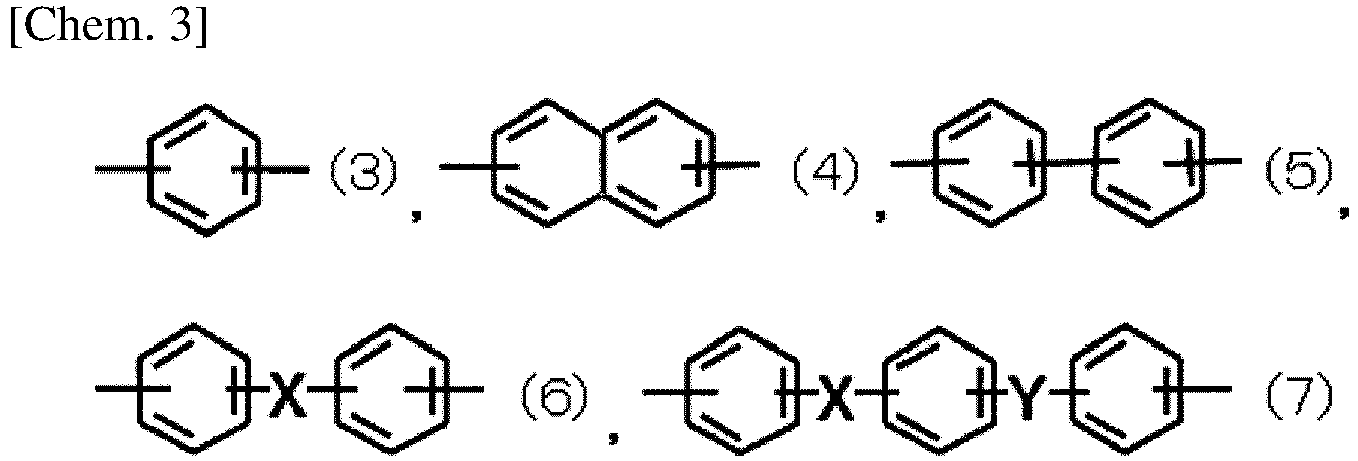
- Specific examples of aromatic diamines include paraphenylenediamine, 4,4'-diaminodiphenyl ether, 3,4'-diaminodiphenyl ether, 4,4'-diaminobenzophenone, 3,3'-diaminobenzophenone, 2-chloro-1,4-phenylenediamine, 1,5'-naphthalenediamine, 4,4'-diaminodiphenyl sulfone, and the like, and aromatic diamines are not limited to these examples.
- Specific examples of aromatic dicarboxylic halides include terephthalic acid chloride, 2-chloroterephthalic acid chloride, isophthalic acid chloride, 2-chloroisophthalic acid chloride, 2,6'-naphthalenedicarboxylic acid chloride, and the like, and the aromatic dicarboxylic halides are not limited to these examples.
- The resin A in the present invention preferably contains an aromatic polyamide having a structure represented by the following formula (1).
-NH-Ar1-NH-CO-Ar2-CO- (1)
- Here, Ar1 and Ar2 each represent an aromatic group.
- In the aromatic polyamide described above, 5 mol% or more and 80 mol% or less of Ar1 represented by the chemical formula (1) is preferably an aromatic group having ether groups. More preferred molar ratio thereof is 7 mol% or more and 60 mol% or less, and still more preferred molar ratio thereof is 10 mol% or more and 40 mol% or less. When the amount of the aromatic group having ether groups is less than 5 mol%, a sufficient porous structure may not be obtained, and battery characteristics may decrease. When the amount of the aromatic group is more than 80 mol%, sufficient heat rupture resistance may not be obtained. The strength of the porous layer may decrease, and sufficient heat resistance may not be obtained. In addition, elimination or deformation of the porous layer may occur in the production step.
- A content of aromatic groups having ether groups in Ar1 can be calculated as follows. First, 100 parts by mass of porous film samples in which a porous layer is laminated on a porous substrate, are fixed to a metal frame, and are immersed for 24 hours at room temperature in 100 parts by mass of concentrated sulfuric acid, thereby recovering the porous layers from the samples. Then, insoluble contents (e.g., inorganic particles) are removed with a centrifugal separator, and the recovered resin components are subjected to a combination of chemical methods (molecular weight analysis, mass spectrometry, nuclear magnetic resonance, fourier transform infrared spectroscopy, etc.) so as to calculate the content of aromatic groups having ether groups.
- In the aromatic polyamide described above, at least a part of the aromatic group of Ar1 and Ar2 in the chemical formula (1) is preferably substituted with an electron-withdrawing group. 30 mol% to 100 mol% of the total amount of all the aromatic groups are more preferably aromatic groups having substituted electron-withdrawing group(s), and 50 mol% to 100 mol% thereof are still more preferably the aromatic groups having substituted electron-withdrawing group(s). Here, the electron-withdrawing group in the present invention refers to a group having electronegativity of 2.5 or more. Examples of the electron-withdrawing group include halogen groups such as a fluoro group, a chloro group, and a bromo group, halogenated alkyl groups such as a trifluoromethyl group, nitro groups, cyano groups, cyanate groups, phenyl groups, and the like.
- The intrinsic viscosity (η) of the aromatic polyamide is preferably 3.0 dl/g or more and 8.0 dl/g or less, more preferably 3.3 dl/g or more and 7.0 dl/g or less, and still more preferably 3.6 dl/g or more and 6.0 dl/g or less. By increasing the intrinsic viscosity, the degree of polymerization, that is, molecular weight of the aromatic polyamide is increased, thereby improving the heat resistance of the aromatic polyamide. Therefore, a secondary battery separator using an aromatic polyamide having high intrinsic viscosity can provide sufficient heat rupture resistance. However, when the intrinsic viscosity is too high, the handleability during polymerization may decrease, and the productivity may decrease. Therefore, when the intrinsic viscosity (η) is 3.0 dl/g or more, sufficient heat rupture resistance can be obtained. Alternatively, when the content of the aromatic polyamide is increased to improve the heat rupture resistance, the air permeability is increased, and the porosity is decreased. Accordingly, the battery characteristics may deteriorate. When the intrinsic viscosity (η) is 8.0 dl/g or less, the handleability during polymerization and the productivity are excellent. In addition, the aromatic polyamide can be sufficiently solved in a solvent, and aggregation of the aromatic polyamide molecules can be prevented, and a porous film can be easily formed.
- The term "resin B" in the present invention means a resin having a melting point of lower than 150°C, or an amorphous resin. The resin having a melting point of lower than 150°C is preferably a resin having a melting point of lower than 140°C, and more preferably a resin having a melting point of lower than 130°C. The above resin is still more preferably a resin having a melting point of lower than 100°C.
- The term "amorphous resin" as described here refers to a resin that does not have a melting point at a temperature range of -20°C to 300°C, that is, does not have an endothermic peak, and has a glass transition temperature of lower than 150°C, in a measurement by a differential scanning calorimetry analyzer. Here, for example, the glass transition temperature is measured by differential scanning calorimetry (DSC) according to the regulation of "JIS K7121: 2012 Method for measuring transition temperature of plastic", in which an intersection point of a straight line obtained by extending a baseline on a low temperature side, at the second temperature rise after temperature is raised for the first time and lowered, to the high temperature side, and a tangent drawn at a point where a slope of a curve at a step change part of glass transition is maximized, is determined as the glass transition temperature.
- The resin B is preferably a resin having a melting point of lower than 150°C or an amorphous resin because high adhesiveness with an electrode is obtained. In the step of adhering the electrode to the porous film, only a hot pressing step or a pressing step is often used, and at this time, the resin B is preferably a resin having a melting point of lower than 150°C or an amorphous resin because a part of the porous layer enters a gap between the active materials of the electrode by heat or press, and the anchor effect is exhibited to enable adhesion to the electrode. When the resin B is a resin having a melting point of 150°C or higher, sufficient adhesiveness with an electrode may not be obtained. The "melting point" and the "method for measuring the melting point" of the resin B are as described in the items of the resin A.
- Examples of the resin B constituting the porous layer in the present invention include fluororesins, acrylic resins, olefin resins such as polyethylenes and polypropylenes, styrene-butadiene resins, crosslinked polystyrenes, methyl methacrylate-styrene copolymers, polyimides, melamine resins, phenolic resins, polyacrylonitrile, silicon resins, urethane resins, polycarbonates, carboxymethyl celluloseresins, and the like, and one kind of these resins may be used alone, or a plurality thereof may be used in combination. Among them, at least one kind selected from fluororesins, acrylic resins, and olefin resins is preferably used, and fluororesins or acrylic resins are more preferred, from the viewpoint of electrical stability and oxidation resistance.
- Examples of the fluororesins include homopolymers such as polyvinylidene fluoride, polytetrafluoroethylene, polyvinyl fluoride, and polychlorotrifluoroethylene, and copolymers such as an ethylene-tetrafluoroethylene polymer and an ethylene-chlorotrifluoroethylene polymer. In addition, examples thereof include copolymers of homopolymers and tetrafluoroethylene, hexafluoropropylene, trifluoroethylene, or the like. Among these fluororesins, polyvinylidene fluoride resins, particularly, resins made of copolymers of vinylidene fluoride and hexafluoropropylene is preferably used from the viewpoint of electrical stability and oxidation resistance.
- The weight average molecular weight of the fluororesins is preferably 50,000 or more and 2,000,000 or less. The weight average molecular weight is more preferably 100,000 or more and 1,500,000 or less. The weight average molecular weight is still more preferably 200,000 or more and 1,000,000 or less. When the weight average molecular weight is less than 50,000, sufficient adhesiveness with an electrode may not be obtained. In addition, when the weight average molecular weight is more than 2,000,000, handling properties and coatability may decrease due to an increase in viscosity.
- Examples of the acrylic resins include poly (meth)acrylic acid and poly (meth)acrylic acid ester. Examples of a monomer of the poly (meth)acrylic acid include acrylic acid and methacrylic acid, and examples of a monomer of poly (meth)acrylic acid ester include methyl acrylate, methyl methacrylate, ethyl acrylate, ethyl methacrylate, butyl acrylate, butyl methacrylate, and the like. One kind of these compounds may be used alone, or two or more kinds thereof may be used in combination.
- The porous layer in an embodiment of the present invention preferably contains inorganic particles. When the porous layer contains inorganic particles, thermal dimensional stability and prevention of short circuit due to foreign matters can be imparted.
- Specific examples of the inorganic particles include inorganic oxide particles such as aluminum oxide, boehmite, silica, titanium oxide, zirconium oxide, iron oxide, and magnesium oxide, inorganic nitride particles such as aluminum nitride and silicon nitride, poorly soluble ionic crystal particles such as calcium fluoride, barium fluoride, and barium sulfate. One kind of these particles may be used, or two or more kinds thereof may be mixed and used.
- The average particle diameter of the inorganic particles to be used is preferably 0.05 µm or more and 5.0 µm or less. The average particle diameter thereof is more preferably 0.10 µm or more and 3.0 µm or less, and still more preferably 0.20 µm or more and 1.0 µm or less. When the average particle diameter is less than 0.05 µm, air permeability may increase due to dense porous layer. In addition, since the pore diameter is reduced, the impregnation property of the electrolytic solution may decrease and the productivity may be affected. When the average particle diameter is more than 5.0 µm, sufficient dimensional stability may not be obtained, and the thickness of the porous layer may increase, resulting in a decrease in battery characteristics.
- Examples of the shape of the particles to be used include a spherical shape, a plate shape, a needle shape, a rod shape, and an oval shape, and any shape may be used. Among them, the spherical shape is preferred from the viewpoint of a surface modification property, dispersibility, and coatability.
- For example, the porous film in the present invention includes a porous substrate and a porous layer provided on at least one surface of the porous substrate, and the porous layer contains a resin A (resin A: a resin having a melting point of 150°C or higher, or a resin having no substantial melting point) and a resin B (resin B: a resin having a melting point of lower than 150°C or an amorphous resin), and satisfies that α/β is less than 1.0, wherein α is a surface opening ratio of the porous layer and β is a cross-sectional porosity of the porous layer. The porous film may be obtained by a method for producing a porous film, and the method is described below.
- When aromatic polyamides are used as the resin A, the aromatic polyamides, which are manufactured by a common production method such as solution polymerization of a diamine with an acid dichloride such as 2-chloroterephthaloyl chloride used as raw materials, resins, and inorganic particles, are dispersed in a solvent, thereby preparing a coating liquid. Here, as the solvent allowing them to disperse, an aprotic organic polar solvent such as N-methyl-2-pyrrolidone, N,N-dimethylacetamide, dimethylformamide, and dimethyl sulfoxide may be used. Among them, N-methyl-2-pyrrolidone is particularly preferred from the viewpoint of formation of a porous structure in the later step.
- In addition, a poor solvent for an aromatic polyamide may be added to facilitate the porosification. The poor solvent is not particularly limited as long as it is a liquid that hardly causes solvation with the aromatic polyamide, and specific examples thereof include water, alcohol-based solvents, and mixed solvents thereof. Among them, water is preferably added, and the amount of water to be added is preferably 500 parts by mass or less with respect to 100 parts by mass of aromatic polyamides. When the amount of water added is greater than 500 parts by mass, aromatic polyamides may be solidified in the coating liquid, and the stability of the coating agent may not be sufficiently obtained.
- In addition, dispersants, thickeners, stabilizers, defoamers, and leveling agents may be added to the coating liquid as necessary.
- As a method for dispersing the coating liquid, a common method may be used. The coating liquid is dispersed by, for example, a ball mill, a bead mill, a sand mill, a roll mill, a homogenizer, an ultrasonic homogenizer, a high pressure homogenizer, an ultrasonic device, paint shaker, and the like. The plurality of mixing and dispersing machines may be combined to perform dispersion stepwise.
- The order of preparing the coating liquid is not particularly limited. From the viewpoint of efficiency of a dispersion step, an order of preparing a coating liquid by mixing aromatic polyamides with an aprotic organic polar solvent and allowing the aromatic polyamides to dissolve therein, and adding resins, inorganic particles and other additives to the solution is preferred.
- Next, the obtained coating liquid is applied to the porous substrate, followed by being immersed in a water tank and performing drying, and the porous layer is laminated. As a coating method, coating may be performed by common methods. It is possible to utilize, for example, dip coating, gravure coating, slit die coating, knife coating, comma coating, kiss coating, roll coating, bar coating, spray painting, dip coating, spin coating, screen printing, ink jetting printing, pat printing, other kinds of printing, and the like. The coating method is not limited to these, and a coating method may be selected depending on preferred conditions for the resin A to be used, the resin B, inorganic particles, binders, dispersants, leveling agents, a solvent to be used, a substrate, and the like. In order to improve coatability, for example, a surface treatment for a surface to be coated, such as a corona treatment or a plasma treatment, may be performed on the porous substrate.
- The content of the resin A in the porous layer is preferably equal to or more than 1 mass% and less than 50 mass%, and more preferably equal to or more than 3 mass% and less than 30 mass%, based on 100 mass% of the entire porous layer. The content of the resin A is still more preferably equal to or more than 5 mass% and less than 20 mass%. When the porous film contains a plurality of porous layers, the above feature should be considered for each porous layer.
- When the content of the resin A in the porous layer is 1 mass% or more, sufficient heat rupture resistance may be obtained. When the content of the resin A in the porous layer is less than 50 mass%, the content of the resin A is not too large, a sufficient porous structure can be obtained, and the battery characteristics are improved. In addition, it is also advantageous in terms of cost. When the porous film contains a plurality of porous layers, regarding each porous layer, the content of the resin A in at least one layer is preferably equal to or more than 1 mass% and less than 50 mass%, and the content of the resin A in all the porous layers is more preferably equal to or more than 1 mass% and less than 50 mass%.
- The content of the resin B in the porous layer is preferably 0.1 mass% or more and 30 mass% or less, more preferably 0.3 mass% or more and 10 mass% or less, and still more preferably 0.5 mass% or more and 5 mass% or less, based on 100 mass% of the entire porous layer.
- When the content of the resin B in the porous layer is 0.1 mass% or more, sufficient adhesiveness with the electrode can be obtained. In addition, when the content of the resin B in the porous layer is 30 mass% or less, the content of the resin B is not too large, and sufficient heat rupture resistance can be obtained.
- A thickness of the porous layer is preferably 1 µm or more and 8 µm or less. The thickness is more preferably 1.5 µm or more and 6 µm or less. The thickness is still more preferably 2 µm or more and 5 µm or less. Here, the "thickness of the porous layer" refers to the thickness of the porous layer when the porous film includes a porous layer provided on one surface of the porous substrate, and refers to the total thickness of two porous layers when the porous film includes porous layers on both surfaces of the porous substrate. When the thickness of the porous layer is 1 µm or more, sufficient heat rupture resistance can be obtained. When the thickness of the porous layer is 8 µm or less, a sufficient porous structure can be obtained and battery characteristics can be prevented from decreasing. In addition, it is also advantageous in terms of cost. When the porous film includes porous layers on both surfaces of the porous substrate, the total thickness of the two porous layers is preferably 1 µm or more and 8 µm or less.
- A rising value of air permeability due to lamination of porous layers is preferably 250 secs/100 cc or less. The above rising value is more preferably 200 secs/100 cc or less. Here, the rising value of air permeability due to lamination of porous layers refers to a value obtained by subtracting the air permeability of the porous substrate alone from air permeability of the porous film having a porous layer, and represents a rising value of air permeability due to lamination of the porous layers. When the rising value of air permeability due to lamination of porous layers is 250 secs/100 cc or less, the battery characteristics are excellent.
- The porous substrate in the present invention refers to a substrate having pores inside. In the present invention, examples of the porous substrate include a porous membrane with pores inside, a nonwoven fabric, or a porous membrane sheet made of fibrous materials, and the like. As a material constituting the porous substrate, a resin that is electrically insulating, electrically stable, and stable in electrolytic solutions preferably constitutes the porous substrate. In addition, a resin to be used is preferably a thermoplastic resin having a melting point of 200°C or lower, from the viewpoint of imparting shutdown functions. The shutdown function here refers to a function that when a lithium ion battery generates heat abnormally, the porous structure is closed due to melting by the heat and the movement of ions is stopped, causing power generation to stop.
- Examples of the thermoplastic resin include polyolefin-based resins, and the above porous substrate is preferably a polyolefin-based porous substrate. In addition, the polyolefin-based porous substrate is more preferably a polyolefin-based porous substrate having a melting point of 200°C or lower. Specific examples of the polyolefin-based resins include polyethylene, polypropylene, a copolymer thereof, and a mixture combining these compounds. For example, a single-layer porous substrate containing 90 mass% or more of polyethylene, a multilayer porous substrate composed of polyethylene and polypropylene, and the like may be exemplified.
- Examples of methods for producing the porous substrate include a porosification method in which a polyolefin-based resin is made into a sheet and then was stretched to become porous, and a porosification method in which a polyolefin-based resin is dissolved in a solvent such as liquid paraffin, and is made into a sheet, followed by extracting the solvent.
- The thickness of the porous substrate is preferably 3 µm or more and 50 µm or less, and more preferably 5 µm or more and 30 µm or less. When the thickness of the porous substrate is more than 50 µm, internal resistance of porous substrate may increase. In addition, when the thickness of the porous substrate is less than 3 µm, production may become difficult and sufficient mechanical characteristics may not be obtained.
- The air permeability of the porous substrate is preferably 50 secs/100 cc or more and 1,000 secs/100 cc or less. The air permeability is more preferably 50 secs/100 cc or more and 500 secs/100 cc or less. When the air permeability is more than 1,000 secs/100 cc, sufficient ion mobility may not be obtained, and the battery characteristics may deteriorate. When the air permeability is less than 50 secs/100 cc, sufficient mechanical characteristics may not be obtained.
- The porous film in the present invention is a porous film including the above porous layer provided on at least one surface of the porous substrate. The porous layer is preferably sufficiently porous to have ion permeability, and air permeability of the porous film is preferably 50 secs/100cc or more and 1,000 secs/100 cc or less. The air permeability is more preferably 50 secs/100 cc or more and 500 secs/100 cc or less. The air permeability is still more preferably 50 secs/100 cc or more and 300 secs/100 cc or less. When the air permeability is more than 1,000 secs/100 cc, sufficient ion mobility may not be obtained, and the battery characteristics may deteriorate. When the air permeability is less than 50 secs/100 cc, sufficient mechanical characteristics may not be obtained.
- The porous film in the present invention may be preferably used for a separator for a secondary battery such as a lithium ion battery. The lithium ion battery has a structure in which a secondary battery separator and electrolytes are interposed between a positive electrode in which a positive electrode active material is laminated on a positive electrode current collector, and a negative electrode in which a negative electrode active material is laminated on a negative electrode current collector.
- The positive electrode is an electrode in which a positive electrode material composed of active materials, binder resins, and conductive assistants is laminated on a current collector, and examples of the active materials include layered lithium-containing transition metal oxides such as LiCoO2, LiNiO2, and Li(NiCoMn)O2, spinel-type manganese oxides such as LiMn2O4, iron-based compounds such as LiFePO4, and the like. As the binder resin, a resin having high oxidation resistance may be used. Specific examples thereof include fluororesins, acrylic resins, styrene-butadiene resins, and the like. As the conductive assistant, a carbon material such as carbon black and graphite may be used. As the current collector, a metal foil is preferred, and aluminum is particularly preferably used.
- The negative electrode is an electrode in which a negative electrode material composed of active materials and binder resins is laminated on a current collector, and examples of the active materials include carbon materials such as artificial graphite, natural graphite, hard carbon, and soft carbon, lithium alloy materials with tin, silicon or the like, metal materials such as Li, lithium titanate (Li4Ti5O12), and the like. As the binder resin, fluororesins, acrylic resins, styrene-butadiene resins, and the like may be used. As the current collector, a metal foil is preferred, and a copper foil is particularly preferably used.
- The electrolytic solution provides a field for moving ions between a positive electrode and a negative electrode in a secondary battery, and is obtained by dissolving the electrolyte in an organic solvent. Examples of the electrolyte include LiPF6, LiBF4, LiClO4, and the like, and LiPF6 may be preferably used from the viewpoint of solubility in organic solvents and ionic conductivity. Examples of the organic solvent include ethylene carbonate, propylene carbonate, fluoroethylene carbonate, dimethyl carbonate, diethyl carbonate, ethyl methyl carbonate, gamma-butyrolactone, sulfolane, and the like, and two or more kinds of these organic solvents may be mixed and used.
- In a method for producing the secondary battery, first, the active materials and conductive assistants are dispersed in a binder solution to prepare a coating liquid for an electrode, the coating liquid is applied to a current collector, and the solvent is dried, thereby obtaining each of a positive electrode and a negative electrode. The thickness of the coating film after drying is preferably 50 µm or more and 500 µm or less. A secondary battery separator is disposed between the obtained positive electrode and negative electrode so as to contact an active material layer of each electrode, and they are sealed in an exterior material such as an aluminum laminate film, followed by injection of an electrolytic solution, and then a negative electrode lead or a safety valve are installed and the exterior material is sealed. The secondary battery obtained in this way has high heat rupture resistance and excellent battery characteristics, and further, production at low cost is enabled.
- Hereinafter, the present invention is described in detail with reference to Examples, but the present invention is not limited thereto. The measurement method used in the present example is described below.
- In the case of the surface opening ratio α, ion coating was performed on a surface of a porous film by using an ion coater, thereby preparing a sample. In the case of the cross sectional porosity β, a porous film was frozen with liquid nitrogen and was irradiated with argon beams from an upper portion thereof to prepare a cross section (Cryo-BIB method), and ion coating was performed on the cross section by using an ion coater, thereby preparing a sample for measurement. The surface of the obtained sample and the cross section of the obtained sample for measurement were observed at a magnification of 20,000 times and a magnification of 40,000 times, respectively, by using a field emission scanning electron microscope (FE-SEM) S4800 manufactured by Hitachi High-Technologies Corporation under an acceleration voltage of 1.5 kV, and image data was obtained (image of only an observation part without a display such as a scale bar). An image was cut out from the obtained image data so as to only remain the porous layer, image analysis was performed using HALCON Ver. 10.0 manufactured by MVTec, and the surface opening ratio α (%) and cross sectional porosity β (%) were determined. In the image analysis method, an 11-pixel average image A and a 3-pixel average image B were generated for a 256-tone monochrome image first, and an area (Area_all) of the entire image B was determined.
- Next, the image A was removed from the image B as difference to generate image C, and a region D satisfying "luminance ≥ 10" was extracted therefrom. The extracted region D was divided into blocks, and a region E satisfying "area ≥ 100" was extracted. A region F subjected to closing treatment with a circular element having a radius of 2.5 pixels was generated for the region E, and a region G subjected to an opening treatment with a rectangular element of 1 (horizontal) × 5 (vertical) pixels was generated, so that pixels satisfying "vertical size < 5" was removed. The extracted region G was divided into blocks, and a region H satisfying "area ≥ 500" was extracted therefrom, so that a fibril region was extracted.
- Further, a region I satisfying "image ≥ 5" was extracted from the image C, the region I was divided into blocks, and a region J satisfying "area ≥ 300" was extracted therefrom. The region J was subjected to an opening treatment with a circular element having a radius of 1.5 pixels and then subjected to a closing treatment with a circular element with a radius of 8.5 pixels, thereby generating a region K. From the region K, a region L satisfying "area ≥ 200" was extracted. A region M which was obtained by filling dark areas satisfying "area ≥ 4,000 pixels" with bright areas in the region L was generated, thereby extracting a region of unopened parts other than fibrils.
- Finally, a total region N of the region H and the region M was generated, and an area of the total region N (Area_closed) was determined, thereby determining the area of the unopened parts. The calculation of the surface opening ratio α and the cross-sectional porosity β was performed based on the following equation.

- α/β was calculated in accordance with the following equation based on the obtained surface opening ratio α and cross-sectional porosity β.
- α/β = Surface opening ratio α (%)/Cross sectional porosity (3 (%)
- 10 places on both surfaces of the same porous film were measured according to the above method, and an average value thereof was determined as α/β of the sample.
- An aromatic polyamide as the resin A was dissolved at a concentration of 0.5 g/dl in N-methylpyrrolidone (NMP) to which 2.5 mass% of lithium bromide (LiBr) was added, and flow time thereof was measured at 30°C by using an ubbelohde viscometer. The flow time of NMP as a blank solution in which the polymer was not dissolved was also measured in the same manner, and the intrinsic viscosity (η) (dl/g) was calculated using the following equation.

- t0: Flow time of blank solution (sec)
- t: Flow time of sample (sec).
- A porous film having a size of 50 mm × 50 mm was cut out to be a sample, the sample was interposed between two stainless steel plates each having a through hole of 12 mm at the center thereof, and further, the two stainless steel plates were interposed between two heating block plates each having a through hole of 12 mm at the center thereof from both surfaces thereof. A ball having a diameter of 9.5 mm made of tungsten was placed in the through hole, the temperature of the heating blocks was raised at 5°C/min and the temperature at which the ball fell was measured. Five samples each having a size of 50 mm × 50 mm were prepared, and the average value of the performed measurements was determined as the thermal film rupture temperature. The temperature being lower than 160°C was evaluated as "D", the temperature being equal to or higher than 160°C and lower than 250°C was evaluated as "C", the temperature being equal to or higher than 250°C and lower than 300°C was evaluated as "B", and the temperature being equal to or higher than 300°C was evaluated as "A".
- In the differential scanning calorimetry (DSC) according to the regulation of "JIS K7121: 2012 Method for measuring transition temperature of plastic", 6 to 7 mg of resin A and 6 to 7 mg of resin B were respectively placed in different measurement pans in a DSC (Differential Scanning Calorimeter) manufactured by PerkinElmer, thereby preparing samples for measurement, and the measurement was performed according to the following conditions. After temperature was raised for the first time and lowered, temperature of a peak top of an endothermic peak at a second temperature rise was defined as the melting point.
- Rate of temperature rise and fall: ±10°C/min
- Range of measurement temperature: -20°C to 300°C.
- A porous film and a positive electrode of 15 mm × 100 mm, in which an active material was LiCoO2, a binder was a vinylidene fluoride resin, and a conductive assistant was carbon black, were disposed such that the active material contacts the porous layer, followed by subjecting to hot pressing at 0.5 MPa, 100°C, and 0.2 m/min by a hot roll press machine, followed by peeling off the porous film manually using tweezers, and the adhesive strength was evaluated based on the following four grades. Similarly, adhesive strength between a porous film and a negative electrode in which an active material was graphite, a binder was a vinylidene fluoride resin, and a conductive assistant was carbon black was also measured, each of the positive electrode and the negative electrode was evaluated, and the result was defined as the adhesive strength.
- Adhesive strength "A": The porous film was peeled off from the electrode with a strong force.
- Adhesive strength "B": The porous film was peeled off from the electrode with a slightly strong force.
- Adhesive strength "C": The porous film was peeled off from the electrode with a weak force.
- Adhesive strength "D": The porous film was peeled off from the electrode with an extremely weak force.
- An aluminum foil was coated with a positive electrode slurry which was obtained by dispersing 92 parts by mass of Li(Ni5/10Mn2/10Co3/10)O2 as a positive electrode active material, 2.5 parts by mass of acetylene black and graphite as the positive electrode conductive assistant, and 3 parts by mass of polyvinylidene fluoride as a positive electrode binder into N-methyl-2-pyrrolidone by using a planetary mixer, followed by performing drying and rolling, thereby producing a positive electrode sheet (coating basis weight: 9.5 mg/cm2).
- This positive electrode sheet was cut out to be 40 mm × 40 mm. At this time, a current-collecting tab-attached portion having no active material layer was cut out so as to have a size of 5 mm × 5 mm outside an active material surface. An aluminum tab having a width of 5 mm and a thickness of 0.1 mm was ultrasonically welded to the tab-attached portion.
- A copper foil was coated with a negative electrode slurry which was obtained by dispersing 98 parts by mass of natural graphite as a negative electrode active material, 1 part by mass of carboxymethylcellulose as a thickener, 1 part by mass of styrene-butadiene copolymer as a negative electrode binder into water by using a planetary mixer, followed by performing drying and rolling, thereby producing a negative electrode sheet (coating basis weight: 5.5 mg/cm2).
- This negative electrode sheet was cut out to be 45 mm × 45 mm. At this time, a current-collecting tab-attached portion having no active material layer was cut out so as to have a size of 5 mm × 5 mm outside an active material surface. A copper tab having the same size as the positive electrode tab was ultrasonically welded to the tab-attached portion.
- Next, the porous film was cut out to be 55 mm × 55 mm, the positive electrode and the negative electrode are stacked on both surfaces of the porous film so that the porous film was interposed between the active material layers, and all the positive electrode coating portion was disposed to face the negative electrode coating portion, so as to obtain an electrode group. The above positive electrode, negative electrode and porous film were interposed between one sheet of aluminum laminated film of 90 mm × 200 mm, long sides of the aluminum laminated film were folded, and the two long sides of the aluminum laminated film were heat-sealed to form a bag.
- An electrolytic solution which was prepared by dissolving LiPF6, as a solute, in a mixed solvent containing ethylene carbonate and diethyl carbonate (ethylene carbonate: diethyl = 1 : 1 (volume ratio)) to reach a concentration of 1 mol/liter, was used. 1.5 g of electrolytic solutions were injected into the bag-shaped aluminum laminated film, and the short side portion of the aluminum laminated film was thermally fused while impregnating under reduced pressure to obtain a laminate type battery.
- Tests were performed on the discharge load characteristics according to the following procedure, and the discharge load characteristics were evaluated based on a discharge capacity retention ratio.
- The above laminate type battery was measured in terms of discharge capacity at the time of discharging at 0.5 C at 25°C and discharge capacity at the time of discharging at 10 C at 25°C, and a discharge capacity retention ratio was calculated as follows: "(discharge capacity at 10 C)/(discharge capacity at 0.5 C) × 100". Here, a charge condition was constant current charge at 0.5 C and 4.3 V, and a discharge condition was constant current discharge at 2.7 V. Five laminated type batteries were produced, and an average value of three measurement results obtained by removing results of the maximum discharge capacity retention ratio and the minimum discharge capacity retention ratio from the five measurement results, was determined as the capacity retention ratio. The case where a discharge capacity retention ratio was less than 55% was evaluated as "D", the case where a discharge capacity retention ratio was 55% or more and less than 65% was evaluated as "B", and the case where a discharge capacity retention ratio was 65% or more was evaluated as "A".
- Tests were performed on the charge and discharge cycle characteristics according to the following procedure, and the charge and discharge cycle characteristics were evaluated based on a discharge capacity retention ratio.
- One charge and one discharge were regarded as one cycle, and charge and discharge was repeated 300 times at 25°C under a charge condition of constant current charge at 2 C and 4.3 V and a discharge condition of constant current discharge at 2 C and 2.7 V.
- The discharge capacity retention ratio was calculated as follows: (discharge capacity at 300th cycle)/(discharge capacity at 1st cycle) × 100. Five laminated type batteries were produced, and an average value of three measurement results obtained by removing results of the maximum discharge capacity retention ratio and the minimum discharge capacity retention ratio from the five measurement results, was determined as the capacity retention ratio. The case where a discharge capacity retention ratio was less than 60% was evaluated as "D", the case where a discharge capacity retention ratio was 60% or more and less than 70% was evaluated as "B", and the case where a discharge capacity retention ratio was 70% or more was evaluated as "A".
- 2-chloro-1,4-phenylenediamine equivalent to 85 mol% based on the total amount of diamine and 4,4'-diaminodiphenyl ether equivalent to 15 mol% were dissolved in dehydrated N-methyl-2-pyrrolidone. 2-chloroterephthaloyl chloride equivalent to 98.5 mol% to the total amount of diamine was added as acid dichloride to the above obtained solution, followed by stirring, thereby polymerizing the aromatic polyamides. The obtained polymerization solution was neutralized with lithium carbonate in an amount of 97 mol% based on the total amount of the acid dichloride, and further was neutralized with 15 mol% of diethanolamine and 25 mol% of triethanolamine, and thus an aromatic polyamide solution having a concentration of the aromatic polyamide being 10 mass% was obtained. The intrinsic viscosity (η) of the aromatic polyamide was 3.0 dl/g, and the aromatic polyamide was a resin having no melting point within -20°C to 300°C and showing no baseline shift in differential scanning calorimetry (DSC).
- N-methyl-2-pyrrolidone was added to the obtained aromatic polyamide solution, further fluororesin (copolymer of vinylidene fluoride and hexafluoropropylene, melting point: 130°C) was added as the resin B such that the concentration was 1 mass% in 100 mass% of the entire porous layer, and the mixture was stirred by a stirrer. Then, alumina particles (average particle diameter: 0.4 µm) were added so that the concentration of the aromatic polyamide was 10 mass% in 100 mass% of the entire porous layer. The mixed solution was preliminarily dispersed by a stirrer, and then dispersed using a bead mill to obtain a coating liquid.
- The obtained coating liquid was applied to both surfaces of a polyethylene porous substrate (thickness: 5 µm, air permeability: 120 seconds/100 cc) by dip coating, followed by being immersed in a water tank and drying until the solvent contained therein was volatilized, thereby forming a porous layer, and thus the porous film in the present invention was obtained. Table 1 shows the measurement results of the obtained porous film in terms of the surface opening ratio α and the cross-sectional porosity β of the porous layer, thickness of the porous layers on both surfaces, thermal film rupture temperature, adhesiveness with an electrode, discharge load characteristics, and charge and discharge cycle characteristics.
- A porous film in the present invention was obtained in the same manner as Example 1 except that the resin B was added such that the concentration was 5 mass% in 100 mass% of the entire porous layer.
- A porous film in the present invention was obtained in the same manner as Example 1 except that the concentration of the aromatic polyamide was changed to 20 mass% in 100 mass% of the entire porous layer.
- A porous film in the present invention was obtained in the same manner as Example 1 except that the concentration of the aromatic polyamide was changed to 4 mass% in 100 mass% of the entire porous layer.
- A porous film in the present invention was obtained in the same manner as Example 1 except that the resin A was changed to an aromatic polyamide (which was obtained in the same manner as Example 1 except that 2-chloroterephthaloyl chloride equivalent to 99.0 mol% based on the total amount of diamine was added as acid dichloride; and which was a resin having an intrinsic viscosity (η) of 4.3 dl/g, having no melting point within -20°C to 300°C, and showing no baseline shift in differential scanning calorimetry (DSC)).
- A porous film in the present invention was obtained in the same manner as Example 1 except that the resin A was changed to an aromatic polyamide (which was obtained in the same manner as Example 1 except that 2-chloroterephthaloyl chloride equivalent to 99.5 mol% based on the total amount of diamine was added as acid dichloride; and which was a resin having an intrinsic viscosity (η) of 5.0 dl/g, having no melting point within -20°C to 300°C, and showing no baseline shift in differential scanning calorimetry (DSC)), and the resin B was added such that the concentration was 5 mass% in 100 mass% of the entire porous layer.
- A porous film in the present invention was obtained in the same manner as Example 1 except that the resin B was added such that the concentration was 10 mass% in 100 mass% of the entire porous layer.
- A porous film in the present invention was obtained in the same manner as Example 1 except that the resin A was changed to an aromatic polyamide (which was obtained in the same manner as Example 1 except that 2-chloroterephthaloyl chloride equivalent to 98.0 mol% based on the total amount of diamine was added as acid dichloride; and which was a resin having an intrinsic viscosity (η) of 2.5 dl/g, having no melting point within -20°C to 300°C, and showing no baseline shift in differential scanning calorimetry (DSC)).
- A porous film in the present invention was obtained in the same manner as Example 1 except that the coating liquid was applied to both surfaces of the polyethylene porous substrate by dip coating, followed by maintaining it for 10 seconds in an environment of a temperature of 60°C and a humidity of 60%.
- A porous film in the present invention was obtained in the same manner as Example 1 except that the fluororesin (a copolymer of vinylidene fluoride and hexafluoropropylene, amorphous resin having no melting point and having a glass transition temperature of -40°C) was added as the resin B such that the concentration was 5 mass% in 100 mass% of the entire porous layer.
- A porous film in the present invention was obtained in the same manner as Example 1 except that an acrylic resin (an aqueous dispersion of particles having an average particle diameter of 100 nm, melting point: 50°C) was added as the resin B such that the concentration was 5 mass% in 100 mass% of the entire porous layer.
- A porous film in the present invention was obtained in the same manner as Example 1 except that a polyethylene resin (an aqueous dispersion of particles having an average particle diameter of 100 nm, melting point: 90°C) was added as the resin B such that the concentration was 5 mass% in 100 mass% of the entire porous layer.
- A porous film was obtained in the same manner as Example 1 except that the fluororesin (a copolymer of vinylidene fluoride and hexafluoropropylene, melting point: 165°C) was added as the resin B such that the concentration was 5 mass% in 100 mass% of the entire porous layer.
- A porous film was obtained in the same manner as Example 1 except that the resin B was added such that the concentration was 5 mass% in 100 mass% of the entire porous layer, and the obtained coating liquid was applied to both surfaces of the polyethylene porous substrate by dip coating, followed by maintaining it for 10 seconds in an environment of a temperature of 80°C and a humidity of 80%.
Table 1 Resin A Resin B Surface opening ratio α (%) Cross sectional porosity β (%) Surface opening ratio/cross sectional porosity (α/β) Kind of resin A Intrinsic viscosity of resin A (dl/g) Content of resin A (mass%) Kind of resin B Melting point of resin B (°C) Content of resin B (mass%) Example 1 Aromatic polyamide 3.0 10 Fluororesin 130 1 10 63 0.2 Example 2 Aromatic polyamide 3.0 10 Fluororesin 130 5 10 55 0.2 Example 3 Aromatic polyamide 3.0 20 Fluororesin 130 1 5 50 0.1 Example 4 Aromatic polyamide 3.0 4 Fluororesin 130 1 10 66 0.2 Example 5 Aromatic polyamide 4.3 10 Fluororesin 130 1 10 60 0.2 Example 6 Aromatic polyamide 5.0 10 Fluororesin 130 5 10 55 0.2 Example 7 Aromatic polyamide 3.0 10 Fluororesin 130 10 10 45 0.2 Example 8 Aromatic polyamide 2.5 10 Fluororesin 130 1 10 63 0.2 Example 9 Aromatic polyamide 3.0 10 Fluororesin 130 1 40 63 0.6 Example 10 Aromatic polyamide 3.0 10 Fluororesin - 5 10 55 0.2 Example 11 Aromatic polyamide 3.0 10 Acrylic resin 50 5 10 60 0.2 Example 12 Aromatic polyamide 3.0 10 Polyethylene resin 90 5 10 60 0.2 Comparative Example 1 Aromatic polyamide 3.0 10 Fluororesin 165 5 10 55 0.2 Comparative Example 2 Aromatic polyamide 3.0 10 Fluororesin 130 5 60 55 1.1 Thickness of porous layers on both surfaces (µm) Thermal film rupture temperature Adhesiveness with electrode Discharge load characteristics Charge and discharge cycle characteristics Example 1 4.0 B B A A Example 2 4.0 B A A A Example 3 4.0 A B B B Example 4 4.0 C B A A Example 5 4.0 A B A A Example 6 4.0 A A A A Example 7 4.0 C A C C Example 8 4.0 C B A A Example 9 4.0 C C A A Example 10 4.0 B A A A Example 11 4.0 B A A A Example 12 4.0 B A A A Comparative Example 1 4.0 A D A A Comparative Example 2 4.0 D B A A - From Table 1, the porous films in all the Examples 1 to 12 are a porous film including a porous substrate and a porous layer provided on at least one surface of the porous substrate, in which the porous layer contains a resin A and a resin B, the resin B has a melting point of lower than 150°C or is an amorphous resin, and satisfies that α/β is less than 1.0 wherein α is a surface opening ratio of the porous layer and β is a cross-sectional porosity of the porous layer. Accordingly, sufficient heat rupture resistance, adhesiveness with an electrode, and good battery characteristics are obtained.
- In contrast, in Comparative Example 1, the melting point of the resin used was high, and sufficient adhesiveness with an electrode is not be obtained. In addition, in Comparative Example 2, since the surface opening ratio is high and α/β is more than 1.0, sufficient heat rupture resistance is not be obtained.
- The porous composite film in the embodiment of the present invention has high heat rupture resistance and adhesiveness with an electrode, and the secondary battery separator having excellent battery characteristics can be provided at low cost. Further, the secondary battery with high heat resistance, high productivity, high capacity, high output, long life and low cost can be provided.
- Although the present invention are described in detail with reference to the specific embodiment, it will be apparent to those skilled in the art that various changes and modifications can be made without departing from the spirit and scope of the present invention.
- This application is based on Japanese Patent Application No.
2017-184497 filed on September 26, 2017
Claims (10)
- A porous film comprising:a porous substrate; anda porous layer provided on at least one surface of the porous substrate,wherein the porous layer includes the following resin A and resin B, and satisfies that α/β is less than 1.0, wherein α is a surface opening ratio of the porous layer and β is a cross-sectional porosity of the porous layer:resin A: a resin having a melting point of 150°C or higher, or a resin having no substantial melting point; andresin B: a resin having a melting point of lower than 150°C, or an amorphous resin.
- The porous film according to claim 1, wherein the surface opening ratio α of the porous layer is 50% or less.
- The porous film according to claim 1 or 2, wherein the resin A is at least one kind of resin selected from the group consisting of polyamides, polyamide-imides, and polyimides.
- The porous film according to claim 3, wherein the resin A contains an aromatic polyamide containing a structure represented by the following formula (1):
-NH-Ar1-NH-CO-Ar2-CO- (1)
wherein Ar1 and Ar2 each represent an aromatic group. - The porous film according to claim 4, wherein an intrinsic viscosity (η) of the aromatic polyamide is 3.0 dl/g or more and 8.0 dl/g or less.
- The porous film according to any one of claims 1 to 5, wherein a content of the resin A is equal to or more than 1 mass% and less than 50 mass% based on 100 mass% of the entire porous layer.
- The porous film according to any one of claims 1 to 6, wherein the resin B is at least one kind selected from fluororesins, acrylic resins, and olefin resins.
- The porous film according to any one of claims 1 to 7, wherein the porous layer contains an inorganic particle having an average particle diameter of 0.05 µm or more and 5 µm or less.
- A secondary battery separator comprising the porous film according to any one of claims 1 to 8.
- A secondary battery comprising the secondary battery separator according to claim 9.
Applications Claiming Priority (2)
| Application Number | Priority Date | Filing Date | Title |
|---|---|---|---|
| JP2017184497 | 2017-09-26 | ||
| PCT/JP2018/035531 WO2019065660A1 (en) | 2017-09-26 | 2018-09-25 | Porous film, separator for secondary batteries, and secondary battery |
Publications (2)
| Publication Number | Publication Date |
|---|---|
| EP3690984A1 true EP3690984A1 (en) | 2020-08-05 |
| EP3690984A4 EP3690984A4 (en) | 2021-06-23 |
Family
ID=65903538
Family Applications (1)
| Application Number | Title | Priority Date | Filing Date |
|---|---|---|---|
| EP18861995.1A Withdrawn EP3690984A4 (en) | 2017-09-26 | 2018-09-25 | POROUS FILM, SEPARATOR FOR SECONDARY BATTERIES AND SECONDARY BATTERY |
Country Status (7)
| Country | Link |
|---|---|
| US (1) | US10950914B2 (en) |
| EP (1) | EP3690984A4 (en) |
| JP (1) | JP7115319B2 (en) |
| KR (1) | KR102613667B1 (en) |
| CN (1) | CN110998911B (en) |
| TW (1) | TWI765096B (en) |
| WO (1) | WO2019065660A1 (en) |
Cited By (1)
| Publication number | Priority date | Publication date | Assignee | Title |
|---|---|---|---|---|
| CN113366695A (en) * | 2019-03-28 | 2021-09-07 | 东丽株式会社 | Porous film, separator for secondary battery, and secondary battery |
Families Citing this family (2)
| Publication number | Priority date | Publication date | Assignee | Title |
|---|---|---|---|---|
| CN115485331A (en) * | 2020-05-01 | 2022-12-16 | 大金工业株式会社 | Composites, polymer electrolytes, electrochemical devices, polymer-based solid-state batteries and actuators |
| JP7231684B2 (en) * | 2020-09-03 | 2023-03-01 | 住友化学株式会社 | Porous layer for non-aqueous electrolyte secondary battery |
Family Cites Families (26)
| Publication number | Priority date | Publication date | Assignee | Title |
|---|---|---|---|---|
| JP4127989B2 (en) * | 2001-09-12 | 2008-07-30 | 帝人株式会社 | Non-aqueous secondary battery separator and non-aqueous secondary battery |
| JP2006338917A (en) | 2005-05-31 | 2006-12-14 | Tomoegawa Paper Co Ltd | Electronic component separator and electronic component |
| CN101384425A (en) * | 2006-02-20 | 2009-03-11 | 大赛璐化学工业株式会社 | Porous film and laminate using porous film |
| PT2065432E (en) * | 2006-09-20 | 2012-01-10 | Asahi Kasei Chemicals Corp | MICROPOROUS MEMBRANE OF POLYOLEFIN AND SEPARATOR FOR BATTERIES OF NON-AQUEOUS ELETROLITES |
| JP4964565B2 (en) * | 2006-11-13 | 2012-07-04 | 旭化成イーマテリアルズ株式会社 | Polyethylene microporous membrane |
| JP5286817B2 (en) | 2007-02-27 | 2013-09-11 | 住友化学株式会社 | Separator |
| JP5239302B2 (en) * | 2007-11-14 | 2013-07-17 | ソニー株式会社 | Lithium ion secondary battery |
| US20090286147A1 (en) * | 2008-05-16 | 2009-11-19 | Atsushi Nakajima | Composite porous membrane, method of producing composite porous membrane, and battery separator, battery and capacitor using the same |
| JP5183435B2 (en) | 2008-11-21 | 2013-04-17 | 日立マクセル株式会社 | Battery separator and lithium secondary battery |
| WO2011089785A1 (en) * | 2010-01-25 | 2011-07-28 | 東レ株式会社 | Aromatic polyamide porous film and separator for capacitor or battery using the same |
| KR101394624B1 (en) * | 2010-08-13 | 2014-05-14 | 에스케이이노베이션 주식회사 | Pore-Protected Multi-layered Composite Separator and the Method for manufacturing the same |
| JP5929469B2 (en) * | 2011-06-28 | 2016-06-08 | 東レ株式会社 | Aromatic polyamide porous membrane, battery separator and method for producing the same |
| JP2013020769A (en) | 2011-07-08 | 2013-01-31 | Teijin Ltd | Separator for nonaqueous electrolyte battery and nonaqueous electrolyte battery |
| TWI548136B (en) * | 2011-10-21 | 2016-09-01 | 帝人股份有限公司 | Separator for non-aqueous type secondary battery, and non-aqueous type secondary battery |
| KR102144598B1 (en) * | 2011-11-18 | 2020-08-13 | 스미또모 가가꾸 가부시끼가이샤 | Laminated porous film, method for producing same, non-aqueous electrolyte secondary battery separator, laminated electrode sheet, and non-aqueous electrolyte secondary battery |
| JP2013211160A (en) * | 2012-03-30 | 2013-10-10 | Tdk Corp | Cell separator and cell using the same |
| KR101292657B1 (en) * | 2013-02-06 | 2013-08-23 | 톱텍에이치앤에스 주식회사 | A hybrid non-woven separator having the inverted structure |
| JP2014198832A (en) * | 2013-03-14 | 2014-10-23 | 東レ株式会社 | Porous film, separator for power storage device, and power storage device |
| CN105593280B (en) * | 2013-10-03 | 2019-04-23 | 东丽株式会社 | Polyolefin porous membrane, battery separator using the polyolefin porous membrane, and method for producing the same |
| TWI500507B (en) * | 2014-04-08 | 2015-09-21 | Benq Materials Corp | Porous separator and method for manufacturing thereof |
| WO2017047576A1 (en) * | 2015-09-16 | 2017-03-23 | 日立マクセル株式会社 | Separator for electrochemical elements, method for producing same, and method for manufacturing electrochemical element |
| EP3376561A1 (en) * | 2015-11-11 | 2018-09-19 | Teijin Limited | Separator for non-aqueous secondary cell, and non-aqueous secondary cell |
| CN105552284B (en) * | 2015-12-22 | 2018-11-06 | 沧州明珠隔膜科技有限公司 | A kind of composite coating lithium ion battery separator and preparation method thereof |
| KR102335587B1 (en) * | 2016-03-29 | 2021-12-06 | 도레이 카부시키가이샤 | Separator for secondary battery and secondary battery |
| JP6654489B2 (en) | 2016-03-30 | 2020-02-26 | 株式会社パナソニックシステムネットワークス開発研究所 | Electromagnetic field simulator |
| CN110114211A (en) * | 2017-02-23 | 2019-08-09 | 东丽株式会社 | Porous membrane, secondary cell diaphragm and secondary cell |
-
2018
- 2018-09-25 EP EP18861995.1A patent/EP3690984A4/en not_active Withdrawn
- 2018-09-25 WO PCT/JP2018/035531 patent/WO2019065660A1/en not_active Ceased
- 2018-09-25 CN CN201880053849.1A patent/CN110998911B/en active Active
- 2018-09-25 KR KR1020207003381A patent/KR102613667B1/en active Active
- 2018-09-25 JP JP2018563737A patent/JP7115319B2/en active Active
- 2018-09-25 US US16/650,377 patent/US10950914B2/en active Active
- 2018-09-26 TW TW107133745A patent/TWI765096B/en active
Cited By (3)
| Publication number | Priority date | Publication date | Assignee | Title |
|---|---|---|---|---|
| CN113366695A (en) * | 2019-03-28 | 2021-09-07 | 东丽株式会社 | Porous film, separator for secondary battery, and secondary battery |
| EP3950300A4 (en) * | 2019-03-28 | 2022-12-21 | Toray Industries, Inc. | POROUS FILM, SEPARATOR FOR SECONDARY BATTERIES, AND SECONDARY BATTERY |
| CN113366695B (en) * | 2019-03-28 | 2024-01-16 | 东丽株式会社 | Porous films, separators for secondary batteries, and secondary batteries |
Also Published As
| Publication number | Publication date |
|---|---|
| CN110998911B (en) | 2022-10-14 |
| TWI765096B (en) | 2022-05-21 |
| EP3690984A4 (en) | 2021-06-23 |
| JP7115319B2 (en) | 2022-08-09 |
| CN110998911A (en) | 2020-04-10 |
| US20200295331A1 (en) | 2020-09-17 |
| JPWO2019065660A1 (en) | 2020-09-10 |
| KR102613667B1 (en) | 2023-12-14 |
| WO2019065660A1 (en) | 2019-04-04 |
| KR20200056379A (en) | 2020-05-22 |
| TW201921774A (en) | 2019-06-01 |
| US10950914B2 (en) | 2021-03-16 |
Similar Documents
| Publication | Publication Date | Title |
|---|---|---|
| EP3719868A1 (en) | Porous film, separator for secondary cell, and secondary cell | |
| KR102271546B1 (en) | Laminated porous film and non-aqueous electrolyte secondary cell | |
| KR102475086B1 (en) | Porous film, secondary battery separator and secondary battery | |
| JPWO2018155288A1 (en) | Porous film, secondary battery separator and secondary battery | |
| US11742514B2 (en) | Porous film, separator for secondary batteries, and secondary battery | |
| JP2018060777A (en) | Secondary battery separator and secondary battery | |
| US10950914B2 (en) | Porous film, separator for secondary batteries, and secondary battery | |
| JP7567477B2 (en) | Porous film, separator for secondary battery, and secondary battery | |
| JP2022056853A (en) | Porous film, separator for secondary battery and secondary battery |
Legal Events
| Date | Code | Title | Description |
|---|---|---|---|
| STAA | Information on the status of an ep patent application or granted ep patent |
Free format text: STATUS: THE INTERNATIONAL PUBLICATION HAS BEEN MADE |
|
| PUAI | Public reference made under article 153(3) epc to a published international application that has entered the european phase |
Free format text: ORIGINAL CODE: 0009012 |
|
| STAA | Information on the status of an ep patent application or granted ep patent |
Free format text: STATUS: REQUEST FOR EXAMINATION WAS MADE |
|
| 17P | Request for examination filed |
Effective date: 20200324 |
|
| AK | Designated contracting states |
Kind code of ref document: A1 Designated state(s): AL AT BE BG CH CY CZ DE DK EE ES FI FR GB GR HR HU IE IS IT LI LT LU LV MC MK MT NL NO PL PT RO RS SE SI SK SM TR |
|
| AX | Request for extension of the european patent |
Extension state: BA ME |
|
| RIN1 | Information on inventor provided before grant (corrected) |
Inventor name: IKOMA KEI Inventor name: KAI NOBUYASU Inventor name: TSUKUDA AKIMITSU |
|
| DAV | Request for validation of the european patent (deleted) | ||
| DAX | Request for extension of the european patent (deleted) | ||
| REG | Reference to a national code |
Ref country code: DE Ref legal event code: R079 Free format text: PREVIOUS MAIN CLASS: H01M0002160000 Ipc: B32B0005320000 |
|
| A4 | Supplementary search report drawn up and despatched |
Effective date: 20210527 |
|
| RIC1 | Information provided on ipc code assigned before grant |
Ipc: B32B 5/32 20060101AFI20210520BHEP Ipc: B32B 27/00 20060101ALI20210520BHEP Ipc: H01M 10/0525 20100101ALI20210520BHEP Ipc: H01M 50/417 20210101ALI20210520BHEP Ipc: H01M 50/42 20210101ALI20210520BHEP Ipc: H01M 50/423 20210101ALI20210520BHEP Ipc: H01M 50/426 20210101ALI20210520BHEP Ipc: H01M 50/449 20210101ALI20210520BHEP Ipc: H01M 50/409 20210101ALI20210520BHEP |
|
| STAA | Information on the status of an ep patent application or granted ep patent |
Free format text: STATUS: THE APPLICATION IS DEEMED TO BE WITHDRAWN |
|
| 18D | Application deemed to be withdrawn |
Effective date: 20250401 |