EP3689884B1 - Novel indene-based transition metal compound, transition metal catalyst composition comprising same, and method for preparing ethylene homopolymer or copolymer of ethylene and alpha-olefin by using same - Google Patents
Novel indene-based transition metal compound, transition metal catalyst composition comprising same, and method for preparing ethylene homopolymer or copolymer of ethylene and alpha-olefin by using same Download PDFInfo
- Publication number
- EP3689884B1 EP3689884B1 EP18862289.8A EP18862289A EP3689884B1 EP 3689884 B1 EP3689884 B1 EP 3689884B1 EP 18862289 A EP18862289 A EP 18862289A EP 3689884 B1 EP3689884 B1 EP 3689884B1
- Authority
- EP
- European Patent Office
- Prior art keywords
- alkyl
- group
- aryl
- transition metal
- ethylene
- Prior art date
- Legal status (The legal status is an assumption and is not a legal conclusion. Google has not performed a legal analysis and makes no representation as to the accuracy of the status listed.)
- Active
Links
Images

Classifications
-
- B—PERFORMING OPERATIONS; TRANSPORTING
- B01—PHYSICAL OR CHEMICAL PROCESSES OR APPARATUS IN GENERAL
- B01J—CHEMICAL OR PHYSICAL PROCESSES, e.g. CATALYSIS OR COLLOID CHEMISTRY; THEIR RELEVANT APPARATUS
- B01J31/00—Catalysts comprising hydrides, coordination complexes or organic compounds
- B01J31/16—Catalysts comprising hydrides, coordination complexes or organic compounds containing coordination complexes
- B01J31/1608—Catalysts comprising hydrides, coordination complexes or organic compounds containing coordination complexes the ligands containing silicon
-
- B—PERFORMING OPERATIONS; TRANSPORTING
- B01—PHYSICAL OR CHEMICAL PROCESSES OR APPARATUS IN GENERAL
- B01J—CHEMICAL OR PHYSICAL PROCESSES, e.g. CATALYSIS OR COLLOID CHEMISTRY; THEIR RELEVANT APPARATUS
- B01J31/00—Catalysts comprising hydrides, coordination complexes or organic compounds
- B01J31/16—Catalysts comprising hydrides, coordination complexes or organic compounds containing coordination complexes
- B01J31/18—Catalysts comprising hydrides, coordination complexes or organic compounds containing coordination complexes containing nitrogen, phosphorus, arsenic or antimony as complexing atoms, e.g. in pyridine ligands, or in resonance therewith, e.g. in isocyanide ligands C=N-R or as complexed central atoms
- B01J31/1805—Catalysts comprising hydrides, coordination complexes or organic compounds containing coordination complexes containing nitrogen, phosphorus, arsenic or antimony as complexing atoms, e.g. in pyridine ligands, or in resonance therewith, e.g. in isocyanide ligands C=N-R or as complexed central atoms the ligands containing nitrogen
-
- C—CHEMISTRY; METALLURGY
- C07—ORGANIC CHEMISTRY
- C07C—ACYCLIC OR CARBOCYCLIC COMPOUNDS
- C07C13/00—Cyclic hydrocarbons containing rings other than, or in addition to, six-membered aromatic rings
- C07C13/28—Polycyclic hydrocarbons or acyclic hydrocarbon derivatives thereof
- C07C13/32—Polycyclic hydrocarbons or acyclic hydrocarbon derivatives thereof with condensed rings
- C07C13/45—Polycyclic hydrocarbons or acyclic hydrocarbon derivatives thereof with condensed rings with a bicyclo ring system containing nine carbon atoms
- C07C13/465—Indenes; Completely or partially hydrogenated indenes
-
- C—CHEMISTRY; METALLURGY
- C07—ORGANIC CHEMISTRY
- C07C—ACYCLIC OR CARBOCYCLIC COMPOUNDS
- C07C291/00—Compounds containing carbon and nitrogen and having functional groups not covered by groups C07C201/00 - C07C281/00
-
- C—CHEMISTRY; METALLURGY
- C07—ORGANIC CHEMISTRY
- C07F—ACYCLIC, CARBOCYCLIC OR HETEROCYCLIC COMPOUNDS CONTAINING ELEMENTS OTHER THAN CARBON, HYDROGEN, HALOGEN, OXYGEN, NITROGEN, SULFUR, SELENIUM OR TELLURIUM
- C07F17/00—Metallocenes
-
- C—CHEMISTRY; METALLURGY
- C07—ORGANIC CHEMISTRY
- C07F—ACYCLIC, CARBOCYCLIC OR HETEROCYCLIC COMPOUNDS CONTAINING ELEMENTS OTHER THAN CARBON, HYDROGEN, HALOGEN, OXYGEN, NITROGEN, SULFUR, SELENIUM OR TELLURIUM
- C07F7/00—Compounds containing elements of Groups 4 or 14 of the Periodic Table
- C07F7/02—Silicon compounds
- C07F7/08—Compounds having one or more C—Si linkages
-
- C—CHEMISTRY; METALLURGY
- C07—ORGANIC CHEMISTRY
- C07F—ACYCLIC, CARBOCYCLIC OR HETEROCYCLIC COMPOUNDS CONTAINING ELEMENTS OTHER THAN CARBON, HYDROGEN, HALOGEN, OXYGEN, NITROGEN, SULFUR, SELENIUM OR TELLURIUM
- C07F7/00—Compounds containing elements of Groups 4 or 14 of the Periodic Table
- C07F7/02—Silicon compounds
- C07F7/08—Compounds having one or more C—Si linkages
- C07F7/0803—Compounds with Si-C or Si-Si linkages
-
- C—CHEMISTRY; METALLURGY
- C07—ORGANIC CHEMISTRY
- C07F—ACYCLIC, CARBOCYCLIC OR HETEROCYCLIC COMPOUNDS CONTAINING ELEMENTS OTHER THAN CARBON, HYDROGEN, HALOGEN, OXYGEN, NITROGEN, SULFUR, SELENIUM OR TELLURIUM
- C07F7/00—Compounds containing elements of Groups 4 or 14 of the Periodic Table
- C07F7/02—Silicon compounds
- C07F7/08—Compounds having one or more C—Si linkages
- C07F7/10—Compounds having one or more C—Si linkages containing nitrogen having a Si-N linkage
-
- C—CHEMISTRY; METALLURGY
- C07—ORGANIC CHEMISTRY
- C07F—ACYCLIC, CARBOCYCLIC OR HETEROCYCLIC COMPOUNDS CONTAINING ELEMENTS OTHER THAN CARBON, HYDROGEN, HALOGEN, OXYGEN, NITROGEN, SULFUR, SELENIUM OR TELLURIUM
- C07F7/00—Compounds containing elements of Groups 4 or 14 of the Periodic Table
- C07F7/28—Titanium compounds
-
- C—CHEMISTRY; METALLURGY
- C08—ORGANIC MACROMOLECULAR COMPOUNDS; THEIR PREPARATION OR CHEMICAL WORKING-UP; COMPOSITIONS BASED THEREON
- C08F—MACROMOLECULAR COMPOUNDS OBTAINED BY REACTIONS ONLY INVOLVING CARBON-TO-CARBON UNSATURATED BONDS
- C08F10/00—Homopolymers and copolymers of unsaturated aliphatic hydrocarbons having only one carbon-to-carbon double bond
- C08F10/02—Ethene
-
- C—CHEMISTRY; METALLURGY
- C08—ORGANIC MACROMOLECULAR COMPOUNDS; THEIR PREPARATION OR CHEMICAL WORKING-UP; COMPOSITIONS BASED THEREON
- C08F—MACROMOLECULAR COMPOUNDS OBTAINED BY REACTIONS ONLY INVOLVING CARBON-TO-CARBON UNSATURATED BONDS
- C08F110/00—Homopolymers of unsaturated aliphatic hydrocarbons having only one carbon-to-carbon double bond
- C08F110/02—Ethene
-
- C—CHEMISTRY; METALLURGY
- C08—ORGANIC MACROMOLECULAR COMPOUNDS; THEIR PREPARATION OR CHEMICAL WORKING-UP; COMPOSITIONS BASED THEREON
- C08F—MACROMOLECULAR COMPOUNDS OBTAINED BY REACTIONS ONLY INVOLVING CARBON-TO-CARBON UNSATURATED BONDS
- C08F2/00—Processes of polymerisation
- C08F2/38—Polymerisation using regulators, e.g. chain terminating agents, e.g. telomerisation
-
- C—CHEMISTRY; METALLURGY
- C08—ORGANIC MACROMOLECULAR COMPOUNDS; THEIR PREPARATION OR CHEMICAL WORKING-UP; COMPOSITIONS BASED THEREON
- C08F—MACROMOLECULAR COMPOUNDS OBTAINED BY REACTIONS ONLY INVOLVING CARBON-TO-CARBON UNSATURATED BONDS
- C08F210/00—Copolymers of unsaturated aliphatic hydrocarbons having only one carbon-to-carbon double bond
- C08F210/02—Ethene
-
- C—CHEMISTRY; METALLURGY
- C08—ORGANIC MACROMOLECULAR COMPOUNDS; THEIR PREPARATION OR CHEMICAL WORKING-UP; COMPOSITIONS BASED THEREON
- C08F—MACROMOLECULAR COMPOUNDS OBTAINED BY REACTIONS ONLY INVOLVING CARBON-TO-CARBON UNSATURATED BONDS
- C08F210/00—Copolymers of unsaturated aliphatic hydrocarbons having only one carbon-to-carbon double bond
- C08F210/04—Monomers containing three or four carbon atoms
- C08F210/06—Propene
-
- C—CHEMISTRY; METALLURGY
- C08—ORGANIC MACROMOLECULAR COMPOUNDS; THEIR PREPARATION OR CHEMICAL WORKING-UP; COMPOSITIONS BASED THEREON
- C08F—MACROMOLECULAR COMPOUNDS OBTAINED BY REACTIONS ONLY INVOLVING CARBON-TO-CARBON UNSATURATED BONDS
- C08F210/00—Copolymers of unsaturated aliphatic hydrocarbons having only one carbon-to-carbon double bond
- C08F210/16—Copolymers of ethene with alpha-alkenes, e.g. EP rubbers
-
- C—CHEMISTRY; METALLURGY
- C08—ORGANIC MACROMOLECULAR COMPOUNDS; THEIR PREPARATION OR CHEMICAL WORKING-UP; COMPOSITIONS BASED THEREON
- C08F—MACROMOLECULAR COMPOUNDS OBTAINED BY REACTIONS ONLY INVOLVING CARBON-TO-CARBON UNSATURATED BONDS
- C08F36/00—Homopolymers and copolymers of compounds having one or more unsaturated aliphatic radicals, at least one having two or more carbon-to-carbon double bonds
- C08F36/02—Homopolymers and copolymers of compounds having one or more unsaturated aliphatic radicals, at least one having two or more carbon-to-carbon double bonds the radical having only two carbon-to-carbon double bonds
- C08F36/20—Homopolymers and copolymers of compounds having one or more unsaturated aliphatic radicals, at least one having two or more carbon-to-carbon double bonds the radical having only two carbon-to-carbon double bonds unconjugated
-
- C—CHEMISTRY; METALLURGY
- C08—ORGANIC MACROMOLECULAR COMPOUNDS; THEIR PREPARATION OR CHEMICAL WORKING-UP; COMPOSITIONS BASED THEREON
- C08F—MACROMOLECULAR COMPOUNDS OBTAINED BY REACTIONS ONLY INVOLVING CARBON-TO-CARBON UNSATURATED BONDS
- C08F4/00—Polymerisation catalysts
- C08F4/42—Metals; Metal hydrides; Metallo-organic compounds; Use thereof as catalyst precursors
- C08F4/44—Metals; Metal hydrides; Metallo-organic compounds; Use thereof as catalyst precursors selected from light metals, zinc, cadmium, mercury, copper, silver, gold, boron, gallium, indium, thallium, rare earths or actinides
- C08F4/60—Metals; Metal hydrides; Metallo-organic compounds; Use thereof as catalyst precursors selected from light metals, zinc, cadmium, mercury, copper, silver, gold, boron, gallium, indium, thallium, rare earths or actinides together with refractory metals, iron group metals, platinum group metals, manganese, rhenium technetium or compounds thereof
- C08F4/62—Refractory metals or compounds thereof
- C08F4/64—Titanium, zirconium, hafnium or compounds thereof
- C08F4/646—Catalysts comprising at least two different metals, in metallic form or as compounds thereof, in addition to the component covered by group C08F4/64
-
- C—CHEMISTRY; METALLURGY
- C08—ORGANIC MACROMOLECULAR COMPOUNDS; THEIR PREPARATION OR CHEMICAL WORKING-UP; COMPOSITIONS BASED THEREON
- C08F—MACROMOLECULAR COMPOUNDS OBTAINED BY REACTIONS ONLY INVOLVING CARBON-TO-CARBON UNSATURATED BONDS
- C08F4/00—Polymerisation catalysts
- C08F4/42—Metals; Metal hydrides; Metallo-organic compounds; Use thereof as catalyst precursors
- C08F4/44—Metals; Metal hydrides; Metallo-organic compounds; Use thereof as catalyst precursors selected from light metals, zinc, cadmium, mercury, copper, silver, gold, boron, gallium, indium, thallium, rare earths or actinides
- C08F4/60—Metals; Metal hydrides; Metallo-organic compounds; Use thereof as catalyst precursors selected from light metals, zinc, cadmium, mercury, copper, silver, gold, boron, gallium, indium, thallium, rare earths or actinides together with refractory metals, iron group metals, platinum group metals, manganese, rhenium technetium or compounds thereof
- C08F4/62—Refractory metals or compounds thereof
- C08F4/64—Titanium, zirconium, hafnium or compounds thereof
- C08F4/646—Catalysts comprising at least two different metals, in metallic form or as compounds thereof, in addition to the component covered by group C08F4/64
- C08F4/6465—Catalysts comprising at least two different metals, in metallic form or as compounds thereof, in addition to the component covered by group C08F4/64 containing silicium
-
- C—CHEMISTRY; METALLURGY
- C08—ORGANIC MACROMOLECULAR COMPOUNDS; THEIR PREPARATION OR CHEMICAL WORKING-UP; COMPOSITIONS BASED THEREON
- C08F—MACROMOLECULAR COMPOUNDS OBTAINED BY REACTIONS ONLY INVOLVING CARBON-TO-CARBON UNSATURATED BONDS
- C08F4/00—Polymerisation catalysts
- C08F4/42—Metals; Metal hydrides; Metallo-organic compounds; Use thereof as catalyst precursors
- C08F4/44—Metals; Metal hydrides; Metallo-organic compounds; Use thereof as catalyst precursors selected from light metals, zinc, cadmium, mercury, copper, silver, gold, boron, gallium, indium, thallium, rare earths or actinides
- C08F4/60—Metals; Metal hydrides; Metallo-organic compounds; Use thereof as catalyst precursors selected from light metals, zinc, cadmium, mercury, copper, silver, gold, boron, gallium, indium, thallium, rare earths or actinides together with refractory metals, iron group metals, platinum group metals, manganese, rhenium technetium or compounds thereof
- C08F4/62—Refractory metals or compounds thereof
- C08F4/64—Titanium, zirconium, hafnium or compounds thereof
- C08F4/659—Component covered by group C08F4/64 containing a transition metal-carbon bond
- C08F4/65912—Component covered by group C08F4/64 containing a transition metal-carbon bond in combination with an organoaluminium compound
-
- C—CHEMISTRY; METALLURGY
- C08—ORGANIC MACROMOLECULAR COMPOUNDS; THEIR PREPARATION OR CHEMICAL WORKING-UP; COMPOSITIONS BASED THEREON
- C08F—MACROMOLECULAR COMPOUNDS OBTAINED BY REACTIONS ONLY INVOLVING CARBON-TO-CARBON UNSATURATED BONDS
- C08F4/00—Polymerisation catalysts
- C08F4/42—Metals; Metal hydrides; Metallo-organic compounds; Use thereof as catalyst precursors
- C08F4/44—Metals; Metal hydrides; Metallo-organic compounds; Use thereof as catalyst precursors selected from light metals, zinc, cadmium, mercury, copper, silver, gold, boron, gallium, indium, thallium, rare earths or actinides
- C08F4/60—Metals; Metal hydrides; Metallo-organic compounds; Use thereof as catalyst precursors selected from light metals, zinc, cadmium, mercury, copper, silver, gold, boron, gallium, indium, thallium, rare earths or actinides together with refractory metals, iron group metals, platinum group metals, manganese, rhenium technetium or compounds thereof
- C08F4/62—Refractory metals or compounds thereof
- C08F4/64—Titanium, zirconium, hafnium or compounds thereof
- C08F4/659—Component covered by group C08F4/64 containing a transition metal-carbon bond
- C08F4/6592—Component covered by group C08F4/64 containing a transition metal-carbon bond containing at least one cyclopentadienyl ring, condensed or not, e.g. an indenyl or a fluorenyl ring
-
- C—CHEMISTRY; METALLURGY
- C07—ORGANIC CHEMISTRY
- C07C—ACYCLIC OR CARBOCYCLIC COMPOUNDS
- C07C2531/00—Catalysts comprising hydrides, coordination complexes or organic compounds
- C07C2531/02—Catalysts comprising hydrides, coordination complexes or organic compounds containing organic compounds or metal hydrides
- C07C2531/12—Catalysts comprising hydrides, coordination complexes or organic compounds containing organic compounds or metal hydrides containing organo-metallic compounds or metal hydrides
- C07C2531/14—Catalysts comprising hydrides, coordination complexes or organic compounds containing organic compounds or metal hydrides containing organo-metallic compounds or metal hydrides of aluminium or boron
-
- C—CHEMISTRY; METALLURGY
- C07—ORGANIC CHEMISTRY
- C07C—ACYCLIC OR CARBOCYCLIC COMPOUNDS
- C07C2531/00—Catalysts comprising hydrides, coordination complexes or organic compounds
- C07C2531/16—Catalysts comprising hydrides, coordination complexes or organic compounds containing coordination complexes
- C07C2531/18—Catalysts comprising hydrides, coordination complexes or organic compounds containing coordination complexes containing nitrogen, phosphorus, arsenic or antimony
-
- C—CHEMISTRY; METALLURGY
- C07—ORGANIC CHEMISTRY
- C07C—ACYCLIC OR CARBOCYCLIC COMPOUNDS
- C07C2531/00—Catalysts comprising hydrides, coordination complexes or organic compounds
- C07C2531/26—Catalysts comprising hydrides, coordination complexes or organic compounds containing in addition, inorganic metal compounds not provided for in groups C07C2531/02 - C07C2531/24
- C07C2531/38—Catalysts comprising hydrides, coordination complexes or organic compounds containing in addition, inorganic metal compounds not provided for in groups C07C2531/02 - C07C2531/24 of titanium, zirconium or hafnium
-
- C—CHEMISTRY; METALLURGY
- C08—ORGANIC MACROMOLECULAR COMPOUNDS; THEIR PREPARATION OR CHEMICAL WORKING-UP; COMPOSITIONS BASED THEREON
- C08F—MACROMOLECULAR COMPOUNDS OBTAINED BY REACTIONS ONLY INVOLVING CARBON-TO-CARBON UNSATURATED BONDS
- C08F2420/00—Metallocene catalysts
- C08F2420/02—Cp or analog bridged to a non-Cp X anionic donor
-
- C—CHEMISTRY; METALLURGY
- C08—ORGANIC MACROMOLECULAR COMPOUNDS; THEIR PREPARATION OR CHEMICAL WORKING-UP; COMPOSITIONS BASED THEREON
- C08F—MACROMOLECULAR COMPOUNDS OBTAINED BY REACTIONS ONLY INVOLVING CARBON-TO-CARBON UNSATURATED BONDS
- C08F2500/00—Characteristics or properties of obtained polyolefins; Use thereof
- C08F2500/05—Bimodal or multimodal molecular weight distribution
-
- C—CHEMISTRY; METALLURGY
- C08—ORGANIC MACROMOLECULAR COMPOUNDS; THEIR PREPARATION OR CHEMICAL WORKING-UP; COMPOSITIONS BASED THEREON
- C08F—MACROMOLECULAR COMPOUNDS OBTAINED BY REACTIONS ONLY INVOLVING CARBON-TO-CARBON UNSATURATED BONDS
- C08F4/00—Polymerisation catalysts
- C08F4/42—Metals; Metal hydrides; Metallo-organic compounds; Use thereof as catalyst precursors
- C08F4/44—Metals; Metal hydrides; Metallo-organic compounds; Use thereof as catalyst precursors selected from light metals, zinc, cadmium, mercury, copper, silver, gold, boron, gallium, indium, thallium, rare earths or actinides
- C08F4/60—Metals; Metal hydrides; Metallo-organic compounds; Use thereof as catalyst precursors selected from light metals, zinc, cadmium, mercury, copper, silver, gold, boron, gallium, indium, thallium, rare earths or actinides together with refractory metals, iron group metals, platinum group metals, manganese, rhenium technetium or compounds thereof
- C08F4/62—Refractory metals or compounds thereof
- C08F4/64—Titanium, zirconium, hafnium or compounds thereof
- C08F4/659—Component covered by group C08F4/64 containing a transition metal-carbon bond
- C08F4/65908—Component covered by group C08F4/64 containing a transition metal-carbon bond in combination with an ionising compound other than alumoxane, e.g. (C6F5)4B-X+
-
- Y—GENERAL TAGGING OF NEW TECHNOLOGICAL DEVELOPMENTS; GENERAL TAGGING OF CROSS-SECTIONAL TECHNOLOGIES SPANNING OVER SEVERAL SECTIONS OF THE IPC; TECHNICAL SUBJECTS COVERED BY FORMER USPC CROSS-REFERENCE ART COLLECTIONS [XRACs] AND DIGESTS
- Y02—TECHNOLOGIES OR APPLICATIONS FOR MITIGATION OR ADAPTATION AGAINST CLIMATE CHANGE
- Y02P—CLIMATE CHANGE MITIGATION TECHNOLOGIES IN THE PRODUCTION OR PROCESSING OF GOODS
- Y02P20/00—Technologies relating to chemical industry
- Y02P20/50—Improvements relating to the production of bulk chemicals
- Y02P20/52—Improvements relating to the production of bulk chemicals using catalysts, e.g. selective catalysts
Definitions
- the following disclosure relates to a novel indene-based transition metal complex, a transition metal catalyst composition including the same having high catalyst activity for preparing an ethylene homopolymer or copolymers of ethylene and one or more ⁇ -olefins, a method for preparing an ethylene homopolymer or copolymers of ethylene and ⁇ -olefins using the same, and the thus-prepared ethylene homopolymer or copolymers of ethylene and ⁇ -olefins.
- a constrained geometric non-metallocene-based catalyst (also known as a single active site catalyst) having a transition metal connected in the form of a ring
- European Patent Publication Nos. 0416815 and 0420436 suggest an example in which an amide group is linked to one cyclopentadiene ligand in the form of a ring, and European Patent Publication No.
- the transition metal complex according to an exemplary embodiment of the present invention is a transition metal complex based on an indenyl group having a nitrogen-containing substituent introduced thereto, represented by the following Chemical Formula 1, and has a structure in which a Group 4 transition metal in the periodic table as a center metal is linked by an indene or the derivative group thereof having a rigid plane structure with abundant and widely delocalized electrons and a nitrogen-containing substituent introduced thereto; and an amido group having a substituted silyl group, while in particular, having a structural characteristic including both an alkyl group or alkenyl group and an aryl group which induce improved solubility in a general hydrocarbon solvent, greatly increased activity at high temperature, and a narrow molecular weight distribution, not a broad molecular weight distribution which is a deficiency of diastereomers, in the silyl group linking the indene or the derivative group having a nitrogen-containing substituent introduced thereto and the amido group, and thus, has a structural merit of being advantageous to obtain a
- the transition metal complex of the present invention is a catalyst having a structural characteristic including both the alkyl group or alkenyl group and the aryl group in the silyl group linking the indenyl group having a nitrogen-containing substituent introduced thereto and the amido group, and thus, has a structural characteristic having both the merit of the alkyl group or alkenyl group which is advantageous in terms of activity and solubility, and the merit of the aryl group having a good injection property of a higher ⁇ -olefin.
- the structural characteristic including both the alkyl group or alkenyl group and the aryl group in the silyl group it was confirmed by 1 H-NMR that two types of diastereomers are present, as shown in FIG. 1 .
- the (C1-C20)alkyl group is, for example, a methyl group, an ethyl group, an n-propyl group, an isopropyl group, an n-butyl group, an isobutyl group, a sec-butyl group, a tert-butyl group, an n-pentyl group, a neopentyl group, an amyl group, an n-hexyl group, an n-octyl group, an n-decyl group, an n-dodecyl group or an n-pentadecyl group;
- the (C2-C20)alkenyl group is, for example, a vinyl group or an allyl group;
- the (C3-C20)cycloalkyl group is, for example, a cyclopropyl group, a cyclobutyl group, a cyclopentyl group, a cyclo
- R 1 may be (C1-C20) alkyl, (C2-C20) alkenyl or (C6-C30)aryl(C1-C20)alkyl;
- Ar 1 may be (C6-C30)aryl or (C1-C20)alkyl(C6-C30)aryl;
- R 2 to R 5 may be each independently hydrogen, (C1-C20) alkyl, (C1-C20)alkoxy, (C1-C20) alkyl(C6-C30) aryl, (C6-C30)aryl, (C6-C30)aryloxy, (C1-C20) alkyl(C6-C30) aryloxy or (C6-C30)aryl(C1-C20)alkyl, or R 2 to R 5 may be linked with an adjacent substituent by (C3-C7)alkylene, (C3-C7)alkenylene or (C4-C7)alkadienylene
- R 1 may be more specifically a methyl group, an ethyl group, an n-propyl group, an isopropyl group, an n-butyl group, a vinyl group, an allyl group or a benzyl group;
- Ar 1 may be more specifically a phenyl group, a naphthyl group, a biphenyl group, a tolyl group, a trimethylphenyl group, a butylphenyl group, a pentylphenyl group, a hexylphenyl group, an octylphenyl group, a decylphenyl group, a dodecylphenyl group or a tetradecylphenyl group;
- R 2 to R 5 may be each independently hydrogen, a methyl group, an ethyl group, an n-propyl group, an isopropyl group, an n-butyl group,
- R 31 to R 35 , R 41 and R 42 may be each independently hydrogen, a methyl group, an ethyl group, an n-propyl group, an isopropyl group, an n-butyl group, an isobutyl group, a 2-methylbutyl group, a sec-butyl group, a tert-butyl group, an n-pentyl group, a neopentyl group, an amyl group, an n-hexyl group, an n-octyl group, an n-decyl group, an n-dodecyl group, an n-pentadecyl group, a phenyl group, a 2-tolyl group, a 3-tolyl group, a 4-tolyl group, a 2,3-xylyl group, a 2,4-xylyl group, a 2,5-xylyl group, a 2,6-xylyl group,
- X 1 and X 2 are each independently halogen, (C1-C20)alkyl, (C3-C20)cycloalkyl, (C6-C30)aryl, (C6-C30)ar(C1-C20)alkyl, (C1-C20)alkoxy, (C6-C30)aryloxy, (C1-C20)alkyl(C6-C30)aryloxy, -OSiR a R b R c , -SR d , -NR e R f or -PR g R h ; and R a to R h may be each independently (C1-C20)alkyl or (C6-C20)aryl.
- X 1 and X 2 may be each independently fluorine, chlorine, bromine, a methyl group, an ethyl group, an isopropyl group, an amyl group, a benzyl group, a methoxy group, an ethoxy group, an isopropoxy group, a tert-butoxy group, a phenoxy group, a 4-tert-butylphenoxy group, a trimethylsiloxy group, a tert-butyldimethylsiloxy group, a dimethylamino group, a diphenylamino group, a dimethylphosphine group, a diethylphosphine group, a diphenylphosphine group, an ethylthio group or isopropylthio group.
- an aluminum compound which may be used as the cocatalyst may be one or two or more selected from the group consisting of an aluminoxane compound of Chemical Formula 3 or 4, an organic aluminum compound of Chemical Formula 5, and an organic aluminum oxide compound of Chemical Formula 6 or 7: [Chemical Formula 3] (-Al(R 51 )-O-) p [Chemical Formula 4] (R 51 ) 2 Al-O-Al(R 51 ) 2 [Chemical Formula 5] (R 52 ) 3-r Al(E) r [Chemical Formula 6] (R 53 ) 2 AlOR 54 [Chemical Formula 7] R 53 Al (OR 54 ) 2 wherein R 51 is (C1-C20)alkyl, preferably a methyl group or an isobutyl group, p is an integer of 5 to 20; R 32 and R 53 are (C1-C20)alkyl, respectively; E is hydrogen or halogen; r is an integer of
- a specific example which may be used as the aluminum compound may include methylaluminoxane, modified methylaluminoxane, and tetraisobutylaluminoxane as an aluminoxane compound; trialkylaluminum including trimethylaluminum, triethylaluminum, tripropylaluminum, triisobutylaluminum and trihexylaluminum; dialkylaluminumchloride including dimethylaluminumchloride, diethylaluminumchloride, dipropylaluminum chloride, diisobutylaluminumchloride and dihexylaluminumchloride; alkylaluminumdichloride including methylaluminumdichloride, ethylaluminumdichloride, propylaluminumdichloride, isobutylaluminumdichloride and hexylaluminumdichloride; dialkylaluminum hydr
- the boron compound which may be used as the cocatalyst is known in U.S. Patent No. 5,198,401 , and may be selected from the compounds represented by the following Chemical Formulae 8 to 10: [Chemical Formula 8] B( 61 ) 3 [Chemical Formula 9] [R 62 ] + [B(R 61 ) 4 ] - [Chemical Formula 10] [(R 63 ) 2 Ar 2 ZH] + [B(R 61 ) 4 ] - wherein B is a boron atom; R 61 is a phenyl group, in which the phenyl group may be further substituted by 3 to 5 substituents selected from the group consisting of fluoro, (C1-C20)alkyl unsubstituted or substituted by fluoro, (C1-C20)alkoxy unsubstituted or substituted by fluoro; R 62 is a (C5-C
- a preferred example of the boron-based cocatalyst may include tris(pentafluorophenyl)borane, tris(2,3,5,6-tetrafluorophenyl)borane, tris(2,3,4,5-tetrafluorophenyl)borane, tris(3,4,5-trifluorophenyl)borane, tris(2,3,4-trifluorophenyl)borane, phenylbis(pentafluorophenyl)borane, tetrakis(pentafluorophenyl)borate, tetrakis(2,3,5,6-tetrafluorophenyl)borate, tetrakis(2,3,4,5-tetrafluorophenyl)borate, tetrakis(3,4,5,6-tetrafluorophenyl)borate, tetrakis(2,2,4-trifluorophenyl)borate, pheny
- a specific combination example thereof may include ferrocenium tetrakis(pentafluorophenyl)borate, 1,1'-dimethylferrocenium tetrakis(pentafluorophenyl)borate, tetrakis(pentafluorophenyl)borate, triphenylmethylinium tetrakis(pentafluorophenyl)borate, triphenylmethylinium tetrakis(3,5-bistrifluoromethylphenyl)borate, triethylammonium tetrakis(pentafluorophenyl)borate, tripropylammonium tetrakis(pentafluorophenyl)borate, tri(n-butyl)ammonium tetrakis(pentafluorophenyl)borate, tri(n-butyl)ammonium tetrakis(pentafluorophenyl
- the cocatalyst may serve as a scavenger which removes impurities acting as a poison to the catalyst in the reactant.
- a preferred range of the ratio between the transition metal complex of the present invention and the cocatalyst may be 1:0.1-100:1-2,000, preferably in a range of 1:0.5-30:10-1,000, more preferably in a range of 1:0.5-5:10-500, based on a mole ratio of the center metal (M):boron atom (B) : aluminum atom (Al) .
- the ratio between the transition metal complex of the present invention and the cocatalyst is out of the above range, the amount of the cocatalyst is relatively small so that activation of the transition metal complex is not completely achieved, and thus, the catalyst activity of the transition metal complex may not be sufficient, or the cocatalyst is used more than necessary to greatly increase production costs.
- excellent catalyst activity for preparing an ethylene homopolymer or copolymers of ethylene and ⁇ -olefins is represented, and the range of the ratio is varied with the purity of the reaction.
- Another aspect of the present invention for achieving the above object relates to a method for preparing an ethylene-based polymer selected from the group consisting of an ethylene homopolymer and copolymers of ethylene and ⁇ -olefins, using the transition metal complex or the transition metal catalyst composition.
- ethylene when the ethylene homopolymer is prepared alone, ethylene is used as a monomer alone, in which appropriate ethylene pressure may be 1-1,000 atm, more preferably 6-150 atm.
- ethylene pressure may be 1-1,000 atm, more preferably 6-150 atm.
- a polymerization reaction temperature of 25 °C-220 °C, preferably 70 °C-220 °C, and more preferably 100 °C-220 °C is effective.
- the olefin may be homopolymerized or two or more olefins may be copolymerized.
- preferred ethylene pressure and polymerization temperature may be identical to those in the preparation of the ethylene homopolymer, and the copolymer prepared according to the method of the present invention contains usually 30 wt% or more of ethylene, preferably 60 wt% or more of ethylene, and more preferably 60 to 99 wt% of ethylene.
- polymers in a scope from an elastomer to a high density polyethylene (HDPE), having a density of 0.850 g/cm 3 to 0.960 g/cm 3 and a melt flow rate of 0.001 to 2000 dg/min may be easily and economically prepared, by appropriately using ethylene and C3-C10 ⁇ -olefins as a comonomer.
- HDPE high density polyethylene
- the catalyst composition presented in the present invention is present in a homogeneous form in a polymerization reactor, it is preferred to apply the catalyst composition to a solution polymerization process which is carried out a temperature equal to or more than a melting point of the polymer.
- the catalyst composition may be used in a slurry polymerization or gas phase polymerization process as a heterogeneous catalyst system by supporting the transition metal complex and the cocatalyst on a porous metal oxide support.
- the present invention relates to the transition metal complex of Chemical Formula 1 for use in preparing copolymers of ethylene and ⁇ -olefins having a unimodal GPC graph, and a method for preparing copolymers of ethylene and ⁇ -olefins which, as a result of TGIC analysis using the transition metal complex, represent a chemical composition distribution as a unimodal or bimodal graph.
- N-tert-butyl-1-chloro-1-methyl-1-phenylsilaneamine (7.16 g, 31.4 mmol) was dissolved in tetrahydrofuran (THF) (50 mL) and added, and then stirred at room temperature for 12 hours.
- THF tetrahydrofuran
- the solvent was removed in vacuo, and dissolved by adding normal hexane (150 mL), and then the solid content was removed by a filter filled with dry celite. The solvent was all removed to obtain Compound 1-c as viscous oil (10.0 g, an yield of 90.8%, a ratio of diastereomers of 1:1).
- a GPC graph of the copolymer prepared in Examples 5 and 6 is shown in FIG. 2 , and a number average molecular weight (Mn), a weight average molecular weight (Mw), and a molecular weight distribution index (MWD) are described in the following Table 3: [Table 3] Catalyst Mn ( ⁇ 10 -3 ) Mw ( ⁇ 10 -3 ) MWD Example 5 Preparation Example 2 42 99 2.33 Example 6 Preparation Example 3 54 119 2.20
- the copolymer prepared using the transition metal complex according to the present invention as a catalyst having high activity at high temperature has unique merits in that copolymers having a narrow molecular weight distribution and a narrow chemical composition distribution (CCD) may be easily prepared, and a product having a narrow molecular weight distribution and a broad chemical composition distribution (2 peaks) may be also prepared. Therefore, the transition metal catalyst composition according to the present invention may be useful for preparing an ethylene-based polymer selected from copolymers of ethylene and ⁇ -olefins having various physical properties.
Landscapes
- Chemical & Material Sciences (AREA)
- Organic Chemistry (AREA)
- Chemical Kinetics & Catalysis (AREA)
- Health & Medical Sciences (AREA)
- Medicinal Chemistry (AREA)
- Polymers & Plastics (AREA)
- Engineering & Computer Science (AREA)
- Materials Engineering (AREA)
- Crystallography & Structural Chemistry (AREA)
- Inorganic Chemistry (AREA)
- Transition And Organic Metals Composition Catalysts For Addition Polymerization (AREA)
- Addition Polymer Or Copolymer, Post-Treatments, Or Chemical Modifications (AREA)
Description
- The following disclosure relates to a novel indene-based transition metal complex, a transition metal catalyst composition including the same having high catalyst activity for preparing an ethylene homopolymer or copolymers of ethylene and one or more α-olefins, a method for preparing an ethylene homopolymer or copolymers of ethylene and α-olefins using the same, and the thus-prepared ethylene homopolymer or copolymers of ethylene and α-olefins.
- Conventionally, in the preparation of a homopolymer of ethylene or copolymers of ethylene and α-olefins, so called, a Ziegler-Natta catalyst system including a main catalyst component of a titanium or vanadium compound, and a cocatalyst component of an alkyl aluminum compound has been used. However, though the Ziegler-Natta catalyst system represents high activity to ethylene polymerization, it has a demerit in that generally a produced polymer has a broad molecular weight distribution due to an active heterogeneous catalytic site, and in particular copolymers of ethylene and α-olefins have a non-uniform composition distribution.
- Recently, so called, a metallocene catalyst system including a metallocene compound of
Group 4 transition metals in the periodic table such as titanium, zirconium and hafnium and methylaluminoxane as a cocatalyst has been developed. Since the metallocene catalyst system is a homogeneous catalyst having a single catalyst active site, it is characterized by preparing polyethylene having a narrow molecular weight distribution and a uniform composition distribution as compared with the conventional Ziegler-Natta catalyst system. For example,European Patent Application Publication Nos. 320,762 372,632 Japanese Patent Laid-Open Publication Nos. (Sho) 63-092621 (Hei) 02-84405 (Hei) 03-2347 US 2003/04286 A1 discloses other metallocene-bases catalysts systems. - Meanwhile, as a catalyst capable of preparing a high molecular weight polymer with high catalyst activity in an ethylene homopolymer or copolymers of ethylene and α-olefins under a solution polymerization condition, so called, a constrained geometric non-metallocene-based catalyst (also known as a single active site catalyst) having a transition metal connected in the form of a ring has been published.
European Patent Publication Nos. 0416815 and0420436 suggest an example in which an amide group is linked to one cyclopentadiene ligand in the form of a ring, andEuropean Patent Publication No. 0842939 shows an example of a catalyst which links a phenol-based ligand to a cyclopentadiene ligand in the form of a ring, as an electron donating compound. Though this constrained geometric catalyst has significantly improved reactivity with higher α-olefins due to the lowered steric hindrance effect of the catalyst itself, it is commercially important to develop a catalyst which provides excellent activity, an excellent copolymerization property, and the like at high temperature. - Meanwhile, according to a conventional literature, "Journal of Molecular Catalysis A: Chemical 174 (2001) 35-49", in the case of an indene-based catalyst in which both aryl group and alkyl group are substituted in a silyl linking group, diastereomers are prepared, which showed a characteristic representing a broad molecular weight distribution. Therefore, the proportions of the diastereomers may be different for each prepared catalyst, and the different proportions of the diastereomers cause inconsistency such as a varied molecular weight distribution of the final product, and thus, the indene-based catalyst is difficult to be commercially applied.
- In order to overcome the above problems of the prior art, the present inventors conducted an extensive study, and as a result, found that a transition metal complex having a structure in which a
Group 4 transition metal in the periodic table is linked by an indene or a derivative group thereof having a rigid plane structure with abundant and widely delocalized electrons and a nitrogen-containing substituent introduced thereto; and an amido group having a substituted silyl group, while in particular, having a structural characteristic including both an alkyl group or alkenyl group and an aryl group in a silyl group linking the indene or the derivative group having a nitrogen-containing substituent introduced thereto and the amido group, has merits such as excellent activity at high temperature in polymerization of ethylene and olefins, and excellent solubility in a solvent such as normal hexane and cyclohexane, and also, found that the catalysts developed in the present invention have characteristics such as producing a high molecule having a narrow molecular weight distribution despite the presence of diastereomers, and representing high activity even at high temperature, thereby completing the present invention. - An embodiment of the present invention is directed to providing a transition metal complex useful as a catalyst for preparing an ethylene homopolymer or copolymers of ethylene and α-olefins, and also a catalyst composition including the same.
- Another embodiment of the present invention is directed to providing a method for preparing an ethylene homopolymer or copolymers of ethylene and α-olefins economically from a commercial point of view, using a catalyst composition including the transition metal complex.
- Another embodiment of the present invention is directed to providing a transition metal complex for use in preparing copolymers of ethylene and α-olefins having a unimodal GPC graph.
- Still another embodiment of the present invention is directed to providing a method for preparing copolymers of ethylene and α-olefins having a chemical composition distribution represented by a unimodal or bimodal graph, using the transition metal complex.
- In one general aspect, an indene-based transition metal complex is represented by the following Chemical Formula 1. More specifically, the transition metal complex has a structure in which a
Group 4 transition metal in the periodic table as a center metal is linked by an indene or a derivative group thereof having a rigid plane structure with abundant and widely delocalized electrons and a nitrogen-containing substituent introduced thereto; and an amido group having a substituted silyl group, while in particular, having a structural characteristic including both an alkyl group or alkenyl group and an aryl group in a silyl group linking the indene or the derivative group having a nitrogen-containing substituent introduced thereto and the amido group.
- M is a
Group 4 transition metal in the periodic table; - R1 is (C1-C20)alkyl;
- Ar1 is (C6-C30)aryl, in which the aryl of Ar1 may be further substituted by one or more substituents selected from the group consisting of (C1-C20)alkyl, halo(Cl-C20)alkyl and (C6-C30)aryl(C1-C20)alkyl;
- R2 to R5 are each independently hydrogen, (C1-C20)alkyl, (C1-C20)alkoxy, halo(C1-C20)alkyl, (C3-C20)cycloalkyl, (C1-C20)alkyl(C6-C30)aryl, (C6-C30)aryl, (C6-C30)aryloxy, (C1-C20)alkyl(C6-C30)aryloxy, (C6-C30)aryl(C1-C20)alkyl or ((C1-C20)alkyl(C6-C30)aryl)(C1-C20)alkyl, or R2 to R5 may be linked with an adjacent substituent to form a fused ring, in which the formed fused ring may be further substituted by one or more substituents selected from the group consisting of (C1-C20)alkyl, (C1-C20)alkoxy, halo(C1-C20)alkyl, (C3-C20)cycloalkyl, (C1-C20)alkyl(C6-C30)aryl, (C6-C30)aryl, (C6-C30)aryloxy, (C1-C20)alkyl(C6-C30)aryloxy, (C6-C30)aryl(C1-C20)alkyl and ((C1-C20)alkyl(C6-C30)aryl)(C1-C20)alkyl;
- R9 is (C1-C20)alkyl, (C3-C20)cycloalkyl or (C6-C30)aryl(C1-C20)alkyl;
- R6 and R7 are each independently (C1-C20)alkyl, halo(C1-C20)alkyl, (C3-C20)cycloalkyl, (C6-C30)aryl, (C1-C20)alkyl(C6-C30)aryl, (C1-C20)alkoxy(C6-C30)aryl or (C6-C30)aryl(C1-C20)alkyl, or R6 and R7 may be linked to each other to form a ring, in which the formed ring may be further substituted by one or more substituents selected from the group consisting of (C1-C20)alkyl, halo(Cl-C20)alkyl, (C6-C30)aryl(C1-C20)alkyl, (C1-C20)alkoxy, (C3-C20)cycloalkyl, (C6-C20)aryl, (C1-C20)alkyl(C6-C30)aryl and (C6-C20)aryloxy;
- R8 is hydrogen or (CI-C20)alkyl;
- X1 and X2 are each independently halogen, (C1-C20)alkyl, (C2-C20)alkenyl, (C3-C20)cycloalkyl, (C6-C30)aryl, (C6-C30)ar(C1-C20)alkyl, ((C1-C20)alkyl(C6-C30)aryl)(C1-C20)alkyl, (C1-C20)alkoxy, (C6-C30)aryloxy, (C1-C20)alkyl(C6-C30)aryloxy, (C1-C20)alkoxy(C6-C30)aryloxy, -OSiRaRbRc, -SRd, -NReRf, -PRgRh or (C1-C20)alkylidene;
- Ra to Rd are each independently (C1-C20)alkyl, (C6-C20)aryl, (C6-C20)ar(C1-C20)alkyl, (C1-C20)alkyl(C6-C20)aryl or (C3-C20)cycloalkyl; and
- Re to Rh are each independently (C1-C20)alkyl, (C6-C20)aryl, (C6-C20)ar(C1-C20)alkyl, (C1-C20)alkyl(C6-C20)aryl, (C3-C20)cycloalkyl, tri(C1-C20)alkylsilyl or tri(C6-C20)arylsilyl;
- with a proviso that when one of X1 and X2 is (C1-C20)alkylidene, the other one is ignored.
- In another general aspect, a transition metal catalyst composition for preparing an ethylene homopolymer or copolymers of ethylene and α-olefins includes the transition metal complex of Chemical Formula 1; and a cocatalyst selected from the group consisting of an aluminum compound, a boron compound and a mixture thereof.
- In another general aspect, a method for preparing an ethylene homopolymer or copolymers of ethylene and α-olefins using the transition metal catalyst composition is provided.
- In another general aspect, a method for preparing copolymers of ethylene, α-olefins and dienes using the transition metal complex or a catalyst composition including the transition metal complex is provided.
- In another general aspect, a compound represented by Formula Int-1 as an intermediate for preparing the transition metal complex of Chemical Formula 1 is provided:


- In another general aspect, a transition metal complex for use in preparing copolymers of ethylene and α-olefins having a unimodal GPC graph is provided.
- In another general aspect, a method for preparing copolymers of ethylene and α-olefins having a chemical composition distribution represented by a unimodal or bimodal graph, using the transition metal complex.
- The transition metal complex according to the present invention or the catalyst composition including the transition metal complex has a high synthesis yield, may be easily prepared by an economical method, and also has excellent catalyst thermal stability to maintain high catalyst activity even at high temperature while having good copolymerization reactivity with other olefins, and may produce a high molecular weight polymer with a high yield, and thus, has high commercial practicality as compared with already known metallocene and non-metallocene-based single active site catalysts. The present inventors have developed catalysts which are diastereomer catalysts, but show a narrow molecular weight distribution characteristic like a single activity site catalyst, by controlling the ligands. That is, the copolymer prepared using the transition metal complex according to the present invention as a catalyst having high activity at high temperature has unique merits in that copolymers having a narrow molecular weight distribution and a narrow chemical composition distribution (CCD) may be easily prepared, and a product having a narrow molecular weight distribution and a broad chemical composition distribution (2 peaks) may be also prepared. Therefore, the transition metal catalyst composition according to the present invention may be useful for preparing an ethylene-based polymer selected from copolymers of ethylene and α-olefins having various physical properties.
-
-
FIG. 1 represents two isomers of Complex 1. -
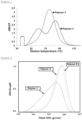
FIG. 2 is a GPC graph of copolymers prepared in Examples 5 and 6 [Polymer 2: a polymer obtained using the complex of Preparation Example 2 as a polymerization catalyst, that is, a polymer prepared in Example 5/ Polymer 3: a polymer obtained using the complex of Preparation Example 3 as a polymerization catalyst, that is, a polymer prepared in Example 6]. -
FIG. 3 is a TGIC graph of copolymers prepared in Examples 5 and 6 [Polymer 2: a polymer obtained using the complex of Preparation Example 2 as a polymerization catalyst, that is, a polymer prepared in Example 5/ Polymer 3: a polymer obtained using the complex of Preparation Example 3 as a polymerization catalyst, that is, a polymer prepared in Example 6]. -
FIG. 4 is a GPC graph of copolymers prepared in Comparative Examples 3, 4 and 6 [Polymer A: a polymer obtained using Complex A of Comparative Preparation Example 2 as a polymerization catalyst, that is, a polymer prepared in Comparative Example 3/ Polymer B: a polymer obtained using Complex B of Comparative Preparation Example 3 as a polymerization catalyst, that is, a polymer prepared in Comparative Example 4/ Polymer C: a polymer obtained using Complex C of Comparative Preparation Example 4 as a polymerization catalyst, that is, a polymer prepared in Comparative Example 6]. - Hereinafter, the present invention will be described in more detail. Technical terms and scientific terms used in the present specification have the general meaning understood by those skilled in the art to which the present invention pertains unless otherwise defined, and a description for the known function and configuration obscuring the present invention will be omitted in the following description.
- The transition metal complex according to an exemplary embodiment of the present invention is a transition metal complex based on an indenyl group having a nitrogen-containing substituent introduced thereto, represented by the following Chemical Formula 1, and has a structure in which a
Group 4 transition metal in the periodic table as a center metal is linked by an indene or the derivative group thereof having a rigid plane structure with abundant and widely delocalized electrons and a nitrogen-containing substituent introduced thereto; and an amido group having a substituted silyl group, while in particular, having a structural characteristic including both an alkyl group or alkenyl group and an aryl group which induce improved solubility in a general hydrocarbon solvent, greatly increased activity at high temperature, and a narrow molecular weight distribution, not a broad molecular weight distribution which is a deficiency of diastereomers, in the silyl group linking the indene or the derivative group having a nitrogen-containing substituent introduced thereto and the amido group, and thus, has a structural merit of being advantageous to obtain a high molecular weight ethylene-based polymer at high temperature with high efficiency.
- M is a
Group 4 transition metal in the periodic table; - R1 is (C1-C20)alkyl;
- Ar1 is (C6-C30)aryl, in which the aryl of Ar1 may be further substituted by one or more substituents selected from the group consisting of (C1-C20)alkyl, halo(Cl-C20)alkyl and (C6-C30)aryl(C1-C20)alkyl;
- R2 to R5 are each independently hydrogen, (C1-C20)alkyl, (C1-C20)alkoxy, halo(C1-C20)alkyl, (C3-C20)cycloalkyl, (C1-C20)alkyl(C6-C30)aryl, (C6-C30)aryl, (C6-C30)aryloxy, (C1-C20)alkyl(C6-C30)aryloxy, (C6-C30)aryl(C1-C20)alkyl or ((C1-C20)alkyl(C6-C30)aryl)(C1-C20)alkyl, or R2 to R5 may be linked with an adjacent substituent to form a fused ring, in which the formed fused ring may be further substituted by one or more substituents selected from the group consisting of (C1-C20)alkyl, (C1-C20)alkoxy, halo(C1-C20)alkyl, (C3-C20)cycloalkyl, (C1-C20) alkyl (C6-C30) aryl, (C6-C30)aryl, (C6-C30)aryloxy, (C1-C20)alkyl(C6-C30)aryloxy, (C6-C30)aryl(C1-C20)alkyl and ((C1-C20)alkyl(C6-C30)aryl)(C1-C20)alkyl;
- R9 is (C1-C20) alkyl, (C3-C20) cycloalkyl or (C6-C30)aryl(C1-C20)alkyl;
- R6 and R7 are each independently (C1-C20)alkyl, halo(C1-C20)alkyl, (C3-C20) cycloalkyl, (C6-C30)aryl, (C1-C20)alkyl(C6-C30)aryl, (C1-C20)alkoxy(C6-C30)aryl or (C6-C30)aryl(C1-C20)alkyl, or R6 and R7 may be linked to each other to form a ring, in which the formed ring may be further substituted by one or more substituents selected from the group consisting of (C1-C20)alkyl, halo(Cl-C20)alkyl, (C6-C30)aryl(C1-C20)alkyl, (C1-C20)alkoxy, (C3-C20)cycloalkyl, (C6-C20)aryl, (C1-C20)alkyl(C6-C30)aryl and (C6-C20)aryloxy;
- R8 is hydrogen or (Cl-C20)alkyl;
- X1 and X2 are each independently halogen, (C1-C20)alkyl, (C2-C20) alkenyl, (C3-C20) cycloalkyl, (C6-C30)aryl, (C6-C30)ar(C1-C20)alkyl, ((C1-C20)alkyl(C6-C30)aryl)(C1-C20)alkyl, (C1-C20)alkoxy, (C6-C30)aryloxy, (C1-C20)alkyl(C6-C30)aryloxy, (C1-C20)alkoxy(C6-C30)aryloxy, -OSiRaRbRc, -SRd, -NReRf, -PRgRh or (C1-C20)alkylidene;
- Ra to Rd are each independently (C1-C20) alkyl, (C6-C20)aryl, (C6-C20)ar(C1-C20)alkyl, (C1-C20)alkyl(C6-C20)aryl or (C3-C20)cycloalkyl; and
- Re to Rh are each independently (C1-C20)alkyl, (C6-C20)aryl, (C6-C20)ar(C1-C20)alkyl, (C1-C20)alkyl(C6-C20)aryl, (C3-C20)cycloalkyl, tri(C1-C20)alkylsilyl or tri(C6-C20)arylsilyl;
- with a proviso that when one of X1 and X2 is (C1-C20)alkylidene, the other one is ignored.
- The transition metal complex of the present invention is a catalyst having a structural characteristic including both the alkyl group or alkenyl group and the aryl group in the silyl group linking the indenyl group having a nitrogen-containing substituent introduced thereto and the amido group, and thus, has a structural characteristic having both the merit of the alkyl group or alkenyl group which is advantageous in terms of activity and solubility, and the merit of the aryl group having a good injection property of a higher α-olefin. In addition, due to the structural characteristic including both the alkyl group or alkenyl group and the aryl group in the silyl group, it was confirmed by 1H-NMR that two types of diastereomers are present, as shown in
FIG. 1 . The catalysts developed in the present invention represent characteristics such as producing high molecules having a narrow molecular weight distribution despite the presence of diastereomers at a ratio of 1:1 to 1:8, and representing high activity even at high temperature. Conventionally, it has been previously reported that the catalysts having diastereomers having an indenyl group and an amido group linked by a silyl group have a characteristic of a broad molecular weight distribution. However, the catalysts developed in the present invention may produce a polymer having a narrow molecular weight distribution at high temperature with a high yield. In particular, the catalysts may have a great commercial value, since a polymer having a characteristic of a narrow molecular weight distribution and a narrow composition distribution may be obtained, and a polymer having a characteristic of a narrow molecular weight distribution and a broad chemical composition distribution may be obtained, by adjusting the substituents. - The term described herein, 'alkyl' refers to a monovalent straight-chain or branched-chain saturated hydrocarbon radical consisting of only carbon and hydrogen atoms, and an example of the alkyl radical includes methyl, ethyl, propyl, isopropyl, butyl, isobutyl, t-butyl, pentyl, hexyl, octyl, nonyl, or the like, but not limited thereto.
- The term described herein, 'aryl' refers to an organic radical derived from aromatic hydrocarbon by removal of one hydrogen, including a monocyclic or fused ring system containing suitably 4 to 7, preferably 5 or 6 ring atoms in each ring, and even a form in which a plurality of aryls is linked by a single bond. A fused ring system may include an aliphatic ring such as saturated or partially saturated rings, and necessarily includes one or more aromatic rings. In addition, the aliphatic ring may contain nitrogen, oxygen, sulfur, carbonyl and the like in the ring. The specific example of the aryl radical includes phenyl, naphthyl, biphenyl, indenyl, fluorenyl, phenanthrenyl, anthracenyl, triphenylenyl, pyrenyl, chrysenyl, naphthacenyl, 9,10-dihydroanthracenyl and the like.
- The term described herein, "cycloalkyl" refers to a monovalent saturated carbocyclic radical composed of one or more rings. An example of the cycloalkyl radical includes cyclopropyl, cyclobutyl, cyclopentyl, cyclohexyl, cycloheptyl, or the like, but not limited thereto.
- The term described herein, "halo" or "halogen" refers to fluorine, chlorine, bromine or iodine atom.
- The term described herein, "haloalkyl" refers to alkyl substituted by one or more halogens, and an example thereof may include trifluoromethyl, or the like.
- The terms described herein, "alkoxy" and "aryloxy" refer to an -O-alkyl radical and an -O-aryl radical, respectively, wherein 'alkyl' and 'aryl' are as defined above.
- In an exemplary embodiment of the present invention, the transition metal complex of the above Chemical Formula 1 may be a transition metal complex represented by the following Chemical Formula 2:

- wherein M, R1, R6, R7, R9, X1 and X2 are as defined in the above Chemical Formula 1;
- R2 to R5 are each independently hydrogen, (C1-C20)alkyl, (C1-C20)alkoxy, halo(C1-C20)alkyl, (C3-C20)cycloalkyl, (C1-C20)alkyl(C6-C30)aryl, (C6-C30)aryl, (C6-C30)aryloxy, (C1-C20)alkyl(C6-C30)aryloxy, (C6-C30)aryl(C1-C20)alkyl or ((C1-C20)alkyl(C6-C30)aryl)(C1-C20)alkyl, or R2 to R5 may be linked with an adjacent substituent by (C3-C7)alkylene, (C3-C7)alkenylene or (C4-C7)alkadienylene containing or not containing an aromatic ring to form a fused ring, in which the formed fused ring may be further substituted by one or more substituents selected from the group consisting of (C1-C20)alkyl, (C1-C20)alkoxy, halo(C1-C20)alkyl, (C3-C20)cycloalkyl, (C1-C20) alkyl (C6-C30) aryl, (C6-C30)aryl, (C6-C30)aryloxy, (C1-C20)alkyl(C6-C30)aryloxy, (C6-C30)aryl(C1-C20)alkyl and ((C1-C20)alkyl(C6-C30)aryl)(C1-C20)alkyl; and
- R11 to R15 are each independently hydrogen, (C1-C20)alkyl, halo(C1-C20)alkyl or (C6-C30)aryl(C1-C20)alkyl.
- In an exemplary embodiment of the present invention, M of the transition metal complex is a
Group 4 transition metal in the periodic table, and may be preferably titanium (Ti), zirconium (Zr) or hafnium (Hf), and more preferably titanium (Ti) or zirconium (Zr). - The (C1-C20)alkyl group is, for example, a methyl group, an ethyl group, an n-propyl group, an isopropyl group, an n-butyl group, an isobutyl group, a sec-butyl group, a tert-butyl group, an n-pentyl group, a neopentyl group, an amyl group, an n-hexyl group, an n-octyl group, an n-decyl group, an n-dodecyl group or an n-pentadecyl group; the (C2-C20)alkenyl group is, for example, a vinyl group or an allyl group; the (C3-C20)cycloalkyl group is, for example, a cyclopropyl group, a cyclobutyl group, a cyclopentyl group, a cyclohexyl group, a cycloheptyl group, a cyclooctyl group, a cyclodecyl group or a cyclododecyl group; the (C6-C30)aryl group or (C1-C20)alkyl(C6-C30)aryl group is, for example, a phenyl group, a 2-tolyl group, a 3-tolyl group, a 4-tolyl group, a 2,3-xylyl group, a 2,4-xylyl group, a 2,5-xylyl group, a 2,6-xylyl group, a 3,4-xylyl group, a 3,5-xylyl group, a 2,3,4-trimethylphenyl group, a 2,3,5-trimethylphenyl group, a 2,3,6-trimethylphenyl group, a 2,4,6-trimethylphenyl group, a 3,4,5-trimethylphenyl group, a 2,3,4,5-tetramethylphenyl group, a 2,3,4,6-tetramethylphenyl group, a 2,3,5,6-tetramethylphenyl group, a pentamethylphenyl group, an ethylphenyl group, an n-propylphenyl group, an isopropylphenyl group, an n-butylphenyl group, a sec-butylphenyl group, a tert-butylphenyl group, an n-pentylphenyl group, a neopentylphenyl group, an n-hexylphenyl group, an n-octylphenyl group, an n-decylphenyl group, an n-dodecylphenyl group, an n-tetradecylphenyl group, a biphenyl(biphenyl) group, a fluorenyl group, a triphenyl group, a naphthyl group or anthracenyl group; the (C6-C30)aryl(C1-C10)alkyl group or the ((C1-C20)alkyl(C6-C30)aryl)(C1-C20)alkyl group is, for example, a benzyl group, a (2-methylphenyl)methyl group, a (3-methylphenyl)methyl group, a (4-methylphenyl)methyl group, a (2,3-dimethylphenyl)methyl group, a (2,4-dimethylphenyl)methyl group, a (2,5-dimethylphenyl)methyl group, a (2,6-dimethylphenyl)methyl group, a (3,4-dimethylphenyl)methyl group, a (4,6-dimethylphenyl)methyl group, a (2,3,4-trimethylphenyl)methyl group, a (2,3,5-trimethylphenyl)methyl group, a (2,3,6-trimethylphenyl)methyl group, a (3,4,5-trimethylphenyl)methyl group, a (2,4,6-trimethylphenyl)methyl group, a (2,3,4,5-tetramethylphenyl)methyl group, a (2,3,4,6-tetramethylphenyl)methyl group, a (2,3,5,6-tetramethylphenyl)methyl group, a (pentamethylphenyl)methyl group, an (ethylphenyl)methyl group, a (n-propylphenyl)methyl group, an (isopropylphenyl)methyl group, a (n-butylphenyl)methyl group, a (sec-butylphenyl)methyl group, a (tert-butylphenyl)methyl group, a (n-pentylphenyl)methyl group, a (neopentylphenyl)methyl group, a (n-hexylphenyl)methyl group, (n-octylphenyl)methyl group, a (n-decylphenyl)methyl group, a (n-tetradecylphenyl)methyl group, a naphthylmethyl group or an anthracenylmethyl group; the (C1-C20)alkoxy group is, for example, a methoxy group, an ethoxy group, an n-propoxy group, an isopropoxy group, an n-butoxy group, a sec-butoxy group, a tert-butoxy group, an n-pentoxy group, a neopentoxy group, an n-hexoxy group, an n-octoxy group, an n-dodexoxy group, an n-pentadexoxy group or n-eicoxoxy group.
- In an exemplary embodiment of the present invention, in the above
Chemical Formula 2, R6 and R7 may be each independently (C1-C20)alkyl, (C3-C20)cycloalkyl or (C6-C30)aryl, or R6 and R7 may be linked by (C3-C7)alkylene containing or not containing an aromatic ring to form a ring, in which the formed ring may be further substituted by one or more substituents selected from the group consisting of (C1-C20)alkyl, (C6-C30)aryl(C1-C20)alkyl, (C1-C20)alkoxy, (C3-C20) cycloalkyl, (C6-C20)aryl, (C1-C20)alkyl(C6-C30)aryl and (C6-C20)aryloxy. - In an exemplary embodiment of the present invention, R1 may be (C1-C20) alkyl, (C2-C20) alkenyl or (C6-C30)aryl(C1-C20)alkyl; Ar1 may be (C6-C30)aryl or (C1-C20)alkyl(C6-C30)aryl; R2 to R5 may be each independently hydrogen, (C1-C20) alkyl, (C1-C20)alkoxy, (C1-C20) alkyl(C6-C30) aryl, (C6-C30)aryl, (C6-C30)aryloxy, (C1-C20) alkyl(C6-C30) aryloxy or (C6-C30)aryl(C1-C20)alkyl, or R2 to R5 may be linked with an adjacent substituent by (C3-C7)alkylene, (C3-C7)alkenylene or (C4-C7)alkadienylene containing or not containing an aromatic ring to form a fused ring, in which the formed fused ring may be further substituted by one or more substituents selected from the group consisting of (C1-C20)alkyl, (C1-C20)alkyl(C6-C30)aryl, (C6-C30)aryl, (C6-C30)aryl(C1-C20)alkyl and ((C1-C20)alkyl(C6-C30) aryl) (C1-C20) alkyl; R9 is (C1-C20) alkyl, (C3-C20)cycloalkyl or (C6-C30)aryl(C1-C20)alkyl; R6 and R7 are each independently (C1-C20) alkyl, (C3-C20)cycloalkyl, (C6-C30)aryl, (C1-C20)alkyl(C6-C30)aryl, (C1-C20)alkoxy(C6-C30)aryl or (C6-C30)aryl(C1-C20)alkyl, or R6 and R7 may be linked by (C3-C7)alkylene containing or not containing an aromatic ring to form a ring, in which the formed ring may be further substituted by one or more substituents selected from the group consisting of (C1-C20)alkyl, (C6-C30)aryl(C1-C20)alkyl, (C1-C20)alkoxy, (C3-C20)cycloalkyl, (C6-C20)aryl, (Cl-C20)alkyl(C6-C30)aryl and (C6-C20)aryloxy; and R8 may be hydrogen or (C1-C20)alkyl.
- In an exemplary embodiment of the present invention, R1 may be more specifically a methyl group, an ethyl group, an n-propyl group, an isopropyl group, an n-butyl group, a vinyl group, an allyl group or a benzyl group; Ar1 may be more specifically a phenyl group, a naphthyl group, a biphenyl group, a tolyl group, a trimethylphenyl group, a butylphenyl group, a pentylphenyl group, a hexylphenyl group, an octylphenyl group, a decylphenyl group, a dodecylphenyl group or a tetradecylphenyl group; R2 to R5 may be each independently hydrogen, a methyl group, an ethyl group, an n-propyl group, an isopropyl group, an n-butyl group, a phenyl group, a naphthyl group, a biphenyl(biphenyl) group, a 2-isopropylphenyl group, a 3,5-xylyl group, a 2,4,6-trimethylphenyl group, a benzyl group, a methoxy group, an ethoxy group, an isopropoxy group, phenoxy, a 4-tert-butylphenoxy group or a naphthoxy group; R2 to R5 may be linked with an adjacent substituent by


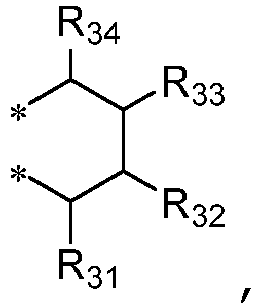
- R31 to R35, R41 and R42 may be each independently hydrogen, a methyl group, an ethyl group, an n-propyl group, an isopropyl group, an n-butyl group, an isobutyl group, a 2-methylbutyl group, a sec-butyl group, a tert-butyl group, an n-pentyl group, a neopentyl group, an amyl group, an n-hexyl group, an n-octyl group, an n-decyl group, an n-dodecyl group, an n-pentadecyl group, a phenyl group, a 2-tolyl group, a 3-tolyl group, a 4-tolyl group, a 2,3-xylyl group, a 2,4-xylyl group, a 2,5-xylyl group, a 2,6-xylyl group, a 3,4-xylyl group, a 3,5-xylyl group, a 2,3,4-trimethylphenyl group, a 2,3,5-trimethylphenyl group, a 2,3,6-trimethylphenyl group, a 2,4,6-trimethylphenyl group, a 3,4,5-trimethylphenyl group, a 2,3,4,5-tetramethylphenyl group, a 2,3,4,6-tetramethylphenyl group, a 2,3,5,6-tetramethylphenyl group, a pentamethylphenyl group, an ethylphenyl group, an n-propylphenyl group, an isopropylphenyl group, an n-butylphenyl group, a sec-butylphenyl group, a tert-butylphenyl group, an n-pentylphenyl group, a neopentylphenyl group, an n-hexylphenyl group, an n-octylphenyl group, an n-decylphenyl group, an n-dodecylphenyl group, an n-tetradecylphenyl group, a biphenyl (biphenyl) group, a fluorenyl group, a triphenyl group, a naphthyl group, an anthracenyl group, a benzyl group, a naphthylmethyl group or an anthracenylmethyl group; m and n may be each independently an integer of 1 to 4; and R8 may be hydrogen, a methyl group, an ethyl group, an n-propyl group, an isopropyl group, an n-butyl group, an isobutyl group, a 2-methylbutyl group or a sec-butyl group.
- In an exemplary embodiment of the present invention, in the definition of the substituents X1 and X2, the halogen atom may be exemplified as fluorine, chlorine, bromine or iodine atom, the (C1-C20)alkyl group may be exemplified as a methyl group, an ethyl group, an n-propyl group, an isopropyl group, an n-butyl group, a sec-butyl group, a tert-butyl group, an n-pentyl group, a neopentyl group, an amyl group, an n-hexyl group, an n-octyl group, an n-decyl group, an n-dodecyl group, an n-pentadecyl group or an n-eicosyl group; the (C3-C20)cycloalkyl group may be exemplified as a cyclopropane group, a cyclobutyl group, a cyclopentyl group, a cyclohexyl group, cycloheptyl group or an adamantyl group; the (C6-C30)aryl group may be exemplified as a phenyl group or a naphthyl group; the (C6-C30)aryl(C1-C20)alkyl group or ((C1-C20)alkyl(C6-C30)aryl)(C1-C20)alkyl group may be exemplified as a benzyl group, a (2-methylphenyl)methyl group, a (3-methylphenyl)methyl group, a (4-methylphenyl)methyl group, a (2,3-dimethylphenyl)methyl group, a (2,4-dimethylphenyl)methyl group, a (2,5-dimethylphenyl)methyl group, a (2,6-dimethylphenyl)methyl group, a (3,4-dimethylphenyl)methyl group, a (4,6-dimethylphenyl)methyl group, a (2,3,4-trimethylphenyl)methyl group, a (2,3,5-trimethylphenyl)methyl group, a (2,3,6-trimethylphenyl)methyl group, a (3,4,5-trimethylphenyl)methyl group, a (2,4,6-trimethylphenyl)methyl group, a (2,3,4,5-tetramethylphenyl)methyl group, a (2,3,4,6-tetramethylphenyl)methyl group, a (2,3,5,6-tetramethylphenyl)methyl group, a (pentamethylphenyl)methyl group, an (ethylphenyl)methyl group, an (n-propylphenyl)methyl group, an (isopropylphenyl)methyl group, an (n-butylphenyl)methyl group, a (sec-butylphenyl)methyl group, a (tert-butylphenyl)methyl group, an (n-pentylphenyl)methyl group, a (neopentylphenyl)methyl group, an (n-hexylphenyl)methyl group, an (n-octylphenyl)methyl group, an (n-decylphenyl)methyl group, an (n-tetradecylphenyl)methyl group, a naphthylmethyl group or an anthracenylmethyl group; the (C1-C20)alkoxy may be exemplified as a methoxy group, an ethoxy group, an n-propoxy group, an isopropoxy group, an n-butoxy group, a sec-butoxy group, a tert-butoxy group, an n-pentoxy group, a neopentoxy group, an n-hexoxy group, an n-octoxyl group, an n-dodexoxy group, an n-pentadexoxy group or an n-eicoxoxy group; the (C6-C30)aryloxy may be exemplified as a phenoxy group, a 4-tert-butylphenoxy group or a 4-methoxyphenoxy group; an example of -OSiRaRbRc may include a trimethylsiloxy group, a triethylsiloxy group, a tri-n-propylsiloxy group, a tri-isopropylsiloxy group, a tri-n-butylsiloxy group, a tri-sec-butylsiloxy group, a tri-tert-butylsiloxy group, a tri-isobutylsiloxy group, a tert-butyldimethylsiloxy group, a tri-n-pentylsiloxy group, a tri-n-hexylsiloxy group or a tricyclohexylsiloxy group, an example of -NReRf may include a dimethylamino group, a diethylamino group, a di-n-propylamino group, a diisopropylamino group, a di-n-butylamino group, a di-sec-butylamino group, a di-tert-butylamino group, a diisobutylamino group, a tert-butylisopropylamino group, a di-n-hexylamino group, a di-n-octylamino group, a di-n-decylamino group, a diphenylamino group, a dibenzylamino group, a methylethylamino group, a methylphenylamino group, a benzylhexylamino group, a bistrimethylsilylamino group or a bis-tert-butyldimethylsilylamino group; an example of - PRgRh may include a dimethylphosphine group, a diethylphosphine group, a di-n-propylphosphine group, a diisopropylphosphine group, a di-n-butylphosphine group, a di-sec-butylphosphine group, a di-tert-butylphosphine group, a diisobutylphosphine group, a tert-butylisopropylphosphine group, a di-n-hexylphosphine group, a di-n-octylphosphine group, a di-n-decylphosphine group, a diphenylphosphine group, a dibenzylphosphine group, a methylethylphosphine group, a methylphenylphosphine group, a benzylhexylphosphine group, a bistrimethylsilylphosphine group or a bis-tert-butyldimethylsilylphosphine group; and an example of -SRd may include a methylthio group, an ethylthio group, a propylthio group, an isopropylthio group, a 1-butylthio group or an isopentylthio group.
- In an exemplary embodiment of the present invention, X1 and X2 are each independently halogen, (C1-C20)alkyl, (C3-C20)cycloalkyl, (C6-C30)aryl, (C6-C30)ar(C1-C20)alkyl, (C1-C20)alkoxy, (C6-C30)aryloxy, (C1-C20)alkyl(C6-C30)aryloxy, -OSiRaRbRc, -SRd, -NReRf or -PRgRh; and Ra to Rh may be each independently (C1-C20)alkyl or (C6-C20)aryl.
- In an exemplary embodiment of the present invention, more specifically, X1 and X2 may be each independently fluorine, chlorine, bromine, a methyl group, an ethyl group, an isopropyl group, an amyl group, a benzyl group, a methoxy group, an ethoxy group, an isopropoxy group, a tert-butoxy group, a phenoxy group, a 4-tert-butylphenoxy group, a trimethylsiloxy group, a tert-butyldimethylsiloxy group, a dimethylamino group, a diphenylamino group, a dimethylphosphine group, a diethylphosphine group, a diphenylphosphine group, an ethylthio group or isopropylthio group.
- In an exemplary embodiment of the present invention, in the above Chemical Formula 2, still more preferably, M is tetravalent titanium, zirconium or hafnium; R1 is (C1-C20)alkyl; R11 to R15 are each independently hydrogen or (C1-C20)alkyl; R2 to R5 may be each independently hydrogen or (C1-C20)alkyl, or R2 to R5 may be linked with an adjacent substituent by



- In an exemplary embodiment of the present invention, the transition metal complex may be selected from the compounds of the following structures, but not limited thereto:


- wherein M is tetravalent titanium, zirconium or hafnium;
- X1 and X2 are each independently halogen, (C1-C20) alkyl, (C3-C20) cycloalkyl, (C6-C30)aryl, (C6-C30)ar(C1-C20) alkyl, (C1-C20) alkoxy, (C6-C30)aryloxy, (C1-C20) alkyl (C6-C30)aryloxy, -OSiRaRbRc, -SRd, -NReRf or -PRgRh; and
- Ra to Rh may be each independently (Cl-C20)alkyl or (C6-C20)aryl.
- Meanwhile, the transition metal complex according to the present invention may preferably operate together with an aluminum compound, a boron compound, or a mixture thereof which may extract an X1 or X2 ligand in the transition metal complex to cationize a center metal, while acting as a counter ion, i.e., an anion having weak binding force, as a cocatalyst, in order to be an active catalyst component which is used for preparation of an ethylene-based polymer selected from the group consisting of an ethylene homopolymer and copolymers of ethylene and α-olefins, and a catalyst composition including the transition metal complex and the cocatalyst is also within the scope of the present invention.
- Another aspect of the present invention for achieving the above object relates to a transition metal catalyst composition including the transition metal complex, and a cocatalyst selected from the group consisting of an aluminum compound, a boron compound and a mixture thereof.
- In the catalyst composition according to an exemplary embodiment of the present invention, an aluminum compound which may be used as the cocatalyst may be one or two or more selected from the group consisting of an aluminoxane compound of
Chemical Formula
[Chemical Formula 3] (-Al(R51)-O-)p
[Chemical Formula 4] (R51)2Al-O-Al(R51)2
[Chemical Formula 5] (R52)3-rAl(E)r
[Chemical Formula 6] (R53)2AlOR54
[Chemical Formula 7] R53Al (OR54)2
wherein R51 is (C1-C20)alkyl, preferably a methyl group or an isobutyl group, p is an integer of 5 to 20; R32 and R53 are (C1-C20)alkyl, respectively; E is hydrogen or halogen; r is an integer of 0 to 3; R54 is (C1-C20)alkyl or (C6-C30)aryl. - A specific example which may be used as the aluminum compound may include methylaluminoxane, modified methylaluminoxane, and tetraisobutylaluminoxane as an aluminoxane compound; trialkylaluminum including trimethylaluminum, triethylaluminum, tripropylaluminum, triisobutylaluminum and trihexylaluminum; dialkylaluminumchloride including dimethylaluminumchloride, diethylaluminumchloride, dipropylaluminum chloride, diisobutylaluminumchloride and dihexylaluminumchloride; alkylaluminumdichloride including methylaluminumdichloride, ethylaluminumdichloride, propylaluminumdichloride, isobutylaluminumdichloride and hexylaluminumdichloride; dialkylaluminum hydride including dimethylaluminum hydride, diethylaluminum hydride, dipropylaluminum hydride, diisobutylaluminum hydride and dihexylaluminum hydride, as an organic aluminum compound.
- In an exemplary embodiment of the present invention, the aluminum compound may be one or a mixture of two or more selected from the group consisting of an alkylaluminoxane compound and trialkylaluminum, and more preferably one or a mixture of two or more selected from the group consisting of methylaluminoxane, modified methylaluminoxane, tetraisobutylaluminoxane, trimethylaluminum, triethylaluminum, trioctylaluminum and triisobutylaluminum.
- In the catalyst composition according to an exemplary embodiment of the present invention, the boron compound which may be used as the cocatalyst is known in
U.S. Patent No. 5,198,401 , and may be selected from the compounds represented by the following Chemical Formulae 8 to 10:
[Chemical Formula 8] B(61)3
[Chemical Formula 9] [R62]+[B(R61)4]-
[Chemical Formula 10] [(R63)2Ar2ZH]+[B(R61)4]-
wherein B is a boron atom; R61 is a phenyl group, in which the phenyl group may be further substituted by 3 to 5 substituents selected from the group consisting of fluoro, (C1-C20)alkyl unsubstituted or substituted by fluoro, (C1-C20)alkoxy unsubstituted or substituted by fluoro; R62 is a (C5-C7)aromatic radical or a (C1-C20)alkyl(C6-C20)aryl radical, a (C6-C30)aryl(C1-C20)alkyl radical, for example, triphenylmethylinium(triphenylmethylium) radical; Z is a nitrogen or phosphorus atom; R63 is a (C1-C20)alkyl radical, and Ar2 is phenyl or a (C5-C7)aromatic radical substituted by (C1-C20)alkyl group. - A preferred example of the boron-based cocatalyst may include tris(pentafluorophenyl)borane, tris(2,3,5,6-tetrafluorophenyl)borane, tris(2,3,4,5-tetrafluorophenyl)borane, tris(3,4,5-trifluorophenyl)borane, tris(2,3,4-trifluorophenyl)borane, phenylbis(pentafluorophenyl)borane, tetrakis(pentafluorophenyl)borate, tetrakis(2,3,5,6-tetrafluorophenyl)borate, tetrakis(2,3,4,5-tetrafluorophenyl)borate, tetrakis(3,4,5,6-tetrafluorophenyl)borate, tetrakis(2,2,4-trifluorophenyl)borate, phenylbis(pentafluorophenyl)borate or tetrakis(3,5-bistrifluoromethylphenyl)borate. In addition, a specific combination example thereof may include ferrocenium tetrakis(pentafluorophenyl)borate, 1,1'-dimethylferrocenium tetrakis(pentafluorophenyl)borate, tetrakis(pentafluorophenyl)borate, triphenylmethylinium tetrakis(pentafluorophenyl)borate, triphenylmethylinium tetrakis(3,5-bistrifluoromethylphenyl)borate, triethylammonium tetrakis(pentafluorophenyl)borate, tripropylammonium tetrakis(pentafluorophenyl)borate, tri(n-butyl)ammonium tetrakis(pentafluorophenyl)borate, tri(n-butyl)ammonium tetrakis(3,5-bistrifluoromethylphenyl)borate, N,N-dimethylanilinium tetrakis(pentafluorophenyl)borate, N,N-diethylanilinium tetrakis(pentafluorophenyl)borate, N,N-ditetradecylanilinium tetrakis(pentafluorophenyl)borate, N,N-dihexadecylanilinium tetrakis(pentafluorophenyl)borate, N,N-dioctadecylanilinium tetrakis(pentafluorophenyl)borate, N,N-2,4,6-pentamethylanilinium tetrakis(pentafluorophenyl)borate, dicyclohexylammonium tetrakis(pentafluorophenyl)borate, triphenylphosphonium tetrakis(pentafluorophenyl)borate, tri(methylphenyl)phosphonium tetrakis(pentafluorophenyl)borate, or tri(dimethylphenyl)phosphonium tetrakis(pentafluorophenyl)borate, and among them, the most preferred one is N,N-dimethyl anilinium tetrakis(pentafluorophenyl)borate, triphenylmethylinium tetrakis(pentafluorophenyl)borate, N,N-ditetradecylanilinium tetrakis(pentafluorophenyl)borate, N,N-dihexadecylanilinium tetrakis(pentafluorophenyl)borate, N,N-dioctadecylanilinium tetrakis(pentafluorophenyl)borate, or tris(pentafluoro)borane.
- Meanwhile, the cocatalyst may serve as a scavenger which removes impurities acting as a poison to the catalyst in the reactant.
- In an exemplary embodiment according to the present invention, when the aluminum compound is used as the cocatalyst, a preferred range of the ratio between the transition metal complex of the present invention and the cocatalyst may be 1:1-2,000, based on a mole ratio of the transition metal (M):the aluminum atom (Al).
- In an exemplary embodiment according to the present invention, when both the aluminum compound and the boron compound are used as the cocatalyst, a preferred range of the ratio between the transition metal complex of the present invention and the cocatalyst may be 1:0.1-100:1-2,000, preferably in a range of 1:0.5-30:10-1,000, more preferably in a range of 1:0.5-5:10-500, based on a mole ratio of the center metal (M):boron atom (B) : aluminum atom (Al) .
- When the ratio between the transition metal complex of the present invention and the cocatalyst is out of the above range, the amount of the cocatalyst is relatively small so that activation of the transition metal complex is not completely achieved, and thus, the catalyst activity of the transition metal complex may not be sufficient, or the cocatalyst is used more than necessary to greatly increase production costs. Within the above range, excellent catalyst activity for preparing an ethylene homopolymer or copolymers of ethylene and α-olefins is represented, and the range of the ratio is varied with the purity of the reaction.
- Another aspect of the present invention for achieving the above object relates to a method for preparing an ethylene-based polymer selected from the group consisting of an ethylene homopolymer and copolymers of ethylene and α-olefins, using the transition metal complex or the transition metal catalyst composition.
- Another aspect of the present invention for achieving the above object relates to a copolymerization method for copolymerizing ethylene, propylene and optionally a non-conjugated diene, using the transition metal complex or the transition metal catalyst composition.
- The method for preparing the ethylene-based polymer using the transition metal catalyst composition may proceed by bring the transition metal catalyst, the cocatalyst, and ethylene or an α-olefin comonomer into contact in the presence of a suitable organic solvent. Here, the transition metal catalyst and the cocatalyst components may be added to a reactor separately, or each component may be mixed previously and added to a reactor, and mixing conditions such as an addition order, temperature or concentration is not particularly limited.
- A preferred organic solvent which may be used in the preparation method may be (C3-C20) hydrocarbons, and a specific example thereof may include butane, isobutane, pentane, hexane, heptane, octane, isooctane, nonane, decane, dodecane, cyclohexane, methylcyclohexane, benzene, toluene, xylene, or the like.
- Specifically, when the ethylene homopolymer is prepared alone, ethylene is used as a monomer alone, in which appropriate ethylene pressure may be 1-1,000 atm, more preferably 6-150 atm. In addition, a polymerization reaction temperature of 25 °C-220 °C, preferably 70 °C-220 °C, and more preferably 100 °C-220 °C is effective.
- In addition, when copolymers of ethylene and α-olefins are prepared, C3-C18 α-olefins, C4-C20 diolefins, C5-C20 cycloolefins or cyclodiolefins, or styrene and a derivative thereof may be used as a comonomer together with ethylene, and a preferred example of C3-C18 α-olefins may be selected from the group consisting of propylene, 1-butene, 1-pentene, 4-methyl-1-pentene, 1-hexene, 1-octene, 1-decene, 1-dodecene, 1-hexadecene and 1-octadecene, a preferred example of C4-C20 diolefins may be selected from the group consisting of 1,3-butadiene, 1,4-pentadiene and 2-methyl-1,3-butadiene, and a preferred example of C5-C20 cycloolefins or cyclodiolefins may be selected from the group consisting of cyclopentene, cyclohexene, cyclopentadiene, cyclohexadiene, norbornene, 5-vinylidene-2-norbornene(VNB), 5-methylene-2-norbornene(MNB) and 5-ethylidene-2-norbornene(ENB). In the present invention, the olefin may be homopolymerized or two or more olefins may be copolymerized. In this case, preferred ethylene pressure and polymerization temperature may be identical to those in the preparation of the ethylene homopolymer, and the copolymer prepared according to the method of the present invention contains usually 30 wt% or more of ethylene, preferably 60 wt% or more of ethylene, and more preferably 60 to 99 wt% of ethylene.
- As described above, when the catalyst of the present invention is used, polymers in a scope from an elastomer to a high density polyethylene (HDPE), having a density of 0.850 g/cm3 to 0.960 g/cm3 and a melt flow rate of 0.001 to 2000 dg/min may be easily and economically prepared, by appropriately using ethylene and C3-C10 α-olefins as a comonomer.
- In addition, an ethylene/propylene (EP) elastomer and an ethylene/propylene/diene (EPDM) elastomer may be well prepared, using the catalyst of the present invention. In particular, since a high-priced diene is easily injected, an EPDM product having a Mooney viscosity (ASTM D1646-94, ML1+4@125 °C) adjusted to 1 to 250, preferably 10 to 200 may be easily prepared in an economical manner.
- Further, for adjusting a molecular weight when preparing the ethylene homopolymer or copolymer according to the present invention, hydrogen may be used as a molecular weight regulator, and the polymer usually has a weight average molecular weight (Mw) in a range of 5,000 to 1,000,000 g/mol.
- Since the catalyst composition presented in the present invention is present in a homogeneous form in a polymerization reactor, it is preferred to apply the catalyst composition to a solution polymerization process which is carried out a temperature equal to or more than a melting point of the polymer. However, as disclosed in
U.S. Patent No. 4,752,597 , the catalyst composition may be used in a slurry polymerization or gas phase polymerization process as a heterogeneous catalyst system by supporting the transition metal complex and the cocatalyst on a porous metal oxide support. - In addition, the present invention also includes the compound represented by the following Chemical Formula Int-1 as an intermediate for preparing the transition metal complex of Chemical Formula 1:

- In addition, the present invention relates to the transition metal complex of Chemical Formula 1 for use in preparing copolymers of ethylene and α-olefins having a unimodal GPC graph, and a method for preparing copolymers of ethylene and α-olefins which, as a result of TGIC analysis using the transition metal complex, represent a chemical composition distribution as a unimodal or bimodal graph.
- Hereinafter, the present invention will be described in detail by the following Examples, however, the scope of the present invention is not limited thereto.
- Unless otherwise stated, all experiments of synthesizing ligands and catalysts were carried out using a standard Schlenk or glove box technology under a nitrogen atmosphere, and an organic solvent used in the reaction was refluxed under a sodium metal and benzophenone to remove moisture, and used after being distilled immediately before use. The 1H NMR analysis of the synthesized ligand and the catalyst was carried out using Bruker 500 MHz at room temperature.
- Cyclohexane as a polymerization solvent was used after sufficiently removing moisture, oxygen and other catalyst poisoning materials therefrom by passing cyclohexane through a 5 Å molecular sieve and a tube filled with active alumina, and bubbling cyclohexane with high purity nitrogen. The polymerized polymer was analyzed by the methods described below:
- 1. Melt flow index (MI)
Measured according to ASTM D 2839. - 2. Density
Measured according to ASTM D 1505, using a density gradient tube. - 3. C2 conversion (%) analysis
Content ratios of unreacted ethylene and nitrogen as a standard material were measured using gas chromatography (GC). - 4. Molecular weight and molecular weight distribution
Measured at 135 °C at a rate of 1.0 mL/min, in an 1,2,3-trichlorobenzene solvent, using PL210 GPC equipped with PL Mixed-BX2+preCol, the molecular weight being corrected using a PL polystyrene standard material. -

- Under the nitrogen atmosphere, dichloro(methyl)(phenyl)silane (30 g, 157.0 mmol) was dissolved in normal hexane (400 mL) in a 500 mL round flask. tert-Butylamine (23.0 g, 314.0 mmol) was slowly added thereto with vigorous stirring, and stirred for 12 hours. The solid content was removed by a filter filled with dried celite. The solvent was removed in vacuo to obtain Compound 1-a as colorless liquid (5.0 g, an yield of 94.2%).
- 1H-NMR (500MHz, C6D6, ppm): δ 0.483(s, 3H), 1.040(s, 10H), 7.038-7.291(m, 3H), 7.713-7.879(m, 2H)
-

- Under the nitrogen atmosphere, 2,3-dihydro-1H-inden-1-one (5 g, 37.8 mmol) was dissolved in anhydrous normal hexane (150 mL) in a 250 mL round flask, and then tetrakis(dimethylamino)titanium (4.7 g, 20.8 mmol) was added thereto with stirring and stirred for 12 hours, thereby producing a yellow solid content. The solid content was removed by a filter filled with dried celite. The solvent was removed in vacuo to obtain liquid Compound 1-b (5.0 g, an yield of 83.0%).
-

- Under the nitrogen atmosphere, Compound 1-b (5.0 g, 31.4mmol) was dissolved in 150 mL of anhydrous normal hexane in a 250 mL round flask, 1.6 M normal butyl lithium (19.6 mL, 31.4 mmol) was added thereto, stirred for 12 hours, and then the solution was removed by filtering. The solid content was dissolved in tetrahydrofuran (THF) (100 mL), and then added to a 250 mL round flask and stirred. N-tert-butyl-1-chloro-1-methyl-1-phenylsilaneamine (7.16 g, 31.4 mmol) was dissolved in tetrahydrofuran (THF) (50 mL) and added, and then stirred at room temperature for 12 hours. The solvent was removed in vacuo, and dissolved by adding normal hexane (150 mL), and then the solid content was removed by a filter filled with dry celite. The solvent was all removed to obtain Compound 1-c as viscous oil (10.0 g, an yield of 90.8%, a ratio of diastereomers of 1:1).

- 1H-NMR (500MHz, C6D6, ppm) : δ 0.076 (d, 3H), 0.953(d, 9H), 2.532(m, 6H), 3.076(s, 1H), 3.475-3.531(m, 1H), 5.499(d, 1H), 7.098-7.569(m, 9H)
-
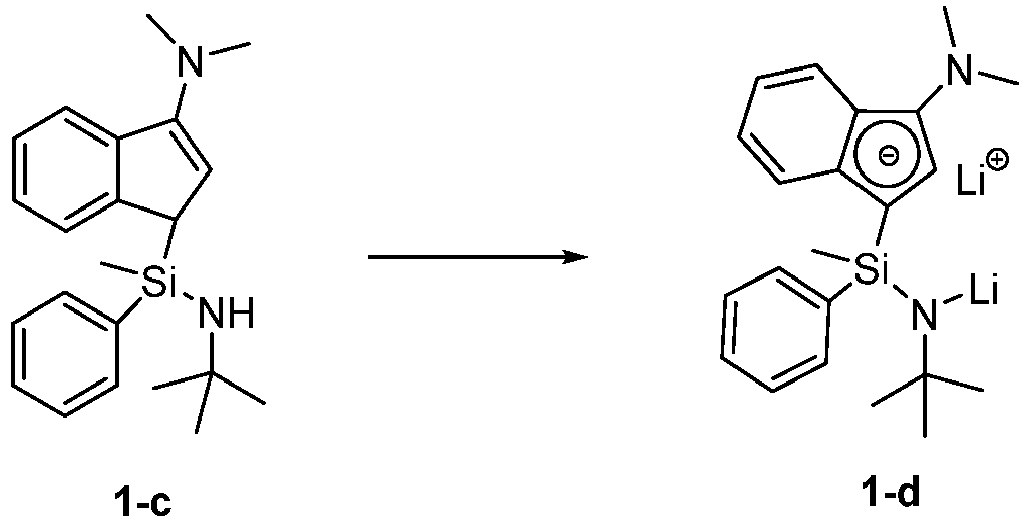
- Under the nitrogen atmosphere, Compound 1-c (5.1 g, 14.6 mmol) was dissolved in normal hexane (150 mL) in a 250 mL round flask. 1.6 M normal butyl lithium (19.1 mL, 30.6 mmol) was added thereto at room temperature, stirred for 12 hours, filtered to separate the solid content, and then dried in vacuo, thereby obtaining Compound 1-d (5 g, yield: 94.8%), which was used directly in the next reaction.
-

- Under the nitrogen atmosphere, Compound 1-d (4.0 g, 11.0 mmol) was dissolved in diethyl ether (50 mL) in a 250 mL three neck round flask, the temperature was lowered to - 78 °C, 1.5 M methyl lithium (14.7 mL, 22.1 mmol) was slowly injected thereinto, and a solution of tetrachlorotitanium (TiCl4) (2.1 g, 11.0 mmol) diluted with anhydrous normal hexane (30 mL) was slowly added thereto at -78 °C. The reactant was stirred at room temperature for 3 hours, and then the solvent was removed in vacuo. The reactant was dissolved in normal hexane (100 mL) again, and the solid content was removed by a filter filled with dried celite. The solvent was all removed to obtain Complex 1 in a red (4.2 g, yield: 89.2%, a ratio of diastereomers of 1:1).
- 1H-NMR (500MHz, C6D6, ppm) : δ 0.055 (d, 3H), 0.730-1.391(m, 6H), 1.474(d, 9H), 2.573(d, 6H) 5.499(d, 1H), 6.631-7.837(m, 9H)
-

- Compound 2-a was prepared by the preparation method of
US 6268444 B1 . -
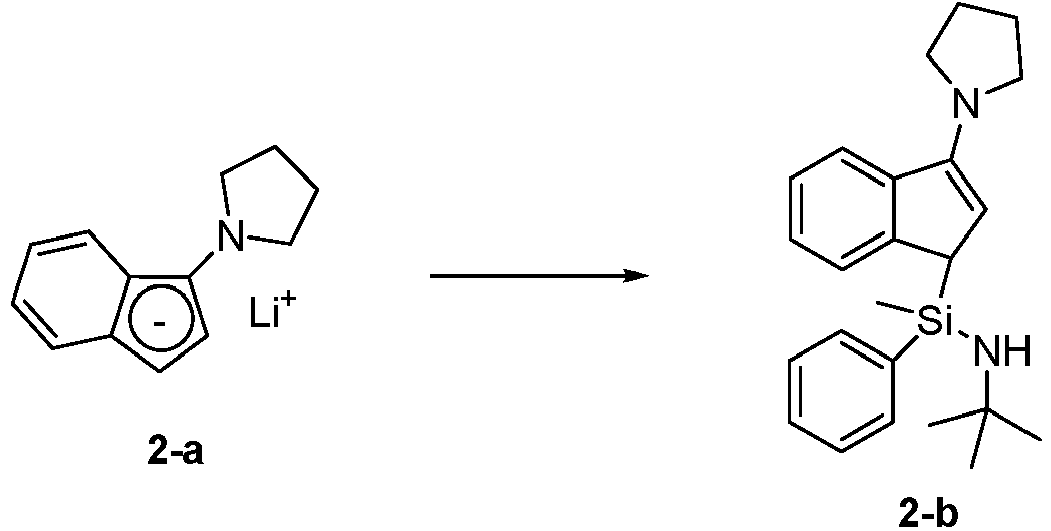
- Under the nitrogen atmosphere, Compound 2-a (6.00 g, 31.4 mmol) was added to a 250 mL round flask, and 150 mL of THF was added thereto, and stirred. N-tert-butyl-1-chloro-1-methyl-1-phenylsilaneamine (7.16 g, 31.4 mmol) was dissolved in tetrahydrofuran (THF) (50 mL), and added, and then stirred at room temperature for 12 hours. The solvent was removed in vacuo, and dissolved by adding normal hexane (150 mL), and then the solid content was removed by a filter filled with dry celite. The solvent was all removed to obtain Compound 2-b as viscous oil (10.8 g, an yield of 91.0 %, a ratio of diastereomers of 1:1).
- 1H-NMR (500MHz, C6D6, ppm) : δ 0.156 (d, 3H), 0.703-0.830(m, 1H), 0.976(d, 9H), 1.501-1.528(m, 4H), 3.089-3.217(m, 4H), 3.501-3.604(m, 1H), 5.259(d, 1H), 7.034-7.652(m, 9H)
-

- Under the nitrogen atmosphere, Compound 2-d (4.14 g, 11.0 mmol) was dissolved in diethyl ether (50 mL) in a 250 mL three neck round flask, the temperature was lowered to - 78 °C, and 1.5 M methyl lithium (29.4 mL, 44.2 mmol) was slowly injected thereinto. The temperature was raised to room temperature, and the reactant was stirred for 6 hours. The reactant was cooled to a temperature of -78 °C again, and a solution of tetrachlorotitanium (TiCl4) (2.1 g, 11.0 mmol) diluted with anhydrous normal hexane (30 mL) was slowly added thereto at -78 °C. The reactant was stirred at room temperature for 3 hours, and then the solvent was removed in vacuo. The reactant was dissolved in normal hexane (100 mL) again, and the solid content was removed by a filter filled with dried celite. The solvent was all removed to obtain Complex 2 in a red (4.14 g, yield: 83.2%, a ratio of diastereomers of -1:3).
- 1H-NMR (500MHz, C6D6, ppm) : δ 0.153 (d, 3H), 0.702-0.950(m, 6H), 1.490(d, 9H), 2.951-3.442(m, 8H), 5.360(d, 1H), 6.698-7.890(m, 9H)
-

- Reaction was carried out in the same manner as the preparation method of
Complex 2 of Preparation Example 2, except for using N-isopropyl-1-chloro-1-methyl-1-phenylsilaneamine (31.4 mmol) instead of N-tert-butyl-1-chloro-1-methyl-1-phenylsilaneamine (7.16 g, 31.4 mmol), thereby preparing Complex 3 (3.54 g, yield: 75.3%, a ratio of diastereomers of 1:2). - 1H-NMR (500MHz, C6D6, ppm): δ 0.071 (d, 3H), 0.660-0.851(m, 6H), 1.196-1.604(m, 10H), 2.843-3.422(m, 4H), 4.133-4.668(m, 1H), 5.380(d, 1H), 6.635-7.813(m, 9H)
-

- A (t-butylamido)dimethyl(tetramethylcyclopentadienyl)silanetitan ium(IV) dimethyl compound was prepared by dissolving (t-butylamido)dimethyl(tetramethylcyclopentadienyl)silanetitan ium(IV) dichloride purchased from Boulder Scientific, U.S.A. in diethyl ether, which was cooled to a temperature of - 78 °C, and reacted with 2 equivalents of methyl lithium.
-

- Complex A was prepared by the preparation method of
US 6268444 B1 . -

- Complex B was prepared by the preparation method of
WO 01/42315 A1 -

- Complex C was prepared from 1H-indene by the preparation method of
Complex 2 of Preparation Example 2. - 1H-NMR (500MHz, C6D6, ppm) : δ -0.131 (d, 3H), 0.404 (d, 3H), 0.825(d, 3H), 1.455(d, 9H) 6.101-6.126(m, 1H), 7.010-7.531(m, 10H)
- Copolymerization of ethylene and 1-octene was carried out using continuous polymerization equipment, as follows.
- The catalysts synthesized in Preparation Examples 1-3 and Comparative Preparation Example 1 were used as a single active site catalyst, cyclohexane was used as a solvent, and the used amount of the catalyst was as described in the following Table 1. Ti represents the catalyst, Al represents triisobutylaluminum, and B represents N,N-dioctadecylanilinium tetrakis(pentafluorophenyl)borate which is the cocatalyst, respectively. Synthesis was carried out by dissolving the catalyst in toluene at a concentration of 0.1 g/L and injecting it, and using 1-octene as the comonomer. The conversion rate of the reactor was able to be assumed by the reaction condition and the temperature gradient in the reactor when polymerization was carried out with one polymer under each reaction condition. The molecular weight was controlled by the function of the reactor temperature and the 1-octene content, and the conditions and the results are shown in the following Tables 1 and 2:
[Table 1] Results of continuous polymerization reaction using complexes prepared in Preparation Examples 1 and 2 as polymerization catalyst Example 1 Example 2 Example 3 Example 4 Polymeriza tion conditions Catalyst Preparation Example 1 Preparation Example 1 Preparation Example 2 Preparation Example 2 Total solution flow rate (kg/h) 5 5 5 5 Ethylene input (wt%) 10 12 8 10 Input mole ratio of 1-octene and ethylene (1-C8/C2) 0.5 0.4 0.5 0.3 Ti input (µmol/kg) 7.5 6.0 6.0 4.8 Ar/Ti ratio 27 33 40 40 B/Ti ratio 3 3 3 4 Reaction temperature (°C) 160 150 150 181 Polymeriza tion results C2 conversion rate (%) 97 77 80 75 MI 4.7 0.07 1.08 0.66 Density (g/cm3) 0.853 0.882 0.868 0.893 [Table 2] Results of continuous polymerization reaction using complexes prepared in Preparation Examples 2 and 3 and Comparative Preparation Example 1 as polymerization catalyst Example 5 Example 6 Example 7 Comparative Example 1 Comparative Example 2 Polymer ization conditi ons Catalyst Preparatio n Example 2 Preparatio n Example 3 Preparatio n Example 2 Comparative Preparation Example 1 Comparative Preparation Example 1 Total solution flow rate (kg/h) 3.2 3.2 5 5 5 Ethylene input (wt%) 8 8 10 8 10 Input mole ratio of 1-octene and ethylene (1-C8/C2) 0.5 0.5 0.4 0.19 0.2 Ti input (µmol/kg) 9.8 10 4.1 1.5 6.0 Ar/Ti ratio 30 30 73 200 30 B/Ti ratio 4 3 5 3 8 Reaction temperature (°C) 150 150 150 104 150 Polymer ization results C2 conversion rate (%) 99 99 99 92 96 MI 6.88 2.58 0.08 5.0 Unmeasurabl e (high MI) Density (g/cm3) 0.865 0.865 0.879 0.878 - Mw (×10-3) 99 119 - - - MWD 2.33 2.20 - - - -Ti: refers to Ti in the catalyst
-Al: represents a cocatalyst, triisobutylaluminum.
-B: represents a cocatalyst, N,N-dioctadecylanilinium tetrakis(pentafluorophenyl)borate. - As seen from the above Tables 1 and 2, Examples 1 to 7 in which polymerization was carried out with the catalysts developed in the present invention were able to easily produce polymers having a high conversion rate of ethylene, low density and a low MI value meaning a high molecular weight even under the condition of high temperature (150 °C or more), as compared with Comparative Examples 1 and 2.
- In particular, Example 7 showed a high ethylene conversion rate despite using a small amount of the catalyst as compared with Comparative Example 2, and thus, it was found that the catalyst of the present invention has excellent catalyst activity. In addition, Example 4 easily produced a copolymer having low density and a high molecular weight even at a polymerization temperature of 181 °C.
- That is, when the complex of the present invention is used as the polymerization catalyst, a copolymer having a high ethylene conversion rate of 77% or more, low density of 0.893 g/cm3 or less and a MI value less than 5 may be prepared, when carrying out polymerization at a high temperature of 150 °C or more.
- Meanwhile, a GPC graph of the copolymer prepared in Examples 5 and 6 is shown in
FIG. 2 , and a number average molecular weight (Mn), a weight average molecular weight (Mw), and a molecular weight distribution index (MWD) are described in the following Table 3:[Table 3] Catalyst Mn (×10-3) Mw (×10-3) MWD Example 5 Preparation Example 2 42 99 2.33 Example 6 Preparation Example 3 54 119 2.20 - In general, a GPC graph of copolymers prepared with the diastereomers as the catalyst has a characteristic of being broad or having a 2 peak graph shape and a broad molecular weight distribution, and the copolymers prepared in Examples 5 and 6 using the complexes of Preparation Examples 2 and 3 of the present invention as the polymerization catalyst uniquely represented a unimodal, narrow molecular weight distribution on a GPC graph. The copolymer (Polymer 2) of Example 5 represented a molecular weight distribution of 2.33, and the copolymer of Example 6 (Polymer 3) represented a molecular weight distribution of 2.2, and both of them showed a unimodal, narrow molecular weight distribution.
- In addition,
FIG. 3 illustrates a thermal gradient interaction chromatography (TGIC) graph for finding out a chemical composition distribution (CCD) of copolymers prepared in Examples 5 and 6. It was found fromFIG. 3 that in Example 5, the copolymer (Polymer 2) prepared usingComplex 2 of Preparation Example 2 as the polymerization catalyst represents a narrow chemical composition distribution of a single peak which is a characteristic of a typical single active site catalyst, and in Example 6, the copolymer (Polymer 3) prepared using theComplex 3 of Preparation Example 3 as the polymerization catalyst represents a double peak, broad chemical composition distribution which is difficult to be obtained from a typical single active site catalyst. - Copolymerization of ethylene and 1-octene was carried out using batchwise polymerization equipment, as follows.
- To a stainless steel reactor having a 1500 mL volume substituted by nitrogen after sufficient drying, 600 mL of methyl cyclohexane and 50-100 mL of 1-octene were added, 1 mL of 1.0 M hexane solution of triisobutyl aluminum was added to the reactor. Thereafter, the reactor was heated, and 0.1 mL of a titanium (IV) compound (1.0 wt% of toluene solution) synthesized in Preparation Examples 1 and 2, and Comparative Examples 2 to 4, and 0.6 mL of 10 mM toluene solution of triphenylmethylinium tetrakis(pentafluorophenyl)borate (99%, Boulder Scientific) were sequentially added. Then the pressure in the reactor was filled with ethylene to 20 kg/cm2, and ethylene was continuously supplied for polymerization. The reaction proceeded for 5 minutes, and then the collected reaction product was dried for 8 hours in a vacuum oven at 40 °C. The reaction temperature, ΔT, catalyst activity, density and a molecular weight are described in the following Table 4.
[Table 4] Results of polymerization using complexes prepared in Preparation Examples 1 and 2 and Comparative Preparation Example 2-4 as polymerization catalyst, and batchwise polymerization equipment Catalyst Used cataly st amount (µmol) React ion tempe ratur e (°C) ΔT (°C) Catalyst activity (polymer (kg) fused catalyst amount (mmol)) Densi ty (g/cm 3) Mw (×10-3) PDI Example 8 Preparation Example 1 2 79.0 48.5 14.3 - - - Example 9 Preparation Example 2 2 75.5 47.3 14.9 - - - Example 10 Preparation Example 2 2 99.0 38.4 18.6 0.901 - - Compara tive Example 3 Comparative Preparation Example 2 2 98.9 20.5 10.0 0.905 550 3.83 Compara tive Example 4 Comparative Preparation Example 3 2 99.1 20.0 9.3 0.903 715 2.56 Compara tive Example 5 Comparative Preparation Example 3 3 99.2 32.7 9.3 - - - Compara tive Example 6 Comparative Preparation Example 4 2 99.2 30.6 13.6 0.900 274 5.97 * Mole ratio of catalyst:B compound:Al compound = 1:20:1000 - From the results of polymerization of Table 4, it may be confirmed that the catalyst activity is significantly changed due to the structure of the polymerization catalyst.
- Specifically, when
Complex 2 of Preparation Example 2 in which a methyl group and a phenyl group are introduced to a silyl group linking an indene substituted by a pyrrolidino group and a t-butylamido group is used as the polymerization catalyst, significantly higher catalyst activity was shown, as compared with Complex B of Comparative Preparation Example 2 having a structure in which a dimethyl group is substituted on a silyl group linking indene substituted by a pyrrolidino group and a t-butylamido group, and Complex C of Comparative Preparation Example 3 having a structure in which a diphenyl group is substituted on a silyl group linking indene substituted by a pyrrolidino group and a t-butylamido group. - In addition, when Complex 1 of Preparation Example 1 in which a methyl group and a phenyl group are introduced to a silyl group linking indene substituted by a dimethylamino group and a t-butylamido group, and
Complex 2 of Preparation Example 2 in which a methyl group and a phenyl group are introduced to a silyl group linking indene substituted by a pyrrolidino group and a t-butylamido group are used as a polymerization catalyst, significantly higher catalyst activity was shown, as compared with Complex C of Comparative Preparation Example 4 in which a nitrogen-containing substituent is not introduced to indene. - That is, it was found that when a complex having a structure in which indene having a nitrogen-containing substituent introduced thereto and an amido group are linked by a silyl group substituted by an alkyl group and an aryl group is used as the polymerization catalyst, due to the unique characteristic represented by optimized three-dimensional/electrical properties of a silyl linking group substituted by an alkyl group and an aryl group, remarkably improved catalyst activity is shown as compared with the comparative complex.
- Meanwhile, a GPC graph of the high molecules prepared in Comparative Examples 3, 4 and 6 using a batchwise polymerization reactor is shown in
FIG. 4 , and a number average molecular weight (Mn), a weight average molecular weight (Mw), and a molecular weight distribution index (MWD) are described in the following Table 5:[Table 5] Catalyst Mn (×10-3) Mw (×10-3) MWD Comparative Example 3 Comparative Preparation Example 2 144 550 3.83 Comparative Example 4 Comparative Preparation Example 3 279 715 2.56 Comparative Example 6 Comparative Preparation Example 4 46 274 5.97 - The polymers prepared using Complex A of Comparative Preparation Example 2 in which a dimethyl group is substituted on a silyl group linking indene substituted by a pyrrolidino group as a nitrogen-containing substituent and an amido group, and Complex B of Comparative Preparation Example 3 in which a diphenyl group is substituted on a silyl group linking indene substituted by a pyrrolidino group as a nitrogen-containing substituent and an amido group, as the polymerization catalyst represented a considerably narrow molecular weight distribution, despite their higher molecular weight, as compared with the polymer prepared using Complex C of Comparative Preparation Example 4 which is the diastereomer, as the polymerization catalyst.
- From the results of GPC and TGIC as described above, it was found that the complex according to the present invention, the complex having a structure in which indene having a nitrogen-containing substituent introduced thereto and an amido group are linked by a silyl group substituted by an alkyl group and an aryl group may produce copolymers having a molecular weight distribution and a chemical composition distribution which are both narrow by adjusting the substituent, despite the presence of diastereomers, or may be applied to a diastereomer catalyst of high activity at high temperature which may produce copolymers having a narrow molecular weight distribution and a broad chemical composition distribution, which are useful for development of a new product.
- Accordingly, the complex according to the present invention, the complex having a structure in which indene having a nitrogen-containing substituent introduced thereto and an amido group are linked by a silyl group substituted by an alkyl group or alkenyl group and an aryl group is easily prepared, has excellent catalyst activity at the time of polymerization at high temperature to reduce catalyst costs, and may easily produce copolymers having a narrow molecular weight distribution and a narrow composition distribution, and copolymers having a narrow molecular weight distribution and a broad chemical composition distribution, by simply changing the substituent, and thus, it may be said that the complex has a great commercial expectation effect.
- As described above, though the Examples of the present invention has been described in detail, a person skilled in the art may make various variations of the present invention without departing from the spirit and the scope of the present invention, as defined in the claims which follow.
- The transition metal complex according to the present invention or the catalyst composition including the transition metal complex has a high synthesis yield, may be easily prepared by an economical method, and also has excellent catalyst thermal stability to maintain high catalyst activity even at high temperature while having good copolymerization reactivity with other olefins, and may produce a high molecular weight polymer with a high yield, and thus, has high commercial practicality as compared with already known metallocene and non-metallocene-based single active site catalysts. The present inventors have developed catalysts which are diastereomer catalysts, but show a narrow molecular weight distribution characteristic like a single activity site catalyst, by controlling the ligands. That is, the copolymer prepared using the transition metal complex according to the present invention as a catalyst having high activity at high temperature has unique merits in that copolymers having a narrow molecular weight distribution and a narrow chemical composition distribution (CCD) may be easily prepared, and a product having a narrow molecular weight distribution and a broad chemical composition distribution (2 peaks) may be also prepared. Therefore, the transition metal catalyst composition according to the present invention may be useful for preparing an ethylene-based polymer selected from copolymers of ethylene and α-olefins having various physical properties.
Claims (20)
- A transition metal complex represented by the following Chemical Formula 1:
 M is a Group 4 transition metal in the periodic table;R1 is (C1-C20) alkyl;Ar1 is (C6-C30)aryl, in which the aryl of Ar1 may be further substituted by one or more substituents selected from the group consisting of (C1-C20)alkyl, halo(C1-C20)alkyl and (C6-C30)aryl(C1-C20)alkyl;R2 to R5 are each independently hydrogen, (C1-C20) alkyl, (C1-C20) alkoxy, halo(C1-C20) alkyl, (C3-C20)cycloalkyl, (C1-C20) alkyl (C6-C30) aryl, (C6-C30)aryl, (C6-C30)aryloxy, (C1-C20) alkyl (C6-C30) aryloxy, (C6-C30) aryl (C1-C20) alkyl or ((C1-C20)alkyl(C6-C30)aryl)(C1-C20)alkyl, or R2 to R5 are linked with an adjacent substituent to form a fused ring, in which the formed fused ring may be further substituted by one or more substituents selected from the group consisting of (C1-C20)alkyl, (C1-C20)alkoxy, halo(C1-C20)alkyl, (C3-C20)cycloalkyl, (C1-C20)alkyl(C6-C30)aryl, (C6-C30)aryl, (C6-C30)aryloxy, (C1-C20)alkyl(C6-C30)aryloxy, (C6-C30)aryl(C1-C20)alkyl and ((C1-C20)alkyl(C6-C30)aryl) (C1-C20)alkyl;R9 is (C1-C20) alkyl, (C3-C20) cycloalkyl or (C6-C30)aryl(C1-C20)alkyl;R6 and R7 are each independently (C1-C20)alkyl, halo(C1-C20) alkyl, (C3-C20) cycloalkyl, (C6-C30)aryl, (C1-C20)alkyl(C6-C30)aryl, (C1-C20)alkoxy(C6-C30)aryl or (C6-C30)aryl(C1-C20)alkyl, or R6 and R7 are linked to each other to form a ring, in which the formed ring may be further substituted by one or more substituents selected from the group consisting of (C1-C20)alkyl, halo(C1-C20)alkyl, (C6-C30) aryl (C1-C20) alkyl, (C1-C20)alkoxy, (C3-C20)cycloalkyl, (C6-C20)aryl, (C1-C20) alkyl (C6-C30) aryl and (C6-C20)aryloxy;R8 is hydrogen or (C1-C20)alkyl;X1 and X2 are each independently halogen, (C1-C20)alkyl, (C2-C20)alkenyl, (C3-C20) cycloalkyl, (C6-C30)aryl, (C6-C30) ar (C1-C20) alkyl, ((C1-C20)alkyl(C6-C30)aryl)(C1-C20)alkyl, (C1-C20)alkoxy, (C6-C30)aryloxy, (C1-C20)alkyl(C6-C30)aryloxy, (C1-C20)alkoxy(C6-C30)aryloxy, -OSiRaRbRc, -SRd, -NReRf, -PRgRh or (C1-C20)alkylidene;Ra to Rd are each independently (C1-C20) alkyl, (C6-C20)aryl, (C6-C20)ar(C1-C20)alkyl, (C1-C20)alkyl(C6-C20)aryl or (C3-C20)cycloalkyl; andRe to Rh are each independently (C1-C20)alkyl, (C6-C20)aryl, (C6-C20)ar(C1-C20)alkyl, (C1-C20)alkyl(C6-C20)aryl, (C3-C20)cycloalkyl, tri(C1-C20)alkylsilyl or tri(C6-C20)arylsilyl;with a proviso that when one of X1 and X2 is (C1-C20)alkylidene, the other one is ignored.
 - The transition metal complex of claim 1, wherein Ar1 is (C6-C30)aryl, in which the aryl of Ar1 may be further substituted by one or more (C1-C20)alkyl substituents.
- The transition metal complex of claim 1, wherein the transition metal complex is represented by the following Chemical Formula 2:
 M, R1, R6, R7, R9, X1 and X2 are as defined in Chemical Formula 1 of claim 1;R2 to R5 are each independently hydrogen, (C1-C20)alkyl, (C1-C20)alkoxy, halo(C1-C20)alkyl, (C3-C20)cycloalkyl, (C1-C20) alkyl (C6-C30) aryl, (C6-C30)aryl, (C6-C30)aryloxy, (C1-C20) alkyl (C6-C30) aryloxy, (C6-C30) aryl (C1-C20) alkyl or ((C1-C20)alkyl(C6-C30)aryl)(C1-C20)alkyl, or R2 to R5 are linked with an adjacent substituent by (C3-C7)alkylene, (C3-C7)alkenylene or (C4-C7)alkadienylene containing or not containing an aromatic ring to form a fused ring, in which the formed fused ring may be further substituted by one or more substituents selected from the group consisting of (C1-C20)alkyl, (C1-C20)alkoxy, halo(C1-C20)alkyl, (C3-C20)cycloalkyl, (C1-C20)alkyl(C6-C30)aryl, (C6-C30)aryl, (C6-C30)aryloxy, (C1-C20)alkyl(C6-C30)aryloxy, (C6-C30)aryl(C1-C20)alkyl and ((C1-C20)alkyl(C6-C30)aryl)(C1-C20)alkyl; andR11 to R15 are each independently hydrogen, (C1-C20)alkyl, halo(C1-C20)alkyl or (C6-C30)aryl(C1-C20)alkyl.
 - The transition metal complex of claim 3, wherein R11 to R15 are each independently hydrogen or a (C1-C20)alkyl.
- The transition metal complex of claim 3, wherein R6 and R7 are each independently (C1-C20)alkyl, (C3-C20)cycloalkyl or (C6-C30)aryl, or R6 and R7 are linked by (C3-C7)alkylene containing or not containing an aromatic ring to form a ring, in which the formed ring may be further substituted by one or more substituents selected from the group consisting of (C1-C20)alkyl, (C6-C30) aryl (C1-C20) alkyl, (C1-C20)alkoxy, (C3-C20)cycloalkyl, (C6-C20)aryl, (C1-C20)alkyl(C6-C30)aryl and (C6-C20)aryloxy.
- The transition metal complex of claim 3, whereinM is tetravalent titanium, zirconium or hafnium;R1 is (C1-C20)alkyl;R11 to R15 are each independently hydrogen or (C1-C20)alkyl;R3 to R5 are each independently hydrogen or (C1-C20)alkyl, or R3 to R5 are linked with an adjacent substituent by
 R21 to R24 are each independently hydrogen or (C1-C20)alkyl;R6 and R7 are each independently (C1-C20)alkyl, or R6 and R7 are linked by

 R31 to R35, R41 and R42 are each independently hydrogen or (C1-C20)alkyl;m and n are each independently an integer of 1 to 4;R9 is (C1-C20)alkyl or (C3-C20)cycloalkyl;X1 and X2 are each independently halogen, (C1-C20)alkyl, (C3-C20) cycloalkyl, (C6-C30)aryl, (C6-C30)ar(C1-C20)alkyl, (C1-C20) alkoxy, (C6-C30)aryloxy, (C1-C20)alkyl (C6-C30)aryloxy, -OSiRaRbRc, -SRd, -NReRf or -PRgRh; andRa to Rh are each independently (C1-C20)alkyl or (C6-C20)aryl.
 - The transition metal complex of claim 1, wherein the transition metal complex is selected from the following compounds:


 M is tetravalent titanium, zirconium or hafnium;X1 and X2 are each independently halogen, (C1-C20)alkyl, (C3-C20) cycloalkyl, (C6-C30)aryl, (C6-C30)ar(C1-C20)alkyl, (C1-C20) alkoxy, (C6-C30)aryloxy, (C1-C20)alkyl (C6-C30)aryloxy, -OSiRaRbRc, -SRd, -NReRf or -PRgRh; andRa to Rh may be each independently (C1-C20)alkyl or (C6-C20)aryl.
 - A transition metal catalyst composition for preparing an ethylene homopolymer or a copolymer of ethylene and an α-olefin, comprising:the transition metal complex of any one of claims 1 to 7; anda cocatalyst selected from the group consisting of an aluminum compound, a boron compound or a mixture thereof.
- The transition metal catalyst composition of claim 8, whereinthe aluminum compound is one or a mixture of two or more selected from the group consisting of alkylaluminoxane and organic aluminum, which is one selected from the group consisting of methylaluminoxane, modified methylaluminoxane, tetraisobutylaluminoxane, trimethylaluminum, triethylaluminum and triisobutylaluminum, or a mixture thereof; andthe boron compound is one selected from the group consisting of tris(pentafluorophenyl)borane, N,N-dimethylanilinium tetrakis(pentafluorophenyl)borate, N,N-ditetradecylanilinium tetrakis(pentafluorophenyl)borate, N,N-dihexadecylanilinium tetrakis(pentafluorophenyl)borate, N,N-dioctadecylanilinium tetrakis(pentafluorophenyl)borate and triphenylmethylinium tetrakis(pentafluorophenyl)borate, or a mixture thereof.
- The transition metal catalyst composition of claim 8, wherein a ratio of the transition metal complex and the cocatalyst is in a range of 1:1 to 2,000, as a mole ratio of the transition metal (M) : the aluminum atom (Al).
- The transition metal catalyst composition of claim 8, wherein a ratio of the transition metal complex and the cocatalyst is in a range of 1:0.1 to 100:1 to 2,000, as a mole ratio of the transition metal (M) : the boron atom (B) : the aluminum atom (Al).
- A method for preparing an ethylene homopolymer or a copolymer of ethylene and an α-olefin, using the transition metal catalyst composition of claim 8.
- The method of claim 12, wherein a comonomer polymerized with the ethylene is one or a mixture of two or more selected from the group consisting of propylene, 1-butene, 1-pentene, 1-hexene, 1-heptene, 1-octene, 1-decene, 1-undecene, 1-dodecene, 1-tetradecene, 1-hexadecene, 1-itocene, 3-butadiene, 1,4-pentadiene, 2-methyl-1, 3-butadiene, cyclopentene, cyclohexene, cyclopentadiene, cyclohexadiene, norbornene, 5-vinylidene-2-norbornene (VNB), 5-methylene-2-norbornene (MNB), 5-ethylidene-2-norbornene (ENB) and styrene, and an ethylene content in the copolymer of ethylene and an α-olefin is 30 to 99 wt%.
- The method of claim 12, wherein a pressure in a reactor for homopolymerization of ethylene or copolymerization of ethylene and an α-olefin is 6 to 150 atm, and polymerization reaction temperature is 50 to 200 °C.
- A copolymerization method for copolymerizing ethylene, propylene and optionally a non-conjugated diene, using the transition metal complex of any one of claims 1 to 7 as a catalyst.
- A copolymerization method for copolymerizing ethylene, propylene and optionally a non-conjugated diene, using the catalyst composition including a transition metal complex of claim 8.
- A compound represented by the following Chemical Formula Int-1:

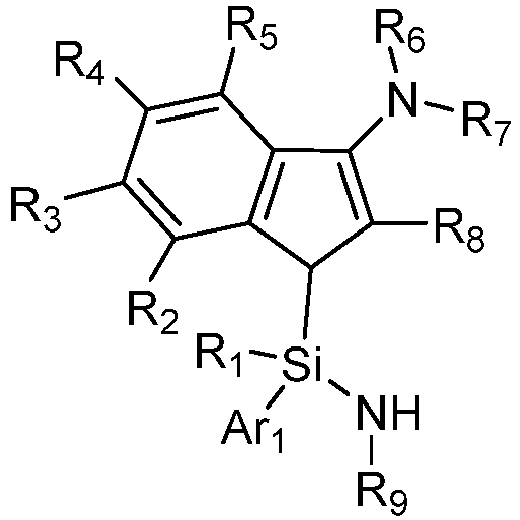
- The transition metal complex of claim 1, for use in preparing a copolymer of ethylene and an α-olefin having a unimodal GPC graph.
- A method for preparing a copolymer of ethylene and an α-olefin having a chemical composition distribution represented by a unimodal graph, using the transition metal complex of claim 18.
- A method for preparing a copolymer of ethylene and an α-olefin having a chemical composition distribution represented by a bimodal graph, using the transition metal complex of claim 18.
Applications Claiming Priority (3)
| Application Number | Priority Date | Filing Date | Title |
|---|---|---|---|
| KR20170127528 | 2017-09-29 | ||
| KR1020180115040A KR102643986B1 (en) | 2017-09-29 | 2018-09-27 | A novel indene-based transition metal complexes, catalysts composition containing the same, and methods for preparing ethylene homopolymers or copolymers of ethylene and α-olefins using the same |
| PCT/IB2018/057534 WO2019064247A1 (en) | 2017-09-29 | 2018-09-28 | NOVEL INDENE-BASED TRANSITION METAL COMPOUND, TRANSITION METAL CATALYST COMPOSITION COMPRISING SAME, AND METHOD FOR PREPARING ETHYLENE HOMOPOLYMER OR COPOLYMER OF ETHYLENE AND α-OLEFIN BY USING SAME |
Publications (3)
| Publication Number | Publication Date |
|---|---|
| EP3689884A1 EP3689884A1 (en) | 2020-08-05 |
| EP3689884A4 EP3689884A4 (en) | 2021-02-24 |
| EP3689884B1 true EP3689884B1 (en) | 2024-07-10 |
Family
ID=66164336
Family Applications (1)
| Application Number | Title | Priority Date | Filing Date |
|---|---|---|---|
| EP18862289.8A Active EP3689884B1 (en) | 2017-09-29 | 2018-09-28 | Novel indene-based transition metal compound, transition metal catalyst composition comprising same, and method for preparing ethylene homopolymer or copolymer of ethylene and alpha-olefin by using same |
Country Status (9)
| Country | Link |
|---|---|
| US (1) | US10919992B2 (en) |
| EP (1) | EP3689884B1 (en) |
| JP (1) | JP7177148B2 (en) |
| KR (1) | KR102643986B1 (en) |
| CN (1) | CN111148748B (en) |
| CA (1) | CA3075240A1 (en) |
| ES (1) | ES2986597T3 (en) |
| SA (1) | SA520411592B1 (en) |
| TW (1) | TWI754776B (en) |
Families Citing this family (5)
| Publication number | Priority date | Publication date | Assignee | Title |
|---|---|---|---|---|
| EP3763745A1 (en) * | 2019-07-10 | 2021-01-13 | Borealis AG | High temperature solution process for the copolymerization of alpha-olefins |
| CN111471074B (en) * | 2020-05-15 | 2023-04-28 | 山东京博中聚新材料有限公司 | Substituted indenyl metal complex, preparation method and application thereof |
| KR102879092B1 (en) * | 2021-11-25 | 2025-10-29 | 롯데케미칼 주식회사 | Olefin copolymer with controlled short chain branch contents, method for preparing the same, resin composition and molded artivle comprising the same |
| CN116284514A (en) * | 2023-02-28 | 2023-06-23 | 天津科技大学 | Constrained geometry cationic metallocene catalyst, its synthesis method and application |
| CN116789883B (en) * | 2023-08-28 | 2024-01-09 | 万华化学集团股份有限公司 | Polyolefin elastomer and application thereof in photovoltaic packaging film |
Family Cites Families (21)
| Publication number | Priority date | Publication date | Assignee | Title |
|---|---|---|---|---|
| JPS6392621A (en) | 1986-10-08 | 1988-04-23 | Mitsubishi Petrochem Co Ltd | Manufacturing method of ethylene copolymer |
| US5055438A (en) | 1989-09-13 | 1991-10-08 | Exxon Chemical Patents, Inc. | Olefin polymerization catalysts |
| DE3742934A1 (en) | 1987-12-18 | 1989-06-29 | Hoechst Ag | METHOD FOR PRODUCING A CHIRAL, STEREORIGIDAL METALLOCEN COMPOUND |
| JPH0284405A (en) | 1988-09-20 | 1990-03-26 | Mitsubishi Petrochem Co Ltd | Production method of ethylene polymer |
| GB8828206D0 (en) | 1988-12-02 | 1989-01-05 | Shell Int Research | Process for conversion of hydrocarbonaceous feedstock |
| JP2926836B2 (en) | 1989-02-22 | 1999-07-28 | 住友電気工業株式会社 | Nitrogen-containing cermet alloy |
| US5186739A (en) | 1989-02-22 | 1993-02-16 | Sumitomo Electric Industries, Ltd. | Cermet alloy containing nitrogen |
| NZ235032A (en) | 1989-08-31 | 1993-04-28 | Dow Chemical Co | Constrained geometry complexes of titanium, zirconium or hafnium comprising a substituted cyclopentadiene ligand; use as olefin polymerisation catalyst component |
| DE69427346T2 (en) | 1993-03-18 | 2001-09-13 | Advanced Technology Materials, Inc. | METHOD AND DEVICE FOR SUPPLYING REAGENTS IN STEAM IN A CVD REACTOR |
| US5637619A (en) | 1995-07-05 | 1997-06-10 | Yale University | Antitumor 2-aminocarbonyl-1, 2-bis(methylsulfonyl)-1-(substituted)hydrazines |
| EP1498178B1 (en) | 1995-07-14 | 2008-06-11 | Sumitomo Chemical Company, Limited | Transition metal complex and process for producing the same |
| ES2224266T3 (en) * | 1996-08-08 | 2005-03-01 | Dow Global Technologies Inc. | METAL CO-JOBS CONTAINING CYCLOPENTADIENYL REPLACED IN POSITION 3 WITH A HETEROATOMO AND OLEFIN POLYMERIZATION PROCEDURE. |
| CN1231668A (en) | 1996-08-08 | 1999-10-13 | 陶氏化学公司 | 2-heteroatom substituted cyclopentadienyl-containing metal complexes and olefin polymerization process |
| DE60001558T2 (en) * | 1999-05-13 | 2004-01-08 | Dow Global Technologies, Inc., Midland | DI AND TRI HETEROATOM SUBSTITUTED METAL INDENYL COMPLEXES |
| US6825295B2 (en) | 1999-12-10 | 2004-11-30 | Dow Global Technologies Inc. | Alkaryl-substituted group 4 metal complexes, catalysts and olefin polymerization process |
| US20020165329A1 (en) | 1999-12-10 | 2002-11-07 | Jerzy Klosin | Alkylphenyl-substituted group 4 metal complexes, catalysts and olefin polymerization process |
| CA2646567A1 (en) * | 1999-12-10 | 2001-06-14 | Dow Global Technologies Inc. | Substituted group 4 metal complexes, catalysts and olefin polymerization process |
| ATE403684T1 (en) | 2002-03-14 | 2008-08-15 | Dow Global Technologies Inc | METAL COMPLEXES WITH SUBSTITUTED INDENYL LIGANDS AND POLYMERIZATION PROCESSES |
| KR100610771B1 (en) * | 2003-03-25 | 2006-08-09 | 재단법인서울대학교산학협력재단 | Metallocene derivatives containing benz [F] indene ligands and preparation method thereof |
| GB0425443D0 (en) | 2004-11-18 | 2004-12-22 | Bp Chem Int Ltd | Supported polymerisation catalysts |
| JP6392621B2 (en) | 2014-10-03 | 2018-09-19 | 株式会社ニューギン | Game machine |
-
2018
- 2018-09-27 KR KR1020180115040A patent/KR102643986B1/en active Active
- 2018-09-28 TW TW107134208A patent/TWI754776B/en active
- 2018-09-28 US US16/650,848 patent/US10919992B2/en active Active
- 2018-09-28 CN CN201880063246.XA patent/CN111148748B/en active Active
- 2018-09-28 JP JP2020516841A patent/JP7177148B2/en active Active
- 2018-09-28 EP EP18862289.8A patent/EP3689884B1/en active Active
- 2018-09-28 CA CA3075240A patent/CA3075240A1/en active Pending
- 2018-09-28 ES ES18862289T patent/ES2986597T3/en active Active
-
2020
- 2020-03-23 SA SA520411592A patent/SA520411592B1/en unknown
Also Published As
| Publication number | Publication date |
|---|---|
| CN111148748A (en) | 2020-05-12 |
| SA520411592B1 (en) | 2022-11-13 |
| ES2986597T3 (en) | 2024-11-12 |
| RU2020114610A3 (en) | 2022-01-11 |
| JP2020535251A (en) | 2020-12-03 |
| CN111148748B (en) | 2023-05-16 |
| KR102643986B1 (en) | 2024-03-07 |
| US10919992B2 (en) | 2021-02-16 |
| TWI754776B (en) | 2022-02-11 |
| EP3689884A4 (en) | 2021-02-24 |
| TW201920209A (en) | 2019-06-01 |
| EP3689884A1 (en) | 2020-08-05 |
| KR20190038387A (en) | 2019-04-08 |
| JP7177148B2 (en) | 2022-11-22 |
| CA3075240A1 (en) | 2019-04-04 |
| US20200262943A1 (en) | 2020-08-20 |
| RU2020114610A (en) | 2021-10-29 |
Similar Documents
| Publication | Publication Date | Title |
|---|---|---|
| US10919992B2 (en) | Indene-based transition metal compound, transition metal catalyst composition comprising same, and method for preparing ethylene homopolymer or copolymer of ethylene and alpha-olefin by using same | |
| EP2225251B1 (en) | Transition metal complexes, catalysts composition containing the same, and process for preparing ethylene homopolymers or copolymers of ethylene and alpha-olefins using the same | |
| JP5422208B2 (en) | Transition metal compound, transition metal catalyst composition containing the same, and method for producing ethylene homopolymer or copolymer of ethylene and α-olefin | |
| EP2087011B1 (en) | Transition metal catalytic systems and methods for preparing ethylene homopolymers or copolymers of ethylene and olefins using the same | |
| CN118401573A (en) | Ethylene alpha-olefin copolymer having a regulated branching content, process for producing the same, and resin composition and molded article comprising the olefin copolymer | |
| EP2340255B1 (en) | NEW TRANSITION METAL CATALYTIC SYSTEMS AND METHODS FOR PREPARING ETHYLENE HOMOPOLYMERS OR COPOLYMERS OF ETHYLENE AND alpha-OLEFINS USING THE SAME | |
| US7847039B2 (en) | Transition metal complexes, and catalysts compositions for preparing ethylene homopolymers or copolymers | |
| EP3904360B1 (en) | Novel tetraarylborate compound, catalyst composition comprising same, and method for preparing ethylene homopolymers or copolymers of ethylene and alpha-olefin by using same | |
| US7985817B2 (en) | Homogeneous catalyst system for producing ethylene homopolymer or ethylene copolymers with alpha-olefins | |
| KR20150138042A (en) | A novel transition metal compound, a transition metal catalyst composition for olefin polymerization containing the same, and a process for producing an ethylene homopolymer or a copolymer of ethylene and an? -Olefin using the same | |
| EP1934266B1 (en) | Homogeneous catalyst system for producing ethylene homopolymer or ethylene copolymers with alpha-olefins | |
| RU2783400C2 (en) | NEW COMPOUND OF TRANSITION METAL BASED ON INDENE, CATALYTIC COMPOSITION BASED ON TRANSITION METAL, CONTAINING SPECIFIED COMPOUND, AND METHOD FOR PRODUCTION OF ETHYLENE HOMOPOLYMER OR COPOLYMER OF ETHYLENE AND α-OLEFIN, USING SPECIFIED COMPOSITION | |
| RU2801287C2 (en) | NEW TETRAARYLBORATE COMPOUND INCLUDING ITS CATALYTIC COMPOSITION AND METHOD FOR PRODUCING ETHYLENE HOMOPOLYMERS OR ETHYLENE AND α-OLEFIN COPOLYMERS USING IT |
Legal Events
| Date | Code | Title | Description |
|---|---|---|---|
| STAA | Information on the status of an ep patent application or granted ep patent |
Free format text: STATUS: THE INTERNATIONAL PUBLICATION HAS BEEN MADE |
|
| PUAI | Public reference made under article 153(3) epc to a published international application that has entered the european phase |
Free format text: ORIGINAL CODE: 0009012 |
|
| STAA | Information on the status of an ep patent application or granted ep patent |
Free format text: STATUS: REQUEST FOR EXAMINATION WAS MADE |
|
| 17P | Request for examination filed |
Effective date: 20200317 |
|
| AK | Designated contracting states |
Kind code of ref document: A1 Designated state(s): AL AT BE BG CH CY CZ DE DK EE ES FI FR GB GR HR HU IE IS IT LI LT LU LV MC MK MT NL NO PL PT RO RS SE SI SK SM TR |
|
| AX | Request for extension of the european patent |
Extension state: BA ME |
|
| DAV | Request for validation of the european patent (deleted) | ||
| DAX | Request for extension of the european patent (deleted) | ||
| REG | Reference to a national code |
Ref country code: DE Ref legal event code: R079 Free format text: PREVIOUS MAIN CLASS: C07F0007280000 Ipc: C07F0017000000 Ref country code: DE Ref legal event code: R079 Ref document number: 602018071689 Country of ref document: DE Free format text: PREVIOUS MAIN CLASS: C07F0007280000 Ipc: C07F0017000000 |
|
| A4 | Supplementary search report drawn up and despatched |
Effective date: 20210126 |
|
| RIC1 | Information provided on ipc code assigned before grant |
Ipc: C07F 17/00 20060101AFI20210120BHEP Ipc: C08F 210/16 20060101ALI20210120BHEP Ipc: C08F 4/6592 20060101ALI20210120BHEP Ipc: C08F 4/659 20060101ALI20210120BHEP Ipc: C08F 2/38 20060101ALI20210120BHEP Ipc: C08F 36/20 20060101ALI20210120BHEP Ipc: C08F 10/02 20060101ALI20210120BHEP Ipc: C08F 4/646 20060101ALI20210120BHEP |
|
| GRAP | Despatch of communication of intention to grant a patent |
Free format text: ORIGINAL CODE: EPIDOSNIGR1 |
|
| STAA | Information on the status of an ep patent application or granted ep patent |
Free format text: STATUS: GRANT OF PATENT IS INTENDED |
|
| INTG | Intention to grant announced |
Effective date: 20231117 |
|
| GRAS | Grant fee paid |
Free format text: ORIGINAL CODE: EPIDOSNIGR3 |
|
| GRAJ | Information related to disapproval of communication of intention to grant by the applicant or resumption of examination proceedings by the epo deleted |
Free format text: ORIGINAL CODE: EPIDOSDIGR1 |
|
| GRAL | Information related to payment of fee for publishing/printing deleted |
Free format text: ORIGINAL CODE: EPIDOSDIGR3 |
|
| STAA | Information on the status of an ep patent application or granted ep patent |
Free format text: STATUS: REQUEST FOR EXAMINATION WAS MADE |
|
| P01 | Opt-out of the competence of the unified patent court (upc) registered |
Effective date: 20240206 |
|
| INTC | Intention to grant announced (deleted) | ||
| GRAP | Despatch of communication of intention to grant a patent |
Free format text: ORIGINAL CODE: EPIDOSNIGR1 |
|
| STAA | Information on the status of an ep patent application or granted ep patent |
Free format text: STATUS: GRANT OF PATENT IS INTENDED |
|
| INTG | Intention to grant announced |
Effective date: 20240503 |
|
| GRAS | Grant fee paid |
Free format text: ORIGINAL CODE: EPIDOSNIGR3 |
|
| GRAA | (expected) grant |
Free format text: ORIGINAL CODE: 0009210 |
|
| STAA | Information on the status of an ep patent application or granted ep patent |
Free format text: STATUS: THE PATENT HAS BEEN GRANTED |
|
| AK | Designated contracting states |
Kind code of ref document: B1 Designated state(s): AL AT BE BG CH CY CZ DE DK EE ES FI FR GB GR HR HU IE IS IT LI LT LU LV MC MK MT NL NO PL PT RO RS SE SI SK SM TR |
|
| REG | Reference to a national code |
Ref country code: CH Ref legal event code: EP |
|
| REG | Reference to a national code |
Ref country code: DE Ref legal event code: R096 Ref document number: 602018071689 Country of ref document: DE |
|
| REG | Reference to a national code |
Ref country code: NL Ref legal event code: FP |
|
| REG | Reference to a national code |
Ref country code: LT Ref legal event code: MG9D |
|
| REG | Reference to a national code |
Ref country code: ES Ref legal event code: FG2A Ref document number: 2986597 Country of ref document: ES Kind code of ref document: T3 Effective date: 20241112 |
|
| PG25 | Lapsed in a contracting state [announced via postgrant information from national office to epo] |
Ref country code: PT Free format text: LAPSE BECAUSE OF FAILURE TO SUBMIT A TRANSLATION OF THE DESCRIPTION OR TO PAY THE FEE WITHIN THE PRESCRIBED TIME-LIMIT Effective date: 20241111 |
|
| PG25 | Lapsed in a contracting state [announced via postgrant information from national office to epo] |
Ref country code: PT Free format text: LAPSE BECAUSE OF FAILURE TO SUBMIT A TRANSLATION OF THE DESCRIPTION OR TO PAY THE FEE WITHIN THE PRESCRIBED TIME-LIMIT Effective date: 20241111 |
|
| PG25 | Lapsed in a contracting state [announced via postgrant information from national office to epo] |
Ref country code: NO Free format text: LAPSE BECAUSE OF FAILURE TO SUBMIT A TRANSLATION OF THE DESCRIPTION OR TO PAY THE FEE WITHIN THE PRESCRIBED TIME-LIMIT Effective date: 20241010 |
|
| PG25 | Lapsed in a contracting state [announced via postgrant information from national office to epo] |
Ref country code: FI Free format text: LAPSE BECAUSE OF FAILURE TO SUBMIT A TRANSLATION OF THE DESCRIPTION OR TO PAY THE FEE WITHIN THE PRESCRIBED TIME-LIMIT Effective date: 20240710 Ref country code: GR Free format text: LAPSE BECAUSE OF FAILURE TO SUBMIT A TRANSLATION OF THE DESCRIPTION OR TO PAY THE FEE WITHIN THE PRESCRIBED TIME-LIMIT Effective date: 20241011 Ref country code: PL Free format text: LAPSE BECAUSE OF FAILURE TO SUBMIT A TRANSLATION OF THE DESCRIPTION OR TO PAY THE FEE WITHIN THE PRESCRIBED TIME-LIMIT Effective date: 20240710 |
|
| PG25 | Lapsed in a contracting state [announced via postgrant information from national office to epo] |
Ref country code: BG Free format text: LAPSE BECAUSE OF FAILURE TO SUBMIT A TRANSLATION OF THE DESCRIPTION OR TO PAY THE FEE WITHIN THE PRESCRIBED TIME-LIMIT Effective date: 20240710 |
|
| PG25 | Lapsed in a contracting state [announced via postgrant information from national office to epo] |
Ref country code: LV Free format text: LAPSE BECAUSE OF FAILURE TO SUBMIT A TRANSLATION OF THE DESCRIPTION OR TO PAY THE FEE WITHIN THE PRESCRIBED TIME-LIMIT Effective date: 20240710 |
|
| PG25 | Lapsed in a contracting state [announced via postgrant information from national office to epo] |
Ref country code: IS Free format text: LAPSE BECAUSE OF FAILURE TO SUBMIT A TRANSLATION OF THE DESCRIPTION OR TO PAY THE FEE WITHIN THE PRESCRIBED TIME-LIMIT Effective date: 20241110 |
|
| PG25 | Lapsed in a contracting state [announced via postgrant information from national office to epo] |
Ref country code: HR Free format text: LAPSE BECAUSE OF FAILURE TO SUBMIT A TRANSLATION OF THE DESCRIPTION OR TO PAY THE FEE WITHIN THE PRESCRIBED TIME-LIMIT Effective date: 20240710 |
|
| PG25 | Lapsed in a contracting state [announced via postgrant information from national office to epo] |
Ref country code: RS Free format text: LAPSE BECAUSE OF FAILURE TO SUBMIT A TRANSLATION OF THE DESCRIPTION OR TO PAY THE FEE WITHIN THE PRESCRIBED TIME-LIMIT Effective date: 20241010 |
|
| PG25 | Lapsed in a contracting state [announced via postgrant information from national office to epo] |
Ref country code: HR Free format text: LAPSE BECAUSE OF FAILURE TO SUBMIT A TRANSLATION OF THE DESCRIPTION OR TO PAY THE FEE WITHIN THE PRESCRIBED TIME-LIMIT Effective date: 20240710 Ref country code: GR Free format text: LAPSE BECAUSE OF FAILURE TO SUBMIT A TRANSLATION OF THE DESCRIPTION OR TO PAY THE FEE WITHIN THE PRESCRIBED TIME-LIMIT Effective date: 20241011 Ref country code: FI Free format text: LAPSE BECAUSE OF FAILURE TO SUBMIT A TRANSLATION OF THE DESCRIPTION OR TO PAY THE FEE WITHIN THE PRESCRIBED TIME-LIMIT Effective date: 20240710 Ref country code: BG Free format text: LAPSE BECAUSE OF FAILURE TO SUBMIT A TRANSLATION OF THE DESCRIPTION OR TO PAY THE FEE WITHIN THE PRESCRIBED TIME-LIMIT Effective date: 20240710 Ref country code: RS Free format text: LAPSE BECAUSE OF FAILURE TO SUBMIT A TRANSLATION OF THE DESCRIPTION OR TO PAY THE FEE WITHIN THE PRESCRIBED TIME-LIMIT Effective date: 20241010 Ref country code: PL Free format text: LAPSE BECAUSE OF FAILURE TO SUBMIT A TRANSLATION OF THE DESCRIPTION OR TO PAY THE FEE WITHIN THE PRESCRIBED TIME-LIMIT Effective date: 20240710 Ref country code: NO Free format text: LAPSE BECAUSE OF FAILURE TO SUBMIT A TRANSLATION OF THE DESCRIPTION OR TO PAY THE FEE WITHIN THE PRESCRIBED TIME-LIMIT Effective date: 20241010 Ref country code: LV Free format text: LAPSE BECAUSE OF FAILURE TO SUBMIT A TRANSLATION OF THE DESCRIPTION OR TO PAY THE FEE WITHIN THE PRESCRIBED TIME-LIMIT Effective date: 20240710 Ref country code: IS Free format text: LAPSE BECAUSE OF FAILURE TO SUBMIT A TRANSLATION OF THE DESCRIPTION OR TO PAY THE FEE WITHIN THE PRESCRIBED TIME-LIMIT Effective date: 20241110 |
|
| REG | Reference to a national code |
Ref country code: DE Ref legal event code: R097 Ref document number: 602018071689 Country of ref document: DE |
|
| PG25 | Lapsed in a contracting state [announced via postgrant information from national office to epo] |
Ref country code: DK Free format text: LAPSE BECAUSE OF FAILURE TO SUBMIT A TRANSLATION OF THE DESCRIPTION OR TO PAY THE FEE WITHIN THE PRESCRIBED TIME-LIMIT Effective date: 20240710 Ref country code: RO Free format text: LAPSE BECAUSE OF FAILURE TO SUBMIT A TRANSLATION OF THE DESCRIPTION OR TO PAY THE FEE WITHIN THE PRESCRIBED TIME-LIMIT Effective date: 20240710 Ref country code: SM Free format text: LAPSE BECAUSE OF FAILURE TO SUBMIT A TRANSLATION OF THE DESCRIPTION OR TO PAY THE FEE WITHIN THE PRESCRIBED TIME-LIMIT Effective date: 20240710 |
|
| PG25 | Lapsed in a contracting state [announced via postgrant information from national office to epo] |
Ref country code: MC Free format text: LAPSE BECAUSE OF FAILURE TO SUBMIT A TRANSLATION OF THE DESCRIPTION OR TO PAY THE FEE WITHIN THE PRESCRIBED TIME-LIMIT Effective date: 20240710 Ref country code: EE Free format text: LAPSE BECAUSE OF FAILURE TO SUBMIT A TRANSLATION OF THE DESCRIPTION OR TO PAY THE FEE WITHIN THE PRESCRIBED TIME-LIMIT Effective date: 20240710 |
|
| PG25 | Lapsed in a contracting state [announced via postgrant information from national office to epo] |
Ref country code: CZ Free format text: LAPSE BECAUSE OF FAILURE TO SUBMIT A TRANSLATION OF THE DESCRIPTION OR TO PAY THE FEE WITHIN THE PRESCRIBED TIME-LIMIT Effective date: 20240710 |
|
| PG25 | Lapsed in a contracting state [announced via postgrant information from national office to epo] |
Ref country code: SK Free format text: LAPSE BECAUSE OF FAILURE TO SUBMIT A TRANSLATION OF THE DESCRIPTION OR TO PAY THE FEE WITHIN THE PRESCRIBED TIME-LIMIT Effective date: 20240710 |
|
| REG | Reference to a national code |
Ref country code: CH Ref legal event code: PL |
|
| PLBE | No opposition filed within time limit |
Free format text: ORIGINAL CODE: 0009261 |
|
| STAA | Information on the status of an ep patent application or granted ep patent |
Free format text: STATUS: NO OPPOSITION FILED WITHIN TIME LIMIT |
|
| PG25 | Lapsed in a contracting state [announced via postgrant information from national office to epo] |
Ref country code: LU Free format text: LAPSE BECAUSE OF NON-PAYMENT OF DUE FEES Effective date: 20240928 |
|
| 26N | No opposition filed |
Effective date: 20250411 |
|
| REG | Reference to a national code |
Ref country code: BE Ref legal event code: MM Effective date: 20240930 |
|
| PG25 | Lapsed in a contracting state [announced via postgrant information from national office to epo] |
Ref country code: BE Free format text: LAPSE BECAUSE OF NON-PAYMENT OF DUE FEES Effective date: 20240930 |
|
| PGFP | Annual fee paid to national office [announced via postgrant information from national office to epo] |
Ref country code: NL Payment date: 20250623 Year of fee payment: 8 |
|
| PGFP | Annual fee paid to national office [announced via postgrant information from national office to epo] |
Ref country code: FR Payment date: 20250624 Year of fee payment: 8 |
|
| PG25 | Lapsed in a contracting state [announced via postgrant information from national office to epo] |
Ref country code: CH Free format text: LAPSE BECAUSE OF NON-PAYMENT OF DUE FEES Effective date: 20240930 |
|
| PG25 | Lapsed in a contracting state [announced via postgrant information from national office to epo] |
Ref country code: IE Free format text: LAPSE BECAUSE OF NON-PAYMENT OF DUE FEES Effective date: 20240928 |
|
| PG25 | Lapsed in a contracting state [announced via postgrant information from national office to epo] |
Ref country code: SE Free format text: LAPSE BECAUSE OF FAILURE TO SUBMIT A TRANSLATION OF THE DESCRIPTION OR TO PAY THE FEE WITHIN THE PRESCRIBED TIME-LIMIT Effective date: 20240710 |
|
| PGFP | Annual fee paid to national office [announced via postgrant information from national office to epo] |
Ref country code: DE Payment date: 20250624 Year of fee payment: 8 |
|
| PGFP | Annual fee paid to national office [announced via postgrant information from national office to epo] |
Ref country code: IT Payment date: 20250624 Year of fee payment: 8 |
|
| PGFP | Annual fee paid to national office [announced via postgrant information from national office to epo] |
Ref country code: GB Payment date: 20250707 Year of fee payment: 8 |
|
| PGFP | Annual fee paid to national office [announced via postgrant information from national office to epo] |
Ref country code: AT Payment date: 20250707 Year of fee payment: 8 |
|
| PG25 | Lapsed in a contracting state [announced via postgrant information from national office to epo] |
Ref country code: CY Free format text: LAPSE BECAUSE OF FAILURE TO SUBMIT A TRANSLATION OF THE DESCRIPTION OR TO PAY THE FEE WITHIN THE PRESCRIBED TIME-LIMIT; INVALID AB INITIO Effective date: 20180928 |
|
| PGFP | Annual fee paid to national office [announced via postgrant information from national office to epo] |
Ref country code: ES Payment date: 20251008 Year of fee payment: 8 |
|
| PG25 | Lapsed in a contracting state [announced via postgrant information from national office to epo] |
Ref country code: HU Free format text: LAPSE BECAUSE OF FAILURE TO SUBMIT A TRANSLATION OF THE DESCRIPTION OR TO PAY THE FEE WITHIN THE PRESCRIBED TIME-LIMIT; INVALID AB INITIO Effective date: 20180928 |