EP3689849A1 - Perfume precursor - Google Patents
Perfume precursor Download PDFInfo
- Publication number
- EP3689849A1 EP3689849A1 EP18858666.3A EP18858666A EP3689849A1 EP 3689849 A1 EP3689849 A1 EP 3689849A1 EP 18858666 A EP18858666 A EP 18858666A EP 3689849 A1 EP3689849 A1 EP 3689849A1
- Authority
- EP
- European Patent Office
- Prior art keywords
- compound
- hydroxybenzoate
- methyl
- methoxyphenyl
- group
- Prior art date
- Legal status (The legal status is an assumption and is not a legal conclusion. Google has not performed a legal analysis and makes no representation as to the accuracy of the status listed.)
- Granted
Links
- 0 *C(*c1ccccc1)=O Chemical compound *C(*c1ccccc1)=O 0.000 description 7
- SQFXAXKHCCOUIY-UHFFFAOYSA-N CC(CCc(cc1)ccc1OC(c(cc1)ccc1O)=O)=O Chemical compound CC(CCc(cc1)ccc1OC(c(cc1)ccc1O)=O)=O SQFXAXKHCCOUIY-UHFFFAOYSA-N 0.000 description 2
- GFMGSUCJHYCYCN-SNAWJCMRSA-N C/C=C/c(cc1)cc(OC)c1OC(CCc(cc1)ccc1OC)=O Chemical compound C/C=C/c(cc1)cc(OC)c1OC(CCc(cc1)ccc1OC)=O GFMGSUCJHYCYCN-SNAWJCMRSA-N 0.000 description 1
- QXAWQRXHNPTFPW-UHFFFAOYSA-N CC(C)(Cc1ccccc1)OC(c(cc1)ccc1O)=O Chemical compound CC(C)(Cc1ccccc1)OC(c(cc1)ccc1O)=O QXAWQRXHNPTFPW-UHFFFAOYSA-N 0.000 description 1
- VLTNMLDZDJICFZ-UHFFFAOYSA-N CC(CC1)(CCC1=C(C)C)OC(c(cc1)ccc1O)=O Chemical compound CC(CC1)(CCC1=C(C)C)OC(c(cc1)ccc1O)=O VLTNMLDZDJICFZ-UHFFFAOYSA-N 0.000 description 1
- UYMBJRLEBUSSOS-UHFFFAOYSA-N CC(CCCC(C)(C)OC(c(cc1)ccc1O)=O)CC=O Chemical compound CC(CCCC(C)(C)OC(c(cc1)ccc1O)=O)CC=O UYMBJRLEBUSSOS-UHFFFAOYSA-N 0.000 description 1
- VNSXZIYGJDVTMN-UHFFFAOYSA-N CC(CCc(cc1)ccc1OC(c(cc1)ccc1OC)=O)=O Chemical compound CC(CCc(cc1)ccc1OC(c(cc1)ccc1OC)=O)=O VNSXZIYGJDVTMN-UHFFFAOYSA-N 0.000 description 1
- HBASNKWTRYIGOF-UHFFFAOYSA-N CC(c(cc(cc1)OC)c1C(O)=O)=C Chemical compound CC(c(cc(cc1)OC)c1C(O)=O)=C HBASNKWTRYIGOF-UHFFFAOYSA-N 0.000 description 1
- SCHWWUFNAAZUKY-YRNVUSSQSA-N CCOc(cc(C=O)cc1)c1OC(/C=C/c(cc1)ccc1OC)=O Chemical compound CCOc(cc(C=O)cc1)c1OC(/C=C/c(cc1)ccc1OC)=O SCHWWUFNAAZUKY-YRNVUSSQSA-N 0.000 description 1
Classifications
-
- C—CHEMISTRY; METALLURGY
- C11—ANIMAL OR VEGETABLE OILS, FATS, FATTY SUBSTANCES OR WAXES; FATTY ACIDS THEREFROM; DETERGENTS; CANDLES
- C11B—PRODUCING, e.g. BY PRESSING RAW MATERIALS OR BY EXTRACTION FROM WASTE MATERIALS, REFINING OR PRESERVING FATS, FATTY SUBSTANCES, e.g. LANOLIN, FATTY OILS OR WAXES; ESSENTIAL OILS; PERFUMES
- C11B9/00—Essential oils; Perfumes
- C11B9/0061—Essential oils; Perfumes compounds containing a six-membered aromatic ring not condensed with another ring
-
- A—HUMAN NECESSITIES
- A61—MEDICAL OR VETERINARY SCIENCE; HYGIENE
- A61K—PREPARATIONS FOR MEDICAL, DENTAL OR TOILETRY PURPOSES
- A61K8/00—Cosmetics or similar toiletry preparations
- A61K8/18—Cosmetics or similar toiletry preparations characterised by the composition
- A61K8/30—Cosmetics or similar toiletry preparations characterised by the composition containing organic compounds
- A61K8/33—Cosmetics or similar toiletry preparations characterised by the composition containing organic compounds containing oxygen
- A61K8/37—Esters of carboxylic acids
-
- A—HUMAN NECESSITIES
- A61—MEDICAL OR VETERINARY SCIENCE; HYGIENE
- A61K—PREPARATIONS FOR MEDICAL, DENTAL OR TOILETRY PURPOSES
- A61K8/00—Cosmetics or similar toiletry preparations
- A61K8/18—Cosmetics or similar toiletry preparations characterised by the composition
- A61K8/30—Cosmetics or similar toiletry preparations characterised by the composition containing organic compounds
- A61K8/33—Cosmetics or similar toiletry preparations characterised by the composition containing organic compounds containing oxygen
- A61K8/34—Alcohols
- A61K8/347—Phenols
-
- A—HUMAN NECESSITIES
- A61—MEDICAL OR VETERINARY SCIENCE; HYGIENE
- A61L—METHODS OR APPARATUS FOR STERILISING MATERIALS OR OBJECTS IN GENERAL; DISINFECTION, STERILISATION OR DEODORISATION OF AIR; CHEMICAL ASPECTS OF BANDAGES, DRESSINGS, ABSORBENT PADS OR SURGICAL ARTICLES; MATERIALS FOR BANDAGES, DRESSINGS, ABSORBENT PADS OR SURGICAL ARTICLES
- A61L9/00—Disinfection, sterilisation or deodorisation of air
- A61L9/01—Deodorant compositions
-
- A—HUMAN NECESSITIES
- A61—MEDICAL OR VETERINARY SCIENCE; HYGIENE
- A61Q—SPECIFIC USE OF COSMETICS OR SIMILAR TOILETRY PREPARATIONS
- A61Q13/00—Formulations or additives for perfume preparations
-
- A—HUMAN NECESSITIES
- A61—MEDICAL OR VETERINARY SCIENCE; HYGIENE
- A61Q—SPECIFIC USE OF COSMETICS OR SIMILAR TOILETRY PREPARATIONS
- A61Q15/00—Anti-perspirants or body deodorants
-
- C—CHEMISTRY; METALLURGY
- C07—ORGANIC CHEMISTRY
- C07C—ACYCLIC OR CARBOCYCLIC COMPOUNDS
- C07C69/00—Esters of carboxylic acids; Esters of carbonic or haloformic acids
- C07C69/612—Esters of carboxylic acids having a carboxyl group bound to an acyclic carbon atom and having a six-membered aromatic ring in the acid moiety
- C07C69/614—Esters of carboxylic acids having a carboxyl group bound to an acyclic carbon atom and having a six-membered aromatic ring in the acid moiety of phenylacetic acid
-
- C—CHEMISTRY; METALLURGY
- C07—ORGANIC CHEMISTRY
- C07C—ACYCLIC OR CARBOCYCLIC COMPOUNDS
- C07C69/00—Esters of carboxylic acids; Esters of carbonic or haloformic acids
- C07C69/612—Esters of carboxylic acids having a carboxyl group bound to an acyclic carbon atom and having a six-membered aromatic ring in the acid moiety
- C07C69/618—Esters of carboxylic acids having a carboxyl group bound to an acyclic carbon atom and having a six-membered aromatic ring in the acid moiety having unsaturation outside the six-membered aromatic ring
-
- C—CHEMISTRY; METALLURGY
- C07—ORGANIC CHEMISTRY
- C07C—ACYCLIC OR CARBOCYCLIC COMPOUNDS
- C07C69/00—Esters of carboxylic acids; Esters of carbonic or haloformic acids
- C07C69/66—Esters of carboxylic acids having esterified carboxylic groups bound to acyclic carbon atoms and having any of the groups OH, O—metal, —CHO, keto, ether, acyloxy, groups, groups, or in the acid moiety
- C07C69/73—Esters of carboxylic acids having esterified carboxylic groups bound to acyclic carbon atoms and having any of the groups OH, O—metal, —CHO, keto, ether, acyloxy, groups, groups, or in the acid moiety of unsaturated acids
- C07C69/734—Ethers
- C07C69/736—Ethers the hydroxy group of the ester being etherified with a hydroxy compound having the hydroxy group bound to a carbon atom of a six-membered aromatic ring
-
- C—CHEMISTRY; METALLURGY
- C07—ORGANIC CHEMISTRY
- C07C—ACYCLIC OR CARBOCYCLIC COMPOUNDS
- C07C69/00—Esters of carboxylic acids; Esters of carbonic or haloformic acids
- C07C69/76—Esters of carboxylic acids having a carboxyl group bound to a carbon atom of a six-membered aromatic ring
- C07C69/78—Benzoic acid esters
-
- C—CHEMISTRY; METALLURGY
- C07—ORGANIC CHEMISTRY
- C07C—ACYCLIC OR CARBOCYCLIC COMPOUNDS
- C07C69/00—Esters of carboxylic acids; Esters of carbonic or haloformic acids
- C07C69/76—Esters of carboxylic acids having a carboxyl group bound to a carbon atom of a six-membered aromatic ring
- C07C69/84—Esters of carboxylic acids having a carboxyl group bound to a carbon atom of a six-membered aromatic ring of monocyclic hydroxy carboxylic acids, the hydroxy groups and the carboxyl groups of which are bound to carbon atoms of a six-membered aromatic ring
-
- C—CHEMISTRY; METALLURGY
- C07—ORGANIC CHEMISTRY
- C07C—ACYCLIC OR CARBOCYCLIC COMPOUNDS
- C07C69/00—Esters of carboxylic acids; Esters of carbonic or haloformic acids
- C07C69/76—Esters of carboxylic acids having a carboxyl group bound to a carbon atom of a six-membered aromatic ring
- C07C69/94—Esters of carboxylic acids having a carboxyl group bound to a carbon atom of a six-membered aromatic ring of polycyclic hydroxy carboxylic acids, the hydroxy groups and the carboxyl groups of which are bound to carbon atoms of six-membered aromatic rings
-
- C—CHEMISTRY; METALLURGY
- C11—ANIMAL OR VEGETABLE OILS, FATS, FATTY SUBSTANCES OR WAXES; FATTY ACIDS THEREFROM; DETERGENTS; CANDLES
- C11B—PRODUCING, e.g. BY PRESSING RAW MATERIALS OR BY EXTRACTION FROM WASTE MATERIALS, REFINING OR PRESERVING FATS, FATTY SUBSTANCES, e.g. LANOLIN, FATTY OILS OR WAXES; ESSENTIAL OILS; PERFUMES
- C11B9/00—Essential oils; Perfumes
-
- C—CHEMISTRY; METALLURGY
- C11—ANIMAL OR VEGETABLE OILS, FATS, FATTY SUBSTANCES OR WAXES; FATTY ACIDS THEREFROM; DETERGENTS; CANDLES
- C11D—DETERGENT COMPOSITIONS; USE OF SINGLE SUBSTANCES AS DETERGENTS; SOAP OR SOAP-MAKING; RESIN SOAPS; RECOVERY OF GLYCEROL
- C11D3/00—Other compounding ingredients of detergent compositions covered in group C11D1/00
- C11D3/0005—Other compounding ingredients characterised by their effect
- C11D3/001—Softening compositions
- C11D3/0015—Softening compositions liquid
-
- C—CHEMISTRY; METALLURGY
- C11—ANIMAL OR VEGETABLE OILS, FATS, FATTY SUBSTANCES OR WAXES; FATTY ACIDS THEREFROM; DETERGENTS; CANDLES
- C11D—DETERGENT COMPOSITIONS; USE OF SINGLE SUBSTANCES AS DETERGENTS; SOAP OR SOAP-MAKING; RESIN SOAPS; RECOVERY OF GLYCEROL
- C11D3/00—Other compounding ingredients of detergent compositions covered in group C11D1/00
- C11D3/50—Perfumes
-
- D—TEXTILES; PAPER
- D06—TREATMENT OF TEXTILES OR THE LIKE; LAUNDERING; FLEXIBLE MATERIALS NOT OTHERWISE PROVIDED FOR
- D06M—TREATMENT, NOT PROVIDED FOR ELSEWHERE IN CLASS D06, OF FIBRES, THREADS, YARNS, FABRICS, FEATHERS OR FIBROUS GOODS MADE FROM SUCH MATERIALS
- D06M13/00—Treating fibres, threads, yarns, fabrics or fibrous goods made from such materials, with non-macromolecular organic compounds; Such treatment combined with mechanical treatment
-
- A—HUMAN NECESSITIES
- A61—MEDICAL OR VETERINARY SCIENCE; HYGIENE
- A61K—PREPARATIONS FOR MEDICAL, DENTAL OR TOILETRY PURPOSES
- A61K2800/00—Properties of cosmetic compositions or active ingredients thereof or formulation aids used therein and process related aspects
- A61K2800/74—Biological properties of particular ingredients
- A61K2800/77—Perfumes having both deodorant and antibacterial properties
Definitions
- the present invention relates to a fragrance precursor, a method for releasing a fragrance alcohol, a phenol or a phenol derivative by the action of a hydrolase or microorganism, a novel compound, a fragrance composition containing the novel compound, and an aroma product, laundry care product, hair care product, cosmetic, cleaner or deodorant containing the fragrance composition.
- Patent Literature 1 a fixative such as p-menthane-3,8-diol (Patent Literature 1) and 3-(menthoxy)-1,2-propanediol (Patent Literature 2) has been proposed.
- fragrance components are volatilized in drying step after the cleaning, as a result, the lingering scent intensity is reduced. Furthermore, since the lingering scent component is biased toward a fragrance component having an extremely low volatility, the palatability is likely to deteriorate, and an unpleasant sensation is sometimes caused. , the lingering scent may be enhanced, but stabilization in a product is difficult, and the application field is limited.
- a scent is not released unless the capsule is physically broken and therefore, scent emission may occur when a lingering scent is not needed, or a scent is not emitted when a lingering scent is needed. Accordingly, there is a problem of mismatch between the need for a scent and the timing of emitting a scent from the capsule.
- the scent lingering property may be somewhat enhanced, but a fully satisfactory lingering scent longevity has not been obtained.
- the lingering scent component is still biased toward a low-volatile component even when a fixative is used, use of a fixative does not lead to an improvement of the smell quality of the lingering scent, and a lingering scent retaining technique for allowing an aroma with fresher feeling to last is demanded.
- the method for deodorizing a malodor caused by a microorganism when an antimicrobial is used in a personal care product such as deodorant agent, not only bacteria causing a malodor but also skin-resident bacteria useful for skin are killed at the same time, and the skin flora balance may be lost.
- the skin-resident bacteria also fulfill the role of keeping the pH weakly acidic and preventing skin infections and in view of maintaining the health of the skin, frequent use of an antimicrobial is not necessarily favorable.
- the odor intensity and unpleasant sensation are strengthened along with the progress of proliferation of a microorganism, and it is likely that when the consumer truly needs the deodorizing effect, a sufficient deodorizing effect is not obtained due to a weak lingering scent intensity of the fragrance.
- the scent lingering property may be increased with the purpose of enhancing the continuity of deodorizing effect, but since the fragrance composition is biased toward a fragrance component having an extremely low volatility, the palatability is likely to deteriorate, and an unpleasant sensation is sometimes caused.
- fragrance having a high scent intensity or extremely raise the perfuming amount, but, for example, at the start of use of a deodorant product, during use of a body cleaner, or during drying of clothing, the fragrance smells too strong, and the user may feel sick.
- a deodorization technique for enabling a deodorizing effect to be exerted at the same timing as a time at which a microorganism sufficiently proliferates and generates a malodor is demanded.
- the present invention has been made in consideration of these conventional circumstances, and the problem to be solved is to provide a fragrance precursor capable of continuously supplying an aroma with fresh feeling even after cleaning the clothing or hair by use of a cleaner or after passing a drying step following the cleaning.
- the problem to be solved by the present invention is to provide a technique for enabling scent emission or deodorization to be achieved at the same timing as a time at which a microorganism sufficiently proliferates and generates a malodor.
- a compound having a specific structure releases a fragrance alcohol, a phenol or a phenol derivative by the action of a hydrolase or microorganism and thereby, realizes an increase in the lingering scent longevity with fresh feeling and alleviation of an odor caused by a microorganism.
- the present invention has been accomplished based on this finding.
- the present invention relates to the following [1] to [8].
- a fragrance precursor capable of continuously supplying an aroma with fresh feeling even after cleaning the clothing or hair by use of a cleaner or after passing a drying step following the cleaning can be provided.
- a technique for enabling scent emission or deodorization to be achieved at the same timing as a time at which a microorganism sufficiently proliferates and generates a malodor can be provided.
- a fragrance composition an aromatic product, a laundry care product, a hair care product, a cosmetic, a cleaner or a deodorant, which can emit an aromatic component upon reacting with a hydrolase and make a lingering sent with fresh feeling to last on clothing, hair or skin or which can emit an aromatic component or deodorant component upon reacting with a microorganism and alleviate an unpleasant odor caused by a microorganism, can be provided.
- an alcohol, a phenol or a phenol derivative, which are an aromatic component can be generated by reacting a fragrance precursor represented by general formula (1) or the later-described compounds 001 to 118 with a hydrolase or microorganism.
- the fragrance precursor of the present invention is represented by the following formula (1):
- R 1 represents a hydrogen atom, an alkyl group having the carbon number of 1 to 12, a hydroxy group, a methoxy group or an ethoxy group.
- the alkyl group having the carbon number of 1 to 12 may be linear or branched and includes, for example, a methyl group, an ethyl group, a n-propyl group, an isopropyl group, a n-butyl group, an isobutyl group, a sec-butyl group, a tert-butyl group, a n-pentyl group, an isopentyl group, a neopentyl group, a hexyl group, a heptyl group, an octyl group, a nonyl group, a decyl group, an undecyl group, and a dodecyl group.
- R 1 is preferably a hydrogen atom, a hydroxy group or a methoxy group, more preferably a hydrogen atom.
- R 2 represents a single bond, an alkylene group having the carbon number of 1 to 2 which may have a substituent, or a vinylene group which may have a substituent.
- the alkylene group having the carbon number of 1 to 2 includes a methylene group and an ethylene group.
- the substituent that the alkylene group or vinylene group may have includes, for example, a halogen atom (e.g., fluorine atom, chlorine atom, bromine atom), a hydroxy group, an amino group, a mercapto group, an alkyl group having the carbon number of 1 to 8 (e.g., methyl group, ethyl group, n-propyl group, isopropyl group, tert-butyl group, n-octyl group, 2-ethylhexyl group, cyclohexyl group), an alkenyl group having the carbon number of 2 to 5 (e.g., vinyl group, allyl group, prenyl group, cyclopenten-1-yl group), an alkynyl group having the carbon number of 2 to 3 (e.g., ethynyl group, propargyl group), an aryl group having the carbon number of 6 to 10 (e.g., phenyl
- R 2 is preferably a single bond.
- R 3 represents a residue resulting from removal of one hydrogen atom of a hydroxy group from a fragrance alcohol having the carbon number of 5 to 20 or a phenol which may have a substituent.
- the fragrance alcohol is described here.
- the fragrance alcohol means a hydroxy group-containing scented compound that is used as a fragrance.
- the fragrance alcohol having the carbon number of 5 to 20 include, specifically, an aliphatic alcohol [for example, isoamyl alcohol, isopulegol, 2-ethylhexanol, 1-octanol, 3-octanol, 1-octen-3-ol, 1-decanol, 1-dodecanol, 2,6-nonadienol, nonanol, 2-nonanol, cis-6-nonenol, trans-2, cis-6-nonadienol, cis-3, cis-6-nonadienol, butanol, hexanol, cis-2-hexenol, cis-3-hexenol, cis-4-hexenol, trans-2-hexenol, trans-3-hexenol, 1-undecanol, heptanol, 2-heptanol, 3-methyl-1-pentanol,
- the phenol which may have a substituent includes, for example, the following compounds.
- R 3 is preferably a residue resulting from removal of one hydrogen atom of a hydroxy group from a fragrance alcohol having the carbon number of 6 to 15.
- Specific examples of the compound represented by general formula (1) of the present invention include the later-described compounds 001 to 118 and the following compound.
- specific examples of the compound represented by general formula (1) of the present invention include geranyl benzoate, geranyl phenylacetate, geranyl salicylate, phenylethyl benzoate, phenylethyl phenylacetate, phenylethyl salicylate, phenylethyl cinnamate, citronellyl benzoate, citronellyl phenylacetate, citronellyl salicylate, linalyl benzoate, linalyl cinnamate, linalyl phenylacetate, linalyl salicylate, cinnamyl benzoate, cinnamyl cinnamate, eugenyl benzoate, eugenyl phenylacetate, eugenyl salicylate, isoeugenyl benzoate, isoeugenyl benzoate, isoeugenyl phenylacetate, isoeugenyl salicylate,
- the compound represented by general formula (1) of the present invention can be easily synthesized by a known method.
- the compound represented by general formula (1) can be synthesized, for example, in accordance with the method described in J. Org. Chem. 51.1006 (1986 ) or J. Org. Chem. 46.5252 (1981 ).
- the compound represented by formula (1a) can be prepared by lithiating a hydroxyl group of Ambestol (compound represented by formula (2)) with butyllithium in a tetrahydrofuran solvent, followed by a reaction with benzoyl chloride.
- the acylating agent used is preferably benzoyl chloride or benzoic anhydride, etc.
- the compound represented by formula (1a) obtained as above can be isolated and purified, for example, by an operation usually employed, such as extraction, distillation, recrystallization and various chromatographies.
- a fragrance alcohol, a phenol or a phenol derivative, which are an aromatic component, can be released by reacting the compound represented by general formula (1) with a hydrolase or microorganism.
- the method for reacting the compound represented by general formula (1) with a hydrolase includes, for example, a method of mixing the compound represented by general formula (1) with a hydrolase-containing aqueous solution.
- the content of the hydrolase in the hydrolase-containing aqueous solution is usually from 0.001 to 50 mass%, preferably from 0.01 to 10 mass%.
- the mass of the compound represented by general formula (1) used at the time of mixing is usually from 0.001 to 10,000 mg, preferably from 0.01 to 1,000 mg, per 1 g of the hydrolase-containing aqueous solution.
- the hydrolase includes lipase, protease, amylase, glycosidase, esterase, etc., and among these, in view of the hydrolysis rate, lipase is preferred.
- the lipase is not limited to a particular one and, as long as it is an enzyme that breaks down fat, may be a naturally occurring material or a formulated commercial product.
- the method for reacting the compound represented by general formula (1) with a microorganism includes, for example, a method of mixing the compound represented by general formula (1) with a microbial culture.
- the method for culturing a microorganism is not particularly limited, and a known method may be used.
- the amount of bacteria in the microbial culture is usually from 10 3 to 10 12 cfu/mL, preferably from 10 6 to 10 10 cfu/mL.
- the mass of the compound represented by general formula (1) used at the time of mixing is usually from 0.01 to 10 mg, preferably from 0.1 to 5 mg, per 1 mL of the microbial culture.
- the microorganism includes Staphylococcus bacteria, Corynebacterium bacteria, Propionibacterium bacteria, Pseudomonas bacteria, Bacillus bacteria, Moraxella bacteria, Malassezia fungi, etc.
- the microorganism includes Staphylococcus aureus, Staphylococcus epidermidis, Corynebacterium xerosis, Propionibacterium acnes, Pseudomonas aeruginosa, Bacillus subtilis, Moraxella osloensis, Malassezia furfur, etc.
- the compound of the present invention is at least one novel compound selected from the group consisting of compounds 001 to 118 shown in Tables 1 to 12 below (hereinafter, sometimes simply referred to as "compound of the present invention").
- the fragrance composition of the present invention contains the compound of the present invention.
- the compound of the present invention may be used individually or in combination of two or more kinds and may also be used in appropriate combination with known fragrance components.
- fragrance components include, for example, natural essential oils such as lemon oil, orange oil, lime oil, bergamot oil, lavandin oil, lavender oil, geranium oil, rose oil and sandalwood oil, hydrocarbons such as ⁇ -pinene, ⁇ -pinene, limonene, p-cymene and thujone, aliphatic alcohols such as octanol and p-tert-butylcyclohexanol, terpene-based alcohols such as menthol, citronellol and geraniol, aromatic alcohols such as benzyl alcohol and phenylethyl alcohol, aliphatic aldehydes, terpene-based aldehydes, aromatic aldehydes, acetals, chain ketones, cyclic ketones such as damascone, ⁇ -ionone and Methylionone, terpene-based ketones such as carvone, menthone, isomenthone
- the fragrance composition of the present invention may contain a solvent, for example, ethanol, isopropyl alcohol, ethylene glycol, propylene glycol, dipropylene glycol, butylene glycol, pentylene glycol, hexylene glycol, polyethylene glycol, diethyl phthalate, isopropyl myristate, triethyl citrate, benzyl benzoate, glycerin, triacetin, benzyl alcohol, paraffin, isoparaffin, a rosin ester derivative such as Hercolyn, glycol ethers such as 3-methoxy-3-methyl-1-butanol, ethyl carbitol (diethylene glycol monoethyl ether), ethylene glycol monomethyl ether, propylene glycol monomethyl ether, ethylene glycol monoethyl ether, dipropylene glycol monomethyl ether, tripropylene glycol methyl ether, dipropylene glycol dimethyl ether, diprop
- the fragrance composition of the present invention may further contain, if desired, known components such as higher alcohol, surfactant, antioxidant, ultraviolet absorber, chelating agent, solubilizing agent, stabilizing agent, cooling sensation agent, preservative, antimicrobial, bactericide, fungicide, insecticidal component and coloring matter.
- known components such as higher alcohol, surfactant, antioxidant, ultraviolet absorber, chelating agent, solubilizing agent, stabilizing agent, cooling sensation agent, preservative, antimicrobial, bactericide, fungicide, insecticidal component and coloring matter.
- the production method of the fragrance composition of the present invention is not limited to particular one, but the fragrance composition of the present invention is obtained, for example, by mixing the above-described components in a usual manner.
- the blending amount of the compound of the present invention in the fragrance composition of the present invention is not strictly limited and can be variously changed according to use of the fragrance composition but is preferably from 0.1 to 95.0 mass%, more preferably from 0.5 to 80.0 mass%.
- the compound of the present invention or the fragrance composition of the present invention can be used, individually or in combination of two or more kinds, for a product such as aroma product, laundry care product, hair care product, cosmetic or cleaner.
- a compounded fragrance for the purpose of letting the scent emitted from the product itself, the scent during use of the product, and the lingering scent from clothing, hair or skin be more favorable
- a scent-impregnated material prepared by impregnating an inorganic porous material such as silica gel or calcium silicate or an organic porous material such as celluloses, with a fragrance
- a scent inclusion complex prepared by including a fragrance in ⁇ -cyclodextrin, ⁇ -cyclodextrin, ⁇ -cyclodextrin, hydroxypropylated ⁇ -cyclodextrin, highly branched cyclic dextrin, etc.
- a known fragrance precursor such as
- the aroma product includes, for example, a perfume, eau de cologne, a liquid air freshener, a gel air freshener, a powder air freshener, an impregnated air freshener, a mist air freshener, an aerosol air freshener, a thermal evaporation air freshener, an incense stick, a candle, etc.
- the laundry care product include, for example, a mist for clothing, a spray for clothing, a laundry detergent, a fabric softener, etc.
- the hair care product includes, for example, a hair shampoo, a hair rinse, a hair conditioner, a hair treatment, a hair tonic, a hair styling agent, a hair dye, a permanent waving agent, a hair growth agent, a hair cologne, etc.
- the cosmetic includes, for example, a lotion, a milky lotion, a cosmetic cream, a soap, a liquid soap, a facial cleanser, a sunscreen, an antiperspirant, a bath additive, a lipstick, a foundation, etc.
- the cleaner includes, for example, a toilet cleaner, a toilet bowl cleaner, a glass cleaner, a kitchen detergent, a washing machine cleaner, a drain cleaner, a bathroom cleaner, etc.
- the compound of the present invention releases a fragrance component by the action of a hydrolase and therefore, is particularly useful when a product having blended therein the compound of the present invention is used in combination with a product having blended therein a hydrolase.
- the method for using the products in combination is not limited to particular one but includes a method of using a mutual combination of laundry care products, hair care products, or cosmetics.
- the mutual combination of laundry care products includes, for example, (A) a method in which a laundry detergent having blended therein a lipase is used in combination with a mist for clothing, a spray for clothing, a fabric softener, etc. having blended therein the compound of the present invention, and (B) a method in which a laundry detergent having blended therein the compound of the present invention is used in combination with a mist for clothing, a spray for clothing, a fabric softener, etc. having blended therein a lipase.
- the mutual combination of hair care products includes, for example, (A) a method in which a shampoo having blended therein a lipase is used in combination with a hair rinse, a hair conditioner, a hair treatment, a hair styling agent, a hair growth agent, a hair cologne, etc. having blended therein the compound of the present invention, and (B) a method in which a shampoo having blended therein the compound of the present invention is used in combination with a hair rinse, a hair conditioner, a hair treatment, a hair styling agent, a hair growth agent, a hair cologne, etc., having blended therein a lipase.
- the blending amount of the compound of the present invention in each product is not strictly limited and can be variously changed according to use thereof but is preferably from 0.0001 to 10 mass%, more preferably from 0.001 to 5 mass%.
- the compound of the present invention or the fragrance composition of the present invention can be used, individually or in combination of two or more kinds, for a deodorant.
- the deodorant of the present invention can be used after making a formulating by optionally blending one kind or two or more kinds of known components selected from a cleaner, an antimicrobial, a fungicide, a deodorant, a natural essential oil, a fragrance, an aroma material, a cooling sensation agent, a warming sensation agent, a rust inhibitor, an antifoaming agent, a pH adjusting agent, water, a solvent, a propellant, a surfactant, an insecticide, a repellent, an insect repellent, a water repellent, a degrading enzyme, an antistatic agent, a coloring matter, an ultraviolet absorber, a preservative, a chelating agent, an antioxidant, a thickener, a gellant, a water-absorbing resin, activated carbon, silica, a porous material, a resin, paper, felt, a higher alcohol, an inorganic salt, etc.
- Examples thereof include a cleaner such as alkylamine oxide, alkylamine, alkyl polyglycoside, naphthalenesulfonic acid-formalin condensate, hydrolyzed collagen peptide salt, acylmethyltaurine salt, N-acylamino acid salt, alkyl sulfate, ether carboxylate, ether sulfonate, alkyltrimethylammonium chloride, dialkyltrimethylammonium chloride, alkylamine salt, alkylamidopropyl amino oxide, alkyl betaine, acetic acid betaine, fatty acid soap, etc.; an antimicrobial such as 4-chloro-3,5-xylenol, isopropylmethylphenol, thymol, hinokitiol, phenol-based compound, polyphenol, catechin, tannin, natural products containing these, natural product containing their derivatives, etc., 2-(4'-thiazolyl)-benzimidazole, benzalkonium
- the formulated deodorant of the present invention includes, for example, a deodorizing mist, a deodorizing spray, a liquid deodorant, a gel deodorant, a solid deodorant, a cream deodorant, a sheet-shaped deodorant, a granular deodorant, a beads deodorant, a powder deodorant, a smoke deodorant, a deodorant for toilet odor, a deodorant for urine odor, a deodorant for body odor, a deodorant for sweat odor, a deodorant for foot odor, a deodorant for scalp odor, a deodorant for aging odor, a deodorant for nursing care, a deodorant for raw garbage odor, a fabric deodorizer, a deodorant for damp-dry odor, a deodorant for laundry care, a deodorant for shoe cupboards, a shoe deodorizer, an entrance deodorizer, a room deodorizer, a bedroom deodorizer,
- the deodorant of the present invention can be used in a product such as aroma product, laundry care product, hair care product, cosmetic, oral care product, hygiene product, insecticide, insect repellent, dehumidifying agent, cleaner, etc.
- the aroma product includes, for example, a liquid air freshener, a gel air freshener, a powder air freshener, an impregnated air freshener, a beads air freshener, a paper air freshener, a permeable film air fresher, a plug-type air freshener, a fan-type air freshener, an ultrasonic air freshener, a water-absorbing polymer air freshener, a mist air freshener, an aerosol air freshener, a thermal evaporation air freshener, an incense stick, a candle, a reed diffuser, etc., to which a deodorizing function is imparted.
- a liquid air freshener for example, a liquid air freshener, a gel air freshener, a powder air freshener, an impregnated air freshener, a beads air freshener, a paper air freshener, a permeable film air fresher, a plug-type air freshener
- the laundry care product includes, for example, a mist for clothing, a spray for clothing, a laundry detergent, a fabric softener, an anti-wrinkle agent, etc., to which a deodorizing function is imparted.
- the hair care product includes, for example, a hair shampoo, a hair rinse, a hair conditioner, a hair treatment, a hair tonic, a hair styling agent, a hair dye, a permanent waving agent, a hair growth agent, a hair lotion, a hair spray, etc., to which a deodorizing function is imparted.
- the cosmetic includes, for example, a lotion, a milky lotion, a cosmetic cream, a soap, a liquid soap, a facial cleanser, a sunscreen, an antiperspirant, a bath additive, a lipstick, a foundation, etc., to which a deodorizing function is imparted.
- the oral care product includes, for example, a toothpaste, a mouthwash, a mouth spray, a mouth freshener, a denture care product, a breath freshening product, etc., to which a deodorizing function is imparted.
- the hygiene product includes, for example, a paper diaper, a sanitary product, wet tissue, tissue paper, toilet paper, a mask, etc., to which a deodorizing function is imparted.
- the cleaner includes, for example, a toilet cleaner, a toilet bowl cleaner, a glass cleaner, a kitchen detergent, a washing machine cleaner, a drain cleaner, a bathroom cleaner, a denture cleaner, etc., to which a deodorizing function is imparted.
- the blending amount of the compound of the present invention in each product is not strictly limited and can be variously changed according to use thereof.
- the blending amount of the compound of the present invention in each product is preferably from 0.0001 to 10 mass%, more preferably from 0.001 to 5 mass%.
- reaction was quenched by the addition of an aqueous ammonium chloride solution, and the solution was extracted with toluene. The organic layer was washed with water and then concentrated under reduced pressure to obtain a crude product. The resulting crude product was purified by silica gel column chromatography to obtain 1.50 g of the target product.
- reaction was quenched by the addition of an aqueous ammonium chloride solution, and the solution was extracted with toluene. The organic layer was washed with water and then concentrated under reduced pressure to obtain a crude product. The resulting crude product was purified by silica gel column chromatography to obtain 1.60 g of the target product.
- reaction was quenched by the addition of an aqueous ammonium chloride solution, and the solution was extracted with toluene. The organic layer was washed with water and then concentrated under reduced pressure to obtain a crude product. The resulting crude product was purified by silica gel column chromatography to obtain 1.50 g of the target product.
- reaction was quenched by the addition of an aqueous ammonium chloride solution, and the solution was extracted with toluene. The organic layer was washed with water and then concentrated under reduced pressure to obtain a crude product. The resulting crude product was purified by silica gel column chromatography to obtain 1.57 g of the target product.
- reaction was quenched by the addition of an aqueous ammonium chloride solution, and the solution was extracted with toluene. The organic layer was washed with water and then concentrated under reduced pressure to obtain a crude product. The resulting crude product was purified by silica gel column chromatography to obtain 2.55 g of the target product.
- Table 14 Scent emission by the action of lipase preparation Lipex 100 L (produced by Novozymes) Example Fragrance Precursor Scent Emission Amount Scent-Emitting Compound 29 compound of Example 1 28,098,876 citronellol 30 compound of Example 12 164,744,420 eugenol 31 compound of Example 13 47,188,750 vanillin 32 compound of Example 10 19,967,420 dihydrofarnesol 33 compound of Example 3 40,430,750 1-((1R,6S)-trimethylcyclohexyl)-3-hexanol
- Shampoos were prepared according to the formulation shown in Table 15. A hair bundle of 10 cm in length was cleaned using the prepared shampoo and rinsed with tap water. After drying at room temperature for 15 hours, about 0.3 g of an aqueous 1% lipase preparation solution was sprayed onto the hair bundle, and the scent on the hair bundle was smelled to examine the presence or absence of scent emission from hair. As the lipase preparation, AY "Amano" 30SD was used.
- the hair after drying obtained using the shampoo prepared in Comparative Example 1 was reacted with lipase, but an odor could not be confirmed.
- Hair conditioners were prepared according to the formulation shown in Table 16. A hair bundle of 10 cm in length was treated with the hair conditioner prepared and rinsed with tap water. After drying at room temperature for 15 hours, about 0.3 g of an aqueous 1% lipase preparation solution was sprayed onto the hair bundle, and the odor on the hair bundle was smelled to examine the presence or absence of scent emission from hair. As the lipase preparation, AY "Amano" 30SD was used.
- citronellol odor is emitted by reacting the hair after drying obtained using the hair conditioner prepared in Example 37 with lipase.
- the hair after drying obtained using the hair conditioner prepared in Comparative Example 2 was reacted with lipase, but an odor could not be confirmed.
- Liquid detergents were prepared according to the formulation shown in Table 17.
- a cotton towel was cleaned with the liquid detergent prepared and rinsed with tap water. After drying at room temperature for 15 hours, about 0.3 g of an aqueous 1% lipase preparation solution was sprayed onto the towel, and the odor on the towel was smelled to examine the presence or absence of scent emission from towel.
- As the lipase preparation AY "Amano" 30SD was used.
- citronellol odor is emitted by reacting the towel after drying obtained using the liquid detergent prepared in Example 39 with lipase.
- Softeners were prepared according to the formulation shown in Table 18. A cotton towel was treated with the softener prepared and rinsed with tap water. After drying at room temperature for 15 hours, about 0.3 g of an aqueous 1% lipase preparation solution was sprayed onto the towel, and the odor on the towel was smelled to examine the presence or absence of scent emission from towel. As the lipase preparation, AY "Amano" 30SD was used.
- Fragrance compositions were prepared according to the formulation shown in Table 19.
- Liquid detergents with or without lipase were prepared according to the formulation shown in Table 20.
- softeners were prepared according to the formulation shown in Table 21.
- Table 20 Formulation of liquid detergent (mass%) Raw Material With Lipase Without Lipase Polyoxyethylene alkyl ether 40 40 Linear alkylbenzenesulfonate 18 18 Butyl carbitol 10 10 Propylene glycol 3 3 Monoethanolamine 3 3 Lipase preparation/Lipex 100L 1 - Deionized water 25 26 Total (mass%) 100 100 Lipex 100L: produced by Novozymes
- a cotton towel was cleaned with the liquid detergent obtained above, and the cotton towel after cleaning was dehydrated and then treated with the softener obtained above. After dehydration, the towel was dried overnight.
- the scent intensity and fresh feeling of the cotton towel during drying and after drying were evaluated by ten expert panelists according to the following evaluation criteria. The evaluation score was determined by averaging the evaluation values of the ten expert panelists. The results are shown in Tables 22 and 23.
- a peak area of the scent-emitting compound was obtained by performing GC/MS analysis of the head space component included in the vial bottle containing 3 mL of a microorganism culture solution in which 10 mg of the fragrance precursor was mixed.
- a microorganism culture solution having not mixed therein the fragrance precursor was used as the control, and a peak area of the control was obtained by the same method.
- the scent emission amount was determined from the difference between the obtained peak area of the scent-emitting compound and the peak area of the control. The results are shown in Tables 24 to 29.
- Table 24 Scent emission amount when mixed with culture solution of Staphylococcus aureus NBRC12732 Example Fragrance Precursor Scent Emission Amount Scent-Emitting Compound 52 geranyl benzoate 839,961,157 geraniol 53 phenylethylene cinnamate 144,750,281 phenylethyl alcohol 54 (Z)-3-hexenyl salicylate 14,126,965 (Z)-3-hexenol
- the fragrance precursor of the present invention releases a scent-emitting compound having a hydroxy group by the action of Staphylococcus aureus NBRC12732.
- Table 25 Scent emission amount when mixed with culture solution of Corynebacterium xerosis JCM1324 Example Fragrance Precursor Scent Emission Amount Scent-Emitting Compound 55 geranyl phenylacetate 39,033,900 geraniol
- the fragrance precursor of the present invention releases a scent-emitting compound having a hydroxy group by the action of Corynebacterium xerosis JCM1324.
- Table 26 Scent emission amount when mixed with culture solution of Pseudomonas aeruginosa NBRC13275
- Example Fragrance Precursor Scent Emission Amount Scent-Emitting Compound 56 geranyl benzoate 117,161,311 geraniol 57 phenylethyl cinnamate 247,508,719 phenylethyl alcohol 58 citronellyl phenylacetate 150,385,642 citronellol
- the fragrance precursor of the present invention releases a scent-emitting compound having a hydroxy group by the action of Pseudomonas aeruginosa NBRC13275.
- Table 27 Scent emission amount when mixed with culture solution of Moraxella osloensis ATCC19976
- Example Fragrance Precursor Scent Emission Amount Scent-Emitting Compound 59 citronellyl phenylacetate 500,940,481 citronellol 60 compound of Example 14 86,274,718 9-decenol
- the fragrance precursor of the present invention releases a scent-emitting compound having a hydroxy group by the action of Moraxella osloensis ATCC19976.
- Table 28 Scent emission amount when mixed with culture solution of Propionibacterium acnes JCM6473
- Example Fragrance Precursor Scent Emission Amount Scent-Emitting Compound 61 geranyl benzoate 105,061,217 geraniol 62 phenylethyl cinnamate 112,497,882 phenylethyl alcohol 63 citronellyl phenylacetate 292,401,763 citronellol 64 compound of Example 14 133,440,692 9-decenol
- the fragrance precursor of the present invention releases a scent-emitting compound having a hydroxy group by the action of Propionibacterium acnes JCM6473.
- Table 29 Scent emission amount when mixed with culture solution of Malassezia furfur NBRC0656
- Example Fragrance Precursor Scent Emission Amount Scent-Emitting Compound 65 geranyl benzoate 121,633,184 geraniol 66 phenylethyl cinnamate 351,450,490 phenylethyl alcohol 67 citronellyl phenylacetate 369,118,269 citronellol 68 compound of Example 14 304,030,021 9-decenol
- the fragrance precursor of the present invention releases a scent-emitting compound having a hydroxy group by the action of Malassezia furfur NBRC0656.
- a gauze impregnated with Triolein 1 g, Tricaproin 1 g and Androsterone 0.5 g was set as a substrate in a petri dish of 33 mm in diameter ⁇ . Furthermore, 1 mL of Staphylococcus aureus test bacterial solution (1 ⁇ 10 9 cfu/mL) previously prepared in 0.9% physiological saline containing 0.2% L-leucine as a substrate was mixed with 3.5 ⁇ L of geranyl benzoate, and the resulting mixture was uniformly impregnated into the gauze that was set.
- a cover was put on the petri dish and after hermetically sealing it, culture was performed at 37°C for 20 hours.
- Sensory evaluation of the degree of pleasantness/unpleasantness of the odor on the gauze after culturing was performed by ten expert panelists according to the following evaluation criteria. The evaluation score was determined by averaging the evaluation values of the ten expert panelists (Example 69).
- Triolein Tricaproin
- Androsterone L-leucine
- Deodorizing mists were prepared according to the formulation shown in Table 31. [Table 31] Table 31: Formulation of deodorizing mist (mass%) Example 70 Example 71 Example 72 Citronellyl phenylacetate 1 0 0 Compound of Example 13 0 1 0 Compound of Example 12 0 0 1 Polyoxyethylene(60) hydrogenated castor oil 3 3 3 Deionized water 96 96 96 Total (mass%) 100 100 100 100
- a cleaned chemical-fiber sock for right foot was sprayed with 0.6 g of each of deodorizing mists obtained in Examples 70 to 72 (Examples 73 to 75).
- Cleaned chemical-fiber socks for left foot, which were not sprayed with the deodorizing mist were Comparative Examples 14 to 16.
- Sensory evaluation of the degree of pleasantness/unpleasantness of the odor on the sock after wearing for 15 hours was performed by ten expert panelists according to the evaluation criteria. As for the evaluation criteria, the evaluation criteria of Example 69 were used. The evaluation score was determined by averaging the evaluation values of the ten expert panelists. The results are shown in Table 32.
- Example 74 Example 71 right foot 2.4 Comparative Example 15 none left foot -2.2
- Example 75 Example 72 right foot 2 Comparative Example 16 none left foot -2
- the socks of Comparative Examples 14 to 16 not sprayed with the deodorizing mist of the present invention emitted an offensive odor and were felt to be unpleasant, but the odor of the socks of Examples 73 to 75 sprayed with the deodorizing mist of the present invention did not smell unpleasant. It could be confirmed that a deodorizing component is released from citronellyl phenylacetate, the compound of Example 13, and the compound of Example 12, which are fragrance precursors, and the unpleasant sensation is thereby alleviated.
- a deodorizing spray was prepared according to the formulation shown in Table 33.
- Example 76 A right-side underarm portion of a cleaned cotton shirt was sprayed with 1 g of the deodorizing spray obtained in Example 76 (Example 77).
- the deodorizing spray was not sprayed onto the left-side underarm portion of the shirt.
- sensory evaluation of the degree of pleasantness/unpleasantness of the odor in the right-side underarm portion and left-side underarm portion of the shirt was performed by ten expert panelists according to the evaluation criteria.
- the evaluation criteria the evaluation criteria of Example 69 were used. The evaluation score was determined by averaging the evaluation values of the ten expert panelists. The results are shown in Table 34.
- the left-side underarm portion of the shirt not sprayed with the deodorizing spray of the present invention emitted an offensive odor and was felt to be unpleasant, but the odor in the right-side underarm portion of the shirt sprayed with the deodorizing spray of the present invention did not smell unpleasant. It could be confirmed that an aromatic component is released from the compound of Example 3, which is a fragrance precursor, and the unpleasant sensation is thereby alleviated.
- the compound represented by general formula (1) can release a fragrance alcohol, a phenol or a phenol derivative, which are an aromatic component or a deodorizing component, by the action of a hydrolase or a microorganism and therefore, is useful.
- Blending of the compound represented by general formula (1) of the present invention in a fragrance composition or various products enables development of a product capable of causing a lingering scent with fresh feeling to last on the clothing, hair or skin or responding to a wide range of needs for deodorization, and therefore, the compound has applicability in the fragrance industry.
Landscapes
- Chemical & Material Sciences (AREA)
- Organic Chemistry (AREA)
- Life Sciences & Earth Sciences (AREA)
- Health & Medical Sciences (AREA)
- Animal Behavior & Ethology (AREA)
- General Health & Medical Sciences (AREA)
- Public Health (AREA)
- Veterinary Medicine (AREA)
- Engineering & Computer Science (AREA)
- Wood Science & Technology (AREA)
- Chemical Kinetics & Catalysis (AREA)
- Oil, Petroleum & Natural Gas (AREA)
- Epidemiology (AREA)
- Birds (AREA)
- Emergency Medicine (AREA)
- Textile Engineering (AREA)
- Fats And Perfumes (AREA)
- Cosmetics (AREA)
- Detergent Compositions (AREA)
- Organic Low-Molecular-Weight Compounds And Preparation Thereof (AREA)
Abstract
Description
- The present invention relates to a fragrance precursor, a method for releasing a fragrance alcohol, a phenol or a phenol derivative by the action of a hydrolase or microorganism, a novel compound, a fragrance composition containing the novel compound, and an aroma product, laundry care product, hair care product, cosmetic, cleaner or deodorant containing the fragrance composition.
- In recent years, with an increased consumer's interest in scents, a wide range of demands are placed on the scent at the time of using a product. In regard to the needs for improvement of the scent longevity, compounded fragrances or fragrance capsules, in which a lot of a last note component with low volatility is blended, are used in general.
- As a scent longevity-enhancing agent, for example, a fixative such as p-menthane-3,8-diol (Patent Literature 1) and 3-(menthoxy)-1,2-propanediol (Patent Literature 2) has been proposed.
- In addition, due to an increased interest in hygiene, many people have become sensitized to "a smell in living space" and consequently, even a smell that they have been heretofore not aware of in life often assumes a target malodor. Among these, malodors associated with human body or laundry are known to be mainly caused by a microorganism. As the method for deodorizing these malodors, there have been proposed, for example, a method of suppressing proliferation of a microorganism by using an antimicrobial (Patent Literature 3), and a method of sensuously alleviating unpleasant sensation by using a fragrance (Patent Literatures 4 and 5).
-
- Patent Literature 1:
JP-A-4-337395 - Patent Literature 2:
JP-A-2002-88391 - Patent Literature 3:
JP-A-2009-46442 - Patent Literature 4:
JP-A-2004-315502 - Patent Literature 5:
JP-A-11-286428 - However, with respect to the improvement of the scent longevity, when a compounded fragrance is used in a product, for example, after clothing or hair is cleaned with a cleaner, most of fragrance components are washed away into water together with cleaning components such as surfactant and therefore, only a very small amount of fragrance components remain in clothing or hair.
- In addition, many fragrance components are volatilized in drying step after the cleaning, as a result, the lingering scent intensity is reduced. Furthermore, since the lingering scent component is biased toward a fragrance component having an extremely low volatility, the palatability is likely to deteriorate, and an unpleasant sensation is sometimes caused.
, the lingering scent may be enhanced, but stabilization in a product is difficult, and the application field is limited. In addition, in the case of the fragrance capsule, a scent is not released unless the capsule is physically broken and therefore, scent emission may occur when a lingering scent is not needed, or a scent is not emitted when a lingering scent is needed. Accordingly, there is a problem of mismatch between the need for a scent and the timing of emitting a scent from the capsule. - In addition, when a fixative is used as a scent longevity-enhancing agent together with a compounded fragrance, the scent lingering property may be somewhat enhanced, but a fully satisfactory lingering scent longevity has not been obtained.
- Furthermore, since the lingering scent component is still biased toward a low-volatile component even when a fixative is used, use of a fixative does not lead to an improvement of the smell quality of the lingering scent, and a lingering scent retaining technique for allowing an aroma with fresher feeling to last is demanded.
- As to the method for deodorizing a malodor caused by a microorganism, when an antimicrobial is used in a personal care product such as deodorant agent, not only bacteria causing a malodor but also skin-resident bacteria useful for skin are killed at the same time, and the skin flora balance may be lost. The skin-resident bacteria also fulfill the role of keeping the pH weakly acidic and preventing skin infections and in view of maintaining the health of the skin, frequent use of an antimicrobial is not necessarily favorable.
- In addition, after washing clothing or hair with a cleaner containing an antimicrobial, most of the antimicrobial components are washed away into water together with cleaning components such as surfactant and therefore, only a very small amount of antimicrobial components remain in clothing or hair. In order to kill the malodor-causing bacteria to such an extent that an unpleasant odor is not sensed, a large amount of antimicrobial or an antimicrobial having a high bactericidal effect needs to be used, and this may raise the concern of adverse effect on human body or environment and at the same time, be associated with a rise in the cost.
- Furthermore, in the case of using a fragrance as a sensory deodorant, this is effective in the short term, but since the scent intensity weakens due to volatilization of a fragrance component with time, the deodorizing effect does not last.
- Moreover, as for the malodor caused by a microorganism, the odor intensity and unpleasant sensation are strengthened along with the progress of proliferation of a microorganism, and it is likely that when the consumer truly needs the deodorizing effect, a sufficient deodorizing effect is not obtained due to a weak lingering scent intensity of the fragrance. The scent lingering property may be increased with the purpose of enhancing the continuity of deodorizing effect, but since the fragrance composition is biased toward a fragrance component having an extremely low volatility, the palatability is likely to deteriorate, and an unpleasant sensation is sometimes caused.
- It may also be conceived to use a fragrance having a high scent intensity or extremely raise the perfuming amount, but, for example, at the start of use of a deodorant product, during use of a body cleaner, or during drying of clothing, the fragrance smells too strong, and the user may feel sick.
- Accordingly, for the malodor caused by a microorganism, a deodorization technique for enabling a deodorizing effect to be exerted at the same timing as a time at which a microorganism sufficiently proliferates and generates a malodor is demanded.
- The present invention has been made in consideration of these conventional circumstances, and the problem to be solved is to provide a fragrance precursor capable of continuously supplying an aroma with fresh feeling even after cleaning the clothing or hair by use of a cleaner or after passing a drying step following the cleaning.
- In addition, the problem to be solved by the present invention is to provide a technique for enabling scent emission or deodorization to be achieved at the same timing as a time at which a microorganism sufficiently proliferates and generates a malodor.
- As a result of intensive studies to solve the problems above, the present inventors have found that a compound having a specific structure releases a fragrance alcohol, a phenol or a phenol derivative by the action of a hydrolase or microorganism and thereby, realizes an increase in the lingering scent longevity with fresh feeling and alleviation of an odor caused by a microorganism. The present invention has been accomplished based on this finding.
- More specifically, the present invention relates to the following [1] to [8].
- [1] A fragrance precursor represented by the following formula (1).
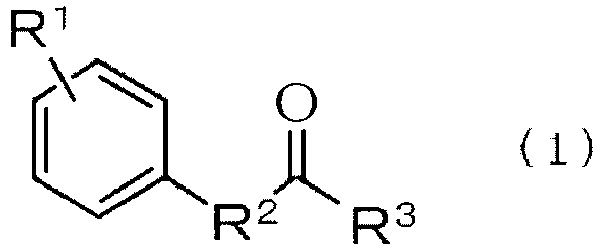
(In the formula (1), R1 represents a hydrogen atom, an alkyl group having a carbon number of 1 to 12, a hydroxy group, a methoxy group or an ethoxy group, R2 represents a single bond, an alkylene group having a carbon number of 1 to 2 which may have a substituent, or a vinylene group which may have a substituent, and R3 represents a residue resulting from removal of one hydrogen atom of a hydroxy group from a fragrance alcohol having a carbon number of 5 to 20 or a phenol which may have a substituent.) - [2] A method for releasing a fragrance alcohol, a phenol or a phenol derivative, including a step of reacting the fragrance precursor according to [1] with a hydrolase.
- [3] The method for releasing a fragrance alcohol, a phenol or a phenol derivative according to [2], in which the hydrolase is a lipase.
- [4] A method for releasing a fragrance alcohol, a phenol or a phenol derivative, including a step of reacting the fragrance precursor according to [1] with a microorganism.
- [5] The method for releasing a fragrance alcohol, a phenol or a phenol derivative according to [4], in which the microorganism is at least one species selected from the group consisting of Staphylococcus aureus, Staphylococcus epidermidis, Corynebacterium xerosis, Pseudomonas aeruginosa, Bacillus subtilis, Moraxella osloensis, Propionibacterium acnes, and Malassezia furfur.
- [6] At least one compound selected from the group consisting of the later-described compounds 001 to 118.
- [7] A fragrance composition containing the compound according to [6].
- [8] An aroma product, laundry care product, hair care product, cosmetic, cleaner or deodorant containing the compound according to [6] or the fragrance composition according to [7].
- According to the present invention, a fragrance precursor capable of continuously supplying an aroma with fresh feeling even after cleaning the clothing or hair by use of a cleaner or after passing a drying step following the cleaning can be provided.
- In addition, according to the present invention, a technique for enabling scent emission or deodorization to be achieved at the same timing as a time at which a microorganism sufficiently proliferates and generates a malodor can be provided.
- Furthermore, by incorporating the later-described compounds 001 to 118, a fragrance composition, an aromatic product, a laundry care product, a hair care product, a cosmetic, a cleaner or a deodorant, which can emit an aromatic component upon reacting with a hydrolase and make a lingering sent with fresh feeling to last on clothing, hair or skin or which can emit an aromatic component or deodorant component upon reacting with a microorganism and alleviate an unpleasant odor caused by a microorganism, can be provided.
- The present invention is described in detail below.
- Note that in the present invention, the "mass" has the same meaning as "weight".
- In the present invention, an alcohol, a phenol or a phenol derivative, which are an aromatic component, can be generated by reacting a fragrance precursor represented by general formula (1) or the later-described compounds 001 to 118 with a hydrolase or microorganism.
- The fragrance precursor of the present invention is represented by the following formula (1):

- In formula (1), R1 represents a hydrogen atom, an alkyl group having the carbon number of 1 to 12, a hydroxy group, a methoxy group or an ethoxy group.
- The alkyl group having the carbon number of 1 to 12 may be linear or branched and includes, for example, a methyl group, an ethyl group, a n-propyl group, an isopropyl group, a n-butyl group, an isobutyl group, a sec-butyl group, a tert-butyl group, a n-pentyl group, an isopentyl group, a neopentyl group, a hexyl group, a heptyl group, an octyl group, a nonyl group, a decyl group, an undecyl group, and a dodecyl group.
- Among these, in view of scent emission performance, R1 is preferably a hydrogen atom, a hydroxy group or a methoxy group, more preferably a hydrogen atom.
- In formula (1), R2 represents a single bond, an alkylene group having the carbon number of 1 to 2 which may have a substituent, or a vinylene group which may have a substituent.
- The alkylene group having the carbon number of 1 to 2 includes a methylene group and an ethylene group.
- The substituent that the alkylene group or vinylene group may have includes, for example, a halogen atom (e.g., fluorine atom, chlorine atom, bromine atom), a hydroxy group, an amino group, a mercapto group, an alkyl group having the carbon number of 1 to 8 (e.g., methyl group, ethyl group, n-propyl group, isopropyl group, tert-butyl group, n-octyl group, 2-ethylhexyl group, cyclohexyl group), an alkenyl group having the carbon number of 2 to 5 (e.g., vinyl group, allyl group, prenyl group, cyclopenten-1-yl group), an alkynyl group having the carbon number of 2 to 3 (e.g., ethynyl group, propargyl group), an aryl group having the carbon number of 6 to 10 (e.g., phenyl group, p-tolyl group, naphthyl group), a heterocyclic group (e.g., 1-pyrazolyl group, 1-imidazolyl group, 2-furyl group, 2-thienyl group, 4-pyrimidinyl group, 2-pyridyl group, 2-benzothiazolyl group), a nitro group, a cyano group, a carbamoyl group, a sulfamoyl group, an acyl group (e.g., formyl group, acetyl group, pivaloyl group, benzoyl group), an alkoxycarbonyl group (e.g., methoxycarbonyl group, ethoxycarbonyl group, tert-butoxycarbonyl group, isobutoxycarbonyl group, an aryloxycarbonyl group (e.g., phenoxycarbonyl group, naphthoxycarbonyl group), a heterocyclic oxycarbonyl group (e.g., 1-pyrazolyloxycarbonyl group, 1-imidazolyloxycarbonyl group, 2-furyloxycarbonyl group, 2-thienyloxycarbonyl group, 2-tetrahydrofuryloxycarbonyl group, 2-morpholyloxycarbonyl group), an imido group (e.g., N-succinimido group, N-phthalimido group), an alkylsulfinyl group (e.g., methylsulfinyl group, ethylsulfinyl group), an arylsulfinyl group (e.g., phenylsulfinyl group), an alkylsulfonyl group (e.g., methylsulfonyl group, ethylsulfonyl group, cyclohexylsulfonyl group), an arylsulfonyl group (e.g., phenylsulfonyl group), a heterocyclic sulfonyl group (e.g., 2-tetrahydropyranylsulfonyl group), a phosphino group (e.g., dimethylphosphino group, diphenylphosphino group), and a phosphinyl group (e.g., phosphinyl group, diethoxyphosphinyl group).
- Among these, in view of scent emission performance, R2 is preferably a single bond.
- In formula (1), R3 represents a residue resulting from removal of one hydrogen atom of a hydroxy group from a fragrance alcohol having the carbon number of 5 to 20 or a phenol which may have a substituent.
- The fragrance alcohol is described here. In the present description, the fragrance alcohol means a hydroxy group-containing scented compound that is used as a fragrance.
- Preferable examples of the fragrance alcohol having the carbon number of 5 to 20 include, specifically, an aliphatic alcohol [for example, isoamyl alcohol, isopulegol, 2-ethylhexanol, 1-octanol, 3-octanol, 1-octen-3-ol, 1-decanol, 1-dodecanol, 2,6-nonadienol, nonanol, 2-nonanol, cis-6-nonenol, trans-2, cis-6-nonadienol, cis-3, cis-6-nonadienol, butanol, hexanol, cis-2-hexenol, cis-3-hexenol, cis-4-hexenol, trans-2-hexenol, trans-3-hexenol, 1-undecanol, heptanol, 2-heptanol, 3-methyl-1-pentanol, 2,6-dimethylheptanol, p-tert-butylcyclohexanol, o-tert-butylcyclohexanol, p-isopropylcyclohexylmethanol, ambrinol, 1-(2,2,6-trimethylcyclohexyl)-3-hexanol, 9-decenol, 4-methyl-3-decen-5-ol, methyltrimethylcyclopentenylbutenol, ethyltrimethylcyclopentenylbutenol, 3-methyl-5-(2,2,3-trimethylcyclopent-3-en-1-yl)-pentan-2-ol, 3,3-dimethyl-5-(2,2,3-trimethyl-3-cyclopenten-1-yl)-4-pentan-2-ol, 3-methyl-5-(2,2,3-trimethyl-3-cyclopenten-1-yl)-penten-2-ol, p-isopropylcyclohexanol, 2,4-dimethyl-3-cyclohexene-1-methanol, 1-(2-tert-butylcyclohexyl)-2-butanol, {1-methyl-2-[(1,2,2-trimethylbicyclo[3.1.0]hex-3-yl)methyl]cyclopropyl} methanol, 1-(4-isopropyl-cyclohexyl)ethanol, 2-{(1,7,7-trimethylbicyclo[2.2.1]-2-heptyl)oxyl-1-ethanol, 4-cyclohexyl-2-methylbutan-2-ol, (1R,2S)-2-pentylcyclopentan-1-ol, etc.], a terpene alcohol [for example, carveol, borneol, isoborneol, piperitol, geraniol, tetrahydrogeraniol, α- or β-fenchyl alcohol, 2-methylfenchyl alcohol, α- or β-santalol, citronellol, 4-thujanol, terpineol, 4-terpineol, dihydroterpineol, nerol, myrcenol, myrtenol, mugol, tetrahydromugol, menthol, dihydromyrcenol, tetrahydromyrcenol, lavandulol, nopol, nerolidol, hydroxycitronerol, farnesol, perilla alcohol, rhodinol, linalool, dihydrolinalool, tetrahydrolinalool, ethyllinalool, isopulegol, dihydrofarnesol, isocamphylcyclohexanol, vetiverol, cedrol, patchouli alcohol, etc.], an aromatic alcohol [for example, anise alcohol, α-amylcinnamic alcohol, 3-methyl-5-phenylpentanol-1, isopropylbenzylcarbinol, carvacrol, cuminic alcohol, dimethylbenzylcarbinol, dimethylphenylethylcarbinol, cinnamic alcohol, phenylallyl alcohol, phenylethylcarbinol, phenylethyl alcohol, 3-phenylpropyl alcohol, benzyl alcohol, 2-methyl-4-phenylpentanol, 2,2-dimethyl-3-(3-methylphenyl)propanol, 3-methyl-5-phenylpentanol-1,2-methyl-5-phenylpentan-1-ol, 4-methyl-2(2-methylpropyl)tetrahydro-2H-4-pyranol, etc.], eugenol, isoeugenol, dihydroeugenol, 2-methoxy-4-vinylphenol, thymol, hinokithiol, guaiacol, chavicol, salicylaldehyde, hydroxycitronellal, hydroxycitronellal dimethyl acetal, hydroxycitronellal diethyl acetal, vanillin propylene glycol acetal, ethylvanillin, vanillin, vanitrope, 4-methyl-2-ethoxyphenol, methyl lavender ketone, furaneol, raspberry ketone, maltol, ethylmaltol, zingerone, methyl salicylate, ethyl salicylate, butyl salicylate, isobutyl salicylate, amyl salicylate, isoamyl salicylate, prenyl salicylate, hexyl salicylate, cis-3-hexenyl salicylate, cyclohexyl salicylate, benzyl salicylate, phenylethyl salicylate, isopropoxyethyl salicylate, ethyl lactate, and methyl atrarate.
- The phenol which may have a substituent includes, for example, the following compounds.


- Among these, in view of aroma, R3 is preferably a residue resulting from removal of one hydrogen atom of a hydroxy group from a fragrance alcohol having the carbon number of 6 to 15.
- Specific examples of the compound represented by general formula (1) of the present invention include the later-described compounds 001 to 118 and the following compound.

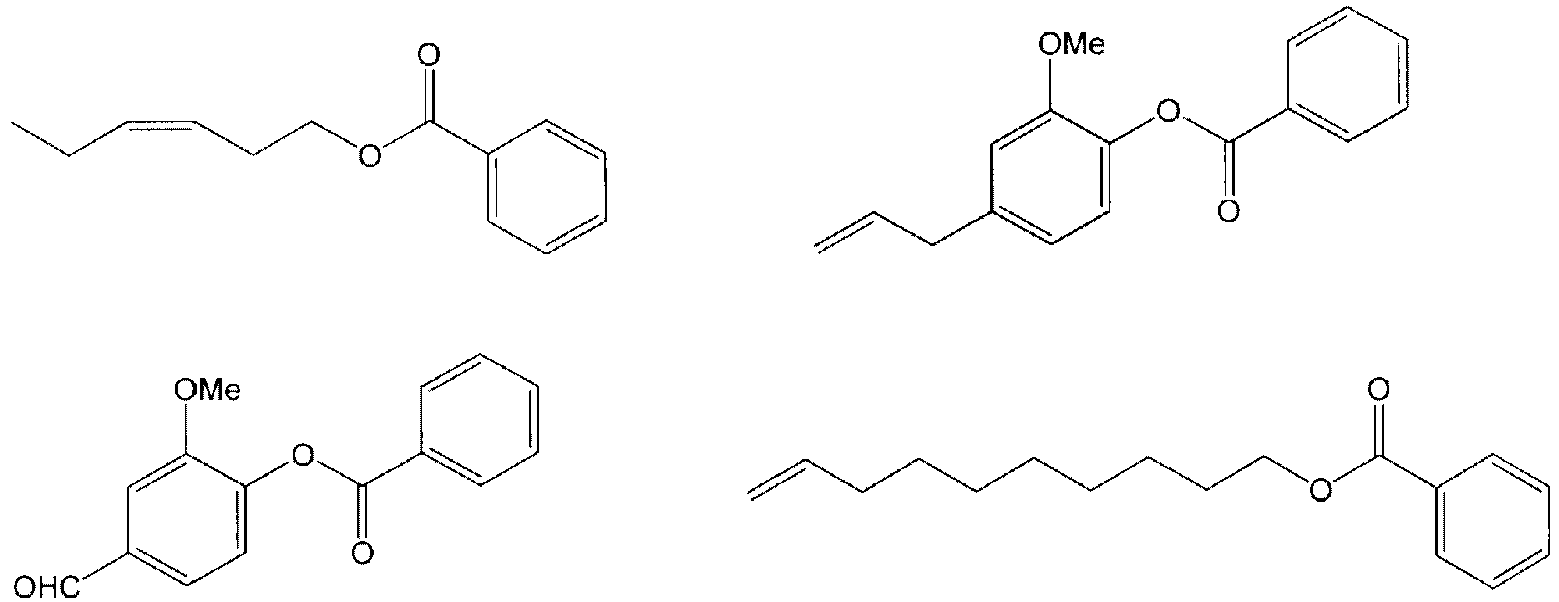
- In addition, specific examples of the compound represented by general formula (1) of the present invention include the following compounds synthesized in Examples later. In the following compounds, nPr stands for a normal-propyl group and Me stands for a methyl group.


- Furthermore, specific examples of the compound represented by general formula (1) of the present invention include geranyl benzoate, geranyl phenylacetate, geranyl salicylate, phenylethyl benzoate, phenylethyl phenylacetate, phenylethyl salicylate, phenylethyl cinnamate, citronellyl benzoate, citronellyl phenylacetate, citronellyl salicylate, linalyl benzoate, linalyl cinnamate, linalyl phenylacetate, linalyl salicylate, cinnamyl benzoate, cinnamyl cinnamate, eugenyl benzoate, eugenyl phenylacetate, eugenyl salicylate, isoeugenyl benzoate, isoeugenyl phenylacetate, isoeugenyl salicylate, menthyl benzoate, menthyl phenylacetate, menthyl salicylate, rhodinyl benzoate, rhodinyl phenylacetate, neryl benzoate, neryl phenylacetate, neryl salicylate, terpinyl benzoate, anisyl benzoate, anisyl phenylacetate, anisyl salicylate, cis-3-hexenyl benzoate, cis-3-hexenyl phenylacetate, cis-3-hexenyl salicylate, vanillyl benzoate, vanillyl phenylacetate, and 9-decenyl benzoate.
- The compound represented by general formula (1) of the present invention can be easily synthesized by a known method. The compound represented by general formula (1) can be synthesized, for example, in accordance with the method described in J. Org. Chem. 51.1006 (1986) or J. Org. Chem. 46.5252 (1981).
- Out of the compounds represented by general formula (1) of the present invention, a synthesis method of 1-((1R,6S)-2,2,6-trimethylcyclohexyl)-3-hexanyl benzoate represented by the following formula (1a) is shown in the scheme below.


- As for the synthesis of the compound represented by formula (1a), the compound can be prepared by lithiating a hydroxyl group of Ambestol (compound represented by formula (2)) with butyllithium in a tetrahydrofuran solvent, followed by a reaction with benzoyl chloride. The acylating agent used is preferably benzoyl chloride or benzoic anhydride, etc. The compound represented by formula (1a) obtained as above can be isolated and purified, for example, by an operation usually employed, such as extraction, distillation, recrystallization and various chromatographies.
- A fragrance alcohol, a phenol or a phenol derivative, which are an aromatic component, can be released by reacting the compound represented by general formula (1) with a hydrolase or microorganism.
- The method for reacting the compound represented by general formula (1) with a hydrolase includes, for example, a method of mixing the compound represented by general formula (1) with a hydrolase-containing aqueous solution.
- The content of the hydrolase in the hydrolase-containing aqueous solution is usually from 0.001 to 50 mass%, preferably from 0.01 to 10 mass%.
- The mass of the compound represented by general formula (1) used at the time of mixing is usually from 0.001 to 10,000 mg, preferably from 0.01 to 1,000 mg, per 1 g of the hydrolase-containing aqueous solution.
- When the compound represented by general formula (1) reacts with a hydrolase, an ester bond in the compound represented by general formula (1) is hydrolyzed, and a fragrance alcohol, a phenol or a phenol derivative is released.
- The hydrolase includes lipase, protease, amylase, glycosidase, esterase, etc., and among these, in view of the hydrolysis rate, lipase is preferred.
- The lipase is not limited to a particular one and, as long as it is an enzyme that breaks down fat, may be a naturally occurring material or a formulated commercial product.
- The method for reacting the compound represented by general formula (1) with a microorganism includes, for example, a method of mixing the compound represented by general formula (1) with a microbial culture.
- The method for culturing a microorganism is not particularly limited, and a known method may be used.
- The amount of bacteria in the microbial culture is usually from 103 to 1012 cfu/mL, preferably from 106 to 1010 cfu/mL.
- In addition, the mass of the compound represented by general formula (1) used at the time of mixing is usually from 0.01 to 10 mg, preferably from 0.1 to 5 mg, per 1 mL of the microbial culture.
- It is considered that when the compound represented by general formula (1) reacts with a microorganism, the compound is ingested inside the microorganism and metabolized, or an ester bond in the compound is hydrolyzed by the action of an enzyme group secreted outside the microorganism, as a result, a fragrance alcohol, a phenol or a phenol derivative is released.
- The microorganism includes Staphylococcus bacteria, Corynebacterium bacteria, Propionibacterium bacteria, Pseudomonas bacteria, Bacillus bacteria, Moraxella bacteria, Malassezia fungi, etc.
- More specifically, the microorganism includes Staphylococcus aureus, Staphylococcus epidermidis, Corynebacterium xerosis, Propionibacterium acnes, Pseudomonas aeruginosa, Bacillus subtilis, Moraxella osloensis, Malassezia furfur, etc.
- The compound of the present invention is at least one novel compound selected from the group consisting of compounds 001 to 118 shown in Tables 1 to 12 below (hereinafter, sometimes simply referred to as "compound of the present invention").
-
Table 1 Compound 001 
(E)-hex-2-en-1-yl (E)-3-(4-methoxyphenyl)acrylate Compound 002 
(E)-hex-2-en-1-yl 4-hydroxybenzoate Compound 003 
(E)-hex-3-en-1-yl (E)-3-(4-methoxyphenyl)acrylate Compound 004 
(E)-hex-3-en-1-yl 4-hydroxybenzoate Compound 005 
(E)-hex-4-en-1-yl 2-hydroxybenzoate Compound 006 
(E)-hex-4-en-1-yl 2-phenylacetate Compound 007 
(E)-hex-4-en-1-yl cinnamate Compound 008 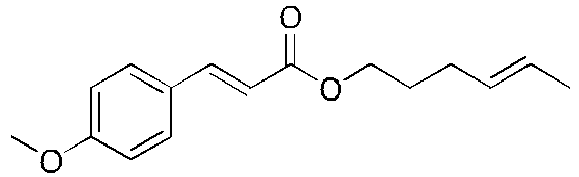
(E)-hex-4-en-1-yl (E)-3-(4-methoxyphenyl)acrylate Compound 009 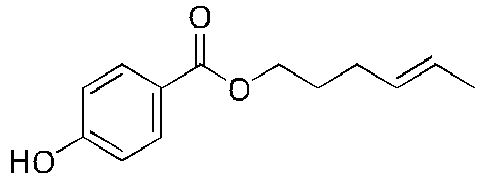
(E)-hex-4-en-1-yl 4-hydroxybenzoate Compound 010 
3,7-dimethylocta-1,6-dien-3-yl (E)-3-(4-methoxyphenyl)acrylate Compound 011 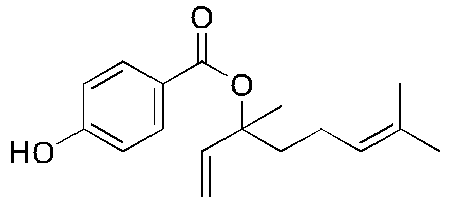
3,7-dimethylocta-1,6-dien-3-yl 4-hydroxybenzoate -
Table 2 Compound 012 
3,7-dimethyloct-6-en-1-yl (E)-3-(4-meth oxyphenyl)acrylate Compound 013 
4-allyl-2-methoxyphenyl 4-hydroxybenzoate Compound 014 
(E)-2-methoxy-4-(prop-1-en-1-yl)phenyl 2-hydroxybenzoate Compound 015 
(E)-2-methoxy-4-(prop-1-en-1-yl)phenyl 4-methoxybenzoate Compound 016 
2-methoxy-4-((E)-prop-1-en-1-yl)phenyl (E)-3-(4-methoxyphenyl)acrylate Compound 017 
(E)-2-methoxy-4-(prop-1-en-1-yl)phenyl 4-hydroxybenzoate Compound 018 
2,6-dimethyloct-7-en-2-yl benzoate Compound 019 
2,6-dimethyloct-7-en-2-yl 2-hydroxybenzoate Compound 020 
2,6-dimethyloct-7-en-2-yl 2-phenylacetate -
Table 3 Compound 021 
2,6-dimethyloct-7-en-2-yl cinnamate Compound 022 
2,6-dimethyloct-7-en-2-yl 4-methoxybenzoate Compound 023 
2,6-dimethyloct-7-en-2-yl (E)-3-(4-methoxyphenyl)acrylate Compound 024 
2,6-dimethyloct-7-en-2-yl 4-hydroxybenzoate Compound 025 
3,7-dimethyloctan-3-yl benzoate Compound 026 
3,7-dimethyloctan-3-yl 2-hydroxybenzoate Compound 027 
3,7-dimethyloctan-3-yl 2-phenylacetate Compound 028 
3,7-dimethyloctan-3-yl cinnamate Compound 029 
3,7-dimethyloctan-3-yl 4-methoxybenzoate Compound 030 
3,7-dimethyloctan-3-yl (E)-3-(4-meth oxyph enyl)acrylate Compound 031 
3,7-dimethyloctan-3-yl 4-hydroxybenzoate -
Table 4 Compound 032 
(Z)-3,7-dimethylnona-1,6-dien-3-yl benzoate Compound 033 
(Z)-3,7-dimethylnona-1,6-dien-3-yl 2-hydroxybenzoate Compound 034 
(Z)-3,7-dimethylnona-1,6-dien-3-yl2-phenylacetate Compound 035 
(Z)-3,7-dimethylnona-1,6-dien-3-yl cinnamate Compound 036 
(Z)-3,7-dimethylnona-1,6-dien-3-yl 4-methoxybenzoate Compound 037 
(Z)-3,7-dimethylnona-1,6-dien-3-yl (E)-3-(4-methoxyphenyl)acrylate Compound 038 
(Z)-3,7-dimethylnona-1,6-dien-3-yl 4-hydroxybenzoate Compound 039 
2-(4-methylcyclohex-3-en-1-yl)propan-2-yl 4-methoxybenzoate Compound 040 
2-(4-methylcyclohex-3-en-1-yl)propan-2-yl (E)-3-(4-methoxyphenyl)acrylate Compound 041 
1-methyl-4-(prop-1-en-2-yl)cyclohexyl 2-hydroxybenzoate Compound 042 
1-methyl-4-(prop-1-en-2-yl)cyclohexyl 2-phenylacetate -
Table 5 Compound 043 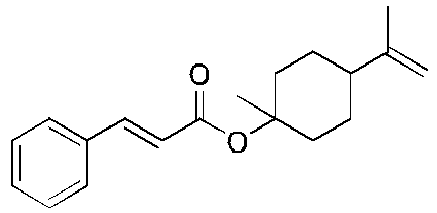
1-methyl-4-(prop-1-en-2-yl)cyclohexyl cinnamate Compound 044 
1-methyl-4-(prop-1-en-2-yl)cyclohexyl 4-methoxybenzoate Compound 045 
1 -methyl-4-(prop-1-en-2-yl)cyclohexyl (E)-3-(4-methoxyphenyl)acrylate Compound 046 
1-methyl-4-(prop-1-en-2-yl)cyclohexyl 4-hydroxybenzoate Compound 047 
1-methyl-4-(propan-2-ylidene)cyclohexyl 2-hydroxybenzoate Compound 048 
1-methyl-4-(propan-2-ylidene)cyclohexyl 2-phenylacetate Compound 049 
1-methyl-4-(propan-2-ylidene)cyclohexyl cinnamate Compound 050 
1-methyl-4-(propan-2-ylidene)cyclohexyl 4-methoxybenzoate Compound 051 
1-methyl-4-(propan-2-ylidene)cyclohexyl (E)-3-(4-methoxyphenyl)acrylate Compound 052 
1-methyl-4-(propan-2-ylidene)cyclohexyl 4-hydroxybenzoate Compound 053 
1-isopropyl-4-methylcyclohex-3-en-1-yl 2-hydroxybenzoate -
Table 6 Compound 054 
1-isopropyl-4-methylcyclohex-3-en-1-yl 2-phenylacetate Compound 055 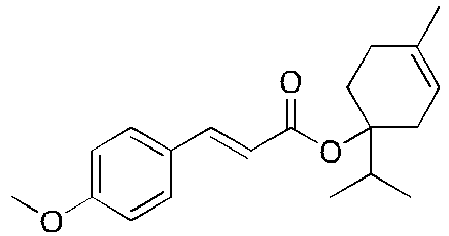
1-isopropyl-4-methylcyclohex-3-en-1-yl (E)-3-(4-methoxyphenyl)acrylate Compound 056 
1-isopropyl-4-methylcyclohex-3-en-1-yl 4-hydroxybenzoate Compound 057 
2,6-dimethylheptan-2-yl benzoate Compound 058 
2,6-dimethylheptan-2-yl 2-hydroxybenzoate Compound 059 
2,6-dimethylheptan-2-yl 2-phenylacetate Compound 060 
2,6-dimethylheptan-2-yl cinnamate Compound 061 
2,6-dimethylheptan-2-yl 4-methoxybenzoate Compound 062 
2,6-dimethylheptan-2-yl (E)-3-(4-meth oxyph enyl)acrylate Compound 063 
2,6-dimethylheptan-2-yl 4-hydroxybenzoate Compound 064 
2,6-dimethyl-8-oxooctan-2-yl benzoate -
Table 7 Compound 065 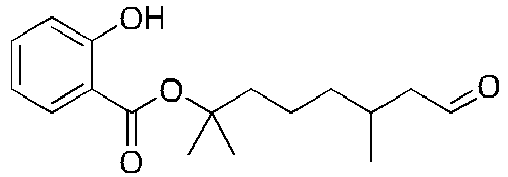
2,6-dimethyl-8-oxooctan-2-yl 2-hydroxybenzoate Compound 066 
2,6-dimethyl-8-oxooctan-2-yl 2-phe nylac etate Compound 067 
2,6-dimethyl-8-oxooctan-2-yl cinnamate Compound 068 
2,6-dimethyl-8-oxooctan-2-yl 4-methoxybe n zoate Compound 069 
2,6-dimethyl-8-oxooctan-2-yl (E)-3-(4-methoxyph enyl)acrylate Compound 070 
2,6-dimethyl-8-oxooctan-2-yl 4-hydroxybenzoate Compound 071 
4-(tert-butyl)cyclohexyl cinnamate Compound 072 
4-methoxyphenyl (E)-3-(4-methoxyphenyl)acrylate Compound 073 
2-methyl-1-phenylpropan-2-yl 2-hydroxybenzoate Compound 074 
2-methyl-1-phenylpropan-2-yl cinnamate Compound 075 
2-methyl-1-phenylpropan-2-yl 4-methoxybenzoate -
Table 8 Compound 076 
2-methyl-1-phenylpropan-2-yl (E)-3-(4-methoxyphenyl)acrylate Compound 077 
2-methyl-1-phenylpropan-2-yl 4-hydroxybenzoate Compound 078 
3-methyl-5-phenylpentyl 2-hydroxybenzoate Compound 079 
3-methyl-5-phenylpentyl 2-phenylacetate Compound 080 
3-methyl-5-phenylpentyl cinnamate Compound 081 
3-methyl-5-phenylpentyl 4-methoxybenzoate Compound 082 
3-methyl-5-phenylpentyl (E)-3-(4-methoxyphenyl)acrylate Compound 083 
3-methyl-5-phenylpentyl 4-hydroxybenzoate Compound 084 
4-formyl-2-methoxyphenyl 2-hydroxybenzoate Compound 085 
2-ethoxy-4-formylphenyl 2-hydroxybenzoate -
Table 9 Compound 086 
2-ethoxy-4-formylphenyl (E)-3-(4-methoxyphenyl)acrylate Compound 087 
2-ethoxy-4-formylphenyl 4-hydroxybenzoate Compound 088 
4-(3-oxobutyl)phenyl 2-hydroxybenzoate Compound 089 
4-(3-oxobutyl)phenyl 2-phenylacetate Compound 090 
4-(3-oxobutyl)phenyl cinnamate Compound 091 
4-(3-oxobutyl)phenyl 4-methoxybenzoate Compound 092 
4-(3-oxobutyl)phenyl (E)-3-(4-methoxyphenyl)acrylate Compound 093 
4-(3-oxobutyl)phenyl 4-hydroxybenzoate Compound 094 
1,3,3-trimethylbicyclo[2.2.1]heptan-2-yl 2-hydroxybenzoate -
Table 10 Compound 095 
1,3,3-trimethylbicyclo[2.2.1]heptan-2-yl 2-phenylacetate Compound 096 
1,3,3-trimethylbicyclo[2.2.1]heptan-2-yl cinnamate Compound 097 
1,3,3-trimethylbicyclo[2.2.1]heptan-2-yl 4-methoxybenzoate Compound 098 
1,3,3-trimethylbicyclo[2.2.1]heptan-2-yl (E)-3-(4-meth oxyphenyl)acrylate Compound 099 
1,3,3-trimethylbicyclo[2.2.1]heptan-2-yl 4-hydroxybenzoate Compound 100 
1-((1 R,6S)-2,2,6-trimethylcyclohexyl)hexan-3-yl benzoate Compound 101 
1-((1 R,6S)-2,2,6-trimethylcyclohexyl)hexan-3-yl 2-hydroxybenzoate Compound 102 
1-((1 R,6S)-2,2,6-trimethylcyclohexyl)hexan-3-yl 2-phenylacetate Compound 103 
1-((1 R,6S)-2,2,6-trimethylcyclohexyl)hexan-3-yl cinnamate Compound 104 
1-((1 R,6S)-2,2,6-trimethylcyclohexyl)hexan-3-yl 4-methoxybenzoate -
Table 11 Compound 105 
1-((1R,6S)-2,2,6-trimethylcyclohexyl)hexan-3-yl (E)-3-(4-methoxyphenyl)acrylate Compound 106 
1-((1 R,6S)-2,2,6-trimethylcyclohexyl)hexan-3-yl 4-hydroxybenzoate Compound 107 
dec-9-en-1-yl 2-hydroxybenzoate Compound 108 
dec-9-en-1-yl 2-phenylacetate Compound 109 
dec-9-en-1-yl cinnamate Compound 110 
dec-9-en-1-yl 4-methoxybenzoate Compound 111 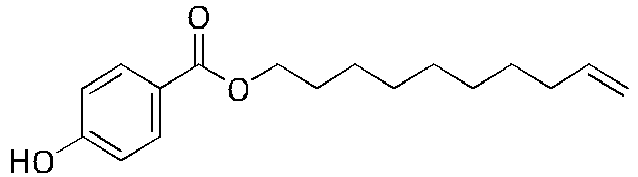
dec-9-en-1-yl 4-hydroxybenzoate Compound 112 
(E)-3,7,11-trimethyldodeca-6,10-dien-1-yl benzoate Compound 113 
(E)-3,7,11-trimethyldodeca-6,10-dien-1-yl 2-hydroxybenzoate Compound 114 
(E)-3,7,11-trimethyldodeca-6,10-dien-1-yl 2-phenylacetate -
Table 12 Compound 115 
(E)-3,7,11-trimethyldodeca-6,10-dien-1-ylcinnamate Compound 116 
(E)-3,7,11-trimethyldodeca-6,10-dien-1-yl4-methoxybenzoate Compound 117 
(E)-3,7,11-trimethyldodeca-6,10-dien-1-yl(E)-3-(4-methoxyphenyl)acrylate Compound 118 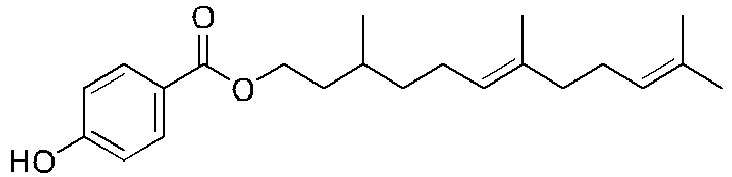
(E)-3,7,11-trimethyldodeca-6,10-dien-1-yl4-hydroxybenzoate - The fragrance composition of the present invention contains the compound of the present invention. The compound of the present invention may be used individually or in combination of two or more kinds and may also be used in appropriate combination with known fragrance components.
- Known fragrance components include, for example, natural essential oils such as lemon oil, orange oil, lime oil, bergamot oil, lavandin oil, lavender oil, geranium oil, rose oil and sandalwood oil, hydrocarbons such as α-pinene, β-pinene, limonene, p-cymene and thujone, aliphatic alcohols such as octanol and p-tert-butylcyclohexanol, terpene-based alcohols such as menthol, citronellol and geraniol, aromatic alcohols such as benzyl alcohol and phenylethyl alcohol, aliphatic aldehydes, terpene-based aldehydes, aromatic aldehydes, acetals, chain ketones, cyclic ketones such as damascone, β-ionone and Methylionone, terpene-based ketones such as carvone, menthone, isomenthone and camphor, aromatic ketones such as acetophenone and raspberry ketone, ethers such as dibenzyl ether, oxides such as linalool oxide and rose oxide, musks such as cyclopentadecanolide and cyclohexadecanolide, lactones such as γ-nonalactone, γ-undecalactone and coumarin, aliphatic esters such as acetic acid ester and propionic acid ester, and aromatic esters such as benzoic acid ester and phenylacetic acid ester.
- The fragrance composition of the present invention may contain a solvent, for example, ethanol, isopropyl alcohol, ethylene glycol, propylene glycol, dipropylene glycol, butylene glycol, pentylene glycol, hexylene glycol, polyethylene glycol, diethyl phthalate, isopropyl myristate, triethyl citrate, benzyl benzoate, glycerin, triacetin, benzyl alcohol, paraffin, isoparaffin, a rosin ester derivative such as Hercolyn, glycol ethers such as 3-methoxy-3-methyl-1-butanol, ethyl carbitol (diethylene glycol monoethyl ether), ethylene glycol monomethyl ether, propylene glycol monomethyl ether, ethylene glycol monoethyl ether, dipropylene glycol monomethyl ether, tripropylene glycol methyl ether, dipropylene glycol dimethyl ether, dipropylene glycol propyl ether, dipropylene glycol methyl ether acetate and dipropylene glycol butyl ether, a terpene resin such as pinene polymer, silicones such as cyclic silicone, and water, or a fixative.
- Furthermore, the fragrance composition of the present invention may further contain, if desired, known components such as higher alcohol, surfactant, antioxidant, ultraviolet absorber, chelating agent, solubilizing agent, stabilizing agent, cooling sensation agent, preservative, antimicrobial, bactericide, fungicide, insecticidal component and coloring matter.
- The production method of the fragrance composition of the present invention is not limited to particular one, but the fragrance composition of the present invention is obtained, for example, by mixing the above-described components in a usual manner.
- The blending amount of the compound of the present invention in the fragrance composition of the present invention is not strictly limited and can be variously changed according to use of the fragrance composition but is preferably from 0.1 to 95.0 mass%, more preferably from 0.5 to 80.0 mass%.
- The compound of the present invention or the fragrance composition of the present invention can be used, individually or in combination of two or more kinds, for a product such as aroma product, laundry care product, hair care product, cosmetic or cleaner.
- Furthermore, in the product such as aroma product, laundry care product, hair care product, cosmetic or cleaner, for the purpose of letting the scent emitted from the product itself, the scent during use of the product, and the lingering scent from clothing, hair or skin be more favorable, in addition to the compound of the present invention or the fragrance composition of the present invention, there may be appropriately blended in combination a compounded fragrance; a powder fragrance or scent capsule of a known core-shell type, a matrix type using starch or processed starch, etc.; a scent-impregnated material prepared by impregnating an inorganic porous material such as silica gel or calcium silicate or an organic porous material such as celluloses, with a fragrance; a scent inclusion complex prepared by including a fragrance in α-cyclodextrin, β-cyclodextrin, γ-cyclodextrin, hydroxypropylated β-cyclodextrin, highly branched cyclic dextrin, etc.; a known fragrance precursor such as silicic acid ester compound, fatty acid ester compound, acetal compound, hemiacetal compound, Schiff base compound, hemiaminal compound or hydrazone compound, each of which can release a fragrance component; a pro-fragrance; a scent precursor; a pro-perfume, etc.
- The aroma product includes, for example, a perfume, eau de cologne, a liquid air freshener, a gel air freshener, a powder air freshener, an impregnated air freshener, a mist air freshener, an aerosol air freshener, a thermal evaporation air freshener, an incense stick, a candle, etc.
- The laundry care product include, for example, a mist for clothing, a spray for clothing, a laundry detergent, a fabric softener, etc.
- The hair care product includes, for example, a hair shampoo, a hair rinse, a hair conditioner, a hair treatment, a hair tonic, a hair styling agent, a hair dye, a permanent waving agent, a hair growth agent, a hair cologne, etc.
- The cosmetic includes, for example, a lotion, a milky lotion, a cosmetic cream, a soap, a liquid soap, a facial cleanser, a sunscreen, an antiperspirant, a bath additive, a lipstick, a foundation, etc.
- The cleaner includes, for example, a toilet cleaner, a toilet bowl cleaner, a glass cleaner, a kitchen detergent, a washing machine cleaner, a drain cleaner, a bathroom cleaner, etc.
- The compound of the present invention releases a fragrance component by the action of a hydrolase and therefore, is particularly useful when a product having blended therein the compound of the present invention is used in combination with a product having blended therein a hydrolase.
- The method for using the products in combination is not limited to particular one but includes a method of using a mutual combination of laundry care products, hair care products, or cosmetics.
- The mutual combination of laundry care products includes, for example, (A) a method in which a laundry detergent having blended therein a lipase is used in combination with a mist for clothing, a spray for clothing, a fabric softener, etc. having blended therein the compound of the present invention, and (B) a method in which a laundry detergent having blended therein the compound of the present invention is used in combination with a mist for clothing, a spray for clothing, a fabric softener, etc. having blended therein a lipase.
- The mutual combination of hair care products includes, for example, (A) a method in which a shampoo having blended therein a lipase is used in combination with a hair rinse, a hair conditioner, a hair treatment, a hair styling agent, a hair growth agent, a hair cologne, etc. having blended therein the compound of the present invention, and (B) a method in which a shampoo having blended therein the compound of the present invention is used in combination with a hair rinse, a hair conditioner, a hair treatment, a hair styling agent, a hair growth agent, a hair cologne, etc., having blended therein a lipase.
- The blending amount of the compound of the present invention in each product is not strictly limited and can be variously changed according to use thereof but is preferably from 0.0001 to 10 mass%, more preferably from 0.001 to 5 mass%.
- The compound of the present invention or the fragrance composition of the present invention can be used, individually or in combination of two or more kinds, for a deodorant.
- The deodorant of the present invention can be used after making a formulating by optionally blending one kind or two or more kinds of known components selected from a cleaner, an antimicrobial, a fungicide, a deodorant, a natural essential oil, a fragrance, an aroma material, a cooling sensation agent, a warming sensation agent, a rust inhibitor, an antifoaming agent, a pH adjusting agent, water, a solvent, a propellant, a surfactant, an insecticide, a repellent, an insect repellent, a water repellent, a degrading enzyme, an antistatic agent, a coloring matter, an ultraviolet absorber, a preservative, a chelating agent, an antioxidant, a thickener, a gellant, a water-absorbing resin, activated carbon, silica, a porous material, a resin, paper, felt, a higher alcohol, an inorganic salt, etc.
- Examples thereof include a cleaner such as alkylamine oxide, alkylamine, alkyl polyglycoside, naphthalenesulfonic acid-formalin condensate, hydrolyzed collagen peptide salt, acylmethyltaurine salt, N-acylamino acid salt, alkyl sulfate, ether carboxylate, ether sulfonate, alkyltrimethylammonium chloride, dialkyltrimethylammonium chloride, alkylamine salt, alkylamidopropyl amino oxide, alkyl betaine, acetic acid betaine, fatty acid soap, etc.; an antimicrobial such as 4-chloro-3,5-xylenol, isopropylmethylphenol, thymol, hinokitiol, phenol-based compound, polyphenol, catechin, tannin, natural products containing these, natural product containing their derivatives, etc., 2-(4'-thiazolyl)-benzimidazole, benzalkonium chloride, benzethonium chloride, cetylpyridinium chloride, triclosan, silver ion, stabilized chlorine dioxide, etc.; a fungicide; a deodorant such as lauryl methacrylate, geranyl crotonate, myristic acid acetophenone, glyoxal, abietic acid, flavonoid, polyphenol, plant extract, amphoteric surfactant, zinc ricinoleate, etc.; a natural essential oil such as lemon oil, orange oil, lime oil, bergamot oil, lavandin oil, lavender oil, geranium oil, rose oil, sandalwood oil, etc.; hydrocarbons such as α-pinene, β-pinene, limonene, p-cymene, thujone, etc.; aliphatic alcohols such as octanol, p-tert-butylcyclohexanol, etc.; terpene-based alcohols such as menthol, citronellol, geraniol, etc.; aromatic alcohols such as benzyl alcohol, phenylethyl alcohol, etc.; a fragrance, for example, aliphatic aldehydes, terpene-based aldehydes, aromatic aldehydes, acetals, chain ketones, cyclic ketones such as damascone, β-ionone, methylionone, etc., terpene-based ketones such as carvone, menthone, isomenthone, camphor, etc., aromatic ketones such as acetophenone, raspberry ketone, etc., ethers such as dibenzyl ether, etc., oxides such as linalool oxide, rose oxide, etc., musks such as cyclopentadecanolide, cyclohexadecanolide, etc., lactones such as γ-nonalactone, γ-undecalactone, coumarin, etc., aliphatic esters such as acetic acid ester, propionic acid ester, etc., and aromatic esters such as benzoic acid ester, phenylacetic acid ester, etc.; a compounded fragrance prepared from the above-described natural essential oil and fragrance; a powder fragrance or scent capsule of a known core-shell type, a matrix type using starch or processed starch, etc.; a scent-impregnated material prepared by impregnating an inorganic porous material such as silica gel, calcium silicate, etc., or an organic porous material such as celluloses, etc., with a fragrance; a scent inclusion complex prepared by including a fragrance in α-cyclodextrin, β-cyclodextrin, γ-cyclodextrin, hydroxypropylated β-cyclodextrin, highly branched cyclic dextrin, etc.; an aroma material, for example, a known fragrance precursor, pro-fragrance, scent precursor, pro-perfume, etc., such as silicic acid ester compound, fatty acid ester compound, acetal compound, hemiacetal compound, Schiff base compound, hemiaminal compound, hydrazone compound, etc., which can release a fragrance component; a rust inhibitor such as trisodium citrate, ammonium citrate, sodium nitrite, ammonium benzoate, ammonium nitrite, etc.; an antifoaming agent such as silicone, etc.; a pH adjusting agent such as citric acid, sodium monohydrogenphosphate, sodium dihydrogenphosphate, potassium monohydrogenphosphate, potassium dihydrogenphosphate, etc.; a solvent, for example, water, ethyl alcohol, propyl alcohol, isopropyl alcohol, butyl alcohol, modified alcohol, ethylene glycol, propylene glycol, dipropylene glycol, butylene glycol, pentylene glycol, hexylene glycol, polyethylene glycol, diethyl phthalate, isopropyl myristate, triethyl citrate, benzyl benzoate, glycerin, triacetin, benzyl alcohol, paraffin, isoparaffin, a rosin ester derivative such as Hercolyn, etc., glycol ethers such as 3-methoxy-3-methyl-1-butanol, ethyl carbitol (diethylene glycol monoethyl ether), ethylene glycol monomethyl ether, propylene glycol monomethyl ether, ethylene glycol monoethyl ether, dipropylene glycol monomethyl ether, tripropylene glycol methyl ether, dipropylene glycol dimethyl ether, dipropylene glycol propyl ether, dipropylene glycol methyl ether acetate, dipropylene glycol butyl ether, etc., a terpene resin such as pinene polymer, etc., and silicones such as cyclic silicone, etc.; a propellant, for example, a liquefied petroleum gas such as propane, n-butane, isobutane, etc., a liquefied gas such as dimethyl ether, fluorocarbon (e.g., CFC (Chloro Fluoro Carbon), HCFC (Hydro Chloro Fluoro Carbon), HFC (Hydro Fluoro Carbon)), etc., and a compressed gas such as nitrogen, carbon dioxide, compressed air, nitrous oxide, etc.; and a surfactant such as polyoxyethylene alkyl ether, polyoxyethylene-polyoxypropylene copolymer, polyoxyethylene hydrogenated castor oil, sorbitan fatty acid ester, etc.
- The formulated deodorant of the present invention includes, for example, a deodorizing mist, a deodorizing spray, a liquid deodorant, a gel deodorant, a solid deodorant, a cream deodorant, a sheet-shaped deodorant, a granular deodorant, a beads deodorant, a powder deodorant, a smoke deodorant, a deodorant for toilet odor, a deodorant for urine odor, a deodorant for body odor, a deodorant for sweat odor, a deodorant for foot odor, a deodorant for scalp odor, a deodorant for aging odor, a deodorant for nursing care, a deodorant for raw garbage odor, a fabric deodorizer, a deodorant for damp-dry odor, a deodorant for laundry care, a deodorant for shoe cupboards, a shoe deodorizer, an entrance deodorizer, a room deodorizer, a bedroom deodorizer, a car freshener, a deodorant for drain odor, a deodorant for pets, a deodorant for diapers, a deodorant for closets, a deodorant for air conditioners, etc.
- The deodorant of the present invention can be used in a product such as aroma product, laundry care product, hair care product, cosmetic, oral care product, hygiene product, insecticide, insect repellent, dehumidifying agent, cleaner, etc.
- The aroma product includes, for example, a liquid air freshener, a gel air freshener, a powder air freshener, an impregnated air freshener, a beads air freshener, a paper air freshener, a permeable film air fresher, a plug-type air freshener, a fan-type air freshener, an ultrasonic air freshener, a water-absorbing polymer air freshener, a mist air freshener, an aerosol air freshener, a thermal evaporation air freshener, an incense stick, a candle, a reed diffuser, etc., to which a deodorizing function is imparted.
- The laundry care product includes, for example, a mist for clothing, a spray for clothing, a laundry detergent, a fabric softener, an anti-wrinkle agent, etc., to which a deodorizing function is imparted.
- The hair care product includes, for example, a hair shampoo, a hair rinse, a hair conditioner, a hair treatment, a hair tonic, a hair styling agent, a hair dye, a permanent waving agent, a hair growth agent, a hair lotion, a hair spray, etc., to which a deodorizing function is imparted.
- The cosmetic includes, for example, a lotion, a milky lotion, a cosmetic cream, a soap, a liquid soap, a facial cleanser, a sunscreen, an antiperspirant, a bath additive, a lipstick, a foundation, etc., to which a deodorizing function is imparted.
- The oral care product includes, for example, a toothpaste, a mouthwash, a mouth spray, a mouth freshener, a denture care product, a breath freshening product, etc., to which a deodorizing function is imparted.
- The hygiene product includes, for example, a paper diaper, a sanitary product, wet tissue, tissue paper, toilet paper, a mask, etc., to which a deodorizing function is imparted.
- The cleaner includes, for example, a toilet cleaner, a toilet bowl cleaner, a glass cleaner, a kitchen detergent, a washing machine cleaner, a drain cleaner, a bathroom cleaner, a denture cleaner, etc., to which a deodorizing function is imparted.
- The blending amount of the compound of the present invention in each product is not strictly limited and can be variously changed according to use thereof. The blending amount of the compound of the present invention in each product is preferably from 0.0001 to 10 mass%, more preferably from 0.001 to 5 mass%.
- The present invention is specifically described below by referring to Examples, but the present invention is not limited thereto. Note that in Examples, unless otherwise specified, "parts" and "%" are on a mass basis.
-
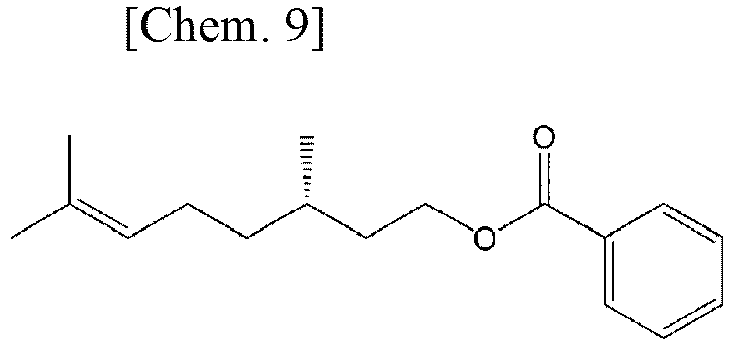
- To 31.2 mL of a toluene solution containing 1.56 g (10 mmol) of (S)-citronellol, 2.79 mL (20 mmol) of triethylamine and 12.2 mg (0.1 mmol) of N,N-dimethylaminopyridine, 1.69 g (12 mmol) of benzoic acid chloride was added at 0°C, followed by stirring at room temperature for 24 hours.
- After cooling the reaction solution, the reaction was quenched by the addition of water, and the solution was extracted with toluene. The organic layer was washed with water and then concentrated under reduced pressure to obtain a crude product. The resulting crude product was purified by silica gel column chromatography to obtain 2.28 g of the target product.
-

- To 15.8 mL of a tetrahydrofuran solution containing 1.05 g (4.64 mmol) of 1-((1R,6S)-trimethylcyclohexyl)-3-hexanol, 3.23 mL (5.10 mmol) of n-butyllithium was added at 0°C, followed by stirring at 0°C for 1 hour. Thereafter, 0.72 g (5.10 mmol) of benzoic acid chloride was added, and the resulting mixture was stirred at 0°C for 1 hour and at room temperature for 5 hours.
- After cooling the reaction solution, the reaction was quenched by the addition of an aqueous ammonium chloride solution, and the solution was extracted with toluene. The organic layer was washed with water and then concentrated under reduced pressure to obtain a crude product. The resulting crude product was purified by silica gel column chromatography to obtain 1.50 g of the target product.
-

- To 15.8 mL of a tetrahydrofuran solution containing 1.05 g (4.64 mmol) of 1-((1R,6S)-trimethylcyclohexyl)-3-hexanol, 3.23 mL (5.10 mmol) of n-butyllithium was added at 0°C, followed by stirring at 0°C for 1 hour. Thereafter, 0.87 g (5.10 mmol) of p-methoxybenzoic acid chloride was added, and the resulting mixture was stirred at 0°C for 1 hour and at room temperature for 5 hours.
- After cooling the reaction solution, the reaction was quenched by the addition of an aqueous ammonium chloride solution, and the solution was extracted with toluene. The organic layer was washed with water and then concentrated under reduced pressure to obtain a crude product. The resulting crude product was purified by silica gel column chromatography to obtain 1.60 g of the target product.
-

- To 15.8 mL of a tetrahydrofuran solution containing 1.05 g (4.64 mmol) of 1-((1R,6S)-trimethylcyclohexyl)-3-hexanol, 3.23 mL (5.10 mmol) of n-butyllithium was added at 0°C, followed by stirring at 0°C for 1 hour. Thereafter, 0.79 g (5.10 mmol) of p-methylbenzoic acid chloride was added, and the resulting mixture was stirred at 0°C for 0.5 hours and at room temperature for 2 hours.
- After cooling the reaction solution, the reaction was quenched by the addition of an aqueous ammonium chloride solution, and the solution was extracted with toluene. The organic layer was washed with water and then concentrated under reduced pressure to obtain a crude product. The resulting crude product was purified by silica gel column chromatography to obtain 1.50 g of the target product.
-

- To 15.8 mL of a tetrahydrofuran solution containing 1.05 g (4.64 mmol) of 1-((1R,6S)-trimethylcyclohexyl)-3-hexanol, 3.23 mL (5.10 mmol) of n-butyllithium was added at 0°C, followed by stirring at 0°C for 1 hour. Thereafter, 0.85 g (5.10 mmol) of cinnamoyl chloride was added, and the resulting mixture was stirred at 0°C for 1 hour and at room temperature for 5 hours.
- After cooling the reaction solution, the reaction was quenched by the addition of an aqueous ammonium chloride solution, and the solution was extracted with toluene. The organic layer was washed with water and then concentrated under reduced pressure to obtain a crude product. The resulting crude product was purified by silica gel column chromatography to obtain 1.57 g of the target product.
-

- To 23.4 mL of a tetrahydrofuran solution containing 1.56 g (10 mmol) of (1R,2S,5R)-2-isopropyl-5-methylcyclohexanol, 6.65 mL (10.5 mmol) of n-butyllithium was added at 0°C, followed by stirring at 0°C for 1 hour. Thereafter, 1.48 g (10.5 mmol) of benzoic acid chloride was added, and the resulting mixture was stirred at 0°C for 1.0 hours and at room temperature for 4 hours.
- After cooling the reaction solution, the reaction was quenched by the addition of an aqueous ammonium chloride solution, and the solution was extracted with toluene. The organic layer was washed with water and then concentrated under reduced pressure to obtain a crude product. The resulting crude product was purified by silica gel column chromatography to obtain 2.55 g of the target product.
-

- To 22.4 mL of a toluene solution containing 1.12 g (5 mmol) of (S)-dihydrofarnesol, 1.39 mL (10 mmol) of triethylamine and 12.2 mg (0.1 mmol) of N,N-dimethylaminopyridine, 0.84 g (6 mmol) of benzoic acid chloride was added at 0°C, followed by stirring at room temperature for 24 hours.
- After cooling the reaction solution, the reaction was quenched by the addition of water, and the solution was extracted with toluene. The organic layer was washed with water and then concentrated under reduced pressure to obtain a crude product. The resulting crude product was purified by silica gel column chromatography to obtain 1.58 g of the target product.
-


- To 22.4 mL of a toluene solution containing 1.12 g (5 mmol) of (S)-dihydrofarnesol, 1.39 mL (10 mmol) of triethylamine and 12.2 mg (0.1 mmol) of N,N-dimethylaminopyridine, 1.02 g (6 mmol) of p-methoxybenzoic acid chloride was added at 0°C, followed by stirring at room temperature for 24 hours.
- After cooling the reaction solution, the reaction was quenched by the addition of water, and the solution was extracted with toluene. The organic layer was washed with water and then concentrated under reduced pressure to obtain a crude product. The resulting crude product was purified by silica gel column chromatography to obtain 1.58 g of the target product.
-

- To 22.4 mL of a toluene solution containing 1.12 g (5 mmol) of (S)-dihydrofarnesol, 1.39 mL (10 mmol) of triethylamine and 12.2 mg (0.1 mmol) of N,N-dimethylaminopyridine, 0.93 g (6 mmol) of p-methylbenzoic acid chloride was added at 0°C, followed by stirring at room temperature for 24 hours.
- After cooling the reaction solution, the reaction was quenched by the addition of water, and the solution was extracted with toluene. The organic layer was washed with water and then concentrated under reduced pressure to obtain a crude product. The resulting crude product was purified by silica gel column chromatography to obtain 1.59 g of the target product.
-

- To 22.4 mL of a toluene solution containing 1.12 g (5 mmol) of (S)-dihydrofarnesol, 1.39 mL (10 mmol) of triethylamine and 12.2 mg (0.1 mmol) of N,N-dimethylaminopyridine, 1.20 g (7.2 mmol) of cinnamoyl chloride was added at 0°C, followed by stirring at room temperature for 24 hours.
- After cooling the reaction solution, the reaction was quenched by the addition of water, and the solution was extracted with toluene. The organic layer was washed with water and then concentrated under reduced pressure to obtain a crude product. The resulting crude product was purified by silica gel column chromatography to obtain 1.55 g of the target product.
-

- To 30 mL of a toluene solution containing 1.00 g (10 mmol) of (Z)-3-hexenol, 2.79 mL (20 mmol) of triethylamine and 12.2 mg (0.1 mmol) of N,N-dimethylaminopyridine, 1.69 g (12 mmol) of benzoic acid chloride was added at 0°C, followed by stirring at room temperature for 24 hours.
- After cooling the reaction solution, the reaction was quenched by the addition of water, and the solution was extracted with toluene. The organic layer was washed with water and then concentrated under reduced pressure to obtain a crude product. The resulting crude product was purified by silica gel column chromatography to obtain 1.90 g of the target product.
-

- To 41.0 mL of a toluene solution containing 1.64 g (10 mmol) of eugenol, 2.09 mL (15 mmol) of triethylamine and 12.2 mg (0.1 mmol) of N,N-dimethylaminopyridine, 1.69 g (12 mmol) of benzoic acid chloride was added at 0°C, followed by stirring at room temperature for 24 hours.
- After cooling the reaction solution, the reaction was quenched by the addition of water, and the solution was extracted with toluene. The organic layer was washed with water and then concentrated under reduced pressure to obtain a crude product. The resulting crude product was purified by silica gel column chromatography to obtain 2.67 g of the target product.
-

- To 38.0 mL of a toluene solution containing 1.52 g (10 mmol) of vanillin, 2.09 mL (15 mmol) of triethylamine and 12.2 mg (0.1 mmol) of N,N-dimethylaminopyridine, 1.69 g (12 mmol) of benzoic acid chloride was added at 0°C, followed by stirring at room temperature for 24 hours.
- After cooling the reaction solution, the reaction was quenched by the addition of water, and the solution was extracted with toluene. The organic layer was washed with water and then concentrated under reduced pressure to obtain a crude product. The resulting crude product was purified by silica gel column chromatography to obtain 2.54 g of the target product.
-

- To 31.2 mL of a toluene solution containing 1.56 g (10 mmol) of 9-decen-1-ol, 2.79 mL (20 mmol) of triethylamine and 12.2 mg (0.1 mmol) of N,N-dimethylaminopyridine, 1.69 g (12 mmol) of benzoic acid chloride was added at 0°C, followed by stirring at room temperature for 5 hours.
- After cooling the reaction solution, the reaction was quenched by the addition of water, and the solution was extracted with toluene. The organic layer was washed with water and then concentrated under reduced pressure to obtain a crude product. The resulting crude product was purified by silica gel column chromatography to obtain 2.54 g of the target product.
- 10 mg of a fragrance precursor and 1 g of an aqueous 1% lipase preparation solution were put in a vial bottle and mixed and after hermetically sealing the bottle, the mixture was subjected to GC/MS analysis of the head space component to obtain a peak area of the scent-emitting compound. As a control, water was used in place of the aqueous 1% lipase preparation solution, and a peak area of the control was obtained by the same method. The scent emission amount was determined from the difference between the obtained peak area of the scent-emitting compound and the peak area of the control. The results are shown in Tables 13 and 14.
-
- Measurement instrument: 7890GC/5975MSD (manufactured by Agilent Technologies)
- Column: BC-WAX 50 m × 0.25 mm I.D.
- Temperature rise: 70°C to 220°C, 4°C/min
- Split ratio: 60:1
-
Table 13: Scent emission by the action of lipase preparation AY "Amano" 30SD (produced by Amano Enzyme Inc.) Example Fragrance Precursor Scent Emission Amount Scent-Emitting Compound 15 compound of Example 11 49,663,459 (Z)-3-hexenol 16 (Z)-3-hexenyl salicylate 16,933,990 (Z)-3-hexenol 17 geranyl benzoate 78,461,812 geraniol 18 phenylethyl benzoate 96,460,830 phenylethyl alcohol 19 compound of Example 6 82,023,336 menthol 20 phenylethyl phenylacetate 50,855,859 phenylethyl alcohol 21 geranyl phenylacetate 54,842,763 geraniol 22 rosinyl phenylacetate 56,492,946 rosinol 23 cinnamyl cinnamate 24,711,289 cinnamic alcohol 24 phenylethyl cinnamate 22,892,002 phenylethyl alcohol 25 compound of Example 7 88,986,381 dihydrofarnesol 26 compound of Example 8 23,338,647 dihydrofarnesol 27 compound of Example 9 19,259,897 dihydrofarnesol 28 compound of Example 3 40,373,157 1-((1R,6S)-trimethylcyclohexyl)-3-hexanol -
Table 14: Scent emission by the action of lipase preparation Lipex 100 L (produced by Novozymes) Example Fragrance Precursor Scent Emission Amount Scent-Emitting Compound 29 compound of Example 1 28,098,876 citronellol 30 compound of Example 12 164,744,420 eugenol 31 compound of Example 13 47,188,750 vanillin 32 compound of Example 10 19,967,420 dihydrofarnesol 33 compound of Example 3 40,430,750 1-((1R,6S)-trimethylcyclohexyl)-3-hexanol - Shampoos were prepared according to the formulation shown in Table 15. A hair bundle of 10 cm in length was cleaned using the prepared shampoo and rinsed with tap water. After drying at room temperature for 15 hours, about 0.3 g of an aqueous 1% lipase preparation solution was sprayed onto the hair bundle, and the scent on the hair bundle was smelled to examine the presence or absence of scent emission from hair. As the lipase preparation, AY "Amano" 30SD was used.
-
Table 15: Formulation of shampoo (mass%) Raw Material Example 34 Example 35 Comparative Example 1 Sodium polyoxyethylene lauryl ether sulfate 14 14 14 Laurylsulfuric acid amidopropyl betaine 4 4 4 Coconut fatty acid diethanolamide 3 3 3 Cationized cellulose 0.5 0.5 0.5 Ethylene glycol distearate 1 1 1 Paraoxybenzoic acid ester 0.2 0.2 0.2 Geranyl benzoate 0.3 0 0 Compound of Example 12 0 0.3 0 Geraniol 0 0 0.3 Deionized water 77 77 77 Total (mass%) 100 100 100 - It could be confirmed that the geraniol odor is emitted by reacting the hair after drying obtained using the shampoo prepared in Example 34 with lipase.
- It could be confirmed that the eugenol odor is emitted by reacting the hair after drying obtained using the shampoo prepared in Example 35 with lipase.
- The hair after drying obtained using the shampoo prepared in Comparative Example 1 was reacted with lipase, but an odor could not be confirmed.
- Hair conditioners were prepared according to the formulation shown in Table 16. A hair bundle of 10 cm in length was treated with the hair conditioner prepared and rinsed with tap water. After drying at room temperature for 15 hours, about 0.3 g of an aqueous 1% lipase preparation solution was sprayed onto the hair bundle, and the odor on the hair bundle was smelled to examine the presence or absence of scent emission from hair. As the lipase preparation, AY "Amano" 30SD was used.
-
Table 16: Formulation of hair conditioner (mass%) Raw Material Example 36 Example 37 Comparative Example 2 Stearyltrimethylammonium chloride 0.5 0.5 0.5 Distearyldimethylammonium chloride 1.5 1.5 1.5 Cetanol 4.5 4.5 4.5 Amino-modified silicone 0.5 0.5 0.5 Glycerin 5 5 5 Paraoxybenzoic acid ester 0.2 0.2 0.2 Compound of Example 6 0.3 0 0 Compound of Example 1 0 0.3 0 Citronellol 0 0 0.3 Deionized water 87.5 87.5 87.5 Total (mass%) 100 100 100 - It could be confirmed that the menthol odor is emitted by reacting the hair after drying obtained using the hair conditioner prepared in Example 36 with lipase.
- It could be confirmed that the citronellol odor is emitted by reacting the hair after drying obtained using the hair conditioner prepared in Example 37 with lipase.
- The hair after drying obtained using the hair conditioner prepared in Comparative Example 2 was reacted with lipase, but an odor could not be confirmed.
- Liquid detergents were prepared according to the formulation shown in Table 17. A cotton towel was cleaned with the liquid detergent prepared and rinsed with tap water. After drying at room temperature for 15 hours, about 0.3 g of an aqueous 1% lipase preparation solution was sprayed onto the towel, and the odor on the towel was smelled to examine the presence or absence of scent emission from towel. As the lipase preparation, AY "Amano" 30SD was used.
-
Table 17: Formulation of liquid detergent (mass%) Raw Material Example 38 Example 39 Example 40 Comparative Example 3 Polyoxyethylene alkyl ether 40 40 40 40 Linear alkylbenzenesulfonate 18 18 18 18 Butyl carbitol 10 10 10 10 Propylene glycol 3 3 3 3 Monoethanolamine 3 3 3 3 Phenylethyl salicylate 0.5 0 0 0 Compound of Example 1 0 0.5 0 0 Compound of Example 12 0 0 0.5 0 Phenylethyl alcohol 0 0 0 0.5 Deionized water 25.5 25.5 25.5 25.5 Total (mass%) 100 100 100 100 - It could be confirmed that the phenylethyl alcohol odor is emitted by reacting the towel after drying obtained using the liquid detergent prepared in Example 38 with lipase.
- It could be confirmed that the citronellol odor is emitted by reacting the towel after drying obtained using the liquid detergent prepared in Example 39 with lipase.
- It could be confirmed that the eugenol odor is emitted by reacting the towel after drying obtained using the liquid detergent prepared in Example 40 with lipase.
- The towel after drying obtained using the liquid detergent prepared in Comparative Example 3was reacted with lipase, but an odor could not be confirmed.
- Softeners were prepared according to the formulation shown in Table 18. A cotton towel was treated with the softener prepared and rinsed with tap water. After drying at room temperature for 15 hours, about 0.3 g of an aqueous 1% lipase preparation solution was sprayed onto the towel, and the odor on the towel was smelled to examine the presence or absence of scent emission from towel. As the lipase preparation, AY "Amano" 30SD was used.
-
Table 18: Formulation of softener (mass%) Raw Material Example 41 Example 42 Example 43 Comparative Example 4 Tri(oxyethylene)methylammonium methylsulfate fatty acid ester 18 18 18 18 Polyoxyethylene(23) lauryl ether 3 3 3 3 Propylene glycol 3 3 3 3 Calcium chloride 0.1 0.1 0.1 0.1 Phenylethyl benzoate 0.5 0 0 0 Geranyl phenylacetate 0 0.5 0 0 Compound of Example 7 0 0 0.5 0 Geraniol 0 0 0 0.5 Deionized water 75.4 75.4 75.4 75.4 Total (mass%) 100 100 100 100 - It could be confirmed that the phenylethyl alcohol odor is emitted by reacting the towel after drying obtained using the softener prepared in Example 41 with lipase.
- It could be confirmed that the geraniol odor is emitted by reacting the towel after drying obtained using the softener prepared in Example 42 with lipase.
- It could be confirmed that the dihydrofarnesol odor is emitted by reacting the towel after drying obtained using the softener prepared in Example 43 with lipase.
- The towel after drying obtained using the softener prepared in Comparative Example 4 was reacted with lipase, but an odor could not be confirmed.
- Fragrance compositions were prepared according to the formulation shown in Table 19.
-
Table 19: Formulation of fragrance composition (parts by mass) Raw Material Example 44 Example 45 Comparative Example 5 Undecylene aldehyde 5 5 5 Allylamyl glycolate 2 2 2 Allyl enanthate 5 5 5 Benzyl acetate 10 10 10 Borneol 5 5 5 Cinnamic alcohol 8 8 8 Citronellol 50 50 50 Coumarin 3 3 3 Tricyclodecenyl acetate 60 60 60 α-Damascone 1 1 1 Dihydromyrcenol 60 60 60 Diphenyl oxide 3 3 3 Eucalyptus oil 1 1 1 Geraniol 30 30 30 Methyl dihydrojasmonate 40 40 40 Hexyl cinnamic aldehyde 40 40 40 Lime oil 25 25 25 Lemon oil 30 30 30 Linalol 80 80 80 Linalyl acetate 40 40 40 MUSK T (produced by Takasago International Corporation) 100 100 100 γ-Methylionone 20 20 20 Methyl nonyl ketone 2 2 2 Nerol 20 20 20 ORBITONE (produced by Takasago International Corporation) 40 40 40 4-tert-Butylcyclohexanol 20 20 20 p-tert-Butylcyclohexyl acetate 100 100 100 Geranyl phenylacetate 200 0 0 Compound of Example 3 0 200 0 Dipropylene glycol 0 0 200 Total (parts by mass) 1000 1000 1000 MUSK T (registered trademark)
ORBITONE (registered trademark) - Liquid detergents with or without lipase were prepared according to the formulation shown in Table 20. In addition, softeners were prepared according to the formulation shown in Table 21.
-
Table 20: Formulation of liquid detergent (mass%) Raw Material With Lipase Without Lipase Polyoxyethylene alkyl ether 40 40 Linear alkylbenzenesulfonate 18 18 Butyl carbitol 10 10 Propylene glycol 3 3 Monoethanolamine 3 3 Lipase preparation/Lipex 100L 1 - Deionized water 25 26 Total (mass%) 100 100 Lipex 100L: produced by Novozymes -
Table 21: Formulation of softener (mass%) Raw Material Example 46 Example 47 Comparative Example 6 Fragrance composition of Example 44 0.5 0 0 Fragrance composition of Example 45 0 0.5 0 Fragrance composition of Comparative Example 5 0 0 0.5 Tri(oxyethylene)methylammonium methylsulfate fatty acid ester 18 18 18 Polyoxyethylene(23) lauryl ether 3 3 3 Propylene glycol 3 3 3 Calcium chloride 0.05 0.05 0.05 Citric acid 0.01 0.01 0.01 Sodium citrate 0.1 0.1 0.1 Deionized water 75.34 75.34 75.34 Total (mass%) 100 100 100 - A cotton towel was cleaned with the liquid detergent obtained above, and the cotton towel after cleaning was dehydrated and then treated with the softener obtained above. After dehydration, the towel was dried overnight. The scent intensity and fresh feeling of the cotton towel during drying and after drying were evaluated by ten expert panelists according to the following evaluation criteria. The evaluation score was determined by averaging the evaluation values of the ten expert panelists. The results are shown in Tables 22 and 23.
-
- 0: Odorless
- 1: Barely perceivable odor
- 2: Odor can be identified as what odor but is weak
- 3: Easily perceivable odor
- 4: Strong odor
- 5: Intense odor
-
- 0: No fresh feeling is sensed.
- 1: Fresh feeling is faintly sensed.
- 2: Fresh feeling is slightly sensed.
- 3: Fresh feeling is sensed.
- 4: Fresh feeling is fairly sensed.
-
Table 22: Results of scent intensity Example 48 Comparative Example 7 Example 49 Comparative Example 8 Comparative Example 9 Liquid detergent with lipase without lipase with lipase without lipase with lipase Softener Example 46 Example 46 Example 47 Example 47 Comparative Example 6 During drying 3.2 2.6 3.3 2.5 2.5 After drying 2.5 1.2 2.8 1.2 1.0 -
Table 23: Results of fresh feeling Example 50 Comparative Example 10 Example 51 Comparative Example 11 Comparative Example 12 Liquid detergent with lipase without lipase with lipase without lipase with lipase Softener Example 46 Example 46 Example 47 Example 47 Comparative Example 6 During drying 3.6 2.4 3.7 2.6 2.4 After drying 2.8 0.5 3.3 0.7 0.5 - It could be confirmed from the results in Tables 22 and 23 that when a softener using a compounded fragrance having blended therein a compound represented by general formula (1) of the present invention is used in combination with a liquid detergent having blended therein lipase, scent emission occurs and the scent intensity and the fresh feeling of lingering scent are enhanced.
- It could be confirmed from the results in Tables 22 and 23 that the fragrance precursor of the present invention releases a scent-emitting compound having a hydroxy group by the action of lipase.
- After inoculating each of bacteria in Muller-Hinton liquid medium, shaking culture was performed at 30°C for 20 hours, and 3 mL of the resulting preculture solution was transferred to a vial bottle. 10 mg of each of the fragrance precursors was mixed therewith and after hermetical sealing, shaking culture was further performed at 30°C for 20 hours.
- After inoculating the bacterium in GAM bouillon liquid medium containing Hemin 0.5 ppm and Menadione 0.5 ppm, static culture was performed at 28°C for 3 days under anaerobic conditions, and 3 mL of the resulting preculture solution was transferred to a vial bottle. 10 mg of each of the fragrance precursors was mixed therewith and after hermetical sealing, static culture was further performed at 28°C for 3 days.
- After inoculating the bacterium in Sabouraud liquid medium containing 0.1% Tween 80, static culture was performed at 28°C for 3 days under anaerobic conditions, and 3 mL of the resulting preculture solution was transferred to a vial bottle. 10 mg of the fragrance precursor was mixed therewith and after hermetical sealing, static culture was further performed at 28°C for 3 days.
- A peak area of the scent-emitting compound was obtained by performing GC/MS analysis of the head space component included in the vial bottle containing 3 mL of a microorganism culture solution in which 10 mg of the fragrance precursor was mixed. A microorganism culture solution having not mixed therein the fragrance precursor was used as the control, and a peak area of the control was obtained by the same method. The scent emission amount was determined from the difference between the obtained peak area of the scent-emitting compound and the peak area of the control. The results are shown in Tables 24 to 29.
-
- Measurement instrument: 7890GC/5975MSD (manufactured by Agilent Technologies)
- Column: BC-WAX 50 m × 0.25 mm I.D.
- Temperature rise: 70°C to 220°C, 4°C/min
- Split ratio: splitless
-
Table 24: Scent emission amount when mixed with culture solution of Staphylococcus aureus NBRC12732 Example Fragrance Precursor Scent Emission Amount Scent-Emitting Compound 52 geranyl benzoate 839,961,157 geraniol 53 phenylethylene cinnamate 144,750,281 phenylethyl alcohol 54 (Z)-3-hexenyl salicylate 14,126,965 (Z)-3-hexenol - It could be confirmed from the results in Table 24 that the fragrance precursor of the present invention releases a scent-emitting compound having a hydroxy group by the action of Staphylococcus aureus NBRC12732.
-
Table 25: Scent emission amount when mixed with culture solution of Corynebacterium xerosis JCM1324 Example Fragrance Precursor Scent Emission Amount Scent-Emitting Compound 55 geranyl phenylacetate 39,033,900 geraniol - It could be confirmed from the results in Table 25 that the fragrance precursor of the present invention releases a scent-emitting compound having a hydroxy group by the action of Corynebacterium xerosis JCM1324.
-
Table 26: Scent emission amount when mixed with culture solution of Pseudomonas aeruginosa NBRC13275 Example Fragrance Precursor Scent Emission Amount Scent-Emitting Compound 56 geranyl benzoate 117,161,311 geraniol 57 phenylethyl cinnamate 247,508,719 phenylethyl alcohol 58 citronellyl phenylacetate 150,385,642 citronellol - It could be confirmed from the results in Table 26 that the fragrance precursor of the present invention releases a scent-emitting compound having a hydroxy group by the action of Pseudomonas aeruginosa NBRC13275.
-
Table 27: Scent emission amount when mixed with culture solution of Moraxella osloensis ATCC19976 Example Fragrance Precursor Scent Emission Amount Scent-Emitting Compound 59 citronellyl phenylacetate 500,940,481 citronellol 60 compound of Example 14 86,274,718 9-decenol - It could be confirmed from the results in Table 27 that the fragrance precursor of the present invention releases a scent-emitting compound having a hydroxy group by the action of Moraxella osloensis ATCC19976.
-
Table 28: Scent emission amount when mixed with culture solution of Propionibacterium acnes JCM6473 Example Fragrance Precursor Scent Emission Amount Scent-Emitting Compound 61 geranyl benzoate 105,061,217 geraniol 62 phenylethyl cinnamate 112,497,882 phenylethyl alcohol 63 citronellyl phenylacetate 292,401,763 citronellol 64 compound of Example 14 133,440,692 9-decenol - It could be confirmed from the results in Table 28 that the fragrance precursor of the present invention releases a scent-emitting compound having a hydroxy group by the action of Propionibacterium acnes JCM6473.
-
Table 29: Scent emission amount when mixed with culture solution of Malassezia furfur NBRC0656 Example Fragrance Precursor Scent Emission Amount Scent-Emitting Compound 65 geranyl benzoate 121,633,184 geraniol 66 phenylethyl cinnamate 351,450,490 phenylethyl alcohol 67 citronellyl phenylacetate 369,118,269 citronellol 68 compound of Example 14 304,030,021 9-decenol - It could be confirmed from the results in Table 29 that the fragrance precursor of the present invention releases a scent-emitting compound having a hydroxy group by the action of Malassezia furfur NBRC0656.
- A gauze impregnated with Triolein 1 g, Tricaproin 1 g and Androsterone 0.5 g was set as a substrate in a petri dish of 33 mm in diameter φ. Furthermore, 1 mL of Staphylococcus aureus test bacterial solution (1×10⁹ cfu/mL) previously prepared in 0.9% physiological saline containing 0.2% L-leucine as a substrate was mixed with 3.5 µL of geranyl benzoate, and the resulting mixture was uniformly impregnated into the gauze that was set.
- A cover was put on the petri dish and after hermetically sealing it, culture was performed at 37°C for 20 hours. Sensory evaluation of the degree of pleasantness/unpleasantness of the odor on the gauze after culturing was performed by ten expert panelists according to the following evaluation criteria. The evaluation score was determined by averaging the evaluation values of the ten expert panelists (Example 69).
- The degree of pleasantness/unpleasantness of the odor on the gauze after culturing was evaluated in the same manner as in Example 69 except that geranyl benzoate was not mixed (Comparative Example 13). The results are shown in Table 30.
- It is known that each of Triolein, Tricaproin, Androsterone and L-leucine emits an offensive odor by the action of a microorganism.
-
- +4: Extremely pleasant
- +3: very pleasant
- +2: pleasant
- +1: slightly pleasant
- 0: neither pleasant nor unpleasant
- -1: slightly unpleasant
- -2: unpleasant
- -3: very unpleasant
- -4: extremely unpleasant
-
Table 30 Example 69 Comparative Example 13 Degree of pleasantness/unpleasantness 1.2 -3 - It was confirmed from the results in Table 30 that as revealed by Comparative Example 13, an offensive odor was emitted along with proliferation of Staphylococcus aureus under the test conditions above. In addition, it could be confirmed that as revealed by Example 69, geranyl benzoate that is a fragrance precursor can alleviate the degree of unpleasantness of the offensive odor caused by Staphylococcus aureus.
- Deodorizing mists were prepared according to the formulation shown in Table 31.
[Table 31] Table 31: Formulation of deodorizing mist (mass%) Example 70 Example 71 Example 72 Citronellyl phenylacetate 1 0 0 Compound of Example 13 0 1 0 Compound of Example 12 0 0 1 Polyoxyethylene(60) hydrogenated castor oil 3 3 3 Deionized water 96 96 96 Total (mass%) 100 100 100 - A cleaned chemical-fiber sock for right foot was sprayed with 0.6 g of each of deodorizing mists obtained in Examples 70 to 72 (Examples 73 to 75). Cleaned chemical-fiber socks for left foot, which were not sprayed with the deodorizing mist, were Comparative Examples 14 to 16. Sensory evaluation of the degree of pleasantness/unpleasantness of the odor on the sock after wearing for 15 hours was performed by ten expert panelists according to the evaluation criteria. As for the evaluation criteria, the evaluation criteria of Example 69 were used. The evaluation score was determined by averaging the evaluation values of the ten expert panelists. The results are shown in Table 32.
-
Table 32 Deodorizing Mist Foot on which Sock Worn Degree of Pleasantness/ Unpleasantness Example 73 Example 70 right foot 2.2 Comparative Example 14 none left foot -2.4 Example 74 Example 71 right foot 2.4 Comparative Example 15 none left foot -2.2 Example 75 Example 72 right foot 2 Comparative Example 16 none left foot -2 - The socks of Comparative Examples 14 to 16 not sprayed with the deodorizing mist of the present invention emitted an offensive odor and were felt to be unpleasant, but the odor of the socks of Examples 73 to 75 sprayed with the deodorizing mist of the present invention did not smell unpleasant. It could be confirmed that a deodorizing component is released from citronellyl phenylacetate, the compound of Example 13, and the compound of Example 12, which are fragrance precursors, and the unpleasant sensation is thereby alleviated.
- A deodorizing spray was prepared according to the formulation shown in Table 33.
-
Table 33: Formulation of deodorizing spray (mass%) Example 76 Compound of Example 3 0.5 Ethanol 19.5 LPG 80 Total (mass%) 100 - A right-side underarm portion of a cleaned cotton shirt was sprayed with 1 g of the deodorizing spray obtained in Example 76 (Example 77). In Comparative Example 17, the deodorizing spray was not sprayed onto the left-side underarm portion of the shirt. After wearing the shirts for 24 hours, sensory evaluation of the degree of pleasantness/unpleasantness of the odor in the right-side underarm portion and left-side underarm portion of the shirt was performed by ten expert panelists according to the evaluation criteria. As for the evaluation criteria, the evaluation criteria of Example 69 were used. The evaluation score was determined by averaging the evaluation values of the ten expert panelists. The results are shown in Table 34.
-
Table 34 Example 77 Comparative Example 17 Degree of pleasantness/unpleasantness 1.8 -3.2 - The left-side underarm portion of the shirt not sprayed with the deodorizing spray of the present invention emitted an offensive odor and was felt to be unpleasant, but the odor in the right-side underarm portion of the shirt sprayed with the deodorizing spray of the present invention did not smell unpleasant. It could be confirmed that an aromatic component is released from the compound of Example 3, which is a fragrance precursor, and the unpleasant sensation is thereby alleviated.
- While the present invention has been described in detail and with reference to specific embodiments thereof, it will be apparent to one skilled in the art that various changes and modifications can be made therein without departing from the spirit and scope of the present invention. This application is based on Japanese Patent Application (Patent Application No.
2017-184026) filed on September 25, 2017 - The compound represented by general formula (1) can release a fragrance alcohol, a phenol or a phenol derivative, which are an aromatic component or a deodorizing component, by the action of a hydrolase or a microorganism and therefore, is useful.
- Blending of the compound represented by general formula (1) of the present invention in a fragrance composition or various products enables development of a product capable of causing a lingering scent with fresh feeling to last on the clothing, hair or skin or responding to a wide range of needs for deodorization, and therefore, the compound has applicability in the fragrance industry.
Claims (8)
- A fragrance precursor represented by the following formula (1):

- A method for releasing a fragrance alcohol, a phenol or a phenol derivative, comprising a step of reacting the fragrance precursor according to claim 1 with a hydrolase.
- The method for releasing a fragrance alcohol, a phenol or a phenol derivative according to claim 2, wherein the hydrolase is a lipase.
- A method for releasing a fragrance alcohol, a phenol or a phenol derivative, comprising a step of reacting the fragrance precursor according to claim 1 with a microorganism.
- The method for releasing a fragrance alcohol, a phenol or a phenol derivative according to claim 4, wherein the microorganism is at least one species selected from the group consisting of Staphylococcus aureus, Staphylococcus epidermidis, Corynebacterium xerosis, Pseudomonas aeruginosa, Bacillus subtilis, Moraxella osloensis, Propionibacterium acnes, and Malassezia furfur.
- At least one compound selected from the group consisting of the compounds 001 to 118 shown below.
[Table 1]Table 1 [Table 2]Compound 001 
(E)-hex-2-en-1-yl (E)-3-(4-methoxyphenyl)acrylate Compound 002 
(E)-hex-2-en-1-yl 4-hydroxybenzoate Compound 003 
(E)-hex-3-en-1-yl (E)-3-(4-methoxyphenyl)acrylate Compound 004 
(E)-hex-3-en-1-yl 4-hydroxybenzoate Compound 005 
(E)-hex-4-en-1-yl 2-hydroxybenzoate Compound 006 
(E)-hex-4-en-1-yl 2-phenylacetate Compound 007 
(E)-hex-4-en-1-yl cinnamate Compound 008 
(E)-hex-4-en-1-yl (E)-3-(4-methoxyphenyl)acrylate Compound 009 
(E)-hex-4-en-1-yl 4-hydroxybenzoate Compound 010 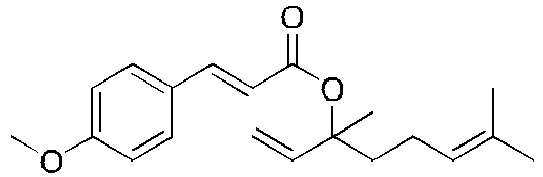
3,7-dimethylocta-1,6-dien-3-yl (E)-3-(4-methoxyphenyl)acrylate Compound 011 
3,7-dimethylocta-1,6-dien-3-yl 4-hydroxybenzoate Table 2 [Table 3]Compound 012 
3,7-dimethyloct-6-en-1-yl (E)-3-(4-methoxyphenyl)acrylate Compound 013 
4-allyl-2-methoxyphenyl 4-hydroxybenzoate Compound 014 
(E)-2-methoxy-4-(prop-1-en-1-yl)phenyl 2-hydroxybenzoate Compound 015 
(E)-2-methoxy-4-(prop-1-en-1-yl)phenyl 4-methoxybenzoate Compound 016 
2-methoxy-4-((E)-prop-1-en-1-yl)phenyl (E)-3-(4-methoxyphenyl)acrylate Compound 017 
(E)-2-methoxy-4-(prop-1-en-1-yl)phenyl 4-hydroxybenzoate Compound 018 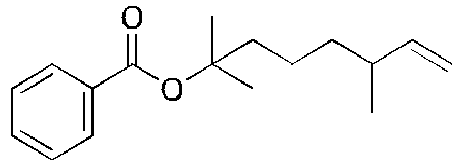
2,6-dimethyloct-7-en-2-yl benzoate Compound 019 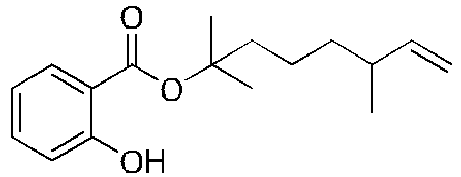
2,6-dimethyloct-7-en-2-yl 2-hydroxybenzoate Compound 020 
2,6-dimethyloct-7-en-2-yl 2-phenylacetate Table 3 [Table 4]Compound 021 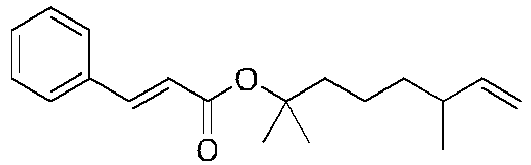
2,6-dimethyloct-7-en-2-yl cinnamate Compound 022 
2,6-dimethyloct-7-en-2-yl 4-methoxybenzoate Compound 023 
2,6-dimethyloct-7-en-2-yl (E)-3-(4-methoxyphenyl)acrylate Compound 024 
2,6-dimethyloct-7-en-2-yl 4-hydroxybenzoate Compound 025 
3,7-dimethyloctan-3-yl benzoate Compound 026 
3,7-dimethyloctan-3-yl 2-hydroxybenzoate Compound 027 
3,7-dimethyloctan-3-yl 2-phenylacetate Compound 028 
3,7-dimethyloctan-3-yl cinnamate Compound 029 
3,7-dimethyloctan-3-yl 4-methoxybenzoate Compound 030 
3,7-dimethyloctan-3-yl (E)-3-(4-methoxyphenyl)acrylate Compound 031 
3,7-dimethyloctan-3-yl 4-hydroxybenzoate Table 4 [Table 5]Compound 032 
(Z)-3,7-dimethylnona-1,6-dien-3-yl benzoate Compound 033 
(Z)-3,7-dimethylnona-1,6-dien-3-yl 2-hydroxybenzoate Compound 034 
(Z)-3,7-dimethylnona-1,6-dien-3-yl 2-phenylacetate Compound 035 
(Z)-3,7-dimethylnona-1,6-dien-3-yl cinnamate Compound 036 
(Z)-3,7-dimethylnona-1,6-dien-3-yl 4-methoxybenzoate Compound 037 
(Z)-3,7-dimethylnona-1,6-dien-3-yl (E)-3-(4-methoxyphenyl)acrylate Compound 038 
(Z)-3,7-dimethylnona-1,6-dien-3-yl 4-hydroxybenzoate Compound 039 
2-(4-methylcyclohex-3-en-1-yl)propan-2-yl 4-methoxybenzoate Compound 040 
2-(4-methylcyclohex-3-en-1-yl)propan-2-yl (E)-3-(4-methoxyphenyl)acrylate Compound 041 
1-methyl-4-(prop-1-en-2-yl)cyclohexyl 2-hydroxybenzoate Compound 042 
1-methyl-4-(prop-1-en-2-yl)cyclohexyl 2-phenylacetate Table 5 [Table 6]Compound 043 
1-methyl-4-(prop-1-en-2-yl)cyclohexyl cinnamate Compound 044 
1-methyl-4-(prop-1-en-2-yl)cyclohexyl 4-methoxybenzoate Compound 045 
1-methyl-4-(prop-1-en-2-yl)cyclohexyl (E)-3-(4-methoxyphenyl)acrylate Compound 046 
1-methyl-4-(prop-1-en-2-yl)cyclohexyl 4-hydroxybenzoate Compound 047 
1-methyl-4-(propan-2-ylidene)cyclohexyl 2-hydroxybenzoate Compound 048 
1-methyl-4-(propan-2-ylidene)cyclohexyl 2-phenylacetate Compound 049 
1-methyl-4-(propan-2-ylidene)cyclohexyl cinnamate Compound 050 
1-methyl-4-(propan-2-ylidene)cyclohexyl 4-methoxybenzoate Compound 051 
1-methyl-4-(propan-2-ylidene)cyclohexyl (E)-3-(4-methoxyphenyl)acrylate Compound 052 
1-methyl-4-(propan-2-ylidene)cyclohexyl 4-hydroxybenzoate Compound 053 
1-isopropyl-4-methylcyclohex-3-en-1-yl 2-hydroxybenzoate Table 6 [Table 7]Compound 054 
1-isopropyl-4-methylcyclohex-3-en-1-yl 2-phenylacetate Compound 055 
1-isopropyl-4-methylcyclohex-3-en-1-yl (E)-3-(4-meth oxyph enyl)acrylate Compound 056 
1-isopropyl-4-methylcyclohex-3-en-1-yl 4-hydroxybenzoate Compound 057 
2,6-dimethylheptan-2-yl benzoate Compound 058 
2,6-dimethylheptan-2-yl 2-hydroxybenzoate Compound 059 
2,6-dimethylheptan-2-yl 2-phenylacetate Compound 060 
2,6-dimethylheptan-2-yl cinnamate Compound 061 
2,6-dimethylheptan-2-yl 4-methoxybenzoate Compound 062 
2,6-dimethylheptan-2-yl (E)-3-(4-meth oxyph enyl)acrylate Compound 063 
2,6-dimethylheptan-2-yl 4-hydroxybenzoate Compound 064 
2,6-dimethyl-8-oxooctan-2-yl benzoate Table 7 [Table 8]Compound 065 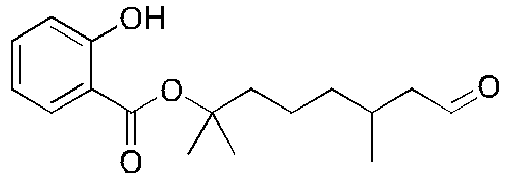
2,6-dimethyl-8-oxooctan-2-yl 2-hydroxybenzoate Compound 066 
2,6-dimethyl-8-oxooctan-2-yl 2-phenylacetate Compound 067 
2,6-dimethyl-8-oxooctan-2-yl cinnamate Compound 068 
2,6-dimethyl-8-oxooctan-2-yl 4-methoxybenzoate Compound 069 
2,6-dimethyl-8-oxooctan-2-yl (E)-3-(4-methoxyphenyl)acrylate Compound 070 
2,6-dimethyl-8-oxooctan-2-yl 4-hydroxybenzoate Compound 071 
4-(tert-butyl)cyclohexyl cinnamate Compound 072 
4-meth oxyph e nyl (E)-3-(4-methoxyphenyl)acrylate Compound 073 
2-methyl-1-phenylpropan-2-yl 2-hydroxybenzoate Compound 074 
2-methyl-1-phenylpropan-2-yl cinnamate Compound 075 
2-methyl-1-phenylpropan-2-yl 4-methoxybenzoate Table 8 [Table 9]Compound 076 
2-methyl-1-phenylpropan-2-yl (E)-3-(4-methoxyphenyl)acrylate Compound 077 
2-methyl-1-phenylpropan-2-yl 4-hydroxybenzoate Compound 078 
3-methyl-5-phenylpentyl 2-hydroxybenzoate Compound 079 
3-methyl-5-phenylpentyl 2-phenylacetate Compound 080 
3-methyl-5-phenylpentyl cinnamate Compound 081 
3-methyl-5-phenylpentyl 4-methoxybenzoate Compound 082 
3-methyl-5-phenylpentyl (E)-3-(4-methoxyphenyl)acrylate Compound 083 
3-methyl-5-phenylpentyl 4-hydroxybenzoate Compound 084 
4-formyl-2-methoxyphenyl 2-hydroxybenzoate Compound 085 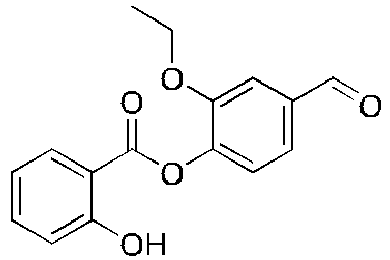
2-ethoxy-4-formylphenyl 2-hydroxybenzoate Table 9 [Table 10]Compound 086 
2-ethoxy-4-formylphenyl (E)-3-(4-methoxyph enyl)acrylate Compound 087 
2-ethoxy-4-formylphenyl 4-hydroxybenzoate Compound 088 
4-(3-oxobutyl)phenyl 2-hydroxybenzoate Compound 089 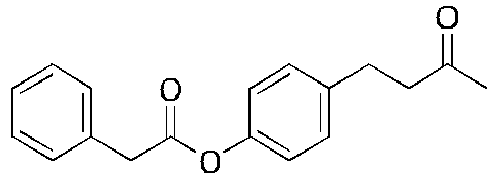
4-(3-oxobutyl)phenyl 2-phenylacetate Compound 090 
4-(3-oxobutyl)phenyl cinnamate Compound 091 
4-(3-oxobutyl)phenyl 4-methoxybenzoate Compound 092 
4-(3-oxobutyl)phenyl (E)-3-(4-methoxyphenyl)acrylate Compound 093 
4-(3-oxobutyl)phenyl 4-hydroxybenzoate Compound 094 
1,3,3-trimethylbicyclo[2.2.1]heptan-2-yl 2-hydroxybenzoate Table 10 [Table 11]Compound 095 
1,3,3-trimethylbicyclo[2.2.1]heptan-2-yl 2-phenylacetate Compound 096 
1,3,3-trimethylbicyclo[2.2.1]heptan-2-yl cinnamate Compound 097 
1,3,3-trimethylbicyclo[2.2.1]heptan-2-yl 4-methoxybenzoate Compound 098 
1,3,3-trimethylbicyclo[2.2.1]heptan-2-yl (E)-3-(4-methoxyph enyl)acrylate Compound 099 
1,3,3-trimethylbicyclo[2.2.1]heptan-2-yl 4-hydroxybenzoate Compound 100 
1-((1 R,6S)-2,2,6-trimethylcyclohexyl)hexan-3-yl benzoate Compound 101 
1-((1 R,6S)-2,2,6-trimethylcyclohexyl)hexan-3-yl 2-hydroxybenzoate Compound 102 
1-((1 R,6S)-2,2,6-trimethylcyclohexyl)hexan-3-yl 2-phenylacetate Compound 103 
1-((1 R,6S)-2,2,6-trimethylcyclohexyl)hexan-3-yl cinnamate Compound 104 
1-((1 R,6S)-2,2,6-trimethylcyclohexyl)hexan-3-yl 4-methoxybenzoate Table 11 [Table 12]Compound 105 
1-((1R,6S)-2,2,6-trimethylcyclohexyl)hexan-3-yl (E)-3-(4-methoxyphenyl)acrylate Compound 106 
1-((1 R,6S)-2,2,6-trimethylcyclohexyl)hexan-3-yl 4-hydroxybenzoate Compound 107 
dec-9-en-1-yl 2-hydroxybenzoate Compound 108 
dec-9-en-1-yl 2-phenylacetate Compound 109 
dec-9-en-1-yl cinnamate Compound 110 
dec-9-en-1-yl 4-methoxybenzoate Compound 111 
dec-9-en-1-yl 4-hydroxybenzoate Compound 112 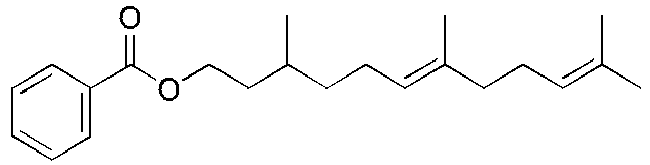
(E)-3,7, 11-trimethyldodeca-6, 1 0-dien-1-yl benzoate Compound 113 
(E)-3,7,11-trimethyldodeca-6,10-dien-1-yl 2-hydroxybenzoate Compound 114 
(E)-3,7,11-trimethyldodeca-6,10-dien-1-yl 2-phenylacetate Table 12 Compound 115 
(E)-3,7,11-trimethyldodeca-6, 10-dien-1-yl cinnamate Compound 116 
(E)-3,7,11-trimethyldodeca-6,10-dien-1-yl 4-methoxybenzoate Compound 117 
(E)-3,7,11-trimethyldodeca-6,10-dien-1-yl (E)-3-(4-methoxyphenyl)acrylate Compound 118 
(E)-3,7,11-trimethyldodeca-6,10-dien-1-yl 4-hydroxybenzoate - A fragrance composition comprising the compound according to claim 6.
- An aroma product, laundry care product, hair care product, cosmetic, cleaner or deodorant comprising the compound according to claim 6 or the fragrance composition according to claim 7.
Applications Claiming Priority (2)
| Application Number | Priority Date | Filing Date | Title |
|---|---|---|---|
| JP2017184026 | 2017-09-25 | ||
| PCT/JP2018/035183 WO2019059375A1 (en) | 2017-09-25 | 2018-09-21 | Perfume precursor |
Publications (3)
| Publication Number | Publication Date |
|---|---|
| EP3689849A1 true EP3689849A1 (en) | 2020-08-05 |
| EP3689849A4 EP3689849A4 (en) | 2021-06-09 |
| EP3689849B1 EP3689849B1 (en) | 2025-01-15 |
Family
ID=65810423
Family Applications (1)
| Application Number | Title | Priority Date | Filing Date |
|---|---|---|---|
| EP18858666.3A Active EP3689849B1 (en) | 2017-09-25 | 2018-09-21 | Perfume precursor |
Country Status (5)
| Country | Link |
|---|---|
| US (1) | US11802258B2 (en) |
| EP (1) | EP3689849B1 (en) |
| CN (1) | CN111108090A (en) |
| ES (1) | ES3012972T3 (en) |
| WO (1) | WO2019059375A1 (en) |
Cited By (1)
| Publication number | Priority date | Publication date | Assignee | Title |
|---|---|---|---|---|
| EP3572518A4 (en) * | 2017-01-19 | 2021-03-24 | Takasago International Corporation | ALDEHYDE OR KETONE RELEASE PROCESS |
Families Citing this family (8)
| Publication number | Priority date | Publication date | Assignee | Title |
|---|---|---|---|---|
| WO2020260598A1 (en) | 2019-06-27 | 2020-12-30 | Firmenich Sa | Perfumed consumer products |
| WO2022063755A1 (en) * | 2020-09-25 | 2022-03-31 | Firmenich Sa | Leave-on composition |
| CN112759517B (en) * | 2020-12-28 | 2022-07-08 | 东莞波顿香料有限公司 | Green pepper aroma compound and preparation method and application thereof |
| JP7858214B2 (en) | 2021-05-17 | 2026-05-14 | ピー2・サイエンス・インコーポレイテッド | Fatty acid terpene alcohol esters |
| US20220380290A1 (en) * | 2021-05-17 | 2022-12-01 | P2 Science, Inc. | Aryl terpene esters |
| US12215120B1 (en) | 2021-05-17 | 2025-02-04 | P2 Science, Inc. | Terpene O-glycosides |
| EP4370585A1 (en) | 2021-07-15 | 2024-05-22 | P2 Science, Inc. | Citronellol alkoxylate surfactants |
| CN116354848B (en) * | 2023-04-13 | 2025-06-03 | 波顿香料股份有限公司 | A ginger aroma compound and preparation method thereof and ginger aroma base |
Family Cites Families (42)
| Publication number | Priority date | Publication date | Assignee | Title |
|---|---|---|---|---|
| US4168248A (en) * | 1972-11-13 | 1979-09-18 | Fritzsche Dodge & Olcott Inc. | Perfume compositions |
| JPH03297685A (en) * | 1990-04-16 | 1991-12-27 | Oji Paper Co Ltd | Thermosensitive recording medium |
| US5228461A (en) | 1991-04-22 | 1993-07-20 | Philip Morris Incorporated | Smoking compositions containing a vanillin-release additive |
| US5172704A (en) | 1991-04-22 | 1992-12-22 | Philip Morris Incorporated | Smoking compositions containing a vanillin-release additive |
| JP3045562B2 (en) | 1991-05-13 | 2000-05-29 | 鐘紡株式会社 | Fragrance composition |
| US6576247B1 (en) | 1994-11-10 | 2003-06-10 | Kanebo Ltd. And T. Hasegawa Co. Ltd. | Sustained-release aromatic and method of detecting micro-organism by using the same |
| EP0760243B1 (en) * | 1995-08-31 | 2006-03-29 | The Procter & Gamble Company | Use of allylic alcohol perfumes as a malodour reduction agent |
| JPH09132527A (en) * | 1995-11-08 | 1997-05-20 | Pola Chem Ind Inc | Suppressant for melanogenesis and dermal preparation for external use |
| EP1003469A2 (en) * | 1996-02-21 | 2000-05-31 | Givaudan-Roure (International) S.A. | Fragrance precursors |
| JPH09241116A (en) * | 1996-03-05 | 1997-09-16 | Lion Corp | Cosmetic composition |
| DE69835624T2 (en) | 1997-06-23 | 2007-08-09 | Givaudan S.A. | Carbonates for the release of aldehydes and / or ketones |
| EP0887335A1 (en) * | 1997-06-23 | 1998-12-30 | Givaudan-Roure (International) S.A. | Precursor compounds |
| DE69920567T2 (en) | 1998-03-31 | 2005-10-06 | Shiseido Co. Ltd. | Method of preventing the body odor of old people |
| JPH11286428A (en) | 1998-03-31 | 1999-10-19 | Takasago Internatl Corp | Aged body odor-restraining perfume composition |
| EP1169292B1 (en) | 1999-03-26 | 2004-11-24 | Firmenich S.A. | Cyclic compounds and their use as precursors of fragrant alcohols |
| US6939835B2 (en) | 1999-03-26 | 2005-09-06 | Firmenich Sa | Cyclic compounds and their use as precursors of fragrant alcohols |
| JP5025845B2 (en) | 2000-09-12 | 2012-09-12 | 高砂香料工業株式会社 | Method and agent for enhancing perfume fragrance and sustainability |
| JP2003055314A (en) | 2001-08-20 | 2003-02-26 | Fujita Masao | Hydroxycinnamic acid derivative and antioxidant using the same |
| DE10140787A1 (en) * | 2001-08-20 | 2003-03-06 | Haarmann & Reimer Gmbh | depot preparations |
| JP2004107207A (en) * | 2002-09-13 | 2004-04-08 | Takasago Internatl Corp | Method for producing hot trienol and its ester |
| US8592361B2 (en) * | 2002-11-25 | 2013-11-26 | Colgate-Palmolive Company | Functional fragrance precursor |
| JP2004262900A (en) * | 2003-03-04 | 2004-09-24 | Takasago Internatl Corp | Body odor suppressing fragrance composition |
| EP2368602A1 (en) | 2003-03-03 | 2011-09-28 | Takasago International Corporation | Deodorant perfume composition comprising essential oils for masking an acid odour |
| US6787674B1 (en) * | 2003-03-27 | 2004-09-07 | Council Of Scientific And Industrial Research | (+)-1-Bisabolone isolated from cymbopogon flexuosus and antibacterial activity thereof |
| JP2004315502A (en) | 2003-03-31 | 2004-11-11 | Kao Corp | Axillary odor deodorant composition and skin cosmetics thereof |
| US20040248762A1 (en) * | 2003-06-09 | 2004-12-09 | Mcgee Thomas | Malodor counteractant compositions |
| CN101124189A (en) * | 2005-02-17 | 2008-02-13 | 弗莱克特瑞尔公司 | aroma chemicals |
| JP2007290983A (en) * | 2006-04-21 | 2007-11-08 | Lion Corp | Deodorant composition and deodorant agent |
| GB0611770D0 (en) | 2006-06-15 | 2006-07-26 | Givaudan Sa | Compounds |
| JPWO2008032847A1 (en) * | 2006-09-11 | 2010-01-28 | 株式会社アップウェル | Topical skin preparation |
| JP2008280318A (en) * | 2007-05-10 | 2008-11-20 | Koei Kogyo Kk | Skin preparation |
| JP5393962B2 (en) | 2007-08-22 | 2014-01-22 | 株式会社マンダム | Antibacterial agent for odor-causing bacteria and anti-odor agent containing the antibacterial agent |
| WO2009113721A1 (en) * | 2008-03-14 | 2009-09-17 | 花王株式会社 | Agent for releasing functional substance |
| EP2496548B1 (en) * | 2009-11-04 | 2013-08-28 | Firmenich S.A. | Esters as perfuming ingredients |
| JP5744473B2 (en) * | 2010-10-29 | 2015-07-08 | 花王株式会社 | Method for reducing off-flavor substances generated from textile products |
| US9334212B2 (en) * | 2010-12-21 | 2016-05-10 | Colgate-Palmolive Company | Compounds and compositions |
| JP2017530122A (en) * | 2014-09-26 | 2017-10-12 | ザ プロクター アンド ギャンブルカンパニー | Perfume goods manufacturing method |
| MX2017005988A (en) * | 2015-01-12 | 2017-07-11 | Firmenich & Cie | Intermediate compounds for producing perfuming ingredients. |
| JP6595386B2 (en) | 2016-03-30 | 2019-10-23 | Kddi株式会社 | Communication system and communication method |
| JP6741458B2 (en) * | 2016-03-31 | 2020-08-19 | ライオン株式会社 | Textile product treating agent composition |
| JP7156953B2 (en) * | 2017-01-19 | 2022-10-19 | 高砂香料工業株式会社 | Methods for releasing aldehydes or ketones |
| CN106866419B (en) * | 2017-04-14 | 2020-01-10 | 石河子大学 | Terpene ester compounds and preparation method and application thereof |
-
2018
- 2018-09-21 ES ES18858666T patent/ES3012972T3/en active Active
- 2018-09-21 CN CN201880061087.XA patent/CN111108090A/en active Pending
- 2018-09-21 EP EP18858666.3A patent/EP3689849B1/en active Active
- 2018-09-21 US US16/650,297 patent/US11802258B2/en active Active
- 2018-09-21 WO PCT/JP2018/035183 patent/WO2019059375A1/en not_active Ceased
Cited By (2)
| Publication number | Priority date | Publication date | Assignee | Title |
|---|---|---|---|---|
| EP3572518A4 (en) * | 2017-01-19 | 2021-03-24 | Takasago International Corporation | ALDEHYDE OR KETONE RELEASE PROCESS |
| US12319891B2 (en) | 2017-01-19 | 2025-06-03 | Takasago International Corporation | Method for releasing aldehyde or ketone |
Also Published As
| Publication number | Publication date |
|---|---|
| US11802258B2 (en) | 2023-10-31 |
| WO2019059375A1 (en) | 2019-03-28 |
| EP3689849B1 (en) | 2025-01-15 |
| ES3012972T3 (en) | 2025-04-10 |
| EP3689849A4 (en) | 2021-06-09 |
| US20210214644A1 (en) | 2021-07-15 |
| CN111108090A (en) | 2020-05-05 |
Similar Documents
| Publication | Publication Date | Title |
|---|---|---|
| EP3689849B1 (en) | Perfume precursor | |
| US12319891B2 (en) | Method for releasing aldehyde or ketone | |
| RU2771564C2 (en) | Deodorant including zinc carboxylate salt and aluminum hydrochloride | |
| CN100356901C (en) | Body odor composition and fragrance composition for suppressing body odor | |
| CN102149664B (en) | Divinyl ether derivatives capable of releasing reactive aldehydes and reactive ketones and methods for perfuming surfaces | |
| CN101010287A (en) | Anti-bacterial compounds | |
| JP2004262900A (en) | Body odor suppressing fragrance composition | |
| JP2016528318A (en) | Compounds for controlled release of active molecules | |
| JP2003321697A (en) | Deodorizing perfume composition | |
| GB2422780A (en) | Deodorant compositions | |
| CN103237536B (en) | Deodorant composition containing violet nitrile | |
| EP3471691B1 (en) | Mixture comprising at least dihydro-5-pentyl-2(3h)-furanone and 2,4-dimethyl-4-phenyltetrahydrofuran and use thereof for masking unpleasant odours | |
| CN101018538B (en) | antibacterial compound | |
| WO2020116608A1 (en) | Deodorant | |
| EP3749281B1 (en) | Perfuming complex and composition of perfumed water | |
| US10907116B2 (en) | Olfactive compositions comprising cyclohexyl-alkyl carbinols | |
| JP4689106B2 (en) | Citral acetal | |
| JP2003320003A (en) | Deodorant comprising polycondensation material of adipic acid/dipropylene glycol (branch isomer mixture) | |
| JP2024074783A (en) | Fragrance composition | |
| JPH10158684A (en) | Perfume and aromatic agent | |
| CN105813628A (en) | diketone action inhibitor | |
| WO2025252632A1 (en) | Mixture comprising beta-ionone, alpha-ionone, cedrol, hexanal and c10 aldehyde and use thereof for masking unpleasant odors |
Legal Events
| Date | Code | Title | Description |
|---|---|---|---|
| STAA | Information on the status of an ep patent application or granted ep patent |
Free format text: STATUS: THE INTERNATIONAL PUBLICATION HAS BEEN MADE |
|
| PUAI | Public reference made under article 153(3) epc to a published international application that has entered the european phase |
Free format text: ORIGINAL CODE: 0009012 |
|
| STAA | Information on the status of an ep patent application or granted ep patent |
Free format text: STATUS: REQUEST FOR EXAMINATION WAS MADE |
|
| 17P | Request for examination filed |
Effective date: 20200319 |
|
| AK | Designated contracting states |
Kind code of ref document: A1 Designated state(s): AL AT BE BG CH CY CZ DE DK EE ES FI FR GB GR HR HU IE IS IT LI LT LU LV MC MK MT NL NO PL PT RO RS SE SI SK SM TR |
|
| AX | Request for extension of the european patent |
Extension state: BA ME |
|
| DAV | Request for validation of the european patent (deleted) | ||
| DAX | Request for extension of the european patent (deleted) | ||
| REG | Reference to a national code |
Ref country code: DE Ref legal event code: R079 Free format text: PREVIOUS MAIN CLASS: C07C0069736000 Ipc: C07C0069614000 Ref document number: 602018078587 Country of ref document: DE |
|
| A4 | Supplementary search report drawn up and despatched |
Effective date: 20210512 |
|
| RIC1 | Information provided on ipc code assigned before grant |
Ipc: C07C 69/614 20060101AFI20210506BHEP Ipc: C07C 69/736 20060101ALI20210506BHEP Ipc: A61K 8/37 20060101ALI20210506BHEP Ipc: A61L 9/01 20060101ALI20210506BHEP Ipc: A61Q 13/00 20060101ALI20210506BHEP Ipc: C07C 69/618 20060101ALI20210506BHEP Ipc: C07C 69/767 20060101ALI20210506BHEP Ipc: C07C 69/78 20060101ALI20210506BHEP Ipc: C07C 69/84 20060101ALI20210506BHEP Ipc: C07C 69/94 20060101ALI20210506BHEP Ipc: C11B 9/00 20060101ALI20210506BHEP Ipc: D06M 13/00 20060101ALI20210506BHEP |
|
| STAA | Information on the status of an ep patent application or granted ep patent |
Free format text: STATUS: EXAMINATION IS IN PROGRESS |
|
| 17Q | First examination report despatched |
Effective date: 20230504 |
|
| GRAP | Despatch of communication of intention to grant a patent |
Free format text: ORIGINAL CODE: EPIDOSNIGR1 |
|
| STAA | Information on the status of an ep patent application or granted ep patent |
Free format text: STATUS: GRANT OF PATENT IS INTENDED |
|
| INTG | Intention to grant announced |
Effective date: 20240822 |
|
| GRAS | Grant fee paid |
Free format text: ORIGINAL CODE: EPIDOSNIGR3 |
|
| GRAA | (expected) grant |
Free format text: ORIGINAL CODE: 0009210 |
|
| STAA | Information on the status of an ep patent application or granted ep patent |
Free format text: STATUS: THE PATENT HAS BEEN GRANTED |
|
| P01 | Opt-out of the competence of the unified patent court (upc) registered |
Free format text: CASE NUMBER: APP_61428/2024 Effective date: 20241115 |
|
| AK | Designated contracting states |
Kind code of ref document: B1 Designated state(s): AL AT BE BG CH CY CZ DE DK EE ES FI FR GB GR HR HU IE IS IT LI LT LU LV MC MK MT NL NO PL PT RO RS SE SI SK SM TR |
|
| REG | Reference to a national code |
Ref country code: CH Ref legal event code: EP Ref country code: GB Ref legal event code: FG4D |
|
| REG | Reference to a national code |
Ref country code: DE Ref legal event code: R096 Ref document number: 602018078587 Country of ref document: DE |
|
| REG | Reference to a national code |
Ref country code: IE Ref legal event code: FG4D |
|
| REG | Reference to a national code |
Ref country code: ES Ref legal event code: FG2A Ref document number: 3012972 Country of ref document: ES Kind code of ref document: T3 Effective date: 20250410 |
|
| REG | Reference to a national code |
Ref country code: NL Ref legal event code: MP Effective date: 20250115 |
|
| PG25 | Lapsed in a contracting state [announced via postgrant information from national office to epo] |
Ref country code: NL Free format text: LAPSE BECAUSE OF FAILURE TO SUBMIT A TRANSLATION OF THE DESCRIPTION OR TO PAY THE FEE WITHIN THE PRESCRIBED TIME-LIMIT Effective date: 20250115 |
|
| PG25 | Lapsed in a contracting state [announced via postgrant information from national office to epo] |
Ref country code: RS Free format text: LAPSE BECAUSE OF FAILURE TO SUBMIT A TRANSLATION OF THE DESCRIPTION OR TO PAY THE FEE WITHIN THE PRESCRIBED TIME-LIMIT Effective date: 20250415 |
|
| PG25 | Lapsed in a contracting state [announced via postgrant information from national office to epo] |
Ref country code: FI Free format text: LAPSE BECAUSE OF FAILURE TO SUBMIT A TRANSLATION OF THE DESCRIPTION OR TO PAY THE FEE WITHIN THE PRESCRIBED TIME-LIMIT Effective date: 20250115 |
|
| PG25 | Lapsed in a contracting state [announced via postgrant information from national office to epo] |
Ref country code: PL Free format text: LAPSE BECAUSE OF FAILURE TO SUBMIT A TRANSLATION OF THE DESCRIPTION OR TO PAY THE FEE WITHIN THE PRESCRIBED TIME-LIMIT Effective date: 20250115 |
|
| REG | Reference to a national code |
Ref country code: LT Ref legal event code: MG9D |
|
| PG25 | Lapsed in a contracting state [announced via postgrant information from national office to epo] |
Ref country code: IS Free format text: LAPSE BECAUSE OF FAILURE TO SUBMIT A TRANSLATION OF THE DESCRIPTION OR TO PAY THE FEE WITHIN THE PRESCRIBED TIME-LIMIT Effective date: 20250515 Ref country code: NO Free format text: LAPSE BECAUSE OF FAILURE TO SUBMIT A TRANSLATION OF THE DESCRIPTION OR TO PAY THE FEE WITHIN THE PRESCRIBED TIME-LIMIT Effective date: 20250415 |
|
| REG | Reference to a national code |
Ref country code: AT Ref legal event code: MK05 Ref document number: 1759810 Country of ref document: AT Kind code of ref document: T Effective date: 20250115 |
|
| PG25 | Lapsed in a contracting state [announced via postgrant information from national office to epo] |
Ref country code: HR Free format text: LAPSE BECAUSE OF FAILURE TO SUBMIT A TRANSLATION OF THE DESCRIPTION OR TO PAY THE FEE WITHIN THE PRESCRIBED TIME-LIMIT Effective date: 20250115 |
|
| PG25 | Lapsed in a contracting state [announced via postgrant information from national office to epo] |
Ref country code: PT Free format text: LAPSE BECAUSE OF FAILURE TO SUBMIT A TRANSLATION OF THE DESCRIPTION OR TO PAY THE FEE WITHIN THE PRESCRIBED TIME-LIMIT Effective date: 20250515 Ref country code: LV Free format text: LAPSE BECAUSE OF FAILURE TO SUBMIT A TRANSLATION OF THE DESCRIPTION OR TO PAY THE FEE WITHIN THE PRESCRIBED TIME-LIMIT Effective date: 20250115 |
|
| PG25 | Lapsed in a contracting state [announced via postgrant information from national office to epo] |
Ref country code: BG Free format text: LAPSE BECAUSE OF FAILURE TO SUBMIT A TRANSLATION OF THE DESCRIPTION OR TO PAY THE FEE WITHIN THE PRESCRIBED TIME-LIMIT Effective date: 20250115 Ref country code: GR Free format text: LAPSE BECAUSE OF FAILURE TO SUBMIT A TRANSLATION OF THE DESCRIPTION OR TO PAY THE FEE WITHIN THE PRESCRIBED TIME-LIMIT Effective date: 20250416 |
|
| PG25 | Lapsed in a contracting state [announced via postgrant information from national office to epo] |
Ref country code: AT Free format text: LAPSE BECAUSE OF FAILURE TO SUBMIT A TRANSLATION OF THE DESCRIPTION OR TO PAY THE FEE WITHIN THE PRESCRIBED TIME-LIMIT Effective date: 20250115 |
|
| PG25 | Lapsed in a contracting state [announced via postgrant information from national office to epo] |
Ref country code: SE Free format text: LAPSE BECAUSE OF FAILURE TO SUBMIT A TRANSLATION OF THE DESCRIPTION OR TO PAY THE FEE WITHIN THE PRESCRIBED TIME-LIMIT Effective date: 20250115 |
|
| PG25 | Lapsed in a contracting state [announced via postgrant information from national office to epo] |
Ref country code: SM Free format text: LAPSE BECAUSE OF FAILURE TO SUBMIT A TRANSLATION OF THE DESCRIPTION OR TO PAY THE FEE WITHIN THE PRESCRIBED TIME-LIMIT Effective date: 20250115 |
|
| PG25 | Lapsed in a contracting state [announced via postgrant information from national office to epo] |
Ref country code: DK Free format text: LAPSE BECAUSE OF FAILURE TO SUBMIT A TRANSLATION OF THE DESCRIPTION OR TO PAY THE FEE WITHIN THE PRESCRIBED TIME-LIMIT Effective date: 20250115 |
|
| PGFP | Annual fee paid to national office [announced via postgrant information from national office to epo] |
Ref country code: DE Payment date: 20250820 Year of fee payment: 8 |
|
| PGFP | Annual fee paid to national office [announced via postgrant information from national office to epo] |
Ref country code: IT Payment date: 20250820 Year of fee payment: 8 |
|
| PGFP | Annual fee paid to national office [announced via postgrant information from national office to epo] |
Ref country code: GB Payment date: 20250820 Year of fee payment: 8 |
|
| REG | Reference to a national code |
Ref country code: DE Ref legal event code: R097 Ref document number: 602018078587 Country of ref document: DE |
|
| PGFP | Annual fee paid to national office [announced via postgrant information from national office to epo] |
Ref country code: FR Payment date: 20250820 Year of fee payment: 8 |
|
| PG25 | Lapsed in a contracting state [announced via postgrant information from national office to epo] |
Ref country code: EE Free format text: LAPSE BECAUSE OF FAILURE TO SUBMIT A TRANSLATION OF THE DESCRIPTION OR TO PAY THE FEE WITHIN THE PRESCRIBED TIME-LIMIT Effective date: 20250115 Ref country code: CZ Free format text: LAPSE BECAUSE OF FAILURE TO SUBMIT A TRANSLATION OF THE DESCRIPTION OR TO PAY THE FEE WITHIN THE PRESCRIBED TIME-LIMIT Effective date: 20250115 |
|
| PG25 | Lapsed in a contracting state [announced via postgrant information from national office to epo] |
Ref country code: RO Free format text: LAPSE BECAUSE OF FAILURE TO SUBMIT A TRANSLATION OF THE DESCRIPTION OR TO PAY THE FEE WITHIN THE PRESCRIBED TIME-LIMIT Effective date: 20250115 |
|
| PG25 | Lapsed in a contracting state [announced via postgrant information from national office to epo] |
Ref country code: SK Free format text: LAPSE BECAUSE OF FAILURE TO SUBMIT A TRANSLATION OF THE DESCRIPTION OR TO PAY THE FEE WITHIN THE PRESCRIBED TIME-LIMIT Effective date: 20250115 |
|
| PLBE | No opposition filed within time limit |
Free format text: ORIGINAL CODE: 0009261 |
|
| STAA | Information on the status of an ep patent application or granted ep patent |
Free format text: STATUS: NO OPPOSITION FILED WITHIN TIME LIMIT |
|
| REG | Reference to a national code |
Ref country code: CH Ref legal event code: L10 Free format text: ST27 STATUS EVENT CODE: U-0-0-L10-L00 (AS PROVIDED BY THE NATIONAL OFFICE) Effective date: 20251126 |
|
| 26N | No opposition filed |
Effective date: 20251016 |
|
| PGFP | Annual fee paid to national office [announced via postgrant information from national office to epo] |
Ref country code: ES Payment date: 20251001 Year of fee payment: 8 |
|
| REG | Reference to a national code |
Ref country code: CH Ref legal event code: H13 Free format text: ST27 STATUS EVENT CODE: U-0-0-H10-H13 (AS PROVIDED BY THE NATIONAL OFFICE) Effective date: 20260504 |