EP3689133A1 - Agricultural fluorine-resin film and greenhouse - Google Patents
Agricultural fluorine-resin film and greenhouse Download PDFInfo
- Publication number
- EP3689133A1 EP3689133A1 EP18861978.7A EP18861978A EP3689133A1 EP 3689133 A1 EP3689133 A1 EP 3689133A1 EP 18861978 A EP18861978 A EP 18861978A EP 3689133 A1 EP3689133 A1 EP 3689133A1
- Authority
- EP
- European Patent Office
- Prior art keywords
- resin film
- film
- light
- transmittance
- fluorine
- Prior art date
- Legal status (The legal status is an assumption and is not a legal conclusion. Google has not performed a legal analysis and makes no representation as to the accuracy of the status listed.)
- Granted
Links
Images
Classifications
-
- A—HUMAN NECESSITIES
- A01—AGRICULTURE; FORESTRY; ANIMAL HUSBANDRY; HUNTING; TRAPPING; FISHING
- A01G—HORTICULTURE; CULTIVATION OF VEGETABLES, FLOWERS, RICE, FRUIT, VINES, HOPS OR SEAWEED; FORESTRY; WATERING
- A01G9/00—Cultivation in receptacles, forcing-frames or greenhouses; Edging for beds, lawn or the like
- A01G9/14—Greenhouses
- A01G9/1438—Covering materials therefor; Materials for protective coverings used for soil and plants, e.g. films, canopies, tunnels or cloches
-
- B—PERFORMING OPERATIONS; TRANSPORTING
- B32—LAYERED PRODUCTS
- B32B—LAYERED PRODUCTS, i.e. PRODUCTS BUILT-UP OF STRATA OF FLAT OR NON-FLAT, e.g. CELLULAR OR HONEYCOMB, FORM
- B32B3/00—Layered products comprising a layer with external or internal discontinuities or unevennesses, or a layer of non-planar shape; Layered products comprising a layer having particular features of form
- B32B3/26—Layered products comprising a layer with external or internal discontinuities or unevennesses, or a layer of non-planar shape; Layered products comprising a layer having particular features of form characterised by a particular shape of the outline of the cross-section of a continuous layer; characterised by a layer with cavities or internal voids ; characterised by an apertured layer
- B32B3/30—Layered products comprising a layer with external or internal discontinuities or unevennesses, or a layer of non-planar shape; Layered products comprising a layer having particular features of form characterised by a particular shape of the outline of the cross-section of a continuous layer; characterised by a layer with cavities or internal voids ; characterised by an apertured layer characterised by a layer formed with recesses or projections, e.g. hollows, grooves, protuberances, ribs
-
- A—HUMAN NECESSITIES
- A01—AGRICULTURE; FORESTRY; ANIMAL HUSBANDRY; HUNTING; TRAPPING; FISHING
- A01G—HORTICULTURE; CULTIVATION OF VEGETABLES, FLOWERS, RICE, FRUIT, VINES, HOPS OR SEAWEED; FORESTRY; WATERING
- A01G9/00—Cultivation in receptacles, forcing-frames or greenhouses; Edging for beds, lawn or the like
- A01G9/14—Greenhouses
-
- A—HUMAN NECESSITIES
- A01—AGRICULTURE; FORESTRY; ANIMAL HUSBANDRY; HUNTING; TRAPPING; FISHING
- A01G—HORTICULTURE; CULTIVATION OF VEGETABLES, FLOWERS, RICE, FRUIT, VINES, HOPS OR SEAWEED; FORESTRY; WATERING
- A01G9/00—Cultivation in receptacles, forcing-frames or greenhouses; Edging for beds, lawn or the like
- A01G9/14—Greenhouses
- A01G9/1407—Greenhouses of flexible synthetic material
-
- A—HUMAN NECESSITIES
- A01—AGRICULTURE; FORESTRY; ANIMAL HUSBANDRY; HUNTING; TRAPPING; FISHING
- A01G—HORTICULTURE; CULTIVATION OF VEGETABLES, FLOWERS, RICE, FRUIT, VINES, HOPS OR SEAWEED; FORESTRY; WATERING
- A01G9/00—Cultivation in receptacles, forcing-frames or greenhouses; Edging for beds, lawn or the like
- A01G9/22—Shades or blinds for greenhouses, or the like
-
- B—PERFORMING OPERATIONS; TRANSPORTING
- B32—LAYERED PRODUCTS
- B32B—LAYERED PRODUCTS, i.e. PRODUCTS BUILT-UP OF STRATA OF FLAT OR NON-FLAT, e.g. CELLULAR OR HONEYCOMB, FORM
- B32B27/00—Layered products comprising a layer of synthetic resin
- B32B27/18—Layered products comprising a layer of synthetic resin characterised by the use of special additives
-
- B—PERFORMING OPERATIONS; TRANSPORTING
- B32—LAYERED PRODUCTS
- B32B—LAYERED PRODUCTS, i.e. PRODUCTS BUILT-UP OF STRATA OF FLAT OR NON-FLAT, e.g. CELLULAR OR HONEYCOMB, FORM
- B32B27/00—Layered products comprising a layer of synthetic resin
- B32B27/30—Layered products comprising a layer of synthetic resin comprising vinyl (co)polymers; comprising acrylic (co)polymers
- B32B27/304—Layered products comprising a layer of synthetic resin comprising vinyl (co)polymers; comprising acrylic (co)polymers comprising vinyl halide (co)polymers, e.g. PVC, PVDC, PVF, PVDF
-
- C—CHEMISTRY; METALLURGY
- C08—ORGANIC MACROMOLECULAR COMPOUNDS; THEIR PREPARATION OR CHEMICAL WORKING-UP; COMPOSITIONS BASED THEREON
- C08J—WORKING-UP; GENERAL PROCESSES OF COMPOUNDING; AFTER-TREATMENT NOT COVERED BY SUBCLASSES C08B, C08C, C08F, C08G or C08H
- C08J5/00—Manufacture of articles or shaped materials containing macromolecular substances
- C08J5/18—Manufacture of films or sheets
-
- C—CHEMISTRY; METALLURGY
- C08—ORGANIC MACROMOLECULAR COMPOUNDS; THEIR PREPARATION OR CHEMICAL WORKING-UP; COMPOSITIONS BASED THEREON
- C08J—WORKING-UP; GENERAL PROCESSES OF COMPOUNDING; AFTER-TREATMENT NOT COVERED BY SUBCLASSES C08B, C08C, C08F, C08G or C08H
- C08J7/00—Chemical treatment or coating of shaped articles made of macromolecular substances
- C08J7/04—Coating
- C08J7/06—Coating with compositions not containing macromolecular substances
-
- A—HUMAN NECESSITIES
- A01—AGRICULTURE; FORESTRY; ANIMAL HUSBANDRY; HUNTING; TRAPPING; FISHING
- A01G—HORTICULTURE; CULTIVATION OF VEGETABLES, FLOWERS, RICE, FRUIT, VINES, HOPS OR SEAWEED; FORESTRY; WATERING
- A01G22/00—Cultivation of specific crops or plants not otherwise provided for
- A01G22/05—Fruit crops, e.g. strawberries, tomatoes or cucumbers
-
- B—PERFORMING OPERATIONS; TRANSPORTING
- B32—LAYERED PRODUCTS
- B32B—LAYERED PRODUCTS, i.e. PRODUCTS BUILT-UP OF STRATA OF FLAT OR NON-FLAT, e.g. CELLULAR OR HONEYCOMB, FORM
- B32B2307/00—Properties of the layers or laminate
- B32B2307/70—Other properties
- B32B2307/71—Resistive to light or to UV
-
- B—PERFORMING OPERATIONS; TRANSPORTING
- B32—LAYERED PRODUCTS
- B32B—LAYERED PRODUCTS, i.e. PRODUCTS BUILT-UP OF STRATA OF FLAT OR NON-FLAT, e.g. CELLULAR OR HONEYCOMB, FORM
- B32B2410/00—Agriculture-related articles
-
- C—CHEMISTRY; METALLURGY
- C08—ORGANIC MACROMOLECULAR COMPOUNDS; THEIR PREPARATION OR CHEMICAL WORKING-UP; COMPOSITIONS BASED THEREON
- C08J—WORKING-UP; GENERAL PROCESSES OF COMPOUNDING; AFTER-TREATMENT NOT COVERED BY SUBCLASSES C08B, C08C, C08F, C08G or C08H
- C08J2323/00—Characterised by the use of homopolymers or copolymers of unsaturated aliphatic hydrocarbons having only one carbon-to-carbon double bond; Derivatives of such polymers
- C08J2323/02—Characterised by the use of homopolymers or copolymers of unsaturated aliphatic hydrocarbons having only one carbon-to-carbon double bond; Derivatives of such polymers not modified by chemical after treatment
- C08J2323/04—Homopolymers or copolymers of ethene
- C08J2323/08—Copolymers of ethene
-
- C—CHEMISTRY; METALLURGY
- C08—ORGANIC MACROMOLECULAR COMPOUNDS; THEIR PREPARATION OR CHEMICAL WORKING-UP; COMPOSITIONS BASED THEREON
- C08J—WORKING-UP; GENERAL PROCESSES OF COMPOUNDING; AFTER-TREATMENT NOT COVERED BY SUBCLASSES C08B, C08C, C08F, C08G or C08H
- C08J2327/00—Characterised by the use of homopolymers or copolymers of compounds having one or more unsaturated aliphatic radicals, each having only one carbon-to-carbon double bond, and at least one being terminated by a halogen; Derivatives of such polymers
- C08J2327/02—Characterised by the use of homopolymers or copolymers of compounds having one or more unsaturated aliphatic radicals, each having only one carbon-to-carbon double bond, and at least one being terminated by a halogen; Derivatives of such polymers not modified by chemical after-treatment
- C08J2327/12—Characterised by the use of homopolymers or copolymers of compounds having one or more unsaturated aliphatic radicals, each having only one carbon-to-carbon double bond, and at least one being terminated by a halogen; Derivatives of such polymers not modified by chemical after-treatment containing fluorine atoms
- C08J2327/18—Homopolymers or copolymers of tetrafluoroethylene
-
- C—CHEMISTRY; METALLURGY
- C08—ORGANIC MACROMOLECULAR COMPOUNDS; THEIR PREPARATION OR CHEMICAL WORKING-UP; COMPOSITIONS BASED THEREON
- C08K—Use of inorganic or non-macromolecular organic substances as compounding ingredients
- C08K5/00—Use of organic ingredients
- C08K5/0008—Organic ingredients according to more than one of the "one dot" groups of C08K5/01 - C08K5/59
- C08K5/005—Stabilisers against oxidation, heat, light, ozone
-
- Y—GENERAL TAGGING OF NEW TECHNOLOGICAL DEVELOPMENTS; GENERAL TAGGING OF CROSS-SECTIONAL TECHNOLOGIES SPANNING OVER SEVERAL SECTIONS OF THE IPC; TECHNICAL SUBJECTS COVERED BY FORMER USPC CROSS-REFERENCE ART COLLECTIONS [XRACs] AND DIGESTS
- Y02—TECHNOLOGIES OR APPLICATIONS FOR MITIGATION OR ADAPTATION AGAINST CLIMATE CHANGE
- Y02A—TECHNOLOGIES FOR ADAPTATION TO CLIMATE CHANGE
- Y02A40/00—Adaptation technologies in agriculture, forestry, livestock or agroalimentary production
- Y02A40/10—Adaptation technologies in agriculture, forestry, livestock or agroalimentary production in agriculture
- Y02A40/25—Greenhouse technology, e.g. cooling systems therefor
Definitions
- the present invention relates to an agricultural fluorine-resin film and a greenhouse.
- Resin films having excellent transparency are widely used as a coating material for a greenhouse (hereinafter, sometimes simply referred to as a "house").
- the resin film is required to allow a sufficient quantity of light to reach crops in the house. It is also important to prevent leaf burning or bottom rot due to direct sunlight from occurring and growth inhibition of lower leaves that are shaded by upper leaves from occurring.
- Patent Literature 1 an agricultural resin film in which, in a laminate of a base film formed of polyvinyl chloride or the like and a resin layer formed of an acrylic acid ester polymer or the like, a surface of the resin layer has unevenness, is proposed (Patent Literature 1).
- Patent Literature 1 Japanese Unexamined Patent Application, Publication No. 2006-115838
- An object of the present invention is to provide an agricultural fluorine-resin film that can increase yield of crops, even in the house with high eaves, during a period when the sunlight is strong on crops or during a period when the sunshine duration is short, and a greenhouse using the agricultural fluorine-resin film.
- the present invention provides an agricultural fluorine-resin film and a greenhouse having the following configurations [1] to [12].
- the yield of crops can increase, even with the high eaves, during a period when the sunlight is strong on crops or during a period when the sunshine duration is short.
- “Haze” means a value measured according to JIS K 7136: 2000 (corresponding international standard: ISO 14782: 1999).
- Eave height of a greenhouse means the height from the ground inside a house to eaves of a house structure.
- An agricultural fluorine-resin film of the present invention (hereinafter also referred to as a "film of the present invention”) is a film containing fluorine-resin and having unevenness on one surface.
- the film of the present invention is applied to a greenhouse so that the surface having the unevenness (hereinafter also referred to as an "uneven surface”) faces an inside of the house.
- fluorine-resin examples include polyvinylidene fluoride, polytetrafluoroethylene, polychlorotrifluoroethylene, polyhexafluoropropylene, polyvinyl fluoride, a vinylidene fluoride-tetrafluoroethylene-hexafluoropropylene-type copolymer, a vinylidene fluoride-hexafluoropropylene-type copolymer, an ethylene-tetrafluoroethylene-type copolymer (hereinafter also referred to as "ETFE”), a tetrafluoroethylene-hexafluoropropylene-type copolymer, and a perfluoro (alkyl vinyl ether)-tetrafluoroethylene-type copolymer.
- One kind of the fluorine-resin may be used and two or more kinds thereof may be used.
- the ETFE As the fluorine-resin, from the viewpoint of easily obtaining a film having excellent low-temperature formability and high strength with low costs, the ETFE, the tetrafluoroethylene-hexafluoropropylene-type copolymer, and the perfluoro (alkyl vinyl ether)-tetrafluoroethylene-type copolymer are preferable, and the ETFE is particularly preferable.
- a number average molecular weight of the fluorine-resin is preferably from 10,000 to 1,000,000 and particularly preferably from 100,000 to 700,000. If the number average molecular weight of the fluorine-resin is equal to or more than the lower limit of the range, the strength of the film will be higher. If the number average molecular weight of the fluorine-resin is equal to or less than the upper limit of the range, more excellent forming processability is obtained.
- the film of the present invention preferably further contains an ultraviolet absorber in addition to the fluorine-resin from the viewpoint of excellent weather resistance.
- an ultraviolet absorber known ones can be used, and examples thereof include inorganic ultraviolet absorbers such as cerium oxide, zinc oxide, and iron oxide, and the like, and commercially available organic ultraviolet absorbers.
- One kind of the ultraviolet absorbers may be used and two or more kinds thereof may be used.
- a content of the ultraviolet absorber with respect to 100 parts by mass of the film of the present invention is preferably from 0.4 to 5 parts by mass, and particularly preferably from 0.5 to 3 parts by mass. If the content of the ultraviolet absorber is equal to or more than the lower limit of the range, excellent weather resistance is obtained. If the content of ultraviolet absorber is equal to or less than the upper limit of the range, a haze will not be too high, and light can be sufficiently taken into the house.
- the film of the present invention has a transmittance at a wavelength of from 300 to 800 nm (hereinafter also referred to as a "transmittance T 1 ") of from 20% to 70%, preferably from 30% to 70%, more preferably from 40% to 70%, and particularly preferably from 50% to 70 %. If the transmittance T 1 is equal to or higher than the lower limit of the range, the transmitted light is not diffused excessively. Therefore, the transmitted light can sufficiently reach near the ground even in a house with high eaves. Therefore, growth is sufficiently promoted even in a portion of the crop near the ground. If the transmittance T 1 is equal to or lower than the upper limit of the range, it is possible to prevent leaf burning or bottom rot due to direct sunlight from occurring.
- the transmittance T 1 can be adjusted, for example, by adjusting the arithmetic average roughness Ra and the maximum height roughness Rz of the uneven surface of the resin film. As Ra and Rz decrease, the transmittance T 1 tends to increase.
- the film of the present invention has a transmittance T 2 of 75% or higher, and preferably 80% or higher. If the transmittance T 2 is equal to or higher than the lower limit of the range, light is efficiently taken into the house in a case where the outside air temperature is low and condensation occurs on the uneven surface. Therefore, it is possible to secure a sufficient quantity of light in the house, even in a period such as winter when the sunshine duration is short.
- a method of measuring the transmittance T 1 and the transmittance T 2 is not particularly limited, and it is preferable to use the following measuring apparatus.
- a measuring apparatus including a box that blocks external light; a light source provided in the box; a slit plate having a slit that allows a part of the light from the light source to pass through; a toroidal mirror that collects the light that has passed through the slit; an integrating sphere disposed such that the light collected by the toroidal mirror is incident on an entrance window at an incident angle of 0 degrees; and a sample folder disposed on an optical path between the toroidal mirror and the integrating sphere and having an opening through which all of the light collected by the toroidal mirror passes, in which a size of the entrance window is 15 mm long ⁇ 17.5 mm wide, and in a state where there is nothing other than the sample folder on the optical path, the light that has passed through the slit is collected by the toroidal mirror in a range of width 3 mm ⁇ length 12.5 mm in the entrance window.
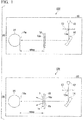
- the measuring apparatus 100 includes a box 10 that blocks external light, a light source 12, a slit plate 13 having a slit 13a, a toroidal mirror 14, an integrating sphere 16 having an entrance window 16a (15 mm long ⁇ 17.5 mm wide square), and a sample folder 18 having an opening 18a (10 mm ⁇ 30 mm square).
- the light source 12, the slit plate 13, the toroidal mirror 14, the integrating sphere 16, and the sample folder 18 are all disposed in the box 10.
- the sample folder 18 and the toroidal mirror 14 are disposed in this order on a straight line perpendicular to the entrance window 16a of the integrating sphere 16, with a space therebetween.
- the light source 12 is disposed on a straight line that intersects perpendicularly a straight line perpendicular to the entrance window 16a of the integrating sphere 16 at a position of the toroidal mirror 14.
- the slit plate 13 is disposed between the light source 12 and the toroidal mirror 14.
- the measuring apparatus 100 is configured such that a part of the light emitted from the light source 12 passes through the slit 13a of the slit plate 13 and is collected by the toroidal mirror 14, and all of the collected light passes through the opening 18a of the sample folder 18 to be incident on the entrance window 16a of the integrating sphere 16 at an incident angle of 0 degrees.
- the light that has passed through the slit 13a is collected by the toroidal mirror 14 in a range of width 3 mm ⁇ length 12.5 mm in the entrance window 16a.
- the number of toroidal mirrors is not particularly limited, and a position of the light source may be appropriately set according to a direction and the number of toroidal mirrors.
- the light emitted from the light source may be sequentially collected by two or more toroidal mirrors provided in the box, and then incident on the entrance window of the integrating sphere at an incident angle of 0 degrees.
- the transmittance T 1 can be calculated as follows.
- the measuring apparatus in a state where a measurement wavelength is from 300 to 800 nm, and there is nothing other than the sample folder on the optical path between the toroidal mirror and the entrance window, of the light emitted from the light source, the quantity of light Q A0 of light entering the integrating sphere is measured ("Step a").
- the film is attached to the sample folder on the entrance window side so as to cover the opening, and is disposed on the optical path.
- the uneven surface of the film faces the entrance window side, is parallel to the entrance window.
- a distance from the entrance window to a surface opposite the uneven surface of the resin film is set to 180 mm.
- the state where there is nothing on the optical path means a state where no members are disposed and there is nothing other than air.
- Q A1 may be measured before Q A0 .
- the transmittance T 2 can be calculated as follows, by using the measuring apparatus described above.
- a test film which has a thickness of 50 ⁇ m, is formed of only an ETFE, and has a transmittance at a wavelength of from 300 to 800 nm of 94% and an arithmetic average roughness Ra of both surfaces of 0.04 ⁇ m is laminated on the film on an uneven surface side to obtain a laminate ("Step d").
- the laminate is attached to the sample folder on the entrance window side so as to cover the opening, and is disposed on the optical path.
- the uneven surface of the laminate faces the entrance window side, is parallel to the entrance window.
- a distance from entrance window to a surface opposite the uneven surface of the film is set to 180 mm.
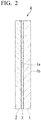
- Step d as shown in FIG. 2 , after water is applied to the entire uneven surface 1a of the agricultural fluorine-resin film 1 (hereinafter also referred to as a "film 1"), the test film 2 is stacked to the film 1 on the uneven surface 1a side to form a laminate 4 in which a water film 3 is formed between the film 1 and the test film 2.
- a laminate is used instead of a single film.
- a water film is formed between the film of the present invention and the test film.
- transmittance T 2 it is assumed a state where the water film is formed by condensation on a surface having the unevenness of the film of the present invention.
- the film of the present invention has a haze of preferably from 15% to 60%, more preferably from 15% to 50%, and particularly preferably from 15% to 40%. If the haze is equal to or higher than the lower limit of the range, scattered light at a growth point can be obtained. If the haze is equal to or lower than the upper limit of the range, the transmitted light can sufficiently reach near the ground even in a house with high eaves.
- the arithmetic average roughness Ra of the uneven surface is preferably from 0.30 to 2.0 ⁇ m, more preferably from 0.8 to 1.8 ⁇ m, and particularly preferably from 1.0 to 1.6 ⁇ m. If the Ra of the uneven surface is equal to or more than the lower limit of the range, it is easy to prevent leaf burning or bottom rot due to direct sunlight from occurring. If the Ra of the uneven surface is equal to or less than the upper limit of the range, the transmitted light can sufficiently reach near the ground even in a house with high eaves.
- the maximum height roughness Rz of the uneven surface is preferably from 1 to 8 ⁇ m, more preferably from 4 to 7 ⁇ m, and particularly preferably from 4 to 6 ⁇ m.. If the Rz of the uneven surface is equal to or more than the lower limit of the range, it is easy to prevent leaf burning or bottom rot due to direct sunlight from occurring. If the Rz of the uneven surface is equal to or lower than the upper limit of the range, the transmitted light can sufficiently reach near the ground even in a house with high eaves.
- a diffusion angle ⁇ of the transmitted light diffused at a light intensity corresponding to 10% of a light intensity of the transmitted light with a diffusion angle of 0 degrees is preferably from 6 to 10 degrees.
- the transmitted light with a diffusion angle in the range of from 0 to ⁇ degrees is light having a light intensity of 10% or more with respect to the light intensity of the transmitted light with a diffusion angle of 0 degrees. It means that the smaller the diffusion angle ⁇ , the smaller the degree of diffusion of the transmitted light, and the larger the diffusion angle ⁇ , the greater the degree of diffusion of the transmitted light.
- the diffusion angle ⁇ is within the range, the transmitted light can sufficiently reach near the ground while preventing leaf burning or bottom rot due to direct sunlight from occurring, even in a house with high eaves. Therefore, the growth of the crops is sufficiently promoted, and the yield is further increased.
- the diffusion angle ⁇ is particularly preferably from 6 to 8 degrees.
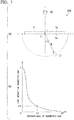
- a measuring apparatus 200 includes a light source 50 and a light receiver 52 provided below the light source 50, and is configured so that the film 1 can be provided between the light source 50 and the light receiver 52.
- the film 1 is provided so that the uneven surface 1a faces the light receiver 52 side and the surface 1b opposite the uneven surface 1a faces the light source 50 side.
- the measuring apparatus 200 is configured such that the light receiver 52 moves on a circumference of a radius R from a point P in the uneven surface 1a of the film 1, where the light incident on the surface 1b from the light source 50 reaches at an incident angle of 0 degrees, and light intensity of the transmitted light with a diffusion angle in a range of from -85 to 85 degrees can be measured.
- the light intensity of the transmitted light with a diffusion angle in the range of from -85 to 85 degrees is maximized when the diffusion angle of the transmitted light is 0 degrees.
- the diffusion angle corresponding to 0.1S is determined as the diffusion angle ⁇ .
- the light intensity of the transmitted light with a diffusion angle in a range of from 0 to -85 degrees is symmetric with the light intensity of the transmitted light with a diffusion angle in a range of from 0 to 85 degrees.
- a transmittance of parallel rays of the transmitted light with a diffusion angle of 2.5 degrees or smaller is preferably from 15% to 55% and particularly preferably from 20% to 55%.
- the transmittance of parallel rays is within the range, light obliquely incident on the film can be easily taken into the house, and the yield of crops is further increased.
- a thickness of the film of the present invention is preferably from 25 to 130 ⁇ m and particularly preferably from 50 to 100 ⁇ m. If the thickness of the resin film is equal to or larger than the lower limit of the range, sufficient strength is easily obtained. If the thickness of the resin film is equal to or smaller than the upper limit of the range, the transparency is excellent and handling during construction is excellent.
- the film of the present invention may be a film in which an uneven surface is coated with an anti dropping agent.
- the anti dropping agent is not particularly limited, and known material can be used. Examples thereof include inorganic fine particles such as silica fine particles or alumina fine particles.
- the film before being coated may be subjected to a surface treatment for enhancing the coating property of the anti dropping agent.
- the surface treatment is not particularly limited, and examples thereof include plasma treatment, ozone treatment, flame treatment, chemical conversion treatment, and primer treatment.
- primer treatment may be further conducted after the plasma treatment.
- examples of the primer treatment include coating with a silane coupling agent.
- the uneven surface of the film may be coated with an anti dropping agent containing a silane coupling agent as a main component and containing inorganic fine particles such as silica fine particles or alumina fine particles.
- the film of the present invention described above has a transmittance T 1 of from 20% to 70%, even in a case where the film is applied to a house with high eaves, the light sufficiently reaches near the ground, while reducing the direct exposure of sunlight to crops.
- the transmittance T 2 is 75% or higher, even when condensation occurs on the uneven surface, light can be efficiently taken into the house in a state where a water film is formed. Therefore, a sufficient quantity of light reaching the crops in the house can be ensured even in a time zone when the sunshine duration is short and the quantity of light tends to be insufficient, such as in the morning in winter.
- the film of the present invention contains fluorine-resin, and thus has excellent moisture permeability. Therefore, it is possible to efficiently release condensed water and air containing moisture in the house to the outside of the house. For this reason, when the temperature in the house rises, it is possible to prevent the humidity from increasing excessively and to prevent the crops from suffering from diseases such as canker disease.
- the film of the present invention contains fluorine-resin, and thus has excellent weather resistance. Therefore, it is possible to maintain the efficiency of taking light into the house and excellent moisture permeability for a long time.
- a greenhouse of the present invention is particularly effective as a greenhouse having a high eaves height of 4 m or more. Even if the eaves are high, the light sufficiently reaches near the ground while reducing the direct exposure of sunlight to crops. An inside of the house can be prevented from becoming hot and humid, and a sufficient quantity of light can be ensured even during a period when the sunshine duration is short.
- Examples of the greenhouse of the present invention can include an agricultural glass house in which the film of the present invention is expanded all over the inside of the glass window, in addition to an agricultural plastic greenhouse in which the film of the present invention is expanded all over the house.
- moisture-containing air in the house passes through the film, and then goes out of the house through the gap between the glass window and a frame portion. Therefore, also in the agricultural glass house, it is possible to prevent the inside of a house becoming hot and humid.
- Examples 1 to 13 and 21 to 24 examples, and Examples 1 to 4 and 21 are examples, and Examples 5 to 13 and 22 to 24 are comparative examples.
- the arithmetic average roughness Ra and the maximum height roughness Rz of the coated surface were measured using a surface roughness measuring instrument (product name "480A", manufactured by Tokyo Seimitsu Co., Ltd.).
- haze (DRY) was measured using a haze meter (product name "NDH5000", manufactured by Nippon Denshoku Industries Co., Ltd.).
- test film having a thickness of 50 ⁇ m (product name "F-CLEAN”, manufactured by AGC Green-Tech Co., Ltd.) is laminated on the film on the coated surface side where water has been applied to the entire coated surface to obtain a laminate in which a water film was formed between the resin film and the test film, and the haze (WET) of the laminate was measured.
- Light source D65 light source using white LED
- the transmittances T 1 and T 2 of the film of each example were measured as follows.
- a large sample chamber product name "MPC-3100", manufactured by Shimadzu Corporation
- the following spectrophotometer was provided inside the box to configure a measuring apparatus equivalent to the measuring apparatus 100 shown in FIG. 1 .
- a part of the light emitted from the light source passes through the slit, and is collected by the toroidal mirror in the range of 3 mm width ⁇ 12.5 mm length in the entrance window of the integrating sphere to be incident on the entrance window with an incident angle of 0 degrees.
- the quantity of light Q A0 of light entering the integrating sphere from the entrance window was measured by using a measurement wavelength of from 300 to 800 nm.
- a film was attached to the sample folder on the integrating sphere side so as to cover the opening. The attachment of the film was performed such that the surface coated with the anti dropping agent (hereinafter also referred to as a "coated surface”) faces the entrance window side and is parallel with the entrance window, and the distance from the entrance window to the surface opposite the coated surface in the film became 180 mm.
- the surface coated with the anti dropping agent hereinafter also referred to as a "coated surface
- a test film (product name "F-CLEAN", manufactured by AGC Green-Tech Co., Ltd., thickness: 50 ⁇ m, total light transmittance at a wavelength of from 300 to 800 nm: 94%, a film formed of only ETFE having arithmetic average roughness Ra of the surface: 0.04 ⁇ m) is laminated on the film on the coated surface side to obtain a laminate in which a water film was formed between the film and the test film.
- the laminate was attached to the sample folder on the integrating sphere side so as to cover the opening.
- a goniophotometer product name "GC-5000L", manufactured by Nippon Denshoku Industries Co., Ltd.
- the film was provided such that the coated surface faces the light receiver side and the surface opposite the coated surface faces the light source side.
- the goniophotometer light is incident on the surface opposite the coated surface in the film from the light source at an incident angle of 0 degrees, and the light intensity of the transmitted light in a range where half of the diffusion angle ⁇ is from 0 to 90 degrees was measured.
- the diffusion angle ⁇ of the transmitted light diffused at the light intensity corresponding to 10% was determined.
- Light source D65 light source using tungsten halogen lamp
- ETFE product name "Fluon ETFE C-88AX", manufactured by AGC Inc.
- a resin film having unevenness on one surface was produced by a T-die extrusion method in which resin extruded into a film shape allowed to pass between a pair of metal rolls and a surface embossed back roll of the kind shown in Table 1 while rotating the rolls.
- "Unused" in Table 1 means that a back roll having no embossed surface was used instead of the surface embossed back roll.
- the forming conditions were as follows: a die temperature was 310°C, a temperature of the metal roll was 50°C, a temperature of surface embossed back roll was 50°C, an air gap between rolls was 150 mm, and the take-up speed was as shown in Table 1.
- the uneven surface of the resin film was subjected to corona discharge treatment, and then coated with an anti dropping agent (product name "F-CLEAN anti dropping agent", manufactured by AGC Green-Tech Co., Ltd.) by the gravure coating method, and dried at 70°C for 30 seconds to form a layer having a thickness of 0.3 ⁇ m, and a film with an anti dropping agent was obtained.
- an anti dropping agent product name "F-CLEAN anti dropping agent”
- the uneven surface of the resin film obtained in the same manner as in Example 1 was subjected to corona discharge treatment, and then coated with an undercoat solution below by the gravure coating method, and then dried at 80°C for 5 seconds to form an undercoat layer with a coating amount of 0.03 g/m 2 .
- a film with an anti dropping agent was obtained in the same manner as in Example 1 except that coating with the following anti dropping agent was performed by a gravure coating method.
- Undercoat solution Solution obtained by mixing 1 part by mass of aminosilane (product name "KBM903", manufactured by Shin-Etsu Chemical Co., Ltd.), 0.05 parts by mass of a leveling agent (product name "Sunphenol 420", manufactured by Shin-Etsu Chemical Co., Ltd.), and 98.95 parts by mass of industrial ethanol (product name "Sol Mix AP-1” manufactured by Nippon Alcohol Sales Co., Ltd.)
- Anti dropping agent Solution obtained by mixing solutions 1 and 2 below
- Solution 1 1.5 parts by mass of 1 N nitric acid was added to 16.1 parts by mass of ion-exchanged water, and 9.7 parts by mass of silica sol (product name "Snowtex S", manufactured by Nissan Chemical Industries, pH 10, solid content concentration: 30% by mass) was added thereto while stirring. The stirring was continued for 30 minutes, and the mixture was allowed to stand at room temperature (25°C) for 1 day.
- silica sol product name "Snowtex S", manufactured by Nissan Chemical Industries, pH 10, solid content concentration: 30% by mass
- Solution 2 2 parts by mass of 1 N nitric acid to 2.75 parts by mass of ion-exchanged water, and 50 parts by mass of industrial ethanol (product name "SOLMIX AP-1", manufactured by Nippon Alcohol Sales Co., Ltd.), 17.8 parts by mass of boehmite (product name "K-Statch Z20A", manufactured by K-I Chemical Industry Co., LTD, pH 4.0, solid content concentration: 20% by mass), and 0.2 parts by mass of aminosilane (product name "KBM 903", manufactured by Shin-Etsu Chemical Co., Ltd.) were added thereto while stirring. The stirring was continued for 30 minutes, and then the mixture allowed to stand at room temperature (25°C) for 1 day.
- Example 1 Except that the surface embossed back roll was changed as shown in Table 1 and the take-up speed was changed as shown in Table 1, a resin film having unevenness on one side was produced in the same manner as in Example 1.
- the uneven surface of the resin film was subjected to a corona discharge treatment and then coated with an anti dropping agent, in the same manner as in Example 1, to obtain a film with an anti dropping agent.
- a resin film was produced in the same manner as in Example 1.
- Ra and Rz were measured on the surface not in contact with the metal roll.
- the surface of the resin film where Ra and Rz were measured was subjected to a corona discharge treatment and then coated with an anti dropping agent, in the same manner as in Example 1, to obtain a film with an anti dropping agent.
- Example 7 The uneven surfaces of the "Super Kirinashi” (Example 7) and “hanayaka (registered trademark)” (Example 8) were subjected to a corona discharge treatment and then coated with an anti dropping agent, in the same manner as in Example 1, to obtain a film with an anti dropping agent.
- Table 1 shows kinds and use or not of surface embossed back roll, and measurement results of take-up speed, a thickness of the resin film, the arithmetic average roughness Ra, the maximum height roughness Rz, the haze, the transmittances T 1 and T 2 , the narrow angle scattering, and a scattering angle ⁇ of each example.
- the diffusion angle ⁇ of "0 degrees" means that the transmitted light was not diffused at all.
- the resin films of Examples 1 to 4 had the transmittance T 1 of from 20% to 70% and the transmittance T 2 of 75% or higher.
- the resin films of Examples 5 to 13 did not satisfy at least one of the conditions of the transmittance T 1 and the transmittance T 2 .
- Tomato cultivation by a house was performed using the film with an anti dropping agent obtained in Example 1. Specifically, in an agricultural roof-type greenhouse with an eave height of 4 m, in which agricultural fluorine-resin film was expanded with an uneven surface (coated surface of the anti dropping agent) facing inside, tomatoes were cultivated by a cultivation method of long-term multi-stage harvesting using high wire induction. For the tomato cultivation, the plant was planted in August at the house and harvested from the beginning of November to the middle of June. The tomato variety was "Mylock" and the number of planted plants was 2,400 per 10 a. Table 2 shows the yield per 10 a of each month and the total yield (t) per 10 a in winter (January to February), summer (May to June), and the whole harvest period.
- Table 2 shows the yield per 10 a of each month and the total yield (t) per 10 a in winter (January to February), summer (May to June), and the whole harvest period.
- Example 21 22 23 24 Film with anti dropping agent
- Example 6 Example 5
- Example 8 Yield [t] November 3.1 3.0 2.7 2.9 December 2.2 2.3 2.0 2.3 January 2.8 2.4 2.4 2.7 February 2.3 1.9 2.2 2.1 March 3.1 3.0 3.0 April 5.0 3.8 4.0 4.1 March 6.6 5.5 5.0 5.0 Beginning to middle of June 4.1 3.1 3.2 3.5 Total of winter (January to February when temperature is low and solar altitude is low) 21.0 22.0 23.0 24.0 Total of summer (May to June when the day is long and solar altitude is high) 5.0 4.7 4.4 5.0 Total of whole period 34.3 28.8 28.7 28.7
- Example 21 using a film with an anti dropping agent having the transmittance T 1 of from 20% to 70% and the transmittance T 2 of 75% or higher, the total yield of tomatoes during the entire harvest period was higher than those in Examples 22 to 24, which did not satisfy at least one of these conditions.
- Example 21 the yields in winter (January to February) and summer (May to June) were higher than those in Examples 22 to 24. This is thought to be due to the fact that in Example 21, the light sufficiently reached near the ground in the house over the whole period to promote sufficiently the growth also in the lower part and it was prevented that the house became hot and humid and the tomato suffering from diseases such as canker disease.
- Example 22 it is thought that the yield was smaller than that in Example 21 due to the effect of leaf burning or bottom rot by direct sunlight.
- Example 23 it is thought that the yield was smaller than that in Example 21 due to the effect that it was difficult for light to reach near the ground in the house.
- Example 24 it is thought that the yield was smaller than that in Example 21 due to the effect of insufficient quantity of light in the house, especially in winter.
Landscapes
- Life Sciences & Earth Sciences (AREA)
- Environmental Sciences (AREA)
- Chemical & Material Sciences (AREA)
- Engineering & Computer Science (AREA)
- Manufacturing & Machinery (AREA)
- Materials Engineering (AREA)
- Medicinal Chemistry (AREA)
- Chemical Kinetics & Catalysis (AREA)
- Health & Medical Sciences (AREA)
- Polymers & Plastics (AREA)
- Organic Chemistry (AREA)
- Soil Sciences (AREA)
- Manufacture Of Macromolecular Shaped Articles (AREA)
- Greenhouses (AREA)
- Protection Of Plants (AREA)
- Laminated Bodies (AREA)
- Compositions Of Macromolecular Compounds (AREA)
Abstract
Description
- The present invention relates to an agricultural fluorine-resin film and a greenhouse.
- Resin films having excellent transparency are widely used as a coating material for a greenhouse (hereinafter, sometimes simply referred to as a "house"). The resin film is required to allow a sufficient quantity of light to reach crops in the house. It is also important to prevent leaf burning or bottom rot due to direct sunlight from occurring and growth inhibition of lower leaves that are shaded by upper leaves from occurring.
- As an agricultural resin film, for example, an agricultural resin film in which, in a laminate of a base film formed of polyvinyl chloride or the like and a resin layer formed of an acrylic acid ester polymer or the like, a surface of the resin layer has unevenness, is proposed (Patent Literature 1).
- [Patent Literature 1] Japanese Unexamined Patent Application, Publication No.
2006-115838 - In recent years, as greenhouses where tomatoes or cucumbers are grown, the use of houses with high eaves is increasing for the purpose of increasing yield by increasing the height of crops. However, the present inventors found that the yield does not increase much when the agricultural resin film described in
Patent Literature 1 is applied to a house with high eaves. The reason for this is considered to be that among diffused transmitted light, a proportion of light going out from a side of the house before reaching the ground is high, and it is difficult for the light to reach crops near the ground. - Particularly in the morning in winter, since sunshine duration is short and sunlight is weak, the quantity of light tends to be insufficient. In order to increase the yield in the house with high eaves, it is important to secure a sufficient quantity of light to reach the crops in the house even in such a time zone. On the other hand, particularly in summer, it is important to prevent leaf burning or bottom rot due to direct sunlight from occurring.
- An object of the present invention is to provide an agricultural fluorine-resin film that can increase yield of crops, even in the house with high eaves, during a period when the sunlight is strong on crops or during a period when the sunshine duration is short, and a greenhouse using the agricultural fluorine-resin film.
- The present invention provides an agricultural fluorine-resin film and a greenhouse having the following configurations [1] to [12].
- [1] An agricultural fluorine-resin film containing fluorine-resin, in which one surface has unevenness, a transmittance at a wavelength of from 300 to 800 nm is from 20% to 70%, and a transmittance T2 below is 75% or more.
Transmittance T2: Transmittance of a laminate at a wavelength of from 300 to 800 nm, obtained by laminating the resin film and a test film, in which the surface having the unevenness of the resin film is completely filled with water, and the test film which has a thickness of 50 µm, is formed of only an ethylene-tetrafluoroethylene copolymer, and has a transmittance at a wavelength of from 300 to 800 nm of 94% and an arithmetic average roughness Ra of both surfaces of 0.04 µm is laminated on the resin film. - [2] The agricultural fluorine-resin film according to [1], in which a haze is from 15% to 60%.
- [3] The agricultural fluorine-resin film according to [1] or [2], in which the surface having the unevenness has an arithmetic average roughness Ra of from 0.30 to 2.0 µm.
- [4] The agricultural fluorine-resin film according to any one of [1] to [3], in which the surface having the unevenness has a maximum height roughness Rz of from 1 to 8 µm.
- [5] The agricultural fluorine-resin film according to any one of [1] to [4], in which the fluorine-resin is an ethylene-tetrafluoroethylene copolymer.
- [6] The agricultural fluorine-resin film according to any one of [1] to [5], further containing: an ultraviolet absorber.
- [7] The agricultural fluorine-resin film according to any one of [1] to [6], in which when light emitted from a light source is incident on the surface opposite the surface having the unevenness in the resin film at an incident angle of 0 degrees, a diffusion angle θ of transmitted light diffused at a light intensity corresponding to 10% of a light intensity of the transmitted light with a diffusion angle of 0 degrees is from 6 to 10 degrees.
- [8] The agricultural fluorine-resin film according to any one of [1] to [7], in which when light emitted from light source is incident, a transmittance of parallel rays in transmitted light with a diffusion angle of 2.5 degrees or less is from 15% to 55%.
- [9] The agricultural fluorine-resin film according to any one of [1] to [8], in which a thickness is from 25 to 130 µm.
- [10] A greenhouse using the agricultural fluorine-resin film according to any one of [1] to [9].
- [11] The greenhouse according to [10], in which an eaves height of the house is 4 m or more.
- [12] The greenhouse according to [10] or [11], in which the agricultural fluorine-resin film is expanded inside a glass window.
- When using an agricultural fluorine-resin film of the present invention, it is possible to increase yield of crops, even in the house with high eaves, during a period when the sunlight is strong on crops or during a period when the sunshine duration is short.
- In the greenhouse of the present invention, the yield of crops can increase, even with the high eaves, during a period when the sunlight is strong on crops or during a period when the sunshine duration is short.
-
-
FIG. 1 is a side view showing a state of measuring a transmittance of a film at a wavelength of from 300 to 800 nm. -
FIG. 2 is a sectional view showing a laminate used for measuring a transmittance T2. -
FIG. 3(A) is a side view showing a state of measuring a diffusion angle θ of transmitted light diffused at a light intensity corresponding to 10% of a light intensity of the transmitted light with a diffusion angle of 0 degrees, andFIG. 3(B) is a graph showing a relationship between the diffusion angle of the transmitted light and the light intensity of the transmitted light. - The meanings of the following terms in the present specification are as follows.
- "Arithmetic average roughness Ra" and "maximum height roughness Rz" mean values measured by a method described in JIS B 0601: 2013 (ISO 4287: 1997, Amd.1: 2009).
- "Haze" means a value measured according to JIS K 7136: 2000 (corresponding international standard: ISO 14782: 1999).
- "Eave height" of a greenhouse means the height from the ground inside a house to eaves of a house structure.
- An agricultural fluorine-resin film of the present invention (hereinafter also referred to as a "film of the present invention") is a film containing fluorine-resin and having unevenness on one surface. The film of the present invention is applied to a greenhouse so that the surface having the unevenness (hereinafter also referred to as an "uneven surface") faces an inside of the house.
- Examples of the fluorine-resin include polyvinylidene fluoride, polytetrafluoroethylene, polychlorotrifluoroethylene, polyhexafluoropropylene, polyvinyl fluoride, a vinylidene fluoride-tetrafluoroethylene-hexafluoropropylene-type copolymer, a vinylidene fluoride-hexafluoropropylene-type copolymer, an ethylene-tetrafluoroethylene-type copolymer (hereinafter also referred to as "ETFE"), a tetrafluoroethylene-hexafluoropropylene-type copolymer, and a perfluoro (alkyl vinyl ether)-tetrafluoroethylene-type copolymer. One kind of the fluorine-resin may be used and two or more kinds thereof may be used.
- As the fluorine-resin, from the viewpoint of easily obtaining a film having excellent low-temperature formability and high strength with low costs, the ETFE, the tetrafluoroethylene-hexafluoropropylene-type copolymer, and the perfluoro (alkyl vinyl ether)-tetrafluoroethylene-type copolymer are preferable, and the ETFE is particularly preferable.
- A number average molecular weight of the fluorine-resin is preferably from 10,000 to 1,000,000 and particularly preferably from 100,000 to 700,000. If the number average molecular weight of the fluorine-resin is equal to or more than the lower limit of the range, the strength of the film will be higher. If the number average molecular weight of the fluorine-resin is equal to or less than the upper limit of the range, more excellent forming processability is obtained.
- The film of the present invention preferably further contains an ultraviolet absorber in addition to the fluorine-resin from the viewpoint of excellent weather resistance. As the ultraviolet absorber, known ones can be used, and examples thereof include inorganic ultraviolet absorbers such as cerium oxide, zinc oxide, and iron oxide, and the like, and commercially available organic ultraviolet absorbers. One kind of the ultraviolet absorbers may be used and two or more kinds thereof may be used.
- In a case where the film of the present invention contains the ultraviolet absorber, a content of the ultraviolet absorber with respect to 100 parts by mass of the film of the present invention is preferably from 0.4 to 5 parts by mass, and particularly preferably from 0.5 to 3 parts by mass. If the content of the ultraviolet absorber is equal to or more than the lower limit of the range, excellent weather resistance is obtained. If the content of ultraviolet absorber is equal to or less than the upper limit of the range, a haze will not be too high, and light can be sufficiently taken into the house.
- The film of the present invention has a transmittance at a wavelength of from 300 to 800 nm (hereinafter also referred to as a "transmittance T1") of from 20% to 70%, preferably from 30% to 70%, more preferably from 40% to 70%, and particularly preferably from 50% to 70 %. If the transmittance T1 is equal to or higher than the lower limit of the range, the transmitted light is not diffused excessively. Therefore, the transmitted light can sufficiently reach near the ground even in a house with high eaves. Therefore, growth is sufficiently promoted even in a portion of the crop near the ground. If the transmittance T1 is equal to or lower than the upper limit of the range, it is possible to prevent leaf burning or bottom rot due to direct sunlight from occurring.
- The transmittance T1 can be adjusted, for example, by adjusting the arithmetic average roughness Ra and the maximum height roughness Rz of the uneven surface of the resin film. As Ra and Rz decrease, the transmittance T1 tends to increase.
- The film of the present invention has a transmittance T2 of 75% or higher, and preferably 80% or higher. If the transmittance T2 is equal to or higher than the lower limit of the range, light is efficiently taken into the house in a case where the outside air temperature is low and condensation occurs on the uneven surface. Therefore, it is possible to secure a sufficient quantity of light in the house, even in a period such as winter when the sunshine duration is short.
- A method of measuring the transmittance T1 and the transmittance T2 is not particularly limited, and it is preferable to use the following measuring apparatus.
- A measuring apparatus including a box that blocks external light; a light source provided in the box; a slit plate having a slit that allows a part of the light from the light source to pass through; a toroidal mirror that collects the light that has passed through the slit; an integrating sphere disposed such that the light collected by the toroidal mirror is incident on an entrance window at an incident angle of 0 degrees; and a sample folder disposed on an optical path between the toroidal mirror and the integrating sphere and having an opening through which all of the light collected by the toroidal mirror passes, in which a size of the entrance window is 15 mm long × 17.5 mm wide, and in a state where there is nothing other than the sample folder on the optical path, the light that has passed through the slit is collected by the toroidal mirror in a range of
width 3 mm × length 12.5 mm in the entrance window. - For example, a measuring
apparatus 100 illustrated inFIG. 1(A) is used. The measuringapparatus 100 includes abox 10 that blocks external light, alight source 12, aslit plate 13 having aslit 13a, atoroidal mirror 14, an integratingsphere 16 having anentrance window 16a (15 mm long × 17.5 mm wide square), and asample folder 18 having anopening 18a (10 mm × 30 mm square). Thelight source 12, theslit plate 13, thetoroidal mirror 14, the integratingsphere 16, and thesample folder 18 are all disposed in thebox 10. Thesample folder 18 and thetoroidal mirror 14 are disposed in this order on a straight line perpendicular to theentrance window 16a of the integratingsphere 16, with a space therebetween. Thelight source 12 is disposed on a straight line that intersects perpendicularly a straight line perpendicular to theentrance window 16a of the integratingsphere 16 at a position of thetoroidal mirror 14. Theslit plate 13 is disposed between thelight source 12 and thetoroidal mirror 14. - The measuring
apparatus 100 is configured such that a part of the light emitted from thelight source 12 passes through theslit 13a of theslit plate 13 and is collected by thetoroidal mirror 14, and all of the collected light passes through theopening 18a of thesample folder 18 to be incident on theentrance window 16a of the integratingsphere 16 at an incident angle of 0 degrees. The light that has passed through theslit 13a is collected by thetoroidal mirror 14 in a range ofwidth 3 mm × length 12.5 mm in theentrance window 16a. - The number of toroidal mirrors is not particularly limited, and a position of the light source may be appropriately set according to a direction and the number of toroidal mirrors. For example, the light emitted from the light source may be sequentially collected by two or more toroidal mirrors provided in the box, and then incident on the entrance window of the integrating sphere at an incident angle of 0 degrees.
- The transmittance T1 can be calculated as follows.
- In the measuring apparatus, in a state where a measurement wavelength is from 300 to 800 nm, and there is nothing other than the sample folder on the optical path between the toroidal mirror and the entrance window, of the light emitted from the light source, the quantity of light QA0 of light entering the integrating sphere is measured ("Step a"). Next, the film is attached to the sample folder on the entrance window side so as to cover the opening, and is disposed on the optical path. The uneven surface of the film faces the entrance window side, is parallel to the entrance window. A distance from the entrance window to a surface opposite the uneven surface of the resin film is set to 180 mm. The quantity of light QA1 of light entering the integrating sphere is measured under the same conditions as in Step a, except that the film is disposed ("Step b",
FIG. 1(B) ). Next, the transmittance T1 (%) is calculated byEquation 1 below ("Step c").
- The state where there is nothing on the optical path means a state where no members are disposed and there is nothing other than air. In addition, QA1 may be measured before QA0.
- The transmittance T2 can be calculated as follows, by using the measuring apparatus described above.
- The entire uneven surface of the film is completely filled with water. Next, a test film which has a thickness of 50 µm, is formed of only an ETFE, and has a transmittance at a wavelength of from 300 to 800 nm of 94% and an arithmetic average roughness Ra of both surfaces of 0.04 µm is laminated on the film on an uneven surface side to obtain a laminate ("Step d"). Next, the laminate is attached to the sample folder on the entrance window side so as to cover the opening, and is disposed on the optical path. The uneven surface of the laminate faces the entrance window side, is parallel to the entrance window. A distance from entrance window to a surface opposite the uneven surface of the film is set to 180 mm. The quantity of light QA2 of light entering the integrating sphere is measured under the same conditions as in Step a, except that the laminate is disposed ("Step e")). Next, the transmittance T2 (%) is calculated by
Equation 2 below ("Step f").
- In Step d, as shown in
FIG. 2 , after water is applied to the entireuneven surface 1a of the agricultural fluorine-resin film 1 (hereinafter also referred to as a "film 1"), thetest film 2 is stacked to thefilm 1 on theuneven surface 1a side to form alaminate 4 in which awater film 3 is formed between thefilm 1 and thetest film 2. In the measurement of transmittance T2, such a laminate is used instead of a single film. In the laminate, a water film is formed between the film of the present invention and the test film. In the measurement of transmittance T2, it is assumed a state where the water film is formed by condensation on a surface having the unevenness of the film of the present invention. - The film of the present invention has a haze of preferably from 15% to 60%, more preferably from 15% to 50%, and particularly preferably from 15% to 40%. If the haze is equal to or higher than the lower limit of the range, scattered light at a growth point can be obtained. If the haze is equal to or lower than the upper limit of the range, the transmitted light can sufficiently reach near the ground even in a house with high eaves.
- In the film of the present invention, the arithmetic average roughness Ra of the uneven surface is preferably from 0.30 to 2.0 µm, more preferably from 0.8 to 1.8 µm, and particularly preferably from 1.0 to 1.6 µm. If the Ra of the uneven surface is equal to or more than the lower limit of the range, it is easy to prevent leaf burning or bottom rot due to direct sunlight from occurring. If the Ra of the uneven surface is equal to or less than the upper limit of the range, the transmitted light can sufficiently reach near the ground even in a house with high eaves.
- In the film of the present invention, the maximum height roughness Rz of the uneven surface is preferably from 1 to 8 µm, more preferably from 4 to 7 µm, and particularly preferably from 4 to 6 µm.. If the Rz of the uneven surface is equal to or more than the lower limit of the range, it is easy to prevent leaf burning or bottom rot due to direct sunlight from occurring. If the Rz of the uneven surface is equal to or lower than the upper limit of the range, the transmitted light can sufficiently reach near the ground even in a house with high eaves.
- In the film of the present invention, when light emitted from the light source is incident on the surface opposite the uneven surface in the resin film at an incident angle of 0 degrees, a diffusion angle θ of the transmitted light diffused at a light intensity corresponding to 10% of a light intensity of the transmitted light with a diffusion angle of 0 degrees is preferably from 6 to 10 degrees. The transmitted light with a diffusion angle in the range of from 0 to θ degrees is light having a light intensity of 10% or more with respect to the light intensity of the transmitted light with a diffusion angle of 0 degrees. It means that the smaller the diffusion angle θ, the smaller the degree of diffusion of the transmitted light, and the larger the diffusion angle θ, the greater the degree of diffusion of the transmitted light. If the diffusion angle θ is within the range, the transmitted light can sufficiently reach near the ground while preventing leaf burning or bottom rot due to direct sunlight from occurring, even in a house with high eaves. Therefore, the growth of the crops is sufficiently promoted, and the yield is further increased. The diffusion angle θ is particularly preferably from 6 to 8 degrees.
- The diffusion angle θ is measured using a
measuring apparatus 200 illustrated inFIG 3(A) . A measuringapparatus 200 includes alight source 50 and alight receiver 52 provided below thelight source 50, and is configured so that thefilm 1 can be provided between thelight source 50 and thelight receiver 52. Thefilm 1 is provided so that theuneven surface 1a faces thelight receiver 52 side and thesurface 1b opposite theuneven surface 1a faces thelight source 50 side. The measuringapparatus 200 is configured such that thelight receiver 52 moves on a circumference of a radius R from a point P in theuneven surface 1a of thefilm 1, where the light incident on thesurface 1b from thelight source 50 reaches at an incident angle of 0 degrees, and light intensity of the transmitted light with a diffusion angle in a range of from -85 to 85 degrees can be measured. - As shown in
FIG. 3(B) , the light intensity of the transmitted light with a diffusion angle in the range of from -85 to 85 degrees is maximized when the diffusion angle of the transmitted light is 0 degrees. When the light intensity of the transmitted light when the diffusion angle is 0 degrees is S, the diffusion angle corresponding to 0.1S is determined as the diffusion angle θ. In the measuringapparatus 200, the light intensity of the transmitted light with a diffusion angle in a range of from 0 to -85 degrees is symmetric with the light intensity of the transmitted light with a diffusion angle in a range of from 0 to 85 degrees. - In the film of the present invention, when the light emitted from the light source is incident, a transmittance of parallel rays of the transmitted light with a diffusion angle of 2.5 degrees or smaller (hereinafter also referred to as "narrow angle scattering") is preferably from 15% to 55% and particularly preferably from 20% to 55%. When the transmittance of parallel rays is within the range, light obliquely incident on the film can be easily taken into the house, and the yield of crops is further increased.
- A thickness of the film of the present invention is preferably from 25 to 130 µm and particularly preferably from 50 to 100 µm. If the thickness of the resin film is equal to or larger than the lower limit of the range, sufficient strength is easily obtained. If the thickness of the resin film is equal to or smaller than the upper limit of the range, the transparency is excellent and handling during construction is excellent.
- The film of the present invention may be a film in which an uneven surface is coated with an anti dropping agent. The anti dropping agent is not particularly limited, and known material can be used. Examples thereof include inorganic fine particles such as silica fine particles or alumina fine particles.
- In a case where the uneven surface is coated with the anti dropping agent, the film before being coated may be subjected to a surface treatment for enhancing the coating property of the anti dropping agent. The surface treatment is not particularly limited, and examples thereof include plasma treatment, ozone treatment, flame treatment, chemical conversion treatment, and primer treatment. In addition, for example, primer treatment may be further conducted after the plasma treatment. Examples of the primer treatment include coating with a silane coupling agent. Further, the uneven surface of the film may be coated with an anti dropping agent containing a silane coupling agent as a main component and containing inorganic fine particles such as silica fine particles or alumina fine particles.
- Since the film of the present invention described above has a transmittance T1 of from 20% to 70%, even in a case where the film is applied to a house with high eaves, the light sufficiently reaches near the ground, while reducing the direct exposure of sunlight to crops. In addition, since the transmittance T2 is 75% or higher, even when condensation occurs on the uneven surface, light can be efficiently taken into the house in a state where a water film is formed. Therefore, a sufficient quantity of light reaching the crops in the house can be ensured even in a time zone when the sunshine duration is short and the quantity of light tends to be insufficient, such as in the morning in winter.
- In addition, the film of the present invention contains fluorine-resin, and thus has excellent moisture permeability. Therefore, it is possible to efficiently release condensed water and air containing moisture in the house to the outside of the house. For this reason, when the temperature in the house rises, it is possible to prevent the humidity from increasing excessively and to prevent the crops from suffering from diseases such as canker disease. In addition, the film of the present invention contains fluorine-resin, and thus has excellent weather resistance. Therefore, it is possible to maintain the efficiency of taking light into the house and excellent moisture permeability for a long time.
- From the above, when using the film of the present invention, it is possible to increase yield of crops, even in the house with high eaves, during a period when the sunlight is strong on crops or during a period when the sunshine duration is short.
- A greenhouse of the present invention is particularly effective as a greenhouse having a high eaves height of 4 m or more. Even if the eaves are high, the light sufficiently reaches near the ground while reducing the direct exposure of sunlight to crops. An inside of the house can be prevented from becoming hot and humid, and a sufficient quantity of light can be ensured even during a period when the sunshine duration is short.
- Examples of the greenhouse of the present invention can include an agricultural glass house in which the film of the present invention is expanded all over the inside of the glass window, in addition to an agricultural plastic greenhouse in which the film of the present invention is expanded all over the house. In the agricultural glass house, moisture-containing air in the house passes through the film, and then goes out of the house through the gap between the glass window and a frame portion. Therefore, also in the agricultural glass house, it is possible to prevent the inside of a house becoming hot and humid.
- Hereinafter, the present invention will be described in detail using examples, but the present invention is not limited by the following description. Among Examples 1 to 13 and 21 to 24, Examples 1 to 4 and 21 are examples, and Examples 5 to 13 and 22 to 24 are comparative examples.
- For the film of each example, the arithmetic average roughness Ra and the maximum height roughness Rz of the coated surface were measured using a surface roughness measuring instrument (product name "480A", manufactured by Tokyo Seimitsu Co., Ltd.).
- For the film of each example, haze (DRY) was measured using a haze meter (product name "NDH5000", manufactured by Nippon Denshoku Industries Co., Ltd.).
- In addition, a test film having a thickness of 50 µm (product name "F-CLEAN", manufactured by AGC Green-Tech Co., Ltd.) is laminated on the film on the coated surface side where water has been applied to the entire coated surface to obtain a laminate in which a water film was formed between the resin film and the test film, and the haze (WET) of the laminate was measured.
Light source: D65 light source using white LED - The transmittances T1 and T2 of the film of each example were measured as follows.
- As a box that blocks external light, a large sample chamber (product name "MPC-3100", manufactured by Shimadzu Corporation) was used. In addition, the following spectrophotometer was provided inside the box to configure a measuring apparatus equivalent to the measuring
apparatus 100 shown inFIG. 1 . In the spectrophotometer, a part of the light emitted from the light source passes through the slit, and is collected by the toroidal mirror in the range of 3 mm width × 12.5 mm length in the entrance window of the integrating sphere to be incident on the entrance window with an incident angle of 0 degrees. -
- Product name: "UV-3600" (manufactured by Shimadzu Corporation)
- Entrance window: 15 mm long × 17.5 mm wide square
- Distance from entrance window to toroidal mirror: 350 mm
- Distance from entrance window to sample folder: 180 mm
- Opening of sample folder: 10 mm × 30 mm square
- Slit condition: Slit wavelength 8 nm
- Light source: Deuterium discharge tube lamp (from 190 nm to 450 nm) and tungsten halogen lamp (from 350 nm to 2300 nm)
- In the measuring apparatus, in a state where there is nothing other than the sample folder on the optical path between the toroidal mirror and the entrance window, of the light emitted from the light source, the quantity of light QA0 of light entering the integrating sphere from the entrance window was measured by using a measurement wavelength of from 300 to 800 nm. Next, a film was attached to the sample folder on the integrating sphere side so as to cover the opening. The attachment of the film was performed such that the surface coated with the anti dropping agent (hereinafter also referred to as a "coated surface") faces the entrance window side and is parallel with the entrance window, and the distance from the entrance window to the surface opposite the coated surface in the film became 180 mm. Except that the film was disposed, the quantity of light QA1 of the light entering the integrating sphere from the entrance window was measured under the same conditions as the measurement of the quantity of light QA0, and the transmittance T1 (%) was calculated by
Equation 1 below.
- After water was applied to the entire coated surface of the film, a test film (product name "F-CLEAN", manufactured by AGC Green-Tech Co., Ltd., thickness: 50 µm, total light transmittance at a wavelength of from 300 to 800 nm: 94%, a film formed of only ETFE having arithmetic average roughness Ra of the surface: 0.04 µm) is laminated on the film on the coated surface side to obtain a laminate in which a water film was formed between the film and the test film. In the measuring apparatus, the laminate was attached to the sample folder on the integrating sphere side so as to cover the opening. The attachment of the laminate was performed such that the coated surface in the film of the laminate faces the entrance window side and is parallel with the entrance window, and the distance from the entrance window to the surface opposite the coated surface in the film became 180 mm. Except that the laminate was disposed, the quantity of light QA2 of the light entering the integrating sphere from the entrance window was measured under the same conditions as the measurement of the quantity of light QA0, and the transmittance T2 (%) was calculated by
Equation 2 below.
- As the measuring
apparatus 200 shown inFIG. 3 , a goniophotometer (product name "GC-5000L", manufactured by Nippon Denshoku Industries Co., Ltd.) is used, and the film was provided such that the coated surface faces the light receiver side and the surface opposite the coated surface faces the light source side. In the goniophotometer, light is incident on the surface opposite the coated surface in the film from the light source at an incident angle of 0 degrees, and the light intensity of the transmitted light in a range where half of the diffusion angle θ is from 0 to 90 degrees was measured. When the light intensity of the transmitted light with a diffusion angle of 0 degrees was 100%, the diffusion angle θ of the transmitted light diffused at the light intensity corresponding to 10% was determined. (Angle to be measured is θ/2)
Light source: D65 light source using tungsten halogen lamp - For the film of each example, narrow angle scattering was measured using a haze gard i (manufactured by Tetsutani & Co., Ltd.).
Light source: D65 light source using white LED -
- Roll A: Roll with Ra of 2.6 µm and Rz of 19.5 µm
- Roll B: Roll with Ra of 0.35 µm and Rz of 2.4 µm
- ETFE (product name "Fluon ETFE C-88AX", manufactured by AGC Inc.) was used as the fluorine-resin, and a resin film having unevenness on one surface was produced by a T-die extrusion method in which resin extruded into a film shape allowed to pass between a pair of metal rolls and a surface embossed back roll of the kind shown in Table 1 while rotating the rolls. "Unused" in Table 1 means that a back roll having no embossed surface was used instead of the surface embossed back roll. The forming conditions were as follows: a die temperature was 310°C, a temperature of the metal roll was 50°C, a temperature of surface embossed back roll was 50°C, an air gap between rolls was 150 mm, and the take-up speed was as shown in Table 1. The uneven surface of the resin film was subjected to corona discharge treatment, and then coated with an anti dropping agent (product name "F-CLEAN anti dropping agent", manufactured by AGC Green-Tech Co., Ltd.) by the gravure coating method, and dried at 70°C for 30 seconds to form a layer having a thickness of 0.3 µm, and a film with an anti dropping agent was obtained.
- The uneven surface of the resin film obtained in the same manner as in Example 1 was subjected to corona discharge treatment, and then coated with an undercoat solution below by the gravure coating method, and then dried at 80°C for 5 seconds to form an undercoat layer with a coating amount of 0.03 g/m2. Next, a film with an anti dropping agent was obtained in the same manner as in Example 1 except that coating with the following anti dropping agent was performed by a gravure coating method.
- Undercoat solution: Solution obtained by mixing 1 part by mass of aminosilane (product name "KBM903", manufactured by Shin-Etsu Chemical Co., Ltd.), 0.05 parts by mass of a leveling agent (product name "Sunphenol 420", manufactured by Shin-Etsu Chemical Co., Ltd.), and 98.95 parts by mass of industrial ethanol (product name "Sol Mix AP-1" manufactured by Nippon Alcohol Sales Co., Ltd.)
- Anti dropping agent: Solution obtained by mixing
solutions - Solution 1: 1.5 parts by mass of 1 N nitric acid was added to 16.1 parts by mass of ion-exchanged water, and 9.7 parts by mass of silica sol (product name "Snowtex S", manufactured by Nissan Chemical Industries,
pH 10, solid content concentration: 30% by mass) was added thereto while stirring. The stirring was continued for 30 minutes, and the mixture was allowed to stand at room temperature (25°C) for 1 day. - Solution 2: 2 parts by mass of 1 N nitric acid to 2.75 parts by mass of ion-exchanged water, and 50 parts by mass of industrial ethanol (product name "SOLMIX AP-1", manufactured by Nippon Alcohol Sales Co., Ltd.), 17.8 parts by mass of boehmite (product name "K-Statch Z20A", manufactured by K-I Chemical Industry Co., LTD, pH 4.0, solid content concentration: 20% by mass), and 0.2 parts by mass of aminosilane (product name "KBM 903", manufactured by Shin-Etsu Chemical Co., Ltd.) were added thereto while stirring. The stirring was continued for 30 minutes, and then the mixture allowed to stand at room temperature (25°C) for 1 day.
- Except that the surface embossed back roll was changed as shown in Table 1 and the take-up speed was changed as shown in Table 1, a resin film having unevenness on one side was produced in the same manner as in Example 1. The uneven surface of the resin film was subjected to a corona discharge treatment and then coated with an anti dropping agent, in the same manner as in Example 1, to obtain a film with an anti dropping agent.
- Except that the take-up speed was changed as shown in Table 1 and extrusion forming was performed using only a metal roll on one side without using the surface embossed back roll, a resin film was produced in the same manner as in Example 1. In the resin film, Ra and Rz were measured on the surface not in contact with the metal roll. The surface of the resin film where Ra and Rz were measured was subjected to a corona discharge treatment and then coated with an anti dropping agent, in the same manner as in Example 1, to obtain a film with an anti dropping agent.
- For the resin film, product name "Super Kirinashi" manufactured by Sekisui Film Co., Ltd. (Example 7), product name "hanayaka (registered trademark)" manufactured by Sekisui Film Co., Ltd. (Example 8), product name "scattered light farming vinyl SUNRUN (registered trademark)" manufactured by Mitsubishi Plastics Agri Dream Co., Ltd. (Example 9), product name "BI SANRAN E-STAR (registered trademark)" manufactured by Mitsubishi Plastics Agri Dream Co., Ltd. (Example 10), product name "BI SANRAN DIASTAR (registered trademark)" manufactured by Mitsubishi Plastics Agri Dream Co., Ltd. (Example 11), product name "Kagenashi 5" manufactured by C.I. TAKIRON Corporation (Example 12), and product name "Cleantate (registered trademark) SK" manufactured by Santerra (Example 13) were prepared.
- The uneven surfaces of the "Super Kirinashi" (Example 7) and "hanayaka (registered trademark)" (Example 8) were subjected to a corona discharge treatment and then coated with an anti dropping agent, in the same manner as in Example 1, to obtain a film with an anti dropping agent. In addition, the surfaces of the "scattered light farming vinyl SUNRUN (registered trademark)" (Example 9), "BI SANRAN E-STAR (registered trademark)" (Example 10), "BI SANRAN DIASTAR (registered trademark)" (Example 11), "Kagenashi 5" (Example 12), and "Cleantate (registered trademark) SK" (Example 13) where the arithmetic average roughness Ra and the maximum height roughness Rz were measured were also subjected to a corona discharge treatment and then coated with an anti dropping agent, in the same manner as in Example 1, to obtain a film with an anti dropping agent.
- Table 1 shows kinds and use or not of surface embossed back roll, and measurement results of take-up speed, a thickness of the resin film, the arithmetic average roughness Ra, the maximum height roughness Rz, the haze, the transmittances T1 and T2, the narrow angle scattering, and a scattering angle θ of each example. The diffusion angle θ of "0 degrees" means that the transmitted light was not diffused at all.
[Table 1] Example Use or not of surface embossed back roll (Roll A or B) Take-up speed (m/min) Thickness of resin film [µm] Surface roughness Haze (DRY) [%] Haze (WET) [%] Transmittance T1[%] Transmittance T2[%] Diffusion angle θ/2 (°) Narrow angle scattering [%] Ra [µm] Rz [µm] 1 Use roll A 6 80 1.26 5.71 24.5 9.0 61.7 83.4 3 37.5 2 Use roll A 6 80 1.26 5.71 24.5 9.0 61.7 83.4 3 37.5 3 Use roll A 8 80 1.61 7.10 46.9 9.1 39.4 83.3 4 23.8 4 Use roll B 8 80 0.32 2.00 24.2 8.8 65.0 83.6 3 52.4 5 Use roll A 10 80 2.15 9.28 77.6 9.8 15.0 81.7 9 6.9 6 Unused 10 80 0.04 0.11 9.3 8.3 83.8 83.7 0 7 - - 80 0.86 3.56 45.9 21.0 39.9 69.3 3 8 - - 148 0.55 2.40 32.1 30.1 56.8 59.8 1 9 - - 70 0.41 2.53 36.1 25.2 54.9 65.6 1 10 - - 70 0.18 1.27 21.2 20.1 69.7 73.6 1 11 - - 140 0.40 1.63 21.7 20.8 68.7 72.3 1 12 - - 145 0.30 1.93 47.8 45.5 43.4 46.9 1 13 - - 92 0.20 1.41 74.0 71.8 19.1 21.6 1 - As shown in Table 1, the resin films of Examples 1 to 4 had the transmittance T1 of from 20% to 70% and the transmittance T2 of 75% or higher. On the other hand, the resin films of Examples 5 to 13 did not satisfy at least one of the conditions of the transmittance T1 and the transmittance T2.
- Tomato cultivation by a house was performed using the film with an anti dropping agent obtained in Example 1. Specifically, in an agricultural roof-type greenhouse with an eave height of 4 m, in which agricultural fluorine-resin film was expanded with an uneven surface (coated surface of the anti dropping agent) facing inside, tomatoes were cultivated by a cultivation method of long-term multi-stage harvesting using high wire induction. For the tomato cultivation, the plant was planted in August at the house and harvested from the beginning of November to the middle of June. The tomato variety was "Mylock" and the number of planted plants was 2,400 per 10 a. Table 2 shows the yield per 10 a of each month and the total yield (t) per 10 a in winter (January to February), summer (May to June), and the whole harvest period.
- Except that the film with an anti dropping agent was changed as shown in Table 2, tomatoes were cultivated in the same manner as in Example 21. Table 2 shows the yield per 10 a of each month and the total yield (t) per 10 a in winter (January to February), summer (May to June), and the whole harvest period.
[Table 2] Example 21 22 23 24 Film with anti dropping agent Example 1 Example 6 Example 5 Example 8 Yield [t] November 3.1 3.0 2.7 2.9 December 2.2 2.3 2.0 2.3 January 2.8 2.4 2.4 2.7 February 2.3 1.9 2.2 2.1 March 3.1 3.0 3.0 3.0 April 5.0 3.8 4.0 4.1 March 6.6 5.5 5.0 5.0 Beginning to middle of June 4.1 3.1 3.2 3.5 Total of winter (January to February when temperature is low and solar altitude is low) 21.0 22.0 23.0 24.0 Total of summer (May to June when the day is long and solar altitude is high) 5.0 4.7 4.4 5.0 Total of whole period 34.3 28.8 28.7 28.7 - As shown in Table 2, in Example 21 using a film with an anti dropping agent having the transmittance T1 of from 20% to 70% and the transmittance T2 of 75% or higher, the total yield of tomatoes during the entire harvest period was higher than those in Examples 22 to 24, which did not satisfy at least one of these conditions. In addition, Example 21, the yields in winter (January to February) and summer (May to June) were higher than those in Examples 22 to 24. This is thought to be due to the fact that in Example 21, the light sufficiently reached near the ground in the house over the whole period to promote sufficiently the growth also in the lower part and it was prevented that the house became hot and humid and the tomato suffering from diseases such as canker disease. Also, this is thought to be due to the fact that, in the summer, the sunlight is sufficiently diffused to prevent leaf burning or bottom rot due to direct exposure to leaves and fruits of the tomato from occurring, and in winter, sufficient quantity of light was secured when condensation occurs on the uneven surface of the film.
- In Example 22, it is thought that the yield was smaller than that in Example 21 due to the effect of leaf burning or bottom rot by direct sunlight.
- In Example 23, it is thought that the yield was smaller than that in Example 21 due to the effect that it was difficult for light to reach near the ground in the house.
- In Example 24, it is thought that the yield was smaller than that in Example 21 due to the effect of insufficient quantity of light in the house, especially in winter.
- The entire contents of the specification, claims, drawings, and abstract of Japanese Patent Application No.
2017-185017, filed on September 26, 2017 -
- 1
- Agricultural fluorine-resin film
- 1a
- Uneven surface
- 1b
- Surface opposite uneven surface
- 2
- Test film
- 3
- Water film
- 4
- Laminate
- 100, 200, 300
- Measuring apparatus
- 10
- Box
- 12
- Light source
- 13
- Slit plate
- 13a
- Slit
- 14
- Toroidal mirror
- 16
- Integrating sphere
- 16a
- Entrance window
- 18
- Sample folder
- 18a
- Opening
- 50
- Light source
- 52
- Light receiver
Claims (12)
- An agricultural fluorine-resin film comprising fluorine-resin,
wherein one surface has unevenness,
a transmittance at a wavelength of from 300 to 800 nm is from 20% to 70%, and
a transmittance T2 below is 75% or more:
Transmittance T2: Transmittance of a laminate at a wavelength of from 300 to 800 nm, obtained by laminating the resin film and a test film, in which the surface having the unevenness of the resin film is completely filled with water, and the test film which has a thickness of 50 µm, is formed of only an ethylene-tetrafluoroethylene copolymer, and has a transmittance at a wavelength of from 300 to 800 nm of 94% and an arithmetic average roughness Ra of both surfaces of 0.04 µm is laminated on the resin film. - The agricultural fluorine-resin film according to claim 1,
wherein a haze is from 15% to 60%. - The agricultural fluorine-resin film according to claim 1 or 2,
wherein the surface having the unevenness has an arithmetic average roughness Ra of from 0.30 to 2.0 µm. - The agricultural fluorine-resin film according to any one of claims 1 to 3,
wherein the surface having the unevenness has a maximum height roughness Rz of from 1 to 8 µm. - The agricultural fluorine-resin film according to any one of claims 1 to 4,
wherein the fluorine-resin is an ethylene-tetrafluoroethylene copolymer. - The agricultural fluorine-resin film according to any one of claims 1 to 5, further comprising:
an ultraviolet absorber. - The agricultural fluorine-resin film according to any one of claims 1 to 6,
wherein when light emitted from a light source is incident on the surface opposite the surface having the unevenness in the resin film at an incident angle of 0 degrees, a diffusion angle θ of transmitted light diffused at a light intensity corresponding to 10% of a light intensity of the transmitted light with a diffusion angle of 0 degrees is from 6 to 10 degrees. - The agricultural fluorine-resin film according to any one of claims 1 to 7,
wherein when light emitted from light source is incident, a transmittance of parallel rays in transmitted light with a diffusion angle of 2.5 degrees or less is from 15% to 55%. - The agricultural fluorine-resin film according to any one of claims 1 to 8,
wherein a thickness is from 25 to 130 µm. - A greenhouse using the agricultural fluorine-resin film according to any one of claims 1 to 9.
- The greenhouse according to claim 10,
wherein an eaves height of the house is 4 m or more. - The greenhouse according to claim 10 or 11,
wherein the agricultural fluorine-resin film is expanded inside a glass window.
Applications Claiming Priority (2)
| Application Number | Priority Date | Filing Date | Title |
|---|---|---|---|
| JP2017185017 | 2017-09-26 | ||
| PCT/JP2018/034051 WO2019065281A1 (en) | 2017-09-26 | 2018-09-13 | Agricultural fluorine-resin film and greenhouse |
Publications (3)
| Publication Number | Publication Date |
|---|---|
| EP3689133A1 true EP3689133A1 (en) | 2020-08-05 |
| EP3689133A4 EP3689133A4 (en) | 2021-06-02 |
| EP3689133B1 EP3689133B1 (en) | 2025-11-12 |
Family
ID=65902382
Family Applications (1)
| Application Number | Title | Priority Date | Filing Date |
|---|---|---|---|
| EP18861978.7A Active EP3689133B1 (en) | 2017-09-26 | 2018-09-13 | Agricultural fluorine-resin film and greenhouse |
Country Status (7)
| Country | Link |
|---|---|
| US (1) | US11491758B2 (en) |
| EP (1) | EP3689133B1 (en) |
| JP (1) | JP7081608B2 (en) |
| KR (1) | KR102626069B1 (en) |
| CN (1) | CN111031786B (en) |
| TW (1) | TWI776956B (en) |
| WO (1) | WO2019065281A1 (en) |
Families Citing this family (3)
| Publication number | Priority date | Publication date | Assignee | Title |
|---|---|---|---|---|
| JP2022059582A (en) * | 2020-10-01 | 2022-04-13 | 東レ株式会社 | Woven fabric |
| CN115250799A (en) * | 2022-08-04 | 2022-11-01 | 浙江纺织服装职业技术学院 | an agricultural greenhouse |
| CN121536065B (en) * | 2026-01-20 | 2026-03-27 | 山东森荣新材料股份有限公司 | Anti-drip ETFE film for greenhouse and preparation method thereof |
Family Cites Families (21)
| Publication number | Priority date | Publication date | Assignee | Title |
|---|---|---|---|---|
| JPS5470940A (en) * | 1977-11-10 | 1979-06-07 | Yoshitane Kurimoto | Greenhouse apparatus |
| JPS59150816U (en) * | 1983-03-29 | 1984-10-09 | タキロン株式会社 | Roofing materials for agricultural and horticultural greenhouses, etc. |
| JPS60141753U (en) * | 1984-02-29 | 1985-09-19 | 東発工機株式会社 | Film hanging device for plastic greenhouses |
| US5316825A (en) * | 1991-06-19 | 1994-05-31 | Mitsubishi Kasei Vinyl Company | Anti-fogging film made of a transparent synthetic resin |
| JPH0731295A (en) * | 1993-07-13 | 1995-02-03 | Nippon Carbide Ind Co Inc | House lining film |
| EP0746973B1 (en) * | 1994-02-21 | 2000-08-02 | Asahi Glass Green-Tech Company, Limited | Agricultural covering material |
| KR0137289B1 (en) * | 1995-02-18 | 1998-04-24 | 위계성 | Green house |
| ATE415811T1 (en) * | 2003-12-26 | 2008-12-15 | Agc Green Tec Co Ltd | BUILDING COVERED WITH PLASTIC FILM |
| US20060057343A1 (en) | 2004-09-01 | 2006-03-16 | Hideoki Tsuji | Light-scattering composite agricultural film |
| JP2006115838A (en) | 2004-09-01 | 2006-05-11 | Jts Kk | Agricultural light scattering composite film |
| KR100744676B1 (en) * | 2005-08-24 | 2007-08-01 | 제이티에스 가부시키가이샤 | Light scattering composite film for agriculture |
| KR101441714B1 (en) * | 2006-12-28 | 2014-09-17 | 엠지시 휠시트 가부시키가이샤 | Polymer film |
| JP3996632B2 (en) * | 2007-01-09 | 2007-10-24 | 旭硝子株式会社 | Fluorine resin film |
| EP2351481B1 (en) * | 2008-10-21 | 2016-08-10 | Asahi Glass Company, Limited | Light-scattering fluororesin film for agricultural applications, and method for producing same |
| ES2397210T3 (en) * | 2008-12-08 | 2013-03-05 | Asahi Glass Company, Limited | Fluorinated resin film and use thereof |
| JP5434245B2 (en) | 2009-05-11 | 2014-03-05 | 大日本印刷株式会社 | Light control sheet and building |
| JP5638901B2 (en) * | 2010-09-29 | 2014-12-10 | 三菱樹脂アグリドリーム株式会社 | Agricultural film |
| JP5963042B2 (en) * | 2012-04-02 | 2016-08-03 | 大日本印刷株式会社 | Agricultural solar control film |
| JP6583956B2 (en) * | 2015-03-31 | 2019-10-02 | 三菱製紙株式会社 | Light control sheet |
| JP6716326B2 (en) | 2016-04-05 | 2020-07-01 | 株式会社三共 | Slot machine |
| JP7141947B2 (en) * | 2016-07-22 | 2022-09-26 | デンカ株式会社 | Agricultural fluorine-containing laminated film and agricultural covering material using the same |
-
2018
- 2018-09-13 CN CN201880050328.0A patent/CN111031786B/en active Active
- 2018-09-13 EP EP18861978.7A patent/EP3689133B1/en active Active
- 2018-09-13 WO PCT/JP2018/034051 patent/WO2019065281A1/en not_active Ceased
- 2018-09-13 KR KR1020207006137A patent/KR102626069B1/en active Active
- 2018-09-13 JP JP2019544570A patent/JP7081608B2/en active Active
- 2018-09-19 TW TW107132959A patent/TWI776956B/en active
-
2020
- 2020-02-05 US US16/782,177 patent/US11491758B2/en active Active
Also Published As
| Publication number | Publication date |
|---|---|
| EP3689133A4 (en) | 2021-06-02 |
| KR20200058388A (en) | 2020-05-27 |
| US20200198287A1 (en) | 2020-06-25 |
| JPWO2019065281A1 (en) | 2020-11-26 |
| KR102626069B1 (en) | 2024-01-16 |
| CN111031786A (en) | 2020-04-17 |
| JP7081608B2 (en) | 2022-06-07 |
| TWI776956B (en) | 2022-09-11 |
| US11491758B2 (en) | 2022-11-08 |
| WO2019065281A1 (en) | 2019-04-04 |
| RU2020109729A (en) | 2021-10-27 |
| EP3689133B1 (en) | 2025-11-12 |
| TW201919470A (en) | 2019-06-01 |
| CN111031786B (en) | 2022-09-20 |
| RU2020109729A3 (en) | 2021-11-17 |
Similar Documents
| Publication | Publication Date | Title |
|---|---|---|
| US11491758B2 (en) | Agricultural fluorine-resin film and greenhouse | |
| US10575476B2 (en) | Reflective articles and methods for increasing photosynthesis | |
| CN101910884A (en) | Polymer covering with solar radiation protection | |
| EP2351481B1 (en) | Light-scattering fluororesin film for agricultural applications, and method for producing same | |
| CN114554835A (en) | Canopy panel for solar delivery, wicker positioning and canopy partitioning | |
| EP1554924A1 (en) | Heat-insulating material for agricultural or horticultural facility | |
| Nomura et al. | Estimation of photosynthesis loss due to greenhouse superstructures and shade nets: A case study with paprika and tomato canopies | |
| Antón et al. | Direct and diffuse light transmission of insect-proof screens and plastic films for cladding greenhouses | |
| Tantau et al. | Solar transmittance of greenhouse covering materials | |
| JP2012010609A (en) | Agricultural sheet | |
| RU2773637C2 (en) | Agricultural film of fluorine resin and greenhouse | |
| KR102254578B1 (en) | Hybrid Type Long-term Greenhouse Coating Film with Advanced Cooling and Heating Performance for Agriculture | |
| ES2386964T3 (en) | Thermoplastic products for acceleration of growth, increase of the harvest and improvement of the quality of useful plants in agriculture | |
| CN110799032B (en) | Films for agricultural greenhouses and agricultural greenhouses | |
| WO2012167865A1 (en) | Wavelength-selective reflective coating | |
| Sebastian et al. | CdSexTe1-x thin films for solar control applications | |
| JPH10174530A (en) | Light shield material | |
| CN210094176U (en) | Radiation refrigeration curtain | |
| JP6580538B2 (en) | Agricultural color scheme film | |
| US20250187974A1 (en) | Improved production of an energy-reflecting composite | |
| Herná ndez et al. | Solar radiation variability in East-West oriented Mediterranean greenhouses | |
| JPS62272928A (en) | Agricultural mulching film | |
| US20230345884A1 (en) | Ground cover materials | |
| Deltour et al. | Covering materials for greenhouses | |
| TWM562220U (en) | Sunlight adjustment high light transmission plastic film structure |
Legal Events
| Date | Code | Title | Description |
|---|---|---|---|
| STAA | Information on the status of an ep patent application or granted ep patent |
Free format text: STATUS: THE INTERNATIONAL PUBLICATION HAS BEEN MADE |
|
| PUAI | Public reference made under article 153(3) epc to a published international application that has entered the european phase |
Free format text: ORIGINAL CODE: 0009012 |
|
| STAA | Information on the status of an ep patent application or granted ep patent |
Free format text: STATUS: REQUEST FOR EXAMINATION WAS MADE |
|
| 17P | Request for examination filed |
Effective date: 20200206 |
|
| AK | Designated contracting states |
Kind code of ref document: A1 Designated state(s): AL AT BE BG CH CY CZ DE DK EE ES FI FR GB GR HR HU IE IS IT LI LT LU LV MC MK MT NL NO PL PT RO RS SE SI SK SM TR |
|
| AX | Request for extension of the european patent |
Extension state: BA ME |
|
| DAV | Request for validation of the european patent (deleted) | ||
| DAX | Request for extension of the european patent (deleted) | ||
| A4 | Supplementary search report drawn up and despatched |
Effective date: 20210504 |
|
| RIC1 | Information provided on ipc code assigned before grant |
Ipc: A01G 9/14 20060101AFI20210428BHEP Ipc: C08J 5/18 20060101ALI20210428BHEP |
|
| STAA | Information on the status of an ep patent application or granted ep patent |
Free format text: STATUS: EXAMINATION IS IN PROGRESS |
|
| 17Q | First examination report despatched |
Effective date: 20230206 |
|
| GRAP | Despatch of communication of intention to grant a patent |
Free format text: ORIGINAL CODE: EPIDOSNIGR1 |
|
| STAA | Information on the status of an ep patent application or granted ep patent |
Free format text: STATUS: GRANT OF PATENT IS INTENDED |
|
| INTG | Intention to grant announced |
Effective date: 20250624 |
|
| RIN1 | Information on inventor provided before grant (corrected) |
Inventor name: ODA, KOICHI Inventor name: NAKAMURA, JUNETSU |
|
| GRAS | Grant fee paid |
Free format text: ORIGINAL CODE: EPIDOSNIGR3 |
|
| P01 | Opt-out of the competence of the unified patent court (upc) registered |
Free format text: CASE NUMBER: UPC_APP_5724_3689133/2025 Effective date: 20250903 |
|
| GRAA | (expected) grant |
Free format text: ORIGINAL CODE: 0009210 |
|
| STAA | Information on the status of an ep patent application or granted ep patent |
Free format text: STATUS: THE PATENT HAS BEEN GRANTED |
|
| AK | Designated contracting states |
Kind code of ref document: B1 Designated state(s): AL AT BE BG CH CY CZ DE DK EE ES FI FR GB GR HR HU IE IS IT LI LT LU LV MC MK MT NL NO PL PT RO RS SE SI SK SM TR |
|
| REG | Reference to a national code |
Ref country code: CH Ref legal event code: F10 Free format text: ST27 STATUS EVENT CODE: U-0-0-F10-F00 (AS PROVIDED BY THE NATIONAL OFFICE) Effective date: 20251112 Ref country code: GB Ref legal event code: FG4D |
|
| REG | Reference to a national code |
Ref country code: NL Ref legal event code: FP |
|
| REG | Reference to a national code |
Ref country code: IE Ref legal event code: FG4D |
|
| REG | Reference to a national code |
Ref country code: DE Ref legal event code: R096 Ref document number: 602018087179 Country of ref document: DE |
|
| PG25 | Lapsed in a contracting state [announced via postgrant information from national office to epo] |
Ref country code: ES Free format text: LAPSE BECAUSE OF FAILURE TO SUBMIT A TRANSLATION OF THE DESCRIPTION OR TO PAY THE FEE WITHIN THE PRESCRIBED TIME-LIMIT Effective date: 20251112 |
|
| REG | Reference to a national code |
Ref country code: LT Ref legal event code: MG9D |
|
| PG25 | Lapsed in a contracting state [announced via postgrant information from national office to epo] |
Ref country code: NO Free format text: LAPSE BECAUSE OF FAILURE TO SUBMIT A TRANSLATION OF THE DESCRIPTION OR TO PAY THE FEE WITHIN THE PRESCRIBED TIME-LIMIT Effective date: 20260212 |
|
| PG25 | Lapsed in a contracting state [announced via postgrant information from national office to epo] |
Ref country code: AT Free format text: LAPSE BECAUSE OF FAILURE TO SUBMIT A TRANSLATION OF THE DESCRIPTION OR TO PAY THE FEE WITHIN THE PRESCRIBED TIME-LIMIT Effective date: 20251112 Ref country code: FI Free format text: LAPSE BECAUSE OF FAILURE TO SUBMIT A TRANSLATION OF THE DESCRIPTION OR TO PAY THE FEE WITHIN THE PRESCRIBED TIME-LIMIT Effective date: 20251112 Ref country code: HR Free format text: LAPSE BECAUSE OF FAILURE TO SUBMIT A TRANSLATION OF THE DESCRIPTION OR TO PAY THE FEE WITHIN THE PRESCRIBED TIME-LIMIT Effective date: 20251112 |
|
| REG | Reference to a national code |
Ref country code: AT Ref legal event code: MK05 Ref document number: 1855919 Country of ref document: AT Kind code of ref document: T Effective date: 20251112 |
|
| PG25 | Lapsed in a contracting state [announced via postgrant information from national office to epo] |
Ref country code: RS Free format text: LAPSE BECAUSE OF FAILURE TO SUBMIT A TRANSLATION OF THE DESCRIPTION OR TO PAY THE FEE WITHIN THE PRESCRIBED TIME-LIMIT Effective date: 20260212 |
|
| PG25 | Lapsed in a contracting state [announced via postgrant information from national office to epo] |
Ref country code: IS Free format text: LAPSE BECAUSE OF FAILURE TO SUBMIT A TRANSLATION OF THE DESCRIPTION OR TO PAY THE FEE WITHIN THE PRESCRIBED TIME-LIMIT Effective date: 20260312 |
|
| PG25 | Lapsed in a contracting state [announced via postgrant information from national office to epo] |
Ref country code: PT Free format text: LAPSE BECAUSE OF FAILURE TO SUBMIT A TRANSLATION OF THE DESCRIPTION OR TO PAY THE FEE WITHIN THE PRESCRIBED TIME-LIMIT Effective date: 20260312 |
|
| PG25 | Lapsed in a contracting state [announced via postgrant information from national office to epo] |
Ref country code: PL Free format text: LAPSE BECAUSE OF FAILURE TO SUBMIT A TRANSLATION OF THE DESCRIPTION OR TO PAY THE FEE WITHIN THE PRESCRIBED TIME-LIMIT Effective date: 20251112 |
|
| PG25 | Lapsed in a contracting state [announced via postgrant information from national office to epo] |
Ref country code: LV Free format text: LAPSE BECAUSE OF FAILURE TO SUBMIT A TRANSLATION OF THE DESCRIPTION OR TO PAY THE FEE WITHIN THE PRESCRIBED TIME-LIMIT Effective date: 20251112 |
|
| PG25 | Lapsed in a contracting state [announced via postgrant information from national office to epo] |
Ref country code: BG Free format text: LAPSE BECAUSE OF FAILURE TO SUBMIT A TRANSLATION OF THE DESCRIPTION OR TO PAY THE FEE WITHIN THE PRESCRIBED TIME-LIMIT Effective date: 20251112 |